



not be a stable colony. But for a person, they wouldn’t cause an issue.”
A Carleton University research team is preparing to test the effects of microgravity on crickets this summer. Insecta researchers say the “nutty” insects might be the key to sustainable space food.
“Crickets are very high in protein and Vitamin B-12,” Emily McColville, a master of biology student on the team, told the Charlatan from Insecta’s Nesbitt Building lab.
“They can also be reared in pretty much any environment, lots of temperatures and very small spaces.”
McColville said she believes crickets could be raised on waste products in a space-food setting.
Though crickets are not subject to animal welfare restrictions, McColville said the team is “very mindful” of the ethics of their experiments. She said the team keeps the cricket’s containers clean and frequently swaps out their food and water.
“Even though that might not be regulated, that’s something we as a lab try to do to the best of our ability,” McColville said.
“Hopefully, this can be an early step in astro agriculture,” she said. “But before using them as a long-term space food, we have to research how they might fare.”

In the fall of 2023, the Canadian Reduced Gravity Experiment Design Challenge selected Insecta and three other research teams to design experiments for a lateJuly flight aboard a Falcon 20 jet.
“The jet goes up into a parabola and then down into freefall,” McColville said. “You’ll get about 20 to 40 seconds of zero-gravity hang time in between those parabolas.”
McColville said the team expects the parabolic flight to expose the crickets to space-like stressors, including vibration, noise and temperature fluctuations.
“We’re hoping to bring the crickets down and run some different tests on them [...] to look at how their viral loads are affected,” she said.
She added the team is testing crickets’ viral loads because many crickets carry latent virus es, which can lay dormant before “opportunisti cally” emerging when a host is under stress.
“We’re wondering if the stresses of space flight will leave room for these viruses to opportunistically activate,” McColville said.
McColville said while little is known about what causes latent viruses to express in crickets, they aren’t known to threaten human health.
“[Latent viruses] would really just harm the crickets’ development,” she said. “It might

The Carleton community’s response to eating crickets has been “mixed,” Hunter Brzezinski, a fourth-year biology student and Insecta member, said with a laugh.
Brzezinski said the team hosted a demonstration in November with cricket-based products, including cake pops, in Carleton’s cafeteria.
That said, crickets are “not necessarily replacing your steaks” and can be used in many nutritional contexts beyond snacking, said Sophie Kasdorf, a PhD candidate and Insecta team member.
“A lot of the applicability of insects is towards things like pet food or livestock food,” she said.
Serving crickets whole “turns people off very often,” Cassandra Stabile, a fourth-year biology student on the team, said.


“They can be brought down to a flour or made into something else,” Stabile added. “That’s a lot more palatable for most people.”
Kasdorf said that the Insecta team snacks on crickets often — the commercially approved kind, not their test subjects.
“We’ve had cricket Cheeto puffs, whole-roasted crickets with chili and cricket pancakes,” she added. “You can do a lot of stuff with them.”
“Tons of cultures and communities already eat insects,” Kasdorf noted. In fact, as much as 80 per cent of the world eats bugs.
“There was an initial mental barrier of people wanting to try crickets,” Brzezinski said. “But once they did, they liked it.”

Alexander Mossdorf, a thirdyear industrial design student at Carleton University, recently won third place for his industrial design at the Housewares Association’s 31st Student Design Competition.
Mossdorf’s innovative design, titled The Mode, stood out among the competition’s record-breaking 358 entries from 31 schools around the world.
The winners showcased their products at the Inspired Home Show from March 17 to 19 at McCormick Place in Chicago.
The Charlatan sat down with Mossdorf to discuss his award-winning design and the importance of sustainability, health and the environment in industrial design.
The Charlatan (TC): Tell me about your design, The Mode.
Alexander Mossdorf (AM): The product is an air quality appliance for those who have their own home workshops. It’s kind of a two-in-one product. It has air filtration qualities as well as shop vacuum qualities. A dial on top of the product allows you to switch between air quality improvement and shop vacuum.
You can control the intensity of the fan so you can prioritize how much volume of air you want. Since radial fans can be quite loud and aggressive, if you just want it to passively run in the background without disturbing you, it can do that.
TC: Tell me about your experience in the Housewares Design Competition.
AM: Applying to this competition was a project requirement that our professor gave us, so everyone in the class did it. I didn’t quite expect this outcome. Both of my parents are doctors,

so I hear about air filtration often. I spend a lot of time in the workshop, and I find I end up breathing in a lot of wood dust or foam dust. I figured there was a way for users who have home workshops who don’t have an integrated ventilation system to better the air quality and their physical health.
TC: Walk me through the creative process for your design.
AM: Since I wanted to pursue a product that could have air filtration qualities and shop vacuum qualities, I wanted to try to create a dual intake system with separate intakes for different functions of the product.
I wanted to set the scale to one foot by one foot, as I found that filters within those dimensions are very common and accessible to people. I really wanted to encourage flexibility in the design. I used a radial fan, which prioritizes a larger amount of air displacement as opposed to speed or suction force. This was specifically beneficial for a filtration device but also comes in handy
for a shop vacuum.
I wanted to design vacuum wheels with treads specifically able to go over its own power cord so it doesn’t trip over itself. I also wanted to implement both a filter bag and a square filter. Using a filter bag would prolong the lifespan of the product, such as by reducing the amount of particles out of the square filter, and they’re easier to replace and consume fewer resources.
TC: How do sustainability, the environment and health intersect with your design?
AM: The focus of my design was a user-centred approach to improving health. I found that the health quality of people who own their own home workshops without ventilation systems suffers when they work excessively in these shops. Fine particulates can enter the lungs, which can be pretty damaging over the long term.
In terms of sustainability, I tried to address that with the dual-filter setup because panel filters (filter bags) can be very
costly to replace environmentally and for the wallet. The filter bags are a bit thinner, they catch the majority of particulates that are larger than one micrometre, which increases the lifespan of the panel filter quite a bit. I’ve recently made some mockups for the design that included a variation including recycled microplastics in the housing as well as a cardboard packaging concept, which would include recycled plastics with a wrapped paper label.
TC: Do you have any role models or inspirations in industrial design?
AM: My professor, Rob Watters. He pushed me into this direction quite a bit. He showed me I was capable of doing things I wasn’t sure I was capable of before this project came along. My parents also helped. Though they are not designers, they are creative minds. They gave me a lot of input on how I could go about this project while prioritizing the user.
TC: What’s so important about including sustainability, health, and the environment in design?
AM: Sustainability is becoming a topic that’s more and more prevalent in industrial design. A lot of people have to consider what they are putting out into this world because many designs are not being properly recycled or could be done better. That includes the very end when it starts to break down. I think when a designer designs a product, they have to keep in mind the entire lifecycle of the product.
This interview has been edited for length and clarity.
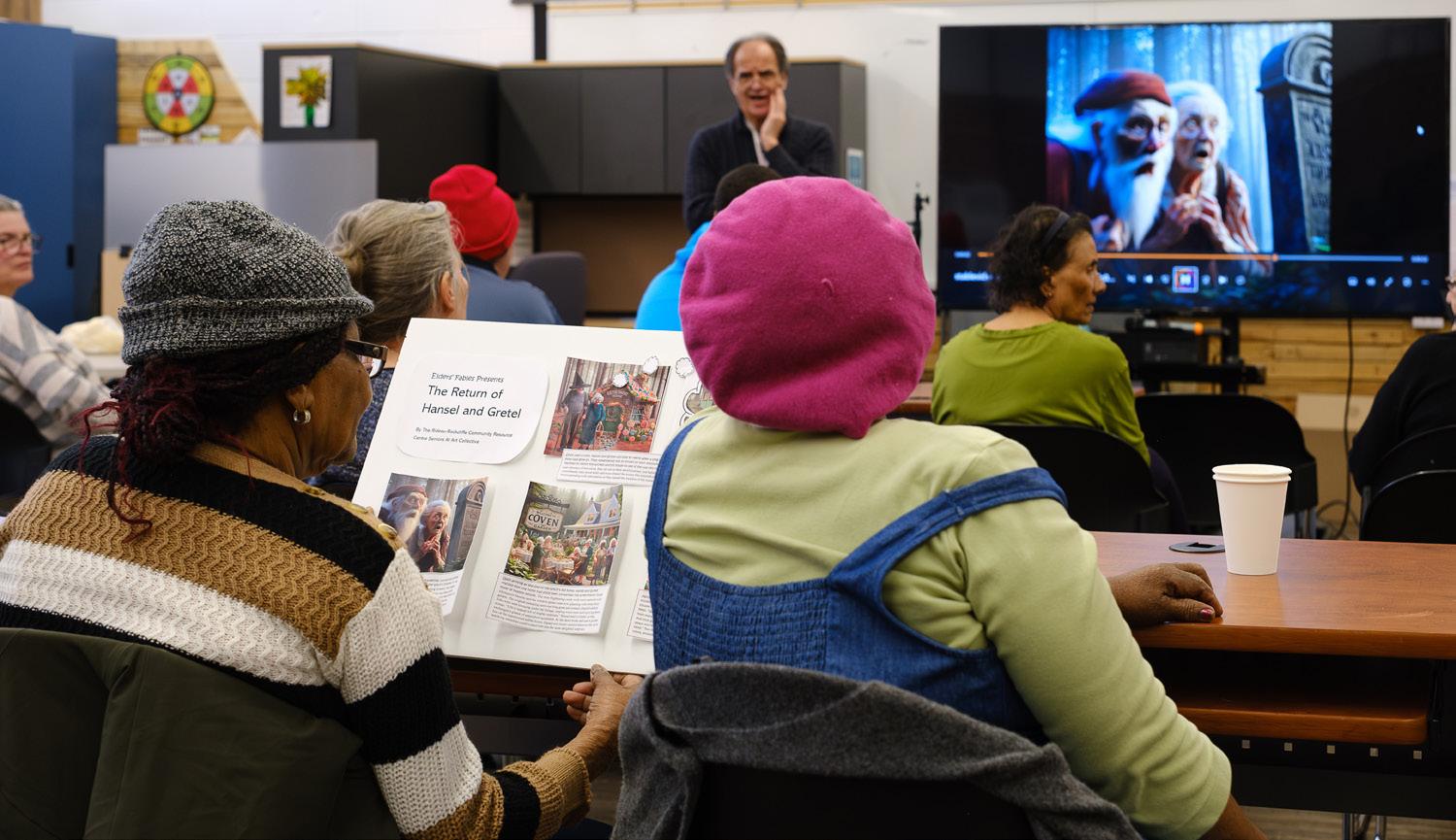
A group of 12 seniors sit in a brightly lit room inside the Rideau-Rockcliffe Community Resource Centre. Their task is simple: together, they must reimagine the story of Little Red Riding Hood.
The seniors bounce ideas off each other to craft the tale, creating a laughter-filled environment while combatting the effects of social isolation that seniors often experience.
“What about changing her name to Li’l Red?” one participant suggested.
“Let’s give her a malicious glint in her eye,” another added.
But the seniors are doing more than just crafting a story. Once the tale is complete, the group brings their story to life using an AI text-to-image software.
As the software’s visualization fills the screen, smiles animate the room as the seniors revel in their creations and share their favourite parts with each other.
Over the last year and a half, this dedicated and creative group of seniors have worked together to create a calendar and a colouring book filled with their own AI-generated images.
“As a community resource centre doing seniors’ programming, you’d think we’d be the last place to see something like AI being implemented,” said Luc Lalande, innovator-in-residence at the community resource centre.
“But I think, if anything, this project is showing that technologies applied in a creative way and ethically can generate a lot of good and promote joy.”
Lalande said the group’s eagerness to experiment with AI and show off their creative side has been encouraging.
“We often put seniors in a stereotype that they’re not creative and not imaginative,” he said. “But it’s just that we never put them in a situation where they can exercise their imagination and creativity.”
For Isabelle Villeneuve, 69, the activity is an important way to bring seniors
together. She said she’s witnessed the impacts of social isolation among seniors in her building, especially for those who are physically unable to leave their apartments without assistance.
“People are very isolated and they’re alone. They have nobody,” she said. “Now it’s like a breath of fresh air to have others to connect with.”
To reimagine Little Red Riding Hood, the group experimented with readingclub.ai, a brand-new software launched only two weeks prior. When prompted, the AI generates additional lines of the story and creates images based on the final product.
Alexis Diamond, software co-founder and professor at the online institution Minerva University, was present at the session and guided the seniors on how to use the software.
“We are trying to get people to see how to make our app as useful and fun as possible, so we see seniors as a really good potential user because they’re connected to young people and they have lots of stories,” Diamond said. “When you help seniors feel good, you feel good.”
The group is now working toward

generating images to form a series of storyboards, which they plan to display at the community resource centre’s upcoming Intergenerational Day event on June 1.
To ensure everyone’s voices and perspectives are included, Lalande said he has started incorporating elements from non-Western fairy tales into the group’s portfolio. Recently, he introduced Haitian folklore characters Ti Malice and Tonton Bouki into a story to engage the group’s Haitian participants.
Lalande said he also plans to bring in Inuit elders in the coming weeks to share stories important to their community, which the group can then bring to life in a series of images.
“I don’t want to just do Western fairy tales that we all know,” Lalande said. I think it’s a great platform for cross-cultural storytelling.”
Despite the predominantly negative focus on AI, Lalande said its ability to facilitate community building when used in a person-centred way should also be celebrated.
“When you centre people at the focus and the AI is enabling stuff rather than AI being the focus, good things happen,” he said.

Models strutted down the runway in earthy garments at the student-led environmentalist fashion show Project Waterway on March 12, showcasing the art of sustainability through a diverse array of fashion designs.
Held at the University of Ottawa, Project Waterway focused on consumer conscientiousness in the age of fast fashion while highlighting students’ role in protecting the Ottawa River.
The catwalk was a joint effort between Unity for Action, the uOttawa Sustainable Development Centre and Ocean Wise, a global conservation organization aiming to protect waterways and oceans.
All designs were created and modelled by uOttawa students. Show sales went to Belong Ottawa, a support organization for marginalized people.
The fashion show’s opening segment, the Beauty of Water, focused on the history and function of the Ottawa River, depicted through pearl satin and colourful embroidery. An immersive, relaxing underwater soundtrack played in the background.
Next, the Anthropocene focused on harm-
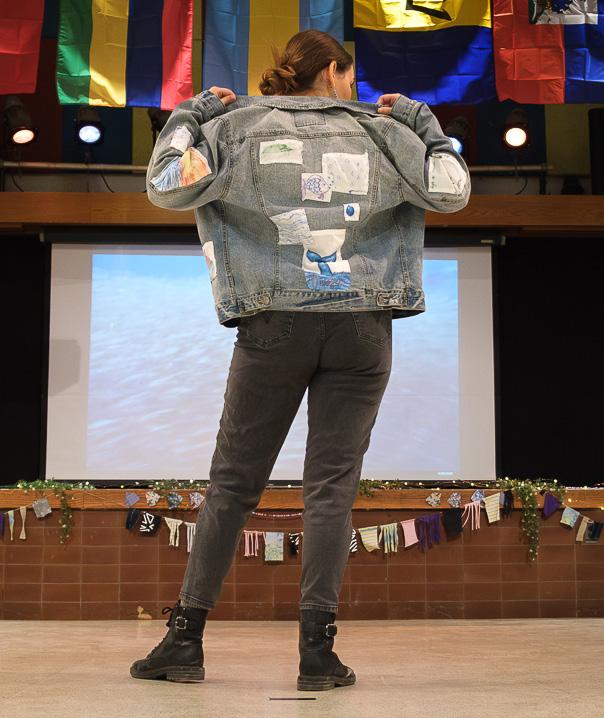
ful human environmental impacts, such as oil pollution and overfishing, through stained green clothes and stitched visuals of fish bones. The final segment, the New Wave, urged attendees to be conscious of their clothing and develop eco-friendly habits.
Sophia Arellano, a second-year environmental studies student at uOttawa and co-leader of Project Waterway, said she felt the runway show “would be a cool way to educate people on the impacts of our fashion.”
“I knew I wanted to do something artsy and somehow incorporate environmental themes,” Arellano said. “I landed on the idea of a fashion show because I love upcycling.”
Arellano said Project Waterway was influenced by 2019 research from the Ottawa Riverkeepers, which discovered microfibres along the Ottawa River.
Microfibres are a form of microplastics originating from fast-fashion synthetic fabrics such as ultrasuede and polyesters. These microfibres can contain toxic chemicals and are challenging to remove from waterways and wastewater treatment systems.
“In all of the samples that had microplastics, there was always microfibres,” Arellano said. “It really opened my eyes and it made me realize we need to be more conscious about the clothing that we’re wearing.”
Arellano said she believes promoting fashion sustainability on campuses will encourage students to choose clothing that is safer for Ottawa’s environment.
She recommends checking the tags on clothing and avoiding synthetic fabrics.
“The beautiful thing about fashion is that it’s a way of expressing ourselves,” Arellano said. “When we incorporate sustainable practices into fashion [...] it makes people realize that fashion doesn’t have to be the next new, flashy, big thing.”
Hana Irwin, a fourth-year communi-

cations student and the Unity for Action uOttawa vice-president of marketing, coled the project alongside Arellano.
Irwin said she was wanted to interested in promote ing the importance of fashion sustainability.
“[It’s] informing people that fast fashion and the fashion industry is just really damaging,” Irwin said. “We can make a difference on our own by changing our own purchasing habits.”
Irwin said she focused on ensuring Project Waterway was a fun, creative outlet for designers and models.
“I think this is a cool way to show outfits that we put together and made in a sustainable way,” Irwin said.
Sasha Emery, a fourth-year environmental studies student at uOttawa, created and modeled their personal designs for Project Waterway
For the show, Emery crocheted a top with reused yarn, which was then pairing ited with thrifted clothing.
“The crochet pattern resembles a fishing net,” Emery said. “My vision [was that] I wanted to look like something being stuck in a fishing net. I wanted to recreate that feeling of being trapped.”
Emery said the show allowed them to express their passion for environmental activism through their craft. They added they hope Project Waterway draws attention to excessive clothing consumption.
“I have always loved design and fashion but I just never really allowed myself time to explore these [passions],” Emery said. “Maybe this form of art, making clothes, is also part of the sustainability movement.”
For Montreal-based artist Tania Lara, geographies are interwoven with human identity. To explore that intersection, Lara turned to embroidery.
“The threading speaks of an active gesture,” she said. “We’re always threading together different parts of our identity, different parts of our communities and different pieces of the environment that surrounds us.”
Lara’s embroidery exhibit Threading Topographic Tales, ran at Gallery 101 from Feb. 10 to March 16. The exhibit featured countercartographic textile maps, audio recordings and video projections to highlight themes of gender-based violence, identity, femininity and imaginings of a brighter future.

Counter-cartographic mapping is a growing practice of creating new maps that further social and political change to challenge existing systems of power.
“Conventional cartography is very bottom-up, where there is one specific truth imposed on ways of moving through the land,” Lara said. “Counter-cartography is wanting to acknowledge that there are infinite ways of living through space.”
The inspiration for Threading Topographic Tales came to Lara while she was studying at the Université du Québec à Montréal and writing her master’s degree thesis on autogeography as an artistic project and research method.
“It’s not a very common concept,” Lara said about the term “autogeography,” describing it as an intersection of identity, land and the body. For Lara, auto-
geography situates identity as something that is “always overflowing.”
“It’s a practice where you put together different pieces of land and territories that surround you—but that includes territories within you as well.”
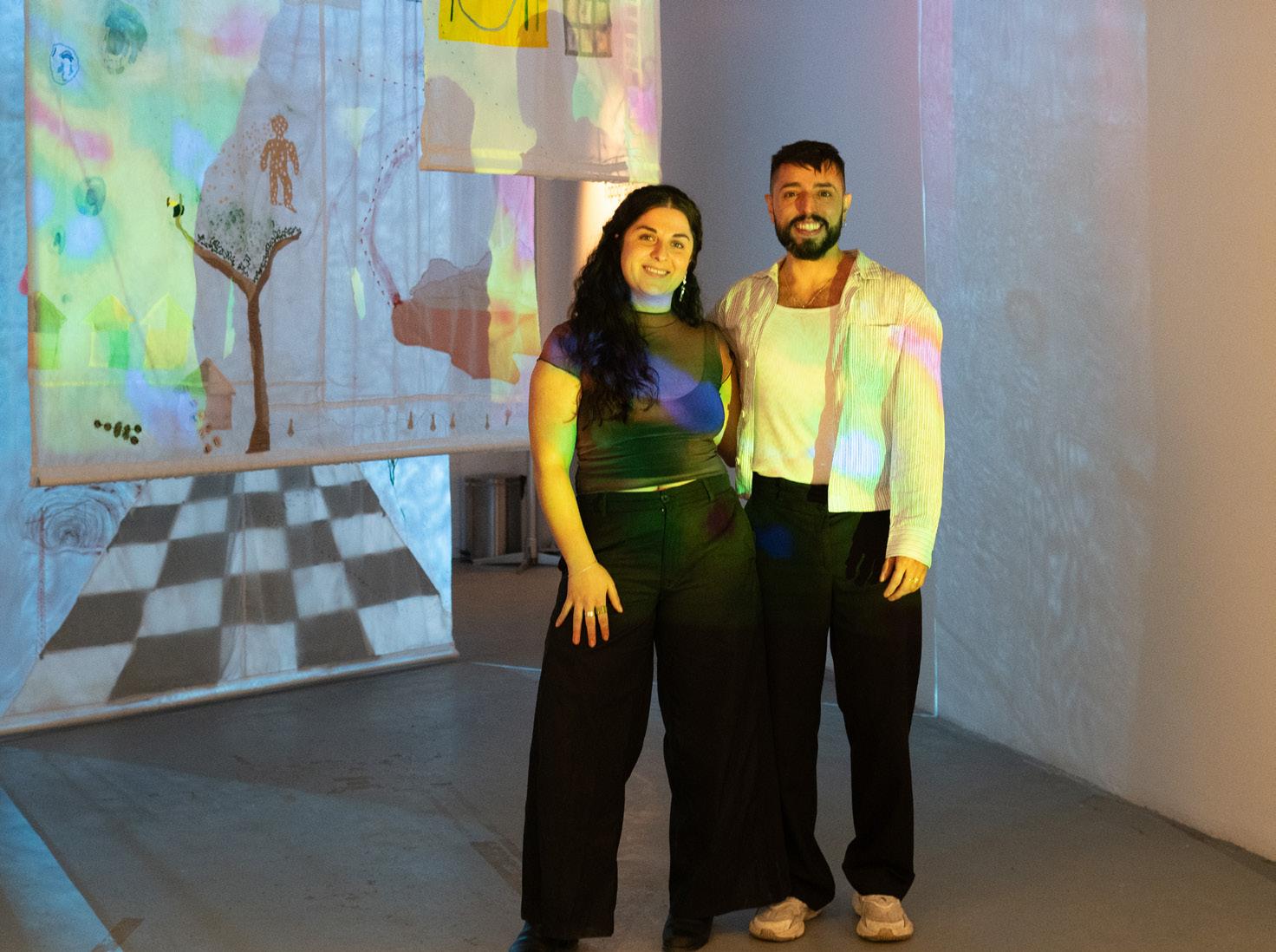
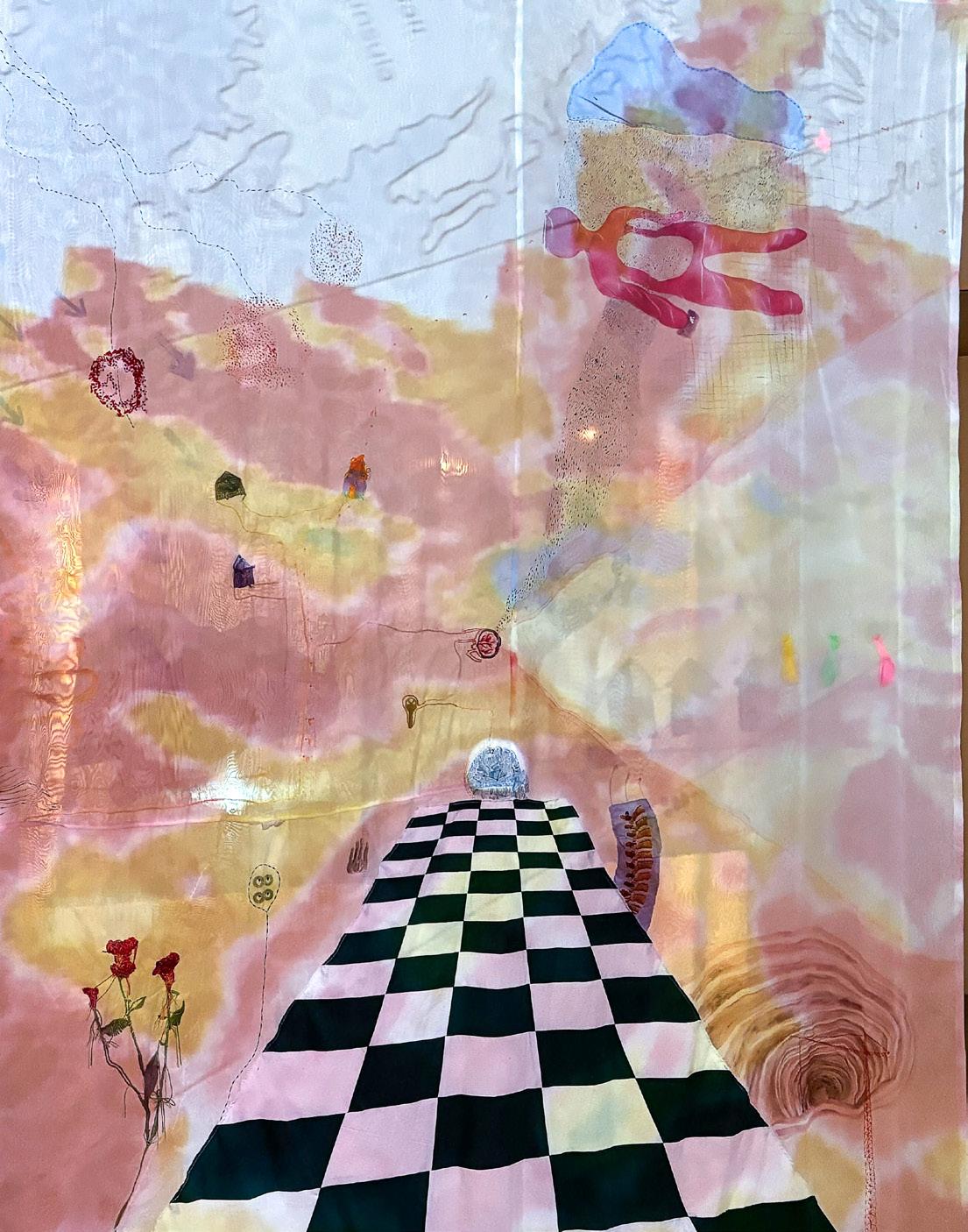
Threading Topographic Tales featured three of Lara’s autogeographic embroidery maps. Near the exhibit’s entrance, “autogeography #4” is a large-scale textile and video artwork created with the help of video technician Karina Arabelaez.
The textile features details of Lara’s emotional and geographic life, including red flowers and a check-patterned pathway.
Maps projected upon the textile symbolize Lara’s intertwining relationship between her identity and land.
“autogeography #2” and “autogeography #3” also explore Lara’s identity by incorporating inspiration from her recurring dreams and emotional landscapes.
“I always dream that I’m on the subway, climbing some stairs, or about the rain. I tried to put all of that into one kind of crazy map,” Lara said.
“Those are very personal,” she added. “It was always my goal to go deeper into my own stories and my own territories, but always with the objective of reaching outwards.”
Santiago Tavera, curator of Threading Topographic Tales, said he and Lara worked together to create an immersive narrative.
“We started by filling the space with Tania’s exploration of her ques-
tioning her own body and identity, then we were able to incorporate moving from the private to the public space,” Tavera said.
Textiles “casa en fuego” (Spanish for “house on fire”) and “pieles vivas” (Spanish for “living skins”) depicted patriarchal structures that target BIPOC and transgender bodies.
“I worked in Oaxaca, Mexico, where I photographed graffiti in the city that touched on gender violence,” Lara said of “pieles vivas.” “I embroidered those graffitis into a type of shawl called a rebozo.”
A long Mexican garment, Lara’s rebozo showed colourful graffiti-style spray painted and embroidered phrases such as “justicia” (Spanish for “justice”) and “me cuidan mis amigas no ta policia” (Spanish for “my friends take care of me, not the police”).
“For me, it was kind of a collaboration with anonymous works. That’s what graffiti is all about,” Lara said. Kristina Corre, administrator of Gallery 101, said the show “builds” from intimate stories to shared understandings.
“The ground floor is more intimate, then upstairs you have communal works where you’re imagining new worlds together,” Corre said.
The second floor of Gallery 101 featured Lara’s collaborative projects. “utopía,” two embroidered canvases with images such as human bodies and a compass, was a collaborative work by 15 women in Bogotá, Columbia. The piece also included a 20-minute audio recording of the artists’ conversations.
“We were trying to think about how we can make our cities better,” Lara said.
Lara added that some of the ideas the artists worked with included imagining parks, streets and hospitals named after women.

“That project was very centred on the thoughts of our craziest dreams,” Lara said. “To be able to create a different world, we have to start by imagining something different.”
The final piece in the exhibit, “tu’ux kumek’kuba’ob lemootsobo” (Yucatec Maya language for “Where the roots meet”), was created by 30 participants from Yaxcabá, a village in the Yucatán peninsula of Mexico.
A picture book displayed the participants’ embroidered work, accompanied by a video and audio clip of the group’s conversations in Spanish about their art.
“I was really interested in the collective part of art making, and how art can be an important factor for social change and community building,” Lara said.
Tavera said he thinks Threading Topographic Tales shows how geography, bodies and identities are not “fully static.”
“Our identities are parts of different intersectionalities that compose us,” he said. “Identities are multiple, everlasting and always in flux.”

Delphine Devos, owner of second-hand clothing business Delirium Thrift in Montreal, has a keen eye for fashion and loves shopping for clothes that make her feel most authentic. But while scrolling on TikTok, she saw something that upset her.
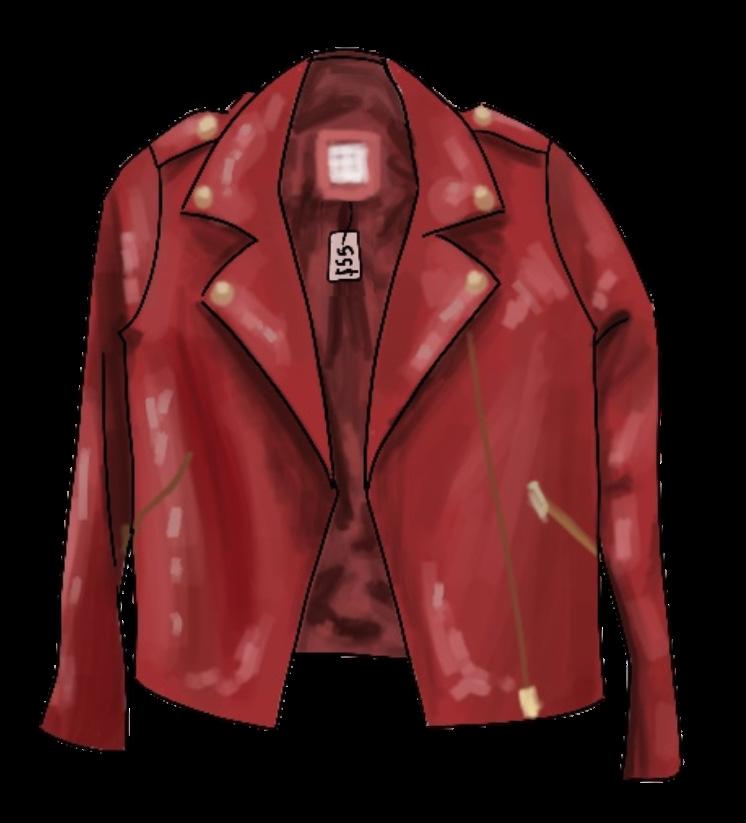
She saw a video of a girl critiquing a new leather jacket she found on a fast fashion website. It was $400, in the colour “vintage black”— a shade meant to create a distressed and pre-worn look.
Devos said it’s “absurd” people will spend that much money on one item from a fast fashion store.
“If you can spend $400 at H&M, you have better things you can go and spend your money on,” she said. “You can get so much more with that $400 by shopping second-hand.”
“Every day, there are at least 30 to 50 similar leather jackets just sitting at your local thrift shop priced at $50 to $100.”
As Canadians continue to face sky-high inflation, the lure of fast fashion — a booming trend before the current cost of living crisis — has only become stronger. Fast fashion refers to stores that sell cheaply made clothes for low prices.
Shein, the “ultra-fast fashion” company based in China, for example, produces hundreds of daily new
styles for its brand. In November 2023, Shein’s mobile app was downloaded more than 275,000 times by Canadians, according to information compiled by TechReport.
While already growing in popularity, the online fast-fashion industry grew exponentially when the pandemic struck, shuttering brick-and-mortar stores.
At Shein, for example, a key retail partner shared in early January that Shein’s annual revenue for 2023 is likely well above $30 billion.
As Canadians struggle to cope with high living expenses, the temptation to buy cheap threads is higher than ever.
Fast-fashion products may be cheap to buy, but they come with a heavy cost on other fronts, from the exploitation of garment workers to toxic waste and excessive water consumption.
The waste generated by the pursuit of instant shopping gratification is staggering: roughly 18.1 billion pounds of garments are thrown away every year when 95 per cent could be reused or recycled, according to ThredUp, an online thrift and consignment store.
However, a growing number of consumers are

looking for alternatives to fast fashion amid a rising awareness of the environmental and human rights toll of trendy cheap clothes.
One of these alternatives is investing in sustainably made clothing. Many sustainable fashion companies strive to use materials that are both environmentally friendly and long-lasting.
Frank and Oak, a sustainable clothing brand based in Montreal, uses materials such as hemp, yak wool, and Seawool—a new yarn-like material made from oyster shells and recycled bottles made from Polyethylene Terephthalate (PET), which is commonly used for packaging drinks.
Elisabeth de Gramont, head of impact for Frank and Oak, said their team searches for innovative solutions to material-related problems.
“Our design philosophy goes beyond deciding to use recycled polyester. It is really thinking about what are different types of fibres and blends that we can use that are both innovative and make interesting products, because we are still an apparel company. We know that people express themselves through fashion,” she said.
De Gramont said the company runs a mill in Taiwan that takes discarded oysters from the food industry to make the Seawool that Frank and Oak uses for some of its shirts and sweaters.
New circular models of material making, where existing fabrics are reused to make new garments, contrast with fast-fashion companies’ widespread use of synthetic fibres.
Frank and Oak was hit hard by pandemic shutdowns and went bankrupt in 2020, de Gramont said.
The company restructured, with new owners coming in to shake things up and save the day. Since then, it has seen “double-digit growth every year,” according to de Gramont.
“The consumer base is expanding, and the operational changes that we’ve made have been very effective
in making the brand better, the product better and the customer experience better,” she said.
De Gramont said a shift in consumer attitudes during the pandemic has contributed. She said the pandemic has made people rethink their fashion choices, choosing to ditch fast fashion instead.
“I think post-COVID, more people have become more conscious about sustainability and the environment,” she said.
According to a report by a UK-based consulting company, the ethical fashion market reached a value of more than $7 million USD in 2022 and is expected to continue growing.
Investing in better materials or pieces that have a longer life beyond trends could also save consumers money in the long run.
Amelia Bennett, a fourth-year bachelor of biology and humanities student at Carleton University, said inflation is causing her to cut down on the amount of clothes she buys
and has prompted her to invest in higher-quality items.
“I only buy things that I know are going to go with other pieces I already own. I also don’t really buy much new clothes, maybe five or six new pieces a year, but I usually invest in high-quality items,” Bennett said.
Kelly Drennan, founder of the Toronto-based advocacy group Fashion Takes Action, said consumers should consider not only the price of the item but also the cost per wear.
“If you’re going to buy something new, make it an investment. If you paid $80 for something, you’re going to cherish it a lot more.”
“Let’s say you pay $20 for something, but it’s super trendy, and you only wear it five times in a season. The cost per wear would be about $4. Now, let’s say you buy something that is less trendy, it’s, like, a black top, and it costs $50. You paid more at first, but if you wear it 25 times this season, the cost per wear is down to $2,” she said.
But not everyone can afford sustainably made clothing or invest in higher-end pieces.
practices.
“If we could teach them that it’s not only the right thing to do, but that it’s cool, chances are that they’re going to spend their babysitting money, or when they get their first job, on thrifted clothes,” Drennan said.
Marie-Michèle Larivée, a trend forecaster and consultant based in Montreal, said that the younger shoppers are becoming more sustainability conscious but don’t necessarily have the money to buy from more expensive brands. She noted this cohort is increasingly turning to second-hand clothing.
Drennan said shopping second-hand is also one of the ways consumers can be more environmentally friendly while not breaking the bank.
“You know, we could probably survive on this planet by just re-wearing what’s already out there […] for the next 50 years or more,” she said.
Raising awareness of the environmental toll of fast fashion among young people and promoting alternatives such as thrifting, are important aspects of Fashion Takes Action’s programming, Drennan said.
“We have been working with students from ages eight to 17 since 2014, and to date, we’ve delivered that program to over 33,000 students across Canada. We can’t change anything if you don’t know what the problem is,” she said.
One of the group’s most notable programs is the #IAmAThrifter campaign for high school students, a social media content creation program that can count towards volunteer hours to promote better fashion
“Fashion is a mirror of society,” Larivée said, explaining that the pandemic has shifted the way consumers think about clothes.
She said the popularity of thrifting and consignment shopping is rising among those wanting to buy sustainably while saving money — a trend that was launched in part on social media by Gen Z shoppers.
“The [looming] recession is only increasing the [interest in] … this movement to buying second-hand,” she said.
Devos said she used to shop solely at fast-fashion stores, but the cost-of-living crisis has put an end to that.
“Of all the things I have to spend money on, fashion is at the bottom of the list. I have to pay for groceries and rent first,” said Devos.
Even before the inflation crunch, Devos said she was disillusioned with fast fashion and felt she was missing something.
“I realized fast fashion doesn’t fulfill my needs in terms of self-expression,” she said. “It’s not because it’s cheap that it means it’s good. I realized that there are so much more clothes out there than what is being sold in-store at the mall,” Devos said.
While living online during lockdowns, she started
seeing TikTok videos about shopping second-hand.
“It was kind of like a discovery. I was like, ‘Oh, wow, there’s so many things out there.’ I can express myself freely without falling into trends,” Devos said.
Devos started to buy more second-hand items over the course of the pandemic during the same time that she launched Delirium Thrift in 2021.
She operates it through the online store Depop, her social media accounts (TikTok and Instagram) and in-person at flea markets in Ottawa and Montreal.
Shopping for second-hand clothing meant she could “still have cheap things” that were “a better investment for the planet as well as the economy of it all,” she said.
Devos said the allure of thrifting is not just the cheap price but also the uniqueness of the pieces.
“Thrifting kind of pushes you to figure out what you truly like, because there are so many things when you go into the thrift store and not one single thing is the same,” Devos said.
Thrifters often take pride in their finds. According to ThredUp, 72 per cent of thrifters say they feel proud to share with others that their outfit is second-hand.
This personal connection with fashion purchases is fundamentally different from what Drennan calls the “disposability mindset” that fast fashion creates.
A similar sense of personal connection is also part of the appeal of sustainable clothing brands, Larivée said, noting that the more value someone ascribes to an item, the more they cherish it.
“I think sustainable brands are really good at storytelling and putting their values in their clothing,” she said.
De Gramont describes a similar dynamic at Frank and Oak, saying that customers talk about having an emotional connection to the brand. She said this is important to “getting people to want to keep something and wear it for a long time.”
Other environmentally friendly options for cashstrapped consumers include making clothes last longer by mending and embellishing them, and thinking of new ways to style old pieces, said Osmud Rahman, professor of fashion at Toronto Metropolitan University.
Renting and trading clothes are also becoming increasingly popular options, he notes.

He imagines depots similar to the “take-a-book, leavea-book” boxes that have been springing up in neighbourhoods in recent years, where people can trade clothes the same way they borrow a book at their neighbourhood’s little free library.
“You don’t need to pay anyone, but after you use it, you wash it and then return it. And then, at the same time, you can also borrow something from other people,” he said.
Devos said she trades clothes with her friends to freshen up her wardrobe.
“When I’m done with a piece, the first thing I do before selling or donating is ask if somebody else would want it or would want to trade pieces,” she said.
Rahman said that consumers can revolutionize the fashion industry by shifting their shopping priorities.
“If we change our mindset and the way we shop, then we can change the whole fashion system.”


Ottawa’s reputation for being boring is simply unfounded when you consider all of the incredible outdoor activities in the city and its surrounding areas. With spring in full swing, it’s time to usher in the season of warmer weather. Dive into this guide to kickstart your spring with a burst of outdoor excitement!
Visiting one of the many sugar shacks in the Ottawa region is a great way to welcome the spring season. Perhaps the most wellknown is the Vanier Sugar Shack. Vanier’s shack is located only a few kilometres from the downtown core, making this sugar shack easily accessible.
The shack aims to keep the tradition of old-fashioned maple syrup production alive. Its workers boil the sap from surrounding trees, producing an estimated 500 litres of syrup yearly. Attendees can get their sugar fix by munching on classic pancake breakfasts paired perfectly with their crafted syrups.
Every year, the fields beside Dow’s Lake burst into a mesmerizing display of multicoloured tulips. These iconic flowers have become Ottawa’s spring symbol, attracting an estimated 500,000 visitors in 2023. The Tulip Festival runs from May 10 to 20 this year, and as always, the lake’s shores will be lined with local vendors ready to provide food and freshly squeezed lemonade!
The Dow’s Lake Pavillion has kayaks available for rent throughout the warmer months of the year. Taking advantage of these
water sports rentals is a must, particularly for Carleton students who benefit from the campus’s proximity to the lake.
In the winter, the canal and its surrounding bodies of water are renowned as skating destinations. However, once the ice melts, it becomes a beloved spot for kayaking and paddleboarding enthusiasts in spring and summer.
Sticking with the theme of locations near Dow’s Lake, the Fletcher Wildlife Garden is a magnificent place for nature lovers to visit. There are plenty of beautiful specimens of plant life in this garden area such as wildflowers, ferns, shrubbery and violets.
The real treat however are all the animals you could see. Per their official website, plenty of bugs, reptiles, birds, and even bats and beavers make up the collection of critters one could encounter while visiting this place.
This is a bit of a unique one, but it’s a great way for those who haven’t seen much
of Ottawa to really get a feel for the city and its attractions.
Virtual escape games are tours guided by your phone that involve solving a bunch of puzzles to reach the game’s conclusion. There are several of these available to download from websites such as Adventure City Games and apps such as Questo. During your scavenger hunts, your memory and understanding of important sites will be tested with puzzles and short quizzes.
Because these games cover so much of the city, you could wind up visiting one of the locations listed here during your gameplay!
Ottawa’s Hog’s Back Falls are a very popular place to visit in the spring. Locat-

ed a short walk away from Carleton University, you could spend hours just mesmerized by the violent yet calming nature of the rushing water.
In May, the surrounding park opens for visitors who want to get a close-up view of the roaring falls or enjoy the surrounding hiking trails. Something is fascinating about Hog’s Back Falls, as it sticks out superimposed over a neighbourhood of cars, buses and bridges.
From the Tulip Festival to virtual escape rooms, Ottawa has something for everyone to discover and enjoy. Spring breathes new life into the city and its surroundings, so get outside and embrace it!






Society is increasingly embracing electric cars (EVs) as the future of environmentally friendly transportation. While battery-powered cars emit less pollution than their gasoline-powered counterparts, EVs are not as eco-friendly as commonly believed.
The world needs to resist the EV frenzy and instead prioritize the enhancement of environmentally friendly public transportation systems and walkable infrastructure for a sustainable and accessible future for all.
The production of EVs fails to demonstrate a commitment to mitigating the physical and environmental impacts associated with the vehicle manufacturing industry. The estimated carbon footprint of the steel materials used by the world’s top 16 automakers was at least 77 million tonnes of CO2 in 2021 and 74 million tonnes of CO2 in 2022.
In addition to being made of the usual steel and plastics that create pollution, most EVs use lithium-ion batteries that are unethically sourced, which has led to safety and human rights concerns for workers who mine for battery materials like cobalt.
line-powered vehicles and EVs, also presents significant challenges. Today’s cities are largely designed around cars, with many infrastructure projects catering to vehicular traffic.
This leads to the continuous expansion of roads and highways, often resulting in deforestation and the disruption of habitats unable to withstand the impacts of industrialization.

Mines often use child labour to produce bags of cobalt, according to Amnesty International. In the Democratic Republic of Congo, the world’s largest cobalt extractor, children work for up to 12 hours a day in the mines, carrying heavy materials for wages as low as $2 per day.
These young workers are deprived of basic protective gear such as gloves, face masks, and other pieces of appropriate work attire and are vulnerable to lung and skin diseases.
Subsequently, the cobalt is transferred to mineral processing plants like Huayao, which then distributes it to battery manufacturers supplying multinational corporations such as Apple, Microsoft, Sony and vehicle manufacturers like Volkswagen.
In addition to ethical concerns, mining has negative effects on the surrounding environment, causing deforestation, erosion, and contamination of local streams and wetlands.
Instead of mass producing EVs, we should promote the best alternative—cycling or walking. Today, people use their cars to travel trivial distances, and developing car-centric infrastructure supports this habit. The environment depends on society getting out of this mindset.
Public transportation will be necessary to cover larger distances. Although there are definite questions to be answered about the environmental impact of buses and rail systems, a large number of people ultimately rely on these systems, and there is ample potential to develop eco-friendly alternatives.
Better public transit systems worldwide could alleviate the need to manufacture millions of cars.
Electric vehicles are not the magic solution. Instead, we need more governments to invest in accessible, cheap, working public transportation and infrastructure that encourages cycling and walking rather than increasing reliance on cars.
Despite being marketed as an environmentally friendly wonder, “green vehicles” still present many flaws. Society can and should do even better in reducing its overall footprint.
Infrastructure that prioritizes cars, including both gasoGraphics by
 alisha Velji

Trailing 58-54 to the No. 1 ranked team in U Sports basketball with one quarter remaining in the championship final, Carleton Ravens guard Kali Pocrnic said she didn’t have a doubt in her mind.
“When I look at my team, I trust them completely,” Pocrnic said of a roster that was largely unchanged from its 2023 variant. “I know I have 15 girls that have my back, so it was never really a doubt because I knew we’d pull through.”
Pocrnic’s seven fourth-quarter points were a large factor in the Ravens’ eventual 70-67 win over the Saskatchewan Huskies, which earned the program its third-ever U Sports banner in Edmonton.
But she would never admit that.
“I guess numbers-wise it does look like that sometimes, but I have to give
them down and I will do anything for the team.”
Rather than asking Pocrnic herself, it’s better to let her coaches and teammates do the praising.
“There’s no one else in the country I’d want to have leading our team,” head coach Dani Sinclair said after her team’s quarterfinal win against the UFV Cascades. “She just wants the team to win. She’s our leader and the most selfless one you could ever imagine. Just a pleasure to coach.”
“Every time she plays, I’m just speechless,” Ravens guard Tatyanna Burke said after the Ravens’ semifinal win over the Queen’s Gaels. “There are no words because I’m always in awe.”
The path to such immense success wasn’t always so clear. The undersized five-foot-three guard has put in the work to get where she is today.

“I came into Carleton and I could not shoot the basketball at all,” Pocrnic said. “My coaches were able to push and train me to become the shooter and player I am today. So winning MVP and two national championships with my team is just crazy.”
Pocrnic wasn’t named to the U Sports’ season-ending All-Canadian First Team, which now looks laughable given her backto-back tournament MVP and champion status. Pocrnic averaged 15.1 points per game in the OUA regular season, but averaged 21.7 in the national tournament, where it mattered most.

With most of the team eligible to return next season, there are plenty of reasons for Pocrnic to stay along the quest of a championship three-peat. Only guard Océane Kounkou and forward Hadeza Ismaila are ineligible to play next season.
Pocrnic is graduating after this term with a bachelor of arts in psychology but has one year of eligibility left.
For now, Pocrnic is taking a break before she makes her next move. Besides, she said she’s been swamped with school work since returning from Edmonton.
“For the last two weeks since playoffs started, I have pushed everything aside,” Pocrnic said.
When her bachelor’s degree is finally secured, she’s looking forward to working her fifth summer at Terra Greenhouses in Milton, Ont.
“I really need breaks from basketball sometimes just to think about other things,” Pocrnic said. “It’s nice when you start to miss the sport that you’ve been playing, so just having a month off is really crucial.”
Pocrnic said there is a pull to play ball in Europe, where many of her former Ravens teammates have flocked.
Emma Kiesekamp, Pocrnic’s former teammate and the first Ravens women’s basketball player to win two U Sports championships, played her first season for BS Leiden in the Netherlands this year.
“That’s definitely an option for me, and I think it would be really, really cool,” Pocrnic said.
“This program is amazing and there’s so many opportunities that it gives you,” Pocrnic said. “I knew coming into Carleton that they have that kind of mindset where they’re just trying to make you the best you can be. To see that work for a lot of people is extraordinary.”

The Lennox is centrally located, close to transit, restaurants, entertainment, and everyday amenities + open green spaces, and the Rideau Canal - the best that Ottawa has to offer.