2026 Jockey International, Inc. All rights reserved.
Printed and bound in the United States of America. No part of this publication may be reproduced or transmitted in any form or by any means, electronic or mechanical, including photocopying, recording or any information storage and retrieval system now known or to be invented, without permission in writing from Jockey International, Inc. 2300 60th Street, Kenosha, Wisconsin, 53140, except by a reviewer who wishes to quote brief passages in connection with a review written for any media.
Produced for Jockey International, Inc. by CorporateHistory.net, Tallahassee, Florida.
www.corporatehistory.net
Author/Editorial Director: Heidi Tyline King
Creative Director and Designer: Charity Myers
All trademarks and service marks and registered trademarks and service marks used herein are the property of their respective owners.
All photographs, advertisements, and images included in this publication are used under license or are the exclusive property of Jockey International, Inc. Unauthorized copying, reproduction, or distribution is strictly prohibited without written permission from Jockey International, Inc.
“
As a privately held company, we have the luxury of taking the long view. Even as there have been monumental changes, in many ways, things haven’t changed since the days of Reverand Cooper. The common thread from the beginning of Jockey has always been, and will always be, to serve people, to take care of people.
”
—Debra S. Waller
CONTENTS
Chapter One FAMILY
Chapter Two INNOVATION
Chapter Three SELLING AN IDEA
Chapter Four MARKETING A BRAND
Chapter Five CULTURE
Chapter Six GLOBAL REACH
Chapter Seven GIVING BACK
Born of necessity and prayer.
Fortified by ambition, hard work, ingenuity , and luck.
Driven by an unwavering sense of fairness, decency, and goodwill.
Inspired to meet human need, with an iron will to fill it.
At every turn, motivated to do well by doing good unto others.
Chapter One
FAMILY
“[We were] easily persuaded to buy more machines, and then were shown how nice it would be to manufacture our own yarns, and also that it would be better to have our own mill in which to operate the machinery …. We were so green, that these different things did not mean anything to us except that it would seem nice to have them …. We were not so green but that we realized we had assumed a heavy financial load; in fact, we were almost terrorized with the weight of the responsibility we had assumed.”
-Henry S. Cooper
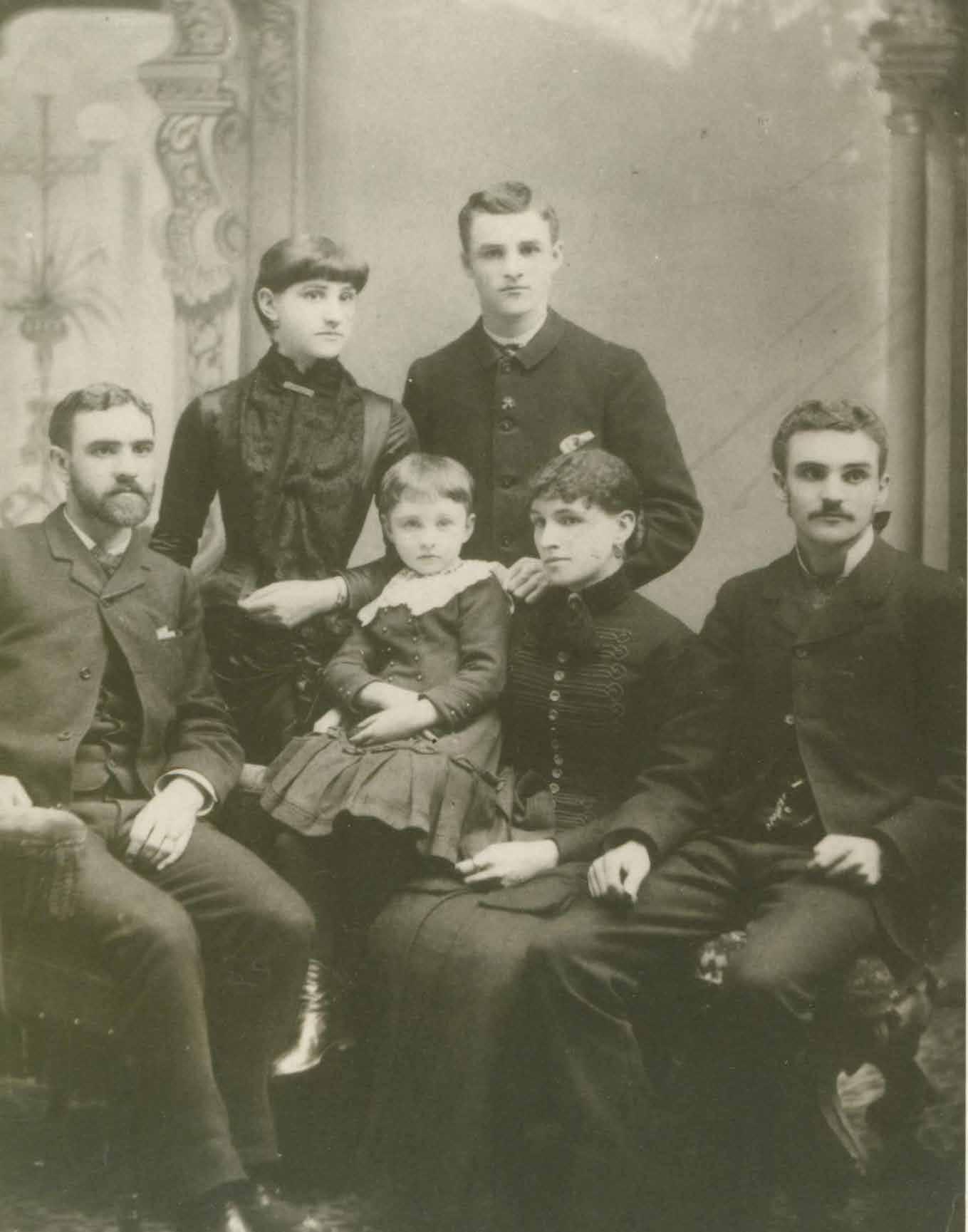
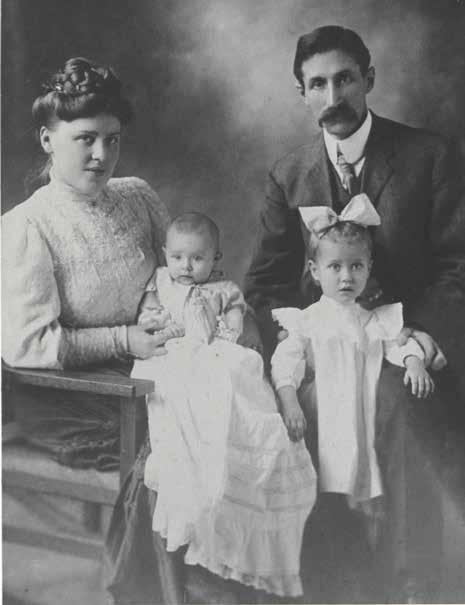
Front: Willis, Stella, Lillie and Henry Back: Anna and Charles
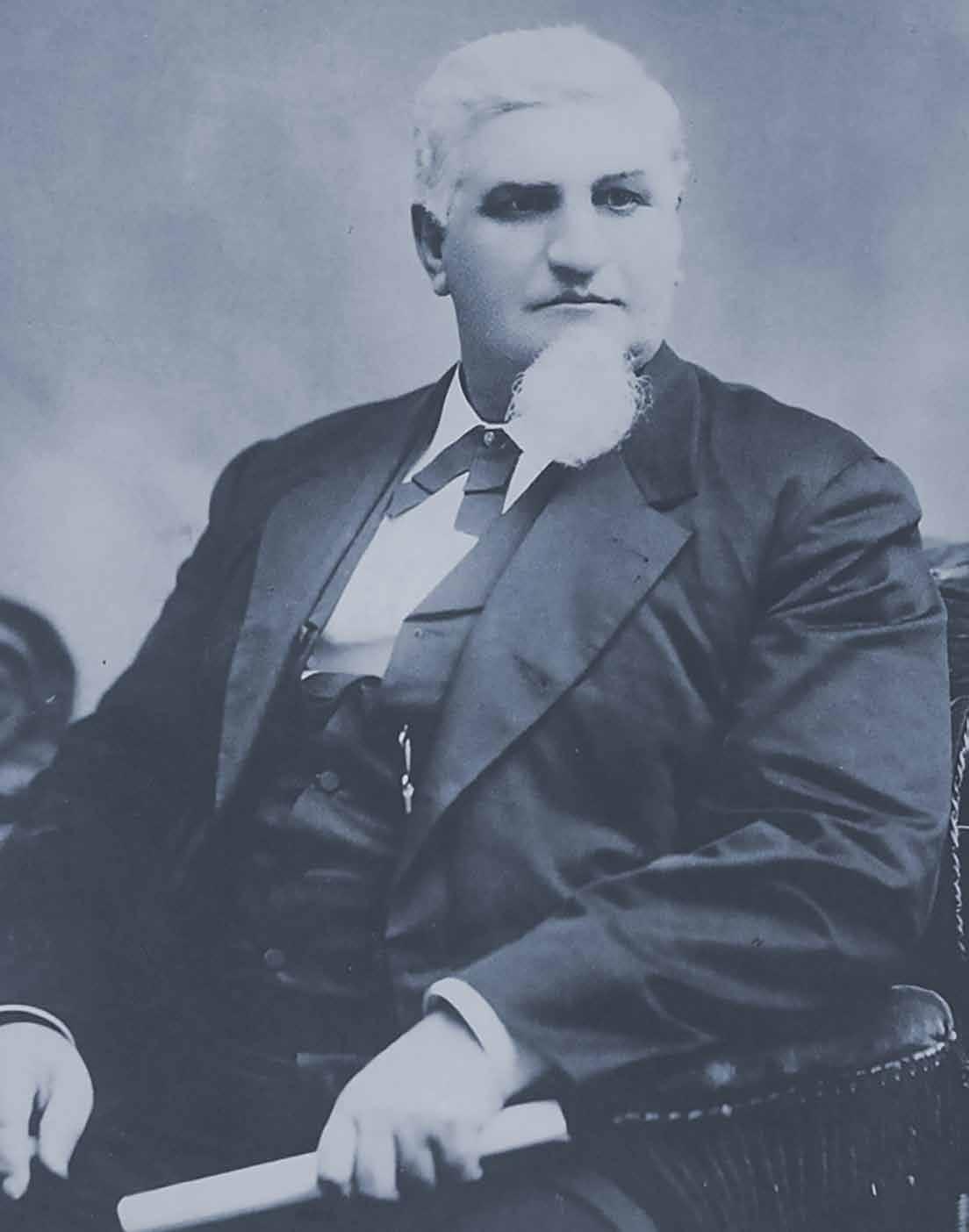
To understand the fundamental values that have defined Jockey International for 150 years, one must understand its founder, Samuel T. Cooper. And to understand Samuel T. Cooper, one must travel back to the 1840s when he heard the call, mounted his horse, and took off for the frontier settlements flung across America’s untamed, wide-open plains to share the gospel…
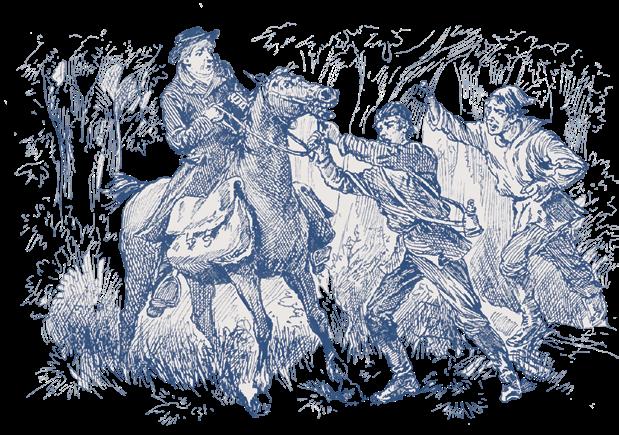
Many a man has been stirred by the Spirit of the Lord but few with the fervency of the Methodist circuit riders of the 1800s. Moved by conversion and lured by the prospect of adventure beyond the family farm, they spent weeks away from home, often riding up to 500 miles to cover their assigned circuits. They relied on creativity and ingenuity for survival and sustenance. While the grueling conditions refined their character and deepened their faith, they could also be deadly: Nearly half died before the age of 30.
Most were young and poor with no formal education. They passed long hours alone by reading the Bible and in doing so, became “efficient interpreters of a larger life … and developed a keenness of mind and a readiness of wit that has rarely been equaled.”
It was this “wit” that drew hundreds of people from as far as twenty miles away to their camp revivals. Because these gatherings sometimes lasted as long as nine days, a traveling preacher’s effectiveness depended on his ability to captivate an audience. As such, the circuit riders became masters of extemporaneous storytelling, selling the “good news” with such contagious zeal and “holy, knock-em down power” that, when unleashed in their animated, elevated voices, “poured forth a torrent of burning exhortation, which would make the stouthearted quail before him.”
Such was the world and ideals that shaped Samuel Thrall Cooper. Fairness, decency, and an overwhelming desire to serve ran deep in Samuel’s character. Unlike most circuit riders, Samuel had attended Asbury College (now DePauw University) during his stint with the Greencastle Circuit in 1847. He was “dignified in manner, chaste in style, apt in illustration, a forceful and effective gospel preacher, with a remarkable gift in exhortation.” Throughout his life, Samuel remained strengthened by his faith, unflappable in the face of adversity, and committed to the greater good in every endeavor — the same core values and convictions that, one hundred and fifty years later, can still be found interwoven into the very fabric of Jockey International, Inc.
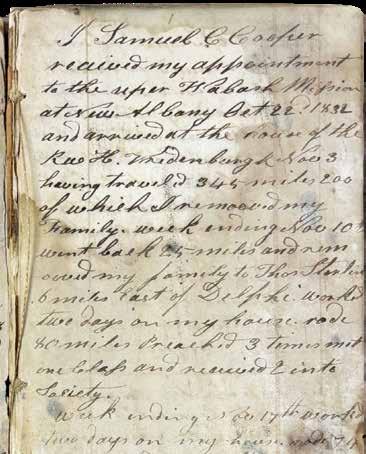
Above, left to right: Samuel Cooper diary Circuit Rider illustration from book ??
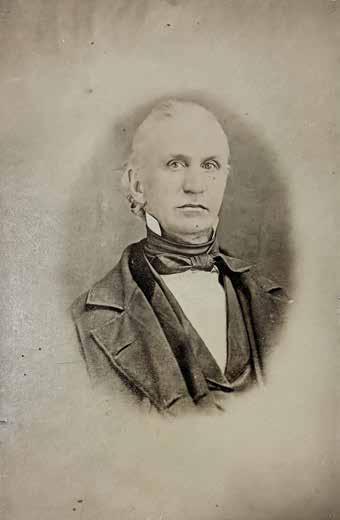
Samuel T. Cooper, date?
Increasingly our captains of industry labor under the delusion that serving one’s fellow man is the exclusive occupation of clergy and others who advance charitable causes. In truth, humble devotion to serve one’s fellows is the surest foundation for a prosperous market-driven enterprise.
-Willis W. Cooper
In 1871 at age 47, Samuel found himself at a crossroads. Active in church leadership and on the Board of Trustees for Northwestern University, a buggy accident that had left him with a bum leg and on crutches for three years forced his early retirement as a circuit rider. Preaching was not a lucrative profession, and Samuel was not motivated by money, but circumstances couldn’t be ignored. With a wife and five children at home, he needed a job. He had followed his father, Samuel C. Cooper, one of the most popular preachers in the North Indiana Conference, into the ministry; now, hoping to prove himself to be as “shrewd a businessman” as his father was considered, he embarked upon a new career selling school furniture for A.H. Andrews Company.
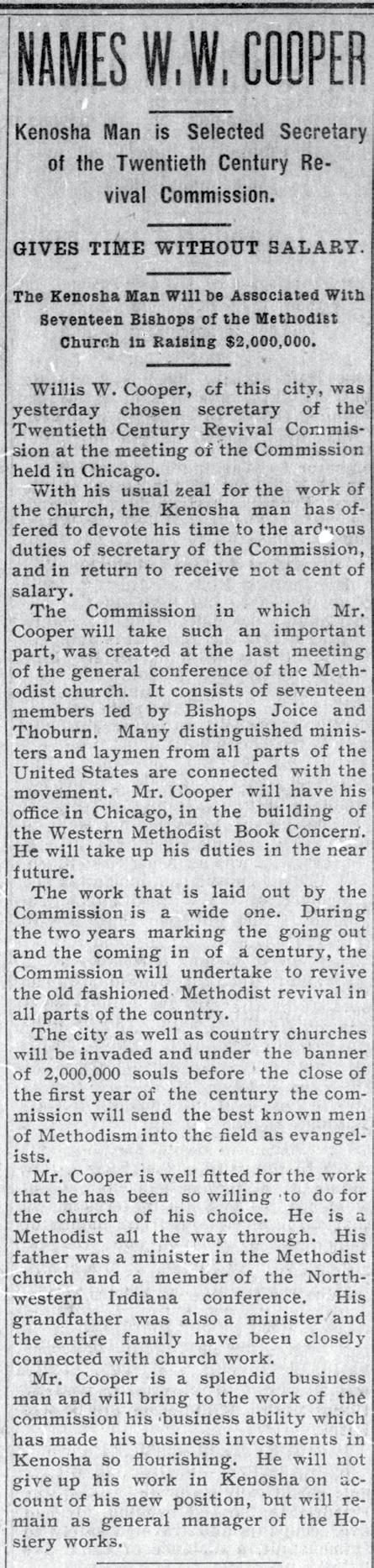
That same year, the oldest of his five children, Willis, struck out to build a life of his own. At age 17, he moved to St. Joseph, Michigan, to work for Abel W. Wells, a former lumberman and contemporary of his father’s in the Methodist church who manufactured splint baskets for peach shipments. Willis was a go-getter: gregarious, astute in business, and civically active even at a young age. Wells recognized his potential and quickly promoted Willis to a management position with stock options.
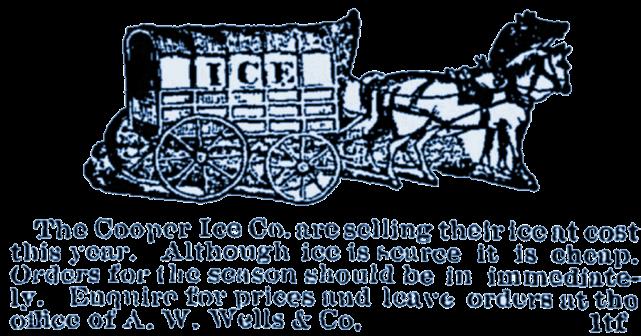
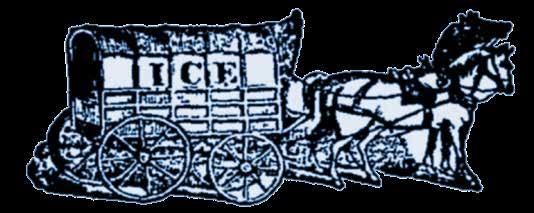
Whether influenced by Willis’ success, Samuel’s desire to have the family together, his restlessness in working for someone else, or all three, in 1875 Samuel moved his family to St. Joseph, Michigan, and in 1876, started the Cooper Ice Company — that’s right… ice, not socks
A desire to do what’s right, to serve rather than sell is the foundation, the unchanging raison d’etre upon which Jockey International is built, an unbroken thread of promise and pride connecting the company’s past with its present. However, the Cooper family’s first business venture dating to 1876 was in ice— a fitting trade given that the Cooper Ice Company was also started to satisfy the human need for comfort — in this case, keeping cool instead of staying warm.
Local newspapers touted that “Cooper Ice is quite popular in St. Joseph,” “Ice for the Country,” and “Keep Cool,” demonstrating Samuel’s knack for adapting his ministerial “exhortations” to marketing even in his earliest entrepreneurial venture.
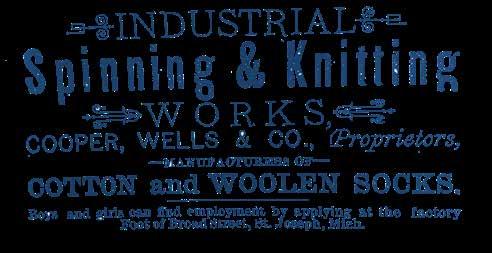
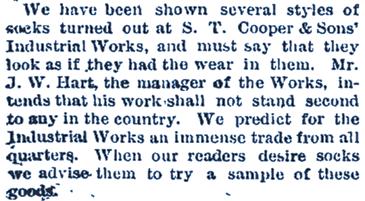
The shift from ice to socks occurred in 1878, when Samuel jumped feet-first into the manufacturing business. With the purchase of six used knitting machines, he started S.T. Cooper and Sons’ Industrial Spinning and Knitting Works, maker of heavy-duty all-wool stockings for men. Capital came by way of Samuel’s good name, a name synonymous with integrity, hard work, and honest dealing.
example of caption for photos in book caption example here
CREATING A BRAND OF COMFORT
Samuel intuited that manufactured clothing was the future of the textile industry, but according to his younger son, Henry, in The Story of Cooper’s Quality Since 1876, written in 1912, it was more likely a combination of his perennial optimism and belief in the good of mankind. If truth be told, “my father and my brother, Willis W. Cooper, and myself were roped into the business; that is, we did not really go into it voluntarily,” Henry wrote.
Henry, just 18 at the time, began working for Samuel while Willis continued to work for the basket company, at first assisting when he could but eventually joining his father’s venture fulltime in 1881. In 1879, Abel Wells bought into the firm. The name changed to Cooper & Wells, with A.W. Wells as president and S.T. Cooper as vice president.
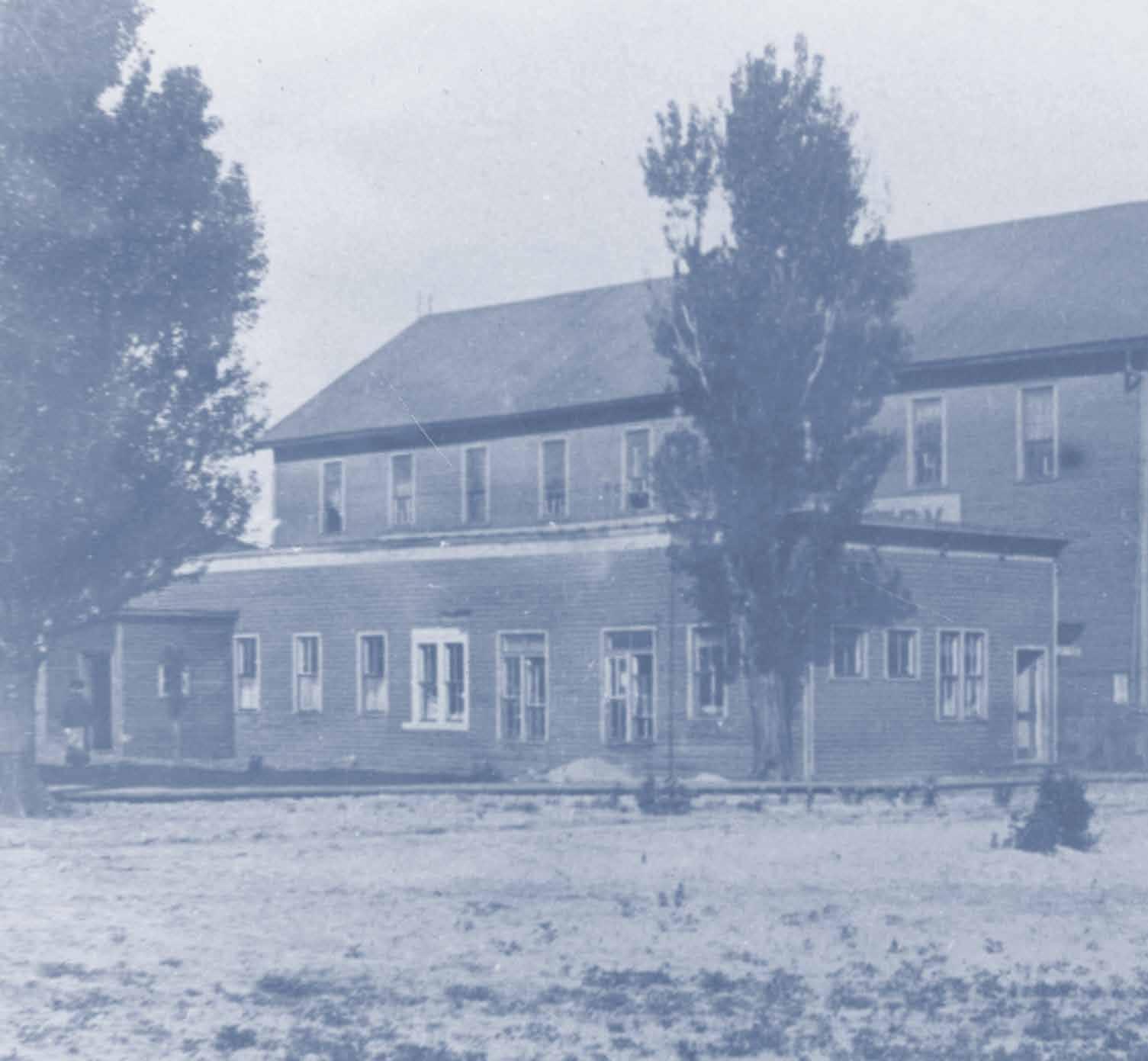
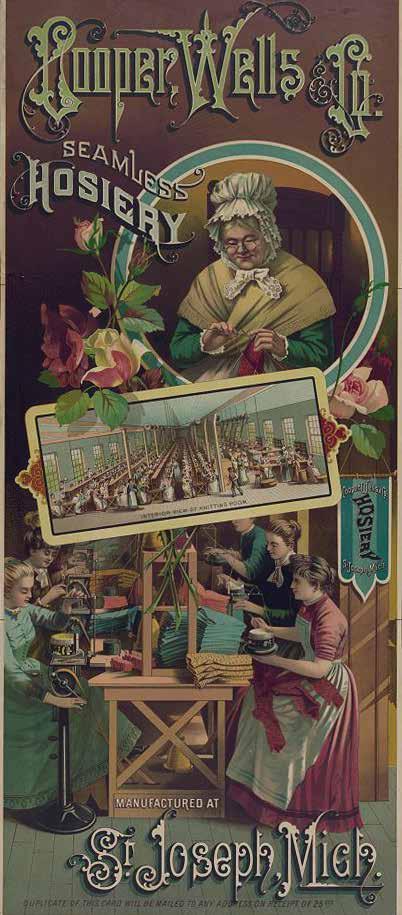
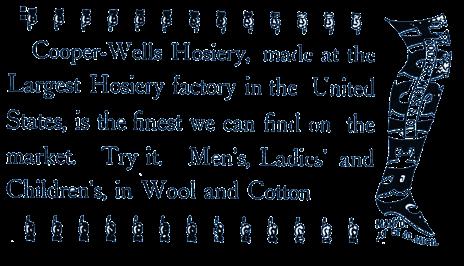
The partnership played to the men’s strengths: Willis and Henry’s gift for management and innovation, Samuel’s marketing acumen, and Wells’ financial experience. By 1879, “Cooper Industrial Spinning and Knitting Works was running day and part of night” as the largest hosiery mill in Michigan.
example of caption for photos in book caption example here
So where did the company lore of making socks for lumberjacks originate? The first written mention of lumberjacks popped up in 1912 in the aforementioned history of S.T. Cooper and Sons. Wells was a “keen and able businessman” who believed that “there is always a consumer demand for honest goods.” While visiting his brother’s general store in Morris, Minnesota, he observed farmers’ wives coming in with homemade socks to trade for supplies followed by lumberjacks who came in to buy the durable, all-wool socks. Wells then took the idea back to Michigan, one of the largest producers of lumber in the country at the time.
It’s a plausible story: Wells was a former lumberman, and he did visit his brother often in Minnesota. However, it’s important to consider the source: an “as told to” story written by a family friend in a booklet given out to customers, “Compliments of Cooper Underwear Company.” Furthermore, eloquent exhortation ran deep in the Cooper family, and Henry had a proclivity for exaggeration. It could be that Henry, a brilliant marketer who, by his own account, was keen to get back into hosiery, could have embellished the story as a new angle to sell socks. And then there’s the matter of time. Thirtyfour years had passed, according to Henry, and like most stories reflected upon after the fact, then tend to grow bigger and better over time.
Regardless of whether lumberjacks made a run on Cooper and Sons socks, within two years, the company had a monopoly on the trade and a reputation for honest, reliable goods — a reputation that even today, continues to define Jockey International worldwide.
Samuel Cooper died unexpectedly in 1892, leaving his sons a legacy of doing well by doing good to others. According to an 1892 church record, “while prosperous and ‘diligent in business,’ Samuel was ‘fervent in spirit’ serving the Lord … he went out into the waste places, organizing societies, building houses of worship, contributing liberally of his own means, and thus multiplied hundreds of souls to
Soon after, his sons sold their shares in Cooper & Wells. Henry went to work for what became Dow Chemical Company in Midland, Michigan, while Willis and , Samuel’s youngest son, moved to Kenosha to join Chicago-Rockford Hosiery Company.
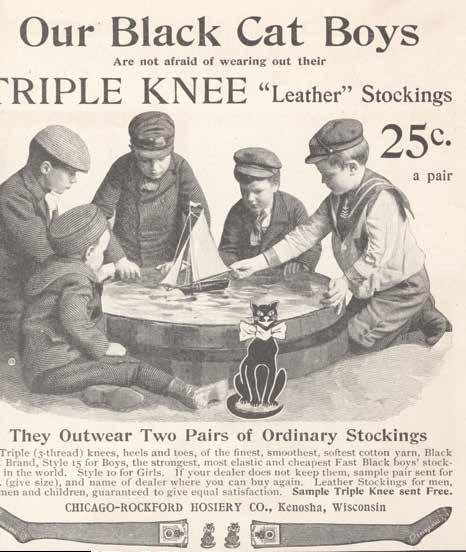
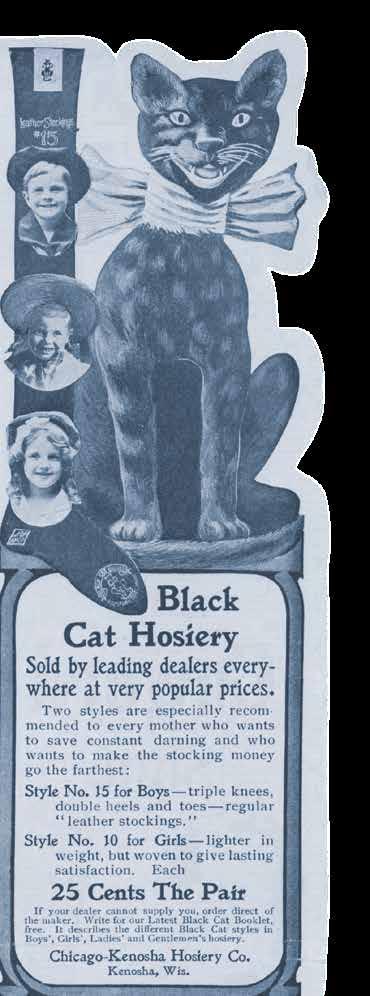
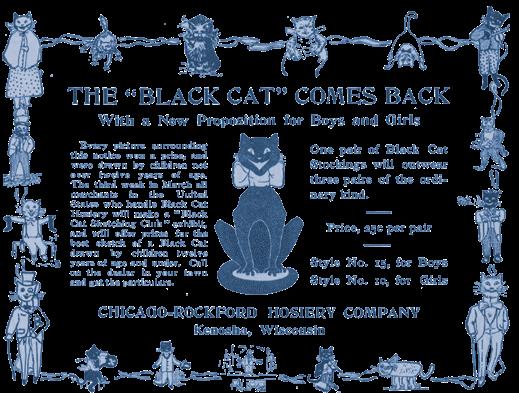
Black Cat Hosiery advertisements, 1898 and 1904
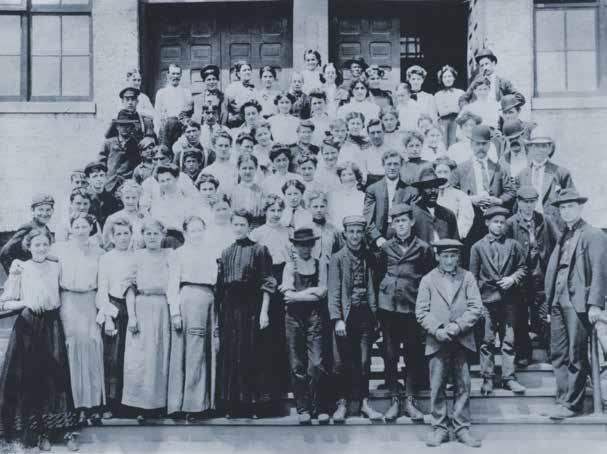
Right page, left: Cooper employees, 1902
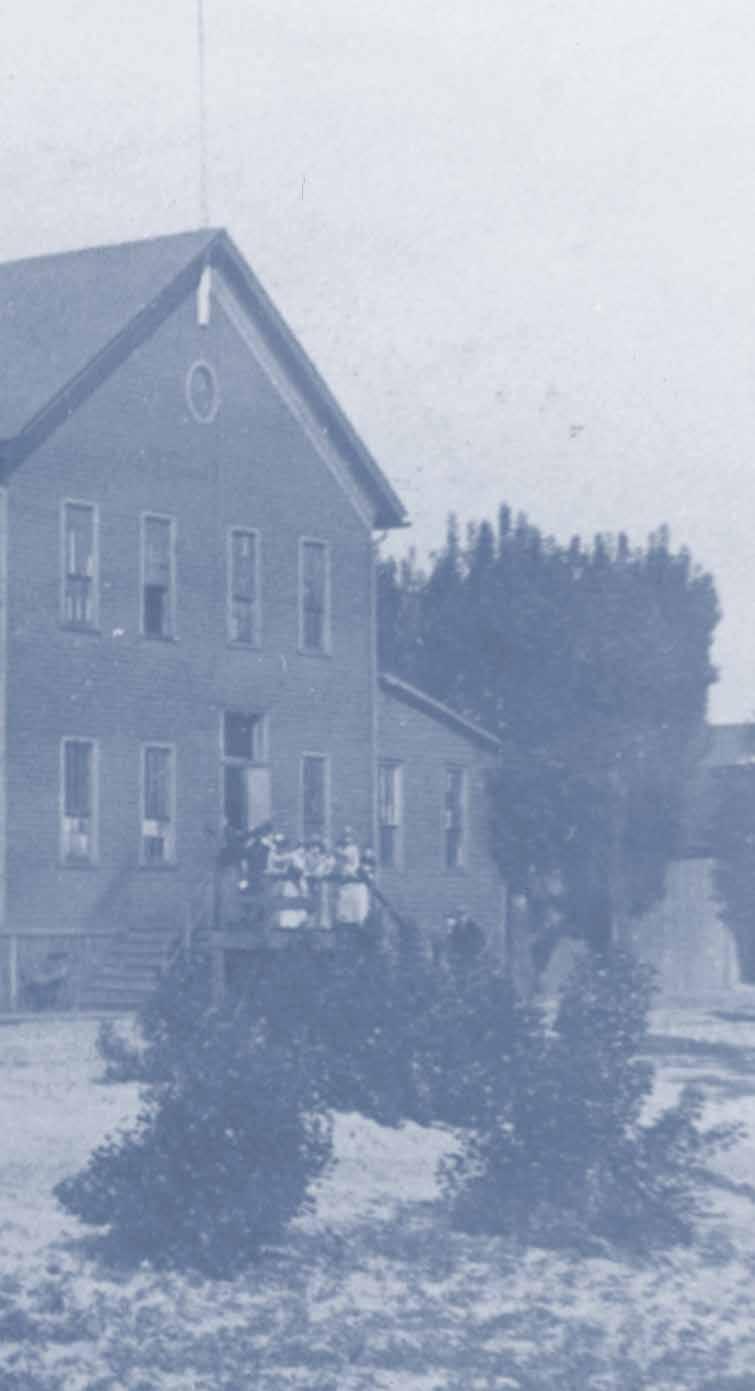
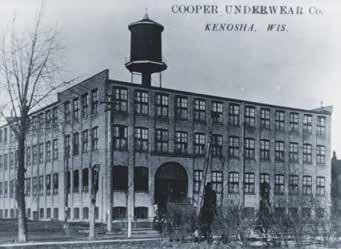
Right page, top right: Chicago-Rockford Hosiery Mill in
Right page, bottom right: Cooper plant, Kenosha 1903
In keeping with the disciplined work ethic instilled in them by their father, the brothers rose through the ranks and reinvested their profits, a move that ultimately gave them control of the company. Their BLACK CAT hosiery for men, women, and children became a household name known for its quality and was sold using the same direct-to-retail sales methods pioneered by Samuel Cooper.
The Cooper brothers approached their personal lives with the same integrity and verve. As Methodists, they fostered a strong sense of community and responsibility to the greater good through involvement in local organizations. Charles served as a Village Official in the office of Recorder and formed several civic groups, including the Masonic Temple, Hospital Association, and Kenosha Manufacturer’s Association. Willis was active in the regional Methodist movement, trustee for Albion College and Lawrence University, and a leader of the Prohibition Party, running unsuccessfully as the 1898 candidate for lieutenant governor. Both were instrumental in the formation of the Kenosha YMCA and deeply involved in the Park Avenue M.E. Church, Willis as head of the church board and Charles as leader of children’s programs and the choir.
They also continued to innovate. The men’s underwear market was rapidly expanding, and Willis and Charles recognized the sales potential of offering products to complement their hosiery line. In 1900, despite majority ownership and management responsibilities with the hosiery company, they persuaded Henry to join them in a new partnership to manufacture underwear.
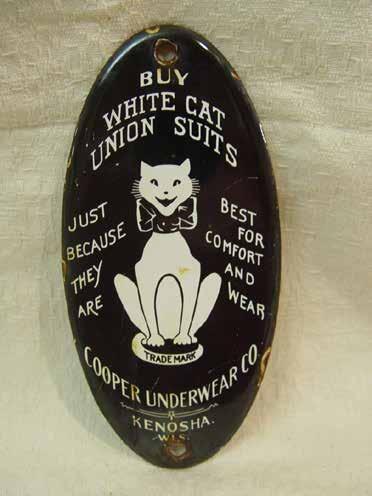
Committed to quality, the company entered the market with a union suit and matching shirt and drawer marketed under the WHITE CAT name. Pleased with the growing volume of sales, in 1903 the brothers constructed a new mill east of the ChicagoRockford Mill (later renamed the Chicago-Kenosha Mill) and the present location of Jockey International. And later that same year on September 13, a new era began when they incorporated Cooper Underwear Company.
There comes a time in the life of every business when uncontrollable circumstances either destroy or define its future trajectory. The tragic deaths of Willis and Charles Cooper in the 1903 Iroquois Fire in Chicago were one such touchpoint for Cooper Underwear. Not only was Henry left to oversee two companies but bound by duty and the strong familial bonds that characterized the Cooper family, he was suddenly responsible for three families: his wife and eight children, Willis’ wife and daughter, and Charles’ two young children who were now orphaned since their mother had died the year before.
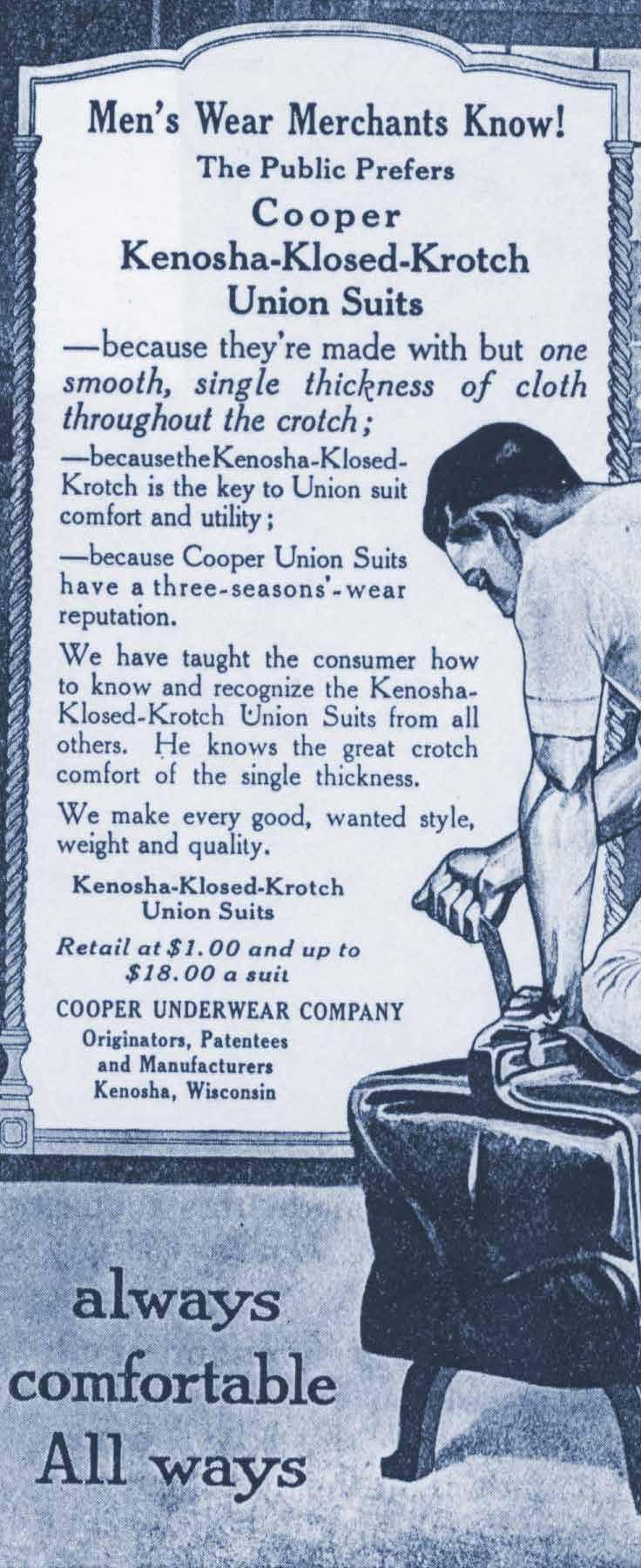
With the same mettle that drove his father and grandfather before him, Henry charged forth, not only keeping the companies afloat but increasing revenues at the hosiery company over 100 percent from 1903 to 1910. Cooper Underwear also prospered, evidenced by the “200 dozens per day” manufactured in 1907. With the success of the innovative “KENOSHA KLOSED KROTCH,” introduced in 1910, combined with a change in major stockholders in the Chicago-Kenosha Hosiery Company in 1912, the family business underwent a second shift from socks to underwear when Henry sold his shares in the hosiery company in 1913 to focus solely on Cooper Underwear.
Henry Cooper was visionary but grounded, an “intelligent student of conditions and a masterly marshal of resources” and the embodiment of Jockey’s guiding principles of creativity, quality, and family. As a curious entrepreneur who embraced calculated risks to drive innovation, he moved to Tennessee to operate a saw mill with a friend and later traveled to Mexico and Central America to investigate coffee growing before committing to Cooper’s fulltime. At Cooper’s, he championed novel products, pioneered revolutionary sales techniques, and implemented unprecedented ways to reach the customer.
In his later years, he spent his free time cultivating peonies, an apt analogy for the way he conducted business: “He never wasted time or resources but held that both were given to him in order that he might do something which would add something to the comfort or the happiness of others.”
Kind and courteous, he was singular in his devotion to the business and above all, family, which extended to the “Cooper
Family,” one that “was not one bound by the ties of blood, but one bound by the ties of closest personal interest of employee and employee.” When Henry died on October 25, 1924, his obituary stated that to his employees, his passing was not that of a boss but of a friend.
Henry’s death aggravated the obstacles the company faced in the 1920s. For starters, sales stagnation and falling profits weakened the Cooper Underwear Company’s financial position. While Cooper’s had created a lighter union suit to meet new trends in clothing after World War I, they no longer held the competitive edge. An increase in imported goods cut into profits.
A larger issue concerned governance. Robert S. Cooper, Henry’s son, led the Cooper Underwear Company as president from 1912 to 1930 — at least on paper. Yet Henry actively controlled the company until 1919 and was involved in management up until his death. Furthermore, almost every member of management was a relative. For the first time, the company wrestled with the interpersonal conflicts, leadership transition, confusion of roles and boundaries, and generational differences that eventually challenge most family businesses.
Robert proactively managed these issues and did his best to foster growth and harmony. Under his leadership, the company re-entered the hosiery business and quickly became one of the largest distributors of socks and stockings in the country. He expanded the factory, improved employee benefits and, recognizing the need for new ideas, brought on Arthur R. Kneibler in 1928 to reorganize marketing and sales — the very Kneibler later credited with the development of Jockey underwear.
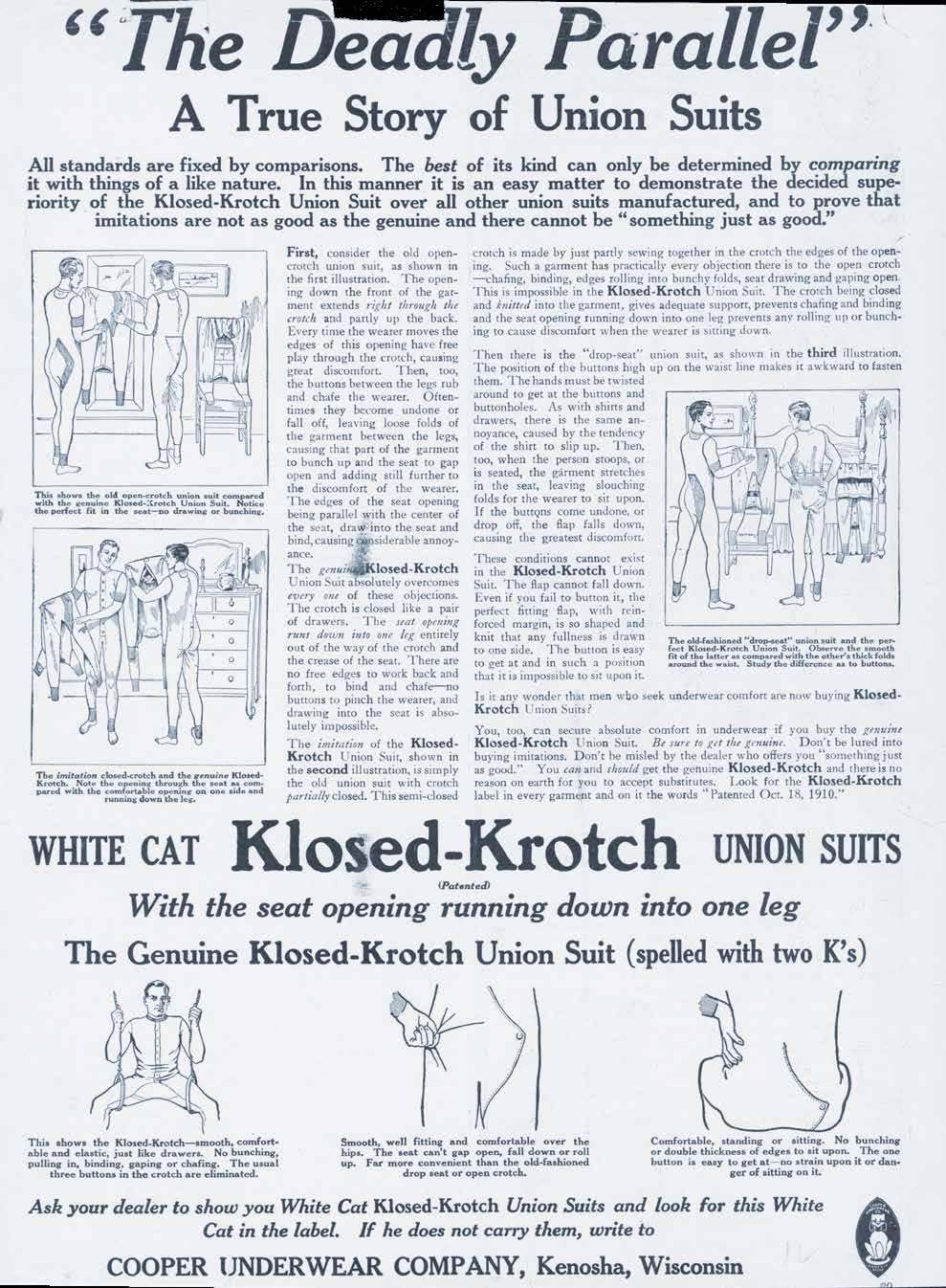
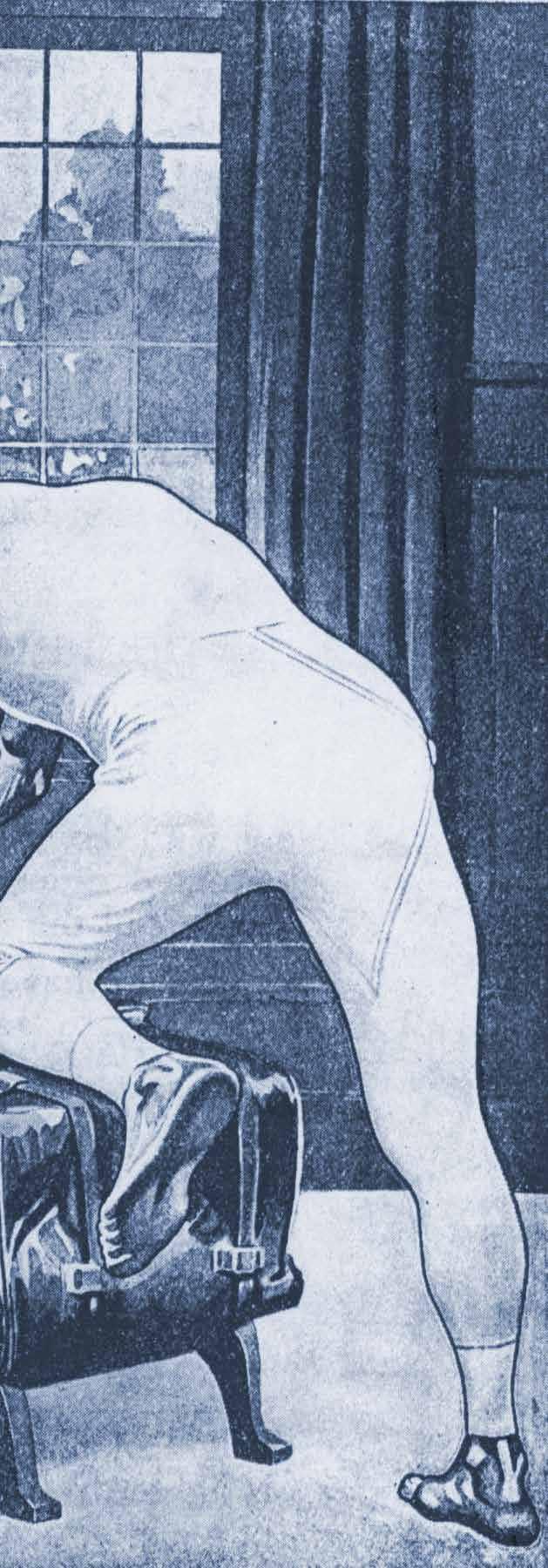
Left: Klosed-Krotch Union Suit advertisement, date?
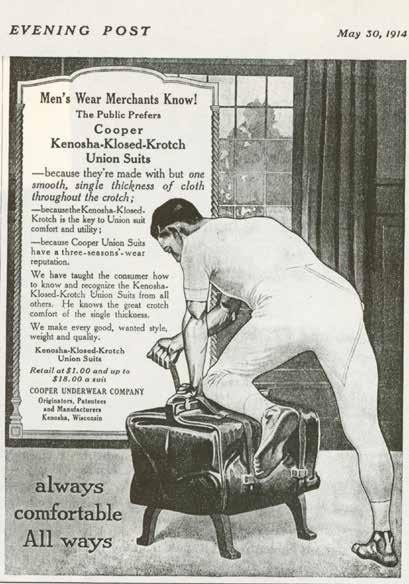
Above: Klosed-Krotch Union Suit Satureday Evening Post advertisement, May 1914
It is easier to do a thing right than to do it wrong. I’ve based my ideas of quality, responsibility, and service on it. This advice of [Abel W. Wells] has been a great influence in my life.
“ ”
-Henry S. Cooper
Family TreeCooper
Henry S. Cooper 1858-1924
1. Roberta Stratton d. 1917
2. Bertie Hardy m. 1919
Josephine Treasurer, 1912-1918 Bookkeeper, 1918-?
Louise Monteen Jessie Kathryn Lucy
Irene Barden
Mary Nelson VP
Gerald Secretary
Robert S. Cooper 1887-1945 President 1913-1930
Rev. Samuel T. Cooper 1824-1892
Mary Ward 1833-1920
Willis W. Cooper 1854-1903-Iroquois Fire
Anna Goodenow d. 1928
Maude Cooper 1874-1957 m. 1897
Anna Stella Lillie
Charles Beachel d. 1940 Dir. of Coopers
Jane Beachel Miller m. Robert C. Miller 1943- d. 1990
Carl (Jennifer) Monona
Gilbert (Laura) Wilkesboro
Chip (Raymond) Pleasant Prairie
Robert (Karen) Verona
Donna Joan Wolf 1929-2000
William “Bill” Steigerwaldt 1925-2016
Linda Steigerwaldt Debra Steigerwaldt 1957-
William S. Lindsey (Steve)
Donna “Jodie” (Andy)
Charles “Rick” Waller
Carlotta “Sis” Lance Jockey 1953-1985
Arthur M. Millholland 1928-2014
Mary Anna Lance 1926-1987
Charles Knickrehm
Harry H. Wolf, Sr. 1890-1979
Donna Margaret Currey 1888-1954
Charles F. Cooper d.1903-Iroquois Fire
Flora Yokum d. 1902
Carlotta Cooper 1895-1988
Gilbert S. Lance 1894-1960 Sec/Treas 1930-1955
Charles F. Cooper 1924-1994
1. Alice Whitfield
Mary Cooper Little
2. Jean Watson
Anna Louisa Cooper David Frost Cooper
Ralph Y. Cooper 1891-1957 President, 1930-1957
1. m. 1915 Miriam Frost d. 1918 (flu)
2. Mildred Todt d. 1964
Robert F. Cooper 1916-1975 President, 1958-1971
Family Tree Wolf
Harry H. “Buddy” Wolf, Jr. 1925-1989
Ruth Helen Briggs 1920-2008
Mary Wolf Rolfing Bogue 1923-2007
1. James Rolfing 1926-1960
2. Verle Bogue 1913-2003
Charles, Flora, Ralph, and Carlotta
Ralph and Robert “Bobby” Cooper
1971 Harry H. Wolf, Sr. buys Coopers
When the stock market crashed in 1929, the company’s financial position worsened. Robert didn’t have the passion for the company like his predecessors; he preferred to move to a warmer climate and worry less about day-to-day business — but he knew who did. With the company’s longevity and greater good in mind, Robert negotiated a deal that handed the reigns to his nephew, Ralph Y. Cooper.
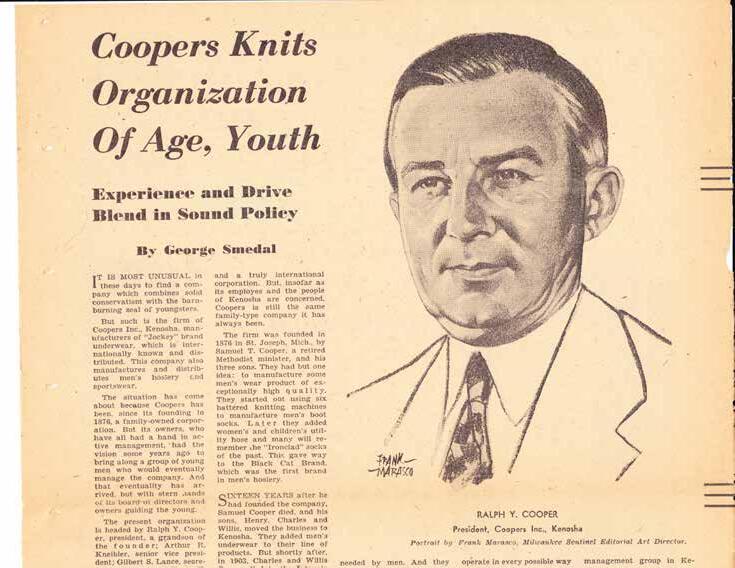
Ralph Cooper “was born with a piece of knit goods in his mouth.” His desire to be part of the family business prompted him to quit college just before graduating and start working his way up at Cooper’s, first as knitting machine operator, then foreman, assistant factory superintendent, superintendent, office manager, production supervisor, treasurer, and head of hosiery operations. By the time he reached the position of president, he understood every facet of operations and administration.
Ralph’s love of the company and his heartfelt commitment to see it succeed were contagious. His sister, Carlotta, had married Gilbert S. “Gib” Lance, heir to the Simmons mattress fortune:
Lance was as generous as he was visionary. As one newspaper noted, “Not a single charity or worthwhile drive was ever turned down by this quiet unassuming man.“ Lance bought into Ralph’s plan and in July 1930, invested heavily in the company, now called Coopers, Incorporated. Likewise, by working his way through the ranks, Ralph earned the respect and friendship of Cooper employees.
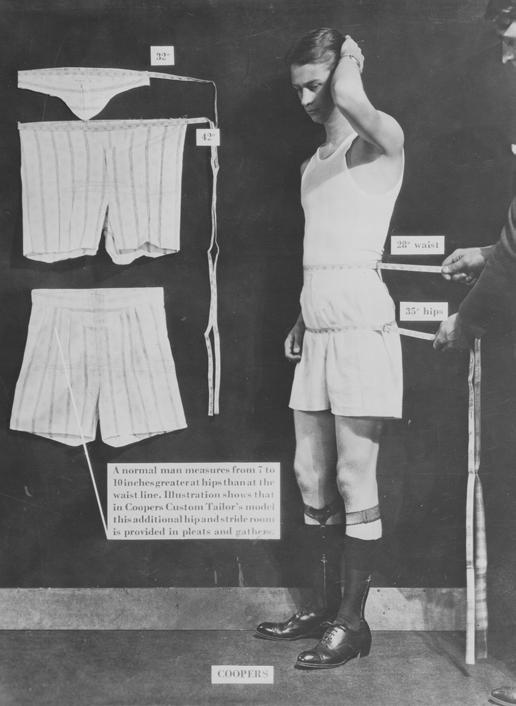
Ralph’s importance in maintaining the Cooper legacy cannot be overemphasized. As it did with almost every business in the country, the Great Depression created severe financial challenges, and there couldn’t have been a worse time for a young executive to take over a reorganized company. Ralph threw himself into his work. He encouraged Kneibler’s proclivity for innovative marketing, advertising, and sales promotions as well as his introduction of new products such as the “ShuPac,” a knitted shoe bag, and Custom Tailor’s Model Shorts. A major breakthrough occurred in 1934 with the introduction of Kneibler’s skimpy new design, the Jockey brief, which revolutionized the men’s underwear industry.
Similarly, celebrity endorsements, licensee agreements, novel merchandising, and improvements in product construction such as the wildly popular Y-front brief changed how underwear was marketed and sold. Ralph recognized that the world was changing, cultural mores were loosening, and the reach of advertising was growing
ever more pervasive in modern society. He took calculated risks to adapt and capitalize upon these advancements — and in the process, literally changed how underwear was perceived in the market.
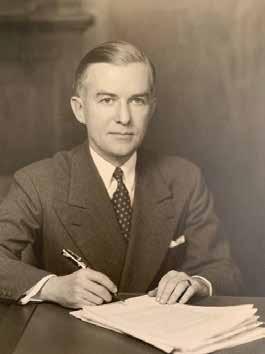
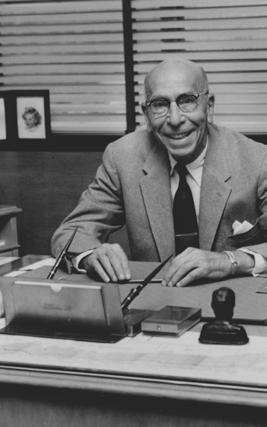
Above: Ralph Y. Cooper at his desk
Left: Custom Tailor Boxer demonstration, 1930
One of the lessons gained from the history of Jockey is that such success as the company has had did not just happen of its own accord. It was the result of intelligent, hard hitting teamwork of a lot of people. No one group of persons or departments could have done this job alone.
-Ralph Y. Cooper
Ralph knew his strengths, but he also understood his limits. He demonstrated a genuine respect for his colleagues and employees and welcomed collaboration at every turn. In 1930, alarmed by the precariousness of the company’s financial position, he supported Lance’s suggestion of bringing in a consultant for advice. Harry H. Wolf, Sr., had deep experience in finance and engineering, and his intensive business study of Coopers, Inc., was so well received that he was asked to stay on under an agreement that would allow him to share in its future success.
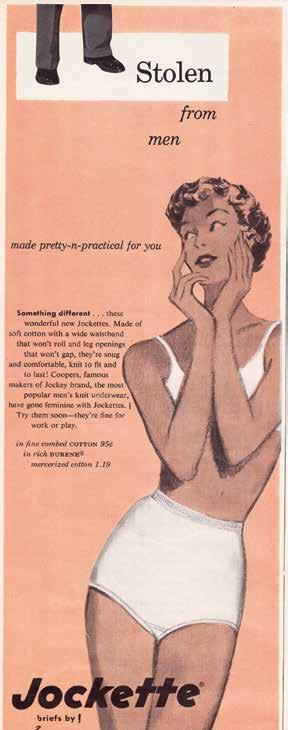
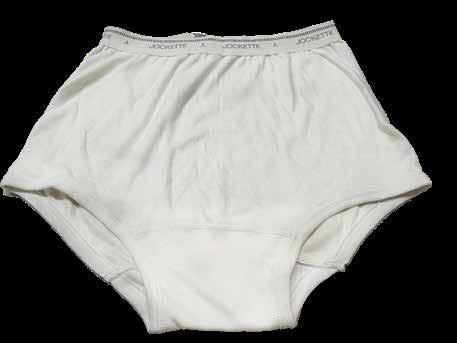
Like his family before him, Ralph remained persistent in overcoming roadblocks — and there were many, such as the 1952 flop of Jockette underwear for women, constructed similar to men’s underwear and marketed in the men’s underwear section of department stores. The company learned and moved on, in this case to underwear made from engineered fabrics and in fashionable prints.
Equally important, Ralph’s integrity remained unfaltering in the fickle world of business. “Our policy is going to be to produce goods that the average consumer wants, of a quality and sales appeal second to none, styled to meet present day
demands — at prices that are fair to the retailer and give the consumer an honest value for his money and 100 percent service,” Ralph said in a 1931 sales convention booklet. World War II created a shortage of materials, including the natural rubber used in Jockey waistbands. A switch to Neoprene, a synthetic rubber, worked fine until 1947 when, unbeknownst to the company, the formula used to make Neoprene changed. Overnight, Coopers was swamped with customers complaining of faulty waistbands. In the end, management first made the call to recall the defective garments and replace the waistbands, then went a step farther by working side-by-side with the National Laundry Institute to study the issue, find its cause, and devise a resolution. It was a costly decision, over $200,000, but protecting the company’s reputation for quality proved priceless.
In the shadows, Robert Frost Cooper watched as his father devoted his life to Coopers, International. He also observed his generosity both civically and within the industry. Ralph was part of the War Production Board charged with all knitted textiles for the war effort. He served as president of the Kenosha Hospital Association, Kenosha Vocational School Board, and the Manufacturers Association, Masonic Temple Association.
He oversaw the construction of a new wing at the Kenosha Hospital and a new million-dollar Vocational School building. In 1957, it was Robert’s turn to carry the Cooper legacy forward.
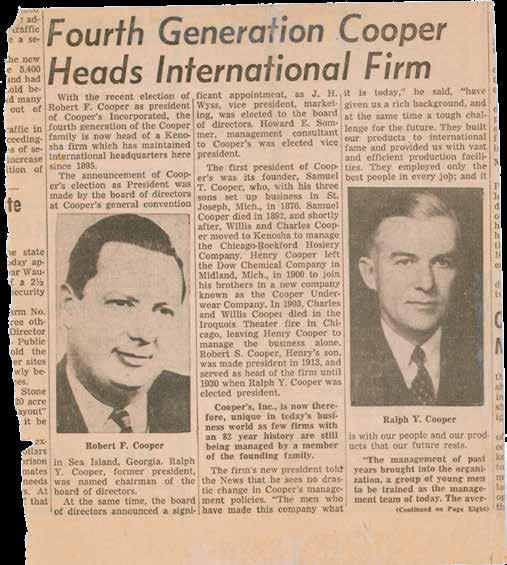
Robert Cooper was the last of the Coopers to lead the now 81-year-old company. Like his father before him, Robert had grown up working at Coopers. He was a longtime salesman before assuming the presidency in 1957. Underwear sales in the U.S. languished in the 1950s but opportunities increased with overseas markets fascinated with American goods, especially name-brand products.
as the “Cadillac of men’s underwear” and its competitive edge based on quality of fabric and construction. Robert won that fight and went on to organize and lead the Brand Names Foundation, a lobbying and public relations group.
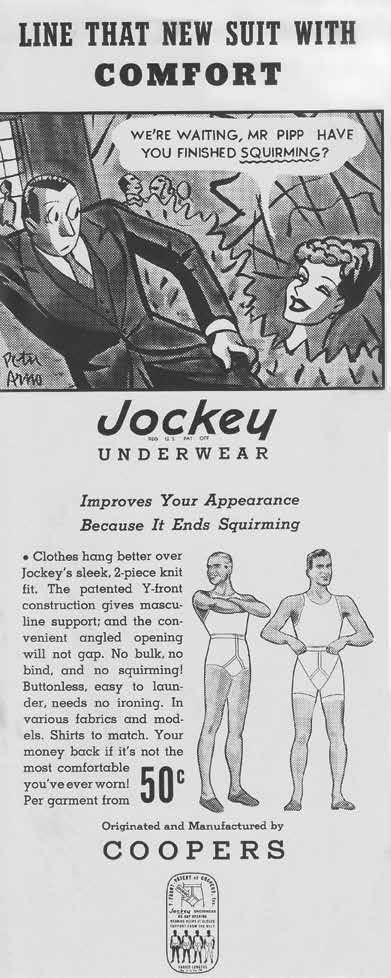
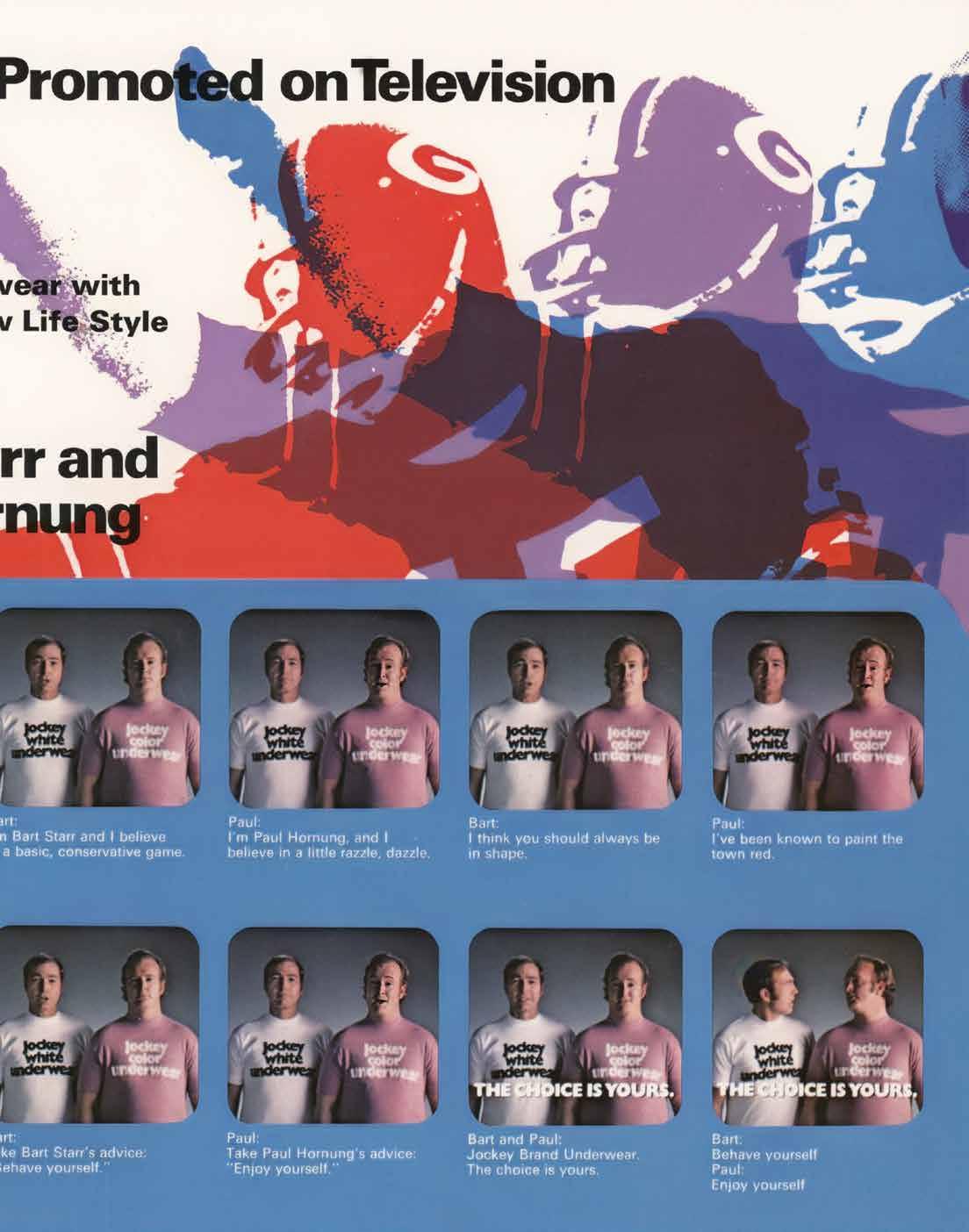
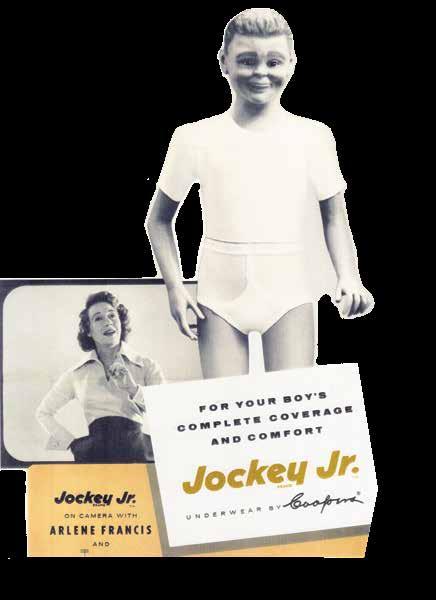
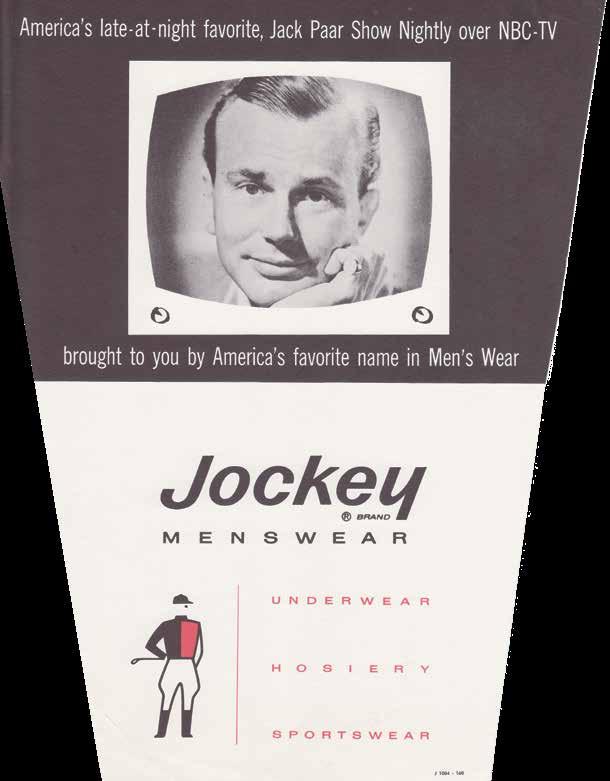
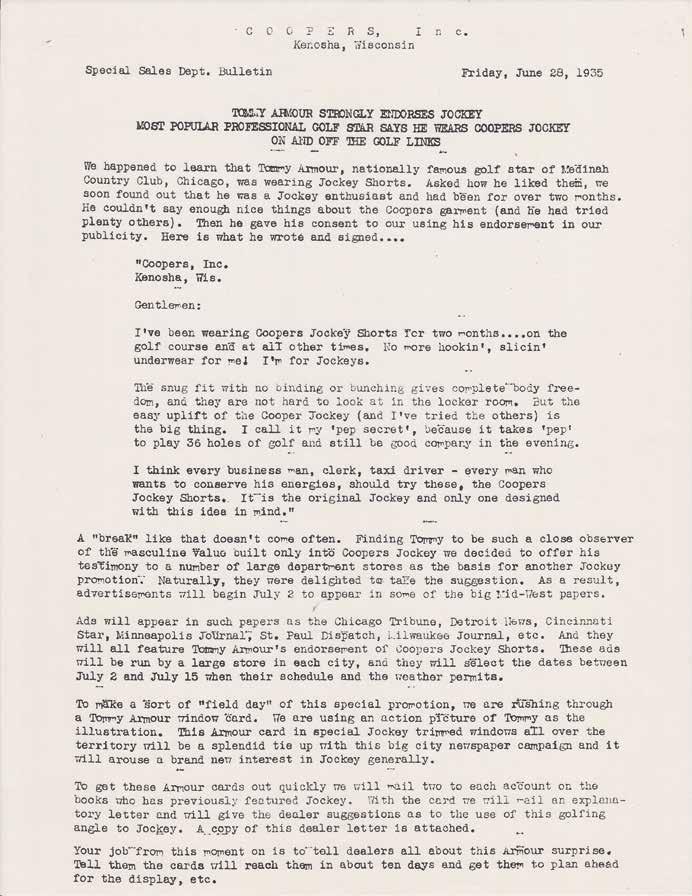
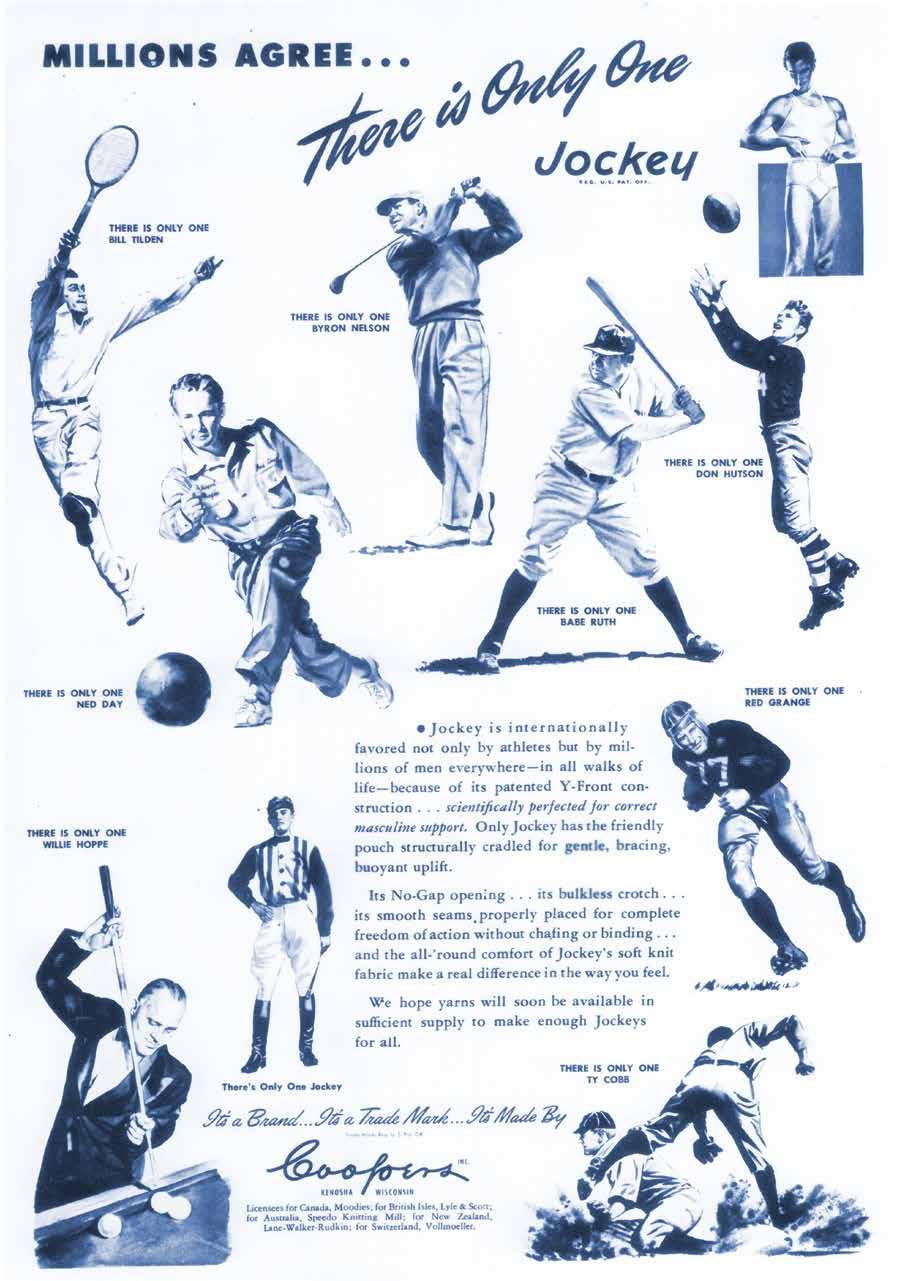
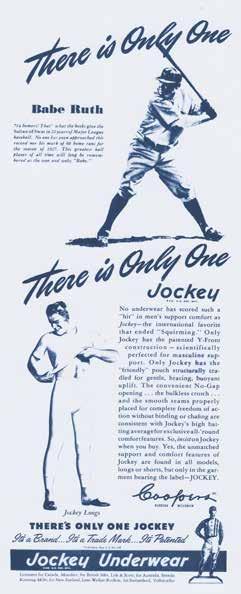
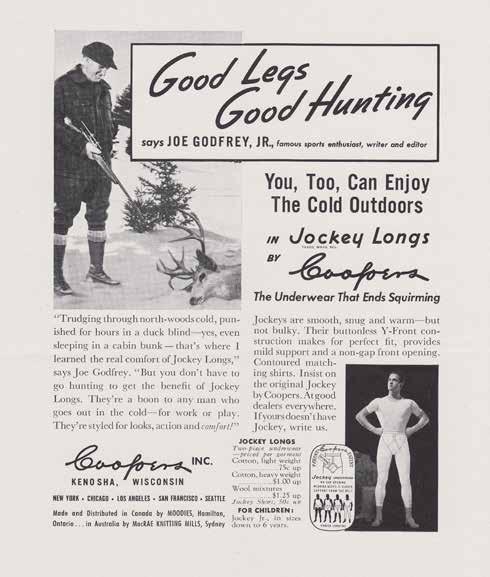
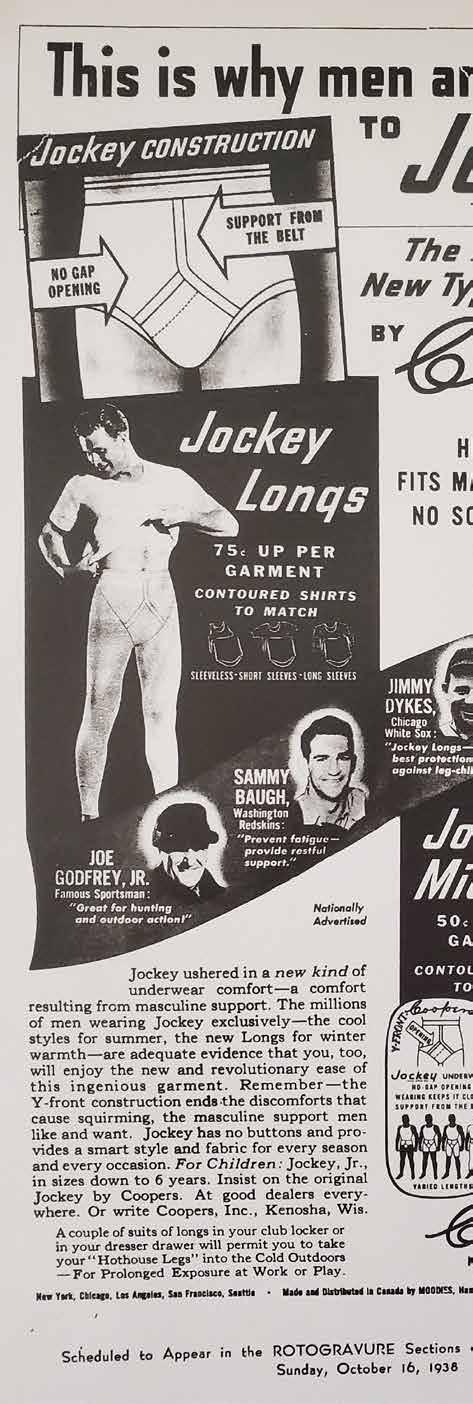
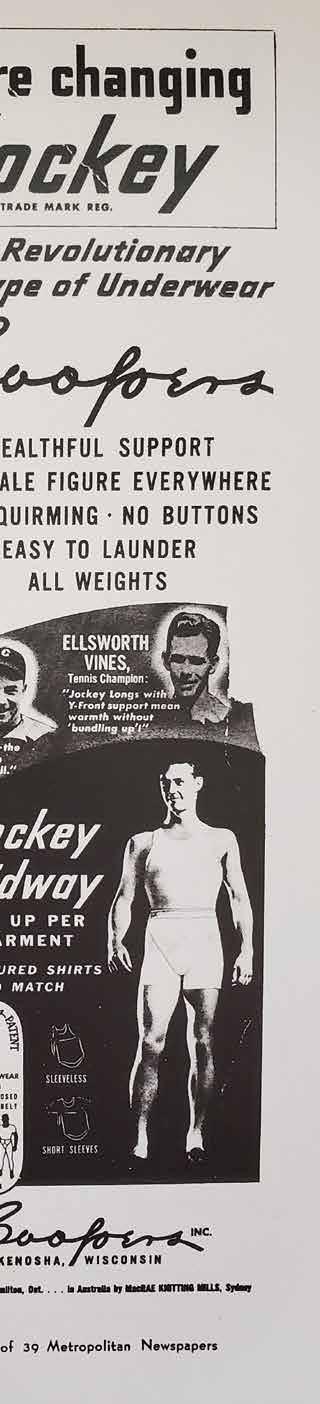
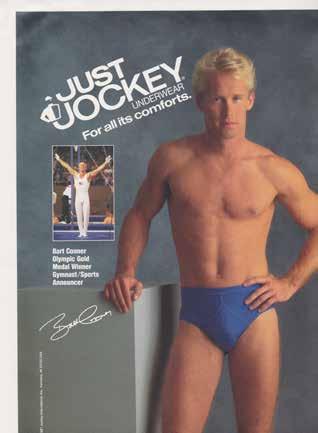
During this era, Coopers, Inc. forged new paths in advertising and marketing such as the ingenious idea of packaging underwear in a special Christmas box — the first time underwear was marketed as a gift item. The company was a pioneer in advertising. In 1913, they launched the first national print campaign for underwear for the Kenosha Klosed Krotch union suit. In 1954, they became the first to advertise underwear on television with appearances on NBC’s Home show with Hugh Downs and Arlene Francis. Well ahead of their time, Coopers first used celebrity advertising in 1935 when Golfer Tommy Armour promoted Jockey underwear. They returned to celebrity advertising in 1969, a move that earned the company recognition as the Brand Name Manufacturer of the Year. “We try to put an aura of fashion around our underwear line in advertising, packaging, display and design,” Robert said at the time. “We’re always ahead of the times.”
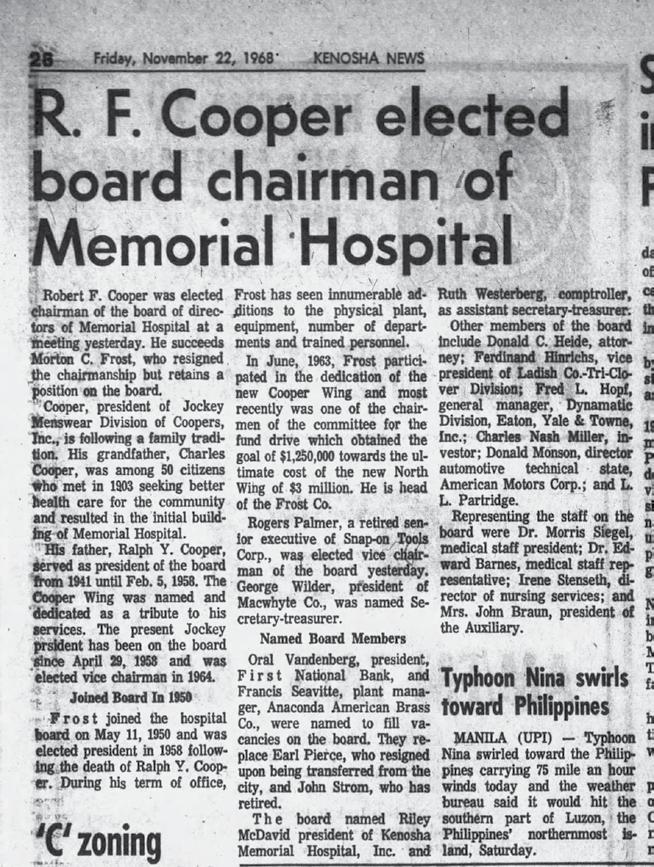
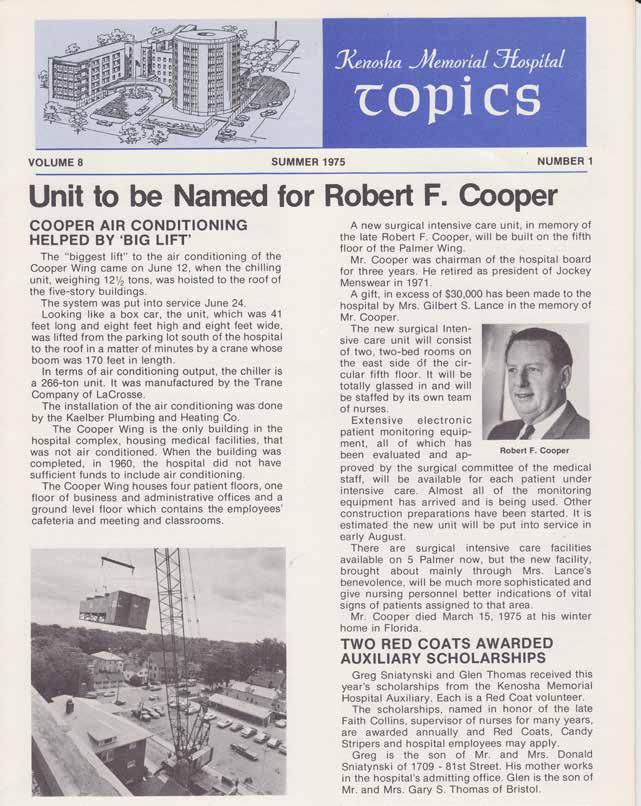
Well-respected in the apparel industry, Robert also served as president of the National Underwear Institute and director of the American Apparel Manufacturers Association. Locally, he continued to support the Kenosha Memorial Hospital as chairman of the board, was part of the executive committee of the Kenosha Youth Foundation, president of the Kenosha County Council on Alcoholism and the Kenosha Foundation, and director of the Kenosha County United Fund, First National Bank, and Kenosha Manufacturers Association.
Since the 1930s, the Cooper family’s ownership of the company had diminished gradually, attributable to a need for cash infusion, the deaths and subsequent sale of stock held by family, and Harry Wolf, Sr.’s, growing interest in the company. When Robert took over, the Cooper shares were fractional. In the 1960s when revenues were lackluster, Robert and Harry differed on operational and management changes to rectify performance, but Robert lacked the financial authority and clout that previous Coopers had enjoyed. In 1971, Robert called it quits. He was the last Cooper to hold an executive position with the company. An era had ended.
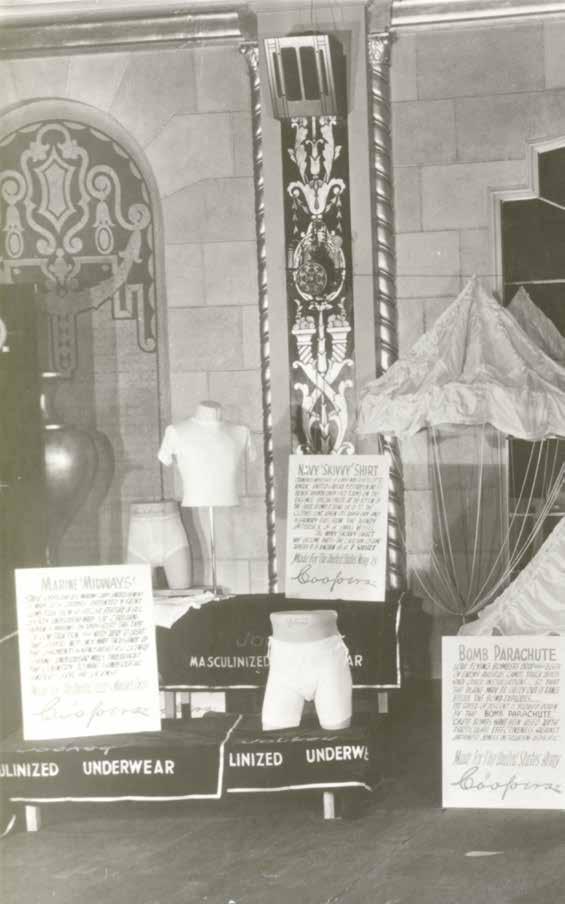
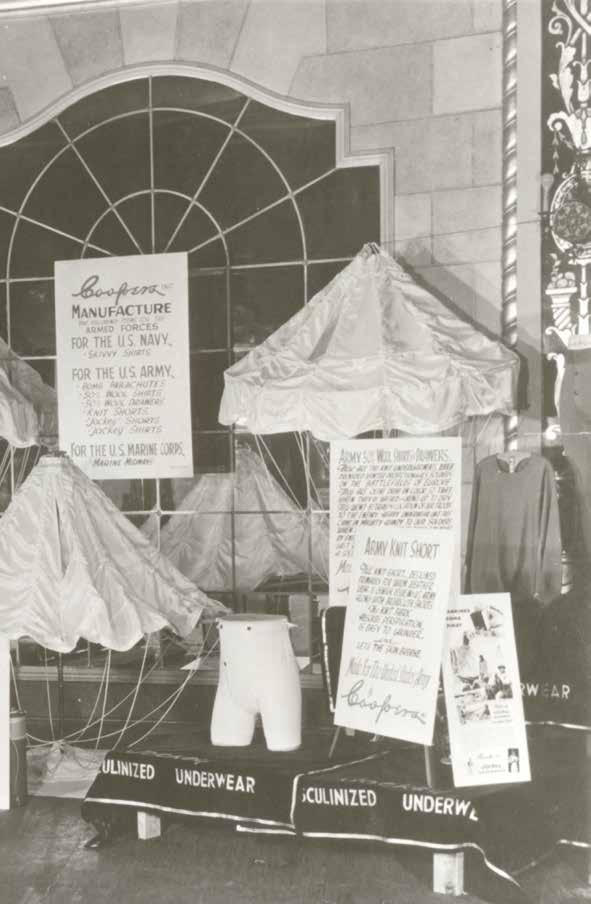
Motivated to do well by doing good, Robert was cut from the same cloth as his father and grandfather, and he worked tirelessly to preserve and protect the company’s brand. During World War II, Cooper fought the government’s suggestion to standardize the civilian products purchased for the war effort, arguing that to do so would destroy the company’s reputation
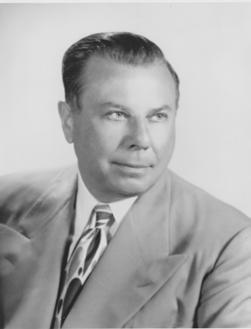
Harry H. Wolf, Sr., was already family when he became sole owner of Coopers in 1971. In the 1930s, Lance brought him on as a consultant to keep Cooper’s from going under during the Great Depression, and he never left. Over time, he recognized that his financial shrewdness, grasp of industry trends, and management insight could not only help solve Coopers’ short-term problems but steady the company for long-term growth.
The men who have made this company what it is today have given us a rich background, and at the same time a tough challenge for the future. They built our products to international fame and provided us with vast and efficient production facilities. They employed only the best people in every job; and it is with our people and our products that our future rests.
-Robert F. Cooper
A genius with numbers, Harry understood the importance of the bottom line, and he was willing to make tough decisions to keep the company financially viable. In fact, his first action in 1931 after Lance asked him to execute the suggestions in his company assessment was to fire every employee, including management, and then announce that all positions were open to all applicants — at lower pay. At any other time, this could have triggered revolt, but in the Depression, jobs were scarce. A lower-paying job was better than no job at all.
Despite such a harsh correction, Harry sensed that the company’s long-term position was strong, so much so that he agreed to be compensated based solely on Coopers’ performance. He even put his own reputation on the line to secure a loan in the mid-1930s for manufacturing a new product line. When bankers asked what he intended to use for collateral. “My good name,” Harry replied. The loan was granted.
financial position, he kept Jockey’s spirit of experimentation and discovery alive. “Success is organic — something that grows out of the past,” Harry once said at a yearly sales convention. “Success does not accumulate like a snowball out of multitudes of small successes. It grows from within.”
Above all, it wasn’t lost on Harry that Coopers’ foundation was built on the family values of hard work, a strong work ethic, attention to quality, and a concern for the greater good that, in turn, gave the company a clear identity and purpose. Like the Cooper family, Harry was active civically and philanthropically, founding the Harry H. Wolf Charitable Foundation in 1956 to support educational, charitable, and religious projects including Carthage College, St. Catherine’s Hospital, and the Kenosha Memorial Hospital Building Fund.
That Jockey had survived almost 100 years could be attributed
From the 1930s on, Harry was involved in every key decision at Coopers. Longsighted, Harry’s codified processes, made product recommendations, and launched marketing campaigns as incremental steps forward in fortifying the company for the long term. He sacrificed short-term profitability in favor of long-term viability. Under his watch, Coopers opened and expanded mills and modernized factories to “eliminate useless and wasted effort.”
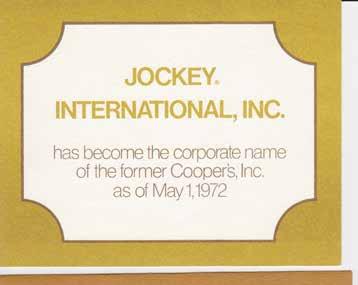
Harry became Chairman of the Board in 1960 and CEO in 1971. The next year, Coopers was renamed Jockey International, Inc. to reflect its growing presence worldwide and as a nod to its most famous trademark. Even as Harry guarded the company’s
to wise governance, added as scaffolding to support and move the values of its founders and leaders into action instead of the other way around.
Despite his keen judgement of talent, Harry’s one oversight was his succession plan. At age 84 in 1974, Harry was still leading Jockey when illness confined him to his home. Harry was a hard worker who probably didn’t know how to quit, but his inability to hand over the reins to the next generation could have been an subconscious hesitation about who the reins would be handed to. In 1976, his only son, Harry Hay “Buddy” Wolf, Jr., was named Chairman of the Board and CEO. Buddy had worked at Jockey since 1950 and was the assumed choice to be next in line.
Success comes to the business which fulfills an economic function. The ultimate test of survival is whether or not the business can do something worthwhile and of lasting importance.
-Harry H. Wolf, Sr.
In the male-dominated business world of the 1970s, it never crossed the minds of Harry, Sr., and his board to consider that one of Harry’s daughters, Donna Wolf Steigerwaldt and Mary Bogue, might be better suited for the job.
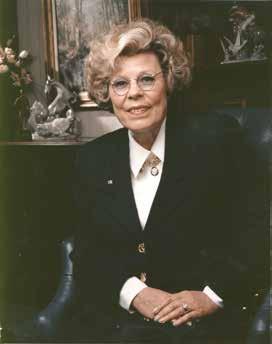
When growing expenses and a slip in market share began affecting company performance, board members added Donna and Mary to the board. And despite protests from Buddy, in 1978, the company once again sailed into uncharted territory by naming Harry’s youngest daughter, Donna, as the new Chairman and CEO of Jockey International.
Donna Wolf Steigerwaldt was Harry H. Wolf, Jr., in a skirt. To understand the rarity of being a woman CEO and Chairman of the Board in 1978, consider this: Katherine Graham, publisher, CEO, and Chairwoman of the Board of Washington Post, was the first and only woman to lead a Fortune 500 company in the 1970s. Donna was well-spoken, well-liked, and had a Midwestern no-nonsense sensibility to “figure it out” problems appeared. She was smart, bold, and direct, yet despite having a successful career in the insurance industry before choosing to stay home with her children, Donna admitted that her father “never even considered having his daughters in the business with him.”
Out of the workplace for 34 years raising a family, Donna lacked deep management experience and “knew absolutely nothing” about the business. Having grown up observing her father’s work ethic and watching as Jockey flourished under his leadership, she intuitively felt that the organization wasn’t
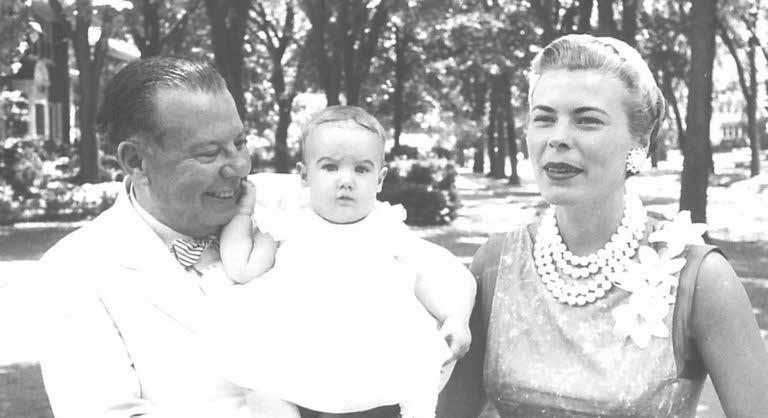
Left: Harry, Debra and Donna
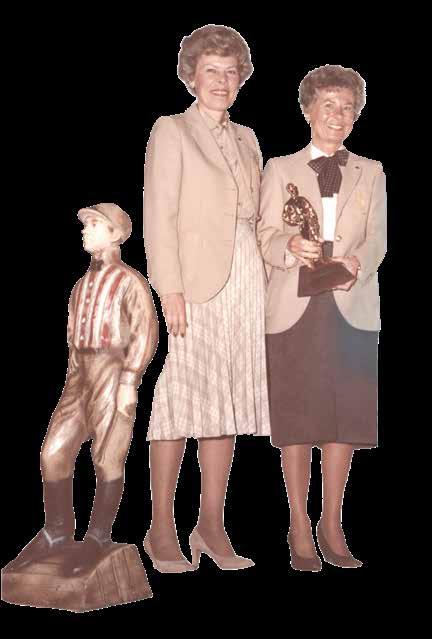
Below: Donna Wolf Steigerwaldt and Mary Wolf Bogue
headed in the right direction, so following in the footsteps of Henry Cooper after his brothers’ deaths, she stepped up.
Donna cared deeply about preserving her family’s legacy — a family business where success was not measured solely in quarterly results. “At a time of uncertainty when we weren’t sure what was going to happen, Donna was the answer,” remembers Anne Arbas, Executive Vice President and Chief Financial Officer. “Once she took over, things changed for the better. Donna knew where she wanted the company to go, and she wasn’t afraid to speak up. That was reassuring, and everyone got on board.”
Using the same blueprint as her father did 48 years earlier, Donna commissioned an intensive study into all facets of Jockey’s business, and then just like her father, she quickly reorganized the company to eliminate bloat and bring expenses under control. Her hands-off management style, however, was a departure from the traditional autocracy where decisions were made at the highest levels and then pushed down as directives to employees. Instead, she “wanted everyone to be able to run their own jobs, be their own bosses, be responsible for their own territories, which wasn’t the case when I came on board,” she said in a 1988 interview. “I wanted them to be proud of what they had done as individuals.”
Her employees loved her for it. Even as she kept a low public profile, “The Jockey Lady,” as Donna affectionately came to be known, focused on building rapport with people at every level of the business, which, in turn, repaired the low employee morale she had inherited when she started. She had bought into the idea of “Jockey as family” at a young age, and it was deeply concerning to her that employees would think anything less. “I take a great deal of time in touching our people,” she said. “It’s very important to me that they’re happy as well as trained properly and taken care of — that they’re emotionally happy. I embrace them and they embrace me and that’s what makes Jockey the big, little company that it is.”
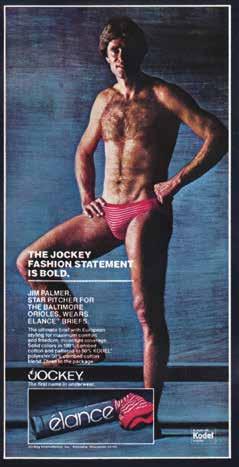
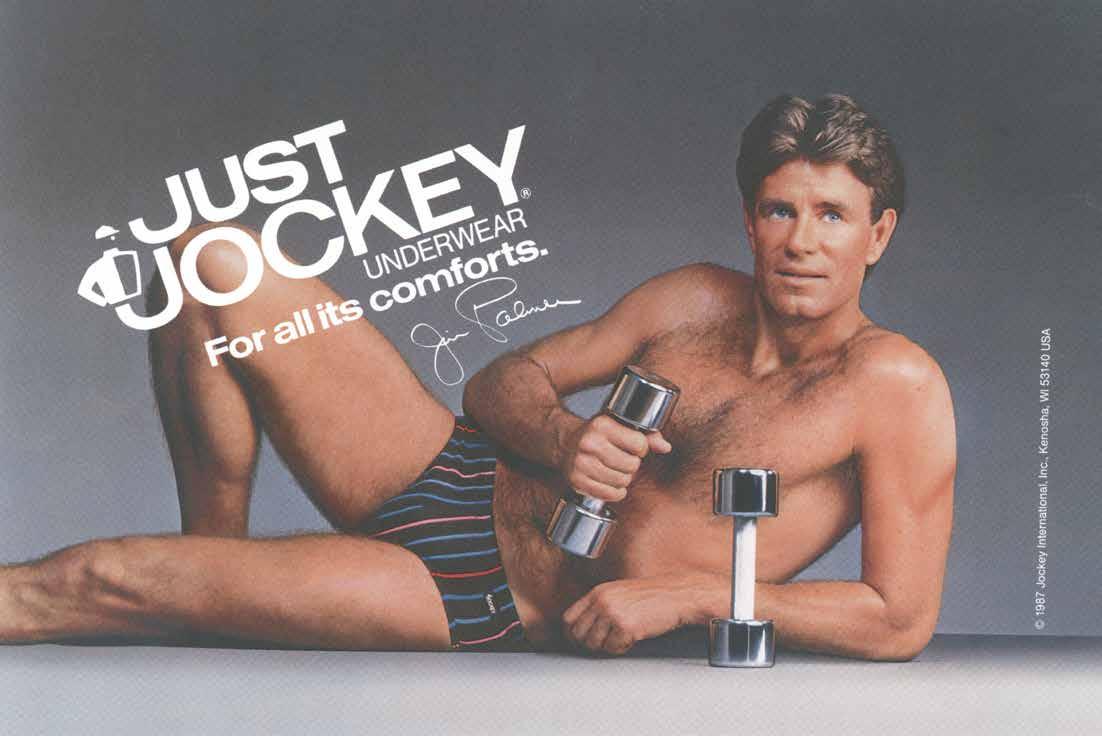
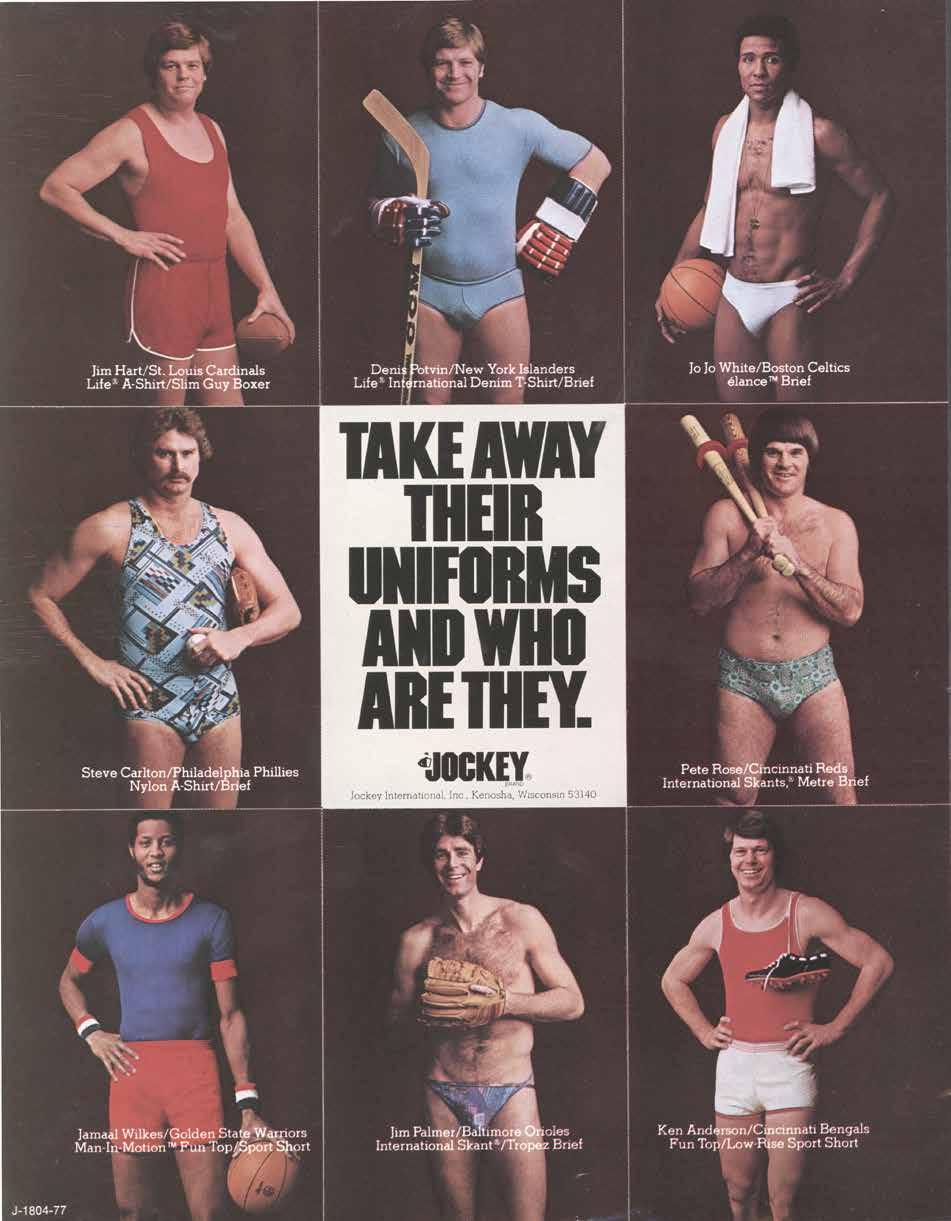
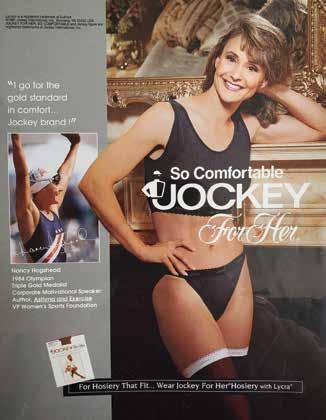
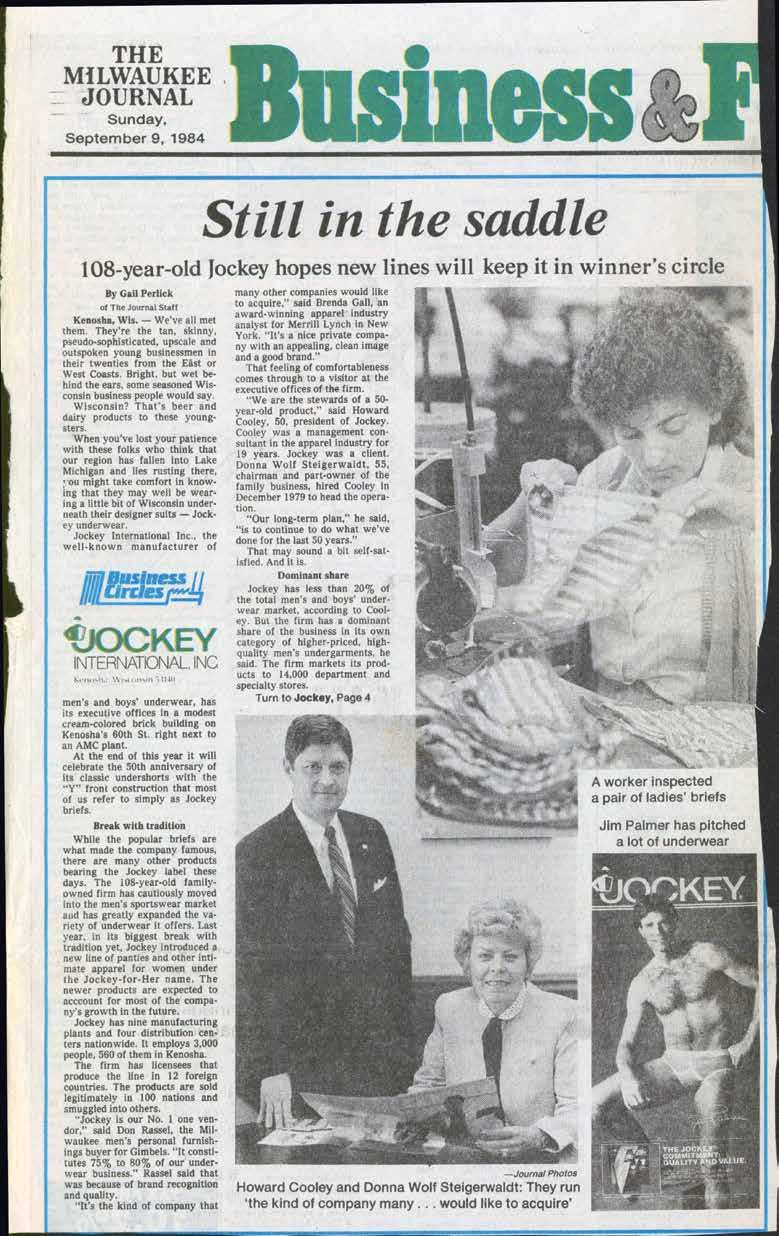
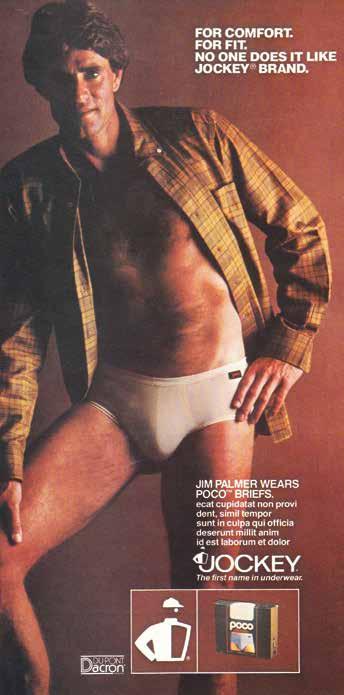
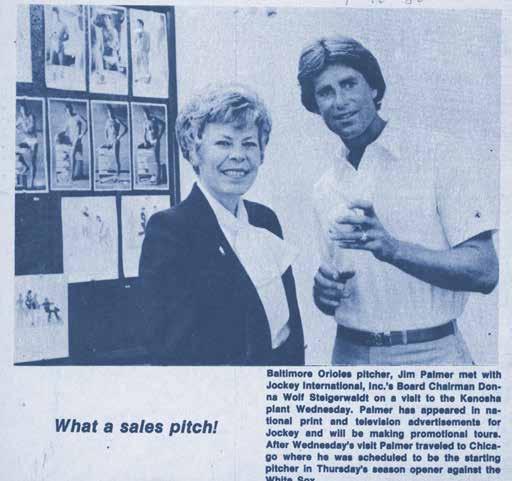
Attentive to details, Donna oversaw manufacturing modernizations, continued expansion overseas, penned new licensing deals with national chains, introduced customer research and tracking to better understand buying habits, and reintroduced marketing with celebrity spokespeople, including the first female athletic spokesperson in 1991, and the longtime partnership with Jim Palmer modeling Jockey underwear.
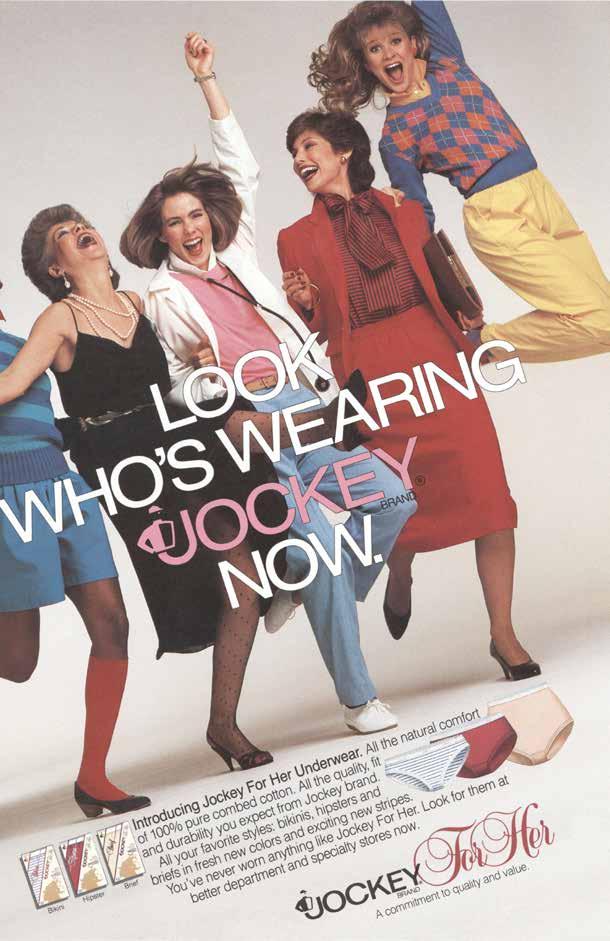
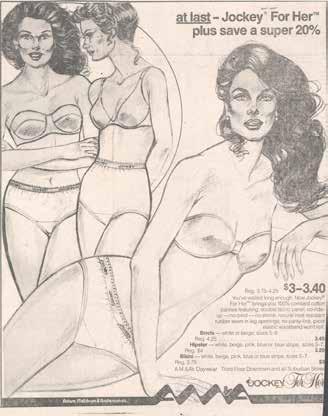
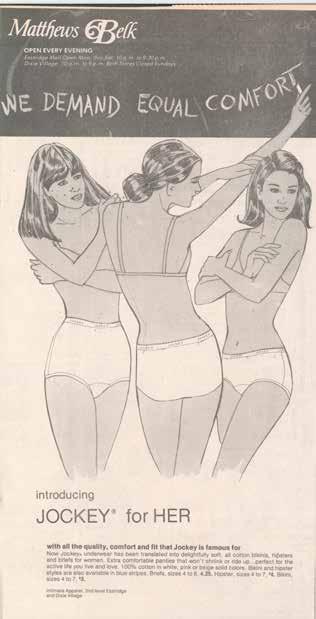
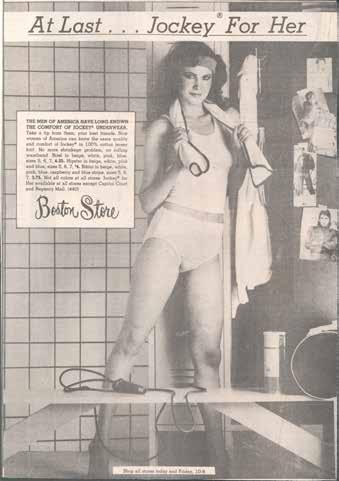
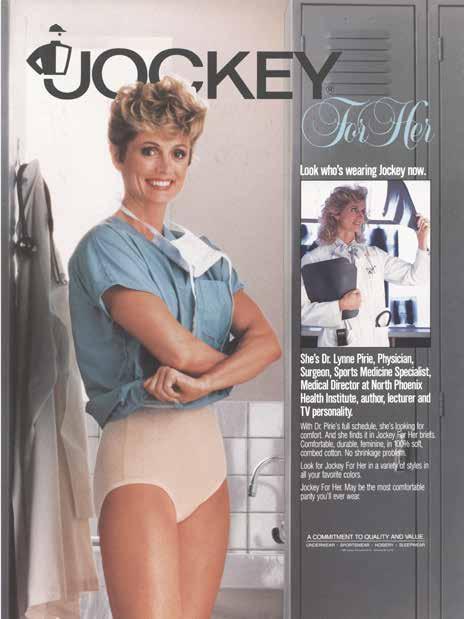
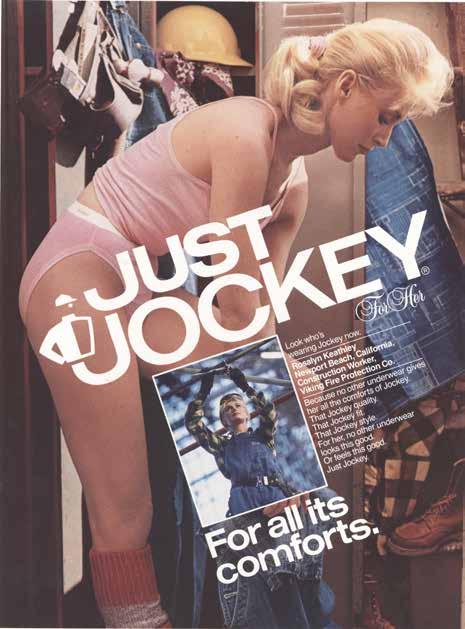
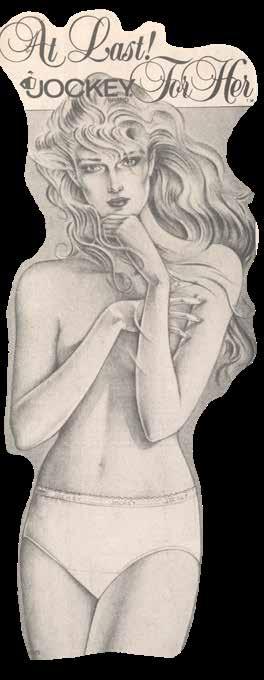
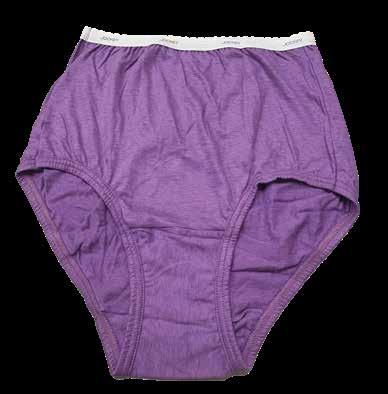
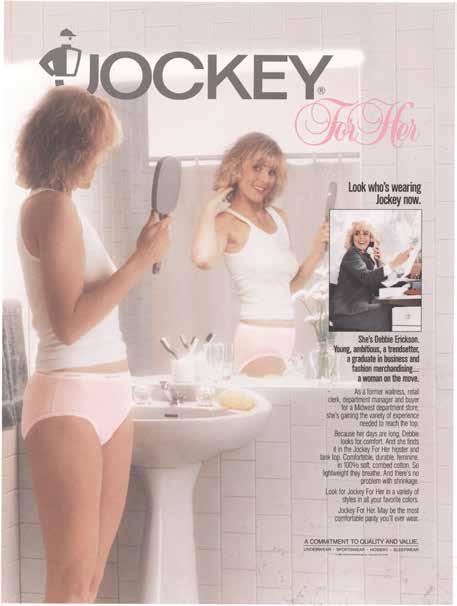
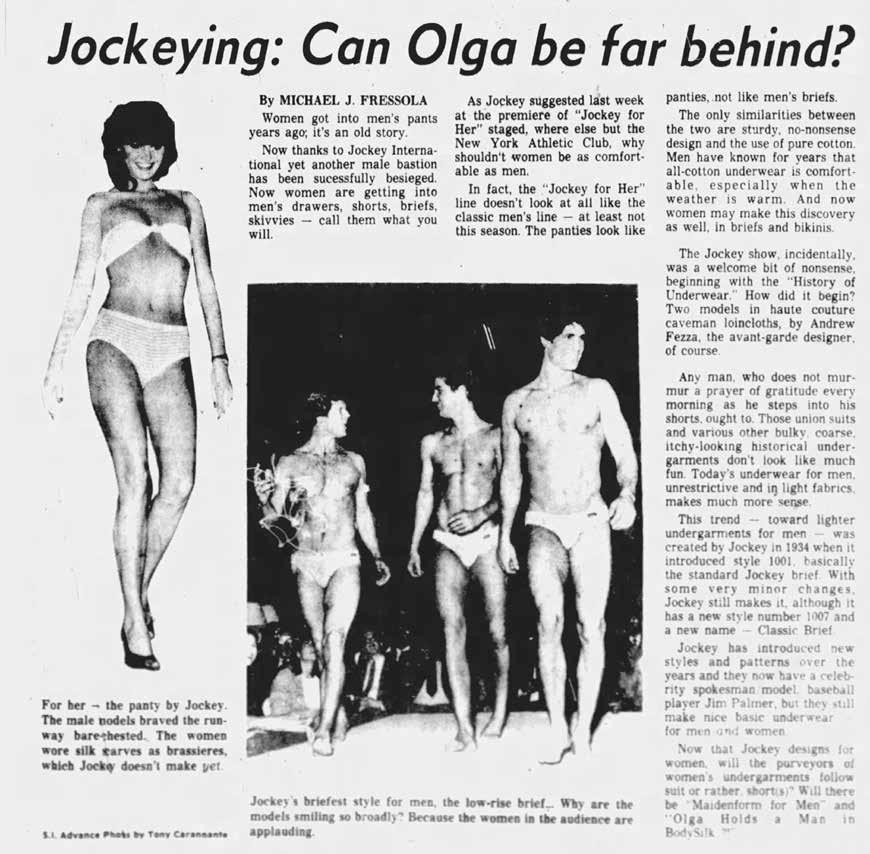
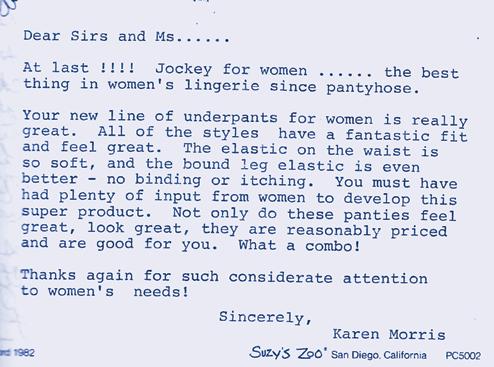
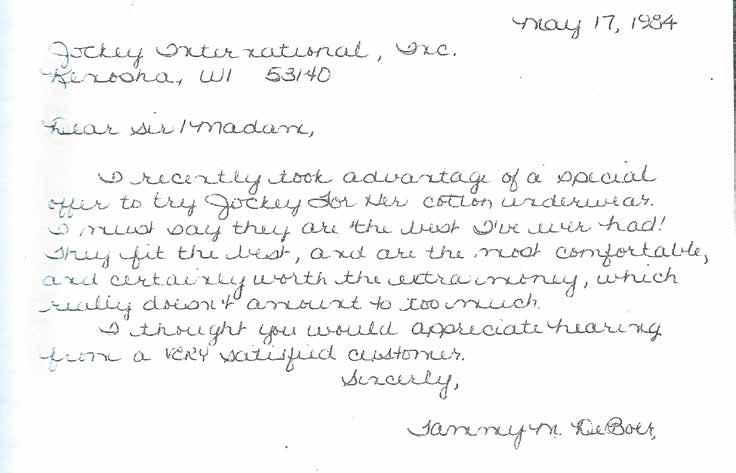
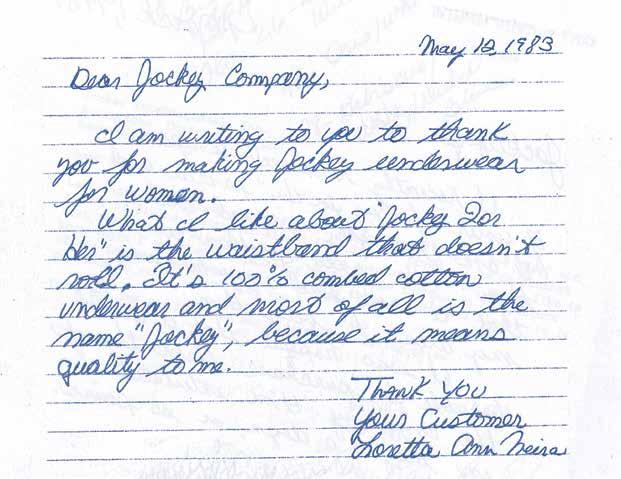
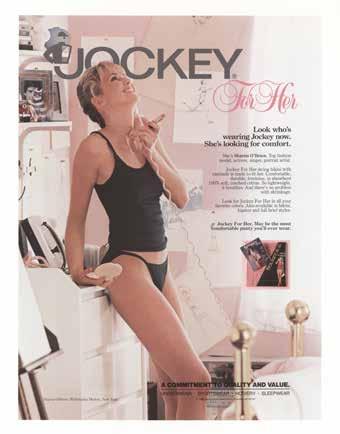
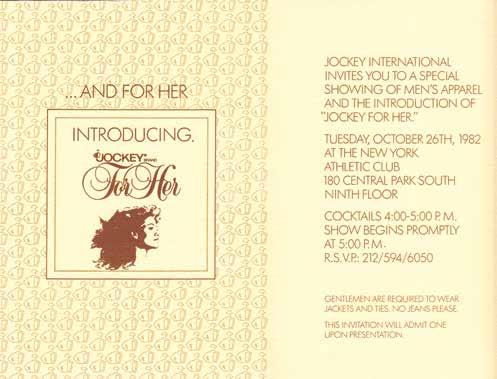
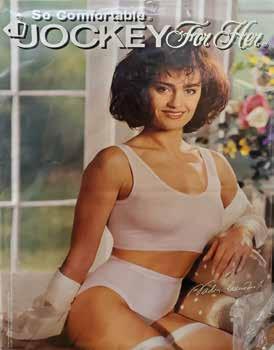
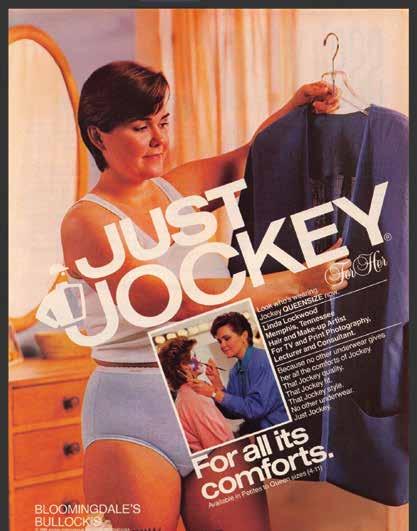
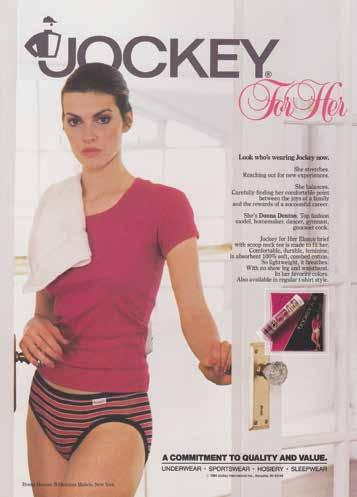
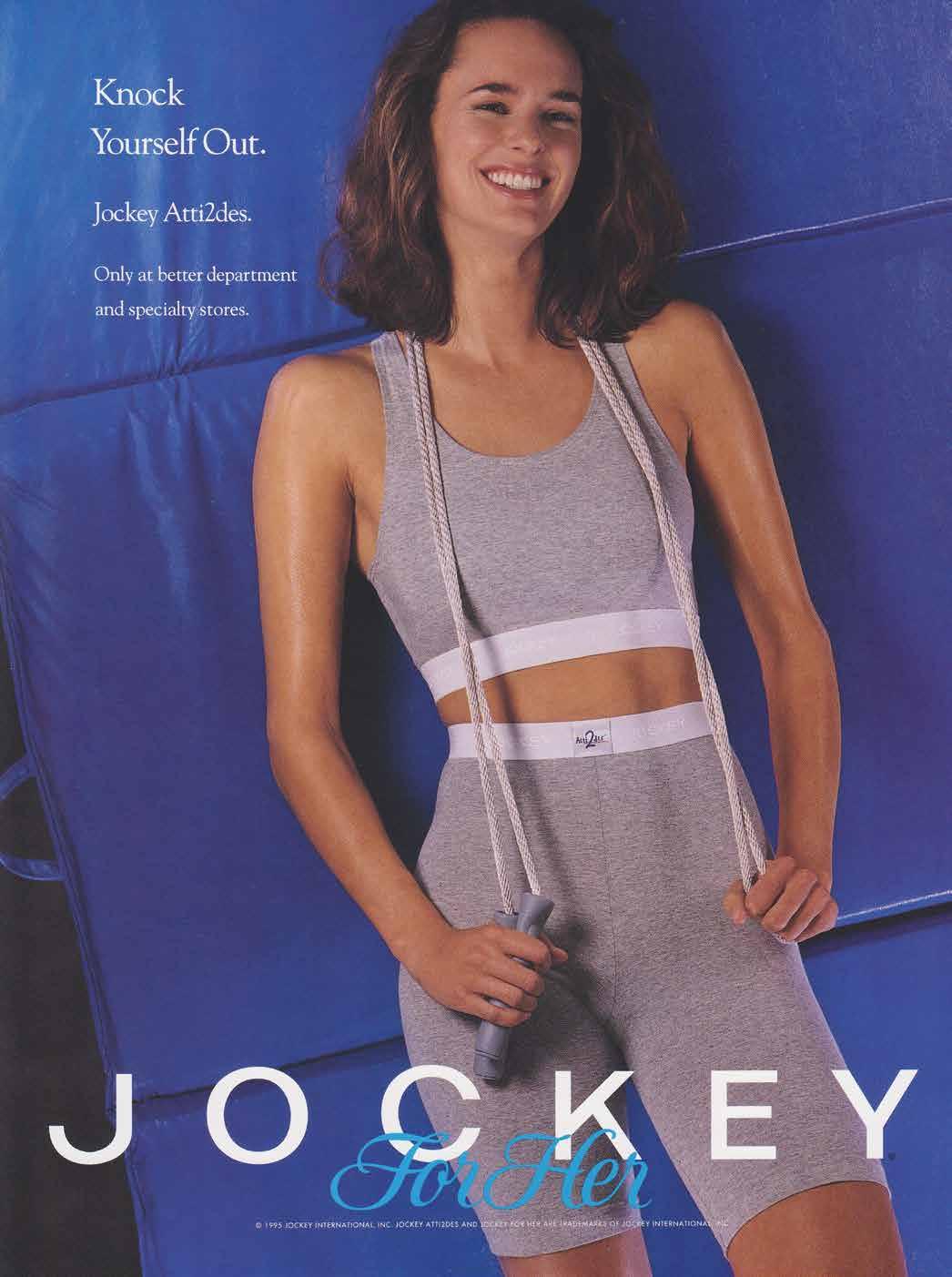
Struck by the popularity of the men’s line with women and a cultural change toward androgyny in women’s fashion, Donna knew that times were changing. The Jockette experiment thirty years earlier went down as one of the company’s biggest flops, but this time around, Donna believed that women were ready for and deserved the same type of comfort as men. Her most audacious move came in 1982, little more than four years after taking the helm of the company, with the launch of Jockey for Her. Not only was the construction and shape of Jockey for Her underwear vastly different from what was currently being sold. “Today, some women take cotton intimates for granted,” said Debra Steigerwaldt Waller, Jockey’s current CEO, “But I remember a time when cotton intimates were a radical concept that nobody believed in. Nobody but Jockey and consumers, that is.” Sales rolled in, quashing any concern the company had about the new line. Jockey for Her revenue was beyond anyone’s expectations.
Not since Henry Cooper’s move from socks to underwear seventy years earlier had the company experienced such a monumental shift. “It was amazing to watch,” Debra said. “Mom and Howard Cooley, who was president at the time, made a great team and had perfect timing. To think that a men’s underwear company recognized a gap in women’s underwear and then worked relentlessly to fill it with really high quality, comfortable product that actually fit—I really don’t think there has been anything like it since.”
Not only was the construction and shape of Jockey for Her underwear vastly different from what was currently being sold, the underwear was made of cotton, a rarely used fabric for women’s underwear at the time.
Like her predecessors, Donna took the adage of “satisfying the human need for comfort” to heart, not only in creating comfortable underwear but also in creating a comfortable rapport with customers and a comfortable work environment for employees. She had the grit to dig her heels in and persist amid frequent obstacles and constant cultural change.
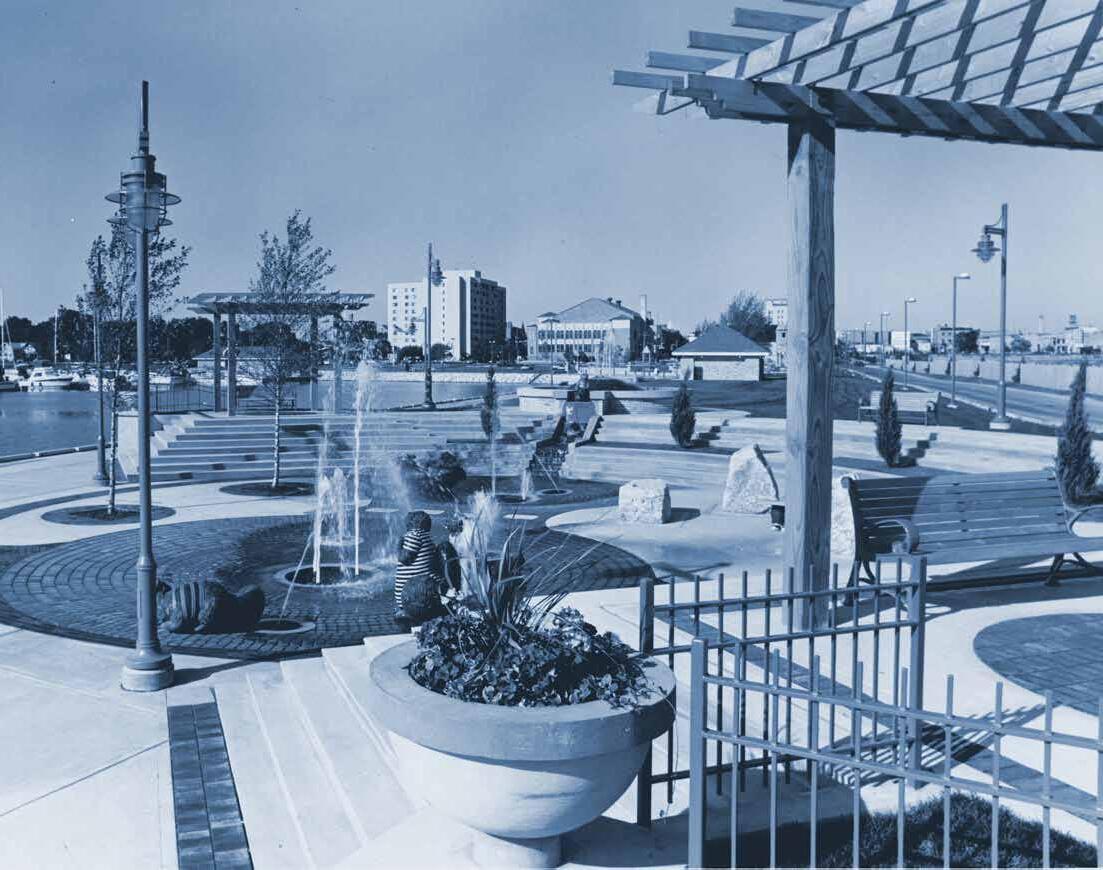
Donna’s loyalty extended to Kenosha and beyond. She created a park across from headquarters and served as trustee at Carthage College and the Kenosha Symphony Orchestra. Under her guidance, Jockey became a leader in placing women in important jobs because, as Donna said, “In order to create a female executive, you have to have positions in which a woman can learn to become an executive.”
By the new millennium, Jockey was an intrinsic part of American life, a mega-brand and household name often imitated but never equaled — thanks in no small part to Donna’s leadership and drive. “I’d like the people of Jockey to know that it was me who carried on the tradition,” she said when she took the job in 1978. Upon her death in 2000, employees and associates mourned the woman who had ushered in a new age at Jockey. Ed Gill remarked that Donna “set the tone for the organization. She was a guiding light.”
From the start, Debra insisted that she be defined by her work rather than her family name, and both she and her mother were adamant that she receive no preferential treatment. “We even went to the trouble of pretending we didn’t know each other at work,” Debra said. “I remember one time we met in the hallway and walked right by each other looking the other way.” That Debra was Donna’s daughter was the worst-kept secret in the company.
Debra didn’t want to let her mother down or be remembered for failing at the family business. In turn, Donna was thrilled that her daughter showed an interest in the family business, but she was no pushover, and she didn’t cut Debra any slack: If she had any inclination about rising within the ranks, Debra would have to start at the bottom and work her way up.
With no formal business training, Debra started in the merchandising department coordinating with Research and Development (R&D) on the launch of Jockey for Her. Under the tutelage of Don Ruland, she learned every phase of R&D work from organizing fabrics and designing patterns to garment construction and testing, marketing, and production. It was a collaborative environment where colleagues talked through ideas and issues, worked together toward a clear goal, and found time to wrestle problems and find solutions. They also had fun.
Debra Steigerwaldt Waller was born with lint in her blood, an observation that Art DeCesaro, then VP of Sales, made early in Debra’s career. She laughed at the time, but now, more than 40 years later, it’s evident that Debra lives and breathes Jockey,
Like her mother, Debra never intended to join the family business. She didn’t even have an insider’s perspective because her parents had purposely kept the company separate from their family life. They wanted Debra and her siblings to grow up unentitled and unencumbered, with the freedom to choose their own careers.
Still, Debra had always been drawn to working with color, yarns, and fabrics, and she sewed and crocheted as a hobby. After college, when teaching elementary and special education and later working as a teller and supervisor at a savings and loan lacked the fulfillment and purpose she sought, Debra asked her mother if she could come to work for her.
The experience was formative in Debra’s preparation to lead Jockey, so much so that in retrospect, she remarked that “it was the pinnacle of my career, the most exciting and invigorating time in my life, and in the company’s life, because we were just getting involved in the women’s product,” she said. “There was so much energy that came from the organization. Everyone in every department had a role to play, and we pulled together to get Jockey for Her launched in record time.”
Debra’s path to CEO wound through men’s underwear to merchandising, special markets, and assistant to the president before taking the top job in 2001. In the twenty-five years since, she has brought to market more products than in the 125 years prior, including new lines for girls and boys, strategic partnerships and licensing deals with designers and department stores, and expanded product lines for both men and women.
I followed myself. I was born with a silver spoon in my mouth, but I picked it up and fed myself. You make your life what you want it to be. I firmly believe that.
-Donna W. Steigerwaldt
People are our number one reason for success. They always have been, and they always will be. Our future rests in their hands, just as it has for 150 years.
-Debra S. Waller
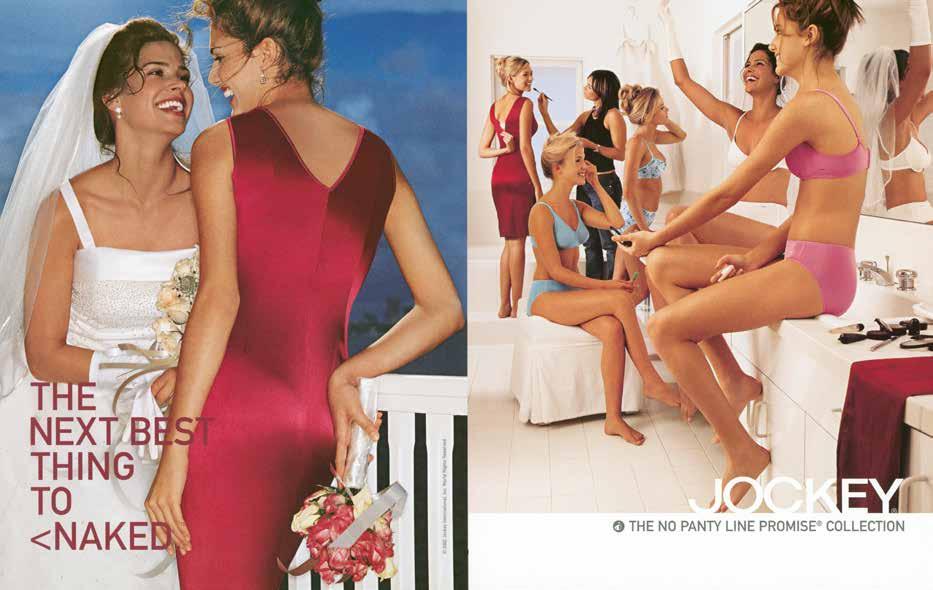
In 2001, one of the company’s most successful collections debuted: the No Panty Line Promise, the first of its kind in the market. Four years later in 2005, Jockey began home parties with Jockey Person to Person
Complementing her impressive track record in product development, Debra has overseen revolutionary technological changes in manufacturing, administration, and materials such as a line using Outlast® technology developed by NASA to regulate skin temperature and the Made to Fit collection using fabrics that conform easily to body shape.
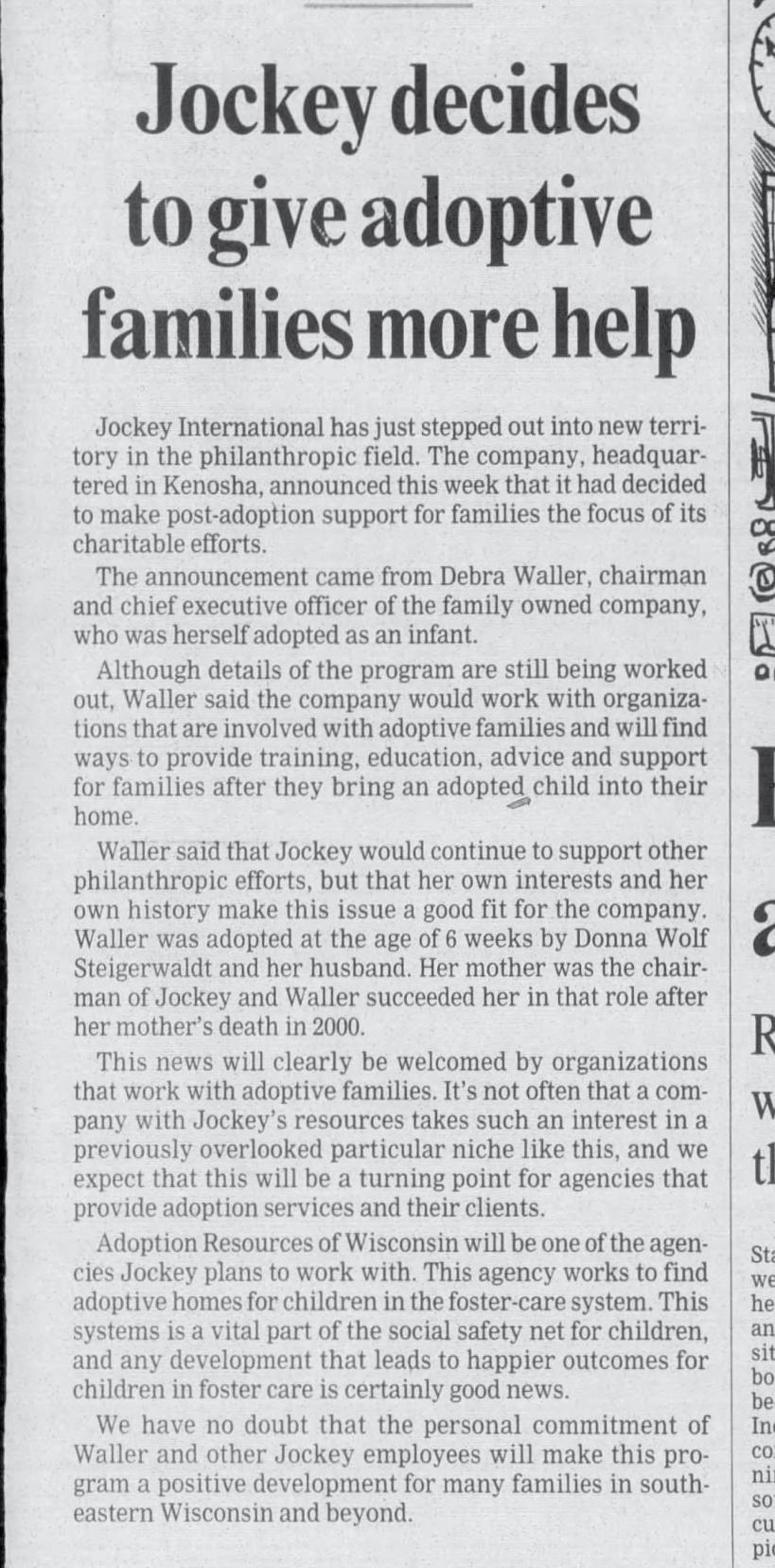
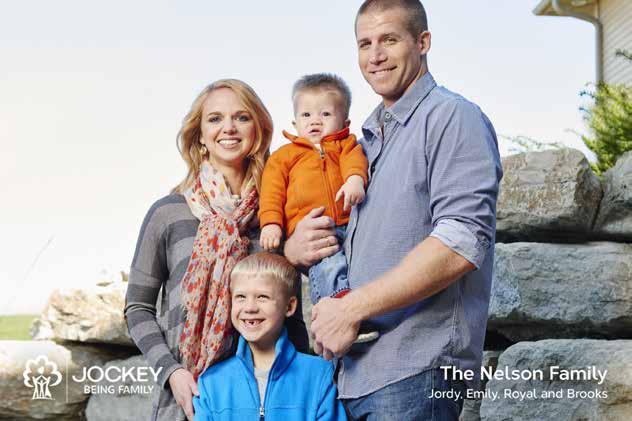
Debra is also the first CEO in company history to use Jockey as a platform to promote social causes that reflect Jockey’s values. In addition to supporting Habitat for Humanity, Kenosha schools, and Sleep in Heavenly Peace, which builds and delivers beds to children without beds, she founded Jockey Being Family in 2005 to support and strengthen foster and adoptive families, a program that has now spread to all 50 states. “Twenty years ago, there was such a negative connotation to adoption, which doesn’t make sense because every child deserves to have a forever family that loves and cares for them,” Debra said. “It was an ‘aha’ moment to realize that as a company, by publicly supporting adoption, we could make a real difference. And of course, it is personal, because I was adopted myself.”
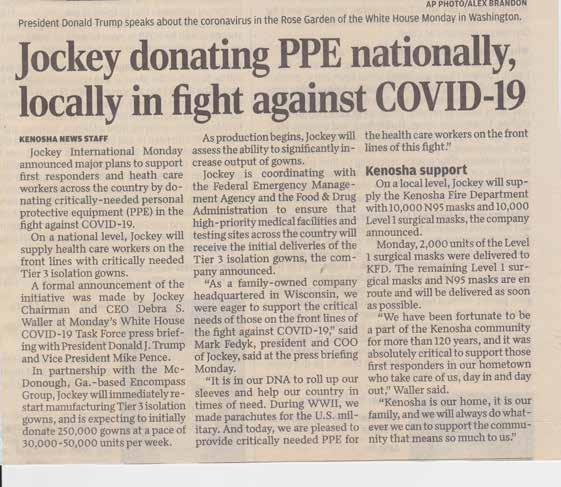
Despite such market success and commitment to the greater good, ask today’s Jockey employees about Debra’s legacy and unilaterally, the reply is her compassion and care for people. Retired President Ed Emma said that Debra, like her mother, “puts a premium on people and families, a novel approach that stunned those of us who had come from the gloomy daily grind of the retail sector.” Current President and COO Mark Fedyk concurs. “During COVID, we started talking about masks and gowns and PPE (Personal Protection Equipment), and while other companies were gearing up to sell things, Debra was gearing up to give them away.”
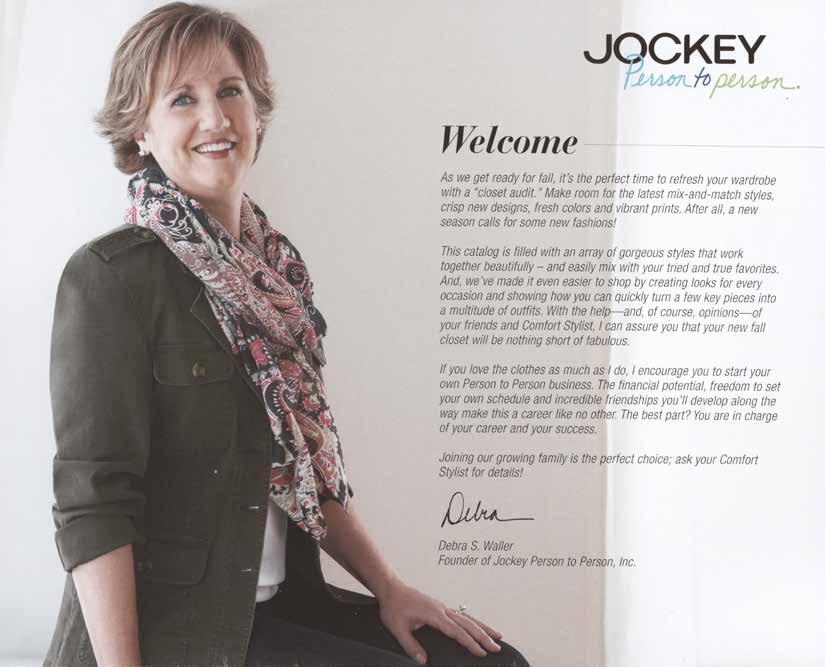
More than any other title, Debra sees her role as protector of the Jockey brand and the values that Reverend Cooper imbued in every facet of the company 150 years ago. “As a privately held company, we have the luxury of taking the long view,” Debra said. “Even as there have been monumental changes, in many ways, things haven’t changed since the days of Reverand Cooper. The common thread from the beginning of Jockey has always been, and will always be, to serve people, to take care of people.”
THE COOPER ERA
Samuel C. Cooper 1799 – 1856
Samuel Thrall Cooper 1824 – 1892
Willis Ward Cooper 1854 – 1903
Henry Sample Cooper 1858 – 1924
Robert Stratton Cooper Xx – 1945
Ralph Yocum Cooper 1891 – 1958
Robert Frost Cooper 1916 – 1975
THE WOLF ERA
Harry Hay Wolf, Sr. 1890 - 1979
Harry Hay “Buddy” Wolf, Jr. 1925 - 1989
Donna Wolf Steigerwaldt 1929 - 2000
Debra Steigerwaldt Waller 1956 -
Principles and values are only as good as the people who put them into practice.
-Debra S. Waller
THE COOPER FAMILY
Chicago Rockford Hosiery Company 1892-1903 Willis Cooper, Managing Shareholder 1892-1903 Charles Cooper, Managing Shareholder 1903-1913 Henry Cooper, Managing Shareholder
Cooper Underwear Company 1902-1904 Henry Cooper, General Manager 1902-1903 Willis Cooper, President 1904-1913 Henry Cooper, President 1913-1930 Robert S. Cooper, President
THE WOLF FAMILY
Coopers, Inc./Jockey International, Inc. 1971 Harry Hay Wolf, Sr. becomes sole owner, CEO, and Chairman of the Board 1971-1975 Jack Wyss, President
Jockey International, Inc. 1976-1978 Harry Hay “Buddy” Wolf, Jr., CEO and Chairman of the Board 1975-1977 Richard Jensen, President 1978-2000 Donna Wolf Steigerwaldt becomes sole owner, CEO, and Chairwoman of the Board
1979-1992 Howard Cooley, President 1992-1993 Paul Sebastian, President 1993-1994 Tom Bienemann, Managing Director 1995-2012 Ed Emma, President 2000-present Debra Steigerwaldt Waller, Chairwoman of the Board
1995-2012 Ed Emma, President 2012-2015 Byron Norfleet, President 2015-2018 Bob Nolan, President 2018-present Mark Fedyk, President
Samuel Thrall Cooper starts the Cooper Ice Company
1878
Abel W. Wells buys into the company; the name changes to Cooper & Wells.
Abel Wells, President
1879
Samuel founds S.T. Cooper and Sons’ Industrial Spinning and Knitting Works with sons Willis W. Cooper and Henry S. Cooper.
1892
After Samuel dies, the sons sell their shares in the company. Willis and Charles, Samuel’s youngest son, move to Kenosha to join Chicago-Rockford Hosiery Company.
Henry joins his brothers in the partnership.
1900
1902
September 13 - The brothers found Cooper Underwear Company.
After the death of his brothers in 1903, Henry eventually sells his shares in the ChicagoRockford Hosiery Company to focus fulltime on Cooper Underwear Company. His son, Robert S. Cooper, assumes the presidency even though Henry remains active in management until 1919.
1912
Ralph Y. Cooper, Charles’ son, negotiates a deal to assume the presidency from his uncle. The name changes to Coopers, Incorporated. Harry H. Wolf, Sr., joins the company as a consultant in exchange for a share in future business. From this point forward until his death, he is involved in all major company decisions.
1930
1929
The company changes its name to Coopers, Incorporated.
1957
Robert Frost Cooper becomes president, the last of the Coopers to lead the company.
The company becomes JOCKEY International to reflect its growing presence worldwide and as a nod to its most famous trademark.
1970
Serving as Chairman of the Board since 1960, Harry becomes CEO in 1971.
Harry Hay “Buddy” Wolf, Jr. briefly assumes the CEO and Chairman of the Board positions.
1976
1978
Concerned about the company’s longevity, Buddy’s sister, Donna Wolf Steigerwaldt becomes the new CEO and Chairman of the Board.
Debra Steigerwaldt Waller becomes CEO and Chairman of the Board.
2001
Transforming the future by thinking big.
Resisting convention, reinventing comfort.
Learning from mistakes in the quest for success
Revolutionizing an industry.
Going beyond what is to what is possible .
Chapter Two
INNOVATION
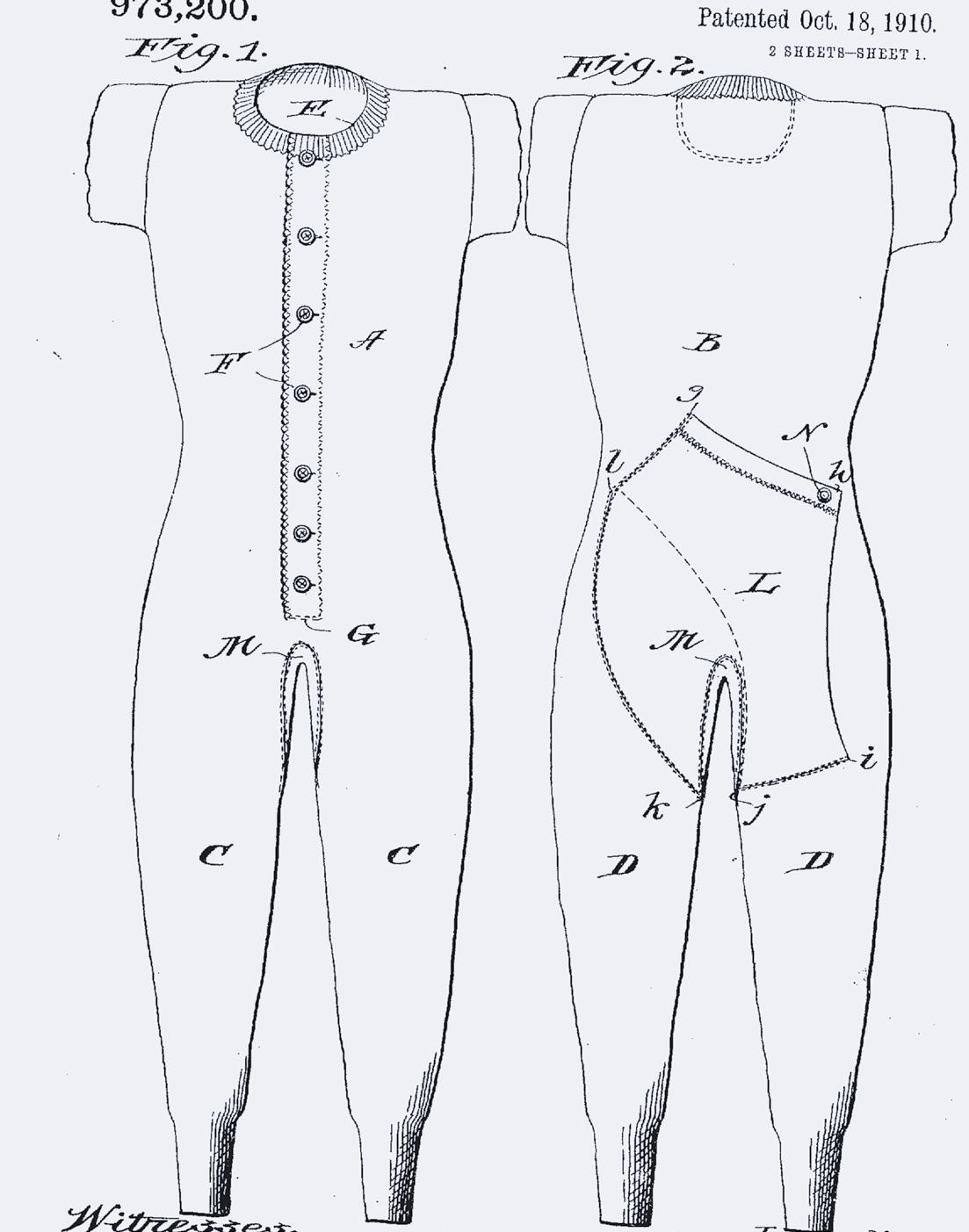
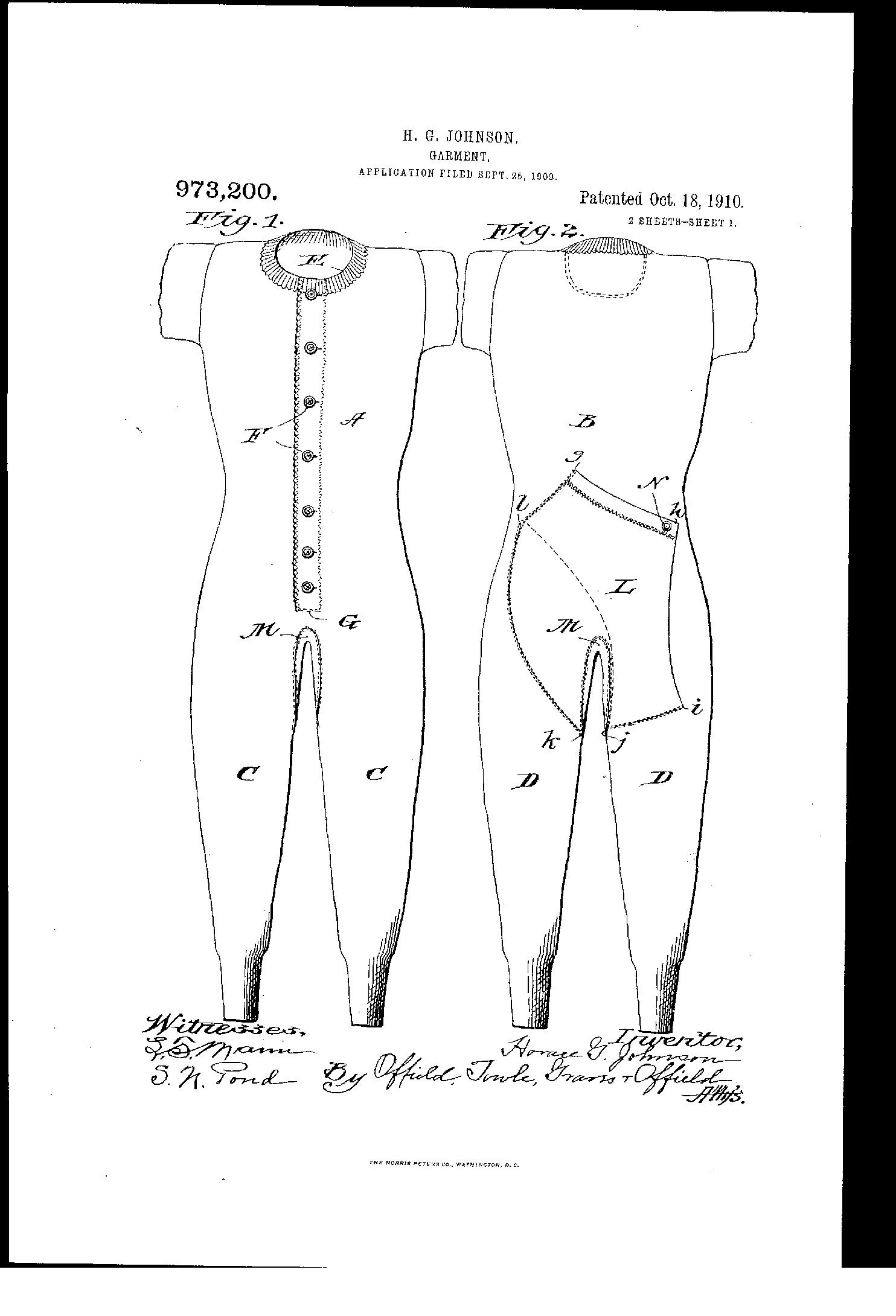
Like all good ideas, the inspiration for the closed crotch union suit came to Horace Greeley Johnson, manager of Coopers’ knitting room, in the middle of the night — “almost like a dream.” And like all husbands who wake in the middle of the night, Horace woke his wife, Olevia LoveJoy Johnson, prodding her up and over to her sewing machine before his vision faded. At Horace’s direction, Olevia arranged and stitched fabric scraps asymmetrically across the rear of the suit. Instead of a vertical opening where buttons, seams, and folds bunched in the crotch and buttocks “with considerable discomfort,” the diagonal opening stretched from the left hip to just above the right knee, overlapping like an “X” that opened with ease. Overnight, the innovation revolutionized men’s underwear, eliminating the need for fasteners and multiple layers of fabric.
Why does that seam bunch?
What can keep the waistband from rolling?
Problems such as these remain problems unless someone is curious enough to ask Why? Indeed, to delve deeper, continually question, and refuse to bend to the status quo leads to breakthrough. At Jockey, curiosity is the heartbeat of innovation.
Underwear as innovative? In the early days, Jockey innovation was born of necessity and survival. Henry Cooper was not the sort of man to sit back and let life happen, and after the death of his brothers in 1903, he was determined to hold together both his extended personal family and Cooper Underwear family. And so, he pressed forward, using the circumstances before him to create the future he desired for both.
By 1907, Cooper Underwear was manufacturing underwear at a record 200 dozen per day, but Henry continued to think outside the box in search of the next best thing. He encouraged employees to look for improvements at every turn, even tinkering himself with the design for the existing bulky one-piece union suit. Nurturing a culture of collaboration led to Horace Greeley Johnson’s Kenosha Klosed Krotch union suit, the single greatest innovation in underwear at the time.
The problem with underwear in the 1900s is that it was still an “unmentionable” item of clothing. Most people didn’t spend a lot of money on undergarments, and beyond function and comfort, most didn’t give it a second thought. That was about to change.
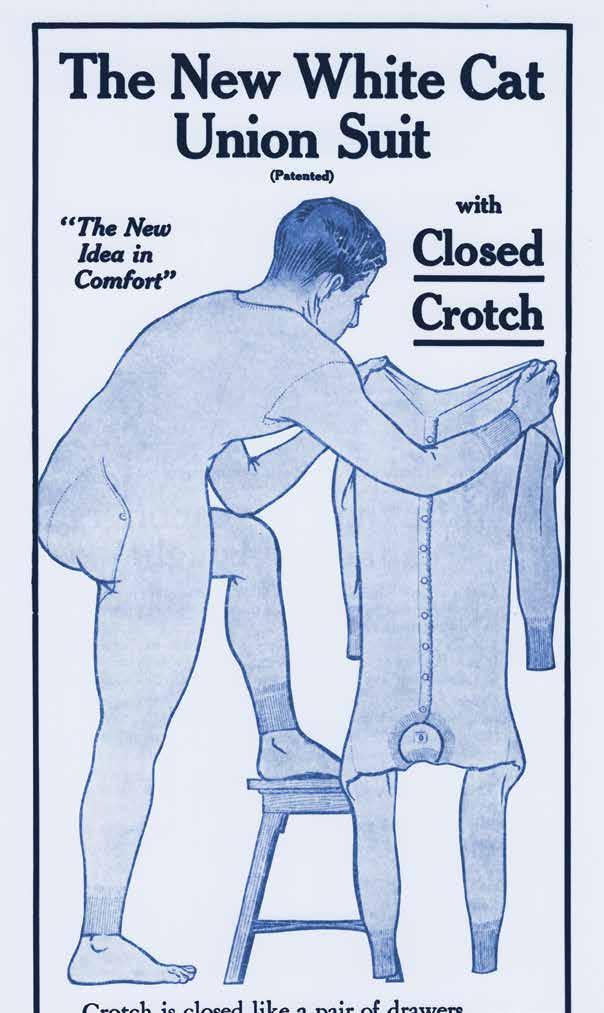
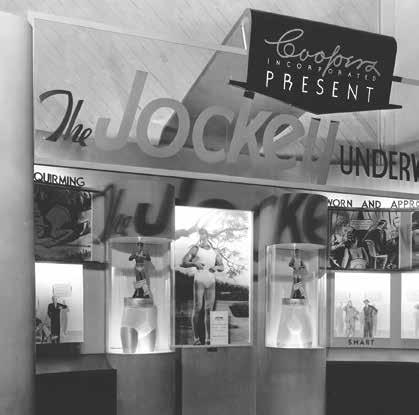
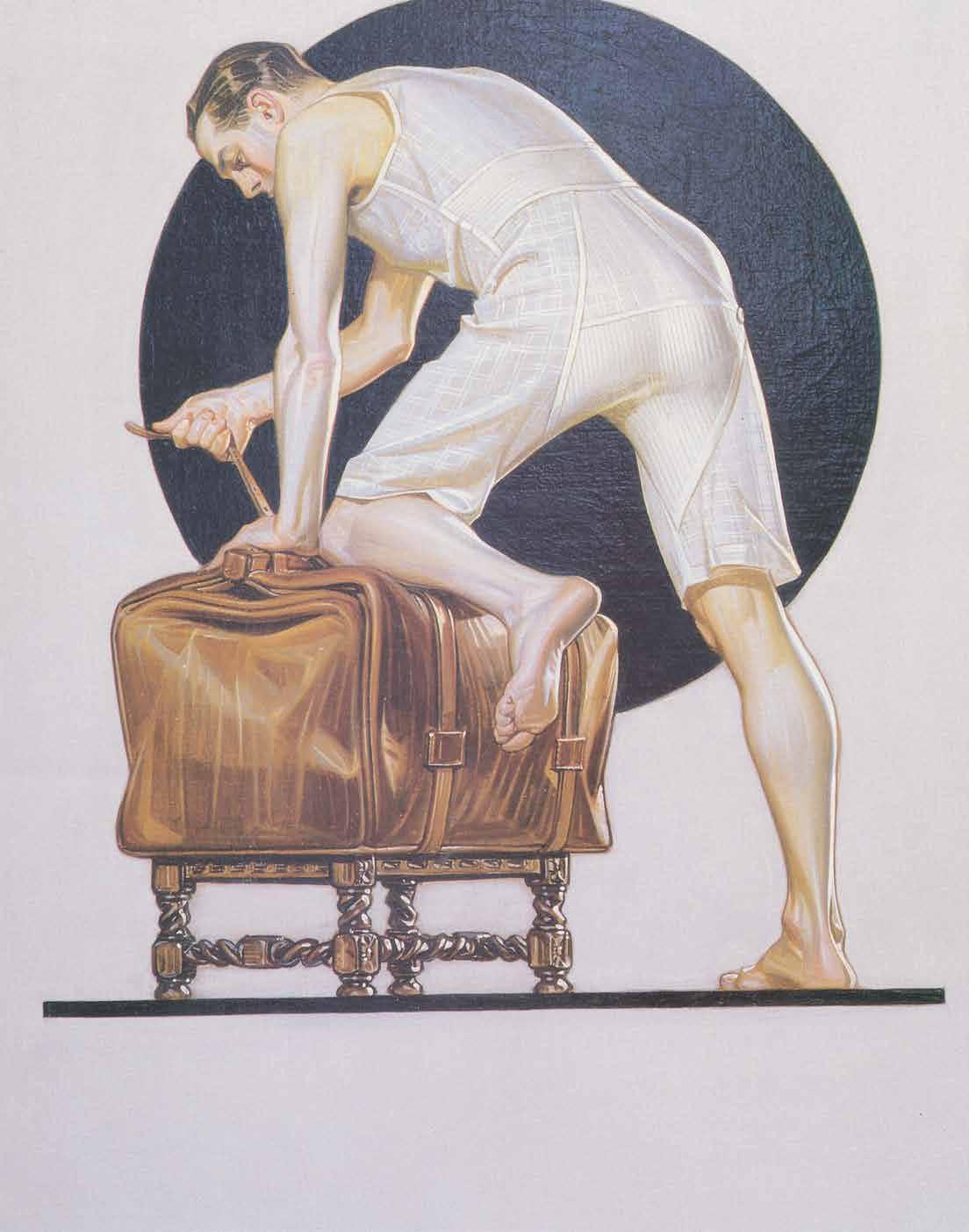
Despite his serious nature, Henry had a proclivity for showmanship, and he wasn’t afraid to try something new. In 1910, Cooper Underwear began selling the White Cat Closed Crotch union suit. In 1913, the name changed to the Kenosha Klosed Krotch, no doubt an attempt to set apart Cooper’s union suit from imitators. Soon after, Cooper’s launched a national advertising campaign for the union suit featuring the “Man on the Bag” illustrations by Joseph C. Leyendecker, already famous for his “Arrow Shirt Man’ drawings, the campaign ushered in a new age in sales and marketing in the underwear industry. By 1915, Coopers was the world’s largest maker of union suits.
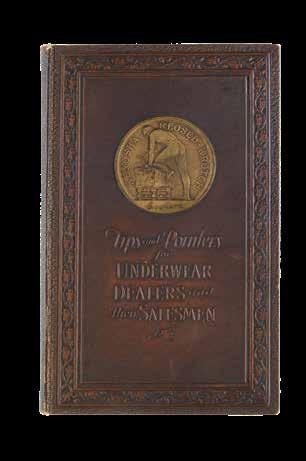
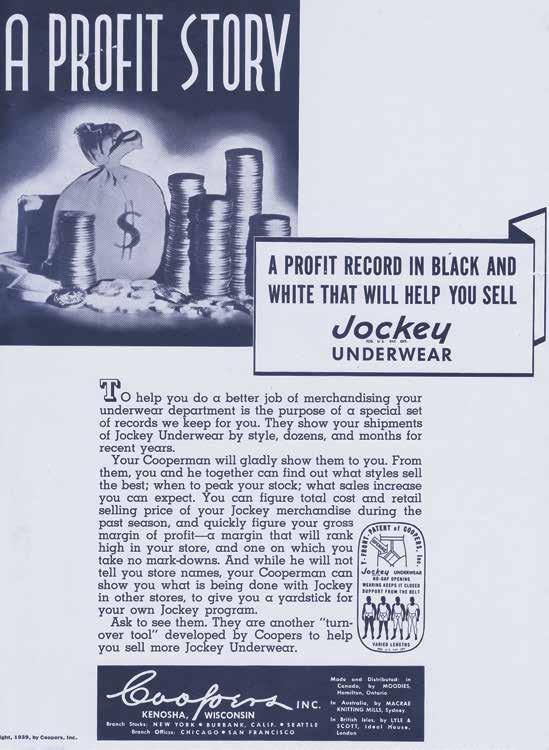
Eight years later in 1923, Henry wrote a 177-page sales treatise chock full of advice, product details, and measuring tips to use in training his sales team. In turn, his sales team trained retailers, who trained customers on the product’s benefits. Until the Kenosha Klosed Krotch suit’s debut, no company had ever taken such care to educate retailers in as much detail about a garment, much less underwear.
Left page: Union Suit Klosed Krotch advertisement, 1911 and Klosed Krotch patent, 1910
Above: Horace Johnson and wife, Olivia Lovejoy with daughters circa 1906
Like Henry Cooper, Arthur R. Kneibler was a man who saw beyond “what was” to “what could be.” It was the 1920s, and Cooper Underwear “was only a few steps ahead of the sheriff in those days,” Arthur remarked at the time. The Great Depression was in full swing, and underwear wasn’t a necessity. It didn’t help that consumer tastes were also changing toward a preference for lighter, two-piece underwear instead of the heavier one-piece union suit.
Arthur joined the company in 1928 and immediately began work assessing and improving the marketing, sales, and advertising departments. One of his first suggestions was to change Cooper Underwear to Coopers, Incorporated. The old name had confused customers because it failed to reflect the company’s ever-growing range of products beyond underwear.
Arthur was also an after-hours inventor who was constantly devising new products in search of the next big hit. In 1934, 24 years after the introduction of the Kenosha Klosed Krotch, he and Coopers’ plant manager Herman Fredericksen began experimenting with a new tank suit…
“…and our experiment had proceeded to the point of where the garment — brief, like a swim garment, having no belt but rather an apron here and suspenders from there on — was being tried out on a laboratory basis in our local pools. The absence of a constricting element at the waistline was quite a big point at the outset, so we put an elastic band there because , as one dove into the water, something had to stop the water from tearing the suit apart. That is the way that garment was born, and a few of the boys around here began to wear it as underwear. Then the idea of substituting it for the ordinary jock strap was born, and some of the other boys who had been in the habit of wearing that kind of contrivance substituted this garment for it and wore it under whatever other underwear they wore.”
After testing the product by wearing it himself, Arthur was convinced that he had stumbled across a winner. Taking a page from Henry Cooper’s playbook, he created an aggressive advertising and marketing campaign, once again featuring a retail guide with garment details and the same cellophane packaging and on-the-counter self-service display that had made the Singleton, a form-fitting union suit from 1933, so popular.
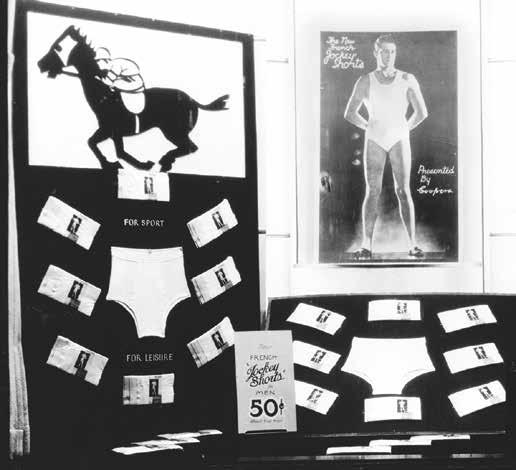
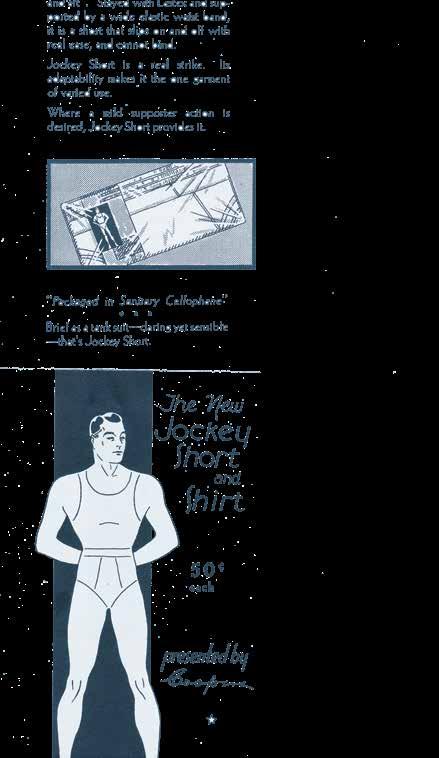
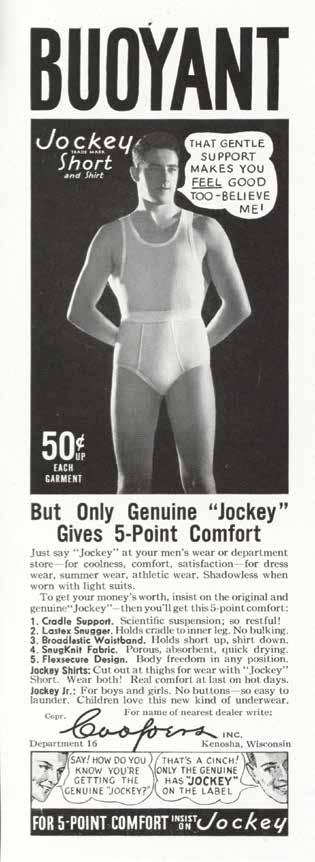
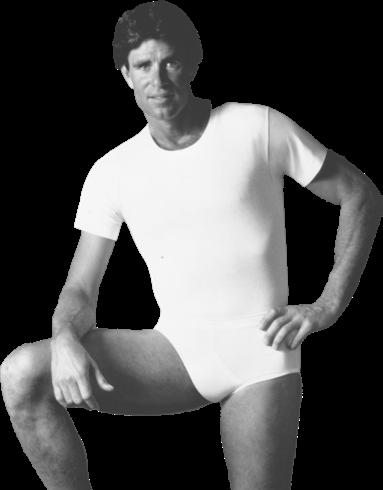
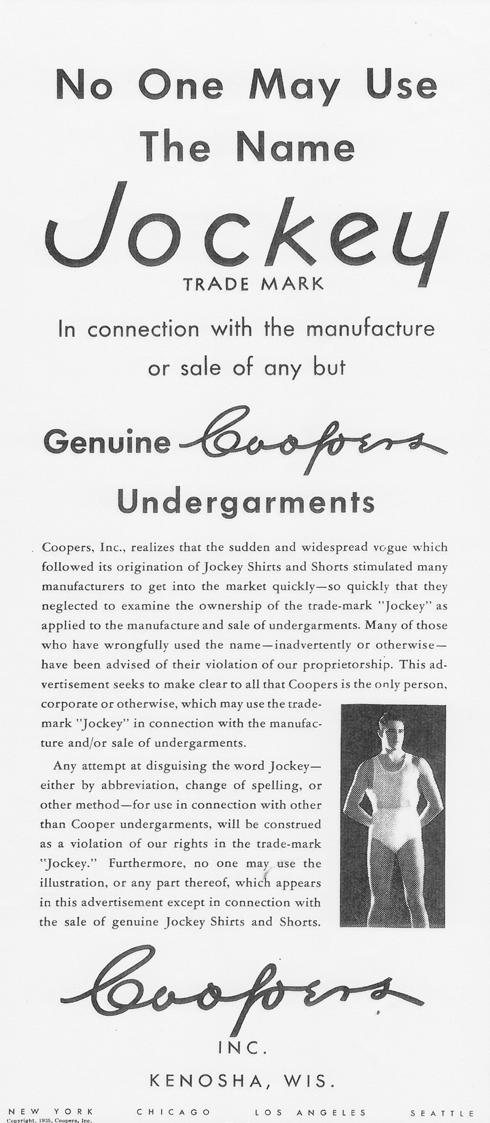
Arthur conferred with sales managers on a potential name for the new underwear. “Jockey,” a loose reference to “jock strap,” wasn’t anyone’s first choice but it was short, catchy, and athletic, so it stuck. The Jockey short debuted in 1934 and by 1935, Coopers was producing 3,000 dozen pairs a day.
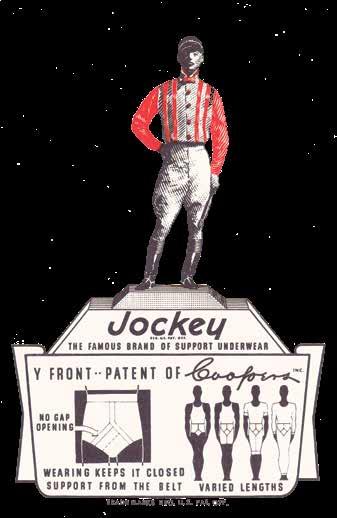
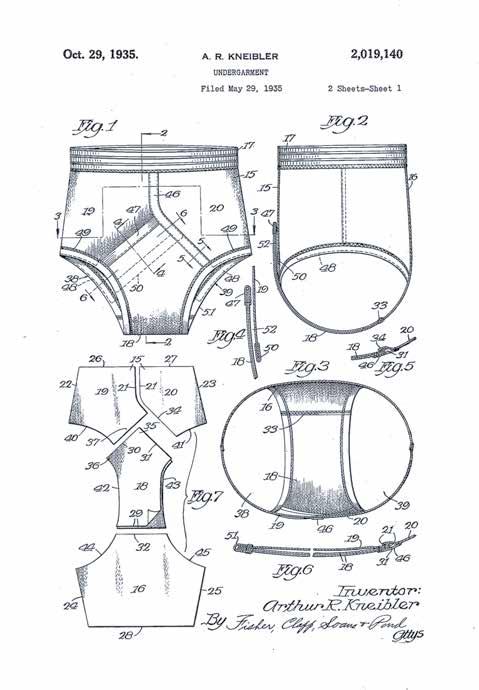
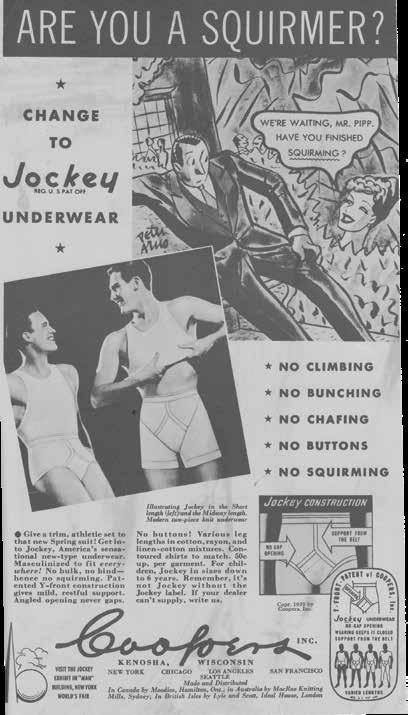
Innovation is not always groundbreaking. Over its 150 year history, Jockey has pioneered many new innovations in underwear, but the company has been just as effective at improving existing inventions. In fact, incremental improvements and slight alternations to existing products can be just as significant and successful as creating a new product. Take the invention of the Y-Front Jockey brief in 1935. Even with the brief’s success, “The Edison of Underwear,” as Arthur had come to be called by his colleagues, continued to tinker with its design with the invention of the Y-Front opening with reinforced seams for support in January 1936. This simple shift of the fabric once again revolutionized men’s underwear with an innovative design featuring both form and function.
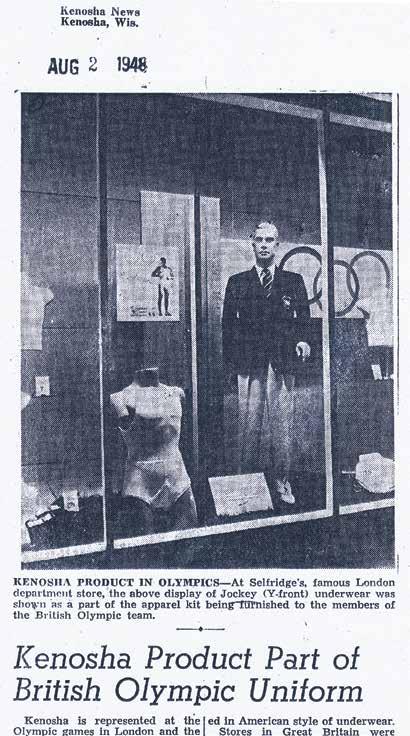
Right: 1935 Brief Window display
“A Name Synonymous with Comfort:” Jockey
new product without any negative connotations?
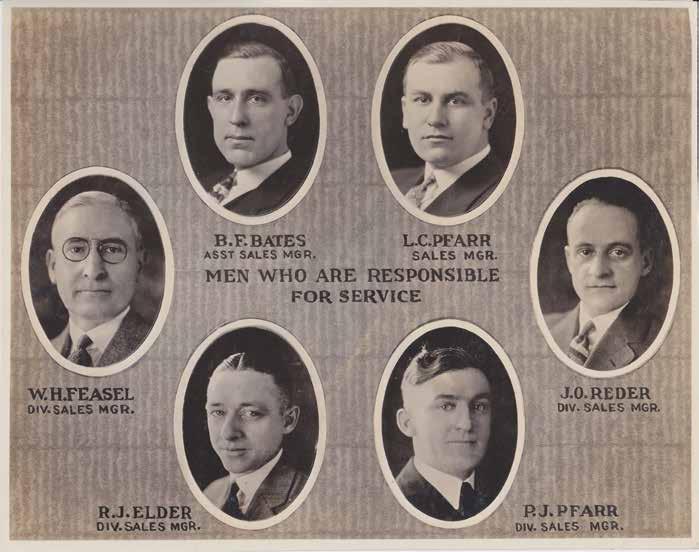
Arthur R. Kneibler and his sales team, Lou Pfarr, Bob Menn, and Barrett Bates, struggled to find a name for weeks when launching the Jockey brief in 1934. Early on, someone mentioned “Jockey,” for its association with the “jock strap,” but the group continued to cycle through dozens of names. Finally, as the rollout loomed closer, Kneibler asked everyone to write their preferences down: “Jockey” was the only name on all four slips of paper. It was familiar, easy to pronounce, and suggested masculinity and athleticism. On July 2, 1935, Jockey became a registered trademark for the company, and in 1960, all products began selling under the Jockey name.
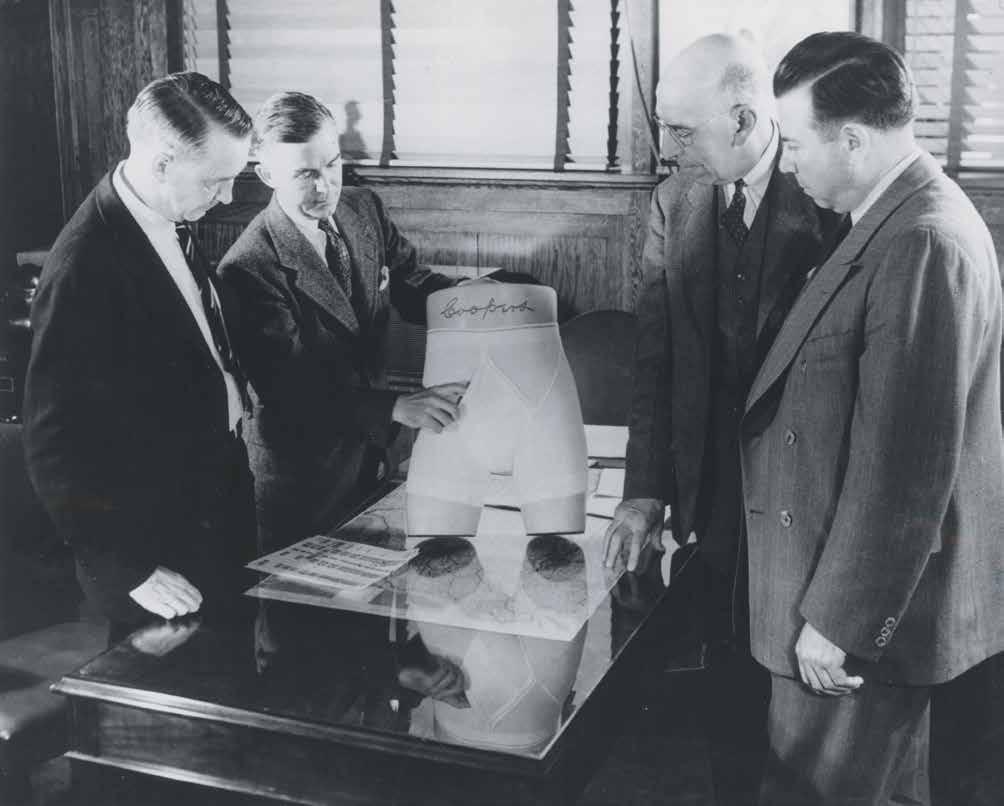
Four Horsemen: L-R: Gib Lance, Ralph Cooper, Arthur Kneibler and Harry H. Wolf, Sr.
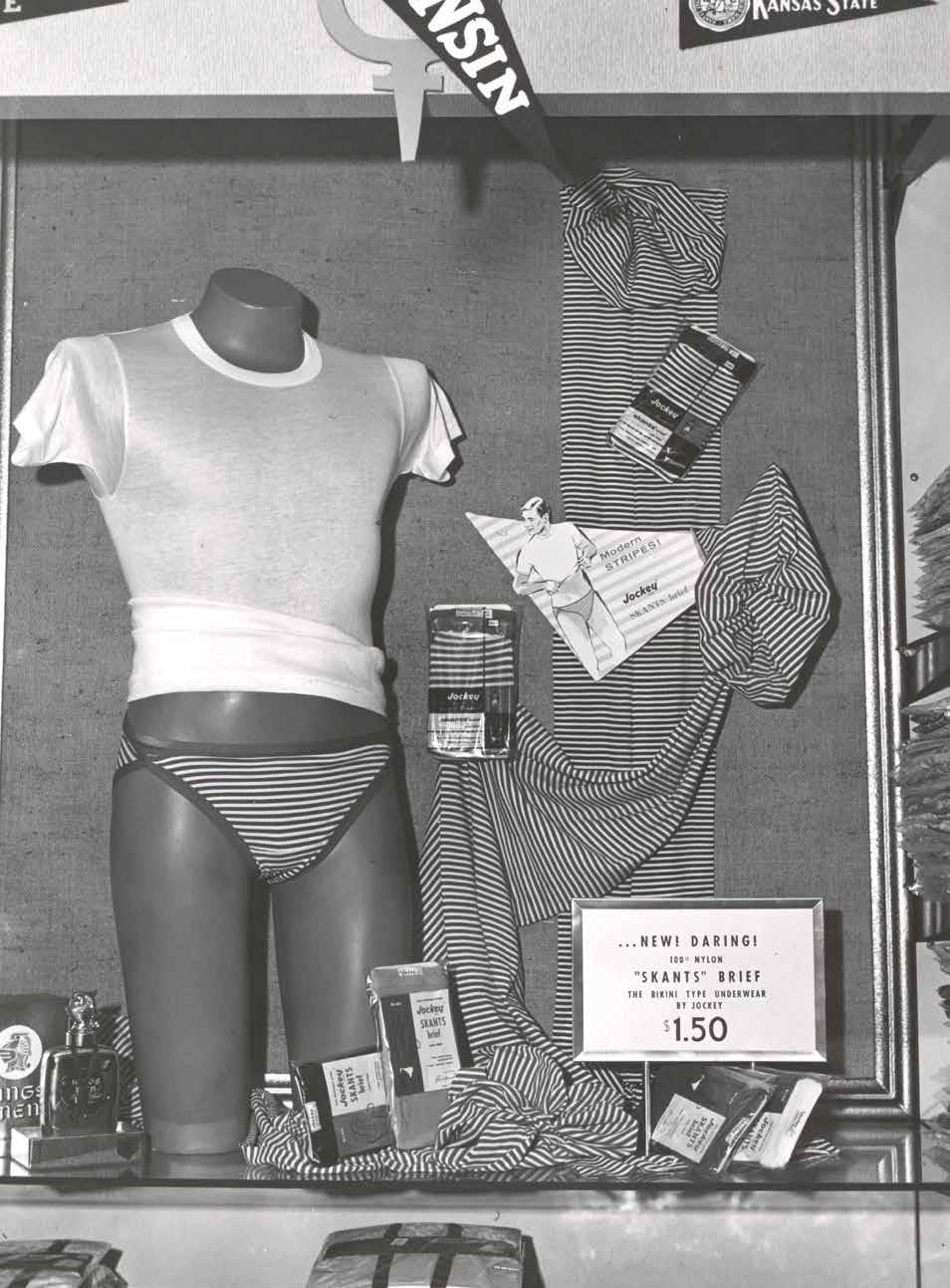
Background and right page: 1960 Skants window displays
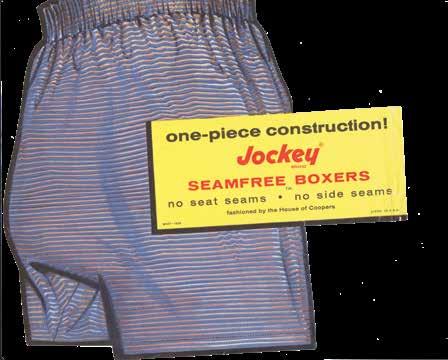
The Seamfree Jockey Boxer Short is another example. Boxer shorts had been around since the 1920s, but in the never-ending quest to “satisfy the human need for comfort,” Coopers patented the first seam free version in 1958. In 1997, the Cotton Women’s Almost Nothing Seamfree launched, with various styles still sold today.
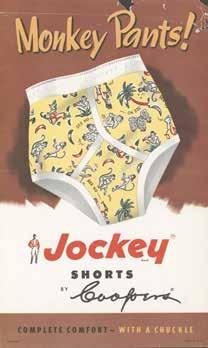
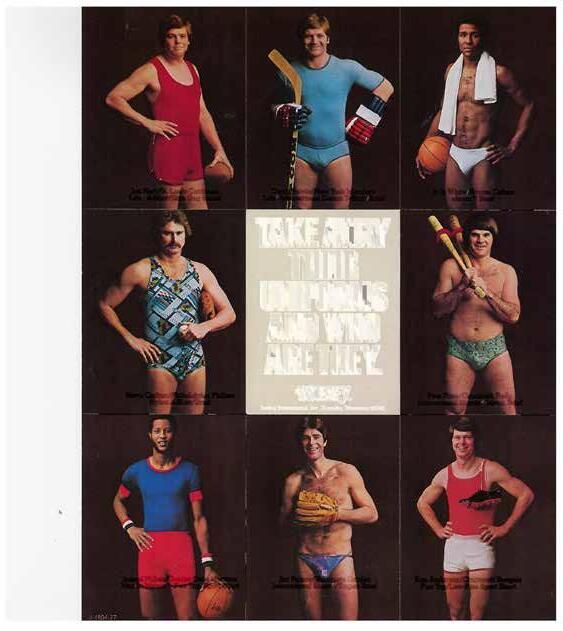
By the mid-20th Century, the Jockey brand was recognized worldwide, and while the classic white brief remained perennially popular, the Coopers team tested new fabrics, explored the latest manufacturing techniques, and bounced around ways to give tried-and-true products a new twist. When the Fancy Pants line of briefs in Celanese fabric and novelty prints debuted in 1949, there was nothing innovative or new about the garment design, but the prints, including the popular leopard, tiger, and zebra patterns, added a fourth characteristic to the traditional quality, comfort, and fit of underwear: fashion.
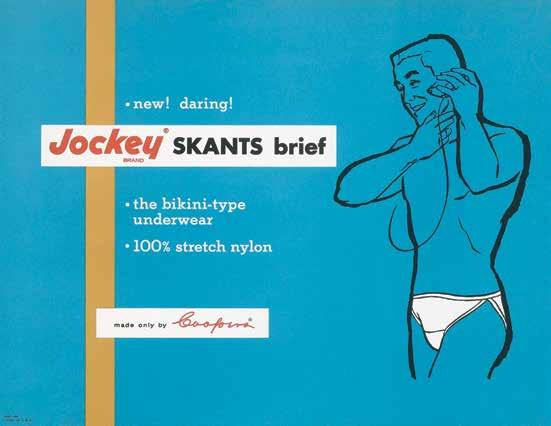
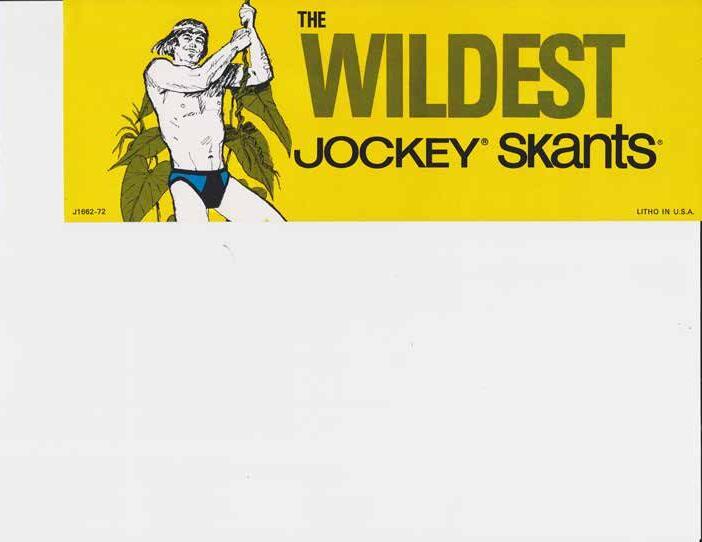
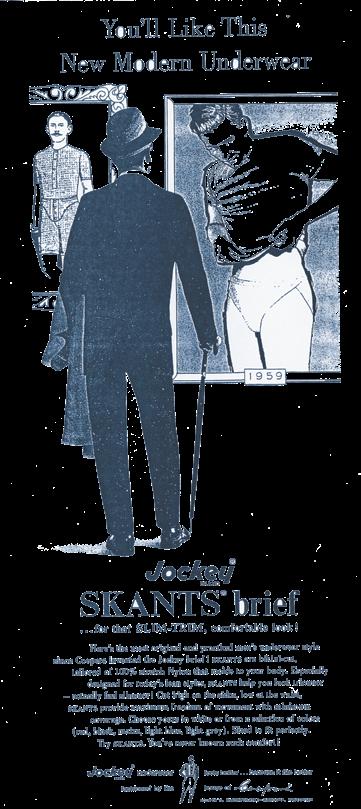
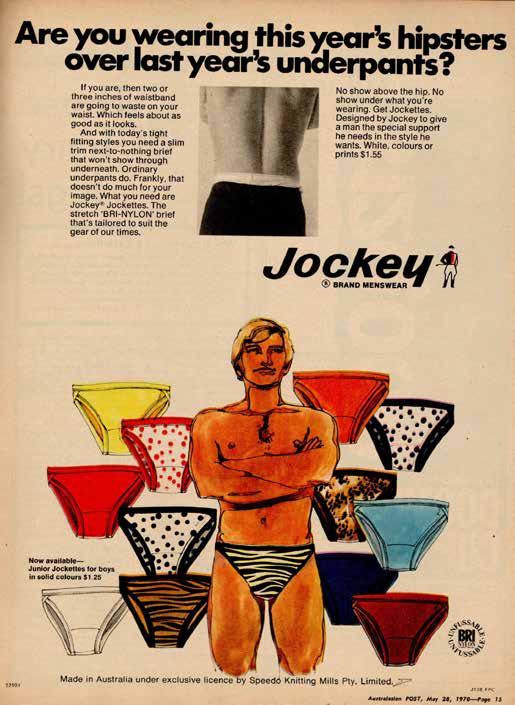
Fancy Pants became the inspiration for Jockey Skants, introduced nine years later in 1958 by Bill Testard, the son-inlaw of Horace Johnson, inventor of the Kenosha Klosed Krotch. Low-cut at the waist, high-cut on the sides, and made from stretch nylon tricot fabric designed to conform to the body, Skants were sold in white and solid colors, with knit-in stripes added the following year. Advertised as high fashion underwear, Skants was ahead of its time and a precursor to the Jockey Life Underwear in 1965 and the Elance collections of the 1970s. The idea of fashion as self-expression had finally trickled down to underwear, and advertising touted the new bold colors, briefer cuts, and various fabrics already popular with European customers. In a 1973 commercial for Jockey Life, Godfrey Cambridge asked consumers, “Whoever said underwear has to be white, anyhow? People come in colors don’t they?” Within a few years, the popular Jockey Life line had become 25 percent of Coopers’ business.
It takes more than a good idea to have a breakthrough. Innovation is only possible when someone is stubborn enough to stick with a good idea until the kinks are worked out. The Kenosha Klosed Krotch had Horace Johnson. The European-style Jockey brief became a moneymaker and the inspiration for Skants, the no-fly front bikini brief, after Ernie Ott in marketing convinced then President Jack H. Wyss that a lower, more modern rise would be a big seller overseas.
And now, it was Donna’s turn.
In the early 1980s, women across the country had gone bonkers for the Elance national advertising campaign featuring Baltimore Orioles’ baseball player Jim Palmer. Furthermore, almost every week the company received letters from women who bought and wore men’s Elance bikinis because they liked the fit and comfort of Jockey underwear. Even women employees at Jockey wore men’s Elance.
Donna W. Steigerwaldt took notice. The world was changing, and she sensed the shift that was coming in society for women because she herself had defied social mores and stereotypes as one of the first women in the 1970s to lead an international company.
Since becoming CEO four years earlier, Donna had been learning, listening, and watching, and she was keenly aware that even though thirty years had gone by since the launch of the 1952 Jockette line for women, it was still considered one of the company’s biggest flops.
Still, Donna figured that if women appreciated the comfort of Jockey underwear for men enough to write letters about it, then why not create a line of underwear especially for women? It would be a calculated risk to move into women’s fashion, but Donna had nothing to lose. As a woman CEO, many people already assumed that she would eventually fail.
Donna wasn’t the only one excited about the possibilities of a new underwear line for women. Jockey President Howard Cooley, a textiles expert who had worked as a consultant for the company since the 1960s, shared her enthusiasm. Just as her father, Harry H. Wolf, Sr., had been a trusted adviser to several generations of company leadership, Howard became Donna’s righthand man, a confidante and confidence-builder who encouraged her to forge her own path.
The timing was right, but there one more reason that Donna was right person for the challenge: She was a woman. Who better to transform the world of women’s underwear than a woman who knew as much about underwear as anyone in the world, a woman who understood the unique challenges of fitting a woman’s body and maintaining comfort in the myriad roles she assumed throughout her day?
This time around, there would be no missteps selling women’s underwear in the men’s department, or altering underwear originally designed for a man’s body to fit a woman. Donna sized up the competition and found that most women’s underwear didn’t hold up and didn’t fit right. Furthermore, it was unattractive and uncomfortable.
She tasked Don Ruland to investigate state-of-the-art fabrics, manufacturing techniques, and successful marketing campaigns for the new product line. It wasn’t enough for the new designs to look “right:” they had to fit right, too, so Jockey developed standardized sizing for women’s underwear, which the current market lacked.
The most important step came when Donna enlisted Jockey employees (including herself), a group of flight attendants, and Carthage College students to test the underwear by wearing it. Based on the feedback and performance, she and Don went back and forth to the drawing board, refining the durability, comfort, and fit. It was a process that repeated itself until finally, the garments were “comfortable, didn’t ride up or bind, stayed in place, and fitted the same before and after many washings.”
Jockey for Her debuted in November 1982 and became so successful that it expanded beyond the initial three styles of underwear to include tanks, bras, tees, and queen sizes while also inspiring two new lines: Jockey for Girls and Jockey for Boys.
A little over two years later in 1984, women’s underwear accounted for 18 percent of Jockey’s volume.
Once again, Jockey innovation pushed the company beyond the historical boundaries of what an underwear company should be. The success of Jockey for Her also confirmed that Donna, like the Coopers and Wolfs before her, was capable of driving meaningful innovation. But could Donna go a step farther and cultivate a culture of innovation that would last through future generations?
Ads need caption here
The answer came in the form of Debra S. Waller, Donna’s daughter, who began work at Jockey in January 1982.
It was no accident that Debra landed in merchandising as liaison to the Research & Development Department. “Donna knew that Debra needed a strong background if she was going to one day move up in the company,” remembers Anne Arbas. If Debra had any intention of one day leading Jockey, trial by fire in such a fast-paced, challenging, and tedious position would determine if she had the ilk of an innovator. After all, if curiosity was the heartbeat of Jockey innovation, innovation was the lifeblood of Jockey’s success.
By the 1980s, name brand companies popular in other retail areas as well as fashion designers recognized the growth potential in underwear. Many adapted designs that Jockey had made famous. Other companies, recognizing Jockey’s expertise in producing comfortable, quality products, went directly to the source, and for the first time, Jockey agreed to manufacture briefs, boxers, and tee shirts for other designers. Yves St. Laurent signed on in 1981, Perry Ellis in 1985, and Christian Dior in 1989. Although the partnerships were short-lived for failing to reach sales expectations, they paved the way for the more successful collections created for Tommy Hilfiger and Liz Claiborne in the 1990s. “Jockey’s a preeminent marketer, and they share our values of fit and quality,” said Paul Charron, Liz Claiborne’s president at the time.
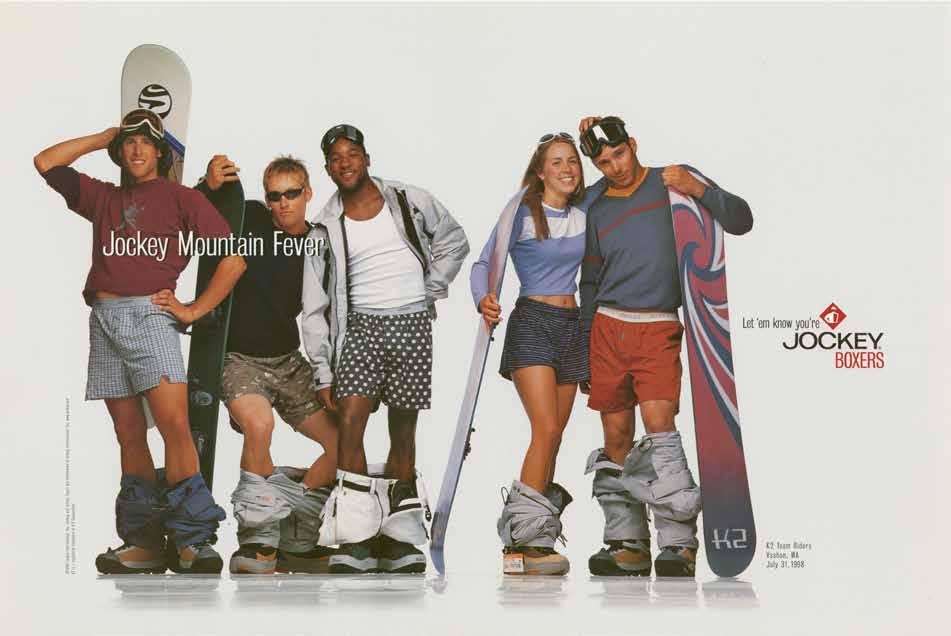
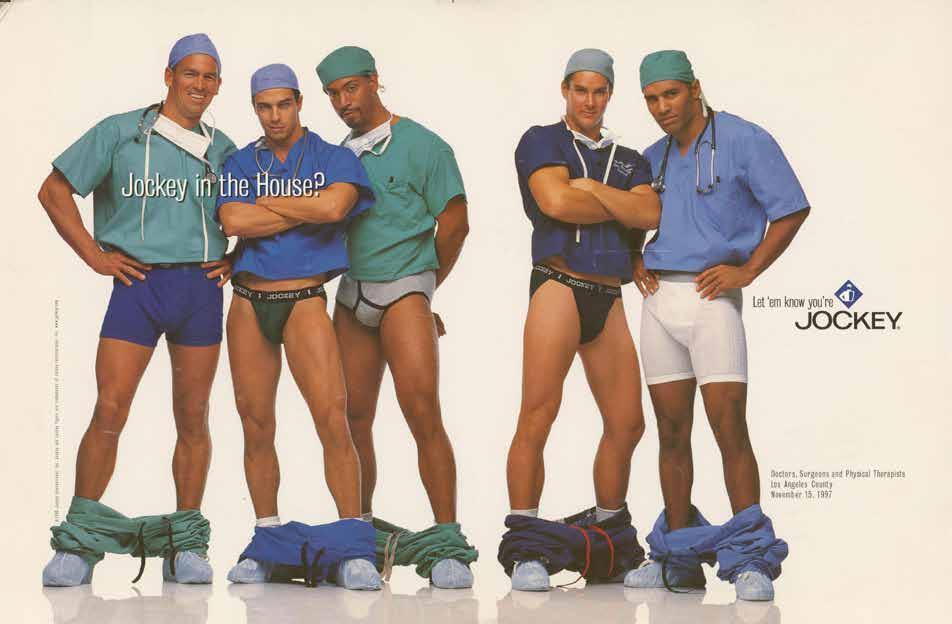
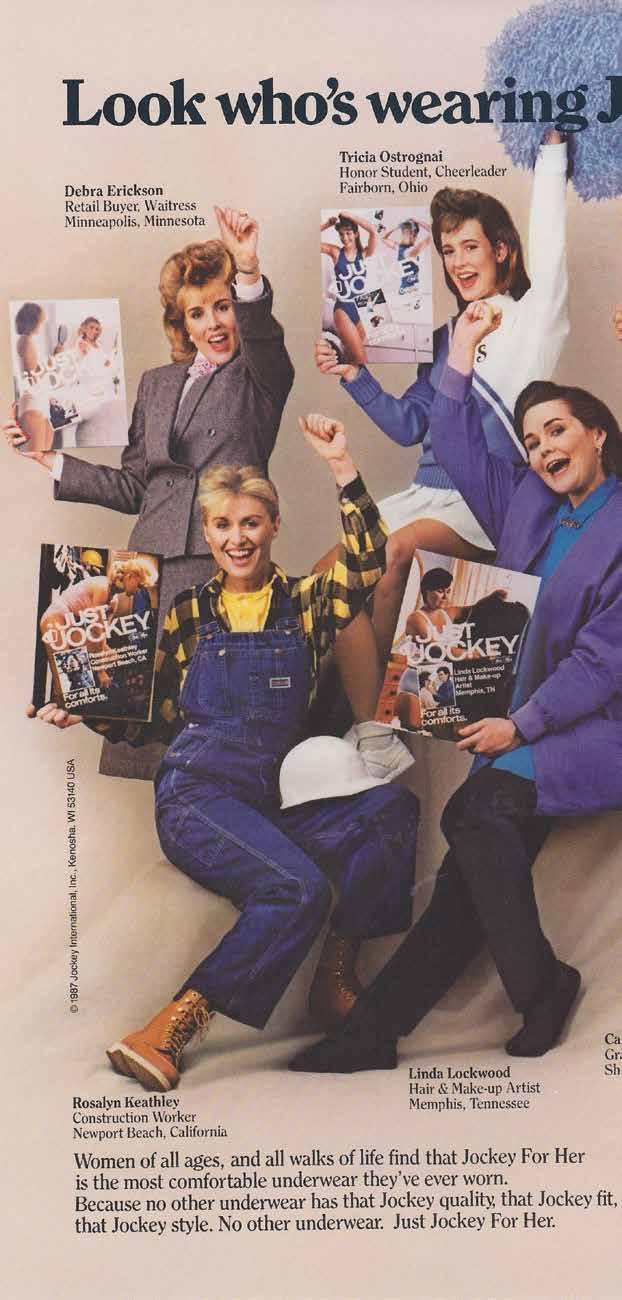
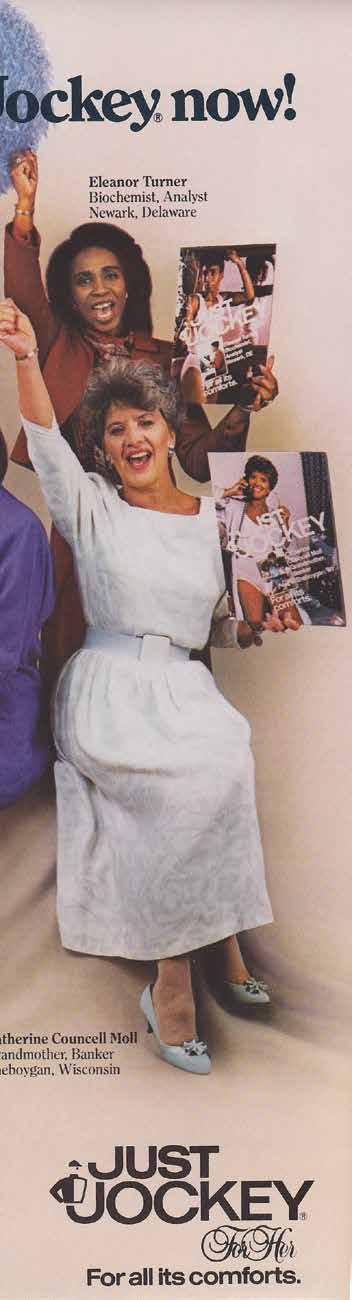
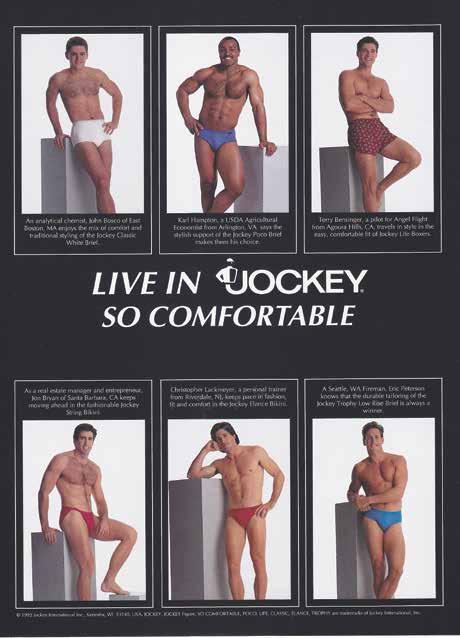
An ideal opportunity came in 1998 with the “Let ‘Em Know You’re Jockey” advertising campaign featuring “real people” — doctors, firemen, surfers, and stockbrokers modeling Jockey underwear. The campaign coincided with the relocation of the company’s New York City showroom to the fashionable garment district. Guests invited to the opening of the showroom were also escorted to the unveiling of Jockey’s giant Times Square billboard featuring young snowboarders from the Rocky Mountains. The crowd roared when the snowboarders appeared live, dropping their snow pants to “Let ‘Em Know You’re Jockey.” Henry Cooper may not have recognized the fabrics or styles of underwear, but he would have overwhelmingly approved of the campaign’s fashionforward novelty while still touting the comfort of Jockey underwear. “It was attractive, and it had humor,” said Debra, who had by then moved into the role of vice president of marketing and advertising. “And best of all, it attracted attention.”
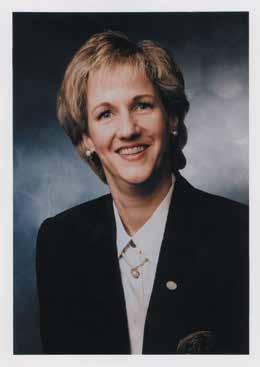
In 2001, Debra followed in her mother’s and grandfather’s footsteps by becoming CEO and Chairman of Jockey. After almost twenty years of moving up and around the company, she has witnessed firsthand how Jockey charts its own course by doing things that other companies don’t do. Being adaptable, cultivating a culture of continuous improvement, demonstrating the ability to pivot amid change, and taking calculated risks to disrupt the market are traits of Jockey innovation — traits firmly rooted in Henry Cooper’s philosophy of doing business but equally evident in the modern company that Jockey International would become under her leadership.
As the millennium approached, Jockey remained the Cadillac of underwear, synonymous worldwide for comfort, fit, and quality. Still, there was no denying that the retail space Jockey had controlled almost exclusively for over a century was becoming a battleground for consumer attention. The company had already introduced new styles using new, technologically advanced fabrics, but to compete, it was imperative that Jockey stand out in an increasingly crowded market.
Left page: 1997 and 1998 “Let ‘em know you’re Jockey” ads
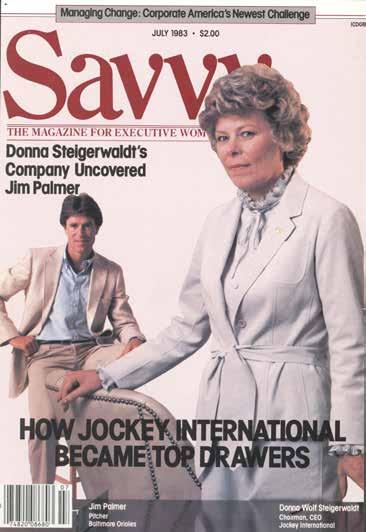
Above: Savvy magazine featuring Donna Steigerwaldt and Jim Palmer, July 1983
It’s no surprise given Debra’s early experience in R&D that innovation has continued to play an integral role at Jockey. Modern consumers want the latest, greatest products, have an increased interest in underwear in a variety of styles, expect technological advancements in fabrics and manufacturing, and capitalize on the ease and availability of online purchasing. These factors along with Jockey’s evergrowing global presence created such demand that as many updated and new collections have been introduced in Donna’s 25-year tenure as in the first 125 years of the company’s history combined.
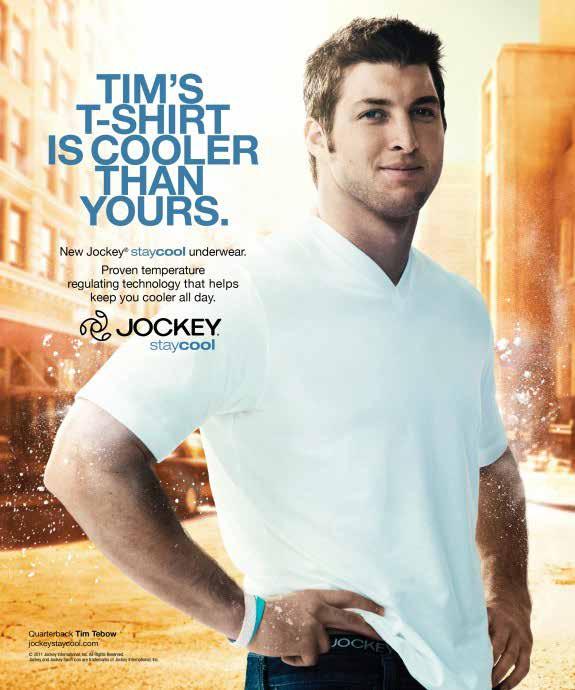
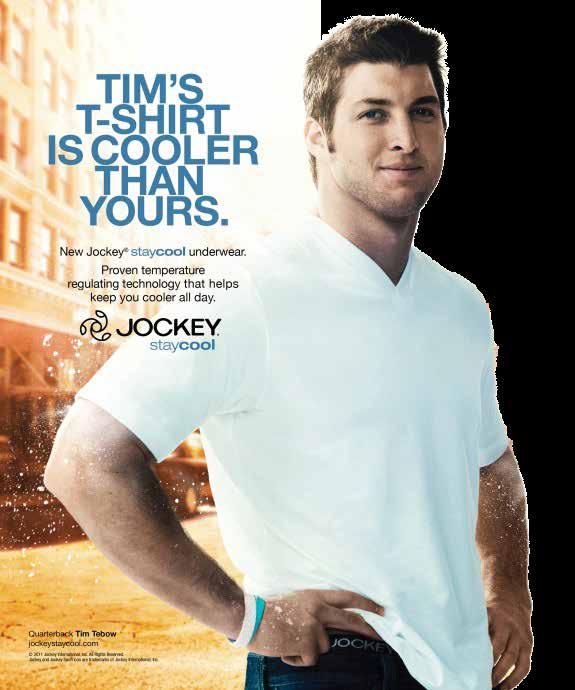
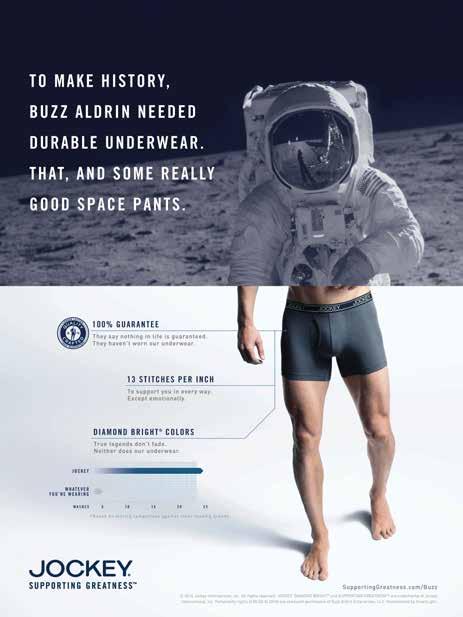
Some innovations are completely new. For example, when asked to submit designs for the Astronaut’s Continuous Wear Garment, Jockey developed the 2011 Staycool line, becoming the first company to manufacture underwear made from Outlast technology developed by NASA. Using phase change materials (PCMs) that absorb, store, and release excess heat, Staycool garments regulate skin temperature by as much as 4 degrees to keep the body cool and comfortable. “It’s Jockey’s fastest-selling collection in modern history,” said Mo Moorman, director of public relations at the time. “This is something no one else in the US market is offering. If there’s anywhere you want to be most comfortable, we think it’s your underwear.”
In true Jockey fashion, a splashy advertising campaign featuring professional football player Tim Tebow as spokesperson promoted the line. “It it’s good enough for astronauts,” he said, “it’s good enough for me.”
JOCKEY FIRSTS
Above: Jockey “Future of Underwear”
Right: Tim Tebow is brand ambassador and promotes the Jockey Staycool line of underwear
1880s First to sell direct to retail rather than through jobbers
1910 First to offer a solution to unwanted bulk in union suits, the Kenosha Klosed Krotch
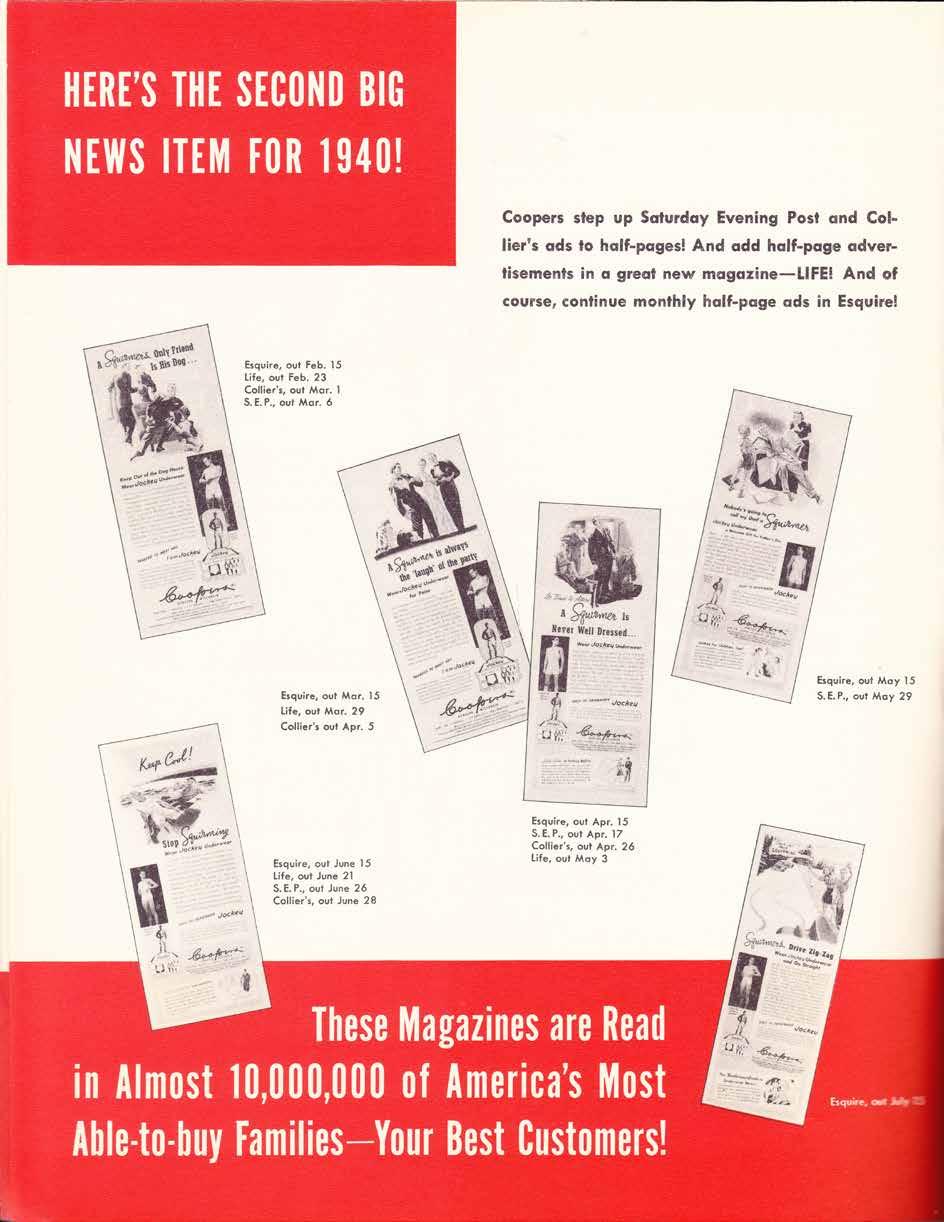
1911 First to advertise men’s underwear in a national advertising campaign in the Saturday Evening Post
1933 First to mount underwear on cardboard and wrap it in cellophane
1934 First to offer the men’s brief
1936 First to offer the Y-front opening on a brief, a Jockey invention
1937 First to introduce the Stride form, a plaster mold of a real man’s body to display men’s knit support underwear
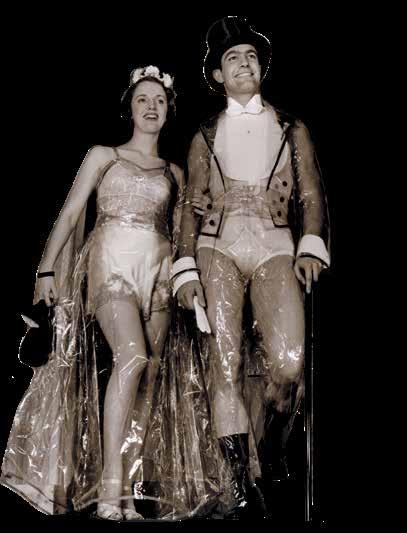
1938 First to host an underwear fashion show: The Cellophane Wedding
1939 First to create a self-service display for underwear, invented by Jockey salesman Pete Pfarr
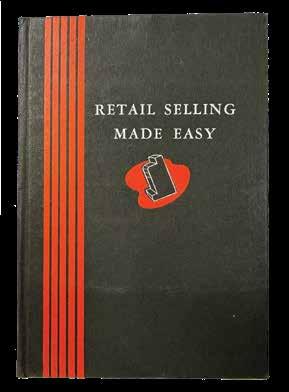
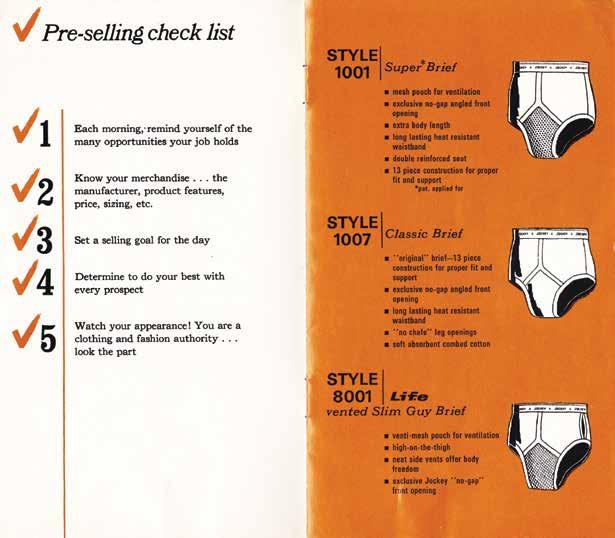
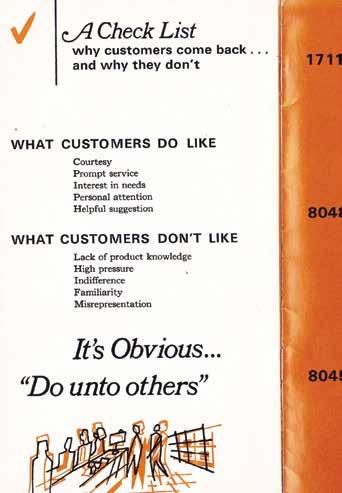
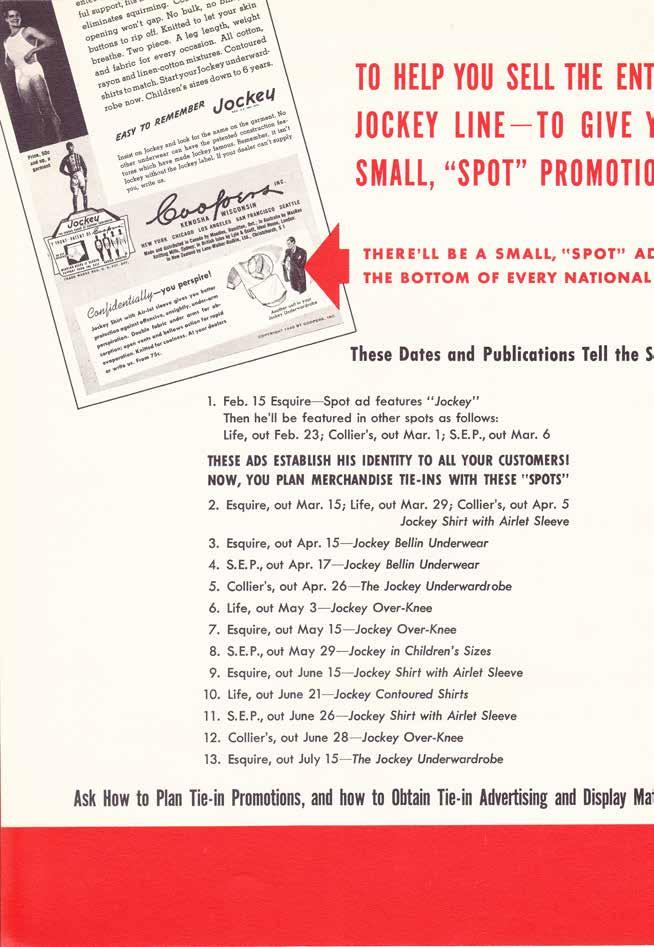
1940 First to provide a comprehensive national sales training course, “Retail Selling Made Easy,” for sales people
1947 First to weave the “Jockey” name into the waistband to deter copycats from imitating the striped pattern
1956 First to advertise boys’ underwear nationally on television
1956 First to offer underwear in Christmas packaging
1958 First to sell men’s bikini underwear, Skants, in the U.S.
1958 First to advertise men’s underwear on television
1978 First international privately held company to have a woman as CEO
1982 First to host an underwear fashion show featuring both men’s and women’s underwear
1999 The Jockey bra is the company’s first structured bra.
2000 Founding member of WRAP: Worldwide Responsible Accredited Production organization
2013 First to offer a volumetric bra, RealFit Bra by Jockey
Likewise, the No Pantyline Promise collection quickly became a best-selling collection after debuting in 2001 and has continued to be one of Jockey’s most popular and enduring product lines for women, a customer base Debra had helped to nurture and attract almost twenty years earlier. “It was a time when clothing began to get tighter fitting on the body and there was an issue with panty lines showing through garments,” Debra said. “So, we ran with it. For the waistband and legs, we covered a very fine, thin rubber elastic with cotton fabric, which is different from what we had done in the past. Not only did we solve the panty line problem, but the panties were completely washable and stayed in place when you wore them.”
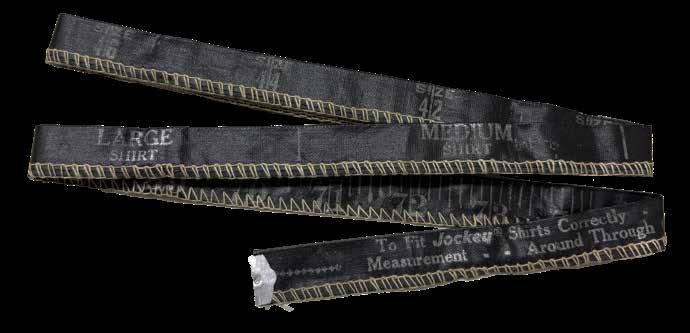
Other developments have built upon past success. The 2013 introduction of volumetric measuring for bra cup size using telemetric scans for cup size, which demonstrated Jockey’s continued obsession with fit, had its roots in the 1938 Jockey hip tape, a measurement tool introduced at the insistence of getting the fit of a garment right on the body.
One of the more novel programs with perfect timing was Jockey Person to Person, direct sales home parties hosted by Jockey ambassadors from 2005-2015. “For ten years, it was a thing to watch,” Debra said. “Home parties were a big thing at the time, and our salespeople really understood the brand and the products. They developed a close bond with their customers and with each other. And they had fun.”
Jockey innovation is also visible in the company’s outreach and service programs. In 2005, when there were still negative connotations about being adopted, Jockey launched Jockey Being Family to support adoptive families nationwide with resources and funding. Today, the program extends to foster children and families. “We wanted to do something to change the culture, and we believed that we could use our platform and reputation to make a difference,” Debra said. “I, myself, am adopted, and I believe that every child deserves to grow up with a loving family in a forever home.”
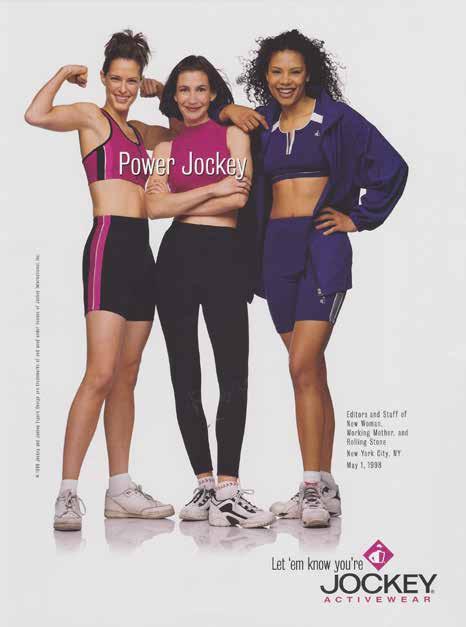
Right top: Let ‘em know you’re Jockey featuring women editors, 1998
Right: Jockey Real fit bra
Right page: 2013 Person to person letter from Debra
In yet another way that sets the company apart from the status quo, Debra has blazed a trail unlike any of her predecessors by expanding the brand to 120 countries, a global network so vast that it would have been unimaginable to Samuel Cooper or her grandfather, Harry Wolf, Sr., or even her mother, Donna. Furthermore, Jockey International, Inc. has expanded beyond underwear into full lines of socks, thermals, sleepwear, activewear, and lounge wear for men, women, and children. “All those years ago, Reverend Cooper went into the ice business and then later, socks and underwear, to take care of his family and take care of people,” Debra said. “Now, 150 years later, Jockey has grown, but we are still focused on doing the same thing: taking care of our family, which includes the greater Jockey family, and taking care of people, our Jockey customers and the families we help through programs such as Jockey Being Family.”
Such success comes with a caveat: Jockey innovation can never be for innovation alone. The words Debra said back in 2001 when she took the helm of the company remain as true today: “While Jockey must not lag behind, neither can the company afford a reckless race for newness for its own sake. Jockey must change with the times — and yet remain Jockey.”
October 18 – United States Patent No. 973,200 is issued for the White Cat Closed Crotch US union suit, better known as the Kenosha Klosed Krotch
1910
Arthur R. Kneibler invents the Jockey short.
The company’s first tee shirt and athletic wear, the 1711 Sanitaire , is introduced to wear under football shoulder pads.
1890s
Irked by the large amount of leftover cotton thread sitting in the warehouse, Henry Cooper experiments by using the thread to sew knee stockings for boys. The resulting Iron Clad brand becomes the first company’s first innovation.
1933
January 29 – The trademarked one-piece Singleton with a sleeveless top, short legs, elastic waist, and drop seat was a form-fitting union suit with “great eye appeal… fashioned to fit every curve.”
The Singleton was well-received in part because of its innovative cellophane packaging and above-the-counter display — both innovative firsts in the underwear industry.
1934
Arthur R. Kneibler perfects the Jockey short design with a front fly Y-front, available initially in only longer lengths. A year later, the 1007 basic brief with Y-front debuts.
1935
1936
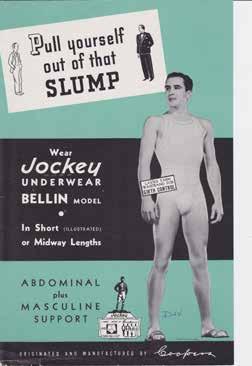
The 1031 Bellin brief debuts featuring a waistband with abdominal support.
1947
An industry first, the company replaces its signature stripes with the word “Jockey” woven into the waistbands to deter copycats.
1949
The Fancy Pants promotion of briefs in novelty prints sells 6,741 dozen.
The company launches Jockette women’s underwear in combed and mercerized cotton and stocked in the men’s department. Less than two years later, Jockette is discontinued.
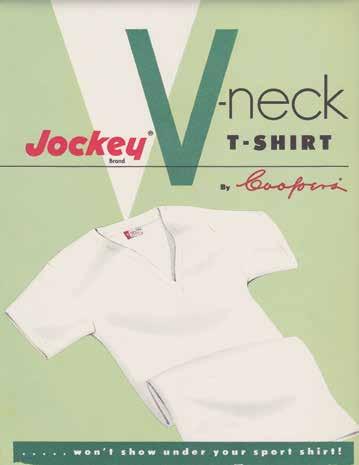
The 1714 V-neck t-shirt joins the product line.
The Woven Short Program is announced, marking the first time a non-knit item carries the Jockey trademark.
1956
Bill Testard, who invented Skants and the son-in-law of Horace Johnson who invented the Kenosha Klosed Krotch, starts the company’s first Research and Development Department.
Jockey is the first underwear manufacturer to adopt a registered trade name, Suprel , for a new polyester/combed cotton blend of underwear.
1964
1958
Skants 1005 debuts. As the first bikini underwear for men sold in the US, the no-fly bikini brief is made from 100% stretch nylon.
The Seamfree Jockey Boxer Short is patented and exclusive to Coopers.
1961 The company begins using the Pak-nit process, a treatment for knit fabrics that controls shrinkage.
Introduced to great fanfare, Jockey for Her features a brief, hipster, and bikini for women in its first collection.
The success of the Jockey for Her collection leads to two new lines: Jockey for Girls and Jockey for Boys
1987
The Naturals collection made from unbleached cotton debuts for men and women.
1994
1976
1993
The company enters an agreement with the Tommy Hilfiger brand to manufacture and sell underwear.
1999
Jockey adds the Jockey Bra collection to its offerings for women.
Jockey’s StayNew is the first fabric of its kind to look and feel new, wash after wash.
The launch of the Jockey Bra introduces volumetric measuring for a precise fit.
The new Jockey Outdoors collection is promoted by country music artist Luke Bryan.
2022
2021
The Made in America collection launches.
A salesman is not born. He is made.
Sell through, not to…
A name synonymous with hard work and honest dealing.
Know your business, know your merchandise, know what you are talking about. We’re never out of comfortable.
Chapter Three
SELLING AN IDEA
Like the Coopers brand, Ruth Harman embodied the Great American ideals of freedom, perseverance, authenticity, unconventionality, pride, and durability. And like Coopers, she was a woman of firsts. After earning her pilot’s license in 1932 at age 18, she became the first Wisconsin woman to earn her commercial pilot’s license, the first Wisconsin pilot to earn a transport pilot license, the first woman to fly Air Mail, and the first to earn her rating as a flight instructor. She was the lead stunt pilot in the Kenosha Air Show and a member of a flying circus. She ran her own pilot’s school and served as manager of the Kenosha airport, eventually purchasing it. Later, during World War II, she trained pilots for the Army Air Corps and US Navy and flew War Bond and V Bond drives.
Harmen’s story became the company’s story in 1935 when she began endorsing the company by flying with “Coopers Masculiner” emblazoned on the side of her Taylor Cub. As the press release stated, “Miss Ruth Harman, young and comely postmistress in Coopers plant post office is also a licensed transport aviator …… one of the few to attain that rank. Some weeks ago, she and a girl companion flew from Kenosha to participate in air races in the Southeast. Rain and snow, low ceilings, head winds, etc. tested her flying skill to the utmost, but she completed the round trip in spite of five forced landings. As can be imagined, a ship with so masculine a name as “Coopers Masculiner” manned by two girls, created quite a twitter.”
When necessity knocks, a salesperson answers. Samuel T. Cooper had never sold a pair of socks in his life, much less underwear, but it’s hard to reason with fate when you have six mouths to feed, not including your own. When his health forced him to semi-retire from the preaching circuit in 1871, Samuel had no marketable skills, no land to farm, and no savings to speak of. He was 47 years old.
What he did possess were the same qualities that had made him a successful preacher: his reputation, a knack with people, a quality product to sell, and a desire to serve. For the next seven years, Samuel sold school furniture, then ventured into ice by opening Cooper Ice in 1876. In 1878, he made the move to manufacturing with S.T. Cooper Industrial Spinning and Knitting Works. A year later, the company was “running day and part of night” to keep up with demand. By 1885, it was the largest hosiery mill in Michigan.
Left: 1935 Ruth Harmon flew the Coopers Masculiner
Below: Linder statue date??
Curious how Jockey has succeeded in business for 150 years? Look no further than their storied history—a playbook for sales success. Almost from the beginning, the company deviated from its competitors by centering sales around quality rather than price. Make no mistake: Success at sales is contingent upon having a quality product to believe in. So sure that customers also valued quality over price, Cooper’s actually tested the theory in 1936 with the innovative Wieboldt campaign. To see whether price alone drove sales, the campaign included advertising in the Chicago Daily Times, window and store displays to draw in customers, counterspace for showing products, ample stock on hand to sell, and a Cooper representative at each of the five stores for the entire four-day event. What it didn’t include was the traditional promotional discounts; this time around, the products remained full price.
Not only was the campaign a resounding success, but it proved that customers didn’t mind spending a little extra for Jockey comfort and quality. “This test was a prescription for promoting and selling underwear at regular prices, resulting in volume sales,” commented Robert “Bob” Menn, former general sales manager. “All of the components of the promotion are in the plan that has been used successfully ever since.”
1936 testimonial ad from Wieboldt Storess declaring sales success for Coopers undergarments, hosiery and sportswear
Never before had we experienced such a response to an underwear item offered at full price.
-Wieboldt Department Store Manager, commenting on the success of the Wieboldt campaign
SUCCESS AT SALES
is contingent upon having a quality product to believe in
Across Jockey’s ten generations of doing business, it has often been the outsider with a fresh perspective, objective clarity, and a willingness to challenge the industry’s status quo that has taken the company to the next level. Consider Samuel Cooper, an outsider with no experience in manufacturing or hosiery sales. And yet because he was unconstrained by the norms of the industry, he was able to envision a different way to solve problems and manage the business—a key trait of effective salespeople. Samuel was also optimistic. Where others saw barriers, Samuel saw possibilities. A case in point: his revolutionary idea of selling direct to retailers.
Having spent his entire career as a preacher dealing directly with people, Samuel figured that selling socks was a lot like selling the gospel. Relying on jobbers, or middlemen, to represent the company when they had no idea about how the items were made didn’t make sense to Samuel, so he began visiting retailers and selling direct with the same zeal he used as a preacher.
Retailers welcomed the direct contact. They appreciated that the company valued their business enough to send an actual employee to visit their stores. They also liked knowing where the goods came from and who was behind manufacturing them. By the early 1880s, Samuel’s novel sales approach had completely upended the retail market with what would become a standard sales approach still used in the 21st century.
A hundred years later, another industry outsider, Donna W. Steigerwaldt, made waves by introducing Jockey for Her. “It’s about time that women can enjoy the same comfort, quality, and fit that men have known and enjoyed for years with Jockey brand underwear,” said Howard Cooley, president and general manager at the time.
Left: 1914 Coopers Union Suits ad
Far left: 1922 Coopers Union Suit window display
a fresh perspective, objective clarity, and a willingness to
CHALLENGE THE INDUSTRY’S
STATUS QUO
Left: Jockey for Her “Look who’s wearing Jockey now” advertisement featuring “real women”
Left page top: Jockette underwear made in the early 1950s
Left page middle: Jockey for Her brief circa 1980
Innate ability to TIME THE MARKET JUST RIGHT
To ensure that women actually had a chance to try the new line for themselves, Donna did the unthinkable—she gave away 1 million pairs in 1983. Overnight, the collection became a customer favorite. Introducing a completely new line and marketing it with innovative an innovative sales campaign were gutsy sales moves from an outsider short on retail experience but long on insight about the needs of real women.
“The ad campaign itself was so different from anything that had been done before, and my mother and Howard Cooley had an innate ability to time the market just right, which is a big part of sales success,” said Debra S. Waller, CEO. “It was also amazing because we were selling more than a new product—we were trying to change people’s mindsets, to make them understand that we were in the women’s business. It was as big as the shift from socks to underwear.”
Donna’s acuity for sales was also evident in the 1985 “Look Who’s Wearing Jockey Now” campaign designed by Warwick Advertising. Featuring real people in real life—warts, wrinkles, and all—instead of models, it was one of the earliest examples of “reality advertising.” The campaign also used the power of story to create an aspirational lifestyle and sell the possibilities of what could be. Vividly illustrating important points about the products made them easier to remember.
Right: 1982 newspaper article about Jockey for Her fashion show
Right page top: Salesmen for Coopers in date?
1935 Jockey Buoyant short advertisement
EARLY SALES LESSONS STILL RELEVANT TODAY
Be persistent: Pete Pfarr, a young cashier in 1917, turned a stagnant local market into 35 new accounts in six months, later becoming a top-selling Cooper salesman. “I don’t stop showing and selling until I get an order.”
Demonstrate pride in what you are selling: Blow Grover often role played in sales presentations how young salesmen should react to rude store buyers: “I have a great deal of respect for your store and for you,” he’d say. “I believe your store can make a good profit selling Cooper union suits. So, dear sir, I ask that you treat me, my company and my products with respect…”
example of caption for photos in book caption example here
Everyone wears underwear, don’t they? The people that we use aren’t always the sports heroes or the Marilyn Monroes of the world, but that’s what makes the ads good. People can relate to what they see.
-William Herrmann, Senior Vice President for Advertising, commenting on the “Look Who’s Wearing Jockey Now” campaign May 15, 1989, New York Times
Another winning sales characteristic is the ability to disrupt the market. In 1912, Henry Cooper followed in his father’s footsteps by disrupting the status quo in advertising to sell the idea of quality and pride found in Cooper Underwear. Henry commissioned well-known artist Joseph C. Leyendecker of Saturday Evening Post fame to create a series of illustrations for the Kenosha Klosed Krotch union suit advertising campaign. The national campaign broke ground for underwear, but even more significant was that the illustrations presented the underwear’s functionality as dignified and sophisticated.
While competitors used euphemisms and jokes to grab attention in their ads, the “Man on the Bag” conveyed the idea of distinction, masculinity, and athleticism, and moved men’s underwear resolutely into the advertising mainstream.
Successful companies “sell through, not to” retail stores, and they teach their salespeople about the products, who, in turn, teach their customers. Henry preached that salesmen didn’t just sell product to the stores, they sold to the retail market through the stores. He also expanded Samuel’s idea of direct sales by emphasizing the importance of teaching the salesperson who then teaches the customer about the benefits of Cooper Underwear. In Henry’s own words, “A salesman is not born. He is made.” The same goes
In 1917, the “Coopers Confidential Information” brochure introduced women to a host of selling points for union suits. Henry believed that good salesmen should know the business, know the merchandise, and know what they are talking about,” so in 1923, he published “Tips and Pointers for Underwear Dealers and Their Salesmen” to train salesman on everything from the types of wools used in manufacturing to how to measure different body types. A sound recording of Jockey sales training was introduced in 1938 and in 1948, Jockey sales training movies debuted with topics such as “Retail Selling Made Easy” and “More Than a Name.”
Top: 1940 Retail Selling Made Easy
Far left: Tips and Pointers for Underwear Dealers and Their Salesmen
Left and above: Coopers Confidential Information brochure, 1917
Ability to DISRUPT THE MARKET
Left page: 1938 Direct mail advertisement
Left page top: 1938 Jimmy Dykes endorses Jockey Longs
Opening an outlet store in 1978 was a first for Jockey, a move that gave the company valuable one-on-one time with customers to share the virtues of the brand. The same care given to creating comfortable, quality underwear was poured into every aspect of the guest experience. Employees went through rigorous training and customers were given a 100% satisfaction guarantee. In 1996, Jockey opened the first of two airport stores, one in Pittsburgh, then later in Philadelphia. And with the advent of the internet, Jockey opened its online store in 2000.
At times, Jockey has addressed the consumer directly with product education as key advertising messaging. A 1914 ad outlined the ABCs of the Kenosha Klosed Krotch union suit. A 1938 ad listed the merits of Jockey Longs, suggesting myriad ways the underwear could be worn during cold weather. Thirty years later in a 1967 ad, Jockey explained how the construction of Jockey briefs, made from 13 separate pieces of fabric, provided customers the support and protection they desired.
In 2007, the “Pantology” guide provided tips from a psychologist, Feng Shui doctor, and lifestyle and fashion advisor to advise customers on the type and color of underwear to wear in every situation. For example, wearing a thong sent out positive vibes “from their sacral chakra to those around them.” Likewise, earth colors were recommended for days when men felt stressed and nervous. As the guide stated, “What a guy chooses to wear to hold his most treasured possessions can reveal a great deal about the type of man he is.”
Below: Pantology promotional booklet
Right page: Jockey Longs advertiement, 1939
In the increasingly crowded world of retail, it’s hard enough to sell a new, trendy item that’s all the rage. It can be almost impossible to sell an item that has been around for over 100 years. The formula, which has worked time and again at Jockey, is introducing innovative, fresh ways to share a timeless message. A popular example is the 1965 reimagining of historically white underwear into an array of rainbow colors for the Jockey Life collection. Touted by sports figures such as Paul Hornung, Bart Starr, and Yogi Berra, building a wardrobe of colored as well as white underwear soon became the norm.
From 2005 to 2015, home parties made famous by Tupperware in the 1950s and ‘60s made a huge comeback. Always on the lookout for opportunities to connect with customers in a new way, Jockey capitalized on the novelty of the moment by launching Jockey Person to Person, a direct selling business with home parties hosted by Comfort Specialist consultants. Products were developed to be stylish, comfortable and versatile and were offered in an array of sizes. Selling direct to the customer was also nothing new—the technique was simply refreshed by selling the items to guests in the comfort of home.
“Home parties were so popular at the time, and for ten years, it was really a thing to watch,” Debra said. “It was such a successful program on many levels. We had Comfort Specialists all over the country who really understood our brand and the products, and they developed a close bond with their customers and with each other. And they had fun.”
Jockey has held licensing agreements since 1936, but it wasn’t until the 2000s that the company put a fresh spin on what licensing entailed. “At the time, licensees designed their own products with little input from Jockey headquarters other than color direction or basic styles,” said Tim Wheeler, President of International at the time. “We took a different approach by providing them with everything needed to replicate the product in their own market—they literally copied our products. But then, we went further by telling them styles which would be in our upcoming campaigns and even providing photography and ads they could use locally.” It was the same agreement, but value-packed with new features to support Jockey’s licensees in other aspects of business. “As a result,” Wheeler, said, “we began to see consistency in the Jockey brand worldwide.”
Good salesmen should know the business,
KNOW THE MERCHANDISE,
and know what they are talking about
Left page and left: 1972 Politically themed underwear ad demonstrates that Jockey is for everyone.
Above: 1976 “What the well undressed man is wearing...”
Top: Person to person Jockey 2013
INNOVATIVE, FRESH WAYS
to share a timeless message
Below: Cover and pages from Successful
Right page: “Stop Squirming” ads, 1939
Selling brochure, 1965 and Jockey hip tape
STOP SQUIRMING
Always looking for ways to serve customers with quality products, Cooper’s introduced Jockey hip tape in 1938 so that customers purchased the right size of underwear. The tape was black with sizes printed directly on the tape to guarantee a perfect fit. Instructions directed salespeople to place the tape “around hips at the largest point, pull end through metal loop with only medium tension. Read appropriate waistband size, but do not measure in inches.” The “Stop Squirming” advertising featuring drawings by Peter Arno advised customers to “ask to be hip-taped.”
Our job is to be sure our customers get what they want when they want it— good quality, fair prices, and prompt service.
-Ralph Cooper
Speaking at the 1949 Jockey convention
Sales is understanding that CUSTOMERS’ DESIRES AND NEEDS EVOLVE and change
Left: Many customers wrote letters to Jockey expressing their appreciation for the JFH line of underwear
As global marketing campaigns grew more sophisticated, so, too, did Jockey products. A basic tenet of sales is understanding that customers’ desires and needs evolve and change, especially across cultures. “For example, China is a very superstitious country, so finding the right translation for the brand is paramount,” said Enrique Cardenal, former Director of Brand Activation, History and Archives. “Yellow products do poorly in Vietnam because it washes out their skin tones. Sizing also varies. The average build of a German woman is completely different from an Indian woman. Social behaviors, what is acceptable to include in advertisements—even color preferences—are very different from one culture to the next. It is essential to find out, understand, and adjust the brand to meet these cultural differences.”
At the end of the day, sales at Jockey have never been about sales—it’s about helping. “Satisfying the human need for comfort is a great tagline, but it’s not our mission, Mark said. “Our purpose is to faithfully serve families and communities. We provide them with comfortable products. We’re also a necessity. I like to say that we’re not rocket scientists, but rocket scientists need us—the people changing the world need us. Our purpose is to support and care for them by providing an incredibly high-quality product so they are comfortable, confident, and not distracted from the important contributions they are making.”
As a privately held company, Jockey isn’t beholden to the quarterly spreadsheet, so if a product isn’t quite right, more time can be taken to iron out the kinks. Refusing to compromise quality and comfort also keeps the company from trend hopping or giving in to quick wins with salacious phrases that would be so easy to fall back on when selling underwear. “We don’t make decisions because they are easy; we make them because they’re right—and we make them for the long term,” Mark said.
Today, 150 years later, Jockey continues to approach sales as an opportunity to serve rather than as a transaction—it’s Samuel Cooper’s greatest legacy. Purpose rather than profit drives the company to understand the desires and needs of the customer and then create comfortable, quality solutions. “I don’t know of any other company that has made such an impact and yet not have that impact really known,” Mark said. “There is such a humility and quietness in Jockey’s purpose because we’re not looking for credit, we’re looking to make a difference.”
1973 Bart Starr and Paul Hornungalt advertisement
150 Years of Sales
1938
The Singleton is mounted on cardboard and wrapped in cellophane—a first for underwear.
1933
1936
Jockey goes international by signing a licensing contract with J.R. Moodie Company, a Canadian firm to manufacture and sell Cooper products. The Cellophane Wedding – one of the most incredible marketing stories
The company’s “underwardrobe” is featured at the New York World’s Fair.
1939
Peter Pfarr develops cellophane packaging for briefs, creating the first self-service retail underwear “Labels described the product completely so that no questions were left unanswered in a customer’s mind.”
“One day while going through my files in my desk … the thought occurred to me that those index files were in very neat order. I knew just where to put my hands on anything that I needed from those files. I began to wonder then why we couldn’t arrange Jockey garments in the stores in order by sizes or possibly by styles in the same way as the file had been arranged. Why couldn’t we make a box, possibly to hold Jockey garments that way?” - Pete Pfarr, 1939
1938
The company introduces its first video training materials, “slide and sound film” reels on how to sell underwear.
1941
1940
Take a Complete Jockey Underwardrobe to School” advertises Jockey underwear to college students.
1948
Radio advertising begins in selected major cities.
1956
Jockey is the first company to advertise underwear on TV.
Jockey features barechested men in its ads, setting a new norm for bare-chested men in underwear advertising. The “Take Away Their Uniforms” ads feature popular athletes in low rise underwear.
1977
1978
The first outlet store opens.
Jockey gives away 1 million pairs of underwear to celebrate the launch of the Jockey for Her collection.
1980
Jim Palmer becomes Jockey Ambassador.
1985
The “Real People” campaign is one of the first “reality advertising” campaigns.
The 100 th store opens in Manchester, Vermont
1997
Jockey products, mostly made of cotton are promoted as the “next best thing to naked” to emphasize their comfort.
2003
The “Show ‘em” campaign, a throwback to the “Real People” campaign, features everyday heroes wearing Jockey.
2016
Comfort that transcends culture.
Satisfying the human need for comfort.
The Jockey trademark – synonymous with fit, comfort, and durability
A name that means something. There is only one Jockey .
Chapter Four
MARKETING A BRAND
Enrique Cardenal had never heard of Jockey before taking a position as manager of International Sales in 2007, but it didn’t take long for him to see Jockey’s potential in Spain and beyond. “I have a lot of imagination and creativity, so when I learned that in 2009, the brief would celebrate its 75th anniversary, I knew it was the perfect way to help our products stand out. I put together a road show with 15 stores and held splashy parties with celebrities and influencers in attendance. The media went crazy. Everyone was talking about Jockey.
It was in doing research for the campaign that Enrique realized he was working for a sleeping giant. “Everyone in America knew about Jockey, but few markets in Europe had any idea about the company’s legacy,” he said. “But you can’t get new consumers to fall in love with Jockey if they don’t know the brand. Just think, everything we know about underwear—we invented it. We invented the brief. We were the first to put our name on the waistband. It’s owned by the original family of underwear. It was one of the greatest stories never told—the story of the quintessential American brand with an amazing heritage.”
Brand is a COMPANY’S SOUL.
example of caption for photos in book caption example here
Debra S. Waller wasn’t thinking about brand strategy when Jockey dusted off 25-year-old equipment and began producing isolation gowns and other personal protection equipment (PPE) for frontline workers during COVID in 2020. She didn’t consult market data to justify the expense or solicit social proof to promote Jockey’s actions in the media. Instead, she saw a problem and a way that Jockey could help. “While other companies were gearing up to sell things, Debra was gearing up to give them away,” said Mark Fedyk, Jockey president.
There’s a reason there is only one Jockey.
For all the marketing speak about branding, the truth is that a brand can’t be dreamed up in a marketing meeting. It can’t be copied or replaced. It’s not a product with a life cycle. Instead, a brand is what the company stands for, how it lives out its values, and ways those values are experienced by its customers, time after time. Brand is a company’s soul.
When COVID hit, there was no playbook for Debra to follow because the world had never experienced such a global event. She could only trust that Jockey’s mission to do what’s right, to serve rather than sell, would see the company through. “I have always felt that if we stay true to our values and focused on what we’re doing as an organization, we will be fine,” Debra said. “At the same time, I feel a huge weight of responsibility to carry the company forward. It’s part of my DNA, and I never want to do anything that would jeopardize what the Coopers put together.”
For Samuel Cooper, starting a business was never about selling a product. Instead, he sold solutions to problems that needed to be solved by creating products that were such a perfect, durable solution that customers never dreamed of purchasing them from another company.
Because enriching the lives of customers and that of the greater community is a foundational value, Jockey knows what it is and what it is not. This depth of brand assurance eliminates guesswork and presents a clear path forward during periods of uncertainty. Time-tested values, strong and resilient, become brand touchpoints for company leaders like Debra when confronted with business challenges, complex decision making, and uncontrollable cultural crises such as pandemics.
“Samuel Cooper clearly lives within Debra, in her concern for people’s well-being, her insistence on superior quality, and her solid faith to make the world a better place,” said Ed Emma, retired Jockey president, at her 20th anniversary party in 2021. Debra embodies the Jockey brand.
In 1912, Horace Johnson and Henry Cooper, believing they had invented something special, helped pioneer the modern concept of brand. The Kenosha Klosed Krotch union suit had been so well received that copies were popping up everywhere, so they sought legal protections and licensing deals to protect the design and quality associated with the Cooper name.
Henry went a step further by publishing the 1912 “Story of Coopers Quality Since 1976,” positioning the Coopers’ brand as a family business consumers could trust, one built on straight-shooting business principles where comfort was more than a slogan, but a commitment. The folksy, intimate history is just one example of how Jockey, long before modern companies embraced the concept of branding, distinguished its products, ideas, and organization from competitors to make a lasting impression on customers.
example of caption for photos in book caption example here
…to do what’s right, TO SERVE RATHER THAN SELL
The firm which insists that a sale is not complete until the goods are worn out and the customer still satisfied, is building a business for itself, its children and its children’s children.
-Motto that Henry Cooper kept on his desk
The desire to do what’s right, to serve rather than sell,
is at the heart of the Jockey brand. “It is part of our DNA to roll up our sleeves and help our country in her time of need,” Debra said of Jockey’s efforts during a 2020 press briefing on COVID at the White House. “During World War II, we made bomb chutes for the military. And today, we are eager to serve this great country by providing support for the healthcare workers on the frontlines of this fight. …When we learned of the critical need for PPE, we knew we had to help. Monumental lifting by Jockey, our partnership with Encompass Group, FEMA, and the FDA was done in just a few days to be production ready. As a result, we expect to begin delivering 30- to 50,000 gowns per week, helping those that need it the most right now.”
example of caption for photos in book caption example here
Success is something that grows out of the past.
Harry H. Wolf, Sr. also sensed that the company was far from ordinary, so much so that his early compensation as a consultant in the 1930s was based on company performance. He recognized that fundamental to the company’s success was its strength of brand recognition. Consequently, throughout his tenure, Harry H. Wolf, Sr. worked with Jockey president Ralph Cooper and Chicago attorney James Hume to patent and copyright product names and aggressively pursue patent infringements to protect the company’s current and future intellectual property.
Hume cautioned Harry and Ralph that trademark threats could be minimized if the Jockey name was associated with more than just words, and so in 1940, Ralph contracted with the ad agency of Charles Daniel Frey who commissioned well-known painter and sculptor Frank Hoffman to create a Jockey statue. After several sketches, Hoffman created a 12”-tall bronze figure known as the Jockey Boy. At the 1940 sales convention, an actor dressed in the same outfit strolled onto the stage and announced:
“I am Jockey. I belong in the future… I am a trademark which will forever distinguish your name and your garment in the minds of buyers. I am your inspiration and your guiding star. I’ll be seeing you in store windows all over the country.”
Additionally, Harry H. Wolf, Sr. considered quality equally important to brand image, and he insisted on quality in every facet of manufacturing. It wasn’t enough for customers to purchase Coopers’ underwear: He wanted customers to take pride in wearing it. Coopers is “a name that means something to those who use it,” he said in a 1938 speech.
-Harry Wolf
“You have a tremendous heritage here and with it a fearful responsibility,” said Arthur Kneibler about the Jockey brand at a 1954 sales convention. Jockey was already considered an iconic American brand, born and built on the American ideals of hard work, opportunity, individuality, and family connection. The company had grown up with the country. No fabricated aesthetic or romanticized lifestyle had been created to promote Jockey’s heritage. It had simply evolved organically from its authentic, all-American identity, commitment to consistency, quality, and comfort, and reputation built on deep-rooted trust and credibility with customers.
Nearly 50 years later, Tim Wheeler, retired president of International Sales, was eager to capitalize on Jockey’s heritage when devising a marketing strategy for global sales in 2006. Already, the company had established a presence in Europe, but the opportunity for growth was limitless.
“Jockey was one of the first American companies to go international, and a lot of its exposure in Europe occurred indirectly as the manufacturer of quality garments and supplies for U.S. military soldiers during World War II,” Tim said. “Before coming to Jockey, I had never worked for a legacy brand, but I knew that its history would be a significant part of introducing Jockey to people around the world who were unfamiliar with the company. Finding interesting aspects of the brand through its heritage became key to making Jockey relevant for our international licensees.”
JOCKEY KNOWS WHAT IT IS and what it is not.
example of caption for photos in book caption example here
Times change. Leadership changes. Trends change. Products change. And yet, as a business, are you who you say you are, yesterday, today, and tomorrow? This is the challenge of protecting brand authenticity, especially when the brand is global.
For a company claiming to have the highest quality and most comfortable underwear on the market, the 1940s neoprene fiasco could have been Jockey’s downfall. Yet rather than ignore a problem not of its own making, the company took back all defective garments without question. It was the right thing to do, yet the company didn’t stop there. Intent on going above and beyond to serve customers, Jockey began stitching the name “Jockey” into the waistbands of briefs, sending a clear message that Jockey not only owned up to the failure and delivered on its promise of quality but staked its reputation on meeting customer expectations for comfort and quality. In 1947, “There is only one Jockey,” along with “It’s a Brand…It’s a Trade Mark…It’s Patented,” taglines began appearing in company advertising to reinforce Jockey’s unique brand identity and authenticity.
When a company like Jockey becomes a household name, the brand takes on a life of its own. Customers form emotional connections and view the brand as an extension of their own identity. Such was the case when customers began looking for the Jockey name stitched on or into garments before making a To wear Jockey implied an affinity for quality, comfort, and wholesome American —a result completely unexpected but welcomed by the company.
The “Jack Paar fiasco” is another lesson in the power of emotional connection. In 1958, Jockey planned a series of 30-second live advertising segments on the Tonight Show. As Robert Cooper, Jockey’s president at the time, looked on from the studio audience, host Jack Paar pulled out the package of underwear and immediately was overtaken by a fit of laughter. For the next two minutes, a minute-and-a-half over the segment’s time slot, Paar could only bark out the word “Jockey” between uncontrollable gasps and giggles. Robert was horrified; Marketing Vice President Jack Wyss was enraged. The next morning, Wyss cancelled the campaign—that is, until receiving reports that viewers loved the segment. Television, like life, is not always scripted, and viewers connected with the authenticity of Paar’s spontaneity. That a company could poke fun at itself made Jockey relatable.
Losing control of the narrative can easily go the other way. In the 1980s, fashion designers entered the men’s underwear sector, marketing sex appeal to drive sales. Jockey didn’t take the bait. Despite adapting to cultural shifts, Jockey remained a brand for the common man and their family—real people living real lives. Because Jockey consistently lived out its values in all business dealings, there was no need to resort to suggestive, risqué imagery to boost sales, and frankly, it wouldn’t have worked. Jockey understood its customers because the people who had built Jockey were also real people living real lives, and they expected the same qualities from the companies that served them.
In 1935, a rumor circulated that “The Silver Scot,” Golfer Tommy Armour, winner of three major championships, wore Jockey underwear. Curious, the company contacted Armour who confirmed the story and agreed to endorse Jockey underwear for an endorsement fee. Soon, Armour’s endorsement could be found splashed across newspaper ads and display cards in stores:
To bridge the gap between aspiration and everyday life, Jockey was one of the first companies to solicit celebrity endorsements, spokespeople, and ambassadors. Celebrities give human form to a brand. It’s an easy way to engage customers and build momentum for a particular product
Above and right: Jockey announces Tommy Armour endorsement, 1935
Right: Jim Palmer 1987
Have you got your Jockey underwear on?
-President Ronald Reagan to Jim Palmer during Palmer’s 1983 visit to the White House
An endorsement can also build prestige, sometimes to the level of myth. For example, the 1948 British Olympic Team selected Jockey Y-front underwear as part of their official wardrobe, the Y-Front became connected with the five Olympic rings, representing the pinnacle of athletic form.
What makes a good Jockey ambassador, as celebrities are now called? In addition to being recognizable by Jockey customers, the ambassador must embody Jockey’s values and portray the brand’s wholesome, clean cut, honest, decent, and hardworking image. In recent years, professional athletes have been joined by country music artists. Luke and Caroline Bryan began representing Jockey in 2020, with singer Dylan Scott signing on in 2023.
The most successful celebrity campaign happened completely by accident. In 1976, eight professional sports athletes modeled for the “Take off their uniforms and who are they?” campaign. When Professional Baseball Player Pete Rose failed to show for an ad shoot, the company frantically reached out to Baltimore Orioles Pitcher and Major League Baseball Hall of Fame Pitcher Jim Palmer to fill in. Palmer was so comfortable in his own skin that soon, he was starring in a series of ads wearing Jockey’s Elance briefs. The ads were then distributed as posters that flew off the shelves. Palmer’s celebrity skyrocketed. He later appeared in ads for the Jeans brief, in campaigns debuting fashion colors and stripes, and in ads for Jockey for Her and Queen Size underwear for taller and larger women. When Palmer appeared at baseball games, fans would chant, “Jim, show us your Jockeys!”
Top: Jockey Y-front underwear shown on display for 1948 British Olympic Uniform
Above: Harold Solomon ad, 1981
Right page: 1977 ad featuring a variety of sports figures
ARE YOU WHO YOU SAY YOU ARE, yesterday, today, and tomorrow?
The story goes that in 1934, Arthur Kneibler created the Jockey brief after receiving a postcard from the French Riviera. Whereas most people saw a man in a bikini-style swimsuit on the card, Kneibler saw the future of underwear—a barely there brief for the common man. When the brief became the most stylish item of the decade, its romantic origin story spread like wildfire in media across the country. The only problem? It wasn’t true. The same goes for the lumberjack story, debunked by Jockey Archivist Mary Keen in 2024.
The lessons that can be derived from these tall tales is that stories strengthen a brand. Stories make it easier to build connection with customers across cultures and generations. They create an aspirational lifestyle and sell the possibilities of what could be. They vividly illustrate important points, making them easier to remember.
Jockey has had some of the best storytellers in the business. The bikini myth, circulating since the brief was launched, was perpetuated in subsequent years in media such as the 1956 article in Advertising Age celebrating Jockey’s 80th anniversary. The lumberjack lore came much later in 2001 in a newspaper insert commemorating the company’s 125th anniversary. Photography, video—even sports figures and celebrity ambassadors—are carefully chosen to reinforce brand values, promote positive brand image, and convey subliminal messaging.
2016 ad featuring Chris Van Etten
Above: 1981 ad for Jockey Jeans-Brief Underwear
The greatest story about the Jockey brand that’s ever been told also happens to be true. It’s easy to confuse history with story, especially for a company that is 150 years old. But history is only heritage. Products are part of the story, but not the story itself.
Rather, brands that survive have a solid identity centered around a core story that delivers on a promise. They form longlasting relationships with customers built on shared values and authentic engagement. Real-world experiences create nostalgic ties and brand loyalty because customers trust that the brand will be around and do what it says it will do.
The real story—the true story of the Jockey brand—lives and breathes in its employees, partners, and customers. “In a world of growing divisiveness and discontent, the Jockey brand is about the power of coming together, the power of perseverance, the power of selflessness, of caring, of collaboration to build this country and invest and support its communities,” said Mark Fedyk, president. “Our story is much more important than making money; it’s about our impact. Jockey is the story of people who have lived and are living the American Dream.”
If I pitched like Jockey made underwear, we’d never lose a game.
-Jim Palmer Orioles Pitcher
Left page: 1946 advertisement “There’s only one Jockey”
Above: Live in Jockey ad featuring everyday men in various lines of work, 1992
Ambassadors, Models, and Endorsers: Through the Years
1946
Tommy Armour becomes the first professional athlete to endorse Jockey products.
1935
Major League Baseball Player Babe Ruth endorses Jockey.
1938
Washington Redskins Quarterback Sammy Baugh posed for national magazine ads wearing Jockey Longs.
1948
The British Olympic Team selects Jockey Y-front underwear as part of their official wardrobe.
Professional Golfer Tony Lema endorses a line of Jockey golf wear.
1960s
New York Yankees
Professional Baseball Catcher Yogi Berra and his three sons model Jockey Life underwear.
1965
1967
Professional Golfers Bert Yancey, R.H. Sikes, and later, Tom Weiskopf, model Jockey golf “tournamenttested” sportswear as part of the Jockey Trophy Team.
Jim Palmer models Elance briefs and becomes one of the best-known product spokesmen in America.
1980
Professional Tennis Players Mark Dickson, Mike Leach, Marcel Freeman, and Brad Gilver endorse World Class Tenniswear Jockey sportswear.
U.S. Gymnastic and two-time Olympic gold medalist Bart Conner becomes a spokesperson for Jockey.
1987
1983
Jim Palmer makes his first appearance as spokesman for Jockey for Her at Gimbels in Milwaukee. More than 1,200 people jam the aisles in the lingerie dept.
For the first time, Jim Palmer appears in a Jockey television ad.
Now living in America, Romanian Gymnast and nine-time Olympic Medalist Nadia Comaneci becomes a Jockey spokeswoman.
1992
2004
New Zealand Crusaders Super Rugby Player and member of New Zealand’s All Blacks national team Dan Carter becomes a Jockey spokesman.
Heisman Trophy Winner and Professional Football Player Tim Tebow signs as Jockey Brand Ambassador.
2010
2019
Professional Golfer and two-time winner of the Masters Tournament Bubba Watson and his wife, Angie become Jockey Being Family Ambassadors.
Country Music Artist Luke and Caroline Bryan become Jockey Brand Ambassadors.
2020
2023
Country Music Singer Dylan Scott becomes Brand Ambassador for Jockey Outdoors/ Made in America.
Creative, imaginative , original.
A distinctive American image, a wholesome heritage Setting the pace for the high-fashion market. Where comfort isn’t a commodity – it’s a culture.
Look who’s wearing Jockey now.
Chapter Five
CULTURE
“I quickly found the brand I usually use, Jockey Classic Briefs. They were three for five dollars which didn’t seem too inflationary. I read the label on the plastic bag they came in, just to make sure they hadn’t changed any of their famous ‘Comfort Features’ – ‘Exclusive Tailoring for Proper Fit to Support a Man’s Needs; Contoured Designed Arch Gives Added Comfort No Gaps; Support Waistband is Smoother Fitted Heat Resistant; Stronger Longer Lasting “V” No Chafe Leg Openings; Soft Rubber at Either Thigh Only; Highly Absorbent 100 Per Cent Highly Combed Cotton.’ So far so good, I thought. I checked the ‘Washing Instructions’ – ‘Machine Wash Tumble Dry.’ Everything was fine, the same as always…”
—Andy Warhol, From A to B & Back Again: The Philosophy of Andy Warhol
ICONIC BRANDS are born from the inside out.
It’s impossible to pinpoint the moment when the universe shifts, imperceptibly, and transforms an underwear company into a iconic brand representative of American culture. It happens organically, imperceptibly, transcending time and geography to build enduring relevance across generations and cultures.
Josephine Molinaro was fresh out of high school when she began working at Jockey on July 18, 1979. “I still remember my first day,” said Josephine, currently a Lead Technical Sewer. “My family moved from Italy when I was young, so I didn’t speak very good English, but I needed a job, and I had heard that Jockey was a good place for women to work.
“When I walked into the lunch area, I felt so out of place,” she continued. “It was clear everyone had their own groups and lunch tables, and I didn’t know where I was going to sit down. I was only 18 and they were in their 40s and 50s, and they just moved over and took me in.”
Josephine experienced the same reception on the sewing floor. Even though she sewed at home, the heavy-duty machines at Jockey bore no resemblance to her home sewing machine. “Those older ladies like Gloria Hunt and Virginia Merrick taught me how to thread the needle, run the machine, and all the little tricks so that I didn’t have to stop and call the supervisor to help me,” Josephine said. “They wanted to make sure I felt comfortable so that I could do my job well.”
Left: “Feel like a million” advertisement date??
Above: Andy Warhol signed Jockey underwear date??
For Noreen Wilkinson, who started in 1975 and retired as Executive Assistant to the CEO in 2021, going to work at Jockey meant going to work with family. “My husband, his mother, and his grandmother worked at Jockey,” she said. “Once I got into the company, I found out that so many other people had family members who also worked at Jockey — my son now works at Jockey!
“What I didn’t realize at the time is how my co-workers would also become family. We spent our lives together, working, celebrating, and supporting each other, and I think it’s because of the tone set by Mrs. Steigerwaldt and now Debra. Because they were women, and because Jockey is a family-owned business, they understood the need to be there for family and instilled those family values into the culture of the company.”
Iconic brands are born from the inside out. Their values are authentically established, lived within its own culture, and naturally radiated outward to the greater community. “As chairman, I have never been more convinced that our continued progress depends entirely upon our employees,” said Debra S. Waller after assuming the CEO position in 2001. “Principles and values are only as good as the people who put them into practice. This was the most important lesson of my mother, who preceded me in this office. Donna W. Steigerwaldt always recognized that Jockey’s people are its number one reason for success.”
Jockey’s culture is deeply rooted in its belief of “creating comfort” at every turn, evident in the quality, comfortable clothing it manufactures, the servant leadership and thoughtful, longterm decision-making of its family owners, the genuine care extended to the families and communities Jockey serves—even the family-like environment it cultivates at work. “If they ever hire somebody that’s not a fit for the family atmosphere and environment, they don’t last long,” said Mary Keen, Jockey Archivist. “And you can tell almost immediately when somebody is not Jockey.”
Right: “Wages are good at Coopers, 1946
Such authenticity nurtures reputation. Reputation reveals which brands are built on substance—and which are built on show. Only then do brands forged by time—from Samuel Cooper’s desire to serve and Harry Wolf’s integrity to Donna W. Steigerwaldt’s community involvement and Debra S. Waller’s commitment to family—become legacies.
Companies like Jockey become cultural icons because they have learned to master relationships. Customers express a specific need or challenge; Jockey then innovates to find a solution. As customer needs are met over and again, trust develops. In time, Jockey becomes the go-to brand because customers know they can count on Jockey’s comfort and quality.
Samuel Cooper set the standard for Jockey’s customer-first approach. As a minister, he “won the hearts of all by his earnest devotion to the cause of Christ and by his frank, genial disposition.” It was only natural that he approach business with the same verve and authenticity. Similarly, Henry Cooper insisted in his Tips and Pointers sales guide that “Coopers doesn’t believe in making the man fit the suit but making the suit fit the man,” a philosophy centered around the needs and desires of the customer.
Today, despite 150 years of innovation in business and manufacturing, the key to sales success has remained relatively unchanged. Jockey’s longest tenured retail store manager. “Sales really comes down to loving your customers,” said Barbara Tillman, Jockey’s longest tenured retail manager for the Locust Grove, Georgia, store until it closed in 2025. “I was in retail for 53 years, and my shoppers came back again and again because I knew our products inside-out and could help them choose the best ones for their lifestyles. They also came back because they knew I cared.” Brands
As relationships mature, they take on a life of their own beyond sales, where Jockey is no longer relegated to its traditional role of delivering a product but has become a trusted friend deeply integrated into people’s lives. “We are Jockey because for the last 150 years, we have delivered on our promise of solving the human need for comfort,” said Christina Brabham, Senior Manager Visual Merchandising and Marketing. “Many of our customers are still wearing the same style of underwear their mothers put them in—and they’re 35 years old. They have an emotional connection with our brand. Wearing Jockey makes them happy. It fits their bodies just right. It’s comfortable. And it lasts.”
During the final stages of product design for the Model 1001 Jockey brief in 1934, Arthur Kneibler received some interesting feedback about the brief’s support features from Kenosha Urologist C.W. Richards. Richards had long sought a product to replace bulky and uncomfortable bandages typically used to support patients after groin surgery. The brief was an ideal solution, and he
asked Kneibler for samples to give to his patients. Richards also explained that such support could be beneficial to all men because it provided enough support to “relieve the gravitational pressure on the most fragile parts of the male anatomy,” but not too much so that the brief was constricting. Intrigued, Kneibler implemented Richards’ improvements into the final version of the brief.
A distinctive characteristic of iconic brands is how they intertwine with societal trends, changing consumption patterns and influencing everyday life. When Kneibler capitalized on Richards’ medical endorsement in subsequent advertising, he transformed underwear from merely an “unmentionable” product to an item openly discussed for its health and comfort advantages.
example of caption for photos in book caption example here
Wearing Jockey makes them happy. It fits their bodies just right. It’s comfortable. And it lasts.
-Christina
Brabham, Senior Manager Visual Merchandising and Marketing
The styles that Jockey manufactured in the 1960s and 1970s exemplify Jockey’s uncanny ability to stay a step ahead of the crowd. Societal change, it seems, eventually trickles down to even shake up the world of underwear. With the growing youth and college markets, Jockey visualized the social changes of the era with expressive underwear in bright colors and contemporary patterns.
Similarly, when Jockey for Her was introduced 48 years later in 1982, the company distributed coupons for free panties to gynecologists followed by publicity touting that the breathable cotton of Jockey for Her underwear was more hygienic than synthetic fabric. Overnight, Jockey for Her became more than underwear—it became the smart choice for health-conscious women.
Furthermore, the Jockey for Her campaign, cutting edge at the time, introduced a carefully crafted message that promoted body positivity and diversity, messaging that changed cultural norms by celebrating and accepting the many different shapes of women.
More recently, Jockey’s 2010 ad campaign featuring Heisman Trophy winner Tim Tebow not only introduced the company’s new line of Staycool t-shirts made with Outlast technology, but it also shifted public perception of performance fabrics for routine wear—not just for workouts or playing sports.
At the time, the general public had little expectations, if any, for everyday basics. When Tebow demonstrated that elite athletes weren’t the only ones who could benefit from moisture-wicking technology, it raised consumer expectations for what basic clothing should deliver. In addition to fueling the broader athleisure movement, the campaign reinforced brand loyalty, positioning Jockey as a company who felt their consumers deserved to stay as dry, cool, and comfortable throughout their day as elite athletes.
Iconic brands don’t just sell products—
THEY SELL IDEALS AND LIFESTYLES.
Top: Jockey distributed coupons for free panties to gynecologists promoting that the breathable cotton of Jockey for Her underwear was more hygienic than synthetic fabric, 1983
Right: Jockey for Her ad featuring everyday people, 1991
Right page, top: Donna Denton featured in ad for Elance line, 1984
Right page, bottom: Just Jockey ad 1980
Iconic brands don’t just sell products—they sell ideals and lifestyles. They invest in their customers’ lives. They respond to events beyond the market to impact and contribute to making the world a better place. At Jockey, the company’s reputation as changemaker has become its most powerful legacy, and while products continue to be essential to Jockey’s financial success, they play a supporting role in service of Jockey’s greater mission.
Harnessing Jockey’s manufacturing strength, expertise, and resources are obvious ways the company has benefitted society. During war time, Jockey has pivoted from manufacturing underwear to producing items to support the war effort. During COVID in 2020, Jockey manufactured hospital gowns and masks for frontline health workers. Leading in times of crisis demonstrates a commitment to the values that Jockey espouses.
Another example of cultural impact is Jockey’s influence globally as a champion of ethical manufacturing and foe of sweatshop labor. As a founding member of the Worldwide Responsible Accredited Production (WRAP) organization, Jockey has long been at the forefront of implementing safe, lawful, humane, and ethical practices in production facilities around the world. “It’s very important that we take care of the environment and our people, no matter if they work for us or for a contractor,” Debra said.
One of Jockey’s biggest societal impacts is Jockey Being Family. Since 2005, the nonprofit organization has provided resources to support thousands of adoptive families nationwide. However, when the program was launched, adoption still carried a negative connotation. By capitalizing on Jockey’s global popularity and clout, Jockey Being Family was able to publicize the benefits of adoption—the ideal that every child deserves a forever home. Customers paid attention. They related to such a simple, fundamental truth and in turn, the sense of shared purpose deepened their loyalty to the brand.
1943 display of World War II contributions such as bomb chutes and underwear and undershirts
LEADING in times OF CRISIS
In 2005 Jockey International launches a charity,
Jockey Being Family to support families who adopt children.
Jockey was WOVEN INTO THE VERY FABRIC of American identity
In the end, the companies that evolve into cultural icons become so enmeshed in the lives of their customers that they transcend commerce, becoming symbols for the American ideal.
When legendary photographer Herb Ritts photographed Julia Roberts in 1990, the same year she catapulted to fame after starring in the blockbuster, “Pretty Woman,” he dressed her in Jockey men’s briefs to convey Roberts’ every-girl persona as “America’s Sweetheart.” “You’re always trying to get to one moment with one frame that eventually may speak for your generation,” he said of his photographs. In this case, he succeeded.
Nostalgia is another indicator. The emotional connection between Jockey and its customers is built on generations of shared experience and trust, creating cultural touchstones with personal and collective relevance. “Even before I went to work at Jockey, I wore Jockey underwear because that’s what my parents wore,” said Cathy Pierce, Manager of the Product Development Sample Department. “Comfort is a personal choice, and some people think they have to shop at certain stores because they think it’s better quality, but that’s not necessarily true. I’ve also looked at other brands less expensive but then I just can’t bring myself to buy them because I know they’ll just fall apart. I’d rather pay more for Jockey and get a better garment that gets softer with washing and one that stays put on the body without twisting.”
Such loyalty, rooted in nostalgia and the every day, became central to Artist Andy Warhol’s paintings and screenprints. In 1981, Warhol’s series on iconic American brands, including
paintings of Jockey underwear and red screenprintings on actual Jockey underwear, forced the world to radically rethink what art could be by embracing ordinary, universally recognized products as art. “I just paint things I always thought were beautiful, things you use every day and never think about,” he once said.
That Warhol appreciated he could count on Jockey underwear to be comfortable, affordable, and consistent, “the same as always,” revealed more than his artistic commentary on consumer society and everyday life. Jockey’s ubiquitous, “every person” appeal created mass appeal and deep connection across culture differences. Because everyone could share the same experience of wearing Jockey, Warhol recognized that Jockey was no longer just a household name synonymous with the American ideals of comfort, quality, and authenticity—Jockey was woven into the very fabric of American identity.
Above: Jockey Supporting Greatness ad campaign, 2014
Right page: 1990 Herb Ritz photograph of Julia Roberts wearing Jockey mens underwear
A need for comfort that transcends culture
Comfort that appeals to everyone, from Athens to Zanzibar.
Global reach in 120 countries, 6 continents, X locations, XX employees.
Distinctive American image; global appeal. The underwear worn around the world .
Chapter Six
GLOBAL REACH
John Moodie, Jr., could see the future. In 1878, he owned the first bicycle brought to Canada. In 1898, he turned his attention to the automobile, becoming owner of a one-cylinder Winton imported from Cleveland, Ohio—the first car in Canada. He owned the first player piano in Hamilton, his hometown, along with the first motorboat. After he taught his wife, Janet, how to drive, she became the first female driver in Canada.
Moodie’s openness to market innovation along with his willingness to take risks also made him a savvy businessman. It was no wonder, then, that Moodie, who owned a Canadian manufacturing company, showed up in Jockey’s New York office in 1936 with a proposition.
The year had been one of the company’s best. The Jockey Y-Front brief, introduced in 1935 and refined in 1936, had not only led to a dramatic increase in sales but set a new standard in men’s underwear. Innovative national advertising campaigns in Esquire and Collier’s magazines and the Saturday Evening Post significantly raised brand awareness.
With the demand for Jockey underwear on the rise in both Europe and Canada, Moodie had his sights set on a licensing agreement. Arthur Kneibler invited Moodie to Kenosha and before the year was out, J.R. Moodie, Co., Ltd. had secured the first international licensee agreement to produce and sell Jockey underwear in Canada.
example of caption for photos in book caption example here
We sell THROUGH SERVICE
Henry Cooper dreamed big, but even he didn’t imagine that his family’s manufacturing company—at times only one stitch away from completely unraveling—would one day be an iconic American brand known the world over. In fact, Henry would have likely cut short any talk about expansion, especially overseas. “Many of the best manufacturers in the United States have come to us to get the privilege of making our patented closed crotch union suit,” he said in the 1915 The Story of Coopers Quality Since 1876. “Just this week an underwear manufacturer came to our office and wanted to pay us a large sum of money for the use of our name on his own goods. We, of course, could not allow anyone to put our name on goods not manufactured in our own factory.”
Ralph Cooper, Charles’ son and President at the time, recognized expansion for what it really was: opportunity knocking. The Canadian agreement affirmed his hunch about the potential of licensing as well as untapped international markets. And because the licensee model required almost no investment on the part of the licensor, it presented a low-risk venture that could lead to rapid growth.
example of caption for photos in book caption example here
In 1937, Ralph set sail for Europe to scout partnerships throughout Europe and visit menswear stores that stocked the Jockey brand, including a meeting with Simpson’s, an up-scale London department store. In addition to selling 424,000 Jockey briefs and shirts, Ralph walked away with a lead for a possible manufacturing partner, Lyle and Scott in Hawick, Scotland. A year later, Lyle and Scott signed on as a Jockey licensee.
Upon closing the deal, Charles Oliver, managing director of Lyle and Scott, came to Kenosha for a month to review factory and marketing operations. When he returned to Scotland, he persuaded Lyle and Scott directors to build a new factory, a move that solidified the licensee’s commitment to manufacturing Jockey products. The investment paid off in the short-term with sales totaling $316,000 in the first year and in the long-term with a profitable partnership.
Manufacturing licensees in Australia, New Zealand, and Argentina quickly followed in 1938, in part because of Jockey’s methodical but effective approach to sales. When international salesman Al Shelton arrived in Australia and New Zealand to visit the “down under” customers, he took the licensees’ sales staff under his wing. According to Kneibler, Shelton told the new licensees, “You don’t know how to sell Jockey because there is a special way to do the job. I will go around personally, contact the buyers and the merchandise managers in all of your principal stores. I will take with me members of your selling staff so that they may learn the whole story by hearing me give it to the buyers.”
To be in the right place at the right time with the right product is more luck than strategy. Jockey’s moment in the right place with the right product came about because of the company’s partnership with the U.S. military to supply soldiers with underwear and other garments. “Jockey was one of the first American brands to go international, in part from the exposure that resulted from World War II,” said Tim Wheeler, retired President of International Sales. “U.S. soldiers wore our underwear, which naturally increased interest in the brand.”
To wear Jockey is to embrace the INDIVIDUALISM, PROGRESS, and MODERNITY that America represents
The company’s right timing emerged from the late 1930s’ licensing deals that kept Jockey underwear in stock throughout Europe—and therefore on the radar of European consumers. This proved especially vital considering that once the war was underway, Jockey’s stateside factories pivoted to supply 30 government contracts for T-shirts, Jockey briefs, wood shirts and drawers, and other apparel. QUOTE
From the start, Jockey supported its European licensees with magazine and outdoor advertising in Europe’s English-speaking countries. Customers were already familiar with Jockey’s quality and comfort, but it was equally important that they understood that the brand wasn’t just a flash in the pan. Rather, Jockey’s credibility was built on 60 years of consumer trust and a reputation for manufacturing innovative, high-quality products.
The ads coincided with the postwar fascination of all things American. Jockey’s message of comfort, quality, and innovation, values deeply rooted in American consumer culture, resonated with consumers worldwide—to wear Jockey was to embrace the individualism, progress, and modernity that America represented.
example of caption for photos in book caption example here
With growth comes growing pains. In the early days, there were times when Jockey’s survival came down to a single decision—a novel product to revive sales, a last-minute infusion of capital, a leader who dug in their heels. As Jockey expanded from a regional underwear manufacturer to a global brand, the company no longer operated in survival mode, but newfound success created new problems.
For one, keeping up with the demand for products precipitated the need for additional manufacturing partners. In 1948, Jockey contracted with Giffin Manufacturing in Carlisle, Kentucky, a relationship that continues today. In 1951, the company purchased a factory in Millen, Georgia, followed by new distribution centers in Lambertville, New Jersey and Cedartown, Georgia in 1953 and Los Angels, California in 1956. That same year, Jockey opened the Belzoni, Mississippi, plant. Highly efficient and equipped with the latest manufacturing machines, the new factories introduced new hurdles such as inexperienced workforces, ensuring consistent standards from one plant to another, and managing production across multiple sites.
Contractors around the world WANT TO DO BUSINESS WITH JOCKEY BECAUSE OF WHO WE ARE and what we stand for
Exporting American ideals, technology, and advancements in manufacturing naturally benefits Jockey’s licensees operating in other countries. But global reach travels both ways. In the 1960s, international salesman Wall Erickson took notice of a new European trend spreading like wildfire: colored bikini briefs. At first, management back home in Kenosha didn’t pay much attention, but Erickson kept insisting that Jockey roll out a line of their own colored underwear. In 1964, Life Line debuted with not just basic colors, but French blue, midnight blue, California red, berry, jade, smoke, brick, hickory brown, and sangria.
Introducing colored underwear in markets where it was already sought after was one thing; selling it to the more conservative American man was another. That’s when the idea of a spokesman campaign came about. “Bart Starr, Leo Durocher, Godfrey Cambridge, and Wally Cox all confessed that they wore colored underwear,” Erickson said at the time. The campaign not only saw sales skyrocket for colored underwear but also for white. “We were surprised but sales of fashion underwear helped the sales of our white underwear, too. White is now a fashion item.” By paying attention to customer needs in one part of the world, Jockey was ahead of the game in providing products to customers in another part of the world that had not yet realized they would want it.
example of caption for photos in book caption example here
Milwaukee Journal article, 1984
Above right: Jim Palmer featured in ad for Spanish language ad, 1982
It usually takes some time for new CEOs to settle in before making major changes. Donna Wolf Steigerwaldt, who had been a stayat-home mom before assuming the CEO position at Jockey in 1978, seemed anxious to make up for lost time. After assessing the company’s overall health, she jumped right in with an aggressive plan for growth, optimistic about what the decade would bring. “Yes, we have ambitious goals, but they are realistic, and we have the people with the marketing know-how and commitment to reach them,” she said at the time. “We want to continue the philosophy that gained Jockey International the reputation of the worldwide leader in the apparel industry. “We will continue to look for opportunities in the apparel related field and to market only quality products around the world under the Jockey brand name.”
To reduce production costs, the company shifted manufacturing overseas, a move that complicated the supply chain. Coordinating production across myriad countries, each with its own infrastructure, labor market, and regulatory environment required regulatory expertise and patients. Plants with inadequate oversight led to additional problems such as unreliable suppliers and delays.
One instance occurred in 1993 when Tom Beinemann, a new managing director, updated and streamlined manufacturing and distribution standards for every plant producing Jockey clothing. At first, small factories failed to deliver, shortages in materials occurred, and sourcing and distribution spiraled into chaos. Eventually, identifying points of friction and moving capable personnel into oversight positions produced the efficiency that Beinemann had envisioned.
Donna also worked to integrate licensees into the decision making process by bringing them together with Jockey’s management to discuss common issues such as improving worldwide distribution. Collaborating across continents could be difficult in the days before the internet, but once again, Jockey was ahead of the industry by fostering a culture of shared decision making. By prioritizing direct dialogue and aligning the interests of the company’s international partners, Donna laid the foundation for Jockey’s future with strategies for global expansion that were both inclusive and effective—a model that came to be the standard for cross-border cooperation in the apparel industry.
Yes, we have ambitious goals, but they are realistic, and we have the people with the marketing know-how and commitment to reach them.
-Donna Wolf Steigerwaldt
circa 1980s
Donna Steigerwaldt and Jim Palmer,
Here’s a little secret: the Jockey underwear sold in Thailand varies in size from Jockey underwear manufactured in America. Clothing for Vietnam and other countries in Southeast Asia is never made from pale yellow fabrics. In China, customers know the brand “Jockey” as 居可衣 which translates to “comfortable clothing to live in. If a company hopes to succeed worldwide, it must find a balance between respecting cultural difference while maintaining brand integrity.
“It requires fine tuning our approach to reflect a local understanding,” said Enrique Cardenal, former Director of Brand Activation, History, and Archives. “It’s also important to follow up on problems because sometimes, it might be a cultural issue instead of the actual product. For example, we figured out the hard way that light yellow is not a good color for consumers in Southeast Asia because it doesn’t complement their skin types. So, forget about making products in light yellow because they’re never going to buy it.”
One of the greatest challenges of operating a company with global reach is finding the balance between adapting to local culture and refusing to compromise the company’s values. For Jockey, the sweet spot is to identify and partner with companies that share the same warmth, ethics, and beliefs in business. No matter if a licensee is located thousands of miles from Kenosha, the focus on customer satisfaction, quality, and consistency are non-negotiable. How these essentials are implemented and what regional preferences are reflected in the brand is the prerogative of the local licensees.
“We may have different cultural and business practices, but our licensees have the same values and desire to serve their communities and customers as we have here in the U.S.,” said Mark Fedyk, former President of North American Wholesale and Licensing and now President and COO. “Unleashing that spirit has led to significant business opportunities in current markets as well as emerging markets such as Africa and India.”
JOCKEY’S VALUES ARE UNIVERSAL
regardless of country, ethnicity, or religion
example of caption for photos in book caption example here
One advantage to implementing a values-based system worldwide is that Jockey’s values are universal regardless of country, ethnicity, or religion. “Contractors around the world want to do business with Jockey because of who we are and what we stand for,” said Bill Frazier, Sr. Director Regional Operations, WH Production and Engineering.
The desire to be appreciated knows no geographic boundaries. That’s why Jockey takes care to consider customer focus, or the needs and desires of customers, employees, and communities, in every facet of business. When a customer walks in to a Jockey store, they are greeted with by an associate trained not only to sell but to solve problems and help customers find products that meet their needs. “We are the complete opposite of most salespeople,” said Christina Brabham, Senior Manager of Retail Guest Experience. “Rather than asking all the questions, we listen and then ask open-ended questions to better understand what problems our customers are trying to solve. We sell through service.”
Even in countries where manufacturing standards aren’t as high as in America, licensees are trained to ensure that their production processes meet the same quality standards expected from their American counterparts. Similarly, the company’s longstanding tradition of innovation, whether in product design, manufacturing processes, or marketing, means sharing new technology, novel fabrics and materials, advancements in manufacturing, and industry knowledge with international partners.
In the 2000s, Jockey’s international team underwent a revisioning to revitalize and expand the company’s global sales efforts. It was important for partners to understand the brand’s DNA and how Jockey should be presented, but delivering consistency in messaging and products worldwide is complicated. To support these global partners, the company created tools such as an orientation booklet and video and then followed up with training, monitoring, and open communication. Regular meetings fostered a sense of global unity and brand strength.
WE FAITHFULLY SERVE families and communities
Back in 1917 when the company was still in its infancy, management couldn’t figure out why it was a constant struggle to meet production goals. Employees were paid by piece rate, so the more pieces they completed and passed on, the more money they made. Yet very few even attempted to speed their output, that is, until someone discovered that upon getting paid, the employees, mostly boys in their early teens, were required to immediately turn over their paychecks to their parents. “It was only after we started paying in cash, leaving the pay envelopes unsealed, and stopped marking the amount earned on the face of the envelope in ink that we created an incentive for the workers to attempt higher production at piece rates,” recalled Robert S. Cooper, President at the time. “It seems that when we paid by check, parents took the check, and the worker, getting nothing, had no personal incentive. What we really had to do was to provide an opportunity for workers to steal something from their own parents.”
As the story illustrates, caring for people better is not a new and improved company value but one that lies at the heart of what it means to be Jockey Just as Robert stood up for the rights of his employees at a time when child labor laws were nonexistent, today’s company leaders champion the emphasis on people. Indeed, Jockey’s culture of servant leadership and service to others is the “secret sauce” that distinguishes Jockey from its competitors. “We faithfully serve families and communities, and we value our partnerships dearly,” Fedyk said. “When we contract with a factory, we are employing tens of thousands of people with well-paying jobs, so we want to make sure they work in safe factories and make decent wages so they can put food on the table.”
example of caption for photos in book caption example here
Jockey’s commitment to the greater good is evident in the company’s adherence to and leadership for humane and ethical standards worldwide. In 1997 Jockey joined other manufacturers in laying the foundation for an independent factory certification program to define and enforce the highest level of humane, legal, and ethical standards in production. The Worldwide Responsible Accredited Production, better known as WRAP, debuted in 2000. “We’re sending a clear message,” said Edward “Ed” C. Emma, President and COO at the time. “We will not tolerate inhuman conditions in any factories anywhere. We must take a stand here and now. We have a responsibility to set a high standard that will set the tone for apparel manufacturing throughout the 21st century.”
Despite the risk of interrupting the company’s supply chain, Jockey has led the way in the battle against human trafficking, child labor, and forced labor. Working with the U.S. government and other apparel industry leaders, Jockey has also been instrumental in brokering international agreements to uphold WRAP principles. “I love being in a factory, but you can tell right away by how it hums whether the machines are in sync and if the sewers are happy,” said Debra Waller, CEO. “It’s a simple indicator, but I always head to the bathrooms—if they’re not clean, more than likely they aren’t treating their employees well.” Ironically, Debra’s grandfather, Harry Wolf, Sr., expressed a similar sentiment more than fifty years earlier when asked about his management style: “Show me a plant with clean wash rooms, and I will show you a plant that is modern, efficient, and profitable.”
Taking care of people extends to taking care of the environments in which they work and live. It does no good to claim a concern for people if a factory is dumping dye into a river that supplies drinking water.
Perhaps the biggest benefit of Jockey’s values-based, peoplefirst business approach is how such principles have trickled down to Jockey’s licensees in other countries. For example, Page Industries in Bangalore, India, has become the region’s leader in ethical practices, environmental stewardship, and community partnerships. Building schools in the communities that are home to its factories is but one example of the social initiatives the company supports.
“Jockey’s history is a testament to the power of vision, partnership, and the enduring appeal of American ideas,” said Will Waller, Sr. Director Brand Partnerships/Business Development and Debra’s son. “It only takes one factory to believe in our mission, one deal that goes the right way, to change the world.”
WRAP Certification’s 12 Principles of Ethical Manufacturing
WRAP principles promote responsible business practices and sustainability by monitoring and certifying that participating facilities operate under safe, lawful, humane, and ethical conditions.
• Compliance with Laws and Workplace Regulations
• Prohibition of Forced Labor
• Prohibition of Child Labor
• Prohibition of Harassment and Abuse
• Compensation and Benefits
• Hours of Work
• Prohibition of Discrimination
• Health and Safety
• Freedom of Association and Collective Bargaining
• Environment
• Customs Compliance
• Security
Today, Jockey products are manufactured in Costa Rica, Honduras, Jamaica, the United Kingdom, and the United States. In the U.S. alone, the brand is distributed through more than 14,000 American department and specialty stores. Additionally, the company licenses and distributes products in more than 140 countries around the world, making Jockey a rare example of a truly global company.
Even more impressive is Jockey’s pursuit of impact over profit—a business strategy built on the integrity of Samuel Cooper and lived out by every leader since. “Our heritage and strong foundation help us stay on course even when competitors are nipping at our heels,” Debra said. “It doesn’t matter what other companies around us do. We simply need to stick to our values and stay focused on what our brand is. We know who we are.”
UNITED STATES CANADA PERU PANAMA
INDIA CHINA
It only takes one factory to believe in our mission, one deal that goes the right way, to change the world.
-Will Waller
Global Expansion for 150 Years
Jockey goes international by signing a licensing contract with J.R. Moodie Company in Canada, allowing the manufacture and sale of Cooper products outside the U.S. for the first time.
1936
The company reincorporates under the name, Jockey International, Inc. , to reflect it’s growing international presence and ambitions.
1937
For the first time, Jockey’s president travels overseas to scout intercoastal partnerships.
1959
The company introduces its first video training materials, “slide and sound film” reels on how to sell underwear.
1988
Jockey purchases Nantucket Mills, a hosiery manufacturer, and later acquires a licensee operation in the United Kingdom (UK), marking the start of direct manufacturing and distribution in the UK and Scandinavia.
Jockey joined other manufacturers in laying the foundation for an independent factory certification program that led to the creation of WRAP (Worldwide Responsible Accredited Production)
1997
A tightly managed virtual manufacturing network concentrated in Asia and Central America supports global product development and distribution.
200X
1995
Jockey stages India’s first-ever innerwear fashion show, a significant step in expansion and brand visibility throughout India.
199X
Manufacturing facilities open in Costa Rica, Honduras, Jamaica, and the UK to support global distribution and supply chain efficiency.
2025
The Jockey trademark is registered in 120 countries worldwide.
Compelled to serve . A mindset of servant leadership International reach, hometown roots . Working together for the greater good . Community spirit in everything we do.
Chapter Seven
GIVING BACK
In the autumn of 1850, communities across America were gripped by the devastating cholera pandemic. Outbreak first occurred in cities—President James Polk was infected and died in 1849 in an outbreak that struck Nashville—but soon, the disease spread to Midwestern outposts and small communities along waterways, railroads, and migration and trade routes.
There was no known cure and a fifty percent chance of death if infected. But Samuel T. Cooper and his fellow circuit riders were not deterred. Cholera was just another danger in the life of a traveling preacher, one they met with the unwavering commitment, selfless service, and spiritual resolve required of their calling to serve.
“During that fall we encountered the plague of Asiatic cholera, losing many of our best and brightest members,” Samuel recalled in his memoirs. “Many houses lost every inhabitant. Some squares were almost entirely deserted, and houses nailed up. This afforded some of our members work day and night, administering to the sick and dying, and laying away the dead. Many thrilling scenes were witnessed, which eternity alone will fully explain.”
So strong was Samuel Cooper’s impulse to serve that now, eight generations later, his legacy of service and commitment to community live on in the moral fabric of Jockey International, and in the leaders and employees who embody his same integrity and generosity of spirit.
Giving back isn’t just part of Jockey’s story: It’s the very lifeblood of the brand. The same hands that ministered to cholera victims in 1850 would, only twenty years later, build a business founded on the principle of serving rather than selling. Indeed, Samuel staked his future on the belief that doing good is good for doing business.
In the late 1800s, corporate giving was not a common practice. There were no formal policies in place, and institutionalized philanthropy amounted to workplace welfare programs such as free night school, bonuses, basic healthcare, and informal mutual aid in times of disaster or economic down turns.
Rather than giving through their company, founders and leaders gave personally based on their religious, moral, and community ties. Samuel considered generosity as both responsibility and gratitude. Like his fellow Methodist, John Wesley, he was convicted by Biblical teaching, believing that Christians should “gain all you can, save all you can, and give all you can.” Samuel lived what he preached: Giving was not only about financial charity but living simply, making personal sacrifices, and using his talents and resources for the good of both church and community. In addition to charitable work through his church, he was deeply involved in community improvement as vice president of the St. Joseph Improvement and Benefit Association, a civic organization that invested energy and resources into developing the economic and social fabric of the town.
example of caption for photos in book caption example here
Samuel also believed that company employees should be treated fairly and compensated for their work. At Jockey, charity starts at home. In a time when progressive workplace standards were unheard of, the company set the standard for employee benefits by offering free bath facilities, a café with free coffee, free night school, and a dormitory to house female employees.
Of equal importance, he instilled the same ethos for caring in his sons. In an 1878 ad, Willis Cooper promoted the cause of the YMCA with the message to “be not weary in well doing, for in due season we shall reap if we faint not.” He also served as secretary for the Twentieth Century Revival Commission which raised— at the time—the exorbitant sum of $2 million for the mission work and expansion of the Methodist church. A 1900 article remembered him as “well fitted for the work that he has been so willing to do for the church of his choice. He is a Methodist all the way through.”
Charles served as president of the Manufacturers Association and was a member of the Kenosha Masonic Temple. Concerned about health care for everyone in the community, he was one of 49 citizens to create the Kenosha Hospital Association that resulted in the creation of Kenosha’s first hospital.
Described as “a man of many charities… thoughtful of the needs of others and anxious to advance every movement for a betterment of moral and religious life of the community,” Henry Cooper instituted some of the company’s first philanthropic policies. In 1914, the company invested $3,000 to create a men’s clubhouse in the basement of the Kenosha factory. The KKK Klub, first named after the Kenosha Klosed Krotch union suit but later dropped to avoid any association with the racist group bearing the same name, provided male employees a wholesome, safe place to hang out after work. The club featured pool tables, a library, sitting room, shower and tub baths, and two bowling lanes. Employees paid 25 cents weekly for dues. Gambling and liquor were strictly prohibited, with an emphasis instead on wholesome social gatherings, organized hikes, and a company baseball team to foster a sense of belonging and camaraderie.
QUOTE FROM MARY ABOUT THE REASONS BEHIND THIS – A TIME OF PROHIBITION, FOR MORAL REASONS… example of caption for photos in book caption example here
Henry was also behind Jockey’s “family first” philosophy, and he saw to it that employees were treated and compensated fairly. Jockey stood apart from competitors who struggled with labor unrest and frequent strikes. For example, the neighboring Black Cat/Allen-A Hosiery plant implemented a “stretch-out” method of working to drive workers harder for lower pay, which led to large strikes throughout the late 1920s. The company avoided such practices by offering reliable pay, job security, and a work environment that valued dignity and fairness—values that continue today but at the time were rare, “or different enough, at any rate, from what was going on at neighboring plants” and other mills throughout the country. “There isn’t anything I enjoy more than the happiness and prosperity of the Cooper family, and that family includes every man and woman and boy and girl that has helped us in our field of industry,” Henry said at the time.
Communities are never more unified than in times of war, when people come together with collective strength against a common foe. Crises also move companies to give back in meaningful ways. During World War I, when it would have been more profitable to pursue new business, Jockey shifted much of its production to manufacturing government-issued underwear to keep U.S. soldiers as comfortable on the front lines as they were at home.
When World War II broke out, the company once again suspended production of its clothing line and converted its factories to manufacture underwear and parachutes for the U.S. government, a move that emphasized patriotic service over profit. The company held Red Cross drives, war bond sales, and funded relief programs. The company also covered any gaps in pay for employees who served in the military and provided Christmas bonuses as additional support for their families—a commitment that fostered deep loyalty among employees who returned to work after the war. Such practices also shaped the company’s longstanding policy of hiring veterans, which continued through the Vietnam and Gulf Wars to today. QUOTE the specialized skills, unique perspectives, and leadership qualities of former military personnel.
Jockey’s legacy is built on a simple but powerful principle: TREAT OTHERS AS YOU WISH TO BE TREATED.
Honor For Coopers ·1
·Coopers Given Army Ordnance Banner Award
Outstanding Production Of Bomb 'Chutes Gains Recognition For Dept.
For "meritorious production" of bomb parachutes for the U. S. Army, Coopers has been awarded the "Army Ordnance Banner." One of the bannETs is now in place in the parachute department, while a second has been placed in the main entrance hall of the building.
In announcing the award, GE'orge B. Vidal of the Chicago Post, Army Ordnance Association, wrote us as follows:
"This is to inform you that the Chicago Post of the Army Ordnance Association has awarded the employees and management of Coopers, Incorporated, the Army Ordnance BannET for meritorious production.
iOO% INCREASE
"Your company mastered the difficult sewingjobrequiredonparachutesso rapiuly that within a few months it was possible to meet production scheduleswhich had beEn increased by 200 per cent.
"In recognition of your achievement, you are entitled to display the Army Ordnance
Banner in your plant. Congratulations on your outstanding performance."
The banner was prEsented to the Bomb 'Chute department on Monday, October 25, by President Ralph Cooper, and accepted forthe employees byMrs.Genevieve· Lundskow
In making the presentation, President Cooper said, in part, "the fine production record which we have made is due largely to the efforts of you people who actually make the 'chutes. You have every right to feel proud of your achievement. You have my heartiest congratulations."
In making the presentation, he also r.evealed that to date not a single parachute made by Coopers has been rejected by theArmy. "This is an almost unhEard of record," he said, "and one of which all of usshould be very proud."
DEADLY WEAPON
Information from the fighting fronts indicates that parachute bombs have rapidly become one of America's most-feared weapons Floating down on the enemy from low-flying planEs, they explode abovt ground and scatter their charge for hundreds of feet, wrecking grounded planesand military installations, and killing enemy personnel.
So the girls in the bomb 'chute department have a double reason for feeling proud- first, because of their fine production record, and second, because they are producing a weapon which is helping winthe war.
Girls of the Bomb 'Chute de 1>artment are rightfully proud of the Army Ordnance Banne r awarded to tl1em and to Coopers for meritorious production" of ' chutes In J>resenting the award, Pres_ident RalJ>h Cooper paid
PresidentRalph Cooper and :n.trs. GenevieveLundskow with the Army Ordnance Banner presented to Coopers for our work in 1naking bomb parachutes.
example of caption for photos in book caption example here
After the war, a shift to corporate philanthropy occurred as laws changed, public expectations of business grew, and corporations recognized a civic duty and social contract to give back. In 1946, Jockey began funding annual scholarships for two Kenosha high school graduates to the North Carolina State University College of Textiles—which are still being funded today. Ralph Cooper continued his father’s work as president of the Kenosha Hospital Association, overseeing the construction of a new wing at the Kenosha Hospital in 195X. He also served on the War Production Board during World War II, was a director for the Kenosha Savings and Loan, and served as president of the Kenosha Youth foundation, Masonic Temple Association, and the national Manufacturers Association. As a Kenosha School Board member, he was instrumental in the construction of a new vocational school building in Kenosha in 19XX. Image of first recipients?
Harry Wolf followed in the philanthropic footsteps of his predecessors—indeed, it was the company’s commitment to high quality, exceptional values, and service that first attracted him to Jockey. Under his leadership, the company’s association with the Kenosha Hospital continued, but he also branched out to support Carthage College, St. Catherine’s Hospital, and the Harry H. Wolf Charitable Foundation, founded to support educational, charitable, and religious projects.
example of caption for photos in book caption example here
In order to create a female executive, you have to have positions in which a woman can learn to become an executive.
“It’s a marvelous time for women.” Historically, corporate America has been a man’s world and until 1978, it was no different at Jockey. The company’s spirit of generosity and caring had always set it apart from its competitors, but it was a woman who transformed the company’s reputation from simply creating quality, comfortable apparel to an organization that championed genuine community impact and cultural change. Donna Wolf Steigerwaldt’s rise to CEO marked a turning point that challenged that status quo, disrupted business as usual, and deepened employee engagement and opportunities.
-Donna Wolf Steigerwaldt
In addition to introducing new employee support benefits such as bereavement allowances and health and wellness programs, Donna intentionally sought ways to expand corporate roles for women. “In order to create a female executive, you have to have positions in which a woman can learn to become an executive,” Steigerwaldt said in a 1982 article. “It’s a marvelous time for women. Everyone, women or men, can make their lives be what they want them to be. I firmly believe that you can create your own opportunities through hard work.”
A popular leader who fostered relationships with employees and kept her office door open, Donna was the first to approach leadership with a servant’s heart. “People loved my grandmother. She was strong and could easily command the room, and she could also care less about what men thought of her,” said Will Waller. “But she also loved spending time with family. And she had a big heart. She was a philanthropist long before people began calling it that.”
Passionate about education, Donna gave generously to her alma mater, Carthage College, and served as chair of its Board of Trustees. She funded scholarships and supported local art organizations in Kenosha and Sarasota, Florida, where she retired. “She set the foundation for modern philanthropy at Jockey,” said Tim Wheeler, retired President of International.
Whereas Donna modernized Jockey’s approach to corporate giving, her daughter, Debra Waller, institutionalized giving as an integral part of Jockey’s culture. “Debra is fantastic with people,” said Michael Lapidus, retired President of D2C. “She has a warmth about her that really shines through. She brought the company into the 21st Century and has built an incredibly strong culture of caring.”
Donna was a hard act to follow—not to mention the generations of strong, mission-minded leaders before her. It took time, but Debra figured out how to serve people in her own way. For starters, she initiated Jockey’s philanthropic efforts from a place of gratitude and an inherent obligation to give back—not from the marketing department as a way to promote Jockey’s products.
She also made serving equitable by implementing a companywide policy in 2010 giving every employee 40 paid hours annually to serve the cause of their choice. With paid volunteer time, employees have the luxury of serving others without sacrificing their time and income to do so—and they can serve the cause of their choice, which deepens their engagement. It’s a lesson that Debra learned firsthand.
Because Debra is adopted, helping children find forever homes is close to her heart. In 2005, she founded Jockey Being Family® (JBF) to support, educate, and strengthen families through the challenging, unpredictable, and rewarding journey of adoption. The organization provides grants for critical post-adoption services such as counseling, educations, and family support programs as well as access to resources and a supportive community for children and families. As Jockey’s signature charitable program, employees support the program through fundraising, mentoring, and hosting gift drives for adoptive and foster children in the local community. “Twenty years ago when we started Jockey Being Family, there was still a stigma
surrounding adoption,” Debra said. “But I know personally how much adoption can change a life, and I believe strongly in our tagline that every child deserves a forever family.”
The program has been praised as a model for corporate social responsibility and is an ideal example of how corporate philanthropy makes a genuine impact. “The irony is that we started the program to fill a need rather than benefit the business, but when people see and relate to our mission, they end up wanting to support us,” Debra said. However, success is best illustrated by the stories from families who have benefitted from the program.
“Jockey Being Family found us during a difficult season and seeing how much love, support, and kindness was at arm’s reach brought us some needed hope,” said Meg Maikowski, whose family has received support from JBF. “They recognize that there are great times and difficult times along this journey and they
want to be a part of it all, encouraging and supporting families along the
The Jockey Being Family has since evolved into a broader initiative to support children in foster care, programs to eliminate human trafficking, and mental health and wellness programs.
Debra has been fortunate to have witnessed all the good that Jockey has had in the world, but she has also borne the responsibility of navigating the company through the COVID-19 pandemic, one of the darkest periods in history. Even as she looked for alternative ways to keep employees working, Debra was also concerned with Jockey’s contributions to the greater good. Almost overnight, the company shifted to manufacturing medical personal protective equipment (PPE), scrubs, and masks for health workers—all of which the company donated.
When restrictions lifted in 2021, the company amped up its involvement with charity by pairing employees as mentors in area middle schools and partnering with Sleep in Heavenly Peace to build beds on site for children. The next year, Jockey employees built a Habitat for Humanity home for a local family and began sponsoring Lunch Code, a free, 15-week web development bootcamp. A partnership with Folds of Honor began in 2024.
Internally, Debra adopted her mother’s “family first” approach to business by creating a “promote-from-within” employee policy with clear paths to advancement and free training and development such as cross-training programs to encourage diverse leadership. She introduced flexible work arrangements and relocation support for work-life balance and made celebrating milestones and personal events an important part of the company culture. “The company culture is what kept me here,” said Sue Mattner, executive assistant for marketing and supply chain. “If you have a willingness to learn, there are opportunities to grow. I don’t have a formal four-year education but I have had great mentors in my bosses and colleagues who have invested in my success. As a result, I feel trusted and supported. I feel valued.”
example of caption for photos in book caption example here
https://www.newspapers.com/image/599720887/
-Debra Waller
Kenosha News
The world has grown considerably smaller than it was 150 years ago. With technology advancements and the Internet, communication now occurs instantaneously, traversing continents and oceans in lightning speed. In business, serving a global community that spans over 100 countries is challenging—but also ripe with opportunity.
In the 2000s, Jockey recognized its unique position on the world stage and began advocating for fair labor and environmental stewardship globally. Debra reinforced this commitment to caring throughout the supply chain, partnering only with suppliers and communities who share Jockey’s standards for human dignity, care, and ethical business.
“Our relationships are not transactional,” said Mark Fedyk. “We do our best to faithfully serve families no matter where they live. When we partner with a factory, we employ tens of thousands of people in well-paying jobs in safe working conditions and give them a chance to put food on the table—and that’s just the impact we have with our factories. Every investment we make supports our purpose of caring for and supporting families, whether they’re here or in Kenosha.”
Kenosha. Even with such global reach, Kenosha lies at the heart of the Jockey community. Together, theirs is a story of deep roots, mutual growth, and enduring community connection. Jockey has long enjoyed the benefits of the city’s work ethic, family values, and ingenuity. In an ever-changing world, Kenosha has proved to be a steady partner, dependable in every way. Fairness and decency run deep. People take pride and find purpose in their shared accomplishments.
Likewise, Jockey has been a cornerstone of the city’s industrial and social life, providing stable employment and supporting local initiatives and businesses. Beyond business, company leaders and employees have been engaged citizens, serving in myriad roles and always looking for ways to give back. Even as the city’s reputation rests in part on Jockey’s worldwide name and economic contributions, the two are inseparable with histories so intertwined that it’s impossible to separate the impact of one on the other. If Debra has her way, it’s a relationship that will continue for the next 150 years. “Kenosha is our home,” she said. “It is our family, and we will always do whatever we can to support the community that means so much to us.”
There’s little doubt that in the end, Samuel Cooper achieved the heavenly immortality he chased after so faithfully and fervently— yet even he couldn’t have imagined that his name would also live on for generations among mortals. He was right all along: as in life, a desire to serve rather than sell can be instrumental to purposeful business success. In other words, doing good is good for doing business.
When a company focuses on mission and impact, the byproduct is both business success and positive social change. Community engagement and philanthropy drive employee morale, deepen retention, and foster a sense of purpose and pride among employees. This enhances public perception and brand loyalty. Customers notice and appreciate when a business genuinely cares for its community. The result is a brand built on perseverance, collaboration, and the enduring power of caring for others for the next 150 years.
With Debra at the helm, long-term relationships will continue to take priority over short-term profits. Upholding company values will continue to matter more than growth, and creating comfort will continue to evolve into a more inclusive mission of serving families and communities.
“It hasn’t always been rosy,” Debra said. “We’ve had many ups and downs in our 150 years, but we’re still here, and the common thread since the beginning has been taking care of people. When we get off course, it doesn’t work. But when we stay true to our mission, we are unstoppable.”
example of caption for photos in book caption example here
https://www.newspapers.com/image/597601318/
Samuel T. Cooper cares the sick and dying from the cholera outbreak that sweeps the country.
1850
1946
Jockey funds annual scholarships for two local students to attend North Carolina State University’s College of Textiles.
Kenosha News (Kenosha, Wisconsin)
2005
Jockey Being Family® launches.
1997
Donna Wolf Steigerwaldt funds the Sesquicentenni8al Plaza & Learning Moment at Carthage College.
Jockey partners with Sleep in Heavenly Peace to build beds on site for children who don’t have one. 2021
The Jockey Undie Run and Flannel Fest kicks off to raise money for Jockey Being Family.