SPECIAL ELECTION ISSUE THE
CHARGER BULLETIN The official news source of the University of New Haven. Volume 98, Issue 10| November 7, 2016 | West Haven, Conn. ChargerBulletin
www.ChargerBulletin.com
@ChargerBulletin
@ChargerBulletin
@ChargerBulletin
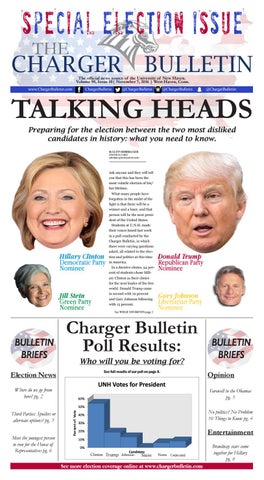
TALKING HEADS Preparing for the election between the two most disliked candidates in history: what you need to know. By GLENN ROHRBACKER
Editor in Chief grohr1@NEWHAVEN.EDU
–––––––––––––––––––––
Hillary Clinton Democratic Party Nominee Jill Stein Green Party Nominee
BULLETIN BRIEFS
Ask anyone and they will tell you that this has been the most volatile election of his/ her lifetime. What many people have forgotten in the midst of the fight is that there will be a winner and a loser, and that person will be the next president of the United States. Students at U.N.H. made their voices heard last week in a poll conducted by the Charger Bulletin, in which there were varying questions asked, all related to the election and politics at this time in America. In a decisive choice, 54 percent of students chose Hillary Clinton as their choice for the next leader of the free world. Donald Trump came in second with 19 percent and Gary Johnson following with 13 percent. See WHAT STUDENTS page 2
Donald Trump Republican Party Nominee Gary Johnson Libertarian Party Nominee
Charger Bulletin Poll Results: Who will you be voting for? See full results of our poll on page 8.
Election News
UNH Votes for President
Where do we go from here? pg. 2
60%
Third Parties: Spoilers or alternate options? pg. 3 Meet the youngest person to run for the House of Representatives pg. 6
Percent of Vote
50%
Opinion Farewell to the Obamas pg. 5 No politics? No Problem 10 Things to Know pg. 4
40% 30%
Entertainment
20% 10% 0%
BULLETIN BRIEFS
Candidate
Clinton Trump Johnson
Stein
None Undecided
See more election coverage online at www.chargerbulletin.com
Braodway stars come together for Hillary pg. 8
November 7, 2016
www.ChargerBulletin.com
Election 2016
www.ChargerBulletin.com
ChargerBulletin
@ChargerBulletin
@ChargerBulletin
By KARINA KRUL
STUDENT LIFE EDITOR KKRUL@unh.newhaven.edu
––––––––––––––––––––
A
con’t from page 1
Jill Stein (left) Gary Johnson (right) AP Photo
How can both statements be true? Do third party votes matter? The answer is yes, for a couple reasons. First is influencing the outcome of an election, which can be viewed as positive or negative depending on the viewpoint. For example, in the 2000 election, many of Ralph Nader’s voters came from Al Gore’s fan base, effectively “stealing” votes from him. This was especially apparent in Florida, a state Gore would narrowly lose and subsequently lose the election. The presence of a third candidate negatively affected Gore’s campaign, while positively affecting George W. Bush and awarding him presidency. More importantly, for this specific election, is future status of third parties. There are many candidates running under a variety of parties representing different interests, but in this election two parties have a chance to solidify themselves as major players moving for-
ward. The Libertarian Party, with governors Gary Johnson and Bill Weld leading the ticket, and Green Party, headlined by activist Jill Stein, are both fighting for votes on November 8th. Again, these candidates aren’t going to win the election. Even if Johnson won his home state of New Mexico, he would fall well short of the required 270 electoral votes needed. A vote for Stein in a heavily democratic state would have little outcome in the outcome of the election. Despite this, third party votes still matter. Any party that garners more than 5% of the national popular vote will receive minor party status for the upcoming election cycle. This is huge, as parties will receive federal funding as well as automatic ballot status. With these tools, third party candidates would be in actual striking distance of the White House, and have the ability to reach the debate stage. A vote for
Johnson may not see him as our next President, but it will give the Libertarian party the resources to compete on a more level playing field with Democrats and Republicans in 2020. Finally, there is a huge “what if” that appears extremely unlikely, but could result in Johnson, Stein, or even independent candidate Evan McMullin winning the presidency. If no candidate reaches 270 electoral votes, made possible only by other candidates winning electoral votes, there would be no winner on Election Day. Instead, the decision would then shift to the House of Representatives, who would be tasked with choosing the next President from the three candidates that received the most electoral votes. This scenario occurred in 1824, when Andrew Jackson won the most electoral votes, but not the majority needed. The runner-up, John Quincy Adams, was
Editor in Chief grohr1@NEWHAVEN.EDU
––––––––––––––––––––– It seems like this election cycle has become the new normal daily routine, awaiting the next bombshell scandal or feud to capture the media for days, just waiting for the next. Democrats have been scrambling since the summer to come to terms with the possibility of a Donald Trump presidency. They also have been working on their policy plan, should their wishes be granted and Hillary Clinton is elected. Republicans have made clear that they
would continue to barricade Clinton’s policy initiatives, and even her Supreme Court nominees, should the Republicans remain in control of Congress. Donna Brazile, the current chairwoman of the Democratic National Committee, who took over after the resignation of Debbie Wasserman Shultz, is looking for Clinton to get started right away on setting up her administration and making sure the government can function before diving into other initiatives. “She needs to take care of all the left overs – The Supreme Court,
raising the debt ceiling, she should put in place a new cabinet and a new administration,” Brazile said. Brazile also believes that Clinton should bring back some of the issues that have been important to many Americans but didn’t quite make it onto the forefront of political discourse in the general election. “She need sot talk about the kinds of issues that will bring us together. Find something to talk about that makes us feel good as Americans,” Brazlie said. Democrats in the Senate are looking to
Many students used their vote for Governor Johnson as a protest against the two highly disliked mainstream candidates. Students were also asked what issue they felt was the most important this election season and the top answer was the economy, with 16 percent of the vote, followed by Gun Control/Gun Rights and Education tied for second at 12 percent. Other top answers include income inequality, immigration, and national security. An overwhelming number of students
See THIRD PARTY page 3
Where Do We Go from Here?
By GLENN ROHRBACKER
@ChargerBulletin
What Students Want
There are More Than Two Options
re Donald J. Trump and Hilary Rodham Clinton really the only two people that could be our next president? Well, yes and no. According to the Federal Election Commission, 1,780 candidates filed to run for presidency during this election cycle. With many being eliminated in primaries, dropping out, or simply not being serious candidates, there are still over twenty candidates with ballot access on one or more states. But don’t expect to see any of these candidates in the White House any time soon. With the United States of America’s two-party dominant system, and the Electoral College as opposed to a direct election, a win from a third-party candidate is virtually impossible. We are constantly told two things during voting season. One rhetoric claims “Every vote counts! Get out and show you have a voice in democracy, it’s your civic duty.” But we are also consistently reminded a third party vote is “wasted,” and a vote for a third party might as well be a vote for the candidate that seems to be winning.
Page 2
start working on the issues that President Obama and the Democratic Party have been pushing during his two terms, but have been blocked by a Republican Congress. Senator Chris Murphy of Connecticut recognizes the importance of Clinton bringing up the policies that she hopes will appeal to young people, a group who has never been reliable voters and have not expressed great enthusiasm for the Democratic nominee. “She’s got a really aggressive plan to make college debt free, but I think she also needs to talk about the con-
noted that the media has played a negative role in this election 87 percent to be exact. Only 7 percent of students believe the media’s role was positive, a big question that will be reviewed after the election is over on Tuesday. As the concern for the lack of young voter turnout continues, students at UNH are proving that they are invested in their future and are planning to vote this Tuesday, with 77 percent of students saying they were planning on voting or already voted. Full results from the poll can be found on the last page of this issue.
Donna Brazlie AP Photo
trasts…young people value diversity, they value tolerance and Donald Trump is the antithesis of a country that puts a value on diversity,” Murphy said in an interview last month. Even local governments are bracing for the possibility of a Donald Trump presidency. A report from the New Haven Register showed that the New Haven city government was not lawfully required to help federal immigration officials evict undocumented immigrants, even if they cannot stop them. Democratic Mayor of New Haven Toni Harp, a Clinton supporter,
Don’t forget, this newspaper is recyclable!
expressed the difficulty of governing under a Trump presidency, stressing the importance of working with other local officials to get things done. “We will have to try to work with our congressional leaders and hopefully do the best that we can,” Harp said. She also noted that the city had benefitted greatly under the Democratic leadership of President Obama. Democrats all over the country are hoping that they can finally move beyond the Doanld Trump phenomenon of this election, while Republicans are nowhere near done with Secretary Clinton.
November 7, 2016
www.ChargerBulletin.com
Page 3
Election 2016 www.ChargerBulletin.com
ChargerBulletin
@ChargerBulletin
Say it in a Meme
@ChargerBulletin
By MEGHAN MAHAR
ultimately chosen as the next President. It’s a longshot at best, as current projections put Clinton well over 270 electoral votes, but it is worth noting as a technical way a third party candidate could actually win in 2016. A vote for a third party
–––––––––––––––––––––
T
A mock conspiracy theory spread that labelled Republican candidate Ted Cruz as the infamous 1960s “Zodiac Killer.” John Kasich was mocked for his food intake. Bernie Sanders tweeted an image while watching the first Clinton vs. Trump debate and it instantly went viral. The memes that have surfaced along the road to the primary election and beyond represent attitudes towards candidates and the election as a whole. When tensions arise, memes alleviate it by introduc-
ing simple yet honest humor. During the Sanders/ Clinton clash, a poster titled “Bernie or Hillary?” circulated on Twitter. The poster allowed people to combine comedic topics and pop culture issues and contrast the two candidates, depicting Sanders as relatable and poking fun at Clinton for trying too hard to relate to the younger generation. Memes are also used to incite arguments. Adults unironically use pictures of candidates with bold, politically
charged captions with the goal of making a point: more often than not, however, all parties affected by the post remain firm in their opinions. These posts are driven by frustration with the current administration and the presidential nominees. During the last few days of the election, both Clinton and Trump scrambled to secure votes. Millions followed their trail to the White House via social media. In a time when tensions are high, memes have become a cultural tool of expression.
factors we see in Presidential elections. “People simply get tired of them [elections] and opt out of local elections because they feel these are the least important when in reality they are exceedingly import,” says Dr. Patricia Crouse, a political scientist and professor at UNH, teaching state and local government. Local elections have less money in them, don’t hold many campaign events, and might only have a couple debates in the local town. Those signs on front lawns could be the biggest piece of exposure a candidate gets, but not because their position is not important. Local and state governments are the most present in everyone’s lives, yet the least recognized for their role. Fire and police depart-
ments, school districts, property taxes, road cleanups, town laws, and many, many other daily functions of a town or state are ran by these institutions. State and local governments are the first citizens would blame if they failed or weren’t functioning efficiently – think the DMV. However, these crucial components are the quickest to be overlooked, especially in a presidential election year. “There is an attempt made by most states to separate local elections from state/ federal elections so that the attention is focused on the local elections,” Dr. Crouse said. There is much less coverage of local and state elections, even in off-years, unless there
are particular interest in a certain area of the country in a competitive or game-changing election. Mayor of the City of New Haven, Toni Harp, recognizes the struggles faced by politicians running for office in local elections and the lack of accessibility they may have compared to national candidates. “Every news station, every late night talk host, every radio station has really been talking about the national election,” said Harp. Despite what may seem like a conscious effort to ignore local elections during a presidential election year, it isn’t something people even notice. Citizens aren’t any less informed about local elections during off-years, which is why states have looked to
Remember Local Elections
By GLENN ROHRBACKER
Editor in Chief grohr1@NEWHAVEN.EDU
––––––––––––––––––––– While pundits and friends alike fight over the two presidential candidates in anticipation of this historic election, many people will forget the candidates that matter even more than Trump and Clinton. People see signs with bright American colors and usually unfamiliar names on them spread out over town, with a call to vote for that person for a local office, but do they know what they mean? Do people know what their state senator does? Or even who he or she is? These local officials and their importance often get overlooked, often due to the lack of nationally appealing
Third Party
con’t from page 2
staff WRITER MMAHA2@.unh.newhaven.edu
he public’s perception of a candidate’s personality is arguably one of the most crucial pieces of swinging a vote. Unfortunately for the candidates in the 2016 election, this aspect is almost entirely out of their hands. Social media places candidates under constant scrutiny down to every second that they are visible in public. Dictionary.com defines a meme as “a cultural item in the form of an image, video, phrase, etc., that is spread via the Internet and often altered in a creative or humorous way”. Memeinspiring content is often born from moments when a candidate is caught off-guard or has their actions contextually manipulated. Memes reflect the perspectives of potential voters on social media, ranging from Baby Boomers on Facebook to members of Generation Z on Twitter.
@ChargerBulletin
See LOCAL page 6
candidate is not a wasted one, in ways it’s more valuable than voting for, say, Donald Trump in a heavily blue state, or vice versa. A third party vote is an investment in the future, a vote made with a conscience, and a vote to break up the broken
The Candidates on Social Media
By PENELOPE LANE
CONTRIBUTING WRITER PLANE1@UNH.NEWHAVEN.EDU
––––––––––––––––––––– Today, college students everywhere are waking up to the smell of fresh coffee and the sight of newsfeed stories on their social media pages. The first thing young adults are doing is checking what their friends and the rest of the world have been up to while they were asleep. Politics is a hot-button topic in our society, especially on college campuses. Students entering college are finally old enough to vote in an election. Students tend to take off with this new found freedom and plant their stake into the political party of their choosing. Certain colleges will lean closer to one political party and this can be a factor of environment, where students are coming from, their personal upbringing, and their major. Though all presidential elections create a divide, the 2016 race seems to have created a deeper wedge than usual. This division can be seen here at the University of New Haven, especially with the availability to voice one’s political opinion on social media. Mary Kate Kelly, a junior Forensic Science major has noticed a huge political divide on campus, especially online. “I think now people are literally too afraid to say who they’re voting
Don’t forget, this newspaper is recyclable!
for without being verbally attacked with this election and it’s worse than ever.” Students are tweeting, Facebooking, snap chatting, yaking, and blogging their opinions and re-sharing pictures and videos from other people. This sharing of a political opinion article that shows support for the right side of the political spectrum. Social media has played a huge part in this presidential election. This election has been especially controversial due to the candidates and the political leaning of this campus. Some students say that the campus leans towards the left and others disagree. Political Science Professor Joshua Sandman, believes one thing where Journalism Professor Susan Campbell believes another thing. Sandman has worked at the University for years and says that campus is, “Almost evenly divided, but somewhat to the right.” Whereas Campbell who has only been teaching here for one year says that campus, “Probably -- as with most college campuses -- more to the left”. It seems that student’s opinion tends to be more conservative yet the administration is more liberal. “I find it hard to tell if this campus leans hard right or hard left. I could not say for sure. Though it is clear to me
See SOCIAL page 6
November 7, 2016
www.ChargerBulletin.com
Page 4
Opinion & Editorials ChargerBulletin
www.ChargerBulletin.com
@ChargerBulletin
No Matter What, We Will Be Fine
By SUSAN CAMPBELL
to spend Election Night
tinued. According to
in a bunker – or, at the
TrendCT, Connecticut
–––––––––––––––––––––
least, a blanket fort at
has the most segregated
has been on anyone’s
I
home.
poverty (and wealth) in
radar because we’ve all
the country. While the
been bit players in the
number of people who
political circus.
day, some folks are
season, we thought
necticut is dropping, we
act nicer. I’m sorry we
loading their guns in
2012 set the standard
still have children try-
forgot our manners, but
Georgia, according to a
for bad campaign be-
ing to do homework in
let’s not lose sleep over
New York Times story
havior. We were naïve.
state homeless shelters.
Tuesday’s outcome.
from this weekend.
By comparison, those
Jobs remain hard to
Yes, this was a barbed,
That’s Georgia, in the
Romney/Obama ads
come by. We have some
ugly campaign, but we
United States, as in
look like a garden party.
of the most expensive
know how to behave.
“Georgia On My Mind.”
This year has been un-
housing markets in the
We’ve certainly done it
precedented for accu-
country. Consequently,
before.
Should Be Panicking
sations, investigations
we continue to lose col-
About the Election:
(quasi and otherwise),
lege graduates to places
documentary, “Con-
Go Ahead. Wet That
tweets, and counter-
where the cost of living
trol Room,” in which
Bed,” says Slate. “Psy-
tweets.
is more reasonable.
U.S.-educated Suda-
JOURNALISM PROFESSOR SlCAMPBELL@unh.newhaven. edu
When did we become
n anticipation of a
Clinton win on Tues-
“Of Course You
so easily frightened? Before this election
chologists and Massage
It’s all been delicious
are homeless in Con-
organization.
But very little of this
There is a line in the
nese journalist Hassan
Therapists Are Report-
and great fun, if you like
are told to prepare for
Ibrahim earnestly tells
ing ‘Trump Anxiety’
steel cage matches, but
a silver tsunami, where
a companion that he
Among Clients,” says
while we were watch-
by 2025, 35 percent of
has absolute faith in the
the Washington Post.
ing the show, what did
the state’s population
American people, and
we in the Nutmeg State
will be 55 and older, ac-
absolute faith in the
friends are unfriending
miss during this elec-
cording to the Connect-
Constitution.
and followers unfollow-
tion season? While we
icut Economic Resource
ing. People are vowing
were launching tweet-
Center, a nonprofit
bombs, poverty con-
research and marketing
Me, too. Deep breath. We’ll be fine. I promise.
What Happened When My Absentee Ballot Went Missing
By KARINA KRUL
student life Editor kkrul1@unh.newhaven.edu
––––––––––––––––––––
Who do you vote for? Why would you vote for them? For all of you who don’t pay attention to politics here are 10 things you should know about the election, coming from someone who doesn’t pay attention to politics: 1. Hillary sent some emails that, I think, were illegal and may or may not be treason. 2. Trump is being accused of sexual assault against multiple women. 3. Hillary was apparently “responsible” for four soldiers killed in Benghazi (wherever that is) and was never brought up on charges. 4. Trump still wants to build a wall with Mexico’s money. 5. Hillary’s foundation has been accused of having the same donors as ISIS. 6. Trump keeps blaming Mexico and China for taking American jobs. 7. There are two other people running who no one seems to deem as relevant. 8. The three presidential debates were basically a representation of The Hunger Games, Catching Fire & Mockingjay.
While many students at
your day better.
when someone tells
9. Apparently, the millennial generation will have
you that you should’ve
a very large impact on the end results.
UNH live local enough
Students here trust
to vote, even more do
riety of different things,
ballot two weeks ago.
have a lot of things to
not. If you have to fill
from annual holiday
A certain level of effort
worry about, finishing
out an absentee bal-
cards to expensive care
should be exerted in a
papers, writing labs,
lot for the presidential
packages to important
search attempt. Instead,
studying for exams,
election it can get pretty
documents; they should
when I went to the
and getting everything
stressful fairly quickly.
be more organized.
mailroom, I was greeted
together to vote may
Especially when your
Losing mail should be
with the nonchalant
not be your top priority.
absentee ballot mysteri-
a much less common
response of, “ask them
Many college students
ously disappears.
occurrence than it cur-
to send it again.” Four
rently is.
days before the election.
When you spend three
Occasionally it still
10. These are two of the most disliked candidates in United States history. Hopefully this has provided those of you who have not paid much attention these last few months with some helpful information. Now you know a little bit more than you would if you were to look at a Facebook headline or from what your friends say.
Helpful.
aged from voting be-
days and many hours
cause it can pose such
on the phone with your
happens, mail gets lost,
Millennials are the
challenges.
local voter registration
and that is very under-
generation to change
office only to find out
standable.
the world. Isn’t that
These challenges only
What if you don’t pay much attention to politics?
cern should be seen
received their absentee
are even more discour-
––––––––––––––––––––
it really doesn’t make
the mailroom with a va-
be stressful. Students
By MYLES BROWN
COntributing Writer MBROW9@unh.newhaven.edu
how they should.
that they can go home
Voting in college can
10 Things to Know if You’re Not into Politics
I’m sorry we didn’t
Meanwhile, planners
On social media,
@ChargerBulletin
@ChargerBulletin
what they tell us? We
increase when things do
that your ballot had
What is not under-
not work the way they
been sent weeks ago,
standable is when the
have the numbers
should. When you go
it does not encourage
people, who could have
and ideals to seriously
to college in a state you
you to vote. When you
made the mistake, do
change the way the
are not registered in,
go to the mailroom and
absolutely nothing to
system functions. If
there is more opportu-
they do not even seem
correct it. Not even
we vote. Yet, when it is
nity for things to not go
to care that you may
an apology. A certain
now not be able to vote,
degree of care or con-
See BALLOT page 5
Express your opinion! Send your editorials to ChargerBulletin @newhaven.edu
What was your reaction? Let the opinion writers know!
November 7, 2016
www.ChargerBulletin.com
Page 5
Opinion & Editorials ChargerBulletin
www.ChargerBulletin.com
@ChargerBulletin
@ChargerBulletin
@ChargerBulletin
Voting Between a Rock and a Hard Place By KARINA KRUL
student life Editor kkrul1@unh.newhaven.edu
––––––––––––––––––––
T
his is the first
presidential election our generation will be able to vote in, and our options are between an uneducated oompa loompa and an untrustworthy liar. This is supposed to be an exciting first moment, but instead it is too often perceived as a hopeless path to an empty future. In our first election most of us are not choosing the candidate that will help America the most, we are choosing the candidate that will mess up the country the least. That does not encourage millennials to go out and vote, it encourages them to
give up and stay home.
didate, they will decide
Our first chance to have
who wins. Ironic right?
a voice in our govern-
While this election may
ment and we are told
not be the best or most
that it is a hopeless
promising, it may be
cause. Promising right?
one of the most impor-
Clinton and Trump are
tant. This election will
the most disliked presi-
still decide who leads
dential candidates this
our country for the next
country has seen in a
four years, and it will
long time. Trump has
set a foundation for the
continuously proven
years after that.
to have no experience
Voting is important,
and nowhere near the
regardless of who you
proper knowledge re-
support, or if you don’t
quired to be president
support anyone. Vot-
of the United States. He
AP Photo
ing is a civic duty. Sure
has no previous govern-
Many people have re-
not much draw to either
but their numbers seem
we do not have the best
ment positions, and he
served to staying home
candidate.
to get closer every day.
options for our first
has filed for bankruptcy
on November 8th, to
Clinton has been un-
According to The Wall
ever election, but we
multiple times.
avoid supporting either
der investigation by
Street Journal, Clinton
still have options, we
Clinton has proven to
candidate.
the FBI, and nuclear-
only leads Trump by 4
can still decide, and we
be untrustworthy. She
Between Trump’s vul-
launch officers have
percent. It is the people
need to.
has been caught lying
gar comments towards
said they do not trust
who decide to stay
Do not let the candi-
and deleting emails.
women, Clinton’s role
Trump with nuclear-
home on election day
dates strip you of your
On top of their clear
in the Benghazi attack
launch codes – neither
that will ultimately de-
voting right, do not
character flaws, their
in 2012, Trump’s bank-
of those facts are very
cide our next president.
let their unpopularity
policies are drastically
ruptcies, and Clinton’s
reassuring.
The millennials giving
allow you to miss your
different, and many
emails, there is not
Clinton is leading in
up their first ever vote
first chance to have a
people do not agree
much to work with as
most current polls,
because they do not
voice.
with either of them.
a young voter. There is
although not by much,
want to choose a can-
considerable contro-
by her past controver-
and get me to say I
he could do to people
done, and how hard I
versy that makes things
sies.
think he’s the perfect
I care about and the
cringe at the thought of
candidate for America
beliefs I stand for is a
the next four years.
A Difficult Choice This Election
By SARAH COSTELLO
Contributing writer SCOST2@unh.newhaven.edu
––––––––––––––––––––– Since most of us at UNH are 18 and older, we get to cast our vote towards who will be our country’s leader for the next four years, and for most of us, is the first time we get to participate in a presidential election. Unfortunately, it is our task to decide between (what I see as) the lesser of two evils. Hillary Diane Rodham Clinton and Donald John Trump represent the Democratic and Republican candidates for this year’s election, respectively, and both have caused
hard to decide who is
With the Whitewater
even worth the vote by
scandal, cattle futures
forever even once. But
terrifying nightmare.
November 8th.
controversy, and most
it wouldn’t be fair to
I’ve taken a long time to
is the thought that my
Clinton has a history
recently, the email con-
neglect the fact he’s ac-
read up on their cam-
vote really does count,
with the White House,
troversy, where she was
complished a few things
paigns, watch as many
and that vote can count
government and other
sending emails on her
in his life.
debates as I could, and
towards potentially
major political endeav-
family’s private server,
take my time to decide.
hurting the people I
ors. Once the First
showing that she was
ly powerful and wealthy
Lady, she now has the
trying to act above the
empire despite failing
when I wished that this
ing down important
chance of being the first
official State Depart-
more than once. He is
wasn’t my responsibil-
parts of what our nation
female President in the
ment server. She has
also one who “listens to
ity. Both of these people
stands for.
US. She is much more
been exposed numerous
the people” since he is
bring up promises for
open social issues such
times for questionable
not a traditional politi-
a better tomorrow for
to vote for in the end,
as women’s rights, gay
acts and decisions, and
cian, and “knows” what
the entire nation, when
but that doesn’t mean
marriage, and generally
it makes me wonder
the public might want.
the entire nation knows
that any of this was
seems to want to help
whether or not I can
That does not hide
their history and what
easy, and that trying to
indebted college kids
trust her on her word
the fact that he is racist,
they have done in the
take responsibility over
and small businesses
sometimes.
sexist, homophobic, xe-
past.
choosing either Hill-
thrive under her presi-
Then we have Donald
increasingly difficult to actually cast a ballot, less and less millennials will do so. When ballots are lost, and students,
nophobic, and is openly
But there are times
When I try hard to
love, or possibly bring-
I do know who I want
ary Clinton or Donald
dential term. However,
Trump. Honestly, you
very rude to anyone
find positives about
Trump is one I wish
her campaign is occa-
couldn’t pay me three
who isn’t apparently
either of them, I ulti-
was easier and not as
sionally overshadowed
times his net worth
a white, upper-class
mately remember who
stressful or fearful.
male. To think what
they are, what they’ve
Ballot Blunder
con’t from page 4
He’s built an extreme-
What scares me most
who have a long list of
the government. The
things to accomplish,
next time a mailroom
need to spend hours
loses someone’s voice in
trying to figure out how
their government, the
to fix it, they give up.
least they could do is
They do not vote. They
apologize.
do not have a voice in
Want to write for the Charger Bulletin? Email chargerbulletin@newhaven.edu
What was your reaction? Let the opinion writers know!
November 7, 2016
www.ChargerBulletin.com
Page 6
Election 2016
www.ChargerBulletin.com
ChargerBulletin
@ChargerBulletin
@ChargerBulletin
@ChargerBulletin
Don’t Like Your Choices? Social Media Blame the Primaries con’t from page 3
that the administration is afflicted with cultural Marxist principles, which I clearly detest,” declares Sophomore Criminal Justice major, Benjamin Way. As the election rolls closer, more and more news will break for and against candidates and the political parties that they represent. People will continue to speak their minds and stand up for what they believe in. College is the first
By CONNOR VARGO
CONTRIBUTING writer CVARG1@unh.newhaven.edu
–––––––––––––––––––––
E
ver since Hillary Clinton and Donald Trump were nominated as the Democratic and Republican candidate for president of the United States respectively, I have constantly heard one question asked, rhetorically and literally, by friends, family and strangers alike: how did we get here? Out of the 152 Million people who meet the requirements to become president of the United States , these are the best two our system of democracy could come up with? Regardless of your political leanings, or whether you feel strongly about one candidate or the other, Hillary Clinton and Donald Trump are the two most unpopular candidates to ever run for the Oval Office. This isn’t necessarily because of polarizing party politics either. Droves of Republicans have come out against Donald Trump over anyone of his outlandish comments he’s made throughout his campaign, and many Democrats have been apathetic towards Hillary Clinton, calling her careless after her email scandal. So if this many people have such disdain for one or both major party candidates, how did these two candidates win their respective party’s nomination? Was the process rigged
as some citizens on both ends of the political spectrum have claimed? Or did bias media coverage play a part? Well, the answer to both of those is ultimately no. The real answer, the one that is supported by facts and hard statistics, is that people did not come out and vote in the primary process. The primary process is the system used to select each party’s nominee for president. Primaries are run by each party at the state level, so for example, the Connecticut Democratic Party dictates how the democratic primary election will be run in the state of Connecticut. Each state has a primary election or a caucus, which essentially is a mini convention of sorts where supporters of any candidate have the ability to make the argument for their candidate to other voters. One of the caveats of the primary process is that each state runs their election a little differently. Some states allow for open primaries, meaning your party affiliation doesn’t
Local Elections
con’t from page 3
remedy the overwhelmingly low turnout in many areas. “I don’t think people see any direct connection between local politics and national politics. They don’t even think about them on the same level. Local politics is just too far removed to be impacted by presidential poli-
tics,” Crouse added. In respect to increasing turnout, states have tried to update their processes with modern times. In Connecticut, the Secretary of State initiated online voter registration, where it only takes a few minutes to register, rather than a couple weeks sending in a request and/or making a visit to the local office.
Democratic National Convention AP Photo prohibit you from voting for any candidate. Other states have closed primaries, which mean in order to vote for a candidate of a certain party, you must be a registered member of that political party. The Democratic and Republic Party also have party elites who get votes at their respective conventions, which are referred to as “super delegates.” Many claim that this process is undemocratic, however there is not law that mandates primaries have to be democratic. The presidential nomination process has actually become more democratic compared elections several years ago; however, the turnout for primary elections is staggeringly low. The 2008 primaries brought out a record high participation rate of 30 percent. Democrats, many excited by the idea of the first African-American president, turned out significantly more than Republicans. This past primary process lead to the second
highest participation rate since 1980 with 28.5 percent, however, that doesn’t say much, considering primaries get significantly low turnout every election. Only 14.8 percent of eligible Republicans and 14.4 percent of eligible Democrats had a say in their party’s nominee. What’s even more troubling is that more than half of those who came out didn’t even vote for the two nominees, meaning in total that about 9 percent of eligible voters in the US voted for either Donald J. Trump or Hillary Rodham Clinton. Simply put, the reason why we have the two nominees we do is because people did not vote in the primaries. We got to Donald Trump and Hillary Clinton because people didn’t know how, want to, or cared enough to vote in the primaries, which makes me wonder if the people asking how we got to this point even attempted to have a say in who their party’s next nominee for president of the United States would be.
One of the main concerns in both parties on the national stage is how this year’s presidential election will affect down-ballot races in towns and states across the country. Many Republicans fear losing control of Congress due to the continued discontent with the Trump Campaign. Dr. Crouse thinks that the affect each candidate will have in local races will be opposite of a typical election year,
where down-ballot candidates usually do well if their party’s candidate does well. “Rather than down ballot candidates sweeping in based on the support of a popular candidate, you will have down ballot candidates sweeping in on the negativity towards the opposing candidate,” she said. Several governors may be displaced this year and we may have the balance in Congress shifted into the blue.
www.ChargerBulletin.com
adult experience that students get and the fact that an election is happening at the same time really shows students how the world works and how they can develop who they are and what they believe in. Younger generations have been hard to reach in previous elections so hopefully this controversial election will encourage students to go and voice their opinion on the voting ballet this November 8th.
Meet Erin Schrode
By SAMANTHA REPOSA
“I never thought I would be a politician ––––––––––––––––––––– and I’m not,” Schrode said. Ask an average Before filing her name 25-year-old what they in to run, Schrode are doing with their wrote a letter to herlife and they will laugh self to explain why she in your face because was running and put odds are they do not her potential campaign even know. Ask Erin in perspective to stay Schrode, not your aver- grounded. age 25-year-old from Schrode ran her 2015 California, what she is campaign on four pildoing with her life and lars: environment and she will tell you she is public health, learning, shaking up the societal gender rights, and tech norms while inspiring innovation, while rechange through not defining public service only the nation, but the and expanding what it world. means to be politician. Schrode became an Her campaign eduinternational sensacated not only voters tion within the political within her district, but spectrum last year dur- the nation about the ing the primary election vitality of fiscally renowhen she was running vating the student loan for the 2nd Congressio- and grant system to nal District in hopes of make higher education becoming the youngest an opportunity to all, member of the House raising minimum wage, of Representatives in and immersing technolhistory and deliver the ogy more prominently “promise of her genera- between Washington tion.” and voters to create the “We deserve a place conversation of issues at the decision making and concerts, which table,” Schrode said. started a movement “Period. End of story.” among millenials across Eleven days before the the country. deadline to file papers “People tell me, ‘Erin, to run for the 2nd Con- you made me care gressional District in about issues I didn’t California and 72 days know existed,’” says before the election, Sch- Schrode as she is an rode gave a speech adadvocate for change dressing the problems and equality across the and what needed to be board. fixed in her town. Though, she did not Shortly after, Schrode earn a seat in the house was bombarded with during, she did ignite a people encouraging her conversation that could to run for a seat in the be heard by nationally United States House of and internationally that Representatives against millennials are ready to incumbent Jared Huff- take a stand. man (D-CA), which she Read full coverage on www.chargerbulletin.com laughed off. assistant EDITOR srepo2@unh.NEWHAVEN.EDU
October 19, 2016
www.ChargerBulletin.com
www.ChargerBulletin.com
Page 7
Bulletin Board ChargerBulletin
@ChargerBulletin
@ChargerBulletin
@ChargerBulletin
The Charger Bulletin
300 Boston Post Road | West Haven, CT 06516 ChargerBulletin@newhaven.edu | www.ChargerBulletin.com www.twitter.com/ChargerBulletin | www.facebook.com/TheChargerBulletin office: 203.932.7182 | text: 270.864.6397 Our office is located on the third floor of Bartels Hall, in the Center for Student Engagement, Leadership and Orientation Editor-in-Chief Glenn Rohrbacker Assistant Editor Samantha Reposa Staff Writers Ben Atwater, Alessia Bicknese, Caitlin Duncan, Marina Jube, Riley Knebes, Karina Krul, Angela Tricarico, Caitlin Carney, Meagan Mahar, Christina Genovese, Lauren Cohen Copy Editors Alessia Bicknese, Angela Tricarico, Karina Krul, Caitlin Carney, Christina Genovese, Khaaliq Crowder Arts & Entertainment Editor Alex Halfinger Sports Editor Billy Sakmann Opinion Editor Alessia Bicknese Student Life Editor Karina Krul Photo Editor Erica Naugle
* The Charger Bulletin staff strives for excellence and accuracy in writing and reporting. We recognize that mistakes may occur and encourage readers to notify the Bulletin if they feel a correction is necessary. Please email the Editor-in-Chief at chargerbulletin@newhaven.edu.
Since 1938, The Charger Bulletin has been the official student newspaper of the University of New Haven. Advertising The Charger Bulletin accepts advertising from outside sources. Ad rate sheets are available upon request or by calling 203.932.7182 or via email at ChargerBulletin@ newhaven.edu. Advertisements must be either submitted on CD by mail, fax, or inperson, or, preferably, sent via email. All advertisements must be received by noon on the Thursday prior to scheduled printing. Due to school sanctions, The Charger Bulletin is unable to accept advertisements from establishments that advertise human research. The Charger Bulletin reserves the right to refuse any advertisement. Advertisements within The Charger Bulletin are inserted by outside sources identified in the advertisements themselves and not by the University of New Haven. Advertising material printed herein is solely for informational purposes. For the most up-to-date information. visit www.ChargerBulletin.com/advertise/. Letters to the Editor The Charger Bulletin welcomes letters to the editor. Letters can be sent via email to ChargerBulletin@newhaven.edu or online at www.ChargerBulletin.com. All letters must include the writer’s full name and phone number for verification and can be withheld upon request. The opinions expressed in letters to the editors, poems, columns, or other submissions are not necessarily those of the staff. The Charger Bulletin has the right to refuse to print any letter or submission. Final decisions are made by the Editor-in-Chief. 2nd Place - ASPA Annual Contest/Review for Scholastic Yearbooks, Magazines and Newspapers 3rd Place - ACES National Headline Contest, 2012
The Charger Bulletin is an unbiased student newspaper, and declines to endorse any political figure for any office. All views and opinions expressed are those of the writers themselves and not The Charger Bulletin.
View coverage of all of this weekend’s homecoming events online at www.chargerbulletin.com
November 7, 2016
www.ChargerBulletin.com
Page 8
Election 2016 www.ChargerBulletin.com
@ChargerBulletin
@ChargerBulletin
@ChargerBulletin
Charger Bulletin Poll Results
Political Ideology Most Important Issue Most Important Issue
5
1
2
3
4
5
6
4 Ideology
Best 2016 Election Tweets
ChargerBulletin
3 Series1 2
8
9
10
11
5%
11%
8% 20%
30%
40%
14
15
10%
1 10%
13
16%
11%
0%
12
1%
2%
4%
5%
4%
7
7%
4%
5%
7%
Percent of Vote
1 - Very Liberal
1 - Economy 2 - Immigration 3 - Criminal
2 - Somewhat Liberal
Justice 4 - Gun Control 5 - Income Inequality 6 - National Security 7 - Foreign Policy 8 - Cli-
3 - Moderate
mate Change 9 - Education 10 - Health Care
4 - Somewhat Conservative
11, 15 - Gender Issues 12 - All 13 - Common
5 - Very Conservative
Sense 14 - Other
Obama’s Effectiveness Main News Source 70%
62%
40%
60%
30%
50%
20%
40%
12%
10%
30% 20%
17%
10%
1
2
3
4
7%
15%
0%
8%
2%
10% 0%
40%
1% 1
2
3
4
5
8%
6
5
13% 8%
7
8
Series1
Series1 1 - Facebook 2 - Twitter 3 - Newspaper 4 - Cable News 5 - Radio 6 - Google News 7 - Political Websites 8 - Other
1 - Effective 2 - Ineffective 3 - Neither 4 - Effective, but not because of him 5 - Ineffective, but it isn’t his fault
Broadway is With Her
By ANGELA TRICARICO
COPY EDITOR ATRIC1@.unh.newhaven.edu
–––––––––––––––
T
he Broadway community has always been viewed as a tight knit family. With many of the same shared ideals and backgrounds, the Broadway community has come together even more this past year to support their presidential candidate of choice: Hillary Clinton. While there were performers supporting her prior to her official nomination as the Democratic candidate, the communal support really began after the Democratic National Convention, and as the idea of a Trump presidency began to sound
like more and more of a threat to performers and writers in the Broadway community. Clinton has recognized her support from the Great White Way – she quoted Hamilton in her DNC acceptance speech and chose Hamilton as a venue to raise money for her campaign, where a special performance was added with the ticket money going to her campaign. When Broadway banded together after the Orlando nightclub shooting to record a charity single, the supergroup, featuring Audra McDonald, Idina Menzel, Debra Messing, Darren Criss, Michael Urie and many more, was invited to perform at the DNC. Actors’ Equity Association, the labor union for stage actors, released a statement on
August 30, 2016 that officially endorsed Clinton as their presidential candidate. In the 103 year history of AEA, the union has never endorsed a presidential candidate. In the statement, AEA President Kate Shindle wrote, “Our union has historically chosen to remain nonpartisan and above the fray. But at such a critical time in our country’s history, this union does not have that luxury if we hope to protect our members. We have to fight with everything we have for our survival.” Clinton was honored to receive the endorsement and issued a statement following it. “I have spent my life fighting to even the odds for those who have had the odds stacked against them. That means making it pos-
Don’t forget, this newspaper is recyclable!
sible for every child to live up to his or her God-given potential, no matter where they come from, what they look like, or who they love,” she wrote. Over the past two months, the coalition Broadway for Hillary has become more and more active in their campaigning. The host committee includes stage actors Gavin Creel, Andrew and Celia Keenan-Bolger, Telly Leung, Shakina Nayfack and Adrienne Warren, actor Jesse Tyler Ferguson and his husband, lawyer Justin Mikita, and writers Jeanine Tesori, Andrew Lippa and Stephen Schwartz. On the first day of phone banking for the Clinton campaign, Broadway for Hillary held a phone bank Keep reading on chargerbulletin.com