ELECTRIC VEHICLES MAGAZINE
ISSUE 77 | JUL–SEP 2026 | CHARGEDEVS.COM
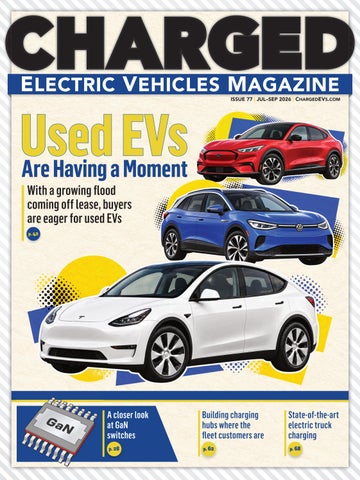
Used EVs Are Having a Moment With a growing flood coming off lease, buyers are eager for used EVs p. 42
A closer look at GaN switches
Building charging hubs where the fleet customers are
State-of-the-art electric truck charging
p. 28
p. 62
p. 68
THE TECH CONTENTS
28 A closer look at GaN switches
28
current events 12
12
Astemo to invest $112 million to expand traction motor production in Kentucky Bosch’s rigid e-axle integrates motor and transmission for heavy electric trucks
14
ROHM’s SiC MOSFETs go into BMW’s Neue Klasse electric powertrain ZF Aftermarket repair kits for hybrid and EV motors, inverters and reducers
16
Maxion and Novelis develop aluminum battery housing for buses and trucks Sensata’s OmniNode consolidates high-voltage distribution for commercial EVs
18
WACKER’s silicone rubber exudes oil to ease EV battery coolant seal assembly Asahi Kasei Microdevices’ sensors go into Microchip’s arc fault detection design
16
19 Wevo’s WEVOPUR 60210 FL T potting protects battery management PCBs 20 Cabot to use $50-million grant to expand production of conductive additives Versinetic’s CongaEEL and MinnoRay let two AC sockets share one controller
22 Echion signs MOU with Energy Tech Solution to develop XNO battery cells AEM’s rare earth-free Titan heavy-duty motor delivers 700 kW peak power
24 Deutronic’s DVCH3003 DC/DC converter handles up to 900 V for off-highway EVs Infineon’s PMIC integrates resolver excitation and safety logic for EV inverters
26 LG Energy Solution ties LMR battery gas generation to voltage limits ROHM releases automotive-grade 650 V IGBTs for EV compressors and heaters
20
27 Schaeffler develops process to reuse rare earth magnets from EV motor rotors AYK Energy launches a swappable containerized marine battery system
THE VEHICLES CONTENTS
42 Used EVs are having a moment
42
With a growing flood of off-lease EVs and gas prices up 40 percent, buyers are eager for used EVs—and prices have risen.
current events 34 European truckmakers could lose a quarter of the market to the Chinese by 2030 Archer Aviation and BETA collaborate to bring electric air taxi charging to Texas
35 DELIVAN unveils production models of its electric vans at European trade show 36 Boise School District to deploy 8 electric school buses
36
San Francisco schools begin rolling out electric school buses
37 California’s Ontario airport deploys electric ground support equipment APM Terminals Elizabeth orders 96 electric terminal tractors from Orange EV
38 UK parcel delivery firm expands its electric van fleet to 4,000 vehicles Cape Town orders 38 Volvo low-entry electric city buses
39 Amazon rollout of 50 Mercedes-Benz eActros 600 electric trucks in Germany
39
Next generation of London’s plug-in black cabs to go into production in 2027
40 Swiss dairy company deploys three electrified refrigerated trailers Elektrotrucker sets off to circumnavigate the globe in a Mercedes electric truck
41 University at Buffalo commissions 8 new electric buses AVILOO extends its used EV battery warranty offer to 14 more European markets IDENTIFICATION STATEMENT CHARGED Electric Vehicles Magazine (ISSN: 24742341) July-September 2026, Issue #77 is published quarterly by Electric Vehicles Magazine LLC, 136 4th St N, STE 201, Saint Petersburg, FL 33701-3889. Periodicals Postage Paid at Saint Petersburg, FL and additional mailing offices. POSTMASTER: Send address changes to CHARGED Electric Vehicles Magazine, Electric Vehicles Magazine LLC at 136 4th St N, STE 201, Saint Petersburg, FL 33701-3889.
40
THE INFRASTRUCTURE CONTENTS
62
62 Building charging hubs where the fleet customers are 68 #Truck Charging Needed
current events 52 Lincoln Electric’s EV chargers earn NEMA Make It American product certification OBE Power secures investment to expand North American EV charging network
52
54 Coulomb introduces bidirectional MCS for its mobile energy storage systems South Africa’s CHARGE upgrades its off-grid EV charging network
56 Zapgo opens EV charging hub with five chargers in Barrow-in-Furness, England PowerUp America to build four new NEVI fast EV charging sites in North Carolina
57 Green Water & Power and Autel Energy have installed over 10,000 EV chargers VEV secures investment to accelerate expansion of fleet electrification services
58 TUAL’s PowerUp battery-integrated charging keeps commercial EVs rolling
54
Kempower and JET Charge power a large electric bus depot in Western Australia
59 Alpitronic adds a depot dispenser to its range of commercial EV chargers NYC selects it’s electric to build out curbside EV charging network
60 Paua and Zaptec partner to offer EV charging payment system for fleets Kempower to provide DC fast charging to DP World’s port operations in Canada
61 PG&E expands its California V2X program WiTricity opens wireless EV charging lab in Florida
61
Innovation is our everyday
Power Electronics
Let’s do something BIG. BorgWarner has over 130 years of experience helping shape the future of mobility alongside our partners. With the world’s foremost technologists and engineers committed to collaboration and excellence, we’ve developed a portfolio of innovative solutions that are transforming the way the world moves.
Variable Cam Timing
High Voltage eFan
Publisher Christian Ruoff Senior Editor Charles Morris Technology Editor Jeffrey Jenkins Segment Leaders Joel Franke Mark Rogers
Contributing Writers Jeffrey Jenkins Charles Morris Christian Ruoff John Voelcker
For Letters to the Editor, Article Submissions, & Advertising Inquiries Contact: Info@ChargedEVs.com
Special Thanks to Kelly Ruoff Sebastien Bourgeois
Jeremy Ewald Graphic Designers Tomislav Vrdoljak SUSTAINABLE Certified Chain of Custody FORESTRY Promoting Sustainable Forestry INITIATIVE www.forests.org
SFI-00993
ETHICS STATEMENT AND COVERAGE POLICY AS THE LEADING EV INDUSTRY PUBLICATION, CHARGED ELECTRIC VEHICLES MAGAZINE OFTEN COVERS, AND ACCEPTS CONTRIBUTIONS FROM, COMPANIES THAT ADVERTISE IN OUR MEDIA PORTFOLIO. HOWEVER, THE CONTENT WE CHOOSE TO PUBLISH PASSES ONLY TWO TESTS: (1) TO THE BEST OF OUR KNOWLEDGE THE INFORMATION IS ACCURATE, AND (2) IT MEETS THE INTERESTS OF OUR READERSHIP. WE DO NOT ACCEPT PAYMENT FOR EDITORIAL CONTENT, AND THE OPINIONS EXPRESSED BY OUR EDITORS AND WRITERS ARE IN NO WAY AFFECTED BY A COMPANY’S PAST, CURRENT, OR POTENTIAL ADVERTISEMENTS. FURTHERMORE, WE OFTEN ACCEPT ARTICLES AUTHORED BY “INDUSTRY INSIDERS,” IN WHICH CASE THE AUTHOR’S CURRENT EMPLOYMENT, OR RELATIONSHIP TO THE EV INDUSTRY, IS CLEARLY CITED. IF YOU DISAGREE WITH ANY OPINION EXPRESSED IN THE CHARGED MEDIA PORTFOLIO AND/OR WISH TO WRITE ABOUT YOUR PARTICULAR VIEW OF THE INDUSTRY, PLEASE CONTACT US AT CONTENT@CHARGEDEVS.COM. REPRINTING IN WHOLE OR PART IS FORBIDDEN EXCEPT BY PERMISSION OF CHARGED ELECTRIC VEHICLES MAGAZINE.
POWE RING THE FUTU RE OF BAT TE RY MAN U FACTU RING ANDRITZ IS YOUR GLOBAL E NGINE E RING AND LOCAL SE RVICE PARTNE R FOR BAT TE RY SOLUTIONS
DISCOVER SOLUTIONS ACROSS THE ENTIRE BATTERY VALUE CHAIN! From lab and pilot lines for advanced battery innovations to scalable cell manufacturing, lead-acid technologies, and advanced testing, ANDRITZ delivers manufacturing solutions built for maximum efficiency,
sustainability, and reliability. ANDRITZ will showcase its equipment and service portfolio for battery cell assembly and finishing, cell case production, battery testing, and more this October at the Battery Show North America. ANDRITZ. FOR GROWTH THAT MATTERS.
ANDRITZ Schuler North America ⁄ 7145 Commerce Blvd. ⁄ Canton, MI 48187 ⁄ USA ⁄ andritz.com
US VISIT TH O AT B O ! 3 3 6 2 E P L AC GTO N M I IN T N , HU O IT D E T R 1 5, 2026 12O C T.
VIRTUAL CONFERENCE
EV Engineering
Don’t Miss Our Next Virtual Conferences On
EV Engineering
Who should attend? Charged Electric Vehicles Magazine presents FREE online events for the EV industry featuring live webinars, on-demand videos, whitepapers and interactive Q&As.
EV Engineering Events
Featuring: Motor Design and Manufacturing
Spring Virtual Conference March 2027
Power Electronics Design and Manufacturing
Fall Virtual Conference
Cell Development and Battery Systems Design
Now On-Demand
Plus
Testing, Powertrains, Thermal Management, Circuit Protection, Wire & Cable, Advanced Manufacturing
www.ChargedEVs.com/Conference
Publisher’s Note The EVs keep coming—new and used SPECIALISTS IN AUTOMATIC ELECTRICAL TEST EQUIPMENT
We advise. We design. We implement. We support. You test your best. mktest.com/automotive sales@mktest.com
In our last issue, I noted that important industry milestones across all three of our main coverage areas were set to be reached in 2026. The good news is that the progress remains on track—news of new powertrain tech, new vehicles and major new infrastructure deployments continues to cross our desk daily. The bad news is that much of the action is happening outside the US, and our country continues to fall farther behind. To give just a couple of examples: Rustam Kocher gave us plenty of good news about the state of electric trucking (see Page 68), but most of it applies to the European market; in this month’s Charging Forward (see Page 78), Charles Morris reports on a nifty new V2G-capable home charger, but it’s made by a Chinese company, and will not be sold in the US. It was particularly sad to hear about the billions of dollars (and hundreds of jobs) that US automakers flushed when they cancelled EV programs and plans for new battery plants, citing disappointing sales figures. Do American drivers simply not want EVs? Don’t you believe it. US (and Japanese and European) automakers made a conscious decision to slow-walk the EV transition, and the result is fleets of shiny new Chinese EVs on the streets of Europe (and Canada, and Mexico, and Asia, and everywhere outside the US). We’re happy to see all the new EVs, but we’d be a lot happier if they were made in the USA. All is not lost, however—far from it. The advent of higher oil prices, coinciding with the approach of EV/ICE price parity, has done more to promote global EV adoption than a decade of government subsidies and loans. (Oh, the irony!) The headlines about America’s EV slowdown miss some very good news on the used car lot. As John Voelcker reports (see Page 42), used EV sales are growing, and the vehicles are selling fast. A wave of lease returns is bringing more low-mileage choices to market, often at substantial discounts from new. That supply will keep coming through 2028. The EV transition is finding fresh momentum among buyers who were priced out of new vehicles the first time around. Electric trucks are on their way to the US, too. Sales of the Tesla Semi have been setting new records, seemingly on a weekly basis. Two orders for hundreds of units sounded impressive until a consortium of shippers put in a bid for 2,500. Meanwhile, the legacy OEMs’ order books are as empty as a cartoon wallet with a moth flying out. Thanks to a new California law, they must now publicly disclose their prices, and if they want to survive, they’ll have to cut them almost in half. Automakers may have slammed the brakes on their EV investments, but charging infrastructure providers are flooring their accelerators. CPOs, gas station chains, retail giants and real estate investors are deploying ever-faster and more reliable chargers in large numbers. New York City is rolling out 700 curbside chargers. Here in Florida, I’ve been making a lot of road trips, and I no longer have the slightest problem finding a place to charge. So much for the “not enough infrastructure” argument against going electric. The charging industry has come a long way in the last decade, and this time around, the big players fully intend to make profits. Truck charging is emerging as a new frontier. In this ish, Rustam Kocher (Page 68) explains why trucks need purpose-built charging sites, and EV Realty’s new CEO Henrik Holland (Page 62) explains the critical importance of choosing strategically located sites with access to utility connections.
Christian Ruoff | Publisher EVs are here. Try to keep up.
Image courtesy of Bosch
Image courtesy of Astemo
THE TECH
Astemo to invest $112 million to expand hybrid motor production in Kentucky
Bosch’s new rigid e-axle integrates motor and transmission for heavy electric trucks
Astemo Americas will add nearly 300,000 square feet of production and warehouse space at its two manufacturing plants in Berea, Kentucky, and spend more than $112 million to increase output of hybrid motors there. The investment is the first phase of a multi-year program to increase hybrid powertrain component production across Astemo’s Kentucky sites, according to the Kentucky Cabinet for Economic Development. The Berea plants build chassis and electric powertrain components. A separate Astemo plant in Harrodsburg, Kentucky, produces electric powertrain and engine management systems. Michigan-headquartered Astemo Americas runs 23 manufacturing sites across the Americas, 12 of them in the US. The parent company is a joint venture between Hitachi, Honda Motor and JIC Capital. Charged has covered Astemo’s agreement to supply Honda with e-axles, units that combine a silicon carbide inverter, a square-wire motor and a gearbox. The company has also agreed to provide JATCO with inverters and motors for future Nissan EVs and PHEVs. “Since we opened our first Kentucky plant in 1985, the Commonwealth of Kentucky has been a cornerstone of our US operations,” said Tim Clark, President and CEO of Astemo Americas.
Bosch has developed a rigid e-axle that integrates the electric motor and transmission for commercial vehicles weighing 18 to 49 metric tons, from distribution trucks to tractor-trailer combinations. A rigid e-axle incorporates the drive unit at the axle itself, so torque reaches the wheels without a propshaft running back from a centrally mounted motor and gearbox. Bosch says this arrangement cuts vehicle weight and is more efficient than a conventional electric center drive. Paired with silicon carbide inverters, which Bosch rates at up to 99% efficiency, the axle lowers operating costs in freight transport, according to the company. Silicon carbide MOSFETs switch with lower losses than the silicon IGBTs they replace, so less of the battery’s energy is dissipated as heat on the way to the motor. A high-voltage blower module for 800 V architectures was developed specifically for electric commercial vehicles and off-highway machines. Higher bus voltages move a given amount of power at lower current, which keeps cable and connector sizes down in the high-voltage auxiliary circuits. Cooling fans in an electric truck draw from the same pack that moves the vehicle, so fan power is a parasitic load on range. The module cools key vehicle components on demand rather than running continuously, which Bosch says reduces energy consumption and increases range.
12
Electrification Is Complex. Your System Architecture Doesn’t Have To Be. H I G H V O LTA G E SWITCHING, SENSING & PROTECTION SOLUTIONS F O R N E X T - G E N E R AT I O N ELECTRIC VEHICLES
Sensata helps OEMs manage, protect, and control electrical power throughout the vehicle. From high-voltage contactors to fast disconnect devices, our solutions help simplify vehicle architecture and support safer, more efficient electric vehicles.
Explore Sensata e-Mobility solutions www.sensata.com/e-mobility
ROHM’s SiC MOSFETs go into BMW’s Neue Klasse electric powertrain ROHM Semiconductor’s SiC MOSFETs are being used in the electric powertrain of BMW’s Neue Klasse, the Gen 6 platform for the automaker’s electric vehicles. The Gen 6 inverter is built into the electric motor’s housing and runs on an 800 V architecture. Compared to the Gen 5 powertrain, the automaker estimates the reduction in energy losses at 40%, in cost at 20% and in weight at 10%, and the gain in overall vehicle efficiency at around 20%. It expects the new powertrain to charge 30% faster and travel 30% farther than the one it replaces. SiC’s conduction and switching losses are lower than a silicon IGBT’s at an 800 V bus voltage, and the lower losses translate to more range at a given battery capacity, or more headroom for faster DC charging. ROHM says its fifth-generation EcoSiC devices cut on-resistance roughly 30% compared to the fourth generation at a 175° C junction temperature, at equivalent breakdown voltage and chip size. ROHM has signed a long-term SiC contract with Vitesco Technologies worth more than $1 billion and running to 2030, and a long-term supply agreement with Chinese automotive electronics maker United Automotive Electronic Systems (UAES) covering onboard chargers and inverters.
14
Image courtesy of ZF
Image courtesy of BMW
THE TECH
ZF Aftermarket introduces repair kits for hybrid and EV motors, inverters and reducers ZF Aftermarket has introduced four new kits in its E-Mobility Repair Kit family, covering electric motors, inverters, transmission mechatronics and electric drive unit reducers in hybrid and battery-electric drivetrains. Each kit bundles the parts needed for a defined repair, so an independent workshop can fix a failed component instead of replacing the whole assembly. The company says it plans to release over 100 electric axle drive repair kit variants this year. The Repair Kit EM is for ZF’s second-generation hybrid modules in 8HP transmissions. It combines the rotor and stator assemblies in a single electric motor package, and the components are end-of-line tested. The Repair Kit IN covers inverter-related failures in fourth-generation 8HP hybrid transmissions. It supplies the parts in one box to restore the power electronics that convert DC to AC for motor control. The Repair Kit RD is for electric drive unit reducers in which bearing components may be affected. It supplies those bearings so a workshop can restore function without replacing the complete drive unit. The Repair Kit ME is a remanufactured mechatronics unit for fourth-generation 8HP transmissions. Each unit is rebuilt using original processes, components, testing and flashing and is fully function-tested before delivery. Swapping the mechatronics requires less downtime than a full transmission replacement, according to the company.
Discover unique tape solutions for your EV battery design challenges Battery designs that stay in-step with the evolving EV landscape begin with the Avery Dennison portfolio of pressure-sensitive EV Battery tape solutions. Our adhesive technologies help pack manufacturers and OEMs: • Reduce battery flammability • Boost dielectric strength • Optimize design and assembly Discover our unique and comprehensive tape solutions at tapes.averydennison.com/evbattery or scan below:
©2026 Avery Dennison Corporation. All rights reserved.
ADVANCED THERMAL MANAGEMENT CONTROLS
for Mobility Applications
From design through production, TLX Technologies works hand in hand with your design team to develop and produce custom valves that solve your toughest thermal management challenges. + High flow, low pressure drop + Near-zero cross-flow leakage + Maintains state without constant power
CONTACT US WITH YOUR CHALLENGE
sales@tlxtech.com | tlxtech.com
© 2026 TLX Technologies
+ PWM and LIN communication protocols with feedback
Image courtesy of Novelis
Image courtesy of Sensata Technologies
THE TECH
Maxion and Novelis develop InVolt aluminum battery housing for electric buses and trucks Maxion Structural Components and Novelis have jointly developed Maxion InVolt, a battery housing for electric commercial vehicles stamped from rolled aluminum using a new alloy created for the application. The companies say the InVolt housing is about 35% lighter than an extruded aluminum housing built to the same technical requirements. The design can be adapted to different vehicle sizes, from light to heavy commercial vehicles. Weight is a central constraint for battery-electric buses and trucks. Stamped aluminum is already widely used across the automotive industry, and Maxion says that, compared with current processes, the stamped approach is more cost-effective and allows easier access to internal components for maintenance. Aluminum’s combination of low weight and impact absorption suits the safety and performance demands of electric commercial vehicles, according to Novelis, which supplied the raw-material expertise. Aluminum is repeatedly recyclable without loss of properties, and Novelis says that recyclability can reduce greenhouse gas emissions by up to 95%. “With over 40 years of experience in the automotive sector, Novelis is focused on co-creating innovative and customized solutions to meet the demand for more sustainable mobility,” said Daniele Albagli, Vice President of Sales for Novelis South America.
16
Sensata’s off-the-shelf OmniNode consolidates high-voltage distribution for commercial EVs Sensata Technologies has introduced the OmniNode, a patent-pending, off-the-shelf high-voltage power distribution unit for battery-electric commercial vehicles. It combines DC charging, switching, circuit protection, sensing, diagnostics and communications in a single system, built from Sensata components including contactors, fuses and current sensors. The OmniNode is designed for on- and off-road commercial vehicles, including Class 5 and above trucks and buses. The unit has an operating voltage of up to 1,000 V DC and a continuous current rating of 500 A. A boost rating allows it to deliver 700 A for 15 minutes at 60° C, and current derates above 60° C ambient. The unit operates at ambient temperatures from -40° C to 85° C, and is rated for altitudes up to 4,000 m. It needs no active cooling, the company says, even in low airflow. Overcurrent protection covers up to 1,250 A at 850 V. Short-circuit protection spans 1.25 kA to 40 kA at 850 V for inductance of 0 to 200 µH, and Sensata says the unit protects against a full battery short circuit. Protection is bidirectional. The unit includes a high-voltage interlock loop (HVIL), and dielectric withstand is rated at 2.7 kV between high-voltage circuits and 4.3 kV between the highand low-voltage sides. The component is suitable for use in ISO 26262 safety-related systems up to an ASIL-B target.
SILICONES SOLUTIONS FOR BATTERY ASSEMBLY Pack Sealing & Gasketing → RTV - CIPG / FIPG → RTV -Foam → HTV - LSR / HCR
Cell Protection (Thermal Runaway + Compression → Foam Potting → Composite Pads → Silicone Pads
Thermal interface Materials → Potting → Gap Filler → Adhesive
Dielectric Coatings → FR Coatings → FR Rubber
Inspired by temperature
High Precision Liquid Temperature Control for the Automotive Industry, from -45°C to +150°C
• Chillers, Baths & Circulators • Water-Glycol Operation • Natural Refrigerants • 4-Year Warranty • 24/7 Support
For more information, contact us at: 1-800-726-4877 sales@huber-usa.com www.huber-usa.com
Image courtesy of Asahi Kasei Microdevices
Image courtesy of WACKER
THE TECH
Asahi Kasei Microdevices’ current sensors go into WACKER’s ELASTOSIL LR 3822 Microchip’s arc fault detection silicone rubber exudes oil to design Technology has adopted Asahi Kasei Miease EV battery coolant seal Microchip crodevices’ (AKM) CZ39 and CZ3K series coreless current sensors in a reference design that uses machine assembly learning (ML) to detect arc faults. The design is built German chemicals maker WACKER’s new ELASTOSIL LR 3822 is a liquid silicone rubber developed for connector seals and sealing elements in the cooling circuit of EV traction batteries. The cured elastomer continuously releases silicone oil from its surface. That oil bleed leaves a lubricating film on the molded part, which is designed to ease machine assembly. Silicone rubber has a comparatively high coefficient of friction, and dry seals are correspondingly hard to feed, position and press home on an automated line. Samples stored for 1,000 hours in a glycol-water mixture at 125° C retained most of their mechanical properties, according to the company. Compression set after that exposure measured 44%, which WACKER says leaves sealing elements enough resilience to maintain a consistently high level of sealing performance in the seal groove. The cured rubber can be stretched by 270% without cracks or damage, and it stays elastic at temperatures as low as -45° C. Hardness is Shore A 60, which the company says is a specification commonly used in the sealing segment. The grade is a paste-like two-component compound mixed 1:1. WACKER says pot life for the mixed components is at least three days at room temperature.
18
around Microchip’s dsPIC33A digital signal controller (DSC), which runs the signal-processing and inference algorithms on the controller itself, so detection decisions are made locally without external processing resources. Arc faults can start electrical fires, and conventional threshold-based detection may have trouble telling a real arc from ordinary system activity, the company explains. In DC systems such as solar PV, EV charging and energy storage, switching transients from relay contact bounce, inverter operation and capacitor inrush generate broadband noise in the same frequency bands as an actual arc fault. Microchip’s reference design runs an edge ML model directly on the dsPIC33A, using the controller’s integrated DSP engine and analog peripherals to run inference on-chip. AKM says this approach reduces false triggers and improves detection performance compared with a threshold-based design. The CZ39 and CZ3K series are coreless sensors with a 100 ns response time. The arc fault demonstration is available through Microchip’s reference design program. Intended applications include solar PV, energy storage systems, EV chargers, smart ignition systems, e-fuse designs and residential and industrial safety switches.
Wevo’s new WEVOPUR 60210 FL T is a polyurethane compound for the selective potting of multilayer printed circuit boards in automotive battery management systems. The system is applied by the dam-and-fill method and is built for boards that monitor and control voltages of up to 800 V in electric vehicles. As the company explains, diagnostic, communication and safety functions have pushed up the integration density of these boards, which have to withstand mechanical stress, changing environmental conditions and high operating temperatures. Potting encases a circuit board in a cured compound in order to shield the electronics from vibration, moisture and heat. Selective potting applies the protective compound only where it is needed, so connectors and testing points stay accessible.
Image courtesy of Wevo
Wevo’s WEVOPUR 60210 FL T polyurethane potting protects battery management PCBs
The compound has a Shore hardness of D 40 to 50 and a thermal conductivity of 0.8 W/m·K, and its dielectric strength exceeds 20 kV/mm. The material is designed to absorb shocks, vibrations and the stresses that come from fluctuating temperatures, and moving heat through the potted assembly helps reduce temperature differences between components and lowers the risk of stress cracks and solder joint detachment. The cured compound fixes the components in place and is formulated to prevent electrochemical corrosion and protect them from moisture. Optimized adhesion forms a durable bond with the substrate to help prevent delamination.
Level up coating while using less material. Conashield™ CS 313 Flood Coating
Reduced material costs
Excellent coverage
High reproducibility
Find out more: elantas.com/e-mobility
ELAN_AD_half-page_Flood-Coating_CHARGED_APRIL_2026.indd 1
19.03.26 20:54
Image courtesy of Versinetic
THE TECH
Cabot to use $50-million DOE grant to expand production of conductive additives in Louisiana and Texas Cabot will use a $50-million grant from the US Department of Energy (DOE) to expand domestic production of battery conductive additives at its existing plants in Franklin, Louisiana, and Pampa, Texas. The company plans to invest about $75 million of its own alongside the grant. Both projects are expected to be operational by the end of 2028. The grant originally funded a Cabot project in Michigan. Cabot and DOE redirected the funding to a two-site brownfield expansion program, which Cabot expects to speed up development of a domestic supply of conductive additives. The Franklin plant will produce LITX battery-grade conductive carbons. Pampa will host the first commercial-scale production of Cabot’s carbon nanostructures (CNS), which the company calls its most advanced conductive additive technology. CNS is part of Cabot’s ENERMAX product family. Conductive additives form the electron-conducting network inside a lithium-ion electrode, linking active-material particles to each other and to the current collector. Cabot ties the expansion to battery demand from energy storage systems, the power needs of AI infrastructure and data centers, grid modernization and broader electrification.
20
Versinetic’s CongaEEL and MinnoRay boards let two AC charger sockets share one controller EV charger design consultancy Versinetic is launching two charge controller boards for manufacturers of AC chargers. CongaEEL is a power controller board and MinnoRay is a communications and controller board. Two CongaEEL boards can pair with a single controller to build a dual-socket charger, so each socket doesn’t need its own controller. CongaEEL is intended for public and commercial AC charging applications. It includes the three-phase mains contactor, an onboard residual direct current detecting device (RDC-DD), current measurement and the ISO 15118 interface on a single IEC 61851-compliant board. MinnoRay is a compact board designed for cost-sensitive applications. It combines 10/100 Ethernet, an LTE Cat 1 bis modem, WiFi and Bluetooth, and the company says it is OCPP 1.6 compliant. MinnoRay handles communications, while the CongaEEL board it pairs with handles power and safety functions, including the ISO 15118 interface for Plug & Charge. A manufacturer can use the two boards to build a single- or dual-socket, three-phase AC charger from fewer separate components than would be required to build from scratch, cutting the time needed for assembly, wiring and compliance testing. The two components are available directly from Versinetic or under license for high-volume manufacturers that build them into their own charger designs.
EMPOWERING YOUR ELECTRIC FUTURE At Parker, we are not just keeping pace with the electrification revolution; we’re leading it. Our diverse portfolio of cutting-edge technologies combines innovation efficiency to drive the future of electric vehicles. Our highly engineered solutions, including thermal management materials, adhesives and coatings, enhance safety, reliability and performance across EV applications.
Join us in Detroit at the Electric & Hybrid Vehicle Technology Expo Visit us at Booth 1822 to explore how Parker can power your electrification journey.
Echion signs MOU with Energy Tech Solution to develop XNO niobium-anode battery cells Anode material developer Echion Technologies has signed a memorandum of understanding (MOU) with South Korean battery equipment maker Energy Tech Solution (ETS) to develop battery technology based on Echion’s XNO niobium-based anode material. ETS is headquartered in Seoul and has additional locations in Chungju and Detroit. ETS is the first total battery solution provider in Echion’s partner network, and it will provide production line design, cell assembly equipment and Korea-based cell design R&D for XNO. Under the MOU, Echion will use ETS as a contract manufacturer for demonstration cells and product design iteration. For customers that want XNO cells, ETS will allocate part of its capacity in Chungju to customize cells to cylindrical, pouch and prismatic form factors. The company also offers full turnkey cell design and manufacturing. Echion developed XNO for industrial applications such as mining, rail, maritime and data centers, and the company says it outperforms mainstream lithium-ion batteries on performance and durability. Niobium-based batteries are often considered a higher-performing alternative to lithium titanate (LTO) batteries in the premium category of fast-charging batteries with long cycle lives, according to Echion. Like LTO anodes, niobium-based anodes operate at a higher voltage than graphite, which reduces the risk of lithium plating during fast charging. ETS aims to demonstrate XNO-based batteries with up to 50,000 cycles and charge rates as high as 10C. “We’re confident that XNO batteries manufactured by the experts at ETS, on their well-trusted equipment, will give those customers seeking to produce their own XNO batteries the charging speed and cycle life they need,” said Jean de La Verpilliere, Echion’s CEO.
22
Image courtesy of AEM
THE TECH
AEM’s rare earth-free Titan heavy-duty motor delivers 700 kW peak power British supplier Advanced Electric Machines (AEM) has released performance figures for Titan, the largest and highest-torque motor in its rare earth-free HDRM range. Titan is rated at 500 kW of power and 3,500 Nm of torque in continuous operation, and 700 kW and 5,000 Nm peak. Maximum speed is 4,000 rpm, and dry weight is roughly 200 kg. AEM credits compressed coils and a revised thermal management system for the power and torque density. The extruded housing can be built in different lengths and fitted with a choice of output shafts. The motor is designed to work with a range of inverters. Titan uses no permanent magnets, so it requires no rare earth elements. This removes the risk of demagnetization at high temperatures and speeds, the company explains, and the motor produces no cogging torque even at high speed. A freewheeling function lets it coast without drive torque, and AEM states that neither back-EMF nor short-circuit currents occur in the event of a fault. Titan currently exists as a detailed 3D concept, and the first samples are expected in Q3 2027. AEM says the program is part of a £16-million investment in its electric powertrain technologies.
YO U R PA R T N E R I N S I M U L AT I O N A N D VA L I D AT I O N
Samar, Development Engineer at dSPACE
“My goal? Helping you switch to electric mobility even faster.” Our development and test solutions are in use wherever clever minds are driving the dynamic change towards electromobility – from power generation, charging, battery and fuel cell technologies, to electric motors and power electronics. Get your e-innovations on the road faster with dSPACE – your partner in simulation and validation. emobility.dspace.com
Image courtesy of Infineon
Image courtesy of Deutronic
THE TECH
Infineon’s TLE9744QK PMIC integrates resolver excitation Deutronic’s DVCH3003 DC/DC and safety logic for EV converter handles up to 900 V inverters Infineon has introduced the OPTIREG TLE9744QK, a power management IC for the high-voltage traction for off-highway EVs inverters used in electric and hybrid vehicles. The part The DVCH3003-700-24 delivers an adjustable 2-30 V at 112 A from an input of 400-900 V. It is the high-voltage end of a three-converter lineup Deutronic USA is offering to North American off-highway vehicle builders, alongside the 450 W DVC453 and the DVC1903, which run from inputs between 24 V and 80 V. All three are galvanically isolated switching regulators. The DVC1903 delivers 24.3 V at 70 A from a 48-80 V input, or up to 160 A in bursts of four seconds or less. Its product page puts the power range at up to 1,680 W, typical efficiency at 95% and the housing at IP54. A 24-48 V version intended for fuel cell systems delivers an adjustable 2-30 V at 80 A behind an IP65 housing, and the CAN variants run CAN 2.0A or J1939. Deutronic lists intralogistics, construction machinery and compact industrial vehicles as applications. The DVC453 is rated at 450 W and 92% typical efficiency. It accepts either a 24-36 V or a 48-80 V input and delivers 24.3 V at 18.5 A behind an IP65 housing. At the high-voltage end, the DVCH3003-700-24 runs at 94% typical efficiency, and its product page rates the housing to IP65, IP67 and IP6K9K. All three converters carry short-circuit, no-load and over-temperature protection and can be connected in parallel. The DVCH3003 adds an HV interlock.
24
folds an inverter’s supply rails, its resolver excitation circuit and a dedicated safety engine into a single device. Infineon puts the board-area saving at up to 70% for the devices the single chip replaces, and says component count falls along with it. The product page lists two buck/boost pre-regulators feeding linear post-regulators for the microcontroller, communications and reference rails, along with two trackers, six analog inputs, five digital inputs and four digital outputs. The Integrated Safety Logic (ISL) block runs as a second, independent safety path. It supervises phase currents, DC-link voltage and the health of the microcontroller and gate drivers, and it can determine and enforce a safe state if the main microcontroller stops working correctly. A redundant supply input keeps the ISL running if the main low-voltage supply fails, so a fault on that rail does not take the safety path down with it. Infineon says the architecture fulfills ASIL-D, developed according to ISO 26262. Samples, evaluation boards, reference designs, documentation, software and tools are available on request, and the product page lists the part in stock with unit pricing. Infineon also lists the part as planned to remain available until at least 2038.
Image courtesy of ROHM
THE TECH
LG Energy Solution ties LMR battery gas generation to charge and discharge voltage limits Researchers with LG Energy Solution and Seoul National University have found a set of operating conditions that suppresses gas generation in lithium manganese-rich (LMR) cells, one of the obstacles to using the chemistry in large-format EV batteries. The joint research, carried out with Jongwoo Lim’s team in Seoul National University’s Department of Chemistry, was published in Nature Communications. Oxygen oxidized during charging that does not fully return to its original state during discharge damages the cell’s internal structure and produces gas, the researchers explain. Large-format EV cells have little spare internal volume, so the gas raises internal pressure and degrades performance. The team analyzed oxygen redox across different charge and discharge conditions and found that oxygen recovery depends on both the upper cutoff voltage used in charging and the cutoff voltage used in discharging. Lowering the upper charging voltage from 4.6 V to 4.3 V increased the share of oxidized oxygen that was reduced again from 86% to 97%. Lowering the discharge cutoff from the conventional 3.0 V to 2.0 V let the oxygen recover to nearly its original state. LG’s researchers redesigned the operating voltage range and the formation process for 40 Ah-class large-format LMR cells, including a lower-temperature formation step to hold down gas generation. The optimized cells retained 92.2% of their initial energy after 883 charge and discharge cycles.
26
ROHM releases automotivegrade 650 V IGBTs for EV compressors and heaters ROHM has released its 4th-generation 650 V IGBTs, automotive-grade switching devices, which are designed for use in EV electric compressors and high-voltage heaters of the PTC and coolant types as well as inverters for industrial equipment. The parts have a typical collector-emitter saturation voltage, VCE(sat), of 1.55 V and a short-circuit withstand time of 7 µs at Tj = 25° C, and ROHM says they meet the AEC-Q101 automotive reliability standard. Conduction loss in an IGBT tracks its saturation voltage, so a lower VCE(sat) means less power dissipated while the device conducts and less heat to remove. ROHM redesigned the device structure, including the process and edge termination, to raise current density while cutting both conduction and switching losses. Short-circuit tolerance usually trades off against lower loss, but the company says the 7 µs withstand time still gives inverter and heater circuits enough margin to detect and interrupt an overcurrent before the device fails. SiC is increasingly being adopted in high-power applications such as traction inverters, ROHM says, while 650 V IGBTs remain common in lower-power auxiliary systems such as electric compressors and HV heaters. Silicon IGBTs also see wide use in industrial motors and compressors. The lineup includes 12 products in the TO-247N package (the RGAxxTS65HR and RGAxxTS65EHR series) and 10 bare wafer products (the SG83xxWN series). ROHM is also developing a 12-product TO-247-4L series and plans to release surface-mount IGBTs in TO-263L and top-side cooling packages.
Image courtesy of AYK Energy
Image courtesy of Schaeffler
Schaeffler develops process to AYK Energy launches a recover and reuse rare earth swappable containerized battery system magnets from EV motor rotors marine AYK Energy is launching the Cosmos Marine Battery Specialists at Schaeffler’s E-Mobility plant in Szombathely, Hungary, have developed a process for recovering rare earth magnets from defective electric motor rotors and reusing them in new ones. The magnets come from parts that failed during manufacturing rather than from vehicles at the end of their lives, so the process is a factory scrap loop rather than end-of-life recycling. The technology developed at Szombathely allows the magnets to be recovered and reused safely, the company says. The magnets are pressed out of the defective parts, then cleaned and vacuum-packed. They go into new rotors under strict testing, according to the company. In transfer molding, magnets are set into slots in a rotor’s laminated core and locked in place with injected resin, so they cannot simply be lifted out of a rejected part. Schaeffler says the process can also be moved to other permanent-magnet e-motor production sites that use transfer molding. The process requires minimal investment and produces significant cost savings, according to the company, which also credits it with reducing scrap and transport-related CO2 emissions compared with other processes. “With this project, we not only protect our environment, but also serve the interests of our customers,” said Tibor Szigeti, CEO of Schaeffler’s Hungarian companies and Managing Director of Schaeffler in Szombathely.
Container, a containerized marine battery system that can be swapped in and out or installed permanently. The company explains that the system removes the need for a dedicated onboard battery room, a complex and costly part of a marine battery installation. AYK says it is already taking orders while the system moves through class approval, having completed the New Technology Qualification (TQ) stage. The container carries eight independent levels of safety, IP67 ingress protection and an A60 fire rating, a marine fire class rated to hold for 60 minutes. “Our containerized batteries can be stacked onshore and charged off-site to be transported to ports when required,” said founder Chris Kruger. “They can then be loaded onto vessels at speed and tailored to voyage energy requirements, perhaps loading dozens of batteries at a time.” The same containers can supply temporary hotel-load power to vessels in port, which reduces emissions, or be exchanged between voyages as a swappable system. AYK designed the system primarily for the ferry, RoPax and passenger vessel markets, but says it’s also suitable for tugboats, feeder vessels, hybrid commercial craft and other workboats that need battery power. “The Cosmos containerized battery will simplify installation, reduce engineering complexity, lower project costs and speed up implementation,” said Kruger.
JUL-SEP 2026
27
THE TECH
A CLOSER LOOK AT
GaN SWITCHES
A 300 mm gallium nitride wafer at Infineon’s cleanroom in Villach, Austria.
28
By Jeffrey Jenkins witches based on the wide band-gap semiconductors SiC (silicon carbide) and GaN (gallium nitride) have been gaining market share on their conventional silicon counterparts over the last decade or so because they deliver lower total losses at higher switching frequencies and power levels, all at an increasingly competitive price. SiC MOSFETs are far more popular than GaN (MOS)FETs, however, and the parenthetical aside, “(MOS)FETs,” is the first clue why: GaN switches can be constructed in numerous ways, with differing behaviors between them. In contrast, SiC MOSFETs behave more or less the same as their conventional Si counterparts, and often come in the same standardized packages, so it’s entirely possible to get decent-enough results by merely substituting SiC for Si in an existing design (though getting optimal results will take some effort, so don’t be too lazy!). SiC also has a much higher thermal conductivity and can operate at much higher junction temperatures than either GaN or Si—two advantages which are especially attractive in EV/hybrid applications. In an article that is ostensibly about GaN, this is sounding more like a sales pitch for SiC, but GaN does have its advantages, and in some applications, it is no hyperbole to call it a game-changer.
S
GaN does have its advantages, and in some applications, it is no hyperbole to call it a game-changer. The goal behind the development of wide band-gap semiconductors is, somewhat paradoxically, to get them as close as possible to being an insulator without actually becoming one, because this reduces the physical size of the die for a given voltage and current rating. The latter might seem unbelievable, but there are three synergistic factors at work here: the first is that breakdown voltage in a material is a linear function of the distance between opposing polarities (e.g. the drain and source terminals), and of its critical field specification (typically given in MV / cm), while the critical field is an exponential function of its band-gap energy. The upshot is that the critical field for SiC is approximately 10x higher than that of Si, while for GaN it is closer to 14x higher, meaning that device geometries can be that much smaller for a given breakdown voltage. The second factor is that the on resistance goes up with the square of breakdown voltage, but goes down
Simplified cross sections of a gallium nitride high electron mobility transistor (left) and a silicon MOSFET (right)
JUL-SEP 2026
29
THE TECH
with the cube of critical field, which effectively means that on resistance is a linear function of breakdown voltage (among other factors) for a given material, but inversely proportional to the cube of the critical field value for different materials; ergo, on resistance is 143 lower in GaN right there! The mobility of charge carriers (i.e. electrons in an n-type material; holes in a p-type) also influences on resistance (and switching speed, more obviously), and Selected properties of silicon, gallium nitride and 4H silicon carbide GaN excels here, too, with an electron mobility ranging from 1,500 to 2,000 (in units of cm2 / s), compared to ~1,400 for Si and ~950 for SiC. GaN ought to be running circles around SiC, then, when it comes to on resistance vs GaN can typically withstand breakdown voltage—not to mention its blistering high a surprising amount of speed, by virtue of its electron mobility—yet the GaN switches that are actually in stock at Mouser, for example, overvoltage without top out at 650 V, whereas there are hundreds of different avalanching (though at a SiC part numbers rated for 1,200 V or higher. There may be all sorts of reasons why, but I suspect this is more of a high enough overvoltage tacit acknowledgment that no one really wants to switch it will avalanche, and not 800 V (or more!) in 10 ns (or less!). In its most basic structure, a GaN switch typically congracefully, either). sists of a lateral n-GaN drain-source channel with an AlGaN barrier layer on top to separate it from the gate (the gate itself may take on several forms). Strain between the interface of the n-GaN and AlGaN layers creates a sheet behave differently, and have subtly (or vastly) different of electrons—colorfully referred to as a two-dimensional gate drive requirements. GaN has some other quirks, but a particularly unusuelectron gas, or 2DEG—which results in the drain-source al (though not unwelcome) one is that it can typically channel being highly conductive by default (aka depletion-mode operation). Normally-on switches are a bit withstand a surprising amount of overvoltage without avalanching (though at a high enough overvoltage it will of a hazard in most power converter circuits, but it is possible to convert GaN over to normally-off (enhanceavalanche, and not gracefully, either). That’s not an inment-mode) operation via modifications to the gate vitation to exceed the VDS rating given on the datasheet, structure, or with an additional MOSFET, wired either in but it does imply that one need not be as conservative cascode (giving true enhancement-mode operation), or with voltage derating GaN as with other switch types. in series with the source terminal of the GaN switch (actOn the flip side, GaN tends to have a very anemic pulse ing more as a static “safety” switch). The existence of all current rating, exhibiting a phenomenon called current these different schemes explains why GaN switches from collapse (similar to desaturation in an IGBT) in which different manufacturers and/or device generations can the device basically runs out of gain, causing the drain-
30
www.apec-conf.org
THE TECH
The real reasons for considering GaN in the first place are its blazing fast switching speed and its reputation for having lower parasitic capacitances, and therefore much lower switching losses.
Infineon’s CoolGaN 650 V G5 transistors
source voltage to soar above a certain current, hence one should be rather generous with the current derating. For example, the datasheets of two switches from Infineon, the IGK048B041S GaN FET and the BSC059N04LS6 Si MOSFET, which have similar voltage, continuous current and on resistance ratings, claim a pulsed current rating of 120 A for the GaN switch and 263 A for the Si one (neither is realistically achievable, of course, but the relative comparison is nonetheless telling). The quirkiest quirk is that a conventional enhancement-mode GaN switch (i.e. not with a cascode or series MOSFET) exhibits zero recovery time during reverse conduction, but with a source-drain voltage drop that is the sum of its gate threshold voltage and any negative bias voltage applied to the gate. An example of where this can be an issue is during the deadtime between the switches in a half-bridge (see below on gate drivers), but a simple solution is an external fast-recovery or Schottky diode in anti-parallel. The drain-source channel will take up reverse conduction initially, but its relatively large voltage drop will slew the current through any stray inductance over to the external diode in short order. Of course, the real reasons for considering GaN in the first place are its blazing fast switching speed and its reputation for having lower parasitic capacitances, and therefore much lower switching losses, but beware that the latter may only be true at higher voltages. For
32
example, the capacitances and gate charge values are roughly the same in the aforementioned 40 V switches, but comparing two similarly rated parts from Infineon at the 650 V level shows a clear advantage for GaN: input capacitance is ~7x lower and total gate charge is ~12x lower in the GaN IGLD65R140D2AUMA1 vs the Si IPL65R195C7AUMA1. To actually make use of GaN’s extreme speed—and to realize its promise of lower switching losses—requires even more care than usual in minimizing loop inductances, especially in series with the source terminal, the local bypass capacitor(s), and the gate, as even 1 nH of stray inductance in these loops can cause real headaches with ringing and overshoot at the 1-10 ns switching speeds possible with GaN. This is also why packages that are rarely used elsewhere for power devices (e.g. BGA and LGA) are so common in GaN, on the premise that their demonstrably lower stray inductances outweigh their relatively higher fragility (vis-a-vis temperature swings, vibration and impact), costlier PCB construction, and even more costly x-ray inspection for verifying solder joint integrity. As mentioned above, the different approaches to enabling enhancement-mode behavior in GaN switches have resulted in a diverse range of gate drive requirements. For example, the construction using a cascode MOSFET inherits its behavior, meaning that the overall GaN switch is off at 0 V, fully on at +10 V, and will tolerate a maximum of +/- 20 V, while the construction using a series MOSFET really just uses the latter to block conduction in the GaN switch by default. Among
the modified gate structure constructions there is less variability in behavior, but in all cases there is a rather narrow margin between the threshold (+1 to +2 V), fully enhanced (+4 to +5 V) and maximum allowed voltages (+6 V, typical). Also note that some GaN constructions require no gate current to maintain conduction (i.e. behave like MOSFETs), while some will require a few mA to 10s of mA of forward bias, which may also be proportional to drain current (like a BJT!). One subtle factor which emerges from the above is that the relatively low threshold voltage does lower total gate charge, but also results in a much higher susceptibility to spurious turn-on as a result of ringing on the gate, commutation of the opposite leg switch in a half-bridge, etc. However, the usual solution of biasing the gate with a negative voltage when off works well here, and there is somewhat more flexibility in that anything from -1 V to -10 V should be fine (yes, the maximum allowed negative gate voltage can [sometimes] be higher than the positive). There is no upside to the paltry gap between optimum and maximum gate voltages, however, and this is why GaN needs “more than usual care” with its gate drive. Towards that end, the four options are: 1. use a conventional gate driver (or switchmode controller) IC intended for MOSFETs or IGBTs, which will likely have too much enforced deadtime if it is a half-bridge type, while also requiring a much higher supply voltage to get out of UVLO, so you’ll need to clamp the gate voltage with a zener(s), wasting power that may be in short supply (e.g. derived from the bootstrap circuit or a small isolated DC/DC converter); 2. use a GaN-specific gate driver IC with appropriate supply voltage(s); 3. design a discrete voltage-limited current-source driver circuit specifically for the application; 4. use a GaN switch (or half-bridge array) with integrated gate driver(s). The first solution is very tempting, I know, but should be avoided for its overall poor performance. The second solution has the best mix of flexibility, performance and cost, followed by the third solution, which is rather less palatable due to the board area required, and the strays that come with it. Finally, the last solution is capable of the best switching performance, unsurprisingly, but at
GaN is also just different enough from anything else that one is well-advised to do more reading than just the manufacturer-supplied app notes. the cost of extreme susceptibility to supply chain disruption, also unsurprisingly. Otherwise, you really do need to consult the datasheet and application notes from the specific manufacturer of the specific GaN switch for the recommended gate drive conditions (and/or driver circuit/ICs), as you probably won’t get away with recycling the same basic gate drive design from one GaN application to the next, as you can do with Si (or even SiC) MOSFETs. GaN has its advantages and disadvantages, but it is also just different enough from anything else that one is well-advised to do more reading than just the manufacturer-supplied app notes, and towards that end I can recommend the book GaN Power Devices for Efficient Power Conversion by Lidow et al, which is on its fourth edition (2025). Otherwise, GaN is very compelling whenever minimizing the volume and/or weight of reactive energy storage components from a massive increase in switching frequency is a high priority, such as an onboard charger or DC/DC converter. Conversely, GaN would be a poor fit in the traction inverter, with its relatively low pulse current capability—meaning more over-dimensioning than usual will be prudent—and its faster switching speed is not just wasted, but is actually a negative (from the higher dV / dt accompanying such). That said, technical superiority is irrelevant if you can’t get the same part number—or a drop-in substitute—a year or two from now, and GaN does seem to be uniquely susceptible to this problem with its double-whammy of being a rapidly evolving switch technology that also tends to come in unusual packages; needing a board redesign which then triggers a renewed round of safety and EMC compliance testing is nobody’s idea of a good time.
JUL-SEP 2026
33
T&E analysis: European truckmakers could lose a quarter of the electric truck market to the Chinese by 2030 It’s no secret that European (and US and Japanese) automakers and truckmakers have fallen far behind their Chinese competitors, even as they continue to lobby against emissions regulations and other measures designed to force them to catch up. Now Transport & Environment has put some numbers to the ongoing market shift. The EU heavy truck market, which amounts to around 245,000 vehicles annually, is dominated by a small group of legacy truckmakers: Daimler Truck, Traton, IVECO, DAF and Volvo Group. Zero-emission trucks accounted for 5.6% of sales in the EU countries in 2025, double the figure from a year earlier (market share is over 15% in Norway, Sweden and the Netherlands). T&E predicts that new entrants could capture a big part of the market quickly by offering comparable quality at lower prices—and Chinese truckmakers have announced plans to do just that. Based on stated goals, they hope to grab up to a quarter of the heavy e-truck market by 2030. European truckmakers aren’t standing still—they’re steadily improving their electric trucks—but T&E’s research finds that Chinese EVs perform as well as European trucks on key metrics, including driving range, charging time, maximum payload and energy efficiency—and deliver a total cost of ownership that can be as much as 12% lower.
34
Image courtesy of Archer Aviation
Image courtesy of MDEMRAN - stock.adobe.com
THE VEHICLES
Archer Aviation and BETA collaborate to bring electric air taxi charging infrastructure to Texas Archer Aviation, BETA and Macquarie Capital have collaborated to launch America’s Consortium for Electric Skyways (ACES), and have set a goal to electrify up to 250 air taxi sites at America’s largest airports and metro areas over the next decade. The consortium’s current project is to expand interoperable electric aviation charging infrastructure in Texas at key facilities such as airports and FBOs (fixed-base operators, which provide support services to general aviation operators at public-use airports). ACES plans to create a shared infrastructure model under which multiple operators can use the same chargers. This approach will enable infrastructure operators, OEMs and investors to join in building a unified network rather than competing proprietary charging systems. The Texas Department of Transportation (TxDOT) is conducting pilots in cooperation with the FAA’s eVTOL Integration Pilot Program (eIPP), which is designed to accelerate the safe deployment of Advanced Air Mobility (AAM) vehicles in the National Airspace System. ACES will collaborate with TxDOT to identify locations where eVTOL operators expect to fly, and prepare the needed infrastructure. The agency has highlighted plans for regional test flights connecting the Texas Triangle (Dallas/Fort Worth, Austin, San Antonio and Houston) and rural communities with air taxi networks. BETA, Archer and other OEMs plan to conduct electric air taxi test flights in Texas in the coming months.
DELIVAN, a subsidiary of Chinese OEM Chery, has developed a new electric van for the European market. The company unveiled its first production models at the recent IAA Transportation 2026 trade show. DELIVAN’s first two all-electric production vans represent two different sizes within the company’s forthcoming European lineup. At the show, the company displayed four converted variants, demonstrating the flexibility of DELIVAN’s vehicle platforms and their potential for specialist applications. DELIVAN has announced collaborations with several European conversion partners, including new partnerships in Germany.
Image courtesy of DELIVAN
DELIVAN to unveil production models of its electric vans at European trade show
DELIVAN plans to enter the European market in phases beginning in 2027. The company has a European headquarters in Liverpool, and is in the process of establishing a German subsidiary. DELIVAN’s wider ecosystem includes three complementary layers: DELIVAN PRO, DELIVAN X and DELIVAN I, which cover service, conversion and customization, and intelligent fleet technology.
Image courtesy of Highland Electric Fleets
Image courtesy of Zum
THE VEHICLES
San Francisco schools begin Boise School District to deploy rolling out electric school 8 electric school buses buses Boise School District (BSD), which serves some 21,650 students at 47 schools, will deploy 8 new IC Bus electric school buses and supporting charging infrastructure for the 2026-27 school year. The new buses are being deployed in partnership with Durham School Services and Highland Electric Fleets. BSD was awarded $2.76 million through the EPA’s Clean School Bus Program to support the purchase. Highland Electric Fleets supported BSD throughout the electrification process, including vehicle and charging infrastructure deployment and the long-term management of the electric fleet. Through its Electrification-as-a-Service (EaaS) model, Highland works with school districts and transportation providers to manage the transition to electric transportation and support fleets throughout the life of their projects. “Bringing these eight electric school buses into service is an important investment in modernizing student transportation, being good neighbors by using public resources responsibly and building a more sustainable future for our community,” said Boise School District Superintendent Wendy Johnson. “Replacing just five diesel school buses with electric buses can reduce the risk of pediatric asthma for approximately 1,500 students,” said Brian Buccella, Chief Commercial Officer, Highland Electric Fleets.
36
The San Francisco Unified School District (SFUSD) has begun deploying electric buses in the first phase of a transition to an all-electric school bus fleet. In May, the district announced plans to deploy 104 electric school buses this year, and an additional 134 next year. Details of the buses, including the identity of the manufacturer(s), have not been publicly reported, to the best of our knowledge. The fleet will use vehicle-to-grid technology, allowing buses to return stored energy to the electrical grid when not transporting students. According to transportation operator Zum, the V2G system will have a capacity of approximately 3 GWh. “San Francisco presents one of the most unique operating environments in the country, and this milestone is the result of an enormous amount of work and collaboration,” said Tomas Beccar-Varela, Transportation Director at San Francisco Unified School District. “We are not simply introducing new vehicles—we are building a cleaner, more modern student mobility system.” “I’ve been driving school buses in San Francisco for 26 years, and it’s thrilling to see our fleet take this next step,” said Angela Watson, VP of SMART Local 1741. “Drivers are looking forward to these electric buses. They’re quieter, cleaner and better for our drivers, our students and the communities we drive through every day.”
Image courtesy of Orange EV
California’s Ontario airport deploys electric ground support equipment California’s Ontario International Airport (ONT) has been awarded a $4.15-million VALE grant from the FAA to expand its fleet of electric ground support equipment (GSE). Ground support equipment (the nifty little vehicles you see at airports, shuttling luggage around and towing planes) presents an excellent use case for EVs: short distances, heavy loads, depot charging always at hand. The Federal Voluntary Airport Low Emissions (VALE) grant program helps airports reduce emissions by funding eligible projects. ONT’s latest award follows previous VALE grants supporting the airport’s ground power unit (GPU) and pre-conditioned air (PCAir) projects. These investments reduce the need for aircraft and ground equipment to burn fuel while parked at the terminal, supporting cleaner and more efficient airport operations. The grant will cover 75% of the $5.53-million cost of installing electric ground support equipment (eGSE) charging infrastructure at Terminals 2 and 4. “This latest investment by the FAA is a tremendous vote of confidence in the work we are doing to build a more sustainable airport,” explains Atif Elkadi, CEO of the Ontario International Airport Authority. “Three VALE grants in three years represents meaningful progress, and this latest award will allow us and our airline partners to continue reducing emissions.”
APM Terminals Elizabeth orders 96 electric terminal tractors from Orange EV Why has Orange EV thrived while other commercial EV startups dropped like fruit flies? The company started by identifying an application that was ideal for EVs—terminal trucks, aka yard dogs—and patiently executed through years of pilots. Today the company has some 2,000 electric trucks in service, and is regularly announcing new orders. Earlier this summer, APM Terminals Los Angeles (Pier 400) followed up a year-long 20-truck rental pilot with an order for 40 more units, bringing its electric fleet to 60 trucks. Last week, Greenwich Terminals, operator of the Packer Avenue Marine Terminal in South Philadelphia, made a deal for two dozen Oranges. The latest news: APM Terminals Elizabeth has placed an order for 96 trucks, one of Orange’s largest sales to date. The HUSK-e XP units will be manufactured at Orange EV’s production facility in Kansas City, Kansas, and are compliant with the Build America, Buy America Act (BABA) requirements. Each truck is purpose-built for heavy port and terminal operations, and is capable of moving up to 180,000 lbs of combined weight. Each features a 310 kWh lithium iron phosphate (LFP) battery, the largest available pack in the Orange EV lineup. Orange EV CEO Kurt Neutgens sees “evidence of an inflection point in ports, as operators move past the pilot and testing phase to standardize around Orange EV’s turnkey solution. Many port operators are accelerating because the Orange EV real-world data shows the business case for electrification and the environmental case align.”
JUL-SEP 2026
37
Image courtesy of Paul Currie
Image courtesy of Volvo Buses
THE VEHICLES
UK parcel delivery firm expands its electric van fleet to 4,000 vehicles UK parcel delivery company DPD is in the process of taking delivery of 341 new Mercedes-Benz eSprinters. The vans are scheduled to be operational by the end of October, in time for what is expected to be a record-breaking peak Christmas period for DPD. The addition of the new eSprinters, which will be deployed across the UK, will bring DPD UK’s EV fleet to a total of 4,000 vehicles. The new vans will be supported by the Mercedes-Benz CompleteCare repair and maintenance program. DPD has been rolling out electric vehicles in its lastmile fleet since 2018. In 2025, the company delivered over 85 million parcels using EVs. “Large panel vans are the workhorse of our final-mile operation, so the new eSprinters will give us the capability we need to support far more lower-emission deliveries over a wider area,” said Olly Craughan, Head of Sustainability for DPD UK. “Our EV fleet currently operates in more than 7,300 postcodes across the UK, largely focused on inner-city locations where we are able to increase the benefits of operating electric vehicles through a decrease in air pollution. The eSprinters can carry the same payload as the equivalent 3.5t diesel, while the new battery technology and improved range mean more of our depots can start deploying larger EVs further afield.”
38
Cape Town orders 38 Volvo low-entry electric city buses Volvo Buses will supply 38 Volvo BZR Low Entry Electric buses to the City of Cape Town, South Africa. The buses will operate within the city’s electric passenger transport system. “This is a landmark project for both Cape Town and for us. We can be very proud to introduce electric buses to the city, and in doing so, prove that we acknowledge and support a sustainable future,” says Leon Nelson, Director, Volvo Buses in South Africa. The Volvo BZRLE Electric is based on Volvo’s flexible BZR platform. The bus bodies will be locally designed and manufactured by Gauteng Bus and Coach Centre in Johannesburg. The charging infrastructure will be managed by the City of Cape Town. Volvo Buses has acted as a strategic advisor throughout the electrification process, supporting infrastructure planning and system implementation. “The first buses are scheduled for delivery in 2027,” says Rob Quintas, City Councillor responsible for urban mobility in Cape Town. “We have ordered a minimum of 38 buses, but this number may increase with funding availability. The new buses will be paid for by means of Public Transport National Grant funding.” “This project demonstrates how electrification can be implemented in a way that strengthens local capabilities, builds technical competence, and contributes to the development of a future-ready public transport ecosystem,” says Manish Sahi, Vice President, Volvo Buses MIAC.
Image courtesy of LEVC
Image courtesy of Daimler Truck AG
Amazon begins rollout of 50 Mercedes-Benz eActros 600 electric trucks in Germany
Next generation of London’s plug-in black cabs to go into production in 2027
Amazon has taken delivery of 27 Mercedes-Benz eActros 600 battery-electric trucks in Germany, the first part of a total order of 50 units that will be delivered by the end of 2026. In early 2025, Amazon and Mercedes-Benz Trucks signed a contract for more than 200 eActros trucks. In the UK, where the majority of the fleet is being deployed, deliveries began in late 2025. In total, Amazon is investing more than a billion euros to electrify its transportation network in Europe, including more than 400 million euros dedicated to operations in Germany. The transition includes the installation of hundreds of heavy-duty EV chargers at the company’s European facilities. Amazon is deploying the eActros 600 on middle-mile routes, transporting goods between fulfillment centers and urban areas. The eActros 600 has three LFP battery packs, each with 207 kWh of capacity. The total capacity of 621 kWh supports a range of up to 560 kilometers in long-haul transport with a gross train weight of 40 tons. With a standard semitrailer in the EU, the eActros 600 has a payload of around 22 tons. Mercedes-Benz Trucks recently added additional variants to the eActros 600 lineup. Customers can choose between two cab variants, two or three battery packs, numerous wheelbases, and new axle configurations. In total, the second generation of the eActros offers over 40 variants of the base vehicle.
London’s iconic black cabs started plugging in in 2018. Since then, the London Electric Vehicle Company (LEVC) has sold over 12,000 of its TX taxis worldwide. LEVC’s TX “range-extended electric taxi” (technically a plug-in hybrid) features the company’s proprietary eCity powertrain. Now the company has confirmed that a next-generation plug-in black cab will launch in the UK market in the second half of 2027. The new model has been designed from the ground up to meet the Metropolitan Conditions of Fitness set out by Transport for London. LEVC’s history began in 1908 when the first black cab was specially designed and commissioned for use in London. The company introduced the plug-in TX in 2018. Chinese auto firm Geely Group has invested some £1 billion in LEVC since 2013. LEVC has revealed a series of early design sketches, but technical details and specifications remain under wraps. The company has completed the assembly of a prototype TX model, and is preparing its production facility in Ansty, Warwickshire, for the start of new vehicle production in 2027. “Our next-generation taxi will honour everything drivers and passengers value about the current TX, while taking a significant step forward in design, innovation and sustainability,” said Tony Chi, CEO at LEVC. “We know how important the future of the black cab is to our partners and we want to reassure them that LEVC is fully committed to the future of this sector.”
JUL-SEP 2026
39
Swiss dairy company deploys three electrified refrigerated trailers Swiss dairy company Emmi Schweiz has deployed three electrified refrigerated trailers from Nivalis Energy Europe as part of its efforts to reduce emissions from its refrigerated transport fleet. Now operating on live distribution routes, the trailers power their energy-intensive refrigeration systems using dedicated battery systems, preserving the e-trucks’ battery capacity for driving. Each of the new electrified trailers will travel an average of 200-400 kilometers per day—the refrigeration units normally operate for around 6-10 hours daily. The Nivalis platform’s modular architecture enables fleets to configure a combination of battery, rooftop solar and regenerative e-axle technologies according to their specific operating requirements. For Emmi’s urban distribution routes, the trailers, manufactured by Ackermann Fahrzeugbau, have been equipped with Nivalis’s battery-electric refrigeration platform—which uses a Mitsubishi TEU1300SA refrigeration unit—and seven rooftop solar panels. “Electrification will only be adopted at scale if it fits naturally into the way fleets already operate,” said Pavel Gilman, VP Sales & Project Management at Nivalis Energy Europe. “Every fleet is different, so the future isn’t a one-size-fits-all approach—it’s giving operators the flexibility to deploy the right combination of technologies for their business. That’s why our platform is modular, allowing customers like Emmi to electrify refrigerated transport in a way that complements their existing operations.”
40
Image courtesy of Daimler Truck AG
Image courtesy of Nivalis Energy Europe
THE VEHICLES
Elektrotrucker sets off to circumnavigate the globe in a Mercedes eActros 600 electric truck Tobias Wagner, a professional truck driver and content creator also known as “Elektrotrucker,” has set off on a round-the-world tour in a Mercedes-Benz eActros 600 electric truck. Wagner aims to be the first person to circumnavigate the globe with a long-haul electric truck within one year. The planned route covers 45,000 kilometers through 30 countries in Europe, Asia, Australia, North America and South America, and is intended to be completed with a maximum of 80 charging stops. “I have been driving battery-electric trucks in international long-haul transport for several years, and I know what is already possible today,” said Tobias Wagner. “With this round-the-world tour, I want to find out how far we really are. I will reach places where electric mobility already works and others where it still reaches its limits.” Logistics company DHL will provide vehicle transport on the necessary sea routes between continents. The expedition vehicle is based on a series-produced Mercedes-Benz eActros 600. Modifications for the requirements of a round-the-world tour include two spare-wheel carriers, single tires, auxiliary headlights and a specially developed camper body from Bliss Mobil. The truck supports CCS charging at 400 kW. Tobias has also equipped the truck with his own DC charging station from Alpitronic so that, if necessary, it can also be charged from an AC circuit at up to 43 kW.
Image courtesy of AVILOO
Image courtesy of University at Buffalo
University at Buffalo commissions 8 new electric buses The University at Buffalo, a New York State flagship university with 30,000 students, recently added eight new 40-foot battery-electric transit buses to its UB Stampede fleet, which serves some 16,000 passengers each day. The university undertook the project in collaboration with campus transportation provider WeDriveU and fleet electrification specialist Zenobē. Ten chargers have been installed at WeDriveU’s Buffalo customer service center, which supports the UB Stampede fleet. The university plans to fully electrify its bus fleet as part of its road map for a zero-emissions campus by 2030, well ahead of the 2045 deadline set under New York Executive Order 22 for state-operated heavy-duty vehicles. “Our goal is to provide safe, reliable transportation while continuing to reduce our environmental impact,” said Christopher Austin, UB Director of Parking and Transportation. “These buses help us do both. They improve the rider experience today and represent another investment in the future of mobility at UB.” “Fleet operators and institutions need confidence that their electric buses will be ready to perform every day,” said Matt Curwood, Vice President, Business Development—Transit, Zenobē North America. “Zenobē’s giving that certainty through thoughtful planning, reliable charging infrastructure and long-term operational support.”
AVILOO extends its used EV battery warranty offer to 14 more European markets EV battery diagnostics specialist AVILOO has begun offering its AVILOO Battery Warranty in an additional 14 European markets, extending its reach to 24 countries. AVILOO’s Battery Warranty is issued as a standalone document, separate from the company’s existing independent battery certificate. For each vehicle, an individual State of Health (SoH) floor is calculated using AVILOO’s proprietary diagnostics database. The calculation sets the minimum SoH the battery must maintain at 20,000 km over the oneyear warranty period. Dealers can offer this warranty to buyers as a credible, independently underwritten selling point, without carrying the risk themselves. Buyers receive a one-year warranty period during which they can carry out an AVILOO FLASH Test—a three-minute, manufacturer-neutral diagnostic that assesses real battery capacity, thermal management, and charging capability against original factory specifications. If the battery’s SoH falls below the calculated threshold during the warranty period, the buyer receives a fixed compensation payment, which is set locally for each market. “The AVILOO Battery Warranty raises the used electric vehicle market to a new level,” said Marcus Berger, CEO of AVILOO. “This builds trust and gives dealers and buyers right across Europe a level of certainty that simply has not existed before. We are seeing enormous appetite from both dealers and consumers, in our established markets and our newest ones alike.”
JUL-SEP 2026
41
USED EVS ARE HAVING
A MOMENT With a growing flood of off-lease EVs and gas prices up 40 percent, buyers are eager for used EVs—and prices have risen. By John Voelcker
42
THE VEHICLES
A
previously overlooked corner of the EV market is suddenly having its moment in the sun. But the new kid on the block is…used? New electric vehicles get a lot of attention—given their remarkable advances in 15 years, that’s understandable. But a growing number of drivers are finding that used EVs hit the sweet spot of capability, availability and affordability. Used EV share of total sales rises Many people don’t know that two and a half times as many used cars are sold in the US as new cars: 39 million used cars change hands every year vs the typical 15 to 17 million vehicles sold new. As cars last longer—S&P Global Mobility says the average model on US roads is now 12.8 years old—and rising prices make new vehicles unaffordable for more and more households, there’s little shame left to driving a recent car bought used. But EVs add a new wrinkle to the new-vs-used discussion. New EV sales have leveled out from the lows they hit after incentives ended a year ago—but used EV sales
44
“More than 600,000 new EVs were leased from 2023 to 2025 to take advantage of the commercial-purchase loophole in the IRA. Their three-year leases are now starting to expire. ”
have grown for four quarters as a proportion of all EVs sold in the US. CEO and Chief Analyst Loren McDonald of Chargenomics quantified the evolution. In the first quarter of 2024, 330,000 EVs were sold. Just 19 percent of those were used. The peak EV sales quarter, Q3 of 2025, when incentives were about to expire, saw a whopping 550,000
sold—20 percent of them used. But from April through June this year, a total of 364,000 EVs were sold—and the used proportion is now up to 32 percent. Higher gas, more cars, lower prices Two things came together to boost interest in (and lately the prices of) used EVs. First, more than 600,000 new EVs were leased from 2023 to 2025 to take advantage of the commercial-purchase loophole in the IRA. Their three-year leases are now starting to expire, dumping them back into the resale market. Most have fewer than 30,000 miles; some are below 20,000. OffLeaseEV.com, a data website run by EV industry insiders, includes data on the number of vehicles entering the market. The number of lease-return EVs doubled from Q1 to Q4 of this year—more than 100,000 fresh off-lease electric cars are expected to hit the market this October through December. A further swell in EV lease returns will come in the third quarter of next year, 2027: nearly 150,000. An even greater swell will hit in 2028, as the last wave of leases from the second and third quarters of 2025 arrives.
“The same depreciation that
has been so painful for early EV owners can become a major advantage for the next buyer.” Second, the most anti-EV US administration in history launched a war of choice, still ongoing, that has boosted fuel prices 40 percent or more in a matter of months. Drivers feeling the pain in their wallets when filling up likely have at least one friend, neighbor, coworker or relative who points out that it cost them the same amount to “refuel” when plugging in this month as it did in January. Fuel isn’t the only thing that costs more this year. The lack of affordable new vehicles has been an industry theme for a few years now, and the drumbeat has grown lately. It turns out that used EVs are a spectacular deal,
JUL-SEP 2026
45
THE VEHICLES
because unfamiliarity among dealers and shoppers made them depreciate more—though that data is skewed because the reductions from government incentives aren’t reflected in the percentages. “The same depreciation that has been so painful for early EV owners can become a major advantage for the next buyer,” said Paul Waatti, Director of Industry Analysis at Autopacific. People noticed, prices rose Jimmy Douglas, founder and CEO of Plug, which supplies used EVs to dealers, offered more fine-grained detail in an interview with Charged. He pointed out that used EVs are increasingly being traded in and bought from franchised auto dealers rather than pure used-car outlets or EV specialists. By August, 59 percent of used EV sales went through new-car dealerships, up from 55 percent the month before. Perhaps most interesting, while active listings for used EVs are steadily increasing (44,000 in August vs 37,000 in July), those EVs sold as fast in August as they did in February—42 days on average, per Cox Automotive—despite a far greater volume of EVs sold (30,879 in February, 44,350 in August, a 44 percent jump).
46
Douglas noted some standouts, including the Ford Mustang Mach-E (an average of 20 days to sell) and the now discontinued Ford F-150 Lightning (18 days). The bulk of used EV listings, he acknowledged, remained firmly in the Tesla category. The sheer sales numbers of the Model 3 (since 2017) and the Model Y (since 2020) ensure that they’re the used-car volume leaders by far. Among other used EV models, Cadillacs do well, he said, as they’re bought by higher-end shoppers who want the premium EVs and are less focused on cost. Volkswagen ID.4s “sell like crazy,” in part because after six model years, earlier versions are inexpensive now. The Hyundai Ioniq 5 and Kia EV6 are at 21 and 18 days respectively. In fact, his data shows the top 8 used EV models by volume all sell faster now than they did before the Iran War began. This demand spike has led, Douglas said, to a rise in used EV prices. Data from Cox Automotive shows that, while new EVs still cost roughly $5,000 more than the average price for all vehicles, average used EV prices— which had been trending toward parity—jumped 7.5 percent from February ($34,821) to August ($37,441). Stephanie Valdez Streaty, Director of Industry Insights
“Perhaps most
interesting, while active listings for used EVs are steadily increasing, those EVs sold as fast in August as they did in February—42 days on average, per Cox Automotive—despite a far greater volume of EVs sold, up 44 percent.”
JUL-SEP 2026
47
THE VEHICLES
at Cox Automotive, discussed the phenomenon in the company’s Q3 2026 Sales Forecast Update Presentation. (Her 9-minute summary of new and used EV sales trends can be viewed online.) “Used EV sales continue to grow both sequentially and year over year,” she said. More detail: “Used EV listing prices [were] up 8.2 percent year over year” compared to a roughly 3-percent rise for ICE vehicles. “That widened the used EV premium from 2.9 percent a year ago to 7.8 percent today. More off-lease EVs are entering the market, expanding the number of used EVs available to consumers, even as pricing remains firm.” Battery health: no standard measure Still, a major sticking point to buying a used EV remains the concern over battery life. While EV batteries are warranted against outright failure for at least 8 years or 100,000 miles in the US—and some makers warrant that energy capacity will remain at 70 percent or better within
48
“Used EV listing prices were
up 8.2 percent year over year compared to a roughly 3-percent rise for ICE vehicles.” a given time or mileage—there’s no universal or standardized measure of battery health. “Companies like Recurrent now track hundreds of thousands of cars,” said Sam Abuelsamid, VP of Market Research at Telemetry, “and their data shows that even at 100,000 miles, most EVs—except for older, air-cooled Nissan Leafs—still have at least 90 percent of their original battery capacity.” “With 100,000-mile warranties on batteries,” he added, “buyers should have no concern about that aspect.”
High-voltage cables engineered for demanding environments Protected. Flexible. Ready for installation.
Coroflex develops high-voltage cable solutions for the next generation of electromobility. With our innovative ProTect HV cables, proven Coroflex cable technology is combined with factory-applied Coroplast wire harness tape for enhanced abrasion resistance and reliable performance in harsh operating environments. Your advantages: Enhanced protection against abrasion and mechanical stress Tight bending radii and high flexibility for the tightest installation spaces Reduced assembly effort and process costs Highest concentricity supports optimal automated processing Excellent sealing properties and electrical safety
Connecting a world of progress.
“Ultimately, a battery-
health score may need to become as fundamental to the used EV transaction as the odometer and vehicle-history report are today. ” While largely supporting that argument, other analysts added details that could suggest slightly more caution. Robby DeGraff, Manager of Product and Consumer Insights at Autopacific, notes that today, a battery’s state-of-health information isn’t easily available, and often requires plugging into the vehicle’s OBD-II port and downloading specialized software to analyze and interpret the signals. How the vehicle was charged affects that health: vehicles recharged almost entirely via DC fast charging— those used for ridesharing or driven by owners with no access to overnight home charging—may be more at risk of battery degradation than those charged exclusively at Level 2 stations. When Congress voted in May 2025 to kill California’s Advanced Clean Cars II program, a requirement in that act that would have helped future used EV buyers died with it. Starting with 2027 models, every EV would have
50
had to display its battery state of health as a simple percentage figure. Every EV also would have had to warrant at least 70 percent remaining capacity after 8 years or 100,000 miles. Neither of those is required of any EV sold in the US today. “Ultimately, a battery-health score may need to become as fundamental to the used EV transaction as the odometer and vehicle-history report are today,” adds DeGraff ’s colleague Waatti. Cheap new EVs vs cheap used EVs? The present flood of off-lease EVs will continue through the first three quarters of 2028, reflecting the period when the EV leasing credit remained in place. So, you’ll likely hear more and more about used EVs, from buying guides to industry analyses. Even as more affordable new EVs enter the market next year and beyond—think the 2028 Ford Fathom, the 2027 Kia EV3 or the current Chevrolet Bolt—they will face strong competition from heavily depreciated EVs just three to five years old. “Two- and three-year-old EVs are basically like new,” Chargenomics’ McDonald said, “but often carry a discount of $10,000 to $20,000 versus a current year of the same model.” So, he suggested, “Automakers and dealers not only
THE VEHICLES
have to worry about compelling new and affordable EVs from competitors—in many cases their prime competition might be their own EVs coming off leases.” That could hit not just their current lineup but their less expensive entries to come. While some shoppers will only settle for a new vehicle, others may struggle to decide whether a brand-new Ford Fathom really represents a better value than a three-year-old, well-optioned Ford Mustang Mach-E if each stickers at $30,000 to $35,000. Bright future for used EVs In July, California Governor Gavin Newsom signed legislation (SB168) that launches a new incentive program for new and used EVs bought by first-time buyers. Used EVs will be eligible for an incentive of $1,750, compared to the $4,000 used EV federal purchase incentive that ended last September 30. For used EVs, there is no income cap for buyers, but eligible used vehicles’ sticker prices are capped at $25,000—except for vehicles made by companies headquartered in California. Among volume EV
makers, that is largely restricted to Tesla, Rivian and Lucid. California leads every other US state in its percentage of new EVs sold—roughly one in four new vehicles sold in the state has a plug. EVs are far more of a known quantity there, the state has mature public charging infrastructure, and it has not let up on its goal of reducing vehicular emissions—one it has pursued since the early 1960s. In the end, Abuelsamid said, “While used EV prices have crept up since February, they are still a fantastic value compared to new or even used gas vehicles.” He added that he bought a used 2023 model last year. “It’s been great, and my wife never wants to go back to a gas car.” It’s possible that sentiment may become a refrain among US households previously priced out of new EVs—or unwilling to drop new-car money on such a new technology. Those gas prices don’t look like they’re coming down any time soon—and more EVs come off lease every month.
JUL-SEP 2026
51
Image courtesy of OBE Power
Image courtesy of Lincoln Electric
THE INFRASTRUCTURE
Lincoln Electric’s EV chargers earn NEMA Make It American product certification
OBE Power secures new equity investment to expand its North American EV charging network
EVSE manufacturer Lincoln Electric has earned product-level certification under the National Electrical Manufacturers Association’s (NEMA) Make It American program. Contractors, government agencies, fleet operators and other EVSE buyers want to buy (and in many cases, are legally required to buy) hardware that contains a specified proportion of US domestic content. But how can they prove that the products they’re buying really contain the proportion of domestic content that manufacturers advertise? NEMA’s Make It American program provides an independent framework for validating domestic manufacturing and content requirements. Lincoln’s Velion DC Fast Chargers are manufactured in the US with more than 70% domestic content. This not only supports compliance requirements for federally funded projects, it also helps customers reduce supply chain risk, and gives them greater confidence in the security and availability of their EV charging infrastructure, the company explains. “Lincoln Electric is setting the standard for what domestic EV charging manufacturing looks like,” said NEMA SVP of Strategic Growth and Membership Alexa Burr. “This certification gives contractors, state transportation departments, and federal agencies a verified resource, and it reflects the kind of manufacturing leadership Make It American was built to recognize.”
US charging network operator OBE Power has secured a major new equity investment from North Sky Capital. The investment complements OBE Power’s existing credit facility with Gresham House. OBE Power will use the new capital to accelerate its expansion of its North American EV charging network, with a focus on multifamily, hospitality, healthcare, commercial and other destination-based properties. “OBE Power’s business model is focused on deploying, owning, operating and managing EV charging infrastructure for property owners and institutional partners, allowing hosts to provide EV charging solutions without making significant capital investments or assuming operational complexity,” the company explains. “We are proud to welcome North Sky Capital as a strategic partner, given its deep understanding of the renewable energy and sustainable infrastructure sectors,” said Luis Paul, cofounder and Managing Director of OBE Power. “With this strategic investment, OBE Power has secured the capital foundation required to support its ambitious expansion goals over the next three to five years.” “North Sky Capital has evaluated the EV charging sector for several years, and we believe OBE Power presents a compelling and well-structured expansion opportunity in the market,” said Adam Bernstein, Managing Director of North Sky Capital.
52
LEARN MORE
EXRAD® cable solutions combine thermal capability, advanced shielding and rugged durability for demanding battery-electric, plug-in hybrid and hybrid vehicle applications.
High Temperatures
High Voltage
Shielded & EMI-Rsistant
Abrasion & Chemical Resistant
Exceptional Flexibility
Irradiation Cross-Linked XPLO
OEM Worldwide Approval
Discover the EXRAD® difference at champcable.com
Image courtesy of Coulomb Solutions
Image courtesy of CHARGE
THE INFRASTRUCTURE
Coulomb introduces bidirectional MCS capability for its mobile battery energy storage systems Coulomb Solutions (CSI), a provider of commercial electrification and energy storage products, is adding Megawatt Charging System (MCS) support to its newest-generation Mobile Battery Energy Storage Systems. CSI’s optional architecture incorporates MCS on both the input and output sides. This allows the system to be rapidly recharged through an MCS connection, and to provide high-power MCS charging directly to commercial EVs. CSI’s Mobile Battery Energy Storage Systems offer two MCS configurations. The 699 kWh Mobile BESS offers up to 700 kW of MCS input/output power. It’s designed for mobile fleet charging, temporary deployment, vehicle testing and infrastructure-constrained locations. The 2.3 MWh Mobile BESS offers up to 1 MW of MCS input/output power. It’s designed for heavy-duty fleet applications including Class 8 trucks and buses, ports, industrial and large-scale temporary charging applications, eVTOLs, marine, construction, and agriculture applications. Both systems are eligible for a point-of-purchase rebate of up to $300,000 under the 2026 CORE Voucher Funding program. CSI’s BESS systems also feature standard 480 VAC recharging capabilities. The 480 VAC connection is also bidirectional, and can support building loads, shave peaks to minimize demand charges, and shift energy usage from peak to off-peak periods.
54
South Africa’s CHARGE upgrades its off-grid EV charging network Three months after launching its off-grid, solar-powered EV charging network on South Africa’s N3 highway corridor, Zero Carbon Charge (aka CHARGE) has confirmed plans to double charging capacity at both the company’s hubs in response to growing demand. CHARGE generates solar energy on-site, delivering off-grid charging for both passenger and commercial EVs in South Africa. The upgrade will increase total charging capacity at each hub from 360 kW to 720 kW. Solar capacity at each site will grow from 280 kWp to 470 kWp, while battery storage capacity will increase from 645 kWh to 1.4 MWh. Load management automatically allocates available power among vehicles. When sufficient capacity is available, the system can direct up to 600 kW to a single connector. The upgrade will also future-proof the network for the next generation of 800-volt vehicles entering the market, and lay the groundwork for CHARGE’s move towards megawatt-level charging. Combined, the two upgraded CHARGE Hubs will have the potential to generate approximately 1.6 GWh of renewable energy annually. “When we launched these hubs in May, we built them to accommodate today’s vehicles while leaving room to grow,” said Joubert Roux, CHARGE co-founder and Chair. “Within three months, demand from customers driving both passenger and commercial vehicles has made it clear that we need to bring that growth forward. This expansion also reflects what is happening in South Africa’s EV market. The latest NAAMSA figures show electrified vehicles now account for 6% of new light vehicle sales.”
Zapgo opens EV charging hub with five 200 kW chargers in Barrow-in-Furness, England EV charge point operator Zapgo has opened its largest site to date—a new DC fast charging hub at Sowerby Wood Business Park in Barrow-in-Furness, a coastal city in Northern England. The new charging hub features 10 charging bays, including 2 fully accessible bays, served by five 200 kW Alpitronic chargers. Amenities at the charging hub include rest rooms, a coffee machine and a vending machine. Zapgo has partnered with local businesses to provide ongoing maintenance. Barrow-in-Furness itself is an industrial port town, which is (perhaps unsurprisingly) underserved by public charging. However, the nearby Lake District National Park sees some 18-19 million visitors annually. “We’re delighted to launch Zapgo’s largest site to date: a much-needed ultra-rapid charging hub in Barrow-in-Furness which provides significant support to the growing number of local residents and visitors who are making the switch to EVs,” said Neil Mahapatra, CEO of Zapgo. “Our site’s proximity to the world-famous Lake District National Park makes it a key amenity for the millions of families who visit the area each year.”
56
Image courtesy of PowerUp America
Image courtesy of Zapgo
THE INFRASTRUCTURE
PowerUp America to build four new NEVI fast EV charging sites in North Carolina US charge point operator PowerUp America has been selected to receive four new funding awards through the North Carolina DOT’s National Electric Vehicle Infrastructure (NEVI) program. The company will use the funding to bring public DC fast charging stations to Chocowinity, Plymouth, Wadesboro and Whiteville, communities located along North Carolina’s transportation corridors. Kempower will supply the DC fast charging equipment for the new stations, continuing its partnership with PowerUp America. Kempower’s North American headquarters and manufacturing operations are located in Durham. Working alongside NCDOT, Kempower, utility providers and local partners, PowerUp America will provide development, design, permitting, construction and commissioning for the new charging stations, which are expected to open in mid-to-late 2027. “These awards are another opportunity for our team to turn public investment into charging stations that communities and drivers can rely on,” said Jessie Hensley, President of PowerUp America. “North Carolina is home for Kempower in North America, which makes it especially meaningful to see our charging technology being deployed in communities across the state,” said Monil Malhotra, President of Kempower North America.
EV charging infrastructure provider Green Water & Power (GWP) has announced a milestone in its partnership with EV charging hardware manufacturer Autel Energy: the installation of more than 10,000 Autel EV chargers nationwide since 2023. GWP has worked closely with Autel Energy to deploy commercial charging solutions in a range of applications, including hotels, apartments, retail centers, schools, medical facilities and fleet operations, in twelve states. GWP is currently contracted to install more than 3,000 additional Level 2 chargers and 100 DC fast chargers over the coming months. Other new projects, including solar installations, are in various stages of development. “Crossing 10,000 installed chargers with Autel Energy is a milestone we’re proud of, but the number that matters most to us is 99.72% uptime,” said Danny Gold, President of Green Water & Power. “Property owners and drivers don’t care about how many chargers we’ve installed—they care that the one in front of them works every time they need it. That reliability is what’s made Autel Energy a great partner for us.” “From the outset, we designed our charging hardware and supporting software to deliver reliability and flexibility at scale,” said Michelle Luo, CEO of Autel Energy North America. “GWP has demonstrated what that looks like in practice—by consistently exceeding industry benchmarks across their entire network.”
Image courtesy of Matthew Jones Photography
Image courtesy of Green Water & Power
Green Water & Power and Autel Energy have installed over 10,000 EV chargers
VEV secures investment to accelerate European expansion of its fleet electrification services Commercial fleet electrification firm VEV has secured an unspecified amount of new investment in a funding round led by Jolt Capital, with Finland’s state-owned investment company Tesi joining as a co-investor. VEV will use the new funds to support its expansion into new European markets including France, Germany and the Netherlands. VEV offers a comprehensive package of fleet electrification services, including fleet strategy, charging and energy infrastructure, energy supply and operational services. The company currently serves some 6,000 commercial EVs across Europe, including more than 5,000 in the UK. VEV’s system is built around VEV IQ, an intelligent charging and energy management platform that provides fleet operators with real-time visibility and control of vehicles, chargers and on-site energy assets through a single system. The platform is operational at more than 600 sites serving the transport, logistics and waste sectors. “Technology has transformed how consumers manage energy—commercial transport is now at a similar inflection point,” said Clara Audry, General Partner at Jolt Capital. “For fleet operators, the challenge is no longer simply choosing electric vehicles. It’s about integrating infrastructure, energy and operations in a way that is reliable, cost-effective and scalable,” said Mike Nakrani, CEO of VEV.
JUL-SEP 2026
57
Image courtesy of Kempower
Image courtesy of Jake Ovington / TUAL
THE INFRASTRUCTURE
Kempower and JET Charge power up a large electric bus depot in Western Australia
TUAL’s PowerUp batteryintegrated charging The Western Australian government is in the process of technology keeps missionfully electrifying the Transperth network of buses. The and state governments will jointly invest A$250 critical commercial EVs rolling federal million to replace diesel buses with locally-built electric buses while upgrading depots with the needed charging in the UK infrastructure. TUAL, a developer of charging solutions for commercial EVs, has rolled out its PowerUp Charger technology at three SP Energy Networks sites in the UK, following a successful pilot at Middlewich in Cheshire. SP Energy Networks, operator of a regional electrical transmission and distribution network, will use TUAL’s battery-buffered PowerUp Charger technology at locations in Middlewich, Liverpool, and Cambuslang near Glasgow to support electrification of fleet vehicles in locations where conventional charging could be constrained. TUAL’s PowerUp Charger combines integrated battery energy storage with high-power DC charging, drawing and storing energy from available grid supply and delivering energy to vehicles when required. The system enables operators to get around grid constraints, making it faster and easier to deploy DC fast charging capability. For SP Energy Networks, operational requirements require charging sessions to fit into 30-minute dwell periods during breaks and re-stock visits. The company found that TUAL’s PowerUp Charger provides the perfect solution for the three sites, offering reduced civil engineering requirements and the flexibility to be moved quickly if site requirements change.
58
The latest step towards a zero-emission public transport network was the completion of a major charging infrastructure upgrade at the Karrinyup Bus Depot, the third bus depot in Perth to be electrified. JET Charge delivered the project for Programmed, the facility manager for the Transperth bus network, including electrical and civil design, construction and commissioning. Kempower supplied the charging hardware. The Karrinyup site currently supports 71 electric buses, and capacity is to increase to 110 buses by the end of the year. The depot has been equipped with 56 Kempower Satellites, providing a total of 112 CCS2 charging plugs, each capable of delivering up to 150 kW of power. “Bus operators are not buying chargers. They are buying the certainty that buses leave the depot on time, every day,” said Tim Washington, CEO of JET Charge. “That certainty comes from one party being accountable for the whole system: the design, the high-voltage works, the safety systems, the software integration and the commissioning. At Karrinyup we carried that end to end, so Programmed and the PTA have one number to call rather than a queue of contractors. Kempower gave us hardware we could stand behind, and we built the rest of the system around it.”
Image courtesy of it’s electric
Image courtesy of Alpitronic
Alpitronic adds a compact NYC selects it’s electric to depot dispenser to its range of build out curbside EV charging commercial EV chargers network In 2025, Alpitronic unveiled its HYC1000 distributed charging system, which features a Power Cabinet with eight 125 kW Power Stacks that deliver a total charging power of up to one megawatt. The system can distribute this power in 62.5 kW increments to as many as eight outputs. Now Alpitronic has added the new Depot Dispenser, specifically designed for charging e-bus and e-truck fleets at depots, to its lineup. The Depot Dispenser features a compact housing measuring 600 × 400 × 250 mm. Depending on the configuration, this dispenser weighs up to 35 kg, excluding the charging cable. It can be wall-mounted, pedestal-mounted, or installed on a crossbeam or under the depot ceiling. The charging cable is available in lengths of 2.0, 5.5, and 7.5 m. The Depot Dispenser features a CCS connector and operates at voltages ranging from 150 to 1,000 V. Alpitronic specifies a peak current of 400 A, enabling the stated 400 kW—though this is only achievable with vehicles operating near 1,000 V. For the Depot Dispenser, Alpitronic has omitted the touchscreen commonly found on its larger charging stations. Instead, a status LED indicates charging status. Authentication is provided via RFID. Optional card readers and a QR code reader allow operators to enable charging for both their own fleets and for guest vehicles. A legally compliant DC meter is also offered as an option. The Depot Dispenser will initially launch in Europe, and other markets will follow.
The city of New York and its partner the New York Power Authority have selected Brooklyn-headquartered it’s electric to build out the city’s permanent curbside EV charging network across all five boroughs. The company will replace the city’s current pilot infrastructure and install hundreds of new curbside chargers over the next three years. The city’s Department of Transportation has announced plans to expand the PlugNYC curbside EV charging network from the current 88 Level 2 charging points to 700. The buildout will be targeted at neighborhoods with high concentrations of taxi and rideshare drivers and limited off-street parking. New York City is home to more than 80,000 rideshare drivers. The majority of these drivers park on the street, and this has been a major obstacle keeping them from switching to EVs. More curbside charging could remove that barrier. The city’s Green Rides initiative requires that all Uber and Lyft trips licensed by the Taxi and Limousine Commission (TLC) be electric or accessible by 2030. Engineering and construction services will be provided by Maverick Construction, a full-service engineering, procurement and construction company headquartered in Boston. The network’s backend platform will be provided by it’s electric’s long-term partner, SWTCH Energy. The charger’s design is a collaboration between it’s electric and Billings Jackson Design. The chargers will be manufactured in Queens.
JUL-SEP 2026
59
Image courtesy of Paua and Zaptec
Image courtesy of Kempower
THE INFRASTRUCTURE
Paua and Zaptec partner to offer a comprehensive EV charging payment system for fleets Paua, provider of an EV charging payment platform for UK businesses, has partnered with Zaptec, a Norwegian EV charger manufacturer, to offer fleet operators “a fully connected EV charging ecosystem spanning home, workplace, depot and public charging.” As organizations make the transition to EVs, charging can become a multi-location affair, the companies explain. Vehicles may be charged not only at depots, but also at employees’ homes and at public charging stations. As a result, fleet managers may contend with fragmented systems, manual expense claims and limited visibility of charging costs. Together, Paua and Zaptec aim to deliver “a seamless charging experience that enables businesses to manage every charging event, regardless of where it takes place.” Zaptec’s Go 2 solution provides intelligent charging at home for company car and van drivers, while Zaptec Pro delivers scalable charging infrastructure for workplaces, depots and commercial sites. Cloud-based management features give businesses real-time visibility into charging activity, energy consumption and charger performance. Zaptec chargers securely share charging session data with Paua using in-built energy meters, enabling businesses to automatically calculate charging costs and accurately reimburse business mileage. Drivers can continue using Paua’s charge card and app to access the UK’s public charging network.
60
Kempower to provide DC fast charging infrastructure to DP World’s port operations in Canada EVSE manufacturer Kempower has signed a framework agreement with global logistics firm DP World to supply EV charging infrastructure and related services across all DP World terminals in Canada. Kempower’s agreement with DP World standardizes charging infrastructure at DP World’s terminals in Canada. Kempower’s charging solutions will support the electrification of DP World’s service vehicles and container-handling equipment, while providing a foundation for future electrification projects. The agreement also includes service-level commitments to support the charging infrastructure. DP World currently operates five port terminals in Canada—Vancouver, Fraser Surrey, Nanaimo, Prince Rupert and Saint John. Construction of its new Contrecoeur container terminal at the Port of Montreal is underway, and commissioning of the terminal is expected by 2030. In the first phase of the partnership, Kempower will supply a total of 46 Kempower satellites providing a total of 4.4 megawatts of power in Vancouver, Fraser Surrey, and Prince Rupert. “Electrifying our terminal operations is an important part of how DP World is building more efficient and resilient supply chains in Canada,” said Doug Smith, CEO, DP World in Canada. “This agreement with Kempower gives us a scalable, reliable charging platform that can support our operations today while creating the flexibility to electrify more of our equipment over time.”
Image courtesy of WiTricity
PG&E expands its California V2X program
WiTricity opens wireless EV charging lab in Florida
Pacific Gas and Electric (PG&E) has announced a significant expansion of its Vehicle-to-Everything (V2X) program, adding several new vehicles and charger options for its California customers. V2X technology allows compatible EVs to be used as mobile batteries, providing backup power to a home during outages and sending power back to the grid during periods of high electricity demand. PG&E’s Vehicle-to-Everything program offers customers financial incentives to install and use cutting-edge bidirectional EV charging technology. Residential incentives include: • $2,500 upfront ($3,000 for customers in disadvantaged communities) • $1,500 Early Adopter Incentive for the first 250 customers to enroll • $13,000 in additional incentives through California Energy Commission grant funding, subject to additional eligibility requirements. The expansion includes the addition of four new automakers to the Eligible Products List: Kia, Volvo, Polestar and Nissan. Certain EV models from Ford, Tesla and GM were already on the list of eligible vehicles. PowerFlex, a commercial solar installer and EV charging provider, and Bidirectional Energy, provider of a software platform that connects EVs, bidirectional chargers and utility programs, will also be added as approved partners. Bidirectional charging’s transition from pilots to commercial implementations is still in an early phase. For now, only specific vehicle and charger combinations are supported.
Wireless EV charging pioneer WiTricity has completed construction of a new R&D lab following the company’s recent relocation to Stuart, Florida. The new facility will increase the company’s ability to support OEM and Tier 1 integration programs. WiTricity says its medium-power wireless charging systems are proven, operational and available today. Automatic wireless charging isn’t just about convenience—it’s an enabling technology for autonomous vehicles. WiTricity’s medium-power wireless charging systems support power levels from 7.2 kW to 50 kW. A vehicle equipped with a receiver on its undercarriage parks over a ground-based charging pad. Power is then transferred through highly resonant magnetic coupling. The new Stuart laboratory expands the company’s capacity for design engineering, application-specific prototyping, electromagnetic and system simulation, testing, validation and vehicle-integration support. At the new facility, WiTricity can work with automakers, suppliers, fleet operators, licensees and technology partners to tailor and deploy its existing wireless charging systems across specific vehicle platforms and operating environments. While the company is focused on the medium-power segment, which addresses passenger and autonomous applications, WiTricity’s capabilities extend to 75 kW and higher for heavy-duty vehicles and equipment. In industrial settings such as airports, marine ports, transit operations, drayage and yard operations, automatic charging can improve safety and reduce downtime, the company points out.
JUL-SEP 2026
61
THE INFRASTRUCTURE
Image courtesy of EV Realty
IF THEY COME, WE’LL BUILD IT EV Realty sites its heavy-duty EV charging hubs where the fleet customers are 62
“
We have the capability to take a site from a piece of dirt all the way through to an operating charging project.
”
By Charles Morris
H
eavy-duty EVs have different charging requirements than passenger EVs. As electric truck guru Rustam Kocher explains on page 68, a charging hub purpose-built for heavy-duty EVs differs from a consumer charging hub in several ways. But it’s not just the physical design of the site that differs—the business model is a bit different too. Passenger car drivers stop off to charge whenever their battery gauges (or their bladders) tell them to, so charging operators focused on this market have to choose likely locations and wait for customers to drive in. Fleet customers are more predictable—their trucks tend to run regular routes, and they need to count on being able to charge exactly when and where they need to. Therefore, companies that serve the heavy-duty market tend to offer charging on more of a subscription basis,
Henrik Holland EV Realty President
and they build charging sites with specific customers in mind. As any real estate investor will tell you, location, location, location is all-important. That’s why the vast majority of heavy-duty charging hubs are currently located in Southern California, near the giant port complexes of Los Angeles and Long Beach, in the midst of the surrounding sprawl of warehouses and logistics centers. But there’s more to choosing a site for a charging hub than simply picking a strategic location. EV Realty was launched in 2022 to provide turnkey charging solutions for electric truck fleets. As its name implies, the company sees value in owning strategic locations. Its strategy is to acquire, develop and operate optimally sited, grid-ready properties to support regular freight and logistics customers.
JUL-SEP 2026
63
THE INFRASTRUCTURE In April 2026, EV Realty opened its first Powered Property in San Bernardino, in an area that’s home to around 17,000 medium- and heavy-duty trucks. The charging hub features 76 high-power charging ports and 9 MW of total power capacity, sufficient to serve over 200 trucks per day. The Kempower charging hardware allows charging at up to 500 kW with CCS and up to 1.2 MW with MCS. Fleet management software from Synop allows customers to make reservations and to receive comprehensive reports on cost, range and efficiency. Onsite staff, parking and on-site amenities are available 24/7. Announced customers include national carrier J.B. Hunt Transport, beverage distributor Gate City Beverage and electric carrier Nevoya. In September 2026, the company acquired a new site in Ontario, California—an equally strategic location not far from the San Bernardino site. Construction there is to start in 2027. Henrik Holland, a veteran of the energy and venture capital industries and Board Chairman of Catalyst Mobility (formerly CALSTART), recently joined EV Realty as President. He chatted with Charged about the details of site selection, the importance of interfacing with utilities, and where the charging industry fits into the emerging energy ecosystem. Q Charged: Tell us a bit about your personal back-
ground and how you ended up at EV Realty.
A Henrik Holland: I’ve been in the energy industry for
23 years. I started my career at Shell in 2003. I always had a passion for the renewable side of the business, and finally in 2013, I got an opportunity to make that step by joining Shell Technology Ventures. I moved from the Netherlands to the US and led clean-tech venture investing for a while. Looked at lots of businesses and made investments in the clean energy space, spanning a range of technologies and business models. That period of time led to the development of the company’s distributed energy business here in the US. In 2018, I was asked to develop the go-to-market strategy for the mobility side of the business in the US, because I knew the space and the investors so well. We acquired charging software provider Greenlots in 2019. That was our entryway into the market. I took an operating role at the company. Did that for about a year and a half, and I got to know the space really well by looking at it through
64
I’ve also learned that a key bottleneck in this transition is the real estate to make it happen, and that efficient, cost-effective and timely site development takes a marriage between two otherwise pretty separate sets of expertise: real estate development and the charging and energy side. an M&A lens, but also through being responsible for energy for the solutions that we were offering our customers on the charging side. We were providing utilities with software, with turnkey projects. I ran the team that worked with Fortune 100, 500 companies on their early charging deployments, from delivery vans to heavy-duty trucks. I was also responsible for our lab, so I have a lot of experience with interoperability testing. We ran interoperability testing for 20-plus hardware vendors in our lab. We had companies like GM and Ford come in with their vehicles to test how they would work with different types of charging hardware. I started to see that, as they were doing their first deployments, customers were piecing the projects together. They were buying software and chargers themselves, even though we would execute them as a project. And I started to believe that the industry needed more integrated fleet solutions, and that in the future, you would see fueling infrastructure for electric fleets at warehouses. I joined Prologis to build out that strategy, which I think we did quite successfully—grew that to a network of about 70 megawatts between the US and Europe. We ended up doing hundreds of projects between light-duty and heavy-duty. Did that at depots behind the fence for onsite fleets plus whoever might be visiting at that location. We also developed charging hubs. So, I’ve operated across the charging space. I am of the view that the world of stationary distributed energy, on-
Image courtesy of EV Realty
site storage, generation, energy management in general, is coming together with the mobility world to be able to get vehicles going reliably and at the appropriate level of cost from a fueling perspective. That’s what got me to EV Realty. I think this is the platform where a lot of those things come together. I’ve also learned that a key bottleneck in this transition is the real estate to make it happen, and that efficient, cost-effective and timely site development takes a marriage between two otherwise pretty separate sets of expertise: real estate development and the charging and energy side. How do we get a site energized? How do we work with utilities? How do we think about the tariffs that the sites are on? How does the way that customers want to use their vehicles interact with that energy system? If you charge at the wrong time, you might be hitting high demand charges. You want to make sure that those types of things don’t happen. Larger corporations may not be the ones who are spearheading the development of an industry. When you’re doing innovation in a larger corporation, you’re not generally in the core business of that company. It’s easier to innovate if you are working within a company like EV Realty that is built to push the envelope. And I fundamentally believe that EV Realty has the right investor behind it in NGP, which is committed to this journey.
Q Charged: We talk a lot about the charging stack
these days. I’ve talked to companies that provide one part of the stack, or several layers of the stack. Some offer charging as a service, some offer trucks as a service. When one founds an infrastructure company, presumably one has to ask, Which parts of the stack should we focus on? Where do we see the most opportunity? I haven’t talked to many companies that focus on the real estate aspect, although that’s obviously very important. A Holland: I think I can speak to that, because I joined
a real estate company in the summer of 2021, around the same time that Patrick Sullivan founded EV Realty. Patrick and I have always been aligned about where we see value in the stack. The foundation of the stack is where these sites actually are—the real estate. On top of that, you have the hardware. Then you have the energy component, be that utility-provided and/ or combined with some form of onsite energy management. On top of that, you have the software that ties it all together. That’s my model of the charging stack. Then of course you have the vehicles that consume the product that’s created with that stack. Now, where can you actually make money? I think there’s money to be made in all of those levels, and you
JUL-SEP 2026
65
THE INFRASTRUCTURE
Image courtesy of EV Realty
could take the view as a company that you want to operate across all of them and be vertically integrated. My belief is that a significant, enduring part of the value of that stack is the siting, the location of the real estate, because that’s the thing that can’t change, and it’s in limited supply. What’s more, if you combine that with energy, we’re talking about something that is even more constrained and in limited supply. So, there’s two angles to this. One: for this transition to happen, the market needs to have access to cost-effective, energized real estate, or there’s not going to be any places to charge these trucks. Two: because this is a limited resource, there is a lot of long-term value to be created by developing those resources and controlling and owning them. Q Charged: EV Realty has bought some existing
sites—truck parking lots or industrial sites in strategic locations—and developed charging hubs there. Is that a better way to go, because you have part of your work done for you already? Or is it better to start from a
66
What’s really important is to understand the energy system really well, to know where bottlenecks are and where you will be able to energize within a time period that we would consider acceptable. greenfield site and build from the ground up specifically for electric trucks? A Holland: Every site is different, and we qualify
locations on a number of criteria. To a degree, whether it’s a greenfield site, a graded lot, a truck yard or even a five-decade-old warehouse that needs to be demolished and redeveloped, doesn’t matter a whole lot for us. We have the capability to take a site from a piece of dirt all
If you’re competing with a truck actually doing what it’s intended to do, V2G doesn’t create enough value to do that. You do that with a stationary storage system. the way through to an operating charging project. What is more important to us is the cost basis of the site. Is it in the right location? And can we get power there within a reasonable period of time and at the appropriate cost? We have a proprietary site selection platform called Compass, which takes a wide variety of data into account, including utility data. What’s really important is to understand the energy system really well, to know where bottlenecks are and where you will be able to energize within a time period that we would consider acceptable.
a smarter grid, and that goes for distributed energy resources as a whole. We’re going to see more onsite storage—behind-the-fence, behind-the-meter storage, solar. Utilities are increasingly going to find ways to integrate those resources into the grid and the DSOs. Over time, will vehicle batteries play a role in that as well? I think so, to a degree. Is that where I would start today? Is it a transformative technology that is going to catalyze our industry in the near term? I’m a bit more skeptical about that. But I do think that it’s part of a bigger piece that we’re going to see come together long-term. You’re already seeing it in segments where it makes sense. School buses, for example, where you have a system sitting stationary for a long period of time with significant battery capacity. For V2G you need to have a lot of scale, a lot of vehicles connected, for that really to have an impact. So I think we’re going to see a lot more V2G deployments when we have a lot more EVs on the road. Q Charged: It seems to me that the only going con-
Q Charged: Can you tell us a bit about your customer
mix?
cerns so far are school bus applications. Maybe for trucks, it’s not as great an application because fleets don’t want their trucks sitting for long periods of time.
A Holland: At our San Bernardino site, the customers
A Holland: Exactly. V2G is an enabling technology to
are heavy-duty fleet customers. We also work with the autonomous vehicle providers across the sector. But we are not being public yet about any particular deals. these still pilot technologies, or are we seeing some commercial deployments?
achieve something, but what? Smarter use of the grid, load reduction, cost reduction—and you’re only going to be able to do that where you have the right operational duty cycle. If you’re competing with a truck actually doing what it’s intended to do, V2G doesn’t create enough value to do that. You do that with a stationary storage system.
A Holland: Let me start with MCS. I think that one’s out
Q Charged: Anything else you’d like to discuss? Any
Q Charged: I ask everyone about MCS and V2G. Are
of the garage, both here in the US and in Europe. In Europe, the conventional OEMs are a little farther along with their MCS truck deployments, but at San Bernardino we built one of the first MCS charging sites in the country. I believe that MCS is going to be an important part of the equation going forward. It provides the type of charging time that customers are looking for. It’s not necessarily going to be what you want to do for all use cases, but it’s important in the heavy-duty sector because you’re dealing with much larger battery volumes. It’s great that the industry is converging around open standards. On V2G, I think we are moving towards a world with
new projects in the pipeline for EV Realty?
A Holland: Well, today we announced the acquisition of a new location in Ontario, California. We’re very excited about that addition to our portfolio. One thing to add is that my mandate is to support our growth nationally— the capability we’re talking about here is something we can bring to bear across the country. So far we have been very focused on California, because that’s where our customers wanted us to be. But we have been increasingly seeing opportunities outside of the state as well, so there will be more to follow on that.
JUL-SEP 2026
67
THE INFRASTRUCTURE
Truck Charging
Needed Electric truck pioneer Rustam Kocher considers the state of the e-truck art By Charles Morris
Rustam Kocher ustam Kocher might be described as the elder statesman of electric trucks. Back in 2021, he was the Charging Infrastructure Lead at Daimler Trucks North America, and also the Chair of CharIN’s Megawatt Charging System (MCS) task force. On his watch, Daimler collaborated with utility Portland General Electric (PGE) to build a prototype truck charging station called Electric Island (see our January/ February 2021 issue). Mr. Kocher has retired to a beautiful historic city in Portugal, but he remains quite active as an advocate for electric trucks, and especially for building the charging infrastructure that’s required. Since we last spoke (see our April/June 2023 ish), there are a lot more electric trucks on the roads, and we’ve seen a lot of changes on the EV scene, so we reconnected with Rustam for an update on the latest trends. One thing has not changed: heavy-duty EVs need purpose-built charging stations, and Rustam’s going to keep chanting “Truck Charging Needed” until they get rolled out.
R
68
Q Charged: The last time we spoke, way back in ’23,
public charging for heavy-duty EVs was a new thing. Now it seems to be a hot market. You sent me a list of a couple dozen companies that are in the biz, or trying to be—though you did note that the segment is “prone to frequent new market entrants, consolidations and failures.” A Rustam Kocher: That industry has a lot of potential.
The two main providers are WattEV—I’m on their Advisory Board—and Terawatt. Right now, not a lot of fleets are spending heavily on electrification, but the providers that are staying alive are offering trucking-asa-service or charging-as-a-service so that fleets can nibble at it at their own pace.
Q Charged: Things may heat up soon. WattEV recently ordered 370 Tesla Semis, then Einride topped that with a 500-unit order, and now we hear that a somewhat mysterious consortium of shippers wants to order 2,500. Can Tesla produce that many trucks?
Milence’s Ketenis charging hub in the Port of Antwerp-Bruges. Image courtesy of Milence
A Rustam Kocher: I think build capacity will be a
potential issue, but it’s a better problem to have than a lack of orders, which is what the legacy OEMs are facing. Q Charged: The Megawatt Charging System (MCS) was a brand-new thing three years ago. Are we seeing some widespread adoption yet? A Rustam Kocher: Yes. MCS recently became a fully
published standard just like CCS—not only the connector itself, but the entire protocol and everything that goes into it. Anybody can put it on a truck, anybody can put it into a charger. When we dove into this in 2018, we thought we were devising a fast charging standard for commercial trucks. Well, it’s now clear that it’s for anything that rolls, digs, floats or flies. It can be an excavator, a ferry or an eVTOL. For marine, it makes it a much cheaper proposition to go electric. Before, if you had a ship you wanted to electrify, you had to order a bespoke design. It cost a lot of money, and then if it broke, you’d be down for days, if not weeks or months, because the only folks that could repair it were the ones that made it. But with MCS, you can order an MCS charger from 30 different vendors and it can be maintained on the spot. We’ll start to see ferries
You can’t pull a big rig into a standard light-duty charging site and charge. go carte blanche electric because the operating costs are so much lower. Q Charged: There are 30 charger manufacturers that
are offering MCS hardware now? A Rustam Kocher: At least.
Q Charged: What about on the vehicle side? Are we
seeing many OEMs offering MCS?
A Rustam Kocher: Yes. In Europe, Mercedes has it, Volvo has it, TRATON brands has it, and series production is either in planning or happening with all the major manufacturers. Q Charged: Speaking of the European truckmakers, I know I’m not the only one who thinks the things they’re doing and saying are crazy. The Chinese
JUL-SEP 2026
69
THE INFRASTRUCTURE
An Einride electric Scania truck at a timber-canopy charging station. Image courtesy of Einride
truckmakers are moving into Europe. They’re in position to grab a big piece of the market and everybody knows it, but the European truckmakers continue trying to water down regulations and delay electrification. What are they thinking? A Rustam Kocher: I don’t know. I have the same
reaction as you. Every one of the CEOs of the legacy truck manufacturers just went on stage at IAA and begged for a three-year delay on the current regulations that they had already begged a delay for once, and that they had already agreed to when they were put in place five years ago. You and I lived through this electrification transition in the light-duty industry. What did the OEMs do when they couldn’t hit their numbers in California? They offered lower-cost vehicles, specifically on lease. You could get a Nissan LEAF for 100 bucks a month or less. They lowered the prices so they could hit the targets because they had fleet emission regulations to meet. Why can’t the truck manufacturers do that?
70
A lot of fleets that buy trucks are really big, but the majority are only 10 trucks or less. Those guys need some clarity—what’s this vehicle going to cost us, and how do we make any sort of financial estimates? They’ve specifically avoided that topic. They don’t even speak of it, but they say, “Conditions aren’t conducive to us hitting our numbers, we must dial back and slowwalk everything.” Meanwhile, you’ve got at least four Chinese manufacturers that are going to be producing or are already producing and delivering trucks throughout Europe. It makes no sense. Q Charged: Tesla’s getting ready to start selling Semis
in Europe too.
A Rustam Kocher: Yep. Q Charged: Another thing they’re saying is, “We can’t
sell any electric trucks because there’s no charging.” They think Europe needs 35,000 chargers, and they want governments to pay for it.
A Rustam Kocher: They pulled that number straight out of their ear, but the number that ICCT estimates is closer to 5,000. Yes, we need more truck charging. You can’t pull a big rig into a standard light-duty charging site and charge. It’s physically impossible in many cases. I agree with that, but there’s no reason why you can’t convert fleets that are doing out-and-back routes or depot-to-depot routes. There are routes that are feasible, and fleets are using existing infrastructure that’s in place already. The European OEMs have been doing a great job with truck charging network Milence, I will give them that. Milence has the best truck charging sites we’ve seen, and they’re building them out quickly. Do they have enough in place yet? No, but they seem to be moving quickly to build more. We’re seeing more movers in that space as well. Granted, a lot of them are up in the Nordics, but that’s where the bulk of the trucks are. We’re seeing them start to come down south as well—Holland, Northern Germany. As the truck population grows, so will the infrastructure. Q Charged: The OEMs are also rolling out new
models.
A Rustam Kocher: They’re announcing new, more
capable vehicles that are capable of doing more weight, and more range, then they cry, “Oh, we can’t meet the numbers.” Lower your prices!
If you can put in a BESS, you can make do with a twoor a three-megawatt grid connection and just use that as your reserve power. Not so much at PACCAR, Navistar. Those guys are dragging behind, and are going to be paying for it with market share. Q Charged: Automakers have invested a lot of money in engine plants, and they don’t want to strand those investments. I don’t know how it is with the truckmakers, but when it comes to the US automakers, engines are almost all they build anymore, right? A Rustam Kocher: Really, the only IT and core capability that a lot of these OEMs have is the technology that goes into how the engine is built—not even in building the engine itself in many cases. The other factor is that many of these manufacturers make a huge portion of their income from aftersales. At the major truck manufacturer I used to work for, about 50% of profit came from aftersales. And guess what doesn’t make a lot of money on aftersales? Electric vehicles. Q Charged: Some automakers have this idea that
they’re going to charge buyers a subscription fee for this and that, and I don’t think that’s going to fly. A Rustam Kocher: It seems that they’re trying to
Q Charged: I suspect that there are pro-EV and anti-EV parties at every automaker, eternally vying for mastery.
extract as much profit out of the businesses as possible. You see the stock buybacks at GM, Ford, Daimler, and it doesn’t make sense. They should be investing that money back into the business to try and catch up with electrification, but they’re not.
A Rustam Kocher: That’s very much the case. At some
Q Charged: What’s California Senate Bill 1312 all
of those companies, the old school is winning the turf war, and at others the new guys are winning. You’re seeing TRATON and Volvo make some great advances.
about?
A Rustam Kocher: It’s designed to provide clarity on
JUL-SEP 2026
71
THE INFRASTRUCTURE the sticker price of the trucks. Since electric trucks started to become available in 2021, 2022, nobody’s been clear as to what the actual cost of the units are. The only company that has published their prices has been Tesla, and now that they’re actually selling it, they’ve kind of covered up their prices too. It would be better for the consumer to have an open market. A lot of fleets that buy trucks are really big, but the majority are only 10 trucks or less. Those guys need some clarity— what’s this vehicle going to cost us, and how do we make any sort of financial estimates? Right now, none of them can do that because they don’t know what the actual vehicle cost is. Q Charged: So the new law is good for smaller fleets
because they get more price clarity?
A Rustam Kocher: I think it’s good for everybody. You only have an active market when information’s available to everybody, and right now it’s not. It’s really good for the small fleets because typically they’re takers instead of makers on price, whereas the large fleets will negotiate a special price with the manufacturer. If you’re buying 1,000 trucks, you kind of get to set your own price. Q Charged: It’s good for taxpayers too, because it
prevents the companies from fiddling the subsidy money and pocketing half the profit. Wasn’t that part of the impetus for the bill, to make sure that those subsidies were being passed on to buyers? A Rustam Kocher: Yes, 100%. It was far too easy to set
the price in such a way that they could make sure they made all the profit. Q Charged: Is this an issue in Europe also?
A Rustam Kocher: Yes, but I think it’s rapidly going to
go away as an issue in Europe because of the Chinese truckmakers coming in and being very clear on price. I think price is going to be communicated clearly to the entire market, just as it is for light-duty cars, because the Chinese are going to compete on price and they’re going to publish price lists for their trucks in every market. Q Charged: We’ve been talking about the European
72
You can pull the truck straight in, you plug in, there’s amenities for the driver—showers, food, restrooms—so that while the truck is charging, they can take their break and then off they go. truck market. It seems to me that in the US auto and truck markets, there’s political coercion going on. I see these automakers canceling programs, writing off billions. These can’t be good long-term decisions for the companies. What’s behind their decision-making? A Rustam Kocher: I don’t think anybody really knows.
Billions in write-offs, and battery factories and new technology development that’s all been shuttered. It boggles the mind. You can’t run a company with constant swings from opposite poles every four years. If you’re going to keep a company profitable and keep it relevant, one would think that you set a strategy and you follow that strategy regardless of what the political winds are. We’re not seeing that right now. Q Charged: Is there a certain amount of that going on
in Europe too?
A Rustam Kocher: Much less. There’s no major political party in the world outside the Republican Party that refuses to acknowledge the reality of climate change. Even the right-wing parties in Europe recognize that climate change is a thing and we need to combat it. It’s much less a political football. What we are seeing in Europe, as well as Asia, South America and Africa, is that with this massive price swing due to the Gulf War, the prices of diesel and gas have gone through the roof, and electric car sales have spiked as a result. I have relatives in Indonesia that I never thought would be interested in electric cars, and suddenly they’re all driving electric cars. The only markets that seem to be lagging are Japan and the US, and I can’t explain either one.
An electric truck enters a CATL battery-swapping hub in China. Image courtesy of Octopus Energy
Q Charged: The irony is as thick as bunker oil. A Rustam Kocher: Isn’t it? This guy’s done more for electric vehicles and sustainability than anything anyone else could ever have done. He blundered his way into being a sustainability savior. Q Charged: Back in ’23, you told me that commercial vehicle battery packs were tough to source for several reasons, and you foresaw that being a bottleneck. Is that still the case? A Rustam Kocher: I think it’s becoming less so. I didn’t envision what’s going on in China with CATL pushing to corner the market on swappable batteries, and how quickly the Chinese truck market has landed on LFP as the most viable chemistry. The availability of truck-sized modules and packs has grown faster than I ever hoped it would. Those replaceable packs in China that they lift off the back of the truck and drop in behind the cab, those are about 220, 240 kWh. You’re seeing modules built at
I didn’t envision what’s going on in China with CATL pushing to corner the market on swappable batteries, and how quickly the Chinese truck market has landed on LFP. that size at scale, and those are fairly cheap. If you can package those and put them on your truck, then you can pretty quickly get up to 600, 700 kWh. I think that’s what a lot of the manufacturers are doing now, and that’s made that hurdle a bit lower than I anticipated it. Q Charged: I was always skeptical about battery
swapping, but they’re doing it in China. Is that something we’re going to see in Europe and the US? A Rustam Kocher: Maybe. We saw a partnership with
Octopus Energy in the UK where they’re going to take
JUL-SEP 2026
73
Mercedes-Benz Trucks developers successfully test electric charging at 1,000 kilowatts. Images courtesy of Mercedes-Benz
There’s a great app out there called eTrucker. He’s physically inspected every site that’s on there and said, “Yes, you can get a truck in and out.” on that business opportunity. Octopus has been focused in the UK. Now they’re starting to spread throughout Europe. They’re working with EV owners on vehicle-to-grid as well, and they’re providing a virtual power plant response to power markets in England. I think their reason for trying to corner this particular market is because there’s a great opportunity to use those batteries for what Octopus is really good at, which is arbitraging power. They can fill them when power’s cheap, they can put it back into the grid when power’s expensive, and then can dispense them onto the trucks. So I think they come into this with a different view on how they want to utilize the physical battery charging units once they’re up and running. We’re seeing a lot of truck charging sites incorporate
74
battery storage systems for the same reasons. If you’re going to put in megawatt charging at a site and your grid connection has to be able to support it, there’s not a lot of grid connections that are available with 8 to 10 megawatts. They don’t exist. But if you can put in a BESS, you can make do with a two- or a three-megawatt grid connection and just use that as your reserve power. Then you can arbitrage the power on the BESS, so power management software incorporated with the BESS could potentially make you even more money than the charging site does. It’s a unique opportunity. Q Charged: I saw a conversation recently about
someone who pulled up a semi at a regular old public charging site, and guess what? It didn’t work. This is something you addressed a long time ago, and you built a prototype truck charging station called Electric Island. What does a truck charging site need to have that’s specific to trucks? A Rustam Kocher: A lot of things. Primarily it’s size.
You’re talking about a 40-ton vehicle, in some cases 60 or more. They’ve got to be able to have the right ingress and egress to enter and exit the site, so it’s got to be able to withstand that sort of weight. It’s got to have the right
THE INFRASTRUCTURE height. A lot of DCFC charging sites are in parking garages or have roofs that aren’t the right height. A lot of them, the parking configuration is such that if you’re trying to bring a truck in, you’ll end up blocking other vehicles. There’s a great app out there called eTrucker. He’s physically inspected every site that’s on there and said, “Yes, you can get a truck in and out. Yes, you can get a truck in and out with a trailer, whether you have to drop the trailer to get on the charger or not or to get into the site. And how much power is available? What’s the speed of the chargers?” Because charging a heavy-duty truck at 50 kW, it doesn’t make any sense. You want 250, 350, 400 or more. A lot of these guys are doing dual-gun now, so you want dual-gun 350 or what have you. That’s the place we are in now. It reminds me of the early days—2012, 2013 when charging infrastructure was not standardized. You could pull up in a particular EV and the charger would cause an error because the handshake and the interaction between charger and vehicle wasn’t standardized or hadn’t been tested well enough to provide a guarantee that everything was going to work. I think CCS2 charging in Europe for trucks works as far as the handshake and the power is concerned. I don’t think that’s a problem. I think it’s the physical size of the site that becomes the issue. A site that’s designed specifically for heavy-duty vehicles, like Milence, solves all those problems. Einride has a bunch up in Sweden as well. You can pull the truck straight in, you plug in, there’s amenities for the driver—showers, food, restrooms—so that while the truck is charging, they can take their break and then off they go. That infrastructure has to exist for those trucks and buses, because they can’t be mingling with the light-duty vehicles. You have truck stops for a reason. We need the same infrastructure for heavy-duty EVs as well. That’s my hashtag, #Truck Charging Needed, and I’ll continue to use it until we have enough. Q Charged: Back in 2023, you mentioned the US
truck stop operators Love’s, Flying J and Pilot. Those are now offering EV charging, but are they offering truck charging? A Rustam Kocher: No. Those three are not.
An ICCT analysis said that as many as 20 to 30% of routes are TCO-positive already, and they foresee an 80% positivity by 2030. Q Charged: Maybe they figure there’s not enough elec-
tric trucks in the US yet.
A Rustam Kocher: For sure. They know exactly how
much a diesel pump can make them over a 24-hour period. Right now, putting in a charger for electric trucks doesn’t have that same economic imperative, so they’re not going to do it. Love’s and TA have done a really good job putting in light-duty charging, and I applaud them for that. They’re bringing in a different customer base—EV owners tend to be a bit more economically upscale. Cokes and smokes make all the gas stations’ money. I think the Quick Marts of the world are going to make money off EV charging folks in the same way. Q Charged: The last time we talked, I asked, “When
do you see the TCO converging for EVs and ICEs?” And you said, “My guess for commercial trucks is the early 2030s.” Still the case? A Rustam Kocher: I was wrong, because ICCT just ran
a couple analyses and they see TCO positive already on many routes. Obviously, the range and the load have to be a match for the vehicle and the customer use case. ICCT has been doing some great work on the analysis, and they said that as many as 20 to 30% of routes are TCO-positive already, and they foresee an 80% positivity by 2030. So, I obviously missed the mark on that one, and I’m happy to say that. I really think it’s that Chinese market pushing, making things a lot cheaper than anybody ever thought they would be in a much shorter timeline. China speed is happening, and it’s pushing things along faster than anybody ever thought they would.
JUL-SEP 2026
75
Don’t Miss Our
Virtual Conferences on EV Engineering Fall: September 2026 - Now On Demand Next Spring: March 2027
VIRTUAL CONFERENCE
EV Engineering
www.ChargedEVs.com/Conference Free To Attend!
Cell Development and Battery Systems
Motor Design & Manufacturing
Power Electronics Design & Manufacturing
Testing, Powertrains, Charging Systems, Thermal Management, Circuit Protection, Wire & Cable, and more
Advertiser Index AABC
77
Chroma
2
FSIP Electronics
79
ANDRITZ Schuler
8
COFICAB Group
80
Huber
17
APEC 2027
31
Coroflex
49
iTEC 2027
25
Avery Dennison
15
dSPACE
23
MK Test Systems
10
The Battery Show EU
55
Eaton
11
Parker
21
Bluestar Silicones
17
Elantas
19
Sensata
13
Borgwarner
6
Eberspächer
35
TLX Technologies
15
Champlain Cable
53
EV Engineering Conference
9
For more info about advertising visit: www.ChargedEVs.com/Advertise
26th Annual
advanced automotive battery conference DECEMBER 7 - 10, 2026 SAN DIEGO, CA San Diego Convention Center
SAVE $200
off Registration with Code
2603-CHARGED200
FOR MORE THAN 25 YEARS,
the Advanced Automotive Battery Conference (AABC) has brought together the leaders shaping the future of automotive battery technology. Established to assess the current state of the industry while providing informed perspectives on what lies ahead, AABC remains a trusted forum for understanding the technologies and strategies driving vehicle electrification worldwide.
The program explores the critical technical and business challenges influencing the pace and direction of electrification, from nextgeneration battery chemistries and performance requirements to manufacturing scale-up and supply chain dynamics. Through in-depth presentations and strategic discussions, attendees gain valuable insight into the evolving needs of the global automotive market. Join chief battery technologists from leading automotive OEMs as they share development priorities and projected battery requirements, alongside key suppliers presenting their latest innovations and future roadmaps. AABC offers a unique opportunity to connect with decisionmakers across the battery ecosystem and position your organization at the forefront of this rapidly advancing industry.
AdvancedAutoBat.com/US
Bidirectional charging: coming soon, or already here?
T
he term “game-changing” gets thrown around a lot, and sober journalists such as we tend to avoid it. But once bidirectional charging becomes more widely available—let’s just say it will be very cool. I ask everyone I talk to about bidirectional charging, and what I hear is that the technology, and the various applications it enables (collectively referred to as V2X), are in the midst of the transition from pilot projects to commercial deployments. It’s already in pretty widespread use in Europe. Here in the backwaters of the US, school systems are using V2X-enabled school bus fleets to reduce their electricity bills, and a few early-adopter EV owners are using it for home backup power. Can you, an EV owner, install a bidirectional charging system at home? In theory, absolutely. In current reality—well, maybe. As is often the case for an emerging technology, the few systems available are proprietary— supported only for specific vehicle/charger combinations—and pricey. And as usual, US EV owners have far fewer options than those in Europe or that other country. A bidirectional system requires a compatible vehicle and charger, some additional hardware to integrate the system with the building’s electric system and the grid, and software to make it all work. What could you do with a home system? The most obvious application is backup power—powering your home from an EV’s battery in case of an outage. Another is load-shifting—charging your EV at off-peak times and discharging it at peak times. (This is only worthwhile if your local utility offers time-of-use [TOU] rates.) Theoretically, bidirectional charging also enables V2G applications—allowing the utility to draw power as needed for grid services. Some optimists predict that utilities will pay EV owners for such services, and there are indeed several pilot programs under which they are doing just that. But will V2G transform an EV from a money pit into a source of incremental income? We’re skeptical. The industry experts we talk to agree that V2G requires scale to be cost-effective. A fleet of 500 school buses that sits idle in a lot for defined times every day is attractive for utilities. A couple hundred passenger EVs scattered across an urban area may be less so. And if utilities do end up realizing big savings from V2G, how much of that savings will they share with ratepayers? We’ll see. One of the first bidirectional-capable home chargers was the Ford Charge Station Pro, which worked with the F-150 Lightning and the Ford Intelligent Backup Power
By Charles Morris
system. Note our use of the past tense. Ford no longer sells the Charge Station Pro, or the Home Integration System that was required to enable V2H. We have read about a third-party product that may work with the Lightning, but at this point I’d say that, if you bought an F-150 Lightning hoping to use it for backup power, you’ve been had. You’re in a better position if you own a Kia EV9 (and have a lot of money left over after buying it). Wallbox makes a bi charger called the Quasar 2, which enables backup power, V2H and V2G. It currently only works with the EV9, and it isn’t widely available yet. The company is now running a pilot with a couple hundred homeowners in California and Connecticut. If you’re not eligible for this or another pilot program, you can pre-order a Quasar 2. Wallbox is quoting a price of $9,449 for the system, excluding an estimated $7,000 in installation and interconnection costs. Yes. The humble Nissan Leaf has had bidirectional capability for years, and Fermata Energy makes a bi charger that enables V2X applications. Alas, the last we heard, it was available only to commercial buyers, and no pricing was publicly available. Meanwhile, outside the wall, a Chinese company called Hoymiles has launched the V2X DC Charger, which works seamlessly with the company’s HiOne Allin-One BESS. The setup allows solar, battery storage, EVs and the grid to work as one integrated energy system. The exciting thing about this gadget is that, unlike other home bi chargers we’ve heard of, it’s supposed to work with multiple EVs, including models from Tesla, BMW, Audi, Volvo and several Chinese brands. However, we still haven’t reached the point at which home V2X fans can assemble their own systems from off-the-shelf components. A Hoymiles spokesperson explained to Charged that the V2X DC Charger works only as part of the company’s HiOne system. And unfortunately (like all the newest and coolest stuff these days), the new charger won’t be sold in the US. It’s available only in the European and Asia/Pacific markets. That’s the bad news. The good news is that the technology for home V2X is there. Most new EV models are capable of going bi, and bidirectional chargers have been shuttling electrons back and forth for a few years in commercial applications. Home V2X is a valuable feature that many EV drivers should be willing to pay for, so we predict that within the next year or two, we’ll see more systems becoming available, and prices coming down.
An EV Battery Can Still Hold
Energy You Can’t See That’s why EV batteries need to be discharged before recycling.
the
Battery Terminator
completely drains that stored energy discharging it to –2 V, making the battery safer to handle.
shop.fsip.biz •
• 800-333-1194
Get more out of your EV chargers with
REMANUFACTURING You install them. We restore them. ChargePoint Clipper Creek & More!
shop.fsip.biz •
• 800-333-1194