ELECTRIC VEHICLES MAGAZINE
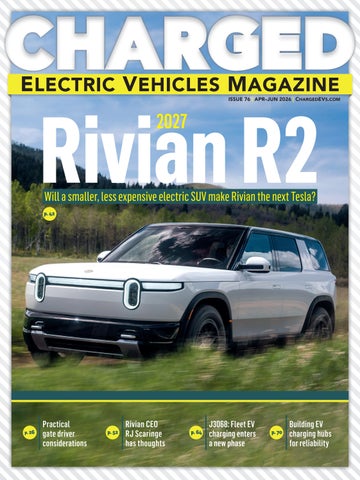
Rivian R2
ISSUE 76 | APR–JUN 2026 | CHARGEDEVS.COM
2027
Will a smaller, less expensive electric SUV make Rivian the next Tesla?
p. 42
p. 26
Practical gate driver considerations
p. 52
Rivian CEO RJ Scaringe has thoughts
p. 64
J3068: Fleet EV charging enters a new phase
p. 70
Building EV charging hubs for reliability
THE TECH CONTENTS
26 Practical gate driver considerations for modern switches
26
current events 10 Inside Henkel’s Battery Application Center 12 MAHLE’s new range extender engine and a rare earth-free motor
12
Chroma’s 8000 EV & EVSE test system covers ISO 15118-20 and liquid cooling
13 14
hofer powerTec’s battery disconnect unit for electric buses enters production GÖPEL electronic’s new battery cell tester checks up to five cells at once Octillion opens third Indian battery plant, adding 3 GWh of capacity per year
15 16
Amazon to use Electrovaya’s Infinity batteries for material handling Magnachip licenses Navitas’s GeneSiC technology for 1,200 V and above Empower EIT’s new Dallas center produces battery-grade lithium carbonate
14
17 18
Sila raises $300 million to expand its Moses Lake silicon anode plant Geely’s 16-in-1 Intelligent E-Drive debuts on the Geely TT Wevo’s WEVOSIL silicone gap filler can fill millimeter-scale battery pack gaps
20 Lumafield launches an in-line X-ray system for 100% production inspection SABIC’s new PPS compounds insulate power modules for 800 V EV inverters
22 Driventic launches VEDS 2.2 electric drive system for commercial vehicles Yokogawa’s new WT1500 power analyzer measures up to 2,000 V DC
24 YASA to develop two axial flux designs with little or no rare earth content IMA sells majority stake in electric motor equipment maker ATOP
24
25 Munich Electrification to expand its line of battery management systems Evolution Metals signs supply deal for non-China NdPr metal
THE VEHICLES CONTENTS
42 2027 Rivian R2
Rivian’s smaller, more affordable R2 needs a Tesla Model Y moment for the company to grow.
52 Rivian CEO RJ Scaringe 42 Has Thoughts current events 32 New Mitsubishi Eclipse Sportback EV to offer both J1772 and NACS ports DP World expands its EV fleet at Brazil’s Port of Santos
33 NOEMI Aerospace secures €3-million grant to support electric flight tests 34 EVSearch reports surging Canadian demand for Chinese EVs
33
Wrecked Teslas are commanding high salvage prices
35 PowerSled brings exportable power to the job site while saving space and fuel Chinese OEM Sany expands its bridgehead in the European electric truck market
36 Einride orders 500 Tesla Semis Denver Public Schools adds 25 electric school buses to its fleet
37 GE Aerospace test-flies a hybrid-electric aircraft at 30,000 feet Janus Electric boasts a full order book for its diesel-to-electric conversions
38 Norwegian power plant deploys Volvo A30 Electric articulated haulers
38
Orange EV deploys its 2,000th electric terminal truck
40 Scania moves cautiously to expand electric truck production capacity in Europe California bill aims to enforce electric truck pricing transparency
41 Hybrid aircraft makes historic flight across Utah Kia’s first electric van makes a big splash in its European debut IDENTIFICATION STATEMENT CHARGED Electric Vehicles Magazine (ISSN: 24742341) April-June 2026, Issue #76 is published quarterly by Electric Vehicles Magazine LLC, 136 4th St N, STE 201, Saint Petersburg, FL 33701-3889. Periodicals Postage Paid at Saint Petersburg, FL and additional mailing offices. POSTMASTER: Send address changes to CHARGED Electric Vehicles Magazine, Electric Vehicles Magazine LLC at 136 4th St N, STE 201, Saint Petersburg, FL 33701-3889.
41
THE INFRASTRUCTURE CONTENTS
70
64 Fleet EV charging enters a new phase 70 Building EV charging hubs for reliability
current events 54 WestLight Energy hooks up 200 apartment residents with low-cost EV chargers char.gy and Devon Council partner on kerbside EV charger trial
56 Easelink collaborates with SEG Automotive to scale its automated EV charging
56
Connecticut selects AmpUp to scale Adapt & Earn managed charging program
57 Colorado Walmart becomes the company’s 100th store to add EV fast charging JD Power study: the public charging experience is steadily improving
58 i-charging’s new 1.6 MW charging platform for heavy-duty EVs Wallbox and Turning Point Energy deploy over 10,000 chargers in Saudi Arabia
59 InstaVolt and British Land continue major UK retail park EV charging rollout Schneider’s new Level 2 residential EV charger has built-in load management
60 Autel offers a new cable protection program for public EV chargers
59
XCharge NA powers electric firefighting vehicle at Dallas airport
61 UL releases an important new V2G standard Pilot, GM and EVgo now offer charging at over 300 locations
62 Circontrol’s EV charging products to be marketed under the Circutor brand Allego migrates its 16-country European network to the AMPECO platform
63 U.S. Energy expands its portfolio with a new battery-integrated charging system i-charging introduces Eichrecht-certified distributed EV charging solution
60
Publisher Christian Ruoff Senior Editor Charles Morris Technology Editor Jeffrey Jenkins Segment Leaders Joel Franke Mark Rogers Jeremy Ewald
Contributing Writers Jeffrey Jenkins Charles Morris Christian Ruoff John Voelcker
For Letters to the Editor, Article Submissions, & Advertising Inquiries Contact: Info@ChargedEVs.com
Cover Image Courtesy of Rivian Special Thanks to Kelly Ruoff Sebastien Bourgeois
Graphic Designers Tomislav Vrdoljak SUSTAINABLE Certified Chain of Custody FORESTRY Promoting Sustainable Forestry INITIATIVE www.forests.org
SFI-00993
ETHICS STATEMENT AND COVERAGE POLICY AS THE LEADING EV INDUSTRY PUBLICATION, CHARGED ELECTRIC VEHICLES MAGAZINE OFTEN COVERS, AND ACCEPTS CONTRIBUTIONS FROM, COMPANIES THAT ADVERTISE IN OUR MEDIA PORTFOLIO. HOWEVER, THE CONTENT WE CHOOSE TO PUBLISH PASSES ONLY TWO TESTS: (1) TO THE BEST OF OUR KNOWLEDGE THE INFORMATION IS ACCURATE, AND (2) IT MEETS THE INTERESTS OF OUR READERSHIP. WE DO NOT ACCEPT PAYMENT FOR EDITORIAL CONTENT, AND THE OPINIONS EXPRESSED BY OUR EDITORS AND WRITERS ARE IN NO WAY AFFECTED BY A COMPANY’S PAST, CURRENT, OR POTENTIAL ADVERTISEMENTS. FURTHERMORE, WE OFTEN ACCEPT ARTICLES AUTHORED BY “INDUSTRY INSIDERS,” IN WHICH CASE THE AUTHOR’S CURRENT EMPLOYMENT, OR RELATIONSHIP TO THE EV INDUSTRY, IS CLEARLY CITED. IF YOU DISAGREE WITH ANY OPINION EXPRESSED IN THE CHARGED MEDIA PORTFOLIO AND/OR WISH TO WRITE ABOUT YOUR PARTICULAR VIEW OF THE INDUSTRY, PLEASE CONTACT US AT CONTENT@CHARGEDEVS.COM. REPRINTING IN WHOLE OR PART IS FORBIDDEN EXPECT BY PERMISSION OF CHARGED ELECTRIC VEHICLES MAGAZINE.
Laser Welding Fully automatic Laser Welding Systems
www.hesse-mechatronics.com
Hesse GmbH - Your reliable equipment partner for: Laser Welding
Wire Bonding
Smart Welding
Automation
VIRTUAL CONFERENCE
EV Engineering
Don’t Miss Our Next Virtual Conferences On
EV Engineering
Who should attend? Charged Electric Vehicles Magazine presents FREE online events for the EV industry featuring live webinars, on-demand videos, whitepapers and interactive Q&As.
2026 EV Engineering Events
Featuring: Motor Design and Manufacturing
Spring Virtual Conference Now On-Demand
Power Electronics Design and Manufacturing
Fall Virtual Conference
Cell Development and Battery Systems Design
September 14-17, 2026
Plus
Testing, Powertrains, Thermal Management, Circuit Protection, Wire & Cable, Advanced Manufacturing
www.ChargedEVs.com/Conference
Publisher’s Note When the EV equation starts to work SPECIALISTS IN AUTOMATIC ELECTRICAL TEST EQUIPMENT
We advise. We design. We implement. We support. You test your best. mktest.com/automotive sales@mktest.com
Several milestones long regarded as important EV tipping points have been or may be reached this year, across all three of our main coverage areas. The Tech: For years, the figure of $100/kWh for EV batteries (at the pack level) has been touted as a tipping point. That figure has been reached and exceeded. Meanwhile, solid-state batteries, considered the most likely successor tech to today’s cell designs, are beginning to appear in production vehicles. Chinese companies are taking the lead: automaker GAC expects to incorporate SSBs into cars in 2026; SAIC predicts volume deliveries in 2027; and CATL and BYD plan to produce small batches around 2027. Alternative chemistries will also soon be appearing on production lines: CATL says its Naxtra sodium-ion battery will reach mass production by the end of 2026, and HiNa is operating a GWh-scale cell line. The Vehicles: EV/ICE price parity inches ever closer. With California’s new purchase incentives, entry-level EVs such as the Bolt and Leaf can now be had for under $30,000. On the commercial side, some use cases have already reached the point at which it makes no economic sense to buy new diesel vehicles. All vehicle classes are seeing steady progress towards cost-effective electrification. EV market share in Europe is soaring (growing even faster than in China, by some estimates). The latest figures we’ve seen put it at around 27% and growing. In some countries (Norway, Finland) and some segments (transit buses) it’s far higher. Unfortunately, European automakers are losing traction. In Q1 2026, Chinese brands accounted for an estimated 8.4% of the passenger BEV market in Europe—up from 5% in 2025. Meanwhile, some “secondary markets” in Asia, South America and Africa are seeing explosive electrification of both passenger EVs and city buses. The Infrastructure: Public and fleet charging are rapidly maturing industries, as Charles Morris discusses in this issue’s Charging Forward column. Charging infrastructure for heavy-duty EVs is appearing in key regions, encouraging operators to buy more electric trucks. WattEV now has seven heavy-duty truck charging hubs in operation in California. A map compiled by Renault Trucks recently showed 280 truck-specific charging hubs in operation in Europe, and 222 more in the pipeline. Public charging is increasingly seen not as a mere loss leader, but as a potentially profitable enterprise. The reliability scandal is not over, but it appears to be under control. Companies are doing a much better job of site selection and site design. Visit our web site to read John Gartner’s detailed history of the US EV charging market, including insights about where things are heading next. Over the years, we’ve covered companies representing almost every link in the EV charging value chain, from hardware manufacturers to reliability specialists. In this issue, you’ll read our first interview with a construction firm exec. Osborne has built charging sites for all the biggies, from EA to Tesla to IONNA. On page 70 of this issue, CEO Stephen Osborne explains how reliability and customer satisfaction begin in the construction phase. One of the hottest and healthiest trends in fleet charging is right-sizing charging infrastructure. Not all use cases require DC fast charging—some fleets can save big by going with an intelligently managed Level 2 setup. For use cases that require more power than Level 2 can offer, but don’t need DC, J3608 offers an intriguing alternative, as industry expert Ned Funnell explains on page 64.
Christian Ruoff | Publisher EVs are here. Try to keep up.
THE TECH
Inside Henkel’s Battery Application Center, where adhesive formulations meet production-line robots Most adhesive companies ship samples. Henkel built a factory inside its lab. The Battery Application Center in Madison Heights, Michigan, runs production-intent dispensing equipment, a six-axis ABB robot, and pump systems sized for fullscale EV battery housings. OEMs and battery manufacturers can bring in their actual components, run them through real dispensing processes and walk out with data on bead application, flow rates, temperatures and material behavior at production speeds. “It takes the conversation very quickly from just focused on samples to more of a co-system-based co-engineering with our partners and customers,” said Pankaj Arora, Vice President of Henkel’s Electronics, eMobility and Automotive Components business for North America. Charged recently visited the center to see what’s inside and talk to the engineers running it. Production equipment in a prototyping lab Senior Application Engineer Chloe Jindra walked us through the dispensing setup. The robot cell handles one-component and two-component cartridge and bulk dispensing of polyurethanes, epoxies, thermals and silicones. Multiple dispenser heads let the team switch between material types without rebuilding the cell. “These HMI tools allow us to control certain factors like our flow rates and our pre-pressures as well as our bead size,” Jindra said. “That way we make sure we get the perfect bead size for our customer every time.” The pump systems take German-sized pails (hobbocks), standard pails and drums, all heated to manage viscosity. This is important, because materials behave differently at room temperature than in the 40-60° C range in which production lines typically run. De-bonding on demand Gluing a battery pack together is one engineering challenge. Taking it apart is another. Matt Boback, Senior Manager of the Battery Application Center, told us that a growing share of the work now focuses on de-bonding: making adhesive joints that can be reversed on purpose, for in-plant rework, field service repairs and end-of-life recycling.
10
Watch our Battery Application Center tour: www.ChargedEVs.com/Henkel-Tour “We focused in on two main triggers,” Boback said. “These are both either electrical or thermal de-bonding triggers to safely remove and de-bond the assemblies.” The goal is an adhesive that holds up under the thermal and mechanical loads of normal battery operation but releases cleanly when hit with the right stimulus. Boback called it “a de-bond-on-demand type of environment.” That’s harder than it sounds. An adhesive that lets go too easily is a reliability risk. One that won’t let go at all makes the pack a single-use assembly—a problem, as repairability and recycling rules tighten in Europe and North America. Lab to line The other challenge is making sure what works in the lab still works at volume. “We want to take something that’s in the lab environment and it’s going to go through pilot lines, through production-intent volume,” Boback said. “We want to have that consistency throughout the process.” This means matching temperatures, speeds, bead geometry and pressures across scales so that a material qualified in Madison Heights performs the same way at rate on a customer’s floor. Arora said the facility also feeds Henkel’s own product development. Working with OEMs early reveals requirements the materials team wouldn’t see from a datasheet request alone, from new cell chemistries to evolving pack architectures. “We are able to dial those learnings back into our development cycles and produce a better product,” Arora said.
Electrification Is Complex. Your System Architecture Doesn’t Have To Be. H I G H V O LTA G E SWITCHING, SENSING & PROTECTION SOLUTIONS F O R N E X T - G E N E R AT I O N ELECTRIC VEHICLES
Sensata helps OEMs manage, protect, and control electrical power throughout the vehicle. From high-voltage contactors to fast disconnect devices, our solutions help simplify vehicle architecture and support safer, more efficient electric vehicles.
Explore Sensata e-Mobility solutions www.sensata.com/e-mobility
MAHLE introduces a new range extender engine and a rare earth-free electric motor Image courtesy of MAHLE
Automotive supplier MAHLE has developed a range extender system for heavy-duty trucks that packages a combustion engine and a generator into part of the space an electric truck’s battery would normally occupy. The system is designed to replace about one third of the battery capacity of a typical electric truck with a compact diesel engine. The assembly is a self-contained unit: the generator, engine, thermal and fluid management, fuel tank, AdBlue tank and exhaust treatment sit inside one box that drops into existing battery-electric platforms. The high-voltage generator, which features a newly developed oil cooling system, delivers 110 kW continuous and up to 130 kW peak power, and boasts a power density of more than 7 kW per kilogram. The unit’s thermal management system provides 48 kW of high-temperature and 15 kW of low-temperature cooling. Swapping part of the battery for the range extender cuts the rear axle load by about 400 kg and the total vehicle weight by about 600 kg, MAHLE explains. MAHLE has also developed a new Contactless Transmitter (MCT) electric motor for the drive axles of heavy commercial vehicles. It uses no permanent magnets and therefore no rare earth elements, which the company says saves up to 3 kg of rare earth magnets per vehicle compared with a benchmark permanent magnet synchronous motor. The motor is 10% lighter and more efficient than a permanently excited design under real driving conditions, according to MAHLE. It delivers a peak output of 370 kW and torque of over 900 Nm at 3,900 rpm, and reaches about 95% efficiency in the EU’s VECTO simulation cycle.
12
Image courtesy of Chroma
THE TECH
Chroma’s 8000 EV & EVSE test system covers ISO 15118-20 and liquid-cooled charging Test equipment maker Chroma has introduced the 8000 EV & EVSE automated test system (ATS), which is designed for simultaneous multi-connector testing of DC EV supply equipment (EVSE), EV charging compatibility validation and liquid-cooled high-current charging tests. Paired with the Chroma 80713 EV & EVSE simulator, the system supports testing against both ISO 15118-2 and ISO 15118-20 requirements, which Chroma says lets users perform interoperability and communication protocol validation across both versions of the standard. Chroma describes ISO 15118-2 as the mainstream DC fast charging communication framework, applicable to compatibility testing for mass-produced EVs and charging stations. ISO 15118-20 extends the support for Plug & Charge, wireless power transfer, bidirectional power transfer and Megawatt Charging System (MCS) applications. ISO 15118-20 also adds Dynamic and Scheduled charging modes, which allow a charging strategy to be adjusted to grid conditions, and its support for bidirectional power transfer lets an EV feed electricity back into the grid. Communication security moves to Transport Layer Security (TLS) 1.3. Higher DC fast charging power means higher currents, which raise the thermal load on the cable, the connector and the power modules behind them. Liquid cooling carries that heat away more effectively than air cooling. Chroma says the 8000 ATS supports stable, long-duration high-current testing, and that its power switching design helps reduce the risk of test interruptions, making it suited to validating liquid-cooled charging connectors, high-power modules and MCS applications.
hofer powerTec, part of the hofer technology group, has started series production of a battery disconnect unit (BDU) with integrated control functionality, built for electric bus application. The unit is going into a new battery system developed by LION Smart, which is intended for use in commercial vehicles, particularly buses. A BDU is the high-voltage interface of a battery pack— it contains the main contactors, pre-charge circuit, fuse and current sensing unit that connects and disconnects the cells. The pre-charge path limits inrush current into the inverter’s DC-link capacitors before the main contactor closes, and contactor weld detection is commonly handled at the same point. Integrating the control electronics into that assembly can allow designers to eliminate a separate controller
Image courtesy of hofer powerTec
hofer powerTec’s battery disconnect unit for electric buses enters series production
and its associated wiring. Bus battery packs are usually distributed in roof or underfloor modules, and the space left for disconnect hardware is limited. The architecture supports multi-pack systems at over 1,000 V. hofer also offers the iBDU, or intelligent battery disconnect unit. The iBDU routes high-voltage lines separately, which hofer says allows early detection of thermal instability. It also offers Automotive Safety Integrity Level (ASIL) capability.
Discover unique tape solutions for your EV battery design challenges Battery designs that stay in-step with the evolving EV landscape begin with the Avery Dennison portfolio of pressure-sensitive EV Battery tape solutions. Our adhesive technologies help pack manufacturers and OEMs: • Reduce battery flammability • Boost dielectric strength • Optimize design and assembly Discover our unique and comprehensive tape solutions at tapes.averydennison.com/evbattery or scan below:
©2026 Avery Dennison Corporation. All rights reserved.
Image courtesy of Octillion
Image courtesy of Gopel
THE TECH
GÖPEL electronic’s new Octillion opens third Indian battery cell tester checks up to battery plant, adding 3 GWh of five cells at once capacity per year GÖPEL electronic has released a battery cell tester that evaluates up to five battery cells at the same time. The modular, configurable device runs standard safety and functional tests on individual cells for quality assurance of high-voltage EV batteries, in both development and production. The new tester is a smaller companion to the company’s end-of-line (EOL) battery test system, which runs test routines on a complete battery pack rather than on individual cells. The tester covers standard safety measurements. The Open Circuit Voltage (OCV) reading is a cell’s voltage with no load applied, and it serves as an indicator of the cell’s state of charge. The Alternating Current Internal Resistance (ACIR) measurement determines a cell’s internal resistance under alternating current, a value that GÖPEL says reflects the cell’s performance, state of aging and quality. Internal resistance tends to rise as a cell ages, so measuring it helps flag cells that fall outside spec before they go into a pack. OCV and ACIR together give a quick read on a cell’s condition without a full charge-discharge cycle. Matching cells by voltage and resistance matters because a pack’s weakest cell limits the performance of the whole string. GÖPEL’s tester is designed to deliver fast, reproducible test results. The tester connects to automated equipment, and GÖPEL says this lets batch testing run in a matter of seconds. Incoming inspection and cell grouping are typical applications.
14
Octillion Power Systems has opened its third battery manufacturing plant in India, in Halol, Gujarat. The Tier 1 supplier converted an empty structure into a fully operational plant in less than eight months. The plant covers more than 13,000 square meters, and will build over 48,000 battery systems per year at full capacity, or more than 3 GWh of energy storage. Across all three of its Indian sites, Octillion expects annual output to top 150,000 battery systems and roughly 9 GWh, going into passenger vehicles, buses and commercial trucks. The Halol plant incorporates Octillion’s standardized production process, thermal modeling and battery management systems into the local supply base, an approach the company says goes beyond assembly and shortens lead times. Research from the International Institute for Sustainable Development puts net localization of high-value components such as cells, motors and controllers below 20% for many manufacturers, and finds India to be heavily dependent on imported lithium, cobalt and nickel for battery production. The government’s National Critical Minerals Mission is funding domestic exploration and processing capacity. EV sales in India reached more than 1.54 million units in the first half of 2026, up 43% year on year, and EV penetration passed 11%, according to JMK Research. Electric passenger cars rose 83% over the same period and electric buses 42%, including more than 4,200 e-buses allocated in June 2026.
Battery maker Electrovaya has signed an agreement with Amazon to support continued deployment of its Infinity Battery Technology in Amazon’s material handling operations. Electrovaya says the relationship could also expand into robotics and energy storage applications. Electrovaya says its Infinity energy storage systems have a perfect field safety record and offer a reduced environmental footprint and lower total cost of ownership compared to competing lithium-ion technologies. Electrovaya is developing systems that pair the Infinity lithium-ion platform with high-power architectures for data center, industrial and logistics applications, and the company says these improve safety, cycle life and charging speed. Lithium-ion packs suit material handling because they
Image courtesy of Electrovaya
Amazon to use Electrovaya’s Infinity batteries for material handling
support opportunity charging and deliver long cycle life, allowing forklifts to run across multiple shifts without the battery swaps that lead-acid systems require. Electrovaya is expanding its US manufacturing at a 52-acre site in Jamestown, New York, where a 137,000-square-foot facility is planned as the company’s first gigafactory. “Electrovaya’s Infinity Battery Technology has demonstrated real performance in demanding material handling environments,” said Raj DasGupta, Electrovaya’s CEO. “We look forward to building on that foundation in other industrial applications where safety and longevity are critical.”
Level up bonding while cutting curing time. Damival® Snap Cure Technology
Reduced space requirements
Reduced curing time
Longer processing window
Find out more: automotive@altana.com
ELAN_AD_half-page_Snap_cure_CHARGED.indd 1
01.05.26 20:44
Image courtesy of Empower EIT
THE TECH
Magnachip licenses Navitas’s Empower EIT commissions GeneSiC technology for 1,200 V Dallas center, produces and above battery-grade lithium Magnachip Semiconductor is moving into the high-voltage and ultra-high-voltage silicon carbide market by carbonate licensing Navitas Semiconductor’s GeneSiC technology. The license covers Navitas’s Gen 4 and Gen 5 GeneSiC Trench-Assisted Planar (TAP) technologies at 1,200 V, 2,300 V, 3,300 V and higher. GeneSiC came to Navitas through its August 2022 acquisition of GeneSiC Semiconductor. The TAP structure is the basis of Navitas’s high-voltage SiC devices for medium-voltage grid and infrastructure applications. Magnachip also gains access to Navitas’s SiC supply chain and materials ecosystem. The technology is to be ported, qualified and internalized at Magnachip’s fab in South Korea, and the companies expect this approach to speed Magnachip’s entry into the SiC market while maintaining continuity with Navitas’s existing technology and materials base. The licensed technologies will support such applications as energy and grid infrastructure, energy storage, industrial electrification, automotive and other high-power systems in Korea. Navitas and Magnachip say the agreement also covers areas beyond SiC that they expect to detail later. “By licensing our proven GeneSiC technologies and supporting Magnachip through our supply chain and materials ecosystem, we are creating a path to scale advanced SiC solutions more rapidly while enabling a deeper, long-term collaboration between our companies,” said Chris Allexandre, Navitas President and CEO. At 3,300 V and above, SiC devices compete with silicon IGBTs in grid-scale converters and traction drives. A higher blocking voltage per device reduces the number of parts that have to be connected in series, and SiC’s lower switching losses allow higher switching frequencies and smaller magnetics.
16
Empower EIT, a vertically integrated lithium technology and operating company, has begun operation of its direct lithium extraction (DLE) and conversion process at its new 17,000-square-foot facility in Dallas. The process turns extracted lithium chloride into battery-grade lithium carbonate. The company is aiming to make its first commercial sales in 2027. Empower EIT ran five processing campaigns, each starting from eluate representing 40,000 gallons of brine, extending capabilities the company demonstrated on multiple domestic brine resources in earlier trials. The results of all five campaigns were evaluated by an independent testing lab, which verified battery-grade lithium carbonate at 99.68% to 99.91% purity. DLE pulls lithium directly from brine rather than concentrating it in evaporation ponds, the slower method used in conventional brine operations. Alongside the processing line, the Dallas center houses an environmental lab that the company will use to support resource owners with brine testing, resource validation and the design of lithium recovery systems from bench scale through field-deployable units. Empower EIT says it has also shipped battery-grade lithium carbonate to a confidential offtake partner for final evaluation. “The commissioning of our Dallas Operations & Innovation Center represents the culmination of more than a decade of research, development and technical optimization,” said Preston McEachern, Chief Technology Officer at Empower EIT. “Combined with the field deployments to date, this validates that our technology is ready to support commercial deployment.”
Battery materials company Sila has raised $300 million in a private equity round to accelerate US production of its silicon-carbon (Si/C) anode and to fund a planned second-phase expansion of its plant in Moses Lake, Washington. Sila completed construction and began operations at the Moses Lake facility in fall 2025 and is ramping production. The 160-acre site starts with 2 GWh of Phase 1 capacity and is engineered to expand to as much as 250 GWh over five years. The anode is Sila’s Titan Silicon, a Si/C material the company launched in 2021. Sila says it delivers 20-40% higher energy density than traditional graphite, enabling smaller and lighter batteries capable of faster charging.
Inspired by temperature
Image courtesy of Sila
Sila raises $300 million to expand its Moses Lake silicon anode plant
Silicon stores far more lithium per gram than graphite, but it swells as it charges, and managing that expansion is the central engineering challenge for silicon anodes. “This funding allows us to further scale our operations and ensure that critical industries have a secure and reliable supply of advanced batteries,” said Gene Berdichevsky, Sila co-founder and CEO.
High Precision Liquid Temperature Control for the Automotive Industry, from -45°C to +150°C
• Chillers, Baths & Circulators • Water-Glycol Operation • Natural Refrigerants • 4-Year Warranty • 24/7 Support
For more information, contact us at: 1-800-726-4877 sales@huber-usa.com www.huber-usa.com
Image courtesy of GEELY
Image courtesy of Wevo
THE TECH
Geely’s 16-in-1 Intelligent E-Drive debuts on the Geely TT Geely Auto Group has unveiled the Geely 16-in-1 Intelligent E-Drive, an 800 V electric drive system that combines core drive hardware and functions in a single unit weighing 75 kg. The system, which was developed in collaboration with InfiMotion, will make its debut on the Geely TT. Integrating drive components into a single system simplifies the power transmission path and reduces energy losses during power delivery, according to Geely. Geely estimates the system’s efficiency at 93.8% on the CLTC (China light-duty vehicle test cycle). An 800 V architecture lets the drive run at lower current for a given power level, which reduces resistive losses and heat in the powertrain. In an efficiency challenge around Qinghai Lake, a Geely TT running the drive recorded measured energy consumption of 8.20 kWh/100 km. In a dual-motor all-wheel-drive configuration, the drive produces a combined 425 kW and enables acceleration from 0 to 100 km/h in 3.8 seconds. Geely developed a 54-channel directional cooling design that it says lowers peak motor temperature by up to 15° C. The shaft and gear structure use active lubrication to maintain thermal stability, and Geely says the drive is engineered to a 5-million-kilometer durability target, validated at the component, assembly and vehicle levels. “The Geely 16-in-1 Intelligent E-Drive strengthens Geely Auto Group’s in-house capabilities in electric powertrain development, intelligent control and advanced manufacturing,” said Li Chuanhai, Vice President of Geely Auto Group and President of Geely Automobile Research Institute.
18
Wevo’s WEVOSIL silicone gap filler can fill millimeter-scale battery pack gaps German potting and adhesives manufacturer Wevo-Chemie has introduced a new thermally conductive silicone gap filler for compact assemblies such as high-voltage battery packs and power electronics. Wevo’s WEVOSIL 26040 FL gap filler is rated at 4 W/m·K and can be applied at bondlines of less than 70 µm. The material has a thermal conductivity of 3 W/m·K and a density of 2.22 g/cm³. Wevo says conventional paste-like gap fillers with high viscosity quickly reach their limits when gaps measure only a few millimeters, and that the new material can be applied reliably in tight spaces. It can be laid down as a bead and compressed into place under low pressure. If no free areas need to be connected, it can also be injected into the gap, and Wevo says its high sag resistance keeps it from flowing back out. The gap filler can be processed using standard dosing systems, such as those used for potting compounds, including both piston and eccentric screw pumps. Wevo says the extruders and barrel or drum extrusion stations that many highly filled gap fillers require aren’t necessary, and that its sedimentation-optimized formulation can be stirred back to a uniform consistency with simple mixing tools in a few minutes even after prolonged storage. The choice of filler and the low viscosity also help prevent abrasion in the dosing systems and the maintenance costs that come with it, the company says. The material cures without by-products or volume shrinkage, and the cured surface stays tacky. Wevo says the density is significantly lower than that of many highly filled gap fillers of comparable thermal conductivity, which supports weight-optimized assembly designs. Wevo says compact high-performance batteries or electronic components in humanoid robots can be thermally bonded to the outer skin in narrow areas with layers of 1 to 2 mm to support rapid, uniform heat dissipation.
THE TECH
Lumafield has rolled out a new in-line arrayed X-ray system that enables manufacturers to inspect every part moving down a production line, rather than a sampled few. The system is designed to drop into existing conveyor lines and to scan at full line speed, flagging defective units and letting good parts through without slowing the flow. Applications include electronics, automotive parts, batteries and consumer goods. The new system, called Mars, runs at speeds up to 2.5 feet per second and comes in both 2D and 2.5D arrayed configurations. Its X-ray sources and detectors can be arranged to match how parts sit on the line and the specific regions a team needs to inspect. The multilinear 2.5D architecture captures depth information in a single pass, which Lumafield says gives clearer visibility of defects in harder applications. Configurable sorting and rejection options control how flagged parts are handled downstream. Each scan feeds Lumafield’s cloud software rather than producing a standalone pass/fail result. Mars tracks how part features are distributed across production runs and, according to the company, surfaces process drift before it becomes a yield problem. Lumafield says the data grows more useful as it accumulates across runs, shifts and sites. Mars can scan products through their packaging to separate defective units from valid ones before a seal is broken. Batches that need a closer look can be routed to Lumafield’s Triton Performance system for full 3D CT scanning, which confirms whether parts are truly defective and characterizes failure modes without scrapping units that would have passed. The company’s Voyager platform consolidates data from each stage into a single view for quality and operations teams. Conventional in-line X-ray scanning has long been used to catch obvious defects, but Lumafield says its usefulness has been held back by the software behind it. On automotive lines, the company says, scaling visual inspection is costly, and still misses internal defects that can hide in injection-molded parts and assemblies.
20
SABIC has introduced two grades of polyphenylene sulfide (PPS) compounds built to insulate high-voltage power modules, including the insulated-gate bipolar transistor (IGBT) switching devices used in electric drive systems. The new LNP THERMOCOMP OFM76XXP and OFM76EXP compounds have the potential to be used in power modules for 800 V and higher traction inverters and fast chargers, as well as renewable energy systems and industrial automation such as robotics. Both grades carry a comparative tracking index (CTI) of PLC 0, the highest CTI class, along with dielectric strength for electrical insulation and UL94 V0 flame retardancy down to a 0.4 mm wall thickness. SABIC says the compounds retain 90% of their strength and insulation capability after 1,000 hours of heat aging at 200° C. Compared with polybutylene terephthalate (PBT) and polyphthalamide (PPA) materials, the company says they offer better dimensional stability and resistance to thermal shock, supporting thinner and lighter parts. They can also be molded in white or light colors so the QR codes printed on IGBTs stay visible. PPS resins withstand continuous heat and resist tracking, the surface breakdown that can form conductive paths across an insulator at high voltage. Both properties matter in 800 V power electronics, where higher voltages and denser packaging stress the insulating materials. The OFM76EXP grade offers enhanced laser-marking capability, adhesion to silicone-based sealants and crack resistance, and SABIC says it has the highest impact strength among comparable materials. Beyond IGBT module insulation base plates, SABIC lists potential uses in DC power transmission systems, high-voltage inverters and breakers, integrated busbar brackets and renewable energy infrastructure. Both grades are available globally.
Image courtesy of SABIC
Lumafield launches an inline X-ray system for 100% production inspection
SABIC’s new PPS compounds insulate power modules for 800 V EV inverters
Reed Relays | EV & Charge Point Testing y Switching up to 12.5 kV; stand-off up to 20 kV+ y Switching power from 10 W to 200 W y Optional electrostatic screen y Typical life up to 109 operations y Available in through-hole SIL and SMD packages
Request a free working sample: pickeringrelay.com/samples
Stocked by pickeringrelay.com +1 781-897-1710 | ussales@pickeringtest.com
Faster. Safer. Stronger.
Boost The Output In Your Busbar Manufacturing With Ultrasonics Achieve perfect busbar connections even with different metals like aluminum and copper with our innovative ultrasonic welding technology. Discover your benefits now!
UPGRADE YOUR MANUFACTURING NOW!
www.herrmannultraschall.com
Image courtesy of Yokogawa
THE TECH
Image courtesy of Driventic
Driventic launches VEDS 2.2 electric drive system for commercial vehicles Driventic has launched the VEDS 2.2, an electric drive system aimed at commercial vehicles from medium-duty trucks to heavy-duty buses and coaches. The system packages three main components, connected directly to one another, into a single unit: a highspeed EVO 390 motor, a new inverter and a single-stage planetary gear unit. An electrically powered oil pump with an integrated oil filter handles lubrication and cooling for the motor and gear unit. The complete drive unit weighs 275 kg, and Driventic has optimized its torqueto-power ratio for heavier vehicles. To simplify vehicle integration, Driventic reduced the vehicle-side interfaces to a minimum. The motor holds the cooling-water connections, the inverter the power and signal cables and the gear unit the KITAS sensor signal connection. The drive unit mounts to the nondrive side of the motor and to both sides of the gear unit through flange surfaces with threaded holes, and a KV180 output flange links the gear unit to the vehicle axle. An IP6K9K rating suits the harsh operating conditions of commercial vehicle duty. Because the rear axles from conventional diesel-powered vehicles can be used without modification, Driventic positions the VEDS 2.2 as a basis for retrofit projects that avoids new investment in axle technology and reduces system costs. On the vehicle side, operation requires only suitable high-voltage and 24 V batteries and a low-temperature refrigerant circuit with an air-water heat exchanger. The VEDS 2.2 builds on the VEDS 1.5, which Driventic has sold since 2025. That earlier system combines a drive inverter system (DIS), an integrated diagnosis and management unit (DMU) and an automotive-grade connector system, delivers peak output up to 390 kW and complies with automotive cybersecurity standards based on ISO 21434.
22
Yokogawa’s new WT1500 power analyzer measures up to 2,000 V DC without high-voltage dividers Yokogawa Test&Measurement has released the WT1500, a four-channel power analyzer that measures up to 2,000 V DC directly, eliminating the need for the high-voltage dividers that test setups normally need to reach those levels. High-voltage systems in electrified vehicle and renewable applications can run into the thousands of volts, so test setups often add external dividers to scale the signal down before it reaches the analyzer. Those dividers can introduce measurement error and complicate the wiring. Yokogawa designed the WT1500 to read up to 2,000 V without them, covering power conversion systems (PCS) and energy storage systems (ESS) directly. The analyzer has a total power accuracy of ±0.038% at DC and 50/60 Hz and a low-power-factor accuracy of ±0.07% of apparent power at 50/60 Hz, which Yokogawa says are the best DC figures in the WT series. The WT1500 takes two types of input element: the High Voltage (HV) element measures up to 2,000 V DC and 300 kHz for PCS and ESS work; and the Wide Bandwidth (WB) element handles up to 1,000 V at 2 MHz for the high-frequency waveforms of modern EV motors. Both share a common sensor input and can be mixed in a single unit. The WT1500 supports four power measurements and four motor evaluations, including both encoder and resolver signal inputs. The resolver support lets engineers run motor evaluation tests without extra equipment. Conventional motor efficiency measurements otherwise synchronize separately measured power and resolver signals on a PC. The analyzer also offers IEEE 1588 time synchronization, data output to CAN and CAN-FD buses and transmission over UDP, and it can be controlled remotely from a PC, external monitor or tablet.
Image courtesy of IMA Group
Image courtesy of YASA
THE TECH
IMA sells majority stake in YASA to develop two axial flux electric motor equipment motor designs with little or no maker ATOP to Lichtenberg rare earth content Capital YASA will develop two axial flux motor designs that reduce or eliminate rare earth magnet content, under a UK government-funded program called Project Resilience. The grant comes through the DRIVE35 Demonstrate competition, and the work will be delivered from YASA’s UK engineering and development facilities. Heavy rare earth-free permanent magnet designs are suitable for high-performance battery-electric and hybrid vehicles, YASA says, and its designs are intended to maintain power density without increasing motor mass or package size. In parallel, the company will develop fully rare-earth-free axial flux technology for vehicle applications with different performance, cost and manufacturing requirements. The two development routes will be built around common YASA stator technology, creating the potential for a modular motor architecture in which different rotor technologies can be selected according to the requirements of each vehicle program. YASA says the shared stator also lets it carry engineering, design, development and manufacturing knowledge across both pathways while broadening the range of applications its axial flux technology can address. YASA says supply chains for rare earth permanent magnets are highly concentrated geographically, which can expose automotive manufacturers and suppliers to export restrictions, price volatility and potential disruption. Heavy rare earths, according to the company, are commonly used to help permanent magnets withstand the high temperatures and demanding operating conditions inside electric motors, and can be particularly difficult and carbon-intensive to extract and process.
24
IMA Group has agreed to sell a majority stake in ATOP, an Italian builder of automated production lines and winding machines for electric motor stators and rotors, to an organization advised by Austrian investor Lichtenberg Capital. IMA will remain a minority shareholder and industrial partner. ATOP says it was among the first to industrialize hairpin technology for electric traction motors. Its technology portfolio includes hairpin, coil, flyer, needle, spindle and single-pole winding as well as permanent magnet assembly, and the company holds more than 680 patents. Customers include international OEMs and Tier 1 suppliers, mainly in e-mobility. Hairpin winding replaces round wire with rectangular copper bars that are bent, inserted into the stator slots and welded. The rectangular cross-section packs more copper into the same slot area, which lowers resistance and improves thermal performance, but the bending, insertion and welding steps demand automation that conventional winding lines can’t provide. IMA acquired a majority of ATOP in 2019. It says it played a decisive role in the company’s industrialization and international expansion, and that it has decided to hand the operational lead to a partner with dedicated transformation expertise while continuing to contribute its industrial and international network and its technological know-how. The two companies say the goal of the partnership is to position ATOP for an expected upswing in e-mobility investment. They plan to expand ATOP’s product portfolio and its customer base in e-mobility and adjacent markets.
Image courtesy of Munich Electrification
Evolution Metals signs supply Munich Electrification secures deal for non-China NdPr metal used in EV motor magnets capital to expand its line of Evolution Metals & Technologies (EM&T) has executed agreement with Senri Trading to purchase neodymibattery management systems anum-praseodymium (NdPr) metal from SRE Vietnam, a Munich Electrification, a maker of battery management systems for electric vehicles and stationary storage, has secured fresh capital to widen its product line. Private investment firm Ardian is acquiring a majority stake in the Munich-based developer, and providing additional capital to fund the company’s development pipeline and its expansion into new market segments and geographies. Founded in 2014, Munich Electrification employs around 300 people and develops BMS hardware, electronics, control and sensor components and the software that runs them. Its systems cover cell monitoring, current sensing and functional safety. The company’s BMS platform supports voltages up to 1,000 V. For high-voltage battery energy storage systems (BESS), the company’s technology covers applications up to 1,500 V DC. The BMS is used in commercial vehicles, BESS and passenger cars. All systems, including the proprietary software, are developed in-house, and series production is handled by partners in Europe. The company says it plans to add US production. The product portfolio is built on a modular platform that combines hardware with customized software and system configurations, which Munich Electrification says allows rapid adaptation to different applications and high scalability in production volumes. Munich’s customers include automotive OEMs and Tier 1 suppliers as well as utility-scale BESS system integrators, primarily in the US and Europe. “In just over ten years, we have developed into a leading supplier trusted by top-tier commercial vehicle OEMs and energy storage integrators across Europe and the US,” said CEO Georg-Friedrich Graf.
wholly owned subsidiary of Japanese trading company Tokai Trading. EM&T says the material comes entirely from a non-China source. NdPr metal is used to make the permanent magnets that go into EV motors, wind turbines, robotics, defense and aerospace applications. EM&T says the metal will feed an increase in output to approximately 10,000 metric tons of rare earth magnets per year in 2026. NdPr oxide has to be reduced to metal before it can be alloyed and cast into magnet feedstock, so buying the finished metal lets EM&T feed its existing production lines directly. Tokai has traded rare earths and rare metals since 1981, and began investing in SRE, its wholly owned Vietnamese subsidiary, in 2008. In January 2025, SRE began tripling its processing capacity for mid-stream rare earth materials to 3,929 metric tons per year. From January 1, 2027, US defense contractors will be barred from using Chinese-origin rare earth magnets in qualifying weapons systems, EM&T says. The company says the Senri contract brings it another step closer to running its magnet production at full rate. EM&T operates in Korea and plans to build additional capacity in the US. The company is a mid- and downstream manufacturer of rare earth magnets and battery materials, and says it does not intend to enter the mining business. “For years, Evolution has manufactured rare earth magnets on a commercial, revenue-generating scale,” said David Wilcox, Executive Chairman of Evolution Metals & Technologies. “Securing additional ex-China rare earth materials in a format Evolution can use in its production lines is another important step.”
APR-JUN 2026
25
THE TECH
PRACTICAL
GATE DRIVER
CONSIDERATIONS FOR MODERN SWITCHES 26
By Jeffrey Jenkins
Modern insulated gate semiconductor switches such as Si- and SiC-MOSFETs and Si-IGBTs are far easier to use than the bipolar junction transistors and GTO (Gate Turn-Off) thyristors of decades past. A primary reason is that they are all controlled by a voltage applied to a control terminal—the gate—that looks like a capacitor (albeit a non-linear one). Consequently, the gate only requires current to change states (according to the capacitor equation I = C * [dV / dt]), otherwise these devices act as voltage-controlled current sources, meaning that it’s entirely possible (and quite common, in fact) to drive them from a voltage source with just a resistor in series with the gate to limit the peak current (and dampen any oscillation that might result from the gate capacitance resonating with the omnipresent stray inductance). Notably missing from the above list of switches is the GaN-HEMT (High Electron Mobility Transistor), because how to drive it very much depends on the device generation and manufacturer, hence I’ll save it for a future article. Otherwise, two assumptions being applied here are that the switches are polarized for positive voltages (i.e. n-type), and that they are normally off (i.e. enhancement mode). That said, the gate voltage levels for fully turning on and off a conventional or “SuperJunction” Si-MOSFET are +10 V and 0 V, respectively, while both the SiC-MOSFET and Si-IGBT benefit from a somewhat higher gate voltage to fully turn on (+15 V is ideal), and will typically require a negative gate voltage to be reliably held off, especially at higher bus voltages and switching speeds (ranging from -3 V to -8 V, depending on the specific device and application). In less-critical applications it is certainly possible to use the same voltage levels for any of these switch types, with the understanding that overdriving a Si-MOSFET will waste more gate drive power, while
underdriving a SiC-MOSFET or Si-IGBT will result in higher conduction losses (though this is often done deliberately to make it easier to protect against shorts using desaturation detection), and not applying a negative bias voltage to the latter types will demand a (potentially dramatic) slowing down of the switching speed to avoid false triggering from the dreaded Miller capacitance (i.e. the capacitance between the drain/ collector and the gate). Other factors that are most important when designing the gate drive circuit are: 1) the placement of the switch in the power converter circuit (i.e. high- or lowside); 2) the peak voltages and currents expected; 3) whether galvanic isolation between the switch and the control circuit is required; 4) the switching frequency; and 5) the total gate charge for the switch. That last spec—total gate charge, or QG —basically lumps together all of the various parasitic capacitances in the switch to give a single value for the quantity of electrons, in coulombs, required per volt of change at the gate.
The average power to drive the gate is found with the straightforward equation: P = QG * VGS * fsw. Note, however, that QG also changes—and somewhat non-linearly—with the bus voltage being switched (hence factor #2 above), so the device datasheet will at least give a QG for nominal operating conditions, and will often graph out QG vs VGS and QG vs. V DS (or VCE , for a Si-IGBT). The average power to drive the gate is then found with the straightforward equation: P = QG * VGS * fsw. For example, a C3M0032120K SiC-MOSFET from Wolfspeed rated at 1,200 V and 63 A max has a QG of 118 nC at a V DS swing of 800 V and a VGS swing of 19 V (-4 V to +15 V), so if switched at 100 kHz its gate will require (118*E-9) * (19) * (100*E+3) = 0.224 W of drive power.
APR-JUN 2026
27
THE TECH
The cost/benefit ratio of a modern gate driver IC is hard to pass up in all but the most cost-sensitive of applications. The two main switch positions are low-side, in which the source or emitter terminal is connected to the negative rail/ground, and high-side, in which the source/emitter is connected to the load. Low-side switches are trivial to drive, and it is entirely possible for the typical switchmode controller IC to directly drive the switch (with the obligatory series gate resistor) in converters operating at moderate power/switching frequency/switch QG values. Otherwise, there are myriad specialized gate driver ICs that can pump out much higher peak currents than any controller IC, and that have all sorts of useful features such as Miller clamping, which actively clamps the gate to ground to (sometimes) let you safely use SiC-MOSFETs or SiIGBTs without a negative supply rail, and overcurrent protection via desaturation detection, which turns off the switch whenever the voltage drop across it exceeds a predetermined value (~7 V is typical, but this can be adjusted downward with a series Zener diode). Some dedicated gate driver ICs are also capable of driving the switch with bipolar voltages from a logiclevel input, and, of course, most will have UVLO, or UnderVoltage LockOut, which ensures that the switch is off whenever the supply voltages are not within range. Basically, the cost/benefit ratio of a modern gate driver IC is hard to pass up in all but the most cost-sensitive of applications. Driving a high-side (or floating) switch is more of a headache because the gate needs to be more positive than the source/emitter to turn the switch on, but the source/emitter will jump up to the positive supply rail potential when that happens. Th is is not an uncommon situation, of course, hence there are all sorts of solutions out there. The three main ones are: 1) a small isolation transformer (aka a pulse transformer, aka a GDT, or Gate Drive Transformer); 2) a level-shift ing
28
high-side (or half-bridge) driver IC; and 3) a fully isolated gate driver IC. The fi rst option—a GDT—is very attractive on paper, but can be very difficult to implement in the real world, especially in applications where the duty cycle must span a wide range (or, worse, could/will exceed 50%). Th is is because transformers demand equal voltseconds of opposite polarity to reset their core each cycle, so either a DC restoration circuit (which brings its own share of headaches) or a 1:2 primary-to-secondary-turns ratio will be needed so that a 50% duty cycle signal spanning 0 V to +10 V doesn’t get turned into a +/-5 V signal at the switch gate (or a +2 V / -8 V signal at 80% duty cycle, etc). Another critical requirement is that the primary of the GDT must always be driven with a low impedance (which also implies that the GDT must have very low leakage inductance), otherwise the switch could partially turn on when it is supposed to be off, or even start oscillating, both of which are no bueno. Given the other gate drive options available these days, GDTs are best reserved for topologies that always drive their switches at 50% duty (e.g. the phase-shifted full bridge) and/or when a really high isolation voltage rating is required (e.g. >7.5 kV). Another solution that is very tempting for both cost and circuit complexity reasons is the use of level-shifting high-side and half-bridge driver ICs, exemplified by the legendary (or infamous) International Rectifier (now Infi neon) IR2110. These ICs are fabricated on high-voltage processes rated for 600 V or more to allow level-shift ing a logic level control signal up to a high-side switch, and to avoid needing an isolated supply to drive said switch, they typically use a so-called “bootstrap” charge pump to store +10 V to +15 V in a small capacitor every time the low-side switch turns on. The lack of galvanic isolation is an obvious downside—a catastrophic failure on the power side prob-
Transformers demand equal volt-seconds of opposite polarity to reset their core each cycle.
THE TECH
Three isolation techniques for isolated gate drivers: optical, magnetic, and capacitive.
ably won’t stop there—but a more subtle gotcha is that these ICs also have a limited duty cycle and frequency range when using the bootstrap charge pump because the low-side switch must turn on for some minimum amount of time, and when the high-side switch is off, to recharge the bootstrap capacitor, while said capacitor can only power the high-side circuit for so long. Also pay close attention to the dV/dt transient immunity spec, as failing to respect this (by attempting to switch too quickly) can result in latchup failure, which is exactly as bad as it sounds. Still, these ICs are a compelling option for cost-sensitive and/or “everyday” power conversion applications, particularly when the load itself is isolated (as well as any feedback paths, if required). Finally, there are gate-drive isolator ICs, which combine the peak current rating and rich feature set of a low-side or half-bridge gate driver with true galvanic isolation, all in a conventional IC package. Pretty much all of these ICs can operate from 0-100%
30
Pay close attention to the dV/dt transient immunity spec, as failing to respect this (by attempting to switch too quickly) can result in latchup failure, which is exactly as bad as it sounds. duty (so there’s no lower limit on frequency, as with GDTs and bootstrapped level-shift drivers), and will have sufficient dV/dt immunity (called Common Mode Transient Immunity, or CMTI, when applied to isolators) for typical EV applications. Many of them will also have safety agency approval/listing, which is a defi nite plus compared to, say, a bespoke GDT
As you might imagine, active gate drive can get awfully complicated awfully quick, hence it rarely compares favorably with just slapping in another switch or two and calling it a day.
whipped up in the lab with an off-the-shelf toroidal core and some wire wrap wire (c’mon, we’ve all done this…or maybe I’m just showing my age). The main isolation techniques used in these ICs are optical, magnetic and capacitive. Optical types use a conventional LED and photodiode (or, rarely, phototransistor) optocoupler for isolation, and while they’ve been around the longest, they are not necessarily the cheapest option. Optical isolators also have a relatively low upper frequency limit, due to minority carrier recombination in the photodiode or phototransistor, and typically, a relatively low CMTI compared to the magnetic and capacitive types. Magnetic isolators use an IC-scale, coreless transformer composed of two spiral coils separated by an insulator (e.g. SiO2) for isolation, while in the capacitive types the forward and return current pathways between the input and output sides are bridged with…yes, capacitors. Both magnetic and capacitive isolators convey pulse information across the isolation boundary
by modulating an RF carrier signal (typically using burst, or on/off, modulation) to enable operation down to DC and up to some fraction of half the carrier frequency (i.e. less than the Nyquist limit). Both types can achieve extremely high CMTI ratings (100 V/ns or better) and can theoretically transmit power across their isolation barriers to power their output sides, but I’m only aware of this latter feature in a select few magnetic isolators from Analog Devices (e.g. the ADuM5230, which can supply a whopping 150 mW). Frankly, the optical, magnetic and capacitive isolators are more or less functionally similar, but capacitive types are often the least expensive. Finally, whenever two or more switches are paralleled to achieve a higher current rating, it’s obvious that gate-drive power will increase monotonically with switch count, so at some point it will make sense to use individual drivers for each switch, rather than a single driver (and individual series gate resistors, as per usual). A more subtle issue with paralleled switches is unequal current sharing due to inevitable differences in voltage drop (whether from R DS[on] or VCE[sat]), transconductance, threshold voltage, etc. One can progressively derate the total array current to (hopefully) prevent any one switch experiencing overcurrent, but another solution frequently touted is so-called active (or adaptive) gate drive, in which (most commonly) a central controller monitors the current through each switch and then adjusts their individual gate voltages (and even their timing) on the fly. As you might imagine, active gate drive can get awfully complicated awfully quick, hence it rarely compares favorably with just slapping in another switch or two and calling it a day.
APR-JUN 2026
31
Image courtesy of DP World
Image courtesy of Mitsubishi
THE VEHICLES
DP World expands its EV fleet New Mitsubishi Eclipse at Brazil’s Port of Santos Sportback EV to offer both Port operator DP World has expanded its fleet of electric handling vehicles at the Port of Santos in Brazil. J1772 and NACS charging ports cargo The company recently deployed 15 “internal terminal Many automakers are fitting new cars with NACS (SAE J3400) charging ports instead of the more traditional CCS ports. For road trips, this allows drivers to use Tesla Superchargers without an adapter, but most EV owners will need to replace their home chargers if they buy a new NACS-equipped EV. Mitsubishi is taking a different tack. The 2027 Mitsubishi Eclipse Sportback, an all-new EV that will be launched across North America in the fall of 2026, will offer both a J1772 and a NACS charging port as standard equipment on all models. Most Charged readers will be conversant with the various charging standards in use today, but for new EV owners, charging may seem like a more complex issue than it is (and good luck getting a car salesperson to explain it). Both the CCS and NACS standards allow both AC (at home) and DC (on the road) charging, but NACS handles both AC and DC charging with the same plug. Thus, the Mitsubishi Eclipse EV will be able to charge at Levels 1 and 2 using the J1772 plug found on most home chargers and portable chargers, and it will be able to use DC fast charging (at up to 150 kW) or Level 2 charging using the NACS plug.
32
vehicles” (aka terminal tractors or yard goats), and three reach stackers. The new equipment is part of DP World’s BRL1.6-billion expansion of its Santos terminal, which will increase container handling capacity to 2.1 million twenty-foot equivalent units (TEUs) by 2028. This is just the first phase of a broader terminal modernization initiative that will introduce a total of 44 electric terminal tractors. Later this year, DP World expects to receive two new quay cranes and six rubber-tired gantry cranes (RTGs), each with a capacity of 41 tons. An additional two quay cranes and nine RTGs are scheduled for delivery in early 2027. DP World has invested more than BRL100 million to electrify 22 RTGs at the Santos terminal. Between January and April 2026, diesel consumption declined 29.2% compared with the 2024 average. “We continue to invest in infrastructure and equipment that enables us to deliver greater capacity, reliability, efficiency and sustainability for our customers,” said Fabio Siccherino, CEO of DP World in Brazil. “These new electric vehicles strengthen our operations today while supporting increasing trade volumes and the longterm growth of Brazil’s trade.”
Image courtesy of NOEMI Aerospace
NOEMI Aerospace secures €3-million grant to support flight tests for its electric amphibious aircraft NOEMI Aerospace has secured a grant of 3 million euros from Innovation Norway to support the flight test program for its electric amphibious aircraft. The public funding will be matched by 4 million euros from private investors. The total of 7 big ones will support the flight test program for NOEMI’s first aircraft. The program includes testing on the ground, on water and in the air, from the first system tests to first flight and the subsequent flight test campaign. The results will document the aircraft’s performance and characteristics, forming the basis for certification and commercial operations.
At NOEMI’s development and test facility at Torp Sandefjord Airport, the company’s first full-scale test aircraft is now being built. Production of the wing is underway, motors, inverters and battery systems are in place, and the test rig for the electric drivetrain is in operation. NOEMI expects to roll out the test aircraft within the next 12 months and complete the first flight by the end of 2027. NOEMI’s electric amphibious aircraft is designed to operate from both water and land, without the need for new infrastructure. The platform is designed for electric regional passenger transport, but can also be used for cargo, medevac services, search and rescue, military operations, firefighting and other missions.
19-20 August Booth #1250
Silicon Carbide & IGBT Power modules Industry-standard packages for enhanced robustness and drop-in compatibility.
Automotive IGBT & SiC 3-Phase Power Modules
• AQG-324 Qualified • Trench Gate Field Stop Technology • Low Saturation Voltage Industrial & Automotive Single-phase IGBT Modules
• Fast switching • Direct Liquid Cooled Customizable IGBT & SiC Modules
• Cost-effective
www.cissoid.com
Image courtesy of A Better Bid
THE VEHICLES
Wrecked Teslas are commanding high salvage EVSearch reports surging Canadian demand for Chinese prices Numerous automotive reporting sites and industry analysts offer metrics on new and used EV sales, but what EVs happens to salvaged EVs after a total loss? Chinese EVs are headed for Canada. The country has set an initial annual quota of 49,000 Chinese-made EVs, and this will increase to 70,000 within five years. A share of the quota is reserved for vehicles priced below CA$35,000. EVSearch, a Canadian electric vehicle research and discovery platform, has added a new section to its site dedicated to Chinese EVs. Since its quiet beta launch, the Chinese EV Discovery Center has logged over 25,000 users and 130,000 page views, making it the platform’s fastest-growing research category. EVSearch’s information hub includes a virtual showroom of EV and PHEV models available in Canada, an EV Charging Cost Calculator and a Battery Health Estimator for pre-owned EVs. The Chinese EV Discovery Center provides vehicle specifications, estimated Canadian pricing, reviews and model comparisons. “Our data proves that Canadians are actively vetting these vehicles well before they arrive in local showrooms,” said Behzad Mohajer, founder and CEO of EVSearch. “As major global manufacturers confirm Canadian launch timelines for late 2026, consumers are seeking independent information to compare their options.”
34
A Better Bid, a Florida-based auction broker that gives buyers access to salvage and clean-title vehicle auctions, has released internal data that reveals some interesting trends. The company has seen a sevenfold surge in Tesla listings since 2019, and finds that these vehicles “defy traditional salvage pricing.” The median winning price for a ruined Tesla is a healthy $10,700—nearly triple the platform-wide median of $3,850. “Fueled by global demand for intact battery modules, electric drive units and reusable tech, rebuilders and EV specialists treat these wrecks as valuable goldmines rather than scrap metal,” the company tells us. The salvage EV market is “effectively a single-brand ecosystem.” Only a handful of salvaged cars from competing EV makers such as Rivian, Polestar and Lucid are showing up on auction blocks. The data also reveals an anatomy of EV accidents. Front-end collisions dominate the platform’s inventory, accounting for 162 of the 367 recorded Tesla lots. Rearend impacts accounted for 75 lots, and side impacts for 32. Minor dents and scratches accounted for 29 lots, followed by flood damage, all-over damage and hail.
Image courtesy of Sany
Image courtesy of Lightship
PowerSled brings exportable power to the job site while saving space and fuel PowerSled, a division of electric RV manufacturer Lightship, has launched a work trailer that incorporates battery energy storage, propulsion, exportable power and solar integration. The PowerSled delivers the same advantages as a powered semi-trailer—the towing vehicle realizes fuel savings and/or increased range. For work crews, it has another handy feature: it can be used to haul equipment or supplies while bringing exportable power to a job site, without sending a second vehicle. The PowerSled is a flexible platform designed to be adaptable to a range of applications, including remote job sites, utility projects and emergency response. The PowerSled offers a payload capacity up to 8,700 lbs and gross vehicle weight under 12,000 lbs. The battery system is available in 80, 160 or 240 kWh configurations. The platform can export 38 kW of vehicle-to-load (V2L) power at 240 VAC. It supports both Level 2 AC and DC fast charging via an NACS connector. The company’s TrekDrive propulsion-assist technology, already proven in the Lightship AE.1 travel trailer, features motor output power of 40 hp (continuous) or 94 hp (peak). By actively assisting the tow vehicle, the PowerSled can double the fuel efficiency of an ICE towing vehicle or the range of an EV, according to the company. It uses a standard 7-pin tow vehicle connection. Lightship has begun delivering the PowerSled platform to agricultural drone manufacturer Exedy Drones, which plans to use it as a mobile charging and field operations hub for drone-based crop monitoring and spraying applications.
Chinese OEM Sany expands its bridgehead in the European electric truck market Sany is known as one of China’s largest heavy machinery manufacturers. The company also makes long-haul electric trucks, and it is now targeting the European market. Sany acquired German concrete pump specialist Putzmeister in 2012, and it is already established in Europe’s construction machinery market. Sany has begun marketing its e263 electric semi-truck in Europe, and vehicles are now in commercial operation with unnamed customers in Germany. “The first vehicles have been in operation on German roads since spring 2026,” Kevin Eichele, Head of Product and Business Development at Sany eTrucks Europe, told the Germany-based EV news outlet electrive. The e263 is produced in Changsha, China, where Sany has a factory with an annual production capacity of 300,000 trucks. The vehicles are then shipped to Europe, where Putzmeister adapts them to meet local market requirements. Sany has also partnered with Alltrucks to provide maintenance and repair services. Sany’s e263 features an in-house-developed electric axle with dual motors delivering 420 kW (continuous) or 730 kW (peak) and 1,000/1,760 Nm of torque. The e-truck operates on an 800-volt architecture, and sports a 636 kWh LFP battery pack from Eve Energy, which delivers a range of “more than 500 kilometres.” Sany offers three power take-off options. The mPTO consists of a separate electric motor with 45 kW continuous power for operating hydraulic or mechanical equipment while driving. The gPTO is a gearbox-mounted PTO on the electric axle with 210 kW, suitable for applications such as tipping trailers. The ePTO offers 22 kW at 400 V for refrigerated trailers.
APR-JUN 2026
35
Image courtesy of Einride
THE VEHICLES
Denver Public Schools adds Einride orders 500 Tesla Semis 25 electric school buses to its Einride offers Freight Capacity as a Service—a turnkey package that includes electric trucks, charging depot fleet infrastructure and software to coordinate it all. The company’s cabless autonomous truck may be still awaiting its moment, but Einride is already operating substantial numbers of electric semi-trucks (250 at last count) from Peterbilt and BYD on behalf of some major shippers. Now Einride is planning to add Tesla Semis to its US fleet—some 500 of them in fact, the largest known order for Tesla’s electric truck to date. The e-trucks will serve Amazon and other Einride customers in North America—specifically in California, Texas, New Jersey, Illinois and Georgia. The deployment will be carried out in multiple phases over the next 24 months, and will be “fully financed with third-party financing solutions.” Einride will use its Saga software platform for routing. “As electric trucks introduce operating variables, such as charging time and energy costs that shift situationally, they require a sophisticated logistics approach to execute,” Einride explains. “Saga AI optimizes a fleet of individual electric trucks into a coordinated network that is more efficient, more reliable and more cost-efficient to run. Every additional truck and mile adds more operating data back into the platform, so the network’s efficiency compounds over time.” “This deployment is yet another proof point that we can execute at the scale our customers demand,” said Einride CEO Roozbeh Charli. “Working closely with Tesla to bring next-generation Semis into active operations quickly and at scale is a testament to the strength of that partnership, and how quickly this technology is maturing from promise to daily operations.”
36
Colorado’s school districts seem to be engaged in a healthy competition—who can deploy the most electric school buses? Boulder Valley School District has 13 electric buses; Cherry Creek is about to deploy its first six; Aurora Public Schools has seven and is about to receive six more. However, it’s only logical that the state’s largest school district should have the state’s largest electric vehicle bus fleet. Denver Public Schools recently announced plans to add 25 e-buses to its fleet. The district already has three electric buses, so adding 25 more will make e-buses 12 percent of the nearly 300bus fleet, which drives a collective 12 thousand miles per day. Grant funding covered the $11-million price tag for the buses and associated charging infrastructure. DPS bus driver Ayana Evans told local TV show 9News that she’s looking forward to the lack of loudness. “It’s going to be great for the environment, and I’ve heard that kids actually tend to be quieter on electric buses because they don’t need to raise their voice over the engine.” “This will give us the largest fleet of electric school buses in the state of Colorado,” said Tom Wildman, DPS Director of Sustainability. “We’ve got no exhaust coming out of these buses, which is obviously going to benefit the students that ride in it, the schools that they pull up to, but also everyone who lives in this wider community. Especially with all the air pollution issues that we have here in Denver and along the Front Range, that’s a significant contribution to driving down problems with respiratory health.”
In collaboration with NASA, BETA Technologies and Boeing, GE Aerospace conducted a test flight of a hybrid-electric aircraft above 30,000 feet—the altitude typically used by passenger commercial aircraft. The flight demonstrated several new electric aircraft engine systems. The team’s single longest flight in hybrid-electric operation was more than two hours. “The aviation industry’s first high-altitude hybrid electric flight is one for the history books,” said H. Lawrence Culp, Jr., Chairman and CEO, GE Aerospace. The record-breaking test campaign was enabled by GE Aerospace’s integrated megawatt-class and multi-kilovolt hybrid-electric propulsion system, which was developed through the NASA Electrified Powertrain Flight Demonstration (EPFD) project. The right side of the EPFD aircraft, a Saab 340B, was modified for flight tests with a hybrid-electric system that fits inside an inverted nacelle, providing extra ventilation. The system includes GE Aerospace-developed motor/ generators, power converters and inverters, controllers, Avio Aero gearboxes, Dowty propellers, Unison heat exchangers, torque sensing, engine harnesses, and a CT7 engine. BAE Systems provided the batteries, Boeing subsidiary Aurora Flight Sciences supplied the complete nacelle, and BETA Technologies served as the systems integrator. “This hybrid-electric system improved the high-altitude performance and climb capability while creating a flying laboratory to inform all future hybrid designs,” said Kyle Clark, founder and CEO of BETA.
Image courtesy of Janus Electric
Image courtesy of GE Aerospace
GE Aerospace conducts a test flight of a hybrid-electric aircraft at 30,000 feet
Janus Electric boasts a full order book for its diesel-toelectric truck conversions Janus Electric is an Australian provider of electrification solutions for heavy-duty vehicles, including battery-swap systems, conversion kits and charging infrastructure. According to the company, converting legacy diesel trucks to electric drive can be more cost-effective than buying new EVs. Now the company has announced several new orders from customers in the US, Canada and Australia. Momentum is strongest in the US, where a technology-neutral incentive framework is translating fleet operator demand into contracted orders. Ability Tri-Modal, Janus Electric’s first US fleet customer, has ordered 16 additional Janus diesel-to-electric conversion kits and 18 swappable battery sets. Deliveries are to begin in the second quarter of 2027. The A$10-million order increases Ability’s total commitment to 20 vehicle conversions. The company will use the Janus Charge & Change Station infrastructure. Janus and its authorized California dealer and conversion partner, Electric Vehicle Choice, secured HVIP vouchers for US$112,000 per truck, and Port of Los Angeles Plus support of US$54,000 per truck, for Ability’s first four conversion kits. These incentives are technology-neutral and are available for diesel-to-electric conversions as well as for new EVs. Janus has several other irons in the fire. The company has pending orders from customers in Canada and Australia, and is also working with the Harbor Trucking Association, whose members collectively operate more than 33,500 trucks serving the US port drayage market. Janus is increasing production capacity and working with key suppliers—including battery partner Electrovaya—to fulfill its North American commitments.
APR-JUN 2026
37
Image courtesy of Orange EV
Image courtesy of Volvo CE
THE VEHICLES
Norwegian hydroelectric Orange EV deploys its 2,000th power plant deploys Volvo A30 electric terminal truck We’ve been covering Orange EV for a decade, and it’s Electric articulated haulers one of the greatest success stories in the commercial EV Volvo Construction Equipment (Volvo CE) has sold several of its A30 Electric articulated haulers to LNS (Leonhard Nilsen & Sønner) for use at a Norwegian hydroelectric power plant. Four units have been delivered, and three more are scheduled to follow next month. LNS, one of Norway’s largest contractors, will use the machines, on behalf of Hafslund Kraft, for the construction of the Hemsil 3 power plant in the Hallingdal region of Norway. The machines will be used in the construction of a 20-kilometer-long tunnel—their zero-emission operation makes them ideally suited for enclosed and sensitive working environments. Steffen Solstrand Ludvigsen, Project Site Manager at LNS, said: “The project is a strong fit for this type of machine. We’ll be working in tunnels with blasting cycles, which allow time for charging between runs. That makes electric haulers particularly well suited to the work here.” The project, expected to be completed in 2029, will increase annual energy production by around 110 GWh. Electric equipment such as the Volvo A30 Electric will play a key role in construction. Lars Oust, Project Manager at Hafslund Kraft, said: “Hafslund has a strong environmental focus and takes a forward-leaning approach to electrifying construction operations on our projects. To succeed in the green transition, we need to adopt new technology and take the lead as a client, driving demand for this type of equipment. That’s why being the first in the world to use electric haulers is so important to us.”
38
market. Now the company has deployed its 2,000th electric terminal truck. The historic yard goat was delivered to Coke Canada Bottling, one of Canada’s largest beverage manufacturers and distributors. The deployment expands the bottler’s use of Orange EV electric terminal trucks at facilities in British Columbia and Quebec. Orange EV’s electric terminal trucks operate at distribution centers, logistics hubs, ports and intermodal facilities throughout North America, including winter environments in Canada. The company’s e-TRIEVER platform is designed for warehouse and distribution operations, while the HUSK-e is designed for port and heavy-duty applications. Orange EV says its electric yard dogs have surpassed 33 million miles of operation in more than 370 fleets operating in 41 US states, 4 Canadian provinces and the Caribbean. Across all deployments, Orange electric trucks have maintained an average uptime rate of approximately 97%. “Delivering our 2,000th truck is more than a production milestone—it reflects a broader industry tipping point,” said Kurt Neutgens, co-founder, President and CTO. “Having done calculations under real-world conditions and duty cycles, fleet operators are no longer asking whether electric yard trucks can do the job. They are now asking how quickly they can standardize around Orange EV solutions to improve their uptime, predictability and total cost of ownership.”
Image courtesy of Scania
THE VEHICLES
Scania moves cautiously to expand electric truck production capacity in Europe Truck manufacturer Scania plans to invest 70 million euros in its production site in Angers, France, to expand its capacity for electric truck production. The investment includes an extension of the existing facility and the adaptation of assembly lines for electric truck production. Scania’s Angers facility, in operation for more than three decades, serves customers in France and across Europe. The company appears to be moving very cautiously into the electric future. “We are preparing for the future, but we must remain able to adapt to changing volumes and market dynamics,” said Petrus Sundvall, President of Scania Production Angers. “The site will be capable of assembling both combustion-engine and electric trucks, ensuring [that] we can respond to evolving customer demand.” “The transition to electrified transport is not only about vehicles,” said Christian Levin, President and CEO of Scania. “Scania is investing to support this transition, but lasting progress will depend on how quickly the entire transport ecosystem can move forward together. Europe has set ambitious targets for reducing emissions from transport. Achieving those ambitions will require coordinated action across the entire value chain. Transport operators need the confidence to invest, infrastructure needs to be deployed at scale and regulatory frameworks must support long-term planning. This investment demonstrates Scania’s commitment to contributing to that transition.”
40
California bill aims to enforce electric truck pricing transparency A common criticism of subsidy programs is that sellers may simply raise their prices by part or all of the subsidy amount, capturing taxpayer money as additional profit instead of passing savings on to buyers. In California, which is expanding its already substantial support for electric commercial vehicles, a bill requiring vehicle OEMs to publicly reveal the prices they’re charging customers has passed the state senate, and will now go to the governor to be signed into law. SB 1213, “Zero- and near-zero-emission medium- and heavy-duty vehicles: incentives: transparency” is intended to bring down the price of electric trucks by tying state funding under the Clean Truck and Bus Voucher Incentive Project (HVIP) to “full pricing transparency” of electric trucks by manufacturers. Unlike passenger vehicles, truck prices are not always publicly available—companies may set different prices for different customers. Electric truck advocacy organization Idle Giants reports that electric truck prices remain high in the US and have increased, despite falling prices in Europe. It’s been widely reported that the Tesla Semi, which has now gone into volume production, is priced significantly lower than Class 8 tractors from legacy OEMs, but reliable information about pricing is not easy to find. Volvo Group, Daimler Truck and Traton continue to work on multiple fronts to stall or delay the shift to clean technologies. Could keeping the prices of their electric trucks uncompetitive be part of their slow-walking strategy? The California legislation can’t force OEMs to lower their prices, but it aims to ensure that accurate pricing information is available to all interested parties—dealers, buyers and taxpayers (and don’t forget the press). “SB 1213 passed three Senate committees without a single ‘no’ vote because it puts California first,” said Guillermo Ortiz, Senior Clean Vehicles Advocate at the Natural Resources Defense Council. “Governor Newsom [has just committed] $1 billion to accelerate clean truck adoption, and this bill makes sure that money actually delivers.”
Image courtesy of KIA
Image courtesy of Ampaire
Kia’s first electric van makes Hybrid aircraft makes historic a big splash in its European debut flight across Utah The Utah Department of Transportation (UDOT) has launched its uFLY initiative with the first demonstration flight of a hybrid-electric aircraft in Utah. Ampaire’s EEL hybrid aircraft traveled between Salt Lake City International Airport and Cedar City Regional Airport. uFLY is a public-private partnership led by UDOT that brings together five western states, private firms and research institutions. The program is designed to provide a real-world proving ground to test and evaluate emerging aviation technologies. The FAA selected UDOT to lead one of eight partnerships nationwide for the Electric Vertical Takeoff and Landing Integration Pilot Program (eIPP), a three-year initiative designed to help safely integrate advanced aircraft into the National Airspace System (NAS). Ampaire’s hybrid propulsion system, which combines electric and fossil-fuel power, is designed to maintain the range, reliability and operational flexibility needed for regional aviation. Ampaire’s aircraft use battery technology developed by Utah-based EP Systems. The company’s aircraft have flown more than 35,000 miles. Today’s flight is the first of several demonstrations planned through the uFLY program. In the coming months, UDOT and its partners will continue to publicly demonstrate electrified aviation technologies through real-world operations across Utah. “This mission demonstrates why hybrid-electric aviation is practical for regional operations today,” said Kevin Noertker, co-founder and CEO of Ampaire. “Our hybrids operate across meaningful distances, varied terrain and existing airports without waiting for new infrastructure. The propulsion system changes—the regional aviation system does not have to.”
Delivery vans represent an excellent use case for EVs, and they’re an increasingly common sight on European streets. As Joris Van Roy reports in New Mobility News, Kia’s first electric van has become an instant hit in Europe, outselling models from manufacturers with decades of history in the segment. According to Kia, since going on sale in Europe, the new PV5 Cargo has become the best-selling battery-electric small (C-segment) van in 12 countries. In the UK, Kia registered 3,239 PV5 Cargo vans and 1,141 Passenger models during the first seven months of 2026, making it the country’s best-selling electric van. Built on Kia’s dedicated E-GMP.S platform, the PV5 Cargo features an under-floor battery pack, which gives it 4.4 cubic meters of space, room for two Euro pallets, and a loading sill only 419 millimeters high. The long-range version sports a 71.2 kWh battery pack that delivers 416 kilometers of WLTP range—superior to that of the Mercedes eCitan (283 km), the Renault Kangoo Van E-Tech (308 km) the Ford E-Transit Courier (334 km) and the Opel Combo Electric (which is related to the Peugeot E-Partner and Citroën ë-Berlingo, and offers up to 343 km). As Van Roy notes, the Kia tends to be a bit more expensive than competing models, notably offerings from Renault and the Stellantis brands. In Belgium, the PV5 Cargo starts at roughly €32,425 (plus VAT). Buyers seem to be willing to pay a bit more for the PV5’s combination of range, usable space, charging speed and equipment. Kia’s PV5 is currently available in Cargo, Passenger and Chassis Cab versions, and the company plans to release more than 40 PBV body types, including the larger PV7 (due in 2027) and the PV9 (2029).
APR-JUN 2026
41
THE VEHICLES
2027 RIVIAN R2
42
WILL A SMALLER, LESS EXPENSIVE ELECTRIC SUV MAKE RIVIAN THE NEXT TESLA?
Image courtesy of Rivian
APR-JUN 2026
43
THE VEHICLES Rivian’s smaller, more affordable R2 needs a Tesla Model Y moment for the company to grow. By John Voelcker The 2027 Rivian R2 electric SUV is faced with a huge task: It has to be nothing less than the company’s breakout model. Tall and square, the five-seat compact utility vehicle is aimed at the heart of the US market, with up to 330 miles of EPA-rated range at launch. Within a year or so, R2 models will range from $45,000 to north of $60,000. Deliveries of the high-spec R2 Performance with Launch Package started in June, priced from $59,485. Reservation holders have been able to configure their R2s online since then. Rivian has the capacity to produce up to 160,000 R2s per year in its Normal, Illinois, assembly plant, CEO and founder RJ Scaringe said at a media roundtable during the launch drive. [For other quotes from Scaringe, see page 52.] That’s before its second plant, in Georgia, comes online in 2029. Note that the company’s larger and pricier R1S SUV and R1T pickup truck—starting around $75,000—sold a combined 51,500 units in the US in 2024, a number that fell to 38,000 last year. We spent a long June morning driving the Rivian R2 in and around Park City, Utah, on a mix of highways, winding mountain roads and off-road trails. It’s essentially what we expected: a thoroughly competent electric SUV that is very clearly Rivian in looks, technology and performance. As the company has what Scaringe termed “a very, very large backlog” of orders on its books, you may see a lot of R2s on the roads relatively soon.
Strong sense of the brand Rivian has a strong sense of its brand identity, and the R2 could have come from no other maker. If anything, it risks being mistaken for the R1S, its larger sibling. If the R1 pair represent Rivian’s debut, its Chief Design Officer Jeff Hammond said, the R2 is its “second album”—and it almost surely won’t disappoint fans of the fi rst one. Side by side, the R2 appears smaller than the R1S in every dimension. Its 66.9-inch height, 9.6 inches of ground clearance, and choice of 19-, 20-, and 21-inch wheels make it look larger than it is—only 2.5 inches longer (though 4 inches taller) than a Hyundai Ioniq 5
44
Images courtesy of John Voelcker
Rivian has a strong sense of its brand identity, and the R2 could have come from no other maker.
APR-JUN 2026
45
THE VEHICLES
Images courtesy of Rivian
hatchback. That presence is part of the Rivian brand. If you want a quick way to tell an R2 from the R1S, look at the rear door windows: the smaller R2 lacks the upright fi xed pane behind the main glass. The vertical headlights on either side of a blank panel are no longer as divisive a design element as they were when the two R1 models were the breakout hits of the 2018 Los Angeles Auto Show. Now, they just say Rivian—as do the slab-sided profi le, the vertical tail and the very traditional two-box overall shape. The hood line isn’t as beveled as that of many EVs, but it’s slightly dished in the center, which helps a bit with forward vision. Laudably, the beltline isn’t as high as it might have been, meaning better outward visibility at the sides and rear for driver and passengers. At 5’ 10” with the seat elevated, my shoulder was higher than the beltline, a rarity indeed these days.
46
Inside, Rivian has created a simpler cabin in a lowercost vehicle that doesn’t look cheap. There are still very few hard controls, though the R2 sports a pair of large, knurled metal rollers—Rivian calls them “haptic halo wheels”—at the ends of the steering-wheel hub. They not only scroll up and down, they tilt left or right, push in, or pull forward from the back. For drivers brand-new to the R2, they will take some learning, but they are, at least, very tactile—even as their functions change (with helpful diagrams in the instrument cluster showing what they do) depending on context and central-screen commands. Disappointingly, adjusting airflow volume and direction through the vents requires multiple actions on the central screen. Rivian strongly believes they will be set once by each driver, so that’s all that’s needed. On behalf of the many drivers who want more or less air
Inside, Rivian has created a simpler cabin in a lowercost vehicle that doesn’t look cheap. aimed at a specific point—without having to tap, swipe and pinch on the central screen—we just as strongly disagree. We can only hope the truck’s voice assistant can do all that while letting drivers keep their hands on the wheel, where they should be. SUV features include a fully flat load-bay floor with the second row folded down, two separate glove boxes in the cabin, a front trunk, and a power rear window
that retracts into the body of the tailgate to let owners carry longer items—surfboards, 12-foot lumber—with the gate closed.
Drives just like...a Rivian Rivians are hardly light or delicate—the R2’s curb weight is roughly 2.5 tons. Their controls also feel heavier than those of other EVs. Compared to the Volvo EX60 we drove last month—arguably a competitor in the compactto-midsize EV utility category—the Rivian requires more steering effort, more pedal effort, and more deliberate motions from the driver. For a vehicle that is clearly a truck-biased SUV, that’s appropriate. But it remains easy to place on the road, steering feel is excellent, and Rivian’s regenerative braking and one-pedal driving are among the best. Behind the wheel, acceleration in the default All Pur-
APR/JUN APR-JUN 2026
47
THE VEHICLES
Images courtesy of Rivian
pose drive mode was fully adequate for even fast-moving traffic. Rivian doesn’t build in the kick-you-in-the-kidneys launch capability that got Tesla so much attention a decade ago. Switch it to Sport mode, however, and pedal response gets a lot spicier. Rivian quotes as little as 3.6 seconds for 0-to-60 mph acceleration, presumably using the Launch Mode, which we didn’t test. But there’ll likely be a tri-motor and/or quad-motor R2 at some point in the future, paralleling the R1 lineup, so if you want a hot-rod R2 with truly explosive off-the-line acceleration, wait for those. On rocky trails, the R2 did just as we expected. It was fine on any road the company suggested. We can’t assess if it’ll rock-climb the way a Jeep Wrangler might, but it felt every bit the off-roader a standard-spec Jeep Grand Cherokee did. We expect Rivian to offer an All-Terrain Package for the R2 as well, again paralleling the R1.
48
It remains easy to place on the road, steering feel is excellent, and Rivian’s regenerative braking and one-pedal driving are among the best. Old-school battery, charging The R2’s 87.9 kWh battery pack contains 4695 form-factor high-nickel NMCA cells supplied by LG Energy Solutions. These will initially come from South Korea, until LG’s cell plant in Arizona is up and running next year. They are housed in traditional modules, powering a pair
Innovation is our everyday. With products that propel the future, BorgWarner has over 130 years of experience helping our partners get to where they need to go. With the world’s foremost technologists and engineers, committed to collaboration and excellence, we’ve developed a portfolio of innovative solutions, including our Exhaust Gas Recirculation components.
Exhaust Gas Recirculation
Let’s do something BIG.
THE VEHICLES
Images courtesy of John Voelcker
Unlike a growing number of makers, Rivian has not adopted an 800-volt architecture—it runs its pack at roughly 450 kW. of motors rated at up to 482 kW (656 hp) and 609 lb-ft of torque. Unlike a growing number of makers, Rivian has not adopted an 800-volt architecture—it runs its pack at roughly 450 kW. Instead, the company has put its tech efforts into its zonal ECU strategy, advanced driver assistance systems (ADAS), and future deployment of significant artificial-intelligence features throughout the vehicle and its operating ecosystem. All R2s have a NACS port on the left rear fender, which eases charging at Tesla Supercharger stations with older, shorter charging cords. Maximum DC fast charging rate is 240 kW, and Rivian says it can charge from 10 to 80 percent in 29 minutes—as always, depending on ambient and battery temperature, charging station performance and utility power delivery. Level 2 charging is rated at 11 kW, and the R2 is fully bidirectional, with 11 kW of exportable power as well. A J1772-NACS adapter comes standard with every R2 for Level 2 AC charging, but a CCS-NACS adapter for DC fast charging is optional.
50
Zonal ECUs, AI computer power, autonomy to come The Rivian R2 is one of the few vehicles on the road with an entirely zonal architecture, which minimizes and integrates computing units for the myriad functions required in a 2020s vehicle. CEO Scaringe noted that Tesla has done it, and that Volkswagen will build Rivian’s platform into future products—though he neglected to name
The Rivian R2 is one of the few vehicles on the road with an entirely zonal architecture, which minimizes and integrates computing units. Lucid, arguably a competitor for Rivian customers, albeit with different types of EVs. All 2027 R2s are fitted with the hardware and software for Rivian Autonomy+ (note the plus sign), which will provide “Universal Hands-Free” assisted driving on 3.5 million miles of North American highway and secondary roads. Every R2 buyer gets a 60-day free trial of Autonomy+, after which it’s either a one-time fee of $2,500, or can be switched on or off for $49.99 per calendar month. (Launch Package models include a lifetime subscription to the feature.) We tested the system briefly, but look forward to a longer and more comprehensive comparison with other hands-free adaptive cruise control systems—including GM’s Super Cruise, Ford’s Blue Cruise, Tesla’s Full Self Driving, Drive Pilot from Mercedes-Benz, and others. Point-to-point hands-off driving will roll out sometime later this year, and all first-year R2s will be capable of that function when the necessary OTA update ships. Note that
the first year of R2s will not be fitted with Lidar, for which a very small bulge in the roof just above the windshield can be seen. That will allow the later addition of further levels of autonomy, but the company is perhaps sensibly focused on getting its first year of R2s out the door while refining its autonomy systems. Rivian Assistant, an AI system that answers naturallanguage questions, will become available later this summer via an OTA update—meaning we couldn’t test it in our early-production R2s.
A full R2 range, starting at the top As with most makers, the first versions of the new R2 are the top trim and the priciest. The R2 Performance with Launch Package is the one now shipping, at around $60,000. Later this year, the R2 range will expand with more premium configurations. Standard models with rear-wheel-drive from $49,985 will follow early in 2027, with a range estimated by Rivian at up to 345 miles. Finally, the base R2 will launch in the summer of 2027 at $46,485 and up. (All prices include the mandatory $1,495 delivery fee.) That base model has an estimated range of 245 miles, with a battery pack of unspecified capacity. CEO Scaringe said that, as was the case for the R1, demand for the cheapest version is expected to be quite low. Rivian provided airfare, lodging, and meals to enable Charged to bring you this first-person drive report.
APR-JUN 2026
51
THE VEHICLES
Rivian CEO
RJ Scaringe
Has Thoughts Rivian founder and CEO RJ Scaringe sat down with more than a dozen auto reporters in June for a lengthy Q&A session during the R2 launch drive event. What follows are his comments on a few topics, each of which bears on the R2’s prospects. They have been edited for clarity and length.
On zonal architecture and the VW deal RJ Scaringe: Outside of Tesla and Rivian, Western manufacturers do not have software-defined architectures. They have not moved into even zonal ECU consolidation. When you start to think beyond software-defined vehicles, into AI-defined vehicles, there's a very significant gap I think the vast majority of Western manufacturers have a real challenge with. It was precisely that which led to the very large partnership we have with Volkswagen. It’s a $5.8-billion deal that essentially takes our zonal ECUs and associated base-level OS, and deploys that across a wide variety of form factors, price points, and of course brands within the Volkswagen portfolio. We've been pretty open on saying we think of that as the first of what we hope are many deals like that. On Chinese carmakers’ technology Scaringe: We're very bullish on our technology, so I look at the Chinese makers from two angles. One is from a technical point of view, for similar reasons to why Rivian as a company is built very differently. If you designed a car company today, the talent profiles, the location of where you build, the teams, would all look very different than if you had designed a car company going back half a century, maybe more. You would end up with a very
52
Image courtesy of Rivian
"Outside of Tesla and Rivian, Western manufacturers do not have software-defined architectures. They have not moved into even zonal ECU consolidation." different topology of electronics and software—and that's a big structural advantage, relative to the classic Tier Onedependent distributed systems that have 75 to 125 ECUs in a car. There are only a couple of companies in China that actually have done that. A lot of them have just copied what's in the West. A handful—call it maybe five companies—are very technically advanced. I am personally super-familiar with the architecture of Xiaopeng and others, which are among the most advanced in China. I can happily say that our architecture is more advanced, and there are a lot of concepts that we’ve been able to take from a first-principles standpoint that are actually ahead of the Chinese cars. That really makes us extremely bullish on how we see things in the future in the United
"The Chinese cost of labor is about one seventh what it is the US, and the cost of capital is free, or better than free, meaning zero-percent-interest loans from the government—or in many cases, grants." States, because of the same trend that is happening in China—cars are becoming more and more electric.
On Chinese carmakers’ cost structures Scaringe: All the Chinese companies have a second element, which is a very low cost structure. For that, there's no magic fairy dust. The Chinese cost of labor is about one seventh what it is the US, and the cost of capital is free, or better than free, meaning zero-percent-interest loans from the government—or in many cases, grants from the government to build plants. We don't have that. In the West, there's not free capital to build production capacity. So the compounding effects of that across the tiered supply chain, all the way up to the OEM, have resulted in cost structures for the Chinese that are just unattainable with Western labor and capital cost structures. And that's why I think you'll see tariffs in many countries, to try to bring some equilibrium to that. On future owner expectations Scaringe: What I think is going to happen over the next five years: Consumers increasingly are just going to expect things to know stuff. For instance, you'll be frustrated when, if a service technician calls and says, “I’d like to have your car serviced,” and you're like, “Wait, I'm in Europe, how do you not know that? That's so frustrating that you don't know that.” All the other services in your life are going to start to know all these rich, contextual things. So, in 2030, if a service tech asks, “Is the car making a clicking noise?” you'll respond, “Why are you asking me that? Why don’t you ask the car?” We think that that's going to become much more part of the expectation. It won't be a binary step change—it'll just be this gradual growing expectation. I think you're going to have your car know every-
thing, how it's been used, and a good idea of how you're going to use it. To the degree you want it to know those things, anyway, and to the degree you open up access to your calendar. But I think that's just going to become more and more the way things work.
On the lack of “compelling” electric vehicles Scaringe: I really disagree with the idea that customers don't want EVs. And I have an existence proof that supports my hypothesis: I think we have an extreme lack of choice in highly compelling products. And when I say highly compelling, I don't mean mediocre. I don't mean good enough. I mean something that you're actually really excited to get into.
"I think we have an extreme lack of choice in highly compelling products." The existence proof is there's a car that launched in 2016, and a sibling car that launched in 2019, the Tesla Model 3 and Model Y, that are selling around half a million a year. They represent close to 60% of the EV market share in the US. And they’re great cars. They're highly compelling. That's a big enough number, they're selling enough volume, that this is not just Tesla fanboys. This is regular people—families, college students, retirees, regular people, Uber drivers—everybody is buying these, and it's not as if they’ve just launched—they’ve been on the market for a while. So the existence proof we see is that there's really one example of a highly compelling set of vehicles: the Model 3 and Model Y. Great tech, great dynamics, nice packaging, the right price point, great range. So it's not at all surprising that, if you're running a large car company, and you've just spent $20 billion launching a bunch of mediocre products that haven’t done particularly well in the market, you wouldn't say, “Oh, well, we just whiffed it. We just launched a bunch of products that are dogs.” Of course, you're gonna say, “The market doesn't want EVs.” You can sort of see why they would. We think the market is very hungry for EVs. I should say it differently: We think the market is very hungry for great cars, and the fact that they’re EVs is secondary.
APR-JUN 2026
53
Image courtesy of char.gy
THE INFRASTRUCTURE
WestLight Energy hooks up 200 California apartment residents with low-cost EV chargers
char.gy and Devon Council partner on kerbside EV charger trial
WestLight Energy, a public agency and the official electricity provider for the California communities of San Mateo County and Los Baños, has completed a large multi-family home EV charging retrofit project at Peninsula Pines Apartments in South San Francisco. The company installed individual Level 1 EV chargers for all of the apartment complex’s 200+ residents. “The Peninsula Pines project is a direct application of WestLight’s ‘right charger, right place’ strategy—widespread Level 1 charging where it fits, complemented by Level 2 and DC fast chargers where higher capacity is needed,” said Shawn Marshall, CEO of WestLight Energy. “At Peninsula Pines, that approach meant dedicated charging for every resident at a fraction of the typical cost. It’s a scalable blueprint for multifamily EV charging.” “Too often, renters and lower-income families are left behind in the transition to electric vehicles because they lack access to affordable charging,” said Marty Medina, Chair of the WestLight Energy Board of Directors. “Expanding access to Level 1 charging can lower transportation costs by half, making EV ownership a practical option for more households.” GoPower, WestLight Energy’s technical partner, developed the project, provided all charging equipment, installed the chargers, and will operate and maintain the equipment. Property owners in San Mateo County and the City of Los Baños can contact WestLight Energy to inquire about installing EV chargers at their own buildings.
Curbside charging (kerbside to our British colleagues) is the solution to the problems faced by EV owners who rely on on-street parking. Curbside chargers are now common sights in London, and they’re spreading to other regions of the UK. On-street charge point operator char.gy is set to begin a trial of new on-street EV charge points in Devon. The company will deploy 30 new on-street charge points installed across the county. All will be powered by 100% renewable electricity. The project is supported by the UK government’s Local Electric Vehicle Infrastructure (LEVI) Fund. When the trial is completed, the lessons learned will inform the next phase of installations. According to Zapmap, the UK had around 87,000 public charging points at 45,000 locations as of late 2025. So far, the lion’s share of these have been installed in urban areas, but they’re starting to be rolled out in larger, rural counties such as Devon. char.gy operates what it describes as the UK’s fourth-largest on-street charging network—it has over 5,000 public charge points currently in operation. “This trial is an important step in turning LEVI funding into real, usable infrastructure for communities,” said John Lewis, CEO of char.gy. “For many drivers in Devon, access to reliable on-street charging is essential to making the switch to electric. By starting with a focused trial, we can learn what works locally and help lay the foundations for a wider rollout that gives residents confidence to go electric.”
54
Image courtesy of Easelink
THE INFRASTRUCTURE
Easelink collaborates with SEG Automotive to scale its automated EV charging system Easelink’s Matrix Charging system enables automated conductive charging of EVs. This capability is not just about convenience—it facilitates various commercial EV applications and lays the groundwork for future autonomous mobility solutions. It also makes it easier to integrate EVs into V2G applications and other smart energy systems. Now Easelink has partnered with global automotive supplier SEG Automotive to advance the industrialization and market launch of Matrix Charging. As part of the partnership, both companies will collaborate on initial OEM series production projects. SEG Automotive is also preparing to add Matrix Charging technology to its own product portfolio. SEG Automotive will join the Matrix Charging Interest Group (MCIG), a trade group that promotes standardization of Matrix Charging technology. “We see great potential in automated charging solutions, and plan to offer our customers corresponding products and integration solutions going forward,” said Gunter Meyer, Chief Market Officer New Business at SEG Automotive. “At the same time, we support standardization within the MCIG as an important step toward market acceptance, long-term interoperability, and thus investment security.”
56
Connecticut selects AmpUp to scale Adapt & Earn managed EV charging program The Connecticut Public Utilities Regulatory Authority (PURA) has selected AmpUp to develop a managed EV charging program in collaboration with the state’s electric utilities. The agency evaluated four pilots in Cycle 1 of the state’s Innovative Energy Solutions (IES) Program, and selected AmpUp’s Adapt & Earn managed charging project for deployment at scale. PURA has invited AmpUp and Connecticut’s electric utilities to jointly propose a statewide program design, creating a pathway to expand managed charging at public and shared EV chargers across the state. Managed charging saves energy and improves grid flexibility by allowing utilities to limit EV charging power at times of peak demand. Utilities have done this with air conditioners and other power-hungry loads for decades, and setting up a managed charging program for a home or business is simple enough. To incorporate managed charging into the public EV charging experience is a bit more complex. AmpUp delivers incentives through its platform without requiring vehicle telematics, advance enrollment or additional hardware. Participants receive wallet credits in the AmpUp app in exchange for allowing brief charging pauses during peak demand periods. The 18-month pilot, conducted with Eversource Energy, enrolled more than 1,000 charging ports at 200 locations representing 8 commercial customer segments. According to an independent evaluation, the project shifted charging to off-peak periods during a regional heat wave, and delivered cost savings of about two thirds compared to the cost of the peak electricity supply that was displaced. “The IES Program was designed to find innovations that deliver real, measurable benefits to Connecticut ratepayers, and AmpUp’s project did exactly that,” said PURA Vice Chairman David Arconti Jr. “By demonstrating that public EV charging can serve as a flexible grid resource at a fraction of the cost of traditional peaking resources, this project charts a path toward a more affordable, reliable grid as EV adoption grows.”
Image courtesy of Easelink
Colorado Walmart becomes the company’s 100th store to add EV fast charging Retail behemoth Walmart has been offering EV charging at its stores for years, mostly through a partnership with Electrify America. More recently, the company has begun rolling out its own company-owned and operated EV charging network. It recently celebrated the opening of its 100th EV fast charging site, at the Walmart Supercenter in Monument, Colorado. Walmart says its network is “designed around the customer.” Charging stalls are located steps from each store, and EV charging is integrated into the Walmart app. Walmart+ members receive discounted charging rates. Most Walmart EV charging locations feature 8 to 16 DC fast charging stalls. Each charger is equipped with both CCS and NACS connectors, and delivers up to 400 kW of power. “By expanding EV fast charging at Walmart locations across the country, we’re giving drivers a dependable way to charge while they’re in the store,” said Shayne Wahlmeier, Senior VP, Walmart Energy. “Reaching 100 sites is an important milestone, and our broad footprint positions us to make EV charging more accessible for communities while expanding the ways we serve our customers.” “When a customer pulls into a Walmart to charge, we want the experience to feel as reliable and effortless as the rest of their shopping trip,” said Adam Happel, General Manager, Walmart Retail EV Charging. “We’re proud to reach 100 sites, but our focus remains on building a network customers can count on every time they charge with us.”
JD Power study: the public EV charging experience is improving as OEM-backed networks expand The public EV charging experience has long been a sore point among users. EV drivers have complained about malfunctioning or out-of-service chargers and unnecessarily complicated apps and payment systems. More recently, there’s a sense that things have greatly improved, and—coincidentally or not—the number of available charging sites continues to expand. Now JD Power has put some numbers to the changing atmosphere. The company’s 2026 U.S. Electric Vehicle Experience (EVX) Public Charging Study, which measures EV owner satisfaction with public charging, found several areas of improvement. Customer satisfaction with DC fast chargers increased 12 points compared to last year, to 666 (on a 1,000-point scale). Respondents reported improvements in all 10 factors in the study. Charger availability saw the largest improvement (+27 points), followed by location safety (+18) and cost of charging (+18). Charging failures have reached a record low: the public charging non-charge visit rate fell to 12%, down from 14% a year ago and the lowest level ever recorded in the study. Three new OEM-backed DC fast charging networks have recently come on the scene, and all three performed well in the survey. Customers praised the ease of charging, charging speed and charger availability. IONNA ranked highest among DC fast charger stations in its first year of award eligibility. Site selection matters—a lot. JD Power found that satisfaction is highest for DC fast chargers located at hotels (692), gas stations/convenience stores (689) and restaurants (688), while dealership locations scored significantly lower (570).
APR-JUN 2026
57
i-charging’s new 1.6 MW charging platform for heavyduty EVs uses SOLUM power modules As megawatt-level charging hubs for heavy-duty EVs proliferate around Europe, Portuguese EV charging infrastructure provider i-charging has begun commercial deliveries of its new MAX charging platform. The MAX platform is built around SOLUM’s EV Power Module. Founded in 2015 as a spin-off from Samsung Electro-Mechanics, SOLUM develops power electronics for megawatt charging applications. i-charging’s MAX platform scales from 50 kW to 1.6 MW within a single cabinet, and supports CCS, NACS, China’s GB/T standard and the new Megawatt Charging System (MCS). i-charging’s dynamic power allocation technology distributes available power in real time across up to eight simultaneously connected vehicles. Power allocation automatically adapts to each vehicle’s charging demand. At the core of the platform is SOLUM’s EV Power Module. Designed to operate with up to 32 modules in parallel, the system enables megawatt-class charging within a compact footprint. Following the first installations in Portugal, the companies plan to expand deployment of the MAX platform into additional European markets. Orders have already been received from Germany and Switzerland. “Bringing a 1.6 MW charging system from product announcement to commercial installation is a significantly greater challenge than much of the industry assumed for a long time,” said Pedro Silva, CEO of i-charging.
58
Image courtesy of Wallbox
Image courtesy of i-charging
THE INFRASTRUCTURE
Wallbox and Turning Point Energy have deployed over 10,000 EV chargers in Saudi Arabia When you think of Saudi Arabia, electric vehicles are probably not the first thing that comes to mind. But in fact, the oil-rich kingdom has a rapidly expanding network of EV charging infrastructure. Barcelona-headquartered EV hardware manufacturer Wallbox and Saudi startup Turning Point Energy recently reached the milestone of 10,000 EV chargers sold and installed across Saudi Arabia since the beginning of their partnership in 2022. Turning Point has supported the deployment of Wallbox AC and DC charging solutions across residential, commercial and public charging locations throughout the country. Turning Point serves as an official distributor, certified installer and maintenance partner for Wallbox charging solutions in Saudi Arabia. The partnership has also supported charging infrastructure deployments connected to Turning Point’s agreements with EV brands in the region, including BYD and Lucid. “Saudi Arabia is making significant investments in electric mobility and charging infrastructure as part of its broader transportation and energy transition goals,” said Ignasi Alastuey, Chief Business Officer at Wallbox. “Through our collaboration with Turning Point, we have supported the deployment of charging infrastructure across the country while maintaining installation and service standards.”
UK EV charging network InstaVolt is expanding its partnership with property developer British Land to continue work on a major rollout of EV charging stations at UK retail centers. The partnership comprises 18 British Land locations, where some 273 EV charging units are scheduled to be deployed. Five of the sites are already live, and the rest are due for activation over the coming months. Two sites currently in development—at Reading Gate and Kingston, Milton Keynes—will feature on-site battery energy storage, which will ease demand on the local grid and support reliable charging even at peak times. All the sites are open 24/7. Drivers can take advantage of InstaVolt’s off-peak rates after 8 pm through the InstaVolt app. “This is one of the largest retail park charging rollouts in the country, and it is growing fast,” said Delvin Lane, CEO of InstaVolt. “Retail parks are exactly where ultra-rapid charging belongs: drivers are already there, already spending time, and topping up fits neatly around the shop or a coffee. With battery storage now coming to key sites, we are not simply adding chargers, we are building resilient infrastructure that performs when demand is highest.”
Schneider Electric has launched a new smart Level 2 residential EV charger The new Schneider Charge, now available in the US and Canada, is designed to help homeowners add Level 2 charging within a home’s existing electrical capacity. Many homes, especially older homes, don’t have sufficient electrical capacity to support high-power applications like EV charging, so installing a Level 2 charger may require expensive service and/or panel upgrades. Schneider Charge features SmartAmp, Schneider Electric’s dynamic load management technology, which monitors household electrical use in real time and automatically adjusts charging speed when other appliances need power. This helps homeowners maximize charging output without separate monitoring devices or additional system components. Schneider Charge delivers 11.5 kW/48 A of charging output. It’s compliant with OCPP 1.6, and supports managed-load installations in accordance with UL 3141. The charger is available with NACS (J3400) or J1772 connectors. It features a hardwired design for permanent installation (a plug-in version is to be introduced in early 2027) and a 25-foot charging cable. Installation support is available through Qmerit. “As homeowners buy EVs and add high-power electric technologies, many are realizing their existing electrical systems were not built for that level of demand,” said Shawn Bonacorsi, Head of Electrification Solutions, Schneider Electric North America. “Schneider Charge helps remove that installation hurdle by enabling Level 2 charging within a home’s existing electrical capacity.”
APR-JUN 2026
59
Image courtesy of Schneider Electric
Image courtesy of InstaVolt
InstaVolt expands British Land partnership to continue major UK retail park EV charging rollout
Schneider Electric’s new Level 2 residential EV charger features built-in load management
Image courtesy of XCharge
Image courtesy of Autel
THE INFRASTRUCTURE
XCharge NA powers electric Autel offers a new cable aircraft rescue and fi refi ghting protection program for public vehicle at Dallas airport EV chargers XCharge North America (XCharge NA), which supplies Reliability and uptime are the talk of the EV charging industry these days, and rightly so. Charger manufacturer Autel tells us that one of the most common causes of downtime is damage to a charging cable or connector. Whether the damage results from vandalism, accidental vehicle contact, everyday wear, severe weather, or another unforeseen event, an inoperable cable can leave a charger unavailable when customers need it. Autel’s Cable Protection Program is a new commercial service offering designed to minimize downtime by simplifying the replacement of damaged charging cable assemblies and connectors. The program provides OEM replacement components regardless of the cause of damage. Coverage is available for eligible Autel chargers enrolled prior to deployment, or while they are still covered under the Autel Limited Product Warranty. For customers seeking a higher level of operational support, the Cable Protection Plus option includes OEM replacement parts along with installation performed by either Autel Energy North America or an Authorized Autel Service Partner.
60
high-power EV charging and battery-integrated systems tailored to the North American electrical grid, has provided charging infrastructure for a public safety initiative at Dallas Love Field Airport (DAL). Dallas Fire-Rescue (DFR) has selected XCharge NA to deploy its ultra-fast C7 charging unit to power the airport’s Rosenbauer Panther 6×6 Electric, a fully electric aircraft rescue and firefighting (ARFF) vehicle. The C7AM unit delivers 400 kW of output through liquid-cooled cables, engineered to support the long-duration, high-speed charging cycles the Panther requires. “Transitioning frontline emergency response vehicles to electric significantly mitigates the logistical and environmental hazards inherent to liquid fuel on tarmacs, and creates a safer environment for both ground operations and aircraft,” said Aatish Patel, co-founder and President of XCharge North America. “XCharge has provided a charging solution that not only supports our efforts to introduce the next generation of airport firefighting technology, but also ensures we are prepared to respond quickly and safely when duty calls,” said Chief of Dallas Fire-Rescue Justin Ball.
Vehicle-to-grid (V2G) technology is gradually making the transition from pilots to commercial applications. At the moment, a few automakers, including GM, Ford and Nissan, offer bidirectional charging features, but these require proprietary charging hardware, and are limited to applications such as backup power (V2H). True V2G functionality requires a utility interconnection, and for this, up-to-date standards will be critical. In May, UL Standards & Engagement released the UL 1741 Supplement SC for AC Bidirectional Electric Vehicle Supply Equipment for EVs with SAE J3072 Bidirectional Onboard Inverters. Zach Woogen, Executive Director of the Vehicle Grid Integration Council (VGIC), a national smart EV charging advocacy group, explained in a blog post, “This long-awaited standard, and the resulting developments now underway, may catalyze a new market for low-cost, scalable vehicle-to-grid alternating current (V2G AC) by supporting interoperability.” V2G systems come in two flavors: DC (inverter functions are offboard the EV); and AC (inverter functions are onboard the EV). Several US utilities have adopted or proposed updates to their rules to incorporate both DC and AC V2G applications. Regulators and utilities in California, Maryland, New York, Massachusetts and Connecticut have clarified the treatment for V2G DC systems under existing or modified interconnection rules. As for V2G AC systems, utility rules in California and Maryland define a certification pathway under the relevant UL 1741 Certification Requirement Decision (CRD) for multipiece distributed energy resource (DER) systems in combination with UL 9741. This approach applies to matched, multipiece DER systems, in which a specific vehicle model and charger are certified for V2G AC operation using existing published requirements. Utilities in Nevada and Connecticut have pending proposals to establish this same certification pathway. The May 2026 publication of UL 1741 SC offers a new certification pathway for V2G AC systems. The standard supports the interconnection of a charger as an “oversight supervisor” for a vehicle designed and tested to meet SAE J3072.
Image courtesy of Pilot
UL releases an important new V2G standard
Pilot, GM and EVgo now offer charging at over 300 locations Pilot Travel Centers are a familiar site to anyone who travels the highways of North America. The company has more than 900 locations in 43 states and 5 Canadian provinces. In recent years Pilot, in collaboration with GM and EVgo, has added EV charging to its offerings, and the three partners’ network has grown to over 300 locations with 1,300 DC fast charging stalls in 40 states. The companies are now more than halfway toward their goal of installing up to 2,000 fast-charging stalls across up to 500 locations nationwide. The EV charging industry is maturing, and these days road-tripping EV drivers expect more from a charging site than a couple of plugs off in the corner of a sunbaked parking lot. Since launching its charging network in 2022, Pilot has been getting good customer reviews. The network currently boasts a Plugshare score of 9.41 out of 10. Amenities EV travelers can find at Pilot locations include: well-lit, fully staffed locations open 24/7 with free WiFi and clean restrooms; on-site retail and restaurants; windshield washing supplies; overhead canopies (at some locations) to protect drivers from the weather; and pull-through stalls (at some locations) for drivers towing trailers. “Crossing 300 Pilot and EVgo fast charging locations is an important milestone because it gives EV drivers more of what they need most on the road: simple, convenient and dependable charging,” said William Hotchkiss, Head of Public Charging at GM. “Pilot is making long-distance EV travel more accessible and reliable than ever,” said Scott Hundley, Director of Light-Duty EV and Infrastructure at Pilot. “Reaching more than 300 locations reflects our commitment to building a coast-to-coast charging network and delivering an exceptional travel experience that shows EV drivers they matter.”
APR-JUN 2026
61
Image courtesy of Circontrol EV
Image courtesy of Allego
THE INFRASTRUCTURE
Allego migrates its 16-country European public charging network to the AMPECO management platform
Circontrol’s EV charging European EV charging provider Allego has selected as its new charge point management system products to be marketed under AMPECO (CPMS). The company will migrate its network—which includes 35,000 charge points in 16 countries, some 60 the Circutor brand roaming connections and over 200,000 registered EV Circontrol, a provider of EV charging solutions, is joining forces with Circutor, which specializes in energy efficiency and e-mobility in Spain and Portugal. The companies, which both belong to the same business group, will gradually begin marketing their products and solutions under a single global brand: Circutor. This transition brings together the same professionals, expertise and technologies under a unified brand, and is intended to establish a clearer and more consistent market presence across all regions. “Operating under a unified global brand will make it possible to apply common standards of quality and service worldwide, resulting in a closer, broader and more structured customer experience,” the company says. Founded in 1997, Circontrol initially focused on software development, but has expanded its services to offer mobility solutions, particularly in EV charging and efficient parking. The company has a presence in more than 50 countries, mostly in Europe. Circontrol will continue its activities, and will become the group’s strategic hub for innovation and R&D, focused on EV charging solutions and the energy transition.
62
drivers—to AMPECO’s platform. Allego says it chose AMPECO for the maturity of its purpose-built EV charging platform, its track record migrating large networks, and the speed at which it delivers new capabilities. “In AMPECO we’ve found a partner we can trust with the technology behind our network.” said Allego COO Christian Zeh. “Partnering with AMPECO gives us a modern, future-proof platform that allows us to focus on what matters most: delivering an exceptional charging experience for every driver who uses our network.” Allego will operate on a hardware-agnostic, API-first platform that enables it to connect existing operational and enterprise systems and extend the platform as needs change. At the core of the platform, AMPECO’s CoOperator, its built-in operations agent, is designed to detect faults before they impact support teams, and to enable real-time diagnostics across the entire network. “By adopting the AMPECO platform, we know we have a scalable solution and can focus on the differentiators, on how we can make Allego stand out for EV drivers in a positive way,” said Joost Groeneveld, Director of Network Operations.
Image courtesy of i-charging
Image courtesy of U.S. Energy
i-charging introduces U.S. Energy expands Volt Eichrecht-certified distributed Vault portfolio with a new charging solution battery-integrated EV charging EV Portuguese EV charging infrastructure company i-charging has achieved Eichrecht certification for its solution e-flow distributed DC fast charging solution. U.S. Energy, a U.S. Venture company, has expanded its Volt Vault product line with the introduction of a new battery-integrated EV charging solution. The new Volt Vault configuration integrates 400squared energy storage and charging technology from California-based ElectricFish Energy into U.S. Energy’s flexible, redeployable infrastructure platform. The Volt Vault unit is designed to support a variety of applications, including commercial fueling locations, municipal installations, fleet depots and logistics hubs. It supports dual-port charging at up to 400 kW. An integrated battery stores energy during off-peak periods and releases it when needed, providing ample power for DC fast charging even in locations with constrained electrical capacity. The system supports a range of energy management capabilities, including peak shaving, demand charge management and grid-responsive operations. “This addition to the Volt Vault product line represents a meaningful step forward in accelerating fleet electrification,” said Jerry Miller, Director of Business Development at U.S. Energy. “By pairing our flexible deployment model with ElectricFish’s advanced energy storage and charging technology, we’re helping customers overcome infrastructure barriers and scale EV adoption with greater speed and confidence.”
Eichrecht is Germany’s calibration law governing the accuracy, transparency and traceability of measuring instruments used for billing purposes, including electricity meters at EV charging stations. An Eichrecht-certified charger guarantees that the amount of energy delivered— and therefore the amount billed to the customer—is measured accurately. Eichrecht has become a benchmark for billing-accurate, consumer-transparent charging across Europe. Distributed charging architectures, which feature power cabinets that serve multiple charging dispensers, are increasingly common. i-charging’s distributed solution combines the e-flow user unit with multiple satellites, each capable of delivering up to 800 A. This approach allows all user-facing functions required for compliant charging—including meter visibility, authentication, charging information and payment interaction—to be located in an accessible position through the e-flow control unit, while the satellites can be installed independently where they best support the charging operation. The solution is suited to applications where direct access to the charging dispenser is impractical, such as overhead charging systems, gantries and other infrastructure layouts designed for commercial fleets and heavy-duty vehicles.
APR-JUN 2026
63
THE INFRASTRUCTURE
FLEET EV CHARGING ENTERS A NEW PHASE EVSE engineer Ned Funnell explains the advantages of the J3068 charging standard By Charles Morris
64
I
t may be a cliché, but it’s true: when it comes to EV charging, one size does not fit all. For commercial EV fleets, deploying the most appropriate charging system for their duty cycles can not only save money, it may enable them to deploy more EVs, and/or to sidestep utility upgrade bottlenecks. Medium- and heavy-duty EVs need higher power levels than passenger cars, but they don’t necessarily need the fastest charging hardware available. For example, if you have a fleet of trucks that you know are going to be sitting in the depot overnight, every night, you do not need to charge them in two hours. Today, DC charging is often considered the only viable option for charging trucks or buses, because most AC charging in North America (J1772 and J3400/NACS) operates at roughly 10-15 kW or less. However, DC charging stations cost considerably more than Level 2 AC stations, and, depending on a site’s existing electrical service, may also require transformers, which
cost money, take up space, and may require long waits for installation. Many infrastructure planners may not realize that there is another option, which can enable fleets to get into the sweet spot for charging power. The J3068 standard enables three-phase AC charging across a broad power range. A common 480-volt, 63amp implementation delivers about 52 kW, while higher-power configurations are possible. Using LIN-CP communication and active cooling, the specification’s limit of 160 A would enable 480 V AC charging at 131 kW, potentially at much lower infrastructure cost than DC charging. Charging with 3-phase AC is rare in the US, but it’s a proven approach used in Europe, Asia and elsewhere, and there are mature supply chains for the hardware. When we first connected with Ned Funnell, he was working for EVSE manufacturer Lincoln Electric. Now he’s a Product Manager at Zaptec, a Norwegian company that builds AC chargers and related hardware. He has become something of an EVangelist for the J3068 standard. His rallying cry: Fleet depots don’t have to deal with the power limitations of J1772/NACS forever. The SAE J3068 standard, aka “Electric Vehicle Power Transfer System Using a Three-Phase Capable Coupler,” defines a system for using a charging connector capable of transferring single-phase and three-phase AC power as well as DC power, and defines a digital communication protocol for control. As Mr. Funnell explains, with three-phase power, instead of a single voltage between just two conductors, you have three voltages among three conductors. Physics (or magic—same thing?) tells us that adding a conductor lets you increase your power by 73%, at the same current and same voltage. Moving to a higher voltage, which J3068 allows but does not require, adds another multiplier. Does implementing J3068 charging require an expensive utility service upgrade? Rather the reverse—the power provided at many industrial properties in the US is 480 V 3-phase AC. Using J1772 requires a step-down transformer, but J3068 lets you send 480 V 3-phase power right to the vehicle, giving you over 50 kW of charging power while saving a lot of copper. Q Charged: When did you first get interested in the
J3068 standard?
The J3068 standard enables three-phase AC charging across a broad power range. A common 480-volt, 63-amp implementation delivers about 52 kW, while higher-power configurations are possible. A Ned Funnell: Before I worked at Lincoln Electric, I
was a charging solution architect for a company called Electrada, a fleet charging infrastructure developer. In that role I was faced with the heavy trade-offs between different charging levels. For example, if you want to use AC charging for something like a box truck, you’re limited to single-phase and you’re almost always on 208-volt power at commercial sites, so you can’t really count on more than about 15 kilowatts. You’re flowing 80 amps, and stuff gets really hot—the connectors couldn’t hack it. But to make the jump up to DC charging, even if you only need 25 kilowatts, usually brings a substantial increase in cost, and you’ve got to have 480-volt power. [Editor’s note:
APR-JUN 2026
65
Most DC fast chargers require 480-volt inputs, but Power Innovations International makes chargers that can accept a range of input voltages.] I learned about J3068, which is based on the Type 2 charging standard used in Europe and globally, and I saw a lot of advantages to it. It’s not something that I see competing with J1772 or CCS1 for the private vehicle market, but for fleets that depend on their own in-depot charging infrastructure, it seems like it would be a big win. Q Charged: What do we call this?
By going to a medium level and using the sensible way to transmit power, which is threephase AC for anything doubledigit kilowatts, you can sidestep all those problems.
A Ned Funnell: I just call it J3068, or three-phase Level
2 charging. I’m not aware of any other fun name for it.
for charging based on the concept of suburban families buying EVs. That’s how we ended up with J1772, which is incredibly limiting for fleet charging.
Q Charged: Well, perhaps you should invent a fun,
Q Charged: So the commercial fleet industry is trying
catchy name. I suspect we’re going to hear a lot more about it, because it seems like a great way for fleets to get more bang for their charging buck.
to work with a standard that was originally developed for residential charging?
A Ned Funnell: Yeah. As an example, let’s take a fleet
with a couple different manufacturers, and a Japanese company called Yazaki came up with what we now call J1772. Three-phase wasn’t in the picture because the North American grid generally doesn’t bring it to single-family homes. Meanwhile in Europe, they reused the existing Type 2 Mennekes connector that was already in common use. They’ve got three-phase everywhere, so they defaulted to that, but we didn’t and we’re now paying the price for it.
depot where they’re going to be bringing in additional power, and they can get whatever spec they want. If you’re putting in, say, 100 electric delivery vehicles, and you have to install 100 DC chargers for those, that’s going to be very expensive. But you don’t need to do that because you’ve got all this off-shift time. Those trucks are sitting overnight for at least eight hours. However, AC charging is problematic. Level 2 chargers will nominally do 9.9 kW on a 208-volt supply, which will get you charged in about 9 to 10 hours. And that’s adequate. But running that at 48 amps all the time, those connectors don’t last long, and changing the cable is often not very practical, so you’re changing the entire Level 2 EVSE if anything is damaged. By going to a medium level and using the sensible way to transmit power, which is three-phase AC for anything double-digit kilowatts, you can sidestep all those problems. You’re not paying for the DC charger, and you’re not encountering the penalties of trying to squeeze over 10 kilowatts through single-phase power. This is what they do in Europe and Asia. It’s a common, sensible approach. In the US, unfortunately, back in 2009, the California Air Resources Board (CARB) selected a standard
66
A Ned Funnell: Yeah. CARB, back in the day, worked
Q Charged: So, in Europe, all the AC power is three-
phase?
A Ned Funnell: To clarify, we’re talking about distribu-
tion to sites, not within buildings. It would be more accurate to say that three-phase power trickles down through the European distribution grid much more deeply than it does in the US. Anywhere you’re sending power over long distances, it’s three-phase. But when you get into residences, back in the day, in the US they would save copper by only sending out one of the three phases. In Europe their distances are shorter, so it made more sense to bring three-phase power to the end users. It’s not everywhere, but it’s much more common. The applications where I see J3068 being useful are
THE INFRASTRUCTURE The applications where I see J3068 being useful are almost exclusively fleets. The properties that fleets are operating out of, 95% of the time, already have three-phase.
almost exclusively fleets. The properties that fleets are operating out of, 95% of the time, already have threephase. If they’re operating a fleet of any size, they’re going to need a utility upgrade to get the amount of power they need. But having three-phase already on site means that this is just a utility swapping a transformer and a contractor putting in a bigger panel, rather than an expensive line extension. Q Charged: Does this require replacing the chargers?
Or the transformer?
A Ned Funnell: You might not need to change any of
the electrical infrastructure all the way up to the panel. In a conventional fleet depot now, those panels are served with three-phase power, and it comes in at 208 volts. But then each individual Level 2 charger is served by one of the three phases. Stall A is on phase A, the next stall is on phase B, and so on. What needs to change is mostly on the vehicle. The port on the vehicle needs to be a J3068 connector and the onboard charger of the vehicle needs to be ready to accept three-phase at high power. The charging industry basically already does this, and so does the vehicle industry in Europe. If you buy a Porsche or a BMW in Europe, you’re going to have that same common 11 kW onboard charging spec. But how
they get it in Europe is not 48 amps at 240 volts. They’re using only 16 amps at 400 volts, three-phase. The European grid runs on 400/230 volts (the line-to-line voltage and line-to-neutral voltage). Here in the US we’ve usually got 208/120 volts, so we’re already starting off at half the voltage. Then when you add that one extra conductor, you can transmit 73% more power, even if you don’t increase the voltage. You can also increase the voltage and get a lot more power. Fleet trucks could keep the CCS1 port for DC charging capability—just put a J3068 port next to it, as Range Energy has done on their powered trailer, and you can then charge at up to 43 kilowatts on AC power. Actually, in the US, you get 50 kilowatts by feeding the 480 volts directly to the vehicle. Now, a common critique is that, if you want to have 50 kW charging, you have to have this big honking onboard charger on the vehicle. And in the short to medium term that’s a fair critique because, if an OEM wanted to go this way, they would go to their OBC vendor and say, “Can you give us the OBC you sell in Europe that accepts three-phase power?” There are some on the market that do this, and there’s going to be a higher cost. Some Chinese manufacturers are integrating the onboard charger, drive inverter, DC/ DC converter and other power electronics into a single assembly, and some designs can reuse inverter or motor hardware during charging. Regen braking also sends three-phase machine power through the inverter toward the battery, which is why some of that hardware can be reused for AC charging. Q Charged: If the inverter can function as the OBC, then why do you need the OBC?
APR-JUN 2026
67
THE INFRASTRUCTURE A Ned Funnell: You really don’t. BYD has a 12-in-one unit that includes the drive inverter, the OBC, the DC/ DC converter and several other components. Basically everything that changes current happens in that box, and it happens with the minimum viable shared set of power electronics. The US has stuck with the tried-and-true, proven-though-inefficient method, but eliminating a separate OBC is more than technically viable. Q Charged: Let’s talk about some companies that are
implementing J3068 today. One is Range Energy, makers of an electric-powered semi-trailer, which we covered in our July-September 2025 issue.
A Ned Funnell: The main reason why it works especial-
ly well in their situation is that refrigerated trailers also need power. The vast majority get it from diesel today, but they can also bring three-phase power to the trailer. These depots where the refrigerated trailers are sitting often already have a big panel ready to provide threephase 480-volt power, typically at 30 amps. They need to connect power to the trailer one way or another to keep the box cold. The default way to do that is with three-phase power in the depot, and J3068 actually solves a big problem there, because the industry has not agreed on a standard connector. There is no one plug that works for all refrigerated trailers. I’ve got a friend, Matt Srnec at Thermo King, who is advocating for the refrigerated trailer industry to adopt J3068 as the standard for all refrigerated trailers that are using threephase power. Q Charged: I understand that curbside charging
pioneer it’s electric, which we covered in our July-September 2024 issue, is using J3068 for a different reason. A Ned Funnell: Yes. The other side of this is that you get detachable cable charging. In Europe, many Level 2 chargers on the street or in a parking lot do not have cables attached to them—the charger has a socket with a J3068 connector. There are companies that see enough advantage in the socketed bring-your-own-cable arrangement that they’re using J3068 in the US just for that purpose, even without any intention to put three-phase power through it.
68
There’s a lot of copper in these charging depots that’s unnecessary in a world where you can choose to give the vehicle 480-volt power. Q Charged: So, the cable you use with it’s electric has
3068 on the charger end, and either your J1772 or your NACS on the vehicle end. But for three-phase fleet charging you’d need the J3068 plug on the vehicle side too, right? A Ned Funnell: Yeah. You would see this installed in
fleet depots where you have a detachable J3068 on both ends. You don’t have to do that—you can have the cable attached to the charging station. But there’s still an advantage to a detachable cable for fleets. Even though it’s “behind the fence,” so they’re not so worried about vandalism, the cables and connectors wear out pretty quickly with the J1772 standard, and the typical way to correct that is to replace the entire EVSE. If you have a detachable cable on both ends you can simply have the driver grab a new cable. Q Charged: Any other companies using three-phase
Level 2 charging?
A Ned Funnell: I can’t talk about it, but I’ve been told that a major agricultural equipment manufacturer is trialing J3068 for their off-highway equipment. Again, that’s going to be in places where three-phase is already available. There are more trade-offs with a DC charger, because you’re going to have this unit that either needs to be permanently installed or put on something and lugged around. The idea of a much more lightweight Level 2 EVSE that you can just plug into a receptacle wherever you are would be attractive to them. Harbinger Motors could really benefit from this— they’re almost the perfect application for it. Q Charged: I’m a big fan of Harbinger, which we
covered in January. Commercial EV startups have
been dropping like fruit flies, but CEO John Harris told me their sales keep growing. Why is three-phase Level 2 charging the perfect fit for Harbinger? A Ned Funnell: Well, the energy requirements that they
have are just right. This is going to be overkill for a Chevy Bolt, but the power level isn’t high enough for a Class 8 truck. You want the middle range—Class 3 through 5 vehicles, where it’s got a few hours in the depot, so 50 kW charging can replenish all the energy needed. That’s exactly Harbinger’s niche, they’re selling exclusively to fleets, and their vehicles are going into locations where three-phase power is already common. Q Charged: That brings up a larger point, which is
right-sizing the charging capacity. Companies say, “We want the fastest charging we can get,” but they may be spending more than they need to because their duty cycle doesn’t require really fast charging. A Ned Funnell: Yeah. Especially if they are in a situa-
tion where they have to use DC power, because the 10-15 kW that you can realistically get through the J1772 plug right now is not adequate. They are then probably buying a 50 or a 60 kW charger, and they have to go to their utility to request that capacity, times however many trucks they have, whether they need that much or not, just because that’s the size of DC charger that’s available. Even if their operations only require 25 kilowatts, and even if they intend to limit those chargers to 25 kilowatts for demand charge purposes, they still have to plan for the smallest-size DC charger that meets their needs. So there’s a big risk of overspending on capacity that you don’t need, especially in this kind of messy lower-middle range. Here’s another issue. When you ask for a certain amount of power from the utility, you don’t always have the option of getting it at whatever voltage you want. In the US you’ve got 208 volts and you’ve got 480 volts. For a depot, you may want 208-volt power because that’s what your trucks need for Level 2 charging. But if the utility is pushing you towards 480 volts because that’s their standard voltage for sites of your size, and that’s the transformers they have around, you have to place additional step-down transformers, a huge additional cost and often a lead-time constraint, in order to get the 208- or 240-volt power that you actually need for the
vehicles. There’s a lot of copper in these charging depots that’s unnecessary in a world where you can choose to give the vehicle 480-volt power. And there’s already a market out there of OBCs that companies can buy from the European market, that are already ready for the 480volt market here. Q Charged: If you don’t mind my asking, do you have a professional interest in promoting this? Or is this just something that you’d like to see happen for the common good? A Ned Funnell: Basically the latter. I might profit from it in some way if I make myself the prophet of J3068 and then it happens. May get some pats on the back. But I don’t have any financial stake with any organization that’s promoting this. Q Charged: Congratulations on your new job in Norway, the EV capital of Europe. Can you tell us a little about what you’re doing at Zaptec? A Ned Funnell: I’m Product Manager for Installation
and Commissioning. Zaptec is a manufacturer of AC charging hardware and the rest of the ecosystem. My move to Zaptec is quite timely for this subject—I’m now working for Europe’s leading manufacturer of 3-phase AC charging stations. Zaptec has a phase-balancing technology that allows you to use all three phases and get the advantages of having that higher power with the reduced current. But there are some vehicles that can only accept single-phase input. In that case, those vehicles always pull from one of the three phases, and that creates a huge problem because if you have several of those vehicles in one spot, you’ll end up overloading one phase and be at your limit for the entire service. So Zaptec has a technology that enables the charger itself to internally switch things around so that the single-phase charging EV is going to be on one of the other two phases, and it’ll actively balance that across a whole site so that, no matter what your mix of threephase or single-phase vehicles is, you’re going to be able to maximize the utilization of that service there without overloading one of the phases. They’ve actually been doing this for quite a long time, and they’ve got tens of thousands of chargers installed that are using this technology.
APR-JUN 2026
69
THE INFRASTRUCTURE
BUILDING EV CHARGING HUBS FOR RELIABILITY EV charging infrastructure installation is a big part of Osborne’s commercial construction business. By Charles Morris Over the years, Charged has interviewed execs and engineers from companies covering almost every layer of the charging stack: hardware manufacturers, software developers, security specialists, utilities, standards bodies, and of course, charge point operators (CPOs) and charging-as-a-service (CaaS) providers. However, until now we haven’t heard from a provider of one of the most important parts of the stack—a company that actually builds the charging sites. Yes, general contractors are still required, even in this new age of vertical integration. CaaS providers offer a turnkey package to EV fleet operators, but this doesn’t mean that their own employees handle every aspect of the complex process of building and operating charging infrastructure. A CaaS provider designs infrastructure, coordinates and oversees the process of installing it, chooses quality subcontractors, provides a single point of contact to the customer, and takes responsibility if things go wrong.
70
Likewise, CPOs may have a high degree of vertical integration, but they don’t do everything in-house. CPOs and turnkey charging providers use contractors to handle construction, and many of them turn to Kansas-based Osborne, which has been building commercial structures since 1976. Osborne has worked for all the biggies: Electrify America, IONNA, EVgo, Tesla and more. Charged spoke with CEO Stephen Osborne. Q Charged: Osborne does all kinds of commercial
construction, not just EV-related. How long have you been in the EV charging field? A Stephen Osborne: We’ve been in the EV space for
about 10 years now. We’ve put in something like a thousand locations in the last 10 years. We were in on a lot of the early stuff, building Tesla and Electrify America sites.
Image courtesy of Osborne
Q Charged: You must have seen a lot of changes in the
industry.
A Stephen Osborne: We’ve seen more changes in the
We’ve put in something like a thousand locations in the last 10 years.
last 18 months than we saw in the prior 7 or 8 years. It’s fascinating what’s coming. Higher charging speeds, battery backup systems. Charge port compatibility across cars, that’s been a big issue, and we’re starting to see a lot of conversions. The efficiency of chargers is increasing. When the CPO is paying for $10,000 worth of energy, but they’re losing 20% of it in the old legacy systems, that’s money going out the door. The newer systems are reporting as much as 98% efficiency. One of the big challenges we deal with is the amount of equipment that is put on site. In recent years the new all in-one systems have helped a lot because you can pack charging sites into much smaller locations. One charging site in Georgia had 12 chargers, but it took up almost an acre of space, because there was equipment spread all over the place. Now that same site would probably be around 2,000 square feet.
helps keep a smaller footprint, so it allows people to get a lot more creative in where they put the locations. Less equipment on site is also easier to install and less costly. There’s typically less copper wire underground. Smaller footprints can cause challenges—we still need a basic amount of space to work, have a skid loader or excavator on the site—but instead of working on an acre, I can now work on a 2,000- or 3,000-square-foot spot, and I’m not taking parking stalls away from paying customers.
Q Charged: So, using all in-one chargers as opposed to a distributed system results in a smaller overall site footprint?
A Stephen Osborne: I’m not sure I’m qualified to say it’s a trend. It’s definitely something we see a lot more of. It depends where it’s at and what the end use is.
A Stephen Osborne: Not always, but typically that
Q Charged: Would you say the trend is towards all
in-one chargers and away from distributed charging? I’ve heard a number of people telling me the opposite.
APR-JUN 2026
71
THE INFRASTRUCTURE Q Charged: Are most of your customers CPOs, fleets,
or both?
A Stephen Osborne: Both. We’ve built for Tesla,
Electrify, EVgo, IONNA, Francis Energy, ABB. We’re the preferred contractor for several of them. Our company focuses on enterprise clients where we can handle large program roll-outs. If they have a hundred projects, our typical goal is to take about 30 to 50% of those. We also have some bus charging depots that we work on. Just a couple days ago, we turned on a bus charging depot for the Transit Authority of River City [which serves the Louisville, Kentucky metro area]. We renovated their depot, made a lot of structural repairs to a hundred-year-old building. Rather than tearing it down, we were able to stabilize the building and put in ChargePoint charging systems. Q Charged: That sounds like a good differentiator for
your company—you do all kinds of commercial construction, which your competitors don’t necessarily do. A Stephen Osborne: That’s correct. A lot of CPOs,
they’re trying to go with just the local electrician, but they still need to hire a general contractor to do the civil scope. Then when you run into a problem, it’s a pointing game of who’s to blame, change orders are flying and everybody’s upset. Our company, on the other hand, is the general contractor. We’re licensed all across the US and we stay compliant with all state and local licensing regulations. We’re not doing the rent-a-contractor thing. There’s a lot of people out there that pay a $2,000 or $3,000 fee to get a contractor’s license, which is illegal. One thing we’re doing with IONNA right now—they’re building out convenience stores, so they hire us to do the electrical install, the site work, and our crews build out the convenience store for them at the same time. It’s more of a turnkey operation than your electrician just installing some chargers. Our differentiator is a vertically integrated one-stop shop. Q Charged: Are you doing some projects where you’re
building a whole new store?
A Stephen Osborne: Yes, we have a few. Most of them
72
We put somebody out on the location who built these before and they look at it and say, “Good idea, but if we can just move this one parking stall one aisle over, we’re going to save a ton of money.” are renovations. For example, three years ago, I was driving through Colorado with my family and we saw an old ice cream shop and some crummy EV chargers sitting there. And I thought, that would be a cool spot for an EV charging space and convenience store. About a year later, IONNA sent us a set of plans for Lyman, Colorado and it was that exact spot! It was a full gut and remodel—we put in a whole bunch of chargers and canopies. We’re seeing a lot more amenities at charging stations. Drivers want to get out and stretch their legs, maybe use a dog park, use the restroom, grab some coffee, hop back in the car and off you go. I think that’s going to be a big trend going forward, and we’re loving it because we can do the whole thing. Q Charged: Can you walk me through the steps of a
typical project? Is it always the CPO that hires you, or are there some projects where perhaps a municipality or utility is taking the lead? A Stephen Osborne: That’s a good question. Generally,
these companies will go to an engineering firm to do feasibility studies on the site. A lot of the big CPOs have site developers in-house that will go out and meet with the site host. Maybe it’s a store manager, maybe it’s a real estate handler. They’ll find a location that looks like it fits, then from there, they’ve got a pretty robust amount of due diligence. Can they get power there? What’s it going to cost? We had one location several years ago, we found out there was no power in the area. The utility company would bring us a thousand feet of conduit, but it was al-
It’s an intelligent way of doing things to get that contractor-level design feedback. And then taking that feedback and pulling it back in is really helpful. most a million dollars. And the customer said, “No, that location is not feasible.” But we were able to move it one parcel over and it was only $15,000 for the upgrades. Most of the time, by the time it gets to us, all that site development is already done. We look at the plans and we might recommend modifications. With most of our clients, we have a design feedback loop. When they try to build a charging site on the side of a cliff, we put somebody out on the location who built these before and they look at it and say, “Good idea, but if we can just move this one parking stall one aisle over, we’re going to save a ton of money.” We have that design feedback loop with IONNA and Francis. They do a lot of that site development work, but they still call us up and say, “What do you think about this before we finalize the design?” It’s an intelligent way of doing things to get that contractor-level design feedback. And then taking that feedback and pulling it back in is really helpful. Early stuff with leases, site development, geotechnical reports— there’s a ton of vendors out there who can provide that. There’s very few who do it all in-house. Probably 90% of our stuff, the client has already done most of that and just hands us a set of drawings and says, “Price it and build it.” But that other 10% where we have that design feedback loop going, they’re usually change order-free jobs—the sites get built faster and it’s smooth sailing. Q Charged: Do you usually procure the hardware, or
do you work from what the client wants?
A Stephen Osborne: On small projects or one-off projects, sometimes public entities, we’ll procure hardware, but typically the CPOs are buying tens of millions of equipment at a time and they usually procure that. A
Image courtesy of Osborne
lot of them will send the equipment directly to us. Our company warehouses the equipment. We put it on a truck and send it to the site so we have just-in-time delivery. That has helped a lot with cost on these projects—we had a systemic problem for years where the equipment would not show up, or the wrong equipment would show up. Once we started centralizing that, we stopped having problems almost instantly. Q Charged: Once the site is up and running, do you
provide ongoing maintenance and customer support? A Stephen Osborne: Not on the equipment. Most of
the CPOs have their own support network. It’s not a service we offer currently, although we will very soon, probably by the end of this year. However, a component that nearly everyone misses is that we provide support for the physical real estate location. If somebody wants their site looking pretty, we can come in and clean it up and reseal-coat it, do all the striping work. We make sure the landscaping is set up for the spring and looking good, make sure that light poles are up and functional. It’s like the broken window theory—if a site is not being mowed or taken care of, a driver says, “Maybe I’ll go down the street to the one that looks nice.”
APR-JUN 2026
73
THE INFRASTRUCTURE
Q Charged: Reliability was a huge scandal for a long
time, and I always suspected that one source of the problems was the number of companies involved in an install—CPO, contractor, hardware, software, blah, blah, blah. Are there things that can happen in the construction phase of the project that will lead to better reliability? A Stephen Osborne: Absolutely. Electronics, they’re
going to fail. It’s just a matter of when and how you handle it. Do they go into a fail-safe mode where it prevents someone from being hurt? I’ve seen a lot of equipment failures. I’ve seen switchgear that catches fire. We’ve seen chargers that just stop working. We’ve installed almost 4,000 DC fast chargers, and we’ve developed a simple quality-control checklist that has been developed with input from every single one of the CPOs we work for. We have onsite supervision, and before our project managers close the job and leave the site, they’re going through every little thing, and inevitably somebody missed something, which is why we do the checklist. Commonly, it’s little things like not having the proper torque setting on a lug, or Megger testing the wires [using a megohmmeter to measure the insulation quality of cables] to make sure that when you pulled them through the conduit, you didn’t burn through the shielding and damage your wire. We can fix that before we leave. And we’re there while they commission it, so if there’s a problem in commissioning, we fix it then and there. I’ve seen too many people cut corners on those things, and equipment will fail prematurely because of it. It’s unfair to the CPOs. Q Charged: So the CPOs get blamed for problems
that might’ve been caused by a subcontractor cutting some corners? A Stephen Osborne: Well, yes. If they have a contractor
that doesn’t do what they’re supposed to, it’s not them that’s in the national news getting beat up. But at the same time, they need to be selecting good equipment and they need to spend the money to service that equipment. Most charging equipment needs to be checked over for loose connections or software updates,
74
We’ve installed almost 4,000 DC fast chargers, and we’ve developed a simple qualitycontrol checklist that has been developed with input from every single one of the CPOs we work for. annually at the minimum. It’s just good maintenance practice, and that’s something we’re involved in. We go out to the sites and make sure everything’s up and running well. It starts at the parking lot stripes and the landscaping and it goes to the electronics. Q Charged: I’ve been talking to companies that
provide various types of portable charging, and they’re telling me that their customers don’t necessarily want portable charging so much as they want a quick install. DC-America makes a prefab charging setup on a skid. No trenching, no construction. Is that a threat to what you do, or is that something that your company also offers? A Stephen Osborne: A little of both. There are huge
advantages to using the skid method as long as they’re built right. In 2021, we built a charging system for EVgo in Union Station’s parking garage in Washington, DC. We manufactured the skid system in-house—we designed it, engineered it, did the load studies, built the skid system and installed everything in 30 days. It was a very fast install—that company asked us to come back and put in a couple more. On exterior projects there’s not necessarily a lot of time savings with the skid systems because you still have to prep the site, you still have to get some conduit in the ground. It is an option to save some time on site. If there’s a prevailing wage situation, typically the labor that’s being done in a warehouse would not fall under those prevailing wage rates, so an owner could save a little bit of money that way. It’s just very situation-dependent.
Now, when you look at the Tesla platform, it’s all big concrete skids—those things weigh about 16,000 pounds, and you have to bring in a big crane. There’s no one situation that works for all CPOs. Skids work in some scenarios. Physical, regular civil construction works in others. Q Charged: Another issue I hear a lot about is utility
interconnects. Delays, paperwork, hundreds of different jurisdictions with different rules. Is that something you get involved with?
A Stephen Osborne: We do. We have a team of in-
house utility coordinators that handles all permitting and utility connection. It’s a huge challenge, and one that is really unpredictable. Some jurisdictions may not have availability for a transformer for a year, and you’re stuck. Then another jurisdiction may say, “We’ll bring you a transformer next week and we’re not going to charge you for it.” You never know. We’ve built good relationships with dozens of utility companies. Almost every day one of our clients will call us and ask for help with a utility, and our team’s able to push it across the line and take that burden off their back. That’s part of the service we provide. Q Charged: Do you do exclusively DC fast charging sites or are there some Level 2 sites getting built? A Stephen Osborne: We’ve built a number of Level 2
sites. Not a lot though. They’re generally simpler—usually it’s a single-trade install, just an electrical contractor. There’s not as much value add on Level 2 charging, unless it’s 200 of them. DC fast involves a lot more than just electrical construction. It’s the civil construction, landscaping, design and engineering issues that have a lot of ramifications. Q Charged: Before we go, tell me a horror story or
two—a weird situation where you were able to solve a difficult problem for a customer. A Stephen Osborne: I bet about one out of every ten
projects has a nightmare situation happen. Nine out of ten are going to go smoothly, but I do remember the ones where there were problems.
The biggest thing that we’re rolling out this year is our ongoing maintenance programs. We’re offering service and maintenance every year, to make sure that our client’s sites look beautiful. On one job in New Jersey, we found out we were two feet above an old capped landfill from 10 years ago. We started digging and we’re thinking, “This smells really bad.” Dealing with the remediation was a unique opportunity to excel because we had to find out how to deal with environmental issues. When you start adding all those extra elements, that’s where our company sets ourselves apart. We have our utility coordinators and our environmental team all in-house. We make sure that the problem stops with our company and doesn’t radiate to our client. A lot of times it starts with missing tiny details, like perhaps not getting a geotechnical report. We had a site recently where they dug the site out and you could see water flowing. It was below the water table. A typical DC fast charging station sits on a 5,000-pound cube of concrete, and it’ll just sink right down through that kind of soil—gone! Our team was able to come up with a concrete pier solution that got us down to bedrock, stabilized the site, and everybody’s happy. When you get into a situation like that and everyone’s pointing fingers, you start to have cost impacts hit quickly and it can become really bad. Q Charged: Any new products or services in the pipeline? A Stephen Osborne: The biggest thing that we’re rolling
out this year is our ongoing maintenance programs. We’re offering service and maintenance every year, to make sure that our client’s sites look beautiful. If it looks beautiful, that may be the first impression somebody has of that entire brand.
APR-JUN 2026
75
Don’t Miss Our
Virtual Conferences on EV Engineering Spring: March 2026 - Now On Demand Fall: September 14 - 17, 2026
VIRTUAL CONFERENCE
EV Engineering
www.ChargedEVs.com/Conference Free To Attend!
Cell Development and Battery Systems
Motor Design & Manufacturing
Power Electronics Design & Manufacturing
Testing, Powertrains, Charging Systems, Thermal Management, Circuit Protection, Wire & Cable, and more
Advertiser Index AABC
77
Eaton
9
Hubbell
55
Avery Dennison
13
Elantas
15
Huber
17
APEC 2027
29
EV Engineering Conference
7
iTEC 2027
23
The Battery Show
39
EuroGroup
80
MK Test Systems
8
Borgwarner
49
FSIP Electronics
79
Parker
19
Champlain Cable
55
Henkel
10
Pickering
21
Chroma
2
Herrmann Ultraschall
21
Sensata
11
CISSOID
33
Hesse Mechatronics
6
For more info about advertising visit: www.ChargedEVs.com/Advertise
26th Annual
advanced automotive battery conference DECEMBER 7 - 10, 2026 SAN DIEGO, CA San Diego Convention Center
SAVE $200
off Registration with Code
2603-CHARGED200
FOR MORE THAN 25 YEARS,
the Advanced Automotive Battery Conference (AABC) has brought together the leaders shaping the future of automotive battery technology. Established to assess the current state of the industry while providing informed perspectives on what lies ahead, AABC remains a trusted forum for understanding the technologies and strategies driving vehicle electrification worldwide.
The program explores the critical technical and business challenges influencing the pace and direction of electrification, from nextgeneration battery chemistries and performance requirements to manufacturing scale-up and supply chain dynamics. Through in-depth presentations and strategic discussions, attendees gain valuable insight into the evolving needs of the global automotive market. Join chief battery technologists from leading automotive OEMs as they share development priorities and projected battery requirements, alongside key suppliers presenting their latest innovations and future roadmaps. AABC offers a unique opportunity to connect with decisionmakers across the battery ecosystem and position your organization at the forefront of this rapidly advancing industry.
AdvancedAutoBat.com/US
Charging infrastructure steals the show n 2021 in this space, I posed the question: “How do we find infrastructure solutions when we haven’t identified the problems?” Back in that antediluvian age, we dimly foresaw problems that seemed insoluble. Naysayers cited these as proof that EVs would “never catch on,” and crackpots touted whizzy sci-fi solutions. We pundits admitted that we had no idea what the future EV charging scene would look like. Since then, the industry has matured a lot, and I believe the problems, and some of the solutions, are pretty clearly in focus.
I
Good site selection + good design = utilization In the early waves, chargers were installed at sites that, in hindsight, would never get much utilization (city halls, parks). Nobody knew any better. Now we have various site selection tools, for example EVpin’s software suite, which helps CPOs identify potential high-utilization sites, then design well-laid-out charging hubs. Five years ago, the prevailing idea was that offering free charging would attract customers to businesses. Now free chargers are disappearing, and operators dare to speak of profits. But just because you build it, that doesn’t mean they’ll come. Drivers increasingly expect the kind of perks they used to get at gas stations (nearby eats, lighting, canopies, a trash can or two), and we don’t want apps or RFID cards (more Plug & Charge, please!). Oh, and the chargers need to work, preferably without navigating an AI phone tree. Revenge of the Drivewayless Sometimes the answer to a tech problem is in front of our noses, and so it was with the Plight of the Drivewayless. In 2021, the cry was, “How, o how can we provide charging to urban dwellers who have no assigned parking spaces?” The answer: add EV chargers to lampposts, which are already there, and already have power. These and other types of on-street chargers are already familiar on many European streetscapes, and companies with an aversion to capital letters are bringing lots more to cities in the UK (char.gy and ubricity) and the US (it’s electric). We come to save the grid, not crash it “EVs will crash the grid!” chant the EV-haters (as they plan Manhattan-size data centers). Yes, charging hubs for heavyduty EVs may require “as much power as a stadium.” But stadiums get the power they need, and so can fleet charging sites, with proper planning. A microgrid is a trendy term for a charging hub with battery storage and perhaps on-site generation. But before investing in pricey hardware, you can do a lot with managed charging software. The next step is V2G, which promises to turn EVs into grid assets, and for ideal use cases such as school buses, to generate income. The Mobility House is one pioneer. Another is Tellus Power, which helped two California school districts
By Charles Morris
deploy V2G-based microgrids. (The cynic points out that it remains to be seen how much of the revenue from V2G utilities will pass on to their customers.) Of foxes and henhouses Utilities were some of the first organizations to roll out largescale public charging networks. In California, nascent CPOs cried foul, fearing that utilities would use their monopoly power and access to ratepayer money to squeeze private companies out. Didn’t happen. Today, private CPOs such as ChargePoint and EVgo seem to be thriving, and big box stores and even chicken joints are getting into the act. In a few cases, utilities have built networks, then sold them off to private operators—a win/win for all concerned. What about oil companies (bp, Shell, Total)? Way back when, they went on a charging network buying spree. Do they intend to transition to the new technology, or to kill it by insuring that charging an EV costs more than filling up with dinosaur juice? We’ll see, but if the latter were their objective, they haven’t accomplished much so far. I’ve charged at the bp pulse and Shell Recharge networks, and they worked fine. Going mobile There are many flavors of mobile and semi-mobile EV charging, and many applications, real and imagined. In 2021, we wrote about an R2D2-style robot that was supposed to roam around parking lots charging cars, a concierge service that would make charging house calls, and a truck with mobile chargers powered by Russian natural gas. None of these appear to have made it past the PowerPoint stage. Success stories include Beam Global, which sells selfcontained, solar-powered charging stations to municipalities; Soneil Spark, whose Mobile Charging Trailer brings charging to remote, underpowered or off-grid locations; and DC-America, which sells turnkey charging stations mounted on a metal skid that can be installed in a day, and uninstalled and moved to another location if customer needs change. Obvious applications include disaster relief, events, film shoots, etc. But mobile charging execs have been telling us that many of their customers simply want to get charging up and running now, without waiting for construction, backordered hardware or utility interconnection delays. This is a major bottleneck that I didn’t foresee back in ‘21. As demand for charging scales up, utilities and manufacturers will have more incentive to streamline their pipelines, but it will take years for the logjams to clear. It would be nice to see state governments reform their utility regulations and impose some order on the USA’s 3,000 or so utilities—but that political process may take just as long. Back in 2021, I called EV charging infrastructure a surprisingly fascinating subject. It’s even more so today. Dear readers, I hope you’re having as much fun charging your EVs as I am writing about it!
Get Get more more out out of of your yourEV EVchargers chargerswith with
REMANUFACTURING REMANUFACTURING You You install install them. them. We We restore restorethem. them. ChargePoint ChargePoint Clipper ClipperCreek Creek &&More! More!
shop.fsip.biz shop.fsip.biz ••
••800-333-1194 800-333-1194