ELECTRIC VEHICLES MAGAZINE
ISSUE 72 | APR–JUN 2025 | CHARGEDEVS.COM
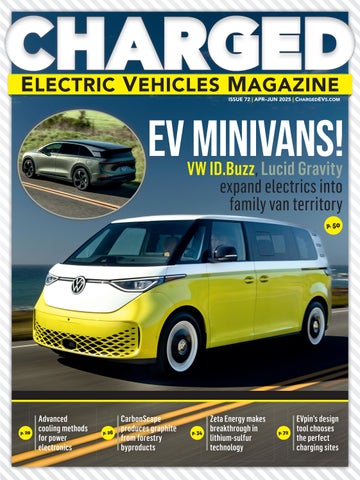
EV MINIVANS! VW ID.Buzz, Lucid Gravity expand electrics into family van territory p. 50
p. 20
iss 72.indd 1
Advanced cooling methods for power electronics
p. 26
CarbonScape produces graphite from forestry byproducts
p. 34
Zeta Energy makes breakthrough in lithium-sulfur technology
p. 72
EVpin’s design tool chooses the perfect charging sites
7/8/25 1:02 PM
M
M
Y
Y
iss 72.indd 2
7/7/25 9:33 PM
THE TECH CONTENTS
20 Advanced cooling for power electronics 26 Graphite produced from forestry byproducts 34 Zeta Energy’s new lithium-sulfur tech
20
current events
26
10
Infineon to supply Rivian’s R2 platform with power modules Turntide expands range of Gen 6 inverters, adds new partner
11 12
WACKER introduces new gap filler for automotive electronics NEO ships first magnet samples produced at new European facility Allison Transmission to acquire Dana’s off-highway business
13
Toshiba starts sample shipments of new SCiBNb EV battery Inmotion launches new DC-DC converter and inverter for commercial EVs
14
34
TDK’s new embedded gate driver powers efficiency in EV thermal systems ENNOVI integrates advanced functionality with busbar sealing technology
15
BASF’s Ultramid Advanced N for high-voltage connectors reduces corrosion comemso introduces SmartCal for calibration of EV battery cell simulators
16
Continental’s new sensor measures heat in EV motors to reduce rare earths Sionic Energy announces drop-in silicon anode platform
17 18
Parker Hannifin to acquire Curtis Instruments, expanding off-highway portfolio dSPACE expands its SCALEXIO real-time testing platform Yokogawa releases high-speed data acquisition unit for automotive testing
16 iss 72.indd 3
19
VOSS, Amphenol and GG Group unveil 1 MW liquid-cooled EV charging harness GÖPEL electronic launches 500 kW EV battery test bench with BMS interface
7/8/25 6:24 PM
THE VEHICLES CONTENTS
50 EV Minivans
VW ID.Buzz, Lucid Gravity expand electrics into family van territory
50
current events 40 Sany Group introduces electric excavators, crawler cranes and telehandlers Kenworth launches two new battery-electric trucks
42 California awards $500 million in funding for 1,000 electric school buses AVILOO updates its FLASH battery test platform for used EVs
43 DHL to deploy 30 Mercedes-Benz electric trucks in Transport as a Service model Pier 400 in Los Angeles to deploy 20 Orange EV electric terminal tractors
44
44 Mack Trucks to offer an electric Pioneer Class 8 truck Volvo sells 35 electric trucks to Swedish waste management company
45 U POWER Tech introduces three new commercial EV platforms Oakland Airport commissions first electric buses in parking shuttle fleet
46 Multistate FedEx and Amazon consolidator buys 20 Mullen electric trucks Volvo CE debuts all-new mid-size electric wheel loader
47 Sandvik sells 22 battery-electric mining machines to South32 Ethiopian Airlines and Archer to deploy Midnight electric aircraft
46
48 International introduces new eRH Series electric Class 8 regional haul tractor New York expands Truck Voucher Incentive Program to include off-road EVs
49 Chinese mine deploys 5G-A unmanned electric mining trucks Scania to roll out MCS-capable electric trucks in Europe in 2026 IDENTIFICATION STATEMENT CHARGED Electric Vehicles Magazine (ISSN: 24742341) April-May 2025, Issue #72 is published quarterly by Electric Vehicles Magazine LLC, 136 4th St N, STE 201, Saint Petersburg, FL 33701-3889. Periodicals Postage Paid at Saint Petersburg, FL and additional mailing offices. POSTMASTER: Send address changes to CHARGED Electric Vehicles Magazine, Electric Vehicles Magazine LLC at 136 4th St N, STE 201, Saint Petersburg, FL 33701-3889.
iss 72.indd 4
48 7/8/25 2:23 PM
THE INFRASTRUCTURE CONTENTS
72
72 Choosing the perfect charging sites
EVpin’s all-in-one site selection and design tool gives EV charging providers the data they need to evaluate potential locations
current events 62 SAE International publishes SAE J3400/2 Standard Electric Era installs 200 kW battery-backed EV chargers in just 54 days
62
64 Eaton and ChargePoint to offer turnkey EV charging solutions, advance V2X bp pulse to install 400 kW DC fast EV charging sites at Waffle House locations
65 MACBETH project aims to establish a European MCS charging network Electric Miles upgrades management platform for EV fleets and CPOs
66 Circle K launches EV charging-only convenience store in Sweden WattEV breaks ground on electric truck charging depot at Port of Oakland
67 Vehicle-to-Grid-enabled car-sharing service goes live in Netherlands city
66
Hyundai Motor Group to demonstrate EV charging robots at Incheon Airport
68 Sense’s EV Analytics provides EV detection and charging insights for utilities Accuenergy launches AcuDC 300 EV charging meter
70 Skycharger to develop 24-port EV charging hub at San Francisco airport Leap and Xos partner to offer grid revenue opportunities for EV fleets
71 XCharge deploys charging depot for California logistics fleet Off-grid EV charging specialist SparkCharge raises $30.5 million
71 iss 72.indd 5
7/8/25 2:25 PM
Publisher Christian Ruoff Senior Editor Charles Morris Technology Editor Jeffrey Jenkins Segment Leaders Joel Franke Mark Rogers Jeremy Ewald Graphic Designers Tomislav Vrdoljak
Contributing Writers Jeffrey Jenkins Charles Morris Christian Ruoff Jonathan Spira John Voelcker
For Letters to the Editor, Article Submissions, & Advertising Inquiries Contact: Info@ChargedEVs.com
Cover Image Courtesy of Lucid Volkswagen of America Special Thanks to Kelly Ruoff Sebastien Bourgeois SUSTAINABLE Certified Chain of Custody FORESTRY Promoting Sustainable Forestry INITIATIVE www.forests.org
SFI-00993
ETHICS STATEMENT AND COVERAGE POLICY AS THE LEADING EV INDUSTRY PUBLICATION, CHARGED ELECTRIC VEHICLES MAGAZINE OFTEN COVERS, AND ACCEPTS CONTRIBUTIONS FROM, COMPANIES THAT ADVERTISE IN OUR MEDIA PORTFOLIO. HOWEVER, THE CONTENT WE CHOOSE TO PUBLISH PASSES ONLY TWO TESTS: (1) TO THE BEST OF OUR KNOWLEDGE THE INFORMATION IS ACCURATE, AND (2) IT MEETS THE INTERESTS OF OUR READERSHIP. WE DO NOT ACCEPT PAYMENT FOR EDITORIAL CONTENT, AND THE OPINIONS EXPRESSED BY OUR EDITORS AND WRITERS ARE IN NO WAY AFFECTED BY A COMPANY’S PAST, CURRENT, OR POTENTIAL ADVERTISEMENTS. FURTHERMORE, WE OFTEN ACCEPT ARTICLES AUTHORED BY “INDUSTRY INSIDERS,” IN WHICH CASE THE AUTHOR’S CURRENT EMPLOYMENT, OR RELATIONSHIP TO THE EV INDUSTRY, IS CLEARLY CITED. IF YOU DISAGREE WITH ANY OPINION EXPRESSED IN THE CHARGED MEDIA PORTFOLIO AND/OR WISH TO WRITE ABOUT YOUR PARTICULAR VIEW OF THE INDUSTRY, PLEASE CONTACT US AT CONTENT@CHARGEDEVS.COM. REPRINTING IN WHOLE OR PART IS FORBIDDEN EXPECT BY PERMISSION OF CHARGED ELECTRIC VEHICLES MAGAZINE.
Laser Welding Fully automatic Laser Welding Systems
www.hesse-mechatronics.com
Hesse GmbH - Your reliable equipment partner for: Laser Welding
iss 72.indd 6
Wire Bonding
Smart Welding
Automation
7/7/25 9:35 PM
VIRTUAL CONFERENCE
EV Engineering
Don’t Miss Our Next Virtual Conferences On
EV Engineering September 15-18, 2025
Who should attend? Charged Electric Vehicles Magazine presents FREE online events for the EV industry featuring live webinars, on-demand videos, whitepapers and interactive Q&As.
2025 EV Engineering Events
Featuring: Motor Design and Manufacturing
Fall Virtual Conference September 15-18, 2025
Power Electronics Design and Manufacturing
Spring Virtual Conference
Cell Development and Battery Systems Design
Now On Demand
Plus
Testing, Powertrains, Thermal Management, Circuit Protection, Wire & Cable, Advanced Manufacturing
www.ChargedEVs.com/Conference
iss 72.indd 7
7/7/25 9:35 PM
Publisher’s Note SPECIALISTS IN AUTOMATIC ELECTRICAL TEST EQUIPMENT
We advise. We design. We implement. We support. You test your best.
EVs are here, just not evenly distributed. According to a quote attributed to writer William Gibson, “The future has arrived—it’s just not evenly distributed yet.” At Charged, we’ve been telling our readers that “EVs are here” since we launched in 2011. No future technology exemplifies Gibson’s maxim better than transport electrification. Norway is close to being an EV-only nation, and places like London and Amsterdam are well on their way, but in many other regions of the world, you might drive for days without seeing an EV. It’s not only rich nations that are embracing the electric future. Ethiopia has banned the import of ICE vehicles. Several other African countries have reduced import duties on EVs, and we read that plug-in vehicles have reached a 70% market share in Nepal. A lot of the new cars in these countries come from Chinese automakers, which have leapfrogged the rest of the world to become the leader in affordable, high-quality EVs. Ford CEO Jim Farley recently said that China’s lead is “the most humbling thing I’ve ever seen.” He is particularly impressed by their ability to create “superior in-vehicle technology” with a smartphone-on-wheels approach to design. “And even beyond that, their cost, the quality of their vehicles is far superior to what I see in the West,” Farley continued. “We are in a global competition with China, and it’s not just EVs. And if we lose this, we do not have a future at Ford.” Unfortunately, American-made cars are steadily disappearing from foreign markets, and the current US administration is pursuing a war on EVs that we believe could decimate our country’s auto industry. Automakers outside of China have always had ambivalent attitudes toward electrification (see Charles Morris’s Charging Forward column on page 82), and the US EV industry is in a state of flux (not to say chaos). For now, however, consumers continue to buy EVs in respectable numbers, and the state of public charging infrastructure is rapidly improving (see our article on EVpin on page 72). Meanwhile, start-ups and legacy brands continue to develop compelling new EV models of all shapes and sizes (see John Voelcker’s report on the VW ID.Buzz and Lucid Gravity on page 50). And bold companies carry on developing new technologies that promise to make EVs ever more powerful, cheaper and locally sourced (see our coverage of CarbonScape on page 26 and Zeta Energy on page 34). These innovations take some years to make it into production vehicles, but as they do, EVs will become practical in more regions and more use cases, and the future will spread around the globe. The only question is, which automakers from which countries will lead the charge?
Christian Ruoff | Publisher mktest.com/automotive sales@mktest.com
iss 72.indd 8
EVs are here. Try to keep up.
7/8/25 1:43 PM
iss 72.indd 9
7/7/25 9:39 PM
Infineon to supply Rivian’s R2 platform with power modules for EV traction inverters Infineon Technologies, a producer of semiconductors for power systems and IoT applications, will supply Rivian’s R2 platform with power modules for traction inverters. The R2 platform will use silicon carbide (SiC) and silicon (Si) modules from Infineon’s HybridPACK Drive G2 family. Infineon expects to start delivering the components in 2026. HybridPACK Drive is Infineon’s power module family for electric vehicles. The company says it has sold over 10.5 million units since 2017. Infineon will also supply other products for Rivian’s new EV platform, including AURIX TC3x microcontrollers and OPTIREG power management ICs. Infineon is building a new 200-millimeter SiC power “fab” (the semiconductor industry’s term for a fabrication plant) in Kulim, Malaysia. This will share production technologies and processes with the company’s existing fab in Villach, Austria, enabling fast ramping and efficient operations in SiC and gallium nitride (GaN) manufacturing. “We are committed to enhancing the performance and range of electric vehicles jointly with innovative automotive companies like Rivian,” said Stefan Obersriebnig, head of the product line for high-voltage modules in Infineon’s Automotive Division. “Our dedication to innovation and zero-defect quality has made us the preferred partner of the automotive industry.”
Image courtesy of Turntide
Image courtesy of Infineon
THE TECH
Turntide expands range of Gen 6 inverters, adds new partner Turntide Technologies has expanded its Gen 6 Inverter range, which offers high performance and flexibility in a compact form factor. The company has also added EVR Motors as a Turntide Turnkey Solutions partner in order to offer integrated, end-to-end systems for OEMs. Turntide Gen 6 inverters deliver high power density and high-voltage performance ranging from 48 V, 450 A up to 80 V, 700 A. The power and form factor allow a motor to operate efficiently across a wide range of voltages and currents, minimizing energy loss, optimizing vehicle and machine performance and extending battery range. Applications include two- and three-wheel vehicles, material handling equipment and any low-voltage electrification needs. EVR’s TS-RFPM motor technology enables compact and light motors that can be tailored to user requirements. EVR’s lineup of motors, from 6 kW to 150 kW, complements Turntide’s next-generation inverters. Multiple customers are using or evaluating the combined solutions from Turntide and EVR Motors, including OEMs in Japan and North America. For instance, RISE Robotics has developed its Beltdraulic System for industrial and off-highway applications. The system combines EVR’s compact, high-efficiency 160 mm radial flux motor with Turntide’s Gen 6, Size 4 48 V inverter—offering a scalable electric alternative to traditional hydraulics. By leveraging the compact motor’s high torque density, RISE has eliminated the need for a gearbox, reducing weight and system cost.
10 iss 72.indd 10
7/7/25 9:39 PM
Image courtesy of WACKER
WACKER introduces new gap filler for automotive electronics WACKER Chemie has introduced a new thermally conductive gap filler for applications in vehicle power electronics. Commercially available as SEMICOSIL 9649 TC, the silicone product can withstand high thermal stresses. It ensures that electronic components have a lasting bond with a vehicle’s active and passive cooling systems, efficiently dissipating the heat generated when a vehicle is in operation. SEMICOSIL 9649 TC was specifically developed for power electronics applications in electric and hybrid vehicles. The silicone-based compound consists of a 2K system that cures at room temperature through an addition reaction to form an adaptable and repairable elastomer. It is an electrically insulating product with a thermal conductivity of approximately 4 W/mK. In testing, SEMICOSIL 9649 TC consistently withstood temperatures of up to 150° C without any significant change in its thermal conductivity or other material properties. The product can also deal with thermal shocks that involve rapid temperature changes ranging from -40° to 150° C. SEMICOSIL 9649 TC is a non-sag material before cure. Its viscosity decreases with increased shearing, for example during mixing and metering. Its shear-thinning property is adjusted so that the compound can be fed by machine and applied as a bead so that processors can achieve a high metering rate and high dosing accuracy. A dispenser is used to apply the gap filler to the heat sink, and then the power electronics circuit board is applied. During compression, a continuous film forms that conforms to the surfaces of the two joining parts, evening out surface irregularities and tolerances. The film hardens between the joining parts to form a thermally conductive layer, which, thanks to its soft and flexible consistency, also absorbs vibrations and impacts. The product meets all relevant automotive industry quality standards and specifications.
iss 72.indd 11
7/7/25 9:39 PM
NEO ships first magnet samples produced at new European facility to traction motor customer Canada-based NEO Performance Materials has shipped sintered magnet samples to a Tier 1 EV traction motor customer from its new permanent magnet facility in Narva, Estonia. NEO has produced 18,000 assembled magnet pieces as part of the initial production samples. The magnets are EV traction motor grade and mark a step forward in Neo’s strategy to provide high-performance materials for the EV market. The magnet samples will be assembled into traction motors for performance testing by the customer and OEM. Production part approval process (PPAP) products are scheduled for the first half of 2026 and mass production is expected to follow later that year. The new Narva facility is strategically located near NEO’s rare earth separation facility in Sillamäe, Estonia, which is expected to allow for vertical integration of operations and efficient production processes in the future. The facility is projected to have an initial production capacity of 2,000 metric tonnes annually, and the company plans to scale up to 5,000 metric tonnes. The $75-million facility is supported by a grant of up to €18.7 million from the EU’s Just Transition Fund and a $50-million credit facility from Export Development Canada. Construction is due to be completed this year.
Image courtesy of Dana
Image courtesy of NEO
THE TECH
Allison Transmission to acquire Dana’s off-highway business, expanding EV and hybrid drivetrain capabilities Allison Transmission has announced a definitive agreement to acquire Dana’s Off-Highway business for approximately $2.7 billion. The acquisition, anticipated to close late in the fourth quarter of 2025 will expand Allison’s existing powertrain and electrification product lines, significantly enhancing the company’s capabilities in hybrid and electric drivetrain systems for commercial and industrial applications. Allison Transmission specializes in propulsion solutions for commercial, defense, and off-highway vehicles, including fully automatic transmissions and electrified systems for on-highway trucks, buses and construction equipment. Dana’s Off-Highway business develops drivetrain, propulsion and electrified solutions, serving customers across the construction, agriculture, forestry, specialty vehicles, aftermarket, industrial, and mining industries. The division operates in over 25 countries, employs approximately 11,000 individuals, and is recognized for its hybrid and electric drive technologies, including axles, drivetrain components and custom propulsion solutions. Following the integration, Allison intends to use its broader global presence and bolster its existing product portfolio, catering directly to evolving customer requirements in heavy-duty equipment markets, including electrification trends in commercial vehicles and industrial machinery.
12 iss 72.indd 12
7/7/25 9:39 PM
Image courtesy of Inmotion Technologies
Image courtesy of Toshiba
Toshiba starts sample shipments of new SCiBNb EV battery with niobium titanium oxide anode Toshiba is now offering samples of its new SCiBNb lithium-ion battery, designed for commercial EVs. Potential users can evaluate the battery for themselves by ordering a sample. The SCiBNb cell features a niobium titanium oxide (NTO) anode. According to the company, this gives it an energy density comparable to that of carbon-based batteries with lithium iron phosphate (LFP) cathodes, as well as distinct advantages in charging speed and lifespan. The company says its battery can achieve an 80% charge in as little as 10 minutes, and boasts an estimated lifespan of 15,000 cycles. According to Toshiba, the NTO anode of the SCiBNb, like the lithium titanate anode of the SCiB, does not cause metal lithium deposition and can be used safely for a long time, even with repeated rapid charging. Toshiba says its SCiBNb is ideal for commercial EVs such as electric buses and trucks that operate on regular routes with high utilization rates. Frequent charging at designated points along the route can allow the battery capacity to be reduced. The SCiBNb cell has a rated capacity of 50 Ah, nominal voltage of 2.3 V, output power of 1,000 W, input power of 2,000 W (at 50% SOC and 25° C) and a 5C charging rate (10 minutes, 80% SOC). Operating temperature is -30° to +60° C. Energy density is 350 Wh/L, dimensions are 98 x 280 x 12 mm, and weight is approximately 860 grams.
Inmotion launches new DC-DC converter and inverter for commercial EVs Inmotion Technologies, a subsidiary of Italy’s ZAPI GROUP and a supplier of electric motors, motor control units and auxiliary electronic equipment for industrial and commercial vehicles, has released a new DCC3 converter and ACH3 inverter. The DCC3 is a rugged, compact DC-DC converter engineered for flexibility to support a range of construction applications. It converts input voltages from 250 V to 900 V into a stable, adjustable 12 V or 24 V output, delivering up to 10 kW of power for auxiliary systems in electric or hybrid industrial, commercial and utility vehicles. The new converter design is available for prototyping now and will go into serial production at the end of 2025. The new third-generation, high-voltage ACH3 inverters come with customizable control software that integrates functional safety and cybersecurity. “Historically, inverter power output and efficiency have limited vehicle electrification. The ACH3 addresses these issues. It has a 99% peak efficiency, current ratings from 30 to more than 600 amperes and up to 900-volt bus voltage with full power,” said Martin Wennerblom, Product and Marketing Director at Inmotion Technologies. The inverter has a minimal environmental impact throughout its production, operational life and end-oflife disposal, according to the company. It has an expected lifespan of 72,000 working hours. The components are sourced from Europe and all units are assembled in Sweden. Inmotion also offers high-power onboard and offboard battery chargers, electric motors, electric power takeoff (ePTO) and fleet management solutions for the construction and industrial vehicle sectors.
APR-JUN 2025
iss 72.indd 13
13 7/7/25 9:39 PM
TDK’s new embedded gate driver powers efficiency in EV thermal systems Japanese manufacturer TDK Electronics has extended the power capability of its Micronas high-voltage microcontrollers (HVC) 5x embedded motor controller family with its new HVC 5481G for automotive applications. The chips are designed for local interconnect network (LIN)-controlled automotive blowers, pumps and fans in thermal systems. They can also power smart brushless DC motor (BLDC) actuators in seats, doors, liftgates and charge-port doors. The HVC 5481G is a programmable gate driver system-on-chip (SoC) for control of an external power bridge with 6 N-channel FETs to drive actuators, fans and pumps. Samples of the HVC 5481G are available now, and production will begin in 2026. The HVC 5481G SoC is compatible with TDK’s existing HVC 5x family software, integrating an ARM Cortex-M3 central processing unit (CPU) with 64 kB of flash memory and 8 kB of SRAM. It operates directly from the 12 V automotive supply rail and integrates a LIN transceiver for communication. The IC supports various motor control algorithms from sensorless 6-step commutation using BEMF detection to single-shunt Field Oriented Control (FOC) algorithms for low noise and high efficiency. The device includes seven general-purpose IO pins, internal timers, and capture compare registers, allowing seamless interfacing with the Micronas Hall-effect or TDK TMR sensors. The HVC 5481G is available in a compact 5 x 5 mm PQFN32 package, and is certified according to AEC-Q100 Grade 1 standards for automotive for medium-power BLDC applications.
Image courtesy of ENNOVI
Image courtesy of TDK
THE TECH
ENNOVI integrates advanced functionality with busbar sealing technology in EV and hybrid drivetrains ENNOVI, a provider of e-mobility technologies, has introduced a new technology for sealing busbars, which prevents coolant leakage in hybrid and EV drivetrain applications. ENNOVI-SealTech can be used with busbars or other interconnects to accommodate applications such as motors, inverters and oil pump interfaces. It offers two sealing methods: double-walled shrink tubes or adhesive tape for challenging applications. Both eliminate post-processing, enhancing manufacturing efficiency and design flexibility without sacrificing sealing performance, according to ENNOVI. Every configuration is validated through a comprehensive testing process, including thermal aging at 150° C for 1,000 hours and thermal shock cycling from -40° to +150° C for 600 15-minute cycles, in accordance with the EN 60068-2 standard. A leak test is also performed to verify sealing integrity. The use of shrink tubing or tape allows ENNOVI-SealTech to adapt to virtually any busbar shape and design specification. The technology is compatible with a wide range of metals and plastics, including copper, aluminum, PA66, PBT, PC and others. “Conventional sealing methods, such as potting or using rubber O-rings or gaskets, incur the high cost and time for secondary processes and/or issues with leakage over the lifetime of the assembly—ENNOVI-SealTech overcomes all these limitations,” said Dominik Pawlik, Product Portfolio Director for Power Interconnects at ENNOVI.
14 iss 72.indd 14
7/7/25 9:40 PM
Image courtesy of Comemso
Image courtesy of BASF
BASF’s new Ultramid Advanced comemso introduces SmartCal N for high-voltage connectors for automated calibration of boasts reduced corrosion EV battery cell simulators BASF has added a new product to its portfolio of PPAs (polyphthalamides, a class of thermoplastics). The new Ultramid Advanced N3U42G6, a polyamide 9T with non-halogenated flame retardant, is designed to minimize electro-corrosion of metal contacts in electric and electronics parts for e-mobility. BASF says its new PPA increases the safety and durability of high-voltage connectors in EV components including inverters, DC-DC converters and battery packs. “Due to its high strength and stiffness over a broad temperature range, its outstanding chemical resistance and dimensional stability, the Ultramid Advanced N grade enhances the robustness and reliability of thinwalled high-voltage connectors, meeting growing industry needs for halide-free components used in warm and humid conditions,” says BASF. Ultramid Advanced N3U42G6 is available uncolored with UL-certified masterbatches, or pre-colored. It boasts high color stability and excellent color retention after heat aging. German automotive supplier KOSTAL Kontakt Systeme uses the new Ultramid Advanced N in several components in its high-voltage connector KS22 Class 4 for high-current modules. The company’s HV-connector, the smallest in its performance class, benefits from the BASF PPA in several ways: the new PPA enables miniaturization and saves installation space, as it shows good flowability at thin wall thickness. It also provides the connector with very high electrical insulation—superior to that of aliphatic polyamides, especially at elevated temperatures. Finally, it has a high elongation at break so that there is no stress whitening when the different components are mounted.
comemso has announced SmartCal, a fully automated calibration system for its Battery Cell Simulator (BCS), targeting developers and testers of battery management systems (BMS) in electric vehicle and high-voltage test environments. The SmartCal system enables on-site or in-lab calibration and adjustment of BCS units, designed to maintain long-term measurement accuracy in EV battery testing. SmartCal integrates an automated process and user interface with a 6.5-digit digital multimeter calibrated to ISO 17025 standards. For in-house use, calibration and measurement data are stored in a centralized comemso database. When used at the customer’s facility, the data is saved locally and automatically exported as a PDF calibration report. The system supports both verification and channel adjustment functions, allowing precise tuning of individual simulator channels. It can be rented or purchased and deployed flexibly across laboratory and production environments. comemso says the system helps ensure consistent measurement quality while eliminating downtime caused by device returns. “If you want to develop good BMS, you have to be able to test them precisely,” said Dr. Kiriakos Athanasas, CEO of comemso. “With SmartCal, we ensure that our customers can maintain the high measurement quality of their BCS over many years—simply, automatically and precisely.” SmartCal is designed for use in EV development, BMS end-of-line test systems, and energy storage applications. By decentralizing calibration, the system can help to reduce logistical effort and minimize testing interruptions.
APR-JUN 2025
iss 72.indd 15
15 7/7/25 9:40 PM
Image courtesy of Sionic Energy
Image courtesy of Continental
THE TECH
Continental’s new sensor Sionic Energy announces drop- measures heat in EV motors, reduces need for rare earths in silicon anode platform Sionic Energy has announced commercial availability of its Rapid Integration Silicon Platform, a drop-in, 100% silicon anode solution designed for lithium-ion battery manufacturers and EV OEMs. The company says the technology replaces graphite entirely and delivers specific energy of 370 Wh/kg, supports ultra-fast charging (under 10 minutes) and provides over 1,000 charge cycles at operating temperatures from -30° to 45 °C. Designed for compatibility with standard lithium-ion manufacturing lines, this silicon platform requires no pre-lithiation or cell compression. It uses a proprietary conductive matrix that maintains both mechanical stability and electrical performance without requiring additional structural components or process modifications. Independent laboratories and global automotive companies have already verified the platform’s performance, according to Sionic. Pouch-format prototypes have been shipped to Tier 1 and Tier 2 battery producers and automotive companies for evaluation. The company says cylindrical cell platform pilot production will begin in Q4 2025, followed by prismatic-format platform pilots in Q1 2026. The platform is packaged as a licensed product, which includes a flexible intellectual property package, material specification sheets and on-site technology transfer assistance, which Sionic says significantly reduces scale-up risks for cell manufacturers. All base silicon and other core materials for the platform are sourced from qualified suppliers within the US, ensuring domestic supply chain compliance.
Continental has developed a new sensor technology that measures the temperature inside permanently excited synchronous motors in EVs directly on the rotor. The company says its e-Motor Rotor Temperature Sensor (eRTS) delivers significantly more precise measurement results than the current software-based temperature simulation. This should enable vehicle manufacturers to reduce the amount of rare earth elements used to increase the magnets’ heat resistance. eRTS contains two separate components: a wireless remote temperature sensor unit located close to the magnet in the EV motor; and a wired transducer element located outside the EV motor. It is connected to the inverter control. Rotors operate under extreme conditions—sometimes at temperatures of up to 150° C—so monitoring and controlling temperature development in EV motors is crucial. Currently, heat development is not measured directly, but calculated based on information from the stator temperature sensor, phase current measurements and environmental variables. This measurement method typically has a tolerance range of up to 15° C. To protect the magnet from demagnetization due to excessive temperature, expensive rare earth elements are used to cover the entire tolerance range and ensure that the magnet is heat-resistant. The new eRTS sensor technology allows the tolerance range to be reduced to 3° C. This means that car manufacturers could substantially reduce their usage of costly rare earth materials—or alternatively, improve motor performance by pushing the limits of the tolerance range.
16 iss 72.indd 16
7/7/25 9:41 PM
Parker Hannifin to acquire Curtis Instruments, expanding commercial and off-highway electrification portfolio Parker Hannifin announced an agreement to acquire Curtis Instruments from Rehlko for approximately $1 billion in cash. Curtis Instruments designs and manufactures power electronics, instrumentation and input devices for a range of commercial vehicles. The transaction is expected to close by the end of calendar year 2025. Curtis expects 2025 calendar year annual sales of roughly $320 million. According to Parker Hannifin Chairman and CEO Jenny Parmentier, “Curtis adds complementary technologies to our existing industrial electrification platform, better positioning us to serve our customers as they continue the adoption of more electric and hybrid solutions.” Parmentier also emphasized that the acquisition aligns
iss 72.indd 17
with long-term industry trends toward electrification, and expects to achieve substantial operational synergies by integrating Curtis’s products into Parker’s offerings. The acquisition targets applications in electric and hybrid vehicles, particularly within in-plant material handling and off-highway environments, where electrification and precision motion controls are becoming increasingly critical. “Rehlko is proud of the legacy and performance of Curtis as a high-performing, innovation-driven business,” said Brian Melka, President and Chief Executive Officer of Rehlko. “Parker is an exceptional company and we are confident Curtis will thrive from Parker’s increased scale, focus, and investment.”
7/7/25 9:42 PM
dSPACE expands its SCALEXIO real-time testing platform Germany-based dSPACE, a provider of automotive simulation and validation systems, is expanding its SCALEXIO real-time platform for hardware-in-the-loop (HIL) applications by adding the new SCALEXIO FSX product line. SCALEXIO HIL systems are designed to validate real-time applications in the automotive, aerospace and industrial sectors. SCALEXIO FSX completes the SCALEXIO product family and enables improved electrical fault injection, signal conditioning and customized extensions. The FSX’s modular architecture allows the simple construction of scalable test solutions and shortens project-specific adaptations of the HIL system in the field. The systems are designed to be easy to handle, enabling users to implement hardware modifications and extensions themselves. The software also has a modular structure. The FSX extension is configured using the External Device Editor and the system and controls are accessed via the ASAMXIL API standard. The External Device Editor can be used to define pin assignments and the cable harness required for connecting control units and other external devices. “With SCALEXIO FSX, we are increasing the flexibility of our HIL offering and responding to current challenges in the context of highly dynamic development projects,” explains Christian Wördehoff, Lead Business Field Manager HIL Testing at dSPACE.
Yokogawa releases high-speed data acquisition unit for automotive testing Japan-based Yokogawa Test & Measurement has introduced its SL2000 High-Speed Data Acquisition Unit, a ScopeCorder series product with a wide range of data logging functionalities for evaluation and test applications, including high-speed sampling and analysis for automotive. The SL2000 is a modular platform that combines the functions of a mixed signal oscilloscope and a data acquisition recorder. It is designed to capture fast signal transients and long-term trends. Applications include electrical analysis and control signal evaluation, durability and reliability testing of components and vehicles requiring high sampling rates and multi-channel simultaneous measurement of analog signals and in-vehicle bus signals such as CAN and CAN FD, and simultaneous measurement and evaluation of temperature, vibration and other mechanical signals that change relatively slowly. The SL2000 can be used separately or in combination with the DL950 ScopeCorder, depending on the application, to meet requirements to simultaneously measure multiple parameters and for the systemization of mechatronic measurements in product development. For example, in the development of motors for industrial and EV systems, the durability test requires a highly reliable measuring instrument and high sampling rates. The unit has eight available slots and up to 32 channels, for which over 20 types of input modules are available to enable measurements of electrical signals, mechanical performance parameters indicated by sensors and decoded vehicle serial bus signals. Up to five SL2000 and DL950 units can be synchronized to increase the number of measurement channels.
Image courtesy of Yokogawa
Image courtesy of dSPACE
THE TECH
18 iss 72.indd 18
7/7/25 9:42 PM
Image courtesy of Voss
VOSS Automotive, Amphenol-Tuchel Electronics and the GG Group have introduced a high-voltage EV charging harness designed to support charging power up to 1 megawatt. The new system integrates active liquid cooling throughout the charging cable and socket to reduce thermal losses and enable significantly higher current loads. The companies claim this could reduce charge times to under five minutes. The charging harness incorporates the Power2Flow charging cable from GG Group, the CHARGESOK CCS2 socket from Amphenol and a fluid-cooled battery connection and thermal management system developed by VOSS. At the core is a polymer heat exchanger embedded within the cable, which uses a multi-layer plastic tube to circulate a cooling medium—either water-glycol or immersion fluids—between the battery and the charging inlet. By actively cooling the areas of peak thermal load, the system avoids overheating without increasing conductor size. This approach allows a 70-percent increase in current load capacity while reducing cable cross-section, improving flexibility and simplifying installation. In contrast to conventional solutions that use large busbars, this lightweight cable design supports easier integration into compact EV architectures. The CHARGESOK socket uses direct-contact liquid cooling to dissipate heat at the source. A coolant circulates around the high-current contacts, improving efficiency and enabling continuous high-power charging. The cooling system is designed for compatibility with existing vehicle thermal architectures, offering flexibility for different OEM platforms. The system is targeted at next-generation EVs requiring rapid charge capabilities and scalable thermal performance.
Image courtesy of GÖPEL
VOSS, Amphenol and GG Group unveil 1 MW liquid-cooled EV charging harness
GÖPEL electronic launches 500 kW EV battery test bench with regenerative power and BMS interface GÖPEL electronic has introduced a modular, high-voltage battery test bench designed for safety and functional testing of EV battery packs. Developed for use in automotive development and production environments, the system is intended to support fast and cost-efficient quality assurance of battery cells and packs. The test bench delivers up to 500 kW of power and supports test voltages up to 1,000 V DC and currents up to 800 A DC. It includes a central measurement unit with integrated computer and display, a control cabinet, and a unit for power electronics, all of which can be configured to meet specific testing needs. The platform also features regenerative energy capability, enabling energy recovered during discharge cycles to be fed back into the grid, improving overall energy efficiency. Key functions include insulation testing up to 7.5 kV, evaluation of AC impedance, cell dynamics under alternating current, and detection of critical defects. Test results provide insights into electrochemical processes, cell aging and internal resistance across frequency ranges. The system interfaces with a battery management system (BMS) via CAN-BUS and performs a charging/discharging cycle followed by state-of-charge verification. Final test data are automatically exported to a production database and presented in customizable reports. The system also verifies quiescent current, confirms the battery’s final charge state, compares sensor and error memory data, and performs the final flashing of customer software onto the battery before delivery.
APR-JUN 2025
iss 72.indd 19
19 7/7/25 9:42 PM
THE TECH
ADVANCED
COOLING METHODS FOR POWER ELECTRONICS By Jeffrey Jenkins
ne of the primary issues the power electronics engineer must address is the removal of waste heat—the well-known Arrhenius equation from chemistry/physics tells us that the operational life of any given electronic component will roughly double for every 10-11° C drop in its temperature. Power electronics devices on EVs are also under considerable pressure to take up as little volume and mass as possible…oh, and to cost less and less over time. While optimizing all of these metrics simultaneously is rather difficult (invoking that favorite saying of
O
20 iss 72.indd 20
7/7/25 9:45 PM
Image courtesy of Infineon
Infineon’s OptiMOS™ power MOSFET family TOLT package. With top-side cooling, the drain is exposed at the surface of the package allowing for 95 percent of the heat to be dissipated directly to the heatsink.
general contractors: good, fast or cheap—pick any two), advanced components and methods for removing waste heat can at least reduce the volume and temperature rise (note that reducing costs is conspicuously absent from the list of potential benefits). Methods of cooling can be broadly categorized as active or passive. The essential difference is that active cooling uses additional energy (usually electrical) to increase the rate of heat transfer. For example, merely blowing air at a speed of a few meters/second across the fins of an aluminum heatsink can easily double the amount of heat it can dissipate for a given temperature rise, while an even more dramatic increase can be had by pumping a liquid coolant past the heat-generat-
Power electronics devices on EVs are also under considerable pressure to take up as little volume and mass as possible and to cost less and less over time. ing components (aka a cold plate). While fan cooling definitely falls into the less-expensive end of the active cooling methods, two major downsides to it are the inevitable buildup of dust and dirt on the fan blades and fins (or on the filter placed in front of such), and the higher susceptibility to failure from shock/vibra-
APR-JUN 2025
iss 72.indd 21
21 7/7/25 9:45 PM
THE TECH Image courtesy of Alpha and Omega Semiconductor
the area over which that heat is concentrated (aka the heat flux, typically specified in Alpha and Omega Semiconductor’s Double-Sided Cooling units of W/mm2). As comDFN 5x6 Package. ponent package sizes shrink, there needs to be either a proportional reduction in losses (i.e. an improvement in efficiency) or a reduction in the thermal resistance between the package and the ambient. While an improvement in efficiency is always welcome—assuming it isn’t accompanied by an outsized increase in price, anyway—reducing the thermal resistance of the package is more often the most practical solution, and one very simple way for a component manufacturer to do that is to simply make both the top and the bottom of the package thermally conductive (see, for example, Alpha & Omega Semiconductor’s DFN5X6 package). This doubles the surface area available for removing heat from the package without (much of) an increase in the manufacturing cost (for the component manufacturer, anyway—double-sided cooling can be a real headache to implement in the real world without making the device too labor-intensive to economically assemble). While double-sided cooling is a relatively recent innovation for surface-mount devices, it was extremely tion. Liquid cooling is altogether more preferable here, popular back in the 1970s and 80s with the so-called as it can achieve exceptionally low thermal resistance “hockey puck” packages used for semiconductor values—pretty much only bested by refrigerant-based switches and rectifiers. Similar challenges with using heat pumps—and liquid pumps tend to survive higher those packages back then also apply today, albeit at a levels of shock and vibration than fans. That said, much smaller physical scale. One of the biggest such a fan is often required on the exhaust side of a liqchallenges is that one or both heatsink surfaces are uid-cooling loop anyway, so this might be a proverbial likely to be electrically live, so they will require isocase of a distinction without a difference. lation between the components and/or the heatsink The parameters that most strongly influence wheth(especially if the latter is exposed). Another challenge: er something more involved than a finned aluminum if multiple components are needed to achieve the necheatsink or cold plate will be required for component essary power rating, then ensuring coplanarity among cooling are (obviously) the amount of heat, in watts, them can be a real headache. Also note that, even if the that needs to be removed, and (rather less obviously)
Reducing the thermal resistance of the package is more often the most practical solution, and one very simple way for a component manufacturer to do that is to simply make both the top and the bottom of the package thermally conductive.
22 iss 72.indd 22
7/8/25 2:38 PM
component thickness is tightly constrained, there will still be variations in the thickness of the solder and board. Care must also be used during assembly to ensure that the packages aren’t crushed by excessive clamping force, but that’s standard operating procedure these days. At any rate, the solution to both issues is often the same: an electrically-insulating thermal interface material. The ubiquitous Sil-Pad comes to mind, but a recent innovation—using so-called “phase-change materials”—will be discussed below. Another recent innovation: semiconductor packages with their heatsink-contacting surface facing up, rather than the printed circuit board (such as the TOLT package from Infineon). This enables a reasonably high power dissipation (or Pd) rating without requiring the oft-specified (and frankly unrealistic) 25 mm x 25 mm pad to even get 1 W of Pd out of an SMT package. The same issue of ensuring coplanarity among an array of the same packages and their attendant heatsink (or cold plate) applies here, with the added caution that it is rarely possible (and always inadvisable) to use the PCB as the other side of a clamp. The usual solution to this issue is to bond the packages to their heatsink/cold plate with a thermally-conductive adhesive or epoxy. These adhesives contain fine particles of copper, aluminum or graphite, which improves their thermal conductivity over conventional adhesives (and definitely the air
iss 72.indd 23
PROTECTING YOUR BATTERY. Preserving your peace of mind.
Stop thermal propagation with PyroThin® cell barriers. Learn more at aerogel.com/PyroThin
7/7/25 9:50 PM
THE TECH A key enabling technology for the new SMT packages is the use of thermal interface materials, or TIMs, which undergo a physical state change (e.g. from solid to liquid) upon rising above a critical temperature. gap they are meant to displace), but be that as it may, their thermal conductivity will still be far worse than almost every other thermal interface material, and they do render the board more or less non-repairable. A solution that preserves repairability is to stiffen the PCB with metal plates or bars on the underside of the board, so that the heatsink mounted on top clamps against these fixtures instead of the board itself. Regardless of the component packaging chosen, more than usual care must be exercised in balancing the mass of the heatsink assembly against the flexibility of the PCB when mounting everything—it may be found that rigidly attaching the heatsink to the enclosure and letting the PCB float is the most reliable option when the heatsink greatly out-masses the PCB. A key enabling technology for the new SMT packages mentioned above is the use of thermal interface materials, or TIMs, which undergo a physical state change (e.g. from solid to liquid) upon rising above a critical temperature (no prizes for guessing their abbreviation is PC-TIM). This results in a much more thorough displacement of any air trapped between the package(s) and heatsink, which greatly reduces the effective thermal resistance of this juncture, and it also better accommodates any slight differences in height/thickness across multiple coplanar packages. Current generation PC-TIMs have a thermal resistance on par with silicone greases but are much more resistant to “pump-out,” which happens when the TIM is squeezed out of the interface from thermal cycling, resulting in a gradual— and usually fatal—increase in the thermal resistance of the interface. PC-TIMs do cost more than conventional TIMs, but the improvement in thermal resistance and greater ease of application—they typically come in preformed pads, much like the aforementioned Sil-Pads,
for example—more than make up for their higher cost in all but the most cost-sensitive of applications. Another application in which material sciences has made some impressive strides is the humble heatsink itself. Replacing metals such as aluminum or copper with polycrystalline ceramics comprised of aluminum oxide (alumina, or Al2O3) or aluminum nitride (AlN) powders allows a heatsink to be molded into any practical shape, then fired at high temperature, more or less like pottery. These ceramics are excellent electrical insulators (>10 kV/mm of thickness), as is to be expected, but also good thermal conductors, which is rather more surprising, because good electrical insulators are usually good thermal insulators, too. In fact, the thermal conductivity of polycrystalline AlN can rival that of metallic aluminum (150-200 W/m * K), while Al2O3 delivers a rather more modest—but still useful—thermal conductivity in the range of 20-40 W/m * K. The coefficients of thermal expansion of both these ceramics are also a good match for most semiconductor materials, so it is possible to directly attach semiconductor dies to them. However, these alternative heatsink materials are not cheap (especially AlN), and they are both quite brittle and very difficult to machine (and note that some machining or grinding after they are fired will be required to achieve the necessary flatness and roughness for a good thermal interface). The last advanced cooling method to consider is the use of heat pipes, which are effectively passive heat pumps in that they use the very heat energy they are transporting to do said transporting. A typical heat pipe consists of a sealed copper tube which is charged with a small amount of a liquid that boils in the range of 60-80° C (i.e. higher than the highest expected ambient temperature, but low enough for the component being cooled to survive) and whose interior is lined with sintered copper particles (roughly the size of fine sand) which act as a wick to transport this liquid via capillary action. When one end of a heat pipe is in contact with a hot surface while the other end is exposed to the cooler ambient, then the internal liquid will begin to evaporate at the hot end, absorbing considerable heat energy in the process from the so-called latent heat of evaporation. As the vapor finds its way to the cool end it will then release much of its heat energy as it condenses, at which point the capillary action of the wick will return said liquid to the hot end. Water is the most
24 iss 72.indd 24
7/7/25 9:50 PM
How a heat pipe works Image courtesy of Advanced Cooling Technologies, Inc.
The last advanced cooling method to consider is the use of heat pipes, which are effectively passive heat pumps in that they use the very heat energy they are transporting to do said transporting. commonly used liquid in heat pipes because it has a very high latent heat of evaporation, but the interior of the heat pipe must be at a lower pressure than the atmosphere (i.e. a partial vacuum) to lower its boiling point. This inevitably makes a heat pipe with water as its transport medium more expensive to manufacture, but the payoff is an effective thermal conductivity that can reach as high as 100 kW/m * K, or around 500 times
greater than that of 6061 aluminum alloy (approximately 200 W/m * K) or nearly 300 times greater than pure C110 copper (350-400 W/m * K). This extremely high thermal conductivity makes it possible to more densely package a number of components together and then move the heat they produce to a conventional aluminum heatsink, without needing fans, pumped liquids or other means of active heat transport to lower the thermal resistance of the heatsink. A heat pipe-based cooling system is likely to be much more compact and more reliable, and it will also require far less (practically zero) maintenance. If this prose about heat pipes is not enough to convince the more skeptical among you, then pick up a heat pipe from an online retailer and hold onto one end with your bare hands while pressing the other end into an ice cube. The heat pipe will cut through the ice cube surprisingly quickly…for as long as your hand can withstand the relentless freezing cold that will be conducted back to it, anyway.
APR-JUN 2025
iss 72.indd 25
25 7/7/25 9:50 PM
THE TECH
CRACKING
THE CARBON
CODE By Charles Morris
CarbonScape pioneers a process to produce graphite locally from forestry byproducts 26
iss 72.indd 26
7/7/25 9:51 PM
Image courtesy of CarbonScape
G
raphite, a crystalline form of carbon, is a critical ingredient in EV battery anodes, but it comes with some baggage. Most graphite is made from fossil fuels, and what’s worse, the vast majority of it comes from China, and establishing reliable sources of supply elsewhere is a long and complicated process. CarbonScape offers an alternative—it produces graphite locally from renewable timber industry byproducts through what it calls a carbon-negative process. CarbonScape’s graphite is engineered for lithium-ion battery anodes, and it can be produced in any region that has a forestry industry. Q Charged: Tell us how you got into the biographite
business.
A Vincent Ledoux Pedailles: I worked in the lithium
industry for most of my professional career, and I’m now focusing on graphite. As a company CarbonScape looked into the graphite market back in 2015, and saw a significant challenge that still exists today—more than 95% of all graphite is currently supplied from China. Producing graphite is difficult, and very polluting—for every ton of graphite you produce, you’ll emit between 15 to 25 tons of CO2, which is obviously not in line with what the EV industry is trying to accomplish. It’s also very difficult for graphite projects to be financed outside of China, and that’s mostly because they can’t compete on price. Many graphite projects within the US have been asking for tariffs to be able to compete against Chinese prices, which is not something we need, but I’ll come back to this later. For us, the idea was to develop a different type of graphite that could be produced anywhere, and also could be affordable.
APR-JUN 2025
iss 72.indd 27
27 7/7/25 9:51 PM
THE TECH Image courtesy of CarbonScape
Today, to produce graphite, typically you’re going to be using either a mined product, or a refined product. You mine flake graphite in Africa or South America, and export it to China to be converted. Or you obtain petcoke or needle coke [carbon-rich solid materials derived from oil refining], and you graphitize it at very high temperature to obtain a graphite product that can be used in a battery application. So, you’re relying on either the oil industry or the mining industry, which means that your pricing structure is going to be quite volatile. At CarbonScape, we are buying a biomass feedstock. We’re basically buying wood chips, which are widely available in the US, especially in the Southeast, and are pretty cheap. We’re going to be buying a ton of wood chips for maybe $70 to $80. You’d pay a lot more to buy a mined product or a refined product. We extract the carbon, which is contained within this byproduct from the forestry industry, and we convert it into graphite. It’s not something that we developed overnight—it took us many years to develop a process, optimize it, and work with battery cell makers and EV makers on the specifications of the end products, and to align with their performance metrics. What we are selling is a biographite that is more environmentally friendly than the traditional graphite product, that can be low-cost, with stable pricing, and that can be manufactured domestically. You can source your feedstock directly from the Southeastern forests, convert it into graphite, and use it directly in local gigafactories, without having to source anything from outside of the US. Q Charged: Where are you right now in the process
of developing your biographite?
A Vincent Ledoux Pedailles: Because it’s a new
product, it needs to be tested and validated, so over the years we’ve worked with a number of battery cell makers, mostly in Asia—in South Korea, Japan and China—to test our product in battery cells, and to make sure that the material overall is good enough, but we have seen that our biographite is actually better than our competition across key parameters. So far, we’ve been running our assets out of New Zealand. We’ve got a pilot plant located there, which is producing samples that we are exporting to Europe, North America and Asia for testing. But what we are
Today, to produce graphite, typically you’re going to be using either a mined product, or a refined product. You mine flake graphite in Africa or South America, and export it to China to be converted. looking at doing is scaling this up to what we call the demonstration plant, which will be the last step for us before we go industrial-scale. The reason we’re building demonstration plants is to allow us to produce larger samples for the battery cell makers, and for the EV makers to finalize their qualification work on our products. To do this qualification, EV makers need larger volumes of material. At the moment, we are financing our demonstration plants, then we’ll move to industrial facilities. We’ve already looked at a number of potential sites to build those commercial plants. One of the obvious sites is in Europe, specifically in Finland. CarbonScape has been backed by strong cornerstone investors to date, includ-
28 iss 72.indd 28
7/7/25 9:51 PM
We extract the carbon, which is contained within this byproduct from the forestry industry, and we convert it into graphite. A Vincent Ledoux Pedailles: Licensing is definitely an
option for the longer term. Once we’ve shown that our technology works at scale, we are happy to consider licensing our technology to other regions or other countries. But when it comes to delivering the first factory, this is something we want to do as a company with an industrial partner. We’ve already been approached to license our tech, but we think it’s too early—we want to make sure we maintain technology custodianship to get it to industrial scale.
Q Charged: The ever-changing tariff situation seems
like bad news for a lot of industries, but it could be good news for you, because it’s going to make graphite from China even more expensive. ing forestry giant Stora Enso, lithium-ion battery leader ATL, and PTL, an anode manufacturer. We’ve also secured a number of supply agreements with forestry companies in the Southeastern US. We’ve done a lot of work in East Texas, Alabama, Arkansas and Mississippi. We’ve identified potential sites and partners to look at building our first commercial assets in the US. We want to develop two regional markets—a production hub in the EU, and another in the US Southeast. But who comes first will be decided within the next few months. Most of the battery material qualification partners we work with downstream are headquartered in Asia, but they have joint ventures with US EV makers, and are now developing or have already developed factories to produce battery cells within the US, so all the qualification work we’ve done in Asia is very useful as we look into entering the US market. Q Charged: Do you plan to produce and sell the
graphite to cell makers, or to license your technology?
A Vincent Ledoux Pedailles: At the end of the day, we
don’t like the end customers having to pay more to buy an EV. Yes, short-term, it’s good for graphite, but I don’t think it’s ever a good long-term solution. You can never bet on having a profitable project just on the back of import duties. And when you go to your equity partners and your lenders, and they realize that your project doesn’t work without tariffs...you can’t rely on that. When we present our numbers, we always discuss the duties and we say, “We can have a competitive product in the US markets against Chinese prices, excluding all duties.” If we can’t prove that, I think it’s going to be very difficult for us to build a project in the US. We see other graphite projects asking for higher and higher duties. There was a group of three or four graphite projects who went to DC to ask for something like a 974% import duty on graphite from China to be able to sell their graphite. It’s going to be very difficult for those ventures to borrow money, or to get equity invested in the project, if they need that to survive. That’s why our approach of sourcing domestic feedstock, which is much cheaper than petcoke and needle coke, allows us to be competitive. Your typical cost
APR-JUN 2025
iss 72.indd 29
29 7/7/25 9:51 PM
THE TECH
Image courtesy of CarbonScape
structure for graphite in China has 40 to 60% of its base cost as feedstock costs. Feedstock cost is probably around 20% of our total cost structure, so that for us is the game-changer. Also the fact that it’s renewable, it has stable pricing, and it’s available domestically. Q Charged: Near where I live in Florida, the forestry
industry is big—lots of sawmills and processing plants.
A Vincent Ledoux Pedailles: There’s some volume available in Florida, but the market is much larger in Alabama, East Texas and Mississippi. Q Charged: You say your feedstock is wood chips. Is
that a waste product from the forestry industry, or is this a byproduct that they sell? A Vincent Ledoux Pedailles: We currently use wood
chips because it’s easy to source, and because it’s a very basic commodity. However, we can use any type of wood products. It can be thinnings from mainstream forest, it can be sawdust, it doesn’t really matter. We can process any of those products. When it comes to wood chips, the main types we’ve been sourcing so far are traditionally used in the felt and paper industry. It doesn’t mean that the product we will eventually source will be diverted from a sawmill, because that’s not the aim. But currently it’s been easier for us to
Feedstock cost is probably around 20% of our total cost structure, so that for us is the game-changer. Also the fact that it’s renewable, it has stable pricing, and it’s available domestically. source those wood chips from the suppliers. Eventually the goal for us is to source only so-called side-stream material, for us to further chip and then pyrolyze into biochar, as opposed to sourcing wood chip material that potentially could be used in other applications such as wood pellets, which is a big market in the US. You’ve got around two million tons of wood pellets being produced for energy purposes, but a large part of it is also exported to the EU (which makes no sense, but it’s an attractive market for US producers). Eventually that will stop and there will be a lot more volume available in the market, so we could also be sourcing this type of material to be converted into biographite, which is much better. And when you think about the waste, if it’s not collected by someone, it will just sit there, and then eventually the carbon that has been captured by
30 iss 72.indd 30
7/7/25 9:52 PM
the growth of a tree will be released into the atmosphere. What we propose is to pick it up, to transform it into graphite, and to lock the carbon in the graphite product to be used in a battery application. Q Charged: So there is a
certain amount of wood chips and byproducts that just gets thrown away. A Vincent Ledoux Pedailles: Forestry is a pretty tough industry to be in, and in some parts of the Southeast there’s a large volume of wood product that is unused. We represent a new market for forestry groups that they have no idea about. That could help them to access a new market—the EV and energy storage markets—and also to add further value to the byproduct, which had a limited value before because it was only used to burn, or to use in felt and paper, which have a more limited budget compared to what we see in graphite anodes. Q Charged: You say your process is actually carbon-negative. Is that because you’re using waste products that would otherwise decompose and release carbon into the atmosphere? A Vincent Ledoux-Pedailles:
You have a few things to consider here. Yes, you are using a product which has captured carbon during its
iss 72.indd 31
Fast Track Development with Simulation Apps Modeling and simulation accelerates design iteration, understanding, and project planning, but requires specific expertise that is not easy to access from the field, factory, or lab where in-the-moment decisions are made. Extend the benefits of simulation to those who need it, when they need it with your own custom apps.
» comsol.com/feature/apps
Effective Collaboration When simulation experts build apps based on their models, colleagues and customers can use simulation to guide decisions in real time.
Full Control Compile and distribute standalone apps worldwide with COMSOL Compiler™. Control and manage access to the apps with your own COMSOL Server™ environment. The choice is yours.
7/7/25 9:53 PM
THE TECH Image courtesy of CarbonScape
growth as trees, but then you’re going to process those wood products, so some emissions will be generated. A lot of those emissions are going to be transformed into what we call syngas. When you convert a wood chip, for example, into what we call a biochar, you’re using a pyrolysis process. And as part of this pyrolysis process, you have different emissions coming out. And those emissions are actually a source of energy that comes in the form of oxygen, hydrogen and carbon. When you convert wood chips into biochar, you produce syngas, which is a renewable source of energy that we also use as part of a process to produce graphite. Syngas replaces [methane, so-called “natural gas”] in our industrial process. It’s produced as part of the heat treatment. The wood chip is a green product—it contains moisture of around 50%, so you want to heat-treat it and convert it to a char. As part of this process, you’ll be producing as a byproduct this syngas, which you can reuse to generate heat. So, part of the carbon is captured, part of the carbon is released, but a portion of the carbon is locked within the graphite, which is then used in a battery. So essen-
We are looking at starting production from our new demonstration plant next year, and we will start construction of our first industrial-scale plant in 2027. tially, the negative part is the part that remains in the product, which is used in the battery application. Q Charged: Tell us more about the different types of
graphite. As I understand it, synthetic graphite and natural graphite are different, and both are used to make a battery anode. A Vincent Ledoux Pedailles: Yes, the main types of
graphite we currently see in the market are synthetic graphite and natural graphite. Spherical graphite and
32 iss 72.indd 32
7/7/25 9:53 PM
coated graphite are more refined versions of natural graphite. When you produce natural graphite, it then needs to be spheroidized to be coated, etc, to be used directly in a battery application. Traditionally, synthetic graphite has better performance than natural graphite, and is also slightly more expensive. Within a battery cell, you tend to mix both types of graphite within the same anode material. Depending on what you want to achieve from a performance perspective, you’ll use a different ratio of natural versus synthetic. If you want a very high-performance, more expensive battery, you use mostly synthetic. If you don’t mind too much about some aspects of the performance, you can use a greater proportion of natural graphite. But it’s not as simple as that, because every natural graphite product or synthetic graphite product is different, and has its own specification. It’s very far from being a commodity. Every single graphite product has a different price, and needs to be tailored for the specific application it’s going to go into. Therefore, what you’re going to do is tailor your product to a specific customer. Traditionally, from one plant, you’re not going to have ten different customers, you’re probably going to have one, two or three. So, you have to start working with your partners very early on, especially if you build a new site, to make sure you fully align with their expectations from a performance perspective. As a company, it’s why we start working so early with the cell makers in the US, to make sure that by the time we go to production, we’ve got a product which is already tailored for them. Because if we wait to start producing at industrial scale, it means we still need one to three years to adapt the product to what they want. Q Charged: So, you’re able to produce different types of graphite to meet customers’ specifications? A Vincent Ledoux Pedailles: Yes. We’ve already been
customizing our graphite products for a range of different cell makers. One of our first investors is a company called ATL, which was initially the parent company of CATL, the largest lithium-ion battery maker in the world. We’ve also been working with South Korean and Japanese companies supplying batteries to large automotive OEMs. We have a standard recipe with standard specifications that we send out for testing with our
cell makers. Then they send us their feedback on what we should adapt to be aligned with their performance metrics, and that optimization work or adaptation work takes quite a bit of back and forth before you get it right. You define a base product first, and then you work with the cell maker to optimize it further. Q Charged: We’ve covered a couple of companies that are working on replacing graphite in the anode with silicon. A Vincent Ledoux Pedailles: Today, and for the next
five to ten years, they’re talking about replacing part of the graphite needed in batteries, not all. Silicon doping is great to improve performance of an anode. We ourselves also do silicon doping within anodes to be able to deliver better performance. But when we talk about fully replacing graphite within batteries, we’re really talking about longer-term solutions, which at the moment can’t be implemented technically or economically. Q Charged: Do you have any competitors in this
space? Is anyone else making biographite?
A Vincent Ledoux Pedailles: No. You have companies working further upstream converting wood chips to biochar. You have some companies who have been looking at converting all types of biomass into carbon, but I think it’s a very early-stage process. None of those companies have done the amount of testing we’ve done, or the amount of validation we’ve done directly with battery cell makers. Overall, I don’t know of any competitors at this stage, and we’re well-protected on the patent side as well. Q Charged: How long before we see your graphite in
a vehicle on the road?
A Vincent Ledoux Pedailles: We are looking at starting production from our new demonstration plant next year, and we will start construction of our first industrial-scale plant in 2027. Depending on whether we pick the US or Europe, it will take between a year and a half to two years to start production, so we anticipate that, at the earliest, we can be in the market in late 2028 or early 2029.
APR-JUN 2025
iss 72.indd 33
33 7/7/25 9:53 PM
THE TECH
CHEAP, ABUNDANT AND SUSTAINABLE
ZETA ENERGY
MAKES A BREAKTHROUGH IN LITHIUM-SULFUR BATTERY TECHNOLOGY By Charles Morris
34 iss 72.indd 34
7/7/25 9:56 PM
Image courtesy of Zeta Energy
ulfur may not be the most glamorous of elements—some may associate it with rotten eggs, stinky well water, or even the devil, as invoked in a country preacher’s fire-and-brimstone sermon. But as a component of an EV battery cathode, sulfur has a lot to offer. The yellow stuff is lighter and less expensive than the cobalt, nickel or iron typically found in today’s cathodes, and lithium-sulfur batteries could deliver superior performance. Zeta Energy, which was founded in 2019, says it has created “the world’s fi rst and only successful lithiumsulfur battery.” Zeta’s sulfur-based cathodes are inexpensive, and use no cobalt, graphite, nickel or manga-
S
nese. Sulfur, a by-product of oil refi ning, is cheap and readily available worldwide, and it has a modest carbon footprint. The company has also developed a novel anode which it says boasts higher capacity than other current anode technologies, and is free of the pesky dendrites that have inhibited development of lithium metal batteries. Zeta’s battery uses metallic lithium instead of intercalating lithium ions, which enables much higher energy density. The company has measured specific energy of 450 Wh/kg—almost double that of today’s best lithium-ion batteries—and a charge rate of up to 10C. Charged spoke with Chief Science Officer Rodrigo Salvatierra.
APR-JUN 2025
iss 72.indd 35
35 7/7/25 9:56 PM
THE TECH Q Charged: What stage are you at with the battery
in testing right now? Have you got some cells with potential customers? A Rodrigo Salvatierra: Our main exposure to the
market is through a recent joint development agreement with Stellantis. The purpose of that agreement is to make lithium-sulfur batteries that can outperform today’s lithium-ion batteries. We are at the stage where the attributes of the cell are being tested in real EV environment testing conditions. There are many ways to test EV batteries. When you have—let’s say—a flashlight, you have a constant discharge current. When you have a car, you have constant pulses of charge and discharge: for example, when you press the brake or when you accelerate. When you are driving, you have a profi le of driving, and how that profi le impacts the cycle life, how lithium-sulfur cells perform under those conditions, that was not well known. We’ve also sent samples to other OEMs. They are interested in other aspects that maybe Stellantis is not really that interested in. We have other programs to develop batteries for low-temperature applications, which is something that sulfur is notoriously bad at. We also have interest in fast charging, which lithiumsulfur is known to be good at. There are other customers interested in buying cells from us, to see if they can fit into their own internal testing conditions. Q Charged: Stellantis is hoping to have lithium-
sulfur batteries in a vehicle by 2030. Are you just testing the cells at this point, or are you already putting the cells together in a battery pack and testing it in a prototype situation? A Rodrigo Salvatierra: The testing we’re doing now
speaks directly to the performance of the electrodes. The other part, which is more engineering, involves making cells in the size required to be used in a module or a battery pack. And a related question is: Can we execute production of really large amounts of those cells so we can fit not only one car, but many of them? Can we scale up the materials? Remember that the lithium-sulfur battery involves two streams of materials that are completely different from those used in the lithium-ion battery. The lithi-
We’re manipulating billions of carbon nanotubes at the same time, controlling the spaces between them precisely, and growing them uniformly on the surface of a metal foil. um-ion battery has materials for the anode, materials for the cathode, and you have a lot of options for both. Lithium-sulfur, not so much. We still have to define where we get the sulfur. If you are a manufacturer of cathode materials for lithium-ion batteries, you go to a big company that sells metal oxides, and they will have a battery-grade cobalt and an industrial-grade cobalt. You can’t find a battery-grade sulfur today—there’s no such thing. Of course, we can use sulfur from chemical grades— we can make cells, we can test our cells. But can we make bigger cells? Are our processes for making the cathodes and the anodes compatible with the same machines that the lithium-ion battery uses today? Or do we need special machines to make lithium-sulfur batteries? That part, I think we have answered. Yes, we can use the same machines that assemble the lithium-ion battery today. We can use those in our production. However, the materials needed for lithium-sulfur batteries are extremely different. We have to make our own anode and our own cathode, so we are actually tackling three problems. We have to make really good, high-performance cells, but we also have to have a lot of cathode materials and anode materials. The fi rst one, the testing, I think is going well. If we didn’t have good performance from our cells, we would not have been able to make a deal with Stellantis on developing a cell for an EV together. But now, we are also working on the engineering side, how to make more of those materials that will go into the cells. Q Charged: So, as you’re testing the cells themselves,
at the same time you have to figure out how to get the supply chain rolling.
36 iss 72.indd 36
7/8/25 6:25 PM
A Rodrigo Salvatierra: That’s correct. We have to align ourselves with suppliers of materials. The good thing about lithium-sulfur is that we don’t have to create a new supply chain, we just have to essentially adapt an existing supplier. Sulfur is a byproduct of oil refi ning. So, we have to fi nd a way to qualify that sulfur and obtain it to make our materials. Q Charged: Sulfur is used in the cathode, but you’ve made some innovations with the anodes also. Lithiated, vertically-aligned carbon nanotubes—is this something that you developed? A Rodrigo Salvatierra: No, carbon nanotube (CNT) technology has existed for maybe 30 years. But making carbon nanotubes the way we make them is a very particular process to Zeta. We can grow this really nice carpet with good control of all the spacing—we’re manipulating billions of carbon nanotubes at the same time, controlling the spaces between them precisely, and growing them uniformly on the surface of a metal foil. Th is is a technology that we developed. Carbon nanotubes are common, but we developed a way to create the carbon nanotubes in a carpet with very good control so they can be relevant for the applications they are intended for, which is as a host for metallic lithium anodes. The CNT itself, it’s not the active anode material. The active material for the lithium-sulfur battery is metallic lithium. But metallic lithium alone creates a lot of problems, which are well known. These are normally described as dendrites, but this is a term that means a lot of things to different people—let’s just say it’s a structure that is undesirable. And one way to remove
The sulfur cathode we developed is also a special type. It’s not based on elemental sulfur—it’s based on something we call sulfurized carbon.
those undesirable structures from the metallic lithium is to use our strategy of hosting that metallic lithium— instead of having a flat foil of metallic lithium, we distribute it over billions of these carbon nanotubes. It’s like if you have this carbon nanotube growing as a vertical pillar, you are distributing the lithium metal on the sidewalls. They’re growing conformally around those carbon nanotubes. How to do that is not trivial. It involves a lot of knowledge about how the current distribution happens in these materials. That’s actually our intellectual property, how to do that. By distributing the metallic lithium inside these carpets, that’s how we prevent the formation of the dendrites. Q Charged: You have a novel anode and a novel
cathode. Are those two things that necessarily work together? Could you have your sulfur cathode with a different kind of anode? A Rodrigo Salvatierra: Good question. The sulfur cathode we developed is also a special type. It’s not based on elemental sulfur—it’s based on something we call sulfurized carbon. It’s a very particular component of the cathode that is responsible for bonding to the active material, which is sulfur. The sulfurized carbon cathode can be paired with different anodes. You can combine it with traditional anodes, or you can take the metallic lithium anode, with our CNT technology, and pair it with typical cathodes. It seems simple to do that, but it’s more challenging than it sounds. When we develop our system, we have to consider the main player, which is the electrolyte. Our system is designed to be used with liquid electrolytes like a lithium-ion battery, but for our battery to operate with our anode and our cathode, we have to have our own recipe of liquid electrolyte. That liquid electrolyte may not be compatible with a traditional cathode like an NMC, and may not be the best for a traditional anode—you would have to develop electrolyte formulations that are specific to that type of chemistry. Of course, it’s not going to be like starting over on the electrolyte development. One of the research projects we have ongoing with another OEM that we cannot reveal at the moment is to develop cells using our sulfurized carbon cathode with other anodes.
APR-JUN 2025
iss 72.indd 37
37 7/8/25 2:55 PM
THE TECH Q Charged: It sounds like all the pieces of the recipe have to work together. Cathode, anode, electrolyte... separators? A Rodrigo Salvatierra: The good thing about using
liquid electrolytes is that we can use most of the separator types that the lithium-ion battery industry uses. We don’t have to have a special electrolyte separator. Q Charged: And you can make your cells using
existing battery manufacturing equipment?
A Rodrigo Salvatierra: We can use almost all the current lithium-ion battery assembly equipment because of the nature of our electrodes. What is different about Zeta’s technology is the way we lead to those electrodes. Anodes and cathodes for the lithiumion battery come in rolls of foil. Those foils are introduced into machines that calender them, cut them, sort them, pick them, and put them into cells. We can produce the same type of rolls. From the raw materials to the electrode level, we are different, but from cell to pack level it’s the same. Right now, for example, in our prototype facility, we use the same methods that we would use to make other types of chemistries. Q Charged: Do you have any competitors in this space? Is anybody else getting close to a good sulfurbased cathode? A Rodrigo Salvatierra: The field is rich today in terms
of competition, which I think is good. I think in the US, the biggest one is Lyten. Lyten uses their own graphene technology to host sulfur, and I think also to host metallic lithium. In terms of manufacturing, also, they’re producing power cells with competitive energy density. Q Charged: What specifically is going on in your
labs right now? Can you describe the steps of the testing process?
A Rodrigo Salvatierra: In our lab, we have processes
for making everything. We synthesize the cathode from raw materials. We synthesize the anode’s base structure from raw gases. We have some carbon
The good thing about using liquid electrolytes is that we can use most of the separator types that the lithiumion battery industry uses. feedstock. We can make the cells as well. And we are very focused on the material side, because we understand that to make a lot of batteries of commercial relevance, we need a pilot plant. Right now we are qualifying all the steps in terms of materials, electrodes, coatings, assembly, so we can create a strong baseline to go to the next step, which is a pilot plant. We completed a Series A funding round in 2023 and now we are raising funds for our pilot facility. The pilot facility will have an automated assembly line. There will be larger machines to make more of the cathodes, not much variation in the type of the cathode. We’re going to freeze one recipe of cathodes, one recipe of anodes. And the pilot will be more focused on the engineering side to facilitate production. It’s notorious that, when you have pilots at the beginning of your production, you will have a very large scrap rate because you’re still adapting your processes. And sometimes, in other companies that scale up battery technologies, they take some time until they significantly reduce the scrap rate so they can start producing. We know that the market is moving quite fast, so we cannot allow ourselves to have a lot of delays. We have a lot of discussions with experts in other companies that have experience in scaling up production, so we know what we should pay attention to. We don’t want to wait until we get bigger machines consuming hundreds of square meters per day and we have to change one thing or another. We have to do that now. For example, when you buy the big machines, there’s always a learning curve, and that can take months or years. We are partnering with the people that have those machines, and we are already learning what works and what doesn’t work before we move to the next step, because we know that there is a rush to produce faster, to get our cells to market faster.
38 iss 72.indd 38
7/7/25 9:56 PM
Q Charged: You said earlier that there are certain
applications for which sulfur batteries aren’t very suitable.
A Rodrigo Salvatierra: Historically, they’re not very
good at cold-weather performance, but we developed electrolytes and sulfur cathodes that are excellent. They actually out-perform lithium-ion batteries. That’s because of the specific type of material we use for the cathodes. One of the things that maybe sulfur is not good at is voltage. The voltage of the lithium-sulfur battery is half that of the lithium-ion battery. It’s lighter, but the voltage is also lower. So, for example, for applications such as cellphones, you might need two batteries in series to reach the required voltage. Every type of cell has good attributes and bad attributes. There’s not a single chemistry that checks all the boxes, including lithium-ion. Lithium-sulfur has its strong attributes, but also has others that are not so good. From my personal point of view, I like the sustainability aspect—sustainable in the sense that there’s so much sulfur available. Q Charged: Tell us more about the sources of sulfur
supply.
A Rodrigo Salvatierra: I’m not going to mention any political orientation, but one interesting aspect about sulfur technology is its connection to oil. Oil is a non-sustainable energy source, and batteries are considered to be the sustainable choice. Sulfur batteries give you the only opportunity for making oil part of the sustainable circular economy. How? The main source of sulfur—above 90%— comes from refi ning oil. Every 10 times you refi ll your car with gasoline, you probably consume the amount of crude oil that you would have to refi ne to generate enough sulfur to make one battery pack for a car. That sulfur battery has no metals, so it requires much less transportation of materials. Metals for batteries like cobalt, nickel, manganese, are not geographically welldistributed. They are produced in one place, they have to travel to another place and then be distributed. That creates a lot of cost. Sulfur, on the other hand, is local. Every country that can extract or refine oil will produce sulfur. So, you can make batteries locally—that’s the first point. The second is bringing oil into the circular
Historically, they’re not very good at cold-weather performance, but we developed electrolytes and sulfur cathodes that are excellent. They actually out-perform lithium-ion. economy—no one has ever actually proposed that. In the 1980s, there was this thing called acid rain, and this occurred because you didn’t remove the sulfur from your oil. The US has maybe the most advanced technology to desulfurize oil. But where do you think that sulfur goes? That sulfur goes back to the well that you got the oil from. Q Charged: Is there any significant market for that
byproduct?
A Rodrigo Salvatierra: There is a huge market for
sulfur, but there’s such a large amount of sulfur that you don’t ever have problems with price oscillation. Just to give an example: Batteries historically use cobalt, but there’s a lot of pressure to reduce the amount of cobalt because cobalt comes from the Republic of Congo, [which has environmental and child-labor issues]. So, we opt for nickel-rich cathodes. Nickel is more available, but nickel is in demand by the steel industry and other industries. One of the major producers of nickel in the world is Russia. When Russia entered the war with Ukraine, there was a huge spike in the spot price of nickel. The prices of nickel, cobalt and all those metals are above $20 per kilogram. The price of sulfur remains under 60 cents per kilogram. It’s two orders of magnitude cheaper. Today, no one cares about sulfur. Sulfur goes to the fertilizer industry, goes to sulfuric acid for the chemical industry. But those industries don’t care if you introduce another huge stream of demand, because there is so much sulfur on the planet. There’s a pyramid of sulfur in Alberta that’s wider than the Giza pyramids in Egypt. Some of my colleagues made a calculation: If you replace all the batteries on the planet with sulfur, you would use maybe half of this pyramid.
APR-JUN 2025
iss 72.indd 39
39 7/7/25 9:57 PM
Sany Group introduces electric excavators, crawler cranes, telehandlers and e-rollers Sany Group, a multinational construction and heavy machinery manufacturing corporation headquartered in Changsha, China, has announced four new off-highway electric vehicles, including excavators, crawler cranes, telehandlers and e-rollers. The new SCC2000A-EV is Sany’s largest pure electric lattice boom crawler crane. It features a 422 kWh CATL battery that will support up to nine hours of operation. The SCC2000A-EV uses a 234 kW Danfoss motor that the company said “delivers strong power for demanding tasks.” It has a lifting capacity of 220 tons (200 metric tons) and is equipped with a 282’ 2” (86 m) main boom, a 98’ 5” (30 m) fixed jib and a 206’ 7” (63 m) luffing jib. The STR50E is the industry’s first 5-ton e-roller. The STR50E comes equipped with a 60 kWh CATL battery that provides over seven hours of continuous operation. It can utilize DC fast charging that returns the battery’s charge to 100% in 60 minutes by means of shared EV charging piles. The new SY215E electric excavator is powered by a 422 kWh CATL battery and 150 kW high-power motor. The battery pack ensures six to eight hours of continuous operation under typical European working conditions. The SY215E also offers dual CCS2 charging that can bring its battery to a 100% charge in 1.5 hours, as well as 360° AI cameras for human-zone detection. Finally, the Sany STH625E compact telehandler is designed for the European market and tight spaces. At 6’ 1” (1.85 m) wide and 6’ 4” (1.92 m) high, it combines compact size with a 34 kWh battery pack that supports eight hours of operation at a speed of 12.5 mph (20 km/h).
Image courtesy of Kenworth
Image courtesy of Sany Group
THE VEHICLES
Kenworth launches two new battery-electric trucks Kenworth has introduced two new battery-electric trucks: the T880E, a Class 8 vocational electric truck for the North American truck market; and the Next Generation T680E, designed for short and regional haul, LTL and drayage operations. Both are now available for order from Kenworth dealers in the US and Canada, and customer deliveries are scheduled to begin later this year. The all-new T880E is driven by the ePowertrain platform, which was developed in-house by Kenworth parent company PACCAR. The fully integrated powertrain system delivers between 365-470 hp continuous power and up to 605 hp peak with 1,850 lb-ft of torque. The T880E offers four battery-string options, along with wheelbase and vehicle configurations to fit a variety of customer needs. The largest battery configuration offers 625 kWh of energy, boasts 250+ miles of range, and is offered in gross vehicle weight ratings (GVWR) up to 82,000 lbs. The T880E uses a CCS1 DC charge port, and supports a 350 kW peak charging rate. The T880E will feature factory-installed options for high- and low-voltage ePTO ports, which can be used to power equipment, a mechanical ePTO, or body configurations in conjunction with aftermarket upfitters. The T880E is offered in both set-back front axle and set-forward front axle configurations with the same multi-piece hood construction as the legacy diesel T880. Inside the cab, driver-focused technology includes the Kenworth SmartWheel and a new 15-inch DriverConnect digital touchscreen. Driver assistance features include DigitalVision Mirrors, Bendix Fusion and Lane Keeping Assist. The Next Generation T680E is designed for short- and regional-haul, LTL and drayage operations. It is available as either a tractor or straight truck in a 6×4 axle configuration. The T680E’s ePowertrain system delivers between 365 and 470 hp continuous power and up to 605 hp peak, with 1,850 lb-ft of torque.
40 iss 72.indd 40
7/7/25 9:57 PM
SCAN FOR YOUR FREE EXPO PASS
SHOWCASING THE LATEST ADVANCEMENTS IN INDUSTRIAL VEHICLE TECHNOLOGYVEHICLE SECTOR REVOLUTIONIZING THE OFF-HIGHWAY
150+ EXHIBITORS 130+
2000+ VISITORS
50+ SPEAKERS
Discover cutting-edge innovationsgroundbreaking from leading suppliers, gain hear insights from an Meet top suppliers showcasing innovations, industry expert-led summit tackling the industry’s biggest challenges, and connectand with experts tackle critical challenges at the Off-Highway Evolution Summit, engineers, and key decision-makers! network with key OEMs, decision-makers shaping the industry!
JUNE 1120 & &12, AUGUST 21,2025 2025 DONALD E. STEPHENS CENTER, CHICAGO, USA KÖLN CONVENTION MESSE GERMANY www.ivtexpo.com/usa www.ivtexpo.com
iss 72.indd 41
7/7/25 9:58 PM
California awards $500 million in funding for 1,000 electric school buses The State of California has awarded $500 million for educational agencies to buy electric school buses and chargers. The Zero-Emissions School Bus and Infrastructure (ZESBI) project has selected 133 educational agencies to receive 1,000 school buses and related charging infrastructure. The grants are expected to be finalized by the end of the year. The incentive program is a collaboration between the California Air Resources Board (CARB) and the California Energy Commission (CEC). It is administered by nonprofit transportation organization CALSTART. In California, all school bus purchases made by school districts will need to use zero-emission technology by 2035. Frontier local educational agencies in rural communities have an extension until 2045. California has provided more than $1.3 billion in incentives to school districts to date, funding more than 2,300 school buses, of which 1,100 are already in use. More than 300 California school districts and local education agencies have purchased at least one zero-emission school bus, and a few have made the switch to a 100% clean fleet. Awardees receive up to $375,000 to replace internal combustion engine (ICE) school buses, in addition to awards up to $95,000 per school bus to purchase and install associated charging infrastructure. Awardees are required to scrap an old internal combustion engine school bus for every new school bus purchased. Priority for the funding was given to small or rural school districts, as well as local educational agencies that have a large proportion of students who receive free or reduced-price meals, are in foster care, or are English-language learners. Local educational agencies located in low-income or disadvantaged communities received secondary priority. “California has set important benchmarks for removing internal combustion vehicles from our roads and replacing them with clean transportation,” said CEC Chair David Hochschild. “CEC is helping school districts move in that direction by funding ZESBI.”
Image courtesy of AVILOO
THE VEHICLES
AVILOO updates its FLASH battery test platform for used EVs and plug-in hybrids AVILOO has released an update to its FLASH battery test platform with a more detailed and accessible certificate for used electric vehicles and plug-in hybrids. The new version introduces additional metrics, benchmarking capabilities and a visual format designed to improve transparency and trust in the EV remarketing process. The updated certificate includes the AVILOO CERTIFIED seal, which is applied when no defects or anomalies are found. It features improved state-of-health calculations using refined algorithms and AVILOO’s growing battery database. Additional enhancements include cell-level heatmaps for defect localization, comparative benchmarking based on battery size, mileage and age, and new range insights that compare real-world range to both manufacturer-rated and database averages. The AVILOO FLASH Test is designed to deliver results in under three minutes and now generates results through a new visual format called AVILOO PREVIEW. This format highlights technical battery health indicators that aid remarketing professionals and non-expert customers in evaluating EV battery performance. AVILOO’s clients, including Manheim Express Europe, have reported improved business metrics after integrating the certificate into their valuation workflows—such as 33.4% higher EV sales rates. The FLASH Test covers approximately 95% of vehicle brands and is TÜV- and CARA-certified.
42 iss 72.indd 42
7/7/25 9:58 PM
Image courtesy of Orange EV
Image courtesy of Daimler Truck
DHL to deploy 30 MercedesPier 400 in Los Angeles to Benz electric trucks through deploy 20 Orange EV electric hylane’s Transport as a Service terminal tractors APM Terminals Pier 400 at the Port of Los Angeles will model deploy 20 electric terminal tractors from Orange EV by Transport as a Service is an increasingly popular model for fleets that are going electric—not only do customers benefit from using an expert to handle their electrification projects, but they are often able to minimize upfront investments and convert capital expenditure into operational expense. The latest major fleet to go this route is logistics giant DHL, which has agreed to obtain 30 Mercedes-Benz eActros 600 electric trucks from German commercial vehicle rental provider hylane. DHL will not purchase the vehicles—instead, hylane will bill DHL based on the actual kilometers driven. The Mercedes-Benz eActros 600 is aimed at the long-distance segment, and started customer deliveries in December 2024. Its lithium iron phosphate (LFP) battery pack has a capacity of 600 kWh, which delivers a range of around 500 km. DHL will use the new electric trucks in its Post & Parcel Germany division, for transport between parcel centers. The trucks are expected to be delivered by the end of the second quarter of 2026. DHL’s fleet already includes 16 electric trucks and 450 CNG trucks in transport, as well as 32,400 electric vans for last-mile delivery. The company operates 10 CNG fueling stations and 41,000 electric charging points.
the end of July. The EVs represent nearly 30% of Pier 400’s diesel terminal tractor fleet. Kansas City-based Orange EV has deployed more than 1,400 of its electric Class 8 terminal trucks with some 300 fleets in the US. The vehicles are compliant with Build America, Buy America standards, and are supported through a domestic service and parts supply network. “We’re proud to partner with APM Terminals Pier 400 in scaling up zero-emission operations,” said Bill Hamlin, Executive Director at Orange EV. “Designed for the toughest port duty cycles, the HUSK-e continues to prove itself—not just in demos, but also in long-term deployments delivering all-day power, performance and reliability.” Pier 400’s labor and maintenance partner, the Pacific Crane Maintenance Company (PCMC), participated in a training program. In May, Pier 400 sponsored three days of paid training, led by Orange EV technicians, for 21 ILWU Local 13 union mechanics employed by PCMC that covered safety protocols, diagnostics and routine maintenance for the new electric tractors. “This training has given our mechanics both the confidence and capability to support the port’s clean energy future,” said Joe Gregorio Jr., President and Chief Operations Officer, PCMC.
APR-JUN 2025
iss 72.indd 43
43 7/7/25 9:58 PM
Mack Trucks to offer an electric Pioneer Class 8 truck US-based Mack Trucks, part of the Volvo Group, is introducing an electric version of its Class 8 Mack Pioneer highway truck. The Mack Pioneer will be the first delivery of a completely in-house electric platform using Mack’s e-axle and Proterra batteries. It will be available as a Day Cab or 44-inch Short Sleeper, and is intended for regional haul, drayage and hub-and-spoke operations. The Pioneer will be equipped with a new Mack e-axle that incorporates the company’s most recent electric propulsion technologies and will be powered by batteries from Proterra, also now part of the Volvo Group. The truck features an aggressive windshield angle, a streamlined chassis design and an optional innovative digital mirror system that replaces traditional mirrors with cameras. Its digital mirror system improves vantage points for drivers by eliminating blind spots and can deliver approximately 1% in fuel savings, according to the company. The truck features remote diagnostics and over-the-air software update capabilities. The MyMack smartphone app will enable drivers to remotely check truck status and control lights and HVAC systems. “Mack designed this truck with driver comfort, safety, connectivity and aerodynamics in mind,” said Fernando Couceiro, Mack’s Vice President of Highway Trucks. “We built this truck from the ground up, creating a solid structure, off of which the Pioneer BEV will be built.”
Image courtesy of Volvo Trucks
Image courtesy of Mack Trucks
THE VEHICLES
Volvo sells 35 electric trucks to Swedish waste management company PreZero, part of the international environmental company PreZero International, which operates in ten European countries, has ordered 35 battery-electric trucks from Volvo. PreZero is also investing in EV charging equipment at the company’s depots in the Stockholm area. PreZero has ordered 24 units of the Volvo FM Low Entry, Volvo’s first truck model developed exclusively for electric operation. The FM Low Entry features heavy load capacity, and is optimized for efficient driving in city areas. It can be adapted for various transportation tasks, such as waste management, distribution and construction. The company is also ordering ten units of the Volvo FM Electric and one of the Volvo FL Electric. All the trucks are equipped with Volvo Dynamic Steering (VDS), which enables steering with minimal effort and is designed to reduce driver fatigue. Most are equipped with Volvo’s new camera-equipped side mirrors, which are designed to improve direct visibility and night vision while limiting blind spots closest to the truck. “We feel that Volvo Trucks is at the forefront when it comes to innovative development in safety and the environment,” says Mårten Widlund, CEO of PreZero. “Volvo’s high quality and extensive service network also give us security in our production, which is extremely important to us.”
44 iss 72.indd 44
7/7/25 9:58 PM
Image courtesy of Port of Oakland
Image courtesy of U POWER Tech
U POWER Tech introduces three new commercial EV platforms U POWER Tech showcased its lineup of urban logistics and specialty EV platforms at this year’s ACT Expo. Established in 2021 in Shanghai and Silicon Valley, U POWER Tech specializes in “smart EV solutions built on skateboard chassis technology.” At ACT, U POWER introduced three purpose-built products. The UP Van is billed as “the world’s most energy-efficient commercial delivery van.” The flexible UP Chassis Cab is designed for easy upfitting. The UP Chassis is a versatile platform designed for multiple duty cycles and applications—customers can design their own fully electric, purpose-built solutions. U POWER Tech’s vehicles feature “comprehensive electric and intelligent capabilities, offering commercial vehicle operators the industry’s most advanced and customizable electrification solutions.” The company boasts innovation from Silicon Valley and supply-chain strength from China, and says it has built “a robust global value chain covering key EV components such as batteries, motors and controls.” The company is already delivering products in North America, Europe and Africa, and has secured funding from investors including Matrix Partners, ZhenFund, and Bosch’s Boyuan Capital. “ACT Expo marks a key milestone for us,” said co-founder and General Manager Yao Zhai. “We’re committed to delivering exceptional products while working together to build a zero-carbon logistics ecosystem that makes electric mobility both accessible and efficient.”
Oakland Airport commissions first electric buses in parking shuttle fleet Oakland Airport (OAK) in California has introduced the first electric shuttle buses to its parking shuttle fleet. Five electric buses, sourced from RIDE—the US spinoff of BYD that focuses on transit solutions—will serve passenger and employee parking lots at the airport. The buses will help OAK meet California’s electrification regulations and represent a step towards the eventual electrification of the airport’s remaining shuttle buses, which are currently powered by renewable natural gas (RNG), over the next decade. The buses are wrapped with OAK-branded graphics that emphasize the benefits of the electric vehicles. The buses and associated charging infrastructure are partially funded by three different grant programs. Approximately $1.5 million has been granted in Federal Aviation Administration (FAA) Zero Emissions Vehicle (ZEV) program funding; $600,000 came from the California Air Resources Board Clean Truck and Bus Voucher Incentive Program (HVIP); and nearly $600,000 was awarded by the California Energy Commission Energy Infrastructure Incentives for Zero-Emission Project (EnergIIZE). OAK is completing the construction of a charging depot and has commissioned five new Heliox 180 kW DC fast chargers at the airport. OAK has partnered with The Mobility House to deploy ChargePilot load management software to reduce peak loads, minimize charging costs and reduce the need for costly future infrastructure upgrades. “We look forward to continuing our path towards an all-electric bus fleet in the coming years,” said Port of Oakland Director of Aviation Craig Simon.
APR-JUN 2025
iss 72.indd 45
45 7/7/25 9:58 PM
Image courtesy of Mullen
Image courtesy of Volvo CE
THE VEHICLES
Multistate FedEx and Amazon consolidator buys 20 Mullen Class 3 electric trucks Cashflow on Wheels, a logistics company based in Houston, Texas, has ordered 20 Mullen Automotive THREE Class 3 electric trucks. The order, which has a retail value of approximately $1.4 million, will be fulfilled by Mullen dealer Pritchard Automotive. Founded in 2023, Cashflow on Wheels is focused on last-mile local delivery, as well as long-distance trucking and transportation solutions. The company’s customers include FedEx and Amazon. “We have been testing EVs across our routes and have decided to transition our fleet, as we’ve seen measurable savings of over $500 per route per week, which allows us to reinvest in our continued growth,” said Kendrick Edwards, CEO, Cashflow on Wheels. “We are confident that adopting EVs will not only reduce costs but also provide the scalability needed to support our future expansion.” “The Mullen THREE is a perfect fit to Cashflow on Wheels’ diverse customer base, including FedEx and Amazon, from last-mile delivery to urban logistics,” said Mullen CEO David Michery.
Volvo CE debuts all-new midsize electric wheel loader and updated electric excavator Volvo CE has introduced a new L120 Electric wheel loader and a refreshed 23-ton EC230 Electric excavator. The models are the first mid-sized machines in the Volvo CE electric lineup, joining three mini-excavators, two compact wheel loaders and an asphalt compactor. The mid-size L120 Electric wheel loader, which is suitable for a variety of applications including agriculture, forestry, infrastructure, waste and ports and logistics, is a 22-ton machine with a lifting capacity of 6 tons and a recommended rehandling bucket capacity of 5 cubic yards. These specifications give it almost identical performance to its non-electric counterpart. The L120’s 282 kWh lithium-ion battery can power the loader, depending on application, for five to nine hours on a single charge. An optional 50 kW DC mobile charger will charge the L120 fully in six hours and a 150 kW DC fast charger can do so in two hours. The updated 23-ton EC230 Electric excavator features a 650 V lithium-ion battery with a capacity of 450 kWh. It has a runtime of up to eight hours per charge and the ability to allow an operator to work a full day without interruption, as the machine will shut down when not in use instead of idling. It also features a refreshed cab with more space and comfort; new safety technology, including Volvo Smart View with People and Obstacle Classification, which provides operators with 360° visibility; and an intelligent electro-hydraulic system that allows for smoother, more precise movements of the boom and bucket.
46 iss 72.indd 46
7/8/25 6:26 PM
Image courtesy of Archer Image courtesy of Sandvik
Sandvik sells 22 batteryelectric mining machines to South32
Sandvik Mining and Rock Solutions has announced an order from South32 for its greenfield Hermosa critical minerals project in Arizona that is the largest ever placed for the company’s battery-electric vehicles. The order includes six Sandvik DS412iE bolters, five Sandvik DD422iE development drills, four Sandvik DL422iE longhole drills, four Toro LH518iB loaders and three Toro TH665iB trucks. The 22 EVs are part of a 42unit underground equipment fleet South 32 has ordered. Several of the conventional units ordered may ultimately be manufactured and delivered as EVs, Sandvik said. A bolter such as the Sandvik DS412iE is used to install roof support bolts in underground mines, while a development drill such as the Sandvik DD422iE is a mining vehicle that is used to drill holes in the surface of a coalbed so that explosives can be inserted and detonated. Longhole drills such as the Sandvik DL422iE models are used for production drilling, in which the typical hole depth varies between 10 m and 40 m. Loaders such as the Toro LH518iB can serve a variety of purposes, including transporting oversize material away from a loading area, touching up dumps, cleaning up around shovels and tandem loading alongside shovels. Finally, the Toro TH665iB is a purpose-built dump truck optimized for underground environments. Deliveries to South32 are expected to begin in the fourth quarter of 2026 and continue through 2030. Hermosa, which is South32’s flagship project in the United States, is an historic mining district located in the Patagonia Mountains of southern Arizona. The mining company anticipates that the project will allow the company to become a globally significant producer of critical minerals. It is currently the only advanced US mine development project that could produce two federally designated critical minerals essential for powering a clean energy future, namely manganese and zinc.
Ethiopian Airlines and Archer to deploy Midnight electric aircraft Archer Aviation has signed an agreement outlining plans to deploy an initial fleet of its Midnight aircraft to Ethiopian Airlines under Archer’s Launch Edition program, in a deal valued at up to $30 million. The companies will work together to build an air taxi network and explore other use cases, including eco-tourism. Archer plans to provide Ethiopian Airlines with a team of pilots, technicians and engineers to support the initial deployment of these early launch edition Midnight aircraft in Ethiopia. Archer also plans to provide back-end software infrastructure and front-end booking applications to help power urban air mobility operations during the program. The airline is the second customer planning to deploy Archer’s Midnight under the Launch Edition program, after Abu Dhabi Aviation. The companies will work with the Ethiopian Civil Aviation Authority (ECAA) to efficiently and safely operationalize Midnight. Archer introduced the Launch Edition program in February 2025 to create a scalable commercialization framework for safely deploying aircraft in early adopter markets. The aim is to demonstrate the capabilities of its Midnight aircraft, drive public acceptance, build operational experience and generate early revenue. “This partnership with Ethiopian Airlines represents a transformative step in bringing sustainable and efficient air mobility solutions to Ethiopia and the broader African market. At Archer, we’re committed to working with forward-thinking partners to unlock the potential of eVTOL technology,” said Alastair Curtis, Archer’s General Manager, Africa.
APR-JUN 2025
iss 72.indd 47
47 7/7/25 9:59 PM
Image courtesy of International Motors
THE VEHICLES
International introduces new eRH Series electric Class 8 regional haul tractor International Motors has introduced a new electric Class 8 regional haul tractor: the International eRH Series. The eRH joins the International eMV Series and the IC Bus Electric CE Series in International’s electric vehicle lineup. Designed to meet the demands of heavy-duty regional and drayage fleets, the eRH Series is available in 4×2 and 6×4 axle configurations. Lithium nickel manganese cobalt (NMC) battery configuration options range from 300 kWh to 500 kWh usable battery capacity, delivering a range of up to 300 miles. The vehicle offers three driver-selectable levels of regenerative braking. Built on the diesel-powered RH Series, the eRH is optimized for local and regional haul applications. It features a 113-inch bumper to back of cab (BBC) measurement for optimized forward visibility, as well as a tight turning radius. The Bendix Fusion integrated driver assistance system improves safety, and the ergonomic design provides ample space and conveniently grouped switches for ease of use. International offers end-to-end consulting services to support customers in reaching their electrification goals. These services include electric readiness assessments, infrastructure planning, grant support and onboarding assistance. The company also provides planned maintenance service contracts. International Service Contracts can also include powertrain coverage, chassis coverage and optional towing coverage.
New York expands Truck Voucher Incentive Program to include off-road EVs The New York State Energy Research and Development Authority (NYSERDA) has announced the expansion of the New York Truck Voucher Incentive Program to include new zero-emission agricultural, construction, rail, and warehouse off-road equipment and Class 3 vehicles. Manufacturers can now apply for eligibility to offer their off-road equipment and vehicles through the program, which provides vouchers or discounts to fleet operators that purchase or lease medium- and heavy-duty electric vehicles and equipment. Manufacturers are invited to submit applications for their vehicles or equipment—including terminal tractors, construction and agricultural equipment, large forklifts, freight locomotives, airport ground support vehicles, and transportation refrigeration units (TRUs)—to become eligible under the program. Dealers can also apply to participate in the program. The new guidelines offer incentives of up to $340,000 for a battery-electric truck, up to $425,000 for a fuel cell truck, and up to 45% of the base cost for off-road equipment. Bonus incentives are available for small fleets, fleets operating in disadvantaged communities, and for fleets that voluntarily scrap an older diesel/gasoline vehicle. The program also supports transit buses for select transit operators with up to $385,000 per purchase. NYSERDA President and CEO Doreen M. Harris said, “This expansion of the New York Truck Voucher Incentive Program will help more fleet owners and operators across the state realize the benefits of using cost-effective and quiet zero-emission powered equipment and medium-and heavy-duty trucks.”
48 iss 72.indd 48
7/7/25 9:59 PM
Image courtesy of Scania
Image courtesy of Huawei
Chinese mine deploys 5G-A unmanned electric mining trucks China Huaneng has put into operation a 100-unit unmanned electric mining truck cluster it calls “Huaneng Ruichi” at its Yimin open-pit coal mine in Inner Mongolia using a large-scale 5G-A vehicle-cloud-network. The unmanned vehicle eliminates the cab, has a load capacity of 90 tons and can operate continuously in harsh temperatures as low as -40° C, protecting personnel and equipment from harsh environments and reducing safety risks. The 5G-A network provides a 500 Mbps uplink and low 20-milliseconds latency, providing precise network coverage for high-definition video backhaul and cloud scheduling for the trucks. The network will be expanded to support more than 300 unmanned trucks to achieve 24-hour uninterrupted production. China Huaneng has formed a consortium with Xuzhou Construction Machinery Group (XCMG), technology company Huawei Technologies and State Grid Smart Vehicle Network to jointly create its intelligent open-pit mine transportation system and replace oil with electricity. Huawei said it will continue to work with Huaneng, XCMG, State Grid and other partners to provide AI algorithms for open-pit mine operations, enabling accurate perception of unmanned vehicles and efficient collaboration in the cloud.
Scania to roll out MCS-capable electric trucks in Europe in 2026 Truck manufacturer Scania has announced that the Megawatt Charging System (MCS) will be commercially available for its electric trucks beginning in early 2026. MCS is an international standard that supports DC charging at a maximum current of 3,000 amps. Scania says its first iteration of MCS, featuring liquid-cooled connectors, will deliver up to 1,000 amps, which will enable charging at up to 750 kW—roughly double the speed of today’s CCS2 standard. “Our new charging technology not only ensures operational efficiency and reliability over long distances but also supports our goal of making sustainable transport a practical reality,” says Daniel Schulze, Head of Scania eTruck Solutions. “With MCS-enabled trucks now available and a robust charging infrastructure across Europe, we are laying the foundation for a more efficient and environmentally friendly future in heavy-duty transport.” “MCS technology allows both public and private charging infrastructure to meet the demands of high-capacity charging, ensuring that operators can recharge quickly and economically,” says Petra Sundström, Managing Director of TRATON Charging Solutions, the dedicated e-mobility service provider within the TRATON Group, which includes Scania. “This is essential for keeping operations efficient and competitive, while supporting broader sustainability goals within the transport sector.” As truck OEMs and charging providers begin to roll out MCS solutions, efforts are underway to build out MCS charging corridors along key transport routes in Europe.
APR-JUN 2025
iss 72.indd 49
49 7/7/25 9:59 PM
THE VEHICLES Image courtesy of Lucid
EV MINI V
VW ID.BUZZ, LUCID GRAVITY EXPAND EL
One’s a retro icon, electrified, the other’s a fast, sleek luxury sev 50 iss 72.indd 50
7/8/25 1:38 PM
Image courtesy of Volkswagen of America
I VANS!
ND ELECTRICS INTO FAMILY VAN TERRITORY
xury seven-seater—but they both qualify as minivans if you squint.
APR-JUN 2025
iss 72.indd 51
51 7/8/25 1:37 PM
THE VEHICLES By John Voelcker emember minivans? The hugely practical family vehicles with three rows of seats, superb cabin access, sliding side doors, and features like hidden floor compartments and vanishing third rows? They hit their height of popularity in North America around 2000, then lost favor as supposedly safer SUVs with more rugged proportions gained favor. Now, two new electric minivans—the retro Volkswagen ID.Buzz and the luxury Lucid Gravity—have joined the four gasoline entries that make up a shrunken, if steady, segment. Those are the Chrysler Pacifica, Honda Odyssey, Kia Carnival and Toyota Siena. For 2025, the Toyota is offered only as a hybrid, while the Kia and Chrysler have optional hybrid versions, though the Pacifica “Hybrid” is actually a plug-in hybrid with 30-plus miles of electric range. The VW ID.Buzz has been a long time coming; it was first shown as a concept in January 2017, and production was confirmed that August after a rapturous reception. It arrived at US dealers early in 2025, though a version with a shorter wheelbase went on sale in Europe 18 months prior, as did commercial versions without the passenger seats or side windows.
R
Making everyone smile The main selling point of the ID.Buzz may be that it makes people grin when they see it. VW has smartly
Images courtesy of Volkswagen of America
The VW ID.Buzz arrived at US dealers early in 2025, and a version with a shorter wheelbase went on sale in Europe 18 months prior.
iss 72.indd 52
7/8/25 1:39 PM
offered two-tone versions of most colors, with the body below the beltline painted in a variety of shades including a vibrant blue, a chrome yellow, and a few others, paired to a white or grey upper body—just like the legendary Microbus of the Sixties. The Buzz is tall, vertical and slab-sided. Combining its short front nose with a fixed glass panel between the leading edge of the front-door window and the windshield pillar cleverly disguises a considerable distance between the driver and front passenger and the base of the windshield. This is designed to provide the kind of safety crush
APR-JUN 2025
iss 72.indd 53
53 7/8/25 1:39 PM
THE VEHICLES
54 iss 72.indd 54
Images courtesy of Volkswagen of America
7/8/25 1:40 PM
zone notably absent from the original Type 2, which continued for several decades after its 1950 launch with the driver’s feet just 18 inches or so from a potential crash. The Buzz has two drawbacks. It’s pricey for a VW, with a starting price of $61,500 for the base Pro S trim, and highend versions approaching $75,000. That’s partly due to its limited numbers. Global production capacity at VW’s factory in Hannover, Germany, for the passenger and commercial versions of the Buzz combined, is slightly over 100,000, which isn’t a lot to serve dozens of global markets at once. Worse, its range isn’t great. Rated at 234 miles in rearwheel-drive form, or 231 miles if you add the optional front motor for all-wheel drive, it loses out on range against three-row EV crossovers, from the Hyundai Ioniq 9 (320 to 335 miles) and Kia EV9 (230 to 304 miles) to the gigantic Cadillac Escalade IQ, with its estimated 460 miles. The standard model of the ID.Buzz sold in the US has a 210-kilowatt (282-horsepower) motor that drives the rear wheels, rated at 413 lb-ft of torque. Optional 4Motion allwheel drive adds a second, 40 kW (53 hp) motor to power the fronts, rated at 99 lb-ft. Regrettably, it uses VW’s confusing, inconsistent user interface, which is now quicker to respond but remains perplexing.
Rated at 234 miles in rearwheel-drive form, or 231 miles with the optional front motor, it loses out on range against three-row EV crossovers.
APR-JUN 2025
iss 72.indd 55
55 7/8/25 1:40 PM
THE VEHICLES
Clever engineering, fast and sleek The Lucid Gravity is the long-awaited follow-up to the Lucid Air, the low, sleek, very-long-range electric luxury sedan from startup Lucid Motors. The Air is a lovely car, and the performance of its high-performance Sapphire variant is just bonkers. It’s a quiet, comfortable, capacious four-seat luxury sedan that will accelerate from 0 to 60 mph in 2.0 seconds, perhaps less. Lucid and the Air had a very long gestation period, and luxury sedans have waned in popularity compared to SUVs. Now the Gravity is here, an addition for which the company quadrupled the floor space of its Arizona factory. Lucid expects Gravity sales to be a multiple of Air sales, which have remained around 10,000 a year globally. The company has supplied battery packs and powertrains to the Formula E electric racing series, and its passenger vehicles are known for their superb EV engineering. Its power units are remarkably compact for their output; its vehicles are sleek, slippery, and low-drag on the outside, surprisingly capacious on the inside. And one model of the Air gets the highest energy efficiency rating of any car sold in the US. The launch Grand Touring version of the Gravity has a total power output of 618 kW (828 hp) and torque of 909 lb-ft. Not surprisingly, that means it can accelerate from 0 to 60 mph at a quoted 3.4 seconds in Sprint mode. Happily, while it’s fast and smooth, the power is delivered in an unfussed manner; the explosive, kick-you-in-thekidneys thrust off the line found in performance Teslas is
The launch Grand Touring version of the Gravity can accelerate from 0 to 60 mph at a quoted 3.4 seconds in Sprint mode.
56 iss 72.indd 56
7/8/25 1:42 PM
Images courtesy of Lucid
iss 72.indd 57
7/8/25 1:41 PM
THE VEHICLES The Gravity comes with an EPA range of up to 450 miles. It offers a startling 120 cubic feet of interior volume (with the front trunk volume included) in the five-seat model, and a second row that folds flat.
Images courtesy of Lucid
iss 72.indd 58
7/8/25 1:42 PM
entirely absent in the Gravity. Meanwhile, the best we can say about the driving characteristics of the ID.Buzz is that they’re unremarkable. Depending on its spec, the Gravity comes with an EPA range of up to 450 miles. It offers a startling 120 cubic feet of interior volume (with the front trunk volume included) in the five-seat model, and a second row that folds flat. For families that want sixth and seventh seats, an optional third row that vanishes below the cargo floor lowers volume by only 6 cubic feet. The Gravity has some drawbacks of its own, though. It too is expensive. The first version (the only one now on sale) is the high-end Grand Touring model, which starts at $95,000. The Gravity we tested in April, with 10 separate options, stickered at a cool $125K. As it did with the Air, Lucid is expected to introduce lower trims—probably including a rear-wheel-drive Pure model—in due course, once demand for the high-end version is satisfied.
Its other drawback may have to do with whether it’s perceived as a minivan or not. The Gravity doesn’t have sliding side doors, though the rear doors are remarkably long, which makes third-row access a breeze. Lucid execs largely shrug when asked about the dreaded “minivan” epithet; they feel it will be an appealing family vehicle, whether shoppers see it as a lower SUV or a sleek minivan. Possibly even, heaven forbid, a wagon?
Bigger but less affordable When the original Dodge Caravan and Plymouth Voyager minivans hit the market in 1984, a main selling point was their enormous interior volume and ease of access—far better than the wagons of the day—for not much more money than any other vehicle. Chrysler built its first-generation minivans on the ubiquitous, highvolume K-Car chassis that spawned dozens of models and saved the company from its first bankruptcy.
APR-JUN 2025
iss 72.indd 59
59 7/8/25 1:42 PM
THE VEHICLES Like all other cars, minivans have expanded enormously over the past few decades. Today’s Chrysler Pacifica is both longer and wider than a Chevrolet Tahoe full-size SUV of 25 years ago. To compete, both the ID.Buzz and the Gravity followed suit—meaning they need very large battery capacities to move big square vehicles through the Air. The Lucid is clearly far, far ahead of the Volkswagen in efficiency; the company quotes a drag coefficient for the Gravity of 0.24, which is remarkable for a vehicle that large—though drag figures from different makers can’t be compared due to varying methods of measurement. Lucid says it gets a range of up to 450 miles from its 123 kWh battery. The quoted drag coefficient for the VW ID.Buzz is a respectable 0.29, but its ranges of 234 (RWD) or 231 miles (FWD) are little more than half the Gravity’s—from a battery with 75 percent the capacity, at 91 kWh. Both cars must use large batteries, and that costs money. A smaller and smaller proportion of US households able to afford a new vehicle at all—the sales-weighted average transaction price remains at its post-pandemic high around $48,800—and neither of these vehicles is going to
Images courtesy of Volkswagen of America
The Gravity is anchored firmly at the luxury end of the scale and the ID.Buzz is something of a retro specialty vehicle for the buyer who really, really loves the looks.
60 iss 72.indd 60
7/8/25 1:43 PM
address the need for affordable, compelling smaller EVs that compete with to their gasoline counterparts. On the other hand, minivans themselves aren’t a particularly large segment, and they’re expensive too. When this article was written, the lowest list price for any gasoline minivan was just under $40,000, for the base Kia Carnival and Chrysler Voyager models. Volume was nothing to write home about either—the entire category of four models sold just over 300,000 units in 2024. (Sales blipped up in the first quarter of 2025; we’ll see if that lasts.) EV minivans won’t be a huge category any time soon. The Gravity is anchored firmly at the luxury end of the scale and the ID.Buzz is something of a retro specialty vehicle for the buyer who really, really loves the looks. Still, the Volkswagen ID.Buzz and Lucid Gravity should expand the market for EVs at least incrementally. They’re another proof point showing that electric powertrains are suited not just to smaller vehicles but to other segments, including the larger ones. Lucid and Volkswagen provided airfare, lodging and meals to enable Charged to bring you this first-person drive report on their vehicles.
Images courtesy of Lucid
APR-JUN 2025
iss 72.indd 61
61 7/8/25 1:42 PM
Image courtesy of SAE International
Image courtesy of Electric Era
THE INFRASTRUCTURE
SAE International publishes SAE J3400/2 Standard SAE International has published a new standard: SAE J3400/2—Connectors and Inlets for the North American Charging System (NACS) for Electric Vehicles. Developed by SAE’s Hybrid-EV Committee, the new standard defines the physical architectural and mechanical specifications of the EV connector and inlet. SAE J3400/2 standardizes the physical architecture of EV connectors and inlets using 2D mechanical drawings and 3D modeling. This gives OEM and charging equipment engineers the specifications needed to develop interoperable hardware. “The publication of SAE J3400/2 as an SAE International standard represents our confidence in the maturity of the 1,000-volt-capable NACS coupler for reliable and safe bidirectional power transfer,” said Dr. Rodney McGee, Chairman of the SAE J3400 NACS Task Force. “During our open-to-the-public meetings, our group will continue to lead the development of industry-led vehicle standards.” “By standardizing these mechanical details, J3400/2 allows manufacturers to design and deploy EV charging infrastructure more rapidly,” said Christian Thiele, Senior Director, Global Ground Vehicle Standards, SAE International. “The broader J3400 standard also ensures system-level consistency, covering communications, AC/DC power delivery, cybersecurity and vehicle-to-everything (V2X) capabilities.”
Electric Era installs 200 kW battery-backed EV chargers in just 54 days Seattle-based Electric Era, a provider of battery-integrated electric vehicle charging solutions, has completed a rapid 54-day installation of six premium charging stalls at a Costco Wholesale warehouse in Northport, Florida. Each stall offers 200 kW of power, and is capable of achieving an 80% state of charge within 20 to 60 minutes on average, according to the company. The installation began with a contract agreement in early April, and was complete—including construction, testing and inspection—by May 30. Electric Era says its expedited deployment timeline was possible due to its patented battery-backed architecture, which reduces peak grid input power requirements and installation complexity. According to the company, this technology reduces grid power consumption by up to 70%. Also, Electric Era manages engineering, manufacturing, supply chain and deployment processes internally, further contributing to shorter installation timelines. The installed solution in Northport features three charger units, each equipped with one CCS and one NACS cable. Electric Era’s system includes a proprietary operating system designed to integrate directly into retailers’ existing IT infrastructures, including point-ofsale, loyalty and CRM systems. The company says its EV charging solutions currently achieve 98.5% per-port uptime and greater than 90% session reliability. Electric Era provides automatic fault detection with remote over-the-air updates, significantly reducing operational disruptions, and maintains a 96% positive driver rating on PlugShare, meeting qualification criteria for the Tesla Third Party Charging program.
62 iss 72.indd 62
7/7/25 10:03 PM
iss 72.indd 63
7/7/25 10:04 PM
Image courtesy of ChargePoint
Image courtesy of bp Pulse
THE INFRASTRUCTURE
bp pulse to install 400 kW DC fast EV charging sites at Waffle House locations across the Eaton and ChargePoint partner Southeast Scattered and smothered with a side of electrons, please! with a taste for retro cuisine and modern to offer turnkey EV charging Road-trippers transportation will soon be able to charge their EVs at the iconic American diner chain Waffle House. solutions, advance V2X EV charging operator bp pulse plans to install DC fast Intelligent power management company Eaton will partner with EV charging provider ChargePoint to integrate EV charging infrastructure solutions, co-developing new technologies to advance bidirectional power flow and vehicle-to-everything (V2X) capabilities. Eaton and ChargePoint will deliver chargers, electrical infrastructure and engineering services as turnkey offerings. The companies aim to “streamline the purchase, design and deployment of EV charging projects, offering joint solutions that will help customers effectively manage site power requirements, optimize infrastructure and enhance reliability at a reduced cost.” “Customers rely on Eaton to solve their toughest power management challenges,” said Paul Ryan, General Manager, Energy Transition at Eaton. “This partnership will help do just that for vehicle charging—bringing together trusted power distribution and EV charging solutions to simplify electrification at scale.” “Our partnership with Eaton will deliver innovation that addresses the biggest barriers to electrified transportation,” said Rick Wilmer, CEO of ChargePoint. “Together with Eaton, we will create unprecedented value for institutions that deploy EV charging.”
chargers at Waffle House locations in Texas, Georgia, Florida and other locations in the South. Each site will feature six EV charging bays equipped with 400 kW DC fast chargers and a mix of CCS and NACS connectors. The first sites are expected to go live in 2026. bp pulse operates more than 40,000 charge points globally, including 8,000 locations in 46 US states. Recent installations include a charging hub near Boston’s Logan Airport deployed in collaboration with Hertz. Other site partners include TravelCenters of America, Thorntons and Amoco. Sujay Sharma, CEO of bp pulse US: “Adding an iconic landmark like Waffle House to our growing portfolio of EV charging sites is an exciting opportunity. We’re building a robust network of ultrafast chargers across the country, and this is another example of third-party collaborations enabling access to charging co-located with convenient amenities for EV drivers.” David Repp, Director of Innovation at Waffle House: “Charging up while fueling up on an All-Star Special will be convenient and fast—a perfect option for enjoying the Waffle House experience while charging your EV on the go.”
64 iss 72.indd 64
7/7/25 10:05 PM
Image courtesy of Electric Miles
Image courtesy of MACBETH
MACBETH project aims to establish a comprehensive European MCS charging network for electric trucks A consortium of 19 European companies, universities and research centers aims to develop and demonstrate charging hubs for heavy-duty EVs. The ultimate goal is to establish a comprehensive European charging network for electric trucks by 2030. The MACBETH (Multipoint megAwatt Charging for Battery Electric Truck Hubs) project is led by the VTT Technical Research Centre of Finland. The project has a budget of €10 million, and is scheduled to last until January 2029. Two large-scale pilots will test charging stations serving multiple users, including heavy- and medium-duty vehicles in professional transport. “To create a functional charging infrastructure, we need to investigate many aspects, including various charging hub designs, hardware systems, plug standards, safety-enabling robot technologies, as well as practical experiences of logistics companies in operating electric trucks,” said Yancho Todorov, Senior Scientist and Coordinator of the project at VTT. One of the project partners is the Finnish company Kempower, which designs and manufactures DC fast EV chargers. “We’re bringing crucial equipment and expertise to the table,” said Kempower Research Director Ville Naumanen. “Currently, megawatt charging infrastructure is very rare in Europe, and our technologies will be key to bridging this critical gap.”
Electric Miles upgrades management platform for EV fleets and charge point operators UK-based Electric Miles has officially launched the next evolution of its charge point management system, originally called Admin Miles. The new product, dubbed emPACT (Electric Miles Platform for Accelerating Clean Technologies), is “a smarter, more powerful CPMS designed to transform how businesses, fleet operators and bus depots manage EV infrastructure and electric fleets.” emPACT enables real-time control of EV chargers, diagnostics, maintenance and smart energy management. Electric Miles is already rolling out the new product with launch customers including Ryze Power and Vestel Mobility. emPACT is white-label-ready and fully OCPP 2.0.1-compliant. Fleet management features include smart charging, dynamic scheduling, dispatch planning and telematics integration. The system includes an array of diagnostics and maintenance tools, as well as firmware updates, warranty and sales support. It handles multiple payment system including contactless, QR code and inapp payments. “We’re already working with DSOs [electricity Distribution System Operators] and have successfully delivered over 2,000 grid flexibility events—proving that emPACT can respond to real-time grid signals, shift EV charging intelligently, and unlock recurring revenue for both our B2B customers and the drivers they serve,” said Arun Anand, CEO of Electric Miles.
APR-JUN 2025
iss 72.indd 65
65 7/7/25 10:05 PM
Image courtesy of Circle K
Image courtesy of WattEV
THE INFRASTRUCTURE
WattEV breaks ground on heavy-duty electric truck Circle K launches EV charging- charging depot at Port of only convenience store in Oakland Heavy-duty EV charging provider WattEV has broken Sweden ground on its sixth heavy-duty electric truck charging Circle K has opened its first EV charging-only location in Europe, in Gårda near central Gothenburg. The location has ten 400 kW chargers and a 1,076 square-foot (100 square-meter) convenience store, making it the largest EV charging-only convenience location in Circle K’s global network. Circle K Gårda is positioned alongside Sweden’s E6 motorway, which carries more than 100,000 vehicles daily. Over 10,000 people work in the vicinity. The opening of the Gårda location follows the opening of Circle K’s largest EV charging hub launch in Järna, Sweden. The company’s European network now includes more than 3,000 Circle K-branded chargers, and continues to grow quickly to meet rising demand. “With ultra-fast chargers, great food and beverage options, WiFi and ample seating, the site has been designed to meet our customers’ needs. It’s a clear step forward in our ambition to be the preferred on-the-go charging destination across Europe,” said Hans-Olav Høidahl, EVP European Operations and Global eMobility.
depot in California, located at the Port of Oakland. The company currently operates five truck charging depots in California, and has another 15 sites under development. The addition of the new charging depot will establish a zero-emission freight corridor from the Bay Area to Sacramento, Nevada and beyond. WattEV’s public charging depot will be capable of charging 25 medium- and heavy-duty electric trucks concurrently at up to 240 kW each, or six trucks at 1.2 MW. The depot is designed for megawatt charging, which can reduce charging dwell times to 30 minutes or less, comparable to diesel refueling times. “We’ve been working towards opening a Northern California charging depot for several years,” said Salim Youssefzadeh, CEO and co-founder of WattEV. “Until now, most truck charging infrastructure has been concentrated in Southern California. This project marks a significant milestone for WattEV, enabling zero-emission freight transport from key ports like Oakland and Stockton into Sacramento and Nevada.”
66 iss 72.indd 66
7/7/25 10:05 PM
Image courtesy of Hyundai Motor Group
Image courtesy of Renault Group
Vehicle-to-Grid-enabled Hyundai Motor Group to car-sharing service goes live in demonstrate EV charging Netherlands city robots at Incheon Airport Renault Group, MyWheels and We Drive Solar have partnered to create a V2G-enabled car-sharing service in the Dutch city of Utrecht. The Utrecht Energized project is now live with 50 Renault 5 E-Tech electric cars, and will eventually include a total of 500 V2G-capable EVs. Thanks to Vehicle-to-Grid (V2G) technology, the EVs can store energy and feed it back to the local grid during peak periods, making renewable power available around the clock, while helping to balance the city’s electricity network. Utrecht ranks among Europe’s most progressively-powered cities—some 35% of its roofs are equipped with solar panels. Such a widespread use of renewables presents challenges for the grid, requiring a system that quickly adapts to changes in energy generation and consumption levels. V2G technology provides a way to balance solar- and wind-generated electricity with demand at peak times. Available via a car-sharing service managed by MyWheels, the vehicles use bidirectional charging technology developed by the Renault Group’s Mobilize brand. We Drive Solar provides bidirectional public AC chargers and aggregation technology that supports Mobilize’s V2G toolkit. The Renault Group explains that successfully implementing V2G at scale requires a harmonized approach across the energy ecosystem, bringing together vehicles, charging infrastructure, energy providers and grid operators.
Hyundai Motor Group has partnered with Incheon International Airport, which serves the South Korean capital Seoul, to deploy automatic EV charging robots as part of a demonstration project. Hyundai Motor Group will use its robotics expertise to streamline EV charging and accommodate an expected passenger influx following a planned major expansion of the airport. The company will provide robotics hardware and software solutions, support the construction and performance optimization of the system, and offer smart parking solutions. The automated charging system received Korean certification last year, and has also obtained CE certification, meeting the European Union’s basic safety requirements. The partners plan to expand automatic EV charging services to various transportation facilities such as airports, seaports and railways. The Hyundai group’s Robotics Lab has already undertaken several automated charging demonstration projects, including the robot-friendly building initiative at Factorial Seongsu in Seoul, which began in 2024. “This collaboration will serve as a milestone in verifying the practical benefits of future mobility technologies by combining Hyundai Motor Group’s robotics and AI capabilities with Incheon International Airport Corporation’s extensive operational experience,” said Heui Won Yang, President of the R&D Division at Hyundai Motor Group.
APR-JUN 2025
iss 72.indd 67
67 7/7/25 10:05 PM
Image courtesy of Accuenergy
THE INFRASTRUCTURE
Sense’s EV Analytics provides EV detection and charging insights for utilities Utilities need to estimate the numbers of EVs in their territories, and project future growth. Massachusetts-based Sense offers a tool to help them do so using smart meters. Sense’s EV Analytics is a new load management solution delivered through AMI 2.0 meters that offers EV detection and charging insights that can enable smarter forecasting, better distribution planning and more efficient managed charging programs for utilities. By processing waveform data at the grid edge, EV Analytics detects the presence of EVs and estimates both Level 1 and Level 2 charge events, including start/stop times and energy consumption. Embedded directly in AMI 2.0 smart meters, Sense enables utilities to detect charging behavior across all vehicles and chargers—without relying on proprietary telematics or cloud-based solutions. EV Analytics is currently available to utilities using Landis+Gyr Revelo meters through the Sense EV Analytics App. “You can’t measure what you can’t see, which is where our new EV Analytics solution comes in,” said Nancy Riley, SVP of Product at Sense. “We’ve focused our energy on finding all EVs on a grid, including those ghost EVs that utilities are often blind to because they use Level 1 chargers.”
Accuenergy launches AcuDC 300 EV charging meter for high-precision DC energy measurement Accuenergy has introduced the AcuDC 300 EV Charging Meter, a revenue-grade DC energy meter designed specifically to serve the expanding electric vehicle fast charging infrastructure market. The device provides 0.1-percent measurement accuracy across an input voltage range from 60 to 1000 VDC and it is MID-certified, meeting IEC 62053-41:2021 Class 0.5 and EN 50470-4 Class C standards for legal billing applications internationally. Engineered to capture precise, reliable measurements in bidirectional EV charging setups, the AcuDC 300 supports vehicle-to-grid (V2G) and other advanced charging applications. To enhance billing accuracy, it includes cable-loss compensation, anti-tamper protection with both electronic and physical seals and built-in data logging with non-volatile memory to ensure data retention during outages. Additionally, the AcuDC 300 offers digitally signed OCMF (Open Charge Metering Format) output to enable seamless data exchange and interoperability with EV infrastructure backend systems. The meter integrates Modbus RTU over RS485 and Modbus TCP/IP over Ethernet, ensuring compatibility across SCADA, EMS and energy billing platforms. With its DIN rail-mountable design, the AcuDC 300 provides easy integration and installation flexibility for EV charging infrastructure applications ranging from standard to ultra-fast chargers.
68 iss 72.indd 68
7/7/25 10:06 PM
15 - 18 OctOber 2025 Oman Convention & Exhibition Centre www.omanevshow.com Co-located with
Join us in the EVolution
Organised by
For Exhibiting Enquiries and Sponsorship Opportunities please contact: Ms. Ulrika Varela, Project Director M: +968 93961624 | info@muscat-expo.com
iss 72.indd 69
7/7/25 10:06 PM
Image courtesy of Leap
Image courtesy of Skycharger
THE INFRASTRUCTURE
Skycharger to develop 24port EV charging hub at San Francisco airport
Leap and Xos partner to offer grid revenue opportunities for EV fleets
EV charging provider Skycharger has been awarded a lease to develop a fast EV charging facility at San Francisco International Airport (SFO). Skycharger will build the EV Hub to serve electric rideshare drivers as well as airport customers and the general public. Skycharger’s EV Hub will help meet the expected surge in charging demand from rideshare vehicles in response to California’s Clean Miles Standard, which will require 90 percent of Uber and Lyft miles to be traveled by EVs by 2030. Skycharger’s EV Hub will feature 400 kW DC charging ports along with a convenience store. It will be built with the support of engineering, procurement and construction firm Burns & McDonnell. Charging hardware manufacturer Kempower will provide 12 Power Cabinets and 24 Satellite dispensers, enabling dynamic power distribution. “We’re moving quickly to bring this hub online,” said Johannes Copeland, COO of Skycharger. “Kempower’s flexible, high-performance charging technology is the right fit for this mission-critical deployment at one of the busiest airports in the country.” Skycharger, a subsidiary of Skyview Ventures, owns and operates a growing network of EV charging stations in seven states, including the West Coast Highway Corridor DC Fast Charging Network, located at highway exits throughout California. Skycharger recently scored a $10-million grant from the California Energy Commission to design, construct and operate two publicly accessible electric truck stops along I-5 in Southern California. The company will also construct a 70-port electric truck charging hub at the Port of San Diego.
Virtual power plant (VPP) platform Leap has partnered with electric truck manufacturer and fleet services provider Xos to offer grid revenue opportunities for electrified fleets. By connecting Xos Hub charging technology to energy markets through Leap’s automated platform, the companies aim to create new value for fleet owners and deliver crucial support for the grid during energy emergencies. The Xos Hub is a mobile, battery-integrated charger designed to speed up fleet electrification without the delays or costs that can be associated with traditional infrastructure. It provides a versatile, scalable solution for stopgap charging, remote deployments, semi-permanent charging and backup power. By using Leap’s software-only VPP platform, Xos can now enroll its customers in California’s Demand Side Grid Support (DSGS) grid services program. During emergency grid events, participating fleets will automatically shift charging from the grid to their Xos Hub battery-integrating chargers, relieving grid strain while generating revenue. Leap’s application programming interface (API) suite automates energy market operations, enabling Xos to quickly deploy and scale its own VPP offering without additional hardware or significant operational overhead. “Our VPP offering gives fleet customers advanced energy capabilities without compromising control or convenience,” said Dakota Semler, CEO of Xos. “It’s a powerful way to lower the cost of infrastructure ownership even further, maximize the value of our products, and support customers in meeting their electrification goals.”
70 iss 72.indd 70
7/7/25 10:06 PM
EV charging provider XCharge North America has partnered with Gateway Fleets, provider of an electrification platform built for last-mile delivery, to deploy a new EV charging depot in Riverside, California. Gateway, whose customers include medium-duty fleets and independent FedEx operators, developed and will operate the new charging depot. The new site features two dual-dispenser GridLink chargers, powered by XCharge’s load management technology, which integrates energy storage with DC fast charging. GridLink takes in electricity during off-peak hours to avoid utility demand charges, and uses 430 kWh of stored energy to provide charging during the day, reducing overall energy costs. By combining flat-rate EV leasing with charging infrastructure, Gateway helps last-mile delivery operators lower their monthly costs and stay compliant with California’s zero-emission vehicle requirements, without requiring them to own or manage the charging equipment. “Gateway Fleets was looking for a charging technology provider that could match the speed, reliability and scalability required to serve last-mile delivery operators,” explained Gateway founder and CEO Bruce Pflaum. “We chose to partner with XCharge NA because their solution is easy to operate, dependable under daily load, and built with commercial fleets in mind. XCharge NA’s high battery capacity and space-efficient dual-dispenser units, coupled with its responsive team and capacity to support high vehicle throughput, made it stand out from other charging providers in the market.”
Image courtesy of Hyundai Motor Group
Image courtesy of XCharge
XCharge deploys charging depot with load management and battery storage for California logistics fleet
Off-grid EV fleet charging specialist SparkCharge raises $30.5 million in new capital SparkCharge, the creator of a mobile off-grid EV charger, has closed a $15.5-million Series A-1 funding round led by Monte’s Fam and a $15-million venture loan facility provided by Horizon Technology Finance. SparkCharge will use the funding to expand its mobile EV charging services throughout the US, Mexico and Canada. Launched in 2017, SparkCharge provides mobile EV charging solutions to customers across industries spanning fleets, delivery services, events, auto OEMs, ports, transportation, autonomous vehicles and rideshare. Its Charging-as-a-Service (CaaS) system makes DC fast charging possible anywhere, even in locations that lack grid infrastructure. This can greatly reduce the upfront investment and long timeframes associated with installing fixed charging infrastructure, the company explains. SparkCharge customers can choose one of several options, and upgrade over time as their fleets expand, including a flexible 80-300 kW battery-powered DC fast charging (DCFC) EV charging solution that can be instantly deployed to a fleet, and a 180-500 kW grid-independent DCFC solution built to deliver large-scale EV charging and all-in-one energy management with a clean energy-powered microgrid, allowing for multiple EVs to be charged simultaneously. The company also offers a turnkey EV charging solution that begins with mobile and off-grid solutions and transitions into permanent grid-connected infrastructure. The package includes everything from planning and permits to final construction and commissioning.
APR-JUN 2025
iss 72.indd 71
71 7/7/25 10:06 PM
THE INFRASTRUCTURE
Q&A with EVpin CEO and founder Maythem Alsodani
72 iss 72.indd 72
7/7/25 10:07 PM
CHOOSING
THE PERFECT
SITES
FOR EV CHARGING
PROJECTS By Charles Morris
EVpin’s all-in-one site selection and design tool gives EV charging providers the data they need to evaluate potential locations
APR-JUN 2025
iss 72.indd 73
73 7/7/25 10:07 PM
THE INFRASTRUCTURE hatever kind of EV charging facility you’re planning to deploy—from a Level 2 destination or multi-family site to a highway DC fast charging station to a commercial fleet depot— site selection is a critical part of the process. Many criteria need to be considered, including not only potential traffic, but the amount of space available, the amount of power available, local regulations and incentives, the local permitting process, and much more. Collecting all the information needed to compare potential sites and make a data-driven decision is a daunting task—and that’s where EVpin comes in. The company provides a set of tools to help charging providers with site selection and design. You can use EVpin’s database to evaluate different sites, and once you’ve identified a potential site, you can design your charging site right on the map using the same tool. Charged spoke with CEO and founder Maythem Alsodani.
W
Q Charged: Who are your customers? Are they the
CPOs, site owners, or...?
A Maythem Alsodani: It’s a mix. We have companies like
Prologis, ChargePoint, Blink, XCharge, Lynkwell, Electric Era, and then we also have companies that are focused on Level 2 charging, like EVPassport and EV+. We also have companies that are not in the charging business—for example, real estate investment companies. Everyone looks at the services we provide from their own point of view. Our tool provides you with all the information you need to assess a site, including what utility operates there, how many cars are passing by on a given road, how many BEVs and PHEVs are registered in the area, what rebate programs are available. We also provide things like ownership information, zoning information, utilization of nearby charging stations and projected utilization scores. What we’re trying to do is to help you answer the biggest question: Is this a site worth pursuing? And once that answer is there, you can design your site directly on the map. True-to-scale layouts that usually take 45 minutes to do manually, clients can do in a couple of minutes. Q Charged: Is that the Spexbook feature? A Maythem Alsodani: No, the Spexbook feature is
different. It helps you virtually build your site. Imagine
Our tool provides you with all the information you need to assess a site, including what utility operates there, how many cars are passing by on a given road, how many BEVs and PHEVs are registered in the area, what rebate programs are available. you’re a CPO that’s pitching to Costco or one of these big retailers—a lot of times they have concerns about line of sight, if the chargers are blocking their signage or anything like that. Spexbook creates a true-to-scale 3D rendering of what the site would look like before it’s built. Clients can also use the renderings to help with expediting permits. Q Charged: I can see how utilities and state agencies
might be interested in using your data too.
A Maythem Alsodani: A hundred percent of our customers are from the private sector. We do have some public agencies, but they’re free accounts. We offer a free tier so people can sign up and get to see the product. Q Charged: What’s your background, and how did you
start the company?
A Maythem Alsodani: My background is in civil and
infrastructure engineering. We started the company as Spexbook, and the original objective was to help architectural design firms make fewer mistakes when compiling drawing sets for contracts. Then one of the engineering firms said, “Why can’t you guys help us with 3D rendering?” So, we did a render for them. They were a client of a large CPO. The CPO saw it and absolutely loved it, and it helped them grow really fast. Other CPOs started seeing our renderings, started requesting them, and all of a sudden, our renderings became the default service that people used for applying
74 iss 72.indd 74
7/7/25 10:08 PM
Image courtesy of EVpin
for permits or showing to big retailers when they were pitching them. We worked with virtually everyone with the exception of Tesla in that space. We were awarded a site selection contract by one of the CPOs, and that gave us the idea for EVpin. They said, “We’ll give you a list of 150 sites, can you tell us the top 50 that we should pursue?” And we’re like, “Don’t you guys have a software tool?” And the answer was, “No. We used these 16, 17 different web sites to qualify a site.” So, we launched EVpin, an all-in-one tool for site selection, in July of 2023, and we’ve grown by 20 times since last year. Q Charged: In the early days of EVs, nobody knew
about site selection. For example, municipalities installed chargers in places where it cost them nothing, like at city hall or at the local college or library. Most of those never got used, and a lot of them have been ripped out. A Maythem Alsodani: There were companies that made
that their strategy—to chase rebates and build these sites
using rebates. A lot of these sites were built, and the utilization wasn’t there. They weren’t making money on them, and the whole premise of building a charging station is to make money from it. But aside from that, I think in the early days it was easy to pick prime sites—for example a great intersection with a lot of cars. But when you get to where we are today, all the prime sites are taken—you want to evaluate other sites, and you need to take a data-driven approach to it. Companies are getting a lot smarter with their money. The investment is really high, so you want to install stations in areas where they make the most sense. If every site costs you over a million dollars to build, you can go out of business if you get it wrong too many times. Q Charged: Your services apply to all types of charging sites, but the criteria for choosing those sites must be different depending on the application. A Maythem Alsodani: Absolutely. For example, there
are elements that are relevant to public charging that are
APR-JUN 2025
iss 72.indd 75
75 7/7/25 10:08 PM
THE INFRASTRUCTURE Image courtesy of EVpin
not relevant to workplace or fleet charging sites. If you’re doing a fleet site, you may not look at nearby amenities—it doesn’t matter how many restaurants are nearby. Our approach is to give you all the facts. What’s relevant to you, even if you’re behind a fence, is understanding how much traffic is going by on a given day, understanding the zoning of the lot where you’re trying to build your depot. If you’re installing EV charging for multifamily units, you want to know where the multifamily units are in a particular area. We allow you to search an address, we tell you where all the nearby multifamily units are, and we also tell you the number of EV registrations down to the zip code level. So, when you go to the property owner, you have all the information to present them with a case for why they should install charging. You can say, year-over-year growth for EV registrations in this zip code is 34%, and this is the breakdown of the make and model of all these cars. You want to know what utility is operating in the area. It’s all there. You can just toggle it to see what interests you the most. Also, you need to create a layout so you can present it to the owner and say, “This is how many parking spaces we’re going to use.” Because a lot of times they only allocate, for example, six parking spaces. They say, “That’s all we have to lease you.” Then you have to design it in such a way that you can fit all your support equipment and all the EV stalls to see how many chargers you can propose. Can you propose six? It all depends on the size of your equipment. We allow you to get a true-to-scale representation of how much space your layout will take. Q Charged: Do some hardware providers have more
compact switchgear? Can the customer look at different scenarios with different hardware providers? A Maythem Alsodani: Yeah. We offer an add-on service called Custom Layout—manufacturers give us the footprints for all their equipment and customers can see the clearances for that hardware and the different sizing options. Transformers come in so many different sizes.
We allow you to get a true-toscale representation of how much space your layout will take. Same thing with the charger equipment, the charger pad. If you’re using XYZ charger manufacturer, it’s going to have a different pad size than another manufacturer. Q Charged: That must be a project for you to keep up to date on all of that, because there’s new products coming out all the time. A Maythem Alsodani: Yes and no. The companies tell us
which pieces of hardware they use, and a lot of companies have standardized on specific makes and models. There are companies that are kind of hardware-agnostic, but for a lot of these large companies, they’re very standardized. Q Charged: I hear a lot about utility interconnects
and how time-consuming and expensive that process can be. Is that a criterion that you can look at in the site selection process? For example, can I look at two
76 iss 72.indd 76
7/7/25 10:08 PM
alternate sites and see which one might be easier to get hooked up to the local utility? A Maythem Alsodani: Indirectly, yes, but unfortunately
not everywhere. Right now we have a map layer called Power Capacity, and that tells you the power capacity down to the circuit level in any particular location in California served by the four major utility companies, as well as select areas in New York and a few other areas. If there is available power, the interconnection is going to be faster. If there is no power available, you’re looking to the utility to tell you how long it will take them to get a new service in.
We have a map layer called Power Capacity, and that tells you the power capacity down to the circuit level in any particular location in California served by the four major utility companies, as well as select areas in New York and a few other areas.
Q Charged: I suppose you’re working on getting that
data for the rest of the country too?
A Maythem Alsodani: We recently added 11 new
regions, showing the available power in 7 new states. All capacity data comes directly from utility companies via their APIs, showing you real-time available power at the voltage class provided by the utility. The data reflects the available power at a given time and is updated multiple times a week. While we strive to provide the most current information, the data’s accuracy depends on the utility companies’ diligence in updating their systems. Some utility companies are very consistent with updates, others less so. It’s an ongoing conversation with the utilities. Q Charged: I’ve heard quite a bit about conversations
with utilities. There’s a couple thousand of them, they’ve all got different procedures, and some of them are more cooperative than others. A Maythem Alsodani: I know. Some don’t have the data
centralized so they can share it with us. Some have the data very organized and updated regularly. It’s a mixed bag. I wish there was a standard way for an exchange of utility data nationwide rather than just going individually to each utility, but that’s not the reality. Q Charged: So you need to have people on staff that
are experts in the utility field. A Maythem Alsodani: Yep.
Q Charged: I hear a lot about microgrids that include
battery storage and maybe solar generation. Does your design tool take account of those additional hardware elements? A Maythem Alsodani: It does in terms of where you
want to lay it out, but it doesn’t get into the analysis of how big the battery storage needs to be for a site. It answers the question of how much footprint it will take up. Q Charged: Utilities offer rebates and incentives, so it
would make sense for them to look closely at their site selection process and make sure they’re giving the rebates to operators that are likely to get a lot of utilization. Do they do that? Do utilities take the time to vet those plans or do they just hand out rebates to whoever fills out their forms correctly? A Maythem Alsodani: I don’t think all utilities are
equal. Some are a bit more diligent with it, but I think for the most part, utilization is not often a requirement. A lot of times they have a requirement for things like installing in a disadvantaged community, for example, but there’s little mention of utilization. There may be some that do consider potential utilization, but from what I’m aware, a lot of them just have a list of requirements, and if you meet them, and if there is available funding, you’ll get the rebate.
APR-JUN 2025
iss 72.indd 77
77 7/7/25 10:08 PM
THE INFRASTRUCTURE We have a map layer called Population Density—we show you the population density per square kilometer, so you can correlate the number of people living there with the amount of traffic that passes by on a given day. Q Charged: I would think the utilities that are more
diligent about that are going to be more successful in the end because after all, they want to sell more electrons.
show you the population density per square kilometer, so you can correlate the number of people living there with the amount of traffic that passes by on a given day. We want to get better at it by also showing where all the street parking is in a city. We don’t do that today because unfortunately there isn’t a public database of this information that’s reliable, so you have to go the manual way and aggregate it city by city, but it’s something that we want to get into because as soon as you install them, the utilization rates can be extremely high. There’s a curbside charger in Brooklyn, and every single time I walk by it, there’s a car charging. Q Charged: When some charging providers do their site selection, they may target more affluent, early-adopter people. Some of the state incentives, like in California, seem to do the opposite—they’re encouraging companies to build chargers in disadvantaged areas.
A Maythem Alsodani: Exactly. Your question is a good one because it speaks to the incentives that both companies have, the charging network and the utility. At the end of the day, the charging station needs to make money, so that should always be the target. But there are different ways that people look at it. A lot of utility rebates focus on multifamily units, for example, so utilization is of less importance because it’s just providing charging to the community. The biggest bottleneck right now is people that don’t live in a single-family home, and want to buy an EV, but they can’t because their co-op doesn’t offer charging. It’s kind of a chicken-and-egg-problem. You need to have charging first, then people can buy EVs. If there is no charging, you wouldn’t buy one. A lot of times there is a well-intentioned set of rebates for multifamily units or offices, and the utilization bit is not there for a reason.
A Maythem Alsodani: That has changed because the price of an EV has gone down significantly. An EV is no longer a car for the affluent, it’s almost at price parity with an ICE vehicle. And you don’t want to have this societal disparity where charging is only in affluent neighborhoods. As part of our analysis, we factor in the entry-level price of a new EV, and we look at income data and tell you how many people can afford to buy an EV in a given area. We have seen the prices drop significantly. It was a six-figure car, not many people could afford it, so the early strategy for a lot of charging networks was to go where the money is. But now we’re seeing a lot of non-affluent individuals buying EVs because it’s a cheaper choice for them, and these people also need charging.
Q Charged: What do you have to say about curbside
charging?
community, you’re betting on future growth as opposed to going where the cars already are.
A Maythem Alsodani: Curbside charging is absolutely needed, especially in areas like New York City, for example. You can’t install many superchargers in the heart of Manhattan because of the real estate limitations, and that’s where curbside charging comes in. We have a map layer called Population Density—we
A Maythem Alsodani: Exactly. And you also want to be able to eliminate charging deserts. A lot of the public charging idea is to get from A to B without having to worry, the same way when you drive a gas car, you know there’s going to be a gas station somewhere along the route you’re driving.
Q Charged: So, when you install in a disadvantaged
78 iss 72.indd 78
7/7/25 10:08 PM
Image courtesy of EVpin
Q Charged: We’ve been talking about planning new
stations, but do you also offer usage data for existing stations? A Maythem Alsodani: We recently launched EVpin
Max, a feature that’s focused on enterprise clients where they’ll get to see session data, how much utilization, how much revenue in an area. It’s really specific, down to the station level. This service is now live, and we have a few known players in the industry who are using it. A lot of times people think only about the average utilization in an area. But utilization is very nuanced— for example, if one DC fast charging station has 50 kilowatts and another station has 250 kilowatts, there may be a very different utilization profile between the two. And then if one has eight stalls and one has two stalls, they’re going to have very different profiles. Our clients are going to be able to look at this information and see the difference between existing stations that have very few stalls and existing stations with a lot of stalls, and to look at the difference in utilization and correlate that with a different kilowatt rating for each station. All this information allows you to get even deeper into data-driven decisions, because you are no longer guesstimating, you are using existing data to predict what will happen, given user behavior.
We recently launched EVpin Max, a feature that’s focused on enterprise clients where they’ll get to see session data, how much utilization, how much revenue in an area. It’s really specific, down to the station level. Q Charged: Isn’t some of that information proprietary? Do CPOs share their usage data to a certain extent? A Maythem Alsodani: Yes, it is largely proprietary. We
are currently working on partnerships with some CPOs, and we acquire some of the data through a third-party vendor. Some CPOs are interested in sharing their data with us. It’s an exchange of benefits, because they get to see it visualized in our tool in a way that’s simple and user-friendly for their sales and deployment teams. In other words, the providers are willing to share this information in exchange for something, and that’s how partnerships get formed.
APR-JUN 2025
iss 72.indd 79
79 7/7/25 10:08 PM
VIRTUAL CONFERENCE
EV Engineering ChargedEVs.com/Conference
Don’t Miss Our Next Virtual Conference On
Live Webinars.
Interactive Q&As.
EV Engineering
On-Demand Videos. Whitepapers.
Fall Virtual Conference September 15-18, 2025
Free To Attend!
Spring Virtual Conference Now On Demand
Advertiser Index APEC 2026
81
COMSOL
31
KOA Speer Electronics
11
Aspen Aerogels
23
EuroGroup
84
London EV Show
9
The Battery Show
83
Hesse Mechatronics
6
MK Test Systems
8
The Battery Show South
63
Hubbell
17
Oman EV Show
69
Chroma
2
IVT Expo USA
41
EV Engineering Conference
7
For more info about advertising visit: www.ChargedEVs.com/Advertise
iss 72.indd 80
7/8/25 6:27 PM
iss 72.indd 81
7/7/25 10:09 PM
Automakers love EVs, automakers hate EVs harged readers may be used to thinking of automakers as the villains of the electrification drama, but corporations, like the humans that comprise them, can be both heroes and villains at once. Yes, automakers are being dragged kicking and screaming into the electric era, and yes, if it weren’t for government regulation alongside competition from EV startups and now from China, they’d probably be happy to Kill the Electric Car, as they did back in the 1990s. On the other hand, the automakers have, for the most part, built excellent EVs within the constraints of current technology—and some of the models they’re selling today are nothing short of spectacular. Furthermore, they are preparing for the EV future, building out charging infrastructure and developing the new supply chains that will be needed to build EVs at scale using sustainable, locally produced components. There have always been pro-EV and anti-EV factions at every automaker, and they have always sent conflicting signals. Recently, GM announced plans to abandon a major investment in an EV plant, and divert the funds to V8 engines. Days later, the company announced plans to build a new battery plant. Toyota’s CEO routinely rants against EVs, spreading misinformation to anyone who will listen—but the company continues to explore solid-state battery tech, and has just launched a much-improved version of its only EV model. Automaker CEOs tell different stories for different audiences. They tell people like us that EVs are the future, and that they plan (maybe, contingent on...weasel, weasel) to go all-electric at some future date. When talking to shareholders, they assure them that they’ll keep a close eye on the profitability of their EV programs, and scale them back quickly if demand falters. As public companies, they have little choice but to act this way. Shareholders expect to see earnings growth every quarter, and CEOs that fail to deliver this can lose their gigs. So can CEOs that dare to discuss job losses—former VW head Herbert Diess was run out of Wolfsburg on a rail for warning that failure to electrify quickly enough would cost jobs. As I’ve often discussed in this space, automakers are caught in The Innovator’s Dilemma—they know that EVs are the future, but embracing the new tech would mean telling customers not to buy the old tech, which they simply aren’t allowed to do. Startups have the advantage of being able to invest solely in new tech. Unfortunately, they can only do so until the VC money runs out, and very, very few will make it through the Valley of Death.
C
iss 72.indd 82
By Charles Morris
Another thing that irks EVangelists is the corporate obsession with forecasts. “We aim to sell X units of EVs by X date,” they say, and X always seems to represent a timid goal. Why not just build the EVs and sell as many as they can? This might work fine in the software industry, where the marginal cost is zero, but not in the metal-bending industries. Building a car involves coordinating the manufacture and delivery of thousands of complex parts—and building the car is only half the battle. Supply chains, raw materials, dealerships, service, compliance...all these things have to be coordinated, and building too few or too many of any one part can lead to big losses. OEMs simply have to make sales projections before they set these massive operations in motion, and if those projections aren’t reasonably accurate, they won’t make any money...and here come those pesky shareholders again! None of this is news to the men and the woman in the corner offices—on the contrary, they are better-informed than you or I. But even if they wanted to go all-in on EVs, for all the reasons listed above, they simply can’t do so— unless and until their competitors are doing so. But the competitive pressure exists not only between companies, but between nations. China’s automakers didn’t take the lead in the EV race because their CEOs are greener or smarter—they got there because their government dictated it, and put incentives in place to make it happen. “Unfair!” whine politicians and pundits. Well, maybe so, but that’s the reality we have to deal with. European pols understand this, and are encouraging automakers to embrace coopetition with the Dragon by building joint ventures that leverage Chinese technology and European labor. The US has decided to go in the other direction, and to surrender our position as a technological superpower. Like an overprotective parent, our government is refusing to let our automakers play with the big boys, while at the same time slashing funding for research into new technologies, and killing pro-EV incentives on both the consumer and producer sides. The idea seems to be that automakers will forget about EVs and return to the good old days of V8 engines and hood ornaments. This isn’t going to happen. Technological genies don’t go back into their bottles. The War on EVs won’t kill EVs, but it might cripple the US auto industry. The OEMs’ internal struggle between maximizing profits today and taking the necessary steps to become EV leaders in the future is nothing new, but it has now become an existential struggle. In the absence of a clear EV mandate and consistent industry-wide incentives, that struggle will ultimately destroy them.
7/8/25 6:27 PM
iss 72.indd 83
7/7/25 10:10 PM
ADV RACING iss 72.indd 84CHARGED 200x270 esecutivo.indd 1
17/04/25 23:05 7/7/25 10:11 PM