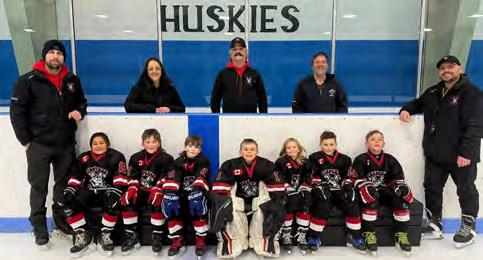
Chapleau Minor Hockey Association (CMHA)bringstogetherfamiliesfrom across Northern Ontario, which includes three surrounding first nations communities. CMHA is focused on creating a positive, inclusive environment where all playersfeelwelcome.
With the Kruger Big Assist donation, CMHA will expand opportunities for those who may face barriers to getting started in minorhockey.Fundingwillsupportthelaunch of an eight-week “Try Hockey” program, providing new players with access to equipmentandasupportiveintroductiontothesport.
The association will also honour the cultural diversity within its region by creating opportunities for new players and offer girls-only ice sessions that foster confidence and create welcoming spaces where players feel encouraged to stay inthegame.
Today, the Ontario government launchedtheRoadmaptoProtectingOntario’s Forest Sector, a 10-year path to protect the workers,businesses,familiesandcommunities of the province’s forestry sector. Building on the government’s strategic investments and actionsto-datethroughOntario’sForestSector Strategy,theroadmaprespondstonewunprecedentedtradepressuresfacingthesectortoday byincreasingtheforestindustry’scompetitive advantage and unlocking new markets to maintain Ontario’s position as a G7 leader in makingandsellingwoodproducts.
“Our roadmap will connect Ontario’s strong forest product supply chains to new sectors here at home and emerging markets around the world,” said Kevin Holland, Associate Minister of Forestry and Forest Products. “Together with our partners, our governmentistakingactiontomeetthiscritical momentandbuildafuture-readyindustry,with thetoolsandtalenttothrive.”
Ontario’s forest sector generates close to $21 billion in revenue and supports over 154,000 jobs across the province.With 97 per cent of Ontario’s forest product exports going totheUnitedStates,theunjustifiedU.S.duties and tariffs pose an immediate threat to these workers, businesses and the communities that depend on them. Ontario is taking decisive action, as part of its broader plan to protect Ontario, to ensure the sector can remain competitive, resilient and self-reliant no matter whatmaycome.
The government will take steps under the threepillars:
-Defendworkers,communitiesandbusinesses by reducing the impact of unjustified U.S. tariffs and duties, working with the federal governmenttokeepcriticalmillsoperatingand promotingOntarioforestryandforestproducts.
-Adapttheforestsectortobemorecompetitive in the global market while safeguarding the long-termsustainabilityofOntario’sforestsby reducing regulatory burden, working with the sectortohelpmodernizeandimprovefacilities and increasing global demand for Ontario forestry products by unlocking new revenue streams.
- Grow long-term demand for Ontario’s forestry products by helping the sector develop and commercialize new forest products, attracting international investment and using more wood to build Ontario as part of the province’sBuyOntariopolicy.
“From the harvesters and sawmills in
the North to the manufacturers in the South, Ontario forestry supports jobs and economic opportunityallacrosstheprovince,”saidMike Harris, Minister of Natural Resources. “This roadmap lays out our plan to build a more resilient forest industry that will create more good-paying jobs and reaffirm Ontario’s positionasthenumberonechoiceintheG7for woodproductsmadefromhighqualitylumber fromourcarefullymanagedforests.”
The Roadmap to Protecting Ontario’s ForestSectorbuildsonactionsto-date,including the release of the Advanced Wood Construction Action Plan and investments under the Forest Biomass Program, the Forest SectorInvestmentandInnovationProgramand the Forest Access Roads Funding Program. Since 2022, the government has invested over $355 million in these programs,supportingcloseto90 businesses,Indigenouscommunitiesandindustrypartners,and creatingmorethan320newjobs across Ontario. Ontario will continue to make strategic investments to protect forestry workers and ensure the sector remains strong for generations tocome.
Working with industry, Indigenous communities and sector partners, the government will develop key performance indicators and report annually on progress towards roadmap goals.
Ontario is the lowestcostlumberproducerinCanada, with a competitive regulatory environment and industryleading talent and technology that maximizebusinessproductivityandgrowth.
Ontario exported approximately $8.3 billion in forest products in 2025. With access to international economiesthroughmorethan50trade agreements, the province is well-positionedtoattractglobal investment and unlock new markets.
The province’s forest sector generates 23% of Canada’s forestry GDP from
just9%ofthenationalwoodharvest,reflecting Ontario’s high value-added manufacturing base and larger share of secondary wood processingthanmostotherregions. Canada and the U.S. rely on Ontario forest products to build homes and infrastructure. Unjustified U.S. trade measures disrupt supply chains, limit productivity and raise constructionandhousingcosts,harmingpeople andbusinessesinbothcountries.
In 2025, the U.S. increased softwood lumber duties from 14.4% to 35.16% and imposedtariffsof10%onlumber(and25%on furniture and cabinetry), resulting in total combined duty and tariff rates on lumber exportsof45.16%.
SHOP LOCALLY
From the archives of Chapleau
Allan Ritchie shares life and experience with grandson
Lark in 'First Communion - Last Communion’
Moments
Michael J. Morris
WritingabouthisgrandfatherAllanRitchie,his grandson Lark noted that he was probably the first 'High-Tech Communication Specialist' out of Moose Factory. He arrived in Chapleau in 1904.
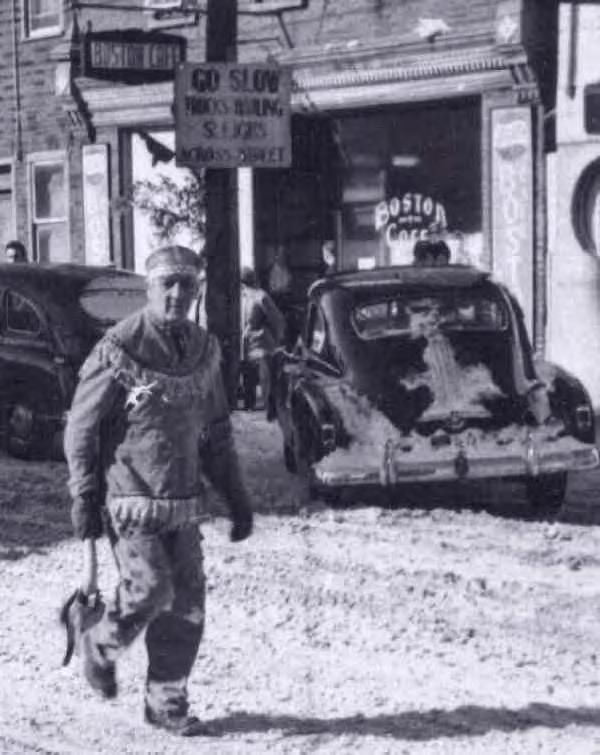
Mr. Ritchie, who was a familiar participantinChapleauparades,workedalarge part of his life as a CPR telegraph operator at various relay points west and east of Chapleau. AllanEarlandRitchiediedinmay1961.
I am delighted that through Brian Ritchie,Lark'sbrother,Iamabletoshare"First Communion - Last Communion', written about timespentwithhisgrandfather.Itfirstappeared inwww.kamazooie.com
'First Communion - Last Communion' by Lark Ritchie
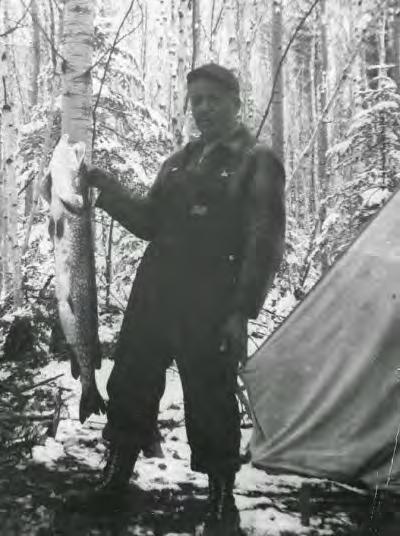
On a Thursday evening in May, in the Springof1961,mymotherfriedsomepikefillets and sent me with them to the Lady Minto Hospital.Ibroughtthemtomygrandfather,who laythereinthelaststagesofcancer.Iwastwelve yearsold,andhe,sixtyseven.
"Hello",Isaid,asIenteredhisroom.He openedhiseyesandlookedupwithashortreply. "Hi Boy, sit down". I sat. He arranged himself, moving a pillow under his side, facing me. We
bothknewhisconditions,thoughwedidnottalk aboutit.
A silence continued. We were used to silence, we had spent my life until that point as grandfather and grandson. Walking and sitting together; few words, long periods of silence, interspersedwithteachingsandplaythathelped makemewhoIamtoday.
I handed him a small brown paper bag. "Mommymadesomefishforyou,"Imumbled, andhandedthebagtohim.Heacceptedthebag, and pulled out two packages wrapped in white translucent waxed paper. He unwrapped one. "Ooo, Fish", he said. His expression conveyed that this was an important thing, and that somehow,Iwasspecialforbringingittohim.
"Whereisitfrom?Whatkind?"
"It’s Pike," I replied, "From down the river."
"Whocaughtit?"
"Daddy caught it. Down past the rapids, intheweedbednearthebeach."
Webothknewthatplace;wehadtraveled the river and each bend, each weed bed was as familiartousasthecupboardsofourhomes.For otherswhotraveltheriver,thatspotisontheeast sideofHendersonLake,asmallsandbeachnow used by hunters in the fall as a moose hunt campground.
Againweenteredamomentofsilence,as hebrokeafilletintotwo."Havesomewithme," andhehandedmeasmallpiece."Ialreadyate,"I said,"wehaditforsupper."Heoffereditagain, urging the fragment towards me, "Have just a littlepiecewithme;it’sbettertoeattogether." Itookitandateit.
For some seconds, we chewed, and swallowed. "It’s good." The short sentence trailedoff,almostawhisper.Iwatchedhimbreak off another piece, which he handed to me. I acceptedit.Hebrokeoffoneforhimself,andas hedid,Isawtearsinhiseyes.ThefirsttearsIhad ever seen in those eyes, and the last. My own eyeswelledwiththesamewarmwater.Herolled onto his back, looked at me, and his hand motioned, "Eat." He placed his own piece into hismouth,andchewed.Ididthesame.
He looked up, past the hospital ceiling towards a sky he saw in his mind, "We used to campthere,onthatbeach,itisagoodplacefora break; to cook." He wiped his lips, and then his eyes; first one, and then the other. "Across the river,thereisasmallbay;behindtheisland.It’s another good place to fish." And he told me a story of a fish he had caught there, and how he hadusedagreenlineandasuckertocatchit,and howithadfloppedinthecanoe.Hetoldmeone more; of a bear on a rock, just down the river a bit.
Our tears had passed, and he asked me
about school, and what it was like outside. I do not remember what else we talked about, or when,orhowIleft.Butitwasthelasttimeweate together, and talked of fishing and hunting, of canoeingandcamping.Isawhimonemoretime; twodaysbeforetheend.Hewasunaware. Wehadsharedafish.Lookingbackatit now,itwasanactofcommunion.Afinalsharing ofknowledge,andbeingtogether.Apassing.The basis of that communion was the river, and the life and lifestyle it provided. Two people connecting,twoadjacentgenerations.Twoages ofhumanity;onemovingintothepast,oneinto the future, bound together by memories of a river.Sayinggoodbye.
This little story illustrates the central significanceoftheenvironmentinmanyNative American lives. When in the last days of life, a manremembersandshareslifeandexperiencein thecontextandframeworkofariver,webeginto understand the subtle, yet vital interweaving of ecology and being, a fundamental entity in personal and social identity.generations. Two agesofhumanity;onemovingintothepast,one intothefuture,boundtogetherbymemoriesofa river.Sayinggoodbye.
This little story illustrates the central significanceoftheenvironmentinmanyNative American lives. When in the last days of life, a manremembersandshareslifeandexperiencein thecontextandframeworkofariver,webeginto understand the subtle, yet vital interweaving of ecology and being, a fundamental entity in personalandsocialidentity.
Allan Ritchie with pike 1954 (Ritchie collection)
Allan Ritchie Chapleau carnival (Ritchie collection)
The Ontario government is launching a consultationtosupportthepotentialsaleanduse ofover-the-counterhearingaids,astheprovince continues to lead the country in advancing innovative solutions that improve patient care. Thischangewouldexpandaccesstoconvenient, accessible hearing support for Ontarians with mild hearing loss and is part of the province’s Health Innovation Pathway, a streamlined system focused on accelerating the adoption of new health technologies that help ensure more patients receive world-class care. This new measurewouldnotinanywayreplaceorimpact Ontario’s existing model of prescription and
“Connecting Ontarians to more accessiblehealth-caresolutionsisonemoreway our government is protecting the province’s health-care system,” said Sylvia Jones, Deputy Premier and Minister of Health. “Expanding accesstoover-the-counterhearingaidswithouta prescription would reduce barriers to treatment forhearingloss,enablingmorepeopletoreturn totheactivitiestheyenjoymost.”
Currently, all hearing aids in Ontario require a prescription from a regulated health professional. Under current regulations, companies that manufacture in-ear headphones andearbudswithbuilt-inhearingaidcapabilities (otherwise referred to as over-the-counter hearingaids) arenot permittedto activatethose capabilities in Ontario. If amended following a period of consultation, proposed regulations would permit those capabilities to be activated, providing more choice and convenience for Ontarians.Thesechangeswouldhavenoimpact on the province’s current model of care and Ontario patients would continue to be able to receive prescribed hearing aids covered under the Assistive DevicesProgram.
Beginning today, the government will launch a 30day consultation. Individuals, industry partners, health organizations and others will be invited to provide feedback on the proposed changes through Ontario’s Regulatory Registry. Following the consultation period, the government will consider feedback received through the consultationbeforemakingany future policy and regulatory decisions.
Through Your Health: A Plan for Connected and Convenient Care, the government is strengthening Ontario’s health-care system, supporting the adoption of innovativesolutionstoprovide people with faster access to high-quality care, when and wheretheyneedit.
The Assistive Devices Program provides funding assistance for prescribed hearing aids for eligible
Ontario residents who have long-term hearing loss,coveringupto75percentofthecostuptoa maximum of $500 for each aid. The program would not apply to over-the-counter, nonprescribed hearing aids. Instead, allowing the sale and use of over-the-counter hearing aids would complement the government’s program and provide people with more choice in obtaininghearingsupport.
TheHealthInnovationPathwayprovides a streamlined process for reviewing and adopting technologies like medical devices and procedures, digital tools, medical imaging and screening,labandgenetictestingandmodelsof health-care delivery to prioritize made-inOntario health solutions and ensure more patientsreceiveworld-classcareclosetohome.
TheHealthInnovationPathwayispartof the government’s Life Sciences Strategy. Ontario Health leads the end-to-end delivery of the Health Innovation Pathway, in partnership withtheMinistryofHealth,SupplyOntario,the Ministry of Economic Development, Job Creation and Trade and the Ministry of Public andBusinessServiceDeliveryandProcurement. Supply Ontario is a provincial agency established to strengthen supply chain managementandprocurementacrossthepublic sector. Supply Ontario will support the review and procurement of promising health technologies through the Health Innovation Pathway.
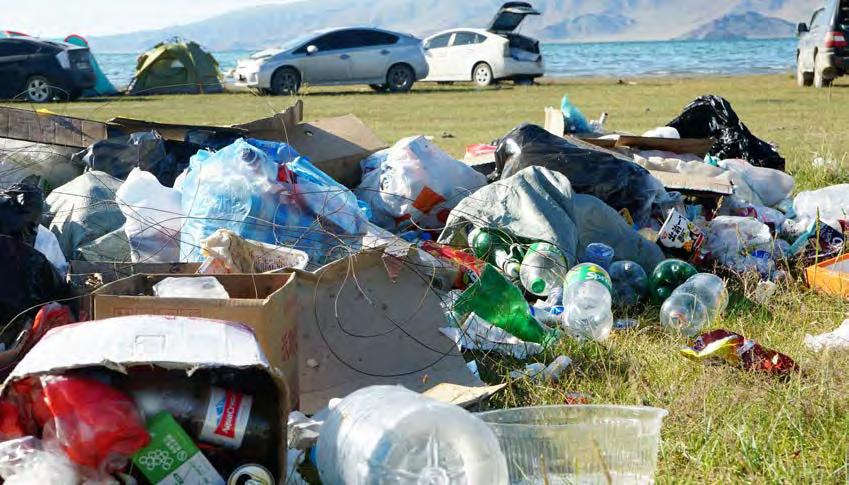
• Shoreline Cleanup data shows the plasticsbanisworking,butitsscopeneedsto increase
• Between 2022 and 2025 all items covered by Canada’s single-use plastics ban sawadeclineinprevalence
• Report data informed 14 local interventions to reduce plastic pollution at its source
• Volunteers removed over 13,445
kilogramsofwastefromwaterwaysin2025
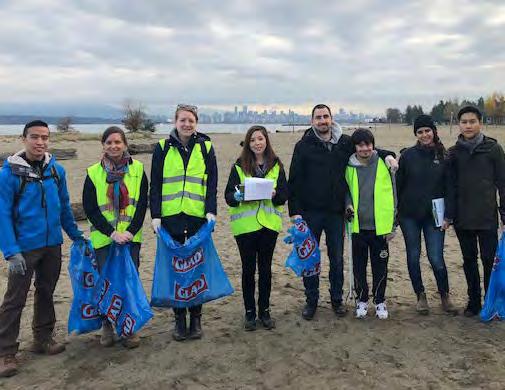
Ocean Wise, an ocean conservation organization headquartered in Vancouver, today released its annual Shoreline Cleanup Impact Report, which shows that Canada’s single-useplasticsbanishavingameasurable impact while highlighting critical gaps in currentregulations.
Drawing on one of Canada’s longestrunning citizen science datasets, the report
revealsgaps
tracks litter collected during Ocean Wise Shoreline Cleanups in Canada and the United States. In 2025, 8,570 volunteers participated in806cleanups,removing13,445.9kilograms ofwasteanddocumentingmorethan345,000 piecesoflitter.
The plastics ban is working, but there arelimits
Thedatashowscleardeclinesinitemscovered bythesingle-useplasticsban,includinga16% drop in plastic bags and a 3% decrease in utensils per person year on year. But these gainsarealsobeingoffsetbyincreasesinitems not covered by current regulations. The number of coffee cups and lids found by volunteersroseby19%,emergingasagrowing sourceofshorelinepollution.
“The data shows what happens when policy targets specific items, and also what happens when it doesn’t,” said Jennie Moushos, Interim CEO of Ocean Wise. “We’re seeing clear progress, but the rise of items like coffee cups and lids shows that the current list of banned items needs to be expandedurgently.”
Dataisdrivingaction
Ocean Wise is working with municipalities to turn shoreline dataintopracticalsolutionsthatpreventwaste before it reaches waterways. In 2025, ShorelineCleanupdatawastranslatedinto14 targeted interventions across five cities, including upgrades to recycling and waste diversioninfrastructureinhigh-trafficareas,as well as expanded school and community educationprogramsfocusedonmicroplastics.
“This report shows the power of collective action,” finished Moushos. “When communities come together, we don’t just cleanupourshorelines,webuildthedataand solutions needed to tackle plastic pollution at its source. Our progress proves that change is possible, and that together, we can go even further.”
Lastweekssolutions
MOMENTS IN TIME
On May 16, 1985, three scientists from the British Antarctic Survey announced, in the scientific journal "Nature," their detection of abnormally low levels of ozone over the South Pole. Within two years, 46 nations signed the Montreal Protocol, pledging to phase out substances known to cause ozone depletion.
Public Health Sudbury & Districts, in collaboration with local school boards, has completedtheannualreviewofstudentimmunizationrecordsunderOntario’sImmunization ofSchoolPupilsAct.Aftercompletingfollowupwiththosewithout-of-dateimmunizations, studentsacrosslocalschoolshavehighimmunizationcoverage.Thisreflectsastrongshared commitment and partnership among families, schools, and Public Health to support student healthandwell-being.
Keeping childhood immunizations up to date stops the spread of illness in schools, preventsoutbreaks,andminimizesdisruptions tolearninganddailylife.
More than 28 000 elementary and secondary students who attend school in the Sudbury and Manitoulin districts were included in this year’s review. Beginning in December 2025, Public Health notified families whose immunization records required
updating. Parents and guardians played a central role in reviewing their child’s records, responding to notices, and arranging immunizations as needed. Schools shared reminders and helped connect families with Public Health.
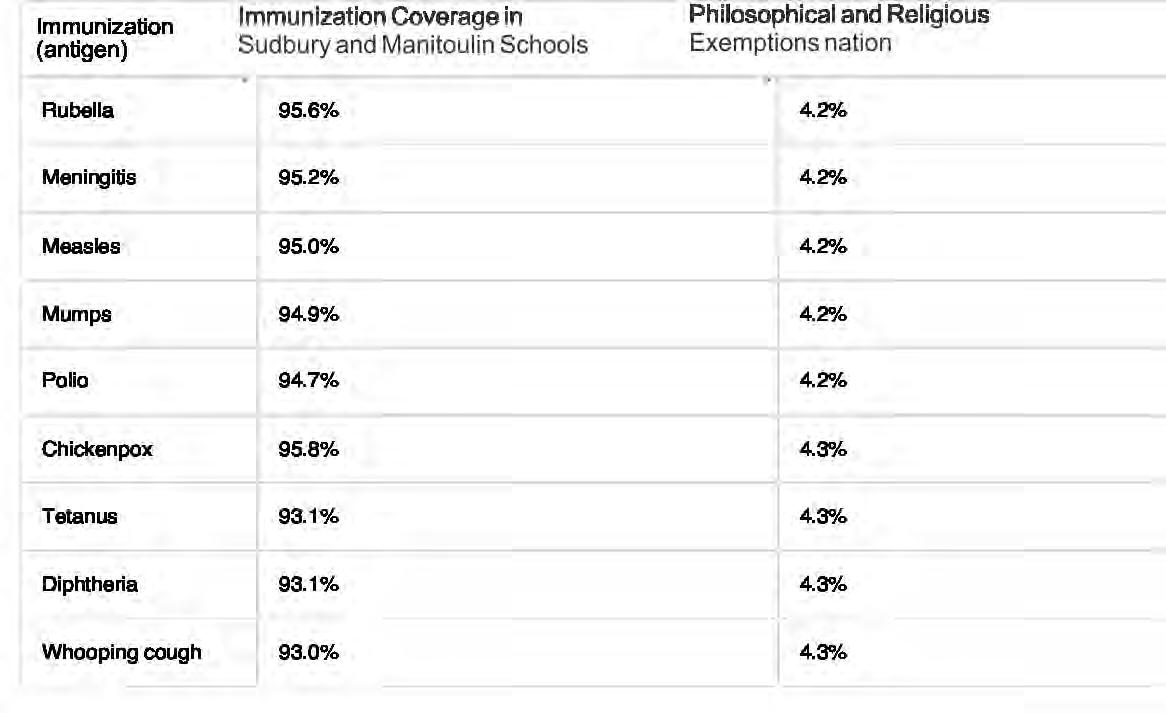
“When families, schools, health care providers,andPublicHealthworktogether,our impact is profound,” said Dr. Mustafa Hirji, Medical Officer of Health for Public Health Sudbury&Districts.“Parentsarmedwithclear information and supports to ease their way respond quickly. Thanks to their efforts, depending on the disease, we have achieved 93% to 96% vaccine coverage in our school communities.”
Public Health clinics administered more than 2 400 vaccines to over 1 600 students.Primarycareprovidersacrosstheservice area reviewed records and vaccinated thousandsmorestudents.Inaddition,manyconversations occurred with families to discuss the benefits and side effects of vaccination. With qualityinformationfromtrustedhealthprofessionals, barely more than 4% of parents opted not to vaccinate, despite being surrounded by unprecedented misinformation that is fueling vaccinehesitancy.
Public Health Sudbury & Districts sincerelythanksschoolboards,schooladministrators,parentsandguardians,andhealthcare providers for their partnership and shared
commitment to keeping students healthy and learningsafely.
Formoreinformationaboutimmunizations or to update a student’s immunization record, visit phsd.ca or contact Public Health Sudbury&Districtsat705.522.9200,ext.458 (toll-free1.866.522.9200).