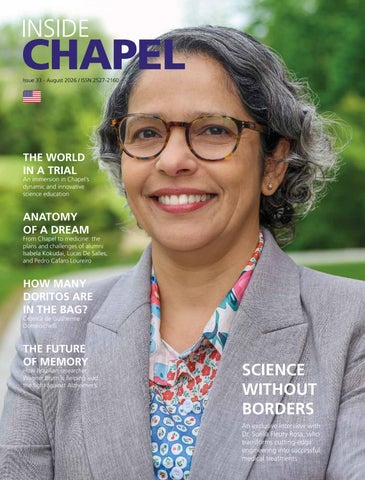
Issue 33 - August 2026 / ISSN 2527-2160
THE WORLD IN A TRIAL
An immersion in Chapel’s dynamic and innovative science education
ANATOMY OF A DREAM
From Chapel to medicine: the plans and challenges of alumni Isabela Kokudai, Lucas De Salles, and Pedro Cafaro Loureiro
HOW MANY DORITOS ARE IN THE BAG? Crônica de Guilherme Domenichelli
THE FUTURE OF MEMORY
How Brazilian researcher Wagner Brum is helping lead the fight against Alzheimer’s
SCIENCE WITHOUT BORDERS An exclusive interview with Dr. Suélia Fleury Rosa, who transforms cutting-edge engineering into successful medical treatments
Engage. Challenge. Support. Care. Prepare students for life.
EDITORIAL
T
Ms. Juliana Menezes, Chapel Superintendent
he 33rd edition of Inside Chapel marks the beginning of the 2026–2027 school year. There is something special about a new school year. It is a time of new beginnings, renewed energy, and fresh possibilities, inviting us to look ahead with curiosity and excitement. At Chapel, we believe that learning extends far beyond the classroom. In an academically challenging and welcoming environment, we are committed to educating the whole student, developing mind, heart, and spirit. Guided by our Christian values, we encourage students to think deeply, ask meaningful questions, make conscious decisions, take responsibility for their actions, and recognize their role in caring for others and the world around them. Our Shared Understanding of High-Quality Learning (SUHQL), one of Chapel’s Guiding Statements, shapes the learning journey and experiences we create for our students. Its final sentence captures the purpose behind all that we do: “Learning has a higher purpose to positively impact society.” This edition brings this idea to life by exploring the role of the sciences in shaping students’ learning, curiosity, and choices throughout their journey at Chapel. We are pleased to feature two remarkable Brazilian professionals whose work demonstrates how knowledge, curiosity, purpose, and perseverance can make a meaningful difference in people’s lives. We introduce Dr. Wagner Schreen Blum, who is contributing to advances in the early diagnosis of Alzheimer’s disease. He is the author or co-author of 61 scientific articles. By 2050, an estimated 5.7 million people in Brazil are expected to be living with some form of dementia (Source: febraz.org.br). His work has earned him the One to Watch Award 2026, presented by the Alzheimer’s Association, the world’s leading organization dedicated to Alzheimer’s research and support. We also explore how science and engineering can transform complex theories into solutions that address real-world challenges. Engineer Suélia Fleury Rosa works at the intersection of science, technology, and health, transforming complex theories into innovative solutions, including RAPHA, a device designed to support the treatment of diabetic foot conditions. She currently serves as a professor and advisor for master’s and doctoral students at Cornell University, an Ivy League institution in New York. For our students, Suélia leaves an inspiring message: Continue developing your skills and cultivating the ability to approach problems through a scientific lens. This way of thinking encourages us to understand why, ask questions, discuss ideas, reflect, challenge assumptions, and seek evidence—broadening our understanding of the world and our place within it. Finally, we turn to the stories of former Chapel students who knew from an early age that medicine was their calling. Their journeys offer a glimpse into how their experiences in the sciences at Chapel influenced their career planning, informed their choices, and prepared them for life beyond our campus. As you explore this edition, I hope you are reminded that science is more than a subject. It is a way of thinking, questioning, and understanding the world. At Chapel, we believe curiosity can become purpose, inspiring our students to use what they learn to make a positive difference. Because at Chapel, learning has a higher purpose: to positively impact society.
STAFF INSIDE CHAPEL IS A SEMI-ANNUAL PUBLICATION BY CHAPEL SCHOOL WWW.CHAPELSCHOOL.COM
EDITORS-IN-CHIEF: Miguel Tavares Ferreira, Marcos Tavares Ferreira, Eliana Cardia and Silas Nunes EDITOR: Paula Veneroso MTB 23.596 (paulaveneroso@gmail.com) EDITORIAL ASSISTANT: Fernanda Caires (publications@chapelschool.com) CONTRIBUTORS IN THIS EDITION: Adriana Calabró, Guilherme Domenichelli, Maurício Oliveira and Paula Veneroso PHOTOS: Acervo Pessoal, Arquivo Chapel, Charissa King-O’Brien e Vanessa Caires GRAPHIC DESIGN AND LAYOUT: João Henrique Moço TRANSLATIONS: Chapel School PRINTER: Eskenazi
CONTRIBUTORS
ADRIANA CALABRÓ [A Brilliant Mind, p. 09] Adriana Calabró is a journalist who develops literature, theater, and audiovisual projects, and conducts her own research on writing as a tool for transformation. She received the PUC/UNESCO Best Books of the Year Seal (2017) and the João de Barro Prize (2016) for her debut book for young readers, Vida Game. She also won the ProAC Literary Creation Award (2007), the Elas Cabíria Telecine Seal (2021), and the Rio WebFest Award (2022, as a collaborating screenwriter). Adriana was a finalist for the Off-Flip and Paulo Leminski awards, as well as in short film festivals in Brazil and in Contis, France. She is the author of nine published books.
GUILHERME DOMENICHELLI [How Many Doritos Are in the Bag?, p. 39] is a biologist, teacher, and writer, working in both print and electronic media. He was a columnist for Recreio magazine and currently writes for Joca newspaper. He has presented programs on TV Cultura in São Paulo (Qual é Bicho, Passeio Animal, and Como cuidar do seu melhor amigo) and is currently the producer and presenter of the YouTube Channel AnimalTV which has over one million subscribers. He is the author of five children’s and young adult books published by Panda Books: Girafa tem torcicolo? (2008), Mistério na Floresta Amazônica (2012), O Resgate da Tartaruga (2014), Criaturas Noturnas (2018), and Gigantes do Passado (2022).
MAURÍCIO OLIVEIRA [Science at Chapel: A Journey Guided by Curiosity, p. 15] has written for the main Brazilian press outlets, including Veja, Exame, O Estado de S. Paulo, Valor Econômico and UOL. Maurício has a Master’s degree in Cultural History and a doctorate degree in Journalism from the Federal University of Santa Catarina (UFSC), and has published over 30 books, which include Amores Proibidos na História do Brasil, Garibaldi, Herói dos Dois Mundos, and Pelé, O Rei Visto de Perto.
PAULA VENEROSO [The Engineer Who Heals, p. 22, and Medical Generation, p. 32] is the editor of Inside Chapel. She is a journalist with a Master’s degree in Portuguese from PUCSP. She has worked as a copyeditor, writer and reporter at Veja and Veja São Paulo magazines and at Folha de S. Paulo Newspaper. For more than 20 years she taught graduate courses in journalism. She currently works as a book designer and editor, in addition to producing and editing news articles for print and digital media.
SUMMARY
09
15
FIGHTING THE BLACKOUT
SCIENTIFIC MINDS, GLOBAL VISION
Recognized as one of the most promising minds in global neuroscience, Wagner Scheeren Brum, a physician from Rio Grande do Sul, is helping lead Brazil’s advances in the early diagnosis of Alzheimer’s disease. An Alzheimer’s Association award-winning scientist, Wagner leads innovative research using blood tests to detect the disease before symptoms appear.
Chapel’s journey in science is centered on curiosity from Early Childhood Education onward, evolving from playful practices to in-depth study of Biology, Physics, and Chemistry. In High School, students’ scientific journey culminates with the strategic choice of IB subjects, including the multidisciplinary Environmental Systems and Societies (ESS) course.
39
42
CHRONICLE
SPOTLIGHT
Based on the idea that human curiosity drives the search for novelty, knowledge, and a deeper understanding of the world—and that, therefore, there is no such thing as a silly question—Guilherme Domenichelli recounts an experience with his students that marked his journey as a biologist and teacher in the chronicle “How Many Doritos Are in the Bag?”
Chapel teachers’ participation in AMISA 2026; activities proposed by students for Senior Take Over; Judge Vanessa Cavalieri’s conversation with students, parents, and teachers; the VIII Literary Meeting honoring Luis Fernando Veríssimo, which broke enrollment records. Catch up on the latest news from Chapel.
22
32
FROM THE LAB TO LIFE
DOCTORS OF TOMORROW
Engineer Suélia Fleury Rosa transforms complex theories into real-world health solutions. She is behind one of the most recent and innovative devices for healing diabetic feet: RAPHA, a device designed to heal diabetic foot wounds by combining LED lights and latex dressings, is expected to be distributed through SUS – Sistema Único de Saúde (Brazil’s public healthcare system) in the near future.
Chapel alums, Isabela Kokudai, Lucas De Salles, and Pedro Cafaro Loureiro chose medicine as their career. They recount how the school played an important role in their lives, recalling the insights that helped them confirm that they had found their true calling.
51
61
TALENTS & PASSIONS
GALLERY
Teachers Carolina Amaral and Talita Vieira, both biologists who are enthusiastic about the sea, talk about their passions. Among students from 6th to 12th grade, pursuits such as singing, ballet, design, and cooking; sports such as tennis, Muay Thai, and soccer; and participation in social projects are highlighted.
A photographic record of cultural and commemorative events from the previous semester at Chapel: Carnival celebrations; traditional foods at the International Festival; the fun activities and culinary delights of the Festa Junina; and the Kindergarten, 6th grade, and 12th grade graduations.
PROFILE
By Adriana Calabró Photos: Personal Archives
A BRILLIANT MIND H
is résumé—which includes a medical degree, a Ph.D. from the Federal University of Rio Grande do Sul (UFRGS), participation in dozens of conferences, and an international award—is undoubtedly impressive both in breadth and depth. One thing is immediately apparent throughout Wagner Scheeren Brum’s professional journey: a deep commitment to scientific research. Although he does not rule out the possibility of practicing medicine, discovering new solutions through research has become the defining focus of his career. “One of the main reasons I followed this path—besides my parents’ encouragement to study—was attending a high school that was unlike most others. It placed a strong emphasis on developing researchers, and hosted one of the largest science fairs in Latin America,” he says. While still in high school, young Wagner dedicated himself to a biotechnology project on the enzymatic biobleaching of cellulose pulp. The study was selected for FEBRACE, the University of São Paulo’s (USP’s) pre-college science fair, and later qualified for presentation at a science fair in New York. It was, without a doubt, a promising beginning. Choosing medicine for his undergraduate studies felt like a natural choice, and he immersed himself in academic and scientific pursuits. Across the universe of possibilities, neurology and psychiatry particularly captured Brum’s attention because, in his words, they were “good for burning neurons through research,” because they are fields filled with scientific challenges. One of those challenges was Alzheimer’s disease, which at the time offered very few accessible diagnostic or therapeutic tools. “I started doing research in this area, and two years later, my
INSIDECHAPEL
WHEN THE CONVERSATION WITH WAGNER SCHEEREN BRUM BEGINS, WE EXPECT TO HEAR THE STORY OF A PROMISING YOUNG SCIENTIST—AND THIS IS EXACTLY WHAT HAPPENS. BUT THE POWER OF KNOWLEDGE NATURALLY EXPANDS BEYOND A SINGLE SUBJECT, AND IT SOON BECOMES CLEAR THAT OUR INTERVIEWEE HAS MUCH MORE TO SHARE ABOUT THE SCIENTIFIC WORLD. HE REFLECTS ON HOW TO ENGAGE WITH ACADEMIA, THE IMPORTANCE OF MULTIDISCIPLINARY COLLABORATION, AND THE CHOICES MADE BY THOSE WHO INVEST IN THEIR OWN CURIOSITY FROM AN EARLY AGE.
9
10
INSIDECHAPEL
PROFILE – WAGNER SCHEEREN BRUM
DEFYING THE STEREOTYPE OF THE RECLUSIVE SCIENTIST, BRUM SHOWS THAT SCIENCE CAN BE A GREAT ADVENTURE, FILLED WITH HUMAN INTERACTION.
Unity makes science Brum speaks enthusiastically about the research center dedicated to the study of neurodegenerative diseases where he works. “In 2018, Professor Eduardo Zimmer returned to Brazil after completing his doctorate abroad in neuroscience, with a focus on Alzheimer’s disease. When he came
back, he realized that few people were conducting truly cutting-edge research, so he began building a multidisciplinary laboratory. I remember that one of my first collaborations was with a physicist, but there were also people from biomedicine, pharmacy, and computer science,” recalls the researcher. “Today there are nearly 50 people.” Another distinguishing feature, he says, is Professor Zimmer’s commitment to keeping everyone constantly connected with the latest international scientific developments through active participation in conferences and continuous exchange with researchers around the world. “We have created a unique and highly collaborative environment where everyone’s expertise complements that of the others. It’s a true living organism that, over time, has profoundly influenced the Brazilian neuroscience landscape.” How does such a laboratory actually function? That is a question that many laypeople and aspiring researchers might ask. Wagner explains that weekly meetings are held to discuss ongoing projects, review preliminary results, and even debate articles that may spark discussion. “Working together every day, in person, makes everything flow
smoothly. Whether in the wet lab—the experimental lab—or the dry lab, where computational analyses are performed, there is always someone available from the team to answer a question or help solve a problem. That makes a difference,” he explains.
A universe for discovery In science, asking questions is a trump card. For Wagner Brum, the specific questions that came up became the driving force behind his own research. The first diagnostic criteria for Alzheimer’s disease were established through a consensus of experts. “The disease was defined by the pathological accumulation of two proteins: betaamyloid and tau protein. However, it was impossible to detect these changes in living patients,” he recalls. During the 1990s, researchers developed the first method for detecting these biomarkers in the cerebrospinal fluid obtained through lumbar puncture, a highly invasive and uncomfortable procedure. In the 2000s, PET (positron emission tomography) made it possible to visualize the distribution of these proteins in the brain. “The problem was that PET scans were extremely expensive, which greatly
INSIDECHAPEL
grandmother became seriously ill and developed more advanced stages of Alzheimer’s disease. Of course, that also motivated me to continue,” recalls the devoted and talented grandson. Brum emphasizes that remarkable progress has been made since he began studying the disease, with numerous new discoveries. Based on the current pace of research, he believes that advances in Alzheimer’s disease will be even more significant over the next five to 10 years. That is encouraging news. Recent Brazilian data indicate that nearly 8.5% of the elderly population lives with Alzheimer’s disease, representing approximately 1.8 million people. By 2050, an estimated 5.7 million people in Brazil are expected to be living with some form of dementia. (Source: febraz.org.br)
11
limited patients’ access to the test,” Brum explains. A major breakthrough came in 2020, when blood tests for Alzheimer’s disease became a reality. For Brum, in particular, the scientific challenge was to determine how this procedure could be implemented safely and efficiently in clinical practice. His work led him to present this research at major international conferences, broadening scientific discussion and culminating in his receiving the prominent One to Watch Award 2026, a recognition presented by the Alzheimer’s Association, the world’s leading organization dedicated to Alzheimer’s research. “Receiving the award was very special. It was another incentive to continue along a scientific path that began early in my life. It’s also wonderful to see our country’s name associated with something positive—that is, high-quality scientific research,” says Brum, who has already authored or co-authored no fewer than 61 scientific articles.
From here to the world Professor Zimmer’s group at UFRGS aims to revolutionize Brazilian neuroscience. The growing presence of Brazilian researchers at major medical conferences suggests that this goal is becoming a reality. This year alone, 50 studies were presented at the Alzheimer’s Association Conference, several of them involving Wagner Brum. “From the beginning, I attended conferences not only to present my own work, but also to participate in and collaborate on other projects. I ended up joining many research groups around the world, including during the two years I spent in Sweden, and realized that people valued my ideas,” he asserts. When asked how he manages so many activities, trips, and academic responsibilities, Wagner admits that it is a real challenge. “My personal life is never 100% organized. I still haven’t found the ideal balance, partly because I also have ADHD. Something urgent comes up, and something important—like physical
BRAZILIAN PHYSICIAN AND RESEARCHER WAGNER SCHEEREN BRUM, 28, REPRESENTS BRAZIL BY BRINGING TOP-QUALITY SCIENTIFIC RESEARCH TO INTERNATIONAL
INSIDECHAPEL
CONFERENCES.
12
activity—ends up pushed aside. That is far from ideal. But one thing I try never to neglect is spending time with my friends and family. That helps me keep my sanity.” For him, whether the conversations are about science or not, talking with colleagues and the people he has met in the many places he has visited is one of the ways he finds balance. Among these important relationships is the one he shares with his girlfriend, a Scandinavian who accompanies him to conferences, allowing them to discover new cities and enjoy good times with friends.
Contemporary challenges If science has evolved and the world has changed, it is worth hearing how a young and successful scientist views human behavior in the digital age. Brum believes that every major technological advance brings both advantages and disadvantages. “It has never been easier to express whatever we want and, at the same time—I’ll say something that sounds a bit like a cliché—we’re overwhelmed by an
PROFILE – WAGNER SCHEEREN BRUM
Long-term vision Asked what message he would like to leave for young people considering an academic career, Wagner Brum is direct. “Research isn’t for everyone, and not everyone enjoys dealing with its challenges. But I think young people should have more exposure to it.” He believes that, although there are exceptions, education is generally too focused on getting students into college as quickly as possible, overlooking the importance of the learning process itself. “My suggestion is to explore different things that don’t necessarily follow the conventional path and discover what you’re good at. Simply realizing that we’re good at something is often enough for us to begin enjoying it,” says the scientist. He also believes that creative activities that stimulate curiosity provide an excellent foundation for anyone interested in research. Friendly and outgoing, Wagner Scheeren Brum defies the stereotype
A SCIENTIFIC LABORATORY IS A LIVING ORGANISM WHERE SEVERAL RESEARCHERS INTERACT AND POOL THEIR KNOWLEDGE.
of the solitary, nerdy scientist and enjoys sharing experiences with others while exploring what the world has to offer. “Even before science, knowledge is about people. We have a much better chance of discovering good things and making new discoveries when we have good people by our side,” he concludes. That is a view that resonates with everything we believe in at Chapel.
INSIDECHAPEL
excess of options and stimuli. As a society, we need to find a healthier relationship with technology. We have more tools than ever, yet it has never been so difficult to simply sit down and get things done. Distractions are everywhere, and we need to learn how to make the most of what the digital world has to offer without losing ourselves or our trust in social interaction.” He also brings science into the discussion by describing both the current reality and the ideal scenario. “We need more and more people engaged in creating knowledge. Research will only be truly valued when there is more funding and better infrastructure to support those working on the front lines. We also need more PhD holders employed in the private sector with appropriate salaries. In Europe, this is much more common because people who want to remain in academia need opportunities.” In Wagner Brum’s view, changing the way science is perceived is essential.
13
INSTITUTIONAL
By Maurício Oliveira Photos: Chapel archives
SCIENCE AT CHAPEL: A JOURNEY GUIDED BY CURIOSITY S
cience is present in Chapel classrooms from the very beginning and consistently emphasizes the most important ingredient for meaningful learning: curiosity. In early childhood education, the foundations of the scientific method—observation, hypothesis building, and experimentation—are introduced intentionally through playful experiences. As students progress through school, the traditional sciences—biology, physics, and chemistry—are taught together until 8th grade, when students begin studying each subject separately. From that point on, students study the three sciences with specialist teachers for three years, before deciding which science subject to pursue during the two years of the International Baccalaureate (IB), based on their future college plans. Beginning in 11th grade, the IB science curriculum also offers Environmental Systems and Societies (ESS), an interdisciplinary science course, as a fourth option.
Playful learning Let’s embark on this journey starting in the early years. Although there is no separate science curriculum in early childhood, science is present throughout the learning experience. “At this age, everything is discovery. Everything is investigation,” says Ms. Carla Eggers, coordinator of the Early Childhood Education Center (ECEC), whose
INSIDECHAPEL
SCIENCE EDUCATION— BIOLOGY, PHYSICS, AND CHEMISTRY—AT CHAPEL BEGINS IN THE EARLY YEARS THROUGH PLAYFUL EXPLORATION AND DEEPENS THROUGH THE INTERNATIONAL BACCALAUREATE (IB) PROGRAM, IN WHICH STUDENTS MAY ALSO CHOOSE ENVIRONMENTAL SYSTEMS AND SOCIETIES (ESS) AS A SCIENCE OPTION.
15
team of 18 teachers and 13 teaching assistants serves 150 children in Pre I, Pre II, and Kindergarten, ranging from three to five years of age. Even without formal science instruction, the goal is clear: to prepare the children for the next stage by developing their investigative skills and helping them acquire a basic understanding of living organisms and the physical properties of objects. A wide variety of activities are planned to achieve these objectives. One recent Pre I project explored water and transformed the classrooms into an ocean floor, generating tremendous enthusiasm among the children. “In addition to helping decorate the classroom walls, the children created costumes of sea creatures using recyclable materials,” explains Ms. Eggers. “We use these activities to introduce concepts related to sustainability.” Rather than following a rigid, predetermined plan, teachers listen carefully to students and allow their interests to guide classroom investigations. “This openness leads to surprising results,” says Ms. Emanuela Santo, an ECEC teacher. “I once had a group of three-and fouryear-olds who became genuinely
interested in learning about sewage. I never imagined children that young would be interested in that topic.” Moments like these, which involve new areas of study, are always challenging but also delightful, she says. “I have absolutely no problem telling children that I don’t know something. Nobody will ever know everything, and that is the greatest fascination of the pursuit of knowledge: remaining in a constant state of learning.”
Nature teaches Any science investigation begins by exploring what children already know about a topic. Before searching for answers, they are first encouraged to think. “We make a list of everything they want to investigate based on what they already know. At the end of the process, we revisit the list to see what they have learned,” Ms. Santo explains. In this way, the basic principles of the scientific method are introduced through questioning and the empirical testing of hypotheses. Surrounded by abundant green spaces and rich biodiversity, Chapel’s campus provides opportunities for outdoor observation and investigation, and the collection of natural materials to use in classroom projects. “Sometimes I take the children outside, give each of them
a small bag, and ask them to collect branches, leaves, and small stones they find on the ground. They then go back to the classroom with the mission of creating something of their own using those materials,” Ms. Santo says. “In this way, science also helps us develop children’s independence and teamwork skills.” Outdoor activities often reveal how unfamiliar some children have become with nature. Even something as simple as taking off their shoes and feeling different textures with their feet can seem unusual to them. “Experiences like these are extremely important at this age because they help develop physical, motor, and cognitive skills,” emphasizes Ms. Eggers. “The other day I read an article about the growing difficulty kids have curling their toes simply because they are always wearing shoes.” Students’ contact with nature extends beyond the campus through field trips. This year, Pre I visited the São Paulo Aquarium, Pre II explored Na Floresta—an educational center within the
São Paulo Botanical Gardens—and Kindergarten spent the day at Cia dos Bichos, an animal farm in Cotia. Besides delighting in the larger animals at Cia dos Bichos, the Kindergarten children also built habitats for small garden creatures—including pill bugs, ladybugs, and earthworms—using natural materials. “These are rich learning experiences that help children better understand ecosystems and how animals depend on one another to keep nature in balance,” says Ms. Eggers.
Intense collaboration In a child’s first years of elementary school, curiosity remains the driving force behind science learning. Perhaps the clearest example is the 3rd grade Science Fair. “Unlike other subjects such as math and English, whose curricula are more structured by this stage, science offers students greater freedom to influence the direction of lessons and experiments through the questions they ask,” explains Ms. Stephanie Mc Farlane, a 3rd grade teacher. She shares some recent examples of experiments
Full structure Seventh grade is the final year in which science is taught as an integrated subject by a single teacher covering general topics such as astronomy, evolution, ecology, and the composition of matter. From 8th through 10th grade, biology, physics, and chemistry are taught separately by specialist teachers in each subject. These teachers follow a rotation system throughout the year, with each spending three months in every
classroom. This methodology allows students to make a more informed choice about which science they will continue studying in 11th and 12th grades, since the International Baccalaureate (IB) curriculum requires students to study one science in depth, aligned with the college major they intend to pursue. “It’s important for specialists to teach students from 8th through 10th grade and to continue with them into the IB. That provides continuity and depth,” says Mr. Rodrigo Salvalajo, the Physics teacher. He explains that teachers with degrees in physics, biology, or chemistry are qualified to teach science, including each of the three disciplines, but it is natural for them to place greater emphasis on their own area of specialization. “That is why the rotation system adopted by Chapel makes such a difference. Each teacher is responsible for the area they know best.” Mr. Salvalajo draws on his own experience to illustrate the value of this methodology. “When I was in elementary school, my science
INSTITUTIONAL – SCIENCE EDUCATION
Ms. Audrey Huang, a 3rd grade teacher (in 2025-2026), also highlights the strong collaborative culture among Chapel teachers across grade levels, as well as with support departments such as Technology and the Library. “That exchange with colleagues becomes even more valuable when we are teaching science because of the interdisciplinary nature of the subject,” she says.
INSIDECHAPEL
inspired by students’ own curiosity: If we plant two seeds of different species very close together, will they produce a hybrid plant? If we bake the same cupcake recipe in different colors, will people prefer one color over the other? Does our heart rate change when we listen to different kinds of music? By 6th grade, science is taught more systematically, with two classes each week, although empirical investigation remains central to instruction. “The students love it, especially because the experiments break up the class routine,” observes Ms. Ruby Sheets, the 6th grade teacher (in 2025-2026). Although the playful spirit remains, there are more opportunities to engage with science more seriously through guided visits to the high school laboratories. These experiences not only nurture curiosity but also help build connections between High School teachers and their future students.
19
INSIDECHAPEL
teacher was a biologist. As a result, I only had real contact with physics—my future career—when I reached high school and began studying the sciences as separate subjects,” he recalls. “When that deep exposure happens a few years earlier, it makes all the difference.” Another major advantage at Chapel, in his view, is having dedicated laboratories for each discipline. “I’ve worked at other schools, and I can say that it is really difficult to find a physics lab.” For Mr. Leonardo Silveira, the chemistry teacher, who holds a bachelor’s degree, a master’s degree, a doctorate, and postdoctoral qualification in the field, the key to awakening students’ interest in science is connecting with familiar everyday experiences. “I always say that the kitchen is our best laboratory. It allows us to observe a variety of
20
chemical reactions, and in the end we can still eat the results,” he jokes, citing baking cookies and mixing baking soda with vinegar as classic kitchen experiments. Ms. Ingrid Vompean, the Biology teacher, also likes to combine learning with fun. “I reserve the tests for the IB years, when we are preparing students for examinations. Before that, whenever possible, I let them choose what they want to do.” She believes that maintaining a playful approach to science is key to keeping students engaged, a challenge that has become even greater in recent years. “Developing activities that release the same level of dopamine as social media videos isn’t easy, but we’re always trying.”
Successful Journey By the time students begin the IB Program in 11th grade, the expectation is that each has a
very clear idea of which science they wish to study during their final two years of high school. For some career paths, the choice is straightforward. Students who plan to become physicians, for example, generally choose biology, while those interested in pharmacy usually choose chemistry, and future engineers tend to select physics. Some careers, however, do not fit neatly into any of these three disciplines. That is why the IB offers a fourth science option: Environmental Systems and Societies (ESS). ESS takes a multidisciplinary approach that combines concepts and knowledge from fields such as geography, economics, history, management, and geopolitics. It is an appropriate choice for students planning careers in business, law, marketing, international relations, diplomacy, and other fields outside
deal with the challenges posed by artificial intelligence, and rely on trustworthy sources of information. In all of these respects, familiarity with the scientific method—which is nurtured from the earliest years at Chapel—plays an essential role. Mr. Salvalajo, Mr. Silveira, Ms. Vompean, and Ms. Vieira make up Chapel’s Science Department together with Mr. Marcio Kuroiwa, the chemistry teacher and Head of the Department. Mr. Kuroiwa highlights the excellent resources available for science education at the school, including a responsive purchasing department that is always willing to obtain materials, even when the requests seem unusual. “We’ve had students who, probably inspired by crime
investigation shows, used luminol to see if crime scenes could be changed,” he says as an example. Mr. Kuroiwa emphasizes that the entire team works with determination and a well-defined methodology from the early years at Chapel to provide students with the best possible science education—a process that reaches full maturity during the IB Program. “The quality we develop throughout this journey becomes evident when our students get to college. Across many different fields, they have no difficulty keeping up with their courses, conducting research, and carrying out more in-depth academic work,” says the Head of the Science Department.
INSIDECHAPEL
STEM and the life sciences. “It is a curriculum that has to be updated continuously, because it deals with topics that are constantly changing, such as sustainability, biodiversity, and climate change,” observes Ms. Talita Vieira, the teacher responsible for the course. A biologist with a master’s in ecology and a doctorate in botany, she explains that students’ individual interests and personal experiences make important contributions to classroom discussions. “The diversity of backgrounds and experiences we have at Chapel is very enriching.” For students who choose ESS, keeping up with current events becomes even more important. This requires discernment and critical thinking to identify fake news,
21
INTERVIEW
THE ENGINEER WHO HEALS Por Paula Veneroso Fotos: Arquivo Pessoal By Paula Veneroso Photos: Charissa King-O’Brien
I
n Brazil, aside from traffic and workplace accidents, diabetes is the leading cause of lower-limb amputations, particularly of the feet. An article published in Jornal da USP in November 2025 warned: “Data from the Health Ministry raise the alarm that this is a public health issue, since an amputation takes place every hour due to diabetic foot. In 2022, 10,000 amputations were carried out—28 amputations per day, more than one every hour.” Starting with this sobering statistic, we travel back in time to Brazil’s Midwest, to the city of Goiânia, where Suélia was born into an impoverished family with a diabetic father. Her mother, a homemaker, had finished high school but never dreamed of going to college because, “at the time, that wasn’t something feasible,” she recalls. Her father, an employee of the Goiás state sanitation company, was illiterate: he only knew how to ‘draw’ his name to sign documents. In her family’s imagination, she would become a successful salesperson in a shopping mall because of her pleasant appearance. “But I loved studying; it was something I truly valued. I would come home from school, and before taking off my uniform, I would run to do my homework. It was wonderful to receive stars from my teacher, whom I deeply respected, and their colors—green, orange, and yellow—brightened my childhood,” she says. She adds, “My parents’ divorce, followed by periods of sadness and extreme poverty, and my father’s death—from a disease that was not treated seriously—all this instability
INSIDECHAPEL
SUÉLIA FLEURY ROSA IS THE NAME BEHIND ONE OF THE LATEST INNOVATIVE DEVICES FOR HEALING DIABETIC FEET—THE SECOND LEADING CAUSE OF AMPUTATIONS WORLDWIDE. YEARS OF DEDICATED SCIENTIFIC RESEARCH LED TO RAPHA, A DEVICE THAT HEALS WOUNDS THROUGH A COMBINATION OF LED LIGHTS AND LATEX BANDAGES AND WILL BE DISTRIBUTED BY SUS—BRAZIL’S PUBLIC HEALTHCARE SYSTEM—IN THE NEAR FUTURE. BEHIND THIS SCIENTIFIC ACHIEVEMENT ARE REMARKABLE QUALITIES: PERSEVERANCE, DEDICATION, AND RESILIENCE. THE RESEARCHER’S PERSONAL STORY HAS ALWAYS BEEN MARKED BY DETERMINATION, ENERGY, AND HOPE IN THE PURSUIT OF POSITIVE RESULTS FOR BRAZILIAN RESEARCH AND BY HER DESIRE TO INSPIRE YOUNG PEOPLE TO DEDICATE THEMSELVES TO SCIENCE, A CAUSE TO WHICH SHE IS DEEPLY COMMITTED.
23
INSIDECHAPEL 24
separated us; my sister and I were sent to live in different homes with people who were not our family. It was an abrupt rupture, but I kept studying; that was the backbone of my existence.” Her dream was to find a cure for the disease that took her father’s life or, at least, to improve the quality of life of those living with it. During high school at one of Goiânia’s most traditional public schools, Suélia began giving private math and physics lessons—subjects she mastered —to the daughters of a doctor. Because she excelled in math and physics, she applied to study engineering and was accepted. At the time, in the late 1990s, she never considered studying medicine because it seemed far beyond her reach. This is the story shared by the current Level IV professor at the University of Brasília and advisor to master’s and doctoral students at Cornell University, the Ivy League institution in New York State, where she gave this exclusive interview to Inside Chapel.
Our first question is an obvious one: If your goal was to find a cure, why did you study engineering and not medicine?
AS SOON AS I GRADUATED IN ELECTRICAL ENGINEERING, I REALIZED THAT I WAS NATURALLY DRAWN TO ACADEMIA, THAT I TRULY ENJOYED RESEARCH AND SCIENCE, THAT I WAS DEEPLY CURIOUS, AND THAT HEALTH WAS WHERE I BELONGED.
SFR: When I was in high school at a public school, my dream was to study medicine because I really wanted to be in a hospital saving lives, preventing early deaths like my father’s, who died from diabetes at the age of 55. So many chapters of his life were cut short. He didn’t grow old. He didn’t live to see his grandchildren come into the world. His life ended too soon. However, for me, medicine was unattainable; it was only for the wealthy. I studied engineering, which was a course that felt more within my reach; after all, a mechanical pencil was a lot cheaper than a stethoscope. And I had a knack for STEM subjects. Engineering was easy for me. Subjects like history are my Achilles’ heel because I cannot memorize dates or periods of time. They drove me crazy. However, I don’t have this issue when it comes to mathematical formulas because I
Your research career started in your undergraduate years when your first grant came through. Tell us what came afterwards. SFR: When I arrived in Ilha Solteira (São Paulo State) to study electrical engineering, the first person I met was Professor Célia Aparecida dos Reis, a mathematician. She was a stern professor. Right then and there I got a good understanding of what scientific research really was: her rigor taught me responsibility, meeting deadlines, being accountable, and making a commitment to deliver what I promised without passing the responsibility on to others. Professor Célia coordinated a research project and needed grantees.
I applied and was accepted. But the project was pure math, building theorems and equations, and I have a practical mind. So I asked the professor to find me a project where I could apply the concepts, and she gave me her okay. I found a project where people and machines interacted in major industries and I worked with the professor throughout my five undergraduate years, developing interface models. When I finished the course, I looked for an internship because I needed the income to help my family, since my dad had already died, and my younger sister had already started college. With financial help from peers, teachers, and even the engineering college dean, I went to São Paulo to apply for an internship at Siemens and was hired. After two
years, I was transferred to Brasília, which helped me stay close to my Goiânia family and also helped me see that industry wasn’t my forte. I realized that I was naturally drawn to academia, that I truly enjoyed research and science, that I was deeply curious, and that health was where I belonged.
And when were you finally able to bring medicine into your research career? SFR: It was during my master’s. I applied to ITA (Aeronautics Institute of Technology) in São José dos Campos (SP State), where I broke with convention and found an advisor who worked with medical robotics. Because I had a strong background in mathematical modeling, we developed a robot that made more
TO ME, A TEACHER IS LIKE A MOM. NOBODY CALLS THEIR MOM BY HER NAME; THEY SIMPLY CALL HER ‘MOM’.
INTERVIEW – SUÉLIA FLEURY ROSA
don’t memorize formulas; I understand them. It’s a different way of thinking.
IN RESEARCH, YOU SHOULD NEVER PULL THE LADDER UP BEHIND YOU.
precise incisions in tibial osteotomies, a procedure that had been very risky in Brazil up until then, but was already performed in Ireland. It was the first master’s dissertation in ITA’s history that combined the electrical and mechanical engineering departments. I had two advisors and even though my friends called me crazy, I was never afraid to put myself out there. After earning my master’s degree, my life became a lot easier, because I got a grant and was able to improve my mother’s quality of life. I was ready to pursue a doctorate. I applied to ITA and UFRGS (Federal University of Rio Grande do Sul) and was accepted at both, but broke with convention once again. I decided to go to the south of Brazil because translational research was already a strong interest of mine. But, once I got there, my advisors’ goal was for me to work on aircraft, whereas I had always wanted to translate knowledge into healthcare. So I had to break away.
INSIDECHAPEL
In Brazil, you are an icon of translational research, whose goal is to convert scientific discoveries made in the lab into practical clinical applications...
26
SFR: That is why I am critical of the way science is conducted in Brazil. Because of this limitation, we don’t have a Nobel Prize. We are too inward-looking and that bothers me greatly. We do not share research, and Brazilians are not very cooperative with their colleagues. I see things differently. The science I do is not mine; it belongs to my country. It belongs to the country that paid for my education, to those who funded the grant that allowed me to carry out my research, to those who paid the taxes and who have no idea what I was studying. So the science I produce, the articles that I write, are not Suélia’s. I am merely the writing tool. There are many people involved, and what I produce is also theirs. This has always been my motto. This process enabled me to
learn something interesting, which I bring to my classes: whenever I don’t understand something, I ask. I tell my students, “Never let your fear of asking questions or admitting what you don’t know hold you back.” For example, English was not my second language when I came to the US and, to this day, I am not as fluent as I would like to be, but I don’t stop learning. That is why I ask my students for help with pronunciation and vocabulary. Knowing my limits is something I have prioritized, and this has helped me suffer less.
Going back to your career, what happened next? SFR: The University of Brasilia had an opening for a professor and another for a doctoral student. I was accepted for both. During my doctorate, I worked for some time on leg prostheses for amputees at Sarah Kubitschek Hospital, which specializes in this area. Then my advisor wanted to change the focus of my research, so we began working with latex. That became the subject of my doctorate, and it turned out to be a great decision because it broadened my perspective and eventually led to the creation of the RAPHA device. That brings me to another very important point: the generosity of those who came before us can give us an incredible wealth of knowledge. I think vanity prevents Brazil from moving forward, and unfortunately many professors pass that attitude on to their students, which is not good.
What do you mean? Could you explain that further? SFR: The goal is to spread knowledge, to let it flow throughout the entire scientific research network. The people who work with us absorb the knowledge we share and pass it on to the next person. It’s a chain reaction of learning, with everyone benefiting from the process. When the final result comes, it does not belong to just one person. No one holds up the trophy alone. There are many people behind every achievement, and students are always part of that
This ‘capillarity’ has helped make one of your most successful projects, RAPHA, designed to heal diabetic foot wounds, widely known. Tell us about it. SFR: RAPHA is a device that combines LED lights with natural latex dressings, a natural product from the Amazon that plays an important role in tissue regeneration. The device combines natural latex dressings with LED light emitters and is applied in a simple, safe, and pain-free way. When activated, the LED lights stimulate tissue regeneration, especially in
by Suélia Fleury Rosa “In the United States, students usually call their professors ‘Dr.’ However, the one thing I ask of my students is that they call me ‘teacher,’ because to me, a teacher is like a mom. Nobody calls their mom by her name; they simply call her ‘Mom.’ I studied for many years to earn that title, and it is very special to me because it brings so many feelings to mind. The title ‘Dr.’ places me at a distance from my students, whereas ‘teacher’ represents a relationship of trust and care, much like the bond we have with our mothers. It’s part of my teaching philosophy. While my own mind enjoys learning complex things, I make every effort to explain them in a simpler way to my students, because I want them to reach the same level of knowledge as I have. A good teacher must know how to work with students who challenge them the most. That is what truly sets a teacher apart. This is true in every kind of school—public or private, well-funded or with very limited resources, regardless of the social structure. Anywhere in the world, there are students, and they all need to be treated as unique, singular individuals, each with their own limitations and needs. You leave the classroom emotionally drained if you are a teacher who is simply there to do a job rather than to teach with genuine dedication.”
INTERVIEW – SUÉLIA FLEURY ROSA
“TEACHER,” A TITLE THAT COMES RIGHT AFTER “MOTHER.”
INSIDECHAPEL
success. None of this happens without students—their energy, their fresh ideas, and their constant renewal. Those of us with more experience need that spark to renew our own energy. After all, we have to pass the baton. I’ll have to retire someday! [laughs]. At UnB, we call this capillarity. When we received funding, I would recruit scholarship students from the Northeast, the North, the Southeast—we worked with everyone. We need the experience of those who came before us, but we also need young people. We need balance. That’s why I always tell my students and advisees, “I’m with you, and you’re with me.”
27
THE SCIENCE I DO IS NOT MINE. IT BELONGS TO MY COUNTRY, TO THE PEOPLE WHOSE TAXES FUNDED THE GRANTS THAT ALLOWED ME TO CARRY OUT MY RESEARCH, AND TO THOSE WHO HAVE NO IDEA WHAT I WAS STUDYING.
WHO ARE RAPHA, SOFIA, AND ENY?
INSIDECHAPEL
Yes, the names of Professor Suélia’s projects sound like people’s names because she likes to give each research project its own identity. “Bringing a translational project all the way to commercialization makes me personify the results, and each name has a special meaning,” she explains. RAPHA, for example, is not an acronym. It’s a Hebrew name meaning “the one who heals.” The RAPHA device was designed to “heal diabetic wounds, which are persistent and difficult to close,” says the researcher. “SOFIA, in turn, brings a sense of lightness to a very serious disease: liver cancer,” says Suélia, explaining why she chose a feminine name for a hepatic radioablation device developed through a project she also coordinated that addressed one of the deadliest cancers affecting men, often associated with cirrhosis caused by excessive alcohol consumption. The organ-on-a-chip* ENY was named after the mother of one of her students. “Gustavo was the student whom I mentored, who spent the longest time with me throughout his academic journey. I first met him in class in 2005, and he asked me to supervise his undergraduate thesis. Later, he completed his specialization, master’s degree, and doctorate under my supervision,” she recalls. His doctoral research focused on developing a chip that allows tissue to grow without using animals in experiments. “I am an advocate for animals, and I oppose their use in research,” reveals Professor Suélia, explaining that ENY, Brazil’s first organ-on-a-chip, was developed at UnB under her supervision.
28
*Organ-on-a-chip is a biomedical technology that uses clear, flexible microchips the size of a USB flash drive to cultivate living human cells inside tiny microchannels that simulate the structure, function, and physiological responses of human organs. These devices recreate the body’s internal environment, including blood flow and tissue mechanics, allowing drug and model disease testing, with the potential to replace animal testing.
Listening to you explain it makes it sound very simple to use. Why isn’t it on the market yet if research has been underway for almost two decades? SFR: RAPHA has been a tremendous learning experience because the translational process has taught us a great deal since 2009. We have a term for something developed in academia, within a university, that never reaches the individual, the SUS public healthcare system, the pharmacy, or anywhere at all. We call it “Death Valley.” Why does this happen? My mind has never accepted it and never will. The same thing happens here in the United States, and in some ways it is even worse. When I came here, I thought things would be different. To my surprise, Cornell is discussing exactly the same issue that we discuss in Brazil. Why do we continue receiving federal funding if the products never reach the market? Why can’t people benefit from them whether by buying them or receiving them through SUS public healthcare? That is when we started pursuing a few theories, and one explanation became very clear to us: researchers want to do everything within their own labs. That is where the problem begins. Although we followed the many regulations and protocols required by ANVISA (Brazilian Health Regulatory Agency), we could not access the specialized equipment
Many lessons were learned, but continuing with your story, the question is: did perseverance win out? SFR: We built strong relationships with well-intentioned people who came into our lives, and RAPHA continued to grow. Then we reached a crucial point: manufacturing capacity was already stretched. Taking a product from academia to the marketplace isn’t easy. Regulatory agencies scrutinize every detail, and no company willingly takes on that challenge. So we had to build trusting relationships with manufacturers. Then the pandemic arrived, and with it came an opportunity. The Secretary of Health for the state of Goiás, an oncologist, contacted me about a virus that would require a different type of mask. I brought
together a group of 90 people on WhatsApp, and over time, because of the pandemic, we learned how to move more quickly through several processes. The Vesta mask, which deactivates 99% of fungi, bacteria, and viruses, went from the drawing board to the marketplace, completing the entire translational process. Today, it is commercially available, incorporates embedded nanotechnology, is patented, has generated scientific publications, dissertations, and theses, and has received several awards. Many people across Brazil contributed to the mask project, making it a milestone for UnB: it became the first Class 1 product approved by ANVISA and made available to society in the university’s 60-year history. From that experience, I learned that before deciding what we wanted to create, we first had to understand what manufacturers were actually capable of producing. Everything we developed was therefore based
INTERVIEW – SUÉLIA FLEURY ROSA
we needed because many specialty laboratories in Brazil were unwilling to open their doors to projects that weren’t their own.
INSIDECHAPEL
wounds caused by diabetes. The patient simply cleans the wound and applies the device for 35 minutes. It doesn’t require electricity, since that isn’t always available in some parts of Brazil. Instead, it runs on a 9-volt battery, so it can be used anywhere. When the treatment has finished, the device automatically turns itself off, in case the patient has fallen asleep, for example. Afterwards, it only needs to be cleaned before being used again. Its manufacturing cost is well below R$ 200, making its distribution through the SUS public healthcare system much more feasible.
29
THE GOAL IS TO SPREAD KNOWLEDGE WITH THE ENTIRE SCIENTIFIC RESEARCH NETWORK. THE PEOPLE WHO WORK WITH ME ABSORB WHAT I SHARE AND PASS IT ON TO THE NEXT PERSON. EVERYONE LEARNS. AND WHEN THE FINAL RESULT COMES, IT DOES NOT BELONG TO JUST ONE PERSON—IT BELONGS TO MANY.
on Brazilian manufacturing capacity. Naturally, the manufacturer still had to make certain adaptations, and that’s how the mask ultimately received the ANVISA seal of approval. That success showed me the path to introducing RAPHA to the same industry.
INSIDECHAPEL
Did it work out? When will RAPHA be produced on a large scale?
30
SFR: It’s working out. For RAPHA, we researchers gave up our royalties so that the device could become commercially available, and it has been very well received. For the past two years, we have worked closely with the manufacturer without receiving any financial compensation for our team, while extending unlimited technical support. The company will distribute the device throughout Brazil, except for an initial production run, which will be donated to the University of Brasília Hospital. Our agreement with the manufacturer also states that royalties will later be paid to UnB once the company’s initial investment has been recovered. After all, UnB was the institution that made much of our research possible.
And when will RAPHA become available through SUS, Brazil’s public healthcare system? SFR: Before that can happen, there is still another stage to complete. RAPHA has already received an ICD (International Classification of Diseases) code for wound treatment. Next, it must be evaluated by CONITEC (National Commission on Technology Implementation), the Ministry of Health body responsible for assessing new technologies before they are incorporated into SUS. Because RAPHA received funding from the Ministry of Health during a certain period, its review may proceed by way of an internal request, which would speed up its approval. Once ANVISA grants its approval, the final stage will involve UnB’s Office of the Rector and the manufacturer’s meeting with the Ministry of Health to request its evaluation. If we successfully complete this entire process—and I truly hope we do so, with RAPHA becoming part of SUS treatment protocols–that would be the perfect way to close this chapter. Then, I will be ready to retire.
When it comes to learning science, what message would you like to leave for young students? SFR: I want to tell them that every opportunity they have at school to study science will make a difference in their lives, no matter what career they pursue. Scientific thinking is a skill everyone should develop. Looking at problems scientifically opens countless opportunities: understanding why things happen, asking questions, discussing ideas, reflecting, questioning your own answers, broadening your understanding, in brief, applying theories and concepts that you never imagined you would use. So embrace opportunities to experience science—whether at a science fair or in the classroom—with enthusiasm. Even if you choose a career in business, science will always be part of your life. It is in there in the most basic everyday activities, even preparing the food we eat.
Dr. Suélia, what message would you like to leave for teachers? SFR: I would tell teachers that we face many challenges, and the newest is artificial intelligence. We cannot reject its presence in the classroom—we need to embrace it. This week, before
INTERVIEW – SUÉLIA FLEURY ROSA
Women are twice as likely as men to develop Alzheimer’s disease because of menopause. Although this increased risk is associated with the sharp decline in hormones such as estrogen, many questions remain unanswered, and few studies have explored the topic. To help improve the quality of life of women in midlife and beyond, Professor Suélia Fleury Rosa is currently developing MenoTwin, a multi-system platform that integrates individual symptoms with hormonal, physiological, metabolic, and cognitive data to create personalized clinical intelligence capable of predicting and reducing cognitive decline during the transition to menopause and the risk of Alzheimer’s disease through the early identification of each woman’s individual risk. “Today, there is a technology called Digital Twin, which basically creates a digital copy of a patient’s data so that predictive models can be developed,” explains Professor Suélia. “The goal is to understand what is happening with each woman individually. Because every woman responds differently, the clinical diagnosis should also be personalized. MenoTwin seeks to do exactly that through yet another collaboration between engineering and biomedicine,” concludes the researcher as she prepares to publish the project’s first scientific article later this year.
my students left for break, I showed them a problem solved by artificial intelligence and asked them to do exactly what I had done: use artificial intelligence to solve it. They couldn’t get the correct answer. Why? Because without us as teachers to guide them, artificial intelligence—and even the best prompts—isn’t enough. Students need teachers to guide them and provide the kind of feedback that only teachers can give—human, trustworthy, and tailored to each individual. Artificial intelligence is not designed to do that, and I don’t believe it ever will. So, teachers, recognize your unique value in the classroom. You have the unique responsibility of guiding young minds individually. Feel valued, because you are shaping the future of the world.
To close, what message would you like to leave for the growing number of women pursuing careers in science in Brazil and around the world? SFR: From my undergraduate years until today, I have never stopped doing research. In 2026, it will be 29 years since I received my first research grant from FAPESP (São Paulo Research Foundation). Just as it happened to me, I have no doubt that we will continue to see more and more women in research. First of all, we women must never pull the ladder up behind us. We have to welcome and support the women who are on the way up behind us, especially the younger women beginning their journeys. We also need to encourage the men who believe in women in science and who support women in leadership positions. Most importantly, we have to work alongside them, because it is well known that two heads are always better than one. I hope we continue to find the courage to face challenges and forge ahead. The hard sciences need women because they sometimes require perspectives that those who came before us could not provide. We are here to help change that. So, women, come to the hard sciences. It is such a beautiful, fascinating field. I love it. You can tell, can’t you? [laughs].
INSIDECHAPEL
THE NEXT PROJECT: FOCUSING ON WOMEN
31
ALUMNUS
By Paula Veneroso Photos: Vanessa Caires
INSIDECHAPEL
MEDICAL GENERATION
32
FORMER CHAPEL STUDENTS AND FUTURE DOCTORS ISABELA KOKUDAI, LUCAS DE SALLES, AND PEDRO CAFARO LOUREIRO SHARE WHY THEY CHOSE MEDICINE AND EXPLAIN HOW THE SCHOOL’S INTERNATIONAL FOUNDATION AND VALUES INFLUENCED THEIR PROFESSIONAL CHOICE.
A
lthough each followed a different path, the three Chapel alumni are now studying medicine—two in Brazil and one in Ireland. What Isabela, Lucas, and Pedro have in common is their dedication to learning, perseverance, and the International Baccalaureate (IB) Diploma. They belong to a generation of students who understood, even in elementary school, that knowledge is not simply a goal but a journey built through autonomy. When they left Chapel, each carried with them part of that foundation to face the challenges of a medical degree.
THE RIGHT TIMING OF ISABELA’S FINESSE AND RESILIENCE For Isabela, Chapel was the backdrop for nearly her entire life—a welcoming and caring space. She spent 14 years there, from Pre II at the age of four through her graduation from high school in 2022. It was a
continuous journey, shaped by her family’s values and her parents’ desire to provide her with an excellent English-language education. “I really miss school. Some people graduate and don’t want to think about it anymore, but I really miss it. I was always very close to the teachers. We built friendships with them, got to know everyone, every familiar face,” she says, recalling with affection the traditions of the International Festival and the colorful Festa Junina celebrations. She did more than simply attend school. Isabela chose to lead and become actively involved in school life, serving on the Student Council (StuCo) from seventh grade through her senior year and as a member of the National Honor Society (NHS). “Organizing Spirit Week and all the events—which were connected in the end—was really special. I treasure those memories,” she says.
Subtle and natural Determined to become a doctor in Brazil, Isabela’s decision to study medicine gradually took shape while she was in 9th grade, driven by a genuine interest in Biology classes. Since there are no doctors in the family, she had to forge her own path. Her main goal was admission to Faculdade
I WAS ALWAYS VERY CLOSE TO THE TEACHERS. WE BUILT FRIENDSHIPS WITH THEM, GOT TO KNOW EVERYONE, EVERY FAMILIAR FACE.
Israelita de Ciências da Saúde Albert Einstein, one of the few prestigious institutions that accepts IB scores for direct admission. The competition, however, was very tough: only two spots were available through that route. On her first attempt, right after graduating, she was unsuccessful. To prepare herself better and bridge the gap between the reflective philosophy of the IB and the more exam-oriented format of Brazilian entrance examinations, she spent all of 2023 in a traditional college preparatory course. The process demanded emotional resilience. “It was really
hard to do the prep course because it felt like a setback. I worked so hard throughout school, and not getting in on my first attempt was difficult. But in the end, everything worked out,” she recalls.
Down to earth Isabela’s dedication paid off. Through the traditional college entrance exam, she was accepted into both Santa Casa Medical School and the ABC Medical School. However, she ultimately achieved her major goal in a different way: she reapplied to Einstein using her still-valid IB score and secured her dream spot.
A COMPLETE ECOSYSTEM AND LUCAS’ HERITAGE
INSIDECHAPEL
People often say that medicine is a profession passed down from one generation to the next, like an invisible baton. In Lucas’ family, medicine was always present at the dinner table. Both his father and mother are neurosurgeons. Watching their routines and observing complex surgeries up close while growing up did not discourage him from donning the white coat. On the contrary, it awakened a natural sense of vocation. Being accepted into Brazil’s most competitive medical schools depended far more on his own effort than on his family name. Lucas was a brilliant and determined student. “I was always very committed and determined. So when it was time to really focus on studying, it came naturally,” he says. That dedication produced remarkable results. Lucas earned an impressive 43 points on the IB Diploma, an exceptionally high score that requires outstanding performance across all subjects and places students among the highestachieving IB candidates worldwide. This score was essential to Lucas’ plans, since Einstein Medical School requires an exceptional academic record from students seeking direct admission through the International Baccalaureate.
34
She is now in her fifth semester and praises the medical school’s active learning approach, which closely resembles the independence she developed at Chapel. “From the very beginning, we have to develop projects, pursue the research we want to carry out, and group work is a major part of the program. In that sense, Chapel prepared me by shaping the kind of student who fits in really well here.” In her daily academic life, she makes a point of dispelling the glamour often associated with the institution: “People think we’ll only train at Einstein Hospital, but that’s not the case. Most of our practical
training and internships take place in public hospitals, including Heliópolis, Ipiranga, and M’Boi Mirim. That’s where we build our foundation and gain close contact with the SUS (Brazil’s public healthcare system).” Open-minded, Isabela is in no hurry to choose a specialty. Surgery interests her, but she remains open to different possibilities, just as Chapel encouraged her to be. Her journey is, in many ways, a living example of what our academic community hopes to offer the world: professionals with outstanding technical skills and deeply human values.
Support and flexibility Lucas’ Chapel journey began in Pre II and grew into many happy years at the school. He embraced every aspect of school life: he served on the StuCo, was president of the NJHS in 9th grade, and secretary of the NHS in 11th grade. He stepped back from leadership roles only during his senior year so that he could devote himself fully to the final IB examinations. Beyond his stellar academic achievements, Lucas was a standout on the soccer field. As captain of the Varsity team, he led the school through a golden era, winning three consecutive futsal championships.
Long-lasting ties That closeness and openness helped him build lasting relationships with his teachers. As soon as he saw his name on the admission list, Lucas sent thank-you messages to
MY JOURNEY AT CHAPEL WAS A LONG ONE. I’M VERY HAPPY IT WAS BECAUSE CHAPEL WAS MY SECOND HOME.
ALUMNUS – ISABELA, LUCAS E PEDRO
As his academic workload increased, the support and flexibility of his teachers helped him balance the demands of school. “I played soccer, but as my studies became more demanding, I couldn’t attend practice. I talked to Mr. Bruno Pereira, and he understood. Even so, I played in every match because staying physically active was important to me,” he recalls. The sport also taught him lessons that he certainly carried into his medical career: “What I loved most about school was playing soccer. Team sports teach you how to win, how to lose, and how to deal with frustration even when things are not your fault,” he explains.
several of them. He is often in touch with mentors including Mr. Desai, Mr. Weaver, and Ms. Vompean, his biology teacher, with whom he exchanges WhatsApp messages every week. “I think the relationships I built with some of my teachers really turned them into lifelong friends,” he says. The list of teachers who shaped Lucas’ years at Chapel is long, and he apologizes for not having enough space in this article to mention everyone he is truly fond of. Now experiencing life at Einstein Medical School, the future doctor praises both the outstanding faculty— all practicing physicians—and the excellent facilities. He also jokes about the makeup of his class of 80 students. “Most of the class is made up of women. There are only 16 men—we barely have enough for a team.” What excites him, however, is the wide range of sports offered by the college, allowing him to stay physically active while studying. Although he is only in his second semester, Lucas already sees neurosurgery with both respect and familiarity. “Personally, I think my profile is better suited to surgery than to clinical practice. The brain is a fascinating organ, isn’t it? That’s what draws me to it.”
INSIDECHAPEL
BORDERLESS: PEDRO’S TRANSATLANTIC CROSSING
36
While Isabela and Lucas chose to build their careers in Brazil, Pedro Cafaro Loureiro decided to explore the world. Born in Brazil, Pedro was attending a school that followed the Brazilian curriculum when he realized his future lay beyond the country’s borders. He wanted to live and study abroad. Knowing he would need a school experienced in preparing students for international universities, he transferred to Chapel at the beginning of 9th grade. “I realized I wanted to go to college outside Brazil, and that’s really difficult without a school that prepares you for it—not just by teaching English, but by guiding you through the entire application process,” he explains. The connection with Chapel was immediate: “I loved
Chapel from the moment I first set foot on campus. My schedule was always busy. I was president of StuCo and the NHS, took part in the Math Club, won medals in the Knowledge Bowl, and even founded my own club: the Wonders of Science,” he recalls.
Dream and reality Pedro’s initial plan was to study medicine in the United States--a longtime dream that he now jokingly describes as a childhood fantasy. During high school, however, when he came face to face with the reality of the American system, his plans changed. In the United States, the path to medicine requires four years of undergraduate study, followed by the demanding MCAT (Medical College Admission Test), and then another four years of medical school. “It is a very long process, quite expensive,
and there is a good chance it might not work out. So I decided it wasn’t the right path for me,” he recalls. Determined to find another route, Pedro hired a college counselor to help him develop a new strategy. That is when he turned his attention to the United Kingdom and Ireland, where students enter medical school directly and complete a five-year program. Accepted by several European institutions, Pedro chose the University of Galway in Ireland, where he is now in his fourth year. The cultural adjustment came immediately, beginning with the weather and social customs. Although he describes the Irish as people with a good sense of humor who “laugh so they don’t cry,” he also learned to respect the local preference for personal space. “If you greet someone, you talk to them, but you don’t touch them. If you do,
Ready for the world Academically, the rigorous IB Diploma became Pedro’s greatest advantage in meeting the demanding expectations of Irish medical school, providing a strong foundation in the basic sciences. “The beginning of medical school is all about the basic sciences, right? Physiology, microbiology, anatomy—all of those were subjects I had already studied in the IB, especially in biology. That was really good because it gave me a real advantage over classmates who had not completed the IB. For my university exams, I even studied from the IB Biology Study Guide. It worked really well. During my first years, I ranked among the top 7% of my class.”
Pedro points out that the concepts he learned in chemistry and the hands-on research projects he completed for his Biology Internal Assessment (IA) on osmolality continue to be useful in his daily studies. With only one year left before graduation, his schedule remains intense. He has already passed the first stage of the lengthy process required to qualify for medical training in the United States, which remains his long-term goal, where he hopes to complete a residency in emergency medicine. However, because he also holds an Italian passport, he is seriously considering completing his internship year in Ireland, where doctors trained in Ireland are highly sought after around the world thanks to the country’s excellent medical education. He
acknowledges that postgraduate training in Ireland is demanding and highly mobile, requiring doctors to move from one hospital and one city to another every three months. “You have to live out of a suitcase, and that is really hard,” he vents. For someone who learned to cross borders at Chapel, the whole world is a territory waiting to be explored, and no border is too great to cross. Three young people, three different paths, one shared foundation. Whether in the busy public hospitals of São Paulo’s SUS public healthcare system or beneath the gray skies of Galway, Isabela, Lucas, and Pedro carry with them the lasting mark of Chapel: the conviction that science demands rigor, but caring for people always begins with the heart.
ALUMNUS – ISABELA, LUCAS E PEDRO
people think it’s strange,” he muses. Another surprise was discovering that the English he had learned at Chapel stood out. “During the first few weeks, everyone thought I was American, simply because I had picked up my teachers’ accents.”
MY SCHEDULE AT CHAPEL WAS ALWAYS BUSY. I WAS PRESIDENT OF STUCO AND THE NHS, TOOK PART IN AND EVEN FOUNDED MY OWN CLUB: THE WONDERS OF SCIENCE.
INSIDECHAPEL
THE MATH CLUB,
37
CHRONICLE
By Guilherme Domenichelli Photos: Personal Archives
HOW MANY DORITOS ARE IN THE BAG? lbert Einstein, Rosalind Franklin, Leonardo da Vinci, and Marie Curie were men and women who, in different eras, revolutionized science through their discoveries and inventions. Besides their research careers, they all shared one essential quality: curiosity. History offers countless examples of this. After all, curiosity has driven humanity forward since the earliest days. Early humans lived in caves and survived by feeding on the remains of carcasses that other carnivorous animals had killed. They also fled from predators and hid whenever they were threatened by large felines and wolves. Then, at some point, something changed the course of the lives of those hominids—and all of us. A curious primitive human observed fire created by natural causes and realized it could drive predators away, provide warmth during winter, and make food softer and tastier. Voilà! That single discovery changed the course of human history forever. Space has always fascinated people. The stars, the planets, and the Moon were once surrounded by mystery. Would humans ever reach them? Part of that mystery began to unfold during the Space Race of the 1960s and 1970s, when the United States and the former Soviet Union competed to be the first to reach space. The launch of the Sputnik 1 satellite by the Soviet Union in 1957 marked the beginning of that race. It was followed by events that included Soviet cosmonaut Yuri Gagarin’s flight as the first
INSIDECHAPEL
A
39
INSIDECHAPEL
human in space in 1961 and the Apollo 11 Moon landing by the United States in 1969. What new discoveries in space research await us? Compared with everything that remains to be explored, the universe may seem small. Curiosity is a natural human trait that drives the search for new ideas, knowledge, and a better understanding of the world. Children are living proof of this. At a certain stage of development, their curiosity is awakened, and they enter the famous “why”
40
phase, usually between the ages of three and four. During this period, both their curiosity and vocabulary grow, leading them to ask countless questions about how the world around them works. I had an experience that shaped my journey as a biologist and teacher. I was working with 6th grade students on a Science Club project in which they carried out several investigations with children. One day, I asked the class to write down 100 different questions about any
topic that sparked their curiosity. The main goal was not to find answers, but simply to practice asking questions. I pointed out to them that they should not be embarrassed about their questions, because there are no silly questions, that every question matters. After some time, I invited anyone who wanted to share what they had written up until then. The questions were fascinating, and some were even funny, like: How long does a cockroach live? What is the longest a person can live?
CHRONICLE – GUILHERME DOMENICHELLI Is this material recyclable? How should it be disposed of? Does it have an environmental impact? What ingredients are in the snack? Are food additives harmful to our health? Is it made from potatoes, corn, or wheat? Which foods are most commonly eaten around the world? The students became even more excited, and suddenly many new questions and research possibilities began to appear! The “why” phase may be temporary, but human curiosity should last a lifetime. Routine, work, daily life, and responsibilities of adulthood often suppress the “need to know” that is rooted in every human being. That is why it is so important for families and teachers to encourage this natural curiosity in children and adolescents. We should all remember to keep looking at the world with the same curiosity we were born with, allowing the engine of lifelong learning to keep running.
It is also worth remembering that observing, asking questions, imagining possible answers, and testing them are the foundations of scientific knowledge. When curiosity is organized into a systematic process, we call it the scientific method. By publishing how they conducted their experiments and the results they achieved, researchers allow others to continue exploring new questions. That is how knowledge grows: collectively. Not every young person will pursue a scientific career to become the next Charles Darwin, Nikola Tesla, or Ada Lovelace, or one of the many other great names in the history of scientific research, past and present. But being attentive to the world and to the many opportunities to discover how things work will certainly help them become more critical thinkers about the issues they face locally and globally, as well as more creative professionals and human beings who will fully embrace their role in the world.
INSIDECHAPEL
Why is there no cure for cancer? Were the pyramids built by ETs? I was thrilled with the results and encouraged the students to keep asking more questions while I explained the next stages of the project for the following classes. Just before class ended, a student raised her hand. She said she had a very silly question but wanted to ask it anyway. In a low voice, she asked, “How many Doritos are in the bag?” A few students started laughing, but I reminded them of what I had said earlier. There are no silly questions! No matter how simple a question may seem, every question has the potential to uncover new layers of knowledge about a topic. I explained that one question born of this initial curiosity could lead to many different investigations, some of which might become extremely important to build our knowledge. For example: Why is the snack bag filled with air? Why is the inside of the package lined with aluminum?
41
SPOTLIGHT CHAPEL TEACHERS STAND OUT AT AMISA 2026 At the annual AMISA (American International Schools in the Americas) educators’ conference, held in April at the Escola Americana in Rio de Janeiro, over 500 people from 20 countries across South, Central, and North America, as well as the Caribbean, gathered under the theme “Connecting Minds, Cultivating Kindness.” Committed to continually strengthening
teaching practices and providing learning experiences that foster students’ critical thinking, creativity, and autonomy, four Chapel teachers participated in the conference. Below are the projects presented at the conference by Chapel teachers Cristina El Dib (Art), Julia Schmitt and Stephanie Omori (Pre II), and Stephanie Mc Farlane (Elementary School – ES).
The Art of Being Kind Cristina El Dib – Elementary School Art Teacher
INSIDECHAPEL
From the beginning of Elementary School, students participate in art experiences that intentionally integrate social-emotional learning. Each learning unit is designed to incorporate the Elements and Principles of Art while simultaneously supporting diverse learning needs and nurturing skills like empathy, kindness, and collaboration. Over the years, these experiences have helped students strengthen both their creativity and technical abilities while developing the emotional tools needed to work respectfully and with kindness others. During art classes, students are encouraged to express themselves creatively through a variety of approaches that foster both artistic growth and personal development. Rooted in authenticity and
42
emotional connection, the creative process begins with the heart and soul, allowing students to engage deeply with the questions they explore. Workshop participants experienced the Collective Painting on the Floor Project, an annual art initiative I lead with my sixth-grade students. This project represents the culmination of a multi-year approach that integrates the development of art skills with social-emotional learning, beginning in the 1st grade. Participants also had the opportunity to experience some of the same strategies and activities I use with my students to promote social-emotional learning. At the end of the workshop, many teachers thanked me for the practical suggestions.
Connecting Cultures, Connecting Minds: An Early Childhood Interdisciplinary Project on Indigenous Perspectives The workshop presented a Pre II project where children explored the Cherokee and Guarani traditions through art, storytelling, and games. Participants experienced similar activities and discussed how collaborative planning can foster culturally responsive learning. The workshop attracted more participants than we had expected. We were both nervous, but everything worked out in the end. Several people approached us afterwards, including a specialist in indigenous educational practices, offering positive feedback and recommending additional resources. It was a truly meaningful experience, and we can hardly wait to apply again. We came back full of ideas, and it was incredibly inspiring to connect with so many educators from different places.
SPOTLIGHT
Julia Schmitt and Stephanie Omori – Pre II Teachers
We Belong to Each Other: Promoting a Sense Of Community in the Classroom The workshop focused on the importance of fostering a sense of belonging through different strategies that strengthen connection, encourage kindness, and build healthy relationships within the classroom. Between 20 and 25 teachers attended my workshop. It was an amazing experience because everyone became genuinely involved in the activities. Their feedback showed how much they valued both the connections established during the workshop and the practical ideas they could immediately apply in their own classrooms. This was my first time attending the AMISA conference, and it was incredibly rewarding both personally and professionally. Personally, I felt honored to have been selected to participate and present a topic I care so deeply about. Professionally, the experience helped me grow as an educator, and I learned so much from the outstanding teachers and experiences shared throughout the conference.
INSIDECHAPEL
Stephanie Mc Farlane - Elementary School Teacher
43
JUDGE VANESSA CAVALIERI TALKS TO STUDENTS, PARENTS, AND TEACHERS
F
eatured on the cover of the previous issue of Inside Chapel, Vanessa Cavalieri, head judge of the Child and Youth Court of Rio de Janeiro, visited Chapel during March and April to speak to the school community about online safety.
Healthy choices The magistrate held two meetings with students from 6th through 12th grade, during which she addressed
digital responsibility and the importance of young people making healthy choices in light of all the possibilities offered by social media. According to 10th grader Lucca Karam, “the judge’s words were very relevant because younger students may not be aware of the risks they are exposed to on social media.” “I also thought it was really interesting to learn that young people can lose their freedom if they commit digital crimes. I think few people knew that,” adds the 15-year-old student.
An invitation to reflect During the parent talk, Vanessa Cavalieri drew attention to the changing profile of young people who commit crimes, highlighting the involvement of uppermiddle-class and affluent teenagers in cybercrime. Daniela Coelho, a mother of four children who all attend Chapel, appreciated the session, which she described as “a warning, an invitation to reflect, and, at the same time, a guide on how we should act to be more aware of our children and the paths they are taking in the virtual world.” In her view, the judge was wise to point out that many parents are afraid to let their children go out on the streets because of violence, yet overlook the fact that this same violence is already in their children’s hands and homes, through their cell phones and video game screens. “It is useless to close their bedroom door and believe they are safe while 44
SPOTLIGHT
Watchful eye “The reality was shocking,” says music teacher Roberta Braga about the talk Vanessa Cavalieri gave to the faculty. “As a teacher, I think the meeting was very helpful in deepening our understanding of the many situations that may be unfolding without our awareness,” says Ms. Braga. She adds, “What resonated with me was the need to keep learning, because the best teachers are not necessarily those with the most experience, but those who continue to evolve and understand the importance of learning independently.” Julia Ragusin, the ECEC Physical Education teacher, agrees with her colleague: “It was a good reminder to us as teachers that we must pay attention to children’s behavior, act proactively, and always keep a close eye on our students.” According to her, it was important for the judge to address bullying and any form of violence that could be harming a student. “We need to look
beyond academic content and pay attention to children’s behavior and to anything that may be triggering, disturbing, or upsetting them.”
Speaking the same language Daniela Coelho highlights the importance of the talks promoted by Chapel, particularly the timeliness and relevance of the topics and the renowned professionals who “share information and help us become
better prepared for this challenging task.” She believes it is a privilege to belong to a school that “uses education and teaching as tools to promote the changes that are needed, always centered on Christian values.” Teacher Júlia Ragusin emphasizes the value of offering talks to children, parents, and teachers alike. “Our message is very consistent and everything is focused on the safety of our students, which is our greatest concern.”
INSIDECHAPEL
leaving them exposed to dangers we cannot even imagine they are facing,” adds Ms. Coelho.
45
EXPERIENCE EXCHANGE CHAPEL ORGANIZES SEMESTER MEETING FOR AMERICAN SCHOOLS
INSIDECHAPEL
O
46
n March 5 and 6, Chapel hosted the AASB (Association of American Schools in Brazil) Superintendents’ Meeting. The event brought together superintendents from all American schools throughout Brazil, and is held on a rotating basis among the participating institutions. “It was a great pleasure to welcome 12 colleagues for another opportunity to exchange enriching experiences, learning, and connections,” says Ms. Juliana Menezes, Chapel’s Superintendent. “This time, the meeting was even more special for us at Chapel because it was held at our school and gave participants the opportunity to become more familiar with our school community and culture.” The meetings are not isolated events but the culmination of continuous communication, which takes place daily through a messaging group. Ms. Menezes points out that everything flows cordially and transparently. “We stay in touch daily throughout the year, sharing ideas, experiences, and insights, but the in-person meetings make this collaboration even more meaningful and enjoyable. Among our schools, there is a genuine spirit of cooperation, partnership, and exchange aimed at benefiting
student learning and strengthening our community,” she explains. “Although we share many similarities, there are also differences that enrich the group and allow each family to find an excellent school aligned with their values and their children’s needs.” In addition to the institutional and collective benefits, Ms. Menezes emphasizes that participating in the group is also an excellent professional development opportunity. “The experiences, perspectives, and information we share through open dialogue go far beyond what we learn in books or in the classroom,” she says. “There are real-life experiences and genuine challenges related to the positions we hold in an area that brings new demands and lessons every day. Education is dynamic, and this continuous exchange with colleagues whose professional journeys and international experiences differ from ours helps us broaden our perspectives, keep pace with these changes, and continuously strengthen our work. We always seek to keep our practices aligned while respecting the individuality of each school and ensuring that our students remain at the center of every decision and analysis,” concludes the Chapel superintendent.
SPOTLIGHT
SENIOR TAKEOVER: A RITE OF PASSAGE THAT CLOSES OUT HIGH SCHOOL ecoming a senior is a source of pride for every student entering the final year of high school. A tradition in American schools, Senior Takeover can be celebrated in the most unusual ways, with pranks ranging from students taking over the school and interrupting classes to entering school offices or making a mess in the hallways by throwing wet toilet paper onto ceilings or covering walls with paint and graffiti. Pranks like these may seem funny, but in reality, they only create more work for school custodial teams, whose workload can increase threefold when a group of students goes too far. At Chapel, beginning the final year of high school is a reason for celebration, but respect for classmates, teachers, and staff takes precedence over any disorder. For that reason, the takeover has rules. As soon as seniors finish their IB examinations and stop attending classes, the juniors—the students completing 11th grade—take their place and carry out their own rite of passage through a series of fun activities. Their first activity is to “take over” the seniors’ lunchroom, creating a fun and memorable moment for the students.
Unlimited fun “I enjoy playing games, but in moderation. We are a Catholic school with high standards of conduct. That’s why I don’t think it is appropriate for some students to do whatever they want, especially in a school attended by children of different ages,” says Sean Quinn, High School Principal. In the view of the English educator, who has been at Chapel for four years, everyone can celebrate together, as long as no one becomes a victim of the celebration. That is why, since the beginning of his tenure, he has invited class representatives to meet with him and discuss healthy ways of celebrating this milestone together. The process begins with the design that will be printed on the seniors’ sweatshirts, which the entire class wears throughout its final year. Mr. Quinn takes part in every stage, from the initial concept to final production, and always buys one for himself, proudly wearing it throughout the school year. “I buy the
sweatshirt with my name printed on the back, and I can’t allow them to print a slogan or image they might regret later, because we wear these sweatshirts all year long,” he explains.
Nothing is allowed? It depends. Besides the sweatshirt, seniors are free to express their creativity through activities that truly celebrate this milestone, but they should always meet with the principal beforehand to discuss their plans. This careful approach has worked well and has produced positive results over the past few years. One of the classes wanted to organize a panelaço—a celebration involving the banging of pots and pans—through the school hallways to mark the beginning of senior year. They were not prevented from doing so; they simply had to schedule a date and time. Another, more daring class wanted to parade a decorated music float along the school’s main roadway, much like a Carnaval parade. Their request was approved after they met several requirements, including registering the float, verifying the driver’s credentials, and obtaining prior approval for the time, route, and playlist so that basic standards of common sense would be respected. “After all, the songs have to be appropriate and consistent with the school’s values. You can’t just play anything here,” says Mr. Quinn.
Welcome, new seniors Mr. Quinn smiles whenever he is asked what the next class will come up with. He is always open to discussing the creative ideas that each new senior class brings him. “Let’s talk about it. Schedule a time with me. We’ll sit down together and plan your Senior Takeover,” he suggests. This year was no exception. The current seniors celebrated the beginning of their final year wearing pajamas, displaying a banner in front of the HS office, decorating the school with balloons, banging pots and pans, and leaving Post-it messages for younger students. After all, healthy practices are always welcome, and they make a lasting impression.
INSIDECHAPEL
B
47
VIII LITERARY EVENT SETS REGISTRATION RECORD
INSIDECHAPEL
W
48
ith more than 200 entries, Chapel’s Eighth Literary Event, honoring Luis Fernando Veríssimo, produced the largest anthology ever since its first edition, with over 300 pages. The awards ceremony confirmed the event’s success, filling the auditorium with students and their relatives celebrating the winners in each category. “It was the highest level of participation by the school community in the event’s history. We even had to change the format by serving coffee outside of the auditorium and replacing tables with rows of chairs,” recalls Ana Inglesi, French teacher and member of the organizing committee. The record number of submissions resulted from an intensive promotional campaign. “We have been promoting the event for several years, but this year we worked especially hard to increase participation,” explains Livia Galeote, a member of the organizing committee. She lists several of the strategies used: “We sent teachers presentation materials and slides explaining the theme to share with students, placed QR-code
posters throughout the hallways to make registration easier, emailed families, and created classroom materials to spark students’ curiosity. All of this helped increase the number of submissions.”
A contagious celebration The strong family presence at the awards ceremony to honor their children also encouraged students to submit their texts and participate. “The awards ceremony is so exciting that its enthusiasm is contagious. Every year, more parents attend because they get caught up in the excitement,” mentions Ms. Galeote. Brazilian Program Coordinator Eliana Cardia agrees with her colleague: “Compared with previous years, I felt parents were more engaged this year and eager to participate again next year. I believe family participation can grow even more.” One particularly interesting aspect of this year’s event was the participation of entire families. “We had two families in which the children, mother, and father
Behind the scenes Awards Day is, in fact, a very special occasion. Seniors played an active role in two special moments this year when the winners were presented. Lara Cavalcanti gave the opening remarks, introducing
always beautiful and impeccable,” explains Ms. Cardia. She adds: “The texts undergo several rounds of revision, and this year we worked with over 200 submissions, producing a book that is almost twice the size of those from previous years.”
SPOTLIGHT
the life and work of the honored author, Luis Fernando Veríssimo. The book cover was designed by her classmate Sofia Pezoa. The ceremony also featured two piano performances: one by senior Pedro Winkelmann and another by 11th grader Vibha Komala. Long before this culminating moment, however, extensive work takes place behind the scenes. When submissions are received, authors’ names are replaced with pseudonyms, and each text is evaluated independently and confidentially by two judges whose scoring is based on rigorous criteria. Nearly two dozen evaluators participated in this stage, and none discussed their assessments with one another. The organizing committee then compiles the scores, identifies the winners in each category, and begins producing the anthology. “This process is very complex, but the final result is
Satisfaction guaranteed Despite the tremendous amount of work involved, the organizing committee unanimously agrees that the team’s engagement begins long before the promotional campaign, the awards ceremony, or even the finished book. “Our satisfaction begins the moment we choose the author to be honored each year,” concludes Ms. Cardia. It is always a Brazilian author. This work is deeply rewarding because the author receives a tribute, becomes part of our classroom studies, and creates wonderful learning opportunities for our students,” concludes Ms. Cardia.
INSIDECHAPEL
all submitted works,” says Tatiana Cavalari, HS and IB Portuguese teacher, who previously served as an evaluator and this year joined the organizing committee. “I truly began to appreciate the tremendous amount of work and dedication involved. Only those working behind the scenes really understand the scope of everything that has to be organized. When I became involved in every stage of the process, all the way to publication, I gained a completely new perspective. One of the most rewarding moments is when the book is finished and everyone receives their awards. It’s incredibly moving,” she adds.
49
TALENTS & PASSIONS In this edition, we feature the hobbies and talents of two Chapel teachers, both biologists with a passion for the sea, who work at opposite ends of basic education: Carolina Amaral in Pre I and Talita Vieira in the IB Program. While one fulfilled a childhood dream of caring for sea turtles on the southern coast of São Paulo State, the other traveled farther north and discovered a new species of seaweed previously unknown to science. Among the students, this section highlights seven standouts from 6th to 12th grade who devote themselves to artistic pursuits such as singing, dance, design, and cooking; athletic activities such as tennis, Muay Thai, and soccer; and participation in social projects.
CAROLINA AMARAL HUMAN DEVELOPMENT I HAVE A VERY KEEN EYE FOR THE BODY IN MOTION, AND JUST AS THIS IS PART OF MY LIFE AND MY FAMILY’S LIFE, I ALSO BRING IT INTO MY WORK
INSIDECHAPEL
WITH MY STUDENTS.
52
Biologist Carolina Amaral discovered her passion for early childhood education during her first internship as a science teacher at an international school in São Paulo. “When I found myself teaching children, I realized that was what I wanted to do for the rest of my life,” she says. That realization led her to pursue a second degree in Pedagogy, followed by a specialization in Early Childhood Education. Since joining Chapel in 2020, she first taught Portuguese in the Elementary School (ES) before applying for an opening in the Early Childhood Education Center (ECEC), where she has now been teaching Pre I for five years. In addition to English and Portuguese, Ms. Amaral was exposed to other languages throughout her years in basic education. She also learned Italian at home from her mother, a tradition she has continued with her five-year-old son, Eric. Moving between different languages is a natural part of family life. Most of their activities are designed to expand Eric’s experiences, as she explains: “We use several languages. I read stories to Eric in different languages, and he understands them. We also explore music and sounds using different instruments.” Surrounded by music since childhood, Ms. Amaral learned percussion, keyboard, and recorder before moving on to the flute. Her home has become something of an early childhood learning laboratory. In addition to a large collection of books, the living room includes a music corner—with a piano, keyboard, guitars, acoustic guitars for adults and kids, and a ukulele—where she, her son, and her husband enjoy making music together. Eric’s room also includes a Legostyle building area where blocks are carefully organized by category. “Biology taught me to think about the holistic development of living beings, and that is what I apply in both my personal life and my profession,” she discloses. Caring for physical well-being has always been a constant source of pleasure: “I have always practiced sports, and swimming has been part of my life since I was a baby.” Her love of the water ultimately led her to biology, and a teenage dream came true when, as a young adult, she spent several months on Arvoredos Island, Guarujá, on the southern coast of São Paulo, helping rehabilitate sea turtles.
TALENTS & PASSIONS
TALITA VIEIRA MARINE BIOLOGY I TRY TO PASS ON MY CONNECTION WITH THE SEA TO MY STUDENTS: I TELL THEM THAT WHEN WE STAND BEFORE A HEALTHY BEACH, WE ARE APPRECIATING BEAUTY.
INSIDECHAPEL
Until she completed her degree in Biology, Talita Vieira, Chapel’s High School and IB science teacher, had rarely traveled beyond the Paraíba Valley, where her hometown of São José dos Campos is located. However, everything changed when she began her master’s degree in ecology at the Federal University of Santa Catarina. The then 20-year-old began traveling throughout Brazil and abroad. “I started in Florianópolis. During my master’s degree, I began working with marine algae and had the opportunity to travel extensively. Later, during my doctorate in botany at the University of São Paulo, I continued this work, traveling along the Brazilian coast, collecting organisms,” she says. That work led to an important scientific discovery: the identification of Lithophyllum atlanticum, a species of algae found along the coast of the state of Ceará, in northeastern Brazil. “My research involved extracting DNA from the algae. After analyzing the DNA of this species, I realized it had not been described before. Discovering a new species for science was incredibly rewarding,” she admits. Besides traveling to several countries to present her research at international scientific conferences, Ms. Vieira also lived for a time in the United States, where she completed part of her doctorate at the University of Louisiana in Lafayette. When she became pregnant with her daughter, she decided to leave university teaching and move to international schools, since her academic career had always been centered on teaching science in English: “I improved my English and developed the vocabulary needed for that goal,” says the teacher who always finds time to learn another language. She is currently studying French. “I am self-taught. I am learning on my own, and not long ago I finished reading my first book in French, L’Étranger, by Albert Camus,” she says. Cooking is another of her passions, inherited from her mother, who always worked in the culinary field. Among her specialties are risottos, soups, and tacos. “Oh, and I also make pies, and my lentils are fabulous,” jokes the researcher, whose greatest inspiration is her belief in the importance of scientific environmental education for protecting the planet and future generations.
53
STELLA CARUI SINGING OUT LOUD EVER SINCE I WAS VERY YOUNG, WHENEVER THERE WAS A PARTY AT HOME, I LIKED SINGING FOR PEOPLE. WHEN MY PARENTS SAW THAT, THEY ENROLLED ME AT A
INSIDECHAPEL
MUSIC SCHOOL.
54
Stella Carui has been studying singing since she was seven, when her parents enrolled her at Intermezzo, a traditional music school in São Paulo. Her gift for singing had revealed itself years earlier: “I was very young—four or five years old—and I would sing for people whenever my mom hosted a party at home. I liked to sing Shallow by Lady Gaga,” says Stella, who is about to turn 13. Every week after school, Stella takes singing and piano lessons at the music school, where she participates in recitals and pocket shows. “At the end of the year, there is always a major performance at a theater, and in the middle of the year, we perform at the school itself,” says the seventh grader, who joined Chapel in Pre I. During these musical performances, Stella sings and plays the piano, which she also studies at Intermezzo. Sometimes she takes the stage alone; on other occasions, she is accompanied by her twin sister, Catarina, who plays the piano while Stella sings out, leaving her shyness behind. “Even when I sang only for my family, I felt a little shy, but now I don’t feel that way as much,” she reveals. Stella opens up even more when she begins talking about another great passion: skiing. “I love skiing. At the beginning of every year, I travel with my family to go skiing. I have been doing it since I was eight, and it’s something I really love.” She then mentions another sport: tennis, which she has played since she was very young, influenced by her father. “My dad really likes playing tennis, so I would watch him and wanted to learn.” Stella currently takes weekly tennis lessons at Monte Líbano Club in São Paulo and, on weekends, usually plays with her father at the family’s beach house in Guarujá, on the southern coast of São Paulo State. Asked whether she intends to compete in tournaments, she says no: “I only play for fun.” With the same goal of having fun, Stella—who loves singing, traveling, skiing, and playing tennis—also plays volleyball every Monday after school at Chapel.
TALENTS & PASSIONS
ALICE HODGE PRECISE STEPS I AM HAPPY WHEN I DANCE. TO ME, BALLET IS A FORM OF THERAPY: IF I’M HAVING A BAD DAY, I GO TO BALLET AND FORGET EVERYTHING. IT TRULY IS LOVE.
INSIDECHAPEL
She is only 13-years-old and is already a member of the Junior Ballet Company at Estúdio Cisne Negro, a traditional Brazilian dance school that uses the Royal Academy of Dance method for classical ballet training. To reach this level, Alice Hodge devotes 10 hours a week to the art form she learned to love at a very young age: “I liked to sing, dance, and listen to music. I was an artistic child,” jokes the 8th grader. Her mother, who had been a ballet dancer, introduced young Alice to ballet when she was three. Later, Alice enrolled at Cisne Negro, where her development began to attract attention. “I started improving and dedicating myself to the annual Royal exams. As early as Grade 2, I received a distinction, which is very good,” she says. The progress made her eyes light up, and she began devoting herself with increasing determination to developing as a dancer. “In addition to my group’s regular classes, I started taking individual lessons to prepare for competitions.” In Grade 4, in 2024, her dedication was rewarded with an invitation from the professional company to join the children’s cast of its traditional year-end production of The Nutcracker. “It’s every student’s dream at that age to be a part of the small group selected each year to dance with the company,” she says. “It’s magical. We spend 37 minutes onstage. It’s incredible! You don’t just dance; you act as well, and there is a great deal of interpretation,” she recalls emotionally. After achieving that long-awaited goal, her dedication only increased, as did her refinement as a dancer and the challenges she faced. One of these was the debut of her first solo variation, choreographed from La Fille Mal Gardée, one of the oldest ballets. “I spent a year with my teacher, learning and perfecting the variation to participate in festivals and competitions. To do that, your variation has to be approved by the school’s directors,” she explains. Once again, she succeeded and made her debut in April of this year. At the time of this interview, she was preparing to participate in the regional qualifying round of the Passo de Arte Grand Prix. “The anxiety is enormous, because many exciting opportunities lie ahead, and I still have so much to learn,” says Alice, who still finds time to join Chapel’s cheerleading team and play the piano, ukulele, and guitar, her other hobbies.
55
BEATRIZ CARDOSO ALWAYS ON THE MOVE I LIKE THE ATMOSPHERE AT CHAPEL. IT’S VERY SAFE, AND THE FOOD HERE IS ALSO VERY GOOD. I ALSO REALLY LIKE THE FIELD AND ALL THE SPORTS THEY PROVIDE FOR
INSIDECHAPEL
US TO PRACTICE.
56
At Chapel since 4th grade in Elementary School, Beatriz Cardoso began 9th grade involved in several athletic activities in addition to her studies. That is not a problem for the 14-year-old young woman, who has always been physically active. “I have never gone without doing something. I have never stopped moving my body,” she says. She took ballet lessons for years, also practiced jazz dance, and trained in artistic gymnastics for four years. “I started gymnastics when I was a cheerleader because I wanted to become more flexible, and I continued for a while even after I stopped cheerleading,” she explains. Beatriz was part of Chapel’s cheerleading team for two years and even became team captain. “I really liked it. My friends were there, and it was very good, but after a while, it began to become tiring. I was doing too many activities, so I decided to stop cheerleading.” It did not take long for her to find another sport at school. At the beginning of this year, she began playing soccer, which she has been enjoying immensely. “It’s always very lively, everyone is always happy when they play, and then there’s the thrill of the tournaments, which makes everything even more exciting,” she says. After playing futsal for one semester, she is now trying field soccer. “Besides, soccer is one more thing for me to learn, right?” she jokes. Outside school, Beatriz plays beach tennis three times a week at her residential complex and at different sports facilities. Her passion for water sports and wakeboarding is also worth highlighting. Cooking is another activity that has always had a place in Beatriz’s life. “I really like cooking and trying new recipes. Whenever I try one and it goes wrong, I make it again until it works,” she says. She has been cooking since she was very young, beginning by playing with flour dough before learning to prepare simple recipes such as gelatin desserts. Her creativity is encouraged by her father, who often cooks different dishes when the family is at their country house in the interior of São Paulo State. “My dad makes moqueca (Brazilian fish stew), homemade pasta with various sauces and cheeses, and he explains to me how to prepare it, but I admit that many of them are very complicated,” she says with a laugh. When she ventures into the kitchen on her own, her specialties are cookies, brownies, and homemade ice cream. Whenever someone in the family wants a delicious sweet treat, they ask Bia, and she takes care of it.
TALENTS & PASSIONS
GERALDO ANDRADE NETO POINTS OF CONTACT I TRIED SEVERAL SPORTS, BUT MUAY THAI WAS THE ONE I TRULY IDENTIFIED WITH. IT’S THE ONLY ONE WHOSE TRAINING SESSIONS I ARRIVE AT FEELING HAPPY, AND IT’S THE ONLY ONE I ENJOY PRACTICING.
INSIDECHAPEL
It has not yet been a year since Geraldo Andrade Neto moved with his family from Salvador, Bahia, to São Paulo. Although the 15-year-old is still getting used to the cold weather, he has fully adapted to Chapel. “I am really enjoying the school. I already have friends. I arrived at the beginning of the 2025-2026 school year, in 9th grade, and joined the NJHS—the junior honor society—because I had already participated at my previous school, PASB, the Pan American School of Bahia,” he says. Now in 10th grade, Geraldo will have to participate in the selection process for new NHS members, but this does not intimidate him. After all, he tries to keep his mind focused on the goals he wants to achieve. “I am persistent,” he asserts. The 10th grader admits that he had some difficulty finding a gym where he could continue training Muay Thai, the ancient Thai martial art he has practiced since he was seven. “My parents always told me that I needed to find a sport because it is important for my health. I admit that I didn’t adapt to any of them. I tried soccer, tennis, volleyball, and basketball, but I didn’t like them. Then, I took a Muay Thai class and fell in love with the martial art. Since then, I have never stopped practicing it,” he reveals. Muay Thai uses the entire body for attack and defense and is known as the “art of eight limbs” because it employs eight points of contact: two fists, two elbows, two knees, and two shins. It is considered one of the world’s most effective and complete martial arts. The sport’s traditional grading system uses fabric bands tied around the biceps, known as Pra Jiad. Their colors change according to the practitioners’ level of experience. Geraldo has progressed through the grading system and currently wears a blue band, but according to him, this only means that he has many levels ahead of him. “Well, I need another 10 years or more to reach the highest level,” he jokes. “And I do want to achieve that because I’ve always liked it so much. It’s something you build, right? When someone much more advanced arrives at the gym, I think, ‘This person has built a great deal and trained very hard.’ Then I think, ‘I want to reach that level.’” To become a more complete fighter, Geraldo also began practicing MMA (mixed martial arts) to raise the level of his fighting skills. “MMA gives me a sense of reality in a fight, even though it is much more difficult,” says the student, whose charisma and politeness help demonstrate the benefits of martial arts in young people’s development.
57
MARIA ANTONIA MICHALUART CULINARY HERITAGE COOKING IS A WAY OF EXPRESSING ART, OF CREATING ART THROUGH FOOD. I THINK THAT’S REALLY
INSIDECHAPEL
WONDERFUL.
58
“I could say I was born cooking,” begins Maria Antonia Michaluart, an 11th grader at Chapel, when asked about her passions. She continues: “I might be a little biased because I’m her daughter, but my mom—who is my greatest inspiration in the kitchen—makes the best gingerbread cakes in the world,” she boasts. Speaking about the signature specialty at her mother’s confectionery atelier, Le Gastronomia, Maria Antonia explains that she grew up helping in the kitchen and was also inspired by both of her grandmothers. “My maternal grandmother is an excellent cook, and my paternal grandmother used to own a Middle Eastern restaurant. They have both inspired me, so cooking runs in the family on both sides,” she says. “I grew up in this world, and that’s why I love cooking. I think it’s a way of expressing art, of creating art through food,” explains the 16-year-old, who has participated in several amateur cooking competitions held at Clube Monte Líbano, where she and her family are members. “I’ve won several of those competitions, but the last time I took part, I lost to my cousin, so I guess he likes cooking even more than I do,” she says with a laugh, adding that the best part of those competitions is not the final result or the prize, but simply taking part, because the experience itself is so enjoyable. Maria Antonia does not have a favorite cuisine: “I love every kind of cuisine, and rather than following recipes, I enjoy creating new dishes,” she says, revealing her creative side. When she is not busy studying or helping at her mother’s atelier, Maria Antonia regularly does gymnastics and weight training, and plays tennis three times a week. “I’ve played tennis since I was little, but I wasn’t really committed because my mom was the only one who insisted that I play. Then I watched the Federer documentary, changed my mind, and decided to dedicate myself to it. Today, I simply play for the pleasure of it,” she concludes.
TALENTS & PASSIONS
JOÃO GUILHERME OLIVEIRA TENNIS FOR EVERYONE IT’S WONDERFUL TO DO THINGS SIMPLY FOR THE PLEASURE OF IT. TENNIS IS ONE OF THEM. IT’S WONDERFUL TO BE ABLE TO GIVE BACK TO OTHERS THE BENEFITS THIS SPORT BROUGHT ME.
INSIDECHAPEL
At the age of 14, João Guilherme Oliveira was ranked No. 1 by the São Paulo Tennis Federation. Today, at 17, although he no longer competes in tournaments, he shares his knowledge by giving volunteer tennis lessons to children and adults in his mother’s hometown in the interior of São Paulo State. He has played tennis since he was very young, but it was during the pandemic that he became more involved in the sport, which both of his parents also play. “Because of social distancing, I had to stop playing soccer, which is a team sport. I started playing more tennis, and that was when I really began to enjoy it,” says the 12th grader who has attended Chapel since Pre II. When João Guilherme entered the IB Program, however, he devoted more time to his studies, which began taking up much of his daily routine. That did not prevent him from sharing his experience. Instead, he used the IB community service hours to combine business with pleasure by organizing a project that offers free tennis lessons in the town where his mother was born and where the family owns a country property. “City Hall built a public tennis court and provided an instructor. Later, funding had to be cut, and they could no longer pay the instructor. So they came up with the idea of selecting the best students to become instructors. That’s where I came in. Besides teaching lessons, I share my experience with the young instructors. We have a group where we exchange ideas, and I help them from a distance whenever I’m not there, because I’m only there on weekends or during long holidays,” says João Guilherme. Guilherme intends to continue volunteering even after completing his required community service hours because the experience has meant so much to him. “It’s been really wonderful. I had already taken part in clinics with my coaches, but this was the first time I found myself teaching lessons, and it has been a very rewarding experience,” he says. “I’ve met wonderful, warm people and formed genuine connections with them.” As he bids farewell to Chapel, where he built lasting friendships, João Guilherme plans to pursue a degree in Business Administration. What about tennis? “It will always be my sport of choice, my greatest pleasure,” he concludes.
59
PEDRO WINKELMANN ART FOR LIFE I LIKE TO CREATE SPONTANEOUSLY. I MAKE THINGS WHEN THEY INSPIRE ME. THAT’S HOW I WORK, WHETHER WITH WOOD,
INSIDECHAPEL
CERAMICS, OR GOLD.
60
Pedro Winkelmann’s artistic energy blossomed when he was still very young and gradually found expression through a wide range of activities. As a child, he ventured into cooking. “I’ve always liked creating new dishes, and that passion has stayed with me to this day. I still prepare very unusual dishes, and I’m always eager to create and learn new recipes,” says the 19-year-old, who has just graduated from Chapel. Having joined the school in Pre I and spent only a few years living abroad, Pedro is completing the journey at the same school where he began his academic life and formed friendships that will last a lifetime. “I developed an identity with this school because the opportunity to meet so many people from other parts of the world while living in Brazil has always been fascinating to me. Over the years, I’ve had Asian, North American, and European friends. It gave me an extraordinary social experience,” says the former student. That international experience led him to appreciate Brazil and its culture even more, a theme that is reflected throughout his artistic work. “My entire IB Arts process centered on Brazilian materials and culture, our fauna, our flora, and our country’s natural beauty. I think that process brought me closer to Brazil because, before that, I had planned to study abroad. In the end, however, I felt much closer to my own country and decided to study architecture here,” he explains. Throughout his academic life, Pedro explored ceramics, fashion design, woodworking, and goldsmithing. “Eventually, I began exploring the world of handicrafts, which I had always liked, and also sculpture in wood, ceramics, and metal. It all started when I was nine years old, and from then on, I began creating a greater variety of things until I transitioned to goldsmithing and started making jewelry,” he reveals. A pianist since the age of seven, Pedro devotes many hours each week to studying classical music under the guidance of a concert pianist. “I speak to thousands of people, but I play for only a few,” he says. What a pity.
GALLERY
INSIDECHAPEL
Carnaval costumes and games, traditional dishes at the International Festival, Festa Junina fun, dancing, and delicacies, and graduation ceremonies for the Kindergarten, 6th, and 12th grades were some of the events that marked the last semester at Chapel. Check out the photos that captured these moments of celebration, unity, and fellowship that brought the school community together on the pages below.
61
CARNAVAL
01
02
Fotos: Arquivo Chapel Photos: Chapel Archives 01 - O Carnaval deste ano teve trio elétrico para animar a festa. 01 - This year’s Carnival featured a “trio elétrico” to liven up the party. 02 - Jogando confetes, os alunos do Pre I Theo Arruda, Samuel Marques e Enrico Beldi. 02 - Pre I students Theo Arruda, Samuel Marques, and Enrico Beldi throwing confetti. 03 - Os amigos do Kindergarten Gabriel Assumpção, Lorena Luna, Theodora de Villi e Laura Ayres curtiram o desfile. 03 - Kindergarten friends Gabriel Assumpção, Lorena Luna, Theodora de Villi, and Laura Ayres enjoyed the parade.
03
04
05
04 - Do Kindergarten, o astronauta Martim Carmello e o policial Eduardo Barros. 04 - Astronaut Martim Carmello and policeman Eduardo Barros from Kindergarten. 05 - As amigas do Pre I Luiza Martins e Chiara Melo capricharam nas fantasias. 05 - Pre I friends Luiza Martins and Chiara Melo went all out in their costumes. 06 - Com Ms. Vitoria Mayumi de Paula, os colegas do Pre II Guilherme Cordovil, Maria Eduarda Borelli e Lorenzo Fagliari divertiram-se na quadra. 06 - Pre II friends Guilherme Cordovil, Maria Eduarda Borelli, and Lorenzo Fagliari had fun on the court with Ms. Vitoria Mayumi de Paula. 07 - A animação tomou conta da turma: Ms. Isabella Amaral, Ms. Louise Lima, Ms. Marianna Zambrini, Ms. Julia Lopes, Ms. Carla Eggers, Ms. Andrea Braun, Ms. Julia Mezavilla, Ms. Giovanna Bueno, Ms. Elizabeth Noel-Morgan, Ms. Isabela Pecoraro e Ms. Maria Hernandez. 07 - Liveliness took over the crowd: Ms. Isabella Amaral, Ms. Louise Lima, Ms. Marianna Zambrini, Ms. Julia Lopes, Ms. Carla Eggers, Ms. Andrea Braun, Ms. Julia Mezavilla, Ms. Giovanna Bueno, Ms. Elizabeth Noel-Morgan, Ms. Isabela Pecoraro, and Ms. Maria Hernandez. 08 - Mr. Colin Weaver e o Trojan marcaram presença na festa de rua. 08 - Mr. Colin Weaver and the Trojan were at the street party.
06
07
08
09 - Animando a bateria do 6º ano, Martina Levinho, Helena Sério e Felipe Lima. 09 - Martina Levinho, Helena Sério, and Felipe Lima livened up the 6th grade drum beat.
09
10
11
10 - As alunas do 1º ano Lyla Quinn, Luiza Zarzur e Maria Carolina Muzzi animaram-se na festa. 10 - First grade students Lyla Quinn, Luiza Zarzur, and Maria Carolina Muzzi had a great time at the party. 11 - Exibindo seus desenhos, as colegas do 4º ano: Isabella Mello, Letícia Pacífico, Katarina Karam, Isabella El Khouri, Lorena Fernandes, Isabella Haddad e Stella Lamounier. 11 - Fourth grade friends Isabella Mello, Letícia Pacífico, Katarina Karam, Isabella El Khouri, Lorena Fernandes, Isabella Haddad, and Stella Lamounier show off their drawings. 12 - Em tons de azul, os amigos do 4º ano: Julián Conner, Antonio Secali, Gibran Taha, Nicolas Levinho, Leonardo Mariutti e Theo Sério. 12 - Fourth grade friends Julián Conner, Antonio Secali, Gibran Taha, Nicolas Levinho, Leonardo Mariutti, and Theo Sério in shades of blue.
12
13 - As estudantes do 2º ano Lavinia Jucá, Valentina Vieira, Valentina Perrotti e Leticia El Khouri coloriram a festa. 13 - Second grade students Lavinia Jucá, Valentina Vieira, Valentina Perrotti, and Leticia El Khouri brought color to the party. 14 - O bloco dos professores esteve animado: Mr. Rodrigo Burgo, Ms. Roberta Braga, Ms. Juliana Chyla, Ms. Fabiana Tavares, Ms. Juliana Nuin, Ms. Eliana Cardia, Ms. Alessandra Dall’Ovo, Ms. Flavia Tacchini, Ms. Aline Cuchiaro, Ms. Cristiane Valim, Ms. Paula Garcia, Ms. Vânia Abrantes e Ms. Daviane Gomes. 14 - The teachers’ parade group was lively: Mr. Rodrigo Burgo, Ms. Roberta Braga, Ms. Juliana Chyla, Ms. Fabiana Tavares, Ms. Juliana Nuin, Ms. Eliana Cardia, Ms. Alessandra Dall’Ovo, Ms. Flavia Tacchini, Ms. Aline Cuchiaro, Ms. Cristiane Valim, Ms. Paula Garcia, Ms. Vânia Abrantes, and Ms. Daviane Gomes.
13
14
FESTIVAL INTERNACIONAL INTERNATIONAL FESTIVAL
01
Fotos: Arquivo Chapel Photos: Chapel Archives 01 - Em abril, o 39º Festival Internacional contou com a participação de 18 países. 01 - A total of 18 countries were represented at the 39th International Festival. 02 - Os Estados Unidos, como sempre, marcaram presença na tradicional festa. 02 - As usual, the United States were present in the traditional celebration. 03 - A deliciosa feijoada é sempre aguardada na barraca do Brasil. 03 - The delicious feijoada is always eagerly awaited in the Brazil booth.
02
03
04 - O Canadá caprichou na decoração. 04 - Canada went all out on the decor.
04
05
06
07
08
09
05 - A Suécia ofereceu quitutes deliciosos. 05 - Sweden had delicious treats to offer. 06 - A Espanha apresentou iguarias de várias regiões do país. 06 - Spain presented delicacies from several of the country’s regions. 07 - Comida boa nunca falta na barraca do Líbano. 07 - There is never a shortage of good food in Lebanon’s booth. 08 - Croácia, a pérola do Adriático, foi representada no festival. 08 - Croatia, the pearl of the Adriatic Sea, was represented at the festival. 09 - A decoração da barraca da Holanda encheu os olhos do público. 09 - The decor in Netherland’s booth was a feast for the public’s eyes.
10 - Portugal arrasou na decoração e nas delícias. 10 - Portugal outdid itself on the decor and in the treats.
10
11
12
13
14
15
11 - O time da barraca da Alemanha compareceu em grande número. 11 - The team in Germany’s booth turned out in large numbers. 12 - A barraca da Argentina homenageou ícones das artes e das ciências. 12 - Argentina’s booth paid homage to the icons in arts and sciences. 13 - A realeza inglesa esteve presente no festival da Chapel. 13 - The English royals were present at Chapel’s festival. 14 e 15 - O frescor e o sabor siciliano foram destaque na barraca da Itália. 14 and 15 - Sicilian freshness and flavor stood out at Italy’s booth.
16 - As belezas da França foram representadas em todos os detalhes. 16 - France’s beauty was depicted in all the details.
16
17 - As cores da Colômbia fizeram sucesso no evento cultural. 17 - Colombia’s colors were a hit at the cultural event. 18 - Na festa de encerramento do Festival, a comunidade escolar celebrou a diversidade cultural e o internacionalismo. 18 - At the closing event of the Festival, the school community celebrated cultural diversity and globalism.
18
17
FESTA JUNINA
01
02
03
04
05
06
Fotos: Arquivo Chapel Photos: Chapel Archives 01 - A quadrilha do 3º ano fez sucesso na Festa Junina do colégio. 01 - The 3rd grade square dance was a huge hit at the school’s Festa Junina. 02 - Os pares do 2º ano José Miguel Abdo e Eduarda Lichtenberger, e Luana Schvartzer e Maria Eduarda Iberê dançaram a valer. 02 - The 2nd grade pairs José Miguel Abdo and Eduarda Lichtenberger, and Luana Schvartzer and Maria Eduarda Iberê really let loose on the dance floor. 03 - Do 1º ano, Maria Luisa Machado e Thomas Ragusin Baldassarri passando por baixo do túnel. 03 - First graders Maria Luisa Machado and Thomas Ragusin Baldassarri going through the tunnel. 04 - Aysha Taha, do 3º ano, divertiu-se no jogo. 04 - Aysha Taha, from 3rd grade, had fun with the game. 05 - Valentina Perrotti, do 2º ano, domou o touro mecânico. 05 - Valentina Perrotti, from 2nd grade, tamed the rodeo bull. 06 - O brinquedo animou Olivia Nobre, do Pre II. 06 - The ride excited Olivia Nobre, from Pre II.
07 - Na corrida do saco, Maria Luiza Castro, do 1º ano. 07 - Maria Luiza Castro, from 1st grade in the sack race.
07
08
08 - Brincando no campo, Oliver Liang e Arthur Campbell, do Pre I. 08 - Oliver Liang and Arthur Campbell from Pre I playing in the field. 09 - A quadrilha animou os amigos do Pre I Antonio Campos, Eduardo Breuel, Gabriel Chohfi e Arthur Forte. 09 - The square dance excited Pre I friends Antonio Campos, Eduardo Breuel, Gabriel Chohfi, and Arthur Forte. 10 - Do Pre II, os colegas Manuela Sé, Beatriz Leite, Maria Eduarda Bernardi e Leonardo Sodré. 10 - Pre II classmates Manuela Sé, Beatriz Leite, Maria Eduarda Bernardi, and Leonardo Sodré. 11 - No encerramento dos festejos juninos, fogos iluminaram o campus da Chapel. 11 - At the end of the June celebrations, fireworks lit up Chapel’s campus.
09
11
10
MISSA DE FINAL DE ANO DO KINDERGARTEN KINDERGARTEN END-OF-YEAR PRAYER SERVICE
01
02
03
04
05
06
Fotos: LES Fotografias Photos: LES Fotografias 01 - Turma do Kindergarten A com a professora, Ms. Maíra Namura, e a assistente de sala, Ms. Pollyanna Oliveira. 01 - The Kindergarten A class with their teacher, Ms. Maíra Namura, and the classroom assistant, Ms. Pollyanna Oliveira. 02 - Turma do Kindergarten B com a professora, Ms. Maria Hernandez, e a assistente de sala, Ms. Isabella Amaral. 02 - Kindergarten B class with their teacher, Ms. Maria Hernandez, and the classroom assistant, Ms. Isabella Amaral. 03 - Turma do Kindergarten C com a professora, Ms. Emanuela Santo, e a assistente de sala, Ms. Alice Zara. 03 - Kindergarten C class with teacher, Ms. Emanuela Santo, and the classroom assistant, Ms. Alice Zara. 04 - Luca Rizo-Patrón, Martina Antunes, Emma Yao Hwu, Martim Carmello, Pietra Luna e Arthur Li, do Kindergarten A, cantando “Count on Me”. 04 - Luca Rizo-Patrón, Martina Antunes, Emma Yao Hwu, Martim Carmello, Pietra Luna, and Arthur Li, from Kindergarten A, singing “Count on Me”. 05 - Valentim Pereira, Marina Rahal, Lorena Luna, Lorenzo Giamundo, Júlia Chede e Gabriel Assumpção, do Kindergarten B, cantando “When I Grow Up”. 05 - Valentim Pereira, Marina Rahal, Lorena Luna, Lorenzo Giamundo, Júlia Chede, and Gabriel Assumpção, from Kindergarten B, singing “When I Grow Up”. 06 - Vitor Tavares, Lis Vara, Gabriela Viganô e Leticia Ronchetti, do Kindergarten C, cantando “Seasons of Love”. 06 - Vitor Tavares, Lis Vara, Gabriela Viganô, and Leticia Ronchetti, from Kindergarten C, singing “Seasons of Love”.
07 - Luiz Claudio Samaia recebeu o diploma das mãos da Ms. Emanuela Santo. 07 - Luiz Claudio Samaia received his diploma from Ms. Emanuela Santo.
07
08
09
10
11
12
08 - Malu Nagem recebeu o diploma das mãos da Ms. Emanuela Santo. 08 - Malu Nagem was handed her diploma by Ms. Emanuela Santo. 09 - João Lucca Sanches recebeu o diploma das mãos da Ms. Maria Hernandez. 09 - João Lucca Sanches was handed his diploma by Ms. Maria Hernandez. 10 - Marina Rahal recebeu o diploma das mãos da Ms. Maria Hernandez. 10 - Marina Rahal was handed her diploma by Ms. Maria Hernandez. 11 - Luisa Dabbur recebeu o diploma das mãos da Ms. Maíra Namura. 11 - Luisa Dabbur was handed her diploma by Ms. Maíra Namura. 12 - Matheus de Toledo recebeu o diploma das mãos da Ms. Maíra Namura. 12 - Matheus de Toledo was handed his diploma by Ms. Maíra Namura. 13 - Ao final da missa, todos os alunos do Kindergarten cantaram juntos “I’m On My Way”. 13 - At the end of mass, all the Kindergarten students sang “I’m On My Way”.
13
FORMATURA DO 6º ANO 6TH END-OFYEAR PROMOTION CEREMONY
01
Fotos: LES Fotografias Photos: LES Fotografias 01 - A formatura do 6º ano aconteceu no dia 2 de junho. 01 - The 6th grade graduation took place on June 2nd. 02 e 03 - Daniel Cavalcanti e Rafael Cruz fizeram o discurso “Memories of ES”. 02 and 03 - Daniel Cavalcanti and Rafael Cruz gave the “Memories of ES” speech. 04 e 05 - Mariana Romero e Stella Gurgel fizeram o discurso “Staff Appreciation”. 04 and 05 - Mariana Romero and Stella Gurgel gave the “Staff Appreciation” speech. 06 e 07 - Maria Fernandez e Arthur Lima fizeram o discurso “To Our Friends and Family”. 06 and 07 - Maria Fernandez and Arthur Lima gave the “To Our Friends and Family” speech.
02
03
04
05
06
07
08 - Amanda Segui recebendo o diploma, com a superintendente, Ms. Juliana Menezes, e o diretor do Elementary School, Mr. Colin Weaver. 08 - Amanda Segui receiving her diploma, with superintendent, Ms. Juliana Menezes, and the Elementary School director, Mr. Colin Weaver.
08
09
10
11
12
13
09 - Felipe Tossuniam recebendo o diploma, com a superintendente, Ms. Juliana Menezes, e o diretor do Elementary School, Mr. Colin Weaver. 09 - Felipe Tossuniam receiving his diploma with superintendent Ms. Juliana Menezes and the Elementary School director Mr. Colin Weaver. 10 - Sofia Zanata recebendo o diploma, com a superintendente, Ms. Juliana Menezes, e o diretor do Elementary School, Mr. Colin Weaver. 10 - Sofia Zanata receiving her diploma with superintendent Ms. Juliana Menezes and the Elementary School director Mr. Colin Weaver. 11 - Thomas Neto recebendo o diploma, com a superintendente, Ms. Juliana Menezes, e o diretor do Elementary School, Mr. Colin Weaver. 11 - Thomas Neto receiving his diploma from superintendent Ms. Juliana Menezes and the Elementary School director Mr. Colin Weaver. 12 - Alice Schvartzer recebendo o diploma, com a superintendente, Ms. Juliana Menezes, e o diretor do Elementary School, Mr. Colin Weaver. 12 - Alice Schvartzer receiving her diploma from superintendent Ms. Juliana Menezes and the Elementary School director Mr. Colin Weaver. 13 - Francisco Filomeno recebendo o diploma, com a superintendente, Ms. Juliana Menezes, e o diretor do Elementary School, Mr. Colin Weaver. 13 - Francisco Filomeno receiving his diploma from superintendent Ms. Juliana Menezes and the Elementary School director Mr. Colin Weaver.
FORMATURA DO 12º ANO 12TH GRADE GRADUATION
01
01 - No dia 22 de maio aconteceu a Missa, o almoço especial e a cerimônia de premiação do 12º ano. 01 - On May 22nd the 12th grade Mass, special lunch, and awards ceremony took place. 02 - Antonio Vieira de Mello e Alice Abud fizeram a Leitura do Antigo Testamento. 02 - Antonio Vieira de Mello and Alice Abud did the reading from the Old Testament. 03 - Maria Carolina Melo e Beatriz Rangel fizeram a leitura do Salmo Responsorial. 03 - Maria Carolina Melo and Beatriz Rangel read the Responsorial Psalm.
02
03
05
06
04 - Barbara Monte Alto, Lorenzo Perrotti e Maria Clara Ermel leram a mensagem para os seniors. 04 - Barbara Monte Alto, Lorenzo Perrotti, and Maria Clara Ermel read the message to the seniors. 05 - Stella Hodge e Tomas Resegue leram a Oração dos Fiéis. 05 - Stella Hodge and Tomas Resegue read the Prayers of the Faithful. 06 - A cerimônia de formatura aconteceu no dia 23 de maio. 06 - The graduation ceremony took place on May 23rd.
04
07 - Letícia Menezes discursou como Class Salutatorian. 07 - Letícia Menezes gave a Class Salutatorian speech.
07
08
09
08 - Marina Moura discursou como Class Salutatorian. 08 - Marina Moura gave a Class Salutatorian speech. 09 - Mel Arantes foi a oradora da turma. 09 - Mel Arantes was the class speaker. 10 - Lara Cavalcanti discursou como Class Valedictorian. 10 - Lara Cavalcanti was the Class Valedictorian. 11 - Manuela Freitas recebendo o diploma, com a superintendente, Ms. Juliana Menezes, e o diretor do High School, Mr. Sean Quinn. 11 - Manuela Freitas receiving her diploma with superintendent Ms. Juliana Menezes and the High School director Mr. Sean Quinn. 12 - Gabriel Menezes recebendo o diploma, com a superintendente, Ms. Juliana Menezes, e o diretor do High School, Mr. Sean Quinn. 12 - Gabriel Menezes receiving his diploma with superintendent Ms. Juliana Menezes and the High School director Mr. Sean Quinn.
11
12
13
14
13 - Maria Eduarda Kikuchi recebendo o diploma, com a superintendente, Ms. Juliana Menezes, e o diretor do High School, Mr. Sean Quinn 13 - Maria Eduarda Kikuchi receiving her diploma with superintendent Ms. Juliana Menezes and the High School director Mr. Sean Quinn. 14 - Luca Menezes recebendo o diploma, com a superintendente, Ms. Juliana Menezes, e o diretor do High School, Mr. Sean Quinn. 14 - Luca Menezes receiving his diploma with superintendent Ms. Juliana Menezes and the High School director Mr. Sean Quinn.
10