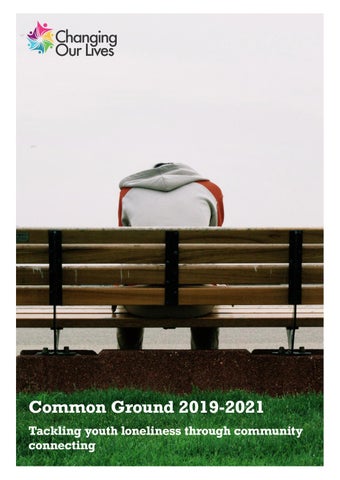
Common Ground 2019-2021 Tackling youth loneliness through community connecting
Acknowledgements Changing Our Lives would like to thank: All the young people who took the time to create work, share their stories and contribute to raising awareness of youth loneliness and all the young people who took part in Human Rights training sessions. Students and staff from the Law School at University of Birmingham (UoB). The Co-op Foundation for funding Common Ground and for their continued support throught our journey together. Wolverhampton Art Gallery for supporting the campaign and hosting the online exhibition of work.
Common Ground 2019-2021 Tackling youth loneliness through community connecting
Foreword The past year has shone a light on the impact of loneliness. Many of us know what loneliness feels like, but it is a very personal emotion and can be the result of different circumstances. The government’s approach to tackling loneliness aims to put the individual at the heart of the solution, recognising the role that all of us can play in making a difference by reaching out to others. As Minister for Loneliness, I recognise the importance of raising awareness of loneliness and reducing the stigma associated with this issue. Our campaign, ‘Let’s Talk Loneliness’ shares practical tips, sources of further support, and case studies to encourage people to reach out and seek support. Feeling lonely is something we can all relate to, but admitting we feel lonely can be much harder. That is why I am grateful to Changing Our Lives and the young people who participated in this project for sharing their individual experiences of loneliness. Their work highlights the impact that loneliness and social isolation can have, particularly for young people and people with disabilities. But it also highlights the power of opening up and talking about loneliness.
Baroness Diana Barran, Minister for Civil Society
Table of Contents Introduction and aims
6
Our desired outcomes
7
The National picture
8
Who we worked with
9
What we did
11
Human Rights training
12
The campaign, “Your new normal. My normal.”
16
Young people’s stories
20
Impacting strategic vision
29
Conclusion
32
Introduction Changing Our Lives is a rights-based organisation. All of our work is rooted in the belief that no one is too disabled and no one’s mental health is too complex to lead an ‘ordinary life’. As such, we don’t believe people’s lives should be limited or defined by disability or mental health diagnoses. Since 2017, we have been working with the Co-op Foundation on Common Ground, which uses ‘Community Connecting’ as an approach to tackle youth loneliness and build connections between young disabled people and their local community. These relationships are grounded in shared interests and a mutual exchange of assets. By establishing real relationships with people, the success of these connections stand the test of time and make a difference to people’s lives. It is through using this approach that young people find solutions to overcoming loneliness, while building stronger communities. Community connecting allows us to build on the strengths of young people, while strengthening their voice to make the change they need in their lives. Too often the social isolation and loneliness that young disabled people experience is defined by their disability, which can be all the more isolating. For 2019 - 2021 our aim was to continue to build on what we’ve learnt so far, developing a range of works to connect and motivate young people to start a conversation around youth loneliness.
Aims of the project Through Common Ground we wanted to deliver positive outcomes for young people and for this to impact on for the wider community. At Changing Our Lives, we focus on finding solutions and achieving outcomes that result in equality and social justice. We don’t deliver set ‘services’, we think of outcomes first and then work in coproduction with people to think about what needs to be done to achieve that outcome and take it from there. It is through this approach that we gather rich learning and enable young people to have more control over the things that matter to them.
6
Young disabled people and their non-disabled peers feel part of a wider community that values their contribution
Connect and encourage future generations of young people to take action to tackle youth loneliness and other issues faced by young disabled people through a non-inclusive education system
Strengthen the knowledge and understanding around the issue of youth loneliness within local organisations
Increased awareness of human rights, disability and youth loneliness in young people, teaching staff and the wider community
Young disabled people and their non-disabled peers feel more confident to share their stories
Our desired outcomes
Learning and confidence building of young people involved in the project delivery
Impact strategic vision and wider city strategy
Benefit the wider community through the work of the campaign
The National picture Loneliness is at the forefront of the political agenda, with stories about loneliness regularly appearing on the news or in our newspapers, particularly during the Covid-19 pandemic. This increasing awareness has highlighted that loneliness can affect all people, regardless of age or background. According to a recent report, called “State of a Generation”, carried out by the Mental Health Foundation in 2019, “around a quarter of young people say they ‘often’ feel they lack companionship (25%), 25% say they ‘often’ feel left out and 27% feel isolated from others.” In the UK, we are noticing that loneliness is affecting young people now, more than ever. Despite us all trying to adapt to the “new normal”, young people’s feelings of loneliness were evident, long before the pandemic began, as the following statistics illustrate.
8
Who we worked with 43 young people from Wolverhampton took part in Human Rights training sessions.
These sessions were co-created and co-delivered by
2 young disabled people from the city and 13 young people studying Law at the University of Birmingham.
18 young people from the West Midlands created work for our “Your new normal. My normal.” campaign.
In total, we have connected with
76 young people
aged 17-22 from across the West Midlands. 9
What we did
Human Rights training The national conversation about youth loneliness talks of the significance peer support can play in challenging stigma. Common Ground has taken this approach and embedded human rights into this conversation. Between 2019 - 2021, Changing Our Lives partnered with the Law School from the University of Birmingham (UoB). We worked with law students who were involved in a Pro Bono programme called Street Law. Street Law is a way of engaging people in the community to learn about law. It has also proved an effective way of teaching people how to actively engage with legal rights and how to use these in campaigns.
We worked with the law students to design and develop a bespoke Human Rights training session aimed at young people in Wolverhampton. Human Rights takes a focus in this project as we have learnt over many years of experience that for awareness to be raised, perceptions changed and action to happen we have to educate people in relation to the lives of disabled people. Expectations need to be raised, so that young disabled people are seen as people first with talents, strengths and abilities. In 2019, 27 Year 7 – Year 9 pupils from mainstream schools took part in face-to-face training delivered by 6 UoB students alongside Changing Our Lives staff and 2 young disabled people from the city of Wolverhampton. In light of the Covid-19 pandemic, in 2020 a virtual form of this training was developed by UoB law students with support from the Changing Our Lives team. In 2021, this interactive online session was delivered by 7 UoB students alongside Changing Our Lives staff to 16 young members from youth forums facilitated through the City of Wolverhampton Council. 12
These sessions educated young people by supporting them to develop a basic awareness of human rights, challenge the young people’s thinking around disability and to understand that human rights apply to everybody. Sessions consisted of thought-provoking open discussions and presented young people with an opportunity to begin to unravel the concept of human rights and how access to these rights is not always fair and equal. By focusing on disability throughout the session, young people analysed stereotypes and societal structures, and began to develop an awareness of the gap between the law and the everyday experience of disabled people.
“Not only did the training session benefit the participants, we as the organisers have benefited greatly from it too. Teaching and learning are an intertwined two-way process and getting involved in the Common Ground project gave us the opportunity to consider carefully about human rights issues that arise everywhere in society. This is extremely important for us as law students and future legal practitioners. It is safe to say that we learnt as much as, if not more than, the young people by being involved in the project.” UoB Law Student 13
Over the course of the human rights training, the following outcomes were achieved: We increased awareness of human rights, disability and youth loneliness in young people, teaching staff and the wider community.
“It is crucial for young people to understand human rights in order to recognise the value of equality, be aware of their rights, and to understand both how they should be treated and how they should treat others. Our training session aims to raise awareness of human rights and to stimulate a deeper level of thinking in relation to human rights issues in society. Discussing such topics creates a safe and conducive place for young people to explore, challenge and form their own opinions and values.” UoB Law Student
“I learnt that discrimination will not go overnight and we need to work as a community to fix it. I also learnt that not every right is protected by law and that
We connected and encouraged future generations of young people to take action to tackle youth loneliness and other issues faced by young disabled people through a non-inclusive education system.
social standards can provoke discrimination.” Youth Forum member, Human Rights Training Workshop feedback (Feb, 2021)
"I used to think that disabled people were not able to do what I could do. Now I know that that disabled people are just like us and should be able to have the same opportunities as we have. We are all the same on the inside and we can all do the same stuff – just in different ways." School pupil, Human Rights Training Workshop feedback (Dec, 2019)
The campaign, “Your new normal. My normal.” Upon shifting to a virtual delivery in light of the Covid-19 pandemic, we re-designed the project and developed a social media campaign called “Your new normal. My normal.” Throughout the course of the Covid-19 pandemic, a national conversation around loneliness has been taking place. People from all walks of life have expressed their feelings of loneliness and isolation, donning the phrase “the new normal”. However, for some young people, these feelings of loneliness are the everyday normal. Too often the social isolation and loneliness that young disabled people experience is defined by their disability, which can be all the more isolating. We sought to raise awareness of this by capturing the stories of young disabled people and their non-disabled peers through the arts. Changing Our Lives use the arts as a vehicle to highlight and challenge societal prejudices and perceptions and by creatively opening up the conversation on youth loneliness, we wanted young people to feel powerful and confident to share their stories. We asked young people to submit work that explored the themes of:
My normal - an insight into your everyday Barriers - what stops you from having friendships? Loneliness - what does loneliness look like for you? 18 young people, aged 10 – 22, from the West Midlands created pieces of work and shared the stories behind them. People took part both individually and collectively. The range of artworks featured on our social media channels throughout the course of the campaign. Alongside young people’s work, we shared some of the facts surrounding youth loneliness, to drive home the impact that this issue has on people’s lives and the significance of the artwork created. Through establishing a relationship with Wolverhampton Art Gallery, the campaign also resulted in an online exhibition, featuring the original artworks of 10 young people whose work was selected by a judging panel. As of 16th February 2021, the online gallery was visited by 489 people. You can click here to view the full collection of artwork produced for the “Your new normal. My normal.” campaign in our arts brochure. Since the campaign, we have continued to use community connecting as an approach to link young people to arts organisations and opportunities within their communities. We have signposted young people to a range of prospects and encouraged them to celebrate their talents and continue to develop their individual skills and strengths.
16
Matilda
Matilda I am hoping this video doesn’t inspire people because ‘they see me as an inspiration’, but inspires people to look out for others.
Instagram user That’s so amazing! Well done! Everyone’s life is so different – but a lot happens behind closed doors where no-one sees what parents, carers, children and young people do! Our lives are all so different! Thank you for sharing!
Facebook user What a lot to have to do every morning, and most of it doesn’t look pleasant to endure. Thank you so much for sharing!
Instagram user I really admire the way you take it all in your stride. This is what you have to do and you get right on and do it. That's true resilience right there.
“We were pleased to support the ‘Your new normal. My normal.’ campaign and were very impressed with and moved by the creative responses of the young people which included paintings, drawings and 3D masks. Four of the pieces created in our sessions were selected for the online exhibition at Wolverhampton Art Gallery.” Alex Vann, owner, Real Arts Workshops
“During the pandemic Wolverhampton Arts and Culture have made it possible for visitors to still engage with art and this collaboration with Changing Our Lives on the Common Ground project has highlighted a different type of normal that young people have to deal with every day.” City of Wolverhampton Cabinet Member for City Economy, Councillor Stephen Simkins
“In my painting ‘Living through the barriers’, I showed that I was able to enjoy my hobby of painting even though I was stuck inside my house throughout the lockdown period and felt lonely. It helped me to get through my worries and feeling of anger that I couldn't do the other things that make me happy and make me calm.” Anna
“What is normal? Your abnormal is my normal but I wouldn’t change that. This has always been my normal, but because it’s different to yours does that really make it abnormal? Isn’t everyone normal? Or is everyone actually abnormal?” Matilda
18
19
Young people’s stories During the “Your new normal. My normal.” campaign, young people shared their stories. In doing so, they ultimately demonstrate that regardless of the labels imposed upon them, they are simply young people first. Loneliness is a shared human experience. Local newspaper, The Express and Star, published a double page spread about the campaign and exhibition, showcasing the work and stories of some young people and further platforming their experiences to the wider community. One of the aims of the project was for young disabled people and their non-disabled peers to feel powerful and confident to share their real life experiences. Below are some of their stories, in the words of young people and their families…
Kara What is the story behind your work? “I created a piece of artwork to show what lockdown has been like for me. I took some photographs of my garden to show that it was the only place where I felt safe during lockdown.” How does youth loneliness affect you? “I realised how lonely people got during lockdown and even though I had my family with me, I still felt a bit lost because I didn’t see any other family or my friends for a very long time. It made me realise that you can’t really live without family or friends.” Why is it important to share our experiences and raise awareness of youth loneliness? “I think it’s really important to raise awareness of loneliness because people don’t realise how many other people can get lonely. Some people have no family or friends or they haven’t got anyone to talk to. It can affect people in so many ways too, so I think it’s really important to raise awareness to show people that there are others out there who do get lonely too.” 20
Matilda What is the story behind your work? “I got involved with the campaign because only recently have the needs of disabled people started to be widely accepted and acted on, through able bodied people needing these alterations throughout Covid-19. Invisible disabilities are no less than visible ones, however they are often disregarded, along with many other disabilities, where their needs aren’t met due to others ignorance, which can lead to people feeling even more of an ‘outsider’ or alone than they already do! I want people to know that you aren’t any less because you need more help. You aren’t any less because you think you’re abnormal. Who’s to judge?!” How does youth loneliness affect you? “Loneliness isn’t just about not having people around you, it’s about not having people around you that understand or can relate to how you are feeling. With cystic fibrosis one of the hardest things is that through all the strict routines, the hospital treatments, the lack of social life, the pain, the isolation, the mental effects, is that you can’t talk to people who actually know what you’re going through, as CF sufferers are not allowed to meet up due to cross infection. So as isolating as the things above are anyway, then think about how the only other people who can relate to you, you won’t be able to meet and will never be able to be there for you physically. The hours of endless daily treatment and mental exhaustion from having a degenerative lifelong condition separates you. You live your life minute to minute and there’s no such thing as being spontaneous. “ Why is it important to share our experiences and raise awareness of youth loneliness? “You can feel alone, like you’re the only one. But it’s important to share and raise awareness for these parts of living with a disability that people don’t often think about. I find social media especially useful, as it’s a great way to connect and interact with the people who do understand. They might not know you are needing that support if you don’t share it with them!” Lily What is the story behind your work? “I documented my regular travel within the West Midlands before translating my notes and drawings into a woven textile. Particular markings, stitches and colours represented timings and length of journey, interactions with other people and disruptions.” How does youth loneliness affect you? “Having volunteered myself with a local social group I know how important it is to have opportunities to socialise and create a support network. I have seen what a difference it makes to have a safe space.” Why is it important to share our experiences and raise awareness of youth loneliness? “It is important to share our experiences as in doing so it supports others who may be struggling, and starts a conversation about how this can be prevented.” 21
Hannah (in the words of Hannah’s mom, Tracey) What is the story behind your work? “Hannah’s piece Friends and memories was inspired by people who mean a lot to Hannah and who she misses for different reasons. Hannah’s best friend and Hannah’s grandad (she always called him Pa), passed away in recent months and she loved them both to bits and misses them dearly. On the other hand, Hannah has two close friends and they have been in each other’s life since they were all about 2 years old. She misses them for totally different reasons as they moved back to Wales with their parents, but we always keep in touch and go to visit them annually. Due to lock-down and shielding Hannah, we were unable to take her to see them this year, which is really sad and hard for Hannah to understand. Hannah signed to me whose name she wanted on each figure, except her own, she wrote her ‘H’. Hannah coloured each figure and drew the expressions on each face. I think it’s telling that she’s drawn happy expressions on everyone, except herself. She always signs ‘sad’ when we mention Pa or her best friend’s names.”
How does youth loneliness affect you? “Hannah has numerous medical conditions, which include being profoundly deaf and severe learning difficulties. During lock-down, she has missed the one to one interaction with friends and family, which she loves as she can see their expressions and lip read when she’s with them. Her world can be a lonely place at times and she can go into her own ‘little world’ if she doesn’t get the connection with people like she would in normal circumstances. We are a close family and Hannah is always the centre of everything we do, but ultimately it’s Hannah living with her disabilities and all we can do is support her as best as we can and hopefully stop her feeling isolated.“ Why is it important to share our experiences and raise awareness of youth loneliness? “It’s great to share experiences, so people can see loneliness from different perspectives. Hannah is lucky and has a loving and caring family around her, to make sure she’s safe and in a good frame of mind. Not everyone is in this position and would have to struggle alone without support. So it’s really important to highlight everyone’s struggle, especially with young adults like Hannah with complex needs.” 22
Thomas (in the words of the words of Thomas’s mom, Amanda) What is the story behind your work? “Thomas’s shed is his personal space where he goes and writes all over the walls. When he is happy he paints over it, until he is upset again and the numbers, names, places and colours are written again. Perhaps it’s the only solid thing he has to hold onto, something he can control whilst the rest of the world is tumbling out of control.” How does youth loneliness affect you? “Loneliness and anxiety causes Thomas to withdraw into himself. He will come out with the word worried, which seems to be a daily thing now. If you write down “Thomas is worried because” he draws a stick man and its arms and legs are jagged instead of straight lines. He will not talk when he is panicking or worrying about things, he is trapped in his mind and not able to escape into the local area because of lockdown and so it’s a vicious circle.” Why is it important to share our experiences and raise awareness of youth loneliness? “I think it’s a really good thing as loneliness, whether you have a disability or not, is a major problem.” Anna What is the story behind your art work? “The inspiration behind my artwork has been being separated from my loved ones who I wasn’t able to see because all plans have had to be cancelled. Through my paintings I tried to show the feeling of loneliness whether it was through the use of cool colours or using contrasting ideas in the painting.” How does youth loneliness affect you? “The biggest way that loneliness has affected me during the pandemic in is not being able to see those close and important to me due to strict travel restrictions between countries. It had destroyed all the plans that were made that were keeping me excited and happy. It almost just took away my happy way of living and any motivation and energy I had to do things. And it made me feel “pointless” doing almost anything. “ Why is it important to share our experiences and raise awareness of youth loneliness? “Some people think that they are the only one going through these different emotions, or they could be nervous or shy to share what they are going through because of the fear of being judged or misunderstood. Therefore, those who are able to speak about their experiences are able to show those people that they are not alone and give them that reassurance and help to cope with what they’re feeling. If someone shares their story it might make others reach out and share theirs too and this way, the more people share, the more they feel connected and the more future connections and support they create for others.”
23
R. Norton What is the story behind your work? “As a happy person I try to hide anything that would make people worry for me, as I believe that I shouldn’t be worried about. I mean why check if I’m okay when others could need it more than me? So, when I saw […] people in similar situations to me expressing their issues I thought “why not?” So I started writing from a place I don’t like to dwell upon. It helped get my problems from my head onto the page and helped me clear my head space, if only slightly.” How does youth loneliness affect you? ”Youth loneliness has affected me from a young age due to my autism. I was always trying to fit in but I felt like a jigsaw piece with no edges. Kids saw me as the “weird kid” and teachers thought I was being mischievous; kids will be kids. Until year five I was quite lonely always trying to play with the other kids and them ignoring me. However, then I got diagnosed and things got better but not perfect. I made 3 friends, until the end of year 6 as one went to a different school and the two who joined me made new friends leaving me alone again... My secondary school experience didn’t get better. If someone was nice to me I’d always try to spend break and lunch with them, even if they were nice to my face to bully me behind my back... I was really gullible trusting people too quickly and doing anything they said to become “better friends” with them, even if the task they asked me to do was just so they could laugh at me. It was tough but it began getting better as I grew up as I realised they weren’t my friends.” Why is it important to share our experiences and raise awareness of youth loneliness? “If we don’t, mental health could sky rocket. Your youth is the most important part of life, during your youth you learn how to make friends and your personal identity flourishes. Taking my personal experiences as an example, my lack of friends in my youth has left me with a lack of understanding about other people’s issues and anxiety that I have to be medicated for.” Summer What is the story behind your work? “I love dogs and other animals and I love the natural world. We all need to focus on the natural things in the world as we don’t need to be so busy anymore. Wildlife is not effected by lockdown in the same way as humans as they can carry on with their ways of life.” How does youth loneliness affect you? “I don’t feel lonely as I always have my family around me but I can feel upset if I can’t go places when they are shut. I was really upset over McDonald’s closing during lock-down and I was so happy when it opened. If everything else shuts again I hope that McDonald’s stays open for me and my dog.” Why is it important to share our experiences and raise awareness of youth loneliness? “To show we are all in the same boat, so other people know that they aren’t the only ones having these feelings and thoughts.” 24
Through the “Your new normal. My normal.” campaign and the gathering of young people’s experiences of youth loneliness, the following outcomes were achieved:
Learning and confidence building of young people was involved in the project delivery. Young disabled people and their non-disabled peers felt more confident to share their stories.
“This campaign has given me a chance to challenge myself and step out of my comfort zone without being afraid. It allowed me to see what I am capable of. I’ve also been able to distract my mind from the effects of the pandemic on the world and instead, put those worries and thoughts onto a canvas.”
“I’m very happy to have taken part in this campaign and it’s amazing to know that some of my paintings were chosen to be displayed on the Art Gallery website. Thank you very much for letting me take part in the campaign. I’ve very glad that I’ve been a part of it.”
“I think it will have a big impact and we are showing people that you are not going through this alone.”
“I’ve honestly really enjoyed painting for the project. For many reasons. It has given me a chance to be creative and grow as an artist and gave me more confidence that showed me what I am capable of. It has also given me a challenge to try something new and helped me get back into painting which always was something I loved to do. And of course it’s been a way to distract myself and let go of the stress because of everything that’s been happening over the past few months.”
Young disabled people and their nondisabled peers felt part of a wider community that values their contribution.
“I’ve always wanted to show my work and inspire others but haven’t had an opportunity come up. So the fact that the Art Gallery will host an online exhibition makes me excited.”
“It felt good to know that my artwork is going to be shared, I’m proud to show my artwork to everyone. I learnt some new skills when I did my photography.”
“The exhibition was really well received and it was a delight working with the Changing Our Lives team. We’re passionate about making culture as inclusive as possible so we hope that this will be the start of an ongoing relationship with Changing Our Lives, which helps to make our venues more accessible for everyone.” Carol Thompson, Senior Curator, Wolverhampton Arts and Culture
We brought benefits to the wider community through the work of the campaign.
“It was fantastic that Wolverhampton Arts and Culture could collaborate with Changing Our Lives by providing a platform for their online exhibition: “Your new normal. My normal.” During lockdown there’s been much more focus on our website and digital offer so we were delighted that we could link up with this project. It was a win-win situation where we were able to showcase amazing artwork by local young people, while raising awareness of the day-to-day experiences of disabled people.” Carol Thompson, Senior Curator, Wolverhampton Arts and Culture
“We think projects like this are a good way
We helped to strengthen the knowledge and understanding around the issue of youth loneliness within local organisations.
to explore emotions and thoughts, and exhibitions are a great way to celebrate the successes of people and go some way to building confidence in their skills.” Alex Vann, owner, Real Arts Workshops
“Because you are vulnerable you are not disposable, you are not any less valuable, and you are not any less deserving. This pandemic has taught the world a lot of what it’s like to live with some conditions, but only the small part of it. Being able to deal with things and carry on as the vulnerable people in this world do, is amazing, it takes courage and strength to fight everyday just for a tomorrow. I enjoy educating people and being open and sharing my life. I want people to appreciate their lives more and I think when people see how much some people have to do every day, they start to realise.”
Impacting Strategic Vision As an organisation, we were able to influence the development of strategic planning for young people in the city of Wolverhampton with the label of special education needs and disability (SEND). We worked in coproduction with young people to lead conversations and share their stories, experiences and ambitions alongside strategic leads at the City of Wolverhampton Council to influence the development of a shared vision. It was through these conversations that a common understanding and shared ambition was cultivated. This vision is one of an ‘ordinary life’, where young people with the label of SEND are afforded the same opportunities as their non-disabled peers through connections with their community, by a mutual exchange of assets and interest based connections with their non-disabled peers. At the time, Changing Our Lives worked with young people on the Challenge Board in Wolverhampton and we were also a member of the SEND and Commissioning Partnership Board. Utilising these links, we generated further conversations around youth loneliness, highlighting the disproportionate impact this has on young disabled people and constructed it as a talking point on their agenda for children and young people. The impact of this work has meant that we have been instrumental in working with young people to coproduce the SEND strategy 2020 – 2025 and the SEND Joint Strategic Needs Assessment (JSNA) 2020. Both of these strategic documents are driven by young people’s ‘ordinary life’ approach, as cited in the Challenge Board’s ‘Ordinary Life White Paper’. The Board define an ordinary life as:
“Being valued as people first, as loving family members, as rebellious teenagers, as paid employees, as community leaders, as home owners and tenants, as neighbours, as friends and partners. Where young people with the label of special educational needs and disabilities are seen in society and have active lives in society - not living in service land and hidden away from communities in segregated services with other disabled people.” Ordinary Life White Paper 29
A key part of leading an ordinary life is having long-lasting friendships and relationships. The SEND JSNA acknowledges that friendships and relationships is a key area. The JSNA cites:
“The Ordinary Life White Paper explains that young people in Wolverhampton think friends are very important as they helped with understanding emotions, cheering each other up, and boosting confidence. Young people with shared hobbies such as ice skating, horse riding, and athletics were more likely to see their friends outside of school. To expand this further, young people wanted more interests available to them locally, so that they could meet up with their friends on an evening or weekend.” SEND JSNA
As a result, the focus on friendships throughout the JSNA, along with a set of recommendations, now acts as a tool for commissioners and impacts the focus of future work in the city. Changing Our Lives is committed to working in coproduction with young people to find solutions to social injustice that result in positive outcomes for their lives. Using community connecting as an approach to combat loneliness is recognised as a way forward by the City of Wolverhampton Council to improve the emotional health and wellbeing of young people in the city. Changing Our Lives are delighted to be at the foreground of this work.
30
“It has been a very enjoyable and insightful experience to be working with Changing our Lives. I have learned so much from Changing Our Lives in recent years. The ‘Ordinary Lives White Paper’ has provided the fundamental framework for the Joint Strategic Needs Assessment which in turn, underpins the new strategy. This means that the work that Changing our Lives did with children and young people with Special Education Needs and Disability (SEND) has been absolutely pivotal in setting priorities and desired outcomes for this population. I have also really appreciated the healthy challenge from Changing Our Lives with regards to both the draft versions of the needs assessment and the development of the new strategy. It just shows that Changing Our Lives has the talent to work very positively with children and young people with SEND as well as make very valuable contributions at a strategic level. It has been a real pleasure to work with Changing Our Lives.” Neeraj Malhotra, Consultant in Public Health
Conclusion Through the national picture and the work that we do across England, we know that too often disability is a pre-requisite for loneliness. At Changing Our Lives, we enable disabled people to live ordinary lives, something that most of us take for granted. We know that young disabled people can be viewed as ‘special’ and as a result often tend not to have friends and are often segregated from their communities in schools and services, where they are only ever exposed to other young disabled people with little or no opportunity for selfexploration and personal development. The impact that this has on their childhood and adult life is lifelong, as this culture ignites fear, negative attitudes, and low expectation. The absence of ordinary life opportunities breeds a culture of dependency, resulting in young disabled people being condemned to a lifetime of being treated as anything but ordinary. Changing Our Lives will continue to use community connecting as an approach to tackle youth loneliness and build connections between young disabled people and their nondisabled peers, to provide peer support and continue to bridge the social gulf that societal structures have imposed. We will also continue to work alongside communities to challenge these structures.
“Some people think that they are the only one going through these different emotions, or they could be nervous or shy to share what they are going through because of the fear of being judged or misunderstood. Therefore, those who are able to speak about their experiences are able to show those people that they are not alone and give them that reassurance and help to cope with what they’re feeling. If someone shares their story it might make others reach out and share theirs too and this way, the more people share, the more they feel connected and the more future connections and support they create for others.” Anna
32
Tel: 0300 302 0770 Email: ask@changingourlives.org Web: www.changingourlives.org Twitter: @positive_lives Registered Charity Number: 1093883