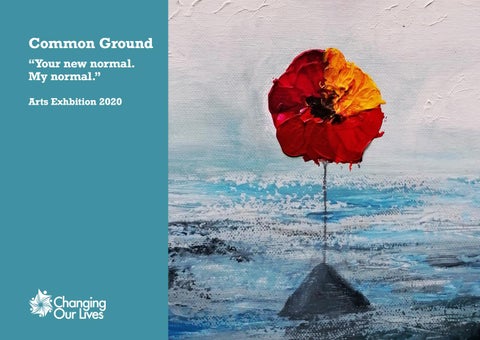
Common Ground “Your new normal. My normal.” Arts Exhbition 2020
No one is too disabled, or too affected by mental health difficulties, to lead an ordinary life
Acknowledgements In the making of this publication, Changing Our Lives would like to thank:
All the young people who took the time to create artwork, to share their stories and to contribute to raising awareness of youth loneliness.
The Co-op Foundation for funding this project.
Wolverhampton Art Gallery for supporting the campaign and hosting the online exhibition of work.
Common Ground "Your new normal. My normal." Arts Exhibition 2020
Foreword The past year has shone a light on the impact of loneliness. Many of us know what loneliness feels like, but it is a very personal emotion and can be the result of different circumstances. The government’s approach to tackling loneliness aims to put the individual at the heart of the solution, recognising the role that all of us can play in making a difference by reaching out to others. As Minister for Loneliness, I recognise the importance of raising awareness of loneliness and reducing the stigma associated with this issue. Our campaign, ‘Let’s Talk Loneliness’ shares practical tips, sources of further support, and case studies to encourage people to reach out and seek support.
Feeling lonely is something we can all relate to, but admitting we feel lonely can be much harder. That is why I am grateful to Changing Our Lives and the young artists who participated in this project for sharing their individual experiences of loneliness. Their work highlights the impact that loneliness and social isolation can have, particularly for young people and people with disabilities. But it also highlights the power of opening up and talking about loneliness.
Baroness Diana Barran, Minister for Civil Society
Table of Contents Introduction 2 The artwork 3 Memory box, Thomas 4 BACK and FORTH, Lily 6 My every morning routine, Matilda 8 The dog, Summer 11 I have no normal, R.A.W. Summer Collective 14 Trapped, R.A.W. Summer Collective 16 Feelings, R.A.W. Summer Collective 17 Lonely in the raging sea, Anna 19 Living through the barriers, Anna 20 My different loneliness, Kara 21 Friends and memories, Hannah 23 Void, Elena 25 My quiet place, Lauren 26 My Storm, R. Norton 28 1
Almost 10% of people aged 16 to 24 were “always or often” lonely – the highest proportion of any age group. This was more than three times higher than people aged 65 and over.’ Office for National Statistics, 2018
Introduction As part of our Common Ground work around youth loneliness, Changing Our Lives developed a campaign called “Your New Normal, My Normal.” Throughout the course of the Covid-19 pandemic, a national conversation around loneliness has been taking place. People from all walks of life have expressed their feelings of loneliness and isolation, donning the phrase “the new normal”. However, for some young people, these feelings of loneliness are the everyday normal. Too often the social isolation and loneliness that young disabled people experience is defined by their disability, which can be all the more isolating.
We asked young people to submit work that explored the themes of: My normal - an insight into your everyday Barriers - what stops you from having friendships? Loneliness - what does loneliness look like for you? The range of artworks created in response to this campaign featured on our social media channels throughout the course of the campaign. The campaign also resulted in an online exhibition with Wolverhampton Art Gallery featuring the original artworks of some young people who took part. This brochure showcases the diverse body of work submitted by young people and the powerful stories behind them.
We sought to raise awareness of this by capturing the stories of young disabled people and their non-disabled peers through the arts. By creatively opening up the conversation on youth loneliness, we wanted young people to feel powerful and confident to share their stories. 2
The Artwork
Memory box Thomas | My normal Thomas's "Life in a Box” is modelled on his shed, which is painted green. The walls are covered in numbers and names of paints, as well as places.
“Loneliness and anxiety causes Thomas to withdraw into himself. He will come out with the word worried, which seems to be a daily thing now. If you write down “Thomas is worried because” he draws a stick man and its arms and legs are jagged instead of straight lines. Thomas’s shed is his personal space where he goes and writes all over the walls. When he is happy he paints over it, until he is upset again and the numbers, names, places and colours are written again. Perhaps it’s the only solid thing he has to hold onto, something he can control whilst the rest of the world is tumbling out of control. He will not talk when he is panicking or worrying about things, he is trapped in his mind and not able to escape into the local area because of lockdown and so it’s a vicious circle.” Thomas's mom, Amanda 4
Thomas | My normal Memory box Decorated box
5
BACK and FORTH Lily | My normal
“The work is based on my day to day travel around my local area. This includes my commute to university, to work, to volunteering - all things I do weekly. I recorded one particular journey, noting details such as timings of transport, delays, changes, numbers of other passengers, diversions, my own actions, the pattern the route itself made on a map etc. I created a woven textile for the ‘to’ and ‘from’, or the ‘there’ and ‘back’ of the journey, meaning 2 textiles were woven. I chose to use weaving as the physical aspect of the work as when weaving a textile, there is a continuous back and forth motion made by the shuttle which is what creates the pattern and the fabric. The combination of this and the notion of ‘back and forth’ by travelling is how I titled the work. Each of the textiles is unique and detailed with alternating textures, layers and a neutral colour scheme.” Lily 6
Lily | My normal BACK and FORTH Woven textiles
7
My every morning routine Matilda | My normal Matilda created a video for Cystic Fibrosis Awareness Month of her daily routine in order to showcase what daily life with CF is like. She completes this 2 hour routine in the same order without fail, morning and night. Matilda's original video can be found on Changing Our Lives’ social media channels: https://twitter.com/Positive_Lives/status/1305423689878560768?s=20
“Routine is key for me, I do these same things in the same order every single day of my life, morning and night! This routine takes about 2 hours to complete each time (night time slightly shorter) and makes a huge difference to my day. This is straight after I wake up; the first things I do. This allows me to breathe (barely) during the day, which I find very difficult to do when I wake up.” Matilda 8
“Here’s what I do: 1. Inject my insulin so I’m able to eat breakfast (10 mins before food) 2. Drink a bottle of water to loosen up my throat and chest - normally a litre 3. Dornase Alpha Nebuliser which takes 5-10 minutes. I have to do this 20-30 mins before Acapella (physio and airway clearance) 4. Mix up my Colomycin Nebuliser 5. Take all my appropriate tablets for that day before my breakfast 6. Eat breakfast (Weetabix, yogurt and milk) 7. Do my Acapella I usually do this sitting down with a big bowl as it makes me throw up and cough so much phloem and it lasts about 35 mins (ish) 8. Colomycin Nebuliser (15 mins) 9. Fostair Inhaler (4 puffs) 10. Sterilise them all for later in the day
Matilda | My normal
11. Shower, get ready and enjoy my
My every morning routine
day!“
Video / photo collage of screenshots taken from video 9
“What is normal? Your abnormal is my normal, but I wouldn’t change that. This has always been my normal, but because it’s different to yours does that really make it abnormal? Isn’t everyone normal? Or is everyone actually abnormal? The hours of endless daily treatment and mental exhaustion from having a degenerative lifelong condition separates you. You live your life minute to minute and there’s no such thing as being spontaneous. I am hoping my video doesn’t inspire people because ‘they see me as an inspiration’, but inspires people to look out for others and see that wearing a mask, or giving up a seat, is a small price to pay for a healthy body. My routine gives me a sense of security and without that I wouldn’t have control.“ Matilda
10
The dog Summer | Barriers
Summer's work reflects the strangeness of this new world in which everyone has to distance themselves, apart from wildlife. The titular dog Summer relates to as herself, as it is confused by new social distancing rules and the need to wear masks.
“I love dogs and other animals and I love the natural world. We all need to focus on the natural things in the world as we don't need to be so busy anymore. Wildlife is not affected by lockdown in the same way as humans as they can carry on with their ways of life.” Summer
11
Summer | Barriers The dog Drawing and short story 12
13
Three artworks by the R.A.W. Summer Collective
I have no normal R.A.W. Summer Collective | My normal An illustration created from an initial brainstorm of intrusive thoughts. It reflects the pressure
Wolverhampton based arts company ‘Real Arts Workshops’ were funded by City of Wolverhampton Council to deliver a Summer
individuals may feel in social environments.
Arts Programme in the city during 2020 for young people aged 10
Trapped
- 16. Young people who attended these creative holiday workshops
R.A.W. Summer Collective | Barriers
submitted work for the campaign.
A mask reflecting the internal spiral one can fall
“We think projects like this are a good way to explore emotions and thoughts, and exhibitions are a great way to celebrate the successes of people and go some way to building confidence in their skills. Art is a fantastic way for young people to express their emotions and feelings.
into when left alone with intrusive thoughts. The vocabulary is taken from magazines, and generally reflect the pressures people may feel to conform to certain ideals relating to lifestyle and image.
During Covid-19 we feel that young people might be
Feelings
feeling disenfranchised and worried. We wanted to give
R.A.W. Summer Collective | Loneliness
the young people an opportunity to show others what they are feeling at this time.”
Two paintings by an individual who showed extraordinary ability throughout the 6 weeks that R.A.W. worked with them. This was the first
Alex Vann, owner, Real Arts Workshops
time they had tried abstract painting and they were delighted with the outcome. 14
R.A.W. Summer Collective | My normal I have no normal Drawing 15
R.A.W. Summer Collective | Barriers Trapped Mask
R.A.W. Summer Collective | Loneliness Feelings I Painting 16
17
R.A.W. Summer Collective | Loneliness Feelings II Painting 18
Lonely in the raging sea & Living through barriers Anna | Loneliness / Barriers
“The inspiration behind my artwork has been being separated from my loved ones who I wasn't able to see because all plans have had to be cancelled. Through my paintings I tried to show the feeling of loneliness whether it was through the use of cool In my painting ‘Living through the barriers’, I showed
colours or using contrasting ideas in the painting.
that I was able to enjoy my hobby of painting even
In the painting 'Lonely in the raging sea', I explored
though I was stuck inside my house throughout the
the idea of the flower being the person who is stuck
lockdown period and felt lonely. It helped me to
in the middle of nowhere. The raging sea represents
get through my worries and feeling of anger that I
the chaos with the pandemic. The flower is the symbol
couldn't do the other things that make me happy and
of hope. It is the only object in the painting that has
make me calm.”
colour and only the flower shines its beauty to the
Anna
rest of its surroundings. 19
Anna | Barriers Living through barriers Painting on canvas
Anna | Loneliness Lonely in the raging sea Painting on canvas 20
My different loneliness Kara | Loneliness
“I created a piece of artwork to show what lockdown has been like for me. I wanted to show what it's like for disabled people to be stuck indoors for so long. I took some photographs of my garden to show that it was the only place where I felt safe during lockdown.” Kara
21
Kara | Loneliness My different loneliness Photo collage 22
Friends and Memories Hannah | Loneliness
“Hannah’s piece, ‘Friends and memories’ was inspired by people who mean a lot to Hannah and who she misses for different reasons. Hannah’s best friend and Hannah’s grandad (she always called him Pa), passed away in recent months and she loved them both to bits and misses them dearly. On the other hand, Hannah has two close friends and they have been in each other’s life since
Hannah signed to me whose name she wanted on
they were all about 2 years old. She misses them
each figure, except her own, she wrote her ‘H’. Hannah
for totally different reasons as they moved back to
coloured each figure and drew the expressions on
Wales with their parents, but we always keep in touch
each face. I think it’s telling that she’s drawn happy
and go to visit them annually. Due to lock-down and
expressions on everyone, except herself. She always
shielding Hannah, we were unable to take her to see
signs ‘sad’ when we mention Pa or her best friend’s
them this year, which is really sad and hard for Hannah
names.”
to understand.
Hannah's mom, Tracey 23
Hannah | Loneliness Friends and Memories Figures 24
Void Elena | Loneliness
“My piece depicts the void we can fall into with lack of contact; all the days blur together and we feel alone in our own little bubble.” Elena
Elena | Loneliness Void Drawing 25
My quiet place Lauren | Loneliness
“The story behind my artwork is related to lockdown during March and July when I was not attending school, meeting friends or going out with my family. I was mainly staying in the front dining room of my home. I did not mind this at first, but as time went on I started to feel sad and grey inside. The colours on the wall in my artwork show how my mood at times felt grey. The brightly coloured mug and other stronger colours show that it will not always be like this and I will go back to school and see friends again.” Lauren
26
Lauren | Loneliness My quiet place Drawing 27
My Storm R. Norton | Loneliness
“Loneliness has affected me from a young age due to my autism. I was always trying to fit in but I felt like a jigsaw piece with no edges. As a happy person I try to hide anything that would make people worry for me. I mean, why check if I’m okay when others could need it more than me? So, when I saw […] people in similar situations to me expressing their issues I thought “why not?” So I started writing from a place I don’t like to dwell upon. It helped get my problems from my head onto the page and helped me clear my head space, if only slightly.” R. Norton
R. Norton | Loneliness My Storm Poem 28
My Storm I think but cannot say
All people can see is my disability
my words are like some allusive play
Why pay attention to me…?
when I try to speak
I’m just another person on the street
I leave devastation at my feet
One that you might meet
you say my future looks bright but I don’t feel alright you can all carry on I don’t mind being alone
you think I can’t work you think I’ll just call you a jerk but I don’t think you understand my pain why don’t you just read this poem again?
You don’t have to ask about my blight Because really I’m alright I know I’ll die So why should I waste time I’m autistic there I said it Why should I rhyme that..? and look like a total twat… it makes me wanna cry how I can’t say my….
words….
29
“It was fantastic that Wolverhampton Arts and Culture could collaborate with Changing Our Lives by providing a platform for their online exhibition: “Your new normal. My normal.” During lockdown there’s been much more focus on our website and digital offer so we were delighted that we could link up with this project. It was a win-win situation where we were able to showcase amazing artwork by local young people, while raising awareness of the day-to-day experiences of disabled people. The exhibition was really well received and it was a delight working with the Changing Our Lives team. We’re passionate about making culture as inclusive as possible so we hope that this will be the start of an ongoing relationship with Changing Our Lives, which helps to make our venues more accessible for everyone.” Carol Thompson, Senior Curator, Wolverhampton Arts and Culture
“During the pandemic, Wolverhampton Arts and Culture have made it possible for visitors to still engage with art and this collaboration with Changing Our Lives on the Common Ground project has highlighted a different type of normal that young people have to deal with every day.” City of Wolverhampton Cabinet Member for City Economy, Councillor Stephen Simkins
Changing Our Lives Tel: 0300 302 0770 Email: ask@changingourlives.org Web: www.changingourlives.org Twitter: @positive_lives Registered Charity Number: 1093883
No one is too disabled, or too affected by mental health difficulties, to lead an ordinary life