Year X - Number 488 | 22 August 2017
Marist News 488
Marist Brothers - General House - Rome
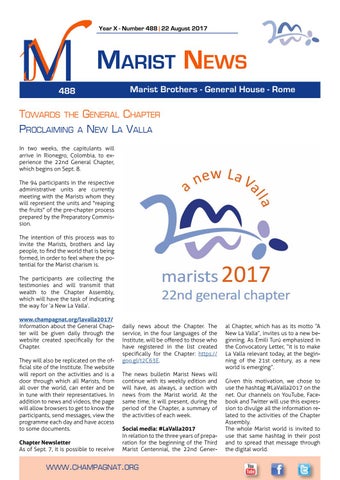
Towards the General Chapter Proclaiming a New La Valla In two weeks, the capitulants will arrive in Rionegro, Colombia, to experience the 22nd General Chapter, which begins on Sept. 8. The 94 participants in the respective administrative units are currently meeting with the Marists whom they will represent the units and "reaping the fruits" of the pre-chapter process prepared by the Preparatory Commission. The intention of this process was to invite the Marists, brothers and lay people, to find the world that is being formed, in order to feel where the potential for the Marist charism is. The participants are collecting the testimonies and will transmit that wealth to the Chapter Assembly, which will have the task of indicating the way for ‘a New La Valla’. www.champagnat.org/lavalla2017/ Information about the General Chapter will be given daily through the website created specifically for the Chapter. They will also be replicated on the official site of the Institute. The website will report on the activities and is a door through which all Marists, from all over the world, can enter and be in tune with their representatives. In addition to news and videos, the page will allow browsers to get to know the participants, send messages, view the programme each day and have access to some documents. Chapter Newsletter As of Sept. 7, it is possible to receive
daily news about the Chapter. The service, in the four languages of the Institute, will be offered to those who have registered in the list created specifically for the Chapter: https:// goo.gl/t2C63E. The news bulletin Marist News will continue with its weekly edition and will have, as always, a section with news from the Marist world. At the same time, it will present, during the period of the Chapter, a summary of the activities of each week. Social media: #LaValla2017 In relation to the three years of preparation for the beginning of the Third Marist Centennial, the 22nd Gener-
www.champagnat.org
al Chapter, which has as its motto “A New La Valla”, invites us to a new beginning. As Emili Turú emphasized in the Convocatory Letter, “it is to make La Valla relevant today, at the beginning of the 21st century, as a new world is emerging”. Given this motivation, we chose to use the hashtag #LaValla2017 on the net. Our channels on YouTube, Facebook and Twitter will use this expression to divulge all the information related to the activities of the Chapter Assembly. The whole Marist world is invited to use that same hashtag in their post and to spread that message through the digital world.
Marist News 488
Being Brother Today European Marist Brothers The younger European Marist Brothers met at L’Hermitage from August 7 - 11, during which fifty-seven brothers commemorated the three years of the Bicentenary preparation. During the first day, participants engaged with the Montagne experience with the “Marist lives through
under
50
meet at l´Hermitage
the lens” project introduced by Brother Tony Leon. Later in the evening, they walked from Les Palais to L’Hermitage.
of La Valla, during which they celebrated their vocation as Brothers once again and committed to become the light of the world.
On Aug. 8, the Brothers focused on the Fourvière year with a trip to the Society of Mary and a visit to the Neyliere. Finally, they lived again the year
During the encounter, life experiences where shared, and the Brothers affirmed that they had felt the fraternity and they thanked God for their vocation.
"
... they celebrated their vocation as Brothers once again and committed to become the light of
the world.
" Who are the unaccompanied minors? Marists of Syracuse and the immigration
drama in
Europe
Following the invitation of the Superior General of the Marist Brothers, Brother Emili Turú, in the letter "The Dance of the Mission," new international communities were formed with the aim of giving a Marist response to the new challenges that, 200 years after the foundation of the institute, the Marists of Champagnat are currently facing.
ly on refugee / immigrant children and adolescents who land unaccompanied in Italy.
So was the Lavalla200> Project created.
The video ( https://goo.gl/XMH9UF ) is captioned.
As result of this project, in October 2016, the Marist Community of Syracuse was established, focused main-
To choose your language, use the setup button (details) in the lower part of the video frame.
The community’s first video was presented in February. In a second video, the Marists of Siracusa presented the factual reality of the apostolate developed by them.
22 August 2017
2
Marist News 488 Who are the unaccompanied minors? For what reasons do they leave their countries? What are the countries of origin from where they depart? From some data, reports of people that work in partnership with the Marists in Syracuse and also reports of some of the boys and girls, we tried to contextualize in order to present what is the social problem faced there. The Marist Community of Siracusa, belonging to the Project Lavalla200>, is formed by Gabriel Bernardo da Silva (Brasil Centro-Sul), Br Onorino Rota (Mediterránea), Mario Araya Olguín (Santa María de los Andes) and Br Riccardo Gómez Rincón (Norandina).
Nairobi: African Marist Formation for a New Beginning African Marist Gathering on Initial Formation, 22-29 July The opening ceremony of the African Marist Gathering on Initial Formation involved the brothers of each of the five administrative units to present the symbols of their own shield and then to lay it on the ground around the nest of three
eggs (representing Spirituality, Fraternity and Mission). The significant moment was the laying down of the shields as it was to signify a time of peace and dialogue. It was a moment to convey the mes-
sage that we are now vulnerable and we are prepared to be changed by the other. These comments from the participants show the fruits of the deep listening and fraternal dialogue during the eight days in Nairobi: • It was wonderful to meet a big group of African brothers around the concern of formation. • There was a lot of energy, listening and sharing. We were all focussed on the new beginning in formation in Africa. There was a deep desire to adjust our formation to the new realities. • It was an enriching experience that invited me to share and express my deep questions in relationship to the formation process especially in our continent. • This program was very good and necessary because I was able to reflect on the various stages of Marist formation. • Honestly it has been a rich experience meeting fellow current formators. It was a renewal for me and for my ministry.
3
22 August 2017
Marist News 488
Marist World
Thailand: Marist Centre for Migrants, Samut Sakhon
France: group from the West Central Europe province at Rosey
Madagascar: formation with Brothers and Lay People in Antsirabe
Brazil: Colégio Marista São Francisco, Rio Grande
Peru: Festival Deportivo Marista 2017
Rwanda: Bukomero School, in Byimana
• The experience was good for me because this was the first meeting that I had as a formator where all African formators participated. • This is the first time for me to attend such a gathering. I appreciate the team work, the spirit of evaluation, the way to gather to talk about Marist formation in Africa and in our Institute. • I was so impressed with the sharing and the well planned and prepared presentations on our identity as well as in the sharing about the young people with whom we work. I was happy with the sharing on the
Marist Africa
concerns of the young brothers in formation. It was enlightening. • Truly it was fantastic, if not the problem of finance, it would have been better to be organized every 2 years or even annually. • My experience was good because I learnt to animate young people as a vocation promoter, and that there is need for personal commitment. • It has been so enriching, introspective, awakening, informative and formative for a New Beginning. I felt that it touched my own vocation.
and the new beginning:
CSAC
meeting in
Nairobi
The second regular meeting of the Conference of Superiors of the African Continent (CSAC) took place in Nairobi from 31 July to 3 August. Normally this second annual meeting is devoted to financial matters and budgets. But, in addition to these matters, some others were discussed, in connection with the operation and future of the MIC and the MUIC. T he religious and formative aspects of the post-novitiate for young African Brothers is the responsibility of MIC 22 August 2017
4
Marist News 488 while the academic aspect is the responsibility of MIUC (Marist International University College). A number of people assisted at the meeting : those in charge of the finance office and accounting for both institutions, the members of the Finance Commission, the Superior of MIC and the director of MIUC, and, for one session, Mr Luca Olivari, the consultant sent by the General Administration. Their purpose was to look for fresh alternatives in providing for this important step in Marist formation. Another significant matter on the agenda was a reflection on the creation of a new international community at Atlantis (Cape Town, South Africa), proposed by the Conference and approved by the General Council. Br Chris Wills, director of Cmi in Rome, Secretariat for the Collaboration of Mission International, helped to provide the context and details of outstanding questions, and offered some lines of action for their decision. There was also a time for the African Mission Commission
to make its contribution to the Conference, regarding action on the priorities selected to implement the New Models Project. Having concluded its agenda, the Conference voted to keep Br Francis Lukong as its President. At the end of the last day, there was a Mass and a special meal, together with the whole community of MIC, as way of thanking the formators and superiors finishing their mandates. Of note was the inauguration of the new Superior of MIC, Br Albert Nzabonaliba, replacing Br Lawrence Ndawala. The CSAC is made up of the four Brother Provincials of Nigeria, Central-East Africa, Madagascar and Southern Africa, the District Superior of West Africa and the Superior of MIC. The two new Provincials already named for Nigeria and Madagascar also took part in the meeting, as well as Br Antonio Ramalho, one the link General Councillors between Rome and Africa.
Open up to the light ‘Amanecer’ programme (June 24 – Aug. 24) The programme 'Amanecer' course for Spanish and Portuguese speaking Brothers, aged 70 – 80, is taking place from June 24 – Aug. 24 in Manziana, Italy. Brothers Landelino Ortego Guerrero, from the Norandina Province, and Alfonso Levis, from the province of Brasil Centro Sul, are animating the programme. They affirmed it is an invitation to “open one’s self up to the light, to the morning. Freshness of the beginning, hope for the new (…) a pace of closing and opening, of
finishing and beginning, of processes and goals.” Speakers include superior general Brother Emili Turú, Br Juan Jesús Moral Barrio on anthropology of the elderly brother, Br Ramón Benseny on interpersonal relationships of the elderly, Br Carlos Huidobro on honouring spirituality (humanity and affectivity), Br Ernesto Tendero, on following Jesus and Water from the Rock, Dr. José Ma Pérez - Soba Díez del Corral on Laity and brothers around the charism. Also, Br Xavier Barceló on personal
prayer and community life, general councillor Brother Ernesto Sánchez on our story of salvation, Father Antonio Gascón on Marianist spirituality , Sister Mari Carmen Rodríguez on integral health in the maturity of religious life, Br José María Ferre on Mary today, and the Identity and Mission of Brother, general councillor Br José María Soteras on the elders in the Bible. The course also included a trip to France to visit various Marist places around L’Hermitage, from July 22 – 31. Participants include: Brother Feliciano Arroyo Lozano (América Central); Brothers Celestino Oveja Medina, Melchor Berciano Travesí, Antonio Augusto (Compostela); Brothers Martín José Sarobe Santesteban, Dionisio Blanco Hoyuelos, Fernando De Vicente Muñecas (Ibérica); Br Sergio Gutiérrez de Velasco Ortiz (México Central); Brothers José Ernesto Naranjo Terán, Rafael Herrera López (México Occidental); Brothers Hernán Gómez Osorio, Santos García García, Landelino Ortego Guerrero (Norandina); Brother Alfonso Levis (animator, Brasil Centro-Sul); Father Carlos López (Chaplain, Claretian) and Brother Manuel Ortiz Laforga (Marianist).
5
22 August 2017
Marist News 488
The Human Rights Council and the Universal Periodic Review FMSI, protagonist in promoting and defending rights of children The most emblematic activity on the theme of promoting and defending human rights and, above all, the rights of children at FMSI (Marist International Solidarity Foundation Onlus) has been the preparation and reporting of the Universal Periodic Review process. This process, which is carried out by the Human Rights Council (HRC), consists of the periodic review of the fulfillment of human rights in each of the member states of the United Nations. This process consists of the following phases: • Preparation and number of reports: The State presents the report on the situation of human rights in the country; The Office of the High Commissioner for Human Rights prepares two reports, one containing the concluding observations of the Committees of the Treaty Bodies; And one that summarizes the reports provided by Non-Governmental Organizations (NGOs) and the National Human Rights Institutes (NHRIs). • Exam and Interactive Dialogue: During this phase, the State that is under review comments on the report that it has previously submitted to the HRC. This is followed by an interactive dialogue between the State under review and the States party to the CHR and the observer States. This is followed by an interactive dialogue between the State under review and the States party to the CHR and the observer States. During the dialogue, States indicate a series of recommendations to the State to improve the human rights situation. Reporting NGOs participate in this phase by submitting their report and recommendations to lobbying activities. • Adoption of the HRC report: at a meeting of the HRC, the final report is adopted, containing essentially the recommendations that States have submitted to the State under review, commenting on the recommendations it has accepted or noted (not accepted), explaining why. At this stage, the NGOs can address the State and members of the HRC orally.
This process constitutes a cycle that as a whole lasts four and a half years, so when this period ends the State is again examined by those who make up the HRC. FMSI has participated in the elaboration of 37 reports, in coalition with other NGOs or alone, with a total of 448 recommendations.
"
FMSI has participated in the elaboration of 37 reports, in coalition with other NGOs or alone, with a total of 448
recommendations.
• The last phase involves both the State and NGOs and National Human Rights Institutes interested in implementing the recommendations.
"
Institute of the Marist Brothers - General House
Piazzale Marcellino Champagnat, 2 - Rome, Italy - comunica@fms.it Our website: http://www.champagnat.org YouTube channel: https://www.youtube.com/user/champagnatorg
Follow us: https://www.facebook.com/fmschampagnat https://twitter.com/fms_champagnat
22 August 2017
6