Rear Adm. Kenneth P. Moritsugu (Ret.), M.D., MPH, FACPM, USPHS
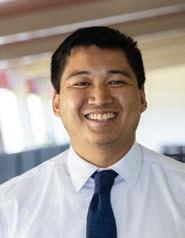
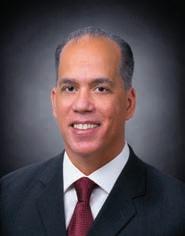
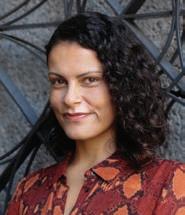
Donald D. Rodrigues
Richard E. Tanaka
Vaughn G. Vasconcellos, Hon Litt.D ’22
Jeff Wagoner
Lt. Gen. Francis John Wiercinski (Ret.)
Greg Young
EX OFFICIO
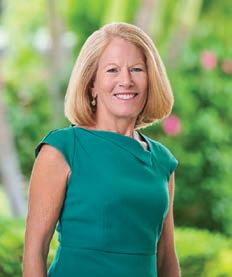
Lynn Babington, Ph.D.
Keiki-Pua Dancil, Ph.D.
LEADERSHIP
PRESIDENT
Lynn Babington, Ph.D.
PROVOST & SENIOR VICE PRESIDENT FOR ACADEMIC AFFAIRS
Lance Askildson, Ph.D.
CHIEF FINANCIAL OFFICER & SENIOR VICE PRESIDENT
Aulani Kaanoi ’93, MBA ’96
RECTOR & VICE PRESIDENT FOR MISSION Fr. Martin Solma, S.M.
VICE PRESIDENT FOR ENROLLMENT MANAGEMENT & ASSOCIATE PROVOST FOR STUDENT SUCCESS
Jennifer Creech ’24, Ed.D.
VICE PRESIDENT, UNIVERSITY COMMUNICATIONS & MARKETING
Cathy Lee Chong
VICE PRESIDENT, ADVANCEMENT
Jill Higashi
VICE PRESIDENT, STUDENT AFFAIRS & DEAN OF STUDENTS
Allison Jerome, Ed.D.
“As technology continues to evolve, we’re leaning into it with curiosity and care—always grounded in our values.”
—Lynn Babington, Ph.D. PRESIDENT
Aloha,
There’s something special about spring at Chaminade. It’s a season that invites reflection and renewal—and as I turn these pages, I’m reminded just how much there is to be grateful for in this community we share.
This issue captures what makes Chaminade so distinctive: the way our mission comes alive through people and purpose. You’ll read about students, faculty, and programs that reflect both our commitment to academic excellence and our deep belief in community partnership and impact. These are more than pillars in our strategic plan—they’re part of who we are, every day.
One story that beautifully illustrates this focuses on our Parish Health Program. Our healthcare students are learning in the most meaningful way possible—by serving others. Through their outreach, they’re connecting with more than 62,000 parishioners so far across our communities, offering care, education, and compassion. It’s inspiring to see students grow not only in skill, but in heart. This is our Catholic Marianist education at its best: preparing students for careers, yes—but also forming them for lives of service and purpose.
You’ll also find a thoughtful look at how we’re approaching artificial intelligence at Chaminade. As technology continues to evolve, we’re leaning into it with curiosity and care—always grounded in our values. Our faculty are asking important questions about how to integrate new tools while staying true to what matters most: relationships, critical thinking, and educating the whole person. It’s a balance we take seriously, and one that reflects both innovation and tradition working hand in hand.
And in a deeply moving way, this issue honors the legacy of the late Ronald Iwamoto, a beloved faculty member whose impact continues to be felt. His story is a powerful reminder that education is, at its core, about connection. He didn’t just teach—he cared, he mentored, and he inspired. Our faculty share that same sense of calling, and it’s what makes Chaminade so special.
As you read through this magazine, I hope you feel what I do—a sense of pride, certainly, but also a sense of connection. Chaminade is a place where people show up for one another, where learning extends beyond the classroom, and where our mission continues to guide us forward in meaningful ways.
Thank you for being part of this community. Whether you’re an alum, a supporter, or a friend, you are part of the story we’re continuing to write together. It is a good one.
Sincerely,
Lynn Babington, Ph.D. PRESIDENT
CHAMINADE UNIVERSITY MAGAZINE
Chaminade University Magazine is produced and published by:
Chaminade University of Honolulu University Communications and Marketing 3140 Wai‘alae Avenue Honolulu, HI 96816
Copyright 2026 Chaminade University of Honolulu. All rights reserved.
Editor
Cathy Lee Chong
Graphic Designers
Kelly Siu, Carrie Wedemeyer
Writers
Nathanial Gronewold, Mary Vorsino
Cover photo Dana Edmunds
Photography Michael Tafao
Communications and Marketing Office Stacey Ishii, MBA ’20
Breeze-Lyn Morita
Hudson Downard
EMAIL: ucm@chaminade.edu
WEBSITE: chaminade.edu chaminade.edu/publications
STAY UP TO DATE with what’s happening at Chaminade at chaminade.edu/news
SEND CLASS NOTES TO: alumni@chaminade.edu
Chaminade-University
FEATURES
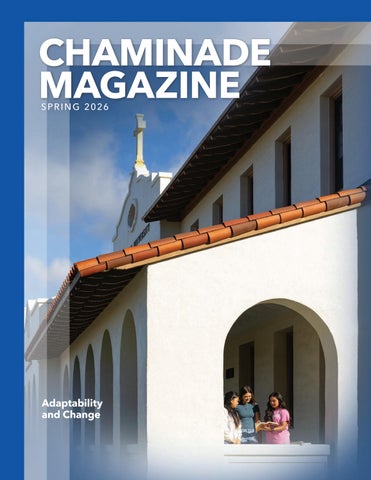
ON THE COVER Adaptation
and Change
Chaminade maintains Marianist educational traditions in the face of modern change.
Ten Things You Love about Chaminade
People, place and purpose | Here are ten reasons our community cherishes Chaminade.
20 Remains of a Saint Marianne Cope’s story is retold through forensic science.
24 Chaminade’s Hogan Program 25 Years of Doing Well by Doing Good.
32 A Scholarship Comes Full Circle Dr. Run Heidelberg ‘95 provides students with opportunities to change dreams.
SECTIONS
VIEW FROM THE HILL
8 Parish Health’s Win-Win
10 Early College
12 Humanities and Beyond
TAKING THE LEAD
14 Global Outreach
16 Chaminade Assessment Center
CHANGE MAKERS
22 Eric, MBA ‘94 and Lori ‘01 Fujimoto
26 Marianist Moment with Father Martin Solma, SM
27 Marianist Lecture Series
INSPIRATIONS
28 Homage to Ronald Iwamoto
30 Heritage Award Winners
34 Recognizing Alumni Near and Far
CHAMINADE ‘OHANA
36 Class Notes
43 Celebrate Cherish Connect
45 Scene & Heard
10 T HI NGS YOU love
ABOU
T CHA MI NADE
Here are ten reasons our community cherishes Chaminade — the people, the place, and the purpose that make it special.
Attention Given by Professors
At Chaminade, professors know students by name— and by story. Small class sizes foster meaningful dialogue, personalized mentorship, and handson learning experiences. Faculty are deeply invested in student success, both inside and outside the classroom, guiding students academically, professionally, and personally.
Hip and Historic Neighborhood of Kaimukī
Nestled in the vibrant neighborhood of Kaimukī, Chaminade enjoys the perfect blend of tradition and trend. From locally owned cafés and eateries to historic landmarks and community events, Kaimukī reflects the authentic spirit of Honolulu. It’s a walkable, welcoming extension of campus life.
Marianist Foundation That Guides Our Daily Lives
Chaminade’s Marianist values—faith, service, community, and education of the whole person—are woven into everyday campus life. These principles shape how students learn, lead, and serve others. Grounded in Catholic tradition and open to all, the Marianist spirit inspires purpose and compassion.
Diversity of Our Student Body
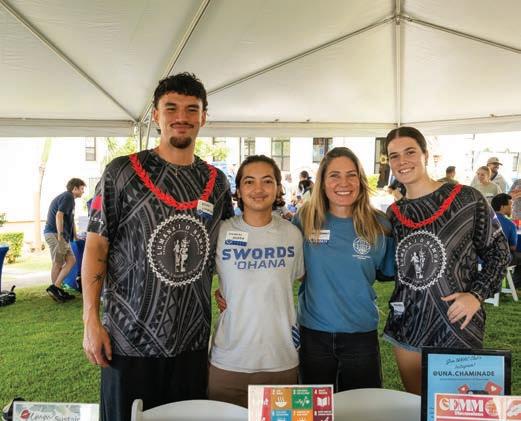
Students at Chaminade come from Hawaiʻi, the Pacific, the continental United States, and around the world. This rich diversity creates a learning environment where multiple perspectives are valued and celebrated. Cultural exchange is not just encouraged—it’s a daily experience.
Silversword Spirit
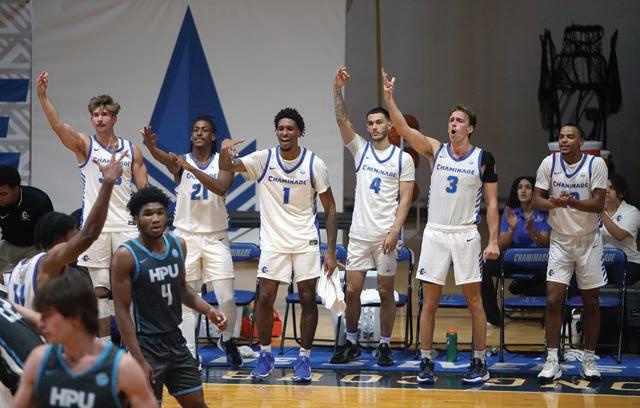
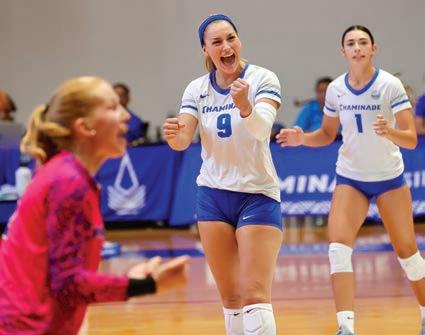
Silversword pride runs deep, whether in the stands, on the court, or on the field. Chaminade athletics emphasize teamwork, discipline, and sportsmanship, reflecting the University’s mission. Win or lose, the Silversword community shows up and supports one another.
6 Views of Diamond Head
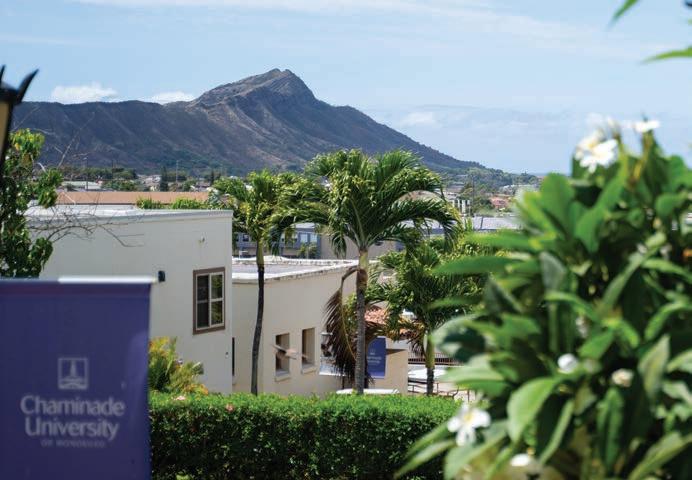
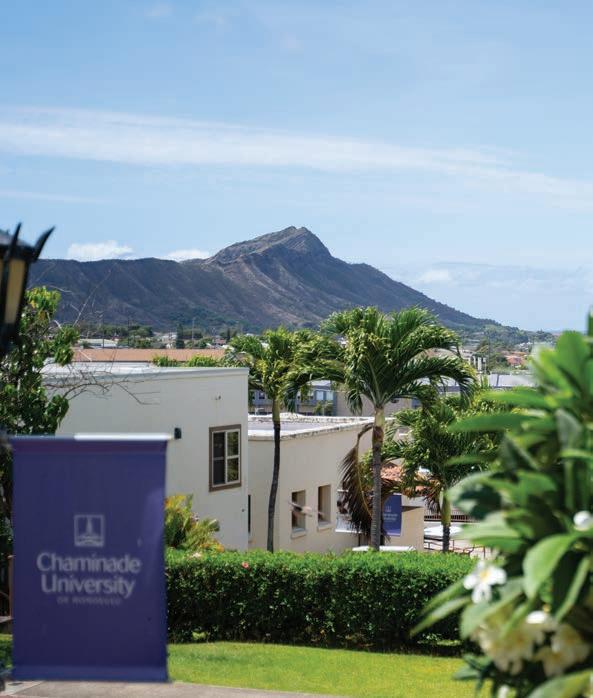
Few campuses can claim a view as iconic as Diamond Head. Framing daily walks to class, views of blue skies and ocean serve as a constant reminder of our unique sense of place on Kalaepōhaku. It’s a view that inspires reflection, gratitude, and connection to Hawaiʻi’s culture and beauty.
Top Programs for Undergraduate and Graduate Students
Chaminade offers a wide range of respected undergraduate and graduate programs designed to meet today’s local and global needs. From health sciences and education to business and forensic science, programs combine academic rigor with real-world relevance. Students graduate prepared to lead with competence and integrity.
8
Our Caring, Close-Knit Community
At Chaminade, you’re never just a number. Students, faculty, staff, and administrators form a supportive network that feels more like ʻohana than institution. This strong sense of belonging is one of the University’s most cherished hallmarks.
Dedicated Alumni Who Support Chaminade
Chaminade alumni remain deeply connected long after graduation. They mentor students, advocate for the University, and generously give back their time, talent, and resources. Their commitment ensures Chaminade’s Marianist mission continues for future generations.
10
Our Impact on Hawaiʻi and Beyond
Chaminade graduates go on to serve their communities locally and around the world. Through leadership, service, and professional excellence, they embody the values instilled during their time on campus. The University’s influence extends far beyond its hillside location, shaping lives and communities everywhere.
A Win-Win Like No Other
Growing up, Nathaniel Leomite
’26 used American Sign Language to communicate with his grandparents, who were both deaf.
It was a skill that he always appreciated having, but that he never really thought would apply to his chosen career in community and public health. That is, until he volunteered with Chaminade’s Parish Health program in his junior year.
Leomite says one afternoon, he was wrapping up a day of service at Saint John the Baptist Catholic Church in Kalihi when he spotted a man who appeared in need but unsure how to ask for help. When Leomite approached, he realized the man’s hesitancy: He was deaf.
Leomite switched to ASL and watched as the man’s expression of concern switched to one of joy.
“It was this full circle moment for me,” says Leomite, who offered the man a box of healthy food options to take home to his children and encouraged him to get a
blood pressure check before he left. “He was the only deaf person and I was fortunate enough to help him. It felt really good.”
The interaction may have been a small one, but it meant so much to the parishioner and to Leomite. And that, says Chaminade School of Nursing and Health Professions
Associate Professor Sandra Bourgette-Henry, DNP, APRN-Rx, is exactly what the Parish Health Program is all about.
“It’s a win-win for the community and for the school,” she says.
50 YEARS OF SERVICE
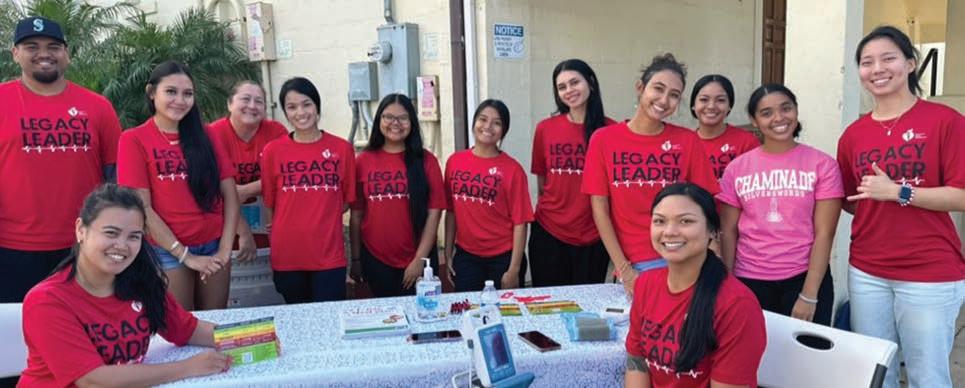
The Parish Health Program, celebrating its fifth anniversary this year, gives students pursuing healthcare professions valuable in-person experience in health education while improving health equity. Students administer blood pressure checks, offer parishioners tips for eating healthy or preventing disease, and talk about medication management, exercise and much more.
Bourgette-Henry says the program, now offered at four Oʻahu parishes, allows
“Since the program began, students have conducted outreach to more than 62,000 parishioners.”
—Nathaniel Leomite ’26
nursing and public health students to better understand the unique health challenges of diverse communities and see the benefits of preventive health and chronic disease management first-hand. The program has also partnered with nonprofits so students can work directly with community leaders.
Since the program began, students have conducted outreach to more than 62,000 parishioners.
“We see people of all ages, little children all the way to elderly,” Bourgette-Henry says. “Students are teaching the patient and teaching the family. And you can’t be a shy person and be a nurse. This program really gets students out of their shell as they work one-on-one with parishioners.”
Father Jaroslaw Skrzypek, of Saint John the Baptist Catholic Church, says the parish health program has transformed his church “into a place where both spiritual and physical health are nurtured side-by-side.” The health screenings and education, he says, are encouraging parishioners to take proactive steps to care for their well-being. And he’s been amazed to see student participants grow through the program, too, as they deliver compassionate care.
“By interacting with our diverse parish family, the students develop the empathy and communication skills needed to be truly holistic healthcare providers,” Skrzypek says. “The fact that so many parishioners, even those without specific health concerns, line up just to check their vitals shows how much the community trusts and values this service.”
And while he’s seen many “wins” through the program, one story stands out. He says a parish family began visiting the Chaminade students weekly for blood pressure checks and one of the family members was flagged for dangerously high readings.
That parishioner followed students’ advice to see a doctor, Skrzypek says, and now is on necessary blood pressure medication.
“Our parishioners are very happy to have these young students among us; they even feel a sense of pride in ‘helping’ the students learn,” Skrzypek says, adding the program is a blueprint for holistic parish ministry.
“It’s a beautiful exchange where everyone feels comfortable and cared for.”
CATHOLIC MARIANIST MISSION OF SERVICE
Reign Morales ’25, DNP ’28 worked with the Parish Health program in spring 2025. She says the experience inspired her to pursue a graduate degree at Chaminade to become a nurse practitioner. “This program taught me a lot about connecting and making a difference within a community instead of just the individual, and the importance of preventative services,” she says.
She says during one interaction through the program, she met a mother with her children and encouraged her to participate in a free blood pressure screening. The woman’s reading was very high, which the woman had been unaware of, and Morales and her peers educated her on the risk of uncontrolled high blood pressure and how she could improve it with diet and exercise.
It was during that exchange the woman explained she’d been adding lots of salt to her meals to gain a little weight, not realizing how detrimental that could be to her health. “A few weeks later, she returned for a follow-up blood pressure check, which showed a significant improvement,” Morales says. “She also reported making dietary changes, including eating less fast food.”
Morales says serving parishioners where they are is about healing people and communities.
“This program aligns with Chaminade’s mission of service since as Catholics, we learn to be disciples of Christ and I feel as if we are doing God’s work to show up for our fellow brothers and sisters,” she says. “As nurses, it is crucial to immerse yourself in the community you serve to be an advocate for patient needs. It is important to understand why people come into the hospital and how preventative services and early intervention can completely change a health trajectory.”
Morales adds she hopes Chaminade continues to expand the program so students destined for healthcare professionals understand how they can make a difference, beyond the hospital and the classroom. “This may inspire some students to pursue community-focused work,” she says.
Bourgette-Henry says that’s certainly a goal.
“High blood pressure, they call it the silent killer. I always thought, ‘Why wait for people to come in before we treat them?’”
Bourgette-Henry says, adding that during most of her career before joining Chaminade she worked with patients who had advanced heart disease.
“That’s why I wanted to gear toward preventing diseases,” she says.
Preventive care through the parish program is also focused on kidney health as untreated hypertension is a leading cause of kidney failure in the islands. “Curing kidney disease is not about building more outpatient dialysis centers,” she says. “It’s about preventing disease, including doing more blood pressure screenings. Most people don’t know they have hypertension.”
Additionally, the program has partnered with several local organizations, including the American Heart Association, which provided students with food vouchers that they
could give to parishioners who were struggling to afford healthy, fresh food options.
Bourgette-Henry says one of the things that she truly loves about the program is the care and creativity that Chaminade students bring to every interaction. In addition to one-on-one screenings, students put together fun games and interactive presentations.
“Students are pulling everything they’ve learned together to reach the community,” she says.
That’s what Leomite, the Public Health major, did. He says his training in cultural competency at Chaminade proved particularly useful as he worked with parishioners from all different backgrounds. And in addition to using ALS, he also switched over to Samoan.
For Leomite, it was all in a day’s work. The California native says his family came from American Samoa, and so it hit home when he helped parishioners “who looked like me” and were struggling to afford food. “It made me want to stay and help out more,” he says. “In my culture, service is big, especially to our elders.”
Leomite says on reflection, he was especially grateful to the Parish Health program for helping him “be of service while keeping my faith strong. There’s a lot of rough roads that we can walk, but I believe God is always going to provide the shoes we need to walk those roads.”
For Leomite, the program even proved pivotal in helping him determine his future career path. After graduation, he says, he plans to pursue a future in social work and community health. “I want to serve less fortunate communities,” he says, “and hopefully, be part of the solution.”
LEFT: Nathaniel Leomite ’26 and his cohort volunteered with Hawai‘i Food Bank for a Parish Health event.
A JUMPSTART
to College Through Partnerships and Programs
Thanks to two partnership programs, the promise of experiencing college while still in high school, and even elementary school, is happening at Chaminade University.
EARLY COLLEGE PROGRAM
After registering for a day of college experiences at Chaminade University, twin brothers and St. Louis School seniors Lawrence and Andrew Robello say they felt genuinely welcomed by Chaminade University after enrolling in the Early College program. They are among 92 high school students who enrolled in the program’s fall 2025 term and culminated with a summit this past December.
“I like how the people are really welcoming here,” Lawrence says. “The college students don’t isolate us because we’re in high school but they welcome us in. If you also need help, the counselors, Ms. Kim (Baxter), Noe (Tugaoen), are there for support.”
In addition, students from Sacred Hearts Academy and Kapa‘a High School are enrolled in the Early College program which is open to students from any Hawaiʻi high school. The program allows high school students to earn college credit, as well as be eligible for high school credit. The program provides a college education to a diverse group of Hawai‘i high school students, in line with the University’s mission to prepare leaders for tomorrow, ready to make impactful contributions to their communities and professions.
“I love this program because it gets me ahead of the game and it opens doors for me, ” says Carlee Lomabita of Sacred Hearts Academy.
Studies show that Early College students are better prepared for full-time college entry, college life and expectations. Students also tend to exhibit higher grade point averages, retention rates and graduation rates.
For more information on how to enroll in the Early College program at Chaminade, visit https://chaminade.edu/earlycollege/
I GO TO COLLEGE
Fifth grader Ireland Baum waited on the lanai of the Sullivan Library, anticipating a day of college life with her classmates and peers from Catholic schools across the state.
“I think coming here to Chaminade is a great experience so I can learn more about college life,” Baum said. “I think college is going to be fun because we get to learn new things and go to fun classes.”
By the sights and sounds of active, engaged, and happy youths on Chaminade’s grassy, beautiful and safe campus, FUN is absolutely correct.
Baum is one of approximately 350 fifth-graders who spent a day in February at Chaminade, attending classes taught by university professors and then receiving a “diploma” presented by Chaminade President Dr. Lynn Babington and Provost Dr. Lance Askildson in a special graduation ceremony in Mamiya Theatre. The “I Go To College” program is a partnership between Hawaiʻi Catholic Schools and Chaminade,
“The value of a college education is not the learning of many facts but the training of the mind to think.”
—Albert Einstein
immersing students from O‘ahu, Kaua‘i, Maui and Hawai‘i island to college life at an early age and providing them with a fun, enriching day.
Schools participating in ‘I Go To College’ include:
St. Joseph’s School, Hilo
Sacred Hearts School, Lahaina
St. Anthony School, Maui
St. Theresa School, Kaua‘i
Our Lady of Good Counsel
St. Theresa School
St. John Vianney School
St. Michael School
St. Louis School
Sacred Hearts Academy
St. Anthony School, Kailua
St. Elizabeth School
St. Joseph Parish School
Maryknoll School
Holy Family Catholic School
St. Patrick School
Mary, Star of the Sea School
The Future of the Humanities at Chaminade and Beyond
Philosophy. Communication. Literature. Performing Arts. History.
Scholars love these and other humanities disciplines and the rich intellectual history behind them, yet these fields are facing challenges in higher education today.
Amore competitive job market, declining student and parent interest, and tightening university budgets are all coming to bear on these and other humanities subjects. Recent federal spending cuts are exacerbating trends. Some say humanities subjects are doomed. Chaminade University says: not so fast.
Chaminade is once again bucking national trends. The School of Humanities, Arts and Design is gearing up to launch five new humanities-focus degree programs next semester, including a new Professional Master of Fine Arts in Writing program, the only one of its kind in Hawai‘i.
Bold initiatives in humanities education are still possible, says School of Humanities Dean Dr. Cheryl Edelson, thanks to the university’s careful recalibration and consideration of students’ needs. These new degree programs—launching despite a perceived national downturn in humanities education—will celebrate the role that these subjects have to play in building up critical thinking, communication, and leadership, all skills essential for individual success.
“We are ideally situated to address the challenges as a small institution that can adapt and change and really meet the students where they are, and explain the sustainable skills that humanities programs and courses offer,” Edelson said confidently. Edelson, who also teaches literature and film, is optimistic. In a broad-ranging interview, she explained how Chaminade is responding to the challenges facing the humanities.
Recent news headlines concerning humanities education in the United States today highlight the challenging
environment. According to the American Academy of Arts & Sciences, the number of humanities degrees awarded at colleges and universities has fallen by more than 25 percent over the past 15 years. Schools are reporting declining enrollment in humanities courses and majors. Some fields, like American studies, have seen accelerating enrollment decline.
Chaminade University hasn’t escaped these pressures. Enrollment has fallen in some programs, Edelson confirmed. She admitted that humanities programs are a tougher sell these days compared to years past.
“This is a national and international phenomenon, it’s not only happening in the United States,” Edelson said. “There have been humanities program cuts in the UK, Europe, Canada, and across the continental US. ” She said Chaminade University has also seen enrollment declines for some subjects, as has been seen nationally.
Regardless, the humanities lay at the center of Chaminade’s Marianist Catholic traditions. They are not going away anytime soon, Edelson said, because they build a foundation that the university seeks to instill within its students, one of critical thinking and ethical decision making. That’s why Chaminade is taking a different course, she said.
“Our approach is not to cut them, it’s to reimagine them.”
This coming Fall semester, Chaminade University will launch four new undergraduate programs built around humanities subjects but very much focused on clear career paths. It’s a response to student and parent demand, Edelson explained.
A new Ethics & Leadership program “brings together religious studies, philosophy, and business coursework, as well as leadership coursework, to really help develop those skills that are going to be necessary in any leadership position,” she said. The program is being tailored to appeal to students interested in pursuing careers in a variety of fields where leadership, collaboration, communication skills, and a firm understanding of cultural contexts are all essential.
School of Humanities Dean, Cheryl Edelson, Ph.D.
“We are ideally situated to address the challenges as a small institution that adapt and change and really meet the students where they are, and explain the sustainable skills that humanities programs and courses offer.”
—C heryl Edelson, Ph.D. Sc hool of Humanities Dean
The forthcoming Law, History & Culture undergraduate degree program will be designed to appeal to pre-law students. Edelson said the program’s designers even took cues from the LSAT, the standardized law school entrance exam, to study how best to structure the curriculum. Law, History & Culture students will be exposed to Hawaiian and Pacific history “because we do have a lot of students who want to practice law and form policy in Hawai‘i and the Pacific ” she said.
Digital Media & Applied Arts students will learn to use the latest and emerging digital technologies, including AI, for advanced graphic design and other creative work. The program will also incorporate “narrative and storytelling” aspects of design, Edelson said.
The fourth new undergraduate program Edelson’s school is working on in collaboration with the School of Natural Science and Mathematics is a truly interdisciplinary degree tentatively titled Ocean Studies & Marine Affairs. She said the program will teach students about topics “such as policy and history and culture of islands and coastal regions, but also about what it means to live sustainably in and with a marine world.”
Also starting next Fall: Chaminade’s new Professional Master of Fine Arts in Writing program. The 36-credit online program includes an in-person campus residency
option. It’s slated to become the state’s only MFA in writing program. The new program will foster “creative thinkers, effective communicators with mastery in written and oral skills, productive collaborators with information literacy who are able to process and share accurate knowledge, data, and factual messages about important issues to a wide audience effectively,” Edelson said.
Where other schools see a crisis, Chaminade sees an opportunity.
Humanities subjects are necessary and valuable for all career paths. They teach future nurses, criminal justice workers, lawyers, and business leaders about this moment in time and how we got here. They teach analytical skills, critical thinking, reasoning, and ethical judgment.
They ground professionals in a better understanding of the past and present, and a stronger appreciation of what the future may hold.
Edelson argues that the future of the humanities is bright, not bleak. Educators just need to concretely demonstrate why these subjects are so worthy and how they can help students succeed in this increasingly competitive and complicated world.
“We have to be able to show them the value of these degrees to learn and develop sustainable skills, but definitely it’s also about helping students to connect their passions and interests to career pathways,” Edelson stressed.
Chaminade’s CIFAL Honolulu Advances Global Sustainability
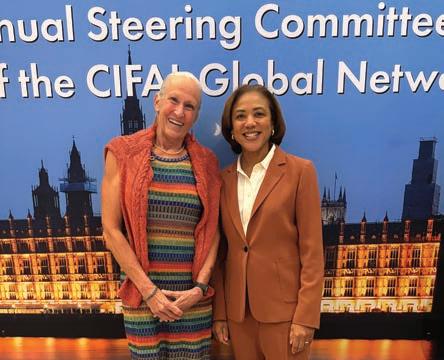
RIGHT: Dr.Gail Grabowskyof Chaminade University with Michelle GylesMcDonnough, United Nations Assistant SecretaryGeneral and Executive Director of the United Nations Institute for Training and Research (UNITAR)
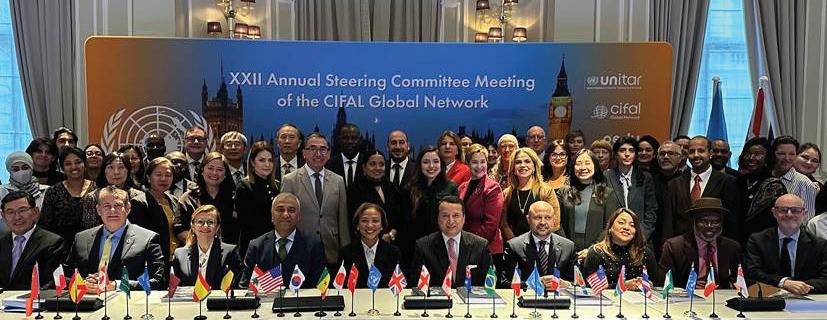
BELOW: Delegates representing 32 CIFAL centers around the world met in London.
Aligned with Chaminade University’s Strategic Plan commitment to institutional sustainability, leaders of CIFAL Honolulu recently represented the university at the 22nd CIFAL Global Network Annual Steering Committee meeting in December 2025 in London. The gathering was hosted by CIFAL London in partnership with GEDU Global Education.
Dr. Gail Grabowsky, dean of the School of Natural Sciences & Mathematics and director of CIFAL Honolulu, and Dr. Helen Turner, professor of biology and Director of Research for CIFAL Honolulu, joined delegates representing 32 CIFAL centers worldwide, along with the United Nations Institute for Training and Research (UNITAR), to review global progress and establish strategic priorities for 2026.
What Is the CIFAL Global Network?
The CIFAL Global Network operates under the leadership of UNITAR, serving as an international platform for training and capacity-building in support of the United Nations Sustainable Development Goals (SDGs).
“It’s about transformation,” said Alex Mejía, Director of UNITAR’s Division for People and Social Inclusion and Head of the CIFAL Global Network. “It’s about capacity building—strengthening people’s knowledge and expertise to do something good for society. These transformations improve communities and help bring progress to people.”
Across its global network, CIFAL reaches more than 150,000 beneficiaries annually through training, research, and communitybased initiatives.
Addressing Global Challenges Locally
During the London meeting, leaders reviewed collective achievements, examined emerging global and institutional challenges, and identified priorities for the year ahead. Discussions took place amid a shifting global landscape marked by geopolitical instability, economic uncertainty, and mounting pressure on the 2030 Agenda for Sustainable Development. Despite these challenges, participants reaffirmed the importance of the 17 Sustainable Development Goals as a shared global framework—particularly at the local level, where CIFAL centers translate international commitments into tangible community action.
At CIFAL Honolulu, those efforts include:
• Youth Education for Social Justice —K-12 education for sustainability initiative
• Invasive Species Management of Islands —partnerships focused on humane free-roaming cat population reduction
• Mālama Maʻi —a hygiene and gender equity security program
• Pacific & Asian Affairs Alliance — diplomacy and environmental training initiatives
To date, CIFAL Honolulu programs have served more than 5,000 participants, approximately 62 percent of whom are Pacific Islanders.
Looking ahead to 2026, CIFAL Honolulu priorities include expanded outreach, workforce development, applied research, and technical assistance to address regional sustainability needs.
“The CIFAL Global Network is unique among United Nations organizations in that our focus is local and on education and creating experts and actors who help Hawaii and the Pacific achieve sustainability guided by the Sustainable Development Goals. The result is that, through the 32 centers aiding local education and community action, together we help to achieve global sustainability.”
Rooted in Mission
As part of UNITAR’s global training platform, CIFAL Honolulu strengthens Chaminade’s role in advancing sustainable solutions both locally and internationally. The work aligns closely with the university’s Marianist characteristics—educating for formation in faith, providing an integral quality education, educating in family spirit, educating for service, justice, and peace, and educating for adaptation and change.
Through CIFAL Honolulu, Chaminade continues to bring global conversations home—preparing students and communities to lead meaningful, missiondriven change.
A Bridge Between Chaminade and the Vatican
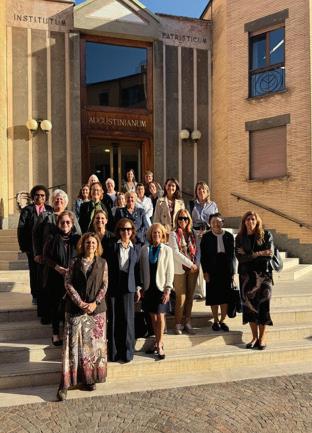
Chaminade President Lynn Babington, Ph.D. traveled to Rome in late 2025 for a weeklong seminar aimed at fostering new opportunities for women in leadership at Catholic institutions of higher education and promoting the importance of values-based education.
Babington was selected to participate in the Women’s Leadership Program,which is an executive initiative of the International Federation of Catholic Universities.
Participants in the gathering, from October 22 to 26, included university presidents, rectors and other distinguished women leaders from academia.
They discussed the critical role of women in Catholic higher education, the importance of advancing women in academia, and the role of service-focused Catholic education.
The program also explored the intersection of faith, leadership and governance at Catholic universities worldwide.
While women are a powerful force in Catholic higher education leadership, they hold only 8% of top positions globally.
Organizers said the Women’s Leadership Program is designed to bring together women leaders guiding institutions with confidence, integrity and Catholic values.
Babington said it was a great honor to participate in the initiative, which included talks at LUMSA University in Rome and visits to the Vatican.
“A central area of reflection was the urgent and important work of Catholic universities to, as Pope Leo XIV’s has said, seek ‘the integral development of the human person forming intellects with a critical sense, believing hearts, and citizens committed to the common good.’”
Babington added, “Those inspiring words speak eloquently to Chaminade’s mission.”
Doctoral Students Gain Practicum Serving Community Needs
BY MARY VORSINO
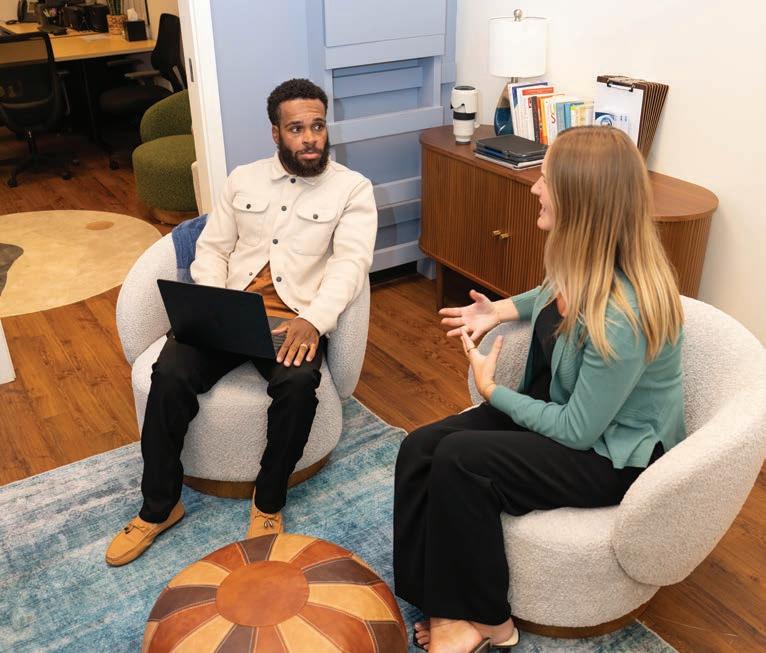
ABOVE: Zach Birts and Marley Preston, both second year doctoral students, collaborate on a case while in the Chaminade Assessment Center.
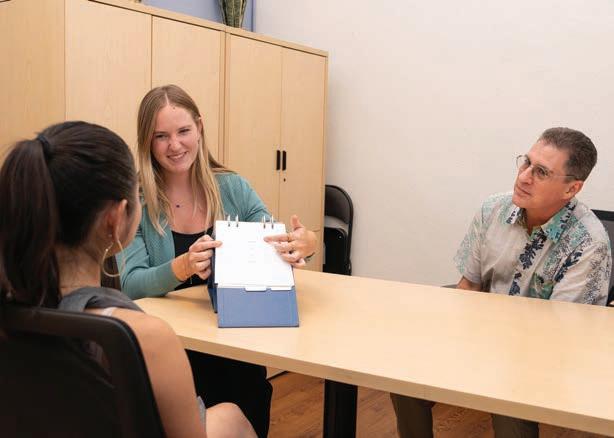
OPPOSITE PAGE: Jeffrey D. Stern, Ph.D., Associate Professor with the Hawaiʻi School of Professional Psychology at Chaminade University, observes as doctoral student Marley Preston meets with a client.
The Chaminade Assessment Center
Our mission is to strengthen Hawaiʻi’s families and communities by providing accessible, culturally responsive, and high-quality therapy services, while training the next generation of Marriage and Family Therapists in the values of ethics, relational attunement, and systemic care.
With practicum, internship, and dissertation requirements, hands-on learning and intensive scholarly inquiry are critical parts of Chaminade’s Doctor of Psychology in Clinical Psychology.
And thanks to the University’s assessment center, graduate students can tackle some of that patient-focused work right on campus.
The Chaminade Assessment Center (CAC), launched in Fall 2023 gives PsyD students the chance to conduct psychological evaluations and fill a community need at the same time.
Dr. Sean Scanlan, director of the Clinical Psychology program at the University, said the CAC started off small but with a strong mission: To offer children and young adults psychological evaluations so they can get the right treatment and educational accommodations.
“We had Chaminade PsyD students searching for practicum sites, and we saw community members needing these psychological assessments,” Scanlan said.
The center’s first clients were Chaminade students. From there, the clientele was expanded to include students referred from nearby private schools. Scanlan said the center was able to serve about 30 patients in their first year and almost 50 in their second.
Meanwhile, about three PsyD students at any one time work under a supervisor at the CAC. Scanlan said each client requires six to 15 hours of testing, which may include an interview and cognitive, personality, and learning assessments. From there, the psychologist and PsyD students synthesize the findings and issue a report with a diagnosis and recommendations.
Clients can take that report to educational institutions for special accommodations or to a community mental health provider so they can begin treatment.
“For our PsyD students, it’s a lot of work,” Scanlan said. “Because it’s not just the student preparing to be with an actual client; they have to be prepared to sit and listen to real world problems, all the while trying to conceptualize a diagnosis.”
But Scanlan said that this real-world, experiential learning experience is critical to their training, similar to that of trainees in the medical fields. He stressed that their clinical supervisor is always there to offer expertise and guidance. The supervisor also handles initial and critical client interactions so students can see practiced psychological evaluations and interactions at work.
Sammie Wilkinson, PsyD ’27 was one of Chaminade’s first PsyD students to serve at the center following its launch and has
“It has been a privilege to work with clients from diverse backgrounds, which has deepened my appreciation for taking a comprehensive and thoughtful approach to assessment,”
—Sammie Wilkinson, PsyD ’27
since put in additional time there as an administrative and assessment specialist. She summed up her practicum experience at the center in one word: “Rewarding.”
“I learned about comprehensive psychological evaluations and assessment, which are major components of the role of a clinical psychologist and a focus of the PsyD program,” Wilkinson said.
“During my practicum, I was able to support both Chaminade students and clients in the community by conducting assessments, identifying and diagnosing various challenges that often impact academic performance and social functioning. Since completing my practicum, I have continued to support the CAC with scheduling and helping clients access services.”
Wilkinson explained that assessment and diagnosis help clients put a name to specific mental health challenges they’ve been experiencing and provide a starting point for healing and support.
“It has been a privilege to work with clients from diverse backgrounds, which has deepened my appreciation for taking a comprehensive and thoughtful approach to assessment,” she said. “One of the biggest challenges is determining an accurate diagnosis, as many conditions can resemble one another. For example, trauma may present similarly to ADHD. Therefore, it is so important that we are thorough, take our time to rule out diagnoses and consider each client holistically.”
She added that helping to broaden access to community-based services has been especially meaningful—and she’s excited about the center’s continued growth.
“Psychological assessments are in high demand but often come with long waiting lists or high costs so it has been wonderful to be part of a center that provides these services in a timely and affordable way,” she said.
Scanlan noted that the center started to accept insurance in 2025. In the program’s first two years, services were free and mostly referral-based. “I think we have the foundation now where we can begin to increase the number of PsyD students we can take and, as a result, the number of clients we can see,” Scanlan said. “We’re happy to be providing this service to the community.”
The center’s growth comes as Chaminade’s School of Education and Behavioral Sciences also launches another win-win program for aspiring mental health professionals and clients in need of services. In spring 2026, the University’s Marriage and Family Therapy program launched its new MFT Training Clinic, where graduate-level MFT therapists in training provide care under the supervision of licensed clinicians. Services are affordable and open to anyone on O‘ahu.
“This clinic is a training ground for future marriage and family therapists,” said Blendine Hawkins, Ph.D., LMFT, director of the Doctor of Marriage and Family Therapy program at Chaminade. “By focusing on couples and families and embracing culturally humble, evidence-based approaches, the clinic is a meaningful new resource for our local community. We’re excited to share this development with those who value strengthening relationships and supporting families.”
Ending the AI “Arms Race”: An Interview with Provost Lance Askildson
BY NATHANIAL GRONEWOLD
Chaminade University takes great pride in maintaining Marianist educational traditions in the face of modern change, and arguably no modern invention has challenged this mission more than artificial intelligence or AI.
Just a few years ago, OpenAI launched the first version of ChatGPT. The impact has been tremendous. College students are now using AI tools to cheat on tests and generate entire term papers. Professors have tried to keep up by using specialized detection software, but it’s proving to be a losing battle.
is the topic dominating conversations at campuses throughout the United States. Administrators and faculty members at Chaminade and elsewhere are struggling to comprehend AI technologies and how they’ve transformed higher education and learning in a very short amount of time. Chaminade University Provost and Vice President for Academic Affairs Lance Askildson, Ph.D. characterizes the current state of affairs as a tech battle where students and AI companies hold the upper hand. Combating AI overuse in education will require adopting different tactics, not different technologies, he says.
“I think we felt like we were in an arms race, but at this point, the technology of those armaments have far exceeded any of our technologies to combat it, and so now we’re in sort of a battle of wits,” he said.
A recent survey by the American Association of Colleges and University and Elon University showed faculty hold overwhelmingly negative views about AI. 83 percent of respondents said they believe the technology will worsen students’ attention spans. 95 percent
predict students will come to rely too heavily on AI tools over time–there’s fear students will let the machines do the thinking for them. Whatever the concerns may be, 86 percent of American university faculty members polled agree that AI will completely transform how teaching must be conducted.
In a wide-ranging conversation on the impact of AI on higher education, Provost Askildson said he’s adopted a much more nuanced and at times optimistic stance.
A renowned linguistics expert, Askildson penned an opinion piece in the Chicago Tribune three years ago arguing that ChatGPT is no replacement for human educators. He stands by this assessment, though he admits the technology has
become more advanced and, in many ways, more threatening since that letter was published. “I do not think that AI is fundamentally changing what a college education is, but it’s challenging us to ask that question anew,” he said.
Provost Askildson is advising Chaminade’s faculty to stop trying to fight AI with detection tools—it’s an arms race they’ll lose. Rather, he’s advising them to retool the way they deliver curricula, emphasizing that the end goal for a university education isn’t good grades or a diploma, but rather students demonstrating that they’ve acquired new knowledge and critical thinking skills to empower them in an increasingly competitive and complicated world.
Provost and Vice President for Academic Affairs, Lance Askildson, Ph.D.
BELOW, WE SHARE SOME OF THE FASCINATING CONVERSATION WE HAD WITH PROVOST LANCE ASKILDSON ON THE IMPACT OF AI ON CHAMINADE UNIVERSITY AND ACADEMIA.
Q: What are the implications of AI in higher education today compared to when this technology first came out?
Provost Askildson: The state of large language models and generative AI has changed quite a bit.
The implications for higher ed are significant in that the tools that we had at the beginning of this journey two and a half, maybe three years ago, were pretty consistent in helping us identify when students were using AI—and so they’re called AI detectors, or there were a few different monikers for them. But basically, the technology to detect AI was about as strong as the technology to produce some of this generative language that was pretty polished. And really in the last eight to 12 months, that’s changed considerably.
The AI detector technology has fallen behind the sophistication and diversification of prompts and responses that the average user can get. And so, I think if you looked at the higher ed press two years ago, there was general acknowledgement that we need to recognize the value of AI for educational purposes, find ways to integrate it into the curriculum. And we’ve been having those conversations here at Chaminade since the beginning.
Q: Does Chaminade University currently have an official AI policy?
Provost Askildson: We do, but it’s baked into our academic integrity policy as a whole. We are working on a more explicit AI use policy so it’s less about the cheating with AI and more about what are the range of potential uses of AI that faculty and students should be considering. It’s going to be more of a heuristic rather than a policy. Does that make sense?
Q: The messaging will be, of course, academic integrity must be upheld. Then, you’ll provide more guidance for faculty while giving them the discretion to determine how to manage this technology in their classrooms.
Provost Askildson: Correct.
I also want it to be written in a way that students can understand that their faculty have true discretion. Some faculty might choose no AI use in their course for particular pedagogical reasons. Others might ask students to actually use AI explicitly as a part of the process and then explain what prompts they used in order to produce certain outcomes, and then critique that. So that might be the assignment.
We just want to acknowledge that there are going to be a range of uses for AI, but that all of the use of AI needs to be explicitly addressed either in the syllabus or in the assignment, or ideally both. And that’s some of the guidance we’ll be providing to faculty.
Q: What can professors do now to adjust their curriculum delivery strategies to sort of mitigate against students’ overreliance on AI?
Provost Askildson: Right now, faculty, when they suspect use of AI, they cannot rely on the detectors because there’s so much concern about construct validity. We just don’t know that the detectors are actually giving us accurate information. Instead, faculty are returning to the old approach of asking students to basically defend their writing.
They’re saying “can you explain to me why you made this point?” and they’ll read something from the text. And based on the student’s oral response–it’s a bit of an
oral interview–they will make a judgement about whether or not the student has used AI.
It’s not about catching the student’s use of AI. It’s about whether the student has mastered the learning that the faculty member has set out for them to learn sufficiently in the judgement of the professor.
The professor doesn’t need to accuse the student of using AI. They can simply say: “Well, you know, it seems to me that you haven’t fully grasped the content of this assignment. You’re not able to explain your reasoning. I’m not suggesting that you have done this fraudulently, but I’d like some additional evidence of mastery.” And so, they can give them additional assignments, they can have them do some alternative work to show mastery of that learning.
Q: How do you see Chaminade and academia in general moving forward?
Provost Askildson: The way we move forward is by keeping our humanity at the center of everything we’re doing.
That means focusing on the human element rather than all of this noise about technology. And it also means recognizing that this is more than just intellectual development we’re aspiring to. It’s character development, it’s whole person development.
At the center of combatting the threats that these new technologies pose, whether it’s AI or some new technology that might be on the horizon, it’s about making sure that the teachers, the faculty, are prepared to approach these new challenges thoughtfully, not in a reactionary way.
This is a Father Chaminade quote: “New times call for new methods.” Which is a really prophetic quote from an 18th Century–19th Century priest.
Over a century after her death, the story of a saint who served leprosy patients and died on Moloka‘i is being told anew—through science.
How Chaminade University’s Forensic Sciences Lab Secured the Remains of a Saint
BY NATHANIAL GRONEWOLD
believe in the resurrection of the body, and so the bones, that part of the body is very important.”
It’s the first time the Catholic Marianist institution has been called upon to assist the Church in this way. Saint Marianne’s remains will be shared among all the Hawaiian Islands.
Mother Marianne Cope was a German-born American Franciscan nun who traveled from Syracuse, New York to the Kingdom of Hawai‘i in the late 1800s to help build the kingdom’s medical infrastructure. She passed away in 1918 and was canonized in 2011.
Saint Marianne is credited with modernizing healthcare practices and establishing hospitals, but she is most famous for her work tending to the spiritual and medical needs of leprosy patients at Kalaupapa, Moloka‘i alongside the legendary Father Damien.
Saint Marianne died of natural causes. Most of her surviving skeleton was laid to rest at the Cathedral Basilica of Our Lady of Peace in downtown Honolulu after her canonization, but hundreds of bone fragments were left embedded in the soil at her gravesite on Moloka‘i. The Sisters of Moloka‘i who are caretakers of Marianne’s remains collected this soil and bone material.
In a first for our institution, Chaminade University was called upon by the Church to help secure these final remains, uniting Marianist mission and modern forensic expertise to bring history to life. Chaminade’s Forensic Sciences Unit was enlisted for the assignment, tasked with carefully sorting and evaluating Saint Marianne’s last surviving bone fragments, which the Church will use to create relics for worshipers.
“The spirit of the person is connected to the body,” The Most Reverend Clarence “Larry” Silva, Bishop of Honolulu, said in an interview with Chaminade Magazine. “We
“This project is going on because one of our pastors suggested that each island should have a relic of Saint Damien and Saint Marianne,” Silva said. “We have one here of course from each of them. Moloka‘i, of course, has also. But we want to make sure the other islands do, so that’s why.”
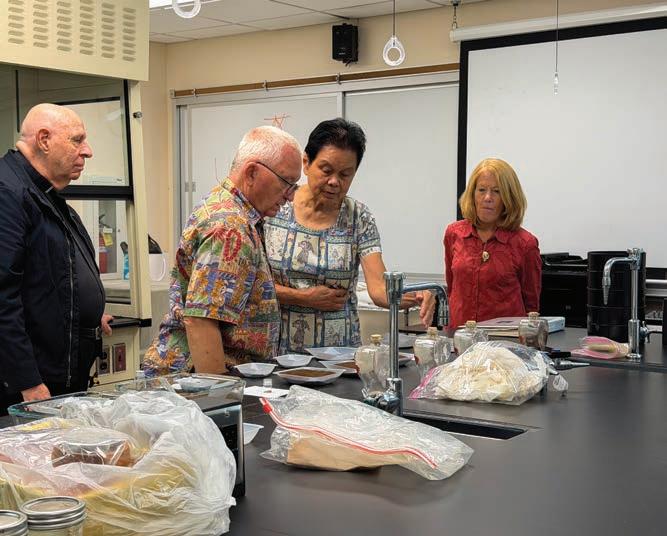
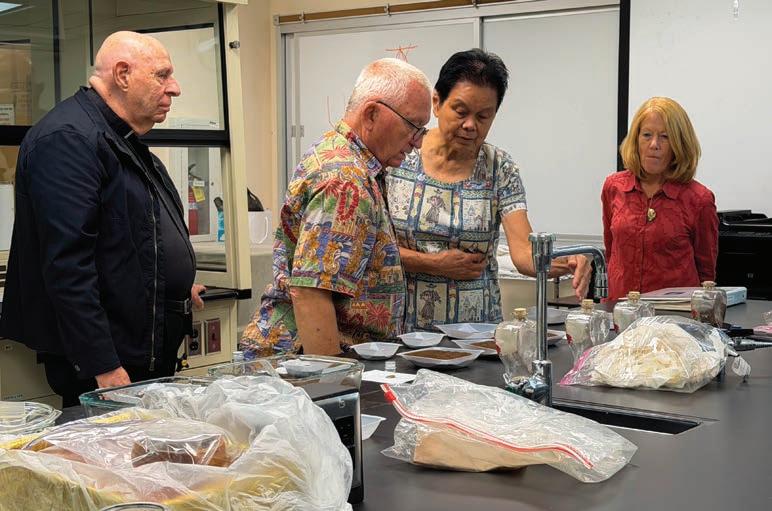
Forensic anthropologist Vincent Sava led the work at one of Chaminade’s campus forensic sciences labs, using sifters and microscopes to separate bone from soil and rock, preserving Saint Marianne’s earthly remains for relics and ceremonies.
“This right here, that’s the result of about 10 to 12 hours of work,” Sava said, holding up a small vial partially filled with tiny chips of Mother Marianne’s bones while his work was underway last January. “And these are actually relatively large fragments.”
Mother Marianne was beatified by Pope John Paul II in 2004. The following year, Sava led a team to exhume her skeleton from the grave on Moloka‘i. Mother Marianne achieved sainthood in 2011
through canonization by Pope Benedict XVI. Her skeleton was subsequently interred in a reliquary at the Basilica in 2014.
Over the years, Sava has been enlisted by the Church to gather remains and artefacts from the gravesites of important figures. The scale of this particular challenge—preserving all of Saint Marianne for antiquity—led Sava to reach out to Chaminade’s forensics lab for help. “Some of the sisters collected up a lot of that soil and they had it stored over the years, and when the church needs relics for ceremonies or to give to other parishes or other churches, we end up extracting what we need from the soil that was collected during the exhumation,” Sava explained.
He said Hawai‘i’s volcanic soil isn’t kind to human remains. “The soil is very hard on bone,” he explained. Decades of decay and deterioration resulted in hundreds of bone fragments left embedded in the ground when Mother Marianne’s skeletal remains were first removed.
The soil was run through sifters and multiple layers of screens, each layer designed to separate large particles from smaller, finer-grained material until only the smallest particles remained. Sava and two Chaminade University students then took this material and placed it under microscopes for analysis. Sava trained the
Q&A
students on how to recognize bone from dirt and rock, a critical skill in forensic science.
Samples were scrutinized and bone fragments carefully collected using specialized equipment. The fragments were then placed in vials.
Bishop Silva visited the lab while the work was underway to assess Sava and the students’ progress. Chaminade University President Lynn Babington accompanied him.
Bishop Silva said Saint Marianne’s history of uplifting the patients of Kalaupapa with joy, compassion, and faith is worth celebrating. “She was very much a healer in many ways,” he said.
Carlos Gutierrez Auyala, Ph.D., MS ‘16 Director and Assistant Professor of the Forensic Sciences Unit at Chaminade’s School of Natural Sciences and Mathematics, said this work with Sava and the Catholic Church was a once-in-alifetime opportunity for his students and the university. When Sava reached out to him for help, Gutiérrez said he jumped at the opportunity.
“This is the first time, that’s why we’re super happy to give them the help that they need,” he said. “This is a special situation. It’s also forensic work. Different forensic work. We usually work with crimes and trying to help the victims and the community; in this case it’s a totally different way but it’s still a forensic analysis process.”
Chaminade University junior and forensic science major Samantha Casarrubias agreed. She and fellow forensic sciences major Emma Rosales quickly volunteered upon hearing of the opportunity to help the Catholic Church recover the remains of Saint Marianne. Casarrubias said the week-long project was “very time consuming and tedious, but it’s good work.”
Gutiérrez said he, his students, and the advanced forensic facilities at Chaminade University’s campus will remain available to the Church for other forensics work in the future. “It’s up to the Catholic Church. If they need more help, we are happy to.”
Q&A
with
The Most Reverend Clarence “Larry” Silva, Bishop of Honolulu
At the request of the Church, Chaminade University’s Forensic Sciences Unit and its students took up the challenge of collecting and protecting the last earthly remains of Saint Marianne of Moloka‘i. The Most Reverend Larry Silva of the Diocese of Honolulu oversaw their work, visiting campus for an update. In an interview with Chaminade Magazine, Bishop Silva explained why Marianne Cope is so revered.
Q: Who was Saint Marianne, and why was she so important to the Catholic Church?
Bishop Silva: She was a Franciscan sister, born in Germany, but raised in New York, upstate New York. She was asked, as were 50 other orders of sisters, to come and work with the patients with leprosy here in the 1870s. And then she, of all the orders that they wrote to, she said, yes.
She was a superior of her order, and she came with six other sisters. She was only going to stay six months, get them started and established, and then go back to New York, but she stayed [more than] 40 years.
Q: What conditions did she find when she first arrived?
Bishop Silva: She started out in Honolulu. There was a leprosy receiving station in Kaka‘ako. When she arrived there, it was terrible. It was dirty, filthy, it was, you know, kind of a warehouse for dying people, and they just put them on the floor and let them stay there so they could die.
She really turned it around. They scrubbed and made it a home. She had a lot of resistance from the superintendent there to the point where she told the Board of Health either he goes or she goes. He went.
Q: She had a forceful personality?
Bishop Silva: Yeah, because, I mean, they could see that she was doing wonderful work. You know, really treating the patients with dignity and so on.
So anyway, then she, in 1888 I believe, she went to Kalapaupa.
She and her sisters ran the Bishop Home for Girls. There were a lot of the minor girls who were sent there with leprosy, Hansen’s disease. And so they were in charge of that home.
She had some rather advancedfor-the-time patient care practices, let’s say. For example, while [Father] Damien contracted leprosy because he wasn’t too concerned about hygiene, she was very concerned about it. She would tell the sisters, wash, wash, wash. Be hands on, but wash. Clean yourself before and after. They even had different habits that they wore while they were working, when they were in the house.
Q: How were her interactions with the patients at Bishop House?
Bishop Silva: She really wanted the girls to feel like they were very special, because many of them were deformed and they didn’t feel good about themselves. So, she would make sure that they had the best fashions and the dresses and hats and bows and whatever. And she planted a lot of trees and flowers and things so that their lives would be brightened up.
She was very much a healer in many ways, and of course, due to her faith, she trusted in God that she could do this very challenging work and not contract leprosy.
Q: Why is this forensic work so important?
Bishop Silva: We believe in the resurrection of the body. And so, the bones, that part of the body, is very important.
This project is going on because one of our pastors suggested that each island should have a relic of Saint Damien and Saint Marianne. We want to make sure the other islands have [relics] so we’ll be able to do that now with these bone fragments that we have here, and then one that I have from Father Damien.
The Gift that Gives Twice
Twice
“It is a gift and privilege to be able to pay it forward.”
—Hoʻea Foundation
Eric and Lori Fujimoto want to level the playing field. With their heartfelt mission, dedication to servant leadership, and philanthropic support of Chaminade University, they are reducing barriers that prevent deserving students from accessing opportunity.
“There are students that should be given the opportunity for college based upon their readiness and skill set, as opposed to whether they can afford it,” Eric said. “The weight of tuition can prevent them from the opportunity. So if the donors and the community can support Chaminade, we are leveling the playing field and making college accessible.”
Eric and Lori both graduated from Pearl City High School and earned degrees from Chaminade, Eric with an MBA in 1994 and Lori with a BA in 2001. They have never forgotten the care and attention that their professors and advisors bestowed upon them, and how Chaminade’s close-knit, belonging community made the college experience meaningful and transformational.
They give back to Chaminade in numerous ways, from philanthropic
support to leadership and volunteerism. Remembering what it was like to be students who needed real world experiences, Eric and Lori started and provided the prize money for the student Silversword Business Competition through the School of Business and Community each year. They established the Eric, MBA ’94 and Lori ’01 Fujimoto Family Opportunities Fund as a perpetual way to support the University and joined the Chaminade Fund Society, which is the University’s leadership giving group. Eric now also serves on the University’s Board of Regents.
The Fujimotos exemplify the spirit of giving that enables Chaminade to provide resources and scholarships to students, inspired to not only level the playing field but to also set an example of their own sons, Dylen, 24, and Camden, 20, to follow.
Eric and Lori co-founded Hoʻea Foundation, which is the philanthropic arm of Hoʻea Wealth Advisory Group, the financial planning company that Eric leads. Hoʻea is also the backer of the annual Unity Prom, which celebrated its third anniversary this past November. The Unity
Prom brings college students and special education high school students together for a special event complete with dancing, music, food and fun with the purpose of providing a prom experience that special needs students may not have. Chaminade business students and student-athletes have been getting more and more involved each year with the event, receiving as much joy as the high school students attending.
“I think the word unity is so powerful that it can mean 10 different things,” Eric added. “Because you go in thinking that you’re trying to provide unity for the student with special needs. But you exit, realizing that it’s unified, your Chaminade University, classmates, teammates are united too.”
“The university students left with their hearts filled,” Lori added. “The special education students taught the university students something too, and that’s great. Itʻs like if you want to make a difference or feel good, give, give something. Give something to someone else. That feels good.”
“There are students that should be given the opportunity for college based upon their readiness and skill set, as opposed to whether they can afford it,”
—Eric Fujimoto
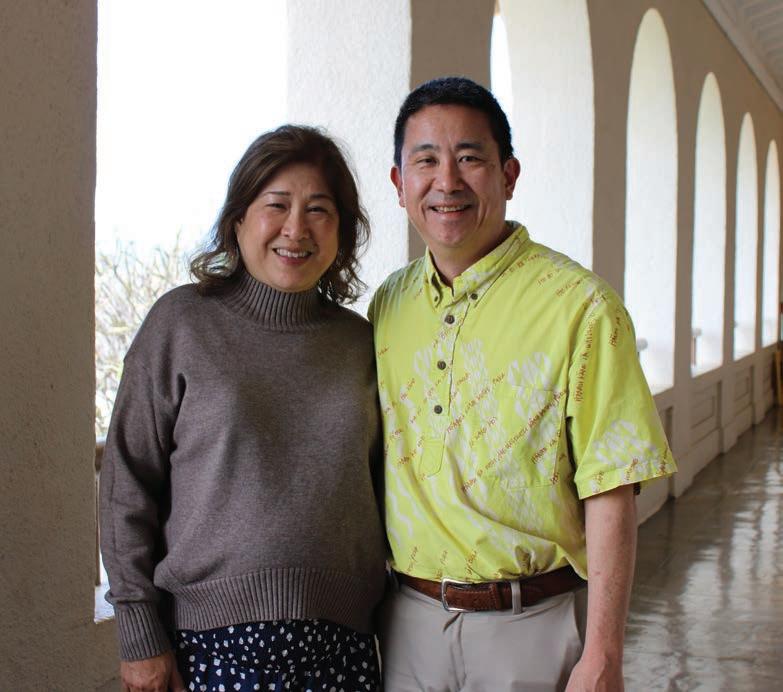
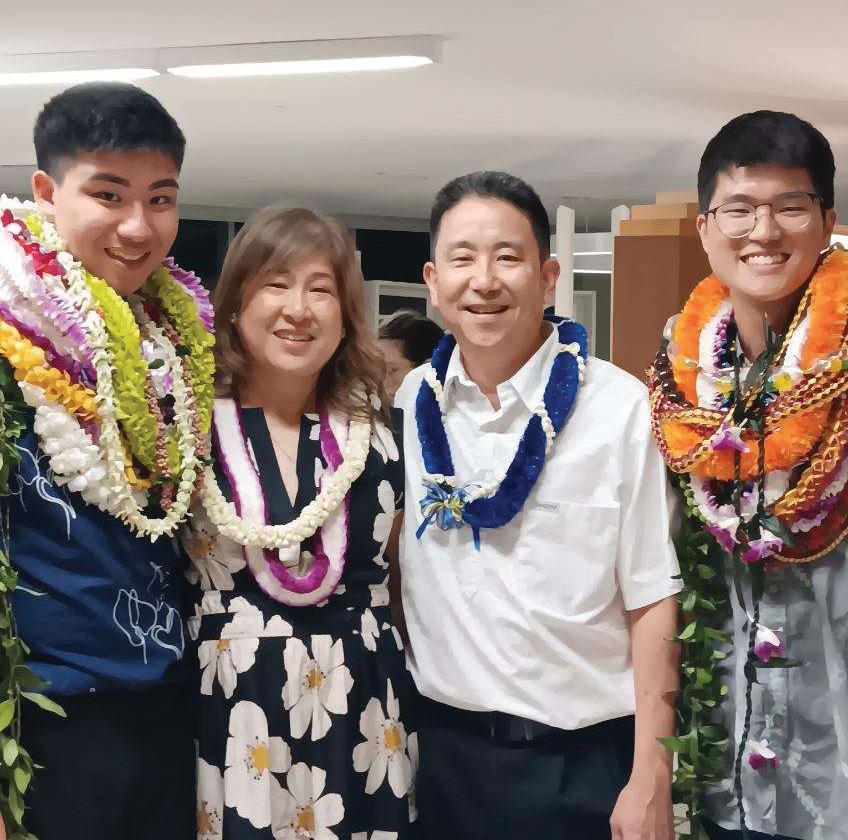
ABOVE: The Fujimoto family: Camden, Lori, Eric and Dylen.
OPPOSITE: Lori and Eric Fujimoto’s philanthropic support of Chaminade makes a difference in the lives of students.
CHAMINADE UNIVERSITY OF HONOLULU
Hogan Entrepreneurial Leadership Program
25 Years of Doing Well by Doing Good
In 2027, the Hogan Entrepreneurial Leadership Program at Chaminade University of Honolulu will celebrate its 25th anniversary— a milestone marking a quarter century of forming ethical, community-minded business leaders. What began as a bold vision has grown into one of the University’s most distinctive offerings, with more than 500 graduates carrying its lessons into startups, nonprofits, corporations and public service throughout Hawai‘i and beyond.
Funded by the Hogan Family Foundation through the generosity of Ed and Lynn Hogan, the program was founded by Dr. John Webster, who believed business education must be grounded in ethics, service and realworld application. Before coming to Chaminade, Webster held executive leadership roles in communications and government relations at IBM and KPMG. He brought both corporate experience and a deep commitment to servant leadership to the University’s Marianist mission.
From the outset, Webster championed social entrepreneurship—an approach captured in the program’s enduring motto: “doing business things that make social sense and doing social things that make business sense.” For him, business and community were inseparable.
He often shared the story of hearing then-Governor Linda Lingle address a Hawai‘i Chamber of Commerce luncheon. Rather than focusing solely on economic growth,
she spoke at length about homelessness. Webster realized homelessness was not separate from business concerns; it affected labor markets, public resources and the overall health of the community. If business leaders were serious about long-term success, they had to care about social challenges.
That conviction led Hogan students to action. They created and distributed a booklet to more than 1,100 businesses outlining the benefits of hiring individuals experiencing homelessness. Students organized training workshops, coached participants in interview techniques, helped them develop professional résumés and connected them to local employers. Many participants secured jobs.
Just as importantly, Hogan students experienced what ethical leadership looks like in practice—helping restore dignity while building opportunity.
This blend of rigorous academics and hands-on engagement quickly became a hallmark of the program. Admission standards were high. Students maintained strong GPAs, demonstrated leadership or entrepreneurial initiative and showed the ability to consider ethical implications in decisionmaking. Once admitted, they studied venture development, entrepreneurial environments and management fundamentals while participating in professional development workshops focused on communications,
etiquette, media relations and cross-cultural leadership.
Equally transformative has been access to a network of mentors and advisors— seasoned executives and innovators who meet oneon-one with students. Over the years, respected guest speakers and accomplished business leaders have shared candid insights, strengthening the program’s credibility and its ties to Hawai‘i’s entrepreneurial ecosystem.
For many students, Hogan becomes the catalyst for turning ideas into reality.
Sheehan M. Chase ‘17, MBA ‘19, a communications major who sought Chaminade’s Marianist community, found the encouragement and challenge he needed. Inspired by creating a journal of his grandmother’s life, Chase envisioned a business built on preserving oral histories. With guidance from Webster and Hogan mentors, he refined his concept, developed a prototype and presented it to the Hogan Advisory Board—landing his first client.
His company, “Tale to Tell,” launched in 2016 and later earned recognition as a top regional finalist in the Global Student Entrepreneur Awards. Chase credits Hogan with equipping him not only with business knowledge but with confidence, mentorship and meaningful connections.
Today, the program continues to build on that legacy under the leadership of Dr. Roy J. Panzarella. With experience spanning the military, global business and higher education, Panzarella brings strategic vision and operational expertise. A former U.S. Army Colonel and executive with Lockheed Martin in the Middle East and Europe, he has led organizations in complex environments and previously served as Vice Chair of Chaminade’s Board of Regents.
As director, Panzarella is strengthening the program’s integration within the University, emphasizing that Hogan is fully aligned with Chaminade’s academic and Marianist identity.
OPPOSITE TOP: Dr. Roy Panzarella, Michelle Bartell and Gary Hogan were speakers at the 2025 Hogan kick off reception.
OPPOSITE BOTTOM: Students have gained valuable experiences through the Hogan program.
ABOVE: Attending a past Hogan event were: Wayne Tanna, Ann Lujan Kishi, Dr. John Webster, Dr. Nora K. Harmsen and husband General (Ret.) David Bramlett.
While funded by the Hogan Family Foundation, the program is embedded within the University’s mission of education for service, justice and peace. Panzarella is expanding collaboration across disciplines, deepening alumni engagement and elevating the program’s visibility as an essential part of the Chaminade experience. Recent guest speakers have included journalist Catherine Cruz and Co-Founders of Keep It Simple Jillian Corn and Hunter Long.
In 2024, thanks to the generosity of Vaughn Vasoncellos, the Vaughn Vasconcellos & Suzie Martin Leadership Institute was added under the Hogan Program.
Approaching its silver anniversary, the Hogan Entrepreneurial Leadership Program stands as a model of how business education can be both competitive and compassionate. Its impact is evident in more than 500 alumni who lead with integrity, build ventures with purpose and serve their communities with creativity and courage.
For 25 years, Hogan has demonstrated that profit and purpose are not opposing forces. At Chaminade, they are partners. By teaching students to do business in ways that make social sense—and social good in ways that make business sense—the Hogan Entrepreneurial Leadership Program continues to shape leaders prepared not only to succeed, but to make a difference.
A Prom for UNITY
There are few events in high school more memorable than prom.
A group of Silverswords made sure that was especially true for more than 120 special education high schoolers, who gathered this past November at the Salvation Army Kroc Center for the 2025 West O‘ahu Unity Prom. The event was sponsored by Ho’ea—The Foundation.
“This project helps connect Chaminade to the community by showing our love and core values with everyone. It is a cool experience for both the students involved and us students working it.”
–Trysten Mooney ’27
Marianist Moment
FATHER MARTIN SOLMA, S.M.
am honored to inaugurate this new feature of our Chaminade Magazine, the premier print and digital “face” of this university. Because of personnel needs in the Marianist Province of the United States, Bro. Ed Brink has assumed the important position as Novice Director. He is eminently qualified and, in my opinion, the very best member of the Province to accompany and mentor new members of the Society of Mary. As a consequence, I’ve been asked to complete his term as Vice President for Mission and Rector, a request I have gladly accepted. I appreciate the trust and confidence of our senior leadership, especially President Lynn Babington.
Recently, President Lynn and I attended the annual meeting of the Association of Catholic Colleges and Universities (ACCU) in Washington, DC. The weather outside was very cold, but that was nothing compared to the dynamism and energy inside the gathering. There were about ten Marianist-connected attendees from Chaminade University, St. Mary’s University of San Antonio, and the University of Dayton. The plenary sessions were especially engaging, focused on the theme of “Through the Lens of Mission.”
As institutions of higher learning face increasing headwinds from demographic changes, questions about the value proposition of a university education, an increasingly competitive job market, and impactful government policies, how do colleges and universities and, more specifically, Catholic colleges and universities, navigate these challenges and stay true to their identity and mission? For me, that is a really central question, especially as I embrace this new role. How does Chaminade University anchor its Marianist Catholic identity and mission?
When the first Marianist Brothers arrived in the Kingdom of Hawaiʻi in 1883, they disembarked from the ship and walked from Honolulu Harbor to the Cathedral of Our Lady of Peace on Bishop Street. They celebrated their first Mass in Hawaiʻi with the Sacred Hearts priest who would eventually be declared St. Damien De Vester of Molokaʻi. That set our Catholic roots.
But, as importantly, they assumed responsibility for St. Louis College and established a distinctive style of Marianist education in the islands: students of all backgrounds and ethnicities were welcomed at a time when that was not common in the schools of Honolulu; they built a genuine “family spirit” within the school, heading Blessed Fr. Chaminade’s belief that a Marianist school must operate as a family; they were keen on an innovative curriculum that would afford graduates access to gainful employment; and they were concerned that students not only learn but learn how to be lifelong learners.
If Chaminade University has a “secret sauce” to anchor its Marianist and Catholic mission and identity, it is exactly these “Characteristics of Marianist Education”: fostering faith formation, meaning the building of ethical and values-specific character in our students, who also come from very diverse backgrounds; providing an integral, quality education; maintaining a welcoming, respectful and inclusive ‘Ohana; educating for justice, peace and the integrity of Creation, where CUH punches much above our weight; and maintaining a disposition of flexibility to meet a world that is always new and evolving.
Everything we do at Chaminade University is done “through the lens of mission.”
The Capacity for Hope
BY CATHY LEE CHONG
Dr. Carolyn Woo bowed her head in prayer before addressing the audience gathered in the Mystical Rose Oratory. Then she began simply: “I’m here to talk about hope.”
As the latest guest in the Marianist Lecture Series, Woo offered far more than reflection. Through personal experience and global perspective, she challenged listeners to recognize both their responsibility and their capacity for hope—even amid devastating news and uncertainty in the United States and around the world.
Drawing from her years of humanitarian leadership, Woo shared vivid stories and metaphors. She recounted how a Guatemalan corn farmer, facing the loss of his land, adapted by cultivating papaya and ultimately built a thriving livelihood. She described how Chinese Christians, confronted with the destruction of religious statues, responded creatively— crafting an image inspired by a folk legend of a peasant woman carrying a light on her head, symbolizing Mary and the Christ Child. In each example, adversity became an invitation to resilience and renewal.
“The biggest blessing of my work at Catholic Relief Services is realizing that problems can be solved in significant ways,” Woo said.
Woo served as president and CEO of Catholic Relief Services (CRS)—the official humanitarian agency of the U.S. Catholic community—from 2012 to 2016. Founded in 1943 by the Catholic bishops of the United States to assist survivors of World War II, CRS has grown to serve more than 200 million people in over 100 countries across five continents.
Before leading CRS, Woo built a distinguished career in higher education. From 1997 to 2011, she served as dean of the University of Notre Dame’s Mendoza College of Business. Under her leadership, the college earned national recognition, including top rankings for undergraduate business education and consistent distinction for excellence in ethics education and research.
Acknowledging today’s social and political tensions, Woo reminded the audience that history, too, has known periods of darkness, including World War II. Yet resilience, she emphasized, is the signature of hope. Drawing from the theological virtues, she
explained that hope emerges when faith is joined with charity—when belief is put into action.
Her international impact has been widely recognized. In 2013, Foreign Policy named Woo among its 500 Most Powerful People for her global leadership, identifying her as one of 33 individuals considered “a force for good.”
In 2015, she was one of five speakers at the Vatican press conference introducing Pope Francis’ encyclical Laudato Si ’, and she later co-coordinated the Vatican’s Energy Transition Dialogues in 2018 and 2019.
Woo concluded with a call to personal responsibility: “Agency is the offspring of responsibility and capacity,”
she said. When individuals recognize both, they can “build back better.”
At the close of the lecture, Woo was presented with the Mackey Award for Catholic Thought, named in honor of Fr. Robert Mackey, S.M., the first president of Chaminade University.
The Marianist Lecture Series—sponsored by The Marianist Center of Hawaiʻi, Chaminade University, and St. Louis School—fosters inclusive dialogue on Catholic thought and social responsibility. Gathered on the Kalaepōhaku campus in a spirit of community and shared purpose, attendees were reminded that hope is not passive optimism, but a call to resilient action.
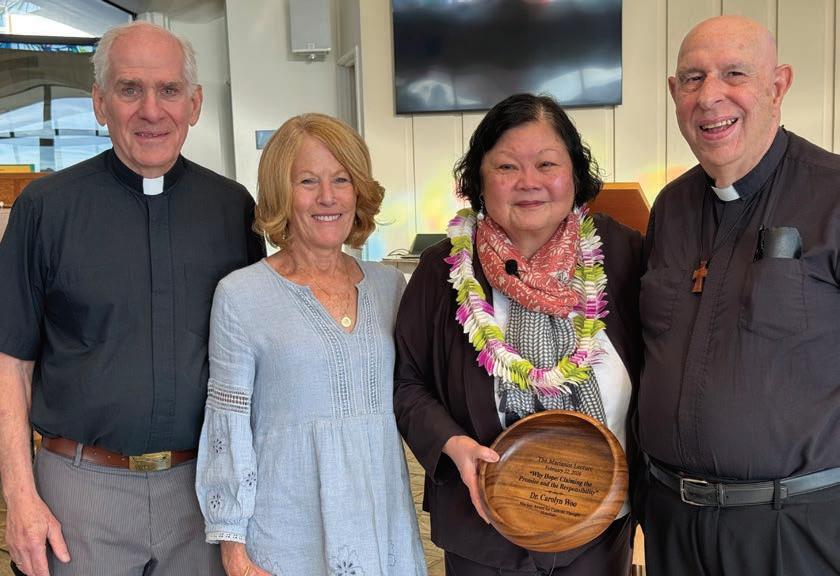
LEFT TO RIGHT: Father Martin Solma, SM; Dr. Lynn Babington, Dr. Carolyn Woo, Most Reverend Larry Silva, Bishop of Honolulu
A LEGACY LIVES ON Remembering and Honoring “Mr. I”
The Chaminade University family is celebrating the life and legacy of a popular professor who left an indelible mark on his students and the campus community and who exemplified the high standards of academic excellence that is part of the University’s promise.
Ronald M. Iwamoto was a long-time biology professor at Chaminade. “Long-time” is putting it rather mildly: Mr. I, as his students called him, called the university home for 47 years, or nearly five decades. It’s not an exaggeration to say that he helped mold the university into the place it is today in very real, tangible ways.
Sadly, Iwamoto passed away in October of 2025, but his legacy endures both in the memory of Chaminade’s alumni, in the fund organized in his honor, supporting a teaching fellowship that bears his name.
Chaminade alum Angela Maroun ʻ76, who majored in biology during her time as a student on campus, remembers Iwamoto fondly.
Surrounded by friends and former students, Ronald Iwamoto continued to be mentor to many.
She says she first met “Mr. I” after enrolling in his Biology 203 course.
“It was his class that made me decide to be a Biology major and love science,” Maroun shared with us. “He made biology fun. He was a tough but fair and caring teacher.”
Iwamoto graduated from Punahou School in 1959, earned a BA in history from Northwestern University, and later an MS in Zoology and an MEd with a focus on Educational Foundations from the University of Hawaiʻi at Mānoa. He joined Chaminade’s faculty in 1967, barely a dozen years after the University’s founding in 1955.
The long track of his academic career means Mr. I touched the lives of thousands of Chaminade University students, mentoring them through their studies and coursework and lining them up for successful careers post-graduation.
Though she originally hails from Syracuse, New York, Maroun said Iwamoto helped her experience the best of Hawaiʻi and its natural beauty as a local would. “He went out of his way to help me feel at home,” she said.
“He went the extra mile to both challenge and support each student so that they could succeed,” she recalled.
Ronald Iwamoto was a beloved Chaminade biology professor for nearly five decades.
Maroun said she took other biology courses that he taught and also worked as a laboratory assistant for several of his classes. She babysat his children and introduced Mr. I to her family when they visited from Syracuse. In fact, he shared time with her and her family on a number of occasions. “He always made time for lunch, dinner, or just a visit,” she said.
Maroun said she especially remembers the island adventures Mr. I took her and her classmates on for his ecology course, the ultimate experiential learning opportunities.
“Ecology was a favorite since we went on many field trips, hikes, and ocean adventures,” she recalled. “Through him, I experienced nighttime on the reef collecting specimens for the lab, catching crabs in the mangroves, and walking during low tide for a picnic.”
Iwamoto was recognized for his excellence by both students and faculty alike.
He was honored with a prestigious Heritage Award during Founders’ Week 2000, bestowed with the Chaminade Award that year by his fellow
faculty and staff members. Later, Iwamoto helped establish a legacy that would endure well past his own lifetime.
In 2018, he and other Chaminade community members formed a committee and established the Ronald M. Iwamoto Teaching Fellowship in Biology, the first teaching fellowship established at the university.
Donors came forward to seed the fellowship with a $50,000 endowment. The fellowship was first awarded to Chaminade Assistant Professor Dr. Frederique Kandel in 2019, recognized for her commitment to professional development in teaching and pedagogy.
Ron Iwamoto left our world on October 21, 2025, but he lives on through the mark he left on Chaminade University, his legacy establishing the university’s science curriculum, and in his students and colleagues’ cherished memories.
“He was just so much fun and a joy to be around,” Maroun said. “How lucky I was to cross paths with Mr. I.”
If you would like to make a gift in support of the Ronald M. Iwamoto Teaching Fellowship in Biology, please scan the QR code.
Ronald Iwamoto pictured with former student
Angela Maroun ‘76
HONORING OUR PAST, INSPIRING THE NEXT GENERATION ~ LEGACY IN ACTION
Aloha Silversword ‘ohana,
Our alumni community serves as a meaningful reminder that the Chaminade connection is rooted in tradition and brought to life through our shared experiences and engagement.
Throughout the year, regional gatherings united Silverswords, fostering camaraderie and renewing friendships. October’s Reunion Weekend was a joyful highlight as we celebrated the Class of 1975’s 50th anniversary and honored milestone classes ending in 0s and 5s. Seeing classmates reconnect after decades reaffirms that, despite the passage of time, the Silversword connection endures.
Our Sunday Mass and luncheon were especially meaningful as we welcomed alumni from the early 1960s and 1970s back to campus. Bernard Lum Hoy ’59, the sole remaining member of his class, joined us—a living link to our earliest days and a reminder that our history endures through each generation.
We also proudly recognized this year’s Alumni Award recipients. Their lives reflect the values formed at Chaminade. Through their leadership and service, they show the lasting impact of the Silversword spirit in our communities.
At the same time, we look ahead to the next generation of alumni. The launch of our Grad Giving Campaign invites the Class of 2026 to begin their journey as alumni. We encourage them to invest in the place where they learned, grew, and thrived. In doing so, they join generations of graduates who sustain our mission through engagement, generosity, and financial support.
It is because of you, our alumni, that this legacy continues. Your presence, participation, and commitment ensure that the Silversword connection will remain strong for generations to come.
Go Swords!
With a grateful heart,
Jodi-Anne Yoshida, MBA ‘23 DIRECTOR OF ALUMNI RELATIONS
Jodi-Anne Yoshida, Director of Alumni Relations
Tradition Lives as Founders Week Celebrates Heritage Award Winners
Students, staff, faculty, and the campus ministry gathered in January to celebrate Founders’ Week, Chaminade University’s annual time to reflect on the origin of the Marianist mission and to express gratitude for those who came before.
The week-long celebration honors the legacy of Chaminade’s three foundational figures and founders of the Marianist Catholic order: Father William Joseph Chaminade, who established the Society of Mary; the Venerable Adèle de Batz de Trenquelléon; and the Venerable Marie Thérèse Charlotte de Lamourous.
Activities at the foot of the statue of Father Chaminade standing prominently at the entrance to campus was adorned with lei, as has been the tradition for decades.
“We all see this image every day when we come to campus,” Fr. Martin “Marty” Solma, SM said. “May it remind us that without this holy founder, this man of faith, hope, and love, none of us would be here studying, working, learning, and playing on Kalaepōhaku.”
Founders’ Day Mass and the Heritage Awards Ceremony were opened by Fr. Christopher Wittmann, known around campus as Fr. Chris. Mirroring the celebration of the Marianists three foundational figures, every year the Heritage Awards recognizes three exceptional members of the Chaminade family.
The Chaminade Award recognizes a faculty or staff member who most exemplifies the spirit of the University. The Marianist Award is given to a staff member who demonstrates extraordinary commitment to Chaminade University’s mission. Finally, the Founders’ Award recognizes a student for their exemplary demonstration of respect, generosity, faith, and other Marianist values.
President Lynn Babington opened the ceremony with a speech reminding everyone of the school’s foundational mission.
“Marianists from the beginning have embraced the idea of education as a mechanism to transform society and support the spirit of openness, mutual respect, and acceptance,” Babington said. “At Chaminade University of Honolulu, we are committed to being such an environment where students thrive.”
•The Chaminade Award is given to a faculty or staff member who exhibits a continuous commitment to Marianist values in education.This year’s recipient is Dr. Dustyn Ragasa ’07, Director of the Master of Pastoral Theology Program and Assistant Professor of Religious Studies.
LEFT TO RIGHT: Father Martin Solma, SM, Lance Askildson, Ph.D., Dustyn Ragasa, Ph.D., ’07, Abigail Hurgo, Easton DelaCruz, Ph.D., ’26 and Lynn Babington, Ph.D.
Originally from Kaua‘i, Dustyn is a proud Chaminade alumnus who went on to earn a master’s degree from The Dominican School of Philosophy and Theology and a doctoral degree from the Graduate Theological Union. After receiving his doctoral degree, he returned and joined Chaminade’s faculty in August 2019.
•The Marianist Award is given to a staff member who exhibits a continuous and extraordinary commitment to the vision and mission of Chaminade while drawing others into the collaborative community. This year’s recipient is Abigail Hurgo, Assistant Vice President for Enrollment Management. Always pleasant and professional, Abigail joined Chaminade in August 2022 after working in admissions at UH Mānoa for 14 years. She leads a dedicated team which focuses on undergraduate admissions, including important events such as Preview Day, New Student Orientation, campus tours and other activities that showcase all that Chaminade has to offer students.
•The Founders’ Award is given to a student who exhibits a commitment to Marianist values by outstanding generosity, respect for others, and spirit of faith. This year’s award goes to Easton DelaCruz ’26 who is majoring in communication and will graduate this year. Easton is a familiar face on campus as he volunteers and helps with dozens of activities and programs. This past summer, he was an intern in the nation’s capital for the Asian Pacific American Institute for Congressional Studies and worked under U.S. Rep. Kimberlyn King-Hinds, who represents his home of the Commonwealth of the Northern Mariana Islands (CNMI).
“As we celebrate the Marianist founders, we celebrate our Heritage Award winners, we celebrate the mission and charism that we have inherited from our founders and are privileged to carry forward in our faith,” Wittmann shared.
The Chaminade Fund allows the University to respond immediately to the greatest needs— whether expanding financial aid, enhancing academic programs, or enriching student life. Help support our students with a gift to the Chaminade Fund today. For more information, contact
Alumnus Comes Full Circle By Creating Chaminade Scholarship
ABOVE: Dr. Ronald F. Heidelberg ‘95 and Dr. Maria Rosario Mabini attended the Scholarship Mahalo Lunch on campus in February.
DR. RONALD F. HEIDELBERG ‘95, known to everyone as Run, long ago learned the importance of service and giving back to his community. He drew those lessons from his time in the military, where he also learned the importance of chasing your dreams to the fullest extent possible.
Now, he’s giving other Chaminade students a chance to chase their own dreams.
Heidelberg and his wife, Dr. Maria Rosario Mabini, have established the Ronald F. Heidelberg ’95 and Maria Rosario G. Mabini, MD Nursing Scholarship. Eligible Chaminade University nursing students can apply for the honor.
Heidelberg has had a long and distinguished career in medicine. “I became an expert medic in the Army,” Heidelberg explained. “That was one of the things that really motivated me to continue to thrive, to be better and better and better.”
And thrive he did. Heidelberg completed his studies at Chaminade while working as a nurse at Hawaiʻi State Hospital. He spent his career there and eventually went on to run it, retiring as the hospital’s administrator about three years ago.
Heidelberg said he decided to establish the new scholarship in his and his wife’s name for a simple reason. “To be able to give back to the medical community,” he said. “Being able to help other folks out, because that is what’s at the core of healthcare, helping others.”
GIVING BACK WITH GRATITUDE
Now a retired state hospital administrator, Heidelberg is still active in his community. He especially values the education he received and the time he spent at Chaminade. That’s why he established this new scholarship–to ensure
that others have the same opportunities that he was afforded in life.
Originally hailing from Gulfport, Mississippi, just outside of Biloxi, Run studied nursing at a Christian college in the area. He later became a pharmacy technician, and then a recruiter paid him a visit. He joined the United States Army, where he enlisted to become a medic. That’s what ultimately brought him to Hawaiʻi, where his journey and adventure began.
“They assigned me to Schofield Barracks, and basically I was a line medic, so wherever the Rangers and all those guys went, I went,” he recalled. “So, it was a pretty interesting job.”
While serving, he decided to continue with his education. At the time, Chaminade University had a facility on Schofield. Run said he jumped at the chance, happy for the opportunity to further his studies at a Catholic Marianist university. “I actually started going to Chaminade University while I was still on active duty,” he said. “And that was one of the really good things about Chaminade, it was flexible.”
“I was going to a Christian college in Biloxi,” he added, “and then when I came to Hawaiʻi it made more sense to go to a Christian college, so Chaminade.”
But that’s not the only reason. In addition to the convenience of studying while serving his country on the base, Run says he and his wife continued to spend time at the Chaminade University library well after both of them had graduated.
“Chaminade had a great library,” he said. “We used to study there when we were ready to go to residency. It was just a great place to be.”
BEGINNING OF A CALLING
Heidelberg eventually found his way to working at the hospital, starting as an entry level nurse in 1994. He worked his way up the ranks. He met his wife there and spent his entire career there, eventually becoming the administrator.
He said his greatest accomplishment was getting the state to agree to build a new facility to replace the aging structure he worked in. “When I first started at the hospital, there was always talk about building a new hospital.” It took a long time, but they finally broke ground on the new hospital in 2018. It opened for business in 2022.
It’s that kind of tenacity and determination that has helped Run succeed in life. Now, an aspiring nurse studying at Chaminade has a chance to follow in Dr. Heidelberg’s shoes.
The Ronald F. Heidelberg ’95 and Maria Rosario G. Mabini, MD Nursing Scholarship will award $1,995 (the year of his graduation from Chaminade) to a student in need who also shows tremendous promise to succeed and some day give back to the community.
He hopes this award will inspire a student to complete a nursing degree and join the medical profession, because nursing is an important field rich with potential, one offering multiple career opportunities, as Heidelberg’s life experience has shown.
“That’s what we would like to do, just be able to give back and get more people interested in medicine because it is A to Z,” he said.
Accolades for Alumni
The stars shined brightly on three illustrious graduates who were recognized with Alumni Awards at the Silversword Reunion on campus on October 18, 2025.
Surrounded by family, friends and classmates, each award recipient was presented with a special plaque from President Lynn Babington, Ph.D. and showcased in a University video. Congratulationsto the award recipients who exemplify all the good qualities that Chaminade alumni possess.
RYLAN CHONG ’10, Ph.D.
Recipient of the Marianist Alumni Award for exemplifying the Marianist spirit
Always on the cutting edge, Rylan Chong ’10, Ph.D. codeveloped Hawaiʻi’s first Data Science undergraduate program at Chaminade in 2019, with a focus on community building and providing students access to in-demand skills and career opportunities. Under his leadership, Silversword Data Science students have won national competitions, clinched prestigious local and national internships, pursued graduate degrees, and attained positions with leading institutions. Importantly, they have also used their skills to give back in innovative new ways.
In addition to directing Chaminade’s Data Science program, which offers a major, minor, certificates and online proficiency courses, Chong redesigned and now leads Computer Science at the University in addition to managing an impressive portfolio of grants from the National Science Foundation, National Institutes of Health and the Alakaʻina Foundation, among others. Notably, Chong was co-principal investigator for a $10 million NSF INCLUDES Alliance grant aimed at building the data science community, capacity, research and education in the Pacific.
After graduating from Chaminade, Chong went on to earn a master’s and doctoral degree in information security from Purdue University of West Lafayette. On receiving this award, Chong thanked his mentors and said the honor was his to share. “It recognizes everyone who has shaped me and joined me on my journey to make the technology fields more accessible across the Pacific and support our students,” he said.
LEFT: President Babington, Ph.D. congratulates Alumni Award recipients, left to right, Rylan Chong ’10, Ph.D., Angela Riccardi Maroun ‘76, and Joshua Orimoto ‘20.
JOSHUA ORIMOTO ’20
Recipient of the Young Alumni Award for excellence in his field and demonstrated service to the community, the university and the public
Joshua Orimoto ’20 was officially commissioned as an officer in the Air Force five years ago, with his grandfather administering the oath of office. He called the moment “once in a lifetime” and said it started him on a pathway of service and personal growth.
Orimoto, who serves as an Air Force cyberspace operations officer, said that his computer information systems courses at Chaminade helped him immensely as he completed Air Force cyber training on computer networking, programming, ethical hacking and cybersecurity. “CUH gave me the confidence to face the challenge and make it to the end of the course,” he said.
Orimoto’s impressive skills and work ethic has already gotten noticed. He was promoted to captain in August 2024, while stationed at Luke Air Force Base in Arizona. That same month, he was selected to serve as a diplomatic security service special agent for the U.S. Department of State.
This past year, he was stationed at Camp Smith on O‘ahu, returning home with his wife, Alicia, while reunited with family and friends. Orimoto, who studied criminal justice at Chaminade, is grateful to Chaminade for inspiring him to serve.
ANGELA RICCARDI MAROUN ’76
Recipient of the Distinguished Alumni Award for making distinguished and outstanding contributions to his profession and the community
As a leader in outpatient and home care physical therapy, Angela Riccardi Maroun ’76 has helped thousands of patients regain their mobility and independence, crediting Chaminade with her success.
Maroun came to Chaminade from Syracuse, New York, after a Presidential Scholarship and work as a biology lab assistant provided her with financial aid. After graduating with a degree in biology, she studied at the University of California at San Francisco. She then worked in acute care at Crouse Hospital in Syracuse, as a homecare therapist and consultant before opening her clinic in 1988. She also started one of the first women’s health physical therapy programs in central New York. After selling her practice in 2000, Maroun has pursued a personal interest in textile arts.
Maroun has been married to her husband, Don Williams, for 32 years and has a son, daughter, stepdaughter and six grandchildren. Maroun calls Chaminade a very special place that provided her with both a “wider world view and lasting friendships.” She adds, “How many people can say they still visit and text with their professors 50 years later? That is the Chaminade experience.”
NOTABLES:
Kudos and Congratulations
Chaminade University of Honolulu was named one of Hawaii Business Magazine’s 2026 Best Places to Work. This recognition honors organizations that lead strong workplace culture, employee satisfaction, and inclusive practices and was based on employee surveys, benefits, level of engagement and overall experiences.
Lance Askildson, Ph.D., Provost and Senior Vice President for Academic Affairs was named one of the HB20 for the Next 20, Hawaiʻi Business Magazine’s salute to 20 accomplished professionals poised to make a big impact in the decades ahead. Since joining Chaminade in 2019, Askildson has helped establish a new doctoral culture, launching five professional doctoral programs in areas including clinical psychology, nursing practice, educational psychology, public health and organizational leadership— several of them first-to-market in the state.
Chaminade University’s Criminology and Criminal Justice program is receiving a $1 million federal education
grant to establish a new institute for training criminal justice professionals from the Pacific Islands, especially South Pacific island nations and territories.
Kelly Treece, Ph.D. Associate Professor of Criminology and Criminal Justice and director of the program, said, “There’s nothing like this in the whole state and of course nothing like it in all the South Pacific.”
Bro. Edward Violett, S.M. Vice President of the Marianist Center of Hawaii, has been named the new Provincial for the Marianist Province and has relocated to St. Louis, Missouri. He has been involved in many of the leadership projects at the Kalaepohaku campus, including liaising with leadership at both
Chaminade University and St. Louis School and road repair, utilities, landscaping, and the expansion of the Mystical Rose Oratory pavilion.
Chaminade University has been awarded a five-year, $1.25 million federal grant aimed at bolstering Hawai‘i’s early intervention workforce so that infants and toddlers with developmental concerns have greater access to high-quality and timely services. Elizabeth Park, ME.d ‘04, Ph.D., who is a professor and director of Chaminade’s Early Childhood and Montessori Programs, said the islands face a critical shortage of early intervention professionals.
ALUMNI CLASS NOTES
1970s
Wilson “Tom” Orbe ’73 (Business) and Barbara (Nyblade) Orbe ’75 (Marketing) are enjoying life as grandparents to four wonderful grandchildren, shared by their two daughters. Tom continues to make a meaningful impact as a board member of Thomas House Family Shelter, where he and his fellow board members and staff serve as a beacon of hope for families with children experiencing homelessness. In their free time, Tom and Barbara enjoy fitting in rounds of golf and remain active owners of three Wahoo’s Fish Taco locations. PHOTO #1 Tom and Barbara Orbe, President Lynn, Judy and Bill Garrett.
Robert Crowell ’75 (Business Administration) retired in December 2023 after an impressive 48 years of dedicated service with the State of Hawaiʻi. For the past 30 years, he served as Harbors District Manager for the Kauaʻi District in the Harbors Division of the Department of Transportation, providing steady leadership and commitment to the islands’ maritime operations. Congratulations on a remarkable career of public service!
It was wonderful to reconnect with Richard Daggett ’76 (History) over lunch and catch up on his latest adventures. A proud father and grandfather, Richard shared stories of family, writing, and the journey that has shaped his years since Chaminade. He is a commercial real estate agent, the published author of two books, and is currently working on his third. In his spare time, he is an avid mountain hiker and photographer who enjoys climbing the myriad of trails to the summits of the Koʻolau Mountain Range. PHOTO #2
Frank Miller ’77 (Religious Studies) recently celebrated a remarkable milestone nearly 50 years after first arriving at Chaminade. He has achieved a lifelong goal of earning his doctoral degree in Leadership & Innovation from Purdue University Global. Congratulations, Frank, on this outstanding accomplishment and dedication to lifelong learning! PHOTO #3
Deborah (Wilkins) Bond ’79 (Business) extends her heartfelt thanks to the Chaminade team for staying in touch and for the recent Valentine’s greeting she received. She fondly reflects on her years on Oʻahu as among the best of her life, cherishing both the beautiful campus and the opportunity to attend off-campus classes at military bases around the island. After graduation, Deborah settled in Texas— primarily in Humble—where she built a successful career as a corporate trust officer at First City National Bank (now part of JPMorgan Chase). Following her retirement from banking, she owned a bookstore and a contract post office. Today, she is caring for her 93-year-old mother and hopes to return to Hawaiʻi one day, whether to live or to visit. She shares that she truly enjoys receiving the newsletters, reports, messages, and correspondence, and looks forward to staying connected.
Dr. Michael ’79 (Computer Science) and Dr. Sally Coovert continued their cherished tradition of an annual visit in February 2026. During their time on Oʻahu, they were joined for lunch on the North Shore by Kendra Sia, Director of Annual Fund, and Jodi-Anne Yoshida, MBA ’23, Director of Alumni Relations. The gathering was filled with love, laughter, and meaningful conversation—reflecting on
gratitude for life, lasting connections, and the many adventures the Cooverts enjoy throughout the year. PHOTO #4
1980s
Pamela (Werner) Crenwelge ’80 (Behavioral Sciences/ Religious Studies) recently returned to the islands after more than 40 years away, celebrating a special milestone with her entire family—her husband, son, daughter-in-law, grandson, daughter, and son-in-law. The family gathered to commemorate their 40th wedding anniversary, spending a week celebrating in grand style, including a memorable beach family photoshoot. What a beautiful way to mark such a meaningful occasion!
PHOTO #5
Robert “B Lowe” Lowe ’81 (Criminal Justice). They call themselves the unofficial Canoe Club—a circle of friends whose bond has spanned decades, shaped by college life and life’s milestones, and strengthened by shared experiences that changed them for the better. Each member pursued their passions while building lives rich in purpose, meaningful relationships, and true connection. In October 2025, the group reunited for a pau hana to reminisce, reconnect, and celebrate the good old days at Chaminade. Those gathered included Linus Tavares ’80, MBA ’81, Patrick Marquadt ’81 (Secondary Education), Glenn Preus ’80 (Marketing Science), Dr. Michael Kellar ’81 (Psychology/Sociology), and “B Lowe”. Their reunion was a heartfelt reminder that enduring friendships remain one of the most meaningful legacies of the
Chaminade experience.
PHOTO #6 (L) Linus Tavares ’80, MBA ’81 and Patrick Marquadt ’81, and (R) Glenn Preus ’80, Michael Kellar ’81, and Robert Lowe ’81.
Jerry Garcia, Jr. ’82 (Marketing Science), a former longtime employee of Chaminade, is now a photographer based in Hawai‘i Kai whose creative vision has been shaped by transformative life experiences. He began his photography journey at Chaminade in 1981, learning the fundamentals of the craft using a simple shoebox as a camera—early lessons in contrast, composition, and depth of field that continue to inform his work today. Jerry recently submitted images to the Contemporary Photography in Hawaii 2026: The Seventeenth Annual Statewide Survey Exhibition, sponsored by Pacific New Media in partnership with the Downtown Art Center and juried by Aline Smithson. His work was selected and displayed at the Downtown Art Center for a two-week exhibition. Reflecting on his practice, Jerry shares, “My work grows out of a personal goal of trying to be more mindful and focusing on the natural habits that unfold in everyday life.” PHOTO #7 Jerry and son, Ezekiel.
Patrick Butler ’87 (Computer Science) sends warm wishes and “a little luck in life” to his fellow Silverswords. During the mainland polar freeze in late January, Patrick and his wife, Katrina, were happily enjoying a long-planned trip to Walt Disney World—soaking up beautiful weather in shorts and sunshine while the rest of the country bundled up. Though Florida has its charms, Hawaiʻi will always hold their hearts, from island breezes and the scent of flowers to plate lunches, Zippy’s, and the spirit of ʻohana. Patrick fondly
remembers his Chaminade mentors, Skip Lee and Ward, who helped lay the foundation for his path in computer science. A proud Silversword, he later completed an MIS degree at Virginia Tech, adding a football team to cheer for along the way! Now embracing retirement, Patrick shares that working for yourself and focusing on family is a true gift. He has rekindled his passion for sailing, first learned in the waters of Pearl Harbor near Ford Island, and has recently taken up archery for fun. PHOTO #8
Kevin Moore ’88 (Political Science) was recently featured on Hawaii News Now for his pivotal role in the development of Levi’s Stadium in Santa Clara, California, the site of multiple Super Bowls and upcoming FIFA World Cup matches. Kevin credits his time in Honolulu—and lessons learned through student government, soccer, cross country, and eventually earning a spot on the Silverswords basketball team under legendary coach Merv Lopes—for shaping the perseverance that guided his career in public service. While still a senior at Chaminade, Kevin followed early reports about a proposed stadium in Santa Clara, later championing the project through years of work in local government and a series of letters that ultimately led to meetings with the San Francisco 49ers’ ownership and helped launch construction. Now serving as Co-Chair of the Santa Clara Games Committee, Kevin has helped secure Super Bowls and major international sporting events for the city, and remains proud of the Hawai‘i roots that continue to inspire his work.
1
3 4
5 6
Cynthia Calvillo-Murray ’89 (Behavioral Science) is currently teaching in Southern California, where she proudly names her classroom the House of the Silversword. She encourages her students to stay focused, work hard, and share aloha each day. Even while living in California, Cynthia continues to embody and share her Silversword pride.
Jacki Jura ’89 (Communications/Marketing Science) earned her J.D. from the University of Notre Dame and an LL.M. in Taxation from the University of Washington. She is licensed to practice law in Hawaiʻi and Washington State, as well as before the Federal Court (9th Circuit) and the U.S. Tax Court.
1990s
Sean O’Hara ’90 (Political Science/International Relations) recently retired from a distinguished career in federal law enforcement with the U.S. government. After years of dedicated public service protecting and serving our nation, Sean now begins a well-earned new chapter. Congratulations on your retirement, and thank you for your commitment and service!
William Joseph Hill ’91 (Business Management) is making movies in Hollywood, with his latest project, CYBER FIGHTER, a sci-fi martial arts comedy short about a middle-aged temp who suddenly gains elite fighting skills through a VR program. The proof-of-concept short is paving the way for a full-length feature film. William shares his gratitude for his incredible cast and crew—captured in a recent behind-the-scenes photo—and extends a heartfelt mahalo to Chaminade for inspiring him to pursue big creative dreams and for continuing to support the alumni ʻohana. PHOTO #10
Veronica (Tanis) DePotty ’97 (International Relations) is passionate about helping people and organizations live out their purpose each day. For the past 10 years, she has served with the Michigan State Housing Development Authority (MSHDA), where she oversees federal HUD grant management programs supporting a statewide network of housing counseling agencies across Michigan. Her work focuses on strengthening program performance, ensuring federal compliance, and expanding the impact of housing counseling services statewide. With more than 25 years of experience in nonprofit and government leadership, consulting, and training, Veronica brings expertise in compliance, grant and program management, strategic planning, evaluation, and operational efficiency. She regularly serves as a national trainer and speaker for HUD’s Office of Housing Counseling and the National Council of State Housing Agencies (NCSHA), and has been recognized as a subject matter expert by national platforms, including U.S. News & World Report and the Pew Research Center. Veronica credits Chaminade University with equipping her with the knowledge, discipline, and perspective that have supported her leadership journey. She and her husband, Joe, are proud parents of five children and grandparents to three. Outside of work, she teaches homeschool classes, serves as an ordained chaplain, and enjoys time fishing and bowhunting with her husband at Morrison Lake. PHOTO #11
Terence Gomez ’98 (Criminal Justice) has built a distinguished career with the Maui Police Department marked by service, leadership, and community partnership. A St. Anthony High School graduate, Terence earned his B.S. in Criminal Justice from Chaminade University before joining MPD in 1999. He served in patrol districts
PHOTO #9
across Maui County, as a School Resource Officer at ʻĪao School, a Defense Tactics Instructor, and a founding member of the Specialized Emergency Enforcement Detail, earning the Silver Medal of Valor for rescuing an elderly woman from a burning home. Promoted to Sergeant in 2012, he later led the Juvenile Crime Prevention Division and oversaw the School Resource Officer program, which received national recognition as Model Agency of the Year; he was also named MPD’s Manager of the Year in 2018. After serving as a Lieutenant and advancing youth programs such as Project POI, the Kalo Program, and Second Chance, Terence became a Director and Board Member of the Maui Police Activities League in 2017. Promoted to Captain in 2023, he commanded multiple districts and completed the FBI National Academy in 2024. Now serving as Assistant Chief, Terence brings more than two decades of experience and a continued commitment to Maui County’s communities.
2000s
Mayor Derek Kawakami ’01 (Management), Bro. Allen Pacquing, SM, Director of Advising, Education Division, and L. Pualei Borge, Assistant Director, Flex Partnership Engagement & Student Navigation, attended the Kauaʻi Early Childhood Conference on February 21, 2026, on the island of Kauaʻi. Mayor Kawakami made a special appearance to champion early childhood education, demonstrating his strong commitment to the educators who serve Kauaʻi’s keiki and strengthen the island’s future. PHOTO #12 Pualei Borge, Mayor Kawakami ’01, Bro. Pacquing, SM.
T. Nichelle Inman ’01 (Early Childhood Education) was recently installed as President-Elect of the Kiwanis Club of North Mason for the 2025–2026 term. The Kiwanis Club is part of Kiwanis International, a global service organization dedicated to improving the lives of children and strengthening communities through volunteerism, leadership development, and service projects. Congratulations, Nichelle, on this exciting leadership role and your continued commitment to making a difference! PHOTO #13
Dawn (Yonamine) Kurisu ’03 (Elementary Education/Psychology) has been appointed Vice President and Chief Philanthropy Officer at The Queen’s Health Systems. With over two decades of leadership experience spanning the nonprofit, education, and government sectors, Dawn brings a deep commitment to community and a proven record of driving transformational change. Born and raised in Hawai‘i, she shares a personal connection to Queen’s mission. In her new role, Dawn will help advance the organization’s philanthropic strategy, strengthen partnerships, secure vital investments, and ensure access to high-quality care for generations to come. Dawn was recently on campus as a guest speaker, sharing insights on her career journey with current students. PHOTO #14 Dawn Kurisu, far left, Dr. Amber Caracol, Assistant Provost for UG Research and Chaminade Students.
LaiYin Ng ’07 (Early Childhood Education), MEd ’09
Hawaii Catholic Schools and Chaminade annually host I Go To College for fifth graders from Catholic schools across the state. The day is filled with hands-on experiences for students, teachers, and chaperones, with classes and activities led by university professors that
offer a glimpse into the exciting possibilities of higher education.
Mahalo to the following alumni who are current educators and for your participation: Dr. Peter Park, EdD ’25 (St. Theresa School, Honolulu); Chantelle Luarca ’08 and Christy (DeMello) Keaunui ’96, MEd ’04 (Our Lady of Good Counsel); Nicolle (Navares) Baron ’07, MS ’10 (St. Michael School); Shane Chambers ’08 (St. Louis School); Shireen (Montizor) Santiago ’02 (St. Patrick School); Mandy Thronas-Brown, MEd ’13 (Hawaii Catholic Schools); and PHOTO #15 LaiYin Ng ’07, MEd ’09 (Holy Family Catholic Academy).
Parry Myers, MSCP ’09 is currently a counselor with Desert Sands Unified School District (DSUSD), located in California, working with high school students. He is a part of a dedicated team of counselors who provide personalized guidance to students as they navigate academic challenges, personal development, and career exploration. He and his teammates are committed to helping students achieve their full potential.
2010s
MAJ Charisse Dizon MEd ’10 began her military career in 2002 as a medic in the Army Reserve before transitioning to Active Duty. In 2010, she commissioned into the Adjutant General’s Corps after completing Cadet Summer Training through ROTC. Over the course of her career, she has been stationed in Washington, Kentucky, Colorado, and Louisiana. She has since returned home to Oʻahu, where she currently serves as the Task Force S1 for the 3d Multi-Domain Task Force.
Audra Walker, MSCJ ’12 shares that after moving back to the mainland and facing challenges finding a position in her field, she made the bold decision to return to school to earn her nursing degree. Today, she can combine her master’s degree with her nursing credentials, bringing both disciplines together in her career. Audra says she is loving her career path and is grateful to be putting both of her degrees to meaningful use.
Mary DeVita-Harper ’13 (Biology) was recently promoted to Senior Manager, Workforce Transformation Consultant, at PwC. As she celebrates 10 years with the firm, she reflects with gratitude on the colleagues and mentors who have supported her journey and helped shape her leadership style—rooted in mindfulness and empathy. At PwC, Mary continues to help clients drive innovation and build momentum as part of a global network of over 370,000 professionals in 149 countries.
Andrew Robinson ’13 (Communications) is now serving as Head Basketball Coach at Columbus Catholic High School. At a recent game, “Coach Dru” enjoyed reconnecting with his former Chaminade coach, whom he had not seen since 2001. He also shared his gratitude to Coach Brian Sudis for making the trip to Waterloo, Iowa, to attend the game and reconnect. PHOTO #16
Alex Parker, MEd ’15, MAT ’21 is serving as a DOE Social Studies teacher (Grades 6–12, SPED Mild/Moderate) at Eva McKay Middle School in Līhuʻe, Kauaʻi. He is proud to share that he earned tenure for the 2025–2026 academic year. Congratulations, Alex, on this meaningful professional milestone! PHOTO #17
Amber Jacobson ’15 (Psychology), MAT ’18 was recently selected to lead an innovative new program at the Carlton County Jail in Carlton, Minnesota, following a 6.5-year career with the Federal Bureau of Prisons. As Justice Involved Female Program Manager, she is developing and implementing a 90-day program serving incarcerated women across northeastern Minnesota. The program will incorporate neuroplasticity training, brain coaching, trauma and substance use programming, as well as parenting and restorative practices. Amber’s work reflects her continued commitment to rehabilitation, restoration, and meaningful second chances.
PHOTO #18 (courtesy of PineKnot News).
Congratulations to Katlyn “Keke” Powell ’15 (Elementary Education) on being pinned as a National Board Certified Teacher (NBCT) through the National Board for Professional Teaching Standards. National Board Certification is the most respected professional certification in education, designed to recognize accomplished teachers while fostering ongoing improvement in schools nationwide. This achievement reflects Keke’s commitment to excellence in teaching and the positive impact she has on her students, school, and community. PHOTO #19 Family and college bestie, Christina (Santurio) Botello ’15 (Elementary Education).
Kirk R. Proctor, Jr. ’15 (Historical & Political Studies) has been serving as a U.S. Army Legislative Liaison to the House of Representatives in Washington, D.C. since 2023, offering him a unique vantage point on the development of public policy and the intersection of the legislative and executive branches. He earned a Master of Professional Studies in Legislative Affairs from the George Washington University Graduate School of Political Management in 2023
and was selected for the U.S. Army’s Congressional Fellowship Program. With a professional background in medical acquisitions and logistics, Kirk brings valuable operational experience to the policy arena. He shares that his foundation at Chaminade, where he earned his B.A. in Historical & Political Studies in 2015, instilled in him a deep commitment to service, ethical leadership, and accountability— values that continue to guide his work in public service.
PHOTO #20
Andrew Giles, MBA ’17 is celebrating a new year and an exciting new chapter in his career. After 10 years with Kaiser Permanente in Hawaiʻi, Andrew expressed gratitude for the opportunities, professional growth, and lasting relationships he built during his tenure. He has now joined Bumrungrad International Hospital, where he has begun a leadership role supporting the development of its new Phuket campus. Currently based in Bangkok, Andrew looks forward to sharing updates as the project unfolds. Congratulations on this exciting transition! PHOTO #21
Nicolle (Soriano) Perez ’18 (Environmental + Interior Design) shares how grateful she is for the lifelong connections formed at Chaminade. She and her husband, Adam Perez ’19, met as freshmen in 2014, began dating in 2015, married in 2023, and are now proud parents to their daughter, Shayla Maria (2½). Nicolle and Shayla recently celebrated Adam’s milestone as he participated in the White Coat Ceremony at the Daniel K. Inouye College of Pharmacy, where he is pursuing his PharmD. Nicolle loves seeing her Chaminade classmates grow alongside one another. She celebrates the recent marriage of Dr. Vanessa (Ignacio) ’18 (Biology) and Dr. Clarke Antonio ’17 (Psychology), and looks forward to the upcoming September 2026 wedding of Ashlee Navarro
’18 (Criminology & Criminal Justice) and Justin Carrillo, ’18 (Psychology), MSCP ’21. She shares how special it is that their college friends are now “aunties and uncles” to Shayla. Professionally, Nicolle continues her career as an interior designer with WCIT and recently earned her NCIDQ (National Council for Interior Design Qualification) certification, a prestigious professional credential in the U.S. and Canada. She also serves as President-Elect of the IIDA Hawaii Pacific Chapter, where she enjoys working alongside fellow Chaminade alumna and current chapter president, Monique Palisbo ’17 (Environmental + Interior Design).
Adam Perez ’19 (Biochemistry; Hawaiian & Pacific Studies) recently marked an important milestone as a first-year student at the Daniel K. Inouye College of Pharmacy, taking the oath of service at the college’s time-honored White Coat Ceremony. The ceremony formally welcomes students into the profession of pharmacy and affirms their commitment to becoming compassionate healthcare providers. Adam shares that his ultimate goal is to complete his residency training and bring the knowledge and skills he gains back to serve the island community, which has a great need. “I’ve always believed that knowledge is meant to be shared, and medicine is no different,” he says, reflecting his desire to empower others through education and care. PHOTO #22 “White Coats, Big Dreams,” published by University of Hawaiʻi at Hilo Stories
Mailani Faniel ’19 (Business Administration) was recently honored as the 2025 Director of the Year at Toward Maximum Independence in recognition of her professionalism, leadership, and unwavering excellence. Known for her sharp skills and attention to detail, Mailani consistently delivers at the highest level while managing complex
responsibilities with grace and confidence. Congratulations on this well-deserved achievement!
PHOTO #23
Dr. Robert Rodrigues, MBA ’19 continued his academic journey after Chaminade by earning a Doctorate in Business Administration from Saint Mary’s College of California in 2023, with an emphasis in strategy and organizational behavior. His research explores corporate social responsibility (CSR) strategy, corporate reputation, and organizational adaptation through leadership, group dynamics, and innovation. His work examining multi-level stakeholder perceptions of CSR authenticity and its impact on corporate reputation was published in the International Finance Review, Responsible Firms, Volume 23, Chapter 3 (2024). Prior to academia, Robert built a 26-year career in commercial banking in Hawaiʻi and Nevada, advancing from senior analyst and underwriter to commercial banking officer. He now serves as a Research Analyst with the Honolulu Police Department, focusing on policymaking. Robert shares that his goal is to continue creating positive change through the dissemination of knowledge.
PHOTO #24
2020s
Congratulations to Dr. Rebekah Rapoza ’20 (Nursing), DNP ’24 who is the first Doctor of Nursing Practice (DNP) graduate from Chaminade’s Psychiatric Mental Health Nurse Practitioner (PMHNP) track to be accepted into the highly competitive Nurse Practitioner Residency Program at the VA Pacific Islands Health Care System. Dr. Rapoza is part of the program’s second cohort. PHOTO #25
Dr. Catrina Liner ’21 (Biology) completed her Doctor of Audiology at Pacific University and now serves as a Clinical Audiologist with the U.S. Department of Veterans Affairs. She is proud to be a Silversword alongside Athletic Director Dr. Tom Buning.
PHOTO #26
Ellora (Mendonca) Clark ’21 (Environmental + Interior Design) has joined G70’s interior design department as an interior designer. In her new role, she supports the development of floor plans, reflected ceiling plans, elevations, construction documents and manages FF&E procurement for clients. Ellora brings strong experience in luxury residential design, with previous work at firms in Texas and Hawai‘i, as well as through her own business, Clark Designs Interiors. She earned her BFA in Environmental + Interior Design from Chaminade University of Honolulu. Her design approach centers on creating healthy, sustainable spaces that enhance well-being.
PHOTO #27
Kristy (Tamashiro) Terukina, MSCJ ’22 recently married Shayden Terukina on August 2, 2025. After eight years together and raising their daughter, the couple celebrated their union surrounded by family and friends on a beautiful and lovefilled day. The ceremony marked the first wedding held at Pearl at Kalauao since its renovations, making the occasion even more special. Congratulations to the new Mr. and Mrs. Terukina!
PHOTO #28
Kailani Torres ’22 (Environmental + Interior Design) has joined G70’s interior design department as an interior designer. She supports project documentation, space planning, product specification, and interior renderings, bringing experience across residential, commercial, and branded projects. Kailani earned her BFA in Environmental + Interior Design from Chaminade, where she served as IDPro vice president (2021) and
president (2022) and won the 2022 IIDA Student Design Charrette. A dedicated Polynesian dancer, she infuses storytelling, movement, and culture into her design approach. PHOTO #29
Katie Ka‘ahanui, MSCJ ’22 was appointed coordinator of Safe and Sound Westside, an expansion of the public safety program credited with reducing crime in Waikīkī. Drawing on her experience with Safe and Sound Waikīkī, Katie is leading a community-focused approach emphasizing prevention, youth engagement, and partnerships to address the Westside’s unique needs. Since the program’s launch in November 2024, early data show decreases in violent crime. A lifelong Oʻahu resident, Katie says the work is deeply personal and reflects her long-standing commitment to community outreach.
Kaleb York ’23 (Criminology & Criminal Justice) has been appointed a merit deputy with the Franklin County Sheriff’s Office in Indiana. A 2023 graduate of Chaminade University, York earned an Associate of Science in Criminal Justice before returning home to begin his law enforcement career as a jail officer with the Franklin County Sheriff’s Office. In 2024, he joined the Brookville Police Department and graduated from the 235th session of the Indiana Law Enforcement Academy.
PHOTO #30
After competing for the men’s soccer team at Chaminade, Reilly Minigutti ’24 (Criminology & Criminal Justice) continued his athletic career at the professional level. He signed with Azzurri United FC, a second-division soccer team in Australia, where he made an immediate impact. In September 2025, he scored the winning goal in the championship match, securing the title for his team and marking a major milestone in his soccer career.
PHOTO #31 Reilly Minigutti with teammate Cai Pritchard.
Congratulations to Taylee Miyamura, MSCP ‘23 for being named the 2025 Milken Teacher of Promise for her outstanding leadership, dedication, and innovative, restorative, student-centered support systems at Mililani Middle School. Her multi-tiered attendance system increased regular attendance and contributed to consistent academic improvement, exceeding the state average. She addresses chronic absenteeism and leads campuswide behavioral and social-emotional initiatives. Taylee also created the school’s Restorative Justice Program with administrators and staff to address discipline concerns. The program integrates counseling, responsibility building, academic support, and community service, with Taylee providing direct, targeted daily support to high-risk students.
PHOTO #32 L-R: Representative Lauren Matsumoto, Senator Donovan M. Dela Cruz, Taylee Miyamura, Representative Trish La Chica, Councilmember Val Okimoto. (Courtesy of Senator Dela Cruz).
Tamara Griggs ’23 (Nursing) was recently promoted to Assistant Director of Nursing at Los Altos Post-Acute. She is grateful for the trust and support of her, mentors and colleagues, and looks forward to continuing to serve patients and staff while contributing to quality care and clinical excellence.
PHOTO #33
Dr. Alexandra Davis, PsyD ’24 recently opened a concierge neuropsychology practice in Florida that specializes in comprehensive evaluations, cognitive health, and forensic consultative services across the lifespan. Her work integrates clinical care, education, and collaboration with medical and legal professionals. She welcomes opportunities to connect with fellow alumni and is also available to offer talks or informational sessions for students and alumni interested in training pathways, career development, and professional practice in neuropsychology.
PHOTO #34
Zoe Lewis, MBA ’24 has been named the new executive director of AccesSurf Hawaii. Zoe brings more than a decade of experience in nonprofit leadership. She is also the founder of Aina Impact Advisory, a grant-writing and funding-strategy consultancy serving organizations across the Pacific. Calling the appointment an “honor,” Zoe shared her excitement to work alongside staff, volunteers, and the community. In her role, she will oversee organizational strategy, programs, and day-today operations while guiding the organization’s long-term vision.
Dr. Danielle Masuda, EdD ’25 recently began a new role as Director of Programs at the Hawaii Association of Independent Schools (HAIS), where she oversees programs, events, and the Schools of the Future (SOTF) Conference, supporting independent schools across the state. PHOTO #36 Courtesy of HAIS.
Reign Morales ’25 (Nursing) was recently crowned the 2025 Miss Philippines Hawaiʻi through V2K Productions’ Philippines Hawaiʻi Pageant. The organization’s mission is to empower girls and women from all walks of life by building confidence, strengthening self-esteem, and developing leadership skills—encouraging them to speak their minds and use their voices. Congratulations to Reign on this outstanding achievement!
PHOTO #37
PHOTO #35
Celebrate Cherish Connect
It was a weekend of celebrating old memories and making new ones.
More than 250 Chaminade alumni gathered on campus for Silversword Reunion 2025, from October 17 to 19, for festivities that included recognition as guests of honor at the Pacific Island Review cultural celebration that featured student performances, strolls down Memory Lane, and great food. Reunion attendees also shared a campus tour, dinner and attended Mass.
Cherish: Anne (Liama) Noguchi ‘60 attended the reunion with three generations of her family who are Chaminade graduates or students. Her children are Robert F. Noguchi ‘91, Vincent L. Noguchi ‘94, Julie E. (Noguchi) Cruz ‘97, Anita
Bernard Lum Hoy ’59—from Chaminade’s first graduating class - returned for the event which coincided with Chaminade’s 70th Anniversary, shared Director of Alumni Relations Jodi-Anne Yoshida, MBA ’23.
The reunion is more than an event. It represents a milestone and an opportunity for alumni from across the state and nation to reconnect over a shared passion for Chaminade and the important Marianist foundation and mission.
Celebrate: The reunion featured live music, Hawaiian luau, tribute video, and photos of campus over the years.
(Noguchi) Durocher ‘96.
Connect: Left to right: Gordon Horiuchi ‘79, Peter Carocci ‘75, Patric Baumgartner ‘75, Glenn Chong ‘75, Peter Loo ‘74
In Memoriam
Chaminade University extends heartfelt sympathy to the family and loved ones of the alumni and friends we have recently lost. They remain forever part of our ‘ohana.
CLASS
1966 Russell D. Silva
1972 Raymond T. Mysliwski
1972 Manuel Xavier Palazzo
1974 Marilyn R. (Wadsworth) Chisholm
1974 Terrence W. Fulton
1978 Francis X. Foley
FRIENDS
Ronald Iwamoto, Retired Faculty
Violet S.W. Loo, Past Member Board of Governors
Arthur L. Mori, Ph.D., Retired Faculty
Larry Price, Ph.D., Retired Faculty
Albert S. Wong, Member Board of Governors
The University strives to maintain accurate records. Please notify us when an alumnus or an alumna has passed away. Emails can be sent to alumni@chaminade.edu. —Mahalo.
Submit Your Class Notes *
Please be sure to share your good news wi th the Chaminade community and include the following:
• FULL NAME, GRADUATION YEAR an d MAJOR (include maiden name an d spouse’s name, if applicable)
• CONTACT INFORMATION (em ail and phone number)
• PHOTOS are encouraged (high resolution preferred: 300 dpi or 1.5 MB in s ize)
SCA N THE QR CODE and complete our online form
EMAIL: alumni@chaminade.edu
MAIL: Office of Alumni Relations 3140 Wai‘alae Avenue Honolulu, HI 96816
*All notes are edited for style, content and length.
RIGHT: Seated: Carolyn Kato ‘61, Harlin Young ‘63, Lolita (Macalutas) Lum Hoy ‘61, and Susan Frank-Kama ‘61; Standing: Harvey Teves ‘61, Gay ‘62 and Maria Miyakawa, Carlos Canubida (non-grad), Pauline and Willie Tallett ‘61
Scene & Heard
From San Diego to New Orleans to Hawaiʻi, Chaminade alumni gathered to reconnect, reminisce and remember their positive experiences that made them who they are today. Silverswords travelled from near and far to gather. In San Diego, President Lynn Babington provided updates on all of the exciting happenings on Kalaepōhaku while reconnecting with alumni and welcoming newly admitted students to the Chaminade ‘ohana. More great alumni and Silversword events to come.
3140 Wai‘alae Avenue
Honolulu, Hawai‘i 96816 -1578
CHANGE SERVICE REQUESTED
Advance your career— be a transformational leader. We can help with graduate programs in business, education, counseling, criminal justice, nursing and more. Contact us at graduate@chaminade.edu or (808) 739-8524. chaminade.edu
LEARN MORE AT CHAMINADE.EDU/GRADUATE
For more information, contact the Office of Admissions at admissions@ chaminade.edu or (808) 739-8340.