COMPETITIVENESS
Ensuring Ireland remains a competitive and attractive location for investment requires a regulatory and tax environment that is predictable, proportionate and supportive of business growth. As global economic and trade uncertainty continues, safeguarding Ireland’s economic competitiveness domestically has never been more important.
For many firms, the cumulative impact of administrative obligations, across tax, regulation, employment and compliance, and energy, legal and insurance costs, as well as tariffs, has become a material cost driver, diverting capacity away from innovation, digitalisation and expansion.
Budget 2027 should deliver a systematic programme of regulatory reform through simplification and digitalisation, strengthening Ireland’s international reputation and supporting SMEs to grow and scale.
SUPPORT SMES IN ENHANCING THEIR COMPETITIVENESS
Supporting domestic SMEs to grow and thrive is essential to achieving a more competitive Irish economy. With the administrative and cost burdens on many smaller firms increasing in recent years, it is critical that steps are taken to mitigate the potential adverse impact of additional regulation and administration requirements.
> The use of the SME Test should be expanded and applied to all new regulatory and administrative measures.
> The introduction of targeted supports for SMEs should be prioritised, particularly for those in the services sector or not engaged in exporting. Supporting smaller firms to access digital tools, automate compliance practices and enhance productivity should be a key focus.
> Time, costs, delivery formats and awareness of opportunities are the main barriers to accessing upskilling opportunities for SMEs1. Expanding flexible options, increasing funding provision and ensuring regional access to upskilling should be
prioritised.
> Improving the accessibility of existing measures and supports for SMEs is vital, including the R&D tax credit and other grant supports. Targeted communications and informational actions should also be prioritised in this regard.
Budget 2027 should take steps to further implement government’s Action Plan on Competitiveness and Productivity2. The Plan’s aim to enhance the economic areas within the domestic sphere of influence is welcome, particularly in an increasing uncertain global economic landscape. It is critical that the 85 actions identified in the Plan are implemented swiftly, supporting firms of all sizes to enhance their productivity and compete effectively.
1 South-West Regional Skills Forum, Barriers & Enablers to Employee Participation in Upskilling & Training in the South-West Region
2 Department of Enterprise, Tourism and Employment, Action Plan on Competitiveness and Productivity
EU LEGISLATIVE TRANSPOSITION
In line with policy aims in other areas, it is crucial that simplification is prioritised in the transposition of EU directives. The practice of ‘gold-plating’ EU legislation as it is transposed into Irish law risks placing Irish firms at a competitive disadvantage in comparison to those based in other EU Member States.
> The Accelerating Infrastructure Action Plan recommends adoption of a more prescriptive approach to the transposition of EU legislation, reducing ambiguities and subjectivity where possible3. As Ireland takes on the Presidency of the Council of the European Union in the second half of 2026, now is the opportune time to review Ireland’s approach to the transposition of EU directive and demonstrate leadership in streamlined, effective transposition into national law.
HARNESSING AI TO SUPPORT COMPETITIVENESS
> Supporting businesses, particularly SMEs, to access the EU Single Market is crucial. Delivering on commitments to establish a new taskforce and Single Market Office within the Department of Enterprise, Tourism and Employment is key to reducing barriers to Single Market participation.
Building on the publication of government’s new National Digital and AI Strategy, Digital Ireland – Connecting Our People, Securing our Future, earlier this year, Budget 2027 should invest in digitalisation and AI supports across sectors. Ensuring that SMEs, in particular, have access to new digital and AI tools as they become available, as well as corresponding training and upskilling opportunities, is vital to further strengthen their competitiveness.
Budget 2027 should explore opportunities such as:
> A standalone digitalisation tax credit, accompanied by guidance and support, to ensure SMEs can leverage appropriate funding mechanisms and training opportunities to invest in digitalisation and AI adoption.
As the EU AI Act comes into effect and the AI Office of Ireland is established to coordinate the AI Act’s national implementation, it is vital that Ireland leverages its existing digital ecosystem and skills base to become a leader in European AI adoption. The International AI and Digital Summit, a flagship event of Ireland’s Presidency of the
Council of the European Union, represents a key opportunity to showcase Ireland’s capabilities in the sector.
Cork, with its concentration of global tech firms, leading universities and research infrastructure, is well-placed to host a new AI Academy, focused on training, internships and EU-level collaboration. Budget 2027 must include targeted investments to ensure that Cork and Ireland can benefit fully from EU initiatives in the AI sector and remain competitive in a rapidly changing global economy.
Investment in an AI Academy would also support implementation of the AI Act, providing opportunities to upskill in compliance, supporting businesses in navigating new obligations.
3 Department of Public Expenditure, Infrastructure, Public Service Reform and Digitalisation, Accelerating Infrastructure Report and Action Plan
IMPROVE THE COMPETITIVENESS OF IRELAND’S TAX REGIME
In the International Tax Competitiveness Index 2025, Ireland ranked 31st out of the 38 OECD Member States for tax competitiveness4. Improving the competitiveness of Ireland’s personal and business tax regimes would support talent attraction and retention, entrepreneurship and the scaling of domestic enterprise.
A competitive personal tax regime is essential for entrepreneurs, unincorporated businesses, and mobile talent in a globalised economy. It also helps corporate businesses attract talent and locate high-value activities in Ireland. Measures to simplify the personal tax regime, without narrowing the tax base, should therefore be prioritised.
With regard to Ireland’s personal tax regime, the following measures could support enhanced competitiveness and entrepreneurship:
> Lessening the cost and burden of our progressive tax system and high marginal income tax rate, by:
> increasing the point at which individuals pay the top rate of tax;
> eliminating the 3% USC surcharge for self-employed individuals;
> capping the amount of income subject to PRSI.
> Introduce automatic indexation of personal tax allowances, credits, standard rate cut-off bands, USC bands and PRSI.
> Simplify the taxation of share-based remuneration. Particularly for private unlisted shares, where the practical challenge arises in having to fund frontloaded cash tax liabilities where there is no ability to realise funds from the shares.
4 Tax Foundation, International Tax
> Further enhance the Special Assignee Relief Programme (SARP), including:
> making it available to domestic businesses;
> reverse the recent increases in the minimum income threshold to €75,000 per annum;
> remove the cap on the amount of income that can benefit from the relief;
> maintain the notification deadline of 180 days but remove the curtailment of the relief’s duration where a notification is made between 90 and 180 days.
> Enhance the tax relief for personal pension provision, including taking a whole-of-life approach to tax relief within the fiscal protection of the Standard Fund Threshold for overall tax relief. The recent restrictions introduced on PRSA fundings limit choice in the market.
> Mobilise domestic private capital into productive investment, including activation of the more than €170 billion held in household deposits, through targeted, well designed investment incentives. Consideration should be given to simplification of the overly complex taxation regime applicable to investors in investment funds, supporting increased diversification for Irish investors as set out in the Funds Sector 2030 Review and Funds Review Implementation Plan.
> Encourage investment in Irish businesses, by providing for an Irish-style Individual Savings Account (ISA), similar to the targeted ISA regime in the UK.
> Review the current inheritance tax regime to reflect changing household structures by extending favourable exemption treatments with regard to inheritance tax beyond immediate family members and increasing the tax-free threshold for siblings, nieces/nephews and cohabiting couples from €40,000 to €100,000.
With regard to Ireland’s business tax regime, the government should prioritise implementing the tax measures announced in Budget 2026, including modernising interest deductibility,
SHARE SCHEMES
considering branch exemption, simplifying VAT administration, and reforming withholding tax processes. In particular, the modernisation of interest deductibility rules should focus on reducing unnecessary complexity.
In Budget 2027, further steps should be taken to reduce the cumulative administrative burden within Ireland’s tax regime. Simplifying processes such as preliminary tax rules, R&D tax credits, Employment Investment Incentive (EII), and Corporation and Income Tax filings would strengthen competitiveness across firms of all sizes. To ease compliance costs for smaller companies, short-form and pre-populated corporation tax returns should be introduced to improve efficiency and reduce friction in the tax system.
Practical and accessible share schemes for SMEs should be prioritised to help them compete on a global scale and attract and retain talent.
The Key Employee Engagement Programme (KEEP) needs greater enhancement and simplification for wider appeal. With the relief due to expire at the end of 2028, now is an opportune time to refine the scheme to have wider purpose and increased uptake. While such a new regime is being designed and approved, we suggest the following amendments to KEEP:
> Simplify the scheme to reduce the administrative and filing burden to improve uptake.
> Broaden the scheme to facilitate uptake by various structures of trading groups that have grown organically. The emphasis should be on the group’s overall trading activity. There should be explicit guidelines on the preparation and validity of
valuations. If a valuation is unintentionally incorrect, the relief should not be forfeited. Instead, income tax could be levied on the undervalued amount at the time of the final share sale.
> Provide for the disposal of KEEP shares to qualify for the Revised Entrepreneur Relief.
> The provisions should be revised to allow a KEEP option to be ‘rolled’ during a company reorganisation.
> Introduce share harbour provisions for the valuation of KEEP shares.
> Introduce fixed automatic penalties to impose financial or administrative penalties for late filings
NON-KEEP SHARE PLANS
For non KEEP share awards, employees are generally subject to income tax, USC and PRSI at the time they acquire free or discounted shares, based on market value at that date.
> Introduce an elective deferral, so that the income tax/USC/PRSI charge on such shares would arise at a future liquidity event (e.g. sale or buy back). Aligning the tax point with liquidity would make equity participation more accessible.
> Reduce the BIK ‘specified rate’ for employer loans used to acquire shares in the employer company (or group) to a rate that more closely reflects commercial funding costs. The current rate of 13.5% for non home loans is high by international standards and acts as a disincentive to using employer loans as a mechanism to facilitate employee share ownership. For comparison, the UK’s official interest rate for employee loans will be 3.75% in the 2025/26 tax year. A reduced BIK
rate specifically for share acquisition loans would support broader employee ownership without requiring a general reduction in the specified rate for all employee loans.
> Introduce a bespoke Employee Ownership Trust (EOT) regime in Ireland, modelled on the successful UK framework. An Irish EOT regime would give retiring SME owners an additional, tax efficient succession option by enabling the sale of a controlling interest to a trust for the long-term benefit of employees. This would help keep viable businesses in local ownership, support job retention, and contribute to the resilience of regional and rural economies.
INTEREST DEDUCTIBILITY
Debt funding is a fundamental component of investment decisions and a critical driver of growth. Having a clear and concise regime for the tax treatment of interest is vital for inward investment decision-making, as well as supporting domestic enterprises seeking to finance growth and scale.
Existing domestic tax rules, coupled with numerous anti-avoidance measures, have rendered Ireland’s interest deductibility regime one of the most complex internationally. The recent addition of EU corporate interest deductibility rules has exacerbated this.
Our key recommendations are as follows:
> Retain the ‘wholly and exclusively’ test for the purposes of Schedule D Case I and II.
> Introduce a new interest deductibility rule for Schedule D Case III and IV, which should provide certainty for businesses, be free from complexity and aligned with established caselaw principles.
> Allow companies to offset Case III and Case IV losses on a value basis in the same accounting period: (i) against their other profits and (ii) by way of group relief, in a similar manner to trading losses.
> Interest income chargeable to tax under Cases III and IV of Schedule D should continue to be taxed on a receipts basis. However, corporates should have the option
to elect, on a loan-by-loan basis, to tax such interest income on an accruals basis.
> The first €3 million of exceeding borrowing costs should be excluded from the Interest Limitation Rules (ILR), rather than the current cliff edge approach.
> The Section 247 interest relief provisions should be amended to remove redundancy and align with modern commercial practices. For example:
> remove the common director requirement;
> permit relief for interest on money borrowed to make a capital contribution;
> allow for the direct transfer of borrowed funds to the company concerned or in the case of a refinancing, between lenders; and
> provide that a recovery of capital will not be deemed to occur where the amount recovered is reinvested for a qualifying purpose.
RESEARCH, DEVELOPMENT AND INNOVATION
Given ongoing uncertainties in the international tax landscape, Ireland must ensure that other parts of its value offerings, such as the R&D tax credit, are best in class. This would encourage global businesses to establish operations here with a highly-skilled workforce. In turn, this would create a knowledge spillover to both Irish third level institutions and indigenous businesses and should also create a positive feedback loop when seeking to attract further operations here.
The R&D tax credit can provide an important support to start-ups and growing companies, but the current associated administrative and
technical requirements are too onerous to make it worthwhile for many such businesses.
R&D tax credit – claim deadline and complexity
The tight statutory deadline for making a claim – within 12 months of the end of the accounting period, with no possibility of increasing the claim thereafter even where a valid initial claim has been made – can be difficult, particularly for companies without significant inter nal resources. Compared to the general four year timeframe within which Revenue can subsequently query or challenge a tax return, this is particularly stark.
> From a fiscal policy perspective, and in order to encourage take up among SMEs, a longer deadline of up to four years for SMEs should be considered.
> Simplifying the reporting process and introducing a pre-approval mechanism for smaller companies, allowing them to budget for R&D costs and credits with greater certainty, would also be welcome.
Targeted measures to enhance the R&D tax credit
Recommendations made in the Research and Development Tax Credit and Innovation Compass should be considered and implemented swiftly where possible to enhance accessibility and uptake of the R&D tax credit and strengthen Ireland’s attractiveness as a competitive location for investment and innovation5
Key steps to enhance the R&D tax credit include:
> Increase the rate of relief to 50% in the case of green technologies to accelerate the development and deployment of innovative low-carbon solutions, reduce cost barriers associated with development of green innovation, and stimulate private sector investment in technologies that support Ireland’s climate commitments.
> Expand the range of qualifying fields to take account of AI, blockchain and other emerging areas.
> Allow greater flexibility in respect of capital allowance claims.
> Restructure the Knowledge Development Box (KDB) to preserve its effectiveness for companies in scope of the BEPS Pillar Two rules.
We recommend targeted reforms to the current R&D tax credit outsourcing provisions to enhance flexibility and competitiveness:
> Group R&D outsourcing: Introduce a provision allowing connected party R&D outsourcing up to at least the level of internal qualifying R&D expenditure incurred by the Irish company, provided the outsourced expenditure is borne by the Irish company and the resulting intellectual property is owned and exploited by that company.
> Third party R&D outsourcing: Increase the current outsourcing limit from 15% to 30%, aligning the regime more closely with commercial realities.
> Universities and Institutes of Higher Education: Remove, or significantly increase, the existing 15% cap for collaboration with universities and institutes of higher education and extend the provision to include public research institutes, strengthening industry–academia collaboration.
There is a clear incentive gap within Ireland’s tax framework for commercially significant innovation activities that fall below the thresholds required to qualify for the R&D tax credit. Innovation is becoming increasingly critical for Irish operations, particularly in the areas of digitalisation and decarbonisation, in order to maintain competitiveness.
Ireland should introduce a new standalone innovation incentive, structured as a refundable tax credit, to support companies operating in qualifying fields of science, engineering and technology. This measure would enable firms to scale innovation activity, enhance productivity, and strengthen Ireland’s position as a leading global hub for technology and innovation. Importantly, it would help ensure that Irish operations continue to evolve their capabilities and functionality, supporting the attraction of future investment, projects, and high-value activity.
5 Department of Finance, Research and Development Tax Credit and Innovation Compass
RETIREMENT RELIEF
Capital Gains Tax (CGT) retirement relief is available where an individual aged 55 or over disposes of business or farming assets. The level of relief available varies depending on the age of the individual making the disposal and their relationship (if any) to the acquirer.
As noted by the Commission on Taxation and Welfare report, Retirement Relief helps maintain the viability of businesses and farms, which is vital if Ireland is to meet its stated objective of growing the domestic enterprise base as a counterbalance to the Foreign Direct Investment (FDI) sector6
A number of amendments are required to improve the relief:
> Introduce a tapering of the clawback of relief for disposals between years six and twelve given the long retention period of twelve years.
> Allow for subsequent intergenerational transfers during the retention period without triggering a clawback on the initial
transfer. Currently, where a child receives qualifying assets and then disposes of these qualifying assets to their own child within twelve years of the first disposal, they will be subject to a clawback of the amounts previously deferred. This is the case even when the second disposal would be relieved under Retirement Relief. An exemption should apply in such situations as it is not in line with the stated policy intention of facilitating inter-generational transfers of business or farming assets within a family.
> Amend the CAT/CGT offset provisions where there is a clawback of deferred CGT outside the normal four-year time limits for making tax refund claims.
6 Report of the Commission on Taxation and Welfare, Foundations for the Future
ANGEL RELIEF
The commencement of the new Capital Gains Tax (CGT) relief for investment in innovative businesses is welcome. However, the requirements are complex and may prove a deterrent.
Several provisions should be revised to reflect the realities of start-ups and SMEs, including:
> Broaden the qualifying subsidiary requirement beyond the current 51% threshold which excludes joint ventures. Extend it to subsidiary residents in tax treaty jurisdictions, such as the UK and EEA.
> Amend the connected party rules to allow an individual that already holds an interest in the company to qualify. The onerous connected party rules act as a barrier to further investment by such individuals.
> Remove the “wholly” test for holding companies as it can disqualify companies that temporarily earn interest income on short-term deposits prior to deployment in the business.
> Amend the definition of “initial risk finance investment” to ensure companies are not excluded where eligible shares are first issued on incorporation.
> The relief should also accommodate angel syndicates investing through regulated
nominee structures.
Given the high-risk nature of early-stage investment, the current cap limiting CGT relief to twice the investment should be removed to better reflect the commercial reality that many investments will not realise gains.
We also propose that interest earned by corporate angel investors on loans to qualifying start-ups and SMEs should be taxed at the 12.5% corporation tax rate rather than 25%, with an exemption from the close company surcharge. This would improve returns on higher-risk lending and encourage additional investment, potentially subject to a lifetime cap similar to Revised Entrepreneur Relief.
More broadly, Ireland must encourage greater domestic private capital investment. Venture capital funding for Irish technology SMEs fell 23% to €1.1 billion in 2025, while Irish pension funds allocate only 0.01% of assets to Irish PE and VC funds despite holding €3.8 billion in overseas equities. Policy reform is needed to redirect more domestic capital into Irish businesses.
REFORM OF CAPITAL TAX REGIME
Recent Exchequer figures indicate that yields from both Capital Gains Tax (CGT) and Capital Acquisitions Tax (CAT) were down considerably compared to the same period last year7. To incentivise individuals and businesses to realise gains and reinvest in growing companies, housing supply and other productive activities, we recommend reducing both the CGT and CAT rates to 20%
This would encourage transactions and should increase yield. It would also encourage the most productive use of assets by incentivising sale of unproductive assets to those more likely to make use of them.
Lower rates should also be applied to assets which have been held long-term or are actively used in a business, for example applying the lowest rate to assets held for five years. Such a regime could be introduced for assets acquired
from 2027 onwards to incentivise long-term investment going forward only. At present, there is no distinction between short- and long-term gains, placing Ireland at odds with international norms and reducing the incentive to make longterm investments.
Finally, consideration should be given to introducing a single pay-and-file date for capital tax purposes for each year of assessment.
INVESTMENT AND START-UP INVESTMENT INCENTIVES
Support for start-ups and venture capital must be prioritised in Budget 2027, supporting emerging and scaling sectors such as deep tech to grow. The number of new companies spun out from Research Performing Organisations (RPOs) has stagnated in recent years, demonstrating the need to review the current investment ecosystem to enable progression from idea stage to execution and commercialisation8.
Sources of funding have moved away from Venture Capital investors and towards a more fractured investment ecosystem, with smaller funding rounds, an issue that is particularly prevalent in regional locations.
Consideration should be given to the creation of funds dedicated to investment in companies in the Cork region or other locations to help counterbalance the large pull of funding into Dublin. This fund can be a mix of both public and private funding.
The ongoing review of the EU General Block Exemption Regulation (GBER) presents a timely opportunity for Ireland to strengthen its support for entrepreneurship and innovative enterprises.
As the revised framework is expected to provide greater flexibility for Member States in designing State aid measures, Ireland must use this moment to enhance existing incentives, such as the Employment and Investment Incentive Scheme
(EIIS), Start-up Capital Incentive (SCI) and StartUp Relief for Entrepreneurs (SURE), to ensure they are more competitive, more accessible, and better aligned with international norms. By leveraging the expanded possibilities under the updated GBER, Ireland can close current gaps in early-stage risk capital, stimulate greater private sector investment and build a vibrant domestic sector.
Budget 2027 should prioritise the growth path for scaling enterprises, ensuring that funding is available to support growing companies, helping to build a viable scaling ecosystem. We propose the introduction of a targeted ‘scale-up’ relief for entrepreneurs designed to encourage long-term growth rather than early exits. This relief could provide enhanced CGT outcomes for shareholders who retain a significant shareholding as their business scales, with eligibility linked to objective metrics such as revenue growth and valuation thresholds.
7 Department of Finance, Fiscal Monitor: Incorporating the Exchequer Statement (March 2026)
8 Knowledge Transfer Ireland, Annual Knowledge Transfer Survey 2024
Access to commercialisation supports is another key strand of scaling supports, providing training and funding for areas necessary for commercialisation, such as sales and marketing functions.
For start-up and early-stage companies that are not yet within the scope of the Pillar Two rules,
the introduction of a reduced corporation tax rate of 6.25%, linked to new or incremental investment and expenditure, would provide a strong incentive to scale operations in Ireland. Such a measure would stimulate economic activity and job creation while remaining appropriately aligned with international tax reform developments.
Employment Investment Incentive Scheme (EIIS)
We recommend that the EIIS be extended beyond its current sunset clause of 31 December 2026. According to the Central Bank, in excess of €170 billion is held on deposit in Irish banks. Mobilising even a portion of these funds for productive investment should be a national priority, and a revised EIIS could go a long way to making it happen.
In this regard, we recommend that:
> Amend the EIIS provisions so that, where a company has provided accurate and complete information to Revenue, a confirmation that the company is eligible for EIIS can be issued.
> Amend the holding company rules to allow subsidiary companies in a group to avail of the relief. This would enable groups to attract minority investors into specific subsidiaries that form part of a wider group.
> Relax the connected party rules, in line with the UK approach, so that they only apply where the individual holds a 30% interest in the EIIS company. This would enable Ireland to remain competitive in this space and help ensure that individuals are not prevented from availing of EIIS due to unduly strict rules.
Additional reforms are required to make the scheme more attractive to investors and we therefore support the recommended enhancements to EIIS suggested in the Report of the SME Taskforce, including:9
> Allowing CGT losses for loss-making EIIS investments. This is permitted under Article 21(4) of GBER.
> Offering full CGT relief on gains from the disposal of EIIS investments. This is permitted under Article 21(4) of GBER.
Finally, the rate of EIIS relief available for qualifying green investments should be increased. The EU State aid rules allow for enhanced relief where certain conditions are met, for example, where the investment is made in certain regions of the country. This would align with a number of policy objectives in terms of more balanced regional investment and the green transition.
Start-Up Relief for Entrepreneurs (SURE) Scheme
The Start-Up Relief for Entrepreneurs (SURE) Scheme, in its current form, does not allow for a timely return on investments, resulting in low uptake. Many founders are required to turn to an external tax professional to help access the scheme, resulting in further upfront costs towards a distant gain.
A revised SURE Scheme could serve as an impactful driver of regional economic growth, boosting the pipeline of future companies seeking to spin out from universities with a range of commercialisation projects. More timely payouts from the SURE Scheme would help to attract strong commercial leads to start-ups, if they
could unlock some of their equity funding upfront. A renewed SURE Scheme would also address the recent trend of start-ups being funded by Convertible Debt Instruments, which risk leaving the companies appearing undercapitalised and highly leveraged.
TAXATION OF INVESTMENT FUNDS
The tax treatment relating to Investment Funds is overcomplicated at present, leading to considerable confusion. The reduction in Exit Tax rates to 38% is welcome, however this rate should be reduced further and ultimately abolished. Abolition of the 38% Exit Tax rule on the 8th year anniversary (deemed disposal) would also be welcome.
Amendments whereby losses arising on certain regulated exit funds in particular, can be used to offset against chargeable gains on other investments, should also be considered. Under current rules, capital losses in regulated offshore funds cannot be used to offset other capital gains. However, capital losses in unregulated funds may be used to offset other capital gains.
REGULATION, REPORTING & COMPLIANCE
Administrative burden
The benefit of new, innovative measures and reforms designed to boost competitiveness and support the economy is diluted when the associated administrative burdens are overly onerous, leading to low uptake and reduced impact.
The scale of burden should be commensurate with the scale of the business. Greater simplification should be afforded to smaller businesses recognising the outsized impact administrative burdens have on them given their reduced scale. This would also support start-ups, helping to broaden and deepen the breadth of scaling domestic enterprises, and acting as a counterbalance to concentrated FDI.
The cumulative effect of recent legislative changes, such as pension auto-enrolment and the upcoming implementation of the EU Pay Transparency Directive, on many businesses, particularly SMEs, is considerable. Such measures must be accompanied by sufficient guidance and lead-in times, allowing businesses time to plan and allocate resources.
Operational cost burden
The increasing administrative burden often results in higher administrative costs for many firms, disproportionately impacting SMEs who are often time-poor and operating to tight margins. For example, high legal and insurance costs, driven by delays, complexity, and inconsistency in the civil justice system, are a significant concern and serve to undermine business competitiveness by increasing the operational burden.
> Government should seek to prioritise streamlined legal and insurance processes, alongside financial supports for firms where appropriate.
> Measures such as civil justice reform can help to reduce burdens through faster case handling, expanded early resolution (e.g. mediation), proportionate legal costs, greater transparency, defamation reform, and measures to reduce insurance costs and improve claims efficiency.
Unexpected cost increases are a source of immediate concern for many in the business community, particularly energy costs as a result of ongoing geopolitical uncertainty.
> Budget 2027 should introduce a mechanism to provide energy supports for businesses through periods of energy price instability, ensuring that firms can remain competitive in the face of unprecedented cost challenges.
Reporting requirements
Reporting and compliance requirements are the source of considerable administrative burdens for many firms and, in some cases, a key driver of costs, necessitating the procurement of external service providers to ensure accurate reporting.
> Budget 2027 should promote simplification and streamlined processes, reducing duplication across state agencies by improving data sharing and system integration between Revenue, the Companies Registration Office (CRO), the Registrar of Beneficial Ownership (RBO) and other relevant regulators to eliminate repeated submissions and inconsistent reporting requirements.
> Reform of Enhanced Reporting Requirements should be considered, moving from real time to a monthly reporting model, incorporating de minimis thresholds and appropriate SME exemptions to avoid disproportionate penalties and administrative pressure. In line with recommendations, a review should be undertaken to consider amendments for SMEs below a certain threshold (i.e. below 20 staff and/or below €1 million in annual turnover) to lower the relative administrative burden10.
> The deployment of digital tools across public services should be prioritised to promote further simplification. The development of a single national business portal for tax, corporate, regulatory and grant obligations, for example, would provide an important resource for firms navigating the complex compliance environment.
> Proportionality rules for ESG and procurement data requests made to SMEs should be introduced to ensure smaller firms are not at a disadvantage in accessing supports and ensuring compliance with regulations.
Regulatory enforcement practices
Budget 2027 should prioritise improvements to the consistency and fairness of regulatory enforcement practices across agencies. A more user-friendly mechanism should be introduced to allow companies to correct genuine, minor administrative errors without penalty. This should be accompanied by more comprehensive guidance to support reporting to Revenue and other agencies.
> Current proposals to abolish the right of taxpaying companies to insist on a private appeal hearing could serve to deepen the power imbalance that exists between Revenue and the taxpayer. A charter of taxpayer rights should be put in place on a statutory basis including a guarantee of anonymity in cases which do not involve fraud, ensuring that taxpayers do not feel pressured to settle by the threat of publication.
> The interest rates in relation to the late payment of tax should be 3% per annum across all tax heads to aid business cash flow. The current unfair negative arbitrage against businesses in terms of the rate of interest and the period for which interest accrues needs to be removed.
10 National Competitiveness & Productivity Council, Ireland’s Competitiveness Challenge 2025
HOUSING
Delivering sufficient housing supply is critical for Cork’s economic growth. Under the National Planning Framework, significant population growth is projected for Cork city and county, with the population of the city and metropolitan area alone expected to grow by 40% in the period to 2040.11
This growth will support Cork’s role as the economic driver of the southern region and ensure the city region remains a true economic counterbalance to the capital. However, it must be accompanied by a sustained focus on housing delivery to support the region’s capacity to grow and attract talent.
The establishment of the Housing Activation Office, the publication of government’s Delivering Homes, Building Communities action plan, and additional measures announced in Budget 2026 to stimulate the housing market are welcome.
In 2025, Cork city and county combined saw a total of 3,727 units delivered, but concerns remain about a decline in commencements nationally and viability challenges in brownfield developments. A two-pronged approach to housing delivery, ensuring continued investment in successful government housing schemes, alongside measures to support private investment and the second-hand market, is needed to address shortfalls and ensure that housing delivery keeps pace with projected population growth.
HOUSING TARGETS TO REFLECT A GROWING POPULATION
Government’s housing action plan, Delivering Homes, Building Communities, sets an overall target of 300,000 new homes to be delivered by 2030. At the time of the 2022 Census, the Housing Commission identified a housing deficit of between 212,500 and 256,000 homes in the state, corresponding to a shortfall of between 24,000 and 29,000 homes in Cork12. The Department of Finance’s Future Forty report concluded that such ‘pent-up’ housing demand is
INFRASTRUCTURE ALIGNMENT
unlikely to be resolved before 204013.
Urgent action is needed to address existing shortfalls and support projected population and economic growth. Government must set out clear housing targets, aligned with regional population growth targets, and accompanied by concrete steps to ensure these targets are achieved. Existing obstacles to the delivery of housing in a timely manner must be identified and remedied.
Aligning critical infrastructure delivery across water, wastewater, electricity and transport is vital to unlocking zoned lands and enabling much-needed housing delivery.
Sufficient funding and resourcing for providers of critical infrastructure, as well as local authorities and planning authorities, is a key factor in enabling delivery and multi-annual funding structures should be prioritised to provide greater certainty for developments. Uisce Éireann, ESB Networks, EirGrid, the National Transport Authority and Transport Infrastructure Ireland all have key roles to play in supporting housing and infrastructure delivery and must be resourced effectively to
enable them to carry out their remit.
Significant plans are in place to transform infrastructure delivery over the coming decades. For example, Uisce Éireann’s Cork Wastewater Strategy will support housing and industrial growth, but key elements are not scheduled to be completed until 2080. Exchequer funding is therefore needed to accelerate this and other critical projects.
11 Government of Ireland, National Planning Framework: First Revision
12 Department of Housing, Local Government and Heritage, Report of the Housing Commission
13 Department of Finance, Future Forty
DEVELOPER-LED ENABLING INFRASTRUCTURE
To address shortfalls and delays in infrastructural delivery in cases where housing development is advancing, further provision should be made to allow for the deployment of developer-led enabling infrastructure under agreed standards. This could play a key role in delivering access roads, water and wastewater infrastructure, in particular,
accelerating housing delivery on zoned lands. The recent implementation of the Developer-Led Wastewater Initiative is a welcome step forward and should be replicated across other applicable areas of infrastructure, in line with the aims of the Accelerating Infrastructure Action Plan.
MODERN METHODS OF CONSTRUCTION (MMC)
Modern Methods of Construction (MMC) offer clear benefits in cost, speed and sustainability, but adoption remains limited. Budget 2027 should prioritise dedicated supports to scale MMC, building on the MMC Action Plan published by government last year14. Scaling MMC to support the level of housing delivery needed at
present will require targeted investment in training and skills, testing facilities and standardised design implementation to drive productivity gains and build capacity. Opportunities to leverage AI and emerging technologies to support the construction sector should also be explored, such as 3D concrete printing and robotic bricklayers.
TIMEBOUND TAX-BASED MEASURES FOR PROPERTY DEVELOPMENT
Budget 2027 should consider an extension of timebound viability supports, particularly for urban apartment delivery, given challenges with regard to timelines in the planning and legal systems, as well as the impact of ongoing inflationary pressures on the construction industry. Other areas of the property market would benefit from the introduction of targeted property development tax reliefs. For example, incentives for student accommodation could result in older parts of the housing stock currently used for student housing becoming available for permanent occupation. Such measures should be accompanied by supportive planning policy to prevent the over-concentration of student developments in certain areas.
Similarly, measures targeted towards above-shop living and other innovative approaches to housing delivery could enable delivery of significant housing stock in urban centres.
The Living City Initiative provides considerable tax reliefs to support such aims, however these tax reliefs must be accompanied by a practical approach to the planning for and regulation of such developments to ensure delivery, as well as a more user-friendly approach to the scheme’s administration to encourage uptake. Further expansion of the Living City Initiative to include key urban thoroughfares, such as St Patrick’s Street in Cork city, should also be implemented. Such an approach would also support vibrancy in urban centres, bringing people back into the centres of towns and cities around the country.
14 Department of Further and Higher Education, Research, Innovation and Science, Modern Methods of Construction Action Plan
APARTMENT VIABILITY
Ensuring the viability of apartment development is an ongoing concern, preventing development from progressing beyond planning in some instances. Analysis from the Society of Chartered Surveyors Ireland and Mitchell McDermott indicates that urban apartment development costs now exceed €500,000 in many cases, with hard construction costs representing approximately 50% of total project costs.15
Government interventions to date, including VAT reductions and Croí Cónaithe supports, have moved some developments towards viability, however further measures are required to improve viability in the longer term and provide certainty for developments.
Two Cork Chamber and CIF Southern Region reports completed by EY16 and KPMG17 make recommendations to improve the viability of high-density housing developments, namely:
> Reduce the rate of VAT on residential construction activity to 5% for the period to 2030.
> Provide tax depreciation of 4% per annum for apartment developments and explore accelerated capital allowances over seven years for Build to Rent (BTR) and Private Rental Sector (PRS).
ALIGNMENT OF SUPPORT SCHEMES TO PROPERTY MARKET EVOLUTION
Budget 2027 should update purchase price limits for the First Home and Help to Buy Schemes to reflect market evolution. The current Help to Buy scheme is available for new-build homes or self-build property costing €500,000 or less, while the First Home Scheme is available for homes up to €500,000 in Cork city and €450,000 in Cork county. Aligning limits for Cork city and county should be considered to reflect the integrated property market across the city, metropolitan area and county.
Increases made to the cost-rental income limits in 2024 are too modest and do not reflect couples’ income in or around the average industrial wage. The current cost-rental model locks a large proportion of the population out of the housing market, particularly middle-income couples, because they exceed the net income limit for the schemes.
Eligibility income limits that increase with household size should be considered to improve access for larger households. Similarly, individuals should be permitted to come together to share a larger unit at a more affordable cost by setting individual income limits related to multi-tenant occupancy.18
> Income limits should be adjusted and indexed to reflect actual earnings and inflation trends.
> Investment in cost-rental should be increased to support the sufficient supply of units. Streamline administrative processes to reduce empty units and loss of rental income.
> Cost-rental income limits for Cork city should similarly be adjusted to align with the limit for Dublin, reflecting the evolution of the market in Cork.
> Cross-subsidisation across tenures within sites should be permitted to support access to housing throughout lifecycle.
Consideration should also be given to an increase in the Rent-a-Room Relief threshold, which has remained unchanged for over half a decade, and incentivise the uptake and awareness of this practical tax relief available to individuals who rent rooms in a qualifying residence, where income earned less than €14,000 a year, is exempt from tax.
15 Society of Chartered Surveyors Ireland and Mitchell McDermott, The Real Costs of New Apartment Delivery 2025
16 EY, Viability and Affordability of Apartment Building in Cork City
17 KPMG, Addressing the Viability and Affordability of Housing Development in our Cities
18 ESRI, Pricing and affordability of Ireland’s new Cost Rental housing tenure: A microdata exploration
RESIDENTIAL ZONED LAND TAX
This tax should be amended, not applying to any housebuilder that has been delayed by factors outside their control such as judicial review, infrastructure capacity constraints, the phased
development of lands for residential purposes or any matter related to the planning system, be it pre-application or planning process.
INCENTIVES FOR EMPLOYERDEVELOPED ACCOMMODATION
Introduce incentives for businesses to develop and let properties to staff, either on a short- or long-term basis. For example, taxing rents received by corporate employers from their employees at 12.5% (as opposed to the current 25% rate), employers receiving additional deductions or allowances in respect of the purchase/ retrofit of ‘green’ properties, additional tax reliefs available to employees that lease retrofitted properties from their employer (e.g. additional income tax credits, reduced or ideally full relief
from Benefit-in-Kind (BIK) where less than market rent is paid to employer).
Rental income received should not be surchargeable income for the purposes of the close company surcharge. Such properties should be recognised as eligible assets for CAT Business Property Relief, if they are maintained as rental properties for employees.
TRANSPORT
Transport investment and delivery across Cork continues to advance under the Cork Metropolitan Area Transport Strategy (CMATS) and National Development Plan (NDP), with several major projects progressing to improve connectivity, reduce congestion, and support the region’s projected population and employment growth.
Continued investment in regional, national and international connectivity is a key enabler of sustainable economic and population growth across Cork city, the metropolitan area and wider county. Accelerating the pace of delivery across key projects of strategic importance is vital to Ireland’s ongoing competitiveness and must be accompanied by certainty regarding funding streams and allocations.
A city region such as Cork with significant population growth projected over the coming decades must be equipped with an integrated, multi-modal transport network that can meet the demands of a growing city, at the centre of economic activity in the southern region.
A SUSTAINABLE, INTEGRATED TRANSPORT NETWORK FOR CORK
Budget 2027 should support the development of an integrated, multi-modal and sustainable public and active transport system through transformative projects such as Luas Cork, Cork Area Commuter Rail, BusConnects Cork and active travel schemes to facilitate projected growth in line the National Planning Framework, National Development Plan, and City and County Development Plans.
An integrated transport delivery office must be established in Cork, bringing together key stakeholders at both regional and local level involved in the delivery of critical transport projects for the region, as well as key decision-makers from stakeholders such as TII and NTA, to encourage coordinated delivery and local engagement.
Luas Cork
With a Preferred Route for Luas Cork now published, progress towards delivery of this key strategic project must be prioritised by government. This vital project will enable Cork’s growth for decades to come, while also playing a key role in advancing sustainable travel, in line with the aims of Cork’s participation in the EU Climate-Neutral and Smart Cities Mission. Luas Cork should be designated a key project under the Critical Infrastructure Bill.
Cork Area Commuter Rail
The Cork Area Commuter Rail Programme has a vital role to play in unlocking lands on the city’s northside for housing and supporting continued population growth in east Cork. Significant progress has been made on this project to date and guaranteed multi-annual funding support will be vital to completing the remaining phases of the project.
BusConnects Cork
BusConnects Cork promises to deliver vital sustainable transport corridors for the city region, transforming existing infrastructure and service provision. Its implementation has been subject to a number of delays, however, and must now be progressed as quickly as possible following Cabinet approval for the project in October 2025.
INTERCITY RAIL SERVICES
The All-Island Strategic Rail Review recommended accelerated delivery of a more direct service between Cork and Limerick, reduced journey times between Cork and Dublin, as well as consideration of a cross-Dublin solution to support longer-distance travel, such as that between Cork and Belfast. It is critical that planned reductions in journey times, capacity improvements and network electrification continue at pace, particularly projects outlined in the Rail Project Prioritisation Strategy, which details improvements that can be achieved by 2030.
Higher-speed, seamless connections between Cork and Belfast would play an important role in reducing travel times between two of the island’s largest cities, fostering economic links between regions across the island. Cork Chamber collaborates with Dublin Chamber and Northern Ireland Chamber of Commerce and Industry through the
Tri-Region Partnership to advance shared aims of enhanced all-island connectivity, including higher speed rail links, as well as air connectivity19 Improving connectivity between Cork, the key economic driver of the southern region, and Northern Ireland is instrumental to strengthening all-island economic and tourism links.
INTERNATIONAL CONNECTIVITY
As an island nation, Ireland is entirely reliant on our ports and airports for connectivity and trade. In the current context of geopolitical uncertainty, the potential for trade disruption and fuel inflation is heightened, necessitating continued investment in Ireland’s connectivity and trade security.
Cork Airport
Cork Airport is a key economic enabler, supporting over 12,000 jobs and over €1 billion in economic impact. Targeted investment in critical enabling infrastructure for the airport must be secured through Budget 2027, including road access improvements, sustainable transport connections, and energy and digital infrastructure upgrades. It is also essential to support the airport to access new routes and to maintain existing ones, including those to key business and connectivity hubs to facilitate onward travel.
Government should support the improvement of public transport access to Cork Airport for staff and passengers with the introduction of 24-hour bus services and the extension of services from
hinterland towns to the airport, alongside provision for additional multi-modal transport links in the longer term. Currently, less than 10% of people access Cork Airport by public transport, a figure that has been declining in recent years.
As part of the Tri-Region Partnership, Cork Chamber works with colleagues in Dublin Chamber and Northern Ireland Chamber of Commerce and Industry to advocate for the restoration of a direct airlink between Cork and Belfast. Budget 2026 saw the allocation of funding for the restoration of the Dublin-Derry airlink; this year’s budget must replicate this with a timebound subsidy to re-establish the Cork-Belfast link to enhance business and tourism links.
Port of Cork
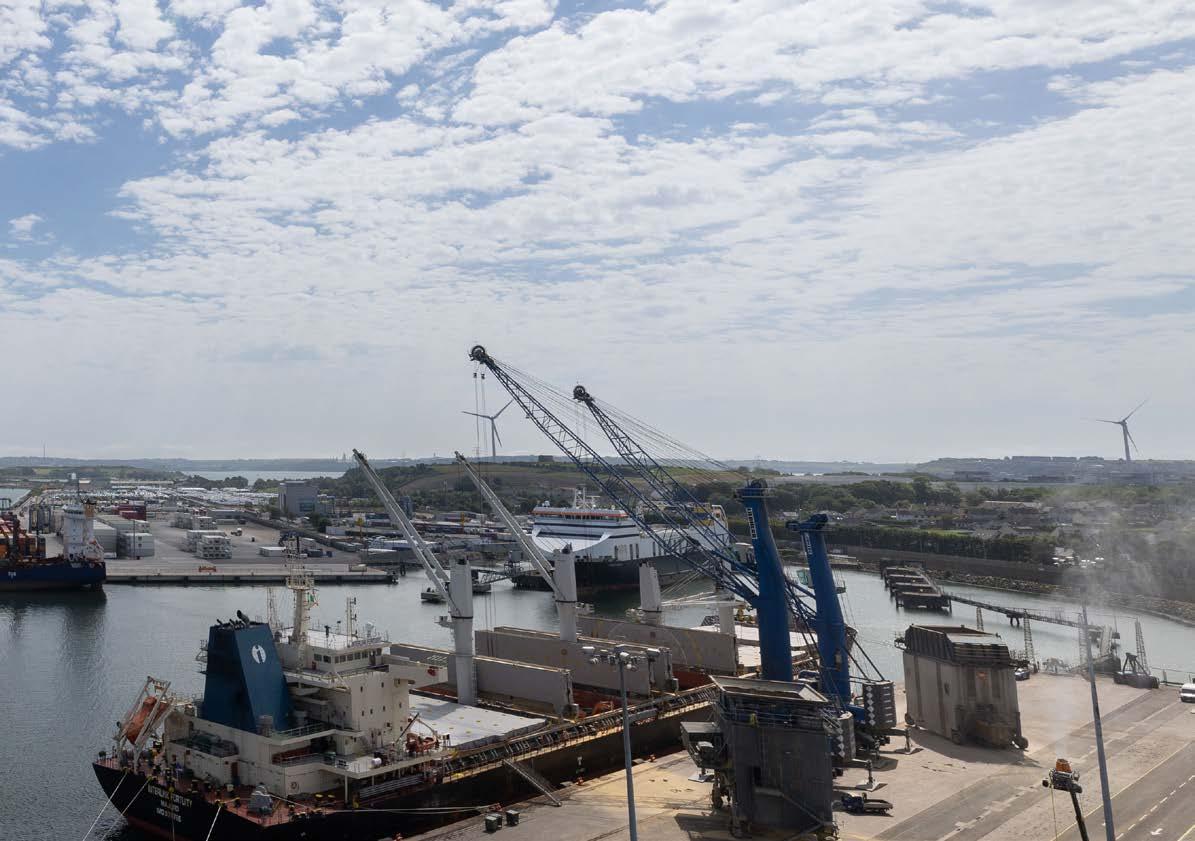
Islands are dependent on maritime trade and ports as drivers of essential economic trade. Cork city has a rich maritime heritage and remains a key point of access to the Irish economy, a role which must be protected and strengthened. In 2025, the Port of Cork handled 10.2 million tonnes of cargo, representing approximately 17% of tonnage moving through Irish ports. 20
Government must future-proof our ports, ensuring they can support economic growth and industrial advancements, access new trade routes and maintain existing ones, and remain insulated from geopolitical shocks and fuel inflation. As the Port of Cork continues to develop, the following are key areas where Budget 2027 can make a meaningful impact:
> Financial incentives can support the relocation of Seveso and other heavy industries (such as mills, warehousing, logistics, etc.) out of areas earmarked for redevelopment to new sites outside of urban areas. This will unlock regeneration lands such as the Docklands and Tivoli. Ensuring that lands are available in key areas such as Ringaskiddy and Marino Point is vital to ensure this transition continues at pace; supporting infrastructure such as access roads like the M28 to Ringaskiddy and Great Island Connectivity Scheme (R624 Cobh Road) must also be prioritised to support this transition.
> Funding should support development of full border control infrastructure at the Port of Cork to handle agricultural produce and the required supports from Revenue to designate an appropriate customscontrolled area to enable cost-effective trade.
> Financial aids to support and de-risk the provision of port infrastructure required to enable offshore renewable energy should be considered.
The Port of Cork has taken steps to invest in its own infrastructure, in particular in relation to offshore renewable energy and national security. The new National Ports Policy must facilitate state supports for continued investment in ports of strategic national importance, including Cork. Port activities are inherently land-intensive; government departments and their agencies should collaborate with the Port of Cork to identify additional lands in the Ringaskiddy area to support its future development.
PRIORITISE STRATEGIC INFRASTRUCTURE INVESTMENT
Government should prioritise investment in projects of strategic importance, critical to Ireland’s economic competitiveness. This includes critical roads, multi-modal connectivity and active travel facilities, public transport and greenways.
Budget 2027 must ensure that provision is made to finance the progression of the following critical projects for the Cork region to support regional connectivity and transport safety, as well as enabling large-scale housing delivery and industrial development:
> Luas Cork,
> Cork Area Commuter Rail Programme,
> BusConnects Cork,
> the Cork Northern Distributor Multi-Modal Route,
> Great Island Connectivity Scheme (R624),
> N/M20 Cork to Limerick Motorway,
> N25 Cork to Youghal Road,
> N72 Mallow Relief Road,
> upgrades to the N71 Cork City to West Cork Route,
> the Northern Transport Project,
> R630 strategic road to Aghada/Whitegate energy hub, and
> Continued funding for the M28 Cork to Ringaskiddy Motorway.
TAXSAVER SCHEME
Review public transport benefits available to employees to encourage uptake, including the TaxSaver Commuter Ticket Scheme. Such schemes allow businesses to support employees with costs associated with commuting without
increasing wages. In addition, the permitted reduced rate of VAT on bicycles, cargo bikes and electric bicycles should be applied to encourage uptake of sustainable travel modes.
ALTERNATIVE FUELS INFRASTRUCTURE
Businesses aiming to electrify their vehicle fleet require significant onsite infrastructure. Lack of national grid capacity can present significant challenges with the roll-out of charging and other infrastructure. Upgrades to the existing grid infrastructure to accommodate alternative fuels,
ELECTRIC VEHICLES (EVS)
scaling biomethane production and anaerobic digestion infrastructure should be prioritised, alongside incentives for early adopters. In the context of geopolitical uncertainty and disruptions to fuel supplies, such investments are even more critical.
To stimulate the second-hand EV market, tax incentives should be introduced and grants extended to buyers, building on the recently announced ICE2EV scheme. High costs hinder many potential buyers, slowing progress towards the target of 845,000 private and 95,000 commercial EVs by 2030.
Benefit-in-Kind reliefs should be enhanced to encourage greater uptake of sustainable travel modes. Any tapering of reliefs at this stage is premature while the adoption of EVs continues to bed in and risks reversing the progress made to date. The transition of Ireland’s existing transport fleet to EVs could be further incentivised through a partial income tax credit for charging costs.
The delivery of efficient charging infrastructure across the state must also be prioritised by government, including super-fast charging on key strategic routes, alongside neighbourhood and destination charging. Improving the accessibility and reliability of charging infrastructure is key to supporting consumer confidence and further EV adoption.
INFRASTRUCTURE
Alongside the delivery of vital transport projects, enhancing critical infrastructure across energy, water, wastewater, social and community infrastructure must be prioritised to keep pace with Ireland’s growing population. The pace of delivery continues to fall short of what is required, placing Ireland’s ongoing competitiveness at risk.21
Realising projected population and economic growth for Cork city and county over the coming decades depends on the state’s ability to deliver critical infrastructure in a timely, reliable manner. Certainty regarding timelines, approval processes and funding streams is crucial to unlocking growth potential.
As the state’s population grows, social infrastructure must also be a priority for investment. Across health, cultural and community infrastructure, investment is needed to promote access to
services, social cohesion and improved quality of life for all.
Commitments made in the Accelerating Infrastructure Action Plan represent a welcome step change in Ireland’s approach to infrastructural delivery and must be implemented in full. Delays in decision-making and funding allocations for vital projects risks inflating associated construction costs, while undermining economic and social progress.
ACCELERATION OF PUBLIC SPENDING APPROVAL FOR INFRASTRUCTURE
Despite the urgency of infrastructure delivery, extended review and elongated approval processes continue to lead to unnecessary delays – a key barrier to Ireland meeting its targets across housing, transport and energy to support economic growth.
Government must prioritise implementation of the Accelerating Infrastructure Action Plan, including provisions for accelerated spending approvals to support the timely delivery of critical infrastructure projects. To improve certainty for contractors, delivery partners and stakeholders, multi-annual or project-based funding models
should be introduced for projects of strategic importance. Milestone-based, transparent progress reporting should be published for major capital projects, including large-scale projects in the Cork region, such as the Cork City Docklands Regeneration, and Lower Lee (Cork City) Flood Relief Scheme.
CRITICAL INFRASTRUCTURE BILL
The forthcoming Critical Infrastructure Bill presents a significant opportunity for government to accelerate the delivery of nationally strategic projects essential to Ireland’s economic competitiveness, regional balance and climate objectives. The Cork Northern Distributor Multi-Modal Route (CNDMR), Luas Cork, the R624 Great Island Connectivity Scheme and vital offshore renewable energy infrastructure and grid upgrades should be explicitly designated under the legislation as projects of critical national and regional importance.
These projects are fundamental to unlocking housing delivery, enhancing sustainable mobility, improving access to the Port of Cork and major employment centres, and supporting the continued growth of Cork as Ireland’s fastest-growing city region. Their inclusion would provide greater
planning certainty, prioritised investment and streamlined delivery mechanisms, ensuring that critical transport and connectivity deficits do not constrain economic development, FDI or quality of life across Metropolitan Cork.
21 National Competitiveness & Productivity Council, Ireland’s Competitiveness Challenge
SOCIAL AND COMMUNITY INFRASTRUCTURE
Infrastructure that supports community development, place-making and overall quality of life offering is a vital strand to competitiveness, attracting investment and talent.
Alongside sustained investment in transport and connectivity infrastructure, Budget 2027 must fund critical elements of social, cultural, educational, community and health infrastructure, including the following:
> Cork Events Centre,
> Cork Elective Hospital,
> Cork City Library,
> New school buildings, alongside refurbishments and expansions of existing buildings,
> Research infrastructure through the INSPIRE Research Infrastructure Investment Package and similar initiatives,
22 University College Cork, Capital Development Plan
> UCC, including projects outlined in UCC’s Capital Development Plan, such as the expansion of the Tyndall National Institute, refurbishment of the Kane Building, a new Cork University Business School on campus, development of the Clinical Medical School, modernisation of the Cork University Dental School and Hospital, and sports initiatives. 22
> MTU capital projects and plans, including investments in sustainability and decarbonisation, High Performance Indoor Athletics Centre, new College of Art, Design & Media, and Centre for the Digital Life Sciences.
> Cork ETB Bishopstown campus, and
> Enhanced funding for islands and Gaeltacht areas.
PLANNING
A number of welcome steps have been taken to address issues in the planning system, including the introduction of the Planning and Development Act and the establishment of An Coimisiún Pleanála. However, it is vital that the additional planning reforms identified in the Accelerating Infrastructure Action Plan, including streamlining judicial reviews, introducing legal obligations for faster agency processing, implementing parallel processing, and establishing a new Regulatory Simplification Unit to remove bottlenecks, are now implemented as quickly as possible to expedite critical developments.
Planning authorities must be fully resourced at local and national level to ensure that applications are dealt with in a timely manner. An Coimisiún Pleanála must also be fully staffed and resourced to respond to appeals within statutory timelines. Supports for the further and higher education sector to provide initial training for planners and support further upskilling in the planning sector should also be prioritised.
CYBER, INFRASTRUCTURE AND ENERGY SECURITY
Security has gained renewed importance amid geopolitical instability and complex supply chains. Encompassing energy security, cybersecurity, the protection of national assets and infrastructure, as well as Ireland’s ability to defend itself, security is now a core strand of the state’s competitiveness on the global market.
Budget 2027 should strengthen Ireland’s cyber resilience, focusing on critical infrastructure and essential national services. As digitalisation continues apace, particularly across public services, data protection should also be a key consideration.
Government must accelerate investment in energy security and grid resilience through faster delivery of renewable generation, storage and grid infrastructure, alongside supports for business energy diversification and onsite generation to reduce exposure to international energy price shocks and supply disruption.
In parallel, enhanced national economic and supply-chain security should be pursued through strategic infrastructure, digital connectivity, and port and transport resilience, while supporting Irish businesses to diversify export markets and reduce dependency on concentrated global supply chains.
Supports for SMEs, such as grant funding, tax incentives, and shared advisory supports for cybersecurity upgrades, staff training and incident response planning, are vital too to ensure businesses of all sizes are equipped with the resources and skills to mitigate cyber risks. Safeguarding our supply chains is vital in the current context of geopolitical uncertainty and potential trade disruptions, and SMEs with key roles to play in essential supply chains must be a core focus.