TRAIN HARD...

This is an official Army publication, prepared under the direction of the Centre for Historical Analysis and Conflict Research (CHACR). The information it contains is for official use only and may not be reproduced for publication in any form without the express permission of the Ministry of Defence. Individuals or agencies wishing to reproduce material should contact the Editor. The views expressed herein are those of the author concerned and do not necessarily conform to official policy. Crown Copyright applies to all material published in this Review except where acknowledgement is made to another copyright holder; this does not affect the intellectual property rights of non-MoD authors. No article, illustration or image may be reproduced without the permission of the Editor.
Clearance: All military contributors are responsible for clearing their material at commanding officer or equivalent level. Beyond this, responsibility for clearance with the MoD lies with the Editor. Contribution from overseas commands must be cleared by the relevant Command Headquarters before submission. The British Army Review assumes such clearance has taken place.
Submissions: Articles should not normally exceed 3,000 words. Material for the next issue should be sent, for the Editor’s consideration, to:
The British Army Review, Robertson House, Royal Military Academy Sandhurst, Camberley GU15 4NP
Email: editorBAR@chacr.org.uk
TRAIN HARD...
Major
Colonel Chris Head, Colonel Ed Oldfield and Major Joseph Murrow
Colonel Toby Till, Colonel Army Training
Captain George
Lieutenant Colonel Gerald Kearse, CO Queen’s Royal Hussars
GENERAL ARTICLES
Major Laurence Thomson, Headquarters Allied Rapid Reaction Corps
Colonel David R Haslam and Lieutenant Colonel Alex Bayliss, Asgard
Brigadier Rob Alston, Commander 9 Deep Recce Strike Brigade
Professor
Major
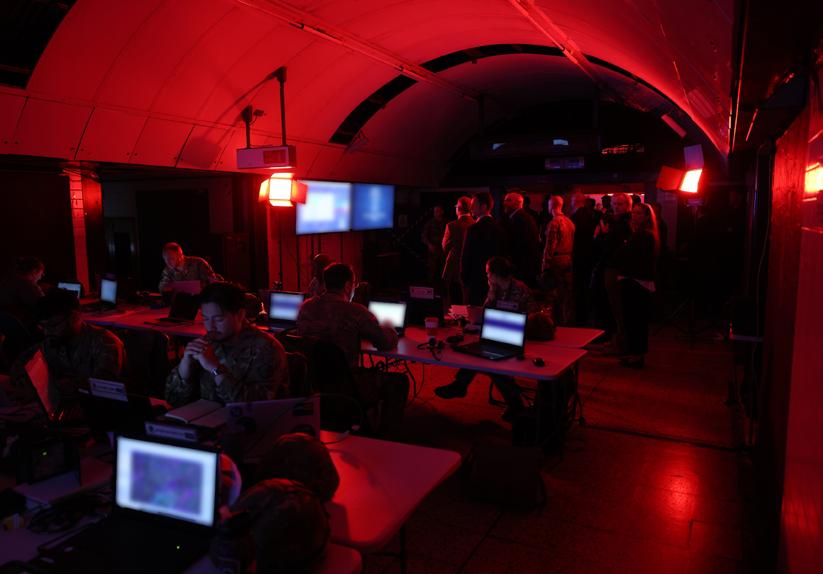
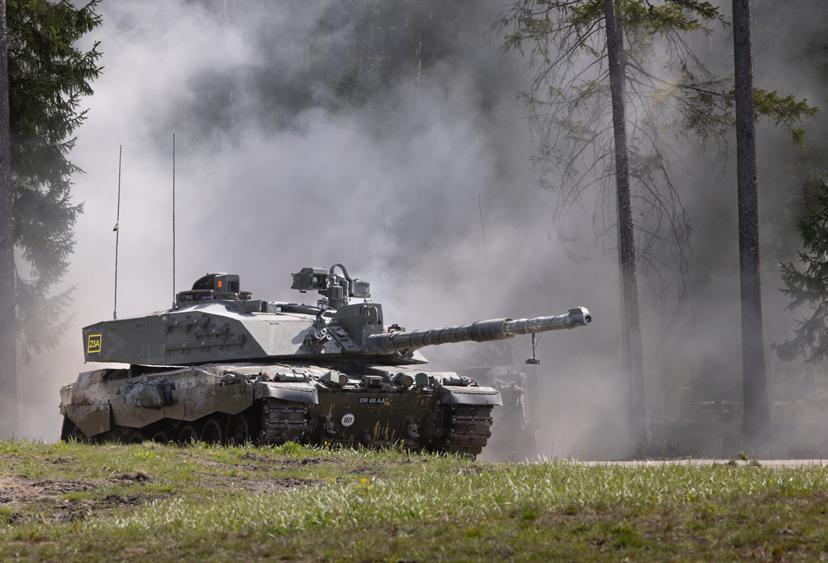

FOREWORD: MAJOR
CONDITIONS SET FOR THE ARMY TO ‘UP OUR GAME’
“In no other profession are the penalties for employing untrained personnel so appalling or irrevocable as in the military.”
– General Douglas MacArthur, US Army Chief of Staff, 1933
MACARTHUR’S warning is not a rhetorical flourish; it is the stark reality of our profession. If we fail to train properly, we will fail in combat. Training is the foundation of combat effectiveness.
This edition of The British Army Review is dedicated to that training. It brings together ideas from across the training enterprise –commanders, instructors, practitioners and thinkers – each offering perspectives that should challenge our assumptions and inspire action. It is not a catalogue of best practice; it is a call to think differently, to question what we do and to drive improvement.
Army Reform has given us a new Principal Training Officer in Commander Land Forces, with a new Army Training and Education Strategy. That strategy describes a clear pivot, a way to up our game. This is not merely about refinement at the margins. It is about ensuring that what we know about modern warfare drives change into what we teach and how we train. As the Chief of the General Staff has put it, “what is thought now needs to be taught”.
Brigadier James Cook’s study of the First World War reminds us what right looks like.1 The British Expeditionary Force did not prevail through ideas alone. Haig, Maxse and others created a system that forced learning into practice – capturing lessons, codifying them and relentlessly embedding them into training. That coherence between thought, doctrine and
execution enabled the British Expeditionary Force of the Somme in 1916 to transform into the army that out-fought its enemy in 1918.
This edition is limited by space to focusing on collective and trade training; but all these efforts are founded on the changes in the Army Individual Training Command and in our individual education programmes. Our pivot applies across that continuum. You
will read in Colonel Toby Till’s hypothetical ‘pre-mortem’ article the potential impact if we do not shift gear, quickly. Colonel James Greaves, Colonel Chris Head and others in the Collective Training Group describe the developments in setting ourselves for scale, and in improving our measurements of performance.
Captian George Williams at the Infantry Battle School outlines Exercise Combined Warrior, where we merge summative assessments from multiple schools to bring more awareness of combined arms manoeuvre to trade training. The commander of Task Force Hannibal brings to life the vital opposing forces capabilities we are adding to all our training: success is a poor teacher. And of vital importance, articles from Lieutant Colonel Andy Breach of the Welsh Guards and Lieutant Colonel Gerald Kearse of the Queen’s Royal Hussars show how leadership in battalions and regiments, focused on hard training, can achieve results among all the daily challenges of unit life.
We are exploiting progress already underway. The creation of the Land Training System and the Army Individual Training Command in 2025, and Army Reform in 2026, have given
us the right foundations – clear authority, stronger governance and a coherent Management of Training System linking education, individual training and collective preparation. But we should be candid: coherence alone is not enough. We are not yet delivering the immersive, demanding and consistently high-quality training that modern war demands. Too often, weaknesses pass unchallenged. Too often, risk is poorly managed. Too often, we fail to convert lessons into practice at the pace required.
You will read in here some of the ways units and trainers are navigating our training system. I offer three elements we must strengthen as the spine of that system: skills, culture and leadership.
Combat now unfolds under persistent observation, and in an environment contested as fiercely in the electromagnetic spectrum and the information domain as on the physical battlefield. Success will depend not only on platforms and systems, but on soldiers and leaders who are digitally literate, intellectually agile and able to integrate effects from multiple systems simultaneously. This demands new cross-cutting skills throughout the force. We must embed technical competence across all training pathways. Every soldier must understand data, networks, emissions and low-level repair of technical systems as critical survivability and lethality functions on the battlefield. Our training system must deliberately develop these skills and reinforce them relentlessly. Recce strike poses particular
“The direction of travel is clear. We will train to fight differently. We will master recce-strike, operate across the electromagnetic spectrum, integrate autonomous systems and embrace the pressure brought by a harder and freer opposing forces.
challenges, which we must grasp: better technical skills must sit in an understanding of the sinews – fires, command, intelligence, sustainment, and so on – which reach through the force. And we must represent those sinews in training, through a live-virtual-constructive blend which allows a recce troop to see not only their parent battlegroup’s companies and squadrons, but the land and joint intelligence, surveillance and reconnaissance and fires to their front, the units to their left and right, and the allied home defence forces alongside them.
This also requires us to change how we think about failure. For too long, failure has been something to avoid or mask. In reality, it is the engine of progress. Training must expose weakness ruthlessly, in an environment where we can analyse and adjust. Success that flatters is dangerous; failure that teaches is invaluable. We must create a culture where we think, learn and leap forward, individually and collectively. A culture that really values its
teachers: selecting them well, preparing them thoroughly, and giving them the time, tools and authority to do their job to the highest standard. Instructors are not a support function; they are the decisive point of delivery. If we want better soldiers and leaders, we must first invest in those who teach. We must also be honest about where we are now. Elements of policy non-compliance persist, particularly in how we approach safety and assurance. The answer is not to constrain training, but to lead better: understanding risk, managing it intelligently and enabling a safe progression to the most demanding activity. Safety is not the opposite of realism; safety is competence.
The single most important determinant of training quality is command. Leaders at every level must prioritise training; protecting the time and demanding the highest standards. They must own safety, not as a compliance exercise, but as a function of professionalism and rigour. And they must drive the culture that searches relentlessly for excellence. Training must be command-led, demanding, progressive and assured. Often we reward commanders most for looking up and out; we need to value equally down and in tactical and technical expertise.
The direction of travel is clear. We will train to fight differently. We will master recce-strike, operate across the electromagnetic spectrum, integrate autonomous systems and embrace the pressure brought by a harder and freer opposing forces. We will develop our training estate and exploit what we have better. We will build a digitally enabled system that accelerates learning, strengthens assurance and makes standards visible. Above all, we will return to first principles. The Army exists to fight. When we are not in combat we should be training or thinking about training. The mark of our professionalism, and our legacies as soldiers and leaders, is how well trained we leave our people. We have work to do. – Major General Ollie Kingsbury, Director Land Warfare

The transformation of the British expeditionary force on the western front 1914-1918, via a process of learninglessons, doctrine, and training, Cook, J. (Author). 1 Sept 2021. P245 2021_Cook_James_0982753_ethesis.pdf

RELEARNING TO FIGHT AT SCALE IN A CORPS CONTEXT
AUTHORS
Colonel Chris Head is Commander, Command, Staff and Tactical Training Group.
Colonel Ed Oldfield is Commander Combat Ready Training Centre.
Major Joseph Murrow is a professionally qualified engineer who is currently part of British Army Training Unit Kenya’s training delivery team.
THE British Army must relearn how to fight at scale. This is not an academic exercise. It follows directly from the strategic environment, the return of major war in Europe and the UK’s commitments to NATO. Recent decades have not prepared the Army for the kind of war it may have to fight: a corps-level campaign against a peer adversary, conducted in a battlespace that is transparent, contested and deeply lethal.
That requirement changes the terms of the problem. It is no longer sufficient to think about tactical excellence in isolation, or to treat technology, manoeuvre, sustainment and defence as separate conversations. A corps fight is a system fight. Its success depends on the Army’s ability to integrate actions and effects across depth, across domains and across echelons. It also depends on the ability of commanders and staffs to understand how their decisions at one level shape options and risks at another.
The Army’s Theory of Battle remains valid.
The Manoeuvrist Approach and Mission Command endure. Combined arms manoeuvre remains the means by which the Army delivers decisive effect in the close battle. But the conditions under which manoeuvre can now succeed have changed. Freedom of action can no longer be assumed. It must be generated, protected and then exploited. That has implications for how the Army thinks, how it equips and, above all, how it trains.
This article argues that relearning how to fight at scale should be the organising idea. Recce strike, combined arms manoeuvre and defensive action should be understood as parts of a single warfighting system within a corps context. Recent conflict and recent training both indicate the same conclusion: the Army must recover corporate understanding of large-scale warfighting, master the fundamentals again and train the force as it expects to fight.
THE CHALLENGE OF RELEARNING SCALE
The central challenge is conceptual before it is
physical. The Army has spent much of the last two decades focused on counter-insurgency and persistent engagement. Those campaigns demanded judgement, adaptability and tactical skill, but they did not require the routine orchestration of deep battle, large-scale sustainment, corps-level command and control or the management of attrition in a peer fight. Institutional memory has therefore faded. Much of the Army’s practical experience is at lower tactical levels, while the intellectual habits associated with formation and corps warfighting have atrophied.
This matters because a corps fight is qualitatively different, not simply larger. Subunits are no longer the main unit of action in the way they often were during Iraq and Afghanistan. In large-scale combat operations, they exist inside a much larger architecture of intent, fires, logistics, protection, information activities and multinational coordination. Their actions remain important, but they are decisive only insofar as they are synchronised with the rest of the force. Relearning scale therefore means relearning interdependence.
The challenge is also physical. The equipment programme is under strain. Legacy capabilities have been reduced, some equipment has been gifted to Ukraine and key replacement systems are not yet fully in service. Ammunition stocks are finite. Training space is constrained. Simulation helps, but it does not yet capture every aspect of drone warfare, electronic warfare, long-range precision fires or the density of a corps battle. The Army is therefore trying to rebuild scale from a diminished base while the character of war itself is shifting.
That combination makes honesty essential. Relearning how to fight at scale will demand
prioritisation. It requires clarity about what matters most, discipline in training, and a willingness to distinguish between what is desirable and what is essential. The task is not to create a perfect future force on paper. It is to build a force that can fight credibly in Europe, at pace, and as part of an alliance.
WHAT CONTEMPORARY CONFLICT SHOWS
The evidence from Ukraine is clear. The battlefield is more visible. Small uncrewed systems are widespread. Sensor coverage is persistent. Targeting cycles are faster. Forces that move carelessly are detected and struck quickly. That has changed the relationship between movement, concealment and survivability. It has also reinforced the dominance of fires and the importance of logistics. The side that can sense, decide, strike and replenish at greater pace and scale gains a profound advantage.
Yet Ukraine also underlines a second point. New technologies have not displaced enduring military truths. Mass still matters. Endurance still matters. The side that can move ammunition, recover equipment, replace losses and sustain command and control under pressure retains a decisive advantage over time. The result is not a new form of war detached from doctrine, but a harsher version of an old one: industrial warfare conducted in a sensor-rich environment.
Other recent operations point in the same direction. Dense urban terrain, complex infrastructure and embedded adversaries compress time and reduce tolerance for error. Precision, discrimination and integration become more important, not less. The common lesson is that tactical action cannot be
understood on its own. Every move sits within a wider system of observation, strike, protection and sustainment. That is exactly the type of thinking the Army must recover if it is serious about fighting at corps scale.
COMBINED ARMS
MANOEUVRE IN A CORPS FIGHT
Combined arms manoeuvre remains decisive, but it is now conditional. Its purpose remains what it has always been: to combine capabilities in a way that generates shock, tempo, dislocation and advantage in the close battle. What has changed is the route by which those conditions are achieved. In a transparent battlespace, manoeuvre that is not set up by action elsewhere in the system is likely to attract attention, be fixed and suffer attrition before it can exploit success.
Put simply, manoeuvre is no longer the starting point; it is the result. A formation can only manoeuvre effectively once the enemy’s ability to observe, target, coordinate and respond has been degraded. That means freedom of action must be generated first. The Army should therefore resist any lingering assumption that manoeuvre can be trained or discussed in isolation from the deep battle, from the contest for the electromagnetic spectrum or from the sustainment architecture that underpins tempo.
This is especially important at corps level. In a corps fight, the decisive point may sit at any depth, and local tactical actions often matter because of how they shape operational opportunities. Commanders must therefore understand manoeuvre not as an independent act of movement, but as part of a broader campaign logic in which deep effects, information advantage, protection
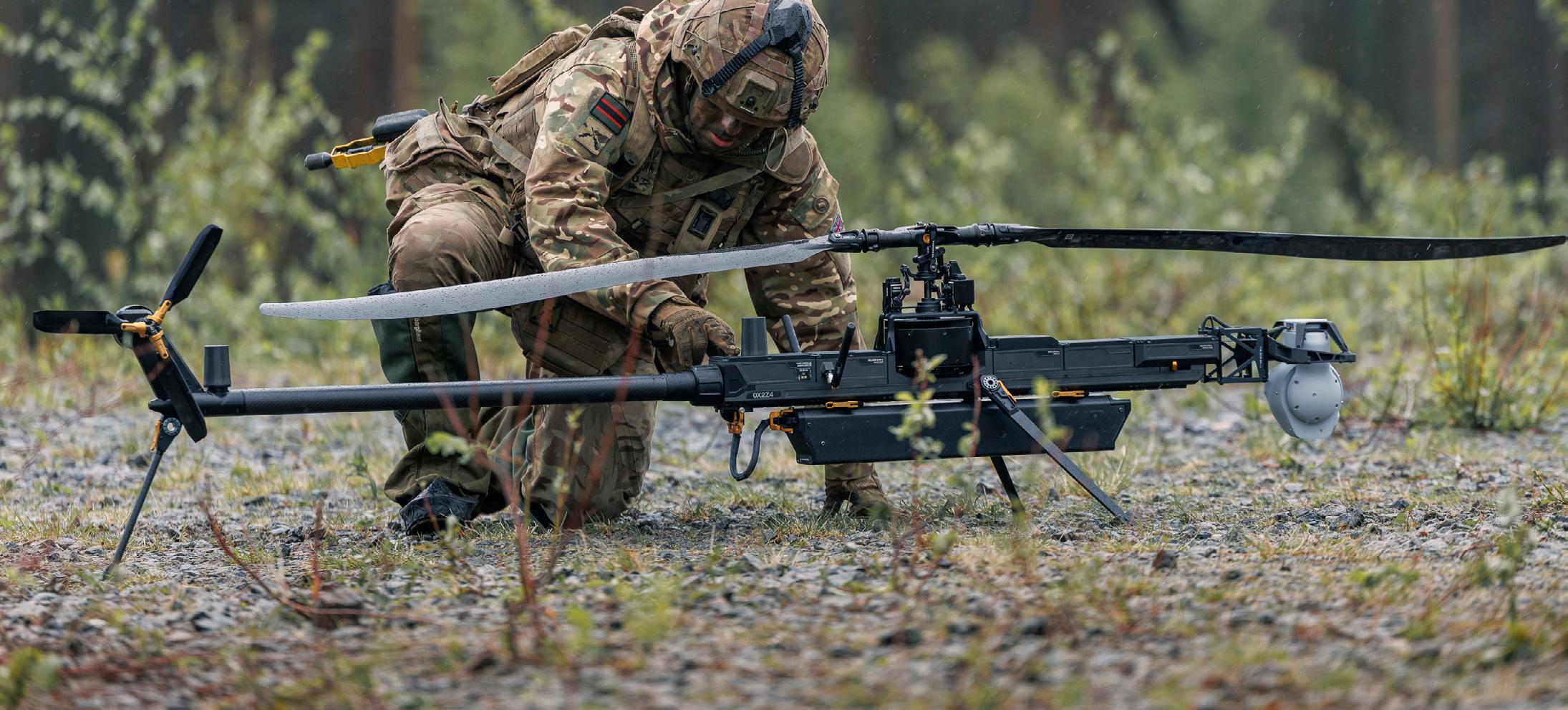
“The evidence from Ukraine is clear. The battlefield is more visible. Small uncrewed systems are widespread. Sensor coverage is persistent. Targeting cycles are faster. Forces that move carelessly are detected and struck quickly.”
“Recce strike may be discussed at formation level and exercised through simulation, while combined arms manoeuvre is validated closer to battlegroup level. The interaction between the two is then implied rather than trained. This is a structural problem. It can create the false impression that deep and close activity are discrete phases, rather than mutually reinforcing actions occurring inside one campaign.”
and sustainment combine to make close action viable.
RECCE STRIKE AS A PRECONDITION FOR SUCCESS
Recce strike has moved from enabler to precondition. That is one of the most important implications of contemporary conflict. By linking sensing, targeting and effects across depth, recce strike does more than support manoeuvre. It degrades adversary coherence, imposes uncertainty, protects the force and creates the opportunities that manoeuvre can then exploit. Seen in those terms, recce strike is not a specialist adjunct. It is a core element of the warfighting system.
That shift matters because the Army still often develops recce strike and close battle activity separately. Recce strike may be discussed at formation level and exercised through simulation, while combined arms manoeuvre is validated closer to battlegroup level. The interaction between the two is then implied rather than trained. This is a structural problem. It can create the false impression that deep and close activity are discrete phases, rather than mutually reinforcing actions occurring inside one campaign.
Relearning how to fight at scale requires the Army to close that gap. Commanders and staffs need a common understanding of what recce strike is for, how it contributes to protection and sustainment, and how success in the depth translates into action in the close. Without that shared understanding, the force risks building islands of competence rather than a coherent fighting system.
DEFENCE, SURVIVABILITY AND THE RECOVERY OF FUNDAMENTALS
If relearning scale is the central challenge, then relearning defensive fundamentals is part of the answer. Evidence from training suggests that battlegroups are generally more comfortable in the offence than in the defence. There is also a tendency to innovate before mastering the basics. That is understandable in a period of rapid technological change, but it carries risk. A force that neglects assured fieldcraft, doctrinal planning and disciplined
preparation in favour of novelty may become less rather than more survivable.
Combined arms defensive planning should be understood in exactly the same way as offensive planning: as the integration and synchronisation of all-arms capabilities to create advantage. Its purpose is not simply to protect a force in place. It is to disrupt, fix and defeat an enemy attack while preserving freedom of action for subsequent operations.1 In that sense, good defence is manoeuvrist. It prepares the conditions for what comes next.
The practical implications are clear. Field fortifications and obstacles remain fundamental. They should be built to doctrinal standards and designed according to requirement, not assumption. There is little evidence that most British battlegroups will enjoy the time, resource or tactical circumstances required to establish elaborate, static defensive systems. In many cases such efforts would be counter-productive.2 Exquisite, equipment-heavy solutions risk creating dependency, slowing tempo, increasing signatures and encouraging static thinking in a fight that may demand rapid repositioning.
A more credible approach privileges simplicity, concealment, dispersion and economy of effort. Obstacles should shape the enemy into areas of disadvantage. Demolitions should be planned and rehearsed with realistic command and control arrangements. Defensive positions should contribute to survivability while preserving the ability to move, reconstitute and fight again. This is not an argument against force protection. It is an argument for force protection that serves the wider battle rather than constraining it.
SUSTAINMENT AND PROTECTION IN AN ATTRITIONAL WAR
One of the strongest lessons from recent conflict is that logistics is not a supporting detail. It is a central determinant of what a formation can do, for how long and at what cost. In a corps fight, sustainment is exposed. Lines of communication, replenishment activity, recovery operations, medical support and

repair nodes all sit within reach of enemy sensors and long-range fires. They cannot be treated as rear-area functions that sit outside the logic of manoeuvre and protection.
The Army has often simplified sustainment on exercise in order to focus training on tactical action. That is understandable, but it is increasingly misleading. In war, sustainment sets the limits of tempo. It determines whether manoeuvre can be sustained, whether combat power can be regenerated and whether a formation can absorb attrition without culminating. Relearning how to fight at scale therefore requires sustainment to be trained as part of the same contested system as fires, command and control, and close combat.
Protection must be understood in the same way. The force is protected not only by armour, engineering and concealment, but by
1UK MOD (2022): Planning and Execution Handbook (2022) Ch. 8-11.
2Institute for the Study of War (2024): Ukraine and the problem of restoring maneuver in contemporary war.
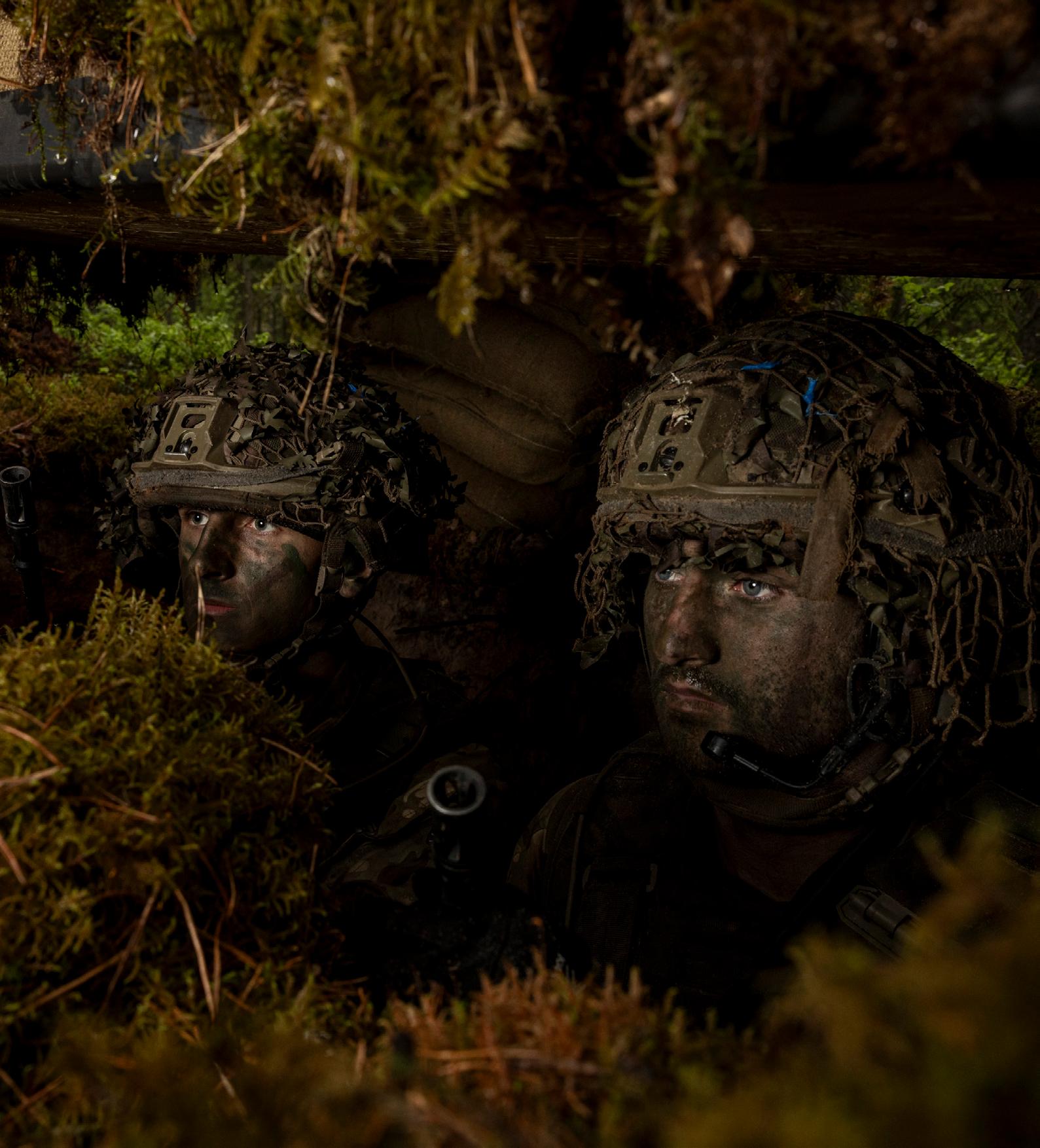
“Defensive positions should contribute to survivability while preserving the ability to move, reconstitute and fight again. This is not an argument against force protection. It is an argument for force protection that serves the wider battle rather than constraining it.”
its ability to suppress enemy sensors, disrupt targeting systems, deceive effectively and shape the battlespace in depth. Recce strike contributes directly to protection in this sense. So does sound defensive planning. So does disciplined sustainment. The key point is that survivability is a system property, not a single function.
TRAINING THE FORCE AS IT EXPECTS TO FIGHT
The most important practical implication is for training. Brigade-level progress is welcome, but it is not enough. If the Army is serious about relearning how to fight at scale, all training must now sit within a corps context. That means more than adding a larger backdrop to lower-level events. It means building a coherent training universe in which sub-unit,
unit, brigade, divisional and corps activities all sit within the same operational logic, with a credible enemy, realistic constraints, multinational dependencies and a contested information environment.
That approach does two things. First, it restores context. Commanders begin to understand how a local action supports a wider design, and what dependencies sit behind apparently simple tactical decisions. Second, it exposes weaknesses that are otherwise easy to hide. Gaps in planning, unrealistic sustainment assumptions, poor integration between deep and close effects, and weak understanding of defensive fundamentals all become visible when activity is nested within a larger fight.
Exercises such as Storm and Arrcade Storm
matter precisely because they move in this direction. They offer the opportunity to link live, virtual and constructive activity at the scale required, to train divisional and corps headquarters within a realistic framework, and to test the Army’s assumptions about fighting in Europe with the structures and capabilities it expects to field. That is not just useful. It is necessary.
But one exercise will not solve the problem. Relearning corps warfighting is a sustained institutional task. It demands common doctrine, coherent scenario design, shared understanding across the Field Army and centralised effort where capability gaps would otherwise fragment the training audience. Above all, it demands consistency. Scale cannot be rediscovered episodically. It must become the context within which the Army habitually thinks and trains.
CONCLUSION
The British Army must relearn how to fight at scale. That is the central point and it should shape every other conversation about readiness, modernisation and training. The return of major war in Europe, the UK’s commitment to NATO and the evidence from contemporary conflict all point in the same direction. The Army needs a force that can fight in a corps context, inside a multinational campaign, against a peer adversary and under conditions of transparency, attrition and deep contestation.
Combined arms manoeuvre remains decisive, but only when the conditions for it have been created. Recce strike is central to creating those conditions. Defensive action and sustainment are essential to preserving them. None of these can be treated as separate specialisms. They are parts of one warfighting system and they should be trained accordingly.
The recommendation is therefore straightforward. The Army should treat relearning scale as its organising priority. It should train within a corps context by default. It should restore mastery of fundamentals, especially in defence and sustainment. It should integrate recce strike and manoeuvre as one system. And it should use exercises such as Storm and Arrcade Storm not as isolated events, but as mechanisms for building a durable culture of large-scale warfighting.
This will be hard. It will require resources, discipline and candour about what remains immature. But it is achievable. The Army has adapted before. It must now do so again, at scale and at pace.
UK MOD © Crown copyright
A CHILLING PRE-MORTEM FOR THE ARMY’S NEXT WAR
AUTHOR
Colonel Toby Till is Colonel Army Training, Army Training Executive.
IT is February 2028, a British Army sub-unit is operating in Estonia. It has deployed as part of the Forward Land Force (FLF) at short notice to deter and then repel an aggressive military incursion. However, despite more than a decade of Op Cabrit the FLF remains underprepared to survive and fight at scale in cold weather. Captain Smith sits in a command post dealing with the effects of the extreme cold. Deployed as part of the FLF with supporting elements from the Strategic Reserve Corps, the young officer reflects on his experiences over the last few weeks and the implications of failing to adequately prepare for cold weather operations against a modernised and experienced adversary.
The abrupt arrival of Sergeant Foster in the command post brings Smith rushing back to the present. Foster glances outside nervously as he rearranges the makeshift chicken wire screen covering the position’s entrance. He listens intently, waiting for the high-pitched buzzing that heralds the arrival of an armed small uncrewed aircraft system (UAS). He
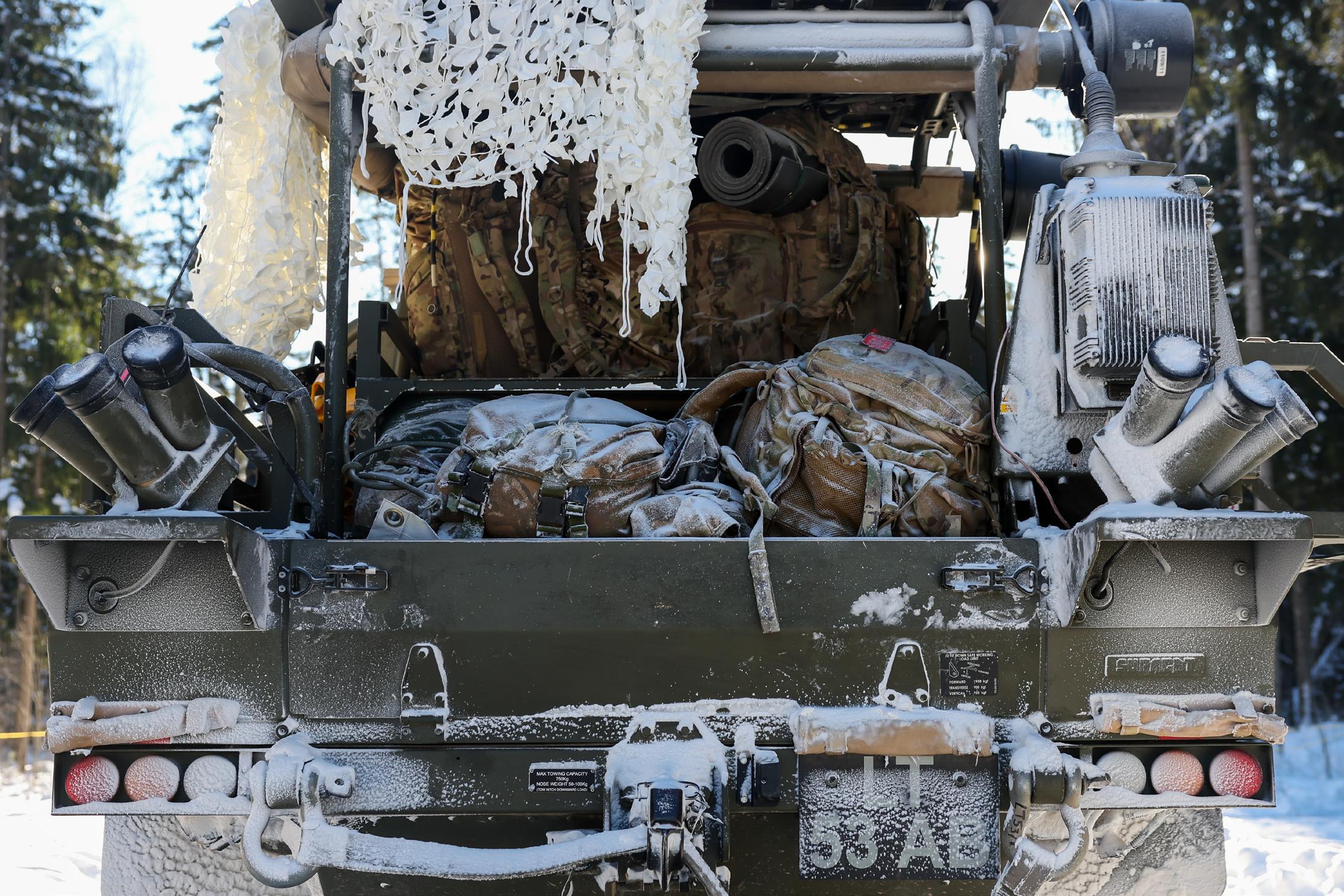
wouldn’t have been hard to spot as he moved between the company’s positions. His green multi-terrain pattern silhouetted him perfectly against the brilliant white snow that surrounded them.
Sergeant Foster’s concern is well founded. From the outset of their time in Estonia, the company has been relentlessly hunted and targeted by their adversary. To reduce the risk of being detected and targeted by indirect fire and drones the company has restricted radio use. They could think of few alternatives. Their understanding of the electromagnetic spectrum is limited because it had received insufficient emphasis during their training. As a result, the company struggles to understand how to avoid detection, deconflict frequencies, manoeuvre aggressively in the electromagnetic spectrum, employ their all-arms electronic warfare team and exploit their attached light electronic warfare team. Prior to deploying, their training had been ground manoeuvre focused and had not taught them how to employ their Robotics and Autonomous Systems (RAS) and counter-RAS.
Beth ProdgerUK MOD © Crown copyright
The implications of these shortcomings were now becoming clear.
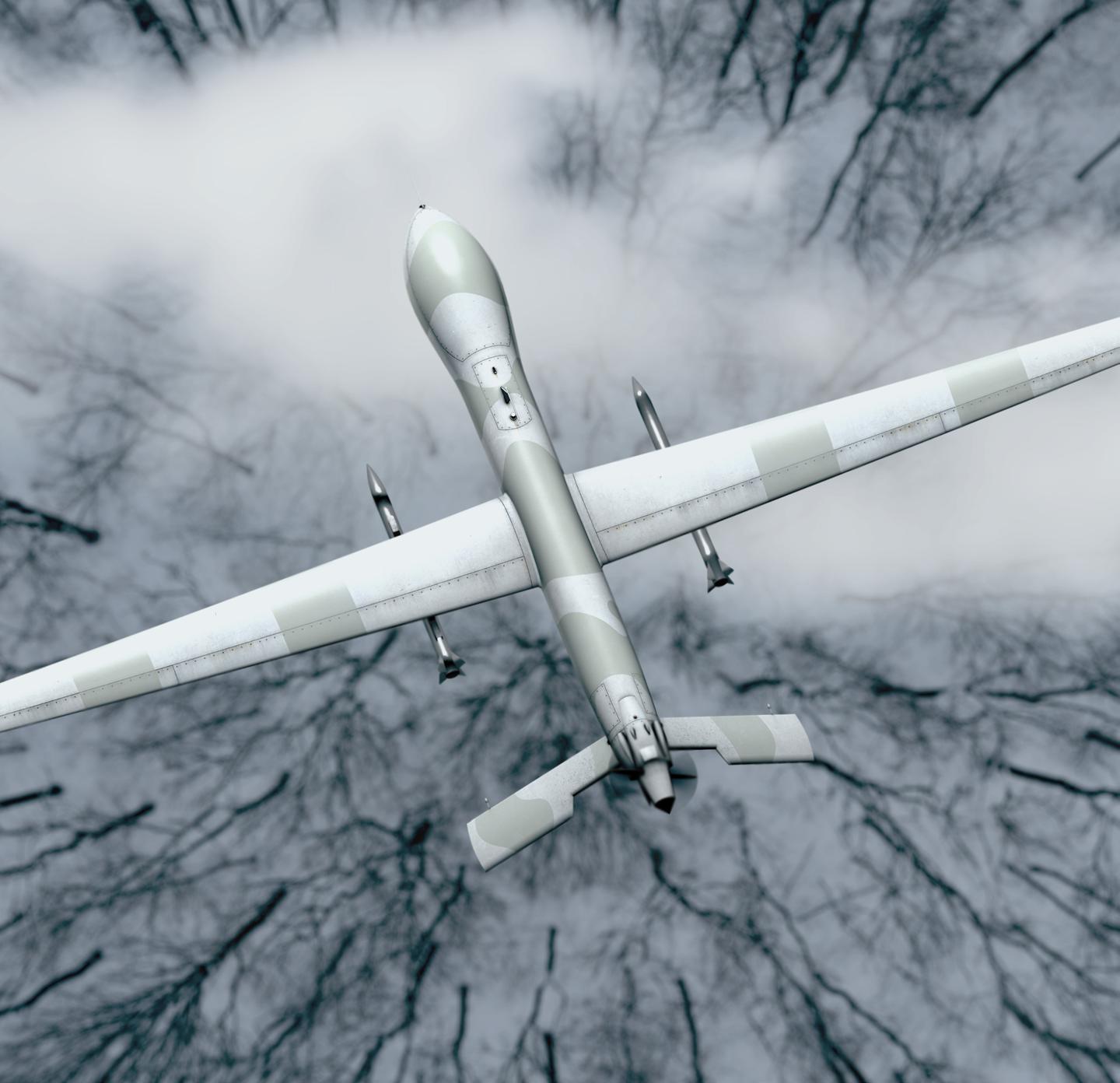
Sergeant Foster complains to Captain Smith he has another broken drone. Smith’s options are limited. His UAS section does not have the technical skills to repair them and returning them to the REME light aid detachment means running a 20 kilometre gauntlet to his rear. During the FLF’s deployment it has been under persistent attack throughout its depth from armed drones. The brigade’s capacity to address this threat is hindered by it lacking a layered, cross-echelon counter-UAS system that it is trained to use. They realised too late the need for multi-spectral camouflage and training in decoys and deception.
Smith looks around, he has some drones and loitering munitions left but a lack of magazine depth means he is required to use them sparingly. He is also unsure how effective they will be. The cold limits their battery life to two hours, and he lacks the silent power generation needed to charge them without risking being targeted by the enemy. His confidence is further undermined by their training prior to deploying. This lacked the simulation and approvals required for his company to develop the knowledge, skills and experience they needed to use their UAS and RAS effectively.
Smith contrasts his situation with that of his adversary as they advance forward. They do so with all the experience and guile of a force that has spent years learning the hard-won lessons of large-scale combat operations. It is a well-rehearsed and effective routine. They advance in the electromagnetic spectrum first, jamming Smith’s communications and finding him with ease. This is quickly followed by swarms of near-surface, surface and sub-surface RAS. Their unmanned ground vehicles (UGV) with integrated counterUAS quickly shoot down what drones Smith has left while dropper drones spread mines across his manoeuvre corridors. The company’s underground positions offer little respite as RAS stalk the sewers and subsurface infrastructure. Direct-fire UGVs then advance, but with only a handful of assault pioneers Smith lacks the resources to slow their advance. The captain is left fixed in an urban position that no longer offers effective protection or freedom of action. His company still haven’t seen an enemy soldier. Smith and his company are facing the consequences of failing to adapt their tactics and training in time. They had devoted disproportionate time to legacy activity that was proving irrelevant in the operating environment they found themselves in.
WHAT SHOULD HAVE HAPPENED
It is February 2028 in Estonia. Amidst sub-zero temperatures a light recce strike company emerges on four axes after a ski and over-snow vehicle infiltration on radio silence. They have controlled their electronic signature and navigated using compasses and astro navigation. Wearing white multispectral camouflage ‘Harry Potter’ cloaks over their cold weather clothing they have hidden from the ever-present drones as they manoeuvred. Their training has ensured everyone has kept their weapons lightly oiled, their clothing is layered for the right activity and they are all able to operate with snowshoes or skis.
The brigade’s capability upgrades are the product of an operational problem from Land Force Command. Their training progression ensured each unit has a core cadre able to survive and fight alongside their local Estonian partners and wider NATO allies. Cyclone and Storm events have advanced the brigade’s ability to operate with key allies on the terrain on which they now find themselves fighting.
Captain Smith sits in his warm integrated company command post. He watches the common operating picture on a single screen in his small but comfortable and highly mobile 4x4 box body hiding in an underground car park. He has a task org of two modernised rifle platoons and a manoeuvre support platoon, all with air and ground RAS at section and platoon level. They keep their cold weather modified small UAS carried close to their bodies to maintain power and additional batteries are recharged from their hybrid mobility platforms.
The company’s flanks are covered by remote seismic and acoustic ground sensors and intelligence, surveillance, target acquisition and reconnaissance UGVs. The manoeuvre support platoon has a blend of direct and indirect precision and area fires. The small swarming munitions trucks are his most valuable asset but are ably complemented by the company’s loitering munitions and armed UGVs. The enemy’s most likely avenue of advance is covered by a small swarm of Jaeger smart mines hiding in the street level rubble. Remote ground sensors cover the subterranean areas and are linked to armed ‘sewer bots’ that can fly unaided down sewer systems, scan for threats and then return. It is all underpinned by the mesh network which allows the company to seamlessly communicate and integrate all its capabilities. Smith reflects on how his training differed from previous generations. He recalls the catalytic influence of the Ukraine conflict and how the opposing forces he faced forced the brigade to fight differently. They were now reaping the benefits.
An automated warning brings Smith back to the present. A rooftop counter-UAS system and electronic warfare scanner have identified the enemy advancing on several axes in the electromagnetic spectrum, in the air and on the ground. His platoons operate from dispersed positions, deliver effects and relocate before being fixed and targeted. Six icons appear on his screen. A combined arms package
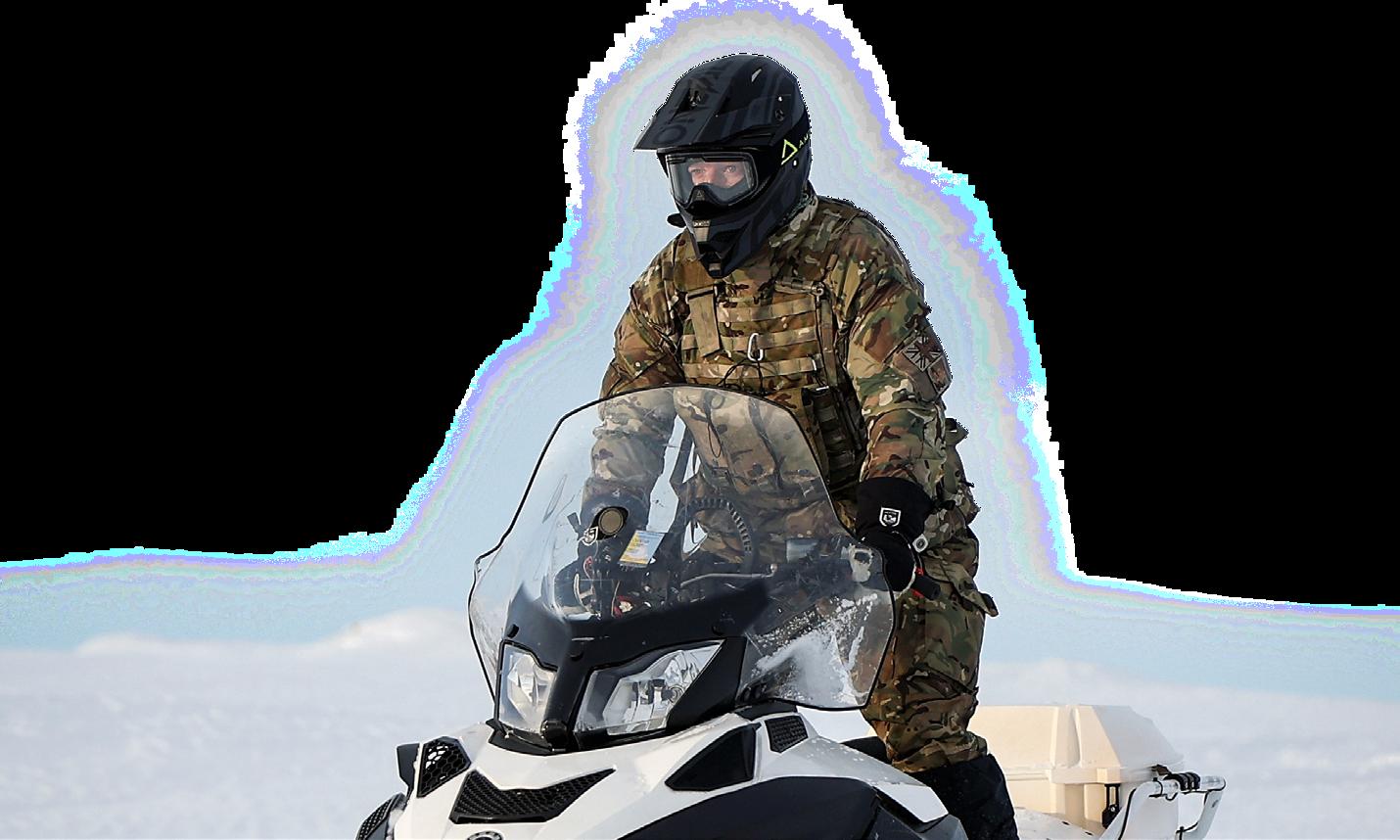
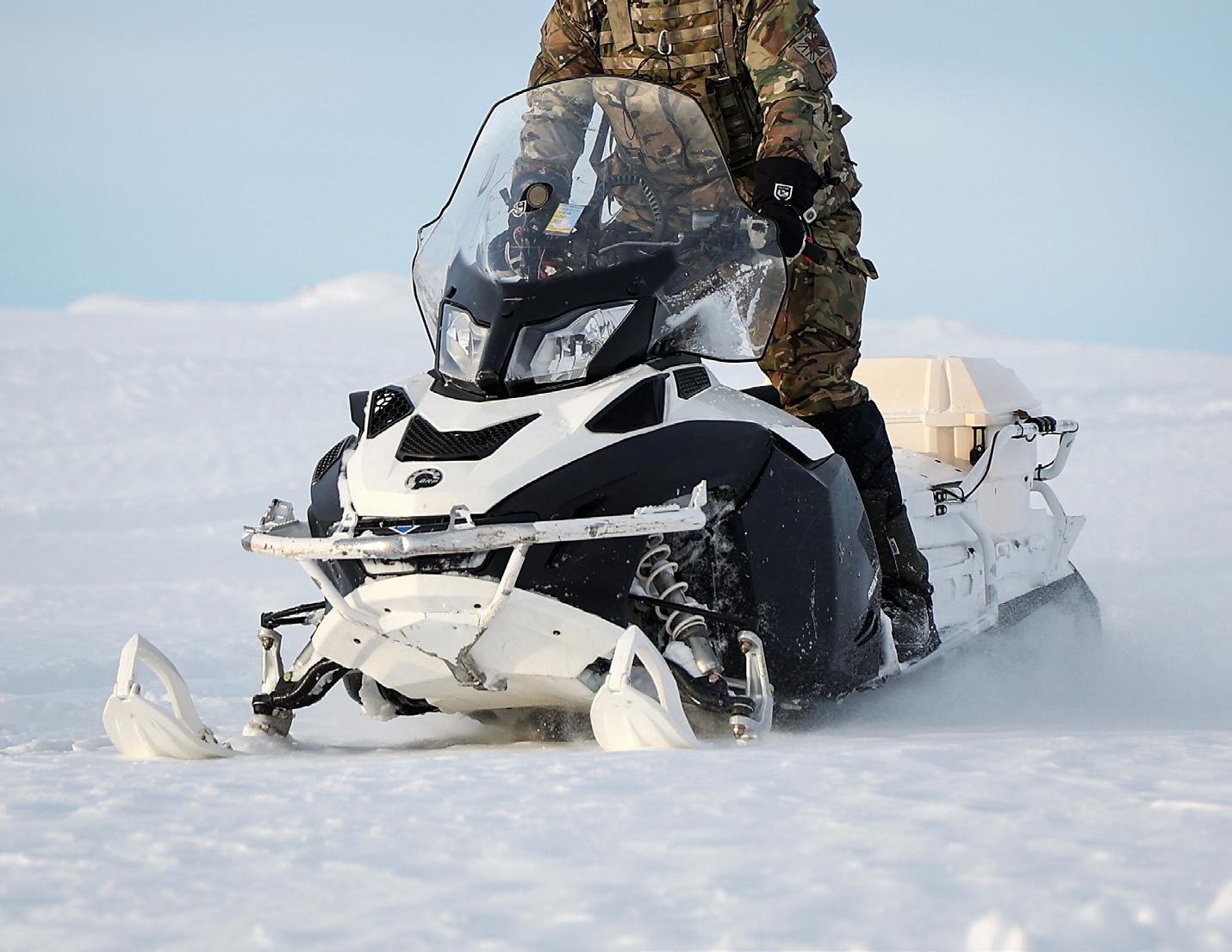
“He wouldn’t have been hard to spot as he moved between the company’s positions. His green multi-terrain pattern silhouetted him perfectly against the brilliant white snow that surrounded them.”
MOD © Crown copyright
dismounted element advance through an old factory. What does he do now?
He has planned for reversionary modes on his Captains’ Warfare Course, but this time artificial intelligence (AI) and autonomy is on his side. An automated voice calmly informs him it has prioritised two targets and selected an appropriate weapons match. Smith quickly confirms the recommendation and an automated order is sent to a call sign which engages moments later. The dismounted infantry in the factory is targeted with an AI-enabled swarm of attack drones. The combined arms column is halted by a combination of the Jaegers and missilecarrying UAS.
Captain Smith deploys two-armed UGVs on pre-planned routes. They engage an enemy-held building and then jockey back, supported by armed UAS. 1 Platoon rapidly relocates to its tertiary fighting position to support 2 Platoon and clear the final enemy from the factory using their UAS to enable their route planning and their integrated assault pioneers to clear them. UAS or small throw bots are used by the sections as they clear the factory room by room. An additional target is cross cued to a neighbouring unit who quickly strike it with a close attack effector.
A warning flashes on Smith’s screen, the power on his UGVs is now at 20 per cent with 45 minutes left on task. This is quickly resolved by the company sergeant major’s group, which has been charging two spare task lines in their lightweight charger. Next to Smith, the company sergeant major is alerted of several casualties by his dismounted tactical network. His load carriage UGVs bring back the casualties in a matter of minutes. He recalls in Helmand it would have taken a full section almost 30 minutes to have made the same recovery. To the company’s rear, a RAS transport platoon launches four heavy lift UAS which fly on a pre-planned route to the ‘robotic ambulance exchange point’. The company sergeant major and his team of medics and UGV operators quickly move the casualties from the UGV to the UAS, check vitals and place the wounded personnel in the
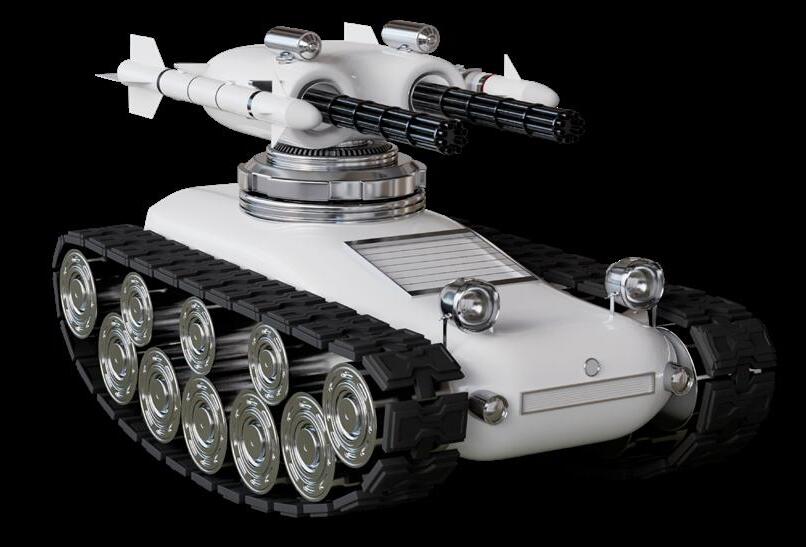
protected cocoon. The blanketed casing on the heavy lift UAS will ensure the casualties arrive in surgical care in well under an hour.
Back in the command post, Smith assesses the situation and relocates his Pandora drone swarm truck – two minutes earlier it had fired on an enemy command and control node identified by an electronic warfare scanner. The platoons move to secondary locations, guided by their UAS and sweeping ahead with electronic warfare assets. Meanwhile a converted turretless autonomous Challenger 2 arrives equipped both as a mobile counterUAS platform and a breacher. It remotely clears mines laid by an enemy drone on the main supply route while its accompanying counter-UAS provide wide area coverage.
Smith has lost several UAS in the engagement. These consumables are quickly and easily replaced by the additive manufacturing detachment with the company quartermaster sergeant, which prints 75 per cent of the parts in less than six hours. The company quartermaster sergeant recalls the previous year’s training. Thankfully it had been well thought through, and every unit had a near surface indoor trainer in the classroom linked to the Dismounted Close Combat Trainer, Interim Combined Arms Virtual Simulation and other recce-strike simulators such as the Joint Fires Synthetic Trainer. It was in use every day. Individual training commenced in netted
facilities in every garrison before live targets were used in the annual brigade ‘near surface warfare concentration’. This was supplemented by the battlegroup and brigade recce strike training events in BATUS, which brought all near surface sensors and effectors together six times a year.
Meanwhile it wasn’t just the close fight that benefitted from autonomy and new ways of fighting. The corps was exploiting swarms of long-range autonomous attack drones to strike key targets from multiple directions, conduct electronic attack and support wider joint operations, including suppressing the enemy’s air defence. AI-enabled decision support tools delivered through Project Asgard allowed the Strategic Reserve Corps to triage masses of data, from open source to Above Secret, and exploit it to drive target development at a previously unimaginable pace and scale. Its people possess the digital skills to operate all these systems, balanced with the technical and tactical expertise. Smart, AI power management tools, at all echelons, ensure autonomous systems remain sustained with sufficient battlefield energy, which increasingly serves as the fuel of the modern battlefield and the key enabler of robotic and autonomous land warfare. All these capabilities have been enabled cross defence lines of development, with training solutions at their core, and were taught across the Land Training System.

TRAINING, LETHALITY AND MEASUREMENT IN THE RETURN TO WARFIGHTING READINESS
AUTHORS
Colonel James Greaves is Commander British Army Training Unit Kenya (BATUK).
Major James AthowFrost is SO2 Tactical Operations, BATUK.
Major Kev Pyper is Chief of Staff, Collective Training Group.
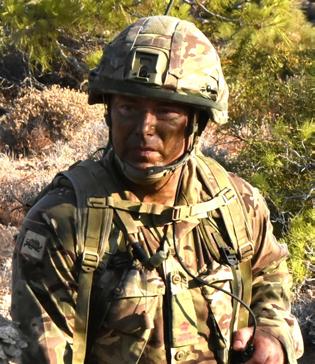
“If we knew, now, that the UK’s land forces would find themselves in large scale combat operations in 2027, what would we be doing differently now, and why aren’t we doing that?”1
THE British Army must prepare for a form of war that is fast, lethal and unforgiving from the outset. Contemporary conflict offers no period of adjustment and little tolerance for error. Units must therefore arrive [whether to BATUK or the battlefield] prepared to operate under immediate pressure, with functioning systems, disciplined procedures and a realistic understanding of what combat will demand. This requirement underpins the development of Storm, a collective training construct designed to expose formations to the complexity, friction and tempo of modern war before deployment rather than during it.
The significance of that proposition lies in what it implies about readiness. Readiness is often discussed in terms of force structure, equipment programmes or declared availability. Those factors matter, but they do not provide an
answer to the most important practical question: can a force element operate coherently under the conditions of modern combat? That question can only be answered through training that reproduces, as faithfully as possible, the pressures that define warfighting reality. If training remains too linear, too permissive or too detached from likely combat conditions, it risks generating confidence without competence. The problem then is not simply wasted resource, but false assurance at precisely the moment when realism matters most.
This article argues that warfighting readiness depends on the integration of three elements: realistic collective training, the generation of actual lethality and a coherent approach to performance measurement. These are not separate lines of effort. They are mutually reinforcing components of a single problem. If training does not reflect the conditions of war, lethality will not be realised. If lethality is not measured properly, performance gaps will
remain obscured. If measurement is incoherent, commanders cannot have confidence in the judgements made about readiness. The institution may then know a great deal about its plans and its processes, but too little about its actual ability to fight.
Seen in this way, Storm is more than an exercise architecture. It is a method for testing whether the Army can translate concept, capability and doctrine into battlefield performance. Its value lies not merely in the scale of the events it enables, but in the way it links decisions to consequences, pressure to behaviour and evidence to judgement. The purpose of this article is therefore to explain not simply what the system does, but why it matters. It matters because the Army’s central readiness challenge is not abstract. It is about whether formations can kill, survive, decide and sustain at the pace modern war demands.
TRAINING FOR MODERN WAR
Modern combat is characterised by persistent observation, rapid targeting, cumulative friction and repeated attack. Forces must operate under degraded information, contested logistics and the constant possibility that any movement, transmission or concentration will be detected and struck. Training that separates these pressures into neat serials risks creating a misleading picture of war. Activity may appear competent in isolation while remaining brittle when exposed to cumulative stress. The issue is not that such training teaches nothing, but that it may teach incomplete lessons. A unit can become proficient at solving carefully bounded tactical problems while remaining unprepared for the pace and disorder of actual combat.
This is why continuity of pressure matters. In modern war, survival after one contact does not guarantee time to reset before the next. Headquarters must process incomplete information while moving, fighting or trying to preserve themselves from detection. Logistic chains cannot assume routine movement. Casualty management does not pause the battle. The training implication is clear: if the Army wants to create warfighting competence rather than administrative confidence, it must expose units to problems that continue, interact and compound. Storm addresses this by requiring formations to fight through fatigue, uncertainty and sustained enemy action instead of solving one discrete tactical problem at a time.
The live and virtual blend is important for the same reason. Live training produces the human realities that simulation cannot fully replicate: fatigue, weather, discomfort, uncertainty, the friction of movement and the mental burden
“If the Army wants to create warfighting competence rather than administrative confidence, it must expose units to problems that continue, interact and compound. Storm addresses this by requiring formations to fight through fatigue, uncertainty and sustained enemy action instead of solving one discrete tactical problem at a time.”
of command in difficult conditions. Virtual training enables representation of capabilities, distances and system interactions that are otherwise too difficult, expensive or constrained to reproduce entirely in the live domain. The point of blending them is not novelty. It is to create a single battlespace in which actions in one area produce consequences elsewhere. A failure to move ammunition forward affects fire support. A failure to resource an observer affects the fire plan. A delayed decision at headquarters alters what a company or battlegroup can do in contact. This link between tactical action and system consequence is at the heart of realistic training.
The emphasis on early orientation follows from the same logic. Warfighting competence cannot be improvised in the final week of a major training event. If a formation arrives without a secure grasp of battle procedure, doctrinal basics, standard operating procedures or core tactical competencies, then much of its training time will be spent correcting avoidable weaknesses instead of learning to operate more effectively under pressure. Early orientation is therefore not simply helpful administration. It is a readiness intervention designed to ensure that units can spend Storm fighting better rather than merely discovering how unprepared they are.
REALISM, CONSEQUENCE AND THE TRAINING AUDIENCE
One of the most valuable features of the Storm concept is that it restores consequence to training. Task Force Hannibal is designed
2RUSI Vol 170 Issue 6/7, Electromagnetic Operations in Ukraine, 6 Oct 2025.
3The Economist. How cheap drones are transforming warfare in Ukraine, Feb 2024.
4RUSI Vol 27 NATO, Should not replace traditional firepower with ‘Drones’, Justin Bronk 2025.
5Wavell Room, How the Russian Army Fights, Sergio Millar 2026.
to make the training audience uncomfortable and link actions to consequences. Configured to simulate ‘Russia on a good day’. Expect mass fires, electronic warfare,2 small UAS,3 counter UAS, massed artillery4 and relentless attacks.5 Expect to be found, outranged and out paced. Expect Hannibal to exploit gaps ruthlessly. Consequence matters because it is what makes training explanatory. In a permissive training environment, a mistake may remain visible only as a minor procedural error. In a contested environment, the same mistake can become operationally decisive. Poor operational security may allow a strike on a command post. Weak logistic protection may starve the main effort of ammunition or fuel. Delayed movement of echelon support may reduce the ability to exploit success. When these relationships are built into an exercise, they force the training audience to understand that warfighting is not a sequence of discrete tactical episodes but a system of dependencies, risks and trade-offs.
This matters particularly because modern conflict punishes shallow competence. Headquarters that are only comfortable when information is complete, communications are stable and timelines are generous will struggle badly against a capable enemy. Likewise, units that have only trained in conditions where support appears on demand, where casualties are quickly removed by the training provider, or where rear areas remain functionally safe may develop expectations that are dangerously inconsistent with war. The purpose of Storm’s pressure is therefore educational rather than theatrical. By saturating the battlespace with uncertainty, information friction and continuous demands, it teaches forces that the battle does not stop because they would prefer time to think.
THE LETHALITY PROBLEM
Evidence from collective training indicates that sub-units are not consistently achieving the lethality expected of them. Engagements frequently occur at significantly shorter ranges than weapon systems allow, particularly at night. This demonstrates a gap between potential capability and realised effect. Possession of equipment does not guarantee effective use of equipment. A force may therefore appear credible when judged by its holdings, yet remain tactically under-lethal when judged by what it actually achieves in training.
This distinction between potential and realised lethality deserves emphasis because it clarifies why the issue matters. Potential lethality is a useful planning concept. It describes what a force could do if its systems are employed
effectively, in the right place and at the right time. Realised lethality describes what it actually does under realistic pressure. For the purpose of preparing for war, the second measure matters most. An army is only as lethal as the distance at which it can kill the enemy consistently in the conditions it is likely to face. If it routinely falls short of that distance in collective training, then its effective lethality is lower than it assumes, regardless of the theoretical range of its weapons or the notional power of its order of battle.
The problem is especially acute because it sits at sub-unit level, where combat is often finally decided. Public and institutional discussions of lethality frequently focus on major capabilities such as rockets, artillery, drones or other long-range systems. Those capabilities are undoubtedly important, but they do not remove the requirement for small units to kill the enemy at the ranges and in the conditions that define the close fight. Broken terrain, bad weather, darkness, urban spaces, trenches, woodland and degraded communications all compress combat regardless of how sophisticated the wider force may appear. If sub-units cannot deliver lethal effect when battle closes, the wider system remains less lethal than it should be.
This is why the lethality evidence matters beyond the narrow issue of marksmanship or fire control. It indicates a broader institutional tendency to assume that capability equates to performance. It shows that training, rather than equipment alone, is the decisive factor in turning weapons into battlefield effect. It also provides a more convincing basis for improvement than abstract discussion of future systems. If a battlegroup cannot currently synchronise machine guns, mortars, anti-tank guided weapons, artillery, engineers and logistic support into coherent fighting power,
then its problem is not only technological lag. It is that its existing system is not yet functioning as effectively as it should.
WHY ACTUAL LETHALITY MATTERS
A narrow reading of lethality might treat it simply as a technical question of range, kill ratios or ammunition expenditure. In practice, it has wider significance because it reveals how effectively a force converts tactical activity into operational effect. Actual lethality matters because it is one of the clearest expressions of whether a formation can bring fighting power to bear at the right time, in the right place and under pressure. When lethality is low, the consequences are cumulative. The enemy survives longer, friendly forces are exposed for longer, ammunition is consumed for less decisive results and opportunities to exploit success diminish. Poor lethality is therefore not merely a tactical defect. It contributes directly to operational inefficiency and increased risk.
There is also a disciplinary value in measuring lethality honestly. A simple definition –killing the enemy or destroying a target – prevents institutional drift towards softer, more comfortable descriptions of combat effectiveness. Enabling functions, survivability and sustainment all contribute to fighting power, but they are not substitutes for effect. Their purpose is ultimately to enable the force to kill the enemy or destroy targets in support of the mission. Restating that point is not rhetorical aggression. It is analytical clarity. Without it, there is a risk that discussions about warfighting become overly managerial, focusing on processes without testing whether those processes culminate in decisive effect.
The emphasis on night fighting is particularly revealing. The data indicating sharply reduced engagement distances at night matters because much modern combat will occur in
“The data indicating sharply reduced engagement distances at night matters because much modern combat will occur in low-visibility conditions, or in environments where observation and movement are heavily constrained.”
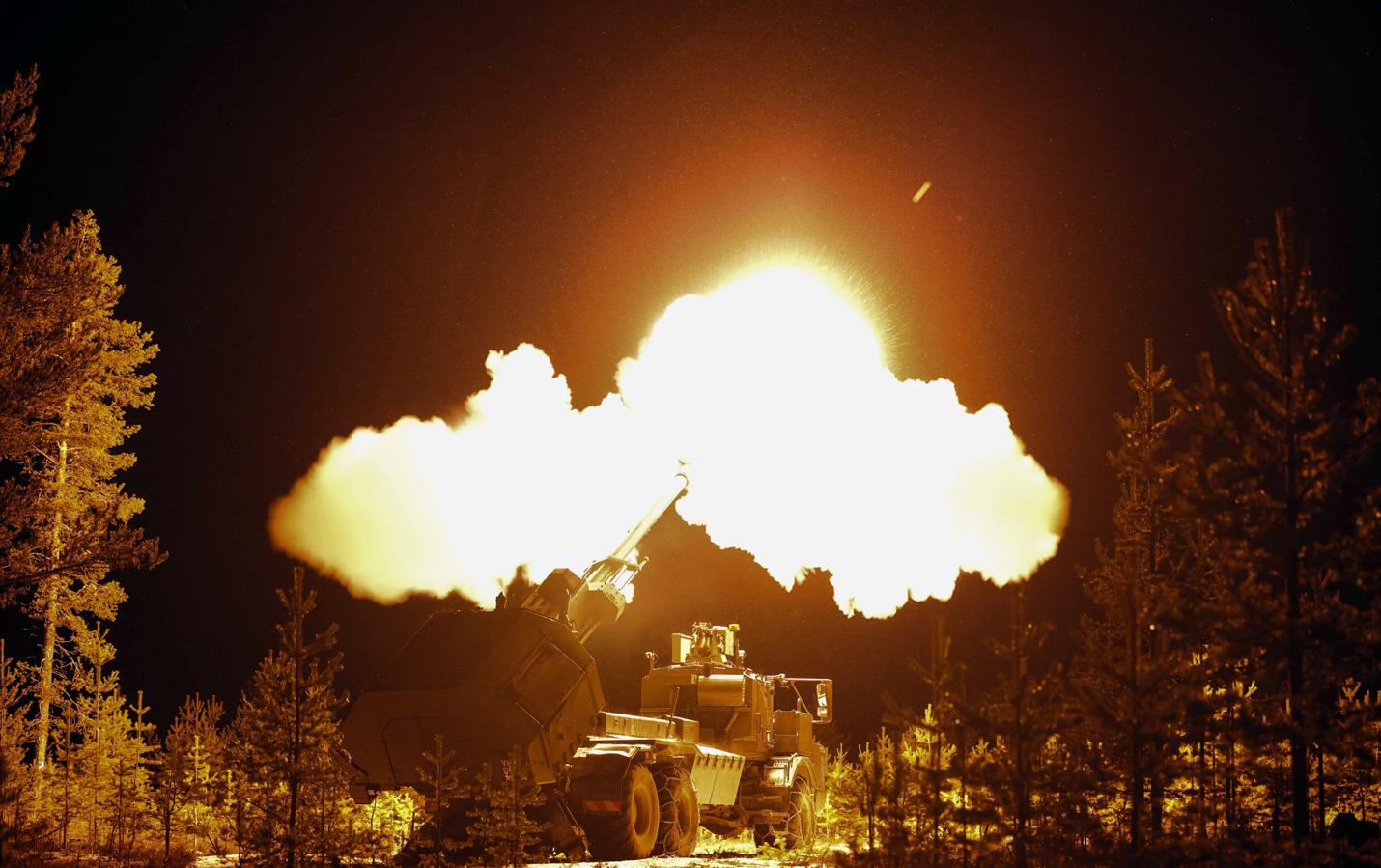
low-visibility conditions, or in environments where observation and movement are heavily constrained. If lethality collapses at night, then a formation’s practical freedom of action also collapses. It becomes less able to exploit darkness, less confident in movement and less effective in seizing the initiative. In that sense, the night fighting problem is not merely about sights or equipment pairings. It is about whether the force can turn a condition that should create opportunity into one that creates self-imposed limitation.
WHY MEASUREMENT MATTERS
Measurement is critical because it shapes behaviour. Training audiences prioritise what is assessed, and therefore poorly designed metrics can distort effort. Overly complex, inconsistent or weakly relevant indicators create noise rather than insight and risk generating false assurance. A force element may learn how to satisfy the visible demands of an exercise without genuinely improving the competencies that matter in war. Conversely, a well-designed measurement framework makes the standard explicit, directs effort towards operationally relevant outcomes and gives trainers evidence that can support honest judgement.
The distinction between measurement and counting is important here. Counting alone records activity. It can indicate volume, occurrence or timing, but it does not necessarily reveal competence. A force may produce a large amount of data while still learning very little. Measurement becomes valuable only when it is connected to doctrine, training objectives and operational requirement. That is why a smaller number of coherent performance indicators can be more useful than a large set of fragmented ones. Too many indicators increase administrative burden, reduce comparability between events and make it harder to draw meaningful conclusions over time. They can also encourage checklist behaviour, in which the training audience focuses on passing visible measures rather than building resilient competence.
The redesign of the performance indicator framework is therefore significant because it addresses a structural weakness in the training system. A doctrine-based framework that combines stable high-level indicators with tailored data collection plans is more likely to support both assurance and adaptation. It gives commanders evidence that is relevant to the conditions of war rather than merely convenient to gather. It also creates the possibility of trend analysis across multiple exercises, which in turn allows the Army to identify whether recurring weaknesses sit in command and control, logistics, target acquisition, situational
awareness, or the application of direct and indirect fire. Without that ability, each exercise risks becoming an isolated event rather than part of an accumulating body of institutional understanding.
FROM DATA TO JUDGEMENT
Objective data is essential, but it is not sufficient on its own. Data can show what happened: timings, engagement ranges, sequence of actions, volumes of fire, casualty evacuation times, or the proportion of named areas of interest that were resourced. Those measures are invaluable because they provide evidence rather than impression. Yet they do not explain whether a decision was sensible, whether doctrine was applied properly, or whether success would likely endure under operational conditions. Data therefore informs judgement; it does not replace it.
This is why professional observation remains central. Observer coach trainers interpret performance in context. They assess whether tasks were completed under realistic conditions, whether action aligned with intent, whether risks were understood and whether capability was integrated in a way that generated fighting power. Their role is not to soften data with anecdote, but to give it operational meaning. That distinction is important. A metric may indicate that a decision was made quickly; it does not tell us whether it was the right decision. A timeline may show that a task was completed; it does not reveal whether the task was completed through sound tactical judgement or through luck in benign circumstances.
The integration of data and military judgement is therefore fundamental to credible validation. Commanders require assurance that reflects real performance rather than isolated outputs. If the assessment system appears detached from operational reality, overly subjective or inconsistent between events, commanders will be less willing to trust it. That in turn weakens the value of training as a tool for readiness and governance. By contrast, a system that combines objective evidence with professional interpretation provides stronger assurance and more useful feedback. It also supports a healthier form of candid after-action review, because criticism is anchored in evidence rather than personality.
TRAINING, LETHALITY AND MEASUREMENT AS ONE SYSTEM
The greatest value in integrating these themes lies in recognising that they describe one system rather than three separate conversations. Realistic training provides the pressure under which capability is
“The challenge is not simply to train, procure or measure more. It is to align training, lethality and measurement into a coherent system.”
tested. Lethality provides one of the clearest expressions of whether that capability produces battlefield effect. Measurement and judgement explain why performance succeeded or failed and what should change as a result. The central readiness proposition is therefore that performance under realistic pressure matters more than declared capacity in permissive conditions.
This system view is important because it explains why seemingly separate failures are often connected. If a battlegroup fails to protect logistics and manoeuvre units are starved of ammunition or fuel, lethality falls. If a headquarters becomes overwhelmed by information and loses tempo, opportunities to mass effect are lost and lethality falls. If a force element cannot move or operate quietly at night, it becomes easier to find, harder to sustain and less able to exploit opportunity. These outcomes should not be treated as isolated tactical errors. They are manifestations of a system that has not yet been trained, measured and integrated effectively enough.
The system view also has institutional implications. It suggests that improving lethality is not only, or even primarily, a procurement question. It is a question of training design, battle procedure, rehearsal, tactical competence and the disciplined exploitation of existing systems. It also suggests that procurement itself should be influenced more heavily by evidence from collective training. If data shows that units are consistently underperforming in particular conditions, then equipment decisions can be tied to demonstrable need rather than fashionable assumption. In that sense, serious collective training does not merely prepare the force to fight. It also tells the Army where its beliefs about its own performance are inaccurate.
IMPLICATIONS FOR THE ARMY
Several implications follow from this analysis. First, realistic collective training must remain the Army’s principal development environment because it is the only place where the force can expose its system of systems to pressure and judge how well its parts interact. This does not mean that every training event must look identical, but it does mean that the most
valuable events will be those that reproduce continuity of pressure, realistic consequence and the interaction of multiple tactical functions rather than those that treat warfighting as a series of disconnected drills.
Second, the Army should continue to narrow, stabilise and discipline its measurement framework. What matters is not the quantity of indicators but their relevance, portability and ability to support military judgement. Commanders need evidence they can trust, not dashboards full of data of uncertain operational value. A simpler doctrine-based framework is more likely to strengthen assurance, enable comparison over time and support meaningful institutional learning.
Third, lethality improvement should begin with the evidence already available from collective training. Before reaching too quickly for technological solutions, the Army should first ask what current data says about how its units are performing. If the problem is that sub-units routinely fail to kill at range or collapse into very short-range engagements at night, then part of the answer lies in sights, rehearsals, fire control, fieldcraft and tactical discipline before it lies in abstract future capability. This is not an argument against modernisation. It is an argument for grounding modernisation in observed performance.
Fourth, there is a cultural implication. Honest evidence must be allowed to drive improvement rather than be softened for comfort. A training system built around consequence, candour and professional judgement is demanding, but it is essential if the Army wants to avoid false assurance. Readiness is not improved by describing weakness more politely. It is improved by identifying it clearly, understanding why it exists and correcting it before operations impose a harsher judgement.
CONCLUSION
The challenge is not simply to train, procure or measure more. It is to align training, lethality and measurement into a coherent system. Storm provides a framework in which that alignment can occur because it exposes the force to realistic pressure, links actions to consequences and creates the conditions under which performance can be judged honestly. The lethality evidence matters because it shows that actual battlefield performance often falls short of theoretical capability, especially at sub-unit level and at night. The redesigned performance indicator framework matters because it provides the means to understand whether training is genuinely producing readiness or merely activity.

REPRESENTING
RUSSIA: AN EXERCISE IN KNOWING THY ENEMY

AUTHOR
1Bartles, C. K. (2016). Getting Gerasimov right. Military Review, 96(1), 30–38.
2McDermott, R. (2017). Russia’s conventional armed forces and the Georgian war. Parameters, 47(4), 65–76.
3Grau, L. W., & Bartles, C. K. (2016). The Russian way of war: Force structure, tactics, and modernization of the Russian Ground Forces. Foreign Military Studies Office.
BRITISH Army training, both individual and collective, increasingly focuses on preparing forces for conflict against peer and near-peer adversaries. Among the most significant threats identified by Western defence establishments is the resurgence of Russian military power and its evolving approach to large-scale warfare. Speaking at the 2025 Royal United Services Institute (RUSI) Land Warfare Conference, the Chief of the General Staff, General Sir Roly Walker, warned that “Russia had seemingly abandoned the principle of mutual co-existence with us here in Europe, and so we needed to prepare accordingly”. His remarks reflected the growing consensus within NATO that Russia represents the principal peer military threat facing European security. This perception has been reinforced by the continued modernisation of Russian conventional forces, the integration of cyber and electronic warfare capabilities and the operational lessons drawn from the war in Ukraine.
The representation of a Russian combined arms army characterises a military system that integrates uncrewed aircraft systems (UAS), armour, mechanised infantry, artillery, air defence, reconnaissance, electronic warfare, cyber operations and information warfare into a coordinated operational framework designed to achieve simultaneous effects across multiple domains. To prepare for conflict against such an adversary, the British Army employs Hannibal –opposing forces – to emulate Russian doctrine and battlefield behaviour within the live, virtual and constructive training environments.
The representation of a Russian combined arms army within the Land Training System is intended to improve the tactical proficiency,
operational planning and strategic awareness of the Army. However, accurately portraying Russian capabilities, doctrine and operational culture is inherently complex and presents both strengths and weaknesses. This article examines how Hannibal represents Russian combined arms armies in training environments while evaluating the advantages and limitations of this approach.
UNDERSTANDING THE RUSSIAN COMBINED ARMS ARMY
The Russian combined arms army is based on the principle of integrating multiple combat functions into a unified operational framework. Russian doctrine traditionally emphasises operational depth, massed artillery fires, electronic warfare, reconnaissance-strike complexes and rapid manoeuvre to disrupt and destroy enemy formations.1 A Russian combined arms army typically includes motor rifle brigades, tank brigades, UAS units, artillery units, engineers, air defence systems, reconnaissance formations, logistics elements and electronic warfare detachments. These components are synchronised to achieve operational objectives through combined effects rather than isolated tactical actions.2
Russian operational thinking is heavily influenced by Soviet concepts such as Deep Battle and Operational Manoeuvre Groups, which prioritise disrupting enemy command structures and exploiting operational vulnerabilities through layered attacks.3 Modern Russian reforms have adapted these ideas to contemporary warfare by integrating UAS, cyber operations and precision fires into traditional combined arms tactics. Hannibal and the Collective Training Group therefore seeks to replicate these characteristics through opposing forces elements designed to simulate
Commander HQ Hannibal is an Intelligence Corps lieutenant colonel.
Russian operational behaviour as realistically as possible.
REPRESENTATION IN THE LIVE ENVIRONMENT
Live environments involve physical field training exercises using troops, vehicles, weapons systems and terrain to create realistic combat conditions. These exercises are designed to expose training audiences to the complexity and intensity of modern mechanised warfare.
In Collective Training Group field training exercises, the nominated Hannibal unit4 simulates Russian doctrine through aggressive reconnaissance, persistent UAS operations, layered defence, artillery-centric operations and mechanised manoeuvre. Russian doctrine places artillery at the centre of combat operations, often using indirect fires to shape the battlefield before manoeuvre forces engage directly.5 Hannibal replicates this approach by conducting sustained artillery preparation, integrating armour and mechanised infantry, employing deception and camouflage techniques, and employing a persistent near-surface UAS threat. Training scenarios frequently place the training
4A different unit is selected to be Task Force Hannibal for each field training exercise.
5Kofman, M., & Fink, A. (2017). Russian military strategy and doctrine. CNA Analysis and Solutions.
6Watling, J. (2024). The arms of the future: Technology and close combat in the 2030s. Royal United Services Institute.
7Watling, J., & Reynolds, N. (2025). Tactical developments during the third year of the Russo-Ukrainian War. Royal United Services Institute.
8Davis, P. K. (2019). Artificial intelligence and military simulations. RAND Corporation.
“Because authentic Russian equipment is rarely available in sufficient quantities, field training exercises typically use surrogate platforms to simulate Russian combat systems. British Army armoured vehicles may be visually modified to resemble Russian tanks and infantry fighting vehicles, while laser engagement systems are used to simulate realistic combat effects.”
audience under sustained indirect fire pressure while communications and navigation systems are deliberately disrupted to replicate Russian electronic warfare tactics.
Because authentic Russian equipment is rarely available in sufficient quantities, field training exercises typically use surrogate platforms to simulate Russian combat systems. British Army armoured vehicles may be visually modified to resemble Russian tanks and infantry fighting vehicles, while laser engagement systems are used to simulate realistic combat effects. Electronic warfare, surveillance and attack, is represented through communications jamming, GPS denial and radio frequency monitoring, forcing commanders to adapt to degraded operational conditions.6 In addition, UAS now play a central role in all Hannibal activities; recent conflicts have demonstrated the significance of UAS in Russian reconnaissance and artillery targeting operations.7
Operationally, Russian military culture emphasises maintaining pressure on enemy
forces through tempo, layered attacks and continuous reconnaissance. Hannibal is controlled through the issuing of orders, but is free-thinking to achieve the mission and seeks to create operational stress by conducting persistent surveillance, artillery harassment, night operations and coordinated manoeuvre attacks from multiple directions. These activities are intended to degrade situational awareness and force commanders to make decisions under uncertainty. Such realism is particularly valuable because it exposes the training audience to the confusion and friction associated with high-intensity warfare.
REPRESENTATION IN THE VIRTUAL AND CONSTRUCTIVE ENVIRONMENTS
Virtual and constructive environments consist of computer-generated simulations, synthetic battlefields and distributed mission training systems that enable British Army personnel to train against large-scale representations of Russian combined arms formations without the logistic burden and real estate challenges associated with field training exercises. These systems allow commanders and staff officers to experience operational complexity on a scale that is impossible to reproduce physically.
Constructive simulations model entire operational theatres using computer-generated forces controlled either by human operators or artificial intelligence. These systems replicate Russian doctrine by modelling artillery fires, UAS operations, electronic warfare, air defence networks, cyber-attacks and mechanised manoeuvre.8 Russian formations can therefore conduct, for example, deep strike operations, integrated air defence activities, operational encirclements and longrange precision fires in a manner consistent with modern Russian doctrine.
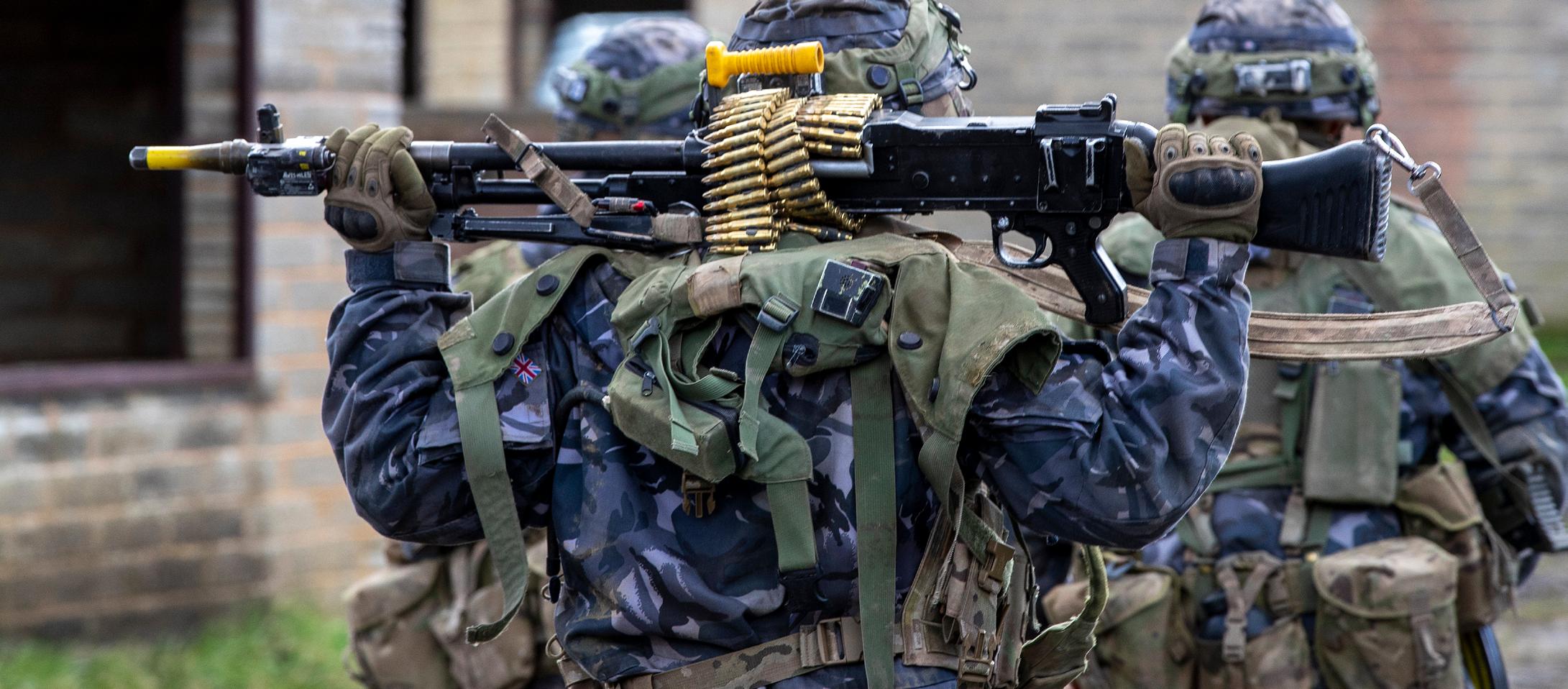
Advances in simulation systems could increasingly incorporate behavioural algorithms designed to replicate Russian decision-making processes. These future systems will model fire prioritisation, operational tempo, defensive layering, target selection and electronic warfare employment. An artificial intelligence enabled ‘virtual Hannibal’ will have the ability to respond dynamically to battlefield developments rather than simply following pre-scripted actions.9 As a result, training audiences encounter more realistic and adaptive enemy behaviour, which helps to improve the representation of the enemy being delivered in training.
A significant advantage of virtual and constructive environments is their ability to integrate multiple domains simultaneously. Russian doctrine strongly emphasises information confrontation and non-kinetic operations.10 They can simulate cyber-attacks, GPS spoofing, satellite disruption, electronic jamming and information warfare campaigns alongside conventional military operations. These effects are extremely difficult, and in some cases impossible, to recreate safely in live training. They also allow training at tactical, operational and strategic levels simultaneously, enabling commanders to understand the relationship between battlefield decisions and wider operational outcomes.
STRENGTHS OF REPRESENTING RUSSIAN COMBINED ARMS FORCES
One of the principal strengths of representing a Russian combined arms army is that it prepares British personnel for conflict against a technologically advanced and operationally sophisticated adversary. Unlike counterinsurgency-focused training, Hannibal enemy scenarios expose forces to integrated fires, UAS operations, advanced air defence systems, electronic warfare and mechanised manoeuvre operations.11 This significantly improves readiness for large-scale combat operations.
Another major advantage is the improvement of combined arms integration within training audiences. Training against Russian-style
9Scharre, P. (2018). Army of none: Autonomous weapons and the future of war. W. W. Norton & Company.
10Giles, K. (2016). Russia’s ‘new’ tools for confronting the West. Chatham House.
11Freedman, L. (2019). The future of war: A history. Penguin Books.
12Manea, O. (2018). The Russian military today and tomorrow. Small Wars Journal.
13Renz, B. (2018). Russia’s military revival. Polity Press.

“Virtual and constructive simulations provide an additional strength by enabling cost-effective experimentation and operational analysis. British Army units from battlegroup to corps can test tactics, operational concepts and emerging technologies against Russian-style adversaries without deploying large formations or expending substantial resources.”
operations requires effective coordination between infantry, armour, artillery, engineers, aviation, logistics and intelligence assets. Exercises often reveal weaknesses in communication, interoperability and command relationships that might otherwise remain hidden during routine training.12 Consequently, forces develop stronger operational cohesion and more effective battlefield coordination.
Representing Russian operational methods also exposes personnel to the complexity of modern warfare. Russian doctrine seeks to overwhelm opponents through simultaneous effects across multiple domains, including cyber operations, artillery strikes, reconnaissance activities, electronic warfare and UAS operations. Exposure to such conditions develops resilience and adaptability. Leaders become accustomed to making decisions under pressure despite communications failures, degraded situational awareness and operational uncertainty.
Virtual and constructive simulations provide an additional strength by enabling costeffective experimentation and operational analysis. British Army units from battlegroup to corps can test tactics, operational concepts and emerging technologies against Russianstyle adversaries without deploying large formations or expending substantial resources. This supports doctrinal development and encourages innovation in areas such as artificial intelligence, UAS warfare, cyber operations and electronic warfare integration.
WEAKNESSES AND LIMITATIONS
Despite these advantages, representing a Russian combined arms army also presents significant limitations. One major weakness is the tendency to oversimplify Russian doctrine and operational culture. Training
organisations may continue to rely on outdated assumptions regarding rigid Soviet-style command structures or predictable battlefield behaviour.13 Russian doctrine continues to evolve in response to technological developments and operational experience.
Another limitation concerns intelligence gaps. British Army understanding of Russian military capabilities is necessarily incomplete and often based on open-source analysis, captured documents and historical observations. Consequently, Hannibal representations may inaccurately portray Russian morale, tactical flexibility, equipment effectiveness and command culture. These inaccuracies can distort training outcomes and create misleading assumptions regarding Russian strengths and weaknesses.
Resource constraints also limit the realism of live training. Russian doctrine relies heavily on massed artillery, layered air defence systems and large mechanised formations. Most training establishments cannot fully replicate the scale or density of these capabilities. As a result, field training exercises may underestimate the intensity and destructive potential of Russian combat operations.
Practical and safety considerations impose further restrictions. Certain battlefield effects, such as strategic missile attacks, electronic warfare operations, massive artillery bombardments, chemical warfare environments and large-scale cyber disruption, cannot safely be recreated in live environments. Although simulation systems attempt to approximate these effects, they cannot fully replicate the physical destruction and psychological impact associated with real combat.
Virtual and constructive environments also
have limitations. Although highly sophisticated, simulations cannot perfectly reproduce human behaviour, fear, exhaustion or battlefield chaos. Personnel may take unrealistic risks because they understand that the environment is artificial.14 Artificial intelligence models similarly struggle to replicate irrational decision-making or culturally specific operational behaviours that may emerge during actual warfare.
Furthermore, they lack many of the physical hardships associated with combat, including sleep deprivation, equipment failures, extreme weather and physical exhaustion. These factors significantly affect battlefield performance but are difficult to reproduce realistically in simulations. Finally, they often struggle to adapt rapidly enough to evolving Russian tactics, particularly in areas such as commercial UAS integration, digital targeting networks and counter-uncrewed aerial system operations.
HOW HANNIBAL WILL BETTER REPRESENT THE THREAT
An effective approach to representing a Russian combined arms army involves connecting and integrating live, virtual and constructive environments. This approach combines the strengths of both methods while reducing their individual weaknesses.
Field training exercises provide physical realism, battlefield friction, terrain challenges and human interaction. Soldiers experience the stress and uncertainty associated with manoeuvre
warfare while developing practical tactical skills. Virtual and constructive systems provide operational scale, multi-domain integration and strategic complexity. They also permit repeated experimentation and large-scale operational rehearsals at relatively low cost.
Live, virtual and constructive integration enables real troops, simulation systems and computer-generated forces to operate within a shared training environment. Soldiers may manoeuvre in the ‘live’ while pilots operate flight simulators and headquarters command virtual formations. Cyber teams can simultaneously conduct simulated attacks against command networks. This integrated approach creates a more comprehensive representation of Russian operational methods across tactical, operational and strategic levels.
Inevitably there is a tension between realistically representing the threat and ensuring maximum training benefit. As a result, Hannibal is free thinking but not necessarily free acting and is often not able to use all the resources it has available to ensure training benefit. But once the training audience has done enough to demonstrate competence and validate, Task Force Hannibal will be able to operate freely (while conforming to appropriate doctrine) and able to use all the resources it would realistically have at its disposal. This will help unlock the incentives to change in the training audience.
CONCLUSION
Representing a Russian combined arms army in
live, virtual and constructive environments is an essential aspect of preparing the British Army for a modern peer conflict. Russian doctrine presents a highly complex challenge involving integrated fires, UAS operations, mechanised manoeuvre, electronic warfare, cyber operations and information confrontation. Effective enemy representation enables British Army personnel to develop the resilience, adaptability and combined arms coordination necessary for success in high-intensity warfare.
Live training provides realism, battlefield friction and physical stress, while virtual and constructive environments offer scalable operational complexity and multi-domain simulation. Together, they enhance British Army readiness and improve operational understanding. However, there are limitations. Intelligence gaps, resource constraints, technological shortcomings and outdated assumptions can reduce realism and create distorted perceptions of Russian capabilities.
Ultimately, the goal is not to replicate Russian warfare perfectly, but to expose the British Army to complexity, uncertainty and operational pressure. By combining realistic doctrine replication with adaptive live, virtual and constructive systems, British Army units will be better prepared forces for the evolving realities of modern warfare.
14Lanoszka, A. (2020). Military simulations and operational realism. Journal of Strategic Studies, 43(5), 721–740.
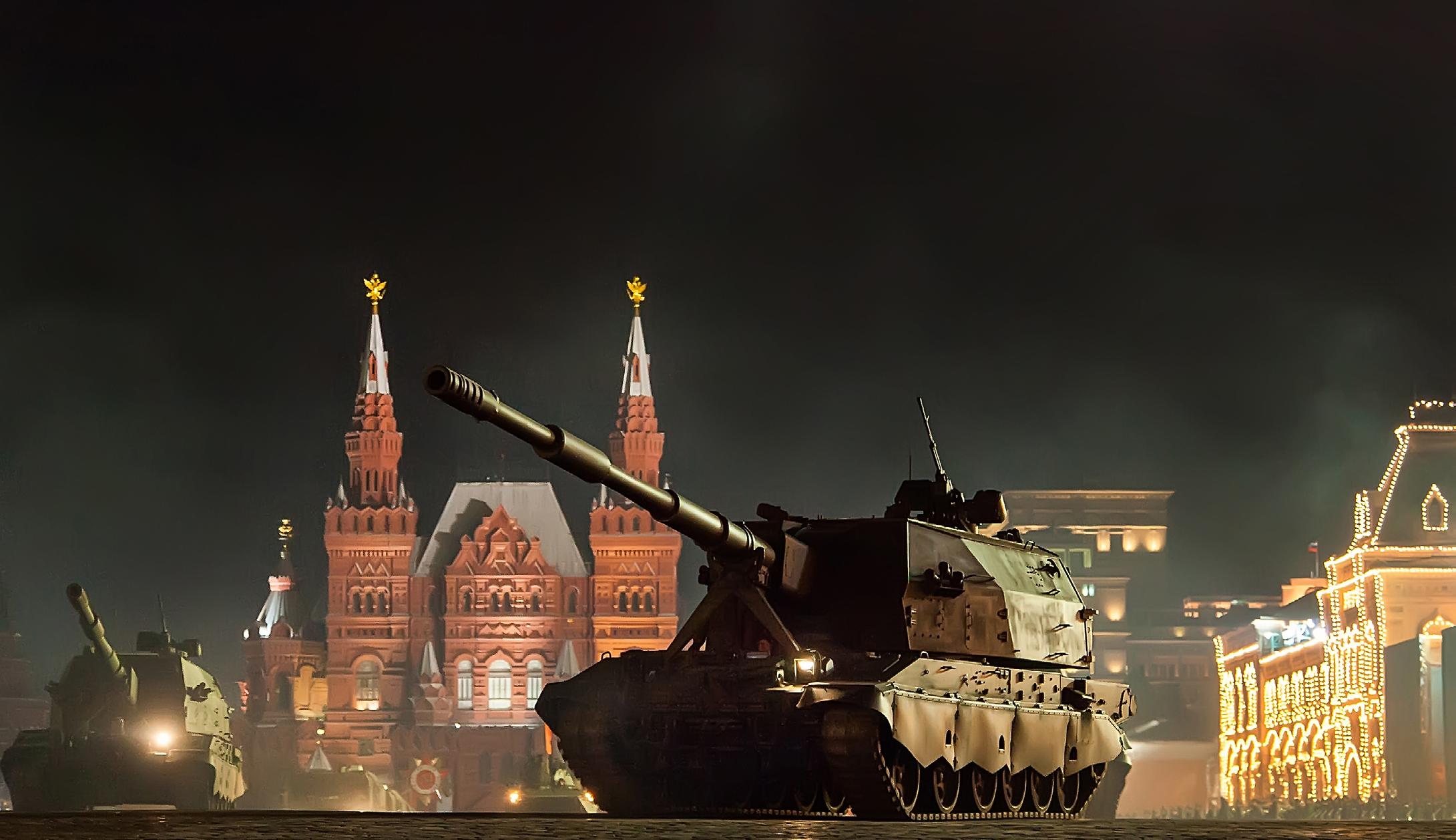

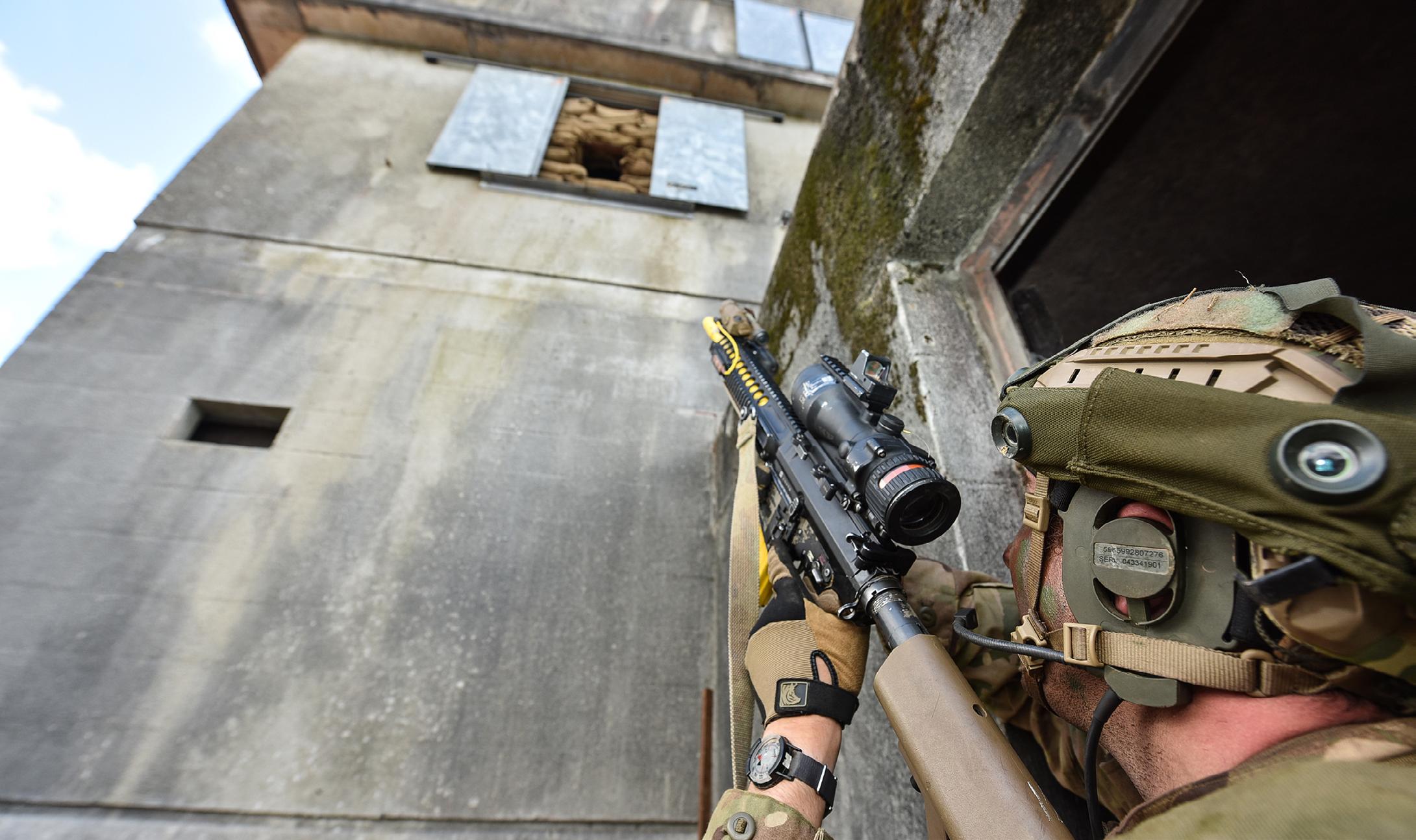
COMBINED EFFORT: TRAINING FOR TACTICAL COMBAT
AUTHOR Captain George Williams is SO3 Operations and Training at the Infantry Battle School.
EXERCISE Combined Warrior is frequently perceived as a battlegroup exercise. In fact, it trains individuals and specialists at scale in a realistic tactical setting. Each exercise brings together 28 courses, representing 23 cap badges, into one exercise. About 1,000 trainees take part alongside command posts, fire support teams, reconnaissance troops and manoeuvre subunits in the same battlespace.
Despite its size, Combined Warrior does not certify units as ready for operations. It does not assess units as whole formations and it does not declare them ready. Instead, it tests individuals and small teams against set objectives in a realistic and contested scenario. To an outsider, Combined Warrior may look like one large exercise that either succeeds or fails. In reality, it is a controlled training system that exposes students to friction and uncertainty so that they must apply their skills under pressure.
PURPOSE
War rarely punishes ignorance alone. More often, failure comes from bad timing, poor communication and the inability to make different arms work together under pressure.
Training often teaches individual skills in isolation. Signals soldiers learn to build and run networks; fire support specialists learn to plan and control fires; junior commanders learn the basics of command and control. But doing these tasks in theory is different from doing them in a contested environment. Combined Warrior closes that gap. It tests technical skill in realistic conditions and forces students to work with other arms that depend on them. It also exposes students early enough to shape good habits before bad ones set in.
A TACTICAL FRAMEWORK FOR TRAINING
Combined Warrior follows three phases: shaping, decisive action and sustainment. Each phase creates problems tied to each course’s training objectives, so several groups can train at once within the same tactical story.
SHAPING THE FIGHT
The shaping phase introduces uncertainty. Reconnaissance and sniper teams move forward to build understanding through observation and reporting. The enemy picture is deliberately incomplete and mixes live role-play with simulated effects. This phase tests whether troops can collect information
and pass it on in time. Success depends not just on collecting good information, but on passing it quickly and in a form others can use. Signals students build and run the networks under realistic limits, including degradation, terrain interference and equipment faults. They must therefore build resilience through backup plans, disciplined reporting and a steady battle rhythm.
DECISIVE ACTION
The decisive phase is the part that most resembles a unit operation. Typically, an infantry company attacks a defended position with direct and indirect fire support. This phase matters not just because of the assault itself, but because it forces supporting arms to work together. Machine gun detachments provide sustained fire, mortars engage targets indirectly and fire support teams coordinate them under pressure. Students must work fast and accept that no one controls the battle perfectly. This reflects modern war, where the enemy quickly exploits delay, exposure and error.
This embodies Combined Warrior’s defining feature – integration. Every group depends on the others in order to succeed. What one course produces, another needs: reconnaissance finds targets, signals keep command working and fires support manoeuvre. It also includes capabilities soldiers rarely meet early in their careers. Military Working Dog teams and Royal Military Police also take part. Their presence reflects the reality of modern operations, where legal, evidential and information issues matter as much as tactics. For commanders, this adds more constraints to planning and execution. For specialists, it means doing their job inside a wider battle that will not stop for them.
SUSTAINING THE FIGHT
Combined Warrior continues after the objective is taken to show that sustainment matters. This includes reorganisation, resupply, casualty handling and preparation for the next task, all under fatigue and uncertainty. This corrects a common training weakness: treating the end of the attack as the end of the problem. In reality, it creates new demands on the force that must be addressed if combat effectiveness and momentum are to be maintained. Students must restore fighting power and keep moving in order to succeed.
CELLINI CASE STUDY
The break-in to Cellini village typifies Combined Warrior. During the scenario, students from the light close reconnaissance and sniper courses deploy on D-3 to set the conditions for the attack. To achieve training objectives they establish observation posts,
find the enemy and conduct close target reconnaissance. In doing so, they build the battle picture for the rest of the exercise. Some of what they report is physical. They observe Calian role-players acting as enemy forces. Some is virtual. Through SCOPIC augmented reality, they identify massing T-72s and BMPs. On D-2, Calian personnel conduct a mock prisoner execution. The recce teams pass this by data, which triggers a series of events and points of integration across the exercise.
For the combat CIS [Communication and Information Systems] schools, regimental signals advanced system and regimental signals detachment commanders’ courses, the training objectives are to establish and maintain communications while passing information between battlegroup headquarters and company command posts. The feed from the intelligence, surveillance and reconnaissance elements moves up and down the chain and becomes the catalyst for further integration. Having received an update from the company command post, an Infantry Battle School instructor, acting as the company commander, delivers orders for a deliberate attack onto Cellini Village to a light role company group that includes elements from the Platoon Commanders’ Battle Course; Platoon Sergeants’ Battle Course; Section Commanders’ Battle Course; Fire
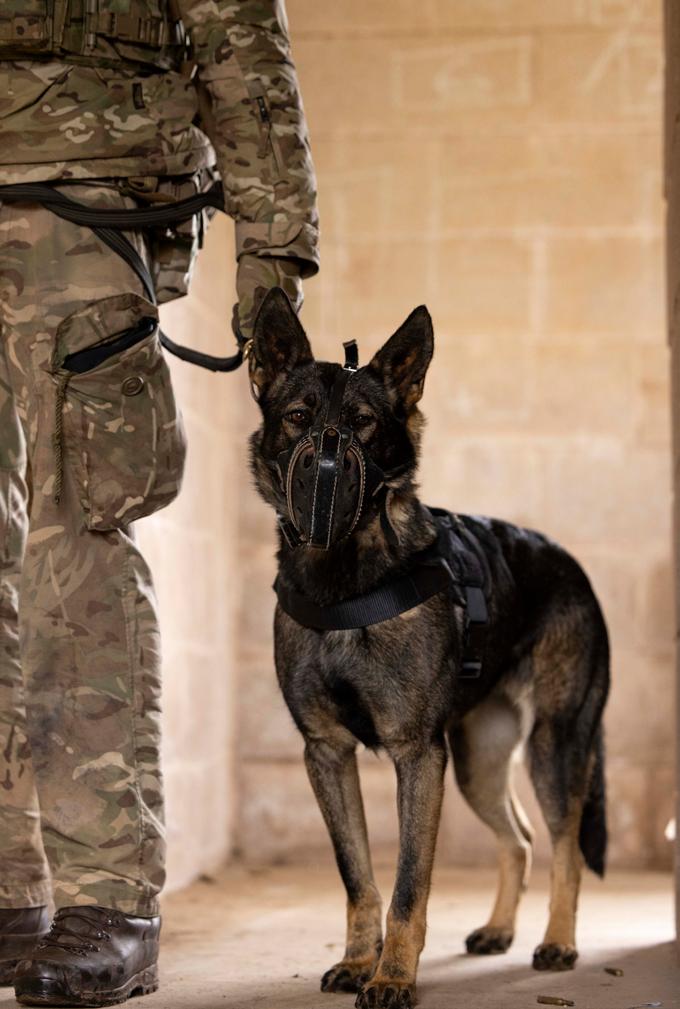
“[The presence of Military Working Dog teams and Royal Military Police] reflects the reality of modern operations, where legal, evidential and information issues matter as much as tactics.”
Support Team Commanders’ Course; Mortar Fire Controllers’ Course; Machine Guns Detachment Commanders’ Course; and lance corporals qualifying as dog handlers and lance corporals qualifying for roles within the Royal Military Police.
The attack begins with machine-gun and mortar students achieving training objectives by enabling a light-role company to break into the urban position. The infantry courses then complete their own offensive urban objectives as they continue the attack. Once a foothold is secured, the fire support teams break off to an observation post overlooking the impact area beside Cellini Village. From there, they call for, adjust and coordinate live fire from a King’s Gurkha Artillery 105mm light gun battery in initial trade training. The fire support teams and the gun line are simultaneously achieving separate training objectives under the same tactical scenario.
Once the break-in is complete, the clearance of the village continues. Bite suits placed throughout the objective trigger the release of dogs to clear buildings. Eventually, a section commander sends a section into a room and discovers a dummy prepared to represent the earlier execution. What the intelligence, surveillance and reconnaissance elements first observed, passed by data and briefed in orders, now becomes the trigger to call the Royal Military Police forward to begin a crime scene investigation and assist with prisoners of war.
ASSESSMENT
Parent organisations assess their own students against their own objectives: infantry instructors assess infantry students, artillery instructors assess artillery students, and so on. The difficulty is that several other courses are operating in the same time and space. Three things make this work:
n Design: Set objectives in advance and tie them to events in the scenario.
n Delivery: Exercise control keeps the activity coherent, safe and on plan.
n Assurance: Senior instructors check that assessment stays fair and consistent.
Assessment is continuous and takes place in both degraded and optimal conditions. Instructors can use communications logs and fire mission records to support their judgement.
FAILURE AND REMEDIATION
Combined Warrior can absorb both routine friction and real training failure without disrupting the wider exercise. The exercise expects failure, but it does not waste training. Failure happens at two levels. First, routine
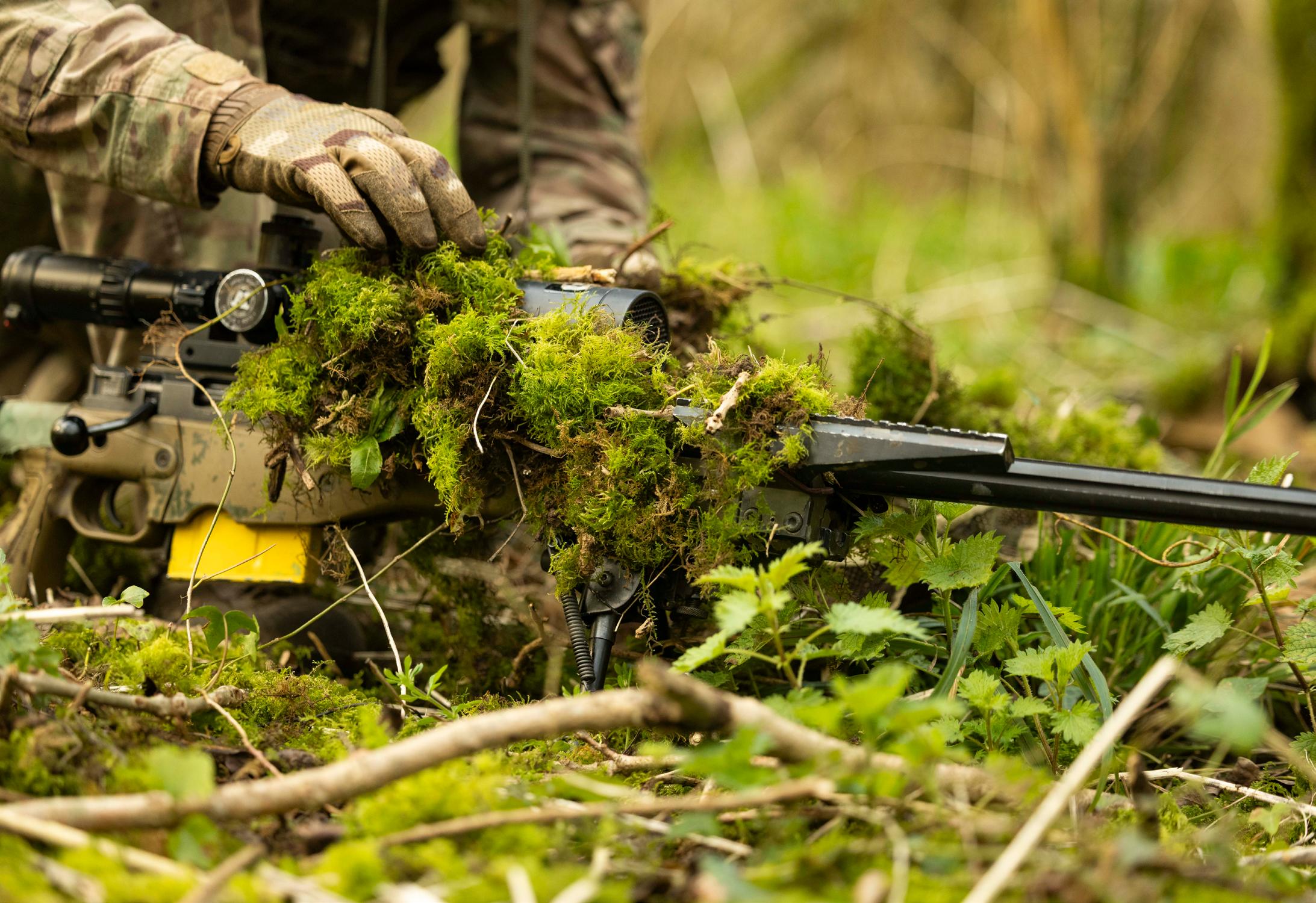
friction: communications break down, people lose situational awareness or get lost. Second, training failure: a student does not meet the required standard. Combined Warrior is built to handle both without stopping the exercise for everyone else. When individuals fail to meet the standard, instructors may remediate and reassess them where appropriate. But where the standard is critical, failure stands. The exercise uses controlled interventions to protect training value for others while still assessing individuals fairly. Realism serves learning, not chaos.
DURATION AND STANDARD
Combined Warrior usually lasts 12 days –long enough to induce fatigue, but still safe and controlled. Students work on little sleep, move in poor weather and make decisions when tired. A student who takes the easy option on night one will feel it on day three. The exercise trains to a warfighting standard: safety and legal rules are non-negotiable, but the tactical problem remains realistic and suited to the level of training.
CONTRIBUTION TO LETHALITY
In Combined Warrior, lethality means speed, accuracy, integration and resilience. The exercise improves lethality by reducing the time between detection and engagement; reinforcing precision in reconnaissance and fire control; showing the consequences of
“Exercise
Combined Warrior recreates the conditions of a battlegroup operation, not to validate units, but to train individuals and small teams in a realistic and demanding setting. Its scale reflects how modern war links many arms together, while its design keeps training objectives at the centre.”
poor coordination; and training individuals to operate effectively under degraded conditions.
Taken together, these improvements increase combat effect without simply adding more people or firepower. It prepares soldiers for a battlefield where disruption is the norm.
CONTINUOUS DEVELOPMENT
Combined Warrior is constantly refined using instructor observations and Field Army feedback. Field Army feedback must be captured and acted on. This includes instructor observations and post-exercise analysis, especially where objectives were met but tactical effect was weak. It also brings in scenario updates between exercises,
adjusting events, enemy behaviour and points of integration. If the Field Army identifies a training gap, Combined Warrior can tighten the related objective and assessment criteria, or change the exercise so the skill is tested more realistically. This ensures that the exercise remains aligned with operational requirements rather than institutional preference.
CONCLUSION
Exercise Combined Warrior recreates the conditions of a battlegroup operation, not to validate units, but to train individuals and small teams in a realistic and demanding setting. Its scale reflects how modern war links many arms together, while its design keeps training objectives at the centre. By exposing students to complexity, uncertainty and reliance on others, Combined Warrior produces soldiers who can do their job as part of a larger force. It comes down to four simple ideas:
n It is not a unit validation exercise; it is an assessment environment for students.
n It uses a single tactical scenario to create shared friction and real dependencies.
n It tests whether technical skills work under pressure, in a contested setting.
n It produces soldiers who understand the system, not just their own lane.
Ultimately, Combined Warrior shows whether training works under pressure.
PREPARING FOR EXERCISE IRON STORM: NOT SUFFIELD, NOT YESTERDAY, NOT SIMPLE
FOR those reading this, particularly anyone who joined an armoured regiment in Germany two decades ago like me, you might expect a nostalgic ode to BATUS [British Army Training Unit Suffield]. Let’s deal with that upfront. The Queen’s Royal Hussars (QRH) Battlegroup’s experience in 2025 is not the same as it was in 2007, when the author first deployed to Alberta. Many things have changed. The prairie is no longer used for armoured training (although 16 Brigade will exercise out there later this year to develop their understanding of how they will fight recce strike as part of Exercise Rhino Bizz) but perhaps more importantly, so too have many of the conditions under which we once applied armoured manoeuvre.
Most crucially, our adversaries have not stood still. The operational context has fundamentally changed. Twenty years ago, I obsessed as a troop leader (amongst other things) in achieving perfect 90-degree attack angles to concentrate combat power. Today, if lip service is paid to the persistent and lethal nearsurface threat in pursuit of a textbook direct fire position, we will be destroyed. It is that simple.
But here’s the comforting part; the fundamentals of warfighting haven’t suddenly disappeared into thin air. For those of you that remember the lecture space in BATUS, hanging on the right-hand wall in the briefing room is a cartoon created by a Light Dragoons Battlegroup of the early 2000s that featured a belligerent robotic character named ‘Dave the Doctrinalist’. In it, the protagonist remorselessly droned on, insisting on the application of the manoeuvrist approach. Dave’s point remains relevant in the build up to major training level Foxtrot events.
The tactical framework of find, fix, strike, exploit with ‘protect’ considered across all elements works. What has changed is the
1Project Vulcan encompasses the replacement for the current Challenger 2 gunner and loader’s simulators. During the QRH’s recent participation in the Sullivan Cup in the US using Abrams MBTs, the 120mm smoothbore gun – very similar to the smoothbore gun on Challenger 3 – doesn’t have bespoke loaders drill trainer. It is so simple they train, examine and practise in the turret.
AUTHOR
Lieutenant Colonel Gerald Kearse is the Commanding Officer of the Queen’s Royal Hussars.
character of, and therefore the application and training for, the evolving fight. Increased reach, precision effects, compressed timelines, contested information flows and persistent observation have made the synchronisation of an all-arms battlegroup more complex than ever. But that synchronisation remains the acme of success, born of simplicity, standardisation, familiarity and repetition.
The following is a brief description of how the QRH Battlegroup prepared for Exercise Iron Storm 25/1, with the aim of validating at training level Foxtrot ahead of assuming the Lead Armoured Brigade Battlegroup 3 commitment from August 2025.
QRH AT THE START LINE
Following three consecutive Cabrit deployments to Estonia, the last concluding in September 2024, the QRH was credible and confident, but not without cost. For me as a new CO staring down the barrel of a Foxtrot level exercise, fatigue was evident. Personnel churn was high and the institutional training rhythm had been disrupted.
The inability to deliver distributed Challenger 2 career courses in Estonia had severely impacted core trade progression. To recover, we had to surge training to more than double the normal annual throughput. This raises a broader issue: planning for stability as the default condition quickly becomes a fallacy when faced with reality. Deployability must be built into training systems, particularly when preparing for large-scale collective activity. Perhaps this is a consideration for Project Vulcan,1 especially as we progress towards the fielding of Challenger 3.
Resilience, meanwhile, remains non-negotiable in a system like ours that is dominated by
humans. Our push towards a 1.5:1 trained ratio, especially in G4 enablers, was not indulgent; it was essential. Welfare, illness and discipline are constants, not exceptions. Again, plans built on perfection will fail. It seems obvious, but wrestling with limited workforce and training capacity always proves a challenge.
Despite significant effort by the training officer, regimental gunnery staff sergeant and motor transport officer, we crossed the line of departure with only a narrow margin of resilience. Given the choice, I would have generated even greater depth, particularly within the sustainment and logistic departments.
SETS AND REPS
There are no shortcuts to experience. It is earned through repetition. With a new battlegroup HQ and significant turnover among squadron leaders, our interpretation of the combat estimate differed from our predecessors. That’s not a weakness; it was a strength. Fresh perspectives force clarity and, as you progress through your training, humility.
From the outset, as the CO I applied one simple test: what did the squadron leaders, the customers, actually want and need? Maintaining that focus paid dividends, as did bringing the all-arms HQ together early, allowing us to build the human dynamics required for effective command. Do not underestimate the benefit of things like dinner nights, where you really get to know each other beyond the military environment. It helps exponentially knowing how somebody ticks when under pressure.
Beginning at Castlemartin and continuing through a mini-command-post exercise, we refined our processes. Standardised estimate products and evolving standing order instructions, driven by the chief of staff, were continually tested by the ultimate critics, the squadron leaders. Over time, we reached a point where process was instinctive, freeing cognitive capacity to focus on the tactical problem rather than worrying if we’d applied every step of the estimate process as the Staff Officers’ Handbook articulates.
This did not come immediately, taking time and numerous repetitions to get our planning to a place we were all happy with. But, by the combined staff tactical training exercise in Germany, the Battlegroup HQ was conducting four-hour estimates and creating products that the squadron leaders could fight from effectively in the Combined Arms Tactical Trainer (CATT). This set the conditions for success on Salisbury Plain.
As well as the necessity to relentlessly practise the estimate process, for an armoured battlegroup the ability to perform drills is crucial to success. The simulated world of the CATT allows repeated rehearsal of secure orders cards (SOC) drills. Appreciating that the threat replicated isn’t entirely reflective of reality doesn’t matter. Understanding your place within the battlegroup and battlespace before physically stepping onto a vehicle is incredibly powerful. Combine this with a growing understanding of the application of SOCs and you start generating tempo, with further confidence coming from repetition.
Every repetition completed before Iron Storm meant fewer mistakes made under pressure on the Plain.
IAN MCGEECHAN WAS RIGHT: WORLD-CLASS BASICS
There is no confidence-builder like live firing 120mm from a Challenger 2 at Castlemartin (pictured below). Conducting this early in the training cycle is critical. Technical gunnery builds confidence in both the newly trained soldiers and their equipment. Simultaneously, it allows the Battlegroup HQ to start to
“Castlemartin provides a distraction-free environment in which the various elements of the Battlegroup’s different capbadges coalesce into a team (if available), while regimental gunnery instructors enforce the highest standards for our armoured vehicle crews.”
understand and practise control, in parallel with conducting sets and reps on the combat estimate. Castlemartin provides a distractionfree environment in which the various elements of the Battlegroup’s different capbadges coalesce into a team (if available), while regimental gunnery instructors enforce the highest standards for our armoured vehicle crews. If possible, I would have deployed the entire unit plus battlegroup attachments to Castlemartin to extend the benefits of the deployment to all.
Following live fire, the squadrons progressed through to training level Charlie (sub-unit), concluding with student crew commanders and troop leader integration on the Subsequent Trade Training (STT) phase during Cyclone. Acknowledged to not be perfect in comparison to operating with a full squadron with all commanders in their positions, we still fare extremely favourably when compared to our allies. Observations from the recent Sullivan Cup participation in the US reminds us that our baseline competence is high. The real
casualty in the new (and necessary) model was training Battlegroup HQ in the execute. Working with the Combined Arms Manoeuvre School, Battlegroup HQ controlled and managed the risk of the STT phase in Cyclone rather than training to execute.
There was a gap between Cyclone competence and where I would have liked the Battlegroup to have been at prior to startex of Iron Storm. Bridging that gap is the real challenge. We self-generated a battlegroup exercise over a preceding weekend, operating at night and practising enabling actions into the attack and the delay. 20 Armoured Brigade also enabled a three-day package on Salisbury Plain prior to the start of the exercise. This provided another invaluable opportunity for the Battlegroup to stretch its legs and get comfortable with the processes and procedures of controlling hundreds of vehicles, the experience battlegroups of old would have gained in controlling the live fire element in BATUS. If we had not had this chance to practise the execute before being assessed on Iron Storm, we would have struggled. Again, sets and reps achieve the level of familiarity needed for confidence and the generation of tempo.
THE NECESSITY TO MODERNISE
Contemporary conflict demands adaptation. The threat from the near surface means battlefield discipline and protection becomes the ultimate enabler. Understanding how to approach this increased threat with standard operating procedures in place became of paramount importance. Despite the significant limitations imposed by Salisbury Plain and the lack of drone mass for both blue and
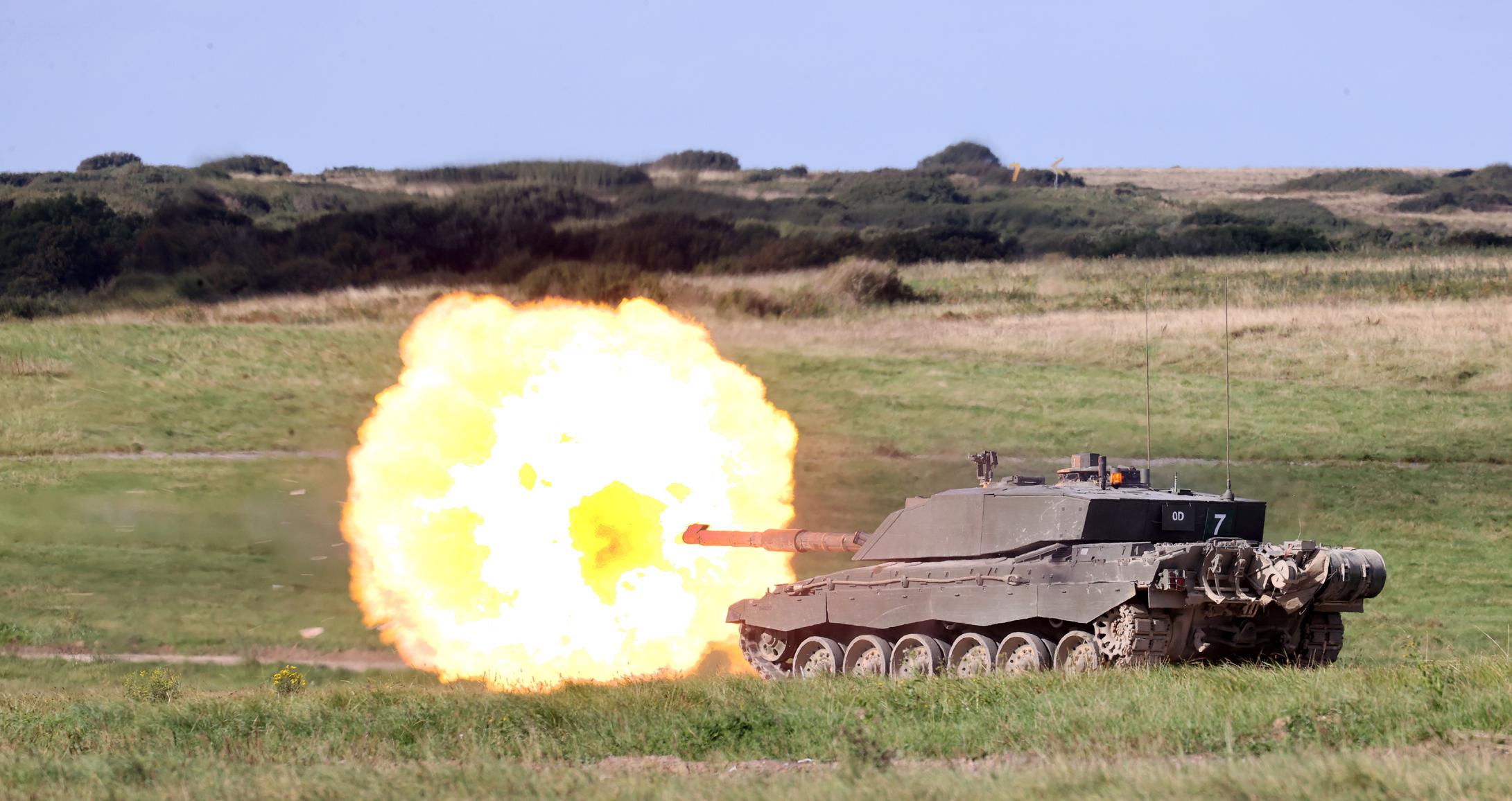
red forces, by analysing what had been done before and what was being applied in theatre provided a path to at least give the members of the QRH Battlegroup the chance to understand what ‘okay’ looked like. Rather obviously, good old-fashioned battlefield discipline saves lives, while also providing a professional platform from which future counter UAS and electronic warfare technologies can be applied. For Battlegroup HQ, practising dispersed four-hour planning cycles over Signal made us all appreciate the benefits of conducting face-to-face planning.
In addition to altering standard operating procedures to account for the near surface threat, we also had the opportunity to convert our close recce troop to Ajax, rather than remaining on Warrior. A risk, but one I deduced to be well worth the benefits if we could pull it off. Gaining permission to run distributed training at Tidworth, in parallel with having to deliver double the number of steady state Challenger 2 courses, the training officer designed and implemented a package of Ajax training that saw all 24 members of the QRH Recce Troop plus the CO’s vehicle (including myself after some painfully long lessons) qualifying. The key lesson from our Ajax training was that units delivering distributed training – with proper oversight – is an incredibly powerful tool and should be exploited where possible to accelerate capability modernisation as part of the Land Training System.
The risk of converting Recce Troop to Ajax was well worth it. During Exercise Iron Storm 25/1, target identification was not a problem with Ajax identifying out to eight kilometres. The limiting factor was our ability to prosecute targets. Our inability to prosecute at range was, to a degree, mitigated by the generation of what we termed ‘system operator troops’. This troop contained our drone and one-way effector capability, able to operate under an S1 licence beyond line of sight to two kilometres obtained in early 2025. Not happy to accept 500 metres line of sight, pressing the boundaries to achieve beyond line of sight was critical in pushing modernisation. As we found, not everyone can operate a drone. Selecting the right individual is key to the effective delivery of the capability. The foundations built during our build up to Exercise Iron Storm in quarter 1/2 of 2025 has seen us, at the time of writing, having 76 qualified UAS operators held within the Regiment and our S1 beyond line of sight licence out to five kilometres.
None of these capabilities are optional extras anymore. They are baseline requirements.
© Crown copyright
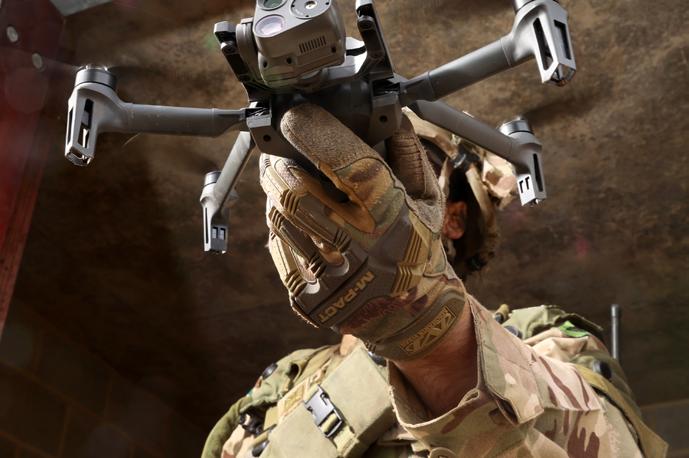
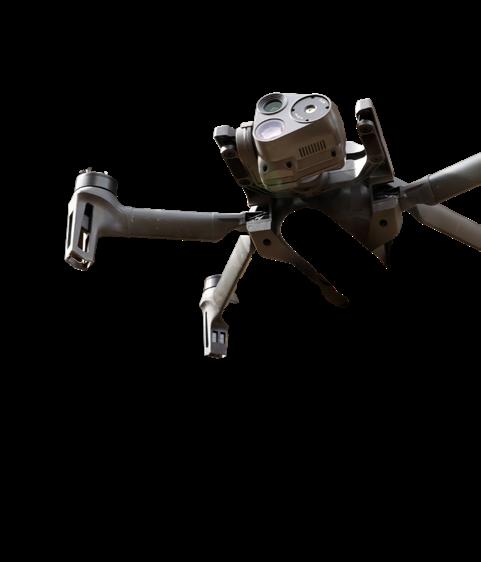
“Not everyone can operate a drone. Selecting the right individual is key to the effective delivery of the capability.”
The challenge is not just acquiring these capabilities; it’s integrating them meaningfully.
WHAT TO EXPECT
Salisbury Plain Training Area is not BATUS. But the challenge is no less real. To replicate the contemporary operating environment while acknowledging the smaller space, the complexity of the challenge has been ramped up. We faced a much more complex and numerous opposing force with multiple complex obstacles in comparison with the vast expanse of the prairie. Looking at the most difficult task 20 Armoured Brigade would face, breaching four obstacles of a motor rifle division over a 20 kilometre depth, the problem set we faced on the plain seems altogether relevant.
Along with the complexity, the counterUAS threat was the other biggest change the Battlegroup experienced compared to previous exercises. It was not hypothetical. You must expect it, train for it and mitigate it. Passive measures, active drills and good battlefield discipline must all come into play. Again, these set the foundations from which to layer technology such as the developing vehicle hard kill Project Griffin and the Modular Integrated Protection System.
Encouragingly, tactical deception, grounded on solid terrain analysis, can achieve disproportionate effects. It remains one of the most cost-effective combat multipliers available but requires real thought and preparation. We considered how to get over the main river months before exercising, and even conducted a terrain walk to consider where the opportunities might arise.
Finally, we felt acutely the tyranny and psychology of distance. Salisbury Plain is not Suffield. You can see the edge of the training area, and indeed at times your house, from the cupola. Breaking this psychological
compression is difficult; I have no answers less for strict personal electronic device policy enforcement. The benefits of a full end-toend deployment and knowing that home is thousands of miles away has real value. Ultimately, discipline and some imagination must compensate.
SUMMARY
Through relentless sets and reps of the combat estimate, deep thinking about how to counter the near surface threat applied through world-class battlefield discipline and firm manoeuvre foundations based upon SOCs and drills freed up our cognitive ability to focus on the complex problems in front of us. This mastering of the fundamentals, and then practising them repeatedly, allowed for a level of familiarisation which enabled us to start to overlay the complexities of the modern battlefield. And these new capabilities must be introduced as early as possible to integrate and become embedded as DNA is crucial. Not perfect by any stretch of the imagination, the QRH Battlegroup during Exercise Iron Storm 25/1 none-the-less started to creep towards a more lethal and modern armoured force with the integration of UAS under armour, loitering munitions and remote breaching.
Having gone through the training cycle while considering modernisation, I offer we do not require revolutionary doctrine, even if retrospectively we are today in the midst of a revolution in military affairs. We require an evolution, adapting proven principles to contemporary realities and technological trajectories. The application of artificial intelligence (AI) during planning and monitoring during execution has huge potential in gaining the initiative over a drills-based adversary and thus generating tempo. This is hugely exciting for an armoured commander. We must avoid overcomplication. The integration of Ajax, UAS, electronic warfare and soon Challenger 3 while working out how best to apply AI is already demanding enough, before we even start to look at uncrewed ground vehicles at the F Echelon. Attempting to simultaneously invent a completely novel approach to warfighting is a bridge too far and will prevent us from integrating it effectively. Keeping it simple, but not simplistic, and developed through quality repetition practised under pressure is crucial.
As Archilocus quoted around 640BC, “we don’t rise to the level of our expectations, we fall to the level of our training”. Habits, preparation and established systems will always be defaulted to under high-stress and unpredictable moments. Sheer willpower or goals are never enough.

KENYAN SYLLABUS: LEARNING TO DANCE IN THE RAIN
AUTHOR
Lieutenant Colonel Andy Breach is the Commanding Officer of 1st Battalion Welsh Guards.
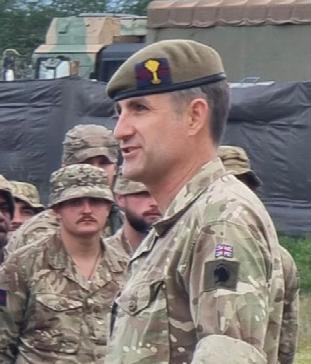
“Define standards, train people on what they are, and enforce them. It is not a standard until it is written down and understood. Your unit will fight the way they have trained, whether you want them to or not.” – Lt Col H Tunnell, Commanding Officer, 1-508th Parachute Infantry Regiment, Invasion of Iraq, 2003.
COLLECTIVE training at any level, particularly overseas in an unfamiliar environment, offers both challenge and reward – provided it succeeds. Few professional experiences rival the moment when an external audience of experts validates a unit’s ability to deliver its core purpose: in our case, to fight and win against a capable enemy equally determined to prevail. Between September and November 2025, the 1 Welsh Guards Battlegroup deployed to Kenya for Exercises Haraka Cyclone and Haraka Storm. Having moved from London District to 4 Brigade in January 2025, the exercises marked our first experience of the Land Training System and our first Collective Training Groupenabled exercise since 2017 and, given our limited recent experience, could easily have proved daunting. However, by defining our doctrine early, rehearsing routinely and
defining simple standards and conditions for training it did not prove to be. Our transition from ‘state ceremonial’ and public duties to Kenya built on earlier deployments to Oman in late 2024 for company-level training alongside the Omanis and Qataris, and on our role as the enemy force (Task Force Hannibal) during 4 Brigade’s validation as the Forward Land Forces Brigade aligned to Estonia. In conjunction with the steps taken below, those exercises, particularly the latter, helped rebuild our practical understanding of combined arms manoeuvre and lay a foundation for our experience in Kenya. This article summarises how 1 Welsh Guards prepared for Exercise Haraka Storm. It reflects one battalion’s experience – ‘a way’ rather than ‘the way’ – but the method remains repeatable regardless of unit type.
Success in any endeavour depends heavily on how an organisation understands the task it has been given and the relationships it builds with those delivering the training. Early in the process, we established a constructive relationship with the trainers at British Army Training Unit Kenya (BATUK). That allowed us to observe recurring trends from previous exercises and incorporate those lessons into
our standard operating procedures and instructions, helping us “fight the kind of war we were in, not the one we wanted”.1 Those lessons ranged from the correct footwear for the terrain (spoiler: ‘approach shoe’ style footwear invariably produce ankle injuries), to trench construction and battlegroup tactical formations. We did more than simply adopt BATUK’s views wholesale. Instead, we evaluated each theme critically and deliberately incorporated it into either the training directive or our standard operating procedures. As a result, when BATUK delivered the all-ranks brief, most of the points they raised were already included in our approach. That established the basis for a productive relationship once we arrived in Kenya and produced an attitude that enabled us to adapt rapidly to feedback. Understanding the character of the exercise and the relationship with those delivering the training became one of the key foundations of our approach.
Eighteen months before deploying to Kenya, 1 Welsh Guards established the conceptual foundations for how the Battlegroup would fight. We defined both the structure of the Battlegroup and the way we intended to operate. Before we could understand function, however, we first standardised form down to section level. That allowed us to understand collectively how we would deliver the tactical actions required of a light-role battlegroup and apply the ‘rule of three’ despite operating with fewer people than we would like. It also enabled us to prepare against a fixed structure during the months before the deployment, particularly for the less regularly used parts of the Battlegroup such as the echelons. Once in Kenya, that work paid immediate dividends during the Storm phase of the exercise by enabling rapid task organisation with minimal friction.
Once we had established the structure, we defined our ‘Theory of Victory’ in line with 4 Brigade’s evolving approach to Estonia. We identified the tactical actions the Battlegroup might have to conduct during large-scale combat operations and built the drills required for those tactical actions on the existing standard orders cards. We then codified a generic scheme of manoeuvre, task organisation, schematic, coordinating instructions, conditions for execution, and a draft decision-support matrix for each drill. That work produced two immediate advantages. First, sub-units understood what the tactical action required and what support they could expect from Battlegroup Headquarters and each other; in effect defining the fight by echelon. Second, the staff gained a clear planning baseline, which
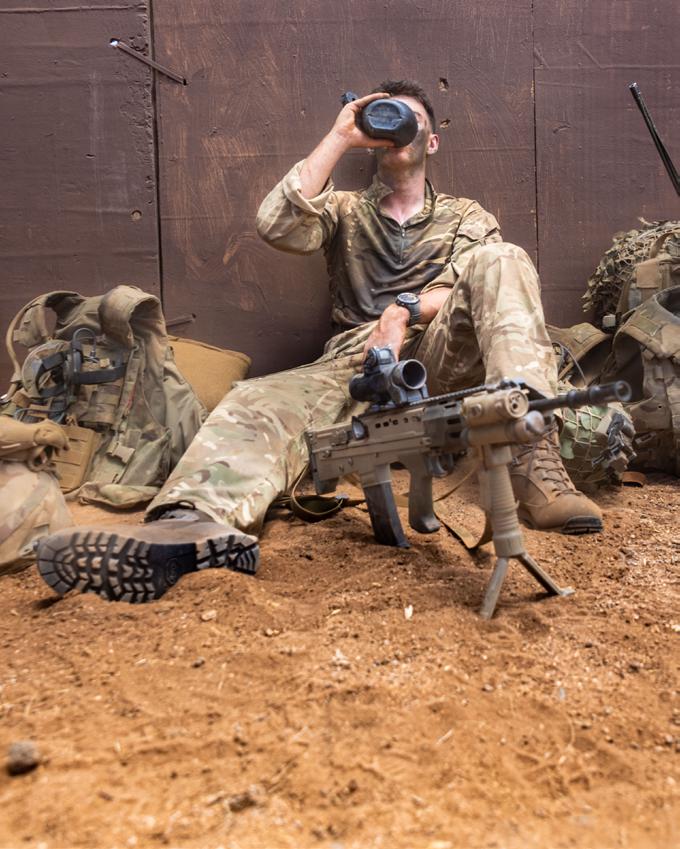
“Personnel fatigue, equipment failures and the actions of a free thinking enemy force in Task Force Hannibal forced continual refinement. However, because we had invested heavily in establishing a coherent Battlegroup doctrine beforehand, we adapted from a clear and widely understood baseline. That allowed us to evolve faster than the enemy.”
accelerated decision-making. We initially identified ten battle drills,2 but that proved too broad for commanders to fully master. We therefore narrowed our focus to four ‘essential battle drills’: attack, defence, obstacle crossing and the advance. The focus allowed us to master what we considered the fundamental building blocks of combat, while writing down all ten still provided a shared conceptual understanding when we later had to execute the others.
Having defined the Battlegroup standard operating procedures, we developed detailed sub-unit standard operating instructions in support. In effect, these became standing orders describing each sub-unit’s role within the essential battle drills. They also covered equipment carriage, identification procedures and a standardised link-up drill. By codifying
these drills, we allowed sub units to refine their own procedures while preserving the Battlegroup’s ability to task organise confidently. During Haraka Storm, reserve platoons routinely operated within other companies with minimal friction – evidence that the approach worked. This approach was further validated during the later stages of the exercise when the echelon company had to replace one of the intended assaulting companies which had been destroyed during the infiltration. The echelon company was able to assume its place in the forming up point, where it spent six minutes, before assaulting at H-Hour with no delay. Without the focus on creating shared understanding of the essential battle drills, this would not have been possible.
With form and function defined, the Battalion embedded a practical understanding of its conceptual foundations. We conducted weekly conceptual development sessions for officers and non-commissioned officers during normal working hours as part of our weekly battle rhythm. Subjects ranged from standard orders cards and dress policy to wargaming the essential battle drills over a large map of Loldiagia Training Area painted by the Reconnaissance Platoon. Rehearsal of concept drills became central to this process. By allowing commanders at every level to visualise each essential battle drill –initially over the Battalion model and latterly incorporated into Battalion physical training sessions – we ensured everyone understood their role. None of these methods were new or revolutionary. The challenge lay in maintaining the discipline to dedicate time each week to mastering our core competence despite the ‘tyranny of now.’ Doing so required what General James Mattis described as a “ruthless will to prepare” when he spoke to the Battalion as we began our preparation.3
1McChrystal, S (2014), My Share of the Task: A Memoir. London: Penguin Books, pg. 64.
2Assembly Area, Advance, Obstacle Crossing, Attack, Withdrawal, Defence, Passage of Lines, Replenishment, Regrouping, & Infiltration.
3General James Mattis, Presentation to 1WG, Windsor, 15 May 2024.
Once in Kenya, we received a large influx of new equipment from Task Force Rapstone, particularly drones, communications systems and vehicles. We therefore had to adapt both the Battlegroup standard operating procedures and the sub-unit standard operating instructions to integrate those capabilities effectively. That adaptation did not stop once Haraka Storm began. Personnel fatigue, equipment failures and the actions of a free-thinking enemy force in Task Force Hannibal forced continual refinement. However, because we had invested heavily in establishing a coherent Battlegroup doctrine beforehand, we adapted from a clear and widely understood baseline. That allowed us to evolve faster than the enemy.
With doctrine and structure established, we
then defined the fundamental combat skills required at individual, section, platoon and sub-unit level. While the Land Warfare Centre publishes relevant guidance, translating documents, such as the Top Twelve, CMC Field Conditions and Standards for CYCLONE and Individual Training, the Force Preparation Order and the Brigade Commander’s Fighting Instructions, into implementable guidance proved complicated. At unit level, those documents required consolidation before they became useful.
We therefore identified what we considered the five fundamental combat skills: combat marksmanship, combat conditioning, navigation, casualty care and communication. We then defined a measurable individual warfighting standard for each. This achieved two effects. First, it bridged the gap between generic Army-wide individual training requirements and the specific requirements of a light-role infantry battlegroup. Second, it gave sub-unit commanders an objective means of assessing capability. More importantly, it helped generate esprit de corps – because every soldier had achieved the same standard under the same conditions. In the context of the contemporary battlefield characterised by persistent surveillance, and huge numbers of first-person view drones and one-way effectors, our current individual warfighting standards are undoubtably not ambitious enough to support Battlegroup Recce Strike, but I would posit that the principle of bridging the gap from the individual training requirement to a special-to-arm specific one remains sound, as does the principle of making them both simple and practical.
We extended the principle of a simple, well
understood standard from the individual level to the section, platoon and sub-unit level through ‘day one competencies’, adapted from veterinary training terminology describing what a student should achieve on the first day of a given phase of training. These competencies mirrored the sub-unit standard operating instructions and defined the expected standard at each training level. That allowed sub-unit commanders to redistribute resources where necessary to maintain consistency and communicate the rate of training objectively to the Battlegroup Commander. As the opening quotation suggests, organisations inevitably train towards the standards they define. We therefore specified not only the standards themselves but also the conditions under which they had to be achieved. Individuals and sub-units conducted assessments at night, under a combat load of 20 kilograms, under radio silence where appropriate, and – for collective competencies – against a live opposing force capable of winning. From the totality of the direction we received, we simplified and rationalised the wider training framework into a measurable and coherent continuum running from the individual to the sub-unit level.
During Haraka Cyclone, we deliberately prioritised section and platoon competence over battlegroup actions. We accepted risk at company and battlegroup level to establish a robust foundation in special-to-arm competence. That approach paid dividends, although it initially felt clumsy in execution when operating above platoon. ‘Taking risk’ briefs well in your unit’s conference room but watching the battlegroup’s gears grind around you while the system learns remains uncomfortable, humbling and requires
patience, but it is an approach I would take again and recommend.
Implicit in the Land Training System is that it exists to generate and integrate capability. Kenya’s freedoms and training permissions allowed Haraka Cyclone to generate an assault pioneer platoon, secure sufficient flying hours to qualify our drone pilots to fly ten kilometres beyond visual line of sight, qualify 43 drivers across five vehicle platforms and train 33 lance corporals. The generation of lance corporals proved the most valuable capability generated through Cyclone. During acclimatisation, the prospective lance corporals completed the required classroom instruction before spending 21 days in role under the supervision of their platoon sergeants, company sergeants major and ultimately the regimental sergeant major. That approach ensured we entered the Storm phase with fully trained junior commanders rather than guardsmen simply acting up into role or after completing the minimum appointment period demanded by a conventional lance corporals’ course.
The 1st Battalion Welsh Guards’ preparation for Exercise Haraka Storm 25/1 demonstrated how disciplined planning, clearly defined standards and adaptability underpin effective collective training. By establishing a coherent battlegroup doctrine early, codifying expectations, rehearsing routinely and prioritising core competence, the Battalion created the conditions for rapid adaptation under pressure. Ultimately, despite environmental challenges, new equipment and a capable enemy, we succeeded because we built clarity, repetition and resilience into the system from the outset. In short, despite the storm, we learned to dance in the rain.
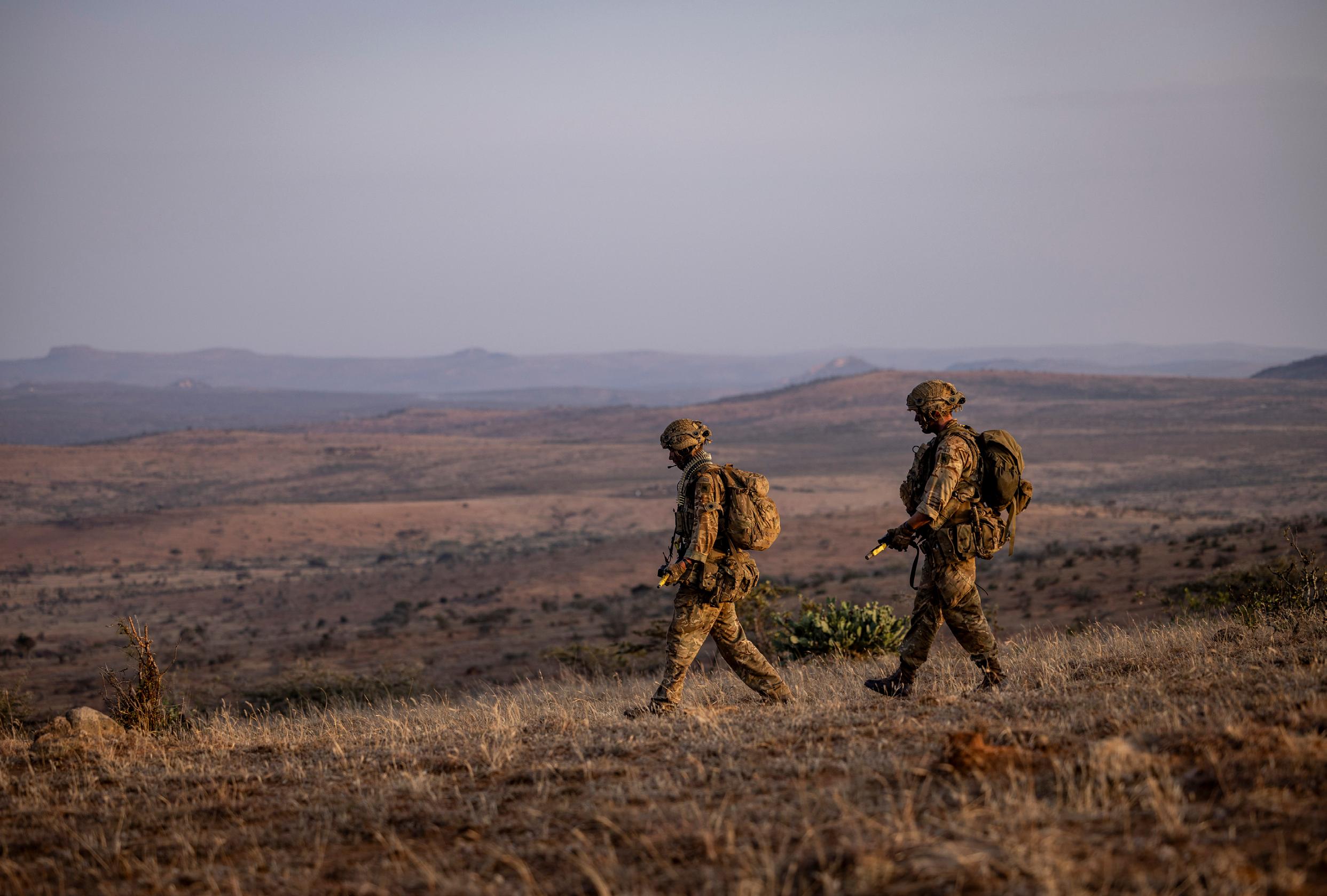
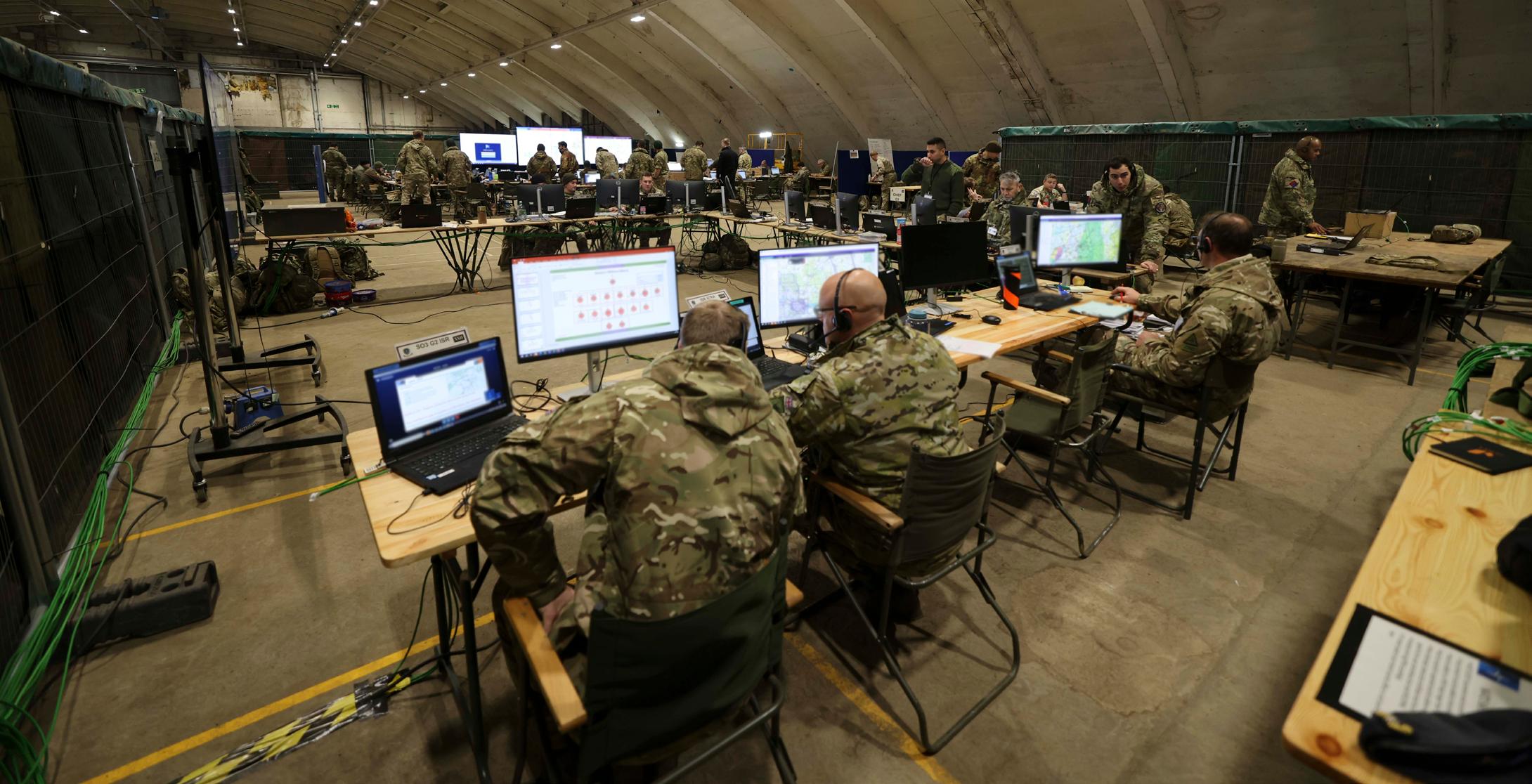
RE-ESTABLISHING THE CORPS LEVEL OF WARFARE IN THE BRITISH ARMY
AUTHOR
Major Laurence Thomson is currently Military Assistant to Chief of Staff of the Headquarters Allied Rapid Reaction Corps and is a former CGS Visiting Fellow at RUSI.
RUSSIA’S war against Ukraine has forced a fundamental re-examination of the assumptions underpinning British and NATO defence policy for the last three decades. Europe will not return to peace any time soon; the Russo-Ukrainian War is not a crisis to be managed nor likely to be unique. Russia has mobilised its armed forces, economy, industry and society for war, making the threats facing Britain today arguably the most serious, least predictable and most prolific since the Cold War. The overarching question facing politicians and senior military commanders has become how best to deter a revanchist Russia and be prepared – if deterrence should fail – to fight and win a large-scale industrial war. Its duration is unknown but it seems likely to prove costly and attritional. The decisions being taken by governments, defence policymakers and industry leaders are shaping Europe’s security for the next decade and beyond. As the Chief of the General Staff recently said, “if we knew, now, that the UK’s land forces would find themselves in large scale combat operations in 2027, what would we be doing differently now, and why aren’t we doing that?”.1
cornerstone of Britain’s security and, within its plans, the land domain is central. Despite the lessons of Ukraine, there remains a temptation in an era of multi-domain operations and manifold technological advances across artificial intelligence (AI) and robotics to treat land power as one domain amongst equals; some even seem inclined to treat it as a lesser one. That would be a mistake. Without capable land forces at scale, escalation cannot be controlled, territory cannot be secured and war cannot be confined. That’s why NATO’s top priority for the UK in the land domain is a fully enabled Strategic Reserve Corps, available to Supreme Allied Commander Europe (SACEUR) across competition, crisis and conflict. The UK-led Allied Rapid Reaction Corps (ARRC) has been set the target of becoming NATO’s best warfighting corps, an ambition that grows more demanding as the Alliance sharpens its collective “focus on Corps-level warfighting” to deter and defend in Europe against Russia.2
2British Army, Army announces three senior leadership
NATO’s collective defence remains the
History may show that one of the most important decisions has already been taken. On 1 April 2026 the British Army implemented wide-ranging organisational changes under ‘Army Reform’. This placed both warfighting divisions and six enabling brigades under
1General Sir R. Walker, International Armoured Vehicle Conference 2026: Chief of the General Staff’s speech, (British Army Website, 20 Jan 26).
appointments, (HMG, 16 Mar 26).
operational command of Commander ARRC, with two further brigades brought under tactical command. For the first time since the end of the Cold War, Britain has a corps in being rather than just a corps HQ. At the same time, Army HQ and Field Army HQ have combined to form the HQ Land Forces and HQ ARRC is delivering its own structural change programme. The establishment of a Deep Reconnaissance Strike Brigade (9th DRS X) and an ARRC Multi-Domain Operations Division (MDO-D) is symbolic of the new place and prominence of the Corps. 39 Royal Artillery Regiment is being reanimated as the new Corps Fires Regiment and is soon to be equipped with sophisticated uncrewed systems and extended range Guided Multiple Launch Rocket Systems [pictured].
BUILDING THE CORPS
The Strategic Defence Review 2025 clearly stated “the purpose of the British Army in support of the roles for UK defence [is to] deter and defend in the Euro-Atlantic [by]
3Ministry of Defence, Strategic Defence and Security Review 2025, (OGL, 2025), p. 109.
4Sam Cranny-Evans. ‘Lessons from the Cold War’, InDepth Briefing, No. 90, (CHACR, 19 May 25).
5Maj Tifani Summers, III Armored Corps concludes Warfighter 25-4, assuring readiness, allied strength, (US Army, 24 Jun 25).
6Giles Ebbutt, British Army looks to re-establish Corps level of command, rehearses NATO plans, (Janes, 16 Mar 26).
7Robert Tollast, Major Laurence Thomson and Noah Sylvia, Digital Targeting Web: Bridging the Gap between
providing one of two Strategic Reserve Corps to NATO”.3 Army Reform 2026 was the structural expression of that mandate and the most substantial task organisation change in a generation. Not since the Cold War and the disbandment of 1st British Corps in 1992 has the British Army so explicitly orientated its force design to “deter and defeat Russia in the event of a war”.4 During a large-scale combat operation a corps HQ has to be able to command up to 120,000 personnel across five divisions in an area of operations the size of Wales. In the modern era, HQ ARRC will need to be able to do so whilst concurrently planning, synchronising and executing operations across land, maritime, air, space and cyber domains.
Reassuringly, the British Army’s institutional familiarity with corps-level warfighting has not completely atrophied. Beginning in 2014 with the reintroduction of brigade-level exercises, from 2017 HQ 3 (UK) Div has maintained a sustained presence in the US Army’s Ex Warfigher command post exercise series. Most recently in June 2025, it trained under III US Corps alongside over 7,000 personnel from multiple nations and peer divisions including 4th US Infantry Division, 10th German Panzer Division and 1st French Division.5 That knowledge has already extensively proliferated across the whole force as “the British Army is re-establishing its ability to conduct operations at Corps level”.6 Together, HQ 1 (UK) Div and HQ ARRC are concurrently advancing towards October 2026 and Ex Arrcade Storm – for the first
time in a generation a British Army corps will validate a British Army division. Eyes will then turn towards its own validation by Land Command as a mission-capable corps HQ on Ex Avenger Triad 2027: an intimidating ambition but one realistically being prioritised and resourced.
MODERNISING AND PREPARING TO FIGHT THE CORPS
To be ready, the HQ ARRC is modernising how it deploys, commands and fights as a corps. Project Asgard and specifically Asgard Decide is central to how it will optimise and transform concurrently. As the British Army’s primary user, work is already ongoing to build a hardened, digital ‘nervous system’ within which the ARRC will connect and fight as part of the Integrated Force’s Digital Targeting Web.7 To do this, the Corps requires access to robust sovereign data infrastructure that is interoperable with NATO systems so as to be able to extend its digital lines of communication across the battlespace. This means replacing traditionally ‘siloed’ data systems, in which staff had to manually share information, with one in which human machine teaming facilitates near-real time collaboration. The Integrated Force can expect to receive terabytes of data, enhancing understanding through data analytics and harnessing AI to ingest, fuse and visualise it. Resilient access to reliable (i.e. accurate and timely) data and the processing power to analyse it will underpin the ability of senior commanders and headquarters staff to make the right decision, at the right time.
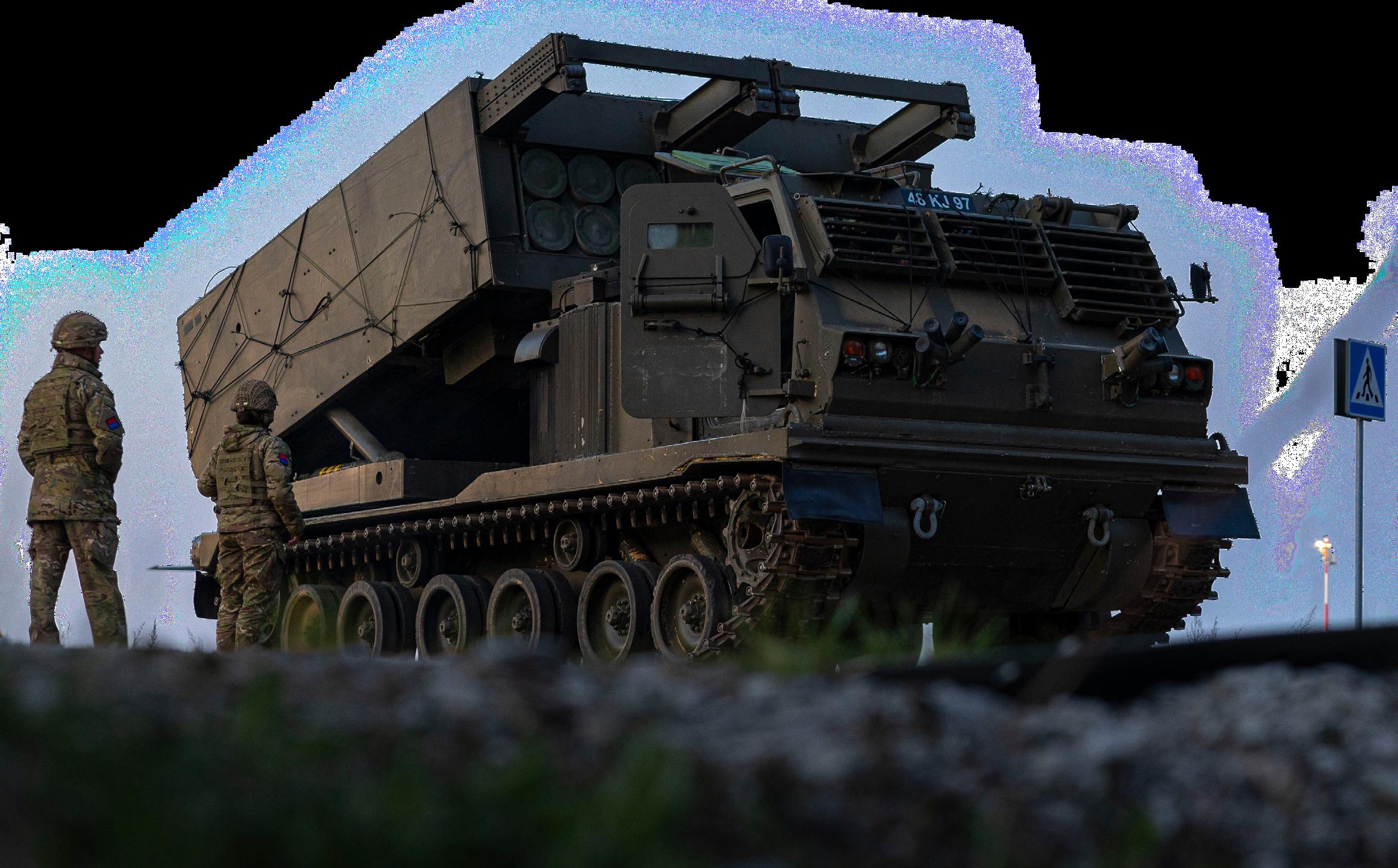
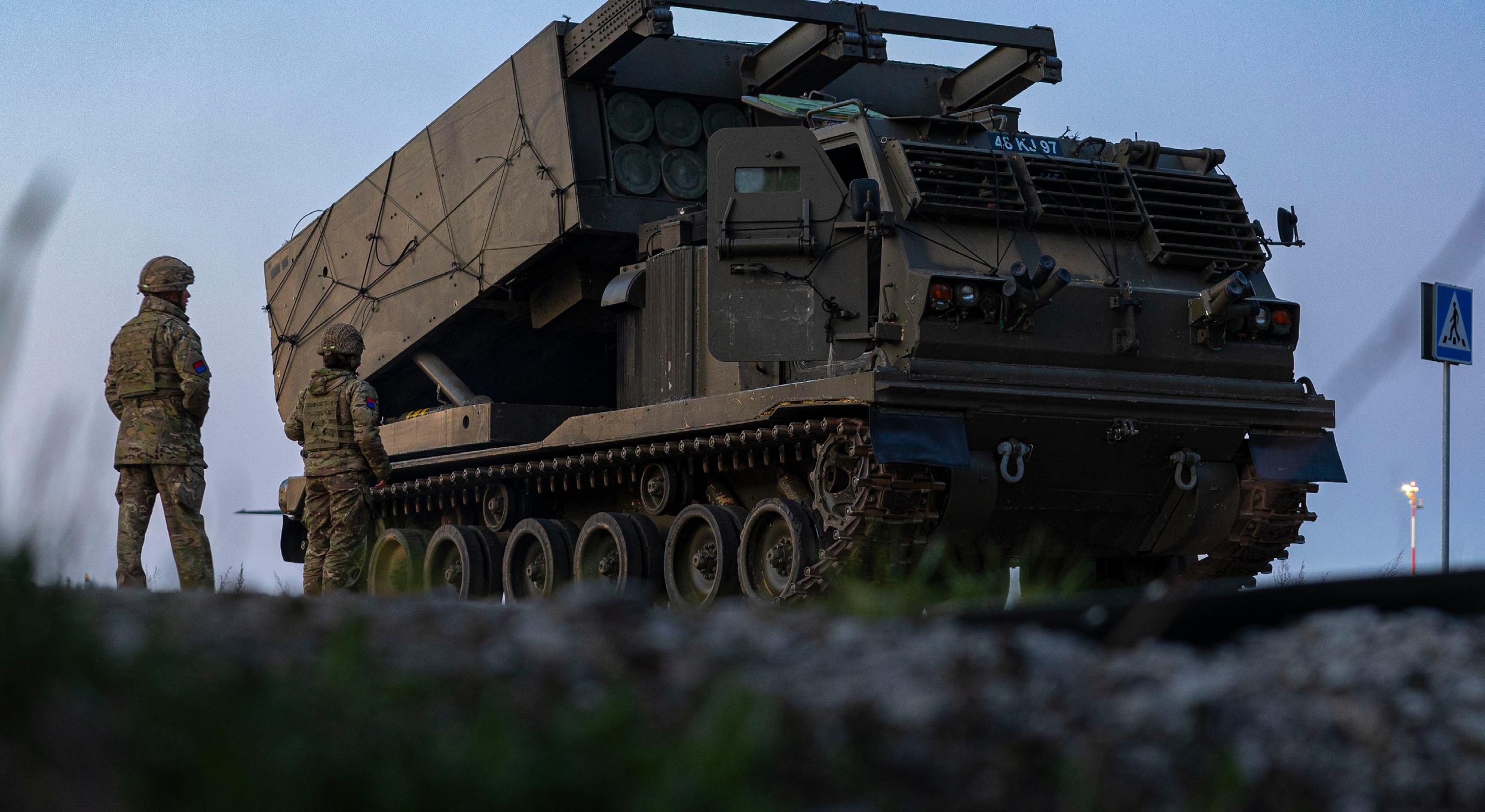
UK MOD © Crown copyright

“The Taliban’s electronic warfare threat was non-existent whilst Russia’s today is world leading. Russia can detect, target and strike a command post within minutes, which means there is no perfect sanctuary in the modern battlespace.”
When NATO fights it is most likely to fight on home soil and amongst allies, it therefore needs interoperability hardwired at every level and across every function. It needs to do this whilst adopting modernised technology and developing the increased readiness required to employ it in time. For decades, military power was platform-centric and assessed by hardware. Today, what matters more is whether you can see, understand, communicate and remain connected within a contested battlefield. All whilst disrupting the enemy’s ability to do the same.
On a modern battlefield increasingly characterised by AI-enabled targeting, contest across the electromagnetic spectrum and the pressures of peer warfare, digitised command and control is both a pre-requisite and a vulnerability. HQ ARRC will be a data-centric headquarters; yet Ukraine has demonstrated that a headquarters which cannot survive cannot command – dispersal, protection, camouflage and concealment are equally vital functions. Protection is not just about the preservation of life at all costs; it is about survivability to deliver lethality. Whilst physical threats remain, the electromagnetic environment presents an increasingly severe
8Ashley Ruiz, The Future of War: Kill-Chain Supremacy and Ukraine’s Lessons, Vol. 18, No. 4, (Journal of Strategic Security, 2025)v, pp. 53-63.
challenge. Land based electronic warfare is far more capable than anything faced on recent British Army operations. The Taliban’s electronic warfare threat was non-existent whilst Russia’s today is world leading. Russia can detect, target and strike a command post within minutes, which means there is no perfect sanctuary in the modern battlespace. Every transmission made is likely to be detected. Because of its importance, HQ ARRC command posts will be primary targets as adversaries seek to identify and strike them as a priority. Long range missiles pose the principal lethal threat, supported by intelligence gathered from the air, space and cyber domains. Therefore, survivability and resilience are fundamental to how HQ ARRC will operate. As a result, work is ongoing to command from underground in protected, subterranean command posts.
HOW THE ARRC WILL FIGHT
The battlefields of Ukraine are laboratories for high-intensity warfighting and many of its lessons directly applicable to modern corps-level warfare. Ultimately, the RussoUkrainian War has demonstrated that the force which survives long enough to cohere and concentrate lethality will win. Survival on a transparent battlefield is also the hardest challenge to overcome. The proliferation of sensors and sophistication of integrated command and control systems means both
sides have compressed their targeting cycles from days to hours to minutes.8 Layered Integrated Air and Missile Defence (IAMD) systems continue to mature alongside advances in uncrewed systems and electronic warfare technologies. The spaces between and behind combatants are increasingly contested and lethal. These are the operating conditions under which the ARRC must be ready to fight and win.
Against this backdrop, the ARRC has developed modern Corps Warfighting Instructions which are subdivided into five phases:
1. Setting the mission. The ARRC’s role is to set the conditions for success: establishing resilient command and control networks, protecting the force on a transparent battlefield, sustaining large formations over prolonged periods, and prosecuting a recce strike approach that allows NATO to fight at distance.
2. Protecting the force. Protection encompasses dispersed logistics, networked IAMD including counter uncrewed systems, prioritised targeting of enemy systems that threaten survivability, and a renewed focus on chemical, biological, radiological and nuclear defences. It also demands hardened communications and resilient command and control arrangements. The transparency of the modern battlefield has made force protection
a central corps function not limited to a single arm or supporting function.
3. Sustaining the force. A corps that cannot sustain cannot manoeuvre. The ARRC’s highest protection priority will almost certainly be logistics. Failing to secure supply lines will lead rapidly to forced culmination and Ukraine has been a stark reminder that war is attritional. In many ways, corps success rests more on protecting and sustaining than finding and striking. The Corps’ ability to keep forces combat effectiveness is central to denying an adversary the option of fighting a protracted war on favourable terms.
4. Fighting recce-strike. The Corps’ approach to fighting is grounded in recce strike at all echelons, integrating and aggregating traditional capabilities with emerging technologies to find, fix and strike critical components of an adversary’s system across the battlespace. With the right data, processes and algorithms, a corps-level headquarters must be able to generate and strike hundreds of targets a day.
5. Manoeuvre to win. All of these phases compound for a single purpose: to create the conditions for divisional manoeuvre. The Corps wins by enabling its divisions to break through defensive systems and exploit success at tempo: manoeuvre remains decisive.
ARRC’S PLACE IN NATO’S LINE OF BATTLE
The ARRC exists in a fundamentally different strategic environment to that which shaped it for much of the post-Cold War era. NATO itself has also changed. Alongside 1st (FRA) Corps, the ARRC is earmarked as SACEUR’s uncommitted reserve and has two main responsibilities: contributing to Alliance
“A corps that cannot sustain cannot manoeuvre. The ARRC’s highest protection priority will almost certainly be logistics. Failing to secure supply lines will lead rapidly to forced culmination and Ukraine has been a stark reminder that war is attritional.”
deterrence and preparing to restore Alliance territory. For the first time in a generation, the British Army has a mission that requires almost every unit and formation to work to a common purpose against a common adversary, within a congruent operational and force design. This necessitated an increased focus on force deployability and readiness. Op Vigilant Spear is the recently announced campaign support plan that will serve to cohere all British Army activity in the Euro-Atlantic Area under Commander ARRC and align it to best deter against Russian aggression.
Viewed holistically, it becomes apparent how the ARRC will pose strategic dilemmas to Russia. A Strategic Reserve Corps such as the ARRC can shape Russian decision-making, long before conflict, and constrain adversary options if a conflict starts. That said, Russia has two critical advantages. First, they can mass combat power at the point of their attack, whilst NATO has the obligation to defend everywhere at once. This asymmetry was visible in the Russian invasion of February 2022 when their forces, concentrated on a narrow axis, achieved a significant initial breakthrough against Ukrainian defences.9 Second, as the aggressor, Russia will have the initiative and carry offensive momentum in the
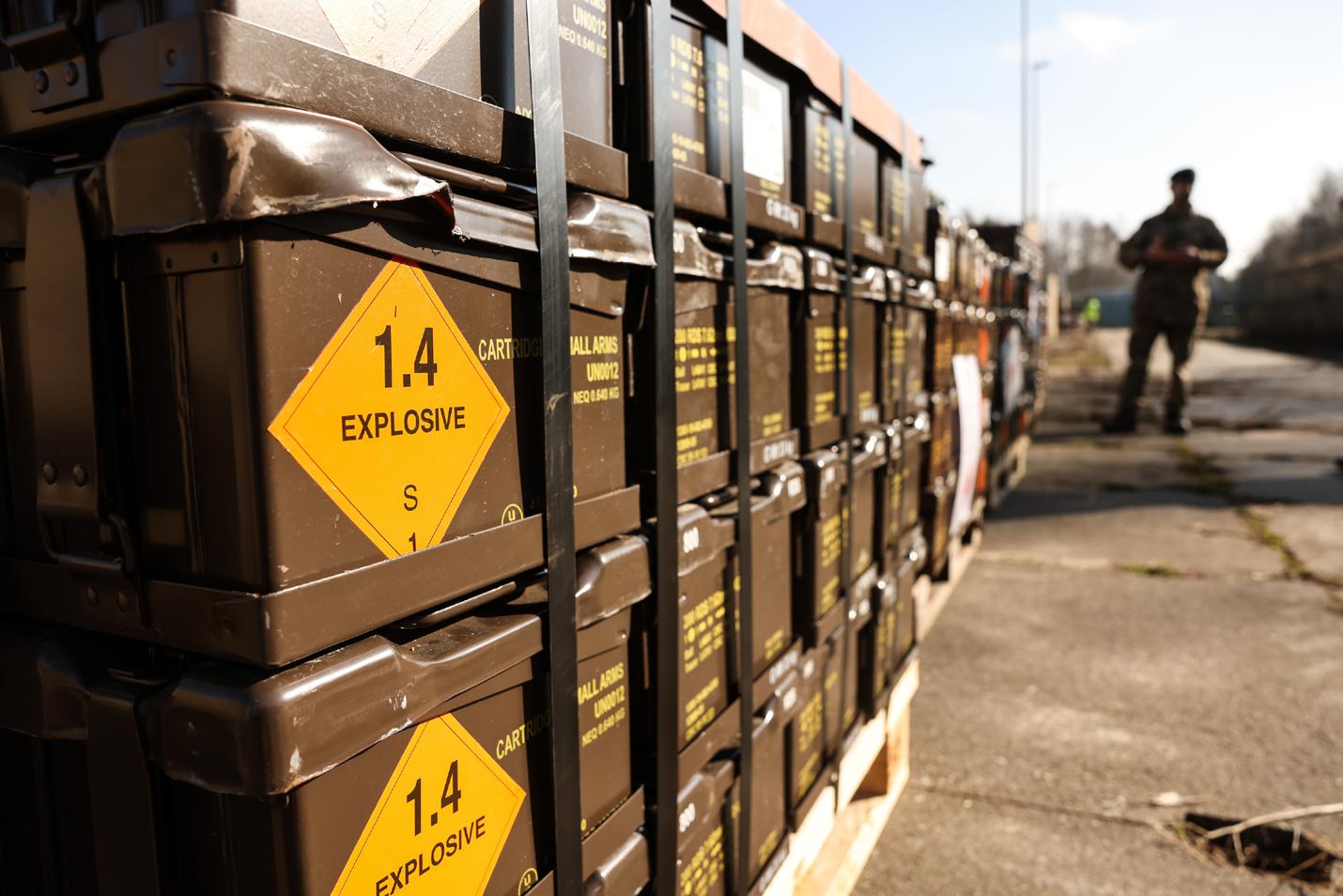
critical early stages: the where, when and how. The ARRC and the broader Integrated Force have to mitigate these advantages.
NATO and Britain’s land contribution to deterrence and defence against Russia is rapidly consolidating around the Eastern Flank Defence Initiative. This concept combines the standing Allied land forces with the latest technological innovations and conceptual adaptions from operations in Ukraine and beyond. The intent is to build a modernised, robust defence-in-depth that will deter Russia from invading and be able to repulse it if deterrence fails. The practical architecture of this approach relies on layered digital systems stitched together across national and Alliance networks. This will be enabled by resilient, multilayered satellite communications, fibre networks with UK reach back to cloud-based compute powerful enough to run sophisticated artificial intelligence and machine learning models to support decision making. Data sits at the heart of the Eastern Flank Defence Initiative and HQ ARRC lies at the operational intersection of that.
The need for a fully enabled corps is today more urgent than at any point since the Cold War.10 Army Reform 2026 has placed that responsibility squarely on HQ ARRC: a corps in being, no longer merely a corps HQ. It is charged with becoming NATO’s best warfighting corps and over the coming months and years will need to simultaneously: optimise the force to work with what it has for the Fight Tonight; modernise its equipment and integrate emerging technology to better prepare for the Fight Tomorrow; all whilst evolving through experimentation in existing doctrine and concepts to Fight Differently. The strategic, organisational and technological decisions being made will determine whether Britain can credibly deter Russia and, if deterrence fails, fight and win at scale.
9Mykhaylo Zabrodskyi, Dr Jack Watling, Oleksandr V Danylyuk and Nick Reynolds, Preliminary Lessons in Conventional Warfighting from Russia’s Invasion of Ukraine: February - July 2022, (RUSI, 30 Nov 22).
10Ministry of Defence, Strategic Defence and Security
AUTHORS
Colonel David R Haslam has been the Assistant Head of Asgard Decide in Army HQ since November 2025.
Lieutenant Colonel Alex Bayliss is Chief of Staff of Asgard Decide in the British Army’s Digital, Security and Intelligence Directorate.
HUMAN JUDGEMENT IN THE DIGITAL AGE
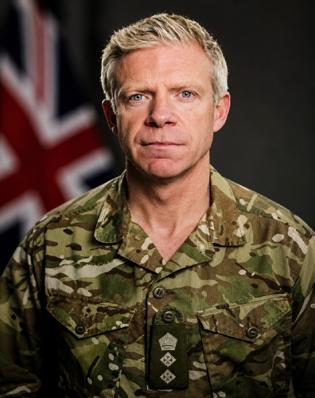
WARFARE has always been shaped by technological change, but the present era is marked by an unusual acceleration in both pace and scale. The rise of artificial intelligence (AI), digital transformation and integrated platforms such as the British Army’s Asgard Decide programme signals what many now describe as a Fourth Technological Revolution in military affairs. This shift is not simply a matter of faster computing or better software. It reflects the integration of data, sensors, algorithms, communications networks and precision effectors in ways that are reshaping how military organisations understand the battlespace, make decisions and apply force.
For the British Army and its partners, this matters because modern conflict is increasingly defined by tempo, understanding and adaptation. Recent wars suggest that forces able to fuse information quickly, identify opportunities before their opponents and coordinate effects across domains gain a marked operational advantage. Yet those same wars also show that technology alone is never decisive. New capabilities matter only when institutions absorb them
into doctrine, training, command culture and force design. This article therefore treats technological revolutions not as a procession of new devices, but as periods in which military systems are reorganised around new possibilities and new vulnerabilities.
A SUCCESSION OF TECHNOLOGICAL REVOLUTIONS
Over the past two centuries, warfare has been repeatedly transformed by clusters of technological innovation. The First Technological Revolution, associated with mechanisation, steam power and the industrial factory, made possible the mass production of weapons, rail-enabled logistics and larger standing armies sustained over far greater distances. For militaries, scale itself became a source of power. Mobilisation, supply and industrial endurance took on new importance, and armies could be armed, moved and sustained at levels previously unimaginable.
The Second Technological Revolution, driven by electrification, chemistry, internal combustion and scientific management, changed not only the scale but the character of military power. Rapid-firing artillery, machine guns, radio, motor transport and later air
power produced a battlespace that was faster, deadlier and more interconnected. Firepower, range and industrial capacity came to dominate military planning, while commanders had to think in terms of operational depth, layered logistics and increasingly complex command-and-control systems. The Third Technological Revolution, emerging from the digital age, added electronics, microprocessors, satellites, advanced communications and precision guidance. It enabled near-real-time situational awareness, long-range precision strike and the rise of information superiority as a military objective in its own right. Across all three revolutions, the central point is the same: new tools did not simply slot into old structures. They altered the institutions themselves, reshaping how armies were organised, how headquarters functioned, how campaigns were designed and how deterrence was understood.
AI AND THE FOURTH TECHNOLOGICAL REVOLUTION
The Fourth Technological Revolution is defined by the fusion of AI, robotics, cyberphysical systems, cloud and edge computing, autonomous and semi-autonomous platforms, and space-enabled capabilities. Its significance lies in the blurring of boundaries between the physical, digital and cognitive dimensions of war. Sensors now generate vast quantities of data across land, air, maritime, cyber and space domains. Networks move that data at speed, algorithms help to organise and interpret it, and effectors can then be selected and coordinated with increasing responsiveness. The result is a battlespace in which the central contest is no longer simply over firepower, but over who
can turn information into understanding and understanding into action most effectively.
This transformation, however, should not be mistaken for a complete rupture with the past. In many respects it extends trends already visible in the information age: the search for precision, the compression of command timelines, the growth of surveillance and the premium placed on integration. What makes AI distinctive is its capacity to cope with the scale, complexity and speed of modern data environments. It can identify patterns, rank priorities, suggest matches between targets and effectors, and automate forms of staff work that once consumed considerable time and manpower. Yet the principal military value of AI does not lie in autonomous violence for its own sake. It lies in decision advantage. Properly designed, AI-enabled systems can help commanders grasp complex situations faster, reduce cognitive burden, reveal options and sustain operational tempo. Poorly designed systems, by contrast, may accelerate confusion, embed bias or create brittle dependencies on vulnerable technical infrastructures. The central question is therefore not whether machines will replace judgement, but whether military institutions can use them to strengthen judgement under pressure.
CASE STUDIES: UKRAINE, IRAN AND THE LIMITS OF AUTONOMY
Ukraine’s war with Russia offers one of the clearest demonstrations of Fourth Technological Revolution warfare in practice. Confronting a numerically superior adversary, Ukraine has relied on ingenuity, decentralised adaptation, commercial technology and externally supported digital tools to generate
battlefield effectiveness disproportionate to its size. Uncrewed systems, satellite connectivity, distributed sensors, digital mapping and rapid intelligence fusion have all helped shorten the interval between detecting a threat and responding to it. In many cases, the advantage has come not from a single exquisite platform, but from the rapid networking of affordable systems and the willingness of units to adapt continuously. Software updates, procedural changes and tactical lessons have moved through the force in weeks rather than years. Adaptation itself has become a warfighting function.
At the same time, Ukraine also reveals the limits of technological optimism. AI-enabled support can accelerate target development and operational planning, but it does not remove friction, uncertainty or human error. Electronic warfare, deception, attrition and degraded communications continue to shape outcomes. Lethal authority remains embedded in human command structures, and rightly so. Similar lessons can be drawn from US and Israeli operations involving Iran and Iranian-backed systems, where AI-assisted targeting and intelligence fusion have enabled faster prioritisation of threats and more responsive precision effects. Yet even technologically sophisticated militaries have been challenged by low-cost drones, dispersed launch networks and the harsh economics of attrition. A cheap one-way drone can impose disproportionate costs on a defender using expensive interceptors, while a distributed adversary can survive even when individual nodes are vulnerable. The lesson is enduring: autonomy may assist, but it does not abolish strategy. Human judgement
“Confronting a numerically superior adversary, Ukraine has relied on ingenuity, decentralised adaptation, commercial technology and externally supported digital tools to generate battlefield effectiveness disproportionate to its size.”
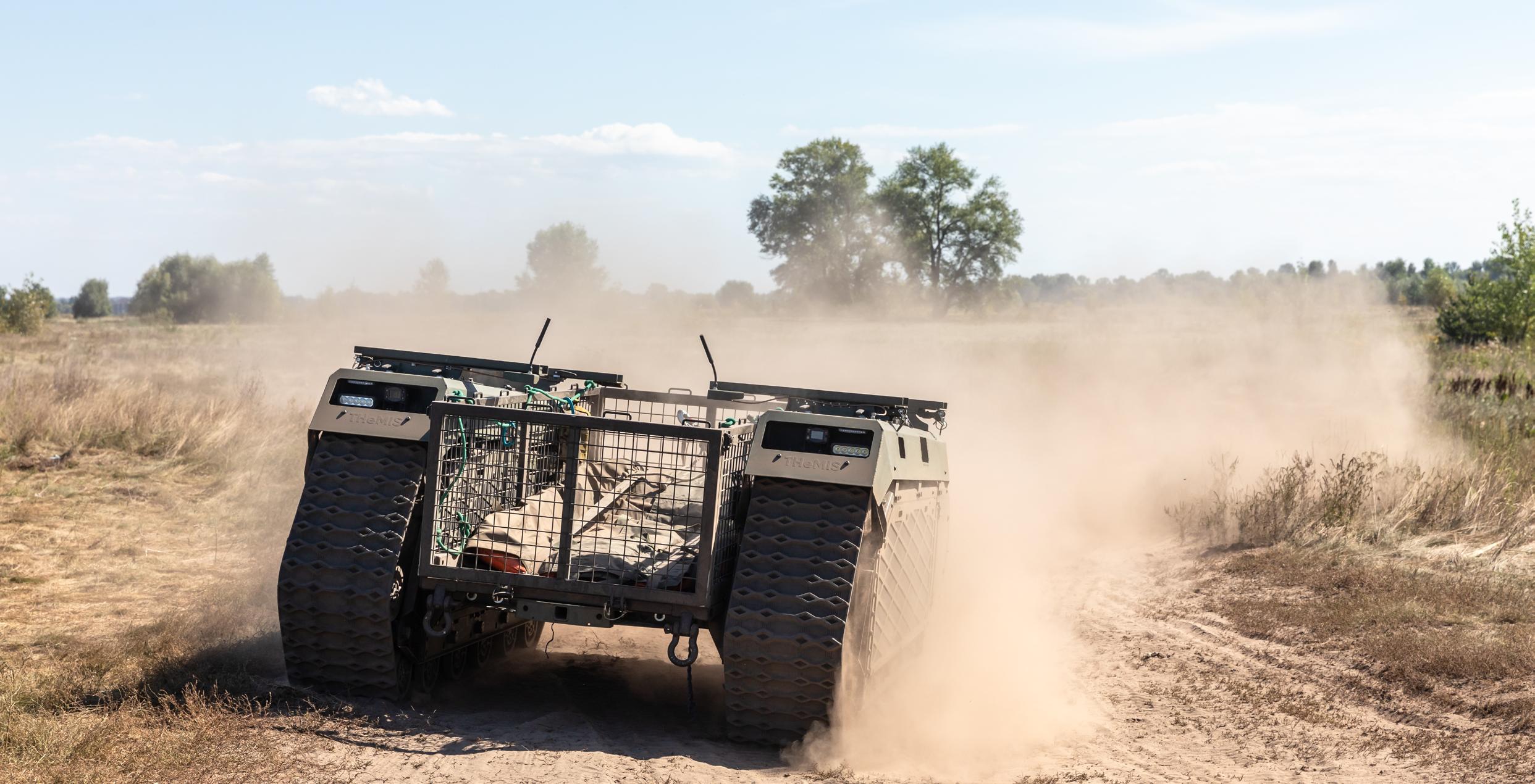
remains essential in deciding what matters, what risks are acceptable and where force should be concentrated.
DECISION ADVANTAGE AND HUMAN CONTROL
The decisive edge in modern conflict lies not in computing power alone, but in the ability to compress decision cycles while preserving coherence and control. Decision advantage means sensing earlier, understanding faster, deciding with greater confidence and acting more effectively than an opponent. In a saturated information environment, commanders and staffs are threatened by overload as much as by ignorance. AI-enabled tools can help restore cognitive advantage by separating signal from noise, surfacing anomalies, prioritising options and reducing the manual burden of staff processes. This matters especially in headquarters that must simultaneously manage targeting, intelligence, logistics, force protection, information activity and coordination with allies. Without digital assistance, the sheer volume of information can paralyse rather than empower.
For that reason, military judgement remains irreplaceable. Legal obligations, alliance frameworks and the ethics of command all require that human beings retain responsibility for the use of force. Ukraine’s experience reinforces the point. AI is most effective not as a substitute commander, but as a decisionsupport technology that helps leaders operate under fatigue, ambiguity and time pressure. It can propose, highlight, correlate and warn, but it cannot bear responsibility in the moral and political sense that war demands. Nor can it reliably interpret intent, alliance implications or strategic signalling without human context. The challenge for military organisations is therefore to preserve meaningful human control while still exploiting machine speed where it offers a genuine advantage. The aim should not be maximal automation, but trustworthy acceleration in support of accountable command.
ASGARD DECIDE AND BRITISH ARMY TRANSFORMATION
The British Army’s Asgard Decide approach is a practical response to both the opportunities and the risks of the Fourth Technological Revolution. It is best understood not as a single software tool, but as part of a broader reccestrike transformation. Its purpose is to combine multi-domain data integration with machineassisted planning and targeting support so that commanders can decide more quickly, reduce staff burden and coordinate effects more coherently across a contested battlespace.

“The British Army’s Asgard Decide approach offers a useful lens through which to understand this moment. The military value of AI lies less in the idea of autonomous war than in the steady construction of decision advantage: better shared pictures, reduced cognitive burden, faster coordination and more coherent integration across domains.”
Asgard Decide is intended to support a self-generating common operating picture, a trusted common intelligence picture, target development, prioritisation, weapon-target matching, mission allocation and post-strike review. In practical terms, it seeks to compress the sensor-to-decision-to-effect cycle while preserving human command authority and replacing fragmented manual processes with a more integrated operational picture. Coupled with the integrated language model, Asgard Decide can ingest written orders, conduct extraction and prepare plans in a fraction of the time previously thought possible.
Its value lies less in automation for its own sake than in freeing commanders and staff officers to focus on judgement, creativity and decision-making. If it enables smaller, more agile and more distributed headquarters, the implications for training, readiness and force design will be considerable. The central question is whether the Army can adapt its institutions quickly enough to exploit what such systems make possible.
INTEGRATION ACROSS DOMAINS: LAND, AIR AND SPACE POWER
Operational effectiveness in contemporary conflict depends on integration across land, air, space, cyber and information domains. Air and space power provide reach, speed, precision, intelligence, surveillance and
communications resilience; land forces provide persistence, physical control and the ability to exploit and hold effects. The digital targeting web emerges from connecting these strengths in a responsive network capable of generating coordinated effects at pace.
INSTITUTIONAL ADAPTATION AND INNOVATION
The pace of digital transformation requires institutions to adapt quickly while preserving assurance, interoperability and legitimacy. Prototype success is not enough. Capabilities must be fielded at scale, integrated with legacy systems, secured appropriately and sustained in operations. The British Army’s approach reflects this challenge by emphasising open interfaces, replaceability and evidence-based integration, seeking to combine the speed of software development with the discipline of a military institution.
Leadership and culture will be decisive in this transition. Senior leaders must encourage experimentation without losing control, and they must ensure that personnel understand how digital systems reshape command, tempo, risk and responsibility.
CONTINUITY AMID CHANGE
Technological revolutions have never delivered victory on their own. Success has always depended on whether militaries could absorb new clusters of innovation into coherent systems of doctrine, organisation, training, command and sustainment. Artificial intelligence is accelerating and deepening established trends, especially the premium placed on information advantage, precision and speed of adaptation. Yet it has not displaced the central truth that warfare remains a profoundly human endeavour. People still decide what must be defended, what risks are acceptable, what political messages military action is meant to send, and how violence is bounded by law and legitimacy. Even the most capable military AI cannot substitute for strategic judgement, disciplined leadership or moral responsibility.
The British Army’s Asgard Decide approach offers a useful lens through which to understand this moment. The military value of AI lies less in the idea of autonomous war than in the steady construction of decision advantage: better shared pictures, reduced cognitive burden, faster coordination and more coherent integration across domains. Future success is likely to belong not simply to those who adopt technology fastest, but to those who combine it most effectively with trust, training, interoperability and the ability to learn faster than their adversaries.
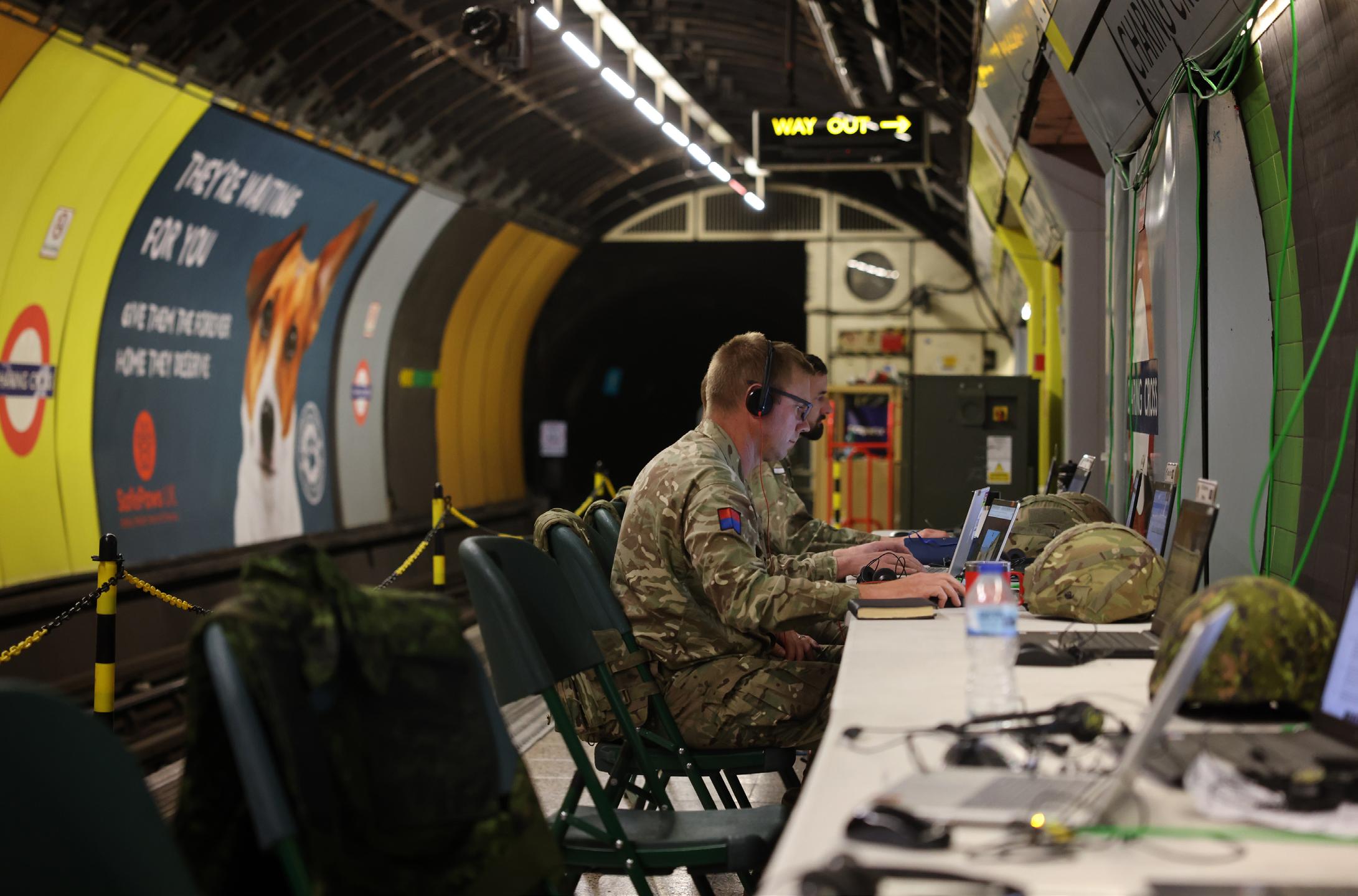
TUBE ‘STRIKE’ DEMONSTRATES ARRC IS ON TRACK AND ON TIME FOR NATO COMMITMENT
AUTHOR
Brigadier Rob Alston is Commander 9 Deep Recce Strike Brigade.
ARRCADE Strike was an unusual mission rehearsal involving elements of the HQ Allied Rapid Reaction Corps (ARRC) and its corps troops. It had three main goals: to practise setting up a command post underground in a busy urban location without being noticed; to bring in the British Army’s new decision advantage system (Asgard Decide); and to show UK and NATO leaders why the strategic reserve corps role is so important, and how ARRC can deliver on it by 2030 if properly resourced.
The HQ deployed by train into a disused London Underground station and set up a forward command post right on the platforms. Staff came and went in plain clothes, so all the military activity underground stayed hidden from the thousands of commuters. This unusual setup was challenging for the real-life support and signals teams from 1st (UK) Signal Brigade, but with great help from Transport
for London, they made it work. This exercise further developed HQ ARRC’s expertise at operating underground, which is a key skill they expect to employ in future conflicts.
Arrcade Strike was also the first time the HQ used Asgard Decide, kicking off a rapid cycle of staff training and system development, as the headquarters integrates artificial intelligence into its processes. Asgard is set to change how the HQ works in many ways. Two early improvements were:
n Creating plans much faster using the HIVEMIND large language model; in hours instead of days.
n Automating how sensors and weapons are coordinated using tools like GAIA, MAVERICK and WORKBENCH, ensuring plans flow smoothly into operations.
This exercise was also the first deployment
for HQ 9th Deep Recce Strike Brigade (9 DRS Bde), formed in April 2026 and which controls ARRC’s long-range surveillance drones and precision fire units. During Arrcade Strike, 9 DRS Bde linked live drone feeds over Salisbury Plain into the Bowman tactical network. This info was shared automatically through the Zodiac intelligence system and sent securely back to HQ ARRC, updating the common intelligence picture. This data informed engagement decisions by artillery staff in the joint air-ground integration centre, with automatically generated digital fire orders sent back over Bowman to rocket launcher command posts in Larkhill. Creating this ‘killchain’ with live data and in-service equipment was a first for the Corps, marking a big step forward in the ARRC’s surveillance and strike command and control capability.
Arrcade Strike showed the importance of ‘mission partners’ from industry and how those partners will integrate into the HQ through a ‘deployed innovation cell.’ Analysts from ARRC’s Operational Analysis and Research Branch teamed up with experts from Dstl, Rapstone and the British Army’s Montagu Group of Specialist Reserves. Together, they are making sure ARRC will stay ahead of enemy technological developments.
Using Asgard tools in such a unique underground location gave Commander ARRC a great opportunity to demonstrate ARRC’s role and capabilities to visitors from the UK and across NATO. With help from 1st (UK) Signal Brigade, 7th Air Defence Group and 9 DRS Bde, staff from the ARRC’s Multi-Domain
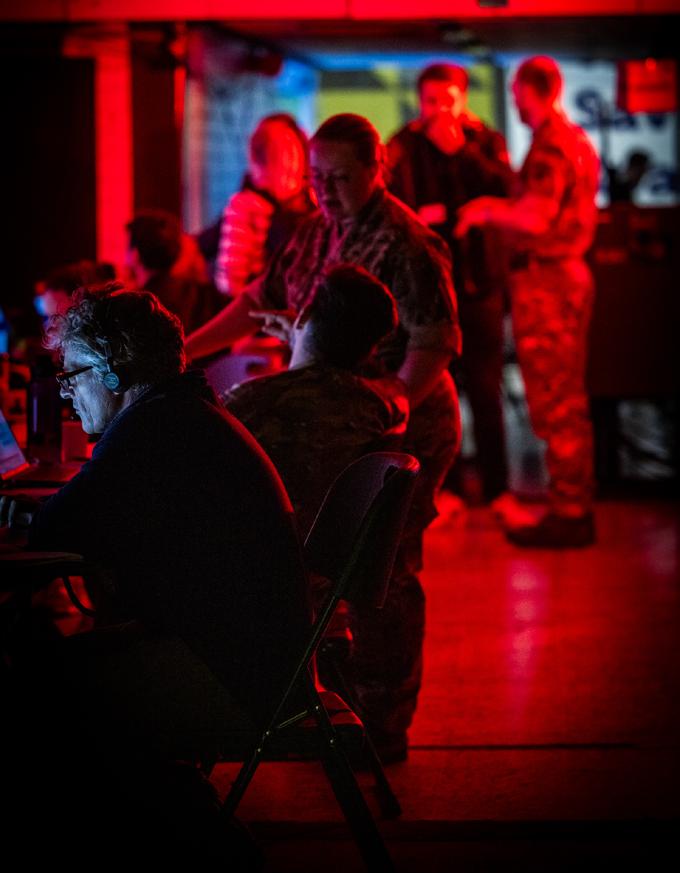
“Journalists from various media outlets left with a very positive impression of how seriously we are preparing for war and the urgent need to properly resource the Corps.”
Operations Division demonstrated how they would coordinate sensors and weapons across all operational domains to counter a realistic Russian threat to NATO.
Visitors from Whitehall and the wider UK defence community saw how investing in the British Army builds on a strong foundation of innovation and supports our NATO commitments. NATO leaders, including the Land
Commander and Corps Commanders, were impressed by our progress towards achieving the requirements of the Eastern Flank Deterrence Initiative and our dedication to the strategic reserve corps role. Journalists from various media outlets left with a very positive impression of how seriously we are preparing for war and the urgent need to properly resource the Corps. The subsequent media coverage helped spread Commander ARRC’s key messages:
n A fully equipped Strategic Reserve Corps is not optional. It is the UK’s top priority in NATO’s land domain and essential to meet the challenge of mass and momentum in future conflicts.
n Modernising by 2030 is doable and affordable with the right mix of weapons and platforms, but we need to act now to be ready.
n We can’t do this alone. We must work closely with industry to build the capacity to fight a large-scale war and keep up with rapid innovation cycles such as those seen in Ukraine. Bringing technicians and tacticians together is key to success.
Arrcade Strike was just the first step in ARRC’s journey with Asgard and one of many milestones on the way to Steadfast Defender 27 and becoming a fully validated strategic reserve corps by late 2027. It gave us great momentum and a clear picture of what investment is needed to turn a mature prototype HQ into a fully deployable capability.
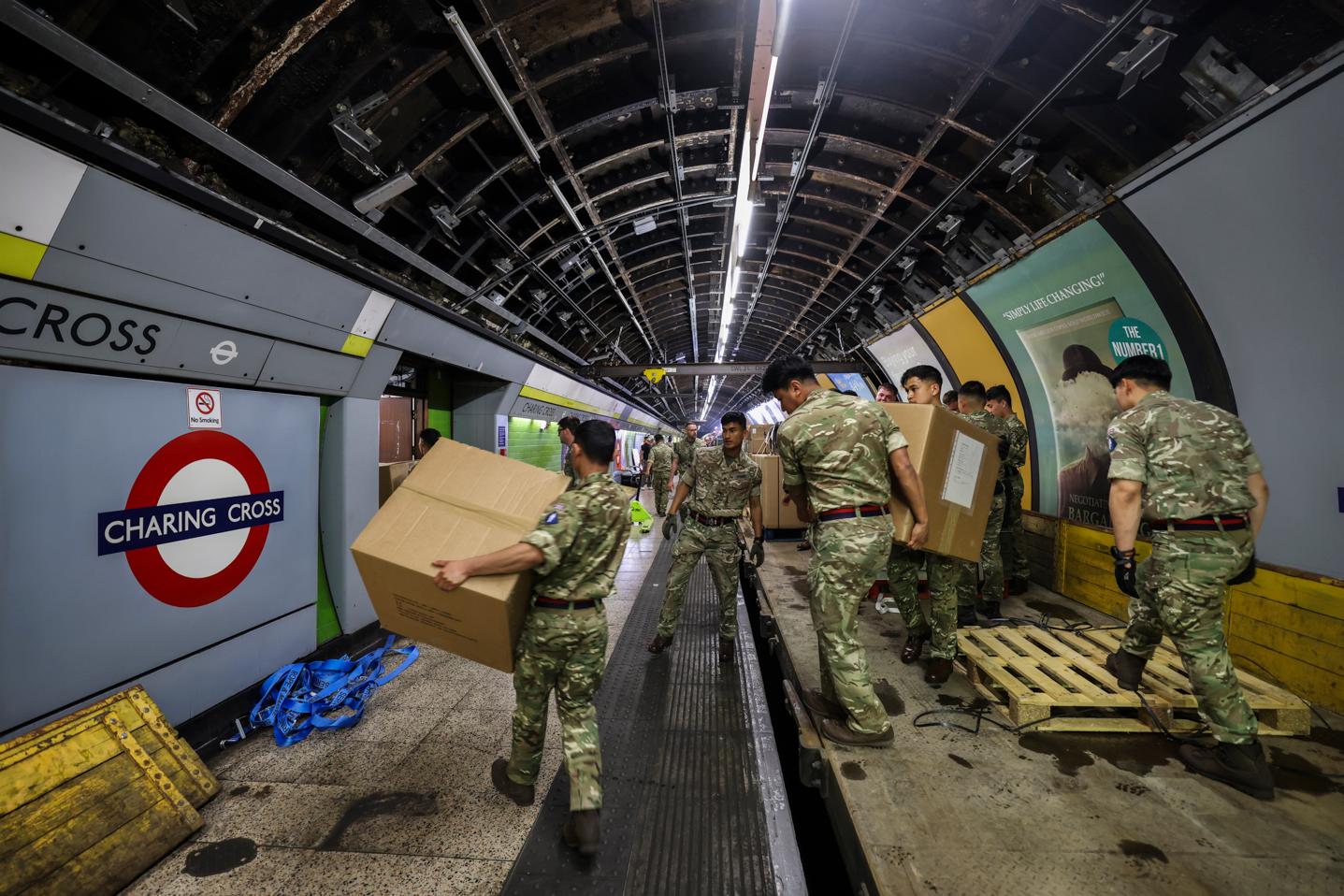
Sgt Sam Terry/UK MOD © Crown copyright
Sgt Jason Greaves/UK MOD © Crown copyright
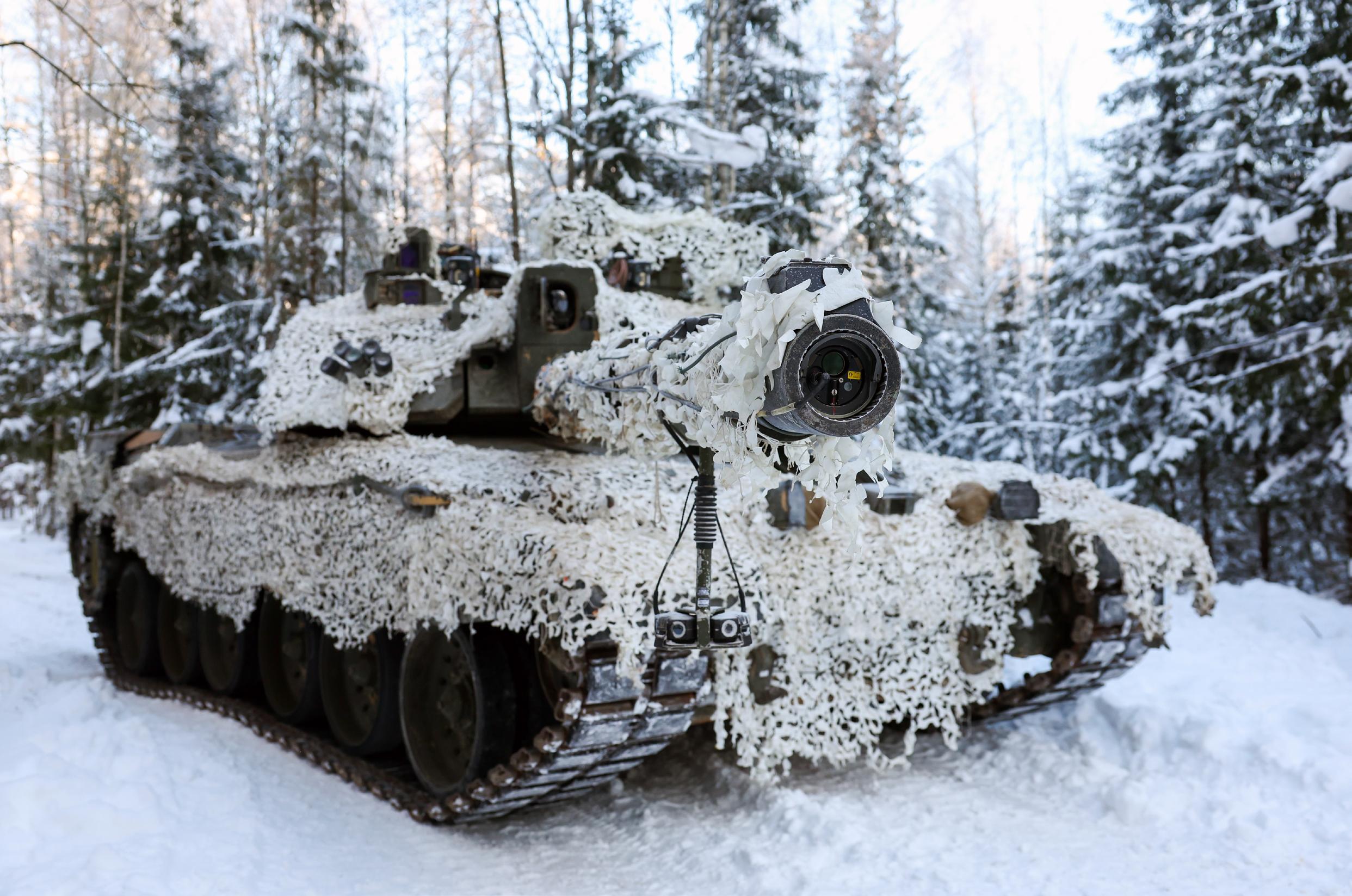
THE COLD CRUCIBLE: WHAT THE BRITISH ARMY CAN LEARN FROM THE WINTER WAR
AUTHOR
Professor Andrew Stewart is Head of Conflict Research
at the CHACR.

S1Iksander Rehman, ‘Lessons from the Winter War: Frozen Grit and Finland’s Fabian Defense’, War on the Rocks, 20 Jul. 2016; Nicholas Murray, ‘The Winter War: This Isn’t the Fabian Strategy You Are Looking For’, War on the Rocks, 29 Jul. 2016; Elisabeth Braw, ‘What Ukraine Can Learn From Finland’, Foreign Policy, 19 Dec. 2021; Ann Marie Dailey, ‘Molotov Cocktails in winter: What 1939 Finland tells us about Ukraine today’, New Atlanticist/ Atlantic Council, 2 Mar. 2022; Brian E. Frydenborg, ‘Bungling the Prewar and First Moves in Finland 1939 and Ukraine 2022: A Comedy of Errors for Stalin’s Soviet Union and Putin’s Russia, Respectively’, Small Wars Journal, 23 May 2022; Franz-Stefan Gady, ‘Breaking the Mannerheim Line: Soviet Strategic and Tactical Adaptation in the Finnish-Soviet Winter War’, War on the Rocks, 8 Feb. 2023.
INCE Finland joined NATO in April 2023, a number of British Army units have conducted study visits to identify historical lessons relevant to today’s complex security challenges. Even before the attempted annexation of the entire country, comparisons were being drawn between Russia’s February 2022 invasion of Ukraine and the Winter War fought from November 1939 to March 1940 between the Soviet Union and Finland.1 At the same time, Finland and the High North has increasingly become seen as potential future targets for Vladmir Putin, leading to an increased interest in better understanding what may, in the near future, become key terrain. With the Forward Land Forces (FLF) Multinational Staff Element (MNSE) in Rovaniemi, hosted by the Finnish Jaeger Brigade with Sweden as the framework nation, and the Multi-Corps Land Component Command Northwest in Mikkeli, there are highly visible demonstrations of the Alliance seeking to deter potential adversaries.2 But, for those partner nations – the United Kingdom prominent amongst
them – who could find themselves fighting some future conflict in what are challenging geographical and environmental conditions, there is much to be gained by looking to the past to better understand the present and help prepare for what might lie ahead.
Despite a strong conceptual base gained during the Second World War and Cold War, the British Army had had little subsequent experience of operating in cold weather.3 With an absence of any detailed current doctrine, Operation Cabrit, and its ten years of close collaboration with its Estonian hosts, has provided a critically valuable learning crucible. Exercise Winter Camp, held earlier
2Hilde-Gunn Bye, ‘NATO Forward Land Forces HQ to Northern Finland’, High North News, 19 Feb./2 Mar. 2026.
3Rob Granger, ‘British Army Cold Weather and Mountain Warfare Training in the Second World War’, British Journal for Military History (Vol. 8, Issue 1; Mar. 2022), 69-86; Andrew Stewart, ‘The Vital Periphery: Britain’s Military Commitment to NATO’s Northern Flank’, Ares & Athena (Jun. 2026 – forthcoming).
this year, delivered considerable benefits, even if the accompanying images did still suggest an absence of dedicated clothing and equipment.4 One description noted the exercise had reinforced several lessons including the impact of winter weather on mounted manoeuvres, the importance of interoperability and the continuing need for further work on “predictable friction points”.5 Prominent amongst the latter was a need to enhance cold weather discipline, “managing sweat, layering and rest to avoid frostbite and exhaustion, while maintaining enough dexterity to handle weapons and communications equipment”. By formally capturing such insights, militaries can significantly reduce operational risk, increase cost efficiency and improve combat effectiveness.6 As General James N. Mattis observed: “There is no reason
4The sixth edition of ‘Joint Doctrine Publication 0-20: UK Land Power’, released in Oct. 2023, contains one reference to ‘cold’ when referring to physical aspects of the land environment; ‘Troops fully layered for the fight on Exercise Winter Camp’, Army, 25 Feb. 2026, army.mod.uk/news/ troops-fully-layered-for-the-fight-on-exercise-winter-camp
5Braid Archer, ‘NATO’s Winter Camp 26: cold steel, cold politics’, Future Warfare Magazine, 11 Feb. 2026, fwmag.com/shownews/914/nato-rsquo-s-winter-camp-26cold-steel-cold-politics
6NATO Lessons Learned Handbook (NATO, Joint Analysis and Lessons Learned Centre, 2022; 4th ed.), 9.
7Ibid., 3.
8Ibid., 49
9Ibid., 11
10Huw Bennett, ‘The reluctant pupil? Britain’s army and learning in counter-insurgency’, RUSI Commentary, 11 Oct. 2009.
11Tom Dyson, Organisational Learning and the Modern Army: A New Model for Lessons-Learned Processes (Taylor & Francis Group, 2019) [e-book].
12A. Edwards, ‘Misapplying lessons learned? Analysing the utility of British counterinsurgency strategy in Northern Ireland, 1971–76’, Small Wars & Insurgencies (Vol.21, No.2; 2010), 303; William Owen, ‘The False Lessons of Modern War: Why Ignorance Is Not Insight’, British Army Review (Issue #185; Autumn 2023), 25.
13K. Jugdev, ‘Learning from Lessons Learned: Project Management Research Program’, American Journal of Economics and Business Administration (Vol.4, No.1; 2012), 16.
14Brent Sterling, Other People’s Wars: The US Military and the Challenge of Learning from Foreign Conflicts (Georgetown University Press, 2021), 275.
15Ibid., 276; Tom Dyson and Yuriy Pashchuk, ‘Organisational learning during the Donbas War: the Development of Ukrainian Armed Forces Lessons-learned Processes’, Defence Studies (Vol.22, No.2; 2022), 373.
16Dyson, Organisational Learning and the Modern Army.
17NATO Lessons Learned Handbook, 1.
18Gordon F. Sander, ‘Ernst Linder: the Swedish general who rode into battle for Finland’s freedom’, Engelsberg Ideas, 25 Mar. 2026.
“With an absence of any detailed current doctrine, Operation Cabrit, and its ten years of close collaboration with its Estonian hosts, has provided a critically valuable learning crucible.”
to send troops into the fight and get them killed when a Lesson Learned the month before could be sent to a commander who could have used it for training.”7
The British Army has previously faced criticism in regard to how it undertakes lesson learning. A fundamental and critical weakness, both for it and many other organisations, both military and civilian, is failure at the outset of this process to cross the divide between a ‘lesson identified’ (a documented observation with a recommended action) and a true ‘lesson learned’ (a validated, implemented change in capability).8 The relevant NATO handbook explicitly warns: “A lesson is not learned until something changes in the way we operate.”9 Added to this, there have been other issues to overcome. According to one historian, with its “disdain for abstract thinking about war” and the value attached to pragmatism, initiative and self-reliance, this has also created a cultural impediment.10 Another study has highlighted a reliance on informal, ad hoc processes that have tended “to persist only for the duration of a single campaign”.11 Blindly transplanting lessons from one conflict to another can be disastrous; ultimately, “context trumps lessons and insights”.12 Lessons can also calcify into dogmatic “intellectual straitjackets”; if observation databases are treated merely as static archives without a mandated remedial action process, the organisation can also suffer from “corporate amnesia” allowing knowledge to leak away.13 Militaries attempting to learn from conflicts also often fall victim to “confirmation bias,
in which investigators seek information that validates existing views rather than searching for data that would falsify them”.14 Rather than acting as neutral assessments, lessons from conflicts are frequently weaponised by branches of the military, or blocked entirely, to defend the status quo or advance preferences.15 This may be at the senior leadership level who view the lessons process “as a threat that could shed uncomfortable light on their areas of responsibility, creating an environment where defensive reasoning blocked institutional change”.16
Following Iraq and Afghanistan, the British Army’s lessons-learned process has improved, in large part due to the work undertaken by the Land Warfare Centre. Into the mix of experience gained from current training, wargaming and simulation, which provide the most immediate and visible currency, the historical case study – conducted either with or without an accompanying inspection of the actual terrain and conditions – can provide significant evidence and information to support future planning and preparation.17 Fought over 105 brutal days, the Winter War provides a rich repository of lessons for modern military organisations anticipating what form a potential conflict on NATO’s north-eastern borders might take and how it might develop. In 1939, the Soviet leader Joseph Stalin demanded Finnish territorial concessions to create a security buffer around Leningrad. When this was refused, the Red Army invaded, expecting a rapid 12-day victory. Instead, its heavily mechanised forces were initially paralysed by extreme sub-arctic temperatures, deep snow and dense forests. Outnumbered Finnish defenders utilised superior ski-mobility and decentralised motti tactics to isolate and annihilate road-bound enemy columns. The resolute defence captured global admiration – Winston Churchill declared “Finland shows what free men can do” – but sheer numbers and eventual Soviet tactical adaptations finally breached the defensive positions.18 Exhausted and devoid of any meaningful

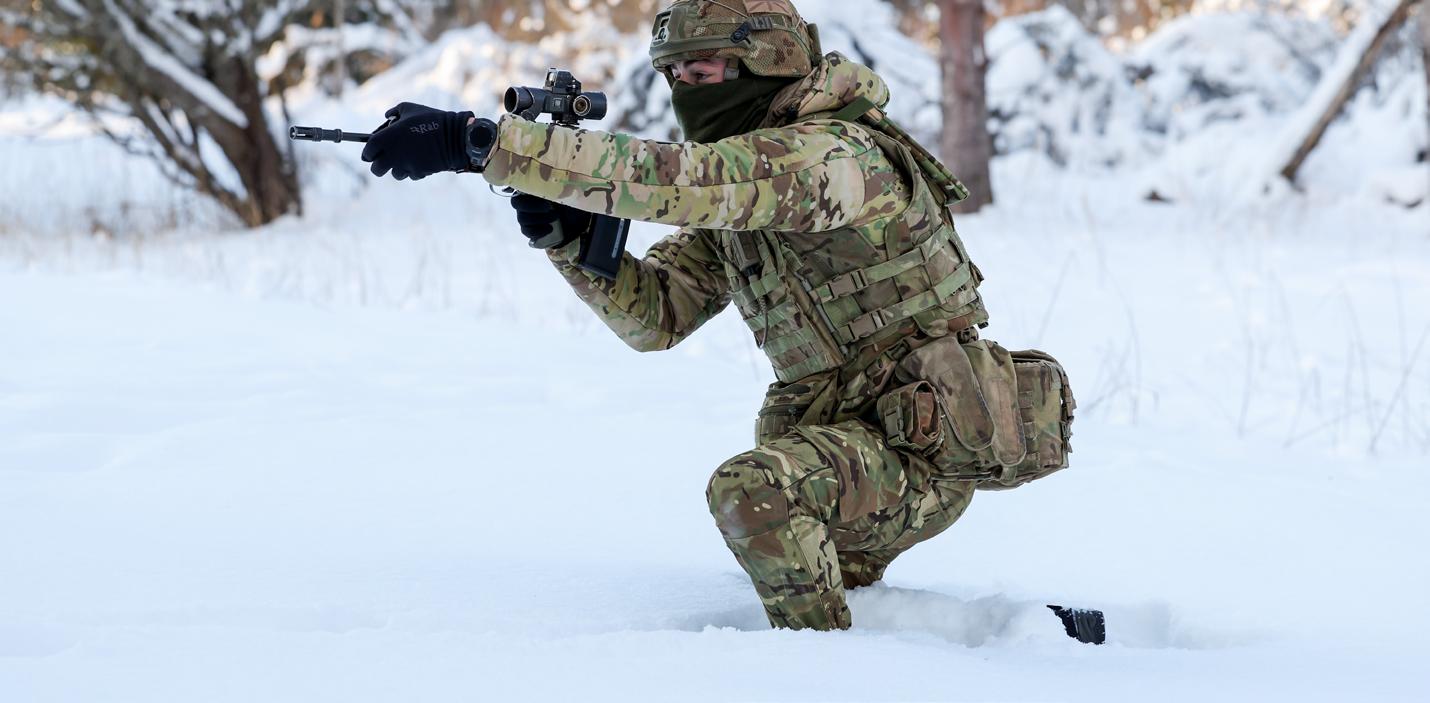
external intervention, the leadership agreed to the Moscow Peace Treaty and approximately 11 per cent of its territory, including the vital Karelian Isthmus, was surrendered and over 400,000 citizens displaced. With a complete annexation avoided and sovereignty retained, this outcome was viewed widely as a strategic success for Finland. For the Soviet Union, it was a humiliating Pyrrhic ‘victory’ in which the Red Army suffered horrific casualties, prompting one Soviet general to famously remark, “we have won enough ground to bury our dead”.19
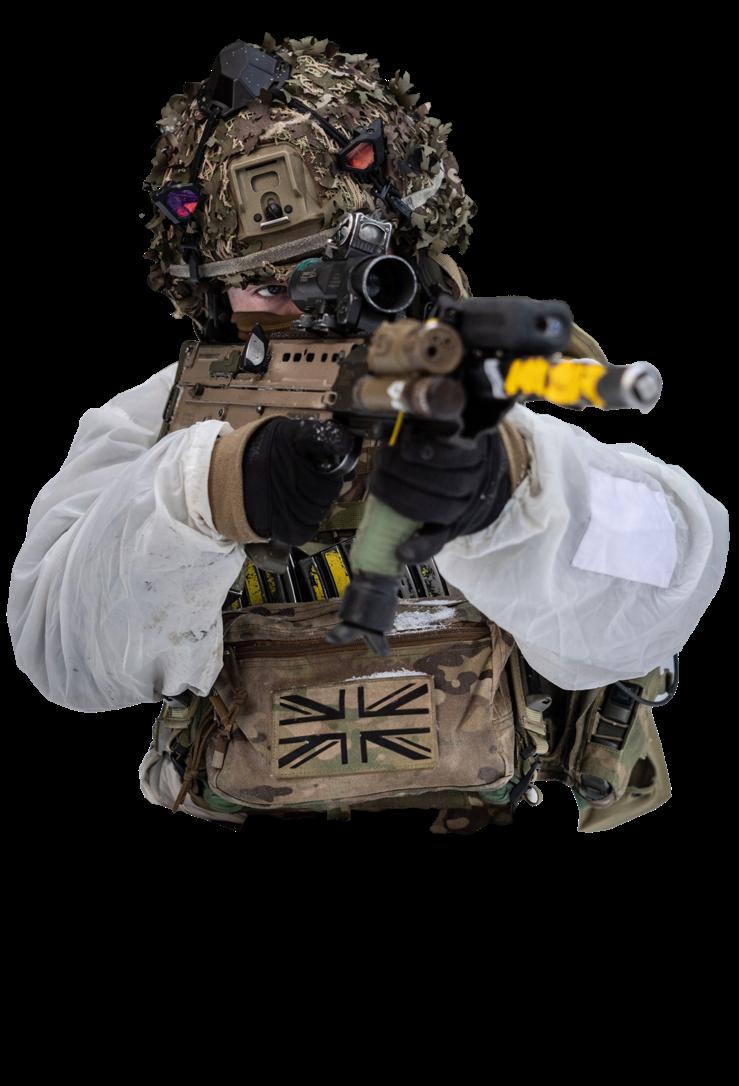
The most detailed note, however, was “the necessity for proper training and equipment for winter warfare”.21
19Keith W. Olson, ‘Between East and West’, The Wilson Quarterly (Vol.10, No.4; Autumn, 1986), 46.
20Major R.O.A. Gatehouse and Captain C.H. Tamplin, ‘Report on Tactical Operations in Finland’, 22 Feb. 1940, WO208/582, The National Archives, Kew.
21Post-war, a small group of Finnish officers transferred into the US Army to share their knowledge of the Soviet Army but also, and more specifically, how to conduct winter warfare operations; Pasi Tuunainen, ‘Training the US Army to Fight the Red Army in Winter - Former Finnish Officers and Military Knowledge Transfer from Finland to the United States During the Early Cold War, 1947–1964’, The Journal of Slavic Military Studies (Vol.29, No.1; 2016), 110-138.
22Among the most valuable examples which provide specific references to lessons are: William R. Trotter, Frozen Hell: The Russo-Finnish War of 1939-1940 (Workman Publishing, 1991); Pasi Tuunanen, Military Effectiveness & Tactics: Finnish Military Effectiveness in the Winter War, 1939-1940 (Palgrave Macmillan, 2016); Robert Edwards, White Death: Russia’s War on Finland, 193940 (Weidenfeld & Nicolson, 2006); Allen F. Chew, ‘The Destruction of the Soviet 44th Motorized Rifle Division’ in, Fighting the Russians in Winter: Three Case Studies, Leavenworth Papers No. 5 (Combat Studies Institute, Dec. 1981); Pasi Tuunainen, ‘New approaches to the study of Arctic warfare’, Nordia Geographical Publications (Vol.43, No.1; 2014), 87-99; Roger R. Reese, ‘Lessons of the Winter War: A Study in the Military Effectiveness of the Red Army, 1939–1940’, The Journal of Military History (Vol.72, No.3; Jul. 2008), 825-852.
23Rehman, ‘Lessons from the Winter War’.
24Chew, ‘The Destruction of the Soviet 44th Motorized Rifle Division’, 17.
“Modern militaries must prioritise life-support infrastructure and understand that environmental attrition can rapidly shatter an army’s morale and will to fight.”
The process of seeking out relevant lessons from this war began almost immediately, the first study being produced by the War Office in February 1940 titled Report on Tactical Operations in Finland 20 A 15-page report, it drew on comments provided by more than 20 Finnish officers, five of whom were major generals, supplemented by a series of captured Russian documents. With clear parallels to the more recent and equally illegal invasion of Ukraine, it noted in its introduction: “Working on the assumption, which was seriously believed, that there would be a revolution in Finland and, therefore, no serious resistance, the Red Army marched into Finnish territory along all main roads, almost in the formation of a victory parade. They expressed great surprise at being greeted with bullets instead of red flags.” Amongst the five subsequent lessons offered, the authors noted a lack of education and training amongst the Russian troops which meant “intelligent tactical manoeuvre… [and] co-operation throughout all arms [was] practically non-existent”. What tactical mobility there had been was only possible owing to the Finns lack of key equipment. Overall, the British officer who authored the report concluded “man for man (of all ranks) the Russian is infinitely inferior to the Finn in battle”.
There was also interest in the United States and, drawing on reports provided by the American military attaché in Helsinki, the US Army War Department’s Military Intelligence Division published three special bulletins. Acknowledging it was “too early to make complete observations”, these, nonetheless, offered nine “tentative conclusions” covering equipment – specifically commenting on the performance of Soviet tanks, anti-aircraft and anti-tank – and leadership. The latter criticised the Soviet ‘dual command’ approach, where every tactical decision required approval from political commissars, and the effect of Stalin’s late 1930s’ purges which had removed many experienced officers. There was also reference to “the necessity for the cultivation of initiative in subordinates” and a thorough knowledge of the operational theatre and the warning that “in intelligence work, truth is essential”.
Although brief and produced whilst the war was being fought, these wartime reports remain valuable and pre-empted the conclusions which have followed. In an ever expanding bibliography of English-language source material, the identifiable lessons can be split broadly into how the two sides fought and the specific challenges of the environment in which the fighting took place.22 The most commonly repeated lesson remains a variant of the need to align equipment and training with the realities of the physical environment. The Finnish military recognised that “snow and ice, under winter conditions, are actually to be considered as an aid to operations and an aid to the rapid movement of troops, not as a hindrance which is the common conception”.23 Relying on skis and sleds, it achieved a profound mobility overmatch. As one of the leading writers on the war observed: “The Finns were prepared for combat in snow at subzero temperatures; the invaders were not. It was almost that simple.”24 The extreme conditions – with deep snow and temperatures plummeting to -40°C – acted as a severe operational constraint on the heavily mechanised Soviet force, with its reliance on petroleum-based lubricants that froze in the cold. And whilst it also held a huge advantage in troop numbers, most of the inexperienced Russians were deployed in summer uniforms, often with little or even no suitable footwear; frostbite killed and incapacitated more than superior Finnish marksmanship. For modern land forces, this historical example emphasises the need to ensure personnel, vehicles and weapons systems are explicitly designed or modified to withstand the frictions of the specific operational environment.
The exploitation of local conditions extended beyond just this advantage as the Finns not only out-fought but also out-thought a static and increasingly paralysed opponent. They deliberately weaponised the extreme cold to induce psychological and physiological collapse within the Soviet ranks. In sub-arctic conditions, human survival requires massive caloric intake. The Finnish high command understood this biological imperative and deliberately targeted Soviet sustainment nodes to break their combat power. During the so-called ‘sausage war’, starving Soviet troops who had passed through Finnish lines stopped to gorge themselves on abandoned field kitchens, allowing the defenders time to regroup and counter-attack. Having observed this, the Finns systematically hunted down Soviet field kitchens and campfires,
depriving the Red Army of hot food and sleep.25 Simultaneously, they preserved their own combat effectiveness by utilising portable, wood-stove-heated 20-man tents, allowing troops to systematically rotate out of the freezing cold to rest and recover just a short distance from the fighting. For contemporary logisticians, the Winter War demonstrates that in extreme environments, sustainment is not merely a support function; it is the centre of gravity. In sub-arctic warfare, maintaining the physiological and psychological health of troops is just as vital as ammunition; in extreme conditions, an enemy’s caloric intake and warmth can be exploited. Modern militaries must prioritise life-support infrastructure and understand that environmental attrition can rapidly shatter an army’s morale and will to fight.
As the initial wartime surveys highlighted, the conflict also vividly illustrated the dichotomy between decentralised mission command and rigid, top-down hierarchies. The Soviet command structure actively stifled tactical innovation. A former Finnish officer noted: “The Russian system of command: follow to the letter the orders and procedures stated in manuals with no or little reasoning or initiative of their own. It did not work with the complicated situation which they faced.”26 The Red Army was paralysed by purges and ‘dual command’ that fostered a culture in which initiative was feared and Soviet commanders, when ambushed, dug in to await orders rather than actively attempting to break out. Conversely, the Finns relied on Auftragstaktik (mission-type orders), empowering junior officers and even individual privates to use their common sense, improvise and exploit fleeting tactical momentum without waiting for higher headquarters.27 Chaotic, high-friction environments require an agile command structure where local commanders are empowered to make rapid decisions. The Finnish approach was not one of passive delay but rather an active, aggressive defence tailored to exploit the friction of the environment and inflict maximum operational paralysis on the enemy.
The war also demonstrated, certainly during its opening months, that raw firepower and massed infantry frontal assaults are ineffective against determined, entrenched defenders making best possible use of difficult local terrain. The ultimate Soviet victory in the Winter War was achieved only after a massive institutional overhaul in early 1940, restoring authority to professional commanders and implementing complex combined-arms operations synchronising massed artillery barrages, armour and infantry. This enabled them to methodically wear down Finnish fortifications and a military organisation which, with the absence of any meaningful international support, had fought bravely but in an increasingly hopeless and mismatched contest. Despite their many failings, the Soviets demonstrated that initial failures do not guarantee ultimate defeat if a military possesses the institutional humility and agility to conduct an honest self-assessment and rapidly implement comprehensive doctrinal and tactical reforms mid-conflict. For the Finns, up until the point where they were forced to agree terms, they had demonstrated that a smaller, highly mobile force can systematically dismantle a larger, rigid adversary by severing lines of communication and leveraging terrain as a force multiplier.
These are only a few of the lessons but there would already appear numerous salient points to draw from the last Winter War which will support the British Army in its future operations. Further visits to the Finnish battlefield and study of more obscure published material and archival sources will allow for more detailed discussion, reflection and analysis. As an initial summary, it can be argued that this somewhat obscure conflict provides an excellent opportunity to study the complexities of extreme-weather operations, the weaponisation of logistics, decentralised command cultures and the paradoxes of military effectiveness. For contemporary planners preparing for multidomain operations in austere environments, it also underscores that technological and numerical superiority are easily negated by
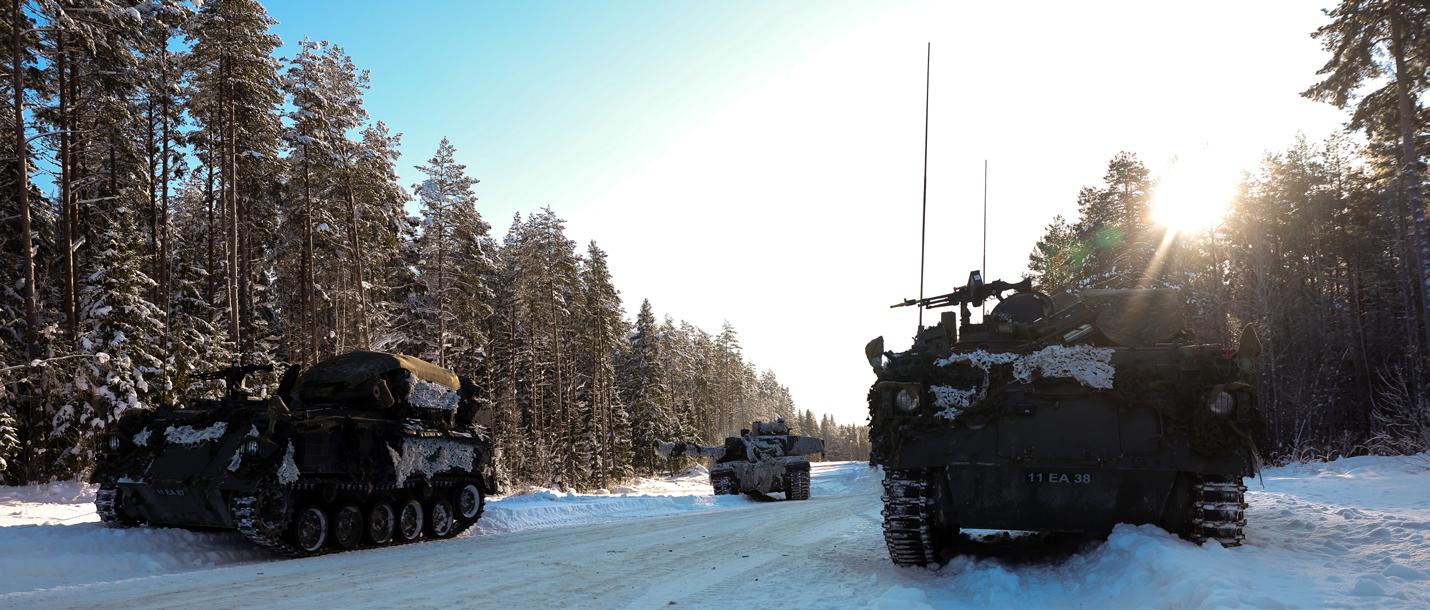
environmental ignorance and rigid doctrine or, and perhaps worse, no doctrine at all.
Where the real significance lies is taking this and speculating how the next Winter War might be fought. For example, how the evolution of Arctic warfare has modernised motti tactics by integrating advanced weaponry, electronic warfare and sophisticated transport systems. Instead of manually felling trees to block enemy columns, modern forces operating from positions of advantage in the snow can deploy improvised explosive devices and anti-tank guided missiles to fragment mechanised units into isolated pockets. And how it is possible to disrupt enemy logistics without exposing personnel as UAVs now replace risky physical ski raids on supply lines while electronic warfare jams digital and voice communications, isolating trapped enemy pockets from their command structures and creating a state of tactical paralysis effectively replicating physical encirclement. Enhanced survivability features, such as armoured cabins and V-hull designs, protect troops from small arms fire and mines. Complementing these platforms, modern troops rely on highly engineered, multi-layered protective gear to survive and manoeuvre in temperatures plunging to -51°C. Over-Snow Vehicles (OSVs) with wide tracks glide over soft snow hauling massive payloads of up to 30 tons, allowing mobile infantry to transport heavy weaponry alongside their squads. These preserve troop stamina by eliminating the physical exhaustion of pulling sleds, while also enabling ‘skijoring’ – towing ski troops with ropes to drastically increase cross-country speed. In extreme sub-zero temperatures, OSVs serve as vital mobile heat shelters. They provide water heaters for rehydrating Arctic meals without the need for vulnerable open campfires and offer warm environments for medical evacuations. The future battlefield will employ very different means which will both enhance and evolve the tactical solutions adopted by the Finns in 1939 and 1940 to overcome their weakness in personnel and equipment. Understanding these, along with the opportunity to study the constants of geography, environment and command, control and leadership, offers clear value for today’s land forces.
25Rehman, ‘Lessons from the Winter War’.
26Dustin Lawrence, ‘Mobility in the Arctic: Applying Lessons from the Past to the New Operational Environment’, Master of Military Art and Science Thesis, U.S. Army Command and General Staff College, 2022, 59.
27Ibid., 59-60.
US ARMY UPGRADES: MODERNISING AT PACE

AUTHOR
Major Scott W Russell is the Chief of Operations of the 1st US Cavalry Division. He has been serving as an exchange officer in the US Army since 2023.
AS the British Army focuses its efforts on modernisation to meet the threat from Russia, on the other side of the pond the US Army is similarly going through a major transformation programme. On 30th September 2025, Pete Hegseth addressed senior leaders from across the military at Quantico, Virginia, mandating the requirement to re-focus on warfighting: “This is a moment of urgency, mounting urgency. Enemies gather. Threats grow. There is no time for games. We must be prepared.”1 The Secretary of War’s speech focussed on standards and culture in the military, but its message was wider than that – it was about driving change and shifting the military to a war footing.
for the British Army, should it wish to maintain its status as the US Army’s partner of choice in the land domain.
MODERNISATION AND TRANSFORMATION
The US Army’s 2021 Modernization Strategy aims to secure its status as a “globally dominant land power” by 2035, in response to major threats posed by state actors such as China and Russia.2 This strategy coheres several major equipment programmes, such as the Next Generation Combat Vehicle and Future Vertical Lift,3 which were already underway. These programmes are fully-funded and have capability lead times akin to those of many British equipment programmes, often exceeding ten years.
1US Army Department of War (2025) ‘Secretary of War Pete Hegseth Addresses General and Flag Officers at Quantico, Virginia’, transcript available at: war.gov/News/ Transcripts/Transcript/Article/4318689/secretary-ofwar-pete-hegseth-addresses-general-and-flag-officers-atquantico-v
2US Army (2021) ‘Army Modernization Strategy’, US Army publications, available at: armypubs.army.mil/epubs/ DR_pubs/DR_a/ARN34818-SD_08_STRATEGY_ NOTE_2021-02-000-WEB-1.pdf, at pp.1-3
3Ibid, a list of all major programmes included in the Strategy can be found at p.9.
In the US Army, major change is underway at pace – it is ‘Transforming in Contact’. This article will explain how the Service is modernising through major equipment programmes and rapid transformation initiatives, showing how novel technology and new concepts are revolutionising the way it organises and operates. In concluding, it considers the implications of this transformation
In 2022, shortly after the strategy’s publication, Russia began its full-scale invasion of Ukraine, where the now ubiquitous use of unmanned aerial systems (UAS) has highlighted how modern warfare is changing. Concurrently, the rise of artificial intelligence (AI) and a deteriorating global security situation underscored the need for rapid modernisation. By 2024, despite heavy investment in
equipment, the US Army recognised that it was not evolving quickly enough.
General James Rainey (pictured right), then Commander of Army Futures Command, identified the slow, “programmatic” acquisition process, which can take two years just to approve a requirement, as too slow to keep pace with the speed of change: “To guarantee our security, we must recognise change and adapt faster… We are not preparing for a theoretical future fight. The struggle for advantage is now.”4 To address this, the Army launched the Transformation in Contact initiative. This scheme complements the longer-term modernisation strategy, which focuses on major equipment programmes, by streamlining the acquisition process for rapidly evolving technologies. It does so by simplifying requirements and getting commercially available solutions down to units as soon as possible, enabling bottomup innovation. This provides soldiers with hands-on experience with new technology, allowing experimentation at the tactical level, whilst driving organisational and doctrinal innovation, which the Army sees as crucial to understanding how best to employ rapidly developing commercial technologies for battlefield advantage.
In acquisition parlance, a ‘capability’ encompasses not just equipment but factors such as training, organisation and doctrine.5 Transformation in Contact enables the simultaneous development of all these aspects. Unlike traditional trials, where units are tasked with testing a single piece of equipment, the initiative involves providing brigades with a wide range of new and experimental technologies to trial simultaneously. In practical terms, this means that when a brigade is designated as a ‘Transformation in Contact Brigade’, it rapidly begins to receive large quantities of capabilities, such as vehicles, drones, sensors and software for experimentation. Concurrently, the delivery of equipment under major programmes is reprioritised to ensure that such brigades receive modernised kit, facilitating meaningful experimentation with future force structures and concepts.6
Transformation in Contact is distinguished from previous modernisation initiatives by its scale, ambition and a genuine sense of urgency.7 The ‘in contact’ part of its name highlights this urgency, as the Army intends to transform without disrupting ongoing commitments: “Transformation is challenging because we only have one Army. This Army must conduct current operations, generate ready forces, and transform simultaneously.”8

“Transformation is challenging because we only have one Army. This Army must conduct current operations, generate ready forces, and transform simultaneously.”
4Gen Rainey, J. (2024) ‘Continuous Transformation: Transformation in Contact’, Military Review, SeptemberOctober 2024, pp.10-26, available at: armyupress.army. mil/Journals/Military-Review/English-Edition-Archives/ September-October-2024/Continuous-Transformation, at p.10-11.
5In UK defence acquisition, the factors making up a capability are captures in the acronym TEPID-OIL: Training, Equipment, Personnel, Infrastructure, Doctrine, Organisation, Information and Logistics.
6An example of this is the deployment of the 2nd Brigade, 1st Cavalry Division on a National Training Center Rotation at Fort Irwin in November 2025, where it experimented with hundreds of individual pieces of equipment from 20 different transformation projects, while also receiving mainstream funded equipment such as Star Shield, WinTAK and Maven.
7Lt Gen Beagle, M., and Lt Col Rund, T. (2024) ‘Continuous Transformation: Institutional Transformation in Contact’, Military Review Online Exclusive, November 2024, available at: armyupress.army.mil/Journals/ Military-Review/Online-Exclusive/2024-OLE/ Institutional-Transformation
8Gen Rainey, J. (2024), at p.11.
9The M1A1 Abrams entered service in 1980 and was upgraded to the M1A2 in 1992. Subsequently it has received three ‘Systems Enhancement Packages’ (SEP), with the most current model of the tank now referred to as the M1A2 SEPv3. In 2023, the M1A2 SEPv4 programme was cancelled.
10Department of Defense (The Army Science Board) (2023) ‘An Independent Assessment of the 2040 Battlefield and its Implications for the 5th Generation Combat Vehicle’, available at: asb.army.mil/Portals/105/Reports/2020s/ ASB%20FY%2020%20BF2040%20ExSum. pdf?ver=vxXNwQxDxPOLZE73KMlGqg%3D%3D, at p.8.
11The M1 Booker was originally conceived as an airdroppable light tank, transportable in a C130, in order to provide an armoured capability for airborne forces. The programme suffered significant requirement creep and is a study in what can go wrong in armoured vehicle acquisition. See Balish, T. Col (Ret.), ‘Canceled M10 Booked Holds Lessons for Transformation’, Association of the United States Army, dated 28 Aug 2025, available at: ausa.org/articles/ canceled-m10-booker-holds-lessons-transformation; Myers, M. (2025) ‘The Army made a tank it doesn’t need and can’t use. Now it’s figuring out what to do with it’, Defense One, published 27 Apr 2025, available at: defenseone.com/ policy/2025/04/army-made-tank-it-doesnt-need-andcant-use-now-its-figuring-out-what-do-it/404877
12-13Department of Defense (The Army Science Board) (2023).
This means that the Army will not wait for a convenient space to appear in a formation’s calendar to enable transformation; brigades are now often designated as Transformation in Contact Brigades at short notice, even while deployed. For example, in 20242025, 3rd Brigade, 10th Mountain Division was awarded the moniker while deployed to Eastern Europe. It received a full fleet of infantry squad vehicles and converted to a mobile brigade without breaking stride in its operational commitments.
TRANSFORMATION WITHIN ARMOURED DIVISIONS
Transformation is taking place across the force, but by focusing on US armoured divisions, the scale of change becomes evident. At a glance, the armoured force today does not appear dissimilar from when it invaded Iraq in 2003, still largely composed of Abrams, Bradleys, Humvees and Black Hawks. However, a wide range of fully-funded programmes are overhauling almost every aspect of the equipment fleet. Equally important, in addition to experimenting with emerging technologies, the Army’s transformation initiative has driven a critical review of existing and planned capabilities as it reconsidered how it will operate in the future.
1. Next-generation combat vehicles
The US Army is rethinking its armour development strategy. While the M1 Abram remains a world-class tank,9 a planned upgrade programme was cancelled in 2023 after a report by the Army Science Board concluded it was “reaching the end of its life”.10 Shortly thereafter, the Army scrapped the M10 Booker Light Tank, after requirements creep made it too heavy to meet its original mandate as an air-droppable light tank.11
The rationale for cancelling the Abrams upgrade is significant. The Science Board’s report determined that at nearly 40 years old “much of the M1’s technology was reaching obsolescence”.12 Additionally, already weighing almost 70 tonnes, its high maintenance burden would only get worse if the planned upgrade went ahead, as the addition of new modular equipment would increase its weight to approximately 80 tonnes. Instead, to dominate the 2040 battlefield, the report recommended that a lighter, more manoeuvrable tank was required.13
This led to the new M1E3 Abrams programme, which aims to deliver a tank weighing no more than 60 tonnes. Key requirements include: an unmanned turret, a reduced three-person crew, a hybrid engine, AI-enabled fire control
U.S. Army photo by Daniel Marble
and survivability systems,14 hard-kill defensive aids, and counter-drone capabilities.15 While it is uncertain whether this requires a new platform or an overhaul of the existing one, the programme has an aggressive timeline, with initial testing expected by 2026 and fielding before 2034.16
The Bradley infantry fighting vehicle entered service in 1981, and since then has developed a strong track record from its time in the Gulf War through to the conflict in Ukraine.17 Since its debut, the US Army has procured approximately 6,500 Bradleys, and along with the M1 Abram, they form the backbone of its armoured brigades.18 The fleet has been upgraded several times over the years, and the latest upgrade, the M2A4, is currently being rolled out to the force.
Concurrently, the XM-30 mechanised infantry combat vehicle is being developed as a replacement. Designed to address the Bradley’s obsolescence, it has a range of demanding technical requirements such as a hybrid-electric engine, an unmanned 50mm cannon turret, modular architecture for future upgrades, and the ability to control autonomous systems.19 Perhaps most significantly, the XM-30 will be able to operate with or without a crew, making it the US Army’s first major unmanned platform.20 The programme used a novel ‘rapid acquisition’ process based on digital design and simulation to quickly select two manufacturers for prototyping,21 with trials now expected in 2027 and initial fielding in the early 2030s.22 Under current plans, the Army will procure 3,800 XM-30s over the life of the contract.23
While the M1E3 and XM-30 are future capabilities, other programmes are already bearing fruit. Firstly, a ‘Maneuver Short-Range Air Defence’ [M-SHORAD] platform, based on the Stryker wheeled armoured vehicle, has now entered service. Equipped with Stinger missiles, this provides essential air defence capability for armoured brigades. Further, the Army recently trialled an
unmanned version during Project Capstone Convergence 5 (pictured below), providing an insight into how this capability may develop in the future.25
Secondly, the Armoured Multi-Purpose Vehicle (AMP-V) programme is replacing Vietnam-era M-113s with a new tracked armoured platform, with variants including personnel carrier, command, medical and mortar.26 Manufactured by BAE Systems, it is based on a Bradley chassis, simplifying maintenance and support.27 Roll-out is now in full swing and, once complete, approximately 3,000 AMP-Vs will be in service, making up approximately 30 per cent of an armoured brigade’s fleet.28
At the lighter end of the spectrum, the equipment strategy is shifting as well. The US Army was in the process of rolling out the Joint Lightweight Tactical Vehicle (JLTV) to replace the ageing Humvee fleet, which is still employed in large numbers. Over 20,000 JLTVs are already in service, but plans to procure up to 49,000 have been curtailed in favour of lighter, more mobile platforms, like the infantry squad vehicle.29
The infantry squad vehicle began as a Transformation in Contact initiative, aimed at providing increased mobility for airborne brigades.30 These are light, unarmoured vehicles based on the Chevrolet Colorado medium truck, modified by GM Defense to feature a roll cage and nine seats.31 Following successful trials, the Army now plans to field over 2,500 infantry squad vehicles to transform all infantry brigades into ‘mobile brigades’,32 and may procure more in the future.
2. Aviation and drones
Under the 2021 Modernization Strategy, the Future Vertical Lift programme aimed to overhaul its utility, attack and reconnaissance aircraft fleet with modern aircraft. However, in 2024, the decision was made to terminate most of that programme, redirecting
14A recent study by RAND on Human-Machine integration in the Army highlighted how AI will be essential for future armoured platforms to enable them to identify, analyse and react to the wide range of threats on future battlefields (Kessler, S., Wallace, S., Yoder, E., Wong., J. (2025) ‘One Team, One Fight: Volume II, Ground Combat Narratives of Human Machine Integration for the US Army’, RAND Research Report, Available at: rand.org/content/dam/ rand/pubs/research_reports/RRA2700/RRA2764-1/ RAND_RRA2764-2.pdf
15-16Judson, J. (2025) ‘US Army plans to dramatically accelerate Abrams tank modernization’, Defense News, dated 14 Apr 2025, available at: defensenews.com/ land/2025/04/14/us-army-plans-to-dramaticallyaccelerate-abrams-tank-modernization
17Hooper, C. (2022) ‘America’s Tough M2/M3 Bradley Fighting Vehicles Are Perfect For Ukraine Fight’, Forbes, dated 30 Dec 2022, available at: forbes.com/sites/ craighooper/2022/12/30/americas-tough-m2m3-minitanks-are-perfect-for-ukraine-and-nato
18The Bradley fleet is divided between the US Army, National Guard and storage (including Army Prepositioned Stocks around the globe). Each Armoured Brigade has just over 150 Bradleys, including both M2 Infantry Fighting Vehicle and M3 Scout variants. US Government Congressional Research Service (2016) ‘The Army’s M-1 Abrams, M-2/M-3 Bradley, and M-1126 Stryker: Background and Issues for Congress’, Report dated 5 April 2026, available at: congress.gov/crs-product/R44229
19US Army, ‘New Mechanized Infantry Combat Vehicle prototype contract awarded to two vendors, US Army Press Release dated 26 June 2023, available at: army.mil/article/267922/new_mechanized_ infantry_combat_vehicle_prototype_contract_awarded_ to_two_vendors#:~:text=The%20XM30%20 has%20several%20key%20features%2C%20 including:,Systems%20Inc.%20*%20American%20 Rheinmetall%20Vehicles%20LLC.
20The exact extent to which it will be capable of operating unmanned is not yet clear.
21US Government Congressional Research Service (2025), ‘The Army’s XM-30 Mechanized Infantry Combat Vehicle (Formerly Known as the Optionally Manned Fighting Vehicle [OMFV])’, Report dated 16 June 2025, available at: congress.gov/crs-product/IF12094
22Camargos Pereira, F. (2024) ‘ Digital engineering saving time, money on Army’s XM30 vehicle competition’ Breaking Defense, 15 Aug 2024, available at: breakingdefense. com/2024/08/digital-engineering-saving-time-money-onarmys-xm30-vehicle-competition-officials
23Weichart, B. (2025) ‘The U.S. Army is Blowing Its Budget on the XM-30 Armored Vehicle’, The National Interest, dated 12 February 2025, available at: nationalinterest.org/blog/buzz/the-u-s-army-is-blowingits-budget-on-the-xm-30-armored-vehicle
24The US Department of Defense has prioiritised the rapid development and fielding of the MSHORAD capability, and while it is already in service, with platforms delivered to Armoured formations, the capability with continue to develop incrementally through a spiral acquisition process (US Government Congressional Research Service (2026) ‘U.S. Army’s Maneuver Short-Range Air Defense (M-SHORAD) System’, Report dated 20 Jan 2026, available at: congress. gov/crs-product/IF12397.
25See Enoch, J, and Miller, D. (2025) ‘Project Convergence Capstone 5 experiments at NTC’, US Army press release dated 3 Apr 2025, available at: army. mil/article/284397/project_convergence_capstone_5_ experiments_at_ntc. See also: DVIDS (2025), M-SHORAD Human Integration Machine, photographs available at: dvidshub.net/image/8922377/m-shoradhuman-integration-machine-hmi
U.S. Army
photo by Sgt. Marita Schwab
focus toward UAS33 as a core component of the Army’s transformation efforts.

The one significant project to survive the cuts was the development of a new utility aircraft to replace the Black Hawk fleet. Following a competition, the Army selected the Bell V-280 Valor tiltrotor (pictured right), with the 101st Airborne Division scheduled as the first unit to receive it by 2030.34 This move follows the US Marine Corps’ successful adoption of the V-22 Osprey, also a tiltrotor platform, in 2007. Though mechanically complex, tiltrotors provide superior speed, range and lift compared to conventional aviation.35 Concurrently, the Army is continuing to modernise some of its existing Black Hawk and Chinook fleets to support medical evacuation and heavy lift capabilities.36
Despite this investment in utility aircraft, the US Army is beginning to experiment with logistics UAS. These can be used for rapid resupply on the front line without risking crewed aircraft, and commercial platforms already exist which have been trialled during recent transformation exercises.
Regarding reconnaissance, efforts to replace the OH-58 Kiowa with a similar crewed aircraft were scrapped, leaving this function entirely provided by unmanned systems. The MQ-1C Gray Eagle currently provides long-range reconnaissance at the corps and division levels, and these will remain in service. However, the shorter-range RQ-11 Raven was retired in 2023, and the Army is now experimenting with a layered approach, employing short, medium and long-range reconnaissance drones concurrently across different echelons.
This creates overlapping layers of surveillance, where platoons use short-range drones37 to support the close fight, battalions use mediumrange systems (out to 10 kilometres) to direct organic mortars, and brigades use a mixture of long-range (out to 40 kilometres) and medium-range drones to support targeting with its 155mm artillery.38 At the higher tactical levels, divisions employ long-range drones and Gray Eagles to coordinate strikes out to 40 kilometres with attack aviation and rocket artillery. This layered use of UAS will see hundreds of drones operating within a single brigade’s battlespace.39
The AH-64 Apache will remain the Army’s primary attack aircraft, which will be modernised to keep it in service until the 2040s.40 However, there are no plans for a future crewed replacement. While
“Though mechanically complex, tiltrotors provide superior speed, range and lift compared to conventional aviation.”
26Dunn, E. (2023) ‘Army Delivers Newest Combat Vehicle’, US Army Press Release dated 14 March 2023, available at: army.mil/article/264804/army_delivers_newest_ combat_vehicle. The M113 has been a workhorse of the US Army for over 50 years, and many of the divested platforms have now been given to the Armed Forces of Ukraine.
27Dunn, Ibid. Worth noting, BAE also manufacture the Paladin 155mm self-propelled artillery platform, and as such, some commonality also exists between that system and the AMP-V.
28Skove, S. (2024) ‘Army Orders Another $0.75 Billion Worth of Armored Multi-Purpose Vehicles’, Defense One, dated 14 March 2024, available at: defenseone.com/ business/2024/03/army-orders-another-075-billionworth-armored-multi-purpose-vehicles/394953
29US Government Congressional Research Service (2025) ‘Joint Light Tactical Vehicle (JLTV)’, Report dated 7 Nov 2025, available at: congress.gov/crs-product/ IF11729; Myers, M. (2025) ‘Marines press ahead with JLTV purchase after Army quits program’, Defense One, dated 8 Sep 2025, available at: defenseone.com/defensesystems/2025/09/marines-press-ahead-jltv-purchaseafter-army-quits-program/407957
30US Government Congressional Research Service, ‘The U.S. Army’s Infantry Squad Vehicle (ISV)’, Report dated 19 Nov 2025, available at: congress.gov/crs-product/IF13092
31Orr, C. (2025) ‘The M1301 Infantry Squad Vehicle Keeps Bringing Troops to the Fight’, The National Interest, article dated 11 Mar 2025, available at: nationalinterest. org/blog/buzz/the-m1301-infantry-squad-vehicle-keepsbringing-troops-to-the-fight
32The US Army is in the process of converting 14 Regular Army and 20 National Guard Infantry Brigades into Mobile Brigade by 2027. The new Mobile Brigade construct is designed to ‘enhance the mobility, flexibility and survivability of Infantry Brigades’, and the new ISVs are an essential component in the transformation (see US Government Congressional Research Service (2025) ‘The U.S. Army’s Mobile Brigade Combat Team (MBCT)’, Report dated 9 Dec 2025, available at: congress.gov/crs-product/IF13128
33US Army (2024) ‘Army announces Aviation Investment Rebalance’, US Army Press Release, dated 8 February 2024, available at: army.mil/article/273594/army_ announces_aviation_investment_rebalance
34Rosenberg, Z. (2025) ‘US Army announces 101st Airborne Division as first Bell V-280 FLRAA operating unit’, Janes, dated 15 May 2025, available at: janes.com/ osint-insights/defence-news/air/us-army-announces-101stairborne-division-as-first-bell-v-280-flraa-operating-unit
attack aviation can be highly effective on the battlefield, its vulnerability to enemy air defence has raised questions about its utility in large-scale combat operations. Instead, the Army is developing long-range one-way attack drones, often referred to as ‘launched effects’, which can be deployed from the air or ground to conduct precision deep strikes.41 Additionally, units are experimenting with FirstPerson View (FPV) attack drones, a capability that has proven highly lethal in Ukraine.42
The Army’s transformation initiative is providing units with large numbers of drones, mostly commercially-available models, for immediate experimentation and training. This allows higher headquarters to innovate with their organisational design and doctrine, whilst also facilitating hands-on training for soldiers. One of the real advantages of this approach is that the Army is learning to employ the commercial UAS available today, ensuring that should war arrive before modernisation is complete, it can rapidly field off-the-shelf equipment and employ it effectively.
3. Fires
The mainstay of the Army’s fires capability within its armoured formations will remain the Paladin 155mm self-propelled howitzer and High Mobility Artillery Rocket Systems (HIMARS).43 A contract to upgrade the existing Paladin fleet was recently awarded to BAE Systems,44 and in late 2025, the Army took delivery of its 750th HIMARS platform from Lockheed Martin.45 Mortars are also an important part of a US armoured brigade’s fires capability, and the new AMP-V mortars variant will deliver welcome modernisation to the mounted 120mm fleet.
In addition to these core fires capabilities, the Department of Defense has recently announced the creation of a task force to develop a low-cost one-way attack drone capability, similar to the Shahed drone which has been used extensively in the RussoUkraine War.46 Considering this initiative and the launched effects discussed previously, autonomous systems are expected to play a significant role in the US Army’s precision fires capability in the future.
However, arguably the most significant evolution in Army fires is the shift toward AI-powered ‘digital targeting’. Understanding this requires first examining the modernisation of the Army’s network and command and control systems.
4. Network
One of the US Army’s modernisation priorities pertains to its network. Efforts have been
Photo courtesy of Bell
A platoon leader assigned to 1st Battalion, 8th Cavalry Regiment, 2nd Armored Combat Brigade, 1st Cavalry Division, views an ‘enemy’ vehicle through a C100 small UAS using the quadcopter’s ground control station at the National Training Center, Fort Irwin. U.S. Army photo by Spc. Julian A. Winston
underway for several years to simplify the network47 and embrace new and developing technologies. These programmes are now delivering tangible capabilities.
A key component is WinTAK, which is software loaded onto secure tablets and smartphones, for use by personnel on foot, in vehicles or in command posts. It provides a shared geospatial map that allows personnel to track friendly forces and mark enemy locations, and provides secure text communication. WinTAK is now employed at all levels in the US Army, from platoon to division, and is a vital part of the wider network and a key enabler to employing AI on the battlefield.
For connectivity, the Army is adopting Starshield, which is currently being rolled out across the force. This is a secure version of Starlink, the success of which has been widely reported in the Russo-Ukraine War, and it similarly uses Space X’s proliferated in low Earth orbit satellite technology. Difficult to detect or jam, it provides high-speed, secure data and is easy to move and set up. The terminals are a fraction of the size of legacy satellite systems, which are now being phased out, reducing the footprint of command posts and increasing their survivability.
While these systems are important, the true game-changer is the Maven Smart System. Developed by Palantir, this AI-enabled platform is now the primary means of tactical command and control from corps down to brigade.48 At first sight, Maven appears to be only an aesthetic improvement on the
US Army’s legacy map and layer-based software.49 But beyond the improved visuals and user-friendly interface, Maven’s AI can fuse and analyse live information to enable ‘data-centric decision making’ and ‘digital targeting’ – two key components of the Army’s digital transformation.
Maven enables the establishment of a genuinely live common operating picture by integrating data from systems such as WinTAK to track all friendly assets in real time. Its AI can incorporate live logistics, maintenance and personnel reporting, and fuse it with live tracks to provide situational awareness of the battlefield. This replaces periodic reporting and spotty, unreliable live tracks from legacy systems, allowing commanders to make decisions based on the real situation at a given moment. Further, Maven’s AI can bring efficiency to planning efforts by assisting the staff in developing courses of action and conducting wargaming.
The system’s AI is also a vital component in ‘digital targeting’. The targeting process currently requires teams of analysts to monitor intelligence and surveillance feeds to identify enemy targets. AI can now monitor, with an unblinking eye, all such UAS feeds using accurate image analysis software, and autonomously fuse the picture with other intelligence feeds to identify and prioritise targets, and even recommend appropriate shooters based on its live blue force picture. While a human remains in the loop,50 this efficiency makes the targeting process significantly faster and more lethal. By also fusing battle damage assessments, Maven
35US Government Congressional Research Service (2025), ‘Future Long-Range Assault Aircraft (FLRAA)’, Report dated 3 June 2025, available at: congress.gov/crs-product/ IF12771
36UH-60M is the medical evacuation model of the Blackhawk fleet. US Army (2024) ‘Army Announces Aviation Investment Rebalance’, US Army Press Release dated 8 Feb 2024; US Army (2025) ‘Army Accelerates Capability to the Force with a Rapid Fielding Effort for Chinook Block II’, US Army Press Release dated 30 Sep 2025, available at: army.mil/article/288833/army_ accelerates_capability_to_the_force_with_a_rapid_fielding_ effort_for_chinook_block_iin
37Often these are small quad copters similar to the types that have become ubiquitous in Ukraine.
38US Government Congressional Research Service (2025) ‘U.S. Army Small Uncrewed Aircraft Systems Programs’, Report dated 15 August 2025, available at: congress.gov/crs_ external_products/IF/PDF/IF12668/IF12668.3.pdf
39Even during experimentation, brigades are being equipped with large numbers of drones. For example, during their November 2025 National Training Center Rotation, the 2nd Brigade, 1st Cavalry Division employed 76 drones of various types.
40Kass, H. (2025) ‘When Will the US Army Retire the AH-64 Apache Helicopter?’ The National Interest, dated 2 November 2025, available at: nationalinterest.org/blog/ buzz/when-will-us-army-retire-ah-64-apache-helicopterhk-110225
41Daugherty, B. (2025) ‘Advancing Army Innovation: Special User Demonstration Highlights the Future of Launched Effects Technology’, US Army Press Release dated 30 September 2025, available at: army.mil/article/288835/ advancing_army_innovation_special_user_demonstration_ highlights_the_future_of_launched_effects_technology
42In US Army parlance, such drones are referred to as PBAS (Purpose Built Attritable Systems), see: US Government Congressional Research Service (2025) ‘U.S. Army Small Uncrewed Aircraft Systems Programs’, Report dated 15 August 2025, available at: congress.gov/crs_external_ products/IF/PDF/IF12668/IF12668.3.pdf; Roaten, M. (2025) Us Army rushing to field FPV UAS to experimental units’, Janes, 29 January 2026, available at: janes.com/ osint-insights/defence-news/c4isr/us-army-rushing-tofield-fpv-uas-to-experimental-units; Hamilton, J. (2025) ‘Army UAS and Launched Effects Summit Concludes at Fort Rucker’, Army Press Release dated 15 Aug 2025, available at: harmy.mil/article/287889/army_uas_and_launched_ effects_summit_concludes_at_fort_rucker
43HIMARS are not organic to armoured divisions, however they are often assigned as to them as part of their task organisation.
has the potential to deliver a more accurate common intelligence picture.
Maven entered service in 2024 and the Army is now learning how to employ it effectively, but challenges remain to realising its full potential. It requires access to all available data pools and must therefore be integrated with other intelligence and fires systems. Complicating this, the data flow between networks of different classification levels is problematic. At a practical level, training is also required as Maven marks a departure from legacy systems, and experience of working with AI is limited. Furthermore, under Transformation in Contact, new and experimental software and hardware, such as drones, will not be integrated with Maven until they are fully approved as ‘systems of record’.
Despite these hurdles, employing AI in command-and-control is a vital part of modernisation. The US Army views AI not only as a way of increasing efficiency, but recognises that it “might actually be necessary to keep up with the speed of operations in the future”.51 As the battlefield becomes more complex, AI is becoming necessary to understand the situation and bring effects to bear faster than the adversary, thereby gaining and maintaining the initiative.
ORGANISATION DESIGN
A sweeping Army Force Structure Transformation Initiative was published in 2024.52 This is now reshaping the Army at all levels,53 as it is reconfigured to embrace new concepts and technologies, and shifts focus to future large-scale combat operations.
One of the most significant changes is a move away from the brigade combat team model back to a more traditional division-centric structure. This marks a shift from the Global War on Terror era design, whereby modular brigades maintained organic fires, intelligence and engineering assets, and could operate independently. The new Army structure moves such assets back to the division level, meaning that brigades are no longer stand-alone entities, and must now operate within the context of a division for support.54
The rationale for this change is that divisions are seen as the correct echelon to synchronise effects in the complex modern battlefield,55 and that brigade headquarters, which operate closer to the front, must become leaner and more manoeuvrable. Their organic intelligence and fires cells are now smaller and integrate into division command posts, operating at reach from the brigade. This, combined with the reduced communications infrastructure
made possible by network modernisation, has reduced the footprint of brigade command posts, making them less conspicuous and more survivable on the battlefield. Division headquarters are also experimenting with distributed, multi-node structures to operate more securely.
This transformation is also driving doctrinal innovation. The volume of different unmanned systems across echelons, creating layered coverage, and the pooling of artillery and intelligence at the division level, are driving a re-evaluation of how the battlespace should be organised. Under current doctrine, the battlefield framework is divided into a deep, close and rear area, with different echelons responsible for each. However, Major General Thomas Feltey, Commanding General 1st US Cavalry Division, challenges whether this linear, methodical framework remains valid, arguing that a holistic “wave-based” approach should be adopted instead.56 This model envisions a consolidated effort to detect and engage the enemy across the entire battlespace. It foresees echelons using their UAS to search for the enemy beyond their boundaries, and for synchronised crossechelon fires controlled by the division HQ. The AI-driven common operating picture and digital targeting web are essential enablers,57 as they render the battlefield transparent to all echelons, thereby eliminating the need to hand-off targets as they cross lines on a linear battlefield framework. This is about unleashing the full effects of a modernised force against the enemy as effectively as possible.
At the brigade and battalion level, Transformation in Contact is also generating new ways to organise the force. For example, within the 1st Cavalry Division’s armoured battalions, multi-purpose companies are being formed that group UAS, mortars, loitering munitions and FVP drones and will use lighter vehicles for rapid manoeuvre and strike. Such innovative organisational concepts demonstrate how the Transformation in Contact initiative is generating new ways to employ evolving capabilities.
IMPLICATIONS FOR THE BRITISH
The British Army faces many of the same core challenges as the US Army: an ageing equipment fleet, the urgent need to rearm amid Europe’s deteriorating security environment, and the requirement to rapidly adopt new technologies. These are complex issues. As the US Army’s transformation efforts demonstrate, integrating new technology into the equipment fleet addresses only part of the problem; the real issue is conceptualising what the future force’s structure should be, whilst rethinking
44Allison, G (2026) ‘BAE Systems wins Paladin howitzer production deal’, The UK Defence Journal, dated 28 Jan 2026, available at: ukdefencejournal.org.uk/bae-systemswins-paladin-howitzer-production-deal
45Suciu, P. (2025) ‘The US Military Just Got Its 750th HIMARS Launcher’, The National Interest, dated 8 Nov 2025, available at: nationalinterest.org/blog/buzz/usmilitary-just-got-its-750th-himars-launcher-ps-110825
46US Department of War (2025) ‘CENTCOM Launches Attack Drone Task Force in Middle East’, Press Release dated 3 Dec 2025, available at: war.gov/News/News-Stories/ Article/Article/4347258/centcom-launches-attack-dronetask-force-in-middle-east
47For a brief summary of the major initiatives to modernise Command and Control, such as ‘Fix C2’ and ‘Next Generation C2’, see Siegner, M. and Lt Col Burns, M. (2025) ‘Adaptive C2: Modernizing Army Command and Control’, US Army Press Release, dated 10 June 2025, available at: army.mil/article/286205/adaptive_c2_ modernizing_army_command_and_control
48Brigade down to battalion and company tend to use WinTAK as their primary C2 system, and more traditional FM Radios and JBCP as secondary and tertiary options.
49Maven is replacing the Command Post Computing Environment, which has been the primary digital map and layer system used by the Army in Command Posts since 2018.
50Kessler et al. (2025), ‘One Team One Fight: Vol I, Ground Combat Narratives of Human-Machine Integration for the U.S. Army’, RAND Research Report, available at: rand.org/content/dam/rand/pubs/research_reports/ RRA2700/RRA2764-1/RAND_RRA2764-2.pdf, at p.35 – ‘An important distinction of this type of benefit is that decisions are still left up to humans; the machines merely present information to assist’.
51Kessler et al. at p.35
52US Government Congressional Research Service (2025) ‘The 2024 Army Force Structure Transformation Initiative’, Report dated 5 Feb 2025, available at: congress. gov/crs-product/R47985
53Major changes are now underway, including changes to the structure of the Army’s strategic headquarters, to the re-rolling of manoeuvre brigades, sweeping changes to the composition of it combat aviation brigades, to mention just a few. The full Army Force Structure policy document is a classified internal document, but an open-source summary of changes taking place is provided in the US Government’s Congressional Research Service, referred to above (dated 5 Feb 2025).
54US Army (2024) ‘Army White Paper – Army Force Structure Transformation’, Press Release dated 27 Feb 2024, available at: army.mil/article/274003/army_ changes_force_structure_for_future_warfighting_operations (follow link at the bottom of the page to the white paper).
55Ibid. This shift from brigade to division as the primary unit of action was a policy that began to take shape following the withdrawal from Afghanistan and the shift in posture from counterinsurgency to Large-Scale Combat Operations (LSCO) – see Kenney, C. (2022) ‘Divisions, Corps to Replace Brigades As Army’s Wartime Formation Of Choice’, Defense One, dated 10 Oct 2022, available at: defenseone.com/policy/2022/10/divisions-corps-replacebrigades-armys-wartime-formation-choice/378234
56Maj Gen Feltey, T., and Rosendale, H. (2025) ‘Restoring Fires and Maneuver: An All-Arms Wave-Based Approach at the Tactical Edge’, Military Review, Online Exclusive November 2025, available at: armyupress.army.mil/ Journals/Military-Review/Online-Exclusive/2025OLE/Restoring-Fires-and-Maneuver/#:~:text=The%20 wave%2Dbased%20approach%20restores,Integration%20 across%20echelons.
how it will operate on the modern ‘transparent’ battlefield to restore fires and manoeuvre.
The British Army’s modernisation and experimentation efforts show clear parallels with those of the US Army. Examples include Project NYX’s development of launched effects to augment attack aviation,58 and Project Asgard’s trialling of Palantir’s AI to enable a ‘digital targeting web.’59 Asgard stands out for not only embracing AI-driven targeting efficiency, but for its critical role in future interoperability with our NATO partners.
Yet, in considering the scale of the US Army’s modernisation efforts, it is clear that it operates in a different fiscal environment than the British Army. Beyond experimentation with new technologies, it is modernising virtually its entire equipment fleet – tanks, helicopters, artillery and more. The level of investment is staggering; the XM-30 Bradley replacement programme alone is estimated at around $45 billion.60
By contrast, the British Army’s constrained budget forces it to make selective choices, but there is risk in a piecemeal approach to modernisation. For example, whilst Project Asgard highlights the value of a digital targeting web, the real game-changer lies in the integration of systems like Maven and WinTAK, combining targeting efficiency with an accurate common operating picture to enable dynamic cross-echelon fires, as the ‘wave-based’ approach calls for. Therefore, until the British Army introduces a dismounted situational awareness capability across the force,61 the full potential of a system like Maven will not be realised.
Whilst we are right to experiment with emerging technologies, we must be cautious that they do not become our sole focus at the expense of core warfighting platforms. Despite investment in programmes such as Boxer and Ajax, much of the fleet remains dated and in need of upgrade or replacement. For now, the British Army retains strong credibility as a US partner, but in the future, without serious investment, will our armoured brigades be able to keep pace with their fully modernised US Army counterparts? A more holistic approach is required to genuinely modernise the force.
The US Army’s Transformation in Contact initiative offers a fresh model for proliferating experimentation and driving bottomup innovation. Unlike the British Army’s focussed, deliberate efforts, this decentralised approach equips brigades across the force with substantial volumes of new equipment to experiment with and provide feedback. The initiative is by no means flawless; rather
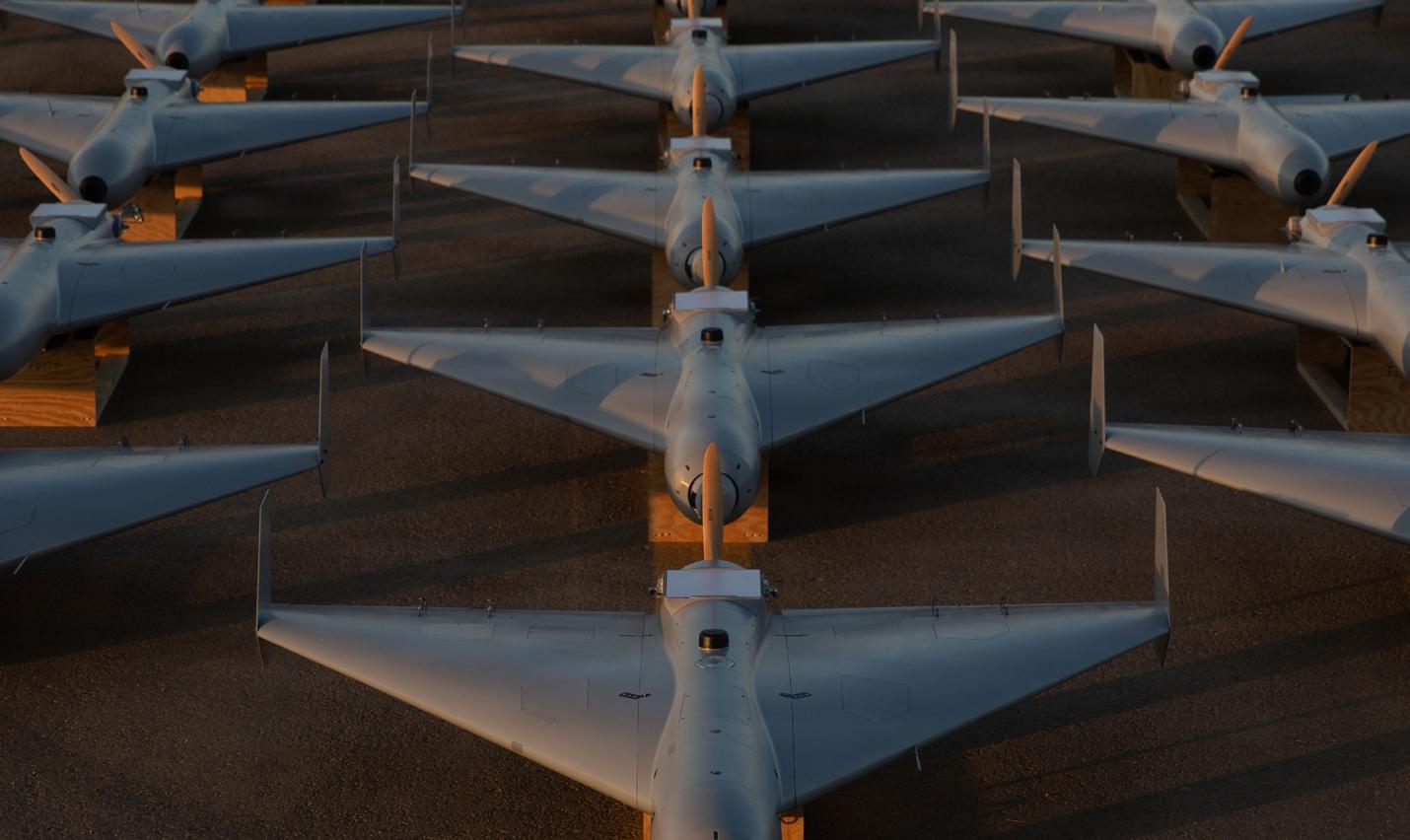
“In considering the scale of the US Army’s modernisation efforts, it is clear that it operates in a different fiscal environment than the British Army. Beyond experimentation, it is modernising virtually its entire equipment fleet – tanks, helicopters, artillery and more.”
than methodical, it can seem disjointed, even frenetic, and yet it has generated a wealth of insights on technical requirements, organisational concepts and doctrine in a remarkably short period of time.
The transformation initiative was created to overcome the sluggish pace of defence acquisition, which is as much an issue in the UK as in the US. If the British Army genuinely wants to accelerate its modernisation, then Transformation in Contact provides a valuable blueprint. What this would mean, for instance, would be that rather than experimenting with UAS in a targeted manner, whereby specific units receive them for isolated exercises, we instead issue thousands of cheap commercially-available drones (of multiple varieties – reconnaissance, attack and logistics) to every manoeuvre unit immediately. This would facilitate widespread experimentation, accelerate feedback, drive innovation and build essential soldier skillsets far more quickly.
CONCLUSION
Transformation in Contact has instilled a sense of urgency in the US Army, and there is now real momentum as it trials and integrates new technology. This article has focussed on armoured divisions, highlighting key developments in drones, armoured vehicles and AI-enabled command and control, but this is only part of the innovation that is underway. The Army is also trialling ground-based autonomy, counter-drone systems and other capabilities to transform light and airborne forces. Concurrently, it is experimenting with new organisational
structures and concepts to reshape the future force, whilst rethinking doctrine and tactics. The US Army’s Modernization Strategy set a target of 2035 for the future force to be ready for large-scale combat operations, with equipment programmes and transformation efforts aligned to deliver within that timeframe. Although some programmes may encounter delays or cancellation over the coming decade, with the level of investment and drive for transformation, real change is afoot. For the UK and other NATO partners, the challenge will be to keep pace and ensure we maintain interoperability with the US in the future.
57Ibid, at p.9.
58MoD (2026),’ Futuristic helicopter drones programme advances as British based companies selected to develop prototypes’, MoD press release dated 24 Jan 2026, available at: gov.uk/government/news/futuristic-helicopterdrones-programme-advances-as-british-based-companiesselected-to-develop-prototypes
59MoD (2025), ‘Fundamental lethality shift for British Army spearheaded by novel targeting tech ‘ASGARD’’, MoD press release dated 20 July 2025, available at: gov.uk/ government/news/fundamental-lethality-shift-for-britisharmy-spearheaded-by-novel-targeting-tech-asgard
60Nilsson, P. (2024) ‘Germany’s Rheinmetall in US defence push with $950mn acquisition’, Financial Times, dated 14 Aug 2024, available at: ft.com/content/3daacd0e-93a744be-bb71-53f1b0e620af; Weichart, B. (2025).
61The British Army has been trialling and experimenting with ‘DSA’ for almost a decade, but there have been delays to the programme over the years – Savage, O. (2024) ‘UK Dismounted Situational Awareness programme delayed’, Janes, dated 12 March 2024, available at: janes.com/ osint-insights/defence-news/defence/uk-dismountedsituational-awareness-programme-delayed. As at 2026, it has yet to be rolled out across the force. Comparatively, WinTAK has been in service in the US Army since 2020 and has been issued at scale to TiC Brigades since 2024.
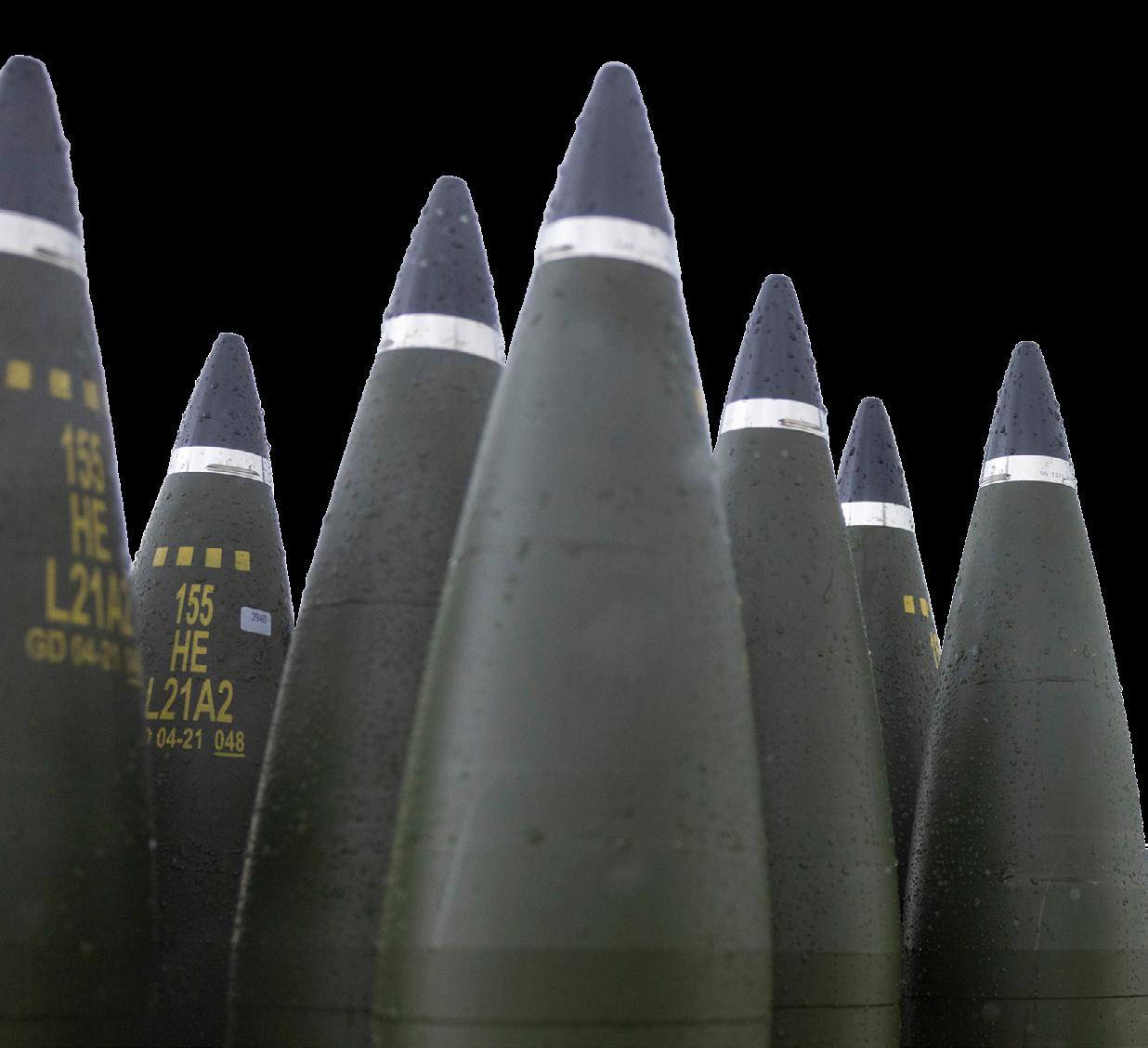
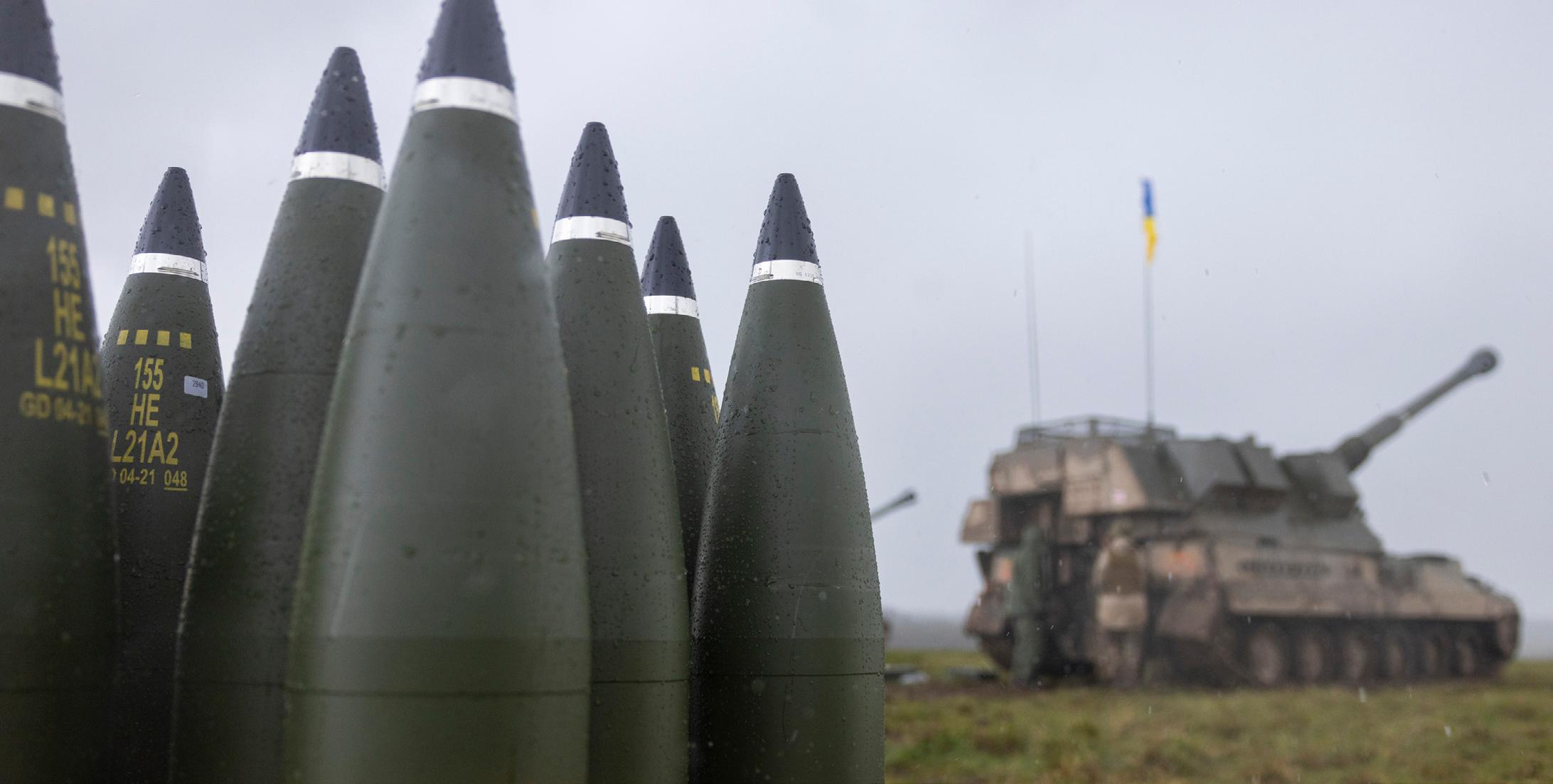
SEVERE RISK OF ‘SHELL SHOCK’
AUTHOR
Lieutenant Colonel Martin Smith has been employed continuously in capability and acquisition roles across Army HQ since 2017, with experience stretching back to 2008. He is currently serving as the SO1 on the Archer selfpropelled howitzer project within the Programmes Directorate.
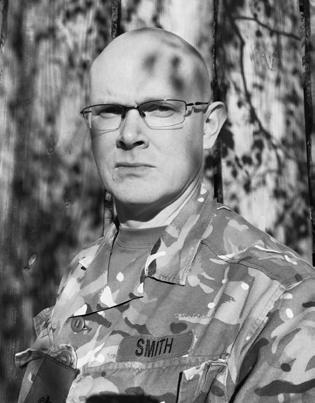
For the want of a nail the shoe was lost, For the want of a shoe the horse was lost, For the want of a horse the rider was lost, For the want of a rider the battle was lost, For the want of a battle the kingdom was lost, And all for the want of a horseshoe nail.
AN aim of the most recent Strategic Defence Review is ”to deliver a tenfold increase in lethality” for the Army through a “RecceStrike model for land fighting power”.1 An impressive ambition, indeed. Although, to the best of my knowledge, no model has ever killed anyone. What kills is firepower. And the British Army’s firepower is provided by the Royal Artillery. And the weapon of artillery is ammunition. It is the hubris of all peacetime armies to think otherwise. Models don’t kill. Shells do. So, as professional soldiers, we should have more than a passing interest in how those shells will be delivered to our future battlefield.
last year,3 if the Ukrainians had more artillery ammunition, then they would be killing more Russians with it. The two are complementary, not mutually exclusive.
1Strategic Defence Review 2025, para 30.
2Commanding General, US Army Europe and Africa.
3Royal United Services Institute (RUSI) Land Warfare Conference, 17-18 June 25.
4The Lesson, 1901.
‘Yes’, you cry, ‘but drones are the future’. ‘Look at what is happening in Ukraine,’ you will say. And you would be right. However, I would make three observations. Firstly, dumb shells can be fired 24/7 in all weathers, can’t be spoofed or jammed, and are almost impossible to shoot down. Secondly, Ukraine is firing a couple of million shells a year, whilst the UK has ordered a number that can only be described as pitiful. One of us has got it right. Lastly, as US General Chris Donahue2 stated at the RUSI Land Warfare Conference
Ammunition – or the lack thereof – is never newsworthy. Or, at least, until it is very newsworthy. In 1915 a ‘shell scandal’ caused a political crisis which brought down the Liberal government. The British Expeditionary Force which had left for France the previous August was, arguably, one of the best that has ever set sail from these shores. It was small, certainly, but perfectly formed; or so it was thought. The 2nd Anglo-Boer War, as Kipling would have it, had taught us “no end of a lesson”.4 The British Expeditionary Force was fast, mobile and highly trained; but it was also brittle. Ammunition stockpiles were quickly consumed, and it would take the creation of an entire new Ministry of Munitions – with draconian powers – to resolve. A century later, our peacetime governments are still playing pass-the-parcel with this very same problem, hoping that the music won’t stop.
Defence is fully aware of this, and our shortage of artillery in general. Indeed, having given our remaining AS90s to Ukraine, it is impossible for it not to be. It is for this very good reason, therefore, that the Mobile Fires Platform project – our new, 155mm self-propelled howitzer (pictured right) – is the Army’s top equipment priority. However, the artillery system-ofsystems is only as good as its weakest link. Right now, that is ammunition. Specifically,
ammunition packaging. Let me explain further.
As well as all the key user requirements that you would expect, there was a further constraint placed upon the Mobile Fires Platform initiative: “...a 20% reduction in the number of people needed to deliver and support new capabilities.”5 It is to “be crewed by a maximum of three”.6 The only way to achieve this was to choose an autoloader, driving cost and complexity into the project. However, this only moved the problem elsewhere along the artillery logistics chain, since someone still had to restock the turret. An AS90 detachment at full strength had nine soldiers (‘gun numbers’), of which five – nearly two thirds – were almost exclusively engaged with ammunition preparation.7 However, the joys of ‘ammunition bashing’ stretch well beyond the gun itself.
To understand why this is, it is necessary to consider how ammunition is delivered to the gun position. Ever since 1970, British 155mm operational ammunition has been delivered in a Unit Load Container (ULC),8 originally procured for the tri-nation FH70 project. These ULCs were specifically developed for ease of transportation and handling of the new L15 high-explosive shell and L8 cartridge on the Foden gun-towing vehicle.
Each ULC held 17 all-up rounds of 155mm ammunition, with 17 fuzed shells at the bottom, and 17 bag charges at the top. It was simple (apart from the arithmetic), robust, foolproof and proven on operations. It worked. Soldiers would slide the shells and charges out of the helitubes and either load them into the gun
[Demountable Rack Offload and Pickup System] which entered service in the 1990s, with its flatrack of ten ULCs (170 rounds) that could be delivered direct to the gun. Manual handling was still required from ULC to the gun, but the innovation significantly addressed the challenge of sustaining the very high-intensity battles anticipated against the Warsaw Pact. This system continued to prove its worth – including on operations – with the introduction of AS90.
The weight of fire that the Mobile Fires Platform can deliver will be driven, largely, by how quickly soldiers can reload the guns from those ULCs. Or at least it would do if we still had any ULCs. Responsibility for artillery ammunition packaging lies with the Defence General Munitions Delivery Team, in Defence Equipment & Support (DE&S). In 2023, DE&S placed an order for 155mm ammunition with BAE Systems through the Next Generation Munitions Solution contract. The ULCs were meant to be supplied as government furnished equipment. However, having gifted most of our ULCs away to Ukraine along with our ammunition, and discounting the ones that have literally rusted away, there are now only enough for about 5,000 shells.
The decision was therefore made to issue the 155mm rounds in the nattily-named Unit Load Specification (ULS) 291. These wooden pallets hold 34 shells stacked vertically and are held together with metal banding. They are cheap and easy to produce, and provide a safe means of transporting shells. However, they are not fit for purpose on a battlefield. The shells within them are open to the elements, particularly dirt, dust and other contaminants. The shells cannot travel fuzed, so it will take more time – or more soldiers – to prepare the ammunition on the gun position. And, most damning of all, once the metal banding has been cut, the ULS becomes unstable and therefore the ammunition – and the vehicle
than bandoliers of stripper clips – only worse.
Another problem is arithmetic. The ULC held one full bag charge for every shell. With Archer we have entered the era of modular charge systems. Unfortunately, whilst the ULS 291 holds 34 shells, the new charges come in pallets of 20 full charges (120 modules). A flatrack will now be left with either 16 shells without charges, or 38 charges without shells. At a time when we don’t have enough ammunition, flatracks or trucks, and no clever way of tracking any of it, this is a logistical nightmare.
There might, of course, be a better solution than the current ULC and this is the perfect time to reconsider 155mm ammunition packaging in its entirety. However, procuring a brandnew system will take years. The answer, right now, might be to just buy more ULCs. It is a simple, proven design, for which Defence owns the intellectual property rights. It is hard to imagine a more ‘oven ready’ project. Alas, the Defence procurement process has made this all but impossible to deliver.
The first challenge is invariably finding the money. Normally this is done through the balance of investment process every year. And, in a normal year, it would be competing with all the ‘big ticket’ items such as Boxer, Ajax and Challenger 3. Unless such items are slated against a bigger project – like the Mobile Fires Platform – they don’t get noticed. In this way
This presents
something of a problem on a battlefield. It is the equivalent of issuing infantrymen with 5.56mm rounds in cardboard boxes rather
5VCDS 06/09/01. Joint Requirements Oversight Committee - Terms of Reference, Annex A, para 14, dated 26 April 21.
6MFP User Requirement Document v2.0, dated 4 May 2021.
7RA Manual Vol III, Surface to Surface, Pamphlet No 22 Part 1, AS90 Drill Book, Ed 2, Dec 21
8ACA L245.
9Munition Incident Defence (MID) reports bear witness to this. Training is mostly conducted with the L21 HE shell, which is packaged in a similar ULS. For example, an ‘Accident, Near Miss and Unsafe Round Report’ dated 2 Nov 20: ‘L21 projectile fell off rack whilst being move from Ammo point to Gunline. This damaged the L166 Fuze, leaving a crack down the outer covering. Therefore deemed unsafe by BSM and GAC’.
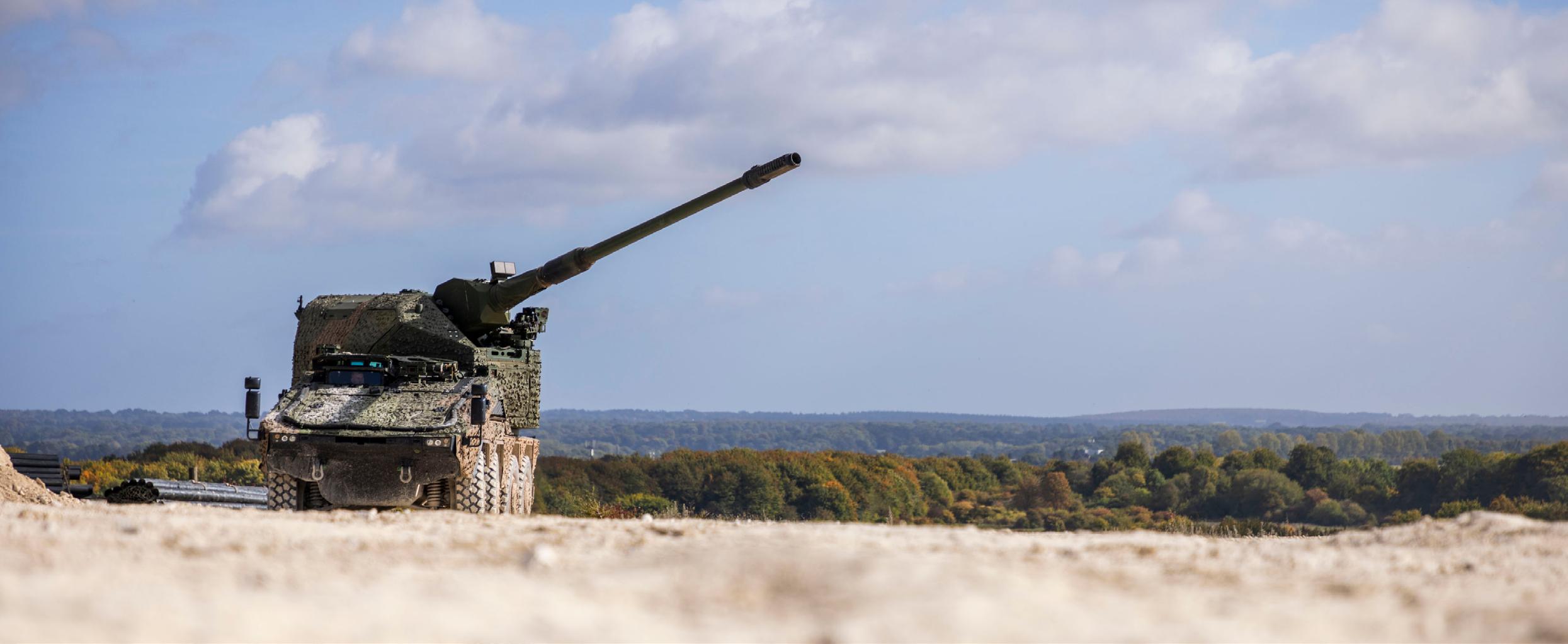
critical capabilities which form the vital ‘glue’ between projects fall between the cracks.
This is not helped by the next problem, which is a lack of ownership. Under the last Army Operating Model Review, a ‘federated’ model of capability sponsorship was enacted. Everyone – and no one – would own the problem. Futures Directorate would manage the total stockpile requirement, run the capability planning groups and control the money. Programmes Directorate would deliver discrete ammunition projects. HQ Field Army would continue to manage the in-service ammunition, including ordering it for training. Nobody would own ammunition in the round (if you’ll pardon the pun).
But, let us assume that the money can be found. The next problem is delivery. DE&S is the respective agent for ammunition. Indeed, until recently when DE&S made its operating model utterly opaque to the outside world, there was an Ammunition Packaging Management Team. The clue, you would think, was in the title. Alas, DE&S does not have the ‘resource’ (i.e. people) to do the work. Defence General Munitions has, historically, been a bit of a sleepy hollow. However, right now – with Archer, 40mm, 120mm mortar and Challenger 3 to name but a few – it is criminally under-resourced. DE&S can, supposedly, justify 400 ‘people coaches’; it can’t, seemingly, prioritise the team which actually delivers lethality. Perhaps this will change under the new National Armaments Director Group, which sounds an awful lot like the Ministry of Munitions of yesteryear. But somehow I doubt it.
DE&S priorities are, allegedly, linked to those of the Front Line Commands, including Army HQ. Alas, 155mm ammunition does not have its own priority; instead, it is, at the time of writing, still slated against Archer. This was fine when Archer was the Army’s top priority. It no longer is. Army HQ could choose to give ammunition its own priority, or to slate it against the Mobile Fires Platform; however, the capability is some years away, so this is a problem that can be kicked down the road. Sadly, without a high enough Army priority, DE&S will not prioritise the work.
But, let us say that Defence General Munitions are resourced, and willing to do the work. Formal change requests to cost the work are still paused, at the time of writing, because of the Defence Investment Plan. Which is strange, given that any conceivable strategy will require 155mm artillery.
Now let us imagine that there is an in-year
“Artillery ammunition packaging is out of scope of the Mobile Fires Platform project; as a result, the Close Support Fires programme will not realise its benefits. Who cares? No one, it would seem.”
underspend. These routinely occur due to government financial ‘annualisation’, or the ‘use it or lose it’ approach to funding. Money is available: however, it has to be ‘accrued’ (spent) by the end of March each year. To do that we need to get on contract with a company, and to select that company we need a competition. Before we can even go to the market we need approval through an outline business case, which takes time to write, circulate and approve. After the competition there needs to be a full business case to spend the money. And now, on top of that, there is also a need to go through a further three-tofour weeks of the ‘PESS’ process (the ironically named Pre-Election Spending System). For a government wishing to increase Defence spending to 3.5 per cent of gross domestic product, requiring the Secretary of State to sign off everything over £100,000 – the Defence equivalent of loose change – seems a strange way of going about it.
Another problem is that Defence talks about programmes and portfolios, but thinks in terms of projects. Money is allocated in the Equipment Plan on the basis of delivering outputs (such as a new gun) not on realising benefits (a reduced logistic burden, for example). Artillery ammunition packaging is out of scope of the Mobile Fires Platform project; as a result, the Close Support Fires Programme will not realise its benefits. Who cares? No one, it would seem. As Archer has demonstrated, so long as there are guns on a gun park and a ministerial photo opportunity, few people want to look under the bonnet of whether or not we have a capability.
You might think that Rapstone is the perfect organisation to address such matters. I would agree. Indeed, I wrote a strawman paper in January 2025 suggesting that Rapstone ought to concentrate on ‘the 5Ds’: dull, dirt cheap, desperately needed, deliverable and deadly. Ammunition packaging ticks all the boxes. Alas, it is not ‘sexy’. Rapstone declined the invitation.
More worryingly, organisation savings against the Mobile Fires Platform are already being considered. Army Strategic Organisation in Army HQ is reducing the establishment of its detachments to just four soldiers. Although
additional workforce is being added elsewhere in the battery establishment, we need to guard against premature reductions.
So, we find ourselves today buying too few guns to meet the requirement, due to a policy direction which forced us down the expensive autoloader route. We are content to spend billions on new guns, but blanche at the thought of paying for a full capability that will actually deliver the benefits needed. If the Chief of the General Staff’s intent is to increase lethality tenfold, and artillery still delivers that lethality, then we are doing the exact opposite of what is needed. My prescription? Increase the stockpiles of our ammunition – especially artillery ammunition – tenfold. Buy the trucks and flatracks to carry it. And structure the Army with sufficient Royal Logistic Corps regiments to drive the trucks. And, in the name of all things holy, put it in something usable. Done.
The question, ultimately, boils down to this: are we really serious about warfighting? Will we constantly chase the latest buzzword –‘cyber’, ‘AI’, ‘kill web’ – and be seduced by the latest shiny thing at international trade fairs in our quest to find the answer to the maiden’s prayer? Will we continue to over-specify individual capabilities at huge expense and risk rather than layer cheaper systems? Will we continue to lie to ourselves about being able to put a corps in the field, or cheat on Exercise Warfighter by pretending we can fire more rounds than physically exist? Instead, do we now start to focus on what we need, not what we want: the boring, mundane, but essential glue that holds everything together? Or was Sir Humphrey Appleby – of Yes, Prime Minister (series one, episode one, The Grand Design (1986)) fame – right all along?
“Bernard, what is the purpose of our defence policy?”
“To defend Britain.”
“No, Bernard. It is to make people believe it is defended.”
“The Russians?”
“Not the Russians. The British. The Russians know it’s not.”
In 1915 the shell scandal brought down the Prime Minister, mired the Commander-inChief’s reputation and brought to an end the last ever Liberal government in the UK.
Artillery ammunition packaging is a quick fix. We should take the opportunity whilst there is still time.
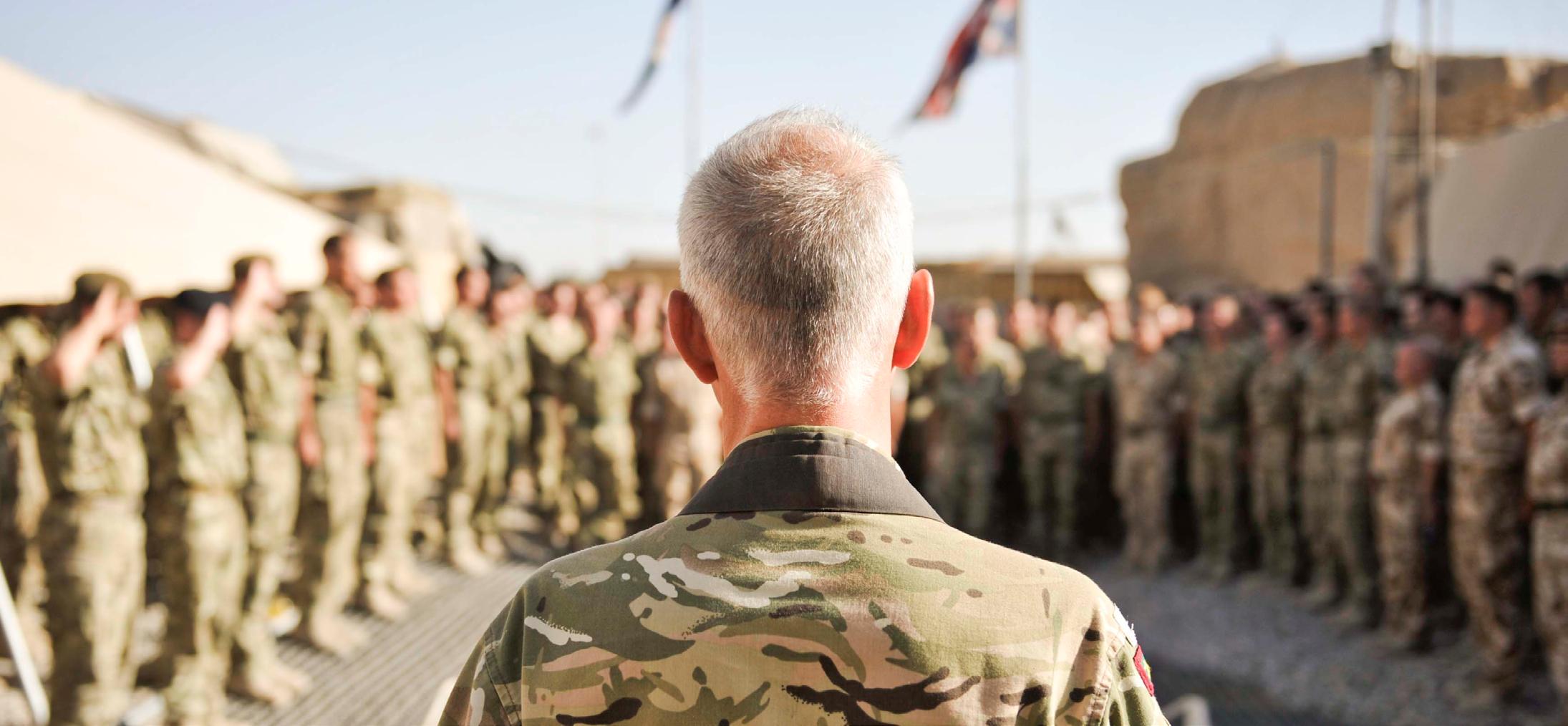
MITIGATING MORAL ATTRITION
AUTHOR
Padre Chris Kellock has served 21 years as a chaplain, across unit, brigade and staff appointments as well as attending the Advanced Command and Staff Course. He is currently the Chaplaincy Team Leader at Land Special Operations Forces.
1M.P. Finch, A Total War of the Mind, The French Theory of la Guerre Revolutionnaire, War in History, Vol.25, No.1, 2017.
2Fergusson, J. (2008) A Million Bullets: The Real Story of the British Army in Afghanistan. London, Bantam Press.
‘It is a war which takes souls.’1
WHILE attempting to return fire, a young British soldier was horrified when the enemy pushed women and children forward as shields.2 In that moment – between firing or being fired upon – the moral dilemma was absolute and the psychological cost significant.
Moral integrity directly impacts fighting power because it shapes the trust, discipline and cohesion essential for effective military operations. When service members maintain a strong ethical foundation, they make sound decisions under pressure, follow lawful orders confidently and support one another without hesitation. Conversely, moral attrition weakens this foundation, leading to poor judgement, fractured teams and reduced resilience in combat. This is not just a chaplain or moral welfare concern, it affects every individual’s ability to perform, adapt and succeed on the battlefield. Upholding moral integrity is therefore critical to preserving unit effectiveness, mission success and, ultimately, saving lives. It is a collective responsibility that underpins the very essence of fighting power.
The concept of moral injury has gained increasing attention, particularly in warfare where individuals face morally challenging and ethically ambiguous situations. Moral integrity can be interpreted in several ways, and it is important to clarify its meaning to ensure a clear understanding of what is being eroded or deteriorating. It can refer to a
holistic concept encompassing psychological, emotional and behavioural aspects, the ability to make coherent and rational moral decisions (moral calculus, such as deontological or consequentialist reasoning), or a positive character trait reflecting virtue.
Furthermore, moral integrity has both individual and corporate dimensions. Individually, it relates to a person’s internal principles and actions, while corporately it reflects the collective ethical standards, culture and behaviour of an organisation or group. It links directly with how we understand the moral and conceptual components of fighting power; recognising these nuances is essential to fully grasp the scope of the concept.
Moral attrition happens when continual exposure to difficult ethical choices, conflicting values or actions that go against deeply held beliefs gradually erodes an individual’s sense of right and wrong and undermines their moral integrity. This can result in actions that undermine unit cohesion, damage trust between comrades and weaken the moral authority essential for effective leadership and mission success. If left unchecked, moral attrition can erode discipline and operational effectiveness, putting lives and national security at risk. So, recognising and addressing moral attrition is vital to maintaining the integrity, resilience and fighting spirit of our forces.
If moral attrition outlines the process of a gradual wearing down of moral confidence or resilience, with associated psychological and emotional impact, the potential outcome
can be defined as moral injury. Whilst there is no single definition of this concept, it can be understood as a deeper wound or lasting distress that can result when someone experiences, does, witnesses, cannot prevent or feels betrayed by something that violates their core values.3
By exploring the relationship between moral attrition and moral injury, the ethical pressures faced by military personnel can be demonstrated. To help mitigate the potential for moral injury I’m proposing a three-pillar framework to strengthen moral resilience: ethical knowledge, integrated training and structured reconciliation.
WAR’S MORAL COST
The moral component of fighting power focuses on the force’s morale, leadership, team cohesion and ethical foundation.4 Recently the Chief of the General Staff noted that: “At a fundamental level, we are rethinking what it means to be a soldier in the 21st century... At the heart lies the need for strong ethical and moral values to withstand the pressures of combat.”5 I would argue that rather than a rethink, it is a renewed emphasis on a fundamental that has maybe been sidelined given the nature of operations in Iraq and Afghanistan versus the high-intensity attritional conflict witnessed in Ukraine.
Operational experience demonstrates that unless the development of the moral component is baked into the very lifeblood of service personnel then the moral health of a fighting force can be fragile, shallow and fleeting. Commenting on Russia’s ‘special military operation’ in Ukraine, Patrick Welsh notes: “If Russia was on the back foot physically, it is all but overthrown in the moral domain… Soldiers, it appeared, had not known
that they were taking part in an invasion, or had been specifically conditioned to believe they were liberators and would be warmly welcomed. This clearly was not the case.”6
The consequences of moral attrition appear at multiple levels: individually through moral injury, post-traumatic stress disorder, depression and self-harm; at unit level through weakened cohesion and eroded trust; and strategically when ethical lapses undermine mission legitimacy. Philip Zimbardo uses the metaphor of “the barrel and the apples” to explore how individual behaviour is shaped by systemic and situational factors, particularly in his work on the psychology of evil.7
He explains that “bad apples” represent individuals who engage in unethical or immoral behaviour due to personal flaws or choices. In contrast, “bad barrels” refer to the environments or systems that can corrupt otherwise good individuals, influencing them to act harmfully. Zimbardo also introduced the concept of “bad barrel makers”, highlighting the role of leaders or architects of these systems who create or perpetuate toxic environments.
This framework is widely used to examine the interplay between personal morality and external influences, particularly in contexts such as military ethics, organisational behaviour and societal structures.
AMBIGUITY, PRESSURE AND THE SLOW DRIFT OF JUDGEMENT
Land Special Operations Forces are particularly vulnerable to moral attrition due to their “time-sensitive, covert, low-visibility” missions, close work with host-nation partners, high cultural demands and elevated risk.8 Concerns about the ethical conduct of the
special operations community highlight how cumulative exposure to high stress potentially accelerates this process of moral attrition.9 In 2020, the Brereton Report found “credible evidence” that elite soldiers unlawfully killed 39 people, recommending 19 current or former Australian Defence Force members be investigated. Recent events have seen this play out and the inquiry is mirrored in the UK.10
Given these pressures and the strategic cost of compromised legitimacy, McDermot and Hart (2017) argue that commanders and soldiers require ethical armouring,11 a method that translates ethical theory into practical frameworks helping small-unit leaders understand and anticipate ethical risk. They emphasise that such armouring must be embedded at the lowest level, shaping not only what soldiers do but who they are.
Operations, whether kinetic or humanitarian, engage every rational and emotional aspect of a service person’s identity. Reflecting on Op Pitting, the UK military’s rapid, two-week humanitarian airlift from Kabul airfield, one soldier noted: “We can train for all sorts of circumstances, but training for seeing children being crushed, women being beaten is not something anybody can really train for… it was just seeing the human tragedy… it was mentally tough.”12
3VanderWeele TJ, Wortham JS, Carey LB, Case BW, Cowden RG, Duffee C, Jackson-Meyer K, Lu F, Mattson SA, Padgett RN, Peteet JR, Rutledge J, Symons X and Koenig HG (2025) Moral trauma, moral distress, moral injury, and moral injury disorder: definitions and assessments. Front. Psychol. 16:1422441. doi: 10.3389/ fpsyg.2025.1422441, [accessed 10 Apr 26].
4Army Doctrine Publication, Land Operations Part 2: The Application of Land Power, 2022, 1-4
5https://www.gov.uk/government/speeches/chief-of-thegeneral-staff-speech-at-rusi-land-warfare-conference-2025

“We can train for all sorts of circumstances, but training for seeing children being crushed, women being beaten is not something anybody can really train for… it was mentally tough.”

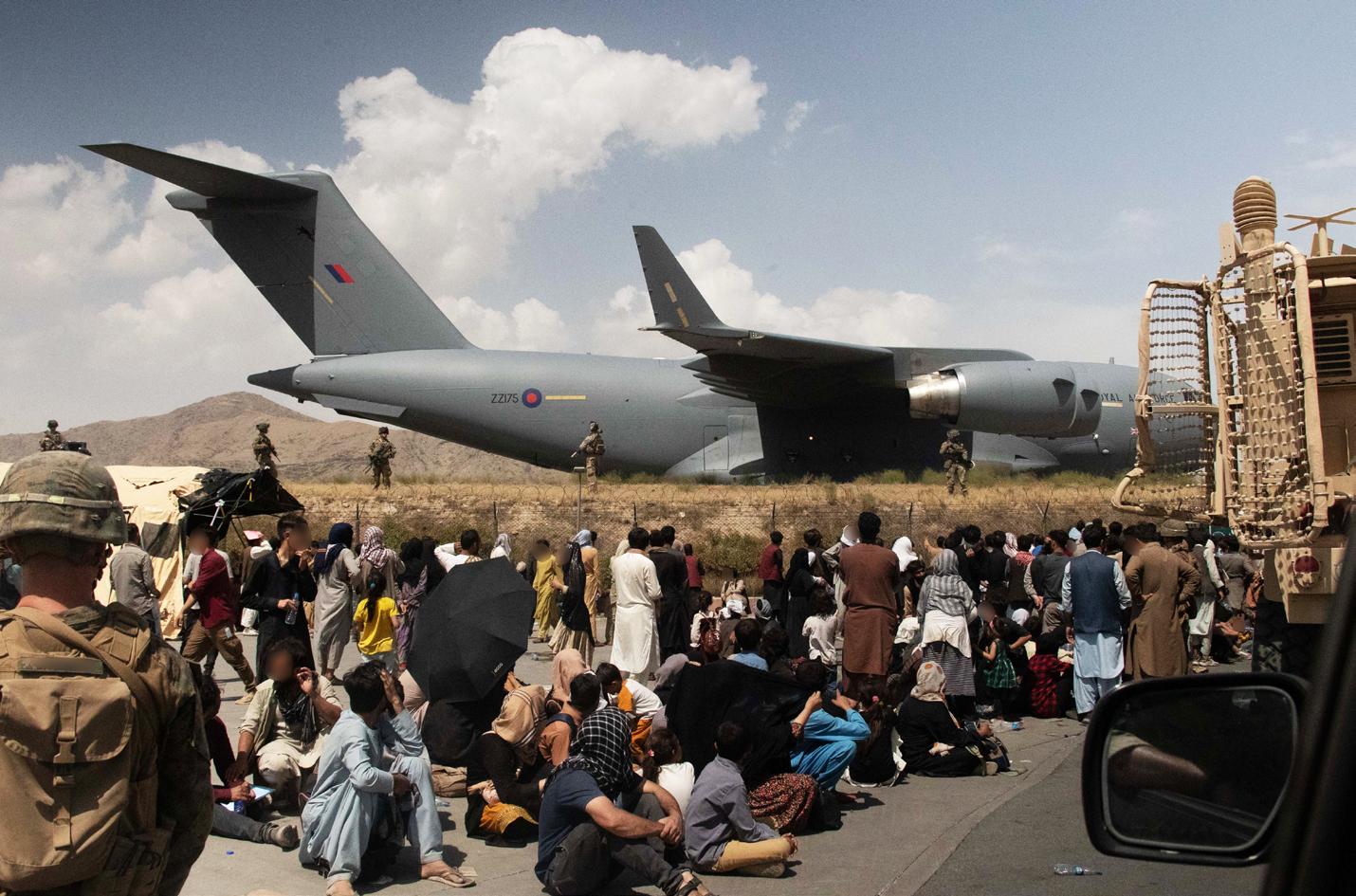
6Fighting power and the war in Ukraine, Wavell Room.
7Zimbardo, P. (2007) The Lucifer Effect: Understanding How Good People Turn Evil. New York: Random House.
8Baker, P., Herbert, R., Whetham, D., ‘The Ethics of Special Ops, Raids, Recoveries, Reconnaissance and Rebels’, Cambridge Uni Press, Cambridge, 2025, 8.
9Gunter, J., O’Grady, H. & Tinman, R. (2025) SAS war crime evidence suppressed, inquiry hears. BBC News, 1 December.
10Ben Roberts-Smith: Why decorated soldier’s war crime case is so historic for Australia, bbc.co.uk/news/articles/ czjwp1vjn9lo [accessed 10 Apr 26].
11McDermott, T., and Hart, S. (2017). Chapter 2 Armouring against Atrocity: Developing Ethical Strength in Small Military Units. In Military Ethics and Leadership, Leiden, The Netherlands: Brill | Nijhoff. Available From: Brill https://doi.org/10.1163/9789004339590_003
12L Cawley and A Dunlop, “Afghanistan: ‘I got the chance to go out and help people’,” BBC, 2022.
Antonovsky (1987) similarly concludes that war destroys fundamental feelings of safety, predictability, stability and the sense of coherence.13 Grimell’s work with Ukrainian chaplains echoes this, describing how personnel “experienced and witnessed horrific, incomprehensible events… dissolving existing norms and challenging perceptions of right and wrong”, with the need to kill contradicting the moral compass shaped by democratic society.14
Emerging forms of warfare do little to reduce this risk. Woolley (2025) argues that despite physical distance, drone operators still face combat stressors “like those in close-quarters combat”, experiencing adrenaline surges and physiological reactions.15 Operational intensity, isolation and the inability to discuss their work may further compound strain and heighten vulnerability to moral attrition and moral injury.
While physical wounds are visible, the unseen wounds caused by moral attrition often cut deeper, possibly proving harder to identify. Upon reflection, one explained that his task was to “preserve soldiers’ human qualities… lest they become war animals, victims of moral attrition”.16
WHY MEANING STILL MATTERS
In defining the breadth of these ‘human qualities’, the World Health Organisation describes health as complete physical, mental and social wellbeing – not merely the absence of illness.17 More recent World Health Organisation frameworks, including the Bangkok Charter (2005), recognise spiritual wellbeing as an essential part of a holistic understanding of health.18
Spiritual fitness is widely understood as the ability to sustain core beliefs, values and meaning, capacities that support resilience and moral courage under pressure. It is not limited to religion; rather it encompasses diverse beliefs and worldviews that can strengthen personnel against the most damaging effects of moral attrition.
Research reinforces this. Yeung and Martin (2014) show that spiritual fitness is strongly linked to resilience and wellbeing in high-stress environments. Meaning, purpose and spiritual coping predict greater resilience and posttraumatic growth, even when demographic factors are controlled.19 Complementary work in military medicine likewise demonstrates that spiritual fitness correlates with psychological resilience among military personnel, highlighting the measurable role of meaning and values in sustaining moral and emotional strength under pressure.20
“Ukrainian chaplains noted that soldiers who lost their mortality, ethics and character became like ‘war animals’, reckless, lacking in judgment, dangerous to themselves, their comrades and their unit.”
SPIRITUAL FITNESS: THE MISSING PILLAR IN READINESS
Within British military doctrine, moves toward more secular and inclusive language have reduced explicit references to spirituality, possibly because the term is too often perceived as referring only to religion. For example, mentions of spirituality in Army Doctrine Publication: Land Operations (2016) are removed from the current edition, despite the earlier version emphasising spiritual foundations – religious, cultural or political – as essential to moral resilience.21 The 2016 iteration included: “Maintenance of morale. Morale is a positive state of mind – a will to
13Antonovsky, A. (1987). Unraveling the mystery of health: How people manage stress and stay well. Jossey Bass Social and Behavioral Science Series. Hoboken: Jossey Bass.
14Grimmel, J, “Ukrainian Military Chaplaincy in War: Lessons from Ukraine”, doi.org/10.1558/hscc.31917
15Woolley, R, ‘Killing, living with killing and moral injury. Do we do enough to prepare our warriors to kill and live with killing’, DEFAC, EuroISME, 2025.
16Grimmel, J.
17who.int/data/gho/data/major-themes/health-and-wellbeing, accessed 19/1/26.
18who.int/teams/health-promotion/enhanced-wellbeing/ sixth-global-conference/the-bangkok-charter, accessed 19/1/26.
19Yeung, D., & Martin, M. T. Spiritual Fitness and Resilience: A Review of Relevant Constructs, Measures, and Links to Well-Being. RAND Health Quarterly (2014).
20Barczak-Scarboro, N., Rapp, P.E., Cellucci, C.J., Chamberlin, R., McCarthy, R. & Park, G.H. (2025) ‘Personal spirituality is correlated with psychological resilience in a training Marine population’, Military Medicine, usaf200. doi: 10.1093/milmed/usaf200.
21Army Doctrine Publication Land Operations Part 2: The Application of Land Power AC72202. Maintenance of Morale.
22Army Doctrine Publication Land Operations (2016)
23Koenig HG. “Spiritual Readiness” in the U.S. Military: A Neglected Component of Warrior Readiness. J Relig Health. 2023 Jun;62(3):1561-1577. doi: 10.1007/ s10943-022-01563-z. Epub 2022 Apr 30. PMID: 35488076.
24Defence_People_Health_and_Wellbeing_Strategy.pdf, p2.
25Grimell, J.
win – which depends on strong leadership. It consists of fighting spirit, moral cohesion, discipline, comradeship, pride in self and unit, confidence in equipment and sustainment, and a firm spiritual foundation.”22
The spiritual foundation is therefore not religiosity, rather spiritual resilience is a capability in and of itself, vital in mitigating moral attrition. Noting a similar concern, a US Army report notes that “service members typically receive extensive training in the tactical, mental, social, and behavioural aspects of readiness, while the spiritual aspects are often ignored”.23
Furthermore, human performance optimisation programmes rarely address the role of purpose and identity in human performance; the Defence People Health and Wellbeing Strategy omits spiritual fitness entirely.24 These initiatives tend to focus on how soldiers can perform better but overlook the deeper question of why they must perform well. To counter moral attrition, a genuinely holistic programme should include spiritual fitness as a core component underpinning moral and ethical lines of effort.
Although spiritual fitness is difficult to measure, its value is clear. Here, spiritual refers not to religion alone but to the sources of meaning, purpose and moral grounding that anchor individuals. These may include belief in God or a higher power but are equally shaped by personal values and cultural influences.
Spiritual fitness strengthens soldiers’ sense of purpose and moral courage, supports resilience and cohesion, and – as demonstrated in the Ukrainian chaplaincy experience – is concerned with preserving individual humanity as well as upholding broader human ethics in war. Ukrainian chaplains noted that soldiers who lost their mortality, ethics and character became like “war animals”, reckless, lacking in judgment, dangerous to themselves, their comrades and their unit.25
The impact of such a descent, at the time and post-conflict, is recognised throughout history, even though there is still no single, settled definition or approach. Terms such as nostalgia, soldier’s heart, war neurosis, shell shock and battle fatigue all point to the same reality: severe trauma – often driven by what we now call moral attrition – leaves a lasting mark on those exposed to its pressures.
Clinical work with Vietnam veterans led Shay to describe moral injury as a “character wound” rooted in leadership betrayal: a
breakdown in the moral contract between leader and led, where expectations of trust and protection are violated.26 Litz presented a complementary internal view, arguing that moral injury arose from moral dissonance when individuals commit, witness or fail to prevent actions that violate deeply held moral beliefs.27 This rupture produces guilt and shame, undermining forgiveness, relationships and reintegration.
Taken together, these perspectives reveal two converging pathways into moral injury – one relational and external (Shay), the other internal and psychological (Litz). Both reflect the slow erosion of moral clarity and resilience under sustained operational strain. Whether through betrayal or repeated exposure to morally dissonant events, moral attrition creates the conditions in which moral injury takes root. It is not merely an outcome but the environment that makes psychological and spiritual harm possible.
Recognising both the internal and external dimensions illustrates the complexity of moral attrition and the range of moral pressures faced by service personnel. Zust and Krauss argue that moral injury is the “soul wound” created when individuals cannot reconcile the gap between their idealised values and their lived experiences.28 Historical interviews with the US Army personnel who committed the My Lai massacre in Vietnam demonstrate the protracted impact of this inability to reconcile what they did while still trying to believe they are good people. Moral attrition and its associated aftermath have many sides. Robert Kilgour served in Northern Ireland, Bosnia and the Gulf: “I’m 43, and every time I think about what I’ve gone through, it brings it back. It’s still raw. I’ve seen some of the best people you’ll ever meet in life put in the ground, and I’ve put people in the ground. It’s changed me.”29
Recent operations show similar patterns of moral strain, yet discussion of moral injury often overlooks humanitarian and peacekeeping deployments. As the UK expands its ‘persistent presence’, personnel will increasingly operate in morally demanding environments where pressures overlap and compound. Clinicians note that this gradual erosion of moral coherence frequently
26-27Shay, J “Learning about combat stress from Homer’s Iliad,” 4 (1/10/91 1991), https://doi.org/10.1007/ bf00974590.
28Zust and Krauss, “Force Protection from Moral Injury: Three Objectives for Military Leaders,” 7.
29Hattenstone, S and Allison, E, “Post-traumatic stress disorder,” The Guardian, 18/10/14.

“Every time I think about what I’ve gone through, it brings it back. It’s still raw. I’ve seen some of the best people you’ll ever meet in life put in the ground, and I’ve put people in the ground. It’s changed me.”
precedes moral injury, with guilt, shame and fractured self-judgement emerging as primary forms of distress.
Moral attrition becomes evident when a person’s core identity or humanity is diminished. Its effects include distorted ethics, loss of spirituality, alienation, eroded trust, aggression and self-harm. The deeper risk lies in treating guilt and shame only as impediments to performance; suppression may sustain short-term effectiveness but accelerates long-term dehumanisation. Left unaddressed, moral attrition harms individuals and corrodes the legitimacy and humanity of the force.
As conflicts end, the state must reintegrate those who serve. Blunting moral sensitivity carries lasting consequences, particularly for those unable to recover from moral injury. History shows that some veterans were
marginalised rather than supported – enduring reminders that preserving humanity in war is essential to both operational credibility and long-term wellbeing.
TRAINING FOR THE MORAL REALITIES OF WAR
A proposed framework for building resilience to moral attrition – and reducing the likelihood that it develops into moral injury – rests on three mutually reinforcing pillars: knowledge, training and integration, and reconciliation. Each pillar targets a specific vulnerability identified throughout this article: the erosion of moral coherence, the absence of realistic preparation for ethical pressure, and the need for structured support to process morally injurious experiences. Together, they address the critical gaps that allow moral attrition to accumulate unchecked, safeguarding the moral component of fighting power and
UK MOD © Crown copyright
sustaining the meaning, purpose and identity essential to long-term resilience. It is for this reason that knowledge must come first, because without a clear ethical framework and shared moral vocabulary, we lack the foundation needed to withstand the early stages of moral attrition.
Where ethical education is delivered, Smith (2024) argues that it equips soldiers to navigate complex moral dilemmas, such as distinguishing the “lesser of two evils” and separating guilt from culpability. Rooted in transformative learning theory, this approach encourages critical reflection and contextual understanding of moral complexity. One soldier reported that such training enabled him to maintain moral clarity under intense pressure. By fostering sustained reflection, ethical training can mitigate the moral attrition associated with warfare and the potential for moral injury. Effective leadership remains essential in shaping the ethical climate that supports this learning.30 Command and chaplaincy led ethical discussion sessions, engaging with academics and staff course ethics input all point the way to embedding ethical education in combat-ready training.
The second pillar – training and integration – deliberately embeds moral and ethical challenges into military exercises to strengthen individual and collective moral resilience. Human skills training, frameworks for moral decision making and ethical dilemma in exercise serials are some of the useful tools for helping mitigate the cumulative effects of morally complex environments.
reframes moral injury not as pathology, but as a natural response of a morally functioning individual confronted with events that challenge deeply held values. This approach also incorporates the biopsychosocial spiritual framework,32 highlighting how different aspects of military life can produce overlapping yet distinct injuries – affecting the mind, body and the soul through moral injury, further underscoring the need for holistic support.33
Effective mitigation depends on a wide network – the chain of command, peers and the broader unit culture all contribute to creating conditions in which individuals can confront, interpret and reconcile morally challenging experiences. While chaplains offer a strengths based, narrative approach that frames moral injury as a catalyst for growth rather than failure, experienced leaders and supportive peers are equally vital in sustaining an environment where such reflection is normalised rather than stigmatised. Given the subjective nature of moral attrition and moral injury, some personnel will inevitably continue to struggle, underscoring the need for a sustained, multidisciplinary system of support understood to be everyone’s responsibility.
As understanding of operational stress management evolves, green space activities offer tailored support based on operational needs. These programmes incorporate command input, chaplaincy, welfare support, listening spaces, group work, yoga, mindfulness and breathing exercises to help personnel reflect, discuss and transition postdeployment.
alongside tactical preparation so soldiers are not confronting moral complexity for the first time in theatre; integrating realistic ethical dilemmas into training to build moral resilience; and providing structured avenues – through chaplaincy, reflective practice and engaged leadership – for personnel to process moral shock, which is essential to sustaining fighting power rather than merely remedial.
Equally, restoring confidence in discussing spiritual fitness – encompassing meaning, purpose and identity – is vital, as it provides the deeper grounding that anchors personnel under extreme pressure and protects against the cumulative effects of moral attrition. Proactively addressing moral attrition in this way strengthens both the force and the moral authority on which British military power depends, while neglecting it risks eroding the will, cohesion and ethical credibility fundamental to operational success.
30McDermott, T., & Hart, S. (2017). Armouring against Atrocity: Developing Ethical Strength in Small Military Units. In P. Olsthoorn (Ed.), Military ethics and leadership (pp. 16–55).
31Williams, J. (2025). 20250310 Lessons_SCORPIUS OS, email to C. Kellock, 10 March.
32The biopsychosocial spiritual framework is a holistic approach to understanding health and wellbeing, which considers the interconnected influence of biological, psychological, social, and spiritual factors on an individual’s overall functioning and quality of life.
33Richardson, N. M., & Lamson, A. L. (2022). Understanding moral injury: Military-related injuries of the mind, body, and soul. Spirituality in Clinical Practice, 9(3), 145–158. https://doi.org/10.1037/scp0000270


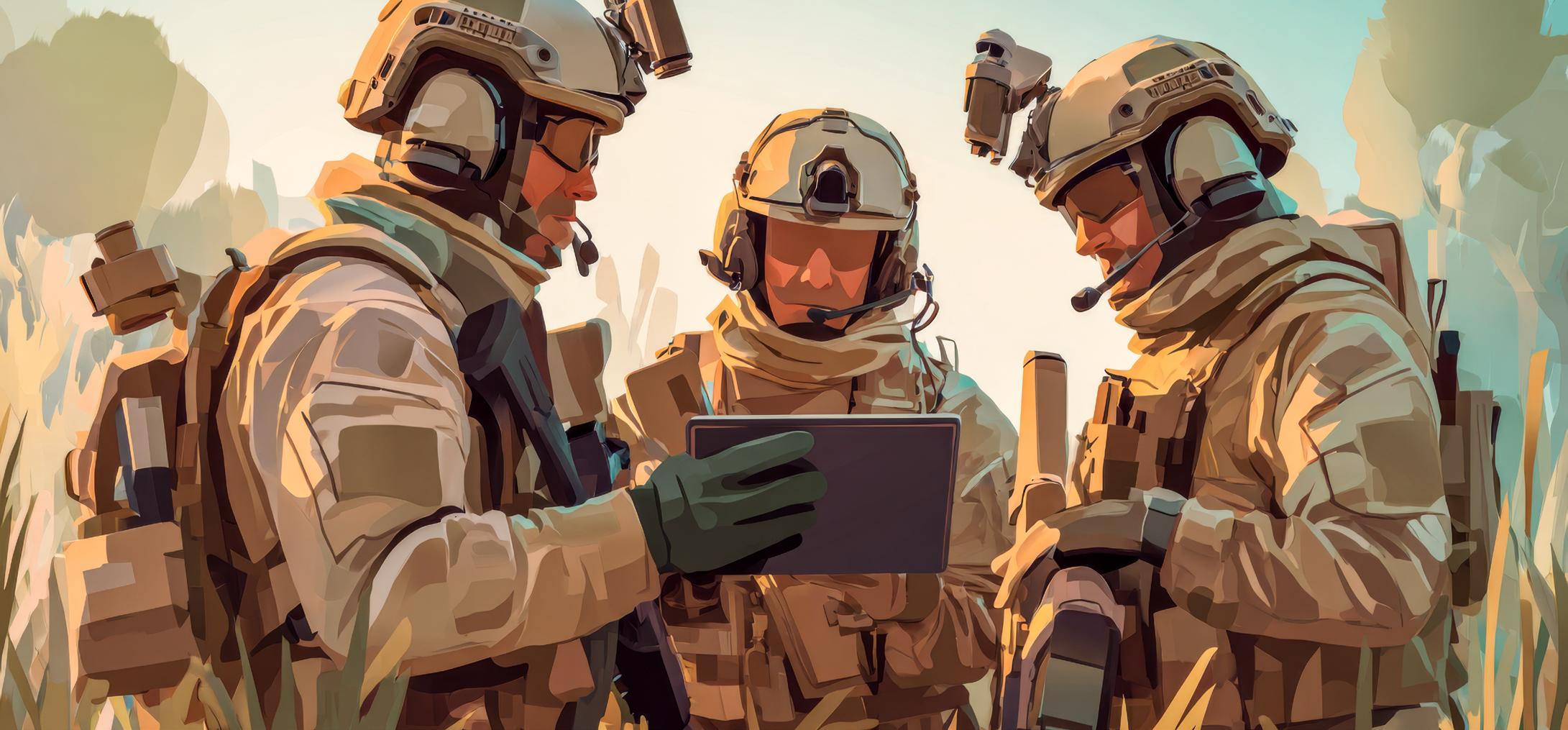
COMMANDING WITH MACHINES: LEADERSHIP ON THE AI-ENABLED BATTLEFIELD
AUTHOR
Dr Martin Crilly is a technology leadership scholar with the University of South Wales, where he is researching leadership in the age of AI. As a Reserve signals officer his background is in military information and communication technology architectures, organisational transformation and now AI-enabled warfare.

FROM optimising processes to reshaping operations, artificial intelligence (AI) is fast becoming a cornerstone of military power. Advanced AI systems are now able to predict and pre-empt outcomes and make logical command decisions significantly faster and more accurately than humans. Consequently, the implications for militaries and command in the AI-enabled battlefield are profound.
Embracing decision-centric warfare is crucial in achieving victory, with AI solutions now being pivotal for maintaining an advantage in future conflicts. However, adopting AI involves more than just technological deployment; it necessitates a transformation in organisational structure, cultural alignment and resource management to address numerous unforeseen challenges. This issue is fundamentally one of leadership, not merely technology.
Despite all the marketing hype, technical jargon and productivity overpromises, leading the application of AI to deliver battlefield advantage will likely still need traditional human leadership skills and competencies. As argued in this article, future leaders at all levels will need to build trust through responsible AI practices to form a culture of innovation and an environment that can imagine and then build these battle-winning combat capabilities.
AI AND
THE
MILITARY: CONTINUITY, NOT DISRUPTION
AI is not new to the military. From Second World War radar pattern recognition and code breaking to modern-day networking and traffic routing, militaries have long exploited digital machines to compress time and sharpen decision-making. What is new is the speed and scale of it. Only in the last decade, enabled by cloud computing, data availability and learning algorithms, have machines become capable of reasoning across complexity fast enough to influence command decisions directly. This shifts AI from a support function to a command-adjacent capability.
Yet the leadership challenge remains consistent with history. As with Turing’s Bombe and Ultra, success will not hinge on leaders’ understanding of the mathematics, but on how they organise, trust and empower people to balance and exploit the advantages without fear of becoming dependent on it, leading to automation bias, but also, the opposite –algorithmic aversion.
This will require a new way of thinking, and there are five principles we should consider.
n Principle 1. Embrace AI uncertainty: balance opportunity, risk and practicality Move forward with a strategy that will
account for uncertainty, opaqueness and constant change.
Firstly, little conceptualisation is available on the shape of a fully AI-enabled military. Concepts such as AI readiness and AI maturity remain emergent and attempts to treat AI as a linear efficiency gain underestimate its disruptive potential.
Secondly, most legacy institutions lack the data quality, architectures and skills to exploit AI at scale. An effective AI strategy must therefore be adaptive, designed to absorb uncertainty, evolve rapidly and deliver value beyond individual use cases. Providing data access (especially with allies) is far harder than algorithms.
Lastly, AI readiness begins with data readiness: sparse, dirty or irrelevant data will just output AI nonsense, often accompanied by unjustified confidence. As the Army’s Chief Data Officer tells us, data is a strategic asset; data readiness is crucial for AI workloads, security, accuracy, discoverability and analytical integrity. Future-ready leadership requires hypothesising data required for future wars, stress-testing assumptions and building the cognitive and technical resilience to adapt under ambiguity.
n Principle 2. Partner with technology: using AI as a human assistant/amplifier Create environments where humans and machines work collectively to generate greater value.
The successful implementations of AI to date have mostly involved seeing AI as an ‘extending partner’, integrating it into existing workflows and thought processes, to enhance and amplify – not replace –human capabilities. This has allowed for speedier, more effective decision-making, faster innovation and sharper strategic focus. It has delivered an offloading of tasks, identifying blind spots and a freeing of humans for higher-level, more value-added deployments. This collaborative approach utilises AI’s strengths in data analysis and automation to amplify human intelligence and leadership, ultimately accelerating innovation and creating a competitive advantage. Using AI for cognitive augmentation could see AI processing vast amounts of data and provide insights that humans might miss, acting as a ‘cognitive partner’ to support strategic thinking and complex problemsolving. Increased innovation and time advantages can be obtained by having AI solutions handle routine tasks and provide novel insights. This application frees human creativity by allowing for more time and
mental energy to be dedicated to innovative thinking, conceptualisation and strategy development. Concentrating on human cognition advantages, by automating tasks and augmenting capabilities, allows leaders to shift their focus from operational details to higher-value strategic thinking and the development of uniquely human skills within their teams. AI capability can be used as additional staff support, processing and even making suggestions, but it cannot be the commander making the final decision. Equally important is knowing when not to use AI, especially in lethal decision chains now evolving into kill webs.
n Principle 3. Learn by doing: repetitive experimentation and hands-on practice Learn from success (and failure) and build experience – enough experience to ask questions and make informed decisions. The side that learns fastest wins.
A recent research study on AI adoption carried out by RAND found that AI projects failed mostly for organisational reasons, primarily due to a misalignment of teams, with 84 per cent of failures traced back to poor leadership decisions, not engineering flaws. The report argues that AI projects rarely fail because “the math is wrong” but because “the humans around the math didn’t align”. Analysis of the failed projects found that it was the operational processes that did not evolve to prioritise the new paradigm of speed and agility in decision-making. AI is a practical activity; there is no magic formula, process or procedure to follow. Like leadership, there is doctrine, guidelines and principles, but no better training than experience itself. It is essential to align incentives, expectations and decision-making to make the organisation culturally ready for AI. Next, celebrate small, visible wins that build trust and provide momentum for faster, more refined models. Lastly, always make the team the hero; the AI is the helper, not the
replacement. Experiment with it, play with it, get it wrong, try again, and quickly learn to get it right more times than you get it wrong.
n Principle 4. Proactively deliver operational value and warfighting capability
Mandate clear metrics and business and military impact objectives from AI initiatives.
The key to AI success is the ability to bridge the gap between theory, strategy and execution. Successful AI projects always have a clear plan for measuring return on investment. This is usually then executed by setting specific, measurable goals related to capability and costs. There are only four questions that leaders need to answer. Firstly, what is the actual problem we are trying to solve? Clearly articulating this frequently points to the right technology solution. Experience has repeatedly shown that starting with an AI solution, then seeking a problem, usually fails. Secondly, what data will the solution use? Is it of suitable quality and/or quantity? Is it available, and do you have access/permission to use it? Thirdly, who has the capabilities to do this? Where will the talent come from to deliver this? Lastly, what are the measures of success? i.e. How much will it cost? How long will it take to deliver? And does it all make military and commercial sense?
In a similar vein, metrics for a successful AI project focus only on four areas. How does it increase value/capability?; how does it reduce costs?; how does it reduce risk?; and lastly how does it improve the customer or soldier experience?
n Principle 5. Reimagine warfare with AI Hypothesise the next war: how would AI be used to prosecute it? Write new, fresh, interesting doctrine.
Thought leadership is now required to develop military capabilities beyond obvious efficiency
“Artificial intelligence capability can be used as additional staff support, processing and even making suggestions, but it cannot be the commander making the final decision.”


gains and cost reductions. AI has the capacity to create a toolset to completely reimagine and then prosecute entirely new models of warfare. Strategic AI adoption will seek to use AI to fundamentally reimagine warfare and create new combat capabilities, moving beyond mere incremental efficiency gains of the current legacy solutions. Some speculative examples might include battlefield automation with the systematic use of robotics and legacy vehicle automations; drone-enabled manoeuvre warfare playbooks that require battlefield datafication, possibly using private 5G battlefield mesh, low earth orbit satellites and satellite-resident sovereign data centres. Militaries must shift their focus from improving existing legacy solutions to exploring totally new concepts like these, creating new military capabilities using AI, identifying a whole new suite of previously unimagined information and communication technology capabilities and combat solutions that were historically thought impossible. This fundamental change necessitates imaginative leaders selecting strong, transformative AI-enabled use cases essential for re-engineering workflows and innovative approaches to warfare. The transition to an AI-enabled military will require a profound strategic insight into future scenarios, recognising AI’s potential for transformative effects that extend way beyond mere enhancements of current capabilities.
DELIVERING AN AI-ENABLED MILITARY
The first action is to develop a strategic AI view, a vision beyond iterative opportunist use
cases, a concept that both understands how AI can fundamentally alter the organisation’s strategy and can deliver decision advantage in a globally competitive landscape – sometimes the best AI is below the surface, the AI you don’t see. Whilst drivers like cost reduction and optimisation help build short-term innovative capital and time, entirely new types of battle-winning concepts, military services and products will need to be developed. Secondly, using AI to re-engineer legacy processes, bolting AI on top of legacy systems, pipelines and workflows, will not deliver success. These processes and the tech stack that enables them need to be redesigned to create new, more dynamic and adaptive systems for an AI-enabled military. Next, build for scale and long-term economics, beyond the demo, into both commercial and military sustainability, viability and scalability. Lastly, have the discipline to reject projects that are simply optimising existing processes. Instead, embrace risk and prioritise quality projects that offer true offensive, lethality and transformative capabilities to fight the next war.
COMMAND IN THE AGE OF AI
Command of the future AI-enabled battlefield will evolve; AI will enable a transition from a centralised control model to a distributed, intent-based execution. It could be argued that this is no different from all other eras as it will still require the same blend of human-centric approaches using the technologies of the day, as well as the domain knowledge to put it into practice. And like all other eras, it also requires the fostering of a culture of continuous
learning, practice, adaptability and trust. To succeed, it is imperative to develop a clear vision for AI’s role, balancing both datadriven insights with human judgment, and then ethically navigating the risks and implications of this largely untested technology. But no different to previous chapters, leaders must also enable, empower and engage their teams with new skills of the era, promote agility, develop playbooks and ensure their units can harness AI to enhance human potential, not replace it.
CONCLUSION: HUMANS WIN WARS (BUT AI WILL HELP)
AI will increasingly shape how wars are fought, but it will not decide them alone. Victory will continue to depend on leaders who can inspire, adapt and command in uncertainty – using AI as an advantage, not as a replacement for myriad human competencies. As we enter a new era of digital transformation for the military, acquiring, developing and retaining talent is the pacing constraint. Having human-tohuman impact in this increasingly digital world and understanding, preparing and inspiring the generation shaped by this technology and social norms will be one of the biggest challenges for military leaders of all ranks. Concurrently, maintaining pace with the latest wave of new technological changes on and off the battlefield will need all to continue to be at the top of their game. The challenge for militaries is therefore not technological adoption, but leadership transformation at pace.
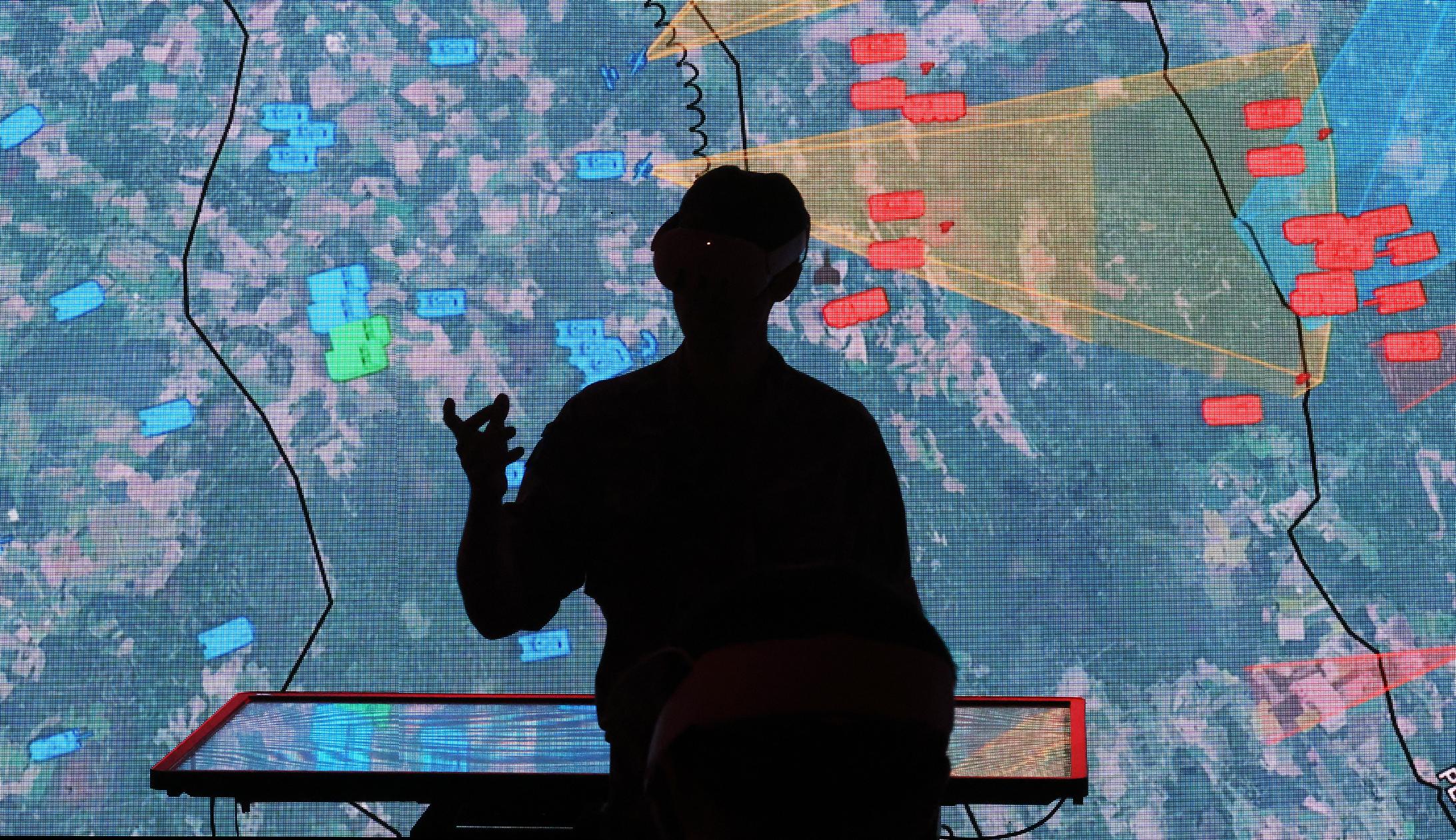
AUTHORS
Colonel Simon Graham has 22 years of experience of providing close support engineering to the Royal Marines and the Army in the collective training environment and on operations.
Colonel Martin Wells is Assistant Head Operate in Land Warfare Centre. Previous appointments include Executive Officer in Strategic Centre, Army Headquarters, and command of the Army’s Short Range Air Defence Regiment.
Lieutenant Colonel Kevan Cameron is SO1 Protect, 3rd (UK) Div and worked with HQ ARRC and 1 (UK) Div to develop and implement the protection concept detailed in this article.

ENABLING LETHALITY: THE PROTECTION TACTICAL FUNCTION
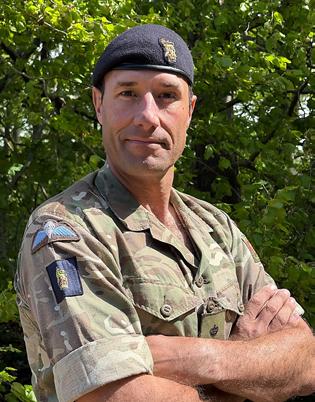
MAJOR General Nikolai Volkov, commander of Russia’s 20th Combined Arms Army, stood rigid beneath the dim glow of his command post’s flickering map display. The Suwalki Gap – once envisioned as a swift corridor to Kaliningrad and a staging ground for Baltic annexation – had become a mire of frustration. His forces had surged forward, expecting to carve a defensive line that would blunt NATO’s response. Instead, they were bleeding momentum.
The Allied Rapid Reaction Corps (ARRC) had proven maddeningly effective. Every attempt to consolidate logistics was met with precision strikes that severed his lifelines back into Russia. Ammunition dumps vanished in fireballs. Fuel convoys never arrived. Counterstrikes yielded little. NATO global navigation satellite system jamming blanketed the battlespace, and Russian Special Operations Forces – so effective elsewhere – were being methodically hunted in the British rear. Their early sabotage efforts had been undone by aggressive counter-reconnaissance. The British logistics effort had melted into the clutter of the semi-abandoned urban sprawl.
Volkov’s attempts to decipher ARRC intent were thwarted by a fog of deception. The electromagnetic spectrum pulsed with emulated signals; decoys mixed with genuine activity –
all tightly woven into a patchwork of truth and lies. In the close fight, British forces had found a way to target his ground control stations with chilling precision, crippling his layered uncrewed air systems (UAS) strike network.
Then came the one-way-effectors. His forward radar arrays – meant to peer deep into NATO lines – were reduced to twisted wreckage. The horizon went blind. Later, under a curtain of low cloud, British aviation struck. An entire armoured battalion was annihilated in minutes. Volkov watched the feed in silence, the flickering images of burning hulls reflected in his weary eyes. He knew the British armour was moving. But where? Above him, a NATO drone loitered in the cold, grey sky. Its sensors reached down like spectral fingers, locking onto the faint emissions of his command post.
In our story above, Major General Volkov and his forces are about to be undone by a well-executed ARRC operation aimed at supporting the restoration of NATO’s territorial integrity. The ARRC’s approach is highly lethal, combining multi-domain effects, rockets, aviation and armour to dismantle Volkov’s fighting system. Yet this success owes as much to effective protection as it does to lethality. Protection and lethality are two sides of the same coin.
Years of counterinsurgency operations since
9/11 have significantly shaped our doctrine, and this influence is particularly evident in the limited scope of the current protection doctrine. While we’ve surged ahead with our keystone Recce-Strike concept,1 guidance on what protection truly entails – and how to operationalise it – remains sparse. Furthermore, campaigning in Iraq and Afghanistan fostered a one-dimensional view of protection, associating it with rear areas and operating bases. Force and health protection, counterimprovised explosive devices and policing dominated, and protection practitioners typically emerged from those disciplines.
Today’s operating environment demands a radically different mindset. Expanding transparency and lethality across the battlefield, adversaries armed with long-range precision weapons, and threats emerging across all five domains require a protection approach that is proactive, not reactive; activity-driven, not static; and synchronised across multi-domain effects. Protection must become everyone’s business – it is a cognitive fabric that is woven through all tactical functions.2 This article aims to reshape your understanding of protection and is designed for planners from battlegroup to corps level.
DEFINITIONS AND DOCTRINE
Protection is one of the eight tactical functions.3 For many, protection may be synonymous with the ‘survivability onion’ – a concept featured on the cover of the UK protection doctrine, Army Doctrine Publication Land Operations, Part 5. UK4 and NATO5 definitions of protection are rather uninspiring, focusing on ‘minimising vulnerability’, ‘preserving fighting power’, and ‘maintaining freedom of action’. The US doctrine6 describes protection more expansively as the ‘synchronisation of effects’ to ‘preserve critical capabilities’, ‘enable access’ and ‘deny freedom of action’.
These definitions contain three useful themes. First, references to ‘minimising threats and vulnerability’ match the language used in risk management. Second, ‘preserving capability’ means taking steps to maintain the maximum amount of combat power. Third, ‘synchronisation’ and ‘enabling/ denying freedom of action’ are akin to manoeuvre, particularly in achieving positions of advantage relative to the enemy. Thus, enacting protection during planning and execution must include risk management, task organisation of protection capabilities, combat power analysis and manoeuvre planning.
Unfortunately, Land Operations, Part 5 offers scant guidance on how to operationalise these activities and overemphasises the role
“Expanding transparency and lethality across the battlefield, adversaries armed with longrange precision weapons, and threats emerging across all five domains require a protection approach that is proactive, not reactive; activity-driven, not static; and synchronised across multidomain effects. Protection must become everyone’s business.”
of risk reduction. The NATO publication is more expansive, providing valuable insights into specialist protection areas – but it still falls short of being a practitioner’s handbook. By contrast, US doctrine offers greater utility and belongs in every protection planner’s battlebox. However, even having read these publications from cover to cover, you will likely be well educated on the individual protection components, but still unclear on what actions to take in planning and execution to bring them all together.
Protection, then, is the most awkward of the tactical functions because it has elusive boundaries, demands shared responsibility, requires persistent attention at all echelons, and is underspecified in the doctrine.7 The rest of this article, therefore, seeks to fill the gap in guidance on what protection planners do.
1Reconnaissance strike primer (2024), AC72290, British Army
2Carvelli, Michael (2025). Protection: the fabric of the warfighting functions, US Army.
3ADP Land Operations Part 2, Chapter 4: Command and control, intelligence, outreach, information activities, fires, manoeuvre, protection, and sustainment.
4ADP Land Operations Part 5: Protection: ‘Protection involves the actions taken to protect the fighting power of a force.’
5Allied Joint Publication 3.14: Force Protection: ‘measures and means to minimize the vulnerability of personnel, facilities, equipment, material, operations and activities from threats and hazards to preserve freedom of action and operational effectiveness, thereby contributing to mission success’.
6ADP 3-37: Protection: ‘Protection is the synchronisation of capabilities and effects in time and space across the depth and breadth of the battlefield to: preserve critical capabilities, assets and activities; to enable persistent access and deny enemy freedom of action’.
7Carvelli, Michael (2025). Protection: the fabric of the warfighting functions, US Army.
8Defeating Russian recce strike complexes; deductions for land warfighting, British Army, May 2025.
9Ibid., p 23.
THE BIG IDEA
At its core, protection planning and execution is about identifying what is killing us and ruthlessly targeting it, whilst protecting our critical assets under defensive domes. In previous conflicts, this mindset drove the development of robust measures for counterimprovised explosive devices, force health protection and countering insider threats. Today, as warfighters preparing for conflict with Russia under NATO command, our challenge is to overcome the threat posed by the Russian ground forces’ recce and fires complexes, including anti-access/area denial systems, layered find, fires, air defence, electronic warfare and heavily armoured forces.8 The 3rd (UK) Division has developed a clear approach to this problem – one that fuses offensive and defensive actions into a coherent whole and was validated during Exercise Warfighter in June 2025. This approach creates a living organism – one that strikes hard at adversary vulnerabilities while shielding its own critical functions.
The Division manoeuvres assets to deliver multidomain fires from advantageous positions. From these positions, those assets then detect and disintegrate the enemy’s integrated air defence system using long-range fires and a range of multi-domain effects. The resultant fleeting gaps in enemy air defence create windows of opportunity to employ multidomain effects and aviation to degrade the enemy’s integrated fires command, divisional and brigade artillery groups, and their layered UAS system. These actions, in turn, enable armoured forces to penetrate defences to seize and hold ground. At regular intervals during this repeating cycle, condition-based decision points are inserted for the general officer commanding to consider whether the necessary conditions are met to initiate the following action at an acceptable level of risk. These conditions include force ratio analysis and depend on accurate friendly force operational effectiveness reporting and enemy battle damage assessments.
This offensive activity is safeguarded through the creation of protective domes around critical capabilities. Project Velocity calls these ‘snowdomes’ which consist of a mixture of air defence, electronic warfare, counter UAS and broader counter kill-chain capabilities, as well as the deployment of protective tactics such as deception, dispersion and electromagnetic signature control.9 Any movement, particularly in the close battlespace, outside these protective domes will be found and destroyed in the presence of a prepared Russian adversary.
This is the basic playbook: a battle-winning
concept that integrates protection and manoeuvre. Now to the methods employed by protection planners to execute the protection function in accordance with this playbook.
PROTECTION PRACTICE
Appoint a protection lead. The protection community – comprising engineers; air defenders; counter-chemical, biological, radiological and nuclear specialists; military police; electronic warfare staff; medical personnel and others – is inherently diverse and dispersed. Appointing a single lead to unify this effort is challenging, but essential. The Strategic Reserve Corps is already wellstructured in this regard.10 At both corps and divisional levels, the protection lead chairs a Protection Working Group.11 This group draws on matrix-managed HQ staff from across the protection disciplines as required.
Appointing an empowered protection lead –supported by a matrix-managed protection team working together and coherently with echelons above and below – will shift the protection dynamic from a purely defensive posture to one that actively enables manoeuvre and offensive operations.
Understand yourself through the enemy’s eyes. A critical output from all question one analysis must be an articulation of which friendly capabilities we think the enemy will seek to target.12 Imagine the enemy intelligence and security team looking at us and drawing up their high pay-off target list.13
10At Corps Headquarters, the Chief Engineer serves as the Protection Lead. Each Division has an established SO1 Protect embedded within the GOC’s principal planning group, while Brigade Headquarters typically assign the CO Engineers to lead protection efforts.
11See ADP 3-37 Protection pp 3-11 to 3-16 for a fulsome description of the Protection Working Group.
12The 7 Questions of the Quick Combat Estimate cover: situation & effects, mission & intent, desired effects & direction, best actions/location, resources, timing, and control measures.
13Planning and Execution Handbook p10-33: High pay-off target list (HPTL). Targets which if lost to the enemy would significantly contribute to the success of the commander’s mission (not necessarily enemy failure) and which can be affected given the systems available.
14See ADP 3-37 Protection pp 3-7 – 3-10 for the full explanation.
15Joint Doctrine Publication (JDP) 3-40, Security and Stabilisation: The Military Contribution: The CAL is a prioritised list of assets or resources that are deemed essential to the success of a mission or operation. These assets are identified as critical because their loss, damage, or disruption would significantly impact the ability to achieve operational objectives.
16For a full description of the PPL see ADP 3-37 Protection p 3-6 and 3-7. It also contains description of the CAL and Defended Asset List (DAL) and their interrelationship.
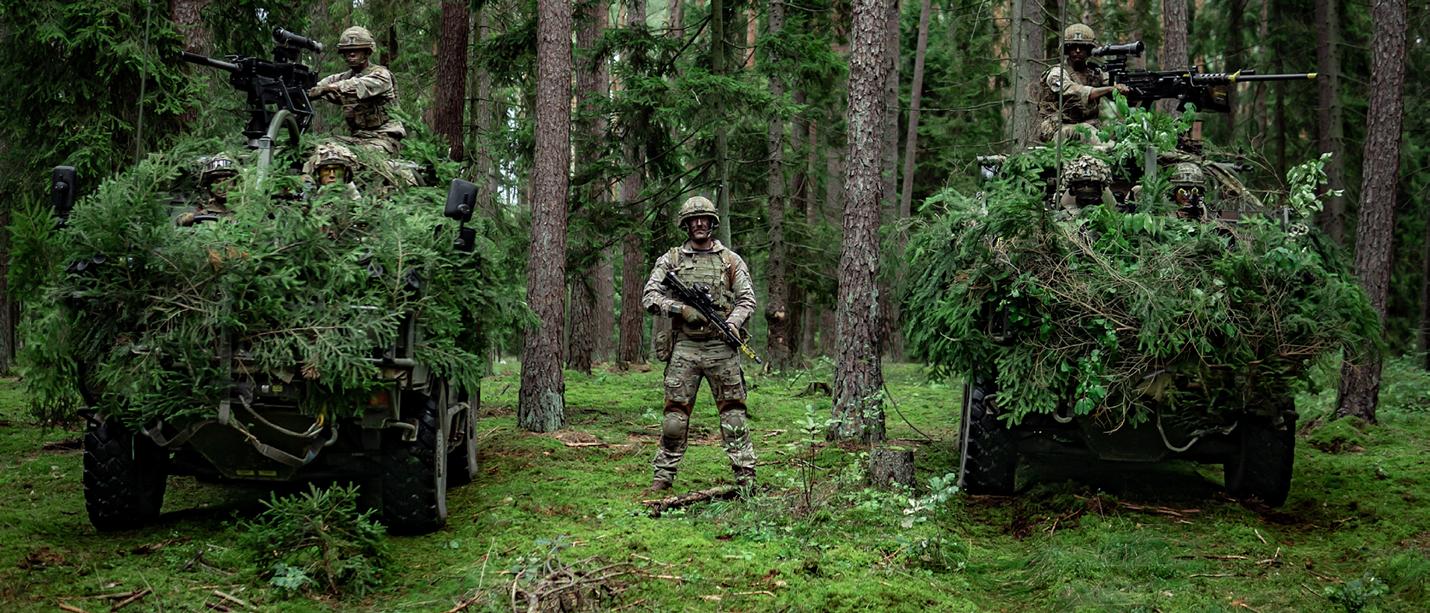
“If you are unsuccessful in either killing the asset that is killing you or hitting effectors post launch, major effort must be placed on hiding from what is killing you.”
This analysis is refined during question two with the wider staff identifying any additional critical capabilities.14 This combined list constitutes the critical asset list15 and will vary depending on the threat and mission. In a Strategic Reserve Corps restore scenario, it is likely to include our headquarters, sensors, long-range air defence assets and mobility support vehicles.
Create protection domes. The protection team flesh out the critical asset list with candidate protection resources to provide multi-domain protection. This resourced critical asset list becomes the candidate prioritised protection list.16
When applying resource to the critical asset list to create the prioritised protection list, 3rd (UK) Div apply a ‘triple lock’ approach where the most prized assets are given physical protection, air defence and electronic warfare coverage. During questions four to seven, the protection team work with the course of action development teams to apply and synchronise the required protection resources. This ensures the protection concept and prioritised protection list form part of the synchronised plan, rather than an afterthought. Thus the ‘snowdomes’ are created for critical assets to manoeuvre within. Subordinate HQs should expect to be given protection tasks by their higher formation. For example, the corps HQs may place medium-range air defence assets on the prioritised protection list but resource the physical protection using force elements from one of the divisions.
KILL WHAT’S KILLING YOU
Offensive action to degrade the enemy’s strike complex is the most effective means of protection. A forensic effort is required to pinpoint where the enemy is successfully targeting our forces. This analysis must be captured on a protection board, detailing loss rates across time, space and method. Such data enables confirmation – or refinement – of earlier assessments of the enemy’s high pay-off target list against us, and may reveal their intentions, objectives, boundaries and
command and control arrangements. Such recording and analysis require staff effort, but is also well suited to machines. Development of such tools in our HQs should be a priority.
Commanders and staff must continually ask: why are specific protection assets being targeted? Understanding what the enemy seeks to expose is critical. This insight must feed directly into our targeting processes, briefed daily at the targeting board and refined continuously. Evidence from the protection board should also inform targeting discussions at higher echelons, enabling the allocation of deep strike assets to disrupt enemy systems beyond the forward boundary. The objective is to get upstream of the threat – anticipating and neutralising it before it manifests. Analysis of current enemy actions should be extrapolated to forecast future intent, generating target nominations for higher echelons to prosecute.
Once a headquarters is proficient in datadriven targeting, a strong institutional focus often develops around fighting the deep and protecting the close. In this environment, it is the protection team’s responsibility to identify blind spots – those threats that fall outside the immediate operational spotlight. Cumulative attrition from low-level Special Operations Forces activity or unexploded ordnance in the rear area can be easily overlooked amid the intensity of close combat and deep fires coordination. These threats may not be dramatic in isolation, but their aggregate effect can be significant. The protection team’s role is to surface these overlooked threats and ensure they are addressed through targeting, mitigation or other protective measures.
Where assets cannot be destroyed on the ground, the ability to intercept and neutralise enemy air-delivered effects becomes essential. This demands correct task organisation and deployment of interceptors – whether radar systems, air defence missile or electronic warfare capabilities. Crucially, the authorities for unmasking these assets must be clearly understood. Once activated, such systems are rapidly identified and targeted by the enemy.
HIDE FROM WHAT’S TRYING TO KILL YOU
If you are unsuccessful in either killing the asset that is killing you or hitting effectors post launch, major effort must be placed on hiding from what is killing you. Physical camouflage and concealment, understanding the benefits of buildings of opportunity (especially where cellars are present), modern camouflage netting, drone nets and cages, thermal protection, and a range of other tactical countermeasures that exploit the electromagnetic spectrum must all be employed.
Headquarters at all levels must understand their electromagnetic signature through signature analysis and electronic intelligence, by intercepting and analysing its electronic emissions. Headquarters must employ techniques like multi-spectral camouflage to mask visible, infrared and radar emissions. Low-probability-of-intercept communications and passive sensors must be used. We are in the foothills of operationalising these capabilities, but they are all essential. The goal is to create empowered managers in all HQs at brigade and above who have a prominent place in G3 to help understand the electromagnetic spectrum dimension.
HARDEN AGAINST THE THREAT
Enemy strikes will inevitably succeed at times, making the survivability of friendly forces a critical concern. Protection demands proactive measures: positioning assets under hardened cover or armour, enabling forward repair and medical support, and maintaining robust, rapid processes for integrating battle casualty replacements. While a deeper exploration of REME, medical and force protection engineering task organisation and capability development lies beyond this article’s scope, their relevance is clear. This highlights the skillsets required within the protection team and the array of factors that must be integrated into protection planning.
HUNTING, NOT FISHING
The Ukrainian Ground-Based Air Defence (GBAD) engagement of a Russian Beriev A-50U over the Sea of Azov on 15 January 2024 exemplified a shift towards offensive counter-air tactics. Employing GBAD to destroy a high value asset far behind the front line has evolved GBAD into a more proactive, mobile and offensive capability – something better described as ‘surface-to-air warfare’ – and complementing its more traditional defensive role. Exercise Warfighter 25.4 accelerated 3rd (UK) Division along that same trajectory, whilst confronting asymmetric threats ranging
from stealth aircraft and hypersonic weapons to drone swarms and loitering munitions. Alongside a key tactic of surface-to-air missile ambush, or ‘SAMBUSH’, four takeaways are highlighted here. First, the early insertion of air defence and counter UAS capabilities, alongside recce callsigns, to front load sensors, mitigate weapon-to-effector engagement overmatch, project ‘sniping pairs’, and deliver localised control of the air. Second, the use of Mobile Fire Teams – highly agile Short-Range Air Defence, counter UAS and electronic warfare-equipped fire teams – able to provide an intelligence-led response to ‘plug gaps’ in air avenues-of approach and operate dynamically across the battlespace. Third, ‘protect to manoeuvre’, the setting of air defence protection before ground forces move to enable proactive engagement of air threats and deliver coverage in depth; akin to the layered ‘belts’ of the Second World War. Fourth, rapid fusion and integration of the Local Air Picture into both corps and divisional targeting processes to further enable ground targeting and support both Recce-Strike and the Land Targeting Enterprise. Most importantly, it must be underpinned by air defence capability mass; for which there is little substitute. Offensive action must remain balanced though, working in tandem with defensive measures to ensure a comprehensive and effective GBAD strategy – managed and resourced through the critical asset list using the ‘triple lock’ approach.
TAKE A RISK-BASED APPROACH
There will never be enough protection assets to meet all operational requirements. Allocating these limited resources is akin to furnishing a room with a rug – you can position it at will, but it cannot cover everything. Consequently, protection planning hinges on an honest and transparent approach to risk management. The protection lead plays a critical role in adopting a cross-functional perspective, assessing risks and progress against objectives. They must effectively communicate this perspective to the commander and staff as part of the daily battle rhythm, serving as both a source of insight and a constructive challenge.
A persistent problem lies in balancing the allocation of protection assets between the rear and the close. The enemy will often target rear areas, drawing protection resources away from the close and leaving frontline forces vulnerable to being destroyed in detail. To address this, the protection lead must be adept at identifying and articulating risk, and quick to propose
mitigations and reveal trade-offs. Operational risks can be summarised using a standard 5x5 risk matrix, supported by a table outlining risks, their causes and mitigations. Additionally, the ‘bow-tie’ method can be employed to visualise specific risks and hazards, providing clarity when planning for specific tasks.
A more extensive approach to risk management can be taken by conducting ‘assessment’. On Exercise Warfighter 25.4, III (US) Corps ran a daily assessment working group, attended by SO1 Military Police, who then delivered a daily assessment update as an agenda item in routine battle rhythm. Assessment is the determination of the progress toward accomplishing a task, creating a condition or achieving an objective.17 3rd (UK) Div managed to derive some value from this process, but our methods were nascent and the authors welcome engagement with those who have or who are interested in developing the UK assessment approach.
CONCLUSION
The article calls for a cultural shift: protection is no longer a niche concern but a collective imperative. Despite being the most awkward of the tactical functions, protection must become everyone’s business. This article articulates a clear approach to embedding protection thinking into operational planning and execution. Protection is about identifying what is killing us and ruthlessly targeting it, while shielding critical assets beneath layered defensive domes. The methodology described integrates offensive and defensive measures with rigorous risk management, ensuring protection is not reactive but anticipatory and decisive. Headquarters must treat protection as a foundational element, woven through all planning and decision-making. This requires an empowered protection lead and a wellresourced protection working group, capable of driving cross-functional coordination. Failure to master this approach will result in operational paralysis and, ultimately, defeat. Only by embracing this uncomfortable truth can we outpace adversaries and safeguard our ability to fight, survive and win.
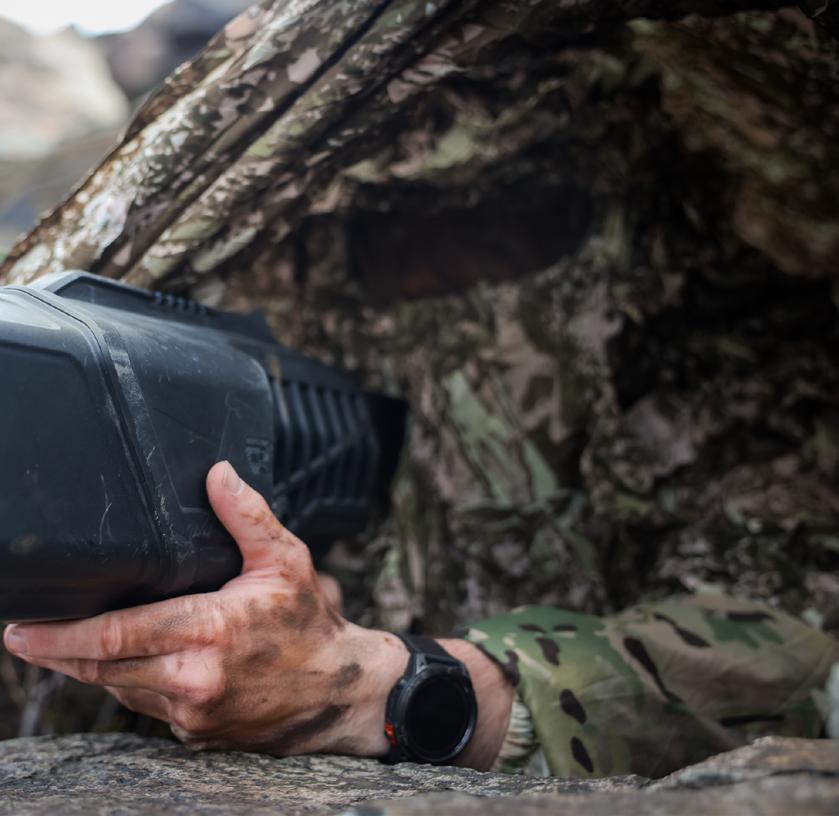
A MEMO ON MENTORING
AFTER 37 years in the Army and two as a consultant, I used enhanced learning credits to study psychology at the University of Gloucestershire. My dissertation examined the lived experiences of British Army officer veterans from the 1980s to explore how their insights could benefit future generations of young officers. A key aspect that emerged was mentoring – or, more accurately, the lack of it. This in turn prompted me to consider where the British Army stands now in relation to mentoring and what proven models might be adapted for our use.
While mentoring was not my original focus, it emerged organically through my interpretative phenomenological analysis. My goal had been to examine participants’ subjective experiences – successes, failures, selfawareness and relationships – but mentoring surfaced repeatedly as an unanticipated theme that significantly influenced confidence, competence and development. My sample comprised five former Servicemen who had served as young officers in the British Army of the Rhine in the 1980s. Their narratives revealed sharp contrasts. Those who benefitted from informal mentoring– such as Harry, whose future commanding officer supported his early operational deployment, and Dick, who was coached prior to Sandhurst –described confidence-building guidance that helped shape their careers. Conversely, Tom, who lacked such support, recalled frustration, isolation and early disillusionment, underscoring how even modest mentoring could have changed his trajectory.
These findings demonstrated that mentoring in the 1980s was inconsistent and largely left to chance. Its absence often hindered personal and professional growth, while its presence fostered assurance and capability. This became an explorative by-product of my research, highlighting that structured, intentional mentoring could bridge the gap between Sandhurst training and the practical realities of leadership in the field.
The British Army has undoubtedly progressed since the 1980s, improving leadership training, welfare provision and career management systems. Yet mentoring remains informal, sporadic and reliant on personalities or regimental culture rather than embedded structures. While officers may receive career development discussions during command and staff appointments, this falls short of
AUTHOR
Lieutenant Colonel (Retd) Simon Wilson spent three years in 137 (Java) Battery, 40th Regiment, Royal Artillery, before going to Sandhurst. He was commissioned into the Queen’s Regiment in 1984, and transferred to the Royal Military Police in 1991.

genuine mentoring, lacking continuity and independence from reporting lines.
For other ranks, mentoring is even less structured. Most personal development occurs through experience, peer support and guidance from the chain of command, supplemented by leadership courses and occasional input from diversity initiatives such as Women in Defence and Army LGBT+.
The absence of a formal, Army-wide mentoring framework represents a missed opportunity. A structured programme spanning all ranks could strengthen leadership cohesion, enhance retention and bolster morale. Crucially, mentoring outside of the direct chain of command would provide officers and soldiers alike with trusted, neutral guidance from those who have successfully navigated similar challenges, fostering openness and reducing fear of judgement.
LEARNING FROM THE USMC MODEL
During a year embedded with the United States Marine Corps (USMC) in Afghanistan, I saw first-hand their capacity for innovation while retaining strong cohesion. The Headquarters Marine Corps Mentoring Guide exemplifies a structured, values-based framework that could inform British Army practice. The USMC formalises one-to-one mentoring relationships, defining clear roles for mentors, mentees and supervisors. It integrates mentoring into career planning through individual development plans, structured goal-setting and scheduled reviews, all deliberately separate from formal reporting chains. This separation builds trust and encourages honest dialogue.
Adapting such an approach within the British Army could involve:
n Endorsement and policy – securing
Army headquarters backing and issuing a formal mentoring directive.
n Structured pairing – matching mentors and mentees across ranks, encouraging cross-regimental links to avoid conflicts of interest.
n Defined roles – clarifying responsibilities: mentors offer guidance and feedback; mentees commit to goal-setting and openness.
n Formal goal-setting – establishing SMART [Specific, Measurable, Achievable, Relevant and Time-bound] objectives linked to Army values in an initial session.
n Regular reviews – conducting monthly or career-point check-ins (for example, pre/ post deployment or promotion).
n Training and resources – providing orientation materials, templates and optional workshops for mentors and mentees.
n Evaluation – collecting feedback via surveys and reporting outcomes to monitor the impact on leadership, morale and retention.
By aligning such a programme with Army values and adapting proven USMC methodology, the British Army could significantly enhance leadership development, reduce attrition and improve overall operational effectiveness.
CONCLUSION
My research began as an exploration of the lived experiences of officer veterans, but it uncovered mentoring as a critical, underutilised factor in shaping young officers’ success. Today, the British Army continues to rely on informal goodwill rather than structured support. By adopting a USMCstyle model tailored to British culture and ethos, we could embed mentoring as a cornerstone of leadership.
Such a programme would provide continuity, trusted guidance and meaningful development opportunities for all ranks, ensuring that future officers and soldiers are better supported,


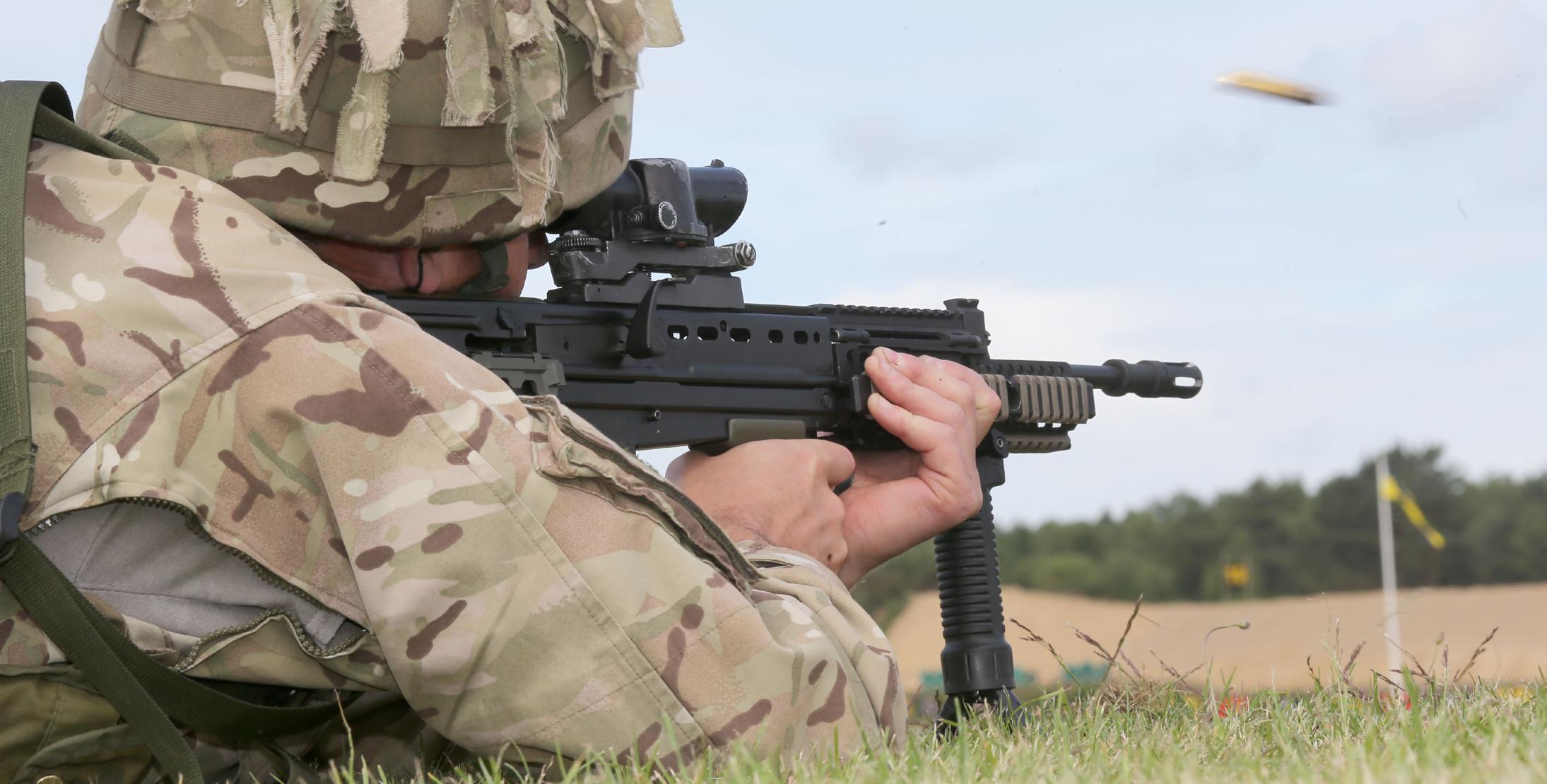
IMPROVISING BANGS... IN THE ABSENCE OF BUCKS
WEEVES didn’t need to be a mind reader to deduce that it was more than just the sub-standard coffee on offer in the officers’ mess that was agitating his current brew buddy. Disquiet was written all over his company’s face.
“Everything alright, quartermaster?” he asked, before mischievously adding, “it’s not like you to be grumpy”.
Major Kevin Dandy, who had been called ‘Beano’ every day of the 30 years he’d spent in uniform, raised an eyebrow, an act which normally indicated extreme and immediate physical violence was a real possibility. Fortunately for Weeves, Beano had more pressing concerns than a cheeky captain.
“I’m worried – Hannah has just told me she’s booked herself a skiing holiday.”
“Why is that worrying?” replied Weeves.
“Because Hannah deals with contracts for the battalion,” groaned the quartermaster. “Once upon a time her job used to be done by a Reserve major, but ‘they’ changed it to a Civil Service post to save money.”
“Right,” intoned Weeves, pleased to be using the active listening skills he’d learnt on a
AUTHOR
The Boxer is a serving British Army officer who floats around the Service like a butterfly and whose words can sting like a bee.

prescribed online learning package, but not remotely sure where Beano was heading with his line of thought.
“Well, if Hannah is booking skiing holidays, she’s probably got herself another job. There’s no way she can afford to hit the slopes on an E1’s salary.”
“Good for her, she’s always been brilliant, and I’ve often wondered why she didn’t do something else,” offered Weeves.
“Absolutely – but with a ban on recruiting civil servants, we’re going to have nobody to renew or sign off contracts,” said Beano, demonstrating second order analysis worthy of Poirot that would have made his Intermediate Command and Staff Course directing staff flush with pride. “The whole appeal of replacing military people with civil servants was to ensure continuity and prevent gaps.”
“That and they get paid about half the wage,” highlighted Weeves.
“That too, I suppose. My point is that now we and the Army are powerless to plug gaps should they arise.”
“I’m sure Hannah just likes skiing,” suggested Weeves, conscious he’d been chatting for eight minutes and that nothing good came from being away from his desk for that long.
“Mark my words, there’s going to be trouble at t’mill,” advised Beano ominously.
Weeves had precious little time to contemplate the quartermaster’s cautionary words before being thrust into the maelstrom of the adjutant’s office. Lieutenant Colonel Jooster, commanding officer of the Third Battalion (there wasn’t a First or Second Battalion) was waiting for him when he came in.
“Morning Weeves, General John is visiting the battalion next month and I’d like to put on a ‘march and shoot’ competition for him to see. Really show off the battalion in its best light.”
Weeves immediately realised two things, coordinating the general’s impending visit would be his responsibility and that the requirement to host coincided with the colonel’s annual appraisal (which meant if the
adjutant did his job well, his boss was more likely to be promoted).
“I’ve just been chatting with the quartermaster, I’ll drop him a message to indent for the ammunition, I’ll have the training officer book the ranges and I’ll warn off the company commanders to adjust their PT programmes,” said Weeves.
“Good-oh,” replied Jooster, confident he’d issued clear intent and guidance, the lifeblood of Mission Command.
As Beano predicted, Hannah resigned the very next day, cleared her tasks on Microsoft Planner and – with untaken leave banked –was gone before the end of the week. Beano walked into Weeves’ office the following Monday morning with a face that screamed ‘I told you so’ and quickly got to the point.
“We can’t get the ammunition delivered for the general’s visit. We should have submitted the paperwork to renew the delivery contract but because we haven’t, it’ll now take weeks.”
“Can’t we just borrow some from another battalion or get it sent down from brigade?” proffered Weeves, his tone indicating he’d not yet grasped the seriousness of the situation.
“They’re all in the same boat. All the contracts should have been renewed at the end of last week, but – as I warned you – the civil servant who was supposed to do it left and her post is now gapped,” explained Beano, his voice slightly raised.
“Okay, not to worry, I’ll elevate it. We’ll get it sorted in no time.”
Beano smiled ruefully. “To elevate it you’d have to get General John to sign it off and I’m not sure the colonel wants us to give the boss any bad news.”
The gravity suddenly hit Weeves. He’d either have no ammunition for the commanding officer’s march and shoot pantomime or get the ammunition but, in doing so, highlight a failing to the one person the colonel was trying to impress. “How much training ammunition have we got?”
“About enough for four rounds each,” replied Beano, “but I was thinking about it on the way here, we could give a few of the lads and lassies 20 each and then drag the general away before he cottons on.”
“Do it,” said Weeves instinctively. He decided, somewhat unwisely, not to tell the colonel.
General John‘s car arrived at the end of the week to be met by a beaming Colonel Jooster and the full ‘bells and whistles’. He was taken to the local training area, briefly met officers whose names he pretended he remembered having forgotten the extensive notes he’d been sent by Weeves, and was then driven to the small arms range.
Lieutenant Toby Gibson met him and delivered a flawless safety brief. Known as ‘Hublot’ by his soldiers by virtue of the fact that, much like the watch brand of the same name, he was often only right twice a day, he was nonetheless fit and unjustifiably confident – everything a young infantry officer needed to be.
Weeves followed at a short distance, pleased to hear a heavy weight of fire going down the range. He glimpsed Beano stood to one side and looking decidedly sheepish.
“Well done on getting the ammo thing sorted, quartermaster,” he whispered.
“I didn’t. The lads and lassies are firing blanks. I’ve got the provost sergeant taking the targets down manually from the console.”
“Really? But I can hear the ‘crack and thump’ of the rounds.”
“That’s the entire guard force crammed in the console banging their chests and clapping over the microphone. The provo’s had them practising all week so they’d get the timing right. Sounds good, to be fair.”
“Weeves. Get over here,” screamed the commanding officer.
“The target on lane 12 just went down six times out of six on that last exposure,” started Colonel Jooster, “but there’s no-one shooting in lane 12; and the target in lane nine seems to be going down whenever lane five fires.”
“Perhaps he’s firing on the wrong target?” Weeves ventured in a bid to deflect his boss from the truth.
“Well, he’s a bloody genius then,” said the colonel, “because he’s dropping them on lane five as well.”
Initially lost for words, Weeves decided to come clean and quickly explained. The colonel stared intently at his adjutant for what seemed like a week, before barking “get the general away before he notices”.
Fortunately, the CO’s driver, ‘Bucky’ Buckton, was on hand to drive the senior officer back to Battalion HQ for his closing chat with Jooster.
“Thanks for a great visit, Weeves,” beamed General John as he emerged from the oneto-one. “I’m delighted to see a battalion that understands shooting is the most important of the infantry skills. And I thought the range team applauding from the console was a nice touch too.” As the general got into his car, he gave Weeves what is commonly referred to as a ‘knowing look’.
Weeves guessed the CO was going to be less pleased than the author of his appraisal appeared to be. “Somehow, General John didn’t notice the soldiers were firing blanks today,” the commanding officer muttered, saluting his superior’s car as it drove away. “In fact, he was so impressed he’s going to enter us in the NATO competition at the US sniper school in Fort Benning. And he’s thrilled with my focus on lethality in these resourcechallenged times. He expects us to show the Yanks we’re still a force to be reckoned with. He said something about coming home with my shield or on it, but I’m not sure what he meant by that.”
“It’s what Spartan mothers used to say to their sons when they went off to war. It meant either return a winner, or dead.”
The colonel, unsettled by Weeves’ classical education, felt his confusion solidify into deep discomfort as the implications of preparing an international shooting team – with no practice ammunition and the general’s opinion of him depending on the outcome – began to sink in. His mood slumping from warm confidence to a feeling of impending doom, Jooster looked long at Weeves, turned on his heel and went back to his office.
Collapsing into his chair, Weeves reflected that only in an organisation that drives with the lights on during the day and turns them off at night could anything quite so ludicrous happen.
The Boxer will be back in the next issue of The British Army Review
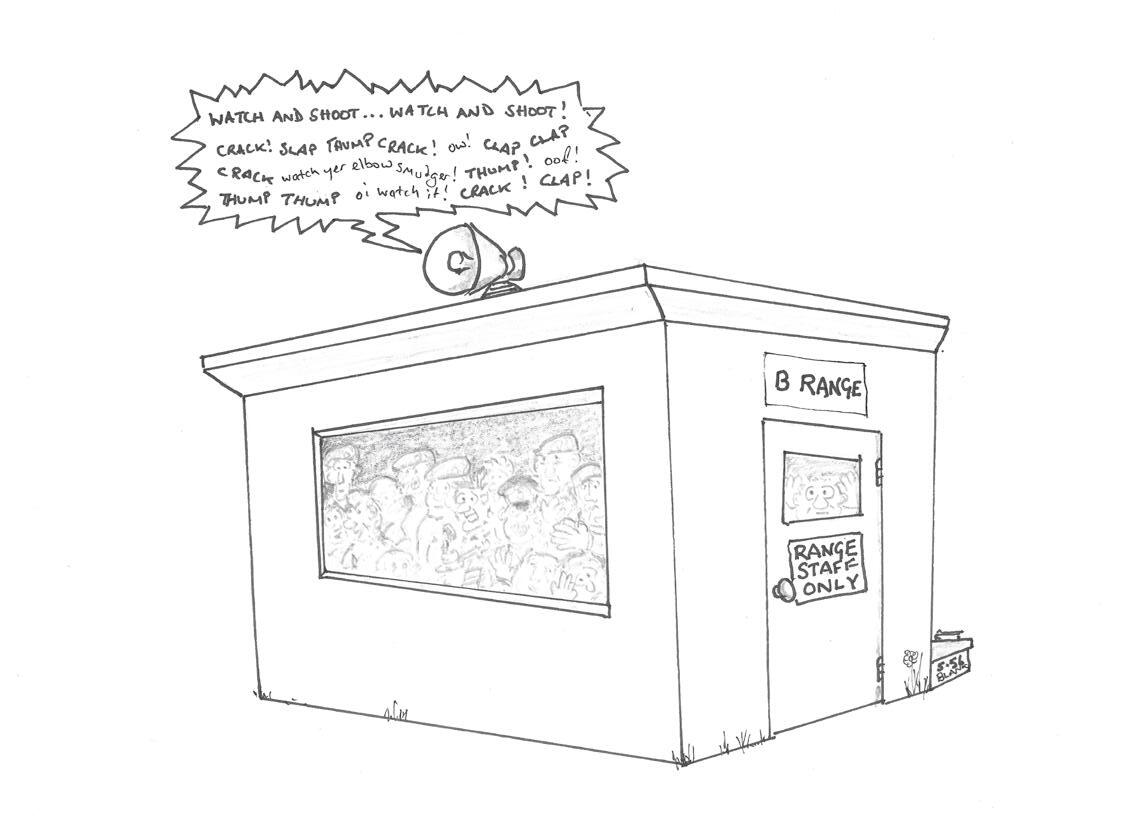
REVIEWS

TITLE
Published by Headline, Hardback, £25
ISBN: 9781035424856
The Next World War: The new age of global conflict and the fight to stop it
AUTHOR Peter Apps
REVIEWER
Major Luke Turrell, Directing Staff, Land Command and Staff College
1Josie

DAMNING EVIDENCE OF THE GATHERING STORM
Peter Apps recently briefed the United Kingdom Defence Academy and mentioned that his mother stresses the importance of the sub-title – The new age of global conflict and the fight to stop it – of his new book, The Next World War. Apps, a global defence commentator for Reuters and a Reserve British Army officer, places the likelihood of a major war at 30-35 per cent over the coming decade, although is clear-eyed that “a serious battle for the future of the world is already underway”.
The book uses, as its model, a re-telling of recent global events with the author pointing out that if journalism is “the first draft of history”, this is a second, repeatedly rewritten, draft of events as they unfurled. As a result, many readers should be familiar with the catalogue of international incidents he includes. However, with news avoidance, according to a recent Reuters report, at a record high with roughly 40 per cent (up from 29 per cent in 2017) of people globally eschewing the headlines because of their negative effect on their mood, information overload or a distrust in the media,1 it is a book that should be marked ‘required reading’ for all defence and security professionals. And, indeed, for anyone who wants to understand the fault lines, flashpoints and human influences on the ‘gathering storm’ that will cloud geopolitics for the remainder of this century.
“What flies off the page throughout this book is the author’s access to people that matter... Accounts from political and military leaders, at multiple levels, litter the title, adding credibility, authenticity and validity to the conclusions.”
reliability by their traditional allies and NATO more broadly. Indeed, Apps quotes Sir Alex Younger (former Chief of the Secret Intelligence Service) in suggesting that the UK has been “infantilised by US dependence”, a comment even more startling given it was made by an individual at the centre of the ‘special relationship’. Throughout The Next World War, Apps supports his insights with diligently researched evidence. One observation that struck this reviewer, relating to the existence of an ‘Axis of Upheaval’, is that 60 world leaders attended the 2008 Summer Games in Beijing, whereas only 22 attended the 2022 Beijing Winter Olympics. If dialogue, mutual understanding and collaboration are the lifeblood of peace and stability, this erosion in numbers suggests more turbulent times ahead.
Apps does an excellent job of breaking down the constituent parts of current defence and security issues. The chapter entitled The challenge for democracies details the legal, societal and cultural legacy of conflicts in Afghanistan and Iraq and the reduction in the size of the British Army over the past decades, partly due to poor recruitment and retention and lack of funding – a factor he contrasts with the increase in German defence spending that will “change the [future] balance of power”. This is juxtaposed with concerns over US
What flies off the page throughout this new book, following his highly successful Deterring Armageddon: A biography of NATO, is the author’s access to people that matter. The extensive footnotes are testament to this. Accounts from political and military leaders, at multiple levels, litter the title, adding credibility, authenticity and validity to the conclusions. I would hate to see Apps’ Christmas card list. As we near the fourth decade of the 21st century, democratic nations around the world are far from confident they are prepared enough to deter even a short conflict, let alone an enduring, attritional fight like the one being played out in Ukraine. As a result, those who work in defence and security in the UK and NATO would be well served to remember Apps’ mother’s focus on trying to stop another global conflict, rather than how to fight it.
Apps is brutally frank in pointing out “all the confrontations and flashpoints of the 2020s had been growing in plain sight for decades”. I would suggest reading this book, and others like it, is a necessary first step, especially in the context of news avoidance, to ensure we don’t miss the growing evidence we are too busy to see. I commend it to you.
Harvey, “Why more and more people are tuning the news out: Now I don’t have that anxiety”, The Guardian, 1 September 2025.
TITLE
Published by Profile Books, Hardback, £22, 291 pages, ISBN: 9781805229124
Polar War: Submarines, Spies and the Struggle for Power in a Melting Arctic
AUTHOR Kenneth R. Rosen
REVIEWER
Professor Andrew Stewart, Head of Conflict Research, CHACR
FROZEN FOOTSTEPS
WORTHY OF RETRACING
In March 2022, the then Conservative Government published a policy paper setting out a proposed British approach to the Arctic region. Four years before, a specially convened Defence Sub-Committee had published the results of a long-running inquiry warning about the potential consequences of a lack of investment (or even interest) in what was more generally referred to as ‘the High North’.1 This new document was intended to guide Defence efforts over a 10-year period, including long-term capability decisions. Noting that Russia had “increasingly militarised its Arctic territory” and China also had ramped up investment and activity, it concluded with the observation that the “era of Arctic exceptionalism is ending”.2 This has proven foresightful although, at least in part, for reasons that nobody just a few years ago could have anticipated. Instead of Russian military adventurism, it has been an increasingly erratic and bellicose American leadership that appears to pose the greatest threat to the regional status quo. So much so that, less than five years later, Parliament has once again turned its eye to the region with the Defence Committee recently announcing a new inquiry.3 Examining current and emerging regional threats and Britain’s defence and security interests, the focus now lies with if the correct strategies, capabilities and alliances exist to respond to an increasingly complex strategic environment. As the committee members get underway with their work, they would do well to read Kenneth Rosen’s recently published book. With its excellent research, vivid storytelling and compelling argument, Polar War: Submarines, Spies and the Struggle for Power in a Melting Arctic offers a timely reminder of the Arctic’s increasingly vital – and contested – position in the global security system.
Yet, it is much more than simply an attempt to make sense of President Donald Trump’s fascination with Greenland.4 It begins with what appears one of the world’s friendliest territorial disputes, dubbed ‘the Whiskey War’, which was contested by fellow NATO members Denmark and Canada through and beyond the Cold War. It revolved around ownership of the Hans Island, “a spit of land – a large rock really, slightly longer than a half mile”, north of Baffin Bay and on which nobody is recorded as ever having lived permanently. ‘Hostilities’ were restricted to
both sides periodically replacing one another’s flags and bottles of aquavit with Canadian Club whiskey. With neither side wanting to give the appearance of yielding sovereignty, what the author terms as ‘polar madness’ continued until June 2022 when a settlement was agreed in which the island was divided between the two creating the first and only Canadian-Danish land border.5
There are some threads which run throughout. One – increasingly put forward by other writers – is that, despite the apparent evidence of recent events elsewhere, in the Arctic the United States has surrendered military supremacy to Russia (and to a lesser degree China), which has chosen to make this region a security focus.6 The other and more prominent argument presented by Polar War is the environmental damage the region has experienced, with the potential for much worse to come. Rosen finishes his story in Coldfoot in Alaska, 120 miles north of the Arctic Circle, where he offers some concluding observations about what he refers to as “the changing Arctic”. He argues: “The American Arctic has never been more vulnerable to security issues, made worse by climate change.”7 Agreeing with him, one of
1The inquiry report was published in August 2018 as ‘On Thin Ice: UK Defence in the Arctic’, 15 August 2018, https://publications.parliament.uk/pa/cm201719/ cmselect/cmdfence/388/38802.htm. For an explanation of this ‘elastic’ concept’s origins, see Odd Gunnar Skagestad, ‘The ‘High North’: An Elastic Concept in Norwegian Arctic Policy’, Fridtjof Nansen Institute, FNI Report 10/2010, 1-4, https://www.fni.no/publications/the-high-north-anelastic-concept-in-norwegian-arctic-policy
2‘The UK’s Defence Contribution in the High North’, 5, https://www.gov.uk/government/publications/the-uksdefence-contribution-in-the-high-north
3‘New inquiry: Defence in the High North’, 28 January 2026, https://committees.parliament.uk/committee/24/ defence-committee/news/211600/new-inquiry-defence-inthe-high-north
4The author’s foreword is dated September 2025, before the most virulent of the threats made by the White House, but it still is able to reference an “egregious campaign to ‘get’ and ‘secure’” the world’s largest island; Rosen, Polar War, 1.
5Rosen, Polar War, 6. For details on the Hans Island Peace Treaty, see https://blogs.loc.gov/law/2022/06/ the-hans-island-peace-agreement-between-canada-denmarkand-greenland
6This was examined in the March 2026 CHACR monthly digest, https://chacr.org.uk/2026/03/30/chacr-digest-54 7Rosen, Polar War, 212.
the book’s 400 interviewees describes it as having always just been “a place to extract things from” and, with the melting of snow and ice, this has now accelerated the scramble for potential resources.8 This leads to a considered appendix offering recommendations on how the United States can advance its national security in the Arctic while also preserving the region for future generations. The impacts of global warming threaten changes that cannot be corrected in the future and Rosen is clearly influenced by this danger but, in presenting a cautionary tale, he also explains how the conditions have been set for a potentially violent near future. After years spent plotting theoretical battles in the High North, the conclusion must be that there has perhaps never been greater potential for a very real Cold War. Add to this already volatile state the Trump presidency which appears well versed in the Peloponnesian War, an updated version in which the Greenlanders – and by extension the Danes – are now cast into the Melian role. For now an uneasy truce holds but there is every reason to believe this may once again be tested.
The author is an independent journalist and previous recipient of the prestigious Bayeux Calvados-Normandy Award for his work

“[The author] also explains how the conditions have been set for a potentially violent near future. After years spent plotting theoretical battles in the High North, the conclusion must be that there has perhaps never been greater potential for a very real Cold War.”
on Islamic State fighters in Iraq. This project was inspired by a December 2022 article he wrote on Svalbard (itself a source of concern for some years and a potential location for future Russian testing of NATO resolve).9 For a popular read – and a really excellent one at that – there is a good bibliography which is supplemented by the hundreds of interviews and records of a number of regional visits. This ‘on the ground’ research gives it, at times, an appealing ‘travelogue’ quality, albeit one infused with often deeply reflective and thoughtful discussion about what might yet become the most pressing security dilemma. This makes the inclusion of only a single map – repeated on the front and back inside
covers and titled ‘Russian and American Defense Assets in the Circumpolar North’ –all the more perplexing. More pleasingly, there is a nearly 60-page reference section. The only criticism of this, more a constructive observation than anything else, is that this really should not be hidden at the back of the book, particularly as many of these references include more layers of detail (and critical thought) which would sit well in the main body of the text. Rosen demonstrates a tremendous modesty, making no claim to be an authority on the region or its environment, noting he does not speak any of the local languages and that Polar War is based on “impersonal and brisk” study.10 In reality, this is an extremely well-researched and considered book which will leave the reader much better informed about a traditionally overlooked but increasingly complex and dangerous geopolitical challenge.
8Rosen, Polar War, 208.
9Kenneth R. Rosen, ‘A Battle for the Arctic Is Underway. And the U.S. Is Already Behind’, Politico Magazine, 17 December 2022, https://www.politico.com/ news/magazine/2022/12/17/climate-changearctic-00071169
10Rosen, Polar War, 224.
Photo by Annie Spratt on Unsplash
DOCTRINE i
The recently published Joint Doctrine provides land forces with agreed and enduring principles for how they plan, sustain and execute operations across the continuum of competition. By integrating updated guidance on sustainment, NATO multi-domain operations and specialist areas such as information activities and Chemical, Biological, Radiological and Nuclear (CBRN) defence, it strengthens the ability of land forces to contribute effectively within joint, multinational and interagency forces. Crucially, it also enhances professional military education and accessibility through innovative delivery methods, ensuring that all doctrine remains relevant, understood and actionable – ultimately improving interoperability, adaptability and operational effectiveness in today’s and tomorrow’s operational environments. Since Autumn 2025, six revised doctrine publications have been promulgated.
AJP-3 Allied Joint Doctrine for the Conduct of Operations, Edition D, Version 1 was published with UK national elements in January 2026 and provides commanders and their staff with direction and guidance on the conduct of joint operations at the operational level. It is the foundational doctrine for the AJP-3 series.
AJP-4 Allied Joint Doctrine for Sustainment of Operations, Edition C, Version 1 was published with UK national elements in January 2026. This publication is the keystone NATO doctrine for the conduct of sustainment in peace, crisis and conflict. It provides guidance to commanders and their staff on the planning, execution, coordination and synchronisation of Alliance operations and missions.
JDP 0-10 UK Maritime Power, 6th Edition was published in February 2026 and is the UK’s keystone maritime domain doctrine publication. This publication brings together higher-level doctrine, government policy and enduring knowledge and experience to provide a basis for understanding the maritime domain. It draws on JDP 0-01 UK Defence Doctrine and sits alongside other joint operational domain-centric doctrine. The doctrine will be of value to the Joint Services Command and Staff College, joint commanders and staffs, the broader Defence community and our allies, as well as other government departments.
Other doctrine that has been published in this period includes updated NATO doctrine on psychological operations; operation, security and deception; communication and information service management and control; and CBRN defence.
Doctrine can sometimes feel challenging and complex to navigate. The Joint Doctrine team is exploring how doctrine can be exploited in ways that will reach the audience and encourage them to engage directly with the publication. With that in mind, and following on from a previous AJP-01 Allied Joint Doctrine podcast, work is underway on an artificial intelligence-generated podcast summary of AJP-3 Allied Joint Doctrine for the Conduct of Operations – this will be a short accessible video that will summarise the doctrine in the form of a two-way conversation. Also under development is an interactive infographic which will be designed to allow the reader to delve into AJP-4 Sustainment of Operations to allow exploration by the individual into the key themes of the doctrine.
Further information can be found on both DefNet and at gov.uk.
n The Doctrine Branch of Land Forces Command recently published Theory of Battle, which describes how the British Army would fight against Russia as part of NATO. It explains the threat, the mechanism for victory and how that translates into the fight across echelons.
“THE PURPOSE OF THE BRITISH ARMY IS TO PROTECT THE UNITED KINGDOM BY BEING READY TO FIGHT AND WIN WARS ON AND FROM THE LAND.”