CHACRDIGEST
OCTOBER 2nd, 2026
AUTHOR: Professor Andrew Stewart, Head of Conflict Research
#60
The views expressed in this Digest are not those of the British Army or UK Government. This document cannot be reproduced or used in part or whole without the permission of the CHACR. chacr.org.uk
In Europe, with continuing evidence of Russian hybrid sabotage, and developments in long-range drone warfare and tactical frontline adaptations in Ukraine, European capability gaps driven by shifting American force postures and German strategic inertia remain a cause for concern. In the Indo-Pacific, Taiwan’s security remains a focus for discussion alongside competing visions of how the United States should conduct regional deterrence strategies while also seeking to manage possible escalation dynamics. In the Middle East, analysis of the Mecca Joint Defence Agreement, signed recently by Saudi Arabia, Turkey and Pakistan, reveals the gap between broad political commitments and severe operational, platform and doctrinal integration hurdles. Turning to Defence, Western European psychological unreadiness is contrasted with Nordic ‘total defence’ models, linking societal resilience directly to NATO’s updated baseline requirements for civil preparedness. How human-machine teaming is applied, scrutiny of claims of inherent AI escalatory bias in wargaming and the role of human judgement in sensor-saturated environments are all also referenced along with a final section which offers a 25-year retrospective on counter-terrorism, tracing the shift since the September 2001 attacks from tactical intervention to a modern threat landscape where non-state actors exploit dual-use technologies amid a systemic pivot toward great-power competition.
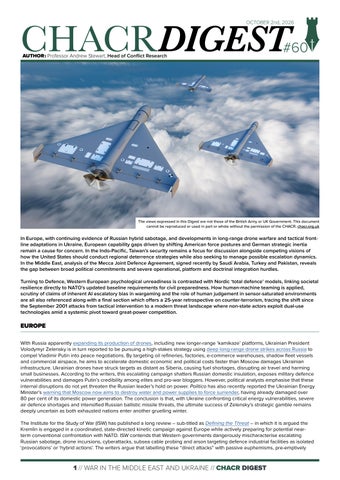
EUROPE With Russia apparently expanding its production of drones, including new longer-range ‘kamikaze’ platforms, Ukrainian President Volodymyr Zelensky is in turn reported to be pursuing a high-stakes strategy using deep long-range drone strikes across Russia to compel Vladimir Putin into peace negotiations. By targeting oil refineries, factories, e-commerce warehouses, shadow fleet vessels and commercial airspace, he aims to accelerate domestic economic and political costs faster than Moscow damages Ukrainian infrastructure. Ukrainian drones have struck targets as distant as Siberia, causing fuel shortages, disrupting air travel and harming small businesses. According to the writers, this escalating campaign shatters Russian domestic insulation, exposes military defence vulnerabilities and damages Putin’s credibility among elites and pro-war bloggers. However, political analysts emphasise that these internal disruptions do not yet threaten the Russian leader’s hold on power. Politico has also recently reported the Ukrainian Energy Minister’s warning that Moscow now aims to destroy water and power supplies to force surrender, having already damaged over 80 per cent of its domestic power generation. The conclusion is that, with Ukraine confronting critical energy vulnerabilities, severe air defence shortages and intensified Russian ballistic missile threats, the ultimate success of Zelensky’s strategic gamble remains deeply uncertain as both exhausted nations enter another gruelling winter. The Institute for the Study of War (ISW) has published a long review – sub-titled as Defining the Threat – in which it is argued the Kremlin is engaged in a coordinated, state-directed kinetic campaign against Europe while actively preparing for potential nearterm conventional confrontation with NATO. ISW contends that Western governments dangerously mischaracterise escalating Russian sabotage, drone incursions, cyberattacks, subsea cable probing and arson targeting defence industrial facilities as isolated ‘provocations’ or ‘hybrid actions’. The writers argue that labelling these “direct attacks” with passive euphemisms, pre-emptively
1 // WAR IN THE MIDDLE EAST AND UKRAINE // CHACR DIGEST
constrains European policy options, signals Alliance hesitation and emboldens Moscow to progressively test NATO’s threshold for collective defence. The writers challenge a prevalent European consensus that Russia will not pose a credible conventional threat until 2028 or 2030. Their analysis concludes that Moscow does not require a fully reconstituted military to execute offensive operations; instead, it can exploit a partially rebuilt force leveraging battle-tested drone teams, electronic warfare and infiltration tactics iterated in Ukraine. Hence, a warning that Russia could launch a limited conventional strike or targeted ground incursion against a front-line NATO state on a significantly shorter timeline. Rather than seeking to conquer vast territory in an extended war of manoeuvre, such an operation would be calculated to exploit political seams within the Alliance, induce decision-making paralysis and break the credibility of Article 5 if member states fail to deliver a unified military response. European leaders are urged to explicitly acknowledge Russia’s actions as state warfare, harden vulnerable infrastructure and drastically accelerate defence rearmament. Front-line nations are also encouraged to prepare forces to ‘fight tonight’ with existing assets, merging traditional highend armoured manoeuvre with adaptive, drone-centric operational concepts, again drawn from the war in Ukraine. It concludes that establishing effective deterrence requires urgent strategic clarity, proactive policy signalling and aligning European rearmament schedules with Russia’s rapidly evolving capabilities. The warning from the Danish Defence Intelligence Service (DDIS) is that Moscow could launch a limited military attack or severe hybrid operations against NATO border nations in the coming months. DDIS reportedly expects intensified hybrid warfare, including direct sabotage against European defence firms and military transport, alongside potential limited military scenarios like targeted missile strikes, false-flag drone operations or covert border incursions. This is in response to worsening economic strain, heavy battlefield losses and Ukrainian long-range strikes, and facing a strategic window before Europe builds stronger autonomous defence capabilities. The latest Danish analysis appears to rule out a full-scale invasion in the near term, but concludes with a warning that Russian risk-taking depends heavily on whether Moscow calculates a localised strike will fail to trigger a unified NATO collective defence response. At the same time, Defense News has reported on a joint intelligence operation by Britain, Norway and the United States that confronted Russian deep-sea submersibles near the Svalbard archipelago. Operating under Moscow’s secretive GUGI directorate, Russian vessels were simulating the deployment of advanced, covert technology designed to disable critical subsea communications cables without leaving fingerprints. Echoing conclusions presented elsewhere, the writers note Western intelligence officials view this foiled operation as part of a broader Kremlin effort to escalate hybrid sabotage across Europe as the Ukrainian front stalls and potentially test NATO’s Article 5 commitment. While it is also seen as emphasising Europe’s strategic vulnerabilities in the High North, the conclusion is that the interception demonstrates NATO’s expanding capability to monitor and deter subsea aggression while warning Moscow that covert attacks on vital seabed infrastructure will be detected and met with consequences. In an examination of the on-going ‘Operation Vivaldi’ counteroffensive in the Lyman sector, it is argued that this demonstrates mechanised manoeuvre and heavy armour remain vital in modern warfare and tanks are far from obsolete when properly integrated into combined-arms operations. Writing for War on the Rocks, Édouard Maurin reaches a different conclusion when explaining how drone saturation and ubiquitous real-time sensors have fundamentally reshaped modern high-intensity warfare. Maurin argues that the traditional linear front line has evolved into a thick, porous ‘contested zone’ expanding several kilometres deep, where battlefield visibility equates to immediate destruction. The core of his thesis centres on the concept of residual presence: small, highly-dispersed units operating from underground or thermal-suppressed hideouts to continuously access, observe, communicate and act within contested terrain rather than attempting to hold fixed, exposed ground. Survival and combat effectiveness depend on minimising thermal signatures (‘delta T’), leveraging decentralised command structures connected by shared real-time drone feeds and creating subterranean buffers. Analysing four distinct operational layers – super-aerial, sub-aerial, surface and subsoil – the writer demonstrates that conventional surface fortifications and massed armour have become fatal liabilities when exposed to low-altitude strike drones. Through a tactical comparison between two Ukrainian positions near Kotlyne, he contrasts ‘HOMAR’, a traditional open trench that suffered catastrophic casualties within hours, with ‘CRAB’, a small, concealed and covered fighting hole that held for ten days while inflicting severe losses on advancing Russian forces. As AI and machine learning further accelerate target acquisition, Maurin contends that Western military planners must abandon obsolete ‘show-the-flag’ positional doctrine in favour of disciplined concealment, extreme dispersal and technological adaptability to survive on sensor-saturated battlefields. In an essay for Engelsberg Ideas, Peter Sies argues that post-war Germany’s deep-seated aversion to hard power (Machtvergessenheit) and legalistic moralism render the nation dangerously vulnerable to Russian hybrid coercion. Sies exposes an internal tension within German identity between the post-Second World War imperatives of ‘Never Again Fascism’ and ‘Never Again Germany’. He contends that using the latter to justify national pacifism betrays true anti-fascist commitments, which now urgently demand a return to realpolitik (Machtpolitik) to confront Russian aggression in Eastern Europe. To counter Moscow’s threats, Sies asserts that Berlin must move beyond diplomatic sermons and establish credible deterrence. This includes setting firm red lines, such as tying countermeasures like Taurus missile deliveries directly to Russian hybrid attacks, and developing an independent Ukrainian strategy rather than reflexively outsourcing security to Washington. To insulate against nuclear blackmail, Sies advocates for an unorthodox leap: pursuing a German nuclear deterrent or negotiating operational control of warheads with France or the United States. Ultimately, Sies maintains that leveraging Germany’s fiscal capacity and industrial weight is vital to containing Moscow, upholding NATO’s Article 5 guarantee and protecting democratic institutions both at home and across Europe.
2 // WAR IN THE MIDDLE EAST AND UKRAINE // CHACR DIGEST
With the confirmation that its Chief of Defence Carsten Breuer has been elected Chair of NATO’s Military Committee, two reports in Politico have, meanwhile, highlighted Germany’s strategic dilemma. The delivery of its first US-built F-35 Lightning II [pictured left] solves an immediate operational need to replace aging Tornado jets and maintain its NATO nuclear-sharing commitment, but the collapse of the Franco-German-Spanish Future Combat Air System (FCAS) project has removed a nextgeneration successor. As Rixa Fürsen warns, this forces Berlin to consider expanding its F-35 fleet, pursuing national alternatives or joining other international programmes. It also heightens warnings that deepening a reliance on Washington threatens European strategic autonomy and sovereign defence-industrial capabilities. These concerns are visible in the delays Berlin faces in acquiring American Tomahawk cruise missiles and Typhon launchers. Heavy US missile consumption throughout this year and stretched production capacity have pushed expected deliveries into the 2030s, missing Germany’s 2029 operational target while significantly driving up costs. Berlin is reportedly leveraging these delays to press for greater transatlantic defence-industrial co-production, aiming to integrate German manufacturers into US supply chains. As the writers note, this friction highlights a broader paradox: Washington demands that European allies buy US arms, yet its own military engagements exhaust available stockpiles. With reports of negotiations to establish a major US military base for 10,000 troops in Poland, an ongoing Pentagon posture review creates lingering uncertainty over long-term European force levels. Writing for the Associated Press, Matthew Lee reports on the Trump administration’s decision to move $52 million in foreign military financing away from European allies, including NATO members Slovakia and North Macedonia, reallocating these funds to Latin American partners like Panama, Peru, Ecuador and Colombia. Described as a “strategic pivot [that] prioritizes Western Hemisphere security”, and focusing on counter-narcotics, migration control and countering Chinese influence, this also demonstrated a willingness to reduce security commitments to European nations that fail to meet spending expectations. Referring to a recent International Institute for Strategic Studies assessment, warning of a critical ‘capability-time mismatch’ as Washington accelerates troop and asset reductions across Europe, Stars and Stripes has highlighted some of the consequences of such actions. As its writer warns, although European defence spending has been increased, persistent shortages in personnel, air defence, artillery and logistics mean European armies cannot independently replace American conventional capabilities before the end of the decade. This will leave “severe strategic gaps” in eastern flank reinforcement and maritime surveillance. Following the completion of Europe’s largest civil defence exercise since the Second World War, and another examination of Finland’s comprehensive ‘total defence’ strategy, an interview with Brigadier General Steven P. Carpenter, Commanding General of Multi-Domain Command, has explained his thinking on operational lessons for modern high-intensity warfare on NATO’s Eastern Flank. These draw on the recent Exercise Arcane Thunder, held earlier this year and that validated the multi-domain company team, which merges drone operators, electronic warfare specialists and Below: An Estonian soldier walks through a trench during space personnel to seamlessly synchronise kinetic fires with non-kinetic Exercise Hedgehog 2025, which saw 16,000 troops take electromagnetic effects. Carpenter argues that future conflict requires part in a sweeping, multinational defence drill. transforming the stratosphere into an active manoeuvre space. By deploying soldier-piloted high-altitude balloons equipped with electronic warfare and reconnaissance payloads, forces can augment predictable satellite coverage with persistent, cost-effective capabilities above congested airspace. He also highlighted two major operational hurdles: managing a ‘tsunami of raw sensor data’ that demands actionable targets be filtered by AI and achieving seamless network interoperability across NATO allies. He challenges the defence industry to fix the inverted cost curve by prioritising low-cost, attritable and scalable systems over exquisite, multi-million-dollar platforms. This follows NATO’s widely reported Exercise Hedgehog 2025, recently examined in the War Room, and which revealed conventional military logistics cannot survive in modern transparent, drone-saturated environments using rigid, centralised systems. Arguing that NATO must fundamentally transform its sustainment architecture, amongst a series of proposals offered, the author also proposed reorienting procurement toward affordable, attritable military capabilities to regenerate combat power at speed. NATO
3 // WAR IN THE MIDDLE EAST AND UKRAINE // CHACR DIGEST
INDO-PACIFIC With analysis of Taiwan’s annual Han Kuang wargames suggesting a shift can be observed away from a historical focus on preventing an invasion strictly offshore or at the beachhead toward a strategy prioritising defence-in-depth, decentralised execution and wholeof-society protracted warfare, three writers have presented arguments about how the United States should apply deterrence in the Indo-Pacific region. Writing in the Small Wars Journal, Christopher Lee argues that the principal obstacle is not physical distance but a flawed cognitive mindset that views the Pacific Ocean as a vast barrier separating the United States from its regional allies. He advocates for a fundamental geostrategic reorientation, viewing the theatre through an alternative lens that places partners like Japan, South Korea, the Philippines and Australia as interconnected nodes within a mutually supporting operational framework. Writing for War on the Rocks, Ken Moriyasu and William Pazos argue a different approach and that, while American military regional planning focuses narrowly on maritime conflict, the decisive arena for Taiwan deterrence is shifting toward the Eurasian landmass. They explain that, to insulate itself against potential US naval blockades at strategic maritime choke points like the Strait of Malacca, Beijing is actively constructing an extensive overland network of oil and gas pipelines, railway corridors and energy agreements across Central Asia and Russia. The authors contend that establishing this continental resilience significantly reduces China’s vulnerability to maritime isolation, thereby emboldening Beijing to accept greater military risks over Taiwan. To counter this strategy, they argue Washington must expand beyond naval power projection and actively contest China’s economic and diplomatic influence along continental routes. This requires deep engagement with pivotal Eurasian ‘swing states’, particularly Kazakhstan, Uzbekistan and Azerbaijan, which control the strategic ‘Ganja Gap’ trade chokepoint. Rather than attempting to convert these nations into formal military allies, it is instead proposed that viable alternatives to Chinese infrastructure financing under the Belt and Road Initiative be offered, such as repurposing allied trade-deal investment commitments from Japan and Europe for third-country development. By injecting strategic uncertainty into China’s continental sanctuary and complicating Beijing’s supply assumptions during a crisis, Washington can cost-effectively strengthen deterrence against a Chinese attempt to seize Taiwan. Also presenting questions about China’s regional strategy, Adam Kuź challenges the traditional American debate between strategic ambiguity and strategic clarity, arguing that both sides focus narrowly on the moment before a crisis rather than how commitments evolve once deterrence fails. The writer introduces what he terms ‘the Corcyra Dilemma’, named after the Athenian defensive pact prior to the Peloponnesian War, to describe how a guarantor’s limited commitment to a weaker partner can tempt an adversary to test it, only for that test to fundamentally alter the commitment’s political and strategic value. Kuź contends that Beijing’s coercive actions against Taiwan need not begin with an overt amphibious invasion; instead, calibrated operations such as blockades, port quarantines or seizing offshore islands could force Washington into a dilemma. Once China acts, the cost of American non-intervention rises exponentially, not merely due to Taiwan’s intrinsic value, but because standing aside would shatter US credibility across the IndoPacific, undermine key alliances with Japan and the Philippines and invite systemic revisions to the regional order. To break this dynamic, he argues planning must focus on deterrence-by-denial rather than relying solely on declarative policy. He concludes that Washington must combine credible military denial options with escalation control mechanisms, ensuring an adversary’s initial test does not force a catastrophic choice between abandonment and uncontrollable conflict.
MIDDLE EAST AND MAGHREB In an analysis of the Mecca Joint Defence Agreement, signed in August 2026 by Saudi Arabia, Turkey and Pakistan, Doga Eralp warns its ambitious political promises severely outpace its military operational capacity. Signed amid growing regional volatility and doubts over American security guarantees, the agreement establishes a broad mutual defence commitment among three major non-Western powers. Eralp acknowledges the signatories offer powerful, complementary assets: Saudi Arabia’s financial wealth and advanced Western air defences, Turkey’s booming defence industry and NATO expertise and Pakistan’s large combat-tested force and nuclear arsenal. However, the author argues this political solidarity lacks the institutional framework, joint command-and-control and integrated defence architecture required to project credible deterrence. Eralp highlights severe operational hurdles, noting that expanding defence-industrial ties do not automatically yield battlefield interoperability. The three militaries depend on fundamentally disparate platform architectures (American, Chinese and indigenous or NATO systems) and lack shared doctrine, standards and training, all of which will make military collaboration difficult to manage. Of greater concern, while the signatories employ deliberate strategic ambiguity regarding trigger thresholds to keep regional rivals guessing, this vagueness is a dangerous liability. Rather than deterring adversaries like Iran, Israel or India, undefined obligations could invite rivals to test grey-zone boundaries, exposing the alliance to entrapment risks across volatile flashpoints in Yemen, Syria, Kashmir and the Eastern Mediterranean. Ultimately, the warning is that, while Washington may welcome the pact to delegate regional burden-sharing, an un-institutionalised alliance creates a dangerous security vacuum and risks overpromising while underdelivering, with an instrument meant to promote collective deterrence instead acting as a catalyst for regional escalation.
4 // WAR IN THE MIDDLE EAST AND UKRAINE // CHACR DIGEST
DEFENCE Allan Little, reporting for the BBC, has examined Western Europe’s acute crisis of psychological unreadiness and civic complacency in the face of escalating Russian aggression. He explains that, following decades of post-Cold War disarmament, European policy elites – most notably in Britain and Germany – have suffered a ‘crisis of disbelief’ while Western publics remain mentally unprepared for the domestic sacrifices and increased defence spending required to counter Russian threats. Front-line Eastern and Nordic states offer a vital blueprint for societal resilience. Nations like Finland and Sweden demonstrate that effective deterrence relies on ‘total defence’ approaches that integrate the entire population. Ultimately, the writer argues small professional militaries alone cannot be relied upon to address modern conflict. To overcome decades of mental disarmament and deter Russian aggression, political leaders must candidly articulate the reality of the threat, foster genuine civic readiness and consider Nordic-style national service models to rebuild societal resilience and military mass. At the same time, with the publication of 2026 Resilience Baseline Requirements, NATO has presented an updated strategic framework asserting that military readiness is ineffective without resilient civilian infrastructure and host nation support. Acknowledging an increasingly volatile security environment marked by hybrid sabotage, cyberattacks, space-asset vulnerabilities and emerging technologies, Allies are encouraged to strengthen civil preparedness and whole-of-society resilience to underpin collective deterrence and military operations. Noting that Allies are expected to account for up to 1.5 per cent of gross domestic product toward resilience and civil preparedness while establishing clear governance frameworks across public, private and military sectors, seven mandatory baseline requirements are highlighted: ensuring continuity of government; securing resilient energy supplies; managing population movements and evacuations; safeguarding food and water resources; handling mass casualties and health crises; maintaining resilient civil communications; and protecting civil transport networks.
FUTURES With reports of the US Air Force’s Decision Advantage Sprint for Human-Machine Teaming (DASH) experiment, reviewing how AI can be used to process complex battlefield data under pressure, an essay in War on the Rocks challenges prevailing claims that AI models possess an inherent escalatory bias in national security wargames. The authors argue that examples of these behaviours may be artifacts of wargame design rather than intrinsic model dispositions. While prior literature attributes AI nuclear escalation to training source material skewed toward coercive military theory, their experiments reveal that AI players consistently seek de-escalatory off-ramps unless explicitly programmed with aggressive, victory-oriented game objectives. Ultimately, they argue that better understanding machine cognition is a strategic necessity for anticipating how both friendly and adversarial human-AI decision systems will perform under crisis conditions. Boaz Golany, writing for ASPI, argues that, despite the rapid proliferation of AI and autonomous systems driven by technological leaps and casualty aversion, claims of human obsolescence in warfare are premature. Autonomous platforms will increasingly dominate space, air, naval and open-terrain operations shifting pilots and naval crews into battlefield managers of autonomous swarms but humans will remain indispensable. This is because complex urban and subterranean battlefields, ambiguous civilian-combatant distinctions and high-stakes ethical choices demand contextual judgement, intuition and moral accountability that machines cannot replicate. He concludes that, ultimately, future warfighting relies on optimising human-machine teaming rather than fully automated combat.
STATECRAFT AND SECURITY RETROSPECTIVE On the 25th anniversary of the September 2001 terror attacks against the United States, Atlantic Council experts have provided a comprehensive retrospective on how subsequent counter-terrorism (CT) operations have fundamentally reshaped both American statecraft and global security. Twenty-five strategic questions are examined and several core arguments presented regarding successes, failures and where US national defence goes next. First, the report argues that while post-9/11 CT delivered tactical excellence, it suffered from profound strategic drift. Four successive administrations resourced campaigns lavishly without defining a clear ‘theory of victory’ or realistic end state. This strategic ambiguity, combined with the repeated abandonment of trusted local allies, severely damaged international faith. Crucially, the lingering trauma and disappointing conclusions of the wars in Iraq and Afghanistan permanently altered American foreign policy, driving both political parties away from idealistic nation-building and democracy promotion toward a pragmatic, transactional realism centred strictly on core national interests and material power projection. Second, a major structural shift in the global threat environment has taken place. The centralised, hierarchical terrorism model of 2001, typified by al-Qaeda’s top-down command, has mutated into a dispersed, highly atomised ecosystem. Legacy brands such as al-Qaeda and ISIS survive but operational initiative has devolved to autonomous regional affiliates, local insurgencies and self-mobilised individuals. Today’s terrorists increasingly embed themselves within localised conflicts, ungoverned spaces and criminal shadow economies across volatile regions such as the Sahel, Central Asia and the Horn of Africa. Third, it is argued that emerging technologies are dramatically compressing the capability gap between non-state actors and sovereign militaries. The rapid proliferation of agentic artificial intelligence, low-cost commercial drones, cyber-intrusion tools targeting energy and water infrastructure and privacy-focused cryptocurrencies, allows decentralised networks to conduct sophisticated propaganda, automated targeting and clandestine financial transfers while bypassing the financial coercion and surveillance architectures established after 9/11. Finally, the report warns that state-sponsored terrorism is increasingly blending with grey-zone hybrid warfare, exemplified by Iranian proxy networks, targeted assassinations and cyber strikes against critical utilities. As American intelligence, financial and military resources are turned back towards great-power competition with China and Russia, this diminishes CT footprints in global hotspots like Africa and South Asia creating dangerous blind spots. This reduced visibility risks granting adaptive terrorist networks the sanctuary, time and freedom required to evolve undetected.
5 // WAR IN THE MIDDLE EAST AND UKRAINE // CHACR DIGEST