Issue 11 - winter 2014
Cannon Hill Anglican College magazine
rhodes scholar
new beginnings
also inside: five premierships in trimester 1 25-year time capsule opened word play in literacy academy
bright future
minister congratulates CHAC
CHAC welcomes P-2
exceptional scientists
Pax et Bonum
Testament to a CHAC education
Contents What a wonderful world
4-5
Out of the mouths of babes
6-7
Manners make the man
8-9
Diakonos noticeboard
10-11
Word play
12-13
World vision
14-15
The big kids
16-17
Everything old is new again
18-19
Young environmental photographer of the year
20
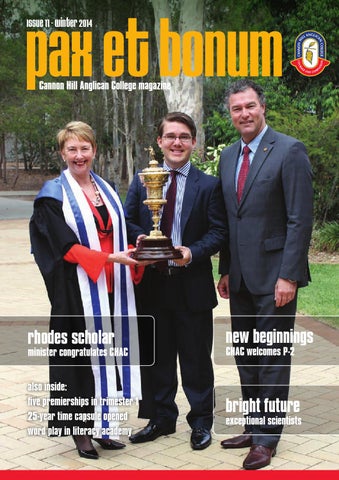
Cover image - Robyn Bell (Principal), the Hon John-Paul Langbroek (Minister for Education, Training and Employment), and Andrew Barnes (Class of 2006 and the 2014 Rhodes Scholar), with the Prince Albert Cup. Pax et Bonum supplements the fortnightly newsletter in maintaining links with parents, grandparents, friends and supporters of the College. The magazine keeps the CHAC community informed of current activities and achievements, and highlights Faculty and College initiatives throughout the year. Thank you to all staff, parents and students for your contributions. Anne Andrew Editor
Editorial Contact Details Communications Office Telephone: 07 3896 0439 Email: publications@chac.qld.edu.au Cannon Hill Anglican College Pty Ltd ACN 010 733 249 ABN 46 010 733 249 Cnr Junction and Krupp Roads, Cannon Hill QLD 4170 Postal: PO Box 3366, Tingalpa DC QLD 4173 Telephone: 07 3896 0444 Fax: 07 3896 0448 Email: college@chac.qld.edu.au CRICOS PROVIDER NO. 00646F 2
CHAC Principal, Mrs Robyn Bell, escorts (left to right) Aaron Dillaway, the Hon John-Paul Langbroek, the Reverend Canon Emeritus Bruce Maughan, OAM (hidden from view), and Andrew Barnes through the tranquil grounds to the College Assembly.
If you have visited our Main Reception recently, you will have noticed in the display cabinet a magnificent trophy (as featured on the front cover of this issue), which was presented to the College at the beginning of the year. The Minister for Education, Training and Employment, the Hon John-Paul Langbroek attended our Academic Assembly, during which he presented the cup to the College, in recognition of being the College attended by the 2014 Queensland Rhodes Scholar, Andrew Barnes (Class of 2006). The cup dates back to 1840, when it was made for Prince Albert, Consort of Queen Victoria, by the celebrated English Silversmith, Edward Farrell. It was purchased by Dr Nye of Brisbane, and given to the Secondary schools of Queensland in 1961 as a trophy for inter-school competition. As the Minister said, ‘The Prince Albert Cup and the Rhodes Scholarship acknowledge not just academic achievement but many of the diverse things that you show here at Cannon Hill Anglican College, through your motto With Courage and Compassion.’ To me, this trophy stands testament to a CHAC education. We strive to offer an holistic education and emphasise time and again that, while we rejoice in the acknowledgements of
the College’s academic prowess, we are about the whole person: their intellectual, social, physical, emotional, aesthetic and spiritual wellbeing. The Rhodes Scholarship, too, is about so much more than intellect. According to the Rhodes Trust’s website, Cecil Rhodes's vision in founding the Scholarship was to develop outstanding leaders who would be motivated to fight 'the world's fight' and to 'esteem the performance of public duties as their highest aim', and to promote international understanding and peace. His will outlined four criteria to be used in the election of Scholars: literary and scholastic attainments; energy to use one's talents to the full; truth, courage, devotion to duty, sympathy for and protection of the weak, kindliness, unselfishness and fellowship; moral force of character and instincts to lead, and to take an interest in one's fellow beings. Is that not the personification of a CHAC student? I hope that each time you see the Prince Albert Cup, throughout 2014, you too will be reminded of what a CHAC education is all about. Robyn Bell Principal
Issue 11 - Winter 2014
‘Progress is impossible without change, and those who cannot change their minds cannot change anything.’ Onwards and upwards
George Bernard Shaw
CHAC may have recorded its best ever academic results in 2013, but resting on these laurels is not an option. In a changing world where educational resources have evolved from a globe in the corner of the classroom, to the world at a student’s fingertips, via their personal tablet computer, CHAC is acutely aware of keeping in step with, if not ahead of, dynamic pedagogy in all its manifestations. This requires not only an external view, to monitor new trends - ensuring they are robust and not just an entrancing passing fad - but also looking inward to constantly challenge the norm, the boundaries of perceived success. An external perspective, and being open to new ideas, complements internal reviews, which is why Deputy Principal, Gary O’Brien, was delighted to be invited on an Australian School Principals delegation to China. ‘It is so important to look outward and tap into the expertise of colleagues around the country and the world. The opportunity to discuss educational ideas and strategies at length was invaluable, as was the opportunity to experience first-hand the situation of our near neighbours,’ Gary said. ‘One of the key findings of this tour, for me, was the realisation that we are moving into a world that is very different from the one in which I grew up, and with that comes the need for a range of different skills to the ones I developed as a student. The need for creativity, innovation and collaboration has never been more prevalent and it behoves us to ensure our students are well equipped to face this world.
Caption: Mr Gary and Dr Susan O’Brien, in the beautiful gardens of the Scholars Hotel in Suzhou. Suzhou is a major city in the southeast of Jiangsu Province, in Eastern China.
The number of low-skilled opportunities for Australians in Australia will continue to diminish as Asia expands. Our future relies on a society that reacts to these changes and prepares our children to be leaders and leading players in this changed world. ‘As the College community prepares to formulate its Strategic Plan to provide a framework for the next five years, we need to cast the net far and wide to gather inspiration and influence, aspirational next-practice
viewpoints, irrefutable methodology. Whether it is a lesson learned in China or a visionary idea suggested by a CHAC colleague, we remain vigilant in our desire to move forward, to evolve - to never rest on our laurels.’
‘The real voyage of discovery does not exist in seeing new things but in looking through new eyes.’ Marcel Proust
3
Pax et Bonum
‘And I think to myself, what a wonderful world.’ Louis Armstrong may have sung about it; Jules Verne may have written about traversing it in 80 days; but each and every day, in our state-of-the-art Science Centre, CHAC students get up close and personal with it! Through the study of Physics, Chemistry and Biology, students gain an understanding of matter and energy, the natural laws of the universe, and the natural systems of the living world. Real-world-learning takes the students beyond the textbook, with opportunities for field trips, camps, competitions, and elite study programs. In 2014 alone, three CHAC students have jetted off to Perth and Canberra, having been selected for the National Youth Science Forum - a prestigious Australian program for selected Year 11 students, who are heading into Year 12, and who are thinking about a career in Science, Engineering and related disciplines. The program exposes them to major scientific institutions and researchers, so that they may make more informed choices for their future endeavours. ‘I had incredible experiences and was exposed to many amazing areas of Science.’ Jack Deeb ‘I learnt new information, ways of thinking, and an attitude to Science and learning that was entirely unique to this program.’ Chloe Sonter
In July, Year 12 students Tim Chant, Angus Dobson, Courtney Graymore, and Mitchell Lovell, will head to the NASA Johnson Space Centre in Houston, Texas, to compete alongside twelve international teams in the International Space Settlement Design Competition. The four students were part of a collaborative team - with Sheldon College, Bundaberg State High, and the Australian Science and Maths School - that won the Australian national final. The students demonstrated creativity, technical competence, management skills, space environment knowledge, teamwork, and presentation techniques to conquer the problems inherent in siting and designing a space settlement. Krafft Ehricke (1917 to 1984) was a visionary space scientist and a pioneer of aerospace technology. It was he who said, ‘Man’s mind and spirit grow with the space in which they are allowed to operate.’ With the many and varied spaces in which our students are privileged to operate locally, nationally and internationally growth is inevitable.
‘I was so inspired and motivated by the many passionate people that I met and I know that it has helped me to further consider my tertiary study options and determine the direction of my future studies within Science and Engineering.’ Courtney Graymore
‘For I dipped into the future, far as human eye could see; saw the vision of the world, and all the wonder that would be.’ Alfred Lord Tennyson
4
Exceptional Scientists’ Program CHAC’s Exceptional Scientists’ Program is a new, or rather formalised and expanded, initiative aimed at talented, or interested, students who are passionate about Science. ‘To describe the chosen students as exceptional could sound elitist,’ explained Gay Ellyet, Coordinator of the program, ‘but it is not necessarily only the top academic students that are chosen. Some students may not blossom in their study of Science until after school, but their passion for the subject is undeniable. I see it as our role to respect that passion and to help it grow.’ Through extension programs, award applications, and real-world-learning experiences, a student’s talent or passion is nurtured, ensuring they receive qualitative exposure to multiple opportunities. Gay acknowledged the commitment the College is making in dedicating a member of staff to ‘exceptional scientists’. ‘To support and mentor a host of students through a range of diverse application processes is time-intensive. I am delighted to be able to dedicate quality time to ensuring our students have the best chance of benefitting from enrichment opportunities. ‘Already this year, for example, we have a record 12 students applying to attend the National Youth Science Forum in 2015. This is outstanding and is just the tip of the iceberg in providing exceptional support to our exceptional scientists!’
Issue 11 - Winter 2014
Meet Ms Rowena Berlin Head of Faculty-Science, Rowena Berlin, has a sunny and optimistic disposition, which may make her teaching background all the more surprising. Rowena took some time out of her busy schedule, in her first year at the College, to give Pax et Bonum readers an insight into her colourful journey. If you don’t already associate this professional woman with teen pregnancies, violence, juvenile detention, and gang-culture, then read on! After graduating with a Science Degree, with Honours in Petroleum Geology, a brief spell in the corporate world, and a Graduate Diploma in Maths and Science teaching, I found myself heading to London to work in a typical inner-city school. With its limited space; culturally-diverse students, some from a refugee background; and a somewhat ‘savoury’ clientele, it was tough. Many students were coerced into the dark world of East End crime families, and so court hearings, violence, and fathers facing GBH charges, were not uncommon. I learnt to value individuals and to deal with different personalities - to not get so het up about my teaching because, for some of these kids, there were far bigger things happening in their lives. They needed to feel safe. It was during my 11 years as a Physics teacher at Churchie that I decided to take a 12-month sabbatical and teach in America; Macon, Georgia to
be precise. I thought if I could teach in innercity London, I could teach anywhere, but I was wrong. This was a totally different world. Working in this low socio-economic school was the hardest teaching job I had ever had. We had kids with criminal records, and those in and out of juvenile detention. There were police and parole officers on campus, and students had to carry clear or mesh backpacks, and keep their shirts tucked in, to ensure that weapons could not be concealed. At one point, four or five of
my Year 9 girls were pregnant. However, some students went on to University; it depended on their family dynamic and whether or not they had the capacity to rise above the gang culture that pervaded the school. This experience further honed my teaching skills as it made me think - really think - about how I taught. I had to be dynamic, interesting, and fun, in order to engage these wary young people. It has made me a more relaxed teacher, as I don’t think anything could faze me now. I’ve seen it all! The students at CHAC may not have the same background, but they still have other issues relative to their personal situations. They are still individuals. However, I must say the kids at CHAC are brilliant. They want to learn and they do their homework. They are polite and well-mannered. They are forward thinking and take ownership of their education. They are committed. It is all about teaching and learning, and enjoying what you’re doing, no matter what your background.
Open Day, with Georgia McGraw, Charlotte Watts and Sofia Cerimovic making a polymer, a high-tech material more commonly referred to as slime.
5
Pax et Bonum
Out of the mouths of babes
In January 2014, CHAC’s landscape evolved once again, when Prep, Year 1 and Year 2 staff and students inhabited the Early Years Centre. And our family history took on a new dimension with the arrival of the ‘hats on legs’. The latter was a phrase coined to describe the influx of ‘the little people’. Never before had staff members had to bend so low to see a student eye-to-eye! However, they may be small but their impact has been significant, as the College’s facilities and community expanded to embrace the new arrivals.
The children raise many a smile with their large hats, boundless energy, and endearing natures; from the little chap who found the orientation day overwhelming, declaring to his mum ‘I think I need an iced tea’, to the throwing of arms around a staff member’s legs to say thank you, to the Year 1 student who decided that they did not build the complete Primary Precinct at once, because ‘it would have been too much sweat’! Yes. CHAC is all the richer for the arrival of ‘the little people’ and we look forward, with great joy, to sharing their journey into ‘big people’
Do not work with children .... In the entertainment industry, it is oft quoted not to work with children or animals. Surely that wouldn’t impact a State Minister’s visit to CHAC?
One enthusiastic child declared that he enjoyed playing with Sophie, at his grandparents’ home.
On only its fifth day of formal operation, the Early Years Centre welcomed its first VIP guest - Queensland’s Minister for Education, Training and Employment, the Hon John-Paul Langbroek. Mr Langbroek was given a tour of the facilities, during which he took the time to speak with Mrs Press’s Prep class.
The Minister proceeded to applaud and endorse the importance of friends, until the student - clearly sensing that Mr Langbroek was on the wrong path - stopped him midsentence and declared (in that special tone that only children can wield), ‘Sophie is a dog’!
The Minister asked the children to name something that they enjoyed about school.
6
Issue 11 - Winter 2014
The world is a BIG place! With many articles in this issue of Pax et Bonum having a global flavour, we took the opportunity to ask our Prep children just how big they think the world is. The answers from the first group went something like this: Lachlan Adams, Violet Coote, Haylee Gibson, Zoe Bartlett, Matilda Wyer. Matilda: As big as God. Lachlan: As big as a whole different planet. Perhaps Jupiter. Violet:
182.
(Stunned silence from the interviewer!) Haylee: 1082. Zoe:
1400.
Haylee: I think Zoe is right. Or maybe me, because mine was a pretty big number. The second group wielded some impressive adjectives! Mia Ross, Ashley Muldoon, William Walter, Kai Belleli, Noah Davis. Mia:
As big as the school.
Ashley: A moon. Or a ginormous dinosaur; perhaps a T-Rex. (Noah makes sure the interviewer records this impressive answer, pointing to her notepad and reminding her that ‘he said T-Rex’!) William: A massive building. Kai:
A ginormous rock.
Noah:
A humungous shooting asteroid.
Wow! The world sure is a big place.
Egg-xactly what was ordered! It was a sea of fluffy chicks, feathers, melting eggs, recalcitrant straw, bunny ears, and colourful cardboard, as 100 excited children paraded their hats, and performed delightful Easter presentations, for their special guests. The hot Autumn sunshine and endearing songs by the children - guaranteed to melt the thickest of chocolate and warm the cockles of all hearts complemented the beautiful outdoor setting. There were plenty of smiles all around, and much excitement with a surprise visit from the Easter Bunny! The young children brought a new dimension to CHAC’s Easter celebrations and their beautifully decorated cross was a highlight of Reverend Sarah’s message of Easter’s blessings. 7
Pax et Bonum
Manners make the man In an article in the South-East Advertiser, on the Firsts’ Volleyball Premiership-winning prowess spanning five years, Director of Sport, Mark Spindler, was quoted as saying, ‘These boys have developed into really great young men and that’s what the school is most proud of.’ Doesn’t that sum up the CHAC ethos? While winning Premierships (especially five in a row!) is cause for celebration, the greater prize is the measure of the sportsperson their attitude, teamwork, commitment, and that they try their hardest. No matter the outcome. In this issue of Pax et Bonum, while we celebrate the triumphs, our Sport and Trimester 1 team Captains also consider the responsibilities of elite athletes, whether on or off the field of competition. Is it not interesting that, when given a reasonably open-ended question, their focus naturally gravitated to character and not necessarily to achievement? Members of the winning Firsts Volleyball team pose for an image to accompany a news story in the South-East Advertiser.
A five-year whitewash The Firsts Volleyball team won the 2014 Premiership; in itself cause for celebration. But much more than this, the same team has, in essence, played together since Year 8 - and has won all five of the Premierships for which it competed. With the Year 10 and Year 7 Volleyball teams also winning 2014 Premierships, it is no wonder that CHAC was declared the top Volleyball school in the TAS Blue Division.
CHAC triumphant in Trimester 1 In Trimester 1, CHAC secured five sporting Premierships. The winning teams are represented in the image by: Year 7 Volleyball Year 10 Tennis Firsts Volleyball Seconds Tennis Year 10 Volleyball
Ryan Ibbs Stefanie Canard David Morgan Meg Ripps Lewis Coller
Well done to all of our Trimester 1 competing teams - we are very proud of you.
8
Issue 11 - Winter 2014
Inspiration or deflation? In an era when many a headline results from the on-field triumphs and offfield antics of sporting icons, our 2014 Sports Captains, and some Trimester 1 team Captains, took the time to reflect on the roles of elite sportspeople in our society.
Jack Deeb CHAC Sports Captain 2014
Lachlann Calderwood Cricket Captain 2014
Although a sportsperson’s main role is on the field, their public profile becomes one of the greatest responsibilities during their career. It is undeniable that the actions and choices of sportsmen and sportswomen will influence the lives of those who worship them as role models– particularly the younger athletes.
Brendon McCullum is a long serving player for the Black Caps and Captain for the past three years. He is a beacon of inspiration to those around him on the field, taking the lead and setting the expectations of his team. He is very much a lead-by-example person, stepping up and taking the fire when the team needs it. He refuses to let the team slump and instils a fire of passion in those around him on the field. It is through his sacrifices for the team that he has earned the respect and admiration of those around him.
A good performance or decision can result in massive surges in support and popularity; however, a bad performance or action will result in severe slander and persecution. So, it is the responsibility of the elite sportsperson to be at the top of their game all year round (both on and off the field), to recover quickly after bad performances or decisions, and always strive for improvement.
Jordan Crawford-Miller CHAC Sports Captain 2014 With great success comes great responsibility! Upon success, athletes are often thrown into the limelight and expected to become automatic role models and leaders. Stepping into the captaincy role myself has meant becoming a larger role model to those around me. It is here you find that being a leader or role model, as such, is not as easy as some may think. It is important to remember that athletes, just like the rest of us, will make mistakes and, in my role as a Captain, I have learnt that your harshest critic is often yourself; these athletes suffering the criticism from those around them will often already have their own lot of fault-finding and self-disapproval to deal with.
The leadership that McCullum shows proved a great inspiration to me. While setting the example and leading from the front may mean most of the grunt is yours to bear, if you can weather the storm, your teammates will respect you more and, overall, you will improve the cohesion and morale of the team.
Bridget Dodds Girls’ Basketball Captain 2014 My particular favourite elite athlete is Laura Geitz, Captain of the Australian Netball team. Geitz inspires me not only because she plays the same position in Netball as myself, but also her intense tenacity and desire to never give in. She leads the team with optimism and encouragement and I can see when she lifts the team with her spirit. When appointed Girls’ Basketball Captain for 2014, I wanted to share my enthusiasm for Basketball with my team and be able to lead the sport with the same life and spirit that Geitz never fails to forget. Lauren Jackson is another leader in the sporting arena that
inspired me this year. Not only is Lauren Jackson an outstanding athlete but an extremely important role model for young girls. Jackson promotes healthy eating and passion for sport as well as considering becoming an ambassador for a foundation that seeks to empower the abused women of the Rwandan Genocide. Hence Lauren Jackson was another athlete that inspired me to enjoy sport as much as I do and inspired me further to want to become Captain and share my passion for sport with the girls at CHAC. Elite athletes are extremely important within our society and I am grateful that we have so many wonderful female sporting role models for the young generation of girls in our community.
David Morgan Boys’ Volleyball Captain 2014 An athlete that has provided me with particular inspiration from the Volleyball arena is Ben Hardy. Hardy led from the front with focus, a passionate ‘never say die’ attitude and sportsmanship to earn the respect of both teammates and opponents. When appointed the 2014 Volleyball Captain, I aspired to take to the role in the same vein that Hardy might; sharing my enthusiasm and passion for the sport whilst attempting to give back as much as I could to help the overall development of the team. I believe that Ben Hardy is a great source of inspiration for any sportsman or woman in the College as we can all look to improve our skills at any point throughout our sporting career at CHAC. We can also look to Hardy’s values of teamwork and the ‘we before me’ ideal to promote cohesion and earn the respect of teammates.
9
Pax et Bonum
Diakonos noticeboard Welcome to the Diakonos noticeboard. Diakonos, the Biblical Greek verb ‘to serve’, describes the mission of service at CHAC. Our College provides opportunities to serve our community and our environment by actively supporting and creating links with community groups and organisations to enable students to be connected and engaged with ‘real world’ activities. Five Committees are overseen by the Diakonos Coordinating Committee, led by the College Chaplain: Boys’ Education Committee, Environment Committee, Girls’ Education Committee, Social Justice Committee, and the UN Women Committee.
CHAC Sisterhood On 6 March, Deborah Joy ce (Teacher - Social Science s) and Jo-Anne Hine (Teache Visual Arts) escorted eight rgirls to the International Wo men’s Day Breakfast - hos by UN Women - at the Bris ted bane Convention and Exh ibition Centre. UN Women is the United Nations entity responsible for promoting women’s empowerment and gender equalit y. The breakfast cele brated the economic, pol and social achievements itical of women, and raised awa reness of its work to provid and girls with an education e wom en and paid work in order to end the cycle of poverty a brighter future for all. and create
‘Bullying? No way!’
Sunny side up Each fortnight, a group of willing CHA C students makes an early start by supporting Murarrie State Scho ol’s Breakfast Club. The Social Justice Committee students assist with serving cereals and toast to the students and, in May, Sarah Bowler, Jessica Johnston, Jorji Murray, and Melinda Trezise practised their culin ary skills by serving pancakes! With sufficient volunteers, we hope to incre ase our support from fortnightly to weekly in Term 3.
College stood ents of Cannon Hill Anglican On 21 March, the staff and stud way!‘ as one and said ‘Bullying. No the National Day tee took the opportunity on The Boys’ Education Commit we do not want that ity , to show our commun Against Bullying and Violence s were vase can e larg Two d. is tolerate an environment where bullying Bell during Mrs by ed plac e atur sign first created for all to sign, with the Primary Leaders. by the College Captains and wed follo ely clos ly, emb Ass e to sign the alik of students and teachers The overwhelming suppor t sage of our mes r clea a t and lunch, sen canvases during morning tea ying. bull to es com it n whe ectation community’s values and exp Les Fergus Coordinator Boys’ Education Commit tee
10
June, National Each year from 27 May to 3 es and builds brat cele k Reconciliation Wee s shared by ship tion rela ul ectf on the resp Islander peoples Aboriginal and Torres Strait t of the weekpar and other Australians. As Anglican Hill non Can , long celebrations Torres and al rigin Abo d laye College disp Strait Islander flags.
Issue 11 - Winter 2014
CHAC and Church ‘Cross’ Over In the lead up to the Easter celebration, CHAC students were able to reach out and support a local parish by making Palm Crosses for the traditional Palm Sunday services. While busy fingers wove the palm fronds into crosses, the students discussed the Easter story and how it continues to influence the lives of Christians today. Learning and serving go hand in hand in Life and Faith at CHAC, strengthening our culture and our Anglican identity. Reverend Sarah Leisemann Chaplain
ing; t fun and fundrais l wasn’t only abou va sti Fe s nd n’ tla ee We ‘gr The ng our local rtunit y to invite alo it was also an oppo od job for the go a ch su , which do alia, community groups on, Greening Austr Marine Conservati an ali str d Au . an nt rs me tee environ ervation Volun Queensland, Cons n tio and rva ers se pp Pre Sto ife e Wildl had stalls. Crim s Environment all Boondall Wetland ted. were also represen Reverse Garbage
11
It was an early start for the Boys’ Educ ation Committee, when they hosted the Boys’ Mentoring Brea kfast in May. Junior Secondar y students benefited from the experience of the Senior boys, as they imparted advice on how best to manage the challenges and opportunities of Colle ge life.
On 3 June, staff and students made a gold coin donation for the privilege of wearing a funk y tie to school for the day. All proceeds raised from the Craz y Tie Day were in support of the Indigenous Literacy Foundation, as part of National Reconciliation Week activ ities
11 tiful late Autumn In May, on a beau p of staff, parents afternoon, a grou ered for High Tea and students gath to raise funds for on the Ar ts Deck , ed by CHAC’s UN nis ga UN Women. Or ing ests spent a relax Women group, gu table lec de s, tea of riety hour enjoying a va al conversation. treats, and convivi
11
Pax et Bonum
Word play
The CHAC Literacy Academy
It is quite awe-inspiring to contemplate the impact that just 26 letters in our Roman alphabet can have, when combined to make words. And the power those words can have when strung into sentences.
Thanks to a grant from Independent Schools Queensland (ISQ), Jenny Middleton, Director of Curriculum and Professional Practice, and Eve Hassall, Head of Faculty - English, are leading a program designed to inspire leaders of literacy instruction, in particular writing, across the curriculum.
Rudyard Kipling, who won the Nobel Prize in Literature, said, when addressing London’s Royal College of Surgeons, ‘I am, by calling, a dealer in words; and words are, of course, the most powerful drug used by mankind. Not only do words infect, egotise, narcotise, and paralyse, but they enter into and colour the minutest cells of the brain’. With Literacy listed as one of the seven crosscurriculum priorities of the Australian National Curriculum, CHAC provides students with robust programs and creative opportunities. The CHAC Literacy Academy, weekly timetabled sessions for reading, and the support of 25 talented entrants into the ICAS Writing Competition, are just some of the ways in which the College embeds Literacy into the ebb and flow of school activities, each and every day of the week.
The bottom line - as with every new initiative - is student outcomes and wide-ranging research supports the positive impact that a program like this can have in contributing to a student achieving their personal best. By ensuring that there is a commonality in approach to teaching and learning from Prep to Year 12, students will experience a smooth journey through Primary, Junior Secondary and Senior Secondary. This can be evidenced in such simple techniques as the use of a common language to describe aspects of writing and the steps needed to ensure students become confident writers in all of their subjects. It may sound obvious, but if all teachers use the same word to describe a desired set of outcomes - for example, a common understanding of ‘voice’, ‘ideas’, or ‘organisation’ - then
students’ interpretation and understanding of instructions will be consistent, and their transition from class to class and from teacher to teacher will be truly seamless. The Academy is based on a set of core principles, derived from various bodies of work. These underpin the work of the CHAC Literacy Academy: • From a student’s perspective, all students can reach their potential given sufficient support and time. • Expectations should be high and early intervention, when required, is essential. • All teachers can teach to high standards, given the right conditions and assistance. •
Teachers will foster reflective practice, adopt collaborative inquiry in professional learning, and be able to articulate both what they do and why they do it.
• Continuous improvement in learning is the responsibility of teachers and students. • Any improvement in teacher practices and student engagement, must increase student confidence and achievement. To ensure that the CHAC Literacy Academy enjoys successful integration into the teaching and learning ethos of the College, internal and external accountability are embedded into the program. Combined with other creative initiatives in the areas of literacy and numeracy, we look forward to monitoring the progress of our students as they journey through the College.
The use of Literacy skills in the Science laboratory is just as important as understanding a Shakespeare play or articulating findings from a Geography field trip.
12
Issue 11 - Winter 2014
CHAC’s extended family Grandparents’ Morning is a much-loved event in the College calendar and a very special component of the morning (apart from the student presentations and the delicious home-made morning tea!) is the kindness the grandparents share as they donate books to the College Library. This year, a magnificent $3,181 was raised, which has funded the purchase of over 200 books. CHAC’s Librarian, Naomi Shannon, was delighted when a Year 4 student asked to see the books that her grandparents had donated several years previously, when her ‘big sisters’ were at CHAC. ‘It was lovely,’ said Naomi. ‘She was thrilled to read the book her big sister had selected, and to see her grandparents’ names on the bookplate.’ Isaac Mellish (Year 2) welcomed his grandparents, Ross and Gail Beasley, to the 2014 Grandparents’ Morning Tea.
Visual Literacy
Did you know?
The adage A picture paints a thousand words may seem at odds with an article about the written word, but is it? Not according to CHAC’s Librarian, Naomi Shannon, who extoled the value of picture storybooks.
In our 2013 NAPLAN outcomes for Reading, our Years 5, 7 and 9 results were between 8.63% and 9.79% above the national average.
‘Picture storybooks introduce children to the concept of reading. Illustrations (the visual text) help children develop and explore their natural love of story and provide a gateway to the written text. ’The use of colour, medium, strength or minimalism of lines, the size of the book and the use of space, all combine to create meaning and elicit emotional responses to a story. With each successive reading, children can gain additional meaning as they explore previously undiscovered aspects of the visual text. ‘But an understanding of, and appreciation for, picture storybooks does not need to be confined to early childhood. Picture storybooks can be used to introduce or explore complex themes and issues. With increasing awareness or understanding, a previously simple picture storybook can become a many-layered and challenging text.’
Books and tablet computers coexist happily in a Year 5 classroom, as Jacob Spencer gets to grips with his school work.
The Very Hungry Caterpillar, illustrated and written by Eric Carle and first published in 1969, is a children’s classic, and our Prep students took the time to create their very own hungry caterpillars!
13
Pax et Bonum
World vision
CHAC is its own mini League of Nations! Many of our current staff and students hail from the four corners of the globe, and we have many tales of CHAC graduates who have travelled to distant shores to work or further their studies. Our current students, too, have to keep their passports ready, as the Faculty of Languages Education conducts biennial trips to France and Japan, and the Director of Performance Music will soon lead a tour to the west coast of the United States of America. Students have previously toured New Zealand and China. Here is just a taster of the global flavour that infuses our College.
On a family holiday to the States, Sam visited Four Corners - the quadripoint in America where the boundaries of four states - New Mexico, Colorado, Arizona, and Utah - meet.
Not a lot of people know that! Did you know that Maine is the only American state with just one other state on its border (New Hampshire) and it is the only state with one syllable? No doubt, Sam Harbison (Year 11) will discover these trivia gems, amongst other things, when he spends the next two semesters as an international exchange student based in Portland, Maine, USA. Recognising an ‘incredible opportunity’, Sam was one of only four Australians selected for ASSIST’s sponsorship program. According to their Mission, ASSIST - a not-forprofit, international educational and cultural exchange organisation based in the United States - creates life-changing opportunities for outstanding international scholars to attend and contribute to the finest American independent Secondary schools to promote mutual understanding, cultural interchange, and global citizenship. When asked why he applied for the scholarship, Sam said, ‘To broaden my world view. I adore travel and know, from spending seven months
14
in England, how different a place can be when you live there, compared to when you visit as a tourist. ‘I will attend a small school but one very similar to CHAC in terms of culture and opportunities. I’m looking forward to studying American history as it will be interesting to see things from their point of view. I have already signed-up for Cross Country and Track and, as the average maximum in winter is zero degrees, my winter sport will be Nordic Skiing! ‘When we visited America last year, for a two-week holiday, I thought the people were very friendly and seemed less Americanised than we are!’ Nevertheless, Sam finds the prospect of living with a host family ‘a little scary’. ‘I won’t see my parents for 10 months but, in this internet age, we will Skype often. I will miss my dog, though!’ Still, as Maine has more Moose per square mile than any other state, perhaps the short-term adoption of a very large four-legged, antlered pet will be in order!
Issue 11 - Winter 2014
It’s a small world after all The CHAC family has several students who are relatively new to not only CHAC, but also Australia. We wondered how they felt about their new home and school, and the differences they noticed.
Ewan (Year 7), County Dublin, Ireland ‘The biggest difference between CHAC and my old school, The Old Borough, is that CHAC is much bigger. There were only one hundred and ten students attending the school; however, The Old Borough is one hundred and eighty years older. Also we didn't have any air conditioning because we didn't need it; instead, we had radiators to heat the classroom.’
Maya (Year 10), lived in Abu Dhabi, United Arab Emirates, for six years ‘CHAC has a very strong sense of community, with all the time dedicated to pastoral care, and the strong sense of pride taken in our Houses. At my old school, we had no sport days, let alone Houses. ‘Australia has a fantastic outdoorsy lifestyle. There is plenty of public transport available; people are able to walk to places and have picnics in parks. In some countries it is too dangerous, or the climate is not suited to these activities. The ability to do so much outdoors creates a healthy energetic vibe.’
Tanner (Year 9), American-born, recently arrived from West Berkshire in England ‘I think what I miss the most about England is the history that is everywhere. You can get to a medieval castle in 15 minutes and some of the houses are up to hundreds of years older than the nation of Australia or even America.’
Ella (Year 12), County Dublin, Ireland ‘The last school I attended had no committees; there were three main sports - Hockey, Badminton and Sailing - and there were no music ensembles. It was an international school, with people from many European countries and America. Seeing people who were always coming and going made me realise that I shouldn’t be worried about starting a new school in a different country, especially when some of the people couldn’t even speak English.’
Leon (Year 8), Oxfordshire, England ‘CHAC is more colourful and vibrant than my old school; it has a lot more nature and greenery around the buildings. I also think that CHAC has more programs and extra-curricular activities available. Also, CHAC is more involved with fundraising and charity.’
Thembi Hanify (Class of 2006) featured recently on the front cover of U on Sunday, as part of a story on Queenslanders now living and working in The Big Apple - New York. Thembi is working as a graphic designer in the art department at fashion label rag & bone. Brooks, Lucy. “Life in the Big Smoke.” U on Sunday (NewsQueensland), 18 May 2014. Photographer - Frankie Buckle.
Did you know? Cannon Hill Anglican College’s sister school in Japan is Seiryo High School. Located in the City of Nagoya, at the foot of beautiful Mt Fuji, Seiryo emphasises academic achievement, sporting and cultural activities, and environmental awareness. A group from Seiryo first visited in 1995 and the schools have conducted reciprocal visits ever since. A Japanese Bursary is awarded annually to two Year 11 Languages students, in support of a sixweek homestay with host families from Seiryo High School, prior to the commencement of their final year at CHAC. In 2013, the recipients were Maud Beach and Douglas Bennett.
Douglas Bennett with his host family in Japan.
15
Pax et Bonum
The big kids As a caring, sharing community, it is no surprise that there is always plenty of excitement for the ‘grown ups’, as well as CHAC students! The Parents and Friends’ Association has had a very busy year, with the Fashion Parade in March, and the Wetlands Festival at the end of May, to name but two of its major commitments. Both events were hugely successful, which would not have been possible without the seemingly endless contribution of volunteer hours and efforts. The CHAC Foundation hosted its third annual Corporate Networking Evening. Forty-six business representatives registered for the opportunity to put out their virtual village market stalls, by showcasing their businesses to one another. Guest speaker Adam Franklin - gave some much-appreciated and practical advice on harnessing social media for extending the reach of the marketing message.
The Japanese-themed table was voted best-dressed table at the Primary Mothers’ Day Morning Tea.
There are always opportunities for catching up with old friends, making new friends, supporting College initiatives, enjoying value-add opportunities, and for being very much an important part of the caring and sharing community that is CHAC.
Date Claimers Semester 2 has many exciting events in store, including the Christmas Carols on 29 November.
Nearly 50 companies registered to attend the CHAC Foundation’s annual Corporate Networking Evening.
Mark them in your diary! 3 September Fathers’ Day Breakfast (Primary) 5 September Volunteers’ Thank You Function 5 September P&F Trivia Night 12 September CHAC Foundation Golf Day 17 September Music Staff Showcase 4 November CHAC Foundation Melbourne Cup Luncheon 29 November CHAC Christmas Carols
16
Wetlands Festival 2014 was a true celebration of the CHAC community spirit, as hundreds - if not thousands - of volunteer hours and a never-ending stream of generous donations resulted in a recordbreaking fundraising effort.
Issue 11 - Winter 2014
25 years in the making
Foundation Day 2014 was always going to be special, as we concluded the celebrations of the College’s 25th year, but no-one had quite foreseen just how memorable an occasion it would turn out to be. The ingredients were all there: the celebration of the opening of the Time Capsule; the visit by the College’s first school Captain, and other Foundation Staff; the acknowledgement of Staff Service Awards; the presentation to the College of special memorabilia. Add a touch of heartfelt sentiment, emotional honesty, inspired creativity, and an appreciative audience, and the outcome was a moving event that will linger long in the hearts and minds of those present. The tone was set with the at-times poignant, attimes emotional, at-times amusing speech given by Assistant Principal, David Pavish, who spoke on behalf of Staff Service Award recipients, himself having received a specially-struck Chrysalis pin acknowledging 20 years of service to CHAC. ‘I have enjoyed being a part of an ever growing and dynamic school that has thrown up lots of interesting challenges over the years,’ said Mr Pavish, as his speech drew to its conclusion. ‘The values we hold dear - care and compassion for others, respect and tolerance - haven’t changed since the day I first started teaching here. ‘Other constants that I have enjoyed have been the strong sense of community and the friendly, professional and collegial staff that CHAC seems to attract. The staff and students I associate with
every day, are my family away from home and the relationships we encourage between staff, students and parents are quite unique and to me have always been that special CHAC X-factor that we refer to often.’ Following a beautiful presentation by the Primary Choir, John Holland - a Foundation Parent and first President of the College’s Parents and Friends’ Association (P&F) presented to the College the blazer worn in 1989 by his daughter, Amanda, and a framed picture of the first Foundation Day cake. He also, on behalf of the College Founder, the late Mr Rod Wells and Dr Roslyn Wells, presented to the College the brass school bell that was given to Mr Wells on retirement in 1991, by the P&F. Mr Holland’s heartfelt speech left no-one in any doubt of his affection for the school.
The cutting of the traditional Foundation Day cake was truly a celebration, as a host of special guests - each testament to the College’s short but rich history - gathered around the cake. This Assembly-to-remember was rounded off with prayers of thanksgiving and a rousing rendition of the College Hymn. Was it our imagination, or were the words sung with deeper meaning; with a greater appreciation for our very special community? We’d like to think so.
The delivery of the Time Capsule, buried early in 1989, was an entertaining mix of filmed footage and live action, the melding of which elicited gasps of delight from the audience, as the culmination saw a group of Prep students burst into the Auditorium, to present the Time Capsule to their Principal, Mrs Bell. But wait - there’s more! The Time Capsule contained a letter from the first College Captain, addressed to ‘The Students of 2014’. Imagine, then, the audience’s delight when that person - Mrs Keleisha Rigby-Smith nee Rigby - was invited to the podium to read the very words she had written. Her animated and sensitive reading of her letter served only to add to the electric atmosphere already in the Auditorium.
Keleisha Rigby-Smith caught up with the 2014 College Captains.
17
Pax et Bonum
A global family
The aspects of being a worldwide communion are the traditions and practices that unite us and make us a global family – our Anglican family traits. The first of these Anglican family traits is the daily tradition of Morning and Evening Prayer, a liturgy in which Anglicans around the world all pray using the same form and often the same words, just in a different language. ‘When I pray in Australia,’ said CHAC’s Chaplain, the Reverend Sarah Leisemann, ‘I know that Anglicans in Australia are praying with me and for me, and around the world, at any given moment in time, someone is praying somewhere using an Anglican form of prayer. ‘I like to imagine this as a picture of warmth: as the world turns, the prayers spread and surround the world. There is a regular rhythm of prayer that envelops the world morning and evening. As the sun comes up in one country, or sets in another, prayers never cease. Someone somewhere will be praying. There is a lovely sense of belonging and comfort in that idea.’ The second part of being part of a wider family becomes evident when travelling the globe. Wherever you go in the world, the Anglican Communion exists, whether it is in Europe, the Americas, Africa or Asia, you will find an Anglican church somewhere. In spite of differences in language and culture, the traveller who steps into an Anglican church will recognise some of the elements that also form part of worship here at CHAC; things like saying ‘The Lord be with you.’ In any language, the response will always be ‘And also with you’.
18
‘The forms of prayer and the forms of worship are the same wherever you go, they will simply have a local flavour and style,’ Reverend Sarah said. ‘I often encourage our students, when they travel, to visit an Anglican church and to tell the community that they attend an Anglican school. The local church will want to reach out the hand of friendship to the traveller, no matter where they come from. It is nice to know that our students will have a friendly place to visit, even if they feel really lost. They will always have a little home to go to!’ In addition to these shared traditions, being part of the Anglican family means that our little corner of the world is regularly prayed for by the rest of the world. Anglicans publish a Cycle of Prayer each year, in which every single diocese in the world is listed so that, eventually, every Anglican church has prayed for every other Anglican church.
‘When it is Brisbane’s turn, every Anglican in the whole world, who uses the Cycle of Prayer, will pray for Brisbane on its designated day, which is amazing when you think about it!’ said Reverend Sarah. ‘What’s more, our College is prayed for specifically once a month in our own Diocese and yearly across Australia. Anglicans know about us and care about us. ‘As we pray though the Cycle of Prayer, we pray our way around the world. It reminds us that we do not live in a bubble. The world is in need of our prayer and support, some places more than others. It stops us being introspective and naval gazing, and it is another way that we can live out what we encourage our students to be global citizens - and more than that, to be global prayerful citizens.’
Whether worshipping in a grand cathedral or a rustic country church, Anglicans the world over will use familiar prayers and liturgies.
Issue 11 - Winter 2014
Everything old is new again The Past Students’ Association (PSA) has a vision to actively contribute to a supportive and nurturing College community that will provide ongoing benefits and assistance to current and future members of the PSA and wider community.
The Voice As an integral part of the CHAC community, the PSA’s Honorary Office Bearers and Committee were invited to participate in Cannon Hill Anglican College’s strategic planning process - a process designed to formulate, through consultation with stakeholders, the strategic direction of the College for the next five years. ‘The Committee greatly appreciated the opportunity to be involved in the development of the College’s strategic plan,’ said PSA VicePresident Sam Walpole.
‘Casting our minds back to our time at the College was an enjoyable exercise, and it is hoped our perspective from life post-CHAC, and as members of the alumni community, will aid the College in formulating its agenda for the next five years. ‘Participation in initiatives such as this is a key aim of the Association as it seeks to have past students closely involved with the current College community.’
(L to R): Yasmin Murry (2011), Gough Kettle (2010), Sam Walpole (2010), Sarah Narloch (2007), Ryan Browne (2013), Mark Vincent (Insight Plus), Megan Wooldridge (2002) and Sam Hunter (2004) engaged in the strategic planning process.
10 and 20 year reunions Calling all 1994 and 2004 graduates. It is your turn to celebrate! 20 September 2014 – 7 to 10pm Gateway Room, Colmslie Hotel. Visit www.chac.qld.edu.au for details.
Foundation Day drinks and tour The PSA’s third annual drinks evening - held each year on Foundation Day - was held on the Arts Deck and guests ranged from 2013 graduates to as far back as 1995. The opportunity to catch up with old faces, and compare stories of the past with new faces, is establishing itself as an annual must-do ritual for our alumni. This year, for the first time, a tour of the campus was also offered. Even recent graduates were amazed at the ongoing evolution of facilities. Our 1995 visitor, Steen, was delighted to discover that ‘the big tree’ was still very much a part of the campus landscape!
Assistant Principal, Dave Pavish, caught up with 1995 graduate Steen Gundesen.
2004 graduates Jenny Manton, Sam Hunter and Liz Lawson.
19
Young Environmental Photographer of the Year The much-maligned Ibis was sacred to the Egyptians. It represented the god Thoth - god of wisdom, knowledge and writing. Had cameras been invented in these ancient times, then perhaps photography will have been added to the list! For it is an image of these ancient birds, taken on the CHAC campus, that won Year 11’s Georgia Canning the title of Lord Mayor’s Young Environmental Photographer of the Year. CHAC’s enthusiastic support of the competition was rewarded with a professional photography workshop for 30 students, so we look forward to seeing their newly-honed skills later in the year.