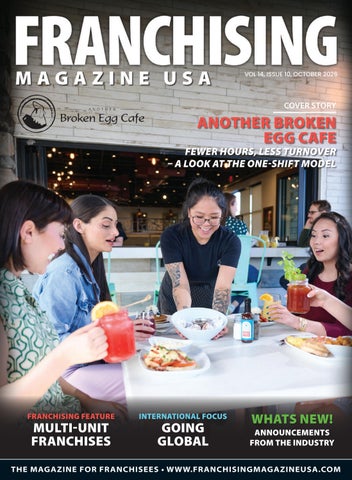
VOL 14, ISSUE 10, OCTOBER 2026
COVER story
Another Broken Egg Cafe
Fewer Hours, Less Turnover – A Look at the One-Shift Model
franchising feature
multi-unit franchises
international focus
going global
whats new! announcements from the industry
Franchising MAGAZINE USA 1 The magazine for franchisees • WWW.FRANCHISINGMAGAZINEUSA.COM
VOL 14, ISSUE
10, OCTOBER
2026
COVER
stORy another Broken egg cafe Fewer Ho
VOLUME 14, ISSUE 10, 2026
– A Look AT
urs, Less Tur nover THe one-s HiFT ModeL
On the cover: Another Broken Egg Café
president: Colin Bradbury. colin@cgbpublishing.com Publisher: Vikki Bradbury. vikki@cgbpublishing.com editorial department: editor@cgbpublishing.com advertising: Grace Padiz. grace@cgbpublishing.com Production: usaproduction@cgbpublishing.com DESIGN: Michelle Quinn. michelle@cgbpublishing.com CGB PUBLISHING Canadian Office: Sidney B.C Canada U.S. Office: Seattle, WA www.franchisingmagazineusa.com
franchisin
g featur
multi-uni e fr anchiset s
The ma gaz
ine for fra
internation
nch isee s
Welcome to the October 2026 issue
al focus
going gloBal
• WW W.f ran
whats ne
w!
announcem ents from the industry chi sin gm
agaFranc hising zin MagaZ eUs inEom a.c Usa 1
of Franchising Magazine USA!
I recently attended the World Franchise expo in Fort Lauderdale Florida, lots of interest in Franchising and got to speak with a lot of entrepreneurs looking to take the next step in their path. On the cover this issue we have Another Broken Egg Café who runs one shift, mornings into early afternoon, with no dinner or late-night. It’s one example of how a daypart structure shapes staffing, kitchen complexity and the day-to-day life of a franchisee and their team. As usual we have some great topics from our residential experts in this issue, Evan Hackel starts off with Who Moved the Franchise? Why the Future Belongs to Those Willing to Change. George Knauf states NO BODY WARNS YOU ABOUT TUESDAY the interesting parts — the model, the unit economics, the vision of what this becomes in year five. Lucas Frey asks What Franchise Founders Can’t Delegate. From our Guest writers we have Ms. Sarah Kulbatski who broaches a relevant subject on how inflation is affecting Franchise Owners. Our Special feature this issue is Multi-Unit Franchising, Chris Conner my resident Feature expert covers the many advantages of multi-unit ownership. We also meet Amanda Alverez who explains how and offers Lessons From this Multi-Unit Franchisee who went from Growing from One Location to Three. For our veteran readers we meet a franchisee who went From Army Colonel to Franchise Owner: and what it taught her about her Military Transition and entrepreneurship. Plus, don’t miss our A-Z Franchise Directory, which offers a comprehensive guide to exciting franchise opportunities across industries. Also check out our new look website which has had incredible feedback https://franchisingmagazineusa.com/ Happy reading!
Proud member of the IFA:
International Franchise Association 1501 K Street, N.W., Suite 350 Washington, D.C. 20005 Phone: (202) 628-8000 Fax: (202) 628-0812 www.franchise.org
Vikki Bradbury | Publisher Franchising Magazine USA
The information and contents in this publication are believed by the publisher to be true, correct and accurate but no independent investigation has been undertaken. Accordingly the publisher does not represent or warrant that the information and contents are true, correct or accurate and recommends that each reader seek appropriate professional advice, guidance and direction before acting or relying on all information contained herein. Opinions expressed in the articles contained in this publication are not necessarily those of the publisher. The publication is sold subject to the terms and conditions that it shall not be copied in whole or part, resold, hired out, without the express permission of the publisher.
Franchising MAGAZINE USA 3
The public and policymakers need to understand franchising. Our purpose
@OurFranchise is an industry-wide campaign created to spread the word about the value of franchising and share the stories of men and women just like you, who are leading the way as franchisors, franchisees, and franchise employees. The franchise business model has been proven time and time again to work, but it’s threatened when the public and politicians don’t understand how it operates to benefit local, independent franchise establishment owners and their communities. Putting a spotlight on real leaders succeeding with the franchise model is how we’ll ensure franchising is stronger than ever before.
Follow us
Share the tools and resources offered on AtOurFranchise.org/resources
Help us keep the momentum going
Since our launch in June 2016, we’ve reached 1.7 million people through outreach efforts, including events in key cities and states, where we spoke directly with business owners, employees, policymakers, and the media. Additionally, we’ve reached people across America through our website and social media channels, digital advertisements, and the promotion of We the Franchisees on Politico – but there is much more work to do. As a franchisor, franchisee, or franchise vendor, you are a leader in your community – and we need your support, now more than ever.
You benefit by joining
By joining @OurFranchise, you’ll get access to exclusive stories and resources that can help grow your franchise business, educate employees at all levels about the franchise business model, and share the economic importance of franchising with consumers. You will also have the opportunity to share your franchise success story with your peers. Visit AtOurFranchise.org Contact Erica Farage, Senior Director of Political Affairs and Grassroots Advocacy and Multi-Unit Franchisee Engagement International Franchise Association efarage@franchise.org (202) 662-0760
b
a
x
Our Franchise
@OurFranchise
@OurFranchise
This is just the beginning
Make sure you stay up to date with the campaign’s latest efforts through email updates and social media. Visit our website to read and share the latest stories of franchisors and franchisees making an impact in their communities. Become a franchise advocate to help ensure Americans, now and in the future, have the opportunity to start franchise businesses. Take the lead today!
conte nts oc tober 2026
10
Expert Advice
Women in Franchising
12 Evan Hackel: Who Moved The Franchise?: Why The Future Belongs To Those Willing To Change
36 Dee Burkhardt: Scaling For Success: 4 Lessons In Multi-Unit Franchise Growth
16 Luke Frey: What Franchise Founders Cant Delegate 22 Jon Franz: How To Find Buyers Outside Of A Franchisor’s Listings
Have Your Say 32 Building Kidz School: Beyond The New Build: How Real Estate Flexibility Can Accelerate Childcare Franchise Growth
26 Sarah Kulbatski: How Inflation Is Affecting Franchise Owners
Cover Story
40 George Knauf: Nobody Warns You About Tuesday
10 Jorge Salvat | Another Broken Egg: Fewer Hours, Less Turnover: A Look At The One-Shift Model
28
In every issue 6
What’s New! Announcements from the Industry
48
50 A-Z Franchise & Services Directory
Have Your Say
veterans in franchising
38 5 Franchise Leaders: Back To The Future: 5 Franchise Leaders Revive 90’s Growth Tactics For Todays Market
FEATURE CONTENTS
Franchisee in Action
Franchisee in Action
Expert Advice
48 Trina Rice: From Army Colonel To Franchise Owner: What My Military Transition Taught Me About Entrepreneurship
14 76 Fence: 76 Fence Southern LowCountry: Officially Opens With Grand Opening Celebration In Savannah
Franchisor in Depth 20 French Florist: The “Niche Riche” Boom: How French Florist Is Turning Specialized Craft Into Franchise Growth
International Focus 24 Troy Hazard: Going Global
28 Chris Conner: The Many Advantages Of Multi-Unit Ownership
Franchise in Action 30 Scenthound: Scaling Smart: Lessons From A Multi-Unit Franchise Growing From One Location To Three 34 Sam Bat TCBY: LongTime Famous Brands International Franchise Expands TCBY® and Mrs. Fields® Presence Across The Southeast
Franchisor In Depth 46 Wild Bills: Our Customers Are Already At The Event. We Go To Them.
Snapshot 44 Dreamaker Bath: Dreammaket Bath & Kitchen Of Ogden Gives Back With Bathroom Makeover For Army Veteran Franchising MAGAZINE USA 5
Lola Beans Heads to Miami with Five-Unit Development Deal Lola Beans, has signed a five-unit development agreement to enter the Miami market. The deal marks another major step in the brand’s expansion, coming just one week after Lola Beans announced a six-unit development agreement for Delaware. The new franchisees, Daniela Gonzalez and Joangel “Joey” Lopez are immigrants from Nicaragua and Cuba who grew up in Miami, where coffee was always about much more than the drink itself. They grew up surrounded by the city’s cafecito and ventanita traditions, where strong, sweet Cuban-style espresso and walk-up coffee windows have long brought people together for a quick coffee, a familiar face and conversation with a neighbor.
“Miami has such a strong coffee culture, but it’s also a city that moves fast,” said Gonzalez and Lopez. “We fell in love with Lola Beans because it feels close to home. It brings the spirit of Miami’s ventanita cafecito culture into a modern dual drivethru that delivers speed without sacrificing connection. The couple plans to initially develop five Lola Beans locations over the next five years. “We’ve been excited for a long time about building a strong presence for Lola Beans throughout Florida, and this agreement is an important first step in that vision,” said Donny Bradley, founder of Lola Beans. “Joey and Daniela understand the culture, the community and the experience we
want Lola Beans to create, and we believe they will be the first of many outstanding franchisees to help establish the brand across Florida.” Last week the brand signed a six-unit development agreement for Delaware and a 120-unit Texas agreement led by Kirk and Coleen Jeter through Rise Hospitality Group, Inc. LolaBeansFranchise.com.
Slutty Vegan Spreads the Love Across Ohio with Third Market Signing in Cincinnati Slutty Vegan, the world-famous, woman-owned plant-based burger brand founded by entrepreneur, author and reality-television star Pinky Cole Hayes, has officially signed a franchise agreement to bring the rapidly growing concept to Cincinnati, marking the brand’s third market in the state of Ohio. The agreement was signed by Soul Republic Hospitality Group, led by founder Akin Affrica, the same operator behind Slutty Vegan’s Columbus and Cleveland locations. This reinvestment into an additional location builds on the strength of the partnership and rising demand for the brand across the state.
Slutty Vegan’s Columbus and Cleveland locations are anticipated to open in the fall of 2026.
“Cincinnati was always part of the plan for us,” said Akin Affrica, Founder of Soul Republic Hospitality Group. “After signing on for Cleveland and Columbus, we saw firsthand how much demand there is for
Since launching in Atlanta in 2018, Slutty Vegan has grown from a viral burger concept into a nationally recognized brand known for bold flavors, highenergy customer experiences, and
6 Franchising MAGAZINE USA
this brand in Ohio. Adding Cincinnati was an easy decision. We know the market, we know the guest, and we are ready to bring that same energy here.”
community impact. The brand’s founder, Pinky Cole Hayes, is a best-selling author and philanthropist who built the brand from a single food truck into a cultural phenomenon. Cole Hayes has continued her rise to stardom this year as a cast member of Bravo’s The Real Housewives of Atlanta, bringing her boldness and business savvy to one of television’s mostwatched franchises and introducing Slutty Vegan to millions of new fans. sluttyveganatl.com/franchise.
Beyond Juicery + Eatery Expands Breakfast Menu with Protein-Packed Fall Favorites Beyond Juicery + Eatery is giving mornings a fresh yet cozy fall update with the launch of three new Protein Breakfast Scrambles and a Cinnamon Roll Smoothie, available for a limited time now through Oct. 18. Just in time for back-to-school routines, the new Protein Breakfast Scrambles give guests a savory, customizable way to power up. Options include: • Bacon & Avocado Protein Breakfast Scramble — fresh scrambled eggs with bacon, avocado and melted cheddar cheese, delivering 31 grams of protein • Chicken Sausage & Pepper Protein Breakfast Scramble — fresh scrambled eggs with chicken sausage, fresh peppers and melted cheddar cheese, delivering 28 grams of protein • CYO Protein Breakfast Scramble — a build-your-own morning bowl featuring fresh scrambled eggs with a choice of three toppings
combines cinnamon, honey, almond butter, vegan protein and almond milk for a smoothie inspired by the flavor of a freshly baked cinnamon roll, with 19 grams of protein in every serving.
“Breakfast is one of those meals where you want something that tastes great but also gives you the fuel to get through the day,” said Chef Andrew Sipley, culinary lead at Beyond Juicery + Eatery. “We wanted to bring more protein and variety to the menu while keeping things fresh, simple and customizable.
“As everyone settles back into school, work and fall routines, breakfast becomes an especially important part of the day,” said Jasmine Miller, CEO of Beyond Juicery + Eatery. “We wanted to give our guests options that feel fun and seasonal but still reflect what Beyond is all about — fresh ingredients, nourishment and food that helps you feel good.
A new flavor for the fall, the Cinnamon Roll Smoothie puts a better-for-you spin on a classic comfort food. The creamy blend
franchise.beyondjuiceryeatery.com
Caring Senior Service opens West Hartford, Connecticut location New office marks the company’s expansion into Northeastern US Caring Senior Service, a non-medical, personalized home care services company, today announced it has opened a new office at 901 Farmington Ave. in West Hartford, Conn. It is the company’s first location in the Northeastern U.S. Taniesha Thomas, a Connecticut native from nearby Bloomfield, is the new location’s owner. Drawing from years of personal, hands-on caregiving experience, Thomas is focused on bringing home care services rooted in accountability and personal attention to the greater Hartford area. “Improving senior care across my home community is my calling,” said Thomas. “Caring Senior Service represents the heartfelt, dedicated care I want to provide to our area seniors, allowing them to age
in place with dignity while giving their families absolute peace of mind.” Caring Senior Service founder and CEO Jeff Salter said the organization is enthusiastic about its expansion into the Hartford area. According to USAFacts, the Hartford metropolitan area’s residents aged 65 or older reached 19.5% of the total population in 2024, creating greater demand for personalized in-home care. “Taniesha’s background as a caregiver, combined with her strong local connections and passion for senior care, makes her the perfect partner for our Connecticut expansion,” said Salter. “As more families seek trusted in-home options, her leadership will help us meet this growing need.” Caring Senior Service specializes in
customized non-medical home and companion care plans tailored to the unique physical and emotional needs of older adults. By prioritizing extensive caregiver training and strict reliability, the company aims to become the premier trusted resource for local families navigating the challenges of senior care. For more information about Caring Senior Service in West Hartford, please visit www.caringseniorservice.com/ hartford/. Franchising MAGAZINE USA 7
Clean Juice Introduces Apple Harvest Menu for Fall Fall is synonymous with apple, spice and caramel, and Clean Juice is bringing those familiar flavors to the menu its own way. Known for cold-pressed juices, scratch-blended smoothies, and bowls, the brand is unveiling its new Apple Harvest menu, with two limited-time additions pouring nationwide from Sept. 16 through Nov. 10. As the weather cools and seasonal cravings shift, Clean Juice is leaning into fall’s most recognizable flavors without letting them overshadow the fresh ingredients at the heart of its menu. The Apple Harvest lineup puts its own spin on two familiar favorites: • Apple Cider Juice: A bright blend of apple, lemon and pumpkin spice. • Caramel Apple Smoothie: A creamy blend of apple, banana, almond milk, Greek yogurt, Chia seeds, vanilla, maple and dates, finished with a date-based caramel drizzle. “Seasonal menus have become a meaningful part of how people experience a brand, and we wanted to give our guests something that feels distinctly fall without asking them to step outside the way they already enjoy Clean Juice,” said Erik Jensen, vice
president of marketing for BRIX Holdings. “Apple Harvest gives us an opportunity to participate in that while staying aligned with the choices our guests make throughout the rest of the year. The Apple Harvest lineup is designed to fit seamlessly into the everyday moments that define the season, from morning commutes and school drop-offs to afternoon errands and post-workday pick-me-ups. With one option that is bright and refreshing and another that is creamy and satisfying, the lineup gives guests two distinct ways to usher in fall. Clean Juice Rewards members collect two points for every dollar spent, and anyone who joins gets a free 12-ounce made-to-order juice on the next visit. Enroll at cleanjuice.com/ rewards
Greg DuPey of Pillar To Post Home Inspectors Named Franchisee of the Year by International Franchise Association owners who exemplify excellence in their businesses, communities, and franchise systems. DuPey and his wife, Theresa, purchased an existing Pillar To Post franchise in Morrisville, Pennsylvania, in 2012 after he spent decades leading large-scale foodservice operations.
Pillar To Post Home Inspectors (Pillar To Post), North America’s leading home inspection company, is proud to announce that franchise business owner Greg DuPey has been named a 2026 Franchisee of the Year by the International Franchise Association (IFA). The prestigious award recognizes franchise 8 Franchising MAGAZINE USA
The IFA’s Franchisee of the Year awards recognize franchise owners who demonstrate excellence in business, give back to their communities, create opportunities for those around them and support their fellow franchisees. “Franchisees of the Year demonstrate what franchising is all about – individuals who have committed their lives and careers to the betterment of those around them, building something bigger than themselves,” said Matt Haller, President and CEO of the International Franchise
Association. DuPey’s journey has not been without challenges. Shortly after acquiring the business, DuPey suffered a serious back injury after falling from a roof, leaving him in a body cast during his recovery. Even with the injury, DuPey never stopped working and both he and Theresa guided the business through injury, economic downturns and more. “Greg’s story is a powerful example of what makes franchising so special,” said Charles Furlough, CEO of Pillar To Post Home Inspectors. “He has built an exceptional after business, but what stands out just as much is his willingness to help the people around him. He truly embodies the spirit of this award, and we couldn’t be more proud to see him recognized by the IFA.” www.franchise.pillartopost.com.
Crêpe Expectations: Sweet Paris Whisks Open Its First North Carolina Location in Cary scanning a QR code on site and joining the Sweet Passport loyalty program, where members collect “Whisks” toward rewards, receive exclusive offers and enjoy a specialty birthday treat.
A taste of Paris is now a short drive from downtown Cary. Sweet Paris Crêperie & Café has opened its first North Carolina location at 1 Fenton Main St., Suite 190, bringing sweet and savory crêpes, French-inspired interiors and an all-day breakfast menu to the Triangle while also providing an everyday Parisian escape. The crêperie marked the milestone with a ribbon-cutting alongside the Cary
Chamber of Commerce on Tuesday, Sept. 8, which was followed by a grand opening celebration Sept. 19. Festivities were open to the public and featured live caricature artists sketching guests, a balloon installation for photo moments throughout the café and a giveaway of five Longchamp Le Pliage handbags. Guests entered the giveaway by downloading the Sweet Paris app,
“Bringing Sweet Paris to Fenton is such a natural homecoming and a place where the brand has always belonged,” said Allison Chavez, CEO and co-founder of Sweet Paris. “The community’s vibrant mix of families, entrepreneurs and students aligns perfectly with the welcoming atmosphere Sweet Paris is known for. We’re thrilled that the Virentes Group is introducing Sweet Paris to another exciting market.” “Opening our first North Carolina location has been a long time coming, and the welcome we’ve received from Cary has been everything we hoped for,” said James D’Aquila, franchisee and CEO of Virentes Hospitality. “The grand opening celebration was our chance to say thank you properly.
Prime IV Hydration & Wellness Expands Personalized Wellness Offerings with BHRT and Niagen® Prime IV Hydration & Wellness, the nation’s leading IV therapy franchise, is expanding its menu of advanced wellness services with Bioidentical Hormone Replacement Therapy (BHRT) and Niagen®, now available at select locations, giving clients even more personalized ways to support hormone health, cellular energy, recovery, healthy aging and overall well-being. “Our mission at Prime IV has always been to help people feel their best through personalized, medically guided wellness solutions,” said Amy Neary, Founder and CEO of Prime IV Hydration & Wellness. “With the addition of BHRT and Niagen, we’re expanding the ways we can support our clients with more precision, more flexibility, and more innovative tools to help them improve how they feel, function and age.”
The service additions build on Prime IV’s continued commitment to bringing science-backed, medically guided wellness solutions to local communities through innovative treatments tailored to individual health goals. A More Personalized Approach To Wellness Each new offering is designed to meet clients at different points in their wellness journey. BHRT is a physician-guided, symptomdriven bioidentical hormone program designed to help restore how the body functions, not just normalize lab values. The program includes an initial consultation, personalized treatment planning, ongoing provider access, and continued optimization to help address symptoms commonly associated with
hormonal imbalance, such as fatigue, mood changes, sleep disruption, brain fog, low libido, weight changes, and decreased vitality. Energy, Clarity and Healthy Aging with Niagen® Niagen® represents the next evolution in NAD+ therapy. Rather than delivering NAD+ directly, Niagen supports the body’s natural production of NAD+ through nicotinamide riboside, a patented form of vitamin B3 that the body converts into NAD+ through natural cellular pathways. www.primeivhydration.com. Franchising MAGAZINE USA 9
cover story: Jorge Salvat | President & CEO | Another Broken Egg Cafe
Fewer Hours, Less Turnover – A Look at the One-Shift Model Ask any restaurant operator what’s keeping them up at night, and staffing dinner and late-night shifts is near the top of the list almost every time. I’ve seen this problem firsthand. I spent decades in QSR at brands like McDonald’s and Dunkin’, before joining Another Broken Egg Cafe in the FSR space, and one thing hasn’t changed no matter the brand or daypart. This is a people business, and the more shifts a restaurant runs, the harder that business gets. Another Broken Egg Cafe runs one shift, mornings into early afternoon, with no dinner or late-night. It’s one example of how a daypart structure shapes staffing, kitchen complexity and the day-to-day life of a franchisee and their team. 10 Franchising MAGAZINE USA
The More Shifts You Run, the More Can Go Wrong In QSR, I dealt with three or four shifts a day, seven days a week. Every shift had its own hiring pool, call outs and scheduling issues. A general manager wasn’t running one restaurant – they were running three or four of them in the same day, and each with its own crew and set of challenges. FSRs deal with the same kind of complexity, often with fewer resources to handle it. A restaurant running breakfast through dinner or late night needs a different kind of employee and a different level of supervision for each part of the day. Morning shifts tend to draw a different kind of worker than evening shifts do, and that gap is a big reason evening and latenight shifts are often the hardest part of the schedule to staff. More shifts aren’t all downside, of course. More dayparts can mean additional revenue in the same real estate, and some employees genuinely want that longer
day, whether it’s picking up extra hours or having more shifts to choose from. It works for plenty of concepts and people. However, it comes at a cost that’s easy to underestimate until you’re actually in it.
What It Costs to Keep Replacing Employees Hourly turnover in QSR has run as high as 200% a year at some brands. Lead a team of 20 at that rate and you’re hiring 40 people a year just to keep 20 employees on staff. Every one of those hires costs money, in recruiting, training, onboarding and the productivity you lose while someone new gets up to speed. A lot of that turnover traces back to the shifts themselves. Closing late one night and opening early the next morning can wear people down and shows up as call-outs before it turns into resignations. Bouncing from a slow late lunch to a chaotic dinner rush in the same day adds its own kind of stress. Give people regular hours and a predictable pace, and they tend
easier to train someone fast and get them genuinely good at the job, instead of asking a back of house or front of house team to master different menus, preparation and service styles all in a single day.
to stick around, because they can plan a life around the job instead of constantly adjusting to it. At Another Broken Egg Cafe, hourly turnover runs closer to 50% to 75%. It’s still turnover, but a fraction of what multi-shift operators deal with, and that margin can compound quickly. The longer someone stays on a team, the better they get at the job, and that shows up in speed, consistency, check averages and how a guest feels walking out the door – having a major impact on whether they return for a second, third and fourth visit.
How One Shift Simplifies the Whole Operation Running a single shift changes more than the schedule – it also changes the kitchen. A menu built for one or two dayparts means less preparation and a kitchen that isn’t trying to be three or four different restaurants between breakfast and latenight. That kind of simplicity makes it
For a manager, it means running one team through the same rhythm instead of pulling together coverage across three or four shifts. Most of our locations run with two to three managers, where a FSR or QSR operation covering a longer day typically needs several. Scheduling gets easier too. When a crew works the same hours every day, availability is predictable, opening and closing routines become second nature, and the kitchen can prepare almost exactly to the volume it knows is coming. That same predictability carries into people’s lives outside of work. A 7am to 3pm schedule is a completely different offer than a split shift or a rotation that runs into the evening. People can build their lives around hours like that – whether that means being home for their kids after school or even finishing school themselves. For a franchisee, when the restaurant closes at 3pm, it closes. There’s no dinner rush to worry about, late-night close to manage, or guessing what the evening will bring. You know when the day ends, and the rest of it is yours. That’s a very different life than owning a restaurant that’s open late, and it’s a big reason operators stay in this business longer and reinvest.
What This Means for Anyone Evaluating a Restaurant Franchise Labor sustainability across the restaurant industry isn’t going to fix itself, and no single model works for every concept.
Jorge Salvat is President and CEO of Another Broken Egg Cafe, a leader in daytime dining with more than 100 cafes open and more than 100 in development. Jorge is leading the brand’s next phase of strategic expansion through elevated guest experience, stronger franchisee support systems, and the operational discipline required to scale. He brings more than 30 years of operations, consumer and retail, and franchising experience from private and Fortune 500 companies, including an Officer-level role leading Operations and Development at Dunkin’ Brands, where he held P&L oversight for 500 franchises generating multi-billion dollar revenues, and an Officer role at McDonald’s, where he scaled franchises from 550 to 850 across four states and transformed a region from the lowest-ranked to the Top 5. Throughout his career, he has scaled businesses organically and through M&A, led turnarounds and P&L transformations, entered new markets, and raised capital, delivering multi-billion-dollar growth through deep expertise in franchising, branding, e-commerce, and brick-and-mortar strategies.
However, the daypart structure a brand builds around has more to do with staffing outcomes, training costs and franchisee quality of life than many people realize. Every extra shift adds complexity, cost and risk to the people side of the business, and that can matter just as much as real estate or unit economics. For any operator weighing where to invest, or any franchisor considering how to support the franchisees already in their system, thinking it through pays off. A model that’s easier on the people running it is easier to staff, train and grow, and it’s worth just as much attention as the real estate or the financials, because people are the business. v Franchising MAGAZINE USA 11
expert advice: Evan Hackel | Founder and CEO | Ingage Consulting
Who Moved the Franchise? Why the Future Belongs to Those Willing to Change consistency to become an excuse for resisting innovation. I have often seen organizations fall into the trap of saying, “Business is good. Why change?” The better question is: “What do we need to change today so business will still be good five years from now?” Success is not a destination. It is a neverending journey. The strategies that got your franchise system where it is today will not necessarily be the strategies that take it where it needs to go tomorrow.
There is a wonderful little book about change called Who Moved My Cheese? by Dr. Spencer Johnson. It tells a simple story about characters living in a maze who discover that the cheese they have depended on is suddenly gone. One of the most memorable questions in the book is: “What would you do if you weren’t afraid?” It is a great question for franchise leaders to be asking today. Because somebody has definitely moved our cheese.
Change Is Everywhere Consumers are changing. Technology is changing. Artificial intelligence is changing how we communicate, market, train, sell, analyze information, and make decisions. Employees have different expectations. Competition can emerge almost overnight. And ideas that seemed 12 Franchising MAGAZINE USA
innovative only a few years ago can suddenly feel outdated. Perhaps there has never been a period in business when so much change has happened so quickly. For franchise organizations, that creates both an enormous challenge and an extraordinary opportunity.
What Was Normal Is No Longer the Status Quo One of the greatest dangers in business is becoming comfortable with success. When something has worked for 10 or 20 years, we naturally want to keep doing it. We develop systems, procedures, standards, and traditions around it. And franchising is particularly good at developing systems. After all, consistency and replicability are among the great strengths of the franchise model. But there is an important distinction between consistency and complacency. We need consistent execution of the things that matter. But we cannot allow
Your Consumer Is Already Changing Consumers aren't waiting for franchise systems to catch up. Their expectations are shaped by every great experience they have, whether that experience comes from a franchise, an online retailer, an app, a bank, a hotel, or a completely unrelated industry. They increasingly expect speed, convenience, personalization, transparency, and seamless digital experiences. That means we should continually ask ourselves: • “How is our customer changing?” • “What are customers going to expect from us three years from now?” • “What irritates customers about doing business with us today?” • “What would make the experience dramatically easier?” And perhaps most importantly: “If we were creating our business today from scratch, would we create it the way it currently operates?”
That last question can be uncomfortable. It should be.
AI Is Moving the Cheese Again Artificial intelligence adds another dimension to this transformation. I don't believe the right question is, “Will AI affect my franchise?” It already has. The question is how. AI is changing marketing, customer service, training, recruiting, productivity, data analysis, communications, and many other areas of business. And we are still in the early stages of understanding what it will ultimately mean.
As an author, keynote speaker, consultant, and entrepreneur, Evan Hackel has been instrumental in launching more than 20 businesses and has managed a portfolio of brands with systemwide sales of more than $5 billion. He is the creator of Ingaged Leadership, the author of the book Ingaging Leadership: The Ultimate Edition, and a thought leader in leadership and success. Evan is the CEO of Ingage Consulting. Visit www.evanhackel.com
That knowledge is an extraordinary strategic asset—but only if we listen to it.
• Don't wait until a competitor disrupts your market.
Too many organizations make the mistake of developing an initiative at headquarters and then presenting the nearly completed idea to a Franchise Advisory Council for “input.”
• Don't wait until customers tell you that your experience feels outdated.
That isn't meaningful involvement.
• Some leaders will respond by waiting.
What Is True Involvement?
• Others will experiment, learn, ask questions, and discover how these technologies can improve their businesses.
True Ingagement and involvement mean bringing franchisees into important conversations early enough that their ideas can actually influence the outcome. Advisory councils can help franchise organizations identify priorities, understand weaknesses and opportunities, and improve new concepts before significant resources have been committed.
I believe the second group will have an enormous advantage. This is why I have long believed that curiosity is one of the greatest leadership traits. Great leaders don't assume they already have the answers. They continuously search for new and better ones. The arrival of AI makes curiosity even more important. We don't have to know exactly what the world will look like five years from now. Nobody does. But we need to be curious enough to explore it.
Franchising Has a Secret Weapon There is something else franchise leaders should recognize: We have an extraordinary advantage when dealing with change.
When I helped lead the turnaround of Flooring America, Ingagement was central to our approach. We held town halls, created advisory councils and specialty councils, developed regional networking groups, and involved franchisees in building the plan. The organization grew from approximately 270 locations generating $700 million in system-wide sales to nearly 600 locations generating approximately $2 billion within four years. We didn't have all the answers at headquarters. We found better answers together.
Don't Fear Change—Build a Culture That Looks for It
We have franchisees. Think about the collective intelligence contained within a franchise organization.
This brings us back to Who Moved My Cheese?
Franchisees are talking to customers every day. They know what customers are asking for. They see new competitors entering their markets. They know which promotions generate excitement and which ones don't. They experience operational frustrations firsthand. Their employees see things management may never see.
“Smell the cheese often so you know when it is getting old.”
One of Johnson's memorable lessons is:
That is remarkably good strategic advice. • Don't wait until sales decline dramatically to rethink your business. • Don't wait until franchisees become frustrated.
Look for the signals now. Create task forces to study emerging trends. Ask younger employees what they see happening. Ask franchisees what customers are telling them. Experiment with AI. Talk to suppliers. Study industries completely different from your own. Give people permission to question assumptions. Most importantly, create an organization where saying, “Maybe there's a better way” is rewarded rather than resisted. Change should not be something that happens to your franchise system. It should be something your franchise system becomes exceptionally good at creating and navigating.
The Future Is Waiting I don't know exactly what franchising will look like 10 years from now. Neither does anyone else. But I am confident about one thing: It won't look exactly like it does today. The winners will not necessarily be the organizations with the most locations, the longest histories, or even the strongest current business models. The winners will be the organizations that remain curious, listen carefully, involve their people, anticipate change, experiment intelligently, and continuously ask:
What do we need to become next? The cheese is going to move. The question is whether we will sit where it used to be—or head into the maze together and discover what comes next. To Learn More about Mastering Change, I invite you to read my book Ingaging Leadership: The Ultimate Edition. Available at booksellers everywhere and at Amazon.com. Franchising MAGAZINE USA 13
franchisee in action: 76 FENCE Southern Lowcountry
76 FENCE Southern Lowcountry Officially Opens with Grand Opening Celebration in Savannah
PHOTO (credit to Bunny in the City): Anne and Rhett Williamson (center, holding scissors), co-owners of 76 FENCE Southern Lowcountry, are joined by family, friends, local business leaders and community partners for a ceremonial ribbon cutting event celebrating the company’s grand opening on Sept. 13, 2026, at Isle of Hope Marina in Savannah.
Local entrepreneurs Rhett and Anne Williamson mark launch of new residential and commercial fencing business with community ribbon cutting 76 FENCE Southern Lowcountry celebrated its official grand opening Sunday evening on Sept 13th with a ribbon-cutting ceremony at Isle of Hope Marina, marking the launch of a new locally owned and operated fencing business serving homeowners and businesses throughout Greater Savannah and surrounding communities. 14 Franchising MAGAZINE USA
The celebration brought together local business leaders, community partners, family, friends, and neighbors to officially welcome 76 FENCE Southern Lowcountry to the Savannah business community. Franchise owners and husband and wife team, Rhett and Anne Williamson hosted the event, which included remarks, a ceremonial ribbon cutting, networking, and refreshments. For the Williamsons, the grand opening represents both the culmination of a longstanding interest in entrepreneurship and the beginning of a new chapter rooted in
the community they serve. “After more than 30 years in the corporate world, I was ready to build something of our own where we could take the experience we’ve gained over the years and put it directly to work for our customers and our community,” said Rhett Williamson, co-owner of 76 FENCE Southern Lowcountry. “Savannah is an incredible place to live and do business, and Anne and I are excited to build a company here that people know they can count on. For us, that means doing what we say we’re going to do, communicating
they both understand that success in a local service business comes down to earning people’s trust. I’m excited to see what they build in Savannah and across the Southern Lowcountry.” clearly and delivering quality work from the first conversation through the completed project.” Rhett brings more than three decades of experience in technology, warehousing, distribution and operations to the business, including executive leadership and oversight of complex, constructionrelated operations. He also spent five years working independently as a consultant. Anne brings an entrepreneurial background of her own. She founded two springboard diving clubs and previously co-owned and managed a gymnastics and trampoline gym. Together, the couple has also owned and managed long- and shortterm rental properties. “We’ve both had entrepreneurship woven into different parts of our lives, so there has always been an appreciation for what it means to build something yourself and take care of the people who put their trust in your business,” said Anne Williamson, co-owner of 76 FENCE Southern Lowcountry. “What makes this especially meaningful is the opportunity to do it together and to build relationships right here in our community. We’re incredibly grateful for everyone who came out to celebrate with us and for the support we’ve
already received as we get started.” 76 FENCE Southern Lowcountry provides residential and commercial fencing solutions throughout Greater Savannah and surrounding communities. The company offers a range of fencing options with a focus on quality craftsmanship, efficient service and consistent communication throughout the customer experience. The company also offers financing options and technology-driven design capabilities that allow homeowners to visualize fencing projects before installation begins, bringing a streamlined, professionally managed approach to a traditionally fragmented home services category. The Williamsons’ operational leadership, entrepreneurial experience, and ties to the community position them well to grow the brand throughout the region. “Rhett and Anne bring exactly the kind of experience and mindset we want representing 76 FENCE,” said Carl van der Horst, regional developer for 76 FENCE in Georgia. “Rhett understands how to build strong systems and lead complex operations, while Anne brings firsthand experience building and managing businesses of her own. Just as importantly,
Rhett and Anne have also joined the Savannah Area Chamber of Commerce and are already becoming active members of the local business community as they establish 76 FENCE Southern Lowcountry in the region. “We’re pleased to welcome Rhett and Anne Williamson and 76 FENCE Southern Lowcountry to Savannah,” said Tina Mock, Vice President, Member Services for the Savannah Area Chamber of Commerce. “Entrepreneurs who choose to invest, build relationships, and put down roots here contribute to the continued strength of our region. We look forward to supporting Rhett and Anne as they grow their business and become an even greater part of all that makes Savannah a great place to live and work.” For Rhett and Anne, Sunday’s celebration was designed not only to mark the opening of the business but also to begin building the local relationships they see as central to its future. The couple plans to remain actively involved in the business and the communities it serves as 76 FENCE Southern Lowcountry grows. Those interested in learning more about 76 FENCE Southern Lowcountry or requesting an estimate can visit https://76fence.com/savannah. Franchising MAGAZINE USA 15
EXPERT ADVICE: Luke Frey | CEO | Bella Vista Executive Advisors
What Franchise Founders Can’t Delegate Growing a franchise organization changes what leadership requires from its founder. In the early stages, founders create enormous value through proximity. They know the business, understand the customer, recognize when something feels wrong and can usually make decisions faster than anyone around them. That ability helped build the core business and often carries the first franchise locations through uncertainty. Growth does not make those strengths less valuable. It changes where they create the greatest value. As the franchise system expands, more decisions should move away from the founder. Operations leaders solve problems. Trainers develop franchisees. Field teams support execution. Finance professionals interpret performance. Technology makes information easier to distribute. Delegation becomes necessary, but some responsibilities never fully leave the founder’s desk.
The Illusion of Escalation In most organizations, a difficult decision has somewhere else to go. A manager escalates to a director. A director escalates to an executive. Someone with greater authority eventually assumes responsibility. For the founder, escalation ultimately ends. There is no higher desk. That reality marks an important transition from operator thinking toward ownership thinking. The founder can delegate increasing amounts of work, but ownership still requires judgment about direction, resources, standards and people.
16 Franchising MAGAZINE USA
Luke Frey is a seasoned franchise strategist with over two decades of experience in leadership and business development. His journey from the front lines as a fire chief to the helm of his own successful franchise has equipped him with unique insights into the challenges and triumphs of franchise ownership. As the author of Your Guide to 90-Day Success: The Franchisee’s Strategy for Early Wins, Luke empowers franchisees to achieve early wins and sustainable growth by shortening the steep learning curve of business ownership. Passionate about helping others succeed, Luke offers actionable strategies that blend practical business acumen with a deep understanding of human dynamics. Through his work, he’s committed to shaping the future of franchising, one successful business at a time.
The challenge is that founders often carry habits from the operating stage into the scaling stage. Those habits rarely look irresponsible. In fact, many look like dedication. A founder remains involved in operating detail because solving the issue personally is faster. A difficult personnel decision gets postponed because loyalty matters. Leadership waits for perfect information even though enough information already exists to make a sound decision. A relationship receives another exception because enforcing the standard feels unnecessarily confrontational. Each choice can make sense in isolation. Repeated over time, however, those choices can create organizational dependence.
When Founder Strength Becomes Organizational Dependence Most franchise founders are strong operators before they become franchisors. They know how to serve customers, solve problems and keep the business moving. Those capabilities matter, particularly while the franchise organization is young and operating infrastructure is still developing. But scalable organizations eventually need to convert what the founder knows into what the organization can repeatedly do. That requires a shift in leadership attention
from personally solving every issue toward determining which issues reveal something the organization needs to strengthen. The founder begins moving from solving toward deciding, from protecting relationships toward establishing clear standards, and from reacting to individual situations toward defining how similar situations should be handled in the future. That does not mean the founder stops operating or becomes detached from the business. It means personal intervention increasingly produces organizational learning rather than simply another completed task. Scale does not punish effort. It exposes where effort is compensating for capability the organization has not yet developed. That distinction can be difficult to see because performance may remain acceptable. Franchisees still receive answers. Problems still get resolved. Customers may never know how much personal effort occurred behind the scenes. The better question becomes what the organization can now do reliably that previously required the founder to step in.
Three Responsibilities That Stay With the Founder Many responsibilities can and should move deeper into the organization as the franchise grows. Three areas, however,
continue to require founder stewardship: direction, financial discipline and leadership standards. 1 - Direction Execution can be delegated, but direction cannot be abandoned. A founder does not need to dictate every initiative or approve every operating decision, yet someone must continually clarify where the organization is going, what matters most and which opportunities fit the long-term direction of the brand. Without that clarity, people do not stop making decisions. They make decisions using their own interpretations. Franchisees emphasize what matters most to them. Department leaders optimize their individual functions. Growth opportunities become attractive because they are available rather than because they advance the organization’s priorities. The danger is rarely immediate chaos. It is gradual drift. Operational alignment becomes harder when strategic direction becomes ambiguous.
The founder’s responsibility is therefore not to control every decision. It is to make the direction clear enough that other people can exercise sound judgment without requiring continual intervention. 2 - Financial Stewardship A founder can hire a CFO, controller, bookkeeper or financial advisor. None of those roles transfers ultimate responsibility for financial stewardship. As a franchise organization grows, financial decisions become increasingly structural. When should another support position be added? How much capacity should be built before additional franchisees enter the system? Where should capital be invested? Which expenses create reusable organizational capability, and which merely relieve temporary pressure? Those decisions affect more than a financial statement. Delaying a support hire may protect short-term margin while increasing operational strain. Adding infrastructure too early may burden the organization before demand
exists. Pursuing unit growth without understanding the economic consequences can make expansion appear stronger than the organization underneath it. Financial discipline therefore requires more than watching revenue and expenses. It requires understanding what today’s allocation decisions are preparing the organization to handle tomorrow. 3 - People and Standards Founders can build leadership teams, but they cannot permanently delegate responsibility for what the organization is willing to tolerate. Culture becomes visible through repeated decisions about standards, accountability and behavior. Who receives another exception? Which behavior gets corrected? What happens when a high performer disregards an important expectation? How consistently does leadership respond when a franchise partner operates outside established standards? People learn what an organization values partly by listening to what leaders say.
Franchising MAGAZINE USA 17
EXPERT ADVICE: Luke Frey | CEO | Bella Vista Executive Advisors
a different kind of instability. Mature leadership requires enough discipline to distinguish between information still genuinely needed and discomfort being disguised as a need for more information.
The Ownership Question Founder-to-CEO growth is not primarily about doing less. It is about becoming more deliberate about the work only ownership can do.
They learn much more by watching what leadership repeatedly permits. Avoiding a difficult people decision can feel relationally protective in the moment, but inconsistency eventually teaches the organization that some standards are negotiable. That lesson travels farther as the system grows.
Avoidance Eventually Becomes Structure One of the more difficult realities of leadership is that postponed decisions do not remain isolated. An unresolved issue changes how other people behave around it. A support problem that remains unaddressed creates workarounds. An unclear territory decision creates assumptions. A weak performance issue changes the workload for stronger employees. Inconsistent standards encourage people to test where the real boundaries are. The organization adapts to the decision leadership did not make. That is why avoidance can eventually appear to be an operational problem rather than a leadership problem. At five locations, founder energy may compensate for ambiguity. At fifteen or twenty, the same ambiguity begins creating visible inconsistencies. At thirty or fifty, those
18 Franchising MAGAZINE USA
inconsistencies can become expensive because more people, locations and decisions depend upon them. Growth reveals what smaller scale allowed leadership to absorb personally.
A Lesson From the Fireground My years in the fire service taught me that indecision is not neutral. On a fireground, waiting can feel safer than acting with incomplete information, but conditions continue changing while the officer decides. Smoke thickens. Heat increases. Structural conditions deteriorate. Resources become committed elsewhere. The officer rarely has perfect information. The responsibility is to observe reality, interpret the information available and make the next sound decision. Business leadership is rarely as urgent as a fireground, but the underlying principle still applies. When leaders delay an important decision, the organization does not remain frozen while they wait. People fill the gap. They create workarounds, make assumptions, compensate personally or avoid the issue themselves. Indecision is still a decision. It simply allows the surrounding conditions to determine more of the outcome. The answer is not impulsiveness. Decisiveness without judgment creates
A useful exercise is to examine the decisions currently consuming leadership attention and ask which ones are recurring because the organization still depends upon the founder’s judgment. Then go one level deeper. What decision has been postponed because the conversation will be uncomfortable? What financial issue already contains enough information to require action? Where is an experienced employee repeatedly compensating for an unclear standard? Which operating problem keeps returning because the underlying decision was never made? The goal is not faster decision-making for its own sake. The goal is disciplined stewardship: acting when the evidence is sufficient, clarifying what the organization needs, and leaving behind greater capability than existed before the decision. As the franchise grows, the founder’s role changes. The responsibility does not disappear. Leadership becomes less about personally carrying every decision and more about ensuring the organization develops the clarity, standards and capability to carry more of them well. Scalable leadership begins when the founder’s judgment becomes organizational capability. #Franchising #FranchiseLeadership #FranchiseGrowth #FounderLeadership #EmergingFranchisors #OrganizationalDesign #ScalableSystems #OrganizationalElasticity
ATTEND A FRANCHISE EXPO
REGISTER FREE CODE: SMARTMOVE
WHEN WORK CHANGES.
Ask a different question.
“What if I owned the business instead?” The conversation that changes your future could begin here. Meet franchise brands across dozens of industries.
REGISTER FOR FREE WITH CODE: SMARTMOVE | FRANCHISEEXPO.COM Franchising MAGAZINE USA 19
franchisor in depth: French Florist
The “Niche Riche” Boom:
How French Florist Is Turning Specialized Craft into Franchise Growth For decades, the floral industry ran on a predictable playbook: standardized arrangements, mass-market sourcing, and a business model built more around convenience than craftsmanship. Today, consumers are trading generic, mass-produced goods for products that feel personal, rare, and expertly hand-crafted. Industry watchers call it the “Niche Riche” boom, a definitive shift toward specialized, designdriven purchases over one-sizefits-all convenience. French Florist stands out not as a reaction to that shift, but as its architect. A premium floral atelier with more than 45 years of design heritage, French Florist has honed an approach that looks nothing like the traditional shop on the corner. Now, that ecosystem is expanding as a franchise opportunity, and sophisticated multi-unit operators are taking notice.
A Category Ready for Disruption Floral has long been one of the most fragmented retail categories in the country. Most flower purchases are highly transactional, a last-minute grab from a grocery store or a blind order from a thirdparty wire service. Quality is inconsistent, and craft is an afterthought. French Florist was built in direct opposition to that model. Every arrangement is treated as a living work of art, built using thoughtfully selected, premium blooms rather than whatever
20 Franchising MAGAZINE USA
is cheapest that week. Buyers who once settled for convenience are now actively seeking out, and paying a premium for, arrangements that feel curated and intentional. “For too long, the floral industry has operated without the systems to honor the craft properly,” said Michael Jacobson, CEO of French Florist. “We built the infrastructure behind the scenes, supply chain, marketing, and technology, so floral boutiques can thrive without compromising artistry. Now we’re partnering with operators who believe flowers deserve the same operational standard as any luxury category.”
Scaling Specialization Without Compromise The challenge with any design-driven concept is scale. French Florist’s answer is a technology-enabled operating system built underneath the artistry. Approximately 95% of orders are placed online and routed through proprietary software directly to the nearest French Florist boutique, eliminating the thirdparty middlemen that have historically eroded florist margins. The physical boutique serves not just as a retail storefront, but as a high-end production hub and experiential anchor for highticket corporate and event clients. While designers handle the creative work by hand, the proprietary recipes, centralized marketing, and automated order management allow operators to run a highly optimized, technology-leveraged operation without sacrificing artisanal quality.
That structure translates into real performance. The company’s three corporate flagship locations generate revenue multiple times that of a traditional florist, fueling a massive wave of franchise development. In 2025 alone, French Florist awarded 45 territories, positioning it among the fastest-emerging brands in the space.
The Recurring Revenue Engine For prospective franchisees, French Florist’s appeal goes far beyond aesthetics; it is the financial architecture. Unlike traditional florists that rely strictly on transactional holidays, French Florist equips its owners with a predictable Annual Recurring Revenue (ARR) engine. Through structured B2B subscription models for luxury hotels and corporate offices, corporate gifting programs, and a strategic client retention platform, franchisees are handed a playbook designed to secure reliable, year-round cash flow. The centralized marketing engine keeps lead flow consistent, while ongoing coaching and streamlined supplier relationships support both single-unit owners and multi-unit developers.
A Brand Built for the Long Boom Backed by more than 9,000 five-star customer reviews and 45 years of design expertise, French Florist is proving that specialization and scale are not mutually exclusive. It is a model built not for a momentary trend, but for long-term enterprise value, proof that uncompromising craftsmanship and scalable growth can thrive together. v
Huffman Family Sports Performance Center
“
Unlike traditional florists that rely strictly on transactional holidays, French Florist equips its owners with a predictable Annual Recurring Revenue (ARR) engine.
”
Huffman Salisbury University Franchising MAGAZINE USA 21
EXPERT ADVICE: Jon Franz | Founder | Franchise Clearly
How to Find Buyers Outside of a Franchisor’s Listings A question that often comes up: “Can I sell my franchise without the franchisor’s approval?” The short answer is no. Every franchisor must approve a buyer before you can close a deal. However, that doesn’t mean that listing with corporate is your only means to find buyers. A franchisor will tell you that all the buyers in their database are approved by corporate. True; however, it doesn’t account for the thousands of buyers who will very likely qualify to submit an offer. All franchisors make expansion their priority, so, given a choice between selling a new unit and reselling an existing store, they will prioritize the new store every time. That makes it more challenging for sellers to find the right buyers and close on their timeline. Here’s how to identify the right system to work for you: A national database of thousands of motivated buyers looking for a business just like yours. Franchise sales teams often work within a single region, so they may have strong contacts in New England but not in Texas. They may not think to seek out or share leads from different parts of the country. Someone who understands your business and who will make a great buyer. Whether vetted by corporate or identified elsewhere, the right broker will stay in contact with them to let them know when the next opportunity comes up. There should be a shared goal: a great offer that can close quickly. They will also not waste your time with people who don’t have the financial means or the motivation to get a deal done. A process that will give you the opportunity to evaluate several offers and choose the one that’s right for you. If you 22 Franchising MAGAZINE USA
Jon Franz is the Founder and President of Franchise Clearly®, where he oversees transactions and works directly with franchise owners throughout the resale process. Since 2015, he has led more than $145 million in closed sales and developed proprietary technology designed to bring greater transparency and efficiency to franchise resales. Jon holds a BBA in Finance from the University of Wisconsin–Madison, an MBA in Finance from the University of Central Florida, and is a Lifetime Certified Business Intermediary® (CBI).
have a profitable unit, you’re almost certain to get several full-price offers for your business. When a seller has four qualified buyers competing for their business, they can be assured they’re getting the best terms and the highest possible offer in the current market. They can trust they’re dealing with buyers who want a quick, clean closing because they know the seller has plenty of options. Keep communication flowing so the deal progresses. We understand that sellers are busy running their business, which makes it hard to respond to every inquiry and request for information. Most owners have
never sold a business before. The right broker understands how to keep a deal moving and how time and inertia can kill
deals. They’ll ensure the offer is legitimate and the buyer stays engaged. If they run into issues or conflicts, they always have at least one other offer to pivot to. Experience in selling franchises makes the diligence, negotiations, and closing quicker and more stress-free for both parties. Selling your business is a complex process, and chances are you’re doing it for the first and only time in your life. Franchise brokers do it every day. v
Don’t miss an issue
Get the App cover story: Jorge Salvat | President & Ceo | Another Broken egg Cafe
easier to train someone fast and get them genuinely good at the job, instead of asking a back of house or front of house team to master different menus, preparation and service styles all in a single day.
Fewer Hours, Less Turnover – A Look At the one-Shift ModeL Ask any restaurant operator what’s keeping them up at night, and staffing dinner and late-night shifts is near the top of the list almost every time. I’ve seen this problem firsthand. I spent decades in QSR at brands like McDonald’s and Dunkin’, before joining Another Broken Egg Cafe in the FSR space, and one thing hasn’t changed no matter the brand or daypart. This is a people business, and the more shifts a restaurant runs, the harder that business gets. Another Broken Egg Cafe runs one shift, mornings into early afternoon, with no dinner or late-night. It’s one example of how a daypart structure shapes staffing, kitchen complexity and the day-to-day life of a franchisee and their team.
The More Shifts You Run, the More Can Go Wrong In QSR, I dealt with three or four shifts a day, seven days a week. Every shift had its own hiring pool, call outs and scheduling issues. A general manager wasn’t running one restaurant – they were running three or four of them in the same day, and each with its own crew and set of challenges. FSRs deal with the same kind of complexity, often with fewer resources to handle it. A restaurant running breakfast through dinner or late night needs a different kind of employee and a different level of supervision for each part of the day. Morning shifts tend to draw a different kind of worker than evening shifts do, and that gap is a big reason evening and latenight shifts are often the hardest part of the schedule to staff. More shifts aren’t all downside, of course. More dayparts can mean additional revenue in the same real estate, and some employees genuinely want that longer
day, whether it’s picking up extra hours or having more shifts to choose from. It works for plenty of concepts and people. However, it comes at a cost that’s easy to underestimate until you’re actually in it.
What It Costs to Keep Replacing Employees Hourly turnover in QSR has run as high as 200% a year at some brands. Lead a team of 20 at that rate and you’re hiring 40 people a year just to keep 20 employees on staff. Every one of those hires costs money, in recruiting, training, onboarding and the productivity you lose while someone new gets up to speed. A lot of that turnover traces back to the shifts themselves. Closing late one night and opening early the next morning can wear people down and shows up as call-outs before it turns into resignations. Bouncing from a slow late lunch to a chaotic dinner rush in the same day adds its own kind of stress. Give people regular hours and a predictable pace, and they tend
to stick around, because they can plan a life around the job instead of constantly adjusting to it. At Another Broken Egg Cafe, hourly turnover runs closer to 50% to 75%. It’s still turnover, but a fraction of what multi-shift operators deal with, and that margin can compound quickly. The longer someone stays on a team, the better they get at the job, and that shows up in speed, consistency, check averages and how a guest feels walking out the door – having a major impact on whether they return for a second, third and fourth visit.
How One Shift Simplifies the Whole Operation Running a single shift changes more than the schedule – it also changes the kitchen. A menu built for one or two dayparts means less preparation and a kitchen that isn’t trying to be three or four different restaurants between breakfast and latenight. That kind of simplicity makes it
For a manager, it means running one team through the same rhythm instead of pulling together coverage across three or four shifts. Most of our locations run with two to three managers, where a FSR or QSR operation covering a longer day typically needs several. Scheduling gets easier too. When a crew works the same hours every day, availability is predictable, opening and closing routines become second nature, and the kitchen can prepare almost exactly to the volume it knows is coming. That same predictability carries into people’s lives outside of work. A 7am to 3pm schedule is a completely different offer than a split shift or a rotation that runs into the evening. People can build their lives around hours like that – whether that means being home for their kids after school or even finishing school themselves. For a franchisee, when the restaurant closes at 3pm, it closes. There’s no dinner rush to worry about, late-night close to manage, or guessing what the evening will bring. You know when the day ends, and the rest of it is yours. That’s a very different life than owning a restaurant that’s open late, and it’s a big reason operators stay in this business longer and reinvest.
What This Means for Anyone Evaluating a Restaurant Franchise Labor sustainability across the restaurant industry isn’t going to fix itself, and no single model works for every concept.
Jorge Salvat is President and CEO of Another Broken Egg Cafe, a leader in daytime dining with more than 100 cafes open and more than 100 in development. Jorge is leading the brand’s next phase of strategic expansion through elevated guest experience, stronger franchisee support systems, and the operational discipline required to scale. He brings more than 30 years of operations, consumer and retail, and franchising experience from private and Fortune 500 companies, including an Officer-level role leading Operations and Development at VOL P&L 14, ISSUE 10, OCTOBER 2026 Dunkin’ Brands, where he held oversight for 500 franchises generating multi-billion dollar revenues, and an Officer role at McDonald’s, where he scaled franchises from COVER stORy 550 to 850 across four states and transformed a region from the lowest-ranked to the Top 5. Throughout his career, he has scaled businesses organically and through M&A, led turnarounds and P&L transformations, entered new markets, and raised capital, delivering multi-billion-dollar growth through deep expertise in franchising, branding, e-commerce, and brick-and-mortar strategies.
another Broken egg cafe
Fewer Hours, Less Turnover – A Look AT THe one-sHiFT ModeL However, the daypart structure a brand builds around has more to do with staffing outcomes, training costs and franchisee quality of life than many people realize. Every extra shift adds complexity, cost and risk to the people side of the business, and that can matter just as much as real estate or unit economics. For any operator weighing where to invest, or any franchisor considering how to support the franchisees already in their system, thinking it through pays off. A model that’s easier on the people running it is easier to staff, train and grow, and it’s worth just as much attention as the real estate or the financials, because people are the business. v
10 Franchising MagaZinE Usa
Franchising MagaZinE Usa 11
franchising feature
multi-unit franchises
international focus
going gloBal
whats new! announcements from the industry
Franchising MagaZinE Usa 1 The magazine for franchisees • WWW.franchisingmagazineUsa.com
www.franchisingmagazineusa.com Franchising MAGAZINE USA 23
INTERNATIONAL FOCUS: Troy Hazard | Board Advisor, Speaker & Author
Going Global Troy Hazard has been a leader in the franchise sector for 35 years. He’s worked with 300+ brands in 16 countries, and has been both a franchisee and a franchisor. He currently serves as a board advisor for several brands developing their global strategy. He is also a speaker and the author of the Amazon bestselling business book, Future-Proofing Your Business. www.troyhazard.com
24 Franchising MAGAZINE USA
You’ve built a solid brand and system in the United States, but you know it could be even bigger. You’ve had friends and family tell you for years how well your system would go in another country because they just got back from vacation and noticed a gap in your sector while they were travelling. Your instinct tells you it’s time, your intuition tells you to look before you leap. Follow your intuition! As a franchise consultant of some 35+ years, and a dual citizen of the United States and Australia, I’ve invested in and helped franchise brands come to America, and helped American franchise systems explore opportunity beyond the borders into markets around the world. In all cases, success comes from spending the time today, to know what the business looks like tomorrow.
Build the business case before you buy the plane ticket AI has given business leaders a real helping hand when it comes to doing early market entry research. From the comfort of your office, you can gather enough market intel to at least offer up a draft working paper that delivers that ‘hand on your heart’ moment – should I stay or should I go?
Start with the end in mind What does your business look like when it’s finished? Is it one new market entry, multiple entries, or are you going through the process to simply talk yourself out of going global just so you can take it off the table and focus on your backyard? All great questions when assembling your 3-year plan. And that’s the only roadmap to help you answer that question. So, start with that, and work your way back to a risk profile that matches your intuition.
Cash is king, in any language With your new plan in hand, set about building an overlay of a Variable Sensitivity Analysis to validate your initial financial findings. Think of this as a ‘good, better, best’ guide to accommodate the good days and the bad, and there will be both. The caveat being that a bad day, from a distance, is exponentially harder than it is two doors down. As with many businesses, there will be a moment when you’ll need to rob Peter to pay Paul, but this comes with an added toll of an exchange rate, and indifferent bankers.
Look for the hidden competition Just because your American competitors are not in the new market you are exploring, it does not mean there are not hidden challengers lurking in the shadows. Some of the stronger brands in smaller markets are the boutique operators. They may be smaller, but they punch above their weight. Know who is in the fight, before you pull the gloves on.
Do you speak the language You say tomato, I say tomahto - is a thing. In 2008 I spent my first 6 months living in the USA struggling to simply order a ham, cheese and tomato sandwich. Only when I changed my ways did I get my lunch. Nuances matter, even in English speaking countries. Choose assimilation over brand arrogance, if you don’t want to alienate your audience. The changes may seem subtle, but the impact could be the difference between feast and famine.
If you build it, will they come You have brand presence, size, momentum and a system that supports the American lifestyle. This means little to anyone on the other side of the border. Is your system and brand flexible enough to accommodate a different lifestyle, a different way of life, a different brand positioning, and even a different offer? Your market entry strategy
needs to make culture a consciousness, not just a consideration.
Seek to partner, not pillage The days of charging exorbitant initial
master franchise fees in markets are long gone. So too are the days of believing
you can launch a brand in a new country without a passport. Get up close with
your new country partners, listen to them,
learn from them, and build a better system together for the greater good of the global brand. This includes the integration of
commercial intelligence across countries, understanding that interpretation is the enemy of collaboration.
Enterprise Value, or Ego and Vanity Which ‘EV’ are you serving with your
global ambitions? This is the look-in-themirror question that only a strategically solid and subjective 3-year plan can
answer. Will this market entry improve your overall enterprise value for your business, or is it just to feed your ego
so you can say you conquered another
country? This is the feet-to-the-fire final frontier. Does the move fuel the value to
your business, or just feed your personal vanity?
It’s easy to get ahead of yourself as you and your leadership whiteboard what’s next. It’s also typical human nature. I can’t begin to tell you how many boardrooms I have sat
in and watched the excitement in the room go from ‘what if’ to world domination, before the first coffee break.
My message to each and every one of the
founders and CEOs I have worked with is
the same – If you want to go further faster, slow down to speed up. Spend the time to be strategically sound today, to take the
gamble out of going global tomorrow. v
Franchising MAGAZINE USA 25
expert advice: Sarah Kulbatski | Entrepreneur, Business Strategist and Risk Management Coach
How Is Affecting Franchise Owners Inflation remains one of the biggest challenges facing franchise owners driving up the cost of labour, food, supplies, rent, utilities, transportation, insurance, financing and other day-to-day operations. At the same time, cautious consumer spending, higher wage demands and unpredictable supply chains are putting additional pressure on profitability and long term stability. As costs rise faster than revenue, franchisees are being forced to rethink how they operate while maintaining brand standards and customer expectations. However, inflation has also encouraged greater innovation and operational efficiency across the franchise industry. By improving efficiency, strengthening financial management, controlling expenses, focusing on customer value and adapting to changing market conditions, franchise owners can better
26 Franchising MAGAZINE USA
Ms. Sarah Kulbatski is an entrepreneur, business strategist and risk management coach dedicated to helping businesses achieve sustainable short and long term success. With a strong commitment to quality, innovation and sustainability, she empowers individuals and organizations to navigate challenges, optimize performance and achieve their business objectives. Ms. Kulbatski’s expertise and insights have been featured in published articles across the United States and Canada. She is also the author of a book on organizational dynamics and effective team building, reflecting her passion for fostering strong, collaborative and high performing teams. skulbatski@gmail.com
manage uncertainty and build more resilient businesses.
Rising Food and Supply Costs Inflation has significantly increased the cost of supplies and inventory, creating added pressure for franchise owners. Food related franchises have been particularly affected by rising prices for ingredients, packaging, beverages and transportation. Since many franchises operate on tight margins, even small increases in supplier costs can have a noticeable impact on profitability. Prices that were once predictable can now fluctuate frequently,
making budgeting more difficult. Retail franchises are also dealing with higher costs for merchandise, shipping, warehousing and imported goods. While some franchisors use national supplier agreements to help control costs, franchisees continue to face higher wholesale prices and reduced margins.
Labour Costs Continue to Increase Rising labour costs are another major challenge for franchise owners. Wage expectations have increased across many industries due to labour shortages,
competition for workers and higher minimum wages. Franchises in sectors such as restaurants, hospitality, fitness and retail often rely heavily on hourly employees. As wages rise, owners must either absorb higher payroll costs or increase prices to protect profitability. Beyond wages, franchisees are also facing higher expenses for employee benefits, insurance, training, overtime, recruitment and retention. At the same time, hiring and retaining workers remains difficult. To manage these pressures, some businesses are reducing operating hours, operating with leaner teams or investing in technology and automation. For franchisees already managing royalties, marketing fees and lease costs, rising labour expenses can put significant pressure on cash flow.
Customers Are Spending More Carefully Inflation affects consumers as well as businesses. As households spend more on essentials such as housing, groceries, fuel and interest payments, many have less money available for discretionary purchases. This creates a difficult balance for franchise owners. While businesses need to raise prices to cover higher costs, customers are becoming more price conscious and selective about where they spend. Consumers are increasingly dining out less, delaying purchases, choosing lower cost options, using discounts and comparing competitors more carefully. Franchise brands are competing more heavily on value. Quick service restaurants, for example, are using meal deals, loyalty programs and promotions to attract budget conscious customers. While these strategies can help maintain sales, excessive discounting can further reduce already tight franchisee margins.
Higher Interest Rates and Financing Costs Higher interest rates have added another challenge for franchise owners who rely on financing or carry business debt. Franchisees often use loans to open locations, renovate stores, purchase
equipment, refinance debt or manage cash flow. As borrowing costs rise, monthly loan payments increase and financing can become more difficult to obtain, particularly for smaller operators. New franchise buyers face additional pressure as startup costs for construction, equipment, signage and leasehold improvements have also increased. For multi unit franchise owners, higher financing costs are making expansion decisions more cautious and increasing the importance of careful financial planning.
driven inventory systems and mobile apps
Rent and Occupancy Expenses Are Climbing
operating expenses rise. Franchisees also
Rising commercial rents are creating additional pressure for franchise owners, particularly those that depend on high traffic retail locations, shopping plazas and urban storefronts. Franchisees may also face higher expenses for property taxes, common area maintenance, utilities and insurance. In some areas, landlords are seeking higher renewal rates or shorter lease terms, adding further uncertainty. Combined with rising labour and inventory costs, higher occupancy expenses can significantly affect profitability. Consequently, franchisees are paying closer attention to location performance and evaluating whether individual stores remain financially sustainable under current market conditions.
Franchisors Are Adjusting Business Models Many franchisors are responding to inflation by adapting their business models, operations and franchisee support. Common strategies include streamlining products and menus, renegotiating supplier agreements, improving inventory management, expanding digital ordering and introducing automation. Some franchise systems are also rethinking store designs to reduce construction and operating costs. Smaller locations, drivethru models, mobile services and delivery focused operations can help lower expenses and improve flexibility. Technology is playing an increasingly important role. Self service kiosks, automated scheduling, AI
can improve efficiency and reduce reliance
on labour. However, mandatory technology upgrades can also create additional costs for franchisees already facing financial pressure.
Profit Margins Are Under Pressure One of the most significant effects of inflation is shrinking profit margins.
Even franchise businesses with steady sales can see profitability decline as
face the challenge of working within
established brand systems that can limit their flexibility. Unlike independent
businesses they may have less control
over pricing, suppliers and promotions. For example, menu prices may require
franchisor approval, certain vendors may
be mandated, promotions may be required and royalty fees continue regardless of
inflation. This can leave franchise owners caught between rising costs and limited
ability to respond. As a result, many are
focusing on efficiency, reducing waste and
strengthening customer retention to protect profitability.
Adaptation Is Becoming Essential Inflation has made adaptability
increasingly important for franchise
owners. Rising costs are pushing operators to become more financially disciplined, closely monitor expenses and find new ways to improve efficiency. Common
strategies include tighter inventory control, careful labour scheduling, renegotiating vendor agreements, strengthening
customer loyalty, expanding digital sales channels and closely monitoring cash flow. Franchisees who maintain open
communication with their franchisors, track expenses carefully and respond
quickly to changing consumer behaviour can better manage inflationary pressures and protect the long term health of their businesses. v
Franchising MAGAZINE USA 27
f r a n c h i s i n g f e at u r e
EXPERT ADVICE: Chris Conner | Founder | Franchise Marketing Systems
The Many Advantages of Multi-Unit Ownership If you’re just starting out in business ownership, the first step can be intimidating. And with good reason. There are start-up costs, build-out considerations, real estate selection, and plenty of other decisions to make before you ever open the doors. But once you get your stride, the doors are open, the lights are on, and the money starts rolling in. You’ve figured out the systems and settled into the rhythm of running the business. Then you might start thinking, “Hey, I could do this again.” That’s where multi-unit ownership comes in. Rather than stopping with one franchise location, multi-unit franchisees develop and operate multiple units, often within a defined territory or market. The next unit can be a little easier than the first. I liken it
28 Franchising MAGAZINE USA
to having your second child — you know the game at that point. You’ve already been through the site selection process. You know what opening looks like. You understand the brand’s systems, training and day-to-day operations. You and the franchisor or corporate team know each other. Plus, you’ve learned a few things along the way, too. This is what is so enticing about multiunit ownership. There are numbers that show that multiunit ownership represents a significant part of the franchise landscape. According to FRANdata’s 2026 Franchising Economic Outlook, 19.3% of franchisees operate multiple units, yet those multiunit operators account for 58.8% of all franchised locations. The report also notes that successful single-unit franchisees are increasingly reinvesting in additional locations, transitioning into multi-unit operators, and leveraging the operational
experience they gained from their first unit. Why? Because it works. Let’s dive into five specific advantages of multi-unit ownership to consider.
A Scalable Way to Grow Once you have one successful location gaining traction, opening another can offer a way to grow your portfolio without starting an entirely new business. Multi-unit ownership is not just a copyand-paste situation. Each new unit comes with its own real estate considerations, staffing needs, market dynamics, and opening challenges. However, the foundation is already there. Wingbay is one example of a concept designed with that kind of scalability in mind. The fast-casual wing concept describes its model as lean, streamlined, and built for nationwide expansion, with a simplified buildout. Its menu features
Halal-certified chicken and 14 wing and tender flavors. More on Wingbay here: https://wingbayfranchising.com.
Systems That Work, at Work One advantage of opening a second location is having a better personal understanding of what it takes to get the business up and running. You have experience with the brand’s products or services, understand the opening process, and know more all that is required to run the business. Every new location will bring its own challenges, but an established system and a working knowledge of the business can make those challenges easier to navigate. Instead of re-learning new processes for each location, the franchisee can apply the already-familiar systems and standards while adapting to each market. The Slimee, for example, emphasizes standardized operating systems, training, technology, and a CRM platform as part of its franchise model. A franchisee expanding into another location can build on that framework and lessons learned from the first operation. Check out The Slimee’s details at https://theslimee.com/franchising.
Building a Stronger Local Presence There is something to be said for seeing the same brand pop up in more than one place. A single location can become a favorite in its neighborhood. Several locations can help a franchisee build a broader presence throughout a community or market. Maha Juice, for example, says its customers visit an average of two to three times a week for its food and beverages. More locations can give those loyal customers additional opportunities to interact with the brand as part of their regular routine. Multiple locations can also create more opportunities to build relationships, participate in community events, and establish a recognizable presence beyond one storefront.
Chris Conner has worked in the franchise development industry for almost 20 years and helped over 600 brands franchise their brand and develop franchise distribution channels. He founded Franchise Marketing Systems in 2009, which now includes a team of 27 franchise consultants based in and Canada and supports brands around the world to grow and scale through franchise expansion. Visit www.fmsfranchise.com for more information
You can learn more about Maha Juice Bar here — https://franchisemahajuicebar.com.
Leveraging Operational Efficiencies Once multiple locations are operating, the size of the business can create opportunities that simply don’t exist with one unit. A multi-unit owner may be able to share resources, knowledge, and personnel across locations. Marketing efforts can be coordinated, staff may be able to support more than one unit, and administrative functions such as scheduling, technology, and ordering can potentially be managed across the units. The franchise system does not change — multiple units simply makes it possible to make the most of the resources already available as the business grows. What works for one location can support several, and the owner may have more opportunities to create consistency across the operation. Raw & Kibble provides an interesting example. The pet-focused brand currently lists five South Florida locations while also offering nationwide shipping through its online store. That gives the business both a local retail presence and a way to reach customers beyond its store markets. More on the brand can be found at https://rawandkibblefranchise.com.
More Than Just You Perhaps one of the biggest changes that comes with multiple locations is the role of the franchise owner. With one unit, an owner may be hands-on with everything. As additional locations are added, the need for dependable managers and a trustworthy
team becomes increasingly important. There is another advantage to that shift: it creates opportunities for the people already on the team to grow, too. A strong manager at one location may eventually be ready to oversee another. Over time, the owner can build a group of trusted leaders who understand the brand, know the operation, and can step in wherever they are needed. That can create a tight-knit management team surrounding the owner rather than leaving the success of every location dependent on one person. The Bunker Fitness Center, for example, emphasizes leadership, team building, and maintaining its brand standards. Its franchise support includes training, operational guidance, and marketing support. Learn more about The Bunker Fitness Center at https:// thebunkerfitnesscenterfranchise.com/.
Dip into Multi-Unit Ownership Multi-unit ownership is about recognizing when you’ve built a business that can support another step forward. For the right franchisee, the second location can be the beginning of a larger business, a stronger team, and a different kind of ownership journey. With the businesses mentioned above, franchise partners have the right guidance and corporate teams in place to support the next unit each and every time. Interested in finding out more about multi-unit ownership? Now is the time — visit www.fmsfranchise.com or call us at 800-610-0292 to get connected.
Franchising MAGAZINE USA 29
f r a n c h i s i n g f e at u r e
franchisee in action: Amanda Alvarez | Owner of Scenthound | Tampa, FL
Scaling Smart:
Lessons From a Multi-Unit Franchisee Growing from One Location to Three By Amanda Alvarez, owner of Scenthound in Tampa, FL, with two more franchise locations on the way. When you open your first franchise, the focus is simple: build a great business, one customer at a time. But as you scale, the habits, systems, and instincts that drove the success of your first location may not translate seamlessly to your second or third. As you consider expanding to multiple locations, it’s important to remember that growth isn’t necessarily about real estate or construction. It’s about people, process and operational infrastructure. Here are four strategies to keep in mind as you grow beyond your initial location:
Use First Location Insights to Prepare for Your Second The biggest mindset shift you’ll need to make, if you’re planning multi-unit expansion, is treating your first location as a training ground for your own absence, not a place that constantly demands your time and attention. That means taking an honest inventory of what depends too heavily on you as the owner. Which processes are hard to repeat without your direct involvement? Where would a completely different team possibly struggle running the day-to-day without you there? Ask yourself these questions well before you feel ready to expand. Waiting until you urgently need the answers means you’re already behind. You also need to invest early in infrastructure that can support a bigger business than the one you’re currently operating. This can include technology, phone coverage, reporting, training, and performance measurement. It’s tempting to only build what your current location needs. However, if you wait until growth forces your hand, you’ll be building those systems under pressure, which is much harder to do. 30 Franchising MAGAZINE USA
Build Your Leadership Bench Before You Need It One of the most important, and often overlooked, parts of scaling a business is developing people, not just processes. Your strongest future leaders are most likely already working inside your franchise. However, you’ll need to ensure they understand the opportunity for growth exists and coach them to step into a bigger role with confidence. Promoting from within is essential, not just as a growth strategy but as a culture strategy. The standards and environment you’ve worked hard to build at your first location take real effort to establish. The people who already know those expectations are best positioned to carry them into new locations, especially as you spend less time overseeing employees and more time focused on expansion. That said, recognize that a strong single-location manager doesn’t automatically become a successful multi-unit leader. The skills required are very different. Give your emerging leaders more visibility into day-to-day operations, strengthen their delegation and management skills, and gradually increase their capacity to oversee more than one location. It takes time, but a well-prepared leader can make all the difference in growing, strengthening and sustaining your culture.
Leverage Your Franchise Network Scaling can feel like an isolated challenge. You’re responsible for keeping your first location strong while simultaneously navigating everything that comes with expansion, from site selection and construction to staffing and marketing in a community you may
knowledge. Speak to other franchisees and ask for the kind of insight you won’t find in a textbook. These conversations can help you understand what to expect at each stage of growth and avoid mistakes others have already learned the hard way. Tapping into that experience can save you months of trial and error. When you buy a franchise, you’re also buying into a brand, which means operating as an extension of a much larger system. Leverage it. The owners around you aren’t competitors. They’re collaborators who have a stake in seeing you and the brand succeed.
Protect the Business You’ve Already Built Expansion naturally pulls your attention toward what’s next: the new location, the new team, construction deadlines, and launch plans. But growth shouldn’t come at the expense of the business you’ve already built. Your first location needs to remain strong enough to support expansion without losing momentum, service quality, or team morale. The goal isn’t simply to open more locations. It’s to build multiple healthy businesses that can perform at a consistently high level without depending on you to manage every detail.
be entering for the first time. It’s easy to fall into trying to figure it
all out on your own, but the best operators lean on their network of peers often.
Owning a franchise means more than running a single business. You’re part of a national network of owners navigating the same questions you are, whether they’ve already expanded or are in the process of doing it now. Take advantage of that collective
That’s really what all four of these strategies come down to. Expansion isn’t primarily a real estate project or a construction timeline. It’s a people, process, and infrastructure project, and neglecting any one of those pieces puts the whole business at risk. Prepare your first location to run without you, develop leaders who can carry your standards forward, lean on the network around you, and protect what you’ve already built along the way. You don’t have to do it alone, either. Between your team, your leadership bench, and the larger network of owners around you, you have more support than it might feel like some days. Lean into it. Leverage it. It’ll make all the difference. v Franchising MAGAZINE USA 31
f r a n c h i s i n g f e at u r e
have your say: Sangeet Karamchandani | Partner, Chief of Operations & Technology | Building Kidz School
Beyond the New Build: How Real Estate Flexibility Can Accelerate Childcare Franchise Growth In the US, roughly 46 percent of children live in a “childcare desert” or an area without access to affordable, quality childcare. For those who do find a program, waitlists can range from six months to over a year. These numbers show that there is no shortage of room for early childhood education to grow.
we’ll keep doing that where it makes sense. However, the more meaningful work, to us, is building pathways for candidates who might otherwise never have a chance to own in the early childhood education industry. It’s not about cutting square footage. We want to help operators run efficient, financially successful schools without needing extraordinary amounts of capital upfront.
The opportunity may be there, but so is the common perception that childcare franchising is nearly impossible to break into, weighed down by seven-figure initial investments, limited real estate options and models that don’t allow for growth beyond a single center.
Experienced operators know exactly what to look for when evaluating a franchise concept, and unit level economics are most important. Regardless of the industry, profitability is the goal, and initial startup costs can make or break a deal. It’s no secret that the highest startup cost typically lands with the real estate. Throughout my career, I’ve had many conversations with franchisees evaluating multiple concepts for growth, and the same sentiment keeps coming up – flexibility to grow in nontraditional ways opens the door to expand beyond a single location. Most franchisees see the value in operating multiple locations within the same brand, but the numbers must make sense for that to work.
When potential franchisees start their conversations with Building Kidz School, the initial questions typically focus on construction and location. Do they need to build from the ground up? Can they deviate from a prototypical layout with a formulaic design and floorplan? They raise valid concerns about finding affordable real estate in their markets, but they’re pleasantly surprised when we share a different formula for growth, one that puts building conversions, second-generation retail and office flex spaces front and center. This investment in real estate flexibility is intentional, and it’s a strategy for growth that franchisors should not ignore. Large-box construction isn’t the challenge for us. We know how to build a school from the ground up and do it well, and 32 Franchising MAGAZINE USA
Lowering the Cost of Growth
This year, the International Franchise Association reports that the initial investment to open a new franchise typically tops seven figures, with real estate accounting for a significant share of that cost. Regardless of how the land is acquired, that’s just part of the equation. New build construction also comes with a hefty price tag, a lengthy permitting process and inevitable construction delays.
For many prospective franchisees, that’s enough to stop their franchising journey before it ramps up. When franchisors build a model that allows for growth in unexpected and non-traditional places, that cost drops significantly, improving the path to profitability over time.
Tapping into Unexpected Locations Looking beyond new build construction to find the right real estate in an ideal market isn’t just about putting a business in any available box. Standards still exist to protect the brand, but behind the scenes, franchisors are working alongside franchisees to develop new models that let a brand shine in spaces that may not have been originally intended for a school. Conversations with commercial landlords have further validated this approach. They often have vacancies in premium locations, and childcare has typically not been top-
of-mind as a possible tenant, but a flexible approach turns it into a win for landlords and franchisees. Additionally, this model shows directly how the pool of qualified candidates grows as initial investment costs come down, and a model built to adapt becomes a competitive advantage and a powerful growth tool. At Building Kidz, we consider a range of formats for growth, including acquisitions, residential conversions, new site development in retail centers and standalone buildings, and partnerships with churches, corporations and business centers. In urban areas where new construction opportunities are limited but demand for quality childcare is high, this approach has proven invaluable. Our brand standards and ability to mold into different spaces allows us to convert a given location into a Building Kidz School quickly while
ensuring consistency across the entire system. One of our multi-unit franchisees, Josh Thomas in the Baltimore, Maryland market, is preparing to open his third Building Kidz location, and each of his schools is a conversion. Josh opened his first location in 2023, and thanks to strong consumer demand and a direct path to profitability, he’s opening his third less than three years later. His success, like that of many other Building Kidz franchisees, is a case study in the power of real estate flexibility, and we’re replicating that path in markets across the country.
A Crowded Market, A Clear Advantage With more than 100 childcare and childservice-focused franchise businesses in the marketplace, there is sizable industry growth opportunity, and demand for quality childcare remains high across the
country. By building a model that looks beyond a standard new build, the path to scalability with passionate, qualified franchisees becomes far clearer. That flexibility is essential to how we operate, and it continues to unlock growth in new ways. Franchisees appreciate being able to bring a school to an in-demand area that once seemed cost-prohibitive, and success shows up in high enrollment numbers, as well as in feedback from families who benefit from having quality childcare in the right location. Ultimately, flexible real estate pays off in more than one way – it draws in more qualified franchisees, opens better real estate and builds a stronger customer base. That’s a principle that applies well beyond childcare, but for us, it means expanding access to a broader group of owners and bringing quality childcare to more communities. v Franchising MAGAZINE USA 33
f r a n c h i s i n g f e at u r e
franchisee in action: Sam Bat | TCBY
Longtime Famous Brands International Franchisee Expands TCBY® and Mrs. Fields® Presence Across the Southeast
Expanded development agreement adds Georgia to existing North and South Carolina territory, with plans for 15 new locations 34 Franchising MAGAZINE USA
Famous Brands International, the parent company of iconic dessert brands Mrs. Fields® and TCBY® (The Country’s Best Yogurt), today announced continued growth across the Southeast through an expanded development agreement with longtime franchisee and area developer Samuel Batt of Batt Enterprises. The agreement adds Georgia to Batt’s existing North Carolina and South Carolina territory, with plans to develop 15 new locations across the three states. Batt currently operates 15 TCBY and two Mrs. Fields locations and is experiencing his strongest year in the history of his TCBY ownership, with year-to-date sales up double digits compared with the same period last year. His continued investment reflects strong performance and sustained customer demand for both brands, while the expanded territory provides an opportunity to introduce TCBY and Mrs. Fields to more communities throughout the Southeast. As an area developer, Batt is building on the infrastructure he has established in the Greater Charlotte market with further expansion across North Carolina, including the Research Triangle region of Raleigh, Durham, and Chapel Hill. His development strategy prioritizes suburban growth corridors, college-adjacent neighborhoods with experienced local operators to support long-term, sustainable growth. The agreement represents a significant next phase of Batt’s investments in the brands and builds on more than 16 years of experience as a TCBY franchisee. With Georgia now included in his territory, Batt plans to carry the momentum established in the Carolinas into new markets while applying his experience operating and developing both brands. As he continues this growth, Batt is working closely with Famous Brands to identify and support franchisees who share his commitment to TCBY and Mrs. Fields and are equally as dedicated to building strong, lasting operations. “I’m proud to continue reinvesting in TCBY and Mrs. Fields,” said Samuel Batt,
Franchise Owner. “These are iconic brands that generations of customers have known and loved for decades, and we continue to see that connection translate into strong performance today. Expanding across the Southeast gives us the opportunity to bring high-quality frozen yogurt and freshly baked treats to more communities throughout the region. I look forward to growing both brands and introducing them to even more families.” A franchisee since 2010, Batt has played a pivotal role in the evolution of TCBY, including piloting the brand’s first selfserve concept for the brand in Charlotte, an initiative that helped inform its broader rollout. In addition to operating his own locations, Batt supports other franchisees throughout the region by providing operational guidance and development support. He also takes pride in giving back to the communities his stores serve, having donated six figures over the years to local schools, sports organizations, and nonprofits. TCBY offers a broad selection of frozen yogurt flavors and treats designed to appeal to a range of tastes and dietary preferences. Its menu includes more than 50 soft-serve and 16 hand-scooped yogurt flavors, including low-fat, fat-free, dairyfree, gluten-free, vegan and no sugar added options. Guests can customize their orders with more than 35 toppings, including candy, fresh fruit, nuts and sauces. The menu at select locations also includes milkshakes, parfaits, sundaes, cakes, pies, chillers, sorbet fizz, and other frozen treats. For more than four decades, Mrs. Fields has delighted customers with its signature cookies, cookie cakes, brownies, and gift offerings. As the brand continues to evolve, it remains a destination for freshly baked treats that combine nostalgia with everyday indulgences for customers across generations. With franchise opportunities available in key U.S. markets—including RaleighDurham, NC; Charleston, SC; and Atlanta, GA—TCBY and Mrs. Fields are actively seeking experienced multi-unit operators. To stay up to date on the latest news and promotions, follow Mrs. Fields on Facebook and Instagram and follow TCBY on Facebook, Twitter, and Instagram.
About Mrs. Fields®: Mrs. Fields is one of the original and most iconic cookie retail store brands in the world. It is the epitome of the American Dream. Debbi Fields was a homemaker when she had the idea of bringing her irresistible cookie recipes to the public. Debbi opened her first store in Palo Alto, California in 1977, over 49 years ago. The Mrs. Fields® name quickly became associated with warm, freshly baked cookies right out of the oven that were always made with high-quality ingredients. Mrs. Fields now operates in 24 states and six countries and plans to continue expanding through franchising in the United States and internationally.
About TCBY®: TCBY® is the original and most recognized frozen yogurt brand, known for leading the industry in nutrition, taste, and product quality. With more than 45 years of experience, TCBY has played a pivotal role in shaping and growing the frozen yogurt category. TCBY currently has more than 125 franchised locations worldwide and offers a broad product lineup, including low-fat, fat-free, and no sugar added soft-serve and hand-scooped frozen yogurt options. The brand was the first to introduce Greek Frozen Yogurt and, in 2011, launched its proprietary “Super Froyo” classification, representing TCBY’s most nutritious frozen yogurt blends. TCBY and Mrs. Fields are part of the parent company, Famous Brands International.
About Famous Brands International: Famous Brands International is the international franchising business for globally renowned brands TCBY® and Mrs. Fields®. With more than 275 franchised locations worldwide serving millions of loyal customers, it maintains a strong presence in the U.S., Canada, Australia, China, Morocco, Panama, Taiwan, Qatar and the Bahamas. Famous Brands International leverages these iconic brands to accelerate franchise expansion, deepen customer loyalty, and unlock new growth opportunities across established and emerging markets globally. For more information, visit famousbrandsintl.com.
For more information on franchising opportunities, visit MrsFieldsFranchise.com or TCBYFranchise.com. Franchising MAGAZINE USA 35
f r a n c h i s i n g f e at u r e
women in franchising: Dee Burkhardt | Signarama
Scaling for Success:
4 Lessons in Multi-Unit Franchise Growth I never intended to become a multi-unit owner. There wasn’t a master plan that said we would have two locations of Signarama by a certain year, then three, and finally four as we do now. In fact, every acquisition we’ve made started because the existing owner reached out to me. The opportunities presented themselves, and each time I had to decide whether that opportunity made sense for us. Sometimes the best opportunities aren’t the ones you go looking for. If you build a strong business, the opportunities may find you. Keep your eyes open and be prepared to act when the right one does. One strength I see in many women business owners is preparation. Where we can sometimes hold ourselves back, we wait until we feel completely ready before taking action. Preparation matters. Building strong people and processes
matter. But eventually, you have to be willing to take a calculated risk and take that final step. As we observe the fifth annual Women in Franchising National Appreciation Day (Oct. 14), which was created by United Franchise Group to acknowledge those working in the industry and encourage more women to own their own small business, I’d like to share that lesson and others from my experience scaling up my Signarama brand.
Lesson 1: Make a Plan and Be Ready to Change It I always say I plan in pencil. A good plan gives you direction, but having alternatives gives you the ability to adjust when circumstances or opportunities change. I want to know where we’re trying to go, what could get in the way, and what our alternatives are. Because something will change. As a business owner, you’re rarely going to have 100 percent of the information you’d like to have. At some point, you have to make the best decision you can with the information you have.
Dee Burkhardt is a longtime sign industry entrepreneur and the owner of four Signarama franchises in Wisconsin: Appleton, Fond du Lac, Menomonee Falls, and Pewaukee. She has spent decades building and growing sign businesses and was inducted into the Signarama Hall of Fame in 2023.
Multi-unit ownership has made me think much further ahead. Where is the industry going? What capabilities will customers expect? What technology will change our business? Where do we need more leadership? What should we automate? What investments will make us more competitive five years from now? But I don’t want a five-year plan to become a five-year set of handcuffs.
Lesson 2: Build the Organization Before You Start Adding to It I had been in the sign industry for decades when, in 2016, I converted my independent sign company to a Signarama franchise. When the opportunity to acquire a second location came along in 2018, I wasn’t actively looking for another shop. But I could see the potential. I could see we had the infrastructure to support growth. We already had production capabilities, equipment, experienced people, and industry knowledge that could sustain more than one market. Rather than 36 Franchising MAGAZINE USA
organization and where local knowledge and flexibility make us better. We’re still figuring out some of that. I don’t pretend we’ve solved it all. Every time we improve one process or integrate another part of the organization, we learn something that changes how we approach the next one.
Lesson 4: Multi-Unit Growth Is Really a Leadership Challenge It’s easy to focus on revenue, equipment, customer lists, and financial statements when evaluating an acquisition, but the people may be one of the most valuable assets you’re acquiring. They understand the customers, the market, and the history of that business. The owner’s responsibility is to recognize that talent, give those people opportunities, and help them see that becoming part of a larger organization can create opportunities for them too. There’s also a practical reason to let go and trust your people. You simply can’t manage every decision across multiple locations. You have to develop people who can make good decisions when you aren’t in the room.
simply duplicating everything, I saw an opportunity to leverage the strengths we had already built. That acquisition worked, and it changed the way I looked at future opportunities. The strength of the Signarama brand and network gave us access to resources, relationships, and shared knowledge that helped make multi-unit growth possible.
Lesson 3: One Plus One Doesn’t Always Equal Two You can’t simply replicate a successful single-location operation. When you have one location, communication happens naturally. As you add locations, those informal communication systems can start to break down.
Those are two very different questions.
Every acquisition comes with its own history, people, customers, and way of doing things. If you aren’t intentional about creating common systems, four locations can quickly become four separate companies that happen to have the same name.
If the answer is no, that’s okay. “No” is a decision. Figure out what needs to change, so you’re better prepared when the next opportunity comes along.
Standardization doesn’t mean assuming the original location’s way is always the best way. The challenge is figuring out what should be standardized across the
The question isn’t simply “Can I afford another location?” It’s “Can my organization support another location?”
I still know the sign business, and I still love the sign business. I can get very interested in a complicated sign project very quickly. But my highest-value role today isn’t managing that individual project. It’s building an organization capable of successfully handling thousands of projects without needing me to manage each one. I look for leaders who take ownership, communicate well, solve problems, and genuinely care about both the customer and the team. Experience is valuable, but accountability and judgment are even more important. Be Ready to Take Action I certainly don’t have everything figured out. But that’s part of what I enjoy about business. There’s always another problem to solve, another opportunity you didn’t expect, and another way to get better. So, plan in pencil. Be prepared. Keep learning. Make decisions. And when the right opportunity comes along, have the courage to act. v Franchising MAGAZINE USA 37
have your say: Gerardo Flores | Mark Lubin | Ryan Rao | Tom Wylie | Chris Connolly
Back to the Future:
5 Franchise Leaders Revive 90’s Growth Tactics for Today’s Market
1
2
In a landscape crowded with AI tools and virtual everything, these franchise executives are finding that some of the industry’s oldest playbooks still deliver the best results Franchising has never been more technologically advanced, with AIpowered site selection, virtual tours, and algorithm-driven lead scoring reshaping how brands find and evaluate candidates. However, alongside these advances, we’re seeing some of the most effective growth tactics from the past were never broken. From in-person meetings to old-school relationship building, a handful of franchise leaders are proving that “old school” and “high performing” aren’t mutually exclusive. Here, five executives across different sectors of franchising share the 90s-era strategies and why they’re driving results in 2026.
1
In-Person Discovery Days – Gerardo Flores, CDO of Marco’s Pizza
In-person Discovery Day dates back to Marco’s earliest years of franchising, bringing candidates to headquarters to sit across the table from the people who’d actually become franchisees, not a slide deck. We never abandoned that tradition, 38 Franchising MAGAZINE USA
3
4
and in 2026, we’re doubling down on it. Earlier this year we announced our new Operations Center of Excellence in Orlando – an extension of our Toledo headquarters, where we will host in-person Discovery days with candidates around the world. Prospects will have the opportunity meet our executive team in-person so they can ask the tough questions directly to our leaders and gauge for themselves who they’d be building a business with. We take this a step further with the Operations Center of Excellence having a real-store kitchen environment where prospective franchisees don’t just hear about operations, they can see and experience them firsthand.
5 Empowering the Team, 2 Not Managing the Deal – Mark Lubin, CDO of Celebree School
In an industry increasingly obsessed
with pipeline dashboards, it’s easy to lose sight of a simple truth: my number one
customer isn’t the franchisee prospect. It’s
my team. Over 25 years across consulting, operations, sales, and now franchise
development, I’ve learned that if the people
closing those deals don’t feel supported and trusted, the prospect experience will never be what it should be.
I believe in process and discipline, but my focus is removing bottlenecks. I trust my
In a market flooded with polished pitch decks and virtual walkthroughs, that kind of real, unscripted access to decisionmakers has become a differentiator. Candidates today are more skeptical and better informed than ever, and they want to look someone in the eye before investing in the franchise opportunity. Discovery Day gives them that – an honest, two-way conversation where they can challenge us as much as we’re evaluating them. It’s a 90s-era tactic that works even better today, precisely because it’s become rare.
team to own it. And that starts with giving
There’s validation with 80 new store openings slated for 2026 as Marco’s continues to grow its footprint.
forward environment. It’s a 90s-era belief
my team the resources and latitude to think critically and bring me solutions.
The results show up in the confidence
our entire team brings to every candidate and franchise owner conversation. When
they feel trusted, they close deals with the
same authenticity and directness prospects are craving in an increasingly automated market.
This relationship-forward approach
increasingly gets lost in today’s loud, techfocusing on people first, then process, applied to a 2026 team.
Bringing Back the Recruiting Franchisees Leading With the Why 3 Membership Economy – 4 Like Family – Tom Wylie, 5 – Chris Connolly, Vice Ryan Rao, Chief Development President of Bad Ass Coffee President, Franchise Sales at Officer of VIO Med Spa
of Hawaii
BrightStar Care
In franchise development, we spend a lot of time talking about what is new: new technology, new acquisition channels, and new ways to drive transactions. But one of the strongest growth models is one businesses used exceptionally well in the 90s: membership. Gyms, warehouse clubs, and video stores understood that the goal was not simply to make a sale. It was to create a reason for customers to return consistently and drive lifetime value for the business.
Franchise development has become a data exercise. Pipelines, dashboards and costper-lead metrics dominate the conversation, and somewhere along the way the human side of recruiting an owner got lost. In the 90s, the strongest brands grew differently. They recruited franchisees the way you welcome someone into a family, leading with shared values and letting the returns follow. That is a philosophy worth reviving.
Ask almost any BrightStar Care franchisee why they got into this, and you will hear a name. A mother who needed care no one could quite deliver. A husband who wanted to stay home instead of moving to a facility. A neighbor who navigated a diagnosis with no one in their corner. Nearly everyone who joins us has been touched personally by the exact need our locations exist to meet.
When I evaluate a franchise model, I look closely at the customer acquisition cost and lifetime value of the customer. If an owner has to win every customer back from scratch each month and is overly reliant on one-time purchases, the business can become dependent on LTO promotions to drive revenue. A strong membership model changes that dynamic by creating a base of recurring revenue and customers who are already invested in the brand. For franchise owners, that predictability is powerful. Greater visibility into monthly revenue and demand allows them to make smarter decisions around staffing, inventory, marketing and future investment. It also gives owners the confidence to focus on building the business for the long term instead of continuously chasing the next one-time transaction. But membership alone is not a strategy. A recurring charge only becomes recurring revenue when the customer continues to see real value. Franchise leaders have to build the right service mix, operating systems, and customer experience around the model so franchisees are equipped to earn that renewal every month. At VIO Med Spa, we have applied that thinking to aesthetics, but the lesson holds across franchising. Sustainable growth comes from creating a model that benefits both the owner and the customer over time. To me, that is the 90s lesson worth reviving. Do not build a business that has to win the same customer over from scratch every month. Build a recurring revenue engine by giving people enough value to keep choosing you.
At Bad Ass Coffee of Hawaii, the family, or as we call it, Ohaha, aspect is not simply a talking point. We build it into the fabric of how we’re growing our brand. We want to create an experience, not just a transaction. One of these experiences happens around a destination location. Families scurry into a Bad Ass Coffee before heading to the beach, grabbing an array of coffee drinks and memorabilia merch to take with them long after the vacation concludes. These destination locations, and the high-volume sales within each one, are why we’re hyper-focused on bringing franchisees into our Ohana. We know the nostalgia it brings our customers, and the financial gain potential it affords our franchisees. That is what we sell prospective franchisees on. We are not asking an owner to open another drive-through on a busy corner just to churn and burn through customers. That isn’t who our Bad Ass Coffee brand is. We are inviting them to build a gathering place, a destination in their community that its visitors come back to again and again. We invest in the grassroots of family, one location and one owner at a time. We look for people who understand that a great cafe brings families together. The tactics that built great franchise brands in the 90s were never really about the decade. They were about people and the places that brought them together. For us, returning to that destination-driven, family-first foundation is how we plan to grow Bad Ass Coffee for the next generation of owners and guests.
That is not a coincidence, and it is not new. In the 90s, long before “purpose” became a line in a pitch deck, people started businesses because something in their own life demanded it. Conviction came first and the business plan followed. Somewhere along the way, franchise recruiting drifted toward lead scores and conversion rates, and that personal spark got treated as a nice-to-have rather than the whole point. We treat it as the whole point. When we evaluate a candidate, the why matters as much as the balance sheet, because it is what sustains an owner when the work gets hard. Care is demanding. What carries a franchisee through the difficult days is remembering the person who made them want to do this in the first place. The truth underneath all of it is simple. The need for care touches everyone. It always has, and it always will. Every one of us will either need it or love someone who does. Franchisees who understand that do not just build rewarding businesses. They build something their communities lean on, and they mentor the next owners to do the same. That is the tactic worth carrying forward from the 90s and well beyond. What ties these five approaches goes far beyond nostalgia – it’s a recognition that growth built on genuine relationships tends to outlast growth built on convenience alone. As franchising becomes more digital and more data-driven, the brands willing to slow down and show up in genuine ways are finding that’s exactly what sets them apart. Sometimes the most forwardthinking move is remembering what worked in the first place. v Franchising MAGAZINE USA 39
EXPERT ADVICE: George Knauf | Franchise Investment Strategist | IFA Keynote Speaker | Creator, Knauf’s Hierarchy of Franchising
NOBODY WARNS YOU ABOUT TUESDAY The Hardest Days of Ownership, and the One Thing That Gets People Through Them A record producer released a book this month about failure. I bought it expecting nothing. I finished it thinking he had described the actual experience of business ownership more honestly than most of what our industry publishes. 40 Franchising MAGAZINE USA
Benny Blanco has produced for Rihanna, Ed Sheeran, Justin Bieber. Billions of streams. His book lays out seven rules he calls non-shortcut shortcuts, which is the most honest phrase in it. No system. No hack. One of the seven is simply this: fail until it feels good. Crash, burn, repeat, never quit. I have spent twenty-two years on the buyer's side of franchising. What strikes
me about that rule is not how bold it
sounds. It is how ordinary the failures actually are.
We talk about risk in capital letters.
Market risk. Execution risk. The risk of the investment itself. Then a candidate opens, and the risk that actually shows up looks nothing like the one anybody described. It is Tuesday. The new hire didn't come
the interesting parts — the model, the unit economics, the vision of what this becomes in year five. That is a human tendency, not a sales tactic, and candidates pull the conversation there as often as anyone else does. It is also true that the specific failures cannot be described in advance, because nobody knows them yet. No franchisor can tell a candidate which hire will walk out, which quote will come in light, which vendor will disappoint them in March. Those details only exist once someone is actually operating. But the shape can be described. And the shape is this: there will be a Tuesday. Probably several. They will arrive in the first year, they will feel personal, and they will not mean what the person experiencing them thinks they mean. That distinction matters more than any other piece of preparation I know of. The owners I have watched build real portfolios were not braver than the ones who struggled. Often they were not more experienced. What they had was an accurate picture of what the early days would feel like, so when a bad week came, it meant it was a bad week. It did not feel like evidence they had made a catastrophic mistake with their family's future. And there is a second thing those owners did, which is the part I wish more people heard before they signed. back after lunch. A customer left a one-star review over something that wasn't the owner's fault. The quote went out eleven percent low and the crew is already on site. Four thousand dollars of digital spend produced two calls, both wrong numbers. The new software still doesn't talk to the accounting package. None of it is dramatic. None of it makes a good case study. And all of it can land in a single day, on a person who spent twentyfive years in an environment where a visible mistake was something you survived rather than something you learned from. Here is what I want to be careful about saying. This is not a story about candidates being misled. In discovery, everyone is drawn to
They used the system on the hard days. This is the genuine advantage of franchising over independent ownership, and it is the most underused asset in the model. The franchisor has a support team whose entire function is bad Tuesdays. Field consultants have watched the pricing mistake a hundred times. More importantly, somewhere in the system are franchisees who have already lived the exact day this owner is having, and most of them will take the call.
George Knauf is a Franchise Investment Strategist with thirty years in franchising and the author of The Last Employee: The Rise of Ownership. He works exclusively with prospective franchise owners.
call their field consultant, because in their old life raising a problem was an admission. They don't call another franchisee, because they assume everyone else is doing better. Both assumptions are usually wrong, and the cost of that silence is far higher than the cost of the original problem. Blanco's own story is useful here because it is so unglamorous. The songs nobody wanted. The years that went nowhere. The stretches when the scoreboard said he was finished. Coming from someone with billions of streams, that transparency makes failure boring. Survivable. Expected. And he is clear that he never got through any of it alone. Where I break with him: he says never build a plan B. That is fine advice for a twenty-two-year-old with a laptop and poor advice for a forty-eight-year-old with a mortgage and kids in school. The owners I watch succeed did the opposite. Before signing anything they could tell you what a slow year would cost, how long their reserves would last, and what the household would do if year one came in under plan. That is not timidity. It is what makes a person brave enough to sign, and steady enough to absorb a bad quarter without panic. Blanco wasn't reckless. He was relentless. Those two words get blurred constantly, and candidates pay for the confusion.
Independent owners have none of that. They have the same Tuesday and a spouse who doesn't have an answer either.
So here is the honest version, for anyone weighing this decision. Success in a franchise is not the absence of failure. It is a long accumulation of small ones, absorbed on ordinary days, by people who expected them and did not try to carry them alone.
What I see too often is an owner absorbing a hard stretch privately, out of the same instinct that made them hide errors in corporate for twenty-five years. They don't
Everyone who has built something in this industry has a Tuesday like the one above. The ones who make it just picked up the phone. v Franchising MAGAZINE USA 41
focus: Ricky Kalmon | Author
Leverage Your Mindset for Franchise Growth In an industry where conversations are often dominated by operations manuals, compliance, technology and financial performance, Ricky Kalmon’s Leverage Your Mindset for Franchise Growth offers something refreshingly different. Rather than focusing on systems alone, Kalmon makes a compelling case that the true competitive advantage in franchising begins with the people behind the brand and, more importantly, the mindset they bring to work every day. The book’s central premise is clear: while motivation may come and go, mindset drives sustainable leadership, customer loyalty and long-term franchise success. Published as a practical leadership guide rather than a conventional business text, Leverage Your Mindset for Franchise Growth is structured as a 14-day development program. Each chapter requires only 10 to 15 minutes of daily commitment and is supported by accompanying audio sessions that reinforce the lessons through guided reflection and mindfulness exercises. The format reflects today’s busy franchise environment, where owners, managers and frontline teams rarely have time to work through lengthy management textbooks but still need practical tools they can apply immediately. Kalmon is no stranger to the franchise sector. Having worked with franchise brands across hospitality, food service, retail and home services, he understands that growth isn’t created solely through stronger marketing campaigns or
42 Franchising MAGAZINE USA
improved operational procedures. Instead, he argues that franchise success is built upon consistency of behaviour, accountability and the ability of leaders to influence culture from the inside out. That experience is evident throughout the book, which speaks directly to franchisors, franchisees, regional managers and team members alike. One of the book’s strongest qualities is its practicality. Rather than presenting abstract theories, Kalmon encourages readers to examine their daily habits, internal dialogue and responses to pressure. His concept of “AutoThoughts™” explores the automatic thought patterns that influence behaviour, decision-making and leadership. While the terminology is uniquely his own, the underlying message is universally relevant: the conversations we have with ourselves ultimately shape the conversations we have with our teams and customers. The opening chapters focus on the role of the individual as a brand ambassador. Kalmon reminds readers that every employee—whether a franchise owner or a casual team member—represents the brand long after they leave the workplace. In an era where online reviews and customer expectations can influence a brand’s reputation almost instantly, this emphasis on personal accountability feels particularly timely. His discussion around customer experience is equally relevant, reinforcing that every interaction either strengthens or weakens customer trust. Perhaps the most valuable section for franchise leaders is Kalmon’s exploration of stress management. Running a franchise is demanding. Labour shortages, operational
pressures, customer expectations and financial responsibilities can quickly overwhelm even experienced operators. Rather than treating stress as an unavoidable consequence of business ownership, Kalmon positions mental resilience as a genuine commercial advantage. Leaders who develop greater awareness, clarity and emotional control, he argues, create stronger cultures, make better decisions and ultimately build more successful businesses. The chapters devoted to consistency are equally compelling. Every successful franchise understands that consistency underpins brand value, yet Kalmon takes the discussion a step further by arguing that operational manuals alone cannot deliver consistent customer experiences. Systems establish standards, but mindset determines how those standards are executed. When team members genuinely understand the purpose behind brand standards, consistency becomes part of the culture rather than merely another compliance requirement. What also distinguishes this book is its accessibility. Kalmon writes with warmth, humour and genuine enthusiasm, balancing relatable stories with practical exercises. Each chapter concludes with a concise “Mindset Reset” and actionable “Mindset Redirect”, encouraging readers to immediately implement what they have learned. This workbook-style approach transforms the book from simply an inspirational read into a practical coaching resource that franchise organisations could easily integrate into leadership development programs. Readers expecting detailed operational advice, legal guidance or financial modelling should understand that
An insightful and practical “ leadership resource that shifts the conversation from operational excellence to personal excellence. Ideal for franchisors, franchisees and leadership teams committed to building stronger brands from the inside out.
”
this is not the book’s purpose. Kalmon deliberately stays focused on the human side of franchising—leadership, accountability, resilience, communication and culture. While some readers may appreciate additional references to broader behavioural research, the author’s extensive experience working with franchise networks gives the material practical credibility and relevance. For franchisors, the book offers an effective framework for strengthening organisational culture across an entire network. For franchisees, it provides an opportunity to step back from the day-to-day demands of business ownership and invest in personal leadership. For emerging managers and frontline teams, it delivers practical lessons that reinforce the importance of personal responsibility and customer-focused thinking. In many respects, Leverage Your Mindset for Franchise Growth arrives at the right time. As franchise systems continue to compete for talent, improve customer experiences and navigate increasingly complex business environments, technical skills alone are no longer enough. The strongest brands will be those that develop resilient leaders capable of inspiring consistent performance across every location. Ricky Kalmon’s latest book is a timely reminder that successful franchise systems are ultimately built by people, not processes. Systems create the framework, but mindset determines how effectively those systems come to life. For anyone serious about building stronger leaders, healthier cultures and more profitable franchise businesses, this is a worthwhile addition to the professional library. v
Franchising MAGAZINE USA 43
veterans supplement
SNAPSHOT: DreamMaker Bath & Kitchen
DreamMaker Bath & Kitchen of Ogden Gives Back With Bathroom Makeover for Army Veteran
DreamMaker Bath & Kitchen of Ogden recently completed a bathroom makeover for a local Army veteran and his wife after their original 1952 bathroom had become unsafe. The project was led by Nate Coombs, a veteran and owner of DreamMaker Bath & Kitchen of Ogden. Coombs and his business partner, Kevin Hansen, were also recently named 2026 Franchisees of the Year by the International Franchise Association for business leadership, community involvement, workforce development and service to others. The couple had faced several costly repairs in the older home, including asbestos, electrical updates and plumbing issues. Their bathroom still worked, but a leaking shower faucet created moisture concerns, and the bathing area had become a safety
issue because of the veteran’s servicerelated physical limitations. DreamMaker of Ogden selected the couple from a group of applicants because of their accessibility needs, financial need and the difference a safer bathroom would make in their daily life. The remodel included removing the old bath/shower area, opening the walls and plumbing, and rebuilding the space with a more accessible shower. Coombs documented the project from the original bathroom through demolition, construction and installation. For Coombs, serving the community is part of how he leads DreamMaker Bath & Kitchen of Ogden, and this project gave his team a practical way to help a fellow veteran. “As a veteran-owned company, we are deeply grateful for the sacrifices made
by our nation’s service members,” Coombs said. “It is an honor to give back by providing a safer, more accessible bathroom that will improve comfort, independence and quality of life for years to come.” DreamMaker Bath & Kitchen of Ogden serves homeowners throughout Northern Utah with kitchen, bath and interior remodeling. The Ogden team is part of DreamMaker Bath & Kitchen, a fullservice interior remodeling franchise known for its Code of Values and customer-first approach to design and remodeling. DreamMaker Bath & Kitchen is headquartered in Waco, Texas, and operates 44 franchises in 24 states. For more information about DreamMaker Bath & Kitchen of Ogden: www.dreammaker-remodel.com/ogden
Leadership. Teamwork. Executing SOPs. Connecting veterans with education, resources and opportunities at vetfran.org
Franchising MAGAZINE USA 45
veterans supplement
franchisor in depth: Mike Quilty | CEO | Wild Bill’s Craft Beverage Co.
Our Customers Are Already at the Event. We Go to Them. Our business starts with the event calendar, not a storefront.
Wild Bill’s Craft Beverage Co. has been serving small-batch craft sodas at fairs, festivals, comic conventions, air shows, and motorcycle rallies since 2002. Guests buy one of our collectible mugs and enjoy unlimited refills throughout the day. We’ve been operating this way for
24 years, and today we serve roughly 600 events annually across 40 states.
The model works for a simple reason: customers are already there.
My business partner and chief growth officer, Mike Russo, and I entered the business as franchisees in Texas. We
learned the model by operating it ourselves and acquired the company in 2018. 46 Franchising MAGAZINE USA
The Business We Are Actually In The product is craft soda made with pure cane sugar, offered in nostalgic flavors people remember and a few they don’t expect. Pickle soda gets the most attention. Birch beer wins the most converts. But the business we are actually in is events. Our franchisees operate mobile, Wild West-style soda wagons at events ranging from county fairs to anime conventions. Labor is primarily part-time and tied to the weekends when each wagon is operating. That makes Wild Bill’s fundamentally different from a traditional storefront beverage franchise with year-round rent, fixed operating hours, and permanent staffing requirements. We currently have 20 franchise owners, up from 16 at the beginning of this year,
with new agreements signed in Cleveland, Salt Lake City, Washington, D.C., and San Diego. We expect to have close to 60 wagons operating nationwide by the end of 2026.
Who Fits, and Who Does Not Our franchisees come from different backgrounds, but they share one important trait: They genuinely enjoy being at events. This is primarily a weekend business, and owners need to be comfortable working it themselves. Russo describes his own years as a franchisee as 18 straight weeks of setting up on Thursday and working through Sunday. Monday through Wednesday were for applications, bookings, and logistics. If someone spends a Saturday at a festival and cannot wait to leave, this is probably not the right investment for them. We will tell them so.
months in advance. Operators who enter the system during the winter and are ready to run by January can build a full firstseason calendar.
The Next Five Years Over the next five years, we want to expand the private and corporate side of the event calendar. That already includes employee appreciation days, university functions, grand openings, and weddings. These events help operators fill weekdays that might otherwise sit empty.
The bigger challenge is hiring. A franchisee with three wagons can only be present at one of them. The success of the other two depends on that owner’s ability to recruit, train, and trust a team. We are a veteran-owned company, and veterans have been central to our story from the start. In 2017, I volunteered at Boulder Crest Retreat during a reunion for a Marine company that had returned from Afghanistan. Some were unemployed or underemployed despite having significant leadership experience. I came away believing there had to be a better way to connect that experience with business ownership. We hired four of them. Several later became franchisees. Today, our Veteran Franchise Program offers qualified veterans a reduced franchise fee and financing support. We also have excellent franchisees who never served: first responders, people with a parent or grandparent in the military, and people who simply appreciate our mission.
Why the Model Holds Up Against Competition We tell every new franchisee the same thing: Everybody is your competition, including the lemonade stand two booths down. What is harder to copy is the 24 years we have spent building relationships. We’ve worked with event promoters, concessions companies, and venue operators across
nearly 100 convention centers, expo halls, fairgrounds, and arenas. Those doors do not open because you have a good pitch. They open because you showed up, delivered, and came back the following year. New franchisees enter the system with access to those established relationships. We can also point them to markets we already serve but don’t yet have a local owner in. These include Portland, West Virginia, Louisville, and Minneapolis, for example. At events, customers are accustomed to paying a premium for things that may not be memorable. We want their experience with Wild Bill’s to be different. We offer unlimited refills, give customers a collectible mug they can keep, and provide a brand experience some guests already recognize from grocery stores or Amazon.
How We Support Operators New franchisees spend two to three days training at our Headquarters in Allentown, Pennsylvania. We walk them through the equipment and then put them through a mock event. Along the way, we deliberately create an equipment problem and ask them to diagnose and fix it. After training, we help franchisees evaluate events and complete applications, including assessing which opportunities may justify the booking fee. They also receive access to our promoter network. Event applications are often submitted
We also want to continue opening indoor venues so operators in colder markets can work through the winter instead of hibernating. We will also keep improving the equipment. We are currently operating the fifth generation of our wagon, with a sixth generation in development. We don’t want to grow simply to add franchisees. Every one of our franchisees survived COVID, when an event-based business watched its revenue fall to zero overnight. We got through that period by not signing everyone who applied, and we will not build the company’s future that way either.
Advice for Anyone Exploring Franchising Go work a day in the business before signing anything. Not a discovery-day presentation. An actual event, on an actual Saturday, in the heat, with a line of customers. Ask the franchisor how many candidates they rejected last year. If they cannot give you a straight answer, I would want to know why. And find something you would be willing to do on a weekend. Ours happens to involve soda.
About Wild Bill’s Craft Beverage Co.: Wild Bill’s has been crafting premium, non-alcoholic craft sodas for over 20 years, serving customers at events nationwide. With a focus on creating nostalgia-evoking flavors, Wild Bill’s sodas are available online, at local retailers, and at hundreds of events annually. As a veteran-owned and operated business, Wild Bill’s is dedicated to supporting veterans through meaningful employment opportunities and partnerships with veteran-focused non-profits. Franchising MAGAZINE USA 47
veterans supplement
franchisee in action: Trina Rice | Express Employment Professionals Franchise Owner | Stafford, Virginia
From Army Colonel to Franchise Owner:
What My Military Transition Taught Me About Entrepreneurship After more than 30 years in the Army, I knew how to lead teams, build workforce strategies, recruit talent, and navigate complex organizations. What I had to figure out was how those skills would translate into the next chapter of my career. I retired from the Army on November 1, 2025, as a Colonel. Today, I am the owner of an Express Employment Professionals franchise in Stafford, Virginia, where I partner with employers to find talent for short term projects, permanent roles, or both. My own military experience also gives me an advantage especially when working with transitioning service members and veteran friendly employers. Getting to that next chapter, however, was something I had been thinking about long before I hung up my uniform. I knew I wanted to build something of my own, so I spent years preparing for what would come after the Army.
Preparing for a Second Career My military career began in 1993, when I enlisted in the Virginia Army National Guard while attending Virginia Tech. I later participated in the Reserve Officers’ Training Corps (ROTC) and the university’s Corps of Cadets, earning my commission in 1996. I started as an E-2 and eventually retired as a Colonel having served in roles spanning transportation, air defense, and the full spectrum of human resources including recruiting, talent management, and workforce development. These roles allowed me to grow, cultivate, and demonstrate my leadership skills. The idea of preparing for life after the Army began much earlier than my retirement. About eight years into my career, a difficult leadership experience made me realize I could not assume I would serve as an Army Soldier my full career. I leaned in to my military training and developed what we called a PACE plan: Primary, Alternate, Contingency, and Emergency. In other words, what would I do if my first plan did not work, circumstances changed, or I suddenly had to leave? I connected with a franchise broker and explored different concepts. I purchased a TSS Photography franchise. With the majority of the business taking place on weekends, it made it 48 Franchising MAGAZINE USA
possible for me to continue serving. That experience showed me that entrepreneurship could be a viable second career. When I began researching Express in 2024, I immediately saw a connection between my military experience and the business. I had spent much of my Army career developing skills that translated well into the staffing sector. Express gave me the opportunity to put those abilities to work in a completely different setting.
The Skills That Came With Me One of the biggest lessons I have learned through this transition is that leaving the military does not mean leaving your skills behind. The challenge is learning how to translate them. Veterans often have experience that does not immediately show up in the language of a civilian résumé. They have led teams, solved
problems, trained people, operated under pressure, and adapted to changing circumstances. The question is how to communicate that experience in a way that makes sense to a civilian employer.
have faced similar challenges. That does not mean franchising eliminates the challenges of entrepreneurship. It means you are not necessarily facing them alone.
I understand that challenge because I have lived it from both sides. During my military career, I also worked on issues affecting service members preparing for civilian careers. I was involved in efforts to give transitioning service members greater flexibility to participate in opportunities in the geographic areas where they planned to relocate. Now, as a staffing business owner, I get to help people navigate that transition firsthand.
I have also experienced the difference between building an independent business and operating within a franchise system. With an independent startup, you are the trailblazer. You have to develop, test, and refine the processes yourself. With a franchise, there are established systems, support, and a network of other owners who have already learned lessons you can benefit from.
My military background helps me explain the terminology and experiences that can be difficult for someone who has never served to understand. This allows me to help employers recognize the skills and experience behind a military résumé and understand the value a veteran can bring to the workplace. It also allows me to coach my fellow service members how to translate their resumes into powerful representations of what they can do to positively impact an employer’s bottom line.
Finding Structure and Community in Franchising There is another part of the transition that people do not always talk about: what happens when you lose the camaraderie. The military provides a strong sense of belonging. You know your team, your mission, and the people you can call when you have a question or a problem. Leaving that environment can be difficult. Franchising has given me a different kind of community. The business comes with established processes and standard operating procedures, something that feels familiar to someone who spent decades in the Army. If I have a question, I can turn to the franchisor for support. I can also learn from other franchisees who
Today, I still approach my business with the mindset the Army taught me: identify the mission, determine what needs to happen to accomplish it, and then execute. Some people who walk through our doors are looking for a career change. Others are transitioning out of the military. Many are facing significant financial challenges and simply need an opportunity to get back to work. A temporary or contract assignment can sometimes be the first step toward rebuilding confidence, strengthening a résumé, developing new skills, and finding a longer-term opportunity. I knew when I left the Army that I wanted to build something of my own. After giving so much to the military, I wanted the next chapter to be something I was building for myself while still serving others. Franchising has allowed me to do that without leaving behind the lessons that made me successful in the Army. I have a mission. I have a team. I have a system. And best of all, I have a community. The uniform may be different, but I am still doing what I have always done: leading people, solving problems, and finding a way to accomplish the mission. v Franchising MAGAZINE USA 49
FRANC H ISE & SERVICES DIRECTORY
franchising usa
Excellent for branding and recognition.
A-Z Listings are a great way to promote your business, giving you a presence within our publication and also the Franchising USA website.
Choose a 12 or 6 month package or simply add the A-Z directory onto your Focus, Profile or Ad!
Each detailed, full colour A-Z listing comes with a 150 word write up and your logo.
Aroma Joe’s Founded in 2000, Aroma Joe’s is a coffee and beverage destination known for handcrafted drinks, signature AJ’s RUSH® Energy Drinks, and all-day food served in a friendly, upbeat environment. Headquartered in Scarborough, Maine, the brand has grown to more than 100 locations across the East Coast and continues to expand. Aroma Joe’s is committed to positively impacting people through passion, caring, and commitment to excellence. Its proprietary coffee is craft roasted and Rainforest Alliance Certified, ensuring it is sustainably
Batteries Plus Batteries Plus is the nation’s leading battery and power solutions service center, offering a comprehensive selection of products, technical expertise, and customized services through a nationwide network of over 800 locations open and in development. Headquartered in Hartland, Wisconsin, and
British Swim School British Swim School is a leading swim education franchise dedicated to building confidence in every stroke and safety for life. With over 45 years of experience, British Swim School empowers swimmers of all ages and abilities with essential water survival skills that last a lifetime. Serving communities across the United States and Canada, British Swim School offers expert-led swim lessons through a progressive, skill-building program designed to meet swimmers where they are, whether they are just getting comfortable in the water or refining advanced techniques. Lessons are held at
Camp bow wow Camp Bow Wow is the premier dog care franchise, built upon a proven, scalable business model successfully operating for 25 years. Recognized as a leader in brand awareness, we offer an emotionally rewarding and robust business opportunity through four key revenue streams: Doggy Daycare, Overnight Boarding, Grooming, and Training/Enrichment. The “CampLife” experience is defined by an uncompromising focus on safety and fun. Dogs
50 Franchising MAGAZINE USA
To learn about the A-Z directory or any other products please contact Vikki Bradbury: advertising@cgbpublishing.com or 778-426-2446
grown and ethically sourced. In partnership with its roaster, the company also supports a Coffee Farmers Group of 40 family-owned farms in Honduras, each audited annually for environmental, social, and economic standards. Focused on genuine connection, every customer is greeted by a barista and served with a smile. With flexible build-out options, strong community engagement, and multi-unit franchise opportunities, Aroma Joe’s For more information contact Ashley Sidney at: franchising@aromajoes.com franchising.aromajoes.com
owned by Freeman Spogli, Batteries Plus is dedicated to providing reliable, commercial and residential power solutions – including batteries, lighting, and repair services – to help organizations and customers minimize downtime and maximize efficiency. For more information about Batteries Plus and its franchising opportunities visit batteriesplusfranchise.com.
convenient, accessible pool locations and taught by highly trained instructors in a warm, welcoming environment. British Swim School’s inclusive approach ensures that everyone, from infants and toddlers to adults and individuals with special abilities, has the opportunity to become a safe and happy swimmer. Through trusted instruction and a proven method, British Swim School helps families swim smarter, safer, and stronger at every age and every stage. For more information contact Ashley Gundlach at: Phone: 844-576-2796 Email: goswim@britishswimschool.com Website: https://britishswimschool.com/
enjoy supervised, all-day play in dedicated yards, overseen by our Certified Camp Counselors® who are trained in pet first aid and CPR. We provide pet parents peace of mind with 24/7 live-streaming webcams. With over 220 locations and high multiunit ownership, Camp Bow Wow offers a strong, established system for entrepreneurs passionate about dogs. For more information contact Mark L. Jameson at : Phone: 214-346-5679 Email: Mark.jameson@propelledbrands.com Web: www.campbowwow.com/franchising/
time focusing on getting their job done.
Cornwell Quality Tools has been “The Choice of Professionals®” since 1919. For more than 100 years, we’ve been building a reputation for producing the best tools and equipment around, trusted by professionals across the automotive, heavy-duty, and related repair industries.
Our franchisees become the go-to source for these professionals in their communities, offering them the tools and equipment they want at competitive prices. Our franchise owners provide excellent, reliable customer service, meeting the demand as they expand and manage all aspects of their tool truck franchise.
We proudly manufacture quality tools and storage equipment that’s built to last. And we make it convenient for automotive technicians and shops to purchase what they need, so they can spend more
For more information contact Andrew Scott at: Phone: 330-336-3506 Email: Franchise@cornwelltools.com https://cornwellfranchise.com/
Daisy
coaching, and a 24/7 customer call center. Franchisees can serve luxury homeowners, remodelers, builders, designers, architects, and small businesses without needing a traditional retail storefront.
Daisy is the fastest growing national brand in smart space installation and service, helping homeowners and small businesses make technology simple, reliable, and enjoyable. Local branches design, install, and support connected solutions including audio/video, lighting, shades, security, networking, smart home systems, home theater, and ongoing DaisyCare support.
Daisy is ideal for entrepreneurial operators who want to lead a relationship-driven service business, build a local team, and grow with a category-defining national platform in the connected living market. It is a modern service brand for the future of connected living.
For franchise owners, Daisy brings structure to a fragmented, high-demand industry. The model combines a premium local service business with national systems, training, vendor relationships, marketing, business
For more information contact Gavin Lantzy at: Phone: 949-799-2900 Email: Gavin.lantzy@daisyco.com Website: www.daisyco.com/franchising
Fitura Brands
centered around heat, cold, and breathwork experiences.
Fitura Brands is a next-generation wellness and performance franchise platform built for the modern consumer. Headquartered in Park City, Utah, the company is developing a portfolio of categorydefining concepts positioned at the intersection of fitness, recovery, longevity, hospitality, and social wellness. Its brands include Padel//SWT, a premium indoor padel and performance club; Core Precinct, an athletic reformer Pilates concept focused on precision movement and strength; and ContrasTheory, a structured recovery and contrast therapy studio
Ford’s Garage The franchise offered is for a Ford’s Garage Restaurant that offers Prime Burgers and Craft Beers alongside a full menu and full bar. Ford’s Garage gives customers the vibe of being in a 1920’s service station/ prohibition bar with its old-style brick, dark
Freeway Insurance Becoming your own boss is a wish held by many, and franchising makes that possible. The insurance industry is an incredible option with a unique mix of limitless potential and true security: People will always need insurance — no matter the state of the economy. Choosing your insurance franchise partner relies on forming an alliance with a company that shares your values, growth expectations and, most of all, offers you the life you envision. Freeway Insurance guarantees a franchise model built with your success
FRANC H ISE & SERVICES DIRECTORY
Cornwell Quality Tools Company
Unlike traditional fitness franchisors, Fitura Brands is building an integrated ecosystem designed around how people train, recover, connect, and perform today. The platform combines elevated design, centralized marketing infrastructure, operational support, and scalable franchise systems to create premium wellness destinations with long-term category relevance. Founded in 2025, Fitura Brands is preparing for franchise expansion across the United States beginning in 2026.
colors, rich wood and hand-hammered copper bar tops. The atmosphere allows customers to enjoy music, sports on the big-screen, and a delicious meal with friends or family. For more information contact David Ragosa at: Dragosa@fordsgarageusa.com Fordsgarageusa.com
as top priority. Freeway’s winning culture revolves around people first: You, your customers and your community. Simply put, we deliver the best cost, choice and convenience. That’s our Customer Trifecta. With Freeway Insurance’s established franchise model, focus on diversity and accessibility, and continuous support, we will turn your passion into a winning business. For more information contact Alex Trachtman at: Phone: 214-505-6973; Email: Alex.trachtman@confie.com or visit www.freewayfranchise.com
Franchising MAGAZINE USA 51
FRANC H ISE & SERVICES DIRECTORY
Heart to Home Meals Heart to Home Meals delivers nutritious, chefcurated meals directly to the homes of older adults. With 150+ menu options tailored to a range of dietary needs, Heart to Home helps seniors age in place with dignity and ease. Since launching in the U.S. in 2019, Heart to Home Meals is where local teams deliver more than just meals by fostering meaningful personal connections
Hello Garage Hello Garage is a home services franchise specializing in complete garage transformations. The company combines premium garage floor coatings with storage and organization solutions to help homeowners transform their garages into clean, functional and attractive spaces. Founded within a family-owned organization with more than 50 years of experience in home services, Hello Garage has developed a focused business model built around a streamlined installation process, quality products and a strong customer experience. The company operates in a highly fragmented garage
Kumon North America Inc. High school math teacher Toru Kumon developed the Kumon Method of learning more than 60 years ago in Japan, when his son was struggling with second-grade arithmetic. Realizing that a strong foundation in the basics-addition, subtraction, multiplication and division-was essential for higher-level math, Kumon created a series of math worksheets for his son to work on after school.
Penn Station East Coast Subs Penn Station is a fast-casual sandwich franchise built on craveable flavor, operational discipline, and a commitment to doing things right. For more than 40 years, the brand has been known for grilled-to-order subs, classic deli sandwiches, fresh-cut fries, and fresh-squeezed lemonade—made with care by teams who take pride in the food they serve. Penn Station meets guests where they are, offering sandwiches, wraps, salads, and kid meals, with options available grilled or served cold as deli classics. Customers can order in-store, online for pickup, or delivery, and enjoy
Pillar To Post Home Inspectors At Pillar To Post we are the leader in the Home Inspection Industry, as we have more owners and inspectors than any other home inspection company, highest average invoice, more million-dollar producers, more innovations, more hours of training, and more coaches than any other brand. We offer an executive model, where the franchise business owner has full-time involvement in the business but does not have to be a home inspector.
52 Franchising MAGAZINE USA
In addition to customers paying privately for our meals, Heart to Home Meals also partners with various Medicaid and Medicare Advantage insurances, underscoring our dedication to health equity and further emphasizing our mission to provide nutritious and delightful meals effortlessly. For more information contact Richard Peroe at: Phone: 757-818-5088 Email: Richard.peroe@hearttohomemeals.com Web: https://hearttohomemealsfranchiseusa.com
renovation market and is building a national brand in a category with significant opportunity for growth. Hello Garage provides franchise owners with comprehensive training and ongoing support in operations, sales, marketing, technology and business development. The business is designed around a focused, hands-on ownership model, allowing owners to build their local business with a small team and scale as their market develops. For more information contact Jenny Sonderman at: Ph: 4022756377 Email: jsonderman@hellogaragehq.com Hellogaragefranchising.com
With daily practice, Kumon’s son gradually expanded his mastery of mathematical skills and by sixth grade was able to solve differential equations and integral calculus problems. Today, at locations throughout North America, Kumon franchisees apply this method of daily practice and self-paced advancement to children’s math and reading skills. Phone: 201-928-0444 Website: Kumonfranchise.com
a welcoming, energetic in-restaurant environment. Behind the scenes, the brand is deeply focused on franchise owner profitability, investing heavily in training, operations support, marketing, and technology. Penn Station strives to turn customer love into repeat visits, stronger sales, and long-term, sustainable growth for its franchisees. Contact: Jane McPherson Phone: 513-474-5957 EXT 107 Email: Jane.mcpherson@penn-station.com Website: https://www.penn-station.com/
The owner is focused on building a Scalable locale team. With an established brand of 450+ franchises in the US and Canada, with a reputation for integrity and professionalism, inspiring our clients to trust us in every market. By focusing on these values, we have become the largest home inspection franchise in North America and we’re proud of our rapid growth. We are also under the FirstService Brands umbrella alongside Floor Coverings International, CertaPro Painters, Paul Davis, and California Closets. https://franchise.pillartopost.com/
Randy’s Donuts: A Franchise Built on Iconic History and Fresh Opportunity Founded in 1952, Randy’s Donuts is world-famous for its giant rooftop donut and handmade treats. The brand has grown from a Southern California icon to a global sensation featured in film, TV, and pop culture. Since 2015, under the Kelegian family’s leadership, Randy’s has modernized operations while preserving its legacy of quality and freshness. With over 70 years of donut-making expertise, the brand has earned top franchise rankings and continues expanding through
Rhea Lana’s Franchising Systems, Inc. Rhea Lana’s is the nationally recognized, awardwinning children’s consignment franchise that helps families save money, earn income, and shop highquality items for their kids. Founded in 1997, our mission is to serve families with excellence by hosting seasonal, week-long consignment events that feature gently used, name-brand clothing, toys, baby gear, and more at a fraction of retail prices. Consignors earn a generous percentage on their items, while shoppers enjoy
Rodizio Grill Established in 1995, Rodizio Grill® The Brazilian Steakhouse™ is the first authentic Brazilian steakhouse in the U.S. Founded by Ivan Utrera, who wanted to bring this popular Brazilian Churrascaria concept, along with cherished family
a proven hub-and-spoke model ideal for multi-unit investors. Franchisees benefit from flexible formats, no corporate markups on supplies, and hands-on training and support. From onboarding to grand opening and beyond, Randy’s provides tools, proprietary recipes, and ongoing guidance to help owners thrive. Backed by strong brand recognition, a focus on quality, and multiple revenue streams, Randy’s Donuts offers a one-of-a-kind opportunity to grow with one of the most beloved brands in the world. https://randysdonuts.com
incredible value. With locations nationwide, Rhea Lana’s has become a trusted name in communitybased resale, combining a professional, organized shopping experience with a heart for giving back through charitable donations. Our proven business model offers franchise owners flexibility, profitability, and the opportunity to make a meaningful impact in their communities. For more information contact Riley Norman at: Ph: (501) 499-0009 Email: rileynorman@rhealana.com Web: www.rhealana.com
recipes, to the USA from his home country of Brazil. Rodizio Grill’s all-inclusive menu offers unlimited Brazilian sides, over 30 gourmet salads, and rotisserie grilled meats and grilled items, carved tableside by Rodizio Gauchos. For more information, visit Rodizio.com.
Stratus Building Solutions
technology, and back-office support so you can focus on growth, recruiting and leadership.
Stratus Building Solutions offers one of the most powerful Master Franchise opportunities in the industry. Ranked consistently among the top commercial cleaning franchises, Stratus empowers entrepreneurs to build scalable businesses by granting exclusive regional rights to develop their own network of unit franchisees.
This isn’t just another franchise it’s a business empire in a box. With more than 93 Master Franchise territories awarded across North America, Stratus is changing the way ambitious professionals enter franchising, offering stability, scalability and true legacy-building potential. If you’re ready to control your future, Stratus is the opportunity that puts you at the top.
As a Master Franchise Owner, you step into a proven $100+ billion industry with multiple recurring revenue streams, low overhead, and recession-resistant demand. Stratus provides unmatched training, marketing,
For more information contact Rob Lancit at: Phone: 516-551-4773 Email: rlancit@stratusclean.com Web: www.stratusfranchsing.com
Tint World®
professional installation services. Through Tint World® Mobile Services™, the company also offers residential and commercial window film, solar energy-saving films, security films, decorative films, graphics films and related installation services. Built around premium products, professional service, clean facilities and a customer-first experience, Tint World delivers style, protection, comfort, safety and performance for vehicles, homes and businesses.
Tint World® Automotive Styling Centers™ is a leading automotive styling and window tinting franchise providing customization, protection and enhancement solutions for automotive, marine, residential and commercial customers. Founded in 1982 in Tamarac, Florida, the brand began as a window tinting concept and has grown into a fullservice franchise system with more than 250 locations open or in development. Tint World specializes in window tinting, protective films, vehicle wraps, audio and security systems, car and truck accessories, wheels and tires, detailing ceramic coatings and
FRANC H ISE & SERVICES DIRECTORY
Randy’s Donuts
For more information contact Michael Glick at: Phone: 888-629-8777 Email:Michael.glick@tintworld.com https://www.tintworld.com/
Franchising MAGAZINE USA 53
54 Franchising MAGAZINE USA