MEMORANDUM TO: FROM: SUBJECT: DATE:
Cornerstone Clients and Interested Parties Cornerstone Government Affairs 2026 Election Analysis: Tennessee November 4, 2026
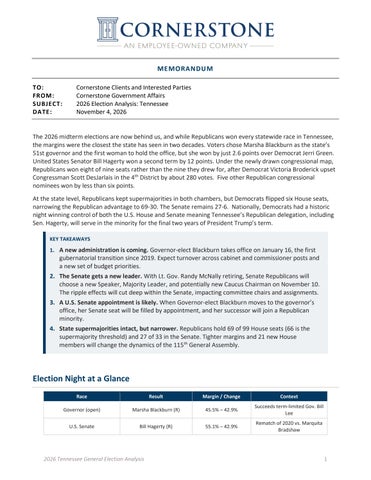
The 2026 midterm elections are now behind us, and while Republicans won every statewide race in Tennessee, the margins were the closest the state has seen in two decades. Voters chose Marsha Blackburn as the state’s 51st governor and the first woman to hold the office, but she won by just 2.6 points over Democrat Jerri Green. United States Senator Bill Hagerty won a second term by 12 points. Under the newly drawn congressional map, Republicans won eight of nine seats rather than the nine they drew for, after Democrat Victoria Broderick upset Congressman Scott DesJarlais in the 4th District by about 280 votes. Five other Republican congressional nominees won by less than six points. At the state level, Republicans kept supermajorities in both chambers, but Democrats flipped six House seats, narrowing the Republican advantage to 69-30. The Senate remains 27-6. Nationally, Democrats had a historic night winning control of both the U.S. House and Senate meaning Tennessee’s Republican delegation, including Sen. Hagerty, will serve in the minority for the final two years of President Trump’s term. KEY TAKEAWAYS
1. A new administration is coming. Governor-elect Blackburn takes office on January 16, the first
gubernatorial transition since 2019. Expect turnover across cabinet and commissioner posts and a new set of budget priorities. 2. The Senate gets a new leader. With Lt. Gov. Randy McNally retiring, Senate Republicans will choose a new Speaker, Majority Leader, and potentially new Caucus Chairman on November 10. The ripple effects will cut deep within the Senate, impacting committee chairs and assignments. 3. A U.S. Senate appointment is likely. When Governor-elect Blackburn moves to the governor’s office, her Senate seat will be filled by appointment, and her successor will join a Republican minority. 4. State supermajorities intact, but narrower. Republicans hold 69 of 99 House seats (66 is the supermajority threshold) and 27 of 33 in the Senate. Tighter margins and 21 new House members will change the dynamics of the 115th General Assembly.
Election Night at a Glance Race
Result
Margin / Change
Context
Governor (open)
Marsha Blackburn (R)
45.5% – 42.9%
Succeeds term-limited Gov. Bill Lee
U.S. Senate
Bill Hagerty (R)
55.1% – 42.9%
Rematch of 2020 vs. Marquita Bradshaw
2026 Tennessee General Election Analysis
1
Race
Result
Margin / Change
Context
U.S. House (9 seats)
8R–1D
No net change
D gain in CD-4; R gain in CD-9
State Senate (17 of 33 seats)
27 R – 6 D
No change
One open seat (SD-5, McNally)
State House (99 seats)
69 R – 30 D
D+6
21 new members
Statewide turnout
2.1 million
Up 20% from 2022
2022: 1.76M; 2018: 2.24M
Voter Turnout Approximately 2.1 million Tennesseans cast ballots in this year’s general election, up from roughly 1.76 million in the 2022 midterm, but still below the 2.24 million who voted in 2018. Early voting set the pace: 1,280,642 ballots were cast during the two-week period, up 45 percent from 2022 and only about seven percent behind 2018. Turnout ran ahead of 2022 in 94 of 95 counties, with Shelby County casting more ballots than any other county.
Ballots cast in Tennessee midterm elections (millions) 2.24
2.10 1.76
2018
2022
2026
Source: Tennessee Secretary of State. Totals reflect votes cast for governor; 2026 is an unofficial estimate.
Governor’s Race With Governor Bill Lee term-limited, Tennessee’s open governor’s race was the marquee contest on the ballot. Republican U.S. Senator Marsha Blackburn defeated Democrat Jerri Green, a Memphis City Council member, 45.5 to 42.9 percent, a margin of about 54,000 votes. Green’s showing was the best for a Democratic nominee for governor since Phil Bredesen’s 2006 reelection. Independent David Hatley drew 9.3 percent, and fellow Independent Lauren Pinkston took 1.2 percent.
2026 Tennessee General Election Analysis
2
Governor — share of the vote (%) Marsha Blackburn (R)
45.5%
Jerri Green (D)
42.9%
David Hatley (I)
9.3%
Lauren Pinkston (I)
1.2%
All others
1.0%
Source: Tennessee Secretary of State unofficial results as of Nov. 4, 2026. Results are unofficial until certified (by Nov. 23). Blackburn 957,136; Green 902,953; Hatley 195,564.
Republican share of the governor’s vote, 2018–2026 (%)
59.6%
64.9% 45.5%
2018 (Lee)
2022 (Lee)
2026 (Blackburn)
Source: Tennessee Secretary of State; 2026 unofficial.
United States Senate United States Senator Bill Hagerty won a second six-year term, defeating Democrat Marquita Bradshaw 55.1 percent to 42.9 percent in a rematch of their 2020 race, which Hagerty won with 62 percent. Hagerty won by roughly 250,000 votes and outpaced Blackburn by more than 180,000 votes. Because Democrats won control of the Senate, Hagerty will return to the minority, and Republicans will give up their committee and subcommittee gavels, including on Appropriations, where Hagerty has served as a subcommittee chairman. Tennessee’s other Senate seat will soon change hands. Blackburn will resign to become governor, and her successor will be appointed by Gov. Lee if she resigns before her inauguration, or by Blackburn herself if after. Names mentioned include U.S. Rep. Tim Burchett, Knox County Mayor Glenn Jacobs, and former CoreCivic CEO Damon Hininger.
2026 Tennessee General Election Analysis
3
U.S. Senate — share of the vote (%) Bill Hagerty (R)
55.1%
Marquita Bradshaw (D) Other
42.9% 2.0%
Source: Tennessee Secretary of State unofficial results as of Nov. 4, 2026. Results are unofficial until certified (by Nov. 23). Hagerty 1,138,436; Bradshaw 886,974.
United States House of Representatives This year’s congressional races were the first held under the map the General Assembly enacted earlier this year, which split Memphis among multiple districts and redrew the 9 th District, which was previously the state’s lone Democratic seat. Longtime Congressman Steve Cohen (D-Memphis) chose not to seek reelection after the redraw. In the new 9th, state Senator Brent Taylor (R-Eads) defeated state Representative Justin J. Pearson (DMemphis) with 49.6 percent of the vote. The Republican map’s goal of a 9-0 delegation fell short in the 4 th District, where Democrat Victoria Broderick defeated Congressman Scott DesJarlais, 48.9 to 48.7 percent. DesJarlais had held the seat since 2011, but lost it by 280 votes. The delegation stays 8-1, with the Democratic seat moving from Memphis to the 4 th District, and Broderick will join the new Democratic majority. Three seats will have new members in January. In the 5 th District, Charlie Hatcher, who unseated Congressman Andy Ogles in the August primary, defeated Columbia Mayor Chaz Molder 51.6 to 46.7 percent. In the open 6 th District, state Rep. Johnny Garrett (R-Goodlettsville) won the seat vacated by gubernatorial candidate John Rose. Congressman Matt Van Epps, who won a December 2025 special election in the 7 th District, earned his first full term. Incumbent Republicans Diana Harshbarger, Tim Burchett, Chuck Fleischmann, and David Kustoff were all victorious.
2026 Tennessee General Election Analysis
4
U.S. House: Republican vs. Democratic share of the vote by district (%) 67.4 57.7
57.6 48.7 48.9 41.2
51.7
46.7
50.8
47.5
50.3 48.1
51.6
46.4
49.6 48.5
40.2
29.5
CD-1
CD-2
CD-3
CD-4
CD-5
Republican
CD-6
CD-7
CD-8
CD-9
Democrat
Source: Tennessee Secretary of State unofficial results as of Nov. 4, 2026. Results are unofficial until certified (by Nov. 23).
Gray shade = Incumbent; Blue or Red shade = Winner. CD-05, CD-06 and CD-09 were open seats.
District
Democrat
Republican
Independent
Winner / %
CD-01
Kristi Burke
Diana Harshbarger
—
Harshbarger / 67.4
CD-02
Michaela Barnett
Tim Burchett
—
Burchett / 57.7
CD-03
Anna Golladay
Chuck Fleischmann
—
Fleischmann / 57.6
CD-04
Victoria Broderick
Scott DesJarlais
Jacob Anders
Broderick / 48.9 — FLIP
CD-05
Chaz Molder
Charlie Hatcher
—
Hatcher / 51.7
CD-06
Mike Croley
Johnny Garrett
—
Garrett / 50.8
CD-07
Darden Copeland
Matt Van Epps
Andrew Koontz; Jonathan Thorp
Van Epps / 50.3
CD-08
Heidi Kuhn
David Kustoff
—
Kustoff / 51.6
CD-09
Justin J. Pearson
Brent Taylor
—
Taylor / 49.6
Tennessee State Senate Seventeen of the Senate’s 33 seats (odd numbered districts) were on the ballot this year, with Republicans defending 13 and Democrats four. The lone open seat was Senate District 5, where Lt. Gov. Randy McNally (ROak Ridge) retired after nearly five decades in the Legislature. Republican Jimmy Matlock defeated Democrat David Miller to succeed him. One race to note for 2027 – state Senator Brent Taylor (R-Eads) appeared on the ballot both for Congress and for reelection in Senate District 31. Taylor won both and will now have to resign his Senate seat for federal office. The Shelby County Commission will appoint an interim senator until a special election is held, however, the commission is not required to choose a Republican.
2026 Tennessee General Election Analysis
5
Tennessee General Assembly — partisan makeup (seats) House — 114th GA
75
House — 115th GA
24
69
Senate — 114th GA
27
6
Senate — 115th GA
27
6
30
Republican
Democrat
Based on unofficial results. Supermajority thresholds: 66 of 99 House seats; 22 of 33 Senate seats. Senate count assumes SD-31 stays Republican after Taylor’s expected resignation.
Senate Race Outcomes: Gray shade = Incumbent, Blue or Red shade = Winner.
District
Democrat
Republican
Independent
Winner / %
SD-01
—
Adam Lowe
—
Lowe / 100
SD-03
—
Rusty Crowe
—
Crowe / 100
SD-05 (open)
David Miller
Jimmy Matlock
—
Matlock / 61.2
SD-07
Bryan Langan
Richard Briggs
—
Briggs / 52.7
SD-09
—
Steve Southerland
—
Southerland / 100
SD-11
Tim Roberts
Bo Watson
—
Watson / 52.9
SD-13
Angela Evans Wynn
Dawn White
—
White / 51.9
SD-15
—
Paul Bailey
—
Bailey / 100
SD-17
Lindsey Patrick-Wright
Mark Pody
—
Pody / 52.7
SD-19
Charlane Oliver
—
—
Oliver / 100
SD-21
Jeff Yarbro
—
—
Yarbro / 100
SD-23
—
Kerry Roberts
David Lee Marcum
Roberts / 69.5
SD-25
—
Ed Jackson
—
Jackson / 100
SD-27
David Hardy
Jack Johnson
—
Johnson / 61.1
SD-29
Raumesh Akbari
—
—
Akbari / 100
SD-31
David Weatherspoon
Brent Taylor
—
Taylor / 51.9
SD-33
London Lamar
—
—
Lamar / 100
2026 Tennessee General Election Analysis
6
Tennessee State House of Representatives All 99 House seats were on the ballot, with 65 contested in November. Democrats flipped six Republican-held seats while holding every seat they defended. Combined with 12 open seats and three incumbents who lost August primaries, the House will welcome 21 new members in January. House Republicans will enter the 2027 session with 69 seats, still above the 66 needed for a supermajority but with far less room than the 75 they held. The six Democratic pickups were: District 13 (Rutherford County): Brett Windrow defeated Rep. Robert Stevens (R-Smyrna) 51.4 to 48.6 percent; District 18 (Knox County): Bryan Goldberg defeated Rep. Elaine Davis (R-Knoxville) 55.0 to 45.0 percent in a rematch of 2024; District 34 (Rutherford County): Owen Farnsworth defeated Rep. Tim Rudd (R-Murfreesboro) 52.0 to 48.0 percent; District 49 (Rutherford County): Connie Casha defeated Rep. Mike Sparks (R-Smyrna) 55.1 to 44.9 percent; District 75 (Montgomery County): Allie Phillips defeated Rep. Michael Lankford (R) 55.0 to 45.0 percent; and, District 97 (Shelby County): Jesse Huseth defeated Rep. John Gillespie (R-Memphis) 57.0 to 43.0 percent.
New members joining the 115th General Assembly
6 3 12 1 Senate
House Open-seat winners
Defeated an incumbent (primary)
Defeated an incumbent (general)
Senate total does not yet include an interim appointment to SD-31 if Sen. Taylor resigns for Congress.
Contested House Race Outcomes Gray shade = Incumbent, Blue or Red shade = Winner. Open seats are marked “(open).” District
Democrat
Republican
Independent
Winner / %
HD-03
Lori Love
Timothy Hill
—
Hill / 76.9
HD-05
Catherine Bacon
David Hawk
—
Hawk / 76.8
HD-06
Brad Batt
Tim Hicks
Rodger Broadwater
Hicks / 61.7
HD-07
Sarah Jayne Della Vecchia
Rebecca Alexander
—
Alexander / 61.8
HD-08 (open)
Hilary Trudell
Jordan Henderson
—
Henderson / 68.8
HD-11 (open)
Sheila Grooms McMahan
Kenny Cody
Larry Jeremiah Brown
Cody / 73.2
HD-13
Brett Windrow
Robert Stevens
—
Windrow / 51.4 — FLIP
HD-14
Lindsay Young Honaker
Jason Zachary
—
Zachary / 55.8
2026 Tennessee General Election Analysis
7
District
Democrat
Republican
Independent
Winner / %
HD-16
Eliza Boles
Michele Carringer
—
Carringer / 59.5
HD-18
Bryan Goldberg
Elaine Davis
—
Goldberg / 55.0 — FLIP
HD-19
Jenny Fowler
Dave Wright
—
Wright / 65.5
HD-20
Karen Gertz
Tom Stinnett
Jeff Coggin
Stinnett / 63.7
HD-23
—
Mark Cochran
Jeremy Bromwell; Jason Hitt
Cochran / 77.5
HD-24
Daniel F. Jones
Kevin Raper
—
Raper / 68.1
HD-25
Monica Mowdy
Cameron Sexton
—
Sexton / 76.9
HD-27
Paige Quirin
Michele Reneau
—
Reneau / 53.7
HD-28
Yusuf Hakeem
—
Demetrus Coonrod; Johnny Horne
Hakeem / 72.4
HD-29
Ryan V. Scofield
Greg Vital
—
Vital / 61.9
HD-30
Art Rymer
Esther Helton-Haynes
—
Helton-Haynes / 51.2
HD-31 (open)
Michael Woodlee
Andrew J. Swafford
Keith Nolan; Randy A. Sharp
Swafford / 72.1
HD-32 (open)
Ali Simpson
Jack L. Stockton
—
Stockton / 71.6
HD-33
Anne Backus
Rick Scarbrough
—
Scarbrough / 57.3
HD-34
Owen Farnsworth
Tim Rudd
—
Farnsworth / 52.0 — FLIP
HD-35
Phil Barnes
William Slater
—
Slater / 62.5
HD-37
Mary Ann Young
Charlie Baum
—
Baum / 52.9
HD-38
Seth McMillan
Kelly Keisling
—
Keisling / 81.4
HD-40
Daniel T. Hawthorne
Michael Hale
—
Hale / 77.1
HD-41
R. Jason Goodman
Ed Butler
—
Butler / 76.3
HD-42
Trenton Tyler Strode
Ryan Williams
—
Williams / 64.1
HD-43
Samantha Petit
Paul Sherrell
—
Sherrell / 68.0
HD-44
Latoya Holcomb
William Lamberth
—
Lamberth / 66.4
HD-45 (open)
Mandy Cook
Brian Stewart
—
Stewart / 57.8
HD-46
Dominic Howard
Clark Boyd
—
Boyd / 65.8
HD-47
Mike Stein
Rush Bricken
—
Bricken / 69.9
HD-48
Matt Ferry
Bryan Terry
—
Terry / 55.0
HD-49
Connie Casha
Mike Sparks
—
Casha / 55.1 — FLIP
HD-52
Justin Jones
Michele Vetter
Martez Coleman
Jones / 79.8
HD-55
John Ray Clemmons
Jayla Thomas
—
Clemmons / 85.0
HD-57
Matt Burchfield
Susan Lynn
—
Lynn / 57.2
HD-59 (open)
Mark Proctor
Bill Hancock
—
Proctor / 57.5
HD-60
Shaundelle Brooks
Eva Angelina Romero
—
Brooks / 63.9
HD-61
Becca Ripley
Gino Bulso
—
Bulso / 57.2
HD-62
Brieanna L. Akers
Pat Marsh
—
Marsh / 72.1
HD-63
Laura Andreson
Jake McCalmon
—
McCalmon / 61.0
2026 Tennessee General Election Analysis
8
District
Democrat
Republican
Independent
Winner / %
HD-64
Craig D'Apolito
Scott Cepicky
—
Cepicky / 62.3
HD-65
Julian Pierre-Griffin
Lee Reeves
—
Reeves / 62.6
HD-66
Tamara Bavendam
Sabi “Doc” Kumar
—
Kumar / 66.1
HD-67
Ronnie Glynn
Chris Lanier
—
Glynn / 63.0
HD-68
Garfield Scott
Aron Maberry
—
Maberry / 57.8
HD-69
Rachael Murray
Jody Barrett
—
Barrett / 72.2
HD-70
Rayanne Moos
Clay Doggett
—
Doggett / 77.7
HD-71
Matt Day
Kip Capley
—
Capley / 73.9
HD-75
Allie Phillips
Michael Lankford
—
Phillips / 55.0 — FLIP
HD-77
—
Rusty Grills
Erin Reid
Grills / 77.3
HD-78 (open)
Hillary Capes-Gwinn
Perry Keenan
—
Keenan / 64.1
HD-79
—
Brock Martin
Kirk D. Carter
Martin / 75.2
HD-80 (open)
Andrea Bond Johnson
Julian A. McTizic
—
Bond Johnson / 62.9
HD-83
Margaret Price
Mark White
—
White / 50.6
HD-87
Karen Camper
Reggie William Hall
—
Camper / 90.1
HD-89
Randy Debord
Justin Lafferty
—
Lafferty / 55.2
HD-92
Teri Mai
Todd Warner
—
Warner / 62.6
HD-94
Francine Johnson
Ron Gant
—
Gant / 71.5
HD-97
Jesse Huseth
John Gillespie
—
Huseth / 57.0 — FLIP
HD-99
—
Tom Leatherwood
William P. Mouzon
Leatherwood / 63.4
Unopposed in November: HD-01 (Jessica Means, open), HD-02 (Gary Stidham, open), HD-04, HD-09, HD-10, HD-12, HD-15, HD-17, HD-21, HD-22, HD-26 HD-36 (Noah Smith, open), HD-39, HD-50, HD-51, HD-53, HD-54, HD-56, HD-58, HD-72, HD-73, HD-74, HD-76, HD-81 (Brett Giannini, open), HD-82, HD-84 (Matthew Szalaj, open), HD-85, HD-86, HD-88, HD-90, HD-91, HD-95, HD-96 (Telisa Franklin, open) and HD-98. HD-93 had no candidate on the ballot; write-in John Bradley is the likely winner.
What It Means for 2027 Tuesday’s results did not change which party controls the General Assembly, but they set up the most significant turnover in Tennessee’s legislative structure in years. A new governor, a new Senate Speaker, 21 new House members, and a U.S. Senate appointment will all be in place by the time the 115th General Assembly gets down to business. A New Administration Governor-elect Blackburn will be inaugurated on January, 16, 2027, the first change in administration since 2019. Over the next ten weeks, expect a transition team, a wave of cabinet and commissioner appointments, and early signals on the new governor’s legislative package. Her first budget, due to the Legislature shortly after the session begins, will set spending priorities across every department.
2026 Tennessee General Election Analysis
9
Washington: Tennessee in the Minority With Democrats controlling both chambers of Congress, eight of Tennessee’s nine House members and both senators will be in the minority. Representative-elect Broderick will be the delegation’s only member in the majority. The GOP delegation will lose committee gavels, and its members’ influence will depend more on bipartisan dealmaking. Federal funding, Medicaid and health policy, and oversight of federal agencies will all look different under Democratic control. New Leadership in the State Senate Lt. Gov. Randy McNally’s retirement ends his tenure as Speaker of the Senate, which began in 2017. The Senate Republican Caucus will nominate his successor at its caucus meeting on November 10, with the formal vote by the full Senate when the 115th General Assembly convenes on January 12, 2027. The Senate Republicans will also nominate a new Majority Leader, and potentially, a new Caucus Chairman. A new Speaker almost certainly means new chairs on several committees and the possibility of new committee assignments.
Key Dates Date Nov. 10 (Senate) & Nov. 19 (House)
Event Senate and House Republican caucus leadership elections.
Jan. 3, 2027
120th Congress sworn in.
Jan. 12, 2027
115th General Assembly convenes at noon; Speakers formally elected.
Jan. 16, 2027
Inauguration of Governor-elect Blackburn.
Late Jan./Feb. 2027
Governor’s first State of the State and budget address.
Looking Ahead We now know the membership of the 115th General Assembly, which convenes at 12:00 p.m. CT on Tuesday, January 12, 2027. Over the coming weeks, attention turns to caucus leadership elections, the governor-elect’s transition and cabinet appointments, and the U.S. Senate appointment. These decisions will largely determine committee leadership and the policy agenda for the next two years. We will keep you updated as each unfolds, and please don’t hesitate to reach out with questions about how these results affect your priorities.
*
*
*
Interested in viewing additional election insights from Cornerstone’s bipartisan policy experts? Visit our 2026 Election Resource Center at cgagroup.com/2026-election
2026 Tennessee General Election Analysis
10