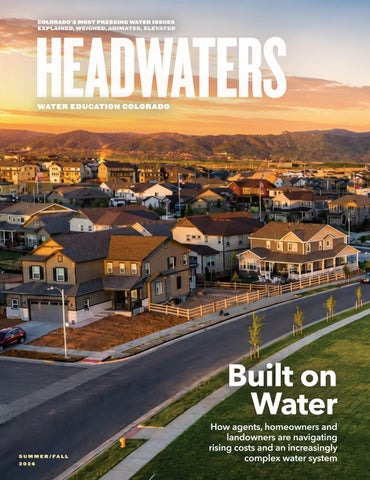
Built on Water
S U M M E R /FA LL 2026
How agents, homeowners and landowners are navigating rising costs and an increasingly complex water system
CONTENTS Summer/Fall 2026
FEATURES
INSIDE
The Wa ter & Rea l Esta te I s sue
Water shapes Colorado real estate — from what housing is built, to how much it costs, who can afford it, and what can be done with the property. In this issue, we explore the people, policies, and practical decisions driving a more water-conscious approach to real estate, development, and sustainable growth, and the need-to-know info that any property buyer or real estate pro should have at the ready.
4
DIRECTOR’S NOTE
5
WHAT WE'RE DOING WEco's upcoming events, reporting and more
6
FROM THE EDITOR
7
PULSE Water news from across Colorado New Guardrails Feds release a new Colorado River management framework
COVER: COURTESY OF STERLING RANCH. CLOCKWISE FROM TOP: AI GENERATED BY DANA P. SMITH; ISTOCK; JASON CONNELLY, FOR THE COLORADO SUN.
High Country Thirst Coloradans work together to shift water supplies during this dry year
12 Before You Buy Water matters in Colorado real estate deals. Dive into high-priority issues with practical checklists and go-to resources to help buyers and agents make informed decisions and avoid costly mistakes. BY ELIZABETH MILLER
18
The Cost of Every Drop
26
Planning for Growth
Sky-high water costs add to home affordability challenges. Discover how some communities, developers and policy makers are experimenting with ways to save both cash and the state’s most precious resource.
As Colorado grows, so does the need to rethink how communities use water. Explore the policies, partnerships, and innovative planning efforts bringing water and land use together to support a more sustainable future.
BY ELISABETH KWAK-HEFFERAN
BY EMILY PAYNE
Around The State Quick updates from Colorado's major watersheds
31
MEMBER'S CORNER How members are engaging with Water Education Colorado
ON THE COVER Sterling Ranch in Douglas County
H E A DWAT E R S S U M M E R / FA L L 2 0 2 6
•
3
INTRODUCTION A Note From The Interim Director
STAFF
We at Water Education Colorado are excited to share our Summer/Fall issue of Headwaters magazine with you, looking at how water availability impacts real estate development in our state. In this issue we'll dive into how water rights and water access affect home buyers; how tap fees impact the cost of housing; and how innovation in landscaping is improving water conservation, and saving money, in our gardens and yards. Through the articles in this issue, we hope that you understand another facet of the complex system of water in Colorado, and can use that information to make better decisions with your home buying, water conservation efforts, and help to educate your neighbors and friends on how water permeates every aspect of our lives. As we end a summer of drought, the need for water conservation and sustainable development is more urgent than ever, and the innovative work that people around the state are doing is instrumental in achieving a sustainable future. In other news, we are grateful to have spent time with the water community on September 10th to celebrate the 20th Water Education Colorado President's Reception! The Colorado water community came together to support a sustainable, educated future, and we thank everyone who has supported, sponsored, and partnered with our organization over the years. Your support makes what we do possible, and we are excited to continue engaging with the difficult and complex topics that surround water in Colorado. We're also approaching the end of our program season for 2026, and will be beginning to open applications and registrations for our 2027 programs soon. Keep an eye out for Water Leaders 2027 applications, Water Fluency 2027 registration, and much more as we close out the year! Sincerely,
Acting Executive Director Programs Director
Lisa Darling President Dulcinea Hanuschak Vice President Saeda Aljazara Brian Werner Administrative and Secretary Programs Coordinator Alan Matlosz Paulina Gutierrez Treasurer Program and Outreach Cary Baird Coordinator Perry Cabot Jerd Smith Nick Colglazier Fresh Water News Editor Nathan Fey David Graf Caitlin Coleman Eric Hecox Publications and Digital Resources Managing Editor David LaFrance Dan Luecke CREATIVE Karen McCormick Leann Noga Dana Smith Headwaters Art Director Peter Ortego Nate Pearson Dylan Roberts Ana Ruiz Elizabeth Schoder Don Shawcroft Chris Treese Katie Weeman
THE MISSION of Water Education Colorado is to ensure Coloradans are informed on water issues and equipped to make decisions that guide our state to a sustainable water future. WEco is a non-advocacy organization committed to providing educational opportunities that consider diverse perspectives and facilitate dialogue in order to advance the conversation about water. HEADWATERS magazine is published three times each year by Water Education Colorado. Its goals are to raise awareness of current water issues, and to provide opportunities for engagement and further learning. THANK YOU to all who assisted in the development of this issue. Headwaters’ reputation for balance and accuracy in reporting is achieved through rigorous consultation with experts and an extensive peer review process, helping to make it Colorado’s leading publication on water. © Copyright 2026 by the Colorado Foundation for
Water Education DBA Water Education Colorado. ISSN: 1546-0584 CSU Spur, Hydro/The Shop, 4777 National Western Drive, Denver, CO 80216, info@wateredco.org
4 • WAT E R E D U C AT I O N C O LO R A D O
COURTESY OF SABRINA SCHERMA
Close to Home
BOARD OF TRUSTEES
Sabrina Scherma Programs Director, Acting Executive Director
WHAT WE'RE DOING ONLINE Webinar Recording: Rethinking the AI/Water Management Nexus Did you enjoy the spring issue of Headwaters magazine focused on AI and water? Then tune in and watch the recording of our September webinar, to hear a few ways in which AI is being employed in water management — at a municipal utility, in agriculture, and in city watershed risk planning — followed by a discussion and Q&A on the future of AI in water. Find recordings of all recent webinars at watereducationcolorado.org/ webinars.
Water Fluency, Another Success WEco's 2026 Water Fluency Program wrapped up its 12th successful year on September 2. The program provides in-depth water education and training. Water Fluency graduates take the language of water into their fields to lead with confidence. This year's program focused on the South Platte River Basin, highlighting the unique issues and innovations of Front Range communities. Over five days, the 35 participants in the class engaged in learning through lectures, site visits, and discussion groups to expand their understanding and awareness of Colorado water. A special thank you to our 2026 Water Fluency Title Sponsor, the Colorado Water Resources & Power Development Authority, for making this program possible.
Tell Us What You Think Take our anonymous reader survey to share more about yourself, how you think we’re doing, and what you’d like to see from Headwaters magazine. It only takes a few minutes to complete.
COURTESY OF WATER EDUCATION COLORADO (3)
Scan the QR code to get started!
H E A DWAT E R S S U M M E R / FA L L 2 0 2 6
•
5
FROM THE SOURCE From The Editor
Room to Grow?
6 • WAT E R E D U C AT I O N C O LO R A D O
and build with less water, and in turn reduce the costs that fall back upon homebuyers. “Reduce how much water any given house needs, and you can reduce the water costs — and therefore, the total price of the home — while also developing more sustainably,” Elisabeth Kwak-Hefferan writes in “The Cost of Every Drop” (page 18). Read her feature for more on the connection between water supply, tap fees, the way in which a development is planned, and the cost of housing. We also look beyond the sticker price in Elizabeth Miller’s “Before You Buy” (page 12). There you will find checklists and must-know basic info for homebuyers, land buyers and real estate agents dealing with transactions that involve water. In my experience, a lot of people spend time thinking and talking about real estate — it impacts where and how we live, and ties to how our communities are planned, developed and function. But we interact with water on a daily basis. It seems like conversations about water should be centered as well. I look forward to seeing how water can enter and steer more conversations about real estate, development and planning, and how we can all work together in the face of water scarcity!
Editor
P.S. I appreciated hearing feedback from Northern Water and want to hear from you too. Scan the QR code on the flipside of this page to take our reader survey and share your ideas and input.
COURTESY OF CAITLIN COLEMAN
It has been a challenging, hot, dry summer. We’ve all experienced and heard about drought impacts across the state. While autumn is bringing some relief, nearly 94% of the state was still in drought as of September 24. This issue of Headwaters magazine focuses on real estate and development. While real estate might seem to be a disparate topic from drought, our coverage bumps up against questions about what the future holds and how the state can and should develop when faced with the realities of a drier, water-scarce future. Policies around growth, development, and even economics could change based on how long it stays dry and how we plan for drought. I recently spoke with friends from Northern Water who suggested that WEco look at how we grow as a state, and share what can be done to encourage and plan for new development in ways that require less water (stay tuned for a webinar exploring this). The Colorado Department of Local Affairs’ (DOLA) 2025 Colorado Strategic Growth Report found that strategic growth in the state could mean consuming about 36% less land and using 19% less water — it can have a big impact. In Emily Payne’s “Planning for Growth” (page 26) we look at recent state legislation, which requires local and regional planning commissions to consider that DOLA report when adopting or amending comprehensive plans. The legislation also requires any community with a comprehensive plan to coordinate with water providers to include a water supply element. It’s still too soon to see the impacts of these laws— local governments must add that water supply element to their comprehensive plans by the end of this year. But the work of planning for development with water in mind doesn’t fall solely on governments. Some forward-thinking developers, municipalities and others have been able to plan for
PULSE Water News From Across Colorado
Under Pressure
COURTESY OF ARAPAHO AND ROOSEVELT NATIONAL FORESTS
From emergency measures in Colorado’s mountain towns to new rules for managing the Colorado River, drought is forcing hard choices about how, and where, water gets used.
Low water levels this summer at Lake Granby
› H E A DWAT E R S S U M M E R / FA L L 2 0 2 6
•
7
PULSE Water News From Across Colorado
New Guardrails Federal officials set the framework for a decade of Colorado River management. BY SHANNON MULLANE
Colorado water officials knew that they and the three other Upper Basin states would likely be asked to conserve Colorado River water under a new plan spanning the next decade. Now they know the target amount: up to 200,000 acrefeet, or 65 billion gallons of savings among the four states. Water watchers gained new insights into the river’s future when a federal report was released on July 31, 2026. The report, a final environmental impact statement, describes how the federal government plans to manage the river basin’s key reservoirs, including lakes Mead and Powell, for the next 10 years. It outlines significant water cuts for downstream states — Arizona, California and Nevada — plus a range of reservoir releases and new storage pools for conserved water. States will have to negotiate specific plans for cuts, conservation and more every two years. The seven states and 30 tribes in the basin had already seen a preliminary version circulating this summer. Now, the Upper Basin states — Colorado, New Mexico, Wyoming and Utah — can ramp up to a firm conservation target. “This framework provides the flexibility to respond to changing hydrologic conditions while preserving the opportunity for the Basin States to continue working toward durable, consensus-based solutions,” said Secretary of the Interior Doug Burgum in a news release. The final report sets guardrails for how water should be stored, conserved and released from reservoirs. It will last for 10 years. The report analyzed releases from Lake Powell between 5 million and 12
8 • WAT E R E D U C AT I O N C O LO R A D O
million acre-feet. One acre-foot roughly equals the water used by two to four households each year. Lower Basin states could be called on to cut their use by as much as 3 million acre-feet under the two-year operating plans. The basin as a whole used about 13.1 million acre-feet each year between 2020 and 2024, according to the Bureau of Reclamation release. The Lower Basin’s portion of that total was about 6.5 million acre-feet per year. Arizona is expected to be hit hardest by the cuts outlined in the federal environmental impact statement. But Nevada became the first to sue over the Colorado River's future in late August, citing frustrations over the steep, federally imposed water cuts it faces and the lack of mandatory cuts in upstream states.
The report also analyzed voluntary conservation in Upper Basin states of up to 200,000 acre-feet combined under the short operating plans. The four states used about 3.8 million acre-feet of water each year between 2020 and 2024, according to Reclamation. (The rest of the water was used by Mexico or was lost to evaporation.) It defines storage pools in reservoirs, like small bank accounts within larger accounts, for conserved water that can be used in the future. Lake Powell can store up to 8 million acre-feet in its conservation pool. Lake Mead can store up to 3 million acre-feet.
Shannon Mullane writes about the Colorado River Basin and Western water issues for The Colorado Sun.
Lower Basin states could be called on to cut their use by as much as 3 million acre-feet under the two-year operating plans.
The tall bleached "bathtub ring" is visible on the rocky banks of Lake Powell.
High Country Thirst
Colorado is shifting water supplies to protect communities hit hardest by an exceptionally dry year.
JASON CONNOLLY, FOR THE COLORADO SUN; FACING PAGE: ISTOCK
BY JERD SMITH
Historic water shortages are drying out the scenic mountains that lie at the heart of Colorado’s tourist economy. This prompted the state to issue emergency orders earlier this summer, allowing water to be shifted to the towns and ranches most likely to run dry. The Colorado River District, which represents 15 Western Slope counties, ran one emergency response effort, and with financial support from the Colorado Water Conservation Board, anted up nearly $1 million to make sure even towns that can’t afford it, will have access to drinking water. To make the plan work, the River District opted not to lease portions of the water in two high country reservoirs, Ruedi in the Roaring Fork Basin and Wolford Mountain, near Kremmling, on a first-come, firstserved basis, as it normally does. Instead, the water was doled out based on community need, with people and food production getting the water first. Under Colorado law, water can only be diverted, stored and used for a designated purpose. Water rights are also tied to seasons, with some available only in the winter or summer. But this spring, the River District, seeking more flexibility, went to Colorado State Engineer Jason Ullmann and asked for emergency authorization to use its water supplies differently. The state agreed, giving the district until the end of August to conduct emergency releases. At the same time, large agricultural water users in the Grand Valley agreed to cut their water use in an effort to lessen
Following a winter of historically low snowpack, reduced flows in the Blue River left Green Mountain Reservoir’s 66,000-acre-foot Historic Users Pool unfilled. As a result, nearly 250 communities and ranches across the Colorado River Basin could have seen their water rights go unmet.
strain on the Colorado River, and protect some of the small towns and ranchers who would have been cut off otherwise. At issue is a special pool of water that lies within Green Mountain Reservoir, near Heeney, known as the historic users pool, or the HUP. The water is meant as a backup source that allows towns to pump wells and divert from streams even when their water rights are not in priority on the mainstem of the Colorado River. But this year, because of the drought, Green Mountain’s HUP didn’t fill, something that hasn’t occurred since the 1960s when the pool was created to protect mountain water users who had junior water rights, according to Ullmann. The emergency order means that even without the backup from Green Mountain, these communities and ranches are unlikely to have their water supplies cut off. The Eagle River Water and Sanitation District, which serves Vail and other small towns in Eagle County, has water in the HUP. Working in the shadow of a nearly snowless winter, the Eagle River District moved early to enact watering restrictions.
“The writing was on the wall,” said Siri Roman, CEO of the Eagle River Water and Sanitation District. Today a banner sign on its website warns that the risk of water shortages “is very high.” Despite this summer’s deep dry spell, water users say they are encouraged by recent light rains and cool weather. But Andy Mueller, general manager of the River District, said this summer was a dress rehearsal for what lies ahead as climate change and warmer temperatures continue to hamper mountain snows and spring stream levels. “We are just beginning to grapple with the impacts of climate change. Science indicates that 30 years from now, this year may be on the wetter side.”
Extended versions of these stories originally appeared in Fresh Water News, a collaboration between The Colorado Sun and Water Education Colorado. Read it online at wateredco.org. Jerd Smith is editor of Fresh Water News.
H E A DWAT E R S S U M M E R / FA L L 2 0 2 6
•
9
PULSE Around The State: Quick Updates From Colorado's Major Watersheds
ARKANSAS RIVER BASIN Colorado Public Radio reports that officials are releasing 2,500 acre-feet of water from Twin Lakes into the Arkansas River to support fisheries and recreation amid historic drought and high temperatures. Releases began in early August and will run through November. Those collaborating to release this water include the U.S. Bureau of Reclamation, Southeastern Colorado Water Conservancy District, Colorado Water Conservation Board, Colorado Parks and Wildlife, and Colorado Water Trust.
Arkansas River
COLORADO RIVER BASIN Fresh Water News reports that Northern Water will pay $30 million over the next 30 years to solve long-standing clarity and water quality problems at one of Colorado’s most treasured natural wonders, Grand Lake. Under the terms of the agreement, signed in late July, the water provider will spend $1 million annually to test and implement new solutions to the problem, including weed control, aeration and sediment removal. The deal is the first time a dedicated source of money has been set aside to help the lake, Northern Water spokesperson Jeff Stahla said.
GUNNISON RIVER BASIN The Colorado Sun reports that Blue Mesa Reservoir, the largest reservoir in Colorado and a savings bank for Lake Powell, continues on a crash course with low water levels this summer. The U.S. Bureau of Reclamation, which manages the dam, cut releases for endangered fish in order to keep an extra 10 feet of water in Blue Mesa by the end of October. The Uncompahgre Valley Water Users Association, which relies on Blue Mesa diversions, has limited water users to 50% of their normal allocations. Even with water cuts, the reservoir could drop low enough to stop power generation in 2027.
10 • W A T E R E D U C A T I O N C O L O R A D O
NORTH PLATTE RIVER BASIN
RIO GRANDE BASIN
Anglers were called to monitor water temperatures along the North Platte River this summer, according to North Park Anglers. The Wyoming Game and Fish Department issued a voluntary fishing closure in mid-July, beginning at the Colorado/Wyoming state line, in order to reduce stress on fish. Temperatures along that stretch of river exceeded 70 degrees most days.
Alamosa Citizen reports on a highprofile trial in Alamosa water court that ran from late June through late July. The trial dealt with the latest water management plan for Subdistrict 1 of the Rio Grande Water Conservation District. The subdistrict is home to the most cash crops in the valley and is the region with the largest volume of groundwater pumping from the
burn scars in southwestern Colorado, prompting emergency evacuation orders. The Gold Mountain fire, which started in June near Ouray, is the largest the community has experienced, reports CPR. Officials urge residents to pay attention to the weather forecast and heed local emergency alerts.
SOUTH PLATTE RIVER BASIN Fresh Water News reports that Aurora Water has been employing “smart” meters on every Aurora property. This has been key to Colorado’s third-largest city achieving its water-saving goals this year. Aurora says its 400,000 residents are using 27% less lawn water than in 2025, and managed a 9% cut from combined indoor and outdoor use. Denver Water has seen a 5% cut of water use compared with its previous fiveyear average among 1.5 million city and suburban customers.
ROYAL GORGE RAFTING
YAMPA/WHITE/ GREEN RIVER BASIN
unconfined aquifer. The plan outlines a new approach to recovering the aquifer by limiting the subdistrict’s groundwater withdrawals to the amount of surface water that naturally flows into the subdistrict over a five-year running average. Irrigators protested the plan in water court, arguing that they will be driven out of business. The state Division of Water Resources and the Rio Grande Water Conservation District asked the court to approve the plan, arguing
that without it, the unconfined aquifer won’t recover, and groundwater well curtailment will become inevitable. The judge will continue deliberating through the fall.
SAN JUAN/ DOLORES RIVER BASIN The Colorado Sun reports that intense rainfall in late July triggered flooding and debris flows on recent wildfire
Several mandatory and voluntary closures were in place this year along the Yampa River to protect the stressed river and stressed fish. Steamboat Springs enacted recreational closures to the Yampa River beginning July 1, reports the Steamboat Pilot. The closure was triggered after flows dropped below 85 cubic feet per second. This marks the earliest river closure since 2012, according to the city. In late July, after finding more than 300 dead mountain whitefish in the Elk River, officials implemented a voluntary fishing closure on the river near Steamboat Springs. The fish die-off is attributed to high water temperatures and low flows under extreme drought conditions. — Caitlin Coleman
IN COLORADO, WATER RIGHTS CAN BE OWNED AND REGULATED SEPARATELY FROM LAND. HERE’S WHAT HOMEBUYERS NEED TO KNOW BEFORE SIGNING. BY ELIZABETH MILLER
12 • W A T E R E D U C A T I O N C O L O R A D O
ILLUSTRATIONS BY DANA SMITH
x Before You Buy
Homebuyers, land buyers, and real estate agents can face complications when it comes to understanding water on any property.
H E A DWAT E R S S U M M E R / FA L L 2 0 2 6
•
13
x Before You Buy
14 • W A T E R E D U C A T I O N C O L O R A D O
CONNIE ZHOU/ GOOGLE/ ZUMAPRESS.COM (2)
in Weld County, with a house on a well and a ditch adjacent to it. A potential buyer was excited; it was a good fit for their horses. Then they discovered the water rights had been sold off separately, and the well for the house was restricted to in-home use. They couldn’t legally fill a horse trough from the ditch through their land. “They had to walk away from it,” says Michael Weber, who is both a real estate agent and a water resources engineer with Maverick Solutions. “Whenever people are buying a house without [municipal] water — so something in the mountains or in the country — their struggle is actually understanding how water can be applied to that house.” Homebuyers and land buyers, and the realtors working with them, face varying complexities with water, based on the kind of property purchased, as well as local differences among cities, counties and river basins. If water is taken care of through a municipal water provider, it makes for fewer worries, but not none. For some new houses, homes on wells, or land purchased with an intent to build, the list of concerns grows. Buying land in Colorado requires at least an understanding that water rights can be owned, transferred and regulated separately from land. Real estate deals in Colorado require a “source water addendum” which tells some, but not all of the story, and the property disclosure document — among the many details on past damage, roof age, sprinkler system — also lists where water comes from for a property. “For realtors, it’s really finding that first piece of, what is the source, and then if that source needs more detail, diving deeper into those resources that are available to us,” Weber says. That can include plowing through the Division of Water Resources and county databases, for a fuller understanding of what’s going on. Homes that get their water from a municipal water provider often have a more secure water supply, but some municipalities have more robust supplies than others, and in years with a drought, some developments fare better than others, says Bill Wombacher, an attorney
ISTOCK; PREVIOUS SPREAD: EDITED ISTOCK
THE PROPERTY SEEMED IDEAL — 20 ACRES
Colorado real estate buyers should confirm that there is water to meet their needs on a property — if they're hoping for land to support horses, they should ensure that there are water rights or well water for horses included in the deal.
“WHENEVER PEOPLE ARE BUYING A HOUSE WITHOUT MUNICIPAL WATER ... THEIR STRUGGLE IS ACTUALLY UNDERSTANDING HOW WATER CAN BE APPLIED TO THAT HOUSE.” —Michael Weber, Real Estate Agent and Water Resources Engineer for Maverick Solutions
H E A DWAT E R S S U M M E R 2 0 2 6
•
15
BEFORE YOU BUY: A WATER CHECKLIST
From municipal taps to private wells, here’s what Colorado buyers should review before signing on a home or land purchase.* *This is not intended as legal advice.
Q Does your community have a secure water supply? Know where your water comes from and whether there are any water quality concerns. Find details on the property's water source in the property disclosure. The source water addendum also discloses the property’s water provider — further investigate that supplier. Municipal water utilities publish annual reports that disclose any water quality concerns. Boil advisories can signal brewing problems. Investigate any past water supply issues and look into future plans. Many water providers have long-range water supply and demand reports that they keep updated. Find this information there, and use it to gauge your comfort level. Q Review HOA covenant details for responsibilities and allowances — they can add costs or hassles. What are the requirements for stormwater management? For landscaping? Is xeriscaping allowed (or even required)? Have watering restrictions been issued? Q Review the monthly water bills for the past year and check with the local water provider about planned rate increases impacting future water bills. If you’re buying a new build: Q Some towns have issued tap moratoriums. These may reflect infrastructure concerns as much as water supply issues, but will still stall water deliveries to new homes. Ensure that your new build is equipped and ready to receive water. Q Review the local water provider's monthly water rates and ask about any planned rate increases.
16 • W A T E R E D U C A T I O N C O L O R A D O
Q Review taxes and tap fee expenses. Most new housing developments are structured as special districts to help pay for shared amenities and services such as stormwater management, street lighting, sidewalks, parks, and also water supply. The costs of these services are repaid through taxes on new homes — review those taxes. If you’re buying a house or land without municipal utilities: An attorney who can assist in reviewing the legality of water use may be most helpful for these transactions. Q If the house is on a well, realtors and/ or buyers should search for details on the amount of water allocated to that well and how that water can be used. Small residential parcels are sometimes restricted to in-house domestic use and limited outdoor irrigation. Buyers who intend to use well water for substantial irrigation, livestock or commercial purposes may find the permit more limiting than expected. Use the Colorado Division of Water Resources Well Permit Search Tool to find well permits and related documents, such as the well construction log. Check the well permit for restrictions, as well as for other users and augmentation plans if groundwater pumping requires replenishing out-of-priority depletions to streams. Where required — particularly on South Platte and Arkansas River tributaries — wells pumped without a valid augmentation plan can face shut-down orders that could affect the property’s entire water supply.
Also, consider paying for a pump test of any existing well to make sure it can produce reliable water supply for the home — this is often required by mortgage lenders and by certain counties. Q Consider the age of the well and any other water infrastructure that the home relies on. Infrastructure repairs or improvements can be costly. Q Buyers should be wary of real estate marketing terms, and take precautions to understand how available surface water and wells can be used. For example, in marketing rural homes, the term “live water” is often used, leading buyers to think they can use the water for livestock or irrigation purposes, even when water rights aren’t included with the property. Q Check the status of any water rights that were historically tied to the property. Water rights can be sold off separately from the land, and in over-appropriated water districts, even a permit to drill can be tough to secure. Q Confirm the paperwork is being done to legally transfer any water rights with the land. Q Request and review water court decrees, ditch company share certificates, and well permits. Water rights generally specify type of use, place of use, and point of diversion as well as amount. Verify current uses comply with those terms. Q Vet the legality of all water features on the property. Check on canals, ditches, diversions, streams, rivers and ponds, and whether landownership includes rights to use any of that water.
Q Ensure that your well produces ample, drinkable water. Consider paying for a water quality test to confirm well water is safe to drink.
COURTESY OF GOOGLE
If you’re buying a house on municipal water and sewer:
ISTOCK; FACING PAGE: ISTOCK
x Before You Buy
with Nazarenus, Stack & Wombacher, who teaches a water law class for real estate agents. Scott Clark, an attorney with Clark Hill in Denver who focuses on water issues, suggests checking on the history of the local government or special district that’s supplying a home — determine how long it has been around, understand its water rights, and assess whether existing property owners have had issues with water delivery or restrictions. As subdivisions have moved into previously rural areas, sometimes irrigation ditches run through suburban backyards. The backyard property owner may not have any right to use that water or alter that ditch, including piping or moving it, but the water rights owner will have the right to use the water — and access the property to clean and maintain the ditch. Or perhaps the property owner is a shareholder in the ditch company — a partial water rights holder of the ditch — even that doesn’t mean that they have jurisdiction over the ditch that runs through the backyard. Stories of water gone wrong abound: The landowner whose private property included a streambank that people were accustomed to spending time on as part of an adjacent park. Or homeowners who were unable to move in because a town denied new water taps for their new homes. “You could buy a beautiful piece of property that has no water rights with it, thinking you can drill a well, but you could be in an over-appropriated water system, and then you’re having a discussion with the water resources engineer to say ‘I want to drill a well,’ even though there’s no ability to drill a well there,” Weber says. He’s seen that in Larimer County, where the water table is too deep. Sometimes, real estate agents seem motivated to close the deal, rather than diligently verifying that the purchase is right for everyone, he says. But he has noticed people starting to get curious and ask more questions, rather than stumbling into problematic water situations because they didn’t think to check the details before buying. “The news has heightened the idea of drought, and of the arid West that we live in, and that the water supply is a scarce resource,” Weber says. “So, I think there’s a more heightened awareness of what’s going on.”
Ponds can be attractive property features, but buyers should confirm whether the water use is legal before closing.
Historic water use on a property doesn’t guarantee that use is legal. Watch out for ponds, in particular. Thousands of illegal ponds exist in the state. Wombacher has seen landowners required to buy $50,000 water rights from somewhere else to offset an illegal water use in a decorative pond or landscaping. He has been called in on numerous transactions where something tripped an alarm and prompted a call to an attorney, and, he says, none of them seemed to have a seller intentionally misrepresenting what was going on: “People just don’t know, because the rules are so nuanced and it’s very challenging, even if people try to do their own research, to get the information right.” In Wombacher's worst-case scenario story, a landowner in the Arkansas Basin discovered that a 70-foot-tall earthen dam storing a huge quantity of water on his property had been illegally built and had no water right — and no outlet. That owner had to spend $100,000 to put a hole in the dam to let water flow downstream. “That’s an extreme example, but these ponds are everywhere,” Wombacher says.
“The last thing you want to do is spend hundreds of thousands of dollars to buy a problem that you have to spend more money to fix.” A University of Denver Water Law Review article estimates that more than 15,000 illegal ponds exist in the Arkansas River Basin alone. There could be many thousands more across the state, Wombacher says. What the attorneys will tell you, time and again, is to hire a water rights attorney to have a look. A few hundred dollars for their time might save thousands down the line. “It’s so much easier to fix these problems in the course of a pending transaction than to try to fix it after the fact, and all the costs are borne by the buyer after the fact,” Wombacher says.
Independent journalist Elizabeth Miller has written about environmental issues around the American West for publications including The Washington Post, Scientific American, Outside, Backpacker and The Drake.
H E A DWAT E R S S U M M E R / FA L L 2 0 2 6
•
17
THE COST OF EVERY DROP
In some communities, water can add tens of thousands of dollars to the price of a new home. Conservation-oriented tap fees may help boost affordability while using less H2O. BY ELISABETH KWAK-HEFFERAN
18 • W A T E R E D U C A T I O N C O L O R A D O
DANA P. SMITH
In Denver, a prospective homebuyer touring a newly built single-family home might not realize exactly what is contributing $10,450 to the sticker price. That same thing might account for an extra $35,000 for a new house in the latest Wiggins subdivision, or $32,000 in Crested Butte. At a sleek new three-bedroom in Loveland, the add-on might be $55,600. It’s water — and though the details vary by location, anywhere you look for new construction in Colorado, particularly along the Front Range, it’s going to cost you. For prospective homebuyers already navigating an expensive real estate market, those fees might be the difference between closing on a home of their own and endless scrolling on Zillow. A home needs water, of course: enough to satisfy every washing machine load, toilet flush, dishwashing session, and lawn or garden sprinkling demanded by its inhabitants. In an arid place like Colorado, that water often doesn’t come cheap, and there isn’t always enough of it to go around. This poses a challenge for developers, who must nail down a water supply before any new housing can even break ground. It’s perhaps an even bigger burden for buyers, who typically end up shouldering the cost passed on from developers to acquire and connect the water to their new homes. Still, with water fees so high, how can developers possibly bring anything more affordable to market? Water is just one variable in the complex calculus needed to make building new houses pencil out. But in Colorado, it’s a significant one. There’s a simple reason why water is so expensive: It’s in short supply and high demand. Traditionally, people have approached the question of water availability from the supply side only — building new reservoirs or purchasing additional water rights to provide for new development. But increasingly, forward-thinking municipalities, water utilities, developers, and builders are looking to tackle the twin challenges of out-of-reach home prices and water scarcity by looking to the demand side as well. Reduce how much water any given house needs, and you can reduce the water costs — and therefore, the total price of the home — while also developing more sustainably.
H E A DWAT E R S S U M M E R / FA L L 2 0 2 6
•
19
THE PRICE OF WATER The whole complicated issue of housing, water and money begins with a simple idea: We shouldn’t build new housing unless we know for sure that we have enough water for it. In Colorado, that notion is encoded in the law as “water adequacy.” “Water adequacy is a state statutory requirement to ensure that before new development occurs in Colorado, the water provider, and the [local government], and the developer are working together to en-
own water dedication requirement. Naturally, the more water that must be dedicated, the higher the price tag for the developer. Acquiring water alone isn’t enough to get the faucets flowing in a brand-new home. The water provider also has to lay out infrastructure to connect new builds to the existing system, and sometimes, to pull off system upgrades, too. So the provider charges a fee for that. Infrastructure fees, plus the cost of satisfying the water dedication requirement
"The more the tap fee is, the higher price point the house needs to be for the homebuilder to make any money... [and] the consumer needs more square feet to justify the price of the house, so you end up with a bigger house. It's a vicious cycle." —BROCK SMETHILLS, PRESIDENT OF STERLING RANCH DEVELOPMENT COMPANY
sure that there is sufficient, adequate water supply to cover the new demands of that development,” explains Lindsey Rogers, municipal conservation policy manager at Western Resource Advocates (WRA). This applies to any place that needs a development permit — if a government decides that a permit is needed, the developer must demonstrate that it has a plan to supply enough water to meet the development’s needs. Enter the water dedication requirement. This is the amount of water that a local provider determines is adequate to supply a new home, multifamily dwelling, or entire subdivision, usually expressed in acre-feet per year. It’s the developer’s responsibility to provide that volume of water to the utility before any construction begins. Sometimes, that means acquiring new water rights and dedicating them to the provider. Sometimes, it’s paying the provider a fee (called a cash-in-lieu fee) so that the provider can acquire new water. Every municipal water utility or water district sets its
20 • W A T E R E D U C A T I O N C O L O R A D O
are together colloquially called tap fees (or system development fees). Those tap fees influence where new development can happen, how much those homes cost, and even how water-efficient each one can be. “If you go talk to any land developer or homebuilder today in Colorado, water is the biggest issue as to where you can develop across the Front Range,” says Brock Smethills, president of Sterling Ranch Development Company. “It’s a very scarce resource.” Scarce usually goes hand in hand with “expensive,” and indeed, Colorado has some of the highest tap fees in the country. These charges vary widely by water provider, with the priciest in Northern Colorado, especially if the only available supply comes from shares of the Colorado-Big Thompson Project. In 2025, each contract unit from that federal water diversion, estimated to yield 0.7 acre-feet, cost $57,500 per unit, down from a high of $67,000 in 2023. “Water is the biggest cost in any jurisdiction,” says Ted Leighty, CEO of the Home
Builders Association of Metro Denver and the Colorado Association of Homebuilders. “It factors in big-time.” A 2025 analysis from HBA Metro Denver found that tap fees account for 60% of total developer fees, on average, across the Denver area. Water providers point out that fees are high because water in Colorado is highly sought-after — and therefore, expensive. “There’s limited water along the Front Range at the end of the day,” says Amber Kauffman, district manager at Little Thompson Water District. “If there were fewer people chasing water, or a bigger bucket of supply, then the prices would be lower.” Developers and builders generally pass on those fees directly to the homebuyer. “If we can’t cover our costs, and there’s not a margin for profit, then we can‘t reinvest in the next project,” Leighty notes. “A lot of that has to be borne by the ultimate homeowner so we can continue building the next one.” A single-family house that otherwise would have cost $500,000 might list for $550,000 — the kind of upcharge that could squeeze people shopping for a home, or even knock it out of their budget altogether. Renters can’t escape tap fees, either, as the owners of multifamily buildings usually need to pass them on, too. Metro West
60%
The average share of total development fees that come from tap fees across the Denver metro region
FROM TOP: DANA P. SMITH; COURTESY OF METRO WEST HOUSING SOLUTIONS
Housing Solutions, the housing authority for Lakewood, develops, builds, and manages affordable rental units. “The more that it costs us to build, the higher we have to set those rents,” says Brendalee Connors, chief real estate officer. “Then we’re unable to help serve the folks who have much lower incomes. It just goes downstream. The higher costs mean we are less effective at serving the people who could most use it.” High tap fees can shape what kind of houses get built, in sometimes surprising ways. For example, costly water fees can actually lead to bigger, more expensive homes. “The more the tap fee is, the higher price point the house needs to be for the homebuilder to make any money,” Smethills says. Say a provider charges a flat tap fee, no matter what the house’s size or water efficiency might be: The developer doesn’t have much incentive to build smaller, more efficient homes. “The consumer needs more square feet to justify the price of the house, so you
end up with a bigger house,” Smethills says. “It’s a vicious cycle.” And sometimes, high tap fees have more predictable consequences. In 2023, Metro West Housing Solutions started planning for a new apartment complex that would serve people making between 20% and 70% of the area’s median income. The 44 apartments, in two buildings, would rent for between $355 (for a studio) and $2,000 (a three-bedroom) a month. But the housing authority ran into several roadblocks, including a tap fee from the local water district that amounted to $14,000 per unit. It ultimately had to scrap the development in 2024. Water was a big reason why Metro West couldn’t build the new complex. “It was deeply disappointing,” Connors says. “That was 44 families that will now not have housing that is affordable to them, in a neighborhood with good opportunities. That’s the hardest thing.” Eye-popping as they can appear, tap fees only account for a small chunk of a new
An apartment complex by Metro West Housing Solutions.
house’s listing price. Developers also face wastewater costs, building permit fees, and use taxes. And a whole lot more goes into the cost of building a home, from lumber to labor to landscaping. But water costs do have an important place on any developer’s balance sheet. And, increasingly, water providers are realizing that tap fees can be a powerful tool in shaping the kind of new homes a community needs — both more affordable and much more efficient in using Colorado’s most precious resource.
H E A DWAT E R S S U M M E R / FA L L 2 0 2 6
•
21
SAVING MONEY BY SAVING WATER
tion fees, reasonably affordable,” says Brock Smethills, Harold and Diane’s son. Plus, “It’s the responsible thing to do to conserve water.” That idea — use less water, pay less in water fees — made the master-planned community of Sterling Ranch possible. And it’s starting to catch on. “What we’ve been seeing in Colorado in more recent years is a transition toward conservation-oriented tap fees,” says WRA’s Rogers. “That’s where utilities are using other factors to try to get a closer approximation of the actual water use of an individual home or business.” Water providers vary in how they’re approaching the idea, but they might offer discounted tap fees for a smaller home footprint and/or fewer bedrooms and bathrooms. And because the lion’s share of a home’s water footprint usually goes to outdoor use, especially watering lawns, discounts aimed at reducing that are particularly effective. In practice, that might look like a slashed fee for building on smaller lots, shrinking a home’s irrigable area, or using
The Sterling Ranch community in Littleton, Colorado
22 • W A T E R E D U C A T I O N C O L O R A D O
10K
Total number of homes planned for the Sterling Ranch community, where water conservation has been a crucial part of making development work
drought-tolerant plants in landscaping. By 2019, developers were paying conservation tap fees for 60% of new single-family homes across the Front Range, and the number is likely increasing, says Benjamin Edelstein, an assistant professor of economics at Loyola University Chicago who has studied Colorado’s tap fees. Building smaller homes on smaller lots is one of the best ways to keep water use down for the long term, Edelstein says. “If you can induce developers to build on smaller lots, that physically constrains how much water [households] are likely to use, now and 50 years in the future.” Developers say conservation-oriented tap fees are critical if communities want to see smaller, more affordable homes. “We simply can’t build small homes if every [tap fee] is $80,000 to begin with, no matter what the size of the home or lot, or whatever kind of landscaping,” Leighty says. The Little Thompson Water District, which serves a predominantly rural area in Northern Colorado, has a menu of tap fees ranging from $42,500 to $187,500 — these are higher than many of their peers. The cost is based on the new home’s lot size and whether or not the developer uses low-water plants and soil amendments in its landscaping. Kaufmann says that
COURTESY OF STERLING RANCH
Today, looking at the 3,000-and-counting new houses anchoring a patch of grassland on the far southwestern edge of the Denver metro zone, you’d never know the area was once considered too hard to develop. Conventional wisdom said acquiring the surface water needed to supply homes on the old Sterling family ranch, which sits between Chatfield and Roxborough state parks, was just too expensive, and the non-renewable groundwater below the ranch couldn't support further development. Harold and Diane Smethills begged to differ. When the couple closed on the property in 2008, Douglas County required developers to dedicate .75 acre-feet of water per home, per year, which translated to an exorbitant tap fee and would have pushed house prices far too high. The new owners thought they could build homes that wouldn’t need anywhere near that much water, so they successfully negotiated it down to .4 acre-feet per home, per year. “It was the only way to make the housing, and the tap and connec-
"Building smaller homes on smaller lots is one of the best ways to keep water use down for the long term."
DANA P. SMITH
—BENJAMIN EDELSTEIN, AN ASSISTANT PROFESSOR OF ECONOMICS AT LOYOLA UNIVERSITY CHICAGO
in most cases, the eventual homeowners of those conservation-minded builds do use less water than larger homes with bigger lawns (and they face a hefty fee if they exceed their expected use). Otherwise, “we wouldn’t have enough water for everybody,” she says. Municipal water utilities in Aurora and Castle Rock have also been refining their conservation tap fees over the past few years. And last year, Colorado passed a law, HB25-1211 requiring water districts to consider tap fee discounts for conservation measures in new homes. In the Sterling Ranch community in unincorporated Douglas County, aggressive
water conservation has been a crucial part of making development work. Each building has two water meters, one for indoor use and one for outdoor; homeowners pay more for outdoor use, incentivizing conservation. Each home also comes with a smart irrigation controller that syncs to current weather conditions to optimize efficiency (read: No watering in the rain). Sterling Ranch Development Company also partnered with Denver Botanic Gardens to provide a list of approved low-water-use plants for builders to incorporate into landscaping. And the community is home to the state’s
first rainwater harvesting pilot project; the collected rainwater goes toward irrigating common areas. After gathering water-use data for five years, the company proved its houses were tapping far less than .4 acre-feet per year, and convinced the county to drop its dedication requirement to .26 acre-feet for a single-family home on a detached lot — further reducing development costs. Sterling Ranch, which is zoned to grow to a maximum of 16,050 homes, now offers options ranging from 1,100-square-foot, two-bedroom townhomes (going for $415,000) to 6,500-square-foot standalone houses (listed at $1.6 million), plus apartments that rent from $1,700 to $3,000 per month. “Every dollar we spend on water, translates to another dollar you pay in cost of your house,” Smethills says. “Wasting money on water that’s not going to be used is not a good way to lower housing costs.” Nor does it help people conserve a precious resource.
H E A DWAT E R S S U M M E R / FA L L 2 0 2 6
•
23
FINE-TUNING FEES Tap fees are evolving alongside new data and new conservation rules, so developers and water providers have needed to iron out a few wrinkles. In 2016, Castle Rock Water debuted lower tap fees for developers who created water-efficiency plans for new homes. But when the town passed an ordinance restricting turf for all new houses in 2022, the utility retired those discounts. Similar turf restrictions became law across the state last year, when the legislature passed limits on “nonfunctional turf” (that is, not used in places like athletic fields or playgrounds) and particularly thirsty types of grass in all new multifamily housing projects with 12 or more units. But as conservation measures that used to be voluntary become mandatory, developers say that discounts should stay in place. “We know that we’re going to use less water now, so let’s pass those savings along,” notes Leighty. “[Otherwise], we’re saying we don’t want it to make sense for us to build a smaller, more affordable home. Let’s look at water intensity, low-flow toilets, what is the bathroom count, how many bedrooms are there, how many people might be living there, what the landscaping looks like. Then let’s reduce those tap fees so we can bring on the reward of less water usage.”
Castle Rock Water ... worked with the town council to pass new tap fee discounts in April. The new fee structure will tie the water resources fee to the square footage of the house.
Castle Rock Water, for one, recognizes that concern and worked with the town council to pass new tap fee discounts in April, says Director Mark Marlowe. The new fee structure ties the water resources fee to the square footage of the house. “All the data we’ve looked at shows a fairly strong correlation between water use and house square footage.” Castle Rock now offers deeply discounted tap fees for smaller homes, for example, the system development fee for homes under 2,000 square feet is $21,750, and $59,658 for homes from 7,500 to 7,999 square feet. Another wrinkle that water providers and developers have to consider is that water-efficiency measures, like smart irrigation technology or water-wise landscaping, can cost more upfront than the status quo. But some argue that conservation pays
Castle Rock, Colorado
off in the long run. “If houses being built today were using the same amount of water as houses built 20 years ago, we’d have to charge much higher system development fees to obtain that water,” Marlowe says. “We have limited water supplies, and new supplies are very expensive.” Smethills predicts that water efficiency at Sterling Ranch will keep the community’s tap fees steadier, while other water providers will need to jack up their charges to accommodate new growth. “It’s the more responsible, practical thing to do,” he says.
Percent lower tap fees for a new 1,500-square-foot home compared with a standard single-family home in Castle Rock
24 • W A T E R E D U C A T I O N C O L O R A D O
COURTESY OF ELDORADO WATER
35%
FROM TOP: COURTESY OF THE FARMS; COURTESY OF SOUTH MAIN
CREATIVE SOLUTIONS Tap fee discounts aren’t the only way communities are using water to bring down housing costs. In Buena Vista, officials have come up with an innovative policy that offers water as a carrot to entice certain kinds of development. “We knew we only had so much water,” says Joel Benson, the town’s former senior policy advisor. “We have to assume we don’t have enough [water] for everybody. Let’s try to encourage the use of that water to fulfill our needs as a community.” Buena Vista’s leaders calculated the water supply it had available (in single-family home equivalents, or SFEs), then distributed it into eight “buckets.” Infill was allocated 73.4 SFEs, with affordable, attainable, and workforce housing next at 55.6 SFEs (the other buckets include smaller, non-infill developments; emergency use; economic development; multifamily rental housing; and public, nonprofit, or institutional development). Anything else fits in the general development category, allocated 91.3 SFEs, or 24% of the total water supply. Since the policy went into effect in 2023, one major subdivision project has tapped into the affordable housing bucket. Developers pay the same water dedication fee to Buena Vista Water, regardless of which bucket they’re using. But the utility is considering an amendment that would charge a higher fee to general development, and use the difference to support more affordable housing. Despite its water scarcity, Colorado remains a desirable place to live, with modest job growth — and a state that needs to add tens of thousands of new housing units every year to keep up with demand. The more of them equipped with moderate square footage, low-flow toilets, and xeriscaped yards, the less water they’ll each use. That kind of smart planning will stretch the state’s limited water while simultaneously adding to the stock of affordable homes that Coloradans so desperately need.
Elisabeth Kwak-Hefferan is a freelance writer and editor who specializes in climate and the environment. Her work appears in The New York Times, National Geographic and more.
“The Farm” at Buena Vista supports water sustainability through dense, community-centric housing and the adoption of water-wise landscaping. By concentrating residential units and shared green spaces into a tight footprint, the development reduces per-capita water usage compared to traditional, sprawling subdivisions.
South Main, Buena Vista, Colorado
H E A DWAT E R S S U M M E R / FA L L 2 0 2 6
•
25
26 • W A T E R E D U C A T I O N C O L O R A D O
Planning for
Growth
As Colorado races to build more housing, communities are rethinking how land use and water planning work together to create a more sustainable future.
by Emily Payne
H E A DWAT E R S S U M M E R / FA L L 2 0 2 6
•
27
Strategic Growth Compared to business as usual, strategic growth in Colorado could mean consuming about 36% less land, using 19% less water, and producing 11.5% fewer emissions from vehicles, all while resulting in 24% more multifamily housing and an estimated $1,708 savings on annual household vehicle costs, according to the Colorado Department of Local Affairs’ (DOLA) 2025 Colorado Strategic Growth Report. “Strategic growth is about creating more housing Coloradans can afford, while protecting our water resources and reducing energy costs,” says Shannon Gray, DOLA
28 • W A T E R E D U C A T I O N C O L O R A D O
70
NUMBER OF COLORADO COMMUNITY TEAMS TRAINED BY GROWING WATER SMART TO CREATE CUSTOM WATER RESILIENCE ACTION PLANS.
communications director, who notes that many communities are already shifting development patterns. “In the last five years, the state has moved toward greater integration of growth strategies, housing and transportation, and has built on successes in integrating water and land use planning.” Colorado’s Senate Bill 24-174, signed in May 2024, now requires local and regional planning commissions to consider DOLA’s Strategic Growth Report when adopting or amending comprehensive plans, which outline communities’ visions for future growth, land use, and development. Gray says the department has seen a high rate of compliance with the legislation already. “While it is too soon to see all of the potential outcomes from the 2024 legislation, we have a wealth of evidence that communities are stepping up to do their part for strategic growth,” says Gray. “We are hearing and seeing locally and regionally tailored approaches to providing opportunities for housing with a long-term vision of fiscal and environmental sustainability.” In addition, SB24-174 requires communities with comprehensive plans to coordinate with water providers to include a water supply element. According to Meryl Corbin, former Growing Water Smart Program director at the Sonoran Institute, simply creating this communication between communities and providers will go a long way toward water-efficient development.
Breaking Down Silos “Just knowing who your water providers are and what their challenges are, opening
that door to have more conversations and more collaboration around water and land use planning, or just even water supply planning, helps the local governments understand what the limits are,” says Corbin. “We can no longer ignore that there are limits to the water supply,” says Corbin. “What can we do to grow smart and still meet our community’s needs?” Fort Collins is already putting this idea into practice. The city manages its own water utility, but three other local water suppliers also serve certain Fort Collins residents, resulting in inconsistent fees, policies, and conservation programs. The city’s planning department has participated in several Growing Water Smart programs, including a two-day workshop by the Sonoran Institute, with water utility and planning partners. This helped them develop various policies and tools to meet their water efficiency goals. For example, a water efficiency tool — aptly called WET — evaluates water demand from various growth scenarios. “Since we started doing these Growing Water Smart workshops together, our per capita consumption has gone down dramatically over the past 20 years,” says Clay Frickey, Fort Collins’ city planning manager. Fort Collins has reduced its water consumption per capita per day from 223 gallons in 1996 to about 140 gallons today. Communication has played a big role in this success: Frickey says the city consistently engages with utility providers to make sure they can serve future growth. Meanwhile, other municipalities have built interagency coordination into their development process. Buena Vista, after finding that the city could run out of water for new developments as soon as 2030, leveraged the Local Government Land Use Control Enabling Act of 1974, which allows cities, towns and counties to require that developers have a sufficient, dependable, long-term water supply for a build-out. The city’s water allocation policy, passed in 2023, now ties water use and development to specific community priorities, like more affordable workforce housing. It favors multi-family and dense residential development and deprioritizes larger, single-family homes — in alignment with the DOLA Strategic Growth Report recommendation.
PREVIOUS SPREAD: EDITED ISTOCK
In Colorado, new developments are increasingly rife with questions about water cost and availability. The state is currently more than 100,000 units short on housing, and the state demography office projects that some 34,100 new homes need to be built each year over the coming decade to prevent a deepening housing shortfall. Meanwhile, the Colorado Water Conservation Board projects that by 2050, there could be a gap between municipal and industrial water supply and demand of 230,000 and 740,000 acre-feet per year statewide. Developing new, affordable housing for a growing population while reducing water demand cannot happen under business as usual, says Nicole Poncelet, executive director of One Water at the City of Fort Collins. “The frameworks that we have in place, that were built back in the 20th century, don’t necessarily facilitate or make it easy to support the challenges that we are being faced with in the 21st century, like affordable housing,” says Poncelet. “Because the cost of water or the availability of water to even do development … You have to jump through a lot of hoops to try and move water.” Because Colorado’s local governments have land-use authority, meaning communities themselves decide how they grow and whether water supplies are adequate, their decisions have a significant impact on the state’s future water supply and demand. As the state updates its guidance for strategic growth through policies and frameworks, the work of aligning land use with water availability will happen within local communities.
More Support Needed The Sonoran Institute has trained more than 70 water teams in Colorado — including Buena Vista and Fort Collins — to help communities create custom action plans to support water resilience. Corbin says she has seen communities of all sizes make measurable progress toward more coordinated, water-conscious growth. “Colorado is leading the Western U.S. in integrated water and land use planning,” says Corbin. However, Frickey notes that small communities may need additional support to comply with SB24-174. “The idea that cities consider the
impacts to our water supply at that level is really important. I think we should all be doing that … and I think it’s going to be a challenge for some municipalities to comply with [SB24-174] because of the level of specificity the state’s looking for,” says Frickey. “I think for some communities it’s going to be a pretty heavy lift to comply.” DOLA assists local governments through a dedicated land use and water planner and a technical assistance team. Its Housing Planning Grant Program, which accepted its latest round of applications this summer, provides grants to local governments to help them better understand their housing needs. Gray also encourages
small communities to work with neighboring jurisdictions and consider a regional approach to water-smart development, for coordination, efficiency, and shared cost. “DOLA sees many pathways to accomplish the requirements and goals of SB24174,” says Gray. “Colorado communities are on a path toward water-smart development and potential abounds to continue to take the work deeper. Many local governments have been leading the way.” H
Emily Payne is a writer covering the intersection of food, agriculture, health and climate. She is editor of the global nonprofit Food Tank.
Years Before the Welcome Mat The home you buy today represents years of coordination and planning among developers, engineers, water providers, and local planners. As Colorado grapples with housing shortages and limited water supplies, that collaboration is becoming more important than ever. The following is a generalized timeline and varies by community and project. 20+
10+
8
6
4
2
1
YEARS OUT
YEARS OUT
YEARS OUT
YEARS OUT
YEARS OUT
YEARS OUT
YEAR OUT
LAND USE PLANNER
Growth data and public input inform the community's vision
Update land use code and water adequacy standards
Predevelopment application discussions with the developer
Review development application for water adequacy (with water planner)
Subdivision review, assess impact fees
Inspection includes applicable water efficiency standards
Building permit and certificate of occupancy issued, building begins
WATER PLANNER
Plans, designs water systems to meet future demand
Secures permits and funding to build systems
Continues securing permits and funding
Builds reservoirs, pipelines, tanks, treatment
Continues building infrastructure
Tests, inspects and prepares system for service
Water system is active and serving the community
DEVELOPER
Acquires land, begins community engagement in comp planning
Market research, concept planning and due diligence
Entitlement, seek zoning approvals, seek development plan approval
Breaks ground on infrastructure and begins development
Homesites developed and builders begin construction
Final home construction and community amenities completed
ENGINEER
Topographic surveys and feasibility studies
Master plans for roads, stormwater, sewer & grading
Detailed design and permitting of infrastructure
Construction of roads, sewer and stormwater systems
Quality testing, inspections and system completion
Infrastructure is complete and ready for homes
Guide land use with community engagement
Planning for a reliable future
Vision for the development project
Designing the infrastructure
YOU & YOUR REALTOR
The journey to your new home
Begin and narrow your search, find the right home and make an offer
H E A DWAT E R S S U M M E R / FA L L 2 0 2 6
•
29
MEMBER'S CORNER A Community Of People Who Care About Water
Learning and Connecting Through Webinars
Misson:
IMPACT Water Education Colorado is the leading organization for informing and engaging Coloradans on water. Through leadership training, educational resources, and programming, we are working toward a vibrant, sustainable and water-aware Colorado.
WEco has welcomed more than 590 people into online learning environments this year with four webinars that took place between May and September. These webinars are meant to be both engaging and informative. We often revisit topics covered in Headwaters magazine to dive deeper, bring them off the page, and provide an additional way for people to learn and engage with the topics that we're covering. We always make time for participants to ask questions of our speakers, or to engage in discussion.
So far this year, our webinars have looked at Colorado's new dredge and fill program, the AI/ water management nexus, and challenges and adaptations surrounding the drought. You can watch recordings of all of them on our website at watereducationcolorado.org/webinars. Additional webinars are already in the works. Stay tuned for more programming, coming soon, focused on this real estate and development topic, additional drought-focused webinars, and more. Did you know that our webinars are free to WEco members? We hope to see you — even if it's just online — soon!
590
The number of people who have attended one of our webinars in 2026. WEco has held four webinars this year, engaging with people across the state and beyond on timely topics such as this year's drought, AI and water and more.
Get Involved!
E N G AG E
VO LUNTE E R
GIVE
Dive into our diverse programming.
We rely on our volunteers!
Find more information on our website. A few ideas to pique your interest:
Email us at info@wateredco.org to express interest:
Your gift advances an engaged Colorado, leading to informed decisions and sustainable solutions.
1
2
3
Watch a recording of a recent webinar or stay tuned and join us for upcoming webinar programming at watereducationcolorado.org/webinars. Registration is free for members! Visit our shop to order a copy of any of WEco's community guides — now available in English and in Spanish! Make your voice heard! Visit our social media pages or craft a letter to the Fresh Water News editor to share your thoughts, opinions or experiences.
1
Share your expertise and we’ll plug you in — as a blog contributor, a speaker, or a peer reviewer for publications.
2
Join a contact list to provide local support when we bring one of our programs to your area.
3
Help us connect with Colorado's Spanish-speaking communities to provide new educational resources and opportunities tailored to them.
Not a member yet? Join the WEco community at watereducationcolorado.org.
Three ways to give:
1
Sponsor an upcoming program or event to showcase your organization's support for water education. Visit wateredco.org/ get-involved/sponsorship-opportunities to learn more.
2
WEco accepts charitable gifts of appreciated stock — you get double the tax benefit! Contact saeda@wateredco.org.
3
Colorado Gives Day is December 8. Schedule your donation starting November 1. Or donate year-round to support WEco's work across the state. Visit wateredco.org/donate today.
H E A DWAT E R S S U M M E R / FA L L 2 0 2 6
•
31
NONPROFIT ORG U.S. POSTAGE PAID DENVER, CO PERMIT NO 178
CSU Spur, Hydro/The Shop 4777 National Western Drive Denver, CO 80216
WATEREDUCATIONCOLOR ADO.ORG Publication of Water Education Colorado's Headwaters magazine is made possible by the generous support of sponsors and advertisers. We would like to extend our appreciation and thanks to these sponsors for contributing financially to this issue.
Thank You to our 2026 Annual Partners: