Investment Office
CONSOLIDATED ENDOWMENT FUND

Environmental, Social, and Governance Report, 2024-25
May 2026

EXECUTIVE SUMMARY
The University of Pittsburgh released its inaugural environmental, social, and governance (ESG) Report in March
202 2.1 This report, for the fiscal year ended June 30, 2025, is the fifth edition of what the University expects to continue to release annually.

The University of Pittsburgh’s largest financial asset is its Consolidated Endowmen t Fund (CEF), valued at $6.1 billion as of Jun e 30, 2025. The CEF supports financial aid , scholarships, faculty positions, and researc h activities and links past, current, and future generations of University stakeholders , includin g students, faculty, and staff
The primary investment objective of th e CEF is to earn a rate of return over an extende d period of time that is sufficient to suppor t a prudent spendin g policy while preserving it s inflation-adjusted asset value.
It is the University’s core belief that supportin g responsible business practices is integral to producing strong investment outcomes
This is not a new concept at Pitt. In fact , the Investment Office, which manages th e CEF, has been incorporating many of th e concepts now referred to as “ESG factors” into its due diligence process on a case-by-case basis since 1990, and in a more consisten t manner since an ESG Policy for the CEF was established in March 2020. 2
1 Available at https://www.financeoperations.pitt.edu/sites/default/files/esg _repor t _final _0.pdf
2 Available at https://www.financeoperations.pitt.edu/sites/default/files/esgpolicyfinal3-25-20.pdf

This report provides updates on the following topics:
CEF Fossil Fuel Exposure:
Total (public and private) exposure to fossil fuels decreased from 7.8% of the CEF as of Jun e 30, 2024, to 6.7% as of June 30, 2025. Private investment exposure to fossil fuels, whic h decreased from 5.9% of the CEF as of June 30 , 2024, to 4.8% as of June 30, 2025, is currentl y projected to become de minimis around 203435, given current trend lines. This forecast is likely to fluctuate significantly over time fo r reasons outlined in this report
Policies Regarding Direct Engagement with Underlying Companies and Proxy Voting:
The report provides an overview of the policie s governing the University’s direct engagemen t with underlying investment holdings regardin g ESG matters and its approach to proxy voting
External Investment Manager ESG Policies: External investment managers currentl y
overseein g approximately 94% of the CEF by value have formal ESG policies in place or have indicated that they take ESG considerations into account when makin g investments. Only ES G considerations that have financial implication s (enhancin g returns or mitigatin g risk) are take n into account – investments are not made to promote political or social causes .
In July 2022, the University launched an ES G page on the CFO website to serve as a portal for new CEF documents and investmentrelated ESG disclosures. This informatio n continues to be available via the Pitt Financ e & Operatio ns website. 3
Although the University does not make CE F investments purely for sustainability reasons , investments that can enhance risk-adjuste d financial returns while advancing such outcome s
are considered, but only to the extent tha t they are competitive with other investmen t opportunities from a financial standpoint in orde r to ensure that the CEF assets entrusted to th e University by donors are managed in accordanc e with the University’s fiduciary duty.
It is important to note that this report focuse s only on ESG considerations as they relate to CE F investments. The University of Pittsburgh has been actively involved much more broadly i n sustainability initiatives for more than 30 years , especially in connection with its operations (fo r further information, please visi t https://sustainable.pitt.ed u).
3 Available at https://www.financeoperations.pitt.edu/environmental-social-and-governance-esg-investment-considerations-pit t

INTRODUCTION
Founded in 1787, the University of Pittsburgh has a mission to provide high-quality undergraduate and graduate programs in the arts and sciences and professiona l fields whil e supportin g broade r publi c interests contributing to the social, intellectual, an d economi c developme nt o f the Commonwealt h o f Pennsylvania, th e nation , and th e world . This mission i s futur e oriented, perpetual in nature, and intrinsically supportive of positive societal and environmental developments beyond the Universit y ’s campuses .
Pitt’s Consolidated Endowment Fun d (CEF) is the University’s largest financial asset, valued at $6.1 billion as of Jun e 30, 2025. The purpose of the CEF is to provide permanent and stable financial support for the benefit of current and future generations of University stakeholder s in perpetuity by funding financial aid , scholarships, faculty positions, researc h activities, and more
The CEF is governed by the Investmen t Committee of the Board of Trustees an d is prudently managed by University staf f in the Investment Office within the Offic e of the Executive Senior Vice Chancello r for Administration and Finance and Chief Financial Officer. Over the course of th e University’s 239-year history, communit y interest in CEF investment exposures has grown in significance, promptin g reflectio n

and action by the Board and Investmen t Office staff. In recent years, investmen t considerations related to multiple issue s have grown in focus amon g the University’s stakeholders, includin g the broade r Universit y communit y (undergraduate and graduate students, faculty, staff, an d alumni), the neighborhood of Oakland , the City of Pittsburgh, and the greate r Pittsbur gh regio n.
The increased significance of these topics amon g community stakeholder s has coincided and overlapped with a growin g investment sector awareness of the potential benefits of considering ES G factors in investment decision-making . As explained in Pitt’s ESG Policy, ES G factors include considerations that have the potential to improve the quality of investment decision-makin g by presentin g
a deeper and more robust assessment of expected risks and returns. Environmental factors may relate to how a company manages waste or greenhouse gas emissions; social factors may relate to discrimination and health- and securityrelated considerations; and governanc e factors may relate to compensation , alignment of interests, and ethics. Th e Investment Office has incorporated ES G factors into its investment due diligenc e process for many years; however, in recen t years, the Investment Office has don e so with a more standardized approach , culminatin g with the release of th e inaugural ESG Report in March 2022 .
THE FUNCTION AND PURPOSE OF PITT’S ENDOWMENT
It is important to review the broader context of the CEF, including why it exists, who governs and manages it, and how it is structured.
What is an endowment?
An endowment is a gift of funds or property whos e purpose is to provide the recipient with a source of revenue. Pitt’s endowment is designed to keep th e original gift principal intact while usin g some or all of the resultin g investment returns as revenue tha t financially supports the University’s operatin g budget , primarily in the form of financial aid for students. Th e two primary goals of general endowmen t management are :
1. to preser ve the long-term real purchasing powe r of assets by generatin g net investmen t returns that match or exceed the endowment’s annual spendin g and the erodin g effects of inflation an d
2. to provide a reliable stream of meaningfu l revenue for the University
There is an essential need for universities to invest an endowment’s principal effectively in orde r to generate sufficient income to provide financial aid , support endowed chairs and professorships, and fun d operations, amon g other uses .
What are Pitt’s endowment characteristics?
The CEF is an investment pool comprisin g mor e than 3,000 individual endowment funds, substantiall y all with designated purposes and restrictions, tha t are commingled (pooled together) to facilitate mor e efficient investment. Each restricted endowmen t fund that the University accepts has a clearly stated , legally bindin g purpose for the assets provided to which the University must adhere. Additionally, th e legal documents accompanyin g CEF investment s typically include confidentiality provisions that preven t the University from disclosin g specific investment s or investment managers. Confidentiality provision s are deemed necessary to avoid impairin g long-ter m investmen t returns
1: CEF by Purpose (as of June 30, 2025)
Financial Aid
Chairs , Professorships , and Instruction
Postretirement Reserves
Scholarships , Fellowships , and Awards
Othe r Purposes
Amon g CEF objectives, the most critical to th e University’s mission is the long-term preservatio n of assets on a real (inflation-adjusted) basis, as they provide a steady, meaningful stream of incom e to University beneficiaries. Figure 1 indicates th e defined purposes for Pitt’s CEF funds . 4 These endowed gifts provide perpetual financial suppor t for scholarships, fellowships, faculty chairs , instruction, and other University programs an d services 5
4 “Other Purposes” include research, library and public service, general and undesignated funds, long-term reserve fund, and development and institutional support
5 The University
Figure
HOW ARE INVESTMENTS WITHIN THE CEF MANAGED?

The Investment Committee of th e University’s Board of Trustees is responsibl e for establishin g and approvin g the guideline s governing how the CEF may be invested , includin g the approval of the target asse t allocation for the CEF. Figure 2 reflects th e current target asset allocation for the CEF as of June 30, 2025
Within the Office of the Executive Senior Vice Chancellor for Administratio n and Finance and Chief Financial Officer, the Investment Office, led by the chie f investment officer (CIO), is responsible fo r investin g the CEF pursuant to the guideline s established by the Investment Committee , primarily through the selection an d monitorin g of external investment manager s and the reporting of their performance to th e Investment Committee .
The external investment manager s who manage money on behalf of the CE F (of which there are well over 100) are typically responsible for identifyin g an d makin g specific investments in securitie s in accordance with their stated and agreedupon investment approach .
Figure 2: Current Target Asset Allocation (as of June 30, 2025)
INVESTMENT OFFICE STATEMENT OF GOVERNANCE
Management of the CEF is guided by the University’s Statement of Governance, Investment Objectives, and Policies for the Consolidated Endowment Fund (Statement of Governance), which was made effective Sept. 17, 2012, and last amended and restated Jan. 25, 2023.6 The Statement of Governance addresses “Social Responsibility” in Section XIV:7
To fulfill the University’s stated missio n and meet the expectations of the donor s who have entrusted gifts to the University, the University must manage its CEF wisely. As stated previously, the primary investmen t objective established for the CEF is to maximize the financial return on such assets, takin g into account risk and other considerations as mor e specifically set forth in this Statement, in orde r to provide a reliable stream of meaningfu l income while preservin g the CEF’s real asse t value. Accordingly, the Committee shall no t apply non-financial constraints pertainin g to investment holdings of the CEF unless there is a situation of such magnitude that the Boar d specifically directs the Committee to conside r such non-financial parameters .

In evaluatin g any specific socia l responsibility concern as directed by the Board , the Committee may consider the gravity of the social impact, the University’s need to maintain a sound financial investment policy, the potential effectiveness of the Committee’s investment or votin g decisions to influenc e positive change, and such other consideration s as the Committee may deem appropriate . In no event will a recommendation be mad e that an investment be selected or retaine d solely for the purpose of encouragin g o r expressin g approval of a company’s activitie s or, alternatively, for the purpose of placin g o r leavin g the University in a position to contes t a company’s activities
6 Available at https://www.financeoperations.pitt.edu/sites/default/files/2023_01_25_statement_of_governance_-_amende d _and_restate d _-_final.pdf
7 This language also is referenced and repeated in the CEF’s ESG Policy.
CEF ESG UPDATES
Below are updates on total fossil fuel exposure within the CEF and projected private investment fossil fuel exposure, an overview of the policies governing the University’s direct engagement with underlying investment holdings regarding ESG matters and its approach to proxy voting, and a breakdown of the percentage of the CEF managed by external managers who have formal ESG policies or have indicated that they take ESG considerations into account when making investments.
CEF Fossil Fuel Exposure
Total (public and private) exposure to fossil fuel s decreased from 7.8% of the CEF as of June 30 , 2024, to 6.7% as of June 30, 2025 .
Public investment exposure to fossil fuels remaine d flat at 1.9% as of June 30, 2024, and June 30, 2025 . Public investment exposure, which is held indirectl y via index funds and funds managed by externa l investment managers, is expected to continue to fluctuate over time .
Private investment exposure to fossil fuel s decreased from 5.9% of the CEF as of June 30 , 2024, to 4.8% as of June 30, 2025. Figure 3 provide s updated projections of the CEF’s expected private investment exposure to fossil fuels, which is currently projected to become de minimis aroun d 2034-35, given current trend lines
Forecasts of the future percentage of the CE F invested in private fossil fuel investments ar e subject to variation as a result of several factors , including: changes in the future market value of the fossil fuel investments; the future value of the overall CEF; the methodology/model used to forecast the investments; and the assumption s
used within the model, as assumptions are update d and refined on an ongoin g basis in respons e to changes in market forecasts. Even relativel y minor updates to any of the aforementione d factors can result in significant variability i n projections. Importantly, the timeframe ove r which the CEF’s private investment manager s liquidate the investments is generally not withi n the University’s control. Although the associate d funds typically have stated termination dates, it is not unusual for such funds to have their terminatio n dates extended for several additional years The projections presented herein represent th e Investment Office’s best estimates as of June 30, 2025 .
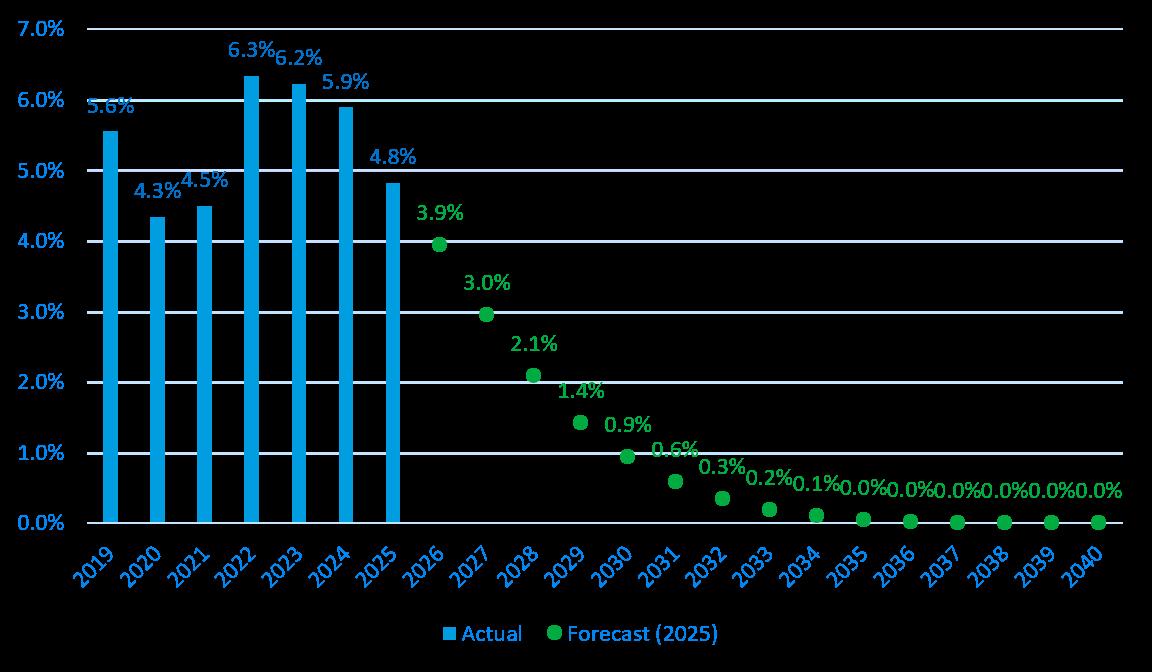
Figure 3: CEF Private (Illiquid) Fossil Fuel Exposure Forecast8
Direct Engagement with Operating Companies
Ongoing conversations with University stakeholders have pointed to the value in clarifying the University’s approach to engagement with underlying companies and investment holdings within the CEF. The Investment Office follows the approach outlined in the ESG Policy for the CEF:
Direct Engagement with Operating Companies: Unless it is making a direct or co-investment, the University will not engage directly with underlying companies or investment holdings in the CEF, but will instead delegate this responsibility to the respective external investment managers utilized by the CEF.
The Investment Office does not typically make direct investments in individual operating companies, instead preferring to invest in funds managed by third-party investment managers who are responsible for selecting the underlying investments. Co-investments represent one exception to this general approach and are defined to include direct investments in individual companies made alongside an investment fund managed by one of the CEF’s existing third-party investment managers. Co-investments are used selectively to increase exposure to specific companies and typically provide an opportunity to do so on a no-fee or reduced-fee basis. When evaluating coinvestments, the Investment Office may nevertheless delegate responsibility for direct engagement to the respective external investment managers in situations where it deems it appropriate to do so.
Proxy Voting
The ESG Policy for the CEF also outlines the University’s approach to proxy voting:
Proxy Voting: The University [believes] that the investment managers that are carefully selected and employed by the University are best suited to vote the proxies of shares held in the portfolios that they manage. Therefore, responsibility for voting such proxies shall be delegated to the respective external investment managers utilized by the CEF. In the event of any regulatory or other statutory requirement that prohibits the investment manager from voting on behalf of the University, the CIO shall assume responsibility for voting suc h proxies.
Accordingly, the University does not typically engage in the voting of proxies, relying instead on its external investment managers to do so. To the best of the Investment Office’s knowledge, there currently are no regulatory or other statutory requirements that prohibit any of the CEF’s investment managers from voting proxies on behalf of the University, precluding the need for the CIO to assume responsibility for voting suc h proxies.
External Investment Manager ESG Policies
Beginning in fiscal year 2019 (prior to the adoption of the ESG Policy in March 2020), the Investment Office
began asking its external investment managers whether they possessed ESG policies. At that time, some external managers indicated that they had adopted ESG policies, but many others indicated that they did not yet have formal ESG policies in place. The Investment Office held discussions with managers and encouraged them to evaluate relevant ESG-related issues and develop policies to address them.
External investment managers currently overseeing approximately 94% of the CEF by value have formal ESG policies in place or take ESG considerations into account when making investments as of June 30, 2025. Figure 4 provides a breakdown of CEF assets managed by managers with formal ESG policies, by managers that do not have formal ESG policies but take ESG considerations into account, and by managers that do not explicitly take ESG considerations into account when making investments.9 Only ESG considerations that have financial implications (enhancing returns or mitigating risk) are taken into account – investments are not made to promote political or social causes.
Figure 4: External Investment Managers by ESG Policy Adoption (by % of CEF value)