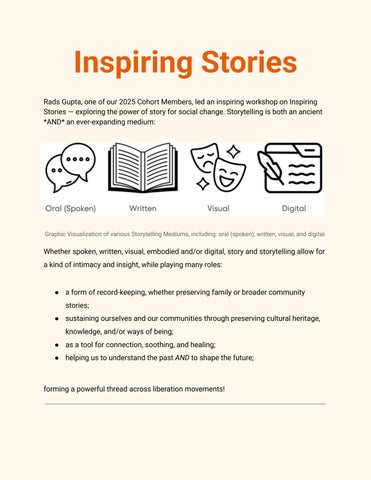
Inspiring Stories Rads Gupta, one of our 2025 Cohort Members, led an inspiring workshop on Inspiring Stories — exploring the power of story for social change. Storytelling is both an ancient *AND* an ever-expanding medium:
Graphic Visualization of various Storytelling Mediums, including: oral (spoken), written, visual, and digital.
Whether spoken, written, visual, embodied and/or digital, story and storytelling allow for a kind of intimacy and insight, while playing many roles:
● a form of record-keeping, whether preserving family or broader community stories; ● sustaining ourselves and our communities through preserving cultural heritage, knowledge, and/or ways of being; ● as a tool for connection, soothing, and healing; ● helping us to understand the past AND to shape the future;
forming a powerful thread across liberation movements!
In Storytelling in Sistersong and the Voices of Feminism Project1, Loretta Ross offered this reflection:
“As an African American feminist, I come from a verbal, storytelling culture with deep roots. For me, storytelling is about survival. Storytelling is how we passed on knowledge and culture, values and behaviors. The storyteller might be the griot or the grandmother. Both told us stories of our past, our present and our future. Storytelling is how we saved our lives when reading was forbidden, knowledge was hidden, and cultural continuity was shattered. We weaved together the threads of our collective experiences to create quilts of iconic stories of triumphs, of failures, of dreams and of realities. But most of all, the stories were about possibilities. Through stories we could imagine, arguably the most powerful word in any language. Through our imaginations, our stories defied our oppressions and offered both spiritual solace and practical advice to survive a hostile world and build communities in which we could thrive. Through stories and storytelling we could examine and explore the meanings in our lives.”
Rads shared some of their favorite storytellers, who also inspired how Rads thinks about storytelling itself. Rads uplifted Dr. Maya Angelou’s work and reflections on the power of stories and poetry, as described in her autobiography, I Know Why the Caged Bird Sings:
“Maya had gone silent for years after experiencing the trauma of being violated. It was poetry that led her to speak again, after a patient teacher, Mrs Flowers, commented, “You do not love poetry, not until you speak it.” Trusting her teacher,
1
Chapter. 6 in Telling Stories to Change the World: Global Voices On The Power Of Narrative To Build Community and Make Social Justice Claims (2008).
Maya started reading poems out loud — a practice which became her road to recovery.”
For Rads, this is a powerful example of the revolutionary power of stories: not necessarily as a guide or checklist for what to do, but as an awakening of, or an opening to possibility.
Rads, smiling, with ‘Portrait of a Phenomenal Woman’ by artist Lava Thomas, featuring Dr. Maya Angelou.
Here’s Rads with the Portrait of a Phenomenal Woman Installation by artist Lava Thomas, a collaboration between the San Francisco Public Library and SF Public Arts Commission. The installation includes a quote from Dr. Angelou's 1973 interview with Bill Moyers, on celebrating the power of libraries and human connection: “Information helps you to see that you're not alone. That there's somebody in Mississippi and somebody in Tokyo who all have wept, who've all longed and long, who've all been happy. So the library helps you to see not only that you are not alone, but that you're not really any different from everyone else. There may be details that are different, but a human being is a human being.”
This is the first monument celebrating a Black Woman in San Francisco's Civic Arts Collection — absolutely worth a visit if you're in the city! Located by the Larkin Entrance at the Main Library in the SF Public Library System. As an example of global lineages of liberatory resistance through poetry, Rads held up the now world-famous poem by Dr. Refaat Alareer, If I Must Die:
If I Must Die (2023) Poem by Dr. Refaat Alareer. Image Description in alt text.
Dr. Refaat Alareer wrote the poem for his daughter, Shymaa, saying: “I want my children to plan, rather than worry about, their future and to draw beaches or fields of blue skies and a sun in the corner, not warships, pillars of smoke, warplanes, and guns. Hopefully, [my stories will...bring people...] together and give them consolation and solace to continue the struggle until Palestine is free. Until then, I will continue telling her stories.”
Graffiti in Arabic and English with Dr. Alareer’s words: “if I must die, you must live to tell my story…” and “Palestine” — spray painted in black ink on a pink wall. Location & Photographer are unknown.
Though written for his daughter, Alareer’s words have touched millions around the world, translated into over 100 languages, archived & made available: ifimustdie.net. In December 2024, OR Books published If I Must Die: Poetry & Prose, a compilation of Dr. Refaat Alareer’s work, available for purchase here.
In exploring the power of storytelling to help us understand our present, and reimagine the future, Rads shared some of Octavia Butler’s reflections in her May 2000 essay, A Few Rules for Predicting the Future:
“...I don’t believe we can do anything at all without side effects–also known as unintended consequences. [...] In Parable of the Sower, my character put it this way: All that you touch/You Change / All that you Change / Changes you / The only lasting truth/Is Change / God / Is Change.
Be Aware of Your Perspective. How many combinations of unintended consequences and human reactions to them does it take to detour us into a future that seems to defy any obvious trend? Not many. That’s why predicting the future accurately is so difficult. [...] It’s also true that where we stand determines what we’re able to see.
Count on the Surprises. No matter how hard we try to foresee the future, there are always these surprises. The only safe prediction is that there always will be. So why try to predict the future at all if it’s so difficult, so nearly impossible? Because making predictions is one way to give warning when we see ourselves drifting in dangerous directions. Because prediction is a useful way of pointing out safer, wiser courses. Because, most of all, our tomorrow is the child of our today. Through thought and deed, we exert a great deal of influence over this child, even though we can’t control it absolutely. Best to think about it, though. Best to try to shape it into something good. Best to do that for any child.”
Last January, when the White House asked Octavia Butler, [then] 52, to write a memorandum to the President outlining her vision of the future, the author chose education as her subject. “I was poor, Black, the daughter of a shoeshine man and a maid,” Butler explains. “At best I was treated with gentle condescension when I said I wanted to be a writer. Now I write for a living. Without the excellent, free public education that I was able to take advantage of, I might have found other things to do with my deferred dreams and stunted ambitions.” Instead she went on to garner science fiction’s highest honors, the Hugo and Nebula awards. ESSENCE MAGAZINE, MAY 2000.
There is sacred wisdom in our stories. And, before inviting us into small groups to share some of our own stories, Rads emphasized the importance of maintaining agency and autonomy over how, when, where, with whom, or even whether we choose to share
something. Rads offered these questions for further reflection — and we’d love to hear from all of you, too:
● How has story played a role in your own life or work? ● Do you see yourself as a storyteller? A keeper of stories? ● How do you tell stories? (It is important here to consider whose story it is, and whether it is yours to tell!)
Thank You, Radhika “Rads” Gupta for leading such a joyful workshop, and for celebrating so many beloved stories and storytellers, too!
Related Resources: ● Storytelling in Sistersong and the Voices of Feminism Project (2008) by Loretta Ross, Chapter in Telling Stories to Change the World: Global Voices On The Power Of Narrative To Build Community and Make Social Justice Claims ● Dr. Maya Angelou & The Pedagogical Power of Poetry from Pedagogy4Change ● Still I Rise — Dr. Maya Angelou, 1989 Live Performance ● Movement History & The Arts: Poetry, Liberation, and Resistance (Zine) by Creating Freedom Movements ● Read If I Must Die (Poem) by Dr. Refaat Alareer + Translations. ● Purchase If I Must Die: Poetry & Prose — a compilation of Dr. Alareer's work, published on December 10, 2024 by OR Books. ● Read Al Jazeera's 2021 Article 'As the bombs fall, I write’: The poets of Gaza' ● Buy Books for the Gaza Poets Society OR visit their Online Store ● Read A Few Rules for Predicting the Future by Octavia E. Butler ● Support Indie Booksellers through Bookshop + Save 20% on AAPI Titles in May! ● Check out the Protect My Public Media and I Love Libraries (ALA) Campaigns