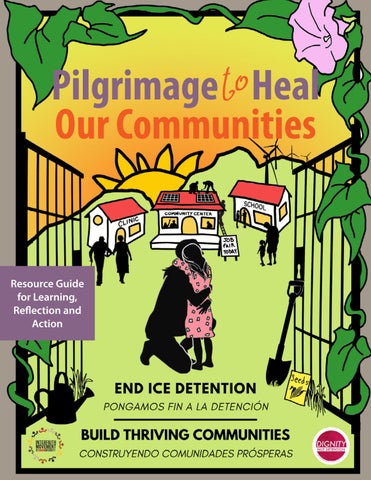
Pilgrimage to Heal Our Communities
Pilgrimage Heal Our Communities
Resource Guide for Learning, Reflection and Action
1
2
Pilgrimage to Heal Our Communities
FRAMEWORK FOR PILGRIMAGE (Acknowledgment for this framework from Dr. Joanne Doi, M.M. & Rev. Deborah Lee - PANA Pilgrimages to Manzanar
and the Sacramento River Delta)
Pilgrimage is an ancient spiritual practice in many traditions and pilgrimages have evolved into modern journeys that evoke layers of meaning, collective memory, healing and ongoing commitment for justice. This pilgrimage is part of a tradition of postcolonial Pilgrimages which revisit shadowed ground, sacred traces of suffering and hope. It is a spiritual journey in which we enter into the experience, not remain on the outside as a spectator or tourist. It is about reconnection with each other, with our ancestors, with mystery, and the depth of life. It is regaining awareness of our deep connections and a return to the pivotal events in our own history or embedded narratives in the land itself. Pilgrimage is a collective experience; a practice of remembering as resistance, reparations through memory, and emotional catharsis for compassionate action. We remember in order to heal, to recover memory, to decolonize ourselves, to restore our deeper souls. We journey together, experiencing together more than we could alone. Stage 1: MOTIVATION & LONGING (prior to departure of pilgrimage) What is calling you to go? What do you seek to learn? What do you seek to heal or to love? What or who are you carrying with you? How is your life story connected to the story of people in detention centers? Stage 2: PREPARATION AND DEPARTURE (Beginning of Pilgrimage- Oct 26th) Shedding. Openness to the new. We cross a threshold and enter an unknown landscape. We often rely on a guide, teachers who have been there before. We rely on each other for it is always a new journey. Stage 3: JOURNEY – THE WAY (October 26-October 29th) Using all the senses. The Encounter. Communion with the land and the people, with the ancestors. Community (united with) Stage 4: RETURN AND PROMISE We are changed. (Reflections for the return or post-Pilgrimage) How are we changed? What do we bring back to our community? What new commitments do we make to heal the harms? What promise do we make so that this experience lives on?
Pilgrimage to Heal Our Communities
ABOUT THE PILGRIMAGE The Pilgrimage to Heal Our Communities is an interfaith, spiritual pilgrimage to Bakersfield, Adelanto, Calexico, and San Diego as part of a multi-year effort to transform the six remaining immigrant detention centers into thriving communities with a priority on well-being and life-sustaining economies. Our journey will inform California communities, elected officials and impacted families about a new opportunity to access funds from recent CA legislation HEAL – Healthy Economies Adapting to Last – that the Dignity Not Detention (DnD) Coalition won in 2023. HEAL divests in detention centers and invests in high-road jobs and building a sustainable economy. From October 26th – October 29th, 2023, a group of about 45 pilgrimage participants, composed of community members who have been detained, faith leaders, and leaders in the movement to transform carceral systems, will undertake this journey. We will stop to gather in reflection, prayer and action at the six remaining ICE detention centers in California. These facilities detain thousands of immigrants in California each year, separating families and loved ones from their communities. Immigration detention does not need to exist and local communities are in dire need of economic investments to build a thriving and sustainable future. The Pilgrimage to Heal our Communities is organized by Interfaith Movement For Human Integrity, the Dignity Not Detention coalition, local community coalitions Free Them All San Diego / Shut Down Otay, Detention Resistance, Kern Rapid Response Network, Imperial Valley Equity and Justice Coalition, Imperial Liberation Network, Shut Down Adelanto, Mesa Verde/Golden State Annex Strike Support Committee and the co-collaboration of each participant who joins us on the bus.
ABOUT THIS RESOURCE GUIDE This resource guide is provided to deepen our shared understanding about immigrant detention in California and tools to bring it to and end, and to offer reflection and action as we journey on the Pilgrimage.
3
4
Pilgrimage to Heal Our Communities
ABOUT INTERFAITH MOVEMENT FOR HUMAN INTEGRITY (IM4HI) IM4HI is a California-based faith-rooted organization working with congregations, faith leaders and those directly impacted for the dignity and full inclusion of immigrants and people impacted by incarceration. We bring a multi-faith voice and leadership to justice-centered movements that transform people and institutional structures to ensure the full humanity of every individual and the holistic well-being of our communities. We believe that every person is sacred across bars and borders. https://www.im4humanintegrity.org/
ABOUT THE DIGNITY NOT DETENTION COALITION The Dignity Not Detention (DND) coalition is a partnership of over 16 California organizations composed of organizers, communications experts, attorneys, and formerly incarcerated leaders, formed in 2015 to fight immigrant detention at the state level. Our collective mission is to end detention in California so that we may help pave the path to end detention nationwide. www.facebook.com/DignityNotDetentionCA
Cover artwork by Peg Hunter. Design by Guillermo Prado, 8point2.com
Pilgrimage to Heal Our Communities
TABLE OF CONTENTS History of Incarceration in California
7
Just Closures
14
Californians United for a Responsible Budget (CURB)
15
A Just Transition
16
Victories Ending Detention Centers in California
19
2022 Pilgrimage for a Better Future
21
Healthy Economies Adapting to Last (HEAL)
22
Prison Closure Road Map Overview
24
The Pilgrimage Route and Calls to Action
26
Pilgrimage Spiritual Resources
43
5
6
Pilgrimage to Heal Our Communities
https://www.aiisf.org/history
Pilgrimage to Heal Our Communities
HISTORY OF INCARCERATION IN CALIFORNIA Impact on Black, Indigenous and People of Color The state of California as we now know it was built on stolen land and the genocide of Indigenous people. Spanish colonizers, including Franciscan missionaries and the Spanish military, imprisoned Indigenous people and forced them into labor in California as a key part of their strategy to take control of California’s land and resources. Prisons, jails, detention centers and other systems of incarceration have been used to control targeted groups of people, especially Black, Indigenous, and people of color (BIPOC) throughout the history of the United States. In early California, Spanish settlers imprisoned indigenous people and forced them to work in missions, which were early prisons. The formal prison system, begun around the same time, was designed to control people and reinforce the norms of white settler culture. Over time, prisons and detention have been used to control Black men and women during and after the end of slavery and into the present, to control Chinese and Japanese immigrants and their children, and to threaten and control long-term residents or those trying to immigrate to the United States from Muslim, African, Central and South American nations. These systems have shaped the United States. They have been used to consolidate land, create profit for those with power, reinforce racial inequity, and suppress Black, Indigenous and people of color populations. In California, the Immigration Station on Angel Island (1910-1940) was established to control mostly Chinese migration into the United States through a brutal and dehumanizing process. To enforce Chinese exclusion laws, around 100,000 Chinese migrants were detained trying to enter the US. Japanese, South Asian, Korean, Russian, Jewish, Filipino, and African immigrants were also detained here, and faced various levels of hardship based on race, class, and gender. During World War II, 120,000 people of Japanese ancestry, including US citizens, were forcibly relocated and incarcerated. All of California’s residents who were of Japanese descent were rounded up in 12 assembly centers in California and 10 permanent immigration prison camps surrounded by barbed wire and armed guards in remote areas across the country for the duration of the war.
The Growth of Incarceration Since the 1970’s California has led the country in a prison boom. California constructed 22 prisons between 1984 and 2013. The rise of prisons ironically took place during a period of falling crime rates. Author and activist Ruth Wilson Gilmore’s book California
7
8
Pilgrimage to Heal Our Communities
Gulag explains how the state invested capital to build and staff prisons in poor rural areas impacted by the decline of agriculture. Then policies were enacted to fill the prisons with largely unemployed and underemployed people from urban centers impacted by the decline of manufacturing. Policies of criminalization, like the war on drugs and three strikes laws were enacted, leading to an explosion in the numbers of people incarcerated -especially Black, Brown, Indigenous, and low-income folks–from poor urban areas being sentenced for longer and longer periods of time. Between 1980 and 2007, the number of people behind bars increased more than 450%. Today there are 34 prisons in California. Black and Brown people represent over 70% of the prison population and make up 2/3rds of those serving life sentences. The prison system went from being a fairly small part of the entire state infrastructure to the major employer in the state government. For several decades, Communities United for a Responsible Budget (CURB), a statewide coalition has worked to fight jail and prison construction. Their People’s Plan for Prison Closure (PPPC) identifies 10 prisons they recommend to be closed by 2025 based on critieria of overcrowding, unsafe conditions, homicides and deaths, and inaccessibility to visitors.
Reflection Questions to Consider: (Consider journaling, making art, or discussing in small groups.) 1)
What land are you indigenous to?
2)
If you are not indigenous to the land you currently live on, whose ancestral lands are you living on? (To find out check native-land.ca.)
3)
What are the Indigenous communities of the land you live on currently calling for solidarity and support, such as protecting sacred sites or seeking land back?
4)
How is your life connected to California’s rural or urban communities? What do you notice is in need of healing?
Pilgrimage to Heal Our Communities
For Profit Prisons For profit companies like CoreCivic (founded in 1983) and GEO (founded in 1984) operate prisons for local, state and federal governments, including Immigration detention. Maximization of profit and the structure of their contracts, provide a per-person fee which encourages them to keep as many beds full as possible and keep their costs as low as possible. It incentivizes them to spend millions of dollars lobbying for legislation that leads to increased incarceration and immigration enforcement. CoreCivic and GEO recently converted to Real Estate Investment Trust business structures, which allows them to largely avoid taxes and provide larger dividends to investors. In 2020, the state of California’s Department of Corrections ended its final three contracts with private, for-profit prisons. Two of those, the Desert View Facility (Adelanto) & Golden State Facility (MacFarland), both run by the GEO corporation, have since re-opened as new immigration detention facilities with federal contracts to imprison immigrants for ICE. In December 2022, CDCR announced that it will not renew the lease with CoreCivic for California City Correctional Facility, terminating the contract in March 2024 and ending the use of that facility as a state prison. It is important that we be vigilant to ensure it also is not repurposed as an ICE Detention Center. In 2021 President Biden issued an executive order to cut ties and not renew Justice Department contracts with for profit prison companies. However, this order does not include federal contracts for ICE detention.
CoreCivic.com
9
10
Pilgrimage to Heal Our Communities
Timeline of Immigration Policies Immigration policies in the United States have changed and shifted over time in response to political and social pressures. This infographic created by Freedom For Immigrants presents a short history of immigrant detention.
(Infographic: https://static1.squarespace.com/static/5a33042eb078691c386e7bce/t/5a8c9121ec212d e919d366e8/1519161665581/Short_history_of_detention.png)
Pilgrimage to Heal Our Communities
11
12
Pilgrimage to Heal Our Communities
Basic Facts About Immigrant Detention Immigration detention is the government practice of incarcerating human beings while they wait for a decision on their immigration case or potential deportation. The U.S. government runs the largest immigration detention system in the world with 200 immigration prisons or jails holding about 250,000 people (in FY 2021). 80% of adults in immigration detention are held in private prison companies such as GEO, CoreCivic, and Management Training Corporation (MTC). The 1990s brought on a paradigm shift in immigration policy, leading to detention being a primary means of immigration enforcement. In 1996, the U.S. enacted legislation that dramatically expanded the use of detention. The Antiterrorism and Effective Death Penalty Act (AEDPA) and the Illegal Immigrant Reform and Immigrant Responsibility Act (IIRIRA) increased the scope of who could be subject to mandatory detention. The 1996 laws also rendered any non-U.S. citizen, including legal permanent residents, vulnerable to detention and deportation. After the September 11, 2001 attacks, the Immigration and Naturalization Service or INS was divided into U.S. Citizenship and Immigration Service (USCIS), Immigration and Customs Enforcement (ICE) and Customs and Border Protection (CBP). It also moved from the Department of Justice to the newly created Department of Homeland Security (DHS). In the U.S. context, immigration detention is better described as immigration prison or jail as most are run by private prison companies or county jails that contract with ICE. There are only a handful of government-run facilities, but they also look and feel like a prison. Inside immigration detention, people are stripped of their wallets, documents, clothing, phones, electronics and other belongings. In immigration detention they have very limited access to a phone. They are denied access to a court appointed attorney and access to immigration attorneys is limited. There is no sentence or conviction. They do not know how long they will be detained, and there are little to no requirements that they be informed. They could be there for months or years. Sometimes authorities can detain a person for the entire time it takes to process their migration application, asylum claim, or other legal process and the person is granted the right to stay or is deported. Immigration detention in California is now only privately run. Private prison companies profit and local governments pad their shrinking budgets through lucrative federal contracts. Immigrants in detention can be undocumented or documented immigrants, including people whose immigration status is not current, is expired or is under review. It can include people seeking asylum and legal protection at our borders. It can include visa holders who arrive at our border or an airport. It can include people who have lived here for years and decades, who may have a U.S. citizen spouse, children or business. It can include refugees or people with a green card who have been granted the permanent
Pilgrimage to Heal Our Communities
13
right to live in the U.S. who because of a past conviction can be held in immigration detention, even after they complete their time in jail or prison and have rehabilitated or earned release. From Detention Watch Network: “It doesn’t have to be this way. Immigration detention is not necessary or humane. People navigating their immigration case should be able to do so with their loved ones and in community, not behind bars in immigration detention. They are better able to navigate their case and access legal resources outside of detention. The majority of people in detention have been living in the U.S. for years, have families here, and are established members of their communities. People seeking asylum often have strong community ties with loved ones waiting to welcome them to the United States. And for those that need support, they can access it through community-based groups that offer services to help people navigate their immigration proceedings.”
Sources: Detention Watch Network (www.detentionwatchnetwork.org/) Freedom For Immigrants (www.freedomforimmigrants.org/) International Detention Coalition (idcoalition.org/)
Further resources to learn more: Book: Dunbar-Ortiz, Roxanne. An Indigenous Peoples’ History of the United States, 2015. Book: Alexander, Michelle, and Cornel West. The New Jim Crow: Mass Incarceration in the Age of Colorblindness, 2020. Rematration Resource Guide by Sogorea Te’ Land Trust The Campaign To Close All Prisons in California Timeline on Incarceration and Immigration by Interfaith Movement For Human Integrity Detention Statistics from Freedom For Immigrants Detention 101 from Detention Watch Network Yuba Liberation Coalition June 2023 Report www.prisonpolicy.org/scans/building.html www.nytimes.com/2019/04/17/magazine/prison-abolition-ruth-wilson-gilmore.html
14
Pilgrimage to Heal Our Communities
Just Closures As a community, we are asking for the Just Closure of each immigrant detention facility in California and nationwide. What does Just Closures mean? Just Closure means that each center should close and every person inside should be released to their loved ones. Just Closure means that every center is closed and will not be repurposed as a jail, prison, or other form of detention. Just Closure means that we create economies where people can have good jobs that contribute to the wellbeing of our communities and environments. Just Closures can be an opportunity to transform local communities for the better by supporting community reinvestment and job development in creative and generative ways. “Just Closure is the act of closing jails, prisons, and detention centers with the release of all those who are incarcerated in them, as opposed to transferring to other cages. It means completely closing them, and closing them justly. Just closures means understanding that the prison industrial complex is the cause for all this suffering, and immigrant detention is merely an arm of it. It means divesting from these harmful cages and investing in community-based solutions like housing and healthcare. Just Closures shifts power away from carceral actors and empower locals to reimagine public safety, health, and their community’s wellness.”
Further Resources on Just Closures: JustClosureGuide Lessons From The ICE Detention Termination in Contra Costa County Abolitionist Steps vs Reformist Reforms Yuba Liberation Coalition June 2023 Report
Pilgrimage to Heal Our Communities
From Californians United for a Responsible Budget (CURB): But don’t prisons create jobs for rural local economies? “Actually, when a new prison is opened, the vast majority of new full-time jobs go to veteran correctional personnel from other jurisdictions, not community residents. In fact, local residents of prison towns are often ineligible for prison jobs because they lack the necessary skills and/ or are unable to compete for prison jobs because of the seniority of prison job classifications…. Most of the money from prison contracts flows into large national retailers, and out of the local economy, ravaging local businesses and employing very few local residents. Prisons typically don’t have to follow state environmental standards. This has led to water quality and quantity issues in California, like the prison towns of Avenal and Tehachapi, that have significantly disincentivized other businesses or economic ventures from taking root in these communities.”
15
16
Pilgrimage to Heal Our Communities
A Just Transition The Just Transition framework aids the economic shift away from extractive economies and oppressive systems, including carceral systems, oil and gas industry, policing, and surveillance, towards more sustainable regenerative economies and systems of care, such as green jobs, behavioral health crisis responses, and community based solutions to mass incarceration. California incarcerates a higher percentage of its people than almost any democracy on earth. There are 241,000 people from California behind bars on any given day, in a carceral system often built on toxic land. Eight of the ten cities in the U.S. with the highest year-round concentration of particulate matter between 2013 and 2015 were in California and seven out of the ten cities in the US with the worst ozone pollution were also in California.
Reflection Questions to Consider: (Consider journaling, making art, or discussing in small groups.) 1)
What does healing look like for people, the land, economies?
2)
What would it look like to end ICE detention and build thriving economies? What does a thriving communities look like?
Pilgrimage to Heal Our Communities
17
18
Pilgrimage to Heal Our Communities
Photo by Joyce Xi
Pilgrimage to Heal Our Communities
V I C TO R I E S Ending Detention Centers in California Since 2012, our state-wide movement has helped shut down 9 detention centers with a total decrease of 4,299 beds and 7,188 beds left to remove. 1
2012 termination: Mira Loma Detention Center, in Lancaster, a county jail operated by the LA County Sheriff’s Department. It could detain up to 1,400 people and operated as an immigration detention center beginning in 1997.
2
2017 termination: Santa Ana City Jail, in Santa Ana, was a jail operated by the City of Santa Ana.
3
2018 termination: Rio Cosumnes Correctional Center (RCCC), in Elk Grove, owned by Sacramento County and operated by the Sacramento County Sheriff’s Department.
4
2018 termination: West County Detention Facility, in Richmond, a county jail owned by Contra Costa County and operated by the Contra Costa County Sheriff’s Office.
5
2018 termination: Victorville Federal Correctional Complex, in Victorville, was a medium-security federal prison operated by the federal Bureau of Prisons.
6
2019 termination: James A. Musick Facility, in Irvine, was a jail owned by Orange County and operated by the Orange County Sheriff’s Department.
7
2019 termination: Theo Lacy Facility, in Orange, was a jail owned by Orange County and operated by the Orange County Sheriff’s Department.
8
2020 termination: Yolo County Juvenile Detention Facility, in Yolo, was a county juvenile detention facility operated by the Yolo County Probation Department.
9
2023 termination: Yuba County Jail
19
20
Pilgrimage to Heal Our Communities
Most Recent Victory! On February 8, 2023, ICE’s detention contract with Yuba County Jail officially terminated. For nearly 30 years, ICE detained immigrants at the Yuba County Jail (YCJ) in Marysville, California. YCJ gained notoriety due to its appalling conditions, which have been well-documented over the years and which resulted in a consent decree by Federal Magistrate Judge due to inadequate medical and mental health staff and overuse of administrative segregation. There were multiple hunger strikes, and tragically, numerous deaths. Yuba Liberation Coalition: The Last of its Kinds in California, Lessons From The Termination of the ICE Contract at the Yuba County Jail
Legislatives victories! Together we have passed legislation in California to curb detention which have become models for detention reform nationwide. In 2017, we passed AB103 which mandated an annual state-funded review of detention centers and prohibited criminal jails from engaging in new contracts to hold immigrants for ICE.
centers in California. In 2022, the Ninth Circuit ended up blocking AB 32, but the bill served as a vehicle for DND to expand on the abolitionist praxis of the times, growing our base of supporters statewide.
In 2017, we passed SB 29 which prohibited This year in 2023, we passed the HEAL budget proposal. HEAL dedicates 5 million cities or counties from entering into new, dollars to incentivize California localities or modifying existing, detention contracts to divest from immigration detention with private prison companies. by providing them funding to invest in In 2019, the coalition helped pass AB new industries and jobs. HEAL presents a 32, the first bill of its kind to phase out new tool in our advocacy toolbox to close and ban for profit prisons and detention detention centers once and for all.
Pilgrimage to Heal Our Communities
2022 PILGRIMAGE FOR A BETTER FUTURE During five days in June, a busload of 15 formerly detained immigrants, 10 religious leaders from a variety of faiths, and 10 community organizers wound its way down the freeways and county roads of California. Drawing inspiration from the 1966 pilgrimage of the United Farm Workers and annual pilgrimages to the Manzanar Japanese internment site, our Pilgrimage for a Better Future took us 1000 miles from Yuba to Calexico, stopping at six for-profit detention centers and one remaining county jail (Yuba) where immigrants suffer behind bars.
Mobilizing Across Miles Over 550 people attended one or more of the seven interfaith prayer ceremonies and actions held outside the detention centers in dusty fields and parking lots, against backdrops of unforgiving concrete and barbed wire fences, under the blazing California sun. Local organizations coalesced to plan events, inviting local indigenous elders, people who were formerly detained, advocates, faith leaders, and congregation members. Looking back, we see that we successfully strengthen connections between the different fights across Southern California. The Yuba Contract was ended, amazing organizing happened within Golden State Annex and Mesa Verde organizing large scale worker and hunger strikes, and many of those we supported are now out of detention and organizing with us. We won the investment of $5 Million into HEAL (details below) and the HOME Act (connected to the Vision Act) just passed before it was vetoed by Governor Newsom.
21
22
Pilgrimage to Heal Our Communities
Pilgrimage to Heal Our Communities
23
24
Pilgrimage to Heal Our Communities
Pilgrimage to Heal Our Communities
25
26
Pilgrimage to Heal Our Communities
THE PILGRIMAGE ROUTE AND CALLS TO ACTION
Kern Valley State Prision Golden State Annex Mesa Verde Desert View Annex Adelanto
Otay Mesa Detention Imperial Regional Detention
Pilgrimage to Heal Our Communities
Day 1 of Pilgrimage: October 26th, 2023 Kern Valley State Prison (KVSP) KVSP is one of the 10 prisons CURB’s Close California Prisons campaign recommends the state should prioritize for closure by 2025 based on feedback from over 2000 system-impacted people. One of the most harrowing sites of harm identified by The People’s Plan for Prison Closure is Kern Valley State Prison (KVSP) in Delano, CA. We have been told by people inside about power outages that have led to dangerous conditions, overcrowding, medical negligence, and the rampant use of solitary confinement to silence people’s demand for humane treatment. Kern Valley State Prison is a male-only state prison in Delano, California. Kern Valley is a Level IV Maximum Security institution, opened in June 2005 with a design capacity of 2,448 inmates and as of June 2023 was overcapacity with a population of 2,727(111.4% capacity). The facility is adjacent to North Kern State Prison and has an annual operating budget of $123 million. According to Ella Baker’s Center for Human Rights Hidden Hazard’s Report, Kern Valley State Prison is at risk of flooding, and while not included in California measures of measures of environmental injustice, according to the CalEnviroScreen, a state tool that utilizes census data, air pollution levels, and other measures, to designate disadvantaged communities, KVSP, are all surrounded by scores from this screen. Kern County, which includes Bakersfield, McFarland, and Tehachapi, has more 3,969 incarcerated people, not including the 401 people who are in ICE Detention Centers.
27
28
Pilgrimage to Heal Our Communities
Carceral Institution & City: Golden State Annex Detention Center, McFarland, Kern County, and, Mesa Verde, Bakersfield, Kern County Key Industries Kern County is the second-largest U.S. food producer and one of the largest suppliers of energy including oil, gas, solar, and wind. Another main industry sector is the carceral system. There are 27 jails, prisons and private immigration detention centers in Kern County.
Environmental Racism The pollution from oil wells and fracking disproportionately affects Kern County’s immigrant population, POC, and rural communities. “One in three Kern residents lives within a mile of an oil or gas well, and 64% of residents who face increased exposure to pollution-related health threats are Latino.” Environmental justice advocates are urging elected representatives to prioritize the community’s health first and invest in a Just Transition from fossil fuels to renewable energy industries.
Quick Facts
Contract parties: GEO Group Inc. holds a contract with ICE for three private immigration centers in Kern; the Mesa Verde ICE processing Center, the Golden State Modified Community Correctional Facility (also known as Golden State Annex or (GSA), and the Central Valley Modified Community Correctional Facility.
ICE contract terms: The current end date is 2034 with 5-year renewal options, next one up is December 2024, but the legality of the contract is questionable. GEO previously contracted with the State of California Department of Corrections to use Golden State and Central Valley as state prisons, and the land and facilities are privately owned by GEO. After the state of California ended their contract with GEO in 2015, GEO opened Mesa Verde for immigration detention in 2015.
Guaranteed minimum payment for GSA: GEO is guaranteed payment by ICE (regardless of occupancy) for 560 beds.
Guaranteed minimum payment for Mesa Verde: GEO is guaranteed payment by ICE (regardless of occupancy) for 320 beds
Total Capacity for Golden State Annex is 700. As of September 1st, 2023, there are a total of 154 people at this facility.
Total Capacity for Mesa Verde is 400. As of September 1st, 2023, there are a total of 47 people at this facility.
The City of Bakersfield (GSA), City of McFarland (MV) or Kern County has the power to discontinue the land use permit of these two carceral facilities.
Pilgrimage to Heal Our Communities
What you Need to Know 1
COVID-19 Failures: Despite GEO Group being fined less than a year ago by CalOSHA for not having a plan to control aerosol transmissible diseases like Covid-19 at GSA, ICE and GEO Group have consistently failed to protect individuals in their custody from the spread of Covid-19. On August 25, 2023, 30 detained individuals signed a letter condemning ICE and GEO for their negligence and mismanagement of the latest outbreak. People who were infected report having been denied access to antiviral medication and given only cough drops or electrolytes. People detained at Mesa Verde reported a serious lack of COVID-19 protocols and care, having to resort to hunger strikes for better care. Early in the pandemic a judge stated that ICE had “avoided widespread testing of staff and [detained people] at the facility, not for lack of tests but for fear that positive test results would require them to implement safety measures.”
2
On-going labor strike: On June 6, 2022, detained individuals declared a labor strike, in solidarity with immigrants detained at nearby Mesa Verde, to protest medical neglect, unhealthy and spoiled food, unsanitary living conditions, exorbitant commissary and phone prices, retaliation for speaking up and exploitative $1/day pay to clean the bathrooms and dorms. On July 13, 2022, nine labor strikers filed a lawsuit on behalf of the detained working population at GSA and MV against The GEO Group over $1/day wages, inspired by detained workers at Northwest Detention Center in Tacoma, WA who filed a similar lawsuit against GEO.
3
30+ day hunger strike: On February 17, 2023, 77 individuals detained at GSA and Mesa Verde launched a joint hunger strike demanding the immediate release of all individuals detained at the facilities and the shutdown of both detention centers. A few days later, the number of strikers grew to 84. The longest some individuals went without eating was just over 30 days. Courageous strikers experienced retaliation by ICE and GEO officers for peacefully protesting including violent dorm raids and out-of -state transfers, forcing them to end their strike. The hunger strike was an escalation of the over-year-long, ongoing labor strike.
Community Vision Kern County is a culturally diverse county, with a population of around one million it is the nation’s top food and energy supplier. Advocates and organizers envision a Kern County where everyone can live a healthy life, and where families can thrive. A county that puts people first.
Who to contact to get involved The MV-GSA Strike Support Committee at eunice@pangealegal.org, rlopez@aclusocal.org or marinardesoto@gmail.com
Links to Further Reading A Collective Journal by Hunger Strikers and Their Loved Ones Learn more about the Labor Strike MV-GSA Hunger Strike for Collective Liberation Complaints Filed with the Office of Civil Rights and Civil Liberties
29
30
Pilgrimage to Heal Our Communities Testimonies
JOSÉ RUBÉN HERNANDEZ GOMEZ,
Community Organizer, formerly detained at Mesa Verde Jose Ruben, now 33 years old, was born in Mexico, and has lived in the Central Valley since he was 3 years old. After 4 years of transforming his life while in prison and earning release, instead of being released to his family, he was shackled and sent to Golden State (and then Mesa Verde) ICE Detention Centers in 2022. During his 16 months in detention he co-led a worker strike to protest forced labor at $1 per day and then an 84 person hunger strike on the inside demanding an end to sexually abusive officer conduct, poor conditions, and for their immediate release. Due to his organizing and the courage of so many on the inside, he was released in April 2023. He is now an impacted leader with Dignity Not Detention and helping to organize this Pilgrimage.
RH
Currently detained at Mesa Verde “My practice every day is to wake up and be the Sun. That is my only choice. There may be clouds, there may be a Tsunami but the sun still rises. I will continue to be the sun.” R. H.
R.H is a 25-year-old tri-lingual Triquii from Oaxaca, Mexico. He grew up working in the fields both in Mexico and in California and loves working with plants. R.H. was previously deported to Mexico. Due to dangerous conditions, he returned but was later picked up by ICE again. He is now detained at the Mesa Verde ICE Detention Center and fighting for his life and stopping his deportation. R.H. was instrumental in both the Mesa Verde labor strike in 2022 and the hunger strike in 2023 where he both experienced and witnessed violent retaliation and withholding of health care and other services. R.H. makes it through each day with the support of his fellow inmates, outside organizations, and his regular yoga practice. While his deportation case continues, he has been granted release and is excited to be reunited with his family in Monterey County on November 18th, 2023.
Pilgrimage to Heal Our Communities
Day 2 of Pilgrimage: October 27th, 2023 Carceral Institution & City: Adelanto ICE Processing Facility & Desert View Annex; Adelanto, California contex for the region
Key Industries Plagued by extractive economies, the communities of the High Desert have largely been dependent on military, carceral, and logistic-based warehousing jobs that have proven to be unsustainable, low-paying, and a detriment to the environment.
Labor and Environmental Justice Issues in the Region A scarcity of high-paying jobs drives residents to commute sometimes multiple hours to be able to support their families. The region is unprepared and susceptible to climate change disasters such as wildfires, water shortages, and energy disruptions. The water quality in Adelanto is an issue that residents and advocates have been working on addressing for several years now.
Quick Facts
Contract parties: GEO Group Inc. holds a contract with ICE. The City of Adelanto, although not in the contract, still issues land use permits that allow the facility to continue operating. GEO pays the City of Adelanto a bed tax of $1 per bed, occupied or not, per day, for the detention center and the GEO-owned state prison located next door, Desert View Modified Community Correctional Facility, as well as $50,000 for facilitating the subcontract with ICE, according to the 2016 development agreement between GEO and the city of Adelanto. As part of the contractual arrangement, GEO pays the city more than $1 million in annual fiscal mitigation payments and administrative fees.
ICE contract terms: The current end date is 12/19/2034; the next renewal is up December 2024.
Guaranteed minimum payment: GEO is guaranteed payment by ICE (regardless of occupancy) for 2,690 beds in the two facilities..
Total Capacity for Adelanto ICE Processing Center Capacity: 1,940 beds
Total Capacity for Desert View Annex: 750 beds
As of September 1st, 2023, there are a total of 8 people at the Adelanto ICE Processing Center (East and West) 7 men and 1 woman, Ligaya, who’s story is below.
31
32
Pilgrimage to Heal Our Communities
As of August 21st, 2023 there are 186 people in Desert View Annex.
The City of Adelanto or San Bernardino County has the power to discontinue the land use permit of this carceral facility.
What you Need to Know 1
Since 2011 the GEO Group, one of the largest private prison corporations, has collaborated with ICE to capitalize on the city of Adelanto’s economic instability. There is a long record of human rights abuses at the Adelanto ICE Processing Center. From inadequate health care, sexual assault, use of solitary confinement, and mistreatment the detention center has cause extreme harm to immigrant families.
2
In 2017, three people died within three months, including Osmar Epifanio Gonzalez-Gabda, Sergio Alonso Lopez, and Vicente Caceres Madariaga underscoring the severity of negligence. In 2020, the GEO group secured a modification of a contract to expand the hazardous immigrant detention center into one of the largest in the country, currently capable of housing 2,690 immigrants with the addition of the Desert View Annex.
3
Most recently, in a failed attempt to respond to the COVID-19 pandemic, the facility staff confirmed using a toxic chemical disinfectant inside the facility, causing people to develop bloody noses, burning eyes, and persistent cough. The number of detained individuals at Desert View Annex is currently on the rise, consisting of asylum seekers detained since the expiration of Title 42 in May 2023. A large population of individuals being held inside the Desert View Annex are asylum seekers and individuals transferred from jails and prisons.
Photo by Joyce Xi
Pilgrimage to Heal Our Communities Testimonies
Adelanto ICE Processing Center: Ligaya Jensen is a mother to two U.S. citizen sons who has been detained in Adelanto for five years after serving a prison sentence. During that time, she has endured countless abuses inside the detention center including lack of proper medical care that led Ligaya developing serious medical conditions including potentially cancerous tumors. The system has continued to unjustly doubly punish her. Even though she served her sentence and was ready to be reunited with her family, ICE has kept her detained for longer than her sentence in state prison. Since August 25th, 2023, Ligaya is the LAST woman being held inside the Adelanto ICE Processing Center.
Ligaya Jensen
You can take action by supporting Ligaya using THIS TOOLKIT. https://bit.ly/FreeLigaya
Desert View Annex: In 2023, Jose Oswaldo Rodriguez Rafael was released from the California Rehabilitation Center in Norco (State Prison) on day 69 of his 179 day sentence with the expectations to return to his wife and two children. Instead he was transferred to the Desert View Annex ICE Detention Center with deportation orders. Jose Oswaldo is one of the many undocumented immigrants who have been double punished by this country’s justice system. You can support Jose and others inside the Desert View Annex by donating to their commissary. To donate, Venmo to @IC4IJ - put “Jose Oswaldo-Desert View Annex”.
Jose Oswaldo Rodriguez Rafael
33
34
Pilgrimage to Heal Our Communities
Community Vision First and foremost, an economy that works for all. A Just Transition from an extractive economy to a shared economy that heals the Earth and creates sustainable jobs for generations to come.
Take Action Visit the Adelanto Water Justice Coalition website to learn more about the local efforts to improve the water quality in Adelanto.
Links to Further Reading Adelanto: 𑇙 Lawsuit on Behalf of People Detained at Adelanto Detention Center Prevails Against Motion to Dismiss 𑇙 Adelanto, CA Toxic Tour: Episode 1 𑇙 Decarceration as Environmental Justice: Securing a Just Transition for Adelanto 𑇙 Detention Center in Your Backyard 𑇙 It’s time to shut down the Adelanto ICE Detention Center Desert View: 𑇙 Urgent Civil Rights Situation of Detained Mauritanian Asylum Seekers at Desert View Annex 𑇙 Immigration activists demand freedom for Black Mauritanians at Adelanto ICE facility 𑇙 Adelanto council deadlocks on ICE expansion; city attorney determines expansion can continue
Who to contact to get involved 𑇙 Esmeralda Santos, Shut Down Adelanto organizer esmeralda@ic4ij.org 𑇙 Follow us on instagram @shutdownadelanto
Pilgrimage to Heal Our Communities
Day 3 of Pilgrimage: October 28th, 2023 Carceral Institution & City: Imperial Regional Detention Facility, Calexico contex for the region
Imperial County We are a diverse and vibrant community characterized by our unique geographical position along the U.S.-Mexico border. Imperial County thrives on agriculture, with a significant portion of its population engaged in farm work, contributing to the region’s rich agricultural heritage, supplying 2/3 of the entire nation’s vegetables during the winter months. ¡Tierra y Libertad! Average income per household is $49,079 with a 17.3% unemployment rate (more than twice the state average) with a total population of 178,713 people.
Labor and Environmental Justice Issues in the Region Imperial County has a complex labor and environmental justice history dating back to the late 19th century. It has been a focal point for labor activism, notably during the early 20th-century labor strikes in the agricultural sector. Additionally, the region has grappled with environmental challenges due to intensive farming and proximity to the Salton Sea, such as water scarcity and air quality issues. The Imperial Valley is perennially ranked at the top of California’s most polluted places. Water and air contamination are serious issues for the residents of the Imperial Valley. Imperial County’s children visit emergency rooms and are hospitalized for asthma at double the rate of the state average, as well as double the state rate of active asthma among adults older than 65. These issues continue to shape Imperials’ social and environmental justice movements as residents work towards equitable labor practices and sustainable environmental solutions.
35
36
Pilgrimage to Heal Our Communities
Quick Facts
Contract parties: Management and Training Corporation (MTC) holds a contract with ICE.
Contract terms: The current end date is 12/19/2034; the next renewal is up December 2024.
The land is owned by Imperial Valley Gateway Center, LLC, a company owned by Timothy Kelly, the cousin of Imperial County Board of Supervisor Ryan Kelly.
Total Capacity: 782 beds
Guaranteed minimum payment: MTC is guaranteed daiy payment by ICE (regardless of occupancy) for 640 bed, $45 million per year.
As of August 21st, 2023, there are a total of 534 people at this facility
The City of Calexico or Imperial County has the power to discontinue the land use permit of this carceral facility.
What you Need to Know 1
There is a lengthy history of retaliatory solitary confinement being weaponized by MTC against detained organizers at Imperial. In October 2021, following California’s passage of the Accountability in Detention Act, MTC was the first private prison company to be sued for damages in the state. Carlos Murillo, who grew up in Imperial County, was held in solitary confinement at Imperial for more than a year.
2
MTC, the private prison company that operates Imperial, bills itself as the more “caring” or “humane” private incarcerator to CoreCivic/CCA or GEO. MTC’s motto, posted around Imperial’s walls and on staff uniform pins, is “BIONIC,” which stands for “Believe It Or Not, I Care.” MTC also has strong relationships with governments and organizations with power and influence around the area through an established “Community Council”. However, MTC has its own lengthy track records of abuse and impunity, both in Imperial as well as many other notorious ICE detention facilities across the country.
3
In early 2022, nine organizers inside Imperial filed a civil rights complaint regarding the ongoing and hazardous air, dust, mold, and drinking water contamination. On April 19, 2023, the Environmental Protection Agency investigated IRDF and connected with individuals formerly/ detained at IRDF for interviews as part of their follow-up. The department was investigating the mis/use of pesticides – including some of the disinfectants and other cleaning chemicals used at IRDF. On July 19, 2023, the Toxic Enforcement Section of the EPA issued a Notice of Warning to MTC, the private prison operator of the Imperial facility. The day after the warning was issued, people inside IRDF reported that staff took away all the cleaning chemicals.
Pilgrimage to Heal Our Communities Testimonies
Donald Varela Fernandez, a Costa Rican immigrant whose dream is to live a safe life as a gay man, recently experienced a brutal and torturous experience at the intersection of the medical industrial complex and ICE/MTC detention. Donald advocated for an urgently needed back surgery due to injuries sustained before he fled home. However, during his time at the hospital, despite the on-site physician directing that he be allowed to get up and stretch, ICE and contracted Spectrum Security guards kept him chained to his bed for two weeks, even though he was desperate to move his body to be able to heal. Donald was also deprived of phone access the entire time and thus deprived of access to counsel. ICE stonewalled his pro bono legal team & refused to disclose where he was until a legal assistant went to their office at Imperial. His deportation officer engaged in inappropriate and harmful behavior, mocking his situation and expressing pride in their plans to deport him back to danger. Despite the risk of further retaliation for his advocacy, Donald intends to keep speaking out and working with others toward liberation.
Donald Varela Fernandez
Supporters of the Interfaith Movement for Human Integrity took part in a pilgrimage to statewide immigration detention centers that called for the facilities’ “just closures.” The pilgrimage arrived at the Imperial Regional Detention Facility on Tuesday, May 31. | JULIO MORALES PHOTO
37
38
Pilgrimage to Heal Our Communities
Community Vision An Imperial County free of the prison industrial complexes that perpetuate fear, terror, and harbor distrust within the community. A local economy that provides high road jobs and careers. Imperial County will become the model point of entry that welcomes migrants from all over the world.
Take Action Imperial Valley Community Accompaniment Project (IVCAP) is a volunteer-based community project based in Imperial County invested in the safety & well-being of both our long-residing community members and individuals seeking asylum detained by ICE at the Imperial Regional Detention Facility (IRDF). Imperial County is an im/migrant community, and IVCAP seeks to fight for im/migrants to be treated with compassion and dignity instead of detention as they seek asylum or defend their right to stay with their loved ones in the United States. For more, information reach out to ivcaproject@ gmail.com or (760) 278-4307
Who to contact to get involved 𑇙 Inland Valley Equity and Justice Coalition, Daniela Vega, (602) 373-5884, danielalopvega@gmail.com
Photo by Joyce Xi
Pilgrimage to Heal Our Communities
Links to Further Reading The Shadow of El Centro: A History of Migrant Incarceration and Solidarity by Jessica Ordaz. Bounded by desert and mountains, El Centro, California, is isolated and difficult to reach. However, its location close to the border between San Diego and Yuma, Arizona, has made it an important place for Mexican migrants attracted to the valley’s agricultural economy. In 1945, it also became home to the El Centro Immigration Detention Camp. The Shadow of El Centro tells the story of how that camp evolved into the Immigration and Customs Enforcement Service Processing Center of the 2000s and became a national model for detaining migrants—a place where the policing of migration, the racialization of labor, and detainee resistance coalesced. Book review by Megan Ybarra (University of Washington) on Jessica Ordaz’s The Shadow of El Centro: A History of Migrant Incarceration and Solidarity. Antipode Online June 2021 https:// antipodeonline.org/wp-content/uploads/2021/06/Book-review_ Ybarra-on-Ordaz.pdf Borderlands La Frontera: The New Mestiza by Gloria Anzaldua. In her most widely acclaimed book, Anzaldúa draws on her experiences growing up on the tejas border between the U.S. and Mexico to offer historically-informed, innovative perspectives on identity, geography, language, nationalism, spirituality, and much more. A hybrid text that shifts seamlessly among prose, poetry, memoir, history, social protest, philosophy, and myth, Borderlands’ multiplicity expands previous scholarship on border issues, the Borderlands, ethnic/gender/sexual identities, language, and conventional literary forms. Anzaldúa’s innovative code-switching (transitions, sometimes within a single sentence or paragraph, from standard to working-class English, Chicano Spanish, Tex-Mex, Nahuatl) was groundbreaking and has helped pave the way for its increased acceptance.
39
40
Pilgrimage to Heal Our Communities
Day 4 of Pilgrimage: October 29th, 2023 Carceral Institution & City: Otay Mesa Detention Center, San Diego Key Industries The largest sectors of San Diego’s economy are defense/military, tourism, international trade, and research/manufacturing, respectively. San Diego hosts the largest naval fleet in the world.
Labor and Environmental Justice Issues in the Region In September 2023, the Environmental Health Coalition had a big success getting New Leaf Biofuel to back away from plans for a pipeline in Barrio Logan, a neighborhood choked with diesel pollution.
Quick Facts
Contract Parties: CoreCivic holds a contract with ICE and Federal Marshalls.
ICE contract terms: After AB 32 was passed outlawing private prisons in California, a 5 year contract between ICE and CoreCivic was signed in December 2019. The contract stipulates two 5 year extensions, but the legality of the contract is questionable. The current facility opened in 2010, taking over from the San Diego Contract Facility that opened in 1977. The land the facility is on is privately owned by CoreCivic.
Total capacity: 896 beds
Guaranteed minimum payment: CoreCivic is guaranteed payment by ICE (regardless of occupancy) for 750 beds
As of August 21st, 2023, there are 967 persons at OMDC.
The City of San Diego or San Diego County has the power to discontinue the land use permit of this carceral facility.
What you Need to Know Medical neglect: People detained at OMDC report that they have difficulty accessing adequate medical care. They report problems accessing medications and medical equipment consistently; routinely being offered over the counter pain management for serious conditions, rather than appropriate tests and treatments; and difficulty making appointments with specialists.
Pilgrimage to Heal Our Communities
COVID-19 Failures: CoreCivic utterly failed to respond appropriately for most of the pandemic, failing to provide adequate PPE, limiting testing, and neglecting proper quarantine protocols. They released dozens of medically vulnerable detainees only when forced, due to an ACLU lawsuit. As a result, hundreds of people in custody at OMDC became sick and one person – Carlos Escobar Meijia – died. Federal Marshal’s custody: In addition to detaining asylum seekers and people fighting their deportations, OMDC is also used by the Federal Marshals to detain people being charged with an immigration related federal offense, such as illegal re-entry. The number of people being held under Marshal’s custody, as well as their conditions, is not always included in information about OMDC. They are an invisible population.
Photo by Joyce Xi
41
42
Pilgrimage to Heal Our Communities
Who to contact to get involved 𑇙 Free Them All San Diego, freethemallsandiego@gmail.com Miguel Angel, mi.angel.o907o@gmail.com,
Links to Further Reading Compounding Suffering During a Pandemic: A Case Study in ICE’s Detention Fialures https://www.afsc.org/story/compounding-suffering-during-pandemic America’s Immigration System is a COVID Spreader https://www.scientificamerican. com/article/americas-immigration-system-is-a-covid-superspreader/ Testimony from Leticia Sierra formally detained at Otay Mesa Detention Center https:// www.youtube.com/watch?v=GOcNSeszCwM
Photo by Joyce Xi
Pilgrimage to Heal Our Communities
PILGRIMAGE SPIRITUAL RESOURCES Our Pilgrimage Prayer to HEAL Our Communities 1) Healing of the Earth and Land: (Placing our palms down, receiving and sending energy) We pray for healing of the sacred land beneath our feet
We recognize and honor the ancestral lands of the ____ people. Honoring what was here before. The memory of this land at a time before prisons when indigenous values and knowledge and ways of being lived in this place. We offer intentions and prayers for the restoration of indigenous values and for the healing of the land, the wildlife, air, and waterways. 2) Healing Individuals Harmed by immigrant detention and incarceration (Placing one hand on your heart) Our Hearts go out to …. To the people who lost their lives while detained in these facilities and other forms of caging throughout the world. To the people who are still detained and incarcerated and who are suffering from the abuse and mistreatment by these discriminatory unjust carceral systems. May they soon be released home to their families. To the people who have been released to their families and communities. We pray for your recovery from the trauma that these detention centers and prisons have caused you. To the people who were unfortunately deported to places where their lives were endangered and suffered harm, even death. May your soul be at peace. To the people who were deported, we pray for your safety and your right to return. May you soon be reunited with your family and loved ones.
43
44
Pilgrimage to Heal Our Communities
3) Healing Families and Loved Ones also harmed (Placing our other hand on our heart) We extend our comfort to children suffering from the separation from their mothers and fathers, deprived of their love, guidance and protection. For the parents who have died waiting for their children’s release without expressing their love and saying their last goodbyes in person. For the heartbroken parents who feel helpless, waiting for the release of their sons, daughters, and children suffering from illness and medical conditions only worsened by continuous incarceration and detention. For the partners and spouses who have been separated, often to care for the bills and the children on their own. For the hardship of going through holidays and every day without having their significant other with them to provide happiness and comfort. 4) Healing Ourselves (Gathering light and energy from the universe in the palms of our hands, we breathe in this movement to bring healing towards ourselves.) We gather light and energy into our bodies: To fill the places that are weary, to the places in need of replenishment. To soothe and repair our own wounds -physical, emotional, spiritual. To bring comfort in the face of disappointment and loss. To bring in self-empathy and compassion first to ourselves, so that we can offer it to others To generate generosity and understanding that we can bring to our relationships and movements.
Pilgrimage to Heal Our Communities
5) Healing Communities (Drawing up light and energy from our center with the palms of our hands, we breathe out healing towards others) We offer our energy and prayers to those engaged in the work of healing communities: the people who are making things whole and bringing about healing in this community. (You can name them now.) The detained folks who are leading the fight within these detention centers and prisons as mentors, advocates, and organizers to change the injustices and waiting to give back to their communities. The folks formerly incarcerated and detained who have been released and are now contributing their leadership to the community in so many ways: offering guidance, mentorship, substance abuse counseling, serving the homeless and violence prevention. The allies, faith leaders, organizers, advocates and attorneys, who have been a united front in combating the injustices, and oppression that human beings are suffering in these prisons and detention centers. Closing (Hug) : We offer appreciation to everyone here involved in healing communities.
45
46
Pilgrimage to Heal Our Communities
On Pilgrimage
Pilgrimage is a journey that frees the pilgrim from all that prevents heart-unity with others.” - Mahatma Gandhi
“…on this pilgrimage, what I have seen, and experienced, has forced me to re-arrange much of my thought-patterns previously held, and to toss aside some of my previous conclusions…” Malcolm X
“If anyone saves a life it is as if they have saved All of Humankind.” (from Qur’an and Talmud)
“That we should want for our brothers and sisters what we want for our families, children and ourselves.” beloved prophet Muhammed (pbuh):
Is not this the fast that I choose: to loose the bonds of injustice, to undo the thongs of the yoke, to let the oppressed go free, and to break every yoke? Is it not to share your bread with the hungry, and bring the homeless poor into your house; when you see the naked, to cover them, and not to hide yourself from your own kin? (Isaiah 58: 6-7)
Pilgrimage to Heal Our Communities
I still my mind and recognize Ofvnkv, the one above and within, the ever creative force that is the breath of life that animates all of creation. I rest in it knowing that it is good and is the source of all that is good in this life. I keep my mind on it as it guides me out confusion to clarity of mind and enables me see this world as proof of its overflowing generosity. I give thanks for all of creation. I know that Ofvnkv prepares the way for us on this pilgrimage to heal our communities. The First Peoples of this land know too well the hardships of removals and the horrors of extermination and all forms of genocide. We know the sorrows of leaving our homes, loss, incarceration, and suffering. We stand with those who are seeking refuge now because we who are here today are living proof of the good of the Creator. We heal the past by correcting the errors of the present. We ask for guidance as we make our way this week. We ask that we see with clarity of Spirit and a generous heart. We release all obstacles to healthy communities and embrace our kinship with those who seek refuge and life. We embrace the work of creating economies that create good for all concerned. We embrace all that heals Earth who is Our Mother. And so it is. -Rev. Dr. Victoria Bomberry Center for Spiritual Living Menifee Valley Enrolled member of the Mvskoke Nation.
47
Pilgrimage to Heal Our Communities ּ,וניֵתֹובֲא יֵהֹלאֵו ּוניֵהֹלֱא יי ָךיֶנָפְלִמ ןֹוצָר יִהְי ,םֹולָׁשְל ּונֵכְמְסִתְו ,םֹולָׁשְל ּונֵכיִרְדַתְו םֹולָׁשְל ּונֵדיִעְצַתְו םֹולָׁשְל ּונֵכיִלֹוּתֶׁש .םֹולָׁשְלּו הָחְמִׂשְלּו םיִּיַחְל ּונֵצְפֶח זֹוחְמִל ּונֵעיִּגַתְו םֹולָׁשְל ּונֵריִזְחַתְו רמוא דימ רוזחל ותעד םא ְ,ךֶרֶּדַּב תֹועָר תֹוּיַחְו םיִטְסִלְו בֵרֹואְו בֵיֹוא לָּכ ףַּכִמ ּונֵליִּצַתְו ,םָלֹועָל אֹובָל תֹוׁשְּגַרְתִּמַה תֹוּיֻנָעְרֻּפ יֵניִמ לָּכִמּו ּ,וניֵאֹר לָכ יֵניֵעְבּו ָךיֶניֵעְּב םיִמֲחַרְלּו דֶסֶחְלּו ןֵחְל ּונֵנְּתִתְו .הָּתַא ןּונֲחַתְו הָּלִפְּת ַעֵמֹוׁש לא יִּכ :הָּלִפְּת ַעֵמֹוׁש יי דרפס חסונ יפל הָּתַא ְךּורָּב ָ:ךיֶכָרְד לָכְּב ָךְרָמְׁשִל ְךָל הֶּוַצְי ויָכָאְלַמ יִּכ :םָלֹוע דַעְו הָּתַעֵמ ָךֶאֹובּו ָךְתאֵצ רָמְׁשִי יי .םיִהֹלֱא יֵכֲאְלַמ ֹוב ּועְּגְפִּיַו ֹוּכְרַדְל ְךַלָה בֹקֲעַיְו :לאכימ לאירוא לאפר ת”ר םָאָר רֶׁשֲאַּכ בֹקֲעַי רֶמאֹּיַו .םִיָנֲחַמ אּוהַה םֹוקָּמַה םֵׁש אָרְקִּיַו ,הֶז םיִהֹלֱא הֵנֲחַמ ָ:ךֶרְמְׁשִיְו יי ָךְכֶרָבְי ָּ:ךֶּנֻחיִו ָךיֶלֵא ויָנָּפ יי רֵאָי :םֹולָׁש ָךְל םֵׂשָיְו ָךיֶלֵא ויָנָּפ יי אָּׂשִי
The Spirit of the Lord is upon me, because the Lord has anointed me. He has sent me to preach good news to the poor, to proclaim release to the prisoners and recovery of sight to the blind, to liberate the oppressed, and to proclaim the year of the Lord’s favor. Luke 4: 18-19
48
Pilgrimage to Heal Our Communities
Spirit of our Ancestors Spirit of Life and love, Healing and peace Guide our steps in peace Support us in peace And return us in peace. May we reach our visionary destination Of liberty for all the incarcerated Quickly in our day. May we live to see healed communities An end of detention and incarceration and justice proclaimed throughout the land. Grant us blessings upon the work of our hands and hearts. Bestow grace, kindness and compassion in the eyes of all who see us Which leads to just action. Hear the voice of our prayer. Amen Adaptation of Jewish Travelers Prayer by Rabbi Lynn Gottlieb
Loving God, Please hear our call for freedom and justice. We are made in your image – all of us, no matter where we started – but we fail to recognize our neighbors and we fail to treat them with respect, the respect due all human beings. Those behind bars too often are treated as unworthy of respect, of love, and most of all, your care and concern. Help us, Lord, to walk the talk. To see those who are different as our brothers and sisters and to seek freedom and justice for all who are cruelly imprisoned because of our fears. Help us to heal from our fears as we move forward into a new world to care for creation and one another. Help us build healthy communities that provide jobs and housing for all. Help us find the path back to wholeness and love. Amen. -Rev. Evelyn Vigil
49
50
Pilgrimage to Heal Our Communities
Litany to HEAL (Hilda Cruz, Interfaith Movement for Human Integrity) Reader: Immigrant detention centers continue to operate in California, imprisoning our community members, separating them from their families, and harming the well-being of our communities. They cause significant pain and suffering to those held inside and cause trauma to their loved ones. (Pause) We know ICE detention is unnecessary and that people can better navigate the immigration legal system outside with community support. Let us respond in Faith, Compassion, and Love till the imprisonment of immigrants is no more. All: Compassion calls us to acts of Mercy and to undo all systems of oppression and harm. Reader: Immigrant detention centers are environmentally harmful to the local communities. They use vast amounts of energy and resources, while private prison corporations profit. All: Love calls us to be good stewards of the earth and each other and to do no harm. Reader: In California, we need healthy economies that can adapt to long-term sustainability, workforce development, and green infrastructure so that localities can end their toxic reliance on ICE detention facilities. HEAL would give cities much-needed capacity to train workers in jobs for a sustainable, regenerative economy that will support future generations. All: Wisdom calls us to acts of reimagination and transformation. Reader: We call on local governments to refuse to renew the local use permits that allow these facilities to operate. We call on local governments to transition from a carceral economy to one that will build a sustainable future for all Californians. All: Our faith calls us to abolish systems of harm and invest in and create the conditions for life to thrive. Reader: May we transform oppressive economies into thriving ones and genuinely seek future generations’ well-being. All: May it be, amen!
Pilgrimage to Heal Our Communities
51
52
Pilgrimage to Heal Our Communities
Interfaith Movement for Human Integrity 310 8th St. #310, Oakland, CA 94607
www.facebook.com/DignityNotDetentionCA
www.im4humanintegrity.org/