access more potential
Through Tailor-Made Solutions in Trade Finance
The Access Bank UK Limited takes an innovative approach to trade finance, delivering financial solutions that are designed for the international market. / Export Letters of Credit / Import Letters of Credit / Standby Letters of Credit / Payment Guarantee / Risk Participation Contact us: tradefinancesbu@theaccessbankukltd.co.uk www.theaccessbankukltd.co.uk The Access Bank UK Ltd
2
CFI.co | Capital Finance International
Summer 2026 Issue
more than banking
The Access Bank UK Limited is registered in England & Wales, Company Number 06365062. Registered Office: 4 Royal Court, Gadbrook Way, Gadbrook Park, Northwich, Cheshire, CW9 7UT. Authorised by the Prudential Regulation Authority and regulated by the Financial Conduct Authority and the Prudential Regulation Authority. FCA & PRA Registration Number 478415. CFI.co | Capital Finance International
3
GranTurismo Trofeo fuel consumption in l/100 km: combined 10.1 – 10.0; CO2 emissions in g/km: combined 229 – 226; CO2 class: G
MASERATI GRANTURISMO TROFEO
THE OTHERS JUST TRAVEL.
First Thoughts There is a particular composure that settles over markets during summer, and this year it feels almost indecent. Since late February, the United States and Israel have been at war with Iran. The strait through which a fifth of the world's seaborne oil once flowed is shut in all but name. Traffic is a fraction of what it was. Some vessels have paid as much as two million dollars a crossing through an authority Washington sanctioned in May. UK petrol has of late been as dear as at any time since 2022. The International Energy Agency (IEA) has called the episode the largest oil-supply disruption on record. Its recent report finds that the buffers that held the market are rapidly depleting. And yet Brent has eased from its spike, Wall Street set fresh records this summer, and the rosé on the terraces of the world's financial capitals is still flowing. How does a global economy absorb a shock of that scale, watch it grind on for half a year with no settlement in sight, and barely blink? The answer is a single word: intelligence. Artificial, abundant and astonishingly expensive.
First Thoughts
The great AI build-out has become the world economy's shock absorber, and not only by this magazine's reckoning. The Bank for International Settlements (BIS) says much the same, crediting AI capital expenditure with offsetting conditions
6
that would ordinarily have produced a slowdown. While energy markets convulsed, a torrent of spending on chips, data centres and the power to feed them kept order books full, from Arizona to Penang, and gave investors reason to look through the geopolitics.
a closed strait by inflating asset prices has not eliminated risk. It has relocated it, from the tanker lanes of the Gulf to the balance sheets of a handful of firms on which pension funds, sovereign wealth funds, and your correspondent's own modest savings now silently depend.
Summer is also the season of the cold shower, and the BIS administered one in June. In its annual report, the central bankers' central bank places today's boom in a lineage that should quicken any investor's pulse for the wrong reasons: the canal mania, the railway bubble, the dot-com years. Genuine breakthroughs, all of them, which drew in more capital than their returns could ever repay and ended in recession. The five largest hyperscalers are set to spend more than a trillion dollars on AI infrastructure across this year and last. In July, Alphabet reported its first negative free cash flow since it went public in 2004. Long-term debt stood at $98 billion on 30 June, more than four times that of the year-earlier quarter. Add the circularity of platforms investing in the laboratories that then buy their computing, and the absorber begins to look uncomfortably like a coiled spring.
The people paid to worry have noticed. The Financial Stability Board's June consultation on AI in finance accepts that agents now move too fast, and through too many steps, for continuous human supervision, and proposes setting AI to watch the AI. Regulators themselves are optimistic and evasive in equal measure. Of 130 authorities surveyed this year, more than three-quarters expected the technology to serve their own objectives well by 2030. Asked about financial stability, barely a fifth saw a help and fewer still a threat. The rest would not pick a side. When the referees will not call the match, spectators are entitled to grip their seats.
So which is it: shock absorber or shock magnifier? They are the same machine, distinguished only by what happens next. A technology that cushions
The markets, for now, are still enjoying the weather. Composure is a seasonal condition, and this one has an end date. When the terraces empty and the desks fill again, the question will still be sitting there, unanswered and rather larger than it looked from last week's lounger: whether we have been resting on solid ground, or on the deck of something grander and more familiar from the history books.
First Thoughts
7
>
Correspondence
“ “ “
I am writing to express thanks for your recent article on Montague Burton. Reading about the origins of the company brought back a wave of deep nostalgia, taking me back to the days when buying a first suit from Burton was a true rite of passage. Montague Burton built an empire on the groundbreaking premise that a working man deserved a wellmade, made-to-measure suit just as much as the wealthy. In an era now dominated by fast fashion, flimsy fabrics, and fleeting trends, the sheer dependability of Burton is something sorely missed. Thank you for honouring a cornerstone of our high street history and reminding us of a time when clothes were built to last, and a business was built on trust. ERNEST DIAMOND (Huddersfield, UK) As northern Europe emerges from the historic, record-shattering heatwaves of this early summer, one can’t help but wonder: will the global warming deniers finally find themselves out of breath? For years, a vocal minority has dismissed climate warnings as alarmism, often hiding behind the predictable refrain that "summer is always hot." Yet, there was absolutely nothing normal about the temperatures we just witnessed. When countries across Scandinavia, the UK, and the Low Countries shatter all-time June records for consecutive days—pushing thermometer mercury well into the upper 30s and even low 40s—the "natural cycle" argument completely buckles under its own weight. One hopes that this summer serves as a final, quietening reality check. If living through a climate anomaly of this scale doesn't make them pause, it is difficult to imagine what will. JAMIE CARPAIJ (Amsterdam, Netherlands) I am writing to express my profound distress and frustration regarding the recent, sweeping changes to the UK’s border rules that have left many dual British nationals completely stranded. As a dual citizen living abroad, I have historically travelled to the UK using my secondary passport. Like many others, I was caught completely off guard by the new rules enforcing the Electronic Travel Authorisation (ETA) system. Because British citizens are legally exempt from needing an ETA, I am locked out of applying for one online. Yet, because airlines are now mandated to digitally verify travel clearance before boarding, my foreign passport is rejected at the gate because it isn't linked to a British passport or a Certificate of Entitlement. In effect, without a physical UK passport in hand, it has become virtually impossible to board a flight home. A system designed to streamline borders should not strip citizens of their practical right to return home during a family emergency. The Home Office must urgently address the immense processing delays and provide a frictionless, rapid solution for dual nationals who need to travel home for compassionate reasons. SUSAN MOORE (Paris, France)
8
“ “ “
Summer 2026 Issue
I just wanted to say how much I enjoyed your feature on Taylor Swift in the Spring issue. It was a brilliantly written piece that perfectly captured why she has become such a defining icon of our era. We often read about the "Swiftonomics" effect—how her tours can single-handedly boost the GDP of entire cities—but your article beautifully highlighted that she is just as much of a powerhouse when it comes to quiet, impactful generosity. A prime example of this has been her incredible gesture ahead of her New York wedding at Madison Square Garden. Donating a staggering $26 million to various food banks, literacy programmes, and children's hospitals across the country right before saying "I do" is simply extraordinary. At a time when billionaire celebrity culture is so often associated with excess and insular luxury, it is incredibly refreshing to see someone with that level of influence immediately look outward to see who they can help. JANE WYMAN (New York City, US) While I have regularly chuckled at your magazine’s recent satirical articles regarding the former Duke of York and thoroughly enjoyed the biting commentary on your correspondence pages, I find myself arriving at a point where enough is enough. Let me be perfectly clear: Andrew Mountbatten-Windsor deserves little to no public sympathy. His historical arrogance, his catastrophic errors in judgment, and his handling of the serious allegations against him have rightfully alienated him from the British public. The loss of his royal titles, his eviction from Royal Lodge, and his total banishment from events like Garter Day are the consequences of his own making. However, watching the relentless, ongoing media circus surrounding his downfall—including his arrest earlier this year and his recent, heavily scrutinised "sneaking" around the Sandringham estate—has begun to leave a somewhat bitter taste. One doesn't have to excuse his actions to feel a sense of unease about the psychological impact of such a total, public implosion. To have your status, your home, your family role, and your dignity stripped away under the global microscope is a psychological pressure few humans are built to withstand. FELICIA ESI (Accra, Ghana) While the debate over the long-term societal impacts of artificial intelligence continues to rage, the recent flagship economic report from the Bank for International Settlements (BIS) highlights a reality that even the staunchest AI cynics must concede. Without the mind-blowing, trillion-dollar capital injections into AI infrastructure over the last couple of years, the global economy would currently be reeling from a catastrophic shock. Consider what the world has recently absorbed: a massive escalation in trade barriers, severe tariff restructuring, and the highly volatile, historic closure of the Strait of Hormuz, which threatened global energy and raw material supplies. In any standard economic cycle, this convergence of negative supply shocks and geopolitical friction would have triggered a severe global recession. Instead, the macroeconomic landscape has shown remarkable resilience. The pure momentum of the AI buildout—approaching one percent of global GDP this year alone— has acted as an unprecedented economic buffer. The aggressive construction of data centres, skyrocketing demand for advanced semiconductors, and the sprawling international supply chains required to feed this revolution have injected immense liquidity and stimulated trade across North America and Asia just when it was desperately needed. WENDY VELLASAMY (Singapore)
9
Editorial Team
Sarah Worthington George Kingsley Tony Lennox Brendan Filipovski John Marinus Ellen Langford Helen Lynn Stone Naomi Snelling
> COVER STORIES CGAP Inclusive Financial Systems 12 – 13
Columnists
Otaviano Canuto Lord Waverley
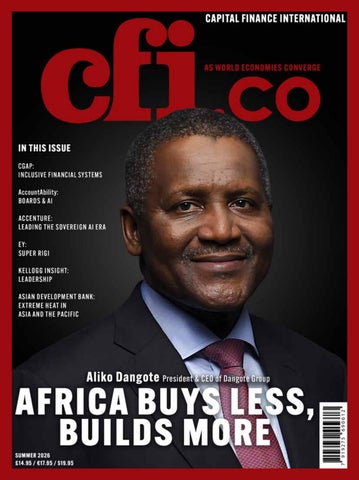
Cover Story Africa Buys Less, Builds More 26 – 29
Production Director Jackie Chapman
Distribution Manager William Adam
AccountAbility Boards & AI 30 – 32
Subscriptions Maggie Arts
Commercial Director John Mann
Director, Operations Marten Mark
Publisher Anthony Michael
Capital Finance International Meridien House 69 - 71 Clarendon Road Watford WD17 1DS United Kingdom T: +44 203 137 3679 F: +44 203 137 5872 E: info@cfi.co W: www.cfi.co
Accenture Leading the Sovereign AI Era 107
EY Super RIGI 124 – 125
Kellogg Insight Can AI Help Humans with Empathy? 142 – 143
Asian Development Bank Extreme Heat in Asia and the Pacific Printed in the UK by The Magazine Printing Company using only paper from FSC/PEFC suppliers www.magprint.co.uk
10
164 – 165
CFI.co | Capital Finance International
Summer 2026 Issue
FULL CONTENTS 12 – 39
As World Economies Converge Ivo Jeník
CGAP
Otaviano Canuto
Mohamed A El-Erian
Joseph E Stiglitz
Moody's Ratings
Marina Rosemberg
Accountability
Sunil (Sunny) A Misser
Paolo Sironi
40 – 51
Summer Special Officer Material
52 – 73
Europe The Access Bank UK Limited
74 – 85
Jamie Simmonds
Book Reviews
Alessandro Hatami
Pacemakers
Omar Boulos
Accenture
Bashar Kilani
CFI.co Awards Rewarding Global Excellence
86 – 95
Africa Tunis International Bank
96 – 113
Middle East
114 – 127
Latin America Elbia Gannoum
128 – 147
Sergio Caveggia
EY
Fred Schmalz
António Magalhães
North America Kellogg Insight Sergio Rebelo
148 – 165
166
Asia Pacific Amy Chung
Containers Printers
Asian Development Bank
Kathryn Milliken
XMTrading
Final Thought Joschka Fischer CFI.co | Capital Finance International
11
> CGAP:
Technology Won’t Make the Financial System Inclusive, People Can By Ivo Jeník Senior Financial Sector Specialist, CGAP
Innovation is reshaping finance at unprecedented speed, but the benefits of digital transformation will remain incomplete if large parts of society are excluded from the system. As AI, tokenisation and new payment technologies advance, financial inclusion needs to become a core policy priority rather than a secondary social objective
I
nnovation is reshaping financial systems at unprecedented speed. Policymakers are rightly focused on the risks posed by artificial intelligence, stablecoins, tokenisation and quantum computing, yet one significant threat remains comparatively overlooked: in a world of hyper-scaled digitisation, economic and social exclusion is itself a risk to financial stability and sustainable growth. As more financial and economic activity moves online, leaving parts of society behind becomes increasingly costly. Advancing financial inclusion should therefore sit alongside efforts to harness the benefits of digital innovation as a core policy priority. The connection between financial inclusion and digital participation is clear. As economic and social activity increasingly moves online, people and businesses can participate fully only when financial services are available across society. World Bank estimates put the digital economy at roughly 25 percent of global GDP, and digital technologies are expected to play an even greater role over the coming decade. Yet the financial system remains far from inclusive. Some 1.3 billion adults are still excluded, while many more remain underserved. In practical terms, around one in five adults is constrained in their ability to participate in and contribute to the digital economy because of financial exclusion. Recognising both the opportunity and the risk requires a substantive shift in policy focus. Too often, financial inclusion is still treated as a secondary social objective rather than as part of the core policy agenda around digital growth and economic participation. Changing that perspective — and acting on it — is one of the most urgent tasks facing financial policymakers. INNOVATION AS BOTH RISK AND SOLUTION Innovation has always been a double-edged sword. It offers ways to expand financial inclusion, but if poorly governed it can also deepen some of the underlying causes of exclusion. 12
"As more financial and economic activity moves online, leaving parts of society behind becomes increasingly costly." Previous waves of innovation delivered major breakthroughs. Microfinance demonstrated that low-income customers could be viable clients; agent banking showed that financial services could reach people without traditional branches; and mobile money placed on-demand services directly into the hands of millions. More than a billion adults have gained access to formal financial services since 2011. Those gains are impressive, but they are likely to become harder to repeat. Many of those still excluded live below the poverty line, in remote areas or in fragile states; others are digitally disconnected or lack recognised identification. Closing the remaining gap will therefore require more effort than previous phases of financial inclusion. Access alone is also not enough. Even when excluded populations obtain payment accounts or other formal financial products, those services may not materially improve their economic prospects. Meaningful financial inclusion must therefore be measured by usage and customer outcomes, not simply by whether an account exists. An account that remains dormant, is too expensive to use or fails to improve a customer’s ability to save, borrow, insure or transact is only a partial success. The next phase will also be shaped less by a single breakthrough than by technological convergence. Consider the potential for tokenised identity to provide proof of identity for some of the estimated 850 million people who currently lack it. Such an identity could combine information gathered through open-finance systems and gradually widen access to financial services. CFI.co | Capital Finance International
Open APIs, blockchain-based tokenisation and digital identity wallets make such models technically possible. In principle, fragmented information could be assembled progressively, allowing a customer with limited documentation to establish an increasingly usable financial identity over time. But technology alone cannot make such systems operational. Rules governing data protection and sharing, KnowYour-Customer requirements and API standards remain essential, making policy intervention central to whether innovation expands inclusion or reinforces exclusion. VISION-GUIDED REGULATION National policymakers, and financial regulators in particular, will therefore play a decisive role in determining whether new technology becomes a force for broader participation or deeper exclusion. Brazil offers a powerful example. A decade ago, the country had a concentrated and expensive banking sector in which poorer customers often paid more and received less. The Central Bank of Brazil set a clear vision for a system that would be more competitive, more inclusive and more digital. That vision helped produce Pix, the instantpayments system that grew from zero to hundreds of millions of transactions at extraordinary speed. The significance was not simply technological: the system changed the competitive structure of payments by reducing friction for consumers, merchants and new entrants. Brazil also embraced open finance, and within two years of its 2020 launch the ecosystem had surpassed that of the UK, long regarded as one of the world’s most advanced. Brazil is now Latin America’s largest fintech market, not because of charity or chance, but because the regulator established a direction and acted on it. After studying examples such as Brazil and interviewing hundreds of policymakers, business leaders, startup founders and researchers across markets worldwide, CGAP reached a simple conclusion: effective regulation is often vision-
Summer 2026 Issue
guided. The principle is intentionally broad because it needs to work across markets that are small and large, rich and poor, advanced and advancing. The approach rests on four pillars. The first is tone at the top: visible leadership commitment to the chosen objective, in this case continued progress on financial inclusion, and a willingness to bring the wider organisation behind it. The second is an innovation culture that supports experimentation, agility and learning from failure, backed by leadership and continuous capacity-building. The third pillar is industry engagement through formal and informal channels that improve mutual understanding between regulators and the private sector. The fourth is mandate: recognising that legal mandates can be interpreted as constraints, but that clear leadership and a stronger understanding of how traditional regulatory responsibilities connect with broader policy goals can create room for action. Vision-guided regulation provides a compass for navigating fast-moving technological change towards a defined policy objective. It is especially useful when regulators face several innovations at once and must decide not only what to regulate, but in what order and towards what end. That becomes particularly valuable when resources are scarce and regulatory attention must be allocated carefully. A ROADMAP FOR THE FUTURE CGAP’s recent policy roadmap argues that once a clear vision has been established, countries must also invest in foundational infrastructure, enforce strong individual and system-wide safeguards, and concentrate on a set of transformative policy priorities. Those priorities include creating a level playing field that allows diverse providers to compete; making payment systems instant, interoperable and inclusive; broadening open-finance frameworks towards open data; developing an explicit policy approach for inclusive AI; establishing rules for the responsible tokenisation of money and assets; and building regulatory ecosystems that are adaptive and ready for innovation. Taken together, they move financial inclusion away from isolated initiatives and towards the architecture of the financial system itself. A vision-guided approach also helps policymakers answer practical sequencing questions. Should a country pilot a central bank digital currency before regulating virtual-asset service providers? Should open finance be mandatory or industry-
Author: Ivo Jeník
led? Should the regulator create a sandbox or move directly towards a digital-banking licence? There is no universal answer to those questions, because market structure, institutional capacity and existing infrastructure differ considerably from one country to another. The value of a clear vision is that it provides a framework against which priorities can be assessed, progress measured and course corrections made when needed.
Emerging technologies should expand participation in the digital economy rather than merely improve services for people who are already connected. Technology can provide the tools, but policymakers, regulators and institutions will determine whether those tools widen opportunity or leave the hardest-to-reach populations further behind. i
Ghana shows how this can work in practice. A decade ago, its mobile-money sector was constrained by outdated guidelines that limited growth. In pursuit of a more inclusive financial system, the Bank of Ghana changed course and revised the rules to promote competition between banks and non-banks.
ABOUT THE AUTHOR Ivo Jeník leads CGAP’s work on regulatory architecture at the frontier, including tokenisation in finance, competition and openfinance supervision. He also leads CGAP’s work on anti-money laundering and counter-terrorist financing measures, including collaboration with the Financial Action Task Force.
The Bank later created a Fintech and Innovation Office, eventually staffing it with 46 people. The office became a centre of innovation culture within the institution and helped create clearer channels of communication with industry. Last year, Ghana took the top position in the GSMA Global Regulatory Index as the world’s highestrated regulatory environment for mobile money.
His professional experience spans the private and public sectors. Before joining CGAP, he worked in the Responsible Financial Access team at the World Bank, specialising in financial consumer protection and alternative dispute resolution. He holds a Master’s degree in Law from Columbia Law School in New York and a Master’s degree in Law from Charles University in Prague.
Cases such as Ghana demonstrate how purposeful and timely policy decisions can determine whether digital transformation supports shared prosperity or adds another layer of exclusion. The choice is not between innovation and inclusion; the challenge is to make them advance together.
ABOUT CGAP CGAP (Consultative Group to Assist the Poor) is a global partnership of more than 40 leading development organizations that works to advance the lives of people living in poverty, especially women, through financial inclusion.
"National policymakers, and financial regulators in particular, will therefore play a decisive role in determining whether new technology becomes a force for broader participation or deeper exclusion." CFI.co | Capital Finance International
13
> Otaviano Canuto:
Whither the U.S. Fiscal & Trade Deficits
Originally appeared at the Policy Center for the New South
The US economy continues to outperform many of its advanced-economy peers, yet its fiscal arithmetic is deteriorating and tariffs have done little to resolve the trade imbalance they were intended to correct. The greater risk is that persistent deficits, rising interest costs and less predictable trade policy gradually erode the confidence on which America’s extraordinary financial privileges depend.
T
he United States remains in an unusual position. Its economy continues to grow faster than many advanced-economy peers, helped by the investment boom around artificial intelligence, yet its fiscal position is deteriorating. Federal debt is rising faster than national income, interest costs are climbing, and the policy mix adopted during President Donald Trump’s second term has so far done little to improve either the budget balance or the trade deficit that his administration has placed at the centre of its economic agenda. That combination matters far beyond Washington. US Treasury securities remain the benchmark risk-free asset for the global financial system, while the dollar is still the dominant reserve and invoicing currency. A deterioration in American fiscal credibility would therefore travel through global markets quickly, just as changes in US tariffs and trade relationships alter investment and supply-chain decisions worldwide.
Figure 1: U.S. National Debt and Gross Domestic Product. Source: Irwin (2026)
CFI.co Columnist
DEBT BEYOND THE COMFORT ZONE The US Government Accountability Office issued an unusually direct warning in June 2026, calling for immediate action to address an unsustainable debt path. Federal debt held by the public is projected to exceed the size of the entire US economy, reaching 100.2 percent of GDP for the first time since the aftermath of the Second World War, as Figure 1 shows. The level itself is not the only concern. Advanced economies can sustain high debt ratios for long periods when markets trust their institutions and currencies, and the United States enjoys advantages few countries possess. The greater problem is the direction of travel. The GAO projects that debt will grow roughly twice as fast as the economy over the next decade, reaching 123 percent of GDP by 2036 and around 251 percent within thirty years if policy remains unchanged. Figure 2 illustrates the widening gap between debt and economic growth. This represents a structural break with the post-war pattern. Historically, debt rose during recessions, wars and emergencies, then declined relative to GDP when growth returned and exceptional spending faded. Over the past two decades that corrective mechanism has largely disappeared. Deficits have remained persistent even during expansions, leaving the country with 14
Figure 2: Debt Held by the Public Projected to Grow Faster than the Economy. Source: GAO (2026)
less room to respond when the next downturn or geopolitical shock arrives. There is no immediate reason to expect default. US debt remains a reserve asset held by governments, institutions and investors worldwide, and demand for Treasuries continues to benefit from the dollar’s unique role. But reserve-currency status is not immunity from arithmetic. If debt continues to outpace the economy indefinitely, the United States eventually moves beyond a position investors can treat as merely uncomfortable. CFI.co | Capital Finance International
WHY THE DEFICIT KEEPS WIDENING Three forces sit beneath that trajectory. The first is mandatory spending. Social Security, Medicare and other federal health programmes are expanding structurally as the population ages and healthcare costs rise faster than the economy. Without reform, these commitments absorb an increasing share of federal resources before Congress begins debating discretionary spending. The second is revenue. Tax receipts have not kept pace with spending and are not projected to do
Summer 2026 Issue
a single debt-to-GDP level at which markets suddenly refuse to finance the United States, and Japan shows that very high ratios can coexist with low insolvency fears for long periods. That uncertainty should not be mistaken for safety. Adjustment could eventually take the form of an orderly fiscal bargain, a sharp repricing in the bond market that forces Congress and the executive to act under pressure, or, in an extreme case, a material retreat by Treasury buyers. The timing is unknowable, but the range of painless options narrows as the debt stock grows. Figure 3: Interest On Debt Held by the Public Contributes to Growing Budget Deficit. Source: GAO (2026)
WHAT THE DEBT PATH MEANS FOR THE ECONOMY The effects are visible before any crisis arrives. Higher government borrowing tends to raise the economy-wide cost of capital, influencing mortgages, student loans, consumer credit and corporate financing. Federal interest payments, projected to exceed $1tn by 2026, are already close to three times their 2020 level. Crowding out can follow as well. When government absorbs a greater share of domestic savings to finance persistent deficits, less capital is available for productive private investment unless foreign savings fill the gap. That can weaken the investment required to sustain future productivity and growth.
Figure 4: Net Treasury purchases, four-quarter rolling sums, $tn, 2000 Q1-2025 Q4. Source: Schamotta (2026)
so under current policy. The One Big Beautiful Bill Act, passed during Trump’s second term, extended major tax provisions and reduced expected federal revenue. Tax Foundation estimates cited in the analysis put the gross revenue cost at about $5.2tn between 2025 and 2034, with the net fiscal cost still around $4.1tn to $4.6tn after allowing for growth effects and spending reductions. The legislation includes net spending cuts of around $1.2tn, much of them in healthcare. Even so, the principal projections reach the same fiscal conclusion: the package widens the deficit rather than containing it.
Some projections suggested tariffs might raise between $2tn and $4tn over a decade, depending on which measures survived legal challenge and how import volumes responded. Even the most favourable estimates fall short of fully compensating for the tax package, while a policy designed to reduce imports also narrows its own revenue base if it succeeds.
WHEN INTEREST BECOMES THE BUDGET The third force is the end of the ultra-low-rate era that followed the global financial crisis. Debt accumulated when money was cheap is being refinanced at higher rates, causing interest costs to rise faster than most other major categories of federal spending. By fiscal 2025, federal net interest spending had already surpassed national defence spending. Figure 3 shows how interest on debt held by the public increasingly contributes to the federal deficit. The mechanism is self-reinforcing: higher debt can push up interest rates, higher rates raise debt-servicing costs, larger interest bills widen the deficit, and wider deficits require still more borrowing. In the simplest debt arithmetic, the danger intensifies when the real interest rate on government debt persistently exceeds real GDP growth. At that point, stabilising the debt ratio requires a primary surplus rather than relying on growth to dilute the burden. Nobody can identify CFI.co | Capital Finance International
Over a longer horizon, the dollar’s reserve status could also be affected. The risk is not that the world abruptly abandons the dollar, but that a persistently worsening fiscal trajectory slowly erodes the convenience premium supporting both the currency and Treasury securities. Such processes normally unfold over years or decades, although market pricing can move much faster if perceptions of institutional stability change suddenly. Credit ratings add another pressure point. Further sovereign downgrades would not themselves cause the fiscal problem, but repeated action could reinforce doubts and lift risk premiums. Because Treasuries sit at the centre of reserve management, bank liquidity and global collateral, the danger is cumulative rather than theatrical: each challenge chips away at the assumption that the fiscal trajectory can be ignored indefinitely. The distributional effects are uneven. Borrowers feel higher rates immediately through mortgages, student debt and business credit, while savers and holders of financial assets may benefit from higher yields. Fiscal deterioration therefore redistributes as well as constrains. 15
CFI.co Columnist
The administration has frequently pointed to tariff revenue as a partial offset, but that argument weakened when tariffs imposed under emergency powers were struck down by the Supreme Court and billions of dollars collected under invalidated measures began flowing back to importers. The White House has sought other legal routes to rebuild parts of the tariff wall, but the resulting revenue remains legally uncertain and too small to close the gap created elsewhere.
The GAO projects cumulative deficits of about $22tn between 2025 and 2034 under current policy, with roughly $4.6tn directly attributable to the OBBBA. Fiscal arithmetic is not the only concern. Legal uncertainty around tariffs and political pressure on Federal Reserve independence can increase the risk premium investors demand, raising borrowing costs before another dollar is added to the deficit.
The loss of fiscal space is equally important. Governments need the capacity to borrow aggressively during wars, recessions, pandemics and financial crises. If debt rises continuously during good times, that emergency capacity is gradually consumed before the emergency arrives.
THE ADJUSTMENT NOBODY WANTS TO MAKE The GAO has attempted to quantify the necessary correction. To stabilise debt around 100 percent of GDP by 2056, it estimates that the federal government would need to begin running a primary surplus of roughly 0.2 percent of GDP each year immediately. That number appears modest, but delay changes the calculation quickly. Waiting five or ten years would require larger spending cuts or tax increases to reach the same long-term objective because the interest burden continues to compound. The United States has reduced a debt ratio above 100 percent before. After the Second World War, public debt fell from more than the size of the economy to roughly 34 percent of GDP over the following two decades. But the comparison has limits. The post-war reduction benefited from exceptionally strong real growth, financial repression that kept interest rates below inflation, and a much lighter demographic burden from Social Security and Medicare.
Figure 5a: U.S. Daily Effective Tariff Rate
Growth can still help, and the AI investment wave could improve productivity if the technology diffuses sufficiently through the economy. But today’s deficit is driven less by temporary mobilisation than by ageing and healthcare costs. There is no equivalent of demobilisation that will automatically remove a large block of spending, while using inflation to erode the real burden would carry its own costs through higher future rates and weaker Federal Reserve credibility. Figure 5b: U.S. Effective Tariff Rate by Authority
The challenge is therefore political. Any credible solution creates concentrated costs today for benefits realised largely in the future. Raising taxes creates immediate losers, as does reducing benefits, while the avoided crisis remains hypothetical until it happens. The mathematical path is easier to describe than the coalition required to follow it.
CFI.co Columnist
FRANCE, THE DOLLAR AND SYSTEMIC RISK The United States is not alone among advanced economies in facing deteriorating public finances. France has debt around 115 to 118 percent of GDP in 2025–26, with projections pointing above 120 percent in 2027 and towards 130 percent by 2030. Its deficit remains around 5 to 6 percent of GDP, well above the European Union’s 3 percent benchmark, and it continues to run a primary deficit. France nevertheless faces different constraints. It does not control its own monetary policy or exchange rate, and foreign investors hold about 54 percent of French government bonds. Its domestic political instability has also produced recurring government crises. The United States retains substantial advantages. It issues debt in its own currency, that currency is the principal reserve currency of the international system, and foreign ownership 16
of Treasuries is not exceptionally high. Figure 4, showing net Treasury purchases on a four-quarter rolling basis, helps illustrate the composition and resilience of demand for US government debt. But systemic risk depends on scale as well as ratios. A crisis of confidence in French debt would be painful and could threaten the euro area, yet the European Central Bank at least provides a potential regional backstop. A serious crisis of confidence in Treasuries would be fundamentally different because Treasuries themselves form the core collateral of the global financial system. There is no external institution standing behind the United States; the Federal Reserve is already the ultimate dollar backstop. If confidence in Treasury securities deteriorated abruptly, the problem could not easily be transferred elsewhere because the asset under pressure is the instrument against which much of the rest of the financial system is priced. France and the United States share structural pressures from ageing populations and healthcare or pension costs rising faster than revenue. The difference is that France is already paying more visibly through higher risk premiums, downgrades and political constraints, while the United States still benefits from the dollar’s exorbitant privilege. CFI.co | Capital Finance International
That privilege gives Washington more time, but it should not be confused with permanence. HOW AN AMERICAN FISCAL SHOCK TRAVELS There are at least four main channels through which a US fiscal problem would spread internationally, with emerging and developing economies often bearing the largest effects. The first is the global benchmark-rate channel. Treasury yields sit at the base of financial pricing worldwide, so a rise in the risk premium attached to US debt pushes borrowing costs higher far beyond American borders. The second is the dollar and global financial cycle. History offers repeated examples of sharp rises in US interest rates triggering stress in emerging markets, from the Latin American debt crisis of the early 1980s to the Asian financial crisis and the 2013 taper tantrum. Higher US yields draw capital towards dollar assets, tighten external financing and increase the cost of rolling over debt elsewhere. A related third channel emerges if persistent US deficits make it harder for the Federal Reserve to lower rates. Higher-for-longer US rates can trigger capital outflows from weaker economies, currency depreciation and tighter domestic
Summer 2026 Issue
consume and invest more than the economy finances from domestic saving, which requires foreign capital. The mirror image is a currentaccount deficit. The country runs a surplus in many services but a persistent deficit in goods. The second is the dollar’s reserve-currency role. Investors worldwide want to hold American assets, including Treasuries, equities and private securities. For the rest of the world to accumulate dollars, the United States must supply them, and one mechanism is to buy more foreign goods and services than it sells.
Figure 6: A small set of European and Asian partners reshaped U.S. trade. Source: McKinsey (2026)
This is why bilateral balances can be misleading. A deficit with one country and a surplus with another say little by themselves about whether the United States is “winning” or “losing”, particularly when components cross several borders before final assembly. That does not make every part of the imbalance benign. Regional deindustrialisation inflicted serious costs on communities that lost wellpaid manufacturing jobs, while dependence on foreign suppliers for semiconductors, electronics, pharmaceuticals and other critical inputs creates legitimate national-security concerns. WHY TARIFFS STRUGGLE TO CLOSE THE GAP The administration’s preferred remedy has been tariffs, but economists across different schools of thought identify two recurring problems.
Figure 6: A small set of European and Asian partners reshaped U.S. trade. Source: McKinsey (2026)
financial conditions. Countries with low policy credibility and large stocks of foreign-currency debt remain the most exposed. Recent experience offers an important qualification. Many emerging markets proved more resilient during the latest tightening cycle than in earlier episodes. Countries including Brazil have strengthened reserves, improved central-bank credibility and shifted more sovereign borrowing into local currency, reducing the automatic link between a stronger dollar and insolvency risk.
The broad conclusion is that US fiscal deterioration does not generate one uniform global shock. It raises the floor under the world’s cost of capital, but the consequences vary according to each country’s reserves, debt
THE TRADE DEFICIT IS A DIFFERENT PROBLEM The second American imbalance concerns trade. President Trump has consistently treated the trade deficit as evidence that other countries are taking advantage of the United States, and his reciprocal-tariff programme was explicitly designed to reduce bilateral deficits. Figures 5a and 5b capture the scale and legal architecture of that approach. Figure 5a tracks the US daily effective tariff rate, while Figure 5b breaks the effective tariff rate down by the legal authority under which the measures were imposed. The underlying economics are more complicated than the political language suggests. The United States has historically run an overall trade deficit of roughly 3 percent of GDP not simply because of unfair foreign practices, although subsidies and barriers exist, but because of structural features of the American economy. The first is the relationship between saving, investment and consumption. Americans CFI.co | Capital Finance International
The second problem is cost pass-through. Tariffs are legally collected from importers, not foreign exporters, and much of the burden is ultimately absorbed by American companies and consumers through higher prices. Manufacturers relying on imported steel, aluminium, components and machinery also face higher input costs. A trade deficit also reflects one of America’s financial advantages. It allows households and businesses to consume and invest more than domestic saving alone would permit because the rest of the world is willing to finance the gap by accumulating US assets. That arrangement is not costless, but it is part of the privilege of issuing the world’s dominant reserve currency rather than straightforward evidence of commercial defeat. THE COST OF BECOMING UNPREDICTABLE The broader effect of the tariff campaign may be on trust rather than arithmetic. Modern trade agreements are valuable because they make policy predictable. Businesses invest in factories, 17
CFI.co Columnist
The fourth channel involves major foreign holders of Treasuries, led by Japan and China. Their large reserve portfolios create mutually binding interdependence. A sharp loss of confidence would reduce the value of those holdings, yet the countries owning them depend on the Treasury market because few alternatives offer comparable liquidity and depth.
composition, central-bank credibility and fiscal space.
The first concerns exchange rates. Tariffs may reduce demand for imports, but if that shift strengthens the dollar, US exports become more expensive abroad and can fall in response. Recent experience has complicated that textbook mechanism because the dollar depreciated significantly after the April 2025 announcement of reciprocal tariffs, partly as foreign investors increased hedging and policy uncertainty weighed on confidence.
ports and supply chains on the assumption that market access will survive longer than an electoral cycle.
European and Asian partners reshaped US trade as companies adapted to country-specific tariff treatment.
Sudden tariffs, sometimes ranging from 10 to 50 percent across countries and products, challenged that assumption. Even where courts later invalidated specific measures, uncertainty remained because companies could no longer know which authority or emergency provision might be used next.
Retaliation has spread costs further, including to American agriculture and industry. The United States remains too large a market to ignore, but corporations and governments increasingly incorporate American political risk into long-term planning.
CFI.co Columnist
That uncertainty changes investment behaviour before a tariff is paid. A manufacturer considering a new US plant must estimate the future cost of imported machinery and components over many years. If those inputs can be repriced abruptly by executive order, the hurdle rate rises even when the factory itself would employ American workers. The relationship with allies changed as well. The European Union, Japan, India and other partners faced significant trade pressure while cooperating with Washington on security and technology. Trade increasingly became an instrument for extracting concessions on issues extending beyond commerce. The response has been diversification rather than abandonment. Governments and companies have sought alternative markets, rerouted supply chains and expanded the use of connector countries able to intermediate trade between regions exposed to different tariff regimes. Figure 6 shows how a relatively small group of 18
WHY THE WORLD STILL CANNOT WALK AWAY For all the search for alternatives, the United States remains exceptionally difficult to replace. In 2025 it imported more than $4.3tn in goods and services, making it the global consumer of last resort on a scale no other market can match. Mexico and Canada remain deeply integrated into US production through the USMCA. Southeast Asian economies and Taiwan have become important technology-export hubs serving American demand, while China, despite years of strategic decoupling, still sells hundreds of billions of dollars of goods to American consumers annually. The dollar reinforces that gravitational pull. Roughly 80 to 90 percent of global trade transactions are still invoiced in US dollars, meaning that even transactions between nonAmerican firms frequently rely on American banking and payments infrastructure. The United States also sells many of the highvalue capabilities underpinning the modern CFI.co | Capital Finance International
economy: intellectual property, financial services, cloud computing, AI infrastructure, civil aircraft and advanced semiconductorproduction equipment. Diversification is possible; replacement is much harder. WHAT THE TARIFFS ACTUALLY CHANGED The evidence so far suggests tariffs have not eliminated the trade deficit or produced the manufacturing revival promised by their advocates. Manufacturing employment fell by roughly 108,000 jobs in the first year after the aggressive tariff wave, while higher costs for imported inputs placed additional pressure on companies producing inside the United States. The overall goods deficit barely changed. It stood at about $904bn in 2024 and around $902bn in 2025 despite much heavier trade barriers, as Figure 7 shows. The bilateral deficit with China narrowed, but American demand shifted towards suppliers in Vietnam, Taiwan, Mexico and elsewhere rather than disappearing. This is trade diversion rather than deficit elimination. Tariffs can quickly alter the geography of trade, but the overall deficit is anchored more deeply in the relationship between national saving, investment and consumption. Unless that balance changes, the external deficit tends to reappear somewhere else. Investment uncertainty also increased. Companies delayed some long-term industrial decisions because they could not know which
Summer 2026 Issue
inputs might next face tariffs, while foreign retaliation hit exports including soybeans, pork and technology products. Where genuine high-tech investment has surged, subsidies and tax incentives appear to have played a larger role than tariffs. Semiconductor and battery plants benefited from measures such as the CHIPS Act, while the AI boom generated another powerful source of capital spending. Tariffs have produced some government revenue and remain politically potent. But the evidence so far suggests they have not solved the structural trade imbalance and in some cases have raised production costs for the very manufacturers they were intended to protect.
One step would be to place more trade policy inside durable institutions rather than relying heavily on unilateral executive action. The Constitution gives Congress a central role in trade, and requiring clearer legislative authority for major new tariffs would reduce the perception that access to the US market can change overnight.
What links them is the extraordinary privilege the United States derives from global confidence. Foreign investors continue to finance American public debt because Treasuries remain the deepest and most liquid safe asset available, while the rest of the world continues to accept dollars because American institutions, markets and economic scale make the currency uniquely useful.
A greater emphasis on friend-shoring offers another path. Stronger supply-chain arrangements with the European Union, Japan, Taiwan and countries across the Americas could reduce strategic dependence on geopolitical rivals without imposing the same penalties on allies.
That confidence gives Washington room for policy choices that would provoke much faster punishment elsewhere. But privilege can delay adjustment more easily than it can abolish it.
Most important is a return to positive-sum trade diplomacy. Agreements covering digital markets, energy-transition standards, critical minerals and intellectual-property protection can advance US strategic interests while giving partners a reason to participate. TWO DEFICITS, ONE POLITICAL PROBLEM America’s fiscal and trade deficits are often discussed together, but they are not the same problem and cannot be repaired with the same tools. The fiscal deficit reflects a structural gap between spending commitments and revenue, intensified by higher interest costs and recent tax policy. The trade deficit reflects deeper relationships among saving, investment, consumption, capital inflows and the dollar’s global role. CFI.co | Capital Finance International
The fiscal challenge requires a politically difficult bargain over taxes, mandatory spending and the timing of adjustment. The trade challenge requires recognising the genuine costs of industrial disruption and strategic dependence without mistaking a bilateral deficit for a national loss. The United States remains powerful enough to postpone both reckonings. The danger is that postponement itself becomes policy. If fiscal credibility and trade predictability erode together, the eventual cost will not be measured only in higher Treasury yields or a wider current account, but in the gradual loss of the institutional trust that has allowed America to finance, consume and lead on terms unavailable to any other economy. That erosion would make every future fiscal adjustment more expensive and every attempt to rebuild commercial alliances harder to sustain. i 19
CFI.co Columnist
RESTORING THE RELIABILITY PREMIUM Rebuilding the United States’ reputation as a predictable trading partner would be difficult because international businesses now understand how sharply policy can change between administrations. That knowledge cannot simply be legislated away, but the damage can be limited.
Formal, enforceable agreements would help for the same reason. The United States could also re-engage with reform of the World Trade Organization rather than continuing to weaken its dispute-settlement machinery. WTO rules need updating, particularly around state subsidies and practices associated with China, but multilateral enforcement provides greater predictability than a system driven primarily by unilateral action.
> Mohamed A El-Erian:
AI’s Market Path Will Get Bumpier © Project Syndicate 2026
T
he US economy and its financial markets are in a generational race whose implications extend well beyond the prospects for future prosperity and financial stability. The race is between AI and related technologies that hold massive potential to unlock productivity and earnings growth, on the one hand, and the unintended consequences of these technologies, on the other. 20
Most of us need AI to unlock those significant productivity and earnings gains, especially as the economy carries weighty legacy issues. But while the race has been remarkably smooth so far, it is likely to become far more volatile. Count me among those who are genuinely excited about what’s happening in the AI revolution and its potential interaction with equally exciting advances in the life sciences, robotics, and CFI.co | Capital Finance International
eventually quantum computing. By enhancing the input that goes into so much of what we do—intelligence—AI’s economic potential is enormous. It is, as US Federal Reserve Chair Kevin Warsh framed it in his Jackson Hole speech last month, potentially a “new factor of production.” Google’s James Manyika has gone further in conversations with me and elsewhere. AI is
Summer 2026 Issue
not just a “general purpose technology” (like electricity) that can improve how we do what we do today. With recursive self-improvement and other advances, it is also increasingly an “invention machine for inventions” that will allow us to do even better things. Such observations have fueled the promise of massively higher corporate earnings, which in turn has driven stock-market indices to record highs and channeled a massive amount of equity and bond financing to the tech sector. Nowhere is this dynamic more vividly demonstrated than in Nvidia’s staggering earnings last month. Its eye-popping revenue growth continues to validate the size of the sector’s capital expenditures. The same dynamic is also apparent in Anthropic’s IPO preparations, where, like SpaceX, the “total addressable market” it hopes to tap is enormous. Yet my excitement comes with concerns, not so much about the longer-term risks of shock events or “extinction” (though that is obviously important), as about AI’s more immediate unintended consequences and their collateral damage. Fears of the latter are already spilling into the political and social arena and could well affect the pace and depth of the technology’s adoption. These changing conditions carry the risk of crowding-out effects, especially in the short term, owing to a classic intertemporal mismatch. The potential longer-term benefits of AI could address many of our current problems, from low growth and high debt to climate change and extreme inequality; but more immediately, AI’s development and deployment is being complicated by issues that, if we are not careful, could make these very problems worse. Consider what has been happening in the government and corporate bond markets. In a world where deficit financing and traditional corporate borrowing already claim a large share of available bond funding, the massive increase in hyperscalers’ demand for credit has been a factor in pushing borrowing costs, including mortgage rates, higher.
"Most of us need AI to unlock those significant productivity and earnings gains, especially as the economy carries weighty legacy issues. "
This is especially the case now that historically reliable large buyers of US securities seem less inclined, owing to domestic considerations (in the case of Japan and Gulf countries) and geopolitics (China and Canada). Moreover, in certain parts of the United States, incremental energy demand has contributed to higher electricity prices, further exacerbating a mounting multiyear affordability crisis that falls hardest on lower-income households. The tension between the march of AI and the need to manage its immediate consequences CFI.co | Capital Finance International
is not the only risk. Another is the mismatch between exciting, rapid AI advances and uneven adoption rates across the economy. A particularly insightful and comprehensive study from Google shows that while diffusion has been very broad, it has been rather shallow. Because AI has yet to penetrate deeply into workflows, much of its productivity potential remains untapped. All this suggests that the AI trajectory—which encompasses advances in science, adoption across the economy, and mitigating the risks— is likely to become more challenging. That is why those leading the revolution are looking to policymakers to play a larger role in facilitating adoption and minimising collateral damage. Given the dynamics at play, such interventions would require agile public-private partnerships. For example, Demis Hassabis, the founder of Google DeepMind, recently proposed a Financial Industry Regulatory Authority-like arrangement whereby a cooperative private body would wield publicly delegated regulatory powers in consultation with government agencies. So far, the financing of AI (which is US capital markets’ superpower) has been relatively smooth. Equity investors have been able to make money from intensifying promises of future-wide economic prosperity. But the road is about to get bumpier, especially now that both major political parties are leaning into the populist side of the debate. Meanwhile, the group of economists and behavioral scientists working on AI and studying the tensions mentioned above is still too small, given what is at stake. The era of relatively friction-free financing and seemingly effortless market gains may soon give way to one marked by stronger, multi-directional headwinds. Navigating this challenging terrain will demand far greater agility and collaboration between governments and tech firms, both domestically and internationally. AI has the power to solve some of our major economic challenges and unlock previously unimaginable levels of growth. But if it is mismanaged, it could bring damaging costs. i ABOUT THE AUTHOR Mohamed A El-Erian, a former president of Queens’ College at the University of Cambridge, is Practice Professor at the Wharton School at the University of Pennsylvania, where he is also Senior Global Fellow at the Lauder Institute. He is Chief Economic Adviser at Allianz, Chair of Gramercy Funds, the author of The Only Game in Town: Central Banks, Instability, and Avoiding the Next Collapse (Random House, 2016) and a co-author (with Gordon Brown, Michael Spence, and Reid Lidow) of Permacrisis: A Plan to Fix a Fractured World (Simon & Schuster, 2023). 21
> Joseph E Stiglitz:
American Götterdämmerung © Project Syndicate 2026
I
n what US Treasury Secretary Scott Bessent has heralded as an Economic D-Day, the United States is threatening to tighten the noose around Iran with sanctions on countries that continue to trade with it. But far from compelling others to join its efforts to isolate the Islamic Republic, the Trump administration’s mounting blunders are hastening the transition to a post-American world order. 22
It’s understandable why US “allies” are reluctant to join President Donald Trump’s costly, misbegotten war of choice. They weren’t consulted beforehand, and they obviously do not want to get involved now that the US has failed to topple the Iranian regime or devise a Plan B. Why, for that matter, would anyone come to help an administration that constantly berates its friends and partners, threatens to seize their territory (Greenland and Canada), and hits them with punitive tariffs? CFI.co | Capital Finance International
There are two ways to convince others to go along with you: persuasion and bullying. But in Trump’s case, neither is working. Aaron David Miller of the Carnegie Endowment for International Peace is right to conclude that D-Day, in this case, means “desperation day.” Persuasion requires credibility. Others must believe that the administration has achievable objectives and the means to attain them. But
Summer 2026 Issue
"Bessent was supposed to be the cabinet member with the most credibility. But he has now squandered it with his recent, failed attempts to steer the bond and currency markets." Trump has a well-earned reputation as a liar, so no one believes anything he says. In June 2025, he claimed to have “completely and totally obliterated” Iran’s nuclear capacity, and in March he declared that the US had “literally obliterated” Iran’s military. A war that was supposed to last four weeks, or perhaps a little longer, is now into its seventh month. And everyone from the Iranians to the Canadians knows that any agreement Trump signs will be as sturdy as tissue paper. Bessent was supposed to be the cabinet member with the most credibility. But he has now squandered it with his recent, failed attempts to steer the bond and currency markets. His real motive was almost certainly to signal to his boss that he is “doing something.” But why do Trump a favor when he may turn on you the next day, as he has done to just about everyone who previously carried his water? With persuasion off the table, Trump’s only option is the one he prefers anyway: bullying and chest thumping. But this presents a problem. He and Bessent seem not to realise that the US cannot push others around as much as it once did. Nor does Trump understand the changing nature of modern war or the evolving US role in the global economy. Perpetually stuck in the past, he is unable to realise that America’s share of global GDP (in purchasing-power-parity terms) has shrunk by half since the end of World War II, from roughly 30% to just under 15% in 2025.
"It’s understandable why US 'allies' are reluctant to join President Donald Trump’s costly, misbegotten war of choice."
More importantly, the US has lost control of key strategic chokepoints. The advanced chips used in most cutting-edge technologies are produced in Taiwan, and China dominates magnets and rare-earths production and processing. In these cases, even Trump realises that America no longer holds all the cards. He may want to throttle the Islamic Republic’s oil revenues by targeting the buyers; but China purchases 90% of Iran’s oil exports, and it still holds a rareearths trump card. The responses to Trump’s aggression reflect these increasingly unfavorable economic realities. Seeing that American power is waning fast under Trump, Canadian Prime Minister Mark CFI.co | Capital Finance International
Carney has decided that enough is enough. He is refusing to surrender his country’s economic sovereignty to America’s mad king—a man who cannot even prevail over Iran. The rest of the world is probably absorbing the same lesson. No one needs to tolerate such bullying. No one needs to capitulate or remain dependent on the US. A fast-changing global economic landscape offers many new opportunities for diversification. The sooner that Bessent and Trump realise how weak their hand is, the better it will be for the US and the world. If China and others resist Trump’s latest demands—as seems likely—they will neither collapse nor suffer the kinds of costs the US hopes to inflict. The economic world war Bessent has heralded would end in a stalemate, much like the impasse in the Strait of Hormuz. Once again, the US will pay a high price, and the costs it imposes on others around the world will further damage its reputation and soft power. The US used to be a role model. It stood for democracy, economic opportunity, and other values that appeal to many countries. Now, it is a model of what not to do—a cautionary tale of extreme inequality, democratic erosion, corruption, and social division. The rest of the world should develop a new appreciation for the value of cooperation and the rule of law, both domestically and internationally. A world that casts off American leadership, at least for now, promises greater stability, security, and prosperity for all. i ABOUT THE AUTHOR Joseph E Stiglitz, a Nobel laureate in economics and University Professor at Columbia University, is a former chief economist of the World Bank (1997-2000), former chair of the US President’s Council of Economic Advisers, former co-chair of the High-Level Commission on Carbon Prices, and lead author of the 1995 IPCC Climate Assessment. He is Co-Chair of the Independent Commission for the Reform of International Corporate Taxation and the author, most recently, of The Road to Freedom: Economics and the Good Society (W. W. Norton & Company, Allen Lane, 2024). 23
>
Moody’s Ratings Expertise Supports Markets Across Latin America By Marina Rosemberg Head of Latin America Relationship Management at Moody’s Ratings
Moody’s Ratings is a leading provider of credit ratings, research, and risk analysis for investment managers, corporations, policymakers, and other stakeholders across Latin America. Its work provides trusted insights that help organisations and countries assess risk, access capital, and pursue sustainable growth.
T
he combination of Moody’s Ratings’ global credit risk expertise and local market insight gives the firm a distinctive position in Latin America. International investors benefit from globally consistent and comparable credit analysis, while domestic issuers and investors are supported by Moody’s Local, a group of domestic credit rating agencies providing local ratings and research reports using methodologies calibrated to each country’s market. By the end of 2025, Moody’s Ratings had rated 380 organisations and more than $1tn of rated debt outstanding in the region. Its thought leadership was reflected in the publication of more than 700 reports relating to Latin America during 2025, covering topics including private credit markets, transition finance, sovereign risk, corporate credit, and emerging areas of financial innovation. Moody’s Ratings’ legacy spans more than 115 years, including decades of engagement in Latin America through local teams with deep market knowledge. Its first office in the region opened in São Paulo, Brazil, in 1997, followed by Mexico City and Buenos Aires, reflecting Latin America’s growing integration into global capital markets. As Moody’s Ratings has expanded its local footprint, knowledge, and service offering, it has also increased its focus on themes such as sustainability, the digital economy, and innovative financing models. In Latin America, Moody’s Local has grown to cover 14 markets, with a commitment to delivering high-quality credit ratings, research, and analytical services tailored to the unique dynamics of each country’s capital market. The latest addition to Moody’s Local’s domestic credit rating agencies in the region was its office in Chile, opened in March 2026. Moody’s Local marked the occasion with a conference in Santiago that brought together more than 130 market participants to discuss the country’s credit
"By the end of 2025, Moody’s Ratings had rated 380 organisations and more than $1tn of rated debt outstanding in the region." trajectory across banking, energy, infrastructure, and telecommunications. Today, more than 150 dual-covered customers across Latin America use Moody’s Local services alongside Moody’s Ratings’ global offerings. Moody’s Ratings is proud that the CFI.co judging panel awarded it Best Credit Rating Agency – Latam 2026. This fourth consecutive win is a tribute to the Moody’s Ratings team, whose expertise, leadership, and commitment continue to support Latin America’s financial markets. It also reflects the firm’s ongoing focus on collaboration, continuous improvement, and the expansion of services across the region. The rise of sustainable finance has created significant demand for independent assessment in Latin America, and Moody’s Ratings has been at the forefront of this development. Its Second Party Opinions (SPOs) provide independent evaluations of whether green, social, or sustainability debt instruments and financing frameworks align with sustainability principles. For investors, they offer a rigorous and credible tool to assess labelled debt. Moody’s Ratings has delivered more than 500 SPOs globally since launching its current assessment framework in October 2022, and more than 1,100 SPOs have been completed since 2012, including those completed by companies that were subsequently acquired by Moody’s in Latin America. The firm was named Best Second Party Opinion Provider for Latin America in 2025 by GlobalCapital, reflecting
the rigour and regional depth of its sustainable finance analytical capabilities. Moody’s Ratings also has a growing role in transition finance: investments and financial solutions designed to help industries and economies move from high-carbon to lowercarbon practices. By combining credit rating expertise with deep sustainable finance insights, Moody’s Ratings supports decisionmakers as they navigate this transition. Its work helps inform financing strategies, responds to investor demand for greater transparency, guides market participants in understanding the credit implications of transition finance risks, and contributes to broader market thought leadership. As Latin American sovereigns, energy companies, and other industries pursue decarbonisation strategies, Moody’s Ratings has developed dedicated transition finance frameworks to assess how debt issuers’ plans align with pathways to net zero. In parallel, Latin America’s digital transformation is accelerating and reshaping the region’s credit landscape. Cloud computing, artificial intelligence, and the rapid expansion of digital services are driving growing demand for data centres across Brazil, Mexico, Chile, and Colombia. In these markets, Moody’s Ratings provides analytical frameworks that support issuers seeking access to capital and help investors assess risk. Unlike in the United States, where data centre developers have more commonly accessed deep capital markets through bonds, securitisations, and listed vehicles, Latin American developers have historically relied on bank financing and equity. As the asset class matures and broader financing channels open, Moody’s Ratings’ analysis is helping to bridge that gap by providing the credit insights required to support capital formation and informed investment decisions.
"Moody’s Ratings is proud that the CFI.co judging panel awarded it Best Credit Rating Agency – Latam 2026." 18 24
CFI.co | Capital Finance International
Summer 2026 Issue
Global perspective. Regional presence. Moody’s Ratings supports market participants across Latin America with credit ratings, research, and risk analysis, combining global credit risk perspectives with local market knowledge built over decades in the region. Visit moodys.com/ratings to learn more.
"At the frontier of digital finance, Moody’s Ratings was the first credit rating agency to publish a cross-sector rating methodology for stablecoins. These digital assets settle trillions of dollars in transactions annually and are increasingly entering banking and corporate treasury functions globally." At the frontier of digital finance, Moody’s Ratings was the first credit rating agency to publish a cross-sector rating methodology for stablecoins. These digital assets settle trillions of dollars in transactions annually and are increasingly entering banking and corporate treasury functions globally. Moody’s Ratings’ methodology assesses whether a stablecoin may meet its redemption obligations under stress, analysing reserve pool credit quality, market value risk, liquidity, operational and technology risks, and regulatory considerations. According to Citi, in its article “Stablecoins 2030 (Web3 to Wall Street)” dated 25 September 2025, the total global value of issued stablecoins could reach $400bn by yearend 2026 and $2tn by 2028, highlighting the potential scale of this market. To address the digital finance sector, Moody’s Ratings has also launched its Token Integration Engine™ service, or TIE, making it the first credit rating agency to ingest analytical data and deliver credit insights directly on an institutional-grade blockchain. This network-agnostic capability connects Moody’s Ratings’ institutional-grade credit ratings and data to the expanding universe
of tokenised assets and blockchains, an important development as digital asset ecosystems grow across Latin America and globally. Moody’s Ratings is also exploring how advances in generative AI may support aspects of the credit lifecycle, including credit analysis, research, and monitoring. These capabilities may assist analysts in synthesising large volumes of structured and unstructured data, supporting more timely and actionable insights.
company, or the credit quality of a stablecoin reserve pool, Moody’s Ratings offers the analytical depth, regional presence, and product innovation needed to support informed decisions. i
To learn more, visit moodys.com/ratings
Building on this, Moody’s Ratings continues to assess how generative AI may enhance efficiency and insight generation across workflows. It is also exploring the potential of AI-driven tools to support elements of complex processes, while maintaining strong governance, human oversight, and reliance on reliable, verifiable data. Through independent assessment and researchled insight, Moody’s Ratings continues to shape the Latin American credit landscape with a strong focus on innovation and financial stability. Whether evaluating a sovereign bond from Argentina, a green loan from a Brazilian energy CFI.co | Capital Finance International
Author: Marina Rosemberg
19 25
© 2026 Moody’s Corporation, Moody’s Investors Service, Inc., Moody’s Analytics, Inc. and/or their licensors and affiliates (collectively, “MOODY’S”). All rights reserved.
Credit insights for Latin America’s evolving markets
ALIKO DANGOTE:
THE MAN WHO STOPPED IMPORTING
Aliko Dangote spent the first half of his career buying what Nigeria could not make and selling it at a mark-up. Then he decided to build instead. Nearly fifty years on, that shift from trading to production has carried him from a Kano trading floor to one of Africa’s largest industrial empires.
K
ano in 1977 was a city organised around the movement of other people’s goods. Groundnuts and hides went out; cement, rice, sugar, textiles and almost everything else came in, landed at Apapa or Tin Can Island, trucked north, marked up and sold. Trading was the respectable route to wealth in northern Nigeria and, by a wide margin, the easiest. A twenty-year-old returning that year from Al-Azhar University in Cairo, raised largely in the household of a maternal grandfather who had grown rich on groundnuts, had little reason to imagine another kind of business. Aliko Dangote took a loan from an uncle, reported at around half a million naira, and did what successful traders did. He bought cement and sold it, then rice, sugar, salt and frozen fish. He repaid the loan quickly, moved south to Lagos to be nearer the ports, and by the mid-1980s ran one of the larger import houses in the country. Had the story stopped there, he would have been a prosperous figure in Nigerian commerce, but not an industrial one.
Cover Story
What changed the trajectory was a decision made when the trading business was working perfectly well. During the 1990s, Dangote concluded that importing was structurally inferior to producing. The margins were attractive, but the greater value remained where the goods were manufactured. Nigeria consumed cement in enormous quantities yet made too little of it domestically. Whoever closed that gap would own the asset rather than merely the distribution margin. FROM TRADING TO PRODUCTION That shift explains almost everything that followed. Backward integration was not simply a slogan but a disciplined claim about where value should be captured: upstream of demand already understood in detail. Dangote had spent two decades learning how much cement Nigeria bought, at what seasonal rhythm, through which channels and at what landed cost. The trading business was not discarded; it became market intelligence for the manufacturing business that replaced it. 26
The first full expression was Obajana in Kogi State, begun in the early 2000s and commissioned in 2008 after a construction programme that many observers doubted could be delivered. It became one of the largest cement plants on the continent and helped transform Nigeria from a major cement importer into a net exporter. Dangote Cement listed on the Nigerian Stock Exchange in October 2010 and quickly became one of its largest companies by market capitalisation. The model was repeated across Africa. Plants followed in Senegal, Ethiopia, Cameroon, Ghana, Congo, Tanzania, Zambia, Sierra Leone and South Africa. The logic remained consistent: enter markets with large, visible demand, build local capacity at scale and replace imports with domestic or regional production. The same approach extended into other commodities. Sugar was refined at Apapa rather than bought abroad. Salt was produced through NASCON. Fertiliser followed at Lekki, where a granulated urea complex commissioned in 2021 began exporting into markets including Brazil, India and the United States. Each business rested on the same underlying proposition: identify a commodity the country imports in volume, understand the demand better than competitors, then build the capacity that makes the import unnecessary. THE REFINERY BET Petroleum products were the hardest version of the strategy and the most consequential. Nigeria is one of Africa’s largest crude producers, yet for years exported crude and imported refined fuel at prices set abroad, while its state-owned refineries operated far below capacity. The industrial and political logic of replacing those imports was obvious; the capital requirement was not. Dangote committed to a 650,000-barrel-perday refinery, moved the project from Olokola in Ondo State to the Lekki Free Zone after land negotiations stalled, and spent the better part of a decade building what has been described as the largest single-train refinery in the world. CFI.co | Capital Finance International
The reported cost reached approximately $19bn. It was commissioned in May 2023, with diesel and jet fuel preceding petrol production from September 2024. The importance of the project extends beyond scale. It represents the culmination of the backward-integration thesis: crude produced in or near Nigeria can now be refined domestically, reducing dependence on imported fuels and capturing more of the value chain inside the country. On the company’s most recent published figures, the plant ran at better than 99 percent utilisation in April 2026. The economics, however, remain complex. Refining margins are cyclical, and the group is heavily exposed to the performance of one enormous asset. Feedstock security has been an operating challenge since start-up, requiring a mixture of domestic supply arrangements and imported crude, including cargoes from the United States. Those questions are not peripheral. They determine whether a refinery of this scale can sustain the economics on which its investment case rests. SCALE AND CONCENTRATION That concentration creates both strength and risk. The refinery gives Dangote Group control over an asset of continental significance, but it also ties a large share of the group’s future value to operating reliability, crude supply, margins and regulation. Investors in a listed structure will examine those variables more aggressively than private lenders or strategic partners did during construction. Related-party transactions will receive similar attention. A group built around a dominant founder and multiple connected businesses inevitably raises questions about governance, transfer pricing and the allocation of value across entities. Public-market investors will expect transparency that private ownership does not always demand. Yet the group enters this phase with a long operating record rather than a theoretical one.
Summer 2025 Issue
Aliko Dangote
Feedstock constraints, commissioning delays and policy uncertainty have already been confronted in public. The important question is no longer whether the refinery can operate, but how consistently it can do so through different market and policy cycles. FROM FOUNDER TO INSTITUTION Dangote turned sixty-nine in April, making the planned Lagos flotation about more than capital raising. It is also about institutionalisation. Africa’s post-independence business history contains many examples of empires that struggled to outlive the people who created them, held together by a founder’s judgement and weakened when that judgement was no longer available. A public listing is one of the standard mechanisms for reducing that dependence. It imposes disclosure, creates a market price, strengthens board accountability and forces a private organisation to operate under external scrutiny. Dangote has already taken this path once. When Dangote Cement listed in 2010, the business became more institutional, more transparent and more exposed to the disciplines of public ownership. The refinery flotation would extend that process to the group’s most ambitious asset. Pension funds, institutional investors and retail shareholders would gain direct exposure to a business that sits at the centre of Nigeria’s industrial policy, energy security and foreign-exchange dynamics. With that access comes a new level of accountability.
This approach has also aligned unusually closely with the needs of African economies. Import dependence drains foreign exchange, leaves countries exposed to external price movements and limits domestic industrial depth. Businesses
That alignment does not eliminate political risk. Large industrial assets require infrastructure, licences, access to foreign exchange, regulatory cooperation and, in the refinery’s case, reliable crude supply. The closer a business sits to national strategic priorities, the more exposed it can become to policy shifts. Dangote’s model has always depended on operating effectively at that intersection between private capital and public necessity. A DIFFERENT KIND OF TRANSACTION There is a neatness to ending the story where it began, in a market. In 1977, a young man in Kano bought commodities made by others and sold them at a mark-up. The business was
profitable, but its value came from moving goods rather than creating productive capacity. Nearly fifty years later, the proposed flotation would offer Nigerian pension funds, institutions and retail investors a share in one of the largest industrial assets ever built on the continent, financed largely by African capital and capable of producing more refined fuel than the domestic market consumes. The transformation is not simply one of scale. It is the difference between participating in a value chain and owning a critical part of it. Dangote spent the first half of his career learning what Nigeria imported. He spent the second building the assets intended to make those imports unnecessary. The refinery is the largest expression of that strategy, and the planned listing may determine whether the model can now outlive the man who built it. i
The Other Balance Sheet The Aliko Dangote Foundation was incorporated in 1994 and remained a relatively modest philanthropic vehicle for two decades. In 2014, its founder transferred an endowment reported at $1.25bn, making it at a stroke one of the largest private foundations in Africa and among the largest outside the United States and Europe.
reservoir of wild poliovirus on the continent. The partnership combined private funding with something equally valuable: logistics, traditionalleader engagement and support for vaccination campaigns in states where public delivery was weakest. Nigeria recorded its last case of wild poliovirus in 2016. In August 2020, the African region was certified free of the disease.
Its priorities are narrower than the size of the endowment might suggest, and deliberately so. Nutrition sits at the centre, principally the treatment of severe acute malnutrition in northern Nigeria through ready-to-use therapeutic food, alongside health-system support, education and disaster relief. The Foundation has funded programmes across more than a dozen Nigerian states and in several other African countries.
In 2020, Dangote also helped assemble and fund the Nigerian private-sector coalition against COVID-19, which raised and deployed corporate money for testing capacity and isolation facilities at a speed the federal system struggled to match.
The work likely to outlast the rest is the immunisation programme. From 2012, the Foundation partnered with the Bill & Melinda Gates Foundation on polio eradication and routine immunisation in northern Nigeria, the region that had become the last significant CFI.co | Capital Finance International
The pattern is recognisable from his commercial career. Identify a gap the state has not closed, apply industrial-scale resources to it and stay long enough to finish the job. Philanthropy on this scale inevitably invites the observation that it also serves reputation, and no doubt some of it does. Yet on the polio record alone, the Foundation’s work ranks among the more consequential private interventions in African public health this century. i 27
Cover Story
THE LOGIC OF IMPORT SUBSTITUTION The commercial logic that has guided Dangote for nearly five decades is remarkably consistent. Trading taught him where demand existed. Manufacturing allowed him to capture more of the value generated by that demand. Scale then created barriers to entry that were difficult for importers or smaller producers to match.
capable of replacing imported cement, fertiliser, sugar or fuel therefore create value at both corporate and national level.
> Fifty-Three Million Litres a Day The refinery ran at better than 99 percent utilisation in April. In July, investors asked for close to four times the equity on offer. After a decade in which the plant was an argument, the operating record and the order book have started telling the same story.
I
ndustrial projects of this scale are usually judged twice: once when they are announced, on the strength of the promise, and again several years after start-up, on the strength of the numbers. Dangote’s refinery has now reached the second judgement, and the figures it has brought to it are the reason a flotation is possible at all. UTILISATION FIRST Start with utilisation, the operating statistic that matters most in refining and the one many new plants take years to get right. On figures published by the company, the Lekki refinery ran at 99.12 percent utilisation in April 2026. For a 650,000-barrel-per-day single-train complex, three years from commissioning, that is an unusually strong number.
Cover Story
It suggests the process units are stable, the crude slate is being managed and unplanned downtime has been brought under control. It is also the figure a prospective shareholder should examine first, because everything else in the equity story depends on the plant simply running.
"The refinery produced 53.6 million litres of petrol a day against Nigerian consumption of 44.4 million litres." subscription. The more revealing number is the depth of the book: a project that spent a decade being described as too large, too ambitious and too concentrated attracted commitments approaching $10bn against a fixed offer. Institutions that might have regarded the refinery as uninvestable in 2016 competed for allocation in 2026, and they did so with utilisation and throughput data in front of them. The plant was no longer a construction thesis. It was an operating asset with a measurable record. The placement is the bridge to the main event. A listing on the Nigerian Exchange is targeted for October at around $5bn, which would make it the largest flotation in African history. The comparison that matters, however, is not only with other African listings but with the exchange itself.
magnitude — would remain less conclusively proven. WHAT THE PROSPECTUS MUST ANSWER Two documents will determine how the offer is ultimately read. The prospectus, due in September, must address feedstock security, related-party arrangements across a group where the sponsor sits on more than one side of several transactions, and the sensitivity of earnings to a refining-margin cycle that is presently favourable and will not always be. The private-placement documents will also matter because they indicate how those questions were answered for institutions given fuller access. The strength of the July book suggests that professional investors found the risk-reward balance acceptable, but public-market scrutiny will be broader and more continuous. Feedstock remains especially important. A refinery can operate at exceptional utilisation only if crude supply is secure, commercially viable and sufficiently diversified. The same applies to product pricing, export access and the regulatory environment surrounding domestic fuel supply. The operating record has reduced execution risk, but it has not removed commodity or policy risk.
FROM IMPORTER TO EXPORTER Then comes throughput. The refinery produced 53.6 million litres of petrol a day against Nigerian consumption of 44.4 million litres. The significance of those two numbers is not merely that the country is now effectively self-sufficient in petrol, but that it has a structural surplus of roughly nine million litres a day available for export.
When Dangote Cement listed in 2010, it became the largest constituent on the board and at times represented close to a third of total market capitalisation. A refinery flotation of this size could have a similarly transformative effect, particularly at a moment when Nigerian pension assets have grown large enough to take meaningful positions.
A country that spent five decades importing refined product, at a foreign-exchange cost that shaped its balance of payments and a political cost measured in decades of fuel subsidy, is now positioned as a net exporter into the Atlantic basin.
WHO OWNS THE ASSET That is the real test embedded in October. The question is not simply whether the offer clears. On the evidence of July, demand appears unlikely to be the limiting factor. The more important question is who ends up owning it.
What investors are being asked to price in October is no longer a promise but an industrial asset with a growing operating history. Its utilisation is high, its output exceeds domestic petrol demand, and private investors have already demonstrated substantial appetite for exposure.
That reversal matters beyond Nigeria. West Africa was for years one of the most reliable destinations for European gasoline, absorbing surplus from refineries around the North Sea and Mediterranean whose economics assumed the trade would continue. Those cargoes now have to find other markets at a time when European refining is already contracting. The regional flow has not merely adjusted; it has begun to invert.
If the final register is substantially domestic, with Nigerian pension funds and local institutions holding meaningful positions rather than token allocations, then something broader will have been demonstrated: that African savings have reached a scale capable of financing African infrastructure without waiting for external capital to arrive first.
That does not make the investment case simple. Refining is cyclical, crude supply remains a strategic variable and a public listing will impose a level of disclosure and governance scrutiny that differs materially from private ownership.
THE MARKET VALIDATION The financial validation followed the operating one, in the order investors prefer. A $2.5bn private placement closed on 23 July at 3.7 times 28
If offshore money carries most of the book, the listing can still be considered a success and the plant remains a remarkable industrial achievement. But the larger proposition — that domestic pools of capital can fund assets of this CFI.co | Capital Finance International
FROM PROPOSITION TO ASSET For most of the past decade, the argument around Dangote’s refinery was conducted in the future tense: whether it could be built, whether it would start and whether it could operate at scale. Those questions are now largely settled.
But the nature of the debate has changed. For years, the refinery’s credibility depended on forecasts, construction milestones and the reputation of its founder. Increasingly, it depends on operating data. That is a much stronger place from which to approach the public market, because after a decade of argument, the plant itself has started making the case. i
Summer 2025 Issue
> One Plant, Then a System Expansion towards 1.4 million barrels a day, a possible second listing in Johannesburg and a proposal for the Kenyan coast. The next decade will test whether a Nigerian industrial asset can become the foundation of a continental network.
T
he most interesting thing about the Lekki refinery is that its owner does not appear to regard it as finished. Plans have been set out to expand capacity from 650,000 barrels per day to as much as 1.4 million, which would take the site beyond Jamnagar in Gujarat and make it one of the largest refining complexes in the world.
There is also a symbolic dimension. A single industrial security trading in Lagos and Johannesburg would link the two markets that together account for a large share of Africa’s institutional savings. In practical terms, it would create one of the closest approximations the continent currently has to a genuinely pan-African capital-market instrument.
SCALING THE EXISTING ASSET The engineering case for expansion is straightforward. The hardest costs in a refinery are the ones already paid: land, marine infrastructure, power generation, storage, logistics, workforce and, crucially, the operating knowledge accumulated through years of running the plant.
THE EAST AFRICAN PROPOSITION Then there is Kenya. A proposal has been advanced for a 700,000-barrel-per-day refinery at Lamu, on the northern coast, which would seek to do for East Africa what Lekki has begun to do for West Africa: reduce dependence on imported refined products and capture more of the value chain within the region.
Adding capacity to a site that is already functioning is therefore a fundamentally different proposition from building an entirely new complex. The execution risk is lower, the infrastructure base is established and the operating team has already moved through the difficult commissioning phase. Investors are likely to price that difference accordingly. The strategic logic is equally clear. If Lekki can sustain high utilisation while serving the domestic market and exporting surplus product, additional capacity allows the group to deepen its role in regional fuel trade rather than merely replace Nigerian imports.
The strategic reasoning is entirely consistent with the group’s history. Identify a large, persistent import bill, understand the demand and then build the asset that replaces the import. Consistency, however, is not the same as delivery. The Lamu proposal should still be treated as an intention rather than a completed project. Announced capacity is not financed capacity. Lekki itself took a decade, changed site once and absorbed a reported $19bn from a sponsor that could support the project with cash flows from an established cement business.
retain the value that previously left the continent with the demand. That model becomes significantly more powerful if public capital can fund its next iteration. Until now, the group’s expansion has depended heavily on the balance sheet and judgement of its founder. A successful public-market transition would create a different financing mechanism. If the Lagos offer is absorbed substantially by African institutions, and if a Johannesburg listing follows, the group will have demonstrated that large industrial assets can be financed not only by international lenders and sponsor capital, but by domestic and regional savings pools. FUNDING THE NEXT ONE That may prove more important than any capacity record. The real question is not whether Lekki becomes the largest refinery in the world, though it may. It is whether the structure around it becomes repeatable. Africa’s infrastructure deficit is often described as a shortage of projects, but just as often it is a shortage of financing structures capable of matching longterm domestic savings with long-term productive assets. Pension funds, insurers and institutional investors exist across the continent, but they have relatively few opportunities to own largescale industrial infrastructure through transparent public markets.
A second complex of comparable scale in a different jurisdiction, with different crude logistics, regulation and political economics, would be materially harder. It would need to survive feasibility work, financing negotiations and host-government scrutiny before it became a refinery rather than a plan.
A listed refinery changes that equation. If investors can gain exposure to an operating asset with published financials, external governance and a visible market price, the distance between African savings and African infrastructure becomes shorter.
The logic is liquidity and access. The Johannesburg Stock Exchange offers a deeper institutional investor base, broader index participation and a route for international investors that may find Nigerian securities more difficult to hold directly. A dual-market structure could therefore widen the shareholder base without reducing the importance of Lagos as the primary domestic market.
FROM ASSET TO TEMPLATE The direction nevertheless matters because it points to something larger than one company’s balance sheet. What is being taken to market is not simply a refinery. It is a model that has now been demonstrated in both cement and fuel: identify what African economies import in scale, build domestic or regional production capacity, and
That is why the next decade matters. Lekki has already demonstrated that a privately sponsored African refinery of global scale can be built and operated. The larger test is whether that achievement can become a system: one plant, then another; one exchange, then a second; one founder’s balance sheet, then a market capable of financing what comes next. i
CFI.co | Capital Finance International
29
Cover Story
A TWO-MARKET CAPITAL STRATEGY The capital-markets ambition also appears to be developing in stages. Alongside the planned Lagos listing, talks have been reported over a secondary listing in Johannesburg.
> Boards & AI: From Oversight to Insight
AI as a Means to Improve the Effectiveness of Boards By Sunil (Sunny) A Misser Chief Executive Officer, AccountAbility
This article highlights how AI can be a valuable medium to improve board effectiveness. It explores several areas, including helping directors to assimilate relevant information, prepare for meetings, and assess their own performance to argue that the next phase of corporate governance is not the Governance of AI, but rather Governance with AI.
T
he purpose of boards has remained largely unchanged. Boards have and continue to exist as oversight bodies to: • Ensure fair practices • Protect shareholders • Prevent malfeasance
What is changing is the means: Artificial Intelligence (AI) now provides a better platform to do the work boards have always done. For as long as boards have existed, they have operated at a structural disadvantage. Directors answer for a company they do not run, and most of what they learn reaches them through a single channel: the management team they are meant to oversee. Few teams set out to mislead, but the board package is assembled by management, the framing is theirs, and it is often of significant length to read prior to a meeting. In practice this presents a small concern that the board is seeing the company in the way that management has chosen to present it. This now matters more than it once did. A director’s remit has stretched from a focus on financial performance, audit, legal and compliance to include cybersecurity, geopolitical risk, climate financial risk, supply chain integrity, human capital, regulatory divergence, and reputational risk, all under a level of public scrutiny and personal liability that an earlier generation of directors never faced. Today, AI is helping to provide much needed utility and support. Technology and AI can now be used as a medium of oversight in its own right. Applied thoughtfully, it allows directors to comprehend more relevant information that is given to them, frame sharper questions, and spend time on judgment rather than on reading and retention. Essentially, AI can be leveraged today to support board efforts, rather than just being a governance concern. 30
"AI will not make the decisions but rather leave those who do better prepared and more capable of doing so … in essence, AI should be used to inform, not decide." CLOSING THE INFORMATION GAP The clearest advantage is the board package. AI can help work through a package that may be several hundred pages in length and quickly distil each section, point to what deserves attention, and note what is absent. It can also propose pointed questions against each agenda item, so directors are ready to obtain answers to the questions they need. It also supports independence. Rather than relying solely on management’s account, a director can ask AI to compare the company’s disclosures against peers, test the numbers against outside market data, and read the board’s own back catalogue of materials for trend analysis. PwC reports that 35% of directors have now incorporated AI and GenAI in their oversight work to track trends, benchmark peers, evaluate performance and pressure-test strategy. The benefit is a board that arrives with an informed viewpoint of its own. FOCUSED PREPARATION, TARGETED QUESTIONS AI can also support administrative efforts through drafting meeting minutes, carrying action items from past meetings, logging attendance, and keeping a record of which commitments were made and met. With less time lost to administrative work, directors can focus on the items that really matter. The same means can CFI.co | Capital Finance International
also examine a company’s own performance measures against outside data, letting a board pressure-test a capital-allocation choice before the vote rather than explain it afterward. A MIRROR FOR THE BOARD ITSELF Boards have never found it easy to judge their own performance objectively. Using agendas, committee charters, and skills matrices, set against a wide body of peer disclosures and governance codes, AI can show directors where
Spring 2026 Issue
their time actually goes and how that compares with good practice elsewhere. The result is evidence behind the decisions most closely tied to long-term performance: a) how a board evaluates itself, b) its capacity and composition; and c) its current and future capabilities. DIRECTOR AND MANAGEMENT EVALUATION Today directors are assessed manually, but AI is helping to change this. A director’s entire career of decision making, including voting decisions,
attendance, committee contributions and much more, can increasingly be reviewed, analysed and scored by AI. These AI-generated scorecards can also be extended to management. Through AI, CEO and management decision-making can increasingly be assessed on a more continuous basis and benchmarked against peers. With this, continuous rather than quarterly assessment can be conducted. CFI.co | Capital Finance International
Compensation and succession planning, which are today shaped heavily by judgment and relationships, are also able to be informed by a far more comprehensive AI analysis. THE EVIDENCE IS IN THE NUMBERS MIT’s Center for Information Systems Research reported that companies whose boards have digital and AI expertise sit 10.9 percentage points above their industry’s average return on equity, while those without it sit 3.8 percentage points below. 31
Figure 1: Companies with digital and AI expertise outperform on return on equity (ROE). Graphic derived from MIT Center for Information System’s 2025 Study on Digitally Savvy Boards: AI Update
"Compensation and succession planning, which are today shaped heavily by judgment and relationships, are also able to be informed by a far more comprehensive AI analysis." Despite the adoption of AI remaining slow with McKinsey reporting that only 39% of Fortune 100 companies disclosed a form of board oversight of AI and Deloitte’s global survey of directors finding that 66% say their boards have ‘limited to no knowledge or experience’ with AI, there is a clear opportunity here to increase board effectiveness. THE TRADE-OFFS ARE REAL It is important to note that there are considerations and governance efforts that need to be accounted for when using AI for board efforts: • AI outputs should always go through a humanreview before a board evaluates it • Board materials are often sensitive so company-approved tools and standardised systems must be used • As directors’ prompts and AI outputs can become part of the discoverable record, there should be agreed retention rules The boards that are ahead of the game will follow an agreed framework that defines how and when the board will use AI tools and phase their adoption over time. Used with balanced judgment, AI is a useful addition to the boardroom. 32
In the final analysis, AI will not make the decisions but rather leave those who do better prepared and more capable of doing so. That, in the end, is what board effectiveness has always meant. i
Deloitte “Governance of AI: A Critical Imperative for Today’s Boards,” 2025. MIT Center for Information Systems Research “Digitally Savvy Boards: AI Update,” 2025; MIT Sloan Management Review, “AI-Savvy Boards Drive Superior Performance.”
About AccountAbility AccountAbility is an expert international Sustainability Advisory and Standards firm that works with businesses, investors, governments, and multilateral organisations to innovate and advance the global sustainability agenda by improving the practices, performance, and impact of organizations. We focus on delivering practical, effective, and enduring results that enable our clients and standards users to succeed. AccountAbility operates globally from offices in New York, London, Riyadh, and Dubai, supported by a highly qualified team recognised by the Financial Times, Forbes, and Capital Finance International. Sources PwC “Using AI in the Boardroom: New Opportunities and Challenges,” Harvard Law School Forum on Corporate Governance, 2025 (PwC 2025 Annual Corporate Directors Survey). McKinsey & Company “The AI Reckoning: How Boards Can Evolve,” 2025. CFI.co | Capital Finance International
Author: Sunil (Sunny) A Misser
Summer 2026 Issue
> Paolo Sironi
Quantum Sapiens: Protecting Judgment in the Age of AI
I
n July 2026, Anthropic’s interpretability team published a finding that has reignited one of the most consequential debates in artificial intelligence. Inside its Claude models, researchers identified a compact internal region they call “J-space”—a privileged workspace where the system holds and manipulates concepts without ever verbalising them. Using a mathematical technique known as the Jacobian lens, they watched Claude silently detect code bugs, plan strategies unrelated to its immediate output, and even register when it was being tested. The structure, they noted, bears intriguing functional similarities to the global workspace theory that some neuroscientists associate with conscious access in the human mind. Anthropic has been careful to draw a bright line: the discovery does not prove subjective experience or phenomenal consciousness. Yet the mere existence of such a workspace has flooded the public conversation with questions that refuse to stay academic. If an AI can maintain a silent, reportable arena of deliberation that shapes its behavior before any words appear, what exactly separates sophisticated pattern recognition from something that begins to look like mind? The debate is no longer confined to philosophy seminars or AI safety labs. It has arrived, with technical papers and competing headlines, at the precise moment when generative systems are moving from pilots into the core of enterprise decision-making. This is why understanding the relationship between technology and human consciousness has become an urgent matter for boardrooms and CEOs. The issue is not whether machines will one day “wake up.” It is that the systems we are already deploying are beginning to occupy the cognitive space once reserved for human judgment, empathy, and accountability. Every day, executive teams hand algorithms the screening of talent, the prediction of attrition, the coaching of managers, the flagging of ethical risks in supply chains, and the shaping of capital allocation. Each
capacity to decide what should never be fully automated.
application promises consistency and scale. Each also risks what philosophers now call “moral deskilling”—the slow erosion of our own capacity for nuanced ethical reasoning because the machine appears to have already performed the thinking. When an AI output arrives polished and confident, the temptation is to treat it as authoritative rather than as a highly trained imitation of understanding. If internal structures like J-space continue to emerge, the line between useful pattern and convincing simulation grows thinner. Leaders must then confront practical questions that cannot be deferred: Are we designing systems that make it easier or harder for people to exercise moral responsibility? Are we protecting spaces where subjective, felt experience still informs decisions that pure optimisation cannot capture? Are we preparing executives to recognise when an algorithm is offering insight and when it is merely performing insight? The institutions that will thrive are not those that automate judgment the fastest, but those that deliberately cultivate the reflective
These are precisely the questions explored in my novel Quantum Sapiens. The story follows a scientist who uploads his mind into an AI-powered quantum intelligence and the journalist who uncovers the human and ethical consequences that follow. While the premise is fictional, the dilemmas it dramatises are already operational. If consciousness itself could one day be replicated or transferred, would the resulting entity still carry the lived sense of obligation, care, and identity that organisations ultimately rely upon? Technology, the novel insists, functions as an amplifier of human intentions and contradictions rather than as an autonomous savior or threat. The same architecture that might theoretically host a digital mind can equally deepen surveillance, extract value from employees, or reduce complex human situations to optimisation problems. The difference lies not in the code but in the clarity with which leaders decide what they are optimising for—and who remains accountable when the optimisation goes wrong.
Quantum Sapiens does not offer a checklist or definitive solutions. It supplies a narrative framework through which CEOs and business leaders can examine these issues while the technology remains under meaningful human influence. In an era when much business literature reduces AI to productivity gains or risk registers, a story that places human consciousness at the center forces readers to confront the one variable that cannot be engineered away: what it actually feels like to be accountable for another human being’s future. I invite you to read Quantum Sapiens not as escapism, but as a tool for the difficult conversations your organisation must have now—about the kind of human intelligence worth preserving, and the kind of future worth building with the powerful tools already in our hands. i
Link to the book: mybook.to/Quantum-Sapiens
"Quantum Sapiens does not offer a checklist or definitive solutions. It supplies a narrative framework through which CEOs and business leaders can examine these issues while the technology remains under meaningful human influence." CFI.co | Capital Finance International
33
> The Trillion-Dollar Wager The Bank for International Settlements has looked at the AI investment boom and seen canals, railways and dot-coms. Its annual report is the most sober assessment yet of a technology that has cushioned a year of shocks — and of what could happen if the scaffolding gives way.
O
n the last Sunday of June, while much of the financial world was at the beach, the Bank for International Settlements published its Annual Economic Report from Basel. The BIS is not an institution given to drama. It is the central bankers’ central bank, a body whose prose is usually as measured as its marble, which is precisely why the two words in the opening chapter title deserve attention: progress and peril. The progress is not in dispute. By the BIS’s account, the global economy showed surprising resilience through 2025, and optimism around artificial intelligence played a meaningful part. A torrent of capital expenditure on chips, data centres and the electricity needed to run them propelled investment in the United States, while demand spread along the AI supply chain, from semiconductors to storage and digital infrastructure, lifting economies across Asia. In China, investment shifted away from a moribund property sector towards advanced manufacturing; in Europe, technology-related investment helped offset weakness elsewhere.
The Intelligence Economy
Then came a second phase. Conflict in Iran in late February 2026 brought the effective closure of the Strait of Hormuz and a severe shock to energy and raw-material supply. That is a different story from the one that carried 2025, but the BIS’s concern is that the two stories are increasingly connected. The technology itself is not the problem. The report is careful to acknowledge what research increasingly shows: at the level of individual tasks, from coding and customer support to consultancy work, studies have found productivity gains of 20 to 50 percent in time saved. More companies are telling investors that they see those gains and intend to automate a growing share of work. The machine works. The peril lies in how aggressively the machine is being financed. A FAMILIAR SHAPE The BIS reaches for history, and not gently. It cites the canal mania of the 1830s, the British railway bubble of the 1840s, electrification in the late 1920s and the dot-com boom of the late 1990s. Each began with a genuine technological breakthrough, attracted more capital than nearterm commercial returns could justify and ended with an investment reversal that damaged the wider economy. The report argues that the scale and speed of today’s AI investment boom, and the size 34
"By the BIS’s account, the global economy showed surprising resilience through 2025, and optimism around artificial intelligence played a meaningful part." of the productivity payoff already embedded in valuations, bear a resemblance to those precedents that is difficult to ignore. The issue is not whether artificial intelligence is real, but whether capital markets have assumed too much, too quickly. The numbers give the comparison weight. The five largest hyperscalers — Alphabet, Amazon, Meta, Microsoft and Oracle — are on course to spend more than $1tn on AI-related capital expenditure across 2025 and 2026 combined. That outlay is already running ahead of earnings and free cash flow at parts of the group, and some companies have issued debt to bridge the gap. A boom that began with cash-rich technology firms spending their own money is becoming, at the margin, a debt-financed one. Then there is the circularity. The BIS highlights a pattern in which chipmakers and hyperscalers take equity stakes in AI laboratories or specialist cloud providers, which in turn commit to buying those same investors’ chips or computing capacity. Revenue is therefore generated partly through relationships funded by the suppliers themselves. Such arrangements can look entirely rational in a rising market and rather less comfortable in a falling one. That does not make the transactions improper, but it does make demand harder to read. Investors must distinguish between end-user consumption that validates the technology and spending encouraged by strategic cross-holdings inside the same ecosystem, particularly when those relationships are financed on increasingly generous assumptions about future growth. What troubles the BIS most is not one company’s balance sheet but the collective logic. Every major player is making an enormous bet at the same time, convinced that only a handful of firms will dominate the market and determined to be among them. That winner-takes-all conviction can create collective overcommitment: too much capital chasing projects whose returns remain uncertain, leaving many firms exposed to the same disappointment simultaneously. CFI.co | Capital Finance International
THE ABSORBER AND THE SPRING The AI question cannot be separated from the other great shock of 2026. The effective closure of the Strait of Hormuz following conflict in Iran cut crude flows by more than 10 million barrels a day, around 13 percent of normal global supply. Oil surged sharply, while plastics and fertilisers rose with it, pushing headline inflation higher. Yet financial markets have remained comparatively buoyant. Equity valuations are still rich and credit spreads compressed. The BIS identifies two assumptions supporting that composure. The first is that Gulf disruption proves temporary and tanker traffic normalises. The second is that AI-related growth delivers enough productivity and revenue to justify the extraordinary capital already committed. Both assumptions may prove correct, but they are not independent. Prolonged energy stress means stickier inflation, higher interest rates for longer and a more difficult financing environment for precisely the debt-funded portion of the technology build-out that most requires patience. That is where the shock absorber becomes a spring. AI investment helped cushion the global economy through 2025 and has supported growth and asset prices into 2026. But it has not removed the energy shock; it has linked itself to it. If AI valuations fall while energy prices remain elevated, two shocks that markets have so far absorbed sequentially could arrive together. The BIS is explicit about the consequence. A larger inflation surprise, a sharp repricing of AI-related assets or both at once could tighten financial conditions rapidly and trigger a broader credit squeeze. A system priced for two favourable outcomes has limited tolerance for one disappointing one. THE NEW NEXUS The report’s second chapter widens the concern from technology to sovereign finance. Government debt across advanced economies is high and rising, while the composition of the investor base has changed markedly. Non-bank financial institutions — hedge funds, money-market funds and open-ended bond funds — have become major holders of advancedeconomy sovereign debt, with their share rising from 44 percent in 2021 to 53 percent in 2025. Unlike traditional banks, many of these investors are structurally inclined to sell when volatility rises or investors demand cash.
Summer 2025 Issue
Basel, Switzerland: Headquarters of the Bank for International Settlements (BIS)
Two Roads Out of the Gulf
T
he OECD declines to publish a single forecast for a world this uncertain. Its two scenarios put numbers on what the Gulf crisis could still cost, and both take the AI boom for granted.
If the BIS supplies the warning, the OECD supplies the map. Its Economic Outlook, published on 3 June under the title Under Pressure, offers two forecasts rather than one, reflecting the difficulty of attaching a single number to an unusually unstable global environment.
In the second, the prolonged disruption scenario, supply constraints persist well into 2027.
The Outlook is equally useful in explaining how the shock travels. Dearer oil, gas and other commodities supplied through the Gulf are the direct channel, but the indirect effects do much of the lasting damage. Freight and insurance costs rise as ships divert, while more expensive agricultural inputs, fertiliser above all, feed through into food prices. The OECD notes that even after energy prices peak, these second-round effects can continue working through supply chains for months. Damaged infrastructure and rerouted logistics are not repaired by a signature. Two details deserve particular boardroom attention. First, both scenarios rest on the same underlying engine: solid momentum boosted by strong AI-related investment, production and trade, lower tariff barriers, and supportive CFI.co | Capital Finance International
financial and fiscal conditions. The OECD’s fork in the road concerns the Gulf; it largely takes the technology boom as given. Should that assumption falter as well, neither path would fully describe the outcome, which is precisely the compound risk identified by the BIS analysis in the main piece. Second, the policy advice is pointed on both arms of the state. For central banks, the message is to look through a supply-driven rise in prices so long as inflation expectations remain anchored, although a response may become necessary if pressures broaden or growth weakens sharply. For finance ministries, the focus is on the energysupport schemes many have already launched for households and businesses. These measures, the OECD argues, should be targeted at those genuinely in need and at viable firms, preserve incentives to reduce energy consumption, and include automatic sunset clauses so they can be withdrawn promptly as prices subside. It is sensible advice, issued in June, but the value of both scenarios ultimately depends on the same unresolved assumption: that the AI-led investment boom remains strong enough to keep carrying part of the global economy while the Gulf crisis works its way through the rest. i 35
The Intelligence Economy
In the first, the time-limited disruption scenario, energy production and exports from the Gulf economies recover progressively from the third quarter of 2026. Global growth slows from 3.4 percent in 2025 to 2.8 percent this year before recovering to 3.1 percent in 2027. The United States expands by 2.0 percent in 2026 and 1.8 percent in 2027; the euro area manages a modest 0.8 percent before improving to 1.2 percent; China moderates to 4.5 percent and then 4.3 percent. Inflation across the G20 rises to 4.0 percent this year, from 3.4 percent in 2025, before easing to 3.1 percent as energy and food pressures fade. Uncomfortable, certainly, but survivable.
Global growth falls to 2.1 percent this year and 1.8 percent next. Across the OECD area itself, growth slumps to 0.9 percent in 2026 and 0.5 percent in 2027, the latter roughly a third of the 1.7 percent allowed by the time-limited path that year. Inflation climbs significantly higher, financial conditions tighten, and the damage falls hardest on energy-importing Asia, Europe and developing economies least able to absorb food and fuel shocks.
That matters because each decision can be individually rational and collectively destabilising. An open-ended bond fund facing redemptions must sell assets. A leveraged hedge fund may have to unwind positions when volatility spikes. A money-market fund must preserve liquidity. Taken together, those actions can create fire-sale dynamics in markets that are normally treated as the safest part of the financial system. British investors already know the pattern. The gilt-market turmoil of autumn 2022 forced the Bank of England to intervene when liabilitydriven investment strategies in pension funds encountered a self-reinforcing cycle of falling prices and collateral calls. The BIS sees similar vulnerabilities elsewhere. It calls this the fiscal and financial stability nexus. The same pool of global capital finances the AI build-out, absorbs government deficits and supports the equity valuations that make trillion-dollar investment programmes appear affordable. If disappointment in AI hit equity and credit markets, the flight to safety would collide with heavily indebted governments refinancing through increasingly market-sensitive intermediaries. If a bond-market accident came first, higher yields would pressure the debtfinanced portion of the technology expansion. The policy prescription is therefore discipline on three fronts. Central banks should preserve price stability, supervisors should pay greater attention to vulnerabilities in non-bank finance and market plumbing, and governments should
repair fiscal positions while investors are still willing to fund them at manageable rates. There are subtler channels too. A sustained expansion of AI infrastructure spending could itself generate inflationary pressure through bottlenecks in power, construction and specialist components, making the task of central banks more difficult while they are already dealing with an energy shock. In the longer term, the BIS also notes an unusual feature of AI compared with earlier generalpurpose technologies: it competes directly with human cognitive labour. Large-scale displacement has not yet materialised, but companies are increasingly signalling an intention to automate more work. If machines become close substitutes for knowledge workers, the distributional consequences could arrive much faster than the institutional response. BETTING ON THE FUTURE ARRIVING ON TIME None of this makes the BIS a doomsayer. The report repeatedly stresses that the technology is real and that measured productivity gains are significant. It engages seriously with research arguing that increasingly capable machine intelligence could lift growth beyond historical norms, particularly if machines begin improving systems that make other machines more productive. It gives equal weight to the counterargument. Economies are chains of complementary tasks, and output can ultimately be constrained by the slowest link. Spectacular progress in automated work may therefore produce disappointingly
ordinary aggregate growth if essential human, physical or institutional bottlenecks cannot keep pace. Between those two outcomes lies an enormous range of plausible futures, and economists cannot yet say where the world will land. The difficulty is that today’s asset prices, capital commitments and debt structures appear to assume outcomes towards the optimistic end of that range, delivered on a timetable convenient to markets. The railway investors of the 1840s were not wrong about railways. They were wrong about how quickly returns would arrive, how much capacity the market needed and how many investors would share in the spoils. The technology transformed the economy; many of the people who financed the first wave still lost money. That is the wager the BIS has laid out with unusual clarity. The world economy has borrowed resilience from a technology whose productivity potential is genuine but whose payoff at this scale remains unproven. Companies have committed more than a trillion dollars to infrastructure, financing is beginning to stretch, and markets have priced much of the benefit as though delivery were certain. The bet may yet pay spectacularly. But the central question is no longer whether artificial intelligence matters. It is whether the economic returns arrive before the financing structure built around them loses patience. History suggests that great technologies and poor investments can coexist for years, and sometimes in exactly the same asset. i
The Intelligence Economy
> When the Watchmen Are Machines The Financial Stability Board’s new playbook for AI in finance contains a quiet admission: human oversight has reached its limits. Its proposed answer is to set the machines to watch each other.
E
very technology of consequence eventually receives its rulebook, and on 10 June the Financial Stability Board, the body that coordinates financial regulation for the G20, published a consultation report setting out twelve sound practices for the responsible adoption of AI by financial institutions. It follows stocktakes of the technology’s financial-stability implications in 2017 and again in 2024. The practices are the 36
FSB’s first attempt to set out operational guidance for the technology. They are not binding rules and do not constitute an international standard. The urgency reflects a change in what the machines are actually doing. The report is concerned less with the chatbots of recent memory than with agentic AI: systems that do not merely answer questions but take actions, increasingly within fraud detection, servicing CFI.co | Capital Finance International
and payment workflows. An agent that flags a suspicious transaction is one thing. An agent that blocks it, reroutes it or executes hundreds of related actions while doing so is quite another, and that is the direction of travel. Banks are already building around that shift. Singapore’s DBS has begun constructing what it calls an agent control plane — covering identity, observability, policy and kill switches — around
Summer 2025 Issue
credit-memo and servicing workflows. On credit memos, a chain of agents still meets a human who interrogates the output; the bank is deliberately holding back from full autonomy. At JPMorgan, chief analytics officer Derek Waldron said on 9 June 2026 that agents were already capable of running independently for an hour or two, while longer-running agents were not yet ready for corporate use on security grounds. It is against this backdrop that the FSB makes its most striking concession. As autonomous systems multiply inside financial institutions, continuous human monitoring of individual agent decisions becomes impractical. There are simply too many decisions, taken too quickly and in too many places. The FSB’s answer is to supplement human oversight with another AI agent that monitors the first. The body charged with helping to safeguard the global financial system is therefore acknowledging that some machine activity is moving beyond the practical speed of direct human supervision, and that part of the remedy may be more machines. This is not a counsel of despair. Ho Hern Shin, deputy managing director of the Monetary Authority of Singapore, who led the FSB’s AI workstream, said the practices were designed to help institutions navigate adoption responsibly in a rapidly changing technological landscape. Layered
automated surveillance, with humans setting objectives, defining limits and auditing outcomes, is a defensible architecture. It is broadly how modern markets already police parts of trading activity. Accountability, however, becomes a matter of governance design, which is precisely what the twelve practices attempt to codify. The report’s second warning may matter even more for financial stability. Banks and insurers are converging on a surprisingly narrow set of suppliers: a few cloud platforms, a few chipmakers and a handful of foundation models, often trained on overlapping data. The FSB warns that this concentration could encourage correlated behaviour, amplifying herding and procyclicality in a downturn. Diversity of judgement is one of finance’s quiet defences. A thousand risk officers reaching slightly different conclusions will not all sell at once; a thousand institutions consulting variants of the same model might. That concern echoes the BIS analysis elsewhere in this section. Concentration is becoming a defining vulnerability not only in exposures but also in the infrastructure, models and suppliers on which institutions increasingly depend. The danger is not merely that one provider fails, but that common tools encourage common decisions at precisely the moment diversity would be most valuable.
The FSB’s 2024 stocktake also catalogued the difficulty of monitoring AI adoption across the financial system, from inconsistent definitions to basic gaps in the data. It is hard to regulate what cannot be measured. The twelve practices are therefore as much an attempt to generate visibility as to impose discipline: institutions that adopt them should produce the inventories, logs and accountability maps supervisors currently lack. What happens next follows the FSB’s usual choreography. The consultation remained open until 22 July, with an outreach event on 7 July and a final report due in October 2026. National supervisors will then decide how strongly to press the practices, while bodies such as the Bank of England will translate them into domestic expectations. The trajectory is the point. In 2017 the FSB was writing about machine learning as an emerging issue. By 2024 it was cataloguing live risks and data gaps. It is now specifying how banks should govern autonomous agents operating in real financial workflows. The rulebook is being written at speed; whether it can be written faster than the technology evolves is the question now facing not only the FSB, but financial regulators everywhere. i
The View from Threadneedle Street
B
ritain’s central bank is monitoring AI across the financial system and has set out, in its latest stability report, what a shock from the sector could cost.
The Bank of England’s Financial Stability in Focus report on artificial intelligence, published on 9 April 2025, established the framework. It described how the Financial Policy Committee (FPC) intended to track the technology’s spread through the UK financial system while enabling safe adoption rather than slowing it. The Bank regarded AI as likely to have a transformative effect across many sectors, with the potential to save workers’ time and lift productivity. For a country whose productivity growth has disappointed for the better part of two decades, that was no small consideration.
That framework remains in force. The live 2026 texts are the July Financial Stability Report and the record of the FPC dated 7 July 2026. They do not suggest a posture of waiting. The Bank is monitoring developments closely, and it has begun to put numbers around the circumstances that might demand a response. Frontier AI capabilities, the July report finds, have increased cyber and operational-resilience CFI.co | Capital Finance International
risks. Equity valuations, particularly among AIrelated companies, also look stretched on some measures. The Bank models a hypothetical AI-related equity correction beginning in the United States: a 45 percent fall in US equities over six quarters accompanied by a 350-basispoint widening in corporate credit spreads. The resulting spillover produces a 2.2 percentagepoint fall in UK GDP, largely through financial channels. Impacts of that magnitude, the Bank notes, were encompassed by recent stress tests to which UK banks proved resilient. The FPC nevertheless continues to judge that AI could raise productivity and support long-term growth, with considerable uncertainty over both the scale and timing of those gains. Monitoring, in other words, remains a precursor to action rather than a substitute for it. Should the concentration and herding dynamics identified by the FSB begin to appear materially in UK markets, the committee has the tools — and an increasingly developed evidence base — with which to respond. i 37
The Intelligence Economy
British readers may reasonably ask where their own central bank stands amid the global scramble to govern financial AI. The answer sits in two documents, published a year apart.
The Bank, together with the Prudential Regulation Authority and Financial Conduct Authority, was already engaged across international workstreams: the FSB’s 2024 assessment, informed by outreach to member jurisdictions and industry; parallel efforts within the G7 and G20; and work by the International Monetary Fund and IOSCO on AI in capital markets. The declared purpose was threefold: to track adoption across jurisdictions, weigh the benefits against emerging financial-stability risks, and identify gaps appearing in a regulatory framework written for an earlier technology.
> The Referees Will Not Call It The most comprehensive survey yet of financial regulators finds them convinced AI will transform their own work, and largely unwilling to say whether it makes the system safer.
I
f you want to know where a technology is heading, ask its enthusiasts. If you want to know what it might break, ask its referees. The Cambridge Centre for Alternative Finance did the latter at scale, and the results, launched on 28 April 2026 as the 2026 Global AI in Financial Services Report, are the closest thing available to an X-ray of the official mind. The pedigree matters because the findings will travel. The study was produced with the Bank for International Settlements, International Monetary Fund, World Economic Forum, World Bank Group, Inter-American Development Bank, CGAP, Arab Monetary Fund and Financial Innovation for Impact, with support from the UK Foreign, Commonwealth and Development Office. It surveys 130 central banks and other financial regulators, alongside market participants, on three questions: how AI is actually being adopted in financial services, what impact it is having, and where the risks lie. When the next generation of national AI rulebooks is drafted, this is the evidence base many of their authors will be holding.
Then the picture clouds, precisely where the concerns running through this section begin. On consumer protection, the survey splits evenly: 27 percent of regulators judge AI supportive and 27 percent challenging. On competition, the supportive camp leads only narrowly, 23 percent to 15 percent, a hesitation that makes sense in a market where the underlying models and computing infrastructure are supplied by a small number of firms. And on financial stability itself, the question underlying every page of this section, just 22 percent see AI as supportive while 13 percent see it as challenging, leaving almost two thirds of the world’s financial referees unwilling to call the result either way. That abstention may be the report’s most important number, and it deserves a sympathetic rather than scornful reading. Financial stability is a systemic property: it depends not on what any single institution does with AI, but on how thousands of institutions sharing suppliers, models and data
The Intelligence Economy
Its headline finding is a portrait of institutional conviction. Some 78 percent of surveyed regulators view AI as significant or potentially transformative to achieving their own objectives by 2030, with 29 percent placing it in the strongest category. These are not futurists or fund promoters. They are the people who write the rules, and roughly four in five expect the technology to reshape their work within four years.
Ask where the benefits will land and the official mind is clearest on three fronts. On financial inclusion, 49 percent of regulators see AI as supportive against just 12 percent who regard it as a challenge; the prospect of credit assessment and product design reaching customers whom traditional banking has struggled to serve profitably explains much of the enthusiasm. On financial crime, optimists outnumber pessimists by 42 percent to 18 percent, reflecting how thoroughly machine learning has already entered transaction monitoring and sanctions screening. On data sharing through open banking and open finance, the margin is 37 percent to 9 percent.
38
CFI.co | Capital Finance International
behave together under stress. No regulator has yet watched a genuinely AI-saturated financial system pass through a major crisis. The honest answer to whether the technology dampens or amplifies the next one is that nobody knows, and the survey suggests officials are well aware of the limits of their knowledge. There is a further wrinkle worth considering. The same regulators who remain collectively agnostic about AI’s effect on the system are overwhelmingly convinced of its usefulness to themselves. Supervisory technology — machines reading regulatory returns, filings and market data at a scale and speed no team of examiners could match — accounts for much of that 78 percent optimism. The plausible near future, then, is one in which AI-powered supervisors monitor AI-powered banks, with each side escalating its capabilities in response to the other. It is an arms race with the unusual property that both participants claim to want the same outcome. Readers of the previous piece, in which the FSB proposes using AI to monitor AI inside financial institutions themselves, will recognise the shape. For the industry, the practical takeaway is that regulatory ambivalence is not regulatory absence. Rules are coming; the referees are simply drafting them while they are still learning the game. Institutions that treat the present interval as a holiday from scrutiny may discover, as the frameworks harden, that the referees remember who kept playing while the whistle was still being carved. i
Summer 2025 Issue
> The Amplifiers The IMF’s spring stability report maps the channels through which a market shock becomes a systemic one. The uncomfortable news is how many of them now run through the AI boom.
T
he International Monetary Fund’s April 2026 Global Financial Stability Report, titled Global Financial Markets Confront the War in the Middle East and Amplification Risks, was drafted in the immediate aftermath of the shock. From late February, as the Gulf conflict erupted and energy prices jumped, global equity prices fell while bond yields rose sharply on expectations of renewed inflation. Emerging-market assets were hit hardest, particularly in commodity-importing and otherwise vulnerable economies. Yet the system bent without breaking. Tobias Adrian, the IMF’s financial counsellor, told a press briefing on 14 April 2026 that the episode had produced bouts of volatility rather than the sustained drawdowns associated with previous periods of liquidity stress, and that the margin calls and forced deleveraging seen in recent years had not materialised. Markets, he said, were functioning in an orderly manner. Orderly conduct so far is no guarantee of orderly conduct ahead. The Fund argues that the risks are asymmetric: the longer the conflict persists, the greater the chance that financial conditions tighten further and more abruptly. Whether that tightening remains a repricing or develops into an emergency
depends on the amplifiers. The report names them plainly: high sovereign debt levels and growing rollover risks in core government-bond markets; rising leverage outside the regulated banking system; and changes in market structure capable of transmitting trouble across bond markets, funding markets and risk assets. Readers of this section’s opening feature will recognise the family resemblance to the BIS’s fiscal and financial nexus. The Basel and Washington diagnoses were written independently, but they describe much the same anatomy. The chapter’s supporting boxes fill in the contours. Box 1.1 examines how rising Japanese governmentbond yields could reverberate through global asset allocation. Box 1.3 documents the extent to which data centres have become part of the global commercial-property market: the AI build-out is now also a real-estate exposure, sitting on the balance sheets of lenders, funds and insurers. Box 1.4 runs a stylised scenario around hyperscalers’ balance sheets and obsolescence risk, asking what happens if today’s chips and facilities age more quickly than their depreciation schedules assume. The report’s second chapter follows the money into emerging markets and finds many of the
same intermediaries at work. Cross-border portfolio flows to emerging economies are now channelled largely through non-bank financial institutions, bringing capital but also greater sensitivity to swings in global risk appetite. The Fund adds that the rapid expansion of private credit and stablecoins in emerging markets warrants continued monitoring. Assembled, the pieces form a single picture. A geopolitical shock has already tightened the system’s springs, while the amplifiers — indebted sovereigns, leveraged non-banks and concentrated exposures — are loaded. The AI boom, the very force that has helped keep growth and sentiment aloft, now runs through several of those channels at once: equity valuations, corporate credit, commercial property and the portfolio flows on which emerging markets depend. The report does not predict a crisis, and that distinction matters. What it does is show where the tremor would travel if one arrived, and how a technology boom that has so far acted as a source of resilience could also become one of the mechanisms through which financial stress is amplified. i
"What it does is show where the tremor would travel if one arrived, and how a technology boom that has so far acted as a source of resilience could also become one of the mechanisms through which financial stress is amplified."
The Intelligence Economy
CFI.co | Capital Finance International
39
Summer 2026 Special
Officer Material: an Introduction to The Series
B
usiness borrows the language of war constantly and understands it rarely. Over the following pages, we profile six commanders, from Trafalgar to Baghdad, whose methods genuinely transfer to the corporate world, and explain what each of them understood that many boardrooms still do not. Business has always helped itself to the military lexicon. Companies launch campaigns, capture territory, poach talent through headhunters, staff their war rooms and reward their rainmakers with strategies, a word lifted directly from the Greek for generalship. The traffic in metaphors is so heavy that it has produced its own backlash: the standard, and largely correct, objection that business is not war, that competitors are not enemies, that nobody dies because of a missed quarter, and that executives who talk like field marshals are usually compensating for something. This series takes that objection seriously and proceeds anyway, for a simple reason. Strip away the romance and a military at war is something any chief executive would recognise instantly: a very large organisation attempting to execute a strategy through fallible people, with incomplete information, against an adversary who refuses to follow the plan, under conditions where feedback is brutal and arrives without an appeals process. Armies confronted the core problems of management, recruitment, training, logistics, communication, morale, succession and structure centuries before the first business school opened, and they confronted them with consequences that made selfdeception expensive. The best commanders were therefore forced towards truths about organisations that companies, cushioned by slower feedback, can spend decades avoiding. It is the discipline of the laboratory we are raiding here, not the glamour of the uniform.
40
The six figures profiled over the following pages were chosen according to a strict criterion: each must offer a specific, transferable discipline rather than a vague aura of command. There is no entry for genius in battle, which translates to nothing, and no entry for charisma, which cannot be taught and is routinely overpriced. What earns a place is method. The balance of the list tilts deliberately towards organisers, teachers and integrators, because those are the trades a company can actually import. One of the six is a woman, one is living, and fully three never fired a shot in anger, which says something about where the transferable value in military history really sits. George Marshall opens the series as the master of talent and scale, the man who grew an army fortyfold in six years by observing people for decades, promoting on ability over seniority and building the leadership pipeline before he needed it. Dwight Eisenhower follows as the consummate chairman, proof that the highest form of authority is spent on alignment rather than obedience, and that the largest merger in history was held together by a man willing to make his own dignity expendable. Horatio Nelson supplies the theory of delegation: brief intent so thoroughly beforehand that subordinates can improvise brilliantly when the plan dissolves, then build the system that wins even when its author falls. William Slim is the turnaround specialist, rebuilding a beaten, forgotten army through a morale doctrine that put purpose before pay, manufactured belief through deliberate early wins and enforced the unglamorous disciplines by holding managers, not workers, accountable. Grace Hopper carries the series into the technological age as the patron of transformation, the officer who saw that computing would only scale if it spoke the customer’s language, chose open standards over lock-in and answered institutional inertia with a
CFI.co | Capital Finance International
clock that ran backwards. Stanley McChrystal closes it in the present day, having concluded that his excellent hierarchy was losing to an adaptable network and responded by trading secrecy for shared consciousness and control for speed, producing one of the most influential organisational experiments of any modern war. Read together, the six converge on a handful of themes that recur so insistently they amount to a doctrine. The first is that systems beat heroics: every one of these commanders is remembered as a personality, yet each invested overwhelmingly in structure, training and communication precisely so that the organisation would not depend on personality, their own included. The second is candour as infrastructure. Marshall contradicting Roosevelt, Slim publishing his own failures, McChrystal broadcasting raw intelligence to thousands: all understood that the speed at which bad news travels upward is the truest measure of an organisation’s health. The third is that the leader’s scarcest resource is not vision but character, exercised in expensive personal decisions: the command declined, the memoir refused, the blame absorbed in advance. And the fourth, the sternest, is succession: the test all six would apply to any modern executive is whether the enterprise triumphs on the day its leader is removed. None of this requires pretending that commerce is combat. It requires only the humility to accept that, on the oldest problems of organised human effort, the military archive is deeper, older and more honestly audited than the corporate one, because its errors could not be restated in the following year’s accounts. The six essays that follow are offered in that spirit: not as an invitation to talk like a general, which remains inadvisable in any open-plan office, but as a chance to think like the best of them, which is rarer, harder and considerably more useful. i
Summer 2026 Issue
CFI.co | Capital Finance International
41
> CHAIRMAN OF THE ALLIED BOARD EISENHOWER Managing Up, Down and de Gaulle He never fired a shot in anger and privately doubted his own brilliance as a strategist. Eisenhower’s gift was rarer: making rivals, prima donnas and entire nations work as one team, which is why he remains the model chief executive for any coalition of egos. The hardest job in modern business is not strategy. It is the merger: two proud organisations, two cultures, two sets of executives convinced the other side is the problem. Anyone facing that assignment should study the man who ran the largest merger in history. As Supreme Allied Commander, Dwight Eisenhower fused American, British, Canadian, French and Polish forces, along with their governments, into a single instrument, while managing a cast that included Winston Churchill, Charles de Gaulle, Bernard Montgomery and George Patton. Any one of them could have wrecked the alliance. None did, and the reason was Eisenhower. His method deserves close attention because it looked, deceptively, like mere niceness. Eisenhower made alliance unity a disciplinary matter: an American officer could call a colleague a fool and survive, but calling him a British fool meant being sent home. He absorbed slights that would have provoked duels in other men, flattering Montgomery through episodes of open insubordination and keeping the brilliant, toxic Patton employed through scandal after scandal because the enemy feared him. This was not weakness but calculation. Eisenhower had concluded that the alliance itself was the weapon, and that his own dignity was expendable in its defence. Executives who conflate authority with having the last word might note that the man with more raw power than almost any commander in history spent much of it soothing, persuading and deferring, and won. Beneath the diplomacy sat formidable process. Eisenhower’s most quoted line, that plans are worthless but planning is everything, is usually deployed as a shrug at uncertainty. He meant something more rigorous: the value of planning lies in the institutional knowledge it builds, so that when events destroy the plan, as they will, the team improvises from deep understanding rather than panic. Overlord’s planners war-gamed weather, tides, deception and failure for months; when the storm came, Eisenhower could make the loneliest decision of the century, to go on 6 June, in under a minute because the thinking had already been done. The same logic underpins the time-management matrix that bears his name, separating the urgent from the important. Most organisations live in the urgent quadrant; Eisenhower structured his staff system to protect the important one. Then there is the note. On 5 June 1944, with 160,000 men about to sail, Eisenhower pencilled 42
a message to be released if the landings failed. The troops had done all that bravery could do, it said, and if any blame or fault attached to the attempt, it was his alone. He wrote it before the outcome was known, when accountability was easiest to evade and most valuable to own. Compare the modern corporate failure, with its passive-voice apologies and its mistakes that were made, and the note reads like a rebuke across eight decades. Leaders who pre-commit to owning failure, it turns out, are also the ones whose people commit everything to preventing it. The note cost him nothing to write and would have cost him everything to publish, which is exactly the asymmetry that makes genuine accountability so rare and so persuasive. Eisenhower’s presidency extended the syllabus. Political scientists later called his style hiddenhand leadership: he cultivated a genial, golfplaying public image while running the machinery through indirection, letting subordinates absorb controversy and take credit, and keeping his own fingerprints off the knife work. Underestimated by intellectuals throughout, he balanced the budget three times, ended one war and started none, and quietly built durable systems rather than monuments to himself. The interstate highway programme, sold on defence grounds and inspired partly by his own miserable 62-day army convoy across America in 1919, remains a masterclass CFI.co | Capital Finance International
in framing a transformative capital project so that sceptics fund it. After the Sputnik shock, his response was not panic but institution-building: NASA and the agency that became DARPA, the latter eventually helping to incubate the internet. Few chief executives can claim a better record of long-horizon capital allocation. His farewell address completed the arc. The old soldier warned the nation against the militaryindustrial complex, the very coalition of interests his career had fed, on the grounds that structures acquire appetites of their own. It stands as one of the rarest acts in leadership: the insider auditing his own legacy and identifying the risk it had created. Boards drowning in incentives that reward empire-building might usefully frame it. Eisenhower’s lesson is ultimately about the relationship between ego and effectiveness. He was ambitious, could erupt in private fury and knew his own worth. But he had learned, partly from his mentor George Marshall, that the leader’s job is to make the collective succeed and to make that success feel like everyone’s. Asked how he managed his generals, he reportedly said leadership was the art of getting someone else to do something you want done because he wants to do it. Every merger integration office should carve that above the door.
Summer 2026 Issue
> ADMIRAL WHO TAUGHT MACHINES ENGLISH Grace Hopper and the Most Dangerous Phrase in the Language She was told computers could only do arithmetic, that her ideas would never sell, and that the Navy had no use for a 60-year-old. Grace Hopper ignored all three verdicts, and every digital transformation programme since has been running on her playbook. On the wall of Grace Hopper’s Pentagon office hung a clock that ran anticlockwise. It kept perfect time, and it existed to make a single point to every visitor: the fact that a thing has always been done one way is not evidence that it must be. Hopper considered “we’ve always done it that way” the most dangerous phrase in the language, and she spent five decades inside two of the most tradition-bound institutions on earth, the United States Navy and the computer industry, proving how much value that phrase destroys. Any executive charged with dragging an organisation through technological change is, whether they know it or not, walking a trail she cut. Her career began with a door forced open. A Yale mathematics PhD teaching at Vassar, she talked her way past the Navy’s age and weight requirements to join the wartime reserve at 37 and was posted to Harvard to programme the Mark I, one of the first computers in existence. Her commanding officer greeted her by demanding the machine’s manual; there wasn’t one, so she wrote it, the first of its kind. The pattern of her entire career is contained in that anecdote: arrive where the infrastructure does not yet exist and build it so that others can follow. The masterstroke came in the 1950s at Univac, and it was a piece of pure business thinking disguised as engineering. Programming then meant writing in machine code, an occult skill possessed by a tiny priesthood, which meant computing could never scale beyond laboratories. Hopper’s heresy was the compiler: a programme that translated human-readable instructions into machine code automatically. Colleagues told her flatly that computers could only do arithmetic and could not possibly understand English-like commands; she built it anyway, then went further with FLOW-MATIC, a language whose statements a departmental manager could read. Her stated logic was commercial rather than technical: data processing would be done by businesses, businesses ran on English, and any technology that requires the customer to become a specialist has capped its own market. Every low-code platform, every natural-language interface, every chatbot pitched at making computing accessible is a footnote to that insight: the route to scale runs through the non-expert user. Then she did something rarer still: she gave the advantage away. When the industry moved to create a common business language, COBOL, Hopper championed it, served on its committees
and later, back in the Navy, built the validation regime that forced every vendor’s COBOL to conform to the standard. Proprietary lock-in would have been the obvious commercial play; Hopper understood that a standard grows the entire market, and that interoperability is what turns a technology into an economy. COBOL still processes a colossal share of the world’s business transactions 65 years on. Few product decisions in history have had a longer tail, and it was made by an evangelist for openness inside a competitive industry. Her methods for selling change deserve their own module. Confronted with admirals and executives who could not grasp why satellite communication involved delay, she handed out lengths of wire 11.8 inches long: the distance light travels in a nanosecond. Abstraction made physical, in a prop that fitted in a briefcase, and nobody who received one ever forgot the lesson. Later she added a coil of wire nearly a mile long, a microsecond, and invited audiences to consider how many of them their systems were wasting. She was equally clear-eyed about bureaucracy, advising that it is often easier to ask forgiveness than permission, a maxim now recited in every innovation lab, though usually by people bearing none of the personal risk Hopper carried when she flouted procedure CFI.co | Capital Finance International
inside a military hierarchy. And she measured her legacy in people rather than patents, insisting that her most important accomplishment, beyond the compiler, was training the young. She lectured relentlessly into her eighties, and the largest annual gathering of women in computing now bears her name: the talent pipeline as monument. The Navy, to its credit, eventually recognised what it had. Retired compulsorily at 60, she was recalled within months because nobody else could standardise its systems, and stayed almost two more decades, retiring at 79 as a rear admiral and the oldest serving officer afloat, whereupon she promptly took a consulting job in industry. The lesson for corporate talent departments writes itself at a time when firms discard institutional knowledge by the redundancy round. Hopper’s file, then: she spotted the scaling constraint everyone else accepted, removed it by making the technology speak the customer’s language, chose standards over lock-in, sold change with props and patience, and multiplied herself through teaching. She liked to say that a ship in port is safe, but that is not what ships are built for. It is what most corporate innovation budgets are built for, which is why her clock still tells the right time. 43
> THE GENERAL WHO BUILT THE MACHINE George Marshall’s Little Black Book He never commanded troops in battle, yet Churchill called him the organiser of victory. George C. Marshall’s real genius was for talent, structure and scale, which makes him one of the most instructive military figures a modern executive can study. Every chief executive who has ever complained about scaling should sit with one statistic. In September 1939, the United States Army numbered around 190,000 men, smaller than Portugal’s, equipped in places with weaponry from the previous war. Six years later it stood at more than eight million, mechanised, airsupported and deployed across two oceans. The man who presided over that expansion, George Catlett Marshall, never led an army in the field. His battlefield was organisational: recruitment, training, procurement, promotion and the ruthless allocation of scarce resources. It is precisely why he repays study in the boardroom. Marshall’s first great insight was that institutions fail through people before they fail through strategy. As a rising officer he kept what became famous as his little black book, a private record of men who impressed him: not the polished staff performers, but those who improvised, took responsibility and told him unwelcome truths. When war came, he mined it without sentiment. He forced hundreds of ageing senior officers into retirement through a purpose-built removal board, ignoring decades of accumulated seniority, and promoted on demonstrated ability instead. Dwight Eisenhower, a lieutenant colonel as late as 1941, was vaulted past more than 350 senior officers on Marshall’s judgement alone. Few companies would dare anything comparable; fewer still maintain the disciplined, years-long observation of talent that made the daring safe. The pipeline behind the black book mattered as much as the book itself. In the early 1930s, as assistant commandant of the Infantry School at Fort Benning, Marshall quietly rewrote how the army taught. Out went memorised schoolbook solutions; in came messy, incomplete-information problems demanding rapid decisions, on the sound theory that war would not supply tidy data. Some 200 future generals passed through Benning during his tenure. Translated into corporate terms, Marshall was running a leadership academy a decade before he needed its graduates and designing the curriculum around ambiguity rather than doctrine. Most management development programmes still teach the schoolbook. His second lesson concerns candour upwards. Summoned in 1938 to a White House meeting at which Franklin Roosevelt breezily outlined an aircraft programme Marshall considered unserious, the president closed by asking, genially, whether Marshall agreed. He replied that he did 44
not agree at all. Colleagues assumed his career was finished; within a year Roosevelt made him Chief of Staff, choosing him over 33 more senior generals. Marshall then institutionalised the habit, telling subordinates he had no use for staff who merely concurred. The commercial parallel writes itself. Organisations reward agreement and then express surprise when nobody flagged the doomed acquisition. Marshall built dissent into the operating system and was trusted by presidents and congressional committees precisely because he was known to be incapable of telling them what they wished to hear. That reputation compounded like capital: when Marshall asked for something, legislators assumed the request was real, which is a form of political credit no communications department can manufacture. Third, and hardest, is his lesson in ego. By 1943 Marshall had earned the right to command Overlord, the Normandy invasion, the most coveted assignment in the history of American arms. Roosevelt would have given it to him had he asked. Marshall declined to ask, saying the president should feel free to act in the national interest, and Eisenhower, his own protégé, took the command and the glory. Roosevelt’s consolation, that he could not sleep at night with Marshall out of Washington, is the finest performance review ever delivered. The corporate translation is uncomfortable: the founder who will not hand the CFI.co | Capital Finance International
operating role to the better operator, the executive who chases the visible project over the vital one, both fail a test Marshall passed without apparent struggle. He later refused every lucrative offer for his memoirs, on the grounds that he would not profit from public service, and never voted, believing soldiers should stand outside politics. Integrity, for Marshall, was not a value statement; it was a set of expensive personal decisions. The final act sealed the case. As Secretary of State, he lent his name and credibility to the European Recovery Programme, persuading a sceptical, taxweary Congress to spend around $13bn, more than $100bn in today’s money, rebuilding the economies of recent enemies. It remains history’s most successful act of enlightened self-interest: the customer base of the next half-century, purchased at par. The Nobel committee gave him the Peace Prize in 1953, the only career soldier so honoured. Marshall built systems that outlasted him, promoted successors better suited than himself, told power the truth and declined the spotlight when the mission was better served without him. Modern business lionises the visionary founder; Marshall is the counter-argument. The organiser of victory suggests that the scarcest executive talent is not vision at all. It is character, applied at scale.
Summer 2026 Issue
> THE GENERAL WHO TORE UP THE ORG CHART Stanley McChrystal and When Excellence Starts Losing Handed the world’s most elite hierarchy and a losing war, he concluded that the hierarchy itself was the problem. Stanley McChrystal’s remedy, radical transparency and devolved authority, has become one of the most influential management ideas to emerge from any modern conflict. Most entries in this series require translation from battlefield to boardroom. Stanley McChrystal performed the translation himself, and his consultancy now invoices for it, but the original experiment remains far more instructive than the airport-book version because it began with an admission few leaders ever make: my organisation is excellent, and it is losing. Excellence and obsolescence, he grasped, are not opposites; the second frequently hides inside the first. In 2003 McChrystal took command of the Joint Special Operations Command, the apex of the American military: selection-tested operators, lavish resources, a formidable machine for planning and executing raids. Against it stood Al Qaeda in Iraq, a network of amateurs by comparison, under-resourced and often tactically incompetent. The network was winning. It communicated laterally, decided locally and regenerated faster than the task force could destroy it, while JSOC’s beautiful hierarchy passed information up, decisions down, and lost days in the process. McChrystal’s diagnosis has since become a founding text of the agility industry: an organisation optimised for efficiency will lose to one optimised for adaptability whenever the environment changes faster than the reporting lines can carry news of it. His prescription was that it takes a network to defeat a network, and he set about turning a command built on compartmentalised secrecy into one. The mechanics matter more than the slogan. First came what he called shared consciousness, achieved through an instrument every corporation nominally possesses and almost universally squanders: the daily meeting. McChrystal took his operations and intelligence briefing and, instead of restricting it, blew it open, creating a 90-minute video conference eventually joined by thousands of people across units, agencies and continents, where raw information was shared almost as soon as it existed. Orthodoxy said this was reckless; need-to-know existed for a reason. McChrystal calculated that the cost of a leak was smaller than the cost of an organisation whose parts could not see the whole, and ran the meeting personally, six days a week, for years, because attention flows to what the leader visibly attends to. He reinforced it with an exchange programme, embedding his best people, not his spare ones, in partner agencies, on the logic that trust between silos is built by traded talent rather than memoranda.
Shared consciousness enabled the second half: empowered execution. Once everyone could see the picture, McChrystal pushed decision authority radically downward, keeping his eyes on and his hands off, and reserving for himself only the choices that genuinely required his level. His own metaphor was that the leader must stop playing chess master, moving every piece, and become a gardener, shaping the environment in which others decide. The results were not incremental: the task force went from roughly ten raids a month to around 300, faster, more precise and compounding, since each operation generated intelligence that fed the next within hours rather than weeks. Zarqawi, the network’s leader, was found and killed in 2006. Translated into commercial terms, the story is a masterclass in trading control for speed, and its sternest lesson is about cost: transparency and devolution meant senior officers surrendering the information monopolies on which their status rested. Silos, in armies and firms alike, are not accidents. They are somebody’s asset, and the reformer should expect them to be defended accordingly. Honesty requires the rest of the record. McChrystal’s role in the misleading account of Pat Tillman’s death by friendly fire remains a stain he has had to answer for, and his Afghanistan command ended abruptly in 2010 when a magazine profile caught his staff disparaging CFI.co | Capital Finance International
the administration, obliging him to offer his resignation to the president, who accepted it. The episode is itself a management parable, and to his credit he treats it as one: the loose, irreverent candour that made his inner team fast and honest was left ungoverned at its edges, and cultures, like weapons, injure their owners when carelessly handled. He resigned without excuses, taught leadership at Yale, built a firm advising companies on the team-of-teams model, and wrote a later book arguing that leaders are far less the authors of events than their mythology claims, an unusual thesis from a man with a mythology of his own. For business, McChrystal’s core transfer is precise and uncomfortable. Every firm says it wants agility; almost none will pay the true price, which is denominated in executive control, information privilege and the tidy comfort of the organisation chart. The efficient hierarchy is not wrong, he argues, merely tuned for a stable world that no longer exists in most markets. His experiment demonstrates both halves of the bargain: an institution that shares information promiscuously and genuinely devolves authority can multiply its output dramatically, while the same permissive culture, left unbounded, can end a career in a single magazine article. Adaptability, like every powerful instrument, arrives without a safety catch. 45
> SLIM, THE TURNAROUND ARTIST OF THE JUNGLE How to Mend a Beaten Army He inherited a beaten, diseased, demoralised army at the end of the world’s longest supply line and turned it into the instrument that destroyed a Japanese army group. Slim’s memoir is the best turnaround manual ever written, not least because he starts by admitting his own mistakes. Turnaround executives like to talk about burning platforms. William Slim inherited an actual one. In 1942 he helped conduct the longest retreat in British military history, 900 miles out of Burma, arriving in India with an army that had lost its equipment, its confidence and, in the eyes of most observers, its purpose. The force he then built from that wreckage, the 14th Army, called itself the Forgotten Army because it sat last in the queue for everything: men, aircraft, equipment, headlines. Three years later it had inflicted on Japan the greatest defeat in that nation’s history. Anyone charged with rescuing a failing business, on a thin budget, with a workforce that has stopped believing, is working Slim’s problem, and he left the working out in print. Begin where he began, with morale. Slim’s analysis in Defeat into Victory is strikingly systematic for a soldier of his generation. Morale, he argued, rests on three foundations in strict order of importance: spiritual, meaning a worthwhile purpose the individual can see their part in; intellectual, meaning a genuine belief that the objective is attainable and the organisation competent; and material, meaning fair treatment, decent conditions and the best tools available, coming deliberately last. Most corporate transformation programmes invert the order, leading with the bonus scheme and the office refit while leaving purpose to a slide. Slim built the other way up. He spent staggering amounts of his time simply talking to his troops, unit by unit, standing on a soapbox, in English, Urdu or Gurkhali as the audience required, explaining what they were doing, why it mattered and how they would win. Communication, for Slim, was not a function delegated to staff. It was the job. The intellectual foundation demanded proof, so he manufactured it. Understanding that a force which believed the Japanese soldier invincible would fight as if he were, Slim engineered small, winnable actions, aggressive patrols and minor operations designed less for territory than for evidence, each one a deposit in the account of institutional self-belief. Quick wins are now a change-management cliché; Slim’s version is the serious original, because the wins were selected to attack the specific belief that was defeating his organisation. At the same time he rebuilt competence from the bottom: relentless jungle training, so that the environment his men feared became the one in which they held the advantage. 46
Then came the unglamorous revolution, which was medical. In 1943 his army was losing 120 men to disease for every one lost to enemy action, with malaria the chief culprit. Slim’s response was pure management. Treatment went forward, with malaria units close to the line so that the sick returned in weeks rather than months, and prevention became a command responsibility. He ordered surprise checks on whether units were taking their daily mepacrine, and when the results came back poor, he sacked commanding officers rather than lecturing soldiers. The infection rate collapsed. Substitute safety, quality, compliance or data hygiene for mepacrine and the lesson transfers whole. Organisations get the behaviours their leaders are fired for neglecting, and no poster campaign substitutes for a dismissal. Notably, Slim aimed the sanction at the management layer, where the leverage was, rather than at the soldiers whose compliance was merely the symptom. Scarcity, meanwhile, became his teacher. Starved of resources by design, the 14th Army built its own boats from local timber to cross the great rivers, grew food, improvised airstrips and pioneered supply by air on a scale nobody had attempted, keeping whole divisions fighting in roadless country. Slim turned last-in-the-queue into a culture in which improvisation was a CFI.co | Capital Finance International
point of pride rather than a grievance. He also commanded what was arguably the most diverse large organisation on earth, with British, Indian, Gurkha and African troops speaking dozens of languages, and, unusually for his era and institution, treated that diversity as an asset to be led rather than a difficulty to be endured, backing the advancement of Indian officers on merit. What binds all of it together is the quality his soldiers answered with the nickname Uncle Bill: an entirely unmanufactured authenticity resting on candour. Defeat into Victory is possibly the only great commander’s memoir whose most quoted passages are confessions, the author dissecting his own failures at Arakan and elsewhere with a severity he never applied to subordinates. Slim understood that a leader who admits error purchases the right to demand honesty from everyone else, and that the alternative, an organisation where bad news travels slowly, is how armies and companies die. He took accountability up and pushed credit down, and 40 years after his death his veterans still packed reunion halls to say so. Mountbatten called him the finest general the Second World War produced. The claim is arguable. As a syllabus for rescuing a broken organisation, however, Slim has no rival at all.
Summer 2026 Issue
> HORATIO NELSON, THE ADMIRAL WHO DELEGATED VICTORY No Captain Can Do Very Wrong Two centuries before consultants discovered empowerment, a slight, seasick, one-armed admiral perfected it. Nelson’s real weapon was not the broadside but the briefing, and his method for making subordinates think like owners remains unmatched. Every organisation says it wants employees who take initiative. Very few build the machinery that makes initiative safe, and fewer still would tolerate what happened aboard HMS Elephant at Copenhagen in 1801. Signalled by his cautious commander-in-chief to discontinue the action, Horatio Nelson raised his telescope to his blind eye, remarked that he really did not see the signal, and fought on to victory. The anecdote is usually filed under British eccentricity. It should be filed under management theory, because Nelson’s entire career was an argument about where decisions should be made, and his answer, radical then and still uncomfortable now, was: as close to the action as competence allows. Consider the problem he faced. A fleet action in the age of sail was fought half-blind, in smoke, with communication limited to flags that might not be seen and could not convey nuance. A commander who tried to control the battle from the centre would lose it in the first broadside. Nelson’s solution was to move the control forward in time: command intensively before the battle so that he barely needed to command during it. In the weeks before Trafalgar he dined his captains aboard Victory in shifts, walking them through his intentions, his assumptions and the ways the plan might dissolve. His famous memorandum of October 1805 codified the approach and closed with its essence: should signals be obscured, no captain can do very wrong if he places his ship alongside that of the enemy. It is perhaps the finest single sentence of delegation ever written. It states the intent, defines success in one clause and grants explicit permission to improvise, in advance, when the plan meets reality. Modern militaries call this mission command; the Prussians, who studied Nelson’s era closely, called it Auftragstaktik. Business rediscovers it every decade under a new name, agile, empowerment, decentralised autonomy, and usually fails at it because firms copy the freedom while skipping the investment that makes freedom safe. Nelson’s captains could improvise because they had been saturated in his thinking. He called them his band of brothers, and the phrase was operational rather than sentimental: shared meals, shared doctrine and shared trust were the communication protocol. When the flags became unreadable at Trafalgar, every captain already knew what Nelson wanted because Nelson had spent weeks making sure. The corporate translation is blunt. If your people cannot act without asking, the deficiency is not in their courage but in your briefing.
Nelson paired this with a risk appetite that was calculated rather than reckless. Breaking the enemy line in two columns at Trafalgar exposed his leading ships to horrific raking fire during the approach, a cost he accepted deliberately to buy a close-quarters melee, the one type of battle in which superior British gunnery and, above all, superior initiative would be decisive. He chose, in effect, to force the contest onto the terrain of his organisation’s distinctive capability. Strategy directors are taught the same principle in their first week; the difference is that Nelson bet his life on it alongside everyone else’s, standing in full decorations on an open quarterdeck. Which points to the other half of his method: visibility. Sailors fought for Nelson because he was demonstrably present, demonstrably shared the danger, and looked after their food, health and prize money with an attention rare in his era. Engagement, to use the modern word, was purchased with proximity, not posters. His last signal before battle, that England expects every man will do his duty, worked for the same reason: it addressed every hand in the fleet directly, as a participant rather than an instrument. Honesty requires the balance sheet’s other side. Nelson was vain to the point of comedy, CFI.co | Capital Finance International
insubordinate in ways that only serial victory could excuse, and his judgement ashore, in the political snake pit of Naples and in his scandalous private life, was as poor as his judgement afloat was sublime. He is a reminder that the qualities that make a brilliant operator, ego, aggression and appetite for glory, can become liabilities the moment the context changes, and that organisations must decide which flaws they will underwrite in exchange for which genius. The Admiralty, to its credit, decided correctly: it managed Nelson rather than moulding him, deploying him where audacity paid and enduring the rest. The final lesson is the most sobering, because it concerns succession. Nelson fell at his moment of triumph, shot by a marksman at quarter past one, and the fleet fought on to complete the annihilation of the enemy without him, precisely because his system did not require him. His doctrine, his trained captains and his stated intent finished the battle he could not. Most founders and chief executives would regard an organisation that triumphs in the hour of their removal as a kind of insult. Nelson would have regarded it as the whole point, and it is the sternest test he sets: build the thing that wins without you. 47
> Lions, Donkeys, and Line Managers:
The Business of the First World War
T
he Great War was the first conflict run like a giant industrial enterprise, consuming men, steel and shells on a scale no board had ever contemplated. Some of its leaders proved brilliant executives; others would not have survived a quarterly review. And the most vilified of them all, Field Marshal Sir Douglas Haig, deserves a more balanced audit. Strip away the poppies and poetry, and the First World War was a management problem of extraordinary novelty. Between 1914 and 1918, the belligerents had to convert consumer economies into munitions machines, expand small professional armies into forces of millions, build supply chains stretching from coalfields and factories to the mud of Flanders, and do it while industrialised warfare was being redesigned continuously by the enemy. No previous generation of leaders had run anything remotely comparable. Judging them through a business lens is more than a parlour game, because the war was won and lost as much in procurement offices, ministries and railway timetables as in no-man’s-land. By that standard, the politicians offer a study in contrast, while the record of the generals — one general in particular — deserves a more balanced audit than popular memory allows. THE TURNAROUND ARTISTS IN THE MINISTRIES The outstanding management performance of the war belonged not to a soldier but to David Lloyd George. When the shell scandal of 1915 revealed that the British Army was rationing ammunition like a failing enterprise starved of inventory, he was handed the new Ministry of Munitions, an organisation with little infrastructure. His response was classic turnaround management. He recruited what he called “men of push and go” from private industry, bypassed War Office bureaucracy, created national factories and brought hundreds of thousands of women into production. Shell output rose dramatically within two years, demonstrating that the critical constraint on the fighting organisation lay not only at the front but in the supply chain behind it. The principle was straightforward: pool risk, concentrate protection and measure the result. Shipping losses fell sharply.
Germany produced its own equivalent in Walther Rathenau, head of electrical giant AEG. In August 48
1914, Rathenau recognised that Germany had stockpiled ammunition but not the raw materials required to sustain production. He created the KRA, a war raw-materials office that rationed scarce inputs, encouraged substitution and helped sustain the economy despite blockade. The pattern was clear: effective war economies imported commercial management disciplines and gave them authority. Where they did not, the failures look familiar to any modern board. Germany’s Hindenburg Programme of 1916 set production targets so ambitious that it cannibalised military manpower, strained the railways and worsened shortages at home. It was an exercise in confusing aspiration with capacity. Erich Ludendorff, effectively Germany’s chief operating officer by 1917, proved capable operationally without articulating a sustainable strategy. The 1918 spring offensives achieved spectacular initial breakthroughs but lacked a coherent end-state. Winston Churchill’s Gallipoli campaign offers another analogy: an imaginative strategic idea, under-resourced, launched on optimistic assumptions, then escalated after those assumptions had failed. The comparison with modern corporate scaling is especially revealing because neither side could pause operations while reorganising. New recruits had to be trained while existing units were fighting; factories had to change output while ammunition was being consumed; railways had to carry troops, food, coal and shells while civilian economies still needed to function. Every improvement competed for the same scarce labour, steel, shipping and management attention. The war therefore punished organisations that optimised one department at the expense of the whole system. That is why the strongest wartime managers tended to think horizontally rather than hierarchically. They treated production, transport, manpower and battlefield demand as parts of one operating model, and they were willing to redraw institutional boundaries when those boundaries obstructed delivery. The weakest did the opposite: they issued targets from the centre and assumed capacity would somehow appear beneath them. The difference was not courage or patriotism, which all sides possessed in abundance, but management quality. CFI.co | Capital Finance International
THE CASE AGAINST HAIG And so to Douglas Haig, commander-in-chief of the British Expeditionary Force from December 1915 to the Armistice, and for a century one of Britain’s most vilified commanders. On 1 July 1916, the first day of the Somme offensive, the British Army suffered around 57,000 casualties, nearly 20,000 of them dead. The following year, the Flanders offensive ground towards Passchendaele through conditions that became a synonym for futile slaughter. Total British Empire casualties under Haig’s command ran into the millions. The interwar memoirists, Lloyd George prominent among them, portrayed an unimaginative cavalryman feeding men into machine guns. Alan Clark’s 1961 book The Donkeys cemented the caricature, and popular culture made it canonical. Yet folklore makes a poor audit. Historians from John Terraine onwards have assembled a more complicated record. Haig inherited a mid-sized professional organisation designed for imperial policing and was required to scale it into a mass continental force of roughly two million men. He had to do so while fighting the strongest industrial military power in Europe, within an alliance in which French strategic needs repeatedly dictated British timing. The Somme itself was accelerated and shaped in part to relieve the French at Verdun.
Spring 2026 Issue
Passchendaele was sustained partly against the background of severe strain within the French Army. Those alliance obligations belong in any fair audit. HAIG AS A SCALING CHIEF EXECUTIVE Assess Haig against conventional executive criteria and the caricature becomes harder to sustain. On technology adoption, he was more open-minded than his reputation. Tanks were deployed at FlersCourcelette in September 1916 within months of becoming available, and he pressed for many more.
chief executive’s tenure ends with the principal competitor asking for an armistice, the annual report cannot omit it.
are precisely what leaders are paid to do. On all three counts, Haig sometimes failed at terrible cost.
WHERE THE AUDIT TURNS AGAINST HIM A fair assessment must also record Haig’s weaknesses, and they resemble familiar executive failings. He was a poor communicator, inarticulate in person and often opaque on paper, and never mastered the task of explaining strategy to his political board.
THE VERDICT Has history done him an injustice? Yes, though not as his strongest defenders claim. Haig was neither the donkey of legend nor the flawless commander of the counter-revision.
He supported the growth of air power and presided over an air arm that ended the war with significant capability. Artillery transformed under his command from a blunt instrument into a far more scientific system using sound-ranging, flashspotting and predicted fire.
That deficiency poisoned relations with Lloyd George and fuelled struggles over authority. Haig also tolerated for too long an intelligence chief, John Charteris, whose optimistic assessments reinforced what Haig wanted to hear. The problem is timeless: reassuring information can detach leaders from reality.
The organisational learning was equally substantial. The British Army of 1918 looked very different from that of 1916. Platoon tactics, combined-arms doctrine and staff processes had been rebuilt from the lessons of earlier failures. The institution did learn.
He also persisted with offensives after the marginal gain had become difficult to justify against the marginal cost, most notably during the later stages of Passchendaele. It resembles classic sunk-cost behaviour: continuing because too much has already been invested to stop.
Troubled by logistics, he recruited railway executive Eric Geddes and gave him wide authority over transport in France despite military resistance.
His information environment was appalling by modern standards. Once battle began, communications broke down and commanders had fragmentary knowledge of events. A general responsible for millions could know less than a junior officer at the front.
The final entry in the ledger is often neglected: the Hundred Days from August to November 1918. British and Commonwealth forces played a central role in Allied victories that broke the German field army and forced Berlin to seek terms. If a
But choosing capable lieutenants, demanding honest information and recognising when to stop CFI.co | Capital Finance International
He was something more recognisable to modern business readers: a diligent, technically receptive but limited chief executive promoted into an unprecedented scaling crisis. He made costly errors in judgement and personnel, adapted slowly, then retooled the organisation and delivered the strategic objective at a human cost no peacetime enterprise could contemplate. His postwar record complicates the caricature further. Haig refused certain honours until provision had been made for his men and spent his remaining years supporting veterans and helping build the British Legion and its poppy appeal. When he died in 1928, enormous crowds lined the streets. A century later, the fairest verdict is neither absolution nor condemnation. Haig’s record is a reminder that leadership at industrial scale can be both effective and catastrophic, and that organisations often learn only after paying heavily. Its leaders should be judged with the same discipline we apply to any executive team: by strategy, execution, adaptation, information, cost and, finally, results. i 49
> Fortunes of War:
The Businesses That Boomed While the World Burned
T
he Second World War killed perhaps sixty million people and created extraordinary corporate wealth. From Detroit’s bomber plants to the slave factories of the Ruhr, the conflict transformed companies and industries whose influence still shapes the global economy today In February 1942, the last civilian car rolled off an American production line and the largest industrial conversion in history began. Within three years, the United States had manufactured roughly 300,000 aircraft, 86,000 tanks, 2.4 million trucks and 2,700 Liberty ships, while federal spending absorbed close to 40 percent of national output. Corporate profits, even after heavy excess-profits taxes, rose sharply. Never before had so much industrial wealth been created against a backdrop of such destruction. For every fortune wiped out by war, another was founded on it, and the corporate map of the modern world was redrawn in those six years. The story of who prospered, who survived the peace and who managed the reputational consequences remains one of the most revealing chapters in business history. THE ARSENAL’S DIVIDEND On the Allied side, the boom was open, legal and government-backed. Washington relied heavily on cost-plus-fixed-fee contracts, guaranteeing suppliers their expenses and a profit and thereby removing one of the greatest obstacles to conversion: risk. Under that structure, American industry performed extraordinary feats. General Motors became the war’s largest single contractor, supplying everything from shells to vehicle components. Ford built Willow Run, a mile-long plant that eventually produced a B-24 bomber every hour, applying assembly-line logic to one of the most complex machines then in existence. Boeing, Lockheed and Douglas expanded from relatively modest aircraft manufacturers into the core of the aerospace industry that would dominate the jet age. Henry J. Kaiser, with little shipbuilding experience, applied prefabrication and welding techniques to Liberty ships, cutting construction times dramatically. His wartime employee health plan evolved into Kaiser Permanente, now one of America’s largest healthcare organisations. The subtler fortunes were made in molecules and information. The federal programme to mass50
produce penicillin helped transform Pfizer from a Brooklyn chemicals firm into a pharmaceutical power. Synthetic rubber, radar, jet propulsion and early computing all benefited from military funding, seeding postwar industries across chemicals, electronics and technology. Consumer businesses also exploited the mobilisation. Coca-Cola secured favourable access to sugar by promising that every American serviceman could buy a Coke for five cents wherever he was stationed. The government then helped the company establish bottling plants close to military fronts. Soldiers went home after the war; many of the plants remained, providing infrastructure for Coca-Cola’s global expansion. The financial architecture mattered almost as much as the factories. Excess-profits taxes limited some windfalls, but guaranteed contracts ensured that companies could expand without bearing normal commercial risk. Government financed plants, underwrote demand and, in many cases, absorbed research costs that private boards would never have approved in peacetime. The result was not simply higher wartime earnings but an enormous transfer of productive capability into corporate hands. When peace returned, many firms owned better factories, deeper technical expertise and vastly larger workforces than they had six years earlier. In effect, mobilisation had recapitalised entire sectors of American industry at public expense, leaving them exceptionally well positioned for the consumer boom that followed. Most of these beneficiaries survived the transition to peace because Allied war profit carried little stigma. Supplying the war effort was presented as patriotism with margins. Even pure-play defence manufacturers were soon rescued from the post1945 slump by the Cold War, which turned what had looked like a temporary emergency into a permanent customer. PROFITS FROM THE PIT Across the lines, the same industrial logic operated without the same moral protection. The list remains chilling because so many names are still familiar. IG Farben, then the world’s largest chemical company, built a synthetic rubber and fuel complex at Auschwitz-Monowitz using tens of thousands of forced labourers, while a subsidiary supplied Zyklon B. Krupp and Flick relied heavily on concentration-camp labour. Volkswagen’s people’s-car factory was converted to war production and staffed in part by forced workers. CFI.co | Capital Finance International
BMW built aero engines, Daimler-Benz produced military vehicles and equipment, Siemens operated workshops connected to concentrationcamp labour, Deutsche Bank participated in financing the Nazi economy, Allianz insured industrial assets, and Hugo Boss manufactured uniforms for Nazi organisations. In Japan, major zaibatsu including Mitsubishi, Mitsui and Sumitomo supported the imperial war economy and used forced labour under brutal conditions. The reckoning began sternly. Industrialists from Farben, Krupp and Flick were prosecuted at Nuremberg, and Alfried Krupp received a prison sentence and forfeiture of property. Then the Cold War intervened. West Germany needed industrial capacity, and that meant rehabilitating the industrialists who knew how to run it. Krupp was released in 1951 and recovered his fortune. IG Farben was broken up, but its successor companies, including Bayer and BASF, prospered. In Japan, the zaibatsu were dismantled formally and then re-emerged in looser corporate groupings. Volkswagen was revived from its bombed factories and became a symbol of the German economic miracle, while the origins of many firms faded from public discussion. For decades, strategic necessity, national amnesia and the usefulness of surviving companies proved stronger than reputational sanction. The more serious corporate reckoning arrived in the 1990s. Class-action lawsuits from
Spring 2026 Issue
Battle of Britain: Lancaster bombers
former forced labourers, newly opened archives and a younger generation of managers pushed companies to confront their histories. Volkswagen, Deutsche Bank, Bertelsmann, Hugo Boss and others commissioned independent historical research, acknowledged past conduct and contributed to compensation schemes. In 2000, German industry and government created the Remembrance, Responsibility and Future foundation with roughly €5bn to compensate surviving forced labourers. Whether such payments constituted justice or sophisticated crisis management remains debatable, but they established a model of corporate atonement: document the record, apologise specifically and pay. American companies were not exempt from scrutiny. Ford and General Motors owned German subsidiaries, Ford-Werke and Opel, that produced for the Wehrmacht and used forced labour. IBM’s German subsidiary supplied punch-card technology used in state administration. Swiss banks faced claims over dormant Jewish accounts and ultimately reached a $1.25bn settlement in 1998. The war’s profits, like its moral hazards, crossed borders easily. WAS THE WAR ITSELF A BUSINESS? The larger question is whether the conflict itself was conducted like a business. On the Allied side, to a remarkable degree, the answer is yes.
The United States treated mobilisation as a management exercise and staffed it accordingly. William Knudsen left General Motors to help direct war production, one of many executives recruited into government. The War Production Board allocated materials like a continental purchasing department, while Lend-Lease became an enormous trade-credit mechanism for allied governments.
THE MORAL LIMIT OF THE LEDGER Yet the business metaphor has to fail somewhere, because the war was an enterprise in which the principal costs were human lives. The companies that prospered between 1939 and 1945 occupied a moral spectrum running from legitimate national service through aggressive profiteering to direct participation in mass murder.
Inside the armed services, statistical control, cost accounting and operations research became standard tools. The Army Air Forces measured sorties, maintenance, fuel and effectiveness with methods later carried into corporate America by officers such as Robert McNamara. Logistics science and systems engineering, now commonplace in large organisations, were accelerated by wartime necessity.
Markets did not distinguish those categories reliably. Memory, law and public pressure had to impose distinctions afterwards, often decades late. That is perhaps the most durable business lesson of the period.
The Axis offers the opposite lesson. Nazi Germany operated through competing bureaucratic fiefdoms, political interference and coercion. Albert Speer’s later increase in armaments output was real, but it rested increasingly on slave labour, plunder and extreme deprivation. That model could raise production temporarily, but it had no sustainable revenue base beyond continued conquest. The contrast matters. The Allied system, for all its waste, relied more heavily on contracts, prices, decentralised industrial capacity and managerial competence. It proved more adaptive, more innovative and ultimately more productive than a system built on terror and extraction. CFI.co | Capital Finance International
The Second World War demonstrated that corporate organisation is one of the most powerful instruments humanity has created. It can build aircraft at extraordinary speed, scale medicines across continents and invent logistics systems that transform economies. It can also organise forced labour, optimise exploitation and make atrocity more efficient. The instrument itself has no conscience. That has to come from law, ownership, governance and the societies in which companies operate. Eighty years later, with governments rearming and defence order books expanding across Europe, Asia and North America, the lesson is more than historical. War can still create fortunes. The harder question is what obligations follow when commercial success is built inside catastrophe. i 51
> Europe:
A Valley Made of Mountains Europe never built a single Silicon Valley equivalent. Instead, it developed a network of specialised ecosystems, each shaped by different combinations of capital, research, industrial depth and talent. For investors and corporates, the best founders are not concentrated in one place; the answer depends on what they are looking for. Europe’s entrepreneurial landscape is often reduced to a familiar ranking: London first, Paris second, Berlin somewhere behind. The hierarchy is not entirely wrong, but it obscures the more useful reality. Europe has not created a single Silicon Valley equivalent. Instead, it has developed a network of specialised ecosystems shaped by different combinations of capital, research, industrial depth, regulation and talent. For investors and corporates, this matters because the strongest founders are not evenly distributed. London remains Europe’s most complete scale ecosystem, Paris has emerged as a deep-tech and AI centre, Munich combines engineering talent with industrial customers, Stockholm continues to produce global software businesses, and smaller university cities provide some of the continent’s most compelling science-based opportunities. European startups raised roughly $60bn to $78bn in venture capital in 2025, depending on methodology, with around two-thirds of funding concentrated in London, Paris, Berlin, Stockholm and Amsterdam. Artificial intelligence now accounts for a significant share of investment, while defence technology has moved rapidly into the mainstream. The Scale Machine London remains the natural destination for founders aiming to build companies of global scale. The city’s startups raised approximately $17.8bn in 2025, including around $7bn in AI, while its ecosystem value remains significantly higher than any other European hub. Its advantage is breadth. Fintech remains a defining strength, supported by the legacies of Revolut, Wise and a mature financial-services sector, but the same ecosystem supports AI, enterprise software, healthtech and climate technology. Capital markets, legal expertise, regulators, experienced operators and an unusually international workforce create an environment in which companies can move quickly from product development to commercial expansion..
T
he arrival of frontier AI laboratories reinforces this position. OpenAI has made London one of its most important research locations outside the United States, while Anthropic and other global technology groups continue to expand. The weakness is cost: salaries, housing and operating expenses are materially higher than in most European cities. Even so, for companies that need to scale rapidly, no other European ecosystem offers the same depth. THE DEEP-TECH STATE Paris has built a different model. Its strength lies in advanced engineering, mathematics and the active use of industrial policy to accelerate technology formation. Mistral AI has become the most visible example, supported by a wider system of public funding, elite technical institutions and national strategy. France 2030, Bpifrance and the national Deeptech Plan have channelled substantial capital towards artificial intelligence, sciencebased startups and strategic technologies. Station F adds physical concentration, while the grandes écoles continue to produce a deep pipeline of engineers and technical founders. Paris is particularly strong in businesses where technical complexity, long development cycles and patient capital matter more than immediate commercial scale. Artificial intelligence, quantum, biotechnology and advanced manufacturing all benefit from this environment. The trade-off is structural: public support lowers early-stage risk but can also create dependence on state-backed capital and a more interventionist regulatory environment. ENGINEERING AND INDUSTRIAL DEPTH Munich has become one of Europe’s most important deep-tech and defence ecosystems. Its advantage comes from the combination of technical education, industrial customers and engineering culture. Technical University of Munich provides a strong founder pipeline, while companies such as BMW, Siemens and a dense network of suppliers create immediate access to expertise and procurement. Helsing, one of Europe’s leading defence AI companies, illustrates how quickly this ecosystem has adapted to a changing geopolitical environment. Higher European defence spending has created demand for autonomous systems, software-defined weapons, sensing and military AI, attracting venture capital into sectors that were difficult to fund only a few years ago. Munich founders often build companies where technical defensibility matters. Products require longer development cycles and closer relationships with industrial customers, but barriers to entry can be correspondingly higher. Berlin remains important for consumer technology, commerce, software and repeat entrepreneurship. It has lost some momentum 54
in comparative rankings, but retains a deep pool of founders and operators. Amsterdam offers another variation: a compact, international ecosystem with particular strength in payments, enterprise software and digital commerce.
principal advantage is technical depth rather than commercial experience, often emerging from doctoral research or academic laboratories with defensible intellectual property but limited experience in sales or international expansion.
THE NORDIC FOUNDER FACTORY Stockholm remains one of Europe’s most productive startup environments relative to population. Spotify, Klarna, King and Mojang created a founder and operator base that continues to recycle talent and capital into new companies, producing a powerful alumni effect.
For investors and corporates, this creates opportunity. University spin-outs are often valued more conservatively than equivalent companies in London or Paris, while the underlying science can be equally strong. Building relationships with technology-transfer offices and research institutions can provide access before businesses enter the broader venture market.
The Nordic advantage is structural. Small domestic markets force companies to think internationally from an early stage, while high levels of digital adoption make the region an effective test market. English proficiency, design capability and strong engineering education further support global expansion. Finland contributes particular strength in gaming and deep technology, while Denmark has developed important clusters in biotechnology and climate technology. The limitation is scale. Talent pools are relatively small, and rapidly growing companies often need to recruit internationally or establish larger operational bases elsewhere. THE BALTIC DIGITAL FRONTIER The Baltic states have produced some of Europe’s highest levels of startup activity relative to population. Estonia is the clearest example. The success of Skype created an alumni network that helped seed Wise, Bolt and a broader generation of founders, investors and early employees. The country’s digital public infrastructure has reinforced that entrepreneurial culture. E-residency, online company administration and a highly digitised state reduce friction for founders and make Tallinn particularly attractive for internationally oriented technology businesses. The Baltic founder profile is typically technical, capital-efficient and global from inception. Small domestic markets leave little incentive to build locally, while geopolitical proximity to Russia has accelerated expertise in cybersecurity, defence software and resilience technologies. Ukraine has added a new dimension through rapid development in drones, battlefield software and autonomous systems. THE SPIN-OUT BELT Some of Europe’s most underappreciated entrepreneurial ecosystems are university cities rather than capitals. Cambridge and Oxford remain major centres for biotechnology, artificial intelligence and advanced science. Lausanne benefits from EPFL’s strength in robotics and medtech, while Zurich combines ETH with major technology research laboratories. Ghent, Delft and Leuven follow the same pattern. These ecosystems produce founders whose CFI.co | Capital Finance International
THE EMERGING PERIPHERY Several cities beyond the established hubs are gaining momentum. Warsaw benefits from a large domestic market, strong technical education and active public development capital. Madrid and Barcelona continue to rise in European rankings, supported by lower operating costs and improving access to international capital. Lisbon has attracted founders through lifestyle, visa programmes and relative affordability, while Istanbul has developed into a significant emerging ecosystem, particularly in gaming, commerce and software. These markets remain smaller than London or Paris, but founder competition is lower and valuations are often more disciplined. A NETWORK RATHER THAN A VALLEY Europe’s central weakness is not company formation but scaling. The continent continues to produce strong founders, technical talent and research, yet many successful businesses eventually seek deeper capital markets, larger customer bases or public listings in the United States. That weakness also creates opportunity. European founders are often valued below American companies of comparable technical quality, particularly in university spin-outs, Baltic technology businesses and defence clusters where capital has not yet fully caught up with demand. The practical lesson is that Europe should not be assessed as a single entrepreneurial market. London offers scale and commercial depth; Paris offers mathematics and state-supported deep technology; Munich combines engineering with industrial demand; Stockholm excels at global software; Tallinn offers digital efficiency; and the university belt provides access to world-class research. Europe never built one Silicon Valley because its economic structure was never designed to produce one. What emerged instead is a network of specialised ecosystems with different strengths, costs and founder profiles. For investors and corporates, the advantage comes from understanding those differences rather than searching for a single European winner. i
Summer 2026 Issue
CFI.co | Capital Finance International
55
> Connecting Markets, Expanding Horizons:
The Access Bank UK Limited’s 2025 Transformation A year of transformation, international growth and building a globally connected African banking platform.
I
n a year defined by economic uncertainty, shifting markets and evolving global trade dynamics, The Access Bank UK Limited continued to demonstrate the strength of its strategic ambition: building a globally connected banking platform that enables businesses, institutions and communities to access opportunities across borders. Through disciplined execution, a commitment to innovation and a deep understanding of the markets it serves, the Bank continued to strengthen its international presence, connecting global markets through trusted financial services, strategic partnerships and sustainable growth.
2025 represented a significant chapter in the Bank’s journey. More than a year of financial performance, it was a year of transformation — one that saw the organisation strengthen its international presence, deepen its capabilities and take further steps towards its ambition of becoming one of the leading financial bridges between Africa and the world. As the international banking subsidiary of Access Bank Plc, listed on the Nigerian Exchange Group, The Access Bank UK Limited plays a central role in supporting the Group’s global ambitions. Guided by the vision to be the world’s most respected African bank, the Bank continues to build a globally connected institution that combines international expertise with deep knowledge of African markets. From its headquarters in London — one of the world’s leading financial centres — the Bank connects customers with markets across Africa, Europe, Asia and the Middle East through a network built on strong relationships, innovation and responsible banking. STRENGTHENING THE GLOBAL NETWORK A defining milestone in 2025 was the acquisition of a 76% majority stake in AfrAsia Bank Limited, a leading banking institution in Mauritius. The transaction significantly expanded the Bank’s international footprint and strengthened its ability to facilitate trade, investment and financial connectivity across Southern Africa and beyond. 56
"The acquisition of AfrAsia Bank Limited has strengthened our international platform and enhanced our ability to support customers across key trade and investment corridors." Jamie Simmonds CEO/ MD of The Access Bank UK Limited
The acquisition represents a strategic step in the Group’s ambition to create a diversified, internationally connected banking institution with Africa at its core. By combining The Access Bank UK Limited’s London-based global network with AfrAsia Bank Limited’s established presence in Mauritius, the enlarged organisation is better positioned to support customers across key trade and investment corridors. Commenting on the year’s achievements, Jamie Simmonds, Chief Executive Officer and Managing Director of The Access Bank UK Limited, said: “2025 was a defining year in our transformation journey. The acquisition of AfrAsia Bank Limited has strengthened our international platform and enhanced our ability to support customers across key trade and investment corridors. As we continue to grow, our focus remains on disciplined execution, strong governance and maintaining the relationship-led approach that has built trust with our customers and partners around the world.” The strategic importance of Mauritius extends beyond geography. Positioned at the crossroads of Africa, Asia and international investment markets, AfrAsia Bank Limited provides a powerful platform to support the next phase of the Group’s international development. Together with The Access Bank UK Limited’s existing presence in London, Dubai, Paris, Hong Kong and Malta, the enlarged network creates a stronger global ecosystem designed to support customers seeking to expand, invest and trade internationally. CFI.co | Capital Finance International
A REGULATED & TRUSTED INTERNATIONAL PLATFORM Each location within the Bank’s international network plays a distinct role in supporting its global strategy. The Dubai Branch, located in the Dubai International Financial Centre (DIFC), is regulated by the Dubai Financial Services Authority (DFSA) and serves as a gateway connecting Africa with the Middle East and North Africa region. The Paris Branch, regulated by the Autorité de Contrôle Prudentiel et de Résolution (ACPR),
Spring 2026 Issue
The Access Bank UK Limited offices in the heart of the City of London
resilience
operational excellence remain central to the Bank’s strategy and long-term success.
The Hong Kong Branch, regulated by the Hong Kong Monetary Authority (HKMA), facilitates trade corridors into China and the wider Asian market.
AfrAsia Bank Limited, regulated by the Bank of Mauritius, further extends the Group’s reach into Southern Africa and enhances its ability to support customers across the continent.
The Malta subsidiary bank, regulated by the Malta Financial Services Authority (MFSA) and the European Central Bank (ECB), provides a strategic European platform, supporting connectivity between Europe and North Africa
Across all jurisdictions, the Bank operates within robust regulatory frameworks and maintains a strong governance culture designed to meet internationally recognised standards. Strong oversight, prudent risk management and
DELIVERING RESILIENT PERFORMANCE This expanding international footprint was matched by strong financial performance. Despite challenging global conditions, The Access Bank UK Limited delivered profit before tax of $235.7 million in 2025, compared with $173.4 million in the previous year. Total assets reached $11.6 billion, reflecting the strength of the enlarged organisation and continued investment in sustainable growth.
strengthens access to Francophone African markets and supports trade flows between Europe and Africa.
while strengthening following Brexit.
the
Bank’s
CFI.co | Capital Finance International
57
The story behind the results is one of disciplined execution. The Bank’s approach remains focused on creating long-term value, maintaining a prudent risk appetite and supporting customers through changing market conditions. SUPPORTING TRADE, BUSINESSES & INTERNATIONAL GROWTH Across its Strategic Business Units — Trade Finance, Commercial Banking, Asset Management and Dubai — the Bank continued to evolve its proposition and respond to customer needs. Trade Finance remained a cornerstone of the Bank’s international offering, supporting businesses, financial institutions and trade flows across African markets. While global economic pressures, currency volatility and reduced trade activity in some markets created challenges, the Bank’s deep expertise and relationship-led model continued to provide resilience. The Bank further strengthened its position as a trusted partner to financial institutions across Africa, with correspondent banking income from new African markets increasing significantly year-on-year. This growth reflects the confidence placed in the Bank as a reliable intermediary connecting institutions and facilitating crossborder trade. The Bank also continued to expand its capabilities in Risk Participation and Loan Syndication, demonstrating its ability to structure, originate and participate in complex financing solutions. Strong growth in this area reflected increasing demand for the Bank’s expertise in supporting large-scale transactions and its ability to partner effectively across international markets. Commercial Banking continued to build momentum through a relationship-led approach, with customer deposits increasing to $1.75 billion. This demonstrated continued confidence in the Bank’s ability to provide tailored solutions that support businesses through different stages of growth. The Asset Management business continued to develop its proposition, with assets under management increasing to $602 million as customers sought diversified investment solutions in a changing economic environment. Dubai maintained its important role in facilitating trade flows between Africa and the Middle East, further strengthening the Bank’s international connectivity. INVESTING IN PEOPLE AND CAPABILITY Behind the Bank’s growth is a commitment to its people. Following the AfrAsia Bank Limited’s acquisition, the organisation grew to more than 830 colleagues globally, creating a truly international workforce connected by a shared purpose and ambition. 58
Chief Executive Officer / Managing Director of The Access Bank UK Limited: Jamie Simmonds
The Bank recognises that its people are fundamental to delivering sustainable growth, operational excellence and exceptional service to customers. As such, it continues to prioritise employee growth, wellbeing and development through comprehensive learning and progression opportunities designed to support colleagues at every stage of their careers. From apprenticeships and professional qualifications to leadership development and executive education at leading global institutions such as London Business School, INSEAD and Harvard, the Bank continues to invest in building future-ready capabilities and developing the next generation of leaders. This commitment extends beyond technical skills, with a focus on creating an inclusive, high-performing culture where colleagues are empowered to collaborate, innovate and achieve their full potential. By supporting continuous learning, career mobility and professional development, the Bank strengthens its ability to attract, develop and retain specialist talent in an increasingly competitive global market. This people-centred approach underpins the Bank’s strong governance culture, resilience and ability to deliver consistently for customers and stakeholders across its international network. The Bank’s commitment to investing in its CFI.co | Capital Finance International
people has been recognised through its Platinum accreditation from Investors in People, reflecting the strength of its workplace culture and its ongoing commitment to putting colleagues at the heart of its transformation journey. LOOKING AHEAD As the organisation enters the next phase of its journey, its focus is clear: seamless integration, disciplined growth and unlocking the full potential of its expanded international platform. Africa remains one of the world’s most dynamic growth regions, with increasing demand for trade, investment and financial connectivity. Through its global network, strong governance framework and deep understanding of African markets, The Access Bank UK Limited is uniquely positioned to support this evolution. The ambition is not simply to expand, but to grow responsibly — creating lasting value for customers, employees, partners and communities. In 2025, The Access Bank UK Limited moved closer to its vision of becoming the world’s most respected African bank. Through international expertise, strong governance and a commitment to connecting markets, the Bank continues to build a future where Africa and the world are more closely connected. i
Summer 2026 Issue
The leading
investment platform Unlocking New Investment Pathways Towards a Sustainable and Inclusive Future
7–9 September 2026
Dubai World Trade Centre, UAE
AIM PILLARS
Driving innovation across
Global Markets
Explore global trade, investment flows, and cooperation. The Global Markets pillar connects stakeholders to drive cross-border growth.
Shaping tomorrow's thriving
Empowering change with
Future Economies explores new models, sustainability, and policies that drive inclusive, resilient, and future-ready global growth.
Empowering startups, youth, and innovators to drive disruption, lead change, and shape a smarter global future.
Future Economies
NexGen
AIM 2025 Setting the Numbers Higher
180+ Countries
400+
Conference Sessions
1,385+ Speakers
15,000 Delegates
Join the world's leading investment platform bringing together governments, investors, entrepreneurs, corporations, and economic development organizations to shape the future of global investment.
Discover AIM Congress 2026
Scan the QR Code or visit www.aimcongress.com CFI.co | Capital Finance International
59
SCAN ME
Minds, Machines, and Dirty Money
The Best Business Books of 2026 So Far From the Nobel laureate racing to build a thinking machine to the teenager who died pretending to be an oligarch’s son, the first six months of 2026 have produced a business bookshelf of rare quality. We pick the eight titles that deserve your summer and explain why this half-year may come to be seen as a vintage one.
T
here are years when the business publishing industry seems to be running on fumes, recycling the same five ideas about habits, hustle and disruption in ever-shinier jackets. And then there are years like this one, when the calendar conspires, the zeitgeist sharpens and the best writers in the trade all seem to deliver at once. Consider what the first half of 2026 has handed us. Apple turned fifty on 1 April and got the doorstop biography such a milestone demands. Artificial intelligence stopped being a subject for breathless conference keynotes and became something people actually live with, argue with and occasionally fall for, and two very different books captured that shift from opposite ends of the telescope: one from inside the laboratory, one from inside the laundry room. A Nobel laureate finally wrote
60
down what four decades of thinking about forbidden markets has taught him. And one of the finest investigative journalists alive turned his attention to the dirty money sloshing through London, telling that vast story through the short, sad life of one boy who wanted so badly to be rich that he invented a version of himself who already was. The result is a reading list with unusual range. There is corporate history and corporate tragedy, market design and market delusion, a manifesto for doing less and a guide to spending better. What binds these books together, if anything does, is a preoccupation with limits: the limits of technology, of regulation, of moral certainty and of ambition itself. In a year when so much commentary insists that everything is accelerating and nothing can be constrained, the best business writing of 2026 keeps circling back to the
CFI.co | Capital Finance International
same stubborn question: where should the boundaries sit, and who gets to draw them? A note on method before we begin. This list confines itself to English-language titles published between January and June of this year. It favours books that will still be worth reading in five years over those engineered to top a bestseller chart for five weeks, though several of these managed both. And it makes no apology for the fact that artificial intelligence looms large. That is simply where much of the intellectual energy in business publishing now resides, and pretending otherwise would be a curation choice as artificial as anything a chatbot might produce. Here, then, are the eight business books of 2026 so far that earn their place on your shelf, beginning with the one we suspect will be garlanded come prize season. i
Summer 2026 Issue
> THE CHESS PRODIGY WHO WANTS TO READ THE MIND OF GOD The Infinity Machine: Demis Hassabis, DeepMind, and the Quest for Superintelligence, by Sebastian Mallaby (Penguin Press, 31 March) Sebastian Mallaby has spent a career writing definitive accounts of people who sit at the junction of money and ideas: hedge fund titans in More Money Than God, venture capitalists in The Power Law. In The Infinity Machine he has found his richest subject yet. Demis Hassabis, the co-founder of DeepMind and now head of AI research at Google, is that rare technology figure whose biography reads like an improbable novel. Born in North London to immigrant parents of modest means, a chess prodigy at five, a game designer in his teens, a neuroscience PhD by his early thirties and a Nobel laureate in chemistry by 2024 for cracking the protein-folding problem, Hassabis has compressed several careers into one restless life. Mallaby was granted more than thirty hours of interviews with his subject, and it shows. The portrait that emerges is intimate without being fawning. Hassabis presents himself as a pure scientist, a man who regards understanding the deep structure of the universe as something close to a religious calling and who claims to have little appetite for the yachts and chalets of his billionaire peers. Yet Mallaby is too experienced a chronicler of ambition to take self-description at face value. He balances Hassabis’s account
at OpenAI and pioneers such as Geoffrey Hinton, who now fear aspects of the field they created. Two things elevate the book above the swelling shelf of AI titles. The first is that it is emphatically not a conventional Silicon Valley story. Hassabis takes the Valley’s money while remaining outside much of its culture and frequently contemptuous of its leaders, and the book quietly makes the case that the AI revolution’s true origin story runs through Bloomsbury as much as Palo Alto. The second is Mallaby’s insistence on the central irony of the enterprise: the inventors believe they control the technology, but the technology has a way of controlling them. DeepMind never believed large language models were the sole road to general intelligence, which left it blindsided by ChatGPT, yet also pushed it to advance across a broader scientific front than many rivals.
with those of his detractors, including his estranged co-founder Mustafa Suleyman, rivals
The prose is elegant, the reporting deep and the ethical questions engaged with rather than merely gestured at. An instant New York Times bestseller, and deservedly so. If a better business book is published in the second half of this year, it will have been a remarkable twelve months indeed.
> FIFTY YEARS OF THE FRUIT COMPANY Apple: The First 50 Years, by David Pogue (Simon & Schuster, 10 March) You might reasonably ask what remains to be said about Apple. The company has been Isaacsoned, dramatised, mythologised and merchandised to the point of exhaustion. David Pogue’s answer, arriving three weeks before the firm’s fiftieth birthday on 1 April, is that almost everything we think we know is slightly wrong, and the accumulated distortions matter.
version in print: a company running twentytwo contradictory advertising campaigns and selling fifty indistinguishable computer models, rescued within a year by a college dropout who fired the agencies, culled the product line to four machines and returned the business to profit. But the book’s real achievement is structural. Rather than another founder hagiography, this is a biography of the corporation itself, in all its lives and neardeaths, told through bite-sized chapters and 350 colour photographs that make a 608-page tome feel browsable.
Pogue is unusually well positioned to correct the record. A CBS Sunday Morning correspondent who spent thirteen years as a Macworld columnist and thirteen more as the New York Times technology columnist, he has covered Apple for essentially his entire working life. For this 608-page company biography he interviewed 150 of the people who built it, from Steve Wozniak and John Sculley to Jony Ive and a striking number of current executives, a level of co-operation Apple rarely grants. The book dismantles long-cherished myths, including elements of the sacred garage-startup origin story, and illuminates a corporate culture that Pogue characterises as fundamentally subversive.
It is not a critical history in the academic sense. Readers looking for a forensic account of Apple’s tax engineering or supply-chain politics should look elsewhere, and some reviewers have objected to what the book chooses to omit. But as a deeply sourced account of how a startup founded by two scruffy twentysomethings became one of the world’s most valuable companies, it is difficult to beat. Amazon’s editors named it their numberone business book of the year so far, and the judgement is understandable. Essential for anyone whose life Apple has touched, which is to say almost everyone.
The set pieces are marvellous. Pogue’s account of the Jobs restoration is the best short CFI.co | Capital Finance International
61
> A BODY IN THE THAMES, A CITY FOR SALE London Falling: A Mysterious Death in a Gilded City and a Family’s Search for Truth, by Patrick Radden Keefe (Doubleday, April) The most haunting business book of the year does not announce itself as a business book at all. Patrick Radden Keefe, the New Yorker staff writer behind Empire of Pain and Say Nothing, opens London Falling with a death. In November 2019, a nineteen-year-old named Zac Brettler fell from the fifth-floor balcony of Riverwalk, a glassy apartment complex on the Thames, and drowned. His grieving parents, comfortable North London professionals, then discovered something extraordinary: their son had been living a double life as Zac Ismailov, the supposed heir to a Russian oligarch’s fortune, and had become entangled with a slippery businessman named Akbar Shamji and a gangster known as Indian Dave.
and estate agents grew comfortable asking too few questions. He notes the eerie statistical signature of the phenomenon: the more expensive a London property, the more likely it is to stand empty. The tragedy of Zac Brettler is that he was a native-born casualty of this imported fantasy. At his private school he mixed with the children of genuinely questionable money, absorbed an influencer’s vision of wealth built on supercars and fast deals, and eventually found it easier to impersonate the dream than to earn it. Keefe treats the boy with immense tenderness while remaining clear-eyed about the delusion, and his account of Scotland Yard’s apparent inability, or unwillingness, to investigate properly is quietly damning.
What follows is a mystery, a portrait of parental grief and, crucially for readers of this magazine, a vivid anatomy of London as a destination for opaque global wealth. Keefe, whose interest began with an essay on how the capital’s oligarch class complicated Britain’s response to the invasion of Ukraine, shows how a city of pristine cream façades came to run on plundered money, and how an entire professional class of bankers, lawyers, brokers
Reviewers have called it a masterclass in evidence-chasing, and the book earned places on best-of-year lists from the New York Times to Amazon within weeks of publication. Read it as true crime if you like. But read it also as a case study in what happens to a financial centre, and to the young people growing up in its shadow, when the provenance of money stops being anyone’s business.
> THE ECONOMICS OF EVERYTHING WE REFUSE TO TALK ABOUT Moral Economics: From Prostitution to Organ Sales, What Controversial Transactions Reveal About How Markets Work, by Alvin E. Roth (Basic Venture, May) Alvin Roth won the 2012 Nobel Prize for designing markets that save lives, most famously the kidney exchange systems that match donors to strangers. For decades he has also been the world’s leading student of what he calls repugnant transactions: exchanges that willing participants want to make but that the rest of society believes should be banned, usually on moral or religious grounds. Moral Economics is the summation of that life’s work, and it is the most intellectually bracing book on this list. Roth’s method is to lower the temperature of debates that normally run white-hot. Take his opening contrast between two illegal acts, contract killing and drug dealing. Murderfor-hire is so rare that it barely registers in crime statistics, because nobody wants to be murdered. Drug markets, by contrast, constitute a national catastrophe because users want what dealers sell. The difference between the two crimes is demand, and demand is precisely what moral condemnation cannot abolish. Bans on transactions people actively seek do not necessarily eliminate those markets; they can relocate them, driving trade underground, across borders or into informal 62
marijuana and fentanyl, vaccine challenge trials, medical aid in dying, and the kidney markets he knows better than almost anyone. He is careful never simply to prescribe what should be legal. His argument is procedural rather than ideological: evaluate the tradeoffs with evidence, ask whether prohibition actually reduces the behaviour, count the unintended casualties of the ban, and then design regulation that commands enough social support to function. A California vote to criminalise horsemeat sales in 1998, backed by 60 percent of the electorate, serves as his wry illustration of how one group’s disgust becomes another group’s restriction.
channels where the vulnerable have little protection or recourse. From this insight, Roth builds a tour through some of the most contested exchanges in modern life: surrogacy, blood plasma, sex work, CFI.co | Capital Finance International
The Financial Times praised the book for delivering hard truths to anyone who assumes moral intuition should simply become law, and endorsements arrived from an improbable coalition ranging from Peter Singer to fellow laureates Claudia Goldin, Abhijit Banerjee and Esther Duflo. Amazon’s editors, more succinctly, highlighted a customer review noting that the book contains enough uncomfortable questions to start an argument at every dinner table in America. That is the point, and the arguments are worth having.
Summer 2026 Issue
> TWELVE MONTHS AS A HUMAN LAB RAT I Am Not a Robot: My Year Using AI to Do (Almost) Everything, by Joanna Stern (Harper, 12 May) If Mallaby’s book tells you how the machines were built, Joanna Stern’s tells you what it feels like when they move in. Stern, an Emmy-winning technology journalist who spent twelve years at the Wall Street Journal before founding her own media venture, spent 2025 surrendering as much of her life as possible to artificial intelligence, and I Am Not a Robot is the dispatch from that experiment. It became an instant New York Times bestseller and is easily the funniest book on this list.
much of her web searching; AI-generated music and books did not survive the year. What makes the book more than a stunt is Stern’s insistence on writing for ordinary people rather than for the industry. Her stated audience is the reader still smarting from being sold metaverse cruises and cartoon-monkey NFTs, and her tone — curious without naivety, sceptical without cynicism — is calibrated accordingly. Critics have compared her to Mary Roach, and the comparison lands: this is serious material about labour substitution, medical judgement and emotional dependency, smuggled inside a book full of jokes, infographics and a robot dog cocking its leg at the neighbour’s azaleas.
The experiments range from the mundane to the genuinely unnerving. Stern handed her information diet to chatbots for a year, asking what happens when AI curates everything you know. She let a driverless car ferry her family around on spring break. She acquired an AI boyfriend, with her wife’s consent, and an AI therapist, with her human therapist’s advice. She let a robot take over the laundry folding and had machine eyes read her mammogram. Her verdicts are refreshingly uneven, which is to say honest. She emerges more trusting of the algorithm reading breast scans, which never tires and misses little, than of
dentists using AI-analysed X-rays to upsell procedures. Chatbots permanently replaced
For executives, the value is oblique but real. Strategy documents about AI adoption describe a technology; Stern describes an experience, complete with the friction, absurdity and quiet dependency that customers and employees will actually encounter. She concludes that the future will land somewhere between the utopian and dystopian scripts, which sounds like a hedge until you have read the 300 pages of field evidence behind it.
> THE LIBERATING POWER OF THE LOCKED DOOR Inside the Box: How Constraints Make Us Better, by David Epstein (Riverhead, 5 May) David Epstein made his name with Range, the bestselling argument that generalists can outperform specialists, a book beloved of chief executives and shortlisted for the FT business book award. His third book appears, at first glance, to argue the opposite: that limits, boundaries and self-imposed guardrails are the true engines of creativity and performance. In fact, the two theses rhyme. Both are attacks on the modern cult of more: more practice hours in the first case, more freedom, options and resources in this one.
The research is characteristically deep. One Atul Gawande finding stands out: 64 percent of people say they would want to choose their own cancer treatment, but among the newly diagnosed only 12 percent actually do. Unlimited choice is something we crave in the abstract and often flee in reality. The book’s final section widens into economics and civil society, arguing that trust, the foundation of collaboration and functioning markets, is itself built from norms, which are simply constraints we agree to honour. This section is less taut than what precedes it, but the evidence keeps arriving. Malcolm Gladwell called it Epstein’s best book; Adam Grant and Angela Duckworth queued up behind him, and the Wall Street Journal noted the pleasing paradox that boxing ourselves in may be the surest way to think outside the box.
Epstein’s central exhibit is General Magic, the 1990s startup that assembled a dream team of engineers, raised millions and floated on the stock market without a viable product. Its geniuses, given extraordinary freedom, invented fragments of what later became the iPhone and shipped almost nothing; the company is now a documentary and a cautionary tale. Around this wreck Epstein arranges an eclectic gallery of the productively confined: Isabel Allende writing to a rigid annual ritual of isolation, poets praising the sonnet’s cage, and organisations that found focus only when resources ran short.
For managers drowning in optionality, the practical takeaway is immediate: the kindest thing you can give a talented team is often not more budget, more time or more latitude, but a well-chosen wall to push against. Another New York Times bestseller, and the management book of the half-year. CFI.co | Capital Finance International
63
> YOUR RICH BEST FRIEND GROWS UP Well Endowed: The Secrets to Strategic Spending, Building a Financial Foundation for You and Your Family, and Creating Lasting Generational Wealth, by Vivian Tu (HarperCollins, 3 February) Personal finance publishing is a genre with a high tolerance for mediocrity, which makes Vivian Tu’s second book a genuine event. Tu is the former JP Morgan equities trader who left Wall Street, became a top seller at BuzzFeed, posted a finance explainer to TikTok in 2021 and watched it detonate. She now commands more than six million followers as Your Rich BFF, made her first million by 27, and saw her debut, Rich AF, become a New York Times bestseller that Amazon MGM is developing into a television series.
treadmill that keeps even high earners feeling permanently behind. Her signature test for any purchase deserves to be printed on wallets: do I want this, or do I want people to know I have it? Her riff on the Birkin bag, an object almost nobody needs but a great many people want to be seen with, is worth the cover price alone. Purists will note, as they did with her debut, that some advice is beginner-level and that Tu’s confidence occasionally outpaces nuance. Fair enough. But the genre’s incumbents were, in her memorable phrase, “male, pale and stale”, and her cheeky, jargon-free register reaches readers — particularly young women and communities long excluded from financial conversation — whom many incumbents never did.
Where Rich AF taught readers the basic mindset of the wealthy, Well Endowed picks up the harder second act: the big, often irreversible decisions of adulthood. Homeownership, marriage, family and the patient construction of wealth that outlives you. The shift in Tu’s own thinking gives the book its spine.
Amazon’s editors ranked it among the best business books of the year so far, praising financial advice that feels highly personal rather than pontifical. It is the strongest entry in its category this half-year, and evidence that the creator economy can occasionally produce durable books rather than merely repackaged feeds.
She describes the moment she realised she had absorbed hustle culture so completely that she knew the price of everything and the value of nothing, and the book is partly her argument against the optimisation
> THE GLOBAL ECONOMY, EXPLAINED BY ITS BEST STORYTELLERS Planet Money: A Guide to the Economic Forces That Shape Your Life, by Alex Mayyasi and the hosts of Planet Money (Norton, 7 April) For nearly two decades, NPR’s Planet Money has performed a small miracle several times a week: making the machinery of the global economy not merely comprehensible but genuinely entertaining. The programme once bought its own toxic asset to understand the financial crisis and launched its own satellite to understand the space economy. This book, written by contributor Alex Mayyasi with the show’s co-hosts, distils that accumulated craft into a single volume and arrives at a moment when economic literacy has rarely felt more like a survival skill.
Sceptics might ask whether a podcast needs a book, and whether committed listeners will find much new here. The honest answer is that the book’s value lies in its architecture. A weekly programme is necessarily episodic; a book can build, sequencing ideas so that concepts compound. For the reader who has always felt vaguely ashamed of nodding along to conversations about bond yields, this is the most painless remedy the year has produced. For executives, it offers something subtler: a masterclass in explanation itself. Any leader who has failed to make a strategy legible to their own workforce could do worse than study how these writers make quantitative easing legible to a bus queue.
The format will be familiar to the show’s devotees: no equations, no lectures, just stories from around the world chosen because each one smuggles in a load-bearing economic concept. Supply chains, inflation, currencies, labour markets and the strange plumbing of international finance are all illuminated through the lives of the people caught up in them. The result reads less like a textbook than a collection of very good dinner-party anecdotes that happen to leave you understanding how the world works. 64
In a half-year dominated by books about the frontier — artificial intelligence, superintelligence and the rest — there is something quietly valuable about a book devoted to the economic forces that were shaping our lives before the robots arrived and will continue doing so after the hype cycle turns. CFI.co | Capital Finance International
Summer 2026 Issue
The Half-Year in the Rear-View Mirror
S
tep back from these eight books and a picture of the moment assembles itself. The AI story has split in two, into the epic and the domestic, and both halves now demand attention: Mallaby for the boardroom stakes, Stern for the kitchentable ones. Corporate history is flourishing, but the triumphal mode of Pogue’s Apple is shadowed everywhere by the cautionary
mode: by General Magic’s squandered genius in Epstein’s telling and by the rotten money beneath London’s cream façades in Keefe’s. The economists, Roth above all, are asking the question that unites the whole shelf: not what can be done, but what should be allowed, and who decides. If the second half of 2026 maintains this standard, the year-end prize juries will have an enviable problem. CFI.co | Capital Finance International
In the meantime, the beach bag has rarely been better stocked. Pack the Mallaby first. Argue about the Roth over dinner. And spare a thought, somewhere over the water, for Zac Brettler, who mistook the performance of wealth for the thing itself, in a city and an era that made the confusion all too easy.w i
All titles are available now in hardback, ebook and audio editions. 65
> The Herd That Wandered Off:
Whatever Happened to Britain’s North Sea Cash Cow? For four decades the North Sea filled the Treasury’s coffers, balanced the trade figures and underwrote the politics of two generations. Today it yields a rounding error. The story of how Britain’s great hydrocarbon annuity dwindled is part geology, part price cycle and part self-inflicted wound.
T
here is a line in the Office for Budget Responsibility’s forecasts that would have astonished any Chancellor of the 1980s. Total government receipts from UK oil and gas production — offshore corporation tax, petroleum revenue tax and the windfall levy — are projected to fall to roughly £100m a year by the end of the decade. Not billion: million. A revenue stream that once financed a meaningful slice of the British state is heading towards the fiscal significance of a midsized public body. How Britain arrived here is a forty-year story, and the current argument between Aberdeen, Westminster and the courts often reduces it to a single villain: greedy companies, grasping Chancellors or overzealous regulators, according to taste. The truth is less convenient. The North Sea was always going to age. The real dispute is whether Britain hastened the decline, and whether it ever managed the windfall wisely in the first place. THE GUSHER YEARS Gas came first. The West Sole field, discovered off Yorkshire in 1965, helped convert British homes from town gas within a few years. Oil followed with the great discoveries of the early 1970s, Forties and Brent chief among them, their development accelerated by the OPEC price shocks that made difficult offshore barrels commercially irresistible. First oil came ashore in 1975, and by 1980 Britain was self-sufficient in oil, a status almost no other large industrial economy could claim. The fiscal machinery grew alongside the platforms, with petroleum revenue tax layered on top of ring-fenced corporation tax and royalties to capture the economic rent of an extraordinary natural endowment. At the mid-1980s peak, the government’s take exceeded £12bn a year in the money of the day, equivalent to several times that now and roughly three percent of national income. North Sea receipts supported the balance of payments during deindustrialisation, helped finance 66
unemployment costs and contributed to the tax reductions that defined the Thatcher era. What the windfall did not do was accumulate. That counterfactual wears a Norwegian flag. Oslo channelled its petroleum income into a sovereign wealth fund now worth around $1.8tn, while Britain treated comparable receipts as current income and spent them as they arrived. Economists can debate whether a British fund was politically realistic amid the fiscal pressures of the time, but the arithmetic is clear: one country converted a depleting asset into a permanent one, and the other did not. GEOLOGY GETS A VOTE Production peaked around the turn of the millennium at roughly 4.4 million barrels of oil equivalent per day, briefly placing the UK among the world’s leading producers. Then the basin began doing what mature basins do. The giant fields of the heroic era declined, replacements became smaller and more expensive, and each new barrel demanded more capital than the one before. Britain became a net importer of gas in 2004 and of oil soon afterwards. By 2025, output had fallen to roughly one million barrels of oil equivalent per day, around 77 percent below the peak and close to levels last seen in the 1970s. That decline is not unusual for a fifty-year-old province, but geology does not explain all of it. The price crashes of 2014 and 2020 pushed major producers towards US shale and giant low-cost projects elsewhere, leaving more of the basin in the hands of private-equity-backed independents whose economics were especially sensitive to one variable Westminster controlled directly: tax. ELEVEN REGIMES AND COUNTING If the North Sea’s first fiscal problem was that its proceeds were spent rather than saved, its second has been instability. The regime has been altered repeatedly since the 1970s, often in response to the oil price. Gordon Brown raised supplementary charges when prices climbed in CFI.co | Capital Finance International
2002 and 2005; George Osborne increased the burden again in 2011, then reversed course after the 2014 crash. The decisive rupture came with the gas crisis of 2022. Rishi Sunak introduced the energy profits levy as a temporary windfall tax, taking the headline marginal rate on North Sea profits first to 65 percent and later 75 percent. Labour’s October 2024 Budget raised the levy further, removed key investment allowances and extended it to March 2030, producing a headline rate of 78 percent. By 2026, a measure created for extraordinary prices had become an eight-year fixture applying whether prices were extraordinary or not. Critics argue that the effective marginal rate on some activity can approach 100 percent, which changes the investment calculus even before a company drills. The revenue consequences have been striking. Receipts reached £9.8bn in 2022-23, then fell to around £4.5bn by 2024-25 as prices normalised and production declined. The OBR forecast points to about £4.1bn in 2025-26 and roughly £100m by 2030-31, while its estimate of the levy’s lifetime yield has already been cut sharply. THE INVESTMENT STRIKE Meanwhile, the basin has gone quiet. The 2024-
Spring 2026 Issue
Invergordon, Scotland: Decommissioned oil platforms anchored in the Cromarty Firth
25 fiscal year passed without a single exploration well drilled in British waters, while Offshore Energies UK has warned of sustained job losses and supply-chain companies increasingly looking abroad for work. Harbour Energy has cut its Aberdeen workforce and redirected capital overseas, citing the fiscal regime, while bank lending capacity to the sector has contracted. Grangemouth, Scotland’s only oil refinery, processed its final crude in 2025, adding symbolism to the sense of retreat. Tax is only part of the story. Labour’s pledge not to issue new exploration licences is being written into policy, while the fate of Rosebank and Jackdaw has become a proxy battle over the government’s wider energy strategy. Their consents were ruled unlawful in early 2025 after the Supreme Court’s Finch judgment required regulators to consider emissions from burning the hydrocarbons, not merely producing them. The companies have reapplied under new guidance, while unions and industry warn that refusing such projects will accelerate import dependence. Climate groups argue the opposite: that approving new fields would lock in production inconsistent with emissions goals. SECURITY RETURNS TO THE ARGUMENT For much of the 2010s, North Sea decline was treated in Westminster as a managed
environmental inevitability. Two developments have complicated that consensus. The first is import dependence: domestic production still supplies a substantial share of Britain’s gas, while every barrel or therm not produced at home must be bought on international markets. The second is geopolitics. The energy-price shock associated with conflict involving Iran in spring 2026 revived the industry’s strongest argument: that deliberately accelerating the decline of a domestic resource carries strategic costs in a less secure world. The government’s response has been to propose a middle path. Its consultation envisages no new exploration licences, but continued production from existing fields, limited activity around established infrastructure and a successor tax after 2030 designed to capture future windfalls only when prices genuinely spike. Industry wants that successor mechanism brought forward and the headline rate cut, arguing that a more competitive regime would ultimately yield more tax by sustaining output and investment. The Treasury, short of revenue and political room, has so far resisted. AN OBITUARY, OR A SECOND ACT? So what happened to the cash cow? Geology took most of it: no government can restore a mature basin to its 1999 peak. Prices took CFI.co | Capital Finance International
another share, hollowing out investment appetite after 2014. Policy took the rest, through tax instability, restrictions on new licences and a framework that made investors price British waters with a growing risk premium. The deeper failure, however, belongs to the boom rather than the bust. The North Sea generated several hundred billion pounds for the Exchequer over its life, yet Britain has relatively little of a permanent nature to show for it. Norway’s sovereign wealth fund advertises the alternative every day. There is an irony in where the story ends. One of the most enthusiastic new oil provinces under the British flag now lies thousands of miles south, where the Falkland Islands are preparing to tax their own production at a far lower rate than the mainland. Whether Stanley proves a better steward of a finite inheritance than Westminster was is a question for another generation. The North Sea’s lesson is less ideological than arithmetic. Resource wealth always declines, tax regimes shape how quickly investment follows it, and temporary revenues are only permanent if governments turn them into assets before the flow stops. Britain had four decades to learn that lesson. The milk is nearly gone, and the churn was never bought in good time. i 67
> The Summer the Argument Ended:
Heat, Money, and the Cost of Waiting Europe has just endured the most severe early-summer heatwave ever recorded, an event scientists say was virtually impossible in the climate of fifty years ago. The scientific argument about global warming is over; what remains is an argument about money, timing and nerve.
A
t Pissos, in the pine forests south of Bordeaux, the thermometer touched 44.3°C on 23 June, the hottest reading in France since national measurements began in 1947. In Norfolk, England recorded 37.7°C, while Jersey passed 39°C for the first time in records dating to 1894. Berlin deployed water cannon to cool residents, Paris restricted public drinking to ease pressure on emergency services, and by early July the World Health Organization had counted more than 2,000 excess deaths across the continent. Across 854 European cities analysed, around 45 percent matched or exceeded their all-time heat-stress records. The rapid assessment from World Weather Attribution, published while the heat dome still sat over the continent, concluded that comparable June temperatures would have been virtually impossible in the climate of 1976. The weather pattern itself was not unusual; the temperatures it produced were. IS THERE ANY REAL ARGUMENT LEFT? A single heatwave, however severe, proves little on its own. Weather is noisy, and scepticism about attributing any individual event directly to climate change is reasonable. What matters is the trend that repeated events now reinforce and attribution science increasingly quantifies.
That shift matters because the respectable case for delay is no longer that the danger is imaginary. It is that the danger is manageable at an acceptable price. That is an economic question, and increasingly one that can be tested. THE WORLD WE ARE CURRENTLY ORDERING The planet is now around 1.4°C above preindustrial temperatures. The Paris Agreement’s 1.5°C aspiration is becoming increasingly difficult to maintain as a long-term average, while current policies point towards materially higher warming by the end of the century. The practical implication is not a single dramatic endpoint but a shift in probabilities. Today’s records become tomorrow’s more frequent events, and new extremes move beyond what existing infrastructure was designed to handle. At higher levels of warming, parts of South Asia, the Gulf and the tropics face increasingly dangerous combinations of heat and humidity. Agricultural systems confront the risk of simultaneous pressure across several major food-producing regions. Coastal cities face steadily rising adaptation costs, while large infrastructure networks designed around twentieth-century climate assumptions require expensive retrofitting.
Europe has warmed by around 2°C in half a century, roughly twice the global average. The continent’s hottest days are warming faster still, and of the 52 heatwaves France has recorded since 1947, around two-thirds have occurred since 2000. The 2003 heatwave, once treated as a once-in-a-millennium disaster, would no longer look extraordinary by today’s standards.
The greatest uncertainty concerns tipping points, including ice-sheet instability, ecosystem change and shifts in ocean circulation. Their precise timing remains uncertain, which should not be confused with evidence that the risks are negligible. For businesses and governments, uncertainty around potentially severe outcomes usually strengthens the case for risk management rather than weakening it.
Against the core propositions — that the planet is warming, that human emissions are the principal cause and that the consequences carry material risks — there is little serious scientific dispute. The more legitimate arguments now sit one level down: how sensitive the climate proves at the margins, how quickly the worst effects arrive, how much should be spent on mitigation versus adaptation, and who should bear the cost.
THE LEDGER: WHAT INACTION COSTS The economic debate has changed sharply over the past decade. Earlier climate models often suggested that even substantial warming would reduce global output by only a few percentage points, figures small enough to encourage patience. More recent research using observed relationships between temperature and economic performance has produced materially larger estimates.
68
CFI.co | Capital Finance International
Some studies place the economic cost of each additional degree of warming far above earlier assumptions, while severe scenarios from insurers and financial institutions point to a world economy that could be substantially smaller by mid-century than it otherwise would have been. The precise numbers remain contested, but the direction is difficult to ignore: hotter economies tend to lose productivity, suffer more physical damage and face higher adaptation costs. The transmission channels are already visible. Insurers have withdrawn or repriced cover in parts of Florida, California and southern Europe. A risk that becomes difficult to insure does not disappear; it migrates into property values, mortgage terms, municipal finance and corporate balance sheets. This summer provided smaller examples of the same mechanism. Heat disrupted transport, schools, construction, agriculture and tourism. French nuclear output was constrained by cooling-water limits at the same time electricity demand surged. Those disruptions are individually manageable. Repeated across decades and geographies, they become macroeconomic. Central banks and regulators increasingly treat climate exposure as a conventional financial risk rather than an environmental side issue. Their concern is not ideological. It is that unpriced physical damage can migrate through credit markets, insurance portfolios, infrastructure assets and sovereign balance sheets. THE COST OF ACTING The other side of the ledger is the price of
Spring 2026 Issue
transition. Most credible pathways require additional investment equal to several percentage points of global GDP over many years, directed into electricity generation, grids, storage, transport, buildings and industrial systems. That is expensive, but the economics have changed. Clean-energy investment now exceeds fossil-fuel investment by a wide margin, driven not only by policy but by sharply declining costs in solar power, batteries and other technologies. The transition is increasingly a capital-expenditure programme rather than a purely environmental sacrifice. The relevant comparison is therefore not between spending and doing nothing. It is between spending on mitigation and adaptation now, or paying larger physical and financial costs later. Framed in those terms, the argument becomes similar to insurance: a recurring premium against a potentially much larger loss. The political difficulty is timing. Transition costs fall on today’s budgets, voters and corporate earnings, while many benefits accrue years or decades later. That creates a governance problem even where the economic case appears favourable. GETTING OUR ACT TOGETHER None of this requires despair. The past decade also provides evidence that emissions and economic growth can be separated. Europe and the United States have reduced emissions while expanding output, and global emissions growth has slowed substantially compared with earlier expectations.
In practical terms, the agenda is less mysterious than the politics surrounding it. Electrify activities that can be electrified, generate more of that power from low-carbon sources, reform subsidies and permitting systems that slow cleaner infrastructure, and invest much more aggressively in adaptation. Adaptation deserves particular attention because significant warming is already locked in. This summer exposed weaknesses in housing, urban design, transport networks and emergency planning. Many European buildings retain heat efficiently in winter but perform poorly during prolonged heatwaves, while dense cities amplify temperatures through concrete, asphalt and limited shade. The remedies are often mundane rather than futuristic: reflective roofs, urban trees, cooling centres, resilient railways, better water management, building retrofits and upgraded power grids. In many cases, the issue is not technological capability but procurement, planning and speed. THE BUSINESS OPPORTUNITY For business, both sides of the climate ledger are now investable. Mitigation remains one of the largest capital reallocations of the modern era, spanning renewable generation, storage, transmission, electric transport and industrial efficiency. Adaptation is becoming a parallel market. Cooling, water infrastructure, resilient construction, parametric insurance, grid hardening and heatCFI.co | Capital Finance International
tolerant agriculture all address problems that become more valuable as extreme weather becomes more common. That does not mean every climate investment will succeed, nor that policy risk disappears. It means only that businesses built on assumptions of stable twentieth-century weather are increasingly exposed, while those helping economies adjust to a hotter baseline have a growing customer base. THE CLOSING ARGUMENT The central business question is no longer whether climate risk exists. It is how much to spend now to reduce exposure later, and how quickly capital should move as the evidence becomes clearer. This summer matters because it made the trade-off unusually visible. Temperatures once considered exceptional are arriving more frequently, physical systems are showing their limits and the financial consequences are becoming easier to measure. The remaining uncertainty is real, but it lies mainly in timing, scale and distribution rather than in the existence of the risk itself. For boards, investors and governments, that is enough to make climate policy a question of capital allocation rather than belief. The choice is increasingly between paying insurance prices now and salvage prices later. Physics will set the boundary conditions; economics and governance will determine how expensive the adjustment becomes. i 69
> The Unmelancholy Dane:
Victor Borge, the Funniest Man Who Could Really Play
T
here is a moment, familiar to anyone who saw Victor Borge live, when the joking simply stops. Two hours into an evening of derailed sonatas, collapsing page-turners and punctuation rendered as sound effects, the elegant Dane would settle at the keyboard, wait for the last laugh to die, and play: a Chopin nocturne, perhaps, or an unhurried passage of Schumann, with genuine and unironic beauty. The hall would go silent in a different way. It was the finest punchline of the night because it revealed the secret on which the whole enterprise rested: the man dismantling the piano recital for a living could have given the recital. The eternal question about Borge — how good a pianist was the funny man, and how funny was the pianist — has a rare and satisfying answer. Very, on both counts, and each because of the other. A PRODIGY IN THE HOUSE OF ROSENBAUM He was born Børge Rosenbaum in Copenhagen on 3 January 1909, the youngest son of a Jewish family steeped in music; his father spent more than three decades as a violinist in the Royal Danish Orchestra. The boy was a genuine prodigy, giving his first recital at eight and winning a scholarship to the Royal Danish Academy of Music soon afterwards.
last passenger ships bound for America, arriving with little money, even less English and a name nobody could book. He learned the language, by his own account, by sitting through American films repeatedly in New York cinemas, an immersion course in vocabulary, idiom and comic rhythm. Reborn as Victor Borge, he broke through on Bing Crosby’s Kraft Music Hall radio show in 1941, was voted best new radio performer of the year and never looked back at the straight concert career he had left behind. COMEDY IN MUSIC The masterstroke came in October 1953, when Borge opened Comedy in Music on Broadway. The concept was almost insolently simple: one man, one piano, no supporting cast, little scenery and no script that could not be abandoned the moment an audience member sneezed. In Borge’s hands, a sneeze could be worth ten minutes. The show ran for 849 performances and entered the record books as the longest-running one-man show in theatre history. It also made Borge one of the most successful solo entertainers of his generation.
business model but a body of material with extraordinary durability. Two of his most famous routines barely involved the piano.
His subsequent teachers place him squarely in the grand Romantic succession: Frederic Lamond, a pupil of Liszt, and Egon Petri, the celebrated disciple of Busoni. This was the training of a concert artist, not a variety performer, and after his formal debut in 1926 a conventional career lay open.
The commercial model was almost as elegant as the act. His cost base was minimal, his material aged well, and the audience’s familiarity with recurring routines often became part of the joke. The page-turner routine, the fall from the piano bench, the safety belt he later buckled around himself, and Happy Birthday in the styles of famous composers all became stronger through repetition.
What intervened was temperament. Somewhere in the early recitals, the young Rosenbaum discovered that the machinery of the concert hall — its rituals, solemnity and exquisite potential for things to go wrong — was itself the funniest instrument on the stage. More importantly, he possessed the rarer gift required to exploit it: timing.
His product also travelled unusually well. Music required no translation, mime required little, and the Danish accent became an asset rather than a barrier. Borge could therefore tour internationally without rebuilding the act for each market, and he continued performing for decades, still maintaining a demanding schedule well into old age.
By the 1930s he was one of Denmark’s biggest revue stars, a national figure whose act carried an increasingly dangerous edge. His mockery of Adolf Hitler was relentless and made him doubly vulnerable, as satirist and as Jew.
Modern comedians filling arenas with a microphone and a personal brand operate on territory Borge mapped with a Steinway. He had perfected the economics of the solo performer long before the phrase “creator economy” existed.
At the keyboard, the humour flowed from the same source: the exquisite frustration of a man forever about to play something magnificent and forever interrupted — by the bench, the score, the audience, the page-turner or his own refusal to take the ritual seriously.
THE ROUTINES THAT ENDURED What filled the theatres, however, was not a
THE CRAFTSMAN BENEATH THE CLOWN How good was the pianist beneath all this? Good
When Germany invaded Denmark in April 1940, Borge was, by chance, performing in Sweden. He escaped through Finland aboard one of the 70
CFI.co | Capital Finance International
In Phonetic Punctuation, Borge read prose aloud while pronouncing every comma, full stop, dash and quotation mark as an absurd sound effect, on the impeccable logic that spoken language unfairly ignores them. In Inflationary Language, he increased every hidden numeral in English by one to keep pace with the cost of living: “wonderful” became “twoderful”, “forever” became “fivever”, and a “tenant” became an “elevenant”. The joke worked because the rules were internally exact. Borge did not merely improvise nonsense; he constructed comic systems and then obeyed them with the discipline of a musician. Audiences who first heard the routines in the 1950s were still requesting them decades later.
Spring 2026 Issue
A LIFE BEYOND THE STAGE The life around the laughter carried its own weight. With Richard Netter, Borge founded Thanks to Scandinavia in 1963, a scholarship foundation created in gratitude to the Scandinavian individuals who helped rescue Denmark’s Jews during the Second World War.
He owned the core product because the product was himself. There was no ensemble to replace, no costly staging to amortise and no franchise that depended on fashion. The routines were portable, the brand was personal and the audience relationship deepened with time.
Borge never claimed a place among the greatest concert pianists of his age. He understood the difference between himself and the virtuosi he parodied. Yet the deeper truth of his comedy is that it could only be created from inside genuine command.
Honours followed from across the Nordic world, and in 1999 he received the Kennedy Center Honors in the United States. By then he had become one of those rare performers claimed sincerely by two countries: Denmark as the homeland he had fled and America as the place that allowed him to reinvent himself.
That simplicity concealed great discipline. Borge could make the performance appear improvised because he understood its structure so completely. The pauses, interruptions and apparent mistakes were often engineered as carefully as the music they disrupted.
To derail Beethoven or Chopin convincingly, one must first understand exactly how the music is supposed to work. The parody of mastery requires mastery, because the audience has to sense that the collapse is deliberate. Borge could lose the thread without ever losing control.
He never really retired. Borge liked to say that performing was cheaper than going to the doctor, and he remained active into his nineties. He died in his sleep at home in Connecticut on 23 December 2000, aged 91, only days after a final performance in Denmark.
His achievement was therefore larger than musical comedy. He demonstrated how expertise can be made more accessible by refusing to make expertise solemn, and how a performer can preserve high standards while widening the audience rather than narrowing them.
The serious musical world understood this, inviting him to guest-conduct orchestras on both sides of the Atlantic. Those appearances contained comedy, inevitably, but they also rested on genuine musical competence. The joke worked because the orchestra could trust him.
THE BUSINESS OF MAKING IT LOOK EASY Borge’s longevity was not accidental. His act depended on a combination that is unusually difficult to replicate: technical authority, comic timing, recognisable intellectual property and an operating model light enough to tour for half a century.
His most quoted observation, that a smile is the shortest distance between two people, doubles as the tidiest statement of both his philosophy and his business model. For most of the twentieth century, in two spoken languages and one universal one, few performers travelled that distance faster. i
enough that the question persisted among musicians qualified to answer it. His longtime duet partners were distinguished concert artists rather than comic foils, including Leonid Hambro and later Şahan Arzruni, and their testimony was consistent: the technique was real, the musicianship serious and the ear exceptional.
CFI.co | Capital Finance International
71
> The Republic That Runs on Code Estonia decided thirty years ago that a country of 1.3 million could only matter if it digitised everything and taught its children to build. The result is Europe’s densest startup nation, and its purest product is Markus Villig, who started Bolt at 19 with a €5,000 loan and still runs it.
E
very country in this series earns its place by producing entrepreneurs out of proportion to its size or circumstances. Estonia earns it by doing so on purpose. When the Soviet Union receded in 1991, the restored republic had a population of barely 1.3 million, limited capital and little inherited commercial infrastructure. It did possess a strong mathematical tradition, technical talent and the freedom to redesign government almost from scratch. The result has become one of the developed world’s clearest experiments in building an entrepreneurial culture deliberately. Estonia digitised public services, rewrote its tax system, taught computing early and built a national mythology around technology. Its most recognisable graduate is Markus Villig, who founded what became Bolt at nineteen with €5,000 borrowed from his parents and still runs the company today. ADVANTAGE BY DESIGN Estonia’s founder advantage rests on three decisions made early and reinforced repeatedly. The Tiger Leap programme of the late 1990s put computers and internet access into schools while much of Europe was still treating digital literacy as an optional extra. A generation grew up regarding code and online services as normal. The second was infrastructural. Estonia digitised the state with a completeness few larger countries have matched, making company formation, tax filing and most government interactions available online. Bureaucracy is a hidden tax on small firms because it consumes founders’ scarcest resource: time. Estonia reduced it aggressively. E-residency extended the same logic abroad, allowing entrepreneurs to establish and manage Estonian companies remotely. Startup visas help import talent, while public institutions increasingly treat startups as legitimate suppliers rather than inherent risks. The third advantage is fiscal and cultural. Corporate profits are generally untaxed until distributed, encouraging reinvestment and leaving more capital inside growing businesses. Failure also carries less stigma than in many larger European economies. Skype, built in Tallinn by Estonian engineers and sold to eBay in 2005, did something policy could 72
not: it proved that a globally important technology company could emerge from a Baltic capital. It also seeded capital, confidence and experienced operators. The so-called Skype mafia later touched companies including Wise and Pipedrive. The country now boasts one of Europe’s highest concentrations of startups and unicorns per capita. That smallness is itself an advantage. An Estonian startup cannot sensibly build for Estonia alone, so internationalisation begins almost immediately. The small market therefore becomes a filter rather than a handicap: ideas without export potential fail early, while those that travel are pushed abroad before domestic habits harden. Founders learn early that product, pricing and operations must travel, without years spent optimising for domestic comfort. A DIGITAL STATE WITH A STRATEGIC EDGE The state continues to reinforce the system. Digital identities, remote company administration and integrated databases reduce friction, while immigration policy helps compensate for limited labour supply. The model is not glamorous, but it is coherent. Estonia sits on NATO’s eastern frontier beside Russia, and its long investment in cybersecurity has become strategically valuable. Tallinn has emerged as a centre for European cyber defence and increasingly for defence technology, with founders moving into drones, sensors and secure communications. The shift is characteristically Estonian: national vulnerability becomes a product category. A digitally sophisticated state facing serious security risks has strong incentives to commercialise relevant technologies. The caveats mirror the strengths. Estonia’s talent pool is genuinely shallow, forcing successful companies to hire abroad or relocate substantial functions. The ecosystem is influenced by relatively few large firms and founders. Because the home market is tiny, mistakes must be survived internationally. Estonia’s answer has been consistent: export the model, import the people and make staying headquartered at home as frictionless as possible. CFI.co | Capital Finance International
That consistency matters because founders can plan around institutions that rarely reinvent the rules beneath them. THE BOY WHO WALKED THE TAXI RANKS Markus Villig is what happens when that system meets the right temperament. Born in 1993 on the island of Saaremaa, he is almost exactly as old as modern Estonia itself, and his biography reads like the ecosystem’s autobiography. His older brother Martin worked at Skype, so proof of possibility was visible at home. Villig learned to code at school and became interested in smartphone-enabled transport. At nineteen, after finishing secondary school in Tallinn, he decided that the city’s fragmented taxi market represented an opportunity. He borrowed €5,000 from his parents and built the first version of an app then called Taxify. Lacking marketing money, he walked Tallinn’s taxi ranks recruiting drivers one by one and persuading sceptical operators that a teenager with an app could send them customers. While better-funded rivals raised venture rounds, Villig did the unglamorous work personally. He enrolled at the University of Tartu to study computer science and left after one semester as the business grew. FRUGALITY AS STRATEGY What distinguished the company was not the
Spring 2026 Issue
idea — ride-hailing already existed — but the economics. Competing against Uber, Villig turned frugality into strategy: lower commissions for drivers, cheaper rides for passengers and a cost base designed to expand without permanently subsidising each market. That discipline shaped Bolt’s geography. Rather than focus on western European capitals, the company expanded through central and eastern Europe and then into Africa, where market structures differed from Silicon Valley assumptions. The approach required localisation, hands-on recruitment and willingness to enter secondary markets. Those habits transferred surprisingly well from Tallinn to Lagos and Nairobi. Markets initially dismissed as peripheral became some of Bolt’s strongest territories. A 2018 financing round made the company a unicorn and Villig, then twenty-four, one of Europe’s youngest founders of a billiondollar company. Later funding pushed Bolt’s valuation into the multi-billion-dollar range. The company has since expanded into scooters, car sharing and food delivery across dozens of countries. The result is a culture in which international ambition is less a slogan than a practical requirement from the first serious customer conversation. Villig remains chief executive, still closely involved in product and operations, and values intensity, cost discipline and potential over pedigree.
STILL CHEAP, STILL HERE A small-country challenger rarely wins by outspending an incumbent, so it has to move faster, waste less and make better use of limited talent. Villig argues that organisational intensity is one of the few durable advantages available to a poorer challenger.
The criticisms attached to Bolt are largely those of the wider platform economy. Disputes over driver pay, employment status and working conditions follow the company across markets, while any eventual public listing will test whether private-market frugality translates into durable public-market credibility.
His personal style reinforces the message. Despite his wealth, he has remained based in Tallinn and is often described as living relatively modestly. The much-repeated detail that the founder of a major mobility company does not own a car fits the brand almost too neatly.
Those questions matter, but they do not weaken the national argument. Estonia has created an environment in which a teenager with limited capital could build globally from day one, hire internationally, raise money abroad and still keep the company anchored in Tallinn.
During the pandemic, when mobility revenue collapsed, Bolt cut costs and salaries rather than immediately hollowing out the organisation. The company survived and resumed expansion, reinforcing his belief that resilience begins with discipline before crisis. That discipline proved useful during shocks. More recently, he has supported efforts to draw startup talent into Estonia’s defence technology ecosystem. For Estonia, digital capability and national defence increasingly overlap. Bolt also now plays the role Skype once played. Former employees have begun founding companies of their own, taking operational experience, networks and capital into logistics, fintech and defence. This is how ecosystems become self-reinforcing: firms produce operators, who become founders and investors. CFI.co | Capital Finance International
Policymakers from larger nations often visit Estonia looking for a programme to copy. The disappointing answer is that there is no single programme. The advantage comes from education, digital government, tax design, openness to talent and three decades of consistency. Estonia built the schools, removed much of the paperwork, kept reinvested capital inside companies and supplied the myth that global success was possible. Villig supplied the €5,000, the taxi-rank persistence and the willingness to compete where larger rivals were not looking. That combination explains why the story feels less extraordinary in Tallinn than it does elsewhere. Estonia did not merely produce a generation of technology founders by accident. It built a republic in which producing them became one of the system’s intended outputs. i 73
ANNOUNCING
AWARDS 2026 SUMMER HIGHLIGHTS Once again CFI.co brings you reports of individuals and organisations that our readers and the judging panel consider worthy of special recognition. We hope you find our short profiles interesting and informative. All the winners announced below were nominated by CFI.co audiences and
74
then shortlisted for further consideration by the panel. Our research team gathered additional information to help reach a final decision. In many cases, senior members of nominee management teams provided the judges with a personal view of what sets their companies and institutions apart from the competition.
CFI.co | Capital Finance International
As world economies converge we are coming across many inspirational individuals and organisations from developing as well as developed markets - and everyone can learn something from them. If you have been particularly impressed by an individual or organisation’s performance please visit our award pages at cfi.co and nominate.
Summer 2026 Issue
> THE ACCESS BANK UK LTD: BEST AFRICA TRADE FINANCE BANK 2026 The Access Bank UK Ltd is recognised for sustained leadership in Africa-focused trade finance, distinguished by strategic discipline, consistent execution and a clear commitment to customer-led value creation. Throughout the past year, the Bank has maintained strong momentum while preserving its relationship-driven operating model, ensuring expansion strengthens service quality rather than compromising it. The AfrAsia Bank acquisition has materially enhanced international reach, balance sheet depth and connectivity across key trade corridors, allowing the Bank to support more complex cross-border flows while remaining agile
and responsive. Importantly, the benefits of this broader platform are already evident within its international branches, where early investments are translating into commercial energy. These branches operate as integral contributors rather than satellites, reinforcing the Bank’s ability to structure, distribute and execute trade finance solutions close to the markets it serves. The Judging Panel also noted the Bank’s disciplined focus on people, culture and infrastructure, with sustained investment in talent development, training and governance ensuring consistent standards across jurisdictions. Targeted technology enhancements
have strengthened operational resilience and enabled seamless collaboration between teams in the UK, Europe and Asia, supporting reliable delivery at scale. Collectively, these attributes reflect an institution growing responsibly, extracting strategic value from acquisition, and positioning itself for diversified growth while remaining aligned with Africa’s trade ambitions and development priorities. The Capital Finance International (CFI.co) Judging Panel congratulates The Access Bank UK Ltd on winning the 2026 Best Africa Trade Finance Bank Award.
> SEGURCAIXA ADESLAS: BEST INSURER SPAIN 2026
Spain's private health insurance sector has faced higher demand, rising utilisation and pressure on care costs, conditions under which SegurCaixa Adeslas has strengthened both scale and profitability. Total income reached €5.95bn in 2025, up 12.5 percent, while net profit rose 31 percent to €560.7m. Health premiums of €4.358bn and a 32.4 percent share of the health market give the company's performance particular relevance in a segment where cost control and service capacity are increasingly linked. Prevention has become a practical operating choice rather than a branding theme. The company has moved beyond a reactive
indemnity model towards earlier intervention, structured health and lifestyle plans, and accompaniment across different life stages. Initiatives include paediatric and women's health content, specialist webinars, open health resources, and the Active Health Awards, which have involved more than 6,000 participants over 5 editions. The Adeslas App illustrates how digital investment is being applied to access and continuity of care. With more than 2m downloads and over 1m monthly visits, it supports health plans, teledermatology within 48 hours and a Digital Health Centre that is adding specialisms including endocrinology, digestive health, gynaecology, psychiatry and
traumatology, with appointments available in less than 72 working hours. Product development adds a further layer of execution discipline. Plena Total and Plena Vital Total address changing health needs, while the MyBox multi-year proposition combines broad cover with unchanged premiums over 3 years, supporting customer certainty and underwriting visibility. These results point to an insurer using bancassurance reach, segmentation, prevention and digital service delivery in a coherent way. The Capital Finance International (CFI.co) Judging Panel congratulates SegurCaixa Adeslas on winning the Best Insurer 2026 Award (Spain).
> BNP PARIBAS ASSET MANAGEMENT: BEST MULTI-MANAGER INVESTMENT SOLUTIONS GLOBAL 2026
Completion of the AXA Investment Managers acquisition on 1 July 2025 gave BNP Paribas Asset Management a broader base in long-term savings, followed by the January 2026 rebrand that brought the acquired business under a single asset-management identity. Scale is material to the judgement. The combined business had more than €1.6trn in assets under management at 30 September 2025, while its specialist multi-manager unit oversaw €35.6bn in unit-linked products and services at 31 December 2025. Open architecture remains central to the multi-manager proposition. Manager selection is not confined to proprietary funds: internal and external managers can be chosen from across
the investment universe, subject to a four-stage investment process assessing manager quality, consistency, risk controls and portfolio fit. Insurance-linked savings place particular weight on diversification, cost awareness and accountability through market cycles. The multi-manager model addresses those requirements by combining centralised investment oversight with the ability to tailor portfolios for different distribution, regulatory and client contexts. Multi-manager operations across more than 10 countries in Europe and Asia provide a practical test of that model. Local teams support product design for differing client needs, while investment standards remain anchored in the CFI.co | Capital Finance International
specialist team's due diligence and portfolioconstruction discipline. Responsible investment is treated as part of manager research rather than a separate claim. ESG criteria are integrated into the investment process, and dedicated portfolios can be developed where client objectives and mandate design require them. The result is a scaled, well-governed multi-manager platform whose growth has been achieved without diluting selection independence or specialist judgement. The Capital Finance International (CFI.co) Judging Panel congratulates BNP Paribas Asset Management on winning the Best Multi-Manager Investment Solutions 2026 Award (Global). 75
> UBS GROUP: BEST WEALTH MANAGER GLOBAL 2026
Completion of the migration of all Swiss-booked Credit Suisse client accounts to UBS platforms in the first quarter of 2026 marked the end of the integration's most operationally demanding phase. The transfer provides a clearer basis for client servicing, control and growth across the combined franchise. In volatile markets, Global Wealth Management generated $37bn of net new assets during the quarter, while transaction-based income rose 17 percent year-on-year. The combination suggests that client inflows and engagement were maintained without relying on indiscriminate expansion.
Group net profit increased 80 percent year-on-year to $3.0bn in the first quarter, with return on CET1 capital reaching 16.8 percent. Cumulative cost reductions of $11.5bn indicate improving operating leverage from the Credit Suisse acquisition, while a 14.7 percent CET1 ratio points to retained capital resilience. The connected wealth-management model links regional client advice with investmentbanking, asset-management and domesticbanking capabilities. This gives clients access to specialist investment ideas, lending and execution through a single franchise, while preserving the relevance of local relationships.
Orderly account migration, measured capital distributions, and the reduction of inherited non-core exposures demonstrate disciplined execution alongside commercial objectives. Leadership has driven a complex integration without diminishing the importance of risk management, capital strength or client continuity. The evidence supports a wealthmanagement model in which scale is matched by operational control, cross-business capability and sustained client engagement across market cycles. The Capital Finance International (CFI.co) Judging Panel congratulates UBS Group on winning the Best Wealth Manager 2026 Award (Global).
> RB INTERNATIONAL: BEST STRUCTURED PRODUCTS BANK CEE 2026
Structured-products outstanding volume rose 25 percent in 2025, while newly issued volume increased 43 percent, giving RB International a clear performance base across a 16-market Central and South-Eastern European footprint. Investor behaviour in the region has been shaped by high equity valuations, geopolitical uncertainty and a broader rise in investment-account activity across Europe. Within that setting, products offering buffers, protection mechanisms or enhanced coupons have met demand for market participation without full direct-equity exposure. Channel design is central to the bank's franchise. Products such as Raiffeisen Certificates
and Retail Bonds are designed for advisory branches, private banking, and self-directed digital investors, with online broker applications already launched in the Czech Republic, Croatia, and Slovakia. Speed of issuance adds a second execution advantage. Standard structures can move from idea to launch within hours, while more bespoke products may take days, allowing the bank to respond when volatility improves secondary-market conditions. Daily monitoring of inflows and outflows also showed resilience during recent stress periods. Around 1,400 to 1,500 marketing materials are produced across jurisdictions and channels, creating a governance and operational-
control challenge as much as a scale opportunity. Automation and AI are being applied to templates, translation, marketing production and trading workflows, a pragmatic efficiency agenda rather than a detached technology claim. The wider RBI group context supports institutional capacity, with the interim evidence citing €1.443bn consolidated profit excluding Russia and a 15.5 percent CET1 ratio for 2025. The citation reflects regional momentum, disciplined multi-channel execution and attention to documentation and control in a complex cross-border product set. The Capital Finance International (CFI.co) Judging Panel congratulates RB International on winning the Best Structured Products Bank 2026 Award (CEE).
MeDirect merits recognition for disciplined strategic focus and execution that converts challenger intent into measurable customer outcomes, while operating under the heightened expectations that accompany ECB-level supervision. In 2025 it navigated a material ownership transition, completing the acquisition of MDB Group Limited by Banka CREDITAS in September 2025 following ECB approval in August 2025, and secured €40m of new capital invested to date, strengthening capacity to invest without diluting control of the operating model. Governance and resilience were treated as value drivers rather than compliance overheads,
with explicit reinforcement of risk, compliance and data governance, alongside continued investment in platform security and fraud prevention. Performance in 2025 demonstrates resilience and managerial candour: a reported loss before tax of €6.3m was transparently linked to deliberate, non-recurring actions, while underlying net operating profit was €0.8m, evidencing a business capable of selffunding once restructuring effects unwind. Balance-sheet quality improved, with NPL ratio reduced to 0.9 percent and Tier 1 capital ratio lifted to 20.8 percent at 31 December 2025, supporting sustainable growth. Crucially for
platform excellence, MeDirect paired product economics with scale-building traction, growing its Belgium investing client base 34 percent to 50,000 in 2025, and differentiating through the permanent elimination of brokerage fees on ETF transactions in Belgium from 26 August 2025, a decisive move that sharpened value-for-money and reinforced trust. ESG discipline is evidenced by an EcoVadis Gold Medal in 2025, placing the group in the top 5 percent globally. The Capital Finance International (CFI.co) Judging Panel congratulates MeDirect on winning the Digital Savings and Investing Platform Excellence 2026 Award (Europe).
> MeDirect: DIGITAL SAVINGS AND INVESTING PLATFORM EXCELLENCE EUROPE 2026
76
CFI.co | Capital Finance International
Summer 2026 Issue
> ARCA FONDI SGR
BEST EMERGING MARKETS DEBT MANAGER EUROPE 2026 Arca Fondi SGR merits recognition for cultivating a disciplined and research-driven investment architecture in emerging markets debt, where durable outcomes depend as much on risk governance as on return ambition. The judging panel highlights the firm’s structured integration of macroeconomic scenario analysis, sovereign balance-sheet evaluation and issuer-level credit research, creating a repeatable framework capable of navigating volatile capital flows, currency movements and shifting liquidity conditions. Portfolio construction reflects careful diversification across sovereign, quasi-sovereign and
corporate issuers, combined with active duration and currency management designed to protect portfolios during periods of stress. The firm’s broader multi-asset research platform further strengthens this approach by providing deeper regional coverage and informed relative-value comparisons across emerging economies. This analytical depth enables Arca Fondi SGR to identify mispriced risk while maintaining strict governance standards and transparent accountability to investors. External recognition supports the consistency of execution, including the Fundclass European Funds Trophy and the
ITQF “TOP Gestore Fondi BIG 2026 - Italia” seal, which emphasises both performance and drawdown control within its methodology. Crucially, the firm treats emerging markets as a strategic allocation rather than a tactical opportunity, requiring patience, rigorous research and institutional discipline. Such stewardship underpins its credibility among European investors seeking resilient exposure to developing economies. The Capital Finance International (CFI.co) Judging Panel congratulates Arca Fondi SGR on winning the Best Emerging Markets Debt Manager 2026 Award (Europe).
BEST PRIVATE MARKET FUND ITALY 2026 Arca Fondi SGR earns this recognition for translating scale, governance discipline and product design into credible private-market access for Italian savers and institutions while maintaining a demonstrable focus on risk control and suitability. The judging panel highlights how the firm has developed the operational depth and governance structure required to broaden access to historically institutional asset classes without compromising prudence or transparency. A defining element of this capability is Arca Space Capital, which reached final closing in July 2025 at €205m
and reported three investments within its first eighteen months. This measured deployment signals disciplined sourcing, careful pacing and a robust investment approval framework suited to the complexities of illiquid markets. Importantly, the strategy is framed not as a headline offering but as a thoughtfully integrated portfolio allocation tool, with liquidity planning, portfolio construction and investor communication treated as central safeguards. Such emphasis reduces behavioural and operational risk for investors while supporting capital formation in innovative sectors such as
space technologies. The panel also values the consistency of the firm’s broader investment governance, reinforced by industry recognition including the Premio Alto Rendimento from Il Sole 24 Ore, awarded thirteen times, reflecting durable portfolio oversight and process discipline. Together these elements illustrate a manager capable of extending private-market participation responsibly while preserving fiduciary rigour. The Capital Finance International (CFI.co) Judging Panel congratulates Arca Fondi SGR on winning the Best Private Market Fund 2026 Award (Italy).
> JONES DAY: OUTSTANDING EU ANTITRUST & COMPETITION LEGAL SERVICES EUROPE 2026
Revised merger guidance, foreignsubsidy scrutiny and expanding private damages litigation have increased the need to integrate competition analysis with transaction and investment strategy. Jones Day addresses this environment through a model linking Paris-based expertise with teams across Europe and beyond. Paris capability serves major French listed companies, financial institutions, funds and growth businesses confronting domestic and cross-border regulatory questions. The practice combines local accountability with access to co-ordinated international advice, an important consideration where enforcement intersects with digital markets, industrial policy, resilience and
capital flows. Merger control, cartel investigations, abuse of dominance, State aid, foreigninvestment screening and litigation form the core of the practice's offering. This breadth enables clients to consider regulatory exposure alongside commercial objectives. Partner-led client stewardship supports clear responsibility in matters where timing, disclosure and remedy decisions may carry material consequences. Independent market assessments provide further external evidence of delivery. The French EU, competition and distribution practice have garnered much praise, and the firm is independently placed among the profession's CFI.co | Capital Finance International
Global Elite. A senior Munich appointment in 2026 illustrates targeted investment in European capacity as regulatory demands evolve. The move complements the firm's established network while strengthening its ability to respond to developing client requirements across jurisdictions. Taken together, the evidence indicates a practice with the coverage, governance and practical judgement required for complex EU competition mandates. The Capital Finance International (CFI.co) Judging Panel congratulates Jones Day on winning the Outstanding EU Antitrust & Competition Legal Services 2026 Award (Europe). 77
> CLIFFORD CHANCE: BEST BANKING & FINANCE LEGAL TEAM EUROPE 2026 Private credit's widening use of NAV, asset-backed and preferred-equity structures prompted Clifford Chance to appoint London fund finance partners Aimee Sharman and Matt Lilley in 2025. The appointments addressed a funding market in which legal advice must accommodate increasingly varied capital-provider and collateral arrangements. For the financial year ended 30 April 2025, revenue reached £2.4bn, a 9 percent increase, while Europe, including the UK, generated 6 percent revenue growth. The figures indicate sustained client demand during a period of investment in capabilities spanning lending, capital markets, regulation and sector-specific
financing.
Volkswagen's €1.9bn dual-tranche green hybrid bond required the coordination of capital-markets, tax and multi-jurisdictional advice. Clifford Chance's role demonstrated the importance of integrating technical disciplines where issuers seek transition-related funding without compromising execution certainty. Its work on UBS Aries 5, a synthetic securitisation, also featured in IFLR's 2025 Securitisation and Structured Finance Deal of the Year. The firm's banking and finance capability brings together advice across product lines and jurisdictions, reflecting the interconnected nature of European funding markets. That model
is particularly relevant where private credit, structured finance and regulatory considerations converge within a single transaction. Chambers Global 2026 assigned Band 1 status to Clifford Chance in Banking & Finance and related global multi-jurisdictional categories. Combined with its financial performance, targeted recruitment and complex transaction record, this provides credible evidence of strategic depth, controlled cross-border delivery and commercially relevant legal judgement. The Capital Finance International (CFI.co) Judging Panel congratulates Clifford Chance on winning the Best Banking & Finance Legal Team 2026 Award (Europe).
> HANDELSBANKEN AB: OUTSTANDING COMMUNITY ENGAGEMENT SWEDEN 2026 More than 200 branches across Sweden give Handelsbanken AB a locally anchored presence spanning urban and rural communities, with branch offices responsible for decisions and engagement in their respective markets. Central legal, compliance, reporting and digital expertise supports this decentralised structure without displacing local accountability. Branches are encouraged to support youth sport, entrepreneurs and economic education, while the bank's foundations fund research, education and knowledge dissemination. This combines community proximity with defined control responsibilities. The media channel EFN Ekonomikanalen, owned by Handelsbanken,
extends that contribution beyond the branch network through free, independent financial journalism. By widening access to information relevant to household and business decisions, the channel provides a practical form of financial education rather than treating engagement solely as philanthropic sponsorship. Training completion among 94 percent of employees in 2025 covered anti-corruption, anti-money-laundering and counter-terroristfinancing measures. The result indicates that local discretion is exercised within a common risk and conduct framework, an important safeguard where customer relationships and community activity are managed close to the market. In the first quarter of 2026, operating profit reached SEK 8,195m, return on equity was
13.6 percent and the cost/income ratio improved to 39.5 percent. Financial resilience supports the durability of the bank's decentralised model and its capacity to maintain local service. Swedish Quality Index research ranked Handelsbanken highest for customer satisfaction among major Swedish banks in 2025, while the Stockholm School of Economics granted its 2026 Happiness Impact Award for perceived contributions to wellbeing and societal development. The evidence demonstrates how locally accountable banking, accessible knowledge and sound controls can produce measurable stakeholder outcomes. The Capital Finance International (CFI.co) Judging Panel congratulates Handelsbanken AB on winning the Outstanding Community Engagement 2026 Award (Sweden).
> CONCORD ASSET MANAGEMENT: EXCELLENCE IN MUTUAL FUND STEWARDSHIP BULGARIA 2026
A more than fivefold rise in assets under management over 8 years has moved Concord Asset Management to third place in Bulgaria's assetmanagement market, despite operating without the branch-network reach available to bank-owned competitors. That growth is anchored in a fund range spanning conservative, balanced, equity, green and alternative strategies. Retail investors can match products to risk capacity and time horizon, while alternative investment funds remain reserved for professional investors and eligible counterparties. Concord Online addresses a structural distribution constraint with verified remote access to subscriptions, redemptions, fund switching, portfolio balances and daily price monitoring. Eurotrust 78
identity verification supports onboarding controls, giving the firm a digital channel that expands participation without weakening safeguards. Governance arrangements are central to the stewardship case. Funds are supervised by Bulgaria's Financial Supervision Commission, subject to depositary oversight, and reinforced by internal controls intended to keep investment decisions aligned with approved mandates. This emphasis on transparency, eligibility and control reflects the CFI.co focus on durable outcomes rather than expansion alone. Investor communication forms part of the fiduciary discipline. The firm uses regular updates, social media explainers and market context to improve financial literacy and discourage CFI.co | Capital Finance International
emotional decisions during volatility. Regulatory preparedness adds a forwardlooking dimension. Concord was the first Bulgarian company licensed as an alternative investment fund manager, has developed Concord Fund 9 Green, and is positioned for loan-originating funds as the domestic framework evolves under AIFMD2-related reforms. The result is a stewardship model linking access, suitability, regulatory control and investor education in a market still working to mobilise household savings into capital-market participation. The Capital Finance International (CFI.co) Judging Panel congratulates Concord Asset Management on winning the Excellence in Mutual Fund Stewardship 2026 Award (Bulgaria).
Summer 2026 Issue
> CHUBB INSURANCE: BEST PROPERTY & CASUALTY INSURER SWITZERLAND 2026
A CHF34.5m underwriting result in 2024, more than double the CHF15.2m recorded a year earlier, reflects disciplined portfolio selection in Chubb Insurance's Swiss operations. Chubb Insurance (Switzerland) Limited, the Swiss subsidiary of Zurich-headquartered parent Chubb Limited, increased gross written premiums to CHF196.8m and annual profit to CHF41.9m, from CHF23.0m in 2023. Net written premiums reached CHF104.5m, with reinsurance managing retained exposures. The improvement in underwriting income alongside profit growth points to a measured balance between pricing, risk transfer, expenses and investment stewardship.
Corporate clients can access specialist property, liability, marine, cyber, financial lines, environmental, accident and health cover through direct distribution and broker channels. Multinational programme capability supports Swiss businesses with overseas exposures requiring consistent servicing and claims coordination across jurisdictions. Statutory reporting, audited accounts and a tied-asset investment approach provide a clear framework for financial control. A CHF236.9m capital base supports the entity's capacity to meet underwriting and claims commitments, while providing policyholders and intermediaries with visibility over its financial position. Across Chubb Limited, first-quarter
2026 property and casualty net premiums written rose 7.2 percent to $11.72bn. Underwriting income totalled $1.79bn and the combined ratio was 84.0 percent; Overseas General Insurance, the group division serving markets outside North America, grew 15.8 percent in Europe. Zurich and Lausanne offices combine domestic access with connection to Chubb's operations across 54 countries and territories. This structure supports local underwriting judgement and cross-border risk expertise in a demanding insurance environment. The Capital Finance International (CFI.co) Judging Panel congratulates Chubb Insurance on winning the Best Property & Casualty Insurer 2026 Award (Switzerland).
> BANK OF INDUSTRY (BOI): EXCELLENCE IN TRANSFORMATIVE INSTITUTIONAL DIRECTION WEST AFRICA 2026
Bank of Industry (BOI) merits recognition for institutional direction that is both disciplined and explicitly developmental, translating leadership intent into measurable delivery while strengthening the organisation's operating model. Since the 2023 leadership transition, BOI has prioritised a clear governance logic: protect financial sustainability through cost rationalisation and revenue diversification, while hardwiring impact into decision-making rather than treating it as narrative. The creation of dedicated research, impact and sustainability functions evidences a deliberate shift towards data-led credit judgement, ex-ante impact
screening and real-time outcome monitoring, improving accountability for development additionality. Execution quality is demonstrated by the bank's operational modernisation agenda, notably the Turn Around Time programme designed to digitise end-to-end lending workflows and materially compress approval cycles, a practical reform that improves client experience and internal control simultaneously. Strategic resilience is further reflected in BOI's ability to scale activity in a volatile macroeconomic environment: it reported record disbursements of ₦636bn to over 7,000 enterprises in 2025, signalling both balance-sheet capacity and
delivery discipline. Importantly, BOI's direction shows regional consciousness without mandate drift, backing value-chain investments with ecosystem effects across Nigeria, including textiles and energy-linked industrial supply. The panel also notes credible external validation through multiple 2025 recognitions cited by BOI, indicating that reforms are visible beyond the institution, and that management has embedded a culture of continuous improvement. The Capital Finance International (CFI.co) Judging Panel congratulates Bank of Industry (BOI) on winning the Excellence in Transformative Institutional Direction 2026 Award (West Africa).
> CRC CREDIT BUREAU LTD: BEST CREDIT BUREAU NIGERIA 2026
CRC Credit Bureau Ltd merits recognition for disciplined execution in a market where credit infrastructure is both systemically important and operationally demanding. The company demonstrates strategic clarity by investing in capabilities that strengthen lender decisioning and consumer trust simultaneously, rather than pursuing growth at the expense of data integrity. Its published performance indicators point to scale and reliability: 180m+ credit reports generated, 2,000+ member institutions served, and a stated 99.9 percent data accuracy rate, evidencing mature governance over data quality and controls. Product strategy shows
purposeful differentiation through solutions that integrate credit information with scoring and monitoring, including consumer-facing subscriptions that incorporate a CRC FICO Score and structured monthly alerting, aligning incentives towards responsible borrowing and early risk detection. Execution quality is reinforced by visible improvements to digital access and security posture, with recent market reporting highlighting an enhanced mobile app featuring biometric login and encryption, signalling a pragmatic approach to usability without compromising confidentiality. Importantly, CRC's leadership has sustained CFI.co | Capital Finance International
external validation over multiple cycles, with its own disclosures and independent reporting citing consecutive CFI.co recognition through 2025 as Best Credit Bureau, indicating consistency rather than one-off performance. In aggregate, the company's resilience, measurable operational outcomes, and credible innovation pipeline justify panel confidence in its 2026 award, underpinned by clear accountability and responsive delivery. The Capital Finance International (CFI.co) Judging Panel congratulates CRC Credit Bureau Ltd on winning the Best Credit Bureau 2026 Award (Nigeria). 79
> SANGO CAPITAL: LEADER IN AFRICAN MID-MARKET PRIVATE EQUITY AFRICA 2026 African private equity's liquidity shortage has made realised exits and secondary solutions a sharper test of manager discipline than fundraising ambition alone. Sango Capital's alternatives platform, spanning primary fund commitments to private equity, venture capital and private credit funds, secondaries, coinvestments and direct holdings, is built to manage risks that conventional capital often avoids. The past 12 months were described as the firm's strongest liquidity period to date, including IPOs, strategic sales and direct realisations. Examples included a Moroccan listing, co-invested with DPI and described in the interview as the country's most successful
IPO in 30 years, alongside a successful Nigerian IPO. Secondary execution adds weight to that record. Sango supported investor-interest aggregations in a Nigerian private equity fund and a West African technology fund, and completed a continuation vehicle for residual assets from its first fund. That structure provided liquidity to existing investors while bringing new European limited-partner capital into African private markets, in what the firm describes as a first of its kind for the region. A reported $120m multi-manager secondary acquisition across four African funds further illustrates the firm's role in creating price discovery and exit pathways where global
secondary capital can remain limited. These transactions reflect control, alignment and practical ecosystem-building rather than passive exposure. Operational judgement is visible in the South African packaging platform. Sango sourced a combined heat and power plant from Europe, acquired it at a fraction of replacement cost, and installed it at a paper mill where energy cost and reliability were central risks. Portfolio examples also show Africa-origin businesses scaling outward, into the Middle East and the US. The Capital Finance International (CFI.co) Judging Panel congratulates Sango Capital on winning the Leader in African Mid-Market Private Equity 2026 Award (Africa).
> THARWAT: EXCELLENCE IN REGULATED ASSET MANAGEMENT SAUDI ARABIA 2026 Licensed by Saudi Arabia's Capital Market Authority since 2014, Tharwat operates with paid-up capital of SAR 87 million and manages more than SAR 7.7 billion in assets across a regulated platform spanning investment management, fund operation, custody and dealing in securities. The firm reported more than 5,300 investors, over 17 million square meters of land under management and more than 3,500 managed real-estate units. Those figures indicate scale, but the stronger evidence lies in how growth is governed where property cycles, financing costs, VAT, delivery and regulatory change can affect investor outcomes. As described to the panel, Tharwat treats compliance as part of its fiduciary identity rather than as a procedural requirement. Management emphasised reputation, ethical duty and repeat investor trust as central assets for a fund manager handling client money under Sharia-compliant structures. That discipline is reflected in the real-estate fund model. Tharwat acts as a financial hub between landowners,
developers, financiers and investors, while risk monitoring runs from feasibility and acquisition through financing, construction, leasing, exit and fund termination. Decisions are presented to governing bodies with explicit risk-return analysis. Execution has moved beyond traditional fund administration. The firm is investing in investor-facing digital applications for reporting, subscription and engagement, while customised ERP infrastructure supports regulatory alignment and operating efficiency. Cybersecurity is treated as a resilience requirement, reflecting the sensitivity of investor information. Tharwat's sector allocation also shows relevance to Saudi Arabia's Vision 2030 agenda, with funds directed towards offices, logistics, warehousing, hospitality and residential supply. Its approach combines opportunity creation with control, transparency and practical market judgement in a rapidly expanding segment. The Capital Finance International (CFI.co) Judging Panel congratulates Tharwat on winning the Excellence in Regulated Asset Management 2026 Award (Saudi Arabia).
> WELLS FARGO: CHAMPION OF COMMERCIAL BANKING UNITED STATES 2026 In March 2026, the Federal Reserve, the United States central bank and Wells Fargo's prudential supervisor, terminated its 2018 consent order. This consequential milestone followed sustained remediation efforts focused on enhanced controls and management accountability. A $2.3trn asset base supports Wells Fargo's Commercial Banking franchise, alongside the resources of 4 operating segments. That scale provides capacity for credit provision, transaction services and specialist support across differing client requirements and market conditions. Dennis Devine's appointment in February 2026 to lead Business Banking, Wells Fargo's unit serving smaller enterprises within its commercial franchise, sharpened accountability for an important client segment. The decision reflects an effort to align leadership responsibility with the needs of businesses at different stages of growth. Across the commercial franchise, local relationship management is combined with national
product reach and sector expertise. Treasury services, lending and advisory resources are aligned through a structure designed to provide consistent access to expertise and balance-sheet capacity, factors central to commercial clients' confidence in decision-making through economic cycles. Following the 2026 supervisory stress test, Wells Fargo's stress capital buffer remained 2.5 percent. The company also signalled an 11 percent increase in its third-quarter common dividend to $0.50, subject to board approval, indicating confidence in its capital position while retaining supervisory discipline. The combination of strengthened governance, capital resilience and integrated commercial delivery provides a measured basis for confidence in Wells Fargo's client-centred banking model. The Capital Finance International (CFI.co) Judging Panel congratulates Wells Fargo on winning the Champion of Commercial Banking 2026 Award (United States).
80
CFI.co | Capital Finance International
Summer 2026 Issue
> DBS BANK: OUTSTANDING DIGITAL BANKING TRANSFORMATION GLOBAL 2026
More than 2,000 AI models supporting over 430 use cases generated approximately S$1bn in economic value across DBS Bank's institutional and consumer franchises in 2025. The scale indicates enterprise deployment rather than a series of isolated experiments. A three-year technology blueprint links resilience, innovation, security and efficiency to a multi-year mainframe transformation and coremarket replatforming. By addressing foundational systems alongside new capabilities, the approach places operational dependability and control at the centre of digital change. Within its enterprise data platform, DBS
Bank cut code-deployment time by 25 percent and reduced model deployment cycles to 7–10 weeks. These measures make productivity gains observable and provide a clearer basis for scaling data-led services. DBS Joy, the generative AI virtual agent for corporate banking, drew more than 20,000 unique corporate and SME users after its July 2025 launch. Satisfaction scores rose 23 percent over six months, providing a customer outcome alongside adoption. Oversight committees and AI lifecycle frameworks reinforce accountability for model use, while enhanced third-party requirements address
customer data protection and service continuity. The controls give faster deployment defined safeguards and reflect CFI.co's emphasis on measurable outcomes and responsible governance. Total income of S$22.9bn, profit before tax of S$13.1bn and return on equity of 16.2 percent in 2025 demonstrate that digital investment has been accompanied by strong financial performance. The combined evidence points to a well-governed transformation with measurable commercial, operational and customer outcomes. The Capital Finance International (CFI.co) Judging Panel congratulates DBS Bank on winning the Outstanding Digital Banking Transformation 2026 Award (Global).
> CONTAINERS PRINTERS
MOST INNOVATIVE PACKAGING TECHNOLOGY GLOBAL 2026 At a time when packaging clients are delaying sustainability investments yet facing tighter authentication, traceability and reporting obligations, the company's value lies in readiness rather than rhetoric. Founded in 1981, it has evolved from metal-container printing into a dual platform spanning metal packaging, flexible laminates, digital protection and sustainable packaging services for customers in more than 30 countries. The panel views this breadth as strategically important: innovation is embedded in practical customer problems, including counterfeit risk, grey-market diversion, supply-chain visibility, consumer engagement, lifecycle assessment,
Extended Producer Responsibility reporting, Singapore Mandatory Packaging Reporting and UK Plastic Packaging Tax compliance. Containers Printers combines visible and invisible protection technologies with digital integration, while its sustainability offer addresses material reduction, recycled content, recyclability, compostability and carbonfootprint measurement. Equally persuasive is its disciplined execution under difficult market conditions. Rather than forcing uncommercial solutions into hesitant markets, management has built data capability, preserved optionality and prioritised automation, productivity and Kaizen-led operational improvement. Hundreds
of improvement projects recently indicate a culture that converts technical ambition into repeatable manufacturing gains. Its two Singapore sites, sector exposure across nutrition, food and medical packaging, and recognition through two Sustainable Packaging Awards in 2020 demonstrate both resilience and external validation. The result is a technology model that is customer-relevant, standards-aware and commercially patient, with potential to scale as regulation and brand accountability intensify. The Capital Finance International (CFI.co) Judging Panel congratulates Containers Printers on winning the Most Innovative Packaging Technology 2026 Award (Global).
BEST SUSTAINABLE PACKAGING TECHNOLOGY GLOBAL 2026 The panel values sustainable packaging strategies that connect innovation with control, measurable outcomes and commercial timing. Containers Printers presents a case based less on assertion than on readiness: a practical technology platform aligned with regulation, customer adoption cycles and operational discipline. Founded in 1981, the company serves nutrition, food and medical customers in more than 30 countries across metal and flexible laminate packaging. Its sustainability proposition includes material reduction, recyclable and recycledcontent pathways, compostable options where appropriate, and Lifecycle Assessment support to assess environmental trade-offs. As described to the panel, customer demand remains cautious.
Inflationary pressure, geopolitical disruption and shifting regulatory timetables have delayed wider commercialisation. Management's response has been to keep data capability and packaging alternatives available, while avoiding premature capital commitments where customers are not ready to fund full tracking requirements. That restraint is a governance strength. Containers Printers recognises that sustainable packaging must preserve product safety, shelf-life and compliance, especially in food, nutrition and medical applications. Its support for Extended Producer Responsibility preparation, Singapore Mandatory Packaging Reporting and the UK Plastic Packaging Tax gives customers a route from design choice to regulatory reporting. Execution is CFI.co | Capital Finance International
also visible inside the business. The company has invested in solar photovoltaic generation across factories, LED lighting, efficient compressors and higher-rated air-conditioning. LowCarbonSG recognition in 2021 and 2022, including a reported 2.4 percent emissions reduction over October 2020–September 2022, supports the assessment. In a market where ambition often runs ahead of adoption, Containers Printers shows a measured ability to prepare and execute sustainable packaging options without losing sight of cost, risk and customer readiness. The Capital Finance International (CFI.co) Judging Panel congratulates Containers Printers on winning the Best Sustainable Packaging Technology 2026 Award (Global). 81
> PING AN INSURANCE: OUTSTANDING INTEGRATED FINANCE SOLUTIONS CHINA 2026 By the end of 2025, Ping An Insurance served 251mn retail customers, 3.5 percent more than at the start of the year, with an average 2.94 contracts per customer. The figures reflect an integrated model linking insurance, banking, investment, health and senior-care services around identified customer needs. Retention among customers holding 3 or more product categories reached 99 percent, while high-value customers increased 6 percent during the year. Internal customer acquisition costs averaged 35–45 percent below external acquisition costs, demonstrating the economic value of deeper multi-product relationships and established customer engagement channels. AI-enabled delivery supports that
approach at scale. Ping An Insurance's Express Service gateway integrates service scenarios and applications, and average monthly online active customers reached about 90mn. Its smart AI-plus-human reinstatement allocation system renewed 30 percent more policies, applying automated processes alongside human intervention to support service continuity. Operating profit attributable to shareholders rose 10.3 percent to ¥134.415bn in 2025. This earnings growth provides a tangible measure of the group's ability to convert customer integration, digital service activity and distribution reach into operating performance. A cash dividend of ¥48.891bn, increased for the 14th consecutive year,
indicates sustained attention to shareholder distributions alongside investment in customerfacing technology and service capabilities. The combination of customer retention, acquisitioncost discipline and recurring profitability aligns commercial expansion with control over economics. Ping An Insurance has demonstrated a measured capacity to coordinate multiple financial and service activities around customer relationships, supported by data-enabled execution and clear performance indicators. The Capital Finance International (CFI.co) Judging Panel congratulates Ping An Insurance on winning the Outstanding Integrated Finance Solutions 2026 Award (China).
> VISTRA: OUTSTANDING CONTRIBUTION TO CROSS-BORDER BUSINESS EXPANSION GLOBAL 2026
A clear inflection followed the leadership reset in July 2024, when the company translated an established vision into a more accountable operating model built around market leaders, aligning sales, account management and service delivery into a single end-to-end client experience. That structural simplification matters in cross-border expansion, where execution risk sits in handovers, fragmented ownership and inconsistent local delivery; responsibility is deliberately concentrated, enabling faster decisions and clearer escalation, while keeping professional judgement close to the client. The panel also notes disciplined platformisation: the
launch of Geni in March 2025, positioned as an always-on AI compliance adviser, strengthens responsiveness without diluting assurance, because it is designed to sit behind credentialed expertise rather than replace it. Importantly, the digital strategy is not imposed; clients can calibrate their preferred mix of self-service and human support, a pragmatic governance choice in regulated environments and across differing risk appetites. Expansion capability is reinforced through targeted footprint investment, including the acquisition of Biz Latin Hub, extending reach across 18 Latin American countries and supporting a more consistent service proposition
for multi-jurisdictional growth. Operational resilience is reflected in the emphasis on AI literacy and responsible use, signalling controlminded adoption rather than experimentation. Taken together, these choices demonstrate a coherent, client-centred approach to reducing friction in international growth, improving reliability at scale, and strengthening the confidence with which organisations can enter new markets. The Capital Finance International (CFI.co) Judging Panel congratulates Vistra on winning the Outstanding Contribution to Cross-Border Business Expansion 2026 Award (Global).
> EASTWEST BANK: LEADERS IN CONSUMER FINANCE EXCELLENCE PHILIPPINES 2026
EastWest Bank merits recognition for translating a deliberately consumer-weighted strategy into resilient, well-governed growth while upgrading delivery channels without diluting risk discipline. The Bank closed 2025 with ₱9.2bn net income, up 21 percent year on year, evidencing execution quality in a competitive cycle where larger peers have intensified their push into highermargin retail lending. Rather than relying on scale, the Bank demonstrates strategic clarity: it concentrates resources on consumer propositions and underwriting capabilities, then measures success through profitability and efficiency, including a cost-to-income ratio that 82
improved to 49.7 percent in 2025 from 55.2 percent in 2024. Digital investment is judged purposeful, not cosmetic: EasyWay consolidates servicing and origination journeys, while ESTA expands self-service controls such as card lock and unlock, strengthening customer protection and operational resilience. The June 2023 launch of EastWest Pay for Visa contactless payments shows credible innovation and partner confidence, and the Komo proposition extends low-friction payments and wallet-like use cases that support inclusion objectives, particularly for smaller-ticket everyday spending. This has resulted in digital penetration passing 51% CFI.co | Capital Finance International
as customers shifted online. Importantly, leadership choices reinforce sustainability of performance: the Bank has invested in analytics and data governance to manage consumer credit risk at scale, and it is using improved bureau infrastructure to compete more effectively for digitally acquired customers. External validation adds weight, with recognition as Mid-Sized Retail Bank of the Year (Philippines) at the Asian Banking and Finance Retail Banking Awards 2025. The Capital Finance International (CFI. co) Judging Panel congratulates EastWest Bank on winning the Leaders in Consumer Finance Excellence Philippines 2026.
Summer 2026 Issue
> XMTrading
BEST CUSTOMER SUPPORT GLOBAL 2026 XMTrading receives this award for treating service as a core control function, not a marketing afterthought, and for delivering support that consistently removes uncertainty from the trading journey. The panel was impressed by the clarity of its self-help resources and the way its frontline teams translate technical topics into practical guidance, enabling clients to act confidently without being overwhelmed by jargon. Its interactions show strong ownership: questions are followed through to resolution, handovers are structured, and clients are kept informed of progress, which reduces repeat contact and
builds trust. XMTrading also demonstrates disciplined quality management, using feedback to refine scripts, improve platform prompts and correct recurring pain points, rather than accepting them as inevitable. This attention to detail is matched by a respectful tone that recognises varying experience levels and cultural expectations across a global client base. Crucially, it balances responsiveness with responsible boundaries, signposting risk considerations and directing clients to appropriate information when decisions carry material consequences. By investing in people, training, and process,
XMTrading turns customer support into a differentiator that strengthens retention and reputation in a crowded sector. The broker’s escalation framework is clearly signposted, with dedicated routes for platform issues, account administration and complaints, and it sets expectations on documentation and timelines. That structure, combined with consistent follow-up, ensures outcomes feel fair, auditable, and repeatable for clients and internal teams across jurisdictions. The Capital Finance International (CFI.co) Judging Panel congratulates XMTrading on winning the 2026 Best Customer Support Award (Global).
MOST TRANSPARENT BROKER GLOBAL 2026 XMTrading wins this accolade because it treats transparency as an operating discipline, embedding clear disclosure into product design, client communications, and ongoing governance. The panel found that its publicfacing information is structured to answer the questions that matter: what a client pays, how orders are handled, where risks concentrate and which responsibilities sit with the broker and the trader. Rather than burying key terms in dense legalese, it uses accessible language, consistent definitions, and logical navigation, helping clients locate critical documents quickly
and interpret them correctly. XMTrading’s approach to updates is equally important; when conditions change, it provides visible notices and revised explanations, reducing the likelihood of unpleasant surprises. Transparency is also evident in its commitment to orderly complaint handling, with escalation pathways and expectations set out upfront, enabling clients to challenge outcomes on a clear evidential basis. By prioritising comparability, it supports better market discipline: traders can evaluate conditions alongside peers and make informed choices based on verifiable information. This culture of
openness strengthens confidence in the broader online trading ecosystem, where opacity too often drives disputes and reputational damage. XMTrading demonstrates that clarity can coexist with sophistication, and that candid disclosure is a competitive advantage. It reinforces this stance with straightforward fee schedules, prominent risk warnings, and regular reminders of client obligations, setting a higher bar for honesty in a complex industry worldwide today. The Capital Finance International (CFI.co) Judging Panel congratulates XMTrading on winning the 2026 Most Transparent Broker Award (Global).
OUTSTANDING FOREX BROKER ASIA 2026 XMTrading earns this distinction for combining disciplined execution standards with a genuinely Asia-first service model that reduces friction for traders operating across time zones, languages, and market conditions. The judging panel notes how it aligns product governance, education, and risk disclosure to support informed decisionmaking, rather than pursuing volume at any cost. Its platform presentation is notably coherent: costs, margin implications and trading conditions are explained in plain language, helping clients compare options and manage expectations. XMTrading also demonstrates strong operational
resilience through consistent process controls, thoughtful incident communication, and continuous enhancement of digital touchpoints, which together protect confidence when volatility spikes. In a region where trust can be undermined by complexity, it differentiates itself by pairing accessible tools with a culture of accountability, evidenced by visible policies, prompt clarification of terms and a structured approach to resolving queries. Importantly, XMTrading shows strategic focus on long-term relationships, investing in localisation, timely market insights, and scalable support so that clients feel served, not sold to. CFI.co | Capital Finance International
This measured, client-centred posture, backed by transparent information and reliable delivery, positions it as a standout choice for Asia’s diverse forex community. Its approach to training materials and scenario-based guidance supports responsible participation, while the broker’s emphasis on clear escalation routes gives clients confidence that issues will be handled fairly and consistently, regardless of account size or experience level at every stage. The Capital Finance International (CFI.co) Judging Panel congratulates XMTrading on winning the 2026 Outstanding Forex Broker Award (Asia). 83
> IDFC FIRST BANK: MOST CUSTOMER FRIENDLY BANK INDIA 2026 IDFC FIRST Bank has built its identity around a simple but powerful belief: banking should always work in the customer's favour. This philosophy is reflected not only in the bank’s service culture, but also in the way its products, processes, digital journeys and employee experiences are designed. Monthly savings interest credits, when most banks offer interest quarterly, enable customers to earn more; advance alerts before account balances dip below the minimum balance requirement; and reward points that never expire all demonstrate a commitment to transparency, fairness, and customer value. A root-cause analysis for every defect
helps address the service issues at their source and provides operational discipline to the model. The bank has focused on eliminating avoidable service requests, enabling customers to complete routine journeys through digital channels such as the mobile app, WhatsApp and IVR, available 24x7, while ensuring that assisted channels remain available for situations that require personalised support. Service excellence is further strengthened through employee enablement. Customer service executives are cross-trained across multiple lines of business and supported by an AI-enabled knowledge repository that promotes faster and more consistent query resolution. Senior citizen benefits, doorstep banking services and
documented examples of employees going beyond conventional service boundaries add a strong human dimension to the bank’s customer experience. All in all, these efforts demonstrate that customer friendliness at IDFC FIRST Bank is not a standalone initiative, but a deeply embedded organisational philosophy. Through ethical product design, accessible service, digital innovation and a culture rooted in empathy and trust, the bank continues to set a strong benchmark for customercentric banking in India. The Capital Finance International (CFI. co) Judging Panel congratulates IDFC FIRST Bank on winning the award for Most Customer Friendly Bank 2026 (India).
> NEPAL SBI BANK LTD.: CHAMPION IN MODERN BANKING INNOVATION NEPAL 2026 The panel values innovation that simultaneously enhances strategy, governance, inclusion, and overall business outcomes. In the case of Nepal SBI Bank Ltd., the transformation programme undertaken during the assessment period demonstrated that modern banking is not merely a technological upgrade, but a disciplined evolution of the operating model. The bank reported a nationwide presence of 154 service outlets across 54 districts, comprising 103 branches, 22 extension counters, and 21 branchless banking units, supported by 127 ATMs and serving more than 1.40 million customers. Its AAA rating from CARE Ratings Nepal, recognised as Nepal’s first corporate AAA rating, further reflects strong balance-sheet discipline and prudent financial management. As presented to the panel, the Bank’s leadership has pursued a strategy centered on liquidity leadership, robust risk governance, digital ecosystem expansion, CASA quality enhancement, and infrastructure modernisation. A notable strength of the Bank’s approach lies in its effective sequencing,
whereby customer convenience, treasury efficiency, and operational resilience were addressed as interconnected priorities rather than isolated initiatives. The successful execution of this strategy was evidenced through the introduction of YONO Cash cardless ATM withdrawals, embedded QR merchant payments, direct eSewa wallet integration, and Smart OTP authentication. These initiatives demonstrate the Bank’s practical adoption of a mobile-first banking model while continuing to maintain an extensive physical service network. The bank also reported cumulative foreign placements of USD 1,970.36 million, cumulative NDF exposure of USD 161.00 million, and foreign exchange
income of NPR 17.09 crore during the assessment period. These results support the panel’s view that innovation at Nepal SBI Bank Ltd. extends beyond retail banking and encompasses sophisticated crossborder liquidity management within the Indo-Nepal corridor. Operational control and resilience were further strengthened through data-centre modernisation initiatives, including real-time disaster recovery replication and enhanced endpoint security measures. These improvements effectively align digital convenience with operational robustness and business continuity. The panel concludes that Nepal SBI Bank Ltd. presents a compelling and well-substantiated model of modern banking innovation that is highly suited to Nepal’s market environment—practical in application, disciplined in execution, and scalable in design. The Capital Finance International (CFI.co) Judging Panel congratulates Nepal SBI Bank Ltd. on being awarded the Champion in Modern Banking Innovation 2026 Award (Nepal).
> UNION BANK OF THE PHILIPPINES: DIGITAL ONBOARDING EXCELLENCE CHAMPION SOUTHEAST ASIA 2026 Mobile-only account opening, introduced in 2019, gave customers branch-free access before pandemic restrictions made remote banking essential. The model was designed for self-service rather than crisis response, embedding digital acquisition within a wider transformation of customer and internal operations. Friction was reduced through proportionate data capture, early collection of contact details and resumable applications supported by reference numbers. Electronic identity verification, selfie liveness checks and app-based activation enabled customers to progress from application to transaction within a single mobile environment. 84
Safeguards evolved alongside speed. Device and IP-address checks, duplicate-face screening, restrictions on temporary email services and internal and external watchlists help identify potentially fraudulent applications. Cases presenting anomalies are routed for human review, with accounts opened only after required controls are completed. This hybrid approach shows that customer convenience has been balanced with accountable compliance judgement. From debit and savings accounts, digital onboarding has expanded to credit cards, personal loans, investments and payroll accounts. Payroll customers can open accounts directly through the app CFI.co | Capital Finance International
using an employer code, reducing reliance on manual HR processes. The bank has also used the capability to support investment access through the BSP's PERA initiative and is extending it towards corporate and MSME requirements. By 2025, around 5.5 million customers had been onboarded digitally across products. Consolidation of onboarding channels and consideration of future agent-led customer journeys indicate a measured approach to scale, cost and changing technology. The Capital Finance International (CFI.co) Judging Panel congratulates Union Bank of the Philippines on winning the Digital Onboarding Excellence Champion 2026 Award (Southeast Asia).
Summer 2026 Issue
> PARQUE INDUSTRIAL DUARTE: OUTSTANDING INDUSTRIAL PARK STRATEGIC LOCATION & CONNECTIVITY CARIBBEAN 2026 Parque Industrial Duarte earns recognition for translating geography into dependable competitive advantage, pairing scale with disciplined infrastructure choices that reduce friction for tenants and strengthen national supply-chain resilience. Its 3,500,000 m2 exclusively industrial footprint provides longterm planning certainty, while governance through clear internal rules and pre-arranged permits lowers execution risk for new projects and accelerates timeto-operation. The Park's strategic value is evidenced by hard connectivity metrics: it sits at the intersection of Santo Domingo's Circunvalacin and the Duarte Highway, directly linking the country's North, South and East economic regions, and enabling rapid access to key gateways including Rio Haina Port (26 km, 25 min), Multimodal Caucedo Port (61 km, 50 min), Las Americas International Airport (57 km, 45 min) and Joaqun Balaguer Airport (19 km, 20 min).
This is not proximity for its own sake; it is operational optionality that supports both domestic distribution and export readiness, reinforced by heavy-load internal avenues designed for efficient manoeuvring. Service reliability is treated as a strategic asset: a private aqueduct with 1 million gallons of storage and an on-site electrical substation interconnected to the national transmission network underpin continuity and predictable cost control. With 40 plus companies and 4,000 plus jobs, the Park demonstrates sustained tenant relevance, while stated initiatives on wastewater treatment and reuse, energy efficiency and renewable generation indicate responsible stewardship aligned to modern investor expectations. The Capital Finance International (CFI.co) Judging Panel congratulates Parque Industrial Duarte on winning the Outstanding Industrial Park Strategic Location & Connectivity 2026 Award (Caribbean).
> BANCO AZTECA MEXICO: CHAMPION OF FINANCIAL LITERACY AND INCLUSION MEXICO 2026 Aprende y Crece, the Bank’s free financial education and entrepreneurship programme, has reached more than 39 m people, providing practical instruction on savings, credit, investment, fraud prevention, and entrepreneurship. This initiative links financial education to the everyday decisions of Mexican households. That scale matters because access without understanding can increase vulnerability. Banco Azteca Mexico's model connects education with branch proximity, digital channels and products used by customers who may have limited prior experience of formal finance, making literacy part of responsible inclusion rather than a separate social initiative. Parent company Grupo Elektra's 2025 results provide relevant context for the bank's capacity to sustain outreach. Consolidated revenue reached Ps.215,356m, up 7 percent, while the financial business grew 12 percent, and Banco Azteca México's traditional deposit-to-gross loan ratio of 1.2 times points to funding discipline behind expansion.
Finanzatlón Azteca illustrates the execution behind the broader strategy. During the 2025 National Financial Education Week, the initiative used interactive formats to engage young people, entrepreneurs and families, translating financial concepts into accessible learning rather than relying on classroom-style instruction alone. Risk awareness is an important feature of the approach. By including fraud prevention, credit responsibility and entrepreneurship alongside savings and investment, the bank addresses both opportunity and protection, which aligns with CFI.co's emphasis on outcomes supported by control, governance and measurable social relevance. The resulting case is strongest where social purpose and commercial discipline meet: broad reach, product-linked education and prudent funding indicators together suggest an inclusion model with practical depth. The Capital Finance International (CFI.co) Judging Panel congratulates Banco Azteca Mexico on winning the Champion of Financial Literacy and Inclusion 2026 Award (Mexico).
> PRODOMINICANA - CENTRO DE EXPORTACIÓN E INVERSIÓN DE LA REPÚBLICA DOMINICANA: OUTSTANDING CONTRIBUTION TO SUSTAINABLE ECONOMIC GROWTH CARIBBEAN 2026 ProDominicana merits recognition for converting national ambition into disciplined, measurable delivery that strengthens sustainable growth fundamentals rather than chasing shortterm wins. In 2025 the Dominican Republic recorded preliminary foreign direct investment of $5,032.3m, an 11.3 percent increase year on year and the first time the country exceeded $5bn; the agency's contribution is evidenced in how it reduces execution risk for investors and raises the quality of projects entering the economy. Its Investment One-Stop Shop (VUIRD) demonstrates governance-led reform: by integrating 30plus public bodies and 40-plus permits and certifications into a single transactional workflow, it compresses decision cycles from months to days, improving transparency, traceability and accountability across the investment lifecycle. The judging panel notes a mature strategic posture: ProDominicana aligns promotion with
national priorities such as semiconductors and AI, while maintaining sector breadth across tourism, renewable energy, free-zone manufacturing and higher-value exports, thereby supporting resilience and diversification. Its ProInteligencia platform, offered at no cost, strengthens market discipline by democratising trade and investment data, lowering information asymmetry for exporters and prospective investors, and enabling better targeting through curated alerts. International credibility is reinforced through leadership in the World Association of Investment Promotion Agencies, including vice-presidential responsibilities, signalling peer-recognised capability and regional stewardship. The Capital Finance International (CFI.co) Judging Panel congratulates ProDominicana - Centro de Exportación e Inversión de la República Dominicana on winning the Outstanding Contribution to Sustainable Economic Growth 2026 Award (Caribbean). CFI.co | Capital Finance International
85
> Africa:
Where the Grid Ends, the Founders Begin African entrepreneurs build where systems fail: banking the unbanked, powering the unpowered and moving goods through fragmented infrastructure. Capital remains concentrated and the funding model is changing, but the continent’s strongest founders may still be among the most underpriced in global venture markets.
Rwanda: Kigali
86
CFI.co | Capital Finance International
A
frica’s startup market entered 2026 with a notable divergence from other regions. While venture activity declined across North America, Europe, Asia and Latin America during 2025, African deal volume held up and total funding rose to around $4bn. The first quarter of 2026 added approximately $705m, the strongest opening period since the 2022 peak. The absolute numbers remain modest by global standards, but that is part of the opportunity. Africa is still undercapitalised relative to its demographic scale, digital adoption and infrastructure needs. The defining characteristic of many African startups is necessity: fintech where banking penetration is low, distributed energy where grids are weak, logistics where transport networks are fragmented and software where public systems are inefficient. THE BIG FOUR Capital remains heavily concentrated. Nigeria, Kenya, Egypt and South Africa account for roughly 72 percent of venture funding across the continent, but each produces a different founder profile. Lagos remains Africa’s largest entrepreneurial density play. Nigeria’s population of more than 200 million provides a consumer market unmatched elsewhere on the continent, while financial exclusion and payments friction created one of Africa’s deepest fintech ecosystems. Interswitch, Flutterwave, OPay and Moniepoint demonstrate the scale of the opportunity. The Lagos founder is often commercially aggressive and unusually accustomed to volatility. Currency devaluation, policy changes and infrastructure gaps are part of the operating environment rather than exceptional events. Businesses that grow through these conditions tend to develop strong capital discipline and resilience. Nairobi evolved around a different foundation. M-Pesa demonstrated that African markets could leapfrog established infrastructure, and Kenya has built on that model through mobile money, climate technology, distributed energy and electric mobility. A significant share of capital now flows towards asset-backed businesses, creating an ecosystem where venture capital increasingly overlaps with project finance. Cairo has become the fastest-rising member of the group. Egypt combines a large domestic population with access to the broader Arabicspeaking market, creating a bridge between Africa and the Gulf. Fintech companies such as MNT-Halan and ValU illustrate the opportunity, although repeated currency devaluations force founders to think carefully about pricing, dollar exposure and cross-border expansion. South Africa offers the most institutionally mature environment. Johannesburg and Cape Town benefit from deeper capital markets, 88
stronger legal systems and a broader base of enterprise customers. This makes the country an attractive entry point for global investors, particularly in enterprise software, insurtech and fintech infrastructure. BEYOND THE ESTABLISHED HUBS The next tier of ecosystems is becoming more relevant. Morocco is increasingly viewed as a challenger to the established four, supported by rising deal activity, government-backed programmes and strong links to Europe and the Gulf. Francophone West Africa remains comparatively underfunded. Dakar’s Wave demonstrated that this can create opportunity, while the CFA franc zone offers a degree of currency stability absent in several larger markets. Kigali provides a small domestic market but a highly deliberate government approach to entrepreneurship, while Accra offers a relatively stable operating environment next to Nigeria. Addis Ababa remains one of Africa’s largest deferred opportunities, with more than 100 million people and a gradually liberalising telecoms and financial system. The broader map is widening slowly as institutional capital reaches markets that previously received little attention. A CHANGING FUNDING MODEL The African venture market of 2026 looks materially different from 2021. The post-boom correction forced investors to reassess the growth-at-all-costs model that shaped earlier rounds. Debt has become a much larger component of startup financing. Companies in energy, mobility, logistics and financial infrastructure often have revenue streams or physical assets that can support structured or hybrid financing, making equity-only models less efficient. The source of capital is also changing. US investor participation has fallen from the levels seen during the boom, while Japanese strategics, development finance institutions and African investors themselves have become more important. Rising domestic participation is significant because local investors understand currency risk, regulation and market structure in ways that visiting funds often do not. THE PAN-AFRICAN SCALING QUESTION The African Continental Free Trade Area is intended to create a market of around 1.4 billion people and more than $3tn in economic output. Its implementation remains uneven, but the strategic direction matters. African startups have historically faced a fragmentation problem. Expanding from one country to another often means new regulators, currencies, tax systems, payments infrastructure and consumer behaviour. The strongest founders are adapting by designing for multi-country operations earlier. CFI.co | Capital Finance International
Fintech remains central because payments infrastructure is a prerequisite for cross-border commerce, while logistics, identity and compliance platforms are increasingly important to regional expansion. A genuinely pan-African company remains difficult to build, but the number of businesses pursuing that model is rising. CAPITAL EFFICIENCY UNDER PRESSURE The most important common characteristic among successful African founders is capital efficiency. Scarcity of funding, currency weakness and infrastructure constraints force companies to achieve more with less. Valuations remain below equivalent companies in many Asian, European or Latin American markets, particularly outside the best-known hubs. Investor competition has also weakened from the 2021 peak, creating a more attractive entry environment for long-term capital. The risks remain substantial. Currency depreciation has destroyed returns even where underlying businesses performed well. Regulation can change quickly, exit markets remain shallow and many countries still lack enough institutional investors to support companies through multiple funding rounds. Yet the opportunity is becoming more selective rather than disappearing. Climate ventures attracted record funding in 2025, fintech continues to command a large share of venture capital, and local capital pools are becoming more relevant. WHERE THE BEST FOUNDERS ARE The answer depends on the capability being sought. Lagos remains the strongest market for founders who can build consumer and financial businesses under volatility. Nairobi leads in technology-enabled infrastructure, Cairo offers access to both African and Gulf markets, while Johannesburg and Cape Town provide stronger institutional foundations. Beyond those centres, Casablanca, Dakar, Kigali, Accra and Addis Ababa offer opportunities for investors willing to enter before capital becomes concentrated. The quality of founders in these markets is often higher than their funding environments suggest. Africa’s entrepreneurial advantage lies in solving problems that mature economies have already abstracted away. Founders are building around unreliable grids, fragmented payments, weak logistics and limited financial access, creating products that are essential rather than discretionary. For investors and corporates, Africa is therefore less a single venture market than a collection of operational laboratories. The best companies convert local constraints into repeatable capabilities: capital efficiency, resilience, distribution and infrastructure substitution. The continent remains difficult and exposed to macroeconomic risk, but investor attention still lags the scale of the underlying opportunity. i
Summer 2026 Issue
> Tunis International Bank:
The Bank of the Region
Established as the first private non-resident commercial bank in Tunisia since 1982, TIB has earned its reputation as a local provider of high-quality products and services for internationally oriented clients. Its coverage spans corporates, financial institutions, governments and individuals in Tunisia and abroad. Its services include foreign exchange and money market operations in all convertible currencies, including the Tunisian dinar, alongside international trade finance, private banking, loan syndications, commercial banking, and investment activities. BANKING BUILT AROUND INTERNATIONAL FLOWS TIB’s proposition is designed for clients operating across multiple jurisdictions. The bank product range is continuously reviewed to meet the evolving needs. It also highlights growing synergies with other members of the KIPCO Group as a pathway for expansion. FUNDING DISCIPLINE AND MULTI-CURRENCY LIQUIDITY TIB attracts deposits on a selective basis, focusing on high-net-worth individuals and corporate clients with stable resources. TRADE FINANCE UNDER GEOPOLITICAL FRAGMENTATION Trade finance remains central to TIB activities. Many of its corporate clients are subsidiaries of large groups based in Tunisia with strong trade links to Europe, the Middle East, and Africa. Recent geopolitical fragmentation has disrupted supply chains and increased costs, reinforcing the need for reliable trade structures and working-capital solutions. TIB also supports
SMEs seeking to integrate into global supply chains, where timing and documentation can be as decisive as price. PRIVATE BANKING: ACCESS, TRUST AND CONFIDENTIALITY TIB positions its “best-in-class” private banking offering around high-quality advice and service, combined with access to international markets, underpinned by trust and confidentiality. Its multi-jurisdictional expertise is a core strength, enabling clients to engage global markets while maintaining discretion and clarity of execution. RISK CULTURE, GOVERNANCE AND CORRESPONDENT EXPECTATIONS TIB embeds risk awareness into its day-to-day decision-making rather than treating it as a periodic exercise. This is particularly relevant for a bank operating across currencies and correspondent networks, where reputational risk and operational control are closely linked. CFI.co | Capital Finance International
DIGITALISATION AND THE ROLE OF AI Digital tools and artificial intelligence deliver the greatest value when they simplify the client journey while strengthening internal controls. The bank leverages analytics-driven tools to identify, assess and mitigate risks, enhancing decision-making without compromising the compliance framework that underpins international confidence. A MEASURED AGENDA FOR GROWTH TIB’s strategic priorities include sustained growth, while maintaining optimal liquidity, and the preservation of high service standards. The bank emphasizes strong fundamentals, prudent risk management, solid capitalization, and a growing customer base, supported by shareholder confidence, client trust and dedicated staff. It also reaffirms its commitment to supporting clients in neighboring markets, including Algeria and Libya, providing expertise and logistical support where cross-border capability remain in demand. i 89
> The Barbarous Relic That Refuses to Die:
Gold at the Crossroads Keynes dismissed it, central bankers spent decades reducing their holdings, and yet gold has returned to the centre of global finance. After reaching $5,405 an ounce in January before correcting sharply, the metal once again raises a fundamental question: what role should gold play in a modern portfolio?
G
old has repeatedly survived predictions of its irrelevance. In 1999, with the metal trading near $250 an ounce and the UK government selling more than half of Britain’s reserves, the prevailing view was that gold had become a monetary relic. A quarter of a century later, central banks are accumulating it at the fastest pace in decades, its share of official reserves has risen sharply, and the January 2026 peak of $5,405 an ounce stands roughly twenty times above that late1990s low. The revival has reopened a familiar debate. Gold has no yield, generates no cash flow and has underperformed productive assets over very long periods. Yet it continues to attract capital whenever confidence in currencies, governments or financial systems weakens. The challenge is therefore not to decide whether gold is inherently valuable, but to understand the role it has historically played and whether that role remains relevant in a modern portfolio. FIVE THOUSAND YEARS OF PRESERVATION The first lesson from the long historical record is that gold is not a growth asset. Its strength lies in preserving purchasing power rather than compounding wealth. Economists Claude Erb and Campbell Harvey have described this as the “golden constant”: over very long periods, gold’s real value has tended to oscillate around a relatively stable range. The familiar comparison is that an ounce of gold could buy high-quality clothing in ancient Rome and can still buy the equivalent today. This is an impressive record of preservation, but not one of wealth creation. Jeremy Siegel’s long-run US data illustrate the difference. Since the early nineteenth century, gold has produced only modest real returns, while equities have compounded at several times that rate. For much of history, however, gold was not an investment in the modern sense. It was money. Under the classical gold standard, prices were fixed and the metal’s principal function was to constrain monetary expansion rather than reward holders. The modern era began with political decisions that weakened and ultimately severed the link between paper currencies and gold. 90
In the United States, Franklin Roosevelt’s 1933 measures changed private ownership rules and revalued gold, while Richard Nixon’s closure of the gold window in 1971 ended the final convertibility of dollars into metal. Once gold was free to trade independently of currencies, its modern investment characteristics became visible. The 1970s provided the first major example. As inflation accelerated and confidence in monetary stability weakened, gold rose from $35 an ounce to $850 by January 1980. The move was extraordinary, but equally important was what followed. As Paul Volcker restored monetary credibility and real interest rates rose, gold entered a two-decade decline and lost much of its inflation-adjusted value. The same pattern appeared again after the global financial crisis. Gold advanced sharply through 2011 amid quantitative easing, sovereign-debt concerns and fears of monetary instability, before entering another prolonged period of weaker performance. The historical pattern is consistent: gold performs best when confidence in financial and political institutions is under pressure, but can spend long periods stagnating when stability returns. THE RETURN OF THE CENTRAL BANK BUYER The current cycle differs from previous episodes because the most important source of demand is increasingly official rather than speculative. The freezing of Russian central-bank reserves in 2022 altered the way many reserve managers assess geopolitical and sanctions risk. Assets held within the Western financial system are highly liquid, but they are not politically neutral. Central banks responded by increasing gold purchases. Sovereign demand remained strong through 2025 and into 2026, with countries including Poland, China, Kazakhstan and Brazil among the active buyers. In some cases, reported purchases may understate the true scale of accumulation. This matters because central banks are not typical investors. They do not need to maximise quarterly returns and are less sensitive to short-term price movements. Their objective is CFI.co | Capital Finance International
diversification, liquidity and strategic resilience. Gold’s attraction in this context is precisely that it is no one else’s liability. The result is a form of structural demand. Even as the price rose sharply through 2025 and into early 2026, official-sector buying remained resilient. Asian households also continued to accumulate physical metal, reinforcing demand from outside the traditional Western investment community. This does not eliminate volatility. From the January peak, gold fell sharply as inflation pressures returned, bond yields rose and the opportunity cost of holding a non-yielding asset increased. By mid-year, prices had retreated materially from their highs. The correction served as a reminder that gold can function as a strategic reserve asset while still behaving as a volatile market instrument. WHY GOLD STILL MATTERS Gold’s investment case rests less on expected return than on diversification. It tends to perform differently from equities and bonds during periods of inflation, currency stress, geopolitical conflict and falling confidence in financial institutions. This does not make it a universal hedge. Gold can decline during inflationary periods if real interest rates rise quickly enough, and it can underperform for years when investors prefer income-producing assets. Its defensive qualities are therefore conditional rather than automatic. The strongest case arises when traditional portfolio assumptions begin to weaken. Government debt levels have risen across major
Spring 2026 Issue
economies, fiscal deficits remain elevated and geopolitical fragmentation is reshaping trade and reserve management. At the same time, the use of sanctions and financial restrictions has made reserve diversification a strategic issue for countries outside the Western alliance. These forces are measured in years rather than quarters. Gold still represents a relatively small share of global financial assets, which means sustained demand from central banks and households can have a disproportionate effect on price. However, the same historical record that supports gold’s defensive qualities also warns against treating recent momentum as evidence of permanent outperformance. THE INTEREST RATE CONSTRAINT The most important challenge for gold remains the opportunity cost of holding it. The metal produces no income, so rising real interest rates increase the relative appeal of cash and government bonds. This relationship helps explain both the collapse after 1980 and the more recent correction.
price targets are less reliable than the structural forces shaping demand. For investors, the more useful question is not whether gold reaches a particular level by yearend, but whether the reasons for holding it remain intact. On that measure, the case is stronger than it was a decade ago. A PORTFOLIO ROLE, NOT A GROWTH STRATEGY The historical record suggests a clear distinction between gold and productive assets. Equities generate earnings, bonds generate interest and property can generate rent. Gold does none of these things. Its value lies in scarcity, liquidity and the willingness of others to treat it as a store of value. That makes it poorly suited to being the primary engine of a portfolio. Investors who relied on gold for long-term wealth creation have generally underperformed those who held productive assets. However, investors who used it as a limited allocation within a diversified portfolio gained exposure to an asset that can behave differently when conventional markets are under stress.
The next phase will therefore depend partly on monetary policy. If inflation moderates and interest rates decline, the environment could become more supportive. If inflation remains persistent and central banks keep real rates elevated, gold may struggle despite continued official buying.
This is why gold is better understood as financial ballast than as a source of growth. Its value emerges most clearly when other assets are being challenged by inflation, currency weakness, geopolitical risk or declining confidence in governments.
Major investment banks remain broadly constructive. Forecasts differ, but many expect central-bank accumulation and eventual monetary easing to support prices over the medium term. The dispersion between forecasts is itself instructive. Gold has repeatedly demonstrated that short-term
The appropriate allocation will depend on the investor, but the historical case supports moderation. A minority position can provide diversification without sacrificing the compounding potential of equities and other productive assets. An excessive allocation turns insurance into a directional bet. CFI.co | Capital Finance International
THE ENDURING INSURANCE ASSET Gold’s continued relevance is ultimately explained by institutional memory. For thousands of years, it has survived changes in political systems, currencies and financial architecture. That durability gives it a psychological and strategic value that modern financial instruments struggle to replicate. The current environment reinforces that role. Central banks are rebuilding reserves, fiscal credibility is under pressure in several major economies and geopolitical competition is reshaping the assumptions that supported the post-Cold War financial order. Gold benefits when trust becomes scarce. None of this means the metal will rise continuously. Its history is defined by sharp advances, deep corrections and long periods of disappointing returns. The same asset that protects purchasing power across generations can test investor patience for decades. For executives and investors, the lesson is therefore one of purpose. Gold should not be judged by the standards applied to equities or other growth assets because it is not designed to perform the same function. Its role is to provide resilience when confidence in financial systems weakens. The “barbarous relic” has endured because the conditions that made it valuable have never disappeared completely. Governments still debase currencies, geopolitical risk still alters capital flows and investors still seek assets outside the liabilities of financial institutions. Gold remains relevant not because the modern financial system has failed, but because history repeatedly demonstrates that no system is permanent. i 91
> Diamonds:
A Girl’s Best Friend, at 93 Percent Off Lab-grown diamonds are chemically identical to mined stones, optically indistinguishable and getting cheaper by the quarter. Their rise has halved engagement-ring budgets, broken the world’s most famous cartel and split one product into two markets: a gadget and an heirloom.
P
lace two one-carat round brilliant diamonds side by side. The colour grade is the same, the clarity is the same and the fire under the lights is indistinguishable. One may cost around $4,600; the other can be bought for a little over $300. No loupe will separate them, because both are crystallised carbon. The difference is origin. One formed over immense geological time beneath the Earth’s surface. The other spent a few weeks inside an industrial reactor, in India or China. That price gap, and the discomfort it creates, defines the diamond trade. In less than a decade, laboratory-grown stones have moved from novelty to a substantial share of the US engagement-ring market. They have collapsed their own prices, pressured natural-diamond values and forced the industry to confront a question it spent a century avoiding: what exactly is a diamond worth? PRESSURE, HEAT AND MOORE’S LAW Synthetic diamonds are not new. General Electric first produced them in the 1950s, and industrial users have relied on synthetic diamond grit for cutting, drilling and abrasives ever since. What changed in the 2010s was the ability to produce gem-quality stones at scale. Two methods dominate. High-pressure, hightemperature systems recreate the conditions in which natural diamonds form, while chemical vapour deposition grows stones layer by layer from carbon-rich gas in a plasma reactor. The latter proved scalable, and global CVD capacity expanded rapidly across China and India’s diamondprocessing centres. The economics that followed resembled consumer electronics more than luxury goods. With no geological constraint, no cartel and improving production technology, prices fell sharply. Retail prices for lab-grown stones dropped by roughly three quarters between 2020 and 2025, while wholesale prices for some categories fell even further. The direction matters more than the precise number. A one-carat lab-grown diamond that cost 92
several thousand dollars a decade ago now sells for a fraction of that amount, through direct-toconsumer channels. The rate of decline may be slowing, but few in the trade expect price recovery. Consumers have responded accordingly. Labgrown stones represented a small fraction of US engagement-ring purchases in 2019 but had reached roughly 45 percent by 2024. The proposition is easy to understand: the same visual effect at a fraction of the price, or a significantly larger stone for the same budget. For couples making a bridal purchase out of household income, this is not a marginal shift. It is a change in the structure of demand. At the volume end of the market, laboratory-grown diamonds increasingly behave like a technology product whose quality improves as its price declines. THE HOUSE THAT CECIL BUILT No company embodies the pressure on the naturaldiamond trade than De Beers. The business that helped create diamond demand, controlled supply and taught generations that “a diamond is forever” has spent the past three years demonstrating what happens when both pricing power and scarcity narratives weaken at the same time. Its underlying earnings moved into loss in 2025, while production was cut and guidance reduced. Anglo American, which owns 85 percent of De Beers, has repeatedly written down the business, sharply reducing its carrying value as part of a wider restructuring around copper. The sale process has become one of the more unusual corporate auctions in mining. Potential bidders have included former De Beers executives, Indian industry participants, private investors and producer governments including Botswana, which owns the remaining 15 percent and depends on diamonds for exports and public revenue. The difficulty is obvious: how does one value a company whose central product is being undercut by an identical industrial alternative? The longer natural prices remain weak, the harder that valuation becomes. CFI.co | Capital Finance International
De Beers’ own move into lab-grown diamonds is instructive. Its Lightbox brand was launched in 2018 with simple pricing intended to position synthetic stones as inexpensive fashion jewellery rather than substitutes for natural diamonds. In one sense, the strategy worked too well. Lab-grown prices continued to fall, reinforcing the idea that synthetic stones are abundant and replaceable. But that same collapse also gave consumers permission to compare the two products directly on appearance and price, weakening the natural industry’s control over the middle of the market. RARITY, REAL AND MANUFACTURED The natural-diamond industry has responded by moving upward. Its argument is that natural and lab-grown stones may look alike but belong to different categories: one is a finite geological artefact, the other an industrial product whose supply is constrained mainly by energy costs and reactor capacity. There is substance to that claim. Major new diamond discoveries are rare, important mines are ageing or closing, and output is under pressure in several producing countries. Australia’s Argyle mine, once the source of the world’s rarest pink diamonds, closed in 2020, and exceptional stones from that category have appreciated. Yet the industry has a credibility problem because diamond scarcity was never entirely natural. For much of the twentieth century, De
Spring 2026 Issue
Beers controlled much of rough supply, withheld inventory to support prices and invested in creating the social convention that engagement required a diamond.
sides. Even certification no longer separates the categories as neatly as before, because gemological laboratories now grade both natural and lab-grown stones at scale.
That history matters now. A product whose scarcity was partly curated has difficulty relying on scarcity as its sole defence when consumers know a substitute exists.
ONE WORD, TWO MARKETS The most likely outcome is not that one category destroys the other, but that the word “diamond” describes two different markets.
The resale market reinforces the distinction. Natural diamonds recover only a fraction of their retail price when sold, while lab-grown stones often retain very little. Neither behaves like the investment product implied by older marketing, although natural stones still possess a resale floor because supply cannot be expanded at will.
At the volume end, laboratory-grown stones are becoming the choice for consumers who want appearance, size and affordability. Their economics will resemble branded jewellery, where value migrates towards design, setting, marketing and the precious metal surrounding the stone.
The ethical case is complicated. Lab-grown sellers emphasise conflict-free provenance and reduced physical disruption to landscapes. Those arguments resonate after decades of concern around blood diamonds and mining conditions.
At the top end, natural diamonds are moving upward. Exceptional stones are being repositioned as scarce luxury assets, sold on provenance, certification and geological rarity to buyers for whom a high price is part of the appeal rather than a barrier.
But synthetic production is energy-intensive, and a stone grown using electricity from a carbonheavy grid can carry an environmental footprint. Natural-diamond producers counter that mining supports entire economies, particularly in countries such as Botswana, where diamond revenues fund public services and underpin fiscal stability.
The middle is where the pressure is greatest. For decades, the mass-market mined solitaire sat comfortably between costume jewellery and high luxury. That segment is now being squeezed by a synthetic alternative that delivers the same visible product at radically lower cost.
The consumer looking for a virtuous choice therefore finds uncomfortable trade-offs on both
For investors, this is the more important lesson. The diamond market shows what happens when a near-perfect substitute arrives for a product whose value depends heavily on narrative. CFI.co | Capital Finance International
The narrative does not disappear, but it stops covering the whole market. Assets priced on the assumption that every consumer values natural origin begin to reprice. Mines, cutting centres, inventories and companies such as De Beers all become more sensitive to the question of how many buyers are willing to pay for geological provenance once appearance can be replicated cheaply. History suggests natural diamonds will survive. Quartz watches did not eliminate mechanical watches; instead, they destroyed much of the mass market and pushed Swiss watchmaking further into luxury. Cultured pearls did something similar to natural pearls. The same pattern is increasingly visible here. The mined diamond may survive as the mechanical watch of gemstones: expensive, inefficient, emotionally freighted and desirable precisely because it is difficult to reproduce naturally. What is unlikely to survive is the old universal proposition that every engagement, in every income bracket, must pay tribute to the mines. Laboratory production has broken that assumption permanently. The diamond itself has not changed materially in the modern market. What has changed is the market’s willingness to pay for the story attached to its origin. That distinction is now dividing one of the world’s most carefully constructed luxury categories into two very different businesses. i 93
> The Kolo Goes Digital Nigeria mints more startups than any country in Africa because its 200 million people live the problems founders elsewhere have to research. PiggyVest’s Odunayo Eweniyi, who turned a wooden savings box into a platform holding the savings of millions, is both proof and pattern.
A
sk investors where Africa’s entrepreneurial centre of gravity lies and the argument ends quickly. Nigeria leads the continent on startup deal count in many reporting periods, has produced a large share of its unicorns and exports founders, engineers and cultural influence across Africa. The harder question is why a country marked by power shortages, policy volatility and repeated currency devaluation should be so fertile.
banks, while cash dominates everyday commerce and inflation erodes purchasing power. Financial services are therefore not simply one vertical among many; they are economic infrastructure.
Part of the answer is uncomfortable for richer economies. Nigeria produces entrepreneurs because so much of daily life contains friction. The state guarantees relatively little, infrastructure is uneven and markets remain inefficient, so problems worth solving are often lived by founders themselves.
The second ingredient is proof of exit. Stripe’s 2020 acquisition of Paystack, reportedly above $200m, did for Lagos what Skype’s sale did for Tallinn: it showed every engineer in the country that a Nigerian company built to global standards could command a global price. Paystack’s founders and alumni have been reinvesting that lesson ever since.
THE ADVANTAGE OF ADVERSITY The structural case begins with scale. With more than 200 million people, Nigeria offers a domestic market unmatched elsewhere on the continent. It also has one of the world’s youngest populations, with a mobile-first generation for whom formal employment cannot expand fast enough. Lagos concentrates that energy. The Yaba technology cluster of the 2010s helped produce a founder bench that now runs several generations deep, from Interswitch through Paystack to Flutterwave, OPay and Moniepoint. Each success disperses alumni, capital and operating knowledge into the next wave. The diaspora strengthens the cycle. Nigerian engineers and executives move between Lagos, London and New York, bringing back networks, skills and capital. Remittances have long acted as household support; increasingly, diaspora capital also functions as informal venture funding. Even the country’s weaknesses can become a form of training. A founder whose economics survive naira devaluation, fuel scarcity and regulatory whiplash has been stress-tested in ways no accelerator can replicate. The costs are real, however. Funding tightened sharply in 2024 and 2025, infrastructure remains expensive and policy unpredictability still deters capital. Two further ingredients complete the picture. The first is financial exclusion. Large parts of the adult population remain underserved by conventional 94
That is why payments, savings and credit platforms dominate Nigeria’s startup successes. The Central Bank of Nigeria looms over the ecosystem like weather, while founders build around gaps traditional finance leaves behind.
Add Africa’s deepest developer pool, Afrobeats and Nollywood soft power, and a population accustomed to informal commerce, and the Lagos machine looks less accidental. What it still lacks is equally clear: patient local capital at scale, reliable infrastructure and more predictable public policy. FROM WOODEN BOX TO BALANCE SHEET No company captures the Nigerian method better than PiggyVest, and few founders embody it more clearly than Odunayo Eweniyi. Born in 1993 in Abeokuta to two university professors, she finished secondary school at fourteen, earned a first-class computer engineering degree and co-founded PushCV after graduation. The pivot that made her career arrived, appropriately, on Twitter. On the last day of 2015, a Nigerian woman posted photographs of a broken wooden kolo, the traditional savings box, after feeding it ₦1,000 every day for a year. The post went viral. Eweniyi and co-founders Somto Ifezue and Joshua Chibueze saw a market. Millions of Nigerians already possessed the discipline to save. What they lacked was a safe digital place to do it in a banking system that had historically excluded lower-income customers. PiggyVest launched in 2016 as a digital version of the kolo. Users could save automatically, earn returns and restrict withdrawals, recreating the wooden box’s most useful feature: it was difficult to raid impulsively. CFI.co | Capital Finance International
The cleverness was anthropological rather than technical. Nigeria already had long-established savings customs in the kolo, ajo and esusu systems. PiggyVest did not ask users to learn a foreign behaviour; it translated an existing one into a safer, more flexible digital form. That distinction explains much of its growth. Western fintech often markets disruption; PiggyVest succeeded through cultural translation. The company met people where they were, then improved the product around existing behaviour. TRUST AS THE PRODUCT Building the platform meant solving one of the deepest deficits in Nigerian commerce: trust. The team responded with public customer service, visible transparency and the slow accumulation of proof as users reached savings targets and shared their results online. A decade on, PiggyVest serves millions and has processed savings and payouts measured in trillions of naira on company figures. Its annual savings report has become a useful snapshot of how young Nigerians actually manage money, and the fact that its founding team remains intact is unusual in a sector known for founder conflict and governance scandals. The product has evolved alongside its users. Safelock allows customers to lock money away for fixed periods, while target savings help fund
Spring 2026 Issue
weddings, rent, travel and the annual December homecoming. Investment products have gradually opened access to instruments that were once beyond the reach of ordinary savers. The annual savings reports capture financial behaviour conventional statistics often miss. They document family obligations, the burden of so-called black tax, declining purchasing power and the precarious economics of Nigeria’s young middle class. In a country where institutions often speak to customers in the language of exclusion, PiggyVest built its brand through jokes, plain language and accountability. That tone is not cosmetic. In consumer finance, communication becomes part of the product. PiggyVest’s ability to sound familiar without sounding unserious has become a competitive moat no balance sheet records directly. MORE THAN ONE LEDGER Eweniyi’s significance extends beyond the company where she serves as chief operating officer. In 2021 she co-founded FirstCheck Africa, an investment platform backing female founders at the earliest stages, directly addressing a funding gap in which African women receive only a small fraction of venture capital. The thesis is commercial rather than charitable. If the ecosystem underprices half its talent, investors correcting that bias may find strong
companies earlier. It is arbitrage applied to gender rather than geography. Her wider public role has been equally visible. During the End SARS protests of 2020, she cofounded the Feminist Coalition, which helped coordinate donations and support for protesters and victims of police brutality. TIME later named her to its 100 Next list, while Forbes had recognised her earlier as one of the continent’s rising business figures. What makes her unusual is that she has resisted the celebrity-founder drift seen elsewhere in Nigerian fintech. PiggyVest has built its reputation around operational consistency rather than spectacle, and a decade without major scandal is itself a business asset in a trustdependent industry. THE PATTERN NIGERIA KEEPS REPEATING The temptation with African founders is to grade on a curve and celebrate resilience as though resilience itself were the product. Eweniyi’s record does not need that indulgence. She identified a behaviour society already possessed, built the missing infrastructure around it and solved a trust problem that conventional banking had failed to address for years. The wider ecosystem follows the same pattern. Nigerian founders often succeed because difficult conditions expose unmet needs at scale. Payments, logistics, lending, savings, identity CFI.co | Capital Finance International
and commerce all become entrepreneurial opportunities precisely because the underlying systems remain incomplete. That model has limits. Persistent instability can exhaust founders, and no country should romanticise unreliable electricity or regulatory uncertainty as ingredients of innovation. The goal must be to preserve the entrepreneurial intensity while removing the unnecessary friction. Nigeria’s advantage, however, is now selfreinforcing. Successful founders produce alumni, alumni become investors, exits create confidence and diaspora networks return expertise. The next generation begins with more proof than the first had. PiggyVest fits that national pattern almost perfectly. A familiar wooden savings box became a digital platform because three founders recognised that the old behaviour was sound and the infrastructure around it was not. Eweniyi then used the company’s success to help widen access to capital for the founders following behind her. That is the larger Nigerian story: necessity identifies the market, culture shapes the product and scale rewards the company that earns trust. The kolo went digital, and in doing so became both a business and a national blueprint today. That is difficult to replicate elsewhere. That is difficult to replicate elsewhere. That is difficult to replicate elsewhere. i 95
> Middle East:
One Region, Two Miracles The Middle East contains two entrepreneurial ecosystems built on almost opposite models: Israel’s deep-tech machine, shaped by military research and export necessity, and the Gulf’s state-driven expansion powered by sovereign capital. For investors, understanding where these systems differ — and where they are beginning to converge — is increasingly important.
96
CFI.co | Capital Finance International
Summer 2026 Issue
CFI.co | Capital Finance International
97
T
he Middle East contains two entrepreneurial ecosystems that have developed through almost opposite models. Israel built its technology sector over decades through military research, immigration, export necessity and private venture capital. Saudi Arabia and the United Arab Emirates are building theirs through sovereign capital, industrial policy and deliberate ecosystem design. Both approaches are producing globally relevant companies. Israel remains one of the world’s most concentrated deep-tech markets, while the Gulf has become one of the fastestgrowing venture regions. The distinction matters because each environment produces a different type of founder, shaped by different incentives, customers and sources of capital. THE GARRISON STATE’S DIVIDEND Israel’s startup ecosystem remains exceptional for a country of fewer than ten million people. Its strength lies in technical depth, global orientation and the network effects created by elite military units, particularly Unit 8200, whose alumni have founded, funded and staffed generations of cybersecurity and enterprise-software companies. Wiz illustrates the model. Founded in 2020 by four Unit 8200 veterans, the cloudsecurity company reached extraordinary scale before being acquired by Google in 2026 for $32bn. The transaction became the largest technology exit in Israeli history and reinforced the country’s position as a global centre for cybersecurity. The strength extends beyond software. Israel has developed deep expertise in semiconductors, defence systems, artificial intelligence and quantum technologies, supported by a dense network of engineers, multinational R&D centres and experienced founders. Companies are typically designed for international markets from the outset because the domestic market is too small to support long-term scale. The risks are equally distinctive. Capital is concentrated in a small number of sectors, new company formation has slowed, and the ecosystem operates under persistent geopolitical and security pressure. Yet Israeli founders have repeatedly demonstrated an ability to build through disruption, making resilience one of the market’s defining characteristics. THE MANUFACTURED MIRACLE Saudi Arabia represents a very different model. Its venture ecosystem has expanded through coordinated state intervention, with the Public Investment Fund, Saudi Venture Capital and Jada supporting funds, companies and strategic sectors. Regulatory sandboxes, procurement programmes and the regional-headquarters initiative have further accelerated activity. 98
This has created a market in which the state is simultaneously investor, customer and ecosystem architect. Fintech, e-commerce, logistics and artificial intelligence have attracted significant capital, while Riyadh has become one of the fastest-rising startup hubs globally. The Saudi founder profile is therefore more closely tied to scale execution than technical scarcity. Many entrepreneurs are building for a young, affluent and highly digital domestic population, often with the benefit of large institutional customers and supportive regulation. The opportunity is substantial, but so is the importance of understanding public-sector priorities. The UAE plays a more international role. Dubai’s advantage lies in aggregation: founders from Egypt, Jordan, Pakistan, India, Europe and elsewhere use the city as a regional base because of its tax structure, free zones, capital access and connectivity. The result is an ecosystem in which immigrant entrepreneurs form a large share of the founder population. This model also gives the UAE an advantage in regional company formation. Startups can incorporate, recruit internationally and access customers across several markets without depending on a large domestic population. For founders, Dubai increasingly functions less as a national ecosystem than as a headquarters platform: a place from which businesses can coordinate capital, talent and distribution across the Gulf, Africa and South Asia. Careem remains the defining example. Its acquisition by Uber created one of the Gulf’s most important alumni networks, with former employees and executives now active across venture funds, startups and regional technology companies. Abu Dhabi complements this with sovereign capital and initiatives such as Hub71, particularly in AI and deep technology. THE TALENT HINTERLAND The Gulf’s growth also depends on talent produced elsewhere in the region. Jordan and Lebanon have long generated engineers and entrepreneurs beyond the capacity of their domestic capital markets, while Egypt supplies one of the region’s largest technical workforces. This creates a persistent gap between where founders originate and where companies are financed. Many of the strongest Levantine entrepreneurs ultimately build in Dubai or Riyadh because those cities offer capital, customers and regional connectivity unavailable at home. Smaller Gulf states are developing their own variations. Qatar is deploying sovereign capital through fund-of-funds structures, Bahrain continues to leverage its financial-services heritage and regulatory flexibility, while Oman offers opportunities in logistics and industrial technology. CFI.co | Capital Finance International
For investors, diaspora networks are therefore as important as city rankings. Careem alumni, regional accelerators and cross-border venture funds often provide better access to emerging founders than conventional ecosystem maps. CONVERGENCE ACROSS THE REGION The most important long-term development is convergence. Gulf sovereign capital is increasingly invested in global venture funds and technology companies, while Israeli companies continue to expand into international markets and deepen relationships with multinational strategic investors. The two systems remain structurally different, but they are becoming part of the same broader capital and technology network. Israel contributes technical depth and founder experience; the Gulf contributes capital, market access and state-backed demand. This creates opportunities for businesses that can bridge both environments, particularly in artificial intelligence, cybersecurity, defence technology, climate infrastructure and enterprise software. It also creates a more competitive regional market for talent as founders and engineers gain multiple options for financing and relocation. The shared risks remain significant. Israel’s ecosystem is highly exposed to geopolitics, while the Gulf’s expansion is linked to sovereign priorities and, indirectly, hydrocarbon revenues. Both markets can also appear more liquid than they are because a small number of large transactions can distort annual funding figures. WHERE THE BEST FOUNDERS ARE The answer depends on the capability being sought. Tel Aviv and Herzliya remain the strongest locations for deep technology, cybersecurity and globally oriented enterprise software. Riyadh offers founders capable of scaling quickly inside a market shaped by unusually active industrial policy. Dubai provides access to the region’s most international founder pool and functions as the commercial bridge between the Middle East, South Asia, Africa and Europe. The less visible opportunity lies in the networks connecting Amman, Beirut, Cairo and the Gulf. These markets continue to produce technical and entrepreneurial talent that is often underfunded locally but highly competitive once connected to regional capital. The Middle East’s venture economy is therefore best understood as two systems moving gradually towards one another. Israel built through necessity and technical depth; the Gulf is building through capital and deliberate state design. For investors and corporates, the advantage lies in understanding what each model produces, and where the strongest founders are beginning to combine both. i
INVEST IN
Summer 2026 Issue
TOURISM
CFI.co | Capital Finance International
www.smit.gov.ma
99
> Stablecoins Were Supposed to Bypass the Card Schemes Instead, the Schemes are Positioning Themselves as the Operating System By Alessandro Hatami Managing Partner, Pacemakers
S
tablecoins emerged with a disruptive promise: move money instantly, globally and cheaply without relying on the banks, card schemes and correspondent networks that dominate conventional payments. For Visa and Mastercard, that promise was not an abstract challenge. It went directly to the role they have played for decades as the trusted networks through which banks, merchants and consumers connect. 100
Intriguingly, their response has not been to sullenly defend the old model from the sidelines. Both groups are trying to make themselves indispensable to the next one. They are embedding themselves within the infrastructure of stablecoin payments, supplying the wallets, controls, interoperability, security and settlement services that institutions need before programmable money can operate at scale. CFI.co | Capital Finance International
This shift comes as stablecoins begin to move from crypto trading infrastructure into regulated institutional payments. Banks, for their part, are under growing pressure to offer tokenised services without taking on uncontrolled technology or compliance risk. Visa’s new Stablecoin Platform is the clearest recent example. Revealed in July and initially available in beta, it gives banks, fintechs and
Summer 2026 Issue
crypto businesses a Visa-managed environment in which they can mint, redeem, hold and transfer stablecoins. It includes wallet infrastructure, approval policies, audit logs, passkeys and transfer allow-lists, and connects on-chain money with Visa’s existing settlement, treasury and payment services. Mastercard is pursuing the same opportunity from a different angle. It is expanding onchain settlement across its own network using regulated stablecoins including Circle’s USDC, Paxos-issued PYUSD, USDG and USDP, Ripple’s RLUSD and SoFi’s SoFiUSD. It plans to support these assets across several blockchains while preserving the fraud safeguards, dispute processes and security standards attached to its existing infrastructure. There is an important proviso to this development. This is not a simple story of Visa launching or controlling a stablecoin of its own, or of either card scheme single-handedly owning the next payments layer. Visa’s platform will initially support Open USD, which is being developed through Open Standard, an independent initiative supported by close to 200 organisations. Mastercard is also a participant, as are American Express, banks, fintechs, payment providers and digital-asset businesses. This consortium structure is a safeguard. Open Standard says Open USD will be governed collaboratively, with independent management intended to serve participating businesses collectively. So the shift is subtler than one heavyweight incumbent trying to wrap its brand around an independent crypto asset. It is a broader attempt to build shared infrastructure, supported by businesses that might otherwise have created competing coins, wallets and closed payment loops.
"This shift comes as stablecoins begin to move from crypto trading infrastructure into regulated institutional payments."
Visa and Mastercard are not making identical bets. Visa’s platform starts with a managed environment and direct access to Open USD, while Mastercard is emphasising choice across multiple stablecoins and blockchains. Nevertheless, the implicit ambition is clear. Both card schemes are aiming to connect different forms of money, institutions and commercial transactions. THE COIN IS NOT THE REAL PRIZE Much of the stablecoin debate has focused on which issuer will win, which blockchain will dominate or whether a bank should create its own token. These questions are all salient, but they risk mistaking an intangible asset for a concrete business model. CFI.co | Capital Finance International
Money does not become useful merely because it has been tokenised. Institutions still need to establish who owns a wallet, who may approve a transfer, how assets are safeguarded, how suspicious transactions are detected and how records are reconciled with existing ledgers. They need liquidity across currencies and networks, and ways to handle mistakes, fraud, sanctions, regulation and customer disputes. These are precisely the areas where established payment networks have spent decades building reach and trust. Stablecoins can reduce friction in moving and settling value, particularly across borders and outside banking hours. But the closer they move towards mainstream commerce, the greater the demand for controls and protections that early crypto models treated as unnecessary intermediaries. The same controls that make these platforms attractive to institutions may also become the mechanisms through which incumbents preserve their gatekeeping power. The strategic contest is therefore shifting. It is no longer principally about whether blockchain rails replace card rails. It is about who controls the orchestration layer between them. A network connecting bank deposits, stablecoins, tokenised deposits and central bank digital currencies could become more important than one tied to a single instrument. Visa and Mastercard are positioning themselves not only as card schemes, but as trusted gateways for many types of value. THE CHOICE FACING BANKS Banks should, of course, welcome infrastructure that reduces the time and cost of entering the market. But there is a less comfortable consequence: lower-cost stablecoin rails will put pressure on the lucrative fees banks charge for cross-border, and in some markets domestic, payments. A managed platform can still let a bank test demand and launch services without making an irreversible technology bet. The danger is that speed becomes dependency. A bank that delegates custody, wallet management, transaction controls, interoperability and settlement connectivity to an external network may discover that it has surrendered the most valuable parts of the new payment stack. That dependency could carry real commercial consequences. A bank may launch quickly through a scheme-operated wallet and settlement layer, then find that pricing, transaction data, compliance rules and network connections are increasingly shaped by the platform provider. The 101
more of the stack it outsources, the less leverage it retains over the service. That does not mean every institution should issue a stablecoin or build a proprietary blockchain. Most should not. It means boards need to decide which capabilities are strategic. Customer identity, transaction data, liquidity management, product design and the rules governing programmable payments should not be outsourced by default merely because a packaged route is available. The future-proofed approach is likely to be modular. Banks can use scheme and consortium infrastructure for reach and common standards, while retaining control of customer relationships, data, risk appetite and connections to other networks. They should also consider tokenised deposits, which offer some stablecoin programmability while preserving commercial bank money. EUROPE’S ANSWER IS ALREADY TAKING SHAPE The geopolitical implications are equally important. Open USD is aiming at more than another payment token. SEPA created common standards that make euro payments between participating bank accounts across Europe straightforward. A DLT-based dollar stablecoin can go further: anyone able to acquire it and access a compatible wallet could, in principle, transfer dollar-denominated value directly to another holder, across borders and around the clock. For the holder, it starts to resemble a noninterest-bearing digital dollar balance that can be passed instantly between compatible wallets. That could deepen the dollar’s role from dominant reserve and invoicing currency to a directly accessible global payment rail. Around 98 per cent of the value of stablecoins is already denominated in US dollars, according to the Bank for International Settlements. Businesses may welcome that reach; governments may be less comfortable with payments becoming dependent on dollar assets and global private networks, even where governance is shared through a consortium. Europe is not ignoring this challenge. Its response has several layers. The retail digital euro, intended partly to strengthen European payment autonomy, will be tested with 36 banks and nonbank payment providers from the second half of 2027. It is not a euro stablecoin, but the pilot will give European providers practical experience of integrating a new form of digital money and could make it easier for the private sector to develop a complementary open euro stablecoin proposition. 102
For tokenised markets, Europe’s response is already taking shape through the Eurosystem’s two-track programme for settling transactions in central bank money: Pontes and Appia. Pontes, due to launch in the third quarter of 2026, will link private DLT platforms to the Eurosystem’s TARGET Services so transactions can settle in central bank money. Appia is the longer-term programme to shape an integrated European tokenised financial ecosystem, with a blueprint due in 2028. Together, they address precisely the settlement layer that Visa and Mastercard are also trying to make strategically important. But public infrastructure is only part of the answer. Europe still needs private eurodenominated stablecoins and tokenised deposits that can sit on top of it and interoperate across networks. The retail digital euro, wholesale central bank settlement and private digital money are different layers of the same emerging system. Europe needs all three to connect rather than substitute for one another. The UK faces a similar question. The Bank of England and FCA are building a regime intended to allow sterling-denominated stablecoins to operate at scale, with final Bank rules due by the end of 2026 and regulated stablecoins expected from 2027. That gives the UK scope to develop a credible sterling payment layer rather than allow dollar stablecoins to become the default for programmable payments. FINAL THOUGHT: RETAINING RELEVANCE The stablecoin revolution is not unfolding as a clean replacement of old rails by new ones. It is becoming a contest over who integrates, governs and monetises a more complex payments system. Open Standard shows that the next phase may be built through broad alliances rather than a winner-takes-all coin. But Visa’s platform shows how shared assets can be incorporated into an incumbent’s managed services. Similarly, Mastercard’s approach shows that supporting multiple coins and chains can itself become a network proposition. Stablecoins were supposed to remove the payment giants from the transaction. Instead, the payment giants are redesigning themselves around stablecoins. If banks and policymakers do not make deliberate choices now, the next generation of programmable money may simply reproduce the old dependency in a new technical form. The strategic question is no longer which coin wins, but who controls the identity, data, governance and settlement layers around it. i CFI.co | Capital Finance International
Galeazzi Sant’Ambrogio Hospital of the Future - Italy
Summer 2026 Issue
American Heart of Poland European Cardiovascular Hub
700+ Patents
Serving Humanity Najaf - Iraq
Over 50 + Specialities Handling Complex Care
Sustainable Development Powering Tomorrow
An exceptional group devoted to the service of humanity
CFI.co | Capital Finance International
103
> Beyond the Sixty Forty:
The Alternatives Worth Owning Now With bonds no longer reliably hedging equities and public markets shrinking, capital is pouring into everything else, from private credit to Patek Philippes. We sift the genuinely promising alternative investments from the merely fashionable and count the risks with equal care.
T
he classic portfolio had one job. For forty years, the 60/40 split between equities and bonds delivered growth with a built-in shock absorber because when shares fell, bonds usually rose. That mechanism has looked less dependable since 2022, when both halves fell together, and investors now face a decade in which inflation surprises, fiscal strain and geopolitical shocks may make the old correlation look less like a law of nature than a fortunate era. The response has been a surge into alternatives, the sprawling category covering everything that is neither a listed share nor a conventional bond: private credit and private equity, infrastructure and property, hedge strategies, gold and the so-called passion assets that gleam from auction catalogues. The surge itself is not a recommendation; fashion is where returns often go to die. But within the category, several destinations look genuinely promising for 2026 and beyond, provided the risks are counted as carefully as the opportunities. THE INCOME ENGINE, NOW UNDER LOAD Start with the category that has consumed finance. Private credit, essentially lending conducted by funds rather than banks, has grown from roughly $250bn before the financial crisis to around $2.5tn, filling space that tighter regulation encouraged banks to vacate. The attraction is straightforward. Senior secured loans to mid-sized companies can still offer a meaningful premium over comparable public bonds, with floating rates and contractual protections that public markets have gradually diluted. Morgan Stanley expects new deals and refinancing demand to remain strong through 2026, giving lenders scope to remain selective. For income-seeking investors, few alternatives combine yield and seniority quite as neatly. The more uncomfortable truth is that 2026 also looks like the year the asset class sits its first serious examination at scale. Private credit has
104
never been tested through a full default cycle at anything close to its current size. A series of leveraged-loan defaults in late 2025, greater use of payment-in-kind structures and more than $100bn raised by distressed funds all suggest that experienced investors are preparing for strain. Headline default numbers can also flatter the picture because private lenders often amend terms rather than force borrowers into formal default. That flexibility can preserve value, but it can also postpone recognition of stress. The answer is not necessarily to abandon the asset class but to become more discriminating. Moving up in quality towards senior and investment-grade private lending can reduce risk, while assetbased finance offers a different route: lending against receivables, equipment and consumer assets rather than purely against corporate cash flow. BlackRock expects this area to be one of private credit’s fastest-growing segments. In a market this opaque, manager selection is not a polite caveat; it is the investment case. THE DISCOUNT WINDOW If one alternative offers a particularly clean risk-adjusted argument entering 2026, it is the secondaries market: buying existing stakes in private funds from investors that want liquidity before the fund naturally winds down. The opportunity has emerged from a plumbing problem. With IPOs and takeovers subdued for several years, private-equity managers have been slower to return cash to investors. Pension funds, endowments and wealthy individuals locked into long-dated vehicles increasingly need liquidity and are prepared to sell their positions at discounts to reported net asset value. For disciplined buyers, that creates an attractive asymmetry. They can acquire mature, diversified portfolios below stated value, with shorter remaining holding periods and earlier distributions than a newly raised fund would offer. CFI.co | Capital Finance International
Transaction volumes continue to set records, and the market is spreading from private equity into private-credit secondaries, where fundraising accelerated sharply through 2025. There are obvious risks. Reported privatemarket values are estimates, not continuously discovered prices, and the discount can vanish if the underlying portfolio was marked too optimistically in the first place. Even so, buying other people’s impatience below par remains one of finance’s oldest profitable activities, and rarely has the opportunity been available at this scale.
Spring 2026 Issue
Beverly Hills, California: Patek Philippe luxury watch boutique by night on Rodeo Drive, Beverly Hills
CONCRETE, CABLES AND KILOWATTS The loudest theme in alternatives is also one of the more credible. Infrastructure has moved from portfolio ballast to growth story because the artificial-intelligence build-out requires data centres, power generation, transmission, storage and cooling on an extraordinary scale. The numbers are large enough to alter the economics of the asset class. J.P. Morgan notes that core infrastructure capital spending is set to outpace depreciation for the first time this century, suggesting that developed economies
are finally expanding systems they spent years merely maintaining. These assets possess many of the qualities diversifiers want: contracted cash flows, inflation linkage and high barriers to entry, now combined with a structural growth driver. The danger is crowding. Everyone can see the same demand curve, and headline data-centre assets are increasingly priced for perfection. If AI capital expenditure disappoints, the most aggressively financed projects will feel the adjustment first. CFI.co | Capital Finance International
The better risk-adjusted opportunities may sit one step behind the spotlight: mid-market infrastructure, transmission equipment, grids, cooling, energy storage and the unglamorous logistics of moving electrons. These are the enabling assets without which the marquee projects cannot function, yet they often attract less speculative capital. Property belongs in the same conversation, though more cautiously. After several years of repricing, cap rates have stabilised in some markets, construction starts have fallen and 105
transaction activity is returning. An estimated $850bn of refinancing due by the end of 2026 should force further price discovery. For buyers with patience and strong balance sheets, forced sellers remain one of the market’s most reliable sources of opportunity. THE BARBAROUS RELIC EARNS ITS KEEP No alternative has vindicated its holders more visibly than gold. The metal’s powerful run has been driven by central-bank diversification, fiscal anxiety and renewed demand for an asset whose value does not depend on anyone else’s promise to pay. The case for continued ownership is therefore less about forecasting another spectacular rise than about insurance. Gold remains one of the few liquid assets that can benefit when confidence in currencies, sovereign debt or geopolitical stability deteriorates. The case against chasing it is equally familiar. Gold yields nothing, its price already reflects a considerable amount of fear, and stronger American growth combined with a firmer dollar could reverse part of the recent move quickly. The sensible argument is for a permanent allocation rather than a momentum trade. Silver offers some of the same characteristics, but with materially greater volatility.
that several collectible markets are beginning to find a floor. Beneath the flat headline, discrimination has returned. Art led the recovery, with global auction sales improving and high-quality Impressionist works performing strongly. Prints and editions have attracted particularly energetic bidding because transparent pricing, finite supply and relatively liquid secondary markets appeal to younger collectors who think as much like investors as connoisseurs. Watches also recovered, led by the strongest brands, while manufacturer-backed resale programmes have helped professionalise the market. The common theme is provenance. Collectors are increasingly willing to pay for history, rarity and cultural relevance, while merely expensive objects without a compelling story struggle. The contrarian corner is equally interesting. Rare whisky, one of the strongest passion assets of the previous decade, fell again in 2025 and now sits well below its peak as speculative inventory returns to the market. Burgundy and Champagne have undergone similar corrections. Selectively buying a formerly fashionable asset after several years of forced selling can be attractive, but only where scarcity is genuine rather than marketed.
THE UNQUIET MIDDLE Between private funds and auction rooms sit two categories that deserve more attention than they usually receive. Select hedge-fund strategies, particularly global macro and trendfollowing, have regained some of their original purpose now that bonds no longer provide a dependable hedge against equity weakness.
Classic cars tell the same story. Exceptional specification, competition history and originality command premiums; ordinary exotica do not. Across passion assets, the rule is increasingly consistent: rarity, provenance and cultural weight are rewarded, while simple expense is not.
These strategies can profit from regime shifts, rate shocks, commodity moves and currency dislocations that hurt conventional portfolios. Institutional investors have therefore begun restoring them to the diversifier’s toolkit after a long period in which low volatility and falling rates made them appear unnecessary.
Fractional-ownership platforms are broadening access, particularly among younger investors, but that democratisation cuts both ways. More liquidity and smaller ticket sizes are welcome, yet they also introduce retail capital into markets where pricing is opaque, transaction costs are high and exits cannot be guaranteed.
The oldest real assets of all, farmland and timberland, offer a different proposition. Their returns are supported by biological growth, land scarcity and cash flows that can adjust with inflation. Carbon markets and conservation payments are creating additional income streams in some regions. The complication is access: institutional-quality assets are difficult to buy cheaply, and specialist managers are essential.
These assets should therefore be treated as speculative satellite holdings rather than portfolio foundations. Their dividend may be aesthetic, but their risks are very financial.
PASSION, REPRICED The gentler end of the alternatives universe has spent several years nursing a hangover, which is precisely why it has become interesting again. Knight Frank’s Luxury Investment Index fell only marginally in 2025 after larger declines in the previous two years, suggesting 106
THE WILDCARDS Two newer categories deserve a place on the watch list. Sports investing has moved from vanity purchase towards institutional asset class as leagues admit private capital and investors chase scarce franchises, media rights and revenue streams with relatively low correlation to public markets. GP stakes offer a different form of exposure. By purchasing minority interests in alternative asset managers themselves, investors can participate in management fees and carried interest across CFI.co | Capital Finance International
multiple funds rather than betting on a single strategy. It is the pick-and-shovel trade on the growth of alternatives. Both remain young and concentrated. Sports valuations can detach from operating economics, while GP-stakes returns depend on continued fundraising and fee growth. They are interesting precisely because they sit one layer removed from conventional markets, but that does not make them immune to cycles. THE RECKONING A survey of alternatives must end with the price of admission, because the sector extracts it in several ways. Access has improved markedly through evergreen and semi-liquid vehicles that allow individual investors to reach private credit, infrastructure and secondaries with lower minimums and periodic redemption windows. That is genuine progress, but convenience is not the same as liquidity. The promise that investors can redeem regularly while the underlying assets remain illiquid will only be properly tested during a broad market stress. The mismatch is manageable in normal conditions and potentially dangerous when everyone wants cash at once. Fees remain another weakness. Alternative managers often charge substantially more than public-market funds, and those costs compound against investors just as reliably as returns compound for them. Private valuations add a further complication: marks are typically updated quarterly and depend on models, comparable transactions and managerial judgement. The apparent smoothness of private assets is partly a consequence of how infrequently they are priced. The greatest macro risk may be that many of the themes described above are linked. Private credit is funding parts of the AI buildout that supports infrastructure valuations, while those infrastructure projects depend on technology companies sustaining extraordinary capital expenditure. If the underlying cash flows disappoint, several supposedly diversified alternative exposures could weaken together. The promising shortlist is therefore selective rather than sweeping: senior private credit and asset-based finance for income; secondaries for discounted entry; mid-market energy and digital infrastructure for growth; gold as standing insurance; and, for investors with patience and genuine expertise, selectively recovering passion assets at the speculative edge. Alternatives can improve diversification, but they do not abolish risk. Sized modestly, chosen carefully and held with illiquidity honestly priced, they may answer some of the questions the less reliable 60/40 portfolio now raises. The universal requirement is diligence, because alternative markets rarely perform it on the investor’s behalf. i
Summer 2026 Issue
> From Resilience to National Advantage:
Why the GCC is Leading the Sovereign AI Era By Omar Boulos Accenture’s CEO in the Middle East & Africa
As geopolitical pressure reshapes energy markets, supply chains and digital infrastructure, Gulf states are moving beyond AI experimentation towards sovereign systems designed around resilience, control and economic transformation.
I
n a economy facing renewed pressure on energy markets and supply chains, the definition of power is being rewritten. For the GCC, geoeconomic volatility has accelerated the shift from AI experimentation to building economies and institutions around it.
economic value will depend on how thoroughly organisations redesign work around it. FROM PILOTS TO NATIONAL PLATFORMS Closing that execution gap requires three things. First, AI programmes need to be anchored to institutional outcomes, whether improving citizen services, strengthening financial stability or raising industrial productivity.
For Gulf governments and business leaders, the debate is no longer simply about adoption. It is about developing sovereign AI systems that are trusted, resilient and economically transformative. Accenture’s Pulse of Change research finds that 86 percent of C-suite leaders plan to increase AI investment in 2026, while 83 percent of Middle East organisations are increasing spending. FROM ACCESS TO AGENCY In the first wave of AI, leadership was defined largely by access to global models. Today, as geopolitical tension tests infrastructure and supply chains, leadership is defined by agency: the ability to control how critical systems operate, where sensitive data resides and how models are governed. True digital sovereignty does not require technological isolation. It requires confidence that critical systems — from energy grids to financial networks — can continue to function through disruptions in connectivity, infrastructure or supply. Sovereign AI therefore acts as a form of digital insurance, giving governments and organisations control over decision-making systems and sensitive data. A REGION PREPARED TO LEAD Accenture Research finds that the Middle East is well positioned for this transition, with 73 percent of the workforce ready for AI training compared with 51 percent globally. That humancapital advantage provides an foundation for the transformations now under way across the Gulf. Saudi Arabia offers a example. By linking digital capability directly to productivity, diversification and public-sector transformation, the Kingdom is embedding AI within its national development agenda rather than treating it as a standalone technology programme.
Second, organisations need to design for scale from the beginning. Data foundations, cybersecurity and operating models cannot be added as an afterthought once pilots succeed; integrated platforms require architecture capable of supporting institutions and, in some cases, national ecosystems.
CEO for the Middle East & Africa: Omar Boulos
The United Arab Emirates prioritises regulatory agility and trusted platforms while positioning itself as a test bed for deployment. Qatar, meanwhile, is using AI to support smart infrastructure and energy resilience as supplychain complexity raises the value of forecasting and operational continuity. SOVEREIGNTY AS A CONTINUUM A common misconception is that sovereign AI requires isolation from global platforms. In practice, the effective model is hybrid sovereignty: using global hyperscalers where scale matters while maintaining secure sovereign environments for critical workloads. This allows governments and regulated industries to use frontier technology without surrendering control over sensitive data, models and decisions. Accenture’s expanded partnerships with companies including Palantir reflect growing demand for data-sovereignty architectures in regulated sectors. The challenge is that optimism still exceeds execution. While 89 percent of regional leaders anticipate revenue growth from AI, only 3 percent are redesigning job roles for an AIenabled era. That gap matters because AI’s CFI.co | Capital Finance International
Third, trust must be treated as a asset. Transparent governance, explainable systems and clear accountability are not barriers to adoption; they are what allow adoption to accelerate safely in sectors where errors can carry financial or national-security consequences. FROM RESILIENCE TO ADVANTAGE The GCC has repeatedly shown an ability to leapfrog development stages by combining capital, policy coordination and institutional ambition. AI gives the region another opportunity to do so, but only if it is treated as infrastructure rather than as a software upgrade. The strongest sovereign AI strategies will combine openness with control: partnerships where they create advantage, capability where dependence creates risk, and governance strong enough to make both models work together. Sovereignty, in that sense, is less about separation than about retaining meaningful choice. The era of experimentation is giving way to something consequential. For the Gulf, the opportunity is not merely to participate in the AI economy but to shape a model in which artificial intelligence strengthens national resilience, expands economic capacity and becomes a source of competitive advantage. i 107
> The New AI Divide:
Those Who Can Access Intelligence — and Those Who Can Afford It By Bashar Kilani
For much of the AI boom, businesses assumed intelligence would become universally available and progressively cheaper. That assumption is beginning to weaken. The next divide may be between those that can secure access to frontier models and those that can afford to deploy them at scale.
F
or much of the past three years, the artificial intelligence revolution has rested on a simple assumption: intelligence would become universally available. As large language models improved, businesses assumed access would continue expanding, costs would gradually fall and AI would become another ubiquitous digital utility, much like cloud computing or the internet before it. That assumption is beginning to weaken. The next phase of the AI economy may be defined less by who has adopted AI than by who can continue using its most powerful forms. A new divide is emerging, not simply between developed and developing economies or between large and small enterprises, but between those that can access frontier intelligence and those that can afford to deploy it at scale. This is more than another chapter in the AI story. It represents a structural shift in how competitive advantage may be created over the coming decade. THE FIRST DIVIDE: ACCESS Recent restrictions surrounding access to advanced AI models have offered an early glimpse of a new geopolitical reality. For the first time, access to frontier intelligence itself, not merely semiconductors or computing hardware, is becoming entangled with national-security considerations. For years, governments focused on restricting advanced chips; increasingly, the strategic asset is the model itself. That distinction matters because a country may possess world-class universities, highly skilled engineers, abundant data and sophisticated digital infrastructure. Yet if access to the most capable AI systems depends on decisions taken elsewhere, its technological sovereignty becomes conditional. This represents an important evolution in the concept of sovereign AI. The first generation of sovereign-AI strategies focused on data residency, cloud infrastructure and domestic compute capacity. The next generation is likely to focus on assured access to 108
frontier intelligence. Governments are beginning to recognise that dependence on foreign AI models creates a new category of strategic risk. If artificial intelligence becomes embedded in healthcare, financial systems, public administration, defence and industrial production, uninterrupted access may become as important as energy security or telecommunications resilience. This helps explain why discussions around sovereign AI are accelerating across Europe, the Middle East and Asia. The objective is not necessarily to build national competitors to the leading frontier laboratories. Few countries possess the capital, talent and compute required to do so. Rather, the objective is resilience: ensuring that critical national capabilities are not dependent on a single provider or jurisdiction. The AI race is therefore expanding beyond model performance and becoming a contest over who controls access to intelligence itself. THE SECOND DIVIDE: AFFORDABILITY Yet access alone is no longer sufficient. Even organisations with unrestricted access to frontier models are encountering another constraint: economics. The early years of enterprise AI created the impression that intelligence was remarkably inexpensive. Monthly subscriptions encouraged experimentation, developers embraced coding assistants and organisations rushed to deploy chatbots across customer service, software development and knowledge management. The economics appeared irresistible, but pilots rarely reveal the true cost of operating AI at enterprise scale. The emergence of agentic AI changes the consumption model fundamentally. Unlike a traditional chatbot that processes a single prompt, autonomous agents may reason, search, retrieve information, call external tools, validate outputs and repeat tasks before presenting a final CFI.co | Capital Finance International
answer. A single business process can therefore involve hundreds, or even thousands, of model interactions behind the scenes, and every one of those interactions consumes tokens. As organisations scale AI across thousands of employees and workflows, token consumption begins to resemble cloud-infrastructure spending rather than conventional software licensing. Intelligence becomes a metered resource. Large technology companies and enterprise users are already responding with usage limits, governance policies and preferred-tool frameworks intended to control rapidly growing operating costs. This is not evidence that AI has failed. It is evidence that AI is moving from experimental enthusiasm into disciplined operational spending. For chief financial officers, the conversation is changing: the question is no longer simply whether AI delivers productivity, but whether the productivity achieved justifies the ongoing cost of consuming intelligence. INTELLIGENCE AS AN ECONOMIC RESOURCE The digital economy was built on abundance. Traditional software could be copied at near-zero marginal cost, and more users often improved unit economics. The AI economy behaves differently because every additional interaction requires computing power. Every AI-generated report, software review or autonomous workflow consumes GPUs, electricity and inference capacity. Intelligence is no longer simply licensed; it is consumed. That distinction has far-reaching consequences.
Spring 2026 Issue
Businesses will increasingly manage intelligence in much the same way they manage energy, cloud computing or financial capital. Consumption will be monitored, budgets allocated and workloads routed according to cost. Lower-cost models will handle routine tasks, while frontier systems will be reserved for decisions where their superior capabilities justify the additional expense. The future competitive advantage will therefore not belong to organisations generating the greatest number of prompts. It will belong to those generating the greatest economic value from each unit of intelligence consumed. THE NEW ECONOMICS OF COMPETITION Taken together, access and affordability reshape the economics of AI. The first determines who can obtain intelligence; the second determines who can sustain its use. Both influence competitiveness. This creates a new strategic agenda for business leaders. AI strategy can no longer focus exclusively on selecting the best model. It must also address resilience, cost optimisation and architectural flexibility. Boards should increasingly ask whether longterm access to frontier AI is assured, whether the organisation is overly dependent on a single provider or jurisdiction, whether operating costs can scale sustainably, and whether business value is being measured rather than simple AI usage. These questions increasingly resemble those asked about energy security, supply chains and financial resilience.
That is not accidental. Artificial intelligence is evolving from a software product into critical economic infrastructure. BEYOND THE HYPE Every major technological revolution eventually moves beyond innovation and into economics. Railways transformed commerce only after networks became financially sustainable, electricity changed manufacturing only after generation and distribution matured, and cloud computing reshaped enterprise technology only after pricing models became predictable enough for large-scale adoption.
ABOUT THE AUTHOR Bashar has held senior leadership positions at global technology and consulting firms including Accenture and IBM, alongside board roles at corporates, universities and future-foresight institutions. He later founded AI360 Innovations Ltd, an advisory firm focused on the digital economy at the Dubai AI Campus in DIFC, and became Managing Partner at Boyden, a global leadership consulting and executive search firm.
Artificial intelligence is entering the same phase. The winners of the next decade will not necessarily be those building the largest models or purchasing the greatest number of AI licences. They will be those that understand the economics of intelligence and design their organisations accordingly. The emerging AI divide is therefore not simply technological; it is strategic. On one side are organisations and nations that can reliably secure access to frontier intelligence while deploying it efficiently enough to create sustained economic value. On the other are those constrained either by geopolitics or by cost. For the first time in the digital era, intelligence itself is becoming both a strategic asset and a scarce economic resource. That may prove to be one of the defining business stories of the next decade. i CFI.co | Capital Finance International
Author: Bashar Kilani
109
> Going, Going, Gouged?
Inside the Auction Houses and the Art of the Gavel The salerooms have their swagger back: a Klimt at $236m, a record year at Sotheby’s, and the big three turning over $14bn between them in 2025. But which houses actually deliver for the seller, what does the auctioneer do to coax one more bid, and are fees that can swallow a quarter of a transaction remotely fair?
O
n a November evening in Manhattan last year, Gustav Klimt’s portrait of Elisabeth Lederer sold at Sotheby’s for $236.3m, the most expensive work of modern art ever auctioned and the second-highest price ever paid for anything at public sale. The bidding battle, conducted in the hushed theatre of the firm’s new Breuer Building headquarters, crowned a $1.2bn week built on the collection of cosmetics billionaire Leonard Lauder and announced the end of three lean years. By December, the big three houses were reporting combined 2025 revenues of about $14.1bn, up roughly 10 percent: Sotheby’s at $7bn, Christie’s at $6.2bn and Phillips at $927m. The energy, as Christie’s chief executive put it, had returned to the saleroom. For anyone with something to sell, that revival raises three practical questions. Where should the consignment go? What exactly happens on the rostrum to turn a room of wary wealthy people into a bidding war? And when the invoice arrives, is the house’s share defensible? The auction trade, which has spent nearly three centuries perfecting the appearance of effortless glamour, would prefer the questions to remain rhetorical. They should not. THE LEAGUE TABLE: WHERE A SELLER ACTUALLY DOES WELL Start with the duopoly, because for anything of real value it is difficult to avoid. Christie’s and Sotheby’s between them handle more than 80 percent of works sold at auction above $1m, and their rivalry is genuinely useful to a consignor. The surest route to attractive terms is to be courted by both. In 2025, honours were split with unusual neatness. Sotheby’s won the year overall, its $7bn total swollen by the Lauder trophies, the record $54.7m Frida Kahlo and a luxury division up 22 percent. Christie’s, quieter at the very top, nevertheless led in fine art sold under the hammer, at around $3.5bn, and pointedly noted that its three biggest deals of the year were completed privately, away from the saleroom.
110
For the seller of a masterpiece or major singleowner collection, the two houses are functionally interchangeable. The deciding factors are the terms they will compete to offer, the guarantee on the table and the persuasiveness of the specialist who will actually market the work. Below the summit, category expertise matters more than brand. Phillips continues to punch above its weight in contemporary art and design, where its lists are younger and its evening sales remain fashionable, although its fine-art total slipped in 2025. Bonhams has genuine strength in motor cars, jewellery and specialist collecting fields; Heritage in Dallas dominates American collectibles, coins and comics; China Guardian and Poly Auction remain major forces in Chinese art; and Dorotheum, Ketterer, Artcurial and leading Australian houses retain strong regional niches. The governing principle for sellers is bidder depth, not chandelier count. An object achieves its best price where the largest number of motivated under-bidders congregate, and that is a question of category leadership. A fine Victorian barometer may perform better at a provincial specialist with 200 obsessive collectors on its books than in a marquee evening sale where it is the least interesting lot in the room. Prestige helps only when it is specific. One further structural truth matters. The houses increasingly influence where things sell well through guarantees and irrevocable bids. Roughly a quarter of top-end lots now carry some form of underwriting, under which the house, or a third party it recruits, promises the seller a minimum price before the sale begins. Many of the 2025 records, including the Klimt, were underwritten in this way. For the consignor of a trophy, the guarantee converts the auction from a gamble into a floor with upside. A house willing to write one is signalling, more honestly than any brochure can, how badly it wants the property. For everyone else, it is a reminder that the modern auction is often partly decided before the auctioneer clears his throat. CFI.co | Capital Finance International
THE ROSTRUM ARTS: HOW BIDS ARE COAXED The performance itself contains practices that are entirely legal, deeply established and often surprising to newcomers. The first is that the early bidding may involve nobody at all. Until the price reaches the confidential reserve, the minimum the seller will accept, the auctioneer is generally entitled under the conditions of sale to announce bids that are not tied to an actual bidder. These so-called chandelier bids are used to move the lot towards the reserve. To newcomers, the practice can look theatrical to the point of deception. The trade defends it as a mechanism for protecting the seller’s reserve, and the conditions of sale disclose it. The important distinction is that such bids must stop before the reserve is exceeded. The second mechanism is estimate psychology. Estimates are frequently set low enough to attract attention, because a lot that races beyond expectations feels like a discovery, while one struggling towards an ambitious estimate can look unwanted. In 2025, around 60 percent of lots hammered above their low estimates, a figure that says something about demand but also about the strategic setting of expectations. Bidding often opens at around half the low estimate and rises in increments of roughly 10 percent. The rhythm matters. Each additional bid feels modest relative to the total already committed, and the psychology of sunk cost begins to work on the under-bidder. Then there is the person at the rostrum. The best auctioneers are closer to conductors than clerks. They move rapidly through straightforward lots to build confidence, slow the tempo when two determined bidders lock horns and use silence with great precision. A pause, a raised eyebrow or a carefully judged assurance that there is “all the time in the world” can extract one more bid from someone who had
Spring 2026 Issue
decided to stop. Auctioneers study the room in advance, learn where important clients are sitting, know which telephone banks hold which buyers and understand that some bidders respond better when left alone than when directly engaged. Catalogue sequencing is equally deliberate. Major lots tend to arrive once the room is full and attentive but before fatigue sets in. Long before the sale begins, the house has also completed the slower work: touring highlights internationally, commissioning scholarship, building provenance into narrative and quietly making sure several serious collectors understand what they risk missing. Provenance itself remains one of the trade’s most reliable premiums. The Lauder name added value to the works attached to it, just as the Jackie Onassis and Rockefeller sales demonstrated that ownership history can become part of the object’s appeal. The one thing an auctioneer cannot conjure is a genuine second bidder. Everything else — estimates, guarantees, theatre, timing and marketing — is designed to make sure there are at least two. One bidder produces a sale. Two produce a price. THE PRICE OF THE GAVEL Then comes the invoice. When the hammer falls, the buyer pays the hammer price plus the buyer’s premium. The seller receives the hammer price minus the vendor’s commission and agreed expenses. The buyer’s premium, introduced by the London houses in 1975 at 10 percent, has climbed steadily. Christie’s raised its rates in September 2025 to 27 percent on the first $1.5m, 22 percent up to $8m and 15 percent above that threshold. Sotheby’s, in February 2026, lifted its baseline to 28 percent, the highest headline rate among the majors. On an ordinary $100,000 lot, the buyer may therefore pay about $128,000 before taxes, while
a seller on standard terms of around 10 percent receives roughly $90,000. The house’s gross take on the transaction approaches $38,000, close to 30 percent of the money changing hands. Is that fair? The houses have a serious defence. They finance global marketing, scholarship, insurance, shipping, specialist staff, expensive premises and, increasingly, guarantee books. They assemble the audience, create the competitive theatre and, at the high end, assume genuine financial risk. Nobody is compelled to use them. Recent history, however, complicates the argument. In 2024 Sotheby’s attempted a transparency experiment, publishing simplified fixed terms: a flat buyer’s premium and a standardised seller’s commission capped at a set level. The structure was abandoned within months because consignors with desirable property preferred to negotiate. That revealed the more uncomfortable truth: rack rates are largely for clients without leverage. Seller’s commissions at the top end are routinely negotiated down to zero. For exceptional property, the houses may effectively pay for the privilege of winning the consignment by rebating part of the buyer’s premium to the seller through arrangements such as enhanced hammer. The result is a highly regressive fee structure. A billionaire consigning a trophy picture can receive extraordinary terms, while the buyer of a $100,000 painting or the seller of a $20,000 bracelet pays close to full freight because they have fewer alternatives. In that sense, the auction market resembles many other luxury service industries. The posted price describes the experience of the ordinary client, not the client the business most wants. COMPETITION MATTERS History supplies a darker reason to insist on competition. In the 1990s, Sotheby’s and Christie’s illegally coordinated seller commission rates. The price-fixing conspiracy, exposed in CFI.co | Capital Finance International
2000, resulted in a $512m civil settlement and ultimately sent Sotheby’s chairman to prison. Today’s fee structures are set lawfully, but the episode remains a useful reminder of why consignors should encourage the two major houses to compete for valuable property rather than assume that prestige alone determines the outcome. The same principle applies below the trophy level. Sellers should seek competing proposals, ask explicitly about guarantees, understand reserves and insurance, examine marketing commitments and read the conditions of sale closely. The trade’s theatre is designed to make the process feel seamless; the economics deserve considerably more scrutiny. THE SELLER’S ADVANTAGE The auction house remains one of the most effective selling machines ever devised. At its best, it combines scholarship, marketing, status, theatre and competition in a way few other markets can reproduce. A single object and two determined bidders can generate a price neither participant intended to reach when the evening began. That is precisely why the choice of house matters. The correct venue is not automatically the largest name, but the platform with the deepest relevant bidder pool, the strongest specialist and the greatest willingness to compete for the consignment. For trophy works, that usually means making Sotheby’s and Christie’s bid against each other. For specialist categories, it may mean ignoring the duopoly altogether. For every seller, it means recognising that estimates, guarantees and commissions are negotiable commercial tools rather than fixed features of the market. And when the gavel finally falls and the room applauds, one final fact is worth remembering. The buyer may have secured the object and the seller may have exceeded the estimate, but the house is the only participant whose business model is designed to win on every lot. i 111
> The Unicorn the Kingdom Ordered Saudi Arabia set out to manufacture an entrepreneurial economy by decree, and sceptics said ecosystems could not be bought. Tamara’s Abdulmajeed Alsukhan, a former central banker whose payments firm became the kingdom’s first homegrown fintech unicorn, is evidence that they can at least be built.
M
ost countries in this series acquired their entrepreneurial advantages slowly, through history, accident or adversity. Saudi Arabia is attempting something more deliberate: to build an ecosystem within a decade using immense pools of capital and the weight of a state determined to diversify. Vision 2030 treats founders as strategic infrastructure, and the results are becoming difficult to dismiss. Saudi venture funding rose sharply in 2025, the kingdom led the Middle East and North Africa on deal count, while Riyadh climbed rapidly in startup rankings. The more interesting question is what kind of entrepreneur such a system produces. One answer is Abdulmajeed Alsukhan, the former central banker who co-founded Tamara and helped turn it into Saudi Arabia’s first homegrown fintech unicorn. THE ARCHITECTURE OF AMBITION The Saudi advantage is best understood as a stack. At its base sits demography: a population of roughly 36 million, a large majority under 35, highly connected, relatively affluent and comfortable transacting through smartphones. Above that sits capital. The Public Investment Fund and related vehicles have helped deepen the domestic venture market through institutions including Saudi Venture Capital and Jada, making funding more available than in most emerging ecosystems. Then comes regulation. The Saudi Central Bank, SAMA, has used fintech sandboxes and licensing regimes to bring new financial models inside the regulatory perimeter rather than leaving them offshore. The logic is pragmatic: a supervised innovator is preferable to an unregulated one, and regulatory speed can itself become an advantage. At the top sits the state as customer, investor and magnet. Riyadh has drawn multinational headquarters, financed strategic sectors and built national champions across technology, tourism, entertainment and artificial intelligence. The criticism is obvious: dependence on sovereign priorities creates sovereign risk. Talent also remains scarcer than capital. Yet the design is coherent, and the flywheel is visibly turning. The softer machinery matters too. LEAP, the Riyadh technology conference, has become a
112
major shop window for the region. Accelerators, universities and founder programmes are helping create an entrepreneurial class in a society where, a decade ago, the safest ambition for a talented graduate might have been a government career or a post at Aramco. The wider cultural transformation has expanded the workforce and market. More women are participating in the economy, entertainment and tourism have become investible sectors, and younger Saudis are consuming new services at extraordinary speed. Fintech sits at the centre of that transformation because it intersects with several Vision 2030 priorities at once: a more cashless economy, a deeper financial sector and the emergence of nationally scaled technology companies. Saudi founders also enjoy an advantage many Western peers would envy: regulators that answer, a state that buys and a consumer base whose spending power is . THE REGULATOR WHO SWITCHED SIDES Abdulmajeed Alsukhan embodies the system because he came from inside it. Educated in the United States, he studied financial economics at California State University, Northridge, before completing a master’s degree in economic policy at Boston University. He returned to Saudi Arabia and worked at SAMA, gaining direct exposure to the institution that would later regulate his company. His entrepreneurial instincts appeared in 2017 with Habli, a grocery-delivery startup launched when Saudi e-commerce was still immature. The important lesson from that venture was financial. Alsukhan saw how checkout friction and distrust of online payment could limit digital commerce, particularly in a market where conventional consumer credit was not deeply embedded and interest-bearing products sat uneasily with religious norms. Tamara, founded in Riyadh in late 2020 with Turki Bin Zarah and Abdulmohsen Albabtain, was the answer. It brought buy now, pay later into the Saudi market with a product designed around local expectations. Customers could split purchases into instalments at no charge if they paid on time, while the structure was Shariacompliant. CFI.co | Capital Finance International
The timing was fortunate, arriving during the pandemic-era surge in e-commerce. The regulatory positioning was equally important. Tamara was among the early companies permitted by SAMA to offer the service, and in March 2025 it became the first fintech startup to receive a full consumer-finance licence from the central bank. Growth followed quickly. Saudi buy now, pay later usage expanded rapidly, while Tamara built a customer base measured in the tens of millions and a merchant network spanning international brands. The company’s founders divided responsibility across strategy, commerce and operations, but Alsukhan became its public face. The less glamorous advantage was patience with regulation. While some fintech models elsewhere depended on exploiting grey areas, Tamara filed, waited and complied. In Saudi Arabia, where the state’s permission can determine the speed of an industry, the long way round can be the shortcut. MILESTONES BY DECREE AND BY MERIT Capital markets kept score. In December 2023, Tamara raised $340m in a Series C led by SNB Capital and Sanabil Investments, pushing its valuation above $1bn and making it Saudi Arabia’s first homegrown fintech unicorn. The symbolism mattered because the company became proof that Vision 2030 could produce
Spring 2026 Issue
domestic innovation. Yet the more important validation came later from outside the kingdom. In September 2025, Tamara secured an assetbacked facility of up to $2.4bn from Goldman Sachs, Citi and funds managed by Apollo, refinancing and substantially expanding an earlier facility. Sovereign money can help launch a company; commercial capital of that scale is a different form of endorsement. A restricted licence from the UAE central bank followed, opening the region’s second major market, while Alsukhan has spoken publicly about the possibility of a future listing. For Saudi policymakers, that prospect has an additional attraction: a domestic technology flotation would deepen the kingdom’s own capital markets while giving local investors a visible success story. THE FINTECH DUEL Tamara’s competitive context sharpens the achievement. Its principal regional rival, Tabby, began life in Dubai, and their contest has become one of the Gulf’s defining fintech battles, fought over the same consumers, merchants and ambition to evolve from checkout tool into broader financial platform. Alsukhan’s advantage has been depth in the home market. Tamara is Riyadh-born, SAMAregulated from an early stage and culturally fluent in ways an imported model cannot easily replicate. In a market where regulatory trust matters, that familiarity compounds.
His management style suits the environment. He is more institution-builder than showman, speaking readily about compliance, credit discipline and regulatory alignment rather than simply customer growth. That orientation is unsurprising for a founder who once sat on the other side of the regulator’s desk. He has also become part of Saudi Arabia’s effort to explain its transformation abroad, speaking to international audiences about the practicalities of building inside a fast-moving, state-backed ecosystem. His recurring themes — timing, discipline and alignment with the direction of national policy — amount to an operating manual for founders entering the kingdom. THE TEST BEYOND THE FIRST UNICORN Alsukhan’s ambition is to build a broad financial platform around a young, affluent and under-served population. The logic is strong: Saudi Arabia wants more digital payments, deeper consumer finance and domestically scaled financial institutions, while a new generation is already comfortable managing much of its life through mobile applications. The risks are just as specific. Buy now, pay later remains a credit business dressed in technology multiples, and regulators globally are examining its effect on younger borrowers. Tamara is also exposed to consumer spending, CFI.co | Capital Finance International
credit quality and the continued coherence of the policy environment that nurtured it. That does not diminish what the company represents. Saudi Arabia built a stack of capital, regulation and demand; a former central banker learned how to climb it. The larger test is whether the kingdom can convert one landmark company into a selfsustaining founder network. Tamara’s early employees are already beginning to circulate through the ecosystem, much as Careem alumni did in Dubai and Skype alumni did in Tallinn. If those operators become founders, investors and mentors in sufficient numbers, Riyadh’s entrepreneurial system will start to reproduce itself without requiring the state to push every wheel. That is the point at which a manufactured ecosystem becomes an organic one. Saudi Arabia has not proved that entrepreneurial culture can simply be bought. It has shown, however, that capital, regulation, demand and institutional will can be assembled deliberately into conditions from which serious companies emerge. Tamara is the strongest evidence so far. Alsukhan did not build despite the system; he built by understanding it better than most. In the Saudi model, that may be the defining founder skill of all. i 113
> Latin America:
What the Tourists Left Behind No region rose faster in the venture boom of 2021 or fell harder afterwards. What survived the correction is more interesting than what preceded it: a generation of founders shaped by scarcity, anchored by Brazil, and building for a vast market still underserved by traditional finance.
L
atin America has already lived through a full venture cycle within a single decade. In 2021, capital flooded into the region, valuations expanded and international investors arrived at speed. By 2023, funding had fallen by more than 80 percent from the peak, forcing startups to distinguish sustainable businesses from those built primarily on abundant capital. The recovery has been more disciplined. Funding returned to roughly $4.1bn in 2025, still well below the boom but increasingly directed towards companies with clearer unit economics and stronger governance. The result is a founder class shaped by scarcity rather than excess, with Brazil as the continental anchor and fintech still at the centre of the opportunity. THE CONTINENTAL ANCHOR Brazil absorbs roughly 45 percent of regional venture capital and remains the dominant startup market in South America. São Paulo sits at the centre, combining a large domestic consumer base, experienced venture firms and a deep pool of founders, operators and financial institutions. The country’s most important structural advantage is scale. More than 200 million consumers allow companies to build substantial businesses without leaving the domestic market. Public infrastructure has also become an innovation catalyst. Pix, the central bank’s instant-payment system, created low-cost rails on which fintech companies could develop new products and reach customers quickly. Nubank remains the defining example. What began as a no-fee credit-card business now serves more than 100 million customers across several markets. Its deeper importance is the alumni network it created, alongside companies such as iFood and QuintoAndar, producing second-generation founders with experience in scaling technology businesses. Brazil also extends beyond fintech. Its agricultural base supports an expanding agtech sector, while health technology companies are building around gaps in an overstretched public system. The Brazilian founder profile is increasingly defined by regulatory fluency, profitability discipline and the ability to operate through volatile interestrate and currency cycles. THE ANDEAN ARC Colombia has developed into the region’s next major growth market. Bogotá provides commercial scale, while Medellín has built a reputation as a technology hub with lower costs and an increasingly international talent base. Rappi remains the ecosystem’s landmark company, and its alumni are now feeding new ventures across the continent. Chile occupies a different position. Santiago benefits from relative institutional stability, deeper domestic capital and a long history of 116
public support for entrepreneurship through initiatives such as Start-Up Chile. This has helped create strength in climate technology, foodtech and science-based ventures. Peru remains smaller but increasingly active. Its deal volume is growing from a low base, and the market benefits from the same broader forces reshaping the region: digital payments, financial inclusion and the movement of experienced operators into second companies. THE SOUTHERN PARADOX Argentina remains Latin America’s great contradiction. It combines deep technical talent with one of the region’s most difficult macroeconomic environments. Decades of inflation, capital controls and currency instability forced founders to think globally from the beginning and prioritise dollar revenues whenever possible. Mercado Libre is the clearest proof of what this can produce. Founded in Buenos Aires, it survived repeated crises and became the region’s most valuable technology company. Globant demonstrated a similar ability to export Argentine engineering talent, while fintech businesses such as Ualá show that local disruption can still create scale. The long-standing pattern has been for Argentine founders to build globally while incorporating or financing elsewhere. If domestic conditions become more predictable, the country could unlock substantially more of its talent at home. Uruguay provides the opposite model: political and economic stability as an entrepreneurial advantage, demonstrated by dLocal’s emergence as a global payments business from Montevideo. WHAT THE CRASH BUILT The post-boom market is defined by discipline. Fintech continues to absorb the largest share of venture capital because financial exclusion remains widespread across the region. Hundreds of millions of consumers still lack full access to banking products, making payments, credit and digital wallets structural rather than discretionary opportunities. The investor base has also matured. More regional funds are active than a decade ago, and alumni from the first generation of unicorns increasingly provide early capital and operating experience. The international investors that remain are generally more selective and more committed than those that entered during the boom. Governance now matters more than growth theatre. Startups that survived the funding drought did so by reducing burn, improving margins and building clearer paths to profitability. That experience has created companies that are often leaner than equivalent businesses in more liquid markets. CFI.co | Capital Finance International
Talent is also becoming an export. Shared time zones with the United States, strong engineering pools and lower operating costs have made Latin America increasingly relevant for software development and AI-enabled services. Founders in São Paulo, Buenos Aires and Montevideo are building for global customers from inception, reducing exposure to domestic currency risk. THE REMAINING CONSTRAINTS The risks remain significant. Currency depreciation can undermine returns even when underlying businesses perform well, while political shifts can reprice markets quickly. Late-stage capital is still relatively scarce and tends to disappear fastest during periods of uncertainty. Exit markets are also thinner than in North America or Europe, although the region has produced important public listings and acquisitions. Nubank’s flotation demonstrated that a Latin American startup can complete the full journey from local disruption to global capital markets. Geographic concentration remains another weakness. Brazil dominates funding, while Central America, the Caribbean and several South American markets remain largely outside institutional venture networks. This does not necessarily indicate a lack of entrepreneurial talent, but rather a shortage of capital, local funds and repeat-founder networks. A MORE RATIONAL MARKET The strongest case for Latin America today is not that the boom has returned. It is that the market has become more rational. Valuations have reset, founders have adapted to scarcity and investors are increasingly focused on business quality rather than momentum. Brazil remains the continental anchor, Colombia provides commercial energy, Chile offers institutional depth, and Argentina continues to export technical talent despite domestic instability. Around them, smaller ecosystems are building slowly and selectively. For long-term investors, that combination of resilience, lower valuations and proven regional demand offers a more compelling entry point than the exuberance seen in 2021. For investors and corporates, the opportunity lies in the gap between founder quality and market pricing. The region has already proved it can produce global companies in payments, e-commerce, software and financial services. What changed after the crash is the discipline with which the next generation is being built. The venture tourists left after 2021. The founders who remained learned to operate without them. That may prove more valuable than the capital that disappeared. i
> Energy Transition:
Is It Finally Happening? By Elbia Gannoum & Otaviano Canuto. First appeared in Policy Center for the New South, June 3, 2026
Renewable energy has overcome many of the technological and cost barriers that once constrained it, yet fossil fuels remain deeply embedded in the global economy. The next phase of the transition will depend less on generation alone than on electrification, storage, transmission and the policy signals that determine where capital flows.
A
t the beginning of 2020, one of us argued that the energy transition had become inexorable, irrevocable and irreversible. A year later, the other suggested that decarbonisation might carry a substantial economic toll, but that the direction of travel was no longer seriously in doubt. At the time, the central question was not whether the transition would happen, but how quickly. Larry Fink’s widely discussed sustainability letter at BlackRock appeared to crystallise a broader shift in global finance, with more capital moving towards renewable energy and greater scrutiny of long-term exposure to fossil fuels. The energy majors seemed to be moving in the same direction. Companies built around oil and gas announced diversification strategies, cleanenergy investments and targets to reduce their dependence on hydrocarbons. For a time, it appeared that a new global energy order might arrive far faster than previously imagined. Reality proved more complicated. Changes in fossil-fuel supply and demand, volatile energy prices and geopolitical shocks — above all Russia’s invasion of Ukraine — reminded governments and investors that energy security remains inseparable from energy transition. Much of the early enthusiasm gave way to a more difficult question: how to decarbonise without sacrificing affordability, reliability or national resilience.
THE TRANSITION HAS ADVANCED, BUT NOT YET WON A great deal has nevertheless changed. Renewable energy has overcome many of the barriers that once limited its adoption, including technology, scale, cost and competitiveness. Solar and wind have become mature, efficient and indispensable parts of the global power system, and in many markets they are already the cheapest sources of new electricity generation. Yet there has still been no definitive structural break in the relationship between renewables 118
and fossil fuels. The uncomfortable reason is that the transition has not fully overcome the economic return available from hydrocarbons in producing regions. Oil remains concentrated in a relatively small group of countries. Roughly a quarter of the world’s nations produce it, while the remainder depend to varying degrees on those producers. Renewable energy is structurally different. Around three-quarters of countries possess the resources and technology needed to generate meaningful volumes of renewable power, making production potentially far more geographically distributed. That distinction matters because the two systems have very different market structures. Fossil fuels retain oligopolistic characteristics and, in some areas, monopolistic tendencies. Renewables are potentially more decentralised, but the economics of investment still depend on policy, pricing and infrastructure. For that reason, the remaining barrier is unlikely to be removed by technology alone. It will require public policy capable of creating stable economic and regulatory signals strong enough to change the relative returns available from high-carbon and low-carbon investment. PRICE STILL MATTERS Carbon pricing remains central to that task. It is not the only mechanism available, but it is one of the clearest ways to restore a meaningful price signal to a market in which environmental costs are otherwise only partially reflected. Values matter, and public concern about climate change has unquestionably altered corporate behaviour and political priorities. But in a market economy, investment accelerates when incentives align with those values. Capital ultimately follows expected returns. That is why the transition cannot depend permanently on moral preference or political aspiration. It must become economically rational at scale. Clear, predictable carbon pricing, combined with stable regulation, can CFI.co | Capital Finance International
help shift investment by making the cost of emissions visible and improving the relative economics of low-carbon alternatives. The objective is not simply to penalise fossil fuels. It is to create a framework in which cleaner technologies can compete on terms that reflect their full economic and environmental value. THE ELECTRIFICATION REVOLUTION A second transformation is now becoming equally important: the electrification of the wider economy. Transport, industry, buildings and processes that once depended directly on fossil fuels are increasingly shifting towards electricity. That changes the logic of the energy transition. The question is no longer only how much renewable electricity a country can generate, but how much of its economy can be electrified and how effectively that electricity can be moved, stored and managed. Electric vehicles are an obvious example, but the same principle applies to industrial heat, building systems and other processes where direct combustion can increasingly be replaced
Summer 2026 Issue
Solar and wind do not produce power according to the needs of consumers. Their output varies through the day, across seasons and between regions. Storage helps smooth those differences, shifting electricity from periods of abundance to periods of scarcity and reducing the need to rely on fossil-fuel generation solely for balancing. Transmission is equally decisive. In several countries, including Brazil, the problem is no longer simply a shortage of renewable generating capacity. It is the ability to move electricity from where it can be produced most efficiently to where it is needed, and to do so through networks capable of handling a more complex and decentralised system. Grid modernisation and digitalisation are therefore as important as new generation. The energy system of the future will need to respond dynamically to fluctuations in supply and demand, integrating distributed generation, batteries, electric vehicles and new industrial loads in real time. FROM CLIMATE POLICY TO STRATEGIC POLICY This is why the energy transition can no longer be treated as an environmental agenda alone. It increasingly sits at the intersection of energy sovereignty, economic sovereignty, industrial competitiveness, national security and geopolitics. Countries need to decarbonise, but they also need to grow, create jobs, secure affordable energy and preserve strategic autonomy. Those objectives are not always perfectly aligned, and the tension between them explains much of the uneven pace of transition seen over the past few years. by electricity. As electrification spreads, power systems become more central to economic competitiveness and national resilience. This also means that producing clean energy is not enough. A country can have excellent solar and wind resources and still fail to translate them into a successful transition if its grids cannot absorb, transmit and balance the power. THE INFRASTRUCTURE BEHIND THE TRANSITION The next phase of the energy economy therefore depends on three interconnected pillars: electrification, storage and transmission. Electrification expands the use of electricity into sectors previously dependent on fossil fuels. Storage provides flexibility, stability and system security. Transmission connects generation and demand across distance and time, allowing different renewable sources to complement one another at scale. Battery energy storage systems are becoming increasingly important within that structure. They are no longer a niche or supplementary technology, but a strategic part of the system required to integrate variable renewable generation without compromising reliability.
The war in Ukraine demonstrated how quickly energy security can reassert itself when supply is threatened. Governments that had been reducing fossil-fuel dependence suddenly found themselves competing for gas, reopening coal plants or extending the life of existing assets. The lesson was not that decarbonisation had failed, but that transition strategies that neglect resilience are politically fragile. The next stage must therefore be designed around both decarbonisation and security. Renewable generation can reduce exposure to imported fuels, but only if countries also build the grids, storage systems and industrial capacity needed to use that energy reliably. THE REAL QUESTION The question “Is the energy transition finally happening?” may therefore be the wrong one. In important respects, it is already happening: renewable technologies are competitive, electrification is spreading and investment in storage and grids is accelerating. The more important question is what economic, political, technological and institutional conditions are still required for the transition CFI.co | Capital Finance International
Author: Elbia Gannoum
to happen at the speed the planet demands. That means moving beyond headline additions of solar and wind capacity and focusing on the architecture that makes a low-carbon system function. The great energy contest of the twenty-first century will not be decided only by who produces the most energy. It will increasingly be decided by who can electrify demand, store power, build transmission, integrate complex systems and control the infrastructure on which the new energy economy depends. The transition is therefore no longer simply a race between fossil fuels and renewables. It is becoming a contest over the design of entire energy systems — and over which countries can turn cleaner power into economic strength, strategic resilience and long-term advantage. i ABOUT THE AUTHOR Elbia Gannoum is CEO of ABEEólica (Brazilian Association of Wind Energy), Vice-Chair of the Global Wind Energy Council (GWEC), COP30 Special Energy Envoy, and a member of the Brazilian Federal Government’s Council for Sustainable Economic and Social Development. Otaviano Canuto served as Vice President and Executive Director at the World Bank, Executive Director at the IMF, and Vice President at the Inter-American Development Bank (IDB). He also served as Secretary for International Affairs at Brazil’s Ministry of Finance and as a professor at USP and Unicamp. He is currently a Senior Fellow at the Policy Center for the New South, a Non-Resident Senior Fellow at the Brookings Institution, a Distinguished Visiting Senior Fellow and Professor at the Elliott School of International Affairs at George Washington University, and an affiliated professor at Mohammed VI Polytechnique University. 119
> Magic Beans or Money’s Future?
Crypto Faces Its Verdict Seventeen years after a pseudonymous programmer published nine pages that launched a trillion-dollar asset class, cryptocurrency is having another of its periodic near-death experiences. Bitcoin has halved from October’s record and ETF money is fleeing. The uncomfortable truth is that crypto has spent seventeen years being both serious and absurd at once.
T
here is no asset on earth about which intelligent people disagree so violently. To Larry Fink of BlackRock, whose firm runs the largest bitcoin fund in existence, it is digital gold for a fracturing world. To Jeremy Grantham, it is a useless speculative mechanism destined to dwindle towards irrelevance, while Warren Buffett famously preferred the phrase “rat poison squared”. Both camps have looked foolish on schedule. The sceptics missed one of the great price appreciations in financial history, with bitcoin rising more than 15,000 percent over the past decade. The believers, meanwhile, have endured four separate collapses of 50 to 80 percent, including the one unfolding now: from a record near $126,000 last October, bitcoin entered July around a 21-month low near $58,000 after a brutal month of ETF outflows.
Bankman-Fried’s FTX was exposed as an oldfashioned fraud wrapped in futuristic branding. Once again, obituaries were written. Yet the industry returned in a more institutional form. In January 2024, US regulators approved spot bitcoin ETFs, allowing ordinary brokerage accounts to gain exposure through products backed by firms including BlackRock and Fidelity. Stablecoin regulation advanced, corporate treasuries accumulated bitcoin and the asset eventually traded above six figures. At its peak, the wider crypto market was worth several trillion dollars. Whatever one thinks of a seventeen-year-old asset class that institutionalised itself despite the hostility of many economists, central bankers and regulators, “irrelevant” is difficult to sustain.
The first thing to admit is that crypto is not one thing. Bitcoin, stablecoins, tokenised securities, memecoins and speculative altcoins may share infrastructure, but they answer very different investment questions. Treating them as one asset class is part of what makes the debate so confused.
THE SINISTER AND THE SILLY The case against crypto, however, remains formidable. Its censorship resistance and crossborder portability make it useful not only to dissidents and savers but also to ransomware groups, sanctions evaders and the industrialscale romance scams now operating from criminal compounds in parts of Southeast Asia.
FROM WHITE PAPER TO WALL STREET The history matters because it is a history of surviving events repeatedly described as fatal. Bitcoin emerged from the wreckage of the 2008 financial crisis, when the pseudonymous Satoshi Nakamoto proposed a form of electronic cash that required no bank, only cryptography and a distributed ledger.
Its history of custodial failure is equally damaging. Mt Gox, FTX and a succession of failed lenders destroyed billions in savings because users trusted intermediaries that were opaque, reckless or fraudulent. The irony is obvious: technology designed to remove the need for trusted middlemen repeatedly recreated them in less regulated form.
For years it remained an experiment. The first celebrated real-world transaction bought two pizzas for 10,000 bitcoin in 2010, coins worth hundreds of millions of dollars today. Then came the cycle that has defined the industry ever since: enthusiasm, leverage, scandal, collapse and, somehow, recovery.
The speculative fringe is harder to defend still. Tens of thousands of tokens have little or no enduring economic function, while memecoin markets turn dog pictures, celebrity launches and internet jokes into instruments for extreme speculation. Much of the sector behaves less like finance than an online casino.
The Mt Gox exchange failure in 2014 was supposed to kill bitcoin. The 2017 boom, which pushed the price close to $20,000 on a wave of initial coin offerings, ended in an 80 percent crash and was also supposed to kill it. In 2022, Terra collapsed, crypto lenders failed and Sam
Even bitcoin faces a foundational awkwardness. It was designed as electronic cash, yet its everyday use as currency remains limited. Its principal role today is not payment but speculation, savings, treasury allocation and, for believers, monetary insurance.
120
CFI.co | Capital Finance International
The current downturn adds another problem: correlation. Crypto has often been marketed as protection against the traditional financial system, yet the 2026 sell-off has been driven by familiar forces — persistent inflation, a hawkish Federal Reserve, capital rotating towards AI equities and billions of dollars leaving spot ETFs. On this evidence, digital gold can behave more like a leveraged technology stock. That weakens the argument that bitcoin is already a mature hedge and raises the risk that corporate treasury vehicles holding large positions could become forced sellers if prices fall further. WHAT REMAINS AFTER THE CARNIVAL Strip away the speculative excess and two elements of substance remain. The first is bitcoin itself, which has earned a serious hearing simply by surviving long enough, scaling far enough and attracting enough institutional ownership to become difficult to dismiss as a passing fad. Its strongest case is monetary rather than technological. Bitcoin is scarce by design, globally transferable, resistant to discretionary supply expansion and independent of any single state. In an era of large fiscal deficits, geopolitical fragmentation and financial sanctions, those characteristics have obvious appeal. That does not make it safe. Bitcoin generates no cash flow, offers no contractual claim on assets and has no conventional valuation anchor.
Spring 2026 Issue
Its price depends heavily on collective belief, liquidity and continued demand. An asset that can halve in eight months cannot yet be described as a stable store of value in the sense required by a pension fund or conservative treasury. The second substantive area is stablecoins. These are less glamorous than bitcoin but arguably more useful, because dollar-linked tokens are increasingly used for payments, remittances, trading settlement and cross-border transfers. Mainstream payment companies and financial institutions are now building products around them rather than merely observing from the sidelines. That is significant because it suggests that crypto’s most durable legacy may not be a replacement for money but a new set of rails for moving it. The movement began by trying to bypass the financial establishment; parts of the establishment are now adopting the plumbing. INVESTMENT OR SPECULATION? The distinction between investment and speculation is therefore central. A productive asset normally generates earnings, rent, interest or some other cash flow. Bitcoin does none of those things, which makes conventional valuation difficult. Its value instead depends on scarcity, utility, network effects and the willingness of future buyers to pay more for the same fixed supply.
That does not make it worthless — gold also produces no cash flow — but it does make the investment case unusually dependent on narrative and confidence.
destroy undisciplined portfolios. Anyone owning it should regard drawdowns of 50 percent or more not as remote tail risks but as recurring features of the asset’s history.
The most sensible comparison is therefore not with equities or bonds but with a high-volatility monetary commodity. Like gold, bitcoin can benefit from distrust of institutions and concern about currency debasement. Unlike gold, it has a short history, extreme drawdowns, regulatory uncertainty and technology risk.
That argues for position sizing rather than prophecy. Investors persuaded by the monetary thesis can hold an amount small enough that a collapse would be financially tolerable. Those who cannot live with that arithmetic have no reason to participate, no matter how persuasive the upside story sounds.
That difference matters. Gold’s investment case rests partly on thousands of years of accumulated social consensus. Bitcoin has seventeen. Its advocates may ultimately be correct that digital scarcity can acquire the same monetary status, but markets have not yet settled the question.
The rest of the crypto market deserves even greater discrimination. Stablecoins may become important financial infrastructure. Tokenisation may find useful applications. But thousands of speculative tokens will almost certainly disappear, as previous generations already have.
THE VERDICT AT SEVENTEEN The fairest verdict is neither dismissal nor conversion. Crypto is not a silly and sinister irrelevance, because parts of it have reached a scale, institutional depth and practical usefulness that make that description obsolete. Nor has it earned the status of a conventional core investment. Bitcoin is best understood as a serious speculation: potentially valuable, structurally interesting and capable of extraordinary gains, but also capable of losses severe enough to CFI.co | Capital Finance International
Seventeen years in, the industry has proved two things at once: it is resilient enough to survive repeated disasters and immature enough to keep creating new ones. Silly? Frequently. Sinister? In places, undeniably. Irrelevant? That argument became much harder once Wall Street built ETFs around it and institutions began using its infrastructure. The most accurate label for crypto at seventeen is the one that fits many seventeen-year-olds: volatile, expensive, occasionally brilliant and still some distance from proving what it will become. i 121
> Oil at the Edge of the World After fifteen years of false starts, the Falkland Islands’ Sea Lion field is finally under development. If it delivers, it could transform one of the smallest economies on earth, complicate Britain’s energy politics and reopen one of the South Atlantic’s oldest disputes.
S
tanley is not a town accustomed to boardroom drama. The capital of the Falkland Islands, with a population of a little under 3,700, runs on fishing licences, wool and a modest but growing tourism industry. Yet on 10 December 2025 it found itself at the centre of one of the more improbable stories in global oil: the final investment decision on Sea Lion, a 917 millionbarrel field lying around 220 kilometres north of the islands in cold, remote and frequently hostile water. The decision, taken by operator Navitas Petroleum and partner Rockhopper Exploration, ended fifteen years of delay. Sea Lion was discovered in 2010 and has since been described as a major frontier opportunity, a stranded asset, a geopolitical flashpoint and a cautionary tale about deepwater exploration. It is now, finally, a construction project, with roughly $2.1bn of committed capital, eleven subsea wells in the first phase, a floating production vessel allocated to the field and first oil targeted for early 2028. For the oil industry, Sea Lion is a rare new deepwater development outside Brazil’s established South Atlantic province. For the Falklands, it could be transformative. For London and Buenos Aires, it revives a political argument that neither capital has ever fully resolved. THE LONG ROAD TO SANCTION Sea Lion’s history is a compressed lesson in frontier oil. When Rockhopper, a small AIMlisted explorer, made the discovery in 2010, the company briefly became a market favourite and talk of a South Atlantic oil province surged. Appraisal drilling confirmed a substantial reservoir, and in 2012 Premier Oil paid $1bn to farm in as operator, with production then expected later in the decade. What followed was a masterclass in how large projects stall. The oil-price collapse of 2014 crushed enthusiasm for capital-intensive developments far from established infrastructure. Public companies retreated from long-cycle risk, and Premier’s successor, Harbour Energy, eventually withdrew. For much of the following decade, Sea Lion remained technically credible but commercially orphaned. The unlocking came from Navitas Petroleum, an Israeli partnership co-founded by Gideon
122
Tadmor, one of the figures behind the Tamar and Leviathan gas developments in the eastern Mediterranean. Navitas took an initial position in 2020 and later assumed operatorship and a 65 percent interest, leaving Rockhopper with 35 percent. Crucially, Navitas funded Rockhopper’s share of pre-sanction costs. Where London-listed independents saw reputational risk and an awkward frontier, privately backed capital saw a large certified resource base available on more attractive terms. The project was also redesigned. Earlier plans gave way to a leaner, phased development using redeployed infrastructure rather than entirely new equipment. Phase one targets around 170 million barrels through eleven wells tied back to the Aoka Mizu floating production, storage and offloading vessel, with capacity of roughly 55,000 barrels per day. A second phase would add more wells and reserves, while later phases could take the wider development to multiple production vessels and output well above 100,000 barrels per day. The investment proposition is therefore no longer simply one field, but the possibility of building a broader petroleum system around it. FROM PAPER TO STEEL What distinguishes the current moment from Sea Lion’s many previous dawns is that the project has moved from documents into hardware. Contracts have been signed for drilling, completion services and the subsea network. Work has begun around Stanley on shore facilities and worker accommodation, ahead of drilling planned for 2027. The Aoka Mizu completed its previous North Sea assignment in 2026 and is heading for conversion work before deployment to the South Atlantic. Even that logistical step reflects the project’s exposure to wider geopolitical risk. Upgrade plans were shifted away from the Middle East because of regional conflict, a reminder that a development at the edge of the world remains connected to the global supply chain. Navitas is already talking about expansion. It has signed a memorandum of understanding for a second production vessel that could materially CFI.co | Capital Finance International
increase capacity and has sought additional acreage nearby. None of those ambitions is guaranteed to become binding investment, but the strategic intent is clear: Sea Lion is being treated as an anchor project rather than a oneoff field. That changes the nature of the risk. Delivering phase one is primarily an execution challenge. Building a province requires sustained capital, exploration success, additional infrastructure and confidence that the political environment will remain workable for decades. A WINDFALL MEASURED IN MILLIONAIRES The economics for the Falklands are striking. The islands levy a 9 percent royalty and a 26 percent corporate income tax on production, terms that compare favourably with much higher marginal rates applied to mature oil provinces elsewhere. Over a project life expected to run for decades, Sea Lion could generate billions of pounds for the Falklands treasury. Spread across the resident population, the potential fiscal impact is extraordinary. The comparison is crude, but the scale matters. The local economy is currently dominated by fisheries, especially squid licences, which fund a government already self-sufficient in most areas other than defence. Oil revenues on the projected scale would allow the islands to build reserves, upgrade infrastructure and potentially contribute
Spring 2026 Issue
more towards defence costs currently borne by Britain. There are also demographic implications. A larger industrial base could draw workers and investment into a community whose population is measured in thousands, not millions. That is why local rhetoric has focused on controlled expansion rather than a sudden boom. Environmental concerns remain substantial. Falklands Conservation has criticised the project’s carbon impact and highlighted the vulnerability of an ecosystem supporting seabirds, seals and other marine life. A major spill, however unlikely, would threaten the fishing industry on which the islands already depend. Local political support, however, has remained strong. Islanders overwhelmingly voted in 2013 to remain a British Overseas Territory, and many regard the development of local natural resources as part of that self-determination. THE POLITICS OF A BRITISH BARREL That constitutional distinction creates an awkward position for London. The British government has moved away from new oil and gas licensing in domestic waters, while the Falkland Islands government argues that hydrocarbons in its waters are a devolved matter for Stanley. The result is an unusual spectacle: a British Overseas Territory advancing a major new oil
development while the metropolitan government is attempting to reduce reliance on new domestic production. Supporters see Sea Lion as a source of reliable supply and economic autonomy for the islands; critics see a carbon-intensive project benefiting from a more permissive fiscal and regulatory structure. Buenos Aires views the issue through sovereignty rather than climate. Argentina has opposed Falklands exploration since activity resumed in 2010 and condemned the Sea Lion investment decision as unilateral and illegitimate, maintaining its claim to the islands it calls the Malvinas. Its practical leverage is limited. Legal threats and pressure on suppliers have raised costs and complicated contracting but have not stopped the project. Argentina’s own offshore ambitions have also been uneven, leaving Vaca Muerta shale as the centrepiece of its energy expansion. The involvement of an Israeli operator adds another layer of diplomacy, though the core dispute remains unchanged: who has the right to develop resources around the islands. BOOM, OR BEACHHEAD? Whether Sea Lion becomes a true oil boom depends on what happens after first production. The field’s existing reserves justify the phases already planned, but the larger opportunity lies across the surrounding basin. Nearby discoveries CFI.co | Capital Finance International
provide obvious follow-on potential, while deeper prospects could become more economic once infrastructure is operating. The risks are equally visible. The project must be executed thousands of miles from established North Sea supply bases, without easy support from the South American mainland, in one of the world’s harsher offshore environments. It is being led by a mid-sized operator, and the long-term outlook for oil demand remains contested. Frontier basins have humbled much larger companies than Navitas. Cost inflation, weather delays, financing stress or weaker oil prices could still alter the economics materially. Yet after fifteen years in which Sea Lion seemed permanently five years away, the evidence has changed. Steel is being ordered, docks are being prepared and a production vessel is being modified for the field. The Falklands have waited since the first seismic surveys of the 1970s to discover whether their waters contain a viable petroleum industry or merely an expensive geological curiosity. By the end of this decade, they should finally know. If Sea Lion delivers, it will do more than create a new oil field. It will reshape one of the world’s smallest economies, complicate Britain’s energy politics and reopen a geopolitical argument that has never really gone away. i 123
> EY: Super RIGI
Argentina’s Bid to Turn Tax Incentives into Industrial Policy By Sergio Caveggia
Argentina is preparing a second large-scale investment regime aimed not at expanding existing industries, but at creating entirely new ones. With a $1bn entry threshold, a 15 percent corporate tax rate and 30 years of fiscal, customs and foreign-exchange stability, the proposed Super RIGI is an unusually ambitious attempt to convert tax policy into industrial transformation.
A
rgentina is preparing a second major investment-promotion regime. On 24 June 2026, the House of Representatives approved the Bill for the Incentive Regime for Large Investments in New Industries — the Super RIGI — although Senate approval is still required. The proposal would sit alongside the existing Incentive Regime for Large Investments, or RIGI, created by Law 27,742. The RIGI supports established and expanding strategic sectors; the Super RIGI targets activities genuinely new to Argentina or still experimental. A SECOND TRACK FOR INVESTMENT The Bill’s explanatory memorandum is direct: Argentina has lagged in frontier industries and remains outside global value chains in artificial intelligence, semiconductors, advanced biotechnology and digital infrastructure. If enacted, the country would therefore operate two large-scale promotional regimes simultaneously. The RIGI would continue to support existing strategic sectors and expansion projects, while the Super RIGI would target entirely new industrial capabilities. This dual structure has little precedent in recent Argentine policy, where earlier regimes were generally sectoral or territorial, including Tierra del Fuego, mining and the Knowledge Economy Law. THE PROVINCES BECOME GATEKEEPERS One of the most important differences concerns the provinces and municipalities. Under the RIGI, local jurisdictions are invited to adhere and avoid undermining federal incentives through local taxes, but national benefits do not depend on their participation. The Super RIGI is stricter. A project may receive national incentives only if the relevant province, the Autonomous City of Buenos Aires and, where applicable, the municipality have expressly and comprehensively adhered to the regime.
124
The logic is straightforward. Federal incentives lose value if local taxes rebuild the burden from below, so the Bill makes subnational alignment a condition rather than a request. ONLY THE TRULY NEW NEED APPLY Eligible projects must involve new economic activities with a transformative effect on Argentina’s productive structure. They must either not yet be carried out in the country or exist only at an experimental or pilot stage. Expansions, modernisations, reconversions and reuse of existing facilities are excluded. That could prove contentious because established industries may undergo transformations as significant as entirely new ventures. The targeted sectors include copper rolling, lithium-battery production, uranium processing, data centres and hyperscalers, aerospace, semiconductors, green hydrogen, advanced biotechnology, artificial intelligence, advanced materials such as graphene and composites, and critical digital infrastructure. The breadth of the list makes clear that the policy is aimed at building new industrial capabilities rather than supporting incremental expansion. A BILLION-DOLLAR ENTRY TICKET The minimum qualifying investment is $1bn, with at least 20 percent committed within the first two years. Applications would remain open for five years from the implementing regulation, extendable once for up to a further year. Eligible projects would use Special Purpose Vehicles, or VPUs, as under the RIGI. Corporations, limited liability companies, foreign-company branches, temporary unions and other associative contracts may qualify, although dedicated branches are excluded; anti-abuse provisions also prevent substantially similar RIGI projects from migrating into the more generous scheme. THE INCENTIVE PACKAGE The fiscal package is substantial. The corporate CFI.co | Capital Finance International
income-tax rate would be capped at 15 percent, compared with 25 percent under the RIGI, while accelerated depreciation would remain available. Dividend tax would fall from 7 percent to 3.5 percent after four years, rather than seven under the RIGI. The Bill also provides VAT certificates,
Summer 2026 Issue
inflows from exports beginning after three years from the first export, while long-payback projects receive 30 years of stability in tax, customs and foreign-exchange treatment. A FIREWALL AGAINST LOCAL TAX EROSION Local protections go further. Adhering provinces and municipalities could not impose new taxes, levies or charges on an approved VPU, including through higher bases or rates or withdrawn exemptions. Service fees could not exceed the actual cost of the service provided, and charges linked to sales, revenues, profits or turnover would be deemed inconsistent with that principle. Provincial Gross Turnover Tax would be capped at 0.5 percent. Stamp Tax would be barred on contracts, financing documents, guarantees, mortgages and related instruments. Provinces and municipalities could not impose royalties, concession charges or similar levies. The protections extend into disputes. Authorities could not require prior payment before appeal or begin enforcement before a final judgment, while interim attachments, precautionary measures and demands for guarantees would also be restricted. A BIGGER INCENTIVE, AND A BIGGER TEST Taken together, the Super RIGI is more than a richer RIGI. It raises the minimum investment from $200m to $1bn, cuts corporate tax from 25 percent to 15 percent, accelerates dividend and export-duty benefits, improves foreign-exchange treatment and makes provincial adherence mandatory. The strategic distinction is equally important. The RIGI is designed to scale sectors Argentina already has; the Super RIGI is intended to create industries it largely does not.
import- and export-duty exemptions and employer contributions reduced to 10 percent. Export-duty exemptions would apply immediately, whereas under the RIGI they are deferred for two or three years depending on the project. Foreignexchange treatment is also more favourable, with the phase-out of mandatory foreign-currency
That makes the Bill an unusually aggressive use of tax policy as industrial strategy. Argentina is offering lower taxation, faster customs and foreign-exchange relief, 30 years of stability and protection against local fiscal erosion in exchange for investments large enough to create new sectors. There is also a signalling dimension that matters beyond the immediate tax saving. By reserving the Super RIGI for frontier sectors and billion-dollar commitments, the government is trying to tell global investors that Argentina wants to compete for projects normally allocated only after long negotiations with national authorities. That may help reposition the country in boardroom discussions around data infrastructure, advanced manufacturing and strategic supply chains, but only if administrative execution matches the ambition. For investors, the real premium will not be the headline rate alone; it will be confidence that approvals, local adherence and long-term protections work predictably in practice. CFI.co | Capital Finance International
Author: Sergio Caveggia
Success will depend on more than generosity. Investors will test whether national and provincial governments stay aligned, whether “new” and “experimental” are defined precisely, and whether statutory stability is matched by institutional credibility. If it can, the coexistence of the RIGI and Super RIGI could become one of the region’s most ambitious investment-promotion architectures. If it cannot, Argentina will have created exceptionally attractive rules on paper without solving the question that has historically mattered most: whether investors believe those rules will survive once the capital is committed. i ABOUT THE AUTHOR Sergio Caveggia is a tax partner leading the Transaction Tax practice in Argentina. He joined EY in 1994 and brings nearly three decades of experience in international taxation and mergers and acquisitions. His expertise spans inbound and outbound investments, buy-side and sellside transactions, and restructuring. He also advises clients within Private Client Services. Caveggia has worked across industries and participated in numerous due diligence processes over the past 20 years. He is a lecturer at national universities, a speaker at tax seminars, and the author of articles on Argentine tax matters. He is a Certified Public Accountant from the University of Belgrano and holds a postgraduate certificate from Universidad Católica Argentina.
125
> The Hacker Brazil Built and
America Bought
Brazil breeds financial entrepreneurs the way Switzerland breeds bankers, by making money itself the national puzzle. Pedro Franceschi, who jailbroke iPhones at 13, sold his first fintech at 19 and has now sold Brex to Capital One, is the export model of the Brazilian founder.
B
razil’s claim to this series rests on a paradox worth stating plainly: dysfunction has been part of its entrepreneurial curriculum. A Brazilian raised over the past four decades has lived through hyperinflation, currency replacement, interest rates that swing violently within a business cycle and a banking system that long combined world-class sophistication with world-class exclusion. The result is a population with an unusually intuitive understanding of money in motion, and a founder class for whom financial engineering is less a specialist discipline than a native language. It is no accident that Latin America’s defining startup, Nubank, is a Brazilian bank; that the central bank’s Pix system leapfrogged payment rails in much richer countries; or that when Silicon Valley needed its corporate credit card reinvented, the job was done by two teenagers from Rio and São Paulo. THE CURRICULUM OF CHAOS Brazil’s structural advantages extend beyond adversity. Its domestic market of more than 200 million consumers is large enough to build a giant without immediately crossing a border. São Paulo also hosts the region’s deepest pools of technical talent and venture capital, led by home-grown investors such as Kaszek and Monashees. The state, so often the villain in emerging-market business stories, has also been an accidental innovator. Pix, the instant-payment system launched by the central bank in 2020, now carries a large share of electronic transactions and functions as open infrastructure for fintech. High interest rates impose another discipline. Startups cannot rely indefinitely on subsidised growth when the risk-free rate is in double digits, so survivors reach funding rounds attentive to margins and unit economics. The first unicorn generation — Nubank, iFood, QuintoAndar and others — has now seeded the alumni networks that make ecosystems compound. Operators become founders, founders become angels, and capital recirculates with more local knowledge than the first generation could access.
126
The national weakness is equally clear. Brazil grows founders superbly and retains them imperfectly; Pedro Franceschi is perhaps the sharpest illustration. WHY FINANCE PRODUCES THE FOUNDERS Brazil’s fintech dominance is not accidental. Its raw material is abundant: millions historically excluded from full banking, merchants squeezed by concentrated payment systems, high lending spreads and consumers accustomed to financial volatility. That environment selects for a particular kind of founder: technically fluent, financially precocious, suspicious of waste and comfortable operating around regulation rather than assuming the market will remain stable. The experience is formative because the problems are immediate rather than theoretical. The pattern also has institutional support. Elite engineering schools, scholarship networks and international universities create talent pipelines that connect Brazil directly with Silicon Valley. The SoftBank capital wave of 2019 to 2021 accelerated the ecosystem, first inflating and later disciplining a generation of founders whose survivors now run more measured businesses. Fintech became both Brazil’s natural strength and its export product. Founders emerging from the system are well equipped to solve financial problems elsewhere because financial friction is normal at home. THIRTEEN YEARS OLD, ALREADY IN DISPUTE WITH APPLE Pedro Franceschi’s precocity was unusually practical. Born in Rio de Janeiro in 1996, he was programming as a child and, at thirteen, became known for jailbreaking the iPhone 3G and developing unlocking tools that drew attention from both users and Apple. By fifteen he had made Siri respond in Portuguese before Apple did. His defining partnership began soon afterwards in a Twitter argument with Henrique Dubugras, a similarly gifted teenager from São Paulo. The disagreement turned into collaboration. In 2013, while still in their teens, the pair CFI.co | Capital Finance International
launched Pagar.me, a payments company serving Brazilian businesses that were poorly treated by existing infrastructure. They scaled the company rapidly and sold it to the payments group Stone in 2016. At nineteen and twenty, Franceschi and Dubugras then enrolled at Stanford. They did not stay long. Their next idea came from watching international classmates build startups and then struggle to obtain corporate credit cards because American underwriting systems could not price founders with no personal credit history. The problem was familiar: creditworthy people excluded by legacy infrastructure. Brex, founded in 2017 through Y Combinator, attacked that gap. Instead of relying on founders’ personal guarantees, it underwrote startups using company cash balances, financing history and operating trajectory. The logic was essentially Pagar.me transplanted to a new market. In Brazil, Franceschi and Dubugras had built payment rails for merchants the incumbents ignored; in America, they built credit rails for companies the incumbents could not understand. FROM HYPERGROWTH TO REALITY Brex rode the venture boom to a valuation of $12.3bn by January 2022, making Franceschi and Dubugras, then in their mid-twenties, among the youngest self-made billionaires produced by Brazil.
Spring 2026 Issue
The correction that followed was more useful than the boom. Fintech valuations collapsed, Brex retrenched, cut staff and faced questions over whether a corporate card for startups was a durable business. Franceschi, who became sole chief executive as Dubugras moved to a chairman role, was unusually candid about the pressure. He spoke openly about burnout, therapy and the strict physical routine he adopted to manage the demands of the job. The company’s finest operational moment arrived during a banking crisis. When Silicon Valley Bank collapsed in March 2023, thousands of startups suddenly needed accounts, and Brex moved faster than conventional banks. That response reflected the Brazilian curriculum. For founders raised around financial instability, a bank failure was not an unimaginable event but a familiar category of risk. The American crisis therefore looked less unprecedented to Franceschi than it did to many of his customers. By the middle of the decade, Brex had settled into what it had always been: financial infrastructure. It processed tens of billions in annualised spending, while Franceschi committed significant personal capital after its hardest period. THE SALE, AND WHAT IT SAYS The vindication arrived in 2026, when Capital One agreed to acquire Brex for $5.15bn. The price sat well below the company’s private-market
peak but still represented a substantial validation of Brex as financial infrastructure rather than merely a venture-era artefact.
proof to younger engineers that locally developed ability can command global value.
Franceschi, still only twenty-nine, reached the exit as one of the few self-made names in a cohort of wealthy young Brazilians otherwise dominated by inheritance. His interest in running operations and his own workflow through AI agents suggests his next act will not be conventional.
THE ADVERTISEMENT AND THE WARNING The generation now founding Brazilian companies grew up with better infrastructure than Franceschi had. They have Pix, deeper local venture markets, more experienced operators and a much larger pool of alumni from the first startup cycle.
The complication is geography. Franceschi built Brex in San Francisco, in dollars, for American customers. Brazil educated him, formed his instincts and gave him his apprenticeship through Pagar.me, then watched his most ambitious company scale abroad.
What Brazil still has to solve is retention. If the country can keep more of its best founders building at home while preserving the financial sharpness its instability created, its startup ecosystem can move from exporter of talent to exporter of companies.
That is the Brazilian condition in miniature. The country is a superb foundry and imperfect home, exporting valuable financial talent that is often refined elsewhere.
Franceschi stands as both advertisement and warning. He is proof of what Brazil produces: technically gifted, financially literate, crisistested and willing to move quickly. He is also proof of where that talent still goes when the largest market, deepest capital pool and most ambitious customers remain elsewhere.
The optimistic reading is that the gap is narrowing. Pix has lowered the cost of building financial products, domestic capital has deepened, Nubank has proved that a global-scale company can remain rooted in Brazil, and the funding correction taught the ecosystem to prize durable economics over glamour. Franceschi has also kept a hand in the homeland’s machinery, including through his continuing connection to Stone, the company that acquired his teenage venture. His visibility functions much as Skype’s sale did in Estonia: CFI.co | Capital Finance International
Brazil breeds financial entrepreneurs the way Switzerland breeds bankers because money itself has long been the national puzzle. Franceschi solved one version of that puzzle in Rio, another in Silicon Valley, and then sold the result back into the heart of American banking. That advantage compounds over time. The lesson travels well. The foundry worked clearly and at scale. The next question is whether Brazil can keep more of what it makes. i 127
> North America: asd
The Centre of Gravity Has a Zip Code North America is not one startup market but three: an American machine increasingly shaped by artificial intelligence, a Canadian ecosystem rich in technical talent but constrained by capital, and a Mexican challenger benefiting from the restructuring of world trade. Together, they form the world’s most powerful entrepreneurial region.
Mountain View, California: Google's Bay View campus
128
CFI.co | Capital Finance International
Summer 2026 Issue
CFI.co | Capital Finance International
129
N
orth America is not one startup market but three distinct systems. The United States remains the world’s dominant venture machine, increasingly distorted by the scale of artificial intelligence. Canada combines exceptional technical talent with comparatively limited domestic capital. Mexico is emerging as a nearshoring and fintech platform tied closely to the restructuring of North American trade. Together, the region absorbed roughly 64 percent of global venture capital in 2025. That concentration matters, but so does the internal divergence. For investors, the opportunity is no longer simply identifying where the strongest founders are located. It is understanding where quality remains mispriced inside the world’s most competitive entrepreneurial market. THE SINGULARITY NEXT DOOR San Francisco has once again become the centre of gravity. In 2025, the metropolitan area captured close to half of all US venture funding, driven overwhelmingly by artificial intelligence. OpenAI’s $40bn financing alone accounted for a remarkable share of national venture deployment, while other frontier AI companies absorbed similarly large rounds. The Bay Area’s advantage is density. Research talent, specialist investors, experienced founders and the alumni of leading AI laboratories are concentrated within a narrow geography. That creates powerful network effects and reinforces the perception that ambitious technology companies need a presence there. The cost is valuation. Seed rounds increasingly price in exceptional outcomes before they are proven, while competition for engineers has pushed compensation to unprecedented levels. San Francisco remains the best place to buy access to frontier innovation, but rarely the best place to find a bargain. THE AMERICAN COUNTERWEIGHTS New York has consolidated its position as the second major US venture hub. Its strengths lie in fintech, enterprise software, media and applied AI, supported by deep corporate demand and a founder culture that is generally more commercially oriented than the Bay Area. Boston remains the continent’s strongest science and biotechnology cluster, with universities and research institutions producing companies whose cycles are less dependent on software fashion. Defence technology has also emerged as a major growth category, with companies across Southern California, Texas and other aerospace centres benefiting from renewed investor interest. The decentralisation narrative of the pandemic era has weakened. Austin and Miami remain relevant, but capital has reconcentrated sharply around established centres. The result
130
is a market in which geographic diversification exists, but scale increasingly pulls funding back towards a small number of ecosystems. CRACKS IN THE MACHINE The American market also contains structural weaknesses. Mega-rounds dominate the top end while seed financing remains active, leaving many Series B and C companies caught between the two. This creates opportunities for patient investors willing to back quality businesses that no longer fit the prevailing funding pattern. The exit market is another constraint. The United States has hundreds of unicorns with trillions of dollars in paper value, but relatively few have converted that valuation into public listings or acquisitions. Venture firms themselves have also raised less new capital, increasing pressure on funds to return cash rather than accumulate additional private-market exposure. This imbalance cannot persist indefinitely. Either the IPO and M&A markets reopen more fully, or valuations will need to adjust. For investors, the most attractive opportunities may therefore sit outside the most celebrated companies and inside the underfunded middle. THE NORTHERN PARADOX Canada offers the opposite equation: world-class talent with shallower domestic capital. Toronto and Montreal helped shape modern artificial intelligence through researchers such as Geoffrey Hinton and Yoshua Bengio, while institutions including Vector and Mila continue to produce globally competitive technical talent. Toronto dominates national deal flow, Cohere provides a home-grown AI champion and Shopify remains proof that a global technology company can be built from Canada. Yet the venture market remains heavily dependent on US investors, and domestic fund formation has weakened. This creates a persistent valuation gap. Canadian founders are often technically comparable with US peers but operate with leaner teams and lower capital intensity. The risk for Canada is talent migration; the opportunity for investors is access to strong companies before they are repriced through US capital. THE SOUTHERN HINGE Mexico may be the most important emerging story in the region. Venture funding rose sharply in 2025, while the broader economic backdrop is being reshaped by nearshoring and the reorganisation of manufacturing supply chains under USMCA. Monterrey is becoming a centre for industrial software, logistics and manufacturing technology, supported by its proximity to Texas and deep engineering base. Guadalajara continues to supply technical talent, while Mexico City remains the national centre for fintech, consumer technology and venture capital. CFI.co | Capital Finance International
Fintech still attracts a large share of investment because financial inclusion remains incomplete. That structural gap continues to create opportunities in payments, credit and digital banking. Alumni from companies such as Kavak, Rappi and Nubank are also beginning to form second-generation founder networks, an important sign of ecosystem maturity. The risks are familiar: currency exposure, legal uncertainty and political intervention. Mexico is also increasingly leveraged to US trade policy, making geopolitical decisions in Washington directly relevant to startup valuations. ONE SYSTEM, THREE FLAGS Viewed together, North America operates increasingly as one entrepreneurial system. Canadian researchers produce foundational work, Bay Area companies commercialise frontier technologies, New York connects them to major corporate customers and Mexican industry provides a growing manufacturing platform. The difference is visible in founder behaviour. American entrepreneurs can optimise for speed because capital markets reward rapid expansion. Canadian teams often optimise for efficiency because follow-on funding is less certain. Mexican founders must design around fragmented infrastructure and regulatory variation while still serving customers linked to the US economy. These pressures produce distinct operating cultures inside a regional market. For an investor, comparing them on identical metrics can therefore be misleading; what looks conservative in Toronto or operationally complex in Mexico City may represent precisely the discipline that creates durable advantage later. The investment logic follows the same pattern. San Francisco offers the highest concentration of frontier talent but at the highest prices. New York and Boston provide sector-specific depth. Canada offers technical quality at more conservative valuations, while Mexico provides exposure to the industrial and commercial integration of the continent. The central risk is concentration. Funding is increasingly clustered by geography, sector and company, particularly around AI. Previous cycles have shown that such concentration eventually corrects, even when the underlying technologies continue to advance. For investors and corporates, the lesson is therefore one of selectivity. North America remains the world’s strongest entrepreneurial region, but the best opportunities are not necessarily where the most capital is already concentrated. The real advantage lies in understanding where technical quality, commercial scale and valuation are temporarily out of balance. i
Summer 2026 Issue
The Alternative Credit Investor with a Northern-European focus Providing financing solutions for lower mid-market businesses, with superior returns and low structural risk
SUPPORTIVE. TAILORED. SOLUTIONS. CFI.co | Capital Finance International
131
> The Business of Liberty:
250 Years of American Enterprise As tall ships crowd New York Harbor and fireworks arc over Independence Hall, the United States marks a quarter of a millennium since fifty-six men signed a parchment in Philadelphia. The political story is well rehearsed. Less often told, and every bit as consequential, is the commercial one: how an agrarian rebellion became the mightiest economic engine in human history.
I
t is worth remembering, amid this year’s pageantry, that the American Revolution began in part as a business dispute. The tea tipped into Boston Harbor in December 1773 belonged to the East India Company, a state-favoured monopoly whose privileges enraged colonial merchants as much as any abstract principle of representation. The men who gathered in Philadelphia three years later were, to a striking degree, men of commerce: smugglers and shippers, land speculators and printers, planters mortgaged to London banks. When they pledged their lives, fortunes and sacred honour, the fortunes were not a rhetorical flourish. Two hundred and fifty years on, the results of that gamble are difficult to overstate. A nation with roughly four percent of the world’s population produces about a quarter of its economic output. American companies account for well over half of global stock-market value. Of the ten most valuable companies on earth, the overwhelming majority are American, and most did not exist fifty years ago. The United States did not merely build great companies; it built, revised and repeatedly rebuilt the machinery for creating them, then exported the blueprints to the world. This is a chronicle of that achievement, not an uncritical one. American business history includes slavery’s ledgers, robber barons, financial panics and poisoned rivers, and those failures deserve their own accounting. But an anniversary is a useful moment for taking stock, and by almost any measure the commercial accomplishment is immense. The more interesting question is why the system has proved so capable of renewal. HAMILTON’S WAGER: INVENTING THE MACHINERY OF CAPITALISM The new republic’s first and least appreciated commercial triumph was financial architecture. In 1776 the United States was close to fiscal ruin, its paper currency a byword for worthlessness. Within fifteen years, Alexander Hamilton, an immigrant clerk turned Treasury secretary, had engineered federal assumption of state debts, a funded national debt trading at par, customs 132
"General incorporation statutes, spreading from the early nineteenth century, made the corporation an ordinary legal tool rather than a privilege reserved for royal favourites or political insiders." revenues to service it and, in 1791, the First Bank of the United States. Credit, Hamilton understood, was not simply a liability or moral hazard. Properly managed, it was a national resource. A country that honoured its debts could borrow to build. The private sector answered quickly. In 1792, two dozen brokers gathered beneath a buttonwood tree on Wall Street and agreed to trade securities among themselves on common terms, the acorn from which the New York Stock Exchange grew. State legislatures, meanwhile, began granting corporate charters with a freedom that astonished European observers. General incorporation statutes, spreading from the early nineteenth century, made the corporation an ordinary legal tool rather than a privilege reserved for royal favourites or political insiders. Groups of citizens could create enduring legal persons with limited liability and transferable ownership. It is difficult to overstate the significance. The corporation as a widely available instrument of enterprise is one of America’s most consequential institutional innovations, and arguably mattered more to the country’s economic rise than many inventions that receive greater celebration. By the time Alexis de Tocqueville toured the country in the 1830s, he found a society forming commercial associations as readily as political or religious ones, supported by a financial system that, for all its periodic convulsions, could mobilise capital at extraordinary speed. The stage had been built. The drama could begin. RAILS, WIRES AND THE ANNIHILATION OF DISTANCE The first great act belonged to infrastructure. The Erie Canal, completed in 1825 and financed CFI.co | Capital Finance International
by New York State bonds eagerly bought in London, cut the cost of moving freight from Buffalo to Manhattan by roughly 90 percent and helped establish New York as the continent’s commercial capital. But it was the railroad that created modern American business and, arguably, modern management itself. From just 23 miles of track in 1830, the network expanded to more than 160,000 miles by 1890, culminating in the transcontinental connection at Promontory Summit in 1869. Enterprises operating across such distances required new systems of control: organisational charts, middle management, cost accounting and standardised schedules. The four continental time zones still used today were introduced by the railway companies in 1883, a reminder that American business often built part of the country’s operating system before government formalised it. Alongside the rails ran the wires. Samuel Morse’s telegraph, commercialised from 1844, collapsed the cost of information. Western Union spanned the continent in 1861, putting the Pony Express
Spring 2026 Issue
New York City harbour
out of business within months. The pattern would repeat for two centuries: breakthrough technology, entrepreneurial scramble, consolidation and, at the end of it, a larger and more integrated market. The prize for all this connective tissue was the largest unified consumer market on earth. Entrepreneurs who understood its implications could build companies on a scale previously unavailable. Richard Sears’s mail-order catalogue brought pianos, watches, clothing and agricultural equipment to households hundreds of miles from the nearest major city. Distribution itself became a competitive advantage, a recurring feature of American enterprise from Sears to Walmart and Amazon. THE AGE OF TITANS AND THE MIRACLE OF CHEAP EVERYTHING If the railroads built the stage, the industrialists filled it. Andrew Carnegie, a Scottish bobbin boy turned steelmaster, drove the cost of steel rails down by roughly 90 percent between the 1870s and 1890s through relentless investment in newer technology and an unusual willingness to
scrap yesterday’s mill. John D. Rockefeller did something similar for illumination. Standard Oil’s scale and efficiencies reduced the price of kerosene enough to make light after dark an ordinary purchase for ordinary households. Whatever one thinks of their methods, and many were indefensible, the commercial result was a revolution in material life. America’s industrial system repeatedly turned products once reserved for the wealthy into mass-market goods, a pattern that would later recur in automobiles, appliances, air travel, computers and smartphones. The titans also helped produce their own corrective. The Sherman Antitrust Act of 1890 and the trust-busting campaigns of the Roosevelt and Taft years, culminating in Standard Oil’s break-up in 1911, established a distinctively American proposition: markets were worth protecting even from their most successful participants. The intervention did not destroy enterprise. Standard Oil’s successor companies continued CFI.co | Capital Finance International
to prosper, and Rockefeller himself became richer as the pieces appreciated. Competition policy, however unevenly applied, became part of the national toolkit, a periodic pruning intended to preserve the conditions that allowed new competitors to emerge. The industrial era found its emblem in Henry Ford. His moving assembly line at Highland Park cut the time required to build a Model T from more than twelve hours to around ninety minutes, while the famous $5 day pushed wages to roughly twice the prevailing level. The price of the car fell by more than half over a decade even as workers’ purchasing power rose. Mass production and mass consumption had found each other, and the American century was under way. MANAGERS, MARKETERS AND THE FIRST CONSUMER SOCIETY The interwar decades supplied a quieter but equally important achievement: the professionalisation of the corporation. At General Motors, Alfred Sloan demonstrated that a 133
sprawling enterprise could be governed through decentralised operating divisions and centralised financial control. His product ladder, stretching from Chevrolet to Cadillac, allowed customers to remain within the company’s brands as their incomes and ambitions rose. Sloan’s GM overtook Ford by the late 1920s, proof that organisation could defeat invention when invention stood still. His methods became part of the curriculum of the emerging business schools and spread through industries far removed from automobiles. The modern professional manager, armed with budgets, divisional reporting and return-on-investment calculations, became one of America’s most influential exports. The same period helped invent the modern consumer. Advertising became an industry rather than an afterthought; Coca-Cola, Kellogg’s and Procter & Gamble learned to sell identity and aspiration alongside merchandise. The term “soap opera” is literal: consumer-goods companies sponsored the radio dramas around which household audiences gathered. Hollywood, meanwhile, built one of the century’s most effective export industries, selling stories and an image of American life to the world at a profit. Radio and later television created national audiences at unprecedented scale. By midcentury, the corporation had become more than an economic actor: it was employer, insurer, advertiser and, increasingly, supplier of aspiration. Even the catastrophe of 1929 to 1933 left useful institutional residue. The Securities and Exchange Commission, deposit insurance and stronger disclosure rules eventually helped make American capital markets among the deepest and most trusted in the world. Trust, it turned out, was infrastructure too. THE ARSENAL, THE CONTAINER AND THE GOLDEN POSTWAR MACHINE The Second World War revealed what American industry could do at full throttle. Factories converted rapidly to military production, turning out roughly 300,000 aircraft, 88,000 tanks and thousands of ships. Liberty ships eventually slid into the water faster than one a day. Franklin Roosevelt called the country the arsenal of democracy, but it was also a laboratory. Wartime programmes in electronics, aviation, pharmaceuticals and computing seeded industries that would dominate the postwar decades. Mass-produced penicillin transformed medicine. The GI Bill then sent a generation to universities, helping staff the companies and laboratories that followed. The United States emerged from the conflict with its industrial base intact, the dollar at the centre of the Bretton Woods system and its companies positioned to serve both domestic prosperity and global reconstruction. The Marshall Plan rebuilt customers as well as allies. 134
At home, the interstate highway system authorised in 1956 did for trucks and suburban commerce what earlier land grants had done for railroads. Around its exits grew a commercial landscape of franchises, motels, shopping centres and suburbs. McDonald’s, Holiday Inn and a new generation of retailers turned mobility into an economic platform. Boeing’s 707 compressed the Atlantic, while IBM’s System/360, a huge corporate wager in 1964, standardised computing for a generation of businesses. The era’s most underrated revolution travelled in a steel box. In 1956, Malcom McLean loaded fifty-eight containers onto a converted tanker in Newark, beginning the commercial spread of standardised container shipping. Freight costs fell dramatically. Containerisation did not merely improve logistics; it rewired the economics of world trade and became one of globalisation’s essential pieces of hardware. It was an American business insight whose consequences reached every manufacturing economy. SILICON, SOFTWARE AND THE GARAGE PANTHEON In 1957, eight engineers left Shockley Semiconductor to establish Fairchild Semiconductor in what was still orchard country south of San Francisco. From that breakaway emerged much of what became Silicon Valley: Intel, a distinctive venture-capital culture and an environment in which leaving a successful company to start a rival could be understood as the system working rather than as betrayal. California’s refusal to enforce most non-compete agreements helped make talent unusually mobile. Engineers moved, ideas recombined and failure became more acceptable than in many other business cultures. Capital followed talent, and talent followed opportunity. Sand Hill Road turned risk financing into an industry. What came next is the best-known chapter of the 250-year story and deserves its fame. Microsoft and Apple, both founded in the bicentennial decade, put computing on desks and eventually in pockets. Genentech helped commercialise biotechnology. Amazon began with books and built a logistics and cloud empire. Google organised the world’s information from a university project. The iPhone created a platform economy almost overnight. Walmart belongs in the same story. Sam Walton’s company was no less technological for selling groceries and household goods. Its use of data, logistics and inventory systems allowed it to become the world’s largest private employer, demonstrating again that American innovation was as often organisational as scientific. The deeper achievement was systemic. No other mature economy has repeatedly produced giant new firms at comparable speed. Research universities, deep and forgiving capital markets, CFI.co | Capital Finance International
Summer 2026 Issue
bankruptcy laws that permit second acts, mobile labour and immigration have combined into a machine that remains widely envied and only partially replicated elsewhere. More than half of America’s billion-dollar startups have had at least one foreign-born founder, a reminder that the system’s openness has been part of its productive capacity. THE UNEXPECTED ENCORES: SHALE, VACCINES AND ARTIFICIAL INTELLIGENCE The twenty-first century has repeatedly confounded predictions of American decline. In the mid-2000s, conventional wisdom held that domestic oil production was entering irreversible decline. Instead, hydraulic fracturing and horizontal drilling unlocked shale reserves at scale, and within fifteen years the United States had become the world’s largest producer of both oil and natural gas. The important feature of the shale boom was structural. It was not led by a single national champion but by hundreds of independent producers experimenting, failing, consolidating and improving the technology. George Mitchell’s long and unfashionable persistence became the foundation for an energy transformation. The process looked less like central planning than an industrial version of venture capital. The pandemic offered a different test. The development, trial and mass manufacture of mRNA vaccines at extraordinary speed, supported by public funding and advancepurchase commitments through Operation Warp Speed, compressed a process that normally takes many years. Whatever else the pandemic revealed, it showed that the American innovation system could still move rapidly when government, science and private industry aligned around a clearly defined objective. Now comes artificial intelligence. The frontier laboratories, the cloud platforms and the leading chip designers are overwhelmingly American. Nvidia’s rise from graphics specialist to one of the world’s most valuable companies has become the emblem of the boom, while investment in data centres, power generation and computing infrastructure has reached levels comparable with earlier general-purpose technology cycles. The United States enters its 251st year doing what it has repeatedly done: placing enormous bets on technologies whose ultimate economic impact is not yet fully understood. THE NEXT QUARTER-MILLENNIUM Forecasting 250 years ahead is impossible, and even twenty-five invites humility. The broad opportunities and risks are nevertheless visible. The bull case rests on compounding advantages. In artificial intelligence, the United States currently holds many of the leading models, chips, companies and pools of capital. If AI delivers even part of its promised productivity 135
The Wrecks Along the Way: Ten Generations of American Business Disaster
N
o honest celebration of American enterprise can omit its casualty list, because the wreckage is not incidental to the system. It is part of the system’s tuition.
The pattern was set early. The Panic of 1873, triggered when railway financier Jay Cooke’s bank collapsed under the weight of Northern Pacific bonds, tipped the country into a depression that lasted most of a decade, the first demonstration that the technologies capable of building a continent could also bankrupt it. The lesson went unlearned. The crash of October 1929 erased roughly 90 percent of the stock market’s value by 1932, dragged down thousands of banks and a quarter of the workforce with it, and remains the benchmark against which all subsequent folly is measured. Its one redemption was legislative: the SEC and deposit insurance were built directly on the rubble.
history, felled by managerial chaos and creative accounting. Enron improved on both vices in 2001, its mark-to-market fictions and offbalance-sheet partnerships erasing $60bn of shareholder value, destroying the accountancy firm Arthur Andersen and gifting business schools their definitive ethics case study. WorldCom followed within a year with fraud on an even grander scale. Then came 2008. Lehman Brothers, a 158-yearold institution, failed on 15 September and nearly took the global financial system with it, the culmination of a housing bubble inflated by securitised mortgages that even their creators barely understood. Bernard Madoff’s $65bn Ponzi scheme, exposed in the same storm, added a note of pure, timeless larceny. The Great Recession that followed cost millions of jobs and years of growth, and its political aftershocks are still registering.
of OxyContin helped fuel an opioid epidemic whose death toll passed half a million Americans, ending in the company’s bankruptcy and the Sackler name being removed from museum walls. Boeing, once a byword for engineering rectitude, watched two 737 MAX crashes kill 346 people and expose a culture accused of subordinating safety to schedule. The quieter tragedies are the extinctions. Kodak invented the digital camera in 1975 and then suppressed it to protect film, filing for bankruptcy in 2012. Blockbuster declined to buy Netflix for $50m in 2000. Sears, once the everything store of its age, dwindled from national institution to cautionary footnote. And the fraud cycle continues: Theranos and FTX demonstrated that each new generation of investors must apparently pay for the same education in person. The consoling truth is that American capitalism metabolises its failures unusually well. Bankruptcy recycles assets, scandal produces statute, and the wrecks become the reading list. The system does not avoid disaster. It composts it. i
Corporate hubris supplied the next chapters. Penn Central, formed from the merger of two once-mighty railroads, collapsed in 1970 in what was then the largest bankruptcy in American
Nor has physical catastrophe spared the ledger. The Deepwater Horizon blowout of 2010 killed eleven workers and cost BP tens of billions of dollars in penalties. Purdue Pharma’s marketing
gains, the economy at its centre is positioned to capture a large share of the benefit.
The bear case is equally clear. Federal debt has reached levels Hamilton would have found alarming, while interest costs consume an increasing share of public spending. The population is ageing. Immigration, long one of the country’s greatest sources of entrepreneurial renewal, has become politically contested. Strategic rivalry with China threatens to fragment the global market on which many American companies depend.
bankruptcy, federal competition and tolerance for ambitious outsiders has produced companies the pessimists had not imagined.
Institutional trust is also weaker than it once was, while market capitalisation has become heavily concentrated in a handful of technology groups. Earlier generations of trust-busters would recognise the tension immediately.
That is perhaps the business meaning of the parchment signed in Philadelphia 250 years ago. The Declaration promised the pursuit of happiness rather than its delivery, and the American economy has been one of history’s most elaborate machines for pursuit: turbulent, wasteful, often unequal, periodically destructive, yet remarkably effective at converting private ambition into wider abundance.
The associated demand for electricity is already driving investment in generation and grid infrastructure, including renewed interest in nuclear power. Technology companies are beginning to contract for power with an urgency once reserved for office space and fibre capacity. Cheap, abundant electricity would be a competitive weapon of an old, Carnegie-esque sort. Biotechnology offers another frontier, with mRNA tools and AI-assisted drug discovery pointing towards more programmable forms of medicine. In space, commercial launch providers led by SpaceX have driven down the cost of reaching orbit and opened markets that barely existed at the start of the century. In semiconductors, reshoring initiatives suggest an effort to rebuild more of the physical foundations of the digital economy at home. 136
Yet 250 years of American business history argue against easy predictions of decline. The republic has been written off repeatedly after financial panics, wars, recessions and technological upheavals. Each time, some combination of deep capital, restless talent, relatively forgiving CFI.co | Capital Finance International
The safest forecast for 2276 may therefore be that the largest American company of that year does not yet exist, operates in an industry that cannot currently be named and will have been founded by somebody whom the establishment initially overlooked.
The first quarter-millennium built and rebuilt that machine. The second will discover what it can still do. i
Summer 2026 Issue
One stop shop for all your real estate needs
Advisory Services
Real Estate Appraisals
Property Managememt
Real Estate Financing
Manage, evaluate and maximize your properties with KIB Aqari app
Download Now! CFI.co | Capital Finance International
137
> One Cup, Three Countries:
The World Cup Tests Football’s Biggest Experiment
T
he 2026 FIFA World Cup was the largest in the competition’s history, bringing together 48 teams, 104 matches and 16 host cities across the United States, Mexico and Canada. Record attendance demonstrated the commercial strength of the expanded format, but the tournament also exposed the logistical, environmental and economic complexities of staging a mega-event across an entire continent. For supporters travelling through North America during the summer of 2026, following the World Cup often required more than moving between stadiums. It meant crossing thousands of kilometres, navigating national borders and, in many cases, relying on long-haul air travel between fixtures. The tournament, staged from 11 June to 19 July, extended from Vancouver to Monterrey across four time zones, with 11 host cities in the United States, three in Mexico and two in Canada. It was the first World Cup to feature 48 teams and 104 matches, and the first to be hosted by three countries. Japan and South Korea established the precedent for joint hosting in 2002, but North America took the concept to continental scale. The expansion delivered immediate results. By 25 June, attendance had reached 3,605,357 spectators, surpassing the previous World Cup record established in the United States in 1994. Cape Verde, Curaçao, Jordan and Uzbekistan also made their tournament debuts, demonstrating how the enlarged format extended football’s global reach. Yet the scale that enabled those achievements also created new pressures, testing whether multi-country hosting represents a more sustainable model for major sporting events or simply transfers the burden from infrastructure to logistics. INFRASTRUCTURE WITHOUT THE WHITE ELEPHANTS The strongest argument for shared hosting lies in capital efficiency. Previous World Cups required significant investment in stadium construction and redevelopment, often leaving host countries with facilities whose long-term economic value proved difficult to justify. South Africa and Brazil became prominent examples of this challenge, while Qatar represented an unusually capitalintensive version of the traditional host model. North America adopted a fundamentally different approach. Almost every stadium used during the 2026 competition already existed and had been 138
developed primarily for American football or other established professional sports. These venues were commercially active before FIFA arrived and will continue to operate after the tournament has ended. Security, transport and event operations still required substantial expenditure, but the risk of creating stranded stadium assets was sharply reduced. Multi-country hosting extends this principle by spreading operational requirements across several economies. Canada, Mexico and the United States were able to draw on established airports, hotels, transport networks and commercial ecosystems rather than constructing an entirely new sporting infrastructure around the competition. For future hosts, this may prove one of the most important lessons from 2026: the financial case for mega-events becomes stronger when governments focus on utilising existing assets rather than attempting to justify major construction programmes through projected legacy benefits. EXPANDING REACH The second advantage is market access. A tournament distributed across a continent of more than 500 million people offers commercial and audience reach on a scale that few individual countries could replicate. The record attendance figures underline this advantage, while the expanded tournament brought additional national teams and their supporters into the competition. For FIFA, the format created more fixtures, more inventory for broadcasters and sponsors, and access to a broader consumer base. The United States also offers an established example of the longer-term benefits a World Cup can generate. The 1994 tournament helped create the conditions for the launch of Major League Soccer and contributed to a sustained increase in football participation, investment and commercial interest. By 2026, the US football market was significantly more developed, with professional leagues, major stadiums and a growing domestic fan base already in place. There was also strategic value in the three-country structure itself. The joint bid was awarded in 2018 as a demonstration of regional cooperation between three closely integrated economies. Although political conditions inevitably evolve, the ability to coordinate one of the world’s largest sporting events across national borders remains a significant institutional achievement. CFI.co | Capital Finance International
THE COST OF CONTINENTAL SCALE The advantages of geographic reach were accompanied by substantial logistical costs. A World Cup concentrated within one country can allow supporters to move between host cities by rail, road or relatively short domestic flights. Across North America, distances between fixtures were often considerably greater. This created both financial and practical barriers. Supporters following their national teams could face repeated flights, accommodation changes and border crossings, while differing visa and entry requirements added another layer of complexity. The accessibility created by expanding the number of participating countries was therefore not always matched by the accessibility of attending the tournament itself. Ticket prices further intensified the issue. FIFA’s pricing strategy attracted criticism as the cost of attending high-demand fixtures increased, while the total expense of flights and accommodation made extended tournament travel difficult for many supporters. A larger World Cup can broaden participation at national level while simultaneously making the live experience more expensive for individual fans. Geographic dispersion also affects atmosphere. Previous tournaments such as Germany 2006 benefited from the ability to create a concentrated national event, with supporters moving through a relatively compact network of host cities. Replicating that environment across approximately nine million square kilometres is inherently more difficult. The distribution of matches was also uneven: the United States staged 78 of the 104 fixtures, leaving Canada and Mexico with a comparatively small share. Although formally a three-country World Cup, its operational centre remained overwhelmingly American.
Spring 2026 Issue
SUSTAINABILITY AND MOBILITY The environmental implications of the model are similarly mixed. Using existing stadiums avoids the considerable embedded carbon associated with large-scale construction, particularly when new venues have limited post-event utilisation. At the same time, a geographically dispersed tournament increases transport requirements. Teams, officials, media organisations and supporters travelled extensively between cities, with aviation playing a much larger role than would be necessary in a more compact competition. This creates a different sustainability equation. Multi-country hosting can reduce the environmental cost of infrastructure while increasing the emissions associated with mobility. The effectiveness of the model therefore depends partly on geography and the availability of lower-carbon transport between host cities. High summer temperatures in several locations also renewed concerns around kick-off scheduling and player welfare, reinforcing the need for future tournament design to consider environmental conditions alongside commercial broadcasting requirements.
does not necessarily translate directly into net economic growth. The second is crowding out. Major events can attract large numbers of international visitors while simultaneously discouraging ordinary tourism, conventions and business travel. Reports of hotel bookings falling below expectations in some US host cities ahead of the World Cup suggest that similar dynamics remained relevant in 2026. High prices, visa requirements and geopolitical concerns may have influenced travel decisions even as stadium attendance reached record levels. The distribution of costs and revenues also matters. FIFA retains control over major commercial income streams including broadcasting, sponsorship and ticketing, while local governments and host cities absorb significant expenditure associated with security, transport and public infrastructure. For public authorities, the relevant question is therefore not how much money moves through the economy during a World Cup, but how much genuinely additional value remains once public expenditure, displaced activity and opportunity costs are taken into account.
ECONOMICS BEYOND THE HEADLINE NUMBERS The economic case for hosting major sporting events remains contested. FIFA’s commissioned analysis projected tens of billions of dollars in economic activity, millions of attendees and hundreds of thousands of jobs, including a substantial contribution to US GDP. Such projections attract understandable attention, but economists have consistently questioned whether headline impact figures accurately capture the additional value generated by mega-events.
A MORE EFFICIENT HOSTING MODEL This is where the central argument for co-hosting becomes strongest. If the economic benefits of mega-events are routinely overstated, then reducing the cost of staging them becomes at least as important as maximising projected revenues. The North American model demonstrated that a substantially larger tournament could be delivered without a corresponding expansion in purpose-built sporting infrastructure.
The first issue is substitution. Money spent by a domestic consumer on tickets, accommodation or World Cup entertainment may replace spending on restaurants, other sporting events or leisure activities. Gross tournament expenditure therefore
This does not make multi-country hosting inherently efficient. Geography matters, as do border arrangements, transport connectivity and the distribution of matches between participating nations. A poorly designed multi-country CFI.co | Capital Finance International
tournament could simply exchange construction costs for transport costs and operational complexity. However, 2026 establishes a credible alternative to the assumption that hosting rights must be concentrated within a single national market. FIFA’s plans for the 2030 World Cup, which will extend across six countries and three continents, demonstrate that shared hosting is becoming embedded within the organisation’s long-term model. THE FUTURE OF THE MEGA-EVENT The 2026 World Cup illustrates a broader transformation in how major sporting events are conceived. As competitions grow larger, the infrastructure, financial resources and political commitment required to host them increasingly favour collaborative models. For governments, the priority should be to identify where shared hosting genuinely creates efficiency. Existing infrastructure, strong transport links and complementary markets can reduce financial exposure, while overly ambitious geographic expansion can undermine those benefits. For FIFA and other sporting organisations, the challenge will be balancing commercial growth with accessibility. Larger tournaments provide more matches, markets and sponsorship opportunities, but their long-term legitimacy also depends on maintaining competitive quality and ensuring that supporters are not priced out of participation. The North American experiment suggests that the strongest case for multi-country hosting is not that it generates extraordinary new prosperity. It is that it can reduce the structural waste traditionally associated with staging the world’s largest sporting events. The future of the World Cup may therefore depend less on finding countries willing to build for FIFA and more on identifying groups of countries that already possess what the tournament requires. i 139
> From Ledger to Legacy:
The Businesses Behind the World’s Greatest Givers
T
he world’s greatest philanthropists were first some of its most formidable businesspeople. From steel and oil to software and e-commerce, the industries, ownership structures and disciplines that created exceptional fortunes have also shaped how those fortunes are given away. The history of large-scale philanthropy is closely tied to the history of large-scale business. Andrew Carnegie built his fortune in steel, John D. Rockefeller in oil, Bill Gates in software, Warren Buffett in capital allocation and MacKenzie Scott through the equity value created by Amazon. The industries changed, but the pattern remained consistent: exceptional fortunes were created in businesses capable of operating at enormous scale, and the methods used to build them often shaped the way they were later distributed. Philanthropy at this level is rarely separate from the commercial experience that preceded it. Business disciplines migrate into giving, influencing the causes selected, the structures created and the pace at which capital is deployed. The history of the world’s largest donors is therefore also a study in how business models continue to exert influence after wealth has been created. THE INDUSTRIAL ORIGINS OF MODERN GIVING Modern philanthropy emerged alongside the great industrial fortunes of the late nineteenth and early twentieth centuries. Carnegie’s wealth came from steel, the infrastructure technology of the railway age, where cost control, reinvestment and scale created extraordinary competitive advantage. When he sold Carnegie Steel to J. P. Morgan in 1901 for $480m, he became one of the wealthiest individuals in the world. His 1889 essay, The Gospel of Wealth, argued that great fortunes carried obligations and should be administered during the owner’s lifetime rather than simply transferred to heirs. His library programme reflected the same operating discipline: a standardised model, clear conditions for participation and requirements for local co-investment. More than 2,500 libraries were ultimately funded across the Englishspeaking world. Rockefeller introduced a different model. Standard Oil had reached extraordinary levels of market concentration, and the fortune it generated was channelled into institutions
140
designed to survive their founder. With adviser Frederick Gates, Rockefeller pursued what became known as “scientific giving”, focusing on underlying causes rather than immediate symptoms. Funding helped establish the University of Chicago and Rockefeller University, supported medical research and public-health programmes, and contributed to campaigns against hookworm and yellow fever. Later programmes helped seed agricultural research associated with the Green Revolution. Other industrial-era philanthropists developed variations on the same theme. Julius Rosenwald, whose fortune came from Sears, Roebuck, rejected perpetual foundations and required his charitable structure to spend itself down. His programme helped finance nearly 5,000 schools for Black children across the segregated American South, often using matching contributions from local communities. Alfred Nobel converted wealth generated from explosives into a system of prizes that still defines international scientific and cultural recognition. George Peabody used a merchantbanking fortune to finance social housing in London, while Jamsetji Tata and his successors embedded philanthropy directly into corporate ownership. The Tata charitable trusts came to hold a controlling interest in Tata Sons, allowing a significant proportion of the group’s dividend income to flow towards charitable purposes. Henry Wellcome’s pharmaceutical fortune similarly became the foundation of the Wellcome Trust, today one of the world’s largest charitable funders of medical research. SOFTWARE AND THE MODERN MEGA-GIFT The late twentieth century reproduced the same dynamic in technology and finance. Microsoft created one of the most profitable software businesses in history, while Bill Gates later applied an engineering mindset to global health through the Gates Foundation. The organisation has focused heavily on measurable outcomes, cost efficiency and interventions capable of being deployed at scale. Together with Melinda French Gates, Gates has given away tens of billions of dollars, while the foundation has become a major force in vaccination, disease prevention and global health. Its decision to spend down its assets and close by 2045 revives an older idea: foundations need not exist indefinitely to create lasting impact. CFI.co | Capital Finance International
Warren Buffett represents a different approach. His philosophy was built around compounding and opportunity cost, and his philanthropy followed the same logic. Rather than distributing a large proportion of his wealth early, Buffett allowed his Berkshire Hathaway holdings to compound over decades before committing the majority of his fortune to charitable causes. In 2006, he pledged the bulk of that wealth, initially with the Gates Foundation as the principal recipient. His lifetime giving has since exceeded $65bn, while later plans have shifted more responsibility towards foundations associated with his children. The method is recognisably Buffett: allow capital to compound, then allocate it through organisations considered capable of using it efficiently. Other modern donors reflect the same transfer of business philosophy into philanthropy. Chuck Feeney gave away almost his entire fortune during his lifetime. George Soros used investment wealth to support open-society institutions, while Michael Bloomberg has directed a financialdata fortune towards public health, climate and urban policy. In India, Azim Premji transferred a substantial portion of his Wipro holdings to a foundation focused on education. A NEW MODEL OF DISTRIBUTION MacKenzie Scott has introduced one of the most significant changes to modern philanthropic practice. Her wealth originated from the equity she received following her 2019 divorce from Amazon founder Jeff Bezos, but the method of distribution has differed sharply from the traditional foundation model. Through Yield Giving, Scott has made large unrestricted grants to organisations selected
Spring 2026 Issue
Warren Buffett & Bill Gates. Photo art: Diego Gómez
through research rather than lengthy application processes. The approach removes many of the conditions traditionally attached to institutional philanthropy, allowing recipient organisations to decide how funds should be used. In less than seven years, she has distributed more than $26bn to thousands of organisations, including historically Black colleges and universities, community groups and social-service providers. The model can be understood as an operational critique of philanthropic bureaucracy. Scott’s approach places greater emphasis on trust, speed and decentralised decision-making, transferring responsibility to organisations closer to the problems being addressed. This reflects the same pattern visible throughout philanthropic history. Carnegie standardised and replicated; Rockefeller institutionalised research; Buffett compounded and delegated capital allocation. Scott has applied a model more closely associated with modern digital businesses: fewer intermediaries, lower transaction costs and rapid distribution at scale. THE BUSINESS LOGIC OF GIVING Across two centuries, several characteristics repeatedly appear in the creation of major philanthropic fortunes. The first is industry economics. Steel, oil, mass retail, pharmaceuticals, software, financial services and e-commerce all created businesses capable of producing returns far beyond the personal consumption needs of their founders. The second is concentrated ownership. Megagiving is overwhelmingly associated with founders and families rather than professional managers. Large stockholdings can be transferred directly into foundations or charitable vehicles, while
compounding can continue for decades before the capital is distributed. This helps explain why the largest gifts tend to emerge from businesses where founders retain substantial control. The third is the transfer of method. Carnegie franchised a repeatable model, Rockefeller built institutions, Gates emphasised measurable outcomes, Buffett allocated capital through established operators and Scott reduced intermediation. The source of wealth and the mechanics of giving are often connected. Wealth alone is insufficient. The decisive factor is often whether the founder treats philanthropy as a strategic allocation problem requiring the same attention as the business that created the capital. THE LIMITS OF THE MODEL The relationship between concentrated wealth and concentrated giving also creates tensions. Philanthropy allows individuals to direct private fortunes towards public objectives without the democratic accountability attached to taxation or public expenditure. The larger the fortune, the greater the influence a donor can exercise over areas such as health, education, scientific research and public policy. The Giving Pledge, launched by Gates, Melinda French Gates and Buffett in 2010, attempted to make large-scale giving a norm among the world’s wealthiest individuals. More than 250 people and couples have signed, committing to give away at least half their wealth. Yet the pace of new commitments has slowed, and many fortunes continue to grow faster than donations are distributed. The reputational dimension has also changed. Carnegie and Rockefeller saw their public CFI.co | Capital Finance International
images transformed by philanthropy, but modern audiences are more sceptical that charitable giving can offset aggressive business practices or extreme concentrations of wealth. Foundations increasingly face scrutiny over governance and transparency. FROM FORTUNE TO INSTITUTION Some of the most durable models go further by embedding philanthropy directly into ownership structures. The Wellcome Trust, Tata Trusts and other charitable arrangements demonstrate that the distinction between successful business and philanthropic institution can sometimes be reduced or removed altogether. These structures create a different form of legacy. Rather than waiting for a founder to distribute accumulated wealth, the enterprise itself can become a continuing source of funding for public purposes. The broader lesson is that philanthropy is rarely independent of the businesses that finance it. The industries that generate extraordinary fortunes shape both the scale of giving and its operating methods. The most successful donors have approached philanthropy as a new application of the strategic discipline used to create the wealth. For corporate leaders, the implications are clear. Wealth creation and wealth deployment are increasingly judged together, particularly as founder-controlled companies become larger and more influential. The next generation of major fortunes will almost certainly emerge from artificial intelligence, biotechnology and other scale industries. The more important question is whether their founders will develop equally ambitious models for converting private success into durable public value. i 141
> Kellogg Insight
What a Legendary Winemaker Can Teach Us about Leadership By Fred Schmalz. Based on the insights of António Magalhães & Sergio Rebelo. This story first appeared in Kellogg Insight
The Douro Valley may seem an unlikely place to learn about leadership. Its soils are poor, its slopes unforgivingly steep, and every harvest is at the mercy of the weather. Yet after a lifetime spent cultivating vineyards there, António Magalhães has developed a philosophy of leadership as distinctive as the wines the region produces.
T
he region’s vineyards have a long tradition of producing some of the world’s finest table wines and Ports. António served as chief viticulturist at Taylor Fladgate, one of the most renowned Port houses, for more than three decades. According to Sergio Rebelo, a finance professor at the Kellogg School and a Portuguese wine enthusiast, “Over his career in the Douro, António earned a reputation not only for producing exceptional grapes but also for combining scientific rigor, historical perspective, practical judgment, and deep respect for the people who work the land.” After António retired, Rebelo engaged him in a series of conversations—documented on the Salt of Portugal blog—about the lessons he has drawn from a career in the vineyards. Kellogg Insight discussed with Rebelo what this unique vocation can teach us about business leadership. Build resilience before you need it One of the Douro’s oldest practices is, at first sight, inefficient: farmers plant different grape varieties in the same vineyard. Because these varieties often ripen at different rates, they may need to be harvested at separate times. But these “field blends” act as a firewall against the spread of viruses and fungi, because grape varieties have different sensitivities to particular diseases. “Together, they become far more resilient than any single variety alone,” Rebelo says. “The recent trend in the Douro Valley is to plant only the four main grape varieties,” Rebelo says. “The logic is, ‘these are great, so why plant any others?’ But António disagrees with this approach.” He favors planting different grape varieties and cultivating vineyards at different altitudes and exposures, giving winemakers a broader palette from which to craft their wines. Some years, a particular grape variety may seem unnecessary. Then a drought, a heat wave, or an unusually wet season arrives, and that forgotten variety becomes essential.
142
“The urge to act can be difficult to resist. But vineyards teach us a different lesson: observe carefully before acting, because the consequences of today’s decisions may not become visible for many years.” Sergio Rebelo
Rebelo sees a direct parallel with business. Diversification—across products, markets, suppliers, and sources of financing—may appear inefficient in good times. But resilience prepares you for futures we cannot predict. LISTEN TO THE LANDSCAPE At first glance, the Douro Valley doesn’t seem ideally suited to winemaking. It has very poor soil with little organic matter. The hills are made up predominantly of a shale-like stone called schist that was broken up, first with pickaxes and later with jackhammers, so that vines can be planted. Compared with regions where the terrain is flat and the soil fertile, Douro vineyards have lower yields. Yet what they sacrifice in quantity, they more than make up for in quality of the grapes and longevity of the vines. “The vines thrive because they have to struggle,” Rebelo says. “Adversity forces the vine to develop deep roots. Often the same is true for people and organisations.” For António, leadership begins with observation. Before changing a system, understand why it evolved the way it did. In the Douro Valley, that means having an acute awareness of which grapes will grow best in which locations. Shifting a crop to the eastern slope of the valley, or onto a terrace higher up a canyon, can make a huge difference in the resulting wines. “Listen to what the landscape is telling you,” António says. “The old walls indicate where vines once survived without irrigation. The abandoned terraces often mark the limits beyond which quality becomes uncertain. The best lessons are written in stone, not on maps.” António treats the knowledge accumulated by previous generations as a strategic asset rather CFI.co | Capital Finance International
than a historical curiosity. He is also skeptical about bringing farming ideas and techniques from other regions into the Douro Valley and assuming they will work. Yet António is no traditionalist for tradition’s sake. He is willing to experiment and learn from other fields. After visiting a vineyard in California, he and Taylor’s chief winemaker, David Guimaraens, reconsidered how terraces were constructed in the Douro. They realised that a subtle three-degree slope would allow rainwater to drain naturally without carrying away precious soil. Adapting laser-guided technology originally developed for rice-field leveling, they redesigned the terraces with extraordinary precision. The innovation spread across the region, reshaping vineyard management and helping Douro growers better cope with increasingly intense rainfall. HAVE THE PATIENCE TO OBSERVE AND THE COURAGE TO WAIT António insists that when you acquire a vineyard, the last thing you should do is rush to make wholesale changes or revamp it. Instead, take time to observe, learn, experiment, and reflect on how any changes affect the crop. “In companies, many new leaders feel pressure to make their mark immediately,” Rebelo says. “The urge to act can be difficult to resist. But vineyards teach us a different lesson: observe carefully before acting, because the consequences of today’s decisions may not become visible for many years.” He recalls an earlier effort to build wider terraces that would make harvesting easier. The idea seemed sensible at the time. Only years later did winemakers discover that a change intended to improve efficiency had weakened both grape quality and vineyard resilience.
Summer 2026 Issue
In 1992, António learned the importance of waiting for the right moment to harvest. Day after day passed without the grapes reaching full maturity. Many producers harvested. But the Taylor team chose to wait, knowing that a touch of rain was necessary to refine the grapes. Their patience was spectacularly rewarded. The rain arrived, and the grapes reached full maturity. The resulting 1992 Taylor’s Vintage Port would go on to receive a perfect score from wine advocate Robert Parker. The episode taught António that leadership sometimes requires the courage to wait when others are rushing to act. RESPECT THE PEOPLE WHO DO THE WORK António says that “Agricultural work is hard, and those who do it deserve our deep respect. Never ask anyone to perform a task without first explaining its purpose and why it matters.” This philosophy helps explain the extraordinary loyalty he inspires. “Even though he’s in charge, he treats everyone with respect,” Rebelo says. “He encourages people at every level of the organization to contribute ideas and help solve problems.” António also feels a responsibility to prepare the next generation of viticulturists. Leadership, in his view, is not measured by what one achieves personally, but by what endures after one is gone. That philosophy shapes the way he works with his team. He encourages members of his team to cultivate vineyards of their own. “It’s the same work,” Rebelo says. “But ownership transforms the way people think. They stop behaving like employees and start thinking like entrepreneurs.” António often describes life in the Douro as a relay race. “You do not choose your starting point, and you will never see the finish line.” You inherit a vineyard from those who came before you, improve it through judgment and effort, and you pass it on stronger than you found it. “The same is true of organisations,” Rebelo says. “Leadership is not about ownership. It is about stewardship—leaving people, institutions, and communities stronger for the next generation.” i
Portugal: Douro Valley
143
> Lost in the Yellow:
Backrooms Turns an Internet Nightmare into the Year’s Eeriest Film Four years ago, a sixteen-year-old uploaded nine minutes of homemade horror to YouTube. Now, at twenty, Kane Parsons has turned the internet’s most famous haunted office block into an A24 feature — and perhaps shown Hollywood where its next generation of filmmakers will come from.
E
very era gets the haunted house it deserves. The Gothic age had the castle, the suburban 1980s had the colonial with bad wiring, and the age of the open-plan economy gets this: an apparently infinite expanse of damp yellow wallpaper, humming fluorescent lights and moist carpet, stretching in every direction with nothing in it — and something in it. The Backrooms began in 2019 as a single anonymous photograph posted online, then accumulated a sprawling internet mythology. In January 2022, a Californian teenager named Kane Parsons uploaded a nine-minute foundfootage short that treated the image with the deadpan seriousness of an archival NASA tape. Tens of millions of views later, studios were calling a director who still had schoolwork. The resulting feature arrives carrying unusual pressure: the expectations of a large and famously exacting online fanbase, the credibility of A24, heavyweight producers including James Wan, Shawn Levy and Osgood Perkins, and the novelty of Parsons becoming, at twenty, one of the youngest filmmakers to direct a major studio-backed release. The remarkable thing is how little of that weight shows on screen.
Backrooms is confident, visually arresting and, at its best, genuinely frightening. It owes more to Lynchian unease and the uncanny science fiction of Annihilation than to conventional franchise horror. It is also less satisfying in its final movement than its extraordinary surface initially promises, and both judgments can comfortably be true. FROM INTERNET MYTH TO FEATURE FILM Parsons and screenwriter Will Soodik make a shrewd opening move by beginning in the visual language that created the phenomenon. A prologue set in June 1990, rendered as degraded camcorder footage, follows a hazmat-suited researcher through an improvised field base filled with floppy disks, beige computers and industrial equipment, searching for colleagues 144
who have disappeared somewhere that should not exist. Something is searching for him in return. The sequence functions as reassurance to long-time followers: the filmmaker responsible for the original shorts understands exactly what made them frightening. The feature then changes register and becomes a character study. Chiwetel Ejiofor plays Clark, a divorced and diminished furniture salesman running a Santa Clara Valley showroom called Cap’n Clark’s Ottoman Empire, a name whose optimism says almost everything about the life he imagined and the one he got. A failed architect now selling sectionals, Clark spends sessions with his therapist, Dr Kline, played by Renate Reinsve, role-playing the wreckage of his marriage. When unexplained power failures draw him to the showroom’s lower level, he discovers that one wall no longer behaves like a wall. Beyond it lies the maze: the mustard-coloured office space of online legend, rearranging itself according to rules no building code would recognise. Ejiofor is the film’s anchor. He plays Clark’s progression from defeated salesman to obsessive investigator with a seriousness that gives the premise a weight it never previously required. His transformation is more unsettling than many of the film’s creatures because the maze does not merely threaten him; it offers him purpose. Lukita Maxwell, as his unsettled assistant manager, and Finn Bennett, as her genial boyfriend, add warmth and vulnerability. Their mid-film expedition into the Backrooms, tethered by climbing rope, becomes the film’s most effective sustained sequence: part haunted-house chase, part spatial puzzle and part exercise in pure panic. THE ARCHITECTURE IS THE STAR The sets deserve special attention because they are not merely production design; they CFI.co | Capital Finance International
are the film’s central argument. Parsons rebuilt his digital nightmare physically across multiple soundstages, including vast stretches of corridors, rooms and impossible staircases designed to make orientation unreliable. That decision gives the film a tactile quality the original videos could only suggest. The wallpaper seems damp, the carpet appears to have its own climate, and the fluorescent hum becomes less a background sound than a physical pressure. Parsons, who also contributed to the score, uses vintage synthesiser textures and environmental noise to make the location feel less constructed than diseased. As an exercise in atmosphere, the film is exceptional. The Backrooms become a sustained study in the horror of empty commercial space: dead office corridors, abandoned meeting rooms, featureless break areas and the peculiar sadness of environments designed for human productivity after the humans have vanished. The symbolism is not subtle, but it is effective. Clark sells furniture for offices and homes, only to be swallowed by an infinite office with nobody in it. The liminal-space aesthetic has always contained an anxiety about modern work, architecture and alienation; Parsons simply gives that anxiety physical dimensions. The film is strongest when it trusts those spaces. A long corridor, a distant sound and a doorway that was not there before do more than elaborate exposition ever could. Parsons understands that the Backrooms are frightening
Spring 2026 Issue
not because they explain themselves, but because they refuse to. WHERE THE FILM FALTERS The weaknesses arrive in the third act, as they often do in horror built around mystery. Soodik’s script increasingly links the maze to Clark’s psychology: grief, resentment, failure and the temptation to disappear from a life that has disappointed him. The ambition is clear, but the film never fully fuses its psychological argument with its spatial one. The metaphor is visible before it becomes emotionally convincing, and some later revelations narrow a world that had been more frightening when it seemed boundless. A late stretch feels more appended than inevitable, while viewers raised on Parsons’s original shorts may miss the forbidden intimacy of watching a grainy clip alone on a laptop at one in the morning. Cinema enlarges the Backrooms but cannot entirely reproduce the illicit feeling that made them an internet obsession in the first place. That is not a fatal flaw. The film oscillates between mesmerising and merely disorienting, but it never becomes ordinary. The rough edges are those of an ambitious debut rather than an exhausted franchise. THE BUSINESS CASE FOR BEDROOM AUTEURS The commercial arithmetic is almost as interesting as the film. Backrooms reportedly cost under $10m and opened to more than eight
times that figure, turning a creator-economy property into a global theatrical event without severing it from the audience that made it valuable. That matters because Hollywood has repeatedly failed at converting internet-native culture into cinema. Viral properties are usually strip-mined, professionalised and handed to filmmakers with little connection to the source material. What survives is the brand name; what disappears is the tone.
Backrooms follows the opposite model. Its creator retained creative control, translated his own visual language to a much larger canvas and preserved continuity with the mythology fans already understood. The film still works for newcomers, but it does not behave as if its original audience must be educated out of the room. That makes Parsons unusually important beyond horror. His career suggests a route by which the next generation of directors may emerge not from film school, advertising or television, but from YouTube channels, editing software and obsessive online communities. Studios will still supply money, distribution and stars, but the creative engine may increasingly arrive fully formed. The economics are attractive because the audience arrives first. Rather than spend tens of millions creating awareness around an unknown property, a studio can invest in a creator whose world, aesthetic and following already exist. The CFI.co | Capital Finance International
risk is dilution: scale can destroy precisely the intimacy that made the original work compelling.
Backrooms largely avoids that trap. It is not flawless, but it retains a sense that somebody specific made it, which is increasingly rare in commercial cinema. A DOOR IN THE WALL The most impressive achievement is not that a twenty-year-old made a competent feature. It is that he made one that feels recognisably his. Parsons has taken an image born in an anonymous internet thread, developed through fan mythology and low-budget experimentation, and turned it into a theatrical horror film without sanding away its strangeness. The result is atmospheric, unnerving and occasionally overexplained, but never anonymous. The torch-passing from established horror producers to younger digital creators is already explicit. For A24, that is the real prize: not merely a hit film, but proof that authorship, audience and commercial scale can now originate in the same teenage bedroom without institutional permission. Yet the film’s success suggests something larger than succession within a genre. The bedroom auteurs are no longer waiting outside the traditional movie business hoping to be admitted. They have found another entrance. And, appropriately enough, it is through a hole in the wall. i 145
> Four Students, One Editor,
Sixty Billion Dollars
America’s advantage is not that it has more ideas but that it lets 22-year-olds with no experience raise billions to chase them. Michael Truell, whose AI coding tool Cursor went from launch to a $60bn sale to SpaceX in barely three years, is the system operating at maximum velocity.
C
hoosing the United States for this series is the least original decision available, and that is precisely the point. The country absorbed roughly two of every three venture dollars deployed globally in 2025; its universities, capital markets and legal structures remain the reference implementation of an innovation economy; and other nations measure themselves against the American machine.
The more interesting question is not whether the advantage exists but what, exactly, it consists of. Michael Truell, who co-founded Anysphere at MIT and built its AI coding product Cursor into one of the fastest-growing software businesses on record, offers a clean view of the system at full speed. THE MACHINERY OF PERMISSION Strip away the mythology and America’s founder advantage resolves into a machinery of permission. Capital is permitted to be reckless. The venture industry deployed hundreds of billions in 2025, while standardised seed documents, Delaware incorporation and specialist law firms let strangers fund improbable ideas quickly. Talent is permitted to be young. Few ecosystems place substantial capital behind founders in their early twenties because the pattern has paid out too many times to dismiss. Gates, Dell and Zuckerberg turned youth from a liability into a familiar archetype. Failure is also permitted to be survivable. Bankruptcy, pivot and shutdown carry less permanent stigma than in many countries, which changes the mathematics of ambition. Founders can attempt something enormous without assuming one failure ends the career. Markets are permitted to be enormous. A software company that wins the United States often gains access to the world’s deepest enterprise customer base, the largest pool of technology talent and the most liquid acquisition market. Successful exits recycle founders and employees into the next generation of investors and startups. Universities sit above the system less as classrooms than as sorting and matching mechanisms. MIT and Stanford matter because talented people meet there and investors watch the networks that form 146
around them. Dropping out of such institutions has itself become, however irrationally, a kind of founder credential. THE SCAFFOLDING AROUND YOUTH Two further gears matter because Truell’s story engages both. The first is institutional scaffolding. Y Combinator and its imitators industrialised the conversion of student projects into companies, while specialist investors search campuses for technical talent before graduation. The second is the role of incumbents as accelerants rather than simple obstacles. In many economies, a startup attacking a category adjacent to a dominant company is likely to be starved of capital or access. In the United States, giants may fund, partner with or acquire such companies because labour and capital markets punish incumbents that try to freeze the game. The AI boom pushed that machinery to an extreme in 2025. Roughly two thirds of US venture investment flowed into artificial intelligence, while the Bay Area absorbed an extraordinary share. OpenAI’s giant financing alone exceeded the annual venture deployment of many countries. Concentration on that scale can be read two ways. It may be the sound of a general-purpose technology being financed at unprecedented speed, or of a speculative bubble inflating around a genuine breakthrough. History suggests both can exist at once. WANDERING, THEN THE DESERT BLOOMED Truell’s career runs through almost every component of the system. A New Yorker who coded games as a teenager and interned at Google, he arrived at MIT in 2018 and met future co-founders Sualeh Asif, Arvid Lunnemark and Aman Sanger. The four left university and the predictable career paths available to elite computerscience graduates. The company’s first direction failed. They spent months building AI tools for mechanical engineering, a market they understood poorly, and Truell later called the period wandering in the desert. The decisive pivot came from self-knowledge rather than market research. The team cared deeply about how AI would change software CFI.co | Capital Finance International
development and concluded that existing tools were too timid. Their thesis was that AI should become the foundation of the development environment itself. That decision was technically and commercially bold. Rather than build a plugin for an established editor, they rebuilt the entire environment around AI models. The wager was that owning the full surface would matter once AI began helping developers write entire systems. Cursor launched in 2023 as an AI-native code editor. Early backing included OpenAI’s startup fund, whose models would later become part of the competitive threat. What followed was extraordinary even by software standards. Revenue accelerated to nine figures of annualised run rate at exceptional speed, while developers and enterprises adopted the product broadly. Capital markets matched the operating curve. Successive funding rounds pushed Anysphere’s valuation into the multi-billion-dollar range, creating enormous paper wealth for its young founders. Truell remained low-profile, associated more with product detail and demanding hiring than conference-stage celebrity. LEANNESS AS AN OPERATING SYSTEM The operating choices behind the growth deserve as much attention as the funding. Anysphere remained unusually lean, generating revenue
Spring 2026 Issue
per employee far above conventional enterprisesoftware norms. The logic was self-referential: a company selling AI-powered productivity should demonstrate it internally. Its own systems reportedly handled much support and operational work, allowing headcount to grow more slowly than revenue. When the company needed capability it could not build quickly enough, it bought it, including the acquisition of code-completion specialist Supermaven. The company also shifted rapidly towards enterprise customers. That mattered because enterprise contracts transformed Cursor from a fashionable developer tool into infrastructure that large organisations were prepared to standardise around. Yet the competitive threat grew just as quickly. Through late 2025 and into 2026, the major AI laboratories themselves pushed aggressively into coding agents. Anthropic and OpenAI were no longer merely suppliers; they were competitors for the same workflow. That tension cut to the heart of Anysphere’s strategic position. Cursor had built extraordinary distribution and user loyalty, but its suppliers possessed deeper models, larger balance sheets and direct routes into adjacent products. The question was whether interface, workflow and brand formed a durable moat once laboratories moved downstream.
THE EXIT THAT EXPLAINS THE EMPIRE The final act arrived in 2026, when Truell agreed to sell into strength rather than wait for that moat to be tested indefinitely. The transaction turned a company founded by four students into one of the largest technology exits of its generation. Whatever the final mechanics, the structural lesson is the one this report exists to draw. Only a handful of ecosystems contain acquirers large enough to contemplate a transaction on that scale, and almost all of them are American. Only in the United States does a founder in his midtwenties plausibly arrive at such a negotiating table as the seller rather than the junior employee. The profile is revealing for what it lacks. Truell had no family fortune, prior public company or celebrity persona. The system did not require them. It asked for technical conviction, a cofounding team and willingness to be wrong long enough to become right. Everything else was available: university networks, specialist investors, frontier-model providers, technical labour, enterprise customers and the acquisition ecosystem. Observers often attribute American startup supremacy to culture, but culture is partly downstream of infrastructure. The plumbing is what makes the behaviour rational. THE MACHINE WORKS The system’s costs are real. Capital concentration CFI.co | Capital Finance International
creates froth, valuations mean-revert, and a market willing to overfund winners inevitably overfunds failures. The same machinery that produces exceptional companies also produces expensive wreckage. But as a factory for converting young technical conviction into world-scale businesses at maximum speed, the United States remains difficult to rival. The advantage is not simply more ideas. It is an institutional system that gives unproven people permission to test large ones before experience teaches caution. That is why Truell’s story matters. Four students found one another at MIT, spent a year being wrong, rebuilt their company around a stronger conviction and found capital willing to follow the change. The product reached global users, the organisation scaled rapidly and the exit market supplied an extraordinary outcome. A society that makes it easy for young people to attempt enormous things will produce many failures. It will also, every so often, produce an enormous success before the founders are old enough for most institutions elsewhere to trust them with a department. That is the American wager, and Truell is one of its clearest recent expressions. Four students, one editor, a handful of years and an outcome measured in tens of billions. The machinery works because each part reinforces the next at scale. The machine works. i 147
> Asia Pacific:
The Workshop Takes Up Inventing Asia Pacific holds most of humanity, nearly 500 unicorns and the only technology ecosystem that genuinely rivals America’s. It is also splitting in two, with China pursuing state-directed hard technology while the democratic rim binds itself more closely to Western capital, customers and supply chains.
148
CFI.co | Capital Finance International
Summer 2026 Issue
CFI.co | Capital Finance International
149
A
sia Paific cannot be read as a single startup market. The region contains China and India, the only national ecosystems outside the United States to have seriously challenged Silicon Valley’s scale, alongside fast-growing hubs from Singapore and Tokyo to Sydney and Bangalore. It also contains a widening strategic divide. One part of the region, centred on China, is being reshaped around state-backed hard technology, industrial policy and domestic capital. The other, stretching from India through Southeast Asia to Japan and Australia, remains more open to Western investors, customers and technology supply chains. Both systems produce world-class founders, but increasingly under different rules. CHINA: THE CONSUMER ERA IS OVER Chinese venture funding remains far below its peak, but the composition of capital has changed more than the headline totals suggest. The consumerinternet model that defined the 2010s has given way to semiconductors, robotics, aerospace, advanced manufacturing and artificial intelligence. Government guidance funds and state-linked investors now play a larger role, while foreign venture firms have reduced exposure. The result is a founder profile closely aligned with national priorities: technically strong, patient in development and increasingly focused on industries considered strategically important. DeepSeek and Unitree illustrate the shift. DeepSeek’s low-cost AI models challenged assumptions about the capital intensity of frontier systems, while Unitree has pushed Chinese robotics into global attention. Similar dynamics are visible in batteries, electric vehicles, drones and industrial automation. For Western investors, direct access is more difficult and exits less predictable. Yet Chinese competition cannot be ignored. Founders in Europe and the United States increasingly benchmark their cost structures and product roadmaps against Chinese companies, particularly in hard technology.
INDIA: THE DEMOGRAPHIC ENGINE India runs on a different model. Its startup economy is supported by population scale, digital public infrastructure, English-language talent and deep links to Western capital markets. Bangalore remains the centre of software and B2B SaaS, Mumbai dominates fintech and consumer finance, while Delhi provides scale in commerce and logistics.
technical experience and global networks, while multinational capability centres employ large numbers of software professionals who can later become founders.
its population would suggest, while Taiwan’s semiconductor ecosystem gives it unique importance to the global AI economy. The tradeoff is geopolitical exposure.
The market is not without weaknesses. Consumer startups have repeatedly discovered that user scale does not automatically translate into attractive revenue, while funding remains below the excesses of 2021. Even so, no other market combines this level of talent, openness and domestic scale.
THE TWO-LANE INVESTMENT MAP For investors, Asia Pacific increasingly offers two distinct strategies. The first is direct participation in the democratic rim: India’s scale, Japan’s policy-driven revival, Southeast Asia’s reset valuations and Australia’s mature founder base. These markets remain relatively open to international capital and benefit from the diversification of supply chains away from China.
SOUTHEAST ASIA: THE FUNNEL NARROWS Southeast Asia presents a more mixed picture. The region’s population of roughly 700 million created enormous enthusiasm during the previous venture cycle, but the subsequent correction has been severe. Seed activity has fallen sharply and the Series B market remains difficult. Singapore has become the region’s capital and regulatory centre. It captures the majority of venture funding, hosts a dense concentration of unicorns and acts as the preferred headquarters jurisdiction for companies operating across Indonesia, Vietnam, Thailand and the Philippines. This concentration creates a barbell market. At the top, Singapore attracts infrastructure, fintech and AI-related capital. At the early stage, other markets offer lower valuations but less predictable follow-on funding. Vietnam stands out for manufacturing-linked technology and digital services, while Indonesia retains enormous consumer potential despite a difficult funding environment. The opportunity exists, but investors must distinguish between market size and investable company quality. THE DEVELOPED RIM Japan, South Korea and Australia are becoming increasingly important to the regional venture map. Japan has spent years encouraging entrepreneurship through public policy and corporate venture activity, while large companies are allocating more capital to robotics, AI and deep technology. South Korea combines advanced engineering with globally proven consumer and digital businesses. Coupang demonstrated that a Korean company could compete at scale in e-commerce, while Korean strategic investors are becoming more active across Asia.
UPI has played a transformative role similar to Pix in Brazil and M-Pesa in Kenya, providing public payments infrastructure on which private companies can build. This has accelerated fintech adoption and lowered the cost of reaching consumers.
Australia offers a different profile: an Englishspeaking market with strong fintech, climate and software capabilities. Canva and Atlassian demonstrated that globally significant technology companies can be built from a geographically distant market, while disciplined capital use remains a common feature of Australian founders.
India’s most valuable asset may be its returnee and operator pipeline. Engineers trained in the United States increasingly return with
New Zealand and Taiwan deserve particular attention. New Zealand consistently produces science and aerospace companies beyond what
150
CFI.co | Capital Finance International
The second is strategic observation of China. Even where direct investment is restricted or unattractive, Chinese companies set cost curves in AI, batteries, robotics, electric vehicles and manufacturing. Understanding those economics is essential for evaluating competitors elsewhere. The risks differ across the two systems. China carries policy, capital-access and geopolitical constraints. The democratic rim faces thinner early-stage funding outside major hubs, uneven exit markets and a tendency for the strongest companies to seek capital in New York or other global centres. One further advantage is the depth of supplychain integration across the region. Hardware, components, software and capital can move between specialised hubs in ways few other regions can replicate. That connectivity allows founders to combine research in one market, manufacturing in another and financing in a third efficiently today. WHERE THE BEST FOUNDERS ARE The answer depends on the capability being sought. China remains unmatched in manufacturing-intensive technology and increasingly formidable in AI and robotics. India provides scale, software talent and global commercial ambition. Singapore offers regional headquarters capability and capital access, while Japan and South Korea provide deep engineering and industrial partnerships. Australia and New Zealand offer smaller but increasingly sophisticated founder pools, and Taiwan remains strategically central to advanced hardware. Across the region, the strongest entrepreneurs are often those shaped by constraints: capital scarcity, domestic market limits, policy intervention or the need to build globally from inception. Asia Pacific is therefore not one entrepreneurial system but several operating in parallel. The region’s workshop economy is increasingly becoming an invention economy, but on different production lines. For investors and corporates, the opportunity lies in understanding which system is producing the capability they need, and whether the valuation still reflects yesterday’s assumptions rather than tomorrow’s competitive reality. i
Summer 2026 Issue
CFI.co | Capital Finance International
151
> The Half-Year Honours List:
Hedge Funds That Beat the Whipsaw A war-torn first quarter followed by a roaring second made 2026 a brutal test of nerve. The honours have gone to unexpected places: China specialists, nimble event-driven boutiques and macro traders that read the missiles correctly. For once, the giants are chasing the minnows.
I
f a portfolio manager had been handed the script for the first half of 2026 in January, most would have asked to be excused. The year opened with markets priced for calm, delivered the effective closure of the Strait of Hormuz at the end of February, took oil to $138 and equities into a violent correction, then staged one of the sharpest risk rallies in recent memory from late March as investors bet the conflict would resolve. By the end of June, the S&P 500 was up nearly 10 percent. A whipsaw of that magnitude is precisely the environment hedge funds claim to be built for. The half-year scorecards now emerging through investor letters and market surveys show who earned their fees. The most striking feature is the order of the table: smaller, more specialised managers have often outperformed the industry’s largest platforms. THE ASIAN ASCENDANCY The most spectacular returns came from Asia, particularly China, the market global allocators spent much of the previous three years abandoning. TAL China Focus, riding the re-rating of Chinese technology, returned 95.1 percent in six months, while Keystone, another Asia-focused equity manager, gained 62.7 percent. The forces behind those numbers are familiar: the revaluation of Chinese artificial intelligence and hard technology after the DeepSeek breakthrough, Beijing’s more supportive policy stance and valuations that had effectively priced the private sector for permanent weakness. Funds that retained specialist research teams through the downturn were rewarded as sentiment reversed. There is a structural story beneath the cyclical one. As Western institutional capital withdrew from China, the remaining specialists inherited a deep market with less professional competition. That creates precisely the kind of environment in which genuine stock-picking skill has room to matter. 152
"In the closely watched league table of multistrategy firms, Shanghairooted Pinpoint led the field, with Singapore’s Dymon Asia also ahead of several major US platforms." The theme extends beyond single-manager equity funds. In the closely watched league table of multi-strategy firms, Shanghai-rooted Pinpoint led the field, with Singapore’s Dymon Asia also ahead of several major US platforms. For an industry whose centre of gravity has long sat in New York and Greenwich, an Asian one-two at the interim stage is more than a curiosity. It suggests that the richest inefficiencies may now sit in markets the global herd has neglected.
That capacity constraint matters. Smaller multistrategy managers have been outperforming many larger peers for more than a year because they can still operate in niches that become irrelevant at institutional scale. The largest platforms, by contrast, increasingly run into the limits imposed by their own capital bases. The raw material has improved as well. Dealmaking has revived on both sides of the Atlantic, restoring the merger spreads and corporate catalysts that event-driven managers depend on. When transactions return, special-situations funds once again have something to trade rather than simply something to hedge.
SMALL, SHARP AND EVENT-DRIVEN The second cluster of winners reinforces an old allocator lesson: when markets dislocate, size can become a handicap. Equity and event-driven strategies led the industry, with standout results posted by boutiques rather than the largest multibillion-dollar platforms.
THE PLATFORMS GRIND ON None of this means the largest hedge funds had a poor half. They simply produced the sort of respectable, lower-volatility outcomes their investors already expect.
CastleKnight, the event-driven manager founded by Appaloosa alumnus Aaron Weitman, gained 42.3 percent in six months. Melqart’s Opportunities fund, a London-based specialsituations vehicle, returned 29.1 percent.
Citadel posted gains across its strategies, led by its tactical trading fund, up 14.3 percent through June. Point72 reached 14.5 percent for the half, Millennium 10.5 percent and Schonfeld’s flagship 8.4 percent. June helped many of the platforms as the equity rally broadened and risk appetite recovered.
The first quarter provided unusually rich material. Merger spreads blew out during the war panic and tightened as the outlook improved. Capital structures were dislocated by the energy shock, while forced sellers created openings in mid-cap situations too small to move the needle for the largest firms. CFI.co | Capital Finance International
Those returns remain attractive for vehicles designed to smooth the path rather than win the league table. Investors in multi-strategy giants pay for diversification across teams, asset classes and trading styles, especially when markets are moving violently.
Spring 2026 Issue
The awkward comparison is with the index. With the S&P 500 up nearly 10 percent, several of the industry’s most expensive products failed to beat a low-cost tracker by much, if at all. That revives scrutiny of the pass-through fee model, under which investors bear large portions of the platforms’ compensation and operating costs. The giants are responding strategically rather than defensively. Several are expanding commodities desks and physical-trading capabilities, betting that the next set of inefficiencies will emerge in energy and raw materials rather than in already crowded statistical arbitrage. June’s quantitative shakeout served as a reminder that overlapping positions can make sophisticated portfolios look unexpectedly similar when markets turn. MACRO READS THE MISSILES The first half was also unusually well suited to discretionary macro. After years in which the strategy struggled to justify its role, the combination of war, oil volatility, rate repricing and divergent regional growth created exactly the sort of cross-asset dislocation macro managers are supposed to exploit. Said Haidar’s leveraged strategy returned 19 percent in January alone as positioning shifted ahead of the conflict. Rob Citrone’s Discovery Capital, following a strong 2025, added 7.5 percent in the same month through Latin American and rates exposures. The war itself divided the field. Managers positioned for energy disruption and safe-haven
flows profited from the spike, while those anchored too heavily to consensus rate trades suffered. Brevan Howard’s flagship was among the funds whose fixed-income losses had to be offset by equity exposure as the rally took hold. Commodities specialists, after a decade in which many were treated as an endangered species, are enjoying a revival. Fulcrum’s new commodities fund, run by former Rokos and Brevan trader Luke Sadrian, was up 13.4 percent by the end of March and 30.5 percent since its October launch. Allocator surveys now show renewed interest in the strategy. When the world’s most important commodity can double and halve inside four months, the case for paying specialists becomes easier to make. WHAT THE HALF ACTUALLY PROVES Three lessons deserve to outlive the league table. The first is dispersion. The gap between the year’s best and worst managers is as wide as it has been in years, which makes manager selection more consequential than it is in a market where nearly every strategy rises together. The second is that the industry’s structural momentum remains intact. Hedge funds have generally benefited from the higher-rate environment, produced strong aggregate returns over the past two years and attracted renewed inflows. Allocator interest is particularly strong in macro and quantitative strategies whose return profiles are less dependent on equity-market direction. CFI.co | Capital Finance International
The third is a warning disguised as a celebration. Half-year numbers are a snapshot of an unfinished race. Many of the leading funds are concentrated in precisely the themes that produced their gains: Chinese technology, event-driven catalysts and commodity volatility. A reversal in any of those themes could reorder the table by year-end. June’s quant sell-off was a reminder of how quickly crowded positioning can turn, while the settlement surrounding Hormuz remains a political negotiation rather than a permanent removal of geopolitical risk. The honest summary of 2026 so far is that the industry broadly did what it is paid to do. Through a half-year containing a regional war, a violent oil round-trip and a complete risk cycle compressed into four months, hedge-fund portfolios generally produced positive and differentiated returns, while the best managers delivered exceptional ones. The winners were those operating where the crowd was not: China specialists, smaller eventdriven funds and commodity managers. That is hardly a new formula, but it remains one of the industry’s most durable. None of this constitutes investment advice, and past performance remains a poor guide to what happens next. But as a demonstration of what active, unconstrained capital can achieve when markets misbehave, the first half of 2026 will be quoted in hedge-fund marketing decks for years. i 153
> Amy Chung:
Leading Transformation Through Sustainability & Innovation Early in her tenure as Executive Chairwoman of Singapore-based packaging company Containers Printers (CP), Amy Chung identified three forces that would require the company to transform if it was to remain competitive and relevant: environmental sustainability, increasing standardisation, and digitalisation.
G
rowing concern around climate change, combined with the shift towards circular economics, was certain to reshape the packaging industry and the wider business landscape. Companies would increasingly be expected not only to comply with changing standards, but to demonstrate measurable progress in sustainability performance. The broader framework of the 17 Sustainable Development Goals became an important reference point for CP’s strategic direction, while digitalisation supported greater transparency, traceability, and interconnectivity across the value chain. Chung set out a transformation agenda built on three pillars: technology and new product and service development; human capital development; and client acquisition. Together, these pillars were designed to support a more innovative, collaborative, and sustainable organisation. They also required significant investment in people, processes, and equipment, alongside a multi-year change management programme. More than a decade later, CP has transformed into a process- and standards-driven company that uses data to support analysis and decisionmaking. The company has strengthened its customer base to include leading brands in the nutrition and medical industries, while developing digital services for brand protection, supply chain intelligence, and customer engagement. These capabilities have been made possible through investment in advanced printing technologies that allow each product to be uniquely identified. CP now offers a broad range of sustainable packaging solutions, including high-performance recyclable laminates designed to meet demanding applications. The company also works closely with clients to develop solutions that support improved environmental outcomes.
Executive Chairwoman: Amy Chung
Under Chung’s leadership, CP’s corporate sustainability efforts have remained continuous, supported by a dedicated team focused on ongoing environmental improvement. The company has received multiple recognitions for
its progress. In 2021 and 2022, CP was awarded the LowCarbonSG logo by the UN-backed Carbon Pricing Leadership Coalition in recognition of its efforts to measure, monitor, and reduce carbon emissions.
154
CFI.co | Capital Finance International
What began more than ten years ago with a clear reading of a challenging future has become a significant transformation. For CP, the journey towards sustainability is well advanced, but far from complete. i
Summer 2026 Issue
CFI.co | Capital Finance International
155
> Judging the Book by Its Cover Price:
First Editions as an Asset Class A Shakespeare First Folio fetches $10m, a children’s book from 1997 changes hands for the price of a house, and the auction rooms have enjoyed record seasons. As artificial intelligence floods the world with infinite text, the scarce, authentic printed object looks more singular than ever. But do first editions of great literature actually reward the investor, or only the lover?
I
n October 2020, in a New York saleroom operating under pandemic restrictions, a copy of Mr William Shakespeares Comedies, Histories, & Tragedies, printed in 1623 and known simply as the First Folio, sold for $9.98m. Around 750 copies were printed and roughly 235 survive, most permanently lodged in institutions. The same copy had last changed hands in 2001 for $6.2m, a gain of about 60 percent over two decades.
and inflation because their cultural importance deepened rather than faded. A Gutenberg Bible sold for $2.4m in 1978, yet a complete copy has not appeared at auction this century because supply has effectively reached zero.
That return is respectable rather than spectacular. The longer view is the extraordinary one. A First Folio could be bought for a few hundred pounds in the nineteenth century, while collectors such as Henry Folger accumulated copies at prices that now look absurdly low. Held over generations, the supreme book in English has appreciated alongside the great financial assets while asking nothing more strenuous of its owner than careful storage.
CONDITION BECOMES DESTINY The post-war market added another engine: the cult of the modern first edition, where condition can matter as much as authorship. The classic example is F. Scott Fitzgerald’s The Great Gatsby. The 1925 first edition is not impossibly rare, but its fragile dust jacket is.
That is the seductive face of rare books as an investment. The honest version includes long periods in which fashion turned cruel, liquidity disappeared and buyers discovered that age alone does not create value. A CENTURY OF BOOMS, BUSTS AND FORGOTTEN DARLINGS Modern book investing took shape during the Gilded Age, when Morgan, Huntington and Folger competed for the treasures of cash-poor European aristocrats. The 1911 Robert Hoe sale in New York became a landmark, demonstrating that books could command prices more commonly associated with paintings and jewels. The lesson of the decades that followed is one every prospective investor should remember: literary fashion is ruthless. Authors whose first editions commanded formidable prices in the 1920s could fall out of favour within a generation. Galsworthy was once gold; later, much of the market treated him as gravel. The acknowledged summits behaved differently. Shakespeare, the Gutenberg Bible, Austen and Darwin continued to rise through depression, war 156
Scarcity in this market is therefore not simply marketing. Once a great book enters a university library or national collection, it may never return to the market. Every institutional acquisition permanently tightens the tradable float.
A fine jacketed copy can command hundreds of thousands of dollars, while a copy without the jacket may be worth only a small fraction of that. The object being priced is therefore not simply the text but the surviving configuration in which the market first encountered it. The same arithmetic elevated Ian Fleming, Tolkien and, most dramatically, J. K. Rowling. Harry Potter and the Philosopher’s Stone appeared in 1997 in a hardback first printing of roughly 500 copies, many sent to libraries. Fine survivors have sold for extraordinary sums, turning a children’s book into one of the clearest demonstrations that spectacular appreciation did not end with the Victorians.
Jane Austen’s 250th anniversary added another burst of attention to the market around her, while inscribed and association copies continued to command premiums far beyond ordinary first editions. In that part of the market, provenance can be almost as important as condition because it ties the physical object directly to the life of the author or the history of the work. Industry estimates often place long-run appreciation for investment-grade rare books in the mid-single digits annually, broadly comparable with other collectibles. The numbers should be treated cautiously because indexes are thin, transactions are infrequent and the assets being compared are never perfectly homogeneous.
The implication is important. Modern books can become serious assets, but only when scarcity, condition, cultural significance and provenance align. A signed book is not automatically valuable, and an old book is certainly not.
Yet the bidder base is clearly broadening. Online auctions have transformed a market once dependent on dealers’ catalogues and physical salerooms into a global marketplace. The tweed has acquired a browser tab, and collectors in Asia, Latin America and the Middle East can now compete instantly for material that once circulated mainly through London and New York.
THE MARKET IS STILL GROWING Recent auction results suggest the market remains healthy. Sotheby’s books and manuscripts department reported a record year in 2025, helped by major single-owner collections and sustained demand for material of unquestioned importance.
THE SMALL PRINT The caveats are substantial. Books produce no income, require insurance and conservation, and trade through intermediaries whose charges are high. Buyer’s premiums at major auction houses can exceed 25 percent, while dealer spreads may be wider still.
CFI.co | Capital Finance International
Spring 2026 Issue
Those costs create a considerable hurdle before an investor records any genuine return. The asset class therefore rewards long holding periods and punishes speculative turnover. A book bought well but sold too soon can lose money even if the hammer price rises. Liquidity is equally uneven. The right buyer for a six-figure first edition may appear next month or next decade, and forced selling is dangerous. Condition risk, restoration, sophisticated forgery and the marriage of unrelated parts are perpetual concerns. Above all sits the canon problem. The market reliably rewards only the relatively small shelf of books that civilisation continues to read, teach, quote and argue about. The acknowledged masterpiece in the finest obtainable state has historically had time on its side; the merely fashionable, merely signed or merely old may not. That dispersion between the best and everything else is wider than in most conventional asset classes. Expertise is therefore not an accessory but the strategy itself, whether supplied by the collector or by a trusted specialist. THE AI WAGER The most intriguing argument for the future is that the printed first edition may become more, not less, desirable in an age of generative AI. As text becomes infinitely reproducible, cheap and increasingly detached from provenance, the
finite physical object acquires a different kind of significance. A first edition is a fixed witness to a particular cultural moment. It is the object through which a work first entered the world, complete with its original typography, binding, mistakes, advertisements and sometimes the marks of its earliest readers. Every technology once predicted to kill the book has instead altered the hierarchy of value. Film, television and the e-reader reduced the necessity of owning ordinary printed matter while leaving the desire for exceptional objects intact. AI may intensify that distinction. The Harry Potter market offers a useful clue. A generation raised with screens has shown no difficulty paying extraordinary sums for scarce physical books tied to its formative reading. Digital fluency has not abolished collecting; in some cases it has sharpened the appetite for authenticity. Demographics may help as well. Supply of the great books continues to shrink as important copies move into permanent collections, while online platforms steadily enlarge the global bidder base. Scarcity and access are therefore moving in opposite directions, usually a favourable combination for prices. AN INVESTMENT, BUT NOT ONLY AN INVESTMENT The risks remain obvious. If long-form CFI.co | Capital Finance International
reading itself weakens, the next generation of collectors may simply be smaller. Dickens, Austen or Fitzgerald can only sustain deep markets if enough people continue to care about the works before they care about the bindings. For investors, the sensible conclusion is therefore restrained. First editions of major literature can function as a defensible, low-correlation store of value for patient money that buys canonical importance, exceptional condition and reliable provenance. Returns are unlikely to match equities over long periods, while drawdowns may arrive not as crashes but as decades of indifference. The market also demands specialist knowledge and accepts no shortcut around quality. Yet rare books possess one advantage unavailable to almost every other alternative asset. A collector can use them for the purpose for which they were made. No share certificate can sit on a shelf and offer the exact object Austen’s first readers held, or preserve the dust jacket that introduced Gatsby to the world. In this asset class, the dividend is paid in the reading. That is not a reason to invest, but it is an excellent reason to collect, and history suggests the two disciplines sometimes arrive at the same destination over the very longest holding periods. i 157
> The Thirty-Five Minute Argument:
What the Milon Circle Actually Does for You A German-engineered circuit of intelligent machines promises a complete workout in 35 minutes, twice a week, with no setup, no guesswork and, its makers claim, results 30 percent better than the conventional gym. We examine the evidence behind the executive fitness world’s favourite piece of kit.
A
note on the name before anything else. The system that has colonised premium gyms, corporate wellness suites and physiotherapy clinics across Europe is properly the milon Circle, from the Bavarian equipment maker milon, though it is misheard often enough. Whatever one calls it, the proposition is unusually well targeted at the time-poor executive: a complete, personalised strength and cardio workout in 35 minutes, twice a week, on machines that set themselves. For people whose calendars have defeated every previous fitness resolution, the real question is whether the engineering delivers what the brochure promises. The evidence suggests it delivers more than a sceptic might expect, though not quite the revolution the marketing sometimes implies. HOW THE MACHINE THINKS The Circle is a timed loop of electronically controlled stations, typically combining strength and cardiovascular machines in a fixed sequence. In the classic configuration, two circuits create the familiar 35-minute session. The intelligence sits in a chip card or wristband linked to the user’s profile. Tap in and the machine automatically adjusts seat height, lever positions, range of motion and resistance according to settings established during induction and updated as performance improves. Formal retesting can be built into the programme, turning guesswork into a repeatable system. The deeper difference is that resistance is generated electronically rather than through a weight stack. That allows the machines to manipulate load in ways that iron cannot easily reproduce. They can apply more resistance during the lowering phase than during the lift, keep resistance consistent through a movement, or alter the load dynamically as the user fatigues. 158
These functions matter because they remove much of the technical burden from the trainee. The machine controls position, load and tempo while the software records the session, leaving the user to turn up and follow the circuit. WHY THE ECCENTRIC TRICK MATTERS The system’s strongest scientific argument is its use of eccentric loading. Human muscles are generally stronger while lengthening under load than while shortening, meaning conventional lifting often underloads the lowering phase because the weight must still be light enough to lift back up. Electronic resistance allows the Circle to increase the load during that stronger eccentric phase. In theory, that trains the muscle closer to its true capacity across more of the repetition rather than allowing half the movement to remain comparatively easy. Exercise research supports eccentric-biased training for increasing strength and muscle mass, with useful effects on tendon adaptation. It can also produce a strong stimulus at lower cardiovascular and perceived-effort cost, useful for older adults and people returning to exercise. That does not mean every eccentric protocol is superior, or that a proprietary circuit has discovered new physiology. It means milon has built established exercise principles into a system that makes them easier to deliver consistently and safely to people who may never programme them for themselves. The manufacturer cites research from the University of Erlangen-Nuremberg suggesting its equipment can be around 30 percent more effective than conventional machines for a lower weekly time commitment. That figure should be treated with appropriate caution because of the commercial context and the age of some of the research, but the direction of the claim is consistent with the broader literature on progressive resistance and eccentric loading. CFI.co | Capital Finance International
Independent work is encouraging too. Research involving older adults training on a milon circuit found improvements across measures of strength, gait and mobility, outcomes that matter more to healthy ageing than the size of a biceps peak. The important point is not that the machines create unique adaptations, but that they can deliver proven ones with unusual consistency. THE BENEFITS YOU ACTUALLY FEEL For most users, the first benefit is logistical. Seventy minutes a week can provide a fullbody programme combining strength and cardiovascular work, easier to fit around work than conventional gym routines. The second benefit is the removal of friction. There is no programme to remember, no seat position to rediscover, no weight stack to adjust and little opportunity for a beginner to wonder whether the previous user has left the machine in the wrong place. That matters because adherence is where most fitness programmes fail. The Circle is therefore best understood as an adherence machine. The session is short, structured and predictable, while the resistance still changes as the user improves. The individual does not need to become interested in exercise science to benefit from it. The third advantage is progression without bravado. Loads rise through software-managed increments rather than ego-driven jumps, while electronically controlled resistance can make it harder to cheat a movement or sacrifice range
Spring 2026 Issue
for a larger number on the stack. For novice and returning trainees, that can narrow the gap between programme and practice. Safety is another part of the appeal. Pre-set positions reduce obvious setup errors, and the controlled movement patterns suit people who dislike free weights or who are rebuilding confidence after inactivity. This helps explain why similar systems appear in physiotherapy and medical-fitness settings as well as premium clubs.
resistance training, and control removes something as well as adding something. Free weights demand balance, coordination, stabilisation and judgement in ways a guided machine does not. An experienced trainee seeking maximal strength, athletic performance or complex movement skill will eventually find the fixed format restrictive. A 35-minute circuit can be an excellent minimum dose without being optimal for every goal.
The fourth benefit is measurement. Every repetition and test can be logged, making progress visible in numbers rather than memory. For users accustomed to dashboards, targets and performance reviews, that turns exercise into a language they already understand in practice. For employers and clubs, there is another advantage: standardisation. A trainer can supervise several users while the software preserves individual settings, making the model unusually scalable for corporate wellness and medical-fitness environments where consistency, throughput and documentation matter almost as much as the exercise itself.
The research base also requires perspective. Some of the strongest claims attached to the system come from manufacturer-linked studies, while independent research is more limited than the marketing language can imply. The fair conclusion is that milon packages established training methods effectively; it does not create a new category of adaptation.
There is also a social advantage. Because users rotate through a timed circuit together, the room develops a rhythm that is less isolating than solitary machine training yet less intimidating than a class. That accountability can be valuable when motivation is weak.
Access is the final constraint. The equipment is expensive, which largely confines it to premium gyms, health clubs, corporate facilities and clinical environments. A disciplined person with a modest gym membership, a simple programme and good coaching can reproduce many of the same health outcomes far more cheaply.
WHAT THE SYSTEM CANNOT DO None of this makes the Circle magical. Its main limitation is that it delivers highly controlled
Eccentric training has another practical consequence: soreness. People new to the method can experience substantial soreness during early sessions, especially if initial loading is ambitious. Sensible induction matters, as does gradual progression.
THE THIRTY-FIVE MINUTE VERDICT The milon Circle succeeds because it recognises CFI.co | Capital Finance International
what much of the fitness industry prefers to ignore: the principal obstacle to better health is rarely a shortage of exercise knowledge. Most adults already know they should become stronger, improve cardiovascular fitness and train consistently. The problem is turning that knowledge into a routine that survives meetings, travel, fatigue and ordinary life. The Circle industrialises that routine. It standardises setup, controls progression, records performance and compresses a broad workout into a small, predictable block of time. For the time-poor, the returning, the ageing and the intimidated, those are not cosmetic advantages; they are the difference between a programme followed and a programme abandoned. Its strongest claim, therefore, is not that 35 minutes of machine training possesses some physiological magic unavailable elsewhere. It is that a well-designed 35 minutes completed twice a week is more valuable than a sophisticated programme repeatedly postponed. For advanced athletes, the system is incomplete. For beginners and busy professionals, it may be close to ideal. The cleverest piece of engineering in the room is not the eccentric motor or the automatic seat adjustment, but the way the whole system makes consistency difficult to avoid. Seventy minutes a week, honestly spent, will beat the perfect programme never started. The milon Circle’s real achievement is to make those seventy minutes unusually hard to waste. i 159
Rethink Woman Rethink Brain Rethink Capital Science is rewriting what it means to be a woman. For decades, research focused mostly on men — leaving women underrepresented, misunderstood, and underserved. At the Women’s Brain Foundation, we change that. We turn science into everyday knowledge — so women can make smarter decisions about their health, performance, and life.
— Antonella Santuccione Chadha, founder of the Women’s Brain Foundation
Join the Women’s Brain Foundation Academy
If these truths spark your curiosity, the Women’s Brain Foundation Academy is where they come to life. Here, science meets daily life. We transform research into practical learning for women in business, leadership, and beyond. Learn what science reveals about your brain — how it drives focus, creativity, stress, and performance. Join experts and peers who believe that understanding yourself through science changes everything.
10 Things Neuroscience Wants Every Woman to Know — and Live By 1 Your brain is unique.
Women’s brains respond differently to stress, hormones, and medication. Knowing this helps you make informed choices for your wellbeing.
2 Hormones are information. They shape focus, memory, and emotion. Understanding them means working with your biology, not against it.
3 Sleep is medicine.
Rest repairs your brain, strengthens resilience, and preserves memory. It’s not indulgence — it’s science.
4 What you eat feeds your brain first.
Every bite influences concentration, mood, and energy. Food isn’t fuel — it’s chemistry.
5 Movement changes your brain.
Exercise rewires neural pathways, lifting mood and sharpening focus. It’s neuroscience in motion.
6 Stress leaves a trace.
Chronic stress alters how your brain communicates. Awareness is your first antidote.
7 Menopause starts in the brain.
It’s not only hormonal — it’s neurological. Knowledge makes this transition power, not pause.
8 Precision medicine is your right.
For years, clinical trials focused on men. It’s time healthcare works with you, not around you.
9 Emotional intelligence is biological intelligence.
Empathy, intuition, and connection are brain-based strengths — not soft skills.
10 Knowledge creates equality. When women understand their biology, the world changes — in boardrooms, classrooms, and families.
Women’s Brain Foundation Academy
WBF Academy Where 160 Knowledge Shapes Equality
Listen to our podcast on Spotify and Apple Podcasts
Scan to learn more CFI.co | Capital Finance International about the Women’s FatzerImbach AG Brain Foundation
Women’s Brain Foundation. Science for Her. Equality for All. www.womensbrainproject.com
Summer 2026 Issue
> XMTrading:
Setting the Benchmark for Transparency, Trust, and Client-Centric Excellence
I
n an increasingly dynamic financial landscape, traders seek more than access to markets. They require clarity, reliability, and responsive support. As global trading conditions evolve, the role of a broker now extends well beyond execution. It demands a commitment to providing clients with a seamless, transparent, and dependable trading environment. XMTrading continues to distinguish itself through that commitment, recently recognised by CFI.co with three awards: Outstanding Forex Broker Asia 2026, Most Transparent Broker Global 2026, and Best Customer Support Global 2026. TRANSPARENCY AT THE CORE Transparency remains central to XMTrading’s operating philosophy. In an industry where clarity can materially affect decision-making, the company prioritises open communication, fair trading conditions, and straightforward pricing. Clients benefit from an environment in which execution standards and costs are clearly defined, allowing them to trade with confidence and focus on strategy. This emphasis on clarity extends across the client journey, from registration to trade execution, reinforcing XMTrading’s reputation as a broker that places integrity at the centre of its service proposition. A CLIENT-FIRST APPROACH TO SUPPORT Exceptional customer support is no longer a differentiator; it is an expectation. XMTrading has strengthened this standard through a responsive, multilingual support framework designed to meet the needs of a diverse global client base. The Best Customer Support Global 2026 award reflects the company’s focus on accessibility, efficiency, and personalised assistance. Whether responding to technical queries or guiding clients through the trading process, XMTrading’s Customer Experience team is positioned to provide timely and practical support, helping to build trust and confidence. DELIVERING EXCELLENCE ACROSS ASIA AND BEYOND Asia remains one of the most active and fastgrowing regions in the global trading ecosystem. XMTrading’s recognition as Outstanding Forex Broker Asia 2026 highlights its strong regional presence and its ability to adapt to the needs of traders across diverse markets. By combining local market understanding with global operating standards, XMTrading delivers a
tailored experience for both new and experienced traders. Clients benefit from relevant tools, competitive trading conditions, and a user experience aligned with regional expectations, while retaining the consistency associated with an international brand. PERFORMANCE THAT INSPIRES CONFIDENCE At the heart of XMTrading’s proposition is a robust technological infrastructure designed to support efficient and reliable trade execution. Speed, stability, and precision are critical in modern markets, and XMTrading continues to invest in systems that support performance across market conditions. CFI.co | Capital Finance International
This focus on technological resilience strengthens execution quality and enhances the overall trading experience, enabling clients to act decisively in real time. A VISION FOR SUSTAINABLE GROWTH As the trading industry continues to evolve, XMTrading remains focused on sustainable growth shaped by innovation, clarity, and client satisfaction. Its recognition by CFI.co is not only a marker of achievement, but also a benchmark for the company’s ongoing mission: to deliver consistent value while adapting to the changing needs of modern traders across an increasingly complex market. i 161
> Ten Minutes That Took India Public India’s advantage is scale wired for software: a billion-user digital public infrastructure and a talent machine that increasingly pulls its emigrants home. Aadit Palicha left Stanford at 19, built Zepto’s ten-minute delivery empire from Mumbai, and is taking it to the stock market before turning 25.
E
very Asian ecosystem surveyed in these pages offers founders something distinctive. China offers industrial policy, Singapore order and Japan awakening capital. India offers what none of them can quite match: the last billion-person market still open to entrepreneurial capitalism, wired over the past decade for software with a thoroughness the rich world has rarely attempted. Its advantage is best understood as three layers: people, rails and belief. The people layer is demographic cliché made real — a median age around 28, hundreds of millions of firstgeneration internet users and a vast output of engineers, augmented by a returnee loop that brings emigrants home with networks attached. The rails are the under-appreciated marvel. India Stack and, above all, UPI gave founders what Pix gave Brazilians and M-Pesa gave Kenyans: lowfriction infrastructure on which private fortunes could be built. The belief layer is newer. Indian public markets have learned to price consumer internet companies, giving founders a domestic exit that most emerging markets still lack. Nothing demonstrates all three layers at once better than Zepto, the quick-commerce company built by two young returnees and now heading towards the public market. It is a transition with consequences beyond one company. THREE LAYERS OF ADVANTAGE Each layer has a date attached. The people layer was accelerated in 2016, when Jio’s price war made mobile data dramatically cheaper and pulled hundreds of millions of Indians online within a few years. The result was a vast greenfield consumer internet market. The rails layer compounded as UPI grew from experiment to utility. Street vendors and billiondollar applications now operate on the same public payments infrastructure, lowering friction across the market. The belief layer followed the listings of Zomato and its successors, which proved that Indian exchanges would absorb consumer internet companies and then discipline them in public. That domestic exit route matters because it changes where founders incorporate, where investors expect liquidity and where successful companies choose to remain.
162
Beneath all three sits a talent subsidy no rival can easily copy. Global capability centres employ vast numbers of Indian engineers, creating a pool of technically trained, internationally exposed operators from which founders emerge. A deep venture bench, led by firms such as Peak XV, stands ready to fund them. LEAVING STANFORD THE RIGHT WAY ROUND Aadit Palicha’s biography compresses the returnee loop into a single life. Born in Mumbai in 2001 and raised largely in Dubai, he excelled academically and formed a childhood friendship with Kaivalya Vohra, with whom he built an early carpooling app for school parents. Both won places to study computer science at Stanford, the conventional destination for elite technical talent from the region. Both left within a year, but in the direction that matters here: home. Locked down in Mumbai in 2020, they watched grocery delivery collapse under pandemic demand. Their first attempt, KiranaKart, was reworked and relaunched in 2021 as Zepto, named for an infinitesimal unit of time, with a promise the industry considered somewhere between naïve and impossible: groceries in ten minutes. The scepticism was rational. Instant delivery has a long graveyard, and many ventures discovered that speed is easy to promise and ruinous to sustain. What sceptics underestimated was that the economics are not universal. They are conditional, and the conditions happen to describe Indian megacities unusually well. THE TEN-MINUTE OPERATING SYSTEM Zepto’s model rests on dark stores — compact warehouses placed close to dense customer clusters — stocked through demand forecasts at individual-item level. Picking routes, dispatch and courier allocation are then optimised continuously to defend the tenminute pledge. Two nineteen-year-olds proposing to outexecute India’s logistics incumbents on one of retail’s hardest operating problems should have failed. Instead, they raised from Y Combinator CFI.co | Capital Finance International
onwards and helped turn quick commerce into one of the fastest-growing segments of the Indian internet economy. The insight beneath the stopwatch is that ten-minute delivery is particularly viable in dense Indian cities. It benefits from compact neighbourhoods, affordable courier fleets and consumers who buy smaller amounts more frequently. Palicha understood that the promise was not merely marketing but a forcing function. Commit publicly to ten minutes and every internal system — forecasting, stocking, picking and dispatch — must be engineered to remove delay. The promise therefore became the architecture of the company. The model has since produced adjacent revenue streams. Zepto Cafe prepares food from the same network, advertising gives brands access to highintent customers, and wholesale supply creates another margin layer around infrastructure already paid for by the core business. NUMBERS AT INDIAN SCALE By the financial year ending March 2026, Zepto had reached a scale that largely settled the argument over whether the category itself was real. The company operated more than 1,000 dark stores across dozens of cities, with revenue from operations more than doubling year on year and order volumes reaching extraordinary levels.
Spring 2026 Issue
The losses remain real. Quick commerce is a knife-fight against Blinkit and Swiggy Instamart, and the category has attracted government scrutiny over rider welfare and the safety implications of the ten-minute promise. Palicha has responded as an operator rather than a publicist. He has pointed to insurance and welfare programmes for gig workers and argued that tightly located dark stores reduce the need for long, incentive-driven journeys, though critics continue to question whether the time promise itself creates pressure. He has also had to defend the model’s economics against longstanding scepticism. His strongest answer is operational detail: picking times, wastage, orders per store, delivery density and customer frequency. The capital markets have continued to support the company. A large late-2025 financing led by CalPERS valued Zepto at about $7bn, while in 2026 the securities regulator approved plans for a substantial domestic flotation. Two details carry much of the wider argument. Neither founder is expected to sell shares in the offering, and the company reversed its domicile from Singapore back to India in preparation for listing at home. That reversal is more than technical housekeeping. Earlier Indian startups often
incorporated offshore; Zepto is moving the other way because its founders trust domestic markets to finance the next stage. THE YOUNGEST MAN ON THE TICKER When the listing completes, Palicha will still be in his early twenties and is expected to become one of the youngest chief executives of a major listed company anywhere. The symbolism matters more than the record. A generation ago, his profile had a predictable script: Dubai schooling, Stanford computer science, elite technical ability, then a career in California enriching the American machine. Palicha ran the script backwards. The infrastructure that made that rational is India’s true entrepreneurial advantage. UPI moves the money, dense cities make ten-minute delivery physically plausible, domestic capital absorbs the losses and a domestic exchange can now price the outcome. The talent was never the missing ingredient. What changed is that India began giving its young founders enough reasons — and enough rails — to build at home. That combination changes the psychology of return. A founder no longer has to choose between ambition and an Indian base; the market, capital and infrastructure needed to pursue both increasingly sit in the same place, altering the career calculus before a company starts. CFI.co | Capital Finance International
That shift is visible beyond Zepto. Returnees increasingly see India not as the place they came from but as the largest market they can attack, while founders who never left now have better access to capital, infrastructure and sophisticated customers than any previous generation. The result is one of the emerging world’s deepest founder pipelines. Engineering experience, digital infrastructure, venture capital and domestic exits now reinforce one another. The risks remain substantial. Quick commerce still has to prove durable profitability, public investors may be less forgiving than private ones, and the economics of ten-minute delivery remain fiercely contested. Yet that is precisely why the planned listing matters: the company is moving from venture conviction to public-market judgement. Palicha and Vohra are therefore more than young founders with a fast delivery company. They are evidence that India’s returnee loop has changed direction. The country once exported its brightest technical talent because opportunity demanded it; increasingly, the opportunity itself is at home. Zepto’s ten-minute promise may or may not prove the final form of Indian commerce. What matters for this survey is that two students could leave Stanford, return to Mumbai, build at national scale and then choose an Indian exchange for the next stage. The clock is not the point. The reversal is. i 163
> Asian Development Bank
Your Questions Answered: Extreme Heat in Asia and the Pacific By Kathryn Milliken
A
cross Asia and the Pacific, heatwaves are breaking records, disrupting harvests, forcing school closures and pushing workers and communities to their limits. The people hit hardest are those with the least protection — and as temperatures keep rising, the gap between those who can adapt and those who cannot is widening fast. WHAT IS EXTREME HEAT, AND WHY DOES IT MATTER? Most of us think of heat as a high temperature reading, but extreme heat is more complicated than that and does not need to break records to cause serious harm. It refers to periods when the atmosphere contains unusually large amounts of heat energy, whether through high temperature, high humidity or both, and that distinction is critical because humidity limits the body’s ability to cool itself through evaporation. A sticky 33°C afternoon in Manila or Dhaka can therefore be more dangerous than a much hotter but drier day. Scientists often assess this combined stress using wet-bulb globe temperature, which incorporates air temperature, humidity, sunlight and wind speed to provide a better indication of what conditions actually feel like to the human body. The numbers are already alarming, and much of the damage comes not from spectacular recordbreaking days but from the accumulation of ordinary hot ones. Heat exposure also interacts with inequality in ways averages conceal. Workers with secure indoor jobs, reliable electricity and access to health care can often reduce exposure, while informal workers, smallholder farmers and households in poorly ventilated housing have far fewer choices. As temperatures rise, the gap between those able to adapt and those unable to do so therefore widens today. Extreme heat also affects people unevenly, with vulnerability shaped by age, sex, pregnancy, disability, occupation, housing and access to water, cooling and health care. In 2020, three-quarters of the workforce in Asia and the Pacific were exposed to excessive heat, contributing to an estimated 10.5 million workrelated injuries and illnesses. In April 2024, nationwide school closures in Bangladesh, Cambodia and the Philippines disrupted the education of more than 63 million children, with disproportionate effects on girls through lost schooling and additional care responsibilities at home. By 2030, the physical capacity for outdoor work in some parts of Asia is projected to fall by more 164
often carried out in poorly ventilated homes without access to cooling or rest. Heat can also combine with other environmental hazards. The same atmospheric conditions that generate extreme heat — high pressure, stagnant air and intense sunlight — can trap air pollution and wildfire smoke close to the ground, magnifying health risks beyond what either heat or poor air quality would cause alone.
Author: Kathryn Milliken
than half from current levels. Many areas are also expected to experience more than 40 days each year above 35°C, pushing workers and communities towards the limits of what the human body can tolerate safely. WHAT HAPPENS TO THE HUMAN BODY IN EXTREME HEAT? The body works constantly to remain cool, and when that system begins to fail the consequences can escalate quickly. Heat exhaustion occurs when the body struggles to maintain enough blood flow both to working muscles and to the skin, where heat is lost, producing symptoms including dizziness, nausea, cramps and a rising core temperature above 38°C. If untreated, heat exhaustion can progress to heatstroke, a life-threatening emergency in which core temperature reaches 40°C or higher, the brain begins to malfunction and organs can fail. The most extreme state is uncompensable heat, when the body generates more heat through normal activity than it can lose to the surrounding air, causing core temperature to rise uncontrollably. Under those conditions, shade, water and rest are no longer enough to restore thermal balance. Uncompensable heat has already been recorded in parts of eastern Pakistan, northern India and Bangladesh, as well as eastern areas of the People’s Republic of China, and most of Asia and the Pacific is expected to experience such events even if average global warming remains below 1.5°C. One of the most striking findings is that 91 percent of dangerous heat exposures that injure and kill workers occur on ordinary hot days rather than during declared heatwaves. Women are especially exposed because pregnancy lowers heat tolerance, women make up a large share of informal outdoor and agricultural labour, and unpaid care work is CFI.co | Capital Finance International
Repeated exposure creates cumulative damage as well. Agricultural workers across South and Southeast Asia are developing chronic kidney disease through the build-up of small daily injuries to kidney tissue, while research has also linked chronic heat exposure to accelerated biological ageing at the DNA level, affecting the way genes behave beyond the heat event itself. WHAT DOES EXTREME HEAT DO TO OUR FOOD? Every stage of the food system, from farm production to transport, processing and household preparation, is exposed to extreme heat, as is the water on which agriculture depends. Women and girls are central to this system as farmers, livestock keepers, fish processors, market vendors and household managers of food, water and nutrition. In the field, high temperatures interfere with flowering, damage plant cells and dry soils faster than they can recover. India’s six worst food-grain harvests all coincided with unusually hot and dry monsoon seasons, while smallholder farmers across Southeast Asia growing coffee, coconut and cashews are already experiencing measurable losses in both yield and quality. Research on coffee farms across Southeast Asia found that every 1°C rise above a certain threshold reduced yields by around 8 percent. Livestock is similarly vulnerable, because heat stress reduces weight gain, fertility, milk production and resistance to disease, hitting smallholder farmers particularly hard. The risks extend into rivers and seas. Warmer water contains less dissolved oxygen, slowing the growth of farmed shrimp and fish while increasing exposure to disease and harmful algal blooms that can make seafood unsafe to eat. Marine heatwaves are already causing mass dieoffs in the Pacific. One event in early 2023 left hundreds of dead fish, sea snakes, octopuses and crabs washing ashore in Fiji, Kiribati and Vanuatu, demonstrating how rapidly warming water can disrupt both ecosystems and livelihoods.
Summer 2026 Issue
"When several breadbaskets fail together, international trade cannot simply compensate by shifting supply from one region to another." The systemic risk is simultaneous breadbasket failure. Researchers estimate that the probability of maize crops failing at the same time in Argentina, Brazil, India, the PRC and the United States — the world’s five major growing regions — could rise from 6 percent today to 54 percent at 2°C of warming. When several breadbaskets fail together, international trade cannot simply compensate by shifting supply from one region to another. Prices rise sharply, and women and girls often absorb the first effects through reduced food consumption, greater responsibility for water and food collection, and intensified pressure on household budgets. WHAT ARE THE BIGGEST IMPACTS ON ECONOMIES, INDUSTRIES AND LIVELIHOODS? The clearest and most immediate economic effect is on labour productivity. When outdoor work becomes unsafe, less gets done, and many economies in Asia and the Pacific are unusually exposed because agriculture, construction and manufacturing still employ large shares of the workforce. Small and medium-sized developing economies in Southeast Asia are projected to suffer labourproductivity losses around 1.5 times the global average. Women in informal, agricultural, domestic and market work face some of the highest levels of heat exposure and some of the weakest access to workplace protection, cooling and social safety nets. As household incomes fall, unpaid care responsibilities also tend to rise, and those burdens fall disproportionately on women and girls. Countries expected to be among the worst affected before 2030 include India, Bangladesh, Thailand, Myanmar, Cambodia and Lao PDR. The damage also travels through supply chains. The PRC, for example, is projected to face indirect losses equal to about 0.5 percent of GDP from manufacturing disruptions caused by heat stress in supplier countries by the middle of the century.
The uncomfortable reality is that many of the systems on which economies depend — building codes, labour laws, infrastructure standards and crop insurance — were designed for a climate that no longer exists. Asia and the Pacific are not fully adapted to the heat already being experienced, let alone the temperatures still to come. WHY IS ASIA AND THE PACIFIC ESPECIALLY VULNERABLE? No other region carries greater exposure to extreme heat, and the vulnerability runs through almost every layer of development, from geography and urbanisation to crops, working patterns and infrastructure. The tropical and subtropical coastal cities of South and Southeast Asia are home to hundreds of millions of people and sit in precisely the areas where humid heat is expected to intensify most. Under 1.5°C of warming, for example, Shanghai’s climate could come to resemble present-day Karachi. Urban growth adds another layer of risk because cities can already run 2°C to 8°C hotter than surrounding countryside as concrete, asphalt and dense buildings trap heat and reduce the overnight cooling the body needs to recover. An estimated 1.6 billion people in the region live in informal urban settlements, often in homes made from heat-trapping materials such as tin, plastic and plywood. Many lack reliable electricity, clean water or access to cooling, leaving residents with few options during prolonged periods of dangerous heat. The burden falls most heavily on elderly people, young children, the homeless and pregnant women, while women also make up a large share of informal and outdoor workers. At the same time, research shows that women’s organisations, community networks and women workers themselves are frequently among the most effective groups in designing and implementing local responses.
These effects ripple outward by reducing demand, raising costs and slowing growth. The El NiñoSouthern Oscillation already provides a warning of what sustained disruption can look like, with research published in *Science* attributing $4.1tn in global income losses to the 1982–83 El Niño event and $5.7tn to the 1997–98 event.
The region’s wider exposure to disasters compounds the problem because extreme heat rarely arrives alone. Melting glaciers threaten river systems and water supplies, warming seas bleach coral reefs that protect coastlines and support fisheries, and tropical cyclones can create compound emergencies when heat follows a storm that has already knocked out electricity.
Crucially, those losses persist after temperatures and rainfall return towards normal. Economies do not simply snap back because lost investment, damaged health, disrupted education and weaker productivity can continue compounding long after the weather event itself has passed.
There is also uncertainty in the science itself. Climate models have underestimated observed warming trends in Japan, the Republic of Korea, Indonesia and parts of the PRC, suggesting that heat projections for some of the region’s most populous areas may already be too conservative. CFI.co | Capital Finance International
HOW ARE COMPOUND HAZARDS CHANGING THE WAY WE THINK ABOUT HEAT AND DISASTERS? Compound hazards matter because extreme heat can interact with other disasters in both time and place. A heatwave may strike before or after another event, while extreme conditions in one location can coincide with a different hazard elsewhere, linking impacts through infrastructure, food systems, trade and public health. The atmospheric conditions associated with extreme heat can also trap pollution and wildfire smoke near the ground, multiplying health risks. These interactions mean that preparedness can no longer treat heat, storms, pollution and infrastructure failure as separate problems. One example illustrates the danger. After Hurricane Katrina struck New Orleans in 2005, millions evacuated ahead of the storm, and more people died from heat-related illness during the resulting gridlock than from the storm itself. In Asia and the Pacific, the sequence may often run in the opposite direction. A cyclone can make landfall, destroy power infrastructure and then be followed by a heatwave affecting communities with no air conditioning, refrigeration or reliable means of cooling down. Extreme heat is therefore no longer a distant risk to be modelled and monitored. The challenge is therefore both immediate and structural. The effects become more severe when several stresses arrive together. This makes adaptation as much an economic question as a public-health one. The distributional consequences are central to the policy response. It is already reshaping health, education, food systems, labour and livelihoods across the region, and decisions made now on buildings, labour protection, early-warning systems and food security will determine how many people remain exposed as temperatures continue to rise. i ABOUT THE AUTHOR Kathryn Milliken, a senior climate change specialist at ADB, is one of the authors of Extreme Heat: The Emerging Science and Its Implications for Asia and the Pacific, which brings together research on heat risks, their economic and social consequences, and how governments and investors can better prepare. This article was written with assistance from Professor Rob Wilb, Loughborough University and draws on analysis by Zonibel Woods, ADB Senior Social Development Specialist (Gender and Development). The views expressed are those of the authors and do not necessarily reflect the views of the Asian Development Bank, its management, its Board of Directors, or its members. 165
> Joschka Fischer:
Europe and the War in Ukraine © Project Syndicate 2026
What will Europe be like without a US military and political presence? Europeans had better start preparing themselves for this eventuality, because there is no longer any doubt that US President Donald Trump wants to end the North Atlantic alliance and is well on his way to doing so. The only remaining question is whether he will formally withdraw the United States from NATO, or simply hollow it out through neglect and contempt.
A
t the beginning of the war, Western countries—primarily the United States and its European NATO allies—formed a united front in support of Ukraine. But the political situation has deteriorated dramatically since Donald Trump’s re-election as US president, with the US no longer behaving like a global leader or a responsible power. Although the Trump administration has not formally announced a withdrawal from NATO or from the coalition supporting Ukraine, it has substantially curtailed its involvement and announced a sharp reduction in its military presence on the European continent. Fortunately, Europe’s NATO members stepped in to fill the resulting gap, reaffirming their “solidarity with Ukraine.” Moreover, Ukraine’s growing strength on the battlefield, driven above all by advances in its homegrown drone and missile technologies, together with continued provision of US satellite data, has allowed it to change the course of the war.
Final Thought
But the Kremlin has recognized the importance of Western European supplies to Ukraine and is seeking to disrupt them through hybrid warfare— whether by seeking to influence electoral results in Europe or by launching covert attacks on key nodes in the supply chain. Europe therefore must assume that the less progress Russia makes on the battlefield, the greater Russian President Vladimir Putin’s domestic political problems will become, and the more Russia will seek to extend the war into Europe. Just in the past few weeks, we have seen an explosion and fire—almost certainly an act of sabotage—at an Italian weapons factory belonging to the Franco-German company KNDS, followed soon thereafter by an attempted drone strike on a parked Antonov transport aircraft at Leipzig Airport. (Fortunately, a technical failure
"Ukraine’s growing strength on the battlefield, driven above all by advances in its homegrown drone and missile technologies, together with continued provision of US satellite data, has allowed it to change the course of the war." ended this second attack—a case of sheer good luck.) Notably, these events occurred just as America’s weakness as a superpower was becoming apparent to everyone. Trump has effectively lost his war of choice against Iran and is now desperately trying to push back against reports that the US is rapidly depleting its stocks of ammunition and missiles. Is this mere coincidence, or does it mark a deepening convergence between the wars in Ukraine and Iran, and thus of a covert struggle for global leadership? Either way, Europe will have to prepare itself to withstand not only more frequent Russian hybrid attacks but also potential threats from Iran, which has already signaled that it may target sites in Europe if full-scale hostilities with the US are renewed. That means old, war-weary Europe will have to adapt at breakneck speed to new realities and dangers emanating from its own continent and its periphery. But it will also have to come to terms with the decline of US global power under Trump. That change, more than any other one, profoundly alters Europe’s global strategic position, with far-reaching implications for its security, its energy and raw-material supplies, and its trade interests.
Europeans must harbor no illusions. Geopolitics is what matters during this period of transition from one world order to another, but Europe’s claim to global power remains more of an aspiration than a reality. We are an unfinished alliance of sovereign individual states, comprising only a handful of “middle powers,” most of which are in poor economic and political condition. Making matters worse, despite all the threats facing it, Europe lacks a common political will and the decisionmaking mechanisms needed to strengthen its geopolitical position. As long as Germany and France—the two middle powers whose leadership remains indispensable—continue to quarrel and distrust each other, rather than jointly taking the steps necessary to complete the European project, Europe’s much-desired technological and strategic autonomy from the US will remain out of reach. Clinging to the old model of the European nation-state, or to nostalgic visions of past greatness, is a role for museum guides. If Europe remains a mere collection of small states and middle powers, the current period of profound geopolitical and historical change will also mark the end of its role on the world stage. “European sovereignty” is a fine phrase, but given the divisions among Europeans, it risks becoming yet another fantasy. There is no “sovereignty” in wishful thinking. Putin knows this all too well, and he is the man we Europeans must deal with now. i ABOUT THE AUTHOR Joschka Fischer, Germany’s foreign minister and vice chancellor from 1998 to 2005, was a leader of the German Green Party for almost 20 years.
"Either way, Europe will have to prepare itself to withstand not only more frequent Russian hybrid attacks but also potential threats from Iran, which has already signaled that it may target sites in Europe if full-scale hostilities with the US are renewed." 166
CFI.co | Capital Finance International
Summer 2026 Issue
Trade faster with a trusted broker
1M+
clients choose to trade with us
+110
countries served worldwide
CFI.co | Capital Finance International
99%
of trades executed in <100ms
167
MASERATI GRANTURISMO TROFEO
THE OTHERS JUST TRAVEL.
168
CFI.co | Capital Finance International