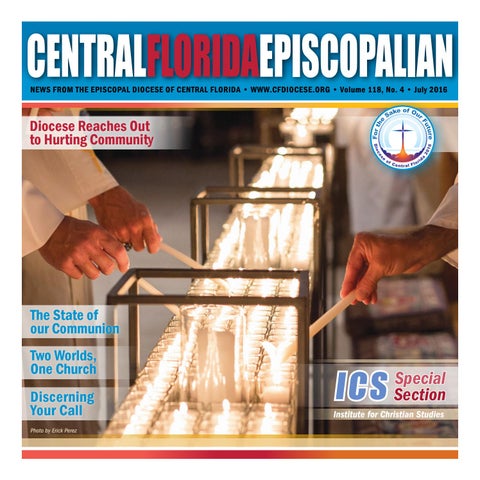
CENTRALFLORIDAEPISCOPALIAN NEWS FROM THE EPISCOPAL DIOCESE OF CENTRAL FLORIDA • WWW.CFDIOCESE.ORG • Volume 118, No. 4 • July 2016
Diocese Reaches Out to Hurting Community
The State of our Communion Two Worlds, One Church Discerning Your Call Photo by Erick Perez
ICS
Special Section
Institute for Christian Studies
The Diocese of Central Florida The Right Reverend Gregory O. Brewer, Bishop Serving 15 counties through 86 churches and 30,000 members
Contents 8 Vital Insights......................................................................................................................3 The State of Our Family..........................................................................................................4 A New Children’s Choir Comes to the Diocese.........................................................................6 St. Mark’s Episcopal Academy is Growing...............................................................................7
The Episcopal Church The Most Reverend Michael B. Curry, Presiding Bishop and Primate An international community of 2.5 million Christians in North and South America, Europe and Taiwan The Anglican Communion The Most Reverend Justin Welby, Archbishop of Canterbury A global community of over 85 million Christians in over 165 countries around the world
Grant Awarded for New Partnership........................................................................................7 Inspired to Learn: São Paulo..................................................................................................8 The Diocese’s First Responder...............................................................................................9 Two Worlds, One Church......................................................................................................10 A Practical Way to Help Impoverished Children.....................................................................11 Get to Know Kristi Alday.......................................................................................................12 ICS Special Section.............................................................................................................13 Welcome to the Exciting World of ICS...................................................................................14 ICS Instructors Teach with Passion.......................................................................................15 ICS: An Instructor’s Perspective...........................................................................................15 ICS Courses........................................................................................................................16
Central Florida Episcopalian The Rt. Rev. Gregory O. Brewer. Bishop
ICS Students Use Senior Project to Help Needy.....................................................................18 ICS: The Gift That Keeps on Giving........................................................................................19 From ICS Student to Teacher................................................................................................19 Incarnation, Oviedo, Starts a New Spanish-Language Service...............................................21
The Rt. Rev. John W. Howe Retired
Canterbury/Camp Wingmann Calendar................................................................................22
The Rt. Rev. Hugo Pina-Lopez Retired
Diocese Calendar................................................................................................................23
The Rt. Rev. John Said Retired
Emmaus Classes to Begin in August.....................................................................................24
The Rt. Rev. William H. Folwell, Retired
Church of the Good Shepherd Welcomes Cameron MacMillan...............................................26 Ordination for Michelle Roach..............................................................................................27
The Rev. Canon Timothy Nunez
The Rev. Adam Young and Family to Join Central Florida Diocese...........................................28
Canon to the Ordinary
Deacon, Priest, or Layperson................................................................................................29
The Rev. Canon Dr. Justin Holcomb Canon for Vocations The Ven. Kristi Alday, Archdeacon
Teamwork: Essential for Successful Parish Ministry...............................................................30 Two Awards in Two Years......................................................................................................32 The Central Florida Episcopalian is published by the Episcopal Diocese of Central Florida. Submissions are welcome, but are subject to editing and use at the discretion of the Central Florida Episcopalian. Please submit notices two months before event to:
Mr. Earl Pickett, Diocesan Administrator Mr. Erick Perez, Subscription Manager
2
CENTRAL FLORIDA EPISCOPALIAN • July 2016
The Central Florida Episcopalian 1017 E. Robinson Street • Orlando, FL 32801-2023 Email: eperez@cfdiocese.org • www.cfdiocese.org
Tel.: (407) 423-3567, ext. 316 • Fax: (407) 872-0006
BISHOP BREWER
8
Vital Insights from the Orlando Pulse Tragedy
By Bishop Brewer
When I heard the news, I was sitting in
the airport in Louisville, Kentucky, my CNN and Twitter feeds exploding. My natural reaction was to keep the horror of this event at a distance, keeping my heart safe from grief and outrage. But slowly, as an answer to prayer, the sadness, the weariness, the empty silence of mourning poured in. So how can I condense what God has shown me since the horrific morning of June 12? The answer is simple. I can’t. But because I care for people all over the world who have been touched by Orlando’s Pulse tragedy, with the help of God, I will try.
1
As someone has said, the deeper the grief, the fewer the words.
That’s how I feel. Words of condolences have little value in the face of this carnage. For right now, all we can do is grieve, pray, and support the family and friends of those who have died as best we can. I will leave it to others to look for someone to blame. Instead, right now, all I want to do is stand aside, pray, and love. There is no justification for this atrocity. Better solutions must be found.
2
Love is stronger than death.
3
People are holding us up in great love and in prayer.
The promise of resurrection brings courage. And the promise of a new heaven and a new earth should fuel all of God’s people to help build a better world.
In my office alone, I’ve received words from Michael Curry, the Presiding Bishop of The Episcopal Church, as well as Justin Welby, the Archbishop of Canterbury in London, England, who took the
time to hand-write a note and then send it as a .pdf email. I’ve heard from friends in Egypt; the Congo; Korea; Canada; Pakistan; Honduras; Nigeria; and Paris, France. People are supporting us in love and prayer as well as in countless vigils across the planet.
4
In spite of this horror, the magic is not gone from our city.
I adapt these words from Jon Gillooly, an Orlando native and editor of a newspaper in Macon, Georgia, who notes the many reports of kindness and heroism amidst the pain: The Marine who worked as a bouncer at Pulse and found a way to help 60 to 70 people escape. The mother who lay on top of her son to protect him, she dying, he alive at that club. The heroism of Dr. John Corsa and his bloodsoaked tennis shoes as well as that of the first responders and all those who served at Orlando Regional Medical Center. Jon writes, “That magic is alive and well. Not in the form of a fantasy theme park, but because people came together during a terrorist attack to help their brothers and sisters.” (http://www.tribuneledgernews.com/opinion/tribune_opinion/ jon-gillooly-the-magic-is-not-gone-from-orlando-the/article_94de6776-341f-11e6-a69e-9fcda8241f1b.html.)
5
We have a long way to go before “Thy kingdom come, thy will be done.”
Here, I present a story of contrast sent to me in a private email by a young man who loves The Episcopal Church. He tells of growing up and being forced to come out of the closet in high school as a gay young man because he confided in a friend. That friend began to spread the story, and it didn’t go well. This young man writes, “I was physically assaulted throughout my sophomore year of high school.” He is now a college student, so it wasn’t all that long ago. “I didn’t want to talk about it,” he says. “I wound up joining the football team just
to cover my injuries as sport-related accidents. I did not want to tell my parents how it happened, because I knew I would only sadden them and cause them to walk in the fear that I already knew.” Photo Erick Perez Sadly, even in our own community, while the Pulse attack was horrific and out-of-the-ordinary, something terrible happens when you’re gay. You fear the day the shoe will drop and you will be rejected next. As an added layer to this tragedy, the majority of those who died in this massacre were Puerto Rican, another minority group in our culture. Truly, we have a long way to go.
6
We gather under the extended hands of Jesus, “Come to me, all you that are weary and are carrying heavy burdens, and I will give you rest” (Matt. 11:28). Here, you see, is the great leveler. No matter who you are, we come into God’s presence and find all kinds of people gathered: friends, neighbors, enemies, people with whom we are theologically in disagreement, people who would oppose some of the things that we say and believe. And yet it is here that we gather. Because it is here, in the presence of the God who made the whole earth that all of our own stories and experiences are brought into alignment. And that is only something God himself can do. Without that kind of community as well as the presence of God, all you have left is yourself.
7
God has put a hunger in our hearts for eternity.
Yes, I can take solace from others, but no human presence answers the void inside, not entirely. Because people are temporal, just like I am. They
CENTRAL FLORIDA EPISCOPALIAN • July 2016
3
EPISCOPAL AND ANGLICAN NEWS
The State of Our Family An evaluation of the Anglican Communion by Archbishop Josiah Idowu-Fearon Delivered May 21 at The Church of St. Luke and St. Peter, St. Cloud
W
hat is the state of the Anglican Communion? Because two of the instruments of Communion have met this year, the question is particularly pertinent at this time. The question is a challenge, as it begs for a comparison. What is the point of reference or comparison that could be the basis of an evaluation of the Anglican Communion this year? The very conservative or very liberal Anglicans who make up 10 to 15 percent of all Anglicans would answer that the state of the Anglican Communion is not very well. The 70 to 80 percent of Anglicans in the wide middle ground have chosen to walk together rather than apart. They live with all the blessings and ambiguities of being a Communion of unity, diversity, difference, and even disagreement. The extremes at both ends would be nothing without this majority middle ground. The large middle group of our Anglican sisters and brothers are represented by the Primates who gathered in January in Canterbury and by the lay people, clergy, and bishops who gathered in Lusaka last March in the Anglican Consultative Council (ACC-16).
1
An Ecumenical Comparison
How does the state of the Anglican Communion look when compared with other global churches, communions, or families of churches? Many believe Anglicans make up the only global church that is struggling today to maintain its integrity in the face of rising diversity, differences, and disagreements on moral issues. At a meeting of the Conference of Secretaries of the Christian World Communions, every secretary general around the table had the same story to tell about the stresses and strains of being a global family of churches at this time. The challenge, then, is how to maintain the unity of global communions within the context of such diversity and disagreement. The profound challenges we are facing today in the Anglican Communion are occurring not because of some inherent flaw in Anglicanism but because we are Christians at a certain time in history. Anglicans do not have to find all the solutions alone. Compared with our sister churches across the ecumenical spectrum, Anglicans are doing much better in some ways, though we have much to learn in other ways.
2
Changes in the Last Four Years
You can see the breadth and cohesion of this middle ground in the Primates’ communiqué offered to the Anglican Communion at the conclusion of their meeting in Canterbury in January. One needs to read the communiqué in its entirety, however, rather than simply the much-publicized first addendum.
The Anglican Communion along with the wider Christian community experienced tremendous growth between ACC-15 in 2012 and ACC-16 in March.
In a different yet equally compelling way, the 45 resolutions passed by assent at ACC-16 clearly reflect the health, breadth, and depth of the Anglican Communion at this time. They convey the Anglican mission to and engagement with the world, other churches, civic society, and the earth.
New Leadership
But this still does not help us identify a point of reference or comparison that we can use to evaluate the state of the Anglican Communion today.
Therefore, I offer the following three points of reference: • An ecumenical comparison. • Seeing how much has changed in the last four years by using the ACC-15 that met in Auckland, New Zealand, in 2012. • A New Testament vision of the church from a reading of the Gospel of John that provides a valuable point of comparison at this time.
4
CENTRAL FLORIDA EPISCOPALIAN • July 2016
Here are a few areas in which we’ve changed: Since 2012, we have gained a new Archbishop of Canterbury, Justin Welby, and a new Secretary General of the Anglican Communion, the first archbishop to hold this post. There have been significant changes in leadership among the primates of the Anglican Communion, such as the election of Presiding Bishop Michael Curry, the first African-American to serve in that capacity. The years 2012-2016 also saw the retirement of Pope Benedict XVI and the election of Pope Francis, the first pope from Latin American and the Global South.
The Anglican Alliance The Anglican Alliance, established in its present form in 2011, has blossomed, bringing Anglicans together from around the world to work with one another in mission, advocacy, development, and relief.
EPISCOPAL AND ANGLICAN NEWS
The Archbishop of Canterbury During the first 18 months of his archiepiscopate, Archbishop Welby and his wife, Caroline, visited every primate of the Anglican Communion, staying with them as guests in their homes. In doing so, our archbishop learned something about the life of each church in the Communion and established a personal relationship with every primate.
“By this, everyone will know that you are my disciples, if you have love one for another” John 13:35
The Primates Meeting and Gathering As an Instrument of Communion, the Primates meeting has struggled in recent years with poor attendance, and bonds of affection have been clearly strained. In the summer of 2015, Archbishop Welby telephoned every primate with an invitation to attend a gathering of primates in his own cathedral at Canterbury. The meeting had one of the highest attendance rates in Communion history. That it was held at all is a sign of the health and vitality of the Anglican Communion. There were moments when the degrees of difference and disagreement were so deep that it looked as if the primates would go forward separately instead of together. The archbishop called for a vote to decide whether they would walk together or walk apart. By God’s grace and the prompting of the Holy Spirit, they chose unanimously to walk together. However, the majority of primates were not able to “receive” the 2015 General Convention’s decision on allowing the marriage of same-gendered people. Their “nonreception” had to be made concrete by a series of actions that have since been known as “consequences.” Two brilliant and faithful theologians of our church have withdrawn for a period of three years from their work in an ecumenical dialogue and in the Inter-Anglican Standing Commission on Unity, Faith, and Order (IASCUFO). No Episcopalian let his or her name stand for election to the Standing Committee or for the roles of chair or vice-chair of the ACC. Because all the resolutions at ACC-16 relating to doctrine and polity were accepted by consensus, members of TEC—along with every other member of ACC-16— did not vote on these issues. The consequences asked of the primates have graciously been observed. This was costly for The Episcopal Church. There were no winners at this meeting. The commitment to unity and communion came at a high price; that the primates made a commitment was such a surprise, such a miracle, such a gift of the Holy Spirit.
however, Archbishop Welby announced that the Lambeth Conference would reconvene in 2020, the centenary of the famous 1920 Lambeth Conference, known ecumenically for its strong commitment to Christian unity.
Ecumenical relationships A sign of health for any church is its relationships with other churches. Our Communion has relationships with seven other global families of churches. We conduct theological dialogues that seek to further the unity between us, mission dialogues that seek to engage and monitor common work in mission, and series of informal talks that maintain lines of communication among us at the highest levels. We also enjoy robust relationships with two multilateral ecumenical instruments, the World Council of Churches and the Global Christian Forum.
3
The community around Jesus in John’s Gospel at the Last Supper
The community in the Gospel of John is gathered around Jesus on the night before his suffering and death—Maundy Thursday—when Jesus gives them a new commandment, the mandatum novum: that we are to love one another as he has loved us (see John 13). Jesus’ words about loving one another as he has loved us bring together both Christian unity and mission: “By this, everyone will know that you are my disciples, if you have love one for another” (John 13:35). The original Greek word for “love” in this passage of the Gospel of John is agape. This is love in action rather than love as an emotion, a feeling, or a “bond of affection.” Agape love is costly and intentional. Jesus’ new commandment to love one another as he loves us means that the way Christians (including Anglicans) treat one another matters. The recent ACC-16 gathering in Lusaka, Zambia, expressed in a particular way Jesus’ command to love one another as he loves us. It was an experience of communion in unity, diversity, great difference, and, of course, disagreement. But from the palpable love we had for one another, meeting as we did in the third and fourth weeks of Easter, it was clear that we are his disciples.
The Lambeth Conference
This is about what we are gathered to be and to do these days in Florida, as we gather with the risen Jesus in the power of the Holy Spirit to celebrate his death, resurrection, and loving presence with us. By virtue of our being here, people will know we are his disciples.
At the time of ACC-15, there were speculations that there would be no more Lambeth Conferences. To ignore such a historic Instrument of Communion in this way was not a sign of a healthy Communion. At the Primates meeting,
If agape love as used in the Gospel of John by the Lord Jesus is a valid point of comparison, then that 75 to 80 percent middle range of Anglicans has much for which to be thankful.
CENTRAL FLORIDA EPISCOPALIAN • July 2016
5
CHILDREN AND YOUTH
A New Children’s Choir Comes to the Diocese The Program Will Use the Royal School of Church Music Platform By Dr. James Guyer
S
t. Andrew’s Episcopal Church in Fort Pierce will begin a children’s choir in the coming 2016-2017 season, starting this fall, after a hiatus of over 25 years. This program will use the Royal School of Church Music (RSCM) platform to both educate children musically and enrich their lives spiritually. The organist/choirmaster at St. Andrew’s, James W. Guyer, comments about this exciting opportunity: “As music has played a major role in the life of St. Andrew’s over the last several years, we have seen the need for the addition of a children’s music ministry become more evident than ever before. In order to sustain steady growth and ensure the future of a singing church, we need to make this program our first priority.”
and academy (founded by the church in 1970). A school with over 300 students, St. Andrew’s Academy will be the primary “target audience” for drawing children into the new choir. For the inaugural year, the goal will be one choir of boys and girls who are entering grades two through six. During the last school year, the academy held multiple classes for these grades. That, combined with school and church sharing a campus, makes the academy a perfect place to draw charter members for the choir. Besides St. Andrew’s Academy, other possible target audiences will include children currently involved in the church, the Fort Pierce Magnet School of the Arts (located one mile from St. Andrew’s), and the Community Outreach Youth Program.
St. Andrew’s Church
The last time St. Andrew’s saw a thriving children’s choir was in the early 1990s under the direction of Ray Stilwell, the organist/choirmaster from 19741991. During Mr. Stilwell’s tenure, the church music program experienced tremendous growth, culminating in a terraced RSCM program featuring five choirs that covered all grades of children and youth. Sadly, this ministry continued only a short while beyond Mr. Stilwell’s involvement at St. Andrew’s. Dr. Guyer hopes to reinvigorate a passion for church music in the families of St. Andrew’s community through the re-creation of an RSCM program.
The Royal School of Church Music was initially developed by the Church of England to train choir boys. It has since spread around the world and today plays a prominent role in many churches both within and outside the Anglican Communion. Its training curriculum, Voice for Life, includes suggestions for musical repertoire and tools for teaching basic musicianship skills, such as sight-singing and ear-training. That makes the RSCM program a perfect fit for the vision and goals of the St. Andrew’s children’s music ministry.
be a successful witness of
This new ministry begins as part of a larger plan to revitalize the greater community of St. Andrew’s, especially the relationship between the church
6
CENTRAL FLORIDA EPISCOPALIAN • July 2016
looks forward with great anticipation to see what God has in store for this new music ministry. Through prayer and the hard work of many volunteers, the St. Andrew’s Boy and Girl Choir will Christ’s good news.
Dr. James W. Guyer serves as organist/choirmaster
at St. Andrew’s Episcopal Church and Academy in Fort Pierce, Florida, a position he has held since 2009. In May, Dr. Guyer graduated from the Indiana University Jacobs School of Music with a Doctor of Music degree (DM) in organ performance and literature. Dr. Guyer cherishes a deep appreciation for music and an excitement to share this with his students and congregation.
CHILDREN AND YOUTH
Grant Awarded for New Partnership Holy Trinity, Fruitland Park, to work with Episcopal school in Haiti By Nancy Bryson, Head of School, Holy Trinity Episcopal School, Fruitland Park
W
hen I learned last year that the National Association of Episcopal Schools (NAES) was requesting proposals for grants, I took the opportunity to write one.
As it happened, the day the request for proposal (RFP) came out, I happened to be in a clergy staff meeting with the Rev. John Kelly at St. George, The Villages. He casually mentioned Haiti and that he had spoken to Canon Bill Squire about establishing a partnership there. (Canon Squire already has ties to Haiti as a former missioner and partnership director for the national church.) However, neither of them knew about the possibility for a grant. I explained the RFP and said I’d give it a try, networking with NAES and the priest currently in charge of Haitian partnerships. My grant proposal suggested the formation of a collaborative between my school (Holy Trinity) and St. George’s Episcopal Church in Haiti. In that way, regardless of potential financial and leadership changes, the mission would be sustained. The priest in charge at Holy Trinity was supportive of the idea, so I moved ahead. NAES really liked the idea of forming a collaborative of local parishes as well as a new partnership, and they loved the fact that the exploratory team possessed such a high degree of expertise in both mission and education. I am grateful to announce that my proposal received a grant award for $2,500 to explore the development of a partnership with an Episcopal school in the Diocese of Haiti. It is my understanding that this proposal was the first and only one of its type to be approved in the entire country. As always, life is interesting when God is involved and prayers are answered. Canon Squire, Father Kelly, and I traveled to Haiti last February, and the partnership has begun.
God is good. I am blessed to be right here, right now.
Dr. Nancy Bryson - Head of School
Dr. Bryson holds a Bachelor of Science, Master's Degree and Doctorate Degree in Education, specializing in ESE/Special Education.
St. Mark’s Episcopal Academy Is Growing Students Especially Love the New STEAM Lab
S
t. Mark’s Episcopal Academy in Cocoa is dedicated to providing a quality education for all students. The school believes students learn best when engaged and stimulated. That’s why St. Mark’s is committed to a model of continuous improvement and to creating an environment conducive to meaningful learning and achieve-
ment.
Academic excellence has long been a St. Mark’s goal, and the school offers today’s students of all grades the best content curricula available in a modern, hands-on environment. A generous gift from one of the members of St. Mark’s Episcopal Church has now multiplied the possibilities for learning. Bob Waterman made the donation in memory of his wife, the late Susan J. Waterman. Prior to her death, Susan served on the Academy’s school board and also as church treasurer. Her husband’s gift funded the creation of the Susan J. Waterman STEAM Lab, a place for students to play, think, and create across disciplinary boundaries. STEAM stands for Science, Technology, Engineering, Art, and Mathematics. As STEAM consultant Georgette Yakman explains, “STEAM programs integrate subjects in an inquiry-based, hands-on curriculum [in a way] that more closely aligns with what students will experience in college and the workforce.” St. Mark’s state-of-the-art STEAM Lab and program have no equal anywhere in Brevard County’s elementary schools. The students absolutely love their cool STEAM Lab and the amazing teacher who works with them there. Thousands of students have benefited from the 50 years of activity in this church mission, and the St. Mark’s Academy graduating class of 2016, with 20 students, is the biggest ever. Best wishes and prayers for continued success to the school, the STEAM Lab, and the church that has invested so much in the students and their futures. CENTRAL FLORIDA EPISCOPALIAN • July 2016
7
AROUND THE WORLD
Inspired to Learn:
São Paulo
Relationship Is a Key Draw for Street Youth Who Seek Literacy By Stephen Dass
T
he three boys were the same age, but Bruno was the only one who had watched some of the free movies in the list we were checking. Among them was the famous “The Bicycle Thief,” directed by Vittorio De Sica. I had never seen the movie, but Bruno had, and he didn’t like it. He told us there was too much hype ahead of time, and the movie didn’t live up to it. I know the story because it’s one all movie buffs like to discuss, but I’ve never found it interesting enough to watch. Bruno related the basic plotline to the other two boys, Lucas and Victor, who had never even heard of this movie. It was strange to see all three of them standing sideby-side, discussing movies. They were the same age but from three different social classes. Lucas comes from an upper-middle-class family. Victor’s family is also middle-class, and Bruno lives in the streets. All three have the desire to learn, but only two have family and friends to inspire and motivate them to pursue their aspirations. Bruno has been in the streets since he was 16. He has no contact with his family and never talks about them. When it comes to self-improvement, he’s on his own, with no family to stand behind his pursuits. Yet none of this has stifled his desire to learn. Bruno, always dressed the same way, has worn the same torn, tattered polo shirt for a few months. It is covered with so much dirt that we can’t identify its original color. His hands and feet are also covered
8
CENTRAL FLORIDA EPISCOPALIAN • July 2016
with dirt, and he carries an equally filthy blanket with him all the time. I gave him one of my polo shirts, which he accepted gleefully. However, he never uses it. Instead, he keeps it in his back pack, which he is never seen without. Here, he also stores what is perhaps his most precious possession: an old, tattered notebook containing the names of all the movies he has seen or would like to see. These are mostly American movies with titles translated into Portuguese. But Bruno wants to know their original names in English and asks Mary to translate them. We believe he invented this as a method for learning English, and we are impressed by how far he has come.
He wants to learn for the sole purpose of discovering new and wonderful things so he can share them with those he loves. Bruno is by far the most intelligent and interesting homeless young adult we have met, but no one would guess it by looking at him. He is able to speak knowledgeably about movies and politics. He formulates his ideas in a logical manner, and his vocabulary is impressive. We are amazed at the things he knows. But Bruno also sniffs paint thinner more than the other children or teens we meet. He uses about a
half-liter per day, he says, and we believe it. He tells us the only times he doesn’t use it are when he is watching a movie or spending time with us. I guess the movies serve as a form of escape that takes away the need for substance abuse. And only recently has he stopped sniffing in our presence. I used to have a hard time getting him to stop using during an activity; instead, he would leave our group. But now, things have changed. We enjoy talking with him, and he always has a big smile followed by a question about something he has read or heard. Bruno has never asked us for anything. Even when he was hurt, he didn’t ask Mary to perform first aid. But he recently asked if we could buy him an English-Portuguese dictionary. I had an old one in the house and gave it to him. He received it happily and hugged us, which was unusual, since we think his filthy attire is a defense mechanism to avoid physical contact. We often see Bruno with Ruan and Felipe. About a week ago, Ruan asked if we could teach him to read and write, which surprised us since we hadn’t realized he was illiterate. He comes from one of the worst neighborhoods in the center. We know he went to school for a few years before running away to the streets, but sending him back to the school now won’t help him. We told him we would try to find a literacy program for him, and he said he was willing to start right away. Bruno sat next to Ruan
DIOCESAN FAMILY
AROUND THE WORLD throughout this conversation and mentioned that although Ruan had been asking for his help, he didn’t feel confident enough to get him started. Not long after that, Felipe asked us if we could also help him with his writing because he lacked confidence and wanted to practice. This was the first time he had requested anything of this sort. So suddenly, three of our homeless teens have been inspired to learn and study. Bruno, Ruan, and Felipe have discovered a context in which learning is useful. If we told them, “Education will guarantee you a better future,” they would agree with us but most likely do nothing about it, since they don’t think about their future often. However, they care about relationships. They see that our relationship with Bruno is growing because there is a deeper exchange between us, and they want to move beyond games and coloring books. Perhaps Bruno has shown all of us that learning can enhance a relationship and make it richer. He wants to learn for the sole purpose of discovering new and wonderful things so he can share them with those he loves. Ruan and Felipe witnessed this, and now they want to discover the joy of learning for its own sake, too.
To read more about São Paulo Mercy Ministry, please visit: www.spmercyministry.com
Stephen and Mary are missionaries sent by the Episcopal Diocese of Central Florida where Stephen served as an ordained priest. Stephen is originally from Singapore and served with YWAM (Youth With A Mission) in São Paulo. Mary was a kindergarten teacher in Maine when she received an invitation by a YWAM missionary to serve as a summer volunteer in Brazil.
The Diocese’s First Responder
Nancy went to the LGBT Center, where at last she was able to obtain food for them. When she arrived at the hotel, it seemed that many people didn’t want to face the news. The reality was too much to bear.
June 12 will not soon be forgotten 7:30 a.m., Sunday, June 12:
DEACON NANCY OLIVER from the Cathedral
of St. Luke arrived at Orlando Regional Medical Center. Like many friends and family members of Pulse victims, she was unable to enter the hospital. The crowds stood outside in the morning sun, waiting to hear if their father, mother, daughter, son, brother, sister, relative, friend, boyfriend, or girlfriend was on the injured or dead list. Nancy decided to stay with them. While there, she listened, consoled, and prayed for many people. However, she was surprised to see so few other clergy members there in this great time of need. Nancy would talk to people who were waiting and, at the appropriate time, ask if she could pray for them and the friend or family member about whom they were concerned. A number of people accepted her offer. Few spoke English, but when they saw her praying with others, they approached her. Through gestures, they would indicate their desire for intercession. Next, they would speak the name of the person for whom they were requesting prayer. Of course, Nancy prayed for everyone who would let her. A Puerto Rican woman came out of the hospital in heavy grief, screaming that she shouldn’t be alive. Blood stains extended from her feet to her knees and were also splattered across her face. Immediately, a group gathered around her and prayed. As more time passed, Nancy wanted to get food and water for those still waiting outside. “My church will pay for whatever food you can provide,” she told the hospital cafeteria workers. “I’ll even pay for it myself.” The answer, however, was disappointing. Bringing food outside the hospital would be considered catering, the workers said, and they were not open for catering on Sundays. Eventually, the hospital sent out three cases of water, which Nancy distributed. After many hours, the crowd was told to go the Hampton Inn to await news of their loved ones.
More than 500 people filled the small hotel space. Here, Nancy saw a number of clergy from around the area and many chaplains from the local hospitals as well. Nancy continued to pray for people and listen to stories about their loved ones. She brought food to the children when it became available. Throughout the afternoon and evening, numerous local businesses delivered food. For the second time that day, Nancy saw Scott, a Pulse employee to whom she had ministered outside the hospital. Once again, she spoke with and prayed for him and continues to pray for him even today. In fact, she still loves and prays for many of the people she met that day. “We, as a church, have to continue to reach out,” Nancy said. “This is not something that will just go away. We have to continue to support, counsel, and help the survivors, their families, and the families of those who died.” Nancy noted that there were 49 dead and 53 injured. Of the 49, 37 were Puerto Rican. Because Pulse was celebrating Latin Night, numerous Hispanics were in attendance, including some from Mexico and even Chile. That’s 102 people who were hit, all with families, friends, boyfriends, and girlfriends whose lives have now changed forever. “We worship God, but we also have to serve God. It’s not just one hour per week,” Nancy explained. “The intensity may lessen, but the need is still there and will be there for a long time to come.” At 8:00 p.m., Nancy finally left the hotel. This is just one example of why the Institute for Christian Studies (ICS) exists. Among its many educational opportunities, ICS offers diaconate classes and training to assist those on the journey toward becoming clergy. We all hope Orlando never experiences another night like June 12. But the ministry of even one faithful, available person can have a lasting impact.
CENTRAL FLORIDA EPISCOPALIAN • July 2016
9
AROUND THE WORLD
Two Worlds, One Church Church of Our Savior, Palm Bay, Partners With St. Mary’s in Liberia
F
ew people know much about Liberia, a Third World country that is also the third-poorest nation in the world. Its hurting people have known both civil war and disease.
In a local connection with Liberia, Church of our Savior in Palm Bay has now become a partner with St. Mary’s in Bolahun. Father Benedict Vani, 84, is St. Mary’s retired priest. He had come to the United States for health reasons but was ready to return.
Father William Momo, current Priest in Charge of St.
Mary’s, visited Church of Our Savior in October and invited Deacon Tom Williams to visit over Holy Week and Easter. So it worked out that Williams was able to escort Vani home and spend time in Bolahun all at once. During his time there, he visited all but four of the 15 mission stations in the area, missing only those with impassable roads. While there, Williams gave a special address at the school on St. Mary’s campus. At one station, he was the first American ever to visit the mission, which gave him a dashiki (traditional Liberian shirt). Although the last mission he visited had been hit by Ebola, the people there still gave him handmade cloth for three stoles, one of which was given to Bishop Brewer at the Deacon Lunch (reported in the June issue of CFE online).
10
Williams had the chance to ask him what his county needs. “Everything!” Momo replied. Not long ago, rebels attacked his stations and stole all their supplies and equipment. Seven boxes of items have already been donated and are being shipped to Liberia. But meeting the needs there is a long-term project.
Fr. Momo and Fr. Vani
Momo hopes to be able to start up the clinic again because the people need access to healthcare. The school on St. Mary’s campus had closed during the civil war but has reopened and needs support. Momo also hopes that the stations in his charge can become their own diocese; but first, the mission needs an upgrade.
The original vision of the founding missionaries, The Holy Cross Fathers, was for the mission to be self-sustaining by farming a plantation of palm oil and cocoa. Momo and his supporters are trying to work toward this goal but need funding.
Williams is working to raise support for the many needs in Momo’s area:
Church of Our Savior raised funds for a well for St. Mary’s. The gift, greatly appreciated, will provide clean water and help reduce sickness in the area. Williams brought funds for a used vehicle and parish support. But more help is still needed for the work in this part of Liberia.
• School • Solar light program • $10,000 for a new roof (the current one is from 1951) and paint for the church • Supplies to restock the church with needed items • A new clinic
In Lofa County, there are 50 missions and only six priests. Momo is dean of all the stations, with direct responsibility for 15.
Please become a part of the efforts to help St. Mary’s in Liberia. The people long for peace, and by supporting the church, you can bring hope. Contact Deacon Tom Williams at tdw12946@msn.com or call him: (321) 505-3046.
CENTRAL FLORIDA EPISCOPALIAN • July 2016
AROUND THE WORLD
A Practical Way to Help Impoverished Children
facilitate distribution of The Shoe That Grows. In a short time, tens of thousands of pairs of these amazing shoes have helped impoverished kids worldwide.
A letter shared by Fred Emil of St. Matthias’ Episcopal Church in Clermont
But every day Kenton receives more requests for this innovative shoe.
I
I told Kenton I would share his story with the Grassfire** team and ask for your help. It costs about $30 to get The Shoe That Grows to a needy child in the developing world.
300 Million Children Lack Proper Shoes recently connected with Kenton Lee, whose invention is transforming how you and I can help meet a very practical need for impoverished children.
One day while serving as a missionary in Nairobi, Kenya, Kenton noticed a little girl in a white dress whose shoes were way too small for her feet. Her badly worn and tattered shoes were several sizes too small, offering her feet no comfort or protection. That’s when a life-changing thought crossed Kenton’s mind: “Wouldn’t it be great if she had shoes that grew with her feet?” In that moment, the idea of “The Shoe That Grows” was born. Kenton immediately began developing a rugged, adjustable shoe that can expand five sizes to meet the needs of growing feet for up to five years. Kenton launched a nonprofit organization called Because International to
As any parent knows, kids’ feet grow! And when kids in the developing world get traditional shoes, they outgrow them in a matter of months and are stuck with ill-fitting and worn-out shoes. Or no shoes at all. That’s a major concern in many parts of the world where soil-transmitted parasites and diseases run rampant. Reports indicate that 300 million kids lack proper shoes, and hundreds of millions more suffer from diseases such as hookworm caused in large part by inadequate footwear. In these areas, shoes play a vital role in holding disease at bay. Unfortunately, far too many children are doing without and paying a steep price.
I Want to Help These Kids As Kenton shared his story, I was struck by how one simple innovation can impact the lives of so many needy children in a positive way. The Shoe That Grows is a brilliant invention that can save lives and ease suffering for millions of children.
Steve Elliott, Grassfire’s president, says: “I am asking the Grassfire team to stand with me and help sponsor 1,000 pairs of The Shoe That Grows for needy children. I know that’s a tall order, but the need is great, and Kenton has already identified thousands of kids who can benefit from these shoes right away.
“Please note that your tax-deductible contribution goes directly to Because International and will immediately be put to work to help needy kids.”
A Call to Action Will you help Grassfire sponsor 1,000 impoverished children to receive these life-saving shoes that actually grow with the child?
Go to http: //grassrootsaction.com/201490/ offer.asp?Ref_ID=34797&CID= 201490&RID=45342472 to sponsor one or more children. **Grassfire, a division of Grassroots Action Inc., is a million-strong network of grassroots conservatives dedicated to equipping you with tools for making a real impact on the key issues of our day.
CENTRAL FLORIDA EPISCOPALIAN • July 2016
11
WHO IS THE DIOCESE?
Get to Know Kristi Alday Dean of the Institute for Christian Studies
fire exists by burning. Where there is no mission, there is no Church; and where there is neither Church nor mission, there is no faith.” The two are linked together.
What is your title and responsibility? My title is the Ven. Kristi Alday, Archdeacon of the Diocese of Central Florida and Dean of the Institute of Christian Studies. As Archdeacon, I have oversight of the active and licensed deacons; am involved with formation and education for people in the process for ordination to the diaconate; and actively work with priests, other deacons, and laypeople to help identify those God might be calling to ordination. I also consult with my contemporaries in other dioceses to stay abreast of current trends.
What do you do as Dean of the Institute for Christian Studies? I work with the bishop to structure curriculum, recruit faculty with a broad scope of expertise, coordinate class times and class offerings, and work with students (both lay and those in process for ordination) to best tailor their educational needs. I work with churches and groups to help them explore ICS. I maintain the website and promote ICS.
What are some projects on the horizon that you’re excited about? I am particularly excited that Father Luis de la Cruz has agreed to teach our first class taught in Spanish. We will offer his class this summer and film it for the web library. I’m also excited about the new launch of the ICS website that is scheduled to be available in July.
12
CENTRAL FLORIDA EPISCOPALIAN • July 2016
Please tell us a bit more about yourself.
I continue to be passionate about our online learning opportunities. The online courses have been well-received by individuals, churches, and small groups. In response to the demand for more online offerings, I plan on filming and offering new classes beginning as early as this summer.
I grew up in Dalton, Georgia, and came to Winter Park to attend Rollins College. I earned a bachelor’s degree in economics and worked in the private sector until 2000. At that time, I came on board with Walking the Mourner’s Path and began training and teaching grief groups all over the country, including time spent in New York immediately after the 9/11 crisis. There, I was part of the team that formed the coventure between Episcopalians and Lutherans to train 40 people to lead grief groups and serve as local resources.
How do you help the churches in the diocese?
I also worked with the Central Florida Diocese for the Strength to Strength capital campaign. I am passionate about church growth and spreading the good news of Jesus Christ.
I try to be a resource for all the churches. I travel and visit different congregations on Sundays to help promote ICS and also to serve as a diocesan liaison. I guest-preach, lead workshops, and enjoy getting around and spending time with the folks of the diocese.
In 2010, I graduated from Asbury Seminary with a master’s degree in counseling and was asked to become the Archdeacon. My first goal was to make ICS available to more people and spread the word about this wonderful opportunity in our diocese.
How did you become Dean of ICS?
I have been married to Tom for 33 years. We have a Belgian sheepdog named Barron and a Goldendoodle named Lyla Rose. Our niece, little Kristi, lives with us and rounds out our family.
I became Dean as part of the job description for becoming Archdeacon, but my personal vision for ICS is best summed up in this quote from Emil Brunner: “The Church exists by mission, just as
I love to cook, fish (especially for redfish and trout at the mouth of the Suwannee River), shop for antiques, and cheer for the Florida Gators!
S C I Institute for
Christian Studies
Preparing the body of Christ for Ministry in the Church and to the world.
CENTRAL FLORIDA EPISCOPALIAN • July 2016
13
S IC Institute for
Christian Studies
ICS
ICS An Online Learning —
Opportunity
to Grow in Your Faith and Knowledge of God By the Ven. Kristi Alday, Archdeacon
ICS
began in the late 1970s in response to the Faith Alive movement. Adults were hungry for superior teaching that would help them grow in their faith and relationship with Jesus Christ. During the late 1980s it was decided, given the high quality of teaching and education available through ICS, that part of its function would be to help train our diaconal aspirants. Today ICS remains committed to the highest level of academic excellence and serves as a multifaceted resource for all people. Courses are available for laypersons, deacons in training, deacons or priests who need to fulfill continuing education requirements, and even non-Episcopalians. As Christians, we are called to continuously engage in the study of God’s Word through scriptures, fellowship, and worship. Students encounter all three of these disciplines at ICS. We worship and pray together, share fellowship and laughter over many cups of coffee and goodies, and study with highly credentialed instructors. Dedicated to following Bishop Brewer’s vision, ICS is intentionally more focused on not only individual growth but also evangelism, outreach, and discipleship. ICS classes are also available online, where they have been enthusiastically received. Our online classes are currently viewed by churches using the classes as material for adult forums on Sundays, small study groups, and individuals both inside and outside our diocese. Due to increased demand for additional offerings, we will film new classes this summer, including our first class taught in Spanish. For more information, visit the ICS website: www.cfdiocese.org/ics. With its variety of easily accessible venues, ICS is a dynamic, vibrant school for growing in Christ. I invite you to join the life-changing world of ICS and delve deeper into your faith, not just for the individual blessings but also for the building up of the Kingdom of God.
14
CENTRAL FLORIDA EPISCOPALIAN • July 2016
ICS
ICS Instructors Teach With Passion
S IC Institute for
Christian Studies
Students Benefit From ‘Amazing’ Christian-Education Courses By the Rev. Jonathan French
I
have served as an instructor with ICS for the last four years. I teach Paradigm Shifts in Leadership. Because I’m a student of the topic myself, I love to teach others about it. I enjoy showing people what I’ve learned over the years and hope to enlighten them about leadership. ICS provides a unique opportunity for people to learn more to grow in their faith and knowledge of the scriptures. It’s affordable and offers highquality courses for students. Whether someone is moving into the diaconate or just wants to learn more about the scriptures, ICS has much to offer. Kristi Alday is the school director, and she has done a great job finding instructors. She researches which topics clergy are passionate about and then recruits them to teach that passion. This is why ICS works so well. When
instructors love what they teach, students become passionate as well. The entire experience becomes magical. I have been the rector at Grace Episcopal Church in Ocala for many years and have listened to many people who have taken ICS courses. I hear things like, “Wow! This class was amazing,” even about topics others might consider less than exciting. But because the teachers are so passionate about their topics, each course becomes alive and interesting. ICS is truly a great school.
ICS: An Instructor’s Perspective How teaching impacts lives
By The Rev. Jon Davis, Ph.D., Executive Director Canterbury Retreat & Conference Center
I
t has been my privilege to be part of the Institute of Christian Studies for more than 20 years. I have taught a few courses, graded deacon exams, and more. I see the impact of this training almost daily as people grow in their knowledge and love of the Lord and are equipped to serve him in the church and beyond. The seed that has been sown into people’s lives and the diocese as a whole has borne great fruit: “thirty and sixty and a hundredfold” (Mark 4:20c). With online opportunities and classes in satellite locations, ICS continues to grow and extend
its reach. As the executive director of Canterbury Retreat & Conference Center, I am pleased with a new ICS class to be held on the Canterbury campus August 13. The Christian life includes numerous “tasks” (spiritual disciplines): prayer, study, service, worship, proclaiming the gospel, and more. So join in a seminar with ICS to enrich your Christian life. You’ll experience a time of learning, fellowship, and gaining skills as you deepen your relationship with Christ and with others.
ICS Offers a Class on Grief Understanding and Working with Grieving
I
n response to the June 12 tragedy in Orlando, the Institute for Christian Studies is offering a one-day workshop on understanding grief and working with people in grief.
Archdeacon Kristi Alday, former COO of Walking the Mourner's Path (a national and international grief ministry), will lead the workshop. Alday spent several years traveling and teaching on grief and helping others learn how to facilitate grief support groups. She also worked in New York after 9/11 and has a master’s degree in counseling. This workshop is open to anyone who is interested, whether clergy or laity, and there is no fee for attending. It will be held at The Cathedral Church of St. Luke in Orlando on Saturday, July 16, from 9 a.m. until 3 p.m. Please bring a brownbag lunch.
If you plan to attend, please help us get a head count by responding to Archdeacon Alday at: kalday@cfdiocese.org.
CENTRAL FLORIDA EPISCOPALIAN • July 2016
15
S IC Institute for Christian Studies Courses Institute for
Christian Studies
ICS
For more information, visit our website at www.icscourses.org
Go Forth: ON-PURPOSE This class will help you clarify and build the foundations of your ministry, define your personal purpose and ensure your identity is truly anchored in Christ. It will also help you get clarity on who is your target audience, those you are called to serve and build a Service Model—a simple plan to put all the pieces together.
Old Testament Survey The Old Testament is filled with stories of human faithfulness and failure, God’s judgment, and redemption. This survey class will provide an overview of every book in the Old Testament. It will explore the big picture of how the books function together and work redemptively for God’s people. You will learn how to faithfully apply the Old Testament scriptures in the age of the New Covenant.
Mission in the City: Revealing the City of God in the City of Man This course will explore biblical reasons and ways to seek God’s peace, the shalom of your city with the Great Commission and Great Commandment in mind.
Diakonia in a Modern-Day World This course will focus on the places the deacon intersects with the church and the world. The deacon is the icon for servant ministry, the herald of the good news in Jesus Christ, and the one who leads the faithful into the world for mission and ministry.
Church Leadership in a Multi-Cultural Context Discovering how to appreciate, understand, and dialogue with those who believe and think differently from you is part of your missiological task. This
16
CENTRAL FLORIDA EPISCOPALIAN • July 2016
Our Anglican Heritage
course seeks to empower future leaders who intend to work in a multicultural context. It will enlighten you as to the obstacles you may face and the not-so-subtle threads of cultural and social alienation that often slip through our theological formation.
In this course, we will examine the development of Christianity in Britain and later, the world. We’ll touch on several key characteristics and decisions that have formed the Anglican Church as we currently know it and consider what type of communion the Lord is calling us to be now and in the near future.
New Testament Survey
Know the Heretics
In this two-part “flyover” of the New Testament, you will explore each book’s promise and challenge for our call to do the work of the ministry: to make Christ and his redemptive love known where we live, work, and worship. Learn to interpret to the Church needs, concerns, and hopes of the world. (“The Ordination of a Deacon/The Examination,” Book of Common Prayer, p. 543).
There is a lot of talk about heresy these days. The frequency and volume of accusations suggest that some Christians have lost a sense of the gravity of the word. On the other hand, many believers have little to no familiarity with orthodox doctrine or the historic distortions of it. This course provides an accessible “travel guide” to the most significant heresies throughout Christian history.
Raising Up Leaders: A Paradigm Shift
The Reformation
This course will consider why leadership matters in the church, a biblical model of leadership, whether or not you’re a leader, and how to attract more leaders both like and unlike you.
This course will help you understand the ideas, events, and conditions leading to and resulting from the Protestant Reformation and subsequent Roman Catholic Counter-Reformation. You will meet the main players involved: Thomas Aquinas, Martin Luther, John Calvin, Thomas Cranmer, Ignatius Loyola, and others. You’ll discover the impact these men had on contemporary Anglicanism.
The Universe Next Door: Comparative Views Discover the foundations of competing worldviews where they align and diverge from Christianity. This course will enable you to understand the basic concepts of differing worldviews in a way that will aid you in defending the gospel of Jesus Christ.
Shaping the Heart, Head and Hands of a Christian Leader Explore how the Lord shapes hearts, heads, and hands for Christian leadership in the present and future. Reading, teaching, discussion, and projects will focus on three essential questions for a Christian leader: Who does the Lord call me to be? What does the Lord call me to know? What does the Lord call me to do?
An Introduction to Prayer Book Worship & Theology This course will give you an understanding of the history and emphasis of Anglican worship. It will place the Prayer Book in the context of theological and historical development, and provide a connection between worship and living.
Deacon 101 Practical
(on site retreat for diaconal candidates only) This retreat is intended to affirm the student’s call to ministry in the world and to share experiences together. Additionally, the student will have the
ICS opportunity to experience the liturgical set up of the Altar and all that is encompassed in preparing for worship.
Sexual Assault, Domestic Violence and the Church This is a study of various forms of violence and abuse and the theological and practical implications of the gospel of the Kingdom for these topics. Gain understanding of the numerous dimensions of sexual assault and domestic abuse. Be aware of the scope of the problem and its effect on victims. You will formulate a theology of violence and abuse and articulate how gospel-based hope and healing relates to violence and abuse.
Shame: The Confusion of Faces Ever since we tasted the forbidden fruit, shame has been a constant companion for the human race. This course will help you debunk common cultural myths about vulnerability, better define shame and examine its triggers. You will explore the neuroscience of our responses to shame and find ways we try to protect ourselves from vulnerability and shame.
Christian Peacemaking Jesus said, “Blessed are the peacemakers” (Matthew 5:9a). The application of the gospel requires faith, understanding, and skill. The principles, behaviors, and techniques of peacemaking can be taught and learned. This course is essential for anyone who desires to become a more effective student and minister of the gospel of Jesus Christ.
Homiletics In this course various approaches to the preparation, delivery, and critique of the sermon will be explored.
Addictions and Faith: Where Do They Intersect? An in-depth look at the point where faith and God meet someone struggling with an addiction. See how
Ministry Review
spirituality can help free a person from the grips that deceive and control. Understand how dependence results from lack of connections and submission to God, and learn how to allow faith to be part of addiction recovery.
(not available online)
If you’ve thought of Genesis as nothing more than a dusty book of who-begat-whom, you’ve missed a lot! See what the Garden teaches us about identity, development, and the impacts of shame. Explore how the relational dynamics of jealousy, rage, and fear played out in the first family and learn how family dysfunction and generational sin worked out in the Patriarchs and how they apply to our own family stories.
Social Media: Proclaiming the Gospel in the 21st Century
Prayer Book Spirituality The Book of Common Prayer is not just a resource we use on Sunday mornings, but a rule of life that governs the spiritual disciplines of all the faithful. This course is designed to a Prayer Book spirituality, which forms disciples of Christ in the way God desires.
We can easily become perplexed when our understanding of moral theology (what scripture and tradition teach us) conflicts with our pastoral care, what reason teaches us, and what social or communal needs demand from us. This course is intended to begin to initiate our own personal pastoral ethical foundation.
Mapping Your Ministry in the World How does the gospel intersect with the world? Is the church a dead end, a rest stop, or a scenic route? How do your brokenness and giftedness combine to fuel your ministry? This course, drawing from 2 Corinthians, is designed to be practical and to challenge you to be able to articulate your unique calling and commitment.
for
Christian Studies
Each encounter we have with another person provides opportunity to minister and to learn about ourselves from both spiritual and practical perspectives. This course will help you define your roles in both the church and the world: to share your struggles and successes with fellow servants in an indepth forum; and to identify and evaluate your skills and preferences for pastoral care.
Genesis and Interpersonal Relationships
Ethics in Action
S IC Institute
How do you proclaim the good news in the 21st century? Learn how technology can help you get the good news into the hands of those who need it most. This hands-on class covers websites as well as social media such as Facebook and Twitter. We’ll learn how to get local media to promote church events and cover other communication applications such as podcasting, blogging, and Skype.
Your Body: God’s Temple This course will examine those scriptures that teach about care of the temple and examine the practicalities of changing our lifestyles to create optimal health.
TO SIGN UP for any of these courses, simply go to our website at:
www.icscourses.org
CENTRAL FLORIDA EPISCOPALIAN • July 2016
17
S IC ICS Students Use Institute for
Christian Studies
ICS
Senior Project to Help Needy Effort Was Inspired by Friendships Formed in the Classroom By Becky Chapman
In my mind, the Institute for Christian Studies, ICS for short, is one of the best-kept secrets in our diocese.
I
became aware of ICS a few years ago when I started to feel called to become a deacon. I attended one class, and, I’ll admit, it felt a little as though I had been thrown into the deep end of the pool. Never fear! That’s one of the great things about the ICS atmosphere. There are plenty of “lifeguards” available in the form of other students, the instructors, and Archdeacon Kristi Alday. Everyone is there to support each other and to learn.
out even better than we had hoped. Thanks to another classmate, Bob Johnson, who provided an entire truckload of supplies, we were able to pack John’s van to the gills. And that’s the kind of friendship that develops at ICS. But ICS isn’t just for those who are interested in becoming ordained as a deacon.
ICS is for anyone who wants to learn about the church, our Anglican heritage, the Bible, leadership, or interpersonal relationships. The wide-ranging topics grow wider and deeper all the time. And here’s another best kept-secret: the quality of the ICS instructors, which has amazed and thrilled me. Many of the classes are taught by clergy from the diocese—some of the most gifted, passionate, and caring instructors ever. They are interested in the topics they teach, have fun presenting the material, and want you to learn. It’s a powerful combination. The newest and best part is that ICS now offers almost all its classes online. So, to wrap it up, I’m a huge supporter of ICS. I’ve made lasting friendships there, not only with my classmates but also with the instructors. The instruction is topnotch and getting better all the time. The investment in each class, in both time and money, is reasonable. And the classes are available both live and online.
What’s not to like? Come on in, the water’s fine!
If, like me, you’re interested in becoming a deacon, you will quickly start to bond with others in the class who are on the same path. Some of them may be a little further along (hint: these people make priceless tour guides). But the people with whom you’ll bond the most are those on the same timeline as you. In many ways, these people really do become your tribe. The seven of us in my diaconate class have become some of my closest friends through this shared journey, and we all know our friendship won’t end once we’re ordained and assigned to parishes around the diocese. We support, encourage, and act as sounding boards for one another as we all learn what it means to serve Christ as a deacon in his church. As we wrapped up our second year of study at ICS in May, we decided to do something special to mark the occasion. For what we called our “senior class project,” we decided to surprise our classmate John Clark by bringing food and supplies to support his outreach mission, No One Hungry, a food pantry he started for the underserved of Titusville. Unbeknown to John, we all agreed to bring donations. And as you can see from the picture, our project turned
18
CENTRAL FLORIDA EPISCOPALIAN • July 2016
Rose Sapp, Christine Croskey, John Clark, Becky Chapman, Bob Johnson, Kay Ruhle
ICS
From ICS Student
ICS: The Gift That Keeps on Giving
Some who attend gain the opportunity to teach
KAY MUELLER, current student
to Teacher
By Deacon Tom Williams (one of the fortunate ones), Church of Our Savior, Palm Bay
I
entered the ordination process in the Diocese of Rochester, N.Y., in 1981. There was no clear understanding of the diaconate at that time, but the Commission on Ministry supported the idea and agreed to let me take formation with the Roman Catholic Permanent Diaconate Program. I followed the development of the diaconate programs in other dioceses and discovered that the Diocese of Central Florida was on the cutting edge of diaconal formation under Bishop John Howe. I was accepted into the diocese by Bishop Howe in 2009. It was so comforting to be part of a diocese that embraced the diaconate from the beginning of its renewal in the early 1980s. I also took advantage of the ICS course offerings for continuing education. I have enjoyed the camaraderie in the diaconate community, and I truly enjoy the yearly diaconal ordination in The Cathedral Church of St. Luke. Two years ago, Archdeacon Kristi Alday asked me to teach the ICS course titled “The Diaconate in the Modern World.” This was the fulfillment of my desire to pass on the experience I had developed over the years. Bishop Brewer has continued the vision of the diaconate in this diocese, and he is most supportive to us as individuals and as a community. As a deacon who has moved into this diocese, I can attest to the gift that ICS is to ministry for both lay and diaconal education. It uses the many talents of individuals as resources and is a leader in local spiritual formation in the wider church.
S IC Institute for
Christian Studies
Here’s what students of the Institute for Christian Studies are saying
ICS is like “the gift that keeps on giving!” Every course I’ve taken, whether online or live at our diocesan facilities, continues to influence my Christian journey. Sometimes this includes looking back with a different perspective, but ICS definitely has enhanced my daily walk. The courses have also broadened my vision of the future, both in my personal life and as regards the life of our faith and our call to share Christ with the world.
Through ICS I have forged new friendships and enjoyed fellowship with fellow classmates, from the breaking of bread together to participating in both reflective and spirited discussions as well as group prayer. The format of the classes is challenging but not intimidating, and the materials are a great addition to my resource library. The instructors are visionary, enthusiastic, and inspiring. ICS provides a win-win situation and solution for continuing Christian education and personal growth.
MARY DELANCY, former student I began attending classes at ICS to learn more about scripture and maybe a little church history. My time studying there became, however, a vital part of my faith journey, which continues to unfold in ways I never could have imagined. ICS gave me the opportunity to learn from clergy and laity of the diocese. The instructors not only were subject experts but also brought a range and depth of perspective that made learning exciting. I learned much from my fellow students, in addition to the instructors, and we developed a supportive, nurturing community that continues today.
I recently returned from a year in the Philippines serving with an organization that rescues and restores girls who have been victims of sex trafficking or other sexually exploitative situations. My studies at ICS prepared me in many ways for this work and gave me peace during the sometimes difficult days. Because of ICS I had a better understanding of Jesus’ call to us as servants and the tools to help the girls grow spiritually and begin their journeys of healing.
ERICK PEREZ, former student ICS is the Diocese of Central Florida’s wonderful tool to raise up leaders and also to give current leaders a well-needed recharge for their ministries. I discovered a sense of camaraderie and familiarity with all participants and instructors. All the instructors
are either leaders or experts in their fields. The education received has no comparison, so much so that it inspired me to return to college (currently attending Rollins College—“Go Tars!”) and finish my degree in order to become a better leader, not just for the church, but for my peers and community, too.
CENTRAL FLORIDA EPISCOPALIAN • July 2016
19
S IC Institute for
Christian Studies
ICS
Become a Part of ICS The INSTITUTE FOR CHRISTIAN STUDIES (ICS) is a dynamic place of learning and fellowship. You can participate by registering for classes, either live or online at www.cfdiocese.org/ics.
T
here are two additional ways you can support ICS. The most vital component is always prayer. The second way is to make a tax-deductible donation.
Monetary donations can be sent to the Central Florida Diocese at 1017 E. Robinson St., Orlando, FL 32801 and designated for ICS.
As always, thank you for your continued support of ICS.
Institute for Christian Studies to Offer Class on Ministry of Worship Held at Canterbury Retreat & Conference Center
Saturday, August 13 9 a.m. – 4 p.m.
Cost: $45 per person (lunch included)
T
his will be an interactive day of exploring the essential ministry of worship in the church and how we can better design, execute, and deliver moments that will inspire and draw people into the loving and awesome presence of God.
Learn how to: • • •
build a worship team. employ technology. lead children, youth, and adults in worship in every context: traditional, contemporary, or blended; large or small.
David Baroni, the keynote speaker, is an
internationally known singer, songwriter, musician, producer, arranger, conference speaker, recording artist, and worship leader. Perhaps best known for his thoughtful, well-crafted lyrics and prophetic, intuitive keyboard playing, Baroni combines a childlike exuberance for Christ with the maturity of a seasoned minister of the gospel.
For more information and to register contact via www.canterburyretreat.org call (407) 365-5571 or email Sue, sue@canterburyretreat.org
20
CENTRAL FLORIDA EPISCOPALIAN • July 2016
DIOCESAN FAMILY
Iglesia de la Encarnación en Oviedo, inicia un nuevo servicio en Español. Emocionantes principios para este nuevo ministerio Por Erick Parez
E
l jueves, 26 de mayo, varias personas se dirigieron al Campus de Canterbury Retreat para mostrar su apoyo a un nuevo servicio exclusivamente en español celebrada en la pequeña capilla de San Francisco. La Iglesia de la Encarnación en Oviedo sintió la necesidad de empezar un servicio en español para el área. El Reverendo José Rodríguez junto con Gladys Rodríguez, quien está en el proceso de discernimiento, unieron fuerzas para poder ofrecer este servicio a la comunidad. Fue una muy buena noche adentro de Canterbury Retreat. El servicio comenzó a las 7 pm, las personas se reunieron al frente a la capilla para disfrutar de un refrescos y entremeses. Al comienzo del servicio, más de una docena de personas entraron en la capilla y se sentaron para participar en este nuevo servicio. La oración del Anochecer fue dirigida por el Reverendo José, mientras que Gladys, era la oficiante. Gladys nos dirigio a través de una enseñanza basada en la lectura de Juan 1: 1-14. Ella habló con convicción y passion, al concluir, el Reverendo José cerró el servicio con la bendición. El jueves fue sólo el principio. Este es el comienzo de un período de prueba de 12 semanas para evaluar cuál es la necesidad en el area para el tipo de servicio a prestar. Gladys nos comentó posteriormente que si el servicio sigue creciendo, se tendra que mover a la parroquia de Encarnación. Ella también estaba muy satisfecha con la cantidad de personas que llegaron al primer servicio. Si conoces a alguien en el área que le gustaría ir a un servicio de habla hispana, por favor haganle saber acerca de este maravilloso tiempo todos los jueves por la noche a las 7 pm.
Incarnation, Oviedo, Starts a New Spanish-Language Service An Exciting Beginning
O
n Thursday, May 26, people drove to the campus of the Canterbury Retreat & Conference Center to show their support of a new all-Spanish-language service held in the small chapel there. Church of the Incarnation in Oviedo felt a need for a Spanish service in this area. Father José Rodríguez and Gladys Rodríguez, who is in the process of discernment, joined forces to bring this service to the community. The service was set to begin at 7 p.m. People gathered outside the chapel beforehand to enjoy some light refreshments and the pleasant evening air. When the beginning of the service was sounded, more than a dozen people entered the chapel and took their seats. Father Rodríguez led the evening prayer, and Gladys officiated. She led us through John 1:1-14, speaking with conviction and passion. Father Rodríguez closed with the benediction. This first service marked the start of a 12-week trial period to evaluate the need for a Spanish-language service in this area. Gladys remarked afterward that if the service continues to grow, it will move into Incarnation’s parish. She was also very pleased with the number of people who attended. If you know people in the area who would enjoy an all-Spanish service, please let them know about this wonderful time of worship at Canterbury every Thursday night at 7 p.m.
CENTRAL FLORIDA EPISCOPALIAN • July 2016
21
CAMP WINGMANN / CANTERBURY
Canterbury
Retreat & Conference Center
Calendar of Events
Camp Wingmann: 2016 Summer Schedule July 10-15: Camp St. Peter Senior High campers entering grades 9-12
July 17-22: Camp St. Francis Middle School campers entering grades 6-8
July 24-29: Camp St. Mary Elementary-age campers entering grades 3-5
July 31-Aug 5: Camp St. John Middle School campers entering grades 6-8
For more information or to register, visit: www.campwingmann.org
22
www.canterburyretreat.org 407-365-5571
July 19-20 / Retreat for Retired
August 18 / Winning the Culture,
Fellowship, Worship, Prayer and Teaching Holy Eucharist, Tues 4pm, Bishop Brewer, Celebrant Tues & Weds sessions based on Psalm 84 led by Dr. Carla Waterman, Ph.D. and Canon Tim Nunez
Biblical Worldview and Culture The seminar consists of three presentations: Session #1: A flyover of world history with key events at 500-year intervals (an amazing story); Session #2: The worldview position of youth in America over the last 30 years (a troubling story); and Session #3: The worldview shift in America over the last 100 years (the forgotten story). All sessions focus on re-establishing a foundation for the grandest of all stories.
Clergy at Canterbury Retreat Center
July 18-22
VBS With the DreamCenter
July 24-29 / Icon Writing Workshop No art experience is needed, just a willingness to allow God to work through the step-by-step process. Each brush stroke is intended as a prayer. This six-day retreat includes the Eucharist, Gregorian chant, praying with icons, readings, and silence as well as lively group conversation, free time, and social hours. Icons will be written in Jo Sonja’s acrylics.
August 13 / ICS Summer Session This will be an interactive day of exploring the essential ministry of worship in the church and how we can better design, execute, and deliver moments that will inspire and draw people into the loving and awesome presence of God.
David Baroni, the keynote speaker, is an
internationally known singer, songwriter, musician, producer, arranger, conference speaker, recording artist, and worship leader.
CENTRAL FLORIDA EPISCOPALIAN • July 2016
not the Culture War
August 26-27 / Dangerous Prayer Through sharing, reflection, peace and quiet, singing, and conversation, we will explore the life of Christian faith. By looking back at our own lives, we will identify moments of revelation, encounter, and transformation. By active participation, we will position ourselves to dwell in the house of the Lord. By prayerful discernment, we will seek the Lord as to the transformation he wants to bring into our lives and how we are to grow in our knowledge of him.
September 9-10 / The 3 Y’s A journey of discovery that will take you to deeper, more intense, and meaningful encounters with the Living God.
DIOCESE
Diocese Calendar of Events Anti-Racism Training & TEC Canons/Title IV Training July 13 Two required classes of all aspirants in the discernment process toward ordination are being offered at no cost on Wednesday, July 13 at the diocesan office, 1017 East Robinson Street, Orlando, 32801. Please REGISTER/confirm your attendance by emailing The Venerable Kristi Alday, Dean of ICS, at kalday@cfdiocese.org or Marilyn Lang at mlang@cfdiocese.org.
Ordination to the Priesthood, The Reverend Cameron MacMillan July 17, 4 p.m. Location: Church of the Good Shepherd, Maitland Retreat for Retired Clergy July 19-20 at Canterbury Retreat Center Fellowship, Worship, Prayer and Teaching Holy Eucharist, Tues 4pm, Bishop Brewer, Celebrant Tues & Weds sessions based on Psalm 84 led by Dr. Carla Waterman, Ph.D. and Canon Tim Nunez
Ordination to the Priesthood, The Reverend Michelle Roach July 23, 2 p.m. Location: St. John’s Episcopal Church, Kissimmee
Bishop Brewer Visitation Schedule 7/10/16 Orlando
Jesús de Nazaret
7/13/16 Port Orange
Grace (YouthWorks)
7/17/16 (a.m.) Deland
St. Barnabas
7/17/16 (p.m.) Maitland
Good Shepherd (Ordination to the Priesthood)
7/23/16 Kissimmee
St. John’s (Ordination to the Priesthood)
7/24/16 Sanford
Holy Cross (New Ministry)
7/31/16 Bushnell
St. Francis
8/7/16 Fruitland Park
Holy Trinity
8/14/16 Orlando
St. Mary of the Angels
8/21/16 Melbourne Beach St. Sebastian by-the-Sea 8/28/16 St. Cloud
St. Luke and St. Peter
Celebration of a New Ministry, The Reverend Dan Smith July 24, 9 a.m. Location: Holy Cross, Sanford
9/4/16 No Visitation 9/10/16 Orlando
Cathedral
Soul in the City July 25-29
(Vocational Deacon Ordinations)
9/11/16 Ormond Beach
St. James
9/18/16 Detroit
House of Bishops Fall Meeting
9/25/16 Orlando
St. Michael’s
10/2/16 (a.m.) Palm Bay
Our Savior
The Commission on Ministry is hosting the Annual Conference on Ministry at Church of the Messiah, 241 N. Main Street, Winter Garden, on Saturday, August 27.
10/2/16 (p.m.) Orlando
Cathedral
Register by contacting Caroline Miller at cmiller@cfdiocese.org or (407) 423-3567, ext. 317.
10/16/16 Inverness
St. Margaret’s
10/23/16 Orlando
St. Matthew’s
10/30/16 Lake Wales
Good Shepherd
Join the team and serve as we travel to Lakeland, Fla. for a week of mission, fellowship, prayer, and lots of fun with an extraordinary group of youth from all over the diocese. This event is for grades 6 – 12. Please contact J.J. at The Cathedral of St. Luke’s for more information. Apply online: www.eyccathedral.com/ events/. Registration and payment deadline is July 8.
Conference on Ministry August 27, 10 a.m. – 3 p.m.
Ordinations to the Diaconate September 10, 11 a.m.
10/9/16 No Visitation
Location: The Cathedral Church of St. Luke, Orlando
Bishop Brewer’s visitation dates are subject to change. Please refer to www.cfdiocese.org for the most current visitation listing.
CENTRAL FLORIDA EPISCOPALIAN • July 2016
23
YOUNG ADULTS
Emmaus Classes to Begin in August The School of Biblical Studies Will Offer Two Ways to Learn “In a year where the diocese is focusing on youth and young adult ministries, we see God’s handiwork in bringing Emmaus to Canterbury. We hope that young Episcopalians from this diocese and from across the nation take the opportunity to come and live out Proper 28, as they ‘read, mark, learn and inwardly digest God’s Word.’” (Emmaus Director Tom Phillips in his address to General Convention)
It is this deepening of spiritual maturity that provides the basis for the Emmaus mission: “To equip the body of Christ with the Word of God and the gospel of Jesus Christ through inductive Bible study, authentic relationships, and community life.”
ince arriving at their new home with Canterbury Retreat & Conference Center last fall, the Emmaus Ministries team has been actively working to serve the Diocese of Central Florida and prepare for the launch of their first Emmaus School of Biblical Studies this August. In spite of a year that they anticipated would be full of preparation for the re-establishing of the school, their time here has in many ways proved more fruitful than they could have ever imagined. The teaching team has traveled to multiple churches throughout Central Florida, making short-term investments in the discipleship vision of local parishes through seminars on Bible content and study methods.
The Emmaus School of Biblical Studies is a 10-month discipleship school held on the campus of Canterbury Retreat & Conference Center in Oviedo, Florida. The school takes students on a journey through the content of the entire Bible, utilizing the tools of inductive Bible study to thoroughly observe the scriptures, interpret them within the historical and literary context, and apply the truths within to their real, everyday lives.
S
Ed Stetzer, guest of Canterbury for the Vestry & Leadership Conference, shared his research findings in an October 22, 2014, post for Christianity Today: “Engaging the Bible impacts one’s spiritual maturity more than any other discipleship attribute. In fact, ‘reading the Bible’ topped our list of things we found impacting spiritual maturity.”
24
CENTRAL FLORIDA EPISCOPALIAN • July 2016
This mission is fulfilled through two avenues: the school and the seminars.
The School
For more information on these opportunities, visit www.emmausbibleministries.org.
The Seminars In his address to the general convention in January, Tom Phillips stated, “When we made the decision to move the ministry to Central Florida, the biggest factor in that decision was the mission, ministry, and character of this diocese.” Without question, the vision of Emmaus has found an easy partnership with several parishes within the diocese, as many had already begun seeking ways to encourage ongoing growth and equipping of the parishioners in their journey of following Jesus.
In order to serve the local parishes within the diocese of Central Florida, Emmaus has designed specific seminars, which are available to support the discipleship vision of the rectors and vestry:
Why the Bible Matters: This one-hour seminar explores the reason the Bible is essential to the life of a follower of Christ.
Individual Book Studies: Take one to two hours to dive into the history, main ideas, and key passages of a book of your choice.
Bible Overview: A four-hour seminar to help you discover where the books of the Bible fit within the history of God and his people.
Inductive Bible Study: In four to six hours, learn to observe, interpret, and apply the scripture yourself by working through either the book of Philemon or Titus.
YOUNG ADULTS Student Testimonial: “The Emmaus School of Biblical Studies (ESBS) was the most challenging yet most rewarding experience of my life. Before ESBS I knew the typical Bible stories. After ESBS I had a greater understanding of not only the history and context of the Bible but also the application it can hold in my life. Living in community, studying the Bible full time, and being discipled by the amazing staff was exactly what I needed. I feel equipped to continue studying the Bible and disciple others in their walks with Christ.” BREANNA DOBBINS, Class of 2015
Seminar Testimonial: “When I met the Emmaus team last summer, I discovered Tom and I share the same vision: to see revival come to The Episcopal Church. I asked Tom if he would consider customizing their program to fit in a church setting to teach our congregation how to study the Bible. The Emmaus team led our congregation through an inductive Bible study series with three sessions: Bible Overview, Philemon, and Titus. The team exceeded my expectations with their biblical knowledge and personal approach, making studying the Bible exciting and fun for our congregation!” THE REV. ROBIN MORICAL Rector, All Saints, Enterprise
Emmaus Ministries is pleased to announce
The Emmaus School of Biblical Studies 2016-2017 school year! The Emmaus School of Biblical Studies is a 10-month discipleship school held on the campus of Canterbury Retreat & Conference Center in Oviedo, Florida. The school takes students on a journey through the content of the entire Bible, utilizing the tools of inductive Bible study to thoroughly observe the scriptures, interpret them within the historical and literary context, and apply the truths within to their real, everyday lives. There are three ways to engage in this journey during the upcoming 2016-2017 school year: On-Campus Residential (cost: $8,950): Live with a community of disciples on the campus of Canterbury. This cost includes housing, utilities, tuition, and meals for the entire 10 months.
Commuter Student (cost: $4,500): For local students with off-campus housing. Commuter students participate in the full Emmaus school, including the provision of one meal Monday-Friday.
Audit Program (cost: $25/book OR $450 for a full-year pass): A If you’re interested in hosting or attending
any of these seminars, please contact the Emmaus Team.
Email: admin@emmausbibleministries.org
Phone: (828) 513-3738
W
hether through the school or the seminars, the Emmaus team looks forward to a long and fruitful partnership with the Diocese of Central Florida as an increasing number of Episcopalians of every age join with the words of the disciples on the Emmaus Road: “Did not our hearts burn within us while he talked to us on the road, while he opened to us the Scriptures?” Luke 24:32, ESV
great way for people in the area who desire to join the Emmaus classroom and grow in their understanding of the scriptures.
On-campus and commuter students are encouraged to apply for the Youth Ministry Internship opportunity, which provides them with practical ministry experience in a local parish as well as a $1,000 tuition discount. For more information on these opportunities visit: www. emmausbibleministries.org Contact the Emmaus Team admin@emmausbibleministries.org Phone: (828) 513-3738
CENTRAL FLORIDA EPISCOPALIAN • July 2016
25
DIOCESAN FAMILY
Church of the Good Shepherd, Maitland, Welcomes Cameron MacMillan New Seminary Graduate Serves Church and Community
C
ameron MacMillan, a recent graduate from Nashotah House Theological Seminary in Nashotah, Wisconsin, is now serving as curate at Church of the Good Shepherd in Maitland. While in seminary, MacMillan met Bishop Brewer on campus. Through that encounter, a relationship of prayer and conversation developed that resulted in MacMillan joining the Diocese of Central Florida. MacMillan was brought up in various Protestant faith traditions throughout his childhood, from nondenominational to Nazarene to Pentecostal. But he has come to find his home in the Anglican faith. He says he has been drawn to the beauty of traditional worship and the historical connection to the early catholic and apostolic church. Liturgical and sacramental worship moved MacMillan and his wife, Hannah, into the Episcopal tradition. The couple have been married for six years and have a beautiful four-month-old baby girl named Lydia. They have lived in the Midwest (Michigan and Wisconsin) all their lives and are looking forward to escaping from snow and enjoying the warm Florida weather. MacMillan has a passion for evangelism and local missions. He believes it essential today to retell the story of the gospel to the unchurched in a winsome and compelling way, since so many people have turned their backs on Christianity due to bad experiences and deficient theology. He believes the best way to do that is to forge genuine relationships with people in the local community and to love them unconditionally, as Jesus did. The MacMillans view their new role in Maitland as relationship-builders. They would like to show
Bishop Brewer, The Very Rev. Sarah Bronos, Cameron MacMillan
26
CENTRAL FLORIDA EPISCOPALIAN • July 2016
hospitality by opening their home as a place for communal meals, Bible studies, and other smallgroup events. Cameron loves reaching out and interacting with teens and young adults. He also has a passion for Christian education and plans to teach classes in the parish that will explore scripture and theology, making them practical and applicable to everyday life. This model of learning has advanced his own spiritual growth, and he wants to offer the same opportunity to others. MacMillan is also interested in how sacramental and liturgical worship can transform and empower people for missions. Those who have a healthy view of the body of Christ will naturally get excited about being God’s people in the world, he believes, and will desire to advance his kingdom wherever they go. In their leisure time, the couple enjoy being outdoors. They love to garden, cycle, hike, picnic, and swim. They also enjoy being involved in local food communities and cooking fresh meals at home. If you happen to see the MacMillans, please reach out a hand and give them a warm welcome into the Central Florida Diocese family.
BISHOP BREWER
DIOCESAN FAMILY
Continued from page 3
Ordination for Michelle Roach
It is always a miracle when two broken people can finally find a way to align together into a relationship that bonds us. But the fact is that outside of this great presence called God, who fills us and shows us love (which is what we see in the face of Jesus), even the best of our relationships never entirely take care of the hunger that will not let us go.
Let’s Get to Know Her!
M
ichelle Roach, who has been sponsored by St. John’s Episcopal Church in Kissimmee, will be ordained to the priesthood on Saturday, July 23.
Michelle was born on the island of Barbados to Arthur and Eustene Dash. Since her parents are devoted Anglicans, she spent most of her life involved in church activities. Michelle migrated to the United States in August 1984, living first in New York City and relocating to Orlando, Florida, years later. She is married to Michael, and they have one son, Brandon. Michelle attended Barry University for her undergraduate studies. While there, she pursued a Bachelor of Professional Studies, specializing in human resources. This degree proved useful in her human resources career with Marriott. In obedience to her call to become an ordained minister, Michelle first attended the Institute for Christian Studies (ICS). Six months into her courses at ICS, Michelle made the decision to enroll at Asbury Theological Seminary to pursue a Master of Divinity degree. Two years later, she transferred to Virginia Theological Seminary in Alexandria, Virginia. Prior to her call to ministry, Michelle worked for Marriott Corporation for more than 23 years. She began her career in reservations and then moved into human resources and payroll. Michelle feels that her years in customer service and management will be helpful as she transitions into church life.
“We all have some knowledge about God; we need to listen more to each other and to share our stories,” Michelle says. During her years at Virginia Theological Seminary, Michelle has been both stretched and challenged. At the same time, she has encountered wonderful spiritual moments in the presence of the Lord. Through these experiences, Michelle has discovered what God truly means in her life. “We all have some knowledge about God; we need to listen more to each other and to share our stories,” Michelle says. She looks forward to beginning her ministry in Central Florida. She is passionate about pastoral care, mentoring youths, and guiding her parishioners to deepen their relationship with God. She also wants to mentor all to reach their potential both inside and outside the church. Her goal is to motivate the parishioners to reach the unreachable. In doing so, they will embrace the community in which they reside. She believes it is essential to care for one another and become a team in order to spread the gospel of Jesus Christ.
We all have a hunger for something larger than we are, to know something more than we presently know. We look to God with a hope beyond hope that the words of Revelation about the place where there is no pain or grief, where God wipes away every tear from every eye, can in fact be true.
8
Christ’s love will give us the fuel we need to both know and to extend mercy. His love is stronger than anything that we would bring into his presence, regardless of how beautiful or how vile and ugly. And because of that, all of us, all those who have died, including the shooter, are invited to gather underneath the cross of Jesus Christ and know his forgiveness; and his mercy; and his great, great love.
So I would ask, open your heart to that God, that as we go forth from these days, we will have what it takes to build this better world.
BECAUSE that love is stronger than death. BECAUSE that’s what he’s given to us. Nothing more, but certainly nothing less.
BECAUSE that’s what love does. It extends mercy. It gives mercy.
Bishop Greg Brewer
CENTRAL FLORIDA EPISCOPALIAN • July 2016
27
DIOCESAN FAMILY
The Rev. Adam Young and Family to Join Central Florida Diocese Bishop Brewer recently ordained Young as transitional deacon
A
dam Young and his family hope to move to Central Florida this summer. Bishop Brewer recently ordained Young as a transitional deacon in Birmingham, Alabama. Ordination as a transitional deacon, a role that requires a minimum of six months of service, is the final step before becoming a full-fledged priest. This November, Adam will be ordained as an Episcopal priest.
CFE Managing Editor Nikki Jenkins asked Adam some questions to help the churches of the diocese get to know their soon-to-be priest.
Tell us a bit about yourself, Adam. I was born in Ohio but raised in Atlanta, Georgia. I got my undergraduate degree from the University of Georgia (Go Dawgs!) and later attended Reformed Theological Seminary in Orlando. I was not raised in a Christian home but was led to Christ as a high school student through the ministry of Young Life. My wife, Beth, and I lived in Orlando for six years while serving a church in the area. Prior to that, we lived in New Orleans and worked for an innercity ministry, Desire Street, for three years. We dated and married there. At
present, we are living in Birmingham, and I have the joy of serving at the Cathedral Church of the Advent. Before my curacy began at Advent, I was the associate pastor at Red Mountain Church (Presbyterian) for five years. Beth and I have three children: one son (eight) and two daughters (five and three). As a family, we love to be outside. For years, that has meant a trek to the mountains, but my wife is a coastal girl. We’re excited about being near water and hanging moss again! Our family motto is: “Bacon goes with everything.” (My wife does not realize this is our family motto, but I’m confident she’s on board.) While living in New Orleans, Beth and I gained a love for the unexpected. We lived in a neighborhood that would be considered undesirable to many. However, what we experienced by way of community and culture has shaped the way we view ministry in any context. We love knowing our parish and celebrating the beauty it has to offer.
What made you switch from a Presbyterian affiliation to The Episcopal Church? I am drawn to The Episcopal Church for many reasons, but primarily because of the richness of the liturgy. I think our culture is hungry for meaningful practices rooted in an ancient faith. The beauty and wonder of Prayer Book worship can connect people with God and one another in powerful ways. While a Presbyterian pastor, I began worshipping at an Episcopal church during the week for morning prayer services—a spiritually refreshing and formative time for me. Much of my pastoral work has been among Millennials. I have found that they (and many others) respond to the beauty and depth of liturgy in worship. That may sound surprising to some, but people want weight, substance, and even some mystery in their faith. Millennials intuitively understand how they are shaped and formed by participating in avenues like music or the arts; the same thing can happen in worship. Liturgy shapes and forms our desires, pointing us to a bigger story. I have heard about a few parishes in the Diocese of Central Florida that desire to grow younger. I think there is an opportunity to do just that and can’t wait to see how the Lord moves.
What brings you and your family to the Diocese of Central Florida? We lived in Orlando for six years during seminary and my first years of ordained pastoral ministry, so we have fond memories and relationships in Central Florida. Through our time here, we know some really great folks in the diocese. That’s what makes this adventure so exciting: joining people we deeply respect who are a part of what God is doing. Getting to know Bishop Brewer and Canons Nunez and Holcomb (and so many others in the diocese) has only deepened our desire to become a part of the family. My wife and I have a heart for engaging the community around us. We find a common heart in Bishop Brewer and the Diocese of Central Florida to take the message of the gospel beyond the four walls of the church building, and we hope to join what is already happening in the life of the diocese.
28
CENTRAL FLORIDA EPISCOPALIAN • July 2016
LEADERSHIP
Deacon, Priest, or Layperson? How to Begin Discerning Your Call to Ministry By Caroline Miller
A
powerful and pervasive myth has taken deep root in many churches across denominations and cultures. It goes something like this: “Only the clergy are called by God.” When Christians believe this myth, they think the most important ministry question they have to ask themselves is, “Am I called?” In 1 Corinthians, St. Paul refutes this way of thinking when he talks about the spiritual gifts: Now there are varieties of gifts, but the same Spirit; and there are varieties of service, but the same Lord; and there are varieties of activities, but it is the same God who activates all of them in everyone. To each is given the manifestation of the Spirit for the common good … Indeed, the body does not consist of one member but of many ... The eye cannot say to the hand, “I have no need of you,” nor again the head to the feet, “I have no need of you.” On the contrary, the members of the body that seem to be weaker are indispensable … But God has so arranged the body, giving the greater honor to the inferior member, that there may be no dissension within the body, but the members may have the same care for one another (1 Corinthians 12:4-7, 14, 21-22, 24b-25). All Christians are called, but they are called to different roles and activities, each of which is important. Knowing that we all are called and indispensable parts of the body of Christ, the true question becomes clear: “To what role am I called?” One calling is to serve as a deacon. The deacon’s role is to serve the church and the community, especially the marginalized. In the ordination service for deacons, the Book of Common Prayer
states, “You are to interpret to the Church the needs, concerns, and hopes of the world.” This is symbolized by assisting the priest at the altar.
“There are varieties of service, but the same Lord” —1 Corinthians 12:5
Though called “to love and serve” everyone, priests are more specifically instructed “to preach, to declare God’s forgiveness to penitent sinners, to pronounce God’s blessing, to share in the administration of Holy Baptism and in the celebration of the mysteries of Christ’s Body and Blood.” In that way, their role focuses specifically on the life of the church. Finally, the calling of laypeople is a far broader category. The Book of Common Prayer states, “All baptized people are called to make Christ known as Savior and Lord, and to share in the renewing of his world.” Although there are lay offices (such as lay eucharistic ministers and lay preachers), all laypeople are called to live out their universal call to evangelism and renewal through the specific gifts, circumstances, and resources the Lord has given them. The ways in which they can do so are too many and too varied to imagine or list them all. All Christians are called, and they discern their call in community. As you contemplate what your specific call might be, talk to the wise, insightful Christians around you. Talk to your rector and deacon. Consider the gifts God has given you, and, most importantly, talk to God. If you are wondering if you might be called to ordained ministry, consider attending the Conference on Ministry on August 27. To register or ask questions, send an email to Caroline Miller at cmiller@cfdiocese.org.
Caroline Miller
Administrative Assistant to theCanon for Vocations..
Most of all, remember with the Corinthians: “There are varieties of service, but the same Lord” (1 Corinthians 12:5).
CENTRAL FLORIDA EPISCOPALIAN • July 2016
29
LEADERSHIP
Teamwork: Essential for Successful Parish Ministry
7 8
By the Very Rev. Orlando J. Addison
T
eamwork is the essential element of every successful organization, business, church, and sports team. God highly recommends it; in fact, teamwork was part of Jesus’ strategy to accomplish his mission on earth. In Mark 6:7, we learn that Jesus sent out his disciples two by two to do ministry. He did not expect them to do it alone. The author of Ecclesiastes says, “Two are better off than one, because together they can work more effectively” (Ecclesiastes 4:9, Good News Translation). In the same way, congregations cannot succeed in ministry unless their members are part of the team. The dictionary defines teamwork as, “The combined effective action of a group or team to achieve a common goal (vision).” My definition of church teamwork is simple: a group of people who believe in God and in each other. When members of a football team play together and believe in each other, they win championships. In the same way, congregations who work together and believe in each other are also successful. Teamwork is not new. Through Jesus, God has given us this strategic key element for success in ministry. And if it worked for the early churches, it can also work for yours. One of the major problems many congregations have in achieving a common goal is finding
30
CENTRAL FLORIDA EPISCOPALIAN • July 2016
They refuse to participate in any team social activities, afraid of getting to know and be known by members of the team. They don’t buy into the vision but work against it and have a vision of their own.
We find people like this in many congregations, and they make it difficult to build a successful team or a growing, caring church. people who fit the team. Well-known baseball coach Casey Stengel once said: “It’s easy to get good players. It’s getting them to play together that’s the hard part!” Pastor Ron Edmondson, church leader and church planter, has identified eight characteristics of people who don’t fit well in a team;
1 2 3 4 5 6
On the other hand, successful team members don’t wait for assignments. They volunteer their time, talent, and treasure and help create an environment of love within the congregation. They assist in the ministry of reconciliation as well as comforting, encouraging, and edifying other members of the body of Christ.
They resist every change suggested. They are the first to say, “It wouldn’t work”; and most of the time they oppose change without a valid reason.
Congregations need to understand the essential role teamwork plays in successful parish ministry. Jesus knew it would help advance his Kingdom, which is why he incorporated this principle into his strategic ministry.
They are negative about everything. They fail to see the good in the place, in their leaders, in ideas presented, and in life.
What part of the team has God called you to play, and how can you use your talent to help your church team succeed?
They always have an excuse and find someone else to blame. They never have a solution but are masters of pointing out problems; their job is to tear down, not to build. They have the tendency to hold their opinion until after something goes wrong and then make sure everyone knows they were opposed to the idea. Instead of going to the source, they love to talk behind people’s backs to create more drama. They also enjoy talking behind the leader’s back but speak pleasantly in their presence.
The Very Rev. Orlando J. Addison is Vicar of Holy Faith Episcopal Church in Port St. Lucie and Dean of the Southeast Deanery. He is the author of several books and has published articles in the Nuevo Herald and other Hispanic newspapers.
LEADERSHIP
Trabajo En Equipo, Elemento Fundamental Para Iglesias Exitosas
6 7
By the Very Rev. Orlando J. Addison
E
l trabajo en equipo es el elemento esencial de todas las organizaciones exitosas, negocios, iglesias y equipos deportivos. Es altamente recomendado por Dios! De hecho, el trabajo en equipo fue parte de la estrategia de Jesús para cumplir su misión en la tierra. En Marcos 6: 7 leemos que Jesús envió a sus discípulos de dos en dos para realizar el ministerio, no esperaba que hicieran ministerio solo. El autor del libro de Eclesiastés 4:9 dice: “Dos son mejor que uno, porque juntos pueden trabajar de manera más eficaz.” De la misma manera, las congregaciones no pueden tener éxito en el ministerio cuando sus miembros no son parte del equipo.
Uno de los principales problemas que tienen muchas congregaciones para lograr el objetivo común es encontrar personas que encajen en el equipo. Un conocido entrenador de baseball Casey Stengel, una vez dijo que “es fácil conseguir buenos jugadores. Lograr que jueguen juntos es la parte difícil!”
El diccionario define el trabajo en equipo de la siguiente manera; “La acción efectiva combinada de un grupo o equipo para lograr un objetivo común (visión).” Mi definición de un trabajo en equipo de la iglesia es muy simple: un grupo de personas que creen en Dios y en cada uno. Cuando miembros de un equipo de fútbol juegan juntos y creen en sí mismo, ganan campeonatos. Similar con iglesias, congregaciones que trabajan juntos y creen en sí mismos son exitosas. Esto no es algo nuevo, Dios ya nos dio este elemento estratégica clave, a través de Jesús, para tener éxito en el ministerio. Si funciono para las iglesias primitivas, puede también funcionar para Santa Fe.
2 3 4 5
El pastor Ron Edmondson, un líder y plantador de iglesias, ha identificado 8 características de personas que no encajan bien en equipo;
1
Se resisten a cada cambio sugerido; son los primeros en decir, “no funcionará,” y la mayoría de las veces se oponen a los cambios sin tener una razón. Son negativos en todo, son incapaces de ver lo bueno en el lugar, en sus líderes, en las ideas presentadas, y en la vida. Siempre tienen una excusa y encontrar a alguien más a quien culpar. Nunca tienen una solución, son maestros en señalar los problemas; su trabajo consiste en la desintegración y no en la edificación.
8
Les encanta hablar a espaldas de la gente para crear más drama en lugar de ir a la persona. También disfrutan hablar a espaldas de los líderes, sin embargo son muy agradables en su presencia. Se niegan a participar en cualquier actividad social del equipo, por miedo a que los miembros del equipo puedan llegar a conocerles y que podrían llegar a conocer a los miembros del equipo. No comparten la visión, trabajan en contra de ella y tienen su propia visión.
Estas son las personas que encontramos en muchas congregaciones y estas son las personas que hacen difícil construir un buen trabajo en equipo. Los miembros de un equipo exitoso no esperan asignaciones, ofrecen voluntariamente su tiempo, talento y tesoro y ayudan a crear un ambiente de amor en la congregación. Asisten en el ministerio de la reconciliación, animan a otros miembros del Cuerpo de Cristo, consuelan a otros y se edifican los unos a los otros. En conclusión, el trabajo en equipo es esencial para el éxito del ministerio parroquial. Jesús sabía que funcionaría, es por eso que Él incorporó este principio estratégico en su ministerio. Por lo tanto, una pregunta para usted, ¿qué parte del equipo Dios le ha llamado a formar parte y cómo puede utilizar su talento para ayudar a su iglesia lograr un equipo éxitoso?
Tienen la tendencia de mantener su opinión hasta después que algo marche mal y se aseguran de que todo el mundo esté al tanto que se oponían a la idea.
CENTRAL FLORIDA EPISCOPALIAN • July 2016
31
CENTRAL FLORIDA EPISCOPALIAN 1017 E. Robinson Street Orlando, FL 32801-2023 Non-Profit Organization U. S. POSTAGE PAID PERMIT NO. 4111 ORLANDO, FLORIDA
Two Awards in Two Years. Wow! Congratulations to
Canon Pinder
Nashotah House Theological Seminary in Nashotah, Wisconsin, presented the Rev. Canon Nelson W. Pinder, D.D. 2004, with the Bishop Kemper Award at the Alumni Awards Banquet held on campus during homecoming on Wednesday, May 25. In September 2015, Canon Pinder was recognized by the Historical Society of Central Florida with its Donald A. Cheney Award.
The Bishop Kemper Award is presented to individuals who distinguish themselves as leaders in service to the broader church. Canon Pinder, a determined advocate for increasing diversity, led the peaceful integration of Orlando’s community during the Civil Rights Era.
CENTRALFLORIDA
EPISCOPALIAN
NEWS FROM THE EPISCOPAL DIOCESE OF CENTRAL FLORIDA WWW.CFDIOCESE.ORG • Volume 118, No. 4 • July 2016
The Diocese has a first responder
Page 9
St. Matthias calls everyone to help impoverished children.
Page 11
Interested in furthering your education?
Page 13
Join the new Spanish speaking church.
Page 21
Does your parish team work?
Page 30
CENTRAL FLORIDA EPISCOPALIAN • July 2016
32