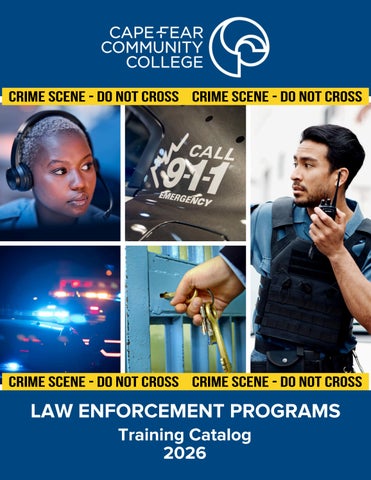
LAW ENFORCEMENT PROGRAMS Training Catalog 2026
2
WELCOME!
It has been our pleasure to provide training to you and your agencies. This catalog contains training offered in 2025 and will be offered in 2026 to aid planning. As always, if there is a topic of interest to you, please let us know, and we will do our best to schedule it. We are happy to announce the arrival of the use of our force simulator and our driving simulator, which are available for your training needs. We look forward to seeing you in 2026 training together to be the best we can be as law enforcement officers, detention/correction officers, and telecommunicators.
QUESTIONS? LAWENFTRAINING@CFCC.EDU
3
DEGREE PROGRAMS
PUBLIC SAFETY ADMINISTRATION Public Safety Administration (PSA) is designed to provide students and practitioners with knowledge and skills in the technical, managerial, and administrative areas necessary for entrance or advancement within various public service sectors, including emergency management, law enforcement, EMS, and firefighting. Students may apply prior learning credits to the program, such as Basic Law Enforcement Training.
CRIMINAL JUSTICE The Criminal Justice Technology curriculum is designed to provide knowledge of criminal justice systems and operations. Study will focus on local, state, and federal law enforcement, judicial processes, corrections, and security services. The criminal justice system’s role within society will be explored. Students may earn 20 credits with the completion of the Basic Law Enforcement Training academy. CONTACT INFORMATION Tim Fuss Criminal Justice & Public Safety Administration 910-362-7220 tfuss@cfcc.edu
4
WELCOME! TABLE OF CONTENTS TABLE OF CONTENTS
COMMUNITY-ORIENTED .................................7 DETENTION/CORRECTIONS ............................8 INSTRUCTOR .................................................12 INVESTIGATIONS ...........................................13 LEGAL .............................................................21 SUPERVISION & MANAGEMENT ...................25 TACTICAL/OFFICER SAFETY .........................27 TELECOMMUNICATOR .................................33 TRAFFIC .........................................................34
QUESTIONS? LAWENFTRAINING@CFCC.EDU
5
2026 IN-SERVICE LAW ENFORCEMENT WELCOME BACK TO THE GRIND by Emmet P. Waters
2026 In-service will be available online or in a traditional classroom setting to meet your needs. Contact the Law Enforcement Section to discuss and schedule your in-service.
REQUIRED 2026 YOUTH FOCUSED: STRATEGIES AND RESPONSES.................................. 2 CREDITS 2026 LEGAL UPDATE ............................................................................................. 4 CREDITS 2026 LEGISLATIVE UPDATE .................................................................................. 2 CREDITS 2026 FIREARMS TRAINING AND QUALIFICATION .............................................. 4 CREDITS 2026 UNDERSTANDING THE ROLES AND AUTHORITY OF PRIVATE PROTECTIVE SERVICES....................................................................................... 2 CREDITS 2026 COMMITTED TO INTEGRITY ........................................................................ 2 CREDITS 2026 CRITICAL DECISION-MAKING MODEL ........................................................ 2 CREDITS 2026 ILLEGAL BUSINESS ACTIVITY ...................................................................... 4 CREDITS
TOPIC OF CHOICE DWI: ARREST TO CONVICTION .............................................. .............................. 4 CREDITS
COMMENTS? HEY@GREATPAPER.COM QUESTIONS? LAWENFTRAINING@CFCC.EDU
6
2026 IN-SERVICE DETENTION 2026 In-service will be available online or in a traditional classroom setting to meet your needs. Contact the Law Enforcement Section to discuss and schedule your in-service. REQUIRED 2026 EXPECT THE UNEXPECTED ........................................................................................... 2 CREDITS 2026 PROFESSIONALISM IN THE WORKPLACE .................................................................... 4 CREDITS 2026 LEADERSHIP FROM WITHIN ........................................................................................... 2 CREDITS 2026 THE DETENTION OFFICER'S CRITICAL ROLE .............................................................. 2 CREDITS 2026 COMMITTED TO INTEGRITY ........................................................................................... 4 CREDITS 2026 PURPOSE AND RESPONSIBILITY: 14J ........................................................................... 2 CREDITS
2026 IN-SERVICE TELECOMMUNICATOR REQUIRED 2026 COMMITTED TO INTEGRITY ........................................................................................... 2 CREDITS 2026 LEADERSHIP FROM WITHIN ........................................................................................... 2 CREDITS 2026 SURVIVING OPERATIONS DISRUPTIONS ..................................................................... 2 CREDITS 2026 PROFESSIONALISM IN THE WORKPLACE ..................................................................... 4 CREDITS 2026 HOW CAN I HELP YOU? CUSTOMER SERVICE ............................................................ 2 CREDITS 2026 RAILROAD SAFETY .......................................................................................................... 2 CREDITS 2026 COURT PREPARATION AND TESTIMONY ..................................................................... 2 CREDITS
COMMENTS? HEY@GREATPAPER.COM QUESTIONS? LAWENFTRAINING@CFCC.EDU
7
COMMUNITY-ORIENTED WELCOME BACK TO THE GRIND by Emmet P. Waters
Who Should Attend: This course prepares law enforcement officers to respond to an incident requiring a bicycle. Course Goals: This essential training combines Emergency Vehicle Operations for bike officers with patrol procedures, tactics, night operations, mock scenes, and basic bike maintenance and on-the-road repairs. Course Length: 4 Days Course Dates: 7/20-7/23/2026
Who Should Attend: Certified law enforcement officers currently assigned or will be assigned as a school resource officers. Course Goals: To provide the participant with the history, philosophy, and basic skills necessary to serve as a school resource officer. Participants will receive instruction in school-based law, ways to handle exceptional students, and class instruction techniques. Course Requirements: Successful completion of practical exercises and passing of final exam with a 70%. Course Length: 5 Days Course Dates: By Request — Contact the Law Enforcement Section
CYCLING PATROL PROCEDURES
SCHOOL RESOURCE OFFICER TRAINING
______________________________________________________________________________ ______________________________________________________________________________ ______________________________________________________________________________ ______________________________________________________________________________ ______________________________________________________________________________ ______________________________________________________________________________ ______________________________________________________________________________ ______________________________________________________________________________ ______________________________________________________________________________ ______________________________________________________________________________
COMMENTS? HEY@GREATPAPER.COM QUESTIONS? LAWENFTRAINING@CFCC.EDU
NOTES
8
DETENTION / CORRECTIONS WELCOME BACK TO THE GRIND by Emmet P. Waters Who Should Attend: Detention officers who wish to gain additional knowledge beyond basic school and mandated in-service training. Course Goals: To provide training in various topics related to the operation of the detention facility. We are pleased to partner with and host the American Jail Association for training. Additional topics will be scheduled once determined. Course Length: Varies Course Dates: 3/18-3/19/2026 - Use of Force and Critical Incident Review Training August 2026 - Generations/Leadership September 2026 - Conflict Resolution
AMERICAN JAIL ASSOCIATION
**More information regarding classes can be found on the AJA website at https://www.americanjail.org/pd%20training
Who Should Attend: Detention officers who wish to become armed to carry for conducting transports for their agency. Course Goals: To give North Carolina certified detention officers the skills and abilities to properly handle and shoot a firearm to a level of proficiency to qualify to the same standard as a Basic Law Enforcement Training recruit. Course Requirements: Be able to achieve a minimum score of 70% on a designated course of fire both day and night and a decision-making (combat) course both day and night. Course Length: 5 Days Course Dates: BY REQUEST - CONTACT THE LAW ENFORCEMENT SECTION
COMMENTS? HEY@GREATPAPER.COM QUESTIONS? LAWENFTRAINING@CFCC.EDU
ARMED DETENTION OFFICER
9
DETENTION / CORRECTIONS WELCOME BACK TO THE GRIND
Who Should Attend: Those assigned or responsible for inmate movement in and by Emmet P. Waters outside the facility. Course Goals: To give the participant the knowledge and practical skills required to conduct efficient, safe, and secure transportation of inmates. Course Length: 3 Days Course Dates: By Request - Contact the Law Enforcement Section
BASIC TRANSPORTATION FOR DETENTION
Who Should Attend: Detention Officers who are responsible for conducting transports for their agency. Course Goals: This course is designed to provide the student with the basic knowledge and skills necessary for operating a vehicle while performing the functions of a detention officer while conducting transports. This course provides skills in multiple driving courses in both daytime and nighttime conditions utilizing cars and vans. Course Length: 5 Days Course Dates: y Request - Contact the Law Enforcement Section
DETENTION DRIVING TACTICS
Who Should Attend: This course is designed to update officers/supervisors working in detention facilities. Course Goals: Discuss relevant federal and state case law as it applies to NC Detention Facilities; Review appropriate NC statutory changes and the practical implications for detention officers; Review the stages of a lawsuit and applicable defenses available; Review updates on statutory and case law with the use of force, searches, and rights of inmates; Discuss risk management, CALEA, ACA, and NHCCA; Discuss the need for DNA orders and the policies needed to obtain DNA; Learn how to write a search warrant and a policy. Course Requirements: Successful completion of course assignments. Course Length: 5 Days Course Dates: By Request - Contact the Law Enforcement Section
COMMENTS? HEY@GREATPAPER.COM QUESTIONS? LAWENFTRAINING@CFCC.EDU
DETENTION LAW INSTITUTE
10
DETENTION / CORRECTIONS Who Should Attend: b ydetention E m m e t Pofficers . W a t e rat s All persons who wish to be employed as confinement facilities or working at those facilities within their first year. Course Goals: To present the basic standard operating procedures for local confinement facilities and develop professional detention officers' roles and responsibilities Course Requirements: Attendance is required for all class sessions. The student must score a minimum of 70% on written tests and/or practical exercises for each block and score a minimum of 70% on the final Commissionadministered written exam. All students confirmed for this course must provide a completed Medical History Statement (F-1) and Medical Examination Report (F-2). Course Length: 25 Days Required Text: Detention Officer Certification Course Manual—Contact CFCC North Campus Bookstore. Course Dates: 1/26 - 2/27/2026 4/6-5/8/2026 7/6-8/7/2026 9/28-10/30/2026
Who Should Attend: This 40-hour course, designed by the National Institute of Corrections, is intended for those in Jail Administrator or Assistant Jail Administrator positions. Course Goals: To provide information on operating a detention facility. This course applies practical tools and resources to planning and everyday detention operations. Course Requirements: Attendance is required at all class sessions. Course Length: 5 Days Course Dates: By Request — Contact the Law Enforcement Section
COMMENTS? HEY@GREATPAPER.COM QUESTIONS? LAWENFTRAINING@CFCC.EDU
DETENTION OFFICER CERTIFICATION COURSE
NATIONAL INSTITUTE OF CORRECTIONS JAIL ADMINISTRATION
11
DETENTION / CORRECTIONS Who Should Attend: The target audiences for this training program are sheriffs and jail administrators of small to medium-sized jails. However, administrators of larger jails may also benefit from the information and techniques presented in the program. Course Goals: This three-day program provides jail administrators with the basic skills and techniques to develop effective budget requests and better manage current resources. Course Requirements: Attendance is required at all class sessions. Course Length: 3 Days Course Dates: By Request — Contact the Law Enforcement Section
NATIONAL INSTITUTE OF CORRECTIONS JAIL RESOURCE MANAGEMENT
______________________________________________________________________________ ______________________________________________________________________________ ______________________________________________________________________________ ______________________________________________________________________________ ______________________________________________________________________________ ______________________________________________________________________________ ______________________________________________________________________________ ______________________________________________________________________________ ______________________________________________________________________________ ______________________________________________________________________________ ______________________________________________________________________________ ______________________________________________________________________________ ______________________________________________________________________________ ______________________________________________________________________________ ______________________________________________________________________________ ______________________________________________________________________________ ______________________________________________________________________________ ______________________________________________________________________________
COMMENTS? HEY@GREATPAPER.COM QUESTIONS? LAWENFTRAINING@CFCC.EDU
NOTES
12
INSTRUCTOR WELCOME BACK TO THE GRIND
Who Should Attend: Any criminal justice personnel planning tomteach any by Em et P. W a t ecourse rs mandated by the Criminal Justice Education and Training Standards Commission or the Sheriffs’ Education and Training Standards Commission must complete this course and apply for certification as a probationary general instructor. Applicants MUST have four years of practical criminal justice experience. Course Goals: To provide the information necessary to research, plan, prepare competently, and present a block of instruction by the Instructional Systems Design (ISD) Model. Course Requirements: Attendance is required for ALL class sessions. The student must develop a lesson plan for the 70-minute block of instruction with accompanying support materials, construct a test appropriate to the 70-minute block of instruction, and teach a 70-minute block of instruction. Course Length: 13 Days Required Text: Instructor Training Student Manual — Contact CFCC North Campus Bookstore. Course Date: 3/2-3/18/2026 5/26-6/11/2026 11/2-11/18/2026
COMMENTS? HEY@GREATPAPER.COM QUESTIONS? LAWENFTRAINING@CFCC.EDU
INSTRUCTOR TRAINING Class Size is limited to 18 students
13
INVESTIGATIONS Who Should Attend: Street gang investigators, security threat group investigators, and intelligence analysts currently assigned to gang investigations and have two to four years of experience in this field. Course Goals: This course emphasizes INTELLIGENCE – the various types and uses of human and technological information and resources available to gang investigators. INVESTIGATIONS – traditional and nontraditional investigative methods and legal issues in gang investigations. SUPPRESSION STRATEGIES AND TACTICS – current trends and best practices in gang investigations. Course Length: 3 Days Course Dates: 6/22-6/24/2026 10/26-10/28/2026
ADVANCED GANG INVESTIGATIONS
Who Should Attend: Current homicide and violent crime investigators. Course Goals: This course emphasizes the study of responding to different types of death and homicide investigations, analyzing evidence found at the crime scene, investigative techniques of interview and interrogation, interpreting wounds and injuries, and legal rights. Course Length: 5 Days Course Dates: TBA — Contact the Law Enforcement Section
ADVANCED HOMICIDE INVESTIGATIONS
Who Should Attend: Those assigned and responsible for conducting pre-employment background investigations of new employees. Course Goals: To provide the participants with the information necessary to perform the background investigation successfully. Course Requirements: Students are asked to bring a background investigation to work on while in class. Course Length: 5 Days Course Dates: TBA — Contact the Law Enforcement Section
BACKGROUND INVESTIGATIONS
COMMENTS? HEY@GREATPAPER.COM QUESTIONS? LAWENFTRAINING@CFCC.EDU
14
INVESTIGATIONS Who Should Attend: Crime scene investigators, detectives, and anyone involved with law enforcement that investigates crime scenes involving bloodstain patterns Course Goals: This course will help the criminal investigator identify, document, and collect all the evidence at a scene where blood evidence is present to assist them in reconstructing the incident. The students will learn how to use the tools necessary to determine the blood’s trajectory and possible location of the suspect and/or victim at the time of the incident. Students will also learn to examine the bloodstain evidence to determine the types of events that occurred during the incident. The students will incorporate the lessons learned during the class in hands-on scenarios to enhance the learning process. Course Length: 3 Days Course Dates: By Request - Contact the Law Enforcement Section
BASIC BLOODSTAIN PATTERNS
Who Should Attend: Officers / Investigators / Detectives or agents with limited experience but little formal training in street gang investigations, including Detention / Corrections. Course Goals: Instruction on how to recognize and identify gang members and gang insignia; ways to develop sources of information about gang activities within the community; and multijurisdictional approaches to gang investigations Course Length: 3 Days Course Dates: 4/27-4/29/2026 9/14-9/16/2026
BASIC GANG INVESTIGATIONS
Who Should Attend: Newly assigned narcotics investigators, patrol officers who wish to become narcotics investigators, and narcotics investigators who have not received narcotics training in some time. Course Goals: Learn proven investigative techniques to dismantle narcotics distribution groups and strategies to further investigations against individual drug dealers. Course Length: 3 Days Course Dates: 5/12-5/14/2026
COMMENTS? HEY@GREATPAPER.COM QUESTIONS? LAWENFTRAINING@CFCC.EDU
BASIC NARCOTICS INVESTIGATIONS
15
INVESTIGATIONS Who Should Attend: Law enforcement officers, investigators, attorneys, medicolegal investigators, crime scene technicians, fire/rescue and emergency management personnel, and other agency personnel involved in response to or investigation of child deaths. Course Goals: The investigator will learn the common presentations and scene findings in cases of sudden natural deaths, including infectious diseases and inherited conditions. Sudden Unexplained Death in Infancy will be covered in depth, with emphasis on important interview questions, scene investigations, and autopsy findings. Course Length: 2 Days Course Dates: By Request - Contact the Law Enforcement Section Who Should Attend: Patrol officers, investigators, and analysts who may encounter or investigate domestic terror groups and criminally subversive subcultures Course Goals: The course will define violent extremism and focus on individuals and groups that attempt to advance social or political beliefs through force or violence in violation of state or federal law. Movements and ideologies covered will include white supremacy, white nationalism, black identity extremism, animal rights and eco-terrorism, antigovernment, and other radical separatist groups. Course Length: 1 Day Course Dates: By Request - Contact the Law Enforcement Section Who Should Attend: Patrol officers, investigators, and analysts who may encounter or investigate domestic terror groups and criminally subversive subcultures. Course Goals: This relevant and timely two-day training will provide law enforcement officers with an introductory overview of numerous domestic terror groups and criminally subversive subcultures that law enforcement professionals encounter daily. The course will define violent extremism and focus on identifying individuals and groups that attempt to advance social or political beliefs through force or violence. Course Length: 2 Days Course Dates: By Request - Contact the Law Enforcement Section
COMMENTS? HEY@GREATPAPER.COM QUESTIONS? LAWENFTRAINING@CFCC.EDU
CHILD ABUSE AND FATALITY INVESTIGATIONS
DOMESTIC TERRORISM AND HATE GROUPS
DOMESTIC TERRORISM: IDEOLOGIES, GROUPS, SYMBOLS AND TACTICS, AND HATE GROUPS
16
INVESTIGATIONS Who Should Attend: Patrol officers Course Goals: The purpose of this class is to gain complete awareness of the drugs facing law enforcement today and gain the expertise needed to make quality observations and sound judgments in determining drug use. Officers will be better equipped to identify drug distribution and smuggling in roadside situations and the community they patrol. The officer safety issues learned in this seminar will benefit the officers attending the seminar and the members of their community. Course Length: 3 Days Course Dates: 6/16-6/18/2026 Who Should Attend: This workshop is appropriate for beginning and experienced child protective service workers, law enforcement, and other professionals who conduct initial investigative interviews with children as part of their professional role. Course Goals: This two-day workshop provides instruction on the First Call Initial Investigative Interview, a research-based, best practices model for an initial investigative interview for children aged five years and above. First Call Initial Investigative Interview is structured to ensure ease of learning and flexibility for use by multiple professional disciplines while providing professionals with sound questioning techniques for obtaining narrative details from children during case initiation. Course Length: 2 Days Course Dates: 2/3-2/4/2026; 3/23-3/24/2026; 6/15-6/16/2026
DRUG INVESTIGATIONS FOR PATROL
FIRST CALL
Class Size is limited to 18 students
______________________________________________________________________________ ______________________________________________________________________________ ______________________________________________________________________________ ______________________________________________________________________________ ______________________________________________________________________________ ______________________________________________________________________________ ______________________________________________________________________________ ______________________________________________________________________________ ______________________________________________________________________________
COMMENTS? HEY@GREATPAPER.COM QUESTIONS? LAWENFTRAINING@CFCC.EDU
NOTES
17
INVESTIGATIONS Who Should Attend: Patrol officers and new investigators. Course Goals: This three-day workshop provides instruction on such topics as traits of an investigator, preliminary investigation procedures, taking statements, and managing crime scenes for the lead investigator. Course Length: 3 Days Course Dates: 3/24-3/26/2026
Who Should Attend: Current homicide, violent crime investigators, or those who seek this type of assignment. Course Goals: Narcotic investigations can be the most dangerous type of investigation that an investigator or uniform officer might encounter in the performance of their duties. Students attending this class will gain complete awareness of the drugs facing them today, but they will also acquire the expertise needed to make effective observations and sound judgments to develop these cases. Several narcotic investigations originate from violators using hotel and motel locations to facilitate their drug operations. Officers will learn how to work with the hotel/motel personnel in their jurisdictions to produce a successful investigation proactively. Officer safety issues will also be emphasized. Course Length: 2 Days Course Dates: 10/6-10/7/2026
Who Should Attend: Current homicide, violent crime investigators, or those who seek this type of assignment. Course Goals: This class incorporates real-life scenarios and provides the student with investigative skills and experiences that are true to life. Course Length: 5 Days Course Dates: 7/13-7/17/2026
COMMENTS? HEY@GREATPAPER.COM QUESTIONS? LAWENFTRAINING@CFCC.EDU
FUNDAMENTALS FOR INVESTIGATIVE PROCESS
HOTEL / MOTEL DRUG INVESTIGATIONS
HOMICIDE INVESTIGATIONS
18
INVESTIGATIONS Who Should Attend: Those assigned and responsible for conducting internal affairs investigations or anticipating being given to internal affairs. Course Goals: To orient experienced law enforcement officers and related personnel to the unique investigative and legal aspects of conducting internal affairs investigations, both administrative and criminal. Course Length: 5 Days Course Dates: TBA — Contact the Law Enforcement Section Who Should Attend: Investigators, crime analysts, and patrol officers. Course Goals: The interviewer has several established goals at a communication event: Gather data or information from the interviewee within an interview. Determine if the interviewee is truthful and, if not, identify the form of the deception. Transition the interviewee from unwilling to willing. Toward this end, the interviewer must have the ability to QUESTION. The interviewer must change the interviewee's goal from deceptive to truthful, from unwilling to willing. In summary, the process is this: Can the interviewer cause the interviewee to respond? Once the interviewee begins to respond, can the interviewer determine if he is telling the truth? If the interviewee is deceptive or noncompliant, does the interviewer have the ability to gain compliance? Course Length: 5 Days Course Dates: 2/9-2/13/2026 10/12-10/16/2026 Who Should Attend: Law enforcement personnel that may need to access information on individuals that they encounter in the field. Course Goals: To provide the new investigator who will conduct such investigations as forgery and uttering, financial transaction card fraud, identify theft, obtaining property by false pretense and embezzlement. Course Length: 2 Days Course Dates: TBA — Contact the Law Enforcement Section
COMMENTS? HEY@GREATPAPER.COM QUESTIONS? LAWENFTRAINING@CFCC.EDU
INTERNAL AFFAIRS INVESTIGATIONS
INTERVIEW AND INTERROGATION
INTRODUCTION TO FINANCIAL CRIMES
19
INVESTIGATIONS Who Should Attend: Child protective service workers, law enforcement, and other professionals conduct initial investigative interviews with children as part of their professional role. Course Goals: This four-and-a-half-day workshop provides an introduction to the RADAR Child Forensic Interview Model. RADAR (Recognizing Abuse Disclosure Types and Responding) is a research-based, best-practice protocol for interviewing children (5 years of age and older) and adolescents assessed for possible sexual or physical abuse. RADAR is structured to ensure interview quality and ease of learning while offering flexibility to be effective with children of different ages and disclosure histories. Radar is adapted in part from the NICHD investigative interview protocol. Course Dates: 2/23-2/27/2026; 4/20-4/24/2026 Who Should Attend: Child protective service workers, law enforcement, and other professionals who conduct initial investigative interviews with children as part of their professional role. Course Goals: The RADAR JR Forensic Interview Model is a two-day competencybased training designed for professionals of various disciplines who have already completed training in the RADAR Child Forensic Interview Model. This course presents an adaptation of the RADAR protocol for interviewing children between 4 to 5 years of age.
RADAR FORENSIC INTERVIEWING
Class Size is limited to 18 students
RADAR JR FORENSIC INTERVIEWING
***Prerequisites: Completion of the RADAR Child Forensic Interview Model*** Course Length: 2 Days Course Dates: 3/9-3/10/2026; 6/22-6/23/2026
Class Size is limited to 18 students
______________________________________________________________________________ ______________________________________________________________________________ ______________________________________________________________________________ ______________________________________________________________________________ ______________________________________________________________________________ ______________________________________________________________________________ ______________________________________________________________________________ ______________________________________________________________________________ ______________________________________________________________________________
COMMENTS? HEY@GREATPAPER.COM QUESTIONS? LAWENFTRAINING@CFCC.EDU
NOTES
20
INVESTIGATIONS Who Should Attend: Detectives and crime scene investigators. Course Goals: This course will help the investigator identify, document, and collect all the evidence at a shooting scene to assist them in reconstructing the shooting incident. The students will learn how to use the tools necessary to determine the projectile’s trajectory and the possible location of the shooter and/or victim at the time of the shooting. Students will also learn to examine the ballistic evidence to determine the weapons used during the shooting incident. The students will incorporate the lessons learned in the classroom in hands-on scenarios to enhance the learning process. Course Length: 3 Days Course Dates: By Request — Contact the Law Enforcement Section Who Should Attend: Patrol officers or those who may encounter individuals recognized as sovereign citizens. Course Goals: To equip the law enforcement officer with the knowledge to recognize and identify sovereign citizens and anti-government extremists and better understand the subculture movement to enhance officer safety and thoroughly conduct investigations. Course Length: 1 Day Course Dates: By Request — Contact the Law Enforcement Section Who Should Attend: Detectives and crime scene investigators. Course Goals: A suicide may be influenced by psychological, biological or social factors as well as a combination of any of the three. Proving a suicide can be a difficult task due to family denials, insurance concerns and lack of an adequate investigation. This course is designed to overcome these difficulties by presenting you with sound investigative procedures and recommendations to ensure that a thorough investigation is conducted. Course Length: 2 Days Course Dates: TBA — Contact the Law Enforcement Section
COMMENTS? HEY@GREATPAPER.COM QUESTIONS? LAWENFTRAINING@CFCC.EDU
SHOOTING RECONSTRUCTION INVESTIGATIONS
SOVEREIGN CITIZENS
SUICIDE INVESTIGATIONS
21
LEGAL WELCOME BACK TO THE GRIND
Who Should Attend: Patrol officers or those assigned to a civil process unit. by Emmet P. Waters Course Goals: This three-day course is designed for deputy sheriffs working in the civil process, the laws, cases, and recommended procedures that govern the enforcement of the post-judgment remedies of executions, exemptions, evictions, and execution sales, including legislative and case law changes approved since 2001. Course Length: 3 Days Course Dates: TBA
Who Should Attend: Patrol officers or those assigned to a civil process unit. Course Goals: This course is designed so that all law enforcement personnel can learn the legal requirements to do valid service on various civil processes and parties, including basic requirements for different remedies and processes. Course Length: 5 Days Course Dates: TBA
Who Should Attend: Investigators or those who may encounter an individual who may need to be interviewed or interrogated. Course Goals: This course will provide a comprehensive legal review of the case law and statutes governing interviews and interrogations. The course will cover constitutional amendments governing interviews and interrogations. Course Length: 2 Days Course Dates: By Request - Contact the Law Enforcement Section
COMMENTS? HEY@GREATPAPER.COM QUESTIONS? LAWENFTRAINING@CFCC.EDU
ADVANCED CIVIL PROCESS
BASIC CIVIL PROCESS
INTERROGATION LAW
22
LEGAL WELCOME BACK TO THE GRIND
Who Should Attend: Officers assigned to a K-9 unit or work b y with E m mK-9s. et P. Waters Course Goals: To expose students to the legal issues involved with the use of canines and be able to discuss the constitutional issues commonly arising with the help of canines Course Length: 1 Day Course Dates: By Request — Contact the Law Enforcement Section
K-9 LAW
Who Should Attend: Law enforcement officers dealing with protests and counterprotests. Course Goals: At the end of the course, attendees will be able to identify the legal issues surrounding demonstrations and implement operational strategies to ensure that the legal rights of demonstrators, counter-demonstrators, and third parties are protected. Course Length: 2 Days Course Dates: By Request — Contact the Law Enforcement Section
LAWS OF MASS PROTESTS
Who Should Attend: Law enforcement officers who deal with motor vehicle searches and seizures. Course Goals: At the end of the course, attendees will identify the federal and state legal issues involved with motor vehicle searches and seizures and implement operational strategies to ensure that evidence is lawfully collected. Course Length: 2 Days Course Dates: TBA — Contact the Law Enforcement Section
MOTOR VEHICLE LAW
COMMENTS? HEY@GREATPAPER.COM QUESTIONS? LAWENFTRAINING@CFCC.EDU
23
LEGAL Who Should Attend: Law enforcement officers wishing to have a better understanding of legal issues. Course Goals: This course provides the skills necessary to conduct enforcement activities associated with search warrants, warrantless searches, interviews, eyewitness identifications, and nontestimonial identification orders and avoid liability while performing such activities. Course Requirements: Students will have to complete a search warrant and successfully pass the post-test. Course Length: 10 Days Required Texts: Robert Farb’s “Arrest, Search and Investigations in NC” along with two (2) student manuals (Red and Green Book) - Contact CFCC North Campus Bookstore. Course Dates: 2/16-2/27/2026 6/8-6/19/2026 9/14-9/25/2026
Who Should Attend: Law enforcement officers who have completed the full two-week PLI two or more years ago. Course Goals: The course will review the concepts covered in PLI. We will also cover recent case law and statutory changes/interpretations. Discussions will include the United States and North Carolina court opinions, legislation updates affecting juvenile law and other legal areas, and upcoming court decisions. Significant discussion areas include search and seizure, search warrants, interrogation law, and civil liability. Course Length: 3 Days Course Dates: TBA — Contact the Law Enforcement Section
COMMENTS? HEY@GREATPAPER.COM QUESTIONS? LAWENFTRAINING@CFCC.EDU
POLICE LAW INSTITUTE (PLI) CLASS SIZE IS LIMITED TO 25 STUDENTS
POLICE LAW INSTITUTE (PLI) UPDATE
24
LEGAL Who Should Attend: Law enforcement officers and/or investigators that may encounter juveniles Course Goals: This course is designed for all school resource officers and law enforcement personnel assigned to investigate juvenile delinquency cases, those involved in juvenile court delinquency proceedings, and those who regularly encounter juveniles. Course Length: 2 Days Course Dates: By Request — Contact the Law Enforcement Section
Who Should Attend: Law enforcement, detention, and telecommunicator supervisors. Course Goals: This course will provide police supervisors at all levels and ranks with an overview of their legal liability as supervisors. The course will cover North Carolina and Federal law and legal theories used against police supervisors and their agencies. Concepts such as gross negligence, intentional torts, deliberate indifference, and 42 USC Sec. 1983 will be covered. Course Length: 1 Day Course Dates: TBA — Contact the Law Enforcement Section
Who Should Attend: Investigators or officers who may be responsible for obtaining a search warrant related to a case. Course Goals: This course is designed to review the laws regarding warrantless search and seizure, search warrants, and a review of search warrant writing requirements. In this class, you will get a review of the laws of search and seizure, particularly warrantless searches and how/why/when to get a search warrant, and a review of how to write a search warrant. Course Length: 4 Days Course Dates: By Request - Contact the Law Enforcement Section
COMMENTS? HEY@GREATPAPER.COM QUESTIONS? LAWENFTRAINING@CFCC.EDU
SRO/JUVENILE LAW
SUPERVISOR LIABILITY
WARRANTLESS SEARCHES/ SEARCH WARRANT PREP
25
SUPERVISION & MANAGEMENT Who Should Attend: Newly appointed supervisors in law enforcement, detention, telecommunicator, or those anticipating promotion. Course Goals: The focus of this program is on practical and visionary leadership skills. Participants examine the impact of values (personal and organizational), ethics, and personal wellness on all of the roles a supervisor must fulfill to successfully meet the challenges they must face in the ever-changing world of law enforcement. Course Length: 5 Days Course Dates: By Request — Contact the Law Enforcement Section
Who Should Attend: Individuals who are responsible for the administration and management of the agency evidence room. Course Goals: This course will focus in detail on the checks and balances that bring significant liabilities hidden behind the doors of the evidence room. Attendees will learn best practices for supervising and maintaining a properly professional evidence room. Course Length: 3 Days Course Dates: 11/30-12/2/2026
Who Should Attend: Law enforcement, detention, and telecommunicators who will be assigned to provide field training to new officers. Course Goals: To provide technical and personal skills to individuals to function as evaluators and trainers of recruits assigned to their respective work areas. Course Length: 5 Days Total Course Dates: 6/8-6/12/2026 12/7/-12/11/2026
COMMENTS? HEY@GREATPAPER.COM QUESTIONS? LAWENFTRAINING@CFCC.EDU
ESSENTIAL SKILLS FOR NEW SUPERVISORS
EVIDENCE ROOM ADMINISTRATION AND MANAGEMENT
FIELD TRAINING OFFICER
26
SUPERVISION & MANAGEMENT WELCOME BACK TO THE GRIND
Who Should Attend: Newly appointed supervisors in law enforcement, detention, by Emmet P. Waters and telecommunicators or those who have yet to have formal training. Course Goals: The course will cover the following topics: liability, misconduct and corruption, leadership styles, and motivation. Course Length: 5 Days Course Dates: 6/1-6/5/2026 8/24-8/28/2026
FIRST LINE SUPERVISION
Who Should Attend: Those who are nearing retirement or those who are planning for the future. Course Goals: Prepare now and plan to finish your career and start the next chapter of your life with reliable information about retirement options you are entitled to as a North Carolina law enforcement officer. Course Length: 1 Day Course Dates: By Request — Contact the Law Enforcement Section
RETIREMENT SEMINAR
______________________________________________________________________________ ______________________________________________________________________________ ______________________________________________________________________________ ______________________________________________________________________________ ______________________________________________________________________________ ______________________________________________________________________________ ______________________________________________________________________________ ______________________________________________________________________________ ______________________________________________________________________________ ______________________________________________________________________________
COMMENTS? HEY@GREATPAPER.COM QUESTIONS? LAWENFTRAINING@CFCC.EDU
NOTES
27
TACTICAL/OFFICER SAFETY Who Should Attend: S.W.A.T. or tactical team members. Course Goals: This course is designed to assist the operator in handling the ballistic shield in different situations. The operator will be able to shoot from behind the shield aggressively. Conduct a reload with and without the gas mask. The operator will also unload, shoot on the move, conduct down officer rescues, and operate the shield while conducting dynamic/static room clears. The operator will conduct entries dry and live-fire exercises in two-person and three-person evolution with and without the gas mask. There will be additional drills to get each operator acclimated to the shield in many ways. This is a physically demanding course that will require a great deal of focus physically and mentally. Equipment Needed: Shield equipment list: Eye/ear protection; Body armor; Duty web gear; Minimum 3 handgun magazines; Duty handgun/duty holster; tactical gear (if available); ballistic shield (if available); 400 handgun rounds; 1 smoke; 1 CN or CS Gas; Gas mask Course Length: 3 Days Course Dates: By Request — Contact the Law Enforcement Section Who Should Attend: S.W.A.T. or tactical team members. Course Goals: This course is designed to assist the operator in handling the ballistic shield in different situations. The operator will be able to shoot from behind the shield aggressively. Conduct a reload with and without the gas mask. The operator will also unload, shoot on the move, conduct down officer rescues, and operate the shield while conducting dynamic/static room clears. The operator will conduct entries dry and live-fire exercises in two-person and three-person evolution with and without the gas mask. There will be additional drills to get each operator acclimated to the shield in many ways. This is a physically demanding course that will require a great deal of physical and mental focus. Shield equipment list: Eye/ear protection; Body armor; Duty web gear; Minimum 3 handgun magazines; Duty handgun/duty holster; tactical gear (if available); ballistic shield (if available); 400 handgun rounds; 1 smoke; 1 CN or CS Gas; Gas mask Course Length: 2 Days Course Dates: By Request — Contact the Law Enforcement Section
COMMENTS? HEY@GREATPAPER.COM QUESTIONS? LAWENFTRAINING@CFCC.EDU
ADVANCED BALLISTIC SHIELD OPERATOR
BASIC TACTICAL BALLISTIC SHIELD
28
TACTICAL/OFFICER SAFETY Who Should Attend: S.W.A.T. or tactical team members. Course Goals: This will be an intense course that will be physically and mentally demanding. Some of the tactical areas that will be covered are an overview of S.W.A.T., physical fitness for the S.W.A.T. operator, tactical dynamic and static room clearing, S.C.A.T. with and without weapons, tactical firearms (handgun, rifles, submachine gun, shotgun), ballistic shields, down man rescue, entry drills, dry/live fire vehicle takedowns, the legal issue for the S.W.A.T. operator, SWAT callouts during night operations dry/live fire evolutions and several more intense block of instructions. Equipment needed: Duty handgun and holster If available, duty rifle, submachine gun Gas mask mandatory with filter Tactical entry and protective kit including helmet (TACTICAL GEAR) If available, elbow and knee pads 1 of each – smoke, gas CN or CS, flash-bang if available from each team Ammo – a handgun – 400 rounds Ammo – rifle – 300 rounds Ammo – submachine gun - 300 rounds Ammo – shotgun - 25 slugs / 25 00 bucks Flashlight / secondary light Ballistic shield Eye, hearing protection is mandatory Ballistic vest or tactical vest is mandatory Recommend gloves, boots, baseball-style hats, BDU-style pants Plenty of water Course Length: 5 Days Course Dates: By Request — Contact the Law Enforcement Section
COMMENTS? HEY@GREATPAPER.COM QUESTIONS? LAWENFTRAINING@CFCC.EDU
BASIC S.W.A.T. OPERATOR
29
TACTICAL/OFFICER SAFETY Who Should Attend: Law enforcement officers who wish to better prepare themselves for a deadly force encounter. Course Goals: This class is for the officer who wants to better understand the dynamics of a deadly force encounter and prepare themselves for that day. Being “Prepared for the Day” offers an in-depth analysis of what occurs during and after an officer-involved shooting, along with information to better prepare you before the incident can happen. Course Length: 3 Days Course Dates: By Request — Contact the Law Enforcement Section
BEING PREPARED FOR THE DAY —SURVIVING A DEADLY FORCE ENCOUNTER
Who Should Attend: S.W.A.T. or tactical team members. Course Goals: This course is designed to assist the operators in gathering specific intelligence on a bus during a critical incident. It prepares the operator for many options about shutting the bus down, breaching windows and doors, approaching from many angles, boarding the target during an assault, and techniques for securing occupants on the bus, along with a variety of responsibilities from team members. We will cover techniques for conducting a rescue under control with sufficient manpower. A great deal of focus will be placed on safety, speed, and the element of surprise. SIMS will also be implemented into this training during scenarios. Course Length: 2 Days Course Dates: By Request — Contact the Law Enforcement Section
BUS ASSAULT / RESCUE
Who Should Attend: S.W.A.T. or tactical team members. Course Goals: This course will expand on the knowledge of any law enforcement officer involved in arresting violent criminals, no matter their current assignment. This course will emphasize deliberate small-team tactics, target research, case law, and arrest philosophies that drive compliance, making safer and more repeatable arrests. Utilizing classroom discussions and practical exercises, we will highlight the apprehension process from the issuance of a criminal warrant through arrest and postarrest. We will demonstrate simple and proven principle-based tactics and techniques used to search structures and make vehicle-based arrests. Course Length: 2 Days Course Dates: COMMENTS? HEY@GREATPAPER.COM By Request — Contact the Law Enforcement Section QUESTIONS? LAWENFTRAINING@CFCC.EDU
CRIMINAL APPREHENSIONS
30
TACTICAL/OFFICER SAFETY Who Should Attend: Law enforcement officers or detention officers who respond to incidents involving individuals with a mental health or substance use by Emmet P. Waters crisis. Course Goals: CIT is a training designed to assist law enforcement officers who respond to incidents involving individuals with a mental health or substance use crisis and those with intellectual and developmental disabilities in a hospital setting. Course Length: 5 Days Course Dates: 4/13-4/17/2026; 9/21-9/25/2026 6/1-6/2/2026 - 2 Days - CIT for Telecommunicators Who Should Attend: Officers assigned or selected to join a crisis negotiations team, or who may otherwise be put in a crisis negotiator role, or officers wishing to learn more about the fundamentals of hostage/crisis negotiations. Course Goals: The course is designed in a forty (40) hour format to prepare a law enforcement professional to act as a hostage/crisis negotiator or team member on a hostage/crisis negotiations team. The course is based on fundamentals developed by the FBI and guidelines from the National Council of Negotiation Associations (NCNA). The course will consist of practice, role-play, and scenario-based training. The student will leave this course with the fundamental skill sets of hostage/crisis negotiation techniques. Course Length: 5 Days Course Dates: 5/18-5/22/2026 - *Register through NCJA Acadis Portal* Who Should Attend: Law Enforcement and Security Officers who require training and practice in mass-arrest procedures. Course Goals: The three-day Field Force Operations (FFO) course provides law enforcement and security officers instruction in protest types and actions, legal considerations, responsibilities of mobile field force teams, and crowd-control methods. The course culminates with a series of hands-on activities that allow responders to practice all of the learned skills (baton-holding positions, mass-arrest procedures, and riot-control formations) in a realistic context. Course Length: 3 Days Course Dates: By Request — Contact the Law Enforcement Section COMMENTS? HEY@GREATPAPER.COM QUESTIONS? LAWENFTRAINING@CFCC.EDU
CRISIS INTERVENTION TRAINING
BASIC HOSTAGE AND CRISIS NEGOTIATION CLASS SIZE LIMITED TO 24
FIELD FORCE OPERATIONS
31
TACTICAL/OFFICER SAFETY Who should Attend: Sworn law enforcement or detention officers. Course Goals: This course will review the principles and practices of unarmed self-defense. Coursework includes lectures, demonstrations, and practical exercises. Upon completion, students will be familiar with and able to use the principles and practices of unarmed selfdefense. Course Length: 8 hours Course Dates: By Request — Contact the Law Enforcement Section
OFFENSIVE STRATEGIC BODY DEFENSE (OSBD)
Who should Attend: Public Safety Leaders who may have to interact with the media. Course Goals: This course is designed to equip public safety leaders with the essential skills and strategies to excel as a Public Information Officer (PIO) in both routine and crisis environments. Participants will learn how to effectively manage media relations, control the narrative, and ensure the timely dissemination of accurate and transparent information to the public and news media.. Course Length: 5 Days Course Dates: 3/2-3/6/2026
PUBLIC INFORMATION OFFICER (PIO) BOOTCAMP FOR PUBLIC SAFETY LEADERS
Who Should Attend: Patrolman, detective, school resource officer, and SWAT operator. Course Goals: This course will provide ideas and things that need to be in place and already shared with loved ones in the officer’s life when this day comes. This course will also assist the officers in preparing to support their fellow officers and families after a deadly encounter or use of deadly force encounter. The course will allow officers to face reality and challenge themselves mentally and physically. It will get deep into the psychological and physiological aspects of shooting. Course Length: 2 Days Course Dates: By Request — Contact the Law Enforcement Section
COMMENTS? HEY@GREATPAPER.COM QUESTIONS? LAWENFTRAINING@CFCC.EDU
TACTICAL MINDSET
32
TACTICAL/OFFICER SAFETY Who Should Attend: S.W.A.T. or tactical team members. Course Goals: This course prepares the operator for approaching vehicles and gaining complete control of the vehicle before extracting anyone out. This is an intense course and advanced due to the discipline of each operator. The operator is trained in setting up several positions around the vehicle. The operator will operate from each position during dry and live fire evolutions. Emphasis is placed on the angles of fire into the vehicle from a stationary position and shooting out of the vehicle through the windshield. The operators will use the gas mask, NFDD’S (FLASH BANGS), breaching tools, and live-fire shooting into the vehicle while in a gas-contaminated environment. Several other practical exercises will be covered during the block of instructions. This training is not to replace felony stops and any different techniques used to control vehicles and occupants inside the vehicle. This is only another option with superior manpower and firepower. Course Length: 3 Days Course Dates: By Request — Contact the Law Enforcement Section
Who Should Attend: Criminal justice professionals looking to expand their tactical communication skills and de-escalation capabilities. Course Goals: To provide the student with the technical and practical skills needed to calm or de-escalate situations while maintaining a professional demeanor. Course Length: 3 Days Course Dates: 3/30-4/1/2026; 11/23-11/25/2026
COMMENTS? HEY@GREATPAPER.COM QUESTIONS? LAWENFTRAINING@CFCC.EDU
VEHICLE ASSAULTS / RESCUES
VERBAL JUDO
33
TELECOMMUNICATOR Who Should Attend: All telecommunicators (sheriffs, police, emergency service centers, highway patrol, etc.) Course Goals: We are excited to continue our partnerships with NENA to provide timely and necessary training to further your careers. Classes and dates will be announced once confirmed. Course Length: Varies Course Dates for 2026: Leadership · Instructor Development Program, · Policy Development · Staffing for Success Frontline Telecommunicator · Reset, Refuel, & Restore Your Purpose in 9-1-1 · Transforming 9-1-1 Center Culture
Who Should Attend: This course is for all telecommunicators (sheriffs, police, emergency service centers, highway patrol, etc.) employed by or sponsored by an emergency service center. Course Goals: To present the basic standard operating procedures for telecommunicators and to develop the role and responsibilities of the emergency service telecommunicator. Course Requirements: Attendance is required at all class sessions. All practical exercises must be satisfactorily completed, and a minimum score of 70% must be achieved on the final Commission-administered written exam. All students confirmed for this course must provide a completed Medical History Statement (F-1) and Medical Examination Report (F-2). Course Length: 7 Days Required Text: Telecommunicator Certification Course Student Manual — Contact CFCC North Campus Bookstore. Course Date: 6/22-6/30/2026; 8/31-9/9/2026
Class Sizes are Limited
TELECOMMUNICATOR CERTIFICATION COURSE
COMMENTS? HEY@GREATPAPER.COM QUESTIONS? LAWENFTRAINING@CFCC.EDU
34
TRAFFIC Who Should Attend: Law enforcement officers who wish to be certified in operating the Lidar instrument for traffic enforcement purposes. Course Goals: To orient the student with the use of the Lidar instrument. Course Requirements: 100% attendance. Successful completion of practical exercises and state exams. You MUST be Certified in Radar before taking this class and show proof of certification. Course Length: 1 Day Required Text: Lidar Operator Manual — Contact CFCC North Campus Bookstore. Course Dates: 2/16/2026; 3/17/2026; 4/20/2026; 5/19/2026; 4/17/2026; 9/22/2026; 10/19/2026; 11/17/2026 Who Should Attend: Law enforcement officers who wish to be certified in operating the Radar instrument for traffic enforcement purposes. Course Goals: To orient the student with the use of the Radar instrument. Course Requirements: 100% attendance. Successful completion of practical exercises and state exams. Course Length: 3 Days Required Text: Radar Operator Manual — Contact CFCC North Campus Bookstore. Course Dates: 2/13-2/15/2026;3/13-3/15/2026;4/17-4/19/2026;5/155/17/2026;8/14-8/16/2026;9/18-9/20/2026;10/16-10/18/2026;11/1311/15/2026 Who Should Attend: Law enforcement officers seeking certification to continue to operate Radar in North Carolina. Officers must have attended the complete certification course. Course Goals: Refamiliarize the student with the operation of the instrument. Course Requirements: 100% attendance. Successful completion of practical exercises and state exams. Must provide copy of SMI certificate. Course Length: 1 Day Required Text: Radar/Lidar Operator Manual — Contact CFCC North Campus Bookstore. Course Dates: RADAR RECERT: 2/17/2026; 3/18/2026; 4/21/2026; 5/20/2026; 8/18/2026; 9/23/2026; 10/20/2026; 11/18/2026 COMMENTS? HEY@GREATPAPER.COM
LIDAR *STATE EXAM NOT INCLUDED IN COURSE DATES
RADAR *STATE EXAM NOT INCLUDED IN COURSE DATES
RADAR RECERTIFICATION (CERTIFIED IN RADAR ONLY) *STATE EXAM NOT INCLUDED IN COURSE DATES
35
TRAFFIC Who Should Attend: Law enforcement officers seeking certification to continue to operate Radar in NC. Officers must have attended the complete certification course. Course Goals: Refamiliarize the student with the operation of the instrument. Course Requirements: 100% attendance. Successful completion of practical exercises and state exams. Must provide copy of SMI certificate. Course Length: 1 Day Required Text: Radar/Lidar Operator Manual — Contact CFCC North Campus Bookstore. Course Dates: 2/18/2026; 3/19/2026; 4/22/2026; 5/21/2026; 8/19/2026; 9/24/2026; 10/21/2026; 11/19/2026 Who Should Attend: Law enforcement officers wishing to learn how to administer field sobriety tests. Course Goals: The course presents a substantial body of information relevant to the DWI detection process, including the organization, presentation, and articulation of the evidence gleaned from that process. It also presents supportive information to bolster the participants’ awareness of the importance of effective DWI enforcement. Course Length: 4 Days Course Dates: TBA — Contact the Law Enforcement Section
Who Should Attend: Law enforcement officers wishing to learn how to administer field sobriety tests. Course Goals: Every two years, every patrol officer should attend an NHTSA-approved SFST Refresher Training course. The course consists of classroom instruction via PowerPoint, a classroom training manual, and a written and physical proficiency exam. Course topics included are an overview of the DWI problem, both from alcohol and drugs, Phase 1 and Phase 2 of the investigation, including proper documentation and validation studies/legal updates. Course Length: 1 Day Course Dates: TBA — Contact the Law Enforcement Section
COMMENTS? HEY@GREATPAPER.COM
RADAR/LIDAR RECERTIFICATION
STANDARDIZED FIELD SOBRIETY TESTING
STANDARDIZED FIELD SOBRIETY TESTING REFRESHER
TIM FUSS, DIRECTOR, LAW ENFORCEMENT PROGRAMS PHONE: 910.362.7220 OR 910.362.7217 EMAIL: TFUSS@CFCC.EDU OR LAWENFTRAINING@CFCC.EDU FIND US ON FACEBOOK AT CAPE FEAR COMMUNITY COLLEGE - PUBLIC SAFETY