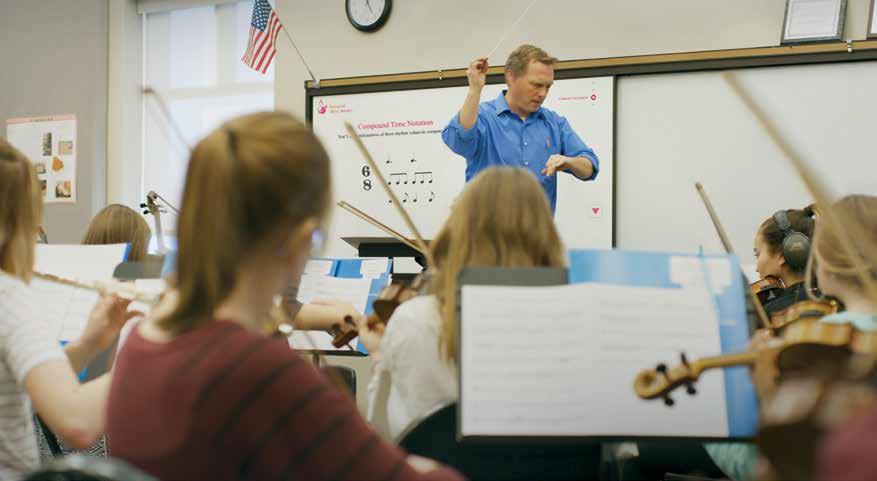
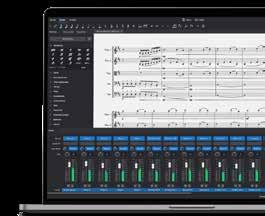
When students can quickly connect theory to the music in front of them, everything changes. Breezin’ Thru Theory builds rapid response, stronger sight reading, and deeper understanding. It’s fun and supports teachers in two powerful ways:
• In-the-moment: with NEW Theory On The Go and Breezin’ Thru Fingerings, you can address concepts quickly during rehearsals.
• Beyond rehearsal: with 24 chapters of sca olded content, it builds skills methodically thru the year, ensuring no learning gaps, and saving you class and marking time.
The result? Less time struggling, more time making music, and rehearsals that really sing.
Executive Director Florida Music Education Association
Scott Evans Hinckley Center for Fine Arts Education 402 Office Plaza Tallahassee, FL 32301 (850) 878-6844 or (800) 301-3632 (scottevans@flmusiced.org)
Editor-in-Chief
Kelly Miller, DMA University of Central Florida 12488 Centaurus Blvd. Orlando, FL 32816-8009 (407) 823-4545 (kelly.miller@ucf.edu)
Editorial Committee
Terice Allen (850) 245-8700, Tallahassee (tallen1962@hotmail.com)
John K. Southall, PhD Indian River State College, Fort Pierce (772) 462-7810; (johnsouthall@fmea.org)
Advertising Sales Valeria Anderson (val@fmea.org) 402 Office Plaza Tallahassee, FL 32301 (850) 878-6844
Official FMEA and FMD Photographers
Bob O’Lary Amanda Crawford Art Director & Production Manager
Lori Danello Roberts LDR Design Inc. (lori@flmusiced.org)
Circulation & Copy Manager
Valeria Anderson, (800) 301-3632
Copy Editor Susan Trainor
Advertiser Index
The Florida Music Director is made possible by businesses and organizations that advertise with us. They make it possible to provide you with a high-quality publication, and we gratefully acknowledge their support of our mission. We hope you will take special notice of the following advertisement and consider the products and services offered. It is another important way you can support your professional association and the enhancement of Florida music education.
The publisher does not endorse any particular company, product, or service. The Florida Music Education Association (FMEA) is not responsible for the content of any advertisement and reserves the right to accept or refuse any advertisement submitted for publication. Information for advertisers (rate card, insertion orders, graphics requirements, etc.) can be found at FMEAMediaKit.org Florida Music Director reserves the right to refuse any ad not prepared to the correct specifications OR to rework the ad as needed with fees applied.
ADVERTISER
Breezin’ Thru, Inc.
The advertisers shown in bold provide additional support to FMEA members through membership in the Corporate and Academic
2026–27 FMEA
MEMBERSHIP: You are eligible for membership in the Florida Music Education Association if you are an individual engaged in the teaching, supervision, or administration of music in elementary and secondary schools, colleges, or universities within the state. Visit FMEA.org/membership to learn more about the benefits of active membership.
SUBSCRIPTIONS: Direct correspondence regarding subscriptions to: Hinckley Center for Fine Arts Education, 402 Office Plaza, Tallahassee, FL, 32301-2757. Subscription cost included in FMEA membership dues ($9); libraries, educational institutions, and all others within the United States: $27 plus 7.5% sales tax.
SUBMISSIONS: Article and art submissions are always considered and should be submitted on or before the 1st of the month, one month prior to the publication issue to: Kelly Miller, DMA, kelly.miller@ucf.edu.
All articles must be provided in digital format (e.g., Microsoft Word). All applicable fonts and images must be provided. Images must be at least 300 dpi resolution at 100% of the size. All submissions must be accompanied by a proof (color, if applicable). Ads may be submitted via email to val@FMEA.org
CIRCULATION: The circulation of the Florida Music Director is 4,500 educators. Published eight times annually by The Florida Music Education Association, Hinckley Center for Fine Arts Education: 402 Office Plaza, Tallahassee, FL 32301FMEA reserves the right to approve any application for appearance and to edit
President’s MESSAGE
President’s MESSAGE
Harry “Skip” Pardee, EdD President Florida Music Education Association
Achieving the ‘Difficult Thing’
Greetings, FMEA! On behalf of the FMEA Board of Directors, we want to thank and congratulate you on another outstanding year of music education for our Florida students. Your role as a music educator is much more than teaching performance skills to students. While these are important for the development of the whole student, you likely agree that this is not where our impact is felt most. As music teachers, we are blessed with teaching in a content area that allows us to connect with our students in deep and meaningful ways.
This spring, the world had an opportunity to pause and watch the launch of Artemis II, bound for the moon. Four brilliant and brave astronauts, from varying backgrounds and fields, came together as a representation of humanity’s relentless pursuit of achieving the “difficult thing.” Music education is, no doubt, a difficult thing. But when we work collaboratively, share the good news and the proven benefits of music education in our communities, and rally behind this important cause, our community begins to demand not just music programs that “survive,” but music programs that thrive
I would like to address some ongoing, common concerns in our work. Our beloved profession is often squeezed—albeit not often publicly stated—by political, academic, financial, and organizational leadership decisions that have negative consequences for the arts. I have no doubt some of you are feeling that squeeze now. I want FMEA members to be assured that the association is doing all we can to mobilize our marketing, branding, communications, and lobbying efforts to make sure those who are charged with doing the “difficult things” and making education decisions at the highest levels continue to understand the power in our profession. An investment in music education, in the face of incessant challenges for schools, is an investment worth making. We know it, but do our leaders know it? We need you to continue to share the power in our profession with all who will listen! If you need my support in these efforts, I am an email away (skippardee@FMEA.org).
As always, I welcome any of our members to contact me directly to schedule a one-on-one conversation. You are tremendously valued for all you do for students every day, and it would be a privilege to connect with you to discuss your vital work.
Always musically,
Harry “Skip” Pardee, EdD, President Florida Music Education Association
Advocacy REPORT
Advocacy Burden or Opportunity?
Why do we have to sing THIS song?” Most of my choral director colleagues resent this question and take it as a personal attack or an affront to their expertise. Their response, if they respond at all, is something along the lines of “I am the professional who chooses the literature.” (In the student’s mind that response means “Because I said so.”) These colleagues often report that within weeks, the same piece becomes the student’s favorite.
I have a confession. I absolutely loved it when
my skeptical high school choral students asked that question. What an incredible opportunity to share the worthiness of a piece, the history, the cultural connections, the musical elements, the power of the arts to express profound concepts when words fail. It was the student’s defiant question that guaranteed their rapt attention to my answer. And if I was ever unable to answer that question satisfactorily to the student’s (or my own) satisfaction, then perhaps that piece was not worthy of our classroom time.
Why do I HAVE to advocate?
Similarly, we are often somewhere between dejected and enraged when we are asked to justify the funding of our music programs. It can be a gut punch when we feel as if our programs are not worthy of the same consideration as other curricular areas. These are valid feelings. Yet, what if we reframe these challenges to our programs as an opportunity to advocate and educate?
Just like students questioning my curricular
choices, I try not to be defensive when decision makers ask questions and reveal their ignorance regarding the value of robust arts programs. While I acknowledge my disappointment at potential reductions or cuts, I enjoy reframing these as opportunities to educate, creatively problem solve, and inspire decision makers. Most administrative cuts are typically financial. These decisions are rarely made with malice. Yet, financial shortfalls should never be the sole reason to cut arts programs. Do not accept that reasoning without offering creative solutions. You and your community CAN affect those decisions. The return on investment for high-quality music and arts education is extraordinary and undeniable. I love sharing this information with decision makers anytime I can. It is never a burden. It’s an opportunity.
FMEA Advocacy Seamless Transition
FMEA is recognized as a leader in arts education. We celebrate and honor Dr. Sanz’s career and her contributions to FMEA and her tireless
Angela Hartvigsen
Jeanne W. Reynolds
Advocacy REPORT
commitment to arts education advocacy. Long before her work as FMEA executive director, she was advocating in her district, in Tallahassee, and in Washington, D.C. Even in retirement, we are thrilled that Dr. Sanz will generously share her time continuing to serve on our Advocacy Committee.
And without skipping a beat, Scott Evans has taken the reins as our new president and CEO of the Center for Fine Arts and executive director of FMEA. Scott Evans is one of the most effective arts education advocates I have ever met, and I have met many. Scott never misses an opportunity to share the good news about arts education. He is masterful. I have no doubt that Florida arts education programs will grow and thrive due to his considerable advocacy skills. It is not surprising that during his first official week on the job, he was meeting with legislators in Tallahassee.
LEGISLATIVE UPDATE
Dance/PE HOPE – At the very last hour on the last day of session, our lobbyists were able to secure an amendment on one of the train bills. Our high school dance students will now be able to earn PE/HOPE credit if they are enrolled in a dance technique class. This is a win!
Other relevant information:
w Very little education legislation passed.
Schools of Hope legislation failed. However, the major challenges associated with the 2025 Schools of Hope legislation were addressed by the Board of Education. Community input mattered!
Voucher funding issues were not addressed. This will need our attention, as funding shortfalls impact all programs, including arts education.
Legislation passed that placed further restrictions on teachers’ unions.
Two education “train bills” passed in the waning hours of the session addressing a variety of provisions, but many education initiatives failed this year.
w State budget was not passed. This is the only thing legislators are required to do. Not having accurate budget information places a burden on school districts as they plan “blindly” for the 2026–27 year. This can result in districts making premature cuts to programs in anticipation of decreased funding.
Special Session(s) –Legislators will be back in Tallahassee for special sessions to finalize a budget, address potential property tax legislation, and address potential mid-decade redistricting. FMEA will follow these sessions closely. Please be prepared to act if you are asked to do so.
Outgoing FMEA Executive Director Kathy Sanz at 2026 Advocacy Day at the Capitol
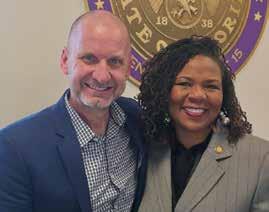
New FMEA Executive Director Scott Evans with State Senator LaVon Bracy Davis
Advocacy REPORT
continued from page 7
FMEA Advocacy Resources for a Changing World
The educational world is changing dramatically due to funding changes, declining birth rates, artificial intelligence, education choices, potential property tax legislation, and a host of other issues. FMEA is working proactively to provide you with effective resources, whether you are facing an imminent problem (reactive) or you want to build or strengthen your existing advocacy network (proactive). Currently we are working with some individual FMEA members to navigate potential unit losses due to lower enrollments. Our advocacy
plans include creating a link to access immediate advocacy assistance for urgent issues, as well as providing new robust advocacy resources to address both imminent advocacy emergencies (reactive) and proactive advocacy goals.
FMEA stands ready to help you articulate effectively why your program is absolutely essential to your school. I am hopeful you will see advocacy not as a burden but rather an opportunity, just as I loved the opportunity to explain my reasoning to students for my choice of choral literature. The positive impact of highquality music education is well documented, undeniable, and inspiring. Embrace all opportunities to sing THAT song.
IMMEDIATE IMPACT
FMEA
seeks
SUMMER TO-DO LIST
w Practice reframing your thinking on advocacy. Shed your defensive posture about the need to advocate. Make a list of all the accomplishments of your program from this past year, small and large. Take time to bask in your successes. Use those successes to craft an effective advocacy message to share with decision makers. Stories are powerful.
w Take the leap and plan to meet with your state senator or state representative in their home district over the summer. More information from the FMEA Advocacy Committee will be coming to help you prepare for these meetings. We need all hands on deck to get the word out about the importance of adequate funding for education including comprehensive, quality arts education for all.
w Make a note to check the FMEA Advocacy Page several times over the summer for updates and resources. Let Angela and me know what additional resources you need, or how we can help you further. We value your input!
w ACT if you get an FMEA advocacy alert. We need to be nimble in these times of educational change and inconsistent funding. We need everyone’s voice singing the same advocacy song.
nominations
for FMEA “Immediate Impact”
The “Immediate Impact” Music Educator Spotlight recognizes outstanding accomplishments of early-career music educators.
FMEA seeks to spotlight the outstanding work and accomplishments of music educators in the earlier stages of their teaching careers who are making an “immediate impact” in their schools, communities, and students. Through the power of music education, these ambitious FMEA members influence positive change, create amazing musical experiences for their students, and help enrich Florida’s music education community.
LET US BRAG ABOUT YOU!
Please submit the nomination form found at fmea.org/programs/spotlight and materials for yourself or a colleague who exemplifies these criteria.
Benny L. Bolden, Jr., EdD President Florida School Music Association
Reflection, Celebration, and Forward Momentum
s I write this message, I am reminded that the seasons are shifting all around us. The coolness of winter has long passed, spring is in full bloom, and before we know it, the warmth of summer will be upon us. In many ways, this mirrors the journey of our school year—what began with preparation and anticipation is now culminating in reflection, celebration, and forward momentum. May stands as a powerful marker for us. It is not just the final issue of this magazine before summer holidays—it is our opportunity to finish strong, to celebrate loudly, and to honor the incredible work that has taken place in classrooms, rehearsal halls, auditoriums, and performance spaces across the state of Florida.
To our directors: thank you. Your unwavering commitment to excellence, often behind the scenes, has transformed lives in ways that extend far beyond a rating or a performance. You have poured into your students not just musicianship, but discipline, resilience, and a sense of belonging. That is the true work of music education.
To our students: you are the heartbeat of this organization. Every note played, every phrase sung, every step marched is a testament to your dedication. You have represented your schools and communities with pride, and more importantly, you have grown— not just as musicians, but as young leaders.
To our administrators, parents, and supporters: your belief in the power of music education continues
to fuel this work. Thank you for standing with us, advocating with us, and celebrating with us.
As we close this school year, let us do so with intention. Let us “end with a bang”—not just in performance, but in purpose. Celebrate your students. Recognize your colleagues. Reflect on your growth. And take pride in knowing that what you have done this year matters deeply. At FSMA, we continue to emphasize that our work goes beyond ratings. Yes, the stage matters. Yes, the performance matters. But what matters most is the impact—the lives changed, the confidence built, and the doors opened through music education.
Equally important, it has been my honor to serve as your first African-American president of FSMA. Thank you for allowing me to serve this organization and this great state. I firmly believe this is the greatest profession on earth. As I come to the end of my time, I am proud of the work we have done—and the work we will continue to do together. Our impact will echo far beyond this moment. As summer approaches, I encourage each of you to rest, to recharge, and to reflect. Take time to invest in yourself, your craft, and your vision for the future. Because when the next season begins, our students will once again look to us—not just for instruction, but for inspiration.
And I have no doubt—we will be ready.
Let’s finish strong. Let’s celebrate boldly. And let’s continue to make music that changes lives.
With appreciation and pride,
Benny L. Bolden, Jr., EdD, President Florida School Music Association
From 70 to 170
How Intentional Growth, Community Partnership, and Legacy Built a Thriving Band Program
BY JOSHUA VELEZ
here are moments in a program’s life when growth becomes visible. Uniform blocks stretch longer across the field. The band room fills beyond capacity. The sound shifts—not just louder, but fuller.
From the outside, it can look sudden. But sustainable growth in music education is never sudden.
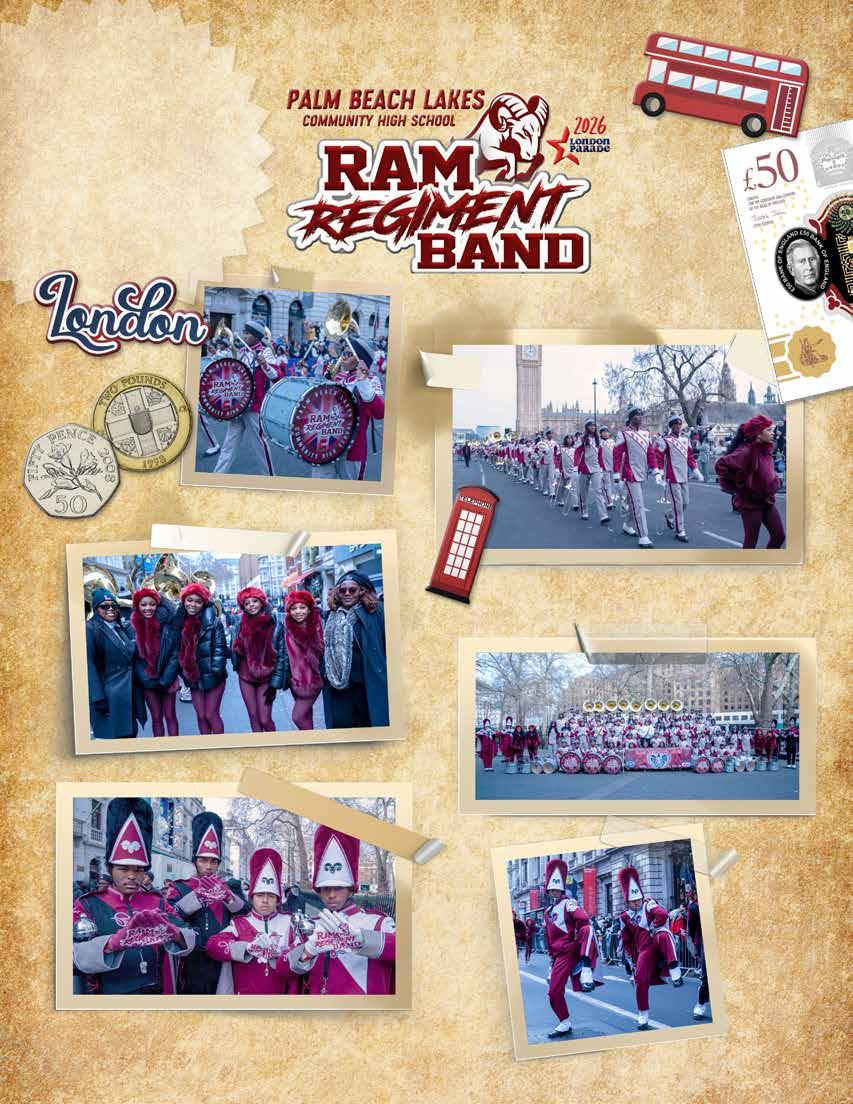
The transformation of the Ram Regiment from 70 students to 170 did not happen in a single season, a single recruiting push, or a single successful performance. It is the product of a decade of intentional systems, relentless visibility, community alignment, and a refusal to lower standards.
As both a graduate of this program and its current director, I have experienced its culture from two vantage points: first as a student shaped by its expectations, and now as a leader responsible for protecting and expanding its legacy.
Growth, I have learned, is not about increasing numbers. It is about increasing belief.
The Foundation: Culture Before Count
When I assumed leadership, the program was steady but limited in scope. Seventy students can absolutely create excellence. But numbers matter when your vision requires scale—competitive ensembles, travel opportunities, and sustainable instrumentation balance. Rather than focus-
ing first on recruitment, we focused on culture. Three non-negotiables were established:
1. Excellence is the expectation, not the exception.
2. Visibility creates value.
3. Relationships drive retention.
Students will not remain in a program where standards are unclear. They will not join a program they never see. And they will not commit to a director they do not trust. So, we built clarity.
Rehearsals became structured and intentional. Section leaders were trained rather than simply appointed. Attendance expectations were communicated consistently. Families were informed partners rather than distant observers. We did not chase growth. We built an environment worth growing into.
Planting Seeds Early— Strategic Feeder Alignment
The most significant shift occurred when we stopped viewing feeder schools as pipelines and started viewing them as partners.
Elementary outreach was reimagined. Instead of a single annual visit, we created recurring pep rally performance tours. Younger students experienced high school band not as a distant concept, but as something energetic and attainable.
170
continued from page 10
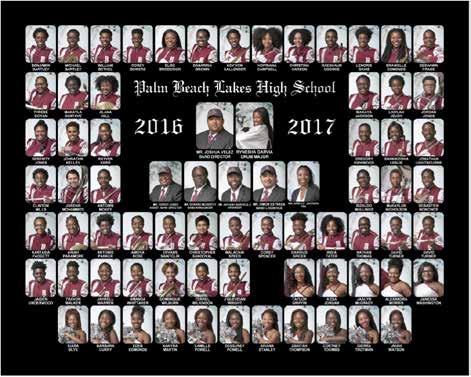
From 70 to 170 Band2016–17picture
At the middle school level, partnerships deepened:
w Joint concerts
w Combined halftime performances
w Sectional mentorship days
w Leadership shadow opportunities
We also provided instructional support where needed—not as supervision, but as collaboration. When middle school students step into high school already feeling connected to its culture, enrollment barriers shrink dramatically. Recruitment became a byproduct of relationship. One middle school student once told me after a joint performance, “I already feel like I go here.” That sentence matters more than any recruitment statistic.
Expanding the Stage: Experience as Motivation
Students stay where they see opportunity.
Expanding our performance calendar was not about being busy—it was about being visible and valuable. We sought experiences that would elevate student perspective.
Performances within a 100-mile radius gave students exposure beyond their neighborhood. Travel reshapes identity. When students perform outside familiar settings, they begin to carry themselves differently.
In 2019, participation in the New Orleans Sugar Bowl New Year’s Parade and Game became a pivotal moment.
Standing on a national stage affirmed what we already believed internally: our students belonged in elite spaces. The impact of that performance extended beyond the event itself. Feeder schools celebrated it. Alumni amplified it. Community pride increased.
Momentum compounds when excellence is public.
Stability Through Uncertainty
The COVID-19 years tested every music educator’s resolve.
Where many programs were forced to pause, we committed to safe continuity. Modified rehearsals, adjusted instrumentation, creative scheduling—whatever it required, we remained active. That decision preserved more than rehearsal time. It preserved identity. Students need consistency, especially during instability. Band became a stabilizing force when so much else felt uncertain.
When in-person instruction fully resumed, we were not rebuilding from absence—we were building from adaptation. Programs that disappear must reintroduce themselves. Programs that endure emerge stronger.
Raising the Competitive Standard
Growth without excellence is unsustainable.
As the only traditional band participating in the Florida Marching Band Championships for several years, we stepped into unfamiliar competitive territory. Traditional style marching often exists outside conventional competitive frameworks, yet it carries immense athletic and cultural depth.
When I refer to a “traditional band,” I am speaking about a marching band style rooted in historically Black college and university (HBCU) traditions. This style emphasizes powerful musicality, precision marching, high-energy performance, and a strong connection to cultural expression and audience engagement. It often includes elements such as dynamic drill design, expressive movement, and a focus on entertainment alongside musical excellence.
Participation signaled something critical: we were willing to be evaluated.
Today, 10 traditional ensembles participate statewide. Representation matters. Progress requires pioneers. Across marching, symphonic, and jazz ensembles, superior ratings became the expectation. Not as a slogan—as a standard. But ratings alone do not build programs.
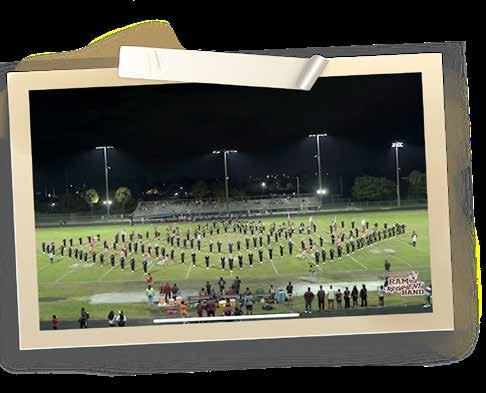
Band 2025–26
Preparation builds programs. Rehearsal pacing improved. Musical literacy became a focus. Visual uniformity was drilled intentionally. Leadership accountability increased. Students rose accordingly.
Leadership Development: Students as Multipliers
At 70 students, leadership feels manageable. At 170, leadership must be systemic. We expanded our student leadership model to include:
w Section leader training workshops
w Peer mentoring systems
w Leadership contracts
w Structured evaluation cycles
Students were not simply given titles; they were given responsibility and mentorship.
When students begin leading culture rather than waiting for direction, growth accelerates naturally. Retention improved significantly once leadership became aspirational rather than ceremonial.
Addressing the Critics
Growth sometimes invites misunderstanding. Occasionally, there are suggestions that expansion limits neighboring programs or creates imbalance. But growth is not a zero-sum equation.
Students choose environments where they feel challenged and valued.
Programs expand when they are nourished consistently.
Sustainable growth requires daily labor that is often invisible:
w Phone calls to parents
w Feeder school coordination
w Grant writing
w Equipment inventory management
w Bus logistics
w Uniform fittings
w Fundraising infrastructure
The visible success represents thousands of invisible decisions.
The Power of Legacy
Perhaps the most personal aspect of this story is legacy. As an alumnus, I am acutely aware that none of this began with me. Former directors built the foundation. They established discipline. They instilled pride. Leadership, in this context, is stewardship.
The invitation to perform in the 2026 London New Year’s Day Parade represents not only present excellence but accumulated credibility. That opportunity belongs to decades of educators and students who contributed before this growth phase. Legacy should never be a finish line. It should be a launchpad.
What Other Directors Can Replicate
Growth is contextual, but certain principles are universal:
w Start with feeder relationships.
w Prioritize visibility year-round.
w Establish non-negotiable standards early.
w Invest in leadership training.
w Maintain stability during crisis.
w Pursue experiences that stretch student identity.
There is no shortcut. As I often say: “I can give you the recipe—but it takes years to bake.”
Looking Ahead
We are not finished. Facility and facility upgrades are in progress. Community partnerships continue expanding. International performance preparation has begun. Alumni engagement is increasing. But the true goal remains unchanged: to create an environment where students feel seen, challenged, and capable of excellence.
From 70 to 170 is not just numerical growth. It is cultural expansion.
It is belief multiplied, and this train does not stop. Not for doubt. Not for distraction. Not even for the Brightline. One hundred seventy strong and still growing.
Joshua Velez, MME , is director of bands, Ram Regiment Band, Palm Beach Lakes High School.
The Sound
Using Visuals to Elevate Music Education and Performance
BY CHRISTINE LAPKA, E d D
FFor many music educators, the classroom is primarily an auditory sanctuary. We educate our students to hear the nuances of a flat pitch, the subtle shift in a choral vowel, or the rhythmic precision of a percussion ensemble. However, while music is an art of sound, the human brain is a powerhouse of visual processing.
Recent educational research suggests that we may be underutilizing one of the most potent tools in our pedagogical arsenal: the visual display. Far from being a mere supplement or a “crutch” for younger students, visuals—when integrated through researchbased frameworks—can fundamentally transform how students analyze, evaluate, and perform music.
Reaching Every Musician: Why Universal Visual Strategies Benefit All Learners
In the heart of every music teacher is the desire to reach every student in the room. This commitment to inclusivity is why the concept of “learning styles” (the idea that some students are “visual,” “auditory,” or “kinesthetic” learners) became so popular. It offered a way to honor the individuality of our students.
of Sight
The Sound of Sight
continued from page 14
However, as our understanding of cognitive science has evolved, researchers like Cuevas (2016) have helped us refine this perspective. While students certainly have preferences for how they take in information, psychological research has consistently shown that matching instruction to a self-reported “style” does not actually improve learning outcomes. Instead, the most effective way to reach “every” student is not by segmenting them into styles, but by providing Universal Visual-Verbal Integration.
The Power of Dual Coding
The reality is that nearly all human brains are wired to process information through multiple channels simultaneously. The foundational theory behind this is Dual Coding Theory, pioneered by Clark and Paivio (1991). This theory suggests that the brain has two distinct subsystems for processing information:
w The Verbal System: Processes language, whether heard or read (e.g., a director’s explanation of a crescendo)
w The Non-Verbal System: Processes imagery and mental representations (e.g., a hand gesture or a graphic representation of that same crescendo)
of 44 studies found that visuals help students move beyond simple recall to analyze, evaluate, and create.
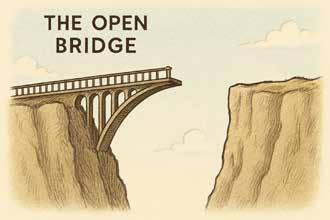
In a music context, this means moving away from visuals that merely say “this is a quarter note” and toward visuals that help students understand why a phrase feels unresolved (see the open bridge) or how a specific harmony functions. Schraw and Richmond (2022) argue that visual displays serve as “cognitive scaffolds.”
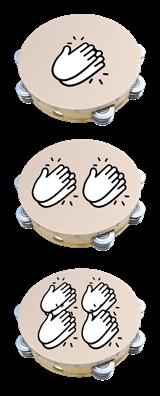
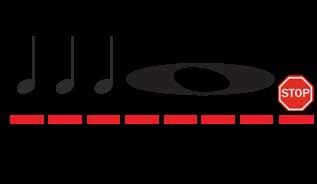
Drums = Beat
Clap = Sound
When we provide information in both formats, we create “double coding” in the brain. This doesn’t just help the “visual learner”—it strengthens the cognitive pathways for every student in the ensemble. By using visuals, we aren’t catering to a preference; we are reducing the cognitive load on the brain and making it easier for students to retrieve musical concepts during the high-pressure environment of a performance.
Visual Displays as Tools for Thinking
Visuals in the music classroom shouldn’t be “decorations.”
According to Guo et al. (2020), visuals have a profound impact on higher-order thinking. Their systematic review
Crescendo
Beyond Literacy to Meaning-Making
Farrar, Arizpe, and Lees (2024) emphasize that “visual literacy” is not just about identifying what is in a picture; it is about “meaning-making.” In music, this means teaching students to interpret visual representations of sound. This interpretive process engages the brain in critical and ethical thinking, allowing students to connect emotionally and intellectually with the repertoire.
Practical Applications for Elementary Music Teachers
For elementary music teachers, visuals are often a staple, but they can be elevated from simple identification tools to “thinking tools.”
1. Student-Generated Shape Maps
Following the findings of Guo et al. (2020), student-generated visuals are more powerful than those provided by the teacher.
w The Activity: Play a recording of a piece with clear contrast (like Grieg’s In the Hall of the Mountain King). After the teacher models shapes that connect to sound, have students draw “Shape Maps.”
w The Thinking: Dots might represent a staccato section while a smooth, wide wave represents a legato section. By asking them to draw what they hear, you are forcing them to analyze musical texture and articulation in real time.
2. Timbre Galleries and Visual Metaphors
Timbre is an abstract concept for young children. Use visual metaphors to help them “see” the sound.
w The Activity: Create a “Timbre Gallery” where different instruments are paired with tactile textures.
w The Strategy: Pair a flute with a picture of silk, a trumpet with a picture of bright, polished metal, and a cello with a picture of heavy velvet. This visual-verbal integration helps students internalize the specific “color” of an instrument’s sound.
3. Icon-Based Foundations
Before introducing traditional notation, use icons that represent the duration of the sound.
w The Strategy: Use a square icon for the beat and split square icons for divided beats. This visual representation of a full beat versus the division provides a concrete foundation for the abstract mathematics of rhythm, making the eventual transition to standard notation much smoother for every child.
Beats Into Smaller Sounds
Practical Applications for Secondary Ensembles
In band, choir, and orchestra, the music score is the primary visual. However, the score is often so dense that students struggle to prioritize information. Visual interventions can bridge this gap.
1. Score Mapping and Color Coding
Schraw and Richmond (2022) suggest that visual displays help with “depth of processing.” Ensemble directors can use color-coding to help students see the “architecture” of a piece.
w The Activity: Have the ensemble “map” their scores during a sectional.
w The Code: Use yellow for the primary melody, blue for counter-melodies, and green for harmonic support.
w The Result: This visual display allows a student to immediately see their “role” at any given moment. It transforms the page from a wall of notes into a functional roadmap.
2. Evocative Imagery for Tonal Color
We often use abstract words like “majestically” or “with fire.” To ground these in Dual Coding Theory, pair them with evocative images displayed on a screen or a board.
Staccato Legato
Dividing
The Sound of Sight
continued from page 17
w The Strategy: Attach a specific image to a rehearsal letter. For a pastoral section in an orchestral work, display a photo of a rolling landscape. For a dissonant, modern choral work, show a piece of abstract expressionist art. This creates a nonverbal anchor for the desired tonal color that words alone cannot convey.
3. Tension-Release Graphs
Guo et al. (2020) highlight that student-created visuals facilitate evaluation.
w The Activity: After a rehearsal, ask students to draw a “tension-release graph” of the piece. Where did the intensity peak? Where did it bottom out?
w The Discussion: Comparing these visual graphs allows for a high-level discussion on musicality. If the flutes draw a peak at measure 40 but the low brass draw a peak at measure 45, you have a visual starting point for a conversation about ensemble balance and intent.
Visuals and Metacognition: Teaching Students to Practice
Metacognition—thinking about one’s own thinking— is the key to independent musicianship. Schraw and Richmond (2022) highlight that visuals are excellent for improving metacognition because they make internal processes external and visible.
The Practice Flowchart
Often, students don’t know how to practice; they simply play through the music and hope it gets better.
w The Tool: Provide a visual “Practice Decision Tree” on a poster in the band or choir room.
THE FLOW:
1. Play the passage.
2. Did I miss a note? (Yes/No)
3. If Yes → Isolate the interval and slow it down.
4. If No → Can I add the written dynamic marking?
This visual display guides the student through the problem-solving process, building their independence and making their practice time more efficient.
Visual Feedback via Video Analysis
Recording a rehearsal is common, but viewing a video is a specifically visual tool.
w The Strategy: Record the ensemble and have them watch it with the sound muted.
w Ask students to describe the “visual energy” of the group.
Do the physical movements of the string players match the phrasing of the music?
Ask singers, “Do our breaths clearly show when phrases begin and end?”
Does the choir look like it is shaping the line, or standing still while music happens?
Bands might be able to see if releases are coordinated visually or scattered.
By isolating the visual, students become more aware of the physical aspects of performance that contribute to the audience’s experience.
Implementing Research-Based Visuals: A Template
To move toward effective visual-verbal integration, teachers can follow a template inspired by the synthesis of Schraw and Richmond (2022) and Farrar et al. (2024):
1. Selection: Choose a visual that is directly relevant to the musical goal (e.g., a diagram of the vocal tract).
2. Integration: Explicitly link the visual to the verbal instruction. “Look at the shape of this dome; this is the space we want to create in our soft palates.”
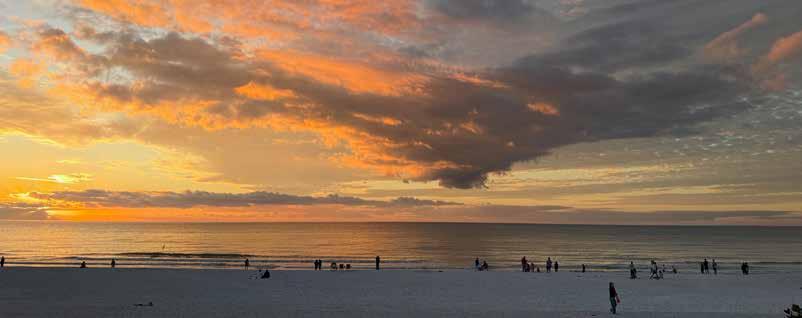
“IF THIS PHOTO WERE A SONG,
WOULD THE TEMPO
BE LARGO OR ALLEGRO?
WHY?”
3. Active Engagement: Don’t just show it; have students interact with it. Ask them to point to the most complex part of a visual rhythm chart.
4. Meaning-Making: Ask students to interpret the visual. “If this photo were a song, would the tempo be Largo or Allegro? Why?”
Conclusion: The Integrated Music Room
The evidence from contemporary educational research is clear: the human brain does not function in isolated “styles.” Instead, it thrives on the synergy between what we hear and what we see. By embracing Dual Coding Theory and moving toward Universal Visual Strategies, music educators can provide a more robust, research-based experience for their students.
Visuals—whether they are teacher-provided diagrams or student-generated maps—are not distractions from the music. They are the scaffolding upon which musical understanding is built. As we integrate these tools into our elementary classrooms and secondary rehearsal halls, we move our students beyond simple recall toward a deeper, more critical, and more expressive engagement with the art of music.
Christine Lapka, EdD, is dedicated to preparing teacher education candidates in the areas of music exceptionalities and elementary music methods at the University of Central Florida (UCF). Prior to joining UCF, she served as a professor of music at Western Illinois University. Dr. Lapka’s dual undergraduate degrees in music education and music therapy continue to inform and enrich her teaching and scholarship.
References
Clark, J. M., & Paivio, A. (1991). Dual coding theory and education. Educational Psychology Review, 3(3), 149–210. https://doi.org/10.1007/BF01320076
Cuevas, J. (2016). An analysis of evidence supporting dual coding versus learning styles. Psychology of Education Review
Farrar, J., Arizpe, E., & Lees, R. (2024). Thinking and learning through images: A review of research related to visual literacy. Education 3–13, 52(7), 993–1005.
Guo, D., McTigue, E. M., Matthews, S. D., & Zimmer, W. (2020). The impact of visual displays on learning across the disciplines: A systematic review. Educational Psychology Review, 32, 627–656.
Schraw, G., & Richmond, A. S. (2022). Using visual displays to improve classroom thinking. Educational Research: Theory and Practice, 33(2), 80–102.
ONLINE
MASTER OF MUSIC EDUCATION
Get your Master’s Degree from Dallas Baptist University! Our Master of Music Education is designed for the working teacher to deepen their knowledge and practical application in music education. Fully Online! You don’t have to leave your teaching position or your home! Special pricing for Online Degrees.
Scan for more details!
FLORIDA MUSIC EDUCATION ASSOCIATION
2025-2026 DONORS
Thank you to all of the donors who have shown their dedication to the improvement of music education in Florida by supporting our Mission through financial contributions.
Our donors support specific causes by donating to the FMEA funds of their choice:
FMEA Scholarship Fund
Music Education Advocacy
General Fund
June M. Hinckley Scholarship
Professional Learning for Members
Mel & Sally Schiff
Music Education Relief Fund
The following have graciously donated to FMEA from April 1, 2025, through April 7, 2026.
MAESTRO’S CIRCLE
$10,000 and up
No current donors at this time.
ARTIST’S CIRCLE
$1,000 – $9,999
All County Music
Artie Almeida
In Honor of my sister, Joyce Slatton, & my niece, Katie Grace Miller
Russell Robinson
Fred Schiff
In Memory of Mom & Dad
DONATE TODAY FOR A STRONGER TOMORROW.
With your support, FMEA will continue to grow its programs for teachers and students, strengthen united advocacy efforts, and improve your professional development opportunities. Visit FMEA.org to learn more information about each fund and to make a donation.
SUSTAINERS
$100 – $999
Carlos Abril
In Honor of Ms. Terry Paulen
Sandra Adorno
Andre Arrouet
Lucinda Balistreri
In Honor of music & arts educators in Sarasota County
Gordon Brock
Trent Brown
In Honor of J. Mark Scott
Kasia Bugaj
Judith Bula Wise
In Honor of Dr. Josh Bula
Dale Choate
In Memory of Dr. Colleen Kirk
Dayna Cole
In Memory of Linda Mann
Alice-Ann Darrow
Virginia Densmore
In Memory of Gene Densmore
Shelby Fullerton Deragon
In Honor of Kathy Sanz
Virginia Dickert
In Memory of Lindsay Keller & Debbie Liles
Michael Dye
In Honor of Michelle R. Tredway
William Fredrickson
In Honor of Clifford Madsen
Kathleen James
In Memory of Dr. Dale Blackwell
Beth & Steven Kelly
Sheila & John King
Jason Locker
In Memory of June M. Hinckley
Joseph Luechauer
Deborah Mar
In Memory of Barbara Kingman
David Martinez-Cooley
John Nista
In Memory of Stanley Dmitrenko
Mary Palmer
Douglas Phillips
In Memory of Dr. Bobby Adams
Kyle Prescott
SUSTAINERS
(Continued)
$100 – $999
Jeanne Reynolds
In Honor of Pinellas County Performing Arts Teachers
Mary Catherine Salo In Memory of Gary Rivenbark & Wes Rainer
Steven Salo
In Memory of John “Buck” Jamison & John Aiello & in Honor of Dr. Bill Prince
Alicia Romero-Sardinas In Memory of John Rose
Meghan Alfaro In Memory of Carol Boyce
David Bayardelle In Memory of Dr. George Sparks
Mark Belfast In Memory of Dr. Mark A. Belfast, Sr.
Greg Carswell
In Memory of all deceased members of the FMEA
William Castillo
Jeff Cayer
Shelby Chipman
Zachary Chowning
Patrick Cooper In Memory of Martha Matteson
Dewey Dodds
Ronald Alumbaugh
Kimberly Bondi
James Bruce
Jamie Bryan In Honor of J. Mark Scott
Addy Burwell
In Honor of Sara Hofschneider
Kathleen Sanz
In Memory of June Hinckley
J. Mark Scott
In Honor of Jason Locker, Michael Dye, Dr. Judy Bowers, Dr. Judy Arthur, & Dr. André Thomas
D. Gregory Springer
Jeannine Stemmer In Memory of Barbara Kingman & Lauren Alonso
PATRONS
$25 – $99
Patrick Dunnigan
Judith Evans
Margaret Flood
Lisa Foltz In Memory of Rev. V. Ron Feener
Bradley Franks In Memory of Gary W. Rivenbark
Tina Gill In Honor of Gary Rivenbark
Dakeyan Graham
John Grau
Ron Guzzo
Julie Hebert In Memory of Marsha Juday
Cynthia Heidel
Bernie Hendricks
Ernesta Chicklowski
Denise Dumala
Timothy Eaton
Debbie Fahmie
Amanda Gilbert
Gabriel Gonzalez In Honor of Luke Hall
Angela Hartvigsen
Leiland Theriot In Memory of Clayton Krehbiel
Richard Uhler
Howard Weinstein In Memory of Barry Weinstein
Kenneth Williams
Anonymous
Anonymous In Memory of Joan Lee Alkyer
Marsha Kindall-Smith
Joshua Langston
Christine Lapka
Matthew McCutchen In Honor of John Carmichael
Amelita McGrath
Katie Grace Miller In Honor of Artie Almeida
Kelly Miller
Katie McGuire Menges
Reiko Niiya
Terry Pattishall
Edward Prasse
Arthur Pranno
Marie Radloff In Memory of Charles F. Ulrey
FRIENDS
up to $24
William Hazlett
Lisa Hewitt
Sara Hofschneider
In Honor of Adaline Burwell
Angel Irizarry
Jason Jerald
Sarah-Christina Larose
Clinton Randles
Diana Rollo
William Rose
Ian Schwindt
Susan Smith
Cheri Sleeper
Eddie Steadman
Andrea Szarowicz In Memory of Byrdie L. Jackson
Katelyn Taylor In Memory of Jared Benyola
Valerie Terry
Anonymous (4)
Anonymous In Memory of Archange Fils-aime
Jessica Moore In Memory of Dr. Nancy Barlar
Merleon Morgan
Brandon Oliva
Elisabeth Olson
Connor Oneacre
Luis Oquendo
John Parris
Sierra Silvia
John Southall
Kelly Southall
Ajori Spencer
Noiree Weaver
Anonymous (8)
Please take time to thank and support our 2025-2026 Academic Partners.
The College of Idaho
BRONZE PARTNERS
Florida Gulf Coast University
Florida Southern College Mercer University Rollins College
Partners as of April 7, 2026.
*Please visit FMEA.org/partners for partnership details or call 850-878-6844.
Please take time to thank and support our 2025-2026 Corporate Partners.
PARTNERS
Cathy’s Choir Class
Hal Leonard
Head’s House of Music
J.W. Pepper & Son, Inc.
BRONZE PARTNERS
Music and the Brain - Building for the Arts
Music is Elementary MusicFirst PACE Travel
Sight Reading Factory West Music Company
FLORIDA BANDMASTERS ASSOCIATION
Jeff Cayer, EdD President
s the school year comes to an end, we enter one of the most meaningful parts of the year. Following music performance assessment, there is still so much to look forward to. Rather than winding down, these last few weeks are filled with opportunities that continue to inspire both students and educators.
In these final weeks, students are often ready to take on new challenges. This
is an ideal time to introduce more advanced and engaging repertoire, allowing them to stretch their abilities
SUMMER CONFERENCE SCHEDULE AT A GLANCE
Monday, July 6:
Board Meeting, Community Band Rehearsal
Tuesday, July 7:
Adjudication Training, Community Band Rehearsals, Past Presidents Reception
Wednesday, July 8:
Community Band Concert, 7-Star/9-Star Rehearsals, Conference Day 1, Family BBQ, Southern Winds Concert
Thursday, July 9:
7-Star/9-Star Rehearsals and Concert, Conference Day 2, Jazz Institute Day 1
Friday, July 10:
Jazz Institute Day 2
Registration is available at: fba.flmusiced.org
and build confidence. Also, attention begins to turn toward preparing for next year’s ensembles and perhaps college auditions. These preparations not only reflect how far students have come but also help them begin visioning their future growth as musicians.
It is also time to celebrate the accomplishments of the past year! End-of-year awards, banquets, and incentive events give us the chance to recognize the commitment and accomplishments of our students. Celebrate your students’ abilities and encourage them to continue to do great things in the future.
In my last FMD article, I mentioned that it might have been too early for the “countdown to summer” posts. Now is the time! I love the creative and imaginative ways that directors count down the days until summer break. While the anticipation of summer break is well deserved, it is essential that we stay intentional in our
work. Maintaining focus and momentum ensures that students continue to grow and finish the year with purpose.
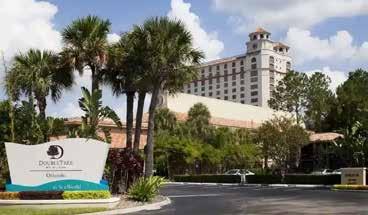
While enjoying your summer break, I encourage you to mark your calendars for our outstanding professional learning opportunity. The FBA Summer Conference will be held July 7–10, 2026, at the DoubleTree by Hilton Orlando at SeaWorld. This annual event provides music educators with valuable insights, practical strategies, and renewed inspiration to carry into the next school year.
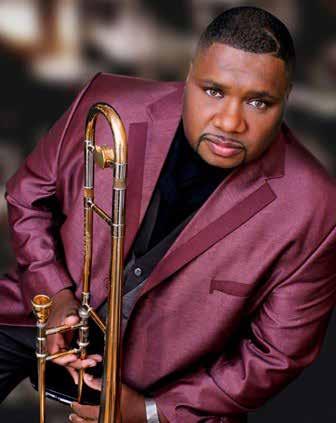
We are honored to feature performance and education and currently serving as director of jazz studies at Augusta University, Mr. Gordon brings a dynamic and engaging perspective you will not want to miss. You can learn more of Wycliffe’s accomplishments on his website: wycliffegordon.com
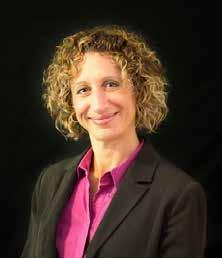
ensemble experiences. One of my favorites is the 7-Star Honor Band. This year, the 7-Star Honor Band will be led by Hannah Jennings of Lake Nona Middle School, and the 9-Star Honor Band will
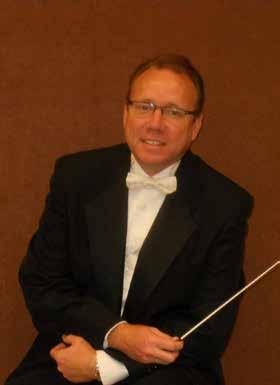
Community Band will be directed by Jon Eckman, director of bands at Bartow High School and of the Bartow Adult Concert Band. Jon’s thoughtful approach will be educational for us all. This ensemble is always a favorite and promises to be an enjoyable experience for performers and audience members alike.
This conference is more than just a professional gathering. It is a chance to collaborate, exchange ideas, and return to your program with fresh energy and perspective. I highly recommend taking advantage of this opportunity.
As we enter the last few weeks of the school year, let’s continue to guide our students with intention while celebrating all they have accomplished. Finishing strong is just as important as starting well. Soon enough, summer will arrive, offering
time to rest, reflect, and prepare for another year of musical growth and excellence.
Wishing you a rewarding end to the school year! I hope to see you this July at the Summer Conference. Go, Band!
A Little Goes a Long Way
Ilovecompleting tasks. I love finishing projects, but even more than that, I love doing them well.
When I was younger, I would set my goals high, but I often struggled to make them work within the time I actually had.
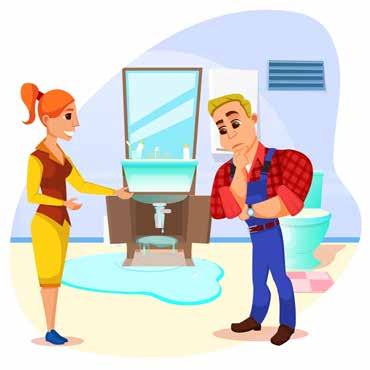
After I had my second child, my husband left for a week-long work trip. As the school year was wrapping up, I had what can only be described as a brilliant idea. I would remodel our bathroom before he got home.
In my mind, this was a cinematic moment. He would walk in, drop his bags, and be stunned by a perfectly finished, magazine-worthy bathroom. Maybe there would even be a slow clap.
I started demolishing the bathroom with absolutely no real plan. I ripped out the sink, tore up the tile, and because clearly I had lost all sense of reason, removed the toilet. All of this while postpartum and home alone with two small children. The tub survived only because even in my delusion, I knew that was above my pay grade.
At some point, I found myself sitting in the middle of the destruction thinking, “Huh … I should probably know how to turn off the water.” So I called my mom.
“Do you know how to shut
off the water to a house?” I casually asked, as if this were a normal Tuesday activity.
She did not take it casually.
When I admitted I had already started demolition and didn’t know where the shut-off valve was, she basically yelled, “STOP TOUCHING THINGS,” and immediately called a plumber friend to come rescue me from myself.
By the time my husband got home, my grand HGTV reveal consisted of some tile and a working toilet. And honestly, at that point, the toilet felt like a major victory.
He walked in, looked around, clearly trying to piece together what had happened, and just stood there silent, understanding exactly what had happened.
But, as he has for the past 26 years, he humored me. He gave me a hug, surveyed the disaster, and then helped me finish what I had very enthusiastically started.
As time has passed, I’ve learned that if I want a remodeled bathroom, I need a lot more time, a better plan, and a clearer understanding of my limitations.
That mindset applies directly to teaching.
Administration plays a role in ensuring we have adequate time to cover course materials. But as teachers, we
Jeannine Stemmer President
must also learn to balance the good days with the difficult ones.
Above all, we must remember that good classroom management is vital to ensure learning. With that in mind:
w If the environment is disrupted, minimize the material for successful learning.
w If the environment is stable, maximize the material for successful learning. No matter what, learning should never be off the table. As we approach the end of the year, disruptions can feel nonstop. Testing schedules, field trips, and students who are absent both physically and mentally all contribute to distractions that can feel insurmountable. Even the students sitting right in front of you are often distracted by
who isn’t there. So, how can we remain effective?
How do we teach and ensure growth when the environment, the situation, and even the culture feel like they’re working against us?
Our responsibility is not just to teach. It is to ensure that students experience learning.
I can teach the wall solfège, but if the wall never learns, am I fulfilling my professional responsibility?
More importantly, am I fulfilling my purpose?
I would argue no. So, what’s the solution?
A little goes a long way. Small successes are still
successes:
w Perfecting four measures is better than rushing through 16 with little focus.
FLORIDA VOCAL ASSOCIATION
w Dictation still matters, even if it’s just one measure.
w Sight-reading still counts in 3/4 time with only do, re, mi.
w Progressions still matter even if it’s just tonic in root position.
w Music terminology still sticks when you yell forte and whisper piano.
w A performance still matters even if it’s one song learned by rote and a 20-minute mini-concert.
Because tomorrow, you can always add another measure, introduce another chord, and add fa, so, la to your sightreading.
You might even start a song you never end up performing, and that’s OK.
The bigger picture is that learning doesn’t have to be big to be meaningful. It can happen in small, consistent successes every day.
By the end of the week, you might surprise yourself.
More importantly, your students will have grown.
You will have fulfilled your professional purpose.
As you wrap up your year, make sure to finish strong.
You are an essential part of the learning for this generation of young people, and an essential part of their lives.
MayFLORIDA ELEMENTARY MUSIC EDUCATORS ASSOCIATION
Meghan Alfaro President
has arrived, and summer is on its way!
This means you have successfully led your students through another year of elementary music education. Let’s take a few moments to remember exactly what that means.
You’ve shared the joy of music-making.
Elementary music educators build the foundation for a child’s whole musical journey. There is nothing quite like the sound of a young person exploring music in new ways through singing, moving, listening, and playing. You get to provide those pivotal first experiences that shape a child’s life.
You’ve expanded creativity. When many other areas of school prioritize one right answer, you provide a space where your students can explore possibilities. Which timbre to choose for this story sound? How loud or soft should we perform? What movements could we add to this performance? The possibilities are endless, and you give them a chance to explore their thinking and innovate solutions to musical problems.
You’ve helped grow their brains.
You’re strengthening pathways that support learning far beyond your classroom. When your students sing, play, move, and listen, their brains are forming connections across multiple regions at once. Coordination, memory, emotion, and cognition are all working together. This is proven neuroscience!
You’ve built courage and confidence.
Every time a child walks into your room and tries something new, you’ve built courage. Every time a child leaves your classroom with a new musical skill they didn’t know they could do, you’ve built confidence. These lifelong skills are invaluable. When children can imagine for themselves new possibilities and then be brave enough to try them, a big world becomes a little less intimidating.
Remember to be brave.
A common theme in my communications this year is to share the good news of elementary music education. What elementary music teachers do is vitally important. Don’t be afraid to share the great things you do in your classroom. Invite your administrator to come watch a lesson. Share your performances with community members. Include advocacy information in your performance programs. As FMEA Advocacy Co-Chairperson Jeanne Reynolds has said, “The best advocate for music education is a strong music program.” A strong elementary music program builds a strong middle school program, and finally a strong high school program. Just as first grade teachers are foundational in a child’s reading journey, so are elementary music teachers foundational in a child’s musical journey. Keep spreading the good news! You make a difference every single day. Take some time to relax and reflect this summer. You deserve it! It is truly a privilege to serve our community of elementary music educators. Thank you for this opportunity.
Andrea Szarowicz President
Leading With Gratitude, Looking Ahead With Purpose
s the school year winds down, we transition from the whirlwind of music performance assessment season into the equally busy stretch of spring concerts, banquets, and year-end celebrations. It often feels as though our work is never truly finished. Yet, in the midst of this activity, it is important to pause and reflect on the extraordinary accomplishments of our students and educators across the state.
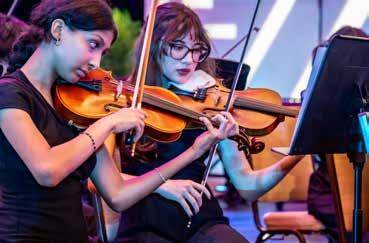
I would like to take a moment to recognize the incredible performances at our State Solo and Ensemble, held at Florida Southern College on March 28, 2026, as well as State Concert MPA, held April 13–15, 2026, at Titusville High School. It was truly an honor to hear your orchestras and to witness the dedication, artistry, and growth demonstrated by
our students under your guidance.
A sincere thank you to our outstanding state solo and ensemble adjudicators—Dr. Rachel Friedman, Dr. Jesus Alfonzos, Dr. Steven Thomas, Dr. Megan Maddaleno, Dr. Robert Hasty, and Professor David Bjella. With 44 schools participating and 291 entries, this event showcased the depth and excellence of orchestral programs across Florida.
We are equally grateful to our state concert MPA judges and clinicians— Dr. Alex Jimenez, Professor Bruce Walker, Dr. David Saccardi, Dr. Robert Gardner, and Dr. Kirk Moss. Their expertise, feedback, and encouragement provided invaluable guidance to both students and directors of the 58 participating schools.
We are deeply appreciative of their commitment to
supporting music education at the highest level.
At the Florida Orchestra Association, our mission remains steadfast: to serve the needs of our students and educators while fostering excellence in orchestral education. This year, the FOA Board has worked diligently on several important initiatives, including revisions to assessment sheets, updates to the music list, and continued development of all-state and committee work. These ongoing efforts reflect our shared commitment to growth, clarity, and service to our membership.
As we look ahead, I encourage you to mark your calendars for our upcoming FOA/ASTA Fall Conference, which will take place October 15–16, 2026, at the Hilton Orlando. We are excited to present this year’s conference theme: The Orchestra Classroom That Matters: Engagement, Care, and Building Programs That Last. We are honored to welcome Professor Bruce Walker as our keynote speaker. This conference promises to be an inspiring and meaningful experience, filled with opportunities for professional growth, collaboration, and connection with colleagues from across the state.
It has been a privilege to serve alongside such dedicated and talented educators this year. I extend my heartfelt gratitude to our board members, adjudicators, clinicians, volunteers, and all who have contributed to the continued success of the Florida Orchestra Association. Your commitment to our students and to one another is what makes this organization so exceptional.
I am honored to continue serving as your president in the coming year, and I look forward to the important work ahead as we continue to build a strong and vibrant future for FOA. As always, we value your input— whether regarding conference planning, handbook updates, or new ideas—and I encourage you to reach out to me or any member of the board.
As the academic year comes to a close, I hope you take time to reflect on the many successes you and your students have achieved. The impact we make as music educators is profound—we shape lives each day through the power of music.
Thank you for the privilege of serving this incredible organization. I wish you all a restful, rewarding, and welldeserved summer break.
FLORIDA NAfME COLLEGIATE
Mark A. Belfast, Jr., PhD Advisor
Reflecting, Celebrating, and Looking Ahead
Nowthat we’ve reached the end of the academic year, it’s worth taking a moment to reflect on all you’ve contributed to your chapters, communities, and the profession of music education. This year was marked by dedication, creativity, and a clear commitment to serving others through music. From organizing events and engaging in meaningful field experiences to building community within your chapters, your work has made a lasting impact.
Grace E. Wieckowski President
It’sThis month, I hope you feel both a sense of accomplishment and the anticipation of what lies ahead. Summer offers a valuable opportunity to recharge, but it is also a time for continued growth. Whether you’ll be teaching, attending camps, performing, or preparing for student teaching, I encourage you to stay connected to your purpose as a future music educator. Each experience you pursue strengthens your musicianship and pedagogy, equipping you to make a
hard to believe I’ve finished my first semester as president of Florida NAfME Collegiate. So many wonderful things have happened this semester that I’d like to reflect on.
Starting back in January, we had our FMEA conference. It was wonderful to have so many of our collegiates gathered and able to make connections with one another. This is also when I assumed the role of president and we elected our new state board. A huge shout out to the current state board members, Emma, Ella, Leo, Christina, and Calliope, for the support they’ve given me in their positions. I’d also be remiss if I didn’t thank the outgoing board members, Jason, Kathryn, Loanne, Elizabeth, and Alana, for everything they did for Florida NAfME Collegiate during their terms.
In February we had our 10th annual Collegiate Advocacy Day. This was my second time attending the state “hill day,” and it’s such a special event. If you’re unfamiliar, the event brings together collegiates from across the state to our state capitol building in Tallahassee to advocate for legislation that supports music education in our
schools and teachers in classrooms. This event keeps getting bigger every year, and it’s inspiring to see so many of our collegiates getting involved in advocacy.
March was Music in Our Schools Month, and we had many of our chapters participate in the NAfME Collegiates in Action Week social media campaign. Through this campaign we were able to see the amazing work being done around the country by NAfME Collegiate members.
In April, NAfME Collegiate announced the winners of the individual and chapter awards, and I could not be more proud of our Florida chapters! We had three of our Florida chapters and one individual win awards. Congratulations to FGCU, UM, FIU, and Jordan Mash (member of FIU Chapter) for all your hard work these awards showcase.
Looking to the future, we have so many amazing things coming up: from NAfME Collegiate Leadership and Advocacy Summit to Fall Conference to FMEA. There are many ways for our members to get involved and make a difference, and I’m excited to see how engaged our membership can be.
We had such a strong semester as Florida NAfME Collegiate, and I can’t wait to see what next semester holds for us. Every member inspires me and makes me so proud to be your president. Let’s keep up the amazing work. Go, Florida NAfME Collegiate!
FLORIDA NAfME COLLEGIATE
meaningful impact in the communities you will one day serve.
I will also take this opportunity to recognize several outstanding achievements within our community.
Congratulations to the following chapters for being named NAfME Collegiate Chapters of Excellence:
w Florida Gulf Coast University (Recruitment)
w Florida International University (Service)
w University of Miami (Advocacy)
These honors reflect sustained effort, thoughtful leadership, and a deep commitment to advancing music education. South Florida in the house! Furthermore, congratulations to Jordan Mash (FIU) for being selected as a recipient of the 2025–26 NAfME Collegiate Professional Achievement Award. This recognition highlights exceptional promise and dedication to the field, and we are proud to see such excellence represented within our state. Well done, Jordan. Proud o’ you!
Representatives from FGCU, FIU, and UM will be recognized at the NAfME Collegiate Leadership Advocacy Summit (CLAS), taking place June 22–24, 2026, in Reston, Virginia. This summit is an incredible opportunity for professional growth, leadership development, and nationallevel advocacy. Attendees will join collegiate leaders from across the country to engage in meaningful learning experiences and will travel to the U.S. Capitol to speak directly with legislators in support of music education. All Florida NAfME Collegiate members are invited to attend. Go to this link to read about CLAS and to register for the event: NAfME.org/Advocacy/nafme-collegiate-summit
Looking ahead, your State Executive Board will be meeting with FMEA leadership later this month to reflect on this year’s successes and to continue planning for the upcoming academic year. We want Florida NAfME Collegiate experiences to be accessible, meaningful, and impactful for you, and your voice plays an important role in that process. Please do not hesitate to reach out to your state board members with suggestions or requests. Use the contact form on the website (flnafmecollegiate.com) or email them to flnafmecollegiate@ gmail.com
Finally, thank you for your passion, professionalism, and commitment to music education. I am truly proud to be associated with such an exceptional group of young educators. I wish you a restorative, inspiring summer, and I look forward to all you will accomplish in the coming year.
FLORIDA COLLEGE MUSIC EDUCATORS ASSOCIATION
Kyle Prescott, DMA, President
Plan Your Proposals
s the spring semester moves forward, faculty across the country begin preparing papers, clinics, and research presentations for the 2026–27 conference cycle. While our own FMEA Professional Learning Conference remains a central priority, it is only one of many opportunities available. Numerous regional, national, and international conferences will soon open their calls for proposals, each offering meaningful platforms to share our work as artist-teachers and scholars.
their deadlines can quickly become time intensive. In addition to traditional searches, faculty may find it helpful to leverage AI tools to generate curated lists of conferences aligned with their interests, complete with submission links and timelines. These tools can also assist in refining proposal topics and shaping abstracts, providing a useful starting point during the late spring and summer months.
To support our membership, the Florida College Music Educators Association has compiled a centralized webpage of conference application links and deadlines, available at FCMEA.org. This resource is designed as a starting point that you may further tailor to your individual goals.
In addition, FCMEA continues to recognize excellence across our profession. Applications are now open for two new faculty awards: the Award for Teaching Excellence and the Award for Research and Creative Activity. Details and submission portals are available on our website.
As we look ahead, I encourage each of you to consider how your work can contribute to the broader conversation in our field.
FLORIDA GUITAR EDUCATION ASSOCIATION
Christopher Perez President
s we wind down the second semester, we have enjoyed or are making final preparations for our spring concerts. It’s certainly been a busy and productive year.
Join FGEA!
I encourage colleagues from around the state who teach guitar to join our newest FMEA council, the Florida Guitar Education Association! By joining FGEA and FMEA, together we will continue to grow and support the best in music education for all students!
Go to this link to join or renew: FMEA.org/ Membership
2027 All-State Guitar Update
As of May 4, the 2027 AllState 9–12 and 7–8 Guitar Ensemble audition items are available for immediate download and summer practice. We are honored to have Dr. Stephen Mattingly (FSU) (9–12) and Bobby Koelble (Rollins College/
SUMMER GUITAR WORKSHOPS
UCF) (7–8) leading our 2027 All-State Guitar Ensembles. Both conductors have chosen a challenging and varied program that will surely excite performers and audience members alike at the 2027 FMEA Professional Learning Conference & AllState Concerts.
Go to this link for the
FMEA Guitar Page for info and download: FMEA.org/ programs/guitar/
FGEA Development
Summer is a time to recharge and renew. While individual counties will hold their own pre-planning professional learning opportunities in August, I urge all guitar teachers and their students to consider participating in one of the many summer guitar workshops to elevate and upgrade your teaching and playing. Having participated in and contributed to different workshops in the past, the personal growth, learning, musical experiences, and performance opportunities always proved most invaluable heading into a new school year. Links are here:
TGW (Teaching Guitar Workshops) Various dates and locations teachingguitarworkshops.org
GFA (Guitar Foundation of America) Denver, Colorado guitarfoundation.org/page/2026Convention Leyenda Convention Oklahoma City, Oklahoma leyenda-foundation.com
Peabody Summer Guitar Institute Baltimore, Maryland
At the end of May, I will reach out to our FMEA guitar education teachers/directors and schedule a summer meeting to be held in late July. The FGEA is in a position for incredible growth. Here we can discuss and share our concerns, forward ideas, gain input, and seek assistance from our membership in helping develop:
w FGEA Handbook
w FGEA district chairperson nominations
w FGEA Guitar Ensemble Music List committee/ editors
w FGEA Summer Professional Learning Conference/Workshop, and more … Congratulations on a fantastic year! I look forward to working with our members on future collaborations as we continue to grow the FGEA.
John J. Dupuis President
The Program Between the Programs Rethinking the ‘In-Between’ Spaces in Music Education
Music programs are often measured by concerts, assessments, community performances, and enrollment numbers. Yet some of the most meaningful learning happens in the spaces between these moments. These “in-between” spaces (before school rehearsals, passing periods, bus rides to performances, post-concert reflections, and even the first five minutes of class) form an unofficial curriculum that shapes the student experience just as effectively as any formal lesson plan.
For music supervisors, these moments are rarely part of district conversations, yet they are where culture is built, relationships are strengthened, and student identity as musicians is often developed. A student may forget a specific warmup exercise, but they will remember how they felt walking into the rehearsal room, how they were welcomed by others, and whether they felt a sense of belonging and purpose. Consider the first few minutes of a rehearsal. In
some classrooms, this is unstructured time where students trickle in, chat, and wait for instruction to begin. In others, it is intentionally designed: students warm up on their own, place their music in order, and engage immediately in musical activities. These routines over time can significantly impact student ownership, leadership development, and overall program cohesion.
Transitions are another powerful space. Moving from one activity to another, full ensemble to sectionals, or rehearsal to dismissal can either feel rushed and disconnected or purposeful and efficient. Teachers who intentionally design transitions create a sense of momentum and clarity, reinforcing that every minute of the rehearsal has value.
Post-performance moments may be the most impactful “in-between” space of all. After the performance is over, what happens next? Is there time for immediate reflection, celebration, and constructive dialogue? Or do students simply pack up and move on?
Programs that intentionally build in reflection, whether through quick discussions, written responses, or peer feedback, help students internalize their experiences and grow as musicians. One practical step is to ask questions. Instead of focusing solely on repertoire, pedagogy, and assessment, we can ask: How are teachers structuring the first five minutes of class? What routines are in place for transitions? How are students engaged during travel or downtime? These questions shift the focus
from isolated events to a more continuous student experience.
Ultimately, the “program between the programs” is where much of culture lives. It is where students decide whether they belong, whether their voice and opinion matter, and whether music is something they will carry with them beyond the classroom. By bringing intentionality to these spaces, teachers can help ensure that every minute contributes to a rich, robust, and meaningful music education experience.
FLORIDA CONTEMPORARY MUSIC & MEDIA ASSOCIATION
Clint Randles, PhD President
Introducing the Florida Contemporary Music and Media Association
The launch of the Florida Contemporary Music and Media Association (FCMMA) marks an exciting and much-needed step forward for music education in our state. As classrooms and rehearsal halls continue to evolve alongside rapid technological and cultural shifts, this new organization arrives at a pivotal moment, when contemporary music and media are no longer supplemental, but essential components of a well-rounded music education.
For years, Florida’s music educators have demonstrated remarkable excellence in traditional ensembles—
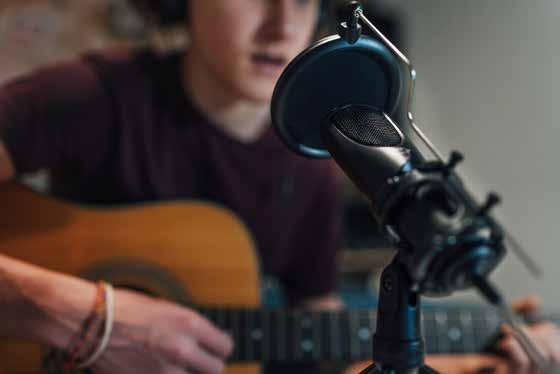
band, orchestra, and choral programs that continue to set national standards. At the same time, many teachers have been expanding their offerings to include guitar, keyboard, music production, songwriting, and digital media. These programs engage students who may not otherwise see themselves in traditional pathways, providing them with relevant, creative, and future-facing opportunities. The FCMMA has been established to support and unify these efforts. Its mission is clear: to provide resources, advocacy, and professional community for educators
teaching contemporary music and media across Florida. Whether it is a teacher launching a beginner guitar class, building a recording studio, or guiding students through composition and beat production, this association aims to be a central hub of support and inspiration.
One of the most promising aspects of FCMMA is its commitment to professional learning. As technology continues to reshape how music is created and consumed, educators must continually adapt. The association plans to offer
workshops, conferences, and collaborative spaces where teachers can share best practices, learn new tools, and stay current with industry trends. This kind of targeted support is invaluable, particularly for educators who may be the sole contemporary music specialist on their campus.
Equally important is the sense of community FCMMA seeks to foster. Teaching in emerging disciplines can sometimes feel isolating, especially when curriculum models are still being defined. By connecting educators across districts and regions, the association creates opportunities for collaboration, mentorship, and shared growth. These connections ultimately strengthen programs and, most importantly, enrich student experiences.
Advocacy is another cornerstone of the
organization’s work. Contemporary music and media programs often require specialized equipment, flexible scheduling, and administrative understanding. FCMMA will serve as a voice at the state level, helping to articulate the value of these programs and ensuring they receive the recognition and support they deserve. By aligning with broader educational goals, the association positions contemporary music as an integral part of 21st-century learning.
As we welcome the Florida Contemporary Music and Media Association, we recognize that its success will depend on the collective energy of Florida’s music educators. This is an invitation to be part of something transformative— to contribute ideas, share expertise, and help shape the future of music education in our state. The students in our classrooms today are growing up in a world where music and media are deeply intertwined. By embracing this reality and supporting organizations like FCMMA, we ensure that our programs remain relevant, inclusive, and inspiring for generations to come.
Jared Allen, PhD President
Should You Join FSEA?
Hello,
fellow music educators! The end of the year is here, and the Florida Steelband Education Association Board and its members wish you the best as we close out the 2025–26 school year. As you transition into the summer and consider the coming school year, the FSEA would like to encourage you to become a member when you complete your FMEA registration. How do you know if you should join FSEA?
w Are you an elementary, middle school, high school, or collegiate music teacher who currently teaches a steelband?
w Are you an elementary, middle school, high school, or collegiate music teacher who wants to teach steelband?
BY WILLIAM SAHLEY Florida Steelband Education Association President-Elect SAHLEY
w Do you teach a steelband “club” or “activity” before or after school?
w Do you teach a curricular steelband during the day?
w Are you a music director who teaches mostly band, chorus, orchestra, or any other musical discipline who also teaches one period of steelband?
If the answer to any of these questions is “yes,” then YOU are a perfect candidate for the FSEA! By joining the FSEA, you gain a group of colleagues well versed in the ways of steelband. You do not need to feel like you’re “on an island” when it comes to teaching steelband. There are many directors across the state who can assist you with things such as:
w Arranging for your instrumentation
w Rehearsing a steelband
w Setting up your classroom or rehearsal space
w Moving steel pans from rehearsal space to performance locations
w Gaining confidence transferring your musical knowledge to the steelband idiom
The FSEA is here for you. We are excited to hit the ground running and look forward to welcoming you to our council!
DIVERSE LEARNERS COMMITTEE
Christine Lapka, EdD Chairperson
AI for Access, Not Replacement Supporting Diverse Learners in the Music Classroom
AI is becoming an increasingly helpful partner in our classrooms, especially when it comes to making learning more accessible for everyone. Tools like text-tospeech (notation to sound), speech-to-text (sound to notation), captioning, and real-time language translation can open doors for students who struggle with reading, writing, or communication. These tools help students to access lessons in ways that work for them and allow them to show what they know or can do without unnecessary barriers.
1. Convert Written to Sound
Text-to-Speech (TTS) converts written text into spoken audio, supporting students with reading disabilities, low vision or blindness, or decoding challenges. It makes print more accessible for learners with diverse communication needs. Try Balabolka it is free for schools and noncommercial uses.
Notation to Sound
This tool converts music notation into sound, offering parallel support for students who rely on auditory access to the curriculum. Most notation software will play sound directly or export audio files for students to listen and view the notation. Options include MuseScore or applications like forScore and Sheet Music Scanner.
Bottom Line
w Helps students access grade-level content even when independent reading is difficult
w Supports comprehension by pairing auditory and visual input
w Research supports TTS (Raffoul & Jaber, 2023): Acts as a compensatory tool for decoding difficulties
Improves reading speed, fluency, and retention
Boosts motivation and self-efficacy, helping students feel capable and independent
2. Convert Sound to Symbol
Speech-to-Text converts spoken words into written text, benefiting students with fine motor difficulties, dysgraphia, or expressive language challenges. Captioning provides realtime on-screen text during spoken instruction or media. PowerPoint’s closed captioning feature offers realtime, AI-powered rendering of spoken audio or video content. In Slide Show mode, PowerPoint can display your speech instantly.
Sound to Notation
AI-powered transcription converts audio into music notation. MelogenAI is a strong option. It allows students to:
w Record or upload a melody
w Convert it to MIDI
w Edit or view notation in any free program (MuseScore, Noteflight, etc.)
Bottom Line
w Allows students to demonstrate understanding without the barrier of handwriting
w Enables more efficient written expression
w Supports students who are deaf or hard of hearing
w Aids learners with auditory processing disorders
w Helps multilingual learners follow spoken English
w For students who think musically but struggle with notation, transcription tools act as a bridge. They can hum, sing, or play an idea, convert it to MIDI, and then refine the score in notation software.
w Ensures that students with dysgraphia, motor challenges, or early notation skills can fully participate in musical tasks
3. Real-Time Language
Translation converts spoken or written English into a student’s home language. For those of us who have ever struggled to communicate, it turns moments of confusion into moments of connection.
Bottom Line
w Supports multilingual students with disabilities who may face compounded barriers
w Makes the curriculum more inclusive
4. Other Thoughts
w Reduce barriers to accessing general education content
w Support Universal Design for Learning (UDL) by offering multiple ways to receive and express information
w Help educators differentiate instruction for students with multifaceted learning profiles
w Free teachers from some administrative tasks so they can focus more on relationship building and direct support It’s important to note that the use of AI in music education is not an endorsement of replacing essential musicianship skills—such as developing aural skills to transcribe music independently. In fact, these AI tools can become crutches for some typically developing students if used without intention or balance. However, for the reasons listed above, these tools can level the playing field for diverse learners who otherwise face barriers.
Reference Raffoul, S., & Jaber, L. (2023).
Text-to-speech software and reading comprehension: The impact for students with learning disabilities. Canadian Journal of Learning and Technology, 49(2). https://doi.org/10.21432/cjlt28296
Summer Madness? SummerCon 2026!
TheEMERGING
Co-Chairpersons
2025–26 school year is just about done, and we are finally ready to sing those famous Alice Cooper lyrics:
School’s out for summer School’s out forever …
No more pencils, no more books
No more teachers, dirty looks
If you don’t know, just google it!
Anyhow, we’ve reached that time of year when the students are thrilled that summer is here, teachers are relieved that summer is here, and parents are terrified that summer is here. This array of feelings is why we themed this column “Summer Madness?” Interestingly, the song Summer Madness (1974 by Kool & The Gang) is anything but mad. In fact, Google AI says the song is “known for its smooth, laid-back groove that evokes feelings of long lazy summer evenings.”
Your FMEA Emerging Leaders Committee wants you to view this season through that same lens: a multifaceted time to shift the focus from your students back to yourself. Summer is also a time of rejuvenating your music education battery and thinking about the ways you lead each and every day in your classrooms and if you’re ready to take it one step further and share what you’re already doing with the rest of our profession. It’s our never-ending effort to always be thinking of the future. Not only of our organization, but the future of music education as well. It’s that time when you can evaluate your current leadership role and investigate new opportunities as well as identify who you will lead, guide, and mentor as you prepare for the next school year.
While it is a time of rest, it’s also a time to continue to grow through summer professional learning opportunities that are taking place all over the state throughout the summer months. The FMEA Emerging Leaders Summer Leadership Conference will take place June 10–11, and the FMEA Multicultural Network Summer Professional Learning Workshop is June 12–13. Both will be held at The Florida Hotel & Conference Center in Orlando. These are just two of the many growth opportunities that will take place this summer and provide all participants with the ability to continue to grow and develop as music educators and music leaders throughout the lazy, relaxing, and chill summer months. Registration information for these and other activities can be found on the FMEA website: FMEA.org
Have a great summer, everyone, and remember that whatever you decide to do with your valuable time this summer, make sure you put you at the forefront of all your adventures! Taking care of yourself is the only way you can effectively and enthusiastically take care of others when we come back. Take care, stay cool, and find your groove!
Bernard (Bernie) Hendricks, Jr.
Jason Locker
s we wrap up another school year of quality music education, I applaud all music educators for promoting and exemplifying quality music education on a daily basis. YOU are a music education hero, rising above and being the light for all of your students!
Speaking of heroes, it’s that time of year when I ask you to consider who in your sphere of influence is deserving of recognition by the FMEA Awards Program
In the coming months I will continue to share with you a little of the brilliance our awardees have to offer you, speaking their truth about music education and the passion that drives them. I share these words of inspiration to give you confidence to be the light to your own students, as well as the drive to help shine a light on others during our nomination period.
Here is your monthly dose of inspiration, inspiring through words of purpose and passion, from our 2026 FMEA College Music Educator of the Year, Dr. Mark A. Belfast, Jr., assistant professor of music education at Florida State University and advisor of Florida NAfME Collegiate. ➡
2026 FMEA COLLEGE MUSIC EDUCATOR OF THE YEAR
Sondra A. W. Collins Chairperson
Dr. Mark A. Belfast, Jr.
“We are so fortunate to have world-class institutions of higher learning here in Florida, and my colleagues in music education across the state are some of the most brilliant, talented, and impactful people within our profession. That’s why I am truly humbled and honored to be named FMEA’s 2026 College Music Educator of the Year.
I often tell my students that teaching is really hard, but teaching and learning are a natural part of the human experience. We are also musical beings and we rely on musical sounds long before we develop the ability to form natural speech and other typical communication methods, which is why intentional, systematic, and purpose-driven music education is essential throughout all stages of human development .
I love the time that I spent as a secondary music educator. And now, as a teacher educator, I feel I have truly found my purpose. Few things make me feel more fulfilled than serving others and watching them thrive. And I strive to show my students that positive relationships and a posture of service lead to joy. So, thank you Florida State University, FMEA, and all of my students and colleagues, present and past, for allowing me to serve well. Thank you, Dr. Steven Kelly, for opening the right doors at the right time so that I might live out my dreams. Thank you to the incredible educators who supported my nomination with letters of reference. Thank you to the FMEA Awards Committee for granting me this honor. And thank you, most of all, to my incredible wife and my brilliant son—without them, nothing I did would have meaning. Lee Iacocca said, ‘In a completely rational society, the best of us would be teachers and the rest of us would have to settle for something else.’ I’m grateful I’ve never had to settle.
Thank you, FMEA. I am honored to serve as the 2026 College Music Educator of the Year.”
Research Puzzles
FOR MUSIC TEACHERS
This on-going column seeks to stimulate awareness of research issues for FMEA teachers and researchers.
FMEA RESEARCH COMMITTEE
D. Gregory Springer, PhD, Chairperson Florida State University
Elementary Music Teachers’ Communications in a Social Media Community
Music teachers find community through membership in professional associations like FMEA and in many other places. Social media is another source of community for music educators. Although some bemoan the flaws of social media generally, there are online communities for music teachers that provide new information about best practices in teaching as well as social connection and networking among colleagues. In previous studies, researchers have examined interactions on the Facebook Band Directors Group (Brewer & Rickels, 2014; Rickels & Brewer, 2017), Choral Directors Facebook Group (Wayman, 2016), and the School Orchestra and String Teachers v2 (SOST v2) Facebook group (Palmquist & Barnes, 2015). In a recent article published in Update: Applications of Research in Music Education, Dr. Jennifer Gee (San Diego State University) conducted a content analysis of professional interactions of those in the Elementary Music Teachers Facebook Group (Gee, 2025). As stated in the article, “the purpose of this study was to examine professional interactions among music educators in the Elementary Music Teachers Facebook group” (p. 1). She systematically analyzed all the posts (n = 749), reactions (n = 11,271), and comments (n = 11,321) in the group across a one-month period.
development, knowledge exchange, and mutual support” (p. 8). All members of NAfME/FMEA can access articles in Update: Applications of Research in Music Education for free. I encourage you to read the entire article to see the complete results.
References
As in previous research, Gee (2025) distinguished between curricular (content directly related to student learning in music), co-curricular (content not directly related to student learning), and community (content related to social dynamics) content. She found that the majority of curricular posts focused on repertoire suggestions and lesson planning, whereas co-curricular posts primarily focused on performance logistics and instruments. Community posts were commonly about humor and sharing other information with other teachers. Based on the findings of this study, it is clear that many teachers make use of the Elementary Music Teachers Facebook Group and that it serves as a form of informal professional learning. Moreover, it seems to function as a place of community for elementary music teachers. As Gee (2025) explained, “Together, these interactions demonstrated how the group functioned as a community of practice, fostering skill
Brewer, W. D., & Rickels, D. A. (2014). A content analysis of social media interactions in the Facebook Band Directors Group. Bulletin of the Council for Research in Music Education, 201, 7–22. https://doi. org/10.5406/bulcouresmusedu.201.0007
Gee, J. L. (2025). Exploring trends in social media and music education: A content analysis of the Elementary Music Teachers Facebook Group. Update: Applications of Research in Music Education. Advance online publication. https://doi.org/10.1177/87551233251349832
Palmquist, J. E., & Barnes, G. V. (2015). Participation in the School Orchestra and String Teachers Facebook v2 group: An online community of practice. International Journal of Community Music, 8(1), 93–103. https://doi.org/10.1386/ijcm.8.1.93_1
Rickels, D. A., & Brewer, W. D. (2017). Facebook Band Director’s Group: Member usage behaviors and perceived satisfaction for meeting professional development needs. Journal of Music Teacher Education, 26(3), 77–92. https://doi.org/10.1177/1057083717692380
Wayman, J. (2016). Choral Directors Facebook Group: A content analysis of social media interactions. Missouri Journal of Research in Music Education, 53, 19–33
Email your questions and feedback to dgspringer@fsu.edu with a subject heading Research Puzzles.
Scott Evans Executive Director Florida Music Education Association
The Beautiful Mess of Music-Making: Joy, Inclusion, and Learning NOTES
This week I had an experience that really moved me, and it tied back to the joy I wrote about in my April piece—joy as the gateway to learning in the music classroom.
Like many of you, I’ve spent hours in cafetoriums, auditoriums, and concert halls, listening and enjoying music while being quiet and still. Making sure as a trained musician and practiced audience member to show my respect for the artistry on the stage and allowing for the music to be appreciated by all around me. Recently I attended a concert for exceptional students as part of UCF Celebrates the Arts, and I was reminded how powerful and fulfilling it can be to invite audiences to respond to the music as they hear it in a way that truly reflects what they are experiencing and feeling.
The concert was packed with young people, and the energy was fantastic. From the start, caregivers were invited to let students engage with the music in whatever way fit their needs. The fine musicians on the stage were prepared for the experience and welcomed the engagement. The room was alive— students talking, laughing, sometimes crying even screaming, and moving in response to sound. When the music felt too loud, students covered their ears
or utilized noise-canceling headphones. When it felt fun, they didn’t wait for a cue—they laughed, danced, and applauded on the spot. Their reactions were honest.
It was loud, at times chaotic, and really beautiful.
As a music educator, I enjoyed observing what this true expression can look like. We often call music a universal language, but we don’t always give students the dialects and space they need. This concert showed how when the space is created, music can open real opportunities for students of all abilities to be themselves and connect with what they hear.
Really this experience was not unlike what I have observed in music classrooms across our state. You are often told by evaluating administrators that your rooms can seem noisy and chaotic. They are not wrong. The music-making process is messy, noisy, chaotic, unkempt, and really beautiful. Because of that, our students make deeper and more meaningful connections. This fosters those moments of joy we know are essential to learning.
Thank you for continuing to make spaces where students can thrive and experience music their own way by embracing the joy of a messy, chaotic, and wondrous process. Thanks for all you do!
The mission of The Florida Music Education Association is to promote quality, comprehensive music education in all Florida schools.
FLORIDA MUSIC EDUCATION ASSOCIATION
Officers and Directors
EXECUTIVE BOARD
President Harry “Skip” Pardee, EdD Collier County Public Schools 5775 Osceola Trail; Naples, FL 34109-0919 (239) 377-0087; pardeh@collierschools.com
FBA President Jeff Cayer, EdD
FCMEA President Kyle Prescott, DMA
FCMMA President Clint Randles, PhD
FEMEA President Meghan Alfaro
FGEA President Christopher Perez
EX-OFFICIO MEMBERS
Past President Jason P. Locker Orange County Public Schools
445 W. Amelia St.; Orlando, FL 32801 (407) 317-3200; jasonlocker@fmea.org
Editor-in-Chief Kelly Miller, DMA University of Central Florida; 12488 Centaurus Blvd.; Orlando, FL 32816-8009; (407) 823-4545; kelly.miller@ucf.edu
Conference Planning Committee Chairperson John K. Southall, PhD Indian River State College; 3209 Virginia Ave.; Fort Pierce, FL 34981 (772) 418-9133; johnsouthall@me.com
FSMA President ............................................... Benny L. Bolden, Jr., EdD laruemusic99@gmail.com
Hall of Fame Chairperson Mary Palmer, EdD (407) 252-5172; mpalmerassoc@aol.com
DOE Arts Education Consultant Erin O’Connor Florida DOE, Bureau of Standards & Instructional Support 325 W. Gaines St.; Tallahassee, FL 32399-0400 (850) 245-0762; erin.o’connor@fldoe.org
President Clint Randles, PhD University of South Florida; 4202 E. Fowler Ave.; Tampa, FL 33620-9951 (813) 974-2311; randlesc@usf.edu
FLORIDA GUITAR EDUCATION ASSOCIATION
President Christopher Perez Freedom High School; 2500 W. Taft Vineland Rd., Orlando, FL 32837 (407) 816-5600; christopher.perez@ocps.net
President-Elect Bernard (Bernie) Hendricks, Jr. Ocoee High School 1925 Ocoee Crown Point Pkwy.; Orlando, FL 34761 (407) 905-3009; berniehendricks@fmea.org
Florida State University School of Music, KMU 330; Tallahassee, FL 32306 (850) 644-4069; skelly@admin.fsu.edu
FLORIDA MUSIC SUPERVISION ASSOCIATION
President John J. Dupuis Volusia County Schools; 200 N. Clara Ave.; DeLand, FL 32720-4207 (813) 787-6790; jjdupuis@volusia.k12.fl.us
FLORIDA NAFME COLLEGIATE
President ................................................................. Grace E. Wieckowski Stetson University; gwieckowski@stetson.edu
FLORIDA STEELBAND EDUCATION ASSOCIATION
President ........................................................................ Jared Allen, PhD Matanzas High School; 3535 Pirate Nation Way; Palm Coast, FL 32137 (386) 447-1575; allenja@flaglerschools.com
MULTICULTURAL NETWORK
Chairperson Arnekua Jackson, PhD St. Thomas University; 16401 NW 37th Ave.; Miami Gardens, FL 33054 arnekuajackson@gmail.com
COMMITTEES
Advocacy ....................................... Jeanne W. Reynolds, Co-Chairperson (727) 744-7252; jeannewrey@gmail.com
Advocacy Angela Hartvigsen, Co-Chairperson School Board of Sarasota County; 1960 Landings Blvd.; Sarasota, FL 34231; (941) 927-9000; angela.hartvigsen@sarasotacountyschools.net
All-State Eligibility Harry “Skip” Pardee, EdD Collier County Public Schools; 5775 Osceola Trail; Naples, FL 34109-0919; (239) 377-0087; pardeh@collierschools.com Awards Sondra A. W. Collins sondra.collins@marion.k12.fl.us
Budget/Finance, Development Harry “Skip” Pardee, EdD Collier County Public Schools; 5775 Osceola Trail; Naples, FL 34109-0919; (239) 377-0087; pardeh@collierschools.com
Diverse Learners ..................................................... Christine Lapka, EdD University of Central Florida; 12488 Centaurus Blvd.; Orlando, FL 32816-2372; christine.lapka@ucf.edu
Emerging Leaders Jason P. Locker/ Bernard (Bernie) Hendricks, Jr. jasonlocker@fmea.org; berniehendricks@fmea.org
Florida Corporate & Academic Partners
Fred Schiff All County Music; 8136 N. University Dr.; Tamarac, FL 33321-1708 (954) 722-3424; fred@allcountymusic.com
Professional Learning Ajori Spencer Pinellas District Office; 301 4th St. SW; Largo, FL 33770-3536 (727) 588-6055; spencera@pcsb.org
Research D. Gregory Springer, PhD FSU College of Music; 122 N. Copeland St.; Tallahassee, FL 32306 (850) 644-2925; dgspringer@fsu.edu
Secondary General Music .........................................................
Ed Prasse
Leon High School; 550 E. Tennessee St.; Tallahassee, FL 32308 (850) 617-5700; prassee@leonschools.net
Student Engagement Michael Antmann, EdD Freedom High School; 2500 W. Taft-Vineland Rd.; Orlando, FL 32837 (407) 816-5600; michael.antmann@ocps.net
FMEA COMPONENTS
FLORIDA BANDMASTERS ASSOCIATION
President ...........................................................................Jeff Cayer, EdD president@fba.flmusiced.org
Past President Bernard (Bernie) Hendricks, Jr. Ocoee High School; 1925 Ocoee Crown Point Pkwy.; Ocoee, FL 34761 berniehendricks@fmea.org
Business Manager ..............................................................Jo Hagan, CPA 8975 San Rae Rd.; Jacksonville, FL 32257 (904) 379-2245; Fax: (904) 379-2260; jo@barefootaccounting.com
FLORIDA ELEMENTARY MUSIC EDUCATORS ASSOCIATION
President Meghan Alfaro Pinellas District Office; 301 4th St. SW; Largo, FL 33770-3536 (727) 588-6055; meghan@femea.flmusiced.org
Past President Ashley Peek Holley-Navarre Intermediate; 1936 Navarre School Rd.; Navarre, FL 32566-7504; ashley@femea.flmusiced.org
Executive Director ......................................................... Jennifer Sullivan 1750 Common Way Rd., Orlando, FL 32814; (321) 624-5433; slljenn@aol.com
FLORIDA ORCHESTRA ASSOCIATION
President Andrea Szarowicz Steinbrenner High School; 5575 W. Lutz Lake Fern Rd.; Lutz, FL 33558-9234; (813) 792-5131; aszarowicz@myfoa.org
Past President Matthew Davis Harrison School for the Arts; 750 Hollingsworth Rd.; Lakeland, FL 33801 (863) 499-2855; matthew.lawson.davis@gmail.com
Executive Director Cheri A. Sleeper 1915 S. 47th St.; Tampa, FL 33619; (813) 363-4139; csleeper@myfoa.org
FLORIDA VOCAL ASSOCIATION
President Jeannine Stemmer Florida Christian School; 4200 SW 89th Ave.; Miami, FL 33165 (305) 226-8152; jeannine@fva.net
Past President David Pletincks Powell Middle School; 4100 Barclay Ave.; Brooksville, FL 34609-0860 (352) 403-8437; david@fva.net
Executive Director David Verdoni verdoni@fva.net
Business Manager ..............................................................Jo Hagan, CPA 8975 San Rae Rd.; Jacksonville, FL 32257 (904) 379-2245; Fax: (904) 379-2260; business@fva.net