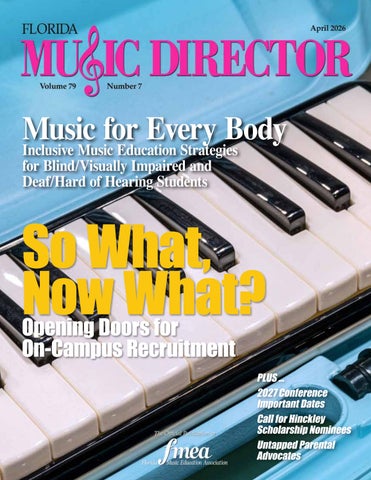
Music for Every Body Inclusive Music Education Strategies for Blind/Visually Impaired and Deaf/Hard of Hearing Students
So What, Now What? Opening Doors for On-Campus Recruitment
PLUS … 2027 Conference Important Dates Call for Hinckley Scholarship Nominees Untapped Parental Advocates APRIL 2026
1
Advertiser Index The Florida Music Director is made possible by businesses and
organizations that advertise with us. They make it possible to
provide you with a high-quality publication, and we gratefully acknowledge their support of our mission. We hope you will
take special notice of the following advertisement and consider the products and services offered. It is another important
way you can support your professional association and the enhancement of Florida music education.
The publisher does not endorse any particular company,
product, or service. The Florida Music Education Association (FMEA) is not responsible for the content of any advertisement
and reserves the right to accept or refuse any advertisement
submitted for publication. Information for advertisers (rate card, insertion orders, graphics requirements, etc.) can be found at FMEAMediaKit.org. Florida Music Director reserves the right to refuse any ad not prepared to the correct specifications OR to rework the ad as needed with fees applied. ADVERTISER Florida International University..................................................IFC This advertiser provides additional support to FMEA members through membership in the Corporate and Academic Partners (FCAP)
program. FCAP partners deserve your special recognition and attention.
FLMusicEd
FLMusicEd
FLMusicEd
FLMusicEd
2026–27 FMEA MEMBERSHIP: You are eligible for membership in the Florida Music Education Association if you are an individual engaged in the teaching, supervision, or administration of music in elementary and secondary schools, colleges, or universities within the state. Visit FMEA.org/membership to learn more about the benefits of active membership. SUBSCRIPTIONS: Direct correspondence regarding subscriptions to: Hinckley Center for Fine Arts Education, 402 Office Plaza, Tallahassee, FL, 32301-2757. Subscription cost included in FMEA membership dues ($9); libraries, educational institutions, and all others within the United States: $27 plus 7.5% sales tax. SUBMISSIONS: Article and art submissions are always considered and should be submitted on or before the 1st of the month, one month prior to the publication issue to: Kelly Miller, DMA, kelly.miller@ucf.edu. All articles must be provided in digital format (e.g., Microsoft Word). All applicable fonts and images must be provided. Images must be at least 300 dpi resolution at 100% of the size. All submissions must be accompanied by a proof (color, if applicable). Ads may be submitted via email to val@FMEA.org. CIRCULATION: The circulation of the Florida Music Director is 4,500 educators. Published eight times annually by The Florida Music Education Association, Hinckley Center for Fine Arts Education: 402 Office Plaza, Tallahassee, FL 323012757. FMEA reserves the right to approve any application for appearance and to edit all materials proposed for distribution. Permission is granted to all FMEA members to reprint articles from the Florida Music Director for non-commercial, educational purposes. Non-members may request permission from the FMEA office.
ONLINE MASTERS IN MUSIC EDUCATION
$1,000 Scholarships Available Keep your current job! Full-time and part-time enrollment options Small class sizes, personal attention and tutoring Encouraging, supportive faculty to help you reach your goals 10910 SW 17th St., Miami, FL 33199 | music@fiu.edu | music.fiu.edu/musiceducation 2
FLORIDA MUSIC DIRECTOR
Contents
APRIL 2026
VOLUME 79
Executive Director Florida Music Education Association Scott Evans
Hinckley Center for Fine Arts Education
402 Office Plaza Tallahassee, FL 32301 (850) 878-6844 or (800) 301-3632 (scottevans@flmusiced.org)
NUMBER 7
Editor-in-Chief
Kelly Miller, DMA University of Central Florida 12488 Centaurus Blvd. Orlando, FL 32816-8009 (407) 823-4545 (kelly.miller@ucf.edu)
Editorial Committee Terice Allen (850) 245-8700, Tallahassee (tallen1962@hotmail.com) Judy Arthur, PhD Florida State University, KMU 222 (850) 644-3005 (jrarthur@fsu.edu) Alice-Ann Darrow, PhD (alifsu@mac.com) Jeanne Reynolds (jeannewrey@gmail.com) John K. Southall, PhD Indian River State College, Fort Pierce (772) 462-7810; (johnsouthall@fmea.org)
Advertising Sales
Valeria Anderson (val@fmea.org) 402 Office Plaza Tallahassee, FL 32301 (850) 878-6844
Official FMEA and FMD Photographers
Bob O’Lary Amanda Crawford
Art Director & Production Manager Lori Danello Roberts LDR Design Inc. (lori@flmusiced.org)
Circulation & Copy Manager
Valeria Anderson, (800) 301-3632
Copy Editor
Susan Trainor
12
18
39
F E AT U R E S
June M. Hinckley Music Education Scholarship Call for Applications.. . . . . . . . . . . 4 Setting the Stage for the 2027 Professional Learning Conference. . . . . . . 10 So What, Now What? Opening Doors for On-Campus Recruitment. . . . . . . . . . . . . . . . 12 2026 MCN Summer Professional Learning. . . . . 17 Music for Every Body: Inclusive Music Education Strategies for Blind/Visually Impaired and Deaf/Hard of Hearing Students. . . . . . . . . . . . 18 D E PA R T M E N T S Advertiser Index. . . . . . . . . . . 2
Council News. . . . . . . . . . . . 28
FSMA Report. . . . . . . . . . . . 6-7
Component News. . . . . . . . . 36
President’s Message. . . . . . . . . 5 Advocacy Report. . . . . . . . . . 8-9
Academic Partners.. . . . . . . . 23 Corporate Partners . . . . . . 24-25
FMEA Donors. . . . . . . . . . 26-27
Committee News.. . . . . . . . . 33 Research Puzzles.. . . . . . . . . 41
Executive Director’s Notes. . . 42 Officers and Directors. . . . . . 43
Florida Music Director (USPS 368560) is published monthly except JAN, JUN & JUL with combined FEB/MAR by Florida Music Education Association, 402 Office Plaza Dr, Tallahassee, FL 32301. Periodicals postage paid at Tallahassee, FL. POSTMASTERS: send change of address to Florida Music Education Association, 402 Office Plaza Dr, Tallahassee, FL 32301.
APRIL 2026
3
APPLY NOW
June M. Hinckley Music Education Scholarship The Florida Music Education Association (FMEA) is solicit-
ing scholarship applications for the June M. Hinckley Music
Education Scholarship. The Association will award $1,000 schol-
arships to selected 2026–27 graduating high school students who were accepted to a Florida all-state ensemble and who intend to major in music education at a Florida college or university.
How to Apply: Fill out the online application using the link
below. As part of the online process, you will be asked to upload
w Essay: Answer both of the following questions in a typed these files:
About
response of approximately 1,200 words and save it as a
June M. Hinckley
1) Why do you wish to become a music educator?
As arts education specialist for the
Microsoft Word (.docx) file:
w Three Letters of Recommendation signed and scanned as PDF files w High-Quality Headshot Photograph, such as your senior 2) Why should music be available to all students?
Florida Department of Education,
June Hinckley led the development
of the Sunshine State Standards for the Arts, which are based on the
photo or a similar image. This will be published in the Florida
National Arts Standards and were
winners.
Education in 1996. Hinckley assisted
Music Director magazine if you are one of the scholarship
2026 Scholarship Online Application CLICK HERE
adopted by the Florida State Board of schools and school districts with the
implementation of the arts standards and with connecting the arts with
the state accountability and testing
program, and she served as a liaison An OFFICIAL COPY of your transcript (must remain sealed) must be sent to the following address:
groups, higher education, and com-
June M. Hinckley Music Education Scholarship
munity arts organizations. She was
402 Office Plaza
a Complete Education project, which
Attn: Val Anderson
a founding organizer of the Arts for
Tallahassee, FL 32301
has coalesced the various community,
Postmark Deadline: April 17, 2026
industry, and school arts organiza-
of teachers, administrators, and music educators convened by
and proactively to improve the qual-
will be distributed to the appropriate college or university once
throughout the state.
Applications will be reviewed by a representative committee
tions in Florida to work cooperatively
FMEA. Notification will be made by May 30. Monies awarded
ity and quantity of arts programs
the student is enrolled.
4
among the various K-12 arts education
FLORIDA MUSIC DIRECTOR
President’s
Harry “Skip” Pardee, EdD President Florida Music Education Association
MESSAGE
Happy Fourth Quarter, FMEA!
W
elcome to April. I hope this semester has been filled
headed a review of our affiliation. Our goal is to ensure
and that you are looking forward to a strong finish to the
best interests of Florida’s music educators. I am encour-
with enriching musical experiences for your students
school year.
While every year brings unique highlights and hurdles,
this has been a landmark year for FMEA. The Executive
Committee and Board of Directors have addressed several historic issues, and I want to share a summary of these
accomplishments. We have completed a tremendous amount of organizational work on behalf of music education in
Florida, and I hope you will join me in thanking the Board
w CEO Search, Selection, and Onboarding for these efforts:
FMEA expresses our deepest gratitude to Dr. Kathy Sanz for her visionary career in arts leadership. Thanks to the diligent work of the CFAE Board and the CEO Search Committee, we have successfully appointed Mr. Scott
Evans as our new CEO and executive director of FMEA.
w Establishing Three New Council Associations Welcome, Scott!
With Full Board Seats
Our Board of Directors should reflect the diverse sub-
jects we teach across the state. Building on the planning and due diligence of previous leaders, we have offi-
cially added three new councils to the FMEA Board of
Directors’ governance structure. These groups will work
to advance Steelband, Guitar, and Contemporary Music
& Media in Florida. We look forward to advancing these great music subjects for students as we continue to be a
model for organizational leadership in music education in
w Reenergizing and Redefining Our Relationship our country.
With NAfME
Following honest and collaborative discussions between
the FMEA Board and NAfME leadership, we have spear-
we meet our fiduciary responsibilities and prioritize the aged by our progress and look forward to sharing more
w Streamlining Summer Activities for Committees, updates in the coming months.
Councils, and the Teach Music Florida Coalition
We have developed a more streamlined, cost-effective plan for our summer FMEA activities and coalition
meetings. These sessions are essential for drafting our
strategic plan and tackling pressing professional issues. By optimizing these events, we move the organization
forward while reducing costs and staff workload. Many thanks to Jason Locker, Bernie Hendricks, Scott Evans,
and the CFAE team for making these improvements pos-
w First President’s Virtual Town Hall sible!
Our first Virtual Town Hall, held Monday, March 30,
was a fantastic opportunity to connect with members
and to discuss the “highlights and hurdles” of our pro-
fession. I am a firm believer that progress only happens when we talk and learn from one another. I feel privi-
leged to moderate these statewide discussions and look
forward to more opportunities to find positive solutions
w Celebrating the 2026 Conference and Planning for 2027 together.
The 2026 conference was a historic success, and we are
already working to ensure 2027 is just as impactful. We look forward to producing another world-class experi-
ence for our teachers, students, and partners next year!
I remain deeply appreciative of everything you do daily
for Florida’s students. Together, we will continue to champion the collective impact of music education on our society. I look forward to connecting with more of you during the final year of my presidency.
Onward, friends!
Always musically,
Harry “Skip” Pardee, EdD, President
Florida Music Education Association APRIL 2026
5
Benny L. Bolden, Jr., EdD
President
N O T E S
FLORIDA SCHOOL MUSIC AS SO CIATION
Florida School Music Association
Spring Is in the Air … and I Hear Music Everywhere
S
pring has a way of reminding us why we do this
work. The days grow a little longer, the air feels a
little lighter, and across our great state the sound of
effort. And perhaps most importantly, they find their voice.
That voice may come through the sound of a trum-
music fills rehearsal halls, classrooms, auditoriums,
pet, the resonance of a cello, the energy of a drumline,
final performances of the year, to choirs lifting their
a teacher who believed in them, guided them, and
and stadiums. From concert bands preparing for their
voices in harmony, to orchestras and jazz ensembles
bringing notes on a page to life—spring in Florida means that music is everywhere.
For many of our programs, this season represents
the culmination of months of preparation through
our music performance assessments. MPA season is always a significant milestone, and it reflects the dedication, discipline, and excellence that define music education in Florida. Yet while ratings, adjudication
sheets, and performances are important, they are not the most important part of what we do. You are!
Across Florida, thousands of students walk into music rooms each day carrying more than instruments and
or the harmony of a choir. But behind every note is
showed them that they were capable of something greater than they imagined. That is the true impact of
music education. Beyond the stages and beyond the assessments, you are shaping lives. You are creating
spaces where students feel seen, heard, and valued.
You are teaching lessons in perseverance, collabora-
tion, and creativity that will remain with them long after the final concert of the year. And because of that work, students across our state are discovering something powerful: that their voice matters—and
that through music, they have a way to share it with the world.
As we move through this vibrant spring season,
sheet music. They carry questions about who they are,
I want to thank each of you for the passion, care,
Because of you—the music educators who stand in
rehearsal spaces every day. Your work matters deeply,
where they belong, and whether their voice matters. front of them every day—those students find answers through music. They find confidence when they per-
form their first solo. They find belonging when they
sit inside an ensemble that becomes family. They find discipline when they realize that excellence requires
and commitment you bring to your classrooms and and its impact reaches far beyond the walls of your
programs. Spring is in the air … and because of you, the sound of music continues to echo across Florida. And in that sound, thousands of students are finding their voice.
Benny L. Bolden, Jr., EdD, President Florida School Music Association
6
FLORIDA MUSIC DIRECTOR
FSMA Summer Leader ship Symposium
Unlocking the Potential: Empowering Music Educators Through Leadership July 12–15, 2026
Marriott Orlando Airport Lakeside 7499 Augusta National Drive Orlando, Florida
A P P L I C AT I O N D E A D L I N E : A P R I L 1 , 2 0 2 6
T
he state and district leadership of our com-
The training is designed in partnership with
ponent associations (FBA, FOA, and FVA)
the FSMA component organizations: Florida
music programs and champion better opportu-
Association, and Florida Vocal Association.
aims to provide excellent stewardship of existing
nities for aspiring musicians. This requires leaders to be efficient organizers of persons, resourc-
es, and projects, in addition to planning paths to fulfill the vision of a better tomorrow for music
education in Florida. This professional develop-
Bandmasters Association, Florida Orchestra Approximately 16 to 20 participants will be selected through an application process. FSMA will cover hotel expenses and meals during the training.
ment opportunity will provide communication
training, team building, scenario-based problem solving, implications of the latest developments in technology, guidance on laws relating to
music education, and other skills identified by participants as a need to find success as a leader in Florida.
APRIL 2026
7
Advocacy
Advocacy Committee Co-Chairpersons
REPORT
Angela and I are thrilled to turn our April column over to Elizabeth “Lisa” J. Olson, the
2026 recipient of the FMEA Distinguished Service of an Individual in Music Education Award. Lisa is the living embodiment of the phrase “Be the change you wish to see in the world.”
As a parent advocate in the Panhandle area, Lisa has often singlehandedly ensured school music
Jeanne W. Reynolds
Angela Hartvigsen
programs be retained or added. Quite simply she is a force. One Lisa Olson has the
impact of a successful community advocacy group or a professional lobbyist. She is an inspiration to all of us. Angela and I are thrilled that Lisa serves on our Advocacy Committee. — Jeanne and Angela
The Untapped Potential of Parent Advocates BY E L I Z A B E T H “ L I S A” J . O L S O N
H
istory, in many ways, is a wonderful teacher. It
is also a compelling source of inspiration. Over the course
of history, we are able to see the full picture and power
of collective impact toward
the goal of creating positive
change. The idea of collective
impact via volunteerism is a
we see this on full display in
Alexis de Tocqueville, in
hot days cleaning concession
bedrock value of our nation. his pursuit to understand American society in 1831, observed with wonder,
“They hardly ever failed to
lend faithful support of each
other.” Nearly 200 years later,
the form of parents spending stands, hours mending and
washing uniforms, supplying food, chaperoning trips, and the list could grow endlessly. The purity of this gift of
effort and time, at personal sacrifice, is incredible.
Yet when I talk with
parents about advocacy, they often appear a bit perplexed
or even intimidated. How do we tap into this wonderfully generous and passionate
resource? With the belief that most parents are willing to give what they can, where
they can, to contribute to the flourishing of the programs
they love and appreciate, I’d like to offer a few practical
deeds for parents. But first, it
would seem useful to address
Ale x is de Toc q u e v i lle 8
FLORIDA MUSIC DIRECTOR
those things that might serve as impediments to parentbased advocacy efforts.
A few thoughts that might
appear disparate on the
w “Stay in your lane” has surface:
become a societal direc-
tive that unintentionally serves as a hobbling
w Parents like to use social device.
media to celebrate their
child’s accomplishments, both individual and col-
lective, but are sometimes shy to interact with their program’s online pres-
w We’re living in a time ence.
where public schools and their programs must be
marketed, but within our
programs there is rarely a
w We must free parents
single point of marketing. to know that advocacy
efforts are “in their lane.”
Though the lobbying arm
of advocacy might appear intimidating, that is not
the sole facet of advocacy. Conveying the truth that
Advocacy REPORT
public, vocal support is a
invitation also helps par-
ership panel. Involvement
advocacy. The perception of
able component of advo-
to connect in a personal
booster clubs, and the like
foe that can be fought with
necessary and managecacy will allow parents
to see they are uniquely equipped to serve as a
wide-reaching and effec-
tive mouthpiece for school music programs.
w Encourage parents to
Manageable Action Items interact with your orga-
nization’s social media to
increase visibility. Be specific and direct. Ask your
booster leadership to lead the way and unashamedly ask parents to interact
w Encourage parents to with social media.
invite decision makers to concerts. A friendly
ents and decision makers manner thus forming
positive relationships.
Consider providing com-
plimentary tickets to these
w Encourage active gratidecision makers.
tude. Principals and other
decision makers are accustomed to hearing com-
plaints but don’t always hear gratitude. A handwritten thank-you note
expressing gratitude for
support of arts programs
in SAC committees, PTOs,
w Inform booster leadership are all helpful.
of positive legislative
decisions and ask them to
have parents send expressions of gratitude via
email or mail. Similarly, inform parents of other
legislative decisions that could have unintended negative consequences
and ask parents to express care and concern for the programs they value.
w Encourage involvement in
large gestures are the
pose of creating a musi-
the greater impediments
is courtesy as advocacy. school decision-making
organizations for the pur-
cally engaged school lead-
It is easy to believe that
only gestures with large
impact. This may be one of to involving parents in
insignificance is the invisible intentional action. Circling
back to the idea of history as both instructor and a source of inspiration, the story of St. Patrick’s Cathedral in New York City comes to
mind. When construction began in 1858, the project
was referred to as “Hughes’
Folly” for numerous reasons, not the least of which
being funding. The large benefactors’ donations
collectively didn’t come close
to funding the entirety of the project. However, the penny
donations by thousands upon thousands of believers in the project led to the completion of one of America’s most exquisite and enduring
buildings. Thousands of
small, gracious acts created a most beautiful result. Such is the work of advocacy, where no effort is insignificant. Lisa J. Olson is a voice
instructor and fierce music education advocate.
She earned a BM in vocal
performance from Samford
University in Birmingham,
Alabama, and later an MME
from the University of Mobile,
Alabama School of the Arts. She served as a high school choral
director for several years, which Angela Hartvigsen, Jeanne Reynolds, and Lisa Olson at the Advocacy Hub, 2026 FMEA Professional Learning Conference
led her to pursue intentional advocacy.
APRIL 2026
9
FMEA Professional Learning Conference &
The Power in Our Profession: Music Education for Collective Impact
n c e r ts fe
ll - S
Pro
ona
l Lea
n r nin g C o nfer e
ce
&
Collective Impact is a broad cross-sector coordination toward a mutual cause. It is a
network of community members, organizations, and institutions that advance a cause
tat
27
e Co
F M E A 20
s si
January 13–16, 2027 Tampa Convention Center
N SIO
THE P
OUR PRO ER IN FES W O
A
by learning together, aligning, and integrating their actions to achieve systems-level change. Join us as we explore the collective impact of music education.
Call for Session Proposals and Performing Ensembles
Exhibit at the FMEA Trade Show
All FMEA members and NAfME members nationwide are
With approximately 10,000 attendees annually, the FMEA
and/or a 25-minute concert performance. Conference
education professional learning events in the Eastern U.S.
invited to submit proposals for a one-hour clinic session
exhibitors are invited to submit Industry Product Showcase
sessions through July 15, 2026. For all others, the deadline is May 9, 2026. PLEASE
CLICK HERE
FOR MORE INFORMATION, POLICIES, AND SUBMISSION PROCEDURES.
Professional Learning Conference is one of the largest music In addition to approximately 250 clinic sessions and
concerts, the FMEA Professional Learning Conference is host to the all-state bands, orchestras, choruses, guitar ensemble, and Orff ensemble.
Attendees include elementary and secondary music
teachers, music supervisors, college students, college music
teachers, school administrators, K-12 students performing in the all-state ensembles, students and professional musicians
performing with invited performing ensembles, and parents of performing students. PLEASE
CLICK HERE
FOR MORE INFORMATION, RATES, AND DEADLINES.
10
FLORIDA MUSIC DIRECTOR
Podcast
FL Music Ed
Important Dates (Subject to Change) MAY 8, 2026 Deadline for Session Proposals and Performance Applications JULY 15, 2026 Deadline for Product Showcase Applications SEPTEMBER 11, 2026 Early Registration opens. Nominations for Student Conference Experience and Tri-M Experience open. SEPTEMBER 26, 2026 Hotels begin taking reservations at 9am.
PLEASE
CLICK HERE
Tales from the Heart of Florida’s Music Education Community Tune in as we delve into the heart of music education, exploring topics that resonate with our members and beyond. Whether you are a seasoned educator or a passionate student, this podcast is for you. With six insightful episodes already available for streaming, there’s no better time to join in the conversation.
KEY CONVERSATIONS
All-State Concerts
Follow “Key Conversations” on Spotify or Apple Podcasts to receive instant updates whenever a new episode drops.
TO VIEW A MORE COMPREHENSIVE LIST OF IMPORTANT DATES
APRIL 2026
11
F E AT U R E
So What, Now What? Opening Doors for On-Campus Recruitment BY DANIEL GREENWOOD
For many middle school music directors, the tried-and-true methods of traditional recruiting—including performances for feeder programs or in-person classroom visits—are no
longer an option. Maybe your program is in a rebuilding phase, or there has been a large teacher turnover at the school. Perhaps there isn’t a strong relation within the feeder pipeline, or lack of a pipeline due to school choice. Or maybe there just isn’t time that works for all schools for a visit during the day.
Music educators who find themselves presented with recruitment barriers don’t need to
reinvent the wheel. Instead, they should ask the question So What, Now What? Despite what
we often hear about “kids these days,” I’ve found that students remain curious and eager to make social and musical connections. When students engage with music, they’re more inclined to become active consumers and producers. When this happens, we can begin to shift from “now what” to “what’s next” on our campuses.
12
FLORIDA MUSIC DIRECTOR
continued on page 14
APRIL 2026
13
So What, Now What? continued from page 12
My first year as a middle school band director, there
was a large turnover of the administrative team and
teachers, to the point that it felt as though the veteran
teachers were in the minority. The band program, once approaching 200-plus students, was down to fewer than 80. Student enrollment for the school was down by 300-
plus students when compared to the next lowest middle
school’s enrollment. Morale was low on campus, but our new administrative team was determined to steer the ship
in a new direction. Their motto for the year was So What, Now What? Their mindset for going into the year was that
we could keep morale low and feel bad for ourselves, or
we could pick ourselves up, ask ourselves So What, Now What? and begin to rebuild. After three years of a steady
positive increase in campus morale and enrollment, we faced the setback of COVID shutting down the end of the
2019–20 school year. Our motto upon reopening campus was again So What, Now What? Through the years this
motto stuck with me when faced with overcoming barri-
ers for my band program, the largest barrier being postCOVID recruiting. By embracing the phrase So What, Now
What? I allowed myself to think in unconventional ways about recruitment within my school. By the end of my last year before returning to graduate school, my band’s
enrollment had increased by nearly 75%, from fewer than 80 members my first year to more than 135 my last year. Being Present
The first step in any successful recruitment strategy is to
show up. Potential students need to see that you and your
program have an exciting presence in campus life. This
doesn’t have to mean constant performances or large-
forget, If it’s important to them, maybe it should be important
interacting with students you don’t know. Stand outside
of shoes, offering congratulations on an accomplishment
scale events. Start by getting out of your classroom and
your room during mornings and between classes. Help supervise lunch once a week or more in the cafeteria.
Attend after-school events (even if your students aren’t
participating), such as games, competitions, and award
you watched them achieve, or showing a genuine interest
in their experiences can all be as meaningful as traditional recruitment.
ceremonies. These important moments outside your class-
Allies and Advocates
with your face and notice your positive engagement. By
allies to help extend your reach. We often forget the influ-
room give students multiple opportunities to put a name
By being present in campus life, you can create powerful
being visible, you become a familiar face on your campus,
ence our colleagues have. Science and math teachers can
which can lead to creating a level of comfort.
Familiarity leads to approachability, which is essential
to building a good rapport with potential students. Never
14
to me. Friendly gestures such as complimenting a new pair
FLORIDA MUSIC DIRECTOR
be great allies for our programs when it comes to integrating music into lessons. An easy way to start this dialogue
is small talk before a faculty meeting. Sit with teachers
outside of the elective department. Present your ideas
carpool; bring them in. The same applies for younger
music to create a hands-on lesson. Be enthusiastic about
musical opportunities with no commitment attached, it
and ask them if they’ve ever thought about incorporating creating exciting opportunities. For example, if there’s a
unit on sounds waves, talk about tuning instruments and
offer to have your students bring instruments to class for a demonstration on frequencies and how they affect tuning.
Additionally, our students themselves can serve as
siblings of students. By exposing non-music students to allows them to check it out without the added pressure
of signing up on the spot. Curiosity leads to interest, and
interest often leads to joining. Before you know it, you’ve gained another student.
Don’t forget the most powerful potential ally: your
powerful recruiters for our programs. Enthusiastic stu-
administrative team. Building relationships with your
Let’s take a page from youth groups and the “bring a
ing your vision. If your administrators only hear from
dents are the best walking advertisements on campus! friend” concept. Swinging by the band room during lunch; bring a friend. Having a concert; bring a friend. Having an after-school rehearsal and a friend needs to
administrators is an invaluable resource in accomplishyou when things are going wrong, they’ll begin to cast a
negative view on your program. However, if you start a continued on page 16 APRIL 2026
15
So What, Now What? continued from page 15
dialogue with meaningful conversations, and help your
Open Doors on Your Own Campus
goals, they can advocate in ways that may offer instant
several ways it doesn’t have to be. Potential students
administrators understand your vision and support your
Recruitment may feel like a huge weight, but there are
benefits and long-term positive outcomes as well. From
aren’t waiting for a fancy, polished performance—they’re
scheduling, to getting students out of class for events and performance opportunities, to spotlighting your
program, and even to funding, your administration can serve as a huge ally. Getting called to the principal’s office can be intimidating, even as an educator. Don’t wait to be
and provide excitement and music, there’s potential for a shift from “Why should I do music” to “Why wouldn’t I do music?”
Music and recruitment both thrive on creativity. The
called down. Stop by proactively, ask how they’re doing,
strides you make will demonstrate that your program is
Above all else, invite them to everything you do, and
program students will want to be a part of.
offer your help, and present solutions over problems! make a big deal of it when they’re there.
welcoming, engaging, and exciting; all positive traits of a
When traditional recruitment doors are closed, find
ways to open doors on your own campus. Over time,
Pop-Up Performances
these moments will add up, and your program will
eventually you must let the music speak for itself. Create
last well beyond a single school year. When the question
ment to the student body. Pop-up performances serve as
engage, inspire, and connect. Your presence, excitement,
the need for planning an elaborate formal performance.
respond.
cafeteria—even if only two tunes, surprising a faculty
Daniel Greenwood is a graduate assistant at
Birthday,” “classroom caroling” during the winter season,
MM in instrumental conducting. He has eight
As your support continues to grow, you will find that
grow while building a culture of engagement that will
musical moments that are memorable and offer engage-
So What, Now What? arises, the answer is simple. Show up,
a great way to generate spontaneous excitement, without
and passion for music will lead the way, and students will
A few examples include performing during lunch in the member at their door with a performance of “Happy
or even a morning performance in a common space on the
day of a big game. These performances show that there are fun musical opportunities in your program.
By going out into spaces that are widely utilized, you
have now made your program visible and integrated as a part of campus life. In the digital age, word travels quick-
ly. Students who see your pop-up performances may post on social media, thus creating a buzz about your program. Even those who don’t take an immediate interest may be left wondering when and where your group will randomly pop up next. This means you’ve sparked an interest!
16
waiting for an invitation! When you show up for them
FLORIDA MUSIC DIRECTOR
the University of South Florida, pursuing an years of music education experience, including seven as the band director of Gifford Middle
School in Vero Beach, Fla. He received his BS in music education from USF.
APRIL 2026
17
F E AT U R E
Music for Every Body Inclusive Music Education Strategies for Blind/Visually Impaired and Deaf/Hard of Hearing Students B Y S A M E S T E S A N D V A L E R I E N Ú Ñ E Z- C A I C E D O
Music is often described as a universal language, a space
music aurally with remarkable precision, and memorize
ing and expression. That belief fuels thousands of class-
entire ensemble. Many DHH students experience music
where students from every background can find belongrooms, from elementary general music to advanced high school ensembles. Yet in many rehearsal rooms, access to that “universal” experience is not equally distributed. For
students who are Blind or Visually Impaired (BVI) and Deaf or Hard of Hearing (DHH), traditional rehearsal
structures, materials, and instructional habits can unin-
tentionally create barriers. If our profession truly believes
through vibration, visual cues, and movement, and some sing confidently with appropriate supports. The real bar-
rier is rarely musical ability; it is access. When teachers shift from asking, “How will this student fit into my
existing system?” to “How can I design my system so this student can thrive?” the classroom begins to change.
Understanding the spectrum of sensory differences is
in the transformative power of music, then accessibility
essential. Blindness and visual impairments range from
design our classrooms, our rehearsals, and our perfor-
requiring tactile and auditory learning. DHH students
cannot be an afterthought. It must be central to how we mances. Inclusive music education is not about lowering standards or creating separate tracks; it is about removing
obstacles so every student can participate fully and meaningfully.
At its core, inclusive practice begins with mindset. Too
often, educators encounter disability through a deficit
lens, focusing first on what a student cannot do. In music classrooms, this may sound like, “Blind students can’t read music,” or “Deaf students can’t sing.” These assumptions are not only inaccurate, but they are also limiting.
Many BVI students read braille notation fluently, learn
18
repertoire with speed and depth that strengthen the
FLORIDA MUSIC DIRECTOR
low vision requiring magnification to total blindness may use hearing aids, cochlear implants, American Sign Language (ASL), spoken English, cued speech, or a combination of communication methods. There is no single pro-
file. This variability makes flexibility crucial. Frameworks such as Universal Design for Learning challenge us to plan with learner variability in mind from the outset
rather than retrofitting accommodations later. In a music
classroom, that might mean presenting rhythmic concepts visually on the board, aurally through modeling, and
kinesthetically through body percussion. It might mean continued on page 20
APRIL 2026
19
Music for Every Body continued from page 18
allowing students to demonstrate understanding through
screen readers increases autonomy. Devices such as the
ment. These strategies do not benefit only BVI or DHH
ing software like JAWS by Freedom Scientific allow stu-
performance, composition, verbal explanation, or move-
students; they strengthen comprehension and retention for all learners.
For BVI students, access to print is often the most imme-
diate challenge. Standard sheet music is rarely accessible without modification. Waiting for braille transcription
or relying solely on audio recordings can delay independence and limit ownership. Providing large-print scores,
high-contrast copies, or digital files compatible with
BrailleNote Touch Plus by HumanWare and screen-readdents to navigate musical materials more independently.
Emerging tactile music displays further expand access to
notation and theory. While not every program will have immediate access to advanced tools, awareness empowers
educators to collaborate effectively with district specialists and families to secure appropriate support.
Technology, however, is only part of the solution.
Teachers must also examine instructional language and rehearsal habits. Phrases like “Watch me” or “Look at measure 32” unintentional-
ly exclude students who cannot rely on
visual cues. Replacing gestures with pre-
cise verbal descriptions, “Altos, begin on
beat three after the piano introduction,” creates clarity for everyone. Orientation and mobility are additional considerations. Music classrooms are dynamic
spaces filled with chairs, stands, risers, and instruments. A moved chair or unex-
pected layout change can cause confusion
or even safety concerns. Maintaining a consistent room setup, verbally announc-
ing changes before rehearsal begins, and keeping pathways clear build trust and independence. Tactile floor markers can
define rehearsal zones while predictable
entrances and exits during performances reduce anxiety. These adjustments require
intentionality, not extensive funding, and they cultivate a rehearsal environment grounded in respect.
For DHH students, language access and
visibility are paramount. Lip reading cap-
tures only a fraction of spoken English, and rapid verbal corrections delivered while
facing away from the ensemble can result in missed instruction. Teachers should
face students when speaking, repeat peer
20
FLORIDA MUSIC DIRECTOR
The Monarch tactile braille device connected to a computer interface displays a tactile keyboard diagram with braille music notation labeling each piano key.
The Monarch displays a tactile diagram illustrating the shape and structure of a trumpet.
comments before responding, and pro-
vide written rehearsal notes when possible. Clear sightlines and strong lighting are
essential, especially when an interpreter is present. Visual tuners, decibel meters, and
projected text reinforce musical concepts in accessible ways. FM systems, including
Roger™ microphones developed by Phonak AG, can transmit a teacher’s voice direct-
ly to hearing aids or cochlear implants, reducing background noise and improving clarity. Live captioning tools embedded in
presentation software or virtual platforms can further support comprehension during instruction.
Music, however, is not solely an audito-
ry experience; it is physical and communal. Vibrations resonate through floors,
risers, and percussion instruments. Simple
tools such as balloons placed near speakers
allow students to feel rhythmic pulses. More advanced vibrotactile systems cre-
ated by organizations like Not Impossible Labs translate sound into wearable vibration patterns, expanding the sensory expe-
rience of rehearsal and performance. These approaches challenge the narrow assumption that music must be heard to be under-
stood. When educators embrace multisen-
sory engagement, they open artistic possibilities for all
Rehearsal design plays a significant role in accessibili-
students and often deepen ensemble awareness of rhythm
ty. Inclusive classrooms prioritize clear sightlines, bright
This work becomes even more powerful when ground-
downs before starting, visual and physical start signals,
it is practical. It looks like an elementary music room
cohesion while supporting students with sensory dif-
to her place because the layout has remained consistent all
patterns, body percussion, and movement-based vocaliza-
gives a clear verbal cue and the ensemble responds with
every learner. Allowing extra time for accessing adapted
designed. It feels like a high school performance where a
flow overall. In many cases, strategies originally imple-
ductor’s preparatory gesture, fully engaged in the shared
elevate the entire ensemble.
They are the natural outcome of proactive planning and a
expected to be experts in every specialized strategy, but
and dynamic nuance.
and even lighting, and structured pacing. Verbal count-
ed in daily classroom reality. Inclusion is not theoretical;
and intentional pauses for processing improve ensemble
where a visually impaired student confidently navigates
ferences. Warm-ups that incorporate call-and-response
year. It sounds like a middle school choir where a director
tion strengthen rhythmic accuracy and internalization for
precision because communication has been intentionally
scores frequently results in more thoughtful rehearsal
Deaf student stands on the risers, eyes locked on the con-
mented as accommodations become best practices that
musical moment. These scenarios are not extraordinary.
Collaboration is essential. Music educators are not
commitment to access.
continued on page 22 APRIL 2026
21
Music for Every Body continued from page 21
they are expected to be willing partners. Teachers of
tive understanding for hearing peers. Inclusion becomes
Hearing, ESE coordinators, and families offer invaluable
into a community where differences are not hidden but
the visually impaired, teachers of the Deaf and Hard of insight. Inviting them into the rehearsal process, even briefly, can provide clarity on seating arrangements,
valued as strengths.
Importantly, inclusive practices do not require educa-
pacing, interpreter placement, or material adaptation.
tors to implement every strategy at once. Beginning with
siloed. Educators can also partner with community orga-
consistent room layout, visual reinforcement of instruc-
Inclusion thrives when expertise is shared rather than
nizations such as the Lighthouse for the Blind and
Visually Impaired, a nonprofit that empowers individu-
als with vision loss to build independence across home, school, work, and community settings, and Hands &
Voices, a family-centered organization offering advocacy, unbiased information, and peer support for families of children who are Deaf or Hard of Hearing. These part-
a single intentional change (clearer verbal directions,
tions) can initiate meaningful progress. Collaboration with specialists, administrators, and families strengthens
implementation. Time must be allotted thoughtfully, as effective accommodations develop through reflection
and adjustment. The process is not only evolving, but it is achievable.
Music education holds extraordinary potential to shape
nerships extend resources beyond the classroom and
identity, confidence, and belonging. When students feel
shared knowledge and community con-
alongside their personal development. Inclusive class-
strengthen inclusive practice through
Inclusive music education is not about lowering standards or creating separate tracks; it is about removing obstacles so every student can participate fully and meaningfully.
nection.
Performance spaces deserve equal
attention. Accessibility should extend
beyond minimum compliance with physical regulations. Providing ramps, stable risers, and predictable stage mark-
ings ensures safe navigation. Offering large-print or braille programs demonstrates respect for audience members
with visual impairments. Incorporating ASL interpreters as integrated mem-
bers of the performance, rather than peripheral additions, affirms language
seen and supported, their musical growth accelerates
rooms communicate a powerful message: you belong
here, your voice matters, and your presence strengthens our ensemble. For music educators serving diverse com-
munities across grade levels, this work reflects not only best practice but professional responsibility. The power
of our profession lies not only in the repertoire we select
or the performances we stage, but in the access we create.
Inclusion is not about lowering expectations; it is about expanding opportunity. When we design music education for every body, we cultivate empathy, strengthen musi-
cianship, and build communities where all students can experience the transformative power of music.
equity and enriches the artistic expe-
Sam Estes is director of choirs at Pinellas Park
ography, and visual storytelling to create multisensory
leads a vibrant and growing program in a Title I
rience. Some ensembles explore projected text, chore-
performances that expand expression rather than limit it. When accessibility is embedded into performance design, it enhances the experience for performers and audiences alike.
Perhaps the most fundamental aspect of inclusive
High School in Pinellas County, Fla., where he school. An active performer and music director, he is passionate about sustainable teaching prac-
tices, inclusive classrooms, and fostering meaningful collaboration among music educators.
music education is the emphasis on student voice and
Valerie Núñez-Caicedo is the general music
tations, select repertoire, or assume leadership roles, they
County, Fla. As a legally blind music educator,
agency. When students are invited to help design adap-
move from passive recipients of accommodation to active contributors. A BVI student may suggest an efficient rehearsal strategy that benefits the ensemble. A DHH student may model expressive signing that deepens interpre-
22
collaborative rather than corrective. The ensemble evolves
FLORIDA MUSIC DIRECTOR
teacher at Cross Bayou Elementary in Pinellas
she is a dedicated advocate for equitable music education. She leads inclusive performances,
directs choirs, and sponsors arts enrichment where she champions access to music education for all learners.
Please take time to thank and support our 2025-2026 Academic Partners.
GOLD PARTNERS
SILVER PARTNERS The College of Idaho
BRONZE PARTNERS Florida Gulf Coast University Florida Southern College
Mercer University Rollins College
Partners as of March 18, 2026.
*Please visit FMEA.org/partners for partnership details or call 850-878-6844. APRIL 2026
23
GOLD
SILVER PARTNERS Mark Custom Recording Service, Inc. Music & Arts Partners as of March 18, 2026.
*Please visit FMEA.org/partners for partnership details or call 850-878-6844. 24
FLORIDA MUSIC DIRECTOR
Please take time to thank and support our 2025-2026 Corporate Partners.
PARTNERS
BRONZE PARTNERS Cathy’s Choir Class Hal Leonard Head’s House of Music J.W. Pepper & Son, Inc. Music and the Brain - Building for the Arts
Music is Elementary MusicFirst PACE Travel Sight Reading Factory West Music Company APRIL 2026
25
FLORIDA MUSIC EDUCATION ASSOCIATION 2025-2026 DONORS
Thank you to all of the donors who have shown their dedication to the improvement of music education in Florida by supporting our Mission through financial contributions.
Our donors support specific causes by donating to the FMEA funds of their choice: FMEA Scholarship Fund
June M. Hinckley Scholarship
Music Education Advocacy
Professional Learning for Members
General Fund
Mel & Sally Schiff Music Education Relief Fund
The following have graciously donated to FMEA from December 8, 2025, through February 9, 2026.
ARTIST’S CIRCLE
MAESTRO’S CIRCLE $10,000 and up
No current donors at this time.
All County Music
$1,000 – $9,999
Artie Almeida In Honor of my sister, Joyce Slatton, & my niece, Katie Grace Miller
Russell Robinson Fred Schiff In Memory of Mom & Dad
DONATE TODAY FOR A STRONGER TOMORROW.
With your support, FMEA will continue to grow its programs for teachers and students, strengthen united advocacy efforts, and improve your professional development opportunities. Visit FMEA.org to learn more information about each fund and to make a donation.
SUSTAINERS $100 – $999
Carlos Abril In Honor of Ms. Terry Paulen
Dayna Cole In Memory of Linda Mann
Sandra Adorno
Alice-Ann Darrow
Andre Arrouet
Virginia Densmore In Memory of Gene Densmore
Lucinda Balistreri In Honor of music & arts educators in Sarasota County Gordon Brock Trent Brown In Honor of J. Mark Scott Kasia Bugaj Judith Bula Wise In Honor of Dr. Josh Bula Dale Choate In Memory of Dr. Colleen Kirk 26
FLORIDA MUSIC DIRECTOR
Shelby Fullerton Deragon In Honor of Kathy Sanz Virginia Dickert In Memory of Lindsay Keller & Debbie Liles Michael Dye In Honor of Michelle R. Tredway William Fredrickson Kathleen James In Memory of Dr. Dale Blackwell
Beth & Steven Kelly Sheila & John King Jason Locker In Memory of June M. Hinckley Joseph Luechauer Deborah Mar In Memory of Barbara Kingman David Martinez-Cooley John Nista In Memory of Stanley Dmitrenko Mary Palmer Douglas Phillips In Memory of Dr. Bobby Adams Kyle Prescott
SUSTAINERS (Continued) $100 – $999
Jeanne Reynolds In Honor of Pinellas County Performing Arts Teachers Mary Catherine Salo In Memory of Gary Rivenbark & Wes Rainer
Kathleen Sanz In Memory of June Hinckley
Leiland Theriot In Memory of Clayton Krehbiel
J. Mark Scott In Honor of Jason Locker, Michael Dye, Dr. Judy Bowers, Dr. Judy Arthur, & Dr. André Thomas
Richard Uhler
Steven Salo In Memory of John “Buck” Jamison & John Aiello & in Honor of Dr. Bill Prince Alicia Romero-Sardinas In Memory of John Rose
Meghan Alfaro In Memory of Carol Boyce David Bayardelle In Memory of Dr. George Sparks Mark Belfast In Memory of Dr. Mark A. Belfast, Sr. Greg Carswell In Memory of all deceased members of the FMEA William Castillo Jeff Cayer Shelby Chipman Zachary Chowning Patrick Cooper In Memory of Martha Matteson Dewey Dodds
Howard Weinstein In Memory of Barry Weinstein
D. Gregory Springer
Kenneth Williams
Jeannine Stemmer In Memory of Barbara Kingman & Lauren Alonso
Anonymous In Memory of Joan Lee Alkyer
Anonymous
PATRONS Patrick Dunnigan
$25 – $99
Bernie Hendricks
Clinton Randles
Judith Evans
Marsha Kindall-Smith
Diana Rollo
Margaret Flood
Joshua Langston
William Rose
Lisa Foltz In Memory of Rev. V. Ron Feener
Christine Lapka
Susan Smith
Matthew McCutchen In Honor of John Carmichael
Cheri Sleeper
Bradley Franks In Memory of Gary W. Rivenbark
Eddie Steadman
Amelita McGrath
Tina Gill In Honor of Gary Rivenbark
Andrea Szarowicz On Behalf of Byrdie L. Jackson
Kelly Miller Katie McGuire Menges
Dakeyan Graham
Reiko Niiya Terry Pattishall
John Grau
Katelyn Taylor In Memory of Jared Benyola
Edward Prasse
Ron Guzzo Julie Hebert In Memory of Marsha Juday Cynthia Heidel
Arthur Pranno Marie Radloff In Memory of Charles F. Ulrey
Valerie Terry Anonymous (4) Anonymous In Memory of Archange Fils-aime
FRIENDS up to $24
Ronald Alumbaugh Kimberly Bondi James Bruce Jamie Bryan In Honor of J. Mark Scott Addy Burwell In Honor of Sara Hofschneider Jeff Cayer
Ernesta Chicklowski Denise Dumala Timothy Eaton Debbie Fahmie Amanda Gilbert Gabriel Gonzalez In Honor of Luke Hall Angela Hartvigsen
William Hazlett Lisa Hewitt
Jessica Moore In Memory of Dr. Nancy Barlar
Sara Hofschneider In Honor of Adaline Burwell
Merleon Morgan
Angel Irizarry
Elisabeth Olson
Jason Jerald
Connor Oneacre
Sarah-Christina Larose
Luis Oquendo
Brandon Oliva
Ian Schwindt Sierra Silvia John Southall Kelly Southall Ajori Spencer Noiree Weaver Anonymous (8)
John Parris APRIL 2026
27
FLORIDA NAfME COLLEGIATE
Mark A. Belfast, Jr., PhD Advisor
Jazz Appreciation Month:
Spotlight on Jazz Vocals click photo or link to listen on Spotify
I
n 2001, the Smithsonian’s National Museum of
American History created
Billie Holiday
celebrate the rich heritage
her voice was intimate and
offered a striking contrast:
Jazz Appreciation Month to
fragile but emotionally
and history of jazz. So, this
devastating! Her performance
April, I invite you to focus
of “Strange Fruit” stands as
your attention on a group of
one of the earliest and most
jazz musicians who are often
powerful musical protests
overlooked. Jazz vocalists
against lynching, cementing
have shaped not just a genre, but the sound of American
jazz as a vehicle for social awareness.
culture itself—blending
relaxed phrasing, rhythmic
and identity across more than
of scat singing shifted
Jimmy Rushing swung
simply delivering lyrics
bands like the Count Basie
storytelling, improvisation, a century.
In the early 20th century,
voices like Bessie Smith and Louis Armstrong helped
define the emotional core
freedom, and refinement the singer’s role from
to improvising like an instrumentalist.
The swing era elevated
of jazz. Smith, known as
jazz singers to global fame.
brought raw emotional
audiences with unmatched
the “Empress of the Blues,” honesty to her recordings,
documenting Black life in the Jim Crow era. Armstrong, meanwhile, transformed
not only trumpet playing
but vocal music itself—his
28
Ella Fitzgerald dazzled
technical precision, tone, and improvisational
brilliance, particularly in her Songbook recordings, which helped canonize American
pop standards. Meanwhile,
FLORIDA MUSIC DIRECTOR
While male vocalists like
the blues with popular big
Dorsey), breath control, and storytelling redefined the
art of popular singing and influenced virtually every vocalist who followed.
Mid-century innovators
Orchestra, Nat King Cole and
expanded the expressive
phrasing into mainstream
Sarah Vaughan possessed
Frank Sinatra brought jazz pop culture. Cole’s smooth baritone and crossover
appeal broke racial barriers
in entertainment, even as he faced discrimination, while
Sinatra’s mastery of phrasing (which he claims to have learned from trombonist and band leader Tommy
and cultural range of jazz. extraordinary vocal range
and operatic control, pushing technical boundaries.
Nina Simone fused jazz with gospel, blues, and classical
traditions, using her music
as a platform for civil rights, particularly in songs like “Mississippi Goddam.”
FLORIDA NAfME COLLEGIATE
Grace E. Wieckowski President
W
e’ve reached the point of the semester when many
college students would consider themselves the bus-
iest, and music majors are no exception to this. I know I’ve been feeling this stress between touring with my school’s
concert choir at ACDA Southern Region, then competing at
NATS Southeastern Region with my voice studio, and while writing this article, in tech rehearsals for my school’s spring opera Hansel and Gretel.
It’s easy to let yourself
get overwhelmed with all the performances, rehearsals, tours, At the same time, artists
jazz standards to wider
Staton contributed to
combines jazz with soul
like Mel Tormé and Dakota
the richness and stylistic diversity of the era.
From the 1970s onward,
jazz vocalists embraced
fusion and global influences.
Al Jarreau blurred genre lines with his innovative vocal
techniques, incorporating
elements of R&B and pop, while Cassandra Wilson drew on blues, folk, and African traditions to
audiences. Gregory Porter and gospel, addressing
themes of identity, love, and social justice. Esperanza
Spalding represents a new
generation of genre-defying artists, blending jazz with
experimental, classical, and global influences while
challenging expectations
of both musicianship and identity.
Across eras, jazz
create a deeply textured
vocalists have done more
Jon Hendricks, a pioneer
have documented history,
and roots-oriented sound. of vocalese, transformed instrumental solos into
intricate vocal arrangements, expanding jazz’s intellectual and creative scope.
In more recent decades,
jazz vocalists have continued to evolve while honoring tradition. Diana Krall
achieved major commercial
success, helping reintroduce
than entertain—they
challenged inequality, and reshaped the possibilities
of the human voice. Their
legacy is not only musical but cultural, reflecting the evolving story of
America itself. So, this Jazz
Appreciation Month, dedicate time to exploring the rich
history and heritage of jazz vocals!
competitions, and exams that come with this time of the semester. For the
seniors, it’s common to find yourself wrapped up in the
“what’s next” question, whether it be grad school, a gap
year, or straight into your first teaching job. At times like these, it’s important to remember your “why” behind
picking music education. For me, my “why” is helping
the next generation find their passion, whether or not it is
music. I believe first and foremost we are teachers of people through music, and the opportunity to shape my future
students through the first thing I found I’m truly passionate about makes the sometimes grueling work of this degree worth it.
All of this said, I would be remiss if I didn’t remind you
to take care of yourself. Treat yourself with the same grace
you show others. If you find yourself getting overwhelmed, eat a snack, take a walk, and then take a step back and
prioritize. If you break your tasks down, they will start to
feel a lot more manageable. The key is to set a schedule and
hold yourself accountable. If you aren’t properly taking care of yourself to keep your body in top form, then your music won’t be in top form either.
Just remember, you do not have to do this alone. The best
music is made through collaboration. You are not an island, and you have a community of students and educators who
all want nothing more than for you to succeed. If you don’t
feel as if you have anyone to turn to, always remember I am here for you. Let’s finish out the semester strong! APRIL 2026
29
FLORIDA COLLEGE MUSIC EDUCATORS ASSOCIATION
Kyle Prescott, DMA, President
Close Those Loops These “open loops”
s a young public-
occupy mental space.
school teacher
They linger in the
in Montana, I quickly
background, creating a
learned that the
kind of cognitive clutter
educator’s year has a
that makes it harder
distinct pace. From the
to focus and harder
brief rest of early July to
to feel accomplished.
the relentless stretches
When everything feels
of October and February,
unfinished, it becomes
each month brings
difficult to fully engage
its own expectations,
with anything.
rewards, and anxieties.
The solution mirrors
Concerts, assessments,
travel, paperwork—the
how we rehearse.
really shrinks.
built on focus: identify a
Effective teaching is
list evolves, but it never
problem, solve it, put it
Now, years later,
working with teachers
across Florida, I’m struck by how consistent that rhythm
So, what are we to do? Among the many
remains. No matter the
strategies available, one
sense that things will ease
close your loops. In other
setting, there is always the up after the next concert,
the next deadline, the next
event. And yet, that moment rarely arrives. At times, the
stands out for its simplicity: words, bring a single task to
completion before moving on to the next.
As educators, we
ladder to excellence in our
are surrounded by
designed by M. C. Escher.
to answer, music to select,
profession feels like it was
unfinished work—emails
on. The same applies here.
challenge is not just the
Then proceed to the next.
with, forms to submit. The volume, but how our minds
Choose one task. Finish it. This might mean
respond to what remains
completing a set of forms in
In music, this is especially
to an email, or making and
incomplete. We fixate on it. true. We remember the one
piece that didn’t land, not the many that did. We dwell on the single mistake, not the dozens of successes.
The Florida College Music Educators Association is pleased to announce the opening of the application window for two new
faculty honors: the Award for Teaching Excellence and the Award for Research Excellence. These awards celebrate the outstanding work of our colleagues across the state, and all members of the Affiliate Council are encouraged to apply through our website at
into context, and move
administrators to check in
FCMEA.org. We also look forward to connecting with you at the FCMEA Spring Business Meeting (virtual), scheduled for Monday, April 20, at 5pm. Zoom details and the meeting agenda will be shared with all members in advance.
one sitting, fully responding committing to a repertoire
decision. It is not about doing less—it is about finishing what you begin.
Will someone occasionally
wait a bit longer? Perhaps. But they will benefit from your
full attention when their turn comes. In a profession where the work is never truly done,
we must create our own sense of completion.
Close the loop in front
of you. Then close the next.
Over time, the noise quiets, the work becomes more
manageable, and we can turn again to teaching music.
30
FLORIDA MUSIC DIRECTOR
FLORIDA STEELBAND EDUCATION ASSOCIATION
Jared Allen, PhD President
IMMEDIATE
IMPACT Music Educator Spotlight
council within FMEA and could not be more grateful to
Recognizing outstanding accomplishments of early-career music educators.
this possible. This has been a dream of my colleagues
FMEA seeks to spotlight the outstanding work and
I
t is an honor and privilege to be writing this article as the president of one of FMEA’s newest councils!
The steelbands of Florida are truly blessed to be given a the leadership of FMEA for all of their work in making and me for many years.
accomplishments of music educators in the earlier
Florida Steelband Education Association. I would like to
an “immediate impact” in their
As part of this development, we also established the
stages of their teaching careers who are making
introduce the founding leadership team for FSEA:
schools, communities, and
William Sahely Raa Middle
President-Elect
of music education, these
Matthew Cresswell Blanker K-8
Secretary
influence positive change, create
Shaun Bennett Callahan Intermediate
Elementary Representative
Dorothy Castle Pine School
Middle School Representative
Dr. Troy Thomas Crooms Academy
High School and Collegiate Representative
We look forward to serving the steelbands of Florida
and elevating the Florida Steel Band Festival through our new council.
Please join the Florida Steelband Education
Association when you renew your FMEA membership next year!
students. Through the power ambitious FMEA members
amazing musical experiences for their
students, and help enrich Florida’s music education community.
LET US BRAG ABOUT YOU! Please submit the form and materials for yourself or a colleague who exemplifies these criteria.
SUBMIT YOUR NOMINATION CLICK HERE
INTERESTED IN TEACHING MUSIC IN FLORIDA?
We can help!
Learn more at: TeachMusic.org APRIL 2026
31
FLORIDA GUITAR EDUCATION ASSOCIATION
Christopher Perez President
New Beginnings s your new FGEA
president, I look
forward to serving colleagues and the FMEA leadership as we continue to provide and support the best in music
education for all students.
Moving forward, I along
with Samuel Ortiz (vice
president) and Ed Prasse
(secretary) look to collaborate
with fellow educators, valuing your input and experience as the FGEA continues to
discover ways of evolving and expanding as an organization. Since its start as the FMEA
Secondary General Music
— Several guitar
In late April/early May, the
ensemble Mini-
2027 FMEA All-State Guitar
President’s Concert
the middle and high school
Concert, Concert, and
w FMEA Guitar Solo & performances
Ensemble Festival (third year and counting)
— Expanded to six sites
w FMEA Professional from three
Learning Conference — Continuous high-
quality professional development
opportunities
Audition packet for both guitar ensembles will be
made available online. Please refer to the link (
FMEA.
org/programs/guitar/) for All-State Guitar Audition updates.
Lastly, I wish to
acknowledge my deepest
appreciation and gratitude to Ed Prasse from Leon
High School (Tallahassee).
I have grown significantly
in Florida has experienced
FMEA Guitar Solo & Ensemble Festival
becoming a respected,
There’s still time for teachers to register guitar students
Committee, guitar education tremendous growth, national leader.
Over time, FMEA has
provided many opportunities for musical growth,
personal development, and performance engagement to thousands of students,
and likewise, for hundreds of teachers, a plethora of
professional development
w Florida State Guitar Festival (10+ years) w FMEA All-State Guitar sessions, including:
Ensembles
— High School (2011
inaugural year, now
16 years and counting)
— Middle School (2026 inaugural year and
a leader through his
example. The immense
depth and development of
guitar education in Florida and FMEA are directly
attributable to his 20-plus
years of dedication, guidance, hard work, leadership, and
vision. I can’t begin to express my sincere thanks for his
support in all he has done and continues to do.
Here’s to collectively
offering the best in music
education for all students!
and ensembles for our three remaining dates and sites.
w April 18, 2026: Florida Gulf Coast University, Ft. Myers (new!) w April 25, 2026: Southwest Middle School, Lakeland w April 25, 2026: St. Augustine High School, St. Augustine (new!) 2026 Festival Sites
w Solo: Perform one piece in a 10-minute timeslot for evaluation, $15 entry fee w Small Ensemble: Perform one piece in a 10-minute timeslot for evaluation, $10 per performer, maximum eight performers w 30-Minute Ensemble Workshop: Perform two pieces in a 30-minute workshop setting, $150 entry fee w 60-Minute Ensemble Workshop: Perform three pieces in a 60-minute workshop
Performance Options
setting, $300 entry fee
Deadline
Checks and signed entry forms must arrive at the FMEA office 14 days prior to the festival date of the site you choose to attend. Credit card payments are not available for the festival entry fees at this time, so please plan accordingly.
counting)
32
as both an educator and
FLORIDA MUSIC DIRECTOR
REGISTER HERE
AWARDS COMMITTEE
Sondra A. W. Collins Chairperson
H
appy spring, FMEA fami-
opportunity to read about your
Janine Jones
award recipient is supporting and
“I am truly honored to be named the 2026
music education throughout our
award represents every student who walks
ly! I hope you have had the
2026 FMEA awardees and how each furthering quality and exemplary state, in. If you have not yet seen this impressive spread of your
FMEA awardees, please turn to pages 16–45 of the 2026
February/March Florida Music Director
here. Their collective
dedication to and passion for music education throughout Florida are truly inspiring!
In the coming months I would
like to share with you a little of
the brilliance our awardees have
to offer you, speaking their truth about music education and the
passion that drives them. I share
these words of inspiration to give you confidence to be the light to
your own students, as well as the
drive to help shine a light on others
OSCEOLA MAGNET SCHOOL FMEA Music Educator of the Year. This into a music classroom ready to discover the power of music.
My dream of becoming a music teacher
began in the fifth grade, and the dream continues to grow. Music education changes lives. It gives students a
voice, teaches collaboration, and builds
confidence in ways that few other subject
areas can. Music is not just something students learn; it’s something they live. Through traditions like fine arts celebrations and diverse ensembles, students experience creativity and
community. These opportunities remind us that music connects people in ways
that nothing else can. Early in my career I learned an important lesson from one of
my mentors. He said no music program is an island. Music thrives when it is woven into the fabric of school and community life. Strong programs grow through collaboration, shared ideas, and a commitment to making music accessible to all.
This award matters because it shines a light on the essential role of music in
in our next nomination period.
education. Music IS a core subject. It teaches creativity, discipline, and empathy. It
words from our 2026 FMEA Music
music provides two things that are irreplaceable: creativity and human
We start with some inspiring
Educator of the Year, Janine Jones. Janine Jones, elementary music
educator at Osceola Magnet School in the School District of Indian
River County (nominated by Sherry St.Petery, on behalf of FEMEA),
inspires through passion and proof:
prepares students for life. In a world of advancing technology and artificial intelligence, connection. It magnifies voices that might otherwise go unheard and gives every child
a chance to express themselves. When we collaborate, share ideas, and advocate for music education, we amplify our impact and create opportunities for every child to experience the power of music.
Thank you, FMEA, for believing in music education and the students who make it
come alive. We are stronger together.”
CONNECT FLMusicEd
FLMusicEd
FLMusicEd
FLMusicEd APRIL 2026
33
DIVERSE LEARNERS COMMITTEE
Media Multitasking and the Music Classroom: What Educators Need to Know s digital tools become ever present in the
lives of adolescents and
young adults, educators—
especially music teachers—are
educators can understand
tasks involving attention,
rehearsal habits, and musical
memory.
changes in students’ focus, engagement.
Kong et al. synthesized
increasingly observing shifts
data from 43 studies and
The three-level meta-analysis
individuals with high
in students’ attentional habits. conducted by Kong, Meng,
Deng, Wang, and Sun (2023) provides one of the most
rigorous examinations to date of how media multitasking experience (MME) relates
to cognitive control. Their findings offer a valuable
lens through which music
118 effect sizes, comparing versus low levels of media multitasking experience.
Across studies, the authors found a moderate negative association between MME and cognitive control,
suggesting that heavier
media multitaskers tend
to perform more poorly on
Christine Lapka, EdD Chairperson
inhibition, and working
More specifically, the meta-
w Inhibitory control is sig-
analysis concluded that:
nificantly weaker in heavy
MME seems to undermine
precisely the executive
functions most needed for sustained, sequential, and cognitively demanding learning.
Before interpreting the
media multitaskers. This
findings, it is essential to
suppression of distractions
et al. (2023) define media
aligns with tasks requiring
w Working memory perforor automatic responses.
mance is reduced, indicat-
ing difficulty maintaining and using information,
especially over short time spans.
understand how Kong
multitasking experience.
MME refers to the frequency with which individuals use multiple forms of digital
media simultaneously—for example, texting while
watching videos, listening to music while scrolling social media, or switching rapidly
WHY THIS MATTERS FOR MUSIC EDUCATORS
Music learning relies heavily on the same cognitive systems that Kong et al. (2023) found to be compromised among heavy media multitaskers:
Inhibitory Control
w ensemble precision w selective listening w ignoring irrelevant auditory or visual Essential for:
distractions
w have difficulty staying mentally anchored during long rehearsals w are easily drawn off task w struggle to filter out irrelevant cues in Music educators may see students who:
performance settings
FLORIDA MUSIC DIRECTOR
is not simply occasional
multitasking; rather, it reflects attention across overlapping media streams
MME is not about a single
moment of distraction—it
reflects long-term habits that may shape how students
process information, respond to cues, and manage complex learning tasks such as those
w rhythm counting w poor recall of instructions w memorization w difficulty retaining musical sequences w improvisation w challenges coordinating simultaneous w following multistep musical directions musical tasks
34
and digital tasks. MME
a habitual pattern of dividing
Working Memory Foundational for:
between apps, platforms,
Music teachers may observe:
found in music education. The study therefore
highlights a crucial concern: students’ media habits
outside the classroom may influence their cognitive readiness inside the classroom.
1 2 3 4 5
ACTIONABLE STEPS FOR MUSIC EDUCATORS 1. Create Low-Distraction Rehearsal Environments The study shows a
consistent correlation—
not causation—between
heavier media multitasking and weaker cognitive control. Although the
Since inhibitory control is especially vulnerable to high media multitasking, educators can:
w implement device-free rehearsal expectations w reduce background distractions w frame focused rehearsal as a form of “executive-function training” that directly counteracts MME
study cannot determine whether multitasking
causes these cognitive
differences, the authors
demonstrate that students who frequently switch
between digital media tend to have lower inhibitory control and working
memory. Because these
same skills are essential
for musical focus, sequence tracking, and ensemble
attention, music educators should be aware of how
students’ media habits may influence their rehearsal readiness. By designing learning environments that strengthen focus
and reduce distractions,
teachers can help counteract the attentional patterns associated with heavy
multitasking and support stronger musical growth. Reference Kong, F., Meng, S., Deng, H., Wang, M., & Sun, X. (2023). Cognitive control in adolescents and young adults with media multitasking experience: A three-level meta-analysis. Educational Psychology Review, 35, Article 22. https://doi.org/10.1007/ s10648-023-09746-0
2. Incorporate Focus-Building Warm-Ups
Warm-up strategies can be intentionally aligned with the cognitive domains identified in the meta-analysis:
w Counting and clapping rhythms — Builds working memory and inhibitory control simultaneously w Call-and-response listening drills — Strengthens auditory memory while requiring delayed, controlled responses w Breathing or centering exercises — Mimic tasks used to recalibrate attentional control in laboratory settings
3. Model Single-Task Practice Strategies
w practice in a quiet, intentionally focused environment w use structured (not spontaneous) practice plans w turn off notifications and set aside technology during practice Consider these strategies:
4. Build Working Memory Through Sequenced Musical Tasks Activities
w layered rhythmic construction w cumulative melodic recall w multistep improvisation
Try using sequenced activities, such as:
5. Educate Students About Cognitive Costs
w recognize why multitasking feels productive but reduces accuracy w understand the relationship between focused attention and musical success w take ownership of their learning habits A short conversation about the research can help students:
APRIL 2026
35
FLORIDA ORCHESTRA ASSOCIATION
Andrea Szarowicz President
s we close out another remarkable season
of music performance
assessments (MPA) alongside the demands of testing
season, I encourage each
of you to pause and reflect on the true impact of your
work. What we do extends
far beyond the stage. In our classrooms and rehearsal spaces, we are shaping
not only musicians, but
young people—fostering meaningful friendships,
building teamwork, and
creating communities where students feel seen, valued,
and connected. The musical growth we hear at MPA is
only one part of the story; the collaboration, resilience, and shared purpose developed along the way are what
truly define our programs.
Take time to celebrate these
timelines—
they matter more than any
since course
moments with your students; rating.
As we begin looking
ahead, now is also the time to connect with your guidance teams and curriculum
particularly
selections for
full four-year
experience. Help
them see the long-term
FOA Executive Board
excitement about continuing
If you have any motions
the Fine Arts Seal, and build
October.
their musical journey.
High school directors,
For those preparing for
administrators to review
this is a critical time to
upcoming events, best of luck
Identify which students are
programs and strengthen
in State Solo & Ensemble
enrollment for next year.
currently signed up for your
program and begin building relationships with those
students and their families
early. Equally important, take time to identify students who may be missing from your roster. In many cases, this
comes down to scheduling
36
connect with your feeder
those relationships to support retention from eighth to
ninth grade. Middle school
directors, your role is equally important—continue to
emphasize the value of at
least one year in high school
orchestra while encouraging students to commit for the
FLORIDA MUSIC DIRECTOR
2025–26 school year.
benefits, including earning
the 2026–27 school year
were completed as early as
enjoy these final weeks of the
to all students participating MPA at Florida Southern
College on March 28 and
State Concert MPA, April 13–15 at Titusville High
Motions & Concerns
or concerns for the FOA Executive Board, please
communicate them with your district chairperson so they
can be discussed at your next district meeting and brought forward to our May 2026 board meeting.
Please also remember to
School. We are looking
complete your adjudicator
on stage.
process is essential for
forward to hearing your work Continue to work hard,
take care of yourselves, and
improvement surveys. This both adjudicators and our training teams. Whether
you experienced something
IMPORTANT REMINDERS AS WE APPROACH YEAR-END:
for growth, your feedback
Becoming a Component Board Approved Adjudicator (CBAA)
and consistency of our
Handbook (pp. 13–14) on the FOA website. Please watch for communication regarding FMEA Professional Learning Conference in Tampa.
any intent to host state MPA
LOOKING AHEAD:
district is able to host April
2026 FOA/ASTA Fall Conference
our executive director at
We are excited to welcome Professor Bruce Walker
12–17, 2027, please reach out to exdirfoa@myfoa.org ASAP. If you have any questions
or concerns, please don’t hesitate to reach out to a
board member. This is your
organization, and your voice
matters—we can only make it stronger with your input.
I look forward to seeing
many of you at the state MPA Until then, may your
continue to inspire long after the final note has faded.
and more. A full schedule and additional announcements will be shared soon. We are also especially excited to collaborate with the Collegiate Committee as we launch the FOA’s Inaugural Intercollegiate Orchestra Ensemble, set to debut at the 2026 Fall Conference. More details to come on this exciting new initiative. 2027 FMEA Professional Learning Conference
Mark your calendars! The 2027 FMEA Professional Learning Conference will take place January 13–16 in Tampa, Florida.
If you are interested in presenting a clinic, please ensure you
are available to attend in person before submitting a proposal. All presentation and performance proposals are due by May 8, 2026. Additional information can be found on the
website.
FMEA
OUR PRO ER IN FES OW
s si
fe
the music you create together
will include Mark Thielen, Dr. Keith Dodson, Excelcia Music Publishing, J. W. Pepper,
Pro
with expression, and may
Engagement, Care, and Building Programs That Last. Additional presenters and exhibitors
27
your performances be filled
WALKER
year’s conference theme is The Orchestra Classroom That Matters:
F M E A 20
rehearsals be full of purpose,
(Columbia Basin College, Wash.) as our keynote speaker. This
N SIO
events.
October 15–16, 2026 | Hilton Orlando
n c e r ts
for 2027. If your school or
e Co
Currently (as of March 19,
2026), we have not received
sign-ups for adjudicator training sessions at the Fall Conference in Orlando or at the
tat
evaluation process.
If you are interested in becoming a CBAA, details can be found in the Adjudicator
ona
ll - S
helps strengthen the integrity
THE P
exceptional or noticed an area
l Lea
r nin g C o nfer e
nce
&
A
Help Us Support Music Education in the Schools!
Donate today for a stronger tomorrow.
Your FMEA is working to advance music education by encouraging the study and making of music by all. With your support, FMEA will continue to grow its programs for teachers and students, strengthen united advocacy efforts, and improve your professional learning opportunities. D O N AT E T O D AY !
The donor levels are: Friends.......................................up to $24 Patrons....................................$25 to $99 Sustainers...........................$100 to $999 Artist’s Circle.............. $1,000 to $9,999 Maestro’s Circle........................$10,000+ APRIL 2026
37
FLORIDA ELEMENTARY MUSIC EDUCATORS ASSOCIATION
Meghan Alfaro President
pril is here, and spring is in full swing! I want to
thank all of you that submitted content for FEMEA’s Music
In Our Schools Month social media campaign and shared our posts on social media!
The ideas, stories, and student quotes served as a reminder of the amazing work that
elementary music teachers do
every day, and it demonstrated
2027 All-State Elementary Chorus
Rollo Dilworth is the Elaine Brown choral chair, vocal arts department chair and professor of choral music education in Temple University’s Center for the Performing and Cinematic Arts in Philadelphia. He also serves as conductor for the Temple University Singing Owls
Campus/Community Chorus, as artistic director for Singing City,
and as conductor for the School District of Philadelphia High School
All-City Chorus. More than 200 of Dilworth’s choral compositions and
arrangements have been published. He has conducted more than 70 all-state
choirs at the elementary, middle, and high school levels, and he remains an active clinician and frequent guest conductor of festival, community, church, and professional choirs.
the impact that music
2027 All-State Elementary Orff Ensemble
posts together received more
of Nebraska-Lincoln. She recently retired from her work as an
education has on students. The than 20,000 views! Keep telling the good news of elementary
music education. We can make a positive difference.
At the January business
meeting, we mentioned that
FEMEA, in collaboration with FMEA, would be creating an
Shelly Smith received her BME and MM from the University
elementary music specialist for Millard Public Schools in Omaha.
Shelly has taught movement and recorder at AOSA Teacher Education courses since 2002 and has served as a workshop clinician at
numerous professional development music conferences, school districts, and AOSA regional chapters. Published in 2015, she was a contributing Trustees and several AOSA subcommittees.
Kristine Wolfe has been teaching preK–6 music and band in the
elementary music leadership
announce that we have dates
University of Nebraska-Omaha. In addition to her Kodály training,
for this summer! The workshop will be held June 10–11, 2026, in Orlando. Access to elementary music looks different across the state, depending on the district where a child lives.
SMITH
author to Artful-Mindful-Playful in Action. Shelly has served on the AOSA National Board of
Papillion-La Vista (Nebraska) Community Schools for over 25 years.
workshop. We are excited to
DILWORTH
She earned a BM from Iowa State University and an MM from the
Kristine is a Level I & II Orff Schulwerk instructor and is an active
clinician at workshops throughout the United States. She has been on
the GPOC (Great Plains Orff Chapter) Board since 2005, having served
as president, vice president, and membership chair before taking over as program chair in 2015.
WOLFE
Our hope is to build a
Participants will be selected by
between the start of the year
making practice recordings
for elementary music
As we look forward to next
helpful to introduce the skills
summer. There are lots of
leadership support system
nomination.
educators to further the
year, I am excited to announce
unite and support music
(Take a look above.)
mission of FEMEA—to
educators in order to provide
our 2027 all-state clinicians! With these fabulous
a high-quality, comprehensive
clinicians, the 2027 all-
children, and the mission of
be unforgettable. If you’ve
music education for all
FMEA—to promote quality, comprehensive music
education in all Florida schools.
38
state experience is sure to
never auditioned students, I encourage you to try! With
such a fast turn-around time
FLORIDA MUSIC DIRECTOR
and audition deadlines, it is
to your students now so they
can be ready to audition. This can include practicing short pitch matching excerpts of
your choosing, working on
for students to use over the creative ways to prepare
early so you and they can
feel confident auditioning in September.
I hope you all have a great
technique and breathing,
month preparing for your
pattern and words, and
creating meaningful memories
teaching the body percussion practicing part independence. You may also consider
spring performances and
for your students and their families. Happy April!
FLORIDA VOCAL ASSOCIATION
Jeannine Stemmer President
A Line to the Heart
M
usic has always been the place where my
emotions find their voice. Music is powerful.
As educators, we hold a
unique tool in our hands.
direct route to the heart. It carries meaning, memory,
same month hurts deeper
place where, again, healing
imagined.
and emotion straight to the can begin.
and this week I lost my
would tear up, imagining
affectionately known as Big
my grandmother was gone.
directly to the heart. And
father. My grandmother,
when something reaches
the heart, there are fewer
obstacles and fewer barriers
to inspire, to comfort, and to heal.
Years ago, when I had
my first baby, I became very sick. I developed sepsis and
appendicitis at the same time. My body was exhausted, and eventually my IVs stopped
Mama, although she weighed about 100 pounds, was
my person. She taught me
everything I know. My dear
the day I would hear it after
burdens we cannot always
Recently, that moment came. I listened again, and I couldn’t stop crying.
This week, I have listened
He loved my sister and me
It Is Well With My Soul, the
world.
When I was born, I was
Narverud and of course,
memories and the hope
Whenever I was feisty with
understanding straight to
So, the doctors inserted a PICC line.
A PICC line bypasses the
smaller, damaged veins and
gata, which means “the cat.”
my father, he called me la gata part 2. The one thing they had in common was how much
quiet fears, and difficult decisions. Sometimes
lectures, advice, or even
conversations cannot break through, but music can. Every rehearsal is an
tell through a piece of
bickered a lot. He called her la
what my body needed to heal.
complicated relationships,
deep inside me, and they are
times. They were bruised, tired, and unable to carry
see, unresolved feelings,
opportunity. Every phrase
the lyrics open something
the little princess of the
family. Big Mama and Papi
much as we do. They carry
classic hymn. The music and
working. My veins had
simply been used too many
Our students need that
kind of connection just as
to Love Never Leaves by Jacob
more than anything in this
That is the power of music.
from In the Heights and
father, Papi, was the hardest
worker you could ever meet.
bypasses every defense and where it needs to go.
For years, I listened to
the song Everything I Know
grandmother passed away,
like that PICC line, the music delivers the emotion exactly
than I could have ever
A few weeks ago, my
Music reaches a place of vulnerability. It speaks
Losing them both in the
helping me heal.
we shape, every story we music, every moment we
ask students to sing with
These songs carry
honesty. These moments
create connections that go
of a peace that surpasses
the center of who I am. Just
far deeper than pitches and rhythms.
Music allows us to go past the walls.
they loved me.
Past the noise.
near the heart. It creates a
my son was born, Big Mama
Past the defenses.
can get where it needs to go,
six o’clock and stayed with
goes straight to a larger vein direct path so the medicine
with no detours, no obstacles. It’s a clear line straight to the center of the body, where healing can begin.
I often think about how
similar that is to what music can do.
Music has a way of
bypassing those barriers.
Like a PICC line, it finds a
When I became sick after
showed up every morning at
It creates a path straight to the heart.
my newborn and me until
A line to the heart.
my husband came home from work. That was who she was, steady, loving, and always
there. My father always went above and beyond to make
sure we had everything we needed. He would sacrifice
And sometimes, that line is exactly where healing begins.
Yes, music is powerful.
The only thing greater is love.
his own needs for us all the time.
APRIL 2026
39
FLORIDA BANDMASTERS ASSOCIATION
Jeff Cayer, EdD President
T
his past winter brought
unusually harsh weather
to Central Florida, with temperatures plunging below
freezing for days at a time.
Much of our newly planted
landscape appeared to have completely died due to the
extreme cold. Each day, our
front yard became more and
I am beginning to see new
more discouraging to look at.
growth in my students, not
Spring has finally sprung,
but also in their aesthetic
Then came April.
revealing new life that quietly endured the difficult season. It has been encouraging to witness new growth
emerging from trees and
flowers that once seemed
beyond recovery. This new
growth has led me to reflect on my own life, particularly
only in their musical abilities appreciation for the arts. The hard work my students and
I have invested over the past
posts of bands celebrating
bands who participated in
meaningful development,
and ensemble, jazz band, and
in New York City, including
few months has resulted in shaping them not just as musicians but as young artists.
I have observed this
as I experience a sense of
growth happening all across
season.
highlight to see social media
relief following assessment
our great state. It is always a
positive experiences at solo concert band MPAs. Many directors have shared the
progress of their students
and programs, reinforcing
the impact of consistent effort and thoughtful instruction. While most district
MPAs are now behind us, our work is far from over. This is a critical time to
reflect on and apply the
Pride of the Patriots from
Orlando and the Ocoee High School Marching Knights
from Ocoee. Thank you for representing our state on a national stage. Kudos to
Dr. Michael Antmann and
Mr. Bernie Hendricks for this outstanding achievement.
This is a pivotal time to
inspire students to pursue
prepare for spring concerts,
level. There is still much work
graduation ceremonies, and
the many events that fill the end-of-year calendar, these
insights will guide us toward continued growth and excellence.
MPAs are not the only
events to celebrate this time
music-making at the highest to be done. Keep a growth mindset at the forefront of
your teaching, and remember that even when you feel run down and worn out, new
growth is happening within each of your students.
As my principal often says,
of year. Bands across the
“Place students in the proper
growth in incredible ways.
with what they need, and
state are showcasing their
For example, congratulations to the Florida high school FLORIDA MUSIC DIRECTOR
the Freedom High School
valuable feedback provided by adjudicators. As we
40
the St. Patrick’s Day Parade
environment, equip them watch them grow.” Go, Band!
Research Puzzles
FMEA RESEARCH COMMITTEE
D. Gregory Springer, PhD, Chairperson Florida State University
FOR MUSIC TEACHERS
This on-going column seeks to stimulate awareness of research issues for FMEA teachers and researchers.
Stayers, Movers, and Leavers in Music Education
I
n music education, teacher retention and attrition remain
critical issues in the livelihood of the profession. Teachers
who remain in teaching positions might be referred to as
“stayers,” whereas those who move to other schools might be referred to as “movers.” Those who leave teaching altogether
a. were written in English;
b. were published between 1992 and 2022; c. referred to in-service music educators;
d. addressed some aspect of teacher retention, attrition, or turnover;
would be classified as “leavers.” There is a need to understand
e. referenced some aspect of K–12 music education settings
cation, and Dr. Tyler Goehring (University of Georgia) recently
f. provided results or implications related to K–12 teacher
in Music Education that examined the research on these differ-
4. Charting the data. This involves extracting certain pieces of
purpose of the study was “to identify relevant literature, to
Goehring’s charts are available in the online supplemental
the characteristics of stayers, movers, and leavers in music edu-
conducted a study published in Update: Applications of Research ent constituents (Goehring, 2026). According to the author, the
summarize the current research, and to identify potential gaps regarding the factors that influence music educators’ retention
in the United States; and retention or attrition.
data regarding each study and summarizing them in a chart. file accompanying the article.
This scoping review highlighted much important
and attrition” (p. 14).
information about teacher retention and attrition. Among
specific type of literature review. According to Rodger et al.
of the literature focused on personal or school factors
The study was written as a scoping review, which is a
(2024), “the purpose of a scoping review is to identify the
types of available evidence in a given area; summarise the
existing evidence; identify gaps in the literature; and make
recommendations for future research” (p. 84). For this scoping review, Goehring (2026) completed the following steps:
1. Identify research questions. Goehring used the following research questions to guide his study:
a. What aspects of teacher retention and attrition have been examined by music researchers?
b. What factors (personal, school, and external/policy
factors) have researchers identified related to music teacher retention and attrition?
c. What are the gaps and limitations in the literature
regarding retention and attrition of music educators? (p. 14)
2. Identify relevant studies. Goehring used search terms like “music teacher” and “attrition” and “turnover” in various
combinations when searching library databases to identify relevant studies.
3. Select studies. For this study, Goehring selected studies from the broader list that met the following inclusion criteria:
the 25 studies selected that met the inclusion criteria, much influencing teachers’ decisions to stay, move, or leave. There is limited research available on external and policy factors
influencing teachers’ decisions. The need for administrative support emerged as a common theme across the literature,
but Goehring (2026) pointed out that there is no established
definition of what “administrative support” actually means.
Goehring also noted certain gaps in the literature, including a lack of literature examining movers. There are many other important findings reported in this scoping review, and I
encourage teachers to read the entire article. All members of NAfME can access NAfME journals such as Update. To stay
informed about future articles published in that journal, be sure to sign up for free email alerts at the journal’s website. References Goehring, T. J. (2026). The stayers, movers, and leavers in music education: A scoping review. Update: Applications of Research in Music Education, 44(2), 13–23. https://doi.org/10.1177/87551233251322804 Rodger, D., Admani, A., & Thomas, M. (2024). What is a scoping review? Evidence Based Nursing, 27(3), 84–85. https://doi.org/10.1136/ ebnurs-2024-103969
Email your questions and feedback to dgspringer@fsu.edu with a subject heading Research Puzzles. APRIL 2026
41
Executive Director’s
Scott Evans Executive Director Florida Music Education Association
NOTES
The mission of The Florida Music Education Association is to promote quality, comprehensive music education in all Florida schools.
Florida Music Education – Cultivating Joy, Resilience, Voice, and Connection
U
pon becoming executive director in March, I
immediately recognized what makes Florida
music education exceptional: teachers who turn
classrooms into places of discovery, rehearsal rooms into spaces for growth, and performances into cele-
brations of student voice. I’ve loved observing these recurring classroom practices—cultivating joy,
building resilience, giving voice, and creating con-
nectivity—and I’m continually inspired by how you
Giving Voice
You provide opportunities for students to express themselves through music. You choose repertoire
and design learning that reflect diverse cultures, eras, and genres so students see themselves in the music and are heard through it. That repertoire broadens perspectives and deepens musical understanding, helping students craft informed, authentic voices.
nurture well‑rounded, engaged young people.
Creating Connectivity
Cultivating Joy
families, community partners, higher education, and
You design lessons that make music irresistible: a
and eras through music. Those connections expand
You recognize that joy is the gateway to learning. moment when a student successfully navigates a
difficult phrase, discovers the power of collective music-making, or shares a spontaneous laugh in
an ensemble. That joy sustains curiosity and fuels
practice. Keeping student-centered joy at the heart
of your classroom sets the stage for deeper growth.
You are connectors—linking students to peers,
to the perspectives and feelings of other cultures
opportunity, foster mentorship, and strengthen the social fabric of schools and communities, creating
spaces for shared meaning, mutual understanding, and belonging.
These practices—cultivating joy, building
resilience, giving voice, and creating connectivity—
Building Resilience
ground a student‑centered approach to music
perseverance. Whether refining technique,
and community engagement. Woven into daily
You utilize music to strengthen students’
bouncing back from mistakes, or performing under pressure, they develop stamina, problem-solving skills, and confidence. You model resilience by setting achievable goals, offering constructive
feedback, and celebrating incremental gains so students are allowed to thrive.
education, guiding instruction, repertoire, feedback, practice, they do more than develop musical skill: they nurture curious, confident, and connected
young people. I look forward to learning from your
classroom work and partnering with you to deepen and expand music education across Florida. It is an honor to serve and a joy to witness your work.
Scott Evans
42
FLORIDA MUSIC DIRECTOR
F LO R I DA M U S I C E D U C AT I O N A SSO C I AT I O N
Officers and Directors
Secondary General Music.......................................................... Ed Prasse Leon High School; 550 E. Tennessee St.; Tallahassee, FL 32308 (850) 617-5700; prassee@leonschools.net
EXECUTIVE BOARD President
Harry “Skip” Pardee, EdD Collier County Public Schools 5775 Osceola Trail; Naples, FL 34109-0919 (239) 377-0087; pardeh@collierschools.com FBA President
Jeff Cayer, EdD FCMEA President
Kyle Prescott, DMA FCMMA President
Clint Randles, PhD FEMEA President
Meghan Alfaro FGEA President
Past President
Jason P. Locker
Orange County Public Schools 445 W. Amelia St.; Orlando, FL 32801 (407) 317-3200; jasonlocker@fmea.org Florida NAfME Collegiate President
Grace E. Wieckowski FMSA President
John J. Dupuis FOA President
Andrea Szarowicz FSEA President
Jared Allen, PhD
Christopher Perez
EX-OFFICIO MEMBERS President/CEO.........................................................................Scott Evans Hinckley Center for Fine Arts Education 402 Office Plaza Dr.; Tallahassee, FL 32301-2757 (850) 878-6844; Fax: (850) 942-1793; scottevans@flmusiced.org Editor-in-Chief................................................................Kelly Miller, DMA University of Central Florida; 12488 Centaurus Blvd.; Orlando, FL 32816-8009; (407) 823-4545; kelly.miller@ucf.edu
President-Elect
Student Engagement............................................ Michael Antmann, EdD Freedom High School; 2500 W. Taft-Vineland Rd.; Orlando, FL 32837 (407) 816-5600; michael.antmann@ocps.net
Ocoee High School 1925 Ocoee Crown Point Pkwy.; Orlando, FL 34761 (407) 905-3009; berniehendricks@fmea.org
FMEA COMPONENTS
Bernard (Bernie) Hendricks, Jr.
FLORIDA BANDMASTERS ASSOCIATION President............................................................................Jeff Cayer, EdD president@fba.flmusiced.org
FVA President
Past President..........................................Bernard (Bernie) Hendricks, Jr. Ocoee High School; 1925 Ocoee Crown Point Pkwy.; Ocoee, FL 34761 berniehendricks@fmea.org
Multicultural Network Chairperson
Executive Director................................................................. Neil Jenkins Florida Bandmasters Association; P.O. Box 840135; Pembroke Pines, FL 33084 (954) 432-4111; Fax: (954) 432-4909; exec@fba.flmusiced.org
Jeannine Stemmer Arnekua Jackson, PhD Member-at-Large
Steven N. Kelly, PhD
Florida State University School of Music, KMU 330; Tallahassee, FL 32306 (850) 644-4069; skelly@admin.fsu.edu
FLORIDA MUSIC SUPERVISION ASSOCIATION
President.............................................................................John J. Dupuis Volusia County Schools; 200 N. Clara Ave.; DeLand, FL 32720-4207 (813) 787-6790; jjdupuis@volusia.k12.fl.us
FLORIDA NAFME COLLEGIATE
President.................................................................. Grace E. Wieckowski Stetson University; gwieckowski@stetson.edu
FLORIDA STEELBAND EDUCATION ASSOCIATION
Conference Planning Committee Chairperson....... John K. Southall, PhD Indian River State College; 3209 Virginia Ave.; Fort Pierce, FL 34981 (772) 418-9133; johnsouthall@me.com
President......................................................................... Jared Allen, PhD Matanzas High School; 3535 Pirate Nation Way; Palm Coast, FL 32137 (386) 447-1575; allenja@flaglerschools.com
FSMA President................................................ Benny L. Bolden, Jr., EdD laruemusic99@gmail.com
MULTICULTURAL NETWORK
Hall of Fame Chairperson.............................................. Mary Palmer, EdD (407) 252-5172; mpalmerassoc@aol.com
Chairperson............................................................Arnekua Jackson, PhD St. Thomas University; 16401 NW 37th Ave.; Miami Gardens, FL 33054 arnekuajackson@gmail.com
Florida NAfME Collegiate Advisor.......................Mark A. Belfast, Jr., PhD (850) 644-3424; mbelfast@fsu.edu
COMMITTEES
Business Manager...............................................................Jo Hagan, CPA 8975 San Rae Rd.; Jacksonville, FL 32257 (904) 379-2245; Fax: (904) 379-2260; jo@barefootaccounting.com
FLORIDA ELEMENTARY MUSIC EDUCATORS ASSOCIATION President............................................................................ Meghan Alfaro Pinellas District Office; 301 4th St. SW; Largo, FL 33770-3536 (727) 588-6055; meghan@femea.flmusiced.org Past President........................................................................ Ashley Peek Holley-Navarre Intermediate; 1936 Navarre School Rd.; Navarre, FL 32566-7504; ashley@femea.flmusiced.org Executive Director.......................................................... Jennifer Sullivan 1750 Common Way Rd., Orlando, FL 32814; (321) 624-5433; slljenn@aol.com
FLORIDA ORCHESTRA ASSOCIATION President....................................................................... Andrea Szarowicz Steinbrenner High School; 5575 W. Lutz Lake Fern Rd.; Lutz, FL 33558-9234; (813) 792-5131; aszarowicz@myfoa.org Past President....................................................................Matthew Davis Harrison School for the Arts; 750 Hollingsworth Rd.; Lakeland, FL 33801 (863) 499-2855; matthew.lawson.davis@gmail.com Executive Director........................................................... Cheri A. Sleeper 1915 S. 47th St.; Tampa, FL 33619; (813) 363-4139; csleeper@myfoa.org
FLORIDA VOCAL ASSOCIATION President......................................................................Jeannine Stemmer Florida Christian School; 4200 SW 89th Ave.; Miami, FL 33165 (305) 226-8152; jeannine@fva.net
DOE Arts Education Consultant...........................................Erin O’Connor Florida DOE, Bureau of Standards & Instructional Support 325 W. Gaines St.; Tallahassee, FL 32399-0400 (850) 245-0762; erin.o’connor@fldoe.org
Advocacy........................................ Jeanne W. Reynolds, Co-Chairperson (727) 744-7252; jeannewrey@gmail.com
Past President...................................................................David Pletincks Powell Middle School; 4100 Barclay Ave.; Brooksville, FL 34609-0860 (352) 403-8437; david@fva.net Executive Director...............................................................David Verdoni verdoni@fva.net
FMEA COMMITTEES & COUNCILS
Advocacy...........................................Angela Hartvigsen, Co-Chairperson School Board of Sarasota County; 1960 Landings Blvd.; Sarasota, FL 34231; (941) 927-9000; angela.hartvigsen@sarasotacountyschools.net All-State Eligibility............................................Harry “Skip” Pardee, EdD Collier County Public Schools; 5775 Osceola Trail; Naples, FL 34109-0919; (239) 377-0087; pardeh@collierschools.com
COUNCILS FLORIDA COLLEGE MUSIC EDUCATORS ASSOCIATION
President.....................................................................Kyle Prescott, DMA Florida Atlantic University; 777 Glades Rd.; Boca Raton, FL 33431-6424 (561) 297-3826; kpresco2@fau.edu
FLORIDA CONTEMPORARY MUSIC & MEDIA ASSOCIATION
President......................................................................Clint Randles, PhD University of South Florida; 4202 E. Fowler Ave.; Tampa, FL 33620-9951 (813) 974-2311; randlesc@usf.edu
FLORIDA GUITAR EDUCATION ASSOCIATION
President.......................................................................Christopher Perez Freedom High School; 2500 W. Taft Vineland Rd., Orlando, FL 32837 (407) 816-5600; christopher.perez@ocps.net
Business Manager...............................................................Jo Hagan, CPA 8975 San Rae Rd.; Jacksonville, FL 32257 (904) 379-2245; Fax: (904) 379-2260; business@fva.net
Awards.......................................................................Sondra A. W. Collins sondra.collins@marion.k12.fl.us
CENTER FOR FINE ARTS EDUCATION
Budget/Finance, Development.........................Harry “Skip” Pardee, EdD Collier County Public Schools; 5775 Osceola Trail; Naples, FL 34109-0919; (239) 377-0087; pardeh@collierschools.com
President/CEO............................. Scott Evans (scottevans@flmusiced.org)
Diverse Learners...................................................... Christine Lapka, EdD University of Central Florida; 12488 Centaurus Blvd.; Orlando, FL 32816-2372; christine.lapka@ucf.edu Emerging Leaders......... Jason P. Locker/Bernard (Bernie) Hendricks, Jr. jasonlocker@fmea.org; berniehendricks@fmea.org Florida Corporate & Academic Partners..................................Fred Schiff All County Music; 8136 N. University Dr.; Tamarac, FL 33321-1708 (954) 722-3424; fred@allcountymusic.com Professional Learning.......................................................... Ajori Spencer Pinellas District Office; 301 4th St. SW; Largo, FL 33770-3536 (727) 588-6055; spencera@pcsb.org Research............................................................D. Gregory Springer, PhD FSU College of Music; 122 N. Copeland St.; Tallahassee, FL 32306 (850) 644-2925; dgspringer@fsu.edu
402 Office Plaza Dr.; Tallahassee, FL 32301-2757 (850) 878-6844; Fax: (850) 942-1793
Director of Operations....................Valeria Anderson, IOM (val@fmea.org) Technology Director................................. Josh Bula, PhD (josh@fmea.org) Marketing & Membership Coordinator..................... Jasmine VanWeelden (jasmine@fmea.org) Administrative Assistant.......................... Siena Deaton (siena@fmea.org)
PROFESSIONAL LEARNING CONFERENCE Exhibits Manager................................................... fmeaexhibits@fmea.org Local Chairperson.....Jon Sever (813) 272-4861; jon.sever@sdhc.k12.fl.us
APRIL 2026
43
44
FLORIDA MUSIC DIRECTOR