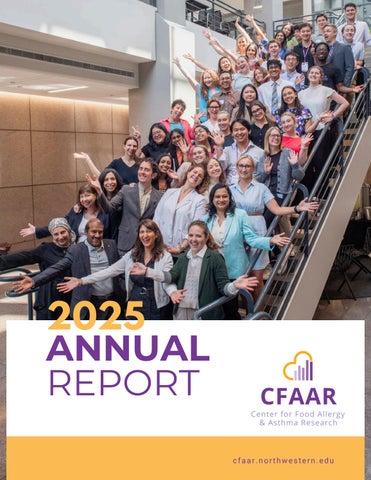
2025
ANNUAL REPORT cfaar.northwestern.edu
2025 ANNUAL REPORT
A WORD FROM OUR FOUNDING DIRECTOR Dear Friends and Colleagues, This past year has been full of both exciting wins and tough challenges. Together, we’ve pushed research forward, built strong partnerships, and made a real difference in the communities we serve. From starting new projects to mentoring future public health leaders, there’s a lot to celebrate. But we also have some hurdles ahead. The loss of major grant funding puts our work in a tough spot. Federal funding has always been a big part of research progress, and without it, we need to find new ways to keep moving. We’re already exploring new paths, like teaming up with businesses and donors and expanding our education and community programs. These steps will help us get through this and come out even stronger. As we move into the new year, we do so with humility and determination. Our work is too important to stop, and the impact on patients, families, and communities is too great. Thank you for standing with us through both successes and challenges. Together, we will keep moving forward, guided by innovation, compassion, and the shared belief that progress is possible—even when times are hard. With gratitude,
Ruchi Gupta, MD, MPH Founding Director, CFAAR
3
Table of Contents Building a Stronger Future, Together
6
Current Research
8
Faculty Accomplishments
10
2025 Food Allergy Summit
12
CFAAR Student Programs
14
Student Alumni Testimonials
16
Publication Highlights
18
Ways to Support CFAAR
20
Save the Date: GFAPS 2026
21
5
Building a Stronger Future, Together This year, CFAAR has grown into a dynamic team of seven faculty members, two postdoctoral scholars, and more than 50 dedicated staff—all united by a shared mission to improve the lives of families affected by allergic conditions. Our work spans three core areas: managing large public health datasets to understand the burden and disparities in allergic diseases, conducting clinical trials to test new treatments and strategies, and engaging with communities and schools to promote education and equitable policies. Our faculty bring diverse expertise, including three pediatricians, two pediatric allergists, and two PhD-level biostatisticians and epidemiologists. We were proud to mentor two post-doctoral scholars this year—one specializing in psychology and the other in microbiology—reflecting our commitment to advancing knowledge across disciplines. Behind the scenes, our staff play a vital role in every aspect of our work. From research managers and clinical experts to senior data analysts and assistants, they support everything from research projects and administrative functions to communications, outreach, and education programs. Together, this team drives more than 20 active research studies, all fueled by a shared passion for creating meaningful change for families living with allergic conditions.
21 60 50
In 2025, CFAAR published 21 peer-reviewed manuscripts, including the “Pediatric Clinician Adherence to Peanut Allergy Prevention Guidelines: A Randomized Trial” in Pediatrics, from our monumental iREACH trial. Study findings were featured on over 50 news outlets including, Good Morning America and U.S. News. Over 60 abstracts and 50 presentations were presented at various international and national conferences including, but not limited to the American Academy of Allergy, Asthma & Immunology (AAAAI) Annual Meeting in San Diego, CA, the American College of Allergy Asthma and Immunology (ACAAI) Annual Meeting in Orlando, FL, the Global Forum on Anaphylaxis and Food Allergy (GAFA), in Padua, Italy and PedAllerCon in New Delhi, India.
6
2025 ANNUAL REPORT
Progress Through Partnership: Passionate Teams and Committed Participants 6,500+ Study Participants in 2025 Our research studies tell your stories. CFAAR continues to see high enrollment and participation in our studies, reflecting the trust and engagement of our communities. With consistent participation across multiple projects, we have had the pleasure of learning about our community's experience with food allergy development, burden, and tolerance. Your participation in our research studies helps advance food allergy patient care, education, and policy. 7
Driving Discovery Across 20+ Groundbreaking Projects From prevention to equity, CFAAR’s research portfolio is shaping the future of food allergy care. These highlights showcase just a few of the innovative studies your support makes possible.
Driving Innovation in Bioinformatics CFAAR is one of ten leading centers in the NIAID-funded Consortium for Food Allergy Research (CoFAR), advancing efforts to understand food allergy mechanisms, develop immune interventions, and create biomarkers for diagnosis. This year, CFAAR’s proposal to standardize food allergy data was selected as CoFAR’s top funding priority, fueling two major initiatives: Common Data Elements (CDE): CFAAR finalized 98 NIH-funded CDEs for consistent data collection in the FORWARD study, a 10-year, multicenter study of 1,500 diverse children with food allergy. Over 50 global experts collaborated to validate and promote these standards. FoodSpace: CFAAR is building a groundbreaking platform to unify food allergy research resources. With 119 resources collected, FoodSpace will launch in January 2026, providing global investigators access to protocols, tools, and data standards.
8
2025 ANNUAL REPORT
Leading the Way in Food Allergy Prevention CFAAR continues to pioneer prevention through two landmark clinical trials: iREACH Study: Published in Pediatrics in October 2025, this NIAID-funded trial demonstrated that a multifaceted intervention significantly improved pediatric clinician adherence to peanut allergy prevention guidelines across 30 Illinois practice sites. CANDO Study: The largest trial of its kind, CANDO explores early introduction of multiple allergens to prevent food allergies and related conditions. Nearly 1,800 infants are enrolled, with outcomes including allergy incidence, atopic disease, and immune/microbiome profiles. These discoveries will shape care for generations.
Advancing Equity and Education in Allergy Prevention CFAAR is committed to addressing disparities and empowering families through innovative research: Advancing Peanut Allergy Prevention through Nutrition Education and Breastfeeding Counseling: This study focuses on equipping families with practical strategies for early peanut introduction, integrating culturally sensitive nutrition education and breastfeeding support to reduce allergy risk. FORWARD Study: The FORWARD study, an NIH-funded project, is building a longterm cohort to better understand food allergy development and outcomes. This year, the cohort grew to 1,550 children across Chicago, Washington D.C., and Cincinnati, with over 2,500 biospecimens collected for advanced microbiome and immunologic research. Recent findings include insights on oral immunotherapy awareness, factors linked to elevated IgE, and distinct skin and gut microbiome patterns in allergic diseases.
9
Faculty Achievements: Driving Innovation in Allergy and Asthma Care This year, our faculty have made remarkable strides in advancing research, clinical care, and education in food allergy and asthma. Through groundbreaking studies, influential publications, and presentations at national and international forums, they continue to shape best practices and improve health outcomes for children and families. The following highlights showcase their leadership and impact across prevention, diagnosis, and policy.
Ruchi Gupta, MD, MPH Dr. Gupta completed the prestigious Executive Leadership in Academic Medicine® (ELAM) program at Drexel University College of Medicine, strengthening CFAAR’s capacity for innovation and collaboration. Dr. Gupta continues to lead CFAAR’s high-impact research body, advocacy, and partnerships that advance the mission to transform food allergy care and policy.
Lucy Bilaver, PhD Dr. Bilaver led the iREACH Study, testing strategies to help clinicians follow peanut allergy prevention guidelines. The study showed that an intervention bundle including education, decision tools, and visual aids significantly improved adherence to early peanut introduction recommendations. These findings highlight a promising path to reducing peanut allergy incidence and advancing prevention.
Kristin Kan, MD, MPH, MSc Dr. Kan leads the TEACCCH Study, integrating mobile health apps and digital inhaler sensors to improve medication adherence. Over the past year, she presented on pediatric asthma at local, regional, and national forums, including Lurie Children’s Grand Rounds and the AAP National Conference. Her recent publications include a Pediatrics commentary on improving access to medications for young adults with chronic conditions.
10
2025 ANNUAL REPORT
Sai Nimmagadda, MD Dr. Nimmagadda advanced food allergy care through clinical education and research. He delivered an international lecture on food allergy diagnostics at the Indian Academy of Pediatrics and presented at CFAAR’s Food Allergy Summit on effective prevention messaging. He also served as a core advisor on skin barrier research and was featured in Northwestern Medicine News for his contributions to shaping the future of food allergy care, alongside multiple publications and poster presentations.
Jessica Palmieri, DO Dr. Palmieri focuses on advancing food allergy prevdention, diagnostics and education. She published a key study on the accuracy of bead-based epitope assays for peanut allergy diagnosis in Annals of Allergy, Asthma & Immunology and co-authored the AAAAI Food Allergy Testing Course. Over the past year, she delivered multiple international talks, including at PedAllerCon in India, on molecular diagnostics and emerging treatments. Her work also includes seven abstracts and ongoing research initiatives.
Waheeda Samady, MD, MSCI Dr. Samady contributed to the iREACH Study team publication on peanut allergy prevention and delivered two lectures at the AAP Section on Allergy & Immunology. She recently published in JAMA Network Open, emphasizing that early peanut introduction can prevent peanut allergy, but parents and pediatricians need more support to implement guidelines effectively. Her work highlights the need for clearer communication and resources to reduce confusion and perceived risks.
Chris Warren, PhD Dr. Warren leads national efforts to improve food allergy surveillance and education. As academic PI of a CDC-funded initiative, he spearheaded development of the Food Allergy Indicator Report, offering an evidencebased overview of U.S. food allergy trends. His work informs strategies for public health stakeholders and advances prevention efforts to reduce population health burden.
11
2025 CFAAR FOOD ALLERGY SUMMIT A catalyst for change CFAAR hosted its third annual Food Allergy Summit on June 27, 2025, bringing together over 350 leaders from seven countries. The event focused on three tracks—Pediatric Education, Policy, and Prevention—highlighting advances in microbiome research, urgent policy needs for allergen labeling and school protections, and the launch of the Food Allergy Data Dictionary, a groundbreaking tool to standardize research worldwide. Attendees joined working groups on policy and prevention, which continue to collaborate virtually. We look forward to reconvening for our international prevention meeting in 2026.
12
2025 ANNUAL REPORT
“Through these meetings we are enabling a future where food allergies are prevented long before they become a burden.” Christopher M Warren, PhD, assistant professor of Preventive Medicine and director of Population Health Research at CFAAR.
350+ ATTENDEES FROM SEVEN COUNTRIES 13
$12,875 145+ 19 awarded in scholarships
students served
paid interns
Investing in the Next Generation of Leaders At CFAAR, we believe the future of food allergy and asthma care depends on the next generation of researchers, clinicians, and advocates. That’s why we’ve created programs that give students real-world experience and mentorship—helping them explore careers in science, medicine, and public health. Through hands-on research opportunities, students learn skills like data analysis, scientific writing, and research study design while working alongside experts in the field. Our programs include CFAAR Scholars, a six-week paid internship for college and medical students; CFAAR Ambassadors, a one-week experience for high school students; and Science Sleuths, a three-month self-guided STEM program for students of all ages. Many alumni go on to medical school, graduate programs, and public health careers— carrying CFAAR’s mission forward into the world. By creating these pathways, we’re building a stronger, more inclusive future for food allergy and asthma research and care.
LEARN MORE
14
Sakura Murase
2025 ANNUAL REPORT
Ambassadors, 2024 and Science Sleuths 2025 In 2024, I participated in the CFAAR Ambassadors Program, where my group proposed integrating the CFAAR food allergy curriculum into schools in order to promote food allergy awareness. Back home in San Francisco, I worked with my school district’s health education team to get the CFAAR food allergy curriculum approved for elementary health classes.
Through the CFAAR Science Sleuths program in 2025, I studied its impact in my former 5th-grade classroom—over 55% of students showed increased awareness. I also used the curriculum to lead a food allergy assembly at my former elementary school in front of over 500 students. This school year, at least nine more teachers in other elementary schools will present the curriculum in their own classrooms. One of the most impactful parts of the CFAAR Ambassadors Program was hearing from the career panelists, who helped solidify my dream of becoming a pediatric allergist. Now, as a high school senior applying to college as a Human Biology major, I’m excited to keep pursuing that path.”
Sponsor a Student, Transform a Future Your gift can open doors for the next generation of leaders. By sponsoring a student to join our program, you remove financial barriers and make our summer programs accessible— providing hands-on research, mentorship, and a pathway to careers shaping the future of food allergy care.
Give the Gift of Education! 15
Shaping the Next Generat CFAAR alumni turn hands-on experience into lasting impact, with ma Michael Yang, MSc
M1 at Tulane University School of Medicine CFAAR Scholar, 2024 Research Study Coordinator, 2025
My time at CFAAR has been truly transformative in shaping my path toward and aspirations in the field of medicine. I first joined as a CFAAR Scholar, where I was introduced to the intersection of clinical care, public health, and advocacy in food allergy. This experience opened my eyes to how research can extend beyond the lab to directly inform patient care and policy. Following that summer internship and upon completing my MSc in Nutrition and Food Science in England, I returned to CFAAR as a research study coordinator. Through this role, I have had the invaluable opportunity to contribute to clinical studies, design new initiatives, and directly collaborate with community partners to advance meaningful change in food allergy awareness and preparedness. These experiences deepened my commitment to food allergy research and health equity, while equipping me with the tools and perspective I now carry into medical school and beyond.”
Ria Jindal
M2 at the University of Cincinnati College of Medicine Research Study Assistant, 2025
My time at CFAAR was truly transformative in my journey to medical school. I gained invaluable research skills like data analysis and scientific writing that I still lean on every day. Beyond that, I had the chance to present my work, connect at local conferences, and even attend the national AAAAI conference. Working side by side with brilliant physicians who continue to mentor me is an incredible gift. CFAAR isn’t just a research center—it’s a vibrant, supportive community that I’m so proud and grateful to be part of."
16
tion of Medical Leaders
any continuing their journey in medical school. John Kosner
M2 at Rush Medical College CFAAR Scholar, 2023 Research Study Coordinator, 2024
As both an intern and research coordinator at CFAAR, what was most impactful to me was how much I learned about disparities and health equity. Working at CFAAR helped me improve upon my research skills and refined my understanding of the social determinants of health. I also had great mentorship throughout my time there, helping me learn the intricacies of applying to medical school and inspiring some of the work I now do in school. THANK YOU CFAAR!“
Madeleine Chow
M1 at the University of Illinois College of Medicine Research Study Assistant, 2025
My experience at CFAAR as a research assistant for the FORWARD study was a truly formative part of my journey to medical school. Beyond learning new research skills, I was deeply moved when talking to patients and families about their struggles with food allergies and hearing how deeply it affected their daily lives. These conversations reminded me why I want to become a physician: to listen with empathy, advocate for change, and help bridge gaps in healthcare. I am especially grateful for the mentors at CFAAR who believed in me and guided my growth and learning. They showed me how research and medicine can come together to make a real difference for patients and their communities."
Ximena Garibay
M2 at the University of Chicago Pritzker School of Medicine Research Study Assistant, 2025
My time at CFAAR was instrumental in developing my skills as a researcher, and these are skills I continue to use in medical school and plan to carry with me throughout my career as a physician. CFAAR was also incredibly supportive of my professional development, and I was able to contribute to manuscripts and even present my work at a national conference. Beyond the research, I met so many amazing mentors, collaborators, and friends who continue to inspire me as I pursue a career that integrates science, patient care, and advocacy.
2025 PUBLICATION HIGHLIGHTS Pediatric Clinician Adherence to Peanut Allergy Prevention Guidelines: A Randomized Trial Ruchi S. Gupta, Lucy A. Bilaver, Jialing Jiang, Richard D. Cohn, Michael S. Carroll, Marc Rosenman, Waheeda Samady, Adolfo J. Ariza, Helen J. Binns, Amy L. Christison, Joy Laurienzo Panza, Alkis Togias; Pediatric Clinician Adherence to Peanut Allergy Prevention Guidelines: A Randomized Trial. Pediatrics 2025; e2025071233. 10.1542/peds.2025-071233
Food allergy-related social anxiety: Novel conceptualization of an important but overlooked construct Engel ML, Herbert LJ, Ramos A, Gupta RS, Warren CM. Food allergy-related social anxiety: Novel conceptualization of an important but overlooked construct. Pediatr Allergy Immunol. 2025 Sep;36(9):e70189. doi: 10.1111/pai.70189. PMID: 40888550; PMCID: PMC12400901.
Common data elements for food allergy clinical trials: an overview Sehgal S, Starren J, Cattin K, Bilaver L, Gururaj A, Togias A, Gupta RS. Common data elements for food allergy clinical trials: an overview. Curr Opin Allergy Clin Immunol. 2025 Jun 1;25(3):194-198. doi: 10.1097/ACI.0000000000001075. Epub 2025 Apr 21. PMID: 40262039; PMCID: PMC12043398.
Disparities in Caregiver-Reported Knowledge, Attitudes, Behaviors, and Clinical Guidance Regarding Primary Prevention of Peanut Allergy Warren C, Stinson A, Samady W, Bilaver L, Nimmagadda S, Gupta R. Disparities in CaregiverReported Knowledge, Attitudes, Behaviors, and Clinical Guidance Regarding Primary Prevention of Peanut Allergy. Acad Pediatr. 2025 Jul 9;25(8):102874. doi: 10.1016/j.acap.2025.102874. Epub ahead of print. PMID: 40645579; PMCID: PMC12341296.
18
2025 ANNUAL REPORT
Determining avenues for improved food allergy support and safety on college campuses Bajaj PM, Kanaley M, Sansweet S, Bajaj K, Auerbach J, Fithian E, Ibrahim K, Gupta R. Determining avenues for improved food allergy support and safety on college campuses. Ann Allergy Asthma Immunol. 2025 Sep;135(3):297-302.e11. doi: 10.1016/j.anai.2025.06.005. Epub 2025 Jun 11. PMID: 40513819.
Distinct skin microbiome signatures in Black and White children with food allergy and asthma Fyolek JP, Mahdavinia M, Jiang J, Bilaver LA, Fox S, Nimmagadda SR, Newmark PJ, Sharma H, Assa'ad A, Seed PC, Gupta RS, Warren CM. Distinct skin microbiome signatures in Black and White children with food allergy and asthma. Pediatr Allergy Immunol. 2025 Sep;36(9):e70197. doi: 10.1111/pai.70197. PMID: 40905926; PMCID: PMC12410127.
Accuracy of bead-based epitope assay testing for peanut allergy diagnosis: Real-world pediatric population study Palmieri JM, Szafron V, Hearrell M, Anvari S, Chinn IK, Eubanks JD, Fernandez-Davila N, Gupta MR, Hajjar J, Lyter-Reed L, Noroski L, Reiland A, Seeborg F, Getts B, Kearney P, Butler H, Davis CM. Accuracy of bead-based epitope assay testing for peanut allergy diagnosis: Real-world pediatric population study. Ann Allergy Asthma Immunol. 2025 Aug;135(2):197-202.e1. doi: 10.1016/j.anai.2025.02.010. Epub 2025 Feb 28. PMID: 40024283.
Strategic Directions for Advancing Equity in Food Allergy: Takeaways From CFAAR's Summit for Advancing Equity in Food Allergy Yang MS, Warren CM, Engel ML, Samady W, Sansweet SR, Kanaley MK, Folger EVW, Shankar S, Gupta RS, Bilaver LA. Strategic Directions for Advancing Equity in Food Allergy: Takeaways From CFAAR's Summit for Advancing Equity in Food Allergy. J Allergy Clin Immunol Pract. 2025 Sep;13(9):2290-2297. doi: 10.1016/j.jaip.2025.05.024. Epub 2025 May 19. PMID: 40398677.
19
The Power of Community Giving Your generosity makes our mission possible. Every gift—big or small— fuels groundbreaking research, empowers families, and strengthens the fight for better food allergy prevention, treatment, and policies. In a year of both challenge and progress, our community of donors has helped us continue driving innovation and impact, even in the face of limited federal funding. Together, we are building a healthier, safer future for all.
MAKE A DONATION TODAY
Your support makes every breakthrough possible—be part of what’s next. 20
Global Food Allergy Prevention Summit
SAVE THE DATE October 22-24, 2026 | Oakbrook, IL
Join us for a dynamic event showcasing the latest advances in food allergy prevention. Explore groundbreaking research and innovative strategies across five critical areas: Early Dietary Influences Microbiome & Environmental Factors Early Treatment & Secondary Prevention Molecular Mechanisms Skin: Barrier or Pathway Connect with leading clinicians, researchers, and industry experts as we dive into the science shaping the future of prevention. You’re invited! Researchers, physicians, medical students, and public and industry attendees—come learn, collaborate, and contribute to the next chapter in food allergy prevention. This year, CFAAR and FAACT are partnering to simplify your experience with shared registration, hotel block, sponsor area, and networking—while keeping summit programming unique to each organization. 21
From all of us at CFAAR
THANK YOU
LEADERS IN FOOD ALLERGY AND ASTHMA RESEARCH The CFAAR team is internationally recognized for their research. They have published the prevalence of pediatric and adult food allergy in the United States, characterized the economic impact of food allergy, and identified disparities in access to care and outcomes among food allergy and asthma patients. To reduce the burden of these diseases and improve health equity, they develop, evaluate, and disseminate interventions and conduct work to inform local, national, and international health policy. With the continued partnership from their advisory boards, clinical partners, advocacy groups, patients, and their families, CFAAR is excited to continue developing more effective and impactful methods to investigate and improve the health of those living with allergic conditions.
CONTACT Email: cfaar@northwestern.edu
CONNECT @cfaarnu
To learn more about CFAAR and how to get involved, please visit cfaar.northwestern.edu