ceufad CYLCHGRAWN CANW CYMRU JOURNAL OF CANOE WALES
Issue 130 March 2017 £2.50
kayak
THE MALTESE SUP PROJECT LOCH SHIN – RIVER CASSLEY ADVENTURE NILE RIVER FESTIVAL 2017
editorial
Waters of Wales Paddle to the Senedd Photo: Waters of Wales / Palm Equipment
T
he access issue has been rumbling on for years now and in February the Welsh Government finally acknowledged the ‘enduring dispute over the rights of those participating in water recreation on individual rivers and lakes.’ It has also stated that it will ‘pursue a resolution to establish clarity in this area.’ It was great to see the Waters of Wales campaign organising a rally to coincide with the release of this statement. Over 100 boaters paddled to the Senedd to demonstrate the importance of this issue, and to submit a petition calling on the Welsh Assembly ‘to remove the lack of clarity in the law for access to and along water, by following the successful Scottish model.’ The pontoon at the Senedd was awash with sea kayaks, open boats, rafts and kayaks, with members, staff and Directors from Canoe Wales taking up paddles to join the campaign. A big thanks to the Waters of Wales campaign for organising the petition and rally, and to everyone who took part. Vicky Barlow Editor
Ceufad Ed Ceufad
2
| Ceufad
@Ceufad
ceufad
Ceufad is the official magazine of Canoe Wales. It is produced by members & the views expressed are not necessarily those of Canoe Wales or the magazine’s editor. Ceufad is free to members of Canoe Wales. SUBSCRIPTIONS are available to non-members for £10 for 4 issues from Canoe Wales. ADVERTISING For advertising rates contact Vicky on: ceufad@canoe.wales SUBMISSIONS Articles are always welcomed & should be submitted as Word files, however, typed articles are also accepted. Images can be prints or tiff/jpeg/RAW files (preferably 300ppi). These will be returned. CONTACT ceufad@canoe.wales – 01678 521199 Ceufad, Canoe Wales, Bala, Gwynedd LL23 7NU Ceufad is produced quarterly in March, June, September and December. NEXT ISSUE: JUNE DEADLINE: 1ST MAY Ceufad welcomes all contributions but reserves the right to edit & condense to fill the space available. Design & layout: Vicky Barlow www.victoriabarlow.co.uk
24 Sunrise over the River Cassley
20 Winter slalom report
contents
14
4
SUPing round Malta
CANOE WALES – WATERWAYS & ENVIRONMENT UPDATE Sharing the rivers with others
6
CANOE WALES – NEWS Latest info and events from Canoe Wales
7
IN THE FLOW Round up of paddling news and events
8
NILE RIVER FESTIVAL 2017 Lowri Davies throws it down in Uganda
34 Getting F.I.T. for paddlesport
20 SLALOM REPORT Winter training with the Welsh Squad
24 LOCH SHIN – RIVER CASSLEY CIRCUIT A snowy open canoe expedition
32 WHEN IRISH WAVES ARE SMILING The Surf Kayak Home Internationals 2016
34 F.I.T. FOR PADDLESPORT Words of wisdom from coach Chris Brain
14 THE MALTESE SUP PROJECT CW Director Sonja Jones on a SUP expedition
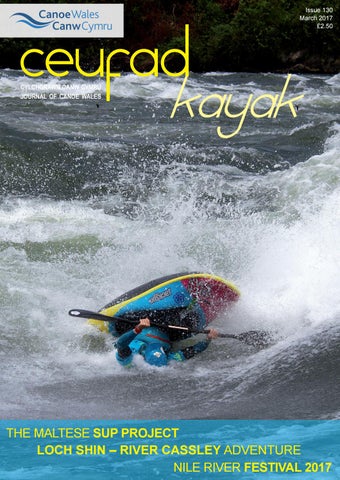
Front cover: Paddler: Lowri Davies Location: Nile River Festival 2017 Photo: Haley McKee
Ceufad
|
3
canoe wales news
News
Newyddion
Sharing Rivers with Others
Waterways & Environment Update
A lot has been going on recently in our efforts to improve access to inland waterways in Wales – some of which is reported elsewhere in this issue – although we don’t yet have a great deal to show for it! The Welsh Government has just announced that it will consider reforms to the laws in this area, which is great news but is just the beginning of a long process of consultation. And I have been continuing discussions with the likes of the Welsh Dee Partnership and Wye and Usk Foundation around improving the situation on those three rivers, where there seem to be particular difficulties in reaching sensible arrangements for different users to share the rivers fairly and amicably. But there is a great deal of talking still to do before we will reach any constructive conclusions.
4
Driving home from a particularly difficult meeting of the Welsh Dee Partnership recently, it struck me that perhaps we should look at the issue of access to inland rivers in a new way. Too often this issue becomes polarised as ‘canoeists versus anglers’, when it should perhaps be about all river users working together in harmony with each other, with the river environment and with local communities. That might sound radical – and a paddlestroke (or a whole river-trip) too far for many of you: but I urge you to read on before making up your minds.
| Ceufad
Canoeing on the Wye, near Holme Lacy Bridge. Photo: Roger Cornfoot. We (the paddling community in England and Wales) believe that “the law is unclear” on our rights to use rivers (because a Secretary of State and a reputable QC have told us this). Whereas others believe (because their NGBs and another respectable QC have told them) that “the law is entirely clear” and “there is no general public right to navigate non-tidal rivers in England and Wales”. These two positions directly contradict one another, which explains why we so often find ourselves in conflict on the riverbank! The Welsh Government has now acknowledged the need “to establish clarity in this area”, but this will take considerable time and effort. In the meantime, what would happen if we could ‘put the law aside’ and ‘put ourselves into each other’s shoes’? “Just walk a mile in his moccasins Before you abuse, criticize and accuse. If just for one hour, you could find a way To see through his eyes, instead of your own muse.” (Mary T Lathrap, 1895 – see the full poem at https://www. aaanativearts.com/native-american-poetry/walk-a-mile-inhis-moccasins) Could this offer hope of a new way forward? If Ian Paisley and Martin McGuinness could work together – why can’t canoeists and other river users (including anglers)? At the heart of things, we all just want the same thing: to enjoy our sport without undue interference and to ensure our natural environment is protected. For canoeists, this may mean being able to paddle on a river of our choice when conditions allow. For anglers, it may mean being able to fish in peace without frequent disturbance. Both are reasonable things for each to expect: but are not necessarily compatible with one another! Paddling on the Dee, Llangollen.
News
canoe wales news
Newyddion
So, what’s to stop us sitting down with each other, finding out what we each need and want – and working out a way to achieve a good deal all round? I think it may be because we’re all hungup on ‘principles’ (“we don’t believe you have any rights to be here” and “we can’t accept that we might not have any rights to be here”) and ‘pride’ (neither party wishing to be seen to ‘lose out’) – the result of which is that we all end up in a lose-lose situation where no-one gets what they really want and no-one really knows where they stand: and where we have no access arrangements in Wales that we are prepared to endorse.
Local kayakers joined forces with other organisations, including Betws y Coed Anglers, to successfully campaign against the hydro scheme on the River Conwy. Photo: Blue Bear Photography. beings like us – who deserve our respect and consideration; not our scorn and abuse? Should we not “do unto others as we would have others do unto us”? I’ll report on what I learn – and whether this helps me get anywhere in any of my ongoing access discussions – in future issues, but in the meantime, “the decision whether to paddle at any location in Wales at any time is for you to make as an individual, taking account of all relevant advice and guidance”, but … • if there is an access arrangement in place (i.e. on the Dee, the Wye, the Usk and the Glaslyn), you should not face a challenge from anyone if you stick to the terms of the arrangement; • if you paddle outside the terms of these arrangements, or on rivers without arrangements in place, you do risk being challenged – in which case you should always be courteous, calm and polite, and attempt to defuse the situation through positive dialogue; and … • If we go out of our way to be friendly towards other river users, we may find they’re “not so bad” after all? Happy Paddling! Further advice from Canoe Wales is available in our latest ‘Position Statement on Shared Use’ and ‘Trespass Briefing Note’, both available at http://www.canoewales.com/PRNstatement/. Steve Rayner, Waterways & Environment Officer environment-officer@canoe.wales
Fishing on the Wye at Glasbury. Photo: Trevor Rickard.
Ceufad
Waterways & Environment Update
I’m not suggesting for one moment that we shouldn’t continue to seek clarity and reform in the law – or that we should accept whatever arrangements we are offered. Canoe Wales supports the Waters of Wales campaign to adopt the ‘Scottish model’ of ‘access for all’ to Welsh rivers and will work with the Welsh Government when it consults on proposals for making improvements “in the opportunities available for participation in different activities”. But while the law remains as clear as Severn Estuary mud, I believe we owe it to ourselves, on those rivers where conflict exists, to continue to explore the scope for voluntary ‘shared use’ arrangements that are ‘the least restrictive possible’, are fair to all and are based on evidence and mutual understanding. So I’m going to try to find out what it is that anglers do in their sport; how they operate; and what it is that we do that particularly irritates them. And to see if this might provide some insights to help break the current stalemate around arrangements on the Dee, the Wye and the Usk. After all, aren’t all other river users, including anglers, just human
|
5
canoe wales news
News
Newyddion
Welsh Government Announces Plan to Improve Waterways Access The Welsh Government released on 13 February its longawaited statement on ‘Improving Opportunities to Access the Outdoors for Recreation’, which offers some hope for improved access to inland waterways in Wales. In the statement, Leslie Griffiths (Cabinet Secretary for Environment and Rural Affairs) said “there is an enduring dispute over the rights of those participating in water recreation on individual rivers and lakes. A resolution should be pursued to establish clarity in this area and to have greater consistency with how other access areas and activities are dealt with”; and that she “will consult on proposals for making improvements.” Canoe Wales expects to be fully involved in this consultation. The full statement is available at: http://gov.wales/about/cabinet/ cabinetstatements/2017/accesstooutdoors/?lang=en. The following day, the Welsh Assembly Petitions Committee was considering the petition submitted by the ‘Waters of Wales’ campaign group and agreed that it needed to press the Government for more details of the proposed consultation. Outside the Senedd building over 100 paddlers (including Canoe Wales members, staff and Directors) from around Wales and England had gathered to raise the profile of waterways access and were met by a number of Assembly Members, and achieved some great media coverage. Our thanks go to all those who took part and to those in the ‘Waters of Wales’ campaign team who gave up so much of their time to organise the event. Photos: Dean Brenton-Davies.
Formation of Canoe Wales Polo Committee The Canoe Wales Polo Committee has been formed to develop the sport of Canoe Polo in Wales, via a Welsh league, a national squad set up, and much more. For more information please visit the Facebook page – www.facebook.com/CanoeWalesPolo. The committee will be using the Facebook page to keep everyone upto-date on what they’re up to and what’s going on in the world of Welsh canoe polo. The committee is also always looking for volunteers, so if you believe you can help, please get in touch.
Coaching Update & Pembrokeshire Sea Kayak Symposium 6/7 May The event will take place on the 6/7 May with a number of update workshops being delivered. The following week there is a plan to put on a number of courses, e.g. 4 Star, coastal navigation, etc. For info email jet.moore@canoe.wales
EVENTS CALENDAR 2017 29 April – 5 May
Anglesley Sea Kayak Symposium
Holyhead
www.angleseyseakayaksymposium.co.uk
6/7 May
Coach Update & Pembrokeshire Sea Kayak Symposium
Pembrokeshire
jet.moore@canoe.wales
26-29 May
Canoefest 2017
Hay on Wye
www.opencanoe.info/canoefest-2017
15/16 June
Mawddach Paddlesport Festival
Barmouth
www.mawddachpaddlefest.org
21-23 July
Tryweryn Fest
Tryweryn
www.tfest.wales To list your event in Ceufad contact events@canoewales.com
6
| Ceufad
in the flow
IN THE FLOW RIVER USK CANOE RACE On Sunday 16th July Croesyceiliog Canoe Club will be hosting their annual River Usk Canoe Race. This event has been running for over 40 years and is one of the most popular races on the paddlesport calendar. The race starts in Newbridge on Usk and finishes 8 miles downstream at St Julian’s Hotel in Newport. Everyone is welcome and the race usually attracts competitors of all standards and ages. Info: www.croesycanoe.co.uk | uskrace@croesycanoe.co.uk
ADVENTURE BEYOND COURSES
CROESYCEILIOG CANOE CLUB
FOUNDED 1971 CANOE WALES TOP CLUB AWARD NEWPORT CLUB ACCREDITATION SCHEME TOP AWARD
2017
RIVER USK CANOE RACE
SUNDAY 16th July 2017 START: Newbridge on Usk FINISH: St. Julian’s Hotel, Newport
Distance: 8 miles Start time: 12.30pm For details: E-mail uskrace@croesycanoe.co.uk Web www.croesycanoe.co.uk
Sponsored by:
www.canoeandkayakstore.co.uk
If you’re looking for any of the following courses through Jet Moore / Adventure Beyond email: fun@adventurebeyond.co.uk • • • • •
4* canoe training and assessment 4* inland kayak training and assessment WWSR IRF raft guide courses Paddlesports leader awards
MAWDDACH PADDLEFEST – BARMOUTH 15/16TH JULY 2017 Now in its 6th Year, the Mawddach Paddlefest has events for all levels of experience and ability, ranging from a Guided Ascent to a 20km Tidally Assisted Marathon, and 6-man Rafted Canoe Races. See www.mawddachpaddlefest.org and Facebook Mawddach Paddlesport Festival for full details and entry forms, with updates on Twitter @Paddlewales There are also lots of fun and “have-a-go” events planned within Barmouth Harbour, which is set in one of the most stunning estuaries in the UK, amidst the mountains of Southern Snowdonia. New SUP events for 2017 include “have-a-go” plus for SUP Clubs an “Escorted Paddle” up the Mawddach Estuary. This Paddlefest is being run as a Charity Event in favour of Hope House Children’s Hospice in N Wales and other local good causes. So if you’re you looking for an exciting action-packed activity weekendaway for all the family, then come and enjoy this Paddlefest weekend whilst helping those in need. See you there, from the Merioneth Yacht Club in Barmouth For more details visit: www.mawddachpaddlefest.org
BRIDGEND CANOE CLUB
OGMORE SLALOM
Double Division 3, 4 and Open
20-21 May 2017
River Ogmore, beside Bridgend Recreation Centre Individual competitions each day Entries close 1015 Saturday and 0915 Sunday
Details from: dave.edwards2311@googlemail.com
Nile River Festival Words: Lowri Davies Photos: Haley McKee
8
| Ceufad
2017
Sitting in the eddy above a huge volume class five rapid is enough to get anyone’s heart racing. Dark, stormy clouds add to the dramatic atmosphere while the music blasting from large speakers and murmur of the commentary over the microphone somehow travels across the thunderous rumbling from downstream. There are hundreds of people lining the banks to watch you race down the thousand-cumec river, which is rising fast. Now that you’re in that eddy, there’s no going back.
Ceufad
|
9
With each pair of racers that set off ahead of you, the safety team signal back upstream to halt the race. These are some of the best big water paddlers on the planet, but still there’s been beatdowns and swims almost every round so far… just how much has the river risen since you scouted? Your heart is thudding in your chest as you are called to the start-line … The Hendri Coetzi Itanda Extreme race is just one part of an epic four days of races, freestyle competitions, parties and silly antics on the While Nile in Uganda as part of the Nile River Festival. I’ve been visiting the Nile for a decade now and the magic of the warm water, daily sunshine, guaranteed white water and perfect waves is never lost. Whatever time of year you visit the Nile it will be awesome, but come for the festival and it will be even more epic and unforgettable. The event kicks off with an evening “big air ramp” contest, where contestants slide down a 20ft concrete ramp and do something to try and impress the judges and crowds alike. This year tactics varied from throwing huge freestyle tricks in kayaks, to dressing up as superheroes or using an umbrella to fall through the air like Mary Poppins. The best scores came for anyone who managed to combine the silly and the skill, such as Sam Ward who managed to pop up an umbrella mid-airscrew, and Yusuf Basalirwa who donned a beautiful wig and bikini to accessorise his huge flips. Spot prizes of beers and funnels were awarded for those who raised a smile; including the giant cardboard Thomas the Tank which had taken
10 | Ceufad
several paddlers all day to cut, paint and construct for his 10-seconds of glory before he became a soggy pile of blue cardboard. Totally worth it. As the sunset turned Lake Bujagali orange, the spectators who floated below the ramp on boats, rafts and SUPs began to head up the hill to the (in)famous NRE bar for the opening party. The music blared, the beer flowed, the people danced and there was totally different sort of Bujagali Sunset enjoyed by many. Friday morning not only brought some heavy heads and tired eyes, but a 35km endurance challenge for those keen or mad enough to take it on! The race ran from the base of the Silverback Dam, which was erected in 2011, all the way to the end of the rafted section near the Hairy Lemon. This section of the Nile included some big volume rapids, interspersed with huge lakes of flatwater, so it might not have seemed sensible that almost everyone was in a playboat. This was because if you want to compete for the overall NRF title, you must use the same boat for the endurance, freestyle and Itanda race … and also because that’s the only boat most people have there. This race was completed in pairs so that you can provide safety cover for one another, but also the moral support to keep going as the sun bakes down on you as you slog across the flatwater. Some people chose not to let the event be a slog at all and completed it at a leisurely pace with their friends, enjoying a picnic along the way. Very civilised! After 35km of racing, taking 2.5-4 hours, the pairs had to
negotiate an obstacle course and down a funnel of beer or soda to stop the clock. After refuelling with a BBQ lunch, it was time to relax on the idyllic Hairy Lemon Island before another feast kicked off; the “Pirates and Princesses” party. The number of bearded princesses was a little troubling, but those pretty “ladies” didn’t let their ball gowns slow them down in the traditional Hairy Lemon party games. In a change to the usual agenda, Saturday hosted the Itanda Extreme Race and with such high flows it was even more epic than usual. Paddlers raced in pairs down the thunderous grade 5 rapid, though it is really the clock they’re against. The fastest 5 paddlers were taken though to a final in which they had to show their skill and flare, not just by negotiating the rapid safely, but also throwing in some freestyle moves or impressive line choices along the way … finished by plugging into the big hole at the bottom, known at The Bad Place. The huge levels made for ‘sporty’ conditions and several paddlers got swallowed up by the big holes such as Cuban and Ashtray. Of the 20 paddlers in the race, only 13 made it to the finish banner! The final was another level of spectacular. Sam Ward and Yusuf Basalirwa dominated again with cartwheels on the entry ramp, massive airscrews on the Cuban and a solid commitment to beatdown in the Bad Place. As a spectator, this event is incredible to watch! Over the
Ceufad
| 11
past 2 years local paddler Sadat has given the crowd a flavour of the heart pounding adrenalin you get from paddling the rapid by committing to the meatiest stoppers and styling out a real kicking of a surf. I’m pretty sure everyone collectively held their breath as they watched him fighting the power of the left side of Cuban in a heady mix of awe, fear and disbelief. High from the adrenaline, we piled into buses, rafting trucks and cattle wagons back to NRE for the party to end all parties: live music, jelly wrestling and table dancing provided the entertainment for the night. Sunday was time for the famous Nile Special Freestyle, a competition like no other, rewarding paddlers for going as big as possible to impress the crowd. The river level was the lowest it had been in weeks, making the wave pretty flushy and hard to use for the first few heats. Never-the-less, huge air and impressive combos were busted out by some of the best big wave boaters in the world. An awesome spectacle for the many people who turned out (including a great showing from the local villages). In the past few years some of the Ugandans have really upped their game and we saw three of the Ugandan freestyle team making the men’s final. In the biggest and most competitive female field yet, both Ugandan entrants made the top 5 final against some top international paddlers. I managed to stick a couple of airscrews, flashbacks and a helix to take the win, with Brooke Hess smashing out a huge flashback and blunts to take second and fellow American Jessie Stone got some nice air blunts for third. In the men’s, Sam Ward continued his domination with impressive
12 | Ceufad
sidekick-airscrew and panam-back-panam combos. Aussie James Rowlinson threw a huge pistol flip for second place while Craig Ayres’s huge back panams secured him third position. All that remained was the prize giving, which was held beside the wave using beer crates as a podium and a Red Bull archway overhead. The event was supported by a bunch of cool companies from across Uganda which meant there were some super-cool prizes such as stays in safari lodges and discount flights with Brussels Airlines. If you have any opportunity to join us next January, do it! 2018 will be the last festival before a new dam floods many of the rapids and waves we enjoy out there … See you at Nile River Festival 2018!
LOWRI DAVIES Lowri is a British Canoeing Level 5 White Water Coach, National Trainer for Freestyle, former European Freestyle Champion and international expedition paddler. She runs FlowFree, a coaching and guiding company that offers coaching for all abilities, including a range of BCU courses, and world-class guided trips abroad. For more info visit: www.flowfree.co.uk Lowri would like to thanks her sponsors for their continued support: Palm Equipment and SheShreds.co
KEY FACTS FOR A UGANDA TRIP How good do I need to be? Anyone can paddle on the Nile as there are all grades of white water available. A solid roll will make most rapids and waves accessible. When should I go? Any time! Uganda is on the equator meaning seasonal change is negligible and water levels are very consistent due to the dams. How long do I need? It depends, but a week is an absolute minimum. Two weeks gives you a better chance to get used to the big volume and make the most of the river. Many people go for longer if they can as living costs once you are there are very low. Do I need a guide? That depends on your ability and how long you have. There are many channels and potential lines, some of which are very difficult to scout, so hiring a professional guide will help to get you up to speed quickly. If you are on a short trip of two weeks or less then I’d highly recommend a guide as it will really allow you to maximise your experience for the time there. Kayak the Nile / Love It Live It are based out there year-round to offer professional guiding. I also run bespoke trips through FlowFree Coaching – www.flowfree.co.uk I’ve heard there’s a dam. When will that go in? There’s a big dam on its way, called Isimba. This is going to flood a lot of the currently paddled rapids. If you have any chance to get there before the dam, do it! Flooding is currently scheduled for May 2018, though tree clearing and such-like will be taking place from now until then. This means Nile River Festival 2018 will be the last one in its current format!
Ceufad
| 13
Words: Sonja Jones Photos: Chris Brain Sonja Jones Georgina Maxwell
14 | Ceufad
have Multiple Sclerosis – an unpredictable beast, but I am determined for it to not become unruly. Paddling has been my version of rehabilitation where it has brought me strength both physically through the bodily act, and mentally due to the challenges that this has come with, increasing my conviction to overcome hurdles. Strength has also been found from my new, and some I believe to be, lifelong friends from the paddling community. My first achievement was to paddle the Great Glen by sea kayak in 3 days rather than the standard 5 in May 2015; which I did, accompanied by 8 others. From that my confidence and both my physical and mental strength surpassed anything I thought possible. This challenge instilled a steadfast passion for paddling and being immersed in the outdoors.
fter the Great Glen, I organised and led my own kayaking expedition in Menorca; an unsupported circumnavigation of the island in May 2016 with 4 newly acquired friends. Leading up to Menorca in early 2016, I began to realise I had some clear asymmetric strength in my legs. My left leg was significantly weaker than my right; this affected me daily when climbing stairs or walking gradual inclines, and was especially alarming on a sea kayaking trip on the Menai Strait and whilst learning to ski in Chamonix. On returning from Menorca, whilst suffering peak post-adventure blues, the idea came to me – I will paddle my legs to strength through the power of SUP. With that idea planted and another goal to focus on to help me to recover from post-expedition despair - I immediately went on Google Earth to find somewhere warm and interesting for a new challenge. I knew that if I wanted paddle-pals, I would ideally need somewhere that would not be too much of a time commitment so that getting time off work wouldn’t be a problem. My eyes suddenly landed on Malta – I had fond memories of holidays there as a child, particularly as it is where I had my first taste of watersports when learning to windsurf at about 10 years old. I thought that if we used inflatable SUPs we could easily get our kit out there and at a rough flight time of 3hrs and 15minutes – we won’t break our backs doing so. I then measured the distance of circumnavigation of Malta, where it became apparent
that to do not 1 but all 3 islands, would be around 137 kilometres. Again, I thought if we had 10 days and favourable conditions, this could be entirely feasible. Feeling full of fire and excitement for this new mission, I set about recruiting exped-i-pals. I knew from my Menorca trip that I needed to be surrounded by a team with significant experience so that we could all look after each other effectively. I knew that if something bad happens with Malcolm (that’s what I call MS), and we simultaneously hit dangerous conditions or another team member has issues, we need to be certain all eventualities are covered. And so the call went out. Georgina, a highly experienced paddler and coach who’d I’d met out in Chamonix. Chris Brain, the man who helped paddle me to strength. Matt Haydock, George’s highly experienced paddler friend and coach. Within a couple of days, this small vision had sparked up into a reality. We had approximately 5 months to get paddle-fit where we all spent our time paddle-boarding as often as possible; I would frequent Cardiff Bay and the River Ely, George and Matt would be on the sea and canals of Scotland, and Chris would often be found mooching around places such as Bala Lake. As we fast approached “paddle-off” we had to think about loading potentially 10 days’ worth of expedition stuff on to a paddle-board. We all had our own methods, especially because we all had varying amounts of cargo-areas on our boards – I just had the
Ceufad
| 15
one area for strapping baggage on at the front on my FatStick 12’6 Racer/Tourer iSUP. All of our boards were by different manufacturers, but what we aimed to do was to have similar length/ widths so that we were able to travel at similar speeds to each other, although cargo did indeed have an effect on our boards’ responsiveness. If there was one thing I learnt from Menorca and that was I over-packed. This time I took the bare minimum clothes (and simply had biodegradable hand wash for them), and everything else was in miniature – I even bought a down jacket that scrunched up less than a jumper and a sleeping bag and roll mat that squished down not much bigger than a can of beans! Everything was placed in one waterproof bag at the front and strapped down with roof-rack straps as bungee cord alone was not going to cut it … as I soon learnt when one broke and twanged my bicep early one morning on loading my board. That was a rude awakening!
THE BIG PADDLE ... We flew out to Malta on Halloween 2016, and in celebration of the spooky festival, two days’ prior, a forceful storm swept over the islands, reaching approximately 45 knots, bashing onto roads and even damaging hotels. Leading up to the trip, I was constantly monitoring the forecast – despite the winter month (which was
16 | Ceufad
chosen purely down to all our availability), it was set to be perfect SUP conditions with barely any wind and a calm sea state predicted. Imagine my horror on Saturday 29th October when I did my daily weather monitoring; I went into a black mood – I took Mother Nature’s mastery as a personal attack, mainly due to my “weather cockiness” leading up to the challenge. On arrival it became clear that the legacy of the storm was still strong; waves were thundering against the rocks and it was obvious that launching (or landing) an inflatable SUP in these conditions would not be advised. Halloween was not the day to mess with Mother Nature. So we took the time to get provisions and bond as a team over a meal as this was the first time we had all been together, and in some cases, even met each other! As the evening progressed the seas grew stronger pelting water over the pavement in places and soaring seemingly high into the sky. Maybe things would look better in the morning. On waking up Georgina (AKA G-Max) and I went straight to the balcony to peek down the narrow street to look at the sea. The ocean appeared calmer than the day before and so our spirits lifted immediately. After a hearty breakfast we all agreed that based on the forecast and the sea state – it was now or never. When we got on the water, we were faced with 6ft swell and when paddling fully laden inflatables,
this was hard going. We realised that all landing spots were going to be on spikey rocks – not ideal for something that may POP. And as daylight hours were not on our side, we needed to think about landing sooner rather than later. At home we had not encountered a landscape like it when SUPing and so our first steep learning curve was timing the waves crashing onto the unavoidable rocks when launching or landing. Before we went on the trip I thought it would be a good idea to take split kayak paddles with us, so if the going got tough, we could make up ground and be much more stable and energy efficient when paddling kneeling/sitting. Within a short while of being on the water, we had to whip out our secret weapons and by golly I am so glad we all decided to bring a set of splits with us. I’m not sure how far we would have got if we didn’t take this solution as they ended up being an absolute Godsend. We ended our day with finding ourselves a secluded camp (despite the urban nature of our environment) at Fort Manoel where we relaxed from a very vigorous day paddling with a spot of ukulele, singing, and rum. Nice. This was absolutely needed to help us recover from the slight disappointment I think we all experienced by the distance (or lack of!) we had covered but it was also a very bonding night as a team as I think we were all hit with this very real feeling of WOW, “what we’re doing … it’s quite something and clearly isn’t going to be straight forward”.
Ceufad
| 17
Although the wind was significantly less than it had been previously, we still had rather decent swell to contend with as consequence of the aftermath of the storm. One rather hilarious outcome of this, was the development of our rather alternative Stand Up Paddle-boarding styles (see boxed text). Mixing up the paddling styles ensured we progressed because sure as eggs are eggs, if we attempted to stand up all the time, our bodies being essentially big sails would impede us significantly, but also, let’s be honest, we would spend more time IN the water, than out of it. We persisted in our paddle, looked at the map and the time and decided we needed to find ourselves a camp for the night. There was only one obvious choice. On the map we could see what appeared to be a harbour called Delimara but as we looked to our left, we could see HUGE container ships hoping to enter said harbour. This was Malta Freeport. As there was seemingly nowhere else to go, we had no choice but to investigate further. SURELY there would be somewhere safe and quiet tucked away for us to snooze for the night. We paddled closely to the side of the port, staying clear of the marine traffic. In front of us was what looked like a power station with exceptionally bright lights … and a small ledge. A ledge perfect for 4 adventurers and their SUPs. There was nowhere else to go. This was it for the night. We set up camp and checked the weather forecast; we could see that a storm may be arriving at approximately 2am. We had some very funny conversations about whether we needed to move away from the water or not, but in the end, we looked at the options and just thought sod it, let’s live on the edge (quite literally) and stay put. The options were bleak. The good news was … no storm arrived at 2am and we didn’t get hit by waves and rain in the night. The plan was to rise and spring into action at 5am to avoid getting into trouble and to make the most of the day in order to make progress. At 5am, we looked at the sky to see forks of lightening in front of us. The next section had the potential to make or break the aim of full circumnavigation, as there would be little to no places to stop due to Dingli Cliffs. We got ourselves sorted and looked at the forecast. Although we could see the weather was due to calm down on that side of the island, there was no doubt in our minds that the sea state would remain hairy. After a short run in with friendly police and quiet contemplation, we accepted that we needed to get to the north of the island in order to stay safe and complete at least part of a circumnavigation. Our aim
18 | Ceufad
PADDLEBOARDING STYLES SDPB (Sit Down Paddle Boarding) – kayak or SUP paddle KPB (Kneel Paddling Boarding) – kayak or SUP paddle APB (Armchair Paddle Boarding) usually with a kayak paddle – where you sit against your luggage like a chair SBASFITAPB (Sit Back And Stick Fin In The Air Paddle Boarding) with a SUP paddle or a kayak paddle: If the cross winds were too strong and the nature of the fin wants you to constantly go with the flow of the wind/ waves ... sit far back so the fin raises out of the water and BOOM ... it can’t change direction to where you don’t want to go ... cheeky!
of three islands was shattered, and even one island was, at best, weather permitting, going to be a twothirds navigation. Our new plan was to paddle to Marsaxlokk to regroup, which was a victory in itself as we managed to actually SUP (yes, standing up!) the whole way. After landing, drinking coffee, and consuming slices of pizza and a burger-pie, we formulated a plan. We needed to get up to Golden Bay on the NW corner of the island, which had considerably better wind speed and direction. Then we could perhaps consider a twothirds circumnavigation. Dicing with Dingli Cliffs was not an option. In order to get there we of course needed a lift. Then we remembered seeing some sea kayakers in the bay on our arrival. Maybe they could help, because the odds are they would have a van. They turned out to be two coaches from the UK who had already heard about our trip, and with help from them and Kayak Gozo we had a lift up to Golden Sands in the NW corner! At Golden Sands the sea was beautifully flat and so we treated ourselves to a sunset STAND UP paddle, and then a night relaxing at a beach bar over a beer and a burger. That’s right folks, this was a day of hard core adventure. The next day we set off standing UP on our boards and all seemed calm as we paddled towards Popeye Village … the original set from the 1980’s film. We did not know that the day was going to be the most
surreal day of our trip, and quite possibly, our lives. The full details on what turned out to be Popeye Hell (we were eventually ‘escorted’ out by Bluto, seriously), check out my blog, as I’m not sure I want to recall the experience again. After this, the rest of the day, seemed serene in comparison. We paddled the north side of the island where we spoke to a spear fisherman, played a private gig in an open top cave early in the morning, battled some hideous side winds and fully understood the capability of the craft, discovered cleansing mud to bathe in, slept next to a mystical dead creature (I’ll never forget the smell!), laughed until our sides split, and had an unforgettable bonding and escapade amidst the initial disappointment of our goal changing. And we were able to spend a bit of time standing up again. In Chris’ words, “standing up hasn’t been the norm, it’s been the reward.” One thing that never ceased to amaze me on this adventure was the overwhelming kindness of the people we met along the way – it has absolutely restored my faith in humanity. I will be eternally thankful for the people that crossed our paths on this trip into the unknown.
SPONSORS Palm, FatStick, McConks, Red Paddle Company, Go Kayaking NW, Glenmore Lodge, VE Paddles, IR Europe.
Ceufad
| 19
SLALOM REPORT Words:Richard Lee Photos: Russell Scaplehorn
T
he Canoe Wales slalom training group has had its busiest winter of training to date, with a group of 30 paddlers making their way to training weekends and camps across Wales and the UK. Following the last races of the season at the Welsh Championships at Bala, and the Pan Celtic race at Tees, paddlers took a short rest and recommenced training at a six day camp at Bala at the end of October. Furnished with water releases on the Tryweryn, the group mixed up water and land sessions with river play, skills and technique while reviewing the 2016 season and preparing for the winter ahead. Between the Bala camp and Christmas, the group attended six weekends at Bala, Llandysul and Nottingham, as well as a strength and conditioning (S&C) workshop with Mark Lewin. These weekends revisited the basics, working on repeating techniques and getting physically fitter as part of a 12 week preparation block. A typical weekend would see a 9am meet and a skills or technique session, followed by an S&C session, and then a physical water session on the Saturday. Sunday morning would be an early start for full runs, followed by individual reviews and a run, with a final session on the water to review or preview priorities amongst the group. There were also midweek sessions at Cardiff, Llandysul, Bala and across North Wales as paddlers looked to increase their training to about 15 hours
20 | Ceufad
per week of on and off water work and stretching/ recovery. Over the Christmas break a six-day training camp was held at Lee Valley, and a four-day visit to Nottingham made use of the demanding white water to consolidate the preparation. A number of paddlers also attended the Wadi white water centre with Gareth Bryant and Llandysul Paddlers over the New Year, as the group entered a transition phase, of increasing the intensity in sessions and applying skills and techniques to full runs and speed work. Weekend visits to Bala, Cardiff and Lee Valley in January took the form of technique and speed work on the Saturday, with a full run completion on the Sunday morning, and a revisit of the course on the Sunday afternoon. Mental skills sessions, physio screening and S&C were also incorporated into the weekends, while the focus shifted to Lee Valley and Llandysul with more full runs, half runs and speed work as the season got closer in February and March. Division One racers kick off the season first on the Thames at Shepperton and the Teifi in Llandysul in March, while the first of the Premier slaloms will be held at Grandtully in Perthshire on the first weekend of April. Great Britain Senior, Under 23 and Under 18 selection will be held at Lee Valley over the Easter weekend, while Division One will resume at Grandtully, Pinkston and Nottingham in April and May. Premier race 3 will be held at Cardiff on the 2nd May.
Ceufad
| 21
2017 RANKINGS Rank 1 2 3 6 9 23 26 27 39 40 46 49 53
Name Fiona Pennie Kimberley Woods Lizzie Neave Gabrielle Ridge Megan Hamer-Evans Isabelle Bushrod Cara Lee Grace Scaplehorn Lili Bryant Bethany Carol Jessica Rayner Bethan Palmer Carys Grey-Thompson
Age S U23 S U23 J18 J18 U23 J18 J16 J18 J16 U23 J16
Club CR Cats Rugby CC Stafford & Stone CC Seren Dŵr Seren Dŵr Seren Dŵr Bala CC Seren Dŵr Llandysul Paddlers Bala CC Brecon CC Bala CC Tees Tigers
Rank 1 2 3 4 10 23 42 50 51 55 56 77 86
Name Bradley Forbes-Cryans Huw Swetnam Zachary Allin Ciaran Lee Edwards James Cooper Etienne Chappell Peter Lake Elliot Goddard Joe Clarke Layton Palmer Steffan Walker Huw Butterworth Sam Davies
Age U23 S U23 S U23 J16 U23 J18 S J18 S J18 J18
Club CR Cats EyeTee Tees Tigers Llandysul Paddlers Seren Dŵr Seren Dŵr Bala CC Seren Dŵr Stafford & Stone CC Llandysul Paddlers Llandysul Paddlers Llandysul Paddlers Brecon CC
Rank 1 2 3 12 14
Name Kimberley Woods Mallory Franklin Jasmine Royle Emily Davies Non Dingle
Age U23 U23 S U23 J18
Club Rugby CC Windsor & District CC Stafford & Stone CC Bala CC Seren Dŵr
Rank 1 2 3 5 7 9 14 15
Name Ryan Westley Thomas Quinn Will Smith Tom Abbott Rhys Davies William Coney Andrew Kettlewell James Coney
Age S S U23 U23 S U23 U23 U23
Club Lower Wharfe CC Lower Wharfe CC Winchester & District CC Mold CC Bala CC Seren Dŵr Viking KC Seren Dŵr
22 | Ceufad
Rank 28 39 40 46
Name Evie Merritt Catrin Schroder Ruth Bramley Elise Churchill
Age J16 J14 J14 J16
Club Llandysul Paddlers Llandysul Paddlers Llandysul Paddlers Seren Dŵr
Rank 6 11 24 26 44 52 68 86 94 97 98 101 103 110 131
Name Carwyn Lavis William Abbott Jon Haylock Finlay Yates-Jones Dion Davies Gavin Cooper Sam Merritt Lorenzo Cutts Steve Starkey Robert Graves Ioan Davies Steffan Griffiths Sam Rolfe Sam Bryant Aaron White
Age J18 J18 M J16 J16 M J18 J18 M M J16 J18 J16 J14 J16
Club Brecon CC Mold CC Llandysul Paddlers Llandysul Paddlers Llandysul Paddlers Seren Dŵr Llandysul Paddlers Snowdonia Slalom Eryri Llandysul Paddlers Independent Seren Dŵr Snowdonia Slalom Eryri Mold CC Llandysul Paddlers Snowdonia CC
Rank Name 14 Lili Bryant 17 Grace Scaplehorn
Age J16 J18
Club Llandysul Paddlers Seren Dŵr
Rank Name 14 Raoul Chappell 46 Joseff Round
Age U23 J16
Club Seren Dŵr Snowdonia CC
The training group is only as good as its individual team members – many thanks to the paddlers and the different members of the coaching team who have been involved with the training group over the last few winters – Mark Abbott, Rhiannon Britton (nutrition), Gareth Bryant, Gavin Cooper, Jonathan Davies, Geoff Forster, Daniel Goddard, Adam Johnstone, Mark Lewin (conditioning coach), Jonathan Males (mental skills), Stu Peacock (performance analysis), Andrew Raspin, Catrin Roberts (physio), Russ Scapelhorn, Becky Webber (physio) and John Willacy. Work hard. Expect nothing. Take responsibility. Enjoy yourself, Race without fear in 2017.
Ceufad
| 23
Article: Graham Warren
Taking to the river on the morning of Day 3, just below Duchally Lodge.
24 | Ceufad
T
hree years ago, whilst wading, lining and paddling down the Oykel from Inverkirkaig to Bonar Bridge, we passed the mouth of a fine looking river flowing in from the north. That river turned out to be the Cassley. It rises up on Ben More Assynt and tumbles the twenty or so miles down to the Oykel, losing 260m of elevation in the process. The river Cassley (at least this Anglicised version of the name) doesn’t sound very Scottish, but it is every bit a highland stream, a dyed-in-the-tartan salmon river, famed in fishing circles. Seeing this river sowed the seed for this autumn’s trip, a circuit up Loch Shin, portaging across to the Cassley then returning down this. Up on top of the mountain, near the source of the river, is a tiny wonderland of connected lochans; the Fionn Lochs and Gorm Loch Mor. This looks an interesting place to explore and a good base for climbing one of the surrounding peaks. White water paddlers are drawn to the Cassley for its two sections of waterfalls. The Scottish White Water Guide describes it as a beautiful white water river, but suggests that most paddlers will want to drive between the two falls to avoid the long intervening sections of “lower grade” water. But it was precisely these sections — solving the intricacies of travelling them — that appealed to us. We wanted to lose ourselves in the “delight of tumbling rapids, foaming runs and deep
pools” as a local guidebook says, not motor on by. Other commitments meant that we were not able to make our usual October slot. We would have to go in the second week of November, accepting the extra challenges of shorter days and even less predictable weather that this would entail. In fact, the weather wasn’t unpredictable— it was predicted to snow. We always hotly debate whether or not to take a trolley. We don’t want to slip into trolley-dependency and so miss out on the magnificent trips where they will not function. The upper reaches of the Cassley looked like a definite no-trolley zone on Google Earth, but to finish this trip we certainly favoured an 8-mile trolley rather than a 24 mile, 3-trip portage up the road section taking us back to Lairg. Also, there was a useful-looking road between the Loch Shin and River Cassley (Duchally) power stations, which would make an easy trolley link if we needed it. So a trolley was somewhat reluctantly added to our gear list. A canoe trip in the dark days of November, with a poor weather forecast can be as much an exercise in remaining positive as it is about paddling. The mountain tops were already ominously white as we motored up the A9. There was definitely a November chill in the air and the illuminated roadside signs were doing their best to get us to turn back with their “Yellow Snow Warning”.
Ceufad
| 25
Loch Shin, a 17-mile ribbon across Sutherland, long enough to have different weather at either end.
Up amongst the snow and nearing the summit on the Power Station Road.
We decided to stop for the night at the Falls of Shin. It was around 7pm and dark enough to make you think your eyes had stopped working. The last of the visitors had long since gone, leaving empty expanses of nicely mown grass for our exclusive use. The roar of the falls was a constant reminder of what might be in store for us. Adventure was in the air. The first leg of our journey was northwest up Loch Shin. This is a big loch, Scotland’s fifth longest, covering around half the span of the entire country from Loch Laxford on the west coast to the Kyle of Sutherland on the east. It looks good on the map, but gets short shrift in the Scottish Canoe Touring guide. The authors say they have tried hard to find redeeming features, but failed to find any. Nothing. The loch just goes on and on through drab, undulating country. In short, they pronounce it deadly dull and boring. As if this wasn’t enough, they throw in the fact that Loch Shin has unreasonable numbers of paddlers’ two legendary foes, midges and anglers. DAY 1 The easiest put-in was a few miles up the loch from Lairg, but we decided not to use this because it left too much open water until the end of the trip. If the wind changed to a westerly and reached terminal velocity, we could be stranded. Instead we started from a lay-by near Lairg, a good decision as it turned out. We had chosen our starting point on the circuit on the basis of the forecasted tail-wind, which turned
26 | Ceufad
up right on time to greet us. As we set out on the loch, the snow was well up out of the way, confined to the highest summits. Contrary to the Touring Guide, we found we were enjoying ourselves. Perhaps there are two Loch Shins. The one we were on was definitely not boring, but pleasant, airy and with the definite aura of a major piece of water in the very far north, and a major crosscountry route. This got us thinking about why would you find a piece of water boring. Is paddling itself of little merit, just a means to get into the scenery? If so, why not walk? Maybe we haven’t yet realised that we shouldn’t be enjoying paddling for its own sake. We continued, surfing on the growing waves, entertaining ourselves by really getting into the spirit of the Canoe Touring Guide’s disparaging view of our loch. “Look at that bird. Plain black. How monotonous.” “Not more mountains; how tedious.” When the Lairg dam was built, the water level rose 11 metres and the already long loch extended even further. We imagined the Canoe Touring Guide writers’ reaction to the loch getting even longer. 3.30pm: the light was fading. The lochside here was low and windswept with no obvious flat areas for our tents. It was getting darker, colder and more austere by the minute. Time to work hard at being positive. A firebreak in the forest, looked more promising, even though in our experience firebreaks rarely give ground smooth enough and dry enough for comfortable camping. However, when we got close
the ground was surprisingly smooth. What’s more, when you stood still water didn’t ooze up around your feet. At least not straight away. Luxury. The stirring treetops in the night told us that the wind was getting up. It started to rain. It was cold enough that rain here would be snow on the tops, so we were nervous about what the view from the tent doors in the morning would reveal.
Hiding from the wind.
Welcome shelter at firebreak camp.
“Y’ll nae make it!”
Our first view of the Cassley snaking out of the snows. This isn’t going to be easy.
DAY 2 The snow level had indeed descended by morning. The mountains had been transformed in the night from majestic to sulky and sinister. We figured that the high lochans, and much of the portage route to get to them, would now be in the snow. This route option suddenly seemed somehow less appealing than it had in front of the fire at home. After very little discussion we opted for the alternative, the trolley route along the power station road leading over the mountain to Cassley Glen. We set off and paddled under a rather threatening grey sky to the end of the loch where the crossScotland route comes in from Loch A Ghriama. Our original portage route to the high country disappeared up into the snow. We paddled on by. We landed instead at a rather desolate beach by the power station, surrounded by inscrutable concrete installations, pipework and fences. Access to the road was easy however, and we trolleyed up smooth tarmac, heading ever closer to the snow. At one point an electricity van appeared coming towards us down the road. The driver was friendly and more than willing to chat, this probably being more appetising than getting out into the snow and fettling powerlines. He told us that the road up ahead was snowed right over, and very slippery, and also that the Cassley may not have enough water to be canoeable, and that we had a long walk in front of us. He wasn’t helping. We continued, soon reaching the first flecks of snow, then patches, then a complete covering. We had hiked all the way up to winter on this barren, treeless mountain. Trekking through the snow wasn’t exactly what we’d had in mind, but to be fair, the thought of climbing aboard the canoe and tobogganing down the far side of the hill did hold a certain appeal. As it happened the snow was melting rapidly and our passage through was almost clear. They say you always remember what you were doing when you first learn of a catastrophe. We were standing in a snowdrift on the top of a mountain. Our feeling of being beyond the last outpost of civilisation had just been compromised by coming across a phone mast on the top of the hill. This prompted Andrew to phone home, which is how we received the result of the presidential election in the U.S. We hurried to get back into the relative safety of the wilderness. Wheeling down the other side of the hill gave us our first glimpse of the Cassley. First impression: pretty, not at all boring, but lacking one of the major ingredients of a river. Perhaps descriptions we had read of people canoeing the Cassley were from a time before the water was diverted to the hydro? But
Ceufad
| 27
Eventually we were treated to longer sections of paddling. in contrast to the snowfields all around us, Cassley Glen looked a green and pleasant land. It was still autumn down there. We stopped for lunch just below the holding pool for water queuing for the rollercoaster ride down the tunnel to Loch Shin. It was a pretty spot, and the river, although still choked with rocks, seemed to be increasing in size. Things were at last progressing quite nicely — but that was all about to change. Like an ominous change in the weather, the track surface turned from smooth tarmac to Estate Rubble. The trolley began to struggle visibly. It juddered, bounced and skidded, and clearly didn’t like it. The bouldery juddering went on and on. Then, suddenly, we heard that most awful of all sounds; worse than the eruptive hydro inflow on Loch Laggan, worse than the wind getting up near dawn, worse even than an angry hail from a ghillie — we heard the malignant hiss of a puncture. Easy Street had suddenly come to an end. We both stood in silence and just looked. We judged that we were at least a couple of miles from paddleable water, maybe a whole lot further. There are a few options in this situation; the obvious one, a puncture repair outfit, was ruled out because we didn’t have one. But we did have something far better— a complete contempt for the foibles of trolleys. We simply picked the canoe up, trolley still strapped on, and flipped it up into an overhead carry, wheels sticking out like a pair of joke Mickey Mouse ears.
28 | Ceufad
Puncture: the distance to paddleable water suddenly seemed much greater. Mist over the Cassley.
Dawn at our Island Camp with the sun doing a fine impression of a meteor.
The beautiful Achness Falls.
The Cassley above our put-in on day 3.
Drumlin Valley.
Dusk overtook us before the river became paddleable. Again, smooth, not-too-wet pitches were not hard to find and we set up camp just below the Wading. track, overlooking a little set of falls. The sky was clearing and it was getting colder. We had covered about 7 miles since Loch Shin. DAY 3 We awoke to a landscape much improved by a blue sky, bright sunshine and brilliant snow-capped peaks. We were back amongst the trees, at the height of their autumn colours. Not hard to be positive this morning. A short carry of about 600 metres brought us to the start of more promising looking water just beyond Duchally Lodge. There were clearly still lots of rocks around, though. A combination of the low November sun in our eyes and a dark algal covering, meant that the first you knew of the rocks was the crunch as you hit them. It was a time to savour a day of in-river entertainment, literally immersing ourselves in the intricacies of downstream wading and lining, reading the river, choosing the best line. Just before lunchtime, it was clear that we were approaching a gorge; the river dropped out of sight, we could see tree tops at eye level, the roar of water intensified and the riverbanks reared up and closed in. The river curved rightwards out of sight, hiding
its secrets. Another of those exciting bits. Decisions: which side to portage; do we follow the river or is the terrain easier further back; where can we get back down to the water again? With the packs, we explored a high path that came uncomfortably close to the edge of the gorge, right above the most dramatic part of the falls. In the worst possible place, Andrew fell, snatched over by the weight of his pack. I leapt forward to grab an ankle, but fortunately didn’t need to complete the action because after bouncing once Andrew came to a halt just short of the edge. Wading with the canoe between and around the generous helping of rocks was quite complex. We were in and out of the canoe so much that it started to fill with water, so we cut some logs to place across the bottom of the boat to keep the packs high and dry. We made four miles that day, got to know every rock in the river personally, and finally limped up onto a little island to camp, with a twisted ankle and bruised knee. After eating, we took a turn around the island for our evening walk. Two hundred yards later we were back at the tents. Ours was a small world. DAY 4 Dawn at the Island Camp was the very essence of November-ness. The air had almost as high-a moisture content as the river. The sun struggled to rise through the mist. We got up with the light at 7am, breath steaming, happy to escape from the wet tents. A few minutes later they suddenly froze.
Ceufad
| 29
Just missing the end of the rainbow.
The camp amidst the spruces and pines at Achness Falls. The lower Cassley became increasingly exciting.
We swung out into the hastening current of the Cassley, confident of more paddling today. After the slow progress of the previous day, we seemed to be rocketing along down bouncy rapids, round wide bends and through deep pools. We still encountered many rocky sections and discovered that the Cassley has a similar geology to the nearby Oykel; a riverbed to be of smooth, slip-slidey slabs set at an angle of around 45 degrees. Your feet were forever sliding away from you, making for very hard going. We were intensely aware of the danger of foot entrapment and proceeded with great care, but falls were frequent. Late in the day we approached the scenic highlight of the river, the famous Achness Falls. These are much more impressive than the Falls of Shin, especially now with beautiful sprays of autumn foliage competing for scenic grandeur with the cascades of white water. Next to the river at the bottom of the falls is a graveyard. To those steeped in canoe history, the gravestones here were very reminiscent of the crosses that adorned the banks of dangerous rapids back in the voyageur days. The atmosphere of the place was such that you could almost hear voyageur songs echoing down between the rocky walls. We found a good campsite on the portage around the falls, on a deep bed of moss and spruce needles in a stand of tall trees. The trees were, for once, in convenient places for tarping, so we soon had a ridgeline stretched out and a simple up-and-over tarp set up to keep out the wind. DAY 5 In the morning the sky was troubled, very dark towards the horizon, and tinged with the purple of winter. Today was not going to stay dry. We put in a couple of hundred metres below the falls, within sight of the road bridge at Rosehall. There were now a lot more runnable rapids but also numerous accursed fishing weirs which needed inspecting. One minute the rain teemed down, the next the sun blazed out; one rapid led into another, then another.
30 | Ceufad
The river now widened out rapidly and before long we pulled out into familiar ground on the Oykel, leading to the Kyle of Sutherland. Over the final seven easy miles we began to experience that warm inner glow of successfully completing another circuit, an idea on the map brought to reality. We finished with a rather awkward exit at the point nearest the main road at Inveran. It was here that we had intended to trolley our gear back up to Lairg, but with the trolley out of action we cached the gear in the trees and set off to walk, in the dark now, the eight miles back to the car. Liberated, joyfully free from our heavy packs, and wrapped in a blanket of darkness, we savoured the alternative landscape of night. Not much further now. We were very glad that we had set out from the near end of Loch Shin, rather than from the easier access point higher up the loch, otherwise we would have been faced with several miles more. The Shin-Cassley route is about 48 miles in total. The upper section of the river was quite hard going in places at the water levels we encountered, but the overall route is one of great variety and interest. The circuit takes you from wide-open water where you paddle to the horizon, over heathery mountain tops and then down to the intimate runs and pools as the Glen closes in. Travelling on a river teeming with salmon, with intense autumn colours and the sound of major falls drifting up the valley made the trip especially memorable. ABOUT THE AUTHOR Graham Warren runs Moosehead Canoes (www. mooseheadcanoes.co.uk), a Derbyshire-based business specialising in wood-canvas canoes and paddlemaking. Graham is author of Canoe Paddles: a complete guide to making your own, and has recently set up ‘Scottish Canoe Routes’ (www.scottishcanoeroutes.info) which gives information on trips in Scotland of the traditional paddle and portage style. For details email: graham@mooseheadcanoes.co.uk
CROESYCEILIOG CANOE CLUB
FOUNDED 1971 CANOE WALES TOP CLUB AWARD NEWPORT CLUB ACCREDITATION SCHEME TOP AWARD
2017
RIVER USK CANOE RACE
SUNDAY 16th July 2017 START: Newbridge on Usk FINISH: St. Julian’s Hotel, Newport
Distance: 8 miles Start time: 12.30pm For details: E-mail uskrace@croesycanoe.co.uk Web www.croesycanoe.co.uk
Sponsored by:
www.canoeandkayakstore.co.uk
When Irish Waves are Smiling The Surf Kayak Home Internationals 2016
W
Portrush, Co. Antrim, Northern Ireland was the venue for the Home Internationals 2016 hosted by the Canoe Association of Northern Ireland. The competition started on the journey out with who could stay wake for the longest for the drive north! Most of the team went out on the night ferry out of Fishguard to Rosslare, and drove through Dublin and Belfast and up to Portrush. It was pretty tough going with not much sleep on the ferry and a six-hour drive. All the tiredness disappeared when we arrived at our accommodation which overlooked East Strand beach and were greeted by 3ft clean waves rolling in! So it was a quick dash to sort ourselves out and straight on for a warm-up training session. Everyone took to the peak well, which was good news, as this was where the competition was going to be held. This peak was called the Arcadia after a Victorian building which stands out on the shoreline. After the session it was time for a team meeting and to welcome the new members of the team and present them with their team hoodies. After the meeting it was straight down to the Portrush boat club for boat check, registration and opening ceremony. The boat club had boats and bodies everywhere - what a sight, old friends, new faces, welcoming handshakes and warm hugs (and that was just the English). It’s a great sport to be involved in, everyone is friendly and welcoming, one big family. As the evening progressed boats were checked, people were registered and the team managers had their meeting to draw up the heats for the next day. Everything seemed to be going like clockwork, a well organised event, but there was one concern; the wave forecast was showing that the swell was dropping off during the week and looking quite small for the following weekend, which was the British Championships. Everyone had their fingers crossed that the forecast was wrong and it would change. Surfing is a fickle
32 | Ceufad
sport and you’ve got to have the patience of a saint! You never really know what swell is coming until you stand on the beach and see what is in front of you. The evening went on with the event being opened by the town mayor, a welcoming speech, photos for the local press and the arrangements for the competition the next day. First heat was at 0730 … The alarm went at 0600 and we were on the beach for 0700. It was still dark when we got to the beach and we couldn’t see the waves! Everyone was a bit anxious, was there any swell? Were there any waves? As it started to get light and the first heat was getting ready to go on, things weren’t looking too good. The swell had dropped off more than they thought and the waves were quiet small. The decision was made to make the most of what we had and crack on with the competition. After the first couple of heats everyone was struggling to make anything of the waves and it was a bit of pot luck whether you were lucky to catch something that you could do anything with. However, the team where really working hard and trying to make every wave count, with everyone on the beach cheering on their team mates. We had a couple of good scores and some good performances from the new members of the team. Halfway through the first round there was a team managers’ meeting called to discuss the conditions, it was agreed to carry on with the first round of the team event and then reassess the situation. First round finished and we looked to be in third position. Now normally team surfing competitions are run over two, three or maybe four days, but the organisers were getting a bit worried about the swell. If it had dropped off this much overnight would there be any waves at all tomorrow?! There was a big pow-wow and with much deliberation the organisers decided to run the second round straight away … this was going to be a long day!
Article: Andy Bailey
So straight into the second round. Everyone was working hard and by midafternoon people where starting to get cold and tired, as most hadn’t eaten since breakfast. Team members were on the beach at all times to make sure nobody missed their heat and to keep the cheering going, keeping spirits high. When Huw Jones won his heat in Masters I.C .things were looking up. As the afternoon went on we were fighting to the last few heats and the light was starting to fade. It was down to the wire on points and in the last heat, pressure was on for our youngest team member Peter Coulson. He had to win the heat for us to get third place overall. It was a challenging heat with small waves and nearly dark, a valiant effort from Peter but we didn’t quite get what we needed. Team Wales 4th in a battle to the end missing 3rd place by one point! During the evening we had a team meal together, and a pizza restaurant was a top
pick. It was good for everyone to relax after a hard day and to talk about their heats and how we could improve as a team. We met everyone else at West Strand the next day but things weren’t looking too good; there was a small wave so a couple of events were organized, then the big bomb was dropped; the organisers had decided that there weren’t going to be sufficient waves to run the individual competition. Everyone was gutted. All the teams met up that evening for the competition meal and presentation. It was a great night mixing with the other competitors from different countries. And the Northern Irish know how to put on a party; great food, live music and a very warm welcome! So that was it, all the hard work and organisation was over and we were in Ireland and three days to kill before we where due to go home, what to do??! Go hunt for some waves!! The forecast
was showing the west coast of Ireland was catching swell, it faces the Atlantic and had more consistent waves, plus the wind was staying low, so we got the map out and looked for a spot where there was going to be surf. Time for a road trip!! We were off to Bundoran, Co. Donegal in the Republic. We all decided that we would use this trip for personal development and that we would all set ourselves goals to improve our personal performance, looking at our strengths and weaknesses. We would buddy up so it would be easier to scrutinise and help each other reach the goals we set. We set off for Bundoran hoping the forecast was right and when we finally arrived we were greeted by some great looking surf. With a couple of days working on our personal development we left for home with big smiles. It had ended up being a very worthwhile trip, a bit short on the competition side but big gains in personal development which in the end
will strengthen the team and help us achieve our goal of being the best in the world. Yes, Irish waves were definitely smiling! The Welsh surf kayak team would like to thank: Ride Surf Kayaks for their continued sponsorship and Canoe Wales for their continued support. Bring on the 2017 World Championships in Portrush! The Welsh are ready to do battle!
WELSH SURF KAYAK TEAM 2016 Peter Coulson Lloyd Jackson Rachel Wall Re Barnard Ewen Arkison
Huw Jones Chris Watson Dave Mills Richard Lawrence Andy Bailey
Ceufad
| 33
Set yourself some goals. Where would you like to be in 12 months? Photo: Hannah James-Johnson.
34 | Ceufad
F.I.T for Paddlesport ne thing I love about paddling is that quite literally everyone involved in it is motivated to improve their boating. It is hard to find a paddler who doesn’t have a desire to get better, and for most of us we know that we can produce very rewarding performances on our “good days”. Most of us also know that simply going out for a paddle is not necessarily the best way to get better and that we need to be a bit more focused in our approach. Through my coaching and time spent with paddlers on the water, one area I believe that many of us could work on (myself included) is our body.
O
Article: Chris Brain Photos: Chris Brain or as credited
ARE YOU CALLING ME FAT? No! Most certainly not, far from it! Anyone who is actively engaged with paddlesport on a regular basis is without a doubt taking positive steps towards their physical and mental health. What I am saying is that for many of us we focus solely on our technical skills as a measurement for improvement rather than looking at our physical fitness. A scenario many people can relate to is that we feel like we reach a plateau with our paddling and we are unsure what to do to move further forwards or sort it out. Many paddlers will aim to continue the same routines at the same venues with a hope that they will improve. They will often keep reaching out for signs of technical improvement as they are usually very obviously measurable rather than looking at the other aspects of their paddling too. If we are going to push past this plateau we need to improve on more than just our technical skills, we need to check we are physically up to the task in hand too!
CAN I NOT JUST GO PADDLING? Absolutely, of course you can! What I am saying is that to make improvements in your physical ability you might need to be a bit more tactical in working on certain areas to make some noticeable improvements. If, however you’re not up for any formal training and you just want to get out on the water, why not try incorporating the following things into your paddling: • At some point throughout the day try to push yourself as hard as you can physically, try and reach your maximum. Find a stretch of water and really go for it. This could be a piece of flat water or your regular river run, but try and do it as fast as you can. If we do this every time we are out, then it will affect our speed, endurance and maximum power output. • Slalom paddlers are of usually very serious about their training, so why not create a course for
yourself? This could even be done on flat water, all you need are some definite markers or check points and try and move yourself around the course as fast as possible. This will of course affect your technical ability too and will get you linking moves and turns faster. • If you are a whitewater paddler, why not get in a race boat? If you are into your open canoeing, why not have a go on a stand up paddle board? The list of craft available is endless but varying what you paddle can be a useful shock to your system and will ultimately work muscle groups differently. The changes and adaptions that you will make in balance, paddling style and flexibility will certainly have an impact on your regular discipline. • Most things are better with a friend of course! You are also more likely to stay focused and on your task too, so get someone else involved with this if you can. It would help if they have similar goals and aspirations to you, but if you are both motivated to get out and paddle and you are going to help each other, having a training buddy is fantastic.
Training is always easier with a friend! Photo: Patrick Beavis.
Ceufad
| 35
If you’re a kayaker why not get out in a canoe?
Set yourself a challenge, Chris Brain and Mike Harper midway through their “Great Glen in a Day” in December 2016.
You don’t have to be in a slalom boat to train like a racer. Photo: Rachel Burke.
PADDLING VS TRAINING As we start to get more serious about making improvements in our physical ability we might need to change our perception of what we are aiming to do when we get out on the water. Many paddlers just go paddling, which is great because it has probably got you to the standard you are at. However, as you can probably guess if you have read this far, what I am now suggesting is that we get out there and train. Of course, the question is how is paddling different to training? When we train, we are goal focused and we set ourselves targets and outcomes. We also create a structured plan for our session and we have specific aims for what we want to do during it. When we go to go to a gym, we don’t just wander round the gym picking up random weights every now and then, having breaks whenever we felt a bit tired and finishing whenever we feel like it. We have structured plans and do a set number of minutes or reps on a variety of machines or exercises that work specific areas that we have targeted, completing all of this in a specific time frame. If we apply this to our paddling our time on the water might look very different and will not feel like your average paddle, but if we are going to move forwards simply repeating what we have always done isn’t going to cut it any more. One key area that we might need to change if we are going to train properly for our paddling is the
36 | Ceufad
image we have of ourselves. Next time you get on the water, aim to think and behave like an athlete, what would they be doing with this training session?
TIME TO GET F.I.T To make improvements physically we need to work our body differently to what we normally do. In doing this we overload our body, doing above and beyond what is our current norm. If we do this our body will undoubtedly respond physically and will noticeably change/develop/improve. The F.I.T Principle is a simple way of training, adjusting Frequency, Intensity and Time. Frequency is obvious, the more we get out the more our body will respond accordingly. Even just simply adding an extra couple of paddling/training sessions in a month will make a difference. Intensity is all about trying harder! Can we add a bit more oomph into our training, pushing ourselves a little bit further? Have a go a reaching your maximum a couple of times throughout your paddling/training session. If we change how long we are on the water and active for, it will impact our physical attributes. Remember though it’s not about sitting in an eddy for longer, it’s about doing more training. Look around, you’ll often see that the best paddlers are the ones that get out the most and do the most on the water!
HOW LONG WILL THIS TAKE? We should see this as a marathon rather than a sprint, it might take some time to see noticeable (measurable) improvements. The best thing to do would be to focus on making improvements over either 6 or 12 months and work from there. To do this well what we really need to do is to aim to make a detailed plan.
PROFILING OUR PHYSICAL ABILITY
Could you be the Sickline 2017 champion?
If we are going to create a plan to help us improve ourselves physically for our boating, we first need to assess where we are now and compare it against where we want to be. Picture where you want to be in 12 month’s time, be realistic as that will be more helpful to you and you are more likely to be committed to the plan and actually aim to achieve it. What do you look like in 12 months, are you paddling more challenging water? Are you lighter? Do you feel more flexible? Can you stay on the water for longer? Or is it just simply easier to carry your boat back to the car at the end of the day? Try not to focus on simply picturing your technical ability, but also your physical capabilities. Now create some measurable categories that you can look at and compare with your present self. These categories might be: • Power • Speed • Endurance • Flexibility • Weight Rate your current self out of ten in each of your categories and then mark where you would like to be in these categories for your future self. Hopefully you’ve identified the areas that you want to work on and if you have a target weight you’ve made a note of that too. However, what we really need right now are some more precise measurements. For each of your category you need to come up with a way that you can measure where you are right now and then you will be able to use the exact same test in the future. If you are serious about improving the physical side of your paddling you’ll want to be precise with your tests. Some examples might be: • How fast can you paddle 100m (or from fixed point A to B) on flat water? • How many strokes does it take to get your boat up to top speed? • What is your top speed? • How long can you sustain your maximum power output? • How far can you travel in 1 minute? • With straight legs can you touch your toes or put your fingertips/palms on the floor? • Keeping your feet together how far can you rotate your upper body? To do most of these simple tests all you need is a friend, a stopwatch and a maybe a tape measure and scales if we want to see how our body is developing. For most recreational paddlers, simple measurements and tests will be fine, but if you’re serious about this
Ceufad
| 37
Why not try using a SUP as a fun way to improve your fitness? Photo: Georgina Maxwell.
then test and measure as much and as accurately as you like. If you wanted you could go into real detail, using GPS to measure speed and distance, heart rate monitors and other advanced equipment too if you have it available.
MAKE THE PLAN (AND STICK TO IT( Now you have a profile for where you are now and you understand where you want to be, you need to plan how you are going to get there. If you put a lot of thought into your plan and make it as detailed as possible it will be more useful and the investment of this time towards it will certainly pay off. It is essential to this plan that you perform your tests again at scheduled points and that you have checkpoints and milestones to make sure that you are on track. You also might be in the position that your goals or motivation changes, this is OK! Reassess your plan, change your goal if you need to and keep moving with it. If, however, for some reason you keep falling behind with your plan or you simply can’t stick to it, then it’s probably time to work out why!
WHAT CAN I DO WHEN I’M NOT ON THE WATER? Keeping focused on your goal whilst you are not on the water can be a challenge but thankfully there is plenty that we can do that will help. Taking part in quite literally any other sport on a regular basis will inevitably have an impact, but without a doubt sports such as running, cycling and swimming will help you improve your overall fitness.
38 | Ceufad
If we want to do a bit of training at home all you need is a mat and either a watch or countdown timer. I use an timer on my phone and set it for 45 seconds of workout and 15 seconds of rest and usually aim to do at least a ten-minute workout (after I’m warmed up). Every time the 45 seconds comes around I vary the activity. It’s easy to make up your own workouts, whether that incorporates planks, squats, push-ups, sit ups or burpees. There are numerous workout ideas and routines out there on the Internet and YouTube. Pick one (or more) that you wouldn’t mind doing and go for it for 10 minutes! If you want to get a bit more serious on your home exercises you can even start using things like skipping ropes, resistance bands, kettlebells, dumbbells or stability balls. Remember buying and owning these things won’t improve your fitness, using them will! Good luck!
Training at home can be easy, you don’t need much equipment to have a big impact on your paddling.
CHRIS BRAIN Chris has been kayaking, canoeing, paddling and coaching for the last 15 years and runs his own business Chris Brain Coaching, delivering paddlesport coaching, safety and rescue courses and REC First aid training. Chris would like to thank Red Paddle co, Pyranha kayaks, Immersion Research, VE Paddles and Go Kayaking for making fantastic kit and their continued support. chris@chrisbraincoaching.com www.chrisbraincoaching.com
Live for White Water?
Coaching at NWWC 2017 Courses BCU WHITE WATER SAFETY & RESCUE 29–30 April 2017 24–25 June 2017 26–27 August 2017 21-22 October 2017
FULLY BOOKED £160 pp £160 pp £160 pp
BCU ADVANCED WHITE WATER SAFETY & RESCUE 29–30 April 2017
FULLY BOOKED
RESCUE 3 – WHITEWATER RESCUE TECHNICIAN PRO 9–11 May 2017
£290 pp
RESCUE 3 – ADVANCED WHITEWATER RESCUE TECHNICIAN 22–25 May 2017
£390 pp
OUTDOOR-SPECIFIC FIRST AID AT WORK 27–29 March 2017
£180 pp
LEVEL 1 RAFT GUIDE TRAINING
3–5 March 2017 £185 pp 5–7 May 2017 £185 pp 7–9 July 2017 £185 pp 1–3 September 2017 £185 pp If you can’t see a suitable date then give us a call.
OTHER COURSES
We run other courses in both Kayak and Canoe, including BCU 3 Star, 4 Star and 5 Star Training and Assessment. We also offer Moderate Water Endorsement and Advanced Water Endorsement both Training and Assessment.
PRIVATE COACHING COURSES
If you’ve got something in mind which you’d like to learn or you’d like a day’s guiding on the river, we can organise a day for you, whether on the Tryweryn or further afield. Please contact us to discuss your requirements. 1 to 1 coaching: 1 coach to 2 participants: 1 coach to 3 participants: 1 coach to 4 participants:
£180 per person, per day £90 per person, per day £70 per person, per day £60 per person, per day
Typhoon Multisport 4 Drysuits available for hire on all our courses only £25 per course.
Booking office: 01678 521083 Email: info@ukrafting.co.uk Website: www.ukrafting.co.uk/coaching-and-courses
>
National White Water Centre Canolfan Dwr Gwyn Genedlaethol