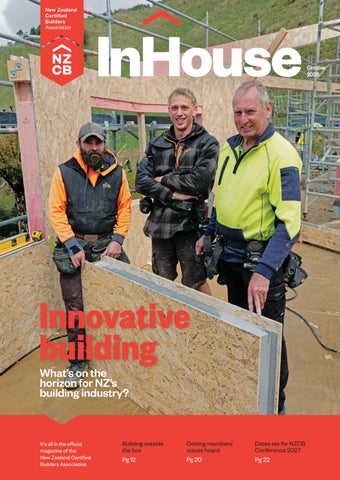
InHouse
Innovative building What’s on the horizon for NZ’s building industry?
It's all in the official magazine of the New Zealand Certified Builders Association
Building outside the box Pg 12
Getting members’ voices heard Pg 20
Dates set for NZCB Conference 2027 Pg 22
October 2026
We’re here for you, with much more than plasterboard. Comprehensive Technical Information Providing solutions and peace of mind
Expert Technical and Sales Support Helping you avoid costly delays or callbacks
Contact the GIB® Technical
Helpline at 0800 100 442
INHOUSE OCTOBER 2026
Contents u
Upfront
From the Chief Executive
u
u
2
Our people
Building business
Knowing your numbers
28
Debt dangers to avoid
30
Key employment law changes
32
The Apprentice and the Master
6
The payback of your insurance premiums
34
Trading Places: Katrina Foster
42
Agile growth to weather a competitive market
36
Using AI inyour business: What to watch out for 38 u
Revere
Above and beyond
10
u
Health and wellbeing
Help injured workers recover at work u
40
Innovation Education
Building outside the box
12
u
Looking to the future
18
Lead yourself first, lead others better
44
Backing the next generation of builders
46
u
News Regional news
Making sure members voices are heard
20
u
NZCB Conference 2027: Building the future
22
Regional events round-up
48
Apps making life easier on and off the job
24
NZ House & Garden Tours 2027
50
u
Apprentice Challenge
NZCB Apprentice Challenge 2027
u
26
Material difference
Product news
u
52
Our partners
NZCB Strategic, Affinity & National Partners
56
NZCB OCTOBER 2026
1
UPFRONT
From the Chief Executive
MALCOLM FLEMING NZCB Chief Executive
Construction activity is increasing, consent numbers are moving in the right direction, and builders have demonstrated considerable resilience and adaptability through a very difficult period.
2 NZCB OCTOBER 2026
THERE ARE FINALLY some reasons for optimism across the construction industry. The latest GDP figures show the economy grew by a modest 0.2% in the June quarter, but construction stood out with growth of 2.7%. That was reinforced by August’s news that annual building consent numbers had passed 40,000 – a milestone reached only five times in the past 50 years. After what has been an exceptionally difficult three years for many builders, seeing activity beginning to lift is welcome news. Of course, the figures don’t tell the whole story. Conditions remain challenging in parts of the country, and a recovery in construction activity won’t necessarily translate immediately into stronger workloads or margins for every business. But there are signs that the worst of the downturn may be behind us. One of the more encouraging things I have seen over the past year has been the way members have adapted to difficult market conditions. Through site visits and regional events, I have had the opportunity to hear directly from builders about how they have responded to the decline in new-home work. Diversification has been a common theme. Some businesses have moved into retail fit-outs, others into farm buildings, maintenance, infrastructure and other areas of construction. What may initially have been a necessity to keep work coming through the door has, for many, become a more deliberate business strategy. As the market improves, some of those new areas of work are likely to remain. That could leave businesses with a broader mix of revenue and less reliance on any one part of the construction market. There are also encouraging signs that the value of the trade-qualified builder is being increasingly recognised beyond the construction industry itself. There is growing interest within the property sector in involving builders earlier in residential projects. Bringing a builder into the design process early can provide useful cost checks, encourage better collaboration between builders and designers, and help identify potential issues before they become expensive problems.
These are not new ideas to those working in the industry, but it is positive to see greater recognition of the contribution builders can make before construction even begins. The more the wider property sector understands the value of that experience, the better the outcome is likely to be for homeowners and clients. There has also been some change at a ministerial level, with Simon Watts taking over the Building and Construction portfolio from Chris Penk. We have begun engaging with Minister Watts on the issues that matter to our members. Those discussions have included NZCB’s support for proportional liability alongside mandatory home warranty insurance, as well as our proposal to strengthen the Licensed Building Practitioner Carpenter class. With an election approaching, there is understandably a degree of uncertainty about what the next few years will bring. However, it is encouraging to see some common ground emerging around the need for greater stability in the construction sector. One area where there appears to be broad agreement is the importance of maintaining continuity for major government building projects that have already been designed and consented, rather than putting projects on hold whenever there is a change of government. Stability is particularly important for an industry that is already dealing with significant fluctuations in demand. The same principle applies to education and training. The building industry needs a skilled workforce and a training system that can provide certainty for apprentices, employers and the wider education sector. Further structural upheaval is unlikely to help achieve that. For now, the focus should be on building on the positive signs we are beginning to see. Construction activity is increasing, consent numbers are moving in the right direction, and builders have demonstrated considerable resilience and adaptability through a very difficult period. There is still some way to go before we can describe the recovery as firmly established, but after several challenging years, it is good to have some more positive news to talk about.
UPFRONT
InHouse magazine, including the wrap, is 100% recyclable. InHouse is printed on PEFC-certified paper, supporting the growth of responsible forest management worldwide. The press used to print InHouse utilises a UV light drying system (LED), meaning there is no solvent to evaporate, and no environmental pollutants are formed. It also uses less power than traditional technology, which helps reduce overall CO2 emissions. The contents of InHouse may not be reproduced in any form, either in whole or in part, without written permission of the Editor. All material received will be assumed to be intended for publication unless clearly labelled 'Not for Publication' and will be published at the discretion of the Editor. Views expressed in articles in InHouse are not necessarily those of New Zealand Certified Builders Association. While every effort has been made to ensure the accuracy of the information included in this publication, the designers, publishers, and Editor take no responsibility for errors, omissions or for any consequences of reliance on this information. Articles are not intended to be relied upon as legal advice.
InHouse
InHouse October 2026
New Zealand Certified Builders PO Box 13405, Tauranga Central, Tauranga 3141 10 Marsh Street, Tauranga 3110
Innovative building What’s on the horizon for NZ’s building industry?
It's all in the official magazine of the New Zealand Certified Builders Association
Cover OCTOBER_B.indd 1
Building outside the box Pg 12
Getting members’ voices heard Pg 20
Published quarterly in print and online, InHouse is the official magazine for New Zealand Certified Builders Association (NZCB). InHouse aims to educate and inform our members and their staff of the latest news from the Association and the Building and Construction Industry.
07 927 7720 0800 237 843 nzcb.nz
Dates set for NZCB Conference 2027 Pg 22
30/09/2026 2:39 PM
EDITOR Andrew Smith andrew.smith@nzcb.nz NZCB PARTNERSHIPS AND SERVICES Nicola Airey nicola@nzcb.nz ADVERTISING Linda Moody linda@nzcb.nz DESIGNERS School Road Publishing PRINT AND DISTRIBUTION Kale Print Ltd kaleprint.co.nz MAILING LIST If you have received a copy of InHouse and wish to opt out, you would prefer to receive it via email, or would like to update your details please email membership@nzcb.nz
FIND NZCB ON
Print ISSN 2463-3305 Online ISSN 2703-2418
We’re backing NZ Certified Builders Proudly supporting the construction industry for over 50 years with the experience and scale that keep your projects moving.
Our team of experts can support you with: Huge range From kitchen and laundry to tech and appliances, we have the range for every space you create.
Wraparound services Delivery, install, and packaging waste services that work around your build schedule.
Specialist team Tailored support from 50+ local account team committed to keeping your project moving.
Contact your local Trade Account Manager hereforyou@twgroup.co.nz nlgcommercial.nz/contact-us
OUR PEOPLE
The Apprentice and the Master
Reuben Mitchell won the Hawke’s Bay heat of the NZCB Apprentice Challenge, as well as the People’s Choice Award at the national final. We talk to Reuben and his boss Aaron Dodd about competition, mentorship and building a career. 6 NZCB OCTOBER 2026
MASTER Aaron Dodd u Director and Founder of Aaron Dodd Homes Hawke’s Bay u Established 2009 APPRENTICE Reuben Mitchell u Apprentice at Aaron Dodd Homes since 2022 u Winner of the Hawkes Bay heat of the NZCB Apprentice Challenge 2026, and the People’s Choice Award at the national final.
MASTER: Aaron Dodd InHouse: Your apprentice Reuben won the Hawke’s Bay heat of the NZCB Apprentice Challenge and then went on to win the People’s Choice Award. How did that feel for you as his boss? Aaron Dodd: I’m pretty proud of him. He communicates well with clients and handles responsibility well. He’s a people person, and definitely more of a leader than a follower. IH: How did you prepare Reuben for the competition? AD: For the practical side of it, I helped him with the gear he needed. He needed time off work to go and practise what he had to do, too. I told him, ‘they’re not going to trick you. If it looks simple, it is simple’. And I told him to take his time. IH: What skills do you think he has gained from this experience that he can bring to his future building career? AD: As I say, he’s a natural leader, so those skills will serve him well. He actually runs jobs for me now – full builds, pretty high-end stuff too – and has since the third year of his apprenticeship. I don’t really want him to be too skilled though, I don’t want him to leave! IH: How do you two work together on site day-to-day? Are there disagreements?
AD: We get on really well actually, we joke a bit. But he pushes back a bit now, as he’s more established. He will even correct me – if he’s got a better way of doing something, he will pipe up and tell me. IH: How did you first get into the building industry? AD: I started my apprenticeship in 1995. I had always wanted to be a builder. I’m from Huntly originally, so I did my time there and then went over to England for four years, then came back and established my business in the Hawke’s Bay. Over the years we’ve grown bigger – we do residential builds, and now I generally have 11 or 12 staff on board. Some years we build three houses, some years we do 10. IH: How do you think the industry has changed since you first started in the 90s? Do you think it’s easier for young apprentices starting out now, or harder? AD: I think it’s probably a bit easier for apprentices now. For example, the tools now are much more sophisticated than what we had. When I started, you had to dig house foundations by hand, and now it’s all done by digger. But I also find the work ethic has changed with this new generation. Some only last a couple of months and then they’re gone. When I did my apprenticeship, it was hard. It really was. I’ve taught apprentices and they’ve all gone on to do really well. But the younger generation these days seem a bit reluctant to work hard. Not all of them, of course, but I do notice it a lot. IH: So you have been very lucky with Reuben? AD: Oh yeah. It was more than four years ago when he started with me, and he just knows so much now. IH: What were some of the toughest lessons you had to learn as an apprentice? AD: Show up every day. I would have been too scared to ask for a day off. And you just had to get on with things. If I was told to dig a foundation, you’d start u
OUR PEOPLE
digging and you’d keep going till you were told the hole was deep enough. IH: What do you enjoy most about mentoring young builders? AD: If they’ve got a good personality you can have some fun with them. IH: What would your advice be to young builders starting out today? AD: Work hard. Nothing is given to you. Listen to your boss: If your boss asks you to jump, you jump. It’s that simple. APPRENTICE: Reuben Mitchell InHouse: Congratulations on winning the Hawke’s Bay heat of the NZCB Apprentice Challenge. How did you feel when they called your name? Reuben Mitchell: I was pretty stoked to be honest. It made all the work I had put into it worth it.
ABOVE: Reuben Mitchell with fellow contestants in the NZCB Apprentice Challenge. ABOVE RIGHT: Reuben is presented with the People’s Choice Award by Andy Wells.
8 NZCB OCTOBER 2026
IH: What will you take from that experience forward with you in the future? RM: I have learned to not forget to take a breath. It’s easier said than done – I was putting so much pressure on myself in the competition not to make a mistake and to do well. I did actually make a mistake on the day, it was just simple maths but in future I would just tell myself to slow down, take a breath, relax and start again. IH: You also won a People’s Choice award at the National Final? How did that come about?
RM: All the NZCB members at the conference had a chance to vote on the 15 builds the apprentices made. Mine was voted the most interesting and people seemed to like it the most... even though the judges didn’t! It was still cool to come away with something. IH: What part of the challenge pushed you the most, and how did you handle that on the day? RM: When I had my slip-up, it was hard because I almost gave up. But I decided to carry on, which was worth it in the end. There were a lot of nerves during the Nationals too, because it was a two-day event and there were four challenges. I just had this gut feeling the entire time, and Saturday morning I couldn’t even eat breakfast. IH: So what inspired you to pursue building as a career? RM: Well I used to work in refrigeration. I would be at building sites watching builders and thinking ‘I want to be able to do that. I want to be able to build a house’. My old man knew someone in the trades, so I went and did a couple of days’ experience with him and I haven’t looked back. IH: How did you come to work with Aaron? RM: The guy I did the building experience with gave Aaron my number, and Aaron called me two days later. I started working with him the next week.
IH: And how do you find Aaron as a boss? Do you two get along well? RM: We have our moments [laughs]! I don’t know if it’s because we are both strongwilled, but most of the time we are all good. IH: What’s the biggest thing you’ve learned from him since starting your apprenticeship? RM: Obviously he’s taught me a lot, because when I started, I didn’t know how to build, and I’ve come a long way. He’s quite focused on the business side of things, so I’m learning about productivity and how to plan your days or weeks to get as much done as possible. Like they say, time is money. IH: Where do you feel you’ve improved the most when it comes to your building skills? RM: When I started I knew how to swing a hammer. But now we do such a variety of work, you kind of want to be good at everything, and I do my best to be as good as I can.
“There were a lot nerves during the Nationals too, because it was a two-day event and there were four challenges. I just had this gut feeling the entire time, and Saturday morning I couldn’t even eat breakfast.”
IH: What is the next step in your career? RM: I’m working on the level 5 supervision course through BCITO to be a foreman. It’s a win-win for me, and Aaron too. I get this new qualification and he gets less on his plate because I’ll be doing more. It’s also a stepping stone towards learning how to manage my own crew in the future. IH: Do you have any good memories working with Aaron on site (or off) that come to mind? RM: There was one time recently actually, when he got annoyed at me because he thought I was taking too long to mark out some timber – I’d only just started but he thought it had been a few hours. I’d been using a laser to get it accurate, but he came in to take over, so up we get on the scaffold to mark it out. Long story short, we ended up back on the original line I had already marked out. He won’t admit that though, but he knows!
Happie
– REUBEN MITCHELL
r custom
Residential estimation made easy ers
Less overtime
Less er
rors
Reduc
e was
te
ore Win m
jobs
www.utecture.com
REVERE
STANDING AT THE island bench of this handsome Wānaka home is an immersive experience: the elevated site and wraparound glazing give the kitchen a control-cabin view of the mountains that is both immediate and expansive. Builder Chris Hayes of Hayes Built knows better than anyone the labour it took to capture this feeling: the structural steelwork that allowed such a generous open-span space; the intricate craftmanship required to ease the cedar window joinery into place. “We built everything apart from the window joinery,” says Chris. About 1500 concrete blocks were laid for the garage and basement area, and a 7.5-metre concrete beam, slotted into place with a Hiab, was
10 NZCB OCTOBER 2026
installed to help support some of the 30 tonnes of stonework encasing the lower level. Upstairs, where there are three bedrooms separated from the living by an Abodo barn-style door that the team crafted, the floorplan reaches out to the lakeside panorama. To complement the oak floors, Chris suggested tongue-and-groove ceilings and feature walls to lend texture to the surfaces. Clever design and exacting workmanship combine in a house but don’t distract from the landscape, which takes the starring role. The owners, who occasionally enjoy beers with Chris on the deck looking north-west to Treble Cone, are naturally over the moon. They’re already dreaming of their next project together.
BUILDER: Chris Hayes Hayes Built LOCATION: Wānaka
INNOVATION
12 NZCB OCTOBER 2026
NZCB OCTOBER 2026
13
INNOVATION
they haven’t had a lot of experience using. But I think a lot of good builders in New Zealand are happy to take new things on.” But it’s not only products and ways of working on site that require innovation and openness to change. Technology is evolving rapidly, transforming the way builders plan, price and manage projects, while creating new opportunities to work more efficiently.
Behind the scenes
ABOVE: Mike Craig of Mike Craig Builders and Leah Spear of Utecture. RIGHT: Mike and Jackson Thompson at work.
14 NZCB OCTOBER 2026
NEW ZEALAND MAY be geographically isolated but when it comes to innovation, our distance from the rest of the world doesn’t mean we need to be behind the times. Across the country, builders are finding smarter ways to work and embracing new ideas before they even reach the build site. From digital technology to innovative materials and construction methods, the way homes are designed and built is changing. For an industry looking firmly to the future, that can mean looking beyond our borders for new products and technologies – and being willing to take a chance on something different. “I think builders in New Zealand are prepared to look outside the box,” says Mike Craig of Mike Craig Builders, who has embraced prefabricated Structural Insulated Panels (SIPs) as part of his approach to construction. “Builders can be a little bit risk-averse at first if there’s a product they’re not too sure about. Under the LBP scheme, we have to guarantee all our work for 10 years. So there is a little bit of resistance when there’s a new product
For Leah Spear of Utecture, one of the biggest opportunities for innovation in construction lies in what happens in the early planning stages. “A lot of residential estimating is still based around people using disconnected systems and manual processes,” she says. “Every time the customer wants to make a change to their plan, someone has to manually check what changed, update the take-off, reprice materials and make sure nothing has been missed.” Utecture is designed to bring those processes together. The technology takes building plans – from concept plans through to detailed designs – and turns them into a digital 3D model. From that model, quantities, measurements and other information required to quantify and price a build can be generated automatically. As the design changes, so too does the model and its associated quantities, allowing builders to price variations much more quickly. Leah says builders using Utecture have reported going from spending late nights preparing customer estimates to finishing the work by 2pm, while the company’s own time-and-motion studies found its quantification service completed full take-offs from detailed design sets 37 percent faster than traditional estimating software. New technologies, products and systems offer plenty of opportunities for building better homes, and improving the building process. u u
INNOVATION
But, according to Mike, builders still need to do their homework to understand how the technology or product works and whether it’s right for them and their business. “I’d like to see builders understand the building they’re working on a little bit more – things like humidity and moisture build up in walls – things that the industry is not actually looking at properly.”
Innovation in practice
ABOVE AND RIGHT: “The panels arrive on site. They’re all pre-cut and ready to go. We stand them all up and work around the house, putting them together, and then once they’re in position, that’s it.” says Mike.
16 NZCB OCTOBER 2026
Innovation requires a shift in mindset and a willingness to jump in and try something new. As Mike notes, the SIP method of building has been around for a long time overseas but it was only when he realised the benefits it could offer when it came to building passive homes that he decided to look into the method in more detail. “The SIPs method isn’t new but it was only when I met this company at a trade show, and I started looking into it a little bit more that I realised what it could offer,” says Mike. “I wasn’t really going out there to look for prefab, but it was ideal for passive
homes,” he says. “I’ve always enjoyed building warmer, more airtight homes so that you have better thermal performance. That’s why I got into doing prefabricated SIPs – the airtightness. The best results I’ve had are from SIPs panels.” “The panels arrive on site. They’re all pre-cut and ready to go. I bring them on site and assemble them there. We stand them all up and work around the house, putting them together, and then once they’re in position, that’s it. There’s hardly any mucking around.” Mike’s approach with SIPs reflects a broader shift towards off-site manufacturing, which the Building Research Association of New Zealand (BRANZ) says has grown significantly in New Zealand. BRANZ reports that the proportion of building work relying on some degree of prefabrication increased from no more than 3 percent in 2013 to 9 percent in 2021.
Innovation has to deliver real benefit Leah says one of the biggest barriers to adopting new technology is simply that
builders are busy. A new product or system can initially feel like another thing to learn, another process to change and another demand on an already stretched business. “The technology needs to fit naturally into the way they already work, be easy to use and deliver value quickly,” says Leah. “Builders don’t want technology for technology’s sake,” says Leah. “They want something that solves a real problem and gives measurable benefits.” Mike says he believes if builders see tangible results from new products, and receive support from within the industry, they will naturally embrace more innovation, and move from ‘just building’ to building more intelligently. He says using SIP panels has made a world of difference to the way he works, and has made his time on site so much more efficient, with very little waste produced. “Once you’ve got the panels in place and the windows in and all the building paper on, you’re away laughing. If you get a wet day, you can carry on inside.
“When you look at the history of prefab, it hasn’t done well here – we’re a small country and you need to be able to produce lots of material to make it work. So, our population size lets us down a little bit, but I think as our population grows, things like prefab will become pretty important.” The answer to innovation in New Zealand construction doesn’t seem to be futuristic robots and headscratching AI models or gadgets, although AI plays an important role. Innovation lies in processes that quietly remove some of the inefficiencies that have long been accepted as part of the job. “Looking ahead, I believe the most successful construction businesses will look increasingly like technologyenabled manufacturing companies rather than traditional construction firms,” says Leah. Mike says: “Looking to the future, if companies get it right and don’t cause the building industry to get more expensive, I think a lot of builders will move into new ways of working, such as prefabrication.”
INNOVATION
Looking to the future BRANZ’s Chris Litten shares his view on the technologies, research and thinking that could reshape how New Zealand builds over the next decade. WRITER: COURTNEY WHITAKER
DR CHRIS LITTEN BRANZ Chief Operating Officer & Executive Leader
BRANZ delivers practical, independent building testing research and product certification. Their experts deliver the evidence and insight that strengthen building performance and decision making.
18 NZCB OCTOBER 2026
ACCORDING TO Building Research Association of New Zealand (BRANZ) Chief Operating Officer Chris Litten, some of the most significant innovation in New Zealand’s building industry is already happening. Research into corrosion, timber durability, low-carbon materials and moisture management is helping the industry develop buildings that are more durable, resilient and efficient, while BRANZ is also investigating how artificial intelligence could support more efficient building design, planning, consenting and off-site construction. But Chris says New Zealand’s building industry has never been short of good ideas. The challenge is making sure new products, technologies and approaches are properly tested, proven and translated into solutions that work on real projects.
Do you think that’s fair? Chris Litten: I don’t agree that the industry is slow to innovate. Builders adopt new products and methods all the time, but they also need confidence that those solutions will work over the long term in New Zealand conditions. Our climate, seismic risks and regulatory settings are different to overseas, so the evidence matters. That’s where independent testing and technical expertise play an important role. BRANZ’s testing and appraisals help give builders confidence in the products and systems they’re using. Our research and evidence also support major changes to the sector, such as proposed updates to NZS 3604, new granny-flat regulations and the introduction of overseas building products.
InHouse: New Zealand’s construction industry is sometimes accused of being slow to adopt new technology.
IH: In your opinion, what, if anything, needs to change here to accelerate innovation?
CL: We need to make trusted information and practical guidance easier for builders to find and use. That includes the BRANZ Helpline, technical guidance on our website and practical resources such as the waste toolbox. The focus is straightforward: help people adopt new approaches with greater confidence and less risk. IH: When you look at innovation across New Zealand’s building industry today, what are the most exciting developments you’re seeing? CL: What’s exciting is that innovation is becoming more practical and easier to use. Digital tools such as BRANZ’s Artisan app are already helping builders manage quality assurance and compliance on site, with less paperwork and greater confidence. We are also seeing major advances in building science. Research into corrosion, timber durability, low-carbon materials and moisture management is helping the industry deliver buildings that are more durable, resilient, efficient and affordable – to build and to operate. This year, we’ve invested in new research to test whether AI tools can support more efficient building design, planning, consenting and offsite construction. This is why independent, industry-led research matters. The Building Research Levy gives the sector a practical way to agree the priorities and invest in the research, testing and evidence needed to turn good ideas into solutions that work in New Zealand. IH: How does New Zealand compare with other countries when it comes to construction innovation? CL: New Zealand has a strong international reputation for building science, particularly in areas such as corrosion, moisture management, durability and building performance. That’s because our buildings face some of the toughest conditions in the world, and we’ve spent decades researching how materials and systems perform over the long term. IH: Are there overseas approaches or technologies you think we should be looking at more closely?
CL: There is plenty we can learn from overseas, particularly in areas such as AI-enabled efficiencies, material passports and circular construction. The key is not simply importing an approach, but understanding how it will perform here, and adapting it to New Zealand conditions. A big milestone in that respect will come next April, when BRANZ will host the International Building Physics Conference in Wellington, bringing the world’s leading building scientists and industry experts to New Zealand. IH: What other technologies or construction methods do you expect to become much more mainstream over the next five to 10 years? CL: I think we’ll see much greater use of digital tools for compliance, quality assurance and building performance. Rather than relying on paperwork and manual checking, builders will increasingly use technology to capture evidence, demonstrate quality and make compliance easier as they build, especially as self-certification approaches are used across the sector. We are also seeing growing interest in performance modelling. Rather than only asking whether a building complies with the relevant standards today, these tools help us predict how it is likely to perform over its full life. IH: What do you see as the biggest barriers preventing innovative products and systems from moving into widespread use in New Zealand? CL: The biggest barrier is confidence that an innovation will work in practice. A good idea is not enough on its own. Builders, designers and regulators need credible evidence that a product or system will perform in New Zealand conditions. Innovation moves faster when people can see the benefits clearly and trust the evidence behind them. IH: Ultimately, what does successful innovation look like for New Zealand’s building industry? CL: Successful innovation is not about chasing the latest technology. It is about making it easier to deliver better buildings and better outcomes for New Zealanders.
NEWS
Making sure members voices are heard Some of the most important work NZCB does on behalf of members happens behind the scenes – making sure the voice of residential builders is heard when Government is developing new rules, regulations and standards that affect the way you work.
OVER RECENT MONTHS, NZCB has been active on a number of fronts, with advocacy covering everything from licensing and building standards to workplace safety and changes to the Building Act. A key focus has been our ongoing advocacy for the introduction of an LBP+ licence class. We believe there is an opportunity to recognise
20 NZCB OCTOBER 2026
experienced, highly competent building practitioners through a licence class that better reflects their skills, experience and professionalism. We have continued discussions with officials and Government on how such a system could work and why it would benefit both builders and consumers. We have also made a submission on proposed changes to NZS 3604, the standard that underpins much of the timber-framed residential construction carried out in New Zealand. Changes to building standards can have significant practical implications on site, so it is important that the realities of residential construction are properly understood by policymakers when those standards are developed. Workplace safety has also been on our agenda, with NZCB recently making a submission to WorkSafe on the new approved code of practice (ACOP) being developed for residential construction. The Association has been engaged with this issue since August 2024, when members in Tauranga spoke directly with Minister van Velden at NSO. The ACOP’s two-tier approach – distinguishing between large and small-to-medium businesses – seems to have been influenced by the feedback provided by our members during this visit, and the Minister has told us she has valued the Association’s early and ongoing engagement on this topic.
Alongside these formal submissions, we have maintained regular contact with MBIE officials and ministers, discussing a range of issues affecting residential builders. These conversations have included proportional liability, home warranties, granny flats, simplifying consenting, as well as other areas where changes to the regulatory framework could reduce unnecessary costs and improve the way building work is consented, inspected and delivered. This approach paid dividends recently with respect to the Ministry of Education’s Regional Supplier Programme proposal, which would have significantly reduced the number of builders involved in Ministry work to between 9-15 main suppliers across the country, down from more than 190 suppliers currently. Many of our members provided strong feedback to their contacts at the Ministry and we also urged officials and advisors to reconsider this proposal. Thanks to these combined advocacy efforts, the Ministry has shelved these plans.
What’s on the horizon Attention now turns to the Building Amendment Bill, which is open for public submissions until 15 November. You can do this online via the Parliament website – just google Make a Submission on Building Amendment Bill. This is an important opportunity for members to have their say directly. While NZCB will continue to advocate strongly on behalf of the industry, there is real value in Government hearing from builders themselves about how proposals such as mandatory warranties and changes to granny flat regulations will affect businesses and projects on the ground. We strongly encourage members to take the time to read the Bill and consider making a submission. And don’t be put off by the thought that making a submission requires a
lengthy legal or technical response. It doesn’t. If you agree with the proposals, you can simply say that you support them and explain briefly why. If you have concerns, outline those. Your submission can be as straightforward as saying which proposals you support or oppose and giving a few examples from your own experience. The more builders who engage with the process, the stronger the message from the industry.
A change at the top Our advocacy work has been made slightly more complicated by a change in the ministerial portfolio, with Simon Watts taking over responsibilities from Chris Penk. Changes of Minister inevitably mean building new relationships and getting key issues back on the agenda. However, we have been meeting with Minister Watts since he took on these responsibilities, and the early signs are encouraging. Minister Watts has been keen to hear directly from the industry about the issues that are causing the greatest concern for builders and where Government can make a practical difference. Those conversations provide an important opportunity for NZCB to put members’ experiences and priorities directly in front of the Minister and his officials. Advocacy is rarely about achieving change overnight. It is about making sure decision-makers understand the consequences of their decisions and continuing to push for a regulatory environment that supports good builders, encourages professionalism and makes it easier to get good-quality housing built. That work will continue. But we also need members to play their part – particularly by engaging with the Building Amendment Bill and making sure your voice is heard.
NEWS
NZCB Conference 2027: Building the future After a successful return to Auckland for this year’s NZCB Conference and Expo, we’re heading south in 2027 – and trying something a little different.
The day will bring together members, industry leaders and partners to explore new ideas, sharpen business and building skills, and look at the issues shaping the future of residential construction in New Zealand.
22 NZCB OCTOBER 2026
THE 2027 NZCB Conference will be held at the Christchurch Town Hall on Friday 30 July, and we’re experimenting with a single-day conference format, following feedback from members who told us that taking two days away from the business can be difficult. The aim is to make it easier and more affordable for more members to attend, while still delivering the learning, networking and social opportunities that make Conference such an important part of the NZCB calendar. The day will bring together members, industry leaders and partners to explore new ideas, sharpen business and building skills, and look at the issues shaping the future of residential construction in New Zealand. There will also be opportunities to earn LBP points, connect with other NZCB members from around the country, and meet the finalists in the NZCB Apprentice Challenge. And while the conference itself will be a one-day event, we’re not doing away with the social side of Conference. There will be a chance to catch up with your fellow delegates on the Thursday evening, and a more formal end-of-conference event on Friday night, where the winner of the 2027 NZCB
Apprentice Challenge will be announced. We’re also delighted that Jeremy Corbett will be returning as MC. After doing such a great job keeping this year’s Conference moving – and the audience entertained – Jeremy will once again bring his trademark humour and quick wit to proceedings. While we’re looking forward to trying the single-day format in 2027, this is an experiment rather than a permanent change. In 2028, we’ll return to Auckland and our more familiar two-day Conference format. As part of this more streamlined format, we will also be holding the AGM 2027 as a separate event on Thursday 10 June, held in person in Rotorua and available for members elsewhere in the country to join online. Registration details for the 2027 Conference will be released once they are confirmed. In the meantime, mark Friday 30 July 2027 in your calendar and start planning your trip to Christchurch. Whether you’re looking for practical ideas to take back to your business, keen to hear from people shaping the future of construction, or simply want to catch up with fellow NZCB members, we hope you’ll make the time to join us for Building the Future.
NEWS
Apps making life easier on and off the job Two new apps are making life a lot easier for builders to manage their equipment and materials, and their own health.
ONE OF THE BENEFITS of NZCB membership is access to tools and services that have been developed with builders in mind. Whether it’s keeping track of the gear and materials across your jobs, or dealing with those aches and pains that come with life on the tools, the right technology can make a busy builder’s life that little bit easier. Two new apps available to NZCB members – Mutu and PainPal – are good examples of this.
Mutu: Keep track of materials and tools Mutu is an app for construction and civil companies that shows you what you own and where it is across every site, yard and store. Staff search a live, shared inventory of equipment and materials from their phone, then book, transfer and reuse instead of hiring or buying new.
24 NZCB OCTOBER 2026
If you’ve ever spent time trying to track down a tool, wondered which job a piece of equipment is sitting on, or discovered you already had something in the shed after buying another one, Mutu could be worth a look. Following a successful pilot with NZCB members, this New Zealand-built
resource management platform is now available nationwide at an exclusive NZCB member rate. Mutu brings your tools, equipment, vehicles and surplus materials together in one place. It gives you and your team visibility over what you own, where it’s located and what’s available to use across different jobs. That can be particularly useful as a building business grows and resources start moving between sites. Instead of relying on memory, spreadsheets or a series of texts and phone calls, Mutu provides a shared register that can be accessed by the team. It can also help put surplus materials to better use. The platform includes a materials reuse marketplace, allowing builders to identify materials they already have available before buying new ones. There are some straightforward practical benefits too. Mutu can send reminders for maintenance and test & tag requirements, while photos and records can be stored to help with theft prevention and insurance purposes. Businesses can also track the savings achieved through reusing materials and equipment. For NZCB, there’s a bigger picture as well. Better management of tools, equipment and materials can help reduce unnecessary waste going to landfill, while improving productivity and profitability – supporting NZCB’s focus on sustainability within the residential construction industry. NZCB members can access Mutu for $99 per month – a saving of more than $2,500 a year compared with Mutu’s standard entry-level pricing. The member package covers up to five team members, five sites and 60 tools, equipment items or vehicles. Find out more: checkmutu.com/nzcb
PainPal: Don’t ignore the niggle PainPal is a free, AI-powered app designed to help construction workers deal with discomfort, pain and injury early – while they’re still on the job. Developed in New Zealand by BetterWorx and backed by CHASNZ, PainPal has been developed using research, industry insight and input from tradies. The idea is simple. Open the app, describe what you’re feeling and chat with PainPal to get practical guidance based on your symptoms. It’s designed specifically for people working in construction and can be used whether you’re on site or at home. And if you’re wondering who gets to see what you tell it, the answer is no one at your workplace. Conversations are private and secure and are not shared with employers. PainPal also gets more personalised the more you use it. Over time, it learns
about your work and your body, allowing its guidance to become more tailored to you. There’s an important safety feature, too. If what you describe suggests you may need urgent attention, PainPal triggers a “red-flag” safety check. The BetterWorx team can then follow up by email and, where necessary, guide you towards appropriate professional support. For builders, it’s another useful tool to have in your pocket. Rather than ignoring an ache or pain until it becomes a bigger problem, PainPal provides a quick way to get some practical guidance on what you’re experiencing. And unlike plenty of the software and services that businesses have to pay for, PainPal is free for individual users. Organisations can also access it through a subscription. Get started: Download PainPal from the App Store or Google Play, or visit painpal.ai to find out more.
The idea is simple. Open the app, describe what you’re feeling and chat with PainPal to get practical guidance based on your symptoms.
Trusted pain and injury advice built for construction workers. Shaped by research, industry insight, and direct input from tradies, PainPal is 100% private and secure. PainPal helps you manage pain early and stay strong on the tools.
Repainting your home starts with the brand Kiwi’s trust!
commended
APPRENTICE CHALLENGE
NZCB Apprentice Challenge 2027 The ultimate search for New Zealand’s best building apprentice is back for another year.
NZCB is excited to welcome back BCITO and Mitre 10 Trade as our principal sponsors for a third year.
NZCB Apprentice Challenge entries open 1 November 2026 and close 28 February 2027. For more information, visit apprenticechallenge.nz.
26 NZCB OCTOBER 2026
THE SEARCH FOR New Zealand’s best building apprentice will get underway again in a few weeks, with entries for the 2027 NZCB Apprentice Challenge opening on 1 November 2026. Entries close on 28 February 2028, and regional heats will take place on 27 May. We’re excited to excited to welcome back BCITO and Mitre10 Trade as our principal sponsors for a third year in a row. Their support is deeply appreciated. The locations for the regional heats will be confirmed as entries come in. Numbers will be capped both nationally and at individual regional events, depending on available venue space, so apprentices interested in taking part should get their entries in early.
A design challenge with a difference For the third consecutive year, NZCB is partnering with Architectural Designers New Zealand (ADNZ), with ADNZ students invited to submit
design concepts for the project that apprentices will build during the regional heats. The winning design will be selected from the student entries, with the successful designer receiving a $1,000 prize. The design competition runs until mid-October, with the winning concept due to be announced before Christmas. The collaboration gives apprentices the chance to work from a fresh design concept while also highlighting the connection between architectural design and the practical skills required to turn an idea into reality.
Christchurch final The 2027 national final will be held in Christchurch on 29 and 30 July, alongside the NZCB Conference. The first day will focus on the practical build component of the final. The second day will see finalists tackle book work and presentations before the overall winner is announced at the end-of-conference social function.
We’re backing NZ Certified Builders
Materials that shape experience.
Proudly supporting the construction industry for over 50 years with the experience and scale that keep your projects moving.
Our team of experts can support you with: Huge range From kitchen and laundry to tech and appliances, we have the range for every space you create.
Wraparound services Delivery, install, and packaging waste services that work around your build schedule.
System INTEGRA aac lightweight concrete plasterteam facade system Specialist
TailoredFinish support from Classico 50+ localROCKCOTE account team coloured plaster committed to keeping Paint moving. your project Resene X-200
Plastering Professional Properly Plastered
0800 50 70 40
Contact your local Trade Account Manager hereforyou@twgroup.co.nz nlgcommercial.nz/contact-us
BUILDING BUSINESS
Know your numbers: Building a better business You don’t have to work harder to make your business work better – understanding your numbers can help improve profit.
MIKE ATKINSON Managing Partner Andersen
MOST BUILDERS KNOW their jobs inside out. The site, the subcontractors, the sequencing, the client expectations and the pressure of finishing the project properly. But the builders who build the strongest businesses also know something else: their numbers. The message from the two sessions we presented at the NZCB Conference in June was simple. Great builders understand their jobs, but successful businesses understand the numbers that drive profit, cashflow, resilience and long-term value. Being busy doesn’t always mean being profitable. In fact, many builders only discover too late that a full pipeline can still create financial pressure if margins are too low, costs are not captured properly, tax has not been planned for, or cash is tied up in jobs in progress and debtors.
Start with the basics Good financial control starts with everyday habits, not at year end. Invoicing work early and accurately, capturing all supplier bills and costs, regularly reconciling bank transactions and keeping everything in one central system aren’t just admin tasks. They are the foundations of good decision-making. Every builder should review five things monthly: profit and loss, balance sheet, cashflow, debtors, and creditors. These simple reports show what’s really happening in the business. The key question is not, “Did we make sales?” It’s “did we make money, collect the cash and leave enough in the business to pay tax, cover overheads, reinvest and build value?” A world-class team passionate about business advisory in New Zealand. Whether you’re looking to streamline operations, expand your market reach, or improve profitability, Anderson is here to help. Visit nz.anderson.com
28 NZCB OCTOBER 2026
Tax is a cashflow issue One of the biggest traps for growing building businesses is treating GST and tax as something to deal with later. GST is not your money. If it has not been set
aside, it has probably already been spent. Good bookkeeping makes tax more predictable, and good tax planning gives owners more control. This includes understanding provisional tax, terminal tax, GST, PAYE, shareholder salaries, drawings, dividends and the structure through which the business operates. The point is not just to “pay less tax”. It is to manage timing, flexibility, reinvestment and protection. Structure matters because the way profits are earned, retained and distributed can make a real difference to wealth creation over time.
Mark-up and margin are not the same thing The topic that created the most discussion at the conference was the difference between mark-up and margin. Many builders add a 20% mark-up to costs and assume they are making a 20% margin. They are not. Mark-up is the percentage added to cost. Margin is the percentage of the selling price that becomes profit. Margin is what you keep. Mark-up is what you add. For example, if the cost of labour and materials is $85,000 and you add 20%, the selling price becomes $102,000. That creates gross profit of $17,000, which is only a 16.7% gross margin. If you actually want a 20% gross margin, you need to divide the $85,000 cost by 80%. That gives a selling price of $106,250, gross profit of $21,250 and an actual margin of 20%. The difference is $4,250 more profit on the same job. That is why pricing discipline matters. Small mistakes in pricing can have a large impact on profit.
Beware the hidden cost of discounting Discounting feels harmless when you are trying to win work, but the maths can be brutal.
On a $100,000 project with $80,000 of variable costs, the gross profit is $20,000 and the gross margin is 20%. If the price is discounted by 10%, the project price falls to $90,000, but the variable costs remain $80,000. Gross profit drops to $10,000 and the margin falls to 11.1%. The business would therefore need to double project volume to earn the same gross profit. The reverse is also true. A 10% price increase on the same example increases gross profit from $20,000 to $30,000 and improves the gross margin from 20% to 27.3%. In that scenario, the business could afford a lower project volume and still cover the same overheads. The lesson is clear. Most builders do not have a volume problem. They have a pricing and margin discipline problem.
What numbers should you be looking at every month?
Mark-up vs margin – They are not the same
Profit creates options Once your bookkeeping, tax, pricing and margins are under control, the next step is to think about the business you are building. A building business that depends entirely on the owner is hard to sell, hard to transition and hard to scale. Buyers, future owners and successors look for consistent profitability, systems and processes, a team that is not reliant on the owner, and a repeatable pipeline of work. Succession planning should start before you are ready to exit. The best exits are planned, not rushed. A strong transition plan identifies the right people, develops leadership capability, cleans up financial reporting, improves margins, reduces owner dependency and creates a business that can operate beyond the founder. Profit drives value. Systems protect it. Succession planning gives you choices.
Three things to do this month You don’t have to work harder. You simply need to understand your numbers better to improve profit. If you want to take action, start small: Review your last three jobs. What margin did you actually make? Check your cash. How much is tied up in jobs in progress and debtors? Set a weekly numbers habit. Spend 30 minutes reviewing your financial position, not just your work pipeline. You don’t need to become an accountant. You need numbers you can trust.
Impact of price discount by 10%
At Andersen, we work with builders and trade businesses across New Zealand to help them understand profitability, improve pricing and margin discipline, strengthen cashflow reporting, get tax and structure right, and plan for growth, ownership transition and succession. Sometimes, a short discussion and a review of a few key numbers can identify opportunities worth far more than the time invested. If you’d like a different perspective on your business, we’d be happy to have an informal conversation. For a complimentary discussion with the Andersen team, contact Mike Atkinson on 021 619 177 or mike.atkinson@nz.andersen.com
BUILDING BUSINESS
Debt dangers to avoid Debt can help manage cash flow, but relying on it can put your business at risk.
AMANDA CHISHOLM My Smart Office
FOR MOST BUILDERS, debt isn’t the problem. But it becomes a serious issue when it’s your only tool to manage cash flow. A quiet month, a late-paying client or unexpected costs can tip a healthy business into a cycle that’s hard to break.
Know the warning signs
My Smart Office can help you get more done in less time. Then you can focus on what matters: growing your business. Amanda Chisholm runs a successful residential building company with her husband and has over 20 years of experience working with customers, sales and marketing, bookkeeping and administration. For more advice contact MySmartOffice on 021 886 120 or visit: mysmartoffice.co.nz
30 NZCB OCTOBER 2026
A few patterns tend to show up before things get serious. You’re constantly shuffling money around to decide which supplier or bill gets paid this week. You’re using credit cards or buy now, pay later to cover materials or wages. There’s no buffer for a quiet month or client who pays late. You’re behind on GST, PAYE or other tax payments. Money stress is affecting your sleep, decisions or family. Any one of these is a sign to take a closer look at your numbers. If you find yourself doing several of these things on a regular basis, it’s time to act.
Don’t wait to get help Money problems build up slowly – one late payment or skipped invoice at a
time. The more you let things slide, the narrower your options become. Treat a cash flow check-up like vehicle maintenance. Do it before something breaks down, not after. If you talk to your accountant or bookkeeper early, you’ll give yourself more options to deal with the situation.
Be careful who you take advice from There are plenty of people or businesses out there who’ll offer to help but not all of them have your best interests at heart. Some debt consolidation or refinancing offers are designed to sell you a new loan at a high interest rate, rather than solve the underlying problem. Before you sign anything, check: Are they charging upfront fees? Are they paid a commission by the lender they’re recommending? Are they a registered financial adviser? Check MBIE’s financial service providers register. Good advice should leave you with more clarity and fewer costs, not a new loan.
Prevention beats a crisis The best way to avoid debt danger is to spot problems before they arrive. Good financial systems can help. Track cash flow weekly, not monthly. Waiting until month end means you’re always reacting to last month’s problems. Regular reviews with your bookkeeper help you look ahead, plan and prioritise payments. Clear communication with suppliers is also important as cash flow tightens. Invoice quickly and follow up properly. Every day an invoice sits unsent is a day you don’t have access to that cash. Automate invoice reminders, monitor payments and act early when a client is slow to play. Keep GST and tax money separate. Move tax into its own account rather than treating it as spending money. Add funds from each invoice payment you receive.
Use accounting software. Xero and similar tools can flag a cash flow slide before it becomes a crisis, but only if your numbers are kept up to date. Plan for the Christmas shutdown. Put aside holiday pay and other wage related costs throughout the year. Good systems and strategies help you manage funds as they’re received, putting your business in a stronger position to meet tax and business obligations. Done well, your bookkeeping acts as an early warning system that catches problems while they’re still manageable.
The takeaway Debt itself isn’t the danger. Ignoring warning signs and turning to the wrong kind of help can turn a rough patch into a crisis. Watch for signs, get advice early and make sure your cash flow systems are working for you, not against you.
Treat a cash flow check-up like vehicle maintenance. Do it before something breaks down, not after.
Disclaimer: This article is general information only and does not constitute financial advice. For advice specific to your situation, please speak with a registered financial adviser or a licensed debt advice service.
BUILDING BUSINESS
Employment Law 2026: Key leave changes to note New leave legislation will bring major changes for employers. Here’s what you need to know. ON 6 AUGUST 2026, the long-awaited Employment Leave Act 2026 was enacted. It will replace the existing Holidays Act, and will come into force in August 2028 after a two-year transition period. There are some big changes in this Act, so it’s important to start thinking about what they might mean for your business. KATE ASHCROFT Ashcroft Mitchell McGregor
Ashcroft Mitchell McGregor operates the NZCB Employment helpline, offering specialist advice, representation and support across employment, immigration and health and safety law, to businesses throughout New Zealand. Visit ammlaw.co.nz
32 NZCB OCTOBER 2026
What you need to do We recommend that employers: Review current employment agreements and leave entitlements in particular, and consider amending any references to the Holidays Act 2003 to help future-proof the agreement against the upcoming legislative change. Wait for more specific guidance from MBIE, and plan to be working on implementation in late 2027, including: ● Identifying what the changes mean for your workforce; ● Updating and testing payroll systems, agreements and policies; and ● Engaging with employees about any changes. While the Act does allow for a further one-year grace period (until 6 August 2029) to update employment agreements, employers who rely on this extra year will need to comply with both the existing employment agreement and the new Act during that time. Where the two are inconsistent, employers must follow whichever arrangement is more favourable to the employee. This creates added
complexity for payroll administration. For this reason, we recommend amending employment agreements as the Act comes into force, rather than relying on the additional transition year.
New definitions are being introduced “Standard Hours” include: Hours under the employment agreement that an employee is required to work and be paid for (excludes hours under availability provision); Any paid breaks; and Hours that would have been worked but for the employee having been on paid or unpaid leave under the Act or other legislation. Standard hours do not accrue when on other forms of unpaid leave or when receiving ACC compensation. “Additional Hours” include: Hours that an employee works beyond their standard hours, that comes with additional pay. Hours worked by an employee under an availability provision (where the employee is obliged to work additional hours when requested by employer, but employer pays them reasonable compensation for this availability). Additional hours do not apply to any salaried employees who work beyond their standard hours, since compensation for this is covered by their salary.
Key changes in the new Act HOLIDAYS ACT 2003 Entitled to four-weeks of annual leave after 12 months continuous employment.
EMPLOYMENT LEAVE ACT 2026 Accrue annual leave from day one of employment based on ‘standard hours worked’.
SICK LEAVE
Entitled to 10 days sick leave after six-months continuous employment.
Accrue sick leave in hours from day one of employment based on ‘standard hours worked’.
PUBLIC HOLIDAYS – NEW “OTHERWISE WORKING DAY” (OWD) TEST
For eligibility for paid public holidays and entitlement to alternative holidays – no clear guidance on how to determine OWD if employee has irregular pattern of work.
Where employees do not work a consistent work pattern – day is considered an ‘OWD’ if the employee worked (or on paid/unpaid leave) on that same day of the week (e.g., Fridays) for at least 50% of the corresponding days over the previous 13 weeks, or, if employed for less than 13 weeks, over the period actually worked.
ALTERNATIVE HOLIDAYS
A full alternative holiday day is provided when an employee works a public holiday that is an OWD, regardless of the time actually worked on that day (even if less than a full day worked).
Accrue alternative holiday if you work any part of a public holiday that is an otherwise working day. Employees accrue alternative leave in ‘hours’ at a rate of one hour for every hour worked, and for each part of an hour worked.
LEAVE COMPENSATION PAYMENT (LCP)
When an employee takes leave, employers and employees must agree what ‘genuinely constitutes a working week’, taking into account the extra hours.
LCP, set at 12.5% of an employee’s ordinary hourly rate, will be paid on all ‘additional’ and ‘casual’ hours worked – instead of accruing annual and sick leave on those hours. In effect, employees will only accrue annual leave in respect of their ‘standard hours worked’ while a 12.5% LCP will be paid on any hours worked beyond this.
ANNUAL LEAVE
Employees who work extra hours for which they receive extra pay have the pay for those hours reflected in higher leave pay at the time leave is taken.
All Individual Employment Agreements (IEAs) will need to be updated ahead of these changes taking effect. We recommend businesses start reviewing their current IEAs now, so updates can be made in good time. We will provide further guidance to NZCB members in due course. Ashcroft Mitchell McGregor can provide advice and guidance about any
We strongly encourage employers to start considering whether their employment agreements will need updating to more accurately reflect employees’ ‘standard hours of work’.
of the changes mentioned above. Visit ammlaw.co.nz to subscribe to our newsletter, gain access to our free webinars, receive invitations to our workshop and seminar series and stay up to date with the latest developments. If you have specific questions about how these changes affect your business, contact the NZCB helpline on 0800 354 821.
BUILDING BUSINESS
The payback of your insurance premiums Paying insurance premiums might feel like a drag – until the unexpected happens. had to be completely replaced. The contractor was required to re-survey the site and obtain fresh council certification for the new footing formwork before work could resume. While Contract Works insurance cannot buy back lost schedule time, it absorbed the substantial financial hit. The policy compensated the contractor for damaged materials, additional labour needed for site cleanup and rebuilding, and professional fees required for engineering re-surveys and council re-certifications.
Dealing with the theft of high-spec fixtures
WHEN AN INVOICE for your insurance arrives, it is easy to view it as an unwelcome operational expense. It is not until the unexpected strikes however that you truly see the value of your insurance payments. Here we share three recent claims examples we have managed that highlight how important your cover actually is.
Recovering from flooded foundations
ICIB Brokerweb is the trusted insurance broker for NZCB and is proud to be celebrating 50 years of doing business in New Zealand. For a review of your commercial vehicle cove, call us on 0800 644 444 or visit icib.co.nz
34 NZCB OCTOBER 2026
Severe weather events across New Zealand have highlighted the vulnerability of civil and residential construction sites during groundworks. A building contractor spent weeks preparing a residential site for a major concrete pour. Just before the concrete trucks were scheduled to arrive, an unseasonal storm caused severe site flooding, washing out excavation trenches and damaging prepared works. Although some raw materials were salvaged, damaged service conduits
The modern building boom has seen high-value appliances and fixtures installed in new builds, making lock-up stage homes prime targets for thieves. A high-spec home on a rural lifestyle property reached the lock-up stage. Despite the building being secured, opportunistic thieves broke in overnight and stripped out brand-new high-end heat pumps, kitchen appliances, tapware, and architectural lighting, along with several power tools stored on site by sub-contractors. A combination of Contract Works and Tools of Trade insurance covered the loss. Crucially, the Contract Works policy extended coverage to principal-supplied materials stored on site, ensuring neither the client nor the builder had to absorb the cost of replacing the high-spec goods.
Navigating Health & Safety at Work (HASAW) allegations Even when thorough safety controls are in place, workplace incidents can lead to lengthy regulatory oversight. A subcontractor working on a timber frame lost their balance and fell several metres to the ground. Fortunately, the worker suffered minor injuries and
returned to work a week later. However, WorkSafe initiated a formal investigation, ultimately prosecuting the building contractor for alleged failures in supervision, safety precautions, and training. The contractor had extensive scaffolding, documented training records, and a site risk management plan, but contesting the charges required extensive legal advice and expert witness representation. Under New Zealand law, insurance policies cannot pay court-imposed Health and Safety at Work fines. However, the contractor’s Statutory Liability insurance covered the legal defence costs incurred throughout the WorkSafe prosecution, as well as court-ordered reparations to the injured worker.
Cover built for the reality of NZ construction Each of these claims highlights a different vulnerability:
Contract Works insurance
protects against physical damage to the works caused by natural disasters and weather events. Tools of Trade and material extensions safeguard against site theft and property damage during the fit-out phase. Statutory Liability insurance provides the legal representation required when navigating complex regulatory frameworks like WorkSafe. When unexpected events disrupt a build, insurance premiums prove their worth – turning catastrophic losses into manageable claims and keeping construction projects moving forward. Time for a review of your policies? ICIB Brokerweb is the trusted insurance broker for NZCB and has been helping to insure Kiwi businesses for over 50 years. Give us a call on 0800 644 444 or email insurance@icib.co.nz for a no obligation review.
Is it time to rethink floor design?
Despite the building being secured, opportunistic thieves broke in overnight and stripped out brand-new high-end heat pumps, kitchen appliances, tapware, and architectural lighting, along with several power tools stored on site by sub-contractors.
NEW SIZES POSI-STRUT® AVAILABLE NOW
MORE DESIGN FREEDOM. ONE COMMON FLOOR DEPTH. Posi-Strut® has always delivered design flexibility for services, spans and performance. Now, with PS24 & PS29, that flexibility goes further, while keeping floor depths consistent. The expanded Posi-Strut® range makes it easier to standardise floor design across a project - without compromising on span capability, load performance or layout complexity.
The result: → Fewer design compromises → Consistent floor zones across levels → Easier coordination with structure and services → Greater freedom without redesign Rather than designing around limitations, Posi-Strut® now enables a more streamlined, repeatable and efficient approach - from concept through to fabrication and installation.
With PS24 & PS29 now available, rethinking floor design just got simpler. Talk to us today or contact a MiTek Licensed Fabricator
www.mitek.co.nz
BUILDING BUSINESS
Agile growth to weather a competitive market Business support agencies can help construction businesses grow without the stress of a larger office team and overheads.
KELLIE BEAUMONT Released
Released is a NZCB National Partner (Starter) and tech advisor for builders – making the process quick and easy, from selecting the right software to setting up the system to training staff. Released also operates the NZCB Technology and Software helpline for members. Contact us at 09 887 9950 or software@released.co.nz or visit released.co.nz
36 NZCB OCTOBER 2026
FOR MANY KIWI construction companies, growth is both a goal and a hurdle. These two perspectives often exist simultaneously. Business owners can find themselves turning down big contracts or putting off hiring more people to avoid the headaches that come with scaling up. With dreams of the future come the realities of the traditional growth path. Big bills from fixed costs each month. Managing payroll, sick leave, and holiday leave. Hiring decisions. Being responsible for multiple livelihoods. But with the right strategy, you can make growth a far more attractive prospect. In a competitive market like the one the trades sector is currently experiencing, flexibility and agility are a major asset. This is what a modern business model of strategically outsourced admin can offer: a leaner team that can scale up and back as the market demands. Growth doesn’t have to be about more projects, more staff, and more stress,
either. For some business owners the next big challenge is simply having the opportunity to take a holiday and achieve that elusive work-life balance.
Lean teams and lower overheads When it comes to taking on more building projects, you’re probably going to need to take on more qualified tradespeople or apprentices. But that’s not necessarily the case for your office tasks. One option for dealing with the extra paperwork is some kind of virtual assistance. There are very inexpensive offshore options, but there are downsides: a lack of local and industry knowledge, time zone mismatches, language barriers. Often, the disconnect makes it difficult to pass on anything more than the most straightforward of admin tasks. There is another option which combines flexibility and a higher level of function. Outsourcing to a local business support agency brings enormous value
to a trades business. You use and pay for only the hours you need as business fluctuates. There are no extra overheads, no added costs – not even office space. However, a NZ-based virtual team member can truly become part of your operations, taking on complex support responsibilities like an employee would.
Depth and breadth of business support skills Hiring one person to take on all aspects of back-office admin is a very real risk. No matter how experienced they are, they may come across a task outside their skillset: bookkeeping intricacies, compliance questions, social media presence, the ins and outs of job-management software, or talking trade with your clients. A business support team offers a wide array of skills, experience, and expertise. Released clients are not just given a random match; they are assigned a team member that matches their needs based on industry and software. Our business units – PODs – are built around software expertise, as we have found that this is one of the most important skill sets when it comes to navigating processes and procedures. Through that point person, a client has access to a deep pool of knowledge. Answers to questions are just a group chat message away. The large team is also leveraged to offer responsive phone answering services, and to offer specialist marketing and website packages. The access to a one-stop business support shop is an incredible resource for growing construction businesses navigating new challenges with compliance, accounting, software systems, and marketing. A leaner team doesn’t have to mean less value. In this case, it means more.
Specialised and local knowledge Knowledge of the industry is crucial for anyone working at a construction company, whether on the tools or in the office. While outsourcing admin to an overseas outfit can save some money upfront, it comes with a cost of a language and knowledge disconnect. This is often what puts people off hiring an agency to do their important administration. It’s a lot of trust to put in another business.
Released has been immersed in the New Zealand trades industry for more than a decade. This means: u Support providers who know the language of trades and can communicate effectively with customers and contractors. u Local knowledge: travel times, weather, and other important details. u Attention to detail when it comes to NZ legislation and regulation: H&S compliance, bookkeeping requirements, and more. This can truly keep you out of trouble!
Software expertise The digital tools used by trades businesses are fast becoming as essential as nail guns, drills, and laser levels. You wouldn’t hire a builder unfamiliar with how to use a drop saw, but finding an administrator with experience in your specific software (Fergus? ServiceM8? Wunderbuild? Simpro? Nextminute?) will narrow down your options dramatically. Software expertise is the basis of how we match team members with clients. When we assign an administrator that’s already very familiar with your job management software, onboarding time is minimal. We have actively pursued partnerships with software companies and promoted upskilling in software for our team members. This means that our clients not only get someone who can hit the ground running, but who can make suggestions to optimise your systems even further. Sometimes success lies in approaching things differently. The typical growth route of taking on more back-office staff, from administrators to accounts people to marketers, is a valid way to expand your construction business in a stable market. With uncertainty comes a very understandable unwillingness to shoulder the responsibility of permanent staff and the overheads they bring. However, more work and more builders undeniably means more administrative work to be done. A large and locally-based business support team like Released offers a fantastic solution to bridge the gap. The depth and breadth of expertise on a pay-as-you go, easily increased or reduced basis is an invaluable resource for businesses trying to scale.
BUILDING BUSINESS
Using AI in your business: What to watch out for AI can speed up and simplify many business tasks, but things can go wrong without a clear policy.
AI TOOLS SUCH as ChatGPT, Claude and Copilot are quickly becoming part of the everyday builder’s world. They can be useful when drafting correspondence, documents, summarising information or helping with administration. But while AI can save time, it doesn’t take away your legal responsibilities as a business owner or builder. There are some things to think about before you start feeding your business information into these tools.
Be careful what you put into AI
At Martelli McKegg, people are at the heart of everything we do. We aim to make legal advice and ongoing support accessible and useful to everyone. We’re all about practical, positive advice that helps you move forward.
38 NZCB OCTOBER 2026
The first question to ask is: would I normally be comfortable sending this information to another company? AI tools are operated by third parties, so putting information into them can mean that information leaves your direct control. That matters if you are dealing with personal or confidential information.
For example, you might have client contact details, employee information, injury records, contracts, pricing, tenders or correspondence sitting in your files. You should think carefully before copying any of this material into an AI tool. The Privacy Act 2020 applies when AI is used to handle personal information. Businesses are expected to take reasonable steps to protect that information, and to make sure it is accurate, complete and not misleading. The Government also recommends considering privacy impacts before using AI with personal information and making sure a person checks the output before acting on it. The same principle applies to commercially sensitive information. Subcontracts, legal advice, tender information and settlement correspondence may be confidential or subject to legal privilege. A simple AI policy can help. It should set out which AI tools your staff can use, what information must not be uploaded, who is authorised to use them, and how information should be stored.
Don’t assume AI is right One of the biggest traps with AI is that it can sound very convincing but it can still be inaccurate. Imagine asking AI to help prepare an extension-of-time claim. It produces a professional-looking document explaining the delay and its impact. But it can miss detail – for example it might overlook a clause in your contract requiring you to give notice within 10 days. The document may look excellent, but the claim could still be rejected. The same applies to specifications, compliance documents, health and safety information and other
technical material. Generic AI tools that are not designed to model specific tasks can be a useful information starting point, but the legal responsibility for checking the information – and making sure it complies with building or health and safety legislation – remains with you. An AI-generated hazard register, for example, cannot replace a site-specific assessment by someone who understands the work being carried out. Before relying on AI for contracts, compliance, design or safety work, it is worth getting appropriate professional advice. You should also check the AI provider’s terms and conditions, as these may limit the provider’s responsibility if something goes wrong.
A sensible approach You don’t need to become an AI expert to use these tools sensibly. For most
small construction businesses, a few basic controls will go a long way: Know what AI tools are being used and what information is being put into them. Set some ground rules about what staff can and cannot upload. Keep a human in the loop – particularly for legal, technical, contractual and safety information. AI can deliver some real efficiencies for a busy building business. But it doesn’t replace professional judgement or responsibility. The businesses that get the most from it are likely to be those that use it as a helpful tool, while keeping sensible checks and controls around it. This article provides general information only, produced with the help of AI and is not legal or insurance advice for any particular project or business. For further information and assistance, contact Martelli McKegg Lawyers’ helpline on 09 300 7632, and/or speak to your IT adviser.
AI can deliver some real eff iciencies for a busy building business. But it doesn’t replace professional judgement or responsibility. The businesses that get the most from it are likely to be those that use it as a helpful tool, while keeping sensible checks and controls around it.
HEALTH AND WELLBEING
Help injured workers recover at work: Six practical steps How can you help injured workers get back into work safely? Here are ACC’s top tips. IN 2025, ACC’s data shows that 18 million workdays were lost due to injury – the equivalent of 50,000 full-time workers missing from the workforce. For construction businesses, that lost time can affect productivity and project timelines. Having a plan in place before an injury happens is important for every construction business. Here are ACC’s six practical steps you can take to get your business ready:
1. Get your leaders on board Business owners, directors and senior team members can set clear expectations that helping injured workers recover and stay connected to work is a priority. They can also make sure site managers have the time, tools and support they need to act quickly when an injury occurs.
2. Make sure your supervisors know what to do Make sure your site managers and supervisors know how to have early conversations, maintain regular contact and support safe recovery at work. This includes understanding what support is available, how to identify suitable duties and how to keep workers connected to the workplace while they recover.
3. Stay connected with your injured worker
ACC helps people recover from injuries so they can get back to work, independence, and everyday life. ACC covers everyone who is injured in an accident. This includes children, students, workers, unemployed, retired, and visitors to New Zealand.
40 NZCB OCTOBER 2026
Don’t wait until your worker is fully recovered before talking about work. Have an early conversation about how they’re doing, what their GP or physio says they can safely do, and what support they might need. Keep checking in as their recovery progresses. Staying in touch helps your employee remain connected to the workplace and gives you the opportunity to adjust duties or hours as their situation changes.
4. Identify suitable duties One of the biggest challenges for businesses is identifying meaningful,
safe duties to help ease your injured worker back into work. Here are a few things they might be able to take on while they’re still recovering: site inspections quality assurance checks site inductions stock and equipment management project administration With temporary adjustments, many injured people with non-complex injuries, such as a sprain or strain, can recover safely at work.
5. Work closely with healthcare providers Healthcare providers can make better recommendations when they understand the work options available within your business. Sharing information about suitable duties with doctors, physiotherapists and rehabilitation providers can help identify safe ways for workers to remain connected to work while they recover.
6. Get your business ready before an injury happens The best time to prepare for an injury is before one happens. Put a clear and consistent process in place so everyone knows what to do. This might include: identifying suitable duties deciding who will contact and support the injured employee making sure supervisors know their role documenting key contacts and responsibilities reviewing and adjusting support as the employee recovers. Having a simple process in place means you’ll be better prepared to respond quickly, support your employee and keep projects moving. Explore ACC’s practical tools, templates and resources to help injured employees to recover at work. Visit acc.co.nz/recover-at-work
Make a statement with liquid metal finishes Offer your clients an entrance door with depth, variation and tactile character of genuine metal. APL Plasma doors are now exclusively available with Elemental Finishes. Using recycled metal powders, they offer a distinctively unique finish that is sealed for long-term protection.
Water Aged Brass
Verdigris Copper
Rust Iron
Foundry Dark Aged Bronze
▶ Explore the full collection
Aerugo Brass
https://www.aplnz.co.nz/innovation/elemental-finishes
Exclusively available through:
OUR PEOPLE
Trading Places: Katrina Foster Katrina Foster has spent her career helping people learn – from hairdressers to health and safety professionals. Now, as NZCB’s new Education and Events Manager, she’s bringing that experience to the building industry. WRITER: COURTNEY WHITAKER
she hasn’t looked back. Now she has stepped into the Education and Events Manager role. Just a couple of months in, she has a clear goal: to give builders the knowledge and skills they need to build better businesses. “The thing that underpins everything I do is to provide relevant training that makes a difference,” Katrina says. “I enjoy training and I enjoy dealing with people.”
New industry, same purpose
ABOVE: “Having that entry criteria – that you can’t join NZCB unless you’re a trade-qualified builder – is something I really like. It’s just in my DNA.” says Katrina.
42 NZCB OCTOBER 2026
“I HAVE TO DO something I enjoy,” says Katrina Foster. For Katrina, that has always meant training. From hairdressing to a 14-year career as a National Education Manager with L’Oréal, followed by leadership development, health and safety and now the building industry – helping people learn and grow has been the constant. More than two years ago, Katrina moved from the beauty industry into the building industry, joining NZCB as Education and Events Coordinator, and
The move into the building industry might seem like a massive change from the beauty business, but Katrina sees a common thread. It’s about helping people become better at what they do. That was part of what attracted her to NZCB in the first place. “I liked the idea of NZCB Education and Events. It wasn’t really fully established when I started. We were dabbling in a bit of education and dabbling in a bit of events. “So to help shape it from the beginning, that really excited me.” During her tenure with NZCB Katrina has helped develop NZCB Learn – a suite of free online courses designed to give members relevant, practical information without taking them away from their businesses for long periods. That’s crucial, she says, because builders are time poor. “We want to inform them so they can go out there and know that everything that they’re doing is compliant. We pull
all the gold nuggets together and deliver what they need to know.” That practical focus is something Katrina wants to carry with her in her new role. “I want to deliver education that fills in capability gaps. If we can do that, then we can help builders have better building businesses.” There was another aspect of NZCB that resonated with her from the beginning: its requirement that members be trade-qualified. With a career built around education, Katrina was attracted by that commitment to professional development. “What attracted me to working for NZCB is you have to be trade-qualified to be a member. With my background, I believe getting an education is important,” says Katrina. “Having that entry criteria – that you can’t join NZCB unless you’re a tradequalified builder – is something I really like. It’s just in my DNA.” One of Katrina’s first priorities in her new role is understanding where members need more support. A recent NZCB Learn survey which was sent out to members provided some useful insights. It was clear there was a demand for leadership development, and for more thought to be put into what happens next for apprentices in terms of ongoing training immediately after they become qualified builders. Artificial intelligence was another area that came through strongly in the feedback, and Katrina says the growing interest isn’t surprising. “As a society, we are talking about AI more and more. So it’s not surprising that those questions about what it can and can’t do are showing up in the building industry as well.”
Building community While education is at the heart of Katrina’s role, she sees the events side as equally important. NZCB delivers around 120 events across its regions each year, giving
members the opportunity to learn while also connecting with others in the industry. For Katrina, that sense of community was another reason NZCB appealed as an employer. “NZCB is about community,” she says. “I love that our association has its own events and education department too, and that empowering members to succeed is part of the strategic plan.” Alongside the current free online courses available through NZCB Learn, more are in the pipeline as the organisation responds to members’ needs and survey results. Katrina wants that programme to keep evolving, while ensuring the courses remain relevant to the realities of running a building business, or learning the ropes as an apprentice. “We’ve got 25 online courses that are free. It’s a suite of really relevant courses for our members to help them learn and grow. So we’re going to continue to build that.”
The why If Katrina’s career has taught her anything, it’s that changing industries doesn’t necessarily mean starting again. Each career move she has made has brought a new audience and a new learning curve, but she says starting down a new career path is nothing to be afraid of. “I think you do feel uncomfortable to begin with because it’s new, but it depends on how you view it,” she says. “If you view it as an exciting opportunity to learn about a new industry and to help a different audience of learners, then most of that fear goes away.” The key, Katrina says, is remembering why you started. “The biggest thing for me is don’t forget your ‘why’. My ‘why’ is all about delivering top-quality education that’s relevant to my learners, whoever they are – builders, hairdressers, whatever – that will make a difference to their business.”
EDUCATION
Lead yourself first, lead others better Great leaders aren’t born – they’re built.
KATRINA FOSTER Education and Events Manager
The NZCB Learn platform is available exclusively to NZCB members, and it brings flexible learning to you. Access it via the NZCB Toolshed and find a range of day courses, online learning and health and safety resources. If you need extra support or have questions, email learn@nzcb.nz or call Marcie Hintz on 021 365 947
44 NZCB OCTOBER 2026
OUR NEW NZCB Learn Course: Leading Yourself First is designed for emerging leaders who want to build the skills, confidence and mindset to lead themselves and their teams more effectively. In this course, you’ll learn how to: Understand your leadership style and recognise where you can develop and adapt your approach. Build self-awareness with practical tools to better understand your actions, emotions and responses. Take control of your time using simple tools and systems to prioritise what matters. Build confidence and resilience and develop healthy habits to support you personally and professionally. If you want to build great teams, create a positive culture and become more productive, this course is for you. No classroom. No rigid timetable. Learn at your own pace, put it into practice, and come back when it suits you. You’ll have 60 days to complete the course, with practical activities, quizzes and downloadable tools to help turn learning into action. Ready to become a better leader? Start with yourself. FREE for NZCB members and available now on the Toolshed.
Scan the QR code to visit the Leading Yourself First course.
Shaun Begovich from Begovich Builders learned about the Above and Below the Line Tool and is making daily use of it with his team. “OARBED – Ownership, Accountability and Responsibility Above the Line, versus Blame, Excuses and Denial Below the Line is now part of our everyday culture and our first point of call as a team. Early on, I used real scenarios to introduce the concept, such as a damaged item on site that was initially blamed on the painters. After a discussion, we realised that we could have put the product away ourselves instead. We took ownership rather than placing blame. That early example got the team thinking with an above-theline mentality. Now, it’s less about reacting when things go wrong and more about how we think and operate before they do.”
NZ'S BEST TRADE RANGE
IS CHANGING FOR THE BETTER THE BRANDS YOU KNOW AND TRUST. THE PRODUCTS YOU NEED, IN THE QUANTITIES YOU NEED THEM.
EDUCATION
Backing the next generation of builders The NZCB Apprentice Trust supports apprentices who might need a bit of extra help – financially or practically – to achieve their potential.
The NZCB Apprentice Trust helps apprentices facing genuine financial hardship stay on track with their training.
EVERY NZCB MEMBER understands the importance of investing in the future of our industry. Whether it’s taking on an apprentice, mentoring someone new to the trade or sharing knowledge gained over years on the tools, supporting the next generation has always been part of what makes our industry strong. The NZCB Apprentice Trust helps apprentices facing genuine financial hardship stay on track with their training.
Apply now The NZCB Apprentice Trust provides practical financial assistance when it’s needed most, including: u Training and course costs u Travel and transport expenses u Hardship and wellbeing support If you know an apprentice who could use some financial support from the Trust, please encourage them to apply.
is quick, simple and makes a direct contribution to apprentices in financial need. Whether you choose to give $20 a month or make a larger one-off contribution, every donation helps apprentices stay in the trade and continue working towards qualification. As well as making direct donations to the Trust, keep an eye out for fundraising events your regional committee might be organising to support the Trust’s work. What better way to help out apprentices in need than by catching up with your colleagues at the same time?
Supporting the Trust If you’d like to support the Trust’s work, a one-off or ongoing monthly donation
46 NZCB OCTOBER 2026
Scan the QR code to donate now.
REGIONAL NEWS
Regional events round-up NSO and regional committees organise around 120 events for members. Here are a few of the most recent.
TOP: Breakfast and a rundown on granny flats legislation in Whangārei. ABOVE: Blenheim members chat with Halo’s Shaun Riley about updates to the guarantee. BELOW: Wellington members catching up in July to discuss new concrete products and artificial intelligence.
ABOVE: Wairarapa members visited JNL’s forest and mill in July. RIGHT: Strikes aplenty at the Nelson members’ midwinter bowling night in June.
48 NZCB OCTOBER 2026
Education Day – A standout for Auckland AUCKLAND EDUCATION DAY 2026 saw the Auckland regional committee team up with BuildNZ, with our classrooms held at the Logan Campbell Centre. This partnership continues to be a fantastic fit, connecting NZCB members with one of the industry’s flagship shows, and giving members LBP points in addition. There was strong turnout from both NZCB members and non-members alike, all keen to take advantage of the sessions, the networking, and everything else BuildNZ has to offer. None of this happens without the generosity of our sponsors and educators, and we’re deeply grateful to Pink Batts, GIB, DriSpace, Cavity Sliders, EasyAccess, Vienna Woods and Abundance, as well as the Walking Bus stand, for their support throughout the day. Special thanks also goes to CARTERS, who sponsored Auckland Council to present in our classroom. There were plenty of fantastic prizes up for grabs too, so a big thank you to EasyAccess, Pro Clima and Botica for their generous support in that space. The Auckland committee takes real pride in Education Day, and every year the goal is the same: make it even better than the last. It’s a day built by the committee for our members, and it’s one that continues to grow in both scale and value thanks to the sponsors, educators and partners who back it. Thank you to everyone who came along and made the day such a success. We hope to see you all again at the next one.
Save the date: NZCB Charity Fishing Competition 2027
GET THE RODS READY – the NZCB Waikato/ Coromandel Committee is bringing back its Charity Fishing Competition in February 2027. The competition runs from 5:30am Friday 19 February until 10am Sunday 21 February, bringing together NZCB members, their teams and whānau from across the Auckland, Waikato, Coromandel, Tauranga, Whakatāne and Rotorua regions. You can fish from your preferred location, with boat, land-based and kayak fishing all permitted. The competition will wrap up with the weigh-in and prizegiving at Thames Rugby Club on Sunday 21 February, followed by a charity auction. Early bird entries are now open for the special rate of $35 per entrant until 5:00pm on 30 November 2026. After that date, the entry price will be $60. The competition will be raising funds for a great cause – the NZCB Apprentice Trust, which helps apprentices facing financial, personal or practical challenges during their training. So, whether you’re a seasoned angler or just keen to get out on the water with your mates, save the date and start planning your fishing team now. To register, scan the QR code.
NZCB OCTOBER 2026
49
REGIONAL NEWS
NZ House & Garden Tours 2027 NZCB is partnering again with NZ House & Garden, and we’re looking to showcase member builds.
TICKETS ARE NOW on sale for the 2027 NZ House & Garden Tours in Queenstown, Blenheim, Hawke’s Bay, and Tauranga. NZCB is seeking member-built or renovated homes that showcase great design inside and out. Tour-goers are drawn to memorable, relatable homes that feel real, lived-in, and full of personality – inspiring ideas for their own projects. With 86% of attendees planning home improvements within the next 12 months, the tours offer valuable exposure to potential clients. Submit your project to be considered and showcase your work to thousands of motivated homeowners. Members can also express interest in volunteering at the NZCB Tour Hubs. Visit: nzcb.nz/2027nzhgteoi
50 NZCB OCTOBER 2026
u QUEENSTOWN
12 and 13 February
u BLENHEIM 26 and 27 February u HAWKE’S BAY
12 and 13 March
u TAURANGA 19 and 20 March
From product launch to real-world experience peace of mind. Features such as remote locking, access codes, and notifications are intuitive for end users, helping reduce call‑backs post‑handover. Flexible application across the home When specifying door hardware, builders need confidence that a product will perform on site and stand up to everyday use. To understand how Yale Unity® Slim delivers in real‑world conditions, Yale spoke with Joe Ravenhall, Sales Manager at Window Makers, a New Zealand joinery manufacturer working with Unity Slim across residential builds. Developed specifically for New Zealand conditions and narrow aluminium door profiles, Unity Slim has moved quickly from product launch to mainstream specification. Its uptake reflects changing expectations from both homeowners and the building industry. “It’s about having something that’s secure, simple, and integrates well into everyday life.” ‑‑‑‑‑‑‑‑‑‑‑Joe Ravenhall, Sales Manager, Window Makers
Although most commonly specified on front entry doors, Unity Slim is also well suited to back and secondary external doors. With multiple backset options available, builders can deliver consistent security across all entry points without compromising door design.
As smart technology becomes standard in homes, clients increasingly expect the front door to deliver the same convenience and control as lighting, alarms, and cameras. For builders, that means specifying solutions that are reliable, easy to use, and won’t create issues after handover. “Convenience is a big driver,” Joe explains. “Builders want something that works reliably for clients once they move in.”
Multipoint locking is a key advantage, particularly for larger or architectural doors. By securing the door at multiple points, it improves sealing, compression, and overall door performance — critical for long‑term durability.
From a manufacturing and installation perspective, Unity Slim integrates seamlessly into industry‑standard locking systems. Local powder coating, assembly, and supply support accurate finish matching, shorter lead times, and straightforward after‑sales support. Smart security as the standard Today, around 70 percent of Window Makers’ entry door hardware includes digital locks, highlighting how smart security has become the new standard. For builders, Yale Unity Slim offers a proven solution that’s easy to specify, reliable on site, and designed for long‑term performance.
Security remains the priority While smart features attract interest, security remains the primary reason homeowners choose a smart lock. Unity Slim combines digital functionality with strong mechanical security, giving homeowners confidence and builders
Recognised for its outstanding design and innovation, the Unity Slim Smart Lock earned Silver at the 2025 Best Design Awards and won the Innovation category at the 2025 Window & Glass Association NZ Design Awards.
Built for joinery performance
Easy to manufacture, easy to support Meeting modern expectations
Made to order in Any Colour!
SCAN TO LEARN MORE
Get in touch:
nz.marketing@assaabloy.com yalehome.com/nz
Key Free
Multipoint Locking Lift-to-lock
Designed for New Zealand conditions
Total control via the app
MATERIAL DIFFERENCE
Product news Introducing DynaFlash Eaves Flashing Eaves flashing may not be the most visible part of a building, but it plays a vital role in protecting the fascia, eaves, roof edge and first purlin from moisture damage. DynaFlash Eaves Flashing brings a fresh approach, using the same continuous-coil concept that made DynaFlash Universal Back Flashing a trusted solution for builders across New Zealand. Manufactured from durable engineered PVC, it is lightweight, flexible and won’t rust or corrode. Long runs can often be completed without joins, making installation faster while reducing potential ingress points. The result is smarter, longer-lasting roofline protection.
The new way to do subfloors Every tradie knows the grind of subfloor installation: endless adhesive cartridges, sore arms, wasted time, and pressure to keep the job moving. That’s where Soudabond Subfloor changes the game. Designed for speed and efficiency, this innovative collapsible adhesive helps complete subfloor installations faster than traditional methods. Even better, one can replaces up to 12 standard solvent-based adhesive cartridges, dramatically reducing handling, waste, and downtime on site. Soudabond Subfloor works in damp and frosty weather, helping crews stay productive through winter starts and tough jobsite conditions. Its solvent-free formula also delivers a cleaner, more user-friendly solution without compromising on performance.
52 NZCB OCTOBER 2026
Aro®: A Smarter Approach to Recessed Window Detailing JSC’s Aro® Recessed Window System provides an integrated approach to recessed window and door detailing in timber-clad facades. Designed to work with JSC VertiClad® and RustiClad® weatherboard systems, Aro® combines 45mm structural cavity battens with purpose-designed aluminium flashings and accessories. The system creates deep, defined reveals and pronounced shadow lines while supporting thermal performance. Timber or aluminium jamb finishes provide further design flexibility in how the opening is resolved. By bringing the key components together as a cohesive system, Aro® makes a traditionally bespoke architectural detail more straightforward to specify, detail and build.
Cemintel Fibre Cement Cemintel Fibre Cement stands apart by combining architectural design freedom with long-term performance. Unlike traditional timber cladding, it is resistant to rot and permanent water damage, while requiring significantly less maintenance over its lifespan. Its lightweight construction makes installation more efficient than many masonry-based façade systems, while a wide range of profiles, textures and prefinished options allows designers to achieve the look of timber, concrete, brick or contemporary panels without the associated upkeep. Backed by expert technical support and engineered specifically for New Zealand’s harshest conditions, Cemintel delivers a durable, versatile and design-led cladding solution for both residential and commercial projects.
MATERIAL DIFFERENCE
Zero Silica Stone Benchtops: Now Within Reach at Cabjaks Cabjaks has partnered with AGB to bring Zero Silica stone benchtops within reach of everyday kitchen budgets, so stone no longer needs to be treated as a luxury add-on. There is a range of colours and waterfall ends, all at unbeatable prices nationwide. Builders can design and price benchtops instantly using our online planning tool. Every quote includes onsite templating and installation once the cabinets are in place. Your exclusive NZCB discount applies when you order stone alongside your kitchen cabinets.
ThermalHeart+® window system Discover the complete window system from APL and AGP – built for today’s higher-performance homes. ThermalHeart+® combines thermally improved aluminium frames with the AGP System® high-performance glazing, designed to work together for improved window system performance. For builders, this locally made solution helps simplify specification, build in performance and meet code requirements with confidence.
Eliment® Insulation Eliment® is a cost-effective insulation alternative for builders and homeowners seeking dependable performance without compromising on quality. Its comprehensive range covers walls, ceilings, mid-floors and skillion roofs, with R-values up to R7.4, helping simplify product selection across an entire build. Eliment® combines thermal and acoustic performance with a firm friction fit for straightforward installation. Made using up to 80% recycled glass, it is compressed for more efficient transport, storage and site handling. Independently verified to New Zealand Standards, CodeMark, EUCEB and GreenTag Level A certified, and supported by a 70-year product warranty, Eliment® offers strong value and long-term confidence.
54 NZCB OCTOBER 2026
OUR PARTNERS
NZCB Strategic Partners New Zealand Certified Builders (NZCB) would like to thank our Strategic Partners who play a vital part in assisting in supporting our Association and the wider building community. Their contributions enable us to deliver key initiatives for members, including training, professional development, new programmes, marketing, and communications. They also bring valuable expertise and support at a national level, with opportunities to engage directly with members through a wide range of activities.
NZCB Affinity Partners NZCB is proud to partner with the following companies, who are aligned with the Association to bring our members discounted services and products.
Fuel Card Programme - offering discounts
Cost + % discount on most Noel Leeming products
Exclusive website and SEO package
Discounts off trade rates (General Hire and Port-A-Loo)
Deals and discounts on your mobile and broadband plans
Exclusive Builders’ Insurance packages
Discounted rate on AA Business Care
Discounts on selected Samsung products
Free accounting, Xero and tax helpline and discounted accounting packages
NZCB trade pricing
Commercial rates on most Harvey Norman products
Discounted services and access to their flooring, window furnishings and accessories
Discounted membership
Exclusive nib health insurance for business members, managed through Advice Financial
Exclusive pricing on Fisher & Paykel and Haier products
More information on these services and products can be found under the Member Benefits section, on the NZCB members-only Toolshed website, nzcb.nz/members/deals-discounts/ or by contacting Linda Moody at linda@nzcb.nz
56 NZCB OCTOBER 2026
NZCB National Partners New Zealand Certified Builders (NZCB) is proud to partner with the following companies who align with our Association and give NZCB members access to a wealth of expertise and support throughout New Zealand.
NATIONAL PARTNER (PREMIUM)
NATIONAL PARTNER (STARTER)
APL Window Solutions aplnz.co.nz
Altus NZ Ltd altus.co.nz
Carters carters.co.nz
Airco Brands airco.com.au
Enveloped Solutions Ltd enveloped.co.nz
Bowers Brothers Concrete Ltd bowersbrothers.co.nz
My Smart Office Ltd mysmartoffice.co.nz
Red Stag Timber redstag.co.nz
Builda Price (2016) Ltd buildaprice.co.nz
New Zealand Panels Group nzpanels.co.nz
Resene Construction Systems reseneconstruction.co.nz
Comfortech Building Performance Solutions pinkbatts.co.nz
Open2view open2view.co.nz
Marley New Zealand Ltd marley.co.nz NEW
Connected Spaces connectedspacesjoinery.co.nz
NATIONAL PARTNER (PROFESSIONAL)
CS Cavity Sliders cavitysliders.com/nz
ACC acc.co.nz
CSR Building Products (NZ) Ltd csr.co.nz
ASSA ABLOY Opening Solutions New Zealand assaabloy.co.nz
DVS® New Zealand Ltd dvs.co.nz
James Hardie New Zealand jameshardie.co.nz Metro Performance Glass metroglass.co.nz Milwaukee Tool New Zealand milwaukeetools.co.nz MiTek New Zealand miteknz.co.nz
FMI Building Innovation aslnz.co.nz Glass Vice Products glassvice.com Independent Building Supplies ibs.co.nz Juken New Zealand Ltd jnl.co.nz
PlaceMakers placemakers.co.nz
JSC Premium Architectural & Building Solutions jsc.co.nz
Resene Paints Ltd resene.co.nz
Kingspan Thermakraft Ltd thermakraft.co.nz
Utecture New Zealand Ltd utecture.com
Laminex New Zealand laminexnewzealand.co.nz
Marshall Innovations Ltd mwnz.com
Paslode New Zealand paslode.co.nz Productspec Ltd productspec.net Rave Build Management ravebuild.co.nz Red LBP Ltd redlbp.co.nz Released released.co.nz Schneider Electric pdl.co.nz Simx Ltd simx.co.nz Soudal Ltd soudal.co.nz Viking Roofspec vikingroofspec.co.nz Your QS Ltd yourqs.co.nz
NZCB OCTOBER 2026
57
Rome wasn’t built in a day. But we’ll give it a good crack. With one of New Zealand’s biggest ranges of building supplies, hardware, tools, kitchens and bathrooms, you can count on Mitre 10 Trade to have everything you need to nail the job. Backed by a massive supplier network, we bring together the trusted brands you know, all under one roof.