1
2
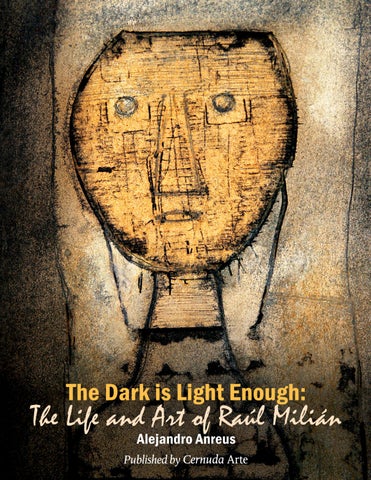
The Dark is Light Enough: The Life and Art of Raúl Milián La oscuridad tiene su luz: Vida y obra de Raúl Milián
Alejandro Anreus
Coral Gables, Florida
3
Credits Publishers Cernuda Arte Editor Ramón Cernuda Design and Typography Diana Benitez Proofreading: Nercys Cernuda Edited and corrected: Xavier and Elena Carbonell Spanish translation: Xavier and Elena Carbonell Photography Diana Benitez Front Cover: Raúl Milián Face, 1958 Mixed media on heavy paper laid down on board 14 ⅞ x 11 in. Cernuda Arte Collection. Back Cover: Raúl Milián Impetus, 1953 mixed media on heavy paper laid down on board 22 x 14 3/4 in. Cernuda Arte Collection. Copyright 2026 by Cernuda Arte All rights reserved Published in the United States of America 4
To the memory of Juan A. Martínez, "el profe," "decano" of historians of Cuban art, hermano.
A la memoria de Juan A. Martínez, "el profe", "decano" de historiadores del arte cubano, hermano.
5
Acknowledgments The author wishes to thank Dr. Olga Herrera for her help in locating materials in the Milián files at the Art Museum of the Americas archives, as well as curator Roberto Cobas at the Museo Nacional de Bellas Artes in Havana, for locating and sharing the Carpentier text.
Agradecimientos El autor desea agradecer a la doctora Olga Herrera por su ayuda a la hora de localizar materiales en las carpetas de Milián en los archivos del Art Museum of the Americas, además de al curador Roberto Cobas, del Museo Nacional de Bellas Artes de La Habana, por haber ubicado y compartido el texto de Carpentier.
6
Contents Credits
4
Acknowledgments
6
The Dark is Light Enough: The Life and Art of Raúl Milián
8
La oscuridad tiene su luz: Vida y obra de Raúl Milián
46
Notes
78
Notas
84
Plates
94
Solo Shows
96
Selected Group Shows
96
Permanent Collections
98
7
The Dark is Light Enough: The Life and Art of Raúl Milián
The Dark is Light Enough: Jorge Luis Borges
On the evening of the 16th of April 1984, a short, heavy set, 70-year-old man jumped from the balcony of his Vedado apartment to his death. His name was Raúl Milián Pons; he was a painter, a connoisseur of philosophy, and the life-long companion and lover of one of Cuba’s greatest painters: René Portocarrero. Milián had been suffering from depression for several months and had expressed his suicidal feelings to various people.1 His is one of the many deaths by suicide in the cultural and political environments of the island, since the arrival of the 1959 Revolution.2 Little is known of his background, yet over the years I have gathered fragments of his life through conversations, and interviews of several of his friends: he came from a modest Havana family who rejected him due to his homosexuality; briefly pursued studies of philosophy at the University of Havana, which he abandoned due to financial difficulties as well as his dislike of Professor Jorge Mañach’s philosophical methodology; by 1939 he had found his life-long companion René Portocarrero and moved in with him.3 This had great social significance, for even in a bohemian milieu, the Havana of the late 1930s was a machista environment. Yet Portocarrero and Milián had the courage to start a life together as gay men in pre-World War II Havana. For years Milián held menial jobs cleaning offices, etc., just to scrape a living. His true passion was philosophy; he was always hiding in the bedroom reading incessantly books of philosophy translated into Spanish from the Austral collection: Kant, Hegel, Kierkegaard, Heidegger, Husserl and Sartre (Editorial Losada in Buenos Aires translated Sartre to Spanish after World War II), by the 1970s he was also reading E. M. Cioran in translation. Milián also read poetry in translation: Novalis, Rilke, Rimbaud and Valéry, and it is significant that these are all very philosophical poets in their discourse. All of these books he underlined and annotated in pencil on the sides and bottom of the pages.4 Existential issues, and the tensions between German idealistic philosophy and pessimism, between oblivion and transcendence, were constant concerns in Milián’s readings and philosophical explorations.5 His access to books and periodicals (on which he spent his measly salary) was possible because Havana was a cosmopolitan city with six substantial bookstores, which ranged from La Moderna Poesía on Obispo street (founded in the 1890s), to the Librería de la Alianza Francesa, which sold books and magazines in French, such as Cahiers d’Art, and Spanish translations of French language works.6 While Portocarrero was an extrovert who socialized with fellow artists of his generation, such as Mariano Rodríguez (1912-1990, father of his goddaughter Dolores Rodríguez), Alfredo Lozano (1913-1997), Cundo Bermúdez (1914-2008) and Mario Carreño (1913-1999), Milián kept very much to himself. In order for people to know him, they had to visit the couple at their apartment, and even then, Milián was known not to come out of the bedroom to meet the visitor until a second or even third visit, and this was only if he intuitively approved of such a visitor.7 8
RAÚL MILIÁN (1914 - 1984), Composition, (Composición), 1951, colored ink and ink on paper, 14 ½ x 11 inches Currently in the collection of the Museum of Modern Art New York, (MoMA). 9
RAÚL MILIÁN (1914 - 1984), Tree-Flower, (Arbol-Flor), 1952, ink and watercolor on paper, 14 ½ x 11 inches 10
RAÚL MILIÁN (1914 - 1984), Impetus, (Ímpetu), 1953, mixed media on heavy paper laid down on board, 22 x 14 3/4 inches 11
The one exception to Milián’s minimal socialization were the occasional Sunday lunch gatherings of the Orígenes literary group around the figure of poet José Lezama Lima (1910-1976).8 These events generally took place at the home of Monsignor Ángel Gaztelu (1914-2003), a poet and Catholic priest.9 In a few existing photographs of these gatherings taken in the late 1940s and early 1950s, Milián appears sitting next to a young woman, standing next to Portocarrero or Mons. Gaztelu; while everyone looks at the camera, he looks away, either down on the floor or to the side, or pointing towards something not visible in the photograph. Most everyone smiles in these photos, but Milián is serious, taciturn, and at most, slightly mischievous. He seems to be alone within a group of people; he is with them, but not of them. He is an odd-man out. Milián’s work illustrated the cover of only one issue of Orígenes magazine; No. 28, 1951.10 Although Lezama Lima would dedicate one of his baroque sonnets to Milián in his “Primera glorieta de la amistad” verses, he would never write an essay on the painter’s work; neither would any other member of the Orígenes group.11 It would be the novelist Alejo Carpentier, who would write a very short text on Milián’s ink drawings entitled Iluminaciones referencing Rimbaud’s book and its visionary qualities: Because in his compositions, he surprises us with the richness, the multiplicity, the scales of the distances that are shown. Through the open window—immutable in its proportions—we are offered, we contemplate a flora, a geology, a life that is sometimes static, sometimes teeming with life, which extends towards the infinite, disposing of its own horizons, of its perspectives, its nocturne or silent values […]. Because Milián’s universe has its monuments, its documents and epitaphs, just as it has its distant armies, its mysterious fleets, its scaffoldings, machines and ruins, within a climate that sometimes defines the movements of its seasons by a faint and always opportune touch of color. Stronger is this universe when color exists without existing; when it is suggested by the very qualities of its factures; when it is born of infinite gradations of white and black; when the ink, under the hand of the artist, becomes light and becomes night […]. How do we entitle the body of works by Milián? With what word do we define its shadows? Perhaps with one, that once, would serve to define a poem: Illuminations.12 According to the art critic and curator José Gómez Sicre, Milián “without ever scribbling doodles or sketches before, in 1950 he was working with inks and watercolors on small sheets of paper and cardboard with his own language, very different from René’s.”13 Yet this “seamless” shift from student of philosophy to visual artist was grounded in years of living with one of the most dynamic and prolific Cuban painters, as well as in his interest in the work of Paul Klee, Henri Michaux, Alfred Wols and the early work of Jean Dubuffet, which he knew through reproductions in magazines and would eventually encounter directly on trips to New York, Washington and Europe.14 Milián clearly paid attention to the linear and graphic qualities of these artists’ works, but in developing his own visuality, he would pursue a constant shift between mark-like lines (that ranged from delicate to harsh) and blotted stains, as well as move back and forth between abstraction and figuration. He would also use the monotype method as a starting point for many of his works; painting and drawing with inks on a small sheet of glass, pressing the single sheet of paper on it, pulling it and re-working the sheet with further layers of colors or stains and lines, which he would blot out, and continue to rework. This was his preferred method of work until 1979, when he opted for a blunter and direct linear expression using felt tip pens. 15 12
RAÚL MILIÁN (1914 - 1984), Coexistence, (Coexistencia), 1954, mixed media on heavy paper laid down on board, 15 x 11 inches 13
RAÚL MILIÁN (1914 - 1984), Rhapsody, (Rapsodia), 1954, mixed media on heavy paper laid down on board, 15 x 11 inches 14
RAÚL MILIÁN (1914 - 1984), Fluctuation, (Fluctuación), 1954, mixed media on heavy paper laid down on board, 15 x 11 inches 15
According to Hugo Consuegra’s memoirs, Milián would also draw directly on photographic paper, responding to the resistant quality of such a surface.16 Gómez Sicre would recall that throughout the 1950s Milián was very aware of the CoBrA and Art Informel groups in Paris, and El Paso group in Madrid. Their pictorial strategies and existentialist ethos were similar to the Cuban artist. He did not seem to have much interest in U.S. abstraction, as has been erroneously claimed.17 There may be moments when Milián’s pictorial sensibility may remind us of Mark Tobey’s, yet the Cuban’s brushwork is more graphic, less painterly—at times it seems he is wounding the paper. Although these groups were relatively short-lived, CoBrA from 1948-51 and El Paso from 1957 to their last exhibition in Rome in 1960, their impact outlived the exhibitions they held as groups. CoBrA, which stood for Copenhagen, Brussels and Amsterdam, was comprised of a number of artists, the majority of which came out of the Situationist International. There is no doubt that the three key figures were the Dane Asger Jorn, the Dutch Karel Appel and the Belgian Pierre Alechinsky. The group’s aesthetic sources were in surrealism, expressionism, the art of children and the insane, as well as, the automatist process, while politically they were a mishmash of anarchism and communism. Their works are unified by gestural surfaces and a fragmented fusion of grotesque/silly figuration and abstraction. Art Informel was the French version of lyrical abstraction, although not a formal group, these painters (Jean Fautrier, Pierre Soulages, Hans Hartung, Serge Poliakoff, etc.) knew each other’s work and exhibited together on occasion, from the late 1940s through the 1950s. Pictorially they shared an absence of a premeditated compositional structure, and a preference for loose brushwork and scribblings. El Paso, which gathered as a group in Madrid in early 1957, consisted of over a dozen artists, and its principal participants were the painters Rafael Canogar, Antonio Saura and Manolo Millares, as well as the sculptors, Pablo Serrano and Martín Chirino. They were rebelling against the conformity and strictures of the Franco dictatorship and working in an aggressive expressivity, consisting of violent gestures and limited color. Goya’s graphic work and Black paintings were sources of inspiration. Both groups were focused on reflecting the anxiety and existential dread of the post-war period.18 Milián with his philosophical background—both idealism and existentialism—and improvisational approach to picture making was easily a kindred spirit. This is evidence that he was not aesthetically isolated, but rather connected outside and beyond his Cuban contemporaries, in effect quietly rebelling against the localism of his environment.19 Shortly after starting to paint, Milián began to exhibit outside of Cuba. In 1952 it was the Washington based curator José Gómez Sicre who included him in the Cuban pavilion at XXVI Venice Biennial (June 14-October 19). In 1953 Gómez Sicre again included him in the second São Paulo Biennial as one of the invited artists representing Cuba. On this occasion the Cubanborn critic would write: It is fascinating to watch the progress of an intellectual approach to the plastic arts. Several years ago, I met Raúl Milián, a student of philosophy, absorbed in the contemplation, analysis, and discussion of works of great thinkers, past and present. As a roommate of the painter Portocarrero, Milián was greatly impressed by the work of that young master, feeling a genuine admiration for the canvases which, day and night, came from his prolific brushes. One day, without training, without previous experience in any plastic medium, Milián began to produce works of astonishing maturity, as if he had passed through an inner, secret apprenticeship. Since that moment, a little over two years ago, he has surprised Cuban art circles with drawings and watercolors of the non-objective type, which perhaps are to be taken as an escape from his 16
RAÚL MILIÁN (1914 - 1984), Displacement, (Desplazamiento), 1954, mixed media on heavy paper laid down on board, 15 x 11 inches 17
RAÚL MILIÁN (1914 - 1984), Abstraction, (Abstracción), 1954, ink and gouache on paper, 14 ¼ x 10 ½ inches 18
RAÚL MILIÁN (1914 - 1984), Impressions, (Impresiones), 1954, mixed media on heavy paper laid down on board, 15 x 11 inches 19
philosophic exercises, or, better still, as a graphic expression of abstract thought. The influence of Portocarrero is manifested more in the realm of technique than in form. Portocarrero gave Milián no instructions or advice, nor has he made any corrections in Milián’s work. The young philosophy student merely watched in silence as the painter went about his task, year after year, and this has turned out to be a kind of by a second hand of work begun by the first. Henceforth, the name of Raúl Milián must be included in all serious accounts of Cuban art.20 Through the connection of architect and journalist Emilio del Junco, Milián had a one-person show of thirty-three ink drawings at the Robert Hull Fleming Museum of the University of Vermont in Burlington (February 2-March 2, 1953). In a wall text from the Vermont exhibition Francis Colburn wrote: Raúl Milián’s pictures come from nothing save an urgent need to solve the problems arising from his inner turmoils, speculations and delights. It is rare to see such uncompromising honesty with oneself. There is not the slightest conscious influence in this work: no frantic climbing onto a bandwagon (an alarming spectacle among so many young American painters); no emulation of a single hero; and, most gratifying of all, none of the cold intellectual calculation of certain avant-gardistes.21 In April 1953, another exhibition of his work, this time titled Ink Paintings, opened at the Picture Loan Society in Toronto, Canada. Running through May 8, the exhibition was covered by the Toronto TV station of the Canadian Broadcasting Corporation in a segment of May 3. The one-page script for the segment contains the text for the voice - over narration: “When a man picks up a brush at the age of thirty six, it is a forgone conclusion that he begins, and inevitably it must end a dauber, a Sunday painter, who pursues not art but relaxation. A really noteworthy exception of this axiom is a Cuban philosopher, Raúl Milián, who is currently exhibiting two dozen ink paintings at the Picture Loan Society.”22 The narrative continues: “These ink paintings by Raúl Milián at the Picture Loan Society are all little wonders of design, composition and technique. Mostly in green and rust tones, they make the most exciting use of mixed and mostly unidentifiable techniques to achieve abstract patterns which, while they are reminiscent of Klee, make a concession to no existing school of non-objective art. Kidney shapes, rock forms, nebulous swirls, emerge from but never lose their identity with the intricate and subtly colored backgrounds.”23 Both of these texts emphasize what would be constants in his work: a preference for a dark, muted palette filled with grays, greens and rust tones, etc., and abstract patterns formed out of biomorphic shapes and calligraphic marks. What is also significant is the reference to his connection to philosophy, which one can argue illuminates the introspective qualities of his pictures. All these exhibitions outside of the island before 1959 are evidence of his international projection, as one of a handful of Cuban artists who could compete outside their native realm, due, no doubt, to the distinctiveness of his ink and watercolor paintings. In 1955 Milián had his first solo exhibition in Cuba (June 2-10) at the College of Social Sciences of the University of Havana. Simply titled Tintas de Raúl Milián, it was positively referenced by art critic Rafael Suárez Solís in December of that year: “He is worthy of appearing on the list of outstanding painters, due to his solid production, his evident talent and the culture acquired to give his art the responsibility of being modern.”24 20
RAÚL MILIÁN (1914 - 1984), Montage, (Montaje), 1955, mixed media on paper, 14 ½ x 10 ¼ inches 21
RAÚL MILIÁN (1914 - 1984), Musicians, (Músicos), ca. 1955, mixed media on heavy paper laid down on board, 15 x 10 3/4 inches 22
RAÚL MILIÁN (1914 - 1984), Figure of a Woman, (Figura de Mujer), ca. 1955, ink and gouache on paper, 14 3/4 x 11 inches 23
In his lifetime Milián would have a total of six exhibitions after 1953, the majority of these were two-person shows with his partner Portocarrero. The earliest of these, which tacitly presented them as a “couple” was the 1956 exhibition at the Pan American Union in Washington, organized by Gómez Sicre. The critic/curator shared with the two painters the same sexual preference, at a time when it was an illegal activity in most countries; thereby this exhibition manifested a sense of solidarity among the three. In the brochure’s text Gómez Sicre wrote: “Like Portocarrero with whom he has long been associated, Raúl Milián is a native of Havana. Both in years and in artistic experience, he is somewhat the former’s junior: he was born in 1914 and made his debut in Cuban art only six years ago. A student of philosophy, Milián at first produced a series of highly intricate drawings of a non-objective nature; later he began to depict human forms in an austere, expressionistic fashion.”25 Calligraphic Works Examples of his more abstract calligraphic works are evident in Impetus, 1953, Abstract Harmonies, 1955, and Thoughts, c. 1955. The backgrounds are rusty yellow ochre or pinkish gray, while a patterned series of lines (some resembling stick figures) have been superimposed while the surface was obviously wet. Evidence of blotting appears throughout the sheets. These works, which are like fields of calligraphic energy, evoke vitality and movement. Musicians, a mixed media work on heavy paper from circa 1955, depicts five thin, totemic-like forms in black lines and gray cross-hatching against a dull orange background. Musical instruments are not literally depicted but rather evoked by semi-abstract shapes. It is significant to note that this subject was very prevalent in the works of contemporaries of Milián, such as Portocarrero, Bermúdez and Carreño. At his most abstract throughout the 1950s, Milián shifted back and forth between block-like black, gray and pinkish gray shapes against light backgrounds (Montage, 1955; Window View, Wall and Façade, all from 1957), and biomorphic and blotted light shapes against black and fluid backgrounds (Revelations and Abstract, both from 1955). Figures The figure as well is evident since his first decade of visual work. Single or in pairs, they are placed within veils of gray or in rectangular box-like forms. The overall lines are nervously expressive, while the faces themselves evoke either a stoic stillness or an anxious melancholy (Light and Shadow, 1955; Face and Figure of 1958; Liaison, 1961; Phases, 1964; and Figures, 1966). These works can be easily placed within the neo-figuration style prevalent world-wide from the late 1950s into the 1960s; they can also be seen as partly connected to the rise in drawing the figure in an expressive manner during this period in Latin America.26 Figural works such as these by Milián would be influential on a younger generation of Cuban artists, such as Ángel Acosta León, Antonia Eiriz, Manuel Vidal and Santiago “Chago” Armada, who explored a tortured and mysterious depiction of reality.27 Flowers Apart from the human figure, the other representational elements in Milián’s pictures are of flowers, usually in vases. In the 1962 book Pintores Cubanos (La Habana; Ediciones R, pp. 139 and 141) two flowers in vases by Milián appear illustrated in full color. One is in purple and blacks, while the other is in a rust-like orange and grays. 24
RAÚL MILIÁN (1914 - 1984), Abstract Harmonies, (Armonías Abstractas), 1955, mixed media on heavy paper laid down on board, 15 x 11 inches 25
RAÚL MILIÁN (1914 - 1984), Revelations, (Revelaciones), 1955, mixed media on heavy paper laid down on board, 15 x 11 inches 26
RAÚL MILIÁN (1914 - 1984), Thoughts, (Pensamientos), ca. 1955, mixed media on heavy paper laid down on board, 21 3/4 x 14 3/4 inches 27
The stems and petals have a vein-like or root-like quality, transforming the conventional depiction of color and lushness for this subject, into something primeval and mysterious. Referring to his work in general and his still-lives in particular, writer Oscar Hurtado wrote: “he has managed to provoke through his pictures unforgettable moments to those that contemplate them... Due to their enigmatic character, as well as their unreality, Milián’s pictures impose a silent contemplation.”28 Milián’s flowers can also be fragile and dry as in Flowers, 1959, wherein a pale blue vase with dark leaves and a dry yellow bud float on an ochre-gray background. Disturbingly beautiful and painted a decade before his death is Grey Flowers (1974); the vase and flowers are one, delineated with a solid black outline. The still-live exists within a rectangle, within a frame, within the rectangle of the sheet of paper. Varying grays define each area. It is perhaps a memento mori, where the brief life of the flower reminds us of the brevity of our lives. Gestural Abstractions More gestural abstractions are prevalent in Milián’s production between 1960 and 1962. Sometimes these have an affinity with certain works from the group Los Once, which introduced abstract expressionism into Cuban art in the early 1950s. Milián’s work was well regarded by this rebellious group of young artists that in general rejected the earlier generation of painters. Guido Llinás (1923-2005) told me that after Wifredo Lam and Amelia Peláez, the only Cuban artist he was interested in was Milián.29 Hugo Consuegra (1929-2003) mentions Milián eight times in his memoirs, recalling his visits with fellow architecture students to the various apartments occupied by René and Raúl over the years, the required gift of a bottle of Bacardí during those visits, etc. Consuegra mentions a rare visit to his family home by the couple to look at his early paintings; Portocarrero praised his sober use of color, while Milián suggested he make his signature as small as possible, so as not to take away from the actual painting.30 Lastly, Raúl Martínez (1927-1995), probably the most controversial member of Los Once, dedicates nine pages to both Portocarrero and Milián in his posthumous memoir Yo Publio, Confesiones de Raúl Martínez. From the first visit, when Martínez stayed conversing with both artists until 2:00 am, to the last visit, when Milián was in the hospital with an infectious leg, the anecdotes reveal the younger painter’s fascination with Milián over Portocarrero. Although to Martínez, Milián looked like a rough character, almost a criminal, who dressed in a disheveled manner; he projected a spiritual depth and tenderness that was moving. Even after Milián suggested a sexual encounter, which disillusioned the younger painter, Martínez liked “those suggestive faces and flowers, intimate and beautiful, with textures and transparencies as spontaneous as the skin of a recently washed orange.”31 Years later, while hospitalized, Milián would accuse Martínez of having betrayed his talent by abandoning abstraction in favor of mamarrachos of Martí (he would also say of Che Guevara and Fidel Castro) in support of the revolution.32 A fierce individualist and defender of the autonomy of the work of art, Milián could not tolerate propagandistic images. These contacts are evidence that Milián, despite his selfimposed isolation, engaged with these young abstractionists, and his work was highly regarded by three of them. Yet, Milián’s “handwriting” is so personal, that this most abstract vocabulary is purely his, even when it shares a similar sensibility to Los Once currently. The palette, as seen in works like Pathos, Adrift, Vestige and Vagueness (all from 1960), consists of orange, green and silvery gray. But the subtlety of these tones is disrupted by the violent graphic gesture superimposed on the foregrounds. Impressions, a horizontal work from 1962, evoke a landscape field of deep blacks and various grays, where in four different areas, the blotting technique allows a white light to come through. Mysterious and meditative, the work could be a visualization of St. John of the Cross’ dark night of the soul, a theme that obsessed Milián throughout his life.33 28
RAÚL MILIÁN (1914 - 1984), Light and Shadow, (Luz y Sombra), 1955, mixed media on heavy paper laid down on board, 14 3/4 x 10 3/4 inches 29
RAÚL MILIÁN (1914 - 1984), Abstract, (Abstracto), 1955, mixed media on paper, 15 x 11 inches 30
RAÚL MILIÁN (1914 - 1984), Personage, (Personaje), 1956, mixed media on heavy paper laid down on board, 15 x 10 ½ inches 31
Milián’s preferred format, whether working on paper or cardboard, was usually vertical. This eliminated any landscape connotation, while asserting a wall or tablet reference. With this in mind, we encounter a large amount of his work from the 1950s right up to his death, which consist of wall-like shapes where rectangles are filled with calligraphic shapes (Ambiguities, 1959; Interior in Abstract, 1973; Rhythms, 1976; Traces, and Premonition Confirmed, both from 1977) ranging from harmonious patterns (the earlier works) to violent scribbles (the late works). Other compositions using the wall shape are the opposite, being in effect about emptiness, where the central area, be it gray (Ideas, 1974) or whitish (Meditation, 1977) represents nothingness. After 1959 With the arrival of the 1959 Revolution artists found themselves in the precarious situation of having to choose between three positions: enthusiastic and partisan support, or exile and internal marginalization. After Fidel Castro’s 1961 Words to the Intellectuals speech, the regime made clear its demands: “Dentro de la Revolución todo, fuera de la Revolución, nada.” The government would not impose socialist realism of the Soviet variety, but artists were expected to defend the revolution and produce works that did not indulge in negativity and defeatism. Mariano Rodríguez, who had been a Communist party member since 1934, became head of the visual arts section of the artists and writers union (UNEAC), as well as a vice-president of the prestigious Casa de las Américas. Younger artists such as Raúl Martínez repudiated their earlier abstractions, and during 1964-66 shifted towards a “Revolutionary” Pop art, filled with national heroes and peasants and workers (yet usually slightly homo-erotic in Martínez's case). Neither Portocarrero nor Milián altered the forms and content of their art. It can be argued that in a way their art became resistant to the “party line.” While contemporaries began to paint revolutionary crowds and happy workers, they remained true to their languages; a joyous baroque in Portocarrero, a brooding expressionism in Milián. For example, from 1959 through 1967, Portocarrero continued to paint his pictures of cathedrals, and these acquired a pictorial density and coloristic luminosity that reflected a triumphant church and Catholic identity, that was not kowtowing to the government. By 1968 the cathedral paintings become dark, gray and blue, reflecting the victory of the regime over the church in Cuba.34 Eventually the cathedrals disappeared from his iconography or are blended in, hiding within his baroque Havana landscapes. In Milián’s case, his ink and watercolor paintings remained dark, broodingly mysterious when abstract, and when figurative charged with existential anxiety. Although Portocarrero was rightly hailed as a major Cuban painter by the time of his death on April 7, 1985, the 1960s were not without their difficulties for the couple. And yet the creative activity of René stands in stark contrast to Raúl’s “silence” after the arrival of the revolution. In September 1959, Portocarrero participated in a group exhibition at the Catholic University of Santo Tomás de Villanueva in Havana; these works were from the 1940s and 1950s and came from private collections, and consisted mostly of religious subjects; the following year he concluded a mural in Duco for the Sala Covarrubias at the Teatro Nacional; he designed theatre sets and costumes, posters, album covers; and by 1962, the antist began his Color de Cuba series of drawings and paintings, which would receive the Sanbra prize at the VII Bienal de São Paulo the following year, etc. 32
RAÚL MILIÁN (1914 - 1984), Wall, (Muro), 1957, mixed media on heavy paper laid down on board, 15 x 11 inches 33
RAÚL MILIÁN (1914 - 1984), Window View, (Vista Desde La Ventana), 1957, mixed media on heavy paper laid down on board, 14 ⅞ x 11 inches 34
RAÚL MILIÁN (1914 - 1984), Facade, (Fachada), 1957, mixed media on heavy paper laid down on board, 14 ⅞ x 11 inches 35
But in the middle of this frenetic productivity, Portocarrero wrote a letter to his old friend, the art critic and curator José Gómez Sicre, who ran the Visual Arts section at the Organization of American States (OAS) in Washington—dated November 1962—where he complained about the new regime and asked for help in leaving the country.35 Although Portocarrero participated in exhibitions between 1968 and 1970, he was out of favor with the regime. Milián would only exhibit in Havana three times after 1959; with Portocarrero in May-June 1966 at the Galería Habana, again in 1981 with René in September, at the same gallery, and finally a solo show in 1983 at the Galería Plaza Vieja in the city. His minimal exhibition record at home speaks volumes, particularly in contrast to his lover’s prolific record of shows. Either “the cultural powers that be” were not interested in introspective, intimate pictures, or Milián himself felt that his pictorial vision did not fit into revolutionary Cuba. But their situation was charged with ambiguity, on the one hand receiving honors, while being marginalized for their independence.36 One such recurring example of their independence was their friendship with the Cuban Franciscan priest, and poet/painter, Miguel A. Loredo (19382011). A dissident and critical spirit, Loredo was imprisoned by the Castro regime from 1966 through 1976, becoming in prison a leader of the Catholic resistance to the dictatorship. After his release, and before he was forced into exile in 1984, Loredo frequented the home of Portocarrero and Milián: They sent for me through Monsignor Gaztelu, who was still in Cuba. I had known them briefly in the late 1950s, but then in 1976, shortly after I was released from prison, they invited me to visit. You must understand how courageous this was at the time. Here you have two old gays, inviting a former political prisoner and a priest, to their home, to discuss art, poetry, spirituality. For the next nine years I visited them every couple of months. At first Milián would stay in the bedroom and look through the peephole, while I spoke with Porto about painting and poetry. On my third visit he came out to greet me, in time he would show me his work, discuss poetry, philosophy, and spirituality. Also, of his fear of ending his own life. He was at times a bit tormented that they were gay; one day I told him that they were an old couple, with their ups and downs, but ultimately a couple. Diplomats, collectors and government agents would drop by with bottles of whisky or rum and occasionally, French champagne. René would drink himself to oblivion, and Milián would become angry at how he was easily manipulated by the government through alcohol. Milián had backbone, dignity, he kept his distance as best he could from what he termed “el régimen de Saturno” which devoured its own children. I think he was one of the most profound and mysterious of artists, he breaks the mold, the cliché of the Cuban artist. His universe is one of shadows and emptiness, of searching, a kind of negative mysticism. Porto was all light, movement and joy, not so Milián. His is a world of anguish and suffering. When I went to say goodbye to them, they cried. Both told me they wished they could leave with me, and I of course wanted to stay and pursue my ministry. I was forced to leave. A little over a month after I left, I heard the news that Milián had committed suicide.37 And yet by 1977, a book with a substantial propagandistic content like Ernesto Cardenal’s En Cuba, makes mention of the “two greatest painters in Cuba” living together in a Vedado apartment building.38 The regime used and abused their talent and prestige as artists, and yet these two broken, and even terrified old gay men, had moments of deep courage and integrity. 36
RAÚL MILIÁN (1914 - 1984), Volatile Flowers, (Flores Volátiles), 1957, mixed media on heavy paper laid down on board, 15 x 11 inches 37
RAÚL MILIÁN (1914 - 1984), Figure, (Figura), 1958, mixed media on cardboard, 14 3/4 x 11 inches 38
RAÚL MILIÁN (1914 - 1984), Face in Green Background, (Rostro en Fondo Verde), 1958, mixed media on heavy paper laid down on board, 14 ⅞ x 11 inches 39
Late work During the last four years of his life, color completely disappeared from Milián’s work, as well as the fluid, watery fields of tones. An exclusively linear drawing is emphasized in these final works, and instead of working with traditional pen and ink and brush, he opted for markers and commercial pens. These works are particularly powerful because they are disturbing; both Filtered Light and Appearance from 1980 depict rectangles within rectangles with wire-like or prison bar cross-hatchings, behind which are figures, ineligible texts and solitary letters that may be meaningless. These are images of great isolation and despair, of desperation in being imprisoned and abandoned. The beauty in these is visceral. A year before his suicide Milián wrote: “In this work I have tried to overcome a sort of inner inferno, but I don’t think I have achieved it and the inferno is manifest. Nevertheless, I believe that this work does not lack importance. I have worked like the hunter who kills lions so as not to kill himself. Hegel said, “the aesthetic value of a work of art does not depend on the feeling that it awakens.” Happiness as well as sadness, joy or heartbreak. The aesthetic value is always positive. Art, even when it expresses what is most tragic, is an affirmation of life.”39 The power of Milián’s work resides in its irradiations; the ability to create a visual syntax where the pictures are in effect a kind of tattoo of the world, of the human condition, which simultaneously invites us to decipher and to contemplate, where darkness and light are in perpetual struggle. Jorge Luis Borges, who understood darkness, both literally and metaphorically, once stated that “the dark is light enough.” Milián’s artistic vision proves it so. Alejandro Anreus, PhD
40
RAÚL MILIÁN (1914 - 1984), Face, (Rostro), 1958, mixed media on heavy paper laid down on board, 14 ⅞ x 11 inches 41
RAÚL MILIÁN (1914 - 1984), Silence, (Silencio), 1958, mixed media on heavy paper laid down on board, 14 ⅞ x 11 inches 42
RAÚL MILIÁN (1914 - 1984), Flowers in a Vase, (Flores en Jarrón), 1959, mixed media on heavy paper laid down on board, 15 x 11 inches 43
RAÚL MILIÁN (1914 - 1984), Untitled, (Sin Título), 1959, mixed media on paper, 14 ⅞ x 11 inches. Currently in the collection of the Museum of Modern Art New York, (MoMA). 44
RAÚL MILIÁN (1914 - 1984), Musings, (Reflexiones), ca. 1959, mixed media on heavy paper laid down on board, 15 x 10 3/4 inches 45
La oscuridad tiene su luz: Vida y obra de Raúl Milián
La oscuridad tiene su luz Jorge Luis Borges
La noche del 16 de abril de 1984, un hombre bajo y corpulento de unos 70 años se lanzó a la muerte desde el balcón de su apartamento en El Vedado. Se llamaba Raúl Milián Pons. Era pintor, aficionado a la filosofía, y amante y compañero de vida de uno de los grandes pintores de Cuba, René Portocarrero. Milián había sufrido de depresión por varios meses y le hizo saber sus intenciones suicidas a varias personas.1 El suyo es uno de los muchos suicidios que han opacado el escenario cultural y político de la isla desde la llegada de la revolución de 1959.2 Se sabe poco de su trasfondo vital, pero a lo largo de los años he reunido fragmentos de su biografía a través de conversaciones y entrevistas con varios de sus amigos. Venía de una modesta familia habanera que renegó de él por su homosexualidad. Cursó durante un breve tiempo estudios de filosofía en la Universidad de La Habana, que tuvo que abandonar por sus dificultades económicas y su poco aprecio por la metodología filosófica de su profesor Jorge Mañach. Para 1939 ya había encontrado en René Portocarrero a un compañero para toda la vida y se había mudado con él.3 Este hecho tuvo una gran repercusión social, pues incluso para el entorno bohemio, La Habana de finales de la década de 1930 era un ambiente homofóbico. Aun así, Portocarrero y Milián tuvieron el coraje de comenzar una vida juntos como hombres gais en La Habana de la preguerra mundial. Durante años Milián realizó labores serviles, limpiando oficinas, etcétera, buscando lo básico para vivir. Su verdadera pasión era la filosofía. Solía esconderse en su cuarto para devorar los libros de filosofía traducidos al español de la colección Austral: Kant, Hegel, Kierkegaard, Heidegger, Husserl y Sartre (la editorial Losada, de Buenos Aires, tradujo a Sartre al español después de la Segunda Guerra Mundial), y en los 70 también leía en traducción a E. M. Cioran. Milián también leía la poesía traducida de Novalis, Rilke, Rimbaud y Valéry, y es significativo que estos sean precisamente poetas muy filosóficos en su discurso. Todos estos libros estaban subrayados y anotados a lápiz en los márgenes y al pie de cada página.4 Los dilemas existencialistas, así como las tensiones entre el idealismo alemán y el pesimismo, entre el olvido y la trascendencia, fueron preocupaciones constantes en las exploraciones y lecturas filosóficas de Milián.5 Su acceso a libros y periódicos (en los cuales gastaba su mísero salario) fue posible porque La Habana era una ciudad cosmopolita con seis formidables librerías, desde La Moderna Poesía en la calle Obispo (fundada en la década de 1890) hasta la Librería de la Alianza Francesa, que vendía libros y revistas en francés, como los Cahiers d’Art, y traducciones al español de obras francesas.6 Mientras que Portocarrero era un hombre extrovertido que socializaba con sus colegas de generación artística, como Mariano Rodríguez (1912-1990, el padre de su ahijada Dolores Rodríguez), Alfredo Lozano (1913-1997), Cundo Bermúdez (1914-2008) y Mario Carreño (1913-1999), Milián era mucho más discreto. Si alguien quería conocerlo, tenía que visitar a la pareja en su apartamento, e incluso allí Milián era célebre por no salir nunca de su cuarto a recibir a sus visitas hasta el segundo o el tercer encuentro, y solo si aprobaba tácitamente al invitado.7 La única excepción a la política de mínima sociabilidad de Milián eran los esporádicos almuerzos dominicales del grupo literario Orígenes, congregado en torno a la figura del poeta José Lezama Lima (1910-1976).8 Estos encuentros tenían lugar generalmente en casa de monseñor Ángel Gaztelu (1914-2003), poeta y sacerdote católico.9 46
RAÚL MILIÁN (1914 - 1984), Untitled, (Sin Título), 1959, mixed media on paper, 15 x 11 inches. Currently in the collection of the Museum of Modern Art New York, (MoMA). 47
RAÚL MILIÁN (1914 - 1984), Abstract in Black and White, (Abstracto en Blanco y Negro), 1959, mixed media on heavy paper laid down on board, 15 x 11 inches 48
RAÚL MILIÁN (1914 - 1984), Flowers, (Flores), 1959, mixed media on heavy paper laid down on board, 15 x 11 inches 49
En las escasas fotografías existentes de estas tertulias, tomadas a finales los años 40 e inicios de los 50, Milián aparece sentado junto a una mujer joven, de pie junto a Portocarrero o monseñor Gaztelu. Cuando todos miran a la cámara, él mira a otra parte, ya sea al suelo o a un lado, o contempla un punto invisible y externo a la fotografía. Casi todo el mundo sonríe en esas fotos, pero Milián está serio, taciturno, y en el mejor de los casos, con expresión socarrona. Parece un solitario incluso cuando está rodeado de gente. Está con ellos, pero no es uno de ellos. Es todo un bicho raro. La obra de Milián sirvió como ilustración de portada en apenas un número de Orígenes, el 28, en 1951.10 Aunque Lezama Lima le dedicó uno de sus sonetos barrocos a Milián en su Primera glorieta de la amistad, nunca llegó a escribir sobre su trabajo. Tampoco lo hizo ningún otro miembro de Orígenes.11 Sería el novelista Alejo Carpentier quien escribiera un pequeño texto sobre las tintas de Milián titulado Iluminaciones, en referencia al libro de Rimbaud y su cualidad visionaria: “En sus composiciones nos asombra con la riqueza, la multiplicidad, las escalas de distancia de lo mostrado. Por la ventana abierta —inmutable en sus proporciones— que se nos ofrece, contemplamos una flora, una geología, una vida ora estática, ora pululante, que se extiende hasta el infinito, disponiendo de sus propios horizontes, de sus perspectivas, de sus valores de silencio o de nocturnidad […]. Porque el universo de Milián tiene sus monumentos, sus documentos y epitafios, así como tiene sus ejércitos lejanos, sus flotas misteriosas, sus andamiajes, máquinas y ruinas, dentro de un clima que a veces define el paso de sus estaciones por un ligero y siempre oportuno toque de color. Pero más fuerte resulta aún ese universo cuando el color existe sin existir; cuando es sugerido por las mismas calidades de las facturas; cuando nace de las infinitas graduaciones del blanco y del negro; cuando la tinta, bajo la mano del artista, se hace luz y se hace noche […]. ¿Cómo titular el conjunto de obras de Milián? ¿Con qué palabra definir sus sombras…? Acaso con una que, alguna vez, sirviera para definir una poesía: Iluminaciones.” 12 Según el curador y crítico de arte José Gómez Sicre, Milián “sin siquiera garabatear o hacer bocetos antes, ya en 1950 estaba trabajando con tintas y acuarelas en pequeñas hojas de papel y cartulina en su propio lenguaje, muy diferente del de René”.13 Sin embargo, esta “insospechada” metamorfosis del estudiante de filosofía en artista visual tenía su fundamento en los años que había vivido junto a uno de los más prolíficos y dinámicos pintores cubanos, así como en su interés por la obra de Paul Klee, Henri Michaux, Alfred Wols y el primer Jean Dubuffet, a quienes conoció a través de reproducciones en revistas y con quienes, a la larga, se encontraría personalmente en sus viajes a Nueva York, Washington y Europa.14 Milián prestó atención, evidentemente, a las cualidades gráficas y en el tratamiento de la línea que poseían estos artistas, pero al desarrollar su propia visualidad ejecutó una variación constante entre líneas parecidas a marcas (que iban de lo delicado a lo áspero) y manchones secos, así como un contrapunto entre la figuración y la abstracción. Además utilizó la técnica del monotipo como punto de partida de muchos de sus trabajos: pintaba y dibujaba con tinta en pequeñas láminas de cristal, presionaba una única pieza de papel contra la superficie, la extraía y aplicaba sobre la lámina más capas de color, o manchas y líneas, que luego secaba y volvía a trabajar. Este fue su método de trabajo preferido hasta 1979, cuando optó por una expresión más contundente y directa de la línea usando rotuladores.15 Según las memorias de Hugo Consuegra, Milián también solía dibujar directamente sobre papel fotográfico, dada la resistencia de dicha superficie.16 50
RAÚL MILIÁN (1914 - 1984), Flower, (Flor), 1959, ink and watercolor on paper, 15 x 11 inches 51
Gómez Sicre recordaría que a lo largo de los años 50, Milián estuvo muy al tanto de los grupos parisinos CoBrA y Art Informel, y del madrileño El Paso. Sus estrategias pictóricas y su ethos existencialista eran similares a los del cubano. Sin embargo, no pareció tener mucho interés en el abstraccionismo estadounidense, como se ha alegado erróneamente.17 Habrá momentos en los que la sensibilidad pictórica de Milián nos recuerde a un Mark Tobey, pero la pincelada del cubano es más gráfica, menos estilizada —tanto que a veces pareciera que está hiriendo el papel. Si bien estos grupos tuvieron una vida breve (CoBrA de 1948 a 1951 y El Paso de 1957 a su última exposición en Roma en 1960) su impronta fue más duradera que sus exhibiciones. CoBrA, cuyas siglas significaban Copenhague, Bruselas y Ámsterdam, estaba compuesto por un colectivo de artistas en su mayoría provenientes de la Internacional Situacionista. No hay duda de que sus tres figuras claves fueron el danés Asger Jorn, el holandés Karel Appel y el belga Pierre Alechinsky. Las fuentes estéticas del grupo estaban en el surrealismo, el expresionismo, el arte de los niños y los locos, y el automatismo, mientras que a nivel político eran una mescolanza de anarquismo y comunismo. Sus obras tienen en común las superficies gestuales y una fusión fragmentada de abstracción y figuración absurda/grotesca. En cuanto a Art Informel, se trató de la versión francesa de la abstracción lírica, y aunque no eran formalmente un grupo, estos pintores (Jean Fautrier, Pierre Soulages, Hans Hartung, Serge Poliakoff, etcétera) conocían la obra de los demás y habían expuesto juntos en alguna ocasión, desde finales de los 40 y durante los 50. A nivel pictórico, compartían la ausencia de una estructura composicional premeditada, y la preferencia por la pincelada suelta y los garabatos. El Paso, que se reunió como grupo en Madrid a inicios de 1957, estaba compuesto por más de una docena de artistas, y sus principales representantes fueron los pintores Rafael Canogar, Antonio Saura y Manolo Millares, así como los escultores Pablo Serrano y Martín Chirino. Estaban en rebelión abierta contra el conformismo y la rigidez del régimen de Franco y trabajaban con una expresividad agresiva, consistente en gestos violentos y color limitado. La obra gráfica de Goya y sus pinturas negras fueron para ellos fuente de inspiración. Ambos grupos se ocuparon de reflejar la angustia y el terror existencial del período de posguerra.18 Con este bagaje filosófico —tanto idealista como existencialista— y su enfoque improvisado de la pintura como arte, Milián se convirtió naturalmente en su espíritu afín. Esto es una evidencia de que no estaba estéticamente aislado, sino en conexión con una realidad que superaba y excluía a sus contemporáneos en la isla. Se estaba rebelando en silencio, de hecho, contra el localismo de su entorno.19 Poco después de empezar a pintar, Milián comenzó a exponer fuera de Cuba. En 1952, el curador residente en Washington, José Gómez Sicre, lo incluyó en el pabellón cubano de la XXVI Bienal de Venecia (14 de junio-19 de octubre). En 1953, Gómez Sicre lo volvió a invitar como uno de los representantes de Cuba en la segunda Bienal de São Paulo. En aquella ocasión, el crítico de origen cubano escribió: “Es fascinante observar el progreso de un acercamiento intelectual a las artes plásticas. Hace varios años conocí a Raúl Milián, un estudiante de filosofía absorto en la contemplación, análisis y discusión de la obra de los grandes pensadores, pasados y presentes. Como compañero de cuarto del pintor Portocarrero, a Milián le impresionó mucho la obra de este joven maestro, sintiendo una verdadera admiración por los cuadros que, día y noche, emergían de sus prolíficas pinceladas. Un día, sin entrenamiento alguno, careciendo de experiencia en toda manifestación plástica, Milián comenzó a producir obras de desconcertante madurez, como si hubiera cursado un aprendizaje íntimo y secreto. 52
RAÚL MILIÁN (1914 - 1984), Ambiguities, (Ambigüedades), 1959, mixed media on heavy paper laid down on board, 14 ⅞ x 11 inches 53
RAÚL MILIÁN (1914 - 1984), Confusion, (Confusión), 1960, mixed media on paper, 10 3/4 x 14 ¼ inches
54
RAÚL MILIÁN (1914 - 1984), Adrift, (A la Deriva), 1960, mixed media on heavy paper laid down on board, 15 x 11 inches 55
Desde aquel momento, hace poco más de dos años, ha sorprendido a los circuitos del arte cubano con dibujos y acuarelas de tipo no objetivo, que quizás deban interpretarse como un escape de sus ejercicios filosóficos, o mejor, como la expresión gráfica de un pensamiento abstracto. La influencia de Portocarrero se evidencia más en el reino de la técnica que en la forma. Portocarrero no le dio a Milián instrucciones ni consejos, ni le ha hecho corrección alguna a su obra. El joven estudiante de filosofía solo tuvo que observar en silencio mientras el pintor realizaba su tarea, año tras año, y ha resultado una suerte de continuación, por parte de una segunda mano, de una obra iniciada por la primera. De ahora en adelante, el nombre de Raúl Milián deberá figurar en todo inventario serio del arte cubano”.20 Por mediación del arquitecto y periodista Emilio del Junco, Milián tuvo una muestra individual de treinta y tres dibujos a tinta en el Museo Robert Hull Fleming de la Universidad de Vermont, en Burlington (del 2 de febrero al 2 de marzo de 1953). En la pared del salón de la exposición, Francis Colburn escribió: “Las pinturas de Raúl Milián no emergen sino de la necesidad urgente de resolver los problemas, las especulaciones y las delicias que se agitan dentro de él. Es raro ver una honestidad tan inflexible consigo misma. No hay la más mínima influencia consciente en su obra: no hay una entrada frenética por el carril (un lamentable espectáculo en el que recaen tantos jóvenes pintores americanos), ni emulación con un único héroe, y lo más gratificante de todo, ni rastro del frío cálculo intelectual de ciertos vanguardistas.”21 En abril de 1953, otra muestra de su obra, esta vez titulada Ink Paintings, fue exhibida en la Picture Loan Society de Toronto, Canadá. La exposición, que duró hasta el 8 de mayo, fue cubierta por la estación Toronto TV de la Canadian Broadcasting Corporation en un segmento noticioso transmitido el 3 de mayo. La única página del guión para ese segmento contiene un texto para ser leído por una voz en off: “Cuando un hombre toma el pincel a los 36 años, se presupone que comienza, e inevitablemente acabará, como pintor aficionado, dominical, que no persigue el arte sino la relajación. Una excepción notable para este axioma es el filósofo cubano Raúl Milián, que actualmente exhibe dos docenas de pinturas a tinta en la Picture Loan Society”.22 La voz prosigue: “Estas tintas de Raúl Milián en la Picture Loan Society son pequeñas maravillas de diseño, composición y técnica. Con tonalidades en su mayoría verdosas u oxidadas, ejecutan una excitante mezcla de técnicas para lograr patrones abstractos que, si bien recuerdan en algo a Klee, no tienen nada que ver con ninguna escuela existente de arte no objetivo. Siluetas renales, formas rocosas, remolinos nebulosos emergen pero nunca pierden su identidad con su fondo intrincado y sutilmente coloreado”.23 Estos textos subrayan lo que serán las constantes en su obra: el gusto por una paleta oscura, opaca, poblada de tonos grises, verdes y oxidados, etcétera; y patrones abstractos confeccionados a partir de contornos biomórficos y signos caligráficos. Algo que también es significativo es la referencia a su conexión con la filosofía, un vínculo del que se podría alegar que arroja luz sobre la cualidad introspectiva de sus cuadros. Estas exposiciones fuera de Cuba antes de 1959 evidencian su proyección internacional como uno de los pocos artistas cubanos capaces de competir fuera de su tierra natal, en gran parte debido, sin duda, a la peculiaridad de sus tintas y acuarelas. 56
RAÚL MILIÁN (1914 - 1984), Abstract in Ochre, (Abstracto en Ocres), ca. 1960, mixed media on heavy paper, 21 ⅝ x 15 inches 57
RAÚL MILIÁN (1914 - 1984), Vagueness, (Lo Impreciso), 1960, mixed media on paper, 14 ½ x 10 3/4 inches 58
RAÚL MILIÁN (1914 - 1984), Imaginary Man, (Hombre Imaginario), 1960, mixed media on heavy paper laid down on board, 15 x 11 inches 59
En 1955, Milián tuvo su primera muestra individual en Cuba (del 2 al 8 de junio) en el Colegio de Ciencias Sociales de la Universidad de La Habana. Titulada sencillamente Tintas de Raúl Milián, recibió una acogida positiva del crítico de arte Rafael Suárez Solís: “Es digno de aparecer en la lista de los pintores destacados, por su sólida producción, su evidente talento y la cultura adquirida para otorgar a su arte la responsabilidad de ser moderno”.24 Durante toda su vida, Milián tendría un total de seis exposiciones después de 1953, en su mayor parte muestras a dúo con Portocarrero. La primera, que tácitamente los presentaba como “pareja”, fue la exposición de 1956 en la Pan American Union de Washington, organizada por Gómez Sicre. El crítico y curador tenía en común con ambos pintores su preferencia sexual, en un tiempo en que era considerada una actividad ilegal en la mayoría de los países, de modo que esta muestra era un gesto de solidaridad entre los tres. En el texto del folleto, Gómez Sicre escribió: “Como Portocarrero, con quien ha estado asociado desde hace tiempo, Raúl Milián nació en La Habana. Tanto en años como en experiencia artística, el segundo ha estado de alguna manera supeditado al primero: nació en 1914 e hizo su debut en el arte cubano hace solo seis años. Estudiante de filosofía, Milián produjo primero una serie de dibujos muy intrincados de naturaleza no objetiva; luego comenzó a trabajar formas humanas en un estilo expresionista, austero”.25
Obras caligráficas Muestra de sus obras caligráficas más abstractas son Ímpetus, de 1953; Armonías abstractas, de 1955; y Pensamientos, c. 1955. Los fondos son de un ocre oxidado o un gris rosáceo, mientras que varias series de líneas con motivos (algunas parecidas a figuras esquemáticas) han sido aplicadas mientras la superficie estaba todavía húmeda. Rastros de manchado aparecen a lo largo de las hojas. Estas obras, una suerte de campos de energía caligráfica, evocan vitalidad y movimiento. Músicos, un trabajo de técnica mixta sobre cartón de c. 1954, representa cinco figuras delgadas, con resonancias totémicas, trazadas con líneas negras y sombreado gris encima de un fondo anaranjado y opaco. Los instrumentos musicales no son representados sino apenas sugeridos por contornos semiabstractos. Es de señalar que este es un tema predilecto en la obra de contemporáneos de Milián como Portocarrero, Bermúdez y Carreño. En su etapa de mayor abstracción durante la década de 1950, Milián osciló entre formas de negro sólido, gris y gris rosáceo sobre fondos claros (Montaje, 1955; Vista desde la ventana, Muro y Fachada, todas de 1957), y formas ligeras, biomórficas y manchadas, sobre fondos negros o fluidos (Revelaciones y Abstracto, ambas de 1955). Figuras La figura es también un motivo visible desde su primera década de trabajo. Solas o en parejas, se sitúan veladas por capas de gris o en formas rectangulares que recuerdan a una caja. Las líneas principales son de una expresividad nerviosa, mientras las caras traslucen una quietud estoica o una melancolía sufriente (Luz y sombra, 1955; Cara y Figura, de 1958; Vínculo, 1961; y Figuras, 1966). Estas obras pueden clasificarse con seguridad dentro del estilo neofigurativo de moda en todo el mundo a finales de la década de 1950 e inicios de 1960. También pueden valorarse su conexión parcial con el auge de una representación muy expresiva de la figura durante esta época en Latinoamérica.26 Las obras figurativas como estas de Milián ejercerían gran influencia en la generación más joven de artistas cubanos, como Ángel Acosta León, Antonia Eiriz, Manuel Vidal y Santiago Chago Armada, que exploraron una representación misteriosa y atormentada de la realidad.27 60
RAÚL MILIÁN (1914 - 1984), Pathos, (Emoción), 1960, mixed media on heavy paper laid down on board, 15 x 11 inches 61
RAÚL MILIÁN (1914 - 1984), Abstraction, (Abstracción), 1960, ink and gouache on paper, 14 3/4 x 11 inches 62
RAÚL MILIÁN (1914 - 1984), Vestige, (Vestigio), 1960, mixed media on heavy paper laid down on board, 21 3/8 x 14 ⅝ inches 63
Flores Además de la figura humana, el otro elemento representativo de la pintura de Milián son las flores, generalmente en búcaros. En el libro de 1962 Pintores cubanos (La Habana; Ediciones R, pp. 139-141), dos flores en búcaros de Milián aparecen ilustradas a todo color. Una contiene violetas y negros; la otra, un naranja como oxidado y grises. El tallo y los pétalos tienen un aspecto venoso, o similar a una raíz, lo cual modifica la representación convencional del color y la exuberancia del tema, convirtiéndolo en algo primordial y misterioso. Refiriéndose a su obra en general y a sus naturalezas muertas en particular, el escritor Oscar Hurtado observó: “Él se las ha arreglado para conceder, a través de sus cuadros, momentos inolvidables para quienes los contemplan […]. Debido a su carácter enigmático e irreal, los cuadros de Milián obligan a una contemplación silenciosa”.28 Las flores de Milián también pueden ser frágiles y secas, como en Flores, de 1959, donde un búcaro azulado con hojas oscuras y un capullo amarillo opaco emergen de un fondo gris ocre. De una belleza perturbadora, y pintado una década antes de su fallecimiento, es Flores grises (1974), el búcaro y las flores son una misma cosa, trazados ambos con una línea negra y sólida. La naturaleza muerta bulle dentro de un rectángulo, de un marco, de la forma cuadrangular de una hoja de papel. Escalas de gris definen cada área. Se trata, quizás, de un memento mori, en el que la vida breve de la flor nos recuerda la caducidad de nuestras propias vidas. Abstracciones gestuales Las abstracciones gestuales en la producción de Milián sobreabundan entre 1960 y 1962. A veces trazan una línea de afinidad con ciertas obras del grupo de Los Once, que introdujo el expresionismo abstracto en el arte cubano de los años 50. La obra de Milián era bien conocida por este subversivo grupo de jóvenes artistas que, en sentido general, rechazaban a las generaciones pictóricas que los precedían. Guido Llinás (1923-2005) me dijo que, después de Wifredo Lam y Amelia Peláez, el único artista cubano que le interesaba era Milián.29 Hugo Consuegra (1929-2003) alude a Milián ocho veces en sus memorias, relatando sus visitas junto a sus colegas estudiantes de arquitectura a los apartamentos en los que vivieron René y Raúl a lo largo de los años, y el indispensable regalo de rigor de una botella de Bacardí durante esas incursiones. Consuegra menciona también una inusual visita de la pareja a su casa familiar para ver sus primeras pinturas. Portocarrero elogió su utilización sobria del color, mientras que Milián le sugirió que hiciera su firma lo más pequeña posible, para que no robara la atención que le correspondía al cuadro.30 Por último, Raúl Martínez (1927-1995), probablemente el integrante más controversial de Los Once, dedica nueve páginas a Milián y Portocarrero en sus memorias póstumas Yo Publio, Confesiones de Raúl Martínez. Desde la primera visita, cuando Martínez se queda conversando con ambos artistas hasta las dos de la mañana, hasta la última, durante la cual Milián estaba en el hospital con una infección en una pierna, las anécdotas revelan la fascinación del joven pintor por Milián, superior a la que sentía por Portocarrero. No obstante, aunque Milián le parecía a Martínez un personaje hosco, casi un criminal y a menudo desaliñado, proyectaba un aura de profundidad espiritual y ternura que llegaba a conmover. Incluso después de que Milián le sugiriera un encuentro sexual, un hecho que desilusionó al joven pintor, Martínez siguió disfrutando “aquellas sugestivas caras y sus flores, íntimas y bellas, con texturas y transparencias tan espontáneas como la piel de una naranja recién lavada”.31 Años después, hospitalizado, Milián acusaría a Martínez de haber traicionado su talento al abandonar la abstracción para hacer mamarrachos de Martí (también del Che Guevara y Fidel Castro) como muestra de apoyo a la revolución.32 Individualista pertinaz y defensor de la autonomía de la obra de arte, Milián no podía tolerar esas imágenes propagandísticas. Estos intercambios ponen en evidencia que Milián, pese a su aislamiento autoimpuesto, estaba en pleno contacto con los jóvenes abstractos y que su obra era muy apreciada por tres de ellos. 64
RAÚL MILIÁN (1914 - 1984), Untitled, (Sin Título), 1960, watercolor and ink on paper, 15 x 11 inches. Currently in the collection of the Museum of Modern Art New York, (MoMA). 65
RAÚL MILIÁN (1914 - 1984), Flower and Vase, (Flor y Jarrón), 1960, ink and plaka on paper, 14 x 10 inches 66
RAÚL MILIÁN (1914 - 1984), Untitled, (Sin Título), 1961, mixed media on paper, 10 ½ x 14 3/8 inches
RAÚL MILIÁN (1914 - 1984), Untitled, (Sin Título), 1961, mixed media on paper, 10 ½ x 14 3/8 inches 67
No obstante, la “escritura” distintiva de Milián es tan personal, que su vocabulario más abstracto es solo suyo, incluso cuando comparte una sensibilidad similar a la de Los Once. La paleta, reflejada en trabajos como Pathos, A la deriva, Vestigio y Lo impreciso (todas de 1960), consiste en tonos anaranjados, verdes y plata verdosa. Pero la sutileza de estos matices es quebrada por el violento gesto gráfico impuesto sobre el fondo. Impresiones, una obra horizontal de 1962, evoca un paisaje de grises y negros intensos, distribuido en cuatro áreas en las cuales la técnica del manchado permite que la luz las atraviese. Misteriosa y meditativa, la obra podría ser una visualización de la noche oscura del alma de San Juan de la Cruz, un tema que obsesionó a Milián durante toda su vida.33 El formato predilecto de Milián, ya fuera en papel o cartón, era el vertical. Así dejaba fuera cualquier connotación de paisaje, favoreciendo la analogía con un muro o una tabla. De tal suerte, encontramos una gran cantidad de trabajos desde 1950 hasta su muerte que consisten en formas similares a una pared, donde los rectángulos están repletos de elementos caligráficos (Ambigüedades, 1959; Interior en abstracto, 1973; Ritmos, 1976; Indicios y Premonición confirmada, ambos de 1977), que van de patrones armoniosos (los cuadros más tempranos) a garabatos violentos (los tardíos). Otras composiciones que utilizan la forma del muro están en las antípodas de las anteriores y abordan el tema del vacío, y su área central, ya sea gris (Ideas, 1974) o blanquecina (Meditación, 1977), representa la nada. Después de 1959 Con la llegada de la Revolución de 1959 los artistas se encontraron en la penosa situación de tener que elegir una de tres posturas: apoyo militante y entusiasta, exilio o marginación interna. Con las Palabras a los intelectuales de Fidel Castro, en 1961, el régimen puso las cartas sobre la mesa: “Dentro de la Revolución todo; fuera de la Revolución, nada”. El gobierno no impondría el realismo socialista del tipo soviético, pero se esperaba que los artistas defendieran a la revolución y produjeran obras que no exaltaran ni la negatividad ni el derrotismo. Mariano Rodríguez, que había sido militante del Partido Comunista desde 1934, se convirtió en jefe de la sección de artes visuales de la Unión de Escritores y Artistas (UNEAC), y vicepresidente de la prestigiosa Casa de las Américas. Artistas más jóvenes, como Raúl Martínez, renegaron de su abstraccionismo temprano y en el período 1964 -1966 realizaron un viraje hacia el pop art, considerado “revolucionario”, poblado muy pronto de héroes, campesinos y obreros (aunque ligeramente homoeróticos, en el caso de Martínez). Cuando sus contemporáneos empezaron a pintar a las masas revolucionarias y a los trabajadores felices, Portocarrero y Milián permanecieron leales a sus lenguajes: el primero, un barroco gozoso; el segundo, su expresionismo melancólico. Por ejemplo, de 1959 a 1967 Portocarrero siguió pintando cuadros de catedrales, y estos adquirieron una densidad pictórica y un luminoso colorido que reflejaba a la Iglesia triunfante y la identidad católica, discrepante del gobierno. Para 1968, las pinturas de catedrales se oscurecen con grises y azules, evocando la victoria del régimen sobre la Iglesia cubana.34 A la larga, las catedrales desaparecieron de su iconografía o se mezclaron, como si estuvieran escondidas, con sus paisajes barrocos de La Habana. En cuanto a Milián, sus tintas y acuarelas siguieron siendo oscuras, de una melancolía misteriosa en lo abstracto, y cargadas de angustia existencial en lo figurativo. Aunque Portocarrero fue enaltecido como un destacado pintor mayor de Cuba, al morir el 7 de abril de 1985, la década de 1960 no careció de dificultades para la pareja. Y sin embargo la actividad creativa de René contrasta con el “silencio” de Raúl tras la llegada de la revolución. En septiembre de 1959, Portocarrero participó en una muestra grupal en la Universidad Católica de Santo Tomás de Villanueva, en La Habana. 68
RAÚL MILIÁN (1914 - 1984), Liason, (Vínculo), 1961, mixed media on paper, 14 ¼ x 10 ¼ inches 69
RAÚL MILIÁN (1914 - 1984), Impressions, (Impresiones), 1962, mixed media on heavy paper, 11 x 14 3/4 inches
70
RAÚL MILIÁN (1914 - 1984), Phases, (Fases), 1964, mixed media on heavy paper laid down on board, 14 ⅞ x 10 3/4 inches 71
Estas obras habían sido pintadas durante los 40 y los 50, procedían de colecciones privadas y abordaban principalmente el tema religioso. Al año siguiente concluyó un mural al duco en la Sala Covarrubias del Teatro Nacional; diseñó escenografías teatrales y vestuario, carteles, portadas de discos; y en 1962 inició su serie de dibujos y pinturas Color de Cuba, que recibiría el premio Sanbra en la séptima Bienal de São Paulo al año siguiente. Pero en medio de esta productividad frenética, Portocarrero escribió una carta fechada en noviembre de 1962 a su viejo amigo, el curador y crítico de arte José Gómez Sicre, encargado de la sección de Artes Visuales de la Organización de Estados Americanos (OEA), en Washington, donde se quejaba del nuevo régimen y le pedía ayuda para abandonar el país.35 Portocarrero participó en exposiciones entre 1968 y 1970, pero eso no quería decir que gozara del favor del régimen. Milián solo expuso tres veces en La Habana después de 1959: con Portocarrero, los meses de mayo y junio de 1966 en la galería Habana; de nuevo con René y en la misma galería, en septiembre de 1981; y finalmente una muestra personal, en 1983, en la galería capitalina Plaza Vieja. Su escueto historial de exposiciones en su país lo dice todo, sobre todo si se compara con el prolífico inventario de muestras de su amante. O los “poderes de la cultura” no tenían interés en sus cuadros introspectivos e íntimos, o el propio Milián sentía que su visión pictórica no tenía cabida en la Cuba revolucionaria. Pero su situación estaba cargada de ambigüedad. Por un lado recibían homenajes, por otro los marginaban a causa de su independencia.36 Un ejemplo constante de esta independencia fue su amistad con el sacerdote franciscano, además de poeta y pintor, Miguel A. Loredo (1938-2011). Espíritu crítico y disidente, Loredo fue encarcelado por el régimen de Castro de 1966 a 1976, convirtiéndose así desde la prisión en el líder de la resistencia católica a la dictadura. Entre su liberación y su exilio, al cual fue forzado en 1984, Loredo frecuentó la casa de Portocarrero y Milián. “Me mandaron a buscar a través de monseñor Gaztelu, que todavía estaba en Cuba. Los había conocido brevemente a finales de 1950, pero luego en 1976, después de que me liberaran de la prisión, me invitaron a visitarlos. Tienes que entender la valentía del gesto en aquel momento. Eran dos viejos homosexuales, que invitaban a su casa a un exprisionero político y sacerdote para hablar de arte, poesía y espiritualidad. Durante los siguientes nueve años los visité cada dos meses. Al principio Milián se quedaba en su cuarto y espiaba por la mirilla de la puerta, mientras yo conversaba con Porto sobre pintura y poesía. En mi tercera visita salió a saludarme, con el tiempo me enseñaría su obra, discutiría de poesía, filosofía y espiritualidad. También de su miedo a acabar con su propia vida. En ocasiones se sentía atormentado por el hecho de que ambos fueran gais. Un día le dije que en realidad eran una vieja pareja, con sus altibajos, pero una pareja al fin y al cabo. Diplomáticos, coleccionistas y agentes del gobierno se dejaban caer por allá con botellas de whisky o ron, y alguna vez con champán francés. René bebía hasta desfallecer, y Milián se encolerizaba por la facilidad con que el gobierno lo manipulaba gracias al alcohol. Milián tenía carácter, dignidad, mantenía toda la distancia posible con lo que denominaba “el régimen Saturno”, que devoraba a sus propios hijos. Pienso que fue uno de los artistas más profundos y misteriosos, rompió el molde, el cliché del artista cubano. Él es un universo de tinieblas y vacío, de búsqueda, misticismo de la vía negativa. Porto era todo luz, movimiento y gozo, pero Milián no. Su mundo es de agonía y sufrimiento. Cuando fui a despedirme de ellos, ambos lloraron. Me dijeron que ojalá hubieran podido irse conmigo, y yo claro que quería quedarme y ser fiel a mi ministerio. Me obligaron a irme. Poco después de un mes tras mi partida, me enteré de que Milián se había suicidado.”37 72
RAÚL MILIÁN (1914 - 1984), Woman's Torso, (Torso de Mujer), 1965, ink and gouache on paper, 15 x 11 inches 73
RAÚL MILIÁN (1914 - 1984), Gray Face on Black Background, (Rostro Gris en Fondo Negro), 1965, ink and watercolor on paper, 14 x 10 inches 74
RAÚL MILIÁN (1914 - 1984), Flower on Blue Background, (Flor en Fondo Azul), 1965, ink and watercolor on paper, 15 x 11 inches 75
Y sin embargo, para 1977, un libro básicamente propagandístico como lo es En Cuba, de Ernesto Cardenal, menciona a “los dos pintores más grandes de Cuba”, que vivían juntos en un edificio de apartamentos de El Vedado.38 El régimen usó y abusó de su talento y prestigio como artistas, y sin embargo esta vieja pareja de gais, en cierto modo rotos y aterrorizados, tuvo momentos de altísimo coraje e integridad. Obra tardía Durante los últimos cuatro años de su vida, el color desaparece completamente de la obra de Milián, así como las regiones de tonos fluidos y líquidos. El dibujo exclusivamente lineal alcanza su clímax en estos últimos trabajos, en los que en lugar de utilizar sus tradicionales plumas, tintas y pinceles, opta por rotuladores y bolígrafos ordinarios. Estas obras son particularmente potentes porque son perturbadoras. Tanto Luz filtrada como Asomo, ambas de 1980, representan rectángulos dentro de más rectángulos, con trazos que recuerdan a las alambradas o barrotes de una prisión, tras los cuales hay figuras, textos ilegibles o signos solitarios que pudieran no significar nada. Son imágenes de gran aislamiento y desespero, la desolación de estar preso y abandonado. Su belleza es visceral. Un año antes de su suicidio, Milián escribió: “En esta obra he intentado sobreponerme a una suerte de infierno interior, pero no creo haberlo logrado y el infierno es evidente. No obstante, creo que esta labor no carece de importancia. He trabajado como un cazador que mata a un león para no matarse a sí mismo. Hegel dijo: ‘el valor estético de una obra de arte no depende del sentimiento que esta despierta’. Felicidad tanto como tristeza, gozo o desilusión. El valor estético es siempre positivo. El arte, incluso cuando expresa lo más trágico, es una afirmación de la vida”.39 La fuerza de la obra de Milián yace en sus irradiaciones. La habilidad para forjar una sintaxis visual en la que los cuadros son una especie de tatuaje del mundo, de la condición humana, lo cual nos invita, simultáneamente, a descifrar y a contemplar allí donde la tiniebla y la luz están en perpetua lucha. Jorge Luis Borges, que entendió la tiniebla, tanto en sentido literal como metafórico, dijo alguna vez que “la oscuridad tiene su luz”. La cosmovisión artística de Milián lo demuestra. Alejandro Anreus, PhD
76
RAÚL MILIÁN (1914 - 1984), Figures, (Figuras), 1966, mixed media on cardboard, 14 ½ x 10 ½ inches 77
Notes Fr. Miguel A. Loredo, OFM (1938-2011), a friend of both artists, who used to visit them regularly, told me of Milián expressing his suicidal wishes. My own aunt, the actress Idalia Anreus (1931-1998), who visited the artists for what she defined as “drinking sessions” in the late 1970s, when a visiting foreigner would gift her a bottle of whisky, also told me of Milián’s raging life-long depressions and suicidal tendencies. 2 From the painter Ángel Acosta León (1930-1964), to the writer Calvert Casey (1924-1969), Comandante Alberto Mora who committed suicide in 1972; Haydée Santamaría in 1980; Osvaldo Dorticós in 1983, and most recently Fidel Castro Díaz-Balart, the son of Fidel, who took his own life on February 1, 2018, the list is long. But these suicides were not just the end products of the socio-political conditions (the totalitarian turn of the revolution, the dissolution of the initial ideals, etc.) or just the individual’s personal demons. It was a fusion of the political and the personal. 3 These basic facts were shared with me over the years by art critic José Gómez Sicre (1916-1991), novelist Enrique Labrador Ruiz (1902-1991), and Fr. Loredo. Also confirmed by the U.S. painter George McNeil (1908-1995), who befriended Portocarrero and Milián when he lived in Havana in 1940 (interviews with McNeil, 9 December 1989 and 26 April 1994, Brooklyn, New York). 4 Ibid, Conversation with Enrique Labrador Ruiz, 16 April 1983, Verona, New Jersey. According to Labrador Ruiz, when Milián moved in with Portocarrero in 1939, he brought with him very little clothing and over four hundred books. 5 Ibid. 6 I am grateful to Dr. Octavio de la Suarée, Jr., literary critic and historian for sharing this information with me. 7 This manner of behavior was told to me by both Labrador Ruiz and Fr. Loredo. The first apartment shared by the couple was in the old Carreño building, located across from the Malecón. In the 1950s they moved to a more modern apartment in a building on 19th street in the Vedado neighborhood, and after the 1959 Revolution they moved to their final apartment on the sixth floor of a newer building across from the Hotel Nacional. It was from this building that the artist jumped to his death. 8 The Orígenes group was most active from the mid-1940s until the late 1950s, when they published a magazine by the same name. Their overall aesthetic embraced a Catholic and tropical baroque, hermetic poetry, and what art historian Juan A. Martínez has described in an essay as a “blanco criollo” sensibility. A drawing by Milián appeared as the cover illustration of the magazine in issue 28, 1951. Elitist and apolitical in the 1940s and 1950s, after the 1959 revolution, some members such as poet/essayist Cintio Vitier (1921-2009) and his wife, fellow poet Fina García Marruz (1923-2022) had, by the 1970s, opportunistically embraced the new regime and become advocates of liberation theology. Lezama Lima maintained a mostly critical distance from the revolution; and as he became more famous outside the island, the government marginalized him more. His one “public compromise” to the revolution is a prose poem written on the death of Che Guevara, and published in a special issue of Casa de las Américas after the guerilla leader was killed in Bolivia (No. 46, Año VIII, Enero-Febrero, 1968, p. 7). Poet Eliseo Diego (1920-1994) became vice-president of the UNEAC (Artists and Writers Union), and was protected by poet laurate Nicolás Guillén, yet earlier he had tried to leave the country with his family. Octavio Smith (1921-1987), poet and translator of James Joyce into Spanish, remained in the country but kept away from political engagement. Only writers Gastón Baquero (1914-1997) and Lorenzo García Vega (19262012), sculptor Alfredo Lozano (1913-1997), as well as composer Julian Orbón (1925-1991) went into exile. Monsignor Gaztelu stayed in Cuba for a while ministering in the church, but ended up dying in exile in Miami. For the best indirect and direct narrative of these shifts, see Lezama Lima’s correspondence to his sister, Cartas a Eloísa y otra correspondencia (Madrid: Editorial Verbum, 1998). 1
78
RAÚL MILIÁN (1914 - 1984), Interior in Abstract, (Interior en Abstracto), 1973, mixed media on cardboard, 15 3/8 x 11 3/8 inches 79
These homes shifted according to the parishes that Gaztelu was serving, which ranged from the Iglesia de la Caridad del Cobre in Baracoa beach, El Espíritu Santo in old Havana, and the Iglesia de Nuestra Señora de las Mercedes in Bauta, in the outskirts of the city. 10 In 1962, Milián would illustrate the cover of a volume of short stories by Kafka, published by Ediciones R. That same year Portocarrero did the cover and vignettes for a volume of short stories by Onelio Jorge Cardoso, also published by Ediciones R. 11 See José Lezama Lima, Poesía completa, (Madrid: Editorial Sexto Piso, 2016). The one Cuban painter that Lezama wrote several texts on throughout the years was Milián’s partner and lover, Portocarrero (four in total, from 1937 through 1962 in various publications). 12 Alejo Carpentier, Obras completas, Vol. 9. Crónicas 2. Arte, literatura, política, (México: Siglo XXI editores, 1990), pp. 57-58. The bibliographic citation is incomplete in this volume of the complete works; we know it was published in a Havana newspaper on the occasion of Milián’s 1955 exhibition at the University of Havana. 13 José Gómez Sicre, interview with author, 15 November 1990, Washington. 14 Milián and Portocarrero traveled to New York and Washington in October 1956 on the occasion of their twoperson show at the gallery of the Pan American Union (René Portocarrero and Raúl Milián of Cuba, Washington: Pan American Union, 1956, unpaginated). In 1958 the couple traveled for the first time to Europe, visiting Holland, England, France and Italy (see Ramón Vázquez Díaz & Axel Li, “Una cronología documentada” in Ramón Vázquez Díaz, Portocarrero, Madrid: Fundación de Arte Cubano, 2015, p. 530. 15 Fr. Miguel A. Loredo, OFM, interview with the author, spring 2008, New York City, Saint Francis Church. Loredo had the opportunity to discuss with Milián his working process on more than one occasion. 16 Hugo Consuegra, Elapso tempore (Miami: Ediciones Universal, 2001), p. 102. “He made ink drawings on photographic paper, with a transparent and mysterious quality that was very different from any painting made in the Cuba of that time.” Consuegra adds that with both René and Raúl there was an opportunity to see good painting, enjoy good conversation, a few drinks of rum and a chance to unwind and “discharge” about the cultural goings-on of the Havana art world at the time. 17 Gómez Sicre, 1990, Ibid. In a 2012 article published in Revista Unión, año LI, No. 76, pp. 4-9, critic Orlando Hernández claims that the artist was aware of the work of Mark Tobey and Mark Rothko—according to Gómez Sicre, this is incorrect; Milián at this time referenced his interest in Spanish informalismo and the CoBrA group. 18 For the CoBrA group see Hal Foster, Rosalind Krauss, Yve-Alain Bois and Benjamin H. D. Bucloh, Art Since 1900, Vol. 2, (New York: Thames & Hudson, 2004, pp. 391-397. For El Paso group see Víctor Nieto Alcaide, “El Paso (1957-1960)” in Enciclopedia Madrid (Madrid: Siglo XX, 2007). 19 Through the bookstores existing in Havana at the time, Milián had access to both Cahiers d’Art and Art News magazines, as well as to the South American literary monthly Sur, which was published in Buenos Aires by Victoria Ocampo, and was international in its cultural agenda. 20 Typed page signed and dated by José Gómez Sicre, March 1953. On the back scribbled in pencil it states “text for São Paulo Biennial.” Raúl Milián file, Archive, Art Museum of the Americas, OAS, Washington. 21 Typed wall text, signed and dated by Francis Colburn. Raúl Milián file, Archive, Art Museum of the Americas, OAS, Washington. 22 One page script for voice-over narration, Canadian Broadcasting Corporation, dated Sunday May 3, 1953. Raúl Milián file, Archive, Art Museum of the Americas, OAS, Washington. 23 Ibid. 24 Rafael Suárez Solís, “El universo musical de Raúl Milián”, in Revista del Instituto Nacional de Cultura, (La Habana, 1, diciembre 1955, p. 75). 25 See note 13. 26 I am thinking of the early work of José Luis Cuevas (Mexico), Marcelo Grassman (Brazil), Julio Zachrisson and Guillermo Trujillo (both of Panama), just to name the leading figures working exclusively in drawing and on paper. 9
80
RAÚL MILIÁN (1914 - 1984), Ideas, (Ideas), 1974, mixed media on heavy paper laid down on board, 14 ⅞ x 11 ⅛ inches 81
This is also stated in the 2012 article by Orlando Hernández. In their lifetimes these artists anecdotally stated as much about Milián’s influence. 28 Oscar Hurtado, “Introducción a Nuestra Pintura” in Pintores Cubanos, (La Habana: Ediciones R, 1962), pp. 29-30. 29 Guido Llinás, Conversation with author, 22 September, 2003, Lehigh University Art Galleries, Bethlehem, PA. 30 Hugo Consuegra, Elapso tempore, (Miami: Ediciones Universal, 2001), pp. 101-102, 129, 172, 201, 207, 290, 310. Consuegra mentions the two artist’s love of his mother’s bread pudding, which was made with dulce de leche. He emphasizes Milián’s anti-social nature; while Portocarrero attended openings, receptions at embassies, etc., Milián stayed at home. If he went out, it was always at night, and usually to working class bars, where he would drink to oblivion. 31 Raúl Martínez, Yo Publio. Confesiones de Raúl Martínez, (La Habana: Editorial Letras Cubanas, 2007), p. 256. Martínez was “controversial” for a variety of reasons; from publicly rejecting abstraction in favor of a revolutionary Pop art, to a fierce sectarian partisanship throughout the 1960s until he “fell from grace” due to his aggressive homosexuality in the 1970s. After his rehabilitation in the 1980s, he once again embraced a partisan support for the revolution. In the memoir’s original manuscript, Martínez wrote that Milián mentioned the mamarrachos of Martí, Che Guevara and Fidel Castro. The last two names were removed from the published version. My aunt, the actress Gladys Anreus, heard this from Abelardo Estorino himself (Martínez's lover), when the playwright was in residence at Repertorio Español theatre in NYC during the years 1996 and 1998. He had the manuscript with him at the time. 27
Ibid, pp. 256-257. Neither Milián nor Portocarrero altered their styles to suit the needs of the revolutionary regime. 33 Both Enrique Labrador Ruiz and Fr. Miguel A. Loredo, mentioned to me Milián’s obsession with St. John of the Cross’ text, the imagery of cold, dark, terrifying emptiness, eventually giving way to spiritual fulfillment and wholeness. 34 By 1968, Pope Paul VI shifted towards a modus vivendi strategy with the Cuban government, which was suggested by his apostolic nuncio, Monsignor Zacchi. Independent and critical bishops were either dead (Pérez Serantes of Santiago, Herrera of Matanzas) or in exile (Boza Masvidal living in Venezuela). Rebellious clergy like the Franciscan Miguel A. Loredo were in prison. 35 In 1989 Gómez Sicre showed me the Portocarrero letter in his Washington library. I have tried to locate the letter, which is supposed to be in the José Gómez Sicre papers at the Latin American Collection, University of Texas Libraries, University of Texas, Austin, Box 19. A record of the letter’s existence is there, but not the letter itself. I recall the content of the Portocarrero letter: complaints about the sectarianism and vigilance of the society, of old friends turned into“cultural policemen” and a specific request of help to leave the country, aided by the U.S. diplomat and art collector, William Bowdler. 36 In 1983, the year before Milián committed suicide, he received the Order for National Culture from the Ministry of Culture. Portocarrero’s marginality is a bit more complicated, on the one hand, he was an internationally known artist, while being neglected by the apparatus of the Ministry of Culture at home. This would change for the better when Chilean President Salvador Allende visited Cuba in 1972 and asked to see his “friend Portocarrero.” Shortly after, through the intercession of the Chilean Marxist, Portocarrero began to receive the patronage and protection of Celia Sánchez, Castro’s right hand woman. The Cuban painter and the Chilean socialist had met when Allende first visited Cuba in 1959, then again in 1966 during the Tricontinental Conference in Havana, and finally in 1972 when Allende returned as the elected president of Chile. Allende admired Portocarrero’s work and collected it, furthermore he liked the jovial, hard drinking personality of the painter, which reminded him of his friend the poet, Pablo Neruda. See Eduardo Labarca, Salvador Allende: Biografía sentimental, (Barcelona: Editorial Catalonia, 2014), and Jesús García Martínez, Salvador Allende. L’uomo. Il político, (Milano: Castelevecchi, 2013). 37 Miguel A. Loredo, interview with author, spring 2008, New York City, Saint Francis Church. 38 Ernesto Cardenal, En Cuba, (México: Ediciones Era, S.A., 1977), p. 114. 39 Raúl Milián in Raúl Milián. Espacio mínimo, (La Habana: Museo Nacional de Bellas Artes, 2014), p. 2. 32
82
RAÚL MILIÁN (1914 - 1984), Grey Flowers, (Flores Grises), 1974, mixed media on heavy paper laid down on board, 14 ¼ x 11 ¼ inches
83
Notas Fr. Miguel A. Loredo, OFM (1938-2011), amigo de ambos artistas, y que solía visitarlos con frecuencia, me contó que Milián había hablado de sus intenciones suicidas. Mi tía, la actriz Idalia Anreus (1931-1998), que se reunía con los pintores durante lo que ella llamaba “sesiones de tragos” a finales de los 70, cuando un visitante extranjero le regaló una botella de whisky, también me habló de la intensa depresión que sufrió Milián durante toda su vida y de sus tendencias suicidas. 2 Partiendo del pintor Ángel Acosta León (1930-1964) y pasando por el escritor Calvert Casey (19241969); el comandante Alberto Mora, que se suicidó en 1972; Haydée Santamaría en 1980; Osvaldo Dorticós en 1983; y más recientemente Fidel Castro Díaz-Balart, el hijo de Fidel, que se quitó la vida el 1 de febrero de 2018, la lista es larga. Pero estos suicidios no son solo la consecuencia de las condiciones sociopolíticas (el giro hacia el totalitarismo de la revolución, la pérdida de los ideales iniciales, etcétera) ni de los remordimientos personales de cada uno: son la fusión entre lo político y lo personal. 3 Estos detalles básicos fueron compartidos conmigo a lo largo de los años por el crítico José Gómez Sicre (1916-1991), el novelista Enrique Labrador Ruiz (1902-1991) y el padre Loredo. También fueron confirmados por el pintor estadounidense George McNeil (1908-1995), quien trabó amistad con Portocarrero y Milián cuando vivió en La Habana en 1940 (entrevistas con McNeil, 9 de diciembre de 1989 y 26 de abril de 1994, Brooklyn, Nueva York). 4 Conversación con Enrique Labrador Ruiz, 16 de abril de 1983, Verona, Nueva Jersey. Labrador Ruiz asegura que cuando Milián se mudó a casa de Portocarrero, en 1939, llevaba consigo muy poca ropa y más de cuatrocientos libros. 5 Ibid. 6 Le agradezco al doctor Octavio de la Suarée hijo, crítico literario e historiador, por compartir conmigo esta información. 7 Este comportamiento me lo describieron tanto Labrador Ruiz como el padre Loredo. El primer apartamento que compartió la pareja estaba en el viejo edificio Carreño, situado frente al Malecón. En la década de 1950 se mudaron a un apartamento más moderno en un edificio de la calle 19, en el barrio de El Vedado, y después de la revolución de 1959 vivieron en su última casa, ubicada en el sexto piso de un edificio moderno frente al Hotel Nacional. Fue de ese edificio desde el que el pintor saltó a la muerte. 1
84
RAÚL MILIÁN (1914 - 1984), Rhythms, (Ritmos), 1976, mixed media on heavy paper laid down on board, 14 3/4 x 10 3/4 inches 85
El grupo Orígenes estuvo más activo desde mediados de la década de 1940 hasta finales de la de 1950, cuando publicaron la revista homónima. Su estética general abarcaba un barroco católico y tropical, la poesía hermética, y lo que el historiador del arte Juan A. Martínez ha descrito en un ensayo como una sensibilidad de “blanco criollo”. Una pintura de Milián fue la imagen de cubierta del número 28 de la revista, en 1951. Elitista y apolítica en los años 40 y 50, después de la revolución de 1959 algunos miembros como el poeta y ensayista Cintio Vitier (1921-2009) y su esposa, la también poeta Fina García Marruz habían, para los 70, acogido oportunistamente al nuevo régimen, y se convirtieron en defensores de la teología de la liberación. Lezama Lima mantuvo una distancia por lo general crítica con la revolución, y a medida que se hizo más famoso fuera de la isla, el gobierno comenzó a marginarlo más. Su único “compromiso público” con la revolución es un poema en prosa sobre la muerte de Che Guevara, publicado en un número especial de Casa de las Américas luego de que el guerrillero fuera asesinado en Bolivia (no. 46, Año VIII, Enero-Febrero, 1968, p. 7). El poeta Eliseo Diego (1920-1994) se convirtió en el vicepresidente de la UNEAC (Unión de Escritores y Artistas de Cuba), protegido por el laureado poeta Nicolás Guillén, ya que antes había intentado abandonar el país con su familia. Octavio Smith (1921-1987), poeta y traductor al español de James Joyce, se quedó en la isla pero alejado de la escena política. Solo los escritores Gastón Baquero (1914-1997) y Lorenzo García Vega (1926-2012), el escultor Alfredo Lozano (1913-1997), así como el compositor Julián Orbón (1925-1991) partieron al exilio. Monseñor Gaztelu permaneció en Cuba por un tiempo ejerciendo su ministerio dentro de la Iglesia, pero falleció en el exilio en Miami. Para obtener una mejor descripción indirecta y directa de estos cambios, véase la correspondencia de Lezama Lima con su hermana, Cartas a Eloísa y otra correspondencia (Madrid: Editorial Verbum, 1998). 9 Estas viviendas fueron cambiando de acuerdo a las parroquias en las que sirvió Gaztelu, que van de la iglesia de la Caridad del Cobre en la playa de Baracoa, El Espíritu Santo en la Habana Vieja, hasta la iglesia de Nuestra Señora de las Mercedes de Bauta, en las afueras de la ciudad. 10 En 1962, Milián ilustró la cubierta de un libro de cuentos cortos de Kafka, publicado en Ediciones R. Ese mismo año Portocarrero hizo la portada y las viñetas de un volumen de historias breves de Onelio Jorge Cardoso, también publicado por Ediciones R. 11 Ver la Poesía completa de José Lezama Lima, (Madrid: Editorial Sexto Piso, 2016). El único pintor cubano sobre el que Lezama escribió varios textos a lo largo de los años fue Portocarrero, compañero y amante de Milián (cuatro en total, entre 1937 y 1962, en varias publicaciones). 12 Alejo Carpentier, Obras completas, Vol. 9. Crónicas 2. Arte, literatura, política, (Mexico: Siglo XXI editores, 1990), pp. 57-58. La cita bibliográfica está incompleta en este volumen de las obras completas; sabemos que fue publicada en un periódico de La Habana con motivo de la exposición de Milián en 1955 en la Universidad de La Habana. 13 José Gómez Sicre, entrevista con el autor, 15 de noviembre de 1990, Washington. 14 Milián y Portocarrero viajaron a Nueva York y Washington en octubre de 1956 para participar en su exposición conjunta en la galería de la Pan American Union (René Portocarrero y Raúl Milián de Cuba, Washington: Pan American Union, 1956, sin paginar). En 1958 la pareja viajó por primera vez a Europa, para visitar Holanda, Inglaterra, Francia e Italia (ver “Una cronología documentada”, de Ramón Vázquez Díaz y Axel Li, en Portocarrero de Ramón Vázquez Díaz, Madrid: Fundación de Arte Cubano, 2015, p. 530). 15 El padre Miguel A. Loredo, O.F.M., en entrevista con el autor, primavera de 2008, Nueva York, Saint Francis Church. Loredo llegó a debatir con Milián su proceso creativo en más de una ocasión. 8
86
RAÚL MILIÁN (1914 - 1984), Traces, (Indicios), 1977, mixed media on paper laid down on boar, 15 3/4 x 11 ½ inches 87
Elapso tempore, de Hugo Consuegra (Miami: Ediciones Universal, 2001), p. 102. Hacía “tintas sobre papel fotográfico, con una calidad transparente y misteriosa distinta de toda otra pintura cubana de aquel momento”. Consuegra añade que con René y Raúl tenía la oportunidad de ver buena pintura, disfrutar de una buena conversación, tomar unas copas de ron, relajarse y “descargar” sobre la actualidad cultural del mundo artístico habanero de la época. 17 Gómez Sicre, 1990, Ibid. En un artículo de 2012 publicado en la Revista Unión, año LI, no. 76, pp. 4-9, el crítico Orlando Hernández asegura que el pintor estaba al tanto de la obra de Mark Tobey y Mark Rothko. Según Gómez Sicre, esta afirmación es incorrecta; en ese entonces Milián había dado a conocer su interés en el informalismo español y el grupo CoBrA. 18 Sobre el grupo CoBrA, ver Art Since 1900, de Hal Foster, Rosalind Krauss, Yve-Alain Bois y Benjamin H. D. Cucloh, vol. 2 (Nueva York: Thames & Hudson, 2004, pp. 391-397). Sobre El Paso, ver “El Paso (1957-1960)”, de Víctor Nieto Alcaide, en la Enciclopedia Madrid (Madrid: Siglo XX, 2007). 19 A través de las librerías existentes en La Habana en ese momento, Milián tenía acceso a las revistas Cahiers d’Art y Art News, así como a la revista literaria mensual sudamericana Sur, publicada en Buenos Aires por Victoria Ocampo, y tenía una agenda cultural internacional. 20 Página mecanografiada, firmada y fechada por José Gómez Sicre en marzo de 1953. En el reverso, escrito a lápiz, dice: “texto para la Bienal de São Paulo”. Expediente de Raúl Milián, Archivo, Art Museum of the Americas, OEA, Washington. 21 Texto escrito en la pared, firmado y fechado por Francis Colburn. Expediente de Raúl Milián, Archivo, Art Museum of the Americas, OEA, Washington, D.C. 22 Guión de una página para narración en off, Canadian Broadcasting Corporation, fechado sábado 3 de mayo, 1953. Expediente de Raúl Milián, Archivo, Art Museum of the Americas, OEA, Washington, D.C. 23 Ibíd. 24 “El universo musical de Raúl Milián”, de Rafael Suárez Solís, en la Revista del Instituto Nacional de Cultura (La Habana, 1, diciembre de 1995, p. 75). 25 Ver nota 13. 26 Me refiero a los primeros trabajos de José Luis Cuevas (México), Marcelo Grassman (Brasil), Julio Zachrisson y Guillermo Trujillo (ambos de Panamá), por solo nombrar las principales figuras que trabajaban exclusivamente el dibujo y el papel. 27 Esto también se menciona en el artículo de Orlando Hernández publicado en 2012. A lo largo de sus vidas, estos artistas comentaron anecdóticamente lo mismo sobre la influencia de Milián. 28 “Introducción a nuestra pintura”, de Oscar Hurtado, en Pintores Cubanos (La Habana: Ediciones R, 1962), pp. 29-30. 29 Guido Llinás, conversación con el autor, 22 de septiembre de 2003, Lehigh University Art Galleries, Bethlehem, Pensilvania. 30 Elapso tempore, de Hugo Consuegra (Miami: Ediciones Universal, 2001), pp. 101-102, 129, 172, 201, 207, 290, 310. Consuegra menciona el amor de los dos artistas por el pudín de pan de su madre, que estaba hecho con dulce de leche. Subraya la naturaleza antisocial de Milián; mientras Portocarrero asistía a inauguraciones, recepciones en embajadas, etcétera, Milián se quedaba en la casa. Si salía, era siempre de noche, y generalmente a bares de clase obrera, donde bebía hasta perder el sentido. 31 Yo Publio. Confesiones de Raúl Martínez, (La Habana: Editorial Letras Cubanas, 2007), p. 256. Martínez era “polémico” por muchas razones: de su rechazo público de la abstracción en favor de un arte pop revolucionario, a su feroz sectarismo partidista a lo largo de la década de 1960, hasta que “cayó en desgracia” debido a su agresiva homosexualidad en la década de 1970. Después de rehabilitarse en los ochenta, decidió una vez más apoyar a la revolución. 16
88
RAÚL MILIÁN (1914 - 1984), Confirmed Premonition, (Premonición Confirmada), 1977, mixed media on heavy paper laid down on board, 14 ⅞ x 10 ⅞ inches 89
En el manuscrito original de las memorias, Martínez escribió que Milián mencionó los mamarrachos de Martí, Che Guevara y Fidel Castro. Ambos nombres fueron eliminados de la versión publicada. Mi tía, la actriz Gladys Anreus, supo de esto por el propio Abelardo Estorino (el amante de Martínez), cuando el dramaturgo trabajó temporalmente en el teatro Repertorio Español de Nueva York entre los años 1996 y 1998. Entonces llevaba el manuscrito consigo. 32 Ibid, pp. 256-257. Ni Milián ni Portocarrero cambiaron sus estilos para cumplir las expectativas del régimen revolucionario. 33 Tanto Enrique Labrador Ruiz como el padre Miguel A. Loredo, me hablaron sobre la obsesión de Milián con la obra de San Juan de la Cruz, la imaginería de un vacío frío, oscuro y aterrador, que finalmente da paso a la plenitud y la integridad espiritual. 34 En 1968, el papa Pablo VI adoptó una estrategia de modus vivendi con el gobierno cubano, sugerida por su nuncio apostólico, monseñor Zacchi. Los obispos independientes y críticos o habían fallecido (Pérez Serantes de Santiago, Herrera de Matanzas) o se habían exiliado (Boza Masvidal vivía en Venezuela). Los clérigos rebeldes como el franciscano Miguel A. Loredo estaban presos. 35 En 1989, Gómez Sicre me mostró en su biblioteca de Washington la carta de Portocarrero. He intentado dar con la carta, que debería estar entre los papeles de José Gómez Sicre en la Latin American Collection, en las bibliotecas de la Universidad de Texas, Universidad de Texas, Austin, Box 19. Allí queda un registro de existencia de la carta, pero no está el documento en sí. Recuerdo el contenido: quejas sobre el sectarismo y la vigilancia de la sociedad, sobre viejos amigos convertidos en “comisarios culturales” y una petición específica de ayuda para salir del país con la ayuda de diplomáticos estadounidenses y el coleccionista de arte William Bowdler. 36 En 1983, un año antes de que Milián se suicidara, recibió la Orden por la Cultura Cubana del Ministerio de Cultura. La marginalidad de Portocarrero es un poco más complicada, por un lado era un artista reconocido internacionalmente, mientras que en su país natal era ignorado por el aparato del Ministerio de Cultura. La situación mejoró cuando el presidente chileno Salvador Allende visitó Cuba en 1972 y pidió ver a su “amigo Portocarrero”. Poco después, por intercesión de los marxistas chilenos, Portocarrero comenzó a recibir el patrocinio y la protección de Celia Sánchez, la mano derecha femenina de Castro. El pintor cubano y el socialista chileno se habían encontrado durante la primera visita de Allende a Cuba en 1959, de nuevo en 1966 durante la Conferencia Tricontinental, y finalmente en 1972, cuando Allende regresó ya siendo el presidente electo de Chile. Allende admiraba y coleccionaba las obras de Portocarrero, y disfrutaba además de la actitud jovial y bebedora del pintor, que le recordaba a su amigo, el poeta Pablo Neruda. Ver Salvador Allende: Biografía sentimental, de Eduardo Labarca (Barcelona: Editorial Catalonia, 2014), y Salvador Allende. L’uomo. Il político, de Jesús García Martínez (Milán: Castelevecchi, 2013). 37 Miguel A. Loredo, en entrevista con el autor, primavera de 2008, Nueva York, Saint Francis Church. 38 En Cuba, de Ernesto Cardenal, (México: Ediciones Era, S.A., 1977), p. 114. 39 Raúl Milián en Raúl Milián. Espacio mínimo (La Habana: Museo Nacional de Bellas Artes, 2014), p. 2.
90
RAÚL MILIÁN (1914 - 1984), Meditation, (Meditación), 1977, mixed media on heavy paper laid down on board, 14 ⅞ x 10 ⅞ inches 91
RAÚL MILIÁN (1914 - 1984), Appearance, (Asomo), 1980, mixed media on paper, 12 x 8 ½ inches 92
RAÚL MILIÁN (1914 - 1984), Filtered Light, (Luz filtrada), 1980, mixed media on paper, 12 x 8 ½ inches 93
Plates Page 9
Composition, (Composición), 1951,
Currently in the collection of the Museum of Modern Art New York, (MoMA).
Page 10 Tree-Flower, (Arbol-Flor), 1952.
Ramón and Nercys Cernuda Collection.
Page 11 Impetus, (Ímpetu), 1953. Cernuda Arte Collection.
Page 35 Facade, (Fachada), 1957. Cernuda Arte Collection. Page 37 Volatile Flowers, (Flores Volátiles), 1957. Private Collection.
Page 13 Coexistence, (Coexistencia), 1954.
Page 38 Figure, (Figure), 1958. Cernuda Arte Collection.
Page 14 Rhapsody, (Rapsodia), 1954.
Page 39 Face in Green Background, (Rostro en Fondo Verde), 1958.
Private Collection.
Private Collection.
Page 15 Fluctuation, (Fluctuación), 1954. Cernuda Arte Collection. Page 17 Displacement, (Desplazamiento), 1954. Cernuda Collection. Page 18 Abstraction, (Abstracción), 1954.
Ramón and Nercys Cernuda Collection.
Page 19 Impressions, (Impresiones), 1954.
Private Collection.
Page 41 Face, (Rostro), 1958. Cernuda Arte Collection. Page 42 Silence, (Silencio), 1958. Private Collection.
Page 43 Flowers in a Vase, (Flores en Jarrón), 1959.
Private Collection.
Private Collection.
Page 21 Montage, (Montaje), 1955. Cernuda Arte Collection.
Page 44 Untitled, (Sin Título), 1959,
Page 22 Musicians, (Músicos), ca 1955. Cernuda Arte Collection. Page 23 Figure of a Woman, (Figura de Mujer), ca 1955.
Ramón and Nercys Cernuda Collection.
Page 25 Abstract Harmonies, (Armonías Abstractas), 1955. Cernuda Arte Collection. Page 26 Revelations, (Revelaciones), 1955. Cernuda Arte Collection.
Currently in the collection of the Museum of Modern Art New York, (MoMA).
Page 45 Musings, (Reflexiones), ca 1959. Cernuda Arte Collection. Page 47 Untitled, (Sin Título), 1959,
Currently in the collection of the Museum of Modern Art New York, (MoMA).
Page 48 Abstract in Black and White, (Abstracto en Blanco y Negro), 1959. Private Collection.
Page 27 Thoughts, (Pensamientos), 1955. Cernuda Arte Collection.
Page 49 Flowers, (Flores), 1959. Cernuda Arte Collection.
Page 29 Light and Shadow, (Luz y Sombra), 1955. Cernuda Arte Collection.
Page 51 Flower, (Flor), 1959.
Page 30 Abstract, (Abstracto), 1955. Cernuda Arte Collection.
Page 53 Ambiguities, (Ambigüedades), 1959. Cernuda Arte Collection.
Page 31 Personage, (Personaje), 1956.
Page 54 Confusion, (Confusión), 1960. Cernuda Arte Collection.
Page 33 Wall, (Muro), 1957. Cernuda Arte Collection.
Page 55 Adrift, (A la Deriva), 1960. Cernuda Arte Collection.
Private Collection.
94
Page 34 Window View, (Vista Desde La Ventana), 1957. Cernuda Arte Collection.
Ramón and Nercys Cernuda Collection.
Page 57 Abstract in Ochre, (Abstracto en Ocres), 1960.
Page 79 Interior in Abstract, (Interior en Abstracto), 1973.
Page 58 Vagueness, (Lo Impreciso), 1960. Cernuda Arte Collection.
Page 81 Ideas, (Ideas), 1974. Cernuda Ate Collection.
Page 59 Imaginary Man, (Hombre Imaginario), 1960.
Page 83 Grey Flowers, (Flores Grises), 1974.
Private Collection.
Private Collection.
Page 61 Pathos, (Emoción), 1960. Cernuda Ate Collection.
Private Collection
Private Collection
Page 85 Rhythms, (Ritmos), 1976. Cernuda Ate Collection.
Page 62 Abstraction, (Abstracción), 1960.
Page 87 Traces, (Indicios), 1977. Cernuda Ate Collection.
Page 63 Vestige, (Vestigio), 1960. Cernuda Arte Collection.
Page 89 Confirmed Premonition, (Premonición Confirmada), 1977. Cernuda Ate Collection.
Ramón and Nercys Cernuda Collection.
Page 65 Untitled, (Sin Título), 1960,
Currently in the collection of the Museum of Modern Art New York, (MoMA).
Page 66 Flower and Vase, (Flor y Jarrón), 1960. Ramón and Nercys Cernuda Collection.
Page 67 Untitled, (Sin Título), 1961.
Page 91 Meditation, (Meditación), 1977. Cernuda Ate Collection. Page 92 Appearance, (Asomo), 1980. Cernuda Ate Collection. Page 93 Filtered Light, (Luz filtrada), 1980. Cernuda Ate Collection.
Jorge Ulla and Daisy Expósito-Ulla Collection.
Page 67 Untitled, (Sin Título), 1961.
Jorge Ulla and Daisy Expósito-Ulla Collection.
Page 69 Liason, (Vínculo), 1961. Cernuda Ate Collection. Page 70 Impressions, (Impresiones), 1962. Cernuda Ate Collection. Page 71 Phases, (Fases), 1964. Cernuda Ate Collection. Page 73 Woman's Torso, (Torso de Mujer), 1965. Ramón and Nercys Cernuda Collection.
Page 74 Gray Face on Black Background, (Rostro Gris en Fondo Negro), 1965.
Ramón and Nercys Cernuda Collection.
Page 75 Flower on Blue Background, (Flor en Fondo Azul), 1965.
Ramón and Nercys Cernuda Collection.
Page 77 Figures, (Figuras), 1966. Cernuda Ate Collection.
95
Solo Shows 1953
Raúl Milián, Robert Hull Fleming Museum, Vermont State University, Burlington, USA. Raúl Milián, Picture Loan Society, Toronto, CANADA.
1955
Tintas de Raúl Milián, Facultad de Ciencias Sociales, Universidad de La Habana, Havana, CUBA.
1956
Panamerican Union, Washington, D.C., USA.
1963
Wystawa Malarstwa, Raúl Milián, René Portocarrero, Sopot/Salón Arsenal Poznan, POLAND.*
1965
(Portocarrero y Milián), (Friendship and Cultural Relations Committee), Sofia, BULGARIA.
1966
Exposición Portocarrero y Milián: óleos y tintas, Galería de La Habana, Havana, CUBA.*
1981
Milián / Portocarrero. Pequeño formato, Galería Habana, Havana, CUBA.
1983
Acuarelas y dibujos. Raúl Milián, Galería Plaza Vieja, Havana, CUBA.*
1984
Raúl Milián 1914 -1984, Museo Nacional de Bellas Artes, Havana, CUBA.*
1988
Tintas de Milián, Museo Nacional de Bellas Artes, Havana, CUBA.
Selected Group Shows
96
1952
XXVI Biennale di Venezia, Venice, ITALY.
1953
II Bienal do Museu de Arte Moderna de Sâo Paulo, Sâo Paulo, BRAZIL.*
1954
Plástica cubana contemporánea. Homenaje a José Martí, Lyceum, Havana, CUBA.*
1955
Pintura, escultura y artes aplicadas.Cuba en Tampa: La feria del progreso, Tampa, Florida, USA.* III Bienal do Museu de Arte Moderna de Sâo Paulo, Parque Ibirapuera, Sâo Paulo, BRAZIL.*
1956
Gulf Caribbean Art Exhibition, The Museum of Fine Arts of Houston, Texas/ The Dallas Museum of Fine Arts, Texas/The Institute of Contemporary Art, Boston, Massachusetts/The Munson Williams-Proctor Institute, Utica, New York/ The Carnegie Institute, Pittsburgh, Pennsylvania/The Colorado Springs Fine Art Center, Colorado, USA. Recent Paintings from Cuba, Roland de Aenlle Gallery, New York, USA.*
1957
IV Bienal do Museu de Arte Moderna de Sâo Paulo, Parque Ibirapuera, Sâo Paulo, BRAZIL.
1959
Artes plásticas, Woman’s Club de Havana, Havana, CUBA.* Salon Comparaisons, Musée d’Art Moderne de la Ville de Paris, Paris, FRANCE.
1960
Pintura contemporánea cubana (See chapter “The Exhibitions,” No.511).
1961
Exposición de pintura, grabado y cerámica, Primer Congreso Nacional de Escritores y Artistas Cubanos, Museo Nacional de Bellas Artes, Havana, CUBA.*
1962
Salón Nacional/1962. Homenaje a Carlos Enríquez, Museo Nacional de Bellas Artes, Havana, CUBA.*
1963
VII Bienal de Sâo Paulo, Parque Ibirapuera, Sâo Paulo, BRAZIL.*
1965
Exposición de dibujos de artistas cubanos, Museo Nacional de Bellas Artes, Havana, CUBA.*
1966
Art of Latin America since Independence, Yale University Art Gallery, New Haven, Connecticut/. University of Texas Art Museum, Houston, Texas/. San Francisco Museum of Art, San Francisco, California/. La Jolla Museum of Art, La Jolla, California/. Isaac Delgado Museum of Art, New Orleans, Louisiana, USA.* 33a Biennale Internazionale de Arte Venezia, Venice, ITALY.* Pittura Cubana Contemporanea, Due Mondi Galleria d’Arte Internazionale, Rome, ITALY.*
1967
Pintura Contemporánea Cubana, Palacio Dunaj, Prague, CZECHOSLOVAKIA*/ Galerie Zentral Buchhandlug, Vienna, AUSTRIA. XXIIIe. Salon de Mai, Musée d’Art Moderne de la Ville de Paris, Paris, FRANCE.*
1968
Panorama del arte en Cuba, Museo Nacional de Bellas Artes, Havana, CUBA.* Maestros cubanos, Instituto Nacional de Bellas Artes, Mexico City, MEXICO.* Pittura Cubana Oggi, Istituto Italo Latinoamericano, Piazza Marconi, Rome, ITALY.*
1970
IX Premi Internacional Dibuix Joan Miró, Collegi d’Arquitectes, Catalunya i Balears, Barcelona, SPAIN.*
1972
Encuentro de Plástica Latinoamericana, Galería Latinoamericana, Casa de las Américas, Havana, CUBA.*
1973
Exposición de pequeño formato, Pinturas y esculturas, Galería L, Havana, CUBA.*
1975
Panorama del arte cubano de la Colonia a nuestros días, Museo de Arte Moderno, Mexico City, MEXICO.*
1976
Exposición de la Plástica Cubana Actual, Museo de Arte Moderno La Tertulia, Cali, COLOMBIA.*
1977
50 Años de la Revista de Avance, Museo Nacional de Bellas Artes, Havana, CUBA.*
1981
IV Bienal Americana de Artes Gráficas, Museo de Arte Moderno La Tertulia, Cali, COLOMBIA.
1988
Twentieth Century Cuban Art from the Collection of Ramón Cernuda and Nercys Ganem. Interamerican Art Gallery, Interamerican Center, Mitchell Wolfson World Center Campus, Miami-Dade Community College, Miami, Florida, USA.*
1991
El ritmo y la línea, Museo de Bellas Artes, Caracas, VENEZUELA.*
1994
Orígenes. Revista de Arte y Literatura... las flechas de su propia estela, Galería Latinoamericana, Casa de las Américas, Havana, CUBA.* 97
Permanent Collections Museum of Modern Art (MoMA), New York, USA. Art Museum, Indianapolis, Indiana, USA. Milwaukee Art Center, Milwaukee, Wisconsin, USA. Museo de Arte Moderno, Sâo Paulo, BRAZIL. Museo de Arte Moderno, Rio de Janeiro, BRAZIL. Museo Bacardí, Santiago de Cuba, CUBA. Museo de Bellas Artes, Buenos Aires, ARGENTINA. Museo de Bellas Artes, Caracas, VENEZUELA. Museo Nacional de Bellas Artes, Havana, CUBA. Museo Nacional de Bellas Artes, Montevideo, URUGUAY. Museu de Arte Contemporánea da Universidade de Sâo Paulo, Sao Paulo, BRAZIL. Museum of Fine Arts, Houston, Texas, USA. National Gallery of Canada, Ottawa, CANADA. Art Museum of the Americas, O.A.S., Washington, D.C., USA.
98
Raúl Milián
99
Alejandro Anreus is emeritus professor of art history and Latin American/ Latinx Studies, William Paterson University. He was curator of the Jersey City Museum, 1994-2001. He is the author of Orozco in Gringolan, the A Ver series monograph Luis Cruz Azaceta (2015), as well as coeditor of/contributor to Ben Shahn and the Passion of Sacco and Vanzetti, The Social and The Real, Mexican Muralism: A Critical History, and A Companion to Modern and Contemporary Latin American and Latina/o Art, Modern Art in 1940s Cuba. Havana's Artists, Critics and Exhibitions. His articles and essays have appeared in Art Journal, Third Text, Art Nexus, Encuentro de la Cultura Cubana, Diario de Cuba, Commonweal and Café Fuerte. In Fall 2023, he was the Leonard A. Lauder Senior Visiting Fellow at the Center for Advanced Study in the Visual Arts, National Gallery of Art, Washington, D.C. He is president emeritus of the Joan Mitchell Foundation. Dr. Anreus is currently Visiting Lecturer at Rutgers University, Newark. He is co-curator of the upcoming Juan Sánchez survey exhibition, which will open at the Phillips Collection in Washington, D.C, and travel to the Whitney Museum of American Art, and the Museo de Arte de Puerto Rico (2027-28). 100
101
102