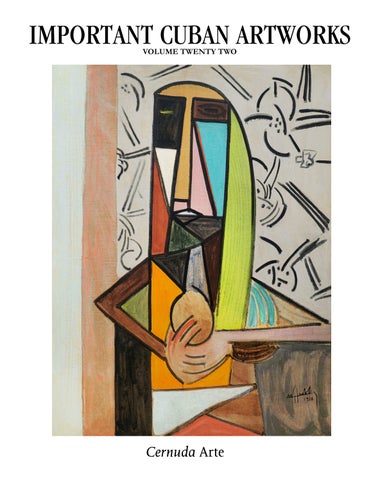
IMPORTANT CUBAN ARTWORKS VOLUME TWENTY TWO
Cernuda Arte 1
Esteban Chartrand (1840 – 1884), A Cuban Landscape, (Un Paisaje Cubano), ca 1869, oil on canvas, 25 x 40 inches Provenance: Acanthus & Reed, New Castle, DE; Sold Sotheby's NY, May 24, 2016, Lot 186; Collection of Percy Steinhart.
Percy Steinhart (1949–2025) was a Cuban-born entrepreneur, art collector, and designer, best known for founding the luxury footwear brand, Stubbs & Wootton in Palm Beach, Florida, in 1993. Beyond his career in fashion, he developed a particular interest in Cuban art. Percy, a dear friend of Cernuda Arte, collected works from Cuban art masters, Esteban Chartrand, Carlos Alfonzo, Guido Llinás, Kcho, Manuel Mendive, Los Carpinteros, Alexandre Arrechea and others. He had “the eye” to choose the best. Greatly loved, deeply missed. Rest in Peace, Percy. R.C.
Wifredo Lam, Untitled [Lady with Fruit], 1938 (illustrated on the cover) Wifredo Lam (1902 – 1982), Untitled [Lady with Fruit], (Sin Título [Dama con Fruta]), 1938, oil on board, 33 x 24 ¾ inches Please refer to page 32 for more information. Cernuda Arte provides a warranty of authenticity for every artwork offered in this catalog, according to the terms established in the Certificate of Authenticity that Cernuda Arte issues to the buyer(s) of artworks acquired from Cernuda Arte. 2
IMPORTANT CUBAN ARTWORKS VOLUME TWENTY TWO
To start this commentary, we want to first wholeheartedly thank our friends and patrons who have supported the gallery so enthusiastically in 2026. Without your passion and your participation, this project would not be viable. Our survival, our growth, and whatever success Cernuda Arte has achieved have been made possible by your patronage. Thank you, thank you, thank you. The twenty-second edition of Important Cuban Artworks is here. For the first time since its inception, it is available in printed and also in fully digital forms for the launch of the art fair season. This document is our signature yearly catalogue, a compendium of what we bring to the art table for the moment now beginning, and, we hope, a reference you will return to long after the fairs have closed. This publication encompasses one hundred and sixty-four pages that document one hundred and sixty-one works, accompanied by dozens of descriptive texts, fact sheets, and other pertinent information about the artists, periods, and depictions we offer and recommend. This catalogue arrives at a significant moment. This year, Cuban art has had an unprecedented global presence through growing private collections, museum exhibitions and surveys, international pavilion presentations, and major acquisitions by important institutions. In New York City, the legacy of Cuban modernism was affirmed by the historic retrospective Wifredo Lam: When I Don't Sleep, I Dream at the Museum of Modern Art (MoMA), on view through April of this year. Meanwhile, in Washington, D.C., the National Gallery of Art announced its first-ever acquisition of a Wifredo Lam painting. (continues on the next page)
Cernuda Arte’s Staff (from left to right): Gerardo Rojas, Christopher Lopez, Diana Benitez, Nico Hough, Ramón Cernuda, Nercys Cernuda, Roxana Martínez, Yenni Fernandez, Gabriel Garlin. 3
On the international contemporary scene in 2026, the sensual surrealism and grotesque expressionism of Roberto Fabelo were on display at the National Museum of Fine Arts in Havana through March as part of his largest solo exhibition to date, Médula. Elsewhere, Juan Roberto Diago had a solo pavilion at the 61st Venice Biennale, presenting Hombres Libres (Free Men), a sculptural installation built from salvaged materials, and the painter Yasiel Elizagaray took his dramatic chiaroscuro to Rome for the solo exhibition Aliento de Espíritu (Breath of the Spirit) at the Vatican's Palazzo della Cancelleria. In Miami, Cuban art took center stage. The Lowe Art Museum staged the largest survey of Afro-Cuban art ever produced, the monumental double exhibition of El Pasado Mío / My Own Past: Afrodescendant Contributions to Cuban Art and Afrocubanismo: Highlights from the Ramón and Nercys Cernuda Collection, both curated by Dr. Alejandro de la Fuente. At the same time, The Patricia & Phillip Frost Art Museum revisited the historic roots of the 1940s avant-garde with Modern Cuban Painters from New York to Havana, curated by Dr. Elizabeth T. Goizueta and Dr. Cristina Figueroa Vives. All three shows were major successes. The worlds of cinema and painting converged around landscape master Tomás Sánchez, whose life and work were the subjects of the documentary Perseverancia, screened in the United States for the first time at the Miami Film Festival. That premiere ran parallel to the high-profile show at our gallery, Tomás Sánchez: A Selection of Artworks from the 1970s to the 2000s, which presented twenty-one works by the international master, one of several historic exhibitions Cernuda Arte presented this year. Alongside it, we celebrated the centennial of the expressionist Gina Pellón with Centennial, a show devoted to five decades of her work. At the time of publication, the gallery is presenting Ángel Acosta León: Selections, the largest exhibition of Acosta León’s surrealist artwork ever presented in the United States. Each of these curated exhibitions drew on the same conviction that guide this catalogue, that great art deserves to be seen, appreciated, and studied. After several years in which speculation drove the art market, 2026 has seen collectors return to quality and history. This has brought a renewed focus to the authentic, well-documented artworks our gallery has always championed. Cernuda Arte's enthusiastic policy of collaboration with museums, curators, appraisers, researchers, writers, advisors, collectors, and other participants in the art world who frequently reach out to us continues unabated. This year our gallery has lent more than fifty paintings and sculptures to four different museum exhibitions and facilitated the loan of another twenty works from gallery clients to museum curators. Often, we are requested to provide historical documentation on lesser-known artists, and asked by professors and doctoral candidates to conduct research in our library of three thousand titles on Cuban art and culture. 4
Our expertise in this field has propelled the gallery to be the foremost recommended source of information regarding the authenticity of Cuban artworks. In 2026 alone, Cernuda Arte received and responded to more than one hundred authenticity inquiries. We provide this service free of charge to those who ask in good faith, whenever we are in a position to answer. All of this is the giving-back side of our endeavors, the other way of saying thank you to everyone who nourishes and sustains the ecosystem of the arts. We are proud to offer this publication as another contribution to the conversation. Let us all continue the journey through art. May health and happiness shine. Ramón Cernuda
Esteban Chartrand (1840 – 1884), Beyond the Sunset, (Más Allá del Atardecer), 1881, oil on canvas, 7 x 12 inches This painting is presented in its original 19th century stretcher and frame. Exhibited in Cuban Art and Identity, 1900 – 1950, Vero Beach Museum of Art, Vero Beach, FL, Oct. - Feb. 2014, Professor Juan A. Martínez, Ph.D., Head Curator, and illustrated in the corresponding exhibition catalog, pages 26 and 64. 5
Esteban Chartrand (1840 – 1884), Hamlet by the Countryside, (Aldea por el Campo), ca 1870, graphite on heavy paper laid down on board, 3 ¼ x 5 ½ inches
Esteban Sebastián Chartrand Dubois (1840 - 1884), was born in the Ariadne Hacienda, in Limonar, Matanzas, on October 11, 1840. From an early age Esteban manifested a clear vocation and talent for painting, surely stimulated by his mother. A cultured lady, Luisa Carlota Dubois was a pianist and portrait artist. Young Esteban visited France in 1854 and again in 1864 to study painting. He was a disciple of the renowned landscape artist, Theodore Rousseau. In 1866 and in 1867 Chartrand secured his initial recognitions by winning First Prizes and Gold Flowers at fairs in Havana and Matanzas. In 1870, he exhibited in The Floral Fair of Charleston, South Carolina, a place he visited frequently to spend time with family. In 1876, he was offered a teaching position at the prestigious San Alejandro Arts Academy in Havana that, for personal reasons, he did not accept. That same year, Chartrand participated in the International Centennial of the United States, in Philadelphia, as part of the Spain pavilion.
6
Esteban Chartrand (1840 – 1884), Cuban Landscape, (Paisaje Cubano), ca 1870, graphite on heavy paper laid down on board, 3 x 4 ½ inches
In 1881 Chartrand again exhibited at the Matanzas Exposition. That year, on June 30th, the artist documented in his own writing a list of the oil paintings he created since he finished his studies in 1865. He acknowledged a total production of 107 works in 16 years. Towards the end of 1882 or early 1883, Chartrand traveled with his wife, Merced Rosalia Gálvez, to Hoboken, New Jersey, under medical advice. He sought a better climate to treat his advanced tuberculosis affliction. However, he did not recover and died there on January 26, 1884. Art historians consider Esteban Chartrand one of the best landscape artists of all time in Cuba. His paintings have been included in numerous exhibitions in Europe and the United States. Island museums such as the National Museum, The Museum of Colonial Art and others currently possess forty-seven oils by the artist. In the US, nearly thirty works by Esteban Chartrand have been located, including three in Florida: two at the Daytona Museum and one at the Flagler Museum. Ramón Cernuda
7
José Carol (Nineteenth Century), Our Lady of Charity, (Virgen de la Caridad del Cobre), 1871, oil on canvas, 63 ¾ x 39 inches Exhibited in Important Colonial and Early Republic Masters, Cernuda Arte, Coral Gables, FL, Mar. – Sep. 2023, and illustrated digitally on cernudaarte.com, exhibitions. Exhibited in CUBAN OLD MASTERS: The 1800s, Cernuda Arte, Coral Gables, Florida, Jan. – Oct. 2019, and illustrated digitally on cernudaarte.com, exhibitions.
A radiant and overpowering version of Our Lady of Charity (the Patroness Saint of Cuba) was rendered in 1871 by Spanish artist residing in Cuba, José Carol, when he was at the height of his talents. The image depicted recreates the story of the Virgin Mary who appeared over the stormy waters of Cuba around 1608, to save three fishermen (traditionally called “the three Juanes”) when they found themselves adrift at sea. The Virgin and Child irradiate calmness. They are set in a central position on the canvas, floating on a cloud accompanied by angels, creating an ascendant and mystical experience. In the lower part of the composition, we see the fishermen in a rowboat imploring for help. The manner in which the painter executes the delicate folds of the Virgin’s white dress and her blue cloak, both adorned with golden threads, is somewhat reminiscent of Zurbarán’s mastery skills. The scene suggests the painter came into contact with images of devotion and religious iconography in Cuba when he traveled to the island in the second half of the 19th century. At that time, Carol served as a sergeant under the command of Leopoldo O’Donnell, a general and statesman then stationed on the island who played a key role in the successful Spanish military insurrections of 1843 and 1854. As published in an article in the Fine Arts section of the newspaper La Nación, Madrid (November 12, 1854), we learn that the painter’s talent for portraiture was much admired, at first by King Ferdinand VII, and later by Queen Isabella II of Spain. Ramón Cernuda 8
9
10
Armando Menocal (1863 – 1942), Bridge of Tren de la Palma, Cristal River, (Puente del Tren de la Palma, Río Cristal), ca 1930, oil on panel, 14 ¾ x 11 ½ inches Exhibited in One Hundred Years of Cuban Landscape, 1850 to 1950, Cernuda Arte, Coral Gables, FL, Dec. 2001 - Feb. 2002, and listed in the corresponding exhibition catalog, page 34, no. 29. Exhibited in Cuban Art and Identity, 1900 – 1950, Vero Beach Museum of Art, Vero Beach, FL, Oct. - Feb. 2014, Professor Juan A. Martínez, Ph.D., Head Curator, and illustrated in the corresponding exhibition catalog, page 36. 11
12
Domingo Ramos (1894 – 1956), Cuban Villa, (Villa Cubana), 1941, oil on canvas, 51 ¼ x 66 inches Exhibited in Domingo Ramos: The Soul of Impressionism in Cuba, Cernuda Arte, Coral Gables, Florida, September - October, 2005, and illustrated in the accompanying catalog, unnumbered page. Domingo Ramos (1894-1956) was born in Güines, in the province of Havana, on November 6, 1894. In 1907, he enrolled in San Alejandro Academy, and in 1918 he received a scholarship from the National Congress to study in Spain at the renowned San Fernando School in Madrid. In 1919, Domingo Ramos exhibited his work in Barcelona, Spain, and upon his return to Cuba, he was named Professor of the San Alejandro Academy. In 1943, he was given the Landscape Painting Chair at the Academy. In 1947, he was designated as an Academic Member of the “Royal Society of Art in London, England. He was also a Member of the Royal Academy of Arts and Letters in Havana. Throughout his prolific artistic career, Domingo Ramos had more than twenty one-person shows and participated in many group exhibits. He won awards and medals in Cuba, Europe and New York City, among them from: the National Academy of Arts and Letters in Havana (1916), the Annual Salon of the Fine Arts Circle in Havana (1936 and 1938), the Ibero-American Exposition in Seville, Spain (1930), the New York World’s Fair (1939), and the Latin American Exhibit in New York (1942). His works are also found in prestigious national and international collections. His painting, Coloso en la Cumbre, was acquired by Madrid’s Museum of Modern Art. Other examples of his works were included in the collections of Havana’s Country Club, Cuba’s Presidential Palace and National Capitol Building. The National Museum of Fine Arts in Havana also has several works in their permanent collection created by this outstanding painter. Ramón Cernuda 13
14
Antonio Rodríguez Morey (1874 – 1967), Tropical Garden, ( Jardín Tropical ), ca 1905, oil on canvas board, 15 x 10 inches Antonio Rodríguez Morey (1874- 1967) was born in Havana on March 4, 1874. He studied at the San Alejandro Academy where Valentín Sanz Carta, the celebrated interpreter of the Cuban landscape, was his mentor and teacher. In 1891 he traveled to Europe in order to continue his training in drawing and painting. In 1895 he established residency in Rome where he worked in the studios of several Italian and Spanish painters. During this time he was also a Professor of drawing at the Sacred Heart Institute of Rome. Rodríguez Morey reaped numerous artistic triumphs in the most important cities of Europe and America, among these a Gold Medal Award in San Francisco (1915) and in Seville (1930). In 1911 he was granted the National Award for Best Landscape in Havana. He was a notorious and fecund Cuban landscape painter. In 1912 he was appointed by the San Alejandro Academy to teach drawing, artistic anatomy and art history, while wholly committing his personal work to the theme of the landscape. In 1918 he occupied the position of Director of the National Museum of Havana. His participation as a Director and Conservator within this institution lasted many years, thus inscribing an important legacy to the development of the arts in Cuba. Rodríguez Morey was also member of several cultural institutions on the national level. Ramón Cernuda
One Hundred Years of Cuban Landscape, 1850 to 1950, 2001, page 38. 15
Oscar García Rivera (1914 – 1971), Street Vendors in Old Havana, (Vendedores Ambulantes por La Habana Vieja), ca 1940s, oil on canvas board, 15 ½ x 20 inches
Oscar García Rivera (1914 – 1971) was born in Pinar del Río, Cuba in 1914. He studied art at the San Alejandro Academy in Havana, and graduated in 1939. García Rivera chose a pictorial idiom related to the French and Spanish Impressionists, where light, color, and loose brushstrokes are utilized to capture the fleeting moment of autochthonous Cuban subject matters. He preferred everyday motifs of popular urban scenes - jovial gatherings of musicians and dancers, multitudes in feverish conga contortions, carnival parades, ballroom and street parties, as well as, religious ceremonies, both of the Afro-Cuban Santería and the Catholicism of the white population. Oftentimes, his canvases would show people of different races participating harmoniously in various folkloric settings. This artist of everyday common and ordinary scenes was the first Cuban painter ever to present a one - artist show at the United States National Museum, Smithsonian, in Washington, D.C., October of 1947. Ramón Cernuda
16
17
18
Víctor Manuel García (1897 – 1969), Sweethearts, (Novios), ca 1948, mixed media on paper laid down on canvas, 30 x 22 inches Exhibited in Víctor Manuel, Transcendencia de la Libertad, Alfredo Martínez Gallery, Coral Gables, FL, undated, ca 1997, and illustrated in the corresponding exhibition catalog. Exhibited in Latin American Art Auction, Miami, FL, Jan. 12, 1997, no. 7 in the catalog.
In Sweethearts, Víctor Manuel García (1897 – 1969) returns to his Gauginesque romantic compositions where his figures, in this instance guajiros (peasants), surrender themselves to the appropriate courtship dictated by the norms of the period. Firm and precise outlines define the volumes revealed by the unmistakable mustard-tinged flesh tone, applied by the painter to represent the racial mix of the criollo, the ethnic Cuban commoner. Ramón Cernuda 19
Víctor Manuel García (1897 – 1969), Young Country Woman, (Joven Campesina), ca 1945, oil on canvas, 20 ¼ x 16 ¼ inches Provenance: Private Collection, Novi di Modena, Italy. 20
Víctor Manuel García (1897 – 1969), Landscape with Farmers and Huts, (Paisaje con Campesinos y Bohíos), 1948, oil on canvas, 16 ½ x 11 ¾ inches, also signed and dated on the reverse Provenance: Manuel Abelén, Vice-Consul of Brazil in Cuba, and his wife, Elena Rodríguez de Abelén who acquired it from the artist in the 1940s; thence by descent to their nephew and niece, Mr. René Rodríguez and Helen Lily Harbour. 21
Fidelio Ponce de León (1895 – 1949), Portrait of a Woman, (Retrato de Mujer), ca 1940, oil on canvas, 23 x 16 inches Provenance: Prat Poig Collection, Santiago de Cuba. Exhibited in Arte Cubano, Subasta Havana, Havana, Cuba, November 2012, and illustrated in the corresponding auction catalog, number 42, page 52. This painting is accompanied by a Photo-Certificate of Authenticity issued by Museo Nacional de Bellas Artes, Havana, Cuba, and signed by Roberto Cobas Amate, Specialist, January 9, 2012. One of the better known Cuban modernists, a first generation Vanguardia painter, Fidelio Ponce studied sporadically at San Alejandro Academy, beginning in 1913. He developed his definitive style in the early 1930s, one where his paintings did not share the typical vibrant multiplicity of colors of his Cuban contemporaries. Instead, his palette was limited to different shades of white, mother of pearl, ochre, and touches of greens, blues, and pinks, so as to accentuate the drama of his thickly impastoed milky and snowy compositions, where pigments were often applied not only with the paintbrush, but also with the fingers, knives and spatulas. In some of his more daring and hallucinatory paintings, the artist reaches a degree of abstraction then unknown to Cuban art. Ramón Cernuda 22
23
24
Eduardo Abela (1889 – 1965), Pianist in Paris, (Pianista en Paris), 1953, mixed media on heavy paper laid down on board, 6 ½ x 8 ½ inches Exhibited in Eduardo Abela (1889 - 1965) A World of Dreams... A Dream of Worlds - 8 Paintings, 1940's to 1960's, Cernuda Arte, Coral Gables, FL, Dec. 2020 – Jun. 2021.
In 1949, while Eduardo Abela was residing in Guatemala as Cuba’s ambassador in that country, his wife Carmen passed. This loss, “the saddest event” in the artist’s life, provoked a sense of hopelessness and despair that pushed Abela to an acute depression. Upon doctor’s advice, he actively began “playing with the brushes”1 without any preconceived ideas or any specific plan. He freed his hand allowing it to distance itself from pictorial ideas. This was the origin of an abstract phase in the oeuvre of the artist. Ramón Cernuda 1
Eduardo Abela, Cerca del Cerco, José Seoane Gallo, Editorial Letras Cubanas, La Habana, 1986, pages 206-209.
25
Eduardo Abela (1889 – 1965), Untitled [Santeria Priest], (Sin Título [Babalao]), 1927, xylography, one-of-a-kind ink on heavy paper laid down on cardboard, 11 ¼ x 7 ½ inches Provenance: Archives of the Revista de Avance, 1927, label included.
Eduardo Abela (1889–1965), was a distinguished artist of the first generation of the Vanguard movement in Cuba. Among his many accolades, Abela was a founding collaborator of the seminal Revista de Avance (1927 to 1930), a by weekly cultural magazine of the younger Cuban intellectuals, writers, poets, philosophers, musicians, painters and sculptors, who advanced artistic, literary and social causes in Cuban society. This magazine was the sponsor and organizer of the group show New Art, First Exposition, May of 1927 (Arte Nuevo, Primera Exposición, Mayo de 1927). For this historic exhibition that launched the Cuban modern art movement, Abela produced the poster for the event. Tellingly, this poster presents in an artistic manner, the image of a strong, defiant, mixed-blood woman, who has broken the chains that constrained her arms and launches forward in a combative demeanor, conveying to the viewer, early on, that the Cuban artistic Vanguardia was about the push for the advancement of racial, gender, social and ethnic causes via the language of art. Abela continued to collaborate with Revista de Avance and the Grupo Minorista until 1930, when the magazine ceased to be published. He continued a long and successful artistic career until his death in 1965. These two exceptionally rare to find wood xylographs (an art technique of carving an image in relief into a soft wooden block, and when the drawing is complete on the surface of the wood, applying ink to the raised surface and pressing it into paper), was mastered by Abela and other modernists in the island during the early days of the twentieth century. Ramón Cernuda 26
Eduardo Abela (1889 – 1965), Untitled [Farmer on Horseback], (Sin Título [Campesino a Caballo]), 1927, xylography, one-of-a-kind ink on heavy paper laid down, 12 x 9 inches Provenance: Archives of the Revista de Avance, 1927, label included. 27
Teodoro Ramos Blanco (1902 – 1972), Bust of a Young Woman, (Busto de una Joven,), ca 1940s, one-of-a-kind 3 dimensional wood (Guayacan sculpture), 9 ¼ x 7 ½ x 7 ½ inches Provenance: Private Collection, Havana, Cuba. “Guayacan” (Guaiacum Sanctum) is also known as ironwood. Due to extreme hardness and density, it immediately sinks in water. This wood turns to dark rosewood colors when exposed to light and hand polishing. 28
Ramos Blanco’s work of “great dignity and simple strength”, signaled to the celebrated American poet and writer, Langston Hughes, “the arrival of a new and interesting personality in the field of American art.” One of the leading artists of the sculptural modern movement in Cuba, Teodoro Ramos Blanco was born in Havana, Cuba. After studying in San Alejandro Art Academy, he completed his studies in Italy in the late 1920s. In the 1930s, he exhibited in Havana at the Círculo de Bellas Artes and at the renowned Club Atenas. During this same year, he presented his work in Italy at the Latin American exhibition of artists and students, Palazzo Venezia, and the Casa de España in Rome. Ramos Blanco’s craft reveals a unique black esthetic that is tightly connected to his African heritage. His sculptures and busts, created primarily in wood, marble and bronze, mainly referenced racial pride and social justice. The artist was influenced by the 1920s & 30s Harlem Renaissance in New York City which propelled the exaltation of African American culture in the nation at large, and magnetized black people from other regions. The artist befriended prominent intellectual figures, including Langston Hughes, Alain Locke, Charles Spurgeon Johnson, James Porter and Arturo (Arthur) Schomburg. In 1933, Ramos Blanco gained international attention when he was invited to showcase his art in the United States in the Harmon Foundation’s annual Exhibition of Work by Negro Artists at the Art Center in East New York. After the 1933 Harmon Exhibition, Ramos Blanco was invited to show his work in other African American art venues: in the American Negro Exposition in Chicago in 1940, and at Howard University. His impressive rendition, Head of Langston Hughes (1932) is part of the Schomburg Center for Research in the Black Culture at the New York Public Library. In 1941, the artist returned to Cuba. In 1943, his work was included in the major show The Latin-American Collection of the Museum of Modern Art at the Museum of Modern Art, MoMA, in New York. In 1944, Ramos Blanco became a Professor at the Academy of Fine Arts San Alejandro in Havana. From the 1940’s until the early 1970’s, the artist exhibited frequently throughout the island, with group and solo shows at the nation’s major venues, including the National Museum of Fine Arts, the Lyceum, and the University of Havana, among others. His life and career were honored in the 1972 solo retrospective, Homage to Teodoro Ramos Blanco: Sculptor, at the Galería UNEAC in Cuba’s capital city. In 1985, the artist’s works were included in the group show, Art in Washington and its Afro-American Presence: 1940-1970, at the Washington Project for the Arts in Washington, D.C. Ramos Blancos’ works were also
featured in the landmark exhibition El Pasado Mío – My Own Past: Afro-descendant Contributions to Cuban Art. This show originally premiered on September 2022 at Harvard University’s Ethelbert Cooper Gallery of African & African American Art. Later, in May 2026, it was presented at the Lowe Art Museum. Teodoro Ramos Blanco died in Havana in 1972. Nercys Cernuda 29
30
Wifredo Lam (1902 – 1982), Untitled [Femme Cheval, Eleguas and Bird], (Sin Título [Mujer Caballo, Eleguas y Pájaro]), 1973, oil on canvas, 23 ½ x 31 ¼ inches, signed and dated on the reverse. Provenance: Galleria del Naviglio, Milan, Italy. This painting is accompanied by a PhotoCertificate of Authenticity signed by Eskil Lam, numbered 24-07, and dated Apr. 20, 2024. In the 1960s, Wifredo Lam, the world traveler, established a home and studio in the Italian coastal province of Albissola Marina, where he spent months away from the Parisian milieu. By this time, Lam had become fully established as a master of the international avant-garde with a sweeping curriculum. The artist had been associated with many significant movements in 20th century art – the cubists, the surrealists, the negritude movement, the abstract expressionists, the Dadaists, and so on – yet his work had resisted trends in the art world. Lam earned his reputation by staying dedicated to his own unique vision, somewhere between the mystical and the physical, the modern and the archaic. Because of this artistic commitment, Lam was able to execute works of a remarkable quality and consistency across decades of output. In these later decades, Lam’s line becomes even more elegant, at times approaching calligraphy. During Lam’s time in Italy, his works exhibited extensively throughout Europe, with major solo shows in London, Milan, Geneva, Amsterdam, Zurich, and Paris, among other artistic hubs. In 1973, his contributions to the Surrealist movement were recognized with his inclusion in the group show Surrealists of the New World at Galería Aele in Madrid. Also in 1973, he was the focus of the solo exhibition, Wifredo Lam, at the Galleria Angolare in Milan. That same year, he executes Untitled [Femme Cheval, Eleguas and Bird] (1973), an exquisite example of the mature artist’s mastery. Nico Hough 31
Wifredo Lam (1902 – 1982), Untitled [Lady with Fruit], (Sin Título [Dama con Fruta]), 1938, oil on board, 33 x 24 ¾ inches Provenance: Daniel Filipacchi, Paris, France. Exhibited in Lam, Galleria Notizie, Turin, Italy, 1964, illustrated in the accompanying catalog, page 3. Illustrated in La Peinture Surréaliste de A à Z, Sarane Alexandrian, Paris, France, 1972, page 31. Illustrated in Wifredo Lam, Gérard Xuriguéra, Paris, France, 1974, page 23. Illustrated in Wifredo Lam: Catalogue Raisonné of the Painted Work, Volume I, 1923-1960, Project Director: Eskil Lam, Acatos 1996, page 261, no. 38.54.
In 1938, Wifredo Lam arrived in Paris with a portfolio of work and a letter of introduction to Pablo Picasso. For nearly fifteen years, he had lived and worked in Spain, which had become embroiled in a turbulent civil war. As military forces closed in, Lam left for France. Picasso received the young Lam warmly, introducing him to dealers, poets, and painters, encouraging him to embrace the African art that had famously influenced Picasso’s own work, and bringing him into contact with major figures like Georges Braque, Joan Miró, André Breton, and Fernand Léger. Untitled [Lady with Fruit], 1938, is a vivid record of that year of discovery, painted at the threshold of Lam’s mature career. Within months of his arrival, Lam was given his first solo exhibition at the Galerie Pierre Loeb, followed by a two-person show with Picasso at the Perls Gallery in New York in 1939. Lam studied African masks and sculptures in Paris’s collections and ethnographic museums. For Lam, the son of a Chinese father and a mother of African and Spanish descent, these objects were not “exotic” curiosities but part of his heritage. In the works Lam produced in 1938, he began to synthesize the lessons of Cubism with the forms of African figuration to create what would become his signature style. Untitled [Lady with Fruit] is an extraordinary example of these combined influences. The seated woman is constructed from interlocking planes of turquoise, pink, rust, ochre, and black that render her head angular and mask-like. A luminous band of green falls from her crown like a veil. She holds a round fruit, recalling the tropics Lam had left nearly two decades earlier. The composition draws on the flattened geometry of Picasso and the radiant color of Matisse, yet its warmth and sensuality belong to the Caribbean. Nico Hough 32
33
34
Wifredo Lam (1902 – 1982), Untitled [Composition], (Sin Título [Composición]), 1959, mixed media on heavy paper laid down on board, 19 ¼ x 25 inches Provenance: Private Collection, Paris, France. This work is accompanied by a copy of a certificate from Lou Laurin Lam, dated December 15, 1987. We are grateful to Monsieur Eskil Lam for having confirmed the authenticity of this artwork.
35
Wifredo Lam (1902 – 1982), Untitled [Femme Cheval in Green Background], (Sin Título [Mujer Caballo en Fondo Verde]), 1972, oil on canvas, 9 ¾ x 13 ¾ inches Signed and dated on the reverse Provenance: Fratelli Orler Gallery, Favaro Veneto (VE); Private Collection, Milan, Italy. Illustrated in Wifredo Lam: Catalogue Raisonné of the Painted Work, Volume II, 1961-1982, Project Director: Eskil Lam, Acatos 2002, on page 380, no. 72.123. This artwork is accompanied by a Photo-Certificate of Authenticity signed by the artist.
36
Wifredo Lam (1902 – 1982), Untitled [Femme Cheval with Flowers], (Sin Título [Mujer Caballo con Flores]), 1978, mixed media on heavy paper laid down on board, 16 ½ x 11 ¾ inches Provenance: Private Collection, Switzerland. This painting is accompanied by a Photo-Certificate of Authenticity signed by Eskil Lam, numbered 25-28. 37
38
Wifredo Lam (1902 – 1982), Branches, (Ramas), 1955, mixed media on heavy paper laid down on board, 22 7/8 x 35 1/8 inches Provenance: Private Collection, Barcelona, Spain. Exhibited in Wifredo Lam, Galería Joan Prats-Artgràfic, Barcelona, Spain, 1976; and exhibited again in Wifredo Lam, Galería Joan PratsArtgràfic, Barcelona, Spain, 1993. Illustrated in Wifredo Lam, Max-Pol Fouchet, First Edition, 1976, pg. 102, no. 110, and Wifredo Lam, Max-Pol Fouchet, Second Edition, 1989, pg. 106, no. 110. Exhibited in The Lost Generation: Women Ceramicists and the Cuban Avant-Garde, McMullen Museum of Art, Boston College, Boston, MA, Jan. to Jun., 2024, curated by Dr. Elizabeth Thompson Goizueta. Also exhibited, same exhibition, at Frost Art Museum, Florida International University, Miami, FL, Jun. 29 to Sep. 29, 2024, and illustrated in the corresponding exhibition catalog, page 172. This painting is accompanied by a Photo-Certificate of Authenticity signed by Eskil Lam, son of the artist, Paris, May 27, 2024.
39
Wifredo Lam (1902 – 1982), Totem, (Totem), 1965, pastel on heavy paper laid down on board, 27 ½ x 19 ½ inches This artwork is dedicated on the reverse to ‘Giordano, Wi Lam, 1975’, and again signed by the artist. Exhibited at Mary-Anne Martin Fine Art, New York, NY, number LAMWDR 1965001, as per the exhibition sticker on the back of the painting. This artwork is accompanied by a Photo-Certificate of Authenticity, signed and dated by Madame Lou Laurin Lam, Paris, November 26, 2001, no. 01-41.
“Thanks to Lam, the preposterous, rugged and uninspired forms that blocked the road are blown up by the great suns of dynamite. Thanks to Lam, the primal spirit - and by that, I mean the sentiment, the dream, the heredity - is projected and illuminated... Nourished with sea salt, sun, rain, marvelous and sinister moons, Wifredo Lam is the one who calls the modern world back to the original terror and fervor.” Aimé Césaire 40
41
42
Amelia Peláez (1896 – 1968), Still Life with Fruits, (Naturaleza Muerta con Frutas), 1935, oil on canvas, 27 ½ x 32 inches Exhibited in Amelia Peláez, A Retrospective, National Museum of Fine Arts, Havana, Cuba, November 1968, and listed number 60 in the exhibition catalog. Exhibited in Amelia Peláez, The Craft of Modernity, Perez Art Museum, Miami, December 2013 and illustrated in the accompanying exhibition book, pages 44 & 45. Illustrated in the book Amelia Peláez, by Alejandro Alonso, Editorial Letras Cubanas, Havana, Cuba, 1988, pages 20 & 21. Illustrated in the book Amelia Peláez, Cerámica, by María Elena Jubrías, Ediciones Vanguardia Cubana, Fundación Arte Cubano, Escandón Editores, 2008, Sevilla, Spain, page 18. 43
44
Amelia Peláez (1896 – 1968), Interior with Balcony, (Interior con Balcón), 1947, mixed media on heavy paper laid down on board, 22 x 30 inches Exhibited in Amelia Peláez: The Craft of Modernity, at the Pérez Art Museum, Miami, FL, Dec. 4, 2013 to Feb. 23, 2014, and illustrated in the corresponding catalog, page 91. Exhibited in Cuban Art in the 20th Century: Cultural Identity and the International Avant Garde, at the Florida State University Museum of Fine Arts Tallahassee, FL, Feb. 12 – Mar. 27, 2016; Also exhibited, same exhibition, at Coral Gables Museum, Coral Gables, FL, Jan. 22, 2017 - Apr. 23, 2017, and illustrated on the cover and on page 81 of the accompanying catalog. Exhibited in The Lost Generation: Women Ceramicists and the Cuban Avant-Garde, McMullen Museum of Art, Boston College, Boston, MA, Jan. to Jun., 2024, curated by Dr. Elizabeth Thompson Goizueta. Also exhibited, same exhibition, at Frost Art Museum, Florida International University, Miami, FL, Jun. 29 to Sep. 29, 2024, and illustrated in the corresponding exhibition catalog, page 139.
In the most insightful analysis of [Amelia] Peláez’s stylistic sources in Cuban architectural decoration, artist Robert Altmann introduced the issue: “The paintings of Amelia Peláez are a conscious vision of the dominant role of ornament in relation to the theme of still life and of the elements of Cuban ornamental art of the last century.”(1) “In her own studio,” he observed, “Amelia Peláez accumulates vestiges of the colonial past: corinthian columns, mamparas, sculpted chairs, and other objects that remind her at every glance of a precise stylistic language [that of Cuban nineteenth-century ornamental art].” (1)
Robert Altmann, “Ornamento y Naturaleza Muerta en la Pintura de Amelia Peláez”, Orígenes, La Habana, No. 8, Invierno, 1945. 45
46
Mariano Rodríguez (1912 – 1990), Rooster and Sunflower, (Gallo con Girasol), 1979, acrylic on canvas, 39 x 47 inches This painting is accompanied by a Photo-Certificate of Authenticity signed by Alejandro Rodríguez, son of the artist, numbered A-510.
Rooster and Sunflower (1979) depicts Mariano’s most important symbol—the rooster. Roosters began appearing in the artist’s work starting in the 1940s, and became a career-spanning trope, present in every creative decade of his ouevre. The rooster, with its assertive and sensuous poise, became both an alter-ego for the artist, as well as a shorthand for his beloved Cuba. Alfred H. Barr, art historian and first director of the Museum of Modern Art in New York, once remarked that Mariano’s roosters were "brash, brilliant in color, they are among his most confidently painted works." As the prolific Mariano absorbed and channeled new influences, the representations of his rooster icon (and by extension, his self-conception), would change accordingly. The rooster in this artwork, triumphant and bold, reflects a latecareer return to color, as well as the influence of the New York School and the North American Pop Art movement on his production in the 1970s. Nico Hough
47
Mariano Rodríguez (1912 – 1990), Rooster, (Gallo), 1941, watercolor on paper, 13 ½ x 10 inches Provenance: Private Collection, Monaco. Illustrated in Mariano, Catálogo Razonado, Pintura y Dibujo, 1936 – 1949, Volume 1, Segunda Edición, José Veigas, page 90, number 41.80. Illustrated in the book Mariano, Tema, Discurso y Humanidad, Alejandro Rodríguez, General Coordination, Danny Montes de Oca, Texts, Escandón Impresores, Sevilla, Spain, 2004, page 204. This painting is accompanied by a Photo-Certificate of Authenticity, signed by Alejandro and Dolores Rodríguez, son and daughter of the artist, dated Sep. 6, 2001. 48
René Portocarrero (1912 – 1985), Angel, (Ángel), 1942, graphite on heavy paper laid down on board, 9 ¾ x 7 inches Provenance: This painting was part of the Betty Jane “Lindy” Bergman Collection (1918-2014). Ms. Bergman was an important collector of 20th century Modern art who donated major works to the Chicago Art Institute, including paintings by Picasso, Miró, Dalí, Magritte, Lam and others. Exhibited in RENÉ PORTOCARRERO (1912 - 1985) Fifteen Creations from the 1940s to 1970s, Cernuda Arte, Coral Gables, Dec. 2020 – July 2021, and illustrated digitally on cernudaarte.com, exhibitions. 49
René Portocarrero (1912 – 1985), Interior with Personages, (Interior del Cerro con Personajes), 1943, gouache on paper laid on board, 19 ¾ x 14 inches Provenance: Eduardo de Acevedo, Havana & New York, (acquired as a gift from the artist).
“Portocarrero’s childhood in the Havana neighborhood of El Cerro… has been often signaled as an important and decisive factor in the configuration of his painting. In the prime of his first years as an adult, memories emerge: ‘… many years after, when I visited those colonial mansions in El Cerro, where I lived during my childhood, I was able to realize that many of the figures such as fountains, arches, statues that appear in my works were part of those surroundings where I was raised.’ This is how the Cerro interiors originate, which are considered some of his most important works… The importance of the Cerro interiors was not sufficiently appreciated, not even by the few critics that had already viewed Portocarrero as a sure asset among the young emerging Cuban artists…Yet, in these interior scenes, some of Portocarrero’s essential characteristics were established in a definitive manner which… would later appear as recurrent features in his work. His palette has become personal, and his free and steady brushstrokes are, at the same time, nervous and tight, with the expressiveness of a precise intention and a hand already confident of its execution.” Graziella Pogolotti and Ramón Vázquez, René Portocarrero, El Mundo del Arte, Chapter 6, Interior del Cerro, Editorial Letras Cubanas, 1987. 50
51
René Portocarrero (1912 – 1985), Havana City, (Ciudad de La Habana), 1961, oil on canvas, 18 ⅛ x 14 ¹⁄₁₆ inches Provenance: Private Collection, Madrid, Spain. We are grateful to Fundación Arte Cubano for having confirmed the authenticity of this artwork. 52
René Portocarrero (1912 – 1985), Cathedral in Red, (Catedral en Rojo), 1958, oil on canvas, 18 ⅛ x 13 ⅛ inches Provenance: Private Collection, Caracas, Venezuela. 53
54
René Portocarrero (1912 – 1985), Anne, (Ana), 1965, oil on canvas, 28 x 20 inches Provenance: Acquired directly from René Portocarrero in his studio in Mexico, circa 1966 by a Swedish diplomat stationed in Cuba and Mexico. Exhibited in René Portocarrero, Museo de Arte Moderno, Bosque de Chapultepec, México, May 1965, and listed in the corresponding exhibition catalog, number 20.
“With her eyes wide open and the immovability of a Byzantine mosaic, these women, who come from El Cerro, have left behind their references to an immediate reality and have placed themselves outside time, petrified as witnesses of an instant.” Graziella Pogolotti Portocarrero, La Mujer Transformada en Emblema, Islas, no. 22, 1966 55
René Portocarrero (1912 – 1985), Little Devils, (Pequeños Diablitos), 1962, oil on canvas, 19 ¾ x 23 ¾ inches. Provenance: Private Collection, Central Florida. Portocarrero’s masterful 1962 composition, Little Devils, finds the artist returning to his beloved subject of the Cuban carnival. The diablitos are masked dancers of the Abakuá, an Afro-Cuban brotherhood whose roots lie in West Africa. Cloaked in patterned costumes, they are said to embody ancestral spirits, and communicate through distinctive dance. Their appearances in Havana’s public festivities date to the colonial period, and they have since become enduring figures in the visual culture of Cuban carnival. Portocarrero renders these figures with characteristic baroque abandon and energetic brushwork, depicting one of the city's ancestral traditions through a modern lens. Their conical black hoods, crowned with tufts of white, are pierced by red eyes, while striped circles hover behind their heads like halos. Portocarrero painted his carnival figures with the same reverence he lent his cathedrals. To him, both were expressions of the island’s social and spiritual life. The year 1962 was among the most prolific of the artist’s career. Alongside diablitos, he painted popular saints and ornamented women, and began his monumental Havana cityscapes. Together, these subjects formed the foundation of Color de Cuba, the series that won Portocarrero the Sambra International Prize at the 1963 São Paulo Bienal, cementing his place among the foremost painters of Latin America. Nico Hough
56
René Portocarrero (1912 – 1985), Havana Carnival, (Carnaval Habanero), 1949, mixed media on heavy paper, 11 x 14 inches Provenance: Acquired directly from the artist by Eduardo de Acevedo.
Noted journalist, Eduardo de Acevedo, was well-known for his coverage of prominent artists such as Wifredo Lam, René Portocarrero, Amelia Peláez and many others. Coming to America in 1945, de Acevedo became a Cuban citizen in 1957. De Acevedo's writings, primarily for The Week in Cuba, documented the Modern Art movement exploding in Cuba during the 1940's. His collection is a testament to the close friendships he maintained with many of the artists who came to represent Cuba's Modern Art movement. Ramón Cernuda 57
Felipe Orlando (1911 – 2001), Three Officials in a Forest, (Tres Funcionarios en un Bosque), ca 1970, oil on paper laid down on canvas, 44 x 56 inches
"The principal figures of the Second Vanguard were all born in the decade of the 1910s. Instead of looking at Paris as the fountain of Modernism, as did the first Vanguardia [generation], they looked at Mexico, but not only to the work of the Mexican Muralists. They found inspiration in the artists associated to the Contemporáneos magazine; the painters Manuel Rodríguez Lozano, Julio Castellanos, Agustín Lazo, María Izquierdo and the sculptor Luis Ortiz Monasterio, who as a group privileged easel painting and formal experimentation over muralism and politically explicit art. The companions of Mariano Rodríguez, within this second generation were, René Portocarrero (1912 – 1985), Alfredo Lozano (1913 – 1997), Mario Carreño (1913 – 1999), Cundo Bermúdez (1914 – 2008), Luis Martínez Pedro (1910 – 1989), and Felipe Orlando (1911 – 2001). This is the principal nucleus of the Cuban artists of the Second Vanguard". Professor Alejandro Anreus, Ph.D., Vida y Obra, Mariano Rodríguez, Edición Estudios Culturales, Miami, FL, Publisher José Ramón Alonso-Lorea, page 5. 58
Cundo Bermúdez (1914 – 2008), Flora, the Harvester of Dreams, (Flora, la Recogedora de Sueños), 2007, bronze sculpture, 9 of 9, (life-size version), 68 ¼ x 19 x 11 ¼ inches Exhibited [different number] in Arte América, Miami, FL, 2007. Exhibited [different number] in Cundo Bermúdez, Pasión y Lucidez, Museo Nacional de Bellas Artes, Havana, July, 2014. Exhibited [different number] in Arte Cubano, Subasta Habana, Havana, lot 20, Nov. 5, 2014, and illustrated in the corresponding auction catalog, front cover and on page 33. Exhibited in Plain Sight, Saladrigas Gallery, Belen Jesuit School, Miami, FL, Jan. – Mar., 2024.
Cundo Bermúdez with Juan Campos in the artist’s studio, ca 2006, giving the final touches to the mold of Flora, the Harvester of Dreams. 59
60
Cundo Bermúdez (1914 – 2008), Trio in C Minor, (Trío en Do Menor), 1968, oil on canvas, 42 x 70 inches Provenance: Pepe and Hilda López Collection, Martha Gutiérrez Fine Arts, Miami, Florida. Exhibited in Homage to Cundo Bermúdez, Cuban Museum of Arts and Culture, Miami, Florida, May – June, 1987, and illustrated in the corresponding exhibition catalog, page 18. 61
62
Mario Carreño (1913 – 1999), Tropical Tree, (Arbol Tropical ), 1984, oil on canvas, 58 1/2 x 47 inches Exhibited in Carreño, Acanthus Gallery, Coral Gables, Florida, April-May 1986. Exhibited in Latin American Art Auction, Miami, Florida, January 7, 1994, and illustrated in the corresponding exhibition catalog, lot 80. Exhibited in Christie's Latin American Art, New York, May 31- Jun. 1, 2007, and illustrated in the corresponding auction catalog, lot 2. Illustrated in the book, Mario Carreño, Cronología del Recuerdo, Editorial Antártica, 1991, page 71.
“Mario Carreño was a happy and generous man who knew how to cultivate great friendships. Those who were close remember his subtle and educated style of humor with joy… His body of work reflects a profound concern for all things human. It is a testimony of humankind’s hopes and dreams. He did convey in his paintings his philosophy of life, while dwelling in various styles and artistic tendencies that prevailed in the twentieth century. His creations were impregnated with the elements and the spirit of his native land [Cuba] and later with the values of the country that he chose to make his place of residence [Chile]. Mario Carreño left an indelible mark due to his extraordinary and talented cultural promotions and artistic production. Highly regarded in the field of Latin American art, Carreño is recognized as one of its most distinguished creators.” Beatriz Huidobro Hart, Mario Carreño, Exposición Retrospectiva, 1939-1993, Museo de Artes Visuales, Santiago de Chile, 2004 63
Mario Carreño (1913 – 1999), Figurehead, (Mascarón de Proa), 1974, bronze sculpture, 13 of 18, 20 ¼ x 19 ¼ x 7 inches Provenance: Manuel Porro Vizcarra, San Juan, Puerto Rico. The mold for this sculpture was created by Mario Carreño in 1974. The casting was finalized in 2002, and production was conducted at Fundición R. Buchhass, Buenos Aires, Argentina. This sculpture (different number) was exhibited in Mario Carreño, Exposición Retrospectiva, 1939-1993, Museo de Artes Visuales, Santiago de Chile, March – May 2004. It appears illustrated on page 52 of the exhibition catalog. This sculpture is accompanied by a Certificate of Authenticity signed by Juan Alberto Campos.
The Cuban born Mario Carreño settled permanently in Chile in 1957, finally making good on an invitation first extended to him nearly twenty years prior by the celebrated Chilean surrealist poet, Pablo Neruda. By this point in his career, Mario Carreño was already an internationally established painter with an impressive list of exhibitions including solo shows at the Galerie Royale in Paris, the Boston Institute of Modern Art, the San Francisco Museum of Art, the Perls Gallery in New York, and several successful group shows at the New York MoMA, the San Francisco MoMA, the Pan-American Union in Washington D.C., and the Sâo Paulo Museum of Art, among many others. In Chile, the tirelessly creative Carreño wound down from a long dedication to geometric art and returned to the subjects of his earlier work, re-contextualized in this new country. The revitalized artist, who had long been inspired by the Atlantic and the sensuousness of the tropics, found another ocean and new landscapes to be his muse. Neruda himself was also a major voice in the international surrealist movement, and a lynchpin figure in the interlocking social circles of the Pan-American and European avant-garde. The two shared an aesthetic language – the ocean, women, fruits and Spanish architecture, flowers and the muscular heroism of the common man. The famously extroverted Neruda would host large gatherings of artists at his home in Chile’s Isla Negra, where he kept his collection of nautical artifacts, including the figureheads of old ships. The crown jewel of the poet’s collection of mastheads was the oak figure of a woman, from the merchant vessel Cymbelina. The figure was salvaged from a clipper ship downed off Chile’s northern coast following a mutiny in 1847. The ship was intentionally destroyed after the crew claimed they had seen the sculpture come to life and pull them off course. To this day, the figure remains on view at the poet’s Isla Negra home. Pablo Neruda died in Santiago de Chile in the autumn of 1973. In 1974, Mario Carreño created Figurehead, one of only three known sculptures by the artist. The sculpture, which is to be understood as a nautical masthead, depicts a windswept woman in profile, forever on her voyage, echoing the classic beauty of Cymbelina and Neruda’s figurehead collection. 64
Nico Hough
65
Raúl Milián (1914 – 1984), Musicians, (Músicos), ca 1955, mixed media on heavy paper laid down on board, 15 x 10 ¾ inches Exhibited in The Lost Generation: Women Ceramicists and the Cuban Avant-Garde, McMullen Museum of Art, Boston College, Boston, MA, Jan. to Jun., 2024, curated by Dr. Elizabeth Thompson Goizueta. Also exhibited, same exhibition, at Frost Art Museum, Florida International University, Miami, FL, Jun. 29 to Sep. 29, 2024, and illustrated in the corresponding exhibition catalog, page 139. Illustrated in the book, The Dark is Light Enough: The Life and Art of Raúl Milián, by Alejandro Anreus, Cernuda Arte, Coral Gables, FL, 2026, page 22. 66
Raúl Milián (1914 – 1984), Abstract Harmonies, (Armonías Abstractas), 1955, mixed media on heavy paper laid down on board, 15 x 11 inches Provenance: The William Bowdler Collection. Illustrated in the book, The Dark is Light Enough: The Life and Art of Raúl Milián, by Alejandro Anreus, Cernuda Arte, Coral Gables, FL, 2026, page 25. 67
Raúl Milián (1914 – 1984), Fluctuation, (Fluctuación), 1954, mixed media on heavy paper laid down on board, 15 x 11 inches Illustrated in the book, The Dark is Light Enough: The Life and Art of Raúl Milián, by Alejandro Anreus, Cernuda Arte, Coral Gables, FL, 2026, page 15. 68
Raúl Milián, the lifetime companion and partner of René Portocarerro, since 1940 to his death in 1984, began painting in the early 1950s. His first one-person museum exhibition was held in Vermont, USA, at the Robert Hull Fleming Museum of Vermont State University, in February of 1953. Immediately Milián’s connections to the New York abstract expressionist group were recognized. His participation at the 26th Venice Biennale the year prior, and his renderings at the 1953 Bienal de São Paulo, Brazil, had impacted the Island’s critics and intellectuals. By 1955 Milián had his one person show in Cuba, at the University of Havana, and the following year his friend José Gómez Sicre organized another Milián show at the Pan-American Union, Organization of American States, Washington, D.C. Milián’s creations have been associated with varied international art movements and distinguished artists. The French Informalists of the late 1940’s, the American Abstract Expressionists at the New York School, the Calligraphy Art of Mark Tobey1 and the Belgian painter and writer Henri Michaux, were some of his contemporary links. Influences and connections can be found in Paul Klee, the early works of Piet Mondrian and the figurative spirit of Jean Dubuffet.
Raúl Milián (1914 – 1984), Ideas, (Ideas), 1974, mixed media on paper, 14 7/8 x 11 1/8 inches
Ramón Cernuda
Orlando Hernández, “Luz de Milián”, Revista Unión, no. 76, 2012, pages 4 to 9. 1
Both works illustrated in the book, The Dark is Light Enough: The Life and Art of Raúl Milián, by Alejandro Anreus, Cernuda Arte, Coral Gables, FL, 2026, pages 81 and 69.
Raúl Milián (1914 – 1984), Liason, (Vínculo), 1961, mixed media on paper, 14 ¼ x 10 ¼ inches 69
Raúl Milián (1914 – 1984), Pathos, (Emoción), 1960, mixed media on heavy paper laid down on board, 15 x 11 inches Illustrated in the book, The Dark is Light Enough: The Life and Art of Raúl Milián, by Alejandro Anreus, Cernuda Arte, Coral Gables, FL, 2026, page 61. 70
Alfredo Lozano (1913 – 1997) was a sculptor and draftsman and a leading figure of Cuba’s modernist generation. After training at Havana’s San Alejandro academy, he studied direct carving in Mexico City, a technique that shaped his work for the rest of his career. Back in Cuba he taught sculpture, became a founding member of the Asociación de Pintores y Escultores de Cuba in 1949, and was closely tied to the Orígenes group, whose journal reproduced his work. Lozano won prizes at the National Salons of 1938, 1950 and 1951, and represented Cuba at the Riverside Latin American Art Exhibition at the Museum in New York (1939), the São Paulo Biennial (1953) and the Gulf-Caribbean Art Exhibition that toured U.S. museums in 1956. Lozano left Cuba in the late 1960s and settled in Puerto Rico, where he taught and produced murals and sculptures while exhibiting regularly in Miami. Throughout these years, his style moved effortlessly between figuration and abstraction. He received Cintas Foundation Fellowships in 1969 and 1982, and in his later years developed his bestknown exile series, the Hachas (Axes), shown in Miami and Puerto Rico. His work was included in the landmark Outside Cuba/Fuera de Cuba exhibition, which toured six venues across the United States and Puerto Rico between March 1987 and April 1989, including the Museum of Fine Arts of Houston, Texas; the Dallas Museum of Fine Arts, Texas; the Institute of Contemporary Art, Boston, Massachusetts; the Munson WilliamsProctor Institute, Utica, New York; the Carnegie Institute, Pittsburgh, Pennsylvania; and the Colorado Springs Fine Art Center in Colorado. Works by Lozano are held in the Museo Nacional de Bellas Artes in Havana, the Lowe Art Museum at the University of Miami, the Miami-Dade Public Library and the Cintas Foundation collection. Nico Hough
Alfredo Lozano (1913 – 1997), Triple Axe, (Triple Hacha), 1980, wood sculpture, 29 x 11 x 7 ½ inches Provenance: Gloria Chibás Collection, Caracas, Venezuela; Acquired directly from the artist. Exhibited in, Alfredo Lozano, Sculptures and Drawings, Bacardi Art Gallery, Miami, FL, Nov. 9 to 30, 1992, and illustrated in the corresponding exhibition catalog, page 21, no. 11. 71
Uver Solís (1923 – 1974), Young Lady with Mango, (Muchacha con Mango), 1970, mixed media on heavy paper laid down on board, 13 1/2 x 9 3/4 inches Provenance: Madame Odette Lavergne Collection, Cannes, France. Exhibited in Art Moderne and Contemporain, Besch Commissaire, Hotel Martinez, Cannes, France, Nov. 2009, and illustrated in the auction catalog, page 44. 72
Uver Solís (1923 – 1974), A Flower Among Flowers, (Una Flor Entre Flores), 1971, mixed media on cardboard, 17 3/4 x 14 inches Provenance: Private Collection, Havana, Cuba. 73
Angel Acosta León (1930 – 1964), Constant Mutation, (Mutación Constante), 1963, mixed media on paper laid down on board, 2 ¾ x 4 ⅛ inches Illustrated in the book Angel Acosta León and His Magic, by Dr. Rosa A. Chediak, page 61. This artwork is accompanied by a Photo-Certificate of Authenticity signed by Eugenia Antonia Acosta León, sister of the artist.
74
Angel Acosta León (1930 – 1964), Sugar Cane Juicer, (Guarapera), ca 1963, mixed media on paper laid down on board, 4 ¹⁄₁₆ x 3 1/2 inches Illustrated in the book, Angel Acosta León and His Magic, by Dr. Rosa A. Chediak, page 95. This artwork is accompanied by a Certificate of Authenticity signed by Eugenia Acosta León, sister of the artist. 75
Angel Acosta León (1930 – 1964), The Great Machine, (La Gran Maquinaria), ca 1964, mixed media on wood, 28 x 87 inches Provenance: Galerie d’Eendt, Amsterdam; Private Collection, Netherlands. Exhibited in Galerie d’Eendt, Amsterdam, where the artist held a solo exhibition in 1964, and appears listed as #6, in the accompanying publication. Illustrated in the 1968 issue of the Dutch magazine Museumtijdschrift.
La Gran Maquinaria belongs to the final year of Ángel Acosta León’s life and is among the most ambitious works of his mature period. Executed on a monumental wooden support measuring nearly seven and a half feet wide, the painting presents a vast mechanical organism suspended in a luminous field. Wheels, skeletal forms, antennae, insect-like creatures, and floating biomorphic elements merge into a structure that is at once machine, landscape, and living being. This synthesis of the organic and mechanical lies at the core of Acosta León’s distinctive visual language, shaped in part by his early experience as a bus driver and mechanic in Havana. 76
The work was exhibited at Galerie d’Eendt in Amsterdam in 1964, during one of two European solo exhibitions held in the final year of the artist’s career. It was acquired by an important Dutch collector and later illustrated in Museumtijdschrift (1968), where it appears installed in the collector’s personal collection. Following the collector’s death, the painting passed to the present owner’s family, who maintained a personal relationship with him and were familiar with his holdings. By 1964, Acosta León had established himself in Cuba through exhibitions at the Museo Nacional de Bellas Artes and Casa de las Américas, as well as participation in the São Paulo Biennial. His first sustained exposure to Europe brought solo exhibitions in Amsterdam and Brussels and introduced his work to a wider audience. Created shortly before his untimely death during a sea voyage from Holland to Havana in December 1964, La Gran Maquinaria stands as a culminating statement of his imaginative universe, embodying the visionary and poetic qualities that have secured his place among the most distinctive figures of twentieth-century Cuban art. Nico Hough
77
Angel Acosta León (1930 – 1964), Coffee Machine in Blue Background, (Máquina de Café en Fondo Azul), ca 1962, mixed media on heavy paper laid down on board, 4 ¼ x 2 inches Illustrated in the book, Angel Acosta León and His Magic, by Dr. Rosa A. Chediak, page 146. This artwork is accompanied by a Certificate of Authenticity signed by Eugenia Acosta León, sister of the artist. 78
Angel Acosta León (1930 – 1964), Birds, (Pájaros), ca 1960, mixed media on paper laid down on board, 10 ¼ x 8 inches Illustrated in the book, Angel Acosta León and His Magic, by Dr. Rosa A. Chediak, page 140. This artwork is accompanied by a Certificate of Authenticity signed by Eugenia Acosta León, sister of the artist. 79
Angel Acosta León (1930 – 1964), Medusa, (Medusa), 1964, mixed media on paper laid down on board, 5 ¼ x 4 inches Illustrated in the book, Angel Acosta León and His Magic, by Dr. Rosa A. Chediak, page 62. This artwork is accompanied by a Certificate of Authenticity signed by Eugenia Acosta León, sister of the artist.
The gifted surrealist artist Angel Acosta León (1930-1964) amassed a collection of over one hundred works on paper executed during the last five years of his short but prolific career. This salient grouping of artistic creations was inherited by Eugenia Antonia Acosta León, sister of the painter, upon the artist's untimely death by suicide in 1964. Toña, as she was called by her friends and family, kept in her possession and protected this treasure for close to fifty years. These works were catalogued, studied and documented by Dr. Rosa A. Chediak, who authored the book Angel Acosta León and His Magic, 2013, a 200-page publication where all the renditions of this collection are illustrated. Cernuda Arte is pleased to have made the acquisition of this unique trove of artworks by Acosta León. Ramón Cernuda 80
Angel Acosta León (1930 – 1964), Walker, (Caminante), 1960, ink on heavy paper laid down on board, 4 x 4 inches Illustrated in the book, Angel Acosta León and His Magic, by Dr. Rosa A. Chediak, page 63. This artwork is accompanied by a Certificate of Authenticity signed by Eugenia Acosta León, sister of the artist.
81
Angel Acosta León (1930 – 1964), Secret Vessels, (Naves Secretas), ca 1962, ink on heavy paper laid down on board, 5 ¼ x 7 inches Illustrated in the book, Angel Acosta León and His Magic, by Dr. Rosa A. Chediak, page 178. This artwork is accompanied by a Certificate of Authenticity signed by Eugenia Acosta León, sister of the artist.
82
Angel Acosta León (1930 – 1964), Unrest, (Descanso Ausente), ca 1963, ink on paper laid down on board, 8 x 10 1/2 inches This artwork is accompanied by a Certificate of Authenticity signed by Eugenia Acosta León, sister of the artist.
83
Antonia Eiriz (1929 – 1995), Demonstration, (Demostración), ca 1960, mixed media on heavy paper, 30 x 25 ½ inches Provenance: Acquired directly from the artist, thence by descent to a Maria Luisa Lobo Collection, Key Biscayne, Florida. Exhibited in 100 Years of Creations by 20 Women Artists (1922 to 2022), Cernuda Arte, Coral Gables, Florida, July - November, 2022.
“Antonia Eiriz was one of the leading artists of the 1960’s generation in Cuba and a myth in her own time… her 1960’s images are outbursts of rage at the human condition in the best modern tradition of Francisco Goya, James Ensor and Francis Bacon. The violence and drama of her works signify not only a generalized tragic view of humanity, they symbolize the uncertain time and place in which Eiriz lived.” Professor Juan A. Martínez, Ph.D.
84
Servando Cabrera Moreno (1923 – 1981), Rebel With a Cause, (El Rebelde con Causa), 1973, oil on canvas, 40 7/8 x 18 inches Provenance: Private Collection, Havana, Cuba. This artwork is accompanied by a Certificate of Authenticity issued by Museo Biblioteca Servando Cabrera Moreno.
Cabrera Moreno’s "erotic style achieves a formidable display of suggestions through the combination and the stylization of ambiguous forms of the human anatomy. Cabrera Moreno guides us through the occult gardens of sexuality, and there in its most interior details, he finds its poetry, a poetry hidden by the philistinism of the bourgeoisie conventions. In the intimacy of the bodies, the artist reveals an unsuspected universe full of beauty. Carnal love is presented as a true physical fusion where the bodies abandon their individuality to amalgamate one with the other.” Gerardo Mosquera, Exploraciones en la Plástica Cubana, Gerardo Mosquera, page 35. (translation Cernuda Arte) 85
86
Agustín Cárdenas (1927 – 2001), After The Ritual, (Después del Ritual), 1989, bronze sculpture, signed and numbered 1 of 7, 21 ½ x 35 ½ x 27 ½ inches Exhibited in Diálogo Tridimensional, Galería Durbán Segnini, Miami, Florida, July to October, 2014, and illustrated in the corresponding exhibition catalog, page 18. This sculpture is accompanied by a Photo Certificate of Authenticity signed by Sulay Segnini, director of the Galería Durbán Segnini, issued on May 1, 2026.
87
Agustín Cárdenas (1927 – 2001), The Family, (La Familia), 1989, bronze sculpture Artist's Proof 3 of 4, 10 7/8 x 4 7/8 x 5 ⅛ inches Exhibited in Christie’s Latin American Art Online Auction, New York, May 2018, and illustrated in the corresponding digitally exhibition catalogue, lot number 52. Exhibited in A Surrealist Century / Un Siglo Surrealista, Cernuda Arte, Coral Gables, FL, Aug. 2024 – Jan. 2025, and illustrated digitally on cernudaarte.com, exhibitions. 88
Agustín Cárdenas (1927 – 2001), The Circus (also known as The Couple), (El Circo [La Pareja] ), 1988, bronze sculpture 2 of 6, 9 ¼ x 8 ½ x 8 inches Provenance: Private Collection, Boston, MA. Exhibited (different number), in Agustín Cárdenas, Marbles, Woods and Bronzes, Galería Durbán Segnini, Caracas, Venezuela, September 1990, and illustrated in the corresponding exhibition catalog, page 25. 89
Agustín Cárdenas (1927 – 2001), Untitled [Warm Presence], (Sin Título (Tibia Presencia)), 1959, bronze sculpture, 4 of 6, 20 ¾ x 5 x 5 inches Exhibited in Christie's, New York, November 15, 2011, and illustrated in the corresponding auction catalog, lot 117. Foundry stamp "Fonderia Tesconi, Pietrasanta" imprinted on the sculpture. Exhibited in BLACK ART MATTERS: 13 Modern and Contemporary Afro-Cuban Masters, Cernuda Arte, Coral Gables, Florida, June - December 2020, and illustrated digitally on cernudaarte.com, exhibitions.
90
Guido Llinás (1923 – 2005), White, Blue and Red, (Blanco, Azul y Rojo ), 1962, oil on canvas, 22 ¾ x 31 ½ inches This painting is illustrated in the book Cuban Art, Past and Present, Vol. 1, Frank Padrón, 2016, page 130.
In the 1950s, Abstraction played a significant role in the development of 20th century Cuban artwork. Many young non-figurative painters like Guido Llinás felt then a need to look beyond their national references and focus on what was happening in the art world internationally. They were attracted to the New York School of Abstract Expressionists and to the applied nonobjectivity of “other art” such as the movement of the Informalist painters in Paris, Madrid and Barcelona. Guido Llinás is best known as a founding member of Los Once (The Eleven), a group that rejected the traditional concept of painting favoring spontaneity and full freedom of expression created in a universal language. In 1953, he exhibited his artwork with The Eleven’s first group show in Havana. In 1957, the Afro-Cuban artist goes to Paris where he studied printmaking and worked until 1959. In 1963, he left Cuba and moved permanently to Paris where he settled for the remaining years of his life. In Paris, Llinás excelled at painting and engraving and met leading artists of the time, such as, Jean Arp, Victor Vasarely, Jesús Rafael Soto, Sonia Delaunay, Richard Montesen and Roberto Matta. Nercys Cernuda 91
92
Hermanas Scull (Haydée Scull, 1931 – 2007; Sahara Scull, 1931 – 2008), Memories of My Old Havana (Memorias de Mi Habana Vieja), 1995, 3 dimensional mixed media collage on canvas board, 15 ¾ x 20 inches
Identical twins Haydée and Sahara Scull, (also known as the The Hermanas Scull, Scull Sisters, or Scull Twins), were unique figures in the art world. The Hermanas Scull dedicated themselves to a collaborative art style, broadly classifiable as three-dimensional painting, that focused almost exclusively on popular urban scenes in South Florida and pre-Castro Cuba. Through this cooperative combination of painting and sculpture, the Hermanas Scull became the first known collective in Cuban art history. Haydée and Sahara Scull chose to follow in a tradition of other naïve artists such as Henri Rousseau, Grandma Moses, Red Grooms, and Purvis Young. Nico Hough 93
Agustín Fernández (1928 – 2006), Untitled [Shield], (Sin Título [Escudo]), 1975, oil on canvas, 30 x 30 Inches Provenance: Private Collection, Carrollton, TX.
94
Gina Pellón (1926 – 2014), Let's Dance, (Ven a Bailar), 2009, mixed media on canvas, 57 ½ x 44 ¾ inches Provenance: Acquired directly from the artist. Exhibited in Gina Pellón, Still Going Strong, Cernuda Arte, Coral Gables, FL, Nov. – Dec. 2010, and illustrated in the corresponding exhibition catalog, page 16. Exhibited in Cuban Art in the 20th Century: Cultural Identity and the International Avant Garde, at the Florida State Museum of Fine Arts, Tallahassee, FL, Feb. 12 to Mar. 27, 2016, and illustrated in the corresponding exhibition catalog, page 103. Also exhibited in Cuban Art in the 20th Century: Cultural Identity and the International Avant Garde at the Coral Gables Museum, Coral Gables, FL, Jan. 23 to Apr. 23, 2017. 95
GINA PELLÓN: CENTENNIAL (1926 – 2026) One hundred years after her birth, Cernuda Arte celebrates the life and work of Gina Pellón, (Cuba, 1926 – France, 2014), whose paintings, collages, and works on paper occupy a distinctive place within Cuban art in exile. Pellón forged a visual language of expressionism with luminous color and freeflowing line. Women, faces, and gatherings recur throughout her work, emerging from striking fields of pigment in compositions positioned between abstraction and figuration. Critics described the animating spirit of her work as “the joy of being.”
Gina Pellón in her studio, Paris, France.
Pellón was born in Cuba on December 26, 1926, in the former province of Las Villas. She studied for six years at Havana’s Academy of San Alejandro and later taught drawing at the Polytechnic Institute of Vedado. Her experience as an educator coincided with the development of a spontaneity that would remain central to her art. During these years, she encountered the gestural freedoms and intense color of American Abstract Expressionism. In 1959, Pellón traveled to France to continue her studies. Following the Cuban Revolution, she decided not to return to the island and remained in France after her visa expired. She had exhibited in Cuba for the last time that same year, but her career thereafter would unfold in Europe and within the wider Cuban diaspora. Paris became the center of Pellón’s artistic and personal life. She quickly found success in Europe, having her first solo show outside of Cuba in Lucern, Switzerland the year after her arrival. In 1961 she received the Medal of the City of Cholet, France. She became a central figure in a community of Latin American and Cuban artists in Paris, including the painter Angel Acosta León. She also connected with figures associated with Surrealism, among them André Breton, Roberto Matta, and Wifredo Lam, and prominent intellectuals like José Pierre, Édouard Glissant, and José Gómez Sicre. Pellón not only developed close relationships with the surrealists, but also with the CoBrA movement, the postwar European avant-garde group whose name derived from Copenhagen, Brussels, and Amsterdam. She befriended Asger Jorn, Karel Appel, and Guillaume Corneille, and shared their interest in spontaneity and expressive color. (continues on page 98) 96
Gina Pellón (1926 – 2014), Clueless Surface, (Superficie desorientada), 2008, mixed media on canvas, 63 ½ x 50 ½ inches Provenance: Cernuda Arte, acquired directly from the artist; Private Collection, South Florida. 97
She exhibited alongside the group, and her work attracted audiences in northern Europe. These affinities informed her practice, but Pellón reimagined the artistic currents around her into a language grounded in female presence and her own experiences of displacement and belonging. For Pellón, exile was a moral commitment as much as a personal circumstance. She was a steadfast advocate for the democratization of Cuba and was dedicated to the freedom of political prisoners and the defense of human rights. As an artist who understood the price of freedom firsthand, her illustrations for Amnesty International gave visual form to these convictions. In her canvases, exile is almost never illustrated, but always embodied. Her figures rarely settle within the frame, and in this way she anticipated by decades conversations about diaspora and identity that occupy art today. Over five decades, her work appeared in more than fifty solo exhibitions and more than one hundred group exhibitions across Europe and the Americas, including presentations in Paris, Lausanne, Brussels, Amsterdam, Toulouse, Silkeborg, Larvik, Geneva, Barcelona, London, Budapest, Venice, Miami, New York, Mexico City, Caracas, and more. In 1978, she received a Cintas Foundation Fellowship and was named a Chevalier of the French Order of Arts and Letters. In 1999, the Musée du Pilori in Niort, France, organized a retrospective of her work. Pellón’s practice extended beyond painting. She produced collages and prints, designed tapestries, and created sets and costumes for two feature films by the French director Marcel Hanoun. She illustrated books by French writers and publications. For the final ten years of her life, she was represented by Cernuda Arte in Coral Gables, who are now the stewards of her archives. The artist died in Paris in 2014. Nico Hough 98
Gina Pellón (1926 – 2014), The Dancer Dances, (La Bailarina Baila), 2010, collage on heavy paper, 11 ½ x 8 inches Provenance: Acquired directly from the artist.
Gina Pellón (1926 – 2014), Rainbow Games, (Juegos del Arcoiris), 2010, collage on heavy paper, 11 ½ x 8 inches Provenance: Acquired directly from the artist.
Gina Pellón (1926 – 2014), The Warm Rose, (La Rosa Cálida), 1988, oil on canvas, 31 ¾ x 25 ½ inches Provenance: Pedro R. López, who acquired directly from the artist; Lic. Jesús Martín Rodríguez, Madrid, Spain. 99
Gina Pellón (1926 – 2014), We Dance at the Edge of the World, (Nosotros Bailamos al Borde del Mundo), 1982, oil on canvas, 57 1/4 x 44 ½ inches This painting is registered in the Photo Archives of Gina Pellón, as organized by the artist during her lifetime. Exhibited in Gina Pellón: Centennial (1926 – 2026), Cernuda Arte, Coral Gables, Florida, September - December 2026, and illustrated digitally on cernudaarte.com, exhibitions. Sold prior to the publication of this catalog. 99B
Gina Pellón (1926 – 2014), The Box of Tricks, (Caja de Trucos), 1970, mixed media on canvas, 51 ½ x 38 inches Provenance: Private Collection, Paris, France. This painting is registered in the Photo Archives of Gina Pellón, as organized by the artist during her lifetime. Exhibited in Art Palm Beach, West Palm Beach, Florida, January 28 – February 1, 2026. Exhibited in Gina Pellón: Centennial (1926 – 2026), Cernuda Arte, Coral Gables, Florida, September - December 2026, and illustrated digitally on cernudaarte.com, exhibitions. Sold prior to the publication of this catalog.
Gina Pellón (1926 – 2014), The Philosophical Butterfly, (La Mariposa Filosófica), 1970, mixed media on canvas, 63 ¾ x 51 1/4 inches This painting is registered in the Photo Archives of Gina Pellón, as organized by the artist during her lifetime. Exhibited in Art Miami, Miami, Florida, December 2 - 7, 2025. Sold prior to the publication of this catalog. 99C
102
Manuel Mendive (b. 1944), Ake Funfún, (Ake Funfún), 2002, acrylic and cowrie shells on canvas, sculpted iron stretcher frame, 80 x 60 inches Exhibited in The Waters, The Quotidian and The Thoughts, National Museum, Havana, Cuba, December, 2002, and illustrated in the corresponding exhibition catalog, page 37. This artwork is illustrated in the book Mendive, Collage Ediciones, La Habana, 2015, page 159.
Mendive continues to appropriate, transform and adapt the visual language of Africa as a means of conveying its rich mythology to a new audience informed less about its ritual than about its aesthetics. He brings a sensibility to each and every work that is at once both genuine and fantastic. He is far more than an artist; he is a man who unaffectedly says, “I live with my ancestors and my gods.” His devotion to the spirits, called Orishas, is the source of his imagery, and he celebrates this devotion in painting, sculpture, and performance… Manuel Mendive unites man’s body to the earth that generated him, to the plants and animals, water and sky, to Mother Nature in which he is a creature among creatures, and in which he finds the reason, time and space of his very existence. It is a totalizing concept of art in which the pictorial mixes with that of the body and soul to reach an intense emotional height, where art and spirit reflect harmony and peace of mind. Carol Damian, Ph.D. Excerpt from the essay Manuel Mendive Hoyo Art and Spirit, on pages 29-31 of the exhibition catalog Things That Cannot Be Seen Any Other Way: The Art of Manuel Mendive, Frost Art Museum, Nov. 16, 2013 - Jan. 26, 2014. 103
Manuel Mendive (b. 1944), The Family, (La Familia), 2005, mixed media on canvas, 33 x 39 1/4 inches Provenance: Private Collection, Hollywood, Florida.
This painting evidences one of the fundamental characteristics of the creative discourse in the work of Manuel Mendive: the presence of anthropomorphic characters or figures where the human outline and animal forms coexist - interacting in the midst of nature - submerged in the pictorial surface or in the forms of his sculptures. The imaginative vision of Manuel Mendive proposes the symbiosis of man with nature in all its dimensions, where the human being is nourished from humus and from the energy that emanates from other living beings. Dr. Guillermina Ramos Cruz, author of the book Lam y Mendive, Barcelona, 2009. 104
Manuel Mendive (b. 1944), Figures in Blue, (Figuras en Azul), 1993, acrylic on canvas, 41 ½ x 50 inches Provenance: Collection of Percy Steinhart, New York.
“It is significant for the artist to establish in his work a symbolic dialogue about the relationships of human beings with the floral kingdom and the animal world. Manuel Mendive appeals to the anthropomorphic metamorphosis of the figures to demonstrate that plants and animals are the true compliment of humans - all significant - not only, nor principally because of the so-called evolution of the species, but mostly because in the spiritual world, they - plants and animals - are essential to divinities and to their spiritual energies.” Dr. Guillermina Ramos Cruz, author of the book Lam y Mendive, Barcelona, 2009.
105
Manuel Mendive’s bronze sculpture, Magical Heads is a work about embarking on a new journey and the preparations it requires. Within the contemporary art firmament, Manuel Mendive’s potent, spiritual works are unmistakable. Over the course of decades, the artist has crafted a unique vocabulary, pulled from his own inspiration and from the inherited cultural myth of the displaced African Yoruba. The bronze sculpture, Magical Heads, unfurls a rich narrative—of omens and voyages, gods and ancestors— through its symbols. Per Santería tradition, birds exchange messages between the earthly world and the spiritual realms. In Magical Heads, the artist’s placement of birds upon the crown of the figure’s head echoes the use of Halos by the early Italian renaissance painters, specifically the maestro Fra Angelico, whom Mendive cites as a major influence. The hybrid human-bird figure is repeated again on the lower portion of the sculpture, surrounded by the flattened cutout shapes of the ex-votos.
Manuel Mendive and Ramón Cernuda.
Ex-votos are devotional objects that give thanks for granted wishes and prayers, and connect closely to the image of the bird, the conduit for these spiritual communiqués. In addition to symbolizing communication with the divine, Mendive’s multi-headed, fused avatars are icons of change and potential. These symbols become especially significant when one is embarking on a new path, as is likely the intention of the bronze figure in Magical Heads. To heed the message of the spirits and advance, one must be prepared. Magical Heads is populated with Yoruba icons of spiritual protection. Notably, the sculpture is adorned with cowrie shells. These shells are believed to bring good luck and to protect the spirit of the wearer. Cowries also play a role in consultas or divination, through which a Babalawo or priest communes with the Orishas (spirits) by tossing consecrated cowries and interpreting their orientation. These consultas are often done before a major change or voyage. The figure in Magical Heads wears a collar, a sacred item traditionally inherited during important ceremonies, assigning the wearer the defense of an Orisha, and below the collar, the figure wears multiple pouches. In the Santería tradition, these pouches, called resguardos, are filled with herbs, charms, and relics to protect the wearer. Each resguardo is customized for the individual’s needs. Strapped to the figure’s back is a forked branch, known as a garabato. The garabato is a tool for clearing brush and removing difficulties and obstacles on your path, and is associated with Elegua, the deity of crossroads, journeys, and chance, as well as beginnings and endings. With the blessings and protection of the Gods, the spirits, and his ancestors, the traveler is ready. Nico Hough
106
Manuel Mendive (b. 1944), Magical Heads, (Cabezas Mágicas), 2007, bronze sculpture, number 9 of 9, 40 1/2 x 20 1/4 x 10 1/2 inches The mold for this sculpture was created by Manuel Mendive in 2007. The casting and production were initiated in 2022. Exhibited [original mold] in El color blanco, azul, verde y el color de mi piel, Museo Regional de Antropología de Yucatán, Yucatán, Mexico, Jan. 9 - Mar. 30, 2008, and illustrated in the corresponding catalog, page 31. Illustrated [original mold] in the book Mendive, Collage Ediciones, Selvi Artes Gráficas, Valencia, Spain, 2015, page 176. This artwork is accompanied by a Certificate of Authenticity, signed by the artist. 107
Manuel Mendive (b. 1944), Offerings, (Ofrendas), 1993, oil on heavy paper laid down on canvas, 15 x 19 ½ inches Provenance: Guy Hannion Collection, Paris, France, who acquired it directly from the artist.
108
Manuel Mendive (b. 1944), Dreams, (Sueños), 1990, mixed media on heavy paper laid down on museum quality board, 20 ½ x 28 ½ inches Provenance: Private Collection, Paris, France.
109
Roberto Fabelo (b. 1950), Woman and Rhinoceros, (Mujer y Rinoceronte), 2005, watercolor on paper laid down on board, 44 ⅜ x 60 inches Exhibited in ROBERTO FABELO: The Theater of Life - Twenty Artworks from the 1990's to Today, Cernuda Arte, Coral Gables, FL, Apr. - July 2021, and illustrated digitally on cernudaarte.com, exhibitions. This artwork is accompanied by a Photo-Certificate of Authenticity signed by the artist.
110
Roberto Fabelo (b. 1950), Suyu and the Beans, (Suyu y los Frijoles), 2016, oil on canvas, 93 x 79 inches Provenance: Acquired directly from the artist. Exhibited in EXPO Chicago Art Fair, Festival Hall, Navy Pier, Chicago, Illinois, September, 2017. Illustrated in the book Fabelo, Persistencia, Eusebio Leal, Rome, Italy, 2017, pages 30 and 31. This artwork is accompanied by a Photo-Certificate of Authenticity signed by the artist. 111
112
Tomás Sánchez (b. 1948), Shore, (Orilla ), 1988, oil on canvas, 57 ¾ x 78 inches This painting is accompanied by a Photo-Certificate of Authenticity signed by the artist, dated September 27, 2008.
113
Tomás Sánchez (b. 1948), Untitled [Christ Crucified], (Sin Título [Cristo Crucificado]), 1985, acrylic and watercolor, paper collage, 20 x 13 inches Also signed, dedicated and dated by the artist on the front: Tomás Sánchez 85 "A mi amigo Mario con mucho aprecio" This artwork is accompanied by a Photo-Certificate of Authenticity signed by the artist, dated July 6, 2026. 114
Tomás Sánchez (b. 1948), Sacrifice Seen Through a Box, (Sacrificio Visto a través de una Caja), 1984, watercolor on heavy paper, 7 x 4 ¼ inches Also titled, signed, dedicated and dated by the artist on the reverse: "To my friend Jeannine with much appreciation, this small gift" Tomás Sánchez, December 12, 1985. This painting is accompanied by a Photo-Certificate of Authenticity, issued by the Fundación Tomás Sánchez, and signed by the artist. 115
116
Tomás Sánchez (b. 1948), Shore, (Orilla ), 1988, acrylic on canvas, 42 ½ x 57 ¾ inches Signed and dated Tomás Sánchez, 88, center right, also signed, titled, and dated Tomás Sánchez, "Orilla," 1988, on reverse Provenance: Collection, Costa Rica. This painting is accompanied by a Photo-Certificate of Authenticity, issued by the Fundación Tomás Sánchez, and signed by the artist. 117
Tomás Sánchez (b. 1948), Vulture Meat, (Carne de Auras), 1975, oil on canvas, 31 x 39 inches Exhibited in Ajiaco: Stirrings of the Cuban Soul, curated by Dr. Gail Gelburd, Lyman Allyn Art Museum, New London, Connecticut, 2009-2010. Exhibited in Ajiaco: Stirrings of the Cuban Soul, curated by Dr. Gail Gelburd, Paul and Lulu Hilliard University Art Museum, Lafayette, Louisiana, Summer 2010. Exhibited in Ajiaco: Stirrings of the Cuban Soul, curated by Dr. Gail Gelburd, Newark Art Museum, Newark, New Jersey, Summer 2011. Illustrated in the book Ajiaco: Stirrings of the Cuban Soul, Dr. Gail Gelburd, Hispanic Alliance / University Press of New England, 2010, page 3. Exhibited in Tomás Sánchez: Paintings, Works on Paper and Early Lithographs, Cernuda Arte, Coral Gables, FL, Sep. - Dec. 2018, and illustrated digitally on cernudaarte.com, exhibitions. This painting is accompanied by a Photo-Certificate of Authenticity, signed by the artist. 118
Tomás Sánchez (b. 1948), The Christ of the Henhouse, (El Cristo del Gallinero), 1974, lithograph 5 of 10, 18 x 11 ¼ inches This artwork was exhibited (different number) in La Conciencia del Testigo: Antonia Eiriz, Tomás Sánchez, Servando Cabrera Moreno, March – June 2009, Museo Servando Cabrera Moreno, Havana, Cuba, and it appears illustrated (different number) in the accompanying exhibition catalog. Exhibited in Antonia Eiriz: A Painter and Her Audience, Miami Dade College Museum of Art Design, Freedom Tower, Miami, FL, Sep. 13 to Nov. 17, 2013, curated by Michelle Weinberg. Exhibited in Tomás Sánchez: Paintings, Works on Paper and Early Lithographs, Cernuda Arte, Coral Gables, FL, Sep. - Dec. 2018, and illustrated digitally on cernudaarte.com, exhibitions. This painting is accompanied by a Photo-Certificate of Authenticity, signed by the artist. 119
Tomás Sánchez (b. 1948), The Return of the Carriage, (El Retorno del Quitrín), 1972, Lithograph, 4 of 5, 12 ½ x 21 ¼ inches Exhibited in Tomás Sánchez: Paintings, Works on Paper and Early Lithographs, Cernuda Arte, Coral Gables, FL, Sep. - Dec. 2018, and illustrated digitally on cernudaarte.com, exhibitions. This painting is accompanied by a Photo-Certificate of Authenticity, issued by the Fundación Tomás Sánchez, and signed by the artist.
120
Tomás Sánchez (b. 1948), Untitled [Gathering at the Park], (Sin Título [Reunión en el Parque] ), 1970, lithograph, artist proof, 5 ½ x 8 ¼ inches Exhibited in Tomás Sánchez: Paintings, Works on Paper and Early Lithographs, Cernuda Arte, Coral Gables, FL, Sep. - Dec. 2018, and illustrated digitally on cernudaarte.com, exhibitions. This painting is accompanied by a Photo-Certificate of Authenticity, issued by the Fundación Tomás Sánchez, and signed by the artist.
121
Flora Fong (b. 1949), Coffee Maker, (Cafetera), 2007, mixed media on canvas, 39 x 31 ½ inches Provenance: Acquired directly from the artist. 122
“Clara Morera studied at the National School of Visual Arts in Havana and graduated from the San Alejandro Academy with a focus on painting, tapestry, soft sculpture, drawing, and mixed installations. She carefully stitches and embeds a rich web of forms into a sea of blue to represent Yemayá. One critic wrote of her work that she ‘discovers the painful extent of her poetic universe. Torn hearts where green branches open out, crowned with golden flowers. Sharp onyx daggers, which have mutilated pilgrims or escaped. A sky of azure. Sacrificial lambs that murmur the names of Orishas, the metamorphosis of strange butterflies, ready to fly away to more clement skies...’ But Morera’s works are not meant to be an illustration of the traits of the various Orishas; rather, she has derived her own forms and her own vocabulary from the many myths of the Orishas.” Dr. Gail Gelburd, Ajiaco: Stirrings of the Cuban Soul, Lyman Allyn Art Museum, New London, Conneticut, 2009, page 27.
Clara Morera (b. 1944), Malevolent Eyes Don't Look at Me, (Malos Ojos No Me Miran), 2005, mixed media on canvas, 52 x 26 inches Provenance: Acquired directly from the artist.
123
124
Humberto Calzada (1944 – 2025), Years of Retribution, (Años de Retribución), 2023, acrylic on canvas, 36 x 72 inches. Provenance: Acquired directly from the artist. This artwork is accompanied by a Photo-Certificate of Authenticity signed by the artist, dated Sep 14, 2024. 125
126
Humberto Calzada (1944 – 2025), The Strength of Distance, (La Fuerza de la Distancia), 1999, acrylic on canvas, 30 x 40 inches Provenance: Private Collection Key Biscayne, Florida.
Calzada has generated an aesthetic centered around the theme of colonial architecture, inspired by memories of his native island. The sensuous color palette and meticulous geometry of Colonial Spanish style are present throughout his oeuvre, as are the recurring motifs of stained glass, white tiles, and calm water. Like many Historic Exile artists, Calzada’s work is an expression of nostalgia. The artist draws from idealized recollections to render scenes that are tranquil and flooded with light, combining technical mastery with a surrealist touch to create a dreamlike vision of the tropics. The artist died in Miami, on August 17, 2025. Nico Hough 127
Juan Roberto Diago (b. 1971), Power is Not Given Away, It's Conquered [from the series “A Place in the World”], (El Poder No se Regala se Lucha [de la serie “Un Lugar en el Mundo”]), 2009, mixed media on canvas and wood, 89 x 65 inches Provenance: Acquired directly from the artist. Exhibited in Diago: The Pasts of This Afro-Cuban Present, Colorado Springs Fine Arts Center, Colorado College, Colorado Springs, Colorado, curated by Professor Alejandro de la Fuente, Feb. 11 – July 2, 2022. Exhibited in Diago: The Pasts of This Afro-Cuban Present, Art Museum of the Americas, Washington D.C., curated by Professor Alejandro de la Fuente, Aug. 1 – Oct. 20, 2024. Illustrated in the book Diago: The Pasts of This Afro-Cuban Present, Professor Alejandro de la Fuente, Harvard University Press, Cambridge, Massachusetts, 2017, page 111. Illustrated in the book Diago: The Pasts of This Afro-Cuban Present, Professor Alejandro de la Fuente, Lowe Art Museum, University of Miami Press, Coral Gables, Florida, 2019, page 44. 128
Juan Roberto Diago (b. 1971), Eating Knives, (Comiendo Cuchillo), 2002, mixed media and collage on canvas, 78 ¾ x 59 inches Provenance: Collection of the artist. Exhibited in Comiendo Cuchillo, National Museum of Fine Arts, Havana, Cuba, June 6 – July 10, 2002, and illustrated in the corresponding exhibition catalog, pages 22 - 23. 129
Juan Roberto Diago (b. 1971), front view, Maria [from the series “Free Men”], (Maria [de la serie “Hombres Libres”]), 2026, brass, iron and wood sculpture, 41 x 30 ¼ x 20 inches Provenance: Acquired directly from the artist. 130
A scar is a document of an injury, but also a record of survival. For more than three decades, Juan Roberto Diago has built a visual language around this double meaning. In his paintings, assemblages, and sculptures, the seams where materials meet rise in thick ridges, like keloids on skin, so that the history of the material is made visible. Maria [from the series “Free Men”] is a powerful expression of this technique and a beautiful representation of the work that has brought the artist to the world stage. Born in Havana in 1971 and trained at the San Alejandro Academy, Diago came of age as an artist during the 1990s, in a time of severe economic crisis that followed the collapse of the Soviet Union. Like many artists of his generation, he responded to scarcity by working with discarded materials, including weathered boards, rusted sheet metal, wire, and scrap. These found materials became inseparable from his exploration of the personal, political, and historical dimensions of race and power in Cuba. The brass, iron, and wood sculpture, Maria Juan Roberto Diago (b. 1971), side view, [from the series “Free Men”], belongs to Diago’s Maria [from the series “Free Men”], 2026 critically and commercially renowned body of work, the Free Men series. Sculptures from this suite were presented as part of the artist’s solo pavilion at the 2026 Venice Biennale, where they received international press and acclaim. Maria subverts traditional conventions of the female sculptural subject through repurposed materials that recall Italian Arte Povera and scrawled surfaces that bring to mind the Neo-Expressionism of artists like Jean-Michel Basquiat. Diago’s works in this series extend a lineage of Caribbean modernism, exemplified by artists such as Wifredo Lam, who brought the histories, cultural traditions, and spiritual life of the African diaspora into modern art. The solo pavilion at the Venice Biennale is only the latest in a string of major accomplishments by the artist in recent years. Diago’s career has been celebrated in the traveling retrospective Diago: The Pasts of This Afro-Cuban Present, curated by Alejandro de la Fuente, PhD, which opened at Harvard University’s Ethelbert Cooper Gallery before touring three more American museums. His work was also recently included in the major traveling show My Own Past: Afrodescendant Contributions to Cuban Art, also curated by Dr. Alejandro de la Fuente, first at Harvard University’s Ethelbert Cooper Gallery in 2022–23, later at the Lowe Museum of Art at the University of Miami in 2026. Nico Hough 131
Juan Roberto Diago (b. 1971), From the series “I Have My History” (De la serie “Yo Tengo Mi Historia”), 2003, mixed media on wood, 34 ¼ x 22 ¼ inches Provenance: Acquired directly from the artist. Exhibited in Diago: The Pasts of This Afro-Cuban Present, Colorado Springs Fine Arts Center, Colorado College, Colorado Springs, Colorado, curated by Professor Alejandro de la Fuente, Feb. 11 – July 2, 2022. Exhibited in Diago: The Pasts of This Afro-Cuban Present, Art Museum of the Americas, Washington D.C., curated by Professor Alejandro de la Fuente, Aug. 1 – Oct. 20, 2024. Exhibited in JUAN ROBERTO DIAGO: Selections from 1998-2019, Cernuda Arte, Coral Gables, Florida, Aug.– Nov. 2026, and illustrated digitally on cernudaarte.com, exhibitions. Illustrated in the book Diago: The Pasts of This Afro-Cuban Present, Professor Alejandro de la Fuente, Harvard University Press, Cambridge, Massachusetts, 2017, page 86. Illustrated in the book Diago: The Pasts of This Afro-Cuban Present, Professor Alejandro de la Fuente, Lowe Art Museum, University of Miami Press, Coral Gables, Florida, 2019, page 36. 132
Juan Roberto Diago (b. 1971), My Hands, (Mis Manos), 1998, mixed media on heavy paper laid down on canvas, 27 ½ x 19 ¾ inches This work is accompanied by a Photo-Certificate of Authenticity, signed by the artist. 133
Juan Roberto Diago (b. 1971), Self-Portrait 1-2-3-6, (Autorretrato 1-2-3-6), 1998, mixed media on heavy paper laid down on board, 27 ½ x 19 ¾ inches Signed, dated, and fingerprinted by the artist on the reverse. 134
Juan Roberto Diago (b. 1971), Refrigerator, (Refrigerador), 2006, Refrigerator, manipulated, mixed materials, 62 x 39 x 29 ½ inches Provenance: Acquired directly from the artist. Exhibited in Manual de Instrucciones, IX Havana Biennial, Convento de Santa Clara, Havana, Cuba, April, 2006. Exhibited in Monstruos devoradores de energía, Casa de América, Madrid, Spain, March to April, 2007. Exhibited in Devoradores de energía, Triennale Bovisa, Milán, Italy, June 21 to July 8, 2007. Exhibited in Monstruos devoradores de energía, Gran Palais de Paris, Paris, France, July 17 to August 3, 2007. Exhibited in Los Fríos, Plaza de San Francisco, Sevilla, Spain, September 8 to 10, 2010. Exhibited in Diago: The Pasts of This Afro-Cuban Present, curated by Professor Alejandro de la Fuente, Ph.D., and Jill Deupi, Ph.D., Lowe Museum at the University of Miami, Coral Gables, FL, Oct. 24, 2019 - Jan. 19, 2020, and illustrated in the corresponding exhibition catalog, page 43. 135
Miguel Florido (b. 1980), Elegy, (Elegía), 2017, mixed media on canvas, 91 ¾ x 48 inches Provenance: Acquired directly from the artist. 136
Miguel Florido (b. 1980), Threshold, (Umbral), 2019, acrylic on canvas, 91 ¾ x 48 ¼ inches Provenance: Acquired directly from the artist. 137
Lilian Garcia-Roig (b. 1966), Banana Plantation and Mogote Hill, (Platanal y Mogote), 2016, mixed media on heavy paper laid down on board, 22 x 30 inches Provenance: Acquired directly from the artist.
138
Lilian Garcia-Roig (b. 1966), Bucolic Viñales Valley, (Viñales Bucólico), 2016, mixed media on heavy paper laid down on board, 22 x 30 inches Provenance: Acquired directly from the artist.
139
Lilian Garcia-Roig (b. 1966), Deep Wood Transition, (Transición Bosque Adentro), 2012, oil on canvas, 30 x 24 inches Provenance: Acquired directly from the artist. 140
Lilian Garcia-Roig (b. 1966), Ascension, (Ascensión), 2018, oil on canvas, 40 x 30 inches Exhibited in Lilian García-Roig: Made in Cuba, Cernuda Arte, Coral Gables, Florida, Nov. - Dec. 2018, and illustrated in the corresponding exhibition catalog, page 11. 141
Yasiel Elizagaray (b. 1987), Vital Existence, (Existencia Vital), 2024, oil on canvas, 59 x 19 ½ inches Provenance: Acquired directly from the artist.
The Expressionist is an artist who wants to convey how their world feels, not just how it appears. This is achieved through techniques like exaggeration, distortion, and the selection of colors that deviate from the real. For some artists, this subjectivity manifests as tenderness; for others, tension. What sets Elizagaray apart is his fluency with both extremes. Elizagaray’s painterly approach walks the line between tradition and innovation, blending compositional cues from American and European masters with a contemporary approach to form and to the application of pigment. Through his attention to detail, restrained color palette and drastic impasto, the artist presents honest images of young people in a world haunted by crises. Nico Hough 142
Yasiel Elizagaray (b. 1987), The Dreamer, (La Soñadora), 2024, mixed media on canvas, 55 x 47 inches Provenance: Acquired directly from the artist. 143
144
Yasiel Elizagaray (b. 1987), Ladies in White, (Damas de Blanco), 2026, oil on canvas, 70 3/4 x 78 3/4 inches Provenance: Acquired directly from the artist. This artwork has been illustrated in the upcoming publication, YASIEL ELIZAGARAY: Aliento de Espíritu, Selvi Artes Gráficas, Valencia, Spain. The publication corresponds to the artist’s one person show of the same title at the Palazzo della Cancelleria, Vatican, Rome, Italy, that opened October 17, 2026.
Yasiel Elizagaray, born in 1987, is a most promising star from the younger generation of contemporary Cuban talents. Elizagaray masterly uses the tools of grotesque expressionism by subverting the classical beauty of infancy, youth and femininity into distorted, unsettling, and maddening forms that expose deep emotional and psychological imbalance, as well as anxiety in his characters. The artist's application of heavy impastos and thinner layers of paint adds to the tension of the composition. His hopeless involuntary sitters are inspired by everyday people that he sees and imagines from his immediate surroundings. Ramón Cernuda
145
Yasiel Elizagaray (b. 1987), Meditation, (Meditación), 2025, mixed media on canvas, 39 ¼ x 31 ½ inches Provenance: Acquired directly from the artist. 146
Yasiel Elizagaray (b. 1987), The Twins, (Las Jimaguas), 2025, one of a kind, glass fiber, epoxy resin and burlap, 22 x 10 x 6 inches Provenance: Acquired directly from the artist. This artwork has been illustrated in the upcoming publication, YASIEL ELIZAGARAY: Aliento de Espíritu, Selvi Artes Gráficas, Valencia, Spain. The publication corresponds to the artist’s one person show of the same title at the Palazzo della Cancelleria, Vatican, Rome, Italy, that opened October 17, 2026. 147
148
Giosvany Echevarría (b. 1971), Return to Paradise, (Regreso al Paraiso), 2026, oil on canvas, 41 ¼ x 62 inches Provenance: Acquired directly from the artist.
Giosvany’s best known renditions celebrate the majestic beauty of the Viñales Valley in the province of Pinar del Río, depicting its renowned mogotes (hillocks), rivers, streams and palm trees. Breathtaking sceneries unfurl with an artful blend of placid atmospheric mood and meticulous brushstrokes. His magnificent compositions clearly show the artist’s fascination with his surroundings and his mastery of the fine art of hyperreal landscape painting.
Recently, the artist has begun applying the lessons of hyperrealism to a series of imaginary landscapes — which to date, have focused on magisterial cascades — broadening his creative horizons and incorporating a dreamlike, spiritualist quality to his production. These meditative compositions show a mastery of detail and a rare command of the subtleties of the natural world. These new works shift the role of the artist, from a virtuoso observer to a painter of sublime new worlds. (continues on next page)
149
Giosvany Echevarría (b. 1971), Customary Beauty, (Belleza Habitual), 2015, oil on canvas, 15 3/4 x 23 ½ inches Provenance: Acquired directly from the artist.
As journalist and art critic, Jesus Hernández commented in his essay on the work of Giosvany Echevarría, The Natural Enchantment of Landscapes:
“Stemming from within those canons – observation, realism and conviction of modernity – is the precise paintbrush of Giosvany Echevarría, whose work we have fortunately come to know during these years. An artist who, although an heir to the Cuban landscape tradition, is defined by the most natural hyperrealism, beyond that of the French pictorial Romanticism and Realism that influenced the first exponents of landscape painting on the island, during the second half of the 19th century with the Chartrand brothers...
150
Giosvany Echevarría (b. 1971), A Lingering Sunset, (Un Largo Atardecer), 2015, oil on canvas, 9 3/4 x 13 3/4 inches Provenance: Acquired directly from the artist.
The core of his body of work is mostly focused on depicting the presence of mogotes (hillocks), streams and palm trees which reveal harmoniously the idyllic image of the Viñales Valley in his native Pinar del Río, grounded in the luminous effect that so finely tunes this sublime setting. Perhaps it might suffice to say that Giosvany Echevarría portrays with hyperrealist mastery, each and every detail that comprises the landscape – from the lush grass that exudes freshness, to the palm trees that stand tall while the wind sways their crests...” Nercys Cernuda and Nico Hough
151
Giosvany Echevarría (b. 1971), Interlude, (Interludio), 2016, oil on canvas, 9 3/4 x 13 3/4 inches Provenance: Acquired directly from the artist.
152
Danuel Méndez (b. 1989), Person, (Persona), 2025, acrylic on canvas, 60 x 48 inches Provenance: Acquired directly from the artist. 153
154
Enrique Casas (b. 1976), Romancing the Coast, (Romanceando la Costa), 2025, oil on canvas, 40 x 60 inches Provenance: Acquired directly from the artist.
Much of Casas’ landscape work evokes the intense and welcoming blues of Monet’s maritime paintings, the hazy lyricism of Eugene Boudin, and the peaceful desolation of Courbet’s rocky beaches, taken to a further point of abstraction by bold and vigorous strokes of paint. The artist’s muse is the Caribbean, with its tropical light and windswept waters. Casas’ Cuba is a world of distance and yearning, a paradise lost where color, light, and form crystallize into a stirring and nostalgic vision. Nico Hough
155
Enrique Casas (b. 1976), The House by the Coast, (La Casa en la Costa), 2023, oil on canvas, 16 x 19 inches Exhibited in Enrique Casas: Time Has Stopped, Cernuda Arte, Coral Gables, FL, Sep. 2023 - Jan. 2024, and illustrated digitally on cernudaarte.com, exhibitions. Provenance: Acquired directly from the artist.
156
Enrique Casas (b. 1976), Refuge Space, (Espacio de Refugio), 2023, oil on canvas, 31 x 39 ¼ inches Exhibited in EXPO Chicago Art Fair, Festival Hall, Navy Pier, Chicago, Illinois, April, 2025. Provenance: Acquired directly from the artist.
157
158
Enrique Casas (b. 1976), Afternoon Conversations, (Conversaciones en la Tarde), 2026, oil on canvas, 17 3/4 x 31 1/2 inches Provenance: Acquired directly from the artist. 159
Enrique Casas (b. 1976), Three Trees, (Tres Árboles), 2023, oil on canvas, 14 1/2 x 19 3/4 inches Exhibited in Enrique Casas: Time Has Stopped, Cernuda Arte, Coral Gables, FL, Sep. 2023 - Jan. 2024, and illustrated digitally on cernudaarte.com, exhibitions. Provenance: Acquired directly from the artist.
160
Irina Elén González (b. 1978), The Senseless Humor, (El Sin Sentido del Humor), 2026, acrylic on canvas, 59 x 41 ½ inches Provenance: Acquired directly from the artist. 161
162
Tania Bruguera (b. 1968), Untitled [Tea Time], (Sin Título [Tiempo de Té]), 2002, mixed media collage of tea bags on heavy paper, signed and dated in the reverse, 22 x 29 3/4 inches Provenance: Private Collection Key Biscayne, Florida. We are grateful to artist Tania Bruguera for having confirmed the authenticity of this artwork. Tania Bruguera is an interdisciplinary artist whose work is grounded in the act of doing or behavior art. The artist embodies personal experience with a wide-raging social and historical perspective to explore diverse issues such as, institutionalized injustice and prejudice, displacement and ostracism, will power and resilience, and personal/social survival. She received her MFAs from The School of the Art Institute of Chicago (United States) and Instituto Superior de Arte (Cuba). Her BFA is from Escuela de Arte San Alejandro (Havana). In 1998 she was selected as a Guggenheim Fellowship Award (United States). Her work is part of the collection of MoMA - Museum of Modern Art (United States); the Museum für Moderne Kunst (Germany); Daros Foundation (Switzerland); JP Morgan Chase Bank (United States); Bronx Museum of the Arts (United States); Museo Nacional de Bellas Artes (Cuba); Centro de Arte Contemporáneo Wifredo Lam (Cuba); The New Museum for Latin American Art (England). Bruguera has had solo exhibitions at the Museo Nacional de Bellas Artes, Havana (2003); Turin, Neuberger Museum of Art, Purchase College, New York (2010); Tate Modern, London (2012); and Van Abbemuseum, Netherlands (2014), among others. Nico Hough
163
Back Cover: Mario Carreño (1913 – 1999), Afro-Cuban Religious Ceremony Room, (Cuarto Fambá), 1943, mixed media on heavy paper laid down on cardboard, 31 x 22 1/2 inches Provenance: Perls Galleries, New York, NY. Exhibitions: Exhibited in Mario Carreño, Perls Galleries, New York, NY, March 13 – April 15, 1944, and listed as number 13 in the corresponding catalog. Exhibited in Paintings, Temperas and Drawings by Mario Carreño, and listed as number 28 in the corresponding exhibition brochure at the following venues: San Francisco Museum of Art, San Francisco, CA, August - September, 1944. Pioneer Museum and Haggin Art Galleries, Stockton, CA, November, 1944. E.B. Crocker Art Gallery, Sacramento, CA, December, 1944. Portland Art Museum, Portland, OR, January, 1945. Seattle Art Museum, Seattle, Washington, February - March, 1945. Exhibited in Six Latin American Painters at the following venues: Atkins Museum of Fine Arts, Kansas City, MO, April, 1946. San Francisco Museum of Art, San Francisco, CA, May 10 – June 9, 1946. Cranbrook Academy of Art, Bloomfield Hills, MI, June 26 – July 30. Dallas Museum of Fine Arts, Dallas, TX, 1946. Literature: Illustrated in “Afro-Cuban Ceremony Room”, Detroit Free Press, Detroit, MI, June 30, 1946, page 16. Illustrated in “Afro-Cuban Ceremony Room”, The San Francisco Examiner, San Francisco, CA., June 2, 1946, page 123. Illustrated in the catalog Wifredo Lam and His Contemporaries, 1938 - 1952, The Studio Museum in Harlem, New York, NY, 1992, on page 65. Illustrated in Relecturas de Carpentier, Asturias, Rulfo y García Márquez, Erik Camayd-Freixas, University Press of America, Lanham, Maryland, 1998, on page 30. Illustrated in Cuadernos de la Plástica Cubana. Carreño, José Gómez Sicre, Ediciones Galería del Prado, Havana, 1943, n.p., b&w illustration. Written about in “Auge y expresión de la pintura en Cuba” Loló de la Torriente, Cuadernos Americanos, Mexico City, Mexico, Vol. 16, N.4, July – August, 1944, page 234. 164
INDEX Abela, Eduardo (1889 – 1965) 24, 25, 26, 27 Acosta León, Angel (1930 – 1964) 74, 75, 76, 77, 78, 79, 80, 81, 82, 83 Bermúdez, Cundo (1914 – 2008) 59, 60, 61 Bruguera, Tania (b. 1968) 160, 161 Cabrera Moreno, Servando (1923 – 1981) 85 Calzada, Humberto (1944 – 2025) 122, 123, 124, 125 Cárdenas, Agustín (1927 – 2001) 86, 87, 88, 89, 90 Carreño, Mario (1913 – 1999) Back Cover, 62, 63, 64, 65, 162 Carol, José (Ninteeth Century) 8, 9 Casas, Enrique (b. 1976) 152, 153, 154, 155, 156, 157, 158 Chartrand, Esteban (1840 – 1884) 2, 5, 6, 7 Diago, Juan Roberto (b. 1971) 126, 127, 128, 129, 130, 131, 132, 133 Echevarría, Giosvany (b. 1971) 146, 147, 148, 149, 150 Eiriz, Antonia (1929 – 1995) 84 Elizagaray, Yasiel (b. 1987) 140, 141, 142, 143, 144, 145 Fabelo, Roberto (b. 1950) 108, 109 Fernández, Agustín (1928 – 2006) 94 Florido, Miguel (b. 1980) 134, 135 Fong, Flora (b. 1949) 120 García, Víctor Manuel (1897 –1969) 18, 19, 20, 21 García Rivera, Oscar (1914 – 1971), 16, 17 Garcia-Roig, Lilian (b. 1966) 136, 137, 138, 139 González, Irina Elén (b. 1978) 159 Lam, Wifredo (1902 – 1982) Cover, 30, 31, 32, 33, 34, 35, 36, 37, 38, 39, 40, 41 Lozano, Alfredo (1913 – 1997) 71
Llinás, Guido (1923 – 2005) 91 Méndez, Danuel (b. 1989) 151 Mendive, Manuel (b. 1944) 100, 101, 102, 103, 104, 105, 106, 107 Menocal, Armando (1863 – 1942) 10, 11 Milián, Raúl (1914 – 1984) 66, 67, 68, 69 (2), 70 Morera, Clara (b. 1944) 121 Orlando, Felipe (1911 – 2001) 58 Peláez, Amelia (1896 – 1968) 42, 43, 44, 45 Pellón, Gina (1926 – 2014) 95, 96, 97, 98 (2), 99, 99 B, 99 C (2) Ponce de León, Fidelio (1895 – 1949) 22, 23 Portocarrero, René (1912 – 1985) 49, 50, 51, 52, 53, 54, 55, 56, 57 Ramos, Domingo (1894 – 1956) 12, 13 Ramos Blanco, Teodoro (1902 – 1972), 28, 29 Rodríguez Morey, Antonio (1874 – 1967) 14, 15 Rodríguez, Mariano (1912 – 1990) 46, 47, 48 Sánchez, Tomás (b. 1948) 110, 111, 112, 113, 114, 115, 116, 117, 118, 119 Scull, Hermanas (Haydée Scull, 1931 – 2007; Sahara Scull, 1931 – 2008) 92, 93 Solís, Uver (1923 – 1974) 72, 73
Catalog Coordinator: Diana Benitez • Photography: Diana Benitez Layouts: Diana Benitez • Proofreading: Nercys Cernuda & Nico Hough 165
Mario Carreño (1913 – 1999), Afro-Cuban Religious Ceremony Room,(Cuarto Fambá), 1943, mixed media on heavy paper laid down on cardboard, 31 x 22 1/2 inches Provenance: Perls Galleries, New York, NY. Please reference page 162 of this catalog for additional information on this artwork.
Cernuda Arte Cernuda Arte 166
3155 Ponce de León Boulevard, Coral Gables, Fl 33134-6825 TEL: (305) 461 1050 FAX: (305) 461 1063 E-MAIL: CERNUDAARTE@MSN.COM WWW.CERNUDAARTE.COM