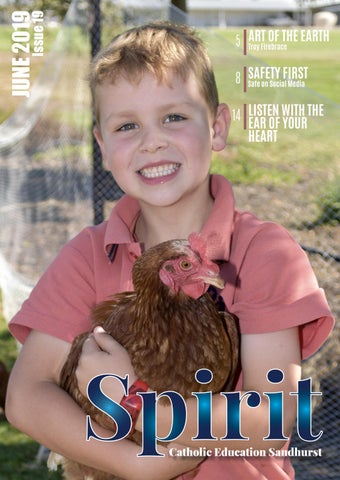
Issue 19
JUNE 2019
OF THE EARTH 5 ART Troy Firebrace FIRST 8 SAFETY Safe on Social Media 14 LISTEN WITH THE EAR OF YOUR HEART
Catholic Education Sandhurst
Editor Email Layout & Design Proof Reader Front Cover Photo Inside Cover Photo Inside Back Cover Photo Back Cover Photo
Jenni Kennedy jkennedy@ceosand.catholic.edu.au Catherine Barianos Mary Pianta Charlie - St Luke’s Primary Shepparton Sacred Heart Primary Corryong St Anne’s College Kialla Miley & Caitlin - St Francis’ Primary Nathalia
© Catholic Education Office Sandhurst 2019 Licenced under NEALS Printed by Espress Printers Epsom
Contents
4 5 8 10 12 14 16 18
From the Director
Mr Paul Desmond
Art of the earth Troy Firebrace
Safety first
Safe on Social Media
Around the Diocese Where everyone belongs
L’Arche celebrates 40 years in Australia
Listen with the ear of your heart Catholic Education Sandhurst 2019 theme
Parent leadership
in Catholic learning communities
The Catholic Education difference Matthew McDonald
3
Director’s Reflection “Darkness cannot drive out darkness; only light can do that. Hate cannot drive out hate; only love can do that.” Dr Martin Luther King Jr November 17, 1957
We would be less than human if we were not appalled by the tragedy that unfolded recently in Christchurch, New Zealand. A lone gunman, fuelled by racial hate and religious bigotry, exacted a toll that still defies belief. How could one man be so filled with a blind rage that fifty human beings lost their lives while at prayer? But, in the midst of the horror that confronted us all in the days following this terror attack, there were moments of human goodness which serve to remind us that evil will never be victorious. The gentle, stoic leadership of New Zealand’s Prime Minister, Jacinda Ardern, was and will be a significant factor in that nation’s healing. She has been a shining example of calm, tolerance and common sense as she won the admiration of people across the globe. One powerful moment arose almost imperceptibly as Prime Minister Ardern spoke at Cashmere High School where the community was grieving the loss of two of its members - Year 10 student, Sayyad Milne, and Year 12 student, Hamza Mustafa, both of whom were killed in the mosque attack. The Prime Minister reminded the students that it is natural to mourn; it is normal to feel betrayed and confused; it is OK to feel angry that their peaceful nation had been violated. But she also appealed to the students not to hate, not to harbour a desire for vengeance, not to allow intolerance and disrespect to become part of their being. She asked the students to watch out for one another; to uphold the rights of all citizens; to be people of love, not hate. In a question and answer session after her speech, one student asked, “Prime Minister, how are you feeling?” The beauty and sensitivity of the question almost caused the PM to falter, but she steeled herself and responded with honesty, “How am I? Thank you for asking. I’m very sad.” As the session came to a close and the students stood to applaud their nation’s leader, the Prime Minister signalled to the child to come forward. In a poignant moment, the 13-year-old hugged the Prime Minister and looked at her to assure her that her words of wisdom were not lost on the youthful audience.
“What wisdom can you find that is greater than kindness?” Jean Jacques Rousseau
Mr Paul Desmond
Director of Catholic Education Sandhurst
4
Art of the Earth
Troy Firebrace is making a name
for himself in the art world and people are starting to take notice. From largescale art pieces, to murals and street art, this is a young man on the rise. So much so, that the unassuming artist was invited to a civic reception at Government House last year to meet the Duke and Duchess of Sussex on their Australian tour. Quietly spoken but articulate, Troy has a message that stems from his culture, his connection to land and the love of his people. Troy Firebrace is a Yorta Yorta and Dja Dja Wurrung man from the Shepparton region and Catholic Schools in the Sandhurst Diocese are benefiting from Troy’s experience as he balances his role as an Aboriginal educational officer with life as a professional artist.
5
“My work is evolving through experimentation with new colour combinations, painting techniques and mediums. Inspiration comes from street art, the environment, experiences in life and my own culture. I hope to develop my art and take my Aboriginal art style to a completely new level. I believe an artist’s work is influenced by his or her own morals, beliefs and personality; that’s why every artwork is so unique. Of course my culture is strongly a part of me and my work, but I feel it’s just as important to discover who I am entirely, reflecting my true self on a canvas,” he said.
If the name Firebrace sounds familiar then it is because talent runs in the family. Cousin Isaiah became a household name after he was crowned winner of ‘X Factor’ in 2015 and represented Australia in Eurovision in 2017. Troy is also no stranger to awards and accolades, being short-listed for the Victorian Indigenous Art Awards in 2015 and winning the prestigious Federation University Acquisitive Award for Work by a Victorian Regional Artist at the 10th Victorian Indigenous Art Awards. Born in Shepparton in 1992, Troy started drawing from an early age. However, it was not until he was in Year 11 that he started to experiment with painting, quickly finding out that paint wasn’t as easily controlled as pencils. Encouraged by a Year 12 art teacher to persevere, he decided to combine art wth his other passion, skating, by painting Aboriginal designs on skateboards for his Year 12 final piece. Troy soon started to use paint as his preferred medium, after discovering the feeling of freedom with his brush stroikes once he got used to the brush. Troy completed Year 12 at Shepparton Secondary College in 2010 and later studied Creative Arts at La Trobe University Bendigo, where he further explored the Arts through his Aboriginal identity. At the same time, Troy completed a Diploma of Sport and Recreation, opening a doorway for him to study a Bachelor of Creative Arts, majoring in Fine Arts. He is currently studying a Master of Teaching. “Over the three years my work developed with my studies; exploring different artists and styles, art mediums like clay and wood, eventually finding my own style, concepts and motivation. During all this I started to really expose my artwork to the public through exhibitions held at galleries such as Kaiela Arts Shepparton, Melbourne Museum and Dudley House in Bendigo. Eventually my art started to gain attention and I was soon being commissioned by clients to develop artworks for them, doing artist talks and classes at Primary and Secondary schools, TAFE and Universities,” said Troy. Troy’s artwork largely contains a narrative, or at least hints at a meaning he would like to convey to people. Influenced by the imagery of his Aboriginal cultural background, he works at bringing together references of landscape, environmental processes and concerns, looking at the way in which humans relate to the natural world. Troy seeks to find and demonstrate a connection between humanity and the environment, exploring the idea of harmonious co-existence.
6
Today, Troy divides his time between life as a professional artist and a career as an Aboriginal educator who provides and develops Aboriginal-based learning and lessons for all ages. He regularly talks to parents, teachers and students about the importance of building culturally safe schools that have a strong understanding of what it means to provide a knowledgeable and respectful school environment. “Aboriginal art and culture were very hazy during my time at school and I want to rectify that, not just so non-Indigenous kids can grow up respecting and understanding the importance of Aboriginal culture, but also, so Aboriginal kids can feel validated in wider society. Teaching them about what they can and cannot do and how to respect their own boundaries is very important. I believe it’s about respect for yourself and others and is an integral part in honouring your ancestors,” said Troy. “I’ve worked all over Victoria in many Primary and Secondary schools, as well as TAFEs and Universities. I also have developed a strong network of clients, professional arts organisations, galleries and government organisations. The work I have been doing has been recognised and congratulated by the Royal Family and the Victorian Governor, but the biggest achievement I have made in my career is the work that I’ve been doing with the students and youth of Victoria. The knowledge they have gained, the work they have produced, and the inspiration to achieve their own dreams and passions is a true reward.”
“
Aboriginal art and culture was very hazy during my time at school and I want to rectify that, not just so non-Indigenous kids can grow up respecting and understanding the importance of Aboriginal culture, but also, so Aboriginal kids can feel validated in wider society.
�
7
SAFETY FIRST Safe on Social Media Kirra Pendergast Director, Safe on Social Media Pty Ltd
Parental controls in iOS 12 If your child has an iPhone and you haven’t upgraded your child’s iPhone to iOS 12, here is the reason to do it now. Apple has created a new set of parental control functions, known as “Screen Time”. Screen Time works via Family Sharing so, as long as your children are part of your “Family” in the Family Sharing settings of your Apple device, you will be able to view and control their Screen Time options from your phone. If the child has an iPhone, but the parent has an Android phone, Screen Time settings can be set on the child’s device. Unfortunately, the parent will have to access the child’s phone to see Screen Time information or make changes to the settings. The best situation is for the parent and child to both have iPhones and be connected with Family Sharing.
You will need to turn on and set up Screen Time on all the devices owned and used by your children. This is done in the Screen Time section of the Settings app. Open up the Settings. - Navigate to the “Screen Time section.” Choose “Turn on Screen Time.” Choose “Continue”. When you see the introductory screen asking whether this is your iPhone or your child’s iPhone, select “This is My Child’s iPhone.” After you have turned Screen Time on, you can set Downtime, which is a set period of time in which your child will be blocked from using the iPhone, or App Limits, which will restrict certain app categories. You can also choose Content and Privacy settings, which are explained further, below. When your child’s device is on your Family Share iCloud account, you can make changes remotely from your (the parent’s) device, by tapping on a child’s name in the Screen Time section of the Settings app, listed under the parent’s own Screen Time usage.
8
Alternatively, Downtime and App Limits selections for your child can be adjusted directly on their device by going to the Settings app and selecting Screen Time on their device. Parental controls only work if they are not altered by the child they are protecting. All of the App Limits, Downtime, and Content Restrictions are protected via a passcode. The passcode restricts changes to the Screen Time settings and must be entered to allow more usage time to children when limits have been reached.
“
“
1
Turn on Screen Time
Downtime sets a schedule that allows you to choose when your child cannot use certain apps on their iPhone or iPad.
2
Downtime Downtime sets a schedule that allows you to choose when your child cannot use certain apps on their iPhone or iPad. During Downtime, only apps that the parent designates in “Always Allowed” and phone calls will be available. We recommend Snapchat or Instagram be restricted during school hours. You turn on blocking for Downtime to prevent apps from being used entirely, but Apple gives you a non-blocking option when you want your child reminded that apps shouldn’t be used at certain times.
3
App Limits App Limits allows you to finely control how much time your children spend on certain categories of apps. With App Limits, you can set restrictions on either All Apps or by Categories, such as Social Networking, Games, Entertainment, Creativity, Productivity, Education, Reading & Reference, Health & Fitness, and Other. After the App Limit has been reached, apps will be locked with an hourglass symbol and a passcode will be required to enable more time. Children can ask for more time through the app. The parent can remotely approve or deny their child’s request for more time directly from their device. You can also set less restrictive rules that serve as more of a reminder, by turning off blocking with App Limits.
4
Always Allowed With Downtime and App Limits, the parent can designate certain apps to be “Always Allowed.” These apps will be accessible at all times, even when Downtime and App Limits are enabled. Apple makes Phone, Messages, FaceTime, and Maps as always available apps, but you can select any apps that you want through the Always Allowed app interface, accessible under “Always Allowed” in the Screen Time section of Settings on a child’s device. You can remove access to all apps, including Messages, with the exception of the phone, which remains available to children in case of emergencies
5
Content Restrictions Content Restrictions have expanded to include preventing a child from changing the passcode on their device, restricting account changes, limiting volume, and automatically turning on Do Not Disturb While Driving. A parent can also set privacy settings for everything from location services (GPS) to advertising preferences. For example, if a parent wanted to make sure they could always access their child’s location, they can turn on Location Services and select Share My Location, and also limit GPS use on other apps. Accessing Content & Privacy restrictions requires an adult to input a Content & Privacy passcode, which prevents children from changing these settings.
For more information: www.safeonsocial.com
9
Catherine McAuley College Bendigo
Catholic College Wodonga
Marian College
St Augustine’s College Kyabram
St Michael’s Primary Tallangatta
St Francis’ Pr
St Luke’s Primary Shepparton
St Mary’s Prim St Mary’s Primary Cohuna
St Patrick’s Primary Tongala
St Peter’s Primary North Bendigo
10
St Brendan’s Primary Shepparton
St Anne’s C
Notre Dame College Shepparton
Marist College Bendigo
e Myrtleford
St Mary of the Angels College Nathalia
St Joseph’s Primary Cobram
rimary Nathalia
St Joseph’s College Echuca
mary Rushworth
College Kialla
St Mary’s Primary Rutherglen
St Liborius’ Primary Eaglehawk
St Monica’s Primary Wodonga
St Patrick’s Primary Pyramid Hill
11
There is an international organisation that has been operating in Australia for the past four decades, providing space for people with and without intellectual disability to spend time together in order to recognise the unique gifts of all.
Where
EVERYONE belongs L’Arche celebrates 40 years in Australia Daniel Giles OAM Clerical Support Officer Catholic Education Sandhurst
L’Arche is an international federation of faith communities where people with and without an intellectual disability share life together. Traditionally, this has been manifested by people with intellectual disability living in a communal household with assistants that are part of the household, a different scenario from many group homes for people with disability, where staff come and go, and are considered separate from the household. L’Arche also provides funded support for people with intellectual disability and creates opportunities for interaction with the wider community, especially through gatherings where people with intellectual disability and others, including the parish community, come together. To celebrate the 40-year milestone, L’Arche Australia held an anniversary conference in Sydney this year. Catholic Education Sandhurst’s Daniel Giles OAM was a presenter at the conference. Daniel is a Clerical Support Officer at Catholic Education Sandhurst and a young man living on the autism spectrum. Daniel shares his experience of attending and presenting at the L’Arche 40th Anniversary Conference. The L’Arche Conference explored the theme ‘Inclusion: Creating Spaces of Belonging into the Future’. It explored how L’Arche has
12
evolved since its establishment in Australia over forty years ago, prior to any systemic deinstitutionalisation program. A L’Arche community is relevant in the current context of ‘individuality’, especially through individual funding packages such as the National Disability Insurance Scheme. A big emphasis was on the idea of our need for community. I presented a talk titled Nourishing the Spiritual Needs of People with Disability, highlighting the L’Arche experience of someone who has a lived experience of disability, but not necessarily an intellectual disability. I presented on a number of themes, such as my life journey (especially my faith journey) and how L’Arche has helped me with my understanding of Jesus, by experiencing the Gospel being lived out among fellow people with disability. I talked about the idea that people with disability are called to be ministers of the Gospel, based both on my own experience of ministering and the experience of the L’Arche members ministering to me. I shared also about how the L’Arche philosophy of people with and without disability sharing life together can be lived out in the mainstream community, including within the context of Stronger Youth, where people with disability are seamlessly included. Although I only attended one day of the conference, I immensely
Resources: L’Arche Australia website: www.larche.org.au L’Arche conference brochure: https://www.larche.org.au/wp-content/uploads/2012/10/LArche-conf-brochure-18-v5-LR.pdf Shane Clifton, theologian: www.shaneclifton.com
enjoyed it. I enjoyed interacting with people with intellectual disability, some of whom prayed in a simple but profound way. Some of the highlights were: • Shane Clifton, a theologian who lives with quadriplegia, sharing about the idea of co-dependent independence; about how we all need support to be able to live independently. • A panel session about the L’Arche Listening and Speaking Group, representative of all L’Arche communities in Australia. A representative from each group advocates for their communities at a national level and it also offers them the opportunity not to just think about themselves but consider how decisions impact upon an entire community.
• A presentation on how a person with intellectual disability was enabled to participate in a higher education program in a Christian theological college. • David Treanor, leader of L’Arche for the Oceania region talking about L’Arche’s relevance in our current age, the gift L’Arche can continue to offer the world today and how to maintain fidelity to L’Arche’s identity and mission. I will conclude by saying how thankful I was to have been part of this conference, having the opportunity to reflect on my experience of L’Arche and hearing other people’s perspectives on disability inclusion.
Daniel Giles OAM Daniel is a young man living on the autism spectrum who works tirelessly as an advocate, not only for people on the autism spectrum, but for all people with disability, as well as those experiencing other disadvantages. He was diagnosed with autism at the age of two-anda-half years. As a child, he experienced delays in verbal communication and social interactions, attending a special school. With the support of his family and so many others, he was able to transition his education to mainstream schooling. He then went on to achieve a Bachelor of Graphic Design (with Honours) at University. As an adult, he lives independently, works part-time as a Clerical Support Officer for Catholic Education Sandhurst and does a range of volunteer work. He is also passionate about educating the community about living with autism and mentoring others who live on the spectrum.
Photograph courtesy of Bendigo Advertiser - June 12, 2017
He was honoured to receive the Order of Australia medal in 2017 for his ‘Service to disability and the community’. Daniel has his own public speaking company called Speaking Insights where he travels throughout Australia and beyond, sharing his personal autism journey ‘From Diagnosis to OAM’. Speaking Insights presentations are designed to give hope and provide strategies to families living with autism and to better inform those working with people on the Autism Spectrum. All presentations are based on lived experience, both from Daniel’s perspective as a person living with Autism and from Daniel’s father Daryl’s as a parent who wants the best outcomes for his child. You can find out more about Speaking Insights at - www.speakinginsights. com.au or you can find “Speaking Insights” on Facebook and Instagram.
13
Maria Weatherill Consultant: Catholic Identity Catholic Education Sandhurst Each year Catholic Education Sandhurst selects a theme, which carries throughout the year. The theme for 2019, “Listen with the ear of your heart’ invites our school communities to listen deeply, the kind of listening needed to hear what God is asking of us. The theme provides a focal point for celebrations, Masses and activities across the diocese. Catholic Education Sandhurst Consultant: Catholic Identity, Maria Weatherill explains the origins of the 2019 theme and how deep listening provides an opportunity to enhance our relationship with God and with each other. When Saint Benedict of Nursia founded the order of monks we know as the Benedictines, he wrote the Rule of St Benedict in 516. The book is a set of actions and moral direction for monks living communally under the authority of an abbot. The first rule is ‘Listen carefully ... and incline the ear of your heart.’ St Benedict, in his Rule, expected his fellow monks to be constantly listening. They should be listening to one
“
St Benedict’s beautifully poetic language also asks us to listen, not just with our ears, but with our hearts to all that comes our way. Whilst we hear the words spoken to us with our ears, in listening with our hearts, we can more deeply reflect and discern what we hear. It is about deep listening. English writer and poet, G.K. Chesterton, wrote that, “There’s a lot of difference between listening and hearing.” Hearing is simply the act of perceiving sound by
In our modern noisy world the challenge to listen is harder but more important.” Sr Geraldine Larkins - Deputy Director: Catholic Mission & Identity
another in the community, to their community leader, to the guests who came to the abbey, to the sick and those in need. And, they should be listening most of all, to God in the Scriptures at communal prayer and in personal prayer.
14
the ear. Listening, however, is something you consciously choose to do and requires concentration. Real listening is mindful and involves listening from a deep, receptive, and caring place in oneself. Dr Tom Neal, Professor of
“
A listening person is ever-ready to read
the signs of the times, is open to the myriad possibilities of our age and will reflect prayerfully, sensitively to what God is calling us to do.” Paul Desmond - Director of Catholic Education Sandhurst
Spiritual Theology at Notre Dame Seminary in New Orleans, suggests that the art of listening is really the art of love. “In a real way, listening to others can be far more powerful as a transforming agent than speaking.” But how can we listen deeply when we live in a world of constant noise and distraction? Our lives are busy, often chaotic and loud. It is much easier to switch off and dismiss what we hear. We now have terms like ‘noise pollution’ in our vocabulary to describe the bombardment of our senses by environmental noises. Noise pollution has adverse effects on our health and overall wellbeing. The one noise we do need to listen to is silence! We all need to spend time in total and uninterrupted silence. When we are able to sit in undistracted silence, we can truly practice inner reflection which enables us to more effectively listen to others. Hence the choice of Listen with the Ear of Your Heart, as the 2019 theme for Catholic Education Sandhurst. This simple rule from St Benedict is so rich in its meaning and opens numerous opportunities for the staff and students in our schools to reflect on faith, personal spirituality and life. St Ignatius of Loyola wrote about getting our hearts in
the right place. When we listen with the ear of the heart, we are more tuned in to the world within ourselves. Many Sandhurst schools have embedded Christian Meditation into the prayer life of the school community. This ancient form of meditation allows for silence and contemplation. For their personal wellbeing now and as adults, our children need to be able to practice silence. It is often in the silence that we hear God. The practice of engaging in the Daily Examen, which is part of Ignatian Spirituality, also encourages students to become aware of God’s presence in their lives and to review their day with gratitude. They listen with ear of their heart to a moment of the day that has enriched them in some way and pray from it. Another experience that allows students to reflect and listen is to journal. Journaling gives them the freedom to express their innermost thoughts and process important insights, emotions, feelings and memories. The theme also leads students into opening up Scripture in a deep way to listen to the message within the text. In the Book of Proverbs advises us to accept God’s words by “making your ear attentive to wisdom and inclining your heart to understanding...” (Proverbs 2:2)
15
PARENT LEADERSHIP
in Catholic Learning Com When we think of parent leadership in Catholic education, we may immediately think of the Chairperson or members of the School or Parish Education Board, the President and members of the Parents and Friends, or Parent Council. Whilst the parents or carers who hold these volunteer positions are highly valued leaders, there are many opportunities for all parents to demonstrate and be engaged in leadership, inside and outside of Catholic learning communities.
Rachel Saliba Executive Officer Catholic School Parents Victoria
As soon as you set foot on school property you are being observed by the very people who are at the centre of learning in our schools, the students. Leadership is demonstrated through actions and how you contribute to the development of a welcoming and positive learning culture and environment for children. When we think of leadership, we sometimes put our leaders on a pedestal or view them through a lens of being a ‘hero’. “For too long, too many of us have been entranced by heroes. Perhaps it’s our desire to be saved, to not have to do the hard work, to rely on someone else to figure things out.”1 We may think that leaders have all the answers and that they will solve all problems. Instead, if we think of leaders rather as ‘hosts’, it can alter the whole culture and perception of leadership in education and, more specifically, our role as parent leaders. As host leaders and volunteers in our communities, we are demonstrating by example and showing the way for others, much like Jesus taught us including, what our children are learning in our Catholic schools. Following in the footsteps of Jesus means that we are the guides, not the superheroes who have all the answers or who seek gratification. Leaders as hosts take on a different role in that they collaborate and share ideas, then solve challenges together. This is what is considered a genuine partnership approach, where each member of a learning community is a valued leader, capable of positive contribution to community, included in decision making and the development of whole school community culture. Leaders as hosts demonstrate selflessness and in the words of Mary MacKillop, “see a need and do something about it.” These leaders don’t wait to be asked to take action. In taking action they are not trying to be heroes, they are showing genuine leadership in doing the right thing and make a difference for others. As parents of children in Catholic schools, we are very capable of leading positive change in the Church and in our communities but, most of all within our families. Parents are the first leaders in the education of their children. Pope Francis continues to emphasise the importance of families in setting an example. He states, “Truly Christian families are known by their fidelity, their patience, their openness to life, and their respect for the elderly … the secret to this is the presence of Jesus in the family.”
16
1
The Berkhana Institute: Whatever the problem, community is the answer. Leadership in the Age of Complexity: From Hero to Host - Margaret Wheatley and Deborah Frieze 2010
mmunities We are all leaders, learning from and with each other in our learning communities.
• developing an Australia-wide Parent Engagement Toolkit;
Everyone has a role to play in a Catholic learning community. Each experience we have, as our children take their journey through school, is a learning opportunity and a chance to show leadership. It is a shared responsibility and one that extends beyond the school gate. In your local community and in your home, you are always demonstrating leadership and guidance with your children.
• working alongside each diocese to improve and promote Catholic education.
• collaborating and supporting the work several governing bodies; and
Catholic School Parents Victoria is currently seeking a parent or carer to become a member of the council from the Diocese of Sandhurst. All enquiries for volunteer council membership can be forwarded to Mrs Rachel Saliba via email at secretary@cspv.catholic.edu.au.
Catholic School Parents Victoria recently developed a five-year strategic plan that provides opportunities for parent leadership in Catholic education at a system, state or national level. The parents who sit on the council are current Catholic school parent volunteers who are passionate about making a difference in education and contributing parent perspective as partners in key decision making in education.
Please visit the CSPV website at www.cspv.catholic.edu.au to download our prospectus and learn more about CSPV and resources available.
Ar Ca e you pa thol a a d rent ic sch Some exciting projects we are currently or have iff or c oo Ca recently been involved in include: t in p holic er are l pa rima Scho en • a review of Naplan; ren ry c ol e in r wi a pill t ars pers nd se Pare n pe • parent engagement workshops for preof c t ed th a Par ctiv ond s Vi a c e en uc service teachers; pa t E in e ry Ca toria ng ssi ag duca tholic are a ati em tio • development of a ‘Parents As on en n at scho team on ta ? of a s ols. n to d p Partners’ Policy for Catholic Par ystem As v ass CS olu ion ma en , P s t Le ta at n Education Melbourne; to V ar ke ad te a teer m e pa joi e ers nd n o see As em rents hi n k • assisting in the organisation of u a CH SA ILD FE TY
WE
LLB
EIN
G
a pi C op CSP r te ing n: tiona bers of ch CO ATHO p a c il l le we MM LIC ed ortu V vo m in urre forums with guest speakers vel con dren UN l u n ITY trib Sta catio ity to untee 201 nt Ca un de 9 CU te n and the National Catholic RR r th ute and issu cont r cou -202 tholic To ICU nci es rib e 1. a s LU C p c l a u Education Commission a exp ply M ho me te tho nd o a as m eri p l l n i c e olic pa d p be en Ple EN PAR Conference due to take ry d ren y c a vo r a GA EN ts GE T ho se v e on lunte ucatio in Vic ovide ou w ME o w i a t sit i e n r p l o place in September l s r NT t a r c c h aut at oj i c t r a a h a e h o r o v eC ww oin ers ho thro nt p e t ol b unc r h w.c i and SPV i u e 2020; l t e o gh ies r me ar spv eng spect .ca to do webs d or p mbe . ag ive tho ite wn are r yo em o lic. l f ent n ed oad or fu nt gr u will w ou the u.a rth h ith p a ave u/j t oin CSPV er inf h orm your ad -us p ros . s pe ation choo ctu 228 l. on s EA VIC S T Ph T ME ORIA ww retar one 0 LBOU PAR w.c y@c 3 92 RNE ADE sp spv. 67 300 v.c cat 04 ath hol 5 8 1 oli ic.ed c.e u. du au sec
.au
17
The Catholic Education
Difference A student’s perspective
Excerpt from a speech by Matthew McDonald Dux of Catherine McAuley College (CMC) 2018
At the beginning of this year, former student and 2018 Dux of Catherine McAuley College (CMC), Matthew McDonald spoke to staff from Catholic Education Sandhurst about his experience at a Catholic School. Over his educational journey, Matthew attended four different schools, including public, private and Catholic schools prior to commencing Year 8 at Catherine McAuley College, formerly Catholic College Bendigo, in 2014. Matthew shared his perspective of someone who has experienced education in different settings, outlining his spiritual and academic growth during his five years at CMC in Bendigo. When arriving at CMC I immediately noticed that there was an impassioned commitment to serving social justice. Striking to me was the inclusion of Faith Leaders, the existence of a Faith and Justice team, Caritas carnivals, Mercy Day and like events. All these elements of the college environment were peculiar to me, yet I quickly realised that this was what made a Catholic school so unique and inviting. I am a baptised Catholic yet, up until arriving at CMC, I hadn’t had the opportunity to see the expression of faith in action. Consider thirteen-year-old me, walking in Caritas Ks for the first time in Year 8; you can understand my awe. Never had I experienced students coming together to show solidarity to this degree. Never had I seen the Catholic Social Teachings as active as I had that day. Through interaction with these teachings, students can explore their faith. This is the significance of Catholic education. Without active participation and interaction with our beliefs, our religious identity becomes no more than adherence. Faith is something much more meaningful than reciting a prayer and attending Mass; it is letting mercy flow through your every action. Events like a whole college Opening Mass, unite students under a common faith and foster spiritual and compassionate growth. I
18
would safely assume that those in the Catholic education system better understand the significance of charity and altruism, purely because of their constant threads through everything we do at school. However, at the same time, Catholic schools do not push students to adhere to Catholicism. The beauty of the system is that it allows kids to become in tune with their faith in their own time and to their own degree. This is done particularly well through the opportunities to involve oneself in faith-based leadership and events. Going to a Catholic school meant that I was able to study Religion and Society for my VCE. This was definitely the most challenging but fascinating subject I have ever done, the class taught me to think critically and question the way the public influences the Church and vice versa. In researching institutional abuse cases and the response of the Church today, I was able to garner a more balanced view of the situation, alternative to the negative picture painted by the media. I learnt of the amazing work of the Truth Justice and Healing Council to ensure the protection and safety of children. I also know a lot more than I once did about the Church during the 4th Century with the Roman Empire and Emperor Constantine. Religion and Society allowed me to realise just how large the social structure of this Church is – I think it is truly incredible to be a part of this two thousand-yearold tradition. All this knowledge has helped me to better understand the Church’s mission and charity. Regardless of the strength of one’s faith, Catholic schools provide a warm, hospitable environment where everyone can flourish. My experience has been so positive and I am grateful for everything I was able to participate in and learn. In fact, I would say that the exposure to faith and spirituality, even for someone non-religious, has great benefits for personal development and acceptance.
19