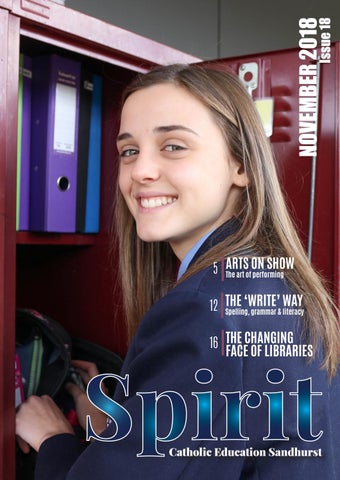
Issue 18
NOVEMBER 2018 ON SHOW 5 ARTS The art of performing ‘WRITE’ WAY 12 THE Spelling, grammar & literacy 16 THE CHANGING FACE OF LIBRARIES
Catholic Education Sandhurst
Editor Email Layout & Design Proof Reader Front Cover Photo Inside Cover Photo Inside Back Cover Photo Back Cover Photo
Jenni Kennedy jkennedy@ceosand.catholic.edu.au Catherine Barianos Linda Power Alesha Smith – Year 10 Marian College Myrtleford (David Williams) St Joseph’s Primary School Numurkah (Daniel Giles) St Liborius’ Primary School & Church (Jenni Kennedy) Students from St Bernard’s Primary School Wangaratta
© Catholic Education Office Sandhurst 2018 Licenced under NEALS Printed by Espress Printers Epsom
Contents
4 5 8 10 12 14 16 18
From the Director
Mr Paul Desmond
Arts on Show
The art of performing
Speaking Your Language Languages in our schools
Around the Diocese The ‘Write’ Way
Spelling, grammar and literacy
ABLAZE
Year of Youth
Changing Face of Libraries Past, Present & Future Alumni in our schools
3
Director’s Reflection The identity of any organisation is defined by the culture, the values, and the beliefs that set it apart. However, each organisation has a logo or image that is recognisable as the identity of the organisation and Catholic Education Sandhurst is no exception. At the commencement of Term 4, Catholic Education Sandhurst launched a brand new logo which we believe represents the beliefs of Catholic Education in the Sandhurst Diocese. Developed over the past 12 months, the new logo features a fresh, contemporary design that will take Catholic Education Sandhurst well into the future. The Cross is central to the design; surrounding the Cross are three circular bands, representing the three deaneries and the three major rivers of the Diocese of Sandhurst. The blue band and writing also serve as a connection to the previous logo, representing the ‘Sandhurst blue!’ Our motto, ‘Believe!, Imagine!, Serve!’ is an important part of our identity and features proudly in Catholic Education Sandhurst material. Developed a decade ago, these words challenge us to provide the best service to our schools, to our families and to our God.
Believe!
Our belief that the values of the Gospel are central to who we are, what we do, and how we act.
Imagine!
We are called to imagine the possible and to seek new horizons while respecting our Traditions.
Serve!
To live out our beliefs and imaginings with action and purpose.
As we move forward with a new design identity, we remember the Staff (Religious and lay) who have gifted Catholic Education Sandhurst with their talents, dedication and passion for education over the decades. While a logo represents the visual identity of an organisation, it is the people who are the heartbeat and ultimately, who make the difference.
Mr Paul Desmond
Director of Catholic Education Sandhurst
4
The aRT of performing
Have you ever been to a live performance on Broadway or London’s West End, or sat in a darkened theatre in a major city, regional centre or country hall? The first two iconic performance spaces are on most people’s bucket list but regardless of where you watch a live performance, the way it makes you feel is universal.
program. Each year a major music festival takes place, involving thousands of students who take part in dance, drama and choral workshops.
A live performance provides a personal experience for both the performer and the audience, no matter how polished the performance is, no matter how often the play is rehearsed, the reaction from the audience and the energy of the performers makes each performance unique.
This year Sandhurst Arts on Show took place in Shepparton, a three-day program featuring specialized workshops run by highly skilled tutors from the Australian School of performing Arts, each one an expert in a particular Arts discipline. Highenergy dance workshops featured two young dancers who are currently performing in the Australian season of ‘School of Rock’. These industry professionals share their skills as well as an insight into this highly competitive, but rewarding industry.
The Arts holds an important place in the education of children throughout the world; it feeds their creativity, imagination and promotes confident children. Every child can experience success with The Arts, even if they have physical, emotional or learning challenges. Dance, music and drama helps children develop emotionally and socially as well as expanding their language and vocabulary.
The program is rigorous and at times challenging, but the ASPA team know how to make it fun and the students respond accordingly. It seems an impossible task to provide a program that engages all students, no matter their skill level or the level of interest, however the ASPA team take it all in their stride and even at the end of the day, when energy is low, students are still giving everything they have to each performance.
Ten years ago, Catholic Education Sandhurst established a partnership with the Australian School of Performing Arts (ASPA) to ensure all Sandhurst students had access to a quality Arts
The Performing Arts equip students with an array of life skills. Dancing, singing and acting helps students develop emotionally, socially and physically!
5
Dance
Singing
The Australian School of Performing Arts (ASPA) singing progra inclusive and fun. The program works with any sized group, fr an entire school, preparing students for a performance outco acquisition.
Vocal techniques are taught to ensure that students get th performance, including the benefits of good posture, cor exercises. Students learn how to enunciate their words a blending of sound. Students are also instructed on h learning how to listen, provide constructive performa conductor’s lead.
Students are encouraged to audition for solo roles a leading performance role as well as experiencin with solo roles share the spotlight with a stude the first time on performance day; this encour
Singing improves self-esteem, helps children enjoyment and engagement in class. Singin improve your physical, emotional, and soc
Dance is more than just moving to music or a series of choreographed dance steps. It is a way of moving that uses the body as an instrument of expression and communication. Through dance, students learn teamwork, focus, discipline and improvisation skills. Dance is a wonderful activity for children of all ages; it takes their natural desire to move and express themselves and structures it into a conscious performance. Throughout history dance has been used as a means of cultural expression; it is one of our oldest forms of storytelling and communication. Dance plays an important role in history and traditions throughout the ages. Dance involves an extensive range of motion, coordination, strength, and endurance, and is an excellent form of exercise promoting good physical health. Dance encourages children to foster a positive relationship with exercise and improves aerobic fitness. The Australian School of Performing Arts (ASPA) provides a dynamic dance program that encourages all students to get active and have fun as they develop coordination, confidence and fitness in a safe and inclusive learning environment. Students find the workshops equally engaging regardless of dance experience. Dance is one of the most enjoyable ways to express yourself and is an activity that all for students can participate in, enhancing their concentration, balance and coordination.
6
g
Drama
ams are high energy, rom one class or choir to ome and focusing on skill
he most out of their rrect breathing and warm up s in a unified way to produce how to be a good audience, ance feedback and how to follow a
s giving them the opportunity to take ng an audition process. Often students ent from another school who they meet for rages social interaction and cooperation.
n to be more focused, and increases ng brings joy to many people and can also cial health! From drama games to public speaking, to coaching and directing a school’s latest production, The Australian School of Performing Arts education program helps students develop important life skills that are transferable to all other disciplines. Drama programs are designed to build confidence, creativity, self-awareness and problem solving skills and to foster new friendships. Elements of a drama program may include warm ups and team building exercises, improvisation and storytelling, public speaking, script writing and more. There are many benefits for children who study drama, including enhanced teamwork skills as well as learning to think creatively. Enhanced performance skills are achieved through role-play and improvisation; developing these skills helps improve a student’s self-esteem and problem solving skills. Developing skills in drama, theatre and the performing arts benefits young people throughout their life. Drama improves a student’s communication skills, vocal projection, articulation and expression!
7
Speaking your language Learning a second language ‘makes us smarter’ reported the New York Times in March 2012. It improves our ability to problem solve and enhances the performance of our brains as we are challenged to recognise, negotiate meaning and communicate in different language systems.
Dolly Gerges Education Officer: Languages
*Why Bilinguals Are Smarter https://www.nytimes.com/2012/03/18/opinion/sunday/the-benefits-of-bilingualism.html
Parents and educators in Australia are particularly focused on the contribution of learning a second language to a student’s cognitive abilities and literacy in their first language. It has been established that students who study a second language tend to score better on standardised tests than their monolingual peers, particularly in the categories of Maths, Reading, and Vocabulary. Results from Camberwell Primary School in Melbourne, which offers a partial bilingual program in French, show that their students perform higher than their peers in similar schools, particularly in the areas of literacy and numeracy.
hola
halo
Why Content and Language Integrated Learning (CLIL)? Content and Language Integrated Learning is an approach or method which integrates the teaching of content from the curriculum with the teaching of a non-native language. It is a pedagogical model for second language education, developed in Europe in the mid-1990s. The approach is based on the success of the Canadian immersion model that began in the mid-1960s, in which mainstream curriculum content, for example Maths or Art, is taught through the medium of the students’ second language. Personally, I have had the advantage of experiencing firsthand the benefits of being taught in CLIL and bilingual programs in Lebanon, where I grow up. In comparison to Australia, the flexibility of a CLIL program fits in well to the Australian education context. • Learning is improved through increased motivation and the study of natural language seen in context. • Accelerates language learning. • Language learning is authentic. • Nurtures a feel good (fun!) and can do attitude. • Higher order thinking. • Language acquisition rather than enforced learning. • Enhances student’s ‘output’. The language of communication is more than a list of new words. • Enhances teacher team work and cooperation.
n
bonjour
The Speak Up Strategy 2017-2019, a diocesan program, is committed to the design of a CLIL professional learning program for implementation in the Sandhurst context. It is anticipated that in the longer term this approach will support schools with one methodology for quality provision of Languages delivery across Primary and Secondary school settings. In 2016, a 181 per cent increase in demand for bilingual skills across over 4 million job advertisements audited in Australia. Students studying a foreign language in Year 12 has decreased from 40 per cent in 1960 to around 10 per cent in 2016. Nearly all young Australians are likely to be working either in highly culturally diverse communities in Australia or in global teams with global clients and markets. It is recommended that Languages classes are delivered for a minimum of 150 minutes per week, spread as evenly as possible (Department of Education and Training, Victoria)
8
Almost three fifths of pupils in the EU learnt two or more foreign languages in upper secondary education in 2015. (Data extracted in 2017)
CLIL in Catholic Education Sandhurst In 2018 Sandhurst commissioned Dr Andrea Truckenbrodt to design and deliver the CLIL program for the Diocese. Twenty-four teachers from eleven primary and secondary schools participated and completed the CLIL program. The program focus is: • Build capacity in their understanding, knowledge and skill in delivery of Languages through content areas. • Design and deliver CLIL lessons. • Design a unit of work for implementation. • Develop a school based Implementation Plan for CLIL in preparation for 2019. Most of the schools in CLIL Cohort 1 have indicated that they will be implementing the CLIL Methodology in 2019. Catholic Education Sandhurst has extended the support to the schools in CLIL Cohort 1 by offering them Phase 2, which includes extended support with the design and implementation of the units of work in 2019. The CLIL program will be offered again in 2019 to Cohort 2 and will be delivered across seven days (inclusive of school visits), and includes webinars, professional reading, resources, one on one support and coaching.
o
namaste
ciao
ni hoa
konnichiwa Learning a second language enhances: • Multitasking • Literacy in the first language • Intercultural capabilities and understanding
dia dhuit
• Creativity • Self confidence • Communication skills • A sense of global citizenship and travelling • Employment prospects • Economic advantages
9
St Liborius’ Primary Eaglehawk
St Therese’s Primary Kennington
St Joseph’s Pri
St Joseph’s Primary Beechworth
St Peter’s Bendigo North
St Kilian’s Prim
Marian College Myrtleford
St Mary of the Angels College Nathalia
Notre Dame College Shepparton
St Francis of the Fields Primary Strathfieldsaye
10
St Patrick’s Prima
St Patrick’s Prim
imary Kerang
St Augustine’s College Kyabram
St Patrick’s Primary Wangaratta
mary Bendigo
St Joseph’s Primary Chiltern
St Bernard’s Primary Wangaratta
St Joseph’s Primary Quarry Hill
Holy Rosary Primary White Hills
Galen Catholic College Wangaratta
St Francis of Assisi Primary Wodonga
ary Pyramid Hill
mary Tongala
11
The
‘Write’
Way
spelling, grammar & literacy
Catherine Bonham Education Officer: Inquiry Mindset & Literacy
As Victorians enter into an election period education often becomes a hot topic. There will undoubtedly be the, “Let’s get back to basics” catch cry, and the, “Literacy and Numeracy standards are falling” headlines. In contrast to all this negative hype, Misty Adoniou, Associate Professor in Language, Literacy and TESL at the University of Canberra, advocates that schools in Victoria teach the basics well and Year 3 NAPLAN results demonstrate this. School communities then, should be focussed on developing complexity. In other words, as the demands of school increase, the basic and intermediate literacy skills of word solving and literal comprehension are no longer sufficient. Effective literacy learning must be occurring at all year levels from Kinder to Year 12. Why? Because students will encounter texts that become increasingly more complex as they progress throughout their school years.
12
From birth, as we read stories to our children we begin their literate journey. Each rich and engaging text provides new experiences and opportunities to learn, practise and expand children’s language. Each adventure fires their imagination, and each situation characters in books find themselves in encourages meaningful understanding of the world. This immersion in quality literature becomes the foundation for success at school and in life. As educators, parents and then teachers, one of the greatest contributions we can give our children is the chance to be exposed to a wide range of literature - for the pure pleasure and enjoyment stories bring in the short term and, in the longer term, in order for them to develop into good writers. For, it transpires, that children can only write as well as they have read or been read to. Reading and writing are two sides of the one coin.
“English spelling is neither chaotic nor illogical. As a morphophonemic language, English is quite systematic and unendingly fascinating.” Misty Adoniou, 2013
One early characteristic of children’s writing is the retelling of an event or creation of a simple story where the writing often looks like “talk on paper”. These initial attempts to communicate through the written word are so treasured (who doesn’t have a mother’s or father’s day card or a “sorry” letter in a drawer?), are often amusing and form part of the memories that capture those beginning school years, but as children move beyond Year 2 or 3 more is required. There is more to good writing! Understanding the difference between talk and literate written language is key to achieving success as a writer. Great writing is about making effective language choices to craft your message and using your knowledge of language to manipulate it - to engage, entertain, inform or persuade the reader. Spelling and grammar are often the measures that writers and writing are judged by. Have you ever seen a sign or read an article only to notice an error and find it grating or irksome? Apparently you are not alone. Research tells us that spelling is a skill that can be learned and that writing provides the purpose for both correct spelling and grammar. Fundamental to spelling is the understanding that the English language has evolved over time. From its beginnings as a celtic language (of which only a few remnants remain today), it has evolved and borrowed and incorporated words from the Romans
(Latin), the Anglo-Saxons (German), the Normans (Old French), the Renaissance (Italian, French & Greek), until this day where we continue to add words to our language. This rich historical tapestry explains why English is not a phonetic language. It is morpho-phonemic language: our words are formed by both their meanings as well as their sounds. Therefore, the most effective spelling programmes will be designed by teachers, not solely based on phonics and onesize-fits-all spelling lists, but rather provide a varied repertoire of approaches drawing upon: • semantic knowledge (knowing what words mean) • phonological knowledge (including phonemic awareness), • orthographic knowledge (understanding what letter combinations are possible/plausible) • etymological knowledge (knowing where words come from) • morphological knowledge (knowing the meaningful parts of a word e.g. base words, prefixes & suffixes) and • visual knowledge (recognising the correct look of a word) (Adapted from Apel et al, 2004)
Catholic Education Sandhurst is deeply committed to providing the best evidence based education for students. In September over 100 leaders and teachers from primary and secondary schools in the Sandhurst Diocese attended a full day’s professional learning facilitated by Misty Adoniou. Attendees at the workshop were inspired by her knowledge, passion and expertise for motivating and supporting them to re-think and redesign how they teach writing, grammar and spelling.
Dr Misty Adoniou is an Associate Professor in Language, Literacy and TESL at the University of Canberra. She teaches undergraduate and post graduate teacher education courses in Language and Literacy and was the lead writer for the national English as an Additional Language Teachers Resource which accompanies the Australian Curriculum. Misty researches and writes in the fields of literacy, teacher professional knowledge and standards and works closely with schools and education systems leading professional learning in spelling, grammar and writing.
13
World Youth Day 2019 The 34th World Youth Day will be held next year in Panama. Young Catholics from across the globe will flock to Central America to celebrate their faith with the youth of the world. World Youth Day was founded by St John Paul II in 1984, and has since spanned generations of pilgrims drawing thousands or even millions of young people. WYD is a testimony of a living Church that is continually being renewed. Youth are the protagonists of this meeting of faith, hope and unity. The main goal of WYD is to let youth know about the message of Jesus Christ, in the context of a joyful meeting of the Pope, young people and leaders of the Church.
Official Prayer of the Year of Youth Come Holy Spirit of this Great Southland Inspire our entire faith community, as we prayerfully discern new horizons for spreading joy in the lives and communities of the People of God. Come Holy Spirit of Youth Fill the hearts of young people with the hope and love of Jesus Christ; enliven our community with the creativity, energy and joy of youth; guide us together, as we strive to offer God’s mercy to those who feel abandoned or outcast. Come Holy Spirit of Faith Empower our community to be courageous; unite your people as witnesses of love. Walk with us, as we blaze new trails of discipleship; accompanying young people as we renew the Church together. Come Holy Spirit of Vocation Stir within young people an awareness of God’s call; reveal to us the graces of young people; guide us all, in finding our place and raising our voices To build a civilisation of love. Amen
14
Burning Fiercely with the Love of God
Fr Rob Galea Fr Rob Galea is an ordained Catholic Priest and is currently serving in the Sandhurst Diocese, Victoria after moving to Australia from Malta, his home country. He is a singer and songwriter with an international fan base. Apart from a series of recordings and CD releases, Fr Rob has also written a number of songs for various campaigns and international conferences. In 2008, together with Bishop Joseph Grech, Father Rob co-founded the Stronger Youth Program – a series of youth retreats, rallies and small groups in the Diocese of Sandhurst. Father Rob Galea has a significant evangelistic and outreach ministry, speaking and singing at schools, conferences and churches around Australia and the world. He and his team minister to about 200,000 young people each year.
The young people of the Sandhurst Diocese took part in a youth festival this year to celebrate the Australian Bishops Year of Youth. Four concerts were held across the three locations of Shepparton, Bendigo and Albury, involving more than three and a half thousand senior students! The Ablaze Festival is a full-scale music event complete with professional musicians, stage lighting and a big band sound. The headliner was Sandhurst’s own ‘rock star’ priest, Father Rob Galea who was joined by other musicians throughout the day. As the first note rang out, the heavy beat and catchy tune had the year 9, 10 and 11 students from Catholic Secondary Colleges on their feet, using music as the universal language to communicate and connect with the Diocesan youth. Although music set the tone for the youth festival, it was only part of the agenda; there were guest speakers, all young and all with a story to tell, striking the perfect balance between the concert and the wider message of connecting young people with their faith. The Ablaze Youth Day was created in response to the Australian Catholic Bishop’s National Year of Youth. The Australian Bishops challenged dioceses throughout the country to seek ways to actively engage with the young people of our Church. “The Year of Youth invites the Church into dialogue about the importance and life-giving presence of young people in the Church and society. It calls for dialogue and active engagement focused on the reconnection and renewal of a new generation of young people in the life of the Church.” Australian Catholic Bishops Conference 2017. Forums like Ablaze and the Stronger Rallies, organised by the Diocese, give young people the opportunity to come together to celebrate their faith. This is an important opportunity for young adults, who are searching for a deeper connection to Church. Providing forums with music and scripture promotes an atmosphere where young people feel at ease to talk freely about their beliefs with their peers.
15
CHANGING FACE OF LIBRARIES Jenni Kennedy Communication Manager: Media & Public Relations
“Reading should not be presented to children as a chore, a duty. It should be offered as a gift.” Kate DiCamillo - American Author
16
Ever since I can remember, books have been an important part of my life. I love the way they feel, the weight of a good novel in my hands, or the colourful pages of a book filled with pictures of the world, taking me places I have never been. Libraries have always been a quiet place for me, where I can spend hours wandering between endless shelves of books, picking up and putting down books at will, searching for a favourite author or reading the latest magazines; but for many, libraries are an oldfashioned establishment that have no role in modern society. The reality, however, tells a different story where libraries are not only surviving, but are thriving, seemingly against the odds. If necessity is the mother of invention, then libraries have had to change to remain relevant in this technological era where people have information at their fingertips via smart phones and other digital devices. We live in an age where time is a precious commodity and convenience is key, therefore taking the time to peruse the bookshelves is for some, a luxury that time does not always permit. However, if you do find yourself with some time on your hands, then I assure you it is a delightful way to spend an hour or two! I remember taking my children to story time at the local library when they were small; it was a weekly outing looked forward to by us all. A story was brought to life by an animated reader sitting in the coveted ‘story teller’s’ chair, little eyes focused on the bright pages and little bodies creeping closer as the story was told. Sometimes an audio would accompany the story telling, delighting the children as a loud moo was heard or a puppet was used to help tell the tale; it was at these library visits that my children fell more in love with books. Modern libraries provide a whole range of services including book clubs, meeting rooms, community programs, access to computers and technology and much more. In short, libraries have become a community hub, responding to local needs, providing extended hours of opening and a diverse range of resources. Libraries provide a complete experience, catering for all. So if public and private libraries have evolved, what does the school library look like now? If every classroom has ipads, laptops and smart boards then why do students need a designated place to find information? In short, has the school library become redundant? Almost all schools have a library of some description, but they vary enormously in terms of size, staffing, facilities and resources. Some libraries are multipurpose areas, doubling as a classroom to accommodate students when enrolments expand at a greater rate than the facilities, or as a community-gathering place. Some school libraries have few shelves; instead, each classroom has a designated library area where books are rotated regularly. Other schools have traditional libraries where books are lined-up on shelves as far as the eye can see. These spaces hark back to the days that I remember, when libraries were hallowed spaces, with a librarian on staff and lots of hidden reading nooks. At the other end of the scale there are flagship library and IT hubs, with
a growing collection of print and ebooks, providing a range of services to students, including safer online experiences, group learning and other resources in print and digital forms as well as resources and curriculum support for teachers. From a parent’s point of view, school libraries are widely seen as a valuable resource, an investment in the learning potential of their child. A well-resourced school library can also provide schools with the competitive edge at enrolment time. Libraries also provide a sanctuary for many children, a quiet space to study or read, a rainy day destination, a place to play a board game or to spend a lunch break that looms heavily for some children. For students who struggle with the school day, the library is a wonderful place to gravitate at lunchtime, where they can engage in a range of activities or simply be alone. It is this ‘timeout’ for some students that enables them to cope with the entire school day. School libraries, like their public counterparts, have had to evolve by thinking outside the box. They have benefitted from trial and error and bold new ventures, out of the process they have emerged as hubs of information, embracing technology as a partner in learning rather than a threat to their existence. Many librarians believe that information technology has made the school library more relevant than ever, working hand in hand with traditional sources of information, giving students access to multiple resources in order to critically understand and explore information. The modern school library fosters student creativity, encouraging students to socialise and collaborate with each other, promoting problem solvers as well as independent learners. Possibly the biggest change in the school library is the noise factor; don’t get me wrong, libraries should still provide a quiet place to study, but it is no longer a place of complete quiet, and in my opinion this is a change for the better. Replacing the days of absolute silence is the healthy buzz of activity that comes from a range of services on offer. The Oxford dictionary defines a library as a building or room containing collections of books, periodicals, and sometimes films and recorded music for use or borrowing by the public or the members of an institution. This description alone shows how much libraries have evolved over the years. The first libraries date back to the 3rd Century BC, where the Ancient Library of Alexandria was one of the largest and most significant institutions of the ancient world, housing scrolls, gardens, meeting rooms and gathering spaces. At the heart of any library, public, private or educational is information and entertainment. Whether it is from books, audio files, digital technology or any of the many information sources, the premise is the same. The difference with the modern library is the diverse range of resources available, catering for every learning style, need or whim. Libraries offer a complete experience for patrons and it is for this reason that they are still very much relevant. The challenge for the future is to be in tune with community expectations and to respond bravely.
17
Past, Present & Future Alumni in our schools
Regardless of whether you are a primary or secondary setting, the value of establishing an alumni network is undeniable. An alumni group breathes life into a school, it preserves and celebrates the history and provides opportunities for individuals to reconnect or stay connected to a school that has been a large part of their life. Most people identify strongly with the school they attended in their youth, therefore, establishing an alumni scheme can help you tap into that goodwill. All schools stand to benefit from this largely underused, yet highly valuable resource. Social events, class reunions, anniversaries, mentoring and fund-raising are just some of the benefits of Alumni as well as building your school profile and expanding your audience. An Alumni Association is not just for Private Schools and Universities, all educational settings can benefit from establishing an alumni database. Reconnecting and engaging with your alumni community can allow your school to: • Build your profile – broadening the circle of people who know about your school and your achievements. • Build affinity – helping people to keep in touch and feel a sense of belonging to your community. • Raise money – tapping into a new source of potential donations and bequests. • Gain support – finding new volunteers, new people to provide in-kind support. • Broaden your contact base – not just with local people and businesses but with people now living and working outside the local community, who may be a good source of sponsorship, partnership, student mentoring, work experience opportunities and more. •
Increase your audience – providing a new ear for information about reunions, fetes, special events, etc.
• Provide a link back to your local community – this is particularly the case with rural and remote communities where youth often leave the community for further education or employment. You can help these people stay in touch and feel a part of your community.
18
Establishing an alumni community can be a significant undertaking, but the good news is that most of the hard work occurs at the start and the best place to start is locally! Utilise your current families to help in the search for former students, staff and supporters of your school and ask them to pass the information on to their family and friends. Placing an ad in your local paper will also help you reach out to your alumni audience and can point people to your website for more information. Many regional papers will support your school by running a story about your endeavours; this is a wonderful way to get exposure, and it is free! Remind your community about your campaign on everything you send out – in your weekly newsletter that goes home to parents, your annual report, in your regular newspaper columns, on your email signature, school letterhead and anywhere else you can think of! And don’t forget social media - check Facebook and LinkedIn groups, or search for a specific group on Google as some ‘pages’ may already exist that will kick start your data base. The important thing is to establish a strategy to make sure you are setting yourself up for success. Good luck getting started. For more information visit https://www.fundingcentre.com.au/help/alumni-basics
19