Kalik Baring Kayap Baringi
Many Paths - One Destination
Sandhurst Aboriginal & Torres Strait Islander Plan
2013 - 2017
2 | Kalik Baring Kayap Baringi Many Paths - One Destination
Artwork Many people have contributed to this document... Where the context requires the use of the words ‘Aboriginal and Torres Strait Islander’ (ATSI) we have used the word ‘Aboriginal’. Artwork: Reanna Bono, Wiradjuri and Wemba Wemba. Vicki Clark Design and Layout: Reanna Bono, Wiradjuri and Wemba Wemba.
Many Paths... One Destination
The artwork used throughout this document is a contemporary interpretation of traditional Jaara Jaara artwork. The centre of the artwork shows four large campsites representing Country. These sites depict a central network for its people to gather as one. All groups in the area travel, work, gather around this location as the central point in their lives and beliefs.
Eight smaller clans are shown, spread out across the diocese. These groups are family groups of those in the centre, yet different as depicted by their different symbols. All groups share the same values, paths and dreamtime creators. The tracks of the four smaller groups span from the centre. This symbolizes people walking, hunting and gathering within their own areas, sharing country and resources with reciprocity. The different dot colours show many different paths taken over time. The Mimi Spirits are shown in four sections of the land. The traditional people sing these protectors, the Mimi Spirits, in song whenever groups gather in the centre as one. Coming together, the people ask for guidance, strength and safe passage through life. The Mimis are shown giving this protection and they appear in Spirit over the Jaara land. Kane Nelson Jaara Clansman Artwork commissioned for Catholic Education Sandhurst 2008
3 | Sandhurst Aboriginal & Torres Strait Islander Plan 2013 - 201 17
There are four main tracks shown spanning from the four corners of the diocese to the centre. These tracks show the paths walked by all groups individually, yet they all share the same destination. These groups are also shown as camps (dotted circles) and half circle shaped symbols being larger camps with elders situated around the camp centre.
Many Paths... One Destination
4 | Kalik k Baring Kayap Baringi n Many y Paths - One Destination
Consultation Group Sue Allengame Phil Billington Vicki Clarke Joan Coldwell Brady Cooper Tui Crumpen Leonie Drummond Jenni Hindson Melva Johnson Brenda Keenan
Louise Levy Bernadette McPherson Greta Morgan Linda Mullett Helen Ramsdale Hilda Stewart Lyn Thorpe Maria Weatherill Donna Widdicombe Vicki Walker
Catholic Education Sandhurst would like to thank and acknowledge the Justice Nelson and the Dja Dja Wurrung Language Committee for allowing us the use of the words Kalik Baring Kayap Baringi pronounced (Have to add here information Justice is sending re the name) to represent the Sandhurst Education Plan 2013 - 2017. Kalik Baring Kayap Baringi – Many Paths One Destination.
Contents Many Paths... One Destination - explanation
3
Covenant Prayer with the Land
6
Acknowledgement of Country
7
Kalik Baring Kayap Baringi A Call from Country
8
A Call from Aboriginal Australia
10
A Call from the Catholic Church
11
Message from Our Bishop
11
A Call from Catholic Education Sandhurst
13
Message from Our Director
13 14
Diagram - Action Map
18
Foundation Stones of Kalik Baring Kayap Baringi
19
Key Actions:
21
1: Catholic Identity and Mission
22
2: Engagement, Connections, Partnerships
23
3: Teaching and Learning
24
4: Literacy and Numeracy
25
5: Leadership, Quality Research, Workforce Development
26
6: Pathways to Real School Options
27
7. Readiness for School
28
8: Attendance
29
FIRE Carrier Project
30
Proud Race Project
32
Key Resources and Websites
33
References
34
5 | Sandhurst Aboriginal & Torres Strait Islander Plan 2013 - 2017
Kalik Baring Kayap Baringi Sandhurst Aboriginal & Torres Strait Islander Education Plan - Action Map
Covenent Prayer with the Land Today, we make a covenant with this land. As a branch is grafted onto mature stock, So we want to be grafted onto the ancient heritage of this land, So that it’s life may flow through us. We commit ourselves to the land we live in and to all who belong to it, Most particularly our Indigenous people And also the newcomers to this country, Who have bound themselves to this land. We will care for it with gentleness, patience, simplicity and compassion, Rather than merely something to be bought and sold. We will see the land as a gift for which we are truly thankful, And undertake the privileged duty of respecting and looking after it.
We thank God, the Great Creator Spirit, for all the earth provides: Water, food, and all the riches above and below the ground. We undertake to use them sparingly and thoughtfully.
6 | Kalik Baring Kayap Baringi Many Paths - One Destination
As we enter more deeply into the Spirit of the land, We see the land as a Sacrament and Icon of our mothering Creator Spirit. Be still. Listen to the breath of the Spirit which has blown through it for ages past, Today, and always; For this is: The Spirit of the Dreaming.
Aunty Betty Pike
Acknowledgement of Country Catholic Education Sandhurst respectfully acknowledges the traditional custodians of the lands of the Diocese. We honour the past and present Aboriginal Liberators who laid the foundation for self determination and rights of Aboriginal Peoples. We thank them for the gift of their unique culture. We commit ourselves to working together with Aboriginal people for reconciliation and justice.
7 | Sandhurst Aboriginal & Torre es Strait Islander Plan 20 013 - 2017
A Call from Country Country… is a nourishing terrain. Country is a place that gives and receives life. Not just imagined or represented, it is lived in and lived with… Country is multi-dimensional – it consists of people, animals, plants, Dreaming, underground, earth, soils, minerals and waters, surface water, and air…Country in Aboriginal English is not only a common noun but also a proper noun. People talk about country in the same way that they would talk about a person: they speak to country, sing to country, visit country, worry about country, and long for country. People say that country knows, hears, smells, takes notice, takes care, and is sorry or happy… From Strategy for Aboriginal Managed Lands in Victoria, December 2003
“Country for me is where I come from. Where my roots are and where I belong – our place”. Aunty Melva Johnson, 2011
“When I walk in my country, I walk in the footprints of my ancestors.” The land is my Spirit ... my county is my prayer”. Vicki Walker, Knowing Home DVD Aboriginal Catholic Ministry Victoria
We have a strong connectedness to country, it is our understanding that we are with ancestors, and it is our place. Country has a spiritual identity; it helps shape our own identity. It helps shape us to feel proud and strong and identify with people we connect with. When on Country it gives us sense of knowing. Sandhurst Koorie Educators, 2011
Country is mother... country is where I come from and where I go back to... country for me is the journey, the journey I am on, the journey of the past the present and on going into the future... that’s what country is for me... Uncle Wally Cooper, 2012
A Call from Aboriginal Australia You can play a tune on black keys, you can play a tune on white keys, but both are needed for perfect harmony. Pastor Sir Doug Nicholls
All students and staff, Aboriginal and non-Aboriginal, learn the true history of this country that will enable us to all walk forward together to create a better future. We would like all Aboriginal students have the opportunity to be: • Proud of their identity • Successful • Self sufficient • Empowered • Confident Koorie Educators 2011
10 | Kalik Baring Kayap Baringi Many Paths - One Destination
We would like all students Aboriginal and Torres Strait Islander and staff to be enriched with Aboriginal culture. Donna Widdicombe, Koorie Education Worker, St Peter’s PS, 2012
A Call from the Catholic Church Pope John Paul II speaks to Australian teachers: ‘The life of a teacher, as I know from personal experience, is very challenging and demanding, but it is also profoundly satisfying. It is more than a job, for it is rooted in our deepest convictions and values. To be intimately concerned in the development of a young person, of hundreds of young people, is a highly responsible task. As teachers, you kindle in your students a thirst for truth and wisdom. You spark off them a desire for beauty. You introduce them to their cultural heritage. You help them to discover the treasures of other cultures and peoples. What an awesome responsibility and privilege is yours in the teaching profession.’ Pope John Paul 11 - Address on Catholic Education, Melbourne 1986
A Message from our Bishop A Message from our Bishop
11 | Sandhurst Aboriginal & Torres Strait Islander Plan 2013 - 201 17
A Call from the Catholic Church You are part of Australia and Australia is part of you. And the Church herself in Australia will not be fully the Church that Jesus wants her to be until you have made your contribution to her life and until that contribution has been joyfully received by others. Pope Jhn Paul II, 29 November 1986
As the human family spread over the face of the earth, your people settled and lived in this big country that stood apart from all the others. Other people did not even know this land was here; they only knew that somewhere in the southern oceans of the world there was “The Great South Land of the Holy Spirit”… But for thousands of years you have lived in this land and fashioned a culture that endures to this day. And during all this time, the Spirit of God has been with you. Your “Dreaming”, which influences your lives so strongly that, no matter what happens, you remain forever people of your culture, is your only way of touching the mystery of God’s Spirit in you and in creation.
12 | Kalik Baring Kayap Baringi n Many y Paths - One Destination
Pope John Paul II, 29 November 1986
I appeal to you, as Papal Legate and in the name of both Pope John Paul II and Pope Benedict XVI, dear brothers and sisters in Christ, to be Ambassadors of reconciliation and apostles of love, ready to share your gifts with others and learn from others to enrich further your own tradition. I know that in the past you have not always received the best gifts that other communities have to offer, but rather harmful and deadly offerings. Let us put this sad past experience behind us and work together to share our best gifts, the wonderful gifts that God had given us. Cardinal Edward Cassidy, 2006
Much has been achieved along the path of racial reconciliation yet there is still much to be accomplished. No one can exempt them self from this process. While no culture may use past hurt as an excuse to avoid facing the difficulties in meeting the contemporary social needs of its own people, it is also the case that only through the readiness to accept historical truth can a sound understanding of contemporary reality be reached and the vision of a harmonious future espoused…I therefore again encourage all Australians to address with compassion and determination the deep underlying causes of the plight which still afflicts so many Aboriginal citizens…. Commitment to truth opens the way to lasting reconciliation through the healing process of asking for forgiveness- and granting forgiveness - two indispensable elements for peace. In this way our memory is purified, our hearts are made serene, and our future is filled with a well-founded hope in the peace which springs from truth. Cardinal Edward Cassidy, 2006
A Call from Catholic Education Sandhurst A Message from our Director Kalik Baring Kayap Baringi - Many Paths – One Destination brings together the energy and learning of the past eleven years into a covenant which acknowledges and confirms the ongoing commitment of all within Catholic Education Sandhurst to full and lasting reconciliation with Aboriginal and Torres Strait Islander people. This commitment will be fulfilled when Aboriginal families are fully welcomed into all our schools and when there is a mutual commitment to understanding culture and language as the fundamental expressions of identity and the opportunity to more deeply understand other and therefore ourselves. Jesus Christ came to reconcile all things – his message was one of profound and unconditional love for all of humankind. His message of love will be fulfilled when we come to love one another as he loved us and live together in community as One in Christ Jesus (Gal 3:28). Education empowers each of us to live life to the full and thus we in Sandhurst commit to welcoming all into our schools, especially those who can gift us with their culture and ancient understanding of life. Living and learning together is at the heart of an education which will create a world of just and harmonious relationships. In this endeavour we are guided by wisdom people…
(Schreiter, 1998, p. 5)
“The Spirit continues to reveal itself in various forms today, waiting to come to fruition in those who listen, trust and act.” (Pike ,2011,p15)
Ultimately we are guided by the Word of God in Scripture. “I have come that you may have Life and have it abundantly”. (Jn 10:10)
Philomena Billington Director of Catholic Education Sandhurst
13 | Sandhurst Aboriginal & Torres Strait Islander Plan 2013 - 2017
Reconciliation, central to the mission of Jesus and a meaningful model for evangelisation, is the transformation of the heart that leads to the unity of all humankind with God through restoring right relationships. Focus on the spirituality of reconciliation: how reconciliation is experienced, how that experience can become a key to a new way of living, and how that way of living might be shared with and transmitted to others is fundamental to the total experience of God transforming the lives of teachers, parents and students.
Purpose of Kalik Baring Kayap Baringi P
Kerang P
Cohuna P
Cobram Nathalia P
P S
Yarrawonga
Echuca
P
Rutherglen
P S
P
Pyramid Hill
Numurkah
P S P
P
Tongala P S
Rochester
Kyabram
P
Mooroopna Elmore
P
Inglewood Eaglehawk Bendigo Kangaroo Flat
P
Tatura
P
P
P
S Shepparton P P P
Shepparton Sth
Wangaratta
P
P
Bendigo North P White Hills S P
P
Quarry Hill
Rushworth
Corryong
S
P
P
P
Benalla Euroa
P
Nagambie
Kennington P
Strathfieldsaye P
P
Beechworth
Wangaratta South
P
P
Myrtleford
P S
(Moyhu) (Bright)
P
Harrietville
Heathcote
Northern Plains Goldfields Central Murray
P S
P P
S P
Tallangatta
S P P Wodonga P S
Chiltern
P
Primary
S
Secondary Specialist Settings (Parish) without a school
Goulburn Valley Ovens
14 | Kalik Baring Kayap Baringi Many Paths - One Destination
Upper Murray
Note: The map contains names of Parishes rather than schools.
The priorities, objectives and key actions outlined in the Sandhurst Aboriginal and Torres Strait Islander Education Plan - Kalik Baring Kayap Baringi provide a framework for committed action and innovative responses to celebrate the opportunities of Aboriginal and Torres Strait Islander students, their families and communities and for all involved in Catholic education across the Diocese of Sandhurst. High quality learning and teaching, school readiness, literacy and numeracy, engagement and connection, retention, pathways, right relationships and leadership are high priorities of the plan. SATIEP targets six foundation stones including cultural competency as an area of capacity building for all staff to ensure that as a diocese, we better understand and respond to Aboriginal and Torres Strait Islander communities in Sandhurst. Kalik Baring Kayap Baringi has been developed through participative consultation and partnership. It sets out the direction for future action by the Catholic Education Office, Sandhurst schools and communities.
Kalik Baring Kayap Baringi 2013-2017 - Action Map Commitment: Sandhurst schools are committed to: • Understanding and responding to Aboriginal and Torres Islander communities within and beyond the Diocese • Developing whole school strategies to enable equal opportunities for all Aboriginal students • Social justice and equity • Implementing the key action areas described in this education plan • Influencing the key priorites of diocesan documents including the Sandhurst School Education Board Strategic Plan (SSEB) and the Charter of Sandhurst School Improvement (CoSSI).
Values: The values which underpin this document grow out of a commitment to Gospel values and building the Kingdom of God in our schools today. Social justice for all Australian people binds us. The key challenge for each of our schools is to become welcoming, authentic, culturally competent and inclusive communities.
Pastoral Letter from the Australian Catholic Bishops Conference 1988
15 | Sandhurst Aboriginal & Torres Strait Islander Plan 2013 - 2017
We commit ourselves as a Church to influence the minds and hearts of the people of Australia to achieve justice and harmony and to uphold the dignity of the Aboriginal people whose ancestors settled here thousands of years before Abraham set off for the Land of Canaan.
Kalik Baring Kayap Baringi 2013-2017 - Action Map Support Staff:
16 | Kalik Baring Kayap Baringi n Many y Paths - One Destination
The Catholic Education Office, Aboriginal Education Team is available to all Sandhurst Diocesan Schools. This team in partnership with local Aboriginal elders, the Aboriginal Catholic Ministry, communities and organisations is available to support and work with schools in the implementation of this Education Plan. Support may include but is not limited to the following: • Advice, support, inservicing and resources to school communities • Learning on Country and immersion opportunities • Advice on appropriate accredited and non-accredited courses • Curriculum planning sessions • Assistance with Aboriginal visiting speakers • Assistance to teachers in the development of literacy and numeracy programs for Aboriginal students • Funding assistance for student intervention programs • Advice on culturally appropriate materials • Advice and support to schools around the resourcing and implementation of the Friends Igniting Reconciliation through Education (FIRE) Carrier Project • Support teacher professional development through appropriate networks • Assist schools in the inclusion of Aboriginal perspective across the curriculum • Celebrate success and achievement • Cultural competency professional learning • Parental engagement
Kalik Baring Kayap Baringi 2013-2017 - Action Map Context The Catholic Education Sandhurst foundational documents: Source of Life - Religious Education Core Document, Strategic Directions 2012 - 2015, Charter for Governance and the Charter for Sandhurst School Improvement (CoSSI), express our commitment to covenant relationships with families, students, staff, parishes and the broader community. Our mission and our response to the Gospel is to be consciously transformational while being grounded in the guiding principles of subsidiarity, co-responsibility, stewardship and dialogue. Kalik Baring Kayap Baringi calls us to intentional focus on Aboriginal and Torres Strait Islander students. However, the outcomes of SATIEP are intended for all students, staff and school community members Aboriginal and non-Aboriginal. Kalik Baring Kayap Baringi is informed by the Ministerial Council For Education , Early Childhood Development and Youth Affairs (MCEECDYA) Aboriginal and Torres Strait Islander Plan 2010-2014 and the Victorian Aboriginal Affairs Framework 2013–2018 which aims to accelerate improvements and educational outcomes for Aboriginal and Torres Strait Islander children and young people.
The Action Map (see diagram over page) illustrates the interrelationships between the outcomes and the action areas. Achievement in any one action area will impact on more than one desired outcome; conversely, achieving sustainable outcomes requires activity in more than one action area. The Action Map guides implementation of the eight key actions outlined in the following pages. Utilising the Action Map schools are able to prioritize the actions and outcomes required locally to meet the needs of their students, families and teachers. Depending on what the priority is (which outcome is most important), it is possible to align the outcome against any of the eight key action to develop specialised and localised activities that will address that outcome. The six foundation stones supporting the Action Map remind us that improving opportunity and choice for Aboriginal and Torres Strait Islander students is important for the future of Sandhurst and Australia, and that achieving the vision will require strong relationships that support the aspirations of the Aboriginal community.
17 | Sandhurst Aboriginal & Torre es Strait Islander Plan 20 013 - 2017
The six foundation stones of the Action Map remind us that improving opportunity and choice for Aboriginal and Torres Strait Islander students is important for Sandhurst and Australia. Achieving the vision will require strong relationships that support the aspirations of the Aboriginal community. These foundation stones underscore the entirety of SATIEP. They are indeed the foundation and the very essence of the strategic intentions outlined in this plan.
Action Map Diagram CATHOLIC C ATHOLIIC ID IDENTITY DENTITY HIGH EXPECTATIONS
CULTURAL COMPETNENCY TNEN NCY
CELEBRATING DIVERSITY & IDENTITY
ACCESSIBILITY
ENGAGEMENT, CONNECTIONS, PARTENERSHIPS
Foundation Stones of Kalik Baring Kayap Baringi Foundation Stone 1 - Catholic Identity T foundation stone refers to all people in the Church This and of the Church. Aboriginal Australians invite us to a acknowledge, honour and celebrate a spirituality and a a w way of being which embraces symbols, rituals, customs and their journey. In living Gospel values we are called a to be people of reconciliation and inclusion because of our shared history and our shared humanity. “We want to walk with you, we don’t want to walk alone…all we want is to be able to think and do the same things as white people, whilst still retaining our identity as a people”. Pastor Sir Douglas Nicholls
Foundation Stone 2 - High Expectations
Foundation Stone 3 - Celebrating Diversity and Identity T foundation stone refers to the prominence of This A Aboriginal and Torres Strait Islander cultures and histories in our curriculum, school, community and h country. We commit to maintaining a culture of c pride in diversity and to building a hope-filled future p for f allll students. t d t W We intentionally value and celebrate the rich history and heritage of different cultures through the inclusion of parallel knowledge systems.
19 | Sandhurst Aboriginal & Torre es Strait Islander Plan 20 013 - 2017
T foundation stone calls for excellence in education. This SStudents are challenged academically to flourish to their optimum ability whilst maintaining a healthy selft e esteem and pride in their heritage. It requires school eaders and d teachers teac leaders to be passionate about their profession in order to create high quality teaching and learning environments. Cultural and individual differences are valued. These environments celebrate the fundamental role of parental and community engagement in a child’s educational journey.
Foundation Stones of Kalik Baring Kayap Baringi Foundation Stone 4 – Engagement, Connections, Partnerships T foundation stone focuses on belonging. It calls for This sschool communities to actively seek ways to develop and nurture relationships with Aboriginal parents and a communities. This foundation stone acknowledges c and values different ways of doing, being and becoming. Through the creation of ‘two-way’ community conversations, the opportunity to speak and be heard, to listen and be acknowledged is prioritised.
Foundation Stone 5 – Cultural Competency
20 | Kaliik Baring Kayap Baringi Many n Paths - One Destination
T foundation stone requires the ability of the school This c community to ‘see’ issues and experiences from another person’s perspective, adhering to appropriate protocols p with respect and consistency. Cultural Competence w is underpinned by b right relationships and it evolves over time. There is a distinct but cumulative relationship between cultural awareness (knowing), cultural sensitivity (appreciating), cultural competence (practising and demonstrating) and cultural proficiency (embedding as practice) and cultural safety (environment).
Foundation Stone 6 - Accessibility T foundation stone refers to all students having access This tto a culturally appropriate and inclusive curriculum. A c curriculum taught by formed and informed professionals who are keen to provide the very best outcomes for all w students t d t regardless d of race, colour or creed. Our vision is for all students and their families to have equitable access to opportunities and rights whilst assuming appropriate responsibilities.
Key Actions 1. Catholic Identity & Mission 2. Engagement, Connections, Partnerships 3. Teaching and Learning 4. Literacy and Numeracy 5. Leadership, Quality Research, Workforce Development 6. Pathways to Real School Options 7. Readiness for School 8. Attendance
21 | Sandhurst Aboriginal & Torres Strait Islander Plan 2013 - 2017
1: Catholic Identity & Mission Key Actions (Priorities) • • • •
Difference and diversity are celebrated, including the true and rich history of Aboriginal Australia. Cultures of right relationships, reconciliation and inclusion are embedded in schools informed by Catholic Social teaching. School policies, documents and actions are interwoven with the Aboriginal and Torres Strait Islander perspective. The Aboriginal Catholic Ministry (ACM) Victoria is a collaborative partner with the Catholic Education Office in the promotion and influence of our Catholic Identity.
Key Strategies (How) •
•
•
22 | Kalik Baring Kayap Baringi Many Paths - One Destination
•
Foster existing networks to encourage and invite Aboriginal families to consider Catholic education as a real option for the education of their children. Support school leadership teams with the development of the FIRE Carrier Project, Proud Race project vision statements, graduate outcomes, curriculum, liturgies and prayers that are inclusive of the Aboriginal Australian perspective. Promote and support the FIRE Carrier Project and the Proud Race project across the diocese and continue to work in collaboration with Aboriginal Elders and networks in the celebration of Aboriginal culture and the teaching of the true history. Continue to work in collaboration with Aboriginal Catholic Ministry Victoria (ACM) in the provision of ongoing and future resources with a focus on Catholic Identity.
Local Implementation • • •
2: Engagement, Connections and Partnerships Key Actions (What) • •
• • •
Aboriginal protocols are respected and understood. Meaningful, productive relationships between Aboriginal families, communities and schools where parents are valued as the first and prime educators of their children are apparent. Students are provided with cross cultural opportunities on local country. Aboriginal and Torres Strait Islander parent/community involvement in school decision making takes place. Partnerships with Aboriginal organisations and external agencies are encouraged.
Key Strategies (How) •
•
• • •
Schools respect Aboriginal and Torres Strait Islander protocols and build trusting, working relationships with Aboriginal parents and local Aboriginal communities. Schools provide opportunities and programs that will contribute to improved educational outcomes for students e.g. parent and school partnership agreements. Schools work with local Aboriginal communities to plan excursions on local country Schools engage with parents about the vision, values and identity of the school. Schools engage with external agencies committed to Aboriginal Education.
• • •
23 | Sandhurst Aboriginal & Torres Strait Islander Plan 2013 - 201 17
Local Implementation
3: Teaching and Learning Key Actions (Priorities) • • •
• • •
Teachers deliver culturally inclusive, historically accurate and engaging curriculum. Schools have strong community and student relationships where the specialist knowledge and wisdom of Aboriginal Elders is valued. Schools where Aboriginal teaching and non-teaching staff are employed, including confident, qualified, aspirational Koorie Educators. Schools accessing local Aboriginal wisdom carriers to inform their curriculum. The educational outcomes between Aboriginal students and nonAboriginal students is closed. Tertiary institutions and the Victorian Institute of Teaching provide high quality pre service teacher education that prepares teachers for diverse educational environments.
Key Strategies (How) •
•
24 | Kaliik Baring Kayap Baringi Many n Paths - One Destination
•
• •
•
School staffs attend Sandhurst Aboriginal Network days and cultural competency workshops, conferences, courses and immersion experiences to ensure the teaching of culturally inclusive curriculum and high expectations of Aboriginal students Schools are intentional in developing strong relationships between community, students and Aboriginal Elders Schools develop initiatives and programs e.g. parent meetings and community conversations, to engage with Elders and the local community in the employment of Aboriginal staff. Schools welcoming local Aboriginal people in the planning and delivery of curriculum. Schools supported to be more intentional regarding research and the collection and use of data to inform and drive improved Aboriginal student outcomes. Schools and Catholic Education to establish stronger links with tertiary providers and the Victorian Institute of Teaching around the provision of teacher education e.g. La Trobe and ACU
Local Implementation • • •
4: Literacy and Numeracy Key Actions (Priorities) • • • •
Engage Aboriginal parents and community in curriculum and other educational conversations. Aboriginal students reaching their full potential in literacy and numeracy. Pedagogy that is sensitive to and respectful of, Aboriginal and Torres Strait Islander student cultures is evident. Strong school leadership and whole school engagement with literacy and numeracy is evident.
Key Strategies (How) • •
•
•
Plan for, and provide opportunity for parents and community engagement in their child’s learning and teaching. Monitor Aboriginal student performance data and testing to inform teaching and learning and to identify where support and intervention in literacy and numeracy is required. School leadership teams and staff are intentional in their engagement in cross cultural professional development opportunities. The provision of literacy and numeracy professional development and cultural competency courses, workshops and immersion programs.
Local Implementation 25 | Sandhurst Aboriginal & Torres Strait Islander Plan 2013 - 2017
• • •
5: Leadership, Quality, Research, Workforce Development Key Actions (Priorities) •
•
• •
•
Principals and teachers access professional development in Aboriginal and Torres Strait Islander education and cultural competence training. Principals and teachers are intentional about leading improvement in educational outcomes for Aboriginal and Torres Strait Islander students. Aboriginal and Torres Strait Islander staff are provided with professional learning and study opportunities. Cultures of learning and teaching are developed that are inclusive of Aboriginal and Torres Strait Islander perspectives, where school communities use research and evidence based practices to inform their teaching, learning and leadership. Increased numbers of Aboriginal and Torres Strait Islander teachers and leaders takes place.
Key Strategies (How) •
26 | Kalik Baring Kayap Baringi Many Paths - One Destination
•
• •
•
Schools provide Aboriginal education professional development opportunities through the engagement with local Aboriginal communities, the Sandhurst Aboriginal Network, workshops, immersions, conferences, cultural competency courses aligned to AusVELs Catholic Education Office in partnership with Aboriginal communities and organisations are intentional about improving student outcomes for Aboriginal and Torres Strait Islander students . Schools support Koorie Educators career aspirations e.g. to undertake tertiary study and professional development. Schools provide a curriculum that includes Aboriginal perspectives to ensure all students have the opportunity to learn about and value Aboriginal and Torres Strait Islander cultures. Schools develop recruitment strategies to increase the employment of Aboriginal and Torres Strait Islander people.
Local Implementation • • •
6: Pathways to Real Post School Options Key Actions (Priorities) • • • •
High quality teaching and learning with differentiated culturally inclusive curriculum is offered to all students. Aboriginal students attaining Year 12, VCAL or employment. Aboriginal students having equitable access to opportunities in schooling in order to succeed and flourish. Multiple pathways that engage Aboriginal and Torres Strait Islander students in their future exploration of career choices are offered.
Key Strategies (How) • •
•
•
Schools staffs plan and teach culturally inclusive curriculum. Schools provide pathways for Aboriginal and Torres Strait Islander school leavers to undertake further training, study or gain employment. e.g. VET provision, work placement, scholarships, traineeships, pre-apprenticeships, tertiary education. Schools develop and offer initiatives that enhance confidence and expand knowledge of real life work and study opportunities through career counselling and engagement in the World of Work, G.V. Big Day Out programs. Foster and develop skills that will allow maximum flexibility, adaptability and resilience in the future where students’ aspirations can be realized.
Local Implementation 27 | Sandhurst Aboriginal & Torres Strait Islander Plan 2013 - 201 17
• • •
7: Readiness for School Key Actions (Priorities) • • • •
Families know the critical importance of early childhood education and have access to quality early childhood education. Aboriginal families engaged in the development and operation of play groups and quality culturally appropriate transition programs. Schools are culturally receptive environments committed to Aboriginal Parental engagement and empowerment. Consultation with wisdom carriers to inform best practice in Aboriginal pre-schooling.
Key Strategies (How) •
•
•
•
Aboriginal parent groups are fostered as a means for invitation to new parents, communication, program development and education. Schools develop parent workshops around school readiness, preliteracy and pre-numeracy and culturally appropriate transition programs. School staffs access professional learning to develop cultural competency to engage with and maintain relationships with Aboriginal families.. Schools maintain and foster relationships with parents and external providers in the area of Early Childhood.
28 | Kaliik Baring Kayap Baringi Many Paths - One Destination
Local Implementation • • •
8: Attendance Key Actions (Priorities) • • • • •
Aboriginal Community involvement in all aspects and at all levels of the schooling process is evident. Aboriginal student attendance is a priority. Aboriginal students have equitable access to resources that will lead to success. School leadership committed to authentic relationships and cultural competence. Commitment to the employment of Aboriginal personnel.
Key Strategies (How)
Local Implementation • • •
29 | Sandhurst Aboriginal & Torre es Strait Islander Plan 20 013 - 2017
School Staffs: • Attend cultural competency workshops, courses and immersion experiences, informed by local traditional owners to ensure the teaching of culturally inclusive curriculum and high expectations of Aboriginal students. • Foster parent school partnerships to develop school based strategies to improve school attendance and student transition programs. Monitor and report annually on student attendance. • Communicate with new parents and assist in the preparation of applications for the Opening the Door Foundation and Office personnel to ensure Aboriginal students have the resources they require. • Create culturally receptive environments in schools. • Employ Koorie Educators and other Aboriginal personnel in Sandhurst schools
Friends Igniting Reconciliation through Education - the FIRE Carrier Project The FIRE (Friends Igniting Reconciliation through Education) Carrier Project is a joint initiative of Aboriginal Catholic Ministry Victoria and the Opening the Doors Foundation with the Sandhurst Catholic Education Office to promote Reconciliation through education in Sandhurst schools. The FIRE Carrier Project seeks to keep the Reconciliation flame alight in schools, educating the wider community about Reconciliation and our shared history and cultures. The FIRE Carriers are elected annually, in the same manner as other school representatives. Commissioned annually in each school are students and teachers. The teacher FIRE Carriers in the school lead their student FIRE Carriers in planning initiatives and events. The FIRE Carrier teacher in the school is usually a member of the Sandhurst Aboriginal Network.
30 | Kaliik Baring Kayap Baringi Many Paths - One Destination
The FIRE Carrier accepts the title and role description, in a special FIRE commissioning ceremony and joins the schools FIRE Carrier Covenant planning group. Listed below are examples of the actions the FIRE Carriers undertake. • Raising the Aboriginal Flag • Helping with Reconciliation week activities • Writing prayers for Aboriginal people • Encouraging the use of Aboriginal Liturgy • Acknowledging traditional Custodians • Fundraising for Opening the Door Foundation – schools are invited in May to undertake fundraising for the OTDF. • Helping to write and action their School’s Covenant • Celebrating significant dates in our shared story • Attending FIRE Carrier meetings • along with many more actions and activities….
The FIRE Carrier Covenant The FIRE Carrier Teams in schools and Colleges enter into a Covenant each year with the Aboriginal Catholic Ministry. The Covenant is a living document where each year a school adds to the list of Reconciliation events and initiatives and sets targets and timeframes for the actions listed. The Covenant includes the following elements: • Spirituality • Cultural Recognition and Awareness • Practical Reconciliation and Justice
All FIRE Carriers are asked to remember Michael McDaniel’s words “My invitation to everyone is that in your everyday power, in your work place with your regular authority, with your everyday resources, turn your mind occasionally to what you can do, for the benefit of all Aboriginal people”. Prof Michael McDaniel, Wiradjuri Man
31 | Sandhurst Aboriginal & Torres Strait Islander Plan 2013 - 2017
The Proud Race Project The Aboriginal Catholic Ministry Victoria invites Catholic Schools to celebrate local Aboriginal people and their stories through engaging in the Proud Race project. This project, a unique initiative from the Aboriginal Catholic Ministry Victoria, invites school communities across Australia to celebrate Aboriginal people and living in a land with the oldest living culture in the world. The Proud Race concept will enable each school to record and celebrate the stories of Aboriginal Australians on life-size bollards which will be exhibited in schools throughout the Diocese and around Australia. Bollard kits will be sent to schools in October including a list of resources and a registry of possible names of ‘Aboriginal People of Significance’ to research and record on each bollard. The completed bollards will be displayed together in a public space to celebrate Australia’s First People and the rich Aboriginal culture of this land. Proud Race empowers communities to participate in keeping alive the spirit of the “I Feel Proud Today” campaign, held in February this year, to commemorate the National Apology delivered by former Prime Minister of Australia, Mr Kevin Rudd in February 2008.
32 | Kalik Baring Kayap Baringi Many Paths - One Destination
“It is vital that this significant date is central to our children’s understanding of our history and the story of our Country’s First Peoples,” said Ms Vicki Clark, Coordinator of Aboriginal Catholic Ministry Victoria. It is anticipated that over 1,000 bollards will be placed in venues right around Australia, each one telling a story of a member of a ‘Proud Race’. It is the Aboriginal Catholic Ministry Victoria’s hope that the Proud Race program will grow as the bollards are added to each year to commemorate National Apology Day. The National ‘Proud Race’ campaign is initiated and supported by the Aboriginal Catholic Ministry for Victoria and sponsored by Reconciliation Victoria and Reconciliation Australia to develop the project. The website below gives further details: http://proudrace.yingadi.org.au/news.php
Key Resources and Websites Wannik http://www.education.vic.gov.au/about/directions/wannik/default. htm Dardee Boorai http://www.education.vic.gov.au/about/directions/aboriginalcharter/ default.htm The Victorian Indigenous Affairs Framework http://www.aboriginalaffairs.vic.gov.au/web7/AAVMain.nsf/allDocs/RW P536BCBD377083AD3CA2574E2001A8984?OpenDocument Proud Race http://proudrace.yingadi.org.au/news.php Aboriginal Catholic Ministry Victoria http://www.cam.org.au/acmv What Works http://www.whatworks.edu.au/dbAction.do?cmd=homePage Victorian Aboriginal Corporation for Languages http://www.vaclang.org.au/ Victoria Aboriginal Education Association Incorporated http://vaeai.org.au/index.cfm 33 | Sandhurst Aboriginal & Torres Strait Islander Plan 2013 - 201 17
Reconciliation Victoria http://www.reconciliationvic.org.au/
References ACT Department of Education and Training – Everyone Matters Strategic Plan 2010-2013. www.det.act.gov.au Australian Catholic Bishops Pastoral Letter, The Church and Aborigines in the Bicentenary, January 25, 1988. Australian Catholic Bishops’ Statements 19851995, St Paul Publications, 1997. Cassidy, E. (Cardinal). (2006). Pope Benedict’s speech was delivered to the National Aboriginal and Torres Strait Islander Catholic Council’s “Dreaming from the Heart” Assembly. Blatherskite Park: Alice Springs. Catholic Education Office, (2005). Source of Life - Core Document. Diocese of Sandhurst, Bendigo. Catholic Education Office (2011) Governance – A Ministry of Binding and Loosing: Charter for Governance, Diocese of Sandhurst, Bendigo. Catholic Education Office (2012) Charter of Sandhurst School Improvement (CoSSI), Diocese of Sandhurst, Bendigo. Department of Planning & Community Development (2012). Victorian Aboriginal Affairs Framework 2013-2018 – Building for the future: a plan for ‘Closing the Gap’ in Victoria by 2031. Melbourne Ministerial Council for Education, Early Childhood Development and Youth Affairs, (2010). Aboriginal and Torres Strait Islander Education Action Plan 2010-2014. Murray, G. (2006) Douglas Ralph Nicholls 1906-1988
34 | Kaliik Baring Kayap Baringi Many Paths - One Destination
http://www.vicbar.com.au/webdata/pdf/Douglas%20Nicholls%20A41.pdf Nelson, K. Many Paths…One Destination - Commissioned Artwork. Catholic Education Office Sandhurst 2008. Nicholls, D. (1938). 1906-88, Aboriginal leader. Governor South Australia 1976-1977. National Day of Mourning speech, 1938. Pike, E. (2011). The Power of Story, John Garratt Publishing: Melbourne. Pope John Paul II (1986). Address of John Paul II to the Aborigines and Torres Strait Islanders in Blatherskite Park, Alice Springs, 29 November 1986. SAMLIV Project Team, (2003). Strategy for Aboriginal Managed Lands in Victoria. SAMLIV Steering Committee: Melbourne. Schrieter, R. (1998). The Ministry of Reconciliation: Spirituality and Strategies, New York: Orbis Books Walker, V. (2004.) Knowing Home: A Reflection of Personal Spirituality by a Woman from the River Country. DVD. Aboriginal Catholic Ministry: Victoria.
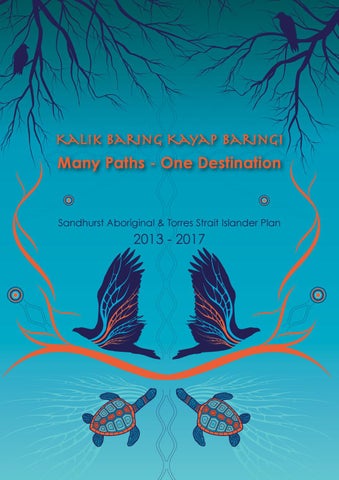
Artwork The artwork featured through the Sandhurst Aboriginal & Torres Strait Islander Plan was done by Reanna Bono, a Wiradjuri and Wemba Wemba woman originally from Echuca. The artwork features the three totems of the Aboriginal people in Northern Victoria that make up the Sandhurst area. Waa the crow, the totem of ??? people; Bunjil the eagle - the creator spirit from the ????? people; and the long neck turtle the totem of the Yorta Yorta people. The artwork shows the three totems being connected to each other, as well as our spirit ancestors that are represented by the pathways in the centre, all united together.
35 | Sandhurst Aboriginal & Torre es Strait Islander Plan 20 013 - 2017
Published by Catholic Education Sandhurst March 2013 The copyright in this document is owned by the Catholic Education Office. No part may be reproduced by any process except in accordance with the provisions of the Copyright Act 1968, NEALS (see below) or with permission. An educational institution situated in Australia which is not conducted for profit, or a body responsible for administering such an institution, may copy and communicate the materials, other than third-party materials, for the educational purposes of the institution. This publication is also published in PDF format on www.ceosand.catholic.edu.au ISBN