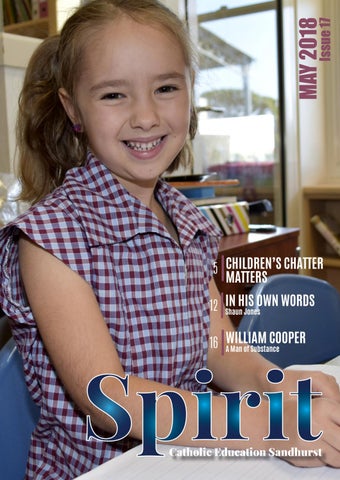
Issue 17
MAY 2018 5 CHILDREN’S CHATTER MATTERS HIS OWN WORDS 12 IN Shaun Jones COOPER 16 WILLIAM A Man of Substance
Catholic Education Sandhurst
Editor Email Layout & Design Proof Reader Front Cover Photo Inside Cover Photo Inside Back Cover Photo Back Cover Photo Director’s Reflection Photo
Jenni Kennedy jkennedy@ceosand.catholic.edu.au Catherine Barianos Mary Pianta Ruby from St Joseph’s Primary School Kerang Mass of the Oils - Sacred Heart Cathedral Bendigo (Daniel Giles) St Joseph’s Primary School Beechworth (Daniel Giles) Nathaniel from St Joseph’s Primary School Nagambie https://catolicochapin.wordpress.com/2013/04/03/el-nino-que-interrumpio-un-via-crucis/
© Catholic Education Office Sandhurst 2018 Licenced under NEALS Printed by Espress Printers Epsom
Contents
4 5 8 10 12 14 16 18
From the Director
Mr Paul Desmond
Children’s Chatter Matters
the role of the speech pathologist in Sandhurst schools
Caritas Australia
justice, dignity & hope
Around the Diocese
Shaun Jones in his own words
Family & Community Engagement learning together
William Cooper a man of substance
Sandhurst Switches Off an act of solidarity
3
Director’s Reflection On Good Friday, 2014, in Madrid, Spain, a young boy innocently and earnestly steps from the crowd during the annual Via Crucis (The Way of the Cross). His aim is to help the fallen Jesus. This one moment in time speaks so eloquently and powerfully of the innate goodness within each of us, particularly children. This boy has responded exactly as God would have us do. He has witnessed a human in distress, he has seen a need and his response is immediate and filled with compassion. The child to demonstrates each of us that no cruelty, no shame, no misuse of power, no humiliation, no degradation nor indignity will ever defeat goodness, hope, love, justice and faith. The boy has chosen not to be a bystander. His heart has been touched by the plight of the battered Jesus and he reacts. He could so easily have been appalled by the events occurring before him and simply turned away. But he chose another course of action. This child is a reminder to us all that, despite what might be odds that appear to be insurmountable, we have a duty to one another, particularly to the victim or the isolated or the abandoned. A young boy stepped from the crowd and, in doing so, has left us with a profound message of what it is to be Resurrection people.
Mr Paul Desmond
Director of Catholic Education Sandhurst
4
Children’s Chatter Matters The role of the speech pathologist in Sandhurst Schools Sheryn Long - Senior Speech Pathologist Catholic Education Sandhurst
I couldn’t count the number of times someone has said to me “Ooh, we’d better speak proper, we have a Speech Pathologist amongst us!” or “So you cure lisps - right?” To the first comment I’d probably suggest that they need to see an elocutionist and, while I work with students with speech sound difficulties, lisps probably comprise only 1% of my caseload. And if I want to be truly honest, most children with lisps resolve independently, as they develop greater control over their motor speech patterns with age. We’ve also been called a Peach Fairy, which is an approximation of Speech Therapist, by some very cute, phonologically challenged students. For the purpose of this article I will refer to the friendlier, more widely accepted, colloquial term and call us “Speechies”. As defined by our National body, Speech Pathology Australia: Speech Pathologists study, diagnose and treat communication disorders, including difficulties with speaking, listening, understanding language, reading, writing, social skills, stuttering and using voice. They work with people who have difficulty
communicating because of developmental delays, stroke, brain injuries, learning disability, intellectual disability, cerebral palsy, dementia and hearing loss, as well as other problems that can affect speech and language. People who experience difficulties swallowing food and drink safely can also be helped by a speech pathologist. In comparison to hospitals, community health or private practice, the school environment is a totally unique context for Speechies to work in. In order to achieve the best outcomes for our students, all stakeholders must be involved in the management process. In schools this could mean the teacher, learning support officer, parents/guardian, principal, as well as involvement from any outside agencies. Critically, the Speechie needs to consider the educational context within which the student works; this means that the Speechie needs to keep abreast of the ever-changing curriculum and school priorities that impact the student’s development and wellbeing.
Pictured: Peta Mazurak (Speech Pathologist) & Koby (student from St Peter’s Primary Bendigo North)
5
STATS Catholic Education Sandhurst Speechies provide school-based support which can occur within the classroom, in groups or with individuals following the Response to Intervention (RTI) framework. This model of service delivery facilitates an active and supported learning environment for students, which encourages generalisation of skills because it occurs within the learning context. The school-based model allows modelling for and collaboration with teachers resulting in sustained change in management of students with language-based needs when interventions are supported by and integrated into teaching practice. All Educational Speech Pathology interventions are accountable and reflect current theoretical knowledge such as the OLSEL* and CPOL* ongoing research. While Speechies work with students with communication disorders, this is a very broad term which includes both spoken and written communication. They might be supporting students with any of the following diagnoses or disorders in: phonology or articulation (speech sounds), oral language, specific learning disabilities (mainly reading and writing difficulties), fluency (stuttering), voice or Autism Spectrum Disorder. Difficulties in most of these areas will not only impact student learning but their behaviour, social skills and general wellbeing.
NSW study estimated that 11% of students in secondary schools have a communication disorder. (McLeod & McKinnon)
STATS Children living in socio-economically disadvantaged locations are 4 times more likely to be at risk (<10th percentile) in the language and cognitive domains. (AEDC, 2015))
STATS Boys are 1.7 times more vulnerable in the language and cognitive domains. (AEDC, 2015)
6
STATS 22.3 - 24.5% of Australian children have a speech, language or communication disorder at school entry. (McLeod & Harrison, 2009)
STATS 46% of young criminal offenders have a language impairment. (Snow, 2014)
Impact of speech, language and communication difficulties There is good evidence to indicate a negative trajectory for at risk groups if successful intervention is not provided. Such evidence includes –
• Increased incidence of disengagement from school (early school leavers, regular absences, greater risk of bullying) • Poor educational outcomes (literacy & language underpins all areas of curriculum) • Mental health challenges (anxiety & depression) • Problematic behaviour • Poor social skill development (impact on friendship groups and families) • Low self-esteem • Health and well-being issues • Limited vocational options • Over representation in our juvenile justice system We, however, believe, like John 10:10; “I have come that they may have life and have it abundantly”, that this trajectory can be turned around. There is very strong, recent research around the links between oral language competence and improved student outcomes. Schools, with our support, can make a difference to the quality of these young peoples’ lives with more inclusive, evidence-based practices in the learning and teaching of language and literacy in the early years. Every school across the Sandhurst Diocese has access to a Speech Pathologist, either through the Catholic Education Office or privately contracted through the school. They can usually be contacted through the school’s Special Education/Learner Diversity Co-ordinator, who will know which days they are visiting the school. For parents wanting further activities to support their child’s language, learning and literacy at home, you will find a “Children’s Chatter Matters” section in each of your weekly school newsletters. Each activity has been carefully selected to reflect the highest quality, up-to-date research evidence on early language/literacy development. The CEO Sandhurst Speechies developed these “family friendly”, fun oral language tasks to promote positive communication experiences at home, as well as enhance children’s learning and literacy skills.
So, look out for the Children’s Chatter Matters logo (right) in your school’s weekly newsletter! * Classroom Promotion of Oral Language; University of Melbourne, Murdoch Children’s Research Institute, RCH, Monash University, CECV, Vic DEECD, Deakin University (2018)
For further information here’s some very useful parent friendly websites and texts: Five from Five - The Five ‘Keys’ to Reading: http://www.fivefromfive.org.au https://www.spelfabet.com.au/where-to-start/parents *Oral Language Supporting Early Literacy - http://www.olsel.catholic.edu.au Making Sense of Interventions for Children with Developmental Disorders. A Guide for Parents and Professionals. Caroline Bowen & Pam Snow. (2017)
7
Caritas Australia
justice, dignity & hope By Gwen Michener: Caritas Australia Justice Educator, Southern Region Vic/Tas
Catherine McAuley College Bendigo ‘Caritas’ is a Latin word meaning compassionate love and, with your support, Caritas Australia has been helping people for over 50 years in countries around the world, as well as in Australia. Caritas Australia is the international aid and development organisation of the Catholic Church; the work of Caritas is reflective of the life of Jesus Christ and is shaped by the tradition of Catholic Social Teaching (CST). Across the globe Caritas delivers long-term development programs as well as short-term relief in times of natural disasters. Caritas Australia and partners stand in solidarity with communities before, during and after emergencies. Caritas Australia works with people regardless of their religion, ethnicity or political beliefs, aiding some of the most marginalised and economically vulnerable people of the world. Supporting people to help themselves out of poverty, hunger and injustice, Caritas Australia’s programs use a strengths-based and integral human development approach where communities can eventually become sustainable and live in dignity. The principles of
8
Catholic Social Teaching promote the dignity of the human person and the common good of all people in the community. Catholic Social Teaching is a body of doctrine developed by the Catholic Church on matters of poverty and wealth, economics, social organisation and the role of the state. Its foundations are widely considered to have been laid by Pope Leo XIII’s 1891 encyclical letter Rerum Novarum. Providing a framework for Caritas to critically analyse social justice issues by assessing what is happening in the world, Catholic Social Teaching enables Caritas to identify what is at stake for the people involved. Through an extensive network of partner organisations, Caritas can tackle the causes and effects of poverty and injustice by providing access to basic healthcare and alleviating health issues arising from poor sanitation. Through its partner organisations, Caritas Australia provides educational opportunities as a central component to freeing people from poverty. Tackling hunger is more than just supplying food; challenging the structures which prevent food security is critical.
Caritas provides an education service in Australia to enable people to learn more about poverty, with the aim of inspiring people to ‘be more’ and serve the poorest in our world. Caritas educators work in each state across Australia, providing resources, student workshops and professional development for teachers. Caritas also supports educators by providing resources at http://www.caritas.org.au/learn/schools for teachers to embed social justice into their curricula. These educational programs aim to enrich students’, parents’ and teachers’ knowledge about the notion that our faith is profoundly social, transforming hearts and minds to encourage school communities to live justly, in harmony and in relationship with God, each other and Creation, nurturing the human development of all. Learning opportunities offered to students and teachers include comprehensive
A brief description of the main Catholic Social Teachings 1.
Human Dignity – every person is created in God’s image and all human life is sacred.
2.
The Common Good - all human beings should be able to enjoy the goods of Creation, we need to look beyond our personal interests and act to benefit our whole human family on earth.
3.
Preferential Option for the Poor - prioritising women, children and men who are most vulnerable to extreme poverty and injustice.
4.
Economic Justice - the economy must allow a just and equitable distribution of resources; people should be paid a fair wage and have decent working conditions.
5.
Care for our Common Home - stewardship of resources, respecting and caring for our environment and the goods of Creation.
6.
Solidarity - we are all part of one big human family on earth, so we have a responsibility to help each person achieve their potential; love your neighbour.
7.
Subsidiarity means that every person has the right to participate in the decisions that impact their lives
8.
Participation means every person can be the architect of change in their own lives.
9.
Peace - We also promote peace which is not only an absence of war but a balance and the “right order” between human beings. Human rights need to be cherished.
exposure to the ‘call to justice’ found in the Hebrew scriptures, in the Gospel stories and within the Catholic traditions as described in numerous Papal writings and statements from bishops. The Bible tells us what justice looks like and how to live a just life, so that all in our human family can live a full and beautiful life. Caritas Australia Justice Educators provide Social Justice Workshops to educational institutions to raise awareness of people’s stories from around the world, where students can choose to take action and make a difference to those less fortunate than themselves. These stories are highlighted during the Lenten season when Project Compassion is launched. Just Leadership Days encourage students to become leaders for justice, in their schools and in their communities, for both local and global change. Students are enabled to challenge injustices, and to develop the leadership qualities to encourage others to do the same. To find out more, please go to http:// www.caritas.org.au/learn/schools/just-leadershipdays All of the work of Caritas Australia is completed through the lens of Catholic Social Teaching and principles. These teachings cover all spheres of life – the economic, personal and spiritual.
“
The central message is simple: our faith is profoundly social. We cannot be called truly “Catholic” unless we hear and heed the Church’s call to serve those in need and work for justice and peace.
“
Caritas Australia works with the First Australian communities to tackle the disproportionate number of development and justice issues they face; unclean water, poor sanitation and hygiene have claimed more lives than anything else over the past century. Caritas Australia also addresses the rights and needs of people with disabilities. The empowerment of women in education, employment, healthcare and their control of assets are also part of their work. Millions of people are under threat from conflict, ethnic violence or internal strife. Poverty, inequality and natural disasters are the major causes. The majority of people infected with HIV and AIDS live in developing countries and this creates a financial burden. Caritas funds programs to assist people affected by HIV to continue to live a life of dignity.
Communities of Salt and Light U.S. Bishops, 1993
St Joseph’s Primary Nagambie
The Catholic Social teachings and principles are not static but are still relevant and responsive to our ever-changing world. To find out more, please go to http://www.caritas.org.au/about/ catholic-social-teaching-values
9
10
Catherine McAuley College Bendigo
Sacred Heart Primary School Tatura
Marist College Bendigo
St Joseph’s Primary School Beechworth
St Mary of the Angels College Nathalia
St Monica’s Primary School Kangaroo Flat
St Therese’s Primary School Kennington
St Peter’s Primary School Bendigo North
Holy Rosary Primary School White Hills
St Bernard’s Primary School Wangaratta
St Joseph’s Primary School Kerang
St Joseph’s Primary School Nagambie
St Patrick’s Primary School Tongala
St Joseph’s Primary School Numurkah
St Patrick’s Primary School Pyramid Hill
St Mary’s Primary School Cohuna
11
SHAUN JONES IN HIS OWN WORDS
Facioscapulohumeral muscular dystrophy (FSHD)
12
is a highly complex, progressive muscle-wasting disease, affecting an estimated 1 million people worldwide. FSHD commonly affects the facial, shoulder and upper arm muscles, however it can affect many other muscle areas, robbing people of their ability to walk, talk, smile, eat and even breathe. There are currently no treatments and no cure for this debilitating disease. Please visit fshdglobal.org to learn more.
My childhood started out as any other childhood usually would; I loved sport, reading books and watching movies, pretty standard stuff. At my Grade Prep school sports at St John’s Primary School in Euroa I was one of the fastest runners in my grade. Fast forward to my Grade 2 school sports and I came dead last in running. This seemed pretty odd to me, so I asked my teacher why I was suddenly so slow and she told me that I must have slowed down as I was getting older. That seemed fair enough to me, but I couldn’t understand why it wasn’t happening to any of the other kids. Not too long after this, the falls started to happen; I found myself falling over multiple times every day for no apparent reason.
at FCJ was an amazing man by the name of David Leslie; he went out of his way to make any adjustment I needed to make my school life easier. For example, all students at the college had their own MacBook Pro to complete their work on but, for someone like me, lugging a heavy laptop around all day was tiresome work, so David saw to it that a MacBook Air was purchased for me instead. Other adjustments included allowing me to be slightly late to some classes, to give me time to walk up and down the stairs, and being driven to excursions. I believe it is important for schools to offer as much support as possible to students who may have special needs, but to offer it in a discrete manner that will not make students feel like they are being singled out for being different.
As Grade 4 began, I was fortunate enough to have my dad, Leo as my teacher. It was at this time that he began to notice that things weren’t quite right with me. The way I walked was becoming slow and sluggish, and I needed to take breaks from walking often. After seeing enough changes in me over a short period of time, dad took me to see a doctor. The first doctor looked over me and believed everything was fine. A second opinion resulted in a referral to a specialist in Shepparton and, ultimately, an appointment at the Royal Children’s Hospital in Melbourne. Shortly after, I was given an official diagnosis of Facioscapulohumeral Muscular Dystrophy (FSHD).
After finishing school, I was able to get a job at FCJ as a teachers’ aide where I am able to help other children who have challenges at school overcome their obstacles and get the best out of their education. I find it very rewarding to be able to give back to a place which did a lot for me during my time as a student.
Although a diagnosis was a relief, we now had to prepare ourselves for what my life with FSHD would look like. Having my dad as my teacher made it quite easy to make adjustments at school for the remainder of my primary years; these adjustments included having my own chair with wheels and armrests as well as being excused from physical activities such as P.E. class, swimming and other sporting events. I was also taken out of class for 30 minutes each day to complete an exercise program to try and stop the deterioration of my muscles. This was something I hated as I didn’t want to be singled out and treated differently from the other kids. I desperately wanted to be normal, to not stand out from the crowd, to not have people stare at me while I walked down the street. However, I knew that this was something I would have to face when I made the transition from primary school to secondary school as I was heading up the highway to FCJ College in Benalla. With none of my close friends from St John’s coming with me, it was daunting to have to make new friends, when I knew the first thing people would see when they looked at me was my disability. Despite my fears, I ended up finding it quite easy to make friends by simply being myself, such a ridiculous cliché I know! I had a healthy social life during secondary school (perhaps too healthy at times) and was fortunate enough to become friends with people who were happy to include me, at times giving me a helping hand and not making me feel uncomfortable about my disability. For example if I had a fall at school, I had one friend in particular who would pick me up off the ground, I’m not really sure how he became the man for the job, but it’s just the way it was… he’d just pick me up and we’d carry on with what we were doing, just the way I liked it. Getting through high school was made far easier for me by the great support I had around me. The principal during my time
Throughout my life I have had various experiences and met various people who have allowed me become more resilient and to overcome the adversities I have faced. I remember on one of my first visits to the Royal Children’s Hospital, I encountered a young boy who had burns covering his entire body, his legs had been amputated and he only had two fingers on each of his hands. At the time I was only nine years old and this was quite confronting for me to see. I looked at that boy and thought to myself, “No matter how bad things may get, it could always be worse.” I still think about that moment to this day, and it makes me appreciate what I have and what I am still able to do. I have also been fortunate enough to travel to the Philippines where I lived in a rural community for 10 days to assist in creating better lives for people who lost their homes to typhoons. This was an eye-opening experience which helped me to appreciate the small things in life that we take for granted in Australia. If I had been born in a country like the Philippines, my access to healthcare would be extremely limited compared to what I have here in Australia, and the thought of this has helped me appreciate the things I have, instead of focusing on what I do not. The final, and most important inspiration I will share with you is my stepmother Sonia. Around the time I finished Year 12, Sonia was diagnosed with metastatic breast cancer. Sonia decided to live out her remaining years doing the things she loved, she believed there was no point in wasting her life doing things she didn’t enjoy. Despite her health condition, she remained positive, which in turn gave me the motivation to not give up and to keep living my life, no matter how poor my physical condition becomes. Although in the past couple of years my condition has deteriorated, I still try to actively do things I enjoy such as attending concerts and music festivals. If I could give some advice to any young person who is facing any sort of challenge in school or in life it is to surround yourself with like-minded, supportive people; to enjoy the finer things in life; to be positive, and to spend as much time doing the things you love as you can. There is no point wasting your life doing things you don’t enjoy.
13
Family & Community
engagement
Who are we? what’s worth learning? How can we learn this together? Catholic School communities across our diocese, with ongoing support from the Sandhurst Catholic Education Pastoral Wellbeing Team, continue to explore these guiding questions while seeking powerful ways to engage families and local communities in support of enhancing student wellbeing and learning outcomes. Family and Community Engagement involves all people in the life of children and our young people working together to create a safe, stimulating and supportive environment for their wellbeing, learning and development. Guided by the Charter of Sandhurst School Improvement (CoSSI), our school communities endeavour to … “be creative in what they attempt to achieve …” and “… work collaboratively to create supportive and inclusive environments that promote health, wellbeing and enhanced learning outcomes.” Healthy schools involve the three major contexts in which students learn and grow: family, school and community. In support of this work in our Catholic School communities across the Sandhurst Diocese, the Catholic Education Pastoral Wellbeing Team works closely with school leaders, staff members, parents and carers to build and strengthen partnerships for learning.
strengthen learning partnerships and to create space for authentic dialogue in a student-focused, strategically planned way. Parents, carers, school leaders, support staff and school-based Family Community Engagement Teams will meet with Pastoral Wellbeing Education Officers, Jenny Griffiths and Steve Hicks throughout the school year to refine local approaches and explore opportunities. The Sandhurst Pastoral Wellbeing Team will assist these secondary and primary project schools to develop and implement policies, procedures, practices and relationships that connect parents to their children’s learning, better connect the school to the community and the community to the school. The development of a school Family and Community Engagement Plan that sits within each school’s broader Strategic and Annual Action Plan is a key feature of this initiative. An opportunity to engage with international lecturer, researcher and author Dr Debbie Pushor, from the University of Saskatchewan, Canada over the past two years has further inspired school communities to think deeply and creatively around ways to enhance wellbeing and learning outcomes for students. Three one-day workshops over the past two years, attended by parents, teachers, support staff and school leaders, have provided an opportunity for reflection on the rich benefits of sharing parent knowledge and teacher knowledge when working in partnership to enhance student wellbeing and learning. Theoretical underpinnings for engaging in authentic dialogue between parents, carers and teachers are further supported by Debbie’s research and her work with pre-service and practising teachers who are engaging deeply with parents, and carers in their local school communities. Effective Family and Community Engagement for schools has the child or young person at the centre of all endeavour. It is about working and learning together to transform the lives of children and young people.
Pauline Corcoran (St Patrick’s Primary Tongala) & Cate Fraser (St Mary’s Primary Rushworth)
This work is being enhanced through an ongoing partnership with Dr George Otero, co-founder of the Centre for RelationaLearning, Santa Fe, New Mexico. Currently, George and the Sandhurst Pastoral Wellbeing Team are working closely with eleven Family adn Community Engagement Project Schools to build local capacity to
14
Catholic Education Sandhurst values parents and carers as partners in education. Due to the unique nature of each school community across the diocese, Family and Community Engagement will look quite different in each individual setting, though be based on the core principles of: building relationships for learning, creating space for dialogue and maintaining a focus on the wellbeing and learning of children and young people.
Family & Community Engagement in action St. Joseph’s Primary, Rochester Following a session with the St. Joseph’s School Board, a workshop for Year 6 leaders explored key questions: What we learn? Where we learn? Who we learn from? The students’ reflections were presented and further explored during a community conversation with both staff and families. A further gathering will be held in Term Two for parents/carers, staff and children to further develop local approaches to enhancing wellbeing and learning.
St. Patrick’s Primary, Wangaratta Year 6 leaders and school staff gathered following a Learning Walk attended by parents, carers and staff for a learning dialogue. Those gathered used picture prompts to share their reflection on learning, prior to creating visual representations of important attributes graduates of St. Patrick’s should develop through their time at the school. The students selected an attribute the school could focus on as a current priority. Plans are underway for a Learning Conversation involving students, parents, carers and staff.
St. Therese’s Primary, Kennington Parents, carers and staff meet to contribute and refine priorities within the school’s strategic and action plans. With a focus on Catholic Identity, Pastoral Wellbeing and Leadership there is opportunity for dialogue about initiatives, strategies and creative thinking around ongoing school improvement. Parents and carers are invited to contribute as co-creators and partners with school leaders about these important areas of school life.
Galen College, Wangaratta Leadership team, staff, parents, carers and students continue to refine the College’s approach to Family Community Engagement with enthusiasm and energy. Staff, parents and carers meet to reflect on key questions: Who are we? What’s worth learning? How can we learn this together? This ongoing dialogue supports the strategic intention to enhance a whole-school approach to Family Community Engagement, leading to improved wellbeing and learning outcomes for students. Senior students contribute to the ongoing dialogue, articulating their needs and aspirations through Community Conversations, workshops and consultation with College Leadership.
St. Augustine’s College, Kyabram Student, staff and parent/carer voices are significant in supporting the strategic planning of ongoing school renewal and development at the college. Student workshops capture aspirations from primary and secondary students, with senior student leaders invited to contribute to the College’s Family Community Engagement approaches, along with representatives from the College’s staff reference group and parent/carers from St. Augustine’s CORE Team. By Steve Hicks & Jenny Griffiths Education Officers: Pastoral Wellbeing - Catholic Education Office Sandhurst
15
William Cooper
a man of substance
William Cooper and family
When the rest of the world was silent, William Cooper, aged 78, marched on the German Consulate in Melbourne to present a petition damning the persecution of the Jewish people by the Nazi Government in 1938. This extraordinary act of courage took place following Kristallnacht, also known as the Night of Broken Glass due to the shards of broken glass that littered the streets after the windows of Jewish -owned stores, buildings, and synagogues were smashed. This act of violence is thought of by many as the beginning of the Holocaust. An extraordinary act by a man who was petitioning for the rights of his own people, here in Australia. So who was William Cooper, and why did this fiercely
16
William Cooper marches - circa 1938
proud Indigenous man stand up for the rights of Jewish people, when no other protests were recorded at that time, anywhere else in the world? William Cooper was a Yorta Yorta man, a human rights campaigner and a man of integrity. Born on December 18, 1860 near the intersection of the mighty Murray and Goulburn Rivers in Victoria, William Cooper fought tirelessly for the rights and dignity of all people, regardless of race or creed. At 13 years of age, William Cooper moved to the Maloga Mission with his mother Kitty and brother Bobby. The mission was situated 15 miles from the township of Moama, on the banks of the Murray River. It was here that William Cooper showed promise as a scholar, developing a love for learning
which would endure a lifetime. As an adult, William Cooper lived most of his life in missions, finding work as a shearer, horse breaker, drover and labourer. He was also actively involved in campaigning for Aboriginal rights, especially land rights. William Cooper married three times and was the father of eight children; his first born child, Bartlett, passed away as a child but the seven remaining children survived. His daughter Amy became the matron of the first Aboriginal hostel established in Melbourne in 1959. Daniel Cooper served and died with the AIF during World War I and Cooper’s youngest son, Lynch was a celebrated athlete who won the Stawell Gift in 1928 and the World Sprint in 1929. Well into his 70s, William Cooper moved to Footscray in
Descendants Julie Ferg
Melbourne, it was at this time that Cooper became a relentless letter writer as he continued to fight for the rights of Aboriginal people. By 1935 Cooper had helped establish the Australian Aborigines League. As its secretary, Cooper circulated a petition seeking direct representation in parliament, enfranchisement and land rights. Recognised as the father of National Aboriginal and Islander Day Observance Committee (NAIDOC) and co-founder of the National Day of Mourning, William Cooper holds a significant place in the history of Australia. Because of this, the William Cooper Memorial Committee commissioned a statue to honour this great Australian and, in March, 2018, the statue was unveiled in Shepparton, Victoria.
Hundreds gather for the official unveiling of the William Cooper Memorial statue in the Queens Garden, Shepparton on 27 March 2018
Standing at 1.8 metres, the bronze statue takes pride of place in the Queens Gardens in the heart of Shepparton, a fitting location for this important memorial. Hundreds of people gathered to celebrate the historic event including descendants of William Cooper and Melbournebased artist, Pamela McKillop who said it was a privilege to create this lasting tribute. The Director of Catholic Education Sandhurst, Mr Paul Desmond led the charge to honour the local hero, as head of the William Cooper memorial committee. Mr Desmond said committee members were thankful for the support of the Shepparton community and believes William Cooper is an inspiring figure who deserves to be immortalised in this way.
Vedran Drakulic - CEO of Gandel Philanthropy
The committee called on the people of Shepparton and surrounding areas to help fund the memorial and the local people did not disappoint. The fundraising efforts however received a significant boost when one of Australia’s best-known philanthropic groups took up the cause. Gandel Philanthropy generously supported the project with a donation of $30,000 towards the cost of the sculpture. Chief Executive Officer of Gandel Philanthropy, Mr Vedran Drakulic was at the unveiling to address the gathering at the conclusion of the ceremony. Further significant donations were made by local Catholic Schools and Australia Communities Foundation, along with many other generous contributors.
Bronze statue of William Cooper
On Tuesday, March 27, the official unveiling of the William Cooper Memorial statue took place in Shepparton. The ceremony was hosted by great-granddaughter, Leonie Drummond and greatgreat granddaughter, Julie Ferguson the descendants of William Cooper breathing life into the moving ceremony. A proud moment for all involved, as the community of Shepparton gathered to celebrate the life of this incredible man. The droning rhythm of the didgeridoo signalled the beginning of the smoking ceremony, as William Cooper’s great-great-great-grandsons took part in the age-old cleansing ceremony. Great-great-greatgranddaughter, Talyssa Baker’s voice was mesmerising as she sang in the traditional Yorta
Yorta language before the official unveiling. The bronze statue of William Cooper shines golden as the sun reflects off the burnished face of William Cooper; the forthright gaze and trademark moustache looks across the Queens Gardens in Shepparton, as he calls for all that is right and just.
“
William Cooper fought tirelessly for the rights and dignity of all people, regardless of race or creed.
“
guson & Leonie Drummond
17
6$1'
+85
t s r u h d ! n f a f S O s e h c t Swi For more than a decade Catholic Schools in the Sandhurst Diocese have been taking part in Sandhurst Switches Off, an initiative to raise awareness about the effects of greenhouse gas emissions and to demonstrate how schools, homes and businesses can reduce their impact on the environment. First instigated in 2008, only a year after the global movement Earth Hour was introduced, Sandhurst Switches Off invites schools to take a stance against climate change on this diocesan day of action. Coinciding with Earth Hour for schools, Sandhurst Switches Off took place on Friday March 23, 2018. Every year hundreds of millions of people around the world take part in Earth Hour, the global movement which was started in Sydney, Australia in 2007. Today, more than seven thousand cities in over 180 countries take part in this amazing conservation campaign. This simple act of solidarity, which involves turning off lights for 60 minutes, is raising awareness about the effects of climate change throughout the world. Many schools across Australia are passionate supporters of Earth Hour and rightly so when Australia is home to some of the most unique species and natural formations in the world. Australia boasts an incredible array of plants and animals; in fact, more than 80% of Australia’s flowering plants, mammals, reptiles, frogs and almost 50% of our birds occur nowhere else on Earth. However, our country is losing species at an unprecedented rate and climate change is a key danger. Sandhurst Switches Off it is an important initiative for students, staff and the wider community, not only from an environmental point of view but as Christians. Sandhurst Switches Off coordinator and Spirituality and Faith Formation officer, Kylie Smith, from the
18
Switc
67
hes
))
Frida
y 23 Join rd M C arch in tu atholic S rning choo 2018 l o s In Sa ff a roun light ndhu rst, w d s Off. t f he d or on e inv All C ite y io atho e ho enco ou to lic sc ur in cese urag part hools ed to ic the d devic ip a nd C ate in turn es fo a ay! tholi off t Sand r pa o c h
f our hurs Educ eir li rt of t Sw ghts ation com itche mitm the day and It is Offic s any or a also ent t es w othe w s o ill be h y o m t due he p le da r ele bolic to cli r c y e tron . This of ou serv m ic a a r soli of cr tion actio te ch of G darit eatio n is s ange od’s y wit n. ymb . Let frag h tho olic us re ile cr ‘If w se w imag e ap eatio ho a in proa e this n. re su our p ch n open a ff t a ure a ness rtne ering spea nd th to a rship kt e env relat he langu we and w ith a ironm ionsh won age ll d e
of fra ip wit er, if n of m te we n t withou as h o lon t set li ters, con the worl rnity and ge d mits s on th umers, ru , our attit beauty in r eir im ude thles will b our s exp med e tha iate need loiters, u t nable s.’ to Laud ate Si, Po
pe Fra
ncis,
p. 17
Catholic Education Office said having a deep respect for creation is central to our Christian tradition. “We have a particular responsibility in Sandhurst to participate in this day of action and awareness. Every individual voice and action in every community makes a difference. This event promotes our ongoing commitment to the preservation of God’s earth and promotes our solidarity with the poor and those suffering due to environmental impact,” she said. Pope Francis reminds us that it is everyone’s responsibility to care for the world in which we live. “I urgently appeal for a new dialogue about how we are shaping the future of our planet. We need a conversation which includes everyone, since the environmental challenge we are undergoing, and its human roots concern and affect us all.” - Pope Francis, Laudate Si Sandhurst Switches Off enables all Catholic Schools in the Sandhurst Diocese to come together in an act of solidarity as we commit to lessening our ecological footprint on the earth. The action we take today will make a difference for tomorrow. L-R: Uriel, Saige & Harry from St Kilian’s Primary Bendigo
19