Catholic Education Sandhurst
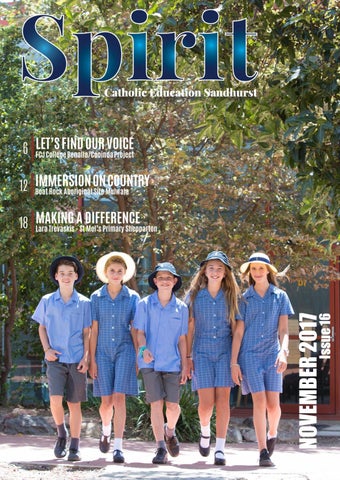
FIND OUR VOICE 6 LET’S FCJ College Benalla/Cooinda Project ON COUNTRY 12 IMMERSION Boat Rock Aboriginal Site Mulwala
Issue 16
NOVEMBER 2017
A DIFFERENCE 18 MAKING Lara Trevaskis - St Mel’s Primary Shepparton
Contents 3 4
From The Director Mr Paul Desmond
Back To The Future
Science, Technology, Engineering & Mathematics
6
Let’s Find Our Voice
FCJ College Benalla/Cooinda Project
12
Immersion On Country
Boat Rock Aborginal Site - Mulwala
14
New Beginnings
The Sandhurst Catholic Education Council
16
Seeing A Need
18
Making A Difference
Sisters of St Joseph 150 years on
Lara Trevaskis - St Mel’s Primary Shepparton
Editor Email Layout & Design Proof Reader Front Cover Photo Inside Cover Photo Inside Back Cover Photo Back Cover Photo
Jenni Kennedy jkennedy@ceosand.catholic.edu.au Catherine Barianos Mary Pianta Catholic College Wodonga Gillian - St Patrick’s Primary Pyramid Hill St Monica’s Primary Kangaroo Flat Photo taken by Daniel Giles Catholic Education Office Sandhurst Rose & Lochie - St Mary’s Primary Echuca © Catholic Education Office Sandhurst 2017 Licenced under NEALS Printed by Espress Printers Epsom
From the Director... Sr Vincent, Atticus Finch, Br O’Halloran, et al... “A teacher affects eternity; they can never tell where their influence stops.” Henry Adams, Harvard University
I was a most fortunate student. In all my years in Catholic schools I was taught by men and women, many of whom were Religious, who cared greatly for us and who gave selflessly to ensure we had every opportunity to learn. They set high standards and then demanded that we do our best to attain them. Educators are in an incredibly privileged position. Through their work, on a daily basis they influence the next generation; they help develop minds and attitudes; they are in a position to ennoble and inspire young people to set and pursue goals. It is a profession which really does touch the future. It is now some years since I was a student, but I clearly remember many of the things my teachers said and the things they taught me. Actually, I can still hear their voices, such was the lasting impact they had on me. My early years were spent under the guidance of a Josephite by the name of Sr Vincent. The joy she derived from teaching was matched only by the joy we gained from being in her presence. I have a very strong memory of my Year 10 English class and studying the novel To Kill a Mockingbird. It seems incongruous to me that this masterpiece celebrated its 57th anniversary in July of this year. Despite the passing decades, Harper Lee’s novel still carries powerful messages of tolerance, justice, courage and loyalty, of the importance of family and community, of friendships and role models. I have always been inspired by the main character in the novel, Atticus Finch, a small town lawyer called upon to defend a man of a different racial group. In one memorable part of the story, Atticus tells his two young children why he took on the unpopular, unwinnable case: “I wanted you to see what real courage is, instead of getting the idea that courage is a man with a gun in his hand. It’s when you know you’re licked before you begin but you begin anyway and you see it through no matter what…” The man who taught me left an indelible impression on me and I think of him often. His is one of the voices I can so clearly recall. I did not know it as a 16-year-old, but I was in the loving hands of a genius. Many of my thoughts and actions are still influenced by the things he taught me decades ago. His lessons were far deeper and more profound than what the curriculum stipulated. This teacher left me with many ideas about courage and optimism and commitment and loyalty. He, like Atticus Finch, had a powerful understanding of the nobility of his profession and of setting the right example for those in their care. The child who has been in the hands of a skilled teacher has been gifted in ways that can never be measured. Only the passing of the decades will reveal the true nature of that gift.
Mr Paul Desmond
Director of Catholic Education Sandhurst
3
o t k Bac
e r u t u f the e
ngine E , y g o l Techno , e c n e i Sc
Modern science presents us with an evolving array of new and innovative ideas. From agricultural drones with infra-red technology to robotics, space travel and medical breakthroughs. Science is constantly influencing the way we live, both now and into the future. Australian educators recognise the importance of Science, Technology, Engineering and Mathematics (STEM) education in preparing students for the jobs of tomorrow, and the part our schools play in ensuring these disciplines are engaging and relevant for students. In December, 2015, the Australian Government introduced the National STEM School Education Strategy to lift student engagement and to support teachers in improving student outcomes. The Australian Education Council, responsible for the Strategy, admits that reversing the trends in STEM performance will take time and effort across the community. “There are many factors that affect student engagement in STEM. Underlying this are the views of the broader community – and parents in particular – about the relevance of STEM, and the approach to the teaching and learning of STEM from the early years and continuing throughout schooling,” the report says.
4
matics e h t a M ring &
“Connected to this is the way industry articulates the importance of STEM-related-skills that extend beyond traditional STEM occupations. University admissions policies also have a strong influence on student choices in the senior secondary years. The purpose of the strategy is to build on a range of reforms and activities already underway. It aims to better co-ordinate and target this effort and sharpen the focus on the key areas where collaborative action will deliver improvements to STEM education.” Australian schools now face the challenge of inspiring a generation of young people to engage with STEM, giving them the opportunity to take part in a wide range of activities where they learn to investigate, explore, make predictions, test ideas and share discoveries. Making STEM interesting enables students to learn concepts from the different disciplines in a way that is completely natural to them. Science, Technology, Engineering and Mathematics surround our daily lives, from our smartphones to the technologies that enable us to explore the world around us. For Australia to prosper in this technological age, Australian students need a strong foundation in STEM and effective teachers to educate and inspire them. There have never been more grants, programs and incentives to promote STEM in education; the emphasis on learning in this area shows that the Australian Government is serious about improving National outcomes in the Science domain.
Amy Holmes - Yr 9 - Galen Catholic College
Schools in the Sandhurst Diocese are doing their part to raise the profile of STEM in order to promote student engagement. A great example of this is Galen Catholic College in Wangaratta where teachers are not only inspiring their students to become engaged with STEM, but the wider Wangaratta community. For the past two years Galen has hosted a STEM Expo as part of National Science Week, showcasing the latest in STEM education. With the sustainability theme of ‘Future Earth’, the Expo highlighted how technology is being used to help plan cities like Wangaratta, the benefits of using drone technology in Agriculture and many other innovative ideas. The Australian Defence Force, Charles Sturt and Melbourne University joined with Wangaratta Sustainability Network, Energy Breakthrough, Urban Landcare Group and other groups to present a diverse selection of STEM resources and information for the Wangaratta community. Technology and Sustainable Practices were highlighted as areas that rely on the STEM disciplines for, industry, agriculture and manufacturing in the North-East region and beyond. Expo co-ordinator Maree Timms, a Science and Maths teacher from Galen College said exhibitors travel from as far as Sydney to exhibit. “More than 300 students attended the Expo from both Catholic and Government schools in the Wangaratta region between 12pm and 3pm, before the Expo was opened up to the general public in the evening.” Maree said the focus on STEM has resulted in an increased interest in robotics in recent years. In fact, robotics is very much on the radar of Galen Students after hosting the Australian Vex Robotics Championship at the College in 2016. Thirty-two teams from Victoria, New South Wales and the Australian Capital Territory battled it out for a chance to represent Australia at the World Championships in Kentucky, USA. The Galen College Robotics team made the top four to be included in the Grand final of the National competition, an outstanding result. STEM Expos provide a forum for interested students to explore the many diverse careers available in the Science, Technology, Engineering or Mathematics fields. Students are able to immerse themselves in an interactive Science experience with experts on hand to answer questions. There is no doubt that people with skills in science, technology, engineering or mathematics (STEM) are in high demand. With a predicted increase in jobs in the STEM domains predicted for the future, it is no surprise that the Australian Government is putting resources into this area. However, if there is a general shortage of students choosing a career in Science, then there is an even greater challenge in attracting women to the STEM workforce. With a recognised gender imbalance in the STEM fields, there are programs addressing this concern, including the Girl Power in STEM program at Melbourne University.
Lachlan Carboon - Yr 9 - Galen Catholic College “Coming from a rural area it’s amazing to have the opportunity to travel to Melbourne University to see new technologies and to be given the same opportunities as city students,” she said. “Science is in everything that we see, do and touch. I love that it has an answer to everything, but everything we discover with Science adds more who, where and why to our questions.” The STEM Girl Power program enables female students to attend a three-day camp at University of Melbourne which includes presentations by academics, panel discussions with industry professionals and interactive workshops. The program also gives participants the opportunity to complete work experience at the university and provides a mentoring program for students in their VCE years. With STEM experiencing a renaissance of sorts, and rightly so, we can look forward to a whole generation of students taking up the call to explore, expand and test the limits of what’s possible in the scientific sphere. While the future of STEM is uncertain, there is no doubt that there are exciting things ahead, some that haven’t even been invented yet!
Year 9 student, Meg Allan from Galen Catholic College was delighted to be selected as one of 30 students from across Victoria to participate in the program.
5
Let’s find our voice!
2049 shares
1500 likes
Max Wright - Cooinda Village
567 comments
It’s been almost forty years since the Queen classic, Don’t Stop Me Now, burst onto the charts. The iconic rock anthem was written by flamboyant front man, Freddy Mercury in 1979. Fast forward four decades and the song is experiencing popularity once more as part of an entertaining lip sync video for the Let’s Find Our Voice Project, a partnership between FCJ Catholic College and Cooinda Aged Care in Benalla.
Program co-ordinator and Director of Wellbeing at FCJ College Catherine Burton said the song, Don’t Stop Me Now was chosen for its positive and joyous message.
The video begins as 93-year-old Max Wright takes the microphone to lip sync the opening lyrics, He is dressed like Freddy Mercury in the original video, complete with leather jacket and chains. As the tempo changes, residents from the local aged-care facility join with Year 7 students from FCJ College and the fun begins. Drumming cooks, dancing students and elderly residents on mobility scooters are just some of the fantastic scenes in the music video.
The popular Facebook clip has had more than 200,000 views since it was uploaded in May this year. But the video is only a small part of the program which is creating meaningful relationships between the residents of the local aged-care facility and students.
Jeanie Campbell - Cooinda Village
“Both the elderly and the young have so much to celebrate, they truly enjoy each other’s company and the film, so cleverly produced by a former student of FCJ College, Christine Walters and filmed by Tim Ratcliffe, captures that joy. The 93-year-old star of the video clip, Max Wright said he has never been more famous!”
The Let’s Find Our Voice Project which commenced in 2012 brings two groups together that may not normally meet. It is essentially a wellbeing project that combines the Year 7 and Year 10 students
7
with the residents of Cooinda Elderly Residents’ Home. Over a term the students travel to Cooinda to take part in a joint choir which culminates in a concert at Benalla Performing Arts Centre, it is here that the video project is aired for the first time each year. An important element of the project is also the writing of memoirs, this task is undertaken by Year 10 English students who hone their listening and writing skills as they draft the memoirs and check for accuracy. The carefully prepared memoirs are presented to the residents and a selection are read at the concert, once more bringing together the young and the elderly. To complete the memoirs, some of the residents travel to FCJ College, an experience that is enjoyed by all. After they tell their story for the memoirs they are invited to have their photo taken.
‘‘
The portraits are taken by another student under the guidance of the school’s photography teacher. These portraits are truly
The family member of a Cooinda resident whose memoirs were recorded through the project, said she believed both FCJ College and Cooinda Aged Care were jewels in the crown of the Benalla Community. Sadly, the much loved resident, Betty Wright, passed away before the concert. “Congratulations and our sincere thanks for your Let’s Find Our Voice Project. It was indeed a privilege to be present and the concert helped us to sustain the loss of our dear mother who passed away just prior to her 100th birthday. The moving memoir and photographic portraits have been widely shared and much appreciated by our family. This has been a very touching and healing project,” she said. Many of the residents have early dementia and are frail. Many too, lack the opportunity to leave the home. This project brings young people to the elderly so both parties and the wider community gain immensely from it.
I really enjoyed the Let’s Find Our Voice Program. It was a great opportunity to get to know some of the residents and to sing with them. It lifted my confidence as I was a bit nervous about singing in front of a crowd. You got to know the residents and to hear their stories, I really enjoyed that.
‘‘
Finn Walsh (Year 7, FCJ College Benalla)
8
beautiful, in a society where there is often a lot of focus on the young, it is quite moving to see care and attention directed at the elderly. These portraits have been treasured by their families.
The Let’s Find Our Voice Project aims to encourage students to give service to others and to connect them in a meaningful way with older people in their community. It is in this way that all participants in the project benefit. As a result of a long term relationship with Cooinda, there is significantly greater cohesion between the two groups. At the recent launch of the Cooinda building plan, FCJ College was asked to attend and to once again perform with the residents. It is evident that there is a real partnership between the two groups. This year, two hundred students from FCJ College will take part in an Alzeimers awareness walk, again at the invitation of Cooinda. In 2016, FCJ College was awarded the Phil Billington Arts and Social Justice Scholarship from the Catholic Education Office which will provide valuable funds to ensure the continuation of the valuable project for years to come. Former Director of Catholic Education Sandhurst in whose name the Scholarship was established said the concert was inspirational in every aspect.
Alex Flack - Cooinda Village
The Chief Executive/Director of Nursing at Cooinda Aged Care, Ms Margaret Aldous said the Let’s Find Our Voice Project has become a vital component of the Cooinda program. “Our research validates the outcome of this program and provides the opportunity to ‘spread the word’ for other Colleges and aged care facilities to replicate.” The Let’s Find Our Voice Project ties in strongly with the College’s wellbeing program. It is an integral part of Positive Education, which is based on Positive Psychology principles. Positive Education is taught explicitly and within co-curricular activities such as the Let’s Find Our Voice Project. FCJ College believes the students gain enormous benefits from the relationships that they form with the Cooinda Village residents. Fostering these positive relationships has the ongoing benefit of boosting a student’s self-esteem and increasing their resilience. A further rationale for the project is to provide a focus on elderly people, often there are assumptions about what elderly people cannot do rather than what they can do. Elderly people do not always get the opportunity to be in the spotlight, this project allows elderly people to feature. There is something very special about a 90-year-old singing solo when they have never done anything like it in their life, in this way it promotes justice. There can sometimes be a focus on young people and the notion that elderly people have less to offer. Principal of FCJ College, Ms Joanne Rock said the program encourages companionship, dignity, hope and kindness. “All the precious human traits are on display and evident in this program. The heart-warming concert that is the culmination of the project is a true gift of the heart and spirit.” “What really touches me personally are the less obvious,” she said. “It is the student who finds the pages for the next song in the song book of an elderly person, or the student who holds the songbook
and points out the lines for another. To me, these small gestures indicate that we have tapped into the humanity of our choir members at a much deeper level than simply the singing of songs.” The partnership between Cooinda Aged Care and FCJ College is inspirational and the benefits for all involved are evident. The partnership works because both the school and the aged-care facility want it to work; staff from both places have embraced the program and are committed to ensuring that the partnership continues. Catherine Burton said although it is the video that gains the most attention, the program is much more than that. “The Let’s Find Our Voice Project has been embraced by the entire community, I am enormously proud of the team effort involved in ensuring the success of this program. If only one school hears about the Let’s Find Our Voice Project and decides to develop a relationship with a local aged-care facility in their town, then I would be thrilled,” she said.
‘‘
‘‘
“The original vision, the expertise and the sheer hard work all came together at the exceptional concert. I am delighted that you won the scholarship, it is an exceptional program that could inspire many more communities,” she said.
The biggest thing was little old me was a star, I have never been on stage!
Wendy Ford (Cooinda Village)
9
Holy Rosary Primary Heathcote
St Mary’s Primary Echuca
St Patrick’s Primary Pyramid Hill
Notre Dame College Shepparton
Faces of Sandhurst
St Liborius’ Primary Eaglehawk
10
St Mary’s Primary Myrtleford
St Francis of Assisi Primary Wodonga
St Joseph’s Primary Cobram
St Mary’s Primary Cohuna
Sacred Heart Primary Yarrawonga
St Kilian’s Primary Bendigo
St Patrick’s Primary Tongala
St Therese’s Primary Kennington
St Monica’s Primary Wodonga
St Joseph’s Primary Kerang
OLSH Primary Elmore
11
Immersion on Country Boat Rock Aboriginal site - Mulwala
“May the ancient dreaming inform and inspire us. May the resilience and generosity of the First People’s encourage us. May the endurance and colour of the land sustain us. May the yearning of all peoples for unity reconcile us.” Aunty Delsie Lilist - Catholic Education Office Melbourne
FIRE carriers, from Sacred Heart Primary School Yarrawonga, spent a day out on ‘Country’ to meet with Yorta Yorta Elder Uncle Col Walker, to listen to the story of this cultural heritage site that we call Boat Rock. The main water reserve is in the shape of a canoe and there are smaller rock holes further up the granite site that ensure all water is filtered and held in the catchment. It has been placed in the perfect position to catch the entire run-off of the granite outcrop where it was created. The devised process was ingenious. A big fire was lit on the site then allowed to cool before it was excavated, this process was repeated until a deep two-metre hole was made. Surely this must have taken dozens of years to complete. Another amazing factor of this site, is that it takes very little rain to completely fill the water reservoir. Ann and Alex Sloan, the land owners of where this significant site is located tell us that the boat rock water source is never empty, even in drought. This is a great example of Aboriginal people’s knowledge and abilities to engineer and develop practical and sustainable solutions with minimal impact on the natural land and environment. Standing around this canoe-like well, listening to Uncle Col speak of his ancestors, one has an overwhelming sensation that enables you to see and feel the ancient life that was lived in this place, in harmony with all of creation/country. A story which has been handed down by elders through generations tells how there were two crystals in Boat Rock. This dreaming embodied the essence of spirit that kept the waters clean and clear at all times. The story has been corroborated by the Sloans as they have one of the crystals, the other is missing and I can’t help but feel sad that the crystals no longer remain in the wells. As we ventured up on to the ceremonial site, we were shown two rocks that are called drums. You can see here where the rock
12
is hollow underneath and it can be used as a drum or a place for dancing in rhythm to the earth or ‘Country’s’ call. Still further up the granite site we were shown the ceremonial ground where corroborees were held. Close by were smaller rock wells where the men washed before and after their dances in times of celebrations and gatherings. Uncle Col told the children that Corroborees were like concerts, singing, dancing, laughter and much fun. Aboriginal people have a deep spiritual connection with the land. There is a great sense of the spirit here in this place. For an Aboriginal person, relationships are not only with people but also with their environment: the land, the birds and animals, the plants, the skies, the waters and the weather. “Like a human mother the land gives us protection, enjoyment, and provides for our needs – economic, social and religious. We have a human relationship with the land.” (Painting country SNAICC 2000) A trip to Boat Rock is a must do for anybody who is interested in the many thousands of years of Aboriginal history. Traditional Owners ensured a sustainable supply of fresh drinking water in a place where no water flowed. The site for this significant well was chosen with great care, strategic knowledge and foresight. A small shower of rain is sufficient to fill the hole with water, which is very necessary over the summer period. Within close vicinity to the Boat Rock wells are kangaroos which stay in the area because of the water supply. This made them an easy catch for the aboriginal people so food was plentiful. Surface scatter was found by Uncle Col Walker as we entered through the gate into the site. Surface scatters are the remains of past Aboriginal activity, produced in the course of their daily life. Surface scatters can be found wherever Aboriginal occupation has occurred in the past. As we entered the bus to continue our
journey, Uncle Col says to the children ‘We do not want to walk before you, we do not want to walk behind you, but we want to walk beside you,’ a wonderful quote of the late great Pastor Sir Douglas Nichols. Leaving Boat Rock we continued on to Kyffins Reserve where Yorta Yorta artist, Treahna Hamm led us through the story of how she and local man, Denis Miles rescued a 300-year-old canoe tree, and others, after a devastating tornado had ravaged the area in 2013. The site was damaged through big winds but if it had not been for these dedicated people, history might have been lost forever. The 300-year-old canoe tree remained standing for years but unfortunately, it has now fallen. The students heard of the history of this place as it had been thousands of years ago, when Aboriginal people occupied the area around the lake – of course it wasn’t a lake then, but a swamp and a beautiful red gum forest.
At the end of this wonderful day the FIRE carriers all sat on the shores of the lake reflecting on the things that they had learnt, FIRE stands for Friends Igniting Reconciliation through Education. Their journey of listening and learning involved seeking to understand the Aboriginal world view. The students heard that all things should live in interconnectedness so as to maintain order and sustainability. Sitting on the land, land that is a source of food, culture, spirit and identity, helped to bring to a close a day that was spent in the environment. Our FIRE carriers had seen and were beginning to understand as never before, a different journey where everything is interconnected. The students plan on creating a presentation that captures the learning of the day where they will share their insights into Aboriginal culture with the school community, told to them by very special Aboriginal people who graciously gave of their time, wisdom and knowledge. Thank you Uncle Col Walker, Yorta Yorta Elder, for walking with us on this your country!
Louise Levy
Education Officer: Aboriginal & Torres Strait Islander Education
“Like a human mother the land gives us protection, enjoyment, and provides for our needs – economic, social and religious. We have a human relationship with the land.” (Painting country SNAICC 2000)
13
New beginnings The Sandhurst Catholic Education Council The Sandhurst Catholic Education Council (SCEC) was established at the beginning of 2017 as an advisory body for Catholic Education in the Sandhurst Diocese. For the past two decades the Diocese has been served by the Sandhurst School Education Board (SSEB) and prior to that, the Diocesan Education Committee (DEC). The DEC was de-commissioned in early 1997 and the Sandhurst School Education Board was created. In December 2016, following a formal review of the Catholic Education Office, it was recommended that a new Board be established and the Sandhurst Catholic Education Council was formed. In 2017, the Sandhurst Catholic Education Council (SCEC) met for the first time in Bendigo, the historic meeting marking a new era in Catholic Education Sandhurst. The Council will be advisory to the Bishop, through the Episcopal Vicar for Education, and to the Director of Catholic education for all matters relating to Catholic Education in the Diocese.
14
The Bishop of Sandhurst, Bishop Leslie Tomlinson was in attendance at the inaugural meeting, giving his thanks to members of the newly formed Council members and acknowledging the contribution of past Board members. “I would like to emphasise the value of Catholic Education, both generally and in imparting knowledge to students in the context of the Catholic Faith. I envisage the Sandhurst Catholic Education Council will contribute significantly to the evangelical work of the Church,” said Bishop Leslie. The Very Rev Dr Brian Boyle has been instrumental in establishing the new Council. He said the creation of the Sandhurst Catholic Education Council is one of the tangible outcomes of the Catholic Education Office review. “It became clear in the review that the diocese was in need of an advisory body that would be a Council of Governance. The members of the Sandhurst Catholic Education Council are committed to working for the overall benefit of Catholic Education.
L-R: Gail Ellard, Fr Peter Taylor, Cameron Fraser, Darren McGregor, Michael Devlin, Very Rev. Dr Brian Boyle EV, Patricia Cowling, Morgan Murphy, Mel Aggenbach, Paul Desmond & Lucy Keath (absent: Carolyn Harkin)
Meet the Sandhurst Catholic Education Council Members: Very Rev Dr Brian Boyle EV - Episcopal Vicar for Education (Ex-officio) Appointed the Episcopal Vicar for Education by Bishop Tomlinson in November 2013, Fr Brian represents the Bishop of Sandhurst in all matters relating to Catholic education in the Diocese. Fr Brian has a background in tertiary education and seminaries. Fr Brian notes that Catholic Education Sandhurst educates 18,500 students and that being Episcopal Vicar for education is close to his heart.
Paul Desmond - Director of Catholic Education Sandhurst (Ex-Officio) With almost four decades experience as an educator and in his third year as Director of Catholic Education Sandhurst, Paul believes the Sandhurst Diocese is a great place to work and to take the word of God to young people. Paul expressed his great appreciation of the experience in the Council and noted that he is looking for a Council that can provide confidence, listen and help find a way forward.
Carolyn Harkin - Former Assistant to the Director: Finance & Resources Carolyn brings her expertise in the areas of finance and governance to the Council, with more than 20 years of service to Catholic Education in both administration and finance before retiring at the end of 2014. Carolyn currently sits on the Board of the Catholic Superannuation Fund as well as Doxa School Bendigo.
Cameron Fraser - Diocesan Business Manager Cameron brings to the Council a background in Commerce, Finance and Accounting and hopes to bring these skills to Council deliberations.
Darren McGregor - Principal of Marist College Bendigo Darren commenced work in the Diocese in 2001 and has a strong passion for Catholic Education and wishes to contribute to the ongoing story of education in the Sandhurst Diocese.
Fr Peter Taylor - Parish Priest of St Joseph’s Benalla Fr Peter has always held a very strong belief in the value of Catholic Education. As a priest of the Sandhurst Diocese and a local of Bendigo, Fr Peter is a very proud supporter of Catholic Education and is looking forward to whatever contribution he can bring to the Council.
Patricia Cowling - Education Consultant: Catholic Education Office Melbourne Patricia works as an Education Consultant for Catholic Education Melbourne and as an independent consultant on Leadership, Curriculum Development and School Improvement. A former Principal of Genazzano FCJ College in Kew (2002-2015) and Padua College in Mornington & Rosebud (1997-2001) Patricia brings a wealth of experience in Catholic Education.
Lucy Keath - Principal of St Joseph’s Primary School Cobram Lucy has been a part of Catholic Education for 20 years. Lucy was Principal of St Mary’s Cohuna for five years and has worked at Catholic Education Melbourne, and overseas. Lucy is very passionate about the education and wellbeing of children.
Michael Devlin - Parent Representative Michael believes that he can bring an understanding of School and Parish Community and would like to be a voice for people who may otherwise not be heard. Michael expressed his appreciation of his time on the SSEB and is now looking forward to being a part of the new Council.
Mel Aggenbach - Parent Representative Mel is a former St Bernard’s Primary Wangaratta Board member and a strong supporter of Catholic Schooling. Mel values the faith aspect of Catholic Schools, especially the role parents play in Catholic Education.
Morgan Murphy - Parent Representative Morgan is Chair of the Victorian Catholic Schools Parent Body. He has three sons who have all been through or are currently a part of the Catholic Education System in the Sandhurst Diocese. Morgan is a nurse and works for Peter Mac and Community Palliative Care.
sc ec
Sandhurst Catholic Education Council
15
Seeing A Need Sisters of St Joseph 150 years on... It has been more than 150 years since the foundation of the Sisters of St Joseph of the Sacred Heart in Penola, South Australia by Father Julian Tenison Woods and Sister Mary MacKillop. In 1866, Father Woods was concerned about the lack of education, particularly Catholic Education in South Australia; so he invited Mary MacKillop and her siblings Annie and Lexie, to travel to Penola to open a Catholic school. The first Rule for the Sisters of St Joseph was written by Fr Woods in 1867 and Mary adopted the religious name, Sister Mary of the Cross. In the first five years following the establishment of the Sisters of St Joseph, forty schools, convents and four charitable institutions were opened in South Australia. The Victorian chapter of the Sisters of St Joseph began in 1890 when Sr Mary MacKillop travelled to the country town of Numurkah to open the first Victorian Catholic school to be administered by the Sisters of St Joseph. The community of Numurkah proudly celebrates the feast day of St Mary of the Cross MacKillop each year and students are taught about the important part their school plays in the history of the Sisters of St Joseph in Victoria. On October 17, 2010, St Mary of the Cross MacKillop became Australia’s first Saint, recognising the inspiration she has provided to countless generations of Australians through her words and her actions. Today, there are more than 800 Sisters of St Joseph living in communities throughout Australia, New Zealand, Ireland, Peru, East Timor, Scotland, Brazil and El Salvador. The Sisters are engaged in pastoral work, as well as in professional roles which include teaching, administration, social services, law, psychology, nursing, aged care, community development and adult education. From humble beginnings in Penola, South Australia a century and a half ago, the Sisters of St Joseph of the Sacred Heart, or the ‘Joeys’ as they are affectionately known, hold a significant place in the history of the Australian Catholic Church.
St. Joseph’s NUMURKAH St Joseph’s School, Numurkah was the first school to be established by the Sisters of St Joseph in Victoria. The school began in January, 1890, when St Mary MacKillop and her Josephite Sisters came to Numurkah to support the Parish Priest of St John’s who was struggling to provide education for the rural poor. They established the school in a one-roomed building which had been the original weatherboard Catholic Church in Saxon Street. Today, St Joseph’s School recognises its traditions and heritage by celebrating Saint Mary of the Cross MacKillop’s feast day each year and, awards are given to students in each class, who follow Mary’s ethos of, “Never see a need without doing something about it!” The school’s first lay Principal was appointed in 2000, bringing to a close the legacy of more than a century of dedicated service to the St Joseph’s School community.
St. Liborius’ EAGLEHAWK Established in 1904, St Liborius’ School set about meeting the needs of a growing population by providing an education for the children of the Goldfields. The Sisters of Mercy had originally provided education for the students of St Liborius’ until the Sisters of St Joseph took over in 1920. In 1954 The Order of Friars Minor came to look after the parish whilst the Sisters of St Joseph continued to provide education at St Liborius’ until 1978, when the first lay Principal was appointed, a legacy of 58 years of service to the Eaglehawk community.
16
The Franciscan Friars withdrew from the parish in 1999 and a Priest from the Diocese of Sandhurst was appointed.
St Joseph’s NAGAMBIE St Joseph’s Primary School, Nagambie was originally named St Malachy’s when it opened in 1871. It was first built behind the current Presbytery, with its frontage to Young Street until 1922, when the new school was built along with a convent in High Street. The Sisters of St Joseph began teaching in 1923 and continued until 1983. Generations of children and families have enjoyed a wonderful association between St Joseph’s School and the Sisters. The school’s official entrance was dedicated to the Sisters of St Joseph in 2007 with a commemoration to their co-founder St Mary of the Cross MacKillop.
St. Mary’s RUSHWORTH For many years the people of the Rushworth parish had dreamed of a Catholic school of their own. Fr. Michael Bowman and a dedicated group of parishioners proposed that St Mary’s School be built and the Sisters of St. Joseph of the Sacred Heart were invited to teach in the school. St. Mary’s School commenced in 1954 with 84 pupils enrolled from Prep to Form 3. The school comprised three classrooms, a small office and two cloakrooms. In 1997 it was announced that Sr Geraldine Larkins rsj would be the last Sister of St Joseph of the Sacred Heart to be Principal at St Mary’s and the first lay Principal was appointed in 1998.
St. Patrick’s PYRAMID HILL St Patrick’s School, Pyramid Hill was established in 1956 to cater for a growing number of Catholic children in the Pyramid Hill region and as a memorial to the residents of the region who had given their lives in World War II. St Patrick’s School opened its doors with 60 enrolments and two classrooms. The Sisters of St Joseph were charged with the responsibility of educating the children. St Patrick’s Catholic Primary School owes much to the Sisters of St Joseph; these courageous women followed in the footsteps of St Mary of the Cross MacKillop who dreamed of providing education to small, isolated communities. The Sisters of St Joseph withdrew from St Patrick’s in 1976, after two decades of service to the children and families of Pyramid Hill and district.
St. Michael’s TALLANGATTA On the initiative of Father George Sait, St Michael’s Primary School and Church were erected in 1958 and the Sisters of St Joseph were invited to staff the school. The first enrolment was 71 students from Prep to Form 2 and included boarders from nearby Corryong. The school was staffed by three Sisters of St Joseph, two who were teachers and a third Sister who prepared the meals and conducted music lessons from the Convent. The school was run by the Sisters of St Joseph for many years until the appointment of the first lay Principal in 1981. St Michael’s still maintains its strong links with the Sisters of St Joseph through the school’s identity and vision, and celebrate the feast day of St Mary of the Cross MacKillop each year.
Sacred Heart CORRYONG In 1962, Corryong’s first Parish Priest, Father Leo Lacey had the drive and vision to establish a Catholic School in Corryong and Sacred Heart School was built. The Sisters of St Joseph responded to Father Lacey’s invitation to staff the new school, and thus began the Josephite story in the High Country. The school opened in 1964 with 55 pupils from Prep to Grade 6, in the care of the Sisters of St Joseph. The first full-time lay teacher at the school entered the Josephites following her experience of the Sisters at Corryong. To celebrate the school’s 50th anniversary the school commissioned a stained-glass window, designed by Sr Therese Quinn rsj. The Jubilee Window features St Mary of the Cross MacKillop and the children of Sacred Heart among the magnificent snow-capped Australian Alps of the region.
17
Making a difference Exceptional young student, Lara Trevaskis from St Mel’s Catholic Primary School in Shepparton has been recognised for her commitment to social justice by being nominated for the Fred Hollows Humanity Award. With her sights set firmly on becoming a human rights lawyer, the St Mel’s student was excited to be nominated for the prestigious award which recognises Year 6 students who follow in Fred Hollows’ footsteps by demonstrating compassion, integrity and kindness towards others. “I want everyone to have the same opportunities and to be treated the same throughout the world,” said Lara. Lara was nominated for the award by Principal of St Mel’s Primary School, Mr Dom Poppa who said the Grade 6 student is always striving to improve the lives of others. “Lara’s goal is to become a human rights lawyer so she can support those in need and make the world a better place,” he said. The award is named after Fred Hollows, an Australian eye doctor who spent his life helping those who couldn’t afford, or access, basic eye care. He worked hard to end avoidable blindness, helping countless people across the globe to see again. The founding Director of The Fred Hollows Foundation, Ms Gabi Hollows said her late husband used to say the basic attribute of mankind is to look after each other. “He would be proud to know the Fred Hollows Humanity Award is recognising students who are demonstrating this belief in their own lives,” she said. “I am constantly inspired by the actions of award recipients and I urge people to nominate a Year 6 student they know who embodies the values of compassion, integrity and kindness,” said Gabi” Lara will be recognised at a Victorian presentation ceremony in Melbourne later in the year. At this ceremony, a Victorian Junior Ambassador will also be recognised and will be able to extend their humanity by allocating $5,000, donated by the award’s charity partner Specsavers, to one of The Foundation’s programs to end avoidable blindness. Last year’s Junior Ambassadors chose to support The Foundation’s work in Cambodia, Kenya and in Aboriginal and Torres Strait Islander communities in Australia. Since it was established in 2012, the Fred Hollows Humanity Award has recognised more than 750 students who are making a positive difference in the lives of others.
18
Lara Trevaskis is joined by class mates Issy Ferrari, Manthan Patel (Middle), Mia Borzillo and Evral Watuta (at back)