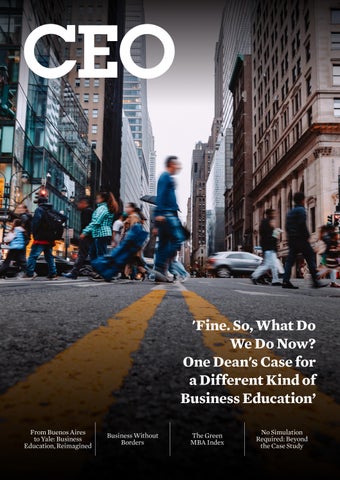
'Fine. So, What Do We Do Now? One Dean's Case for a Different Kind of Business Education’ From Buenos Aires to Yale: Business Education, Reimagined
Business Without Borders
The Green MBA Index
No Simulation Required: Beyond the Case Study
euruni.edu
International network Future-ready skills Industry experts Global opportunities
BARCELONA | GENEVA | MUNICH | DIGITAL
Ready for success
TABLE OF CONTENTS
10
16 1
8 10 12 16
FOREWORD Alexandra Skinner
FINE. SO, WHAT DO WE DO NOW? ONE DEAN'S CASE FOR A DIFFERENT KIND OF BUSINESS EDUCATION Dr Salvador Estapé-Triay
“HOW IT MIGHT LAST” Prof Amir Sharif
FROM BUENOS AIRES TO YALE: HOW SAN ANDRÉS IS BUILDING LATIN AMERICA'S GLOBAL BRIDGE Prof Daniel Serrot
CEO Magazine, Vol. 50
TABLE OF CONTENTS
20 24 26 30
NO SIMULATION REQUIRED Prof Yusuf Sidani
WHAT LEADERSHIP REQUIRES: THREE PERSPECTIVES ON CAPABILITY, CULTURE, AND CHARACTER Alexandra Skinner
THE ADVANTAGE OF ADAPTABILITY: HOW AIB PREPARES LEADERS FOR UNCERTAINTY Australian Institute of Business
BUSINESS WITHOUT BORDERS: BUILDING BUSINESS LEADERS FOR A CHANGING WORLD Christopher Dye
26 2
24
CEO Magazine, Vol. 50
ust e IB L STRA IA’S U A
ON
LI
ER
*
T LARGES NE M
BA
VI O R P
D
TEQSA PRV12090, Institute of Higher Education *see 20 Biggest Online MBA Providers, MBA News (July 2024)
TABLE OF CONTENTS
34 38 40 42 4
38
THE LEADER’S ROLE IN CREATING A STRONG COMPLIANCE CULTURE Lee Bryan
PROOF, NOT PROMISES: INTRODUCING THE GREENMBA INDEX Alexandra Skinner
THE GREEN MBA INDEX CEO Magazine
THE SUSTAINABILITY PARADOX OF 2026 Alexandra Skinner
CEO Magazine, Vol. 50
ceo-mag.com / Spring 2024
5
TABLE OF CONTENTS
44 48 52 56
6
IS AUTOMATION MAKING US LAZY? Alexandra Skinner
WHY WE NEED TO BE MORE SELF-DIRECTED THAN EVER CEO Magazine
THE LEADER AI CANNOT REPLACE Alexandra Skinner
TABLE OF CONTENTS
44
52 48
CEO Magazine, Vol. 50
CEO Victor J. Callender Group Editor-in-Chief Alexandra Skinner Sub-Editor Krysia Whicher Senior Features Editor Dr Alastair Hagger
Head Office: 66 Paul St London EC2A 4NA Telephone: +44 (0) 20 3744 2422 Email: enquiries@theceoindex. com Web: www.theceoindex.com
Features Writer Cara Bouwer Rankings Manager An Nguyen Subscriptions Gemma Westwood Designer PENTA Limited
@ceo_mag
Financial Controller Anthony Gordon Head of Production Steven Whitaker
/CEOMagazineGlobal
Published by CEO Magazine. All rights reserved. No part of this publication may be reproduced without the expressed approval of the copyright owner. Whilst every effort has been made to ensure the accuracy of the information in this publication, the Publisher accepts no responsibility for errors or omissions. The Publisher disclaims responsibility for the views and opinions expressed herein by the contributors. Furthermore, the Publisher does not give any warranty regarding the accuracy thereof. For further information on annual subscription rates visit: www.ceo-mag.com
CEO Magazine, Vol. 50
7
Editor's
Foreword
S
omething has shifted in the conversation about business education, and it goes deeper than the usual cycle of accreditation announcements and ranking table reshuffles. The schools and programmes in this issue are asking a harder question: not whether an MBA is worth doing, but what it needs to become. The answers they are arriving at share a common direction, away from the theoretical and the ornamental, toward the applied, the adaptive, and the genuinely transformative. What is emerging is not a single model but a shared set of pressures: the demand for leaders who can operate in genuine uncertainty, the challenge of building programmes that stay relevant in an environment being reshaped by artificial intelligence, and a growing expectation that business education should be accountable not just for what it teaches but for what it produces. This issue approaches those pressures from four geographies and four distinct institutional positions. Dr Salvador Estapé-Triay opens with a provocation that functions as this issue's thesis: fine, so what do we do now? It is a question about the gap between analysis and decision, between what business schools teach and what business actually demands. Amir Sharif at Norwich takes a different angle: research-first, sustainability-rooted, and why the regional model is having its moment. Daniel Serrot argues for Latin America's growing role in global business thinking, a perspective still underweighted in most publications that claim to cover this market. And Professor Yusuf Sidani, speaking from Beirut, brings something that no curriculum can manufacture: the authority that comes from leading a business school through two wars, a financial collapse, and sustained disruption that would have ended lesser
institutions. His argument that OSB's students do not need to simulate a crisis because they have lived one is a quiet challenge to every school that teaches resilience as an abstract concept. What the Deans describe in theory, the graduates of the Australian Institute of Business demonstrate in practice. Four careers that look nothing alike on paper are connected by a single conviction: that adaptability is not a personality trait but a capability that can be taught, practised, and compounded over time. Also in this issue, we publish the results of the Green MBA Index - our attempt at answering the question conventional rankings consistently avoid: which schools can actually demonstrate their sustainability commitments, and which are simply better at describing them. The methodology, the classifications, and what this cycle's data reveal about where even the leading schools still have building left to do are set out in the pages that follow. And then there is artificial intelligence, the question that shadows everything else in this issue, because it is already reshaping what business education delivers and who it is for. Automation is moving into knowledge work faster than curricula are evolving to meet it. The risk is not simply that content becomes obsolete; it is that students develop a dependency on tools that substitute for the reasoning skills an MBA is supposed to build. The answer is not to resist the technology. But there is a more useful frame than adoption or resistance: what AI makes more important, not less. Judgment, ethical reasoning, and the capacity to lead through genuine uncertainty are not capabilities that automation is absorbing. Those are the capabilities this issue is most interested in - how they are built, which schools are building them, and whether the programmes claiming to develop them can show their work.
Alexandra Skinner is the Group Editor-in-Chief of CEO Magazine
8
CEO Magazine, Vol. 50
GIVE YOUR CAREER WINGS with a GRADUATE BUSINESS DEGREE
MOVE UP | MOVE FORWARD | MOVE NOW MBA • MS IN ACCOUNTANCY & ANALYTICS • MS IN BUSINESS ANALYTICS
AACSB ACCREDITATION
SCHOLARSHIPS AVAILABLE
ACC ACADEMIC CONSORTIUM
A mark of excellence held by fewer than 6% of business schools worldwide
Merit-based, competitive funding available for qualified candidates
Network with other top-tier schools like Stanford, Duke and UNC
GLOBAL STUDY TRIPS
STEM-DESIGNATED
PAID INTERNSHIP TRACK
Immersive international experiences included in tuition for some programs
MSBA & MSAA qualify for up to 36 months of OPT for international students
Collaborate with Fortune 500 companies like Humana, GE and Brown-Forman
BUSINESS.LOUISVILLE.EDU
@UofLBiz CEO Magazine, Vol. 50
9
Fine. So, What Do We D One Dean's Case for a Diff of Business Educa
A
By A lexandra Skinner, Editor-in-Chief
s business schools face growing scrutiny over the value of the MBA, few are willing to engage with the harder questions in public. Dr Salvador Estapé-Triay, Global Dean at EU Business School, is an exception. In this interview, he examines the structural assumptions that have long shaped management education and argues, candidly, that some of them need to change.
Q. If you were to identify the biggest structural assumption the traditional MBA needs to improve on, what would it be, and what has EU Business School done differently? The assumption that management is essentially a body of knowledge. Finance, strategy, marketing, operations… organised into disciplines, taught sequentially, as if business reality would follow the same order. It doesn't. Real managers deal with incomplete information, cultural friction, pressure from above and below, people who don't behave the way the textbook suggests, and decisions that have to be made before the picture is clear. Analytical rigour matters, I'm not dismissing it, but it's rarely the thing that separates good managers from mediocre ones. What we've tried to do at EU Business School is keep the
10
learning close to what business actually feels like. That means practitioner faculty who bring real problems into the classroom, student cohorts with enough international diversity that the learning happens in the room and not just from the professor, and a deliberate effort to put students in uncomfortable situations where the right answer isn't obvious. We're not always perfect at it. But that's the direction.
Q. If business schools are to rethink programme structure, should they also be rethinking admissions? Yes. If we genuinely believe that an MBA develops leadership, maturity, collaboration and judgement, then, in addition to GMAT scores and undergraduate grades, admissions should also be looking at motivation: why this, why now, and the capacity to contribute to other people's learning. In a good MBA, students learn a great deal from each other, as well as from their lecturers. So the quality of the cohort isn't just a reputational matter. It's a pedagogical one. I'd push back slightly on framing it as 'elitist versus accessible.' That's a false choice. What we need is more thoughtful selection.
Q. One criticism of the MBA is that it produces graduates who are analytically strong but poorly equipped for ambiguity. Where does that criticism land? I think there is some truth in that criticism. I've seen it
CEO Magazine, Vol. 50
Deans & Directors Series
Q. Where does EU Business School’s use of the case study method sit in that debate?
Do Now? fferent Kind ation
The case study method is very useful, but not sufficient on its own. It teaches students to structure complexity, take a position and defend it. But analysing someone else's decision after the fact is not the same as making your own with incomplete information and real consequences. Cases should sit alongside live projects, entrepreneurial challenges and direct contact with companies. The question should stop being 'What would you have done?' and start being 'What are you going to do now?'
Q. Practitioner faculty versus research-first? A practitioner brings something you can't get from a paper: the texture of how things actually work. I don't think the research-first model gets everything wrong. Intellectual depth matters. But publication can become the objective rather than relevance. Frankly, I'd be worried about a school with only practitioners, and equally worried about one with only researchers. The difficult part is getting the balance right.
Q. Has accreditation become a compliance exercise? Sometimes, yes. The danger is that documentation becomes the goal rather than the evidence. The forms get filled and the accreditation gets renewed, but whether students are genuinely learning is harder to measure. We take accreditation seriously, but we keep reminding ourselves that it's a means, not an end.
Q. What remains AI-proof?
Analytical rigour matters, I'm not dismissing it, but it's rarely the thing that separates good managers from mediocre ones.”
more than once. Smart people, technically brilliant, producing excellent analyses... and then hesitating when someone says: 'Fine. So what do we do now?' The problem isn't teaching analysis. The problem is when analysis becomes a way of avoiding decision-making rather than supporting it. Closing the gap means putting students in situations where they can't wait for more information: live projects, real clients, time pressure and things that go wrong. Business is messy. Students should experience a little of that before they graduate.
CEO Magazine, Vol. 50
This is one of the few questions where I'm not entirely comfortable giving definitive answers because technology is moving incredibly fast. My instinct today is that judgement, communication, ethics, leadership and earning other people's trust are much harder to automate than technical analysis. Students need to learn how to use AI well. But they also need to know when not to trust it.
Q. Why does the MBA still matter? I've criticised MBAs quite a bit in these answers, but I wouldn't be doing this job if I didn't believe in them. The best programmes still offer something that is difficult to replicate: time to think, exposure to people from very different backgrounds, intellectual challenge and personal transformation. Some MBAs are genuinely transformative and others aren't. Whether a programme delivers on that is something you have to keep earning, cohort after cohort. That’s been true of our approach and why our on-campus MBA continues to be in Tier 1 and our Online MBA is #1 in CEO Magazine’s MBA rankings.
BIOGRAPHY
DR SALVADOR ESTAPÉ-TRIAY is Global Dean at EU Business School.
11
Beyond The Norm: A Business School With Meaning
S
A lastair H agger in conversation with P rof A mir Sharif
ix-and-a-half centuries ago, in a cell attached to a small church just a few miles from the current University of East Anglia (UEA) campus, the anchoress Julian recalled the vision that had inspired her devoted self-seclusion. “And in this he shewed me a little thing, the quantity of an hazel-nut, in the palm of my hand,” she wrote. “I looked thereupon with eye of my understanding, and thought: What may this be? And it was answered generally thus: It is all that is made. I marvelled how it might last, for methought it might suddenly have fallen to nought for littleness.” In our modern age of waste and excess, we no longer look to the divine for comfort as we ponder the finite; the frightening precarity of earthly existence is now an urgent corporeal concern. This is arguably the great epistemological preoccupation of our time: what do we do with the knowledge that our own planet might soon “fall to nought”? There is solace in discovering that institutions like UEA’s Norwich Business School (NBS) have steadfastly confronted the challenge by embedding the study of sustainability and the circular economy into their academic programmes. The school’s Head and Dean, Prof Amir Sharif, transitioned into academia in 2007 after a career in finance (JPMorgan, UBS, KPMG) triggered his own sobering reflections on the state and nature of
12
capital markets and the world economy. “There was some sort of bubble forming, and I could see that was not sustainable,” he says. “The inflows and outflows of investment were enormous, and there was a reckoning to come. Considering the wider implications and consequences of the fallouts of financial markets and my own transition to academia as a result, I became increasingly interested in the linkages between drivers for business as well as sustainability, and therefore for this thing called the circular economy. So moving from the practitioner world to academia was more of a natural segue between two very different worlds.” Sharif’s interest and research focus were rooted in his interest in decision-making and the emergent field back in the early 1990s of what is now ubiquitously called AI (artificial intelligence). Coupled with his interest in systems thinking, he rapidly turned his attention towards the complex and intriguing world of sustainable food systems. This ultimately explains his broad approach as given on his LinkedIn page: “I try to translate the complexity of the world for others.” After leading Brunel Business School as Dean (Head) at Brunel University of London and as Dean of the Faculty of Management, Law and Social Sciences at the University of Bradford, he joined Norwich Business School as its Dean (Head) in November 2024. His leadership byline throughout this period, emanating from his experiences in the corporate world, highlights the power of the collective: teamwork is key to wider success and development.
CEO Magazine, Vol. 50
Students are not just seeking to obtain a degree - they’re getting access to a network of learning." change. In our world too, we’re doing that all the time.” For those professionals considering the opportunity of doing an MBA in this environment, the disruption brought by this current technological change is both personal and structural. AI is reshaping the world of work in terms of which skills hold their value and which roles remain viable, but the more useful question is not only how to survive that shift; it is understanding what this means and the wider implications and opportunities that are important. “Universities don’t necessarily have all the knowledge as they once used to – now a lot of this knowledge is available to everyone,” says Sharif. “But there is still a very valuable benefit that universities and business schools provide. And that is translating this knowledge into action through insight, research, reflection, practice and engagement. Learning, and then higher education, should be about transformation beyond this core knowledge: how do you transform yourself? Students are not just seeking to obtain a degree - they’re getting access to a network of learning.” “If I were to look back at the highlights of leading and NBS is located at an intersection of intellectual and contributing to success in the business school world, I would say geographical loci that gives its students access to a uniquely it is literally based upon having a successful team. Individual cross-disciplinary hub of expertise and information: its UEA efforts are important too and can be amazing, but it is the campus, built around three defined pillars of climate research, collective power of teams that can create success. I’ve seen that creative innovation, and health sciences, is also host to the time and again,” Sharif says. “I’ve been very lucky to be part of Tyndall Centre for Climate Change Research, which “unites UK two business schools where both have won the Times Higher experts to tackle climate change through science, policy, and Education Business School of the Year (Brunel 2013, Bradford sustainable solutions”. In addition to its existing undergraduate 2021). Those recognitions are not because we wanted to become BSc and BA and its postgraduate MSc programmes (which Business School of the Year. It just so happened that we did things include Accounting, AI, Digital Marketing, Fintech, that we thought were very important: being appreciative of how International Business and Purchasing and Supply Chain), the the business world works. Not all business schools necessarily School will launch two new programmes in September that aim towards that in such a direct way. How many business situate both accounting and business management within a school deans have actually been in business, set up businesses, sustainability context. The MBA also includes and integrates or worked in the corporate world? I think that experience sustainable and responsible management thinking, cases, and and mindset count for a lot and can help in distinguishing and approaches too, with all three degree programme portfolios guiding the school, its staff, students and stakeholders” aligning to the School’s accreditation via the UN Principles of Sharif is also acutely aware of the need not just for Responsible Management Education (PRME). organisational evolution, but for language that can communicate The interplay and open exchange of ideas on an academic that story in terms the business world will actually engage campus, which in other disciplines feels under increasing with. “The job of the Dean (head) of school and the senior threat from a panoply of ideological and technological fronts, team really is to translate those challenges, those needs, those is integral to the NBS offering. “Recently I had some students strategic directions,” he says. “And the good news is we have the come to me with an idea for a circular economy-based business,” terminology in our subject area to do that. In the business school Sharif says. “And I had a very nice discussion with them, helping world, we are more appreciative of the idea that organisations them to analyse and explore their business startup idea. At the and the environment they operate in are subject to constant end, I said, ‘Well, I’m really glad that you came to see me. I hope
CEO Magazine, Vol. 50
13
you’re having a nice time doing your business degree.’ But to my surprise I learnt that in fact they were from outside of the business school, and were studying global development. They’d sought the business school in order to develop and advance their idea (with my input). So that’s a great example of the type of interdisciplinary and holistic thinking about business, sustainability, circular economy and systems thinking we are seeking to promote more widely and that we are seeing break through.” On a related note, the thorny obstacle in the thicket of climate-related problem-solving is perhaps untangling where individual responsibility for the environment ends and where corporate liability begins. How should a business school encourage the former and confront the latter? “We still have to teach students ‘how do you make a business run?’ That’s the profit motive, but then you have to balance it with the purpose of a business – and that may not always be rooted in return on investment,” says Sharif. “The purpose motive is to be aware of the consequences of a business and its responsibility beyond profit, including how to deal with change. In this vein, we must remember what a business school needs to teach and what its MBA programme should be for. We need to give students and MBA graduates a mindset and a set of tools to be able to navigate the world now and the world to come.” He cites again the communication and storytelling skills essential for articulating the crux of a problem to industry leaders who are themselves hungry for comprehension and knowledge. “It’s not necessarily about completely revamping a business; it’s about how you can look at what you’re doing as a business differently? What are the socio-economic, environmental, climate, and related impacts? How can you reduce the amount of waste your company produces? How do you reuse some of the outputs you’re producing? There is invested inherent capital in your value chain. How do we consider the scale of that and the resources that go into running an organisation? Bringing together sustainability with business and management is therefore crucial in our connected and globally networked world.” This principle is rapidly becoming embedded in business school accreditation. As the currency that legitimises an institution’s basis for quality, this is now becoming a fundamental element of what a business school is. Specifically, at UEA, NBS’ mission therefore has a durable efficacy for the future in this regard. “Nearly all of the accrediting bodies now have standards that reflect climate change, societal impact, and all of these associated areas,” says Sharif. “The triple crown of AMBA, AACSB and EQUIS all now have these elements deeply integrated, which will allow business schools to show evidence
of how it impacts society positively.” Considering all of these aspects, and where UEA and the NBS are situated, East Anglia has always had a deep historical connection to the wellbeing of its environment and community. NBS itself is housed in the Thomas Paine Study Centre, named after the 18th-century political theorist who was one of the earliest proponents of a universal basic income; the region was also home to the Quaker banker JJ Gurney, who espoused stewardship over profit, and his sister Elizabeth Fry, one of the most significant prison reformers in British history (her eponymous building at UEA accommodates the university’s School of Economics and School of Social Work and Psychology). “The reason our logo and our branding says ‘Norwich’ explicitly is to highlight specifically not only the city and locale, but also to identify with its heritage, and to call out to the future. So we’ve actually put that visibly there in order to extend our reach, and as a vehicle to then explain and promote who we are as part of leaning into our values. As such, the NBS is rapidly becoming internationally well-known and regarded, with some longstanding international relationships. We’ve had an established link with the Hong Kong Municipal University for 10 years, supporting cultural immersion and business management learning through summer school sessions. We’ve also had a very successful relationship with Deakin University in Australia for the last decade, also in terms of supporting a Work Integrated Learning (WIL) programme. We’re about to start running our courses in Singapore and Pakistan too – with further opportunities for international collaboration and provision across China, Sri Lanka and Saudi Arabia rapidly developing. And when people hear about that, they instinctively don’t associate that with UEA and the NBS. But we are increasingly successful in internationalising who we are. Our challenge (my challenge) is to keep on making ourselves viable and relevant: and that’s why I wanted to lead this school: to improve the profile, presence and promote what we do so that we remove the assumption that we are just a regional business school.” How might it last, this local marvel, and not fall to nought? “The point about stewardship and profit: that’s at the heart of the circular economy, and of responsible management,” he says. “We are trying to be a responsible business school. And not only that, we have excellent building blocks and ingredients in terms of our team and working environment. There’s something that we have here, I believe, that many other places have taken years to develop. There’s something about how, what, and who we are as a school that is very powerful and compelling, and which I believe the world needs to know about. We’ve got the principles to show it. We live it, we research it, we teach it. My challenge is: how do we break through? But I believe we’re ready.”
BIOGRAPHY
PROFESSOR AMIR SHARIF is an experienced business school dean and academic leader. He is currently the Head (Dean) of Norwich Business School and Professor of Circular Economy at the University of East Anglia. Prior to this, he was the Dean of the Faculty of Management, Law and Social Sciences at the University of Bradford and, before that, was the Head (Dean) of Brunel Business School at Brunel University London.
14
CEO Magazine, Vol. 50
By A lexandra Skinner, Editor-in-Chief
From Buenos How San Andrés is Bui Global
Q. Universidad de San Andrés has built a distinctive reputation in Latin American business education over a sustained period. What do you consider to be the most significant opportunity for the School right now? The most exciting opportunity we have right now is the intersection of global credentialing and local relevance. Executives across Latin America are increasingly seeking programmes that carry international weight while being deeply rooted in the realities of our markets. We are uniquely positioned to offer both in Latin America. This year, we have two milestones that illustrate this point well. First, we launched our Blended MBA, a format that offers weekly online classes, complemented by a Saturday on-campus session every three weeks. The response has been outstanding, and we have a full cohort starting in June, indicating genuine unmet demand for a rigorous, blended programme. Second, we have formalised a Double Degree partnership with Yale School of Management, giving our MBA students and alumni access to the Master of Advanced Management (MAM). When a San Andrés graduate can continue their journey at Yale, it is a statement about where we stand globally. But perhaps the most meaningful recognition has come from a different direction: we are the only business school in Argentina to receive a Positive Impact Rating, a student-led
16
assessment that evaluates business schools on their contribution to social and environmental impact, not just to the market. It reflects a genuine institutional commitment to educating leaders who care about the world in which they operate.
Q. Argentina's economic environment is unlike almost any other context in which a business school operates. How does this shape the way in which you prepare students for leadership, and does it give your graduates an advantage that schools in more stable markets are unable to replicate? It does indeed, and I say that without any hesitation. There is a kind of leadership muscle you can only build by operating in genuine uncertainty, and Argentina has never been short of that. Our students manage teams, negotiate deals, and make strategic decisions while navigating inflation, currency volatility, and regulatory shifts that would be considered extreme almost anywhere else in the world. That is not an obstacle to their education; it is a core part of it, and sometimes the reason why they decide to do an MBA. What we have consistently found is that our graduates arrive in international roles and bring adaptability and a tolerance for ambiguity that their peers simply do not. They have been stresstested in ways that cannot be simulated in a classroom in other countries.
CEO Magazine, Vol. 50
Deans & Directors Series
Aires to Yale: ilding Latin America's Bridge Our students manage teams, negotiate deals, and make strategic decisions while navigating inflation, currency volatility, and regulatory shifts that would be considered extreme almost anywhere else in the world.”
Our curriculum deliberately channels this. Our case discussions are grounded mainly in Argentine and Latin American business realities. When we teach financial decision-making or crisis leadership, we are not speaking in hypotheticals. Our students have lived versions of those situations. That firsthand experience, combined with a rigorous analytical framework, produces a particular kind of executive, one who is calm under pressure and creative when the rules keep changing. For example, we offer a non-market strategy course in the Executive MBA that specifically addresses how to engage with stakeholders, which is uncommon in MBA curriculums abroad.
Graduate Pathways Q. While many schools have been rushing to implement artificial intelligence (AI), whether through tools, courses, or frameworks, AI has been part of your graduate offering for some time. What does this say about the School’s identity and the learning experience students can expect? It says something we are proud of: that we try to anticipate rather than react. We did not add AI to our curriculum because it became fashionable; we added it because we believed, years ago, that understanding AI as a business force was non-negotiable for
CEO Magazine, Vol. 50
17
anyone who wanted to lead in the coming decade. Our students have been working with AI concepts in courses on data science, business intelligence, and neuroscience, well before it became the conversation topic it is today. At the same time, we know that the learning experience students are looking for needs moments of ‘No AI’, and that’s also something we have implemented.
Q. With AI narrowing traditional graduate pathways like strategy, analysis, consulting, and research, what does graduate trajectory look like at San Andrés today? AI has not so much closed pathways as it has raised the bar for what you need to bring to them. Strategy, analysis, and consulting are not disappearing, but the parts of those roles that involved assembling information and producing structured outputs are being automated. What remains, and what is becoming more valuable, is critical thinking, contextual intelligence, and the ability to lead people through change. That is precisely where our MBA portfolio puts its energy. Our Professional Development and Leadership Track, which includes certified coaching, peer-to-peer mentoring and 360-degree feedback exercises, is designed to build the human capabilities that AI cannot replicate. The same is true for our New Business Launchpad, where students learn and incorporate innovation and entrepreneurial capabilities. Our graduates are not competing with algorithms; they are the people who decide what the algorithms should be doing and take responsibility for the outcomes. In terms of post-programme trajectories, we see a growing share of our alumni moving into entrepreneurial roles, launching ventures or joining family businesses in more strategic capacities. The Yale MAM pathway we have opened adds a new option for those who want to deepen their academic profile while maintaining their professional momentum.
Q. Given the boom in graduate startup activity, with no-code and low-code innovation driving down the cost of MVPs, have you seen a shift in your applicant pool (e.g., more solopreneurs), and, if so, is this reflected in your programme design? We have definitely seen it. Executive MBA and traditional MBA applicant profiles have been shifting for several years, but the acceleration in low-code and no-code tools has made entrepreneurship a realistic option for a much wider group of executives. Five years ago, the dominant applicant profile was someone on a corporate leadership track who wanted to accelerate their career. Today, a meaningful number of our applicants are already running something, or are very close to launching. And for those who were not considering starting their own venture or becoming an intrapreneur, they finish the MBA with a foundation they didn’t expect. Our programme was purposely designed with this in mind. The New Business Launchpad, our SparkLab incubator, and our partnership with Babson College, including the Babson Build week in Boston, give entrepreneurially minded students a structured space to develop and test real ventures alongside their studies. It is not a side activity; it is a core offering.
18
Impact Q. The School ranks number one in Latin America for both Network Power and Return on Investment, two metrics that speak directly to what students experience after the programme rather than during it. Can you talk about the building blocks behind this success and what is required of the School beyond the classroom? Those rankings matter to us precisely because they measure what happens after graduation, not what we tell people will happen. Network Power and Return on Investment reflect whether the relationships built during the programme translate into real professional value, and whether alumni earn more and advance faster as a result of their degree.
I think the role we want to play, and are beginning to play, is that of a genuine ecosystem connector. Not just a place where entrepreneurs come to study, but an institution that actively links capital, talent, mentorship, and ideas across the region.”
In my view, there are three building blocks. First, the quality of the cohort itself. We are selective, not just about academic credentials, but about professional experience and personal character. Our average student has 14 years of working experience and is 37 years old. When you put between 40 and 60 people like that in a room or a virtual space together, the peer learning is extraordinary. The network forms naturally because the people in it are genuinely interesting and capable. Second, we invest heavily in keeping that network alive after graduation. Our Lifelong Learning offer means alumni continue accessing content, events, and each other long after graduation. Many return as guest lecturers, mentors, or advisers. The relationship with Endeavor Argentina, whose executive director is an Executive MBA alumnus, is a good example of what that continuity can produce. Third, and perhaps least visible from the outside, is the programme's intensity. The mandatory courses, electives, study trips, intensive weeks, coaching, international exchange opportunities, double-degree opportunities, and Deep Dive Destinations produce experiences that create lasting bonds between classmates. People go through something meaningful together, and that is the foundation of a network that actually works. CEO Magazine, Vol. 50
Q. You have built robust connections in the entrepreneurial ecosystem through SparkLab, the Babson partnership, and relationships like Endeavor Argentina. What role do you see the School playing in Latin America's entrepreneurial economy over the next decade? I think the role we want to play, and are beginning to play, is that of a genuine ecosystem connector. Not just a place where entrepreneurs come to study, but an institution that actively links capital, talent, mentorship, and ideas across the region. SparkLab has been an important step in that direction. When we incubate a student's venture, we are not just helping one person; we are creating a company that might employ dozens of people, attract investment, and become part of Latin America’s entrepreneurial fabric. That multiplier effect is what excites us most. Looking ahead to the next decade, I see San Andrés playing a stronger role in convening the ecosystem, bringing together investors, operators, policymakers, and the next generation of founders. Our Yale MAM pathway adds an international dimension to that: a San Andrés graduate who continues at Yale does not just gain a credential; they join a global network of innovators. The bridge between Latin American talent and global opportunity is something we are uniquely positioned to build.
Q. What does success look like for a San Andrés graduate ten years out, not in terms of title or salary, but in regard to the kind of leader they have become? The image I carry in my mind is of someone who leads from values as much as from strategy. Ten years out, a San Andrés MBA graduate should be someone who knows who they are, including blind spots and aspirations, not just what they know. Beyond that, I hope they are someone who has brought other people along with them. Leadership is ultimately relational, and the high-impact leaders we try to develop are those who create cultures where people can do their best work, not those who simply produce results at any cost. And I hope they are still curious. One of the things we emphasise throughout the programme - through Lifelong Learning, our alumni community, and our relationships with visiting professors and global partners - is that the MBA is not a destination; it is a starting point. The leaders who remain relevant ten years, twenty years out are the ones who never stopped asking questions. That disposition is something we try very hard to cultivate, and it is the reason our community is so strong and thriving.
The willingness to say good leadership does not guarantee good outcomes, and learning to live with that without becoming paralysed by it is one of the most important things we can teach.” Final Thoughts Q. If you could change one thing about how business education operates globally, what would it be and why? If I could change one thing, it would be the way business schools talk about failure. Globally, we celebrate the case study: the turnaround, the breakthrough, the billion-dollar pivot. But we rarely sit with failure honestly, as a pedagogical tool. We sanitise it, or we frame it retrospectively as a stepping stone to success. And in doing so, we send graduates into leadership roles with a distorted picture of what the work actually looks like. In Argentina, we do not have that luxury. Our context forces honesty. Our students have watched well-run companies collapse due to macroeconomic conditions beyond their control. They have seen talented people make sound decisions that still produced bad outcomes. That teaches a kind of epistemic humility: an understanding that leadership is not about being right, but about making the best possible call with incomplete information and then adapting when circumstances change. If I could export one thing from how we educate here to how business schools operate globally, it would be that humility. The willingness to say good leadership does not guarantee good outcomes, and learning to live with that without becoming paralysed by it is one of the most important things we can teach. The schools that figure out how to make that transferable will produce genuinely different leaders.
BIOGRAPHY
DANIEL SERROT is the Director of Executive and Online MBA programmes at the Universidad de San Andrés.
CEO Magazine, Vol. 50
19
No Simulation Required By Cara Bouwer, Features Editor Cara Bouwer speaks to Professor Yusuf Sidani, Dean of the American University of Beirut's Suliman S. Olayan School of Business, on leading through crisis, building executives for a region the world cannot ignore, and why resilience is a word Lebanon has earned the right to retire.
20
CEO Magazine, Vol. 50
Deans & Directors Series
Q. Lebanon has faced sustained disruption in recent years. What demands have these placed on your MBA students?
Q. How would you position the OSB MBA to a candidate comparing it with other leading programmes?
We have been in a state of sustained disruption: political, economic, financial, and two wars over three years, alongside the wider disruption reshaping higher education and the emergence of AI. It has been a real-life experiment in working under pressure in genuinely difficult conditions. In many ways, it mirrors exactly what a CEO or mid-career executive would encounter: the very scenarios we teach in our strategy courses. Our students have had to become more adaptable in how they learn, and as an institution, we have matched that adaptability. We have leveraged technology and online environments to maintain academic continuity throughout. We have the systems to do that, and we have proven it.
Two words define our character: agility and resilience. Agility is the word we embrace; it speaks to our responsiveness and adaptability. Resilience is the word we use more than we would like to. There is a running joke in Lebanon that people here no longer want to be resilient. But in all seriousness, the ability to operate in disruptive environments is embedded in the DNA of this country and its people. Even if our MBA and Executive MBA graduates end up working in Europe, East Asia, or North America, that character stays with them. They leave this university better prepared to face what the world actually looks like. Last year, we celebrated 125 years of business education.
CEO Magazine, Vol. 50
21
One risk of applying Western standards too rigidly is losing sight of what actually matters: changing lives and delivering real change on the ground." That track record reflects significant regional depth. We attract students who want to understand what it means to manage and lead in this part of the world: people building the cross-cultural intelligence and critical thinking needed to navigate its business dynamics.
Q. How does OSB's approach to developing leadership under pressure show up in its graduate profile? Our regular MBA attracts early-career professionals, typically with three to five years of experience, who want to advance. The online MBA draws learners from the GCC, the Levant, North Africa, and parts of Europe; more advanced in their careers, seeking flexibility without travel. The Executive MBA is a different proposition: mature executives or aspiring executives seeking that final strategic push. They want to connect the dots at a higher level and understand the interdisciplinary linkages between business decisions, economics, politics, and financial institutions. Usually, the Executive MBA is a life-changing decision. After a year and a half, most undergo a transformation: a new role, a different employer, or an entrepreneurial journey. We have had students meet in class and go on to build businesses together. We are proud of those stories.
Q. With institutional trust under pressure globally, what can a business school offer that other providers cannot? Business schools remain legitimate and necessary. There is something a school of business can give that other providers cannot, particularly one embedded in a liberal arts university like AUB. Our students do not only study business. They have the opportunity to engage with philosophy, mathematics, languages, and science. That kind of education builds character
22
in ways that are genuinely difficult to replicate. That said, the online environment is developing rapidly, and we have to evolve with it. If we want to transform business thinking, we have to be willing to transform ourselves. Otherwise, we risk obsolescence.
Q. Your students are living case studies in real time. What does that do for the quality of thinking in the classroom? The Socratic approach, where students are active participants in the learning process, is central to how we teach. We emphasise experiential learning across formats: simulations, capstone projects on our Executive MBA that involve genuine industry engagement, and real problems with real stakes. Our mission is to transform business thinking in this part of the world. To do that, we have to understand what companies and managers here actually need. That is why we established our case hub: to develop cases drawn from the region. At MBA level, we want students engaging with companies in Saudi Arabia, the UAE, Qatar, Lebanon, and North Africa, not only with Western case studies. The language of instruction at AUB is 100 per cent English, but in some instances we translate cases into Arabic.
Q. Global MBA rankings are largely calibrated to Anglo-American corporate metrics. Do they fully capture what your graduates can do? We are very aware of global education standards, which is why, at university level, we hold MSCHE accreditation, and at business level, AACSB accreditation, the premier standard for business education. We recently announced our EQUIS accreditation. Both frameworks emphasise engagement, innovation, impact, and internationalisation: standards we hold ourselves to irrespective of what any ranking requires. One risk of applying Western standards too rigidly is losing sight of what actually matters: changing lives and delivering real change on the ground. In everything we do, we ask how we impact communities and how each graduate is transformed. On employability, AUB ranks in the global top 50 at university level. Our graduates are highly valued by employers.
Q. Are Western standards and global rankings the aspiration for schools operating in the GCC? We are rooted in Beirut, but we have become a university open to the world. We have a twin campus, AUB Mediterraneo, in Paphos, Cyprus, an academic and executive hub in Dubai, and active online delivery of degrees and diplomas internationally. Our executive operations extend across the GCC and neighbouring countries. We also have strong partnerships with organisations like the Mastercard Foundation, which funds African students, giving us a genuinely diverse campus across many nationalities.
Q. Is the global MBA market producing enough executives for the Gulf's economic diversification agenda? This region is extremely attractive to global providers
CEO Magazine, Vol. 50
of business education, and for good reason. It is wellresourced, values partnerships, and has a significant appetite for management talent from both the local and expat populations. We are very active in executive education in Qatar, working with managers across private and public sectors. We have also established a hub at the Dubai International Finance Centre, with our Executive MBA launching there later this year. Over the past two years, 26 per cent of our international engagements were in the GCC. Some programmes are delivered in Arabic. We believe we are uniquely positioned to deliver Arabic-language management education across the region, and it is not only about language. It is about the cultural intelligence we bring.
Q. How do you assess whether your graduates can lead under genuine complexity? In recent years, our students have competed internationally, travelling to Hong Kong, Australia, Vancouver, and Copenhagen, and won awards against students from leading universities worldwide. But it is not only the awards that matter; it is the experience of competing at that level. Another measure is our investment management programme. Students manage a fund that began at $1 million and has grown to approximately $2 million. This year, they beat the market by a significant margin. That is not a classroom exercise. That is genuine accountability.
Q. In 2023, you described the role of educators as "missionaries of peace and reconciliation rather than elements of hate and destruction." What conversations are happening in your classrooms today that speak to that vision? Let me draw on my own experience. I studied for eight years in the United States, completing my MBA and PhD. Before that, I had been almost entirely exposed to the divisions within Lebanon and in Beirut. Those eight years transformed me. I learned how to live alongside people who were different from me, and that is what I want to give my students. We offer education to everyone, without discrimination. But the society outside our campus is deeply divided. I see our role as expanding students' horizons from those divided communities, showing them that another way of being in the world is possible.
"It is not only about learning business. It is about learning how to do business with someone who is not like you, religiously, ethnically, culturally."
Q. Ten years after graduating, what makes a successful OSB MBA stand out? Our graduates have the courage to reflect on their careers and take a leap of faith to transform their futures. Many of our alumni who have the means to send their children to top schools in the US or UK choose instead to send them to AUB, because they want their children to have the same campus experience they had. It is not only about learning business. It is about learning how to do business with someone who is not like you, religiously, ethnically, culturally. I cannot claim a 100 per cent success rate. But I can claim a very high rate of transformation.
BIOGRAPHY
PROFESSOR YUSUF SIDANI is Dean of the American University of Beirut's Suliman S. Olayan School of Business and Professor of Leadership and Business Ethics. His research focuses on business ethics, gender and diversity in organisations, and international human resource management, with a particular interest in the Middle East.
CEO Magazine, Vol. 50
23
What Leadership Requires: Three Perspectives on Capability, Culture, and Character
T
By A lexandra Skinner, Editor-in-Chief he demands on business leaders have rarely felt more acute or more contradictory. In an environment of sustained volatility- economic instability, technological disruption, geopolitical uncertainty, and the accelerating pace of regulatory change- organisations are asking their leaders to be simultaneously more decisive and more adaptable, more commercially rigorous and more ethically grounded, more technically fluent and more human in the ways that technology cannot replicate. What that combination looks like in practice, and how business education is responding to the demand for it, is the question running through the three pieces in this section. Lee Bryan's argument is the sharpest provocation. Compliance culture, he contends, is not a technical function to be managed by a specialist team: it is a leadership disposition that either permeates an organisation from the top or quietly corrodes it from within. When executives treat regulatory frameworks as obstacles to be navigated rather than standards to be internalised, the cultural signal travels faster and further than any policy document. Bryan's case is not that leaders need to understand more about compliance; it is that they need to understand what kind of organisation they are building through every decision they make, including the ones they make before anyone is watching.
24
The graduates of the Australian Institute of Business (AIB) make a different but complementary argument. Across four careers that look nothing alike on paper, the same quality appears as the consistent determinant of progress. Not technical expertise, though that matters. Not the credential itself, though it opens doors. What compounds over time is adaptability: the capacity to read a shifting environment, recalibrate, and continue leading effectively when the conditions that originally defined the role have changed. The AIB graduates do not describe adaptability as something they were born with; they describe it as something the programme helped them develop deliberately, and that they have continued to build through everything that followed. Daniela Aguirre Garcia's path to Ernst & Young ran through a collegiate soccer career in the United States, an injury that closed one door, and the discipline to open another. Her story is not primarily about resilience, though that quality is present throughout. It is about what happens when the capability to lead
CEO Magazine, Vol. 50
What compounds over time is adaptability: the capacity to read a shifting environment, recalibrate, and continue leading effectively when the conditions that originally defined the role have changed.”
under pressure, developed in one context and under entirely different stakes, transfers to a professional environment that rewards exactly those qualities. The tools change, the character that directs them does not. What connects these three perspectives is a challenge to a particular version of what leadership preparation looks like: the version that treats technical competence as the primary measure of readiness, that mistakes the acquisition of frameworks for the development of judgment, that confuses credential with capability. The leaders that organisations most need right now are not the ones with the most sophisticated analytical toolkit. They are the ones who understand that compliance is a cultural practice before it is a legal requirement. The ones whose capacity to adapt has been tested by genuine consequence rather than simulated pressure. The ones who have learned, through experience that no curriculum can fully manufacture, that leadership is not a destination. It is a practice, one that demands as much courage as
CEO Magazine, Vol. 50
competence, and as much self-awareness as strategic skill. That is, in part, what business education is for. Not the transmission of frameworks or the certification of knowledge, but the creation of environments in which people are required to make decisions, defend positions, navigate dissent, and be accountable for outcomes. The MBA at its best does not produce finished leaders. It produces people who understand what finishing requires, and who leave with the self-awareness to keep working toward it long after the programme ends. The three contributors in this section approach that argument from very different angles. But the question each of them is ultimately answering is the same one that organisations are asking with increasing urgency: what does it actually take to lead well, in conditions that nobody fully anticipated, with tools that did not exist when the preparation began? There is no single answer. But there are, in these pages, three perspectives worth considering carefully before you look for one.
BIOGRAPHY
ALEXANDRA SKINNER is the Group Editor-in-Chief of CEO Magazine.
25
The Advantage of Adaptability: How AIB Prepares Leaders for Uncertainty
M
By A lexandra Skinner, Editor-in-Chief odern careers rarely follow a linear path. Today’s professionals are moving between countries, industries and functions while adapting to constant technological and economic shifts. CEO Magazine explores how the Australian Institute of Business (AIB) MBA is designed for this reality, with a focus on applied learning, accessibility and flexibility. Across four graduate experiences, the programme shows its impact in different ways: global mobility, economic resilience, career reinvention and leadership in complex environments. What connects them is adaptability and the ability to work effectively through uncertainty rather than around it.
Building Careers Across Borders
extensive experience across a wide range of functions. However, when she chose to explore new career opportunities, she found it challenging to clearly communicate her level of expertise and seniority to potential employers. Recognising that much of her knowledge had been selftaught, Mel saw the value in complementing her experience with an MBA. Without an undergraduate degree, AIB stood out for recognising her real-world experience as an entry point into the programme. Almost half of AIB’s alumni began their studies without a prior degree, showing that non-traditional candidates can not only qualify but also excel. Three years ago, she relocated to Paris and now works in management consulting, specialising in international development and market entry for food and beverage businesses across the globe. Holding an MBA has proven particularly valuable in the European workforce, where master’s-level qualifications are often expected. Combined with her practical experience, AIB’s globally recognised MBA has helped position her competitively in the market.
Mel Sharpe built her career in Sydney’s food and beverage and hospitality sector, working as both a business owner and consultant across operations, growth, strategy and marketing. After years of running her own business, she had accumulated
“Navigating the job market in a new country is a huge challenge for a plethora of reasons, and landing in a management consulting firm has seen my MBA’s value shine. Being new to the
26
CEO Magazine, Vol. 50
EU, I also didn’t have the deep market knowledge here, like I do in Australia. My MBA gave me a boost, and I was able to use what I learnt to upskill my market knowledge, while my day-to-day work utilises many of the skills our assignments demanded of us.” As organisations face accelerating workflows, heightened competition and growing cost pressures, Mel believes leaders must act as a steady hand, guiding teams through uncertainty. She highlights the practical nature of her MBA as especially valuable in preparing leaders for this reality, particularly through the application of theory to real business challenges. “Throughout all of this, leaders need to coach and mentor their teams. They need to critically assess what is important, stay on task, and clearly communicate priorities, expectations and appropriate courses of action to their team. In a way, the future of work has always been uncertain, and the one aspect within your control is how you show up. An MBA provides many more tools in your toolbox and, whatever the future of work ends up being, you’re more prepared to tackle it.” For Mel, the MBA gave her global mobility by strengthening her ability to operate in international markets. As work continues to span borders, that adaptability has become a defining advantage.
My MBA gave me a boost, and I was able to use what I learnt to upskill my market knowledge.”
MEL SHARPE
Scaling in a Shifting Economy Melbourne-based Paul Coniglio is the Managing Director of Formul8, an architectural signage and film solutions business. Despite having 20 years of experience, he found himself being overlooked for certain opportunities due to a lack of formal qualifications. An MBA allowed him to formalise his strong entrepreneurial instincts and business capability, while adding credibility to progress his career further. Paul studied his MBA specialising in Entrepreneurial Management at AIB, one of five specialisations offered by the Business School, alongside Finance, Marketing Management, Human Resource Management and Logistics & Supply Chain Management. For Paul, the value of the degree became particularly evident amid increasing economic volatility. Operating a business through this period required a more structured approach to decision-making and risk. “The current economic environment is one of the most complex we’ve seen – AI disruption, cost of living pressures, sustainability demands, rising interest rates and geopolitical instability. The MBA helped me cut through that noise. It strengthened my ability to assess risk, scenario plan and build strategies that keep the business agile. More importantly, it gave me the confidence to continue scaling while others were pulling back.” That shift towards structured thinking has had a direct impact on how he leads Formul8 through uncertainty. He credits the programme’s practical learning approach as a key differentiator, particularly its emphasis on real-world business challenges. “The MBA helped me become a more well-rounded and strategic leader. It gave me frameworks to make better decisions and think more long-term. Many of the ideas I developed in my final project have had a direct and lasting impact on how I lead and how we shape our business strategy.” Looking ahead, he sees adaptability as central to both leadership and strategy. “Strategy is no longer static – it needs to be shorter, sharper and continuously reviewed. Leaders need to adjust their approach depending on the environment, the team, and the challenge in front of them. Continuous learning is one of the best investments you can make. For anyone looking to step into leadership or elevate their impact, an MBA provides both the tools and the confidence to navigate uncertainty and make better decisions.” Rather than eliminating uncertainty, the MBA reframes how leaders respond to it. Amid ongoing economic volatility, Paul is able to adapt and scale his business while others pull back.
2025 AIB MBA Graduate
Senior Consultant at WhiteSpace Partners Ltd.
PAUL CONIGLIO
2022 AIB MBA Graduate Managing Director at Formul8
CEO Magazine, Vol. 50
27
Turning Technical Expertise into Strategic Impact Annette D’Emden has built a career spanning more than 20 years in the utilities sector, with a multidisciplinary understanding of electricity, water and wastewater systems. Her career has taken her across Australia, including 16 years in the Northern Territory, before returning to her hometown, Hobart, with her family. Her pathway has been non-linear, beginning with a traineeship after leaving school and later completing an Advanced Diploma in Electrical Engineering at age 30. Over time, her focus has expanded beyond technical delivery, alongside a deepening commitment to tackling water supply challenges. Annette pursued an MBA with AIB to support her transition into consultancy, earning recognition on the Dean’s Merit List for the graduating class of 2026. Her career transition reflects a broader trend in the future of work, where experienced professionals are moving toward advisory positions with greater flexibility and impact. “Transitioning to a Principal Advisor role in an advisory and technical consultancy firm can be directly attributed to my MBA. While studying, I discovered that my approach, characterised by curious questioning, thoughtful consideration of stakeholders and extensive practical experience, gave me the depth of understanding needed for this career change.” Throughout her MBA, Annette applied theory directly to real scenarios, testing frameworks and refining strategies within the context of her own work. This practical approach reinforced her confidence to pursue a different career path. “Business Consulting, especially when combined with change management theories and frameworks, has particularly resonated with me during my MBA journey. The assessments and lecturer for Business Consulting played a significant role in my shift towards an advisory career and shaped my vision for how I want to conduct business in the future.”
she believes this human dimension will become even more critical. “While AI can organise frameworks and streamline information, incorporating human factors is essential. Understanding the context of people and their environment is vital in the decision-making process; what works in one regional or remote setting may not apply to another. Each community has its own unique characteristics, challenges and opportunities.” For Annette, the MBA was not just about career progression, but about creating the flexibility and capability to navigate change and redefine her career.
The assessments and lecturer for Business Consulting played a significant role in my shift towards an advisory career and shaped my vision for how I want to conduct business in the future.”
Her final capstone project further reinforced this transition, highlighting the importance of aligning professional direction with purpose. “The insights from this project challenged me professionally more than I ever expected; it helped me decide that whatever I did in the future needed to bring me joy and lighten my footsteps.” Now working as a Principal Advisor, Annette operates under the principle of ‘Context is Everything’, recognising that solutions must be tailored to the specific environments and communities they serve. As AI continues to reshape industries,
28
ANNETTE D’EMDEN 2025 AIB MBA Graduate
Principal Advisor and Chief Impact Officer at Ekistica
CEO Magazine, Vol. 50
The Generalist Advantage in Complex Environments Beth Cryer is a Dubai-based senior executive known for connecting strategy to execution in complex technology environments. Her career has spanned multiple domains, including strategic HR programmes, portfolio management and enterprise delivery. Rather than specialising early, she has intentionally built experience across functions, enabling her to operate effectively in uncertain settings. One of her key motivations for pursuing an MBA was to formalise and strengthen this experience. “I had spent years working across different domains, and there was always an underlying question of whether I should specialise or continue building as a generalist leader. I chose AIB because the programme is practical and flexible. It allowed me to deepen my knowledge across strategy, finance and organisational performance, without forcing me into a narrow specialisation that didn’t align with my career path.”
not a weakness, it’s a strength. It gave me a stronger foundation across key disciplines and reinforced my position as a generalist leader with depth in strategy, performance and delivery. That shift in mindset has been as valuable as the technical knowledge itself.” She believes this cross-functional perspective will define effective leadership in the years ahead. “As technology continues to evolve, particularly with AI, leadership is becoming less about functional expertise and more about integration. Leaders need to connect strategy, people, technology, and performance, rather than operate within silos.” In this context, the MBA has not just strengthened Beth’s technical capability but equipped her to lead in a future defined by constant change.
The experience also reshaped how she views her own leadership strengths, particularly the value of breadth in navigating ambiguity. She notes that, in modern business settings, leaders must make decisions without complete information while balancing competing priorities. “One of the biggest challenges I’ve faced is navigating ambiguity, both in organisational environments and in my own career path. The MBA helped me recognise that my breadth is
BETH CRYER
2026 AIB MBA Graduate Director - CDTO Office (Group Technology & Data) at Chalhoub Group
The MBA helped me recognise that my breadth is not a weakness, it’s a strength. It gave me a stronger foundation across key disciplines and reinforced my position as a generalist leader with depth in strategy, performance and delivery.”
SCHOOL PROFILE
AIB is the largest online MBA provider in Australia, with over 40 years of history and a global network of more than 20,000 students, alumni, academics and industry experts from 100 countries. As ‘The Practical Business School’, AIB supports working professionals in achieving practical career outcomes through their accelerated, applied, accessible and accredited MBA programme. *The insights featured in this article were garnered from AIB’s 2024 Alumni Insights Report sent out to 12,040 of AIB’s global alumni who graduated between 2005 and 2024.
CEO Magazine, Vol. 50
29
Business Without Borders: Building Business Leaders for a Changing World
W Christopher Dye
hen Daniela Aguirre Garcia left Puebla, Mexico, to pursue collegiate soccer in the United States, she left behind more than a hometown. She left daily lunches with her family, weekends spent at her grandmother's house and cousins who felt more like siblings than relatives. Yet the close-knit family she left behind did not make the move more difficult. Instead, it gave her the confidence to make it.
30
CEO Magazine, Vol. 50
CEO Magazine, Vol. 50
31
“My whole life, I felt something very special for soccer,” Aguirre Garcia said. Despite growing up in a culture where opportunities for girls in soccer were limited, she pursued the sport with determination, eventually earning the opportunity to play collegiately in the United States. Today, Aguirre Garcia is completing her Master of Science in Accounting and Analytics (MSAA) at the University of Louisville College of Business and preparing to begin her career with Ernst & Young. Her journey from athlete to accountant reflects more than personal achievement. It highlights a broader reality facing employers and business schools alike: success in today's workforce requires graduates who can combine technical expertise, adaptability, global perspective and strong interpersonal skills. As organizations navigate rapid technological change, shifting workforce expectations and increasingly interconnected markets, graduate business education is evolving. Employers are no longer seeking graduates who simply understand business theory. They need professionals who can solve complex problems, communicate across cultures, interpret data, leverage emerging technologies and lead through uncertainty. At the University of Louisville College of Business, those needs are helping shape how we prepare the next generation of business leaders.
What Employers Want in 2026 Conversations with corporate partners across industries reveal a common theme. Technical knowledge remains important, but it is no longer enough. Organizations increasingly seek graduates who can analyze information, make sound decisions, collaborate effectively and adapt as industries evolve. Artificial intelligence, advanced analytics and automation are transforming business functions across finance, accounting, marketing, operations and human resources. Employers need professionals who understand these tools and can apply them strategically. Equally important are the human skills that technology cannot replace. Communication, leadership, teamwork and relationship-building continue to rank among the most valued competencies in today's workplace. For Aguirre Garcia, many of those skills were developed long before entering graduate school. Years of competitive athletics taught her how to work within a team, manage challenges and pursue ambitious goals. When a sports injury ultimately ended her soccer career, she redirected that same determination toward academics and professional development. The shift led to internships with Ernst & Young and helped solidify her commitment to accounting. “I turned my focus from athlete to student,” she said. Business schools must intentionally create environments where students can develop both technical expertise and professional confidence. The future belongs to graduates who can bridge both worlds.
32
The Advantage of Regional Business Schools While much attention in higher education focuses on rankings and scale, regional business schools offer advantages that are increasingly attractive to students and employers alike. Smaller cohorts create opportunities for meaningful faculty engagement, stronger peer networks and personalized support. Students gain access to professors who bring both academic expertise and industry experience, while developing relationships with classmates from diverse professional backgrounds. At Louisville, graduate students are connected to one of the nation's most dynamic business ecosystems. The region serves as a hub for healthcare, logistics, manufacturing, financial services, entrepreneurship, bourbon and the equine industry. These industries create opportunities for students to engage with real-world business challenges while building professional networks that extend beyond graduation. For many students, including international students such as Aguirre Garcia, those connections become an important part of their educational experience. Graduate education is not simply about earning a credential. It is about joining a professional community that supports long-term career growth. The value of those relationships became clear to Aguirre Garcia almost immediately. Entering graduate school, she worried she would be surrounded by professionals with years of experience and that she might struggle to find her place. “Before starting the master's, I was really scared,” she said. “I thought there would be people who had worked for 10 years and were coming back to continue evolving. I didn't have the professional experience they had.” What she found instead was a collaborative environment built around shared learning and mutual support. “We're stuck together four times a week, and we make it count,” she said. “We're good friends.” Faculty mentorship became another defining part of her experience. Aguirre Garcia credits professors who challenged her academically while also investing in her growth as a future professional. That combination of rigor and support helped reinforce the confidence she needed to take the next step in her career.
Building for the Future Preparing graduates for the future requires more than updating curriculum. It requires building programs that reflect how professionals learn, work and advance throughout their careers. The University of Louisville College of Business has developed a portfolio of graduate programs designed to meet students where they are while helping them reach where they want to go. MBA offerings include the Full-Time MBA, Professional MBA and Online MBA, providing flexible pathways for recent graduates, early-career professionals and experienced leaders seeking to advance their careers without putting them on hold. Specialized master's degrees, including the Master of Science
CEO Magazine, Vol. 50
in Accounting and Analytics (MSAA) and Master of Science in Business Analytics (MSBA), allow students to build expertise in areas where data, technology and business strategy increasingly intersect. For students like Aguirre Garcia, flexibility and connection were important factors in choosing a graduate program. After completing her undergraduate degree and internships with Ernst & Young, she explored several options before deciding that UofL offered the right balance of academic rigor, professional opportunity and personal support. “I looked at a lot of programs, but what I really liked is that UofL is in person, and that they let me work in the morning,” she said. “I wanted to evolve myself and be a better professional.” Across all graduate programs, students engage with contemporary business challenges, including artificial intelligence, analytics, leadership, innovation and global business strategy. The goal is not simply to prepare graduates for their first job after graduation, but to equip them with skills that remain relevant throughout their careers. Equally important is the emphasis on community. Faculty mentorship, industry engagement and collaborative learning experiences help students build professional networks that endure long after commencement.
In a world where business increasingly transcends boundaries, the most successful graduate programs will be those that help students do the same."
Measuring Success Differently Higher education often focuses on rankings, but long-term impact is measured in different ways. Success can be found in the graduate who advances into leadership. In the entrepreneur who launches a new venture. In the analyst who helps an organization make better decisions. In the professional who creates opportunities for others. It can also be found in stories like Aguirre Garcia's. After leaving home to pursue a dream on the soccer field, she discovered a different calling in accounting. Through graduate education, she strengthened her technical expertise, expanded her professional network and prepared for a career with global opportunities. Her long-term goal is to help expand her father's accounting firm into the United States, creating a bridge between the country where she was raised and the country where she now studies and works. “The goal I have is to become a strong accountant and open his firm here in the U.S. and run the operations for him,” she said. “Being able to extend his firm and extend the legacy and have it here in Kentucky. I think that would be my biggest dream.” That vision captures what modern business education can accomplish. It is not simply about preparing students for jobs. It is about preparing them to create opportunities, build connections and contribute to organizations and communities that extend far beyond geographic borders. In a world where business increasingly transcends boundaries, the most successful graduate programs will be those that help students do the same.
CEO Magazine, Vol. 50
SCHOOL PROFILE
Founded in 1953, the UofL College of Business fosters intellectual and economic vitality in our city, region and the global business landscape. Our academic programs, research, community outreach initiatives, and commitment to student success inspire lives and businesses to flourish through entrepreneurship, innovation, critical thinking, diversity, and the power of people.
33
THE LEADER’S ROLE IN CREATING A STRONG COMPLIANCE CULTURE By Lee Bryan, Founder and CEO of A rcus Compliance 34
CEO Magazine, Vol. 50
C
ompliance culture is one of the most misunderstood forces in modern organisations. It is often described as a set of rules, policies, or controls. In reality, it is something far more revealing. Compliance culture is a mirror. It reflects leadership behaviour back at the organisation, amplified. When compliance failures occur, investigations tend to focus on systems, procedures, and technical gaps. What they usually uncover instead is something more uncomfortable. Decisions that were quietly tolerated. Risks that were normalised. Warnings that were ignored because they were inconvenient. Culture does not break suddenly. It erodes slowly, shaped by what leaders say, what they reward, and what they allow to pass without challenge. For CEOs and senior leaders, especially those navigating increasingly regulated, sustainability-focused, and purposedriven markets, compliance culture is no longer a peripheral concern. It is a central leadership responsibility.
Why compliance culture is a leadership issue, not a technical one Most organisations claim to value compliance. Fewer are honest about what happens when compliance collides with growth, deadlines, or investor pressure. Culture reveals itself precisely at that collision point.
CEO Magazine, Vol. 50
A strong compliance culture is not built by compliance teams alone. It is shaped by leaders long before a policy is written or a training session is delivered. Every organisation already has a compliance culture. The only question is whether it is deliberate or accidental. Leaders set culture through signals. These signals are rarely delivered through speeches or value statements. They show up in everyday behaviour: how leaders respond to bad news, whether risk discussions are encouraged or avoided, how often commercial success is allowed to override regulatory discipline.
In strong cultures, people who raise uncomfortable issues are valued, not marginalised.” 35
Over time, people learn the real rules. They learn which risks matter and which ones can be quietly worked around. They learn whether raising concerns is career-enhancing or careerlimiting. This is how compliance culture forms, regardless of what the handbook says.
What a broken compliance culture actually looks like Broken compliance cultures are rarely chaotic. They are often polite, professional, and confident. That is what makes them dangerous. Common warning signs appear across industries. Compliance responsibility is pushed downwards to junior staff with little authority, while strategic decisions are made elsewhere. Regulatory updates are monitored inconsistently and only taken seriously after enforcement action occurs. Risk registers exist but are static documents created for audits rather than living tools that inform decisions. Sustainability and ESG claims are driven by marketing ambition rather than verifiable evidence. Leaders ask whether something can be defended later rather than whether it is right now. In these environments, nobody believes they are behaving unethically. People are simply responding to incentives. Growth is rewarded. Speed is celebrated. Caution is tolerated only when it does not interfere with performance.
Strong organisations apply the same standards regardless of seniority, revenue impact, or market pressure.”
This starts with clarity. Leaders must define risk appetite in plain language, not abstract frameworks. Teams need to understand where the red lines are and why they exist. Vague statements about being risk-aware or compliant by design are meaningless without concrete examples. It continues with visible ownership. Compliance cannot sit in isolation from leadership decisions. When risks are accepted, deferred, or mitigated, those decisions should be explicit and documented. Silence from the top is often interpreted as approval. Leaders also play a critical role in protecting truth tellers. In strong cultures, people who raise uncomfortable issues are valued, not marginalised. In weak cultures, they are quietly labelled as blockers or pessimists. Over time, this determines whether bad news travels fast or slow. Finally, leaders shape culture through consistency. Rules that apply only when convenient are not rules at all. Teams quickly notice when exceptions are made for high performers, key markets, or tight deadlines. Consistency, especially under pressure, is the clearest signal of leadership intent.
The anatomy of a strong compliance culture While culture cannot be reduced to a checklist, strong compliance cultures tend to share common structural elements. These elements form the anatomy that holds the culture together. 1. Clear intent beyond avoidance Strong compliance cultures are anchored in purpose, not fear. Compliance exists to protect customers, users, and the long-term integrity of the business. When leaders frame compliance purely as a way to avoid fines or enforcement, they limit its relevance. Purpose-driven organisations, particularly those focused on sustainability and social impact, have an opportunity to align compliance with their mission. Regulatory obligations around safety, transparency, and environmental impact are not external impositions. They are mechanisms that turn intent into proof.
The CEO’s real role in shaping compliance culture
2. Ownership at the top In healthy cultures, compliance is visible at board and executive level. Leaders engage with regulatory risk as a strategic input, not an operational nuisance. Decisions involving compliance trade-offs are surfaced, debated, and owned. This does not slow organisations down. It reduces rework, reputational damage, and costly pivots later. Ownership at the top also legitimises compliance teams, giving them the authority to influence outcomes rather than simply report issues.
Many leaders misunderstand their role in compliance. They assume they must either become technical experts or delegate the problem entirely. Both approaches miss the point. The CEO’s role is not to interpret regulations line by line. It is to create the conditions in which compliance becomes the natural outcome of how decisions are made.
3. Psychological safety and challenge Strong compliance cultures encourage challenge. People are expected to question assumptions, highlight gaps, and escalate concerns. Psychological safety is not about comfort. It is about creating an environment where honesty is rewarded.
This is how organisations drift into regulatory trouble while believing they are doing nothing wrong.
36
CEO Magazine, Vol. 50
Leaders set this tone through their reactions. Curiosity signals safety. Defensiveness shuts it down. Over time, teams calibrate how much truth the organisation can tolerate.
Reframing compliance culture as a leadership capability rather than a technical function helps close this gap.
What strong compliance cultures unlock 4. Living systems, not static documents Static policies do not create culture. Systems do. Organisations with strong compliance cultures embed regulatory awareness into everyday workflows. Updates are monitored continuously. Evidence is maintained in real time. Risks are reviewed as conditions change. This approach supports agility rather than undermining it. When compliance information is current and accessible, organisations respond faster to change. When it is buried in outdated documents, every change becomes a scramble.
Organisations with strong compliance cultures experience tangible advantages. Market entry becomes faster because evidence is ready. Investor confidence increases because risks are understood and managed. International expansion becomes smoother because regulatory readiness is embedded.
Every leader leaves a cultural legacy, whether intentional or not. Compliance culture and sustainability As regulators increasingly scrutinise environmental and social claims, compliance culture has become inseparable from Compliance culture is one sustainability leadership. Greenwashing is rarely a deliberate act of deception. It is of the most enduring parts more often the result of cultural disconnects. Marketing teams move faster than evidence. Leaders prioritise narrative over of that legacy.” substantiation. Compliance functions are brought in too late. 5. Consistent consequences Culture collapses when consequences are selective. Strong organisations apply the same standards regardless of seniority, revenue impact, or market pressure. This consistency builds trust internally and credibility externally.
A strong compliance culture closes this gap. It ensures that sustainability claims are treated as regulated promises, supported by data and governance. This protects organisations from reputational harm and reinforces trust with increasingly sceptical stakeholders.
Why even well-educated leaders get this wrong Many leaders navigating compliance challenges are highly educated, experienced, and well-intentioned. Yet compliance culture failures persist. Business education often emphasises optimisation, efficiency, and growth. Regulation is positioned as friction rather than strategy. Case studies focus on success stories, rarely on the cultural dynamics that preceded failure.
Internally, teams operate with greater clarity and trust. Decisions are easier when boundaries are clear.
Compliance culture as a leadership legacy Every leader leaves a cultural legacy, whether intentional or not. Compliance culture is one of the most enduring parts of that legacy. Strong compliance cultures are built through clarity, consistency, and courage. Courage to ask uncomfortable questions. Courage to slow down when necessary. Courage to align words with actions. In the end, compliance culture is not about regulation. It is about leadership at scale.
BIOGRAPHY
LEE BRYAN is the founder and CEO of Arcus Compliance and author of the best-selling book, The Compliance Edge. Lee helps brand owners in regulated industries turn compliance from a burden into a competitive advantage. Since 2017, he has guided some of the world’s most recognisable brands across novel nicotine, cosmetics, consumer electronics, PPE, adult toys, and children’s toys through complex UK and EU regulations. Motivated by losing family members to smoking-related illnesses, Lee made it his mission to protect consumers and champion purpose-driven entrepreneurs who want to do things right.
CEO Magazine, Vol. 50
37
Proof, Not Promises: Introducing the Green MBA Index By A lexandra Skinner, Editor-in-Chief
W
e built the Index with a specific reader in mind: the candidate who isn't just choosing an MBA but trying to choose a career that means something. For that reader, the question has shifted. It's no longer simply which school ranks highest; it's which one actually lives up to what it says about sustainability. That's a fair question to ask, and until now it hasn't had a good answer.
38
The trouble is that sustainability in MBA marketing tends to say a great deal without actually saying very much. A line in a mission statement here, a module title there, present in some form almost everywhere and explained in real depth almost nowhere. For a candidate weighing years of tuition and a career direction against that kind of vagueness, the problem isn't minor. A school that talks about sustainability constantly and a school that has quietly built it into every part of the degree are both easy to find. What's harder to find, from marketing copy alone, is which claim is which. That gap is where the Green MBA Index began. Not as a reaction against any other ranking, and not as an attempt to produce another glossy list ordered from one to a hundred, but
CEO Magazine, Vol. 50
as an attempt to answer a much narrower and more useful question: can a school actually demonstrate what it claims, with evidence? We built the Index around five pillars. Two are about the degree itself: how deeply sustainability actually reaches into the core curriculum, rather than sitting in a single elective that photographs well in a brochure, and how much of that theory gets tested in the real world, through live consulting projects, placements, or applied fieldwork, rather than staying confined to a lecture hall. Two are about the institution behind the degree: whether there's a faculty genuinely advancing the subject through research rather than simply teaching it, and whether the school itself operates the way it tells its graduates to. And one, perhaps the pillar that matters most to a purposedriven candidate, is about what happens next: whether the education actually leads somewhere, into a career where all of it gets used. We did not set out to rank schools one against another by a fraction of a point, the way conventional league tables do. We set out to classify them by capability, using a system closer to a credit rating than a media ranking, running from BBB through to AAA, with each tier representing a defined, evidenced threshold rather than a relative position. A school earns its classification by proving something is true, not by out-marketing its neighbours. What you will find across the Index is this cycle's first qualifying cohort, spanning BBB to AAA, a list that will continue to grow with every cycle we publish. Of that group, nineteen schools, drawn from Europe, Australia, the Americas and beyond, have reached AA or above. Reading their profiles side by side, what struck me most was not how similar their approaches were, but how differently a genuine commitment to sustainability can be built. Some of the schools in the Index are large, internationally networked institutions with decades of infrastructure behind them. At least one is a small, specialist programme with no dedicated sustainability office at all, built instead around a curriculum where the subject was never treated as separate from the rest of the degree in the first place. Both routes are represented here because both routes are legitimate. What unites every school in the Index is not scale or reputation, but the ability to show their work. As a companion to the Index, we will be running a threepart series that unpacks what this year's data actually show, available through our B-School Insights hub. It looks at where this cohort is strongest and where even the leading schools still
A school earns its classification by proving something is true, not by out-marketing its neighbours.”
have building left to do, at the gap between how confidently sustainability is taught and how far it has been developed as a genuine research discipline, and at what might be the most important finding of all: that a strong sustainability curriculum does not automatically lead to a sustainability-focused career, and that the schools furthest ahead on one measure are not always the schools furthest ahead on another. If you are choosing a programme based on where you want to end up rather than simply what you want to study, that distinction is worth reading closely. My hope for this Index is a simple one. I want a candidate who genuinely wants their career to mean something to be able to look at a school's classification and know, with real confidence, that it means something too, that it was earned through evidence rather than granted through good copywriting. Sustainability in business education deserves that level of scrutiny, if only because so much now genuinely rests on getting it right, for the schools building these programmes and for the students betting years of their working life on them. This is our first attempt at providing it, and I expect it to keep getting sharper with each subsequent cycle. Welcome to the Green MBA Index.
BIOGRAPHY
ALEXANDRA SKINNER is the Group Editor Editor-in-Chief of CEO Magazine.
CEO Magazine, Vol. 50
39
The 2026 Green MBA Index How to Read The Results
E
very classification is built from five weighted pillars: Curriculum Integration (25%), Experiential Learning (20%), Research & Thought Leadership (15%), Institutional Environment (20%), and Graduate Pathways (20%). Within each pillar, evidence carries different weight depending on how directly it demonstrates capability. Primary Capability Signals, the strongest, most direct
AAA
Exceptional sustainability integration
School
01 02 03 04 05 06 07 08 09 40
evidence a school can provide, carry 70% of a section's score. Secondary Capability Signals, which support or corroborate that evidence, carry 20%. Context Indicators, background detail that helps interpret a result without demonstrating capability on their own, make up the remaining 10% . What follows is this cycle's classified cohort, AAA through to BBB.
EDHEC Business School Griffith University University of Exeter Business School
Flagship Programme Global MBA Full-time Full-Time MBA One Planet MBA – Full-Time
American University - Kogod School of Business
Full-Time MBA
Aston Business School
Full-Time MBA
Bard College
MBA in Sustainability – Hybrid
Duquesne University
One Year MBA – Full-Time
École des Ponts Business School*
LeadTech Global - EMBA
Norwich Business School*
Full-Time MBA
CEO Magazine, Vol. 50
AA 10 11 12 13 14 15 16 17 18 19 20 21 22
A 23 24
Strong sustainability performance
School
Flagship Programme
Glasgow School for Business and Society, Glasgow Caledonian University
Global MBA – Full-Time
Pacifico Business School
MBA DOBLE TITULACIÓN – Part-Time
La Trobe Business School
Online MBA
Centrum PUCP Business School
Hybrid
Maastricht University, School of Business and Economics Rome Business School
International MBA – Full-time
Maastricht University, School of Business and Economics Gordon Institute of Business Science, University of Pretoria Colorado State University, College of Business*
EMBA – Part-Time Full-Time MBA Impact MBA – Full-Time
Newcastle University Business School
Full-Time MBA
Durham University Business School
Full-Time MBA
TIAS Business School
Full-Time MBA
Manchester Metropolitan University Business School
Part-Time Hybrid
Good sustainability foundation School
Flagship Programme
University of Redlands* (Presidio MBA)
MBA in Sustainable Solutions – Full-Time
Sustainability Management School* (SUMAS)
BBB
MBA in Sustainability Management – Full-Time
Developing sustainability practice
School
25
Full-Time MBA
Flagship Programme
University of Greenwich*
MBA in Sustainable Solutions – Full-Time
*Incomplete data
CEO Magazine, Vol. 50
41
The Sustainability Paradox of 2026
R
By A lexandra Skinner, Editor-in-Chief
ead the headlines this year, and corporate sustainability looks like it's in retreat. Target Corporation's proxy filings tell the story in the numbers: 62 explicit mentions of ‘ESG’ in 2023, down to 0 by 2025. Its ‘Governance & Sustainability Committee’ quietly stripped the word ‘ESG’ from board members' skills criteria, its flagship Target Forward sustainability strategy was deleted from the filing entirely, and its sustainability disclosure shrank to three sentences pointing
42
readers to a webpage. Target is not an outlier. Across the S&P 500 and Fortune 1000, mentions of ‘sustainability’ in proxy statements peaked in 2024 and fell for the first time in 2025. Early sampling in this year's proxy season pointed to a considerably sharper decline still. If you judged the state of the field purely by what boardrooms were willing to say out loud during this year's filings, you'd conclude the whole project was winding down. Look at where else ‘sustainability’ shows up in the same companies' regulatory filings, and a different picture emerges. In the risk factors section of annual 10-K filings, the very same companies retreating from ESG language in their proxy
CEO Magazine, Vol. 50
statements are mentioning ‘sustainability’ more than ever, a trend that has grown continuously since 2020 and, notably, kept climbing through 2025 even as proxy disclosures fell. That divergence is the real story this year. Companies are not abandoning sustainability as a concept. They are abandoning it as a public commitment, while continuing to treat it as a risk to be monitored, disclosed, and managed, precisely because removing it from a risk factors section could leave a company exposed if something goes wrong. Language aimed at investors and the public is retreating. Language aimed at lawyers and auditors is not. Capital markets tell a similarly split story. ESG-designated funds recorded their fourteenth consecutive month of net outflows in January 2026, according to Investment Company Institute data, and the number of ESG funds has contracted by around 12 per cent over the past year as sponsors quietly close products the market no longer wants. But the retreat isn't uniform across the category. Funds branded around broad ESG criteria have swung from net inflows to significant outflows within twelve months. Funds focused narrowly on environmental themes, by contrast, are still attracting new capital, even if that inflow is decelerating month on month. Investors, in other words, appear to be walking away from ESG as a governance label while remaining more willing to back environmental and resource-efficiency plays on their financial merits alone. That's the same pattern showing up in the regulatory filings: the brand is in trouble, the underlying economic logic less so. The mechanics behind the retreat are specific rather than vague political mood. More than 20 US states have passed legislation restricting how public pension funds can weigh ESG factors, several of which are backed by formal boycott lists targeting asset managers, including BlackRock, Vanguard and State Street. A newer line of federal litigation is testing ESG mandates under the theory that criteria without objective legal definition cannot support an enforceable fiduciary standard, real enough that corporate counsel are now advising that explicit ESG commitments in governance documents could be used against companies in future litigation. And the SEC's own climate disclosure rule, which had underpinned much of the compliance-driven adoption of ESG reporting through 2023, has since been rolled back. None of that describes a company simply
Two very different careers sit inside that word ‘sustainability’ right now.” losing enthusiasm. It describes a company responding rationally to genuine legal and financial risk. It's worth being precise about where this is and isn't happening. This is a US story first and most acutely. In the European Union, reporting requirements are being trimmed back too, through the Omnibus simplification of corporate sustainability disclosure rules, but early evidence suggests companies are using that room to sharpen which metrics they report rather than to disclose less about what actually matters to their business. That's a recalibration toward materiality, not the same retreat playing out in US proxy statements and fund flows. For anyone weighing a business degree with sustainability in mind, this split is currently the single most useful thing to understand about the field. Two very different careers sit inside that word ‘sustainability’ right now. One is built on branding: public ESG messaging, carefully named board committees, communications strategies built to be seen. That version is walking into a genuinely contracting market, at least in the US, and the Target proxy record is a fair preview of how quickly such positioning can be dismantled. The other is built on substance: risk assessment, resource efficiency, materiality-driven reporting, the operational and financial logic sitting underneath the label. That version looks considerably more durable, precisely because it was never dependent on the label surviving in the first place. That is precisely the distinction this year's Green MBA Index was designed to highlight, and it's worth reading the results with that split in mind.
BIOGRAPHY
ALEXANDRA SKINNER is the Group Editor Editor-in-Chief of CEO Magazine.
CEO Magazine, Vol. 50
43 9
Is Automation Making us Lazy? By A lexandra Skinner, Editor-in-Chief
44
CEO Magazine, Vol. 50
T
here is a version of this question that is easy to dismiss. Of course technology makes us more efficient. Of course we should use the tools available to us. The printing press did not make us less literate. The calculator did not make us worse at mathematics. The argument that AI is making us lazy sounds, at first, like every previous moral panic about technology dressed up in new language. But there is a version of this question that is harder to dismiss, and it is the one worth sitting with. The tools getting better is not the issue. The issue is what happens to the cognitive muscles that the tools are now exercising on our behalf. When a language model drafts your first email, synthesises your research, outlines your argument, and stress-tests your logic, what exactly are you developing, and what are you left with when the tool is not available, or when the tool is wrong and you lack the independent judgment to know it.
There is a distinction worth drawing here between using tools to handle genuinely routine tasks and using them to avoid the discomfort of difficult thinking.”
CEO Magazine, Vol. 50
45
There is emerging research to suggest this is not hypothetical. Studies on GPS navigation have shown measurable deterioration in spatial reasoning among regular users. Research on calculator dependency has documented similar effects on numerical intuition. The brain, like any system, tends to economise, and when a function is consistently outsourced, the capacity for that function quietly atrophies. There is no particular reason to believe AI tools are exempt from this pattern, and several reasons to think the effect may be more significant given the breadth of cognitive functions they are now handling. For MBA candidates, this matters in a specific and practical way. The MBA is, or should be, a training ground for independent thought under pressure. The case method, the group project, the live client brief, the presentation to a sceptical panel: these are all formats designed to put the candidate in a position where they have to think, decide, and defend a position in real time without a tool to fall back on. The candidate who has spent the preceding years outsourcing that thinking is walking into a programme that is specifically designed to expose that gap. The risk is not that AI-assisted candidates will fail their MBA. Many will not. The risk is more subtle: that they will complete it without the programme ever successfully challenging them because they have learned to produce outputs that look like independent thought without the process that makes independent thought durable. There is a distinction worth drawing here between using tools to handle genuinely routine tasks and using them to avoid the discomfort of difficult thinking. The first is efficiency. The second is something closer to avoidance, and it compounds over time in ways that are hard to reverse precisely because they are hard to notice. You do not feel yourself becoming less capable of independent thought. You simply find yourself reaching for the tool a little earlier each time, for tasks that feel a little less routine than the last. This is not an argument for refusing to use AI tools. That position is neither realistic nor particularly useful. But it is an argument for using them with a degree of deliberateness that most current usage does not reflect; for being honest about which cognitive functions you are choosing to exercise and which you are choosing to outsource, and for understanding that the MBA's value is partly predicated on your willingness to do the hard version of the thinking rather than the fast version.
The candidates who will get the most from an MBA in the next decade are not the ones who arrive with the most sophisticated AI workflows.”
The candidates who will get the most from an MBA in the next decade are not the ones who arrive with the most sophisticated AI workflows. They are the ones who arrive having kept their own thinking sharp, who can still hold an argument in their head, change their mind on the basis of evidence, and arrive at a position that is genuinely theirs rather than a well-prompted synthesis. That capacity is not guaranteed by avoiding AI, but it is threatened by never questioning how much of your thinking you have quietly handed over.
BIOGRAPHY
ALEXANDRA SKINNER is the Group Editor-in-Chief of CEO Magazine.
46
CEO Magazine, Vol. 50
Inspired Minds. Lead the Future. The path to realizing your goals. ISEG MBA is a unique learning experience for future leaders. This programme expanded the traditional core of the MBA with five strategic streams - Global Futures, Entrepreneurship and Innovation, Design and Agility, Technology Disruption and Sustainability and Governance -, and designed a unique Leadership & Personal Journey. ISEG MBA offers immersive experiences in Silicon Valley and Lisbon, and partnerships with a network of outstanding institutions, including the World Economic Forum, University of San Francisco, Copenhagen Institute for Future Studies, Volkswagen SDC Lisbon, Instituto Superior Técnico, Startup Lisboa, and With Company.
The 43rd edition starts in January 2027 ines.vaz@isegexecutive.education | www.isegexecutive.education/MBA
Triple Crown Accreditation
CEO Magazine, Vol. 50
Financial Times Ranking
CEO Magazine Tier 1
47
Why We Need to Be More Self-Directed Than Ever
48
CEO Magazine, Vol. 50
T
here is a paradox at the centre of the modern professional landscape that is not often named. The tools available to us have never been more powerful. The access to information has never been broader. The ability to produce, write, analyse, synthesise, and model has never been more democratised, yet the professionals who are genuinely driving their own development, setting their own direction, and holding themselves accountable for their own growth appear to be becoming rarer rather than more common. This is not a coincidence; it is a consequence. When the tools handle more of the routine, the routine stops being where development happens. And the routine, the daily repetition of tasks that are just difficult enough to require thought but familiar enough to be manageable, is where most professionals have historically built the judgment, intuition, and pattern recognition that defines genuine expertise. Remove it, and you remove the low-stakes environment in which capability quietly compounds. What remains are the genuinely difficult problems, arriving without the scaffolding that used to precede them, and a growing population of professionals who are highly efficient at producing outputs but less practised at generating the thinking behind them. Self-direction is the response to that gap. But it is worth being precise about what self-direction actually means, because the term is used loosely enough to be almost meaningless in most professional development conversations. Self-direction is not motivation. Motivated people are often waiting to be pointed in the right direction; they will work hard once the goal is set, but the goal is set by someone else. Self-direction is not ambition either. Ambitious people are frequently optimising for metrics that other people defined, climbing structures that other people built, chasing recognition that other people control. Self-direction is something more fundamental: the capacity to identify your own questions, pursue your own learning, and be accountable for the answers without an external structure requiring you to do any of it. It is, in its purest form, the professional equivalent of asking what you actually think, and then caring enough about the answer to pursue it seriously. The reason this matters more now than it did a decade ago is that the external structures which used to scaffold professional development are quietly eroding. The long apprenticeship model in which a junior professional spent years doing the groundwork, absorbing the expertise of more experienced colleagues, and developing judgment through sustained exposure to consequences has been compressed or eliminated in many industries. The AI tools
CEO Magazine, Vol. 50
In a world where tools handle the routine, self-direction is no longer a nice-to-have; it is the thing that determines whether the tools work for you or whether, quietly and gradually, you begin to work for them.”
that handle research, drafting, analysis, and synthesis have further reduced the number of tasks that require sustained independent effort. And the always-on information environment has made deep, uninterrupted engagement with a difficult problem feel increasingly unusual rather than simply expected. The cumulative effect is a professional landscape in which it is possible to appear capable of producing impressive outputs, to be seen as efficient and technically proficient, while the deeper capacity for independent thought quietly atrophies from disuse. For anyone considering an MBA, this has a specific and practical implication. The MBA's value proposition has always rested partly on the idea that it accelerates development; that two years in the right environment can produce the kind of professional growth that might otherwise take a decade. But
49
It is possible to appear capable of producing impressive outputs, to be seen as efficient and technically proficient, while the deeper capacity for independent thought quietly atrophies from disuse.”
that acceleration only happens if the candidate brings genuine self-direction to the programme. The structure of an MBA courses, deadlines, cohort expectations, faculty feedback - can function as a sophisticated external scaffold that produces the appearance of development without the substance of it. You can complete an MBA entirely reactively. You can respond to what is asked of you, produce work that meets the brief, contribute adequately to group projects, and graduate with a credential that certifies a certain level of competence. None of that requires self-direction. None of it particularly develops it either. The candidates who get something genuinely different from an MBA are the ones who use the structure as a platform rather than a container. They arrive with their own questions, about their industry, their gaps, the problems they want to solve, and they use the programme's resources to pursue those questions rather than simply completing what is assigned. They seek out the friction in a case study rather than resolving it efficiently.
50
They engage with perspectives that challenge their existing frameworks rather than those that confirm them. They ask what the assignment is not asking: the adjacent problem, the unconsidered assumption, the question the brief was designed to avoid. These habits do not emerge automatically from enrolment. They have to be actively chosen, and choosing them requires a degree of self-awareness that the surrounding environment is not always designed to encourage. A well-designed MBA programme will create conditions in which self-direction can develop through the discomfort of live client briefs, the pressure of real decisions with real stakes, and the experience of being challenged by peers who are as capable as you are. But the programme can only create the conditions; the capacity has to come from the candidate. This is also true beyond the MBA. The professionals who compound most significantly over a career, who develop a depth of judgment and a breadth of perspective that makes them genuinely irreplaceable rather than merely efficient, share a common characteristic that has very little to do with the tools they use or the institutions they attended. They never stopped asking their own questions. When the external structure told them what to do next, they also asked themselves what they thought they should be doing. When the tool produced an answer, they also asked whether it was right. When the environment rewarded efficient output, they also invested in the slower, less immediately legible work of genuine understanding. That investment does not pay off on a quarterly basis. It does not show up in a performance review or a deliverable. It is the kind of development that is almost invisible in the short term and almost impossible to replicate in the long term, which is precisely why it is becoming the rarest and most valuable thing a professional can bring to any role. The MBA is one of the few environments that can accelerate this kind of development. But only for candidates who arrive ready to direct it, who understand that the value of the programme is not in what it gives you but in what it allows you to demand of yourself. In a world where tools handle the routine, self-direction is no longer a nice-to-have; it is the thing that determines whether the tools work for you or whether, quietly and gradually, you begin to work for them. The candidates who will define the next generation of business leadership are not the ones with the most sophisticated AI workflows. They are the ones who have never stopped asking what they actually think, and who hold themselves accountable for finding out.
CEO Magazine, Vol. 50
Drive meaningful change with our Master’s or Postgraduate Certificate in Sustainability Leadership for the Built Environment The University of Cambridge Institute for Sustainability Leadership offers part-time courses in Sustainability Leadership for the Built Environment that develop the knowledge, understanding and leadership skills needed to drive meaningful change in professional practice Learn global best practices through project-based learning. Embark on a highly interactive and collaborative learning experience. Delivering exceptional future-fit built environment projects requires skill and expert coordination of individuals toward shared vision and purpose. Our programmes are highly interactive and designed to foster reflection and debate. Through the programmes, students learn about emerging global trends, opportunities, and challenges in the built environment sector and develop deeper understandings of sustainability and resilience in professional practice, including health and wellbeing, retrofit and reuse, energy and carbon, conservation and heritage, stakeholder engagement, and cultural, political and regulatory contexts.
Bursaries & Scholarships • SLBE Access bursaries • SLBE Changemaker Scholarship • Pomeroy Academy Scholarship • Worshipful Company of Chartered Surveyors Scholarship CEO Magazine, Vol. 50
Applications open early September 2025 for 2026 entry visit www.cisl.cam.ac.uk/slbe for more information 51
The Leader AI Cannot Replace By A lexandra Skinner, Editor-in-Chief
52
CEO Magazine, Vol. 50
T
This is not a piece about soft skills. he soft skills argument has been made many times, and it tends to produce the same list: empathy, communication, creativity, emotional intelligence. The list is not wrong. But it is incomplete in a way that matters, because it describes attributes rather than capabilities, and the distinction is important when you are trying to understand what actually compounds over a leadership career and what AI is genuinely furthest from replicating.
Attributes are things you have. Capabilities are things you do repeatedly, under pressure, with consequences attached, in environments that resist simplification. The leadership capabilities that matter most are not the ones that feel most human. They are the ones that require presence, accountability, and the willingness to be wrong in front of other people, and they are built through a specific kind of developmental history that no tool can shortcut, and no credential alone can produce.
The room There is a capability that experienced leaders develop over years, and that almost no leadership development programme explicitly teaches: the ability to hold a room.
No model has ever had to hold a room. No algorithm has ever had to navigate dissent from someone whose cooperation it genuinely needed. No tool has ever stood in front of a board and owned a gap between a promise and a result.”
CEO Magazine, Vol. 50
53
Not to present to one. Not to manage one. To hold it, to maintain the attention, trust, and productive engagement of a group with competing agendas, varying levels of information, and different degrees of willingness to be there, while simultaneously pursuing an outcome the room may not yet fully agree to. This is not charisma, though charisma can help. It is not authority, though authority creates conditions. It is something more specific and more learnable than either: the capacity to read what is happening in the room in real time-who has disengaged, who is about to object, where the energy is going, what the silence means, and to adjust without losing the thread of what you are trying to achieve. The adjustment is the hard part. It requires making microdecisions continuously throughout a conversation: when to push and when to yield, when to acknowledge an objection and when to redirect it, when to slow down and when to accelerate past the resistance before it solidifies into opposition. Each of those decisions is contextual, relational, and partly instinctive, built from hundreds of previous encounters in which you got some of them wrong and learned from the gap between what you expected and what actually happened. No model can do this. Not because the underlying pattern recognition is beyond AI, but because the room is responding to you specifically. Your credibility with these people. Your history with this organisation. Your willingness to be present rather than performed. The room is not a dataset. It is a live system, and you are part of it.
Dissent The second capability is the ability to navigate dissent, and this is considerably more specific than it sounds. Most leaders can manage agreement. Many can manage conflict in its more visible forms. Fewer can do what the genuinely effective ones do: create the conditions in which dissent is expressed early, when it is still useful, taken seriously rather than managed away, and incorporated into a decision that the dissenting party then commits to implementing even though their objection was not fully resolved. This requires a combination of capabilities that are almost entirely contextual. It requires knowing which objections are substantive and which are political, and understanding that the same objection can be both simultaneously. It requires the ego management to hear a serious challenge to your position without either capitulating immediately or closing down. It requires institutional intelligence to understand which dissenting voices carry weight beyond the room and which express something the wider
54
organisation needs to hear. And it requires doing all of this under time pressure, in front of an audience, with a decision that needs to be made and implemented. The leader who navigates dissent well does not eliminate disagreement. They do something more valuable: they make disagreement productive. They create an environment in which the people who know where the problems are feel safe enough to say so before the problems become crises, and capable enough of being heard that they do not stop trying. AI can surface dissenting perspectives. It can aggregate contrary evidence, flag logical inconsistencies, and model the consequences of decisions that the room would prefer not to examine. What it cannot do is navigate the human dynamics that determine whether dissent is expressed at all: the power relationships, the trust deficits, the unspoken histories that shape what people are willing to say in which rooms to whom.
Accountability The third capability is the most fundamental and the most difficult to develop deliberately: the willingness to be accountable for outcomes rather than outputs. Output accountability is easy to simulate. It is, in fact, one of the things that AI tools do exceptionally well: producing polished, well-structured, and defensible outputs. A rigorous analysis. A well-researched report. A thoughtfully designed process. None of these requires accepting responsibility for what happens as a result of them. They require competence, not accountability. Outcome accountability is different in kind. It means standing in front of a board, a team, or a client and owning the gap between what you said would happen and what actually occurred; not the process failure, not the external headwinds, not the team that underdelivered, not the model that produced an inaccurate forecast. The outcome. Yours. This willingness does not develop in environments where the work can be attributed to a tool, a process, or a methodology. It develops in environments where the decision was made by you, defended by you, acted on by your organisation, and will be accounted for by you when the results are in. Those environments are uncomfortable precisely because they remove the buffers between the decision-maker and the consequence. And that discomfort, sustained over years, across multiple highstakes situations, is what builds genuine outcome accountability rather than the performance of it. The MBA, at its best, creates exactly these environments in compressed form. The live client brief where the recommendation is implemented and the results are visible. The group project where the team fails and the post-mortem requires
CEO Magazine, Vol. 50
“The MBA is not valuable because of what it teaches. It is valuable because of what it requires, and because the leaders it produces, at their best, are the ones who have been required, repeatedly, to do the things that no tool will ever be required to do in their place.”
honest attribution. The case study in which the protagonist's decision was wrong, and your analysis would have produced the same mistake. These are not just learning exercises. They are the developmental moments that build the capacity to own outcomes if the candidate is willing to sit with them honestly rather than resolve them efficiently.
What this means These three capabilities, holding a room, navigating dissent, and being accountable for outcomes, share a common characteristic. They cannot be developed solely through observation or study. They require repeated exposure to highstakes environments where the work is genuinely yours, the room is genuinely responding to you, and the consequences are genuinely real. They also share a common developmental requirement: the willingness to be wrong, in public, and to stay in the situation long enough to learn from it rather than retreat to the safety of a more manageable task. This is what AI cannot replace, not because these capabilities are ineffable or uniquely human in some philosophical sense, but because they are built through a specific kind of history that requires a body, a room, a relationship, and a consequence. They are built through the accumulation of moments in which you were present and accountable and the outcome was real. No model has ever had to hold a room. No algorithm has ever had to navigate dissent from someone whose cooperation it genuinely needed. No tool has ever stood in front of a board and owned a gap between a promise and a result. The MBA is not valuable because of what it teaches. It is valuable because of what it requires, and because the leaders it produces, at their best, are the ones who have been required, repeatedly, to do the things that no tool will ever be required to do in their place. That is the leader AI cannot replace. Not a list of attributes. A history of accountability.
BIOGRAPHY
ALEXANDRA SKINNER is the Group Editor-in-Chief of CEO Magazine.
CEO Magazine, Vol. 50
55
LIST OF CONTRIBUTORS A merican University of Beirut ● S uliman S. Olayan School of Business ● L ee Bryan ●
A ustralian Institute of Business
●
C hristopher Dye
●
EU Business School
●
University of Louisville
●
Norwich Business School
●
Universidad de San Andrés ● D aniel Serrot ● A mir Sharif ● Yusuf Sidani ●
56
D r Salvador Estapé-Triay
●
É cole des Ponts
●
CEO Magazine, Vol. 50
DEGREE PROGRAMS
Executive MBA, Executive DBA Specialized Degrees for Senior Professionals
EXECUTIVE EDUCATION
Custom Programs Co-Designed with Companies and Institutions
RESEARCH CENTERS
Applied Research in Management, Innovation, Tech and Circular Economy
DISCOVER MORE pontsbschool.com
SINCE 1987
GRADUATES GET
WITH A KSU MBA EVENING Join a program in the TOP 2 PERCENT OF BUSINESS SCHOOLS WORLDWIDE with dual AACSB accreditation. Ranked among the nation’s best by THE PRINCETON REVIEW and CEO MAGAZINE.
EXECUTIVE
WEB
CHOOSE YOUR PATH KSU MBA Programs provide an immediate return on investment with: Competitive Tuition (starting at $17K) Convenient locations Curriculum that adapts to today’s business challenges
KSUmba.com KSUmba@kennesaw.edu 470-578-6087