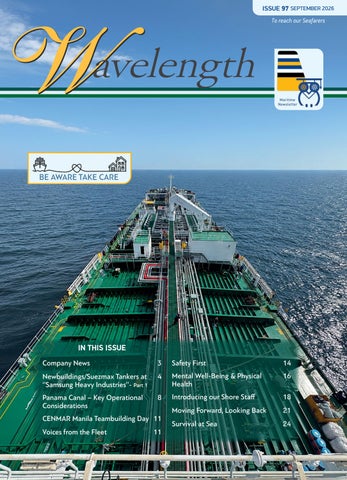
ISSUE 97 SEPTEMBER 2026
To reach our Seafarers
BE AWARE TAKE CARE
IN THIS ISSUE Company News
3
Safety First
14
Newbuildings/Suezmax Tankers at ‘’Samsung Heavy Industries’’- Part 1
4
Mental Well-Being & Physical Health
16
Panama Canal – Key Operational Considerations
8
Introducing our Shore Staff
18
Moving Forward, Looking Back
21
Survival at Sea
24
CENMAR Manila Teambuilding Day 11 Voices from the Fleet
11
Editorial Dear seafarers, The majority of submissions in this edition relate to change, and there are instances where change is inextricably linked to a move that will automatically result in a positive outcome. Therefore, it is easy to equate change with a force that will inevitably steer those affected in the right direction. While there are many quotes made by much wiser individuals than me that endorse this idea, I would suggest that blanket support for change without carefully considering the consequences can be a recipe for disaster. A case in point is hierarchy, which has recently provoked widespread debate. In shipping, however, structural hierarchy is fundamental to function and, therefore, any disruption to this system threatens the integrity of the vessel and the operations carried out by the crew. Of course, there are those who regard hierarchy as tantamount to tyranny, but this argument folds tamely in the maritime environment, where a leader’s active listening to the concerns of those on board and their right to speak up are considered integral to harmonious relationships built on mutual respect. Another theme widely incorporated into the subject of change is that it should, whenever possible, be based on a peoplecentric approach. The articles that highlight the importance of teambuilding, adopting a caring attitude and the need to understand another individual’s perspective reflect this without reservation. Then, there are the pieces that that illustrate how technological advances and meteorological phenomena can drive change. In
such cases, adapting to these external forces must be managed with the utmost care and requires expert guidance while steering a course towards the desired outcome. Last, but certainly not least, are the contributions kindly sent in to commemorate this year’s Day of the Seafarer. Your creative messages will resound loud and clear to our readers. Those who are well aware of the nature of your work and all that it entails will undoubtedly recognise your vast contribution to world trade. And those readers who may stumble upon this publication should be enlightened as to who is actually responsible for making society tick. I would like to thank all the contributors to this issue and give a special mention to Training Superintendent Oleksandr Soshyn, who rightfully draws attention to Chief Cook Doria Nestor along with his team Estrella Ricardo and Cerillo Joewel for their high quality work. The photos and interview in this piece are quite revealing as they demonstrate how taking pride in your wok can have such a positive impact on colleagues. I sincerely hope you enjoy this issue of Wavelength. If you have any comments, suggestions or questions regarding the content, please do not hesitate to contact me at Best wishes, contact@wavelength.gr. Nick Seaman
Day of the Seafarer 2026 – See more on page 11. These are images created by our Seafarers aboard M/V Venture and M/V Danae to commemorate this special day.
Disclaimer: The contents provided herewith are for general information purposes only and are not intended to replace or otherwise contradict the detailed instructions and procedures issued by the owners, managers, flag etc. The articles presented and the views expressed in the bulletin do not necessarily reflect those of the publishers. Editor: Nicholas Seaman • Email: contact@wavelength.gr • Design-Production: www.remdesign.gr
2
Issue 97-September 2026
Company . News
Our Digital Transformation
W
e have been considering how best to implement modern technologies to create added value for our operations, strategic planning and decision making processes for some time now. However, the distance between the point at which conception of the vision occurs and the point where this goal is achieved can be daunting. Therefore, the Company has launched a Digital Transformation Advisory (DTA) programme with LR Advisory, the consultancy arm of Lloyds Register. Having undergone a Digital Maturity Index (DMI) assessment that has identified the Company’s digital readiness to advance along a course of digital transformation, a roadmap has been created. LR Advisory with its vast experience will assist the Company in identifying areas that require targeted investment and improvement. As such, this significant project will allow the
Company to navigate the course through structured strategical phases of development and execution until implementation is achieved. Representing the Company from various departments in this milestone transformation are Konstantinos Lionis (ICT Specialist)/Project SPOC, Anastasia Malegou (HSQE Coordinator), Dimitris Fakiris (Deputy DPA), Marina Xanthi (Crew Assistant). Georgina Verropoulou (Chartering Assistant), Athina Ismyridou (Purchasing Officer), Yannis Vakkas (Fleet Supervisor), Patritsia Petsiti (PMS Engineer/ Technical Coordinator) and Aris Lekkas (Environmental & Energy Performance Engineer). This programme will not only align the Company’s digital capacity with current needs but it will also bolster preparedness to meet the demands of future developments.
Posidonia Running Event The Posidonia running event took place in Piraeus on 31st May 2026. In warm and dry conditions eight colleagues from Head Office with an esteemed ‘’guest’’, the Vice President of the Norwegian Hull Club, Oslo ran about 5 kilometres. The participants were Anthony Lambros, Vasia Papadopoulou, Spyros Tsaltas, Vaia Kyrodimou, Athina Reppa, Nikos Kontzias, Maria Malegou, Elli Moretti and Mr. Esten Falch Gjolmesli. Running approximately five kilometres in less than ideal conditions is an admirable accomplishment. So, well done to all those who took part.
3
Technical
Newbuildings/Suezmax Tankers at Samsung Heavy Industries By Yannis Pantos
As part of our Company’s ongoing expansion and modernization plan, a shipbuilding contract was signed with “Samsung Heavy industries” on 7th April 2025 for the construction of four (4) Suezmax tankers, which will be delivered at the end of each quarter of 2028. It is the third time that an order for Suezmax tankers has been placed to the Korean Shipbuilder. The new tankers will be equipped with machinery and systems of the latest technology, they will be energy efficient, environmental friendly and will comply with the latest Rules and Regulations of Class, Flag, OCIMF and Oil Terminals. The construction of subject vessels will be in accordance with the following key events schedule:
Tank Capacities (100% volume) Cargo Tanks (incl. Slop Tanks)
approx. 171,500 m³
Ballast Tanks
approx. 51,000 m³
HFO/VLSFO Tanks
approx. 3,050 m³
MGO Tanks
approx. 650 m³
F.W. Tanks
approx. 500 m³ Basic Machinery Particulars
Main Engine
Everllence 6G70ME-C 10.5 Ultra long stroke, electronically controlled Engine DMCR: 13,053 kW x 65.9 rpm NCR: 10,330 kW x 61.0 rpm Compliance with NOx Tier III with HP SCR System
Diesel Generators
Daihatsu 6DE-23 Output: 3x1,150 kW Compliance with NOx Tier III with LP SCR System
Aux. Boilers
Alfa Laval Aalborg Oil fired, vertical water tube boilers Two (2) sets – 2 x 35,000 kg/h (steam production)
Composite Boiler
Alfa Laval Aalborg Vertical, cylindrical boiler Steam production Oil fired section: 2,000 kg/h Exhaust gas section: 750 kg/h
Cargo Pumps
Shinko Steam turbine driven 3 x 4,000 m³/h
Key Events Schedule Hull No. SN 2744
SN 2745
SN 2746
SN 2747
To be named
NISSOS AMORGOS
NISSOS AGISTRI
NISSOS ANTIPAROS
NISSOS ANDROS
Steel Cutting
15/10/2026
23/12/2026
22/03/2027
27/07/2027
Keel Laying 05/07/2027
13/09/2027
17/01/2028
17/04/2028
Launching
11/09/2027
15/01/2028
15/04/2028
24/06/2028
Delivery
31/03/2028
30/06/2028
30/09/2028
31/12/2028
The principal dimensions & DWT, tank capacities and basic machinery particulars are indicated in the tables below: Principal Dimensions & DWT Length Overall (LOA)
274.0 m
Length between Perpendiculars (LBP)
268.5 m
Breadth (mld)
48.0 m
Depth (mld)
23.3 m
Design Draft (mld)
16.0 m
Scantling Draft (mld)
17.2 m
DWT at Design Draft
abt. 142,550 MT
DWT at Scantling Draft
abt. 156,850 MT
Ballast Pumps Shinko Electric motor driven 2 x 2,000 m³/h Main air compressors Control & G.S. air compressor H.F.O. Purifiers M/E L.O. Purifiers G/E L.O. Purifier
Figure 1: General Arrangement
4
Issue 97-September 2026
Atlas Copco 3 x 190 m³/h 1 x 500 m³/h
Alfa Laval 2 x 3,400 L/h 2 x 2,600 L/h 1 x 1,300 L/h
F.W. Generator Sasakura 30 tons/day
Compliance with Rules, Regulations and other Requirements The vessels will be classed with Lloyd’s Register of Shipping (LR) with the following Class notations: +100A1, Double Hull Oil Tanker, CSR, ESP, ShipRight (ACS(B,C), CM) LI, +LMC, UMS, ECO (P, VECS-L, EEDI-3, EAL, IBTS, GW), *IWS, BWTS, EGCS (Open, Partial), NAV1, DSPM4 with Descriptive Notes: ShipRight (BWMP(T,S), SCM, SERS, IHMEU), COW(LR), Cyber Resilience, BIOFUEL READY, ShaftRight (N:D), GR(NG,A)
• Energy Saving Devices (ESDs) The following Energy Saving Devices (ESDs) are provided: SAVER Fins (Samsung Advanced Vibration & Energy Reduction Fins) “SAVER Fins” result in increased power efficiency through flow improvement as well as improvement of the hull vibration level by mitigating propeller pressure fluctuation with equalized inflow.
• ShipRight (CM): Construction Monitoring: During the construction of the vessels, the critical areas (high stress concentration areas) should be thoroughly inspected prior to welding i.e. proper gap, alignment of structural members etc. • ECO (P, VECS-L. EEDI-3, EAL, IBTS, GW): The vessels comply with the requirements for environmental protection i.e. protected oil tanks, vapour emission control system, EEDI Phase 3, environmental acceptable lubricants, integrated bilge treatment system, grey water.
Figure 3: SAVER Fins
SAVER Stator D (Partial Duct) The “SAVER Stator D” results in power savings due to net thrust produced by the enclosed duct.
• Cyber Resilience: The ships comply with the requirements of IACS UR E26 and E27 for Cyber Security. • BIOFUEL READY: The use of biofuels has been technically analyzed and tested. The vessels will also comply with the following requirements:
• OCIMF, Mooring Equipment Guidelines, 4th Edition 2018 (MEG 4) • OCIMF, Recommendations for Oil and Chemical Tanker Manifolds and Associated Equipment, 1st Edition 2017 • ISO 21984: 2018, Ships and Marine Technology-Guidelines for Measurement, Evaluation and Reporting of Vibration with regard to ability on Specific Ships • ICS, Guide to Helicopter/Ship Operations, 6th Edition, January 2025
Figure 4: SAVER Stator D
SARB (Samsung Advanced Rudder Bulb) By providing the “SARB”, the flow separation behind the propeller cap is improved and the propulsion efficiency is increased by reducing the hub vortex.
Hydrodynamic improvements • Hull form optimization The vessels’ hull form has been optimized by applying a new bow shape design i.e. a vertical bow (without bulbous).
Figure 5: SARB
Figure 2: Bow shape
STAR Propeller (Samsung Tip Advanced Raked Propeller) This highly efficient propeller with a large diameter of 8.9m creates a lower propeller excitation force and propulsion efficiency is improved. The estimated fuel savings by combining all the above mentioned Energy Saving Devices are approximately 5%. The estimated total fuel savings due to combined effect of the optimized new bow design and all Energy Saving Devices are approximately 6.5%. It should be noted that the expected fuel savings on subject vessels will be approx. 1.5% more than our last Newbuildings at Samsung Heavy Industries i.e. Suezmax tankers Dino, Amalia M, Dimitri, Popi P, Costas P.
5
• Energy Efficiency Design Index (EEDI) The vessels comply with the EEDI Phase 3 requirements. The Energy Efficiency Design Index (EEDI), formulated for new ships, estimates the quantity in grams of emitted CO2 per transport work (g of CO2 per tonne-mile). The required EEDI for satisfying the Phase 3 requirements is 2.484, whereas the attained EEDI is 2.424.
Main Engine The Main Engine is an “Everllence” (ex-MAN) “G” type, “MEC” electronically controlled type Engine, which will be manufactured by “HD Hyundai Marine Engine Co., Ltd”. The “G” prefix stands for “Green-ultra long”. A G-type Engine’s longer stroke results in a lower rpm for the Engine driving the propeller. This lower optimum Engine speed allows the use of a larger propeller and is, ultimately, significantly more efficient in terms of Engine propulsion. Together with an optimized Engine design, this reduces fuel consumption and CO2 emissions.
Figure 8: Location of M/E main bearing #0
Furthermore, in order to enhance the reliability and safe operation of the Main Engine, as per our request a “M/E Main Bearing Temperature Monitoring System” will be provided in addition to the “M/E Bearing Wear Down Monitoring System” and the “Water in Oil Detection System”. The Engine Control System is based on the new generation “Triton” Controller Platform. The new controller platform is characterized by its: • increased engine flexibility for improved performance due to higher computational power and more advanced control functions • advanced controls for increased fuel flexibility and emission reduction • modular architecture for future upgrades • preparation for simple interfaces towards other ship automation systems • enhanced digital offerings
Figure 6: Main Engine
The Main Engine will be equipped with the PMI ACCo System, which is an automated system ensuring optimal Engine tuning across various loads, load ranges, changes, and fuel calorific values. Depending on the load profile, this system can achieve additional fuel savings of 1 to 3.5 g/kW.h.
Figure 9: MPC and new Triton Controller platform
• Compliance with NOx Tier III emission requirements In order to achieve compliance with NOx Tier III emission requirements, the vessels will be equipped with High Pressure Catalytic Reduction (HP SCR) System for Main Engine and a Low Pressure SCR (LP SCR) System for Diesel Generators.
Figure 7: Fuel savings for PMI ACCo system
Daily M/E F.O. Consumption at design draft & M/E NCR, Tier II mode: abt. 39.2 tons/day. As per our request and further to our discussions with Samsung, Engine Builder Hyundai & “Everllence” (ex-MAN), it was agreed that a main bearing #0 should be installed forward of main bearing #1 in order to reduce the load and improve the load distribution in main bearing #1.
6
Issue 97-September 2026
Figure 10: Main Engine fitted with High Pressure Catalytic Reduction (HP SCR)
Daihatsu’s LP SCR System is provided with a by-pass piping arrangement in way of catalyst elements, which results in their longer lifetime.
• Treatment of Sewage, Grey Water & Bilges An IMO approved, biological type Sewage Treatment Plant having a capacity for 32 persons is provided. A Grey Water Holding Tank of approx. 45 m³ capacity is provided. The vessels comply with the requirements of an IBTS (Integrated Bilge Treatment System). The treatment of leaked water and oil is carried out separately in order to minimize the amount of oily bilge water generated in machinery spaces.
Cargo System
Figure 11: Diesel Generator fitted with Low Pressure Catalytic Reduction (LP SCR)
• Compliance with SOx emission requirements An open-loop, U-type Scrubber is provided in order for the vessels to comply with the SOx emission requirements. The exhaust gases of the Main Engine, Diesel Generators and Composite Boiler can be treated by the Scrubber. The design of the Scrubber is sufficient for the treatment of exhaust gases of the M/E (M/E NCR load), two (2) Diesel Generators (2 x 90% load) and the Composite Boiler (1 x 100% load).
Figure 12: U-type, open loop SOx Scrubber
Ballast Water Treatment System (BWTS) The vessels will be equipped with a BWTS of filtration + sidestream electrolysis technology (Maker: SUNRUI). Capacity of BWTS: 4,000 m³/h.
Figure 13: Ballast Water Treatment System (BWTS)
Cargo Tanks & Slop Tanks are grouped into three (3) segregations. As per our request, fifteen (15) additional cargo valves will be installed and thus, the double-valve segregation will be maintained throughout the whole discharge operation, including stripping and COW operations. The vessels are equipped with three (3) Shinko steam turbine driven cargo pumps of 4,000 m³/h capacity each, one (1) cargo stripping eductor of 600 m³/h capacity and one (1) stripping pump of 300 m³/h capacity. An Automatic Unloading System (AUS) is provided for cargo stripping. The maximum loading rate is 12,700 m³/h, whereas the maximum discharging rate is 12,000 m³/h. The cargo pumps are provided with a fixed vibration monitoring system and a mechanical seal leakage detection system. The main & stripping suction valves and the main discharge valves are of the proportional type with intermediate position indication. A Linked Emergency Shut Down System for the cargo handling system is provided according to OCIMF relevant recommendations. Heating coils of aluminized steel (Sch. 80) are provided for the Cargo and Slop Tanks. The tank level gauging system of the Cargo and Slop Tanks is of the radar beam type. An independent high (95%) and high-high (98%) cargo tank level gauging system is provided. Two (2) tank cleaning machines are provided for each of the Cargo Tanks. As per our request the tank cleaning machine of Slop Tank(S) is of the submerged type for improving cleaning efficiency. Inert Gas System, Vapour Control System, Gas Detection System Two (2) Inert Gas Fans of 100% capacity each and two (2) fixed Oxygen Analyzers are provided for redundancy. An automated VOCON valve is provided on the by-pass line on the mast riser. Pressure sensors are provided in all Cargo and Slop Tanks. The cargo vapour control system is designed in accordance with USCG CFR 46 Part 39. Gas detection systems are provided in the P/R, Ballast Tanks, Accommodation entrance (P&S) in the Upper Deck & at the A/C fresh air inlet. (to be continued in the next issue)
7
Marine Operations
Panama Canal – Key Operational Considerations The Panama Canal remains a key operational and commercial consideration for vessels trading through the region. Current hydrological conditions, vessel draft, transit capacity, booking availability, fuel compliance and punctuality can materially affect both the feasibility and cost of a transit. The present situation is particularly relevant in the context of the strengthening El Niño conditions and the resulting pressure on rainfall as well as Gatun Lake levels. 1. DRAFT AND WATER-LEVEL CONSIDERATIONS The Canal operates with Panamax and Neopanamax locks. The design maximum draft is 12.04 m (39.5 ft) for Panamax vessels and 15.24 m (50 ft) for Neopanamax vessels. These are design limits and should not be treated as permanently available operating drafts. The maximum authorized draft for a specific transit may be reduced by the ACP in response to prevailing hydrological conditions. In 2026, the maximum authorized Neopanamax draft was reduced to 15.09 m (49.5 ft) from 3rd July. The ACP has subsequently postponed the planned reduction to 48.0 ft (14.63 m) to 2nd September 2026, and the further reduction to 47.5 ft (14.48 m) to 1st October 2026. Water density is also important when assessing the vessel’s effective transit draft. The ocean approaches are seawater, whereas Gatun Lake is essentially freshwater. The ACP uses a reference freshwater density of approximately 0.9954 g/cm³. Accordingly, the draft shown in the vessel’s loading documentation should not be compared directly with the Canal’s published maximum draft without applying the appropriate freshwater correction, particularly when loading close to the applicable limit. 2. TRANSIT CAPACITY AND BOOKING The ACP has announced temporary reductions in daily transit capacity in response to current watershed conditions. From 3rd September 2026, daily capacity will be reduced to nine (9) Neopanamax slots and twenty-five (25) Panamax slots. Panamax capacity will fall further to twenty-three (23) daily slots from 15th September. Lower capacity increases the importance of securing a reservation in advance, particularly during periods of stronger demand. For Neopanamax vessels, the regular booking framework includes the First Period (90–31 days before the intended transit date), Period 1.a (30–15 days), Period 2 (14–8 days), and Period 3 (7–2 days). Period 2 represents an important opportunity to secure a regular reservation. If a vessel is unsuccessful in obtaining a slot through the applicable regular booking process, available Period 3 slots are allocated through the auction process, subject to slot availability and the applicable ACP rules. Applications for Periods 1 and 2 are submitted daily at 09:00 hrs. Panama local time, with results generally available around 12:00 hrs. 3. PUNCTUALITY AND LATE-ARRIVAL EXPOSURE For booked vessels, punctual arrival is critical. Neopanamax and
8
Issue 97-September 2026
Panamax Plus vessels are required to comply with the applicable arrival window, and late By Nantia Loutinskaya arrival may result in a penalty based on the regular booking fee. The current penalty schedule is: Up to 1 hour late: 25% of the booking fee. More than 1 hour and up to 2 hours late: 50% of the booking fee. More than 2 hours late: 100% of the booking fee. In addition to the financial penalty, a late arrival may jeopardize the vessel’s ability to transit on the reserved date. For high-value bookings, schedule reliability should therefore be treated as a direct commercial consideration, not only an operational one. 4. DISRUPTION CHARGES AND VESSEL READINESS The ACP applies disruption charges where deficiencies or operational conditions affect safe navigation, transit operations or harbour movements. Depending on the vessel type, the nature of the deficiency and its impact classification, charges may range from USD 15,000 to USD 250,000 per event. Additional pilotage, launch, tug or other operational costs may arise separately. The following areas require particular attention before arrival and transit: Maximum draft: Confirm that the vessel remains within the current authorized draft, including the applicable freshwater correction and any temporary ACP restriction. Main engine and essential systems: Verify full operational readiness of the main propulsion plant and related systems. Maneuvering fuel: Confirm sufficient fuel and compliance with the applicable ACP maneuvering-fuel requirements. Air conditioning – critical: The wheelhouse and pilot accommodation must maintain 21–26°C and 40–70% relative humidity. Known defects should be reported before transit. A portable or split A/C unit on the bridge is strongly recommended as contingency equipment. Bridge equipment: Verify the proper functioning of windshield wipers, whistle controls, steering lights and other equipment necessary for safe navigation. Timing of deficiency reporting is also important. Conditions declared before the vessel gets underway are treated differently from deficiencies identified during transit. Where a deficiency develops while underway, the vessel generally has 30 minutes to correct it, subject to the applicable ACP rules and deficiency matrix. 5. MOORING LINE REQUIREMENTS – NEOPANAMAX The current ACP requirements for Neopanamax vessels must be fully complied with. Vessels are required to have six (6) mooring lines forward and six (6) aft, in good condition and immediately available for use before commencing transit. Wire ropes, as well as ropes composed of both wire and fibre or filaments, are not acceptable for Canal operations.
Depending on the vessel’s mooring arrangement, two (2) additional mooring lines stowed on winches fore and aft may be required. Each required mooring line must be at least 200 m long and have a working-end eye of at least 1.50 m, properly spliced in accordance with the rope manufacturer’s procedure. Lines must be maintained in good condition in accordance with the manufacturer’s requirements and/or the latest OCIMF Mooring Equipment Guidelines (MEG). Neopanamax vessels must also be arranged so the lines can be used at the Cocoli North or South tie-up stations. 6. FUEL COMPLIANCE Fuel compliance is a critical pre-transit requirement. Vessels entering Panama Canal waters must operate the main propulsion engines, boilers, auxiliary generator engines and other applicable equipment on compliant fuel such as alternative fuels (BOG, LNG, LPG, methanol and biofuels0, Zero-carbon fuels (ammonia and hydrogen) and Distillate marine fuels (MGO, LSMGO and MDO) or VLSFO/ULSFO with a maximum viscosity of 70 cSt at 50°C. Alternatively, an approved closed-loop scrubber operating in zero-discharge mode, or a hybrid scrubber operating in closedloop and zero-discharge mode may be considered. There is no viscosity limit for HSFO when used with an approved scrubber configuration. Open-loop scrubbers, including hybrid scrubbers operating in open-loop mode, are prohibited in Panama Canal waters. Where a fuel changeover is required, it must be completed before entering Canal waters: at least 8 nautical miles from the Atlantic Breakwater for southbound vessels and at least 3 nautical miles from the Sea Buoy at the Pacific Entrance for northbound vessels. The changeover must be properly recorded in the Engine Room
Logbook and/or Fuel Oil Changeover Record Book. The local Agent must upload the intended fuel/scrubber configuration together with the Bunker Delivery Note (BDN) through the Vessel Fuel Declaration requirement in VUMPA. ACP Boarding Officers may verify this information against the BDN or relevant fuel analysis documentation. Vessels fitted with approved scrubbers should also have the relevant IAPP Certificate and Supplement, effluent holding-tank information and applicable logbook entries available for inspection. For vessels anchoring before transit, VLSFO or ULSFO above 70 cSt at 50°C may be used for auxiliary generators, boilers and other ancillary equipment at the Pacific or Atlantic Anchorages, provided the main propulsion engine remains on compliant fuel. These auxiliary systems must be switched to compliant fuel at least two hours before the scheduled pilot time. 7. OPERATIONAL TAKEAWAY The key operational message is that Canal transit planning should begin well before the vessel reaches Panama. Draft must be checked against the current ACP limit and applicable freshwater correction; booking arrangements should be secured as early as practically possible; the vessel’s critical equipment and mooring arrangements should be verified in advance, and fuel compliance and VUMPA declarations should be completed without delay. With reduced transit capacity and potentially costly reservations, auctions and disruption charges, even a relatively small delay or technical deficiency can have a material commercial impact. Early verification and close coordination between the Master, Owner/ Charterer and local Agent are therefore essential to minimizing avoidable costs and protecting the planned transit date. Reference: Panama Canal Authority (ACP) Notices and Advisories current as of 31 August 2026.
The Mercator Map Open up a geography book at a page with a world map on it, look at a world map online, buy a world map to put up on a wall and the likelihood is that the map will be a Mercator map or projection. Remarkably, this map that is widely favoured today was created in the 16th century by the Flemish cartographer, Gerardus Mercator. It was a creation that first depicted our world as a two-dimensional The Mercator projection and The Equal Earth projection. Source: www.en.wikipedia.org Gall-Peters projection, which also addresses the size ratio problem image. Two centuries later, when the problem of determining longitude but grossly distorts the shapes of several countries. at sea was solved following the invention of a chronometer that However, due to the mathematics involved in representing a kept time accurately under maritime conditions, it was fully spheroid on a flat two-dimensional surface, it is not possible to adopted by navigators. Another advantage it had for marine depict both size ratios and shapes accurately at the same time. navigation was that the meridians were represented by straight Therefore, the Equal Earth projection creates warped geometry, lines, and not arcs. Despite its widespread adoption by mariners, especially in high latitude regions, where horizontal stretching the Mercator map has one significant flaw: the size of landmasses and compressions are apparent. Furthermore, local angles and are disproportionately larger the further away they are from the distances on the 2018 map are not accurate, and since its scale is equator. For instance, high latitude Greenland appears to be not uniform, measuring true distances to places far away is out of about the same size of Africa, when it is in fact around 14 times the question, thereby making the accurate plotting of bearing and routes an impossible task. In short, it is of little use for navigation. smaller. Another remarkable thing about the Mercator map is that it Despite this drawback, the vote on the resolution was is currently in the news! Certain African nations drafted a UN overwhelmingly passed at the recent UN General Assembly resolution to do away with the Mercator map on the grounds that in September 2026. As a result, even though the vote is nonthe smaller size of Africa on the map perpetuates the stereotype binding, it is likely that the Equal Earth map will be adopted by of Africa being comparatively unimportant. Under the resolution institutions across the globe. This means that for the first time in title ‘’Correct the Map’’,they wanted it to be replaced by the over 450 years the most commonly used map of the world will Equal Earth projection, which corrects this size discrepancy. Their change form. preferred projection, created in 2018, is an improvement on the Sources: www.en.wikipedia.org, www.reuters.com, www.bbc.com
9
Onboard Promotions Thirty two of our Seafarers were given a promotion during the second quarter of this year. The list of the ratings and officers aboard 21 Company vessels together with the names of those vessels and promotion details in chronological/alphabetical order appears in the table below. Promotion Date
Name
Vessel
Promotion Details
03.04.26
ROMEROSO Ramil
ANDONIS
04.04.26
SIBONGA Michael
04.04.26
Promotion Date
Name
Vessel
Promotion Details
3/E to 2/E
09.05.26
KUMAR Diwakar
CAPTAIN A. STELLATOS
2/O to C/O
DIMITRI
WPR to ASE
09.05.26
PADILLA Christian
CAPTAIN A. STELLATOS
AC to C/CK
VARFOLOMIEIEV Dmytro
DIMITRI
4/E to 3/E
18.05.26
PINUELA Ervin
SERENO
WPR to ASE
06.04.26
CANDELARIA Godwin
POLYMNIA
OS to AB
19.05.26
MOKRYTSKY Valeriy
COSTAS P.
2/O to C/O
15.04.26
FACUNDO Alvin
ALLIANCE
ENG/TR to WPR
01.06.26
VALENCIA Michael
NILOS
ASE to 4/E
15.04.26
LUCENA Benjie
AMALIA M.
ENG/TR to WPR
07.05.26
ARUMUGAM Satheesh
CE-HAMILTON
3/E to 2/E
16.04.26
ACEBEDO Jeremiah
DIMITRI
OS to ASD
08.06.26
KUMAR Amatjeet
WAVE
3/O to 2/O
23.04.26
HERASIMOV Ihor
APANEMO
FTR to APR/ ELEC
09.06.26
CRUZ Francis
NAMRATA
E/TR to WPR
24.04.26
KANTHAN Bargunan
MERAPI
TME to 4/E
11.06.26
MURUGAN THAMIZHARASI Rajagopal
SEMERU
3/E to 2/E
29.04.26
ANAND Dharmesh
SUNDORO
3/O to 2/O
11.06.26
ORTEGA Lewis
PSERIMOS
WPR to ASE
01.05.26
POTENTE Noel
NILOS
AB to BSN
11.06.26
SIDDIQUE Wasil
WAVE
4/E to 3/E
01.05.26
QUIETA Jowel
PSERIMOS
ASD to BSN
15.06.26
CENAL Jnel
PSERIMOS
OS to ASD
02.05.26
BARCASE Ricky
SEMERU
OS to ASD
23.06.26
VINLUAN Dhonearl
STEFANOS
OS to AB
03.05.26
CABLING Julius
CALLIOPE P.
STWD to C/CK
26.06.26
DELA CRUZ Justin Ferrer
MERAPI
C/TR to AC
04.05.26
ESCANER Val
RUBY
D/TR to OS
30.06.26
KOLISNICHENKO Kostiantyn
NAMRATA
3/E to 2/E
06.05.26
REJANO Joel
APAGEON
ASE to 4/E
07.05.26
RZHEVSKYI Ivan
SERENO
ELEC/TR to APR/ELEC
All those on the list are warmly congratulated on their promotions. As usual, I would like to give a special mention those of our Seafarers who have reached the top of the promotion ladder. These are Julius Cabling aboard M/V Calliope P. and Christian Padilla on Captain A. Stellatos, who have both been promoted to Chief Cook and have taken on the responsibility of providing their respective crews with tasty, nutritious meals. There are also another six Seafarers who are on the second to top rung. The first two, who are now Chief Officers, are Diwakar Kumar and Valeriy Moktrytsky aboard M/T Captain A. Stellatos and M/T Costas P. respectively. The other four are Ramil Romeroso aboard M/V Andonis, Satheesh Arumugam on M/T CE-Hamilton, Rajagopal Murugan Thamizharasi on board M/T Semeru and Kostiantyn Kolisnichenko on board M/T Namrata, each of whom has been promoted to Second Engineer. Those hot on their heels are also worthy of attention. They are Officers who aspire to move further up the ladder and have already shown their loyalty, which is one of the most admirable attributes, and one that will greatly assist them along their career paths. Once again, each and every rating and officer on the list deserves praise for displaying the commitment necessary in order to progress in their professional development.
10
Issue 97-September 2026
Crew Department
CENMAR MANILA TEAMBUILDING DAY Caliraya Resort, Laguna
On 25 July 2026, 24 members of the CENMAR Manila team, including myself, joined a teambuilding day at Caliraya Resort Club in Laguna. We left Manila at 05:00. Although it was an early start and a long journey, everyone was excited and full of energy. The good weather was perfect for outdoor activities. At the resort, we were divided into two teams wearing red and blue shirts. The main team activities were Unity Walk, Canoe and Earth Ball. These games tested our teamwork, communication, balance and coordination. Both teams competed with great energy, but always with laughter and good team spirit. After the activities, everyone was tired and ready for a well-deserved lunch. We then relaxed and enjoyed a lively karaoke session.
In the afternoon, the staff took part in different activities around the resort. These included the Adult & Wave Pool, Hamster by George Magioras Wheel, Slip N Slide, Super Slide, Superman Zipline, water biking. The event gave us a break from our daily office work. It also helped us get to know each other better, build trust and improve our working relationships. We left the resort at 15:00. On the way back, we stopped at a lovely coffee shop for coffee and snacks. We arrived back in Manila at 20:50, tired but happy. It was a long and enjoyable day, full of fun and good memories. The event reminded us that communication, cooperation and mutual support make every team stronger.
Voices from the Fleet
Day of the Seafarer 2026 – Your Voices across the Fleet This year, to mark the Day of the Seafarer and its theme “Carrying world trade. Carrying the risks.”, we invited our vessels to take part in a Fleet Challenge and share, through videos, stories, posters and photographs, what life and work at sea mean to them. We would like once again to sincerely thank all the vessels that participated: M/T A. Nikolaos, M/V Alliance, M/T CE-Hamilton, M/T CE-Bermuda, M/V Duke II, M/T Mikela P, M/V Polymnia, M/T Ruby, M/V Apageon, M/V Danae, M/T Merbabu, M/V Venture, M/V Philippos A., M/V Irina and M/V Niriis. Every contribution brought a different perspective, but together they reflected the same things: pride in the profession, teamwork, responsibility, sacrifice and the very real risks carried by those
who keep world trade moving every day. On the following pages, you can see a selection of the photos and posters submitted during the challenge and read some of the stories shared by our Seafarers. The submitted videos will also be uploaded to the News Section of the Company’s intranet in due course so that their messages can be viewed and shared across the fleet and ashore. Thank you to everyone who took the time to participate and, most importantly, for allowing us to see the Day of the Seafarer through your eyes and experiences.
M/V Philippos A.
11
M/V Irina Preparing for Gladstone: A Seafarer's Story When planning gets difficult due to workload and the next port requires a high level of readiness and compliance... Our bulk carrier was bound for the port of Gladstone to load coal for export. A few days before arrival, the atmosphere on board changed. Everyone knew that Australian ports maintain high standards for safety, quarantine, environmental protection, and vessel condition. The preparation began immediately. The Master called a meeting with the deck crew and assigned tasks. Every corner of the ship had to be inspected and cleaned. The main deck was washed down, rust spots were chipped and painted, and all safety signs were checked for visibility. Fire stations, lifebuoys, and emergency equipment were inspected to ensure everything was ready for any inspection. Meanwhile, the engine department was equally busy. Engineers checked machinery spaces, tested emergency systems, and ensured there were no oil leaks. The engine room had to be spotless. Even small deficiencies could attract attention during port inspections. One of the most important tasks was quarantine preparation. Australia has strict biosecurity regulations. The crew carefully inspected accommodation areas, stores, and deck spaces for any signs of pests. Garbage was properly segregated and secured.
Food storage rooms were cleaned thoroughly, and all records were updated. As we approached the Australian coast, the workload increased. The bridge team prepared navigation plans, checked charts, and reviewed arrival procedures. The Master conducted drills and reminded everyone of their responsibilities during port operations. On the day before arrival, the entire crew worked together. Deck crews touched up paint around the cargo areas, cleaned handrails, and secured loose equipment. The Bosun walked around the vessel with a checklist, ensuring nothing had been overlooked. Despite the long hours, everyone understood the importance of presenting the ship in excellent condition. At sunrise, the coastline of Queensland appeared on the horizon. As the vessel entered the approach channel to Gladstone, there was a sense of pride among the crew. The ship looked clean, organized, and fully prepared. When inspectors and port officials boarded during port stay their visit went smoothly. The hard work of the crew paid off. Standing on deck after the inspection, I realized that successful port calls are not only about navigation and cargo operations—they are also the result of teamwork, discipline, and careful preparation by every seafarer on board. Prepared by 2nd Officer Mark Chain Manus
M/V Apageon
M/V Niriis
12
M/V Danae
Issue 97-September 2026
M/V Ruby M/T Merbabu
M/T Agios Nikolaos
(Continued on page 21)
13
SAFETY FIRSΤ !
from the HSQE Department
MESSAGE FROM THE DPA:
Do the 5 HPP serve the right purpose across our fleet? Dear seafarers, The 5 HPP have been part of our culture for the past few years. I hope you have all heard about them, and that by now, we have all come to adopt the concept behind them. Nonetheless, I believe it is time for self-reflection: • Do you believe the “no blame” culture is supported by accountability on board your vessel? Ellie Moretti, • Do you believe GREAT Safety Leadership and respect for HSQE Manager /DPA onboard hierarchy go hand in hand? I will keep this message short, hoping that constructive self- criticism will kick in for each and every one of us. I wish you safe voyages and a safe return home, PS. Are you familiar with these 5 principles? Read more Elli Moretti in you relevant LET!
Safety during gauging and sampling of liquid cargoes Source: Britannia P&I “Crew Watch” June
Many liquid cargoes carried today – including petroleum products, chemicals, biofuels and cargo blends – may present hazards that are not immediately obvious from their appearance or smell alone. Even relatively common cargoes may release dangerous vapours, particularly when tanks are opened for manual gauging or sampling. UNDERSTAND THE CARGO HAZARDS Before commencing any operation, the Safety Data Sheets (SDS), cargo information and vessel procedures should be reviewed in advance. Pay attention to: • Toxic vapour risks (e.g. benzene, hydrogen sulphide) • Flammability and ignition risks • Oxygen depletion potential • Corrosive or irritant properties • Static accumulation risks • Vapour pressure and expected tank atmosphere. MINIMISE EXPOSURE TO VAPOURS: Avoid positioning directly over tank openings. USE APPROPRIATE PPE: Wear chemical-resistant gloves & goggles or face shields. GAS DETECTION AND ATMOSPHERE MONITORING: Monitor oxygen levels, flammable vapours and toxic gases. COMMUNICATION AND EMERGENCY PREPAREDNESS: Become fully familiar with the use of emergency alarm procedures, first aid measures, emergency shower and eyewash locations and rescue procedures. BUT MOST OF ALL: AVOID COMPLACENCY DURING ROUTINE OPERATIONS
And now a reason to celebrate: You will soon hear from us on this achievement, but in the meantime, on behalf of the Management and the whole office, please see the next page….!!!!
14
Issue 97-September 2026
ZERO ACCIDENTS
15
Mental Well-Being
When strength becomes silence
Why speaking up, respect and knowing your limits are part of staying safe at sea Life at sea asks a great deal from people. Seafarers learn to adapt quickly, work under pressure, live far from home and continue performing even when conditions are difficult. Experience teaches you to solve problems, keep going when plans change and remain calm when others depend on you. These are valuable qualities. But there is a point where being strong can be misunderstood. Sometimes strength becomes “I can manage”. Then “I can manage” becomes “I shouldn't complain”. And eventually, “I shouldn't complain” becomes silence. That silence can matter much more than we realise.
• “Can you show me again?” • “I think something is wrong here.” • “I made a mistake.” In a safety-critical environment, we need to be able to hear all of those sentences.
By Chara Markatzinou
The way we respond matters Speaking up does not depend only on the person who has something to say. It also depends on what happens after they speak. Imagine a cadet asking a question and being laughed at. Imagine a rating pointing out a problem and receiving an irritated response. Imagine somebody admitting a mistake and immediately being humiliated in front of the team. The next time, that person may think twice before saying anything. This does not mean standards should be lowered or that mistakes should not be corrected. Life on board requires discipline, accountability and clear authority. But there is an important difference between correcting someone and diminishing someone. We can be firm without humiliating. We can disagree without attacking. We can correct an error without making somebody afraid to admit the next one.
A crew member may be exhausted but say nothing because everyone else is also tired. A junior seafarer may not completely understand an instruction but hesitate to ask again. Someone may notice an unsafe condition but decide not to mention it because a previous concern was dismissed. Another may be struggling with something happening at home yet continue working as though nothing is wrong. From the outside, everything may appear normal. The work continues. The watch is taken. The job is completed. But continuing to function is not always the same as being okay.
The hidden risk of “just getting on with it” There is a strong tradition in seafaring of endurance and selfreliance. Both have helped generations of seafarers through demanding situations. But no person has unlimited capacity. Fatigue accumulates. Pressure accumulates. Conflict that is never addressed accumulates. So do worries, disappointment, loneliness and frustration. When people believe that admitting any of these things will make them appear weak or incapable, they become more likely to carry the burden quietly. And this is where a well-being issue can gradually become a safety issue. The person who is reluctant to say “I am struggling” may also hesitate to say: • “I am too tired to do this safely.” • “I didn't understand.”
16
Issue 97-September 2026
Therefore, the everyday behaviour of a crew influences much more than the atmosphere or morale. It determines whether people feel comfortable bringing information forward when something does not look right.
Real strength includes knowing when to speak Perhaps we should reconsider what resilience at sea really looks like. It is not simply enduring whatever comes until the end of the contract. Sometimes resilience is continuing. Sometimes it is recovering. Sometimes it is adapting. And sometimes it is recognizing early enough that something needs to change. A person who asks for assistance before exhaustion affects judgement is not failing. A crew member who raises a concern is not causing trouble. A junior officer who asks an additional question rather than pretending to understand is not showing incompetence. These can all be signs of professional responsibility.
What kind of vessel do we create for each other? Every crew member contributes to the answer. It is found in small interactions: how we react to questions, how we give instructions, how we speak when operations become stressful, how we handle mistakes and whether we notice when someone who is normally engaged begins to withdraw. Senior officers naturally have particular influence because their behaviour helps establish what becomes acceptable on board. But rank is not the only factor. Colleagues also affect whether someone feels included, respected and able to talk. Sometimes support is as simple as noticing.
• “You seem quieter than usual. Are you okay?” • “You look tired. Do you need a hand?”
• “Tell me what you saw.” • “It's okay — ask again.”
These are short sentences, but they send an important message:
Something to think about When somebody on board comes to you with a question, concern or problem, does your reaction make it easier for them to speak to you again next time?
You do not have to hide a problem in order to prove that you are strong.
Strong crews do not depend on silent people A good onboard culture is not one where nobody ever struggles, nobody disagrees and nobody makes mistakes. That crew does not exist. A strong crew is one where problems can come into the open early enough to be dealt with; where people can raise concerns before they become incidents; where pressure can be acknowledged before it becomes exhaustion; where mistakes can become opportunities to learn rather than reasons to hide, and where professional respect makes it easier — not harder — to speak. Seafarers are remarkably resilient people. Perhaps the best way to respect that resilience is not to expect people to endure more. It is to create an environment where nobody has to prove their strength by remaining silent.
Physical Health
Before you answer, you should consider that one day, what they hesitate to say may be something the whole vessel needs to hear.
By Chara Markatzinou
Your body is your working tool: protect your back, joints and muscles Working at sea places demands on the body that are easy to underestimate. Climbing ladders, lifting and carrying equipment, working in awkward positions, standing for long periods, repeated movements and even sitting for hours during watches can gradually affect the back, shoulders, knees and other joints. Pain does not always begin with one obvious injury. Quite often, it develops slowly. A stiff lower back after a watch, an aching shoulder after repetitive work or discomfort in the knees when climbing stairs may seem minor at first. When these warning signs are repeatedly ignored, however, they can become more persistent and eventually interfere with both work and everyday life. One of the best ways to protect the musculoskeletal system is simply to keep the body moving. Remaining in the same position for long periods increases stiffness. Short movement breaks, gentle stretching and changing position whenever possible can make a real difference. Even a few minutes of movement during the day can help maintain flexibility and circulation. Good technique is equally important. When lifting, keep the load close to your body, bend through the knees and hips rather than rounding the back, and avoid twisting while carrying something heavy. Most importantly, do not hesitate to ask for assistance or use mechanical aids when a load is too heavy or awkward. Strength should never be confused with taking unnecessary risks. Your shoulders and knees also deserve attention. Repetitive overhead work, frequent ladder climbing, kneeling and prolonged standing all place stress on joints. Where possible, change tasks or positions, use the correct equipment and avoid forcing a joint into an uncomfortable position. Regular exercise helps the body cope better with these demands.
You do not need an elaborate gym programme. Walking, bodyweight exercises, gentle mobility work and exercises that strengthen the legs, back and core can all support everyday function. The aim is not appearance. It is maintaining the strength and mobility needed to work safely and comfortably. Recovery matters too. Adequate sleep, hydration and balanced nutrition all help muscles recover after physical work. Most importantly, do not accept recurring pain as simply “part of the job.” Persistent pain, swelling, weakness, numbness or reduced movement should be reported and medically assessed. Listening to your body early may prevent a small problem from becoming a much bigger one. Your body is one of the most important tools you bring to work every day. Look after it accordingly.
17
Introducing our Shore Staff In this installment, we return with introductions to members of the HSQE Department, most of whom you will be quite familiar with through their presentations in our Forums, daily communications with you, onboard visits and considerable contributions to this publication. Nevertheless, their introductions are well worth reading as they reveal more about the people with whom you continue to build a relationship based on trust and mutual respect. So, let’s see what they have to say.
Maria Mothoniou (MAM) I have been part of the Company and the HSQE Department since July 2021, where most people know me as MAM. I first joined as a Risk Assessment and Management of Change Coordinator and later moved into the role of HSQE Officer. During this time, I have learned that procedures, policies, and regulations are not simply documents to be followed, but tools that should support people in their everyday work, both ashore and on board. One of the most interesting and exciting parts of my role is discovering how regulations and Company procedures are actually applied in practice, both on board and in the office, and how audits can help us understand whether our processes are working as intended or where improvement is needed. My responsibilities include document control, preparing and reviewing procedures, monitoring Masters’ Reviews, supporting and familiarizing Senior Officers with HSQE matters, maintaining SOLAS and FFE training manuals, conducting and following up internal audits, supporting external audits, monitoring Risk Assessments and Management of Change, tracking HSQE KPIs, following up near misses and unsafe acts, and cooperating with the Technical, Marine, and HSQE Departments on different projects, including RightShip, SIRE and TMSA requirements. However, the part of my role that I value most is the connection between shore and ship. When I visit vessels, I try to approach our Seafarers in a friendly, open, and honest way, often using humour to make communication easier and help people feel comfortable speaking with me. For me, this personal connection is very important because it allows our Seafarers to share the challenges they face, raise concerns, and feel that their feedback is heard. I believe that good HSQE performance is not only about asking people to follow procedures, but also about listening, building trust, understanding how things work in practice, and working together to make procedures useful, realistic, and effective.
Nastazia Malegou (A/MLG) Hello! I am Nastazia Malegou (A/MLG) and I have been with the Company since 2006. I first joined the Crew Department, where I had the opportunity to build a close connection with you, our SEAMEN, and gain a better understanding of the challenges you face while serving on board our vessels. Although I had to take a break from the Company for 2.5 years, I was fortunate to return in November 2017 to the Marine Operations Department. During that period, the Goal Zero programme was introduced and I was involved in its implementation along with several other tasks. Then in 2020, during the COVID era, I was internally transferred to the HSQE Department, where I continue to work today. My main responsibility in relation to the vessels is to provide support whenever possible and to serve as a reliable link between the office and our Crews. Whenever I communicate new requirements, procedures or documentation I always try to keep my messages as clear and simple as possible. I never assume that everyone is familiar with a new topic or process – just as we in the office do not always have first-hand experience of life on board. I believe that clear communication, mutual understanding and respect are essential to maintain a strong shore to ship relationship. My aim is always to support the vessels in a practical and approachable manner, ensuring that we work together as one team towards safe and efficient operations.
Despoina Nikolopoulou (DDN) Hello everyone! My name is Despoina and I am currently working as an HSQE Officer. My journey in shipping started in a rather unexpected way with the movie Titanic! After watching it, I decided that becoming a seafarer was what I wanted to do. Looking back, I guess I was more fascinated by the ship than by the love story! I graduated from the Merchant Marine Academy and spent five years at sea as a Deck Officer, mainly serving on board bulk carriers. Life at sea gave me valuable experience, taught me how to work as part of a team and, most importantly, taught me to stay calm when things do not go exactly as planned. After five years at sea, I decided to continue my career ashore and move into the HSQE field. My experience as a Deck Officer has given me a different perspective on safety, quality and compliance, as I have experienced the daily challenges of life on board myself. Today, as an HSQE Officer, I have the opportunity to combine my experience at sea with my work ashore, while continuing to learn something new every day. I am very happy to be part of the team and I look forward to growing professionally, sharing my experience and contributing to the safe and smooth operation of our vessels.
18
Issue 97-September 2026
Eleni Lykofridi (ELL) Hello everyone, My name is Eleni Lykofridi, and I am part of the HSQE team. I joined the Company almost four years ago, following nearly a decade at sea. From the age of 18, I travelled around the world while serving on board large oil tankers.As this was my first shore-based position, I expected the transition to be much more challenging. To my surprise, everything I had seen and learned on board was still relevant. It simply began to make more sense from this new perspective. At sea, we often follow instructions and procedures without fully understanding how they are developed or why the office requires certain actions. Working in HSQE (the department that essentially sets the “why” and the “how”) gave me a clearer understanding of the purpose behind those requirements and brought greater meaning to my career journey up to that point.My goal has, therefore, been to help bridge the gap between ship and shore. Alongside my regular HSQE responsibilities, such as inspections, incident investigations and risk assessments, I am particularly enthusiastic about contributing to projects that turn complex rules and requirements into practical guidance that can be easily understood and applied on board. Through my work, I hope I have helped our crews better understand the reasoning behind safety, while also helping my colleagues ashore gain a clearer understanding of life onboard and the way those at sea think and work. I wish you all safe seas and fair winds. Thank you.
Tina Korosi (TK) Hello everyone! My name is Tina Korosi (TK), and I joined the Company in 2005. With a background in Business and Marketing, I spent almost 10 years working with consumer products before joining our HSQE Department. Over the years, I have handled various HSQE tasks, but since our team expanded in 2019, my primary role has been data analysis and reporting on our quarterly and annual performance. From this position, I have the opportunity to work closely with colleagues from all departments, giving me a great view of how we reach our Company objectives and targets. It is always a true privilege to work with such skilled and supportive people. What is more, the shipping industry changes fast with new regulations, requirements and technology, so our work is always interesting! However, no matter what, our main goal at Head Office is to make your work easier and safer and to make sure you always get home safe! Wishing calm seas to all!
Dimitris Fakiris (DF) My name is Dimitris Fakiris, and I have been working in the maritime industry since 2014, primarily in HSQE and Marine Superintendent roles. For the past seven years, I have been serving as a Deputy DPA within the Company and my journey here has given me the opportunity to grow professionally, take on new challenges and, most importantly, work closely with the people who keep our vessels operating safely every day. Today, through my role in HSQE and, more recently, Training, I have the opportunity to combine two areas that I strongly believe go hand in hand: safety and people development. For me, training and safety are not simply about procedures, certificates, or fulfilling requirements. They are about giving people the knowledge, confidence, and support they need to perform their duties safely and professionally. I strongly believe in continuous learning, open communication, teamwork, and a practical approach to safety. Procedures and standards are essential, but a strong safety culture is ultimately built by people through their everyday decisions, their willingness to speak up, share experiences, learn from mistakes, and support one another. I want our Seafarers to feel that even if ship and shore are two ‘’separate’’ sides, we are one team working towards the same goals. We may face different challenges and carry different responsibilities, but ultimately we share the same goal: to support and learn from each other, to continuously improve, to develop our skills and above all, to make sure everyone returns home safely!
Olga Orlova (OAO) Hello everyone, I’m Olga Orlova. I support our HSQE team in training, drills, daily ship to shore communication and multiple areas that help our vessels operate safely and smoothly. I joined the Company two years ago, after previously working with the Cenmar Ukraine team. I really enjoy supporting our vessels through clear communication, practical guidance and teamwork. For me, safety is always about people first — helping everyone feel confident, supported and connected. One of my roles is to maintain a strong and reliable shore to ship connection that supports our vessels every day. Therefore, I focus on ensuring that everyone on board receives timely information, practical support and clear guidance so that they can carry out their duties safely and with confidence. Strengthening this communication bridge is something I truly value as being able to solve issues faster and support our people where it matters most helps us stay aligned. I am happy to be part of this team and to contribute to keeping our crews safe and our operations running smoothly. May your days at sea be safe, smooth and supported by fair weather.
19
Chara Markatzinou (MRK) For the past 27 years, the Company has been a big part of my professional life. During this journey, I have worked in the Marine Operations, Technical, Training and Crew Departments and, for the last six years, HSQE. One thing, however, has remained constant: my connection with our Seafarers and their training. Over the past few years, as Care & Welfare Coordinator, this connection has become even more meaningful to me. My background in English Literature and teaching may seem slightly unusual for shipping, but it has helped me bring together training, communication and, most importantly, a more personal approach. It was actually this role, and my growing involvement in supporting the well-being of our people on board, that inspired me to pursue studies in Life Coaching. I wanted to understand people better, listen more deeply and discover practical tools that could help people find their way through a difficult moment. Working closely with those at sea has also taught me a great deal. I deeply admire their resilience, strength and ability to keep moving forward, even when life on board becomes challenging. These are qualities I often remind myself to strive towards as well. My heart fills with gratitude when I see a difficult situation resolved, a crew member feeling a little better, or simply knowing that someone felt heard and supported. My aim is simple: to help make life on board safer, happier and a little more comfortable, and to make sure everyone knows there is always someone ashore willing to listen.
Vaia Kyrodimou (VEK) My name is Vaia Kyrodimou, and I have been working in the HSQE Department since February 2020. I started as an SMS Controller, but over the years my responsibilities have expanded. Today, I have a variety of responsibilities, not only in the field of Safety and Quality. I have the privilege of being a member of the Video Production Team, together with Andreas Chandris and Anthony Lambros. This is a creative and collaborative process that gives us great satisfaction, especially when we see you enjoying one of our videos. I am also a member of the Forum Committee. Being the youngest member of this eight-person team is both exciting and, at times, stressful. It requires courage to express your ideas, take responsibility and see projects through to completion. Last but not least, I have been responsible for the “Moving Forward, Looking Back” column in Wavelength since December 2023. You may have already read some of the interviews I have had the pleasure of conducting over the years. I have always enjoyed meeting and talking with you in person, and I feel very lucky whenever I have the opportunity to attend the Forums, visit our vessels, and meet you during the familiarization sessions at the office before boarding. Wishing you all safe seas, and I look forward to meeting each and every one of you in person in the near future!
Elli Moretti (EM) I am Elli Moretti, your DPA, and I hope this acronym means trust and care to you. I am so proud to have been part of this Company since the beginning; this is, after all, my extended family. Maybe we have met during my visits on board or our forums over the years, but there are many of you I have not yet met in person. That is why I am sharing once more that… …my sole task is to ensure you Get Home Safe. It sounds simple, but it is a constant struggle in our ever-shifting industry. Having said that, building our safety culture together is what makes things easier and drives us to maintain a great achievement. This achievement is that we have never lost a life to an accident on board our vessels over the years. This is our common aspiration and our motivation to evolve together towards excellence. A final message to our Seafarers: Help us understand what your life on board is like, be honest and fair, and we will do our best to always make things safer for you. Stay Safe!
Olga Kostrynina (OVK) My name is Olga Kostrynina (OVK). My journey with the Company started back in 2011, when I became part of the Cenmar Ukraine office staff. Later, in 2022, I started working at Head Office in the HSQE Department. Currently some of my responsibilities are: a monthly follow up of Drills/Meetings/Training, a Marine Trust e-learning platform follow up and other related training items. The Company has become the big part of my life and I am happy and proud to be part of it. Safe seas to everyone!
20
Issue 97-September 2026
Moving Forward, Looking Back The global maritime market is currently experiencing a powerful resurgence driven by evolving environmental regulations, shifting global trade routes, and a critical industry-wide push for fleet renewal. For our Company, as for the majority of shipping companies worldwide, ordering a number of newbuilding vessels has been the response. The Company commenced with 1 vessel “M/T NINEMIA” back in 1993 and now has expanded to more than 50. By the end of 2028 the fleet will have increased to around 65 vessels. I remember when I was hired in 2020, the fleet had just 29 vessels. Today, we are incredibly close to having doubled that number. As you can imagine, this rapid fleet expansion naturally requires a parallel growth in our workforce, both on board and ashore. We are thrilled and proud of this development but each coin has two sides. Our new Seafarers need time to understand the Company’s culture, familiarize themselves with the SMS, and adapt to our working mentality of prioritizing safety. At the same time, our experienced crew members must dedicate time to guide and
Voices from the Fleet
help newcomers integrate seamlessly into the team. Simultaneously, the same applies to the office. In 2016 the Company consisted of 75 persons at Head Office, and now there are more than 160 of us. The corresponding By Vaia Kyrodimou number of our Seafarers has risen from about 1200 to around 2300. As each new generation arrives with fresh ideas and different ways of working, they need to feel heard and recognized to facilitate their integration. In order to accomplish this, all of us will have to do our best by means of cooperation, teamwork, proper communication and mutual respect. The next couple of years will bring major changes! We are looking forward to them!
Movement is the way to keep going. Movement is the way to improve. Movement is the way to evolve.
(Continued from page 13)
Excellence from the Galley – M/V Coral Island During his visit to M/V Coral Island in July, our Training Superintendent, Capt. Oleksandr Soshyn, was particularly impressed by the high catering standards maintained on board. Special recognition was given to Chief Cook DORIA Nestor and his team, Messman SALGADO Robert Chan and Steward CERILLO Joewel, for the care, skill and consistency they bring to their daily work. The meals prepared on board were praised not only for being healthy and nutritious, but also for their excellent taste, variety and presentation. In fact, the overall standard was described as comparable to that of a high-quality restaurant — something clearly reflected in the accompanying photos. Good food on board is about much more than simply preparing meals. It contributes to well-being, morale and the small moments of enjoyment that can make a real difference during life at sea. Behind every well-prepared dish are planning, effort, creativity and a genuine desire to take care of the people you work and live with every day. We would, therefore, like to warmly congratulate C/S DORIA and his team for their outstanding performance and for setting such a positive example. We also invited C/S DORIA to share with us what inspires and motivates him to maintain such high standards — and what drives him to put so much care into every meal he prepares for his fellow seafarers. What do you believe makes a meal truly enjoyable and satisfying for the crew? A truly enjoyable meal is fresh, well-balanced and prepared with care. It should provide good nutrition, suit the crew’s tastes as much as possible and be serve on time. A good meal not only satisfies hunger but also helps improve morale and gives the crew something to look forward to after a hard work day. How do you plan varied and nutritious meals while taking into account the provisions available, as well as the crew’s different nationalities, tastes and dietary preferences? I prepare the menu in advance based on available provisions and ensure there is a balance of protein, vegetables, carbohydrates, and fruits. I rotate different cuisines and dishes to avoid repetition and consider the crew nationalities, preferences and any dietary requirements, I also listen to crew feedback so I can improve future menus. What inspires you in your cooking, and where do you find ideas for new dishes or ways to improve familiar recipes? My inspiration comes from making the crew happy and healthy. I learn from my experience, recipes from different cultures, cooking videos and ideas shared by other chief cooks. I also like to improve familiar recipes by using fresh ingredients, better seasoning and attractive presentation.
21
Pioneers of the Waves
Roald Amundsen Roald Amundsen was born into an extended there, they would head to the South Pole. The family of shipowners on 16th July 1872 in Borge team of five men, including Amundsen took near Oslo, Norway. He was the fourth son, and four sledges and 52 dogs with them, and they his mother wanted him to follow in his father’s won the race to the southernmost point on our footsteps. He was a doctor, who also wanted planet. Their precise preposition was the main Roald to study medicine rather than become reason they beat Robert Falcon Scott’s team, involved in a career at sea. He respected which was beset by setbacks, by a month. In his parents’ wishes, but when they died, he January they left the Antarctic for Hobart, where abandoned his medical studies to begin a life at they sent news of their achievements to their sea. Prior to studying medicine, Roald Amundsen backers via telegraph. Unfortunately, Scott and had read Sir John Franklin’s accounts of his his group never left the Antarctic. expeditions in the Arctic. He was captivated by This accomplishment made raising funds much them to such a degree that he admitted his life easier. He was able to acquire several ships, one had been shaped by them. of which was Maud. It was aboard this ship that Roald Amundsen, the expedition's Amundsen’s first voyage, however, was to the leader. Source: www.wikipedia.org Amundsen intended to drift over the North Antarctic. He was a member of the 1897 Pole. However, his plans were scuppered Belgian Antarctic Expedition aboard when ice trapped the ship, eventually forcing the Belgica, serving as first mate. It was a Amundsen to admit defeat. milestone voyage into the Antarctic as this Despite this setback, he did not abandon vessel was the first to spend the winter his goal of reaching the North Pole. So, he there after becoming icebound west of the turned to aircraft as a means of succeeding in Antarctic Peninsula. This unplanned event his quest. Amundsen’s first attempt, aboard a put the crew in danger of scurvy. Fortunately, flying boat, fell short of his destination as the though, the doctor on board advised them craft only reached 87o 44’ N. This was in 1925. to hunt because raw meat contained enough The following year, he departed Spitzbergen vitamin C to keep scurvy at bay. in an airship called Norge, crossed the Pole Amundsen, Hanssen, Hassel, and Wisting at and landed in Alaska. Whether Amundsen The next expedition Amundsen participated Polheim at the South Pole. and those aboard Norge were the first to the in was to the Northwest Passage in 1903. Source: www.wikipedia.org North Pole is still in dispute. Two years later, Aboard his vessel, a four-ton sloop called Gjoa, formely owned by another Norwegian explorer Fridtjof Amundsen went missing when he was on a rescue mission on his Nansen, he led a crew of six. They travelled through Baffin Bay flying boat to find survivors of an airship that had crashed during before reaching a harbour on King William Island, where they its during its return from the Pole. spent two winters. During that time they learned valuable Arctic survival skills from the local Inuit. Then headed west, eventually reaching Nome on the Pacific coast. The crew returned to Oslo in 1906.
Maud, 1918. Source: www.wikipedia.org
Belgica trapped in the ice, 1898. Source: www.wikipedia.org
Initially, his next objective was to explore the Arctic basin, but events conspired to change his destination to the South Pole. He set off for the Antarctic in June 1910 on Fram also previously used by Fridtjof Nansen. In December of the same year Amundsen reached the Ross Ice Shelf. From a base camp they established
22
Issue 97-September 2026
Roald Amundsen is among the greatest of explorers, and is still considered a national hero in his native Norway. His accomplishments of navigating the Northwest Passage, obtaining valuable scientific data, being the first to reach the South Pole and crossing the North Pole stand out in the history of humankind. Additionally, he paved the way for access to remote areas of the globe, which has provided us with a greater understanding of the planet we live on. Sources: www.britannica.com, www.en.wikipedia.org, www.arcticportal.org, www.secretatlas.com
Fun
Corner
1. The settlement with the longest name in the world contains 58 characters. It is a Welsh village called Llanfairpwllgwyngyllgogerychwyrndrobwilllantysiliogogogoch. It is also known as Llanfair PG.
2. The shortest scheduled flight covers a distance of just 1.7 miles (2.7km) between the two Scottish islands of Westray and Papa Westray. The flight time is about 90 seconds.
Test your Brain
1. Make the names of FOUR Company vessels using all the letters in the following sentence: PARIS AND RON SEEM SERIOUS, MINI.
4. Which five-letter word can be placed after the words to the left and before the words to the right?
2. The letters in the chemical symbols for bromine, gold, hydrogen and magnesium can be rearranged to form the name of a European port. What is the name of the port?
5. In 5 steps change the word GOOD to BEST by changing one letter at a time to form intermediate words.
3. Which three-letter word can be used to complete the following words: EX_ _ _ SES, S_ _ _ DING, DEE_ _ _ and O_ _ _ NING?
HEAVY GREY RUNNING
------
TABLE DAMAGE SLIDE
6. In family of five, the combined ages of the three children add up to their mother’s age. The youngest child, who is ten, is a quarter of the age of her mother and one fifth of the age of her father. How many years ago were the children’s combined ages one quarter of the combined ages of their parents?
Answers at the foot of the page
3. A small mammal called an Etruscan shrew has an extremely fast metabolism. It has a heart rate of about 1500 beats per minute and must consume between one and a half times to twice as much as its body weight per day. It cannot survive for longer than a few hours without food.
Quiz
2. Pork Sisig is a popular Filipino dish that originated in Pampanga. Which century can this culinary delight be traced back to? A. 17th B. 18th C. 19th D. 20th 3. How often should a Lube Oil analysis of the gearbox oil of a windlass be conducted by a laboratory? A. monthly B. quarterly C. every six months D. annually 4. Which vessel was on her way to New York with a cargo of about 13,600kg of gold when she sank off the coast of the Carolinas in 1857? A. SS Central America B. Royal Charter C. San Joaquin D. SS Archimedes
6. MSR technology in a maritime environment is comparable to a battery that provides up to 25 years of carbon-free propulsion. What does the ‘S’ in MSR stand for? A. System B. Synchronized C. Safety D. Salt 7. Which Company vessel was built in the Philippines? A. M/V Apageon B. M/V Coral Island C. M/T Agios Nikolaos D. M/V Venture 8. Which Company vessel was awarded a ‘Certificate of Merit’ for support to the Amber System by the USCG and DHS in 2018? A. M/V Casta Diva B. M/T Sundoro C. M/T Leni P. D. M/T Sereno
• Fun Corner Answer: 4 • Test your Brain answers: 1. ANDONIS, IRINA, PSERIMOS, SEMERU 2.Hamburg 3. PEN 4. WATER 5. GOLD, BOLD, BOLT, BELT, BEST 6. 7 years • QUIZ answers: 1. D 2. A 3. C 4. A 5. B 6. D 7. A 8.C
Answers
5. When was the Marshall Islands Shipping Registry established? A. 1976 B. 1988 C. 1994 D. 2000
Answers at the foot of the page
1. If your vessel was in the northernmost port in Europe, what country would you be in? A. Iceland B. Sweden C. Finland D. Norway
23
Survival at Sea
Vidam Perevertilov On 16th February at about 4 am, Vidam Perevertilov, the Chief in the water for about six hours. As soon as he was declared Engineer aboard the Silver Supporter had just completed his missing, the ship sent out a distress call. This prompted French night shift. At 4 am he filed a log report, after which he felt a little navy aircraft to begin a search based on the time he disappeared dizzy. So, he went out onto the deck, hoping that some fresh air and meteorological information on wind and current patterns would make him feel better. However, at some point he probably provided by the French service. This information was also relayed fainted because he could not remember falling overboard. What to ships in the area, including the Silver Supporter. he did remember, though, was regaining The speck that Vidam Perevertilov had swum consciousness in the water and watching towards turned out to be an old fishing buoy on helplessly as the ship became cloaked in that enabled him to keep his head above darkness. water. Fortunately, he was able to reach When Vidam Perevertilov went overboard, the buoy because the wind and current the 167-foot (51 m) Silver Supporter was conditions gave him enough assistance to do on the way to the remote British territory of so. Eventually, his own ship was the vessel that Pitcairn Island from New Zealand. The supply located him. A fellow crew member heard a ship, which acted as a lifetime for the fifty or faint voice cry out and a lookout saw his so permanent residents of the Island, was Vidam Perevertilov. Source: www.stuff.co.nz hand reaching above the waves. They threw a about 400nm south of French Polynesia’s lifebuoy to him and got him on board. southernmost Austral Island at the same time the Chief Back on the Silver Supporter, the Chief Engineer was parched, Engineer fell into the Pacific Ocean. After surviving until dawn, exhausted and had visibly “aged” due to his ordeal. He made a he desperately needed his own lifeline as he was becoming full recovery, and given the scale of the Pacific he was considered weaker. Fortunately, he spotted a black speck in the distance and to have been extremely lucky to spot the abandoned fishing summoned his remaining strength to swim to it without knowing equipment and swimming towards it, a decision that was exactly what it was. ultimately given credit for saving his life. Meanwhile, on board the Silver supporter, the 52-year-old’s Sources: www.theguardian.com, www.nbcnews.com, www.ndtv.com crewmates were unaware that he was missing until he had been
John Michael Grimes John Michael Grimes boarded the Carnival Valor on 23rd enough to swim towards. He forced himself through the pain November 2022 for a Thanksgiving cruise along with 17 family barriers inflicted on him by the stings and by being badly sunburnt members. The cruise from New Orleans to Cazumel, Mexico was through his shut will to see his loved ones again. Miraculously, his meant to allow him to spend some quality time with his extended cries for help were heard by a crewmember on a passing tanker, family and give him some time off from his job as a construction who responded by attaching a flashlight to a life preserver and worker. However, the five-day cruise did not go according to plan. throwing it in the water towards him. Grimes couldn’t grab it On the first evening, the 28-year-old entered an air guitar through due to the waves pushing it away. competition. He won, went out on deck and fell overboard At that point he was becoming desperate, but a shout telling him into the Gulf of America. The next thing he remembered after that the USCG was just 15 minutes out gave him a boost. When his victory was coming round in the water from the fall, which the helicopter arrived, a rescuer swarm to him and loaded him rendered him unconscious. By that time the ship was nowhere into a basket, in which he was winched to safety. to be seen. According to the USCG Aviation Survival Technician on the The following morning, his sister reported him missing, which led helicopter, his reaction to being saved was not to cry, to go to the VSCG conducting an intense search. into shock or become ecstatic, which are Meanwhile, Grimes was drifting with the considered normal. Instead, he showed current, and the effort he was putting in to stay no emotion whatsoever, which led the afloat was taking its toll. During his struggle, Technician to conclude that John Michael two encounters with swarms of jellyfish had Grimes could have held on for a couple left him with several stings on his legs, arms of minutes longer at most. He was given and neck. He also had a confrontation with a treatment for hypothermia, dehydration, his large fish, which caused him to expend more stings and sunburn before being discharged energy. and returning to his family. John Michael Grimes after recovering Sources: www.people.com, www.abc7.com, At sunset, about 20 hours after he’d fallen www.independent.co.uk from his ordeal. www.people.com into the Gulf, Mr. Grimes saw a ship close