
Dear
Nowadays, there seems to be a great deal of uncertainty about how new technology will change the lives of the vast majority of us. While uncertainty is nothing new, the current level has risen to new heights, giving rise to speculation about where humankind is heading. There are also concerns about the potential of intense oceanic and atmospheric conditions disrupting agriculture, thereby causing widespread food insecurity. Additionally, there are geopolitical events, incidents of social unrest and viruses that threaten to destabilize several industries, and in turn countries.
As a result, a number of doom and gloom scenarios have been voiced. These have been met with a range of reactions, most of which have the ability to cause panic. Fortunately, our industry is not one of those in the grip of fear for several reasons, the most important of which is resilience brought about primarily through what I have called the four ‘P’s: Positive, Prepared, Protected and Pleasant.
The first ‘P’ refers to positive thinking, which does not mean looking at the world through rose-tinted glasses. It means that any adverse event or condition is best viewed as having something positive emerge from it. For instance, it could be an appreciation of the skills, training and abilities used to overcome the adversity, or what has been gained in learning from the experience. In other words, the bottom line should be a net positive.
This is exemplified in the Marine Operations and Moving Forward, Looking Back contributions. The title of the former asks whether AI will take specific bridge duties, which gives the technology a decidedly negative connotation. However, the analysis put forward by Captain Delson Roche, which utilizes a positive thinking approach is convincing enough to allay fears of redundancy. A similar stance is adopted by Captain Nishant Mehta in the latter piece as he acknowledges technology is here to stay and that those in this industry must make the most of it.
The Technical article is about maintaining the integrity of hatch covers so that vessels can safely transport cargoes without compromising them. Thus ensuring that a vessel is properly prepared and protected leads to making the process of shipping more resilient. The Crew Department’s piece on the threat of viruses
also incorporates the second and third ‘P’s as it offers invaluable advice about specific viruses as well as how to be prepared for and protected against them.
Being positive, prepared and protected are also fittingly highlighted in the Safety First section, in which shared learning on the most common minor injuries and an unexpected incident can be taken as a positive step to avoiding harm or damage in the future. In the Mental Well-Being and Physical Health submissions the concept of ‘’ healthy body, healthy mind ’’ is linked to our Seafarers’ need to be prepared for and protected against the rigours of daily challenges and demands of life on board.
Last but certainly not least is the Voices from the Fleet installment, which incorporates all four ‘P’s thanks to the contributions from Captains Hassan Moin Uddin and Briones Guelbert together with many excellent images. The positive aspects shine through during the descriptions of their cultural celebrations against a backdrop of chronic awareness. The focus on the last ‘P’ lies in the Company’s zero tolerance policy on bullying and harassment. Being pleasant would eliminate these negatively charged behavioural traits, and it costs nothing! Indeed, being pleasant reflects a positive attitude that leaves those on board protected from the mental distress brought on by such traits, and prepared for a much more enjoyable experience with fellow crew members on long, arduous voyages.
I would like to thank all the contributors to this issue. The time and effort you have put in are very much appreciated. Of those not directly mentioned in this Editorial, I would like to express my gratitude to Training Supervisor, Bosco Fernandes, and new contributor, Aristeidis Lekkas, along with Elli Moretti, Chara Markatzinou and Vaia Kyrodimou from the HSQE Department, whose help, suggestions and contributions make Wavelength what it is.
I sincerely hope you enjoy this issue of Wavelength. If you have any comments, suggestions or questions regarding the content, please do not hesitate to contact me at contact@wavelength.gr.
Best wishes, Nick Seaman
Read about the Mumbai Forum on page
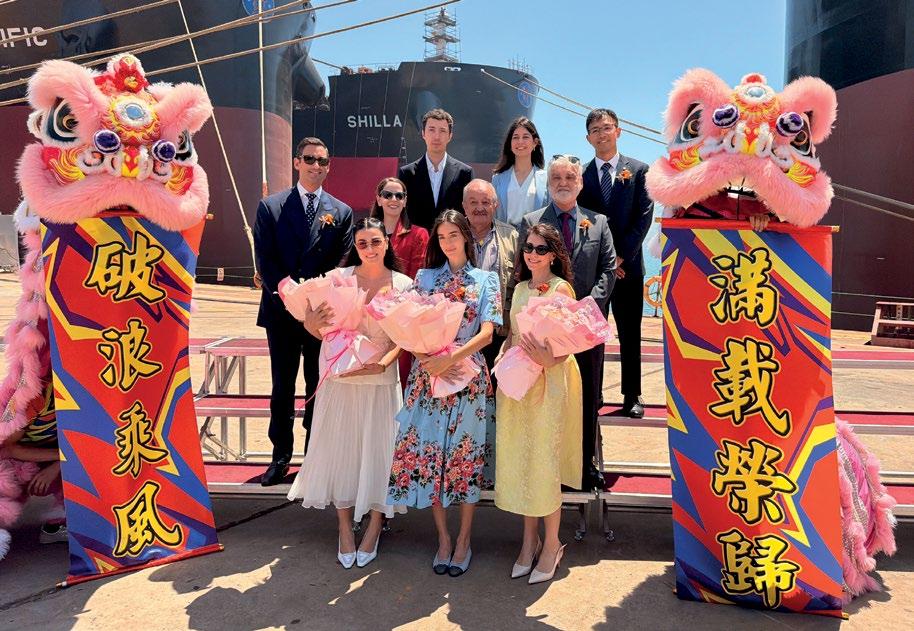
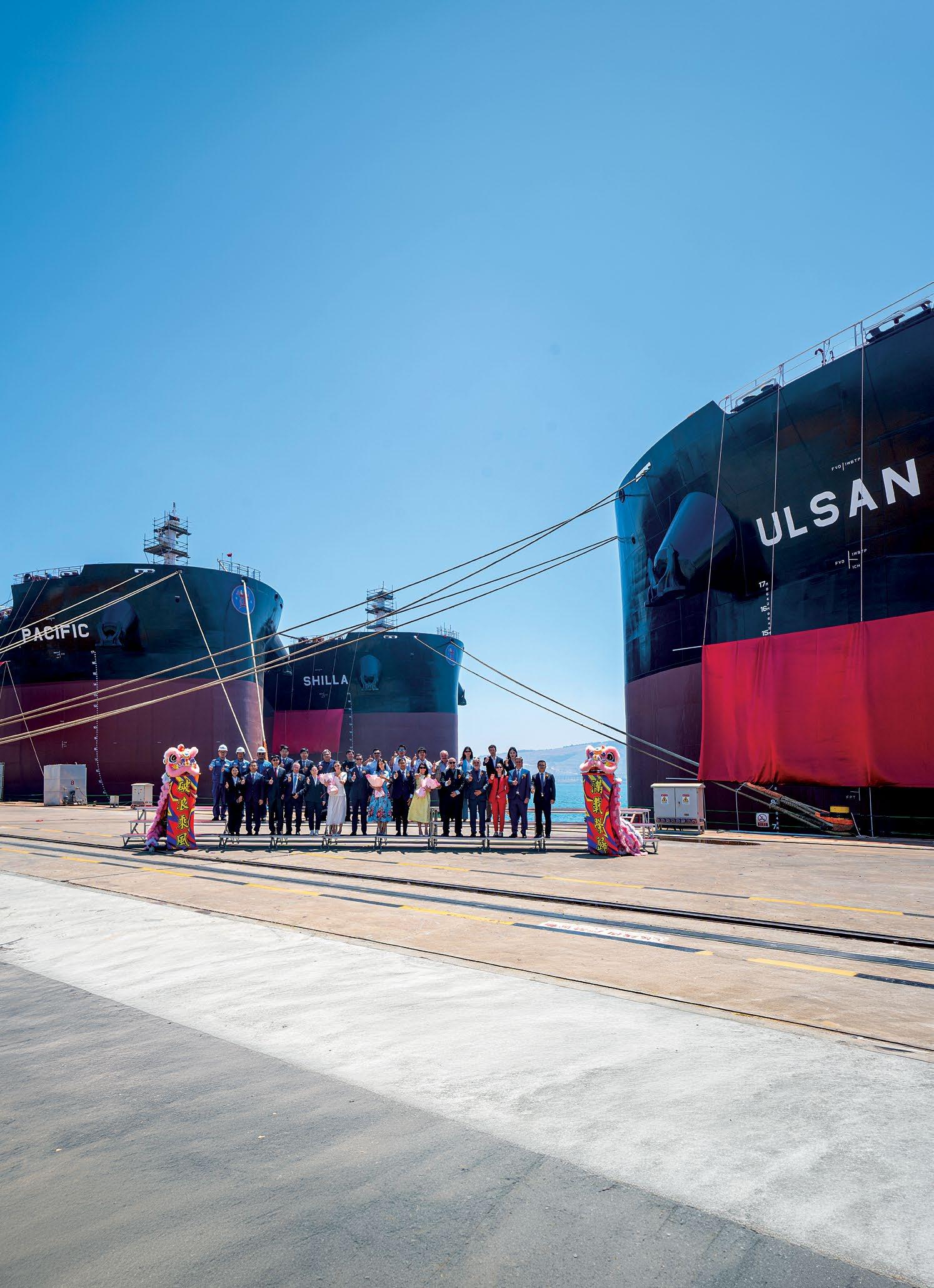
Rarely does one have the chance to witness a Triple Naming Ceremony. The simultaneous naming of three vessels is a spectacular scene in itself, reminding all present of the size and scale of these shipbuilding accomplishments. Hengli Heavy Industries in Dalian, China is the largest single shipyard in the world, truly impressive in more ways than one.
The vessels in question are three kamsarmax bulk carriers – the sister ships M/V Ulsan, M/V Pacific and M/V Shilla, all 82,000 DWT, scheduled for delivery in June, July and August 2026. They are the first three of a series of eight identical ships that will be delivered to our group within 2026.
Our Company was represented at the highest level by CEO
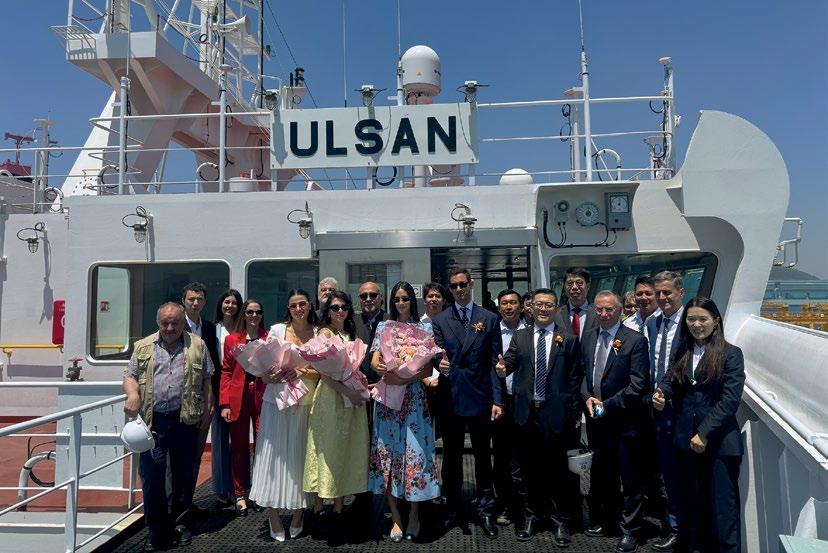
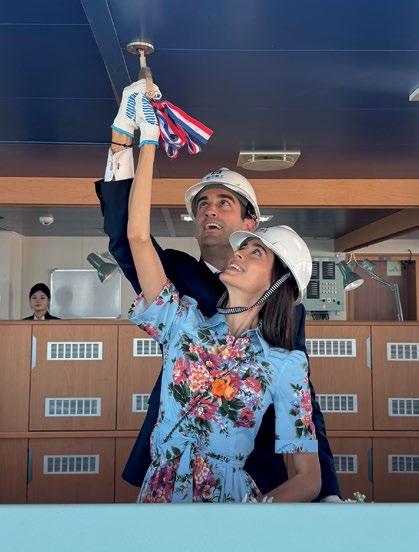
Yannis Procopiou, COO Anthony Lambros and Technical Director Ioannis Pantos. Sunny weather assisted in a truly great day, with moving speeches by Hengli CEO Chen Hanlun, as well as our CEO and three wonderful godmothers, Valentina Procopiou, Stella Koulatsidou (Compliance Officer) and Margarita Tsaousi (Chartering Broker). The ceremony was followed by a visit on board the ULSAN and the traditional first sounding of the vessel’s horn.
The naming ceremony and subsequent delivery mark not only a new beginning but also an ending – the completion of a project for which a group of people has invested timeless effort and dedication. Full credit should be given to our own site supervision team, led by veteran Paul Birleanu along with a younger team consisting of Konstantina Fountouli, Korina Zervou and Christos Pantos, as well as a team of local supervisors. In a matter of hours the music stopped, the confetti was blown away and the nice words became a memory; however, this team continued tirelessly inspecting block after block, pipe after pipe, equipment after equipment to ensure that all ships will live up to the required standards and provide a safe home for our Seafarers.
We thank our supervision team for their hard work, their resilience and their continuous commitment to achieve the best possible results in a challenging and demanding environment. We wish safe voyages and calm seas to these three ships and all those who sail upon them.
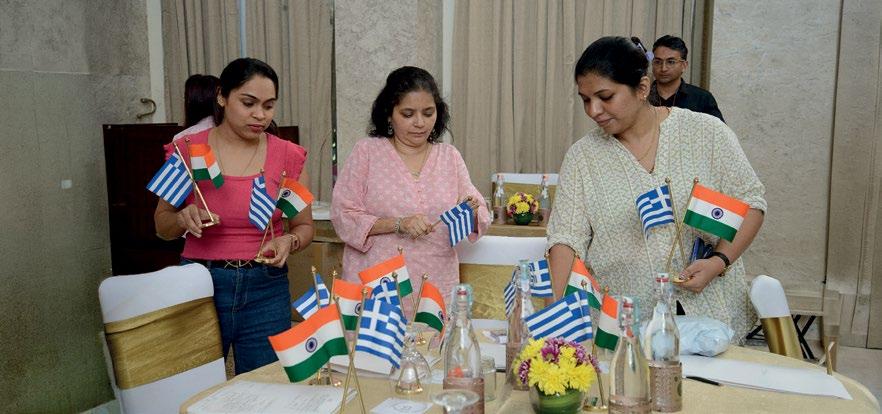
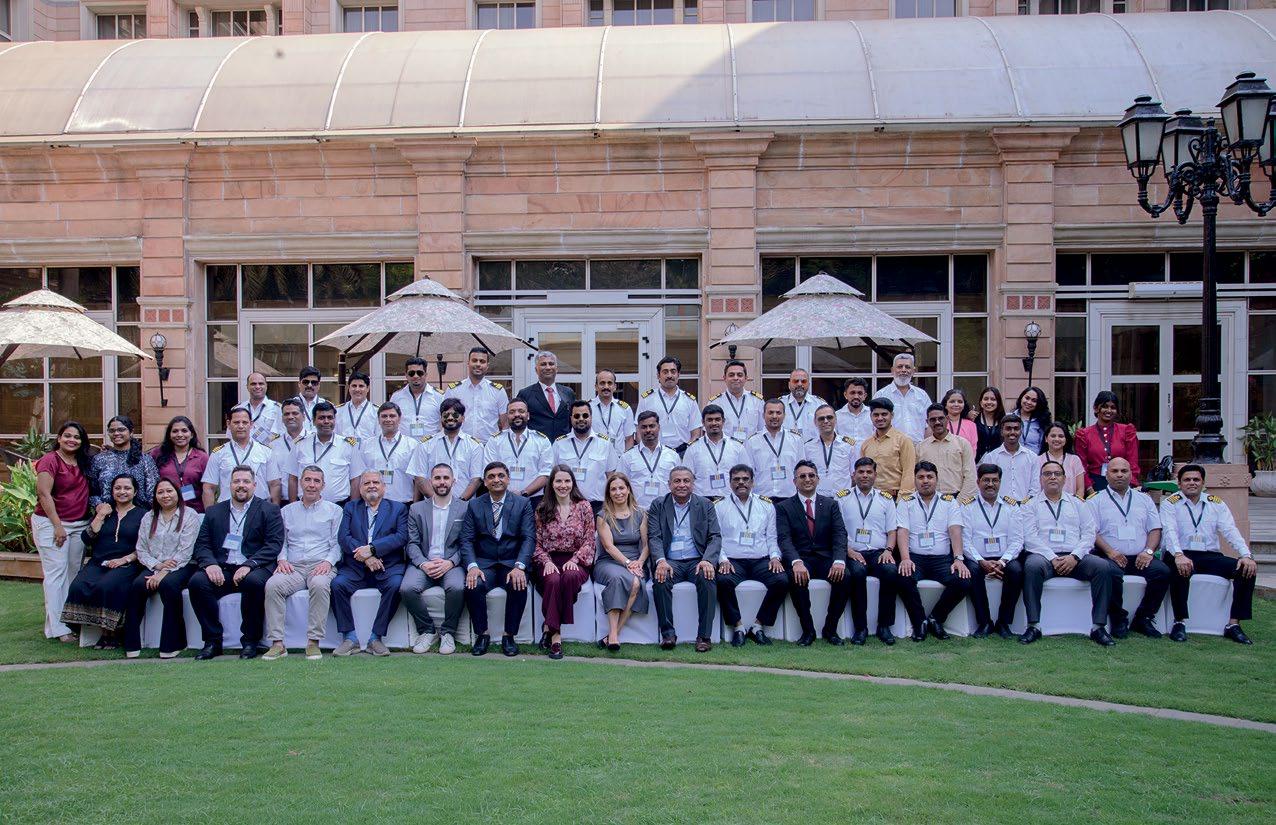
On the 21st of April 2026, Cenmar conducted a One-Day Forum in Mumbai, India.
The Forum brought together shipboard and shore-based professionals for an engaging and insightful session centred under the theme “Speaking Up, Building Trust.”
By Bosco Fernandes, Training Superintendent
The agenda covered several important operational and people-focused topics like the generation gap at sea, dealing with inspections such as PSC and vetting as well as reinforcing good maintenance and engineering practices on board. Discussions on bunker operations and SIMOPS, revisited critical safety and operational lessons, while sessions on emergency preparedness, crisis decision-making, crew evaluations, promotions, and security updates encouraged practical learning and professional development. Brief salient features of the new Q-manual were also presented.
A dedicated session on “Speaking Up, Building Trust” highlighted the importance of creating a work culture where individuals feel confident enough to communicate openly, share concerns responsibly, and contribute positively toward safer and more efficient operations. The need to continuously strengthen and enhance the Company’s safety culture was stressed, reminding all attendees that trust, accountability, and open communication remain fundamental pillars of safe operations. Interactive discussions and Q&A sessions throughout the Forum enabled participants to exchange valuable experiences from both ship and shore perspectives.
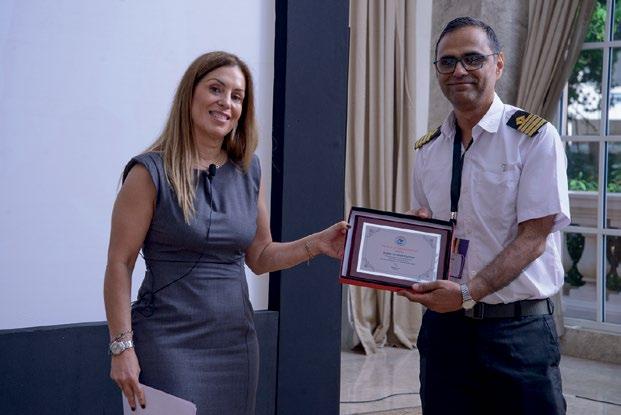
A special moment during the event was the felicitation of long-serving personnel whose commitment, loyalty, and contribution to the Company over the years were recognized and appreciated by all present. Their dedication continues to serve as an inspiration for the wider team.
The Forum concluded with closing remarks and a heartfelt vote of thanks to the organizers, planners and all those involved in coordinating the event seamlessly.
For all those who missed the event and would like to get an insight into the Mumbai Forum 2026, the event is available on YouTube on the Centrofin channel.
In the first quarter of this year, forty of our Seafarers took a step up the promotional ladder. The list of the ratings and officers whose career path took another step, or a first step, forward along with their vessel and promotion details in chronological/alphabetical order appears in the table below.
02.01.26 TKACH Oleksii DIMITRI APR.ELEC to ASS.ELEC
06.01.26 AYUSTE Ben CALLIOPE P. WPR to OLR
09.01.26 SANCHEZ Argy ALLIANCE OLR to FTR
12.01.26 BANGA Michael Louisse WAVE OS to ASD
12.01.26 OMAS-AS Braulio Jr. MERAPI OS to ASD
15.01.26 GUARIN Arjay AGIOS NIKOLAOS ENG/TR to WPR
16.01.26 BISHT Nitesh WAVE 3/O to 2/O
16.01.26 DAYUDAY Ian GUARDIAN OLR to FTR
16.01.26 JIMENEZ Jason APAGEON OS to AB
20.01.26 SORIANO Rico CAPTAIN A. STELLATOS OS to ASD
24.01.26 CAMALES Alfernee LENI P. WPR to ASE
24.01.26
Mark ALEXIA D/TR to OS
Patdrig CALLIOPE P. OS to AB
SAN JUAN Jefferson SUNDORO D/TR to OS 28.01.26 RAYA Elmer ALLIANCE WPR to OLR 02.02.26 VILLENA Randy POPI P. ASD to BSN 13.02.26 Anoop Anil CAPTAIN A. STELLATOS TNO to 3/O 18.02.26 TORRECES Christian Lee NIRIIS 2/O to C/O
19.02.26 PIMENTEL Ivan SERENO OS to ASD
22.02.26 DANESCO Gabriel AGIOS NIKOLAOS WPR to ASE
22.02.26 GERADA Joven AGIOS NIKOLAOS OS to ASD
24.02.26 DIEVICHEV Oleksii SERENO 4/E to 3/E
03.03.26 PAZON Jerick YANNIS P. 2/M to C/O
03.03.26 ROLLON Erickon YANNIS P. A/C to CCK
04.03.26 ROSALES Mark Robert POLYMNIA 4/E to 3/E
09.03.26 GOLINGAY Welrey WAVE OS to ASD
09.03.26 NESTEROV Yurii NAMRATA A/O to 3/O
09.03.26 SULATRA John ALEXIA C/O to MSTR
10.03.26 CATAQUIZ Nikko KAPSALI ASD to 3/M
10.03.26 VICENTE Darren KAPSALI ASE to 4/E
17.03.26 DANICO Christian EVGENIA P. WPR to OLR
20.03.26 GANZA Give LENI P. 2/O to C/O
24.03.26 TO-OC Jo Michael DANAE WPR to OLR
24.03.26 SUBRAMANIYAN Vijaya Raghaven MERAPI 3/M to 2/M
26.03.26 SINGH Anshuman AGIOS NIKOLAOS 2/O to C/O
27.03.26 CASIMINA Ronnel IRINA MMN to STWD
27.03.26 FESTIN Dean IRINA WPR to OLR
28.03.26 CAUMBAN Ric MERBABU A/C to CCK
28.03.26 DEL PILAR Harold MERBABU D/TR to OS
30.03.26 GUBAN Mark SUNDORO A/C to CCK
All those on the list deserve the warmest congratulations. However, I would like to single out Captain John Solatra aboard M/T Alexia as well as Chief Cooks Erickon Rollon on M/T Yannis P., Ric Caumban on M/T Merbabu and Mark Guban on board M/T Sundoro. You have all deservedly reached the pinnacle of your respective promotion ladders, and are ready to mentor those following in your footsteps. There are also those at the other end of the ladder that deserve a mention. They are our Seafarers who have been promoted from Deck Trainee and those who have just left the OS rating behind them. To my mind, the word “ordinary” in OS is a misnomer. You are not ordinary as an OS, and you weren’t ordinary when you were an OS. Like all our Seafarers, you offer a great deal to the Company, the shipping community and beyond. May you continue on your career paths as an integral part of that precious community.

Hatch covers on bulk carriers have two essential functions. In the open position they provide access to the cargo holds for loading and discharging. In the closed position they protect the cargo space by maintaining a weathertight barrier against boarding seas, spray and rain. When this barrier is compromised, the result is rarely limited to a small leak. Poor hatch cover condition is one of the most common causes of wet cargo claims and may also accelerate corrosion, create hold flooding risks and, in extreme cases, threaten the safety of the vessel.
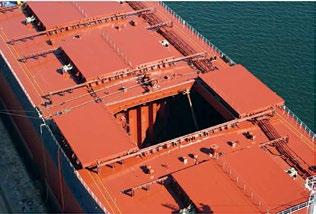
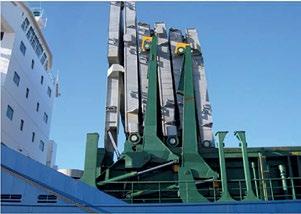
Side-rolling hatch cover arrangement Folding hatch cover arrangement
Most hatch cover defects develop gradually. They start as small signs such as a seal that has taken permanent set, a worn support pad, a blocked drain channel, a slightly misaligned cross-joint or a corroded cleat. During heavy weather, small deficiencies act together and the sealing system can fail. The following points should be treated as practical warning signs during shipboard inspections.
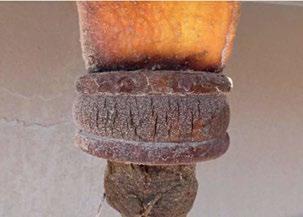
1. Seal set beyond replacement limit: Rubber packing loses resilience with age and compression. Once the seal has taken excessive permanent set, tightening the cleats will not restore the original compression. The packing must be replaced in accordance with the maker’s guidance.
2. Worn, torn, displaced or missing packing: Damaged rubber packing, missing sections and poor cross-joint sealing are direct paths for water ingress. Cross-joints deserve special attention because leakage often starts where panels meet.
3. Temporary seal fixes: Silicone, fillers or improvised packing may appear to solve a leak temporarily, but they do not restore the designed contact between the packing and compression bar. Such repairs can hide the real defect and delay permanent corrective action.
4. Wastage of support pads or side plates: Worn support or landing pads alter panel height and loading. This may cause over-compression of the rubber packing in some areas and insufficient compression in others.
5. Blocked drain holes and channels: Drain channels are part of the water-management system. Cargo residue, scale and paint debris must be removed so that shipped water can drain away and non-return valves can operate freely.
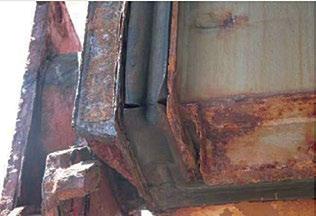
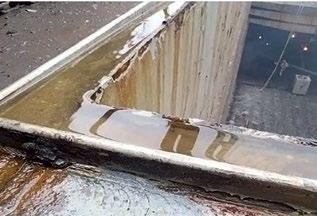
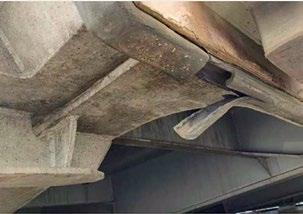
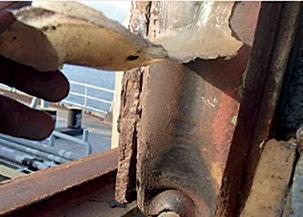
6. Cross-joint, cleating and support-stool defects: Wasted cross-joint channels, faulty alignment and missing or corroded cleats prevent the covers from sitting correctly and maintaining the designed seal compression.
7. Corrosion in steel plating: Corrosion at plating, edges, compression bars and supporting structures weakens the cover and damages the sealing surface. Coating breakdown should be corrected before wastage becomes structural.
8. Worn centre-line wedge devices on side-rolling covers: Worn wedge arrangements may allow cross-joints to open when the ship is at sea, even if the covers appear to be acceptable in port.
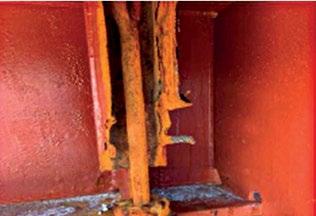

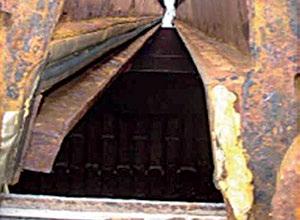

The onboard hatch cover maintenance programme should not focus only on the panels themselves. It should preserve the strength, geometry, movement and sealing performance of the whole arrangement. This means structural steelwork, coating protection, wheels, trackways, compression bars, pads, cleats, drains and hydraulic equipment must all be included in PMS routines and follow-up inspections.
1. Maintain hatch cover structure and coating protection
The overall structural strength of the hatch cover must be preserved by protecting exposed plating and stiffeners. Corrosion, cracked coating and wastage should be recorded early and repaired before deformation or loss of strength develops. Steel repairs should restore the original design condition and not create hard points or distortion that affect panel alignment.
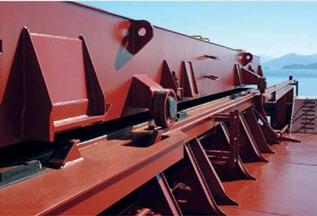
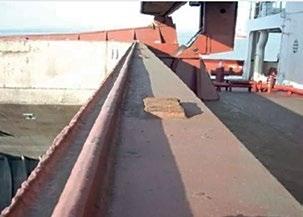
2. Maintain wheels, trackways and compression bars
For rolling covers, smooth and correctly profiled trackways are essential. Damaged, corroded or contaminated tracks can cause difficult movement and panel misalignment. The same attention is required for compression bars and other steelwork bearing on rubber seals or friction pads. A straight, clean and non-corroded compression bar is necessary for an effective seal. Cargo residues left after operations accelerate the wear of resting pads and should never be allowed to remain on coaming tops or cross-joint channels.
3. Maintain hydraulic and mechanical operating systems
Hydraulic or mechanically powered opening, closing, securing and cleating systems must be maintained according to the maker’s recommendations. The play of hinges and wheels should remain within tolerance. Wheel spindles, hinge pins, racks, pinions and hydraulic cylinder bearings require regular greasing. Hydraulic oil storage tanks, valves and filters must be monitored to ensure balanced cylinder operation and to prevent hatch panels from twisting during movement. Oil samples should be taken regularly; oil and filters should be changed based on the maker’s recommendations and oil condition.
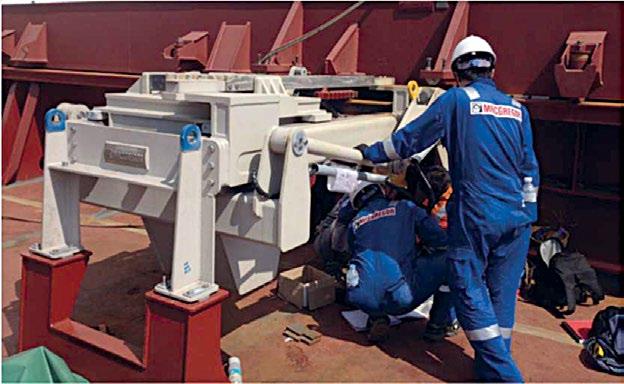
4. Cleats
Cleats keep the hatch covers in position and maintain the seal design compression. When resting pads, compression bars or seals are worn, excessive cleat trimming or over-tightening is not a cure; it can accelerate rubber packing wear and still fail to achieve proper weathertightness. Cleats should be adjusted correctly, kept free to operate and maintained so that each cleat contributes evenly to the sealing system.
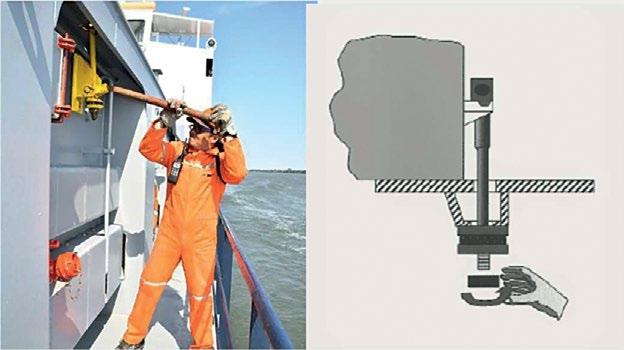
Maintenance of hatch cleats and correct snug/crutch assembly
5. Seals and wear components
Rubber packing and other wear components should be replaced according to the maker’s recommendations. Under normal operation and maintenance, hatch cover seals are commonly expected to have a service life of about four to five years, but the actual condition must always be taken into account. The maker should state the permissible permanent set; a widely used criterion is that loss of compression should not exceed about 50% of the initial design compression. Once this condition is exceeded, replacement is the proper action.
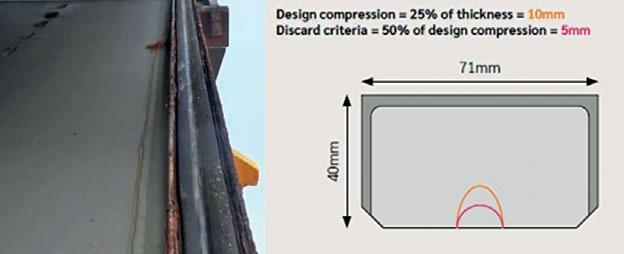
Rubber packing damage, deformation and permanent set criterion.
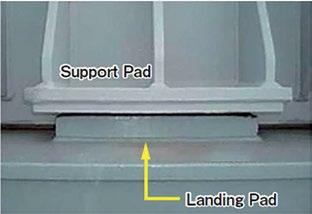
6. Support and landing pads
Resting, support and landing pads control the relative position of the panel against the coaming and sealing surfaces. If worn out, they should be repaired to original dimensions. Pad wear may cause over-compression of the packing rubber or loss of contact in other areas. Checking skirt clearance with feeler gauges and comparing them with the maker’s tolerances should be part of routine condition monitoring.
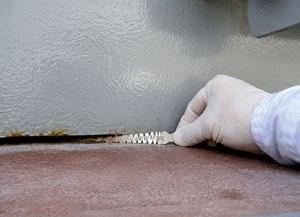
7. Drainage and non-return valves
Hatch cover drains and non-return valves, where fitted, must remain in working order. Drains fitted inboard of the seal line should prevent shipped water from entering the hold. After every cargo operation, coaming tops, cross-joint channels, drain holes and drain valves should be cleaned and checked. The rubber ball in non-return valves must move freely.
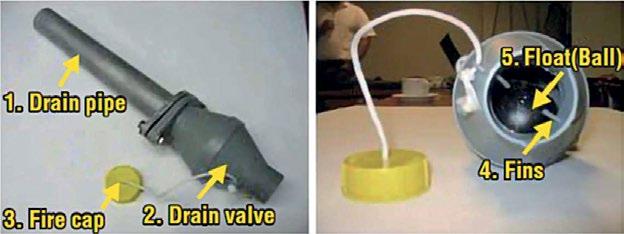
Drain arrangement and non-return valve components
spares and testing
A good hatch cover maintenance programme depends on discipline as much as technical knowledge. PMS jobs should not be left overdue. Ultrasonic tests and tightness checks should be carried out at the required intervals and after major repairs. Findings must be recorded, followed up and verified before the vessel proceeds with water-sensitive cargoes or under heavy weather exposure.
Adequate onboard spares are also essential. Vessels should maintain suitable quantities of spare cleats, wedges, rubber packing profiles, chains or relevant maker-specific components. A lack of spares often turns a known defect into a repeated temporary repair.
After every cargo operation
• Clean coaming tops, cross-joint channels and drain holes.
• Remove loose scale, cargo residue and paint debris.
• Check non-return valves and confirm free movement.
• Inspect visible seal damage, displacement or missing sections.
• Check cleats, wedges and fittings for corrosion and movement.
Periodic / PMS routine
• Inspect trackways, wheels, hinges, racks and pins.
• Grease moving parts according to the maker’s recommendations.
• Check the hydraulic oil level, oil condition, filters and leaks.
• Verify the cleat adjustment and compression bar condition.
• Review hatch cover spares and close overdue PMS items.
Hatch cover maintenance is not always the job that gets noticed on board, but it is often the job that proves its importance when the weather turns bad. Something as simple as a clean drain channel, a properly adjusted cleat, or a rubber packing changed at the right time can prevent serious problems later on. Hatch covers should therefore be regarded as one complete system, not just as heavy steel panels that open and close. Their reliability depends on the small details being taken care of every time. These consist of cleaning after cargo operations, checking the seals and compression bars, keeping the drains free, greasing the moving parts, following the PMS, and avoiding quick temporary repairs that only hide the real problem. At the end of the day, the purpose is clear; keep the cargo dry, protect the vessel, and avoid unnecessary trouble at the discharge port. It is always better to spend time preventing water ingress before departure than to deal with the consequences after arrival.
We are thrilled to announce the delivery of the newest addition to our tanker fleet, the M/T Psara. The vessel is a 50,000-ton dwt Product/Chemical tanker, a representative of modern maritime engineering, safety, and efficiency. Built at Jiagsu Soho Shipbuilding in China, the ship’s prime mover is an ultra long stroke, electronically controlled engine complying with Tier III regulations. Among the extras included in this design are an open-loop scrubber, and Ice class 1C notation and a “Methanol-ready” notation, i.e. the main engine is designed as a Methanol-convertible type, and there is space reservation for the fuel tanks. This quality vessel marks a significant addition to our fleet in our ongoing commitment to operational excellence and sustainable shipping. The ship is named after a Greek island of profound nautical history, symbolising strength and resilience. During the coming six months she will be joined in our fleet by three identical sisters thus increasing our presence in the clean product sector.
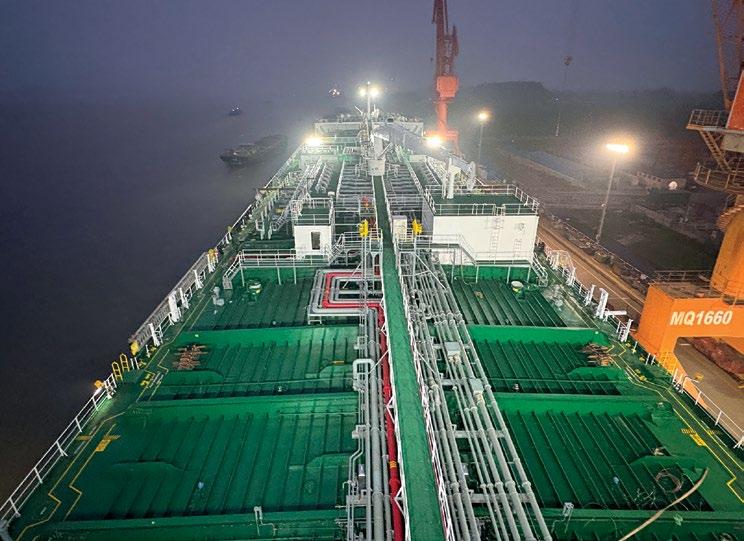
We wish the M/T Psara and her officers and crew fair winds, smooth sailing, and safe seas during all future journeys.
Marine Operations
Everyone in shipping has heard that AI is coming, and computers will soon do what navigators do. Your job is under threat from a machine that never sleeps, never gets tired, and never asks for leave – so it is said. It is a reasonable thing to think about.
But before we get to the future…
Have you considered the bridge you stand watch on? It already has a form of artificial intelligence on it. It has had one for years. And most of us, on most watches, have been doing our level best to ignore it! Can you guess what it is?
Think about what your ECDIS actually does. It monitors your position continuously against safety contours and no-go areas. The moment your track approaches danger, it raises an alarm. Your ARPA does the same for traffic, calculating CPA and TCPA for every echo on the radar, around the clock, without a break. Your BNWAS watches over you.
Put it all together and you have a system that senses its environment, compares what it finds against a set of rules, decides when something is not acceptable, and tries to tell a human being about it. If someone described that capability to you without mentioning a ship, you would probably call it artificial intelligence. On the bridge, we call it "the alarms” and we have spent years becoming very efficient at making them stop.
"We've been sailing alongside a basic form of AI for years. It never sleeps. It never stops watching. And we've trained ourselves to silence it."
None of this happened because seafarers are careless. It happened because the alarms, as designed, made it nearly impossible to take them seriously. Perhaps the rules that governed their usage compromised their functional integrity by creating an incompatibility between the device and the humans it was created to assist.
Shallow water warnings in waters too deep to matter, CPA alarms for vessels already steering away, and caution area alerts for every buoy and a sandbank within twenty miles are prime examples of their ‘’intrusive nature’’. The noise was relentless, and the brain did what brains do; it adapted. It learned to classify most alarms as nuisance and reach for the ACK button as a reflex.
Studies of bridge alarm management find the same pattern consistently: alarm fatigue is widespread, silencing without investigation happens. Our early "AI" was shouting so often, and so indiscriminately, that we stopped hearing it.
How I would imagine two different
Bridge A – today
ECDIS: “BEEP BEEP BEEP.”
Radar: “BEEP.”
BNWAS: “BEEP.”
OOW: (taps “ACK”, resets, promises to “check in a minute” – then goes back to VHF or paperwork.)
Bridge B – same electronics, but a smarter “voice”
Calm, clear voice from the same system:
ECDIS: “Warning: if you keep this course and speed, you will cross your safety contour in 8 minutes. Minimum charted depth ahead is less than your safety depth.”
A different, urgent tone for collision risk, maybe even:
By Captain Delson Roche
RADAR: “Risk of collision with vessel on starboard bow within 10 minutes if no action is taken.”
BNWAS: “You haven’t moved for 3 minutes, are you ok, sweetheart?”
So will AI take your job?
No, not in any near future that the industry is seriously planning for.
The IMO's framework for autonomous ships sets out four degrees of autonomy, from decision support with a full crew right up to fully remote operation. The vast majority of trading vessels today sit at Degree 1 at best: a human watchkeeper with automated assistance. Getting beyond that involves unresolved questions about liability, accountability, legal frameworks and the sheer complexity of what experienced seafarers actually do.
Because here is what no algorithm currently does well: weighing COLREGs against pilot instructions, charterer pressure, crew fatigue and local conditions in a single judgement call built from years of sea time, carrying the responsibility of command. Smarter tools are coming. But they are coming as decision support: a sharper, more articulate version of the systems already on your bridge, one that speaks to you clearly instead of just beeping. The officers of the watch are not being replaced. They are getting a better colleague.
The habit worth starting now
The way we treat today's alarms is how we will work with tomorrow's smarter systems. An officer who dismisses every ECDIS warning as background noise will not suddenly become a thoughtful user of AI-assisted watchkeeping. Habits run deep. Setting alarm thresholds sensibly so that the system cries wolf less often is seamanship. Investigating what a warning is actually telling you before silencing it is seamanship. Treating the bridge systems as a watchkeeping team rather than a source of interruptions is seamanship.
AI is not the threat waiting on the horizon. It is the underappreciated colleague already on the bridge. The question is not whether it will take over the watch, it is whether we are ready to start working with it properly.

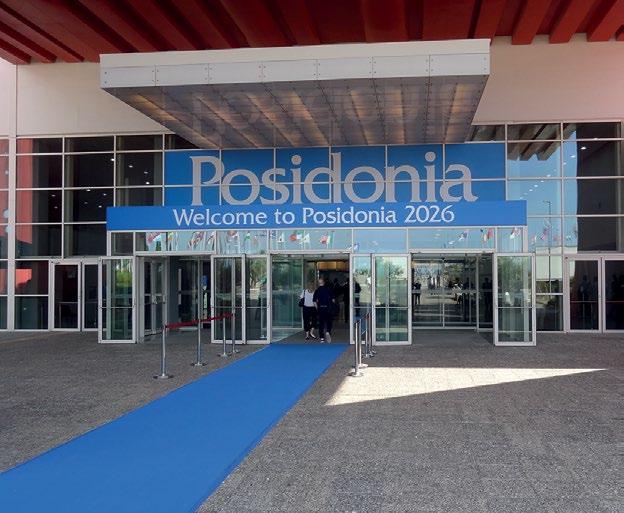
In several respects, Posidonia 2026 from that of 2024. It was well run, superbly organized and hugely successful. From a purely subjective standpoint, though, I felt there was something lurking below the surface. Perhaps the feeling was a result of being exposed to conflicts and geopolitical tensions through media bombardment, which had skewed my perception of the event. Or maybe it was a sense that the shipping industry’s adapting to changes brought about by external forces had taken centre stage, leaving far less room for progress in other directions.
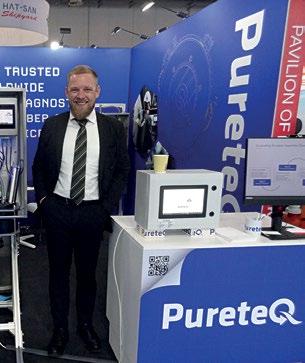
On a more positive note, the human element in terms of connectivity was palpable. I reconnected with the Vice Sales Director of PureteQ, Mr. S.H. Hansen, who remembered me from 2024. I also met the CEO, Mr. A. Skibdal, who engaged willingly in an interesting conversation. This highlighted their company culture of acceptance, and reflected the attitude inherent in Danish social responsibility.
held in the highest regard, and that I had a responsibility to uphold its reputation and show the utmost respect to those talking to me. Please let me know if you believe these thoughts stemmed from delusions of grandeur, but bear in mind that in the current climate, how you behave and what you say can have a profound effect on an individual’s perception of you and those you are seen as ‘’representing’’.
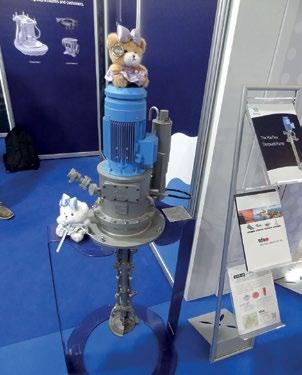
I then visited Marflex, part of the Taiko Kikai Group. Unfortunately, I was unable to speak to anyone from Posidonia 2024. However, I was made welcome by the representatives of the company, who were eager to explain why cute, incongruous, furry figures were adorning part of a pump on display when I enquired about their symbolism. I was given two answers. They were there to soften the perceived hardness of machinery, and they were alike in their beauty and allure. Don’t get me wrong; I appreciate incongruity, so it didn’t take me long to embrace their perspective and appreciate the connection. What is more, while I was juggling my water magazines and camera in an attempt to capture the image, I was handed a bag to make my endeavour easier. I was grateful for the thoughtful gesture.
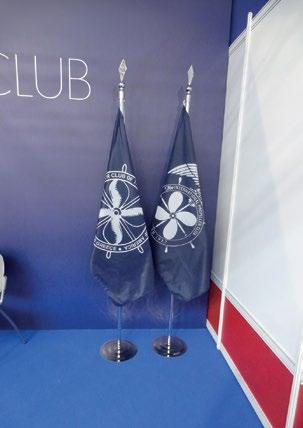
The next stand I stopped at was that of The International Propeller Club of the United States, an esteemed non-profit organization set to celebrate its centenary in 2027. After reading the tag hanging from my lanyard, the representative confirmed that the Company had received several awards, coverage of which has appeared in Wavelength. At that point, I also reflected on what it meant to have the Company’s name below mine. The confirmation reaffirmed the Company being
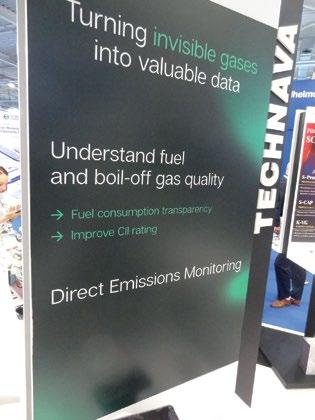
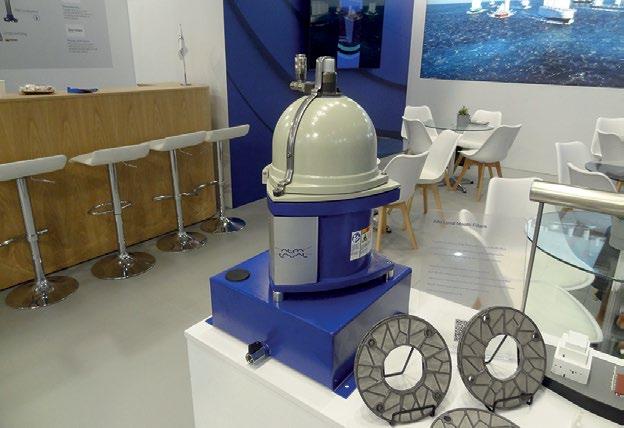
My next three visits were to Alfa Laval, Technava and Dynamic, where the appropriateness of my surname in a shipping industry environment proved to be an effective icebreaker prior to learning more about separators, gas analysis and repairs. I am grateful to all those mentioned for giving up a little of their time so that my experience at Posidonia 2026 was a positive one. The same applies to the other Centrofin Management representatives I bumped into at the exhibition who readily reinforced my point of view on the importance of human connection, cooperation and understanding across the industry. Last but not least, the Posidinia reception/ registration staff, those who helped visitors park and cross the road safely, the cleaners, sales staff and coordinators all deserve plaudits.

Safety at sea depends on crew readiness against health threats. Ebola virus and Hantaviruses pose severe risks to public health, requiring immediate recognition, strict isolation, and meticulous compliance with international hygiene protocols. Although the hazard for crew contracting these viruses remains very remote on board, it is always helpful that all crew on board are well aware of the features of these viruses. This guide provides the necessary instructions for recognizing symptoms and managing potential cases on board in accordance with the guidelines of the World Health Organization (WHO) and the International Maritime Organization (IMO).
1. Ebola Virus Disease
Ebola is a rare but highly lethal virus. It causes severe hemorrhagic fever. It appears in the Democratic Republic of the Congo and other Central Africa countries.
How is it transmitted?
• Direct contact: Through broken skin or mucous membranes with blood, body fluids (saliva, sweat, urine, vomit) of infected or deceased persons
• Contaminated objects: Through contact with clothing, bedding, or medical equipment that has been contaminated
• Note: The virus is not transmitted through the air or water.
Main Symptoms (Appearance within 2 to 21 days)
• Sudden high fever
• Severe headache and muscle pain
• Vomiting and diarrhea
• Unexplained bleeding (from gums, nose, or in stools)
2. Hantaviruses
Hantaviruses cause severe illnesses, such as Hantavirus Pulmonary Syndrome. Hantaviruses exist globally, with the specific virus strain and resulting illness varying greatly by region. Recent incidents on passenger vessels highlight the need for increased vigilance.
How is it transmitted?
• Inhalation of particles: By breathing in dust / aerosol containing dried urine, droppings, or saliva from infected rodents (rats/mice).
• Person-to-person transmission: This is extremely rare, but certain strains (such as the Andes virus) can be transmitted through prolonged close contact.
Main Symptoms (Appearance within 1 to 8 weeks)
• Fever, chills, and fatigue
• Severe pain in the back, hips, and shoulders
• Sudden and severe dyspnea (difficulty breathing)
• Dry cough and gastrointestinal issues
3. Prevention Measures on Board
Anti-Rodent Measures (For Hanta Prevention)
• No dry sweeping: Never sweep areas with signs of rodent
activity using a regular broom. This lifts the contaminated dust into the air.
• Wet cleaning: Spray the area with disinfectant or a bleach solution before cleaning. Use a mop or wet cloths.
• Securing food: Store all food items in airtight containers.
• Waste management: Keep garbage bins tightly sealed and empty them daily.
Personal Hygiene Measures
• Handwashing: Wash your hands frequently with soap and water for at least 20 seconds.
• Use of alcohol rubs: Use hand sanitizer containing 70–80% alcohol.
• Limiting shore leave: Avoid unnecessary shore leave in ports of countries experiencing active outbreaks.
4. Suspected Case Management Protocol
If a crew member displays compatible symptoms, the Master and the Medical Officer must act immediately:
1. Immediate Isolation: Move the patient to a single, wellventilated cabin with exclusive use of a toilet. Keep the door closed.
2. Use of Personal Protective Equipment (PPE): It is mandatory for anyone coming into contact with the patient to wear:
High-protection mask (N95 or FFP2)
Protective goggles or face shield
Waterproof disposable gown and nitrile gloves
3. Medical Reporting: Inform the Company and the designated onboard medical provider.
4. Decontamination of Spaces: Clean surfaces the patient came into contact with using a 0.5% bleach solution. Handle the cabin's bedding and waste as infectious material.

For personal hygiene measures and suspected case management protocol, also refer to our Outbreak Management Plan.
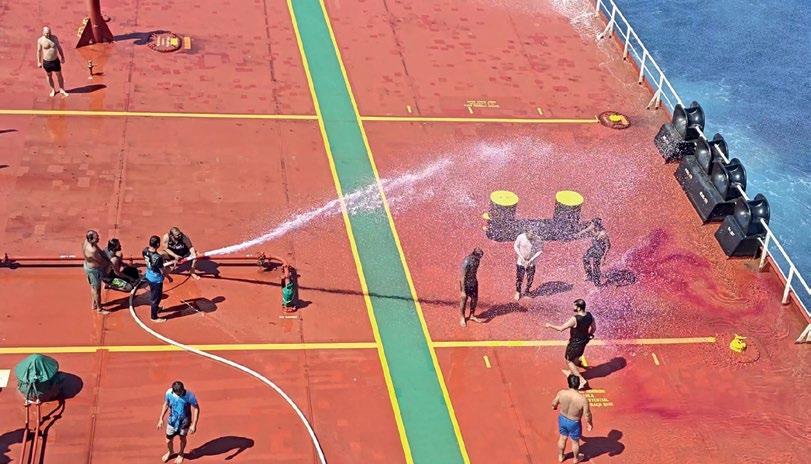
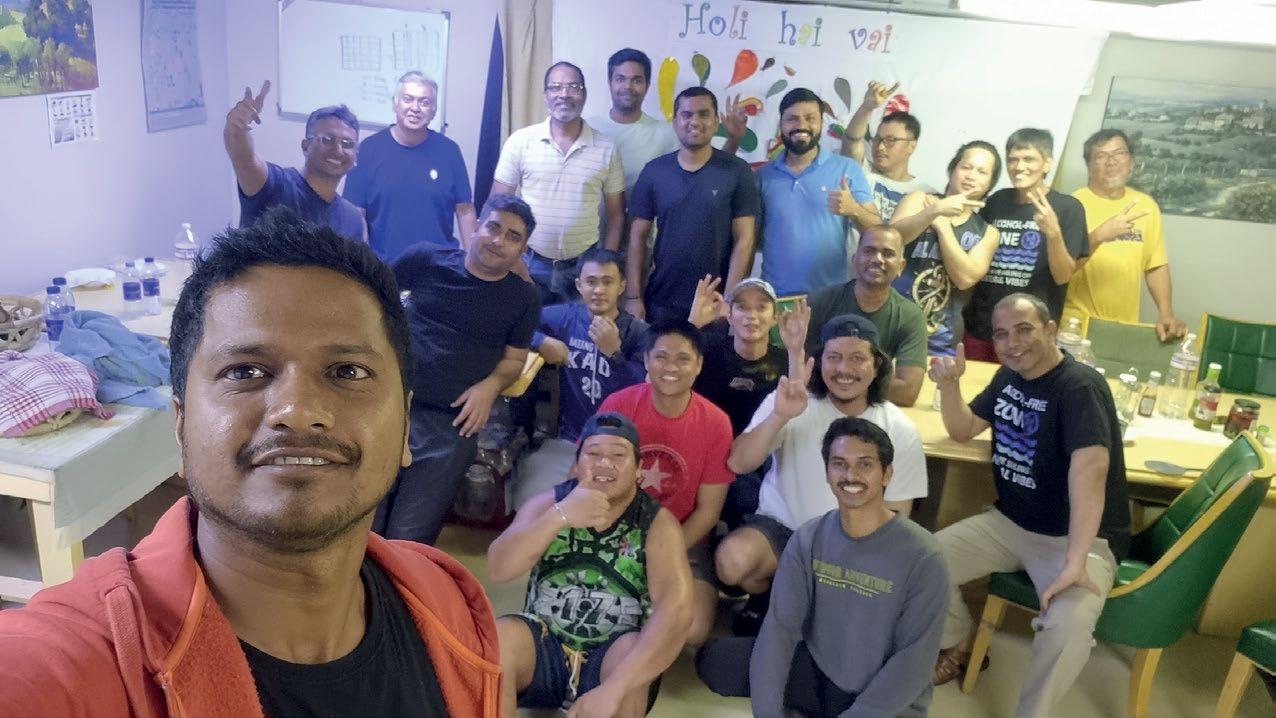
This year, CE-Bermuda celebrated Holi, the festival of colours, on a truly inclusive and cheerful note.
The festivities kicked off with a delightful twist as the crew traded their tools for aprons. In a heartwarming show of spirit, "amateur chefs" took over the kitchen, surprising everyone with their culinary innovation and dedication. A celebration banner was prepared by multiple crew members, who poured on colours with their hands guided by their hearts. It was certainly not exactly a Van Gogh, but the banner did have a vibrant vibe both on the canvas and on the faces who prepared it.
The deck transformed into a mosaic as participants of all religions and nationalities joined the traditional colour play. The Chief Officer didn’t miss the chance to demonstrate the foam applicator unit to spray dyed water, ensuring no one left without a splash of Holi joy!
After a simple but satisfying dinner with traditional items like


Dahi Vada and Malpua, the energy moved indoors for some high-stakes fun. Simple game ideas drew boundless enthusiasm and competitive participation.
• The Turmeric Challenge: Diving face-first (no hands!) into turmeric water to find hidden coins.
• The One-Handed Architect: Racing to build the perfect plastic cup pyramid.
• The Bottle Flip: Aiming for that satisfying vertical landing with a partially filled bottle.
Very few photos were found, but on a positive note, that might have been because people were actually having fun and enjoying themselves. Thanks to the Company’s generous contribution to the welfare club, the night ended on a high note with handsome prizes for the winners.

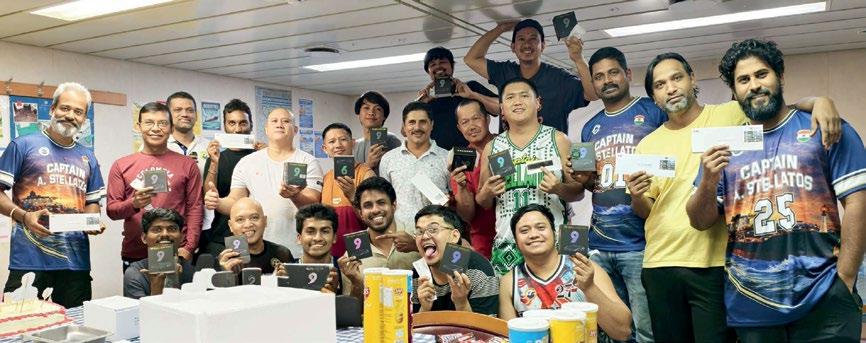
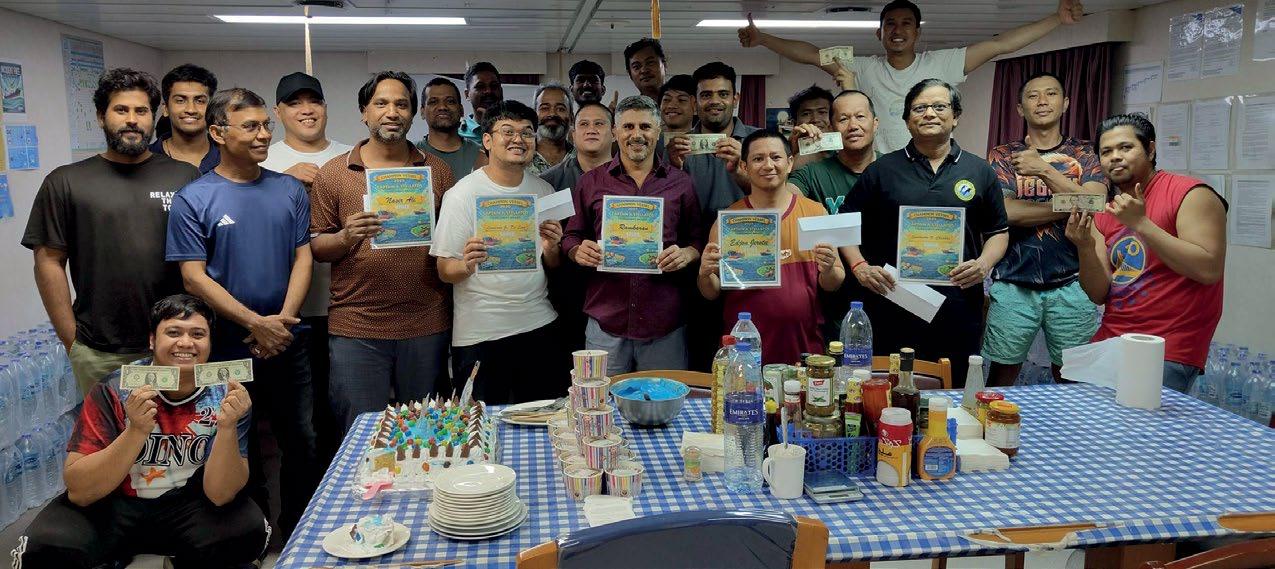
M/T Captain A. Stellatos
The following photos were received from M/T Capt. A. Stellatos, one of our Champion Incident Free Vessels. The Officers and crew shared with us their wonderful messages:
Built on discipline, driven by team work
One Crew, one Standard Champion standards maintained 24/7, without compromise
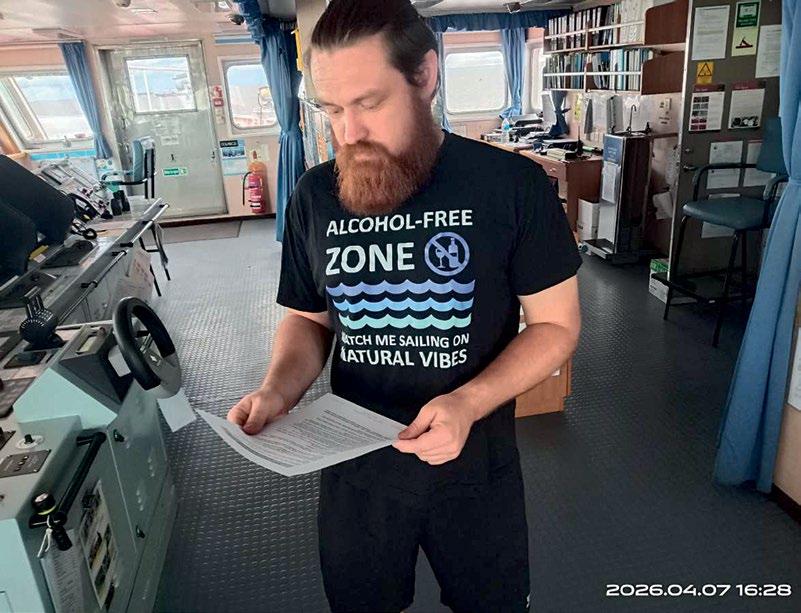
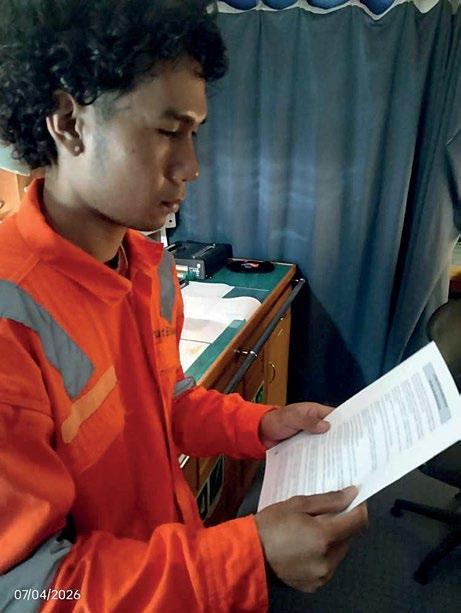
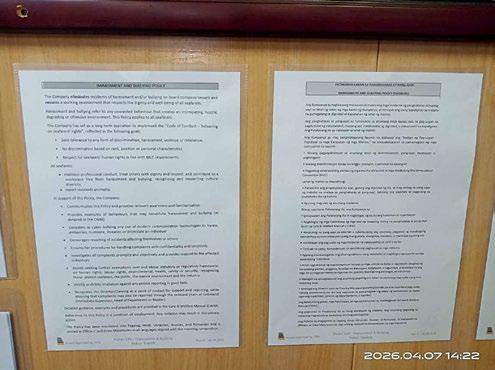
During April all our vessels received the Company’s Bullying and Harassment Policy in the native languages of all crew members. The relevant documents were also posted in Officers' and Crew Messrooms, while a copy was given to each Seafarer.
We are pleased to share how we celebrated Labour Day here on board MV Venture
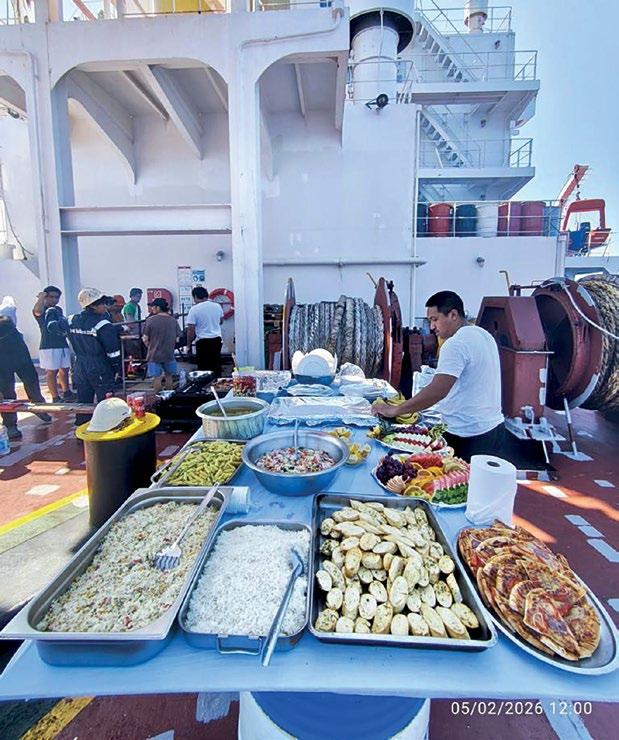
We began the day with BBQ lunch party on the poop deck, featuring grilled suckling pig, chicken, pork and beef. A highlight of the meal was the fresh Dorado fish. It was a wonderful opportunity for everyone to relax, enjoy some fresh fruit and desserts, and simply spend time together just to sit, eat, and have a bit of a chit-chat.
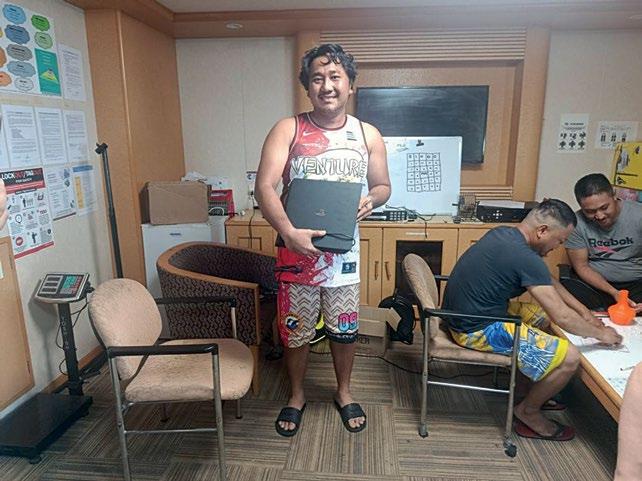
Following lunch, we gathered in the Officer Saloon for our “Bingo Bonanza” We gave out some minor prizes, and the grand winner received a PS4 console. To ensure everyone was appreciated, after the end of the Bingo, we listed those crew who didn’t win, and we made sure nobody went to their cabins empty-handed by giving out items like shampoo, body wash, deodorant and toothpaste.
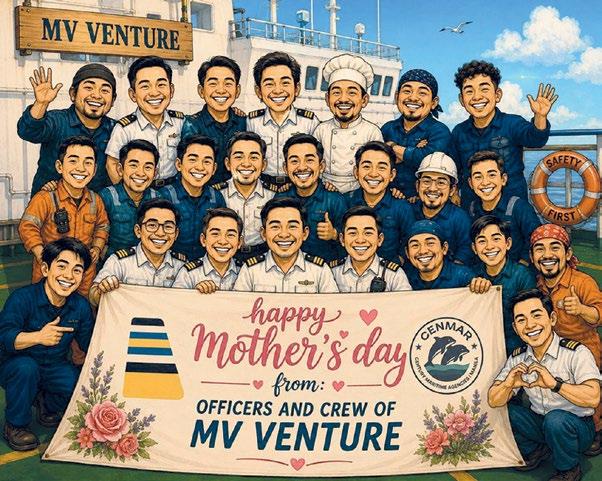
Celebrating Mother’s Day on 10th May 2026
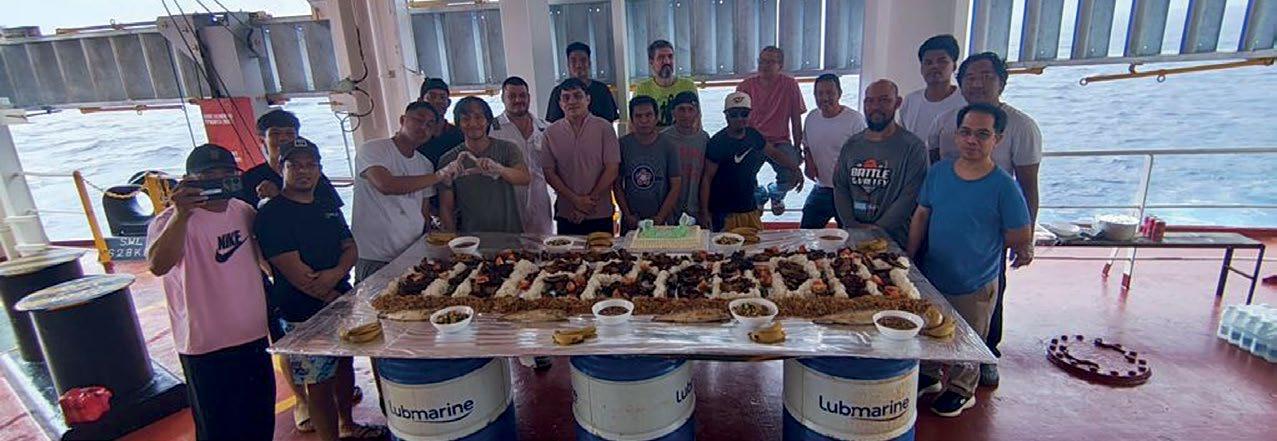
Mother's Day is a meaningful occasion to recognize the love, sacrifice, and unwavering support of the women who serve as the foundation of every family. For seafarers, whose profession requires long periods away from home and loved ones, this celebration carries even deeper significance. Behind every successful voyage is the strength and encouragement of mothers and wives who continue to provide guidance, comfort, and stability despite the distance created by life at sea. The maritime profession is one built on sacrifice, not only by those who sail but also by the families who wait faithfully at home. Mothers and
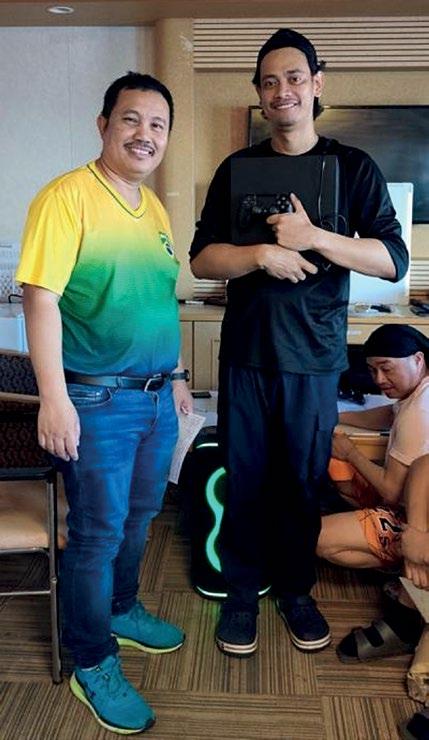
wives endure the uncertainty of long separations, challenging communication, and constant concern for the safety of their loved ones at sea. Yet despite these hardships, they continue to provide encouragement and understanding, becoming the silent strength behind every seafarer's journey. To celebrate and proudly honour our brave and resilient mothers and wives, the Officers and Crew of MV Venture, headed by the Master, Capt. Guelbert Briones, held a simple but meaningful celebration of Mother's Day with asumptuous "Boodle Fight" followed by a competition with several prizes and a PS4 as the Grand Prize. To all Mothers around the world: Happy Mother's Day!
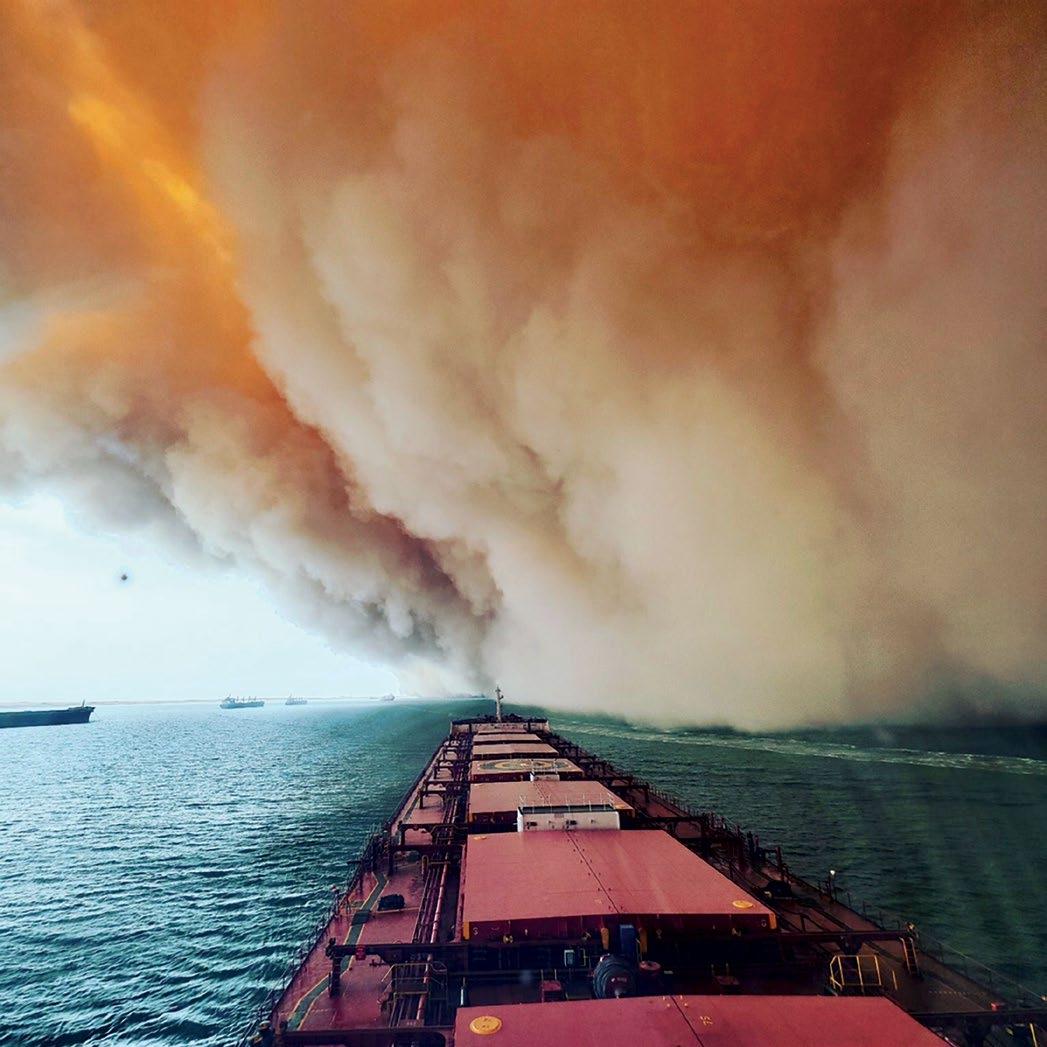
“Sandstorm at Sea” photo displayed in Maritime Museum of Denmark
I was proud to see this remarkable photograph of the maritime industry displayed at the Maritime Museum of Denmark. The photo, taken by our Training Superintendent Mr. Bosco Fernandes, beautifully captures the spirit, scale, and dedication of life at sea.
We wish Mr. Bosco Fernandes many more achievements and continued success in showcasing the maritime world through his talent and vision. https://mfs.dk/en/life-at-sea-photographs-taken-by-sailors-of-today
MESSAGE FROM THE DPA:
Dear seafarers,
Our safety culture is at a stage where you all know what happens if one is “complacent” or believes “this will never happen to me”. We all understand the theory, but it is not so easy to be routinely in a state of “chronic unease”, and believe that even with the simplest of tasks something CAN go wrong.
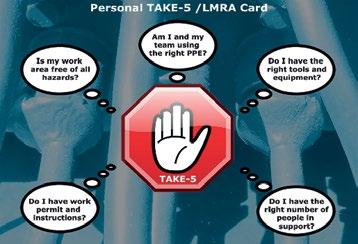
Take hand and finger injuries for example. Why are these among the most common personal injury types across the maritime industry?
The answer is that such injuries frequently arise during tasks perceived as low-risk. Seafarers do not often appreciate fully the line-of-fire and hazards under stable operating conditions even with PPE in use.
Your “situational awareness” and your “chronic unease” will for sure prevent them. Remember, there is NO shortcut to Safety, and this is about “behaviour”.
I wish you safe voyages and a safe return home,
PS. Have you been using your LMRA Card? It is an important INJURY prevention tool!
Source: Rio Tinto RTM/2026/006
Common examples of such injuries, include the use of hammer and punch tools, tightening or loosening nuts and bolts, chisel work, and similar manual activities, where momentary hand placement within the danger zone has resulted in contact injuries requiring onboard first aid and, in some cases, further medical assessment ashore.
• Hand and finger injuries often occur during routine, familiar tasks, rather than high-energy or abnormal operations.
• Line-of-fire exposure can exist even when tasks appear controlled and conditions are stable.
• Manual tasks involving impact, torque, or leverage present inherent risks when hand placement is not actively managed.
• PPE provides protection but does not, on its own, eliminate
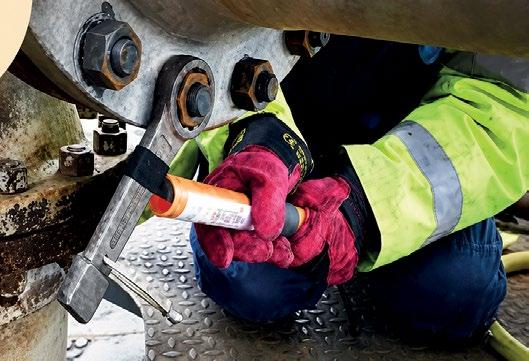
Finger Saver Tool: Start using such tools! Advise our Purchasing dept

Elli Moretti
line-of-fire and pinch-point hazards.
Root Causes:
• Hands positioned within the line of fire during impact, tightening or cutting activities
• Stabilisation of tools or components by hand during force-applied tasks
• Task familiarity leading to reduced perception of risk during routine maintenance activities
• Insufficient consideration of hand placement as part of task setup and execution
Chisel & Punch Holder: Start using such tools! Advise our Purchasing dept


Source: Rio Tinto RTM/2026/009
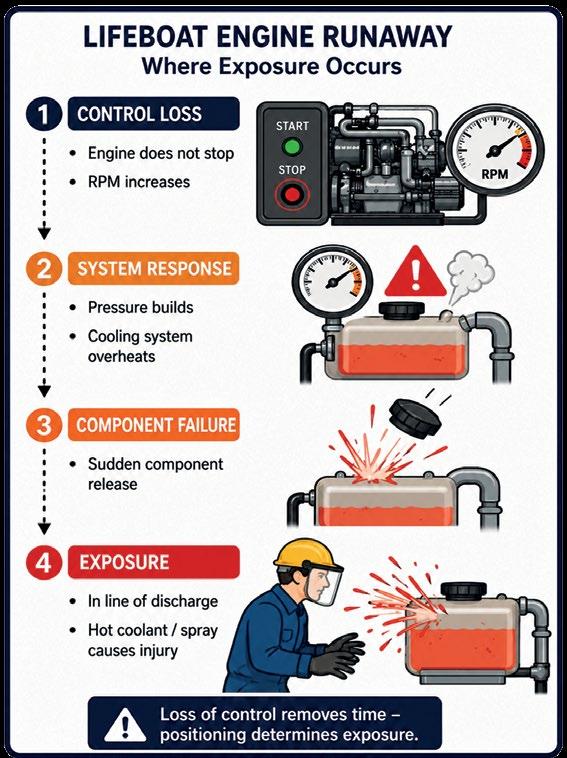
During maintenance and testing of a lifeboat engine on a bulk, the engine entered an uncontrolled high-speed (runaway) condition after restart.
Attempts to stop the engine using the operation panel control were unsuccessful. A further attempt using the local stop lever also did not stop the engine. The engine continued to accelerate.
The fuel supply valve was then closed; however, the engine remained uncontrolled, and pressure and temperature within the cooling system increased.
Shortly after, the coolant expansion tank cap was expelled, releasing hot coolant. A crew member positioned in line of fire with the release, sustained significant burn injuries.
Key Risks Identified
• Inability to stop the engine using available controls during abnormal conditions
• Exposure to runaway engine behaviour and loss of control
• Sudden release from pressurized systems (coolant / fuel) creating line of fire exposure
• Emergency shutdown arrangements may not be readily accessible
• Limited awareness of how systems behave during combined failures
Critical Expectations
Engine Shutdown Awareness
• Normal stopping controls may not be effective during runaway
• Fuel shut-off may be the only remaining control and may not act immediately
• Response under abnormal conditions differs from normal operation
Access & Arrangement
• Fuel shut-off valves may be inside the engine enclosure / not clearly visible or marked / difficult to access during an emergency
• Access may require approaching running machinery or opening covers, increasing exposure
Exposure Hazards
• Cooling systems may become over-pressurized rapidly
• Components such as caps or fittings may fail suddenly
• Personnel in line of fire of release may be exposed to hot fluid / pressure discharge
Recognition
• Rising RPM, delayed response, or abnormal exhaust are early indicators
• Once runaway occurs control is limited and exposure increases rapidly
Points for Consideration on Board
• Are crew clear on the actions to take if the engine fails to stop?
• Do they know the location of the fuel shut off valve and how to access it quickly?
• Can the engine be shut down while maintaining a safe position?
• Is there any intervention requiring opening covers or reaching into the engine space?
• Are crew aware of safe positions to stand in during testing?
• Do they understand the risks associated with coolant pressure and potential sudden release?
Every year, World Seafarers Day reminds us of something that should never be taken for granted: behind world trade, behind every cargo safely delivered, there are people working far from home, often under pressure, uncertainty and risk. This year’s message, “Carrying world trade. Carrying the risks.” speaks directly to the reality of life at sea. Seafarers do not only carry goods across oceans. They also carry the weight of responsibility, fatigue, separation from family, difficult weather conditions, operational demands, inspections, emergencies and worries that remain unseen.
Because of this, mental well-being is not a “soft” subject. It is part of safety, teamwork and good seamanship. A tired or overloaded mind may find it harder to concentrate, communicate clearly, make decisions or react calmly when something unexpected happens. Looking after our mental health is therefore not only important for the individual seafarer; it is important for the whole vessel.
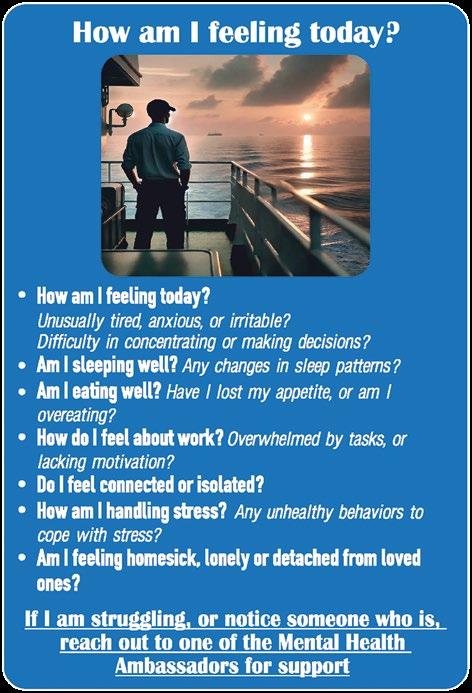
Pressure at sea does not always appear suddenly. It often builds slowly. A person may start sleeping badly, become quieter than usual, feel easily irritated, lose patience, avoid others, overthink family matters, or feel that even small tasks require great effort. These signs do not mean that someone is weak. They simply mean that the mind is asking for attention, just as the body does when it is tired or injured.
One of the most helpful steps is to speak up early. Many seafarers try to endure difficulties in silence because they do not want to worry others or appear unable to cope. However, sharing a concern with the Master, a senior officer, a trusted colleague, or the Care & Welfare Coordinator can prevent the situation from becoming worse. Speaking up does not mean giving up. It means taking responsible action before the pressure becomes unsafe. Small daily habits can also make a real difference. A short walk
on deck, a few minutes of fresh air, regular meals, enough water, a brief call or message to family, music, prayer, reading, exercise or a small routine can help the mind remain steady. These actions may seem simple, but at sea, simple routines often become anchors.
By Chara Markatzinou
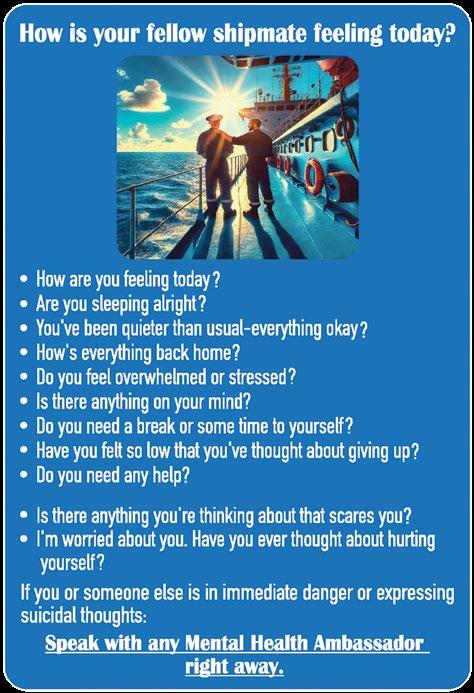
Colleagues also play an important role. Sometimes support begins with noticing. If someone seems unusually withdrawn, angry, tired or worried, a simple and respectful question can help: “Are you okay?” or “Do you want to talk?” Use your Mental Health Card to assist.
We do not need to solve another person’s problems. Often, listening without judgement is a form of support. A kind word, patience during a difficult day, or offering practical help can reduce the feeling of isolation.
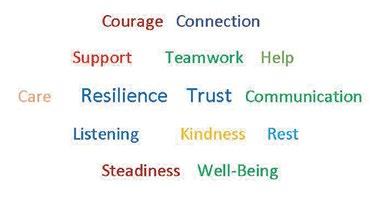
It is also important to remember that being strong does not mean pretending that everything is fine. Real strength is knowing when to pause, when to ask for help, and when to support someone else. Life at sea requires discipline, courage and resilience, but resilience is not built by silence alone. It is built through connection, trust, rest, communication and care.
As we honour this year’s World Seafarers Day, let us remember not only the contribution of seafarers to world trade, but also the pressure and risks carried behind that contribution. Every safe voyage depends on people, and people need support. Whether you are on watch, in the engine room, in the galley, on deck or in your cabin after a long day, your well-being matters. You are not expected to carry everything alone.
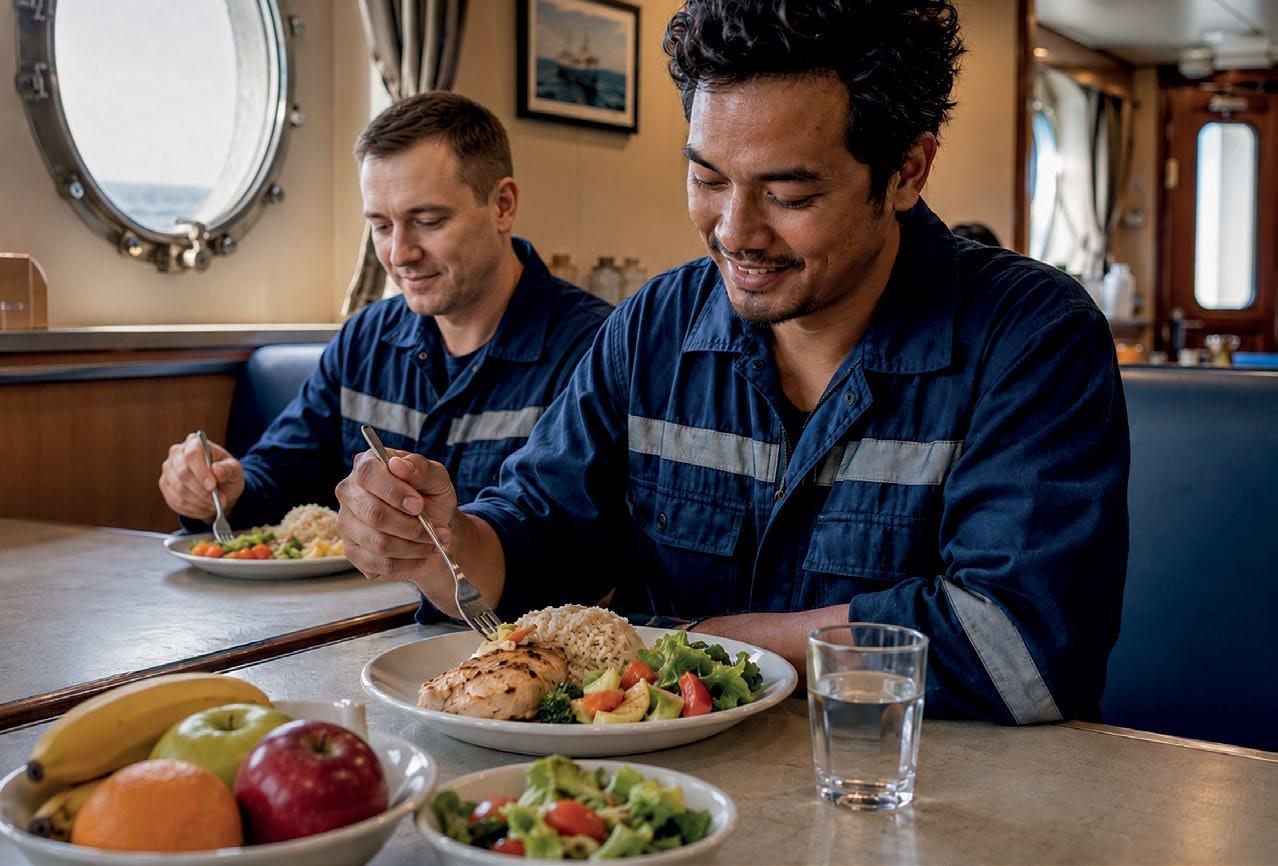
Life on board can be physically and mentally demanding. Long working hours, changing watches, port operations, inspections, hot weather, limited rest and time away from family can all affect the body. For this reason, food should not be seen only as something we eat because we are hungry. It is the fuel that helps us work safely, think clearly, recover properly and keep our energy steady during the day.
Good nutrition does not mean strict dieting or complicated rules. It is about making simple, balanced choices as often as possible. A strong meal usually includes a source of protein such as fish, chicken, eggs, beans, lentils or lean meat, a good portion of vegetables or salad, and a source of energy like rice, potatoes, pasta, bread or other grains. When these are balanced, the body receives the nutrients it needs to perform and recover.
It is easy to depend too much on fried food, sweets, soft drinks or heavy meals on board, especially when the workload is high or when someone feels tired or stressed. These foods may give quick comfort or quick energy, but they often make the body feel heavy or tired later. Too much sugar may also lead to sudden energy drops, which can affect concentration and mood.
Small improvements can make a big difference. Choosing grilled, boiled or baked food more often than fried food is a good start. Adding vegetables to lunch and dinner, choosing fruit instead of sweets when possible, drinking enough water and avoiding
too many sugary drinks can support better health. During hot weather or heavy work, hydration becomes even more important, as dehydration can cause headaches, tiredness, dizzy spells and reduced alertness.
Breakfast is also important, especially for crew members starting early duties or watchkeeping. A very light breakfast or skipping breakfast completely may lead to low energy, poor concentration and overeating later in the day. Even a simple breakfast with eggs, bread, fruit, yoghurt or oats can help the body start the day better.
Eating well also supports mental well-being. When the body is poorly fuelled, stress may feel heavier, sleep may be affected and patience may become shorter. On the other hand, regular meals, enough water and healthier food choices help the body and mind remain more stable.
The galley and mess room play an important role in crew welfare. A variety of meals, fresh ingredients when available, clean food preparation, and balanced portions all contribute to a healthier life on board. At the same time, each crew member can take responsibility for small daily choices.
At sea, strength is not only built through experience and discipline. It is also built through rest, movement, hydration and proper food. Taking care of what we eat is one simple way of taking care of ourselves and each other.
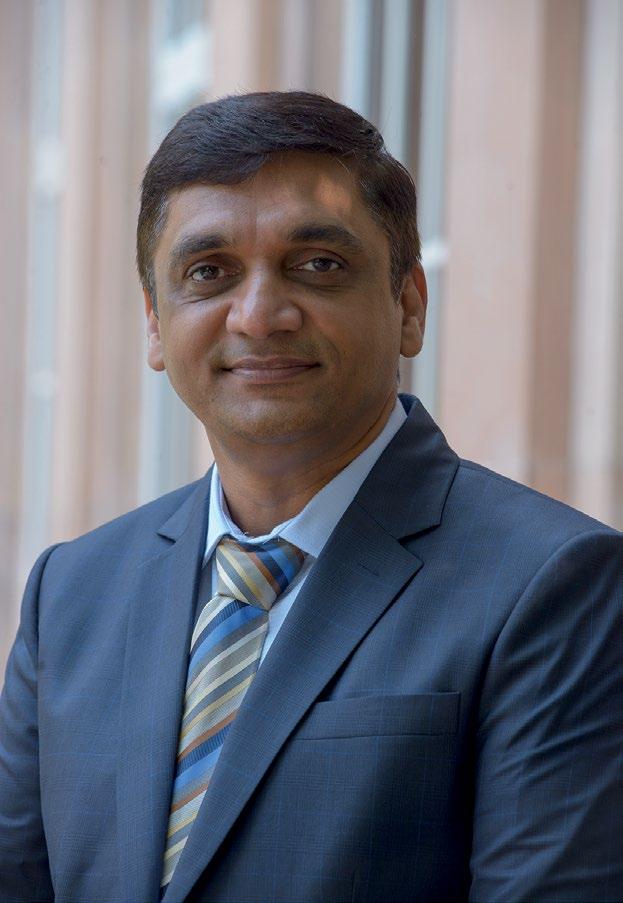
After many years at sea and a long-standing career with our Company, Captain Nishant Mehta is embarking on a new chapter ashore as Navigation Superintendent. Having gained extensive experience on board and a deep understanding of our operations, he brings valuable knowledge, dedication, and a seafarer's perspective to his new role. Let’s learn more about him and wish him the best in his new role!
Q1. What was the driving force for you to embark on a career at sea? What first attracted you to the life and profession of a seafarer?
NIM: I was attracted by the adventure and the opportunity to see the world. What kept me in the profession was the professional challenge of working on board and with people of different nationalities, and the dream of commanding a vessel at sea.
Q2. How many years have you been with the Company?
NIM: I have been with the Company for about 11 years and have sailed on both Crude Oil and Oil/Chemical Tankers, serving as Master for the entire duration with the Company.
Q3. Recently, you became a member of the office staff as Navigation and Training Superintendent. How do you feel now that you have moved ashore from on board?
NIM: It has been an exciting transition. At sea, the focus is on the safe operation of a single vessel, whereas ashore the opportunity is to support multiple vessels and their crews. It is rewarding to continue contributing to safe navigation and crew development in a different role but with the common Goal of “Get Home Safe”.
By Vaia Kyrodimou
Q4. Last week you participated in your first TMSA audit at the office. How different is the approach of the audit from Vetting Inspections on board?
NIM: A SIRE Vetting Inspection focuses on the vessel and its operations, while a TMSA audit examines the Company's safety management systems that support the entire fleet. Both aim to enhance safety and performance, but from very different perspectives. TMSA verifies the Planning aspect of the Organization and SIRE verifies its execution.
Q5. Communication is one of the most crucial parts during navigation operations. How do you think communication has changed, not only from a technical point of view but also as far as the parties/individuals are concerned?
NIM: Communication is now faster and more connected than ever before. However, clear communication, mutual understanding, and Teamwork remain the key factors in preventing errors and ensuring safe operations.
Q6. How do you imagine navigation will advance in the next decade? How will technological advances affect vessel traffic management and vessel tracking?
NIM: Navigation will continue to benefit from a better integration of vessel tracking and traffic management. We can also expect AI to become integrated into our Navigation systems. Technology will enhance safety and efficiency, but the navigator's ability to assess information from multiple sources and exercise judgement will remain essential. The technology is here to stay and advance and we will have to adapt and make the best use of it.
Q7. What do you believe the future holds for this Company and the industry as a whole?
NIM: The industry is evolving rapidly through new technologies, and compliance requirements. Our Company has always invested in its people and maintained a strong focus on safety. And as per a famous quote that if it were not for shipping companies and seafarers, half the world would freeze and the other half would starve.
Q8. Would you like to share something or give any advice for people ashore and on board?
NIM: I believe continuous learning, teamwork and adaptation are the foundations of success. Whether on board or ashore, understanding each other's challenges and working together will always be key to achieving safe and successful operations.
The idea of finding sunken treasure hardly ever fails to captivate the imagination, and that is why underwater treasure hunting has become a way of life for professional treasure hunters of the sea. Unlike the buried treasure hunters ashore who mainly operate with just a metal detector and digging tools, their underwater counterparts use state-of-the-art technology during their searches that have gone through extensive research, planning and preparation phases prior to the underwater exploration stage. Some of the equipment they regularly use nowadays includes remotely operated vehicles (ROVs), side scan sonar that provides detailed images of the ocean floor and magnetometers. Moreover, they are obliged to work both responsibly and ethically, which often entails consulting marine archaeologists or working alongside them. Thus, the lure of underwater treasure hunting is not only about recovering gold, silver, precious stones and valuable artifacts. It is also about gaining historical knowledge and connecting to the past.
All this would suggest that for the most part, these treasure hunters of the sea bed or ocean floor do not make the headlines. However, when they do discover a large amount of treasure, they can attract intensive media attention. One such discovery occurred in September 1988, when the Columbus-America Discovery Group of Ohio led by Tommy Gregory Thompson recovered gold and artifacts from the SS Central America, which had been dubbed the ship of gold.
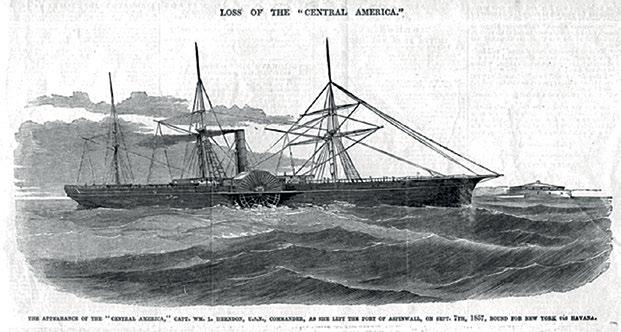
This vessel was a 278-foot (85m) steamer that set off from the City of Aspinwall (now called the Port of Colon in Panama) with 477 passengers and 101 crew on 3rd September 1857. Their destination was New York City, and the main cargo comprised around 30,000 pounds (13,600kg) of gold. Six days after their departure, the ship encountered a category 2 hurricane. Her boiler began to fail, her sails were torn to ribbons and a substantial leak developed between the paddle and wheel shaft. Following significant water ingress, both bilge pumps shut down. As the situation had become dire, a distress signal in the form of an inverted flag was displayed, but no immediate help arrived. The ship sank off the coast of the Carolinas together with 425 of those on board. Of those who survived, the majority were rescued by a vessel that arrived the following morning, fifty were rescued from the waves by a Norwegian barque and three were picked up from a lifeboat a week later.
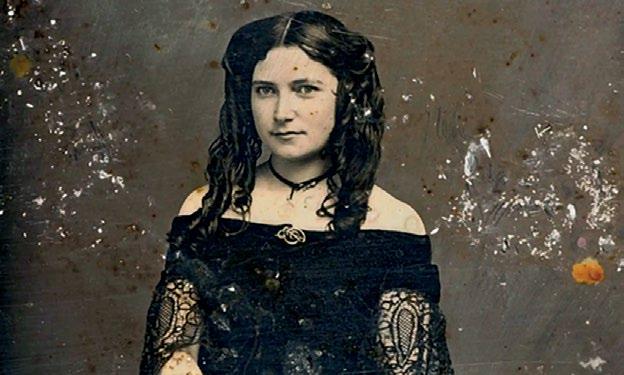
Source: en.wikipedia.org
The first salvage operation was followed by a number of missions that lasted until 1991. In all, these recovered a haul worth an estimated $100-150m, which accounted for only about 5% of the cargo that went to the bottom of the ocean. At the end of the missions, a lengthy legal battle ensued between dissatisfied investors and those involved in the recovery. After being sued, Thompson went into hiding but was arrested three years later. He would spend a little over 10 years in prison.
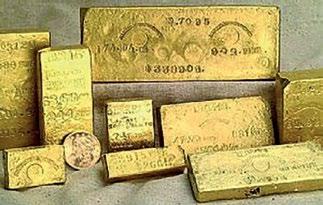
Ingots recovered from the wreck.
Source: en.mercopress.com
Initially, around 7,500 gold coins, including 100 Double Eagles, and 532 gold ingots were brought to the surface. During the last expedition, which took place in 2014, noteworthy finds included a further 3,100 American gold coins, 10,000 silver coins, 200 gold coins from other countries such as Australia, Mexico, France, England, Peru and the Netherlands as well as 1000 ounces of California gold dust.
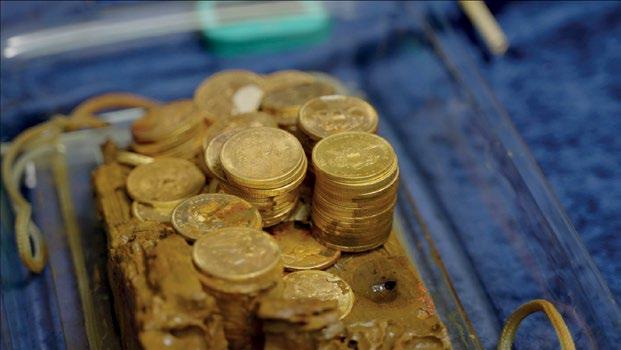
Source:
The attraction of searching for underwater treasure is easy to understand. However, in addition to the rewards to be gained from the financial and historical perspectives, successful expeditions can lead to a great deal of stress and anxiety.
Sources: en.wikipedia.org, www.dresseldivers.com, www.coinagemag.com
Pioneers of the Waves
John Franklin was the ninth of twelve children and his formal education began at a prep school in Huntingdonshire. This was followed by attendance at a grammar school in Spilsby, which was just 10 miles (16 km) from the North Sea. It was this proximity to the body of water that sparked in him a yearning for a life at sea. However, his parents were not on board with his pursing a maritime career. They wanted him to serve the church instead, so in order to show him how harsh life at sea could be, they arranged for him to go to Lisbon and back on a merchant ship. Their plan backfired as he returned with an even greater determination to join the navy.
Franklin joined the navy in 1800 at the age of 14. He saw plenty of action, including the Battle of Copenhagen, the Battle of Trafalgar and a battle at New Orleans, during which he suffered minor wounds. During one period when he was not involved in warfare, he was part of the first crew ever to circumnavigate Australia. This occurred under the command of his uncle Captain Matthew Flinders aboard the aptly named HMS Investigator.
His position in Australia was terminated 1844 as he proved to be less effective than expected.
Eager to put his mediocre governorship behind him, Sir John Franklin accepted the captaincy of an extremely ambitious Arctic expedition at the age of 59. Two vessels, the Erebus and Terror were selected. They would carry 129 officers and crew as well as supplies intended to last for three years. This expedition began in May 1945. It was intended to be the one that would reveal the Northwest Passage. As such, the whole country anticipated news of a successful voyage with bated breath.
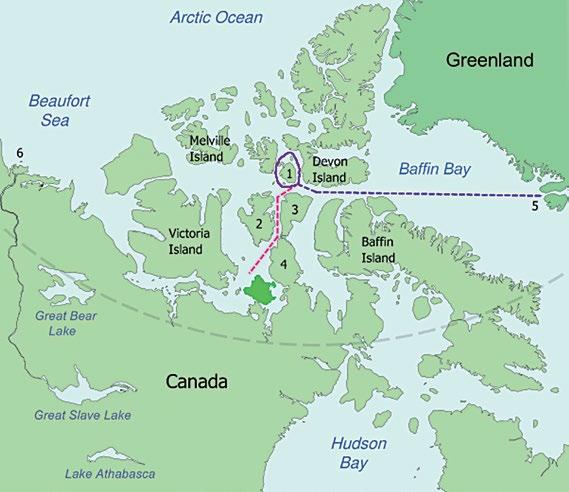
On board he displayed both enthusiasm and skill. He was able to rise through the ranks until the Napoleonic Wars ended in 1815, after which he was effectively sidelines for three years. His career resumed when he was selected for the first exploration of the Arctic in search of the Northwest Passage. This marked the beginning of his career in these waters.
Franklin’s first two expeditions were by no means as successful as he would have wished. They were, in fact, abject failures. In 1818, he took command of the Trent, one of two ships under Commander David Buchan aboard the Dorothea. Both ships were prevented from reaching North America by a storm they encountered off the coast the Greenland. The second voyage also ran into difficulties which led to 11 of the 20 explorers meeting their end.

On his return to England in 1822, he was taken aback when he was informed that he had been promoted to Commander. What is more, he was elected a member of the Royal Society. He then embarked on another expedition whose goal was to explore the coastline around the lower McKenzie River in northwestern Canada with the surviving officers of his second voyage to the Arctic.
In 1829 he was knighted, and in the following year he went to serve in the Mediterranean as a naval officer in the Greek War of Independence. Then, seven years later, he was appointed Governor of Van Diemen’s Land, which is now called Tasmania.
No news came, and it wasn’t a case of no news is good news. The Admiralty were forced to consider the possibility that the expedition had met with disaster. So, several searches took place over a period of around ten years. None of these searches was successful in finding the missing sailors alive. Investigations revealed that the two ships were last seen by seamen aboard British whalers off Baffin Island in late July 1845. After the Admiralty had virtually given up on the search, Lady Franklin organised a mission to discover what had happened. A search of King William Island uncovered skeletons of the crews along with a written account of the expedition up to 25th April 1848. The document revealed that the vessels had spent the winter of 1845-6 at Beechey Island. Later on in the voyage, they became icebound off King William Island, halfway between the Atlantic and Pacific Oceans. Sir John Franklin and 23 others perished at that location. Subsequently, the ships were abandoned by the survivors, who intended to head south to Back River, a journey of over 400km! Their futile attempt was witnessed by an Inuit woman who saw them fall down and die during the walk. It was concluded that their physical and mental decline was most likely brought about by botulism, scurvy and lead poisoning. There are no details of what they had to endure, but it must have been horrific. Franklin has been credited with finding the Northwest Passage by some historians. Doubt has been cast on this assertion by others. What is not in dispute, though, are the facts that his expedition ultimately ended in failure, and that he had accepted an extremely difficult task. Furthermore, he was apparently willing to pay the highest price for the sake of discovery and progress, and although he did not achieve his primary goal, he was able to chart large parts of the Arctic coast while gathering valuable scientific data that would aid later explorers.
Sources: www.ebsco.com, www.pc.gc.ca, www.britannica.com, www.arcticportal.org
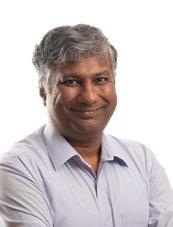
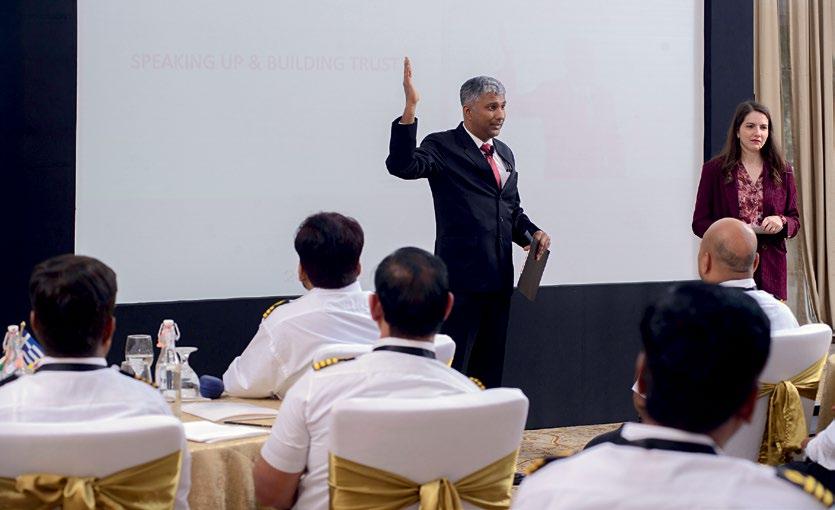
Here is a photo of one of our most expressive presenters who is able to fully engage with the audience, which is a rare talent. Can you guess what Captain Delson Roche is saying? Here are four alternatives:
1. ‘’And every time you see a colleague in the street, you should wave like this.’’
2. ‘’So, I’m going to ask you a question. It’s not a trick question. How many fingers can you see?’’
3. ‘’ It’s not just O.K…O.K, all right!’’
4.’’ A show of hands… How many of us have kept quiet and haven’t spoken up when we had to speak?’’
1. Make the names of TWO historic vessels using all the letters in the following sentence: GET A LITE CABIN. (Clue: Huge dog)

2. The letters in the chemical symbols for nitrogen, phosphorus, radon, tellurium and tungsten can be rearranged to form the name of a major port in northern Europe. What is the name of the port?
3. Which five-letter word can be used to complete the following words: _ _ _ _ _ FUL, WORK_ _ _ _ _ , REIN _ _ _ _ _ , EN _ _ _ _ _ MENT?
4. Which five-letter word can be placed after the words to the left and before the words to the right? POWER - - - -GUARD TURNING MAN BOILING BLANK
5. Change the word LESS to MORE in 4 steps by changing one letter at a time to form intermediate words.
6. Tommy is 50 years old and his father is 77. How many years ago was Tommy’s father 4 times as old as Tommy.
1. If your vessel was in the northernmost port in Africa, which country would you be in?
A. Morocco B. Algeria C. Tunisia D. Libya
2. What is the maximum concentration in mg/kg of catfines at the engine inlet that is typically recommended by Main Engine manufacturers?
A. 60 B. 40 C. 20 D. 10
3. Above what percentage of wear in the brake linings of windlass drum brakes is it recommended that they should be replaced?
A. 30 B. 40 C. 50 D. 60
4. In which year was the first CENMAR Officers’ Forum held in Manila?
A. 2008 B. 2010 C. 2014 D. 2018
5. On 27th May 2025 a Company vessel was caught in a difficult position while alongside at Port Sudan. What was the name of the vessel?
A. M/V Casta Diva B. M/T Merapi
C. M/T Merbabu D. M/T Danae
6. All ships must report their GFI to the IMO each year. The ‘G’ stands for Greenhouse Gas. What does the ‘I’ stand for?
A. Index B. Intensity C. Initiative D. Input
7. A screw ship unloader can be used for grain cargoes. Up to what rate in tons per hour can this piece of specialized equipment move such cargoes to the shoreside handling system?
A. 1000 B. 1500 C. 2000 D. 2500
8. Which one of the following is NOT a property of hydrogen sulphide (H2 S)?
A. It is colourless. B. It is less dense than air. C. It is explosive. D. It is flammable.
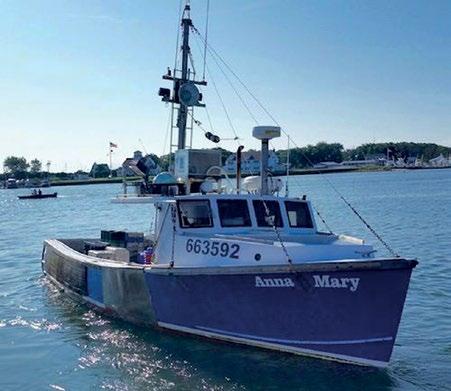
In the early hours of 24th July 2013, John Aldridge, a lobster fisherman who had been plying his trade for two decades in the Atlantic Ocean, was on the deck of the Anna Mary about 40 miles (64km) south of Montauk, New York. With him aboard the 44-foot (13.4-metre) fishing vessel were two other crew members who were fast asleep at the time.
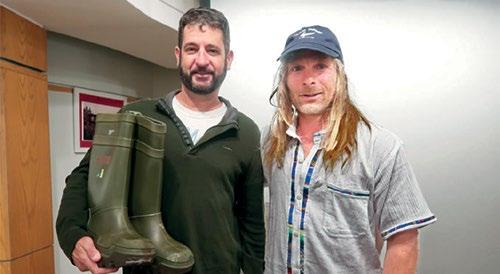
At one point he had to move a heavy cooler. He decided that as he was alone, this task could be accomplished by attaching a hook to the plastic handle on top of the cooler. As he was pulling the cooler, the handle broke, so he was sent reeling backwards with enough momentum to ‘catapult’ him over the open stern ramp and into the Atlantic Ocean.
In the blink of an eye, Aldridge had plunged from the relative safety of the fishing vessel into the cold dark seawater, which he gulped after making contact with the waves. At this point, he began to panic. He was gagging on the seawater, flailing his arms and screaming ‘Anthony’. As the distance between him and the Anna Mary increased, he accepted he was alone in the dark. To make matters even worse, a culture of risk normalisation led to him not have put on a wearable flotation device, which was a safety requirement aboard every commercial fishing boat.
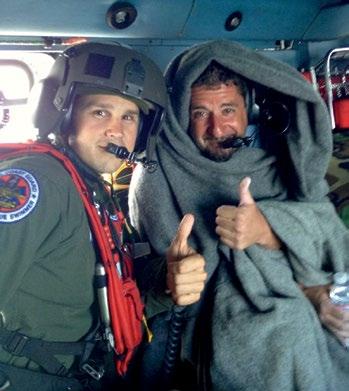
Once reality had set in, the lobster fisherman calmed down and adopted a survivor’s mindset. He lay on the surface and began to think about his predicament. As he was contemplating his situation, his legs quickly rose, leaving him to draw the conclusion that his boots were buoyant. So, he emptied the water from one boot, and then put it in the water with a pocket of air in it. When he put it under his arm, its buoyancy kept him firmly afloat. It was a minor victory, but one that spurred him on to find a buoy he could hang on to, thereby increasing his chances of survival. Aldridge’s main strategy was to find a buoy, but the lobster traps Anna Mary was heading for were one hour away by boat and well out of reach. However, he knew that he was much closer to the ones set by his friend, fisherman Pete Spong. This fact gave him hope, but it was a longer-term goal and he decided to break down his task into several short-term goals. One of these was to ensure marine creatures did not cause him to panic. He put this into practice when he came across two sharks, and it worked as his calm demeanour led them to leave him alone.
About four hours after he had plunged into the sea, one of his crewmates, Anthony Sosinski, awoke to discover John was missing. He immediately made contact with the US Coast Guard, and gave them all the relevant details they required, including the most probable time Aldridge went overboard – a piece of information deduced from the broken handle on the cooler. The New Haven Coast Guard office, which is responsible for this area then utilized the Search and Rescue Optimal Planning System (SAROPS) computer program. This system is linked to a nationwide Ocean Observing System, managed by the National Oceanic and Atmospheric Administration (NOAA) and its federal partners, which is linked to 41 radars that monitor ocean surface events. When all the data were computed, the search area was given as approximately 1000 square miles (2,678 sq.km).
Immediately after the area had been determined, the mission got under way in near perfect weather conditions. Meanwhile, John Aldridge had managed to spot and reach one of the buoys he had been looking for. He clung to it for dear life, his eyes scanning the horizon and skies for signs of rescue craft. Eventually, he spotted helicopters in the distance. It was a massive confidence boost as he knew that the search pattern the USCG adopted would lead them to him. He was correct as about 40 minutes later Bob Hovey, a OSCG swimmer was putting Aldridge in a basket lowered from one of the choppers. This marked the end of his 12hour ordeal in the Atlantic waters.
If statistics are anything to go by, John Aldridge was lucky to survive. Between 2000 and 2016, 204 commercial fishermen in the US perished and 89.3% of fishermen who fell overboard were never found. What is more, none of the 204 fishermen was wearing a personal flotation device (PFD). However, given the fact that Aldridge was able to improvise with regard to buoyancy and able to adopt a positive, calm mindset the odds of him surviving increased. Additionally, interagency partnerships, the vital information provided and favourable weather conditions assisted in his rescue, making his survival more probable. This is why the story of John Aldridge’s encounter with the waves is still being used today in search and rescue courses.
Sources: www.nationalfisherman.com, www.cbsnews.com, www.chesapeakequarterly.net, www.powerandmotoryatch.com