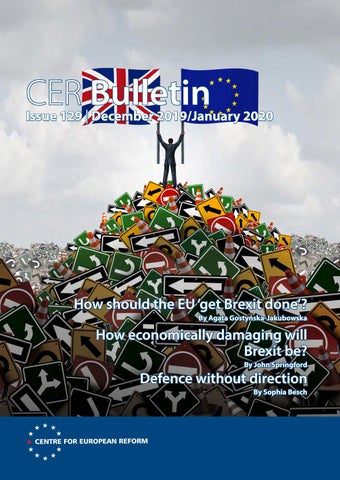
CER Bulletin
Issue 129 | December 2019/January 2020
How should the EU ‘get Brexit done’? By Agata Gostyńska-Jakubowska
How economically damaging will Brexit be? By John Springford
Defence without direction By Sophia Besch
How should the EU ‘get Brexit done’? by Agata Gostyńska-Jakubowska
The EU and the UK might have only 11 months to conclude negotiations on their future partnership. The EU would find it easier to achieve its objectives if its negotiating structures were similar to those for the Article 50 talks. ‘Get Brexit done’ is the mantra of Boris Johnson’s election campaign. If he secures a parliamentary majority in the December election, the UK will probably leave the EU by January 31st – the Brexit deadline set by European leaders. But contrary to Johnson’s claims, leaving the EU will not be the end of the Brexit story. The UK will have to reach agreement with the EU on their future relationship, or face another cliffedge when the transition period comes to an end on December 31st 2020. According to the withdrawal agreement, that is the deadline, unless the EU and the UK agree by July 2020 to extend it (for up to one or two years). Johnson has ruled out any extension: he argues that the 11-month ‘transition period’ is sufficient to agree on a future partnership with the EU. The EU thinks that this is a tall order, but has started establishing new negotiating structures in preparation for opening negotiations on the future relationship as soon as possible. The EU would be best placed for the new talks if it preserved the greatest possible continuity in staffing and structures with the Article 50 negotiations.
The legal basis for the next phase of negotiations will be Articles 207 and 218 of the Treaty on the Functioning of the EU (TFEU), which set out the procedures for opening, conducting and finalising negotiations with third countries. As a first step, the European Commission will formally recommend that the Council authorises the opening of talks with the UK and signs off the EU negotiator’s mandate. The Commission president, Ursula von der Leyen, has decided to keep Michel Barnier as the EU’s chief negotiator for the second phase of the talks. If the withdrawal agreement is ratified, Barnier’s ‘Taskforce for relations with the UK’ will shift its focus to the implementation of the withdrawal agreement: preparing the EU’s position for meetings of the joint committee (which oversees the application of the agreement and discusses any disputes on its interpretation); negotiating the future relationship; and ensuring that the EU is prepared in case no agreement on the future relationship is reached by the end of the transition period. Barnier is recruiting extra staff to deal with these daunting tasks.
INFO@CER.EU | WWW.CER.EU CER BULLETIN ISSUE 129 | DECEMBER 2019/JANUARY 2020
Irrespective of how many officials Barnier employs, however, 11 months is too little for the Commission to negotiate a comprehensive future partnership covering not only trade but various other policy issues. Barnier and his team will therefore prioritise negotiations in areas in which ‘no deal 2.0’ would have the biggest implications for the EU and the UK. The new task force structure suggests that trade and security will be top priorities. Barnier will co-operate in those areas with Phil Hogan, the incoming trade commissioner, Sabine Weyand, director general for trade, Josep Borrell, the incoming EU High Representative, and Helga Schmid, secretary general of the European External Action Service. Unlike the Commission, the Council has not yet formally decided how it wants to organise itself. Normally when the EU conducts international trade negotiations, the Council relies on its Trade Policy Committee (TPC), chaired by the member-state holding the rotating Council presidency. But in the Article 50 negotiations Didier Seeuws, formerly chef de cabinet to then European Council President Herman Van Rompuy, was made chair of the ‘Ad hoc working party on Article 50’, composed of delegates from the 27 member-states. This group facilitated the flow of information between capitals and Barnier, and allowed member-states to raise their concerns about the negotiations. When the group discussed contingency planning for no deal, member-states were allowed to send an extra official with sectoral expertise. Although the UK is scheduled to become a third country on February 1st, many member-states believe that the model used during these discussions should be retained for phase two, at least for the next 11 months, provided that Seeuws, with his negotiation skills and willingness to reconcile differences between the 27 and the Commission, remains chair. MEPs, who will need to approve the final deal with the UK, could also be useful to the Commission in negotiating a deal. When the British negotiating team questioned any of the EU’s ‘divorce’ terms, Barnier was able to threaten that any amendment could lead to the European Parliament vetoing the final deal. The European Parliament became more fragmented after the May election, but pro-European parties will insist on a robust defence of the EU’s interests in the second phase. MEPs could thus be Barnier’s ‘bad cop’ in the negotiations on the future relationship. Throughout the Article 50 negotiations, Barnier worked closely with the European Parliament’s Brexit steering group, composed of the leaders of the parliament’s biggest political blocs and the chair of the constitutional affairs committee.
In the second phase the steering group might also include the chairs of the foreign affairs and international trade committees, among others. Guy Verhofstadt, who currently chairs the group, aspires to chair Von der Leyen’s promised conference on the future of Europe; so the European Parliament may need a new Brexit co-ordinator.
The EU should preserve the greatest possible “continuity in structures with the Article 50 negotiations. ” The limited time frame that Johnson has set for the negotiations makes it difficult to reach any EU-UK deal much beyond a bare bones free trade agreement. The greater the time pressure, the less room there will be for divisions among the 27. But even so, one cannot entirely exclude squabbles among capitals either over the scope of the mandate or Barnier’s approach to the talks. For example, when member-states discussed no-deal contingency legislation on road freight, Poland’s push to allow road freight between the EU and UK to continue without disruption temporarily was initially opposed by Germany, which is a transit country for Polish lorries. But with the help of Seeuws a compromise was eventually struck among the member-states. It would be easier for the EU to reconcile any future differences of opinion among the memberstates if it could retain the familiar negotiating structures and their experienced personnel. The EU would also benefit from maintaining its ‘full transparency policy’, whereby the Commission publishes all its negotiating documents and regularly exchanges views with the 27 EU governments, national parliaments and other stakeholders. In the Article 50 talks, the EU’s willingness to set out its objectives publicly kept the UK on the defensive, and left the impression, whether fairly or not, that the UK was working to an agenda set by the EU. Such an approach in the second phase of the negotiations would also make it harder for the UK to attempt to agree side deals with memberstates if the prospects for finalising the EU-UK negotiations on time were bleak, or to blame the EU for the collapse of talks.
Agata GostyńskaJakubowska Senior research fellow, CER @AgataGostynska
How economically damaging will Brexit be? by John Springford
Economic forecasts are complicated to understand, serially abused (with campaigners picking the best or worst numbers they can find), and uncertain by their very nature. There is a wide range of estimates for the long-term hit from a UK-EU free trade agreement of the type Boris Johnson wants. The National Institute for Economic and Social Research says 3.5 per cent, the Treasury, 5 per cent, and UK in a Changing Europe, 2.3 to 7 per cent. So what is the economic impact of Brexit likely to be a decade from now? The answer hinges on one crucial piece of analysis: whether higher barriers to trade result in a one-off, ‘static’ hit to the economy before growth returns to normal – or whether there are second-order, ‘dynamic’ effects: that is, whether barriers will reduce competition, innovation and productivity growth. Economists divide into two camps. Those that think the hit to growth will be static say that higher trade barriers with the EU will make the British economy less efficient. Goods and services that could have been imported from the EU will become scarcer or more expensive, especially if the UK diverges from EU regulations. And UK exports will cost more in the EU. Consequently, demand for traded products will fall, and demand for domestic products will rise, despite domestic producers making them less efficiently. But once the British economy has adjusted to the higher barriers, it will grow at something like its previous pace: the growth rate is largely determined by innovation, investment
by companies to realise the gains from new production techniques, and improvements in education and training – which, in this view, have little to do with higher trade frictions. Believers in Brexit’s dynamic effects agree, but argue that more open economies are also subject to greater competitive disciplines. After Brexit, weaker competition from EUbased companies will lessen incentives for UK managers to invest in equipment and training that raises the productivity of their workforce. Also, in the single market more competition encourages companies to specialise in particular products, often in supply chains; higher barriers will do the opposite. This debate is not settled. As the UK’s fiscal watchdog, the Office of Budget Responsibility, notes, most of the evidence for dynamic gains comes from studying developing countries that are opening up to trade, where it is difficult to disentangle the effects of openness from those
INFO@CER.EU | WWW.CER.EU CER BULLETIN ISSUE 129 | DECEMBER 2019/JANUARY 2020
of government policies, such as education spending, the degree of corruption or the effectiveness of the legal system, which will also affect incentives to innovate and invest. Still, there are several reasons to worry that the UK is vulnerable to dynamic losses from higher trade barriers, in some ways more than other advanced economies. First, the UK has been exceptionally open to foreign direct investment (FDI) since the 1980s. Its car industry is largely foreign-owned, especially by Japanese and American companies that sought a foothold in the EU’s single market. American, Japanese, and European banks, accountancy and consulting firms have made big investments in operations in the City of London. And the UK is a favoured location for multinational corporations to conduct research and development in pharmaceuticals, biotechnology and software. Foreign-owned companies are responsible for over a quarter of UK output. On average, foreign firms are larger, employ more workers, and are more productive than British-owned ones, in part because they are better managed. As the cost of trading with the EU will be significantly higher under an FTA than it is within the single market and customs union, some of these companies will wind down British operations, taking production facilities, investments in research and development, and managerial know-how elsewhere. And Britain will be a less attractive location for future FDI, curbing future productivity growth. Tesla’s decision to build its new plant near Berlin rather than in Britain is a case in point. There is no evidence to support Johnson’s claim that there will be a “tidal wave” of investment into the UK after Brexit. Second, over the last two decades immigrants have improved the stock of skills of the British workforce, despite pro-Brexit campaigners’ obsession with low-skilled EU immigrants. Over 40 per cent of EU-27 nationals living in Britain have some form of higher education, compared to a quarter of UK citizens. And the UK attracts more highly-educated immigrants than France, Germany or Switzerland. Since the referendum, the big fall in net migration from the EU means that there are fewer skilled workers in the British labour market than if Remain had won. Furthermore, multinational companies transfer workers between their offices and factories in different countries: higher barriers to short-term work migration are inevitable if the UK leaves the single market, which will make it harder to attract staff or transfer workers to other European locations,
discouraging some multinational corporations from investing in Britain. Third, most studies of Britain’s entry into the then European Economic Community found sizeable gains, which are implausibly large for the static view. Using the same ‘synthetic control’ technique as I did to estimate the costs of Brexit so far, economists Nauro Campos and Fabrizio Coricelli found that ‘Brentry’ raised GDP per person by about 9 per cent. (The technique uses an algorithm to find the most similar economies to the UK, based upon prior economic performance, combines them into a doppelgänger UK that did not enter the EEC, and compares it to the actual UK data after the country joined.) More important, they found that entry led to larger gains in GDP per worker, suggesting that greater competition from EU importers and higher inward investment had a large and positive impact on productivity in Britain over time.
of Brexit are already as large as “theThelowercostsestimates for the long-term damage. ” The last reason to fear dynamic losses is that even before Brexit has happened, its costs are already as large as the lower estimates for the long-term damage. The economy is now around 3 per cent smaller than it would have been, according to my estimate, and 2.5 per cent smaller when compared to pre-referendum forecasts, with a big shortfall in private sector investment. Free trade negotiations with the EU are likely to drag on for several years, and with the lingering threat of no deal, growth and investment are unlikely to bounce back, with worrying implications for the productivity of British businesses. Meanwhile, FTAs with distant countries will take a long time to negotiate, and cannot make up for higher trade barriers with the EU, Britain’s largest trade partner. If Johnson wins the general election, he plans a free trade agreement with the EU that will result in “separate markets and distinct legal orders”, according to the political declaration on the future relationship. We cannot be certain, but there are good reasons to fear that Britain will be a significantly poorer country as a result. Fractious politics tends to accompany slow growth, as the last decade demonstrates. Strap in.
John Springford
Deputy director, CER @JohnSpringford
Defence without direction by Sophia Besch
French President Emmanuel Macron recently made headlines with his comment that we are seeing the “brain death” of NATO – an alliance that is nominally functioning but lacks strategic aim and political focus. When asked for solutions, he pointed to the progress Europeans had made boosting defence initiatives outside of NATO. But EU defence also currently lacks direction. Europeans have come far in the last three years, particularly in terms of capability development. The European Commission proposes to allocate a total of €13 billion to defence research and development in the EU’s 2021-2027 budget cycle, compared to just €590 million in the previous one. To use this money effectively, the EU will need to fix its defence planning process. The European Court of Auditors recently pointed out that the EU has now created as many as four different planning tools – the capability development mechanism, the capability development plan, the co-ordinated annual review for defence and Permanent Structured Co-operation, or PESCO – that often overlap with or even contradict one another.
Image: © European Union, 2019
But in developing the EU’s defence policy, Europeans face challenges that will not be easily fixed by rearranging its capability planning instruments. Europeans risk losing sight of what they want to do with their military capabilities once they have developed them. EU foreign and defence ministers agreed in 2016 that the EU should invest in its ability to carry out
crisis prevention and management in its own neighbourhood, to help build up the capacities of its partners, and to protect the union and its citizens. To give substance to these intentions, the EU should do three things. First, Europeans need to flesh out the military implications of these strategic priorities. For example, what does ‘protecting citizens’ mean? Should it refer to the EU conducting counter-terrorism or cyber operations? Could it encompass the territorial defence of memberstates? The EU has a mandate for the latter: Article 42.7 of the Treaty on European Union says that EU countries are obliged to come to the aid of a fellow member-state subject to an armed attack on its territory. But governments have quite different views of how this commitment should be interpreted in the future. France, in particular, wants European militaries and defence ministries to war-game EU responses to a cyber or even conventional attack on a non-NATO EU member-state such as Finland or Sweden. Paris would like to see an EU political declaration during the French EU Council presidency in 2022 that would define what
INFO@CER.EU | WWW.CER.EU CER BULLETIN ISSUE 129 | DECEMBER 2019/JANUARY 2020 7
member-states would do if the mutual assistance clause were invoked. In a similar vein, France’s European Intervention Initiative – a co-operation format outside the EU, proposed by Macron in 2017 – also encourages its members to discuss threat assessments and exchange expertise and intelligence. The aim is to align their security and defence objectives and make it easier to deploy together in the future. But other member-states worry that even engaging in these types of exercises could divide the union further: some support a stronger EU defence policy to balance a weakening NATO, while others are concerned about alienating the US further by developing a separate EU defence policy. Germany therefore wants to start a process of discussion and deliberation with all member-states, a so-called ‘strategic compass’, during its 2020 EU Council presidency. The goal is to unite everyone behind a political and military interpretation of the union’s level of ambition. Both a high-level debate and military exercises are necessary to clarify the military and political implications of the EU’s defence ambitions. And time is of the essence: developing new military capabilities can take years, sometimes decades. Second, the EU should ensure that every new piece of equipment, weapon system or training facility that member-states build together should have a clear link to the EU’s strategic priorities. Member-states have so far largely used PESCO, a framework launched in 2017
to help countries work better together, to get financial support for ongoing multilateral projects. The result is a long list of 47 projects, many without a clear link to the EU’s ambitions. PESCO would benefit if member-states instead created thematic clusters of projects needed to fulfil one of the union’s core defence tasks. They could, for example, group together all cyber defence and security projects related to the goal of protecting European citizens. Third, Europeans should take another look at the operational side of PESCO, which has not received much attention since the framework’s launch. PESCO members pledged to improve their militaries’ ability to deploy together, and to reform the way joint military operations are funded. Since PESCO has neither deadlines nor sanctions for failing to meet targets, it is difficult to hold its participants to account. But more public attention to the operational commitments that member-states have made could make a difference. A PESCO review to assess the framework’s progress, planned for 2020, could be a good opportunity to put pressure on governments to deliver. Getting member-states to develop capabilities together is difficult. But getting them to agree on how to use these capabilities is the real challenge. This is where the EU needs to take action, lest it be branded braindead itself.
Sophia Besch
Senior research fellow, CER @SophiaBesch
CER in the press The Economist 21st November John Springford, deputy director of the CER notes that farming emissions have been creeping up since 2012, partly because of increases in livestock. The Guardian 20th November As Sam Lowe of the CER says: “Where we start [on UK alignment with the EU and its impact on the future relationship] isn’t what matters, it’s all about where we want to end up.” Financial Times 20th November “A commission will not solve the problems of credibility
that NATO faces, problems of burden-sharing, a lack of shared threat perspectives, and illiberal members in its own ranks,” said Sophia Besch of the CER. The New York Times 1st November “The French think that they can act unilaterally without talking to everyone and get away with it, because they have a dynamic young leader with power and no one else does,” said Charles Grant, director of the CER. Financial Times 21st October “It is widely agreed that [Draghi’s] pledge to make the ECB the de facto lender
of last resort to governments was the key to arresting the euro crisis,” said Christian Odendahl, chief economist of the CER. Euronews 17th October “Turkey could trigger Article 5 but it would hardly be credible unless Turkish territory was attacked by Russia or Syria,” said Luigi Scazzieri of the CER. The Guardian 14th October “It looks like this [takeover of the upper house of the Polish parliament by the opposition] may be a small step in the right direction – but it’s clear the opposition
still has an awful lot of work to do,” said Agata GostyńskaJakubowska of the CER. The New York Times 10th October Camino Mortera-Martinez of the CER said, “The Parliament never misses an opportunity to flex its muscles, but it was a misstep by Macron to put forward a candidate [Sylvie Goulard] that he didn’t think was OK to be in his own government.” Kyiv Post 4th October “If either Shokin or Lutsenko told me the sun was shining I would look out of the window to be sure,” said Ian Bond of the CER.
INFO@CER.EU | WWW.CER.EU CER BULLETIN ISSUE 129 | DECEMBER 2019/JANUARY 2020
Recent events 15-16 November Conference on ‘Five challenges for Europe’, Ditchley Park Speakers included: Barry Eichengreen, Pier Carlo Padoan, Hélène Rey and Daniela Schwarzer
30 October Dinner on ‘The Banking Union in 2019: Supervisory priorities and economic risks’, London With Andrea Enria Pier Carlo Padoan
Andrea Enria 17 October CER/Clifford Chance launch of ‘The capital market union: Should the EU shut out the City of London?’, Brussels With Christian Ebeke, Jonathan Faull and Judith Hardt
(L to R) Jonathan Faull and Judith Hardt
1 October Conservative Party conference fringe event on ‘What route out of the Brexit maze?’, Manchester With Carolyn Fairbairn, Richard Graham and Greg Hands
(L to R) Richard Graham and Carolyn Fairbairn
Forthcoming publications Lessons for the High Representative on Israel and Palestine Beth Oppenheim Defending Europe’s values: The rule of law vs the will of the people Ian Bond and Agata GostyńskaJakubowska
Europe, the US and China: A love/hate triangle? Sophia Besch, Ian Bond and Leonard Schuette What would an effective UK trade policy look like? Sam Lowe
For further information please visit
www.cer.eu
EU 2030: Globalisation, technological change and the future of the European economy Sam Lowe and John Springford