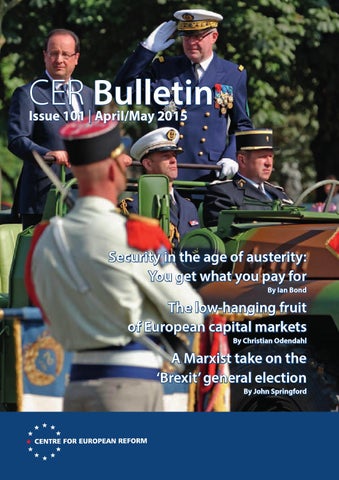
CER Bulletin Issue 101 | April/May 2015
Security in the age of austerity: You get what you pay for By Ian Bond
The low-hanging fruit of European capital markets By Christian Odendahl
A Marxist take on the ‘Brexit’ general election By John Springford
Security in the age of austerity: You get what you pay for by Ian Bond
The EU is in a dangerous neighbourhood, but shrinking European defence budgets suggest that finance ministries either have not noticed or do not care. According to the Stockholm International Peace Research Institute (SIPRI), from 2004 to 2013 defence spending in Europe fell by 6.5 per cent (in constant dollar terms); in some countries, including the UK and Italy, it fell by more than 10 per cent. Over the same period, Russia’s defence expenditure more than doubled, and China’s rose by 170 per cent. Saudi Arabia is now spending more on defence than the UK. At the NATO Wales Summit in September 2014, the alliance’s member-states agreed that they would “aim to move towards the existing NATO guideline of spending 2 per cent of GDP on defence within a decade”. Since then, countries like Belgium and Italy have announced further cuts. Across Europe, defence spending in 2013 (according to NATO figures) averaged around 1.6 per cent of GDP. Only Estonia, Greece and the UK spent 2 per cent or more. Some European politicians have begun to discuss the threats that Europe faces and the need to invest in countering them. The EU high representative for foreign and security policy, Federica Mogherini, has started work on updating the EU’s 2003 security strategy (see Rem Korteweg’s insight of January 19th). Britain’s foreign secretary, Philip Hammond, spoke at the Royal United Services Institute on March 10th of the threats to the UK from terrorism and Russia. President Bronisław Komorowski of Poland told
the German Marshall Fund’s Brussels Forum on March 22nd that the post-Cold War peace dividend had run its course. But what will Europe do to respond? Prime Minister David Cameron vocally supported the NATO 2 per cent target at the time of the NATO summit. But the UK is likely to undershoot it by 2017, if not sooner. To disguise this, government ministers have been trying to include other spending (especially on the intelligence services) under the heading of ‘defence’. The Chancellor the Exchequer, George Osborne, repeatedly avoided endorsing the 2 per cent figure during an interview on March 19th, saying only that the Conservative Party was “committed to keeping our country safe”. In election campaigns, the Conservatives have often portrayed themselves as supporters of strong defence; but this time they are trying not to talk about it at all. The Labour Party is poorly placed to exploit this: Shadow Chancellor Ed
INFO@CER.ORG.UK | WWW.CER.ORG.UK CER BULLETIN ISSUE 101 | APRIL/MAY 2015 3
Balls has suggested that a Labour government would also cut defence spending, though by less than the Conservatives. The UK’s position is bad news for several reasons. First, Britain has traditionally been the strongest link between the US and Europe in the defence and security fields. Now Britain seems to be adopting bad European habits. From President Barack Obama downwards, publicly and privately, the Americans have been critical of the trend of declining defence spending in the UK. Senior Americans like the former defence secretary Robert Gates have long warned that Europe cannot continue to benefit from US defence spending while doing little for itself. If the US cannot even rely on the UK, the risk that America will reduce its commitment to European security will grow. Second, cuts in the UK’s defence capabilities hit the Franco-British relationship, which is central to any serious European defence cooperation. The UK and France provided both the political impetus and military muscle for operations against Colonel Qadhafi in Libya in 2011. But the UK’s role in French operations in Mali and the Central African Republic since then has essentially been limited to providing air transport. Paris knows that it cannot lead European defence efforts by itself. French officials have privately expressed strong concerns about the effect of likely budget decisions on the UK’s force structures and therefore on its ability to co-operate with France. They are also worried that defence budget cuts, like the 2013 parliamentary vote against intervening in Syria, are signs of a growing British isolationism. Third, British ministers will no longer have any credibility when they press other European leaders to spend more on defence, if the UK itself is heading in the opposite direction. All governments in Europe are under pressure to reduce expenditure; for most, with honourable exceptions like Poland, it is politically easier to cut defence budgets than health and welfare. Britain may encourage a downward spiral in defence spending in Europe. Some EU leaders will be happy if the UK stops nagging them to do more on defence. But Commission President Jean-Claude Juncker was wrong to tell Welt am Sonntag on March 8th that “military answers are always the wrong answers”. Sometimes only effective military action can create the space to settle conflicts politically. By repeating the mantra that “there is no military solution” in Ukraine, the West has handed the initiative to Putin, who is ready to impose one. Andrew Wilson of University College London
said memorably at the beginning of the Ukraine crisis that the EU “took a baguette to a knife fight”. A frank debate about European defence and security needs to acknowledge that the EU does not just need soft power tools like trade, aid and the rule of law if it is to ensure stability and progress in the neighbourhood. Europe may keep a baguette in one hand; it needs a sharp knife in the other.
“Europe may keep a baguette in one hand; it needs a sharp knife in the other. ” Juncker was also wrong to suggest that Europe needed its own army – not just because the idea energises British eurosceptics in a sensitive pre-election period; but because institutions and processes cannot substitute for defence capabilities and political will. Having a European operational headquarters is of no use if there are too few forces to command and no consensus on what to do with those forces that exist. The EU can do more, however – if allowed by the UK and others – to help rationalise European defence markets, ensuring that the money that is available is spent efficiently; and to encourage its member-states to work together better on defence. There are good examples of countries agreeing to share capabilities, rather than duplicating them, among the Benelux and Nordic countries. But Europe needs to get beyond delivering the same output for smaller input, and increase both. That should be the focus of the European Council’s discussions on European defence in June, and of NATO’s spring ministerial meetings. The next British government also needs to recognise the European dimension of defence and security policy. Britain faces larger and more diverse threats than in 2010 when it published its last national security strategy. But whatever Britain spends on countering them, the impact will be greater if the rest of Europe takes defence more seriously. A good starting point for the government that wins May’s election would be to reinforce Franco-British co-operation, to reassure France that the UK will remain a reliable defence partner. Then these two countries should persuade European finance ministers to stop budgeting on the basis that the world is at peace and defence spending is a luxury.
Ian Bond Director of foreign policy, CER
The low-hanging fruit of European capital markets by Christian Odendahl
Europe’s economy is too dependent on bank finance. A greater reliance on capital markets would help to boost the region’s economic growth and resilience in future financial crises. To this end, the European Commission is aiming to create a capital markets union (CMU) in an effort to lower Europe’s dependence on bank finance and encourage the integration and deepening of its capital markets. But there are plenty of obstacles. Jonathan Hill, the EU’s finance commissioner, is sensibly focusing on the lower hanging fruit. But even these ‘early action’ measures will take time to implement, and as such will not improve Europe’s short-term economic prospects. Contrary to the US, banks provide the bulk of financing to businesses in Europe. To some extent, this reflects the fact that US firms are on average larger: almost 60 per cent of American employees work for firms with a staff of more than 250; the corresponding figure in Europe is just a third. Participants in capital markets are less willing to invest in smaller firms, because it is relatively more costly to acquire the information needed to determine the risks of lending to them. Banks, with their closer relationship to customers, usually possess that information. Europe’s bank dependence also reflects underdeveloped capital markets in Europe. One problem with bank lending is that it tends to be pro-cyclical, growing strongly during booms and contracting during busts, thus amplifying the business cycle. There are two reasons for this.
First, a financial crisis leads to losses and reduces a bank’s capital. Since banks have to finance a share of their loan book with their own capital rather than with deposits or bonds, they need to rebuild their ‘capital ratio’, which often leads them to curtail lending. Second, regulation tends to tighten after crises: often regulators demand that banks finance a larger share of their loan books with their own capital, or change the amount of assets that banks need to hold to remain liquid. Such changes in regulation often lead to further cuts in lending. To some extent, pro-cyclical regulation is inevitable, but it is more painful in a bank-based economy. Since the crisis, European firms have struggled to access funding because the region’s banks have reined in lending and capital markets were underdeveloped. Regulation was also tightened unduly, for example regarding securitisation.
INFO@CER.ORG.UK | WWW.CER.ORG.UK CER BULLETIN ISSUE 101 | APRIL/MAY 2015 5
And monetary and fiscal policy failed to offset the negative impact of pro-cyclical bank lending on the economy. Some of these mistakes are being corrected: macroeconomic policies have become less contractionary; and regulation has been relaxed in areas where the post-crisis response went over the top, though arguably not enough. A fully-fledged CMU would broaden the funding base for firms and infrastructure projects, making the European economy less bank-dependent and more robust. Larger and deeper capital markets would also help the European Central Bank (ECB) to conduct monetary policy: when a central bank lowers interest rates, there are two ways through which they can be transmitted to firms, via bank interest rates and via the cost of funding on capital markets. Moreover, the ECB would have a wider choice of assets (beyond government bonds) to buy in future ‘quantitative easing’ programmes. However, a fully-fledged CMU requires politically and legally difficult measures like the harmonisation of insolvency, corporate and tax laws – which will take years to implement, if they are ever agreed at all. What is more, the reform momentum is currently strong and should not be spread too thinly over too many projects. The Commission is therefore right to set out three priorities for early action. First, it wants to make it easier for firms based in one member-state to find investors in others. This requires that information about companies be easily accessible and in a form that analysts all around Europe understand. The prospectuses, the key documents that contain information about an asset such as a corporate bond, are costly to produce and need to be harmonised and simplified. Credit scores should also be made easily available and comparable across the EU. The Commission is calling for a consultation on the existing prospectus directive and credit scores framework to start the reform process. It also wants to support the growth of the so-called private placement markets in which medium-sized companies can market bonds in volumes that would be too small for public offerings. Second, the Commission aims to rebuild the European market for securitisation. Securitisation allows banks and financial markets to work together: banks have superior knowledge of local small and medium-sized enterprises (SMEs) and households, and can provide loans to financially sound borrowers; financial markets are eager financiers of such loans but only if they come in the right shapes and sizes. Securitisation allows banks to bundle loans together, and sell tranches to investors. Banks therefore have an incentive to extend more loans if they can sell bundles of them;
participants in financial markets, including pension and insurance funds, can invest in SMEs and other assets that are too small to invest in individually; and the ECB has a large asset class that it can buy in its monetary policy operations.
“A fully fledged CMU would broaden the funding base for firms and infrastructure projects, making the European economy more robust. ” Securitisation has an image problem as it is seen by many in Europe as a cause of the financial crisis. But just as Greek public finances were not the reason for the euro crisis, securitisation was not the reason for the 2008-9 crash: highly leveraged banks, overly complex securitisation, faulty risk models and a run on the refinancing markets of banks and shadow banks all worked together to create a perfect storm. Simple securitisation, on the other hand, was largely blameless. This is especially true in the EU, where the default rate of all ‘structured finance products’ was only 1.6 per cent between mid2007 and mid-2014, compared to almost 20 per cent in the US. The key is to make the process of securitisation transparent and comparable across the EU. This is what the Commission aims to help achieve, and has started a consultation process on the issue. The last ‘early action’ aims to boost long-term investments, especially the use of European longterm investment funds (ELTIFs). In essence, ELTIFs are a new regulatory class of funds which allow issuers to ‘lock up’ investors’ money for a long time, and market them across Europe. The aim is to make it easier for capital to flow across borders into longterm projects such as infrastructure. Here again, the Commission is consulting on how to support the use of these instruments. These three measures are realistic first steps: they focus on relevant issues (access to funding, securitisation and long-term investment); and they cover areas where there is a role for the Commission to drive the process forward. Moreover, the Commission has a powerful ally in the ECB, especially on securitisation, and the support of the German and British governments. But even plucking the lower hanging fruit of the CMU will take time. For example, a new regulatory framework for securitisation could take two years until it is fully operational. The construction of the CMU is a long-term goal, not a solution to Europe’s immediate economic problems.
Christian Odendahl Chief economist, CER
A Marxist take on the ‘Brexit’ general election by John Springford
It is tempting to see the British general election, to be held on May 7th, as a pivotal moment in Britain’s relationship with the EU. If the Conservatives form a government, there will be a referendum on Britain’s EU membership by the end of 2017. If Labour does so, there will not. At the time of writing, the election is impossible to call, with both parties neck and neck in the polls, but neither likely to win enough seats for an outright majority. Karl Marx’s theory of history should lead us to the opposite conclusion, however: that the election will determine nothing. “The mode of production of material life,” he wrote, “conditions the general process of social, political and intellectual life”: economic developments give rise to politics, not the other way round. And economics will determine the politics of Britain’s relationship with the EU. The underlying problem is the eurozone, but not, as many argue, because it is more dirigiste than the UK. Those who believe that the Continent loves red tape have not noticed that, on average, eurozone member-states’ propensity to regulate their economies is now only slightly stronger than the UK’s, as measured by OECD indicators. The Juncker Commission’s agenda, which seeks to further integrate the supply side of the European economy, could have been written in Westminster (the absence of meaningful services liberalisation aside). Rather, the problem has been the eurozone’s macroeconomic policies since the crisis began in
2008, which derailed Britain’s hopes for an exportled recovery. The eurozone’s crisis response was this: the periphery would regain competitiveness through falls in real wages by way of a prolonged period of high unemployment. This would not have been too harmful to British exports had the core provided an offsetting boost to eurozone consumption, but the periphery shouldered the burden alone. Monetary policy was kept tight, partly because the European Central Bank forecast that the economy would rebound and partly because quantitative easing was too difficult politically, at least until every other tool had been tried. The result: eurozone demand was so weakened that the value of British exports to the eurozone fell by 11 per cent in real terms from their peak in 2006 to 2013. The UK’s current account deficit ballooned to 4.4 per cent of GDP in 2014, even as British exports to the rest of the world grew quickly. The IMF forecasts the eurozone’s trend rate growth to be 1.6 per cent a year – far lower than the rest of the world. The consequence: Britain will
INFO@CER.ORG.UK | WWW.CER.ORG.UK CER BULLETIN ISSUE 101 | APRIL/MAY 2015 7
continue the slow process of decoupling from the rest of Europe. The idea that the opposed interests of capitalists and labour drives social change – and hence politics – was central to Marx’s theory. This is also pertinent to the ‘Brexit’ question. Business is largely in favour of staying in the EU, since investors hate uncertainty and they rightly fret about diminished access to the single market after withdrawal. Meanwhile, people who have less capital, either of the financial or human kind, are more fearful of the greater competition that arises from immigration and international trade. Immigration from the EU to Britain is likely to remain high in the next few years, as unemployment will only fall slowly in many eurozone countries, and Italian and Spanish workers will continue to move to Britain in search of work. It is almost certain that the UK will grow faster than the eurozone, and its flexible labour market is easily capable of absorbing the current rate of immigration from the EU. But British workers are increasingly hostile to immigration, and, despite liberals’ best efforts to convince them that it is beneficial, this will make them more antagonistic to the EU. Capitalists, on the other hand, see poor prospects for investment in the rest of Europe. While they are unlikely to want the costs of trade and investment with rich countries on Britain’s doorstep to rise, even as Britain’s economic ties with Europe become less important, their enthusiasm for the Union will wane. The current pro-membership coalition of multinationals, half of the Conservative party, Labour and most of the smaller parties, bar UKIP, will weaken unless the eurozone becomes a
faster-growing place. Big business will not become eurosceptic. But as Britain’s decoupling progresses, business will become less willing to forcefully challenge a future Conservative government that favours EU withdrawal. If the Conservatives lose the election, the price of becoming next Tory leader might be to offer a more radical EU policy than Cameron’s. To win the leadership, candidates might be forced to demand a more drastic renegotiation than Cameron’s moderate set of reforms, or even promise to campaign to leave the EU in a referendum. Conservative party members are more eurosceptic than its MPs, and they get to decide who becomes leader if more than one candidate stands. And when the Conservatives next win a parliamentary majority the pro-European coalition will have been weakened by slow eurozone growth, and continued neurosis about immigration. There is a glimmer of hope for pro-Europeans. Marx’s great mistake was to fail to consider that governments would establish welfare states, as well as public education, health, and progressive taxation systems to prevent inequality from destroying the capitalist order. So far, in times of crisis, the eurozone’s leaders have done just enough to hold the bloc together. It will probably require another recession to force them to tackle the currency union’s design flaws. And unless the eurozone overcomes its problems, the risk of ‘Brexit’ can only grow.
John Springford Senior research fellow, CER
CER in the press The New York Times 30th March 2015 “Flirting with Russia is guaranteed to antagonise the rest of the eurozone,” Mr Tilford of the CER said. “It will make it harder for those in Germany who were arguing for a more conciliatory line toward Greece to keep it.” El País 29th March 2015 “Reopening Schengen in a moment where populist parties are on the rise, and with many national elections in view, would be a mistake.
Member-states should, instead, make real use of the tools already at their disposal, such as the Schengen Information System” said Camino Mortera-Martinez of the CER. Süddeutsche Zeitung 2nd March 2015 In [the case of Brexit] banks would have to move whole departments and convince highly-paid specialists to move. “That could be difficult,” says Christian Odendahl, chief economist at the CER. “London is a worldwide financial centre like New
York or Tokyo, which it would remain despite being outside of the EU”. The Telegraph 19th February 2015 “Syriza have made a lot of mistakes and there isn’t much sympathy for them,” said Simon Tilford. “But at the same time frustration is increasing at the Germans. Not every country is relaxed at the prospect of Greece being ejected from the euro.” The Guardian 14th February 2015 “As Ian Bond of the CER
told Nick Cohen, this [the UK position] isn’t a strategy, it’s just noise. You either arm Ukraine or you don’t. If you wait until its armed forces are on the point of collapse, it will be too late.”
The Guardian 3rd February 2015 “Not only she [Merkel], but a large part of the German political, policy, economics and intellectual establishment was vehemently opposed to the ECB’s move [to print money],” noted the CER.
INFO@CER.ORG.UK | WWW.CER.ORG.UK CER BULLETIN ISSUE 101 | APRIL/MAY 2015
Recent events 28th January Lunch on ‘Russia, Ukraine and the EU’, London With Carl Bildt 16th February Lunch on ‘Hall of Mirrors: The Great Depression, The Great Recession, and the Uses – and Misuses – of History’, London With Barry Eichengreen, Nicholas Crafts and Natacha Valla Carl Bildt
Barry Eichengreen
24th February Roundtable on ‘How Russia is changing and the implications for European security’, London With Dmitri Trenin 25th February Breakfast on ‘Britain and Europe’, London With Douglas Alexander
Dmitri Trenin
Douglas Alexander
Recent and forthcoming publications Disunited Kingdom: Why ‘Brexit’ endangers Britain’s poorest regions John Springford
Cleaning the neighbourhood: How the EU can scrub out bad energy policy Stephen Tindale with Suzanna Hinson
The undiplomats: Populist radical right parties and their influence on European foreign policy Yehuda Ben-Hur Levy
To read all of our recent publications please visit our website.
For further information please visit
www.cer.org.uk