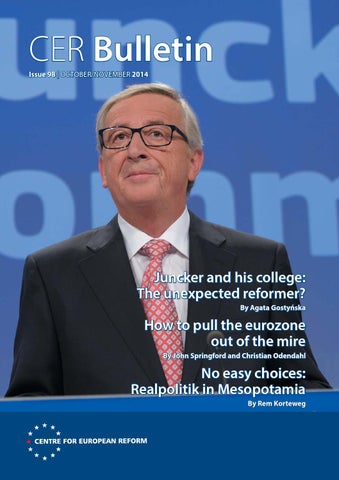
CER Bulletin Issue 98 | OCTOBER/NOVEMBER 2014
Juncker and his college: The unexpected reformer? By Agata Gostyńska
How to pull the eurozone out of the mire By John Springford and Christian Odendahl
No easy choices: Realpolitik in Mesopotamia By Rem Korteweg
Juncker and his college: The unexpected reformer? by Agata Gostyńska
Jean-Claude Juncker, the European Commission’s president-elect, presented his college and its new structure on September 10th. Perhaps surprisingly, there are reasons to be cautiously optimistic about the new president and his team. The Centre for European Reform would not have chosen Juncker as President of the European Commission. The Spitzenkandidaten process by which he became a candidate for Commission president risked pulling the Commission further away from the member-states and towards the European Parliament, a body whose democratic legitimacy is currently questionable. The record low turnout at May’s European elections did not enhance the Parliament’s authority. Juncker’s critics, including the British government, viewed him as an old-fashioned federalist. They feared that he would alienate EU citizens, who are generally sceptical about further transfers of competences to the EU, rather than engage them in the European project. And the (formerly) longest serving prime minister in Europe seemed an unlikely champion of change in the way the EU does things. So far, however, Juncker is showing signs of defying this reputation. He may yet shake the Commission out of its apathy, aided by an experienced team of commissioners, and avoid the pull of the Parliament. He has moved quickly to reshape the organisation of the college. The new structure is a departure from a Commission
organised in rigid silos, which José Manuel Barroso ruled with an iron fist. Juncker is the first president to organise the Commission’s work around ‘clusters’ — an idea long advocated by the CER. Commissioners will now work in ‘project teams’ which reflect the major EU objectives: jobs and growth; reform of the economic and monetary union; the digital single market; an energy union; and more effective EU external relations. Vice presidents will serve as ‘team leaders’ and steer the work of the remaining commissioners. This focus on projects aims to ensure that all relevant commissioners are involved in policy-making. But vice presidents will also filter out unnecessary proposals from individual commissioners that would put additional burdens on business and citizens. For example, the Commissioner for Climate Action and Energy will work among others with the Commissioner for Environment, Maritime Affairs and Fisheries and the Commissioner for Internal Market, Industry, Entrepreneurship and SMEs in his efforts to construct a coherent energy policy. Alenka Bratušek, the Vice President for the Energy Union, will not only co-ordinate this work but will
INFO@CER.ORG.UK | WWW.CER.ORG.UK CER BULLETIN ISSUE 98 | OCTOBER/NOVEMBER 2014 3
also decide which of her team’s activities need to be discussed by the whole college. Smaller and newer member-states have always opposed grouping commissioners in this way. They have feared that it would create secondclass commissioners and that they would struggle to get a senior portfolio. But Juncker cleverly recruited six of his seven vice presidents from newer or smaller member-states (Bulgaria, Estonia, Finland, Latvia, the Netherlands and Slovenia). The large member-states were not left empty-handed either: the UK and France received the portfolios they asked for while Germany made sure that the key economic vice presidents were advocates of austerity. But a decentralised Commission based on clusters may have drawbacks: if not managed properly, it could paralyse rather than improve the Commission’s work. A less presidential Commission may be more vulnerable to personal animosities and clashes of competences, especially if some vice presidents turn out to be less qualified than those they will be managing. Bratušek, the former Slovenian prime minister and now commissioner-designate, is subject to heavy criticism at home for nominating herself to the position even though her party lost in parliamentary elections. The controversies around her candidacy may weaken her credibility in the eyes of the commissioners she will supervise. Overly dominant personalities could also cause problems. Vice presidents should be careful not to destroy team spirit among the commissioners under them by exerting too much of their authority. If Juncker wants to go down in history as the president who not only formed clusters but also made them work, he must show himself to be a good manager too. On Juncker’s side is the fact that many memberstates have sent political heavyweights to Brussels this time. Five of the new college members have served as prime ministers and four as deputy prime ministers. Their political experience should give more clout to the Commission and help it to perform its executive functions, but will not guarantee success on its own. If the EU’s legislative process is to work, Juncker will have to keep the European Parliament happy, as well as the member-states. The Council of Ministers and the European Parliament co-decide on most of the EU dossiers. To gain the support of an absolute majority in the Parliament, Juncker had to tweak his initial ‘electoral programme’ to satisfy not only the Christian Democrats but also the European Socialists and the Liberals. Only after that did the Parliament vote him into the presidency and now it will try to ensure that
Juncker delivers on his promises. MEPs will also set out their expectations of the rest of Juncker’s team during public hearings due to start on September 29th. They will spend the next five years trying to influence the Commission’s activities.
“He may yet shake the Commission out of its apathy, aided by an experienced team of commissioners, and avoid the pull of the Parliament. ” Many of the problems facing Europe require prompt action at the EU level. But citizens worry that the EU regulates too many aspects of their everyday lives, instead of helping Europe out of recession and onto the path of greater prosperity. Junker’s ability to address their concerns may at times be difficult to reconcile with the Parliament’s appetite for expanding its legislative and scrutiny powers. This will be a balancing act for a president elected on the basis of the Spitzenkandidaten process. This may be why Juncker asked Frans Timmermans to be his right-hand man and first vice president responsible for better regulation, inter-institutional affairs, the rule of law and the Charter of Fundamental Rights. Timmermans is a well-known supporter of the involvement of national parliaments in EU decision-making, an idea which is gaining support in more and more European capitals. He is likely to reach out to member-states’ legislatures, seeking to counterbalance both the power of national governments and of the European Parliament. Without provoking inter-institutional wrangling, he will aim to restore the Commission’s equidistance between national capitals and the Parliament. This could strengthen the Commission’s role as agenda-setter, which has been in decline since Jacques Delors’ presidency. Juncker understands that his own political fate depends to a great extent on whether he can turn the Commission into a vehicle for reforming the EU. If he can use the clusters system to get commissioners and senior Commission officials working together; keep MEPs involved in the decision-making process without allowing them to dominate it; and find a way to reduce the distance between European citizens and the Commission that acts for their benefit, he will have proved his critics wrong. He has taken some important first steps.
Agata Gostyńska Research fellow, CER
How to pull the eurozone out of the mire by John Springford and Christian Odendahl
The eurozone economy is in serious trouble. Unemployment is stuck above 11 per cent, and growth and inflation have undershot expectations for the umpteenth time. European leaders were supposed to hold a jobs and growth summit on October 7th. They have had to shelve it: the only thing on the agenda was the ‘Youth Guarantee’, a small programme to get young people into work. The summit’s postponement reflects the growing divide over how to turn around the European economy, whose dire state is threatening the EU’s political future. At this juncture, a radical, five-pronged strategy is required to pull the eurozone out of its slump. Higher public investment, temporary income tax cuts, tax reform, structural reforms aimed at boosting competition in product markets and more aggressive monetary policy all have to come together to bring about recovery. When financial panic hit the eurozone’s periphery, some emergency deficit-cutting was understandable. But the eurozone-wide embrace of austerity – even in those countries that faced no debt crisis – was a bad mistake. And the form that austerity took was disastrous. Eurozone public investment was slashed by a fifth in real terms between 2009 and 2013. Investment is far easier to cut than spending on welfare or public services, since the pain is mostly felt by future generations. But economic theory and evidence shows that public investment in depressions boosts growth, increases tax revenues more than it raises deficits, leads to a lower debt-to-GDP ratio in the medium term and raises productivity in the long term. There is hardly anything worse than cutting public
investment in a severe economic crisis. Now that the European Central Bank (ECB) has calmed the panic in the periphery and government borrowing costs across the eurozone are at record lows, fiscal retrenchment across the eurozone needs to end. Budget consolidation should be a medium-term goal that is postponed during a severe recession. A public investment stimulus of 1 per cent of GDP would return the eurozone’s investment rates to those seen before 2009. Ideally, the eurozone would pool resources to create a common fund for investment to help peripheral countries with less fiscal room for manoeuvre. Should leaders balk at such fiscal transfers – and recent history suggests that they would – most governments,
INFO@CER.ORG.UK | WWW.CER.ORG.UK CER BULLETIN ISSUE 98 | OCTOBER/NOVEMBER 2014 5
except Greece and perhaps Italy, could spend more unilaterally. This would be entirely legal, if eurozone leaders applied the Stability and Growth Pact’s ‘exceptional circumstances’ rule, which allows countries to miss deficit targets in “periods of severe downturn”. Fiscal over-achievers like Germany need to spend much more. Since public investment takes time to work, it should be complemented by tax cuts that can be made relatively quickly. How they affect the economy depends on which taxes are cut and how these cuts are financed. In his recent speech at the annual gathering of central bankers in Jackson Hole, Mario Draghi argued that the eurozone needed ‘balanced budget’ tax cuts, which would be offset by cuts in public expenditure. But spending cuts directly reduce demand while a proportion of any tax cuts will be saved by consumers. Draghi’s approach is therefore likely to reduce growth, not raise it. A better way to cut taxes without reducing revenue is to change the composition of the tax system, away from labour taxes that make European workers comparatively expensive, and towards taxes on wealth, inheritances, property or carbon emissions. These shifts would be likely to have a positive impact on growth over the short and medium term. However, given the extreme weakness of the European economy, governments should also enact lump-sum income tax rebates for one year, which should be financed by borrowing, not spending cuts. This kind of tax cut makes its biggest impact on household expenditure, as the US experience shows. Germany, in particular, could stimulate its domestic economy in this way. On the supply side, there are many headwinds buffeting the European economy: an ageing society; slowing growth in educational attainment; and a slowdown in the labour force participation of women, even before the crisis. Since the workforce is growing slowly in some countries and shrinking in others, Europe will have to make the workers it has more productive. This requires supply-side reform. In 2011, the OECD estimated the impact of structural reforms in Europe on real GDP. It found that the largest gains would arise from promoting competition between firms; then tax reforms to reduce taxes on labour and income, and increase them on wealth, consumption and carbon; then investment in education in countries where attainment lags behind the OECD average; then labour market reform, and, finally, greater investment in research and development.
The reforms that the EU has so far pursued have not followed this order of priorities, focussing obsessively on labour market reforms in an attempt to boost ‘competitiveness’. This puts even more short-term strain on the economy as, in the absence of demand, more people are fired than hired. Structural reforms need a new focus – on tackling barriers to competition in product markets, especially in services, which would raise productivity – and as part of the investment stimulus governments should raise expenditure on education, training and research and development. A looser fiscal policy and supply-side reform would not suffice, however: the ECB also needs to do more. While it has unveiled measures to buy private assets directly in markets, and supply another round of longer-term cheap loans to banks, this is unlikely to do enough to raise eurozone inflation to the ECB’s target. In part, this is because banks and financial markets have failed to pass on monetary stimulus to the real economy in the way the ECB hoped. Belatedly, the eurozone is forcing banks to recapitalise, which is crucial to make monetary policy work better. But the ECB must also shape the expectations of consumers and firms about their future incomes and prices. In addition, threats of unlimited intervention by a central bank are much more effective than limited fiddling in financial markets, as the ECB learnt when its Outright Monetary Transactions programme arrested bond market panic. Therefore the ECB should announce two new measures. First, that it intends to make up for excessively low current inflation with somewhat higher inflation in the future, leading to an average of two per cent inflation over the next five years. This will improve expectations of future incomes and prices, and push down the euro, which will help exporters. Second, in order to make that commitment credible, the ECB should announce unlimited purchases of assets of its own choosing, private and public, domestic and foreign, until the target has been reached. Unless policy-makers take decisive action to raise growth and inflation rates, public debt in a number of member-states will become unsustainable, starting with Italy. Germany remains the major obstacle to change. But without a fresh approach, the political backlash against the euro and the EU as a whole could become impossible to contain. It is not in Berlin’s interest to preside over economic slump and political turmoil.
John Springford Senior research fellow, CER
Christian Odendahl Chief economist, CER
No easy choices: Realpolitik in Mesopotamia by Rem Korteweg
US president Barack Obama is leading an international effort to “degrade and ultimately destroy” the Islamic State in Iraq and the Levant, known as ISIS or ISIL, which has occupied large swathes of Syria and Iraq. The US has attacked the terrorist group in both countries; it will also train Iraqi Sunni forces, and support Syria’s moderate opposition. Success, however, could depend on the ability of the West and its Arab allies to co-operate – at least informally – with Damascus and Tehran. ISIS poses a threat to Europe. The group has promised that some of the approximately 2,500 European fighters in its ranks will return to attack European targets. A number of ISIS-inspired plots in Europe have already been foiled. In July, eight EU states agreed to share intelligence and co-operate to apprehend returning fighters, and to stop ISIS from recruiting in European cities. At the European Council meeting in October, the remaining 20 member-states should also sign up.
support. In Iraq, this means Sunni communities. Some of the 750 US military personnel deployed to Iraq will train Sunni ‘national guard’ units to fight ISIS. This is a challenge. Sunni unhappiness with the Baghdad elite gave ISIS fertile recruiting ground. The US wisely pressured Iraq’s previous Shia prime minister, Nouri al-Maliki, who pursued sectarian policies, to step down in August. But his successor, Haidar al-Abadi, must now show that he can convince Sunnis to resist ISIS.
As French airstrikes on September 18th demonstrated, some Europeans are willing to contribute militarily, though only over Iraqi territory. The UK, Belgium, the Netherlands and others may follow the French lead. But neither President Obama nor European governments have any intention of sending ground troops. As in other counter-terrorism campaigns, the US wants to rely on drones, missiles and airstrikes to weaken ISIS, allowing local forces to retake territory.
The Kurds in Iraq should also help. They are receiving heavy weapons from, amongst others, Germany and the US. Iraqi Kurdistan is stable, energy-rich, investment-friendly and a potentially viable state. But there is a risk that battlefield success could revive Kurdish aspirations for independence. Given the significant Kurdish minorities in Iran, Syria and Turkey, governments in the region would resist such ambitions. The EU should warn Kurdish leaders that such rash steps would add to the region’s turmoil and jeopardise the stability it currently enjoys.
Western airpower cannot succeed without local
INFO@CER.ORG.UK | WWW.CER.ORG.UK CER BULLETIN ISSUE 98 | OCTOBER/NOVEMBER 2014 7
Unfortunately, pushing ISIS out of Iraq is not enough; its sanctuary in Syria must be removed. The group emerged as an effective force fighting the regime of Bashar al-Assad in Syria’s civil war. With US military strikes, Syria’s imbroglio has become even more complex. The US wants both to defeat ISIS and unseat Assad. So instead of working with Damascus, the US hopes to train and equip 5,000 moderate rebels. Previously, however, USbacked groups have been defeated, or weakened by infighting. And opposition groups may not want to shift from fighting Assad to fighting ISIS. A complicating factor is Saudi Arabia’s competition with Iran for influence in the region. Riyadh is worried about ISIS and its claims on Mecca and Medina, but equally about Iran’s support for Assad. By giving Saudi Arabia a role in training moderate rebels, the US hopes it will stop backing Sunni extremists in Syria. Unless the moderate opposition alone can keep the pressure on Assad, this is wishful thinking. On the other side of the conflict, Iran will continue to prop up Assad. Tehran is not part of the US-led coalition, but ISIS is a sworn enemy of its allies in Baghdad and Damascus. Iran’s revolutionary guard already backs Iraq’s volunteer Shia militias and Syria’s military. The West should reach out to Tehran to co-ordinate some military and humanitarian operations. This may be politically easier for EU countries to do than the US; British prime minister David Cameron recently met Iranian president Hassan Rouhani in the margins of the UN General
Assembly in New York. For now, Tehran is playing hard to get, trying to link its help against ISIS to Western concessions on nuclear issues. Europe and the US must firmly resist this. Syrian airspace, unlike Iraqi, remains formally closed to an anti-ISIS coalition, blocking European action over Syria. Russia will not agree to a UN Security Council mandate against Syria’s will, either. But ‘realpolitik’ has made the US and Assad strange bedfellows; Damascus was given advance warning of, and silently acquiesced to, US airstrikes against ISIS and the Khorasan Group (an Al Qaeda offshoot) in Syria on September 23rd. This may be a formula Europeans can also live with. Jordan and some Gulf states supported these US strikes. This is encouraging; their participation helps convince sceptical Sunni Arab audiences that the fight against ISIS is not sectarian. But the attacks may drag the region and the US deeper into Syria’s civil war. Given regional complexities and the Western mantra of ‘no boots on the ground’, there are now two options, neither of them good. The West could attempt to contain ISIS inside Syria, risking further attacks by ISIS in neighbouring countries. Or the West could try to defeat ISIS altogether, but then it must find a way to work with Tehran and Damascus.
Rem Korteweg Senior reserch fellow, CER
CER in the press Voice of America 14th September 2014 “Support for Catalan independence is growing, and they are inspired by what the Scottish are doing. What’s happening is being watched very closely by many other parts of Europe”, said Stephen Tindale of the CER. International New York Times 12th September 2014 “I could weep for the hopes that we had in the early 1990s,” said Ian Bond, a former British diplomat in Russia, now at the CER. “The walls that divided us were collapsing, and Putin is building them up again.”
The Telegraph 11th September 2014 “Putin needs China for his domestic political narrative, but those in the business know that Russia has few alternatives to the West,” said Ian Bond. Reuters 9th September 2014 “Germany has ample financial room to spend more, and a boost in public investment would help the domestic as well as the European economy,” said Christian Odendahl, chief economist at the CER. The Guardian 28th August 2014 John Springford of the
CER wrote: “A detailed and fair-minded appraisal of the macroeconomic consequences of [Boris Johnson’s EU] reforms might undermine the entire argument, and they are not available to the reader of Lyons’s report.” Wall Street Journal 14th August 2014 “The eurozone recovery never really got going, and now it appears to be petering out,” said Simon Tilford of the CER. Wall Street Journal 7th August 2014 The wide-ranging [import] ban on foodstuffs underscored Russia’s dramatic
retreat from the West this year. “It’s symptomatic of a much deeper economic and psychological change going on, which is that Russia is being cut off,” said Charles Grant, director of the CER. Financial Times 5th August 2014 Charles Grant wrote that during the euro crisis Germany became the EU’s “unquestioned leader” on economic policy. “In foreign and security policy, Britain and France have generally set the EU agenda. The Ukraine crisis, however, may allow Germany to lead in this field, too.”
INFO@CER.ORG.UK | WWW.CER.ORG.UK CER BULLETIN ISSUE 98 | OCTOBER/NOVEMBER 2014
Recent events 9th July Breakfast on ‘Is the EU holding back innovation?’, London With The Rt Hon David Willetts MP
10th July Roundtable on ‘Can the EU make better use of scientific evidence?’, Brussels With Anne Glover and Geoff Mulgan Rt Hon David Willetts MP
Anne Glover
8th/9th September CER/demosEUROPA forum on ‘Europe’s foreign policy agenda’, Warsaw With a keynote speech by Radosław Sikorski
Radosław Sikorski
21st September BfB/BNE/CER fringe event at the Labour Party conference: ‘Can Britain lead in Europe? Will EU reforms deliver growth and jobs?’, Manchester With Peter Kellner, Juergen Maier, Phillip Souta, Gareth Thomas MP and Lucy Anderson MEP
Juergen Maier, Phillip Souta and Gareth Thomas MP
Forthcoming publications A capital idea Hugo Dixon
State aid and energy David Buchan and Stephen Tindale
The EU, Russia and sanctions Jennifer Rankin, Christian Odendahl and Ian Bond
The strategic implications of a deal with Iran Rem Korteweg
To read all of our recent publications please visit our website.
For further information please visit
www.cer.org.uk