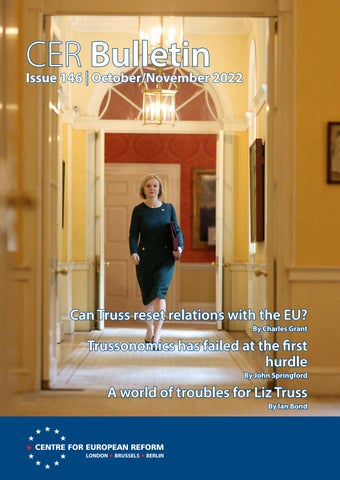
CER Bulletin
Issue 146 | October/November 2022
Can Truss reset relations with the EU? By Charles Grant
Trussonomics has failed at the first hurdle By John Springford
A world of troubles for Liz Truss By Ian Bond
Can Truss reset relations with the EU? by Charles Grant
Britain’s new prime minister has the chance to rebuild bridges to the European Union. But it is unclear whether she will seize the opportunity. The arguments in favour of resetting Britain’s relations with the EU scarcely need stating. The war in Ukraine makes it important for the Western allies to stand together and co-operate. The Brexit deal negotiated by Boris Johnson’s government has led to significant problems for British businesses, such as friction at borders. The perpetual arguments over the Northern Ireland Protocol have destabilised the region’s politics and poisoned the overall relationship between London and Brussels. And with the UK suffering economic turmoil after an ill-conceived minibudget, Liz Truss would surely want to avoid a trade war with the EU. If she aims for a reset, she will find the EU willing to respond. True, Truss did not make herself particularly popular as foreign secretary. In the words of one French official who was in meetings with her, “she treated the diplomatic world like the Tory Party conference, always playing to the gallery”. But most EU governments are tired of the strained relationship with the British and would like to move on. Both Micheál Martin, the Irish Taoiseach, and Joe Biden, the US President, have urged Truss to seek compromises on the protocol. The death and funeral of Elizabeth II created real sympathy for the UK.
Several weeks into her government, it is unclear what line Truss will take with the EU. She has certainly been polite to other European leaders. But she won the leadership of her party by cultivating the European Research Group, a well-organised and vocal band of hard-line eurosceptic MPs. They will be annoyed if she compromises on the protocol, arguing that to do so would betray the Democratic Unionist Party (DUP), the largest Protestant political party in Northern Ireland. The DUP is refusing to join the Northern Irish executive until the protocol is scrapped, seeing it – with the checks it imposes on trade between Great Britain and Northern Ireland – as a threat to the unionists’ British identity. More generally, Truss may seek to energise her political base, and create a clear dividing line with the opposition Labour Party, by picking fights with the EU. The EU itself could make a reset difficult. Most EU governments, and the European Commission, are pretty hard-line on the protocol. As one French diplomat puts it: “We don’t think there is anything wrong with the protocol, and we think that the DUP’s hostility to it has been stirred up by the Conservatives.” EU officials like to point to opinion polls which show a clear majority of the Northern Irish in favour of the protocol.
info@cer.EU | WWW.CER.EU CER BULLETIN issue 146 | OCTOBER/NOVEMBER 2022
The EU’s basic position is that it will not change the wording of the document that Johnson’s government negotiated. One opportunity for Truss to start building bridges would be to attend the inaugural meeting of the European Political Community (EPC) in Prague on October 6th. Emmanuel Macron has dreamed up this new club, with the intention of bringing together the European democracies (in or outside the EU), to discuss common strategic challenges like Russia and energy security. Macron takes the EPC very seriously and has been urging Truss to show up and help to shape the way it develops. In the words of one French diplomat, “there is currently nothing good to say about relations between London and Paris – but if Truss goes to Prague, that would be one good thing.” However, many of Truss’s eurosceptic backers regard the EPC as little more than an attempt to force the British back into EU-dominated structures. Flying to Prague would generate some goodwill, and give Truss the opportunity to get to know European leaders. But what really matters for a potential reset is the protocol. If Truss pushes ahead with the Northern Ireland Protocol Bill, which would allow the government to overturn parts of the protocol, no reset will be possible and bad relations with the EU would be guaranteed. If the bill enters into force – even without the government activating its clauses – the EU would respond to Britain’s disregard for international law by starting some sort of trade war. Truss has one other weapon in her armoury for hitting the EU. This would be to invoke the protocol’s Article 16 – which allows either party to undertake unilateral safeguarding measures if the protocol leads to “serious economic, societal or environmental difficulties that are liable to persist, or diversion of trade”. The article requires both parties to search for a solution through negotiation. The EU would regard the use of Article 16 as a provocation, though less heinous than turning the Northern Ireland Protocol Bill into law. At various times Truss has threatened to invoke Article 16, but her current line seems to be to keep negotiating with the EU over the protocol, with hints that a deal must be reached before the 25th anniversary of the Good Friday Agreement next April. As Hilary Benn MP argued in a recent CER policy brief, a compromise on the protocol is feasible, if both sides show flexibility. The UK needs to set aside the Northern Ireland
Protocol Bill, forget about Article 16 and bury its ideological obsession with removing the role of the European Court of Justice in policing the protocol. It should focus more on the practical difficulties that businesses encounter at the Irish Sea border – and a lot of the hassle would disappear if the UK aligned with EU standards on plant and animal health and food safety. In the past the UK spurned such an alignment on the grounds that it would stymie a trade deal with the US. But as Truss herself admitted recently, there is not going to be such a deal in the foreseeable future. The EU needs to recognise that goods travelling from Great Britain to Northern Ireland that are destined to stay there are an insignificant threat to its single market. Checks on such goods should be minimal. As for the British worry that the protocol’s state aid provisions could subject companies in Great Britain to the Brussels regime, the EU could provide written assurances that this would not happen. While the EU is unwilling to change the protocol’s wording per se, some Commission officials would happily tag on an addendum, clarifying and interpreting the document in ways that would reassure the British. If both sides can compromise on the protocol, a positive dynamic could emerge, with the British and the EU-27 treating each other as allies rather than rivals. The EPC could engender closer alignment on foreign and defence policy, leading to some sort of institutional co-operation between the UK and the EU. Both sides could treat the review of the Trade and Co-operation Agreement that is due in 2026 as an opportunity to smooth down some of its rougher edges – for example to allow Britons to travel briefly to the EU for work without needing a visa (with EU citizens gaining reciprocal rights). Of course, anyone who has watched the Conservative Party for the past six years will be sceptical about the prospects of a reset. The party is now dominated by hard-line eurosceptics, whose belief in the Anglosphere blinds them to the potential benefits of good relations with the EU. Conservative proEuropeans have been purged or keep very quiet about their beliefs. It is hard to imagine that a Conservative government would want more than the most modest and unambitious of resets. But if Truss displays some leadership, she can achieve such an outcome.
Charles Grant
Director, CER @CER_Grant
Trussonomics has failed at the first hurdle by John Springford
Are the UK’s institutions strong enough to stop the government’s wrong-headed fiscal policy? The markets brutally rejected Chancellor Kwasi Kwarteng’s 'fiscal event' on Friday September 23rd. As well as a large and untargeted energy bailout of households and businesses, Kwarteng announced big unfunded cuts to income tax, especially for higher earners, and reversed planned rises in payroll and corporation taxes. Markets responded by selling sterling and UK government bonds. Soon after taking office on September 6th, Kwarteng and Prime Minister Liz Truss had fired the civil servant in charge of the Treasury, Tom Scholar, as a statement of intent that the government would prioritise growth (the Treasury has a tradition of fiscal hawkishness). The government's decision not to allow the Office of Budget Responsibility to provide an independent analysis of the budget undermined investor confidence. The economic crisis the UK now faces has its roots in the Conservative Party’s decision to ignore, marginalise or even denigrate mainstream economics. Markets are now questioning whether Britain’s democratic and technocratic institutions will force the government to change course. It is unlikely that, at the time of writing, the UK is plunging into a balance of payments crisis, which occurs when foreign investors lose confidence in the ability of countries to finance their external
borrowing. Sterling fell 5 per cent against the dollar after Kwarteng’s statement, and 3 per cent against the euro. Government borrowing costs rose by 1 percentage point. It is unusual for an advanced economy’s currency to fall and government borrowing costs to rise at the same time. Usually, a fall in sterling implies a risk of recession, which prompts investors to seek safety in government bonds. But, while large, the size of these moves does not yet suggest a loss of faith in the UK’s ability to finance itself, despite a very high current account deficit (forecast to be 7 per cent of GDP in 2022). By comparison, in 1992, sterling fell 20 per cent when the UK fell out of the Exchange Rate Mechanism, the precursor to the euro. The UK’s macroeconomic framework has more safeguards against wrong-headed fiscal policy than it used to. Together, the bailout and tax cuts amount to a fiscal loosening of between 4 and 7 per cent of GDP over the next 18 months, depending on what happens to wholesale energy prices (which the government has little control over). Britain has a floating exchange rate, which means that foreign exchange markets do not have a currency peg to attack. The 1976 and 1992 sterling crises were driven by speculation that the Bank of England would not be able to raise interest rates by enough to maintain sterling’s value. The Bank is now independent of
info@cer.EU | WWW.CER.EU CER BULLETIN issue 146 | OCTOBER/NOVEMBER 2022
government, with an inflation target rather than the electoral cycle driving policy. Indeed, markets predict that the Bank of England’s base rate will peak at over 6 per cent. However, the leap in borrowing costs after Kwarteng’s statement will be extremely painful, leading to much higher mortgage payments and lower business investment. Many households have short-term, fixed-rate mortgages that will have to be refinanced in the next two years. If mortgage interest rates rise from around 2 per cent to over 6 per cent, households face huge cuts in discretionary spending of hundreds of pounds per month. That is after their energy costs have doubled, and prices for other goods and services have risen rapidly too. Businesses will also find it more expensive to fund their investments. So, by making the Bank raise rates, Truss and Kwarteng’s policies will lower growth substantially. And, without clear signals from the government, Parliament, the Bank of England and the media that the public finances will be put on a sustainable footing, a balance of payments crisis will become more likely. Kwarteng plans a full budget in November and could announce tax rises and public spending cuts to reassure investors. Unless he clearly signals he will do that, Conservative MPs could threaten to vote against his tax cuts, forcing him to change course. Truss could reaffirm her commitment to the independence of the Bank of England, which could hold an emergency meeting and vote to tighten monetary policy further. The Bank was forced to buy long-dated government bonds on September 28th, in order to shore up pension funds, but it will have to raise rates at its next meeting. The reaction of the British media, which has become much more partisan since the Brexit vote, will be an important gauge for investors of whether the UK political system is continuing down the path to US-style polarisation, with a right-wing press that at best questions the patriotism and good faith of the government’s critics and at worst demonises them. However, the degree of ideological fervour on the right means that the solutions to the UK’s economic problems are unlikely to come from the Conservatives. Brexit has reduced the supply capacity of the British economy, with imports, investment and immigration all being curtailed. The energy price shock has further reduced supply, by raising businesses’ costs; and demand, by forcing households to reduce discretionary spending. Public services are underfunded and struggling to recruit staff. Tax cuts and higher interest rates will do little to solve those
problems. There is little reason to believe that tax cuts for the wealthy or lower corporate taxation will sustainably raise growth: the UK has combined low taxes with weak investment and productivity, compared with other advanced economies, for several decades. Interest rates balance savings and investment, and with growth prospects looking weak thanks to Brexit and the energy price shock, higher rates will lead households and businesses to save rather than prompting them to invest more. Britain needs a plausible programme for macroeconomic stability and higher investment. As well as commitments to keep debt sustainable and to safeguard the central bank’s independence, the government could further loosen immigration rules, in order to offset the loss of workers to ill-health, retirement and to EU countries after the end of free moment. Truss hopes to do this, but according to reports, she is facing opposition from her cabinet. The government could announce a strategy of energy efficiency subsidies and licensing for renewables that would quickly reduce Britain’s dependence on imported fossil fuels – Kwarteng has overturned the absurd ban on onshore wind, to his credit. The government could make sizeable investments in transport and education, to raise workers’ skills and make it easier for them to commute to better-paying jobs. It could increase health spending to help people in illhealth to return to work. The UK could end the threat of a trade war with the EU by finding a compromise on the Northern Ireland Protocol. It could lay out principles for alignment and divergence from EU rules, promising only to change EU regulations if civil service analysis shows that the benefits of divergence outweigh its costs. But many of these policies are diametrically opposed to the reigning ideology in Truss’s government. Overall, they would require fiscal policy to be reoriented towards investment and tax rises. With two years to go until a general election is likely to be held, Truss and Kwarteng will be tempted to dig in and hope that falling energy prices come to their rescue. This is a big gamble – and it is up to Parliament, the Bank of England and the media to press them to change course before markets force them to do so.
John Springford
Deputy director, CER @JohnSpringford
A world of troubles for Liz Truss by Ian Bond
The new prime minister faces huge foreign policy challenges. She needs to choose her friends, her enemies and her policies carefully. The UK’s new Prime Minister, Liz Truss, is already suffering some self-inflicted wounds as a result of her economic and EU policy choices. She has also inherited enormous problems in foreign policy, which, if handled badly, will seriously damage the UK’s security. The most immediate challenge is Russia’s continued assault on Ukraine. Boris Johnson positioned himself as an enthusiastic backer of Ukraine’s President Volodymyr Zelenskyy. Despite Johnson suggesting in 2016 that the EU was to blame for Russia’s 2014 intervention in Ukraine, his government was one of the first to sound the alarm in 2021 about Russian President Vladimir Putin’s preparations for invasion, and to supply weapons to Ukraine before the conflict started; and he was among the early visitors to Kyiv after the February 2022 invasion. Truss seems keen to follow his example: in her September 21st speech to the UN General Assembly she pledged to “sustain or increase our military support to Ukraine, for as long as it takes”. After taking office, her first telephone call with a foreign leader was with Zelenskyy, from whom she accepted an invitation to visit Kyiv. There are three questions that Truss needs to answer in relation to Ukraine:
What further sanctions can the UK
impose on Russia to pressure it to change course or constrain its ability to keep fighting, not just signal UK disapproval? At this stage of the conflict, putting more wealthy Russians on the sanctions list will not influence Putin’s thinking, so Truss’s focus should be on measures that target the functioning of the Russian state more directly. For instance, although the UK and EU initially agreed to deny marine insurance to ships carrying Russian oil as a way of cutting Moscow’s most important source of budget revenues, they later relented, fearing the effect on global oil prices. Truss should examine the issue again: oil prices have fallen from a high of about $120 per barrel in early March to about $80 per barrel at the time of writing.
What military aid to provide to Ukraine? So far the UK has committed or delivered £2.3 billion in defence assistance. But Putin is sending an additional 300,000 or more troops to Ukraine, aiming to renew the offensive, or at least to prevent Ukrainian forces from recapturing more territory. If the UK's objective remains that Ukraine should restore its sovereignty over all its territory, Kyiv will need more weapons and ammunition, ideally before Russia’s reinforcements arrive. Among other things, the UK could send more of its multiplelaunch rocket systems and the missiles to go with them, provided that London is willing
info@cer.EU | WWW.CER.EU CER BULLETIN issue 146 | OCTOBER/NOVEMBER 2022
to tolerate the slightly increased security risk of running down its own stocks until it can procure or produce more.
What reconstruction aid to provide to Ukraine? The extent of the devastation caused by Russia’s invasion means that Ukraine will need to rebuild on a scale not seen in Europe since the Second World War. The UK has so far provided about £1.5 billion in non-military aid to Ukraine. The government should look at whether it could confiscate frozen Russian assets and use those to fund additional help for Ukraine. Having reduced its overseas aid budget from 0.7 per cent of GDP to 0.5 per cent, however, the UK may struggle to fund its share of Ukraine’s needs without deep cuts in aid spending for the rest of the world. Such cuts would potentially undermine another of Truss’s stated aims, namely providing an alternative to funding for developing countries from “malign regimes” (as she called them in her New York speech, presumably in a reference to China, among others). Domestic economic problems and a weaker pound will make it harder still for the government to maintain overseas aid spending, let alone increase it.
Truss will also have to decide whether in a planned update of the March 2021 UK Integrated Review of Security, Defence, Development and Foreign Policy, she should shift towards more confrontation with China. The integrated review pointed to a balance between engagement and wariness: “We will continue to pursue a positive trade and investment relationship with China, while ensuring our national security and values are protected. We will also co-operate with China in tackling transnational challenges such as climate change”. In favour of a firmer stance, the Truss government includes some of China’s harshest parliamentary critics, such as security minister Tom Tugendhat. The government has emphasised its commitment to the AUKUS alliance with the US and Australia, seen as a counter to China. On the other hand, with economic relations with the EU disrupted by Brexit and Truss having accepted that a free trade agreement with the US is many years off, the UK may not want to close off the possibility of more trade and investment ties with China. The government’s indecision over whether to allow a Chinese-owned company to take over a semi-conductor plant in Wales suggests that Truss’s team has not yet decided whether to treat China as more of a threat than an opportunity.
The update of the integrated review will also have to reflect Truss’s pledge to increase defence spending from 2 per cent to 3 per cent of GDP by 2030. Defence secretary Ben Wallace has warned that the larger budget will not necessarily be used to reinstate capabilities lost in recent years – instead, it will focus on the needs of modern warfare, including counter-drone technology and more long-range artillery. But inflation and the falling value of the pound will erode the real value of the increased budget. In addition, if demands on the National Health Service, social care and other areas of government spending increase, it may be politically difficult to increase defence spending. The government will have to decide what to prioritise and where to focus geographically: will it stick to plans to deploy more forces ‘East of Suez’, or increase its contribution to the defence of Europe? Whatever decisions Truss takes on defence investment, she will want to ensure that the UK remains a useful partner for the US. She may not welcome President Joe Biden’s stress on the need for the UK to respect the Northern Ireland Protocol, but no UK prime minister can afford to neglect defence and intelligence co-operation with the US. At the same time, she (and future UK prime ministers) will need to take account of the risk of Donald Trump or another Trumplike figure becoming president. The memoirs of various former Trump administration officials show that he had to be persuaded not to pull the US out of NATO; but it might not be possible for officials to restrain a future president. US withdrawal from NATO may be unlikely, but reduced American interest in Europe is enough of a risk that Truss should hedge against it. Thanks in part to its firm line on Russia and its contributions to NATO’s forward presence in Central Europe, the UK has good relations with some EU member-states, in particular Poland and the Nordic and Baltic states. With others, above all France, co-operation needs to be revitalised. As foreign secretary, Truss was willing to countenance limited, low-key practical co-ordination with the EU on foreign policy issues, in particular on sanctions. As prime minister, she should part company with Brexit fundamentalists and rebuild links with EU institutions and member-states on foreign, security and defence policy. She has taken charge at a time of foreign policy troubles; the UK needs all the friends it can find, even if they fly the EU flag.
Ian Bond
Director of foreign policy, CER @CER_IanBond
info@cer.EU | WWW.CER.EU CER BULLETIN issue 146 | OCTOBER/NOVEMBER 2022
CER in the press Financial Times 26th September “It’s a shocking moment,” Luigi Scazzieri, a senior research fellow at the CER, said of the party’s meteoric rise. “It’s the reflection of the electorate that feels like it has tried everything else now turning to the solution that is more radical and new.” Scazzieri added “It’s this huge contrast with Draghi that makes it very hard for people to understand,” saying that it reflects “a country that really feels that things are going in the wrong direction” after two decades of economic stagnation. The New European 23rd September For Ian Bond of the CER, Vučić is an opportunist above all else. “There is a cynical calculation going on about how he can extract the maximum benefit from both sides. He is a Serb nationalist and it plays well with his voters if he can also be shown to be standing up for ethnic Serbs in Bosnia. Does he want to annex the Republika Srpska? I suspect not because that would actually bring down the
wrath of the EU on his head in a way that would not suit his interests. But he’ll be quite happy to cause a certain amount of trouble.” Financial Times 21st September Charles Grant, director of the CER, said French officials had told him that UK-France relations were very poor but that British participation in the Prague summit would change things. “Macron thinks this is really important for discussing strategic issues and he wants the British to take part,” said Grant. “The French say that the Brits can help to shape how the EPC emerges.” City A.M. 16th September “The path the EU is trying to take is creating a new crime that would be around evasion or breaking sanctions laws”, says Zach Meyers, a senior research fellow at the CER. Euronews 13th September "I think COVID-19 is going to be regarded as one of the major success stories of the
European Union over the years to come," said Camino Mortera-Martinez of CER. "Nobody expected to have inflation as high as we have at the moment. So the tools to deal with that are not fiscal expansion for obvious reasons. So in that respect, the Commission dropped the ball, but I think they had to," she said. The Washington Post 13th September "Especially as it pertains to her positions on Europe, she [Meloni] has moderated more noticeably than the other Western European nationalist who earlier this year made a run for power, France’s Marine Le Pen. While Le Pen’s platform had ideas that would have led to standoffs with Brussels – like prioritizing national law over EU law – Meloni’s does not, said Luigi Scazzieri of the CER. Euronews 9th September Elisabetta Cornago, a senior research fellow at the CER, explained that given the way the EU energy market is designed, demand is met by the cheapest power
plants first. The most expensive power plant then determines the price for the entire market. The European Commission has proposed a revenue cap on nongas producers, including nuclear, coal and renewables to bring down prices. Bloomberg 23rd August As Zach Meyers of the CER notes, a lot of the damage has already been done. While both sides suffer from this dispute being dragged out, it’s the UK, as with most Brexit matters, that has more to lose. ... Meyers notes that while the UK was getting more out of Horizon in financial terms than it was putting in, it’s the qualitative elements that signify the bigger loss. New Statesman 17th August As John Springford, deputy director of the CER noted in a recent article, Covid-19 has caused services trade to rise and goods trade to fall but recover relatively quickly, while foreign direct investment and migration flows have continued to surge.
Recent events 26 September Labour Party Conference fringe event on 'The future of the EU-UK relationship', Liverpool Speakers: Stella Creasy, David Lammy and João Vale de Almeida 22 September CER/AIG Webinar on 'EU enlargement after Russia's invasion of Ukraine'
Speakers: Laura Ahrens, Heather Grabbe and Andreas Metz 21 September CER/Clifford Chance lunch on 'How to achieve energy security in Europe', hybrid, Brussels Speakers: Maria Rita Galli, András Hujber and Øyvind Vessia
For further information please visit
www.cer.eu
14 September Discussion on 'Prospects for global corporate tax reforms', hybrid, London Speaker: Pascal Saint-Amans