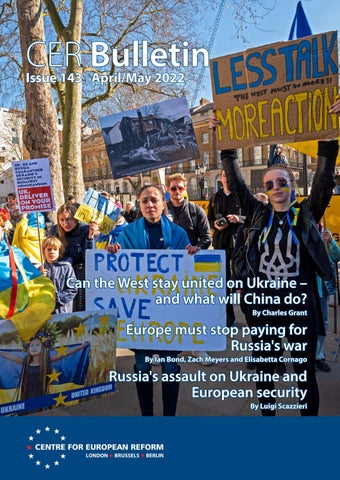
CER Bulletin Issue 143 | April/May 2022
Can the West stay united on Ukraine – and what will China do? By Charles Grant
Europe must stop paying for Russia's war By Ian Bond, Zach Meyers and Elisabetta Cornago
Russia's assault on Ukraine and European security By Luigi Scazzieri
Can the West stay united on Ukraine – and what will China do? by Charles Grant
The longer the war in Ukraine continues, the greater the risk that Western unity will fracture. Meanwhile the choices that China makes will determine the future shape of geopolitics. Although Russia’s invasion of Ukraine has caused untold suffering, it has forged a stronger sense of identity among the people of that country. It has also fueled inflationary pressures – driven by shortages of oil, gas, metals and cereals – and will stymie global growth. Geopolitically, most of the consequences have so far been benign, with the Western states displaying an impressive degree of unity. But the longer the war continues, the more tensions among the allies are likely to grow. First, the good news. In the US, although Republicans and Democrats remain contemptuous of each other, they are working together to put pressure on Russia. Across the Atlantic, there is harmony: the ill-feeling left by President Joe Biden’s chaotic withdrawal from Afghanistan and the AUKUS (Australia-UK-US) defence pact has dissipated, while the principal leaders are keeping each other informed of their moves. Some of the worst rifts in Europe have diminished: London and Brussels remain far apart over how to interpret the Northern Ireland Protocol, but neither wants to provoke a confrontation in the middle of a security crisis. Similarly, the row between Warsaw and Brussels over the independence of Poland’s judiciary has quietened down, for now. As for Turkey’s
dire relations with the EU and the US, Turkish sympathies for Ukraine create the possibility of a modest rapprochement. The most surprising result of the invasion has been Germany’s Zeitenwende (historic shift) on defence: Berlin wants to boost spending massively, supply weapons to Ukraine and buy new equipment, including jets to carry American nuclear weapons. Chancellor Olaf Scholz appears to back President Emmanuel Macron’s plans for strengthening Europe’s defence capabilities. The EU’s Atlanticist members will ensure that European defence is NATO-compatible (and try to include the British). But will these positive developments endure? September 11th 2001 may offer a cautionary tale. Those terrorist attacks brought the major powers together. NATO invoked Article 5 for the first and only time in its history. President George W Bush, whose America-first unilateralism had worried the Europeans, veered towards multilateralism. Russia, and to a lesser degree China, gave firm and unambiguous support to the US and its subsequent efforts to lead an international force into Afghanistan. The EU states agreed on the European Arrest Warrant, a significant measure of integration that would make life harder for terrorists and other criminals.
info@cer.EU | WWW.CER.EU CER BULLETIN issue 143 | APRIL/MAY 2022
But the harmony did not last long. Bush’s decision to invade Iraq, 18 months after 9/11, split the West and the EU in two, alienating Moscow and Beijing in the process.
should enjoy spheres of influence in their neighbourhoods. China enjoys secure access to Russia’s oil and gas. Putin’s demise would be very bad news for Xi.
In 2022, many issues could yet divide the allies, and in particular the EU-27 (as my colleagues have written): Enlargement. Most Central European and Baltic states want to offer Ukraine a clear route to EU membership. Some would do the same for Moldova and Georgia. Others, including the French and the Dutch, think Ukraine isn’t ready and worry that fast-tracking it would badly affect applicants from the Western Balkans. Refugees. The nearly 4 million Ukrainian refugees who have entered the EU have so far caused less disruption than the flows from the Middle East and North Africa in 2015-16. But the numbers will grow and questions of burdensharing could easily create divisions. Energy. Germany, Hungary, Italy and Bulgaria are among those most dependent on Russian gas imports, and therefore oppose a complete ban on energy trade with Russia. Others emphasise that excluding Russian hydrocarbons would accelerate the introduction of green technologies. Defence. The EU’s hawks will keep pushing for more military help for Ukraine, but others will worry about the risks of provoking Russia into starting a general war. Everybody wants to spend more on defence, but some will find that very difficult, given the competing demands on budgets. Peace talks. There will be many diplomatic efforts to end the war. If President Vladimir Putin wanted to, he could probably divide the Europeans by proposing a peace plan that gave Russia just a few bits of Ukraine. Some EU countries might favour such a compromise, while others would argue that Russia should get nothing. But Putin does not yet appear serious about peace – and for now the Western allies agree that it is up to Ukrainian President Volodymyr Zelenskyy to negotiate as he sees best. China. If China breaches Western sanctions against Russia, the US will put pressure on Europeans to sanction China. But Europeans depend more on trade with China than do Americans, and some of them, notably Germany, will hesitate before curbing economic ties.
Yet, against that, China does support the principles of territorial integrity and national sovereignty. And it doesn’t want a complete rupture with the West, since that would create economic difficulties – at a time when Covid, mountains of debt and a bursting property bubble are already causing strains at home. So far China has adopted a position of formal neutrality, while leaning rhetorically towards Russia. It blames the US and NATO for provoking the conflict – and according to US intelligence is considering Russian requests for military assistance. China may well try to keep to the letter but not the spirit of Western sanctions on Russia.
The single biggest variable that will determine the shape of post-war geopolitics may be China’s stance on Ukraine. The first indications are not encouraging. President Xi Jinping seems to see the world primarily through the prism of China’s rivalry with the US. Russia in general and Putin in particular are trusty allies against the US: China can count on Russia’s support in the UN Security Council, for example against Western initiatives on human rights. They agree that big autocracies
The war in Ukraine could easily last a long time. If China chooses to line up alongside Russia, the West will probably respond with tough sanctions (even if some Europeans are reluctant to apply them) on trade, investment and technology. The world would be less multipolar and more bifurcated into two rival blocs. Supply chains would shorten, and less trade would impair growth. In Beijing there are voices that view this prospect with some alarm, but for now they are quiet. The invasion of Ukraine, like Covid, has exaggerated trends that were already evident. Even in the years before the invasion, Germany’s defence budget was rising, the EU was making efforts to achieve ‘strategic autonomy’ in areas like energy, microchips and defence, and some supply chains were shortening. And Russia’s eastwards trajectory was clear. As the CER’s annual report on 2020 commented: “Biden’s emphasis on human rights…will leave Russia with little choice but to line up with China geopolitically.” With Russia’s leaders showing “no signs of wanting to break its dependency on hydrocarbon exports or the kleptocratic system that such an economy feeds, [and] omnipresent gangsterism causing economic harm, living standards will erode slowly as Russia drifts into the Sinosphere.” Now Western sanctions on Russia will hasten that erosion. Putin’s regime has certainly been weakened by the war, though that does not necessarily mean he will fall from power soon. Meanwhile Europeans should do what they can to dissuade China from becoming too closely entangled with Putin. A new Cold War would not be good for China.
Charles Grant Director, CER
Europe must stop paying for Russia's war by Ian Bond, Zach Meyers and Elisabetta Cornago
Putin wants Europe to pay for gas in roubles, forcing it to deal with Russia’s central bank. Europe should respond by ending Russian hydrocarbon imports sooner than planned. Russia’s war on Ukraine may be settling into a bloody stalemate for now, with both sides able to win local victories, but neither able to defeat the other decisively. Russian President Vladimir Putin has opened a new front economically, however, in demanding that “unfriendly countries” pay for Russian gas in roubles. That could force them to transfer hard currency to the Central Bank of Russia to buy the roubles they need. In effect, Putin wants to force Europe to circumvent its own sanctions, and prop up his currency for him. Europe should decline to play this game. It should go further, however. It should stop spending up to €800 million per day on purchasing Russian gas. The higher the gas price rises, the more money flows into the Russian government’s coffers, to be spent on – among other things – invading Ukraine. Even as Western governments supply Ukraine with the weapons to defend itself, and sanction Russia, European consumers are subsidising Putin’s war. Russia’s greatest economic vulnerability is its dependency on revenues from selling fossil fuels. In 2021, revenues from those products made up 35 per cent of Russia’s budget income; and Russia exported more than 49 per cent of its oil and 74 per cent of its gas to Europe. It seeks to mitigate this weakness by playing on Western fears of energy shortages. These fears
are not completely unfounded, but they are exaggerated. Europe’s winter is ending; though industry might still have problems with supply constraints and higher costs, which would justify some state financial aid, there is less risk of gas running out for domestic heating. Europe has a few months to find alternative sources of supply, introduce energy efficiency measures and find ways to soften the blow of (inevitable) higher prices for as long as the crisis in relations with Russia lasts – which could be a long time. The West can constrain Russia’s war effort, and its economic development, by starving the Russian government of the revenues it needs. If Europe were able to stop purchasing Russian oil and gas immediately, that might be the most effective sanction it could impose. The political will to take such a radical step is still absent, however. German Chancellor Olaf Scholz told the Bundestag on March 23rd that cutting off supplies from Russia overnight would plunge Europe into recession and put hundreds of thousands of jobs at risk, although estimates by some economists paint a somewhat more moderate picture. He is not the only European leader who wants a gradual transition away from Russian fossil fuels. But if Europe is not ready to deprive itself of about 40 per cent of its gas and 25 per cent of
info@cer.EU | WWW.CER.EU CER BULLETIN issue 143 | APRIL/MAY 2022
its oil supplies immediately, it can still take steps to accelerate its moves in that direction, and to put in place sanctions to constrain Russia in the long term. After the European Council meeting on March 10th, European Commission President Ursula von der Leyen said that the Commission would propose a plan to reduce imports of Russian gas by two thirds by the end of this year, and to end imports of Russian fossil fuels by 2027. But a five-year timescale is too leisurely. Though ending the purchase of energy from Russia will impose significant economic costs on Europe, it is a price worth paying to hinder Russia’s continuing assault on Ukraine, and the broader threat Putin poses to European security. European leaders should mitigate the damage to their economies and populations as much as they can, but they must stop funding Russia’s imperial adventure. As a first step, the EU can reduce demand for Russian fossil fuels by imposing import tariffs on them. In parallel, the Union should take steps to mitigate the impact of reducing and ultimately ending Russian gas and oil imports. Above all, the EU needs to ensure that European consumers and businesses can cope with higher energy prices and the broader inflation that they will trigger. Poorer households, who spend a larger share of their income on energy, would suffer most. Operating costs for energy-intensive industries like long-distance transport, metal and fertiliser manufacturing would also rise. There are ways to manage these costs. Reducing energy dependency on Russia requires longterm steps like investing in renewables and energy efficiency to cut demand for fossil fuels. But this will take time, so while such investments should accelerate, they should be coupled with measures with immediate impact. Memberstates launched many support measures to counter energy price spikes last autumn. Today prices are higher still, and they will remain high for a sustained period. Governments should opt for targeted transfers to vulnerable consumers over sweeping VAT and energy tax cuts or energy retail price caps: transfers maintain incentives for consumers to reduce energy consumption, while keeping energy prices artificially low does not. Regrettably, several European governments, including the British, German and French, have gone in the opposite direction, cutting fuel duty and giving rebates on household energy bills – steps that will help the better off and do nothing to incentivise demand reduction. The International Energy Agency has given governments a useful menu of steps, such as lowering speed limits, to reduce oil consumption. Even if every possible mitigating measure is adopted, imposing and maintaining a full
embargo or high tariffs on Russian oil and gas imports will still damage European economies. Western governments must explain to their own citizens and businesses why it is so necessary to stop Putin’s progress, or they will risk seeing the EU and European societies divided and less resolute in opposing Russian aggression. Europe is in its current situation because it was too eager to maintain business as usual after previous instances of Russian aggression. In 2008, when Russia invaded Georgia, Europe imposed no significant sanctions. In 2014, when Putin invaded Ukraine and annexed Crimea, sanctions were stronger, but still not harsh enough to make Russia retreat, nor focused enough on limiting its scope to attack again. In 2022, Ukraine’s forces are having some success on the battlefield, and Western sanctions are having a noticeable impact on the Russian economy, but Russia still has plenty of forces in reserve, and could, over time, make good its losses and defeat Ukraine. Europe cannot be complacent. The West should not assume that Putin’s ambitions are limited to Ukraine, and that once the conflict there is over (in whatever form) the danger to European security will have passed. Russia’s former president, now deputy chair of the Russian Security Council, Dmitri Medvedev, published an aggressively anti-Polish article on March 21st. Medvedev’s article may hint that Poland will be the next country in Putin’s sights – or at least, the next to be threatened. That would be consistent with the Kremlin’s December 2021 proposals on European security, in which it demanded that NATO withdraw from Poland and other states that joined the alliance after 1997. Challenging a NATO member would be a major step for Putin, and a risky one, but it is more likely if he sees Europe wavering. Countries like Germany that depend heavily on Russian energy are even now reluctant to risk supplies. But European public opinion is appalled by the atrocities committed by Russia in Ukraine; European leaders should show political courage. They must cut the westward flow of Russian gas and oil, and the eastward flow of European money that funds Putin’s war.
Ian Bond
Director of foreign policy, CER @CER_IanBond
Zach Meyers
Senior research fellow, CER @Zach_CER
Elisabetta Cornago
Senior research fellow, CER @ElisabettaCo
Russia's assault on Ukraine and European security by Luigi Scazzieri
Russia’s invasion of Ukraine will require NATO to greatly strengthen deterrence. Europeans will have to shoulder a larger share of the security burden, acting through both NATO and the EU. Putin’s decision to abandon any remnant of deniability and launch a full-scale attack on Ukraine is a watershed moment in European security. It also raises the spectre of the conflict expanding. To deter Russia from further aggression, NATO’s posture will have to shift. Instead of the small forces currently in eastern members, intended to act as a ‘tripwire’, it will need larger deployments capable of defending territory. European armies will have to provide most of those additional forces, and European defence spending will have to rise to ensure that militaries have the right training and equipment to face Russia. European leaders are aware of the scale of the challenge. Many countries have already announced budget increases. German defence policy has undergone a sea change, with Berlin pledging to meet NATO’s target of spending 2 per cent of GDP on defence and announcing a one-off €100 billion fund to help achieve that. Others, like Denmark and Poland, also announced they would raise defence spending, and more countries can be expected to follow in coming months. Spending announcements on their own will not deter Putin. Countries will have to fulfil their promises, and not delay or dilute them. Higher spending will take years to improve military capabilities, and many European militaries are
starting from a relatively low base in terms of equipment, readiness and interoperability. Much of the funding will go to plugging large gaps due to neglect – particularly in Germany’s case. Since the 2000’s, European forces have focused on fighting poorly equipped groups like the Taliban or the Islamic State. Now they will need to invest in potentially fighting a peer adversary. An additional challenge is that not all European countries will be equally willing or able to raise defence spending given the political pressures to invest in other priorities, and high debt levels in some cases like Italy. And for increased spending to be truly effective, European countries will need to integrate their military capabilities better, for example by forming joint units, and move towards more joint R&D and joint procurement. Russia’s invasion of Ukraine has re-affirmed NATO’s importance, revitalising the alliance and strengthening its pre-eminent role as a provider of hard security. Tensions within the alliance, especially between Turkey on the one hand and Greece and France on the other, will not disappear but they are likely to be substantially dampened. The alliance may even gain additional members, with support for membership gaining ground in Sweden and Finland, which are both exposed to potential Russian destabilisation attempts or aggression.
info@cer.EU | WWW.CER.EU CER BULLETIN issue 143 | APRIL/MAY 2022
Even if they do not end up joining, their co-operation with NATO will deepen. While the conflict has revived NATO, it has also shown the EU’s critical role in facing the challenge. It was through the EU that memberstates imposed sweeping sanctions on Russia. In an unprecedented step, the EU will provide Ukraine with €1 billion in military assistance. The EU’s importance will only grow in the coming months as it tries to mitigate the war’s economic and social spill-over effects on the Union. In the defence field, the effectiveness of the EU’s military support for Ukraine remains to be seen. But the EU’s policy choices will determine whether higher defence spending across Europe can be reached and sustained. Member-states could for instance agree to relax EU fiscal rules regarding defence spending, allowing more countries to quickly invest money in new equipment and improving the readiness of their forces. Member-states could agree to inject more money into the European Defence Fund, which is designed to foster more co-operation in researching and developing military capabilities. And the EU could also agree to issue new collective debt to finance co-operative defence spending. Failure to agree on sizeable financing mechanisms would hobble European security at a critical time. Putin’s attack on Ukraine should ideally put the divisive debate about European ‘strategic autonomy’ to one side and act as a catalyst for a new era of security co-operation between the EU and NATO, and between EU and non-EU NATO allies. But that is not certain to happen. The divisions on strategic autonomy could endure. Despite NATO’s revival, concerns about the US commitment to Europe’s defence under a Trump-like president will not disappear. The conflict has again shown the degree of European reliance on the US. This will provide arguments to those EU countries, like France, that want to strengthen the EU as a defence actor as an insurance policy against a possible US disengagement from Europe. But the idea of a larger military (as opposed to security) role for the EU, for example setting up a fullyfledged EU military headquarters able to run large operations, is controversial, since it would entail a degree of duplication with NATO and potentially divert resources from it. At the same time, although there has been much closer dialogue between the EU and NATO in recent years and especially since Russia’s invasion, there are still obstacles to greater formal co-operation. Turkey is vetoing formal NATO co-operation with the EU and Cyprus is doing the same within the EU, and neither shows signs of dropping their opposition.
Nevertheless, even if more formal EU-NATO co-operation proves unreachable, an informal division of labour is likely to develop. NATO will lead on deterrence and defence, while the EU will lead on those elements of security where there is a strong economic or regulatory dimension, the so-called ‘resilience’ agenda. And the EU has a crucial role to play in enabling greater defence spending and joint procurement through expanded funding and fiscal incentives. Some overlap and duplication will probably be inevitable, but there may be no alternative to strengthening European security and insuring against US retrenchment.
of Ukraine will force NATO to “focusPutin’onstheinvasion threat of Russian aggression. But security challenges in other parts of Europe’s neighbourhood have not disappeared.
”
Putin’s invasion of Ukraine will force NATO to focus on the threat of Russian aggression. But security challenges in other parts of Europe’s neighbourhood have not disappeared. Many will be exacerbated by the conflict: for example, many countries in the Middle East and Africa depend heavily on food exports from Ukraine or Russia. Food insecurity will contribute to social unrest and instability. Terrorist groups continue to pose a threat, not only in the MENA but also in the Sahel region. Reducing dependence on Russian energy will mean increased reliance on MENA suppliers like Qatar and Algeria. And, even if the nuclear deal with Iran is revived, Tehran’s disruptive foreign policy could continue to undermine regional stability. In the Balkans, Russia will continue to foster instability, especially by backing Milorad Dodik, the leader of the Bosnian Serbs, in his attempts to secede from Bosnia. With NATO and the US focused on deterrence, it will fall primarily on the EU to deal with these challenges, through diplomacy, trade, aid, and military assistance. But flexible groups of member-states, the so-called ‘coalitions of the willing’, are also likely to play a role when the EU as a whole is unable to act. Putin’s invasion of Ukraine marks the start of a more dangerous era for European security. European leaders must rise to the challenge, overcoming their divisions and strengthening their defences, both through the EU and NATO.
Luigi Scazzieri
Senior research fellow, CER @LScazzieri
info@cer.EU | WWW.CER.EU CER BULLETIN issue 143 | APRIL/MAY 2022
CER in the press Reuters 21st March Christian Odendahl of the CER, sees the war, which Moscow calls a “special military operation”, as a turning point of sorts for Europe, even if the road remains unclear. It would affect European “integration as much or more as the COVID crisis helped propel a joint fiscal capacity and borrowing.” The Independent 10th March “The chance of all member states agreeing to admit Ukraine while it is at war with Russia is virtually zero, as it could trigger conflict with Moscow,” said Luigi Scazzieri of the CER. The Guardian 4th March Sophia Besch of the CER, points out Scholz himself insisted he had not acted due to pressure from allies, but due to Germany changing its view of the threat posed by Putin. “The truth is the
world did not change last Thursday,” she said. Financial Times 4th March The EU’s recent leaps on common defence and sanctions against Russia are significant and have upended the bloc’s relationship with Moscow, with a phase of protracted “cold” confrontation coming up. However, the CER lays out why there are several reasons to be wary about claims of a “geopolitical awakening”. iNews 2nd March “The main problem is that Ukraine is a de facto occupied country,” says Camino Mortera of the CER. “There are parts of Ukraine which are, officially or unofficially, under the control of another country.” This was also a headache in 2004, when Cyprus joined the EU, even though it was – and still is – partially occupied by Turkey.
France 24 26th February “Cut off from West, Russia has no choice but to become junior partner of China”, argued Charles Grant, director of the CER. “Beijing is ambivalent on the invasion – it won't criticise Russia in public and blames the US - but values stability and territorial integrity.” The New York TImes 24th February “This changes everything for NATO,’’ said Ian Bond, a former British diplomat who heads foreign policy at the CER. “Russia’s aim is to extinguish Ukraine as a sovereign country in Europe. Now we need to worry about everything, and we need to get serious again.’’ BBC News 17th February [The OBR] pointed to research [by John Springford] from the CER, which concluded that in October 2021 the UK's trade in goods with the EU had
been 15.7%, or £12.6bn lower, than it would have been without Brexit. Grist 15th February Over the past decade, “there were new LNG terminals built to reduce dependence on piped gas, and there have been new interconnectors to move LNG across the continent,” said Elisabetta Cornago, a senior research fellow at the CER. “But when it comes to helping households and businesses invest in energy efficiency, that’s where the pace has been very slow.” “How do we build an energy system in Europe that is decarbonised, stable, and affordable?” Cornago asked.” The Washington Post 20th January Getting the Digital Services Act through the EU Parliament is “a huge step in tackling the social problems caused by online platforms,” said Zach Meyers, a senior research fellow at the CER.
Recent events 31 March CER/Kreab discussion on 'The EU policy of the new German government', Brussels Speaker: Michael Clauss 23 March Members' webinar on 'Russia's war on Ukraine' Speakers: Ian Bond, Elisabetta Cornago, Camino Mortera-Martinez and John Springford 22 March CER/Kreab webinar on 'The EU taxonomy and the role of finance
in climate action' Speaker: Mairead McGuinness 15 March CER discussion on 'The war in Ukraine: Strategic, military and historical perspectives', London Speakers: Timothy Garton Ash, Iuliia Osmolovska and Richard Shirreff 11 March CER/Kreab webinar on 'Global economic challenges ahead: Implications for European industrial policy and competition' Speaker: Peter Altmaier
For further information please visit
www.cer.eu
2 March CER/Clifford Chance webinar on 'Transatlantic tech co-operation' Speakers: Frances Burwell, Kim Jørgensen and Ed Vaizey 17 February Members' webinar on 'The Russian threat to Ukraine and the Western response' Speaker: Ian Bond