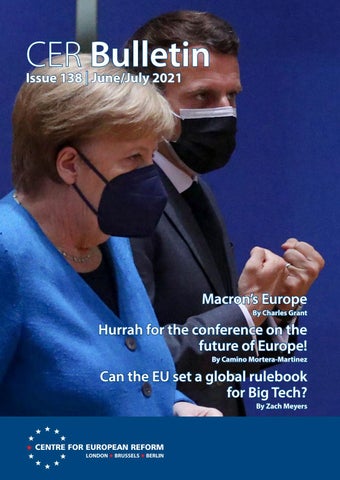
CER Bulletin Issue 138 | June/July 2021
Macron’s Europe By Charles Grant
Hurrah for the conference on the future of Europe! By Camino Mortera-Martinez
Can the EU set a global rulebook for Big Tech? By Zach Meyers
Macron’s Europe by Charles Grant
Alongside Germany, France has often shaped the EU’s agenda. Recently, French influence has grown, and if President Emmanuel Macron is re-elected in April 2022 – likely, though not certain – he will be Europe’s pre-eminent leader for several years. One reason is that Macron is brimming with ideas on the future of Europe, which he pursues energetically. The Brussels institutional machinery feeds off ideas. Macron’s predecessor, François Hollande, came up with fewer schemes and initiatives and was a quieter voice in the European Council.
So, if Macron wins re-election, he will have more heft than the new German chancellor. The economic and political travails of Italy and Spain limit their influence, and in any case both quite often line up with France on EU policy. Poland is in trouble for not respecting the rule of law and so cannot set the EU’s agenda.
A second reason is Brexit. The UK led the EU’s economic liberals in resisting France’s penchant for protectionism and an active industrial policy. Now the Dutch sometimes try to lead the Nordic, Baltic and other pro-market countries, but with less authority than did the British.
France will use its EU presidency in the first half of 2022 to promote its ideas on Europe. Fortunately for Macron, many of the key people in Brussels are sympathetic to France. Ursula von der Leyen, the Commission president, Charles Michel, the European Council president, and Josep Borrell, the High Representative for foreign policy, owe their jobs to Macron’s support. They are at the very least open to French thinking. In Frankfurt the president of the European Central Bank, Christine Lagarde, happens to be French. So are some important officials in Brussels, including Thierry Breton, the commissioner for the internal market, and Olivier Guersent, the director-general for competition policy. In the European Parliament, too – which France has previously not taken very seriously – the French have become more influential. Macron’s MEPs are the largest component of the centrist Renew Europe formation, one of the three groups that run the Parliament.
A third reason is Chancellor Angela Merkel’s impending retirement. Her track-record in crafting compromises helped to make her the European Council’s most respected leader. Germany is already distracted by the campaign for September’s general election, after which the formation of a new coalition government may take two or three months. Then the new chancellor – whether Armin Laschet or Annalena Baerbock – will need time to establish themselves as a substantial figure in EU politics.
INFO@CER.EU | WWW.CER.EU CER BULLETIN ISSUE 138 | JUNE/JULY 2021
Those inside the French government argue – with some justice – that it is not their machinations and string-pulling that ensure French influence, but rather the fact that the world is changing. COVID-19 and the new emphasis on the need for resilient supply chains have made more people sympathetic to Macron’s idea of ‘strategic autonomy’. Broadly defined, the term means that Europe develops not only the capacity to pursue its own interests in defence and security, but also safeguards its independence in areas like energy, trade, financial services and critical technologies. The French are happy that the Commission is increasingly willing to stand up to China on economic issues. Thus the Commission has produced a policy paper on the need for the EU to gain better access to supplies of rare earths (currently dominated by China). It has proposed legislation that could exclude foreign firms (for example, from China) that receive distortive subsidies from taking part in European public procurement or from acquiring European firms. The EU’s foreign investment screening regulation has been in operation since October 2020. The Commission has become more supportive of industrial policy, for example by encouraging Franco-German efforts to foster an electric-vehicle battery industry. And its trade policy now places greater emphasis on reciprocity and the ability to act unilaterally against unfair practices. All these steps reflect French priorities. Some of the Nordic and Baltic countries are uncomfortable with these shifts – but many member-states go along with a lot of French ideas. German opinions are divided but some key figures such as Peter Altmaier, the economy minister, agree with the French on the need for ‘European champions’. The leaders of Germany’s Green party seem to like the idea of increasing Europe’s strategic autonomy. In foreign policy, too, French ideas often prevail. Take the European Peace Facility, a new fund over which – because it is outside the EU budget – the European External Action Service and the member-states have more sway than the Commission. France will probably ensure that a big chunk of the money goes to its priority of the Sahel, for example to train and equip troops. French officials say the first three months of their EU presidency must produce ‘concrete deliverables’, to help Macron to win re-election. They talk of progress on European defence, making a success of the Recovery and Resilience Facility (RRF) and starting to reform the EU’s fiscal rules. But they mention two priorities in particular. One is to show that the EU is making digital
platforms behave responsibly. The French doubt they can conclude the Digital Markets Act and Digital Services Act – which they strongly support – during their presidency, but expect to make good progress on both. They expect this pair to set global standards for the regulation of Big Tech. The French like Joe Biden’s plans for a minimum rate of taxation for large companies. The US is also working on an OECD-wide tax that would apply to most of the world’s largest multinationals – whether digital giants or not – and replace the unilateral taxes that several countries have imposed on the revenues of digital giants. The French worry that this could still allow some digital firms to avoid proper taxation, and have not yet decided whether to support the Commission’s own plans for an EU-wide digital levy – in addition to whatever the OECD agrees. If they do support the Commission they could annoy the US. The second priority is to show that the EU can make a difference to climate change by implementing a carbon border adjustment mechanism (CBAM). The French know that many of Biden’s people oppose a CBAM, and that this alone will cloud the views of some European leaders, including in Germany. But the French are not deterred. The French talk of creating a climate club that would include the OECD countries and others that adopt effective emission-reduction policies. Trade between the club’s members would avoid carbon-related charges, but goods from countries with laxer climate policies, like India, China and Russia, could face them. Apparently the OECD likes this plan, while US climate envoy John Kerry, though initially sceptical, is now willing to consider it. But French officials insist that the EU should not wait for the OECD before pressing ahead with a CBAM. The EU will need to find about €15 billion a year to repay the debt that is funding the RRF. Both a CBAM and a digital levy are candidates to provide the EU with fresh ‘own resources’, as is the Emissions Trading Scheme. The CBAM could in theory be decided by qualified majority, as an environmental measure – but any matter concerning own resources would require unanimity. Macron will probably have to battle both American and European opponents to get his way on the CBAM and digital taxes. But, as one former adviser notes, “his chutzpah and self-confidence are extraordinary”.
Charles Grant
Director, CER @CER_Grant
Hurrah for the conference on the future of Europe! by Camino Mortera-Martinez
If done right, the conference on the future of Europe can help bring about meaningful reform in the EU – even if that means changing the treaties. At first sight, the conference on the future of Europe, an EU-wide consultation lasting nearly a year, may not seem the most straightforward way to generate change and boost democracy. In fact, with three presidents and a complex governing structure made up of over 400 people, the conference may not seem the most straightforward way of doing anything at all. Many think that is the point of the exercise. And yet, with a few tweaks, the conference could end up challenging everybody’s exceedingly low expectations – and become the first step towards much needed reform in the Union.
©European Union
The conference’s main, and most overlooked, problem is timing. It should have started at the beginning of 2020 and finished in spring 2022. But the COVID-19 pandemic intruded and the start of the exercise had to be delayed. French President Emmanuel Macron, who is behind the idea, wants to have the whole thing wrapped up by March 2022, in the middle of France’s rotating EU presidency. Macron himself faces re-election at home in April and hopes that the conference can help to amplify some of his ideas on how to make the EU work better. This means that the conference will be shorter, and also that it will mostly happen online because of COVID-19 restrictions.
The conference’s main strength should be as a platform for citizens who may otherwise remain unheard. A mostly digital conference may boost the participation of digital natives and people generally used to interacting through a screen. But it will discriminate against less digitally able people, like the elderly, and against those living in rural or remote areas with shaky internet connections. A predominantly digital format also makes it hard to engage with local civil society groups who may raise issues that are important to many people, and who already normally struggle to get a hearing in Brussels. Aware of this bias, the Commission has hired a private company to randomly select 108 citizens who will represent the voice of ordinary people. But that alone will not be enough to ensure the conference reaches out beyond urban, educated elites – there is no explanation of what criteria will be used to choose these people and what incentives will they have to participate. One way to solve this problem would be to make the conference a rolling exercise. The EU institutions could commit to hold citizen consultations on a regular basis and to filter and review proposals every two or three years. This would not require expensive consultants, complicated bureaucracy or eminent experts.
INFO@CER.EU | WWW.CER.EU CER BULLETIN ISSUE 138 | JUNE/JULY 2021
Possibly the most effective way to understand what citizens really think is to have a coffee with them. Of course, no EU leader could ever find the time to have coffee with over 500 million people. But they can travel to EU countries and engage with local communities, as national politicians do. A recent EU poll shows that most Europeans would be willing to participate in the conference if given the chance. The EU should exploit this interest by using every possible means to connect with its citizens, from school campaigns and expert panels to prime time TV and town hall meetings. This should be part of the Union’s DNA in the years to come. A more obvious but less serious problem is the conference’s complicated governing structure. An executive board made up of representatives of at least six EU institutions will decide how the conference will operate and oversee its work with the help of a common secretariat. The conference plenary, consisting of representatives of parliaments, citizens and the EU institutions, will meet every six months to discuss the ideas put forward by citizens. The leaders of the Commission, the European Council and the European Parliament will jointly preside over the conference. If that sounds like too many cooks, that’s because it is. But this need not be an issue. The problem is not how many presidents the conference has, or even who gets to lead it. The problem is whether or not the governing structure, however abstruse it may be, will be able to spot the most important issues for citizens, and crucially, do something about them. Previous soulsearching attempts, like former Commission President Jean Claude Juncker’s white paper on the future of Europe, failed because, ultimately, nobody was responsible for addressing the problems identified. To be successful, or at least, credible, the conference should consider all the available means to act on citizens’ concerns, including, possibly, treaty change. Most EU governments do not want to risk changing the treaties, which would require unanimity and referendums in several countries. That is a legitimate concern, as EU leaders fret about mounting euroscepticism – and reopening the treaties may cause serious political crises in countries with EU-hostile governments. But leaders should not shy away from treaty change. The COVID-19 pandemic has shaken the continent in previously unthinkable ways. For the first time, the EU negotiated a deal with vaccine makers on behalf of its memberstates. To weather the economic crisis, the
Union temporarily suspended its fiscal rules and agreed on a recovery fund that includes the issuing of EU debt. The pandemic has also exposed a darker side: the crisis led to more border checks and temporary restrictions to the free movement of people in the EU; and COVID-19 laid bare the EU’s dependency on other parts of the world for the procurement of health equipment and medicines, at a time of increased international tensions. While restrictions on travel will ease as the pandemic recedes, the wider debate on the role of the EU in times of crisis will not. The Commission is considering setting up a Health Union, to deal with public health emergencies better, for example, by jointly developing vaccines. Such a union would take health competences away from member-states, which would, in turn, require treaty change. If the recovery fund works, EU governments may be willing to make it permanent and to overhaul the Union’s debt and deficit targets. This too, will require rewriting the treaties. Beyond the pandemic, the EU may want to rethink other issues that matter to citizens. According to EU polls, a large majority of Europeans want the EU to have a common foreign and security policy. But the EU often finds itself paralysed because one country can veto common action. Changing this would require a unanimous decision of the European Council. Similarly, the conference could help with another complex matter: how to run the 2024 European elections. While voter turnout in 2019 was the highest since 1994, the result satisfied no one – EU leaders ignored the Parliament’s lead candidate system (whereby the candidate of the party with the most seats should become Commission president) but ended up with Ursula von der Leyen – no one’s first choice. Changing the treaties – or even tweaking some rules – will not be easy. But if doing so would make the EU more effective, then EU leaders should not waver. After months of a trying health and economic crisis, EU citizens could be forgiven for wondering what the value of the EU is. The conference should help to answer that question.
Camino Mortera-Martinez
Senior research fellow, CER @CaminoMortera
Can the EU set a global rulebook for Big Tech? by Zach Meyers
The EU is angling to set a rulebook for digital markets which could be adopted around the world. To achieve this, its draft regulations need improvement. The EU has a renowned ability to leverage its market size in order to influence regulatory standards beyond its borders – the so-called Brussels effect. For example, the US is now closer than ever to adopting a comprehensive federal privacy law, demonstrating the global influence of the EU’s General Data Protection Regulation. The EU now wants to set global standards for digital platforms such as Facebook and Google, to make the markets they operate in fairer and more contestable. Digital markets may well be susceptible to the Brussels effect: many countries are considering new regulations, and the large technology firms that operate globally do not want regulatory fragmentation. But the Union’s attempt to develop and export its digital rulebook will require refinement if it is to succeed. Previous EU antitrust cases against American tech giants and its proposals for regulation caused transatlantic tension. The Obama administration viewed large American tech firms as national champions. President Trump was also critical of the EU’s attempts to discipline them: “Your tax lady, she hates the US”, he said of competition commissioner Margrethe Vestager. However, the academic and political consensus in the US has now shifted towards the European position. In 2019, an influential report by the US’s Stigler Centre confirmed many of the EU’s concerns. Since then, large technology firms have alienated
both sides of US politics. Many Republicans were outraged by President Trump’s ban from Twitter and Facebook; many Democrats believe that digital platforms have tolerated and even encouraged the dissemination of right-wing misinformation. These concerns have contributed to a growing belief that Big Tech is too powerful and unaccountable. In October 2020, the US House of Representatives’ antitrust subcommittee proposed the potential break-up of some firms. Both Republican and Democratic subcommittee members agreed that tech giants had acted anti-competitively. In the meantime, competition authorities and policy-makers elsewhere have taken up the case against Big Tech. Regulators in Australia, Japan, Mexico and India have conducted studies critical of large digital platforms. Chinese authorities have also begun taking action against the country’s own large digital firms. Despite the growing global consensus, few countries have yet formulated precise proposals to address the problem. President Biden has appointed antitrust scholars renowned for their criticisms of Big Tech to his administration, but a detailed policy is yet to emerge. Competition authorities around the world have launched antitrust proceedings, but these will be casespecific. The UK has well-developed thinking, but
INFO@CER.EU | WWW.CER.EU CER BULLETIN ISSUE 138 | JUNE/JULY 2021
not yet published draft legislation for its proposed regulatory framework.
one business model in Europe, and a different model in the rest of world.
The European Commission is therefore leading the world, having drafted a Digital Markets Act (DMA). The DMA would set a rulebook for the largest tech firms, requiring them to change their business models in various ways. The rules are intended to ensure fairness for businesses which rely on the largest tech firms, and also intend to give potential competitors more chance of success.
The DMA is better than proposals – many, ironically, emanating from the US – which call for large technology firms to be ‘broken up’. Under the DMA, the Commission could only break up a firm in extreme cases, after repeated non-compliance. This reasonable approach should make the DMA more acceptable to mainstream political thought in the US and elsewhere. Other parts of the DMA, however, could cause conspicuous harm to consumers and reduce competition. For example, many consumers value Apple’s tight control over which apps run on iPhones, and consider that this control delivers greater security; consumers are free to choose a more ‘open’ ecosystem on Google’s Android phones. The DMA could force Apple to relinquish this control. That would remove an important competitive differentiator between Google and Apple’s businesses. Other countries might not accept a regulatory approach which limited consumer choice in that way. Apple would probably limit its compliance to Europe, rather than voluntarily changing its business model on a global scale. MEPs should therefore add more flexibility to the DMA’s rules to avoid this.
Several aspects of the DMA suggest the Commission wants to introduce it quickly, ensuring that the law is implemented before other jurisdictions have finalised their own proposals. First, the Commission wants the DMA to come into force in 2022 – an ambitious timetable by EU standards. Second, the Commission has designed a streamlined process for identifying the digital platforms (referred to as ‘gatekeepers’) which will need to follow the new rulebook. The process relies on simple criteria and tries to avoid detailed analysis. Third, the DMA bypasses the normal steps used in most models of economic regulation. For example, the DMA imposes an initial set of rules on all gatekeepers, without careful analysis and consultation about which are appropriate for each gatekeeper’s particular business. The desire for speed is understandable: the Brussels effect could deliver important benefits for Europe. If the EU’s regulatory standards were adopted in other countries, or voluntarily adopted by large technology firms on a global basis, EU digital businesses could expand globally more easily. They would know they could rely on the same rights when dealing with large technology firms outside the EU as they enjoy inside the EU. The EU cannot simply act quickly and unilaterally, however, if it wants its rules to be adopted elsewhere. The proposed rules must be comprehensive within Europe – the EU must dissuade member-states from ‘supplementing’ the DMA with their own national laws, as Germany has done. The rules need to produce visible benefits for European consumers or businesses – and avoid any obvious negative consequences – so that consumers and lawmakers elsewhere demand the same outcomes. Finally, the rules need to be cost-effective – so that large technology firms (and foreign law-makers) see sense in avoiding the costs of operating different business models in different regions. The EU has not always achieved these objectives. For example, the Union’s requirement that payment card companies separate different parts of their businesses imposed large costs, provided little benefit to competition and failed to gain global traction. Card companies now operate
Some MEPs are also proposing to restrict the DMA’s application to just a handful of gatekeepers. This would be double-edged: such changes would make the DMA more targeted, but also risk ensuring that the only gatekeepers were American – an outcome which could reignite transatlantic tensions, and therefore make other countries less willing to follow the EU. The EU could more easily justify all gatekeepers being American if the DMA focused on one category of business, such as Facebook and Google’s digital advertising; that would look more reasonable that regulating a larger number of firms which all happen to be American. That would also bring the DMA closer to the UK’s approach, which would have other advantages: the UK has a significantly larger number of successful digital businesses than the EU, so if new regulation delivers benefits to digital businesses, those benefits might be readily observable in the UK. Foreign – especially American – lawmakers might be more easily persuaded to copy the EU’s rulebook if the UK and EU were already aligned. The Commission has the opportunity to set a global standard that works for Europe. But care, not just speed, is necessary to prepare a rulebook that other countries will follow.
Zach Meyers
Research fellow, CER @Zach_CER
INFO@CER.EU | WWW.CER.EU CER BULLETIN ISSUE 138 | JUNE/JULY 2021
CER in the press The Guardian 25th May The slump in UK-EU goods trade this year shows the impact of Brexit, [tweets] John Springford of the CER: “The ONS: trade in goods with the EU down 23 per cent in the first quarter of 2021, compared to the first quarter of 2018. That accords with my estimate – Brexit has reduced total UK trade by 11 per cent (both with EU and the rest of the world).” BBC News 22nd May “Imports into Northern Ireland can only make use of the UK's trade deals if the difference between the applied UK tariff and the applied EU tariff is less than 3 per cent of the value of the goods,” said Sam Lowe of the CER. Public Finance Focus 20th May “The OECD proposals will probably not eliminate tax competition between member-states, so some member-states will probably continue to hold out on an EU-wide proposal that
hinders their ability to use tax policy to attract investment,” said Zach Meyers of the CER. The National 13th May Luigi Scazzieri of the CER says a Turkey-style deal was out of the question because it would involve housing migrants in Libya. “The way the deal with Turkey works is that migrants and refugees who arrive in Greece and did not qualify for asylum were returned to Turkey,” he said. Financial Times 9th May “[The Madrid election] was an election fought in bars,” said Camino MorteraMartinez of the CER, who thinks it would be hard to replicate elsewhere in Spain, let alone in Europe. “The stance Díaz Ayuso took completely destroyed party lines. It was borderline populist if not populist altogether.” The Times 28th April John Springford of the CER estimated in his “cost
of Brexit” assessment that UK trade was taking an additional hit, on top of the 10 per cent reduction in UK exports relative to what they would have been since the 2016 referendum. The Telegraph 19th April Sam Lowe of the CER, says businesses are caught between tough regulations and unmanageable costs. “Lots of companies are still struggling because they can’t get advice. They can’t get customs agents to do it for them. They’re struggling to provide the necessary information, or they just can’t take on the additional cost when it comes to trading with Europe.” The Sunday Times 18th April Another British error was allowing “Londongrad” to be corrupted by its embrace of new wealth from Russia, heedless of the criminal and KGB forces behind it, according to Ian Bond of the CER. “We have allowed a kleptocratic system to be run through our real estate,
our overseas territories, it’s hugely damaging,” he said. The New York Times 17th April “They [the German Green party] want a world without nuclear weapons, but acknowledge that it will take time to get there – they’ll first have to find other ways to reassure eastern and central European partners,” said Sophia Besch of the CER. The New Statesman 16th April Against a backdrop of pandemic, climate crisis and favourable shifts in the party-political landscape, the circumstances have never been as ripe for it: “This could be the chance for the Greens to take the chancellery,” asserts Christian Odendahl of the CER. The Economist 3rd April While in America gross fixed capital formation grew by just under 1 per cent a year in 2016-20, in Europe it shrank, according to an analysis by Christian Odendahl and John Springford of the CER.
Recent events 19 May Bruegel/CER/Elcano Royal Institute/ISPI T20 webinar on 'After COVID-19: A most wanted recovery' Speakers: Franco Bruni, Paul De Grauwe, Maria Demertzis, Elena Flores, Christian Odendahl and André Sapir 18 May Webinar on 'Securing Europe's economic recovery' Speaker: Céline Gauer
12 May Webinar on 'The future UK-EU relationship: An Irish perspective' Speaker: Thomas Byrne 10 May CER/Clifford Chance webinar on 'Curbing Big Tech? How the EU should regulate gatekeepers' Speakers: Isabelle de Silva, Andreas Mundt, Pedro Rodrigues Duarte and Andreas Schwab
For further information please visit
www.cer.eu
5 May CER/AIG webinar on 'Forging a middle way: How can the EU navigate the US-China digital divide?' Speakers: Aynne Kokas, Caroline Meinhardt and Alexander Roth