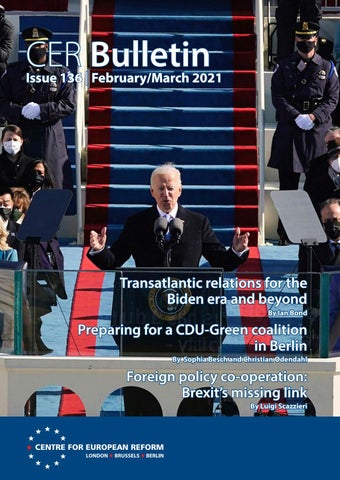
CER Bulletin
Issue 136 | February/March 2021
Transatlantic relations for the Biden era and beyond By Ian Bond
Preparing for a CDU-Green coalition in Berlin By Sophia Besch and Christian Odendahl
Foreign policy co-operation: Brexit’s missing link By Luigi Scazzieri
Transatlantic relations for the Biden era and beyond by Ian Bond
Most European leaders responded to Joe Biden’s election victory on November 3rd with undisguised enthusiasm. They expect him to repair some of the damage that the transatlantic partnership suffered in Hurricane Donald, but pre-Trump America no longer exists, and European policy must reflect that. Following Biden’s win, the EU published ‘A new EU-US agenda for global change’ in December, setting out a number of topics for possible collaboration: global health, climate change, trade and technology, and strengthening democracy. The Biden administration’s first moves in these areas – rejoining the World Health Organisation and the Paris Agreement, for example – have been encouraging. But the EU must also learn the lessons of the last four years, in case relations run into trouble again after Biden. The first lesson is that the US remains a deeply divided society. More people voted for Trump in 2020 than for any other presidential candidate in history, with one exception – Joe Biden. Trump may have left the political stage, but his supporters are likely to shape the future direction of the Republican Party for the next few years at least. They will not believe that there are benefits for them in the kind of policy co-ordination that the EU is calling for – on climate change, what the EU calls “open and fair trade” or the United Nation's sustainable development goals. Biden will prioritise narrowing divisions at home over winning favour in European capitals – as
shown by his January 25th announcement of protectionist ‘Buy American’ measures, which among other things increase domestic content requirements for government procurement. European representatives in the US should work harder on influencing opinions in the South and the Midwest, where Trump’s fans are most numerous. The EU delegation in Washington has various outreach programmes, mostly through universities; it should target these regions more. The larger European states should use their networks of consulates in support of the general European interest, not just national objectives. Though outside the EU, the UK can still use its posts in the US to encourage continued transatlantic co-operation and popular support for NATO. The second lesson is that Congress still matters. The November elections reduced the Democrats’ majority in the House of Representatives from 38 to 11. Many House Republicans remain loyal to Trump: two-thirds of them voted to reject Pennsylvania’s election results, in an effort to deny Biden his victory. Biden is likely to struggle
INFO@CER.EU | WWW.CER.EU CER BULLETIN ISSUE 136 | FEBRUARY/MARCH 2021
to get much of his legislative programme through a Senate divided 50-50 between Democrats and Republicans. Under the Senate’s rules, most bills require 60 votes to progress. For the rest, Vice President Kamala Harris will use her casting vote whenever she can; but one conservative Democrat voting with the Republicans will be enough to block legislation. Biden’s best hope is that in 2022 the Democrats can win more seats in both chambers on the back of an economic rebound after the pandemic; but Republicans, strong in less populous rural states, enjoy a structural advantage in Senate elections, since every state, regardless of population, returns two senators. European diplomats in Washington already spend a lot of time lobbying on Capitol Hill (not least against extraterritorial sanctions – with bipartisan Congressional backing – that target European companies involved in the Nord Stream 2 pipeline project to bring Russian gas to Germany). The Transatlantic Legislators’ Dialogue between Congress and the European Parliament, and more contacts between national parliaments in EU and European NATO member-states and their US counterparts, can complement diplomatic efforts. When COVID-related travel restrictions are lifted, congressional delegations should be welcomed to Europe again. The third lesson is that Americans of all political stripes see China as a growing threat, and want to contain its rise and preserve America’s primacy. They might disagree about the coherence, tactical wisdom or effectiveness of Trump’s China policy, but not its basic objective. Though the EU described China in its 2019 ‘Strategic Outlook’ as “a systemic rival promoting alternative models of governance”, it also called it “a co-operation partner with whom the EU has closely aligned objectives” – words unlikely to be spoken in Washington. The Biden administration has already indicated concern about the EU’s decision to finalise its investment agreement with China without prior transatlantic consultation. US Secretary of State-designate Tony Blinken has characterised China’s actions against the Uyghur population in Xinjiang as genocide, a term no European leader has yet used. The EU told the US in the December ‘new agenda’ that their dialogue on China, initiated in 2020, should be the forum for “advancing our interests and managing our differences”. There are plenty of differences to manage. Once the EU has a coherent policy of its own, including on responding to a systemic rival, transatlantic co-operation may become easier. The fourth lesson is that Democratic and Republican administrations alike expect their
allies to do more for their own security. Obama and his team may have encouraged burdensharing more politely than Trump, with his bombastic claims that Germany and others were ripping America off; but the message was essentially the same: a situation where the US is responsible for 72 per cent of NATO defence spending and European allies for 26 per cent is not sustainable in the long term. The pandemic’s economic impact will make it politically difficult for Europeans to maintain current defence spending, let alone increase it, but they must. China’s rise will inevitably shift the US focus from the European to the IndoPacific theatre. Biden has surrounded himself with senior officials with European ties, but that will not keep US forces in Germany or Italy if the perceived threat is to Japan or Guam. Europeans speak of ‘strategic autonomy’, and may be able to achieve it economically, to some degree, in areas such as supply chains and resilience in the face of sanctions; but in the defence field it will remain a meaningless slogan if Europe lacks the capabilities to carry out even modest operations without US help; and restoring and preserving stability in Europe’s neighbourhood increasingly demands more than modest operations. The final lesson is that Trump’s frequent attacks on the real or invented shortcomings of the EU and NATO have changed European views of the US more than American views of Europe. Polling data shows that in 2020 more than 60 per cent of Americans saw US alliances in Europe as beneficial to both sides; yet only 26 per cent of Germans, 31 per cent of French people and 41 per cent of Britons had a favourable view of the US. The majority of Europeans think the US political system is broken. Biden will certainly benefit from a rebound in positive European feelings towards the US, but European political leaders must do more to stress the continued importance of transatlantic ties, and to shift their voters’ focus away from the personality of the president towards the value of the overall economic, political and security relationship. It will be tempting for European leaders to see Biden and the familiar faces around him, and think transatlantic normality is restored. But Europe needs to think about the longer-term trends in US domestic policy and transatlantic relations. Pre-2016 America is gone, and it is not coming back. European leaders should realise that one cannot step in the same river twice – or the same Atlantic Ocean.
Ian Bond
Director of foreign policy, CER @CER_IanBond
Preparing for a CDUGreen coalition in Berlin by Sophia Besch and Christian Odendahl
2021 will mark the end of Angela Merkel’s reign as German chancellor. In September, Germans will elect a new Bundestag, the lower house of parliament, which is likely to comprise six parties. Current polling has the Christian Democrats (CDU), together with their Bavarian sister party, the Christian Social Union (CSU), with a decisive lead, but that may change depending on the course of the pandemic and when voters take into account that Merkel is no longer on the ballot. Still, the most likely result of the election remains a CDU/CSU-led coalition government with the Greens, who are likely to perform well. The CDU has just chosen Armin Laschet, the prime minister of North Rhein-Westphalia, Germany’s biggest state, to be its leader. It was a vote for continuity, with CDU delegates hoping to hold together the broad coalition of voters that Merkel had assembled: centrists who are open to progressive policies in limited doses; Germans with a foreign background who no longer see the CDU as hostile to them; and women who were drawn to Merkel for her calm, sensible leadership. But not all of the CDU are happy with Merkelism: almost half of the party’s delegates at the January party conference voted for Laschet’s conservative opponent, Friedrich Merz, who represents the pre-Merkel CDU. Laschet has his work cut out to keep his party on Merkel’s course. Economic policy is a case in point. As part of her pitch to the political centre in the last eight years – and as the price for governing in a coalition with the Social Democrats (SPD) – Merkel has agreed to milder versions of policies that her party long opposed. The introduction of the
national minimum wage in 2014 stands out, but she also agreed to more generous parental leave policies, restrictions on temporary and contract work, a right to work part-time, female quotas on company boards, tougher rent controls and a minimum guaranteed pension for low-earners. Tax cuts for firms and deregulation were largely absent from Merkel’s policies over the last eight years, and attempts to lower energy prices or speed up digitalisation were too slow, according to business lobby groups. Those CDU voters in favour of supporting businesses and cutting taxes felt their interests were not heard enough. The CDU trademark policy that remains is Germany’s balanced budget before this crisis. That achievement was mostly the windfall of a strong economy buoying tax revenues and falling interest rates. There is little the German government had actively done to achieve its ‘black zero’: most spending and investment cuts and reforms to social security and pensions had happened before the introduction of the ‘debt brake’, Germany’s
INFO@CER.EU | WWW.CER.EU CER BULLETIN ISSUE 136 | FEBRUARY/MARCH 2021
constitutional fiscal rule, in 2009. But the CDU was more than happy to take the credit, and portrays itself as the architect and guardian of Germany’s fiscal strength. In the process, the debt brake and adherence to fiscal rules have acquired a totemic importance to the party.
the Greens were to form a coalition with the CDU, the SPD would make sure the topic plays a larger role in the public debate than before, in the hope of exploiting the naïve pacificism and status quo complacency that still dominates much of the German debate on defence.
Is that bad news for Europe? For now, Laschet has to protect the CDU’s fiscal legacy if he is to placate the right wing of his party. One of Merkel’s close aides, Helge Braun, recently wrote a sensible op-ed suggesting that the debt brake be softened for a time after crises, but his proposal was brutally shot down by CDU members. The party will continue to resist any attempts to soften fiscal rules before the elections and will surely campaign to return to the black zero. But the CDU may be more open to fiscal changes after the election. The public is in favour of more investment and no longer sees public debt as a major issue. The Greens will come into any coalition talks confident about their manifesto ideas, one of which is to make the debt brake less dogmatic and friendlier to investment, while preserving long-term fiscal sustainability.
Germany’s allies have long complained about its unwillingness to take on greater responsibility for Europe’s security. Berlin, faced with multiple crises in the EU’s neighbourhood and under pressure from Washington, has increased military spending and been active in discussions on strategic renewal in NATO and the EU. For example, Berlin has launched the EU's Strategic Compass process, which aims to foster a shared understanding of threats facing the EU and how to respond to them. But between the CDU’s comfortable attachment to US protection and the SPD’s dovish position on Russia, the defence policy of the current grand coalition has not changed much in recent years.
What is more, sticking slavishly to the debt brake is not cost free: if more debt is ruled out, the CDU will have to come up with other plans to plug the fiscal gap. Pension or welfare cuts would not go down well, and nor would lower investment, let alone higher taxes. The CDU could thus need an elegant way to avoid such distributional debates. It may be time once more for the CDU ‘to Merkel’, that is, to quietly abandon a position formerly held dear because the consensus and political reality have changed. The Greens would be right to use the leverage they have in the coalition talks to pressure the CDU into changing its views. Domestic reconsideration of the debt brake may also soften Germany’s stance in Europe. The CDU will have to come to terms with the idea that reimposing fiscal discipline will take longer. The EU’s rules, which are currently suspended, mandate that countries with debt levels above 60 per cent of GDP reduce it by 1/20th per year. That is very fast, if not downright impossible, for countries with high debt levels, and has not been applied strictly in the past. But the European Commission did demand tax hikes and spending cuts that would at least improve the debt trajectory. It would be a mistake for Europe to return to its fiscal rules any time soon, as it would risk choking off a fragile recovery from the pandemic. A change of heart in Germany would give the Commission more political leeway to interpret the rules liberally. Defence policy does not yet have the same totemic importance for the CDU as fiscal orthodoxy. But if
The Greens, born from the pacifist movements of the 1970s, have not suddenly become hawks. They oppose NATO’s goal of spending 2 per cent of GDP on defence, demand a more restrictive arms exports policy, are sceptical of military deployments, and want Germany to sign the UN treaty banning nuclear weapons, which would mean the withdrawal of US nuclear weapons from Germany and thus the end of Germany’s participation in NATO’s nuclear sharing arrangement. But the Greens are politically hawkish, for example on authoritarian regimes in Russia, China and Turkey, led by a focus on human rights and a belief that Europe should promote peace and liberal values. They want a stronger UN, and a stronger EU foreign and security policy. They have also overcome much of their traditional NATO scepticism, and realise that to fulfil international commitments, the Bundeswehr needs to be properly equipped. Their pragmatism on defence questions is the result of substantial debates within the party. The Greens’ openness to discuss security matters could reinvigorate defence policy at a federal level, too, making Germany more willing to contribute to European defence policy and be tougher on China. Germany is not the fastest at adapting policies that have served it well to a new environment. But the next election is one of the better opportunities to make progress.
Sophia Besch
Senior research fellow, CER @SophiaBesch
Christian Odendahl
Chief economist, CER @COdendahl
Foreign policy co-operation: Brexit’s missing link by Luigi Scazzieri
The UK-EU Trade and Co-operation Agreement does not include foreign policy. The UK and its European partners will continue working together bilaterally and in small groups. But this will not make up for the lack of institutionalised UK-EU co-operation. One of the areas not covered by the UK-EU Trade and Co-operation Agreement is foreign and security policy. This will make it harder for the UK and the EU to work together and for the British to influence European foreign policy. The UK government saw the EU’s offer of a partnership similar to those the Union had with other partners as unappealing and rejected a foreign policy agreement. The UK thought that much European foreign and security policy co-operation happened outside of the EU, in NATO, bilaterally or in small groups like the E3 grouping of France, Germany and the UK. At the same time, the EU’s decision to adopt strict rules for non-EU firms wanting to access its newly created European Defence Fund (EDF), combined with scepticism that the EDF would be effective, contributed to persuading the UK government that it would lose little by not having a formal foreign policy agreement with the EU. Since Brexit, the UK has sought to de-emphasise links with the EU, even denying the EU delegation in London the diplomatic privileges it is normally accorded. Britain also sought to underplay Europe as a region, with foreign secretary Dominic Raab talking of a tilt towards the Indo-Pacific. At the same time, the UK has sought to burnish its credentials as a global
power outside the EU. It has increased defence spending by £16 billion over four years, pushed the idea of setting up a ‘D10’ club of democracies to stand up against authoritarianism and tried to show that Britain is nimbler outside the EU. London has pointed to how it was able to sanction the Belarusian regime more quickly and robustly than the EU, and how the UK has been tougher than its European partners towards China on Hong Kong, Huawei and Beijing’s treatment of its Uyghur minority. Nevertheless, the UK continues to have a large stake in European security. It will continue to have to work together with its European partners to address common challenges in Europe’s neighbourhood, and it will want to influence their policies and those of the EU. At the same time, the size of the UK’s defence industrial base, and its important diplomatic and military assets, mean that European member-states will want to maintain as much co-operation with the UK as possible and ensure that cross-Channel divides do not widen. With no formal co-operation agreement, the UK and EU member-states will try to bolster bilateral partnerships. The UK’s forthcoming Integrated Security, Defence and Foreign Policy
INFO@CER.EU | WWW.CER.EU CER BULLETIN ISSUE 136 | FEBRUARY/MARCH 2021
Review is likely to prioritise deeper relations with Paris, with whom London already has a close partnership under the 2010 Lancaster House Treaties, and also with Germany, Italy and the members of the UK-led ‘Joint Expeditionary Force’: the Netherlands, Denmark, Norway, Sweden, Finland and the Baltics. To strengthen these partnerships, the UK will probably remind its partners of its continued large contribution to European security, with British troops and air patrols in the Baltic states and Poland to deter Russia, air and naval patrols in the Black Sea Region and (recently increased) support for French-led efforts to stabilise the Sahel. Co-operation in small groups outside of the EU, like the E3, will gain prominence. In recent years, the E3 has expanded beyond its original remit of dealing with Iran to also sometimes discussing issues like Syria and the South China Sea, and it is valued by its members as an effective and flexible framework. Another forum for cooperation could be a ‘European Security Council’ (ESC), a French idea recently revived by Europe minister Clément Beaune. The idea would be to keep the UK closely plugged into European security through regular meetings. However, the details remain vague. An ESC could be an EU+UK meeting format, a new institution outside the EU, or an informal framework outside the Union. The key issue is membership. If the ESC were a small grouping, it could generate common thinking among the largest European states. After reaching a joint position with the UK, the ESC members could push the EU to act and it would be harder for other member-states to hinder a common response. However, there would be risks: the more an ESC was formalised, and the more selective its membership, the more it would annoy EU institutions and excluded memberstates. Many smaller member-states were unhappy with being left out of the E3 even when the UK was an EU member. Friction will be higher now the UK is no longer a member, and smaller member-states will be particularly resentful if co-operation between some member-states and the UK takes place in a grand-sounding ESC. At the same time, Germany prioritises maintaining EU unity, and is concerned that an exclusive ESC would undermine it. If the ESC had a broader membership or also included the EU High Representative, it would be less divisive but find it harder to reach consensus. This makes a broad ESC unappealing to France and to the UK, who prize the flexibility and agility of the E3. Given these concerns, an ESC may not materialise. Instead, it is likelier
that we will see an expansion of the E3, with more issues discussed and more consultations between officials and ministers. The E3 may also expand in membership to become an ‘E3+’, with member-states like Italy, Spain or Poland joining France, Germany and the UK, depending on the issue. With transatlantic policy differences set to shrink under President Biden, diplomacy towards many issues in the EU’s neighbourhood may take place in small groups including the main EU member-states and the US. Some of these groups will be linked to the EU, with the High Representative participating.
no formal co-operation agreement, the UK “andWith EU member-states will try to bolster bilateral partnerships. ” In the absence of a formal UK-EU foreign policy agreement, informal arrangements will help keep the UK connected to European foreign and security policy. But informal arrangements cannot substitute for formal co-operation. The UK will find it difficult to influence EU positions on many issues, as other member-states are only likely to involve London when it is in their interest. The lack of a co-operation agreement will make it harder for the UK to influence EU sanctions and keep abreast of what EU institutions and member-states think. It will also be difficult to shield informal foreign policy co-operation from tensions in the broader UKEU relationship. Over time, lack of influence might push the UK to seek a closer foreign and security policy relationship with the EU, particularly if EU defence tools like the EDF become more successful, and British defence firms find it harder to access the European market. Under Biden, the US is also likely to encourage the UK and the EU to build closer relations. In the short term, there is some scope for closer UK-EU co-operation even without a formal overarching agreement, through informal contacts between the UK and EU institutions and co-ordination on sanctions. But a future British government may want to revive Theresa May’s ambition of building an ambitious special security partnership with the EU. For its part, the EU could be willing to offer the UK something close to that if the overall UK-EU relationship improves.
Luigi Scazzieri
Research fellow, CER @LScazzieri
INFO@CER.EU | WWW.CER.EU CER BULLETIN ISSUE 136 | FEBRUARY/MARCH 2021
CER in the press The New European 27th January Charles Grant, director of the CER, told the Tony Blair Institute for Global Change that the UK could end up like Switzerland... “I think we’re going to be in non-stop negotiations for at least 50 years with the EU, as the Swiss will tell you who started in the mid-seventies and have never stopped negotiating with the EU.” The New York Times 21st January Ian Bond, director of foreign policy at the CER, said Britain’s “attempt to downgrade the status of the EU delegation to the UK looks petty and guaranteed to cause ill-will, when the UK needs friends in Brussels.’’ The New York Times 18th January Sophia Besch and Luigi Scazzieri of the CER argue in a new paper that “many Europeans will want to forget Trump’s presidency ever happened.” But they add, “Europe cannot
continue to look to the US to answer key questions on what its interests are and how it should pursue them.” The Times 16th January “The CDU is not the party of ideas,” said Christian Odendahl, chief economist at the CER. “It’s the party of maintaining the status quo.” The Telegraph 16th January As the CER points out, Chancellor Merkel has simultaneously managed to draw outsized support from conservatives, centrists, greens, women and descendants of migrants. But her successor will not be given the benefit of the doubt by most of these groups and will have to prioritise. Express 13th January Commenting on the Brexit deal, Charles Grant of the CER warned there were still uncertainties surrounding the UK-EU relationship going
forward. He also pointed to the sustainability of checks of goods moving from Britain to Northern Ireland. Due to Northern Ireland remaining partly under the EU single market and customs union, he warned some may be “tempted to tear up the NI protocol”. El País 9th January Camino Mortera-Martinez, a senior research fellow at the CER, thinks that what all the latest EU crises have in common is not the internal market, but the erosion of mutual trust. “Without mutual trust”, she adds, “there cannot be a single market.” She emphasises that trust is also “the bedrock of the EU's area of freedom, security and justice, the euro, and the passport-free Schengen area.” Financial Times 27th December “This agreement was never going to do much in terms of financial market access,” said Sam Lowe of the CER.
“It’s less than [what is] in the EU’s Canada and Japan agreements,” he added. Financial Times 26th December “While businesses will most certainly welcome the deal, they will suffer from the lack of an additional grace, or implementation, period to allow them more time to prepare for the change,” Sam Lowe of the CER warned. “There is no legal reason why a further implementation period couldn’t have been included in the trade deal – be it a temporary partial extension of the status quo, or mutually agreed flexibility at the border”. Agence France Presse 21st December “The pandemic is not going to help,” said John Springford, deputy director of the CER. “With Brexit running into the mix, and a Conservative government that’s very unpopular north of the border, I think the support for [Scottish] independence is likely to rise.”
Recent events 27 January CER/AIG webinar on 'Climate and energy in the transatlantic relationship' Speakers: Heather Grabbe, Cassie Powers, Carsten Rolle and Achim Schkade
20 January CER/KREAB webinar on 'EU budgetary policy in the euro area during and after COVID-19' Speaker: Paschal Donohoe
21 January CER/KAS launch of 'European strategic autonomy and a new transatlantic bargain' Speakers: Sophia Besch, Claudia Major and Luigi Scazzieri
15 December CER/KREAB webinar on 'Coping with Covid: The next steps for banks' Speaker: Elke König
For further information please visit
www.cer.eu
8 December Webinar on 'The future of British foreign policy' Speaker: Rory Stewart