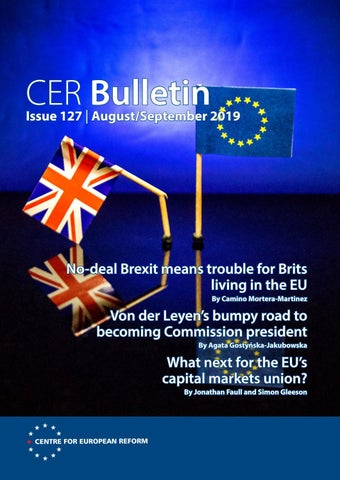
CER Bulletin
Issue 127 | August/September 2019
No-deal Brexit means trouble for Brits living in the EU By Camino Mortera-Martinez
Von der Leyen’s bumpy road to becoming Commission president By Agata Gostyńska-Jakubowska
What next for the EU’s capital markets union? By Jonathan Faull and Simon Gleeson
No-deal Brexit means trouble for Brits living in the EU by Camino Mortera-Martinez
If the UK leaves the EU without a deal, Brits living in EU countries will face a number of hurdles to securing residence. And some will be worse off than others. While there is a vigorous debate about the possible impact of a no-deal Brexit on trade, an equally pressing question has yet to command the same attention: what happens to the rights of the approximately 1.3 million British migrants living across the EU if the UK leaves the bloc without a withdrawal agreement? The thrice-rejected exit deal negotiated by Theresa May provided for a transition period of 21 months (until December 2020) during which EU free movement rights would remain virtually unchanged for British citizens living in Europe, including those arriving up to the end of the transition. After that, Britain and the EU were supposed to have found, or at least be on the way to finding, a new arrangement for regulating migration accross the channel. The transition period was designed to give people living and working abroad (or planning to do so) a degree of certainty, while allowing time for the British government and the EU to come to an agreement about their future relationship. But this certainty has come to an end with new British Prime Minister Boris Johnson’s pledge to leave the EU ‘do or die’ on October 31st. The risk of a no deal exit has never been higher.
No withdrawal agreement means no transition period: if there is no deal, UK citizens living in the EU will become third-country nationals on November 1st. From then on, what happens to them will depend on the country they live in: once the UK walks away from the EU without an insurance policy, migration laws will be decided by each member-state. Brits living in some countries will be better off than others. For example, Ireland and Malta have already said they will continue to allow British citizens to live and work under roughly the same conditions that they enjoy now after a no-deal Brexit. But other countries have said that UK nationals will enjoy those rights only for a limited period, after which they will be treated like other third-country nationals. In Belgium, Cyprus and Spain this grace period will extend until December 2020, but in France, Sweden and the Netherlands it will end after a year. In Austria and Germany it will last just six months. All EU countries have said that they will only grant British citizens rights if the UK reciprocates; and EU citizens have had a hard time proving their settled status in Britain – where they have
INFO@CER.EU | WWW.CER.EU CER BULLETIN ISSUE 127 | AUGUST/SEPTEMBER 2019 3
hitherto not had to register as residents and where the new system allowing them to apply for residency has been plagued with problems. Subject to any issues of reciprocity, UK citizens who have lived in EU countries for several years should be less affected by a no-deal exit, but more recent arrivals will face differing degrees of bureaucracy. Most EU countries have announced that they will allow UK citizens to continue living and working in their countries if they have been resident for at least five years by Brexit day. Many have also said they will make securing settled status easier for British citizens who have resided in the country for less than five years, if they can prove they have been living there lawfully for a reasonable period. To gain permanent residence, British citizens will need to produce evidence of their lawful status. This should be quite straightforward for those residing in countries where registration of EU citizens is mandatory, like Germany or Belgium. But it will prove more complicated for Britons living in France, for example, where there is no obligation to register. Even in EU member-states where registration exists, British citizens will face new obstacles in a no-deal scenario. Some countries may demand additional requirements to grant residence permits, like proof of a clean criminal record (Austria) or language tests (Lithuania). Those who have been residing in EU-27 countries for less than five years will face even higher hurdles: British citizens may be asked to pass integration tests similar to those applied to non-EU citizens. Some countries’ rules will be harder to navigate than others: for example, Sweden only issues personnummers (a personal identification number needed for everything from paying taxes to borrowing books at public libraries) to foreigners who have been in work for at least a year. Three categories of British citizen will be particularly hard-hit by a no-deal Brexit. First, those with low or unstable incomes will find it much harder to prove they have the means to support themselves and thus be allowed to stay in an EU member-state (EU free movement rules require EU citizens to have ‘sufficient resources’, but member-states have tougher thresholds for non-EU nationals). Second, British citizens who work in two or more EU countries, especially those providing services, will struggle to continue their activities. Free movement of services is already patchy within the EU, and promises to become more complex between the UK and the EU-27 after Brexit. This
category includes not only consultants and lawyers, but also musicians and sportsmen. Third, it will become much more difficult for non-EU family members of British citizens living in the EU to join or stay with them, as they will need to comply with more stringent national requirements as opposed to the rather lenient EU rules that apply now. Less conventional families, like same-sex or unmarried couples, will have it hardest: currently, EU citizens in samesex partnerships are protected by EU rules even in member-states that do not recognise them. If the UK crashes out without a deal, British same-sex couples will no longer be recognised in countries like Romania or Latvia, while unmarried partnerships will not be recognised in Poland or Bulgaria.
Three categories of British citizens will be “particularly hard-hit: those with low incomes;
”
service providers; and unconventional families. Many British citizens have tried to escape these problems by applying for citizenship elsewhere in the EU. But this has also not proved easy: in Spain, home to over 300,000 British citizens, the law requires Britons to give up their UK passport if they want to become Spanish citizens. And Belgium, where many long-term British EU officials have tried to obtain Belgian nationality, is wary of handing out passports because this could reduce the number of EU positions allotted to Belgian-born citizens, by virtue of nationality quotas. Johnson’s gamble is that the EU will blink first if the UK looks serious about leaving without a deal. But, as so often, he is misreading the continent. EU countries now assume that no deal is the most likely outcome. That is unnerving news for British citizens living, or hoping to live, in Europe. Johnson and the EU-27 have said that they will respect the rights of those already in place at least for the coming months. But what will happen to Brits moving to the EU after the grace period is over and to those with less conventional jobs and lifestyles is anyone’s guess. A lot will depend on how much goodwill the parties manage to build – but goodwill seems in short supply.
Camino Mortera-Martinez
Senior research fellow, CER @CaminoMortera
Von der Leyen’s bumpy road to becoming Commission president by Agata Gostyńska-Jakubowska
The European Parliament has narrowly elected Ursula von der Leyen as the first female Commission president. Now she faces the difficult task of assembling a team of commissioners to deliver her priorities. On July 16th the European Parliament elected Ursula von der Leyen to be the next president of the European Commission. She scraped through with only nine votes more than the required absolute majority of 374. But her problems do not end there. Now she must put together a team of commissioners that can help her fulfil the promises she made to secure her election, and convince members of the European Parliament (MEPs) to approve her entire college of commissioners so that it can take office on November 1st. Von der Leyen was elected in a secret ballot. But although the European People’s Party (EPP), the liberal Renew Europe group (formerly ALDE) and the Socialists and Democrats (S&D) officially backed her, a significant number of MEPs from these groups voted against von der Leyen. Had all the parliamentarians in these groups supported her, she would have won 444 votes.
Image: © European Union, 2019
Some pro-European MEPs, including the Greens, opposed von der Leyen because she did not come through the so-called Spitzenkandidaten process. This system was designed by the European Parliament to ensure that the European Council nominates the ‘lead candidate’ of one of the European political parties for the Commission presidency. Many MEPs argued
that they could not endorse a candidate chosen behind closed doors by EU leaders, and one whose views were unknown to the wider public. Unlike von der Leyen, lead candidates such as the centre-right Manfred Weber and the centreleft Frans Timmermans have spent the last few months campaigning across the EU on the assumption that one of them would become the Commission president. Other MEPs worried that von der Leyen would struggle to stand up to member-states on issues such as the rule of law. She was proposed by French President Emmanuel Macron as a compromise candidate after EU leaders failed to back Timmermans, who as Commission first vice president had repeatedly clashed with Warsaw and Budapest over democratic backsliding. Von der Leyen has instead struck a more conciliatory tone, arguing that the EU needs to overcome its East/West divisions. Some MEPs also worried that she might be too German in her approach to the management and reform of the eurozone and insist on a strict interpretation of the EU’s fiscal rules. Before the vote, von der Leyen published political guidelines to respond to some of these concerns:
She pledged to improve the ‘lead candidate’
INFO@CER.EU | WWW.CER.EU CER BULLETIN ISSUE 127 | AUGUST/SEPTEMBER 2019 5
system and set up a conference on the future of Europe to come up with proposals to that effect. She attempted to ease concerns that she would stick rigidly to the traditional German approach to the eurozone debate by promising to make full use of the flexibility allowed within the EU’s fiscal rules. She also proposed an unemployment reinsurance scheme to help countries that have suffered a severe economic shock. She pledged to improve the EU’s toolbox for addressing rule of law violations. In her view, no member-state is perfect, and the Union should regularly assess how EU values are being upheld in all member-states. In order to put these ideas into action, the president-elect will need an effective team of commissioners. While the member-states nominate their candidates for commissioner, it is the president who decides which roles they get. Not everybody can have a strategically important portfolio, so von der Leyen will need to stand up to member-states that try to put pressure on her as she matches the nominees to jobs. In her pitch to the European Parliament, von der Leyen promised that her college would be gender-balanced, and that she would ask member-states to offer a female and male candidate. However, several countries have ignored that and only put forward a male nominee. She should ask these countries to suggest a female candidate as well. Being firm with these recalcitrant member-states would help her win over MEPs who fear that she is under the thumb of EU capitals. Von der Leyen should also allocate some senior posts to representatives from Central and Eastern Europe and Scandinavia, which would help her secure the support of MEPs from these countries. So far, the top EU jobs have all gone to Western European candidates: the European Council elected a Belgian to be European Council president; and nominated a Frenchwoman to head the European Central Bank, a German to head the European Commission and a Spaniard as the EU’s high representative for foreign and security policy. The new president-elect should also follow JeanClaude Juncker’s example, and organise the work of her college around ‘project teams’ to deliver her six priorities: 1) a European Green Deal; 2) an economy that works for people; 3) a Europe fit for the digital age; 4) protecting the European way of life; 5) a stronger Europe in the world; and 6) a new push for European democracy.
She should put vice presidents in charge of team projects and ask them to filter out any initiatives that do not correspond to her priorities. There were 40 per cent fewer EU legislative acts during the Juncker Commission than in the previous five-year period when José Manuel Barroso was president. Von der Leyen should put one of her senior commissioners in charge of better regulation, to make sure that her Commission is acting only where it is necessary and where it clearly brings added value. This approach would help counter the eurosceptic narrative that the EU produces too much red tape.
Even with a stellar team, von der Leyen “might still find it difficult to deliver on some of her promises. ” There are also some issues in von der Leyen’s political guidelines, such as cyber security, that touch upon more than one of her priorities. They would best be tackled by flexible ‘task forces’ that combine experts from various Directorates-General and the SecretariatGeneral. This kind of flexible setup, managed by a commissioner, would enable the Commission to respond quickly, and comprehensively, to new emerging challenges. But even with a stellar team, von der Leyen might still find it difficult to deliver on some of her promises. Progress on eurozone integration will depend on the support of EU leaders rather than the determination of the Commission. Eurozone finance ministers have shown little appetite to take bold steps: they have reluctantly agreed to pave the way for a ‘budgetary instrument for convergence and competitiveness’. But rather than stabilising the eurozone, as was initially envisaged by Macron, the instrument will only support structural reforms and public investment, and it will be too small to make any macroeconomic difference. Von der Leyen narrowly succeeded on winning the approval of the European Parliament. The limits of her power, however, lie in EU leaders’ unwillingness to take ambitious steps towards resolving the EU’s most pressing problems. If they are serious about listening to voters’ concerns about climate change, jobs and security, member-states should support von der Leyen’s efforts to build a stronger Europe.
Agata GostyńskaJakubowska
Senior research fellow, CER @AgataGostynska
What next for the EU’s capital markets union? by Jonathan Faull and Simon Gleeson
When the United Kingdom eventually leaves the European Union – assuming it does – it will take Europe’s biggest capital market with it. The loss of the City of London could drive the EU’s 27 remaining members to pursue an inward-looking strategy for managing their capital markets and keep London at arm’s length. Or it could convince the EU to open up its market to London and the rest of the world. In our recently published CER policy brief, ‘The capital markets union: Should the EU shut out the City of London?’, we argue that the EU should prioritise openness. The EU’s ambition to create an integrated capital market for cross-border investment within the EU, known as the capital markets union (CMU), began in 2014, long before Brexit. It is a laudable ambition, but progress has been slow. The integration of EU capital markets requires changes to many different areas of policy such as taxation, insolvency regimes and financial law and has proved politically tricky. With the UK’s imminent departure from the EU, the bloc is now bound to be without a globalscale capital market. But that does not mean it should abandon its ambition to build its CMU. After all, the fundamental issues that such a union is supposed to address endure. More deeply integrated capital markets would make the eurozone more stable, because cross-border capital markets allow the costs of economic shocks that affect one region or country to be borne by investors across the EU. European companies are also over-reliant on banks, which have been lending less and raising more capital
under pressure from regulators. Whether the EU likes it or not, European companies will be increasingly forced to source their financing from elsewhere; continental European capital markets are simply too small to meet the funding needs of its businesses. Going global does not come without challenges. While deeper global integration of European capital markets would increase European businesses’ access to international capital and potentially boost growth, it might also result in a loss of regulatory control, as both New York and London would be outside the EU’s jurisdiction. And such a potential loss of control is frightening for EU policy-makers. This fear has informed the EU’s approach to financial services and Brexit, where it has held a firm line: it stated that, unless the UK chooses to remain in the single market, British firms wishing to continue selling crossborder into the EU will be reliant on existing, narrow, equivalence provisions, which can be unilaterally revoked at short notice. The UK is not going to be considered a special case.
NFO@CER.EU | WWW.CER.EU CER BULLETIN ISSUE 127 | AUGUST/SEPTEMBER 2019 7
Brussels sees scope for trade-offs in future EU-UK arrangements in various areas. The EU is attempting to use every aspect of regulation as a negotiating lever to gain advantages elsewhere. In particular, it believes that, since access to EU customers is a priority for UK firms, the denial of such access is a potential negotiating tool for the EU. The Commission’s recent attempt to use the threat of de-recognition of the Swiss stock market as a negotiating tool in its broader negotiations with the Swiss is an example of this happening on a smaller scale. However, the EU’s own equivalence rules would make it extremely difficult for Europe to actively discriminate against UK businesses without applying corresponding measures to American, Asian and other foreign firms. Since the EU is, above all, a rules-based system, it struggles not to act in accordance with its own rules. As such, any politically motivated ‘raising of the drawbridge’ against the UK would mean raising the drawbridge to international finance in general. While concerns about loss of regulatory control are legitimate, they must not be allowed to curtail companies’ access to finance unnecessarily. The days of financial autarky are gone, and Europe cannot bring them back. Europe should accept that its future is as a participant in global financial markets, and seek to maximise its involvement in those markets, and its voice in their regulation. The relationship with the UK is most important. Regardless of the legal form of the future EU-UK arrangement, the EU needs to ensure regular
exchange of information, deep supervisory co-operation and joint policy-making on future challenges between EU and UK authorities. The UK could offer the EU involvement in the formulation and implementation of regulation in London markets. This could be achieved through a joint policy-making forum between the UK and the EU regulatory authorities, with formal structures in place governing supervision of institutions active in both markets. The financial relationship with post-Brexit Britain would have been best managed through a mutual recognition arrangement – but such an arrangement was always a London pipe-dream; the EU will not accept legally-binding mutual recognition in financial services, and there was never any chance of it being extended to an exiting country. In the absence of such legally binding measures, formal, institutionalised cooperation should remain the ultimate objective of supervisors and regulators on both sides of the channel, regardless of the legal form of the eventual settlement between the UK and the EU. When it comes to capital markets, Europe cannot go it alone. And it would regret trying.
Sir Jonathan Faull
Chair, European Public Affairs, Brunswick Group. European Commission 1978-2016. Member of the CER advisory board. All views expressed are personal.
Simon Gleeson
Partner, Clifford Chance LLP
CER in the press The Telegraph 23rd July Charles Grant, director of the CER says EU capitals think a no deal outcome is now more likely than not. “They don’t trust Parliament to stop it,” he said. Associated Press 23rd July “Planning is unlikely to do much to mitigate the short-term disruption of ‘no deal’,” said John Springford of the CER. For one, he said, there is too little time to build new border and road infrastructure to reduce congestion at the Channel Tunnel and ferry crossings
and on the highways that bring trucks up toward London. Financial Times 23rd July “In any sane world, we wouldn’t be simultaneously threatening a no-deal Brexit while at the same time asking for a European Maritime Force to protect commercial ships in the Gulf,” said Ian Bond of the CER. The Washington Post 16th July “European elections delivered a much more fragmented Parliament,” said Agata Gostyńska-
Jakubowska of the CER.
to the Greens.
Sky News 15th July Sam Lowe of the CER said “The UK right now is not viewed as a bastion of free trade. Brexit is viewed as protectionism – we’re putting up barriers to trade with our biggest market.”
Financial Times 17th June “Pro-European is who we are and who we have always been,” Tom Watson said in a speech at the CER. “Our members are remain. Our values are remain. Our hearts are remain.”
BBC News 17th June Camino Mortera-Martinez of the CER, told the BBC “it’s now clear the Greens will have a very important role in policy-making” – partly because liberal and socialist parties know they lost voters
The Guardian 3rd June “It’s significant that an established centrist party [in Germany] is at last prepared to open up the discussion whether the debt brake still makes sense,” said Christian Odendahl of the CER.
INFO@CER.EU | WWW.CER.EU CER BULLETIN ISSUE 127 | AUGUST/SEPTEMBER 2019
Recent events 11 July CER/Kreab discussion on ‘New tax laws for a new European Union’, Brussels With Pierre Moscovici
20 June CER/Clifford Chance lunch, Brussels With Gordon Sondland
Pierre Moscovici
Gordon Sondland 18 June CER’s 21st birthday party, London Hosted by the Ambassador of France HE Jean-Pierre Jouyet With a keynote speech by Amber Rudd
17 June Speech on ‘The future of Britain and Europe’, London With Tom Watson Amber Rudd
Tom Watson
Forthcoming publications Does the EU need a common arms export control policy? Sophia Besch and Beth Oppenheim Defending Europe’s values: The rule of law vs the will of the people Ian Bond and Agata GostyńskaJakubowska
Europe, the US and China: A love/hate triangle? Sophia Besch, Ian Bond and Leonard Schuette EU 2030: Globalisation, technological change and the future of the European economy Sam Lowe and John Springford
For further information please visit
www.cer.eu
An offer EU can’t refuse: What is Europe doing to fight corruption? Camino Mortera-Martinez What would an effective UK trade policy look like? Sam Lowe