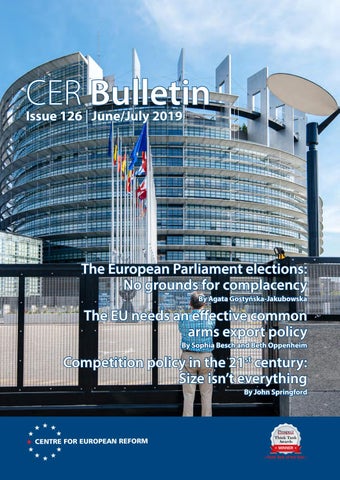
CER Bulletin Issue 126 | June/July 2019
The European Parliament elections: No grounds for complacency By Agata Gostyńska-Jakubowska
The EU needs an effective common arms export policy By Sophia Besch and Beth Oppenheim
Competition policy in the 21st century: Size isn’t everything By John Springford
WINNER Think Tank of the Year
The European Parliament elections: No grounds for complacency by Agata Gostyńska-Jakubowska
Despite media hype about a eurosceptic takeover, pro-EU forces held their ground in the European Parliament. But EU leaders cannot be complacent about the results of these European Parliament elections. EU leaders could be forgiven for breathing a sigh of relief when they discussed the European election results on May 28th in Brussels. Turnout was up, and there was no eurosceptic takeover, despite media hype. The mainstream centreright and centre-left political families lost their majority, which will make EU decision-making more cumbersome. But together with the liberal and green groups, both of which made big gains, pro-Europeans should be able to keep populists in check. The EU cannot be complacent about this result, however. The elections offer three important lessons for EU leaders when they discuss priorities for 2019-2024, and who should run the European Commission. First, increased participation in European elections is good news, but will not improve the EU’s democratic legitimacy on its own. Having fallen in every election since the European Parliament was directly elected for the first time in 1979, this time turnout increased from 42.6 per cent in 2014 to nearly 51 per cent. In some Central European countries, which had previously expressed little interest in European elections, turnout was over 20 points higher. In Romania it reached 51 per cent (from 32). In
Poland, turnout rose from 23.8 in 2014 to 45.6 per cent. European Council President Donald Tusk argued that increased participation “proves that the EU is a strong, pan-European democracy, which citizens care about.” But it is too early to say that European issues were the only driver behind greater public mobilisation in these elections and – as such – comments about an emerging European demos might be premature. A surge in support for populist and eurosceptic parties following the financial and migration crises could have galvanised pro-EU voters concerned about the “survival of the EU” to push back. Polarisation in politics can make people more willing to participate. But the European elections have also traditionally served as an opportunity to express frustration with national governments and domestic politics. In Poland, for example, the European Parliament elections were a dry run for the government and the opposition ahead of parliamentary elections in the autumn; the election campaign focused almost exclusively on domestic issues. Some member-states combined European elections with regional polls or referendums. In Romania, citizens voted on the government’s controversial judicial reforms, which envisaged among
INFO@CER.EU | WWW.CER.EU CER BULLETIN ISSUE 126 | JUNE/JULY 2019 3
other things an amnesty for those convicted of corruption. Ultimately, only detailed surveys on the motivations of voters will confirm whether increased turnout equals greater public engagement with European issues. There is also little evidence that the Spitzenkandidaten system, whereby European political parties put forward their candidates for the office of Commission president, boosted turnout. Supporters of the idea argued that more people would vote if they knew they could influence the choice of the president. The decision to make the charismatic Frans Timmermans, first vice-president of the Commission, the lead candidate of the Party of European Socialists (PES) may have contributed to the electoral success of his party, the Dutch Labour party. But according to a poll conducted by YouGov for the German Press Agency in April, only 26 per cent of Germans knew who the European People’s Party (EPP) Spitzenkandidat was, despite the fact that it was Manfred Weber, a German. The EU’s legitimacy ultimately depends not on turnout or the popularity of the Spitzenkandidaten, but on whether after the elections voters see changes in the policy areas they care about, including migration, the economy, unemployment and climate change. EU leaders, who will nominate their preferred candidate for the post of Commission president (subject to election by the European Parliament), should ensure that their nominee is willing to address these concerns. Second, being clear pays off. The elections showed that being vague does not always pay off. The lack of clear, passionate positions on the issues that matter to EU citizens seems to have cost the centre-right EPP and PES votes. Instead, European voters were increasingly drawn towards political movements advocating more radical solutions (good or bad) to the EU’s problems. This benefitted not only populist and eurosceptic parties but also the pro-European camp. Liberals (who joined forces with Macron’s political formation, Renaissance) and greens capitalised on the public’s weariness with the mainstream political families whose ambition is to ‘muddle through’. In Britain, the Liberal Democrats and the Green Party went from one seat in 2014 to 16 this time and from three seats to seven respectively, thanks to their clear support for another referendum and their opposition to Brexit. The Labour party, on the fence on Brexit, lost half of its seats. The success of green parties across the EU makes them valuable coalition partners for the EPP and
PES, who will only be able to pass legislation if they have the liberals and/or the greens on board. The greens have already indicated that they will only back a candidate for Commission president who is serious about climate action, fighting social injustice and defending the rule of law. The European Council should embrace these priorities in the EU’s Strategic Agenda for 20192024, and pick a Commission president who is a good communicator and will push to implement this agenda. Third, the populist threat is alive and kicking, but this does not have to be a bad thing. The next European Commission president should not be afraid of confronting eurosceptics and their narrative in the European Parliament. Although populists failed to storm the institution, they topped the polls in four of the six largest memberstates: the UK, France, Italy and Poland. As such, they cannot be disregarded. After watching the Brexit mess unfold, most populists now say that they want to build a Europe of nations, moving power away from supranational institutions towards member-states, rather than scrap the EU altogether. Whatever their real intentions, their revised narrative might appeal in several countries, especially Poland, where the public is very pro-European but also divided on how far the EU should intervene in what Poles see as domestic affairs. European populists will continue to use the European Parliament as a platform for eurosceptic rhetoric, and a means of acquiring funding and amplifying their support domestically. Strong populist representation in the European Parliament does not have to be a bad thing for European democracy, if it forces pro-European groups to engage in robust discussion on why their policy proposals are better than those of the eurosceptics. Greater political competition, not only between pro- and anti-European forces, but also within the pro-European bloc, could boost public interest in European politics. Pro-European groups in the European Parliament will be tempted to avoid these clashes, because the parliamentary arithmetic is in their favour anyway. They might see no need to go outside of their comfort zone to debate eurosceptics. But such an approach risks giving the public the impression that although it asked for change it will only get more of the same. Such complacency would squander the democratic potential of these elections.
Agata GostyńskaJakubowska,
Senior research fellow, CER @AgataGostynska
The EU needs an effective common arms export policy by Sophia Besch and Beth Oppenheim
The EU’s strategic interests and credibility are harmed by its ineffective and incoherent approach to arms export policy. The EU is the world’s second largest arms exporter, behind the US. Member-states’ combined arms exports made up 27 per cent of the global total in 2014-18, compared with 36 per cent for the US. On paper the Union has a common arms export policy. EU member-states have agreed to uphold “high common standards” for transfers of conventional arms, through the international Arms Trade Treaty and the EU Common Position on Arms Export Controls. The legally binding Common Position sets out eight criteria against which member-states must test export licences, including respect for human rights and international humanitarian law in the destination country.
protect allies and friendly states; and strengthen Europe’s defence industry.
Member-states are free to decide how they implement the Common Position, however, and there is no EU mechanism to sanction noncompliance. In practice, therefore, member-states operate their own, conflicting, national policies, and misapply the criteria in their export decisions, which are often political, or industry-driven.
By restricting arms supplies, the EU can attempt to change a state’s behaviour. Arms embargoes can constrain aggressive behaviour by depriving a country of military resources. Arms export restrictions can also signal condemnation of human rights abuses or violations of international humanitarian law. But the impact of arms embargoes should not be overstated. On their own, they are ineffective in changing state behaviour, and are particularly poor at preventing human rights abuses and crackdowns on democracy. The most effective arms embargoes are usually accompanied by additional economic sanctions, which hit countries far harder.
Inconsistent implementation of the Common Position stops the EU using arms exports to pursue its foreign and security policy objectives. A genuinely common policy would stop EU weapons being used to undermine regional stability or violate international humanitarian and human rights law; promote regional stability;
By supplying arms, the EU can help its allies and partners maintain technological parity with, or superiority over, shared adversaries; and make it easier to conduct joint operations with its partners. Europeans sometimes export to strategic partners or allies in crisis-prone regions in the hope of contributing to regional stability – though this is a risky strategy that should always form part of a comprehensive support programme, including training and educating security forces about how to use the arms in line with international law.
INFO@CER.EU | WWW.CER.EU CER BULLETIN ISSUE 126 | JUNE/JULY 2019 5
EU arms export policy is also closely linked to efforts to build up the EU’s defence industrial base. Because of the low level of defence spending in Europe, European defence firms rely heavily on exports to sustain themselves. As a result, European industries sometimes prioritise the capability needs of export customers over those of EU states. Between 2014 and 2018, 90 per cent of France’s arms exports and 73 per cent of Germany’s went to buyers outside the EU, while in 2017, 89 per cent of UK arms exports went outside Europe. The EU’s solution, through initiatives like the European Defence Fund, is to create greater economies of scale in European production. The idea is not to encourage EU member-states only to ‘buy European’, but to help them be more selective about whom they export to. At the same time, joining forces to develop a new capability, like the next European fighter jet, requires countries and their defence industries to trust each other to provide components. Arms export policies need to be predictable and consistent. In order to force countries to adhere to the Common Position, the EU would have to introduce a sanctions mechanism. The EU could establish a supervisory arms export body under the control of the Commission or the High Representative, which could report on violations of the Common Position by member-states. If the infringement continued, the Commission could refer it to the European Court of Justice. But creating a sanctions mechanism would require treaty change. The biggest obstacle to a common arms policy however, is that EU member-states often disagree on their analysis of a conflict and the EU’s interests in it. For instance, member-states diverge on whether supplying weapons to Saudi Arabia will help stabilise or destabilise the Gulf region and what the impact on European security would be. Ultimately, there is no consensus on threat perception and strategic assessment. At present member-states have little appetite for surrendering decision-making power over arms exports. But in future the EU’s institutions may try to exert more control. After years of staying out of the defence realm, long considered a bastion of national sovereignty, the European Commission is progressively carving out a role for itself. Even before that, the EU could improve transparency to aid decision-making. The Council’s Working Party on Conventional Arms Exports (COARM) produces an annual report compiling member-states’ statistics on conventional arms licences and exports. The report should become a searchable online
database. Many member-states, including France, the UK and Germany, still fail to submit full reports on their export licences on time. The EU should establish strict reporting deadlines and standardise the format of reports. Some countries struggle to provide the required data due to lack of resources or know-how. COARM should arrange peer review meetings, where governments can exchange best practices on how to gather such data from industry. The EU should implement stronger end-use controls at the European level. Exported weapons can and do end up in the wrong hands. A 2017 report found that more than 30 per cent of the arms used by IS fighters in Syria and Iraq came from Bulgaria, Romania, Hungary and Germany. The EU could encourage and support memberstates in implementing post-shipment controls. EU resources, such as expert teams made up of Commission or European External Action Service staff, dispatched to EU delegations in the buying country, could be employed to help with controls. Finally, export-specific agreements between small groups of member-states that want to work together on a capability project could slowly build trust and contribute to greater convergence. But in order to strengthen rather than erode EU foreign policy objectives, these agreements would have to include a binding commitment to abide by the EU’s export criteria. Without a common and enforceable EU arms export regime, divergence – and therefore weakened EU power and legitimacy – is inevitable. But conversations with EU officials and industry figures make it clear that a supervisory arms export body backed up by a compliance mechanism is at best a long-term possibility, for which there is no consensus at present. For now, EU member-states should attempt to reach consensus on the threat environment in which arms exports are taking place, improve reporting by member-states, tighten end-use controls and reach inter-governmental export agreements. New EU defence initiatives and the increasing role of the Commission suggest the relationship between national sovereignty and defence is shifting. Europe will benefit if it can keep moving towards convergence on arms export policy.
Sophia Besch
Research fellow, CER @SophiaBesch
Beth Oppenheim
Researcher, CER @BethOppenheim
Competition policy in the 21st century: Size isn’t everything by John Springford
France and Germany have proposed laxer EU merger control to help European companies compete with Chinese firms. But competition has been waning within the EU, and stronger merger rules may be needed. In February, after the European Union had blocked a tie-up of Siemens and Alstom’s railway businesses, French and German finance ministers Bruno Le Maire and Olaf Scholz proposed that member-states gain the right to override European Commission merger decisions. Citing rising competition from Chinese companies, they also proposed that the Commission consider competition globally, not just in the European market, when making its decisions. The Franco-German ‘joint manifesto’ had some sensible suggestions for curtailing the distorting effects of China’s credit subsidies, and raising European investment in new technology. But Le Maire argued that Europe needed “true champions”, and that laxer EU merger control may be needed to ease their growth. This is not borne out by recent research. In our paper on regional divergence in Europe, ‘The big European sort? The diverging fortunes of Europe’s regions’, the CER and Bloomberg Economics found that the most profitable European firms are, if anything, more likely to be small and medium-sized companies than corporate titans. And there has been a growing gap between the most profitable firms and the rest. The divergence in profitability was stronger in the services sector than in manufacturing; and particularly strong in high-technology sectors, such as digital
technology, communications, pharmaceuticals and medical devices. In April, the IMF published research showing that corporate ‘mark-ups’ had risen by about 8 per cent in advanced economies between 2000 and 2015, and that smaller, high-technology companies’ mark-ups rose most. A mark-up is defined as the difference between a given product’s price and the cost of producing one extra unit of it. When prices are rising faster than costs, it is a sign that companies have greater market power: companies facing vigorous competition find it difficult to raise mark-ups, because their customers would switch to a cheaper product. Why might some companies, irrespective of size, be better able to raise prices and grow profits? The most likely answer is that ‘winnertakes-most’ dynamics have become increasingly important in recent years. Companies may have better technology for producing their goods and services, better management or better branding. But they may also benefit from ‘network effects’: Facebook and Google dominate the online advertising market because consumers and businesses seek the maximum number of eyeballs for their content, which encourages everyone to use the same platform. Smaller companies may dominate niche markets, providing components or software that are used by many consumers and
INFO@CER.EU | WWW.CER.EU CER BULLETIN ISSUE 126 | JUNE/JULY 2019 7
businesses. These dynamics mean that companies that are only a little better than the competition gain disproportionate market share. Stronger merger control, not weaker, may be necessary to prevent already dominant companies from gobbling up smaller competitors, especially in sectors with persistently high profits: Facebook’s purchase of WhatsApp is an obvious example. At present, competition authorities tend to focus on mergers of large companies. Competition can also be promoted with a broader set of policy tools. The EU should carry on trying to increase trade and foreign direct investment, both within Europe and with the rest of the world. That would allow foreign companies to compete against domestic incumbents. Promarket regulations can help to reduce barriers to entry: ensuring that consumers can easily take their phone numbers, bank account details and other forms of data to alternative providers makes it easier for them to switch to cheaper or better services. Reforms to Europe’s corporation tax regimes would also help. Large multinational companies are better able to shift profits between jurisdictions in order to avoid corporate tax. This means that smaller, largely domestic companies face a higher tax burden. Moves towards a more destinationbased corporate tax system would help to promote competition, by ensuring that multinational companies paid more corporation tax to memberstates that provided a larger proportion of their revenues, making the tax rate for multinationals and domestic companies more equal. The EU needs a broader, more thoughtful competition strategy than France and Germany
have so far proposed. While China’s system of subsidised credit distorts global competition, allowing member-states to intervene in EU merger decisions would add discretion to a system that should be rules-based. Competition Commissioner Margrethe Vestager pointed out at a CER event in May that competition decisions are legally actionable, so would companies be able to take the European Council to the European Court of Justice? And the Commission would struggle to stop member-states from intervening in its decisions in order to advance the interests of favoured companies. Creating European champions to counteract Chinese subsidy may distort competition within Europe, by creating companies with more power in the European market. That may raise prices and lower innovation. A better long-term strategy would be to strengthen multilateral rules, by working with the US to designate China’s banking system as a ‘public body’, which would mean that countervailing duties could then be applied to Chinese exporters who benefit from subsidised credit. In the 21st century economy, size matters less than it used to. Smaller companies can dominate niche markets if they have a product that is marginally better than their competitors’, or if they have already amassed a network of consumers and businesses. And larger companies strategically purchase smaller companies with an eye on their future profits. The welfare of consumers will be served by stronger merger control, not weaker.
John Springford
Deputy director, CER @JohnSpringford
CER in the press CNN 23rd May “Eurosceptics and populists are going to grow exponentially this time,” says Camino Mortera-Martinez of the CER. “You’re going to have a much more divided Parliament.” The New York Times 19th May Agata Gostyńska-Jakubowska of the CER in Brussels said the Austria scandal is timely ammunition for those who warn that many populist parties are deeply
compromised by their ties to Mr Putin. Financial Times 13th May Christian Odendahl of the CER said “It was only in 2012, when Europe threw some dogmas out of the window, that the eurozone stabilised.” Financial Times 8th May “While the common travel area was always designated an issue to be negotiated and resolved by the UK and Ireland bilaterally, the
external trade policy of the EU is very much not,” said Sam Lowe of the CER. Bloomberg 2nd May “Most of the rivals to succeed May would want the UK to be out there as a great trading nation. But within the Tory Party there is also a strand of economic nationalism that would say we don’t want to let in all this foreign stuff,” said Ian Bond of the CER. Reuters 11th April
“Franco-German relations are in a troubled period,” said Charles Grant of the CER. He cited differences on eurozone reform, relations with the US, EU defence policy and tax rules for the digital economy. The Daily Mail 9th April “The UK missed out on a broad-based upturn in growth among advanced economies in 2017 and early 2018 and the economic cost of the decision so far is sizeable,” said the CER’s John Springford.
INFO@CER.EU | WWW.CER.EU CER BULLETIN ISSUE 126 | JUNE/JULY 2019
Recent events 22 May CER/Kreab breakfast on ‘Enforcing competition rules in a globalised world’, Brussels With Margrethe Vestager 8 May Launch of ‘The big European sort? The diverging fortunes of Europe’s regions’, Brussels With Cinzia Alcidi, Joaquín Almunia, Joaquim Oliveira Martins and Raquel OrtegaArgilés Margrethe Vestager
Joaquim Oliveira Martins and Raquel Ortega-Argilés 25 April CER/Kreab breakfast on ‘What will the European Parliament look like after the elections?’, Brussels With Klaus Welle
Klaus Welle
24 April CER/FES conference on ‘Europe’s climate change challenge’, London Speakers included: Elina Bardram, Catherine Howarth, Clive Lewis, Clare Moody and Philipp Niessen
Sophia Besch and Clive Lewis
3 April Breakfast on ‘The Labour Party’s approach to Brexit’, London With Keir Starmer 1 April CER/Kreab breakfast on ‘Catch me if you can: What are Europol’s priorities for the next five years?’, Brussels With Catherine De Bolle Keir Starmer
For further information please visit
www.cer.eu
Catherine De Bolle