Is Spain simply late to Europe’s populist party? by Camino Mortera-Martinez
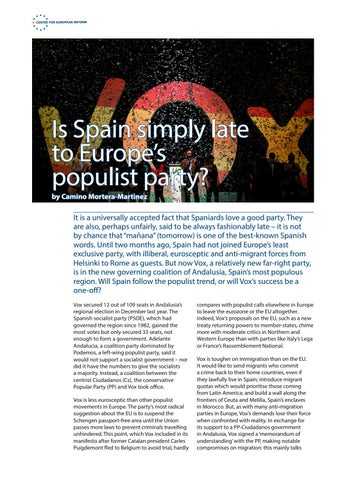
It is a universally accepted fact that Spaniards love a good party. They are also, perhaps unfairly, said to be always fashionably late – it is not by chance that “mañana” (tomorrow) is one of the best-known Spanish words. Until two months ago, Spain had not joined Europe’s least exclusive party, with illiberal, eurosceptic and anti-migrant forces from Helsinki to Rome as guests. But now Vox, a relatively new far-right party, is in the new governing coalition of Andalusia, Spain’s most populous region. Will Spain follow the populist trend, or will Vox’s success be a one-off? Vox secured 12 out of 109 seats in Andalusia’s regional election in December last year. The Spanish socialist party (PSOE), which had governed the region since 1982, gained the most votes but only secured 33 seats, not enough to form a government. Adelante Andalucia, a coalition party dominated by Podemos, a left-wing populist party, said it would not support a socialist government – nor did it have the numbers to give the socialists a majority. Instead, a coalition between the centrist Ciudadanos (Cs), the conservative Popular Party (PP) and Vox took office. Vox is less eurosceptic than other populist movements in Europe. The party’s most radical suggestion about the EU is to suspend the Schengen passport-free area until the Union passes more laws to prevent criminals travelling unhindered. This point, which Vox included in its manifesto after former Catalan president Carles Puigdemont fled to Belgium to avoid trial, hardly
compares with populist calls elsewhere in Europe to leave the eurozone or the EU altogether. Indeed, Vox’s proposals on the EU, such as a new treaty returning powers to member-states, chime more with moderate critics in Northern and Western Europe than with parties like Italy’s Lega or France’s Rassemblement National. Vox is tougher on immigration than on the EU. It would like to send migrants who commit a crime back to their home countries, even if they lawfully live in Spain; introduce migrant quotas which would prioritise those coming from Latin America; and build a wall along the frontiers of Ceuta and Melilla, Spain’s enclaves in Morocco. But, as with many anti-migration parties in Europe, Vox’s demands lose their force when confronted with reality. In exchange for its support to a PP-Ciudadanos government in Andalusia, Vox signed a ‘memorandum of understanding’ with the PP, making notable compromises on migration: this mainly talks
INFO@CER.EU | WWW.CER.EU CER BULLETIN ISSUE 124 | FEBRUARY/MARCH 2019 7
about reinforcing border controls (though it does not explain how) and doing more to fight migrant smuggling. Vox’s softer position on migration in Andalusia is a rational choice. Although many people vote for Vox because they are upset about Spain’s migration policies, this is far from the only explanation for the party’s sudden popularity. Vox thrived in some Andalusian towns with many migrants, but it did rather poorly in others. And a recent poll shows that many of Vox’s voters are unhappy about differences in the distribution of wealth between Spanish regions, and the inefficient functioning of the Spanish devolved administrations. Vox is doing fairly well in national polls. If national elections were held now, reliable polls estimate it would enter the Spanish Parliament with 12 to 13 per cent of the votes, or up to 45 seats (as a comparison, Ciudadanos has 33). If this is the case, Vox will have an important role in coalition formation. Perhaps the success of Vox both nationally and in Andalusia is that it is not a single-issue party, and it revives issues that Spain’s mainstream parties seem to have forgotten amid the noise of the financial crisis and Catalonia’s independence bid. These range from national identity to taxation to domestic violence. Many of them overlap: for example, part of Vox’s argument about national unity is based on the desire to scrap regional differences on taxation, which mean that people living in, for instance, the western region of Extremadura pay
more taxes than those living in Castilla y León in central Spain. In the long run, Vox’s success will not only be measured by the number of seats it manages to secure in the forthcoming European and regional elections, but by its ability to influence and ultimately dominate Spain’s national debate on issues like migration, security and the economy. And on that, Vox seems to be doing rather well: the PP has toughened its stance on values and national identity, as its new leader Pablo Casado rebrands the party as the “unashamed right”. Vox’s surge is also a major headache for Albert Rivera, Cs leader: his party’s membership of the governing coalition in Andalusia has attracted criticism from Rivera’s European partners. This matters, as Rivera hopes to get good results in the European elections by forging alliances with like-minded parties across the EU. The coalition in Andalusia may put off allies such as French president Emmanuel Macron or Dutch prime minister Mark Rutte, whose parties have long ring-fenced the far right. Vox will probably not take the Spanish or European parliaments by storm, though it will make its presence felt. But if the Andalusian experience is anything to go by, Spain has belatedly joined Europe’s populist party.
Camino Mortera-Martinez
Senior research fellow, CER @CaminoMortera
CER in the press The Sunday Times 20th January The influential CER argues [in ‘After the meaningful vote: What are Theresa May’s options?’ by Sam Lowe and John Springford] that the only option for the prime minister in getting a withdrawal agreement through the Commons will be to further blur her red lines, so pushing Britain towards a softer Brexit. The Financial Times 18th January “In some of the key memberstates, senior officials believe that if the European Council wants to give the British an extension beyond July 1st, the election issue could
be solved in a one-page protocol that could be ratified relatively quickly,” said Charles Grant, director of the CER. “This would mean the British would not have to hold elections themselves.”
As Agata GostyńskaJakubowska of the CER notes, it [an Article 50 extension] would also stop the reallocation of the 27 British seats, screwing up other countries’ polls.
relationship go?’, the much bigger threat to trade from Brexit is to Britain’s services sector, accounting for nearly a half of all UK exports, of which around 40 per cent go to the rest of the EU.
Politico 17th January If the EU cannot agree on a common system for legal migration, it may be more realistic for the Union to support bilateral projects between individual member countries or groups and third countries, said Camino Mortera-Martinez and Beth Oppenheim of the CER.
The Financial Times 12th December The EU is scrambling to respond to US sanctions on Iran for fear of retaliation. Luigi Scazzieri at the CER says it is time for the bloc to buck up its ideas.
The Wall Street Journal 6th December For everyone to trade in dollars, they must be able to store them for future use, explain Adam Tooze and Christian Odendahl in a paper ‘Can the euro rival the dollar?’ for the CER. That means finding safe dollar assets, such as government bonds or other bonds with high credit ratings. Demand for these lowers financing costs for anyone borrowing in dollars.
The Economist 16th January
The Telegraph 8th December As the CER’s Sam Lowe points out in a new analysis ‘Brexit and services: How deep can the UK-EU